Dead Jacks · Multi-Gig Links Stuck at 1G · Hidden Couplers · Lower-Level Water · PoE Drops · Re-Termination & Testing
Most of the Cat6 in Rockland was never part of the original building. It was added later — to a 1960s raised ranch in New City, a split-level in Pearl River, a professional office on Route 59, a storefront in Nyack — by an internet installer, a previous owner, a renovation crew or an IT provider in a hurry. Those after-the-fact runs fail at the places the retrofit created: a staple through the jacket, a coupler hidden above a finished ceiling, a jack punched down with the pairs untwisted, a run lying on a lower-level floor that took water. We test each link to its category, find the exact point of failure, repair it properly and hand you the result.
Reviewed and updated October 17, 2026 · Written by Anwar Timothy, NYS licence #12000287431
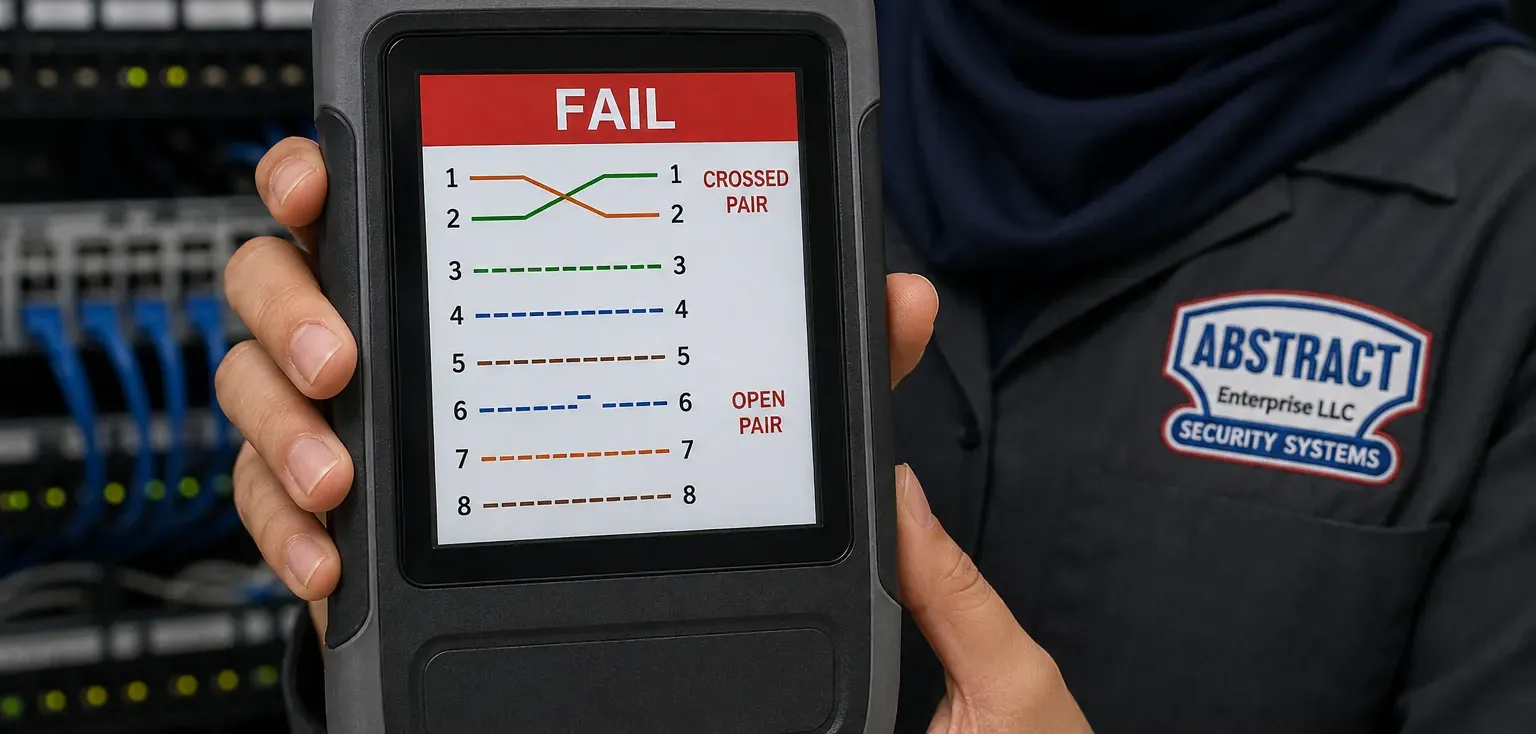
A handheld tester with a blue patch cord plugged into its top displays FAIL in red, with the wire map marking a crossed pair on pins 1 and 2 and an open pair on pin 6; racks of blue patch cords fill the background.
Rockland Cat6 Repair Quote
Tell us which jacks or devices fail and who ran the cable — a technician replies the same business day
✅
Request Sent!
A Rockland technician will be in touch the same business day.
25+
Years Experience
✓
Same-Day Estimates
100%
Licensed & Insured
4.7★
201 Google Reviews
One jack dead in the den, or the whole upstairs slower since the fiber went in? Ring our Rockland line, (845) 640-3835, or use the 60-second form. A licensed technician reads it, asks who ran the cable and what changed, and tells you what the fault most likely is before anything is booked.
Each failing link measured against its Cat6 limits, not just checked for continuity
Hidden splices, couplers and staple damage found by distance, so finished ceilings stay closed wherever possible
NYS licence #12000287431 · fully insured · written quote before work starts
Why Rockland County Properties Need Cat6 Repair Built Around Retrofit Cable
Rockland grew fast, and it grew before anyone wired houses for data. The Historical Society of Rockland County records that homes were going up at a rate of more than a thousand a year in the 1950s, driven by the Tappan Zee Bridge opening in 1955 and the completion of the Palisades Interstate Parkway and the Thruway in the same decade. The county’s population went from 89,276 in 1950 to 229,903 in 1970. That boom produced the streets of raised ranches, split-levels, colonials and capes that still make up most of Clarkstown, Ramapo and Orangetown, and a generation of low-rise offices, strip plazas and medical buildings along Route 59, Route 304 and Route 303. None of it was built with Cat6 in the walls. Every run of Cat6 you find in those buildings today was added afterwards.
That one fact explains most of the Cat6 repairs we do in the county. Cable that goes in during construction is pulled through open framing, terminated on a bench-like workflow and tested before the drywall closes. Cable added to a finished building is fished, stapled, tucked and squeezed through whatever path is available: down an exterior wall cavity, along a garage ceiling, through the heating chase of a split-level, behind baseboard, above a dropped ceiling that was later replaced with drywall. Each of those paths has a weak point — a staple driven too hard, a sharp bend at a top plate, a jacket nicked on a nail, a run spliced with a coupler when it came up short. The link works for months or years, then a renovation, a move of furniture, a new router location or a hot summer finds the weak point.
The second pressure is the network itself. Across Rockland, internet service has been moving to fiber; Optimum’s own installation guidance tells customers on its faster plans to use “Ethernet CAT 6 or higher” and a switch with a 10-gigabit port, and a comparison site claims Optimum fiber now reaches 91.5 percent of Rockland homes. When a household or a small office upgrades to a multi-gigabit plan, every Cat6 run in the building is asked to carry more than it ever has. Links that negotiated a gigabit without complaint suddenly refuse 2.5 or 5 gigabits, or drop back to 100 megabits under load. The plan is not at fault, and usually neither is the cable type — it is a bad termination, an untwisted pair or a cheap coupler that a gigabit link tolerated.
The third is water. Rockland is not on the coast, but it floods. On July 9, 2023 a storm dumped more than eight inches of rain on the county, according to the Rockland County Times, and flash flooding damaged homes, closed Route 9W and much of the road network in Stony Point; Rockland was one of the counties named in the federal disaster declaration that followed. In Spring Valley, a 52-unit complex at 9 Park Avenue that had flooded repeatedly, including a major flood in 2019, was ordered vacated, repaired or demolished in May 2026, ABC7 reported, with its basement apartments already off-limits. Lower levels in the county’s split-levels and raised ranches are exactly where the router, the switch and the cable bundle usually live. When water reaches them, the terminations corrode first.
The last is turnover. Rockland property changes hands and changes use constantly — houses sold to new families who finish the basement, offices in Pearl River and Orangeburg re-tenanted, plazas on Route 59 sold and re-leased, the Palisades Center itself sold at a foreclosure auction in February 2026. Each change adds another layer of cable from another installer, rarely with labels. So a Rockland Cat6 repair begins with two questions most repair calls skip: who installed this run, and what has been done to the building since?
Rockland facts behind the Cat6 faults we repair
More than 1,000 homes a year: the 1950s building rate recorded by the Historical Society of Rockland County after the Tappan Zee Bridge opened in 1955. The houses of that era predate data cabling entirely, so all of their Cat6 is retrofit.
Median year built 1970: Rockland’s housing stock, per a September 2025 Stacker analysis of U.S. Census Bureau data, with 11.5 percent (12,523 homes) built in 1939 or earlier — mostly in the river villages.
109,671 housing units, 64 percent single-unit: the county’s housing count in the American Community Survey as shown by Census Reporter, with 66 percent owner-occupied. Most of our Rockland Cat6 repairs are in houses, home offices and small professional buildings, not towers.
More than 8 inches of rain: on Sunday, July 9, 2023, according to the Rockland County Times, with flash-flood damage to homes and roads across northern Rockland and Route 9W left unusable in Stony Point. Rockland was among the counties in federal disaster declaration DR-4723.
64,575 lightning pulses: detected over Rockland in 2020 in Earth Networks’ New York report, the fewest of the six Hudson Valley counties, with 28 thunder days. Storm surges happen here, but they are a smaller share of our Rockland repairs than water, renovation and termination faults.
More than 47,000 customers: affected by outages in Orange and Rockland Utilities’ territory from July 1, 2026, according to the utility’s July 6 update, with Clarkstown and Ramapo among the towns still waiting at the time. Power returning after an outage is when marginal PoE links and switch ports often give up.
Five towns, 19 villages and 16 hamlets make up the county, per Explore Rockland, and building departments sit at town and village level — which matters when a repair turns into wall or ceiling work.
Put together, the Rockland version of Cat6 repair looks less like storm recovery and more like detective work inside finished buildings: find the run, find out who touched it last, find the exact spot it fails, and repair it without opening more of the house or office than the fault requires. When the cause is the path itself — a run that will be stapled, flooded or crushed again — the repair includes moving it.
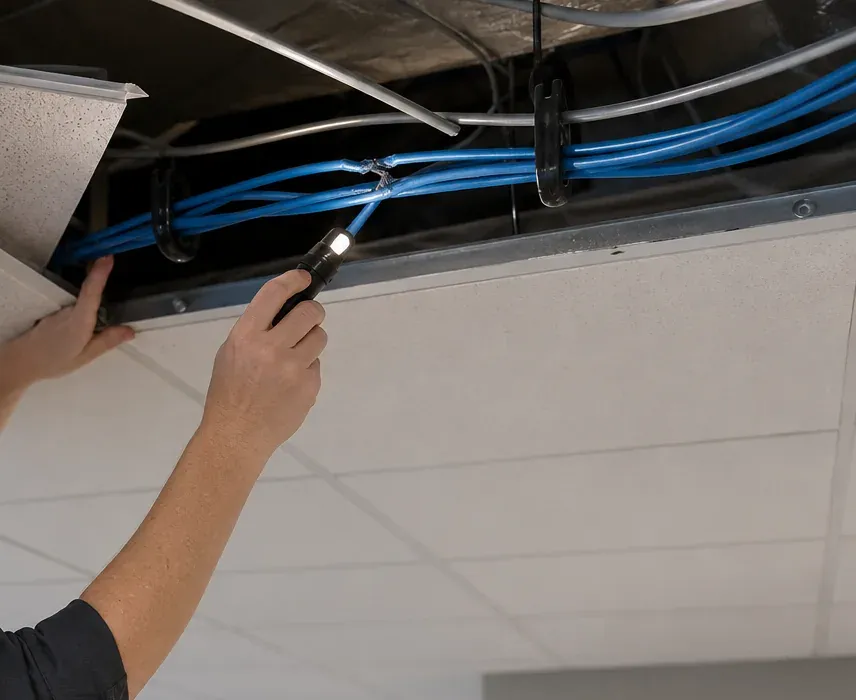
One hand holds a ceiling tile up while the other shines a small flashlight along a bundle of blue cables resting in black J-hooks above the grid.
Repair Capture
A Rockland Cat6 Jack Dead This Morning?
A home office in Congers that lost its wired connection the morning of a deadline, a dental front desk in New City whose card terminal keeps dropping, a camera over a Spring Valley storefront that went dark after the power came back, a family room in Valley Cottage where the TV’s Ethernet stopped working after the painters moved the cabinet — these are service calls, and we treat them that way. Tell us what failed, what changed and who installed the cable if you know. We book the next available two-hour arrival window and load the van for the likely cause: Cat6 and Cat6A keystones and plates, RJ45 plugs rated for solid conductors, replacement cable, a multi-gig link tester and a certification tester. A single bad termination, cord or coupler is usually found and fixed within one to two hours on site. Repair time is $195 an hour with a three-hour minimum ($585), the rate published on our Rockland network cable repair page. Call (845) 640-3835 and say it is a Cat6 fault.
What We Repair
Cat6 Repair Services in Rockland County
These are the Cat6 repairs Rockland homeowners, practice managers, landlords and IT providers call us for most often. Every one ends the same way: the link is measured against its category, the reading is saved, and you are told in plain words what caused the failure.
Dead-Jack Diagnosis
A wall plate with no link at all, traced to the plate, the run, a hidden splice or the far end, with the fault located by distance before any wall or ceiling is opened.
Multi-Gig Link Repair
Runs that will not negotiate 2.5, 5 or 10 gigabits after a fiber upgrade: untwisted terminations, split pairs, voice-grade cords and couplers found and corrected so the link holds the speed the plan was bought for.
Hidden Coupler and Splice Removal
In-line couplers, tape splices and junction boxes left above finished basement ceilings or inside walls during a past renovation, replaced with a continuous run or a rated, accessible connection.
Lower-Level Water Damage
Corroded keystones, patch panels and plugs in basements and lower levels after a flood or a failed sump, tested link by link, re-terminated or replaced, and moved above the water line where possible.
Staple, Nail and Crush Damage
Runs flattened by staples along joists, pierced by a trim nail or a picture hook, or crushed under a door or a cabinet, located on the tester and repaired at the damaged section.
Re-Termination to Category
Jacks, plugs and panel ports remade on matched Cat6 or Cat6A hardware, with the pair twist carried to the contacts, then proven against the Cat6 limits rather than a continuity light.
PoE Camera, Doorbell and AP Links
Cameras, video doorbells, access points and phones that reboot or drop, with weak terminations and damaged runs separated from switch power budgets and injector problems.
Router and ONT Relocation Fixes
Jacks that went dead when the internet equipment moved to a new room during a fiber install, re-patched or re-run so the house’s existing Cat6 is fed from the new location.
Testing and Certification
Repaired links, or a whole house or suite, tested to the TIA permanent-link or channel limits, with saved results you can hand to a buyer, a landlord or your IT provider.
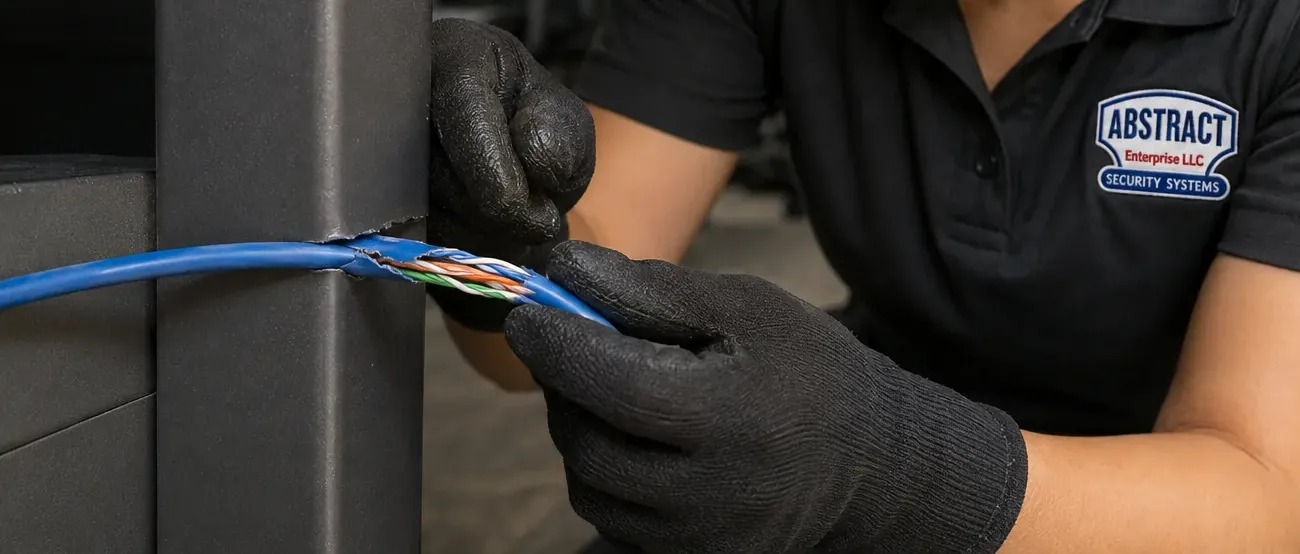
Two gloved hands hold a blue cable beside a dark metal desk leg where the jacket has split open, exposing the twisted orange, green and white pairs inside.
Building Specialists
Cat6 Repair for Rockland County’s Architecture
In Rockland the house or office type predicts where a retrofit run was squeezed through, and so where it is most likely to fail. These are the building types behind most of our county calls, and what each one tends to do to Cat6.
Raised Ranches
Entry on a landing between two floors, living space above, a den, laundry and garage below. Cat6 usually climbs from the lower level through a closet, a heating chase or the garage ceiling, and the tight turns and staples along that climb are where we find damage.
Split-Levels
Three or four half-floors stacked around short stairs. Runs between levels cross the joint where one floor system meets the next, often through a narrow gap above a foundation wall, and finished family rooms hide the path.
Colonials and Capes
Two full floors or a floor and a dormered attic. Cat6 is commonly fished down exterior walls or run through knee-wall attics, where insulation work, summer heat and later dormer additions stress the cable.
River-Village Houses
Victorian and older houses in Nyack, Piermont and Haverstraw, many in the 11.5 percent of county homes built before 1940. Plaster, balloon framing and surface raceway put the weak points at plates, staples and baseboard runs.
Two-Family and Small Multifamily
Houses split into units in Spring Valley, Haverstraw, Monsey and the village centres. Shared basements, a single entry for both units’ internet service and runs that cross from one unit’s space into the other’s complicate every repair.
1960s–1980s Office Buildings
Low-rise suites in Pearl River, Orangeburg, Nanuet and Suffern, re-tenanted many times. Expect three generations of cable above the grid, panels with nobody’s labels and Cat6 jacks on Cat5e cable that was never replaced.
Medical and Dental Practices
Converted houses and small office buildings along Route 59, Main Street in New City and around the hospital campuses. Exam-room jacks behind cabinetry, carts that hit floor-level plates, and patient hours that limit when work can happen.
Strip Plazas and Shopping Centres
Single-storey retail along Route 59 and Route 303 and around the Palisades Center and Nanuet Town Centre. Point-of-sale and camera runs pass through stockrooms and over neighbouring units, and tenant turnover leaves cable of unknown origin.
What we check on every Rockland retrofit run
Who installed it, and how? Cable put in by an internet provider’s technician, a previous owner or a renovation crew tends to have a recognisable signature: field-crimped plugs instead of jacks, a run coming out of the wall through a grommet, colour-coded but unlabelled cable, a cheap keystone that takes a punch tool badly. We look for those signatures first, because they tell us what else on the property was probably done the same way.
Is there a joint we cannot see? When a retrofit run came up short, the usual fix was a coupler. When a basement was finished after the cable was in, the usual fix for a run in the way was to cut it and join it. A certification tester shows a joint as a reflection at a measured distance, so we can tell you whether there is a hidden connection and roughly where it sits before anything is opened. Joints inside closed walls and ceilings are the most common single cause of Rockland multi-gig failures we see.
Has the run been stapled, nailed or crushed? Cable stapled tightly to joists and studs is deformed at every staple. One or two hard staples rarely kill a link; a dozen along a basement ceiling can push return loss and crosstalk past the Cat6 limit. Trim carpenters and picture hangers add nails. Furniture and doors crush runs that were laid on floors or under thresholds. The tester’s distance reading tells us which of those to look for.
Has water reached it? On lower levels we check the bottom of the wall for tide marks, open the lowest jacks and the panel, and look for green corrosion on contacts. Water that has reached the inside of a jacket travels along it, so the reading on the tester matters more than how dry the outside looks.
Is the cable really solid-copper Cat6? At any cut we look at the conductors. Silver showing through the copper colour means copper-clad aluminium, which cannot certify and runs warm under PoE. We also check printed jacket markings, because some retrofit runs are Cat5e with Cat6 jacks on the ends, which explains a lot of disappointing speed tests.
Homeowners who are already opening walls often ask us to look at the rest of the low-voltage wiring. Our low-voltage installation service in Rockland County handles the doorbell, intercom and control wiring that tends to share the same paths.
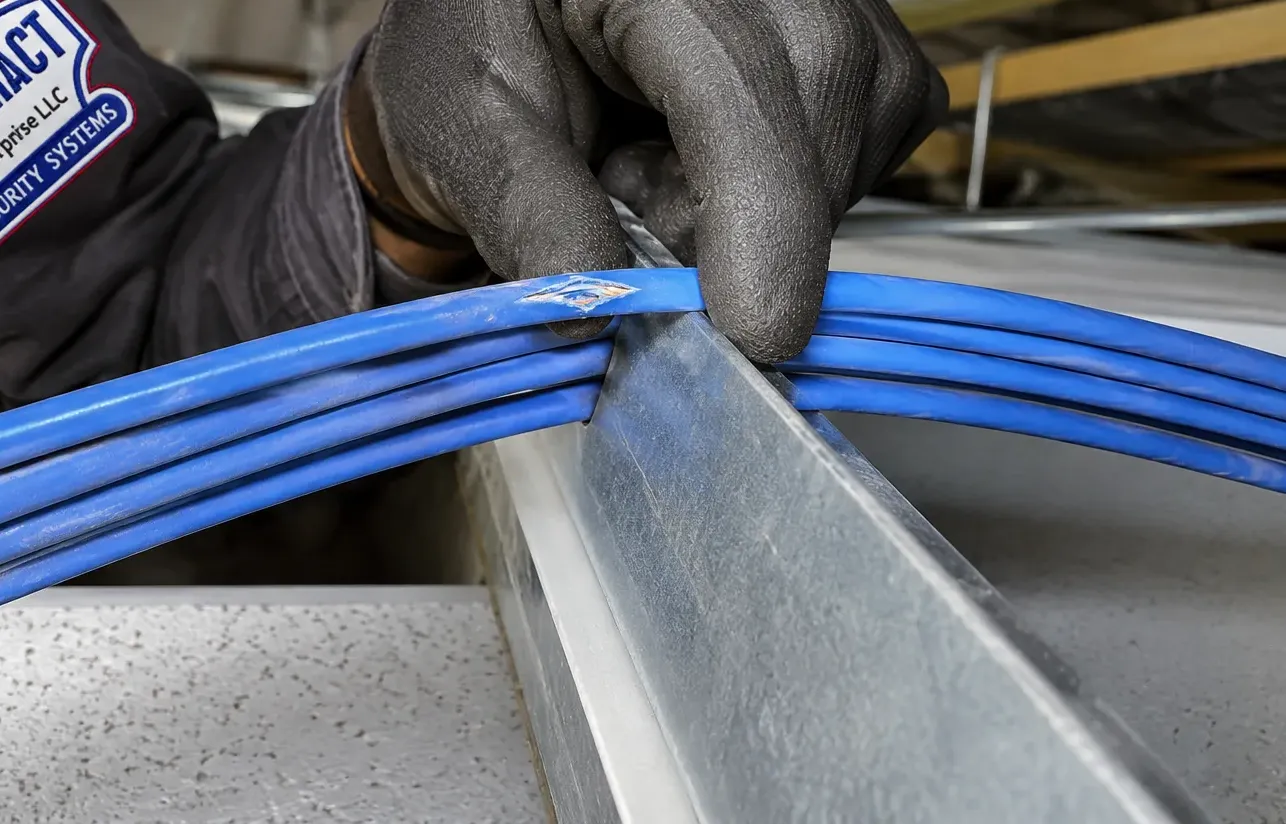
A gloved hand lifts four blue cables where they cross a galvanised ceiling rail; the top cable shows a scraped patch where the jacket has worn through to the colours beneath.
Commercial Cat6 Repair
Business Cat6 Repair in Rockland County
Rockland’s business Cat6 sits in a handful of distinct districts, and each one fails in its own way. The places below are real and are named to describe the building stock around them, not as a list of AESS jobs.
Route 59, Nanuet and West Nyack
The county’s commercial spine, which roughly follows the old Nyack Turnpike between Nyack and Suffern. Nanuet Town Centre, the former Nanuet Mall reopened as an outdoor centre in 2013, and the Palisades Center, sold for $175 million at a February 2026 foreclosure auction according to News 12, anchor a corridor of plazas where tenant fit-outs keep disturbing older Cat6.
Pearl River and Blue Hill
Blue Hill Plaza, a 21-storey tower and an eight-storey building of nearly 1.2 million square feet on 90 acres, completed in 1972 and described on Wikipedia as about 40 percent of Rockland’s office leasing market in 2011, sits beside the former Lederle and Pfizer campus now marketed as Hudson Valley iCampus. Suites here are re-cabled by each tenant on top of the last.
Route 303, Orangeburg, Blauvelt and Tappan
Flex, warehouse and office space such as Bradley Corporate Park in Blauvelt — 16 buildings on 180 acres totalling 1.2 million square feet, per Real Estate NJ in 2019 — and the 54-acre industrial site at 108 Route 303 in Tappan sold in 2026, Rockland News reported. Office fronts with warehouse backs mean runs that cross from conditioned space into hot or cold bays.
New City and the County Seat
County government, courts, law offices and medical practices along Main Street and North Main Street in New City, many in converted houses and small two-storey buildings, where Cat6 was added room by room as practices grew.
Nyack’s Main Street and Broadway
Nineteenth-century brick and frame storefronts holding restaurants, galleries and offices, near the Montefiore Nyack Hospital campus, which its foundation says welcomes more than 180,000 patients and visitors a year. Surface raceway, cellar panels and limited cavities define every repair.
Suffern, Monsey and Spring Valley
Suffern’s Lafayette Avenue downtown and Rockland Community College’s 175-acre campus at 145 College Road, Monsey’s dense mixed-use streets around the Route 59 and Saddle River Road centre that sold in 2026, and Spring Valley’s strip retail — buildings that change hands and uses often.
Compliance callouts for Cat6 repairs in Rockland
Home improvement contracts in writing. Rockland’s Chapter 286, adopted by the County Legislature on April 14, 2026, defines home improvement as repair, replacement, installation and alteration work on a private residence of up to three units, requires every home improvement contract over $500 to be in writing and signed before work starts, and requires a written change order before any additional work over $500. It excludes, among other things, electrical work and work by a county-licensed alarm business. AESS gives every residential repair a written quote and asks for written approval before any extra work, whatever the size.
County trade licensing. Rockland licenses master electricians and electrical inspection agencies under Chapter 250 and home improvement contractors under Chapter 286 through the Department of Consumer Protection. Data-cable repair does not touch line-voltage wiring; if a fault turns out to involve an outlet, a circuit or a sump-pump supply, we stop and tell you to call a licensed electrician. AESS works under NYS licence #12000287431.
Permits. Building permits in Rockland are issued by the town or village where the property sits — Clarkstown, Orangetown, Ramapo, Haverstraw, Stony Point and the incorporated villages each run their own. A like-for-like Cat6 repair rarely needs one; new wall openings in a fire-rated assembly or work in a commercial tenant space may, and we check with the right office before that part of the job.
Abandoned cable. The National Electrical Code requires the accessible portion of abandoned communications cable to be removed unless it is tagged for future use (section 800.25 in the edition EC&M discussed). When we replace a run, the old one comes out where it can be reached.
Firestopping. A Cat6 run that passes through a fire-rated wall or floor — between a garage and a house, or between tenant spaces — has to be sealed again after a repair. We restore the seal with a listed product and point it out to you.
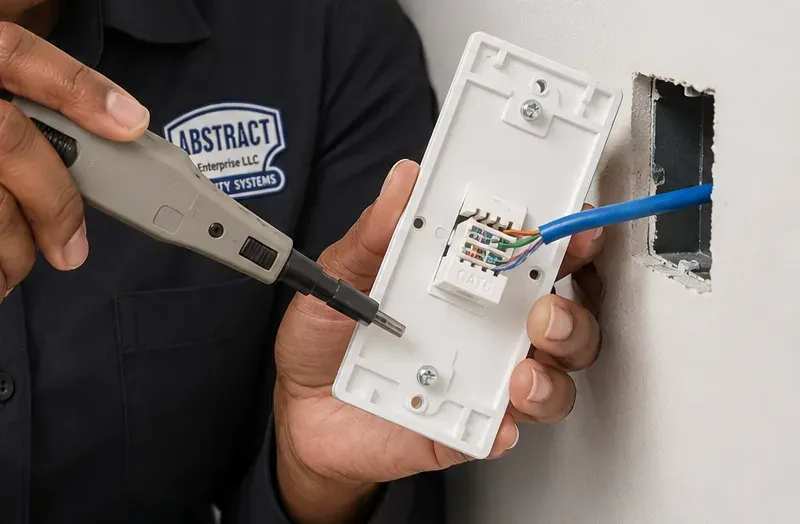
Holding a white single-port plate away from an open wall box, a technician presses a grey punch-down tool against the back of a keystone whose coloured conductors are seated in its slots.
Your Questions Answered
Cat6 Repair in Rockland County: Questions Answered
These are the questions Rockland homeowners, practice managers, landlords and the IT people who look after them ask once a Cat6 link starts misbehaving. They are grouped by what usually set the problem off: an internet upgrade, the layout of the county’s houses, water on the lower level, the way businesses here change hands and use, and the paperwork side of a repair. Shorter practical questions sit in the FAQ further down. If your question is not here, call the Rockland line and ask; the answer usually takes a couple of minutes and costs nothing, and it often tells you whether a visit is needed at all or whether a new cord or a different router port will do.
After a fiber or multi-gig internet upgrade
We moved to a multi-gig fiber plan in Rockland, but the wired office still tops out around one gigabit — is the Cat6 in the wall the limit?
Usually not the cable type, often the way it was finished. Cat6 is rated to carry 2.5 and 5 gigabits over the full 100-metre channel under the IEEE 802.3bz standard, and 10 gigabits over shorter runs, so a typical house or office run is long enough. What stops a link from stepping up is everything around the cable: a router or switch port that only does one gigabit, a computer network adapter that only does one gigabit, a patch cord marked Cat5 or with no marking at all, a jack punched down with an inch of untwist, or a coupler joining two lengths inside the wall. A gigabit link tolerates a surprising amount of that. A multi-gig link negotiates down or drops.
We sort it in order. First we confirm that both ends of the link — the port on the router or switch and the adapter on the computer — actually support the higher speed, because there is no point repairing a cable for a port that cannot use it. Then we test the run itself with a link tester that shows what speed it will negotiate and a certification tester that shows whether it meets the Cat6 limits, with any failure placed at a distance. Most fixes are a re-terminated jack, a new cord or the removal of a hidden coupler. Only when the run itself fails — it is Cat5e under Cat6 jacks, it is copper-clad aluminium, or it has been crushed — does it need replacing.
The internet installer put the new box in a different room, and two wall jacks stopped working that same day — what happened to them?
Almost always nothing happened to the cable. In most Rockland houses with retrofit Cat6, all the runs come back to one spot — a closet, the lower-level utility room, the back of a desk — where the old modem and router sat, sometimes with a small switch. When a fiber installation moves the internet equipment to another room, those home runs are still sitting at the old spot, now connected to nothing, or connected to a switch that no longer has an uplink. The jacks look dead because nothing is feeding them.
The repair is to bring the new internet connection to where the cable gathers, or to bring the cable to where the internet now arrives. Often there is an existing spare run between the two rooms that can carry the uplink; we find it with a tone generator and test it before using it. Where there is none, we either run one new Cat6 link between the two locations or recommend moving the router back to the cable hub, whichever leaves fewer cords trailing across the house. Ask your provider to note where their equipment can and cannot go before they arrive, and send us a photo of the old setup; it makes the fix quick.
The fiber crew drilled a new entry hole and now one basement run tests short — could the drill have caught it?
It is possible, and it is easy to check. A run that suddenly reads shorter than it should on a tester, or shows an open or shorted pair at a particular distance, has a fault at that distance. If that distance lines up with the new hole — the length of cable from the jack to the spot where the drill went through the rim joist or the foundation wall — the drill is the likely cause. Bits that go through a wall cavity or along a joist bay can nick or sever a cable lying against the far side.
The repair depends on what the bit did. A nicked jacket with intact pairs may still pass, though we usually recommend repairing it because moisture enters at the nick. A cut pair needs either a rated splice at an accessible spot or a replacement of the run from that point. We record the reading, photograph the damage and give you a short note you can pass to the provider if you want to raise it with them.
Raised ranches, split-levels and finished lower levels
The Cat6 from our raised ranch’s lower-level den to the bedrooms upstairs failed after we finished the basement ceiling — can it be reached without tearing out the new drywall?
In most cases yes, or with one small, patchable opening rather than a strip of ceiling. The first step is a tester reading from both ends of the run, which gives the distance to the fault. If the fault sits at a jack or a plate, nothing has to be opened. If it sits in the ceiling, the distance and the route — usually along the joists from the utility room toward the stairwell, then up through a wall — narrow it to a short section. Finishing work is a common cause: a drywall screw or a ceiling-light box driven into a run that used to hang free.
If the damage is at a reachable spot, we make one neat access hole, repair the cable with a rated connection or cut in a short replacement section, and leave the opening ready for a patch or covered by a blank plate or an access panel if you would rather keep the spot reachable. If the run is damaged in several places, or was pinched along the length of a soffit, it is often cleaner to abandon it and pull a new run along a different route — through a closet stack, along the garage, or up the exterior wall cavity — than to chase each fault.
Why do the jacks on the half-level above the garage in our split-level fail more than any others in the house?
Because that is usually the hardest-working stretch of cable in a split-level. To get from the utility area to the rooms over the garage, a retrofit run typically crosses the garage ceiling, which is unheated or barely heated, stapled to the joists or the underside of the subfloor, and close to a garage door opener, lights and storage hooks. The cable sees cold in winter and heat in summer, and the people storing things in the garage rafters do not know it is there. The joint where the garage ceiling meets the house floor system is also where installers make their tightest bends.
We test those runs first and look for the signature of the cause: damage spread along the run suggests staples or crushing, a single fault at one distance suggests a nail, hook or bend. The lasting repair usually moves the cable off the garage ceiling surface and into a protected path — a sleeve, a raceway or a route inside the conditioned part of the house — and, where it has to pass through the wall between the garage and the living space, restores the fire seal around it.
A previous owner left a plastic junction box in our New City basement ceiling with several Cat6 runs joined inside it — can it stay?
It can stay if it holds category, but it rarely does. Those boxes are usually where a past owner joined runs that came up short or rerouted cable when finishing the basement, using couplers, punch-down blocks for telephone wire, or twisted-and-taped joints. A Cat6 link can include a properly rated connection, but each one adds loss and reflection, and the cheap couplers and telephone blocks we usually find in those boxes are not Cat6 parts at all. The links through them often still pass data at low speed and fail when asked for a gigabit or more.
We test every run that goes through the box. Those that pass with margin can stay as they are, with the box labelled and left accessible. Those that fail are either remade inside the box with a proper Cat6 connection — acceptable on a short-term basis and only where the box remains accessible — or replaced with a continuous run from the jack to the network location, which is the repair we recommend whenever the route allows. Joints should never end up buried behind finished drywall where nobody can reach them again.
Our mesh Wi-Fi points are plugged into Cat6 jacks but still show a wireless link back to the router — is the wiring to blame?
Sometimes, and it is worth ruling out. Mesh systems that support wired backhaul fall back to a wireless connection between nodes if the Ethernet link is missing, unstable or too slow, and the app may only show that the node is “connected”. In split-levels and raised ranches the jacks used for mesh nodes are often the oldest retrofit runs in the house, and a run with a bad pair or a hidden joint can negotiate at 100 megabits or flap on and off, which the mesh treats as unusable.
We check each node’s jack with a link tester to see what speed it actually negotiates and whether it stays up, then certify the run if it looks marginal. A failed termination or cord is fixed on the spot. If the runs are healthy, the problem lies in how the mesh is set up — for example, nodes connected through a switch that does not pass their traffic properly — and we tell you that rather than replacing good cable.
Water on the lower level
Our router and switch sit on the same lower-level wall as the sump pump — where should the Cat6 terminations go so the next flood does not reach them?
Up, and away from the pump. In many Rockland raised ranches and split-levels the network gear ended up beside the sump because that is where the utility room is and where the cable entered the house. The terminations — the patch panel or the keystone bank, the switch and the router — are the parts that corrode first when water rises or when the pump area stays damp. Cable itself tolerates brief wetting better than contacts do.
The usual repair is to remount the patch point and the equipment on a board or a small wall cabinet at least a few feet above the floor, on the wall furthest from the pump, and to bring the runs up to it with a service loop rather than letting them sag to the floor. Where runs were cut short to reach a floor-level location, we extend them with a short continuous section from a new, raised termination point and test the result. Anything already showing corrosion is re-terminated or replaced, and the old floor-level hardware is removed.
The basement units in our Spring Valley building are shut because of flooding, but the Cat6 to the upper floors passes through them — can it be rerouted around?
Usually, yes. In older Spring Valley, Haverstraw and Monsey buildings, Cat6 for upper units and common areas often runs from a telecom point in the cellar up through basement apartments or storage spaces. When those spaces flood or are closed, the runs inside them become both unreliable and inaccessible. Whether to repair them in place depends on whether anyone may enter the closed space and whether the cable there has been wet.
Where the closed space cannot be used, we look for a path that avoids it — a stair hall, a hallway ceiling on the first floor, an exterior chase, or a short new riser from a relocated termination point — and pull new Cat6 along it, testing each link before the old cable is abandoned and then removed where accessible. The owner or managing agent approves the route first, and any work in common areas follows the building’s rules. Tenants keep their service while the new path is built; the switch-over takes minutes per unit.
How Rockland businesses use and change their space
Exam-room jacks in our New City practice keep failing after the cleaning crew moves the carts — is there a repair that stops it?
Yes. Medical and dental rooms put network jacks at floor level behind or beside cabinetry, and mobile carts, chairs and cleaning equipment hit them every day. The repeated knock loosens the keystone in the plate, cracks the jack housing, or pulls the patch cord sideways until the plug latch breaks or the contacts in the jack spread. The run behind the wall is usually fine; the failure is at the front of the jack.
We re-terminate or replace the damaged jacks, swap in patch cords with protected latches, and change how the plate meets the room: angled plates that keep cords flush, plates moved up to counter height where cabinetry allows, or a short surface raceway so the cord leaves the wall where carts do not reach. Repaired links are tested and labelled so your front desk can tell the cleaning crew which plates to avoid. We can schedule the work before patients arrive or after the last appointment.
We added a PoE camera to the small switch in our Clarkstown home office and now the desk connection drops — can PoE on one port affect another port’s Cat6?
Not through the cable, but through the switch. A PoE camera draws power from the switch, and small desktop switches have a limited power budget and sometimes a modest power supply. When a camera, an access point or a video doorbell starts drawing near that limit — at night when infrared lights come on, or in cold weather when a heater in the housing switches on — some switches restart or briefly reset their ports, and every connection on the switch drops for a moment. That looks like a cable fault at the desk.
We check the switch’s power budget against what is connected, test the camera’s run for a fault that might make it draw abnormally, and test the desk’s run so you know it is clean. The fix is usually a switch or injector with enough power for the devices, or moving the camera to a separate PoE source. If the camera’s own run is damaged, which can cause repeated power negotiation, it is repaired at the same visit.
Our Suffern office’s Cat6 was put in by the internet provider when we opened — when it fails, is the provider responsible or are we?
It depends on where the provider’s responsibility ends, and that point is usually earlier than people expect. Providers generally look after the line into the building and their own equipment — the fiber terminal, the gateway or the modem — and sometimes the first cable to it. Cable they ran beyond that point as a courtesy or for a fee during the original install is often treated as inside wiring, which belongs to the property owner or tenant. Your service agreement or the provider’s support line will say where the line is drawn.
Practically, we start by testing. If the fault is in the provider’s equipment or the line to it, you have a clear reading to show them. If it is in the inside wiring, we repair it. Either way, the result is documented so there is no argument about who should fix what next time. If you rent, your lease may say whether the landlord or the tenant owns the cabling, which is worth checking before the repair is booked.
Paperwork, alarms and who does what
Does Rockland’s new home improvement law change what our written Cat6 repair quote has to say?
Rockland’s Chapter 286, adopted in April 2026, sets out what a home improvement contract on a private residence of up to three units must contain: anything over $500 in writing, legible, in plain English, signed by both parties, with a signed copy given to the owner before work starts, a written change order for additional work over $500, and the owner’s right to cancel by written notice until midnight on the third business day. Whether a particular low-voltage repair falls within the chapter is a question for the county’s Department of Consumer Protection, not for us; this is a summary, not legal advice.
What we do in practice does not depend on the answer. Every residential Cat6 repair gets a written quote naming the links to be tested, the rate and minimum, any replacement runs and their price, and what is excluded. If testing turns up more work, you get a written change order and nothing extra starts until you approve it. That keeps the paperwork in line with the county’s rules and makes the job easy to follow for you, a spouse who was not home, or a landlord.
The alarm panel and our Cat6 share a closet in our Pearl River house — can the network runs be repaired without setting off or disturbing the alarm?
Yes. It is common in Rockland houses for the alarm panel, the internet equipment and the Cat6 termination point to sit together in a basement or closet, and some alarm panels now report over the internet through that same network. We do not open, power down or rewire the alarm panel; that belongs to your alarm company. What we do is identify which cables in the closet are alarm wiring and which are Cat6 before anything is touched, and keep our work to the network side.
If the alarm communicates over your internet connection, unplugging the router or switch to repair a run can trigger a communication trouble on the panel or a call from the monitoring centre. We ask you to put the system in test mode with your alarm company first, or we keep the alarm’s network connection live by working on other ports, so the repair does not set anything off.
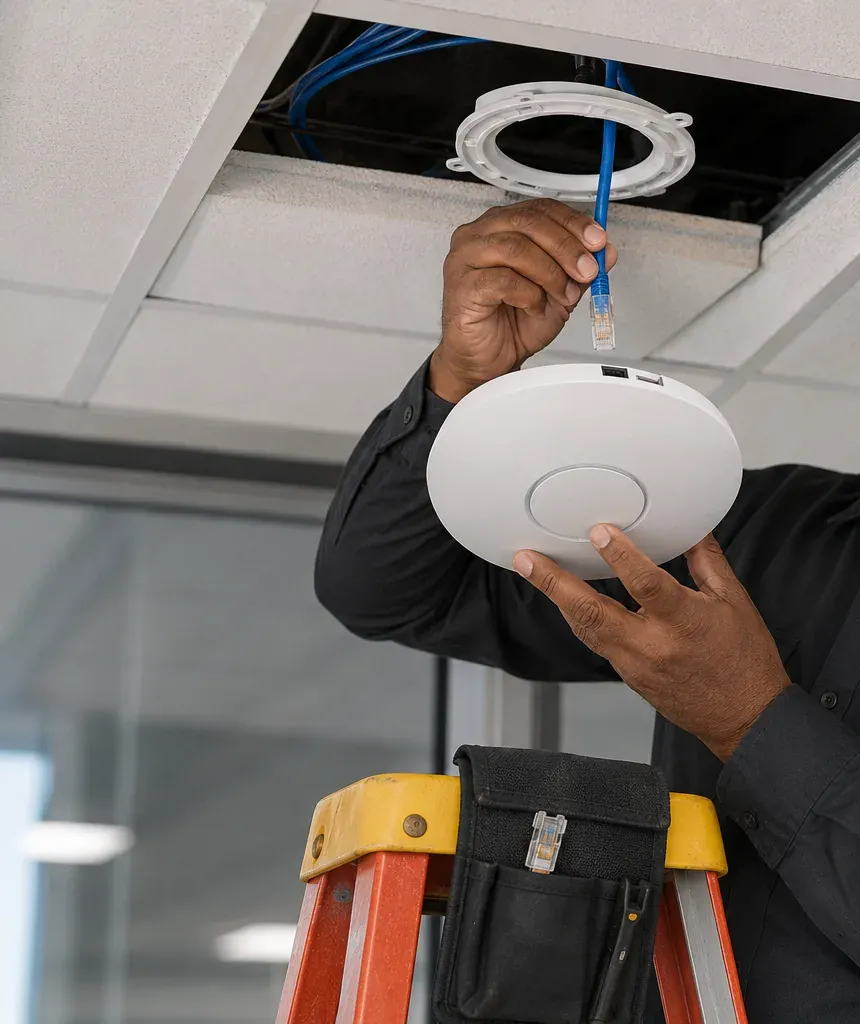
Beneath a lifted ceiling tile, one hand holds a blue cable ending in a clear RJ45 plug while the other supports a round white access point; a mounting ring hangs above and a tool pouch sits on an orange ladder.
Equipment
Test Gear and Parts We Bring to a Rockland Cat6 Repair
Retrofit faults are found with instruments, not by opening walls. This is what goes out on every Rockland Cat6 call, and what each item is for.
Certification Tester
Measures a link against the TIA limits for Cat6 or Cat6A — wire map, length, insertion loss, near-end crosstalk, return loss and related parameters — and saves the result as a record you keep.
Distance-to-Fault Readings
Crosstalk and reflection plots that put a staple, a nail, a hidden coupler or a drill strike at a measured distance from the jack, so only the right few inches of wall or ceiling are opened.
Multi-Gig Link Tester
Shows what speed a run will actually negotiate — 1, 2.5, 5 or 10 gigabits — and whether PoE is present and at what class. The quickest way to prove whether a slow connection is the cable, the cord or the device.
Tone Generator and Probe
Follows one cable through a bundle in a closet, a basement ceiling or a plaza stockroom without cutting anything, to find spare runs and identify unlabelled ones.
Cat6 and Cat6A Keystones
In common colours and styles so repaired jacks match the room, plus modules for patch panels and surface boxes, matched to the category of the run.
Solid-Conductor Plugs and Cords
RJ45 plugs made for solid Cat6 where a run must end in a plug, and factory-made Cat6 patch cords with protected latches to replace the unmarked cords we often find.
Replacement Cable
Solid-copper Cat6 in riser and plenum ratings for indoor runs, plus Cat6A for links that need 10 gigabits over longer distances.
Access and Patching Kit
Low-voltage mounting brackets, flexible drill bits, fish rods and access panels, so a repair through a finished wall or ceiling leaves one small opening that is easy to patch or cover.
Labels and Wall Cabinets
Both-end labels, a port map and small wall-mount cabinets for lifting a termination point off a damp lower-level floor.
Why the certification tester is the most important tool on a Rockland call. A basic continuity tester shows that each of the eight conductors reaches the right pin, and nothing else. It cannot see a staple-flattened section, a hidden coupler, an inch of untwist at a jack or a corroded contact that still conducts. Those are exactly the faults retrofit Cat6 accumulates, and they are what stops a run from carrying a gigabit or more. A repair that ends with a row of green lights on a continuity tester has not been checked against the standard the cable was bought for.
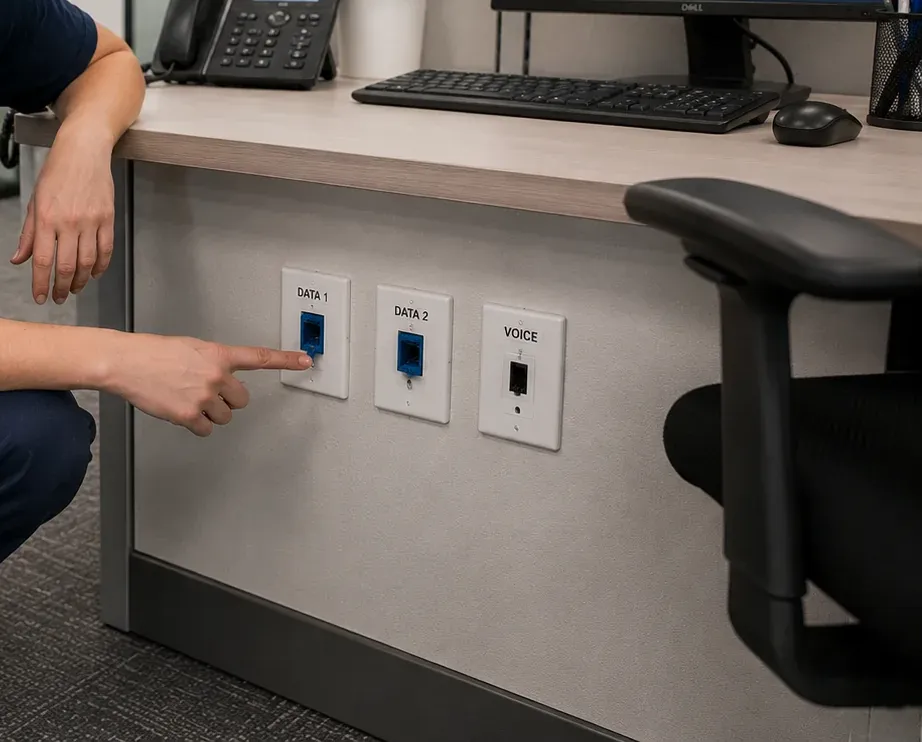
A pointing hand reaches toward three single-port plates set low on a desk panel, labelled Data 1, Data 2 and Voice, with a desk phone, keyboard and monitor on the worktop above.
AI Overview Reality Check
What AI Gets Wrong About Cat6 Repair in Rockland County
How this section was written: Google’s AI Overview could not be opened from the tools used to research this page, so none of the headings below is quoted from it. Each is a claim that retailers, internet providers’ help pages, forums and cost guides commonly publish, and that answer engines tend to repeat. Under each is what we actually find in Rockland houses and offices, with the source for any figure.
“Faster internet plans need Cat6A or better in the walls”
When a multi-gig plan arrives, the advice that follows is often to rewire with a higher category. Provider pages add to the impression: Optimum’s fiber installation guidance lists “Ethernet CAT 6 or higher” among the things customers need for its fastest speeds.
Cat6 is “or higher” already for most homes. The IEEE 802.3bz standard runs 2.5 and 5 gigabit Ethernet over Cat5e or Cat6 up to 100 metres, and 10 gigabits over Cat6 is supported on shorter runs. A Rockland house run is rarely long enough for distance to matter. What blocks the speed is a weak jack, a cheap cord or a hidden coupler.
So before anyone quotes you a rewire, test the run. If it certifies, a better cord or a re-terminated jack is the whole job. If it fails, the reading says where, and replacing one run costs far less than replacing them all.
“If the internet company installed the cable, they will fix it”
Many people assume a cable run by the provider’s technician stays the provider’s problem, and online answers often point owners back to their provider for anything to do with the connection.
Providers generally maintain their line and their own equipment. Runs added inside the building, even by their technician, are commonly treated as inside wiring that belongs to the owner. In Rockland, where so much Cat6 was added during an internet install years ago, owners are often surprised to find the provider will not touch it.
A test settles it either way. A clean inside run with a dead gateway goes back to the provider with a reading in hand; a damaged inside run gets repaired the same day without waiting for a provider appointment.
“Cable behind a finished ceiling can’t be repaired, only replaced”
General advice for a dead in-wall Ethernet run usually jumps to running a new one, or to giving up on wired and buying a mesh system, on the assumption that a fault behind drywall cannot be reached.
A tester’s distance reading turns “somewhere in the ceiling” into a spot. In the raised ranches and split-levels that dominate Clarkstown and Ramapo, many lower-level faults are a drywall screw, a light box or a coupler at one point along an otherwise healthy run.
One small opening, one repair, one patch is often all it takes. Replacement is the right answer when the run is damaged in several places or is the wrong cable, and the test tells you which case you are in.
“Rockland doesn’t flood, so basement cabling is safe”
Flood risk in the New York area tends to be discussed as a coastal and river-front problem, and an inland suburban county can sound safe by comparison.
The record says otherwise. The July 9, 2023 storm dropped more than eight inches of rain and caused flash-flood damage to homes across northern Rockland, according to the Rockland County Times, and Rockland was among the counties in disaster declaration DR-4723. In Spring Valley, a complex that flooded repeatedly had its basement apartments closed and was ordered vacated, repaired or demolished in May 2026, ABC7 reported.
Lower levels are where Rockland houses keep their network gear. Raising the termination point above the floor costs far less than replacing corroded hardware after the next storm.
“Lightning is the main threat to Ethernet in the Hudson Valley”
Advice for the region often leads with surge protection, and it is a real issue for long runs between buildings in the northern counties.
Rockland had the fewest lightning pulses of the six Hudson Valley counties in Earth Networks’ 2020 New York report — 64,575 against Orange County’s 275,059 — and it is a county of compact suburban lots more than outbuildings and long runs between them.
Surges still happen, and runs to a detached garage or a pole camera deserve protection. But in our Rockland work the larger share of faults comes from inside the building: terminations, renovations, staples, water and moved equipment.
“A Cat6 repair should cost about what a new drop costs”
Cost guides publish per-drop prices for new Cat6 — Fixr’s January 2025 guide puts a drop at $125 to $250 including materials and labour — and those numbers get applied to repair calls.
A new drop in open framing is a known quantity. A repair in a finished Rockland house is diagnosis first: which run, which fault, where along it, and whether the run is worth saving. The time goes into testing and finding, then into a small, careful fix.
That is why we price it as published time on site — $195 an hour with a three-hour minimum — plus replacement runs from $175 each only when a run cannot be saved, the figures on our Rockland repair page.
“Any handyman can fix Ethernet now that the county licenses contractors”
Rockland’s home improvement licensing has been in the local news through 2026, and it is easy to read a county licence as a sign that anyone holding one can do any work in a house.
Chapter 286 regulates the business side of home improvement — licensing, written contracts, change orders, cancellation rights. It does not teach anyone how to terminate Cat6 to category or read a certification test, and it excludes electrical work altogether.
Ask whoever repairs your cable what they will test the link with and what result you will receive. A licensed low-voltage contractor should be able to show you a saved Cat6 test, not a row of lights.
Find the One Bad Spot, Not the Whole Wall
Tell us which jacks fail, what the house or office has been through lately, and who installed the cable. We will tell you what the fault most likely is and what the first visit should cover.
House, practice, plaza unit or office suite anywhere in Rockland — describe the failing jacks and what changed, and a written answer comes back the same business day. Rather talk it through? Call (845) 640-3835.
✅
We Got Your Request!
A Rockland technician will reply the same business day. If a link is down right now, call (845) 640-3835.
How It Works
Our Cat6 Repair Process in Rockland
Six steps, built on one rule: find the exact fault before opening anything, whether it is one jack in a Pomona den or a row of exam rooms in Nanuet.
1. Tell us the history
Which jacks or devices fail, what they feed, who installed the cable if you know, and what happened to the building recently — a renovation, a new internet service, water, moved furniture. Photos of the network closet help.
2. Written quote and booking
You receive a written quote with the rate, the minimum and any likely replacement runs, and we book a two-hour arrival window with matching keystones, cords and cable on the van.
3. Test before touching
Each failing link is checked for negotiated speed and PoE, then certified against the Cat6 limits from both ends. Faults are placed at a jack, a cord, a hidden joint or a measured distance along the run.
4. Agree each fix
For every link you hear the finding and the fix — re-terminate, replace a cord, remove a coupler, repair at one opening, or replace the run — and nothing beyond the quote starts without your written approval.
5. Repair with the least disruption
Terminations are remade on matched hardware, damaged sections are repaired through a single small opening where possible, lower-level terminations are raised off the floor, and abandoned cable is removed where accessible.
6. Prove, label and hand over
Every repaired link is certified again and labelled at both ends. You get the saved test results and a short note of what was found and why, ready for your IT provider, a buyer or a landlord.
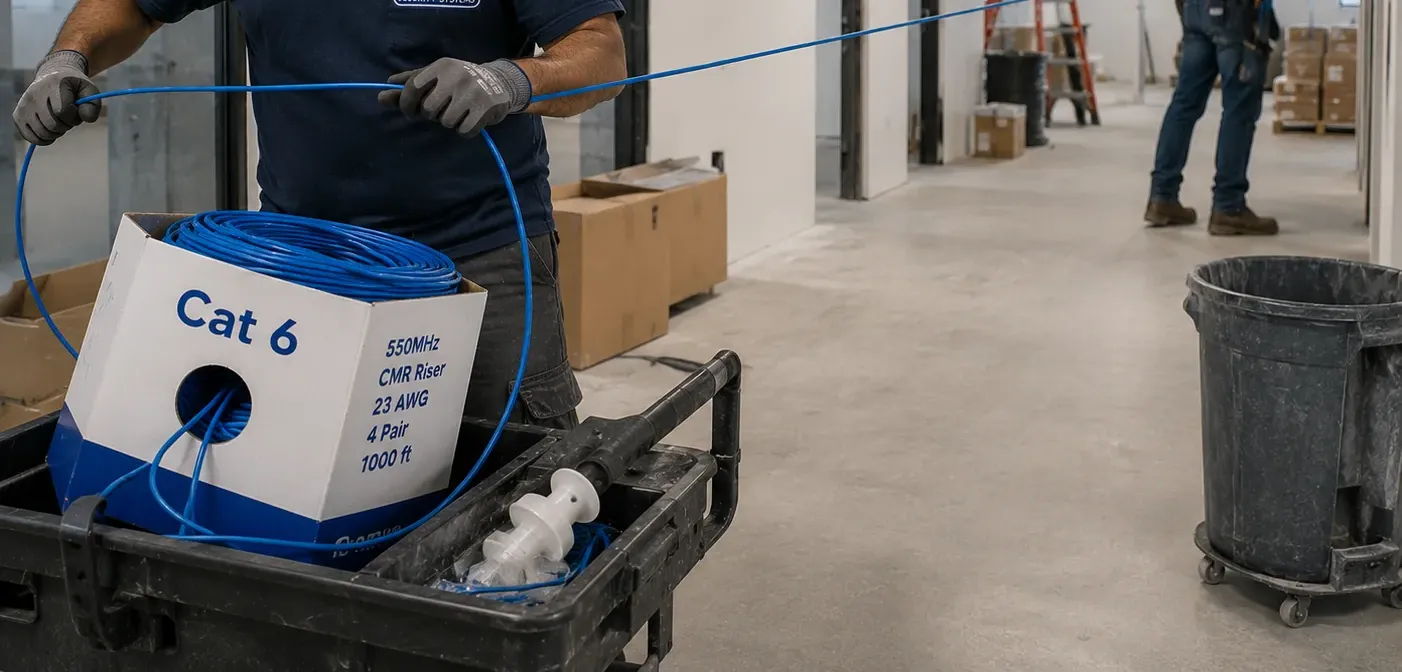
Gloved hands pull blue cable from a carton on a black cart labelled Cat 6, 550MHz, CMR Riser, 23 AWG, 4 Pair, 1000 ft, while the line stretches down a corridor with open ceilings and boxes along the wall.
Coverage Area
Cat6 Repair Near Rockland County’s Landmarks
Six places that sum up the building stock Rockland’s Cat6 runs through. Each is a reference point for the properties around it, not a claim of work inside it.
Blue Hill Plaza, Pearl River
The Skidmore, Owings & Merrill office complex completed in 1972: a 21-storey tower and an eight-storey building, nearly 1.2 million square feet on 90 acres along Route 304, with fiber from two central offices. The county’s tallest reminder of how much office cabling has been laid and re-laid since the 1970s.
Hudson Valley iCampus, Pearl River
The former Lederle and Pfizer site, about 2 million square feet of laboratory, manufacturing and office buildings on 200 acres, now being repositioned as a multi-tenant campus by Industrial Realty Group. Large buildings changing from one owner to many.
Edward Hopper House, Nyack
The artist’s birthplace at 82 North Broadway, built in 1858 by his maternal grandfather. A good picture of the river-village houses and storefronts around it, where Cat6 runs along baseboards and through plaster.
Haverstraw Brick Museum
On Main Street in the village of Haverstraw, which the Historical Society of Rockland County calls the brick-making centre of the East from 1817, with more than 42 brickyards at its peak. Brick walls mean surface routes and drilled sleeves for any network cable.
Piermont Pier
The almost mile-long pier built in 1841 as the eastern terminus of the Erie Railroad and now owned by the village. A reminder that Piermont’s business district sits at the water’s edge, where basements took water during Hurricane Sandy.
Rockland Community College, Suffern
The SUNY campus at 145 College Road, on 175 acres, at the western end of the Route 59 corridor. Campus-scale networks next door to the dense residential streets of Airmont and Suffern.
We repair Cat6 throughout the five towns: in Clarkstown — New City, Nanuet, West Nyack, Bardonia, Congers, Valley Cottage and New Hempstead; in Orangetown — Pearl River, Orangeburg, Blauvelt, Tappan, Sparkill, Palisades, Piermont and Grand View-on-Hudson; in Ramapo — Suffern, Monsey, Airmont, Spring Valley, Hillcrest, Viola, Hillburn, Sloatsburg, Chestnut Ridge, Montebello, Wesley Hills and Pomona; in Haverstraw — Haverstraw, West Haverstraw, Garnerville and Thiells; and in Stony Point — Stony Point and Tomkins Cove. Nyack, South Nyack and Upper Nyack are covered too.
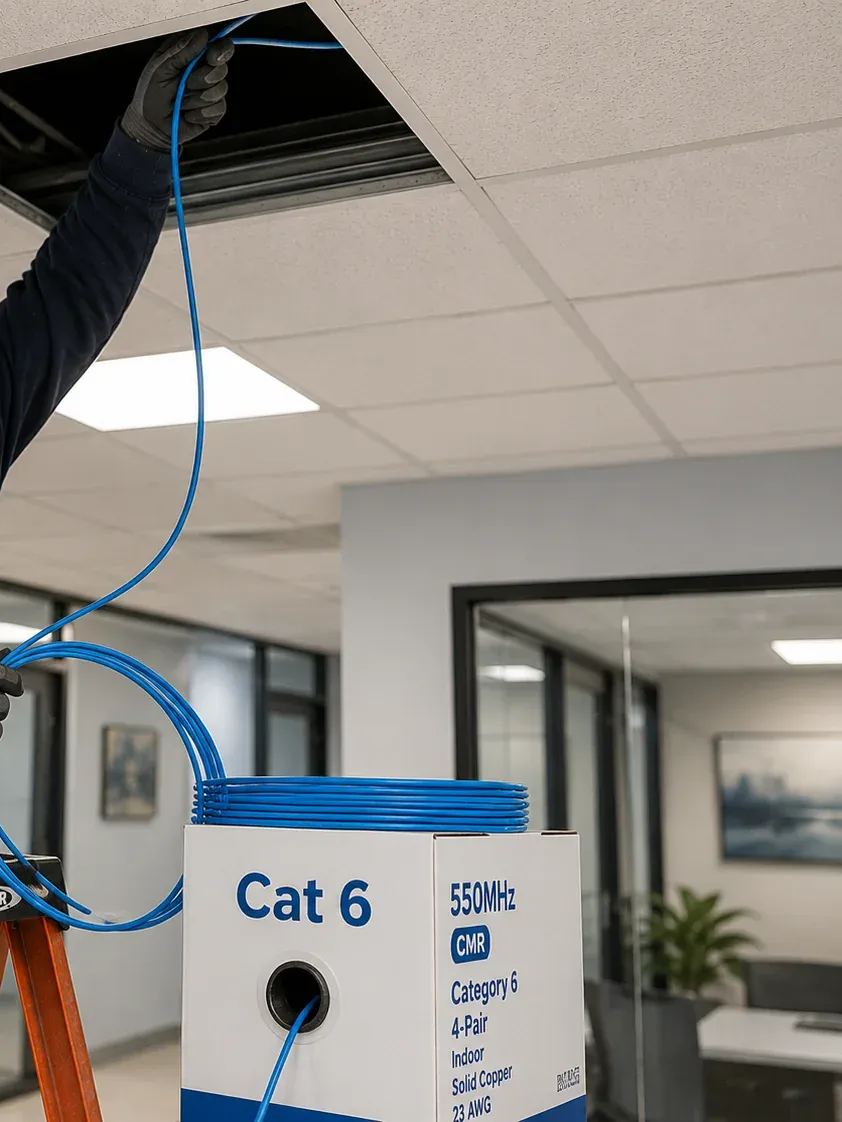
A gloved hand pushes blue cable up through a lifted ceiling tile; coils of the cable drop to a carton below marked Cat 6, 550MHz, CMR, Category 6, 4-Pair, Indoor, Solid Copper, 23 AWG.
Pricing
Cat6 Repair Cost in Rockland County
Every price below is already published on one of our own Rockland or Hudson Valley pages, and the table says which. Anything that depends on what the test finds is quoted in writing before the work starts. Time on site and replacement cable are separate lines, so you can see what you are paying for.
Item
Price
What it covers and where the figure comes from
Repair time on site: speed and PoE checks, certification, fault location, re-termination, cord and coupler replacement, retest
$195/hr, 3-hour minimum ($585)
The specialty service rate on our Rockland network cable repair page; the three hours go on as many links as the technician can test and repair
Time beyond the first three hours
$195/hr
Billed hourly at the same published rate
Replacement Cat6 run where the old one cannot be saved
From $175 per drop
The commercial Cat6 drop figure on our Rockland network cable repair page and Hudson Valley hub: new cable, jack, plate, panel termination, test, both-end labels and a cord
New Cat6 drop up to 100 ft (installation price, for comparison)
$309 per drop
From our Rockland Cat6 installation price table, which shows $265 for Cat5e and $441 for Cat6A on the same terms
Raising a lower-level termination point off the floor
Quoted after testing
Depends on how many runs must be extended and whether a wall cabinet is wanted
Whole-house or whole-suite certification and labelling
Quoted by number of links
Every jack tested and labelled, with a port map and saved results
Opening and patching finished walls or ceilings, new routes, after-hours windows
Quoted after a site look
We leave a clean opening ready for your painter, or quote a patch, before any cut is made
What three hours usually covers in a Rockland house or suite
The minimum buys a technician on site with the full test kit. In a typical house that is enough to test every jack you are worried about plus the cable to the router, find each fault, re-terminate the bad jacks, replace any suspect cords and couplers, and certify the result. In a small practice or office, it usually covers a row of rooms or a patch panel’s worth of links. If the test shows a run that must be replaced or a ceiling that must be opened, you get a written price for that part before anything is pulled or cut.
Why these numbers and not a second price list
The repair rate and replacement-drop figure are the ones printed on our live Rockland network cable repair page, and this page uses them rather than inventing a second set. Your written quote confirms the figures for your property before anything is booked. Work that genuinely varies from one building to the next — opening a finished ceiling, a long new route, after-hours work in an occupied practice — is measured and quoted for the site.
What moves a Rockland Cat6 repair bill
Where the fault sits: jacks, cords and panel ports are quick; a joint above a finished ceiling or a run crushed inside a wall takes access work.
What caused it: one bad termination is one fix; a renovation, a flood or a whole house of hand-crimped plugs affects many links at once.
What the cable is: genuine solid-copper Cat6 can be repaired; Cat5e behind Cat6 jacks, copper-clad aluminium and stranded cord used as a permanent run usually cannot.
What the link must carry: a gigabit link is more forgiving than a 2.5, 5 or 10 gigabit one, so a multi-gig plan raises the bar for every termination.
Access: finished lower levels, occupied exam rooms, shared plaza ceilings and tenant rules all shape how the visit is planned.
About national price figures you may have seen. Cost sites such as Fixr (January 2025 update) list $125–$250 for a new Cat6 drop including materials and $45–$75 an hour for installer labour nationally. Those numbers describe new work in open framing; they are not ours and they do not include finding a fault inside a finished Rockland house.
Full terms — including 50% deposit, one-year parts-only warranty on AESS-supplied products, and the late-fee schedule — are set out in the service agreement.
Shop Our Systems
Cat6 Repair Packages & Pricing
Most Rockland repairs fall into one of these three. Each uses only figures already published on our own pages.
Starter — Single Link Fix
$585
Three hours on site at $195 an hour. Built for one dead or slow jack, one dropping camera or one link that will not reach multi-gig speed: we test it, find the fault, fix the jack, cord or joint and certify it. Time left in the block goes on any other links you want checked.
Standard — House or Suite Recovery
$195/hr after the first 3 hours
For a house after a renovation, a fiber upgrade or water on the lower level, or a practice with several failing rooms: every link tested, hidden joints and damaged sections found, terminations remade, the network point raised where needed, and saved results for every jack.
Premium — Repair Plus New Runs
Repair time + from $175 per run
When testing finds runs that cannot be saved: repair time for everything that can be, plus replacement runs from $175 per drop on a better route, abandoned cable removed where reachable, and an updated port map and labels.
Bring Your Own Parts — Labour Only
Already bought keystones, plates or a box of cable to match your house? We can install them, billed as repair time only, as long as they suit the link: Cat6 or Cat6A parts to match the run, solid-copper cable for permanent runs, no copper-clad aluminium. Everything is tested either way. Parts you supply carry their maker’s warranty rather than ours, and if they cannot produce a passing link we tell you before they go in.
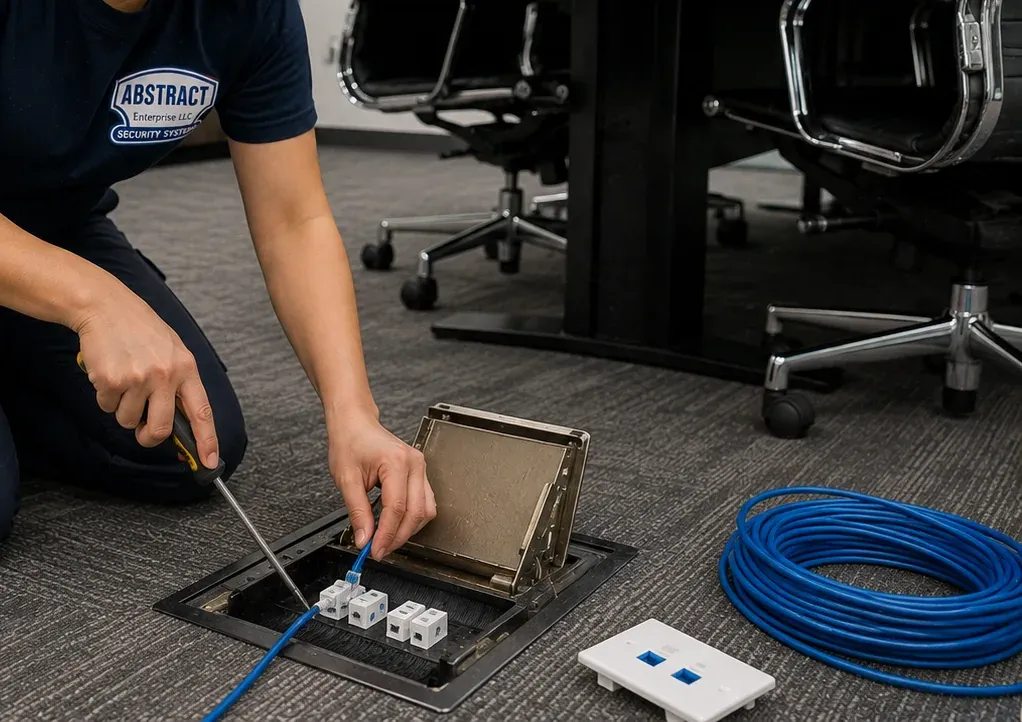
Kneeling on grey carpet beside a conference table, a technician works a screwdriver into an open floor box holding four white keystones, with a coil of blue cable and a two-port plate lying nearby.
Before the Next Renovation Buries Another Splice
Planning to finish a basement, move the router or upgrade the internet plan? Have the Cat6 tested first, while the faults are still easy to reach.
How Cat6 Faults Differ Across Rockland’s Five Towns
A cracked keystone is the same fault in Tappan and in Tomkins Cove. What changes from town to town is the building around it, who installed the cable and what the building has been through. New York State’s county profile lists the five towns, with villages such as Spring Valley and Nyack straddling town lines.
The towns also differ in who you deal with when a repair spills beyond the cable. Each town, and each incorporated village inside it, runs its own building department, so a repair that needs a new opening in a rated wall is checked with that office rather than with the county. The county itself handles contractor licensing through its Department of Consumer Protection.
Clarkstown
The county seat in New City and the Route 59 commercial strip through Nanuet and West Nyack. Clarkstown’s streets of raised ranches, split-levels and colonials produce the classic Rockland retrofit faults — runs through garage ceilings, joints above finished lower levels, mesh points on old jacks — while the professional offices along Main Street and the plazas on Route 59 bring practice and retail repairs. The town runs its own building department, which matters if a repair needs a new opening in a rated wall.
Orangetown
Pearl River, Orangeburg, Blauvelt, Tappan, Sparkill and Piermont. Orangetown holds the county’s biggest office and campus properties — Blue Hill Plaza, the iCampus site, Bradley Corporate Park and the Route 303 industrial belt — where suites are re-cabled with every new tenant, as well as the river-village storefronts of Piermont. Office repairs here are mostly about unlabelled, re-used cable and panels that several tenants have punched down.
Ramapo
Suffern, Monsey, Airmont, Spring Valley, Hillburn and Sloatsburg, and Rockland’s most populous town at 148,919 residents in 2020. Large households and homes that double as offices and study spaces put more devices on each Cat6 run, and two-family houses and small apartment buildings make shared basements and cross-unit runs common. Spring Valley’s repeated flooding makes lower-level terminations a particular concern.
Haverstraw
The village of Haverstraw, West Haverstraw, Garnerville and Thiells. Brick and frame buildings in the old brick-making village, older commercial blocks along the main streets, and two-family houses mean surface-run Cat6, drilled sleeves through masonry and cellar termination points that see damp.
Stony Point
Stony Point and Tomkins Cove at the county’s northern end, with more space between houses and the worst of the July 2023 flash flooding, when Route 9W was damaged and roads across the town were closed. Lower-level and garage runs that took water then still turn up corroded terminations, and longer runs to detached garages and outbuildings are more common than further south.
Multi-Gig Readiness
Is Your Rockland Cat6 Ready for a Faster Internet Plan?
Most disappointing speed tests after a fiber upgrade come down to a short list of causes. This is the order we check them in, and what each one usually means for the repair.
Check
What it shows
Usual fix
Router or switch port speed
Whether the equipment the run plugs into supports more than one gigabit at all
Use the multi-gig port, or add a multi-gig switch; no cable work needed
Computer or device adapter
Whether the device at the far end can use the higher speed
A 2.5 or 10 gigabit adapter; no cable work needed
Patch cords at both ends
Unmarked, flat or very old cords that limit the link
Replace with marked Cat6 cords
Negotiated speed on a link tester
What the run actually agrees to carry with a known-good device
If it negotiates the target speed, the cable is fine
Certification against Cat6 limits
Crosstalk, return loss, insertion loss and wire map, with failures placed by distance
Re-terminate a jack, remove a coupler or repair at the fault
Jacket markings and conductors
Whether the run is genuine solid-copper Cat6
Replace runs that are Cat5e under Cat6 jacks or copper-clad aluminium if the plan needs more than they can carry
One more thing worth knowing before you call anyone: a speed test run over Wi-Fi tells you almost nothing about the Cat6. Test from a computer plugged directly into the jack in question, then from the same computer plugged straight into the router with a short known-good cord. If the two results match, the run is not the bottleneck; if the jack is much slower, the cable or its terminations are, and that is what we come out to find.
The first three checks are things you can look at yourself before calling anyone; together they explain a good share of slow wired connections. The last three need test equipment, and they are where a repair visit earns its keep.
Decision Guide
Repair or Replace: What We Recommend for Retrofit Runs
Once a run is tested, the decision is usually clear. This is how the common Rockland findings translate into a recommendation. You decide, and the recommendation is put in writing.
What the test finds
Usually the right call
Why
Failure at the jack or the plug; the rest of the run is clean
Re-terminate on a matched Cat6 jack
The cable is sound; the termination was rushed
A reflection at a hidden coupler or junction box
Remove the joint with a continuous run, or remake it in an accessible box
Cheap couplers are not Cat6 parts and buried joints cannot be maintained
Damage at one spot behind a finished surface
One small opening, repair, patch
The distance reading makes a targeted repair cheaper than a new run
Damage spread along the run from staples or crushing
Replace the run on a protected route
Many small deformations add up to a link that cannot hold category
Corrosion at lower-level terminations after water
Re-terminate above the floor and test each link
Contacts corrode first; moving them up prevents a repeat
Cat5e behind Cat6 jacks, or copper-clad aluminium
Replace if the link must carry multi-gig or PoE
The cable itself is the limit, so no termination fix will hold
Clean run, but the PoE device still drops
Check the switch power budget before more cable work
A healthy cable cannot fix a switch that runs out of power
A practical note on timing. The cheapest moment to fix a weak retrofit run is before the next change to the building — before a basement is finished, a kitchen is gutted, a practice moves rooms around or a new tenant signs. Once drywall, cabinetry or a new ceiling goes up, the same fault costs an opening and a patch to reach. If work like that is planned, a test of the runs that pass through the area takes an hour or so and tells the contractor which cables to protect.
Complete Services
Every Cat6 Repair Service in Rockland County
A failing Cat6 run often brings a camera, a switch or a new drop into the same conversation. These are the related AESS services for Rockland properties.
One form for any combination of the services above.
Field Notes
Field Notes on Retrofit Cat6 in Rockland Houses
How we approach a retrofit run in a finished house — general practice, not a single job
We start where the cable gathers. In a raised ranch or a split-level that is usually a lower-level closet or utility room, and the state of that spot tells us a lot: hand-crimped plugs in a cheap switch, a bundle sagging to the floor near the sump, a coupler hanging in mid-air, cable that came in through the same hole as the internet service. Whoever did that end probably did the other end the same way.
Then we test before we touch anything. A link tester tells us what each run negotiates; a certification tester tells us whether it meets Cat6 and, if not, how far along the run the trouble is. We compare that distance with the route the cable probably takes — up the closet, across the garage ceiling, down the exterior wall — and that usually points to one spot.
Only then does anything get opened, and as little as possible. Before we leave, every link we touched has a saved result and a label at both ends, so the next person who works on the house — a renovator, a new owner, an internet installer — knows what is there.
FAQ
Rockland County Cat6 Repair FAQ
Can we send photos of the jack, the network closet and the router by WhatsApp before you come out to Rockland?
+
Yes, and it often saves time. Message the AESS WhatsApp line through the link on this page with a photo of the failing plate, the place where the cables gather, the router or internet box and any switch, plus a note of what changed before the fault started. From those we can usually tell whether the cable was hand-crimped, whether a switch or a cord is a likely suspect, and which parts to load. Your Rockland repair is still booked and quoted through the direct line or the form.
Do you need our Wi-Fi password or internet account details to repair the Cat6?
+
No. Testing and repairing cable does not involve logging in to your router or your provider account. Our testers connect to the jack and the far end of the run directly. The only time access to the router helps is when we need to see which port a run lands on or what speed the router reports, and then you or your IT provider can show us the screen. We never change network settings without being asked.
Can the old cable be used to pull its replacement through the wall of our split-level?
+
Often, yes. If the old run is not stapled, glued or tied along its path, we can fasten the new Cat6 to it and pull the new cable through the same route as the old one comes out. It is the least disruptive way to replace a run in a finished house. If the old cable is stapled to framing or has been crushed into a tight spot, it will not slide, and we fall back to fishing a new route; we test the old run's path before deciding.
If a run is being replaced anyway, can a second Cat6 be pulled alongside it for later use?
+
Yes, and it is usually worth doing. Once a path has been opened or a pull is under way, a second cable adds little time and gives you a spare for a future camera, access point or a failed run. The spare is terminated and tested like any other link, or left coiled and labelled at both ends if you prefer. The extra drop is priced at the published replacement-drop figure and shown on the written quote.
Will the rest of our home network stay up while one Rockland run is being repaired?
+
Almost always. We work on one link at a time, so only the jack being repaired is out of service while its termination is remade or its cable is replaced. If the repair is at the patch panel or switch end, a few seconds of disconnection may be needed when a cord is moved, and we warn you first so a video call or an alarm communicator is not interrupted at a bad moment.
Is there a charge for a second trip if the repair needs a part that was not on the van?
+
Second trips are rare because we ask about the property and the fault before booking and carry the common parts for Rockland retrofit repairs. If a matching plate, an unusual module or a long cable route needs something we do not carry, we tell you on the first visit, and any return time is billed at the same published hourly rate, shown on the written quote before it is booked.
Can you repair the Ethernet run to a TV or games console behind a wall-mounted TV?
+
Yes. Wall-mounted TVs in Rockland living rooms often hide a Cat6 jack behind the screen, and the cord and jack there get bent hard when the TV is mounted tight to the wall. We take the TV off the mount if needed, test the run, replace a crushed cord with a short flat or right-angle one, re-terminate or swap the jack, and put the TV back. If the cable in the wall itself is damaged, we tell you before any wall work.
We rent our Rockland house or apartment. Can we book the repair ourselves, or does the landlord have to?
+
Tenants can book us, but check your lease first, because the cabling may belong to the landlord and opening walls usually needs their permission. Testing a jack and replacing a plate or cord rarely touches the building, so many tenants book that part themselves. If the test shows a repair inside a wall or ceiling, we give you a written finding you can send to the landlord, and we are happy to quote the landlord directly.
Can you repair the Cat6 feeding a wired video doorbell at a Rockland front door?
+
Yes. Some video doorbells are powered over Ethernet, and the short run through the door frame or exterior wall to them is exposed to weather, door slams and the drill holes from earlier doorbells. We test the run, remake the termination at the doorbell end with a connector suited to the space, seal the wall opening and confirm the switch or injector delivers the power the doorbell needs. Setting up the doorbell app stays with you or the device maker.
What happens if the test shows our Cat6 is fine and the problem is the computer or the router?
+
Then you will know that for certain, with a saved test result to prove it, and you will not pay for a cable repair you do not need. We show you which device or port is limiting the connection and suggest what to change, such as a different router port, a new network adapter or a switch. The time used is billed at the published rate, and in our experience it is cheaper than replacing good cable on a guess.
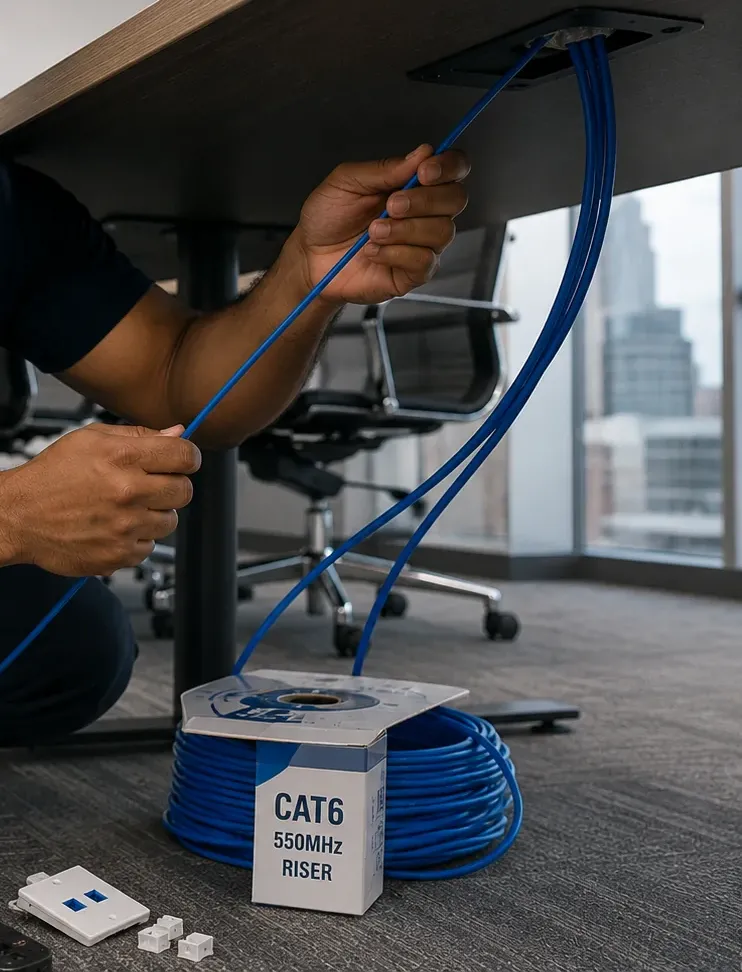
Hands guide blue cables up through a rectangular grommet on the underside of a wooden conference table; a small carton labelled CAT6 550MHz Riser, a crimper, a two-port plate and keystones sit on the carpet.
All Areas Served
Cat6 Repair Across the Hudson Valley, New York City and Long Island
This is our Rockland County Cat6 repair page. It sits under the Hudson Valley hub, alongside the other county pages and our New York City and Long Island hubs. The same technicians, test equipment and published rates apply across the region. If your property sits on the Rockland line — a business in Rockland with a second office in Orange County, or a house near the Westchester side of the river — one call to the Rockland number covers both visits.
Wired Connection Gone Quiet Somewhere Between Suffern and Nyack?
If a jack, a camera, a card terminal or a whole floor dropped off the network, call (845) 640-3835. We book the next open two-hour window, bring the parts the symptom points to, and most termination, cord and coupler faults are found and fixed in one to two hours on site.
Cat6 Repair Rockland County — Licensed, Insured, Proven by Test
Abstract Enterprises Security Systems · 460 E Fordham Rd, Bronx, NY 10458 · Rockland line (845) 640-3835 · WhatsApp (718) 679-0359 via wa.me
NYS Low-Voltage Licence #12000287431 · 100% Licensed & Insured · Same-Day Estimates · Rated 4.7★ from 201 Google Reviews
Parts you supply are covered by their manufacturer, not by AESS. The warranty page and the service agreement set out the full terms.
References to county law, codes and standards on this page are short summaries for Rockland property owners; they are not legal or engineering advice. Page reviewed and updated October 17, 2026. Changelog: first publication of the Rockland County Cat6 repair page.