Licensed Low-Voltage Contractor · All Ten Suffolk Towns · Flex Bays, Lifted Houses, Farms & Campuses
Cat6 Repair in Suffolk County
Re-Tenanted Flex Bays · Sandy-Lifted Houses · Farm & Winery Buildings · Rental Homes · New Construction · Failed Certification
Most of the Cat6 we are called to in Suffolk was installed for a building that no longer exists in that form. The warehouse was split into three bays, the bungalow was lifted onto a new foundation, the potato barn became a tasting room, the summer house has had a different family on its network every fortnight. Cable that was fine for the old layout fails in the new one. We test what the link is doing today, work out what changed around it, and repair it to the building you actually have — from Huntington Station to Orient Point.
Reviewed and updated October 17, 2026 · Written by Anwar Timothy, NYS licence #12000287431 · Suffolk line (631) 407-2884
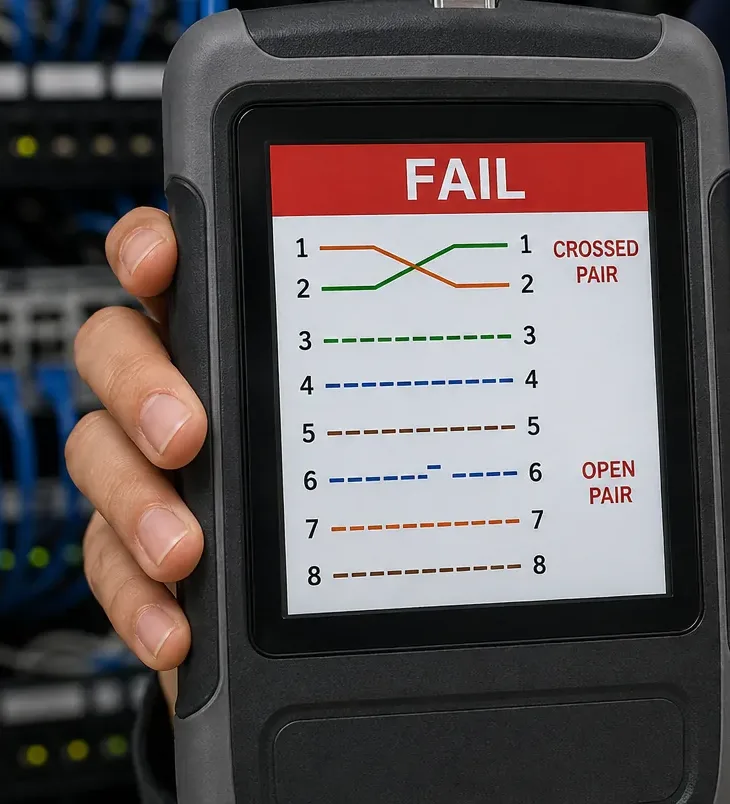
A hand holds a grey handheld tester with a blue patch cord plugged into its top; the screen reads FAIL above a wire map that marks pins 1 and 2 as a crossed pair and pin 6 as an open pair, with racks of blue cords blurred behind.
Suffolk County Cat6 Repair Quote
Tell us which links fail and what changed in the building — a technician replies the same business day
✅
Request Sent!
A Suffolk technician will call you back the same business day.
25+
Years Experience
✓
Same-Day Estimates
100%
Licensed & Insured
4.7★
201 Google Reviews
Moved into a Bay Shore bay where half the jacks are dead, lifted your Lindenhurst house and lost the upstairs office link, or opened a North Fork tasting room on cable nobody has tested? Call the Suffolk line, (631) 407-2884, or use the 60-second form. A licensed technician reads it and tells you, before anything is booked, which part of the building's history is most likely behind the fault.
Every affected link certified from both ends, with the result saved and handed to you
Old splices, couplers, borrowed closets and dead runs identified rather than worked around
NYS licence #12000287431, insured, with one direct number for every town from Babylon to Shelter Island
Why Suffolk County Properties Need Cat6 Repair That Reads the Building's History
Suffolk is eighty-six miles long, it has ten towns and a long list of incorporated villages, and very few of its buildings are still used the way they were when their data cable went in. That is the single most useful thing to know about Cat6 repair in this county. In a Manhattan tower the problem is usually getting to the cable. In Suffolk the cable is usually easy enough to reach, but it was laid out for a different tenant, a different floor plan, a lower house, a different business or a different season, and the building has moved on without it. A link that tested perfectly in 2012 can fail today not because the copper aged but because somebody split the space, raised the floor, rerouted the duct, moved the closet or added three feet of cable with a coupler to reach a desk that used to be elsewhere.
Commercial space shows it most clearly. CoStar described the industrial cluster around Hauppauge, Central Islip and Bay Shore in August 2024 as Long Island's largest, with more than 26.1 million square feet, and said owners there were contending with the most available space on the Island because of a mismatch between the size of the buildings and what tenants now want — smaller bays. When a large single-tenant building is carved into smaller units to meet that demand, the cabling is rarely carved up with it. We find jacks in one tenant's office that are punched down on a panel in another tenant's closet, runs that cross the demising wall above the ceiling, a single switch serving two businesses, and long stretches of cable whose far end has been abandoned behind new drywall. Each of those can produce a failing link, and each one also means the repair has to decide whose cable it is before anyone touches it.
Houses have their own version. After Superstorm Sandy, FEMA's tally reported by Newsday counted 20,798 Suffolk structures flooded, damaged or destroyed, and along the South Shore — in Lindenhurst, Babylon and Amityville, where the National Weather Service recorded two to five feet of water south of Montauk Highway — owners took state money to raise their houses or sell them for demolition. CBS New York reported in 2015 that NY Rising elevation grants for Long Island shoreline homeowners had averaged over $100,000, and that towns and villages were requiring closed foundations with water vents rather than open pilings. Every raised house had its low-voltage wiring disturbed: runs that once dropped into a basement or a slab were cut, extended or rerouted through a new crawl space or the enclosure beneath the living floor. FEMA's own guidance limits that enclosure to parking, building access and storage. Cat6 that was spliced to reach a router left down there is among the most common failing runs we see on the South Shore, and it fails for reasons that have nothing to do with the cable's age.
Then there is the East End, where buildings change use as well as owners. Suffolk had 578 farms and 79 wineries in 2022, according to the state comptroller's agricultural profile as summarised by the Shelter Island Reporter, and a good share of North and South Fork commerce now happens inside buildings built for something else — barns turned tasting rooms, packing sheds turned offices, garages turned guest cottages, houses turned rentals with a new family on the Wi-Fi every week of the summer. Cabling in those buildings was often added in stages by whoever was there, through spaces never meant to hold it, and it gets moved, unplugged and re-patched by people who are not thinking about category ratings.
Finally, a great deal of new Cat6 is going into Suffolk and much of it is never tested by anyone after handover. Station Yards at Ronkonkoma alone is planned for 1,450 homes when complete, with 489 delivered in its first phase in 2020. New apartments, new medical buildings and new tenant fit-outs all hand over jacks that may have been terminated in a hurry, pinched by a drywall screw or never connected at the panel. When those fail, the owner is usually told it is a network problem. Often it is a cabling problem with a very ordinary cause, and a certification tester finds it in minutes.
Suffolk facts that change how a Cat6 repair is planned
86 miles and ten towns: Babylon, Brookhaven, East Hampton, Huntington, Islip, Riverhead, Shelter Island, Smithtown, Southampton and Southold, per the county and New York State — distance is why every Suffolk visit is planned to finish in one trip.
26.1 million square feet: the Hauppauge, Central Islip and Bay Shore industrial cluster described by CoStar in August 2024, with the most available space on Long Island and demand shifting toward small bays — the subdivision that strands Cat6 on the wrong side of a new wall.
20,798 structures: Suffolk buildings flooded, damaged or destroyed by Sandy in FEMA's tally as reported by Newsday in January 2013, 8,153 of them with more than half their value lost — the starting point for the South Shore's raised houses.
Parking, building access and storage: the only uses FEMA's Technical Bulletin 5 allows for the enclosure under an elevated building in a flood zone — which is why network gear and splices left down there are a repair, not a fix.
578 farms and 79 wineries: Suffolk's 2022 count in the comptroller's agricultural profile — buildings where Cat6 now serves registers, cameras and offices inside structures built for equipment and crops.
$67.8 million: the Corey Critical Care Pavilion that Peconic Bay Medical Center dedicated in Riverhead, with roughed-out space left for future suites — an example of the phased hospital growth that leaves links crossing old and new construction.
Put together, those facts describe a county where the question we ask first is not “how old is the cable?” but “what has happened to this building since it was installed?” The answer usually tells us where to test first, what we are likely to find, and whether a fresh termination will do or the run has to be brought to where the building now needs it.
Owners who call us about a failing link in a re-tenanted or renovated Suffolk building often have older copper in the same ceiling. Our Suffolk County network cable repair service covers every Ethernet category, and the AESS Cat6 installation team for Suffolk takes over when a space needs new drops for a new layout rather than repairs to the old one.
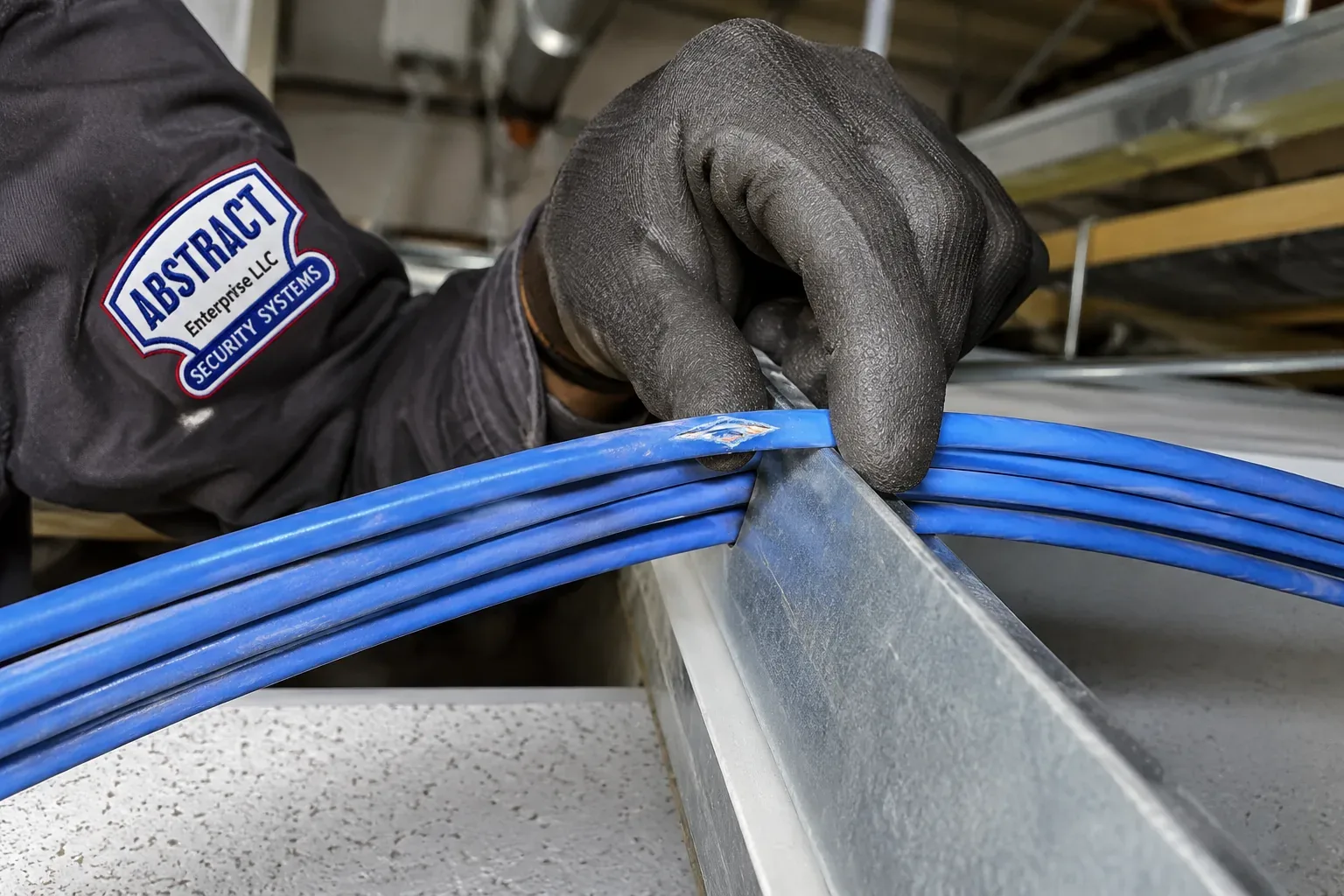
A black-gloved hand, with an Abstract Enterprise Security Systems patch on the sleeve, lifts four blue cables off the edge of a galvanized metal channel above ceiling tiles; one jacket is scraped open where it rested on the metal.
Repair Capture
Suffolk Cat6 Link Down Before the Doors Open?
A dispatch desk in Islandia that cannot reach the warehouse system, a register at a Riverhead shop that went offline mid-morning, a medical office in Smithtown whose check-in terminal lost its link, a camera recorder at a Westhampton house that stopped seeing the driveway — we treat those as service calls and book the next open 2-hour arrival window. The van carries a certification tester, a toner, Cat6 and Cat6A keystones and panel modules, factory-made cords, outdoor-rated cable and sealed enclosures. Most single-link faults at a termination or a cord are found and fixed in one to two hours once a technician is on site. Repair time is $195 an hour with a three-hour minimum ($585), as published on our Suffolk network cable repair page, and there is no East End surcharge: eastern jobs are planned into scheduled windows instead. Call (631) 407-2884 and say it is a Cat6 fault, or see our Suffolk County security camera repair page if the camera itself is the suspect.
What We Repair
Cat6 Repair Services in Suffolk County
Each of these services starts from the same question — what changed — and ends the same way: the link certified against its category limit, the result saved, and a short note in plain language of what failed and what we did about it.
Tenant-Split Rewiring
When a building is divided, we find which jacks land on which closet, move a tenant's links onto its own panel, cut and cap runs that cross into a neighbour's space, and certify what is left so each business owns a clean set of links.
Move-In Acceptance Testing
Before you accept a leased bay, office or suite, every jack is certified and the results sorted into pass, pass-with-thin-margin and fail, so the landlord's “working cabling” promise is measured rather than assumed.
Lifted-House Rerouting
For South Shore homes raised after Sandy: we take out splices and couplers added during the lift, move network equipment above the flood line, and bring each run to it in one continuous length.
Floor and Slab Jack Repair
Floor boxes and slab-fed jacks in flex offices and showrooms that fail after cleaning, rain or a leak. We dry, re-terminate and seal the box, and test whether water has travelled along the run.
Roof and Ceiling Trade Damage
Runs crushed, cut or disconnected by reroofing, HVAC replacement, sprinkler work or a new ceiling. We find the damage by distance, replace the injured section and resupport what the other trade disturbed.
Farm, Winery and Outbuilding Links
Cat6 serving registers, cameras and offices in barns, sheds and production buildings: wet-area terminations moved or sealed, runs lifted off equipment paths, and indoor cable that ended up outdoors replaced.
Rental and Second-Home Recovery
Network cabinets re-patched by guests, jacks pulled out of walls, and links that stopped working between owners' visits — restored, labelled and, where you want it, locked away from casual hands.
New-Construction Dead Jacks
Apartments, condos and fit-outs where jacks never worked: open pairs, unpunched panel ports, screws through cable in the wall cavity. We find and fix them and tell you which faults are the builder's.
Jack, Keystone and Panel Re-Termination
The everyday repair everywhere: cut back to clean cable, remake the termination on matched Cat6 or Cat6A hardware with the pair twist carried to the contacts, and certify crosstalk and return loss again.
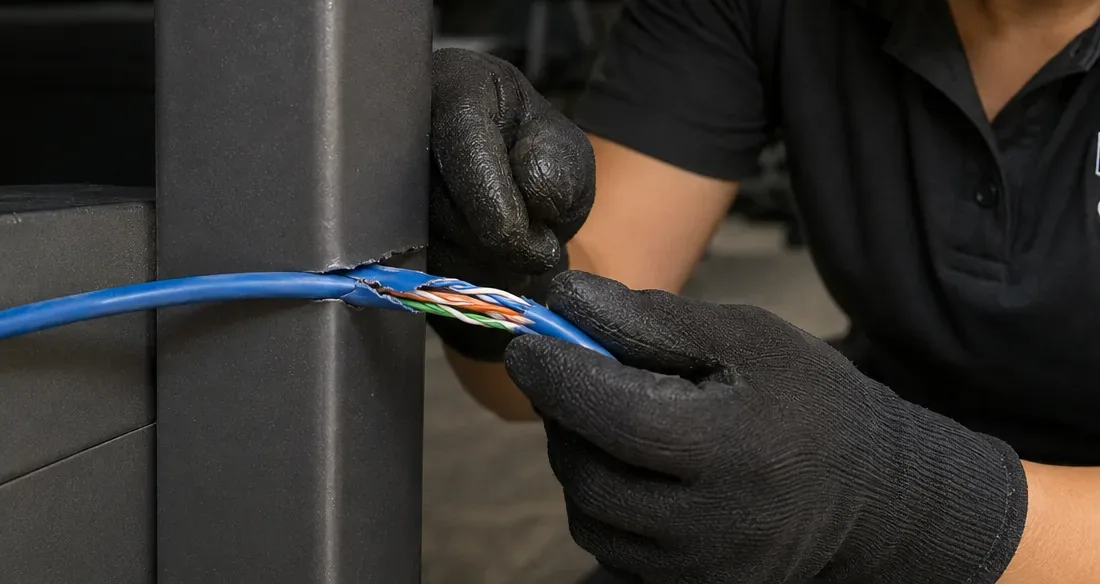
Two hands in black gloves hold a blue cable where it bends around the corner of a dark steel frame; the jacket is split for a few inches and the orange, green and white pairs inside are visible.
Building Specialists
Cat6 Repair for Suffolk County's Architecture
Suffolk's buildings are best sorted not by age but by what has been done to them since. These are the types we repair Cat6 in most often, and the change in each that most often breaks a link.
Subdivided Flex and Industrial Buildings
One-storey buildings in the Hauppauge, Central Islip and Bay Shore cluster and the industrial streets around Ronkonkoma, cut into smaller bays for new tenants. Cabling crosses demising walls and lands in the wrong closet.
Raised South Shore Houses
Bungalows, capes and ranches in Lindenhurst, Babylon, Amityville and other South Shore flood areas, lifted onto closed foundations after Sandy, with runs lengthened through the new crawl space or enclosure.
Barrier-Island Cottages
Fire Island houses reached by ferry, water taxi or permitted vehicle, where salt, sand and long periods without power work on every termination, and every part has to be on the boat.
Farm and Winery Buildings
Barns, packing sheds and production buildings on the North and South Forks now holding tasting rooms, retail and offices, with wet floors, equipment movement and cable added in stages.
East End Estates and Rentals
Large houses with network cabinets, pool houses and guest cottages, rented by the week or the season, where the cabling is re-patched by people who did not install it.
Hospitals and Medical Buildings
Campuses that grow by pavilion and wing, plus medical office buildings and converted houses used as practices, where links cross old and new construction and every repair is scheduled around patients.
Colleges and Schools
Suffolk County Community College's three campuses, district buildings and private schools, where additions and re-purposed rooms leave runs that start in one era of construction and end in another.
New Apartments and Mixed-Use
Station Yards at Ronkonkoma and other new apartment and mixed-use buildings, where Cat6 is new but untested after handover and a dead jack is often a fit-out shortcut.
Post-War Houses With Home Offices
Huntington, Smithtown, Brookhaven and Islip colonials, ranches and split-levels where a home office or a wired camera system was added later, usually by whoever had a drill and a box of cable.
How the repair changes by building type
Subdivided flex buildings. Before we repair a single link in a divided building, we map it: which jacks in your bay land on which panel, which panel sits in which tenant's space, and which runs pass over the demising wall. That usually takes a toner, a tester and an hour with the ceiling tiles out. The repair that follows is often less about re-terminating and more about ownership — moving your links to a panel you control, capping the stubs that wander next door, and leaving you a port map that matches the space you lease. Where the old closet is now inside someone else's unit and cannot be moved, we document which ports belong to you so the landlord can sort out access.
Raised houses. A house lifted on a new foundation usually had its low-voltage wiring cut at the old floor line and reconnected afterwards. Power wiring is reconnected and inspected as part of the job; low-voltage cable is often an afterthought and gets a coupler, a crimped joint or a box of splices in the crawl space so the existing runs reach the router again. Those joints are the weak point. We trace each run, take the joints out, replace the short lengths with continuous cable from the room to a new equipment location above the design flood elevation, and certify each link from end to end so it is a single permanent link again rather than a chain of pieces.
Barrier-island cottages. On Fire Island the repair is planned before anyone leaves the mainland. We confirm how the technician reaches the community — ferry, water taxi or a contractor's driving permit where the National Park Service allows one — and pack every part the likely repair could need, because there is no running back to the van. Terminations get sealed or moved indoors, and anything on a deck or under a house gets cable rated for the exposure.
Farm and winery buildings. In production spaces we keep terminations away from wash-down areas and equipment paths, mount boxes high and sealed, protect runs crossing floors or beams where forklifts and bins move, and check that the cable is rated for a building that may not be heated. Outdoor or between-building runs get outdoor-rated cable and proper entry protection.
Hospitals, colleges and new construction. In institutional buildings we work to the facilities office's rules, schedule around patients or classes, and hand back saved certification results for every link touched. In new buildings we test everything the owner reports dead and the jacks around it, because fit-out faults come in clusters.
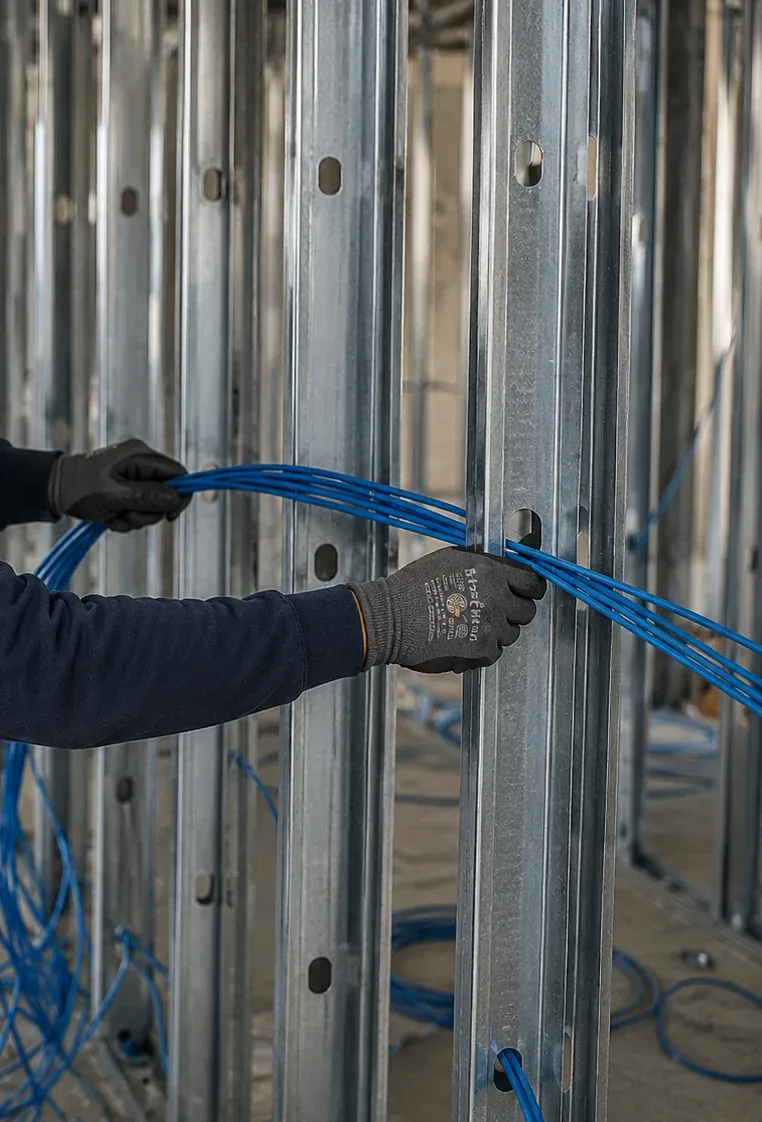
Two gloved hands in navy sleeves pull a loose bundle of blue cables through the punched holes of a row of galvanized steel studs in an unfinished wall, with more coils of blue cable on the floor behind.
Commercial Cat6 Repair
Business Cat6 Repair in Suffolk County
Suffolk's business addresses are spread along corridors, airport parks, hospital campuses and retail strips that each change in their own way. The places below are named to describe the kind of building and the kind of Cat6 trouble that comes with it. They are not a list of our customers or our jobs.
Hauppauge, Central Islip and Bay Shore
The cluster CoStar counts as Long Island's largest industrial node, over 26.1 million square feet, with the Island's most available space and tenants asking for smaller bays. The Cat6 problem here is subdivision: links that cross into a neighbour's unit, closets that end up in someone else's space, and runs abandoned behind new demising walls.
Route 58, Riverhead
The East End's main retail road, where The Shops at Riverhead, a 115,000-square-foot centre anchored by Costco, sits across from the Tanger Outlets. Registers, handhelds and cameras in big-box and pad-site stores depend on links that the store's vendors installed and nobody documented, and stores are re-fitted between tenants.
Enterprise Park at Calverton
The former Grumman site where the Riverhead Planning Board approved a preliminary plat dividing about 2,107 acres into eight lots, with about 292 acres of protected Pine Barrens. Industrial and aviation buildings on a site like this mix decades-old structures with new ones, and links between them are long.
Gabreski Airport, Westhampton
The Hampton Business District on 55 acres of county land at Francis S. Gabreski Airport, planned in 2016 for ten buildings including 67,000 square feet of offices and medical space. Medical and professional tenants in buildings like these re-fit suites as practices change, and their links get extended with each re-fit.
Station Yards, Ronkonkoma
The 53-acre development at the Ronkonkoma LIRR station, planned for 1,450 homes plus office and retail space and close to MacArthur Airport and LIE Exit 60. New residential and commercial cabling, handed over in phases, brings the untested-jack problem in volume.
Hospital Campuses, Riverhead and Southampton
Peconic Bay Medical Center's $67.8 million Corey Critical Care Pavilion left roughed-out space for future suites, and Stony Brook Southampton Hospital is planning a 275,000-square-foot replacement on 15 acres of the Stony Brook Southampton campus, with 2030 described as a best-case opening. Medical practices around campuses like these move, expand and re-wire as the campuses do.
Licensing, permits and code callouts for Suffolk Cat6 repairs
Suffolk County Chapter 563. The county code licenses home improvement contractors under Article II and master and restricted electricians under Article XI, through the Department of Consumer Affairs. RiverheadLOCAL reported in 2019 that the home improvement licence requires a written test plus liability and workers' compensation insurance, that working without one can bring civil penalties of up to $750 for a first violation and $1,500 after that, and that 9,107 such licences were held countywide in 2018. Which licence a given job needs depends on the work and the address, and we confirm it before starting.
Town permit desks. Building and electrical permits in Suffolk are issued by the ten towns and the villages, not by the county. The Town of Southampton, for example, runs its own electrical e-permit portal. A routine Cat6 repair rarely needs a permit, but new exterior penetrations, trenching or work in a rated assembly can, and we check with the municipality before quoting that work.
Utility marking before digging. New York 811 serves Nassau and Suffolk, and asks that it be called at least 48 hours and no more than 10 working days before any digging. A failed buried Cat6 run is not dug up until the marks are in.
Flood-zone enclosures. FEMA's Technical Bulletin 5 limits the enclosure under an elevated building to parking, building access and storage, and FEMA guidance expects building utility components below the required elevation to be elevated or designed for flood loads. On raised houses we move network equipment and terminations above the flood line rather than repair them in the enclosure.
Central Pine Barrens. In the Core Preservation Area, clearing or materially altering vegetation counts as development under the Long Island Pine Barrens Protection Act, which the Central Pine Barrens Commission says requires a hardship waiver. Buried repairs in the pine barrens of eastern Brookhaven, western Southampton and southern Riverhead are planned around that.
Abandoned cable and entry protection. When a run is replaced, the accessible part of the old communications cable comes out unless it is tagged for future use, as the National Electrical Code requires, and outdoor runs entering a building are fitted with a listed primary protector close to the entry point.
Businesses whose failing links feed doors and readers often fold that work into the same visit; our access control installation team in Suffolk County handles the controllers and readers once the cabling underneath them is sound.
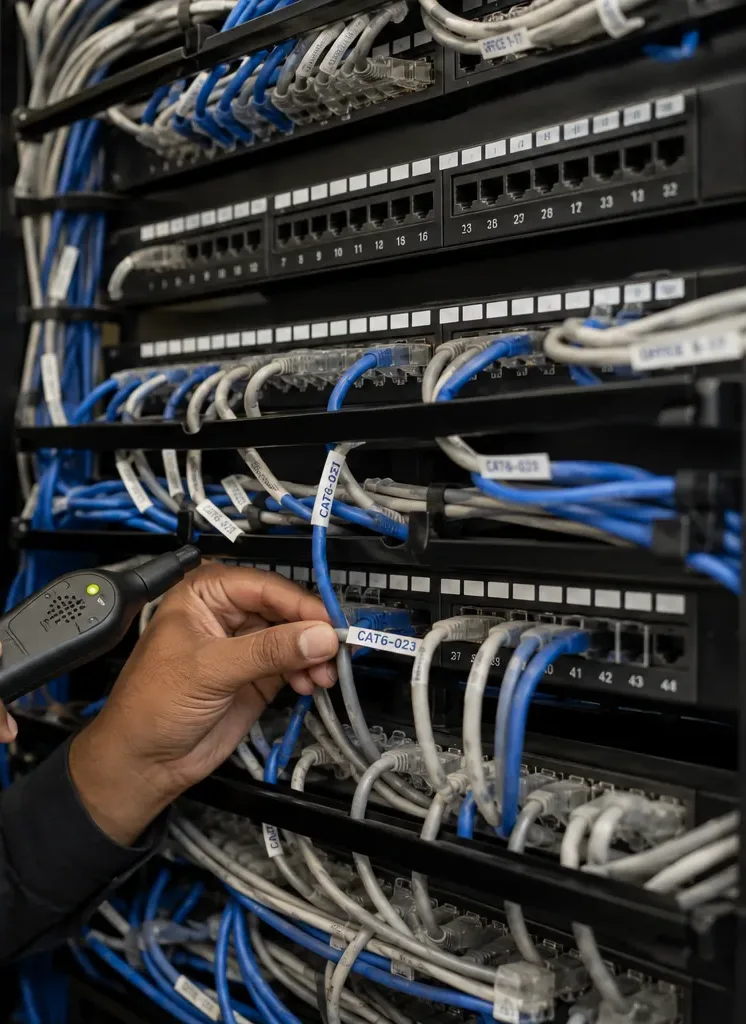
A hand holds a black inductive tone probe close to a blue patch cord with a white label reading CAT6-023, among rows of blue and grey cords plugged into black patch panels numbered along their edges.
Your Questions Answered
Cat6 Repair in Suffolk County: Questions Answered
These are the questions tenants, homeowners, property managers, farm and winery owners and IT providers in Suffolk ask once a Cat6 link has started failing. They are grouped by what changed around the cable: the tenancy, the house, the land and the island, and new buildings. Scheduling and smaller practical points are in the FAQ further down.
When the space was divided or re-let
Our bay in a subdivided Hauppauge flex building has jacks that still run back to a closet on the other tenant's side. Can the repair bring them to our own panel?
Yes, and in most subdivided buildings it is the repair that stops the failures from coming back. When a large building is split, the original closet stays wherever it was, and the jacks in the new bays keep their old runs to it. Your links then depend on a patch panel, a switch and sometimes a power strip in a space you cannot enter, which the neighbouring tenant can unplug, re-patch or lock. They also tend to be long, because the closet was placed for the old floor plan rather than yours.
We first map the bay: which jacks are yours, where each one lands, and whether the run passes over the demising wall. Where your space has a sensible location for a small rack or wall cabinet, we pull new runs or reroute the existing ones to it, terminate them on a panel you control, and certify each link. The stubs left on the old panel are disconnected and labelled so nobody patches into them by mistake. If the landlord wants the old closet left as it is, we document which ports used to be yours so the building's records are accurate.
Our lease says the landlord hands over working data cabling. What test results should we ask for before accepting the space?
Ask for certification results, not a continuity check. A simple tester that lights all eight wires proves only that each conductor is connected end to end; it does not show whether the link meets Category 6 for crosstalk, return loss, insertion loss and length. A certification report shows each link's result against the category limit and its margin, so you can see which links passed comfortably, which barely passed and which failed. It is the only evidence that will settle a dispute later about whether the cabling was working at handover.
If the landlord cannot provide it, we can certify the space for you before you sign off. We test every jack, compare it with the floor plan you are leasing, and give you a summary that separates passing links, thin-margin links, failed links and jacks that land somewhere other than your space. That summary is what you take back to the landlord. We repair the failures on your instruction or the landlord's, whichever the lease makes responsible.
Floor jacks in our slab-on-grade office keep failing after the floors are washed or after heavy rain. What is happening under there?
Water is reaching the terminations. Floor boxes and jacks fed through a slab sit at the lowest point of the room, and a floor box with a worn gasket, an unsealed cover or a conduit that drains toward it collects water from mopping, from tracked-in rain or from groundwater pushing up through the conduit. Once the contacts in the keystone have been wet a few times they corrode, and the link becomes intermittent before it fails outright. If the conduit holds water, the cable jacket can also wick it along the run.
We open the box, dry and inspect it, and test the run disconnected to see whether the problem stops at the termination or extends along the cable. Corroded keystones are cut back and replaced, the box gasket and cover are renewed, and where the conduit is wet we pull the run, dry or clear the conduit if possible, and replace the cable with one rated for a damp location. Where the box keeps flooding, the better answer is often to move the jack to a raised furniture feed or the nearest wall.
The building was reroofed and now the Cat6 runs to the rooftop cameras and units fail. Who fixes what?
Usually the roofer fixes the roof and we fix the cable, but the order matters. Reroofing a flat-roofed commercial building means tearing off membrane and insulation around every penetration, and Cat6 runs that went up to rooftop cameras, antennas or equipment are cut, pulled tight, pinched under new flashing or left with an open hole where the old penetration was. Links that still work may have been kinked or crushed enough to fail return loss.
We test each rooftop link from the closet to find which are cut, which are damaged and where. Where the run is cut at the penetration, we re-terminate it in a sealed outdoor enclosure or replace the exposed section with outdoor-rated cable through a proper weatherhead or sealed penetration, which the roofer then flashes. We give you a list of what the reroofing damaged and photographs of it, which is useful if the cost is going back to the roofing contractor.
When the house was raised or renovated
Our South Shore house was lifted after Sandy and the rooms fed through the new crawl space keep dropping. Why?
Because the runs feeding those rooms are probably no longer single cables. When a house is lifted, the wiring that went down into the old basement or slab has to be disconnected, and after the house is set on its new foundation the low-voltage cable is often reconnected with whatever reaches: inline couplers, crimped plugs joined by a barrel, or a box of punched-down splices sitting in the crawl space. Each joint adds crosstalk and return loss, and in a damp, unheated crawl space with flood vents open to the outside air, the contacts corrode. The result is links that drop out in wet weather and come back when it dries.
The fix is to make each link continuous again. We find the joints with the tester, which places them by distance, then replace each patched run with one length of cable from the room to the network equipment, routed above the flood line and through the conditioned part of the house where possible. Every repaired link is certified end to end. Where the house will be lived in during the work, we do it room by room so the family keeps a working connection somewhere.
The network equipment used to sit in the enclosure under our raised house. Where can it go, and how do the runs get rerouted?
It belongs above the design flood elevation, and usually inside the living space. FEMA's guidance for elevated buildings in flood zones limits the enclosure underneath to parking, building access and storage, and expects building utility equipment below the required elevation to be raised or protected. A router, switch, camera recorder and patch panel on a shelf in the enclosure will be underwater in the next surge, and even between storms it lives in salt air and condensation.
We pick a location upstairs — a closet, a utility room or a ventilated cabinet near where the internet service enters the living floor — and bring every run to it. Runs that came up from the enclosure are replaced with continuous cable through interior walls or a chase; where cable has to pass through the enclosure to reach a camera or a dock, it is rated for the location and has no terminations below the flood line. The internet provider may need to move its own equipment as well, and we tell you what to ask them for.
Farms, rentals and the island
Our winery's Cat6 runs through the same building as the wash-down area. How is it kept working when the floor is hosed?
By keeping the terminations, and as much of the cable as possible, out of the wet zone. Production buildings on the North Fork often combine a crush pad or barrel room, storage and a tasting or retail space under one roof, and the Cat6 for the registers, cameras and office was added later along whatever wall or beam was handy. Floor-level jacks, boxes on walls that get sprayed, and cable lying across the floor or down a drain channel are what fail, usually at the busiest time of year.
We reroute runs high, along beams or in raceway above the splash line, and move terminations into sealed enclosures or into the dry rooms the links serve. Where cable has to cross a wet area, it goes overhead or in sealed conduit, and anything exposed to spray is rated for it. We also protect runs from forklifts and bins at doorways. Then each link is certified, so you know it will hold through harvest.
Summer guests at our rental re-patched the network cabinet and now half the house is offline. How do you put it back and stop it happening again?
We put it back from the cabling up, then make it hard to undo. Guests who lose Wi-Fi in one room often unplug and replug things in the cabinet, swap cords between ports, plug a travel router into a jack or move the switch. The cabling itself is usually fine; what is lost is the map of which jack goes to which port, and sometimes a port or a cord that was damaged in the shuffle. Occasionally a guest pulls a jack out of the wall trying to reach the cable behind it.
We test each jack, re-establish which room lands on which panel port, replace damaged cords and jacks, and patch the cabinet so every room works. Then we label both ends, leave a printed map for you or your property manager, and, if you want, fit a locking door or a lockable panel cover so guests can reach the internet equipment's reset button but not the patching. Owners who rent all season often book a quick check-up between bookings at the start of summer.
Can a Cat6 repair be done in a Fire Island community where contractors need a driving permit or a ferry?
Yes, with more planning. The National Park Service issues off-road driving permits on Fire Island only to year-round residents and to contractors and businesses with work in a given community, and in winter access is by ferry, water taxi or private boat. Freight also moves by ferry: Fire Island News reported in May 2025 that Fire Island Ferries, which serves communities from Kismet to Point O'Woods, had lost the use of its usual freight site on the Town of Islip's Maple Avenue property in Bay Shore during town construction. So the visit is built around the boat, not the van.
We ask for photographs of the cabinet, the jacks and anything outdoors, the size of the house and how the cable runs, and we pack every part the likely repair needs, including outdoor-rated cable and sealed enclosures. We agree with you or your caretaker how the technician gets there and back, and how long the visit can be. Because salt air and long unpowered winters are hard on terminations there, we also check the other links in the house while we are on site.
Our failed buried Cat6 crosses woodland inside the Pine Barrens. Can it be dug up and replaced?
Possibly, but not by simply cutting a new trench through the trees. In the Central Pine Barrens Core Preservation Area, which covers parts of eastern Brookhaven, western Southampton and southern Riverhead, the Central Pine Barrens Commission treats clearing or materially altering vegetation as development, and development there needs a hardship waiver. Outside the Core, local rules still apply. So the first question is exactly where your property and the run sit.
We locate the fault by distance from both ends first, which often shows that the damage is at one point, such as where the cable enters a building or crosses a path, rather than along the whole run. A localised fault can sometimes be repaired with minimal disturbance in the existing trench line. Where the whole run has to be replaced, we look at reusing the existing route or conduit, an overhead or along-structure route, or fiber, and we tell you plainly if the work needs approvals before anyone digs.
Does anyone have to mark utilities before a failed buried Cat6 run is dug up?
Yes. New York 811, which serves Nassau and Suffolk, asks for a call at least 48 hours and no more than 10 working days before digging, excluding weekends and holidays, so the utilities can mark their lines. On a Suffolk property that can include electric, gas, the internet provider's cable, and sometimes a water service, and on farms and estates the buried lines can run a long way from the house. Private lines — a feed to a pool house, a well pump, landscape lighting — are not marked by the utilities and have to come from the owner's knowledge or drawings.
We test the run first so the dig is as small as possible, then wait for the marks before excavating. If the failed run shares a trench with other private lines, we hand-dig around them. Where the replacement run goes back in the ground, it goes in conduit with warning tape above it, so the next person who digs knows it is there.
New buildings
We bought a new apartment at a Suffolk development and some jacks have never worked. Is that a builder issue or a repair?
Often both, and a test settles which. Jacks that have never worked in new construction usually fail for a handful of ordinary reasons: a run that was never punched down at the panel, pairs that were split or reversed at the jack, a drywall screw or nail driven through the cable in the wall, a cable pulled so hard during installation that a conductor broke, or a jack connected to a panel in a different unit. All of those are installation defects. None of them is a network setting.
We certify every jack in the unit, place each fault by distance, and give you a written result for each one. If the fault is in workmanship and the unit is still under the builder's warranty, that report is what the builder's office will want to see, and you can choose to have them correct it. If you would rather it was fixed now, we repair it, and you still have the record. Either way you know which jacks are sound before the furniture goes against the wall.
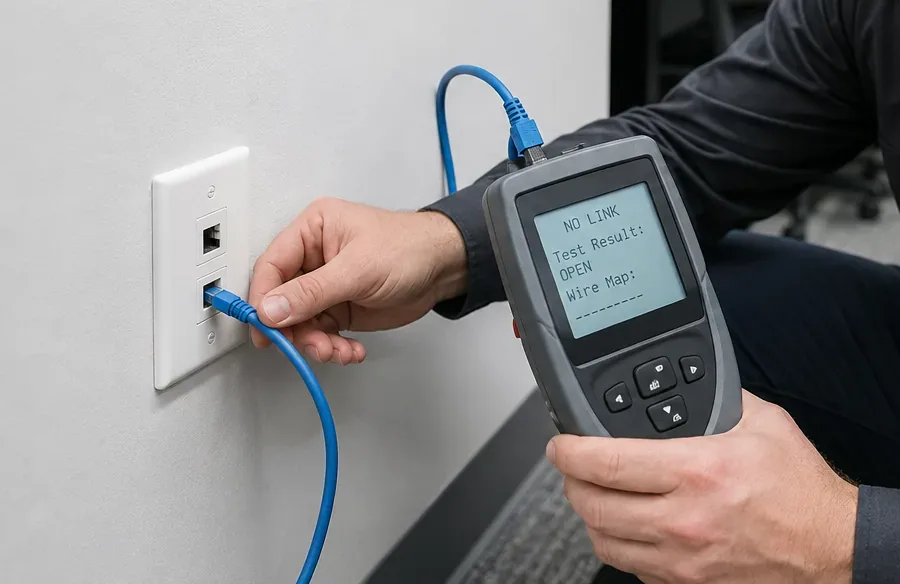
A hand pushes a blue patch cord into the lower port of a white two-port wall plate while the other hand holds a grey tester whose screen reads NO LINK, Test Result: OPEN and Wire Map.
Equipment
Test Gear and Parts on Every Suffolk Cat6 Repair
A Suffolk repair is often a long way from a supply house, so the van is packed for what changed in the building, not just for a bad jack. These are the categories we bring and what each one is for.
Certification Tester
Measures each link against its Category 6 or 6A limit for wire map, length, insertion loss, crosstalk and return loss, and saves the result — the evidence for a lease handover, a builder's warranty claim or a roofer's bill.
Distance-to-Fault Plots
Reflection and crosstalk traces that put a fault at a distance along the run, so a coupler in a crawl space or a crush under new flashing is found without opening every wall and ceiling.
Toner and Inductive Probe
For mapping subdivided buildings and rentals: which jack lands on which port, which panel sits in which tenant's space, and which runs are dead ends behind new walls.
Matched Keystones, Modules and Panels
Cat6 and Cat6A hardware for re-terminating jacks and panel ports, plus small wall-mount panels and cabinets for giving a tenant or a lifted house its own termination point.
Damp-Location and Outdoor Cable
Solid-copper cable rated for crawl spaces, enclosures, decks and burial, so a run through a wet or exposed space is replaced with cable meant to be there.
Sealed Enclosures and Gaskets
For floor boxes, barn walls, roof penetrations and island decks: terminations that have to live near water get a sealed box or move to a dry room.
PoE Load Tester
Shows the power a camera, access point or phone actually receives at the end of the run, which matters when a run has been lengthened during a lift or a re-fit.
Labels and Port Maps
Durable labels for both ends and a printed map of every jack and port, so the next tenant, guest or IT provider can see what goes where.
Fish Rods, Pull Line and Raceway
For rerouting runs through finished houses, above wash-down zones and along beams in production buildings without tearing open more than necessary.
Why the tester matters more than the toolbox. Many of the faults we find in Suffolk — couplers in a crawl space, a run pulled tight under roofing, a split pair from a hurried fit-out — pass a basic continuity check. A certification tester is the difference between a link that lights up and a link that is proven to meet its category, with a saved result that settles who did what.
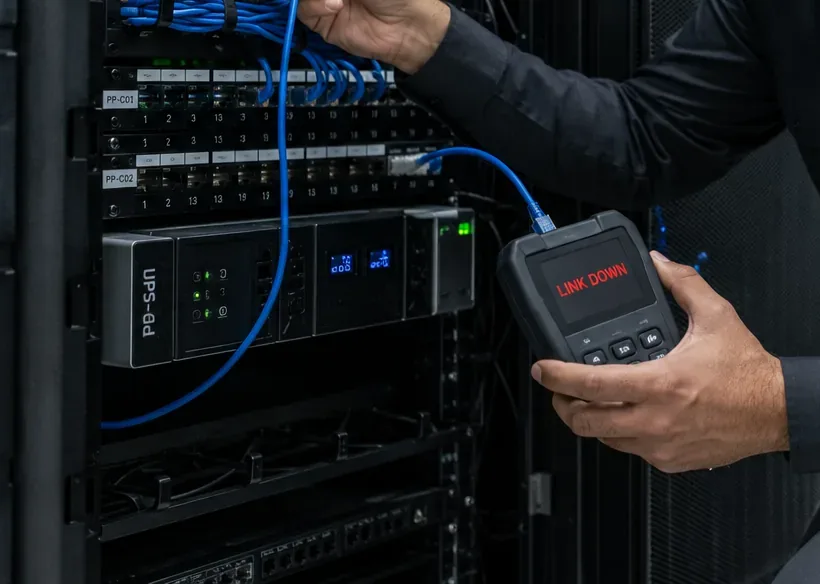
A hand in a dark sleeve holds a black handheld tester whose red display reads LINK DOWN; a blue cable runs from the tester up to a rack holding patch panels labelled PP-C01 and PP-C02 and a power unit, with another hand above plugging a cord into the rack.
AI Overview Reality Check
What AI Gets Wrong About Cat6 Repair in Suffolk County
A word on sources: we were unable to view Google's AI Overview while researching this page, so we do not quote it. The seven claims below are ones that cost guides such as Angi, HomeAdvisor and Fixr, store listings, DIY articles and chat-style answer tools tend to repeat about Ethernet wiring. After each claim comes the Suffolk reality.
“Cat6 lasts for decades, so if it worked once it still works”
Properly installed Cat6 in a stable building does last a very long time, and that is a fair general point.
The catch in Suffolk is the word “stable.” Cable outlives the building it was installed for. The flex building gets split into bays, the house gets lifted, the barn becomes a shop, and each change moves, lengthens, crushes or disconnects runs that were never touched by age.
So a link that worked once has to be retested after any change to the building around it. The question is not how old the cable is but what has happened to it since.
“A barrel connector is a fine way to lengthen a short run”
Inline couplers are sold everywhere and recommended in countless forum answers as a quick way to lengthen a run.
For a temporary patch cord on a desk, fine. Inside a wall, a crawl space or a ceiling, a coupler is a hidden joint that adds crosstalk and return loss, and Fluke Networks' troubleshooting guidance says female couplers should not be used in a data installation. They are exactly what we find in Suffolk houses that were raised after Sandy and in offices that were re-fitted.
The repair is to replace the joined pieces with one continuous run and certify it, rather than add another coupler.
“Running a new cable is about $125 to $250 a drop”
Fixr's national cost guide, updated January 2025, quotes roughly that range per drop for Cat6 installation, and many answers repeat it as the cost of a fix.
That figure describes new drops in an open, ordinary building. It does not describe repairing a link that crosses another tenant's ceiling, rerouting runs out of a flood enclosure, or getting a technician and parts to a Fire Island community by boat. Repair cost in Suffolk depends on what changed around the cable.
Our own Suffolk figures are published below: $195 an hour with a three-hour minimum for repair time, and replacement runs from $175 per drop when a run cannot be saved.
“A green link light proves the wiring is good”
A link light on a switch or laptop is often treated as proof that the wiring is good, and simple testers that light eight LEDs reinforce the idea.
A link light only shows that the two ends negotiated something. A link can light up while falling back to 100 megabits on a broken pair, or pass a continuity test while failing Category 6 crosstalk because of a coupler or a split pair. That is the difference between the landlord's “it works” and a link that meets its category.
Ask for certification results when you take over a space or pay for a repair. They show margin, not just a light.
“Any handyman can re-punch a jack”
Re-punching a keystone is presented as an easy DIY job, and the tools are cheap.
The physical act is easy. Doing it so the link still meets Category 6 is not: too much untwist at the contacts, pairs in the wrong order or a nicked conductor all leave a link that lights up and then fails a crosstalk test. In rental houses and re-tenanted bays we regularly find jacks that several people have re-punched.
Licensing in Suffolk is also not a single county answer. Chapter 563 licenses home improvement contractors and electricians, the towns and villages run their own permits, and which applies depends on the job and the address. Ask whoever does the work to certify it and leave you the result.
“Put the router wherever the internet comes into the house”
That is common advice, and in most houses it is sensible, because it keeps the provider's line short.
In a raised South Shore house the internet service may now come in at the enclosure below the living floor, which FEMA guidance limits to parking, access and storage. Equipment and terminations left there sit in the flood zone and in damp air.
The right place is above the flood line, and the Cat6 should run to it in continuous lengths. Ask the provider to bring its line up to that point rather than building your network around where they left it.
“Wi-Fi extenders make wired runs unnecessary in a big house”
Mesh systems and extenders are widely recommended as an alternative to wiring large houses, and they do help phones and laptops.
The East End houses we work in tend to be large, with pool houses, guest cottages and cameras at the gate, and the devices that matter most there — cameras, access points, recorders and the mesh nodes themselves — work best wired and often need power over the cable. A mesh node with a failed wired backhaul quietly drops to a slower wireless hop.
Repairing the runs to the far rooms and buildings is usually cheaper and steadier than layering more wireless hardware on top of a broken wired network.
Find Out What Changed Around Your Cable
Tell us the town, the building and what has been done to it since the cable went in. A technician will tell you what the likely fault is and how the visit is billed before anything is booked.
Whether it is a re-let bay in Central Islip, a lifted house in Lindenhurst or a tasting room in Cutchogue, the form goes to a technician who plans Suffolk jobs. Describe the fault and what changed, and you get a written reply the same business day. Rather talk? Call (631) 407-2884.
✅
We Got Your Request!
A Suffolk technician will call you back the same business day. If it is urgent, call (631) 407-2884.
How It Works
Our Suffolk County Cat6 Repair Process
Six steps, whether the job is one dead jack in a Huntington home office or a re-let bay in Bay Shore where half the links land next door.
1. History call
We ask what has been done to the building since the cable went in — split, lifted, reroofed, re-fitted, rented — which links fail, and when. The history usually points to the fault before anyone drives east.
2. One-trip plan
We book a 2-hour arrival window, confirm access to closets, ceilings, crawl spaces or the neighbouring tenant's room, arrange ferry or permit logistics where needed, and pack the parts the likely repair needs.
3. Map and certify
Each affected jack is traced to its panel port and certified from both ends. Joints, crushes and breaks are placed by distance, and we note where each run crosses something that changed.
4. Agree the fix
Link by link, we explain the fault and the proposed repair — re-termination, continuous replacement run, new panel location, sealed box or reroute — and you approve the list before work outside it starts.
5. Repair to the building as it is
Terminations are remade on matched hardware, joined runs replaced with continuous cable, equipment and terminations moved out of wet or shared spaces, and accessible abandoned cable removed.
6. Certify, label and hand over the map
Once the work is done, each link is tested to category a second time and tagged where it starts and ends. The saved results and a port map drawn for today's layout come to you.
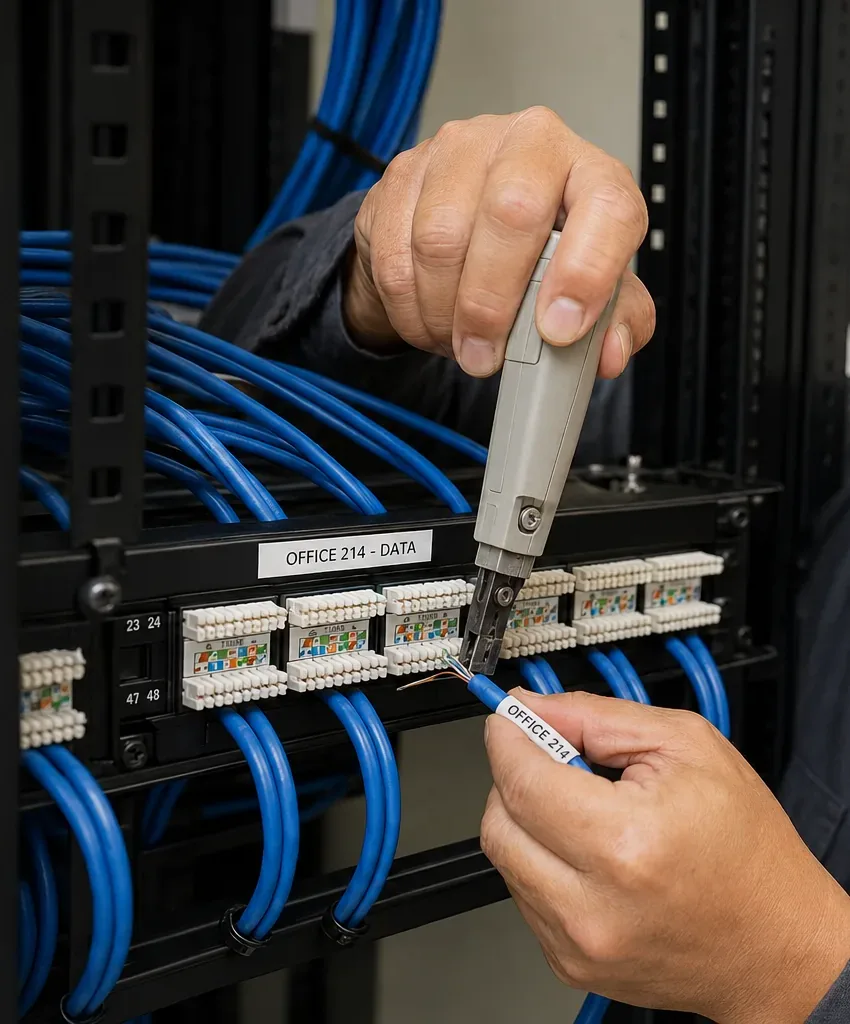
One hand presses a grey punch-down tool onto a white termination block on a black patch panel labelled OFFICE 214 - DATA, while the other hand holds a blue cable tagged OFFICE 214 with its conductors fanned into the block; more blue cables loop below.
Coverage Area
Cat6 Repair Near Suffolk County's Landmarks
These six places describe the range of Suffolk's buildings, from barrier-island structures to a converted estate, a farm-road roadside building, an old aerospace site, a college campus and a new transit village. They are reference points for the buildings around them, not claims of work inside them.
Fire Island Lighthouse, Fire Island National Seashore
The 168-foot tower that began operating in 1858, just east of Robert Moses State Park — the landmark at the western end of the barrier island whose communities are reached by ferry and permitted vehicle.
Vanderbilt Museum, Centerport
A 43-acre waterfront estate above Northport Bay, built in stages from 1910 to 1936 and deeded to Suffolk County in 1944: the North Shore's estate tradition, where large old houses carry new networks.
The Big Duck, Flanders
Built in 1931 by a duck farmer as a shop for his poultry and eggs, moved and moved back, and listed on the National Register in 1997 — a small reminder of how East End farm buildings keep changing use.
Enterprise Park at Calverton
The former Grumman site in the Town of Riverhead, around 2,107 acres in a preliminary plat of eight lots, with about 292 acres of protected pine barrens alongside the industrial land.
Suffolk County Community College, Selden
The Ammerman Campus on 156 wooded acres with more than 13,000 students, one of three campuses with the Grant Campus in Brentwood and the Eastern Campus in Riverhead.
Station Yards, Ronkonkoma
The 53-acre development around Suffolk's busiest LIRR station, planned for 1,450 homes with office and retail space, beside MacArthur Airport and the Expressway.
We also repair Cat6 in Huntington, Huntington Station, Melville, Dix Hills, Commack, Northport, Smithtown, Hauppauge, Islandia, Central Islip, Brentwood, Bay Shore, Islip, Sayville, Bohemia, Holbrook, Lindenhurst, Babylon, Amityville, Deer Park, Patchogue, Medford, Port Jefferson, Shirley, Mastic, Riverhead, Mattituck, Cutchogue, Southold, Greenport, Orient, Westhampton, Hampton Bays, Southampton, Bridgehampton, Sag Harbor, East Hampton, Amagansett, Montauk and Shelter Island, and the hamlets between them.
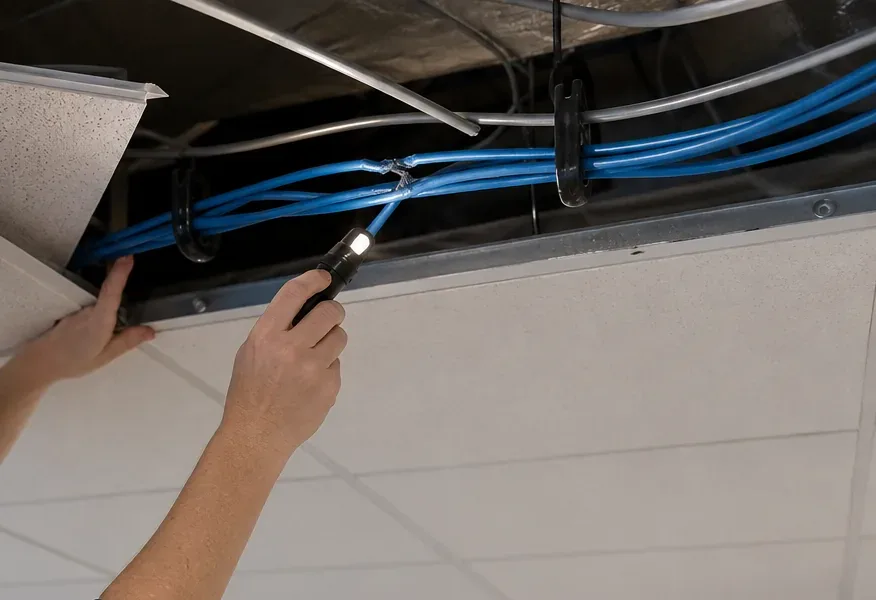
One hand holds up a white ceiling tile while the other shines a small flashlight along blue cables hanging in black J-hooks in the space above; a strip of tape is wrapped around one of the cables.
Pricing
Cat6 Repair Cost in Suffolk County
Every figure in this table is already published on one of our Suffolk pages, and the right-hand column says which. A Cat6 repair has two very different cost parts: technician time to find and fix faults, and any cable that has to be replaced. Your invoice lists them separately.
Item
Suffolk price
Scope and source
Repair time on Cat6 or Cat6A — mapping, certification, fault location, re-termination, resupport, final certification
$195/hr, three-hour minimum ($585)
The specialty rate on our Suffolk County network cable repair pricing table; time after the first three hours is $195/hr, billed in hourly increments
Replacement Cat6 run when a link cannot be saved
From $175 per drop
Same Suffolk table: includes cable, keystone jack, wall plate, panel punch-down, testing, labels at both ends and a patch cord
Re-route of an over-length run to a shorter pathway
Quoted per run
Same table: used where measurement shows the link is out of specification and no termination work will recover it
Closet audit, mapping and labelling
Quoted by port count
Same table: jack-to-port map, live-versus-abandoned identification, durable labels, printed legend and rack re-dress — the work behind tenant splits and rental recoveries
Plenum (CMP) cable where the ceiling is a return-air plenum
Added per drop
Same table; applied only where the ceiling space carries return air
After-hours or weekend window
Premium applies
Same table, for buildings that restrict low-voltage work to off-hours
For comparison only: a new Cat6 drop on runs up to 100 ft
$296 per drop
Our Suffolk County Cat6 installation page, which lists $254 for Cat5e and $424 for Cat6A on the same basis
Depends on distance, ground, access and the municipality's requirements
Where the first three hours ($585) typically go on a Suffolk call
The minimum is three hours of a technician with a certification tester, not a fee for one fix. In a re-let bay it usually covers mapping which jacks land where, certifying the failing links and remaking the terminations that can be saved. In a lifted house it covers tracing the runs through the crawl space, finding the joints and replacing the shortest ones. In a rental it covers re-establishing the patching and fixing damaged jacks and cords. Anything that needs a replacement run is priced before the cable is pulled.
What moves a Suffolk Cat6 repair bill
How much the building has changed: a single bad termination is quick; a split building, a lifted house or a re-fitted suite needs mapping before repair.
Whose space the cable crosses: work that needs the neighbouring tenant's closet, the landlord's ceiling or the hospital's facilities office takes coordination time.
Wet and exposed locations: crawl spaces, enclosures, floor boxes, wash-down areas and roofs add sealed hardware and rated cable.
Getting there: there is no East End surcharge; eastern and island jobs are planned into scheduled windows, and any ferry or permit logistics are set out in the written quote.
What the cable really is: copper-clad aluminium or indoor cable used outdoors is replaced rather than repaired, because neither can be repaired into compliance.
A note on regional pricing. Our pricing guide sets a 1.20× Suffolk factor for some services. For Cat6 repair, the repair rate and the replacement-run figure above are the ones already published on our Suffolk network cable repair page and on our Long Island Cat6 repair page, and we use those same Suffolk figures here rather than introduce a second set. The written quote confirms the figure for your job before work begins.
Full terms — including 50% deposit, one-year parts-only warranty on AESS-supplied products, and the late-fee schedule — are set out in the service agreement.
Shop Our Systems
Cat6 Repair Packages & Pricing
Three shapes a Suffolk job usually takes, from one failing link to a building whose cabling has to be brought into line with its new layout. Every number is one we already publish for Suffolk.
Starter — One Failing Link
$585
$585 covers three hours at $195. In that time a single failing desk, register, camera, access point or home-office link is traced to its port, certified, its cause found — a hurried termination, a coupler, a wet box — repaired and certified again. Time left in the block goes to other links you want checked.
Standard — Map, Certify and Repair a Space
$195/hr after the first 3 hours
For a re-let bay, a lifted house, a rental or a new apartment: every jack mapped to its port and certified, failed terminations remade, joints taken out of short runs, and a written list of anything that needs a replacement run. Closet audits for larger spaces are quoted by port count.
Premium — Repair Plus Replacement Runs
Repair time + from $175 per run
For buildings where the old layout no longer fits: links moved to the tenant's own panel, runs brought up out of a flood enclosure, wet-area cable rerouted high. Repairable links are billed at the hourly rate, new runs start at $175 per drop, and over-length re-routes are priced one by one.
Bring Your Own Parts — Labour Only
Already have keystones, a wall cabinet, a patch panel or a box of outdoor cable for the job? We can install your parts and bill repair time only, as long as they suit the link: matching category, solid-copper conductors, and the right rating where the run is damp, outdoors or buried. Parts you supply carry their manufacturer's warranty rather than ours, and if they will not produce a passing link we tell you before we fit them.
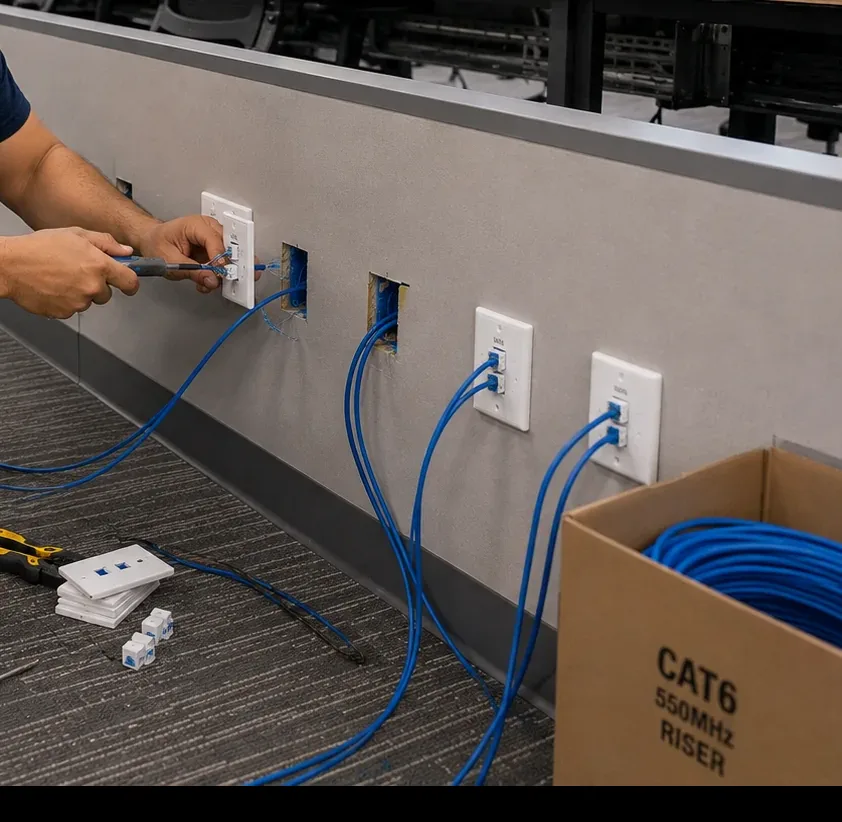
Hands work a tool at the first of several open wall boxes along a grey low partition, with blue cables looping from each box to the carpet; white wall plates, spare keystones and a cardboard carton printed CAT6 550MHz RISER sit on the floor.
Make the Cabling Fit the Building You Have Now
If the space was split, the house was lifted or the barn became a shop, the cable needs to catch up. Tell us what changed and we will plan the repair around it, with the cost set out before the visit.
Cat6 Below the Flood Line on Suffolk's South Shore
On the bay side of Babylon and Islip, water is not a once-in-a-generation event for low-voltage cabling. The National Weather Service's impact table for the Lindenhurst gauge records Sandy's peak at 7.7 feet on the evening of October 29, 2012, with much of the area south of Montauk Highway in Lindenhurst, Amityville and Babylon under two to five feet of water. The same table lists repeated moderate flooding at around four feet in 2016, 2017 and 2018. A house that was raised after Sandy is protected from most of that; the cable that still runs through the space underneath it is not.
Not every house damaged in 2012 was lifted. The Long Island Advocate reported in July 2026 that NY Rising either bought flood-zone houses for demolition or paid to raise them, and that Lindenhurst is now full of empty lots. The houses that remain on those blocks are, for the most part, the ones that went up — and with them, networks rebuilt around a new floor height.
The policy background explains what we find under those houses. FEMA's Technical Bulletin 5 limits the enclosure below an elevated building to parking, building access and storage, and FEMA's guidance on protecting building utilities expects components below the required elevation to be raised or built to resist flood loads. CBS New York reported in 2015 that Long Island towns and villages were requiring closed foundations with water vents rather than open pilings, and quoted Suffolk Legislator Kevin McCaffrey saying closed foundations protect “the mechanical structure of the house; the pipes from freezing.” Those vents are designed to let floodwater in and out. Any Cat6 termination left in that space sits in air that floods, drains and stays damp.
So on the South Shore we treat the flood line as a boundary in the cabling, not just in the house. Before repairing a link that passes beneath a raised floor, we check three things:
Where the joints are. A coupler, barrel or splice box below the floor is replaced with continuous cable, because a joint is where corrosion starts.
Where the equipment is. A router, switch, recorder or patch panel in the enclosure is moved to the living floor, and every run is brought up to it.
What has to stay below. Runs that must cross the enclosure to reach a dock camera, a gate or a garage use cable rated for wet locations, with no termination until the cable is back above the flood line or inside a sealed enclosure at the device.
The same thinking applies to ground-floor offices and shops on the bay-side streets that flood without being raised: floor boxes and low jacks are the first things to fail, and the lasting repair is often to move the termination up the wall rather than to replace it where it was. After a flood, we certify every link that was in the water, not only the ones that stopped, because wet terminations often keep working for weeks before they fail.
Ten Towns
Cat6 Repair Across Suffolk's Ten Towns
Each town has its own mix of buildings and its own permit desk. These notes describe the Cat6 repairs each tends to produce, west to east.
Babylon
The South Shore villages of Lindenhurst, Babylon and Amityville were among the places the National Weather Service recorded as inundated by two to five feet of water south of Montauk Highway during Sandy, with repeated moderate flooding in later years. Raised houses with spliced runs in the crawl space, and ground-floor offices with wet floor boxes, are the typical repairs. Deer Park and the north of the town add light industrial buildings.
Huntington
Melville's office buildings and the commercial roads through Huntington Station sit beside older North Shore houses in Huntington, Northport and Centerport. Re-fitted office suites with extended runs, and home offices added to large older houses, are the common calls.
Islip
Central Islip and Bay Shore make up much of the industrial cluster CoStar describes, along with Islandia, Bohemia and the area around MacArthur Airport. Subdivided buildings and tenant turnover dominate. The town also includes the Fire Island communities served from Bay Shore by ferry.
Smithtown
Part of the Hauppauge industrial park falls in Smithtown, alongside Smithtown's own village and the residential hamlets of Commack, Kings Park and St. James. Flex-building splits and medical offices in converted houses are typical.
Brookhaven
Suffolk's largest town and the only one that reaches from the North Shore to the South Shore. It holds Station Yards at Ronkonkoma, the Selden campus of Suffolk County Community College, Port Jefferson and the bayfront hamlets of Patchogue, Bellport and Mastic, and the western edge of the pine barrens. Its repairs cover nearly every type on this page.
Riverhead
The county's seat and the East End's retail centre along Route 58, with Peconic Bay Medical Center, the Eastern Campus of the community college and Enterprise Park at Calverton. Store re-fits, hospital-adjacent practices and long links on the Calverton site are typical, with farms and wineries to the north and east.
Southold
The North Fork from Laurel to Orient, including Greenport and Fishers Island. Farm and winery buildings, rentals and second homes, and long outdoor runs to outbuildings are most of the work. Visits are planned into scheduled windows rather than charged extra.
Southampton
From Westhampton and the Hampton Business District at Gabreski Airport to Southampton Village, Bridgehampton and part of Sag Harbor, with Stony Brook Southampton Hospital planning its new building at Shinnecock Hills. Large rentals, estates with outbuildings and medical offices are typical. The town runs its own electrical e-permit system.
East Hampton
East Hampton Village, Amagansett, Springs and Montauk: large houses and summer rentals with network cabinets, pool houses and gate cameras, plus Montauk's waterfront businesses. Rental re-patching and outdoor links in salt air are the common calls.
Shelter Island
Reached by ferry from Greenport and North Haven. Houses and small businesses here get a visit planned around the ferry, with every part on board, and outdoor terminations checked for salt and moisture while the technician is there.
What Changed? A Suffolk Guide to Matching the Fault to the Fix
In Suffolk the most useful clue to a Cat6 fault is usually the last thing that happened to the building. This is the table we work from on the first call. The tester still decides, but this tells us what to bring.
What changed
What usually fails
What we check and do
The building was split into bays or re-let
Links that land on a panel in another tenant's space, runs crossing the demising wall, long runs to an old closet
Map jacks to ports; move links to the tenant's own panel; cap and label stubs; certify
The house was raised onto a new foundation
Couplers, barrels and splices added to reconnect runs; wet terminations in the crawl space or enclosure
Find joints by distance; replace with continuous runs; move equipment above the flood line
The roof, HVAC or ceiling was replaced
Runs cut or crushed at penetrations, pulled tight, pinched under flashing or ceiling grid
Floors were refinished, or the office floods in heavy rain
Floor boxes and slab jacks with corroded contacts; water in conduit
Dry, re-terminate and reseal; replace wet cable; move the jack to a wall or furniture feed
A barn, shed or garage changed use
Indoor cable on wet walls, runs on equipment paths, terminations near wash-down
Reroute high; seal or relocate terminations; replace with rated cable
The house was rented for the season
Re-patched cabinet, pulled jacks, damaged cords, lost port map
Re-establish patching; replace damage; label; lock the cabinet
The building is brand new
Unpunched ports, split or reversed pairs, screws through cable, wrong-unit landings
Certify every jack; document defects for the builder; repair on instruction
Nothing changed, but it failed anyway
A termination, a cord, a port or a crushed section
Standard certification and repair; check the conductor is genuine solid copper
Sometimes several things changed. A raised house that is also rented, or a subdivided bay with a new roof, has more than one cause stacked on the same link, and we work through them in order of what the tester shows first.
Before You Call
What to Gather Before a Suffolk Cat6 Repair Visit
Because Suffolk visits are planned to finish in one trip, a little information before we come saves a great deal on site. None of this involves opening anything.
The building's history. When was it split, raised, reroofed, re-fitted or converted? Who did the work? Even rough dates help.
Which jacks fail, and where they are. A marked-up floor plan, a sketch or room names is enough.
Photos of the closet or cabinet. The panel, the switch and where the internet service comes in, with the door open.
Access. Whether we need the landlord, another tenant, a facilities office, a caretaker or a ferry to reach any part of the run.
Anything outdoors or underground. Runs to outbuildings, docks, gates, roofs or poles, and whether they are buried.
Swap test. Try a known-good patch cord and a different switch port. If the fault moves with the device, the cable may be fine.
Paperwork. Any old test reports, the original installer's name, or the builder's warranty documents for new construction.
Please do not re-punch jacks yourself or open floor boxes that have been wet. Both are easy to make worse, and the second can be a shock hazard if power and data share the box.
Complete Services
Every Cat6 Repair Service in Suffolk County
A failing Cat6 link in Suffolk often comes with one of these. Each link below goes to the Suffolk County page for that service.
Habits our crews keep on Suffolk calls, described as method rather than as an account of any one job
We ask what happened to the building before we ask about the cable. A split, a lift, a new roof or a new tenant explains more Suffolk failures than the cable's age ever does.
We map before we mend. In a re-let bay or a rental, knowing which jack lands on which port saves more time than any single repair, and it is what the next person will need.
We look for joints. A coupler or a box of splices hidden in a crawl space or a ceiling turns one permanent link into a chain, and the tester shows us where each joint sits.
We get terminations out of the wet. Floor boxes, crawl spaces, flood enclosures and wash-down walls are where Suffolk contacts corrode, and moving the termination often fixes the fault for good.
And we plan to finish in one trip. On the North Fork, the South Fork, Shelter Island or Fire Island, the parts for the likely repair are on board before we leave.
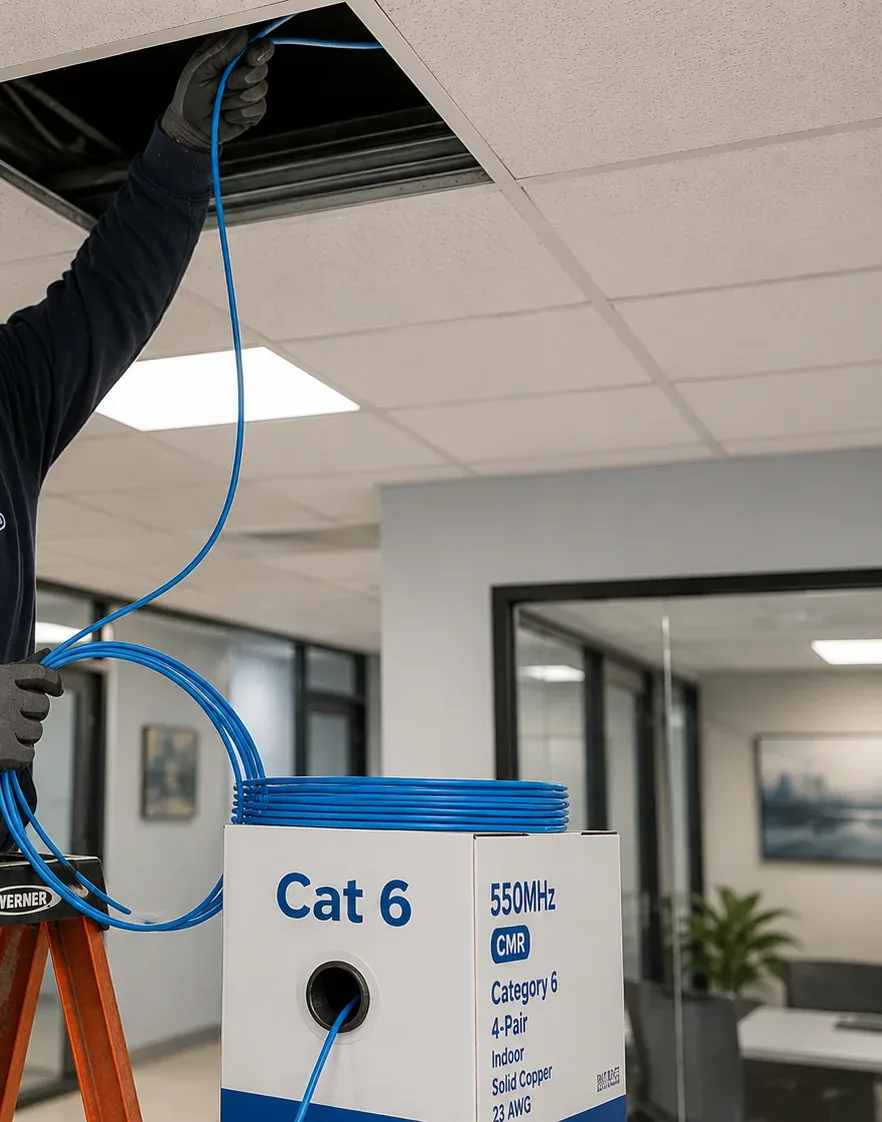
A blue cable rises from a white carton printed Cat 6, 550MHz, CMR, Category 6, 4-Pair, Indoor, Solid Copper, 23 AWG, up to a gloved hand at an open ceiling tile in an office with glass-walled rooms behind.
Responsibility
Inherited Cable, Shared Bills: Sorting Out Who Owns a Suffolk Cat6 Fault
Because so much Suffolk Cat6 was installed by somebody other than the person now paying for it, the first useful output of a repair visit is often a clear statement of whose problem each fault is. We do not decide disputes, and nothing here is legal advice, but the evidence a technician collects — certification results, photographs, a port map and a short written account of the cause — is what landlords, tenants, builders, roofers, insurers and property managers ask for when they work out who pays.
Landlord and tenant in a re-let or subdivided building
Commercial leases in Suffolk's flex and office buildings handle cabling in very different ways. Some treat existing data cabling as part of the premises the landlord delivers; others make everything above the ceiling the tenant's responsibility from day one; many say nothing at all. What makes the conversation easier is a record of the cabling's condition at the start of the tenancy. A certification report dated before move-in, showing which links passed, which were thin and which failed, separates faults that were there on handover from damage caused afterwards. Where your links land on a panel in the neighbouring unit, a port map showing exactly which ports are yours is what the landlord needs to arrange access or to fund moving them.
Owner and builder in new construction
In new apartments, condos and tenant fit-outs, the faults we find on jacks that never worked are usually installation defects: unterminated ports, split or reversed pairs, cable damaged by fasteners during drywall. A builder's or developer's warranty office will want to know which jacks fail, what the tester shows and where along the run the fault sits. We provide that per jack. You then decide whether to submit it and wait for the builder's own trades, or to have the repair done now and keep the report as the record of what was wrong.
Owner and another trade after a renovation
When Cat6 fails right after a reroof, an HVAC replacement, a ceiling renovation or a house lift, the timing points at the other trade, but timing alone rarely persuades anyone. Photographs of a cut run at a new penetration, a cable crushed under a new grid main, or a coupler buried in a crawl space, together with test results that place the fault at that exact distance along the run, make the cause plain. We note the date we found it and leave the conversation with the contractor to you.
Owner, property manager and guests in a rental
For houses rented by the week or the season on the East End and Fire Island, the question is usually whether a fault was caused during a stay. Most rental faults we see are re-patching, pulled jacks and damaged cords rather than failed cable, and a labelled cabinet with a printed map makes it easy to tell after each booking whether anything has been moved. Property managers who keep a copy of the map and the last set of results can check the network between guests without calling anyone.
Owner and insurer after water or storm damage
After a flood, a burst pipe or a storm, an adjuster wants to know which cabling was affected and what it will cost to put right. We test every link that ran through the wet area, photograph corroded terminations and wet boxes, and give you a written scope that separates links that failed, links that passed with reduced margin and links that are unaffected. We do not assess coverage; we document the cabling so the people who do have something specific to work from.
Whatever the situation, the documents are yours. We send the saved results, the photographs and the port map to whoever you nominate, and we keep a copy so a later repair can be compared with the condition we recorded.
FAQ
Suffolk County Cat6 Repair FAQ
Will you send photos of what you found inside the wall or ceiling?
+
Yes. When we open a ceiling, a crawl space, a floor box or a wall, we photograph what caused the fault — a coupler, a crushed section, a corroded keystone, a screw through the cable — along with the repair. The photos go with the saved test results, which helps when the cost belongs to a landlord, a builder, a roofer or an insurer rather than to you.
Can one Cat6 run be split to feed two devices instead of pulling a second cable?
+
Not at gigabit speed. Gigabit Ethernet uses all four pairs in the cable, so splitting the pairs between two devices drops both to 100 megabits at best and leaves a non-standard link. The proper options are a small switch at the far end, which turns one run into several ports, or a second run. We tell you which is cheaper for the location before doing either.
Can you fix a Cat6 jack that was painted over or caulked during a repaint?
+
Yes. Paint or caulk that gets into a keystone jack or the plug opening can keep a cord from seating fully and coat the contacts, so the link drops or never comes up. We remove the plate, replace the keystone and plate rather than trying to clean paint off the contacts, check the cable end behind it, and certify the link. If several jacks in the same room were painted, we test each one before you put furniture back.
Will a Cat6 repair interrupt our alarm or camera monitoring?
+
It can, briefly, if the alarm communicator or camera recorder uses the network being repaired. Before we disconnect anything, we ask which systems report over the network, and we suggest you tell your monitoring company that the system may go offline for a short time. We work on those links last, or one at a time, and check that they report again before we leave.
Can you repair the Cat6 that connects an EV charger in a garage or carport to the network?
+
Yes, the data link to the charger. Chargers that report over Ethernet are often on long runs to a garage wall, a carport post or the end of a driveway, and those runs fail the same ways other outdoor and garage links do. We repair and certify the Cat6 up to the charger's network port; the charger itself stays with its installer or electrician, who should be the one to open it.
Does someone need to be at the property for the whole visit?
+
Someone needs to let us in, show us the closet or cabinet and approve the repair list once testing is done. After that, a caretaker, a property manager or an office contact is enough, and for rentals and second homes many owners approve the list by phone. We call before work that goes beyond what was agreed, and you receive the results and photos when we finish.
Can a Cat6 repair be done while a house elevation or renovation crew is still on site?
+
Often it is the best time, because walls and floors are open and the new routes are easy to reach. We coordinate with the general contractor so new runs go in before insulation and drywall close the walls, and so nobody drills through them afterwards. What we avoid is terminating jacks and certifying links before the dusty and heavy work is finished; those are done at the end, when they will stay undisturbed.
Can you repair Cat6 in a unit we rent out year-round while the tenant is living there?
+
Yes. We need you, as the owner, to arrange access with the tenant and agree a time, and we tell you how long the network will be down while we work. We keep the work to the affected jacks and the panel, clean up as we go, and send the results to you rather than the tenant unless you ask otherwise.
All Areas Served
Cat6 Repair Across Long Island and New York
You are on the Suffolk County Cat6 repair page. It sits under our Long Island Cat6 repair hub, which covers both Long Island counties, alongside the Nassau County page. New York City and the Hudson Valley have their own Cat6 repair pages.
Inherited Somebody Else's Cat6 Somewhere in Suffolk?
Whether it came with a lease, a lifted house, a converted barn or a new apartment, call (631) 407-2884. We book the next open 2-hour window, and most termination and cord faults are fixed in one to two hours once we are on site.
Cat6 Repair Suffolk County — Licensed, Insured, Certified to Category
Abstract Enterprises Security Systems · 1282 Troy Ave, Brooklyn, NY 11203 · serving all ten towns of Suffolk County · Suffolk line (631) 407-2884 · WhatsApp (718) 679-0359 via wa.me
NYS Low-Voltage Licence #12000287431 · 100% Licensed & Insured · Same-Day Estimates · Rated 4.7★ from 201 Google Reviews
Parts you supply carry their manufacturer's warranty. See our warranty page and the service agreement for full terms.
This page describes Cat6 failure and repair as we see it in Suffolk County buildings. What it says about the county code, town permits, FEMA flood guidance, the Pine Barrens rules, New York 811 and the National Electrical Code are summaries, not legal or engineering advice; requirements vary by town, village and site. Page reviewed and updated October 17, 2026. Changelog: first publication of the Suffolk County Cat6 repair page.