Licensed Low-Voltage Contractor · Yonkers to Peekskill · Home Offices, Co-ops, New Rental Towers, Practices & Storefronts
Cat6 Repair in Westchester County
Dead Wall Jacks · Plaster & Concrete Walls · Media Panels · ONT-to-Router Links · Co-op & Rental Units · Converted Offices
Most of Westchester’s Cat6 is not in a ceiling grid. It is behind the plaster of a house built before 1960, inside the concrete of a co-op tower, in the utility closet of a new downtown rental, or running up from the fiber box in a basement that has flooded before. When a link dies there, the job is to find the fault without wrecking a finished room, work out whose cable it actually is, and leave a link that tests to its category. We do that with a certification tester, matched parts and a plan agreed with you before anything is opened.
Reviewed and updated October 17, 2026 · Written by Anwar Timothy, NYS licence #12000287431
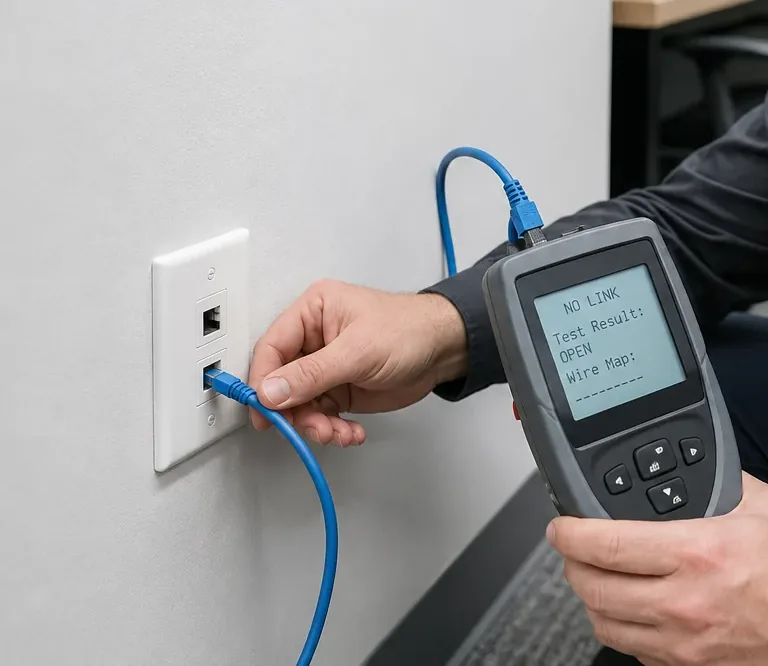
A hand plugs a blue patch cord into the lower port of a white two-port wall plate while the other hand holds a grey tester whose screen reads No Link, Test Result: Open, Wire Map.
Westchester Cat6 Repair Quote
Tell us which jacks are dead and what kind of building you are in — we reply the same business day
✅
Request Sent!
We'll get back to you the same business day.
25+
Years Experience
✓
Same-Day Estimates
100%
Licensed & Insured
4.7★
201 Google Reviews
Desk jack dead the morning of a big call, or half the rooms in a new apartment offline? Ring our Westchester line, (914) 877-2578, or send the 60-second form. A licensed technician reads it, asks what the walls are made of and where the router lives, and tells you what is most likely wrong before anyone comes to the door.
Fault placed by distance from the jack, so a finished wall is opened only where the damage is — if at all
Clear answer on whose equipment failed: the provider’s box, the building’s wiring or yours
NYS licence #12000287431 · fully insured · published rates confirmed in writing before the visit
Why Westchester Properties Need Cat6 Repair That Respects Finished Rooms
Westchester’s cabling problem is not distance or weather. It is that the cable is buried in rooms people live and work in every day. The county’s housing is old and it is finished. Of roughly 392,000 housing units counted in the Census Bureau’s 2019–2023 American Community Survey, more than half were built before 1960, and more than a quarter before 1940. Those are the Tudors of Scarsdale and Bronxville, the shingle and colonial houses of Larchmont, Pelham and Rye, the two-families of Yonkers and Mount Vernon, and the post-war split-levels further north. When Cat6 was added to them, it was fished through plaster and lath, along joists in a finished basement, behind built-ins and up the back of closets. Nobody planned for the day one of those runs would need to be repaired.
That day comes more often now because the runs are working harder. The same survey found that 17.3 percent of Westchester workers worked from home, a share that turns a single dead jack in a spare bedroom into a business outage. A home office that depends on one wired link for video calls, a VPN and a docking station does not tolerate a run that negotiates at 100 Mbps or drops for a few seconds every hour. The cable that was fine when it fed a printer is now the most important wire in the house, and when it fails, the question is how to fix it without opening walls that took a plasterer a week to restore.
The other half of the county lives stacked up. About a quarter of Westchester’s housing units are in buildings with 20 or more units: the brick and concrete co-op towers along Central Park Avenue and in Hartsdale, the elevator buildings of downtown Yonkers, White Plains and New Rochelle, and a fast-growing layer of new rental towers. New Rochelle’s downtown overlay, adopted at the end of 2015, allows up to 6,370 new homes, and more than 4,500 were online by 2025. Many of these new units are sold on their wiring: listings in New Rochelle describe a network switch for each unit in a mechanical room with two access points per apartment, and a Mamaroneck rental advertises Cat6 from the fiber hookup to every room. That is good cabling, but it is also a decade of builder-grade terminations, small switches in warm closets and runs that tenants cannot reach, now coming due for its first round of repairs. Residents still ask on the county’s Reddit who can come and wire a house.
Water is the county’s third pressure, and it targets the room where the network usually starts. In lower Westchester the internet provider’s box, the router and often a small switch sit in the basement, because that is where the service enters. The Sound shore and the river valleys flood: a 2007 winter storm sent water into basements in Mamaroneck, Rye, New Rochelle and Port Chester; Ida filled basements in 2021; and in late September 2023 New Rochelle, Yonkers and Mamaroneck took more than six inches of rain, according to The Journal News. A Regional Plan Association report covered by the same paper in April 2025 estimated that 6,800 to more than 12,300 Westchester homes could be lost to permanent or chronic flooding by 2040. Every one of those floods leaves terminations sitting in damp corners and owners deciding whether to move the whole network upstairs.
Put together, a Westchester Cat6 repair is less about the cable and more about the setting. We test from the jack, read the distance to the fault and open only what has to be opened. We tell you plainly whether the failure belongs to your internet provider, your building, your landlord or you. And when a repair is really a chance to fix the reason the link failed — a switch cooking in a closet, a run lying across a steam pipe, a router on a basement floor — we put that in writing too.
Westchester facts behind the Cat6 faults we repair
53.1 percent of housing units built before 1960: 28.0 percent before 1940, 7.1 percent in the 1940s and 18.0 percent in the 1950s, out of 391,861 units, in the Census Bureau’s American Community Survey 2019–2023 profile for Westchester County. Only 4.3 percent were built in 2010 or later.
17.3 percent of workers working from home: the share of Westchester workers aged 16 and over who worked from home in the same survey — the households for whom one wired link is a working tool, not a convenience.
24.8 percent of units in buildings of 20 or more: again from the ACS profile, alongside 43.5 percent in detached single-family houses. Trade coverage by Cooperator News has put the county’s stock at roughly 42,000 co-op and 25,000 condo apartments.
Up to 6,370 new homes allowed downtown in New Rochelle: under the transit-oriented overlay adopted late in 2015, with more than 4,500 units online by 2025 according to Governing — a large new stock of in-unit Cat6 that is now old enough to need service.
Cat6 to every room as a selling point: current rental listings in New Rochelle and Mamaroneck advertise per-unit network switches, two access points per apartment and Cat6 from the fiber hookup to each room. Wiring is now part of the lease, which raises the question of who repairs it.
More than six inches of rain: fell on New Rochelle, Yonkers and Mamaroneck in the September 28–29, 2023 storm, The Journal News reported, and a 2025 Regional Plan Association study put 6,800 to more than 12,300 county homes at risk of permanent or chronic flooding by 2040.
The practical result is that the first visit in Westchester is often as much about access and ownership as about the link itself. We arrive knowing the house is occupied, the plaster may be original, and the building may have rules. We leave with the link tested, the room as we found it and a short note saying what failed and why.
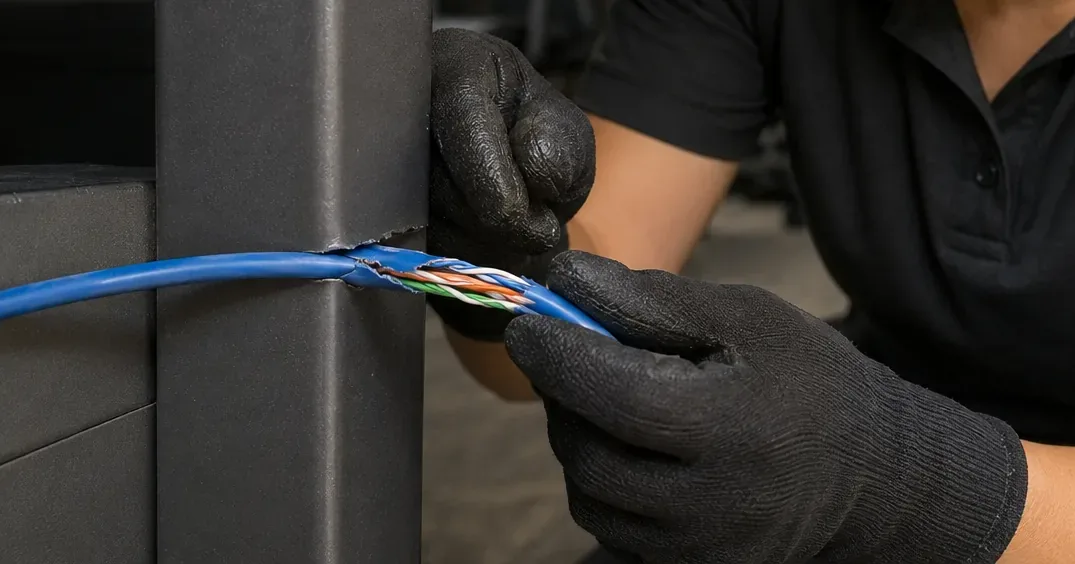
Gloved hands hold a blue cable where its jacket has split open beside a dark metal post, showing the coloured twisted pairs inside.
Repair Capture
Home Office or Apartment Link Down in Westchester?
A docking station that stopped seeing the network this morning, two bedrooms in a new rental that lost their wired ports, an exam room in a practice that fails every time the cord is touched, a point-of-sale terminal on Mamaroneck Avenue that drops after lunch — those are service calls, not projects. Tell us what failed and where the router or switch sits, send a photo of the jack and the closet if you can, and we book the next open 2-hour window with the parts that symptom points to on the van: Cat6 and Cat6A keystones in the common brands, faceplates in white and ivory, media-panel modules, replacement cable in riser and plenum ratings, and a certification tester. A single bad termination, cord or panel port is usually found and fixed in one to two hours once the technician is inside. Repair time is $195 an hour with a three-hour minimum ($585), the rate published on our Westchester network cable repair page. Call (914) 877-2578 and say it is a Cat6 fault.
What We Repair
Cat6 Repair Services in Westchester County
These are the repairs Westchester homeowners, co-op shareholders, renters, practice managers and small offices ask us for most. Each ends the same way: the link tested against the limit for its category, the result saved, and a plain note of the cause.
Dead or Slow Wall Jacks
Keystones behind faceplates in bedrooms, dens and offices cut back to clean cable and remade on matched Cat6 or Cat6A parts, with the twist carried to the contacts so the link holds gigabit and better.
Runs Behind Plaster and Lath
Faults in cable fished through old walls located by distance from both ends, so the repair happens at the jack, the basement or a closet rather than through the middle of a restored wall.
Structured Media Panels
The white enclosures in closets and basements where a house or unit’s runs meet: failed modules replaced, crowded splitters and abandoned phone blocks sorted, and every room tested back to the panel.
ONT-to-Router and Router-to-Switch Links
The short run from the provider’s fiber or cable box to your router, and on to the switch, tested and repaired on our side of the line, with a clear note if the fault is in the provider’s equipment instead.
Apartment and Co-op Unit Wiring
In-unit Cat6 in concrete and masonry buildings, new rental towers and condos repaired within building rules, with access, hours and insurance arranged with the managing agent or superintendent.
Damage From Renovations and Other Trades
Runs nicked by a plumber’s saw, crushed by a cabinet installer or punctured by a TV-mount screw found by distance, repaired, and documented so the cost can be discussed with whoever caused it.
Network Corners Moved Above the Flood Line
Routers, switches and terminations lifted off basement floors after a flood or before the next one, with the Cat6 extended or re-terminated at the new height and tested end to end.
Practice and Office Re-Termination
Exam rooms, reception desks and small office floors in converted buildings brought back to a passing certification, with jacks and panel ports remade and old cords replaced.
Certification After Repair
Every repaired link tested against TIA permanent-link or channel limits, with a saved result you can hand to the next contractor, the landlord or the IT provider.
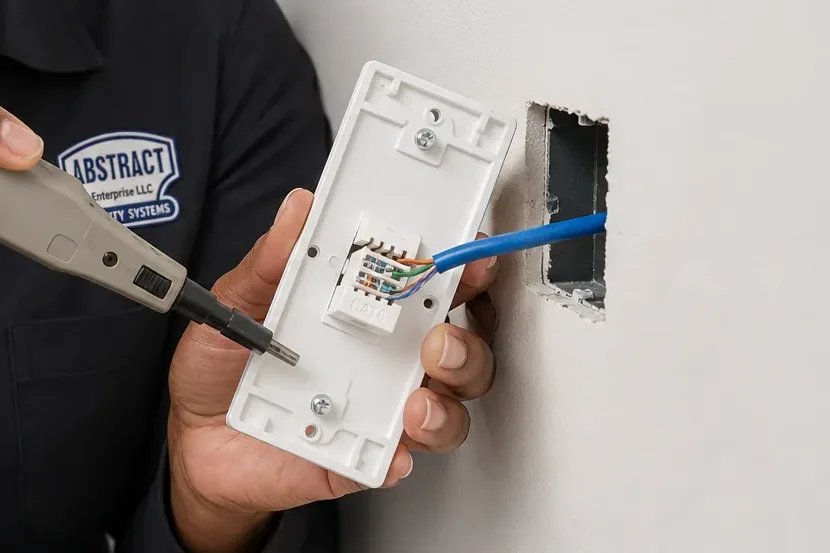
One hand holds a white single-port plate away from an open wall box, with a blue cable punched into the keystone on its back, while the other hand works a punch-down tool; a dark shirt with a company logo shows at the left.
Building Specialists
Cat6 Repair for Westchester County’s Architecture
In Westchester the building decides how a repair is reached, how much of a room it disturbs and who has to agree to it. These are the property types behind most of our county calls, from the Bronx line to the Putnam border.
Pre-War Tudors and Colonials
Scarsdale, Bronxville, Pelham, Larchmont, Rye and the older streets of every village. Plaster on wood or metal lath, few straight stud bays, and Cat6 fished past fire blocks years after the house was finished. Faults cluster at bends and at the jacks.
Post-War Split-Levels and Ranches
The 1950s and 1960s neighbourhoods of Yorktown, New Castle, Greenburgh and the Rivertowns’ uplands. Drywall, forced-air duct chases and half-levels that make runs short but twisted; cable often shares a chase with ductwork.
Two- and Three-Family Houses
Yonkers, Mount Vernon, New Rochelle and Port Chester. Separate internet services per floor, shared basements and runs that cross from one unit’s space into another’s. Knowing which cable belongs to which household comes first.
Concrete Co-op Towers
The mid-century elevator buildings of Hartsdale, Central Park Avenue, Bronxville and downtown White Plains. No drop ceilings, concrete slabs and columns, surface raceway or old conduit, and a board or managing agent who sets the rules.
New Downtown Rental Towers
New Rochelle, White Plains and the Yonkers waterfront. Cat6 to each room, a small switch and media panel in a utility closet, access points in ceilings. Builder-grade terminations and warm closets are the typical failures.
Office-to-Residential Conversions
Former offices such as 1 Martine in White Plains, now apartments. Old corporate cable left above new ceilings next to new in-unit runs; the two must be told apart before anything is cut.
Converted Offices Now Medical Space
Suites along the Platinum Mile and in downtown buildings refitted for practices. Exam-room jacks on cable pulled for a previous tenant, extended or coupled during the fit-out, and expected to certify.
Village Storefronts and Upstairs Offices
Main streets in Mamaroneck, Larchmont, Tarrytown, Ossining, Mount Kisco and Katonah. Narrow buildings, shared cellars, point-of-sale and camera runs through stockrooms, and offices above the shops wired in stages.
Material and method checks on every Westchester repair
What is the wall made of, and what is inside it? Plaster on wood lath, plaster on metal lath, drywall, concrete block or poured concrete each change how a fault is reached. Before we drill or cut anything we ask when the room was last restored, look for signs of steam or hot-water piping and old knob-era electrical paths, and plan the repair around the openings that already exist: the jack itself, a closet, a cold-air return, the basement ceiling below.
Where does the run start and end? In a house the run may start at a media panel, a router on a shelf or the provider’s box in the basement; in an apartment it may start at a switch in a utility closet the tenant has never opened. We test from both ends where we can, because a fault at the closet end is cheaper than one in the wall, and the reading tells us which it is.
Is this the cable you think it is? We check the conductors at the cut. Copper-clad aluminium shows silver at the core and cannot certify; stranded patch cable used as a permanent run, a Cat5e segment spliced in during an earlier renovation, or a coupler hidden behind a plate all show up in the test and change the repair. In older houses we often find two generations of cable to the same room, and the newer one is not always the one that is connected.
Who has to agree? In a house, you. In a co-op, often the board or the managing agent, especially if a wall is opened. In a rental, the landlord, whose lease may say who looks after in-unit wiring. In a converted office or practice, the building’s management and sometimes the IT provider. We sort that out before the visit so the technician does not stop at the door.
Is the room occupied and finished? Almost always. We bring drop cloths and a vacuum, keep plaster dust contained, and agree working hours around calls and patients. When a repair does need an access opening, its size and location are agreed beforehand, and you know who will close it.
Owners of larger houses and small buildings often want the whole wiring picture at once. Our structured cabling team for Westchester County covers new panels, closets and building-wide plans when a repair list grows into a redesign.
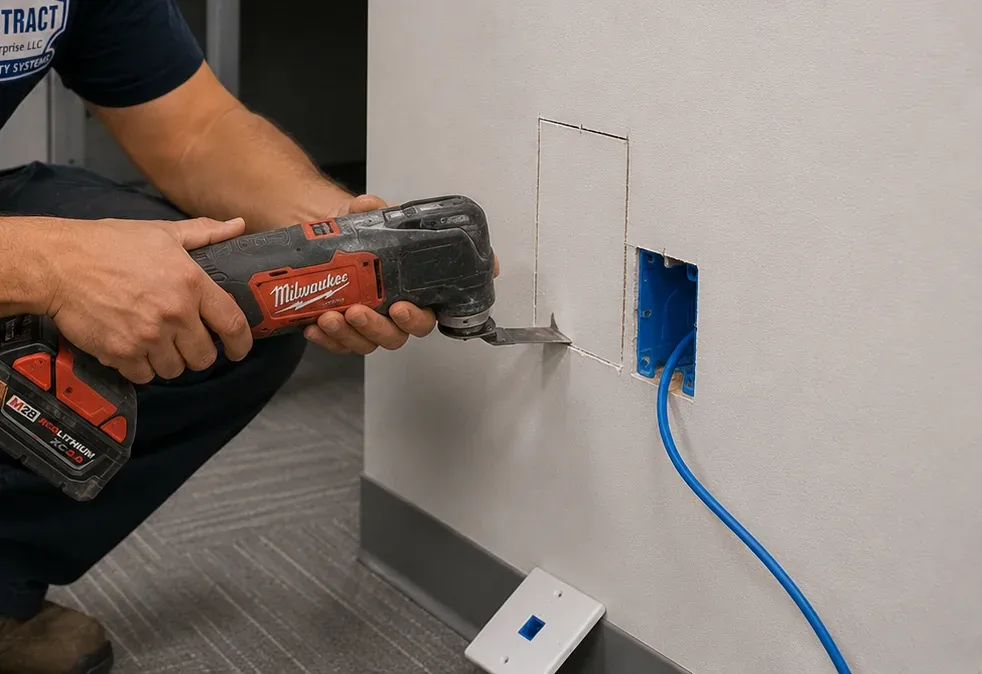
Hands guide a red cordless oscillating tool along a marked rectangle in grey drywall beside a blue low-voltage box, with a blue cable running down to the floor and a spare plate lying by the baseboard.
Commercial Cat6 Repair
Business Cat6 Repair in Westchester County
Westchester’s business Cat6 sits mostly in small and mid-sized spaces: practices, professional offices, storefronts and the commercial floors of mixed-use buildings. The places below are real and named for the kind of building and fault each area tends to produce, not as a list of our jobs.
The Platinum Mile, Harrison and White Plains
Westchester Avenue’s office buildings, a growing share of them refitted for medical use, as the business magazine 914Inc has reported for addresses such as 3030 Westchester Avenue. Exam rooms and reception desks inherit cable from office tenants.
Downtown White Plains
Office floors around Main Street and Hamilton Avenue alongside conversions: 1 Martine became 188 loft apartments, described as the county’s first major office-to-residential redevelopment, and the former AT&T building at 440 Hamilton Avenue was approved for 245 rentals.
Downtown New Rochelle
The transit-oriented overlay around the train station, with thousands of new apartments over ground-floor retail and offices. Commercial floors share closets and pathways with residential floors above.
Central Park Avenue, Yonkers and Greenburgh
Strip centres, medical offices and co-op towers along one of the county’s main commercial roads. Point-of-sale and camera runs pass through stockrooms; tenant turnover leaves runs nobody has mapped.
Mamaroneck Avenue and the Sound Shore Villages
Restaurants, shops and upstairs offices in Mamaroneck, Larchmont, Rye and Port Chester, many with cellars in flood-prone blocks. Terminations near the floor and network gear in basements are the usual risks.
River Town Main Streets
Tarrytown, Sleepy Hollow, Ossining and Peekskill: older masonry buildings with shops below and offices or apartments above, wired in stages as tenants came and went. Surface raceway and coupled extensions are common finds.
Compliance callouts for business Cat6 repairs in the county
Trade licensing. Westchester County requires plumbers and electricians to hold a county trade licence to work in the county, and asks consumers to check the licence card or the county’s online search. If a repair needs a new power outlet for a switch or rack, a county-licensed electrician does that part; AESS does the data work under NYS licence #12000287431.
Home improvement licensing. The county licenses home improvement contractors through its Department of Consumer Protection, and Yonkers runs its own home improvement licence application. Ask any contractor working in your home which licences cover the work they are doing.
Rated walls and firestopping. The 2025 Uniform Code, based on the 2024 International Building Code, took effect across New York on December 31, 2025. Where a repaired or replaced run passes through a fire-rated wall or floor in an apartment or office building, the penetration is sealed again to its rating.
Abandoned cable. Accessible abandoned communications cable is to be removed unless tagged for future use (NEC 800.25, as summarised by EC&M). In conversions and re-let suites, replacing a run includes taking the dead one out where it can be reached.
Local permits. Westchester has 48 municipalities, each with its own building department. Whether a permit is needed depends on the municipality and the scope, so we check with the local office where work goes beyond a like-for-like repair; work that is part of a filed renovation follows that job’s permit and the rules of the town, city or village.
When the failing links feed cameras at the door or in the lot, the device end usually needs attention in the same visit; our security camera repair service in Westchester County picks up where the cable stops.
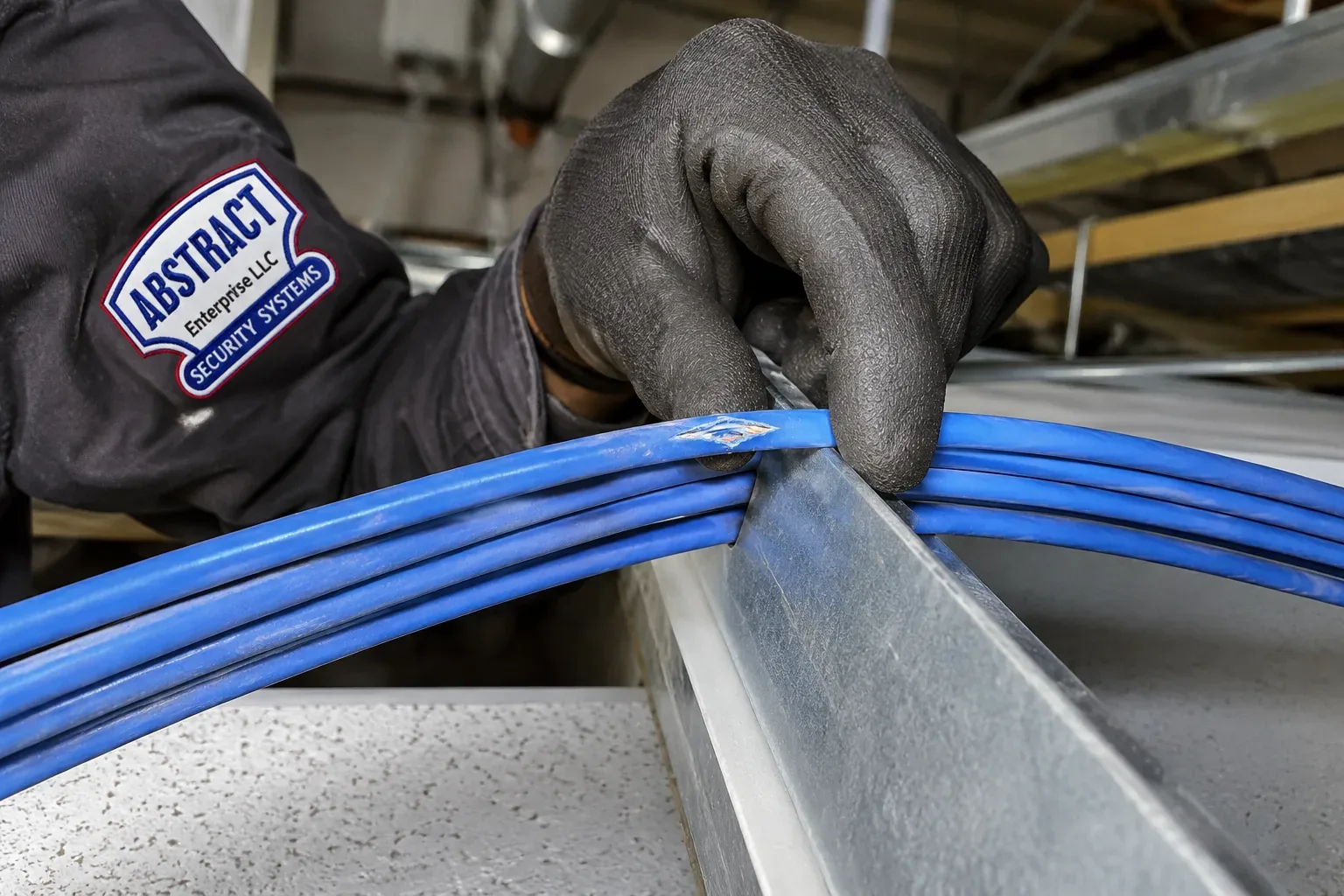
A gloved hand lifts a bundle of blue cables where it bends over the sharp edge of a galvanised metal duct above a ceiling; one jacket is scuffed white at the edge, and a sleeve patch reads Abstract Enterprise LLC Security Systems.
Your Questions Answered
Cat6 Repair in Westchester County: Questions Answered
These are the questions we hear from Westchester homeowners working from a spare room, co-op shareholders, renters in new buildings, landlords, practice managers and small offices once a Cat6 link has started to fail. Shorter practical questions are in the FAQ further down.
Older houses and finished walls
Where along a run fished through plaster-and-lath walls does a Cat6 fault usually sit?
Rarely in the middle of the wall. In a plaster house the cable was pushed or pulled through a cavity that was never meant to hold it, so the stress concentrates in three places: at the jack, where the cable was folded into a shallow old-work box or a low-voltage ring; at the top or bottom plate, where it was dragged around a fire block or through a drilled hole with a sharp edge; and in the basement or attic, where it was stapled to a joist on the way to the panel. Plaster keys and metal lath can also abrade a jacket where the cable was pulled hard across them. The long middle stretch, hanging in the stud bay, is usually untouched.
That is good news, because the jack and the basement are the easiest places to work. We test the link from the panel or router end and from the jack, read the distance to the fault, and compare it with the route the cable takes. A fault a metre from the jack is almost always the box or the termination; a fault at the measured distance of the basement ceiling is a staple or a crushed bend we can reach from below. Only when the reading puts the damage inside a finished wall, away from both, do we talk about opening anything — and then we discuss the alternatives first.
If a Cat6 repair does need an opening in a finished wall, how big is it and who puts the wall back?
Small, planned and agreed before we cut. When the fault reading puts damage inside a wall we cannot reach from a box, closet or basement, the usual opening is a rectangle a little larger than a single-gang box at the measured point, or a slot at the top or bottom of the stud bay where the cable was bent around framing. In plaster we score and cut rather than break out, keep the lath intact where we can, and save the piece if it comes out clean. In a room with decorative plaster, wallpaper or panelling, we look for a less visible point on the same run, such as inside a closet on the far side of the wall.
We repair the cable, leave the opening tidy and ready for finishing, and tell you before the visit whether patching is in our scope or your plasterer’s. Many Westchester owners already have a plasterer or painter they trust for the original finish, and prefer to use them; others ask us to close the opening with a blank plate or an access panel if it is in a closet. Either way, the decision, the size and the location are agreed in writing first, so nobody comes home to a surprise hole above the sofa.
The previous owner’s Cat6 all ends in a basement corner full of coax splitters and an old phone block — can that be sorted out without rewiring the house?
Usually, yes. Many Westchester houses changed hands with a basement corner that grew in layers: a telephone punch block from the 1980s, coax splitters from two generations of cable television, a Cat5e run or two from the first home network and a bundle of Cat6 added later, all ending loose or on a cheap patch block nailed to a joist. Some of those runs go to rooms that matter, some go to rooms that were renovated away, and nobody left a map. The cable in the walls is often perfectly sound; the corner is the problem.
We trace each run to its room with a tone and probe and by testing from the jacks, mark which are live, which are spare and which are dead, and remove what is abandoned and reachable. The runs you use are terminated on a proper panel or wall-mounted module, tested to category and labelled with the room name. The coax and phone wiring that still serves something is left in place and tidied; what serves nothing is taken out. The result is a small, labelled distribution point you can understand, at the cost of an afternoon rather than a rewire.
Why does the Cat6 that runs beside an old steam riser or radiator keep failing?
Because it is being cooked a few months a year. Many older Westchester houses and apartment buildings still have steam or hot-water heat, and the pipes that rise through walls and floors to the radiators are a convenient path for anyone fishing cable. Cat6 resting against a steam riser or tied to a radiator pipe gets far hotter than its rating allows during the heating season. The jacket softens and then hardens, the pairs shift inside it, and the insertion loss on that run rises with temperature, so a link that passes in September can fail in January and recover in May.
The fault reading usually puts the damage where the cable meets the pipe, often at a floor penetration beside a radiator. We confirm by checking the route, then replace the damaged length and move it away from the pipe, with a gap or a separate hole through the floor so it cannot drift back. If the cable has to cross near a heat source, we sleeve it and keep it off the metal. It is one of the few repairs where we ask you to tell us when the heat comes on, because a test in a warm room is the fairest proof that the fix will hold through winter.
A picture hook or a TV-mount screw went into the wall — can a punctured Cat6 run be found and fixed?
Yes, and the fault reading usually leads straight to it. A nail or screw through a Cat6 cable rarely cuts it cleanly; it pushes through one or two pairs, shorting them or breaking a conductor, and the link either drops to a lower speed or fails completely. Because the damage is at a single point, distance-to-fault testing from the jack and from the panel brackets it closely, and matching that distance to the wall where something was recently hung is quick work.
Once the point is found, the fix depends on reach. Behind a wall-mounted TV there is often already an opening or a recessed box where the mount sits, and the damaged section can be cut out and joined with rated in-line hardware or bypassed with a short new length. Elsewhere, a small access opening at the puncture is usually enough. We also look for the next fastener waiting to happen: if the run passes through a wall where pictures or shelves are likely, we tell you where it is so the next hook goes somewhere else.
Our 1950s split-level has Cat6 running through the forced-air duct chase — can it be repaired there, or does it have to move?
It depends on what kind of space the chase is. In many post-war Westchester houses, the easiest path between levels was the chase that carries the supply and return ducts, and cable was laid alongside the ductwork or, sometimes, inside a cavity being used as a return-air path. Cable alongside ductwork in an ordinary chase is a normal repair; we find the fault, fix it and secure the cable away from sharp duct edges and hangers, which are a common cause of crushed jackets in these houses.
Cable inside a space actually used to move air is different. Wiring in air-handling spaces is subject to stricter rules on cable type, and ordinary riser cable is not meant to be there. If the run passes through a cavity that carries return air, we replace the damaged length with plenum-rated cable or reroute it out of the airflow. We will show you which is which, because the honest answer can be “the cable is fine, but it should not be where it is.”
The provider’s box, the panel and your side of the line
Our Cat6 runs from the fiber or cable box in the basement to the office upstairs — whose problem is it when that link stops working?
It depends where the fault is, and finding that line is the first thing we do. In most Westchester houses the internet provider owns the equipment where its service ends — the fiber terminal on a basement wall, or the cable modem — and sometimes the router it supplied. The Cat6 from that box to your router, and from the router to the rooms, is usually the home’s wiring, installed by a previous owner, an electrician or the provider’s technician on the day of installation. Providers will generally confirm whether their service is reaching the box, but the cable inside your walls is normally yours to maintain.
So we test in order. First, whether the provider’s box is passing service at its own port, using a known-good short cord. Then the run from that port to the router, then the router to each room. If the fault is in the provider’s equipment, you get a written note of what we tested and what we found to give them, and we stop there. If it is in the run, we repair it and test it to category. Many calls end with a five-minute discovery that the run is fine and a cord or a port setting is not, which is the cheapest result of all.
One room’s jack died and every run goes back to a white panel in a closet — does the panel have to be replaced?
Almost never for one room. Structured-media enclosures, the white metal or plastic boxes found in closets and basements of houses and condos built or renovated since the late 1990s, hold a data module where each room’s cable is punched down, often beside a telephone module and coax splitters. When one room fails, the cause is usually that room’s termination on the module, its jack at the other end, or the short cord between the module and the router — all repairable on their own.
We test the failing run from the module to the jack. If the module port is the fault, we re-terminate it or replace the module, which is a standard part in the common brands. If the panel was installed with Cat5e modules and the runs are Cat6, we can upgrade the module so the whole path matches. A full panel replacement only makes sense when the enclosure is overheating with equipment it was never designed to hold, or when it is so crowded that the next repair will disturb the working runs — and in that case we will say so and give you a separate price.
Co-ops, condos and new rental buildings
Does our co-op board have to approve a Cat6 repair that stays inside our own apartment?
Check your proprietary lease and the building’s alteration rules, because Westchester co-ops differ. Many treat a like-for-like repair inside the apartment — re-terminating a jack, replacing a cord, re-punching a panel port — as maintenance that needs no approval, but still require that any contractor working in the building be insured and named to the managing agent in advance. Opening a wall, drilling through a slab, or running anything through a shared hallway or riser is usually treated as an alteration and goes through the board or the agent.
We make that simple. Tell us the building and the managing agent, and we send a certificate of insurance naming whoever the building requires, confirm working hours and elevator or service-entrance rules, and describe the likely scope in writing so you can show it to the agent. If testing on the day shows the repair would need an opening or a new path outside the apartment, we stop, document it and give you what the board will need to decide, rather than starting work that might later have to be undone.
Our new rental has a small network switch in the unit’s utility closet — why do some rooms drop out when that closet runs hot?
Because the switch, not the cable, is often the weak point. In many new Westchester rental buildings each apartment has a small switch, a media panel and sometimes the access-point power in the same closet as the water heater, the air handler or the washer and dryer. Those closets get warm, and an unmanaged desktop switch with no ventilation can overheat, reset or shut down ports under load, especially when it is also powering access points over PoE. The symptom looks like a cabling fault: some rooms drop at the same time of day, often when the heating or laundry is running.
We test the runs themselves first, so you know whether the cable is sound, then look at the closet: switch model and temperature, how it is powered, whether the PoE budget is close to its limit, and whether the panel is crowded. In a rental the switch and wiring usually belong to the building, so we write up what we find for the tenant to send the landlord, or work directly for the landlord if they book us. Where a run really is damaged, it is repaired and tested like any other.
Our 1960s apartment building has concrete ceilings and no drop ceiling — how is a failed Cat6 run replaced there?
Usually along the path the original run took, or on the surface. Mid-century co-op and rental buildings across Hartsdale, Yonkers, White Plains and Bronxville were built with poured concrete slabs and masonry partitions, so Cat6 added later had to follow whatever existed: old telephone conduit, the baseboard, a closet, or a surface raceway along the ceiling line. If the old cable was pulled through a conduit, that conduit is the best route for its replacement; we pull the new cable in using the old one as a draw line wherever it still moves.
When the old cable is stuck or the conduit is full, a slim surface raceway painted to match the wall, run along a cornice or a door casing, is the tidy alternative to drilling concrete. Any drilling through a slab or into a structural wall is an alteration in most buildings and needs management approval, so we treat it as a last resort. We test the failed run first, because in concrete buildings the fault is very often at a jack or a coupler rather than in the run, and the replacement question never arises.
Lower floors and flooding
The router and switch sit on the basement floor in a part of town that floods — how should the Cat6 be re-terminated when they move upstairs?
Move the network corner first, then bring the cable to it. In flood-prone parts of Mamaroneck, Larchmont, Rye, New Rochelle and the river valleys, the provider’s box and the router usually sit in the basement because that is where the service enters the house. Raising them means agreeing a new location with the provider for its own equipment, then deciding where your router, switch and panel will live: a shelf above the recorded high-water line, an upstairs closet, or a small cabinet on the ground floor. We help you pick a spot that has power, ventilation and a reasonable path to the rooms.
Then each Cat6 run is tested from its jack. Runs that test clean are extended or re-terminated at the new location; any that sat in water at the low end are cut back past the wet section and re-terminated, or replaced if the damage has travelled. Runs from the provider’s box to the new router location are new or extended cable, tested to category. You end up with the electronics out of the water’s reach, every room working, and a saved test result to compare against if the basement floods again.
Practices, offices and other trades
Our practice moved into a converted office on the Platinum Mile and the exam-room jacks fail certification — is it the cable or the conversion?
Usually the conversion. When office floors along Westchester Avenue and in downtown White Plains are refitted as medical suites, the fit-out often reuses the previous tenant’s cable to save cost: runs are shortened, extended with couplers above the new ceiling, cut into new exam-room walls with old-work boxes, and terminated quickly at the end of the job. The cable in the ceiling may be good Cat6; the joins, the couplers and the hurried terminations are what fail the test, typically on near-end crosstalk or return loss.
The test result itself tells us where to look. A failure close to one end points to that jack or panel port, which we re-terminate. A failure at a fixed distance on several runs often points to a row of couplers above one ceiling, which we remove by replacing the extended section. Runs that are too short of slack, or pass over new light fixtures, are rerouted. Each repaired link is certified, and you get the results in a format your IT provider can file, which matters when the clinical systems depend on every room.
An electrician’s lighting retrofit went through our ceiling and now four desks are dead — how is damage by another trade documented and repaired?
With test results taken before anything is touched. When several neighbouring desks fail right after other work in the ceiling, the cause is usually the work: cable cut while removing old fixtures, crushed under a new fixture’s frame, pulled out of a jack when a tile was lifted, or stapled by mistake. We test every affected run first and save the results, which show the distance from the panel to each fault. Matching those distances to where the new fixtures sit is usually all the evidence anyone needs.
We photograph the damage once the ceiling is open, repair or replace the damaged lengths, re-terminate any jacks that were pulled, and certify each link again. You receive the before and after results, the photographs and a short written description of what was found. Whether you then pass the cost to the other contractor, your landlord or your insurer is your decision; our job is to make sure the record is clear and the desks work.
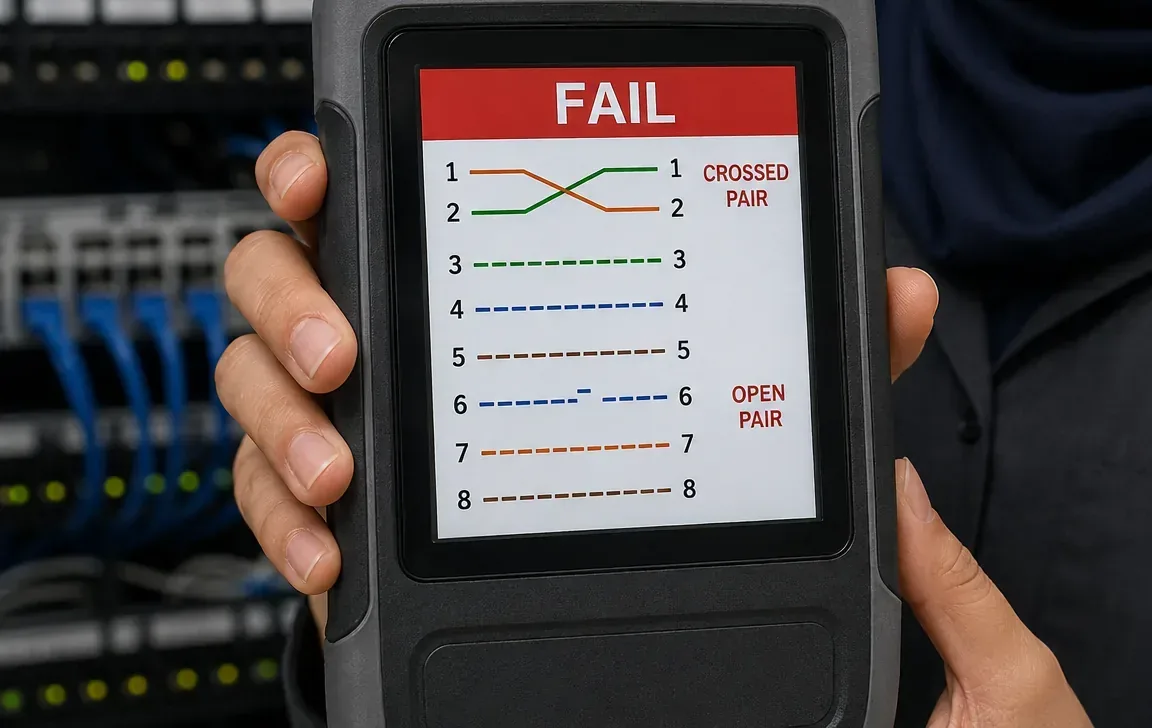
Hands hold a handheld tester whose screen reads FAIL, with a crossed pair marked on wires 1 and 2 and an open pair on wire 6, in front of rows of patch panels.
Equipment
Test Gear and Parts for Westchester Cat6 Repair
Because most Westchester repairs happen in finished, occupied rooms, the kit is chosen to find faults precisely and leave as little trace as possible. These are the categories of equipment and material that go out on every county call.
Certification Tester
Measures each link against TIA limits for its category — wire map, length, insertion loss, crosstalk and return loss — and saves a result you can keep, share with a landlord or compare later.
Distance-to-Fault Analysis
Crosstalk and reflection plots that put the damage at a jack, a panel, a coupler or a measured distance, so a finished wall is opened only where the reading says.
Tone Generator and Probe
Follows a single cable through a crowded basement corner, a media panel or a co-op’s telephone closet without cutting anything, so live runs are identified before work starts.
Link and PoE Qualifier
Shows what speed a port negotiates and whether a switch is delivering power, separating a cooked closet switch or a provider’s port from a damaged cable.
Old-Work Boxes and Low-Voltage Rings
Brackets that fit plaster, lath and odd wall depths, so a re-terminated jack sits properly instead of folding the cable behind a shallow plate.
Keystones, Plates and Media-Panel Modules
Cat6 and Cat6A parts in white, ivory and light almond, matched where possible to the brand already in the house, plus data modules for the common enclosures.
Riser and Plenum Cable
Solid-copper Cat6 and Cat6A in riser rating for walls and plenum rating for air-handling spaces, so the replacement suits the space it runs through.
Surface Raceway
Slim paintable channel for concrete co-ops and masonry walls where a concealed path does not exist, run along trim so it reads as part of the room.
Drop Cloths, Dust Control and Labels
Floor protection, a HEPA vacuum for plaster dust, and both-end labels so the next repair in the house starts with a map.
Why the tester matters more than the toolbox in a Westchester house. A light-up continuity tester only shows that each wire reaches the right pin. It cannot tell you that a run is overheating beside a radiator, that a coupler is hiding behind a plate, or how far from the jack a screw went through the cable. Without that distance, the only way to find a fault in a plaster wall is to start opening it. With it, most repairs happen at the ends.
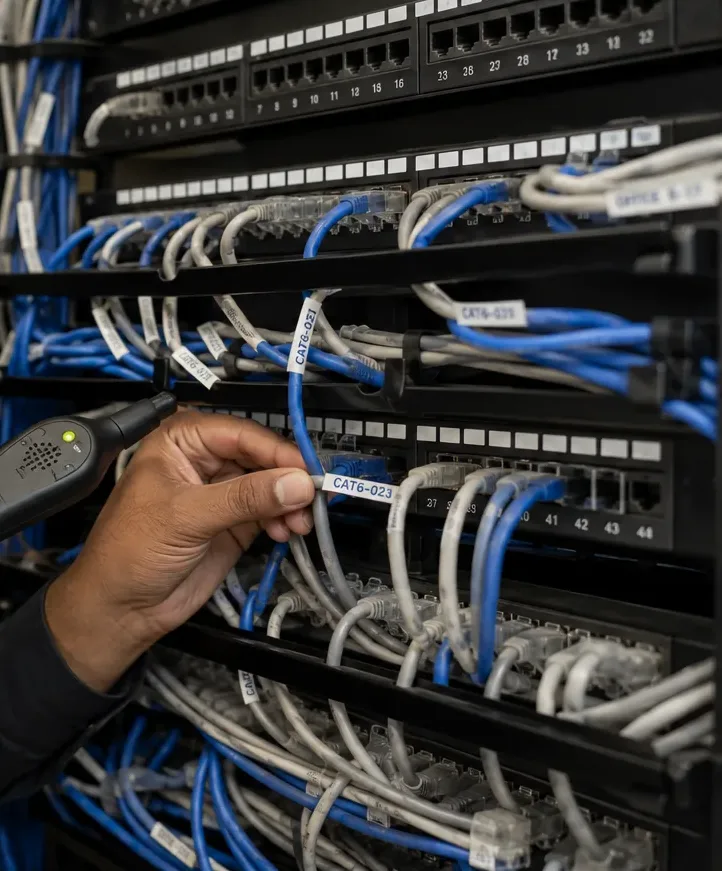
A hand holds a black tone probe against one labelled patch cord among rows of blue and white cords plugged into a rack of patch panels.
AI Overview Reality Check
What AI Gets Wrong About Cat6 Repair in Westchester County
A note on method: Google’s AI Overview could not be viewed from the tools used to research this page, so nothing below is presented as its exact wording. Each heading is a claim that how-to articles, retailer guides, cost sites and forums commonly publish and that answer engines tend to repeat. Under each is what changes when the Cat6 is in a Westchester house, apartment or practice.
“A dead wall jack means the cable in the wall is broken”
Plenty of advice jumps from “the port doesn’t work” to “the cable needs replacing,” which in an old house sounds like opening a wall.
In practice, the cable in the wall is the least likely part to have failed. Terminations, patch cords, panel ports, switch ports and settings fail far more often, and in plaster houses the stress points are at the box and the basement, not mid-wall.
So we test the whole path before anyone talks about walls. Most Westchester repairs end at the jack, the panel or the cord, and the wall is never touched.
“Your internet provider fixes the wiring in your home”
People are often told to call the provider about anything that carries the internet. Providers do fix their own service and the equipment they own.
The Cat6 between their box and your rooms is usually the home’s wiring, even if one of their technicians installed it.
We test the provider’s handoff first and give you a written note if the fault is theirs. If it is the house wiring, we repair it.
“Older houses can’t be fixed without tearing walls open”
Renovation content tends to treat plaster as a reason to give up on wired networks altogether.
Plaster makes new runs slower; it makes repairs of existing runs only a little harder. The cable already has a path, and the faults sit where that path bends, near boxes, plates and basement joists.
Distance-to-fault testing turns “open the wall” into “open the box,” and when an opening really is needed, it is small and agreed beforehand.
“A flat cable under the rug is a fine permanent fix”
Renters in particular are told that a thin flat cable along the floor or under a rug is an easy workaround for a dead in-wall run.
Flat cables are rarely genuine Cat6 to the standard, and under rugs and door saddles they are crushed and kinked every day, which is exactly what fails return-loss tests. In a rental they also leave the building’s own wiring broken for the next tenant.
We would rather repair the run in the wall, or write up what is wrong so the landlord can.
“The landlord is always responsible for the wiring”
Tenant guides commonly say the landlord fixes anything built into the apartment, and that is often true for in-unit Cat6.
It is not universal. Co-op shareholders usually own the wiring inside their apartment under the proprietary lease, condo owners usually own their unit’s wiring, and some rental leases assign in-unit network equipment to the tenant.
We read the situation with you before the visit, so the person paying is the person responsible, and the person approving is the person entitled to approve.
Get the Home Office Back on the Wire
Tell us which jacks are dead, what the walls are made of and where the router lives. We will tell you what the cause most likely is and what the first visit should cover.
House, co-op, condo, rental, practice or storefront — describe the failing jacks and where the router or switch lives, and a written answer comes back the same business day. Prefer to talk? Dial (914) 877-2578.
✅
We Got Your Request!
A technician will reply the same business day. For a link that is down right now, ring (914) 877-2578.
How It Works
Our Cat6 Repair Process
Six steps, built around two ideas: open as little of a finished room as possible, and be clear about who owns what, whether the jack is in a Bronxville study or a seventh-floor rental in New Rochelle.
1. Tell us the symptom and the setting
You describe which jacks fail and when, what kind of building it is, what the walls are made of and where the router, panel or switch sits. Photos of the jack, the panel and the provider’s box let us judge the likely cause before the visit.
2. Sort out access and ownership
We confirm who owns the failing part and who must agree to the work: you, the board, the managing agent or the landlord. Insurance certificates, working hours and parking are arranged before the technician arrives.
3. Test from both ends
Each failing link is tested against its category from the jack and from the panel, router or switch. Distance-to-fault readings place the problem at a cord, a termination, a coupler or a point inside a wall.
4. Agree the least disruptive repair
For each link you get the finding and the fix: replace a cord, re-terminate a jack or panel port, reroute away from heat, or replace a length. Any opening in a finished wall is agreed in size and place before it is made.
5. Repair and protect the room
Floors are covered and dust contained. Terminations are remade on matched parts, damaged lengths replaced with cable rated for the space, abandoned cable removed where reachable and any rated wall resealed.
6. Retest, label and hand over
Every repaired link is tested again and labelled at both ends. You receive the saved results and a short note of what failed and why, ready for a landlord, a board, an IT provider or the next repair.
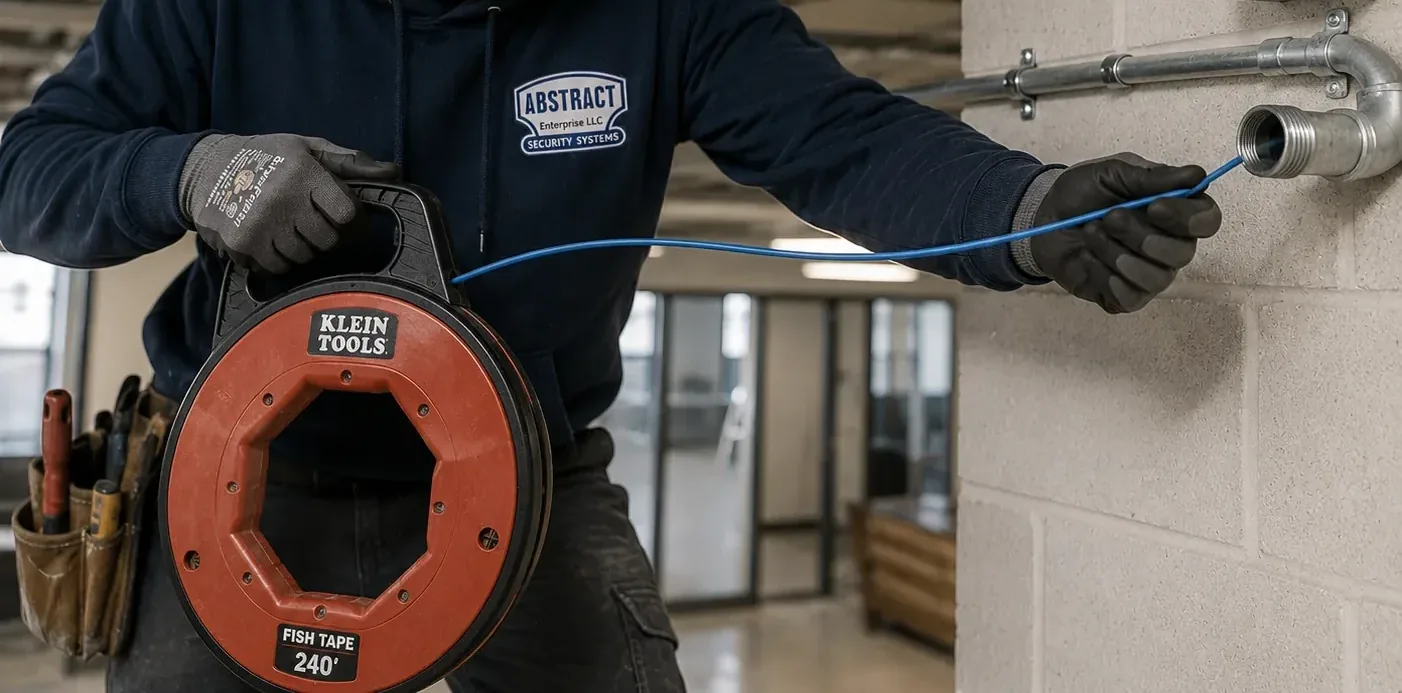
A worker in a dark hoodie and gloves holds a red Klein Tools fish-tape reel marked 240 ft and feeds a blue line into the open end of a metal conduit fitting on a concrete block wall.
Coverage Area
Cat6 Repair Near Westchester County’s Landmarks
These six places say something about the kinds of buildings Westchester’s Cat6 runs through — old houses, Art Deco civic buildings, Gilded Age estates and the planned suburbs around them. Each is a reference point for the property around it, not a claim of work inside it.
Lawrence Park Historic District, Bronxville
Added to the National Register in 1980 as an example of early suburban growth, with narrow meandering streets, irregular lots and an eclectic mix of houses. The kind of neighbourhood where Cat6 is fished through plaster and old framing.
Playland, Rye
Opened in 1928, owned by Westchester County and described in its National Register nomination as the first totally planned amusement park in the country, on about 280 acres beside the Sound. A landmark of the Sound-shore shoreline where basements meet floodwater.
Westchester County Center, White Plains
The Art Deco arena on North Central Avenue, opened with a grand opening on May 22, 1930 and renovated in 1988. A reference for the downtown White Plains blocks of offices, conversions and apartment towers around it.
Glenview and the Hudson River Museum, Yonkers
Glenview is an 1877 Gilded Age house on the National Register, built for financier John Bond Trevor, which became home to the Hudson River Museum in 1924. A picture of the river-city houses whose walls defeat a straight cable pull.
Lyndhurst, Tarrytown
A Gothic Revival mansion designed in 1838 by Alexander Jackson Davis and now a National Trust Historic Site above the Hudson. A reminder of how long Rivertowns buildings have been standing.
Caramoor, Katonah
The Rosen House, a Mediterranean-style villa that took ten years to complete, at the centre of the Caramoor estate in northern Westchester. Northern Westchester houses and estates bring larger homes and longer runs to the same repair questions.
We also repair Cat6 in Yonkers, Mount Vernon, New Rochelle, White Plains, Scarsdale, Hartsdale, Bronxville, Eastchester, Tuckahoe, Pelham, Larchmont, Mamaroneck, Harrison, Rye, Rye Brook, Port Chester, Purchase, Elmsford, Ardsley, Dobbs Ferry, Hastings-on-Hudson, Irvington, Tarrytown, Sleepy Hollow, Briarcliff Manor, Ossining, Croton-on-Hudson, Peekskill, Cortlandt, Yorktown, Somers, Mount Kisco, Chappaqua, Pleasantville, Armonk, Bedford, Katonah, Pound Ridge, Lewisboro and North Salem — and the hamlets between them.
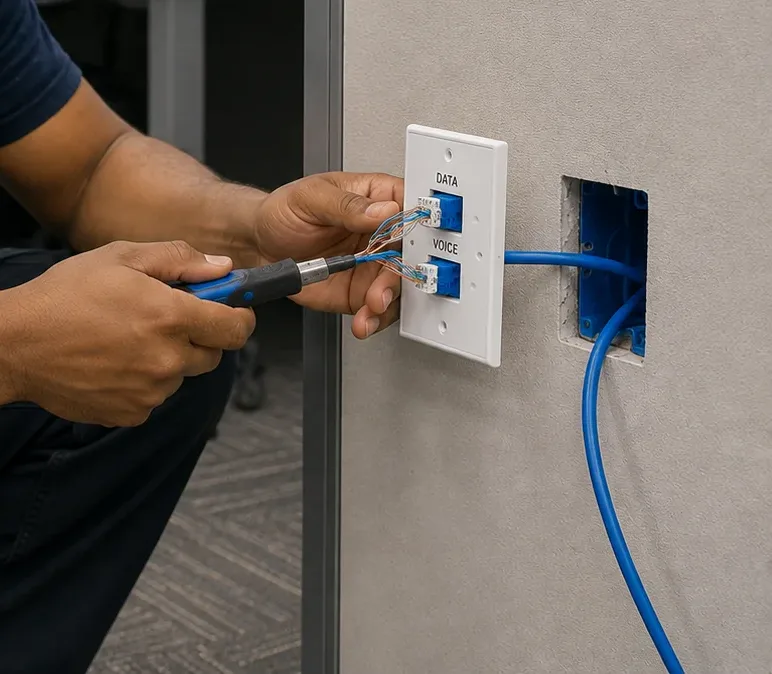
Two hands work a tool into the back of a white two-port plate marked Data and Voice, held beside an open blue box in a grey wall, with blue cable running down to the floor.
Pricing
Cat6 Repair Cost in Westchester County
Every figure below is one we already publish for Westchester, and the table says where. Work that depends on what the testing finds, or on the building’s rules, is quoted in writing before it starts. Repair time and replacement cable are separate lines, so you can see which one you are paying for.
Item
Price
Scope and source
Technician time on site: test, locate faults, re-terminate jacks and panel ports, replace cords, retest
$195/hr, 3-hour minimum ($585)
The specialty rate on our Westchester County network cable repair page and our Hudson Valley Cat6 repair hub; the block is spent on as many links as the technician can bring back
Additional time beyond the minimum
$195/hr
Billed in hourly increments, as published on the same Westchester page
Replacement Cat6 run where the cable cannot be saved
From $175 per drop
The Westchester replacement-drop figure, which bundles cable, keystone jack, wall plate, panel punch-down, testing, labels at both ends and a patch cord
New Cat6 drop up to 100 ft (installation pricing, for comparison)
$309 per drop
From our Westchester Cat6 installation price table, which lists $265 for Cat5e and $441 for Cat6A on the same terms — the Westchester area rate
Plenum (CMP) cable where a run passes through an air-handling space
Added per drop
Applied only where the space is used for return air, as on our Westchester repair price list
Basement corner or closet audit, mapping and labelling
Quoted by port count
Jack-to-port map, live-versus-abandoned identification, both-end labels and a printed legend
After-hours or weekend window
Premium applies
For buildings or practices that limit work to off-hours; arranged access windows in multi-tenant buildings carry no labour premium
Wall patching and finishing, slab drilling, raceway runs
Quoted after testing
Depends on the wall, the building’s alteration rules and whether your own plasterer or painter finishes the opening
What the three-hour block usually covers in a Westchester house or apartment
The minimum buys a technician’s time inside with the full test kit. On a typical county call that is enough to test every jack you are worried about, find each fault, re-terminate jacks and panel ports, replace tired cords and certify the result. Where a house has a basement corner to sort out, or a rental has several rooms dropping, most of that fits in the same block. If testing shows a run that needs replacing, or a wall that needs opening, you get a price and a plan before anything is cut.
Where these figures come from
The repair rate and the replacement-drop figure are the ones printed on our Westchester County network cable repair page and repeated on the Hudson Valley Cat6 repair hub; the new-drop comparison is the Westchester installation price, which already carries the county’s area rate. We use those figures rather than inventing a second set. Your written quote confirms them for your building before the visit is booked.
What moves a Westchester Cat6 repair bill
Where the fault is: a jack, a cord or a panel port is quick; damage inside a plaster or concrete wall takes planning and sometimes another trade.
What the building allows: co-op and rental rules on hours, insurance, elevators and alterations shape how and when the work happens.
Whose equipment it is: faults in the provider’s box or a building-owned switch are handed to their owners with our findings, not billed as cable repair.
What the cable is: genuine solid-copper Cat6 can be repaired; copper-clad aluminium, stranded patch cable and flat cable used as permanent runs generally cannot.
The room: finished plaster, built-ins, wall-mounted TVs and occupied offices add care and time, which we plan for rather than discover.
About the national numbers you may have seen. Cost sites such as Fixr (January 2025 update) list $125–$250 for a new Cat6 drop with materials and $45–$75 an hour for installer labour across the United States. Those describe new work in open walls; they are not ours, and they do not cover finding a fault behind restored plaster in an occupied house.
Full terms — including 50% deposit, one-year parts-only warranty on AESS-supplied products, and the late-fee schedule — are set out in the service agreement.
Shop Our Systems
Cat6 Repair Packages & Pricing
Most Westchester Cat6 repairs fit one of these three. Each uses only figures we already publish for the county.
Starter — One Room Back Online
$585
Three hours inside at $195 an hour. Suits a single dead or slow jack in a home office, bedroom or exam room: we test the whole path from the provider’s box or the panel, find the fault, remake what failed and prove it passes. Time left in the block goes on any other jacks you want checked.
Standard — Whole House or Unit Check
$195/hr after the first 3 hours
For a house with a tangled basement corner or a rental with several rooms dropping: every run traced and tested, live and dead runs identified, the panel or corner sorted and labelled, failed terminations remade and a full set of saved results handed over.
Premium — Repair Plus Replacement Runs
Repair time + from $175 per run
Where testing finds runs that cannot be saved: repair time for everything that can, plus replacement runs from $175 per drop through the least disruptive path, abandoned cable removed where reachable, and an updated room-by-room map. Openings, raceway and slab work are quoted first.
Bring Your Own Parts — Labour Only
Already have keystones, plates in the house’s colour, a media-panel module or a box of cable left from the original job? We can use them, billed as repair time only, provided they suit the link: Cat6A parts on Cat6A runs, solid-copper cable for permanent runs, plenum cable where the space needs it. Everything installed is tested either way. Parts you supply carry their maker’s warranty rather than ours, and if they cannot produce a passing link we tell you before the work is done.
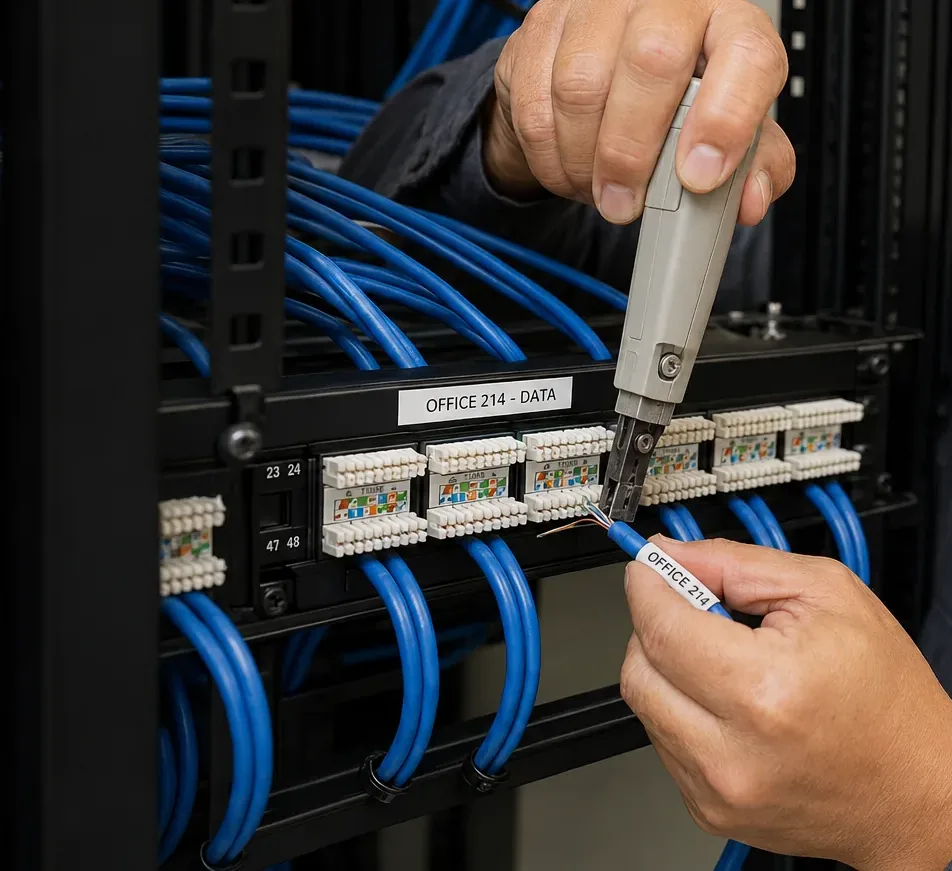
A hand presses a punch-down tool onto a patch-panel module under a strip labelled Office 214 - Data, while the other hand holds a blue cable with a matching printed label.
Before the Next Call Drops Mid-Sentence
Send a photo of the jack, the panel or basement corner and the router, and tell us what the walls are made of. We will tell you what is most likely wrong and what a visit would cover.
Whose Cable Is It? Responsibility in Westchester Houses and Buildings
Half of a Westchester Cat6 repair is knowing who should pay for it and who has to say yes. This is the usual pattern we see across the county. Leases, proprietary leases, condo declarations and provider agreements vary, so treat it as a starting point and check your own documents; we will read them with you if that helps.
Part of the link
House you own
Co-op or condo
Rental apartment
Provider’s fiber terminal or modem
Usually the provider’s
Usually the provider’s
Usually the provider’s
Router and Wi-Fi equipment
Yours or rented from the provider
Yours or rented from the provider
Yours, or the building’s where it is part of the lease
Cat6 inside the walls of the home
Yours
Usually the shareholder’s or unit owner’s
Usually the landlord’s, unless the lease says otherwise
Media panel or in-unit switch
Yours
Usually the owner’s
Usually the landlord’s in new buildings with per-unit switches
Risers, hallway pathways, telephone closets
—
The building’s; work needs the agent or board
The building’s
Who approves an opening in a wall
You
Often the board or managing agent
The landlord
Two points save most of the arguments. First, a written test result that shows where the fault is ends almost every debate about whose problem it is: a fault at the provider’s port is theirs, a fault at a jack in a rented apartment is usually the landlord’s, and a fault in a shareholder’s own wall is usually the shareholder’s. Second, in two-family houses and buildings with shared basements, the cables of different households often run side by side; tracing and labelling them during the repair stops the next technician from cutting the wrong one.
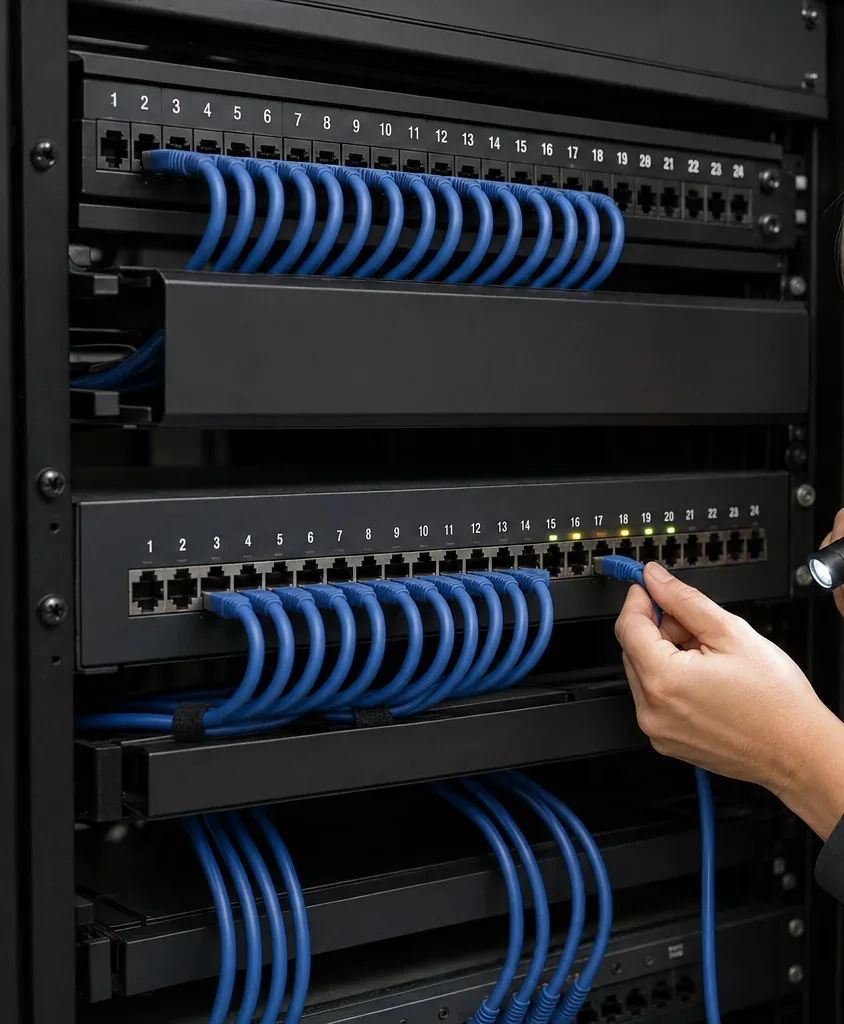
A black rack holds two patch panels with numbered ports and rows of short blue cords; at the right a hand plugs a cord into one port of the lower panel beside a small flashlight.
Across the County
How Cat6 Repair Changes From One Part of Westchester to Another
A failed keystone is the same failure in Yonkers and in Katonah. What changes is the building around it, who else has a say, and what the last decade has done to the room. These are the patterns we plan for in each part of the county.
The river cities: Yonkers, Mount Vernon and New Rochelle
Two- and three-family houses, walk-up and elevator apartment buildings, and in New Rochelle and along the Yonkers waterfront a new layer of rental towers. Repairs here start by working out which household or which landlord a cable belongs to, because basements and closets are often shared. In the older buildings the cable follows old telephone paths and surface raceway; in the new ones it ends in a utility-closet switch and media panel that the tenant may never have opened. Building superintendents and managing agents are part of almost every visit.
The Sound shore: Pelham, Larchmont, Mamaroneck, Rye and Port Chester
Older houses with plaster walls, village storefronts with cellars, and neighbourhoods that have flooded more than once. The provider’s box and the router are often in the basement, so many calls here end up as a conversation about moving the network corner upstairs. Terminations near basement floors and runs through damp cellars are checked as a matter of course, even when the reported fault is two floors up.
Central Westchester: White Plains, Scarsdale, Hartsdale, Harrison and Eastchester
The widest mix in the county: pre-war houses in Scarsdale and Bronxville, mid-century co-op towers in Hartsdale and along Central Park Avenue, downtown White Plains offices and conversions, and the medical suites of the Platinum Mile.
The Rivertowns: Hastings to Croton
Hillside houses, some very old, with steep lots, finished lower levels and steam or hot-water heat in many of them. Runs often pass through a lower level built into the slope, where damp and heating pipes both play a part. The village main streets add small offices and shops above and below each other, wired in stages over many years.
Northern Westchester: from Yorktown and Mount Kisco to Bedford and North Salem
Larger houses, post-war split-levels and some estates, with longer runs inside a single house, home offices over garages, and the occasional run to a pool house or studio. Distances are longer than in the south of the county, so we plan the visit to finish in one trip and ask for photos of the panel and the failing jacks before we drive up. Outbuilding runs follow the same approach as on our Hudson Valley hub.
Complete Services
Every Cat6 Repair Service in Westchester County
A dead Cat6 jack in a Westchester house or building often brings Wi-Fi, a camera, a panel or a TV into the same conversation. These are the related services we offer across the county.
How we work in an occupied Westchester house or apartment — general practice rather than one particular call
We start where the cable ends, not where the wall is. The jack that failed, the panel or basement corner it runs to, the cord between the router and the wall: in finished houses and apartments that is where most faults live, and checking them costs nothing but a screwdriver and a tester. Plates come off, boxes are looked into, and the panel is opened before anyone talks about the wall.
Then we ask about the house’s recent history. A new kitchen, a television on the wall, a radiator replaced, a ceiling fixture swapped, a basement that took water last autumn. The test gives us a distance, and the history usually tells us what is waiting at that distance.
Before we leave, the room goes back as we found it, the result is saved with the date, and the jack is labelled so the next person knows where it goes.
FAQ
Westchester County Cat6 Repair FAQ
Can the repair be scheduled so a home office is offline for as short a time as possible?
+
Yes. Tell us when your calls are, and we test the failing jack first, explain the fix and then take the link down only for the minutes the re-termination needs. If the router or panel has to be worked on, we agree a window, and we can leave a temporary cord to a working port so you stay online while the rest of the work is done.
Do you need our Wi-Fi or router password to repair the Cat6?
+
Usually not. The cable is tested with our own instruments, which do not need access to your network. If a fault turns out to be a router or switch setting, we show you the setting and you or your IT provider can change it, or you can log in for us while we watch the result.
Will you work with our superintendent if the switch is in a locked basement room?
+
Yes, and in many Westchester apartment buildings that is the only way in. Give us the superintendent's name or the managing agent's office, and we arrange access to the room, follow the building's rules on hours and elevators, and leave the room locked and as we found it.
Can a dead jack behind a built-in bookcase or kitchen cabinet be repaired without removing the cabinetry?
+
Often. Many jacks behind built-ins can be reached through a shelf back, an adjacent open bay or a small cut-out in a cabinet back that stays hidden. Where the jack is truly sealed in, we can usually re-terminate the run at a new plate on the side or inside of the cabinet rather than taking the cabinetry out.
Can you repair the Cat6 behind a wall-mounted TV without taking the TV down?
+
Sometimes. If the jack or recessed box is reachable from the side or below the screen, we work around the mount. If the fault is in the box directly behind the TV, the screen has to come off the mount for the repair, and we can take it down and put it back with your agreement.
Do you repair Cat6 in a two-family house where each unit has its own internet service?
+
Yes. Two-family houses in Yonkers, Mount Vernon, New Rochelle and Port Chester often have two providers, two routers and cables from both households running through the same basement. We trace and label each household's runs before repairing anything, so one tenant's fix does not cut the other tenant off.
Will a Cat6 repair interrupt the building's intercom or door-entry system?
+
Not if we know where it is. Some newer Westchester buildings run their entry panels and apartment stations over Cat6 or share closets with them. We identify those runs before work starts and leave them alone, and if the intercom itself has a fault we tell you rather than touching building equipment.
Can you repair the Cat6 that feeds a generator, solar inverter or battery monitoring gateway?
+
Yes, the network cable to the monitoring gateway is ordinary data wiring and we repair and test it like any other run. We do not open or adjust the generator, inverter or battery equipment itself, which stays with its installer.
Do you protect floors and clean up plaster dust after the work?
+
Yes. We put down drop cloths where we work, contain dust at any opening, use a HEPA vacuum for plaster and drywall dust, and take away offcuts, old cable and packaging. The room should look as it did when we arrived, apart from any opening you agreed to leave for your own plasterer.
Can one visit cover both our home office and a small office we run in town?
+
Yes, if they are close enough to fit in the same day. We book the two addresses as one visit, test and repair at both, and give you separate results for each so the home and business records stay apart.
All Areas Served
Cat6 Repair Across the Hudson Valley, New York City and Long Island
You are on the Westchester County Cat6 repair page. It sits under our Hudson Valley Cat6 repair hub, which covers all six valley counties, alongside our Cat6 repair pages for New York City, Long Island, Nassau County and Suffolk County.
Dead Jack Somewhere Between Yonkers and Peekskill?
If a home office, a bedroom, an exam room or a register dropped off the wired network, call (914) 877-2578. We book the next open 2-hour window, bring the parts the symptom points to, and most jack, cord and panel faults are found and fixed in one to two hours inside.
Cat6 Repair Westchester County — Licensed, Insured, Tested to Category
Abstract Enterprises Security Systems · 460 E Fordham Rd, Bronx, NY 10458 · Westchester line (914) 877-2578 · WhatsApp (718) 679-0359 via wa.me
NYS Low-Voltage Licence #12000287431 · 100% Licensed & Insured · Same-Day Estimates · Rated 4.7★ from 201 Google Reviews
Customer-supplied parts are covered by their maker, not by AESS. Our warranty page and the service agreement hold the full terms.
Code, licensing and lease references on this page are short summaries written for property owners and tenants in Westchester County; they are not legal or engineering advice. Page reviewed and updated October 17, 2026. Changelog: first publication of the Westchester County Cat6 repair page.