Most Cat6 in Queens does not fail from age. It fails from use: a kitchen screen hung over a hot line, a register jack at mop height, a basement office that took water in 2021 and again in 2023, a rowhouse floor someone re-drywalled over the run, a new apartment whose wall jacks were never patched to anything. We find out which of those happened to your link, repair it properly and certify it to Category 6 again — from Astoria to the Rockaways, Ridgewood to Little Neck.
Reviewed and updated October 17, 2026 · Written by Anwar Timothy, NYS licence #12000287431
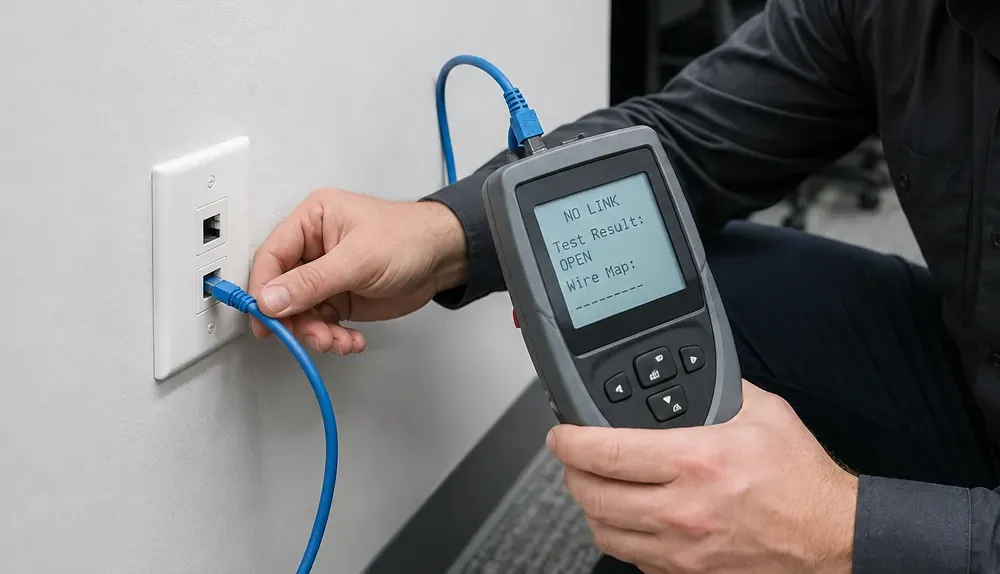
A gloveless hand pushes a blue patch cord into the lower port of a white two-port wall plate while the other hand holds a grey tester whose screen reads No Link, Test Result: Open.
Queens Cat6 Repair Quote
Tell us what went dark and where — a technician answers the same business day
✅
Request Sent!
A Queens technician will call you back the same business day.
25+
Years Experience
✓
Same-Day Estimates
100%
Licensed & Insured
4.7★
201 Google Reviews
A register that says offline in the middle of the lunch rush, a kitchen printer that stopped taking tickets, a home office in the basement that never came back after the last heavy rain? Call our Queens line, (347) 434-6392, or send the 60-second form. A licensed technician reads it and tells you whether it sounds like the cord, the jack, the run inside the wall or not the cabling at all — before anyone books a visit.
Every repaired link certified against the Category 6 limits, not just checked for a light
Kitchen, basement and storefront runs judged on where they live, so the fix does not fail the same way twice
One direct Queens line answered by our dispatcher, and a contractor holding New York State low-voltage licence #12000287431 with full insurance
Why Queens Properties Need Cat6 Repair That Starts With How the Building Is Used
Queens is where New York cooks, sells, rents out the basement and moves into the new tower, often on the same block. The Census Bureau counts about 2.36 million people and roughly 935,000 homes in the borough, and the Citizens Housing & Planning Council's reading of the 2023 Housing and Vacancy Survey notes that half of all the city's housing sits in Brooklyn and Queens. That housing ranges from brick rowhouses in Ridgewood to garden-apartment co-ops in Jackson Heights and Sunnyside, detached houses in Bayside and Whitestone and fifty-storey rentals at Hunters Point. Under almost every one of those, and behind every storefront on Main Street, Steinway Street or Jamaica Avenue, runs Cat6 that somebody depends on.
What breaks that Cat6 is usually the life of the building rather than the passing of time. A restaurant's register, kitchen display and receipt printer are wired because the point-of-sale companies want them wired: Toast's own support pages tell owners that stationary terminals and kitchen screens should use Ethernet rather than Wi-Fi because a cable is more stable. Those same cables then live beside fryers and dish machines, under counters that get mopped every night and inside ceilings that see a fair amount of traffic. A restaurant IT firm, F3 Technologies, lists cables placed too close to heat and water and left in tangled “rat's nests” among the commonest mistakes it finds in restaurants. When one of those links fails, the POS provider's support article is honest about where its help ends: repairs to in-wall cabling may need an outside resource, because the provider does not do intensive cable work.
The second pressure is water and renovation in the borough's houses. Hurricane Ida in 2021 hit Queens hardest: the Queens Daily Eagle reported that eleven of the twelve people confirmed dead in the city were from Queens, ten of them in basement apartments. On September 29, 2023, the remnants of Tropical Storm Ophelia gave the city its wettest day since Ida; the Eagle described countless flooded basement apartments, East Elmhurst streets under water and LaGuardia's Terminal A shut by flooding inside the building. Basements that took water have been gutted and rebuilt, some twice, and the city's 2024 law creating a path to legalise existing basement and cellar homes includes parts of Queens in its program area. Every one of those rebuilds is a chance for a cable that was working to be cut, screwed through, buried behind new drywall or left lying on a floor that floods again.
The third is the brick and the boom. Ridgewood and the edges of Woodside and Glendale are built of brick: the Landmarks Preservation Commission records that the G.X. Mathews Company alone built and sold over 300 tenements in Ridgewood between 1909 and 1912, and the Central Ridgewood Historic District is described as roughly 990 buildings, most of them brick row houses. Cat6 added to those buildings goes up stairwells, along baseboards and through party walls, wherever a drill would go, and it gets disturbed every time a floor is renovated. At the other end of the timeline, the State Comptroller counts Long Island City, Sunnyside and Woodside housing up about 42 percent between 2010 and 2023, to some 66,700 units. Many of those new apartments have Ethernet jacks in every room that lead back to a media panel in a closet — and, as one commenter in the Long Island City subreddit put it, each jack has to be patched at that panel before it does anything. A surprising number never were.
Queens facts that shape a Cat6 repair
About 935,000 homes for 2.36 million people: the U.S. Census Bureau's 2025 estimates for Queens County, with 44.9 percent of homes owner-occupied — a borough of landlords, co-op shareholders, tenants and small owners who each control a different piece of the wiring.
29,000 restaurants citywide: the number NYC Health gives for establishments with inspection results on its ABCEats lookup, a large share of them along Queens's commercial corridors, where register, kitchen-screen and printer links are wired by design.
Eleven of twelve: Ida victims in the city who were from Queens, ten of them in basement apartments, as the Queens Daily Eagle reported — the storm that put basement rebuilding, and the cable inside it, on thousands of Queens to-do lists.
The wettest day since Ida: September 29, 2023, when, per the Eagle, countless Queens basement apartments flooded and LaGuardia's Terminal A was shut by water inside the building.
Over 300 tenements in four years: built and sold in Ridgewood by the G.X. Mathews Company between 1909 and 1912, according to the Landmarks Preservation Commission — three-storey brick buildings where Cat6 is retrofitted, not designed in.
1,812 rat complaints in six months: filed with 311 from Queens in the first half of 2021, up 27 percent on a year earlier, with Ridgewood and Woodside the busiest areas, as QNS reported. Experts quoted there linked part of the rise to restaurants reopening. Rodents and food businesses share ceilings, and so does Cat6.
None of this means a Queens repair is complicated. Most failing links come down to a termination, a cord or one damaged section of cable. It means that the cause of the failure matters as much as the fix. Re-terminate a kitchen-screen jack that keeps getting splashed and you will be back in six months; tidy the cable behind a register without moving it away from the mop bucket and nothing has changed. We look at what the building is doing to the cable before we decide how to repair it.
A Queens building with one dead Cat6 link frequently has older Cat5e, or cable nobody can identify, running beside it. Our Queens network cable repair service covers every Ethernet category and the shared-riser tracing that goes with it, and the AESS Cat6 installation crews in Queens take over when a space needs new drops rather than rescued ones.
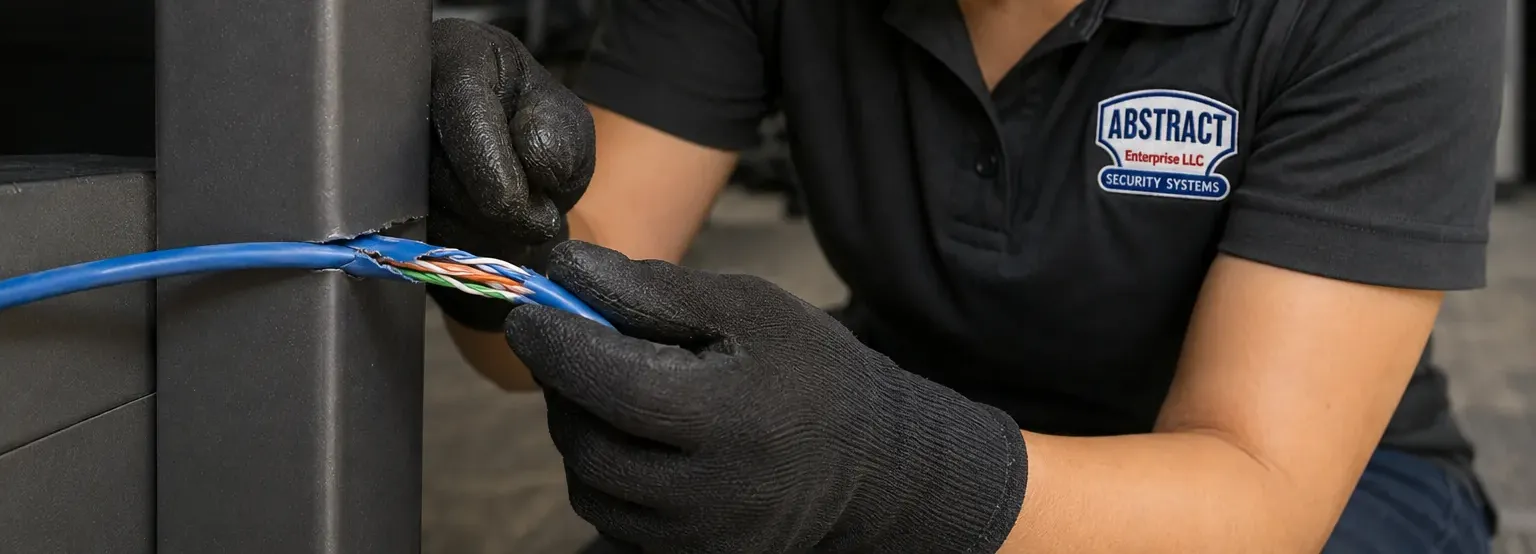
Two gloved hands hold a blue cable at the sharp edge of a dark steel desk leg, where the outer jacket has torn open and the orange, green and white twisted pairs show through.
Repair Capture
Register or Kitchen Screen Offline in Queens Right Now?
Lost card payments at the till, a kitchen printer that went quiet mid-order, a pharmacy terminal or a dentist's imaging PC cut off from the network: our dispatcher treats any of these as an outage and gives it the earliest 2-hour arrival slot on the schedule, which on weekdays is often the same afternoon. The van carries a certification tester, a toner, Cat6 and Cat6A keystones and panel modules, factory-made cords, surface raceway and sealed boxes, because in Queens the failure is as likely to be at a wet floor jack or a renovated wall as in the closet. Most single-link faults at a termination or a cord are found and fixed within one to two hours once a technician is on site. Repair time is $195 an hour with a three-hour minimum ($585), the same rate on our Queens network cable repair page. Call (347) 434-6392 and say it is a Cat6 fault; if the camera rather than its cable is the suspect, see our security camera repair page for Queens.
What We Repair
Cat6 Repair Services in Queens
Sorted by the thing that hurt the cable, this is the work Queens customers call us for again and again. Whatever the cause, the job is not finished until the link passes a certification test for its category and you have a plain note of what went wrong and what we changed so it should not recur.
Counter and Kitchen Links
Registers, kitchen display screens, ticket printers and card terminals that drop during service. We test the run, look at where it passes the line and the dish area, and move or protect the section that heat, grease or water is reaching.
Low Jacks and Floor Boxes
Ports at mop height under counters, in floor boxes by the host stand and behind display cases. Corroded contacts are replaced, and where the jack will keep getting wet we raise it or seal it rather than just re-terminate it.
Basement Run Recovery
Home offices, back offices and network shelves in basements that have taken water. We certify every affected link, replace wet terminations and wicked sections, and lift runs and equipment off the floor while we are there.
Renovation and Trade Damage
Runs screwed through by drywallers, cut by electricians or plumbers, crushed under new flooring or buried behind a wall that used to have a jack. We find the damage by distance and open the smallest possible access.
Rowhouse and Masonry Runs
Cat6 surface-run along brick, up stairwells and through party walls in Ridgewood, Glendale, Woodside and Astoria. Damaged sections are replaced in raceway that protects them, along a path that the next renovation is less likely to hit.
Apartment Jacks and Media Panels
New-building jacks that go nowhere, panels in closets packed with the builder's coax and the provider's modem, and keystones that were punched down in a hurry. We trace each jack, patch or re-terminate it and leave a port map.
Rodent-Damaged Cable
Runs chewed in restaurant ceilings, storage basements and garages. We locate every bite along the length, not just the first one, replace the damaged sections and move the new cable into metal raceway or conduit where the animals travel.
Jack, Keystone and Panel Re-Termination
Most single-link faults end here. We trim the cable past any damage, seat it on a new keystone or panel module of the same category, and keep each pair's twist as close to the contacts as the hardware allows, which is what crosstalk tests reward.
Certification for a Lease, Sale or Fit-Out
Testing the Cat6 a previous tenant left in a storefront, or a building's cabling before a sale or a new lease, with saved results for every link and a written list of what passes, what fails and what to fix first.
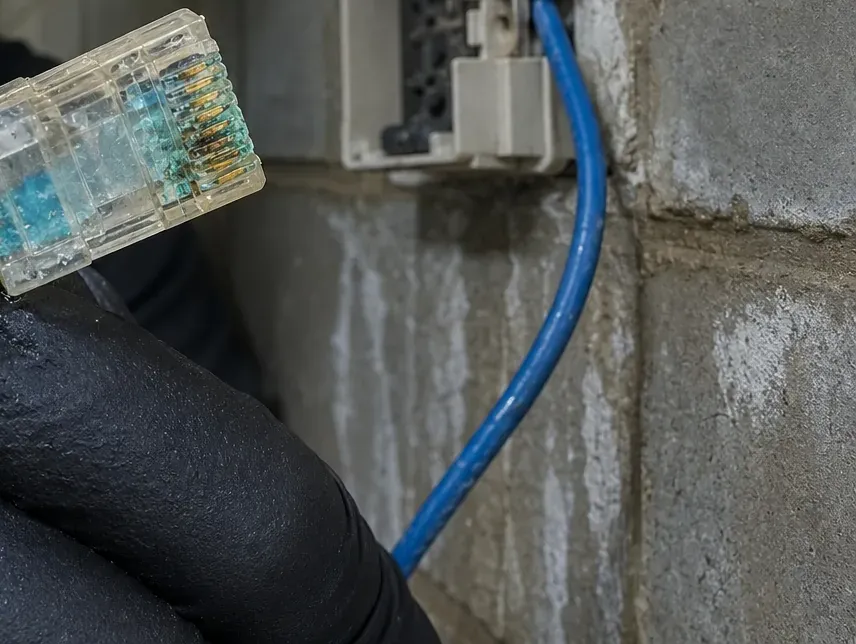
A black-gloved hand holds a clear RJ45 plug whose gold contacts are crusted with green and blue corrosion; behind it a blue cable runs down from an open plastic wall box mounted on a stained concrete block wall.
Building Specialists
Cat6 Repair for Queens' Architecture
Queens has more kinds of building than any other borough, and each kind hides its Cat6 in a different place. These are the structures we see most often between Long Island City and the Nassau line, with the failure each tends to produce and the access each allows.
Brick Rowhouses and Mathews-Style Flats
Ridgewood, Glendale and parts of Woodside and Astoria: two- and three-storey brick buildings with plaster on masonry. Cat6 was added along baseboards, up the stair hall and through party walls, and later renovations disturb it floor by floor.
Two- and Three-Family Houses
Elmhurst, Corona, Woodside, Richmond Hill and Woodhaven: an owner on one floor, tenants on another, often a basement unit. Runs for different households share one cellar closet and one incoming line, and nobody remembers whose cable is whose.
Detached and Semi-Detached Houses
Bayside, Whitestone, Douglaston, Hollis and St. Albans: houses with finished basements, attics and garages. Cat6 runs through joists and closets, and the faults come from basement water, attic work and garage conversions.
Garden-Apartment Co-ops and Complexes
Jackson Heights, Sunnyside, Fresh Meadows and Glen Oaks Village, which describes itself as 2,904 garden-style apartments in 134 buildings. Shareholders own the cable inside their unit; the board controls the walls, the courtyards and the basement.
Mixed-Use Storefront Buildings
Steinway Street, Roosevelt Avenue, 37th Avenue, Main Street and Jamaica Avenue: a shop or restaurant on the ground floor, apartments above, a cellar shared by both. Counter and kitchen runs, awning cameras and the cellar crossing are where repairs concentrate.
Towers at Hunters Point and Court Square
New rentals and condos where each unit has a media panel and jacks in every room, and the building's telecom room is off limits. Repairs live inside the unit: dead jacks, unpatched ports and crowded enclosures.
Converted Factories, Lofts and Studios
Long Island City, Astoria and Maspeth buildings turned into offices, studios and production spaces. Exposed ceilings, long runs on steel and tenants who re-plan the floor every lease put cable in the way of every move.
Professional Offices in Converted Houses
Dental, medical, legal and accounting offices along Queens Boulevard, Northern Boulevard and Bell Boulevard in buildings that began as homes. Cat6 shares narrow walls with old plumbing and heating, and repairs are planned around appointments.
How the building changes the repair
In masonry, we repair along the surface rather than through it. When a Cat6 run in a brick rowhouse is damaged, the instinct is to fish a new one through the wall the same way the old one went. In practice the old path was often a gap behind the baseboard, a hole drilled through a party wall that is now packed with other trades' cables, or a chase that a later renovation closed. We usually replace the damaged section in low-profile raceway along the baseboard, ceiling line or stair stringer, painted to match if you like, so the run is protected and the next contractor can see it. Where a run must pass through brick, we sleeve the hole so the cable cannot be cut by the masonry edge.
In the houses, we follow the water and the renovations. The places where Queens house wiring fails are predictable: the basement floor and the bottom of basement walls, the line where a finished ceiling meets the old joists, the garage that became a room, and any wall that has been opened since the cable went in. We test from the panel or router to every jack, read the distance to any fault, and compare it with where the house has been worked on. The fault is usually within a metre of a renovation.
In co-ops and towers, we repair inside the line the building draws. Shareholders and tenants generally control the jacks, cords and in-unit cable; the board or management controls the riser, the basement and the telecom room. We keep our work inside the unit unless management says otherwise, provide insurance certificates in the wording they ask for, and if a fault turns out to be on the building's side we document it with test results so you can show the managing agent exactly where the problem is.
In kitchens and storefronts, we repair for the next service, not just for today. A run that failed because of heat, grease, water or a cart is rerouted or protected as part of the repair, and the jack is placed where the staff will not hit it. The point of the visit is that the register still works on Saturday night.
When the damaged run in a Queens house turns out to feed a doorbell or yard camera, the device may deserve a look too. That side is handled by our residential security camera team for Queens homes; the wiring repair is what this page covers.
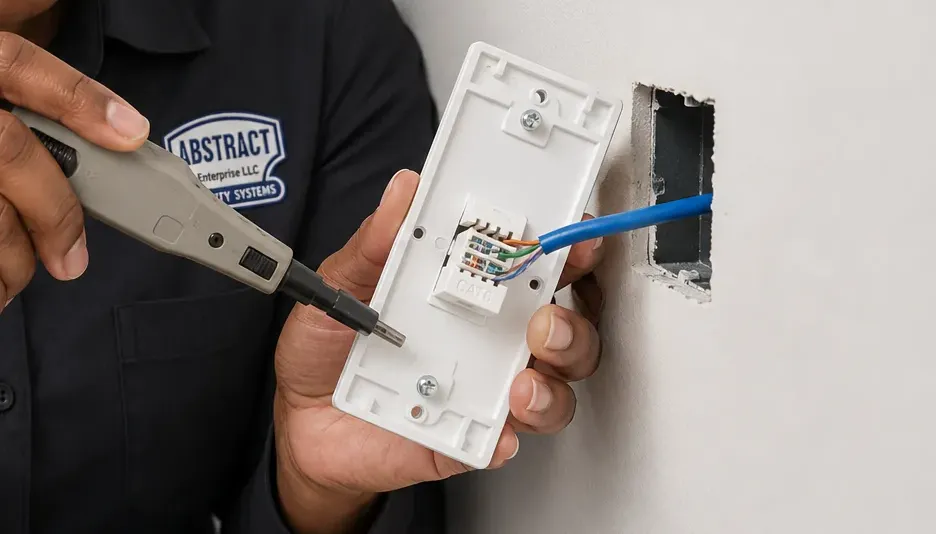
One hand holds a grey punch-down tool against the back of a white wall plate while the other holds the plate, where a keystone marked Cat6 is wired with a blue cable running back into an open box in the wall.
Commercial Cat6 Repair
Business Cat6 Repair in Queens
Queens business life runs along corridors, and the city's own list of business improvement districts reads like a map of where our commercial Cat6 calls come from. NYC Small Business Services lists eleven BIDs in the borough, from the Long Island City Partnership to GatewayJFK. The six corridors below are described by the kind of building and the kind of Cat6 trouble they produce, not as a list of our clients.
Main Street, Downtown Flushing
One of the busiest shopping streets in the city — the local chamber has said its pedestrian count is second only to Times Square, with about 200,000 daily bus riders on Main Street. Restaurants, bakeries, pharmacies and offices packed into subdivided buildings mean short, dense runs that are easy to damage and hard to trace.
Steinway Street and 30th Avenue, Astoria
The Steinway Street BID's retail strip and the cafes and restaurants of 30th Avenue. Storefronts with cellars, long narrow floorplans running back to a kitchen, and counter and camera links that every new tenant re-arranges.
82nd Street and Roosevelt Avenue, Jackson Heights
Shops and restaurants under and around the elevated line, many in older buildings with apartments above. Cat6 for registers and cameras is added piecemeal, often by whoever installed the equipment, and shares ceilings with everything else in the building.
Jamaica Avenue and Downtown Jamaica
The Downtown Jamaica Partnership's district around the AirTrain and the 165th Street and Jamaica Avenue shopping streets, rezoned for denser commercial use in 2007. Offices, government-facing businesses and large retail floors with mixed generations of cable.
Court Square and Long Island City
Office towers led by One Court Square, 50 storeys and Queens's tallest building from 1989 until 2019, beside factories converted to offices and studios after the 2001 rezoning. Cat6 here is either recent tower cabling in managed buildings or loft runs on exposed steel.
Myrtle Avenue, Ridgewood
The Myrtle Avenue BID's shopping street at the heart of Ridgewood's brick neighbourhood: restaurants, bars, salons and small offices in two- and three-storey buildings where cable runs through cellars and along masonry walls.
The links each kind of Queens business cannot afford to lose
Floor boxes at the lanes, the cellar crossing, the gate entry
Salon, barber or nail studio
Booking screen, card reader, music and camera links
Jacks near sinks and chemical stations, cords along the floor
Medical or dental office in a converted house
Front desk, imaging sensors, exam-room PCs, phones
Old walls shared with plumbing, renovated rooms, basement closets
Office or professional suite
Desks, printers, phones, access points
Under-desk cords and desk frames, ceiling runs moved by other tenants
Warehouse, forwarder or studio
Scanners, label printers, cameras, editing and render machines
Long runs on steel, dock doors, cold rooms, carts and forklifts
Building management or co-op office
Lobby cameras, intercom and entry links, laundry-room card readers
Cellar and boiler-room crossings, lobby ceilings, exterior entries
When we are called for one of these, we test the critical links first and the rest of the floor second, so the business is trading again before we look at anything that can wait.
Compliance callouts for Cat6 repairs in Queens
Electrical code. New York City's Electrical Code is the city's amended version of the 2020 National Electrical Code and, according to the Department of Buildings, took full effect on December 21, 2025. Communications cabling repairs follow it, including the listing and installation rules for cable in plenums, risers and fire-rated assemblies.
Dead cable left behind. The National Electrical Code expects reachable communications cable that is no longer used to be taken out unless someone tags it for future use. A Queens storefront that has had four or five tenants can hold more abandoned cable above its ceiling than live cable, and replacing a run is the moment to clear the old one.
Fire-rated walls and floors. A new or rerouted run through a rated wall or floor between a shop and the apartments above, or between units, is sealed with a firestop system so the rating is kept. We do not leave open holes where we have passed cable.
Basements after flooding. The Department of Buildings' advice after Ida was never to switch off power or touch a breaker while standing in water, and that extensive repairs could need registered contractors and permits. We do not work on cabling in a wet basement until the electrical side is safe, and we stay within low-voltage work.
Basement and cellar homes. The city's 2024 law creating a path to legalise existing basement and cellar apartments has its own inspection items — egress, alarms, water sensors and, later, sprinklers. Those are matters for the owner and their architect or expeditor. Our part is to make sure the Cat6 in that space is sound, out of the way of the work and recorded.
Landmarked districts. Jackson Heights, Sunnyside Gardens and several Ridgewood districts are designated historic districts. Work that changes a building's exterior, such as a new cable penetration on the street side, may need Landmarks Preservation Commission approval, so we route repairs inside wherever we can.
If a failed run also carries a door reader or an electric strike, the hardware end belongs to our Queens access control installation team; they take over once the cable has passed its test.
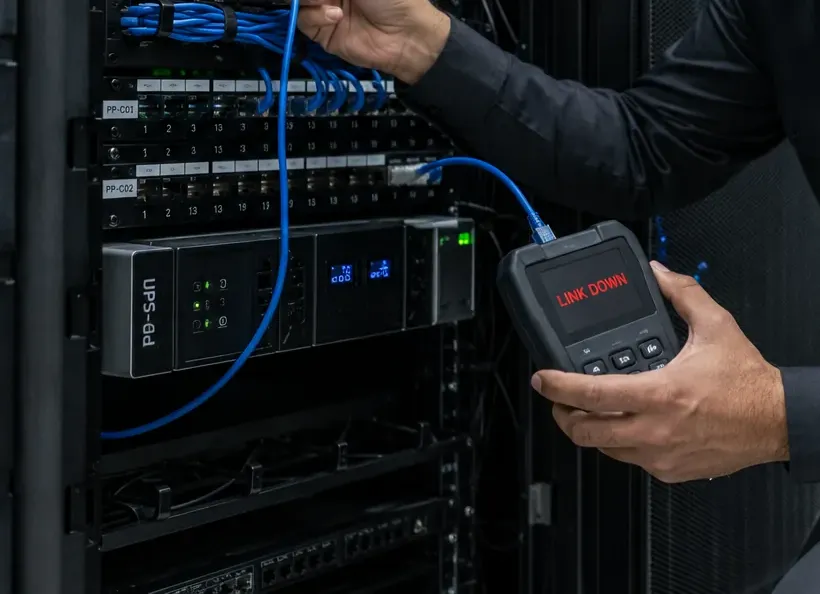
A hand holds a black handheld tester reading Link Down in red, its blue cord running up to a patch panel labelled PP-C02 in a black equipment rack above a rack-mounted power unit; a second hand reaches into the cords at the top of the rack.
Your Questions Answered
Cat6 Repair in Queens: Questions Answered
These are the questions restaurant owners, shopkeepers, landlords, co-op shareholders and apartment renters in Queens ask once a Cat6 link has started misbehaving. They are grouped by where the cable lives: behind the counter, in the house and its basement, and inside the newer apartment buildings. Booking, paperwork and smaller practical points are in the FAQ further down.
Counters, kitchens and storefronts
Why does the kitchen display screen lose its connection when the line is busiest?
Because the busiest hour is also the hottest, wettest and most crowded hour for the cable. Kitchen screens are usually mounted at the pass or over the line, and the Cat6 that feeds them often runs across the ceiling above the cooking equipment or down the wall beside the hood. Copper loses more signal as it warms — Fluke Networks, quoting ISO/IEC 11801, gives a length derating of 0.4 percent per degree Celsius between 20 and 40 °C for unscreened cable — so a long or marginal run can fall below its limit only when the burners have been on for hours. Add a termination that has taken years of steam and grease and a cord that gets knocked every time the screen is touched, and the link works at 10 a.m. and fails at 7 p.m.
We test the run when the kitchen is cool and look at its margin, then walk the path and note every place it passes heat, steam or hands. The usual repair is a fresh termination in a sealed or raised box away from the splash zone, a new factory-made cord, and a reroute of the hot section along a cooler wall or above a barrier rather than directly over the line. If the run has lost too much margin to recover, the section over the kitchen is replaced. We schedule the work between services or on the day you close.
Mop water reaches the floor box under our register every night — is that what keeps killing the link?
Very possibly. A jack at floor level in a space that is wet-mopped daily sits in a film of water and cleaning chemical for hours at a time. The contacts in the jack and the plug corrode, the corrosion raises resistance on one or more pairs, and the link starts to flap or fall back to a slower speed long before it goes dark. When we pull the plate, the copper is often green.
Re-terminating the jack in the same spot only resets the clock. We cut back to clean cable, replace the jack and cord, and then move the termination up into the counter or the wall above the splash line, or fit a floor box with a gasketed cover if the counter is in the middle of the room. If the cable itself has wicked water along its length, which shows on the tester as a fault some distance in, we replace that section too.
Our POS company says the problem is “in the wall” and they don't repair wiring — what happens next?
That is a normal answer, and usually a fair one. Point-of-sale providers support their terminals, printers and software; their troubleshooting guides typically end with reseating or swapping the patch cord, and Toast's own support article says plainly that repairs to in-wall cabling may require an outside resource because it does not provide service for intensive cable work. Once a known-good cord and a known-good device still show no link, the fault is in the jack, the cable inside the wall or ceiling, the panel or the switch port, and that is our side of the line.
Tell us which device, which jack and what the screen or port lights are doing. On site we certify the link from the jack to the panel, which tells us in a few minutes whether the cable is sound, where along it a fault sits and whether the switch port is at fault instead. We fix what we find, retest, and can stay on the phone with your POS support while they bring the terminal back up, so the register is taking cards before we leave.
Our roll-down gate housing has a Cat6 run beside it — could the gate be what keeps damaging it?
It is one of the more common storefront faults we find. Cable for an outdoor camera, an awning sign or a front-door intercom often enters the shop at the top of the window, right next to the gate's coil housing and its motor. Every time the gate rolls up or down, the housing flexes and vibrates, and a run that was zip-tied to the housing, pinched under its cover or fed through the same gap rubs and kinks until the jacket opens. The camera works for a while, then drops in wet weather or only when the gate is half open.
We trace the run from the camera or device back to the closet, read the distance to the fault and check it against the gate housing. The repair is to replace the damaged section and route it away from the coil and motor, through a sealed entry above or beside the housing, with a drip loop on the outside and proper support so nothing moving can reach it. If the gate itself needs work, that is for your gate company; we make sure the cable is not part of the problem when they come.
Houses, basements and renovations
Our basement is being brought up to the city's basement-apartment rules — what happens to the Cat6 running across its ceiling?
It should be dealt with before the ceiling closes, not after. Bringing a Queens basement into line with the 2024 basement program, or simply finishing it properly, usually means new ceilings, fire-separation work, alarms, water sensors and in time a sprinkler, and the trades doing that work will move, cut or bury whatever cable is in the way. The city's program sets out the inspection items; your architect or expeditor handles those. Our concern is the Cat6 that feeds the rest of the house, the cameras and any devices in the unit itself, which often crosses that ceiling from the incoming line to the router.
The best time to call us is when the ceiling is open. We test every run that crosses the basement, mark which ones belong to which floor or tenant, replace anything damaged, move runs to where the framing and sprinkler pipe will not trap them, and leave a labelled pull string for the next change. If walls are going to be fire-rated, any cable passing through them is firestopped. A repair at that stage takes a fraction of the time it takes after the drywall is up.
A contractor screwed new drywall over our Cat6 and now two rooms are dead — can it be fixed without tearing the wall off again?
Usually, yes. A drywall screw through a Cat6 cable shorts or opens one or two pairs at a specific point, and that point can be found by distance from either end. Our tester reads how many metres down the run the fault sits; measured out along the likely path, that usually puts the damage within an arm's length on the new wall. Where two rooms died at the same time, the runs typically share a stud bay or a top plate, and one access opening often reaches both.
We cut a small, neat opening at the fault, remove the screw, and either replace the damaged section with a short length of matching Cat6 joined in a proper inline coupler rated for the category, or, if the run is short or the damage is long, pull a fresh cable through the bay. The link is certified before the wall is closed, and the patch is left ready for your contractor to tape and paint.
In our two-family house the tenants' Cat6 and ours share one closet — how do you repair one without cutting off the other?
By finding out, before touching anything, which cable belongs to which floor. In many Queens two- and three-family houses the internet service for every household comes into the same cellar or closet, and over the years the owners, the tenants and a series of installers have each added runs, small switches and splitters until nobody is sure what feeds what. Unplugging the wrong cord takes someone else offline, and in a rented house that is a phone call nobody wants.
We tone and test each run from the closet to its jacks, label both ends with the floor and room, and draw a simple map of what goes where. Then we repair the failed link while everything else stays connected, and we can separate the households' equipment onto their own shelves or panels if that helps.
An installer drilled through our Cat6 while bringing in new internet service — can you document the damage as well as fix it?
Yes. When a cable, fiber or phone installer drills through an existing Cat6 run, the result is usually a clean hole through the jacket and one or more pairs at the point where their new line came through the wall or floor. Before repairing anything we certify the damaged link and save the result, which records the fault, its distance from each end and the pairs affected. We photograph the damage once the wall or floor is opened and note the date, location and what was done to repair it.
You get a short written report with those results and photos, which is what a provider's claims department or a landlord usually asks for. The repair itself is the same as for any mid-run damage: a short replacement section joined in a category-rated coupler, or a new run if that is cleaner, then certification.
Apartments, co-ops and new towers
The room jacks in our Long Island City rental all run to a media panel in the hall closet — what has to happen in that panel before they work?
Usually the last step of the installation, which is often the one that was skipped. In most new Queens towers, the jacks in each room are wired back to a structured media panel in a closet, and the internet provider's modem or router plugs in there too. For a jack to work, its cable has to be terminated on a panel port or a keystone and then patched to a switch or the router. A commenter in the Long Island City subreddit described exactly that arrangement: the in-wall cables land on a panel somewhere, and each port has to be patched. When a building's handover was rushed, the cables are coiled in the enclosure, terminated but not patched, or punched down with the pairs out of order.
We open the panel, test each run to its jack and find out which of those it is. Unterminated cables are terminated on proper Cat6 hardware, mis-wired ones are redone, and a small switch is fitted in the enclosure if the router has fewer ports than there are rooms. Each jack is certified and labelled, and you get a map that matches the faceplates to the panel ports. If a run genuinely is damaged inside the wall, we tell you and, in a managed building, we tell you what to report to management.
Can a Cat6 jack in a rented apartment be repaired without the landlord's permission?
That depends on your lease and on what the repair involves. Replacing a cord, re-terminating a keystone behind an existing faceplate or re-patching a media panel inside your unit changes nothing permanent, and many tenants treat it like any other small repair. Opening a wall, adding a new jack or running cable through a common area is an alteration, and most Queens leases and every managed building we work in require the landlord's or managing agent's consent first.
We will tell you on the phone which category your repair falls into. If it needs consent, we can send a short scope of work for you to forward, along with our insurance certificate, and we keep our work inside the unit. If the fault turns out to be in a part of the building you do not control, such as a riser or a common closet, our test results give management what they need to fix their side. We cannot give you legal advice about your lease; we can make sure the request you send is clear.
The builder's media panel in our condo closet is so crowded the door won't shut — can the Cat6 in it be repaired without rewiring the apartment?
Almost always. Builder media panels are sized for the cabling, not for the modem, router, power supplies and switches that end up inside them, so the Cat6 gets bent hard against the enclosure edge, keystones are pulled half out of their mounts and cords are crushed by the door. The in-wall cable is usually fine; the damage is in the last half metre, where the cables meet the panel.
We take everything out, test each run, and re-terminate any cable that was strained or kinked at the panel on fresh keystones or a small patch panel. Equipment that does not need to be in the enclosure is moved to a shelf beside it with short, neat cords, power supplies are mounted rather than stacked, and the door closes again. Each room jack is certified and labelled. Nothing in the walls needs to change unless a test shows a run damaged further in.
Our Jackson Heights co-op won't let contractors open the courtyard-side walls — how is a dead Cat6 run repaired from inside the apartment?
By working with the board's limits rather than around them. In the historic garden-apartment co-ops of Jackson Heights and Sunnyside, alteration agreements often restrict work on exterior and courtyard walls, and the district designation means the exterior is protected anyway. A Cat6 run that once went out through a courtyard wall and back in, or along an exterior wall cavity, cannot simply be replaced the same way.
We locate the fault first, because in many cases it is at a termination or a short reachable section and no wall needs opening. Where the run is lost, we plan an interior replacement: along baseboards and door casings in low-profile raceway, through closets, or under the floor of the apartment above or below if the board approves. We send the board or managing agent a short scope and our insurance certificate before starting, and keep the work inside your unit.
Management says only their vendor can touch the telecom room — can you still fix the Cat6 inside our unit?
Yes, as long as the fault is inside the unit. Many Long Island City and Hunters Point buildings, and some older managed buildings elsewhere in Queens, restrict who can enter the telecom or riser room, and we respect that. Most Cat6 faults in apartments and office suites are in the jacks, the in-unit cable, the media panel or the cords, all of which are on your side of the line.
We test from your panel to every jack and, where we can reach it from the unit, toward the building's demarcation. If everything inside passes and the problem is upstream, we give you the saved results and a short note showing that the unit's cabling is sound and where the fault appears to start, so the building's vendor can go straight to it.
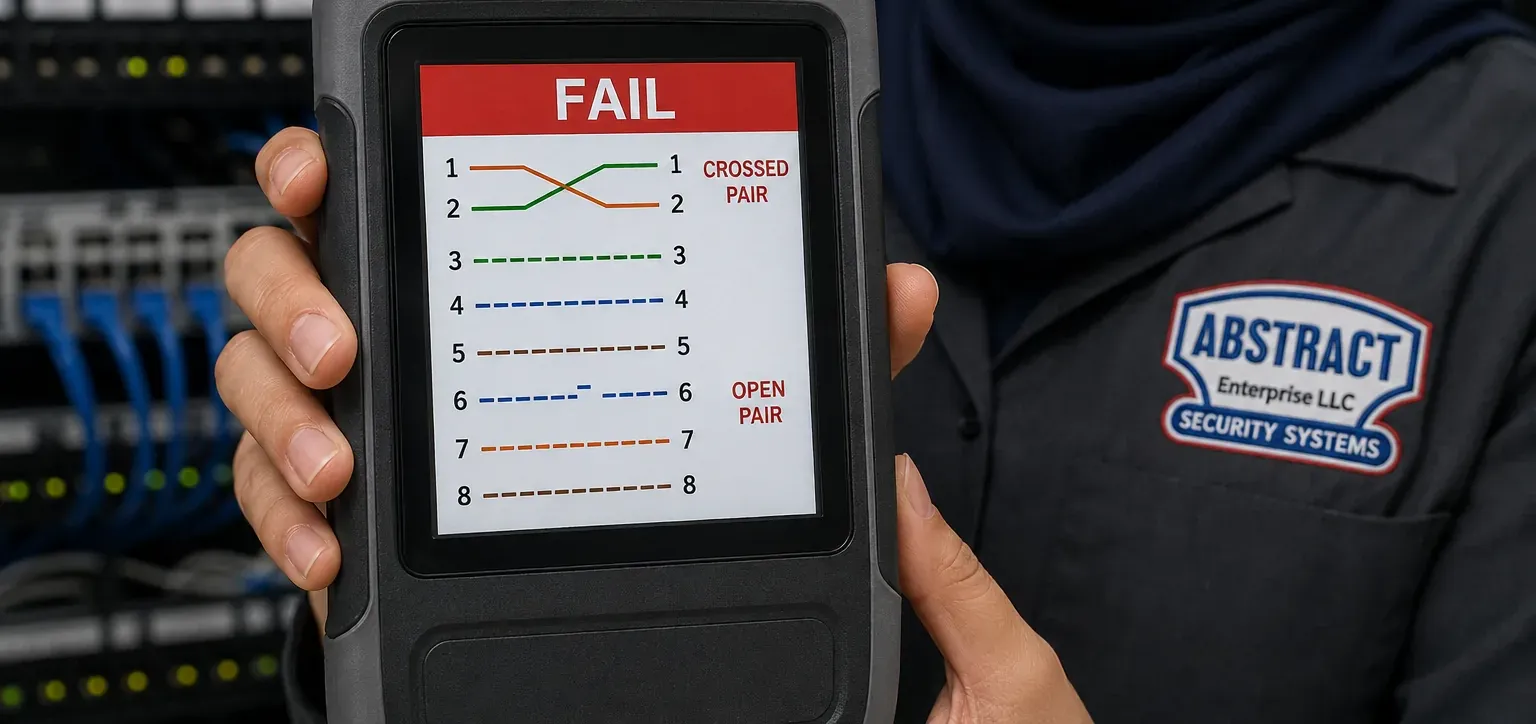
A hand holds a large tester whose screen, under a red Fail banner, draws wires 1 to 8 with lines 1 and 2 crossed and labelled Crossed Pair and line 6 broken and labelled Open Pair; network equipment with blue cords is behind it.
Equipment
Test Gear and Parts We Bring to a Queens Cat6 Repair
The kit for a Queens repair is chosen for kitchens, basements, brick and crowded closets as much as for the cable itself. Everything below comes on the first visit, so a fault found in the morning is usually fixed the same day.
Certification Tester
Measures each link against the Category 6 or 6A limits — wire map, length, insertion loss, crosstalk and return loss — and saves the result. This is what separates a link that lights up from a link that performs.
Distance-to-Fault Readings
Turns “somewhere in that wall” into a measured number of metres from the jack, so the opening we make in drywall, plaster or a raceway lid lands on the screw, bite or crush instead of beside it.
Toner and Probe
Traces unlabelled runs in shared cellars, two-family closets and builder media panels, and confirms which jack belongs to which port before anything is unplugged.
PoE Load Tester
Checks the power a camera, phone or access point actually receives at the far end, which matters for awning cameras and back-of-house devices on long or patched runs.
Matched Cat6 and Cat6A Hardware
Keystones, panel modules, faceplates and factory-made cords in both categories, so a repair never mixes a lower-rated part into a higher-rated link.
Sealed and Raised Boxes
Gasketed floor-box covers, surface boxes and counter-mount jacks for termination points that sit in splash zones, by mop buckets or near dish areas.
Low-Profile and Metal Raceway
Paintable raceway for rowhouse and co-op runs along baseboards and casings, and metal raceway where carts, gates or rodents would damage an exposed cable.
Category-Rated Inline Couplers
Kept for one situation: a single point of damage deep inside finished walls, where pulling a whole new run would mean opening several rooms. The joined link is always certified afterwards.
Firestop and Sleeves
Listed firestop products for runs that pass through rated walls and floors between shops and apartments or between units, and sleeves for holes through brick.
Repair, reroute or replace: how the choice is made
What the test and the walk show
Usual repair in a Queens building
Fault at the jack or plug, cable sound, termination in a dry, protected place
Fresh termination on same-category parts plus a factory cord, then the certification test
Fault at the jack or plug, but the jack sits in a splash zone, at mop height or by heat
Re-terminate in a raised, sealed or relocated box, then certify
Single point of damage mid-run inside a finished wall (screw, nail, drill)
Small access opening, replace the damaged section with a rated coupler or a short re-pull, certify before closing
Several bites or crushes along a ceiling or cellar run
Replace the run and move it into raceway or conduit along a protected path
Cable wet for a long time, corrosion inside the jacket, or a failing return-loss reading along its length
Replace the affected run; lift it and the equipment off the floor
Copper-clad aluminium found at the termination
Replace the run with solid-copper Cat6 — it will not certify and handles PoE poorly
Runs land in a media panel but were never patched, or were punched down out of order
Terminate and patch correctly, add a small switch if needed, certify each room
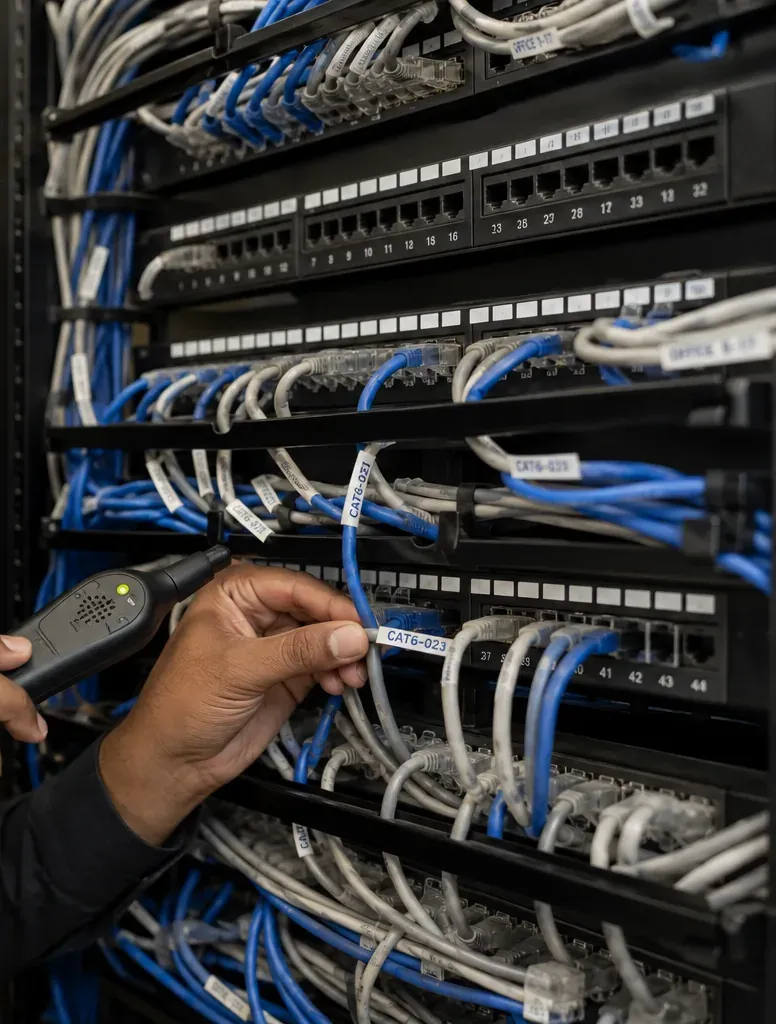
A hand holds a black tone probe with a green light near a blue patch cord whose white label reads CAT6-023, while the other hand pinches the cord among rows of patch panels and grey and blue cords with printed labels.
AI Overview Reality Check
What AI Gets Wrong About Cat6 Repair in Queens
Google's AI Overview was not visible to us when this page was written, so nothing below is quoted from it. Instead, here are seven ideas that keep surfacing in AI-generated answers, POS help centres, forums and price guides, and how each one holds up inside Queens restaurants, houses and apartments.
“Your POS provider will sort out the network”
This is the assumption most Queens restaurant and shop owners make, and it is understandable: the POS company sold the terminals, set up the network and answers the phone.
The cable inside the building is another matter. Toast's support article on Ethernet troubleshooting walks an owner through reseating cords and checking switches, then states that a faulty wall jack may need repair and that repairs to in-wall cabling may require an outside resource, because Toast does not provide service for intensive cable work.
So the practical answer is to know who owns which part before the Saturday it breaks. The POS provider owns the devices and the configuration. Whoever you call for cabling owns the jacks, the in-wall runs and the panel. When we repair a counter link, we can work alongside the provider's phone support so both halves are confirmed working before we leave.
“A busy counter can run on Wi-Fi instead”
Wireless is excellent for handhelds, tablets at tables and anything that moves. Many guides suggest switching a dead register to Wi-Fi.
As a stop-gap that is fine. As a fix it ignores what the POS makers themselves advise: Toast recommends Ethernet for stationary devices such as terminals and kitchen screens because a cable is more stable than Wi-Fi and is not affected by wireless interference. On a Queens block where every storefront and every apartment above it runs its own wireless network, interference is not theoretical.
The fix that holds is to repair the wired link and leave Wi-Fi as the backup. Toast's own guidance also warns that a hardwired device left with Wi-Fi enabled can jump between connections and appear to drop, which is worth checking after any repair. We test the repaired cable; your provider confirms the device is using it.
“A green light at the port means the wiring is healthy”
Many online answers stop at the link light: lights on means cable good, so the problem must be the device or the internet.
A light only means the two ends agreed to connect at some speed. A Cat6 link with a corroded contact, a split pair or a section crushed by a gate housing can light up, connect at a lower speed and drop packets all day. The cabling standards, and the certification testers built around them, measure crosstalk, return loss and insertion loss for exactly that reason: wire map and a light can pass while performance fails.
This is why every Queens repair we do ends with certification, not a glance at the light. If a link is marginal rather than failed, the saved result says so, and you know which ports to watch before the next busy weekend.
“Rodent damage is a pest-control problem, not a network one”
Advice about rats is, reasonably, about food, traps and sealing entry points; cabling barely comes up.
Queens has the numbers to make the connection worth checking. QNS reported 1,812 rat complaints to 311 from Queens in the first half of 2021, up 27 percent on the year before, with Ridgewood and Woodside leading and experts linking part of the rise to restaurants reopening. Rodents travel along the same ceilings, cellars and wall cavities that carry Cat6, and they gnaw what they travel along.
When we find one bite, we look for the rest: we read the whole run for faults by distance, inspect the reachable length and replace every damaged section, not just the first. New cable in a rodent path goes into metal raceway or conduit. Pest control deals with the animals; we make sure the network does not depend on them losing interest.
“New apartments come with working Ethernet in every room”
Listings in new Queens buildings often mention Ethernet in every room, and AI answers tend to repeat that a modern apartment is pre-wired and ready to plug in.
Pre-wired is not the same as connected. The cables from each room end at a media panel in a closet, and somebody has to terminate and patch them before the jacks do anything — a point a Long Island City resident made on the neighbourhood subreddit when another asked whether their apartment had Ethernet available. The State Comptroller counts about 66,700 homes in Long Island City, Sunnyside and Woodside after roughly 42 percent growth since 2010, and in fast buildings that last step is easy to skip.
If your jacks are dead, start at the panel. Our test shows within minutes whether a run is unterminated, mis-wired, unpatched or genuinely damaged, and the first three are quick repairs inside your unit.
“Renovations don't affect low-voltage wiring”
Renovation advice focuses on permits, plumbing and electrical circuits, and treats data cabling as an afterthought.
In Queens houses, renovation is the leading cause of Cat6 faults we see outside of businesses. Drywall screws find cables in stud bays, flooring crews pinch runs under thresholds, electricians share holes and plumbers cut through anything in the way of a new line. After Ida and the September 2023 floods, a great many basements were stripped and rebuilt, some more than once, and every one of those projects passed through cable that had been working.
The cheap moment to protect Cat6 is before the walls close: have it tested, marked and moved out of harm's way, or call us as soon as a link dies after the work, while the contractor is still around and the opening is small.
“National cost guides tell you what a Queens repair costs”
Ask an AI tool what this costs and you will probably get Fixr's national numbers back: $125 to $250 for a Cat6 drop with materials, and $45 to $75 an hour for labour, from a guide last updated in January 2025.
They describe new drops in open, average American spaces. A Queens repair is diagnosis and correction inside a working restaurant, a renovated rowhouse or a managed tower, with parking, building rules and occupied hours attached. That is why our repair time is published at $195 an hour with a three-hour minimum, and why a run that must be replaced is priced separately, from $175 per drop on our Queens network cable repair page.
The more useful number for a business is the cost of the outage. A register that is down through a Friday dinner service usually costs more than the repair. We price the repair before starting it.
Find Out Whether It Is the Cord, the Jack or the Wall
Give us the block, the kind of building and the devices that dropped. You will hear what we think failed, and exactly how the time would be charged, while you are still on the phone.
Whether it is one dead jack in a Sunnyside apartment or a Flushing restaurant with half its kitchen offline, the form goes to a technician, not a call centre. Say what failed and where, and you get a written reply the same business day. Prefer to talk? Dial (347) 434-6392.
✅
We Got Your Request!
Thanks — a Queens technician has your details and will phone you today during business hours. For a link that is down at this moment, dial (347) 434-6392.
How It Works
Our Queens Cat6 Repair Process
Six steps, whether the job is a single kitchen-screen link in Astoria or every room of a two-family house in Richmond Hill.
1. Phone triage
We ask what the link feeds, when it fails — during service, after rain, since a renovation, since move-in — and what the port lights show. That usually narrows the cause and tells us what to load on the van.
2. Access and timing set
We book a 2-hour arrival window around your hours or your service, confirm who opens the cellar or the panel, and send insurance certificates to management or the board if they need them.
3. Certify and walk the run
Each affected link is certified from the panel or router to the jack, the fault located by distance, and the path walked for heat, water, gates, renovation and rodent signs.
4. Cause and repair agreed
We explain, link by link, what failed and why, and propose the repair: re-terminate, raise or seal the jack, replace a section, reroute away from the hazard, or re-patch the panel. You approve; anything outside that list waits for your go-ahead.
5. Repair and protect
The fix goes in, and so does the protection: new terminations on same-category parts, solid-copper replacement sections, raceway or sealed boxes wherever heat, water, carts or rodents would reach the cable again, firestop at rated walls, and old dead cable pulled out where we can reach it.
6. Certify, label and hand over
Each link we touched gets a final certification run. Labels go on at the jack and the panel, and the saved results come to you by email with a few lines on the cause, along with a port map wherever a media panel or shared closet was involved.
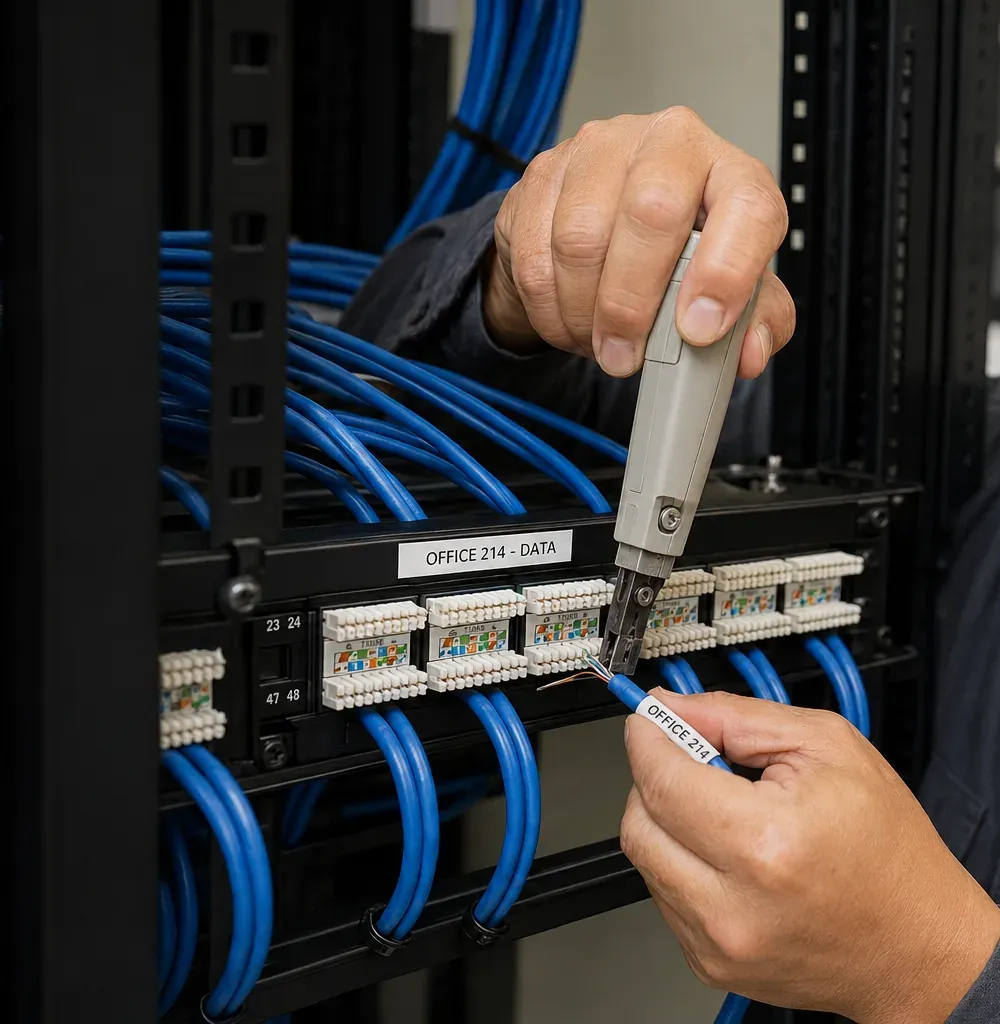
A hand presses a grey punch-down tool onto the back of a patch panel module while the other hand holds a blue cable tagged Office 214 just below a printed label reading Office 214 - Data; looped blue cables fill the black rack around it.
Coverage Area
Cat6 Repair Near Queens' Landmarks
These six places sum up the range of buildings we repair Cat6 in across Queens, from early-twentieth-century brick to a tower and an air-cargo terminal. They are reference points for the neighbourhoods around them, not claims of work inside them.
Central Ridgewood Historic District
About 990 buildings, most of them brick row houses, many by the builder Paul Stier, who put up more than 2,000 houses in the area. The surface-run, party-wall cabling pattern of western Queens in one district.
Jackson Heights Historic District
Designated on October 19, 1993, around one of the country's first garden-apartment communities, built mainly between 1914 and 1939. Co-op rules and courtyard walls shape every repair inside it.
One Court Square, Long Island City
673 feet and 50 storeys, completed in 1989 above the Court Square–23rd Street station and Queens's tallest building until 2019. The anchor of the tower district where in-unit and office-suite repairs concentrate.
Silvercup Studios, Long Island City
The former Silvercup Bakery of 1929–30, a film and television studio since 1983 — the best-known of the factories in western Queens that now hold studios, offices and production space on exposed steel.
Queens College, Flushing
An 83-acre CUNY campus off Kissena Boulevard with more than 40 buildings, set between the dense Main Street business district and the house-lined streets of Kew Gardens Hills and Fresh Meadows.
JFK Air Cargo Area
Where a $270 million, 350,000-square-foot cargo centre with temperature-controlled space opened in 2025 — the edge of the Springfield Gardens and Jamaica warehouse belt, with its forwarders, cold rooms and long runs.
We also repair Cat6 in Astoria, Ditmars, Steinway, Sunnyside, Woodside, Maspeth, Middle Village, Glendale, Elmhurst, Corona, East Elmhurst, Rego Park, Forest Hills, Kew Gardens, Richmond Hill, Woodhaven, Ozone Park, Howard Beach, South Ozone Park, Jamaica, Hollis, St. Albans, Cambria Heights, Laurelton, Rosedale, Queens Village, Bellerose, Glen Oaks, Little Neck, Douglaston, Bayside, Auburndale, Whitestone, College Point, Fresh Meadows, Briarwood and the Rockaways, plus the other four boroughs, Long Island and the Hudson Valley.
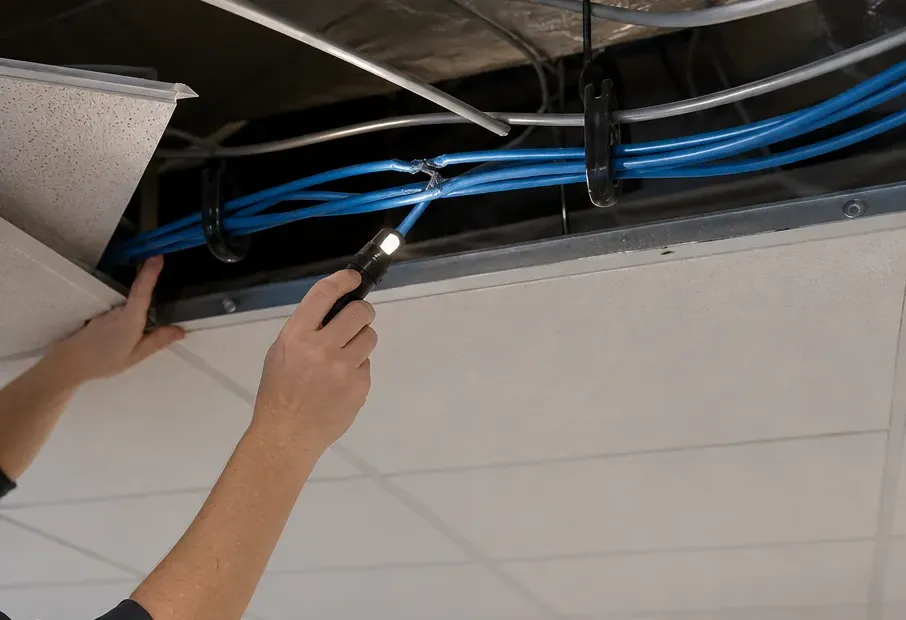
One hand holds up a white ceiling tile while the other shines a small flashlight on a bundle of blue cables running through black hangers above the grid, beside grey conduit and a ceiling frame rail.
Pricing
Cat6 Repair Cost in Queens
Nothing in this table is a new number; the right-hand column names the page each one comes from. On a Queens Cat6 job you pay for two separate things — time spent diagnosing and repairing, and any new cable that has to go in — and the invoice keeps them on separate lines.
Item
Price
Scope and source
Repair labour on Cat6 or Cat6A: testing, toning, fault-finding, new terminations, moving jacks, final certification
$195/hr, 3-hour minimum ($585)
Same rate as our Queens network cable repair pricing; anything past three hours is charged by the hour actually worked
New run pulled to replace a cable we cannot recover
From $175 per drop
Queens network cable repair pricing, which bundles the cable, jack, plate, panel termination, test, two labels and a cord into that figure
Cable entry from outside (awning camera, yard, garage) made good, sealed and bonded
From $194 per penetration
Our Bronx-published $185 figure with the Queens 1.05 area rate applied
Raceway, sealed boxes, firestopping, small switch for a media panel
Quoted with the repair
Listed item by item in the written estimate before work starts
Reference point, not a repair price: one new Cat6 data drop on a run of up to 100 feet
Fixr, updated January 2025 — national figures for new drops, not Queens repairs
Where the first 85 of a Queens visit goes
The three-hour minimum is a block of a licensed technician's time with certification gear, not a fee for one fix. In a restaurant or shop it typically covers testing the failed counter and kitchen links, finding the fault, re-terminating or relocating the affected jacks and certifying them, with time left to test the neighbouring links. In a house or apartment it usually covers tracing and testing every jack, re-patching or re-terminating a media panel and fixing one or two damaged terminations. Runs that need replacing are priced before any cable is pulled.
What moves a Queens Cat6 repair bill
Whether the cause is the termination or the place: a bad jack in a dry spot is quick; a jack that keeps getting wet, hot or hit needs relocating or protecting as well.
Finished walls and masonry: open ceilings and media panels are quick; brick, plaster and newly finished drywall take longer to reach, which is why we locate faults by distance first.
How many trades have been through: runs cut or screwed in several places during a renovation are replaced rather than patched more than once.
Shared closets and missing labels: tracing unlabelled runs in a two-family cellar or a subdivided commercial building takes time, and that time is part of the first block.
Bargain cable: if the conductor turns out to be aluminium with a copper skin, the run gets replaced; genuine solid-copper Cat6 is the kind worth saving.
A note on area pricing. Our repair rate is published at the same $195 an hour across New York, and our Queens network cable repair page publishes the replacement run at $175; we keep both figures identical here rather than introduce a second set of numbers for the same work. Where we have no published Queens figure for an item, as with the exterior entry above, we apply our standard Queens area rate of 1.05 to the published base.
Full terms — including 50% deposit, one-year parts-only warranty on AESS-supplied products, and the late-fee schedule — are set out in the service agreement.
Shop Our Systems
Cat6 Repair Packages & Pricing
Queens repair jobs tend to fall into one of three sizes. The prices are the same published figures as the table above, grouped the way the work usually happens.
Starter — One Counter, Kitchen or Room Link
$585
Three hours at $195. We certify the one link that is causing grief — a register, a kitchen screen, a printer, a camera, a bedroom jack — find out whether corrosion, heat, a screw or an unpatched port is behind it, fix or move it, and prove it with a fresh test. Leftover minutes go to whatever else you want looked at.
Standard — Whole Shop, House or Apartment
$195/hr after the first 3 hours
Every link in the space certified and labelled, failed terminations remade, wet or exposed jacks raised or sealed, media panel or shared closet sorted and mapped, and a written list of any runs that need replacing. Time is estimated in writing after the first round of tests.
Premium — Repair Plus Replacement Runs
Repair time + from $175 per run
For renovated houses, chewed ceilings and storefronts where some runs cannot be saved. Hourly repair for everything recoverable, replacement runs from $175 per drop in protected raceway or along safer paths, reachable dead cable removed, and the port map brought up to date.
Bring Your Own Parts — Labour Only
If the builder left a box of keystones, you bought a new panel, or your POS provider shipped its own cords, we will fit them and charge labour only — provided they match the link's category, have solid-copper conductors and, where the cable goes outdoors, the right rating. Those parts are covered by whoever made them, not by us, and if testing shows they will not pass we say so before they go in.
Fix It Before the Weekend Rush, Not During It
A counter or kitchen link that has started dropping now and then will fail outright on a busy night. Book the repair for a quiet morning or your closed day, and we will give you the cost before the visit.
Queens is too large and too varied for one description. The same cable fails for different reasons in Astoria and in Cambria Heights, and knowing the part of the borough tells us a good deal before we arrive.
Western Queens: Astoria, Long Island City, Sunnyside and Woodside
The oldest and the newest buildings in the borough sit side by side here. Brick rowhouses and walk-ups in Astoria and Woodside carry Cat6 that was retrofitted along baseboards and through party walls; converted factories in Long Island City carry long runs on exposed steel; the towers at Hunters Point and Court Square carry in-unit cabling that ends in a media panel. The commonest calls are dead apartment jacks, renovation damage in older houses and storefront links on Steinway Street, 30th Avenue, Broadway and Queens Boulevard.
Central Queens: Jackson Heights, Elmhurst, Corona, Rego Park and Forest Hills
This is where the garden-apartment co-ops, the two-family houses with basement units and the busiest restaurant corridors meet. Calls come from 37th Avenue and Roosevelt Avenue kitchens, from shareholders whose runs pass through walls the board controls, and from houses in East Elmhurst and Corona that flooded in 2021 and again in 2023. Queens Boulevard and Austin Street add professional offices in older buildings.
Ridgewood, Glendale, Maspeth and Middle Village
Brick from end to end, with the historic districts at the centre. Most residential repairs are in rowhouses and Mathews-style flats being renovated one floor at a time, and most commercial ones are on Myrtle Avenue and Fresh Pond Road. Maspeth adds industrial buildings, where the general cabling questions are covered on our network cable repair page and the Cat6-specific ones here.
Flushing, Bayside, Whitestone and Northeast Queens
Downtown Flushing's subdivided commercial buildings, restaurants and offices sit a few minutes from some of the borough's largest detached houses. Downtown calls are about dense, shared ceilings and counter links; Bayside, Whitestone, Douglaston and Little Neck calls are about finished basements, garage offices and the professional offices along Bell Boulevard and Northern Boulevard.
Jamaica, Southeast Queens and the South Shore
Jamaica's offices and shopping streets, the one- and two-family houses of Hollis, St. Albans, Cambria Heights and Laurelton, and the forwarders and warehouses around JFK. Basement water is the recurring house problem; the airport belt adds long runs in cold rooms and docks. The Rockaways and Broad Channel add salt air and street flooding, which we treat as an outdoor-cable question rather than an indoor one.
Restaurants & Storefronts
Keeping a Repaired Counter and Kitchen Network Running
Most of the Cat6 we repair in Queens food businesses failed for a reason that will still be there tomorrow: the line still gets hot, the floor still gets mopped, the gate still rolls up every morning. These are the habits that keep a repaired link from failing again, and the things we set up during a repair so that they are easy to keep.
Keep terminations out of the splash and mop zone. Jacks for registers, printers and card terminals belong in the counter or on the wall above the splash line, not in the kick plate. If a floor box is unavoidable, its cover should close and seal, and someone should close it after cleaning.
Give the kitchen screen a short, supported cord. A long cord looped over a shelf gets caught by pans and elbows. We fit a cord just long enough to reach, strain-relieved at the mount, so pulling the screen to clean it does not pull the plug half out.
Keep the cable off the hood and away from the fryer. Runs that cross directly above cooking equipment are moved to a cooler path along the wall or above a barrier. A repaired termination is no use on a cable that keeps cooking.
Do not hang things on the cable. Cat6 zip-tied to a shelf bracket, used as a hook for a utensil or squeezed by a sliding door is where we find the next fault. If a run has to pass a door or a gate, it goes into raceway.
Label the critical ports. The panel port and wall jack for each register, kitchen screen and printer are labelled at both ends, so a manager on a Saturday night can tell which cord to swap without guessing.
Keep the switch somewhere dry and ventilated. A network switch on the floor of the dry-goods room or under the prep sink takes water and grease. We move it onto a shelf or the wall during the repair if it is somewhere it will be damaged.
Turn Wi-Fi off on wired terminals. As the POS makers advise, a stationary device should use the cable. Your provider can confirm the device setting; we confirm the cable.
Houses & Basements
A Queens Basement Cat6 Check After Heavy Rain
Queens basements have taken water in Ida, in the September 2023 storm and in plenty of smaller downpours since. If your network equipment or any Cat6 lives in a basement, these are the checks worth doing once the water is gone and the electrical side has been made safe. They take a few minutes, and they tell you whether to call us now or keep an eye on things.
Look at the floor first. Any cable that was lying on the slab, any jack or box below the high-water line and any switch, modem or router that sat on the floor should be treated as wet, even if it still works.
Check the lights. On the router or switch, compare the port lights with how they looked before. A port that now links at a lower speed, flickers or goes amber is often the first sign of a corroded termination.
Unplug and look at the plugs. Green or white crust on the contacts of a plug or jack means corrosion. Replacing the cord is easy; the jack it plugged into needs re-terminating.
Note which rooms upstairs lost their connection. Runs from the basement to the floors above usually start near the incoming line. If a whole floor went down at once, the fault is likely at the basement end.
Do not dry cable with heat guns or heaters. Overheating the jacket does more harm than the water. Let it dry naturally while the space is ventilated, and have it tested.
Keep the old cords and any test results. If you are making an insurance claim, the damaged parts and a record of what failed help, and our certification results can document the condition of each link.
When we repair a flooded basement's Cat6, the repair includes moving it out of the next flood's way: runs lifted onto supports, terminations raised, equipment on a wall shelf. The aim is that the next heavy rain is an inconvenience for the basement, not an outage for the house.
Symptom Guide
When a Queens Cat6 Link Fails Tells You Why
Before anyone tests anything, the timing of a failure is the best clue we have. These are the patterns we hear most often on the phone, and what each usually points to.
When it fails
What it usually points to
What we check first
Only during dinner or lunch service
Heat or steam on a marginal run, or a cord that gets knocked as staff work
Margin on the test, the run's path over the line, the cord at the screen
The morning after cleaning, or after a wet day
Corrosion or water at a low jack or floor box
The jack contacts, the plug, the box cover
Right after a renovation, delivery or move
A screw, staple, pinch or cut from other trades
Distance to fault against the area that was worked on
When the roll-down gate or a door moves
A run rubbing or pinched at the gate housing or a door frame
The entry point beside the housing or hinge
Since the day you moved in
A jack never terminated or patched at the media panel
The panel, port by port
After heavy rain or a flood warning
Water at a basement termination or an outdoor entry
Basement and entry terminations, wicking along the jacket
Gradually worse over weeks, several links at once
Rodent damage along a shared ceiling or cellar run
The full length of each run for multiple faults
Soon after a neighbouring shop or apartment was fitted out
Their contractors disturbed a run in a shared ceiling, cellar or wall
The section of the run that crosses the shared space, by distance
Randomly, and Wi-Fi is fine
A failing termination or cord, or a device switching between Wi-Fi and cable
Certification of the link, then the device's network settings with your provider
If your pattern is not on the list, describe it anyway. Timing that sounds random often lines up with a cleaning schedule, a delivery day or the route a cart takes across the floor; the timing is almost always telling us something.
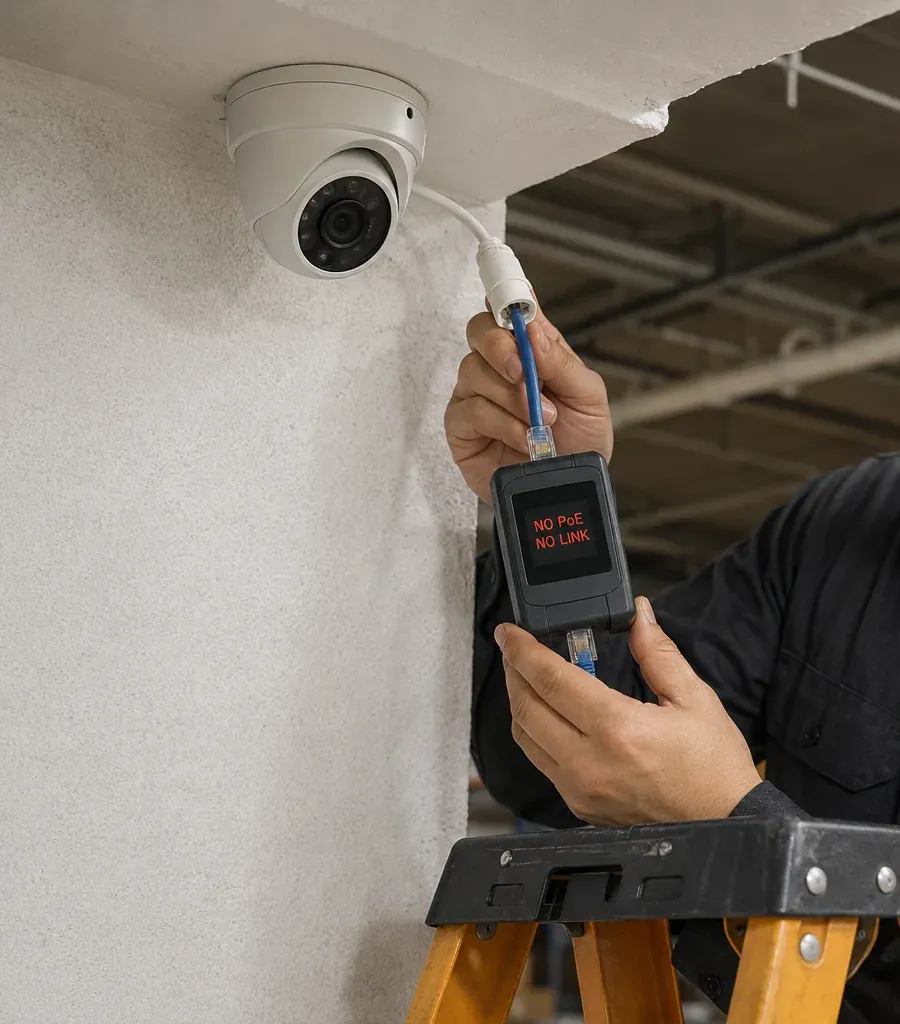
A hand holds a small black inline tester reading No PoE, No Link in red between a blue cable and the white lead of a dome camera mounted at the corner of a textured wall and ceiling, above the top of a stepladder.
Complete Services
Every Cat6 Repair Service in Queens
Cat6 trouble rarely arrives alone. These are the Queens services that most often get booked next to it.
Five working rules from Queens calls — how we go about it, not tales from particular customers
We ask about the building's day before we ask about the cable. When does the kitchen get busy, when is the floor mopped, when did the contractor finish, when did the tenant move in. The answer usually points to the cause before the tester comes out of the bag.
We look at the floor before the ceiling. Low jacks, floor boxes and cellar terminations are where water, carts and cleaning chemicals reach, and in Queens storefronts and basements they account for more failed links than anything overhead.
We read the distance on every fault and compare it with the building's history. A fault three metres from the jack, on a wall that was rebuilt last spring, is a screw until proven otherwise.
We never unplug anything in a shared closet until we know whose it is. In two-family houses and subdivided buildings, the cable we are not working on belongs to someone who is not expecting a visit.
And we leave the next person a map. A labelled panel and a port list taped inside the closet door are the cheapest part of a repair and the part owners thank us for most.
FAQ
Queens Cat6 Repair FAQ
Can you leave a spare Cat6 run in place when you repair a kitchen or counter link?
+
Yes, and in a busy Queens kitchen it is often worth it. While the ceiling or counter is open for the repair, pulling a second run alongside the first costs a fraction of what it would on a separate visit. We terminate and certify the spare, label it at both ends and leave it unpatched, so if the main link is ever damaged again, someone can move one cord at the panel and one at the device and be back in service in minutes. The spare is priced from $175 per drop and itemised before we pull it.
Does the building's super or landlord need to be there while you work?
+
Only if we need a space you do not control. Inside your shop, office or apartment we just need you or someone you name to let us in. If the run passes through a cellar, a boiler room, a shared closet or a roof bulkhead, the person with the keys needs to open it, and in managed buildings the managing agent may want our insurance certificate first. We confirm all of that when we book, so the technician does not arrive to a locked door.
Would a Wi-Fi extender do the same job as repairing a dead Cat6 jack?
+
For a laptop or a phone, sometimes. For anything stationary that the business or household depends on, it is a workaround, not a repair. Extenders share airtime with every other network on the block, and in dense parts of Queens that is a lot of networks. Registers, kitchen screens, desktop PCs, cameras and game consoles all perform more reliably on a certified cable, and a dead jack is usually a quick repair at the termination or the panel. We would rather fix the cable and leave the wireless for the devices that move.
How long should we keep the test results you give us?
+
For as long as you have the cabling. The saved certification results are a record of how each link performed on the day it was repaired, and they are the first thing a technician wants to see when something fails again. They also help when you sell a building, hand a lease to a new tenant, make an insurance claim after water damage or argue with another trade about who damaged what. We send them as files you can keep alongside your lease or building papers, and we keep a copy on our side.
Can you repair a Cat6 run that passes through a fire-rated wall or floor?
+
Yes. Where a run crosses a rated assembly, such as the floor between a ground-floor shop and the apartments above or the wall between two units, the opening has to be sealed with a listed firestop system after the cable passes through. When we replace or reroute a run through such a wall or floor, we firestop the penetration as part of the repair. If we find an existing penetration left open by someone else, we point it out so the owner can have it dealt with.
Do you repair the Cat6 that feeds digital menu boards?
+
Yes. Menu screens behind counters and over service windows are often fed by Cat6 run along the top of a wall or through a soffit, sometimes with the media player tucked behind the screen where heat builds up. We test the run from the closet to the screen, re-terminate or replace what has failed, check that the cord and connector are not strained by the mount, and confirm the player gets a stable link. The screen content itself stays with your signage provider.
We just leased a Queens storefront and the last tenant left Cat6 everywhere — can you tell us what is usable?
+
Yes, and it is worth doing before you build out. We test every run the previous tenant left, identify which ones reach the closet and which are dead ends, check the conductor type, and label the keepers by location. You get a list of runs that pass and can be reused, runs that fail and are worth repairing, and abandoned cable that should come out. That list usually saves money on the fit-out, because good runs do not have to be pulled again.
Do you give a written estimate before replacing any cable?
+
Always. The first block of repair time covers testing and the repairs we can make within it. If testing shows that runs need replacing, rerouting into raceway or firestopping, we write those up item by item with the price for each, using the replacement-drop figure on our Queens network cable repair page, and nothing is pulled until you approve. You can approve all of it, some of it, or keep the list for later.
Does a repaired Cat6 link come back at the same speed it had before?
+
It should come back able to run at whatever speed the devices at each end support, which on Cat6 is normally a full gigabit and on short runs can be more. Before we leave, the certification result shows the link meets the Category 6 limits, and we check that the port at each end has linked at the expected speed rather than falling back to a slower one. If a device still connects slowly after a passing test, the cause is in the device or its settings, and we tell you which end to look at.
Can you show our staff how to tell a cable fault from a device fault next time?
+
Yes, briefly, at the end of the visit. We show the manager or the person who deals with IT how to read the port lights on the device and the switch, how to swap in a known-good cord, and which jack and panel port each critical device uses. That is often enough to tell, in two minutes, whether to call the POS or IT provider or us, and it saves a visit when the answer is a cord.
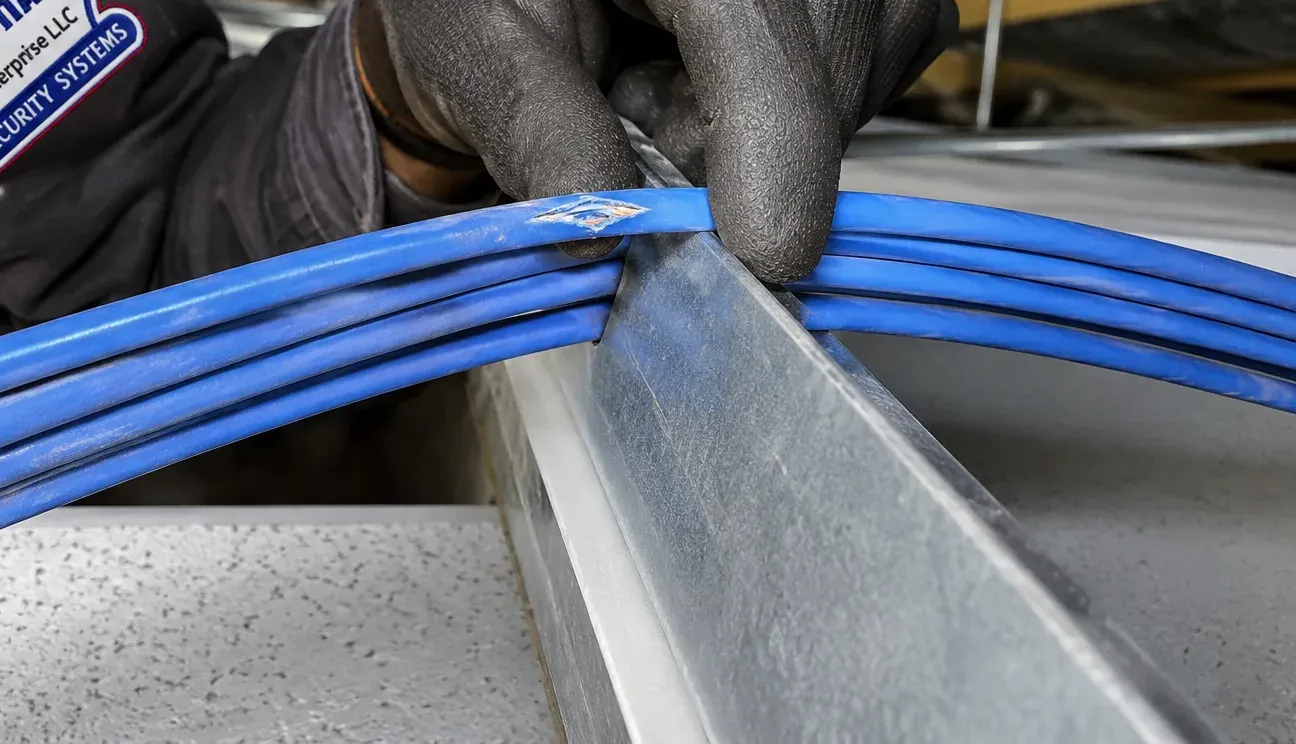
A grey-gloved hand lifts four blue cables where they cross the edge of a metal ceiling grid rail; the top cable has a small torn patch in its jacket just beside the rail, above the white ceiling tiles.
All Areas Served
Cat6 Repair Across Queens, New York City and Beyond
You are on the Queens Cat6 repair page. The New York City hub covers all five boroughs, each borough has its own page, and the Long Island and Hudson Valley hubs cover the counties beyond the city.
Dead register, silent kitchen printer, basement office offline or a bedroom jack that never worked: ring (347) 434-6392. You get the first free 2-hour arrival slot, and a bad termination or cord is normally sorted within an hour or two of the technician walking in.
Cat6 Repair Queens — Licensed, Insured, Certified to Category
Abstract Enterprises Security Systems · 460 E Fordham Rd, Bronx, NY 10458 · serving every Queens neighbourhood · (347) 434-6392 · WhatsApp (718) 679-0359 via wa.me
NYS Low-Voltage Licence #12000287431 · 100% Licensed & Insured · Same-Day Estimates · Rated 4.7★ from 201 Google Reviews
Parts you supply carry their manufacturer's warranty. See our warranty page and the service agreement for full terms.
This page reflects how Cat6 fails and gets fixed in the Queens buildings we work in. References to New York City's electrical and basement rules, historic districts, the National Electrical Code and the cabling standards are plain-language summaries, not legal or engineering advice. Page reviewed and updated October 17, 2026. Changelog: Queens Cat6 repair page first published.