Renovation Damage · Screws & Nails Through Cable · Buried Junctions · Raised-House Rewiring · Moved Routers · Fault Location by Distance
In Nassau the cable is rarely the newest thing in the wall. Most of the county was built before 1960 and has been renovated many times since, so the Cat6 you depend on was threaded into finished houses and offices by one crew and then closed in, screwed through, buried or moved by the next. We find the exact point where a later job damaged the link, open as little of the finished room as possible, and hand back a run that tests to Category 6 again — from Elmont and Valley Stream to Glen Cove, Long Beach and Massapequa Park.
Reviewed and updated October 17, 2026 · Written by Anwar Timothy, NYS licence #12000287431

The painters left on Friday and the office upstairs has had no wired connection since? The provider moved the router and two bedrooms went dark? A suite on Marcus Avenue came back from a weekend refit with six dead desks? Call our Nassau line, (516) 346-5778, or send the 60-second form. A licensed technician reads it and tells you, before anything is booked, whether it sounds like damage from the recent work, a tired termination, or nothing to do with the cable at all.
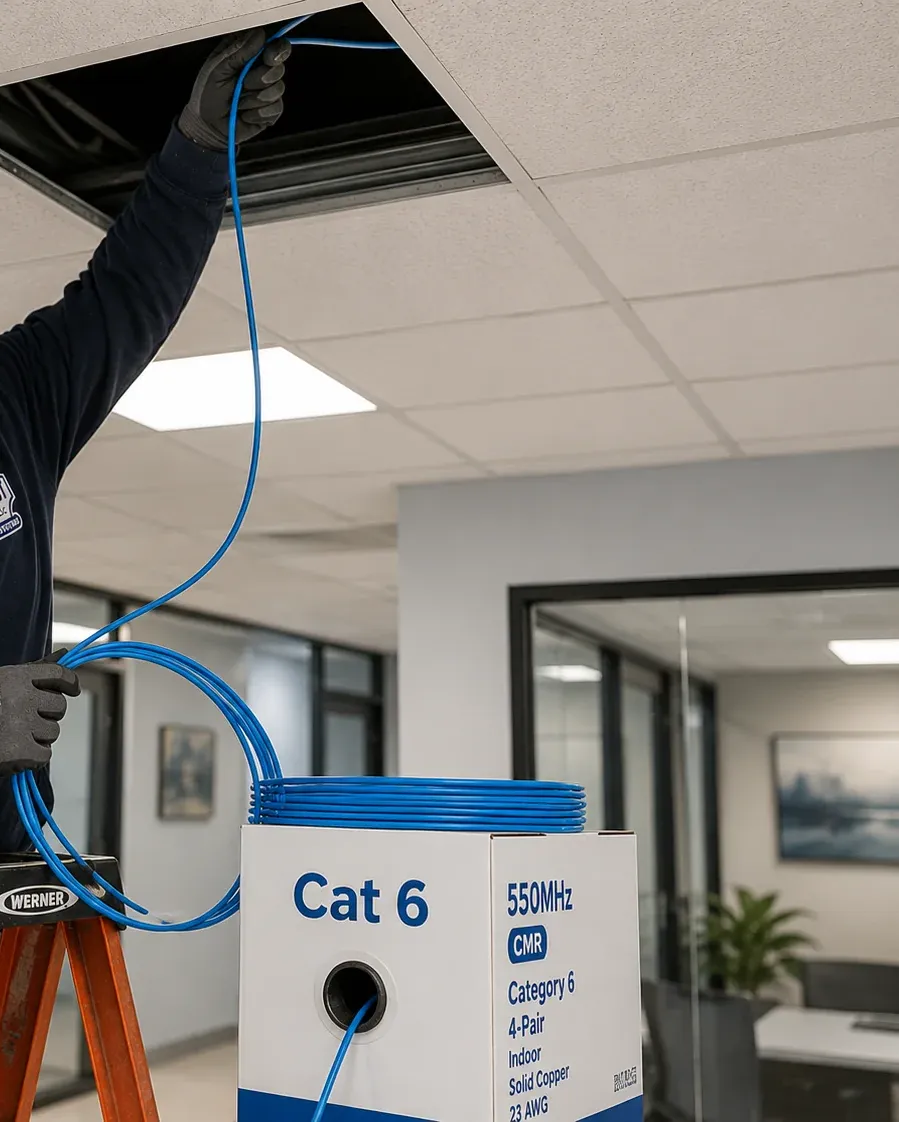
Nassau is a finished county, and its network cable lives inside finished rooms. Almost nothing here was built with Ethernet in mind. The housing stock is old by suburban standards — American Community Survey figures republished by Point2 Homes put the median construction year at 1955, with a third of all homes built in the 1950s alone and nearly one in five dating from before 1940. The office and professional buildings along the turnpikes and parkways have been re-tenanted for decades. Category 6 cable arrived later than almost all of it, threaded into walls that were already plastered or drywalled, laid across ceilings that were already hung, and dropped behind baseboards that were already painted. That is the starting condition for almost every repair we do in the county.
The second condition is that people here stay and renovate. The Census Bureau puts Nassau’s owner-occupied rate at 81.9 percent and the median value of an owner-occupied home at $684,700, and those numbers describe a place where it usually makes more sense to dormer the cape, finish the basement, open up the kitchen or raise the house than to move. Each of those projects brings in trades who are not thinking about the blue cable behind the wall: drywall hangers driving screws on a fixed spacing, flooring crews pulling and re-nailing baseboard, electricians adding boxes, HVAC installers running new ductwork through the same joist bays, roofers and solar crews walking the attic. Most of them do careful work. Some of them hit the Cat6, and because the wall is closed again by the time anyone notices, the damage looks like a mystery.
That changes the repair. In a city riser the hard part is getting permission to reach the cable; on a wide flex building the hard part is distance and heat. In a Nassau colonial, a split-level in a South Shore village or a two-storey professional building off Old Country Road, the hard part is that the cable is sealed inside a surface someone has just paid to finish. Re-pulling a whole run through a freshly painted wall is the expensive answer and often the wrong one. The useful answer starts with measuring exactly where along the run the fault sits, then deciding whether that one spot can be reached through a small, patchable opening, through the jack box, from the attic or basement, or not at all.
The South Shore adds a layer no other part of our coverage has in the same form. After Superstorm Sandy, Newsday counted nearly 3,500 Long Island homes that had been or were slated to be elevated, mostly in flood zones where raising was required to qualify for flood insurance and to rebuild to code, and New York State reported 3,310 elevations in its NY Rising program. Raising a house moves the router, the modem and the cable entry; it adds new framing between the old floor and the new foundation; and FEMA’s own guidance on protecting building utilities tells owners that components such as modems, switches, splitters and routers should be elevated. A good deal of the Cat6 in Island Park, Oceanside, Freeport, Baldwin and the Massapequas was installed before, during or after that work, by different people, and the links that cross from one phase of the house to the next are where we find many faults.
Homeowners who call about one dead jack often have the rest of the house to think about. For copper faults of any category our Nassau County network cable repair team covers the whole house or suite, and when a renovation is the moment to add drops rather than rescue them, the Cat6 installation crews for Nassau County take that on.

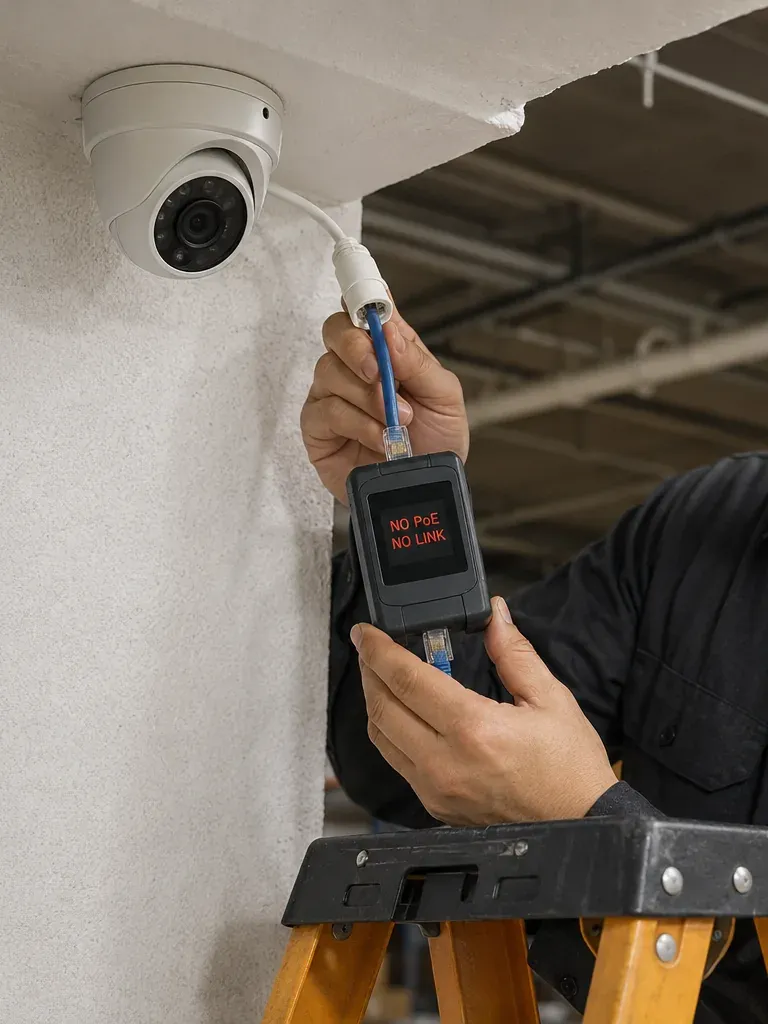
A home office that lost its wired link the day the drywall was taped, a dental front desk that went offline after new cabinets were fitted, a shop register that stopped reaching the card processor after the landlord replaced the ceiling, a camera by the side door that died when the gutters were replaced — we treat those as service calls and book them in the next open 2-hour arrival window. Most single-link faults at a termination or a cord are found and fixed in one to two hours once a technician is on site. Repair time is $195 an hour with a three-hour minimum ($585), the same specialty rate on our Nassau network cable repair page. Call (516) 346-5778 and say it is a Cat6 fault, or see our security camera repair service in Nassau County if the camera itself is what failed.
These are the repairs Nassau homes and businesses ask for most, and most of them begin with work somebody else did in the building. Each one ends with the link certified against its own category limit and a short note of what failed, where, and what caused it.
A run that worked before the remodel and not after. We measure the distance to the fault from both ends, match it to the work that was done, and open the wall or ceiling at that one point instead of guessing along the route.
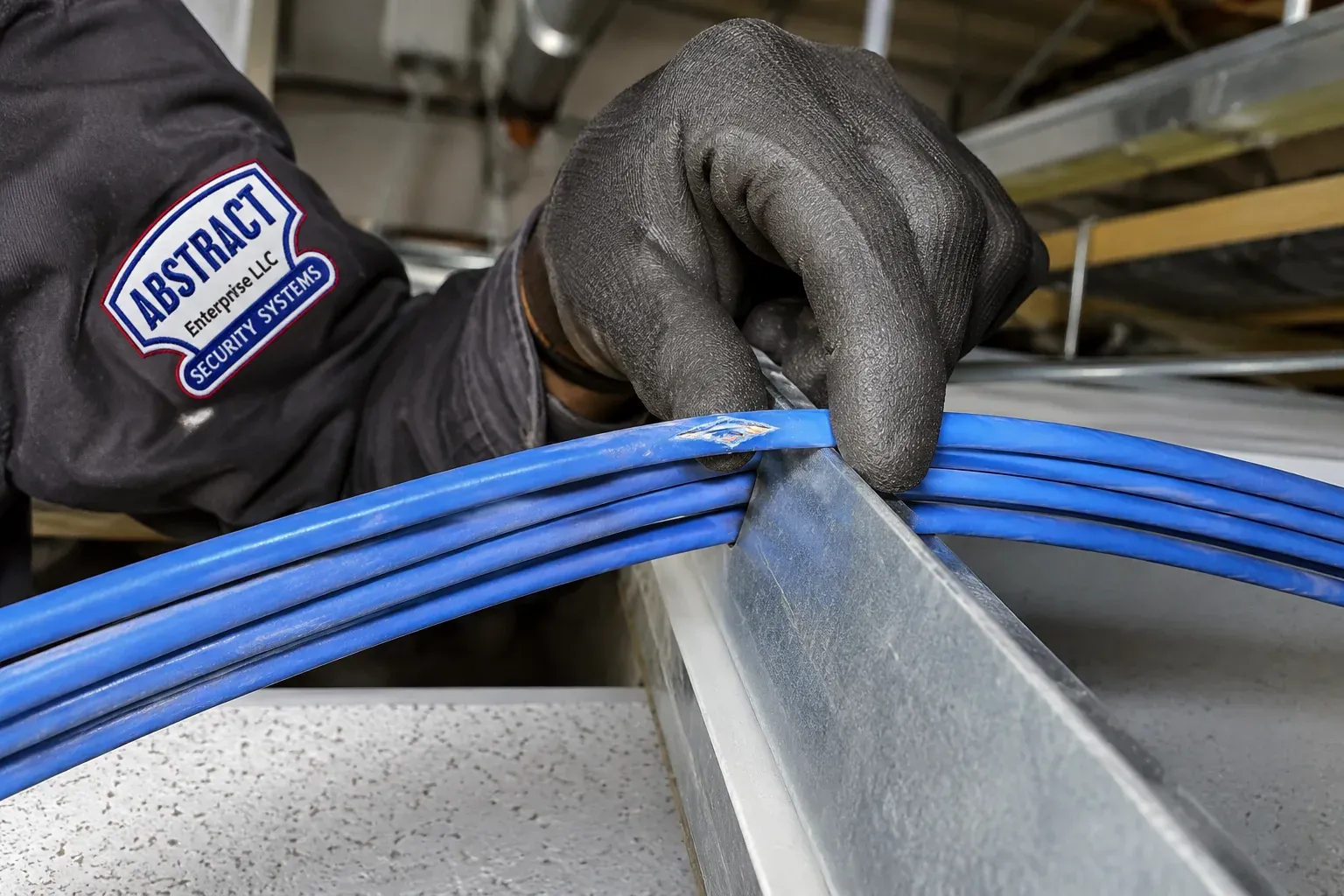
Drywall screws, finish nails, cabinet screws and staples driven through the jacket. The damaged section is cut out and replaced or the run rerouted, and steel plates go over the studs where a fastener can reach it again.
Hidden couplers and splice boxes that a renovation closed into a wall or ceiling. We find them, judge whether the link can ever certify with them in place, and replace them with a proper termination or a continuous run.
Runs that now sit above a new drywall ceiling or behind basement paneling. Access is planned around soffits, recessed-light openings and closet ceilings so the repair leaves as little to patch as possible.
Homes lifted after Sandy, where the router, modem and service entry moved up and the old runs no longer point at anything useful. We repair what can be saved and reroute the rest to the new equipment location.
When the internet company relocated the modem or optical terminal, swapped a patch cord or disconnected a small switch, the house wiring can look dead. We trace which links were disturbed and put the network back together.
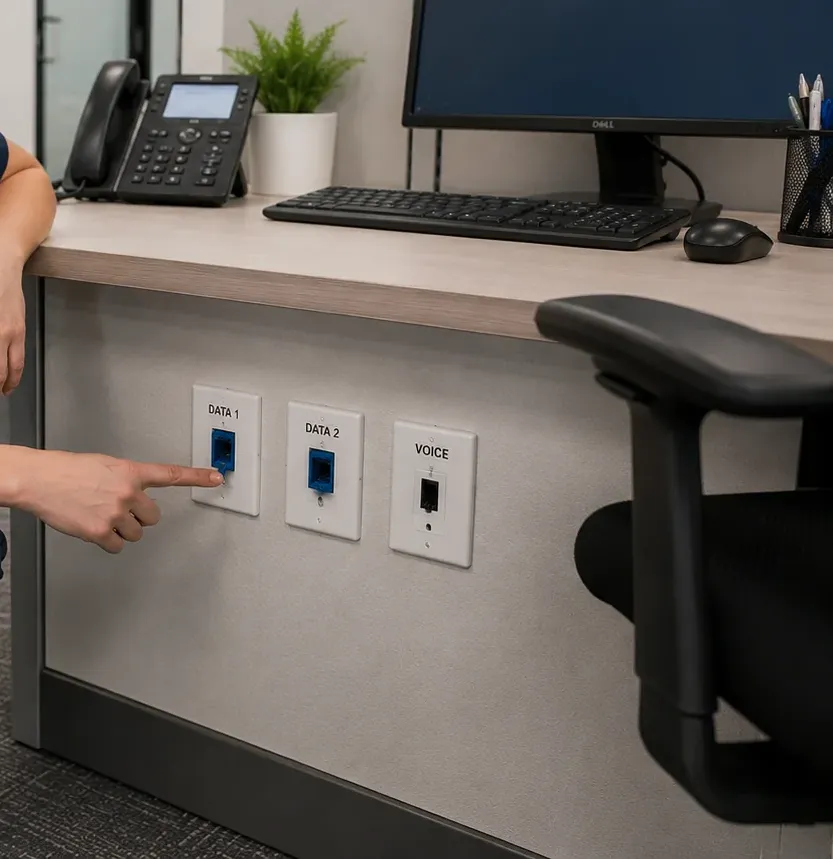
Desks dead after new carpet, new workstations or a weekend move: crushed cords under panels, pinched cable at furniture feeds and jacks pulled off their boxes. Repaired and certified before the next workday.
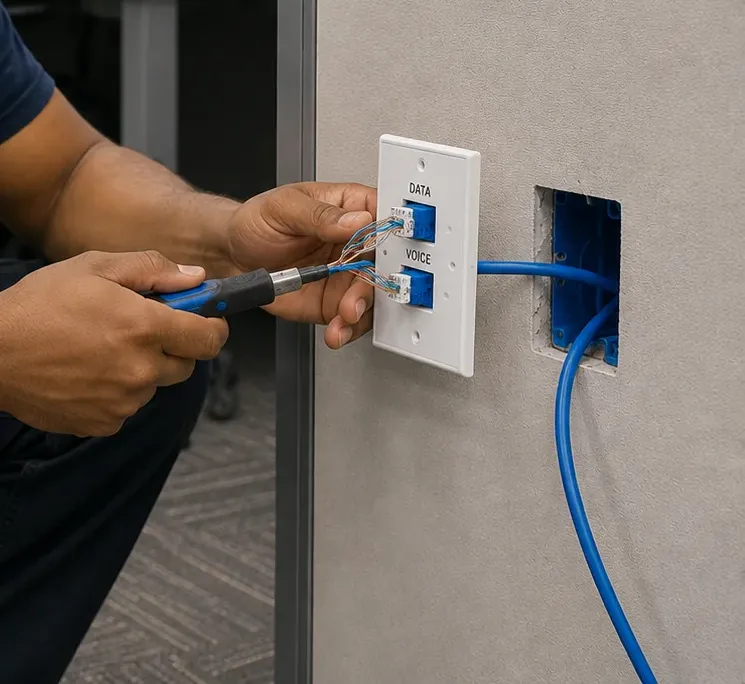
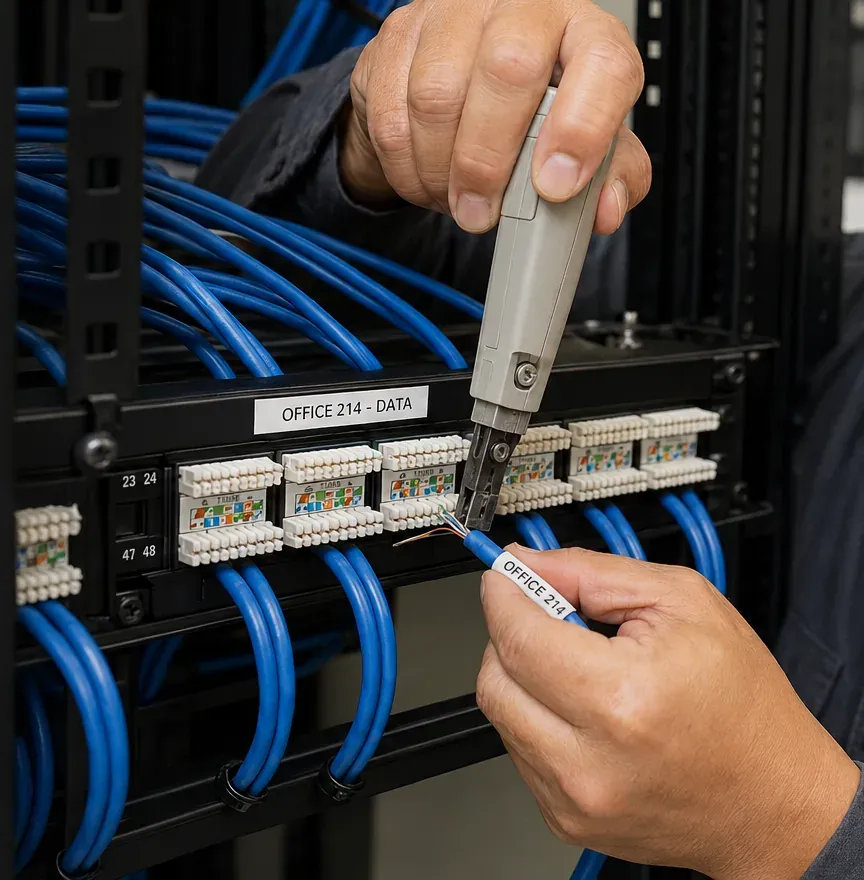
Jacks loosened by furniture, media-panel modules and panel ports that were punched down badly the first time: trimmed to clean conductors, rebuilt on category-matched hardware and proven with a fresh certification.
Saved test results, the measured distance to each fault, and photographs of what we found when the wall was opened — a factual record you can share with whoever did the work that caused it.

Nassau’s buildings tell you how their cable was installed, and therefore how it is likely to have been damaged. These are the structures we repair Cat6 in most often between the Queens line and the Suffolk border, with what each one tends to do to a link that was added after it was built.
Tudors, colonials and foursquares in the older villages, many with plaster on wood lath. Retrofitted Cat6 was fished down through closets and old chases; plaster resists small openings, so access is planned from above or below.
Post-war houses that gained a second floor or a full dormer. The original attic Cat6 often ended up inside new knee walls and floor framing, extended with couplers rather than re-run, and the upstairs jacks are the ones that fail.
Short runs between half-levels through rim joists and stair walls, with a lower level that has usually been finished at least once. Faults collect where cable passes the stair stringer and the den ceiling.
Houses lifted onto new foundations after Sandy, with equipment moved upstairs and new framing between old and new. Runs that span the two phases, or still start at the old ground-floor equipment spot, are the weak points.
Two- and three-storey buildings in village downtowns, with shops below and offices or apartments above. Cable has been added tenant by tenant for decades, and nobody has a map of whose run goes where.
Low-rise professional and corporate buildings on the turnpikes and parkway corridors, re-tenanted many times. Each fit-out left its own jacks, and new ceilings, carpets and furniture keep disturbing the old ones.
Low-rise complexes from the post-war decades, where Cat6 was added by owners or tenants unit by unit, often along baseboards or through shared closets, and repairs depend on which parts the board or landlord controls.
Recent rental buildings near LIRR stations, Mineola among them, with Cat6 to every unit from day one. Faults here are usually workmanship at a jack or a damaged run near a later tenant alteration, and ownership of the fix matters.
Plaster and lath. Older village houses with plaster walls do not take kindly to exploratory holes; plaster cracks beyond the cut and patches show. So in these houses we lean on distance readings more than anywhere else, approach the fault from the attic, the basement or the inside of a closet where an opening matters less, and, when a wall really must be opened, cut a clean rectangle that a plasterer or painter can make disappear.
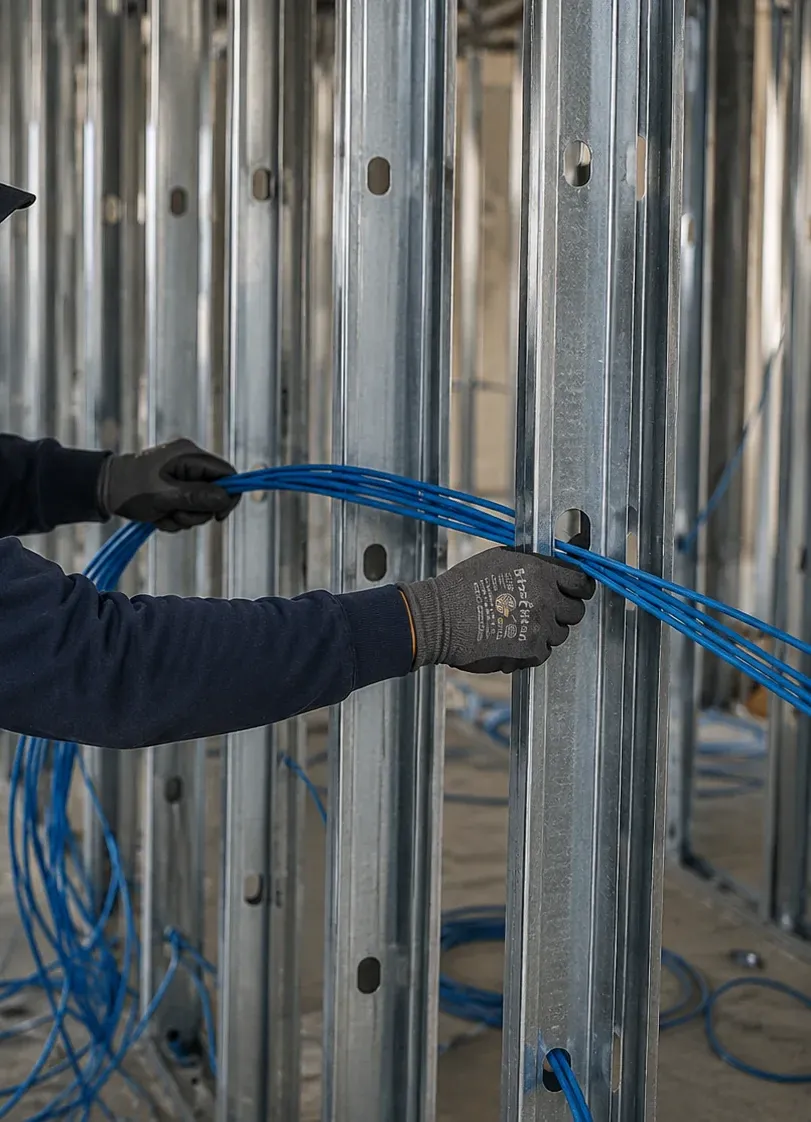
Drywall over new framing. Expanded capes, finished basements and refitted offices are mostly drywall, which is easier to open and repair but is also where fasteners do their damage. Drywall screws are driven on a regular pattern, and a cable that crosses a stud face close to the surface is in the line of fire. When the tester places a fault at a distance that lands on a stud line, we expect a fastener, and we look there first. The repair includes steel protection plates on the studs the new or rerouted cable crosses, so the next hanger cannot do the same thing.
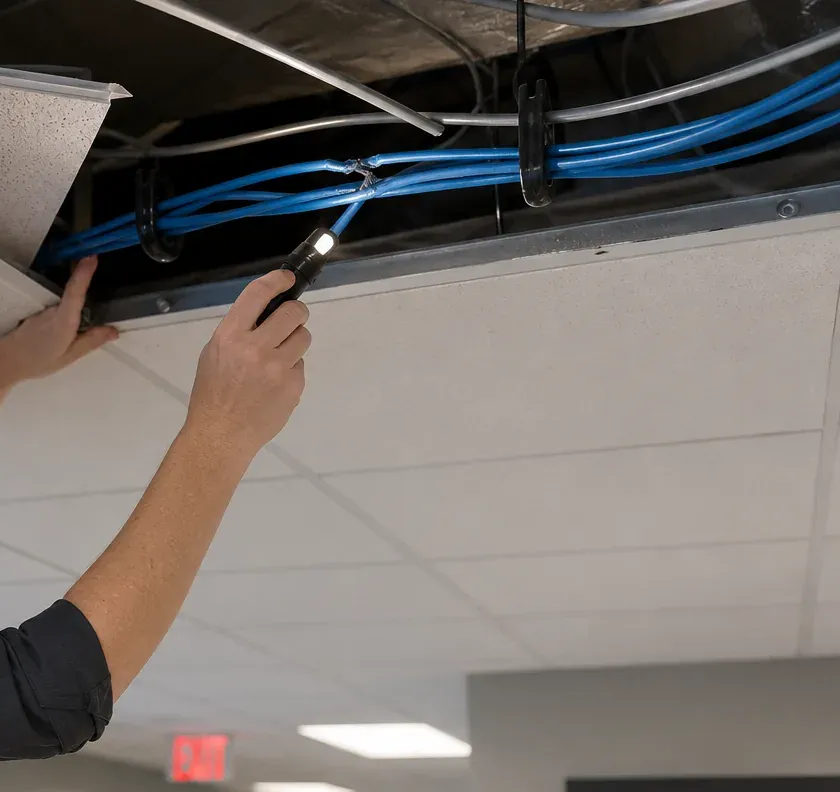
Finished ceilings. In basements and in offices that replaced lay-in tiles with drywall, the old access is gone. We look for every existing opening that leads into the ceiling — recessed-light housings, return-air grilles, soffits, closet ceilings, the access panel the plumber insisted on — and plan the repair around them. Often a damaged section can be bypassed with a new run pulled through an adjacent bay rather than reached directly.
Raised and rebuilt houses. In elevated homes we first establish where the network equipment now lives and where the provider’s line enters. Runs that still home-run to a ground-floor location that has been abandoned, or that now cross a flood-vented enclosure below the living space, get rerouted to the new equipment location. Terminations and any junctions are kept up in the conditioned part of the house, not in the enclosure below it.

Nassau’s business districts are a patchwork of office corridors, hospital neighbourhoods and village main streets, and each one breaks Cat6 in its own way. The places below are named to describe the buildings and the kind of failure we see in them, not as a list of our clients or jobs.
An office corridor straddling Lake Success and New Hyde Park, where Northwell Health moved its headquarters into a 100,000-square-foot building at 2000 Marcus Avenue in 2016 and later bought the 103,000-square-foot 1 Marcus Avenue, according to Long Island Business News. Suites here are refitted constantly, and refits are where desk links die.
County offices, courts and the 591-bed NYU Langone Hospital—Long Island, which moved to Mineola in 1900, with medical suites along Mineola Boulevard and Station Plaza. Small practices in older buildings depend on links that were added one tenant at a time.
Home of Nassau University Medical Center, a 530-bed teaching hospital that began in 1935 as Meadowbrook Hospital, and of the offices, clinics and shops that line the turnpike around it — buildings of many eras, often with cable from every one of them.
The land around the Coliseum, where RXR proposed a $1.5 billion plan to redevelop some 70 acres of parking, as Long Island Business News reported in 2022. Nearby offices and venues are mature buildings with long cable histories, and any redevelopment will put more trades in the ceilings.
The 1,117-acre former air base, closed by the Army in 1961, where Nassau Community College expanded onto 135 acres in 1962 and the Cradle of Aviation Museum’s restoration team works in Hangar 5. Re-used military buildings and the campuses around them mean old structures carrying new networks.
The restaurants, bars and fish markets along Woodcleft Avenue, rebuilt after Sandy — Otto’s Sea Grill keeps a brass plate marking the flood line, and records about three feet of water from Irene the year before. Point-of-sale and camera links on the waterfront are repaired with the next flood in mind.
Where a refit has also disturbed card readers or door strikes, the Nassau County access control installation crew can follow straight on once the links are certified.

These are the questions Nassau homeowners, office managers, landlords and the IT people who look after them ask once a Cat6 link stops behaving. They are grouped by what usually caused the trouble: a renovation, a raised or rebuilt house, someone else’s equipment, and the way offices and mixed-use buildings change hands.
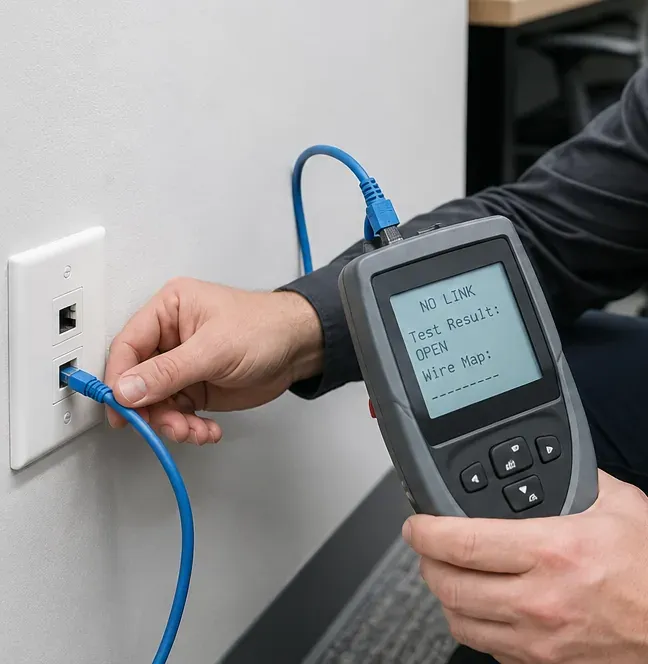
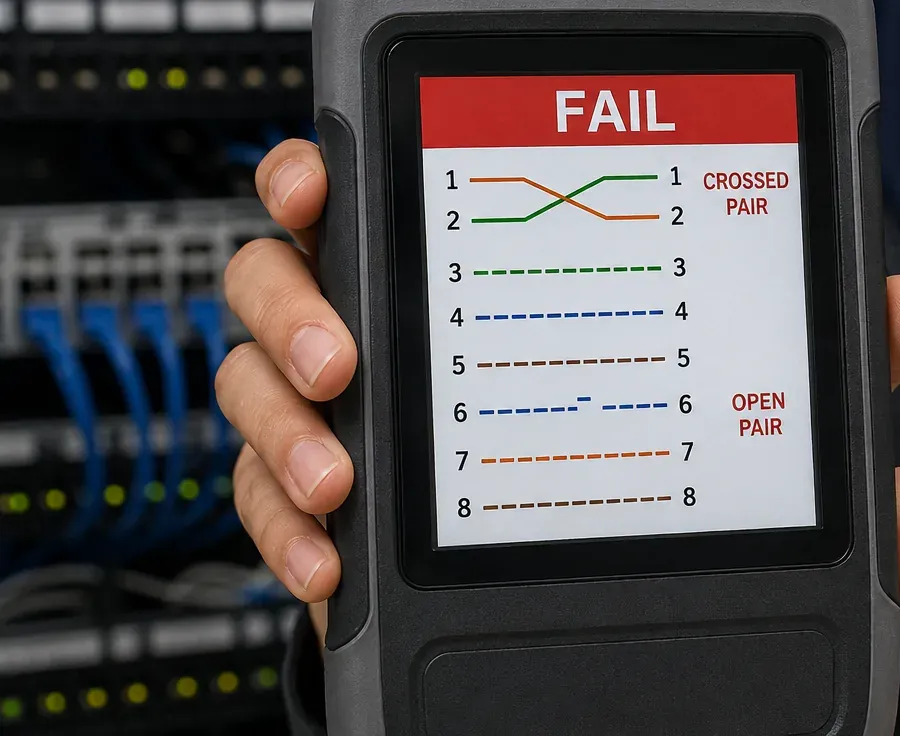
By measuring rather than looking. A certification tester sends a signal down each pair and reads what comes back, and a drywall screw that has pierced the jacket, shorted two conductors or crushed a pair produces a reflection at a definite distance from the jack. We take that reading from the jack end and, where we can reach it, from the panel or router end as well. Two readings that agree on the same point along the run narrow it down to a few inches of wall rather than the full length of the room.
We then translate that distance into the house. The run usually leaves the box, climbs or drops to a plate or a header, and travels along a known path, so the fault distance tells us which stud bay and roughly what height. Drywall screws sit on stud lines, which helps further. We open one small, square-cut hole at that point, confirm the damage by eye, and replace or reroute the damaged section. The opening is cut so that it can be patched flat, and we put a steel protection plate over the stud the cable crosses so the next screw cannot find it.
Usually not in its current form, and the reason is the splice rather than the wall. Many Nassau houses had their Ethernet extended over the years with an inline coupler, a surface box with two jacks back to back, or a twisted-and-taped join hidden behind a cabinet. Fluke Networks’ own troubleshooting guidance says female couplers should not be used in a data installation, and a join like that is often why a link that tested fine years ago now fails crosstalk or will not hold a gigabit connection. Burying it inside a finished wall only makes it harder to reach.
What we do depends on what the new layout allows. If the cabinet run has a toe-kick, an end panel or an adjacent closet we can work through, we replace the join with a continuous length or a proper termination in an accessible box. If the splice point is truly sealed in, we look for a new route around the kitchen — through the basement or the attic and down a different bay — and abandon the buried section in place. Either way the link is certified afterwards, so you know it is sound and not just lit up.
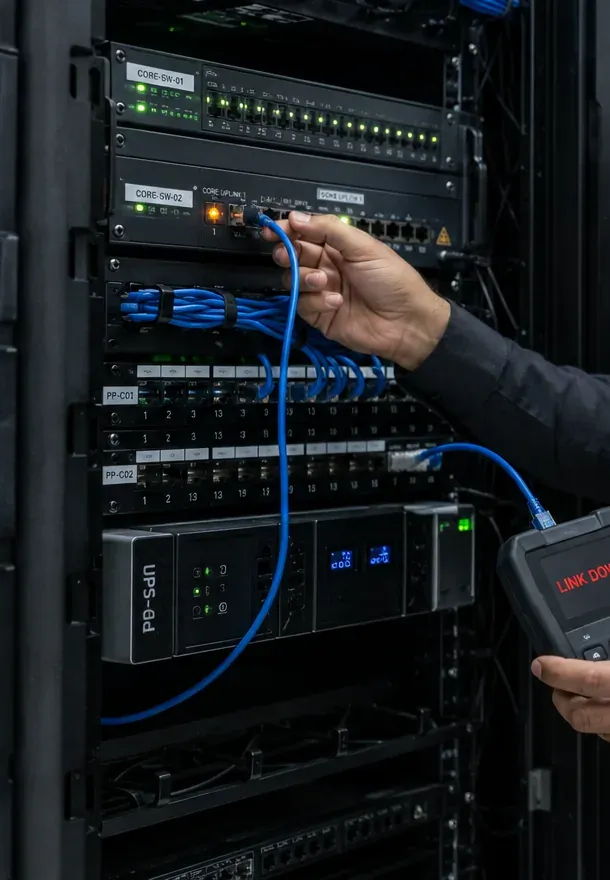
It becomes a planning job rather than a hunting job. In many split-levels, colonials and high ranches, the basement ceiling is where all the house runs gather on their way to the router or switch, and a drywall ceiling removes the easy access that open joists once gave. When one of those runs fails, we start by testing it to see whether the fault is at either end or out along the run, because a fault at the jack or the panel needs no ceiling access at all.
If the fault is in the ceiling, we map every opening that already leads up there: recessed-light housings, heating registers, return grilles, soffits that box in ductwork, the plumbing access panel and closet ceilings. Often the damaged section can be reached through one of them, or bypassed by pulling a replacement through a neighbouring joist bay to the nearest existing opening. When a cut is unavoidable, it is a single clean opening at the measured point. For owners about to finish a basement, it is far cheaper to test, label and tidy the runs while the joists are still open, which is something we can do the week before the drywall arrives.
With measurements, photographs and a timeline, not with an opinion. Attic Cat6 in Nassau capes and ranches is often stapled across joists or laid over the ceiling below, exactly where roofers working from inside, solar installers running conduit, and insulation crews walk and kneel. If a link that certified before the work now fails, the tester will show where along the run the change is, and an attic inspection at that point usually shows a crushed, cut or pierced jacket, sometimes with a footprint or a fastener still in place.
We record the before-and-after test results if you have the earlier ones, the measured distance to the fault, photographs of the damage in place before we touch it, and what we replaced. That gives you a factual record to share with the contractor or their insurer. We do not decide who is at fault, and we do not inflate the scope; we simply document what the cable shows and repair it. If you know work is coming up in the attic, testing the runs beforehand is the easiest way to make any later conversation straightforward.
This is common in houses where the same jack has been redone by several people, and in offices where a desk outlet has been moved a little each refit. Each re-termination cuts back to fresh cable, and once the end barely reaches the front of the box there is nothing left to work with. Stretching it into a keystone puts tension on the pairs and the termination, which is a reliable way to make a link fail crosstalk.
There are three honest fixes. If the run has a service loop at the other end, or passes through a ceiling or basement where some slack can be drawn back, we pull a few inches through and re-terminate properly. If not, we can mount a slightly deeper box or a surface-mount box that brings the termination to the cable. And if the cable is short because it is damaged further back, the right answer is a new length pulled in from the nearest accessible point. What we will not do is add a coupler inside the wall to buy length; that just recreates the problem described above.
Often they do not. When a house is elevated, the provider’s line, the modem and the router usually move up into the living space, and the ground level becomes a flood-vented enclosure for parking and storage. Cat6 that used to home-run to a closet on the old ground floor may now start in a space that is meant to flood, travel up through new framing, and arrive at rooms that have since been rearranged. Some of those runs still work; some were cut or spliced during the lift; and some now point to an equipment location that no longer exists.
We start by finding where the network gear now lives and testing every run from there. Runs that can be re-terminated at the new location are kept. Runs that pass through the enclosure below the house, or that carry junctions at a low level, are rerouted inside the elevated structure where possible, in line with FEMA’s guidance that modems, switches, splitters and routers should sit above the flood elevation. Where a camera or gate device at ground level genuinely needs a link, we run it so the termination and any surge protection sit high, and only the device itself is low.
As high as the room allows, and never lower than they need to be. A jack placed at the usual height above the floor in a ground-level room is the first thing to get wet in a flood, and once water has been into a keystone the contacts corrode even if the cable dries. In houses in the South Shore flood zones that were not elevated, we often move repaired jacks higher on the wall, run cable from above rather than up from the floor, and keep any junction or panel in an upper room or a high closet.
The aim is a network that can be switched off before a storm and come back afterwards without a visit. That means the router, switch and any small rack sit on an upper floor, runs drop to the rooms that need them from above, and nothing that carries a termination lives in the part of the house most likely to take water. It costs little extra when a repair is already under way and can save a full rewire after the next surge tide.
Usually less than it seems, and usually at the equipment end. When a provider technician relocates a modem or an optical terminal, they often unplug the patch cords from the old location, remove a small switch that was sitting beside the old modem, or move the router without reconnecting the cords that fed the house wiring. The cable in the walls is frequently fine; what has gone is the connection between it and the network. Occasionally a run is cut where the old equipment shelf or wall plate was removed.
We test each house run from its jack back to wherever it terminates, identify which ones were feeding which rooms, and rebuild the connection at the new equipment location — a short run between the old termination point and the new router, a small switch, or a patch panel if there are several runs. If the provider cut a run, we repair it. You end up with a labelled set of connections rather than a bundle of unknown cords behind the router, which also makes the next provider visit less risky.
Each room needs its own run for a proper Gigabit connection. One way people feed two jacks from one cable is a pair of passive splitters that put two connections on the four pairs of one Cat6 cable; another is to wire two jacks in parallel. The first approach limits each connection to two pairs, which caps it at 100 megabits per second because Gigabit Ethernet needs all four pairs. The second simply does not work reliably for Ethernet at all, even when the lights come on.
The repair is either a second run to the second room, pulled alongside the first where there is a path, or a small switch at one room feeding the other over a short cable. In houses where pulling a new run would mean opening finished walls, the switch is often the tidier answer. Either way, both links are certified afterwards, and the splitter or parallel wiring comes out so it does not confuse the next person who opens the box.
Yes, depending on how the panel is built. Plenty of Nassau houses wired or renovated in recent decades have a recessed media enclosure in a closet or basement, with Cat6 terminated on a small data module, coax on a splitter, and sometimes a small switch or hub mounted inside. If that switch fails, loses power, or overheats in an enclosure with no ventilation, every room fed from it goes dark at once, which looks like a building-wide cabling failure but is not.
We test the house runs at the panel independently of the electronics, so the cable is judged on its own. Faulty punch-downs on the data module are remade, a failed or obsolete switch is identified and replaced if you want us to supply one, and the panel is tidied so cords are not crushed by the door. If the module itself is an old category or damaged, replacing it with a Cat6 patch module restores the links without touching the walls.
At the desk end, almost always. Weekend refits in Nassau office buildings bring carpet installers, furniture installers and movers through the same space within a day or two. Patch cords are trapped under panels and crushed by casters, wall jacks behind workstations are pulled out of their boxes as furniture is pushed back, cords are plugged into the wrong ports, and the cable feeding a furniture raceway is pinched where the panels join. Damage to the cable inside the walls is rarer, though a jack box can be ripped loose from the drywall.
We test from each dead desk to the panel, replace crushed cords, refit or re-terminate jacks that were pulled, and check the feeds into any furniture system. If the floor has floor boxes or poke-throughs, those are inspected too, since carpet layers sometimes cover or crush them. Each repaired link is certified, the port map is updated so desks land where your IT provider expects, and you get a short list of what was damaged in case the refit contractor needs to know.
Yes. Buildings on village main streets have usually been through many tenants, and each one added its own runs without removing the last tenant’s. The result is ceilings and closets full of cable with no labels, some of it live, some of it dead, and some of it running between floors in ways nobody remembers. Before anything is repaired, the useful first step is to find out which runs are actually connected to something.
We tone and test every run from each accessible end, check which ports are live at any switch or router, and produce a list of runs that serve current tenants, runs that are intact but unused, and runs that are damaged or go nowhere. Live runs that fail are repaired; intact spares are labelled for future use; and accessible abandoned cable is removed, in line with the National Electrical Code. You end up knowing what you own, which matters when the next tenant asks for a working connection.
In a new rental building, the in-wall cabling is normally part of the building, and a jack that has never worked is a matter for the landlord or managing agent first. New transit-oriented buildings like those going up around the Mineola LIRR station are cabled to every unit when they are built, and a dead jack in a recently finished unit is most often a workmanship issue at the termination or a run that was damaged while the unit was being finished. The building’s own contractor may still be responsible for it.
If the landlord agrees to have us look at it, or you have permission to arrange the repair yourself, we test the jack to the building’s panel or the unit’s media box, find the fault and repair it. We need to know who controls the panel, because in many buildings the closet is locked and managed. Where the problem is your own equipment, a cord or a router setting, we tell you that instead and save everyone the bother.
In Nassau the toolkit is built around finding faults inside finished walls and leaving those walls finished.
Measures the link against its category limit and places opens, shorts, crushed pairs and crosstalk faults by distance from either end, which is what turns a wall-wide search into one small opening.
Follows a run through a wall or ceiling and separates live runs from dead ones in mixed-use buildings and inherited closets where nothing is labelled.
Looks into a stud bay or ceiling through a jack box or a small hole before anything larger is cut, to confirm a fastener, a crushed section or a hidden splice.
Low-voltage mounting rings and boxes that fit existing openings, including deeper ones that bring a termination to a short cable rather than stretching the cable to the termination.
Fitted over studs and plates where a repaired or rerouted cable passes close to the face of the framing, so the next drywall screw or finish nail cannot reach it.
For pulling a replacement length between an attic, a basement and a wall cavity without opening the surfaces in between, including through fire blocking in older framing.
Stocked in the common plate colours and styles, so a jack rebuilt in a finished living room or a client-facing office looks like the ones beside it and still meets its category.
Paintable raceway for the few routes where a hidden path is impossible, run along baseboards, casings or corners so it reads as trim rather than an afterthought.
Setting compound, mesh patches and cut-outs for the small, square openings a repair needs, so walls are left closed and ready for paint rather than open and taped.

Method note: we could not open Google’s AI Overview from the tools used to research this page, so none of the statements below are quoted as its wording. They are claims that how-to sites, retailers, cost guides such as Angi, HomeAdvisor and Fixr, and answer engines commonly make about home and office Ethernet. Under each is what changes once the cable is inside a finished Nassau building.
It is true that copper inside an undisturbed wall lasts a very long time, and that many “dead jacks” are really a loose cord, a failed switch port or a router setting.
The catch in Nassau is the word “undisturbed.” Most of the county’s homes date from the 1950s or earlier and have been renovated, often more than once, since the cable went in. Screws, nails, staples, new ductwork and people kneeling in attics all damage cable that was perfectly healthy the day before.
So we test the cable itself, disconnected from the electronics. If it passes, we tell you to look at the equipment; if it fails, the distance to the fault usually lines up with the last job done in that room.
In an open-ceiling office or an unfinished basement, pulling a fresh run can indeed be quicker than diagnosing an old one, and cost guides that quote low per-drop prices for new work reinforce the idea.
In a finished Nassau house the cost of a new run is mostly the walls and ceilings it has to pass through and the patching and painting afterwards. A fault located to within inches, fixed through one small opening, is usually far cheaper than a new route through a newly finished room.
We price both before starting. Sometimes the new run does win — when a cable is damaged in several places, or is the wrong conductor — and then we say so.
Adapters that carry Ethernet over the house’s power wiring or its coaxial cable are popular workarounds, and in some houses they work well enough for streaming and browsing.
They are a workaround for missing cable, not a repair for damaged cable. A house that already has Cat6 to a room gets a faster and steadier link from fixing that run than from adding adapters. Devices that need power over the cable — cameras, access points, doorbells and readers — cannot be served by an adapter at all.
When a Cat6 run is reparable, repairing it is usually the cheaper long-term answer, and it removes a box with its own power supply from behind the television.
Inexpensive continuity testers are genuinely useful for spotting an open or swapped pair after a cord is crimped.
They cannot tell you whether a link meets Category 6, and they do not tell you where along a run a fault sits. A run with a screw through its jacket can pass continuity and still fail at speed; a run with a buried coupler can light up and still drop out under load.
The repair decisions in a finished building depend on distance and on margin. Those come from a certification-grade tester, and the result is the record you keep afterwards.
It is common to read that data and security wiring are exempt from permits, and for a like-for-like repair — re-terminating a jack, replacing a damaged section in the same path — that is usually how it works out in practice.
Nassau’s rules, though, are set by its two cities, three towns and 64 villages, not by one office. An electrical contractor’s guide for the county notes that while low-voltage systems may not need a permit, running new wiring through walls or attics often does, and some municipalities treat work tied to an electrical change differently.
We check the rule for the specific address before quoting new pathways, new openings in rated assemblies or anything that touches line voltage, and we tell you plainly if a permit is involved.
General advice about elevating a house concentrates on the structure, the foundation and the main utilities, which is where the money and the inspections are.
Network cabling is rarely in the plan. When the modem and router move upstairs and the ground floor becomes an enclosure, Cat6 that once ran to a ground-floor closet is left pointing at the wrong place, sometimes spliced to reach, sometimes passing through the very space FEMA’s utility guidance says should not carry network equipment.
A repair in a raised house is really a small redesign: find the new equipment location, keep what can be re-terminated there, and reroute the rest so terminations stay above the flood elevation.
National cost guides do publish figures like that. Fixr’s Cat6 guide, for instance, gives labour at $45 to $75 an hour and new drops at $125 to $250 each as national averages for installation.
Those are national averages for new work, not for locating and repairing a fault inside a finished Nassau wall with a certification tester, carrying the insurance and licensing the county’s homeowners and building managers ask for, and leaving the wall closed.
Our published Nassau rate is $195 an hour with a three-hour minimum, and the price of any new run is quoted before it is pulled. The figure is higher than the national average; the visit is also usually the only one the job needs.
Name the trades that were in, the rooms where the network went quiet and the day it happened. You will hear the likeliest culprit, and what the visit will cost, while you are still on the phone.
From a dormered cape in Wantagh to a suite in Lake Success, this form goes to a technician who repairs Cat6 in Nassau every week. Describe what failed and what work happened nearby, and you get a written reply the same business day. Prefer to talk? Our Nassau line is (516) 346-5778.
Thanks — a Nassau technician has your details and will ring before the end of the business day. Can’t wait? Dial (516) 346-5778.
Six steps, whether it is one jack in a Merrick bedroom or a floor of desks in a Garden City office.
We ask which links failed, exactly when they stopped, and what work happened in the building beforehand — drywall, flooring, a remodel, a provider visit, a refit or a house lift. The answer usually tells us where to measure and what to bring.
We book a 2-hour arrival window, ask where the attic hatch, basement ceiling openings and equipment closet are, check whether the repair could need a new pathway at that address, and bring patch materials for any opening.
Each failed link is tested disconnected from the electronics and certified from both ends. The distance to the fault is translated into a stud bay, joist bay or ceiling position before anything is cut.
Link by link, we explain what happened and the repair we propose — a fresh termination, a short replacement section, a bypass through a neighbouring bay, a reroute to the new equipment location, or a new run. You approve the list first.
Damaged sections are replaced or rerouted, couplers and splices removed, steel plates fitted where cable crosses studs near the surface, accessible dead cable removed, and every opening closed flat and ready for paint.
Every link we touched is retested to Category 6 and tagged at the jack and the panel. Your copy holds the test files, how far along each run the damage sat, and the photos taken before repair, for your IT support or the builder.

These six places sum up the county’s building stock: a planned nineteenth-century village, a county seat built around a hospital and the courts, a converted air base, an office corridor, a stadium district waiting for its next chapter, and a working waterfront. They are reference points for the buildings around them, not claims of work inside them.
The village New York merchant Alexander Turney Stewart began planning in 1869 on pasture he bought from the Town of Hempstead for $55 an acre, as the New York Times recounted. Its older houses and its Franklin Avenue offices are retrofit territory for cable.
The county seat, home to a 591-bed academic medical centre that moved to Mineola in 1900, and to the new rental buildings rising around the LIRR station, among them The Bridge at Mineola, a 101-unit development its builder lists as under construction.
The 1,117-acre air base the Army closed in 1961, now Nassau Community College’s campus, museums and offices, with the Cradle of Aviation Museum’s restoration shop in Hangar 5 and the Georgian Revival officers’ houses still standing.
The office corridor where Northwell Health has its headquarters at 2000 Marcus Avenue, lined with professional and medical office buildings that have been refitted for one tenant after another.
The arena’s site, which its operators describe as 77 acres of property, and the roughly 70 acres of surrounding parking that redevelopment plans have targeted for a mixed-use downtown in Uniondale.
Woodcleft Avenue’s restaurants, bars and fish markets on the canal, reinvented by the Village of Freeport as a waterfront destination and rebuilt after the floods of Irene and Sandy.
We also repair Cat6 in Elmont, Valley Stream, Franklin Square, Floral Park, New Hyde Park, Great Neck, Manhasset, Port Washington, Roslyn, Westbury, Carle Place, Hicksville, Syosset, Jericho, Plainview, Bethpage, Glen Cove, Oyster Bay, Locust Valley, Hempstead, East Meadow, Levittown, Wantagh, Seaford, Merrick, Bellmore, Baldwin, Oceanside, Rockville Centre, Lynbrook, Island Park, Long Beach, the Five Towns, Massapequa and Massapequa Park, and the hamlets between them. The Long Island Cat6 repair hub covers the island as a whole.

No figure on this page is new: each one is already published on one of our Nassau or Long Island pages, and the table says which. A Cat6 repair has two parts that cost very differently — a technician’s time to find and fix the fault, and any cable or hardware that has to be replaced — and they appear on separate lines of the invoice.
| Item | Price | Scope and source |
|---|---|---|
| Labour: measuring the damage, cutting and closing access, rebuilding terminations, short reroutes and the closing certification, on Cat6 or Cat6A | $195/hr, 3-hour minimum ($585) | The specialty rate on our Nassau County network cable repair pricing table and on the Long Island Cat6 repair hub; time after the first three hours is billed as used |
| Replacement Cat6 run where the existing one cannot be saved | From $175 per drop | Nassau County network cable repair pricing table: cable, keystone jack, wall plate, panel punch-down, testing, labels at both ends and a patch cord |
| Plenum (CMP) cable where the ceiling carries return air | Added per drop | Same table; applied only where the ceiling space is a return-air plenum |
| After-hours or weekend window | Premium applies | Same table, for buildings that restrict low-voltage work to off-hours |
| Building-wide identification of live and dead runs | Quoted by port count | Same table (closet audit, mapping and labelling) — used for mixed-use and multi-tenant buildings |
| For comparison only: a brand-new Cat6 drop up to 100 ft | $296 per drop | Our Nassau County Cat6 installation page, which lists $254 for Cat5e and $424 for Cat6A on the same basis |
| Drywall patching at repair openings | Within repair time | Small openings cut for the repair are closed and left ready for paint as part of the hourly work; painting is not included |
The minimum buys three hours of a technician with the test gear, not a single fix. In a house it usually covers testing the failed runs from both ends, placing the fault, opening one access point, repairing the damaged section or re-terminating, closing the opening and certifying the link — with time left to test the other runs in the same wall or ceiling. In an office it usually covers testing a group of dead desks, replacing crushed cords, remaking pulled jacks and updating the port map. Anything beyond that, such as a replacement run through finished rooms, is priced before any cable is pulled.
A note on regional pricing. Our pricing guidelines include area multipliers, but the repair rate and the replacement-drop figure on our live Nassau and Long Island cabling pages are published without one, and this page keeps the same figures rather than introduce a second set. The installation drop prices quoted for comparison are taken as published on our Nassau Cat6 installation page.
Full terms — including 50% deposit, one-year parts-only warranty on AESS-supplied products, and the late-fee schedule — are set out in the service agreement.
Most Nassau jobs land in one of these shapes, sized by how much the last project disturbed. The dollar figures are the ones already printed in our pricing table above.
$585
The three-hour minimum at $195 an hour. One run tested from both ends, the fault placed by distance, a single access opening made and closed, the damaged section repaired or the jack re-terminated, and the link certified. Spare time goes to testing the neighbouring runs the same work may have touched.
$195/hr after the first 3 hours
For a house after a remodel or an office after a refit: every run tested, faults located and repaired, pulled jacks remade, crushed cords replaced, a written list of anything that needs a new run, and saved results you can share with whoever did the work.
Repair time + from $175 per run
For raised houses, moved equipment and buildings with runs beyond saving. Hourly time covers testing, mapping and repairs; replacement runs start at $175 per drop; runs that must move to a new equipment location are priced one by one; accessible dead cable comes out.
Already have the keystones and plates that match your finished rooms, a media-panel module from the builder, or cable left over from the original job? We can install them and bill repair time only, provided they suit the link: the right category, solid-copper conductors, and the correct rating for the space. Parts you supply carry their manufacturer’s warranty rather than ours, and if they cannot produce a passing link we tell you before we fit them.
A short visit before the drywall, flooring or attic crews arrive tells you which runs are sound, protects them, and gives you a baseline if anything changes afterwards. The cost is set out before the visit.
When a link fails soon after building work, the trade involved is the best clue to where the damage is. This is the table we work from on the first call.
| Recent work | Where the Cat6 usually gets hit | What we check and do |
|---|---|---|
| New drywall or a skim-coat over old walls | Screws through cable crossing a stud face; boxes covered or set too deep | Fault distance against stud lines; small opening, replace the section, steel plate on the stud; recover any covered box |
| New flooring and baseboard | Finish nails through cable run along the bottom plate; floor boxes covered or crushed | Test jacks near the floor first; inspect behind removed trim; re-terminate or reroute above the nailing zone |
| Kitchen or bathroom remodel | Runs cut when walls opened, then rejoined with couplers or tape and sealed in | Locate the join; replace with a continuous run or an accessible termination |
| Basement finishing | Runs stapled tight, crushed by furring or soffits, buried above a drywall ceiling | Map existing ceiling openings; bypass the damaged section through an adjacent bay |
| Roof replacement, solar or attic insulation | Attic runs stepped on, cut by conduit work, buried under insulation | Fault distance from the jack below; attic inspection; photograph before repair; resupport the run |
| HVAC replacement | Runs moved or crushed when ducts and returns were rerouted through joist bays | Check runs that share bays with new ductwork; reroute away from duct hangers and sheet-metal edges |
| House raising or flood rebuild | Runs cut or spliced during the lift; equipment moved upstairs; terminations left low | Find the new equipment location; re-terminate or reroute there; keep terminations above flood level |
| Internet provider visit | Cords unplugged, a small switch removed, a run cut where old equipment was mounted | Test house runs disconnected; rebuild the connection at the new location; label everything |
| Office carpet and furniture refit | Cords crushed under panels, jacks pulled from boxes, furniture feeds pinched | Desk-end inspection; replace cords; refit jacks; update the port map |

The cheapest Cat6 repair is the one you never need. A little preparation before the work starts protects cable that would otherwise be in the way.
If the remodel is big enough that the whole layout should change, bring in our structured cabling installation team in Nassau County or our network installation service for Nassau homes and businesses.

The county’s three towns cover most of its land, but much of that land is inside incorporated villages, and two places — Glen Cove and Long Beach — are cities in their own right. That patchwork rarely matters for a straightforward re-termination. It matters when a repair turns into new pathways, new wall openings in a rated assembly, exterior work, or anything that touches power.
The western and southern part of the county, from Elmont and Valley Stream through Garden City, Hempstead, Uniondale and East Meadow down to the South Shore communities from the Five Towns to Seaford. It holds much of the county’s post-war housing, the Mitchel Field campuses and a long stretch of the flood-prone shore where raised and rebuilt houses are common. Unincorporated addresses fall under the town’s own building department; incorporated villages such as Garden City, Rockville Centre, Freeport and Lynbrook run their own.
The north-western quarter, from New Hyde Park and Lake Success across Great Neck, Manhasset and Port Washington to Roslyn and Westbury. Older village housing, peninsula estates, the Marcus Avenue office corridor and a great many professional offices sit here. Many of its communities are incorporated villages, so the right building department is usually the village rather than the town.
The eastern side of the county, from the North Shore villages through Hicksville, Syosset, Jericho, Plainview and Bethpage to Massapequa on the South Shore. Expanded capes and ranches, the Jericho Turnpike and Route 106/107 commercial corridors and a mix of village and unincorporated addresses keep the address check important.
The same renovation that cut a Cat6 run tends to involve other systems too. These are our county pages for the work that most often travels with a repair.
Cat5e, coax-era phone runs and copper faults beyond the Cat6 scope.
New drops when a renovation is the moment to add rather than rescue.
Panels, closets and whole-building cabling plans.
For a detached office or a second building too far for copper.
Speaker, sensor and control wiring routed through the same bays.
Cameras on the end of repaired runs, around the house and drive.
Storefronts, offices and lots on the county’s commercial roads.
Mounting and wiring behind the screen, done without hitting the data run.
Smart-home hubs and keypads that stop responding when their wire is damaged.
Everything we install and repair.
One form for any combination of services.
Working habits rather than stories: what our crews do on every Nassau call, whoever’s building it is
We ask who was in the building last. A link that failed the week the floors were done, or the day after the provider’s visit, has already told us where to start, and it often means the cable was healthy until very recently.
We measure before we cut. Distance from both ends, translated into stud bays and joist bays, decides where the one opening goes. Opening a finished wall on a hunch is the most expensive thing a cable repair can do in this county.
We photograph damage before touching it. A screw through a jacket or a crushed section under a footprint is the record that matters if someone else needs to know what happened.
We plate what we expose. Any stud the repaired cable crosses near the surface gets a steel plate, because the next contractor will not know the cable is there either.
And we close what we open. A small, square opening patched flat is part of the repair, not an extra, and the homeowner should be able to paint over it the same evening.
Someone needs to let the technician in, show where the router, media panel or closet is, and approve the repair plan once the fault has been measured. After that you do not need to stay in the room. Most homeowners are around for the first half hour and the last few minutes, when we show the results and any opening we closed.
Yes. Openings are cut as small, square-edged pieces so they can go back in, and we close them with mesh and setting compound so the surface is flat and ready for paint. We do not paint or match textures; for plaster walls, wallpaper or tile we tell you beforehand if a finisher will be needed.
Yes, and it is usually the best moment. We can test and protect the existing runs before walls close, repair anything already damaged while the framing is open, and coordinate with the contractor so drywall, flooring and cabinets go in after the cable work rather than over it.
We can, but the in-wall cable belongs to the property, so we need the owner or managing agent to agree before any wall is opened or a run is replaced. Testing and re-terminating a jack usually raises no objection; opening finished surfaces does. We are happy to send the landlord a short scope and price first.
Yes, weekend windows are available. They carry the after-hours or weekend premium shown on our Nassau network cable repair pricing table, and the total is confirmed in writing before the visit. Weekday daytime visits have no premium.
Yes, where a hidden path really is not available. Slim, paintable raceway run along a baseboard, a door casing or an inside corner can carry a replacement Cat6 run neatly and reads as trim once painted. We suggest it only after checking for an attic, basement or closet route, since a concealed run is usually the better result.
It can be. Data cable tied tightly to power cables over a long distance, or packed against the panel, picks up interference and is more likely to be damaged when an electrician works there. We separate it where it has been bundled with power, cross power cables at right angles, and leave work on the electrical panel itself to a licensed electrician.
Yes. Mounting brackets are fixed with long lag screws or toggles into the same stud bays where the TV’s data cable usually runs, and a bracket screw through the cable is a common cause of a dead jack behind a screen. We test the run, and if the fault is at the bracket we work around the mount rather than through it.
Yes. We work throughout the county, including both cities, all three towns and the villages inside them. The only practical difference is that permits, if a repair ever needs one, come from the city or village rather than the town, and we check that for the address.
Often, yes. Coaxial runs to televisions or modems and old telephone wiring are commonly damaged by the same renovation that hit the Cat6. We can test and repair them at the same visit under the same hourly rate, and our network cable repair service covers copper cabling of every type.

You are on the Nassau County Cat6 repair page. It sits under our Long Island hub, alongside the Suffolk County page, and the same service runs across New York City and the Hudson Valley.
Cat6 repair on Long Island (regional hub) · Nassau County Cat6 repair (this page) · Suffolk County Cat6 repair
Cat6 repair in New York City — Manhattan, Brooklyn, Queens, the Bronx and Staten Island.
Hudson Valley Cat6 repair · Westchester County Cat6 repair · Rockland, Orange, Putnam · Dutchess County Cat6 repair · Ulster County Cat6 repair
Nassau network cable repair · Cat6 installation in Nassau County
Need something other than cabling? Every service we offer in Nassau and beyond branches off the Abstract Enterprises Security Systems home page; the company itself is introduced on our about page.
If a link stopped after a renovation, a move or a provider visit, or has never worked since the house was raised, call our Nassau line at (516) 346-5778. We book the next open 2-hour window, and most termination and cord faults are fixed in one to two hours once we are on site.
Abstract Enterprises Security Systems · 1282 Troy Ave, Brooklyn, NY 11203 · serving Nassau County · (516) 346-5778 · WhatsApp (718) 679-0359 via wa.me
NYS Low-Voltage Licence #12000287431 · 100% Licensed & Insured · Same-Day Estimates · Rated 4.7★ from 201 Google Reviews
Parts you supply carry their manufacturer’s warranty. See our warranty page and the service agreement for full terms.
Everything above reflects our own repair work in Nassau homes and offices. References to village and town permits, county licensing, FEMA flood guidance, the National Electrical Code and TIA cabling limits are plain-language summaries for planning, not legal or engineering advice, and each municipality applies its own rules. Page reviewed and updated October 17, 2026. Changelog: first publication of the Nassau County Cat6 repair page.