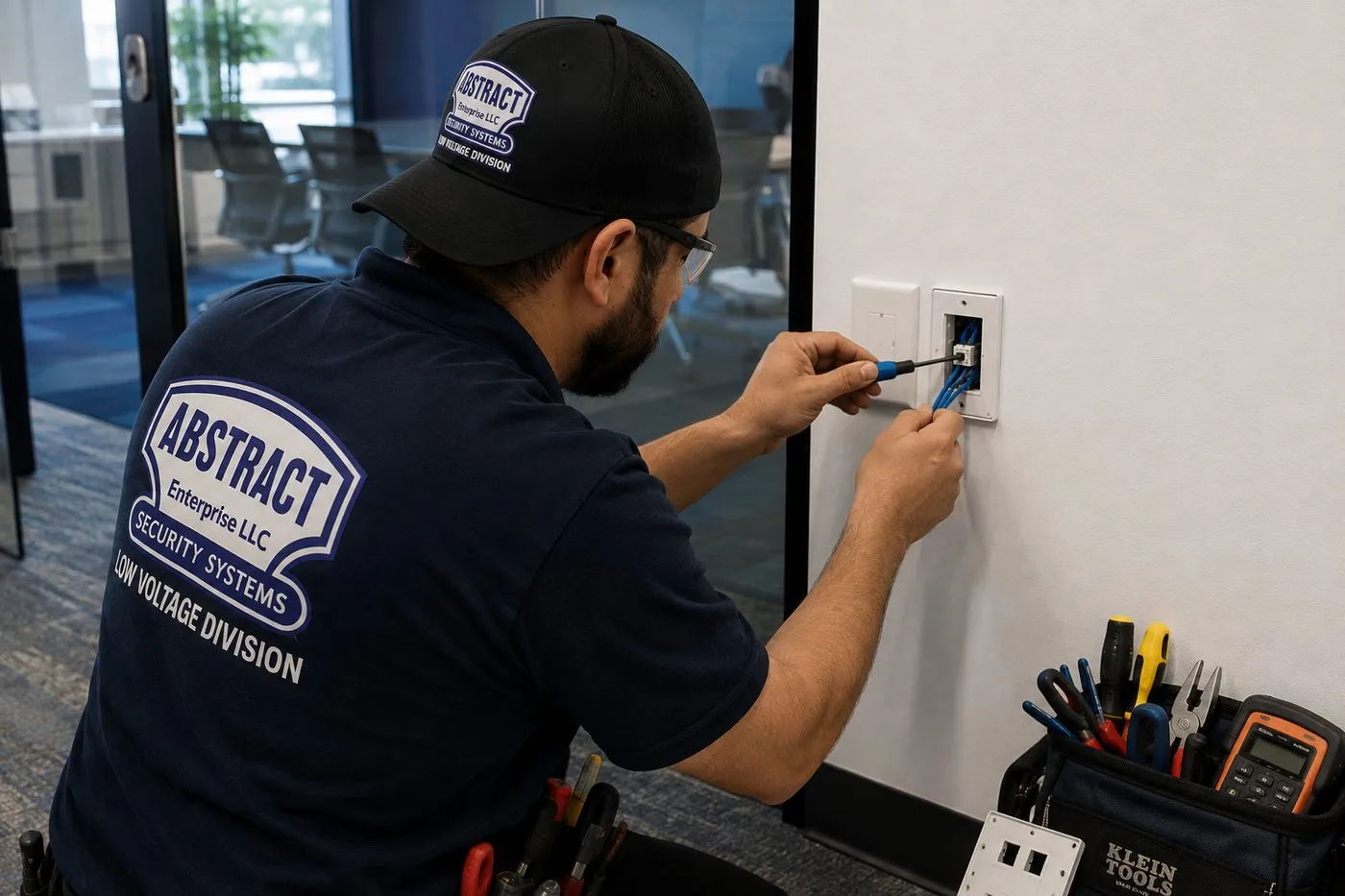
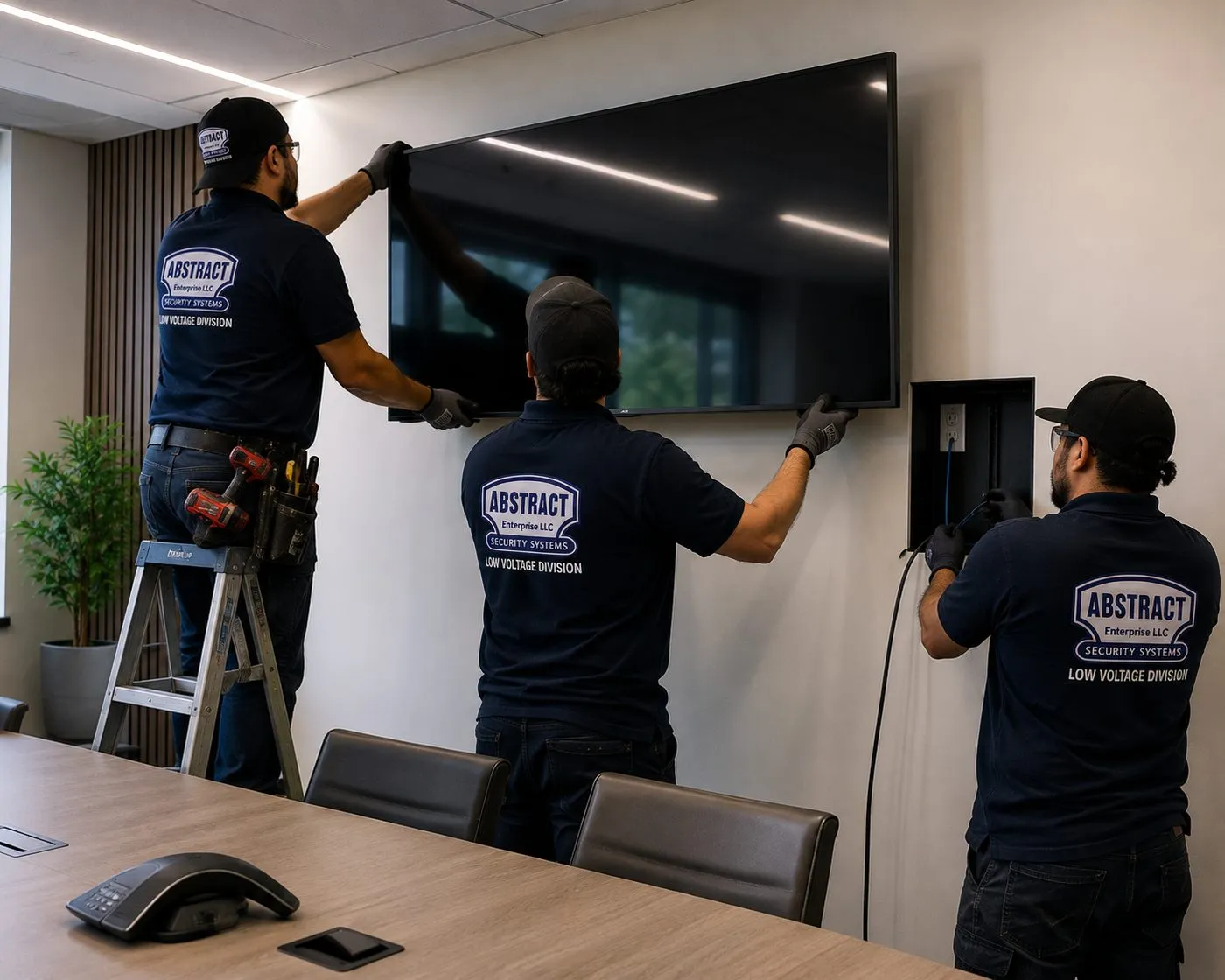
Owner-Side Backbones · Legacy Fiber Audits · Demarc-to-Desk Links · Fusion Splicing · OTDR-Proven Strands
In Nassau the carriers have already done the street. Fiber passes almost every address in the county, and much of it has been there since Verizon's mid-2000s build through the Town of Hempstead. What usually hasn't changed is everything behind the carrier's box: thirty-year-old phone cable in a Lake Success office, a coil of orange multimode nobody can identify above a Garden City ceiling, a village storefront with apartments upstairs and one tangle of wiring for all of them. We close that owner-side gap — measured, spliced, tested and written down — from our Brooklyn office, with a direct Nassau line.
Reviewed and updated October 17, 2026 · Written by Anwar Timothy, NYS licence #12000287431

Already have Fios or Optimum at the wall? Then you are halfway there. Call the Nassau line at (516) 346-5778 or use the 60-second form, and tell us two things: where the provider's box is, and where your equipment or people actually are.
Ask a Nassau office manager whether the building "has fiber" and the honest answer is almost always yes. Using FCC broadband data current to the end of 2025, one availability tracker puts Verizon's fiber at 99.32 percent of the county's population and Optimum's at 96.57 percent. Residents on the Long Island forum argue about which provider is cheaper for a gig up and a gig down, not about whether fiber exists. Verizon's own map lists Hempstead, Garden City and Mineola among its central Nassau service areas. In a county of about 1.38 million people, glass at the curb stopped being news years ago.
The catch is age and reach. Verizon told the Town of Hempstead in the mid-2000s that it already served Valley Stream, Hicksville and Plainview, would build Freeport, Baldwin, Merrick, Elmont and Franklin Square next, and would reach the Village of Hempstead, Uniondale, West Hempstead and Long Beach by the end of 2007. Many of the boxes on Nassau basement walls today were hung in that first wave. They brought light to the building and stopped there. Behind them, the building kept whatever it already had: phone-era copper risers, a cable TV splitter tree, a network closet that grew one switch at a time, and in a surprising number of 1970s and 1980s offices, a run of early multimode fiber that somebody pulled for a mainframe or a phone system and nobody has tested since.
That is the Nassau pattern, and it is different from both the city and eastern Long Island. Nassau is built out. Most of the buildings we work in already exist, are already occupied and were designed long before anyone planned for gigabit service at every desk — low-rise office buildings along Marcus Avenue and Old Country Road, medical suites around the hospital in Mineola, two-storey village blocks with a shop below and apartments above, school buildings in fifty-six separate districts, and post-war houses that have been expanded twice and now hold a home business. The work is rarely about crossing a field. It is about finding a clean path through a building that is already full, and about deciding what to keep, what to re-terminate and what to retire.
The county's patchwork adds a layer of questions. Two cities, three towns and sixty-four incorporated villages each keep their own building department, so the same job can have different paperwork on either side of a street. Commercial and residential work are treated differently: Nassau's Office of Consumer Affairs licenses home-improvement contractors who work on houses, but says plainly that contractors who work only on commercial buildings don't need that licence. Fire alarm changes go to the Nassau County Fire Marshal. None of this is hard once it is planned, but it is why a Nassau fiber quote starts with a walk and a few questions rather than a price per foot. When the walk shows that copper and cameras need attention too, our Nassau County structured cabling crew scopes it the same day.

A cleaner unplugged the media converter, a ceiling contractor cut through a run above the drop tiles, a switch was swapped and the uplink never came back. Those are repairs, and we treat them separately from new installation. Same-day dispatch is the aim across the county; once a technician is on site, a broken pigtail, a crushed jumper or a contaminated connector is usually found and fixed within one to two hours. Call (516) 346-5778 and say "fiber repair," or see network cable repair in Nassau County if the fault is on copper.
Everything here sits on the owner's side of the carrier's box. Verizon or Optimum brings service to a demarc; we take it from there to the rooms, floors, suites and buildings that need it, and we prove each strand before we leave.
When the provider's equipment landed in a basement corner, a boiler room or a utility closet at the wrong end of the building, a short fiber run moves the handoff to where the firewall and switches actually live — without asking the carrier to rebuild its drop.
Fiber between the main equipment room and closets on other floors or at the far end of a long, low office building, so every closet runs at the same speed as the internet connection instead of a copper bottleneck.
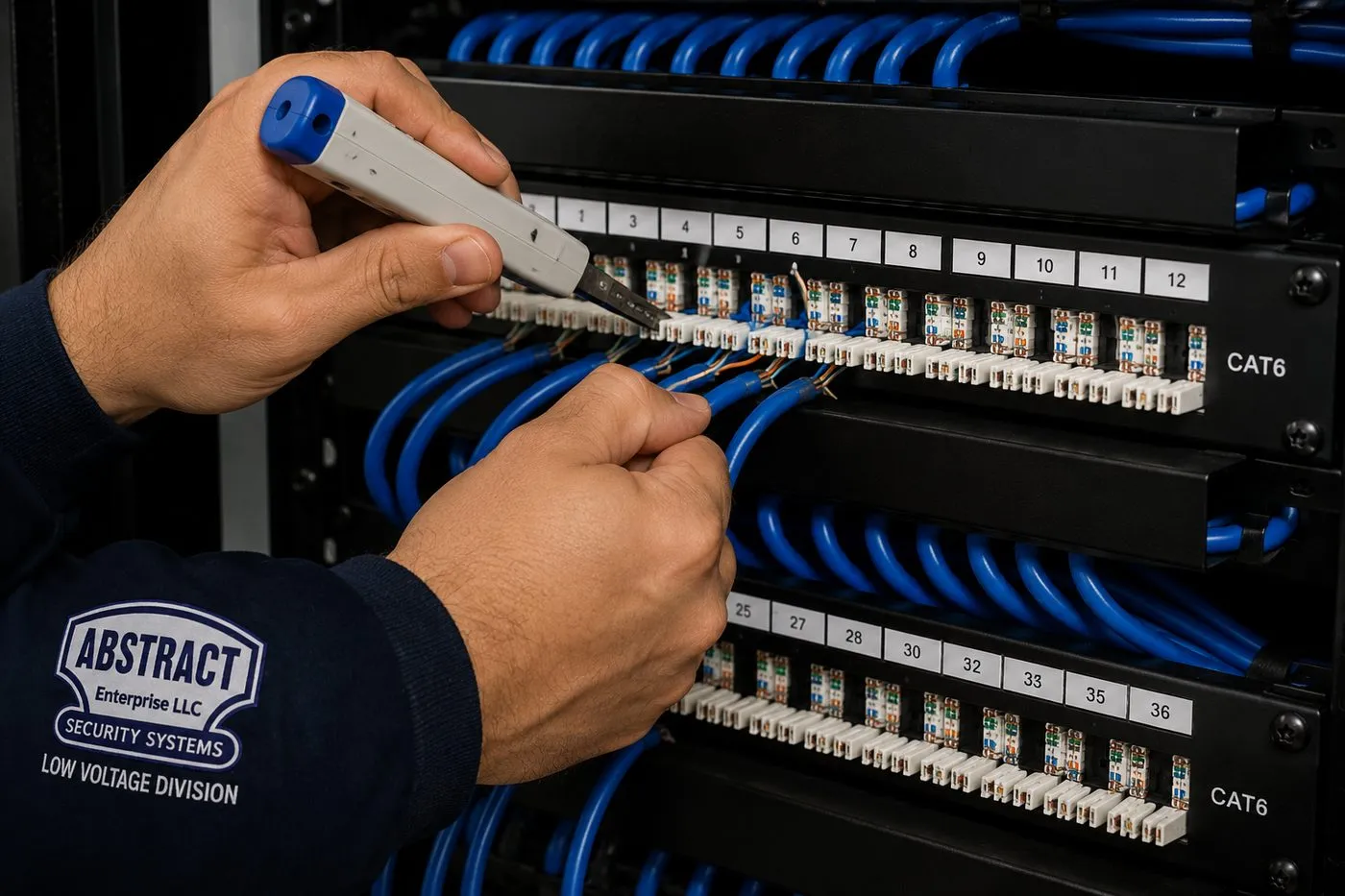
Identifying old fiber in the ceiling or riser, reading its jacket, inspecting and cleaning its connectors and loss-testing every strand, so you know whether it can be re-used, re-terminated or should be abandoned.
Cutting off tired ST and SC connectors and fusion-splicing new pigtails into proper enclosures, or splicing out a damaged section, so working glass already in the building can stay in service.
For village blocks with a business downstairs and tenants upstairs: separate strands and separate enclosures for each occupant, so one cable path serves everyone while each network stays private.
Fiber between wings, portable classrooms, field houses and administration buildings, joined to whatever wide-area connection the district already buys, and scheduled around the school calendar.
Links between exam rooms, imaging, records and front desk in medical office buildings, installed with dust control and quiet hours that keep a practice open while the work goes on.
A single fiber run from the provider's box to a home office over the garage, in a finished basement or in a rear addition, with the business network kept apart from the family's.
Proof you can keep: scope images of the connectors, a two-way loss figure for each strand, an OTDR trace wherever the run is long, matching labels at both ends, and a one-page route map your next IT company can read without calling us.

Much of Nassau was built out in the decades after the Second World War, and its buildings have been adapted again and again since. That history decides where cable can go and what is likely to be hiding above the ceiling already.
Two- and three-storey steel-frame buildings with huge floor plates — 2001 Marcus Avenue in Lake Success, finished around 1978–79, has three floors of roughly 70,000 rentable square feet each. Distances on a single floor can rival a small warehouse, telephone closets are often stacked in one core, and the space above the ceiling frequently serves as the air return.
Converted offices and purpose-built medical buildings clustered around Mineola's hospital and the county's other medical centres, where several practices share one telecom closet and each one needs its own network and its own records path.
Two- and three-storey brick and frame buildings in Rockville Centre, Garden City, Port Washington, Great Neck Plaza, Floral Park and Freeport, with a shop or restaurant on the ground floor, offices or apartments above and a shared basement where every service enters.
Mid-century elementary and high schools with additions from several decades, block walls, long corridors, separate gymnasiums and field houses, and in many districts a central administration building in a converted school.
Enclosed centres such as Roosevelt Field, at more than 2.3 million square feet, and the big-box strips along Old Country Road, Sunrise Highway and Hempstead Turnpike, where the landlord controls the main telecom rooms and tenants need a clean path into their own space.
Capes, ranches and split-levels from the county's post-war building boom that have gained dormers, rear additions, finished basements and home offices, often with the provider's equipment in the basement and the person who needs the connection two floors away.
| Building type | Typical fiber path | What we check first |
|---|---|---|
| 1970s–80s office | Plenum-rated cable above the ceiling to closets at the far ends of the floor; riser-rated cable through existing sleeves in the core | Whether the ceiling is a return-air plenum, what old fiber is already up there, and whether the core sleeves have room and firestopping |
| Medical office building | Short runs from a shared closet to each practice's own lockable wall enclosure | Who controls the shared closet, infection-control and dust rules, and when each practice can tolerate a short outage |
| Village Main Street block | From the shared basement up an existing chase, a disused chimney flue only if the owner and code allow, or a surface raceway in a stairwell | Separate strands per occupant, what the landlord will allow in common areas, and whether the village building department wants a filing for the wider job |
| School building | Armoured or innerduct-protected cable through corridor ceilings and between wings; outdoor-rated cable to field houses and portables | The district's existing wide-area handoff, asbestos survey records, summer and holiday work windows |
| Mall or big-box store | From the landlord's telecom room to the tenant's own rack, usually through the landlord's service corridors | Landlord pathway rules, after-hours access, and where the store's own equipment will live |
| Expanded post-war house | A single small cable from the basement to an upstairs or rear office, through a closet stack, an attic or the garage | Where each addition joins the original house, attic access, and whether any residential licensing question applies |

Nassau's business districts are compact and close together, and most of them grew up around a highway, a rail station or an old airfield. These are the corridors where our Nassau fiber calls come from most often.
Office buildings along Marcus Avenue and Lakeville Road near the Long Island Expressway, Cross Island Parkway and Northern State Parkway: large single floors, long closet-to-desk distances and tenants who expand into the suite next door. Fiber usually ties a second closet at the far end of the floor back to the main room.
The retail and office spine through Garden City, Carle Place, Westbury and Uniondale, anchored by Roosevelt Field on the site of the airfield Charles Lindbergh flew from in 1927 and by the Mitchel Field complex of college, offices and arenas. Retailers need clean paths from landlord rooms; offices need floor backbones.
County and court buildings, law and title offices, and NYU Langone Hospital — Long Island on First Street, a 591-bed hospital that began in 1896 as Nassau Hospital. Around it sit medical practices, labs and professional offices in older buildings that were never wired for imaging files or electronic records.
Floral Park, New Hyde Park, Merillon Avenue, Carle Place, Westbury and Hicksville along the stretch where the LIRR added its third track. Mixed-use blocks near the stations are being renovated and re-tenanted, and that is when fiber should be added.
Office parks and flex buildings around the LIE and Route 135, next to the 605-acre former Grumman and Navy plant in Bethpage where prototype aircraft were built for the Navy and NASA until manufacturing stopped in 1996. Tenants inherit ceilings full of cable from earlier occupants.
Valley Stream, Lynbrook, Rockville Centre, Baldwin, Freeport, Bellmore, Wantagh and Massapequa, plus Long Beach and Island Park. Strip retail, medical offices and marine businesses in an area where Sandy reshaped many buildings and where equipment height matters.

Most Nassau calls start the same way. The business pays for a fast fiber circuit, the speed test in the equipment room looks right, and the people upstairs or at the far end of the building still complain that everything is slow. The carrier did its part. The problem lives in the forty or four hundred feet between the carrier's box and the desks, and it usually takes one of four forms.
The handoff is in the wrong room. When fiber first came to many Nassau buildings, the installer put the optical terminal wherever power and a wall were handy — a boiler room, a basement storage cage, a janitor's closet, the back wall of a garage. The firewall and switches then went next to it because that was the easy thing to do. Years later the business has a real network room on another floor, and a single copper patch cord, sometimes coupled two or three times, carries the whole office's traffic between them. A short, properly terminated fiber link from the carrier's handoff to the network room fixes speed, tidiness and reliability at once.
The backbone is copper that was never meant to be one. In two- and three-storey offices the closets on the upper floors often hang off the main room by a single Category 5 or 5e cable, sometimes routed through spaces nobody can now reach. That one cable caps every person on the floor at whatever it can carry. A small multi-strand fiber cable between closets removes the bottleneck and leaves spare strands for the next tenant.
There is old fiber, but no one knows what it is. Offices that housed banks, insurers, defence suppliers or hospital departments in the 1980s and 1990s often still have fiber in their ceilings: orange-jacketed multimode, ST connectors, a wall box with a few strands patched and the rest coiled. Some of it is perfectly usable for gigabit links; some of it is the wrong type for anything faster; some of it is broken. Testing it costs a fraction of replacing it, which is why an audit comes before any proposal for new cable.
Several occupants share one path. A village block with a pharmacy downstairs and four apartments above, a medical building with six practices, a strip with a landlord's closet at one end — all have a single route for every service. Fiber is useful here not because of distance but because one small cable can carry separate strands to each occupant, landed in separate enclosures, so nobody's network crosses anybody else's.
None of these jobs needs a trench, a pole or a carrier construction order. They need someone to find the path through an occupied building, respect the people working in it, and leave behind glass that has been measured. If the same walkthrough turns up switches, firewalls or wireless that need replacing, our network installation team for Nassau County can quote that work alongside the fiber.

Before we suggest pulling new cable through a Nassau office, we look for what is already there. In buildings of this age it is common to find fiber left by two or three earlier tenants, and the question is never simply "does it light up." It is whether this particular glass, with these particular connectors, can carry the speed you need over the distance it covers.
The Fiber Optic Association's link tables make the stakes clear. Older 62.5-micron multimode fiber, known today as OM1, supports 10-gigabit short-wave Ethernet for only about 33 metres, or 108 feet. Early 50-micron fiber, OM2, manages about 82 metres. For one-gigabit links the same glass is far more forgiving: roughly 275 metres on OM1 and 550 on OM2. So a forty-metre run of orange OM1 between two closets may be perfectly good for a gigabit uplink and useless for ten. Modern OM4 stretches 10-gigabit to about 450 metres, and single-mode fiber removes the distance question for any building in the county.
The result is a short report: what exists, what it can carry, what we recommend. Sometimes the recommendation is to re-terminate twelve existing strands and move on — a few hundred dollars instead of a new backbone. Sometimes it is to leave the old cable alone and run single-mode alongside it. Either way, the decision is made on measurements.
Below, sorted by the kind of building that raised them, are the questions we hear most often in Nassau — from office managers and landlords, school facilities staff, and homeowners with a detached studio or garage. The answers are condensed from what we tell people on site.
The carrier's terminal, its battery unit and its drop cable belong to the carrier; if they misbehave, the provider replaces them, and a service call is the right first step. What usually needs attention is everything you connected to it afterwards. In buildings of that vintage we often find the firewall sitting on a shelf beside the terminal, a long copper cord coupled two or three times running to the real network room, an unlabelled power strip feeding both, and no surge or battery protection on your side. We would leave the carrier's box where it is, mount a small fiber enclosure beside it, and run a short fiber link to your equipment room, with a proper rack, labels and a battery backup for your own gear. That way a technician from Verizon or Optimum can work on their equipment without touching yours, and your network no longer depends on a cord lying across a basement floor.
Start at the middle, not the ends. The single most common bottleneck we find in Nassau offices is the link between the main equipment room and the closets that serve each floor or wing; one old copper cable there throttles everyone behind it. Replacing that with a small fiber backbone usually produces the biggest improvement per dollar. Next, check the horizontal cabling: if the desks are on Category 3 or early Category 5 cable, they need new copper, and our Cat6 installation in Nassau County covers that work. Wireless comes last, because new access points can only be as good as the cable feeding them. We will give you the work in that order with a price for each step, so the budget can be spread across two or three phases if needed.
Yes, and it is usually a short, simple link. The two back rooms are often only a few metres apart, so the main decisions are where to cross the party wall and how to seal it. Where that wall is fire-rated, the hole is kept small, sleeved and closed with a listed firestop product once the cable is through, so the wall's rating is preserved. Each side gets a small wall-mount enclosure, and the strands are tested and labelled so the merged network has one documented link rather than a cable passed through a hole. On Main Street blocks in Rockville Centre, Great Neck Plaza or Port Washington, where neighbouring shops share walls, this is often cheaper than a second internet account.
This comes up constantly in Lake Success and Garden City office buildings as tenants shrink. If your backbone runs through the area you are returning, you have three options: re-route it around the new demising wall through the corridor ceiling, which is the cleanest result; leave it in place under a written arrangement with the landlord, which is fragile because the next tenant's contractor may cut it; or replace the far end of the run with a new closet on your side. We look at the lease terms, measure the reroute and give you the cost of each option. Whatever you choose, it should be done before the demolition crew for the returned space arrives, because a backbone cut during the neighbouring fit-out is an avoidable emergency.
Nassau's Office of Consumer Affairs requires a home improvement licence for contractors who remodel residential homes, and its FAQ says contractors working only on commercial buildings don't need one. The FAQ does not mention low-voltage or data cabling either way. Running one fiber cable from a basement to a home office is a much smaller job than a remodel, but if the work involves opening walls or ceilings in a house, it is reasonable to ask the contractor about county licensing, and you can confirm any contractor's status with the Office of Consumer Affairs directly. We will tell you what we hold — including our NYS low-voltage licence #12000287431 — in writing with the proposal.
It can. Plain data fiber is not part of the fire alarm system, but when a project installs or modifies a fire alarm system — for example, by changing how a panel communicates or linking panels in two buildings — that work is filed with the Nassau County Fire Marshal. The Town of North Hempstead's commercial plan-review checklist spells this out. In practice we keep fire alarm communication on paths and equipment designed and approved for it, coordinate with the alarm company of record, and make sure our general data fiber doesn't become something the alarm quietly depends on. Our Nassau fire alarm installation team handles the alarm side when you need it.
Many Nassau districts buy their wide-area network through Nassau BOCES; Mineola's board, for example, approved a five-year BOCES agreement for fiber connectivity, internet and voice back in 2011. That service typically ends at a handoff in each school's main equipment room. Everything from there to the classroom wings, the gym, the portable classrooms and the field house belongs to the district. That is where we work: fiber between the main room and each wing's closet, outdoor-rated cable to detached buildings, and documentation that matches the district's own records. We schedule pulls for summer, winter and spring breaks, and we ask for the building's asbestos survey before opening any ceiling.
The glass itself is indifferent to the warmth of a normal building, and the cable jackets we use are rated for ceiling spaces, so a restaurant below is not a reason to avoid fiber. What we do differently is routing and housekeeping. We keep the cable well clear of kitchen exhaust ducts, flue pipes and any hot surface, cross them at right angles rather than running alongside, and support the cable on its own hooks so it never rests on a greasy tile or duct. Connectors are where trouble would start: an open adapter in a ceiling that collects cooking residue will eventually need cleaning. So every joint lives inside a closed enclosure in the office or the basement, never loose in the shared ceiling. On Nassau's main streets, where a pizzeria or bakery often sits under the office we are wiring, that is all it takes.
Yes. In an expanded Nassau Cape or split-level, the provider's equipment is usually in the basement and the office is over the garage, in a dormer or in a rear addition. We run a small fiber cable from a wall enclosure next to the provider's box to a compact enclosure in the office, with a media converter or a small switch at each end. The business gets its own firewall and its own cable; the family network stays on the existing router. If your provider can deliver a second service, it can land in the same enclosure and travel on its own strands. Many home-based accountants, therapists and consultants want exactly this: no shared Wi-Fi for client data and a clear line between home and work.
When the space above a suspended ceiling is used as a return-air plenum, as it is in many 1970s and 1980s Nassau office buildings, any cable left exposed there must be plenum-rated — for fiber, the OFNP listing, tested to the NFPA 262 standard — or it must run inside metal conduit. Riser-rated OFNR cable is for vertical shafts, and general-purpose OFN cable is for neither. We confirm on the walkthrough whether the ceiling is a plenum by looking at the air-handling layout, then specify the cable to match. Plenum cable costs more than riser cable, so a quote that ignores the question can look cheaper and fail inspection later.

Nassau jobs are mostly indoor, mostly in occupied buildings and often alongside older fiber. The materials follow from that.
Our default for any new link between rooms, floors or buildings. It covers every distance in the county with room to spare and supports future speeds without re-pulling.
Used when both switches already carry multimode transceivers and the run never leaves the building, or when a company's written cabling standard names OM4.
For return-air ceilings in office buildings, where the fire rating is not optional.
For vertical runs through cores, chases and stacked closets between floors.
For links that leave a building briefly — to a portable classroom, a detached garage or a neighbouring building on the same lot — or that cross a loading area where a crushed cable is a real risk.
Small splice and patch enclosures for basements, shared closets and home offices, lockable where several occupants share the room.
One- and two-unit fiber panels for equipment rooms, with LC adapters, splice trays and slack storage.
The small devices that turn light into a network connection at each end, matched to the fiber type and distance.
Connector scope, one-click cleaners, light source and power meter, visual fault locator and OTDR, all ours and all used on your strands.
| Fiber you may find | Typical jacket | 1-gigabit reach (1000BASE-SX) | 10-gigabit reach (10GBASE-SR) |
|---|---|---|---|
| OM1, 62.5 µm multimode | Usually orange | About 275 m | About 33 m |
| OM2, 50 µm multimode | Usually orange | About 550 m | About 82 m |
| OM3, laser-optimised 50 µm | Usually aqua | About 800 m | About 300 m |
| OM4, laser-optimised 50 µm | Aqua or violet | About 880 m | About 450 m |
| OS1/OS2 single-mode | Usually yellow | Kilometres with long-wave optics — not a limit inside any Nassau building | |
Reach figures for multimode are the Fiber Optic Association's published link distances; jacket colours are conventions, not guarantees, which is why we test.

Search summaries and cost guides answer fiber questions with confident one-liners. Here are seven we see repeated — five quoted as published, two summarised — and what they miss in Nassau.
That figure, from an availability tracker built on FCC data, is accurate as far as it goes, and it is why so many people assume their business is already "on fiber." Availability measures whether a carrier can serve an address. It says nothing about what happens past the carrier's terminal.
In a Nassau office, the carrier's fiber typically ends at a box in the basement or utility room. From there the building may rely on a single old copper cable to reach upstairs closets, or on a patch cord stretched across a storage room. The circuit is fiber; the network is not.
The useful question is therefore not "is fiber available here" but "how far does fiber reach inside our building, and what carries the traffic the rest of the way." That is a five-minute question on a walkthrough, and the answer decides whether you need any work at all.
This range from a national cost guide is a fair orientation, and our own Nassau figures fall inside it: $403 for a multimode drop and $460 for single-mode, terminated and tested. The trouble is the word "typical."
In Nassau's older office buildings a run is rarely typical. A plenum ceiling changes the cable, an asbestos survey can change the route, and a shared core with no spare sleeve can turn a simple pull into a coring job. Those are the factors that move a price, and a per-drop number cannot show them.
That is why we publish the unit prices and then walk the route before writing a proposal. You see the same numbers everyone else sees, plus the specific conditions of your building that change the total.
A New York cabling site says this about OTDR testing, quoting hourly rates instead. It is true of a lot of contractors, and it makes comparing quotes difficult, because the testing line on one bid can't be lined up against another.
We do publish one. In Nassau an OTDR test is $46 per strand, on top of the light-source and power-meter loss test every strand receives anyway. A 12-strand backbone therefore carries $552 of OTDR testing, stated as a line on the proposal.
Whoever you hire, ask for the test plan in writing: which strands, which tests, at which wavelengths, and in what form you receive the results. A bid that says only "fiber tested" leaves you no way to know what you paid for.
The same site makes this point, and it is right about the cable. It also notes that single-mode optics have cost more than multimode ones, which is where the real decision lies.
In Nassau the deciding factor is often what is already installed. If an office has working OM3 or OM4 between two closets and multimode optics in the switches, extending that system can make sense. If the old fiber is OM1 or OM2, it will not carry 10-gigabit over most closet-to-closet distances, and new single-mode is the better long-term choice.
We make that call per link, after testing the old glass and looking at the switches at each end. A blanket rule in either direction wastes money somewhere.
That premium is in line with what we see. The mistake is treating plenum rating as an optional upgrade, the way some summaries present it.
In a Nassau office building where the ceiling cavity returns air to the air handler, exposed cable in that space must be plenum-rated or enclosed in conduit. It is a fire-code requirement, not a quality tier. A cheaper riser-rated bid for a plenum ceiling is a bid that will need to be redone.
On the walkthrough we identify which ceilings are plenums and which are not, so plenum cable is specified only where it is required and you are not paying the premium where it is not.
That timeline comes from a carrier describing how it brings fiber to a multifamily property that has none. Lifted out of context, it reads like a general answer to how long "fiber installation" takes.
In Nassau the carrier's construction is almost always finished; the fiber is already at the building. Owner-side work inside an occupied building is a different scale of job. A demarc-to-network-room link is often done in a day, and a multi-closet backbone in an office building typically takes several working days once approvals are in hand.
What actually sets the calendar in Nassau is access: landlord approval, the asbestos survey, after-hours windows, and for schools the break calendar. We give you a schedule built on those, not on a carrier's construction timeline.
In the mid-2000s Verizon told the Town of Hempstead it would reach the whole town within five years of its franchise, and the build that followed is why so much of Nassau has fiber at the curb. It is easy to read that history as "Nassau is already wired."
Coverage meant streets and drops. It did not rewire the inside of any office building, school or apartment block, and the equipment installed in that first wave is now close to twenty years old. Many of the owner-side connections made to it at the time were improvised.
The practical result is that Nassau's next round of fiber work is inside buildings, not in the street, and it is owner-funded. That is the work this page describes.
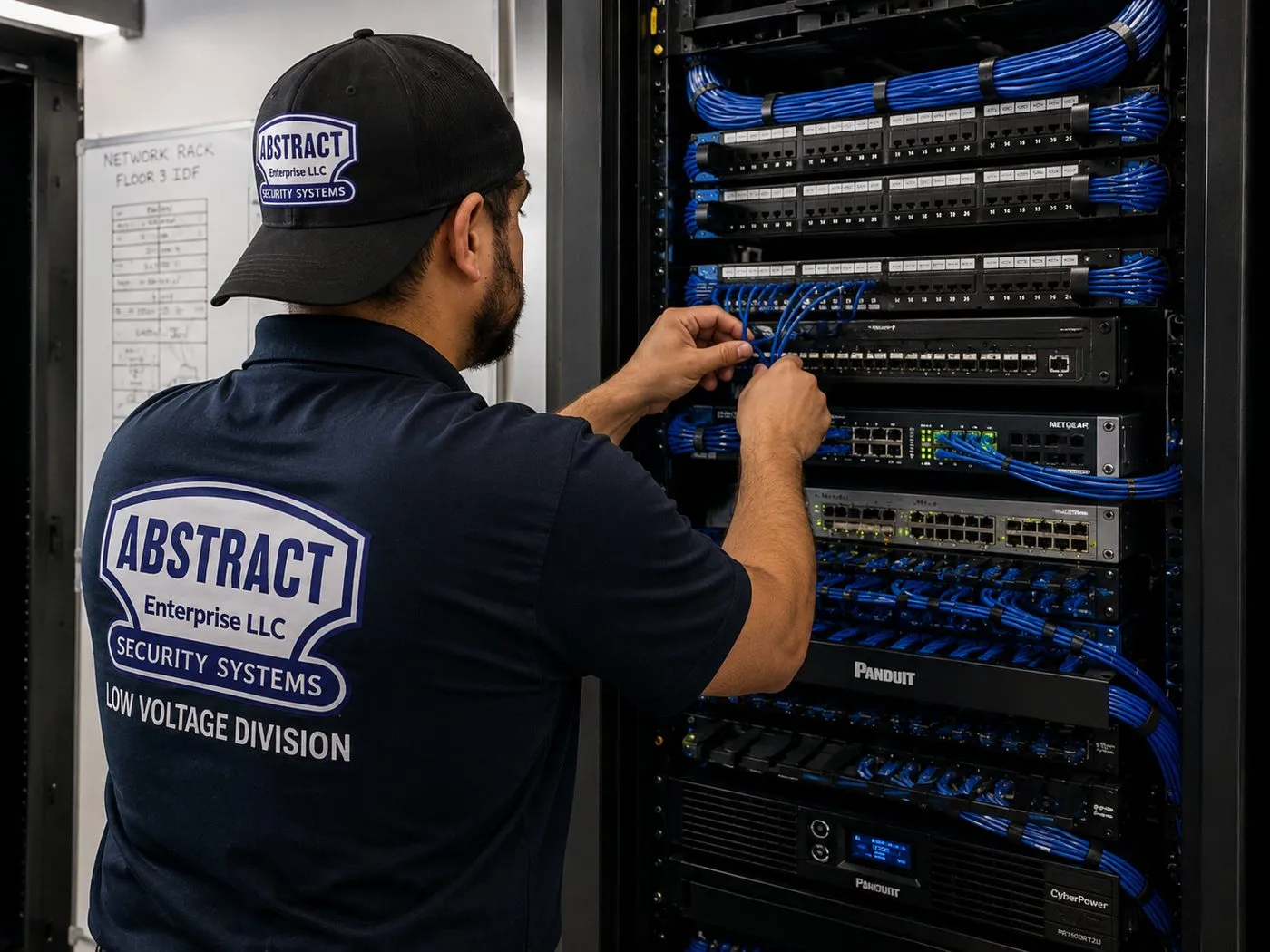
Show us the carrier's box and the desks that complain. We'll walk the path between them, test whatever fiber is already there, and tell you what it would take — free.
Tell us the village or hamlet, the kind of building and where the provider's equipment sits today. A Nassau fiber technician replies the same business day, or call (516) 346-5778.
Your details reached our Nassau desk. Expect a call from a fiber technician during business hours today or the next working day — or ring (516) 346-5778 now if something is down.
Seven steps, built for buildings that are already full of people and old cable. The second step is the one that saves Nassau clients the most money.
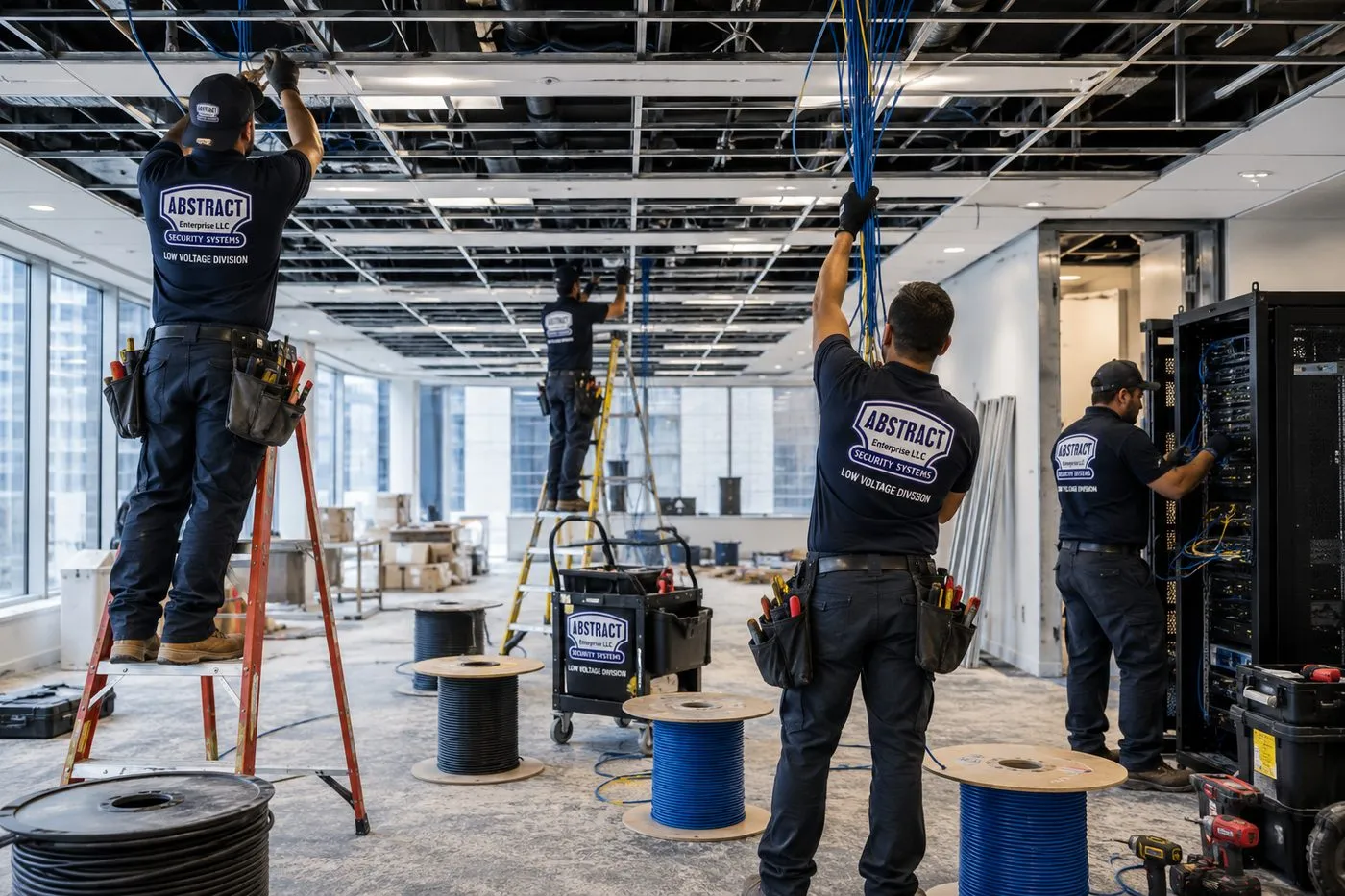
We start at the carrier's equipment and follow the existing path to every closet and room that needs service, lifting ceiling tiles and opening closets as we go, and noting plenum ceilings, sleeves and suspect materials.
Any existing fiber is identified, scoped, cleaned and loss-tested before we recommend new cable, so the proposal re-uses good glass and retires only what fails.
Route, cable type and rating, strand count, enclosures and test plan, priced line by line from our Nassau rates, plus the landlord submission, certificate of insurance and any building-department or district forms the job needs.
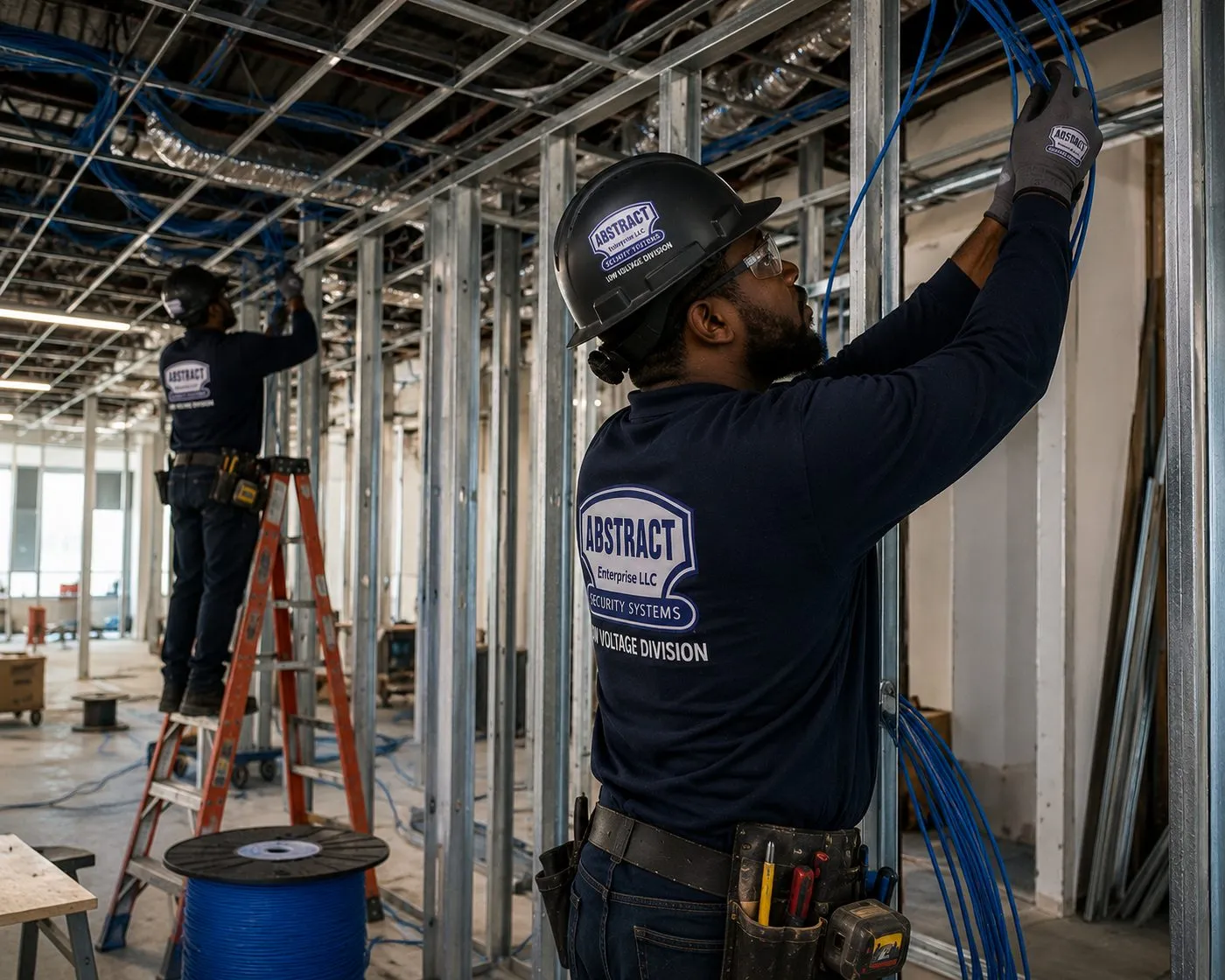
Dust protection and floor cover in occupied areas, existing sleeves re-used where allowed, new penetrations cored and sleeved, enclosures and racks mounted before any cable arrives.
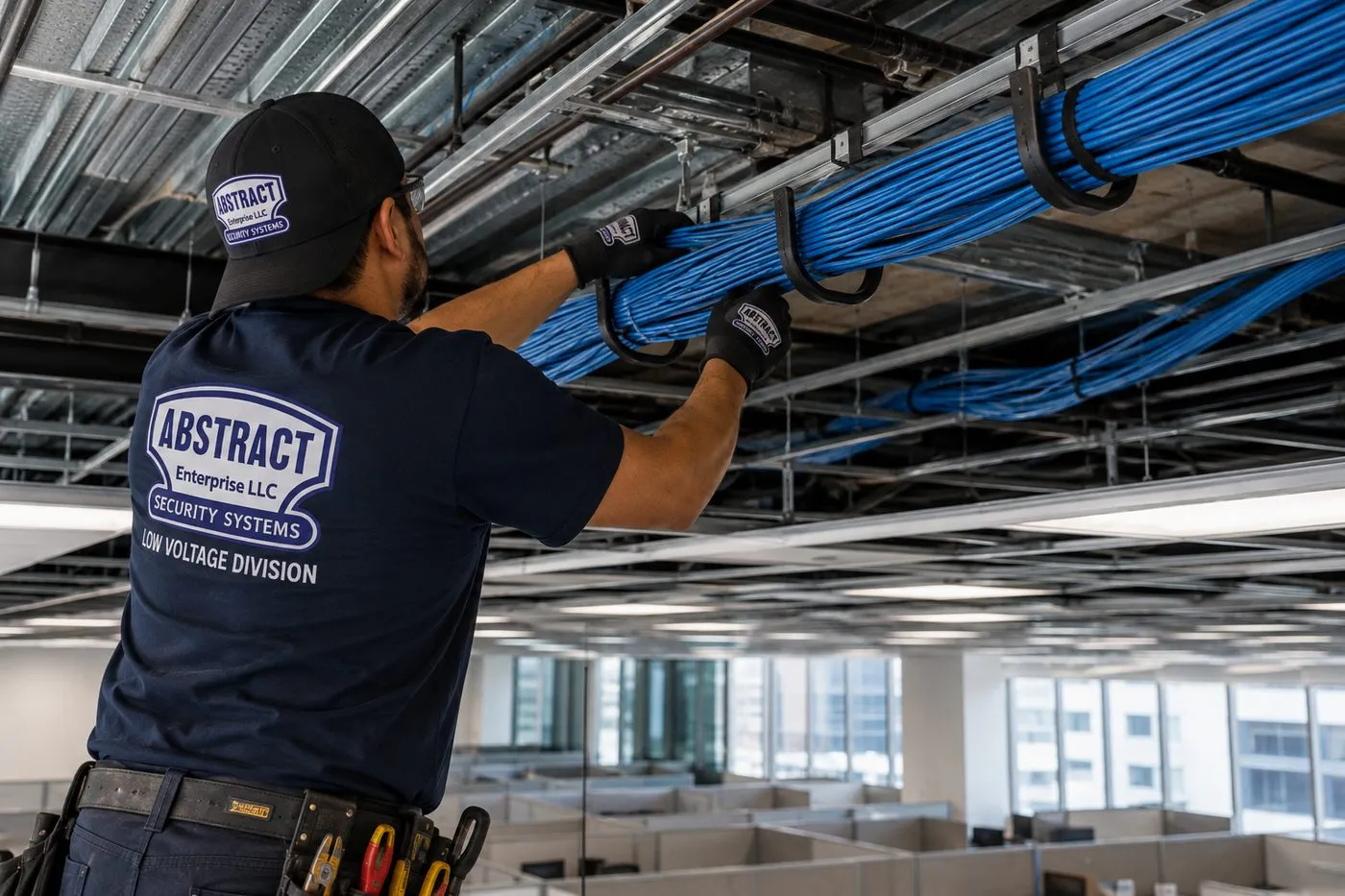
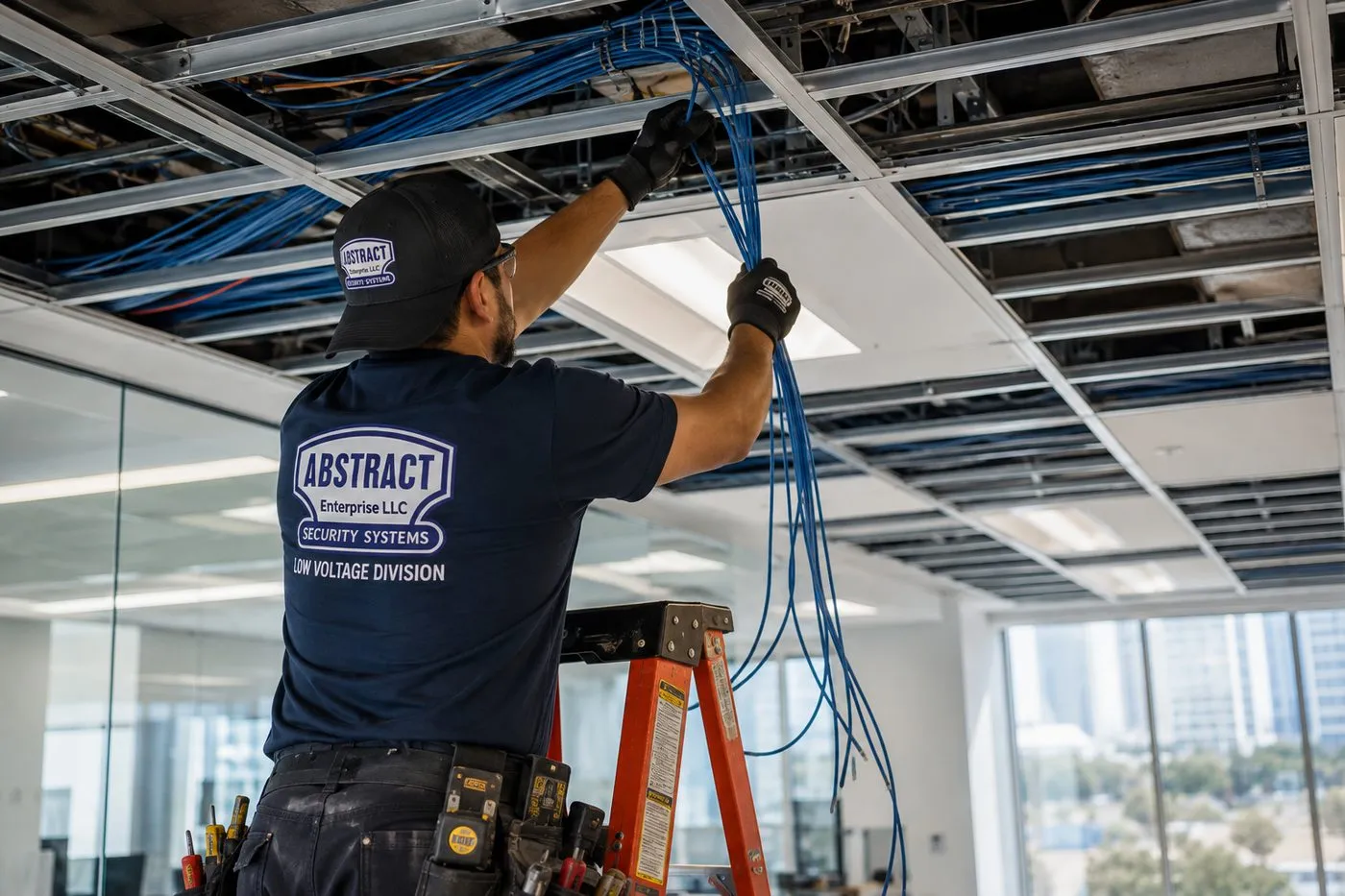
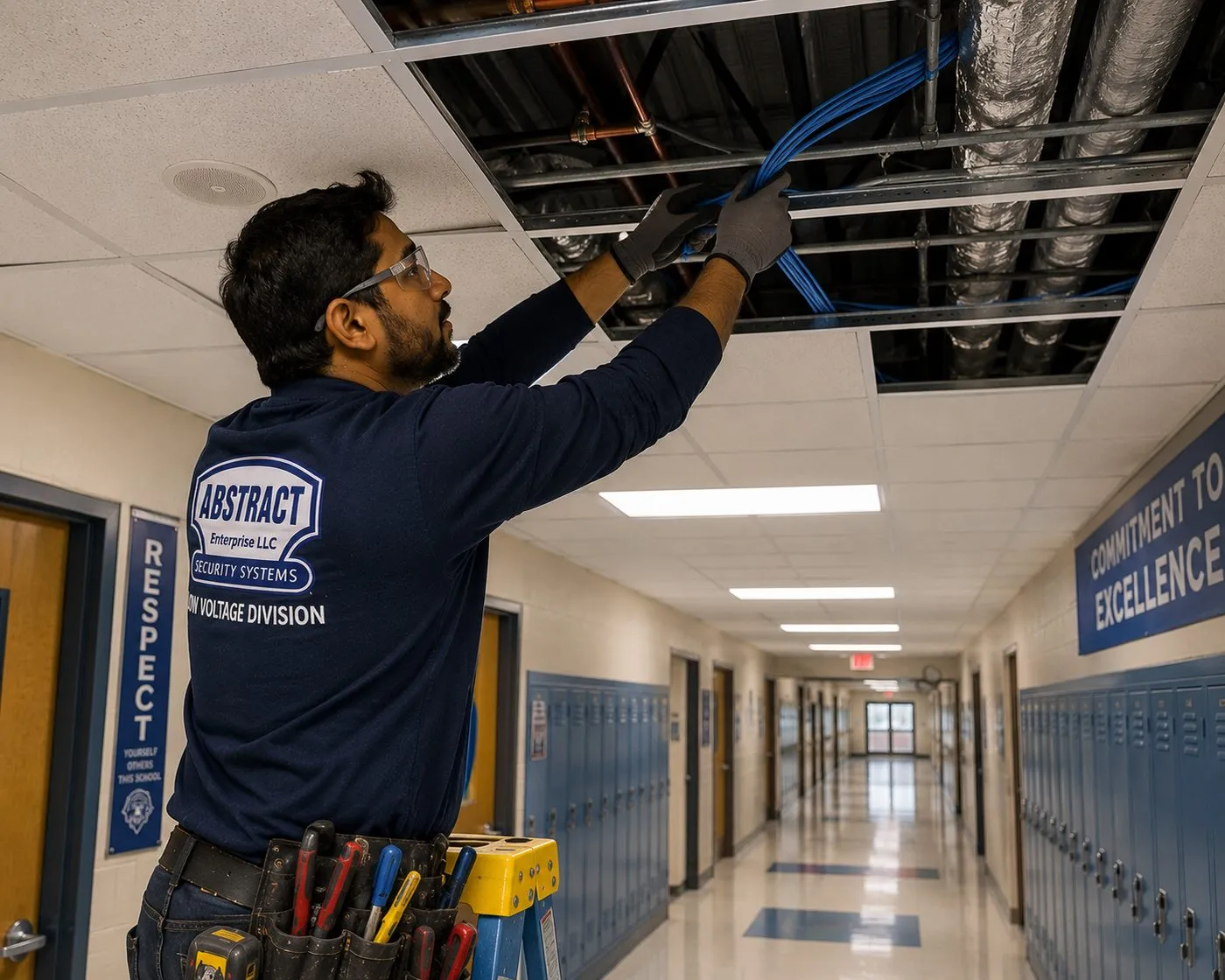
The crew feeds the cable by hand or with a measured pull, never past the maker's tension rating or tighter than its bend radius. It hangs from its own hooks or rides in innerduct instead of resting on ceiling tiles, and each hole it passes through is sealed with a listed firestop and photographed.
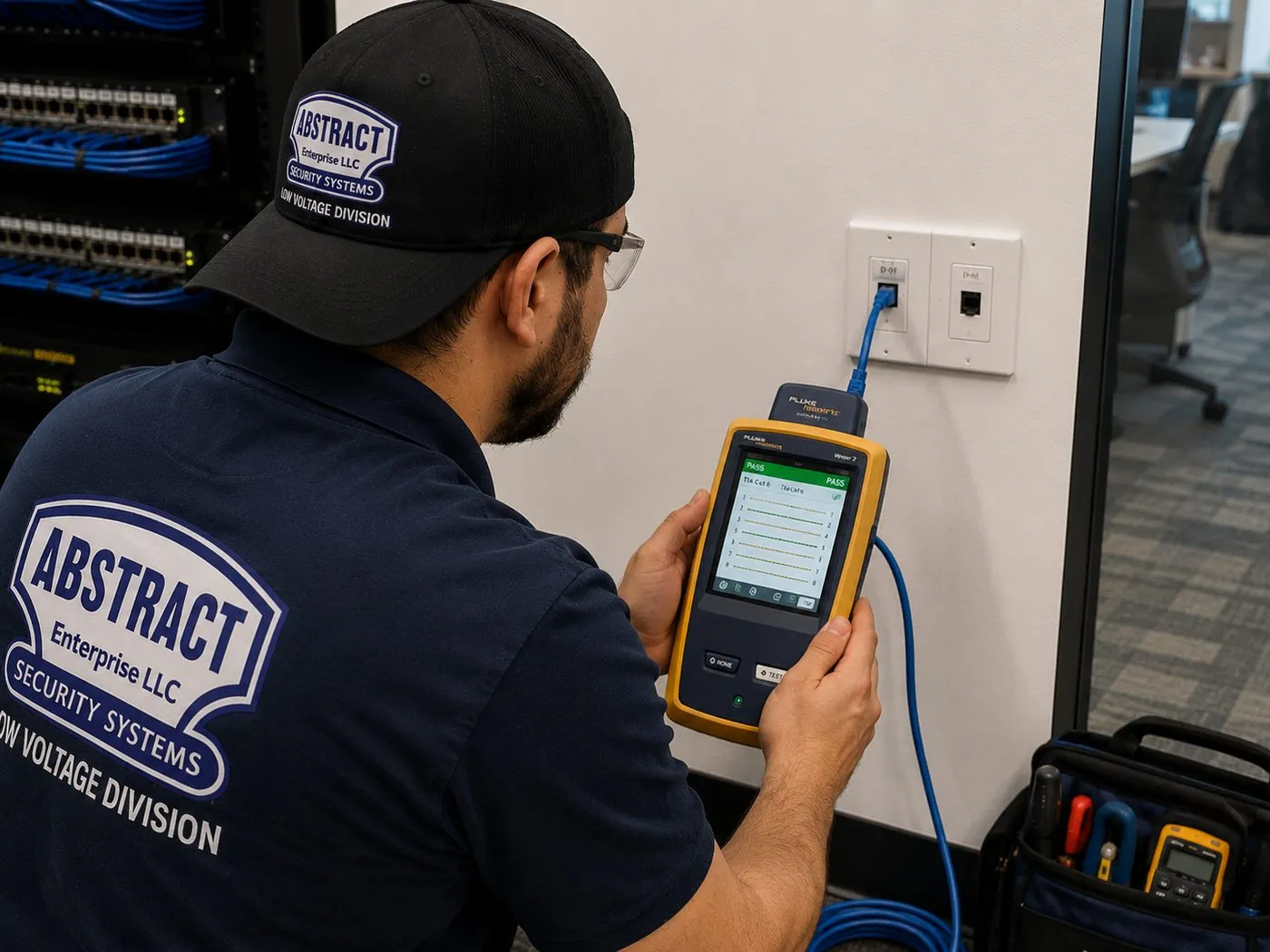
The glass is joined to factory-made connectors by fusion splice inside each enclosure. Then comes proof: a scope image of the end-faces, a two-way loss reading for each strand and, where the run is long or single-mode, an OTDR trace.
Traffic moved onto the new fiber at a time that suits you, old links labelled or removed as agreed, and a results file with a simple route map delivered to you and your IT provider.

Six places that say a lot about the buildings we work in across the county, from an airfield that became a mall to an aircraft plant that became a cleanup site.
A shopping centre of more than 2.37 million square feet at 630 Old Country Road, opened in 1956 on the airfield where Charles Lindbergh began his 1927 transatlantic flight. Its surrounding stretch of Old Country Road is Nassau's busiest retail corridor.
A SUNY college that opened in 1960 in the old county courthouse in Mineola and moved in 1962 to 135 acres of the former Mitchel Air Force Base. Today the campus covers 225 acres with 50 buildings and serves more than 17,000 students a year.
A 591-bed hospital at 259 First Street that opened in 1896 as Nassau Hospital, later became Winthrop-University Hospital and joined NYU Langone between 2017 and 2020. Medical offices fill the blocks around it.
A three-storey steel and curtain-wall office building of roughly 212,000 square feet, completed in 1978–79, with floors of about 70,000 square feet — typical of the large-floor-plate offices along the Lake Success corridor near the LIE and Northern State Parkway.
A 605-acre site in the Town of Oyster Bay where Grumman built aircraft from the 1930s and the Navy ran a weapons industrial reserve plant from 1941 until manufacturing stopped in 1996. Groundwater cleanup continues under state plans.
Ten miles of third track completed in 2022, running through Floral Park, New Hyde Park, Mineola, Carle Place, Westbury and Hicksville — villages whose station-area buildings are now being renovated and re-tenanted.
We also work in Great Neck, Manhasset, Port Washington, Roslyn, Glen Cove, Oyster Bay, Syosset, Jericho, Plainview, Levittown, Massapequa, Wantagh, Bellmore, Merrick, Freeport, Baldwin, Oceanside, Rockville Centre, Lynbrook, Valley Stream, Elmont, Franklin Square, West Hempstead, Hempstead, Uniondale, Long Beach and Island Park, and in neighbouring Queens and western Suffolk.

Nassau prices are our Brooklyn base rate × 1.15. They are the same Nassau figures published on our Long Island fiber optic installation page, rounded to the dollar. Unit lines are firm; backbones and building links are quoted inside the published ranges after a walkthrough.
| Item | Nassau price | What it covers |
|---|---|---|
| Fiber termination on an existing cable | $40 per termination | One connector — fusion-spliced pigtail or mechanical — including re-terminating legacy fiber |
| OTDR test | $46 per strand | Reflectometer shot of every strand showing each splice, connector and the far end |
| Multimode fiber drop | $403 per drop | Short in-building run, terminated both ends and tested |
| Single-mode fiber drop | $460 per drop | Short in-building run, terminated both ends and tested |
| 12-strand OM4 backbone between floors or closets | $5,175 – $8,050 | Fusion-spliced, enclosures both ends, firestopped, loss-tested |
| 24-strand OS2 single-mode backbone or building link | $9,200 – $17,250+ | Single-mode, spliced both ends, OTDR on every strand |
| Second telecom room with fiber link | from $2,760 | Fit-out of an additional IDF closet plus its fiber connection back to the MDF |
| Service and callback rate | $195/hr, 3-hr minimum ($585) | Repairs, troubleshooting and return visits — not the initial install |
National brand versus local contractor. People sometimes ask whether ADT, Ring or SimpliSafe could do this. Those brands are built around monitored alarms and consumer cameras; pulling and splicing private fiber through a Nassau office building is outside what they offer. Your practical options are three: the carrier's field technician, whose job ends at the carrier's own terminal; a regional or national integrator, who may hand the field work to a subcontractor; or a licensed contractor based nearby that owns a fusion splicer and an OTDR and puts the same people on the walkthrough and the install. That last description is ours, and because our unit prices are printed on this page, any competing bid can be checked against them line by line.
The totals below are simple sums of the Nassau price lines in the table, set against the three requests that reach our Nassau desk most often. A real proposal swaps in your route, strand count and building conditions.
$920
Two single-mode drops at $460 each: one from a small enclosure beside the carrier's basement terminal to your network room, and a spare alongside it for a second provider or a future upgrade, both terminated and tested.
$5,175 – $8,050
For the two- and three-storey office whose upstairs closets still hang off one old copper cable: twelve OM4 strands between the main room and each closet, panels at both ends, sealed penetrations and a loss reading per strand. Plenum ceilings and a crowded core push the price toward the top of the range.
$9,200 – $17,250+
A 24-strand OS2 single-mode backbone through a multi-floor building or to a neighbouring building on the same property, spliced into enclosures and OTDR-tested on every strand.
Legacy-fiber rescue. If the audit shows twelve strands of existing fiber that only need new connectors, re-terminating both ends (24 terminations at $40) and adding an OTDR trace on each strand (12 at $46) comes to $1,512 — often the cheapest way to a working backbone in an older Nassau building.
Some Nassau clients arrive with materials in hand — a reel their IT company ordered, enclosures left from a previous office, optics bought in bulk. We will use them. Labour is billed at the $195-an-hour service rate, three hours minimum ($585), covering the pull, the splicing and the certification. A reel we did not supply gets a continuity and loss check before it goes above anyone's ceiling, and anything you provide stays under its manufacturer's warranty rather than ours.

Before you budget for a new backbone, let us test the one you may already have. Walkthroughs are free; the Nassau price lines are published above.
A large share of Nassau's small commercial tenants are practices: physicians, dentists, physical therapists, accountants, attorneys and title agents, many of them clustered around Mineola's courts and hospital, along Northern Boulevard and Middle Neck Road, and on the main roads of the South Shore villages. Their networks have changed more in the last ten years than in the previous thirty. Imaging moved from film to files, records moved to the cloud, and phones moved onto the data network. The cabling in the suite usually did not change at all.
For these clients the hard part of a fiber job is not the cable; it is doing the work while patients and clients keep arriving. We plan in short, quiet blocks. Ceiling work above treatment rooms happens before opening or after closing. Dust protection goes up wherever a tile comes down. Any cutover that interrupts the network is scheduled for a lunch closing, a half day or a weekend, and the practice manager signs off on the time in advance.
The technical pattern is consistent. Fiber links the suite's equipment closet to the building's main telecom room, or the carrier's handoff to the closet, so the practice is no longer depending on a long copper cord through a shared basement. Inside the suite, new copper runs serve the workstations, imaging equipment and phones. Where several practices share one building closet, each practice's fiber lands in its own lockable enclosure, and strands are assigned in writing so nobody's records cross another tenant's equipment.
One more point matters to these offices: documentation. Practices are regularly asked by their IT vendors, auditors and insurers how their network is built. A labelled route map, per-strand test results and photographs of the closet are exactly the evidence they need, and we hand them over at the end of every job.
Walk down the main street of almost any Nassau village — Rockville Centre, Floral Park, Great Neck Plaza, Port Washington, Garden City, Sea Cliff, Massapequa Park, Freeport — and you will see the same building over and over: two or three storeys, a shop or restaurant at street level, offices or apartments above, and one basement where gas, electric, water, phone, cable and fiber all come in. Owners of these buildings call us when a new tenant needs a fast connection, when the apartments above complain about service, or when a renovation finally exposes the tangle in the basement.
The approach that works is to treat the basement as a small telecom room. We mount a wall enclosure near where the carriers enter, run one fiber cable up through the building by the most discreet path available — an existing chase, a closet stack, a stairwell raceway — and land it in small enclosures on each floor. Each occupant is assigned strands, recorded on a chart inside the basement enclosure. Any provider the occupant chooses can then deliver service to the basement and travel up on that occupant's strands without new holes in the building.
Two cautions apply. The first is the people below: a restaurant kitchen or a busy shop cannot have its ceiling opened at lunchtime, so the pull is scheduled with the ground-floor tenant, not just the landlord. The second is the village. Cable work inside an existing building is often modest enough to need no separate filing, but if it is part of a larger renovation, the village building department's rules for that renovation apply, and we make sure the fiber work fits inside them.
Nassau's post-war houses have been extended in every direction: dormers on Capes, second storeys on ranches, rear additions, converted garages and finished basements. Each addition was usually built by a different contractor in a different decade, and the wiring tells the story — a splice in the attic here, a cable stapled along a beam there, Wi-Fi extenders filling the gaps.
When the house also holds a business, the network has to work like an office's. The provider's terminal is typically in the basement or garage, and the office is as far from it as the house allows. Fiber is a good fit because one thin cable can follow a closet corner, an attic run or a garage ceiling to the far end of the house without the losses and interference long copper runs pick up near the electrical service, and it leaves spare strands for a second provider or a camera system later.
We keep these jobs small and tidy: one walkthrough with the homeowner, one route agreed room by room, drop cloths before tools, and a finished enclosure in the office that looks like it belongs there. The family network stays exactly as it was unless you want us to improve it too.
Retail is a big part of Nassau's economy, and it is concentrated: the Old Country Road corridor from Garden City through Carle Place and Westbury, Roosevelt Field itself, the strip centres of Hempstead Turnpike and Sunrise Highway, and the main streets of the villages. Stores have become networks with a sales floor attached. Card terminals, inventory scanners, cameras, digital signage, guest Wi-Fi and the back office all compete for one connection, and the equipment that runs them is often in a stockroom at the back of a deep, narrow space.
In an enclosed mall or a managed centre, the landlord usually controls the main telecom rooms and the service corridors behind the stores. A carrier brings the circuit to the landlord's room; getting it from there to the tenant's stockroom is where fiber earns its place. The run can be long, it shares a crowded pathway, and it has to follow the landlord's rules on routing, labelling and access hours. We submit the route for approval, work in the hours the centre allows and leave the cable labelled to the landlord's standard as well as our own.
In a strip centre or a freestanding big-box store, the problem is usually distance inside the building. The carrier enters at one end, the office is at the other, and the cameras and access points are spread across a sales floor that can be hundreds of feet deep. A fiber link from the entrance point to a closet near the middle of the store, or to the stockroom at the back, shortens every copper run that follows. Our commercial camera installers in Nassau often lay out the camera positions on the same walkthrough so the closet ends up where both systems need it.
Retail work also runs to a calendar. Nobody wants a cutover on a Saturday in December. We schedule the pull before opening or after closing and plan the cutover for the slowest hour of the slowest day, agreed with the store manager in advance.
Most Nassau businesses we serve have an IT provider already: a managed-service company, a one-person consultant or a staff member who looks after the network. We are not there to replace them. Our job is the physical layer — the glass, the enclosures, the connectors and the proof that they work — and we hand it to your IT people in a form they can use straight away.
That starts before the proposal. We ask your IT provider what switches and firewalls sit at each end, which optics they already own, whether they prefer LC or another connector, and whether they want multimode or single-mode for future equipment. If they have a standard, we build to it. If they don't, we recommend one and explain why.
On cutover day we bring the fiber to a labelled panel position and a tested patch cord, and they move the traffic. If an optic doesn't link, we can test the strand on the spot with a light source and power meter, so nobody spends the evening guessing whether the problem is the glass or the switch. Afterwards they receive the same results file you do, with strand numbers and port assignments that match what they see in their own management tools.
The arrangement works the other way too. If your IT provider has spotted a bottleneck and wants a fiber link added, they can call us directly at (516) 346-5778 and we will quote it to you, with them copied, from our published Nassau rates.
The cable is the cheap part of a fiber job; the labour to pull it is not. That is why we size strand counts for the life of the building rather than for today's switch. A typical Nassau office link uses two strands for the main uplink. We rarely install fewer than twelve.
For a single tenant in a two-storey office, twelve strands is usually plenty. For a multi-tenant building, a school wing or a backbone that might one day serve several businesses, twenty-four is the safer choice. The difference in material cost is small next to the cost of opening the ceilings again.
Not every slow network needs glass, and we would rather tell you that on the walkthrough than sell you a backbone you don't need. Three situations come up often in Nassau.
The run is short and the copper is good. In a single-floor office where every closet is within copper's reach of the main room, a properly installed and certified Category 6 or 6A cable between them will carry the speeds most small businesses use. If the existing link is simply a damaged or badly terminated cable, repairing it is the right answer.
The bottleneck is the equipment, not the cable. An old switch with ten-megabit or hundred-megabit ports, a firewall that cannot keep up with the circuit, or a router doing a job it was never designed for will cap speeds no matter what connects to it. We test the link and tell you plainly if the glass is not the problem.
The building can't be opened. Occasionally a lease, an asbestos finding or a landlord's rule rules out any new cable for now. In those cases a temporary solution — better wireless, or re-using an existing pathway as far as it goes — can carry you until the space is renovated, when fiber can be added cheaply while the ceilings are already open.
Either way, you leave the walkthrough with a clear picture of where the bottleneck is and what it would cost to remove it.
Nassau's three towns and two cities feel like different places once you are inside their buildings. The fiber work changes with them.
The town where Verizon built fiber to the premises first, from Valley Stream and Elmont east to Merrick and Baldwin. It holds the county's densest mix: Uniondale's offices and arenas, Hempstead village's downtown, the strip retail of Sunrise Highway and Hempstead Turnpike, and the South Shore communities that took the worst of Sandy. Jobs here are often small and urgent — a medical office whose demarc sits in a basement that has flooded before, a storefront landlord who wants each tenant on its own strands, a professional office in a converted house on a commercial avenue.
Lake Success, New Hyde Park, Great Neck, Manhasset, Port Washington, Roslyn, Mineola and Westbury: home to many of the county's large office buildings and medical practices. This is where we meet big floor plates, return-air ceilings and earlier tenants' fiber most often. The town's own commercial plan-review checklist is a reminder that fire alarm and sprinkler changes go to the Nassau County Fire Marshal, so we always ask whether a fit-out touches those systems before scheduling.
From Bethpage, Hicksville and Plainview in the middle of the island up through Syosset, Jericho and Woodbury to the North Shore hamlets and Oyster Bay itself. The central part is office parks and flex buildings along the Long Island Expressway and Route 135, many on or near land with an industrial past. The northern part is larger houses and estates where a home office or a separate guest building needs one clean link back to the main house.
Nassau's two cities sit at opposite ends of the county and on opposite waters. Glen Cove on the North Shore has a compact downtown and older mixed-use buildings around its waterfront; Long Beach is a barrier-island city where Sandy did heavy damage in 2012 and where equipment rooms belong above the next flood line. Both run their own building departments, separate from the towns.
When Sandy came through in October 2012, AP reported more than a thousand homes destroyed in the Town of Hempstead alone, and more than seventy-one thousand Nassau households applied for federal help. In Long Beach, Island Park, Oceanside, Freeport, Baldwin and Massapequa, the buildings that came back were often raised, gutted and rewired, and the carriers rebuilt their drops at the same time. The result, more than a decade later, is a South Shore with a lot of relatively new carrier equipment and a lot of owner-side wiring that was put back in a hurry.
Three habits make fiber work here last longer. First, keep the electronics high. If a carrier terminal has to stay low by the service entrance, a short fiber link lets your firewall, switches and battery backup live on a raised shelf or an upper floor, where the next storm surge won't reach them. Glass and properly sealed enclosures tolerate damp far better than powered equipment does.
Second, use enclosures and connectors suited to salt air in anything near the water: sealed wall boxes, covered adapters and no bare connectors left hanging in a garage or a bulkhead-side storage room. A scoped and capped connector that sat in salty air for a summer is much easier to clean than one left open.
Third, write the route down. After Sandy, many owners could not tell insurers or new contractors which cable did what. A one-page map with photographs of every penetration and enclosure costs little and makes the next rebuild, or the next claim, much simpler.
Nassau's office market has been reshaping itself for years. Tenants consolidate into one floor, landlords carve big floors into smaller suites, medical groups take over space that used to be general office, and an office in a converted house on a commercial road becomes a dental practice. Each change cuts across cable that someone else installed.
We see the same three problems again and again. Backbones that cross a suite being returned to the landlord, which get cut during the next tenant's demolition. Closets that end up inside one tenant's space while serving another, so a business needs permission to reach its own equipment. And fiber that was abandoned in place by a departing tenant, still connected at one end, confusing everyone who opens the ceiling afterwards.
The fix is planning before the wall moves. If you are a tenant, ask your broker or attorney to cover cable paths in the lease or the work letter: who may use the existing pathways, whether you can keep your backbone in common areas, and who removes what at move-out. If you are a landlord re-demising a floor, ask for an existing-conditions survey of the telecom closets before the architect draws the new walls. We can provide either, and we can re-route a live backbone around a new demising wall overnight so the business never notices.
Every Nassau job ends with a results file. It is worth knowing what is in it, both to check our work and to compare it with what another contractor gives you.
If you are handed a single sheet that says "all fiber tested OK," ask for the per-strand numbers. A contractor who took them will have them.
A walkthrough takes about an hour in a typical office and less in a house. These five things make it more useful.
You don't need drawings. If there are some, they help; if there aren't, the walkthrough and our route map will become the drawing.
Owners who call about fiber in Nassau usually end up asking about something else on the same visit. These are the related services we quote alongside it most often.
The full cabling plant, copper and fiber, designed and certified as one system.
New copper to the desks and access points that the fiber backbone feeds.
Switches, firewalls, optics and wireless that put new glass to work.
Fault finding and repair on existing copper runs.
Data, cameras, intercom and audio planned together for one building.
The interactive price tool for copper and fiber drops in Nassau.
Storefront, lot and corridor cameras whose video can share the backbone strands.
Door readers in several wings or buildings tied to one controller.
District camera projects that ride on the same new building links.
Three habits our crews bring to every Nassau site. These describe routine practice; they are not an account of a particular customer.
In a Nassau office the first tile we lift is above the main closet, not above the problem desk. That is where the history is: old fiber coiled in a loop, a telephone block nobody has touched, cable from three earlier tenants tied together. Ten minutes there tells us more about the building than an hour anywhere else.
The second habit is to bring the scope and the cleaning kit on the walkthrough, not just on the install. If there is legacy fiber, we would rather know on day one whether it is reusable, because it changes the whole proposal.
The third is to treat the people downstairs as clients too. In a village block with a shop below and apartments above, the shop owner's Saturday and the tenants' evenings matter as much as the landlord's schedule. We ask, we put it in writing, and we keep to it.
Yes. We work across all of Nassau County: the North Shore from Great Neck and Port Washington to Glen Cove and Oyster Bay, the central corridor from Lake Success through Garden City, Mineola and Hicksville to Bethpage, and the South Shore from Valley Stream and Rockville Centre to Long Beach and Massapequa. Villages, hamlets and the two cities are all covered, and we confirm local building-department rules for each address.
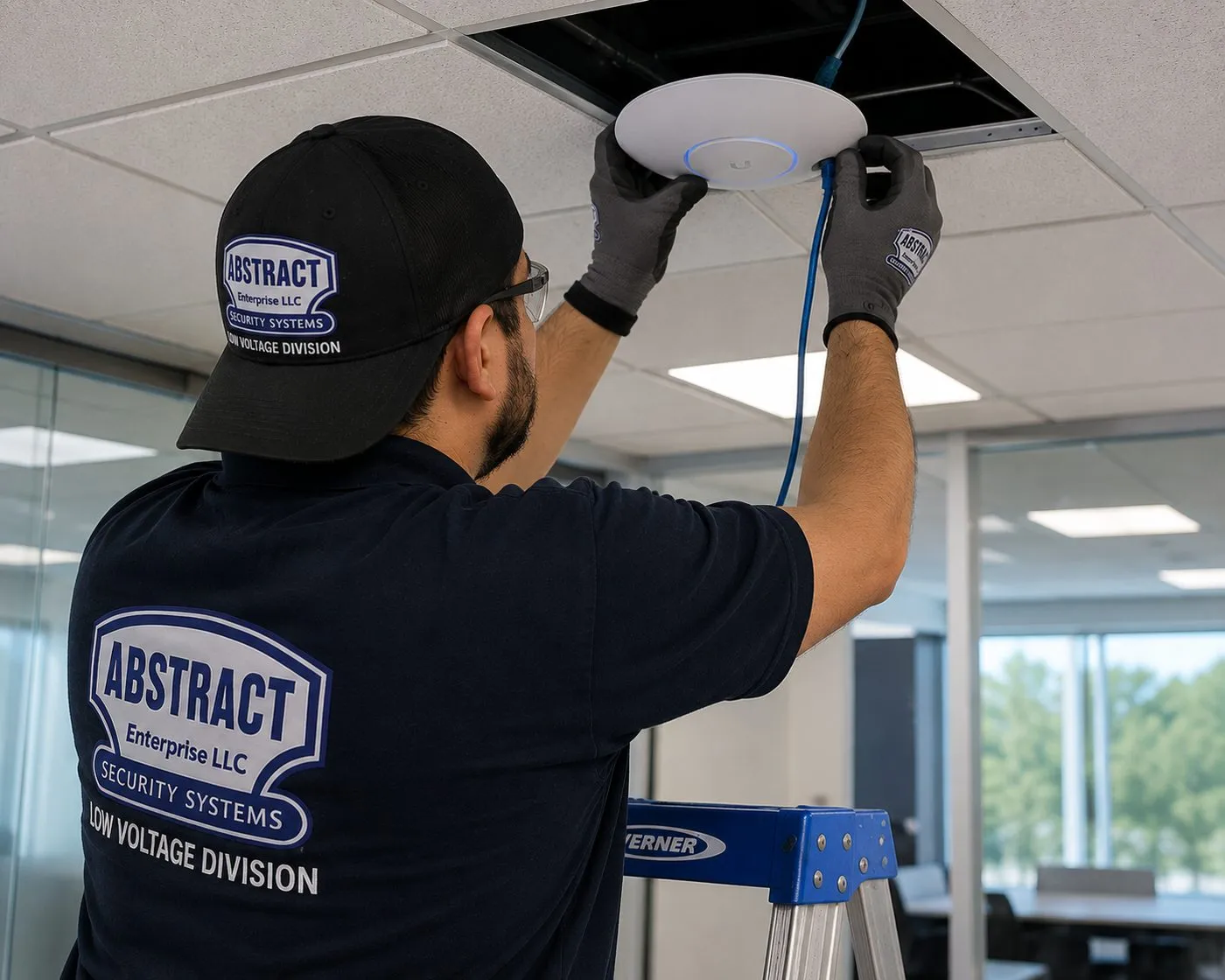
Not usually, and they don't need to. Ceiling access points draw their power and data over a copper Cat6 cable from a PoE switch, and that cable has to stay within 100 metres of the switch. The fiber's job is the step before: it joins the closet holding that switch to the main equipment room, so every access point on the floor shares a fast, interference-free uplink. If an access point has to sit farther than copper allows, we place a small switch near it and feed that switch with fiber.
Most of the time, yes. In a typical Nassau office the cable travels above the drop ceiling, down inside existing conduit or an empty wall cavity we can fish from above, or in a slim surface raceway painted to match the wall. We only cut drywall where no hidden route exists, and when we do the opening is small and patched. The walkthrough is where we find the route, and the proposal says plainly whether any wall has to be opened.
Fiber supported on its own hooks or in innerduct, rather than lying on the tiles or tied to the old grid, usually survives a ceiling replacement untouched. Before the ceiling contractor starts, we can tag the route, photograph it and, if needed, temporarily support the cable while the grid is removed. After the new ceiling is in, we re-test the strands so you know nothing was damaged.
Yes. Independent acceptance testing is a sensible step before you sign off on a fiber job. We inspect the connectors, measure loss on every strand and, on longer or single-mode runs, take OTDR traces, then compare the results with what the installer promised. Testing is billed at our published Nassau rates, and you receive the per-strand results whether the work passes or not.
Very little, if the cutover is planned. We pull, splice and test the new fiber while your existing link keeps running, so the office works normally through installation. Going live is then a matter of moving uplinks and patch cords onto the new strands, which we schedule in a window you choose — often early morning or after closing — with the old link left in place until the new one has carried traffic successfully.
Yes. Many Nassau office buildings have upgraded their energy management systems, and those controls are best kept off the tenants' networks. A backbone cable can dedicate a pair of strands to building controls, landing in their own enclosure or panel position, so the controls contractor has a private path between the plant room and each floor without touching any tenant's equipment.
Usually. Most business switches bought in the last decade have SFP or SFP+ slots that accept a small optical module, and the module is matched to the fiber type and distance. We check the model numbers on the walkthrough and tell your IT provider which optics to use; if a switch has no fiber slots, a pair of media converters bridges the gap until the switch is replaced.
Equipment and cable that belong to the carrier are the carrier's to remove, so we don't take them out ourselves; we can help you ask the provider to retire dead equipment. Old wiring that belongs to the building, such as abandoned copper or fiber from earlier tenants, can be removed or labelled as abandoned with the owner's agreement, which leaves the wall and ceiling clear for the next contractor.
This Nassau page sits under our Long Island fiber optic installation hub, which covers building-to-building links across parking lots and campuses. Next door, fiber optic installation in Suffolk County deals with larger sites and longer distances. The same crews and the same tools serve New York City and the Hudson Valley.
AESS fiber optic installation NYC · Manhattan · Brooklyn · Queens · the Bronx · Staten Island
Hudson Valley fiber optic installation · Westchester · Rockland · Orange · Putnam · Dutchess · Ulster
Need cameras, intercoms, alarms or door access rather than fiber? Our Abstract Enterprises Security Systems home page lists every service, and the story of our company explains who will turn up.
Upstairs desks offline, a school wing cut off, or a village storefront's door readers frozen? Ring (516) 346-5778 and tell us which link dropped. Same-day dispatch is the goal from the North Shore to the South Shore. Most outages trace to a crushed patch lead, a contaminated end-face or a snapped pigtail, which a technician typically locates and fixes inside an hour or two before measuring the strand again.
Abstract Enterprises Security Systems · 1282 Troy Ave, Brooklyn, NY 11203 · Nassau line (516) 346-5778 · WhatsApp (718) 679-0359 via wa.me
NYS Low-Voltage Licence #12000287431 · 100% Licensed & Insured · Same-Day Estimates · Rated 4.7★ from 201 Google Reviews
Full terms — including 50% deposit, one-year parts-only warranty on AESS-supplied products, and the late-fee schedule — are set out in the service agreement. See our warranty page.
Page reviewed and updated October 17, 2026. Changelog: first publication of the Nassau County fiber optic installation page.