Licensed Low-Voltage Contractor · Kingston, New Paltz & the Catskill Towns · Owner-Side Fiber
Fiber Optic Installation in Ulster County
The provider's glass reaches the wall. We carry it the rest of the way.
Ulster County has more fiber at the curb than it has ever had: Archtop in Kingston, Saugerties and Woodstock, Planet Networks on the poles, MTC around Phoenicia, and a Verizon build funded to reach every one of the county's 1,293 unserved locations. What none of those providers do is wire the inside of a reused factory, a Rondout storefront, a Woodstock rental compound or a Shawangunk retreat. That owner-side fiber, from the provider's box to every room and building that needs it, is what we design, splice and test.
Reviewed and updated October 17, 2026 · Ulster County pricing at the published 1.53× area rate · NYS Low-Voltage License #12000287431
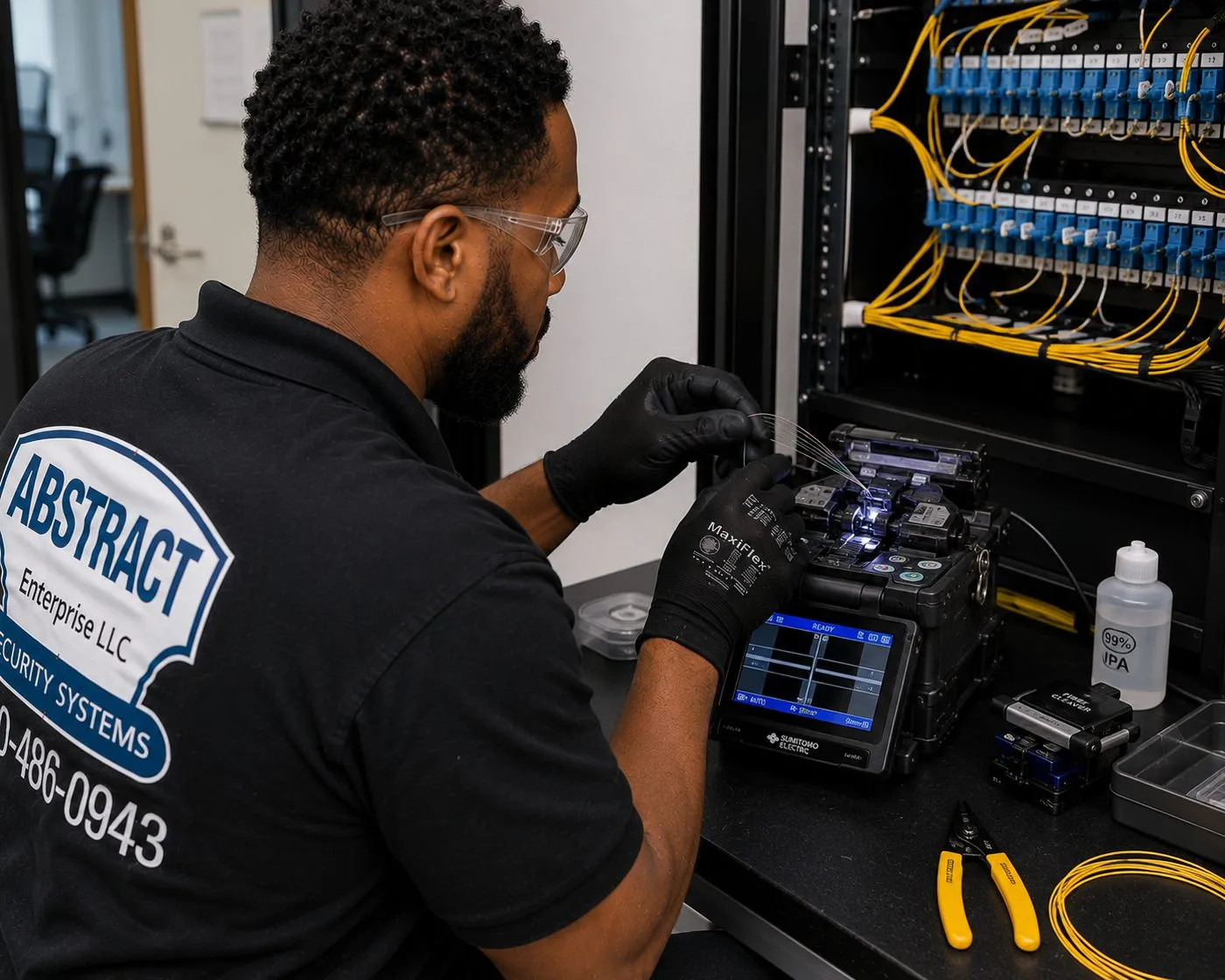
Gloved hands guide bare fiber into a fusion splicer whose screen reads READY; a cleaver, a bottle of 99% isopropyl alcohol, yellow fiber and a pair of strippers sit on the bench under a cabinet of labelled blue connectors.
Ulster Fiber Quote
Tell us who your provider is and where the network has to reach — we reply the same business day.
✅
Request Sent!
An Ulster County installer will call you back the same business day.
25+
Years Experience
✓
Same-Day Estimates
100%
Licensed & Insured
4.7★
201 Google Reviews
New provider fiber at the wall, and a building that still runs on old copper? Call (845) 640-3835 or send the 60-second form with a photo of the provider's box and a note on where the network has to reach. An installer reads it and calls back, usually the same day.
Owner-side fiber designed around the provider you already have, or the two you want
Every strand spliced, scoped and loss-tested; results and a route drawing handed over
Licensed under NYS low-voltage license #12000287431, insured, with certificates issued to landlords, inns and campuses on request
Why Ulster County Properties Need Fiber Optic Installation
For most of the last twenty years the question in Ulster County was whether fiber would ever reach the road. That question is now largely settled, and a different one has taken its place. Archtop Fiber, which is headquartered in Kingston and sits on the East Campus of iPark 87, the former IBM complex, turned on service for homes and businesses around Kingston in March 2024 and in the town and village of Saugerties a month later, and it began building a network in Woodstock that October. Planet Networks, a Newton, New Jersey company, builds along existing utility poles and says it is expanding from Saugerties and Kingston into smaller communities. Margaretville Telephone Company sells fiber service around Phoenicia in the Town of Shandaken. And in May 2026 the county announced that federal BEAD funding had been approved so that Verizon will build fiber to all 1,293 locations in the county still classed as unserved, a $59 million project of which Verizon is paying 71 percent.
Every one of those networks ends the same way: a cable to one point on one building, a small terminal on the wall or in the cellar, and an optical network terminal or router beside it. That is the provider's demarcation point, and everything on the far side of it belongs to the property owner. In a split-level house with the router in the den, that is enough. In most of the buildings people actually call us about in Ulster County, it is not. A multi-gig service that arrives in the cellar of a nineteenth-century commercial building in Uptown Kingston does nothing for the second-floor office until something carries it up there. A service landed in the main lodge of a mountain retreat does nothing for the eight cabins down the hill. A tenant in a former factory building at iPark 87 may find the building's riser full of cable nobody has identified since the 1990s. The bottleneck has moved from the road to the inside of the property.
The county's building stock makes that last stretch harder than it is almost anywhere else in the region. Kingston was the first capital of New York State and was burned by British troops in October 1777; its Uptown Stockade District still has seventeenth-century stone buildings, Midtown grew around early twentieth-century industry along Broadway, and the downtown Rondout district was a tidewater coal terminal at the end of the Delaware and Hudson Canal. Outside the city, a large share of the property that changes hands is reused for something it was not built for: IBM's typewriter and computer plant became a business park, a Hudson River brickyard became a hotel with private cabins, the Lace Mill in Midtown Kingston became 55 apartments with a preference for artists, farmhouses became short-term rentals, and properties across the Catskills and the Shawangunk Ridge now host retreats, weddings and paying guests. None of those buildings were planned with a modern network in mind.
Then there is the way Ulster properties are used. The county comptroller's 2025 report counted 2,827 short-term rentals operating in May 2025, more than three percent of all housing in the county, and found that 98 percent of them were entire homes. In Shandaken, Woodstock, Gardiner and Denning, more than seven percent of all housing is rented by the night. Guests arrive expecting the internet to work everywhere on the property, owners want their own cameras, locks and thermostats kept apart from the guests, and the owner is often two hours away in the city when something stops working. A remote property with a fiber service at the road and a consumer router in the kitchen is the most common setup we are asked to fix, and the fix is almost always wiring, not a faster plan.
So the fiber work in Ulster County is mostly owner-side work. It starts at whatever the provider installed, carries that service through old masonry, timber and reused industrial space to the places it needs to be, splits it safely between owners, tenants and guests, and is tested and documented so the next person who opens the cabinet understands it. The rest of this page explains how we do that across the county's very different towns, what it costs at the Ulster rate, and the questions owners here ask us most.
Ulster County facts that shape fiber work
1,293 locations: every unserved location in Ulster County is to receive fiber under the federal BEAD program, with Verizon as the county's participating provider; $17.3 million in federal funds and $41.7 million from Verizon make a $59 million buildout (Ulster County, May 1, 2026).
March and April 2024: Archtop Fiber switched on service around Kingston, then in the town and village of Saugerties, and says it offers speeds up to 10 Gig (Hudson Valley One, May 2024). It had signed 14 memoranda of understanding with Ulster County communities at that time.
2,827 short-term rentals: operating in Ulster County in May 2025, 3.28 percent of housing; 98 percent are entire homes, and Shandaken leads the county at nearly one housing unit in ten (Ulster County Comptroller, 2025).
200 acres, over 1 million square feet: the former IBM Kingston plant on Enterprise Drive, now iPark 87, whose East Campus houses the Ulster BOCES Career Academies and Archtop Fiber (Ulster County, February 2026).
1,400+ students: high-school juniors and seniors who started at the Ulster BOCES Career Academies at iPark 87 in September 2025, inside the former IBM complex (Ulster BOCES).
1,161 square miles: Ulster's area, with more than a quarter million acres of forever-wild Catskill Park and Forest Preserve land inside it and a 2023 population of 182,333 (New York State).
122.9 billion gallons: the full capacity of the Ashokan Reservoir in the Town of Olive, part of New York City's Catskill water supply, in service since 1915 (NYC DEP).
Chapter 185: the Ulster County Electrical Licensing Law, adopted in 2019 and amended in October 2025, which requires a county Master Electrician license for electrical work and defines that work to include wiring used for communication and data transmission.
Owners who bring fiber to a rental compound or a converted building almost always want cameras and door control on the same strands. Our access control installers in Ulster County and commercial camera team for Ulster plan those devices around the fiber from the first walk-through, so nothing has to be pulled twice.
Repair Capture
Same-Day Fiber Repair Across Ulster County
A link to the guest cabins that died overnight, a patch cord crushed when a shop's ceiling was reworked, a splice case that let in water after a wet spring in the Esopus valley — those are repairs, and they get a repair response. We dispatch the same day where the schedule allows, and most single-point faults on fiber we can reach — a broken connector, a damaged pigtail, a kinked patch cord, a wet enclosure — are found with a light source or OTDR and fixed in one to two hours on site. Call (845) 640-3835 and say it is a fiber repair. For faults on copper runs, see our network cable repair service in Ulster County.
What We Install
Fiber Optic Installation Services in Ulster County
Almost every Ulster job begins at somebody else's equipment — a provider's terminal, a landlord's cabinet, a previous tenant's rack — so each service below starts by working out exactly what is already there. They can be quoted one at a time or as a single project, and each one ends with tested strands, labelled ports and a written record.
Demarc Extensions
The provider's optical terminal lands where it was easiest for the provider's crew: a cellar wall, a utility closet, the back of a garage. We carry the service from there to the room where the network really lives, on fiber you own, with a labelled patch point at each end so the provider's technician can still find their equipment.
Dual-Provider Entrances
Where two providers serve the same street — Archtop and Spectrum in much of Kingston, Planet Networks and Spectrum around Saugerties — a business can take one as primary and one as backup. We plan two separate building entries and two separate paths to the network room so a single dig or fallen branch can't take both down.
Floor-to-Floor Backbones in Old Buildings
Multimode or single-mode fiber from a cellar or ground-floor room to closets on upper floors of nineteenth- and early twentieth-century commercial buildings, routed through old chases, dumbwaiter shafts, closets and pipe paths rather than through finished plaster.
Reused Industrial and Mill Buildings
Fiber through former factory space: long bays, heavy masonry, abandoned conduit and cable trays of unknown history. We identify and tag what is live, remove or abandon in place what is dead with the owner's agreement, and build a documented backbone for the new tenants.
Rental, Inn and Retreat Networks
One provider feed carried by fiber from the main house or lodge to cottages, cabins, a studio or a barn, with separate networks for guests, the owner's devices and the property's cameras and locks, and remote management so problems can be seen from two hours away.
Multi-Tenant Commercial Buildings
Shared main streets in Kingston, Saugerties, New Paltz and Woodstock have buildings with a shop on the ground floor, an office above and an apartment on top. We build a shared fiber riser and a clean common demarc so each tenant can order service from the provider of their choice.
Fusion Splicing and Termination
Pigtail fusion splicing into rack panels and wall enclosures, connector inspection under a fiber scope, and repair splices on existing cable. Splicing is done by our own technicians with our own splicer, not subcontracted.
Testing and Closeout Records
Light-source and power-meter loss on every strand, OTDR traces on long or spliced runs, labelled ports, photos of every enclosure and a route drawing — the record an inn's next owner, a BOCES-trained IT tech or a landlord's engineer can pick up and use.
Fiber for Cameras, Locks and Wi-Fi
Strands planned for the devices that actually ride on the network in Ulster: cameras on remote parking areas and trailheads of private property, keypad and smart-lock controllers on rental doors, access points in cabins and on event lawns.
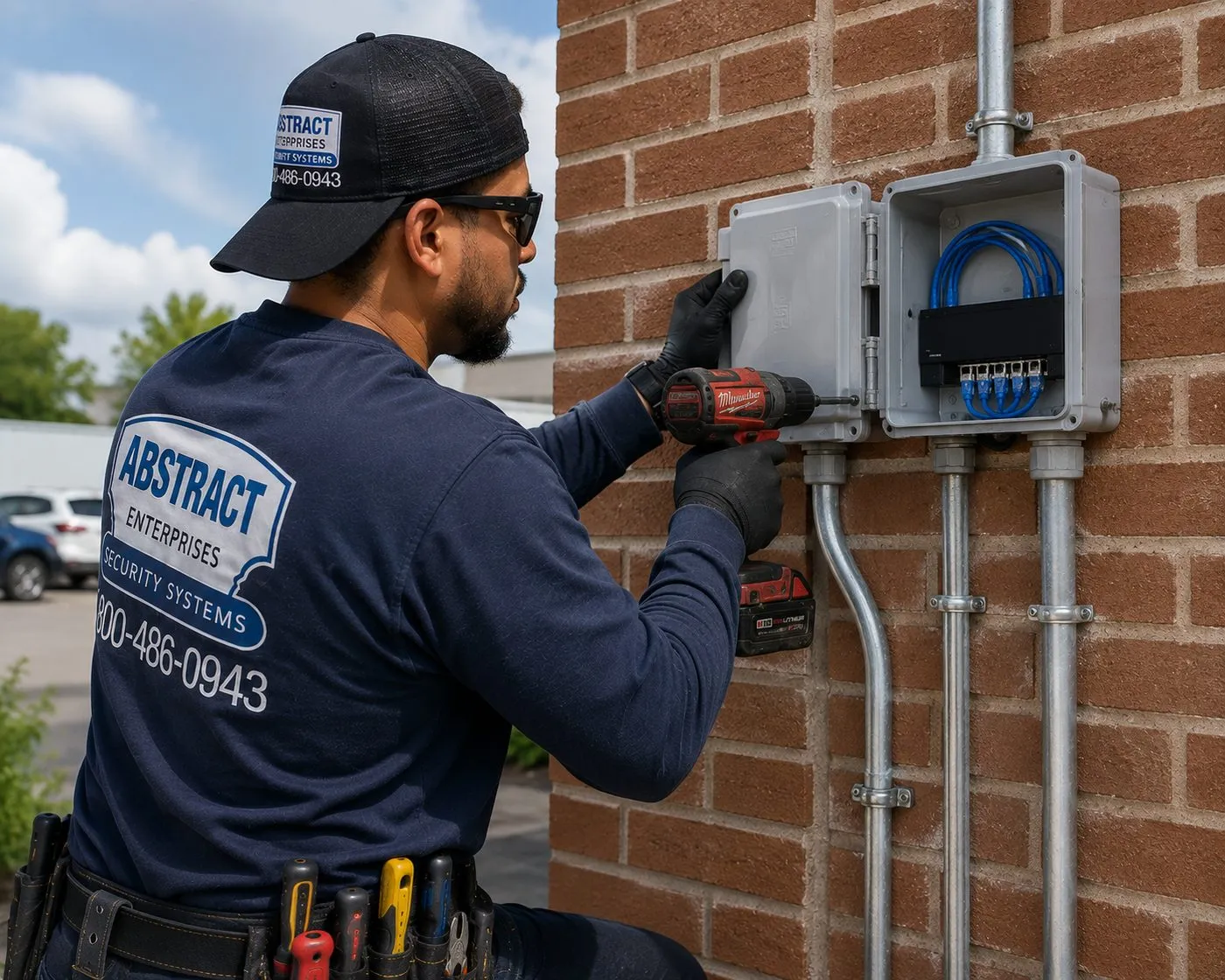
A technician in a cap and sunglasses uses a cordless drill on the hinged lid of a grey weatherproof box fixed to a brick wall; inside the open box beside it, short blue patch cords loop into a small switch, with metal conduit running down the wall below both boxes.
Building Specialists
Fiber Optic Installation for Ulster County's Architecture
Very few Ulster County buildings are doing the job they were built for, and the original purpose decides where the fiber can go. These are the building types that make up most of our county work, and what each one does to a fiber route.
Industrial Campuses Given a Second Life
The former IBM Kingston plant, now iPark 87 on Enterprise Drive, is the county's largest example: about 200 acres and more than a million square feet of buildings that once held typewriter and computer manufacturing, warehouses and a data center. Floor plates are vast, ceilings are high and decades of cable are still in the trays. Smaller versions of the same story sit along the Rondout and in Midtown Kingston.
Main Street Commercial Buildings
Two- to four-storey brick buildings in Uptown and Midtown Kingston and along the main streets of Saugerties, New Paltz and Woodstock. Shops at street level, offices or apartments above, a stone or brick cellar below and, usually, no space set aside for a riser.
Stone Houses and Early Masonry
The Stockade District still has seventeenth-century stone buildings, including the Senate House, and Dutch stone houses stand across the county's older towns. Walls that thick don't take a new hole lightly, so the route is planned from inside out through existing openings and soft spots.
Rental Houses and Cabin Compounds
A main house with a cottage, a studio, a sauna or a converted garage, or a group of small cabins on a hillside. These properties often sit at the end of a long private road in Shandaken, Woodstock, Olive or Rochester, and the network has to work for guests who have never seen it before.
Historic Hotels, Inns and Retreats
Large wood and stone buildings from the resort era, such as Mohonk Mountain House on the Shawangunk Ridge, built between 1869 and 1910 with 259 guest rooms, and newer venues on reused sites such as Hutton Brickyards on the Hudson in Kingston. Long corridors, many small rooms and outbuildings for staff and events make fiber the only practical backbone.
Campuses, Schools and Hospitals
SUNY New Paltz on a 257-acre campus, SUNY Ulster in Stone Ridge, the Ulster BOCES Career Academies at iPark 87, and HealthAlliance Hospital on Mary's Avenue in Kingston. Here the institution owns the standard and we work to it, usually on a new wing, a department move or a contractor's scope.
Methods and materials by building type
Industrial reuse: before designing anything we trace the existing trays and conduit, tone or light-test anything that might be live, and tag it. New fiber goes in its own innerduct or on a dedicated path, never loose on top of decades of dead cable. Armoured or interlocking-armour cable is used where the route passes through areas still used for storage, loading or light industry.
Main Street buildings: riser-rated (OFNR) cable through existing vertical openings — old dumbwaiter shafts, closets stacked one above another, the path the original gas or water pipes took — with firestopping restored at every floor penetration. Where a rear stair or light well is available, surface raceway painted to match is often less disruptive than opening plaster.
Stone houses: the provider's entry is reused wherever possible, the cellar is used as the horizontal pathway, and small-diameter fiber follows existing utility routes upstairs. If a new wall penetration is unavoidable it is kept small, sleeved and sealed with a sealant compatible with old lime mortar.
Rental compounds: outdoor-rated, all-dielectric cable in conduit between buildings, sealed wall enclosures inside each cottage, and a small managed switch in each building so guest Wi-Fi and the owner's devices can be separated properly.
Hotels and retreats: a fiber backbone from a main equipment room to small closets serving each wing or each cluster of outbuildings, with copper only for the last short run to rooms and access points. Work is phased around bookings so no corridor is out of service on a full night.
Institutions: plenum-rated (OFNP) cable in air-handling ceilings, enclosures and labels to the campus standard, and test reports in the format their facilities office specifies.
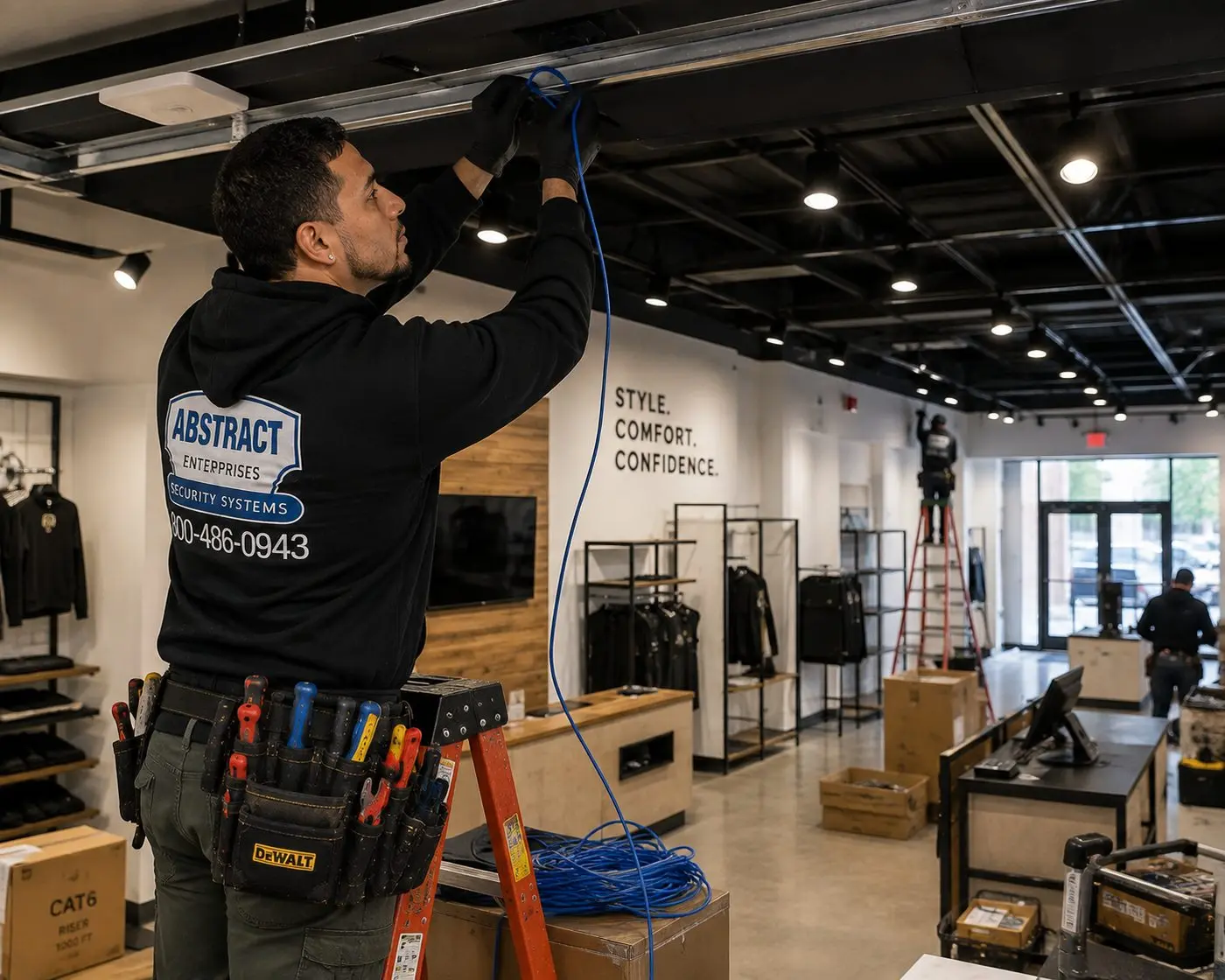
In a clothing shop with racks along the walls and boxes on the floor, an installer on an orange stepladder threads blue cable through the open black ceiling while a second worker on a ladder near the entrance works on another run.
Uptown, Midtown and the Rondout: Three Different Fiber Problems in One City
Kingston is small — about 24,000 people at the 2020 census — but its three historic districts are so different that we treat them as separate markets. Each is listed on the National Register of Historic Places, and each puts a different obstacle between the provider's terminal and the network.
Uptown and the Stockade District
The Uptown Stockade area was the first capital of New York State, and many of its seventeenth-century stone buildings remain, the Senate House among them. Around them are later brick commercial buildings packed tightly together, many with shops at street level and offices or apartments upstairs. The fiber problem here is vertical and lateral at once: getting service from a cellar to upper floors without a riser, and sometimes from one building to the one next door that the same owner also holds. Exterior work in a historic district may need review, so we plan routes that stay inside wherever we can and keep anything visible small, painted and reversible.
Midtown and the Broadway corridor
Midtown is Kingston's largest neighbourhood and grew around early twentieth-century industry. It is home to the Ulster Performing Arts Center, a 1927 theatre on Broadway, the historic City Hall, Kingston High School, and the HealthAlliance Hospital campus on Mary's Avenue, which the Westchester Medical Center Health Network opened in 2022 and says now serves more than 32,000 patients a year. Midtown's fiber work is about large old buildings changing use: the Lace Mill on Cornell Street, a former lace curtain factory now home to 55 affordable apartments with a preference for artists, is the best-known example. Buildings like that need a backbone that can serve many separate units from one provider entrance.
The Rondout and the waterfront
Downtown Kingston, once the village of Rondout, borders the Rondout Creek where it meets the Hudson and was the terminus of the Delaware and Hudson Canal. It is now an artists' community with galleries, restaurants and festivals along a redeveloped waterfront. It also floods: the city has described intermittent flooding as a drag on waterfront redevelopment, and in March 2024 it received $1.5 million in federal transportation money to raise parts of East Strand that see frequent tidal flooding. For fiber, that changes where equipment should sit. We keep enclosures, optical terminals and switches above the level water has reached in the building's history, use gel-filled or water-blocked outdoor cable for anything below grade, and avoid splice points in cellars that take on water.
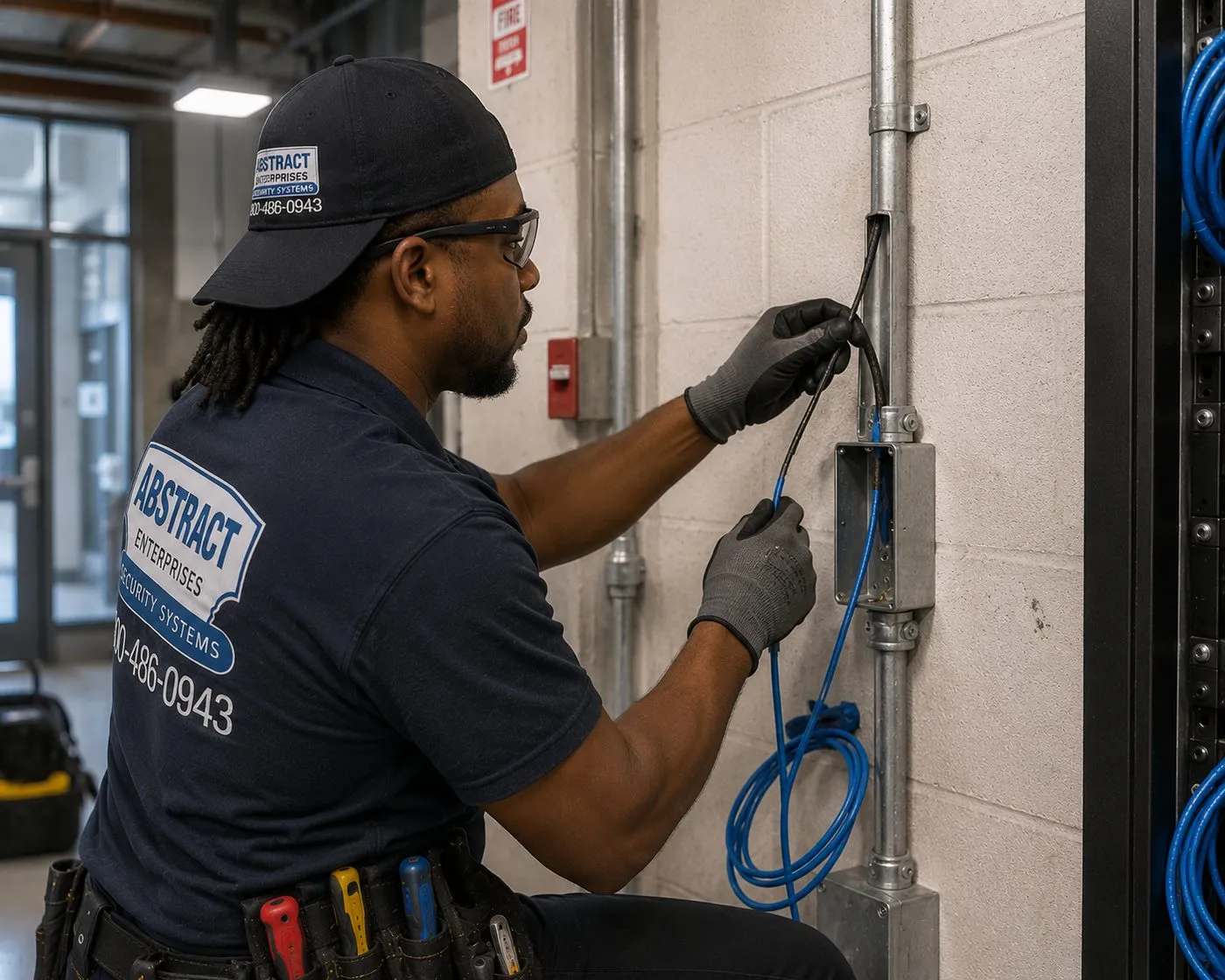
An installer wearing gloves and safety glasses draws cable out of a metal junction box on a run of vertical conduit fixed to a white block wall; a coil of blue cable hangs below the box and a rack of blue patch cords stands at the right edge.
Commercial Fiber
Business Fiber Optic Installation in Ulster County
Ulster's commercial fiber work follows its roads: the Thruway and Route 9W along the river, Route 209 up the Rondout valley, Route 28 into the Catskills and Route 32 through New Paltz. Each corridor has its own kind of building and its own kind of customer.
Enterprise Drive and iPark 87, Town of Ulster
The former IBM complex now holds the Ulster BOCES Career Academies, which opened to more than 1,400 high-school juniors and seniors in September 2025, and Archtop Fiber, which said that year it had grown to 130 employees. The West Campus, including the former Bank of America building, has been the subject of a county foreclosure action since February 2026. Tenants arriving in these buildings inherit very large spaces and very old pathways.
Uptown and Midtown Kingston
Offices, shops, restaurants and apartments in older brick and stone buildings, plus medical offices around HealthAlliance Hospital and the WMCHealth Medical Village planned on Broadway. Typical jobs are demarc extensions, small risers and shared tenant backbones.
Route 9W and the Kingston–Saugerties river towns
Small industrial, contractor and retail buildings along 9W between Kingston, Saugerties and the town of Esopus, often with a front office, a shop floor and a yard. Fiber usually joins the office to the far end of the shop and to cameras covering the yard.
New Paltz and Route 32
A college town around SUNY New Paltz, whose campus covers 257 acres and enrolled 6,113 undergraduates in fall 2025, with student housing, restaurants, offices and the businesses that serve them. Rental buildings with many units and small offices with high bandwidth needs are the common jobs.
Route 28, Woodstock and the Catskill towns
Inns, rental compounds, galleries, studios and restaurants from Woodstock and West Hurley through Boiceville, Phoenicia and Pine Hill. Many of these businesses are seasonal or weekend-heavy, and many are on Archtop or MTC fiber that arrived only recently. The work is mostly carrying a new service across a property that was wired for DSL or nothing at all.
Route 209, Ellenville and the Rondout valley
Stone Ridge, Accord, Kerhonkson and the village of Ellenville, with farms, orchards, small manufacturers, camps and retreat properties strung along the valley. Distances between buildings are longer here and the ground is more varied, so outdoor fiber between buildings is more common than in the river towns.
Compliance callouts for commercial fiber in Ulster County
County electrical licensing. Ulster County's Electrical Licensing Law (Chapter 185 of the county code, Local Law 3 of 2019, amended in October 2025) requires a county Master Electrician license to engage in the business of electrical work, and its definition of electrical work includes wiring for "signaling, communication, alarm or data transmission". Fiber itself carries no current, but outlets, circuits and power feeds to enclosures and equipment are electrical work. Where a fiber job needs new line-voltage power, that part is done and permitted by a county-licensed master electrician, and we coordinate with them.
Building permits are issued by the town, village or city. Kingston and each of Ulster's twenty towns and three villages run their own building departments. Whether a given low-voltage job needs a permit depends on the scope and the municipality, so we confirm it with the building department that covers the address rather than assume.
Short-term rental and lodging rules. Hotels, motels and short-term rentals must register with the Ulster County Department of Finance within three days of starting business and collect the county's 4 percent occupancy tax, and several towns, Woodstock among them, run their own permit systems. Network work doesn't change those obligations, but lodging inspections and insurance conditions sometimes ask about cabling in common areas and life-safety equipment, so we document what we install.
Firestopping and cable ratings. Every floor and fire-rated wall we pass through is resealed with a listed firestop system, and cable listings follow the space: plenum-rated in air-handling ceilings, riser-rated between floors, and outdoor or indoor/outdoor cable wherever a run leaves the building.
Historic districts. Kingston's Stockade, Midtown Broadway and Rondout–West Strand districts are on the National Register, and local review can apply to exterior changes. We plan routes that keep new equipment off historic facades wherever possible.
Digging. Any trench or bore gets a one-call ticket through 811 before the ground is opened, and private lines that the one-call system does not mark — wells, septic lines, irrigation, private electric to outbuildings — are located separately.
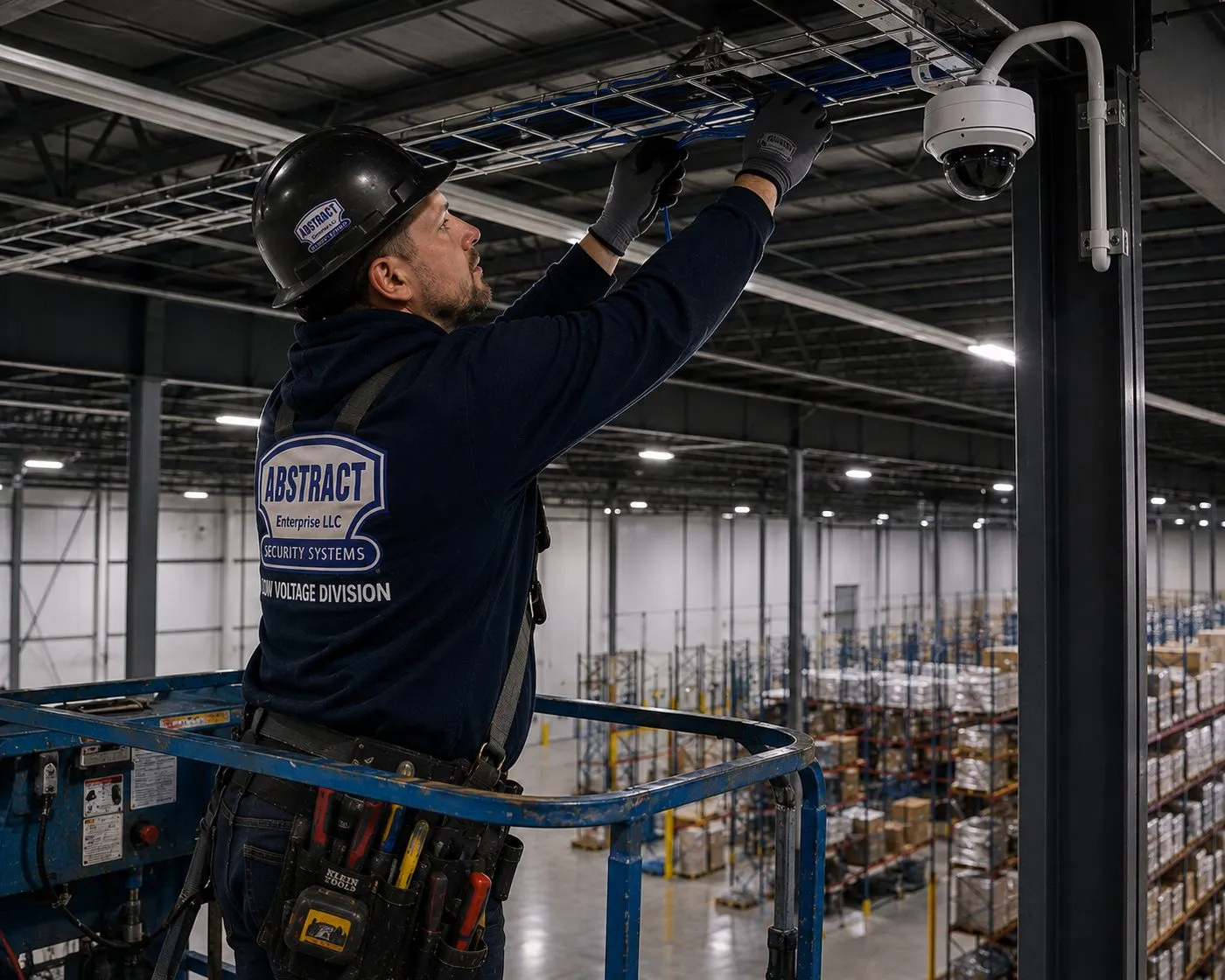
An installer in a black hard hat stands on a blue scissor lift and reaches into a wire-mesh cable tray hung below the roof steel of a high-bay warehouse; a dome camera is mounted on the column beside him and pallet racking stretches down the aisle.
Providers and Owners
Where the Provider's Job Ends and Yours Begins
In Ulster County the most common misunderstanding we meet is about who wires what. Owners who have waited years for fiber reasonably expect that when it finally comes, it comes everywhere. It doesn't, and that is not a failing of any particular provider; it is how residential and small-business fiber service is built everywhere.
The provider's construction crew brings fiber along the road, on poles or underground, to a point near your property. A drop cable then runs from that point to your building, and the installer mounts a terminal on an outside wall or just inside, brings a short cable into the building and connects an optical network terminal and usually a router. Planet Networks told Hudson Valley One in 2024 that its construction uses existing utility poles; Archtop's Sullivan County build, by contrast, was described as nearly all buried. Either way, the installer is scheduled for a fixed visit, works to a standard install, and leaves once the service tests good at that box.
Everything after the box is yours: the cable from the terminal to the network rack, any link to a second floor, a second building or a cabin, the switches, the Wi-Fi, and the separation between guests, tenants and owners. A standard provider visit is not scoped to run cable across a property to outbuildings or to open walls inside, and it does not include splicing or testing fiber you own. That is the gap we fill, and it is why the best time to call us is before the provider's install visit, so the terminal can be placed where the owner-side run is easiest.
Piece of the job
Usually done by the provider
Usually the owner's (our work)
Fiber along the road, on poles or underground
Yes
—
Drop to one point on one building
Yes, to a standard install
We can lay conduit in advance so the drop goes underground or lands in a better place
Terminal and optical network terminal
Yes
—
Extension from the terminal to the network room
Rarely, and only short runs
Yes
Fiber to upper floors, other tenants or other buildings
No
Yes
Switching, Wi-Fi and guest/owner separation
A basic router only
Yes
Backup from a second provider
No
Yes — separate entry, path and failover equipment
Splicing, testing and records for owner fiber
No
Yes
The Verizon build funded under BEAD will add a fourth large network to the county. The county says New York still has to finalize contracts with providers and complete environmental review before money is disbursed, so the timing at any one address is unknown. Owners in the areas it targets — the county's remote, previously unserved locations, many in the Catskill towns — can still prepare: decide where the network should live, and put a conduit from a sensible entry point to that room before anyone arrives.
Town by Town
How Fiber Work Differs Across Ulster's Towns
Twenty towns, three villages and a city make for very different jobs within one county. These notes summarise what usually shapes the work in each part of Ulster, drawn from the county's own figures and from what providers have said publicly about where they build.
Kingston, the Town of Ulster and Esopus
The densest part of the county and the first to get competing fiber, with Archtop service live around Kingston since March 2024 alongside Spectrum. The City of Kingston has about 11,000 housing units and comparatively few short-term rentals, so the work is mostly commercial: storefronts, offices above shops, medical practices, multi-tenant buildings and the large reused spaces of iPark 87.
Saugerties and Woodstock
Archtop turned on service in the town and village of Saugerties in April 2024, where it describes itself as the official technology partner, and began building in Woodstock that October; Planet Networks is a member of the Saugerties Chamber of Commerce and serves the area on existing poles. Woodstock has 378 short-term rentals against 4,289 housing units, close to nine percent, and the Town of Saugerties outside the village has 384. Expect rental compounds, studios and galleries, and small main-street businesses.
New Paltz, Gardiner and the Shawangunk Ridge
The village and town of New Paltz combine SUNY New Paltz, its student housing and a busy main street with farms and rental houses outside the village, where short-term rentals are about four percent of housing. Gardiner, under the ridge, has almost eight percent of its housing in short-term rentals, the third-highest share in the county, after Shandaken and Woodstock. Retreats, inns and the resort properties on the ridge are the larger jobs here.
Shandaken, Olive, Denning and Hardenburgh
The Catskill towns along Route 28 and the high country to the west. Margaretville Telephone Company sells fiber around Phoenicia, and the BEAD-funded Verizon build targets the county's remaining unserved locations. Shandaken has the county's highest short-term rental share, close to one housing unit in ten. The work is long private driveways, cabins on slopes, seasonal properties and owners who are often not on site.
Rochester, Wawarsing, Marbletown and the Rondout valley
Route 209 country: Stone Ridge, where SUNY Ulster has its campus, High Falls, Accord, Kerhonkson and the village of Ellenville. Rochester has 238 short-term rentals, more than five percent of its housing, and Marbletown and Olive are each above four and a half percent. Farms, orchards, camps and retreat properties with several buildings each make outdoor links between buildings more common here.
Lloyd, Marlborough, Plattekill and Shawangunk
The towns along the river and Route 9W south of Kingston, including Highland, Milton and Marlboro, and the Wallkill valley. Short-term rentals are a small share of housing here, under two percent, and the jobs lean toward small businesses, farm stands, light industry and homes with a detached office or workshop.
Your Questions Answered
Fiber Optic Installation in Ulster County: Questions Answered
Innkeepers, landlords, rental owners and tenants across the county tend to raise the same handful of issues on the first call. We answer each at length below, grouped by subject, and keep quick follow-ups for the FAQ lower down.
Getting the speed you are paying for
What has to change inside before a multi-gig plan shows up in the rooms
When a provider sells 2, 5 or 10 Gig service, usually three things stand between the plan and the rooms, in this order. First, the equipment at the handoff: many routers and firewalls that small businesses and rental owners already own have one-gigabit ports, so a 2, 5 or 10 Gig service is capped at one gigabit the moment it passes through them. The router, and the first switch behind it, need multi-gig or SFP+ ports. Second, the wiring between the handoff and the rooms that need speed. Older Cat5e runs are specified for one gigabit; Cat6 can carry 10 gigabit only over short distances; and long runs in big old buildings are often longer than copper allows at any speed. That is where a fiber backbone from the handoff to a closet near the users makes the difference. Third, the Wi-Fi: a single consumer router in a stone-walled house or a long lodge will never deliver multi-gig to a phone in a far room, because the walls and distance eat the signal long before the internet line is the limit.
Before quoting, we measure. A wired test at the optical network terminal shows what the provider is delivering; a test at the far end of each existing run shows what the building is delivering. The difference between the two is the part of the problem that wiring can fix, and it is the part we price.
Can a building in Kingston take service from two different internet providers for backup, and how should both be wired?
Yes, and in parts of Kingston and Saugerties where Archtop, Spectrum or Planet Networks overlap, it is a realistic option for businesses that cannot afford to be offline. The value of a second provider depends on how independent the two connections really are. If both drops come down the same pole line, enter through the same cellar sleeve and land on the same shelf, one fallen limb or one contractor's saw can take both out. We aim for different entry points on different sides of the building where the providers' networks allow it, separate conduit or pathway from each entry to the equipment room, and a firewall or router with two WAN ports that fails over automatically.
Inside, both services should arrive at the same rack on owner fiber or short copper patch runs, clearly labelled with the provider's name and circuit or account reference, so whoever is on site during an outage knows which is which. It is worth asking each provider where their drop can land before their install visit; once a terminal is fixed to a wall, moving it is a second appointment.
Is a cellular backup still worth having once a property has fiber service?
For most rental properties and small businesses in the mountain towns, yes, and it costs little. Fiber outages are rarer than outages on older copper and cable plant, but they still happen, mostly from storms bringing down aerial lines and from construction cutting buried ones, and a remote property may wait for a repair crew. A cellular router or a failover modem plugged into the firewall keeps door locks, cameras, alarms and the payment terminal online while the fiber is down. Guests may notice slower Wi-Fi; they will not be locked out.
The catch in Ulster is coverage. In hollows along Route 28 and below ridges in the Rondout valley, cellular signal can be weak indoors. We test signal strength where the equipment will live, and if it is poor we mount the cellular unit or an external antenna where reception is good and bring its connection back to the rack on the same fiber or copper run.
After you leave, can our own staff or a BOCES-trained technician look after the fiber, and what do they get from you?
Yes, and we plan the handover for exactly that person. Day-to-day care of a fiber network is mostly moving patch cords, swapping a failed optic or switch, and keeping connectors clean, which a careful in-house person can learn in an afternoon. What they need is a network they can read: every strand labelled at both ends with the same name, a strand map on the inside of each cabinet door, test results showing the loss each link had on the day it was installed, and spare patch cords and optics of the right type on the shelf.
At closeout we walk your person through the rack and each remote enclosure, show them how to clean and inspect a connector, and leave the management logins in the owner's name. What we ask them not to do is open splice trays or cut cable; a break in the glass itself is a job for a splicer and a test set, and calling us for it is cheaper than a second break.
Old buildings, new uses
Reusing the steel conduit and cable tray in former IBM-era buildings
The heavy pathways left by a manufacturer can often carry new fiber, and reusing them is one of the biggest savings available in the county's reused industrial buildings. Conduit and tray put in for a manufacturer were usually sized for heavy loads, fixed solidly to the structure and run along the main aisles and walls — often exactly where a new tenant's backbone needs to go. Before we commit to them we check four things: that the conduit is continuous from end to end and not cut or crushed where walls were moved; that its bends are gentle enough for fiber and the pull will stay within the cable's rated tension; that there is real space inside once dead cable is accounted for; and that the tray is still properly supported where earlier tenants added loads.
Where the old pathway passes all four, we pull a fresh innerduct through it so the new fiber is separated from anything left behind and can be replaced later without disturbing its neighbours. Where it fails — a crushed section, a run that dead-ends at a wall built in the 1990s, a tray already full — we build new pathway only for that stretch. At the iPark 87 complex, where the county reports that environmental remediation on the East Campus is complete, and in any other older industrial building, we ask the owner for the hazardous-materials survey before we open ceilings or disturb old pathways.
Untangling years of separate provider drops in an Uptown cellar
The cleanup has to be slow and done in a fixed order, so no tenant loses service along the way. Mixed-use buildings on old main streets usually have one utility entry in the cellar and no common riser, so every time a tenant changed providers a new installer found their own way upstairs. The result is drops stapled across joists, cables through other tenants' ceilings, and terminals nobody can match to a business. The first step is an inventory: we trace each drop from its terminal to the space it serves, confirm which are live with the tenants and providers, and label every one by provider, account and suite.
Then the owner builds the arrangement the building should have had: a small common demarcation board in the cellar and one shared riser — a fiber backbone or a conduit with spare room — to a termination point on each floor. Live services are moved onto it one at a time, each in a short window agreed with the tenant, and only after the new path tests good is the old drop removed. Dead drops come out at the end. Future tenants then order from whichever provider they like, and the provider lands at the common board instead of drilling a new hole.
A cellar-level link through the common wall of two attached buildings
Going through the shared wall is usually a better route than an exterior conduit. Owners in Kingston, Saugerties and the river towns sometimes hold two adjoining buildings and want one network for both, typically a shop or restaurant in one and offices or apartments in the other. A short fiber link through the common wall, at cellar level where the masonry is least visible and the floor levels line up, avoids exterior conduit and the questions it raises on a historic facade. Party walls in older buildings may be brick, stone or both, can be very thick, and may be a rated fire separation, so the penetration is kept small, sleeved and firestopped with a listed system.
Two cautions. If the buildings are on different deeds, a different owner later may not want your cable in their wall, so the arrangement is worth writing down. And if each building has its own electrical service, fiber is the right medium for the link for the same reason it is between separate buildings anywhere: it carries no current between two electrical systems.
Rentals, inns and retreats
Walling off locks, cameras and thermostats from guest devices
On a flat network every device shares one network and can see every other, so a guest's phone or laptop can find the recorder and the lock controller. The protection is giving them different networks from the start, rather than different passwords on the same one. On a properly built property network, guest Wi-Fi sits on its own virtual network that can reach the internet and nothing else. The owner's laptops and the property's management devices sit on a second. Cameras and the video recorder sit on a third, door locks, keypads and smart thermostats on a fourth if the owner wants that separation, and the firewall decides what can talk to what. A guest who plugs a laptop into a wall jack, or whose phone is compromised, cannot see the recorder or the lock controller.
That separation needs managed switches and access points that understand VLANs, and it is far easier when each cottage or cabin is reached by its own fiber link back to a central rack rather than chained from one consumer router to the next. With 2,827 short-term rentals operating in the county as of May 2025, this is now one of the most common designs we build.
Groups at our retreat all stream and video call at once — is the bottleneck the internet line or the wiring between the lodge and the cabins?
It can be either, and guessing wrong is expensive, so we measure. During a busy period, the firewall's traffic graphs show whether the internet line itself is running at its limit. If it is, the fix is a faster plan or a second provider. If it is not, and guests still complain, the bottleneck is inside the property. The usual culprits are wireless mesh units relaying signal from building to building, each hop roughly halving the throughput; long copper runs between buildings negotiating at reduced speeds; a small unmanaged switch in the lodge that cannot keep up; or too few access points in a big room full of people.
Replacing wireless hops between buildings with fiber links, and putting a wired access point in each cabin and in each large gathering room, typically fixes what a faster internet plan cannot. We size the backbone so the links between buildings are never smaller than the internet line feeding them.
Hybrid fiber-and-power cable on Ulster properties
Composite or hybrid cables put optical fibers and copper power conductors under one jacket, and they are made for exactly this: a camera on a pole at the bottom of a drive, a keypad at a gate, a small access point at a sauna or tent platform. A power supply at the main building sends low-voltage DC down the copper pair while the fiber carries the data, and a small device at the far end turns the light and power back into Power over Ethernet for the camera or access point. The fiber still keeps the data path isolated from lightning-induced surges on the network side.
There are limits. Distance and the size of the copper conductors set how much power arrives, so hybrid cable suits cameras and access points, not heaters or lighting. The copper pair is still metal, so the outdoor run needs the same entrance protection any copper cable would. And where the far end already has, or will soon have, its own electrical feed, plain fiber plus a local outlet installed by a licensed electrician is usually simpler and cheaper to maintain.
Land, law and licensing
Properties next to Forest Preserve land in the Catskill Park
If your parcel adjoins state land, plan the fiber route as if the boundary were a wall. Ulster County contains more than a quarter of a million acres of the Catskill Park and Forest Preserve, which New York describes as forever-wild woodlands, and private owners have no right to trench, bore or string cable across state land. Crossing state land is not something a property owner, or a contractor working for one, can authorize. So we design the route to stay on your own parcel, even if that makes it longer, and we check the property line before the first stake goes in.
Two practical steps help. The county's online parcel viewer gives a first look at where your line runs, but on wooded mountain lots the markers on the ground are what count, so we walk them with you or work from a survey. And if your property sits in the Ashokan Reservoir's watershed or near a stream, a long trench may raise questions under New York City's watershed rules even on private land; we route around streams and wet ground or use a shallow bore, and we ask before we dig.
How Ulster County's electrical licensing law treats a fiber job
It is worth being precise here, because the county's rule is broader than most. The Ulster County Electrical Licensing Law, Chapter 185 of the county code, requires anyone engaged in the business of electrical work in the county to hold a county Master Electrician license or work under someone who does, and it defines electrical work to include wiring for signaling, communication, alarm or data transmission. Glass fiber carries light rather than electricity, but almost every fiber job touches something electrical: an outlet for the optical terminal, a circuit for a rack and its UPS, power to an enclosure in a cottage, or the power side of a gate or camera.
We hold New York State low-voltage license #12000287431 and do the fiber, splicing, testing and low-voltage network work. Where the scope includes new line-voltage circuits or outlets, a county-licensed master electrician performs and permits that part, and we coordinate the two so the outlet is where the enclosure needs it. Whether the overall job needs a building permit is decided by the town, village or city building department for the address, and we ask them rather than assume. If anyone quotes you a full fiber install that includes new circuits without mentioning who will pull the electrical permit, ask.
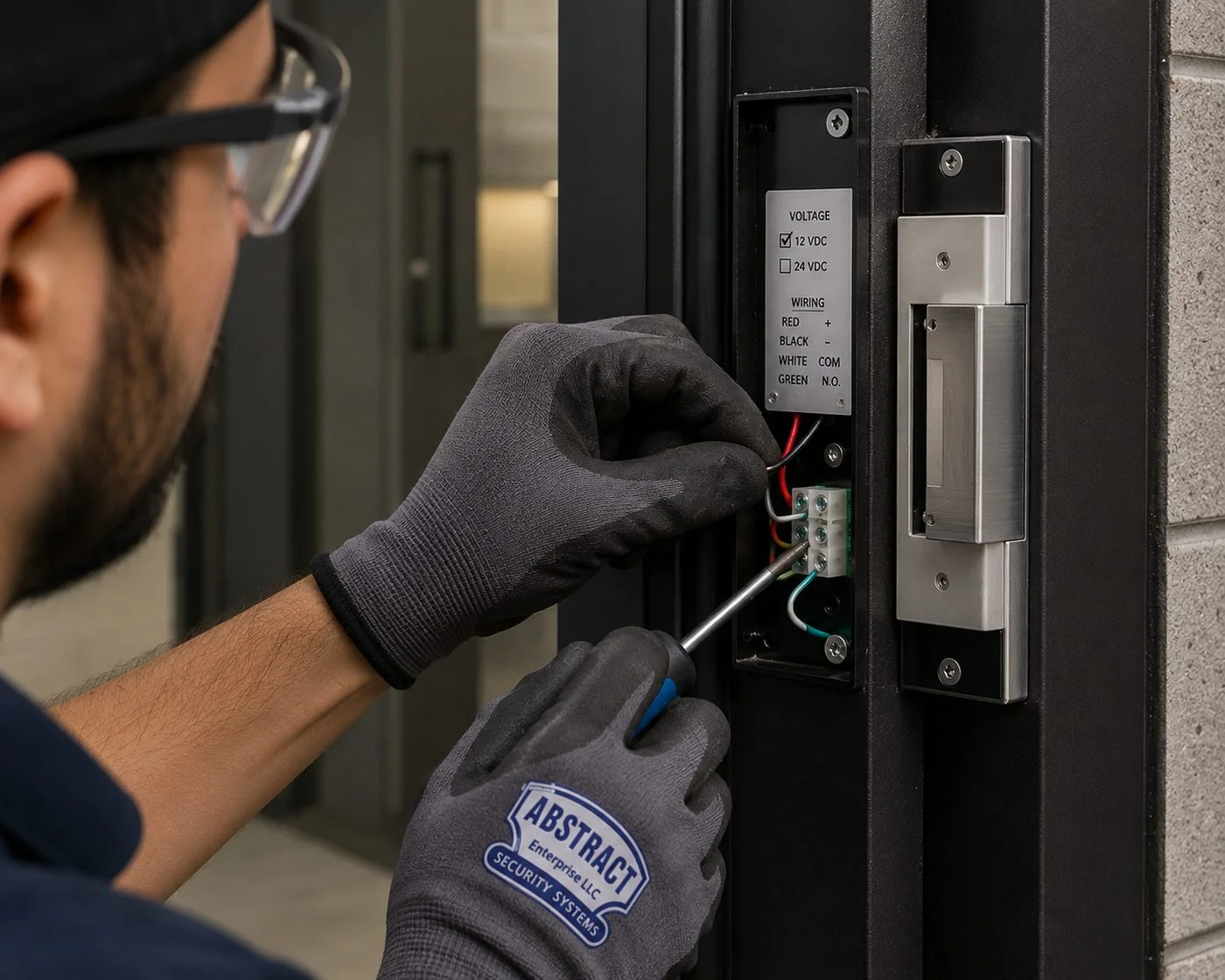
Close-up of gloved hands using a small screwdriver on the terminal block of an electric door strike set into a dark metal frame; a label above the strike lists 12 and 24 VDC and the red, black, white and green wire colours.
Equipment
Types of Fiber Optic Cabling and Hardware We Install
Because so much Ulster work happens inside old buildings and at the provider's handoff, the hardware list below leans toward what lives indoors. Outdoor cable between buildings is covered on our Hudson Valley fiber optic installation page; these are the parts we specify most on county jobs.
Bend-Insensitive Single-Mode
Single-mode fiber made to tolerate tight bends, so it can follow the corners of old closets, door casings and pipe chases without losing light. Our default inside nineteenth-century buildings where a cable has to turn often.
Riser and Plenum Indoor Cable
Riser-rated cable between floors and plenum-rated cable above air-handling ceilings, so a fiber run in a converted mill or a campus building meets the fire rating of the space it passes through.
Indoor/Outdoor Drop Cable
Small, tough cable listed for both environments, for runs that leave a lodge, cross to a cottage in conduit and come straight into the next building without a splice at each wall.
Hybrid Fiber-and-Power Cable
Fibers and copper power conductors in one jacket, with a small converter at the far end, for a camera, gate keypad or access point where no outlet is nearby.
LC Patch Panels and Wall Enclosures
Rack-mount LC panels in equipment rooms, and small wall enclosures in closets, cottages and tenant spaces, each with splice trays, labelled ports and room for spare strands.
Pre-Terminated Assemblies
Factory-terminated, factory-tested cables pulled in one piece where a route is short and known, such as a riser in a three-storey building, to cut time on site in occupied businesses.
SFP+ and Multi-Gig Optics
Transceivers matched to the fiber and the switch, at 1 or 10 gigabit, so the owner-side network can carry the multi-gig services Ulster providers now sell.
Managed Switches and Dual-WAN Firewalls
Switches with fiber uplinks and VLAN support to separate guests, owners, cameras and locks, and firewalls with two WAN ports for a second provider or cellular failover.
UPS and Surge Protection
A small battery backup at the optical terminal, the main rack and each remote enclosure, so a brief power dip on a storm night does not drop the network or reboot every device.
What a provider handoff gives you, and what a multi-gig property network needs
Element
Typical standard provider install
Owner-side network built to use multi-gig service
Handoff point
Optical network terminal where the drop enters
Same terminal, with owner fiber carrying the service to the network room
Router or firewall ports
Often one-gigabit
Multi-gig or SFP+ WAN and LAN ports
Links to other floors or buildings
None, or Wi-Fi mesh relays
Fiber backbone sized at or above the internet speed
Wi-Fi
One router, sometimes mesh units
Wired access points in each building and large room
Separation of users
A guest SSID at most
VLANs for guests, owners, cameras and locks
Backup
None
Second provider or cellular failover on a dual-WAN firewall
Records
Account number on the box
Labelled strands, test results and a route drawing
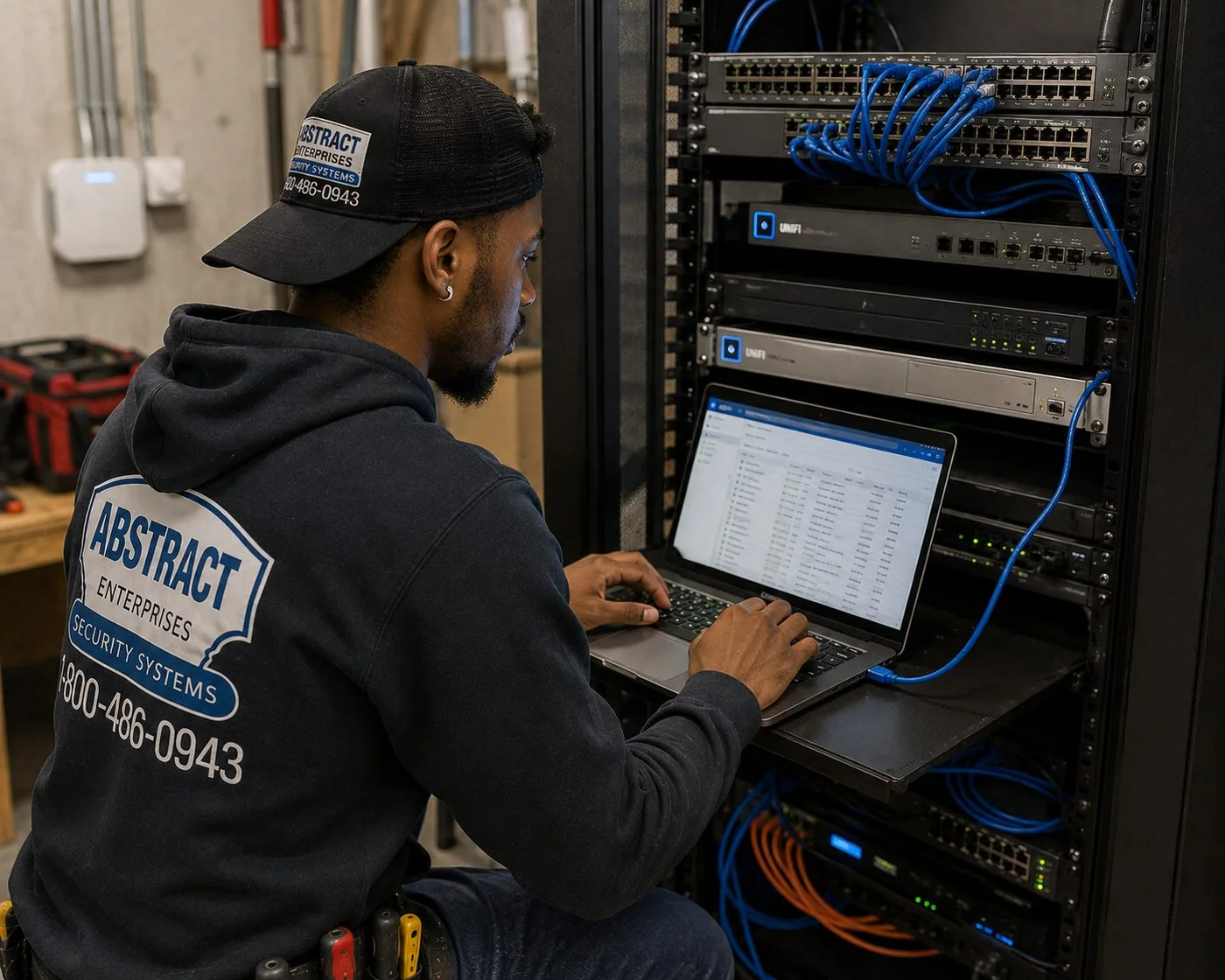
A technician in a cap and hooded sweatshirt types on a laptop resting on a rack shelf, with blue patch cords running into switches and network appliances mounted above and a wireless access point on the wall behind.
AI Overview Reality Check
What AI Gets Wrong About Fiber Optic Installation in Ulster County
AI search summaries tend to repeat national cost guides and provider marketing. The claims below are quoted from the pages those summaries draw on — Angi's fiber installation cost guide, a provider's cost guide and a local provider's own statements — followed by what we see on Ulster County properties.
"Fiber optic cable installation costs between $1,500 and $7,000"
That range comes from Angi's 2026 cost guide, and it is a reasonable national midpoint for a single, simple run. It also hides almost everything that decides an Ulster price. Angi's own figures depend on cable length, aerial versus underground installation and local labour, and none of them account for a stone cellar wall, a riser that has to be found in a building with no riser, or eight cabins on a hillside.
On our published county prices, a single terminated and tested single-mode drop in Ulster is $612 and a twelve-strand OM4 backbone inside a building is $6,885 to $10,710. A small rental compound with a lodge and three cottages, or a Main Street building with four tenants, often lands inside Angi's range. A former factory floor or a retreat with a dozen buildings does not.
The useful number is not a national average but the one on a line-by-line proposal for your building, after someone has walked it. That is why we quote from a site visit and show the unit prices the total was built from.
"Aerial installations are less expensive because they require less digging"
Angi presents aerial as the cheaper method, and on a straight run along existing poles that is often true. Planet Networks, for example, told Hudson Valley One its construction uses existing utility poles because it is the least intrusive approach. But a private property in the Catskills rarely has a pole line where the owner needs one, and new poles, guying and clearances add cost quickly.
Aerial runs on wooded lots also live with trees. Ice, wind and falling limbs are the main reason aerial cable gets damaged, and a mountain driveway lined with oaks and hemlocks is about the worst place to hang one. On those properties, conduit in a shallow trench beside the drive is usually the better long-term buy.
Where aerial does make sense — a short span between two buildings over a paved area, or an existing private pole line in good condition — we use self-supporting or lashed cable with drip loops and proper attachment hardware, and we say plainly in the proposal that it is the more exposed choice.
"Labor costs can range from $50 to $150 per hour"
Angi's labour range describes generic installers. Fiber work that includes fusion splicing, connector inspection and OTDR testing needs equipment and training that a general handyman or a cable-pull crew does not bring, and pricing it by the hour encourages a slow job.
We price installation by the unit — per termination, per tested strand, per drop, per backbone — at the published Ulster rate, so the cost of a job does not depend on how long it takes. The $195 per hour rate, with a three-hour minimum of $585, applies only to service calls, troubleshooting and return visits, never to the installation itself.
If you are comparing quotes, compare what is included: is splicing done on site or skipped in favour of field connectors, is every strand tested, and is a written record handed over at the end?
"Most fiber optic installations require permits, especially for exterior or underground work"
Angi adds that permit fees range from $50 to $500 by municipality. In Ulster County the more important point is who is licensed to do which part. The county's Electrical Licensing Law requires a county Master Electrician license for electrical work, defined to include communication and data wiring, while the fiber itself carries no electricity. In practice the line-voltage power that fiber equipment needs is the part that must be done and permitted by a county-licensed electrician.
Building permits themselves come from the city of Kingston or the town or village building department, and the answer varies with scope. Interior low-voltage work with no new circuits is treated differently from a trench across a property or new power to an outbuilding.
So the honest answer to "do I need a permit" is: possibly for the electrical part, possibly for the excavation, and we check with your building department before we start rather than quote a national fee range.
"Materials cost $1 to $3 per linear foot" for a DIY install
Angi's DIY figure for materials is about right for the cable itself. What it leaves out is that a fiber link is not finished when the cable is in place. The strands must be terminated, which on a quality job means fusion splicing pigtails or using factory-made assemblies, and every strand must be tested, or nobody knows whether the link will work at the speed it is meant to.
A common pattern with owner-installed fiber is cable that was pulled carefully and then left unterminated, or finished with field connectors that were never inspected. A connector with a dirty or cracked end face can lose most of its light and is invisible to the naked eye.
If you want to pull your own cable to save money, talk to us first. We can specify the cable and the conduit, and then come in to splice, terminate and test what you installed under our bring-your-own-equipment labour rate.
"Many providers offer free or discounted installation for a new fiber order"
That line is from a provider's own cost guide, and it is true as far as it goes: the provider's standard install visit is often free or carries a modest activation fee. What is free is the provider's part — a drop to one building and a terminal on one wall.
Owners of a Woodstock cottage compound or a two-building business on Route 9W sometimes assume the free install will reach every building. It won't, and the installer will usually put the terminal where the drop is easiest for their crew, not where the owner-side network would be easiest to build.
Taking an hour before the install visit to decide where the network room is, and to lay a conduit or pull string from the likely entry point, makes the free install far more useful and the owner-side work cheaper.
"Long gone are the days of frequent outages or spotty connections"
That is how Archtop Fiber described the change it brings to Kingston and Saugerties, and fiber to the curb really is more reliable than the copper and cable plant it replaces. But the experience inside a property depends on what happens after the terminal, and most complaints we hear from Ulster owners after fiber arrives are about spotty Wi-Fi, not the line.
A gigabit or multi-gig service feeding one consumer router in a stone house, or relayed by mesh units from a lodge to cabins, still produces dead zones and slow rooms. A storm that cuts power to the property still takes the network down if nothing is on battery.
The fixes are wired access points, fiber between buildings, a UPS on the terminal and the rack, and a failover path. The provider has solved the outside; the inside is still yours to get right.
Find Out What Your Building Is Really Delivering
Tell us your provider and your plan speed. We measure at the terminal and at the far rooms, show you the gap, and price the wiring that closes it at the Ulster rate.
Name your provider, the building or buildings, and where the network has to reach. A photo of the provider's box and of the room you want the network in helps more than anything. We reply within the business day, or call (845) 640-3835.
✅
We Got Your Request!
We'll call you back the same business day. If it's urgent, call us now at (845) 640-3835.
How It Works
Our Installation Process
Seven steps on every Ulster job, whether it is a single demarc extension in a Saugerties shop or a full network for a Shandaken cabin compound. The first two decide most of the outcome.
1. Walk-through and handoff check
We start at the provider's terminal, measure what it is actually delivering, then walk every floor, room and building that needs a connection, looking for vertical paths, old cable and the best place for the network to live.
2. Design and written proposal
Cable types, strand counts, routes, enclosures, switches and Wi-Fi, laid out as a drawing and a line-by-line proposal priced at the published Ulster County rate.
3. Approvals, coordination and locates
Landlord or association consent, the building department's view on permits, a county-licensed electrician for any new circuits, and an 811 ticket plus private-line locates before any digging.
4. Pathways and old cable
Existing chases, conduit and trays cleared and tagged, abandoned cable dealt with as agreed, new conduit or raceway placed and every fire-rated penetration sealed.
5. Pull and place
Fiber pulled by its strength members with slack left at each end, enclosures and panels mounted in dry, reachable spots, and outdoor runs placed in conduit between buildings.
6. Splice, terminate and test
Pigtails fusion-spliced on site, every connector inspected under a scope, every strand loss-tested, and OTDR traces taken on long or spliced runs.
7. Light, label and hand over
Switches, optics and access points installed and configured, networks separated, ports and strands labelled, and test results, speed readings, photos and a route drawing handed to you.
A technician wearing a tool belt reaches into the open rear doors of a black work van whose racks hold aluminium ladders, reels of blue and white cable, red tool cases and a large tool bag.
Coverage Area
Fiber Optic Installation Near Ulster County's Landmarks
Our Ulster service area runs from Marlborough on the river to Hardenburgh at the Delaware County line. The six places below are orientation points, chosen because the buildings around each one are typical of a different kind of county job; listing them does not mean we have done work inside them.
iPark 87, Town of Ulster
The former IBM Kingston plant on Enterprise Drive, dedicated in 1956 and closed in 1995, with more than 5,000 employees by 1959. Today it is about 200 acres and over a million square feet of buildings, home to the Ulster BOCES Career Academies and Archtop Fiber on the East Campus.
The Rondout and the Strand, Kingston
The old village of Rondout at the mouth of the Rondout Creek, once the tidewater terminus of the Delaware and Hudson Canal and now a waterfront of galleries, restaurants and museums, where the city is raising flood-prone stretches of East Strand.
Ulster Performing Arts Center, Midtown Kingston
A 1927 theatre on Broadway at the heart of Midtown, near the historic City Hall, Kingston High School and the Lace Mill — the neighbourhood where Kingston's largest old buildings are changing use.
SUNY New Paltz
A 257-acre campus with 6,113 undergraduates in fall 2025, surrounded by student housing, offices and Main Street businesses in the village of New Paltz.
Mohonk Mountain House, Shawangunk Ridge
A resort founded in 1869 at the meeting of New Paltz, Marbletown and Rochester, with 259 guest rooms on a property of about 1,325 acres and listed as a National Historic Landmark — the far end of the scale of Ulster's hospitality buildings.
Ashokan Reservoir, Town of Olive
Two basins holding 122.9 billion gallons of New York City's water, in service since 1915, with Route 28 passing to its north on the way to Phoenicia and the Catskill towns.
We also cover Saugerties and Malden, Woodstock and Bearsville, Lake Katrine and the Town of Ulster, Port Ewen and Esopus, Hurley and West Hurley, Stone Ridge, High Falls and Rosendale, Accord, Kerhonkson and Ellenville, Highland, Milton and Marlboro, Gardiner, Wallkill and Plattekill, and the Route 28 hamlets of Boiceville, Shokan, Mount Tremper, Phoenicia, Big Indian and Pine Hill. For neighbouring counties, see the Dutchess County fiber optic installation page across the river.
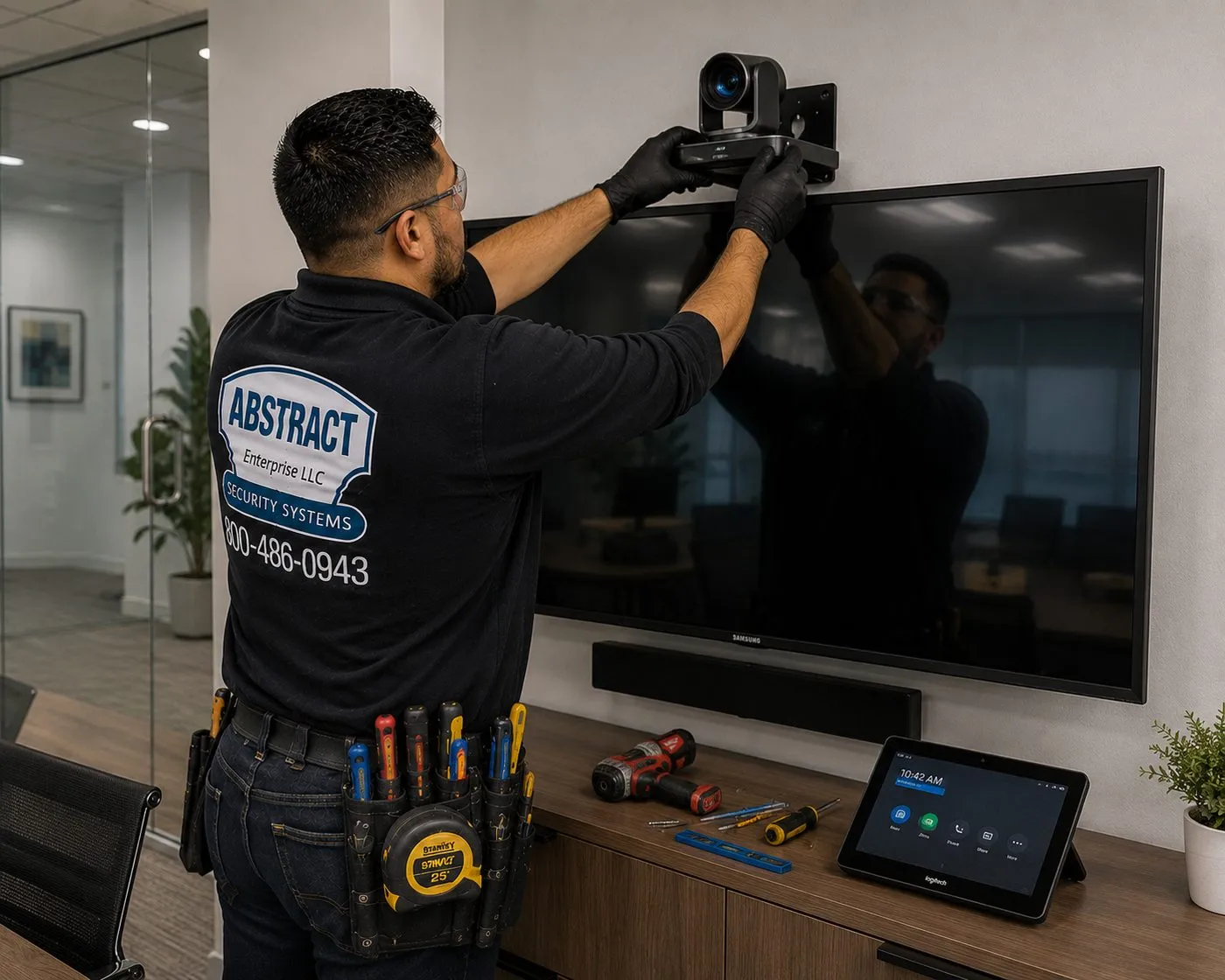
An installer with a tool belt fixes a small conference camera to a bracket above a large wall-mounted display in a meeting room, with a soundbar, a touch control panel and a drill on the console below.
Pricing
Fiber Optic Installation Cost in Ulster County
Ulster County work is priced at our published area rate of 1.53 times the base price, the same rate as Dutchess, and every figure below is a standard published price multiplied by that rate and rounded to the dollar. No price on this page is new, and the same rate applies whether the job is in the city of Kingston or a hamlet at the end of Route 28.
Item
Base price
Ulster County (1.53×)
Fiber termination (per connector)
$35
$54
OTDR test (per strand)
$40
$61
Multimode fiber drop, terminated and tested
$350
$536
Single-mode fiber drop, terminated and tested
$400
$612
12-strand OM4 backbone, floor to floor or across a building
$4,500 – $7,000
$6,885 – $10,710
24-strand OS2 backbone, building to building
$8,000 – $15,000+
$12,240 – $22,950+
Second telecom room with its fiber link
from $2,400
from $3,672
Service calls, troubleshooting and return visits
$195/hr, 3-hr minimum ($585)
$195/hr, 3-hr minimum ($585)
Installation is always priced from the unit lines; the $585 minimum and hourly rate only come into play when we are called back to diagnose or fix something.
How a typical Ulster job adds up
A demarc extension in a two-storey Main Street building — one single-mode drop from the provider's terminal in the cellar to a closet upstairs — is a single $612 line, plus any switch or firewall the owner needs. A rental property with a main house and two cottages, each reached by its own single-mode drop, starts from two drops at $612 each, plus conduit between buildings, enclosures and the network equipment, which the proposal lists separately. A riser serving four tenant spaces in an older commercial building is usually priced as a twelve-strand backbone in the $6,885 to $10,710 range, depending on how many floors it climbs and how hard the vertical path is to find.
What moves an Ulster price up or down
Finding a vertical path. A stacked closet or an old dumbwaiter shaft is quick; a building with no path at all needs more planning and sometimes surface raceway.
Old cable to remove. In reused industrial buildings, clearing and tagging abandoned cable can be a real share of the job.
Distance between buildings and the ground in between. Lawn is easy; driveways, stone, roots, slopes and wet ground take longer.
Whether a conduit was laid before the provider came. A pull string waiting in a conduit is the single biggest saving we see on rental properties.
Booking calendars. Work phased around guests at an inn or a full rental calendar takes more visits than an empty building.
National brand versus local contractor. ADT, Ring and SimpliSafe sell alarm and camera systems; none of them extends a provider's fiber through a Kingston storefront, splices a riser or builds a guest network across a cabin compound. In Ulster the real comparison is between the provider's free standard install, which stops at one terminal; a general electrician, who can run power but usually has no splicer or fiber test set; a regional integrator, which suits large campuses; and a licensed low-voltage contractor with its own splicing and test equipment that walks the building with you and prices each item at the published county rate.
Each package below is assembled from nothing but the Ulster unit prices in the table. Once we have walked your building, the real scope replaces these examples line by line.
Starter — Finish the Fiber Someone Left
$2,028
A twelve-strand cable already pulled between two rooms or buildings but never finished: 24 terminations at $54 and OTDR tests on all 12 strands at $61, for $2,028 at the Ulster rate. Enclosures or panels, if missing, are added at the listed price.
Standard — Riser for an Older Building
$6,885 – $10,710
A twelve-strand OM4 backbone from the cellar demarc to closets or tenant spaces on upper floors of a Main Street building, or across a long reused factory floor, fusion-spliced into panels and loss-tested.
Premium — Lodge to Cottages or Building to Building
$12,240 – $22,950+
Twenty-four single-mode strands between two buildings — a lodge and a cabin cluster, a shop and its warehouse, a main house and a converted barn — spliced into an enclosure at each end with every strand OTDR-tested. Significant trenching or boring is quoted as its own line.
Bring Your Own Equipment — Labour Only
Already bought the cable, the enclosures or the converters, or pulled the cable yourself? We splice, terminate, test and document it at $195 per hour with a three-hour minimum ($585). If the cable is still on its reel we test it there first, because finding a damaged reel after it has been pulled through a building costs far more than finding it on the spool. Equipment you supply carries its manufacturer's warranty; AESS-supplied products carry ours.
Price the Owner-Side Fiber Before the Provider Visit
An hour on site before the provider's installer arrives can decide where the terminal goes, whether a conduit is waiting and what the rest of the job costs.
Designing Fiber for Rentals, Inns and Retreats in the Catskill and Shawangunk Towns
Ulster's visitor economy has turned thousands of ordinary houses into small hospitality businesses, and their networks were rarely built for it. The county comptroller counted 942 short-term rentals in 2015 and an average of 3,013 in 2024, a rise of 220 percent, with the peak in October 2023 at 3,310. In the Town of Shandaken nearly one housing unit in ten is a short-term rental; in Woodstock the figure is close to nine percent, and in Gardiner almost eight. Many of these are compounds — a house and a cottage, a converted barn, a studio, a sauna — rather than a single building.
A network for that kind of property has four jobs. It has to give every guest strong, simple Wi-Fi in every building without them knowing or caring how. It has to keep the owner's cameras, door locks, thermostats, leak sensors and payment devices on networks the guests cannot reach. It has to keep running when the power flickers, because a lock that cannot check in or a camera that goes dark during a storm is a real problem when the owner is two hours away. And it has to be manageable remotely, so the owner or a local caretaker can see what is offline and restart it without driving up the mountain.
Fiber is the backbone that makes those four jobs straightforward. A central rack in the main house — or in a utility room, garage or basement that stays dry — receives the provider's service. From there a fiber link runs to each outlying building, ending in a small sealed enclosure and a managed switch that feeds a wired access point and any cameras or locks in that building. Every switch and access point reports to one management system. The firewall carries a second connection, cellular or a second provider, and the terminal, rack and remote switches sit on battery backup.
Planning around the booking calendar
Owners usually want the work done without cancelling stays. We phase it: conduit and cable between buildings can go in on weekdays between bookings, splicing and equipment installation are quiet work that can happen while a building is empty for a day, and the cutover from the old network to the new is a short window we schedule on a changeover day. Guests may see a new access point on a ceiling; they should never see a trench.
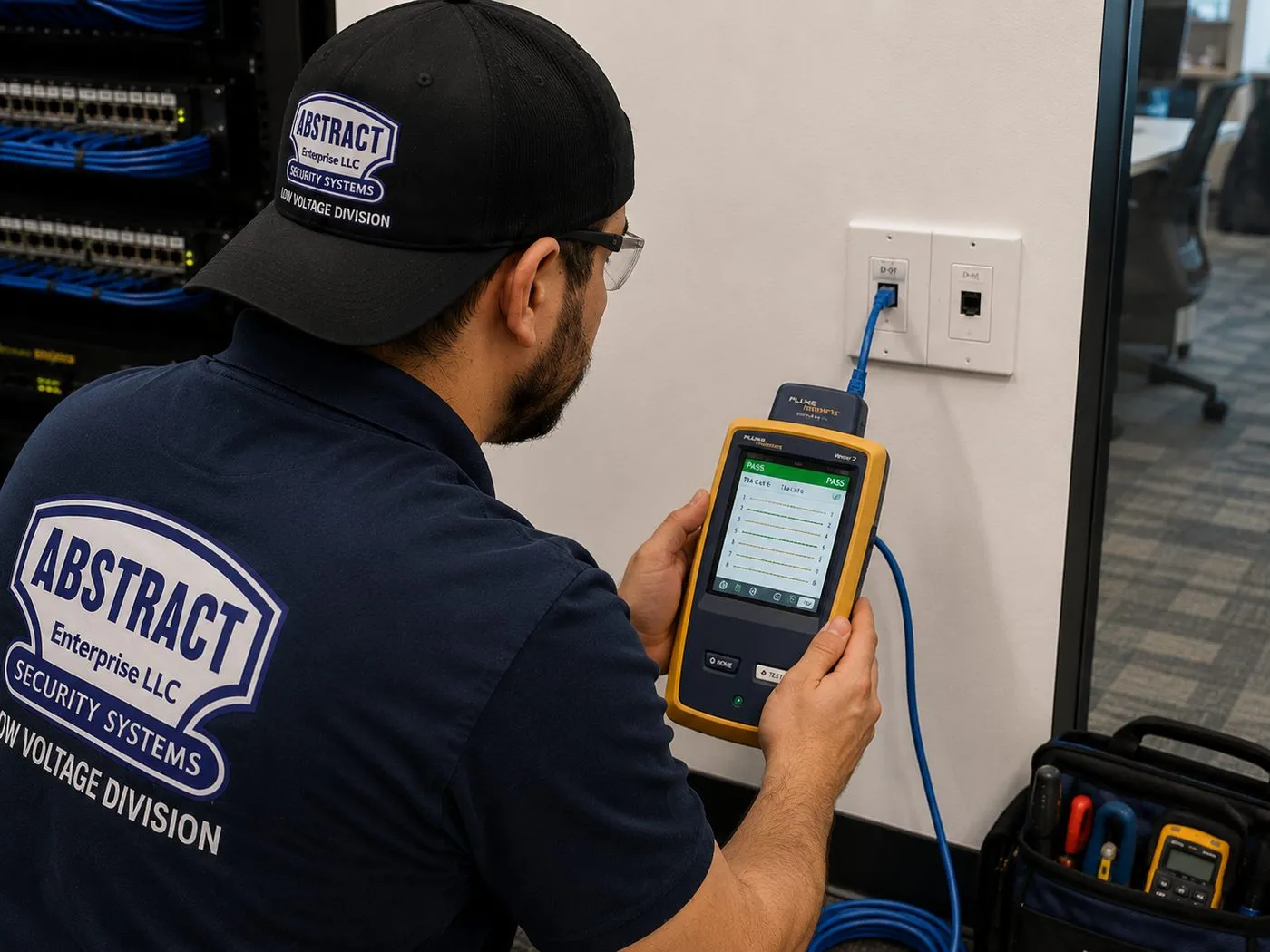
A technician in a cap holds a yellow handheld certification tester whose screen shows a list of passed results, with a blue patch cord running from the tester into a white wall plate; a rack of patch panels and a tool bag are beside him.
Field Notes
Field Notes From Buildings That Were Built for Something Else
From our installers, on what changes when the building in front of you was a factory, a canal-era storefront or a boarding house before it was an office or a rental.
The first walk-through in an older Ulster building is mostly detective work. We open the cellar first, because that is where the provider's terminal usually is and where the oldest pathways start. We look for anything that runs straight up: a closet stacked above another closet, a chase beside a chimney, a pipe that comes through every floor at the same spot. Those are the routes that let fiber climb a building without anyone touching plaster.
Then we look for what earlier occupants left behind. In reused industrial space that can be cable tray full of wire nobody has identified, conduit stubs that end in mid-air, or a telephone backboard that has outlived three tenants. We tone and test before we cut anything, and we write down what we find, because the owner will want to know before deciding what stays.
Before We Visit
What to Gather Before We Walk Your Building
Bring whatever you have; the more of this list is ready on the day, the faster the walk-through goes and the tighter the numbers in your proposal.
Your provider and plan. The name of the provider, the speed you pay for, and a photo of the optical terminal and router with their labels visible.
Where you want the network to live. A dry room with power, ideally near the middle of the building or property, not the far corner of a cellar that takes on water.
Every building and room that needs a connection. Cottages, studios, offices upstairs, tenant spaces, a barn or garage, outdoor areas for cameras or Wi-Fi.
Any plans, surveys or old drawings. Floor plans of an older building, a property survey for a parcel with several buildings, or an old network diagram if one exists.
What is buried. Wells, septic tanks and fields, propane lines, irrigation and private electric to outbuildings, so a trench avoids them.
Your calendar. Bookings, events, opening hours and any tenant who needs notice before work in their space.
Who else is involved. Your IT provider or the person who manages the network remotely, your landlord or building manager, and any electrician already working on the property.
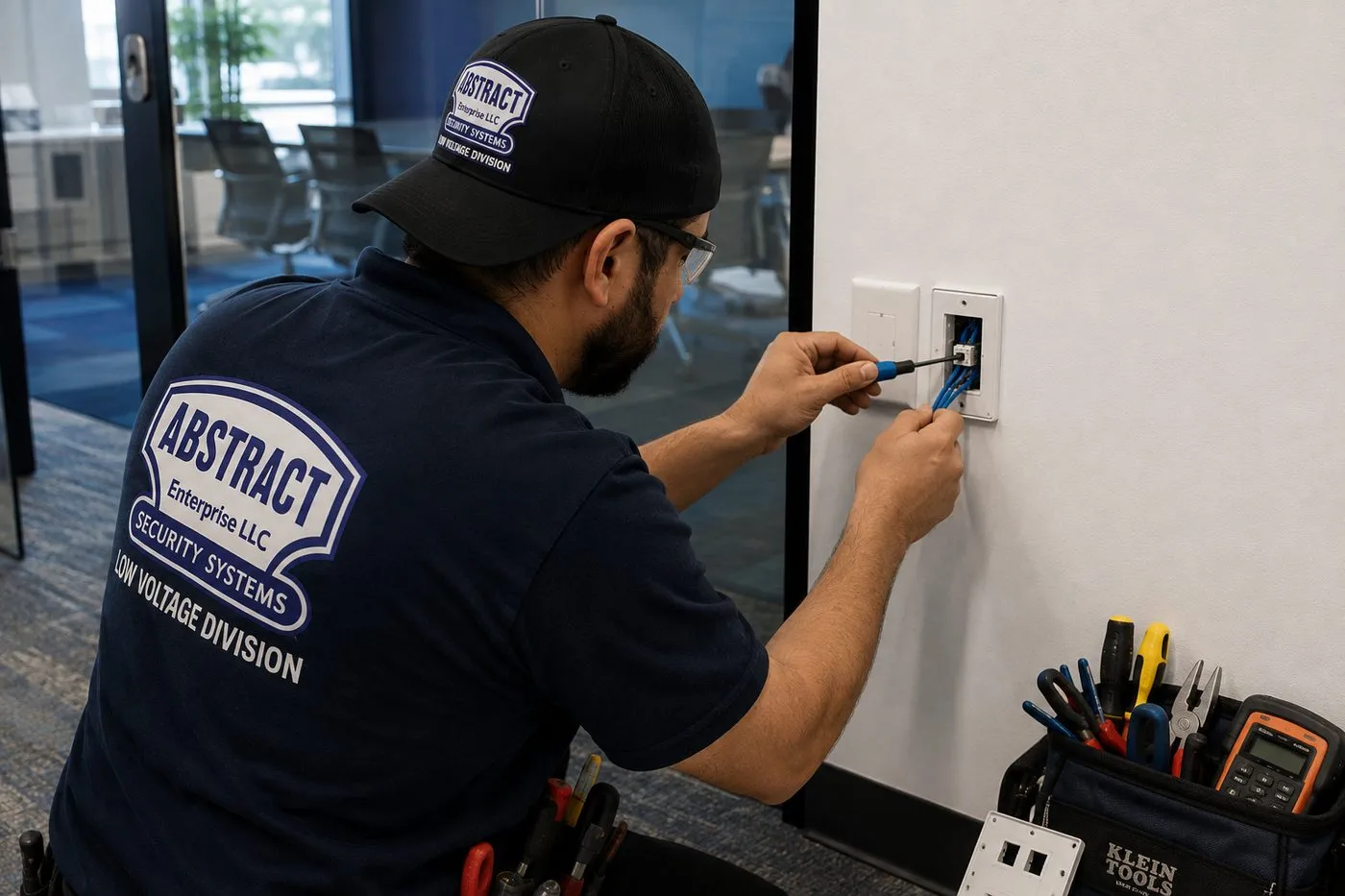
An installer kneels at a white wall and works on a jack in a wall plate with a small hand tool, beside a glass partition; an open tool bag of screwdrivers, pliers and a meter sits on the floor next to a spare faceplate.
Complete Services
Every Fiber Optic Installation Service in Ulster County
Fiber is usually one part of a larger network or security project. These are the related Abstract Enterprises services in Ulster County, each planned to share the same strands and the same rack.
Video intercoms for multi-tenant buildings and gated properties.
Abstract Enterprises Security Systems handles all of these with the same licensed crews, so the fiber installer and the camera or network installer are working from one plan.
FAQ
Ulster County Fiber Optic Installation FAQ
Do you travel to the Catskill hamlets west of the Ashokan, such as Pine Hill and Big Indian?
+
Yes. The Route 28 hamlets of Shandaken — Phoenicia, Mount Tremper, Big Indian, Oliverea and Pine Hill — and the towns of Denning and Hardenburgh are all inside our Ulster service area and are priced at the same county rate as Kingston. We group visits to the western towns where we can, so tell us if your dates are flexible.
Will the new network work with the smart TVs and streaming boxes already in our cabins?
+
In almost all cases, yes. Smart TVs and streaming boxes join the guest network like any other device, and where a TV sits close to a new access point or wall jack we can give it a wired connection for steadier streaming. Devices that guests cast to from their phones need to share the guest network with them, which we set up deliberately.
Can fiber be installed in a log home or a cabin with exposed log walls?
+
Yes. Fiber is thin and flexible enough to follow the gaps that log homes already have: the space under floor joists, interior partition walls, the top plate and the chase beside a chimney or plumbing stack. We avoid drilling through structural logs where possible, and where a cable has to show we use small, colour-matched raceway.
Will a stone patio or slate walkway have to come up for a fiber trench?
+
Usually not. A short directional bore can pass under a patio, walkway or stone steps without lifting them, entering and leaving in soft ground on either side. Where a bore is impractical, stones can be lifted, numbered and reset, and we price that work as its own line so you can decide.
Can you give us a speed report for each cabin or tenant space when the work is done?
+
Yes. At handover we run wired and wireless speed tests in each building or tenant space and record them with the date, time and plan speed, alongside the fiber loss results. Rental owners often use that report to answer guest questions about the internet and to spot a problem later by comparison.
How long will the network keep running in a power cut, and can it run from our generator?
+
With a small battery backup on the optical terminal, the main rack and each remote switch, the network typically rides through flickers and short outages; how long it lasts beyond that depends on the batteries chosen and the load. If the property has a standby generator, the network circuits can be placed on it by your electrician, and the batteries then only have to bridge the few seconds before it starts.
What happens if a tree comes down on an overhead fiber run across our property?
+
The cable may be torn or crushed and the link will drop. The repair is a splice or a replacement section, and a spare loop of cable left at each attachment point makes that faster. On wooded properties we usually recommend burying the run in conduit instead, which removes most of the risk.
Can the same crew install keypad or smart locks for rental check-in while the fiber goes in?
+
Yes. Door hardware and access control are part of our low-voltage work, and planning the locks with the network means each lock or controller sits on the right network segment, with power and a wired connection where it needs one. Battery-powered smart locks still need good Wi-Fi at the door, which the new access points provide.
Can guest Wi-Fi show a welcome page with our house rules before guests connect?
+
Yes. Most managed access points we install can show a simple welcome page on the guest network, with the property name, house rules and a button to accept them, and can limit each guest device's speed so one heavy user does not slow everyone else. The owner can edit the page text from the management dashboard.
Can fiber feed outdoor Wi-Fi for an event lawn, orchard or campground?
+
Yes. A fiber run to a weatherproof enclosure on a building, pole or post feeds outdoor-rated access points that cover a lawn, a pick-your-own field or a group of campsites. We size the number of access points for the crowd on the busiest day, and power them locally or through hybrid fiber-and-power cable.
All Areas Served
Fiber Optic Installation Across New York
This Ulster page reports up to the Hudson Valley fiber optic installation hub, alongside its Dutchess and Putnam neighbours. Where a region below has no dedicated fiber page yet, its link takes you to the quote form, and our crews take that work today all the same.
Guests without Wi-Fi in the far cabin, an office upstairs that lost its link after a ceiling repair, a camera feed dark since the storm — call (845) 640-3835. We send a technician the same day when the schedule allows, a typical connector, patch cord or enclosure fault takes one to two hours on site, and the repaired strands are measured again before we leave.
Fiber Optic Installation Ulster County — Licensed, Spliced, Documented
Abstract Enterprises Security Systems · 460 E Fordham Rd, Bronx, NY 10458 · Ulster County line (845) 640-3835 · WhatsApp (718) 679-0359 via wa.me
NYS Low-Voltage License #12000287431 · 100% Licensed & Insured · Same-Day Estimates · Rated 4.7★ from 201 Google Reviews
Full terms — including 50% deposit, one-year parts-only warranty on AESS-supplied products, and the late-fee schedule — are set out in the service agreement. See our warranty page.
Page reviewed and updated October 17, 2026. Changelog: first publication of the Ulster County fiber optic installation page, with county research on provider rollouts, BEAD funding, short-term rentals and the county electrical licensing law.