Orange County is a county of main streets. Three small cities and twenty villages, each with a nineteenth-century core of brick storefronts, apartments over shops, village halls and firehouses — and new fiber providers are now wiring it one village at a time. The provider stops at the outside wall. We take the fiber from there: into old buildings that hold several tenants, between the civic buildings a village runs, and across the shops and offices clustered along Route 17 — spliced, tested and written down so the next person can find it.
Reviewed and updated October 17, 2026 · Written by Anwar Timothy, NYS licence #12000287431
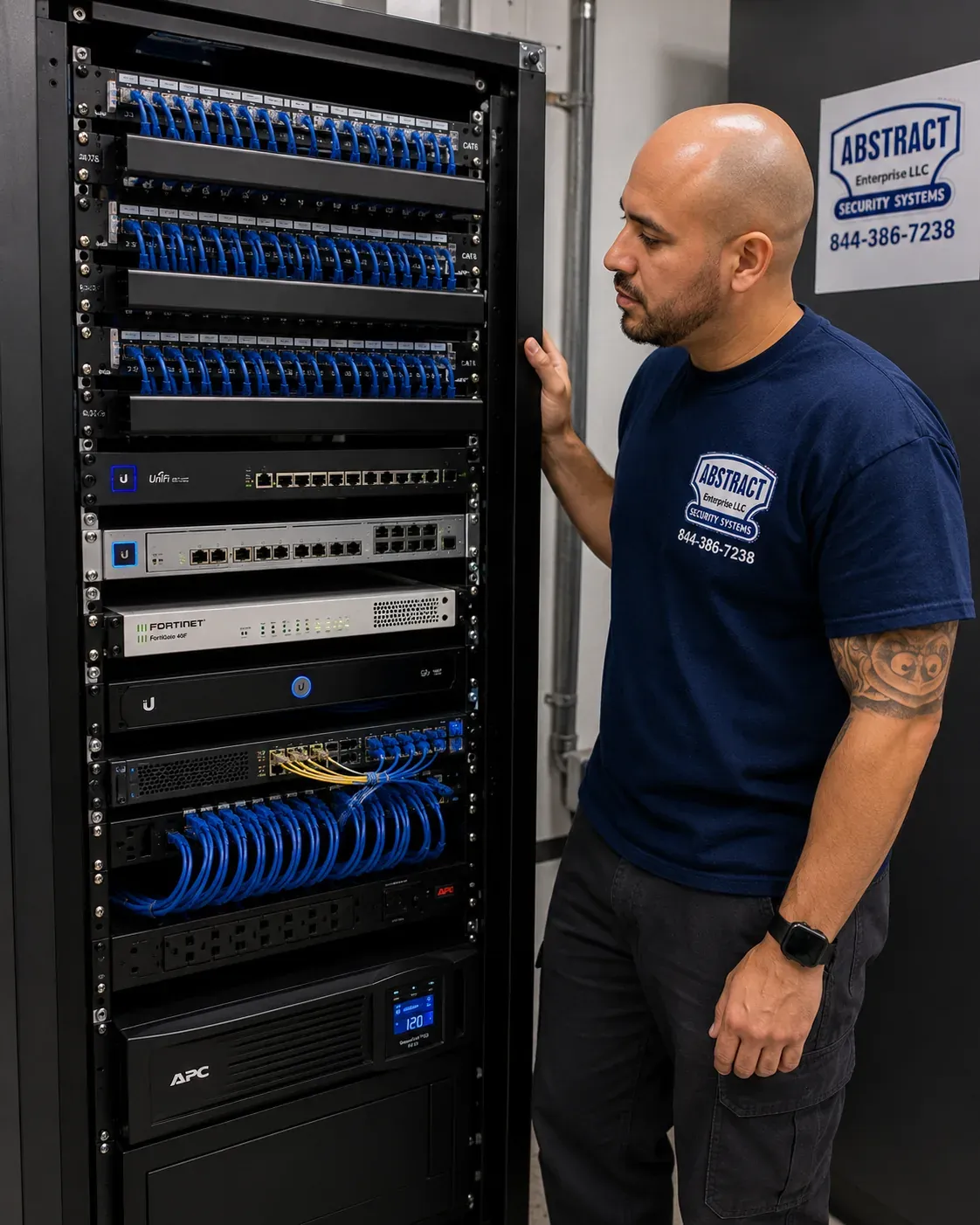
A technician holds the door of a tall black rack: patch panels with blue cords at the top, switches and a firewall in the middle, a short run of yellow jumpers into one switch, and a UPS at the bottom.
Orange County Fiber Quote
Town or village, the building and where the provider lands — a tech calls back the same business day
✅
Request Sent!
An Orange County tech will call you back the same business day.
25+
Years Experience
✓
Same-Day Estimates
100%
Licensed & Insured
4.7★
201 Google Reviews
A building, a village and a provider date? Call our Hudson Valley line at (845) 640-3835 or send the 60-second form. It is read by a licensed installer who will ask the questions that matter in Orange County: who owns the walls, who else is in the building, and which side of the street the service is coming from.
One planned entrance per building instead of a new hole for every provider and tenant
Every strand loss-tested, every enclosure labelled with its owner, results handed over in writing
NYS licence #12000287431 · Orange County work run from our Bronx office on Fordham Road
Why Orange County Properties Need Fiber Optic Installation
Most of Orange County's commercial life still happens on old main streets, and those streets are only now getting fiber to the curb. The county has three cities — Middletown, Newburgh and Port Jervis — and twenty incorporated villages, from Goshen and Warwick to Walden, Washingtonville and Highland Falls. Each has a core of two- and three-storey brick buildings put up when the railroads and river trade were busy: a shop or a bar on the ground floor, apartments or offices above, a basement shared by everyone's meters. Around those cores sit the newer places — plazas along Route 17, the outlet village at Central Valley, the theme park outside Goshen — and between them, town halls, firehouses, schools and churches that have been extended, re-roofed and re-wired a dozen times.
The fiber is arriving from the outside in. Greenlight Networks, which began building in the region in 2023, said in July 2025 that it planned to invest more than $24 million to reach another 16,200 Orange County homes within a year, with construction under way in Goshen, Middletown and the Town of Wallkill and a $4 million build in Port Jervis that started downtown. By June 2026 the company said it had invested more than $26 million in the county and had moved on to Walden, Washingtonville and Highland Falls. Cable operators have been upgrading too. For a business or building owner, that is good news with a catch: every provider's job ends at a box on the outside wall, and the building behind that wall was never designed to carry glass.
That is the gap we fill. In a main-street building with five tenants, it means one planned entrance and a small, labelled fiber enclosure in the basement instead of five providers drilling five holes through the brick. In a former school or hospital building now split among several owners, it means a path from the entrance to each suite that does not depend on whatever the last institution left in the walls. In a village that runs its hall, its police desk and its highway garage out of separate buildings, it means owner fiber between them instead of a monthly circuit for each. And at a shop, restaurant or hotel along Route 17, it means the network that runs the registers, the cameras and the guest Wi-Fi finally has a backbone that a summer of crowds won't knock over.
Orange County also has a habit of reusing buildings rather than replacing them, and it shows in the work. The county's own government center in Goshen, designed by Paul Rudolph and finished in 1967, was closed after flood damage from Hurricane Irene in 2011, partly demolished and rebuilt, and reopened in 2017. In Middletown, Touro College opened its medical school in 2014 inside the former Horton Hospital, a 375,000-square-foot complex. In Newburgh, the East End Historic District alone counts more than 2,200 buildings across 445 acres, most of them brick from the city's late-nineteenth-century industrial peak. Buildings like these get new uses every generation. Fiber put in properly, with a record of where it runs, is one of the few upgrades that keeps paying through each of them.
Orange County facts that shape fiber work
3 cities and 20 villages: Middletown (30,348 people in 2020), Newburgh (28,863) and Port Jervis (8,763), plus twenty incorporated villages, in a county of about 401,000 people (2020 Census figures as listed by City Population).
$26 million+: what Greenlight Networks said in June 2026 it had invested in Orange County fiber to date, with a further $2 million-plus build announced for the Village of Highland Falls and $3.4 million for the Village of Walden.
2,217 buildings on 445 acres: the City of Newburgh's East End Historic District, listed on the National Register in 1985; with the adjoining Montgomery-Grand-Liberty district, about 4,000 contributing properties.
Only county in New York bordering both New Jersey and Pennsylvania, meeting them at the Tri-States Monument in Port Jervis, set in 1882 beneath what is now the I-84 viaduct.
Exits 120 to 131: the roughly 22-mile stretch of Route 17 that a state study named the area of greatest need for a third lane, part of up to $1 billion the governor earmarked in 2022 toward converting the road to Interstate 86.
220 stores: at Woodbury Common Premium Outlets in Central Valley, open since 1985 and listed at about 845,000 square feet — one of the largest contiguous outlet centers in the world.
On a Newburgh community Facebook group, a resident asking how to get a new provider was told the installer's job covers "bringing the fiber optic cable inside your home and setting up the electronics and wiring necessary to provide a WiFi (wireless) signal." For a single house that is about right. For a building with a storefront, three apartments and a dentist on the second floor, it is where the real questions start: whose wall the cable goes through, where the equipment lives, and who is allowed to touch it afterwards.
Most Orange County owners who bring fiber into a main-street building are also changing what's inside it — new cameras on the storefront, a door entry for the upstairs units, a new rack in the basement. Our Orange County structured cabling team and our intercom installers in Orange County plan from the same walkthrough, so the building is opened up once.
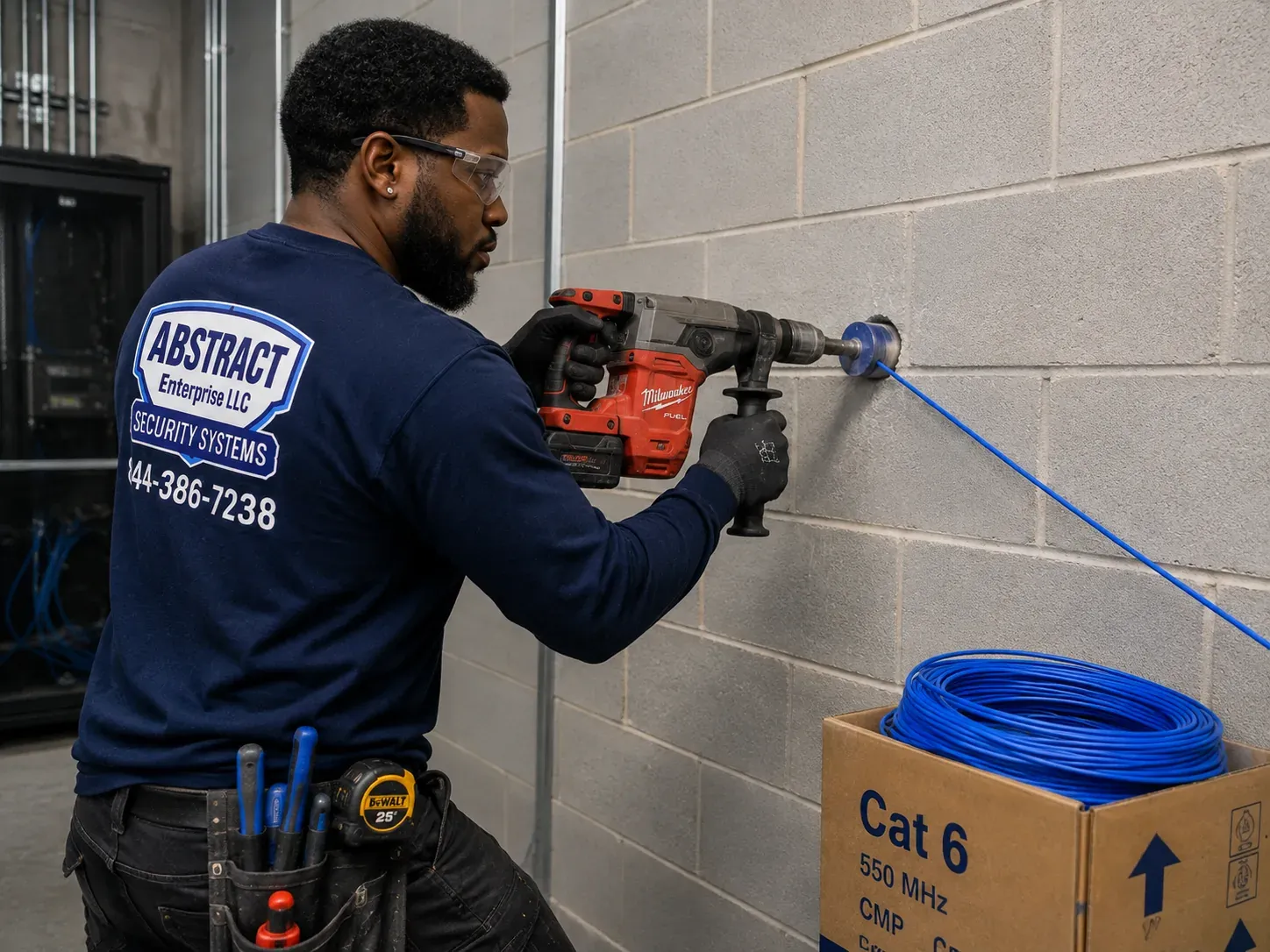
A technician in safety glasses holds a hammer drill fitted with a core bit against a painted block wall, a blue pull line already through the hole and a box of cable at his feet.
Repair Capture
Shop or Office Link Dead on an Orange County Main Street?
If a link that worked last week is down today — after a renovation upstairs, a plumber in the basement or a provider visit that moved something — treat it as a repair, not a project. We dispatch the same day where we can, and most single-point fiber faults (a crushed jumper, a pigtail pulled loose at the back of an enclosure, a connector mated dirty) are found and fixed in one to two hours once a tech is in the room. Call (845) 640-3835 and say "fiber repair," or see our network cable repair service in Orange County when copper is part of the problem.
What We Install
Fiber Optic Installation Services in Orange County
Everything here sits on the owner's side of the provider's box. The provider's responsibility ends at its terminal on the wall or in the basement; ours is to carry that service, and the building's own network, to every place it needs to go — and to prove it with numbers.
Shared Building Entrances
One sleeved, sealed entrance and one labelled enclosure for a building with several tenants, sized so each provider and each tenant gets its own strands and its own space — and the brick is opened once.
Main-Street Tenant Extensions
From the basement enclosure up to a second-floor office or a back-of-house room, along the stairwell or a chase we agree with the owner, so a tenant upstairs is not relying on a long copper run through someone else's shop.
Civic and Municipal Links
Owner fiber between a village hall, a police desk, a highway garage, a library or a firehouse on neighbouring lots, replacing monthly circuits with a link the village owns and documents.
Reused-Building Backbones
Former schools, hospitals, churches and factories split into suites: a backbone from the entrance to each owner's or tenant's space that doesn't depend on the old institution's wiring.
Retail and Hospitality Fiber
Back office to sales floor, front desk to housekeeping, kitchen to patio: fiber where a shop, restaurant or hotel along Route 17 has outgrown a single closet and a single switch.
Pad-Site and Addition Links
A new wing, an annex or a second building on the same lot, tied back to the original building's network over fiber instead of a second provider account.
Splicing and Termination
Pigtails fusion-spliced into new enclosures, cable left half-finished by another contractor completed, and repairs where a renovation crew cut through a live link.
Testing and Records
Loss results on every strand, OTDR traces on longer links, connector end-faces inspected, and a one-page strand map the owner keeps — useful the day the building changes hands.
Entrance Clean-Up
Abandoned provider drops and dead copper traced and removed, old holes sealed, and the basement wall left with one tidy entrance instead of a decade of patches.
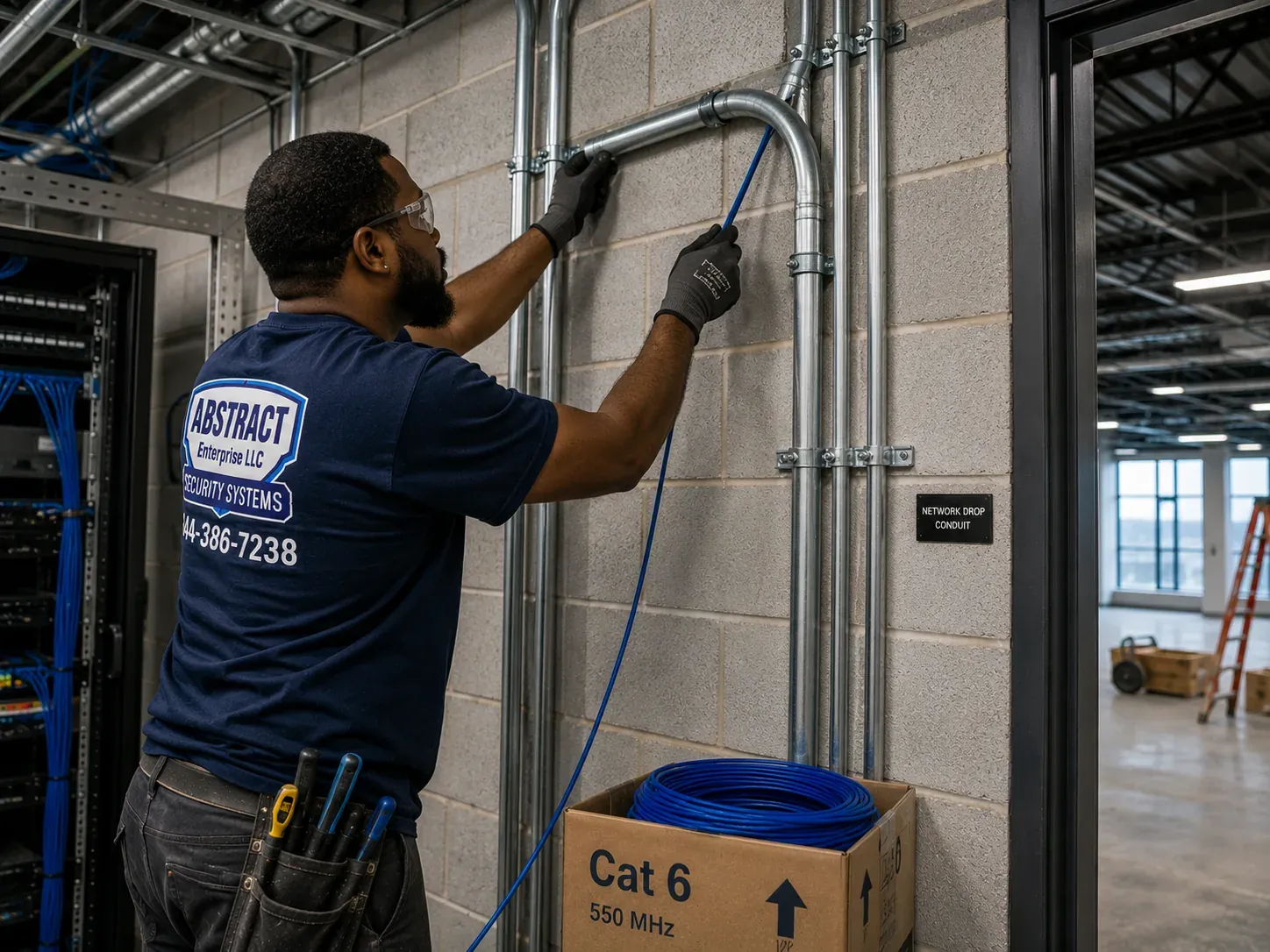
A technician feeds a blue line into a curved length of EMT conduit fixed to a block wall marked "Network Drop Conduit," with an open rack on the left and an empty office floor through the doorway.
Building Specialists
Fiber Optic Installation for Orange County's Architecture
Six kinds of building make up most of our Orange County fiber work. Each one decides where the entrance can go, where the equipment can live and how the cable gets from one to the other.
Mixed-Use Main-Street Blocks
Brick buildings of two to four storeys on Liberty Street and Broadway in Newburgh, downtown Middletown, Front Street in Port Jervis and the village main streets: store below, apartments or offices above, one shared basement. The entrance and the enclosure belong in the common part of that basement; the routes upstairs follow the common stairwell, not a tenant's ceiling.
Historic-District Row Buildings
Italianate and Second Empire townhouses in Newburgh's East End, many now offices or apartments. The facade is protected: in the city's historic districts, exterior alterations need a certificate of appropriateness from the Architectural Review Commission, so we plan the entrance at the rear or below grade and keep the street face untouched.
Reused Institutional Buildings
Hospitals, parochial schools, convents and mills reborn as offices, clinics, apartments or classrooms — Touro's medical school in the former Horton Hospital is the county's best-known example. Thick floors, long corridors, and old pathways that may or may not be usable.
Civic and Public-Safety Buildings
Village halls, courts, police desks, highway garages and firehouses, often on adjoining lots and often extended in several decades. The work has to fit around a building that can't close and equipment that can't go down.
Plazas, Outlets and Destination Sites
Single-storey retail rows along Route 17 and Route 211, the open-air outlet village at Central Valley, and hotels and restaurants that feed off the theme park in Goshen. Long, low buildings where the problem is distance from one end of the row to the other.
Additions and Pad Buildings
A second building on the same lot — a drive-through, a new wing, a garage turned into a showroom — that needs to be on the original building's network without a second provider account.
How the method changes with the building
Brick and stone basements: entrances are core-drilled through the mortar course where possible, sleeved, and sealed both sides; we photograph the finished seal for the owner, because a leaky entrance is the first thing a later inspector or buyer will blame.
Shared stairwells: fiber is small enough to run in a painted surface raceway in a corner of the stairwell, or behind a removable trim board, so no tenant's ceiling has to be opened to reach the upper floors.
Timber floors: in older main-street buildings we drill joists only where the owner agrees, within the limits a carpenter would accept, and keep holes away from the middle third of a span.
Institutional slabs: concrete floors in former hospitals and schools are scanned before any core is drilled; where the old building has open sleeves or chases, we prove them empty before using them.
Long retail rows: a short fiber backbone along the row to a small switch at each end replaces copper runs that would otherwise exceed the 100-metre limit.
Outdoor crossings between civic buildings: outdoor-rated, all-dielectric cable in conduit, with a pull box at each building and a marked route, so a future highway crew knows what is under the lawn.
Owners of multi-tenant buildings often add door entry and cameras in the same visit. If that is on your list, our apartment building camera installers in Orange County can share the fiber enclosure and the walkthrough.
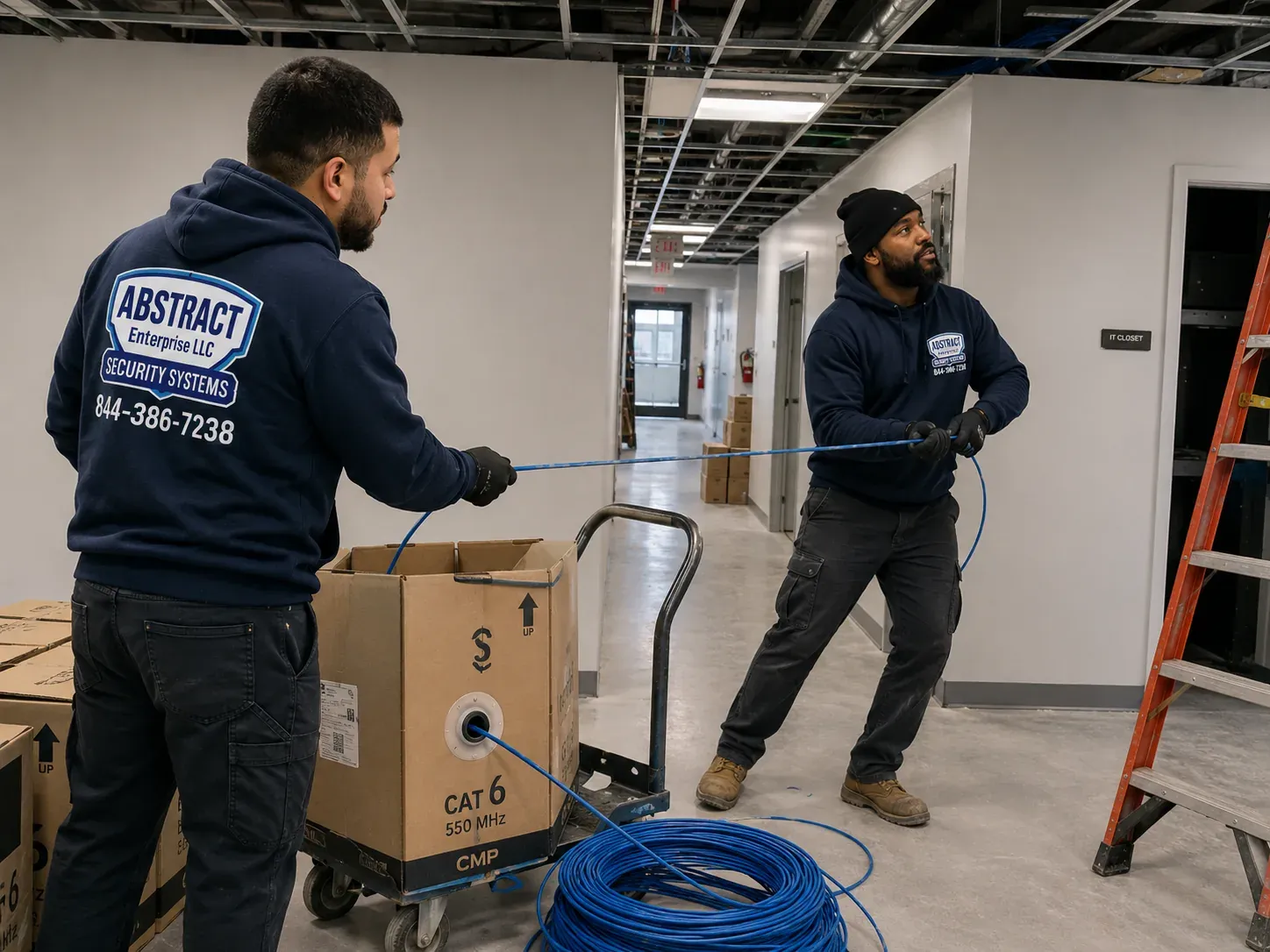
Two technicians work a pull together: one pays cable off a box on a hand truck while the other leans back on the line beside a ladder, under an open ceiling grid and a door marked "IT Closet."
Commercial Fiber Optic Installation
Business Fiber Optic Installation in Orange County
Orange County's business districts are small and spread out, and each has its own mix of buildings. These are the six we work in most, and what the fiber job usually looks like in each.
Newburgh: Broadway, Liberty Street and the Waterfront
Professional offices, restaurants and new apartments in nineteenth-century brick, inside or beside the East End Historic District. Typical job: a shared rear or basement entrance, an enclosure in the common basement, and fiber up a stairwell to second- and third-floor offices.
Middletown and the Town of Wallkill
A downtown of older commercial blocks, medical practices around the hospital and the Touro campus, and the retail and office strip toward the Galleria at Crystal Run. Typical job: suite backbones in reused buildings and links across long single-storey retail rows.
Goshen: the County Seat
Law offices, title companies and county-facing businesses around the courts and the government center, plus the hotels and restaurants that serve visitors to the theme park. Typical job: small office buildings where a dozen staff share one basement and one provider.
Central Valley, Monroe and Harriman
The outlet village at Woodbury Common, the commercial strips along Route 17 and the plazas near the Harriman interchange. Typical job: tenant fiber inside a landlord's rules, and back-office to sales-floor links in long, low buildings.
Port Jervis: Front Street and Pike Street
A small city at the tri-state corner, with a downtown that a fiber provider chose as its starting point in 2025. Typical job: getting new provider service from the front of a narrow brick building to an office or apartment at the back or upstairs.
The Villages: Warwick, Walden, Washingtonville, Cornwall, Highland Falls
Main streets of shops, banks, offices and village halls, several of them in active fiber construction. Typical job: civic links between village buildings and single-building entrances for businesses on the main street.
Rules and approvals that come up in Orange County
1. Historic districts in the City of Newburgh. Under the city's code, nobody may carry out an exterior alteration to a designated property, or to a property within a designated historic district, without first getting a certificate of appropriateness from the Architectural Review Commission. A new conduit or box on a front facade is an exterior alteration. We plan entrances below grade or at the rear where possible, and if anything has to show on the outside, the owner applies before we start.
2. Electrical work and the county licence. Orange County requires anyone working as an electrician in the county to hold a county-issued licence (Local Law No. 8 of 2007, restated in 2024). Fiber cable carries light, not power, and our work is low-voltage; new outlets or circuits for equipment at either end are done by a licensed electrician, and we tell you in the proposal which items those are.
3. Fire-rated walls and floors. Wherever fiber passes through a rated wall or floor — common in former hospitals, schools and apartment buildings — the opening is sealed with a listed firestop system and photographed. Village and town building inspectors look for exactly this when a building changes use.
4. Cable listings. Indoor fiber carries a fire-performance listing under the National Electrical Code: riser-rated (OFNR) for vertical runs and plenum-rated (OFNP) in air-handling ceilings. Outdoor cable that enters a building has to change to a listed indoor type, or be enclosed, within a short distance of the entrance.
5. Digging between buildings. Any trench between civic or commercial buildings starts with a one-call locate request through 811 at least two, and no more than ten, working days before digging, as the regional utility's guidance describes. Private lines — a village's own irrigation, lighting or sewer laterals — are not marked by the utilities, so we ask for the owner's records too.
6. The owner's permission, in writing. In a multi-tenant building a tenant can order the work, but the owner decides where the entrance goes and who owns the enclosure. We put that in the scope so nobody argues about it when the lease ends.
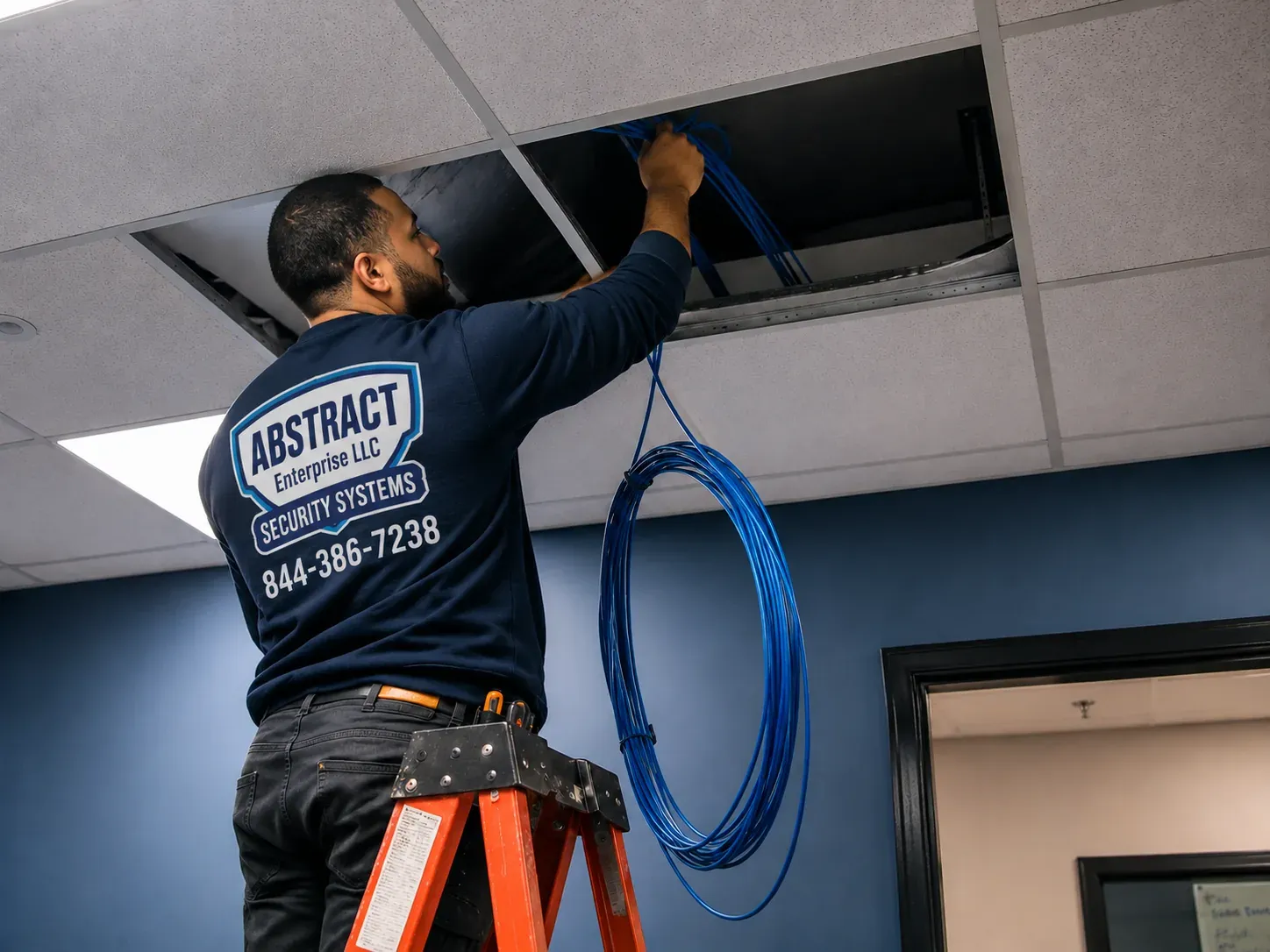
Standing on an orange stepladder, a technician feeds a loose coil of blue cable up through an opening where a ceiling tile has been lifted, in an office with blue walls and a doorway behind him.
Your Questions Answered
Fiber Optic Installation in Orange County: Questions Answered
These are the questions Orange County owners, tenants, village staff and business managers actually ask us, grouped by the decision behind them. Each is answered straight away. Shorter questions about quoting, scheduling and coverage are in the FAQ further down.
Main-street and mixed-use buildings
Each tenant in our Newburgh building orders internet on its own — how do we stop every provider from drilling a new hole through the brick?
By giving the building one entrance and inviting every provider to use it. In practice that means a single sleeved opening through the foundation or the rear wall, sealed inside and out, leading to a small lockable fiber enclosure in a common part of the basement. From that enclosure, fiber runs to each tenant's space, so a new provider only has to land its cable at the enclosure and connect to a labelled strand that already reaches the tenant who ordered the service.
Providers generally prefer this, because it saves their technician the hardest part of the visit. Owners prefer it because the brick stops collecting holes and expanding-foam patches. We size the entrance sleeve with room for at least one more provider than the building has today, and we label the enclosure with the owner's name and a phone number, so a technician who arrives on a Saturday knows whom to call before touching anything.
The only place for a rack in our Front Street building is the attic — is that a bad idea for fiber equipment?
The cable will be fine; the electronics are the worry. Fiber itself tolerates heat and cold well, but switches, provider terminals, firewalls and battery backups are rated for room temperatures, and an uninsulated attic above a brick building can run far hotter than that on a July afternoon. Batteries age quickly in heat, and switches that overheat tend to fail in odd, intermittent ways that look like a bad cable.
If the attic is the only space, we either keep the active equipment small and put it in a ventilated wall cabinet on the top floor just below the attic hatch, with only passive fiber and splices up in the attic itself, or we pick a different spot such as a closet under the stairs or a corner of the basement away from the boiler. Fiber makes that choice easy, because the distance between the entrance and the equipment no longer matters.
We own two adjoining buildings on a village main street that share a party wall — can one network serve both?
Usually, yes, and fiber through the party wall is the clean way to do it. A short link through the shared masonry wall, sleeved and sealed on both sides, lets one provider service and one rack in either building serve both. It also keeps the network electrically separate between the two, which matters when the buildings have separate electrical services, as adjoining main-street buildings often do.
Two things need settling first. If the buildings are owned by different entities, or you may sell one of them, write down who owns the link and the equipment so a future buyer is not surprised to find your network in their basement. And if the party wall is also a fire separation, the penetration has to be firestopped with a listed system — we treat it like any rated wall and photograph the result.
The provider wants to mount its terminal on our storefront facade — can we ask for it somewhere else?
Yes, and on an older main-street building you usually should. A provider's installer will put the terminal wherever the job is quickest, and on a narrow building that is often the front wall, beside the shop window or the upstairs door. On a brick facade that is a permanent mark, and in the City of Newburgh's historic districts an exterior change like that is the kind of alteration the Architectural Review Commission reviews before work is done.
Ask the provider, in writing and before the install date, to land at the rear or side wall, or to bring its drop into the basement through the building's existing entrance. Providers can often accommodate that when they know in advance. If the building has a shared enclosure, tell them where it is; their cable then only has to reach it, and our strands carry the service on to the tenant. We are happy to be on the phone with the provider's scheduler to agree the spot.
Reused and institutional buildings
Our building used to be a church school — are the old intercom and telephone pathways in its walls usable for fiber?
Sometimes, and it is worth an hour to find out. Schools and hospitals from the middle of the last century were often built with steel conduit to every classroom or ward for intercoms, clocks and telephones, and a conduit that is still continuous and not crushed can be an excellent route for fiber. We test each one by pushing a fish tape or blowing a line through it; if it comes out where the drawings say, we use it.
The common problems are conduits that were cut during later renovations, ones that end in a junction box buried behind new drywall, and ones still holding cable for an old system that may or may not be dead. We don't pull anything out until it has been proven dead — an old wire in a former school can turn out to be the fire alarm. Where a pathway doesn't survive the test, we route new and tell you which old ones can be abandoned.
Our practice moved into part of a large former hospital building — can we get fiber to our suite without depending on the landlord's old network?
Yes, and in a building shared by several medical tenants it is usually the right idea. Big reused buildings in Middletown and elsewhere often inherited a network from the institution that built them, and the landlord may offer to connect you to it. That can work for a door reader, but your practice's records system, imaging and phones are better on a path you control, from the building's provider entrance to your suite, with strands labelled to you.
The landlord still decides the route, so we survey the corridors and any shafts with the building's facilities person, propose a path through common areas, and agree where your enclosure will sit. The result is a link that only your practice uses, documented so the landlord knows exactly what is in their building and why.
Route 17, retail and hospitality
Our restaurant near a Route 17 interchange is adding a second building on the lot — should it get its own internet service or a fiber link from the first?
If both buildings belong to one business, a fiber link is usually cheaper over a few years and simpler every day. One provider account, one firewall and one set of cameras and registers on one network; the new building just becomes another part of it. A link of a few hundred feet across the lot, in conduit, is a modest job if it's planned before the paving is finished.
A separate service makes sense when the second building will be leased to a different business, when you want a backup path that doesn't depend on the first building, or when the lot would have to be cut up after it's paved. Some owners do both: a fiber link for day-to-day use and a small second service as a failover, which a hotel or a busy restaurant may well want.
The state plans a third lane on Route 17 — should a business near the highway hold off on buried fiber until the road work is done?
Not for fiber that stays on your own property. The state's plans for Route 17 concern the highway corridor and its interchanges, and fiber between your own buildings, inside your property line, is not affected. Waiting years for a highway project would leave you without the link for nothing.
Where it does matter is anything near the edge of your lot facing the highway or an interchange ramp. If you have been told a strip of your frontage may be needed, keep new conduit out of it, and route between buildings on the side away from the road. We ask about this on the walkthrough, and if you have received any notice from the state about your frontage, we design around it.
Civic and public-safety buildings
Our village hall, police desk and highway garage are in separate buildings — can fiber replace the leased lines between them?
Often it can, and the savings show up every month afterwards. Where village buildings sit on the same or adjoining parcels, an owner-built fiber link between them replaces the circuits a provider charges for each connection, and gives the village a link it controls. Port Jervis offers a good illustration of how closely civic buildings and network equipment can be tied together: the city's police department hosts network equipment for the provider building fiber there.
The limit is the street. Fiber across a village street or a state road needs permission from whoever owns that road, and for longer distances a leased or provider-built link may still be the practical answer. We survey which buildings can be joined on village property alone and price that part first, so the board can see what a privately owned link actually costs before deciding about the rest.
Can fiber keep our firehouse's alerting equipment and cameras separate from the members' Wi-Fi?
Yes. A fiber cable carries many separate strands, and each pair can be a completely independent link, so the alerting and radio equipment, the cameras and the members' internet can travel between buildings on different strands that never touch each other. Within each building, the switches can keep them on separate networks as well.
That physical separation is useful for a fire company, because a problem on the guest or members' network — a bad device, a crowded social night — then cannot slow down or interrupt the equipment that matters. We label the strands by use in the enclosure and on the strand map, so whoever services the building years later can see at once which strand is which.
Licensing, access and logistics
Does Orange County's electrician licence apply to the people installing our fiber?
The county licence covers people working as electricians in Orange County, and county law requires a county-issued licence for that work. Installing, splicing and testing fiber is low-voltage communications work, carried out under our NYS licence #12000287431, and fiber cable itself carries no electrical power at all.
Where the job also needs a new outlet, a dedicated circuit for a rack or power at a far building, that part is electrical work, done by a licensed electrician. Our proposals list those items separately, so you know exactly which part of the job falls under which licence.
Our property in Warwick is a long drive from your Bronx office — how do you keep the job from stretching into extra trips?
By doing the thinking before the van leaves. The walkthrough measures every route, photographs the basement and the equipment spaces, and checks access, so the crew arrives with the right length of cable, the right enclosures and the splicer. Cable is pre-measured with spare, and the owner knows the day before which rooms we need to enter.
Most single-building jobs in western and southern Orange County are completed in one visit, with testing done the same day; larger links between buildings are scheduled as consecutive days rather than scattered visits. If a provider has to connect at the enclosure afterwards, we leave the strands ready and labelled so their visit doesn't need us there.
Will a busy Newburgh or Middletown sidewalk have to be closed while the fiber comes in?
Almost never for our part of the work. The provider brings its cable along the street, usually overhead on poles or through its own underground ducts, and the work in the public sidewalk belongs to it and its permits. Our work begins at the building: the entrance through the wall, the enclosure and everything inside.
Where an owner asks for a new underground entrance from the curb rather than a drop on the wall, the short stretch under the sidewalk usually needs the city's permission, and in that case we tell you plainly and plan it with the city's requirements in mind. For most main-street buildings, a rear or side-wall entrance avoids the sidewalk entirely.
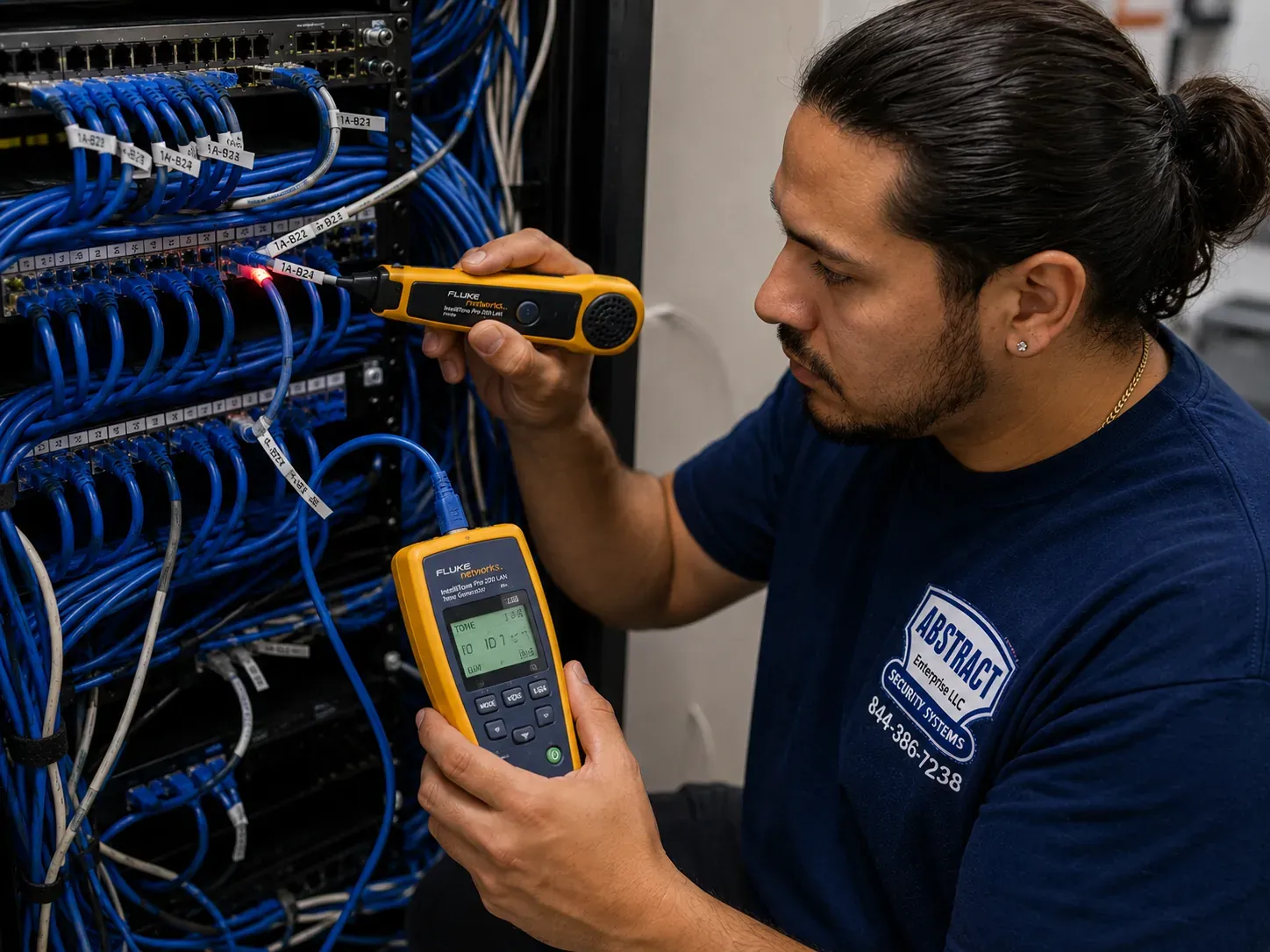
A technician holds a yellow tone probe to one labelled cord in a dense patch panel while a matching test set hangs from a patch cable in his other hand.
Equipment
Types of Fiber Optic Cabling We Install
The parts list for an Orange County fiber job is short. What changes is where each piece goes and how much protection it needs in an old basement, a shared stairwell or a lawn between two civic buildings.
OS2 Single-Mode Cable
Our default for building entrances and for anything a provider may one day use, because providers deliver on single-mode and it reaches any distance a village campus will need.
OM4 Multimode Cable
For short links inside one building where the equipment at both ends already uses multimode optics — between two closets at opposite ends of a retail row, for instance.
Indoor/Outdoor Cable
Rated for both, so a link from a village hall to the garage next door can run underground and straight into each building without a splice at the wall.
Riser and Plenum Ratings
Riser-rated cable up stairwells and between floors, plenum-rated cable above air-handling ceilings in offices and former institutional buildings.
Armoured Fiber
For basements and mechanical rooms where shared tenants, plumbers and boiler service all pass by — a cable that survives being stepped on and knocked.
Wall-Mount Enclosures
Lockable boxes for the building's entrance and for each tenant, holding splice trays and adapter panels, labelled with the owner and the strand map.
LC and SC Adapter Panels
LC for most new links; SC where the provider's terminal or an existing panel uses it. Everything matched so the provider's technician plugs in without an adapter.
Media Converters and SFP Optics
The small pieces at each end that turn light back into an ordinary network connection, specified to match the cable type and the length of the link.
Sleeves, Raceway and Conduit
Sleeves through brick and block, painted surface raceway in stairwells, conduit with pull boxes outdoors — the parts that decide whether the next cable can follow easily.
Provider drop, building entrance or owner link: what each one is
Piece
Who builds and owns it
Where it runs
Typical Orange County case
Provider drop
The internet provider
From the street to the provider's terminal on or in the building
New fiber service arriving in a village that a provider has just built
Shared building entrance and enclosure
The building owner (installed by us)
From the outside wall to a common enclosure in the basement
A main-street block with several tenants and several providers
Tenant extension
The owner or the tenant, as agreed
From the enclosure to a tenant's space on any floor
An upstairs office or a back-of-house room behind a shop
Owner link between buildings
The owner or the village (installed by us)
Between buildings on the same or adjoining property
Village hall to police desk to garage; restaurant to its new pad building
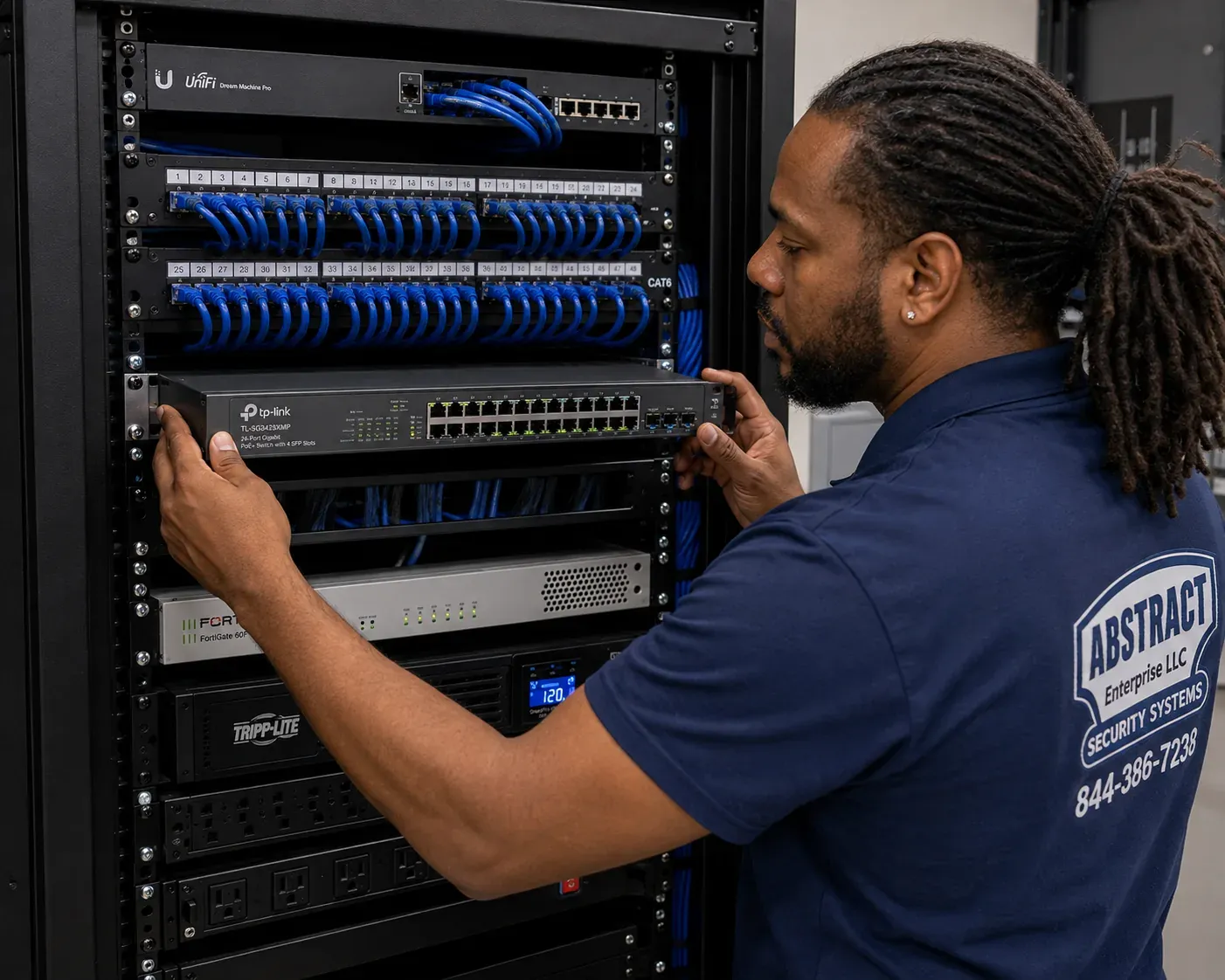
A technician with long braided hair seats a rack-mount switch with SFP slots beneath two rows of patched panels, with a firewall, a UPS and power strips lower in the rack.
AI Overview Reality Check
What AI Gets Wrong About Fiber Optic Installation in Orange County
Search for fiber installation in Orange County and the answers you get — from AI summaries and from the contractor and cost-guide pages they draw on — are mostly sensible in general and often wrong for the building in front of you. We could not get a Google AI Overview to load in our research environment, and the national cost guides from Angi, HomeAdvisor and Fixr did not return a fiber-installation page in our searches, so the claims below are quoted from the published pages that did come up. Each is followed by what we see in Orange County buildings.
"Low-voltage cabling under 50 volts typically does not require an electrical permit"
This line appears on the cabling page of a structured-wiring firm based in New Windsor, and as far as electrical permits go it matches what we see across the Hudson Valley. Fiber carries no power at all, and pulling it through an existing building is rarely a permitted electrical job.
The trouble is the word "permit" being read as "permission." In the City of Newburgh's historic districts, any exterior alteration needs a certificate of appropriateness from the Architectural Review Commission before work starts, and a conduit or box on a facade counts. A building that is changing use — a church school becoming offices, a storefront becoming a clinic — will be looked at by the village or town building inspector, who will want to see firestopping where cable passes rated walls. And any new outlet for the equipment is electrical work for a county-licensed electrician.
So the accurate version is: the fiber itself usually needs no electrical permit, but an Orange County fiber job can still need the owner's written consent, a historic-district approval for anything outside, an electrician for the power, and a sealed, photographed opening wherever it passes through a rated wall.
"For most single-floor offices under 30,000 square feet, Cat6A copper is enough"
Also from that New Windsor firm's FAQ, and also true as a statement about distance: in a compact single-floor office, every desk is usually within copper's 100-metre reach of one closet.
But most of the Orange County buildings we're called to are not one office on one floor. They are a ground-floor shop, two apartments and a law office stacked in one main-street building, each with its own provider, sharing one basement. The question there is not reach but separation and ownership: whose equipment is where, and how each tenant gets its service without passing through someone else's space. Fiber from a shared enclosure answers that neatly even when copper could technically reach.
The same applies to long single-storey retail rows along Route 17 and to reused institutional buildings, where one end of a corridor can be farther than 100 metres of cable from the other once the route goes up, over and around. Square footage alone doesn't tell you; the walkthrough does.
"Fiber-optic cable costs anywhere from $1–6 per linear foot to install"
This range appears on a New York City fiber contractor's page, and a similar per-foot range opens several national cost guides. It is a reasonable description of pulling cable along an open, accessible path.
In an Orange County main-street building, though, the footage is short and the money is elsewhere: the entrance through two feet of brick and mortar, the enclosure and splice trays, the terminations and the tests. A 60-foot run from a basement to a second-floor office priced by the foot sounds almost free; the real job is the opening, the protection in the shared basement, the route up a stairwell without entering a tenant's space, and the termination at both ends.
That's why our prices are built from terminations, tests and backbone ranges rather than footage. Footage matters for links between civic buildings across a lawn, and even there the trench or conduit usually costs more than the glass inside it.
"$300 to $800 per fiber drop installed for a typical office run"
A national cabling company's cost article quotes this range, alongside the reminder that such figures are "orientation ranges, not quotes." Our own Orange County drop prices fall inside it: $490 for a multimode drop and $560 for single-mode, terminated and tested.
Where the published range misleads is in suggesting the drop is the whole price. In a multi-tenant building the first drop also carries the shared entrance and the basement enclosure, which every later tenant then benefits from. The first tenant's job therefore looks expensive and the third tenant's looks cheap.
If you are comparing bids, ask each bidder to show the shared items separately from the per-tenant items. It makes bids comparable, and it gives the owner and tenants a fair basis for sharing the cost.
"Single-mode costs about the same per metre as multimode, so use it for backbones"
The New Windsor firm says this, and so do most current guides: single-mode glass is no longer the expensive option, and one New York competitor's 2026 guide goes further and says single-mode glass is now cheaper than OM4. The catch, which that same guide spells out, is the optics — single-mode transceivers at each end can cost roughly one and a half to five times their multimode equivalents.
For an Orange County building entrance, single-mode is still our default, because the providers deliver on single-mode and anything that may one day carry a provider's service should match. For a short link between two closets in one building where the switches already have multimode optics, multimode can be the cheaper total.
The right answer depends on what is already installed at each end, which is why we photograph the existing switches and terminals on the walkthrough before recommending a cable type.
"Professional fiber installation takes about four hours"
Provider pages say this about residential service: T-Mobile says its in-home fiber install "can take up to 4 hours," and AT&T's support page says four to six. Those numbers are accurate for what they describe — a provider technician connecting one house.
They say nothing about the building work around the provider. In a main-street building, the owner has to agree where the entrance goes, the tenants need notice before anyone enters their space, and if the building is in a Newburgh historic district and anything shows outside, the review has to come first. Then there is the work itself: the opening, the enclosure, the stairwell route, splicing and testing.
A single-building job in Orange County is usually one working day on site once approvals are in hand. The calendar time before that day depends far more on the owner and the building than on the cable.
"A 30-drop office fit-out usually takes two to four days"
The New Windsor firm's FAQ gives this for a copper fit-out in Orange or Dutchess County, and for a new office with open ceilings it is a fair estimate.
Fiber jobs in occupied Orange County buildings run on different clocks. A link between a village hall and its garage may be a day of cable work, but it can only be scheduled after the board approves it and the 811 locate is done. A tenant extension in a reused hospital building may take hours, but only after the landlord's facilities person agrees the route. The cable time is short; the coordination time is what an AI summary leaves out.
When we quote, we give you both numbers: the days on site, and the steps that have to happen first, with who is responsible for each.
Tell Us the Building and Who's In It. We'll Send Back a Route.
Street and village, owner and tenants, and which provider is coming. We'll tell you where the entrance should go and what the job costs at Orange County rates.
Give us the street, the village and who occupies the building. A licensed tech answers within the business day, or ring (845) 640-3835.
✅
Request Received
Thanks — your note is with our Hudson Valley team, and a tech will phone you during this business day. Something already down? Ring (845) 640-3835.
How It Works
Our Installation Process
Seven stages. In a shared Orange County building, the first four are about people — owner, tenants, provider, sometimes a village board — and they decide how smoothly the last three go.
1. Walkthrough with the owner
We walk the basement, stairwells and equipment spaces with the owner or their manager, note every tenant and provider in the building, and measure each route.
2. Entrance and route plan
A marked-up sketch showing where the entrance goes, where the enclosure sits and how each tenant is reached, with any historic-district or rated-wall issues flagged.
3. Proposal split by who pays
Shared items (entrance, enclosure, backbone) priced separately from each tenant's items, with electrician items listed apart, at Orange County rates.
4. Consent, notice and locates
The owner's written consent, notice to tenants whose spaces we enter, any certificate of appropriateness, and an 811 locate for any outdoor digging.
5. Entrance, pathway and firestop
Opening drilled and sleeved, enclosure mounted, raceway or conduit fitted, and every penetration of a rated wall or floor sealed and photographed.
6. Pull, splice and test
Cable pulled within its bend and tension limits, each strand fusion-spliced to a pigtail, every connector inspected and every strand loss-tested, with OTDR traces on longer links.
7. Labels, records and provider hand-off
Enclosures labelled with owner and strand use, a strand map and test results for the owner, and strands left ready for the provider's technician.
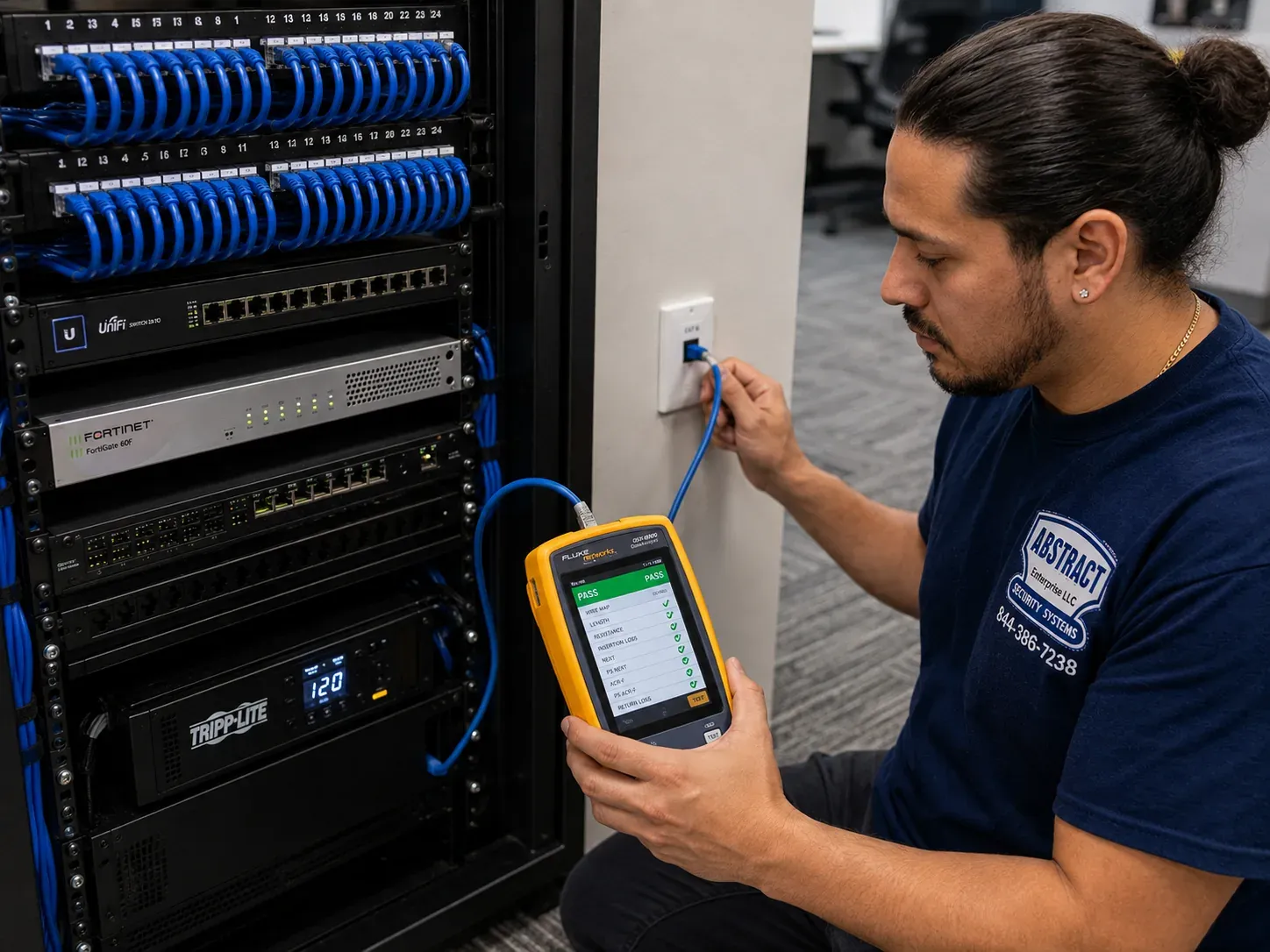
Kneeling beside a rack, a technician holds a yellow handheld tester whose screen shows a green "PASS" list, its cord plugged into a wall jack next to the cabinet.
Coverage Area
Fiber Optic Installation Near Orange County's Landmarks
Six places that sum up the buildings we work in across the county — reused, rebuilt, historic and brand new — and the blocks around them.
East End Historic District, Newburgh
About 445 acres and more than 2,200 buildings, listed on the National Register in 1985: Italianate brick townhouses, churches, schools and the commercial blocks along Liberty Street, Broadway and William Street.
Orange County Government Center, Goshen
Paul Rudolph's 1967 building at the county seat, closed after flood damage from Hurricane Irene in 2011, partly demolished and rebuilt, and reopened in 2017.
Former Horton Hospital, Middletown
The 375,000-square-foot hospital complex that became the Middletown campus of Touro College of Osteopathic Medicine, which welcomed its first class of 135 students in 2014.
Woodbury Common, Central Valley
An open-air outlet village of about 220 stores, opened in 1985 and listed at roughly 845,000 square feet, in the Central Valley section of the Town of Woodbury.
LEGOLAND New York, Goshen
Opened in 2021: about 150 acres of themed park inside a 500-acre property, with a 250-room hotel, served by a relocated Route 17 exit ramp built to Interstate standards.
Tri-States Monument, Port Jervis
The 1882 granite marker where New York, New Jersey and Pennsylvania meet, under the I-84 viaduct at the southwestern corner of a city that grew up as the Erie Railroad's division point.
We also work in Cornwall, Highland Falls, Washingtonville, Walden, Montgomery, Maybrook, Chester, Monroe, Harriman, Tuxedo, Warwick, Greenwood Lake, Florida, Otisville, Unionville and the towns between them, and around both SUNY Orange campuses: the 37-acre Middletown campus on the former Webb Horton estate and the two-building Newburgh campus on the Hudson.
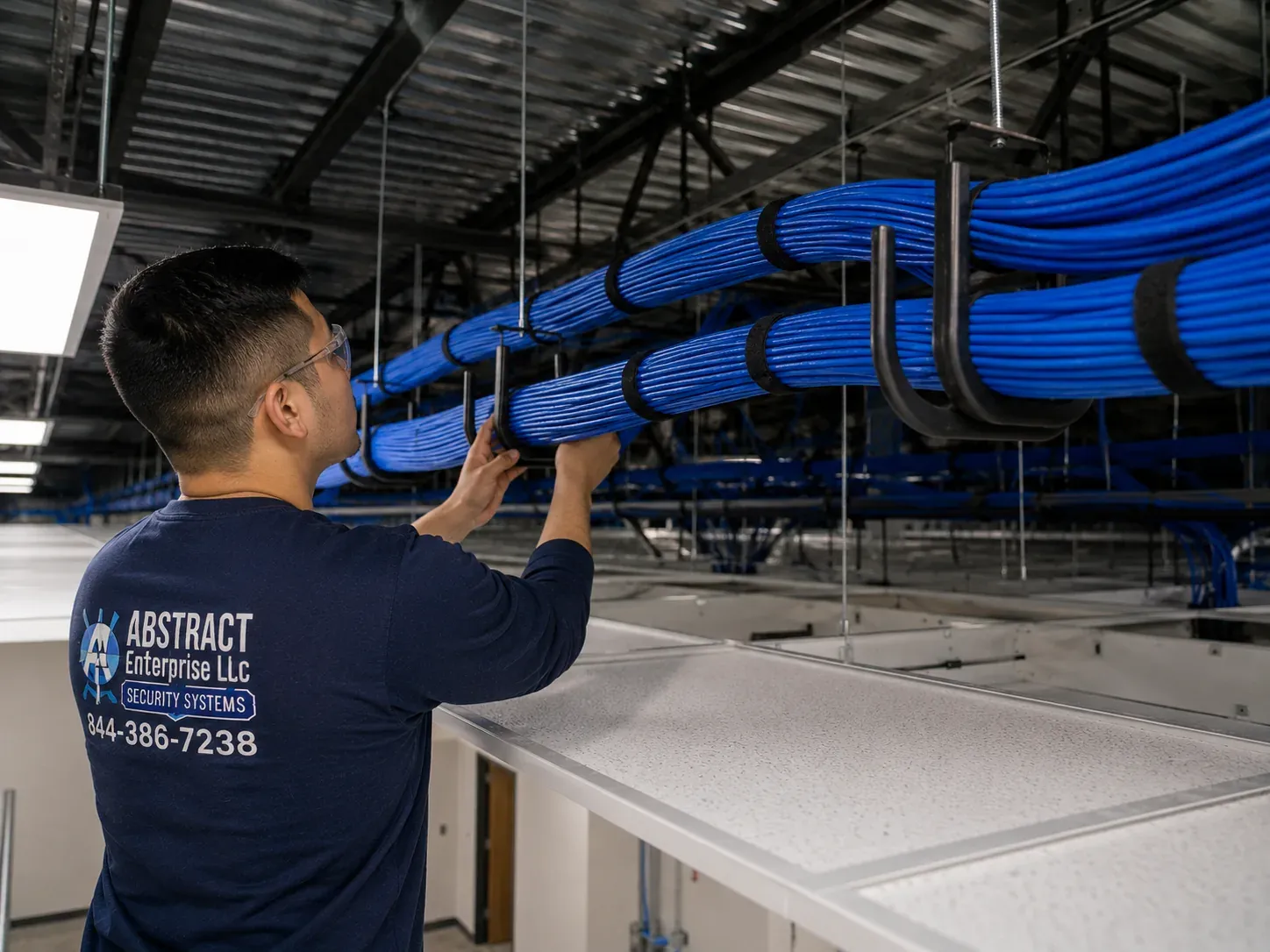
A technician reaches up to two thick bundles of blue cable held in black J-hooks hung from the deck, above a ceiling grid with some tiles still out.
Pricing
Fiber Optic Installation Cost in Orange County
Orange County fiber is quoted after a walkthrough, but the building blocks are published. Orange County carries our 1.40× area rate over the Brooklyn and Bronx base, reflecting travel time from our Bronx office and the spread-out, one-building-at-a-time nature of the work. The service rate for repairs and return visits is the same everywhere.
Item
Orange County price
What it covers
Fiber termination on an existing cable
$49 per termination
LC, SC, ST or MPO, fusion-spliced pigtail or mechanical connector
OTDR test
$56 per strand
Trace and event table per strand, in addition to loss testing
Multimode fiber drop
$490 per drop
Shorter horizontal run, terminated and tested
Single-mode fiber drop
$560 per drop
Shorter horizontal run, terminated and tested
12-strand OM4 backbone
$6,300 – $9,800
Fusion-spliced, enclosures both ends, firestopped, loss-tested
24-strand OS2 single-mode backbone (long or building-to-building route)
$11,200 – $21,000+
Single-mode with OTDR on every strand
Second telecom room with fiber link
from $3,360
Room build-out and the fiber tie back to the main room
Service and callback rate
$195/hr, 3-hr minimum ($585)
Repairs, troubleshooting and return visits — not the initial install
What moves an Orange County fiber quote
The entrance. A clean opening through block at the rear is quick; a stone foundation, a below-grade entrance or a historic facade that has to stay untouched takes longer.
Who else is in the building. Each tenant reached adds a route, a termination point and usually a little patience with access.
Old pathways. Usable old conduit in a former school or hospital saves work; conduit that turns out to be cut or full adds it.
Outdoor sections. A link between civic buildings or to a pad building adds conduit, pull boxes and digging or boring, which outweigh the cable cost.
Electrical items. Outlets or circuits for equipment are done by a licensed electrician and appear as separate lines.
National brand versus a local contractor. ADT, Ring and SimpliSafe sell alarms and cameras, not building fiber, so they are not really an alternative here. The realistic choices in Orange County are the provider's own installer (who stops at the terminal), an IT company that subcontracts its cabling, or a licensed low-voltage contractor who does the entrance, splicing and testing with its own crew and equipment. Ask any of them who will be standing in your basement and who will hand you the test results.
Shop Our Systems
Fiber Optic Installation Packages & Pricing
Below, three common Orange County jobs priced line by line from the published table, with no figure that isn't on it. Your own proposal replaces these assumptions with the measured route.
Starter — Finish and Prove an Existing Cable
$1,848
A 12-strand cable already in the building — left by a previous owner, a provider or another contractor — terminated and documented: 24 terminations at $49 and 12 OTDR traces at $56, with labelled panels and a results file.
Standard — Shared Entrance to the Floors Above
$6,300 – $9,800
A 12-strand OM4 backbone from a common basement enclosure to tenant spaces upstairs, with enclosures at each end, every rated penetration sealed and loss results for every strand. The range depends mostly on the route and the number of tenant end points.
Premium — Building to Building
$11,200 – $21,000+
A 24-strand OS2 single-mode link between two buildings — village hall to garage, restaurant to its new pad building — with OTDR on every strand. Trenching or boring is quoted separately once the route is surveyed.
Bring Your Own Equipment — Labour Only
If your IT provider or the building owner is furnishing the cable, enclosures or optics, we can supply labour only: installation, splicing and testing at the $195 per hour service rate with a three-hour minimum ($585). Materials you supply stay under their maker's warranty rather than ours, and we test a supplied reel before it goes into the wall, so a damaged spool is caught on the floor and not after the ceiling is closed.
Several Tenants, One Basement, One Plan
The walkthrough is free. You get a route sketch, a proposal that separates shared and tenant costs, and a straight answer on what needs approval.
How Fiber Jobs Differ From Port Jervis to Highland Falls
Orange County covers roughly 840 square miles, and a fiber job in a Newburgh rowhouse has little in common with one in a Warwick farm-supply store or a Central Valley outlet unit. This is how the work tends to differ around the county.
City of Newburgh
The densest building stock in the county and the most historic. Much of the East End is two- and three-storey brick from the late nineteenth century, often converted into apartments, offices or a mix of both. Rear entrances, shared basements and stairwell routes are the pattern, and the Architectural Review Commission's certificate of appropriateness is part of the plan whenever anything would show from the street. Waterfront restaurants and the newer apartment buildings near the river add a different job: equipment rooms on the ground floor, with fiber up to the residential floors and out to patios or decks where the cameras and payment terminals sit.
New Windsor and Cornwall
Commercial buildings along the main roads and older village blocks in Cornwall-on-Hudson and Cornwall. The work here is mostly single-building: a professional office, a medical practice or a shop where the provider landed its service in the basement and the business needs it at the front desk two floors up.
Middletown and the Town of Wallkill
The largest of the three cities, with a downtown of commercial blocks, a cluster of medical buildings, and the Touro campus in the former Horton Hospital. Greenlight said in 2025 that it was connecting 6,000 Middletown homes within a year and had connected thousands in the Wallkill hamlets of Circleville and Mechanicstown, so more businesses here now have a choice of provider than a few years ago. The Galleria at Crystal Run area and the strips along Route 211 bring long single-storey buildings where the job is getting from one end of the row to the other.
Goshen, Chester and Hamptonburgh
The Village of Goshen is the county seat, and the government center, the courts and the professional offices around them make for small, busy office buildings. Greenlight said in 2025 that it had connected more than a thousand homes in the village. Outside the village, the theme park, its hotel and the businesses that grew up around visitor traffic add hospitality work: front desk to back office, office to the outdoor areas where the cameras are.
Monroe, Woodbury and Harriman
Retail and service businesses along Route 17 and around the outlet village at Central Valley. Here fiber is mostly about distance inside long buildings and about the landlord's rules: in a managed retail center, the owner controls the roof, the walls and the entrance points, and tenant fiber goes where the center allows.
Warwick, Greenwood Lake and Florida
Village main streets with shops, restaurants, banks and offices in older buildings, and a busy weekend visitor trade. Jobs here are often a shop or restaurant that has outgrown one router in the back room and needs the network extended to a second floor, a back building or a seasonal outdoor area.
Walden, Montgomery, Maybrook and Washingtonville
Old mill-village centres with civic buildings close together. Greenlight announced a $3.4 million build in the Village of Walden in 2026 and was building in Washingtonville at the same time. With new provider fiber arriving, village offices and main-street businesses are the ones calling us to get it from the wall to where it's used.
Port Jervis and Deerpark
A small city of about 8,800 people at the tri-state corner, on the Delaware where the Neversink joins it, built up around the Erie Railroad. Greenlight began its Port Jervis build downtown in 2025 and housed its local network equipment with the city's police department. Downtown buildings on Front Street are narrow and deep, so the typical job is bringing new service from the front wall to an office, apartment or kitchen at the back.
Highland Falls and the River Towns
The Village of Highland Falls, beside West Point, was the latest Orange County village Greenlight announced, in June 2026, with an investment of more than $2 million. Many buildings on its main street are older mixed-use blocks, and businesses there serve a steady stream of visitors. A fiber entrance planned once for the whole building fits it well.
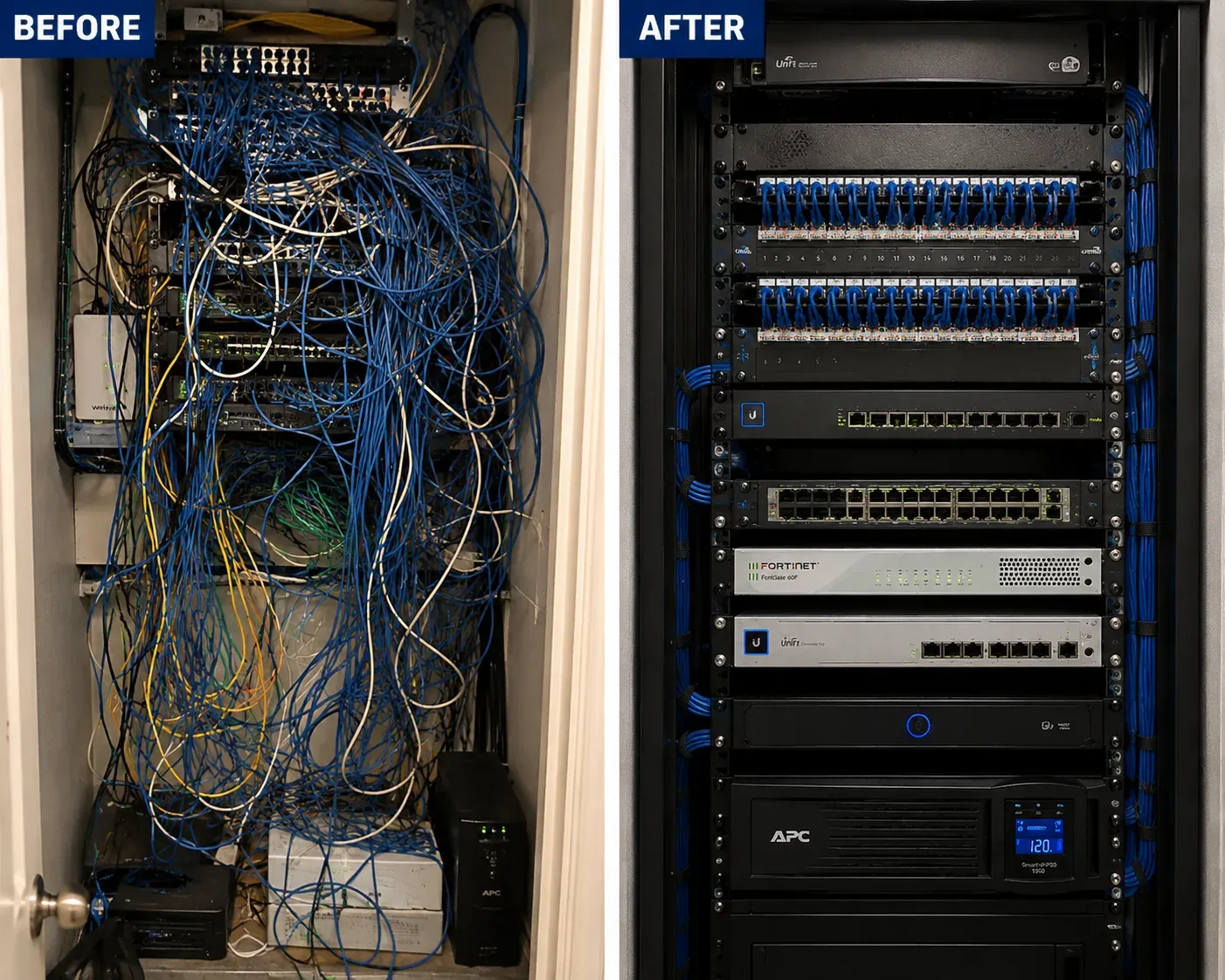
Side by side: on the left, a closet of tangled blue, white and yellow cords spilling over shelves and a small UPS; on the right, a black rack with two patched panels, switches, a firewall and a UPS, cords dressed down the sides.
Main-Street Buildings
One Entrance, Many Tenants: A Fiber Plan for Mixed-Use Buildings
The single most useful thing an owner of an older Orange County main-street building can do is decide, once, how communications get into the building. Without that decision, each tenant's provider makes it separately. A cable comes in through a basement window frame for the shop, another through the brick at the back for the upstairs office, a third along the outside wall to an apartment window. Ten years later, nobody knows which cable is live, the brick has several patched holes, and a new provider's technician has to start from scratch.
The plan we recommend has four parts. First, a single entrance, sized for more providers than the building has today and sealed against water and pests. Second, a lockable enclosure in a common part of the basement, labelled with the owner's name and contact, where every provider lands its service. Third, a small fiber backbone from that enclosure to each tenant space — usually a few strands each, more for an office than for an apartment — run through common areas only. Fourth, a strand map on the inside of the enclosure door and in the owner's files.
With that in place, a new tenant's provider connects at the enclosure, patches to the tenant's strands and is done. The tenant gets service without drilling, the owner keeps control of the building's walls, and the provider's visit is short. When the building is sold, the records go with it.
The same plan works for an owner who lives in one of the apartments and rents out the rest, for a small office building with four professional tenants, and for a former institutional building divided into suites. The scale changes; the principle doesn't.
What it changes for each party
The owner controls where every cable enters, keeps the facade and foundation intact, and has a record a buyer, insurer or inspector can read.
Tenants can choose any provider that serves the street without asking the owner for a new hole each time.
Providers find a labelled place to land, with strands already run to the customer, and finish their visit faster.
The village or city sees fewer exterior changes on historic buildings and fewer cables draped along facades.
Writing down who owns what
The part of a shared-entrance job most often skipped is a single page that says who owns each piece. We recommend the owner keeps the entrance, the sleeve, the basement enclosure and the backbone strands to each unit as part of the building, the same way the plumbing risers belong to the building. Each provider owns its own cable up to the enclosure and its terminal. Each tenant owns whatever it adds inside its own space, such as a switch, a router or a short patch cord, and takes it when it leaves.
Put that in writing once, keep it with the lease templates and hand a copy to each new tenant. It answers the questions that otherwise turn into arguments: whether a departing tenant can pull "their" fiber out of the wall, who pays when a provider damages the enclosure, and whether a new tenant needs the old one's permission to use the strands. It also tells any contractor who arrives later, including us, exactly what may be changed and by whom.
Closeout
The Fiber Records an Orange County Owner Should Keep
In small buildings, the paperwork outlives the people. The tenant who paid for the link moves away, the manager who met us retires, the building is sold. What remains is whatever was left in the enclosure and in the owner's files. We hand over the following on every job, and we recommend owners keep a copy with the building's other records.
A strand map: which strand goes where, who uses it and what it carries, taped inside the enclosure door and supplied as a file.
Loss results for every strand, measured end to end, with the date and the tester used.
OTDR traces for longer links and every building-to-building run, showing each splice and connector along the way.
Photographs of the entrance seal, every firestopped penetration and each enclosure before its cover went on.
A route sketch on a simple floor or site plan, showing where the cable runs through common areas and, outdoors, where the conduit and pull boxes are.
Ownership notes: who paid for which part, who owns the enclosure and which strands are assigned to which tenant or provider.
Owners tell us these records are what make a later job simple. When a new tenant arrives, or a village adds a building to its network, the next contractor — whether that is us or someone else — can start from facts instead of a flashlight.
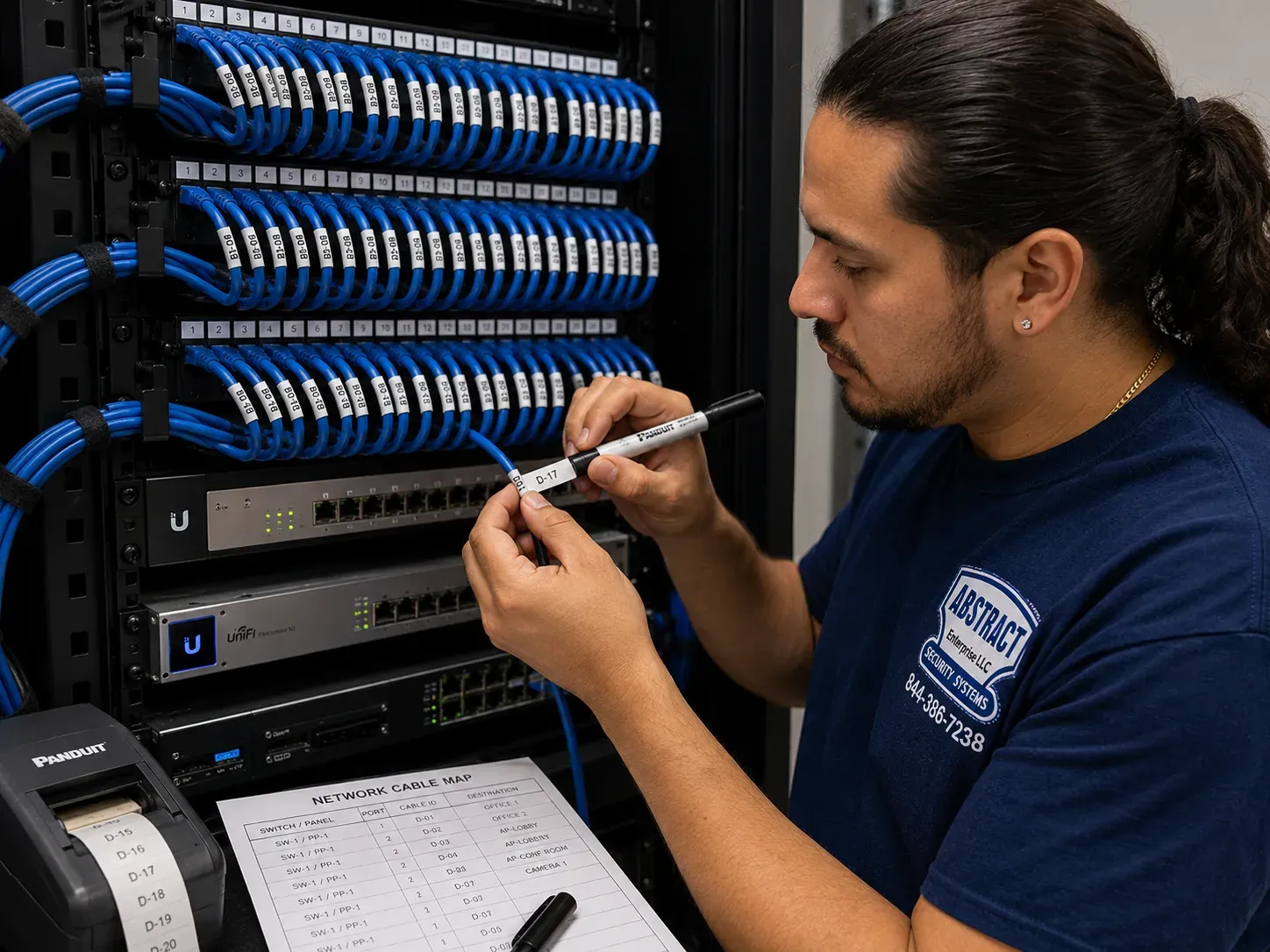
A technician marks a cord label reading "D-17" with a pen beside three rows of labelled patch cords, a printed "Network Cable Map" and a label printer in front of him.
Comparing Bids
Six Things to Ask Any Orange County Fiber Bidder
Fiber bids are hard to compare because they describe different jobs in different words. These six points put them on the same footing.
Where exactly does the cable enter the building, and how is the opening sealed? A bid that doesn't say has not looked.
Which items are shared and which belong to each tenant? In a multi-tenant building you need this split to divide the cost fairly.
Who does the splicing and testing — the bidder's own crew, or a subcontractor? Who hands over the results?
What testing is included: loss on every strand, OTDR on long links, connector inspection? Ask for a sample results page.
What is excluded? Electrical outlets, trenching, historic-district applications and work by the provider should each be named.
What records do you get at the end? A strand map, photographs and a route sketch should be standard, not extras.
If one bid is far cheaper than the others, it usually leaves out the entrance, the testing or the records. All three matter more in an old main-street building than anywhere else, because that is where the next person has the least to go on.
Before the Walkthrough
Five Things to Gather Before We Visit
Have whatever you can of this list handy; the visit goes faster and the number we give you is firmer for it.
A list of everyone in the building — tenants, their providers if known, and who to call to enter each space.
The provider's plans: if a provider has told you where it intends to land its cable, or left a terminal on the wall, take a photo.
Any building drawings, however old. A floor plan from a past renovation often shows chases and conduit nobody remembers.
Whether the building is in a historic district, particularly in the City of Newburgh, so we know whether the exterior is off-limits.
Where your equipment is today and where you would like it to be — a basement shelf, a closet, an attic — so we can tell you honestly whether that spot will work.
Provider Changeover
When New Provider Fiber Reaches a Village Main Street
Several Orange County villages have gone from one or two wired options to a new fiber provider within the last couple of years, and more are under construction. For a single house the change is simple: a terminal appears on the wall and a router goes on a shelf. For a business, and especially for a building with several tenants, the changeover touches more than the internet connection, and it is worth thinking through before the provider's technician arrives.
Start with an inventory of what the old service was doing besides internet. In older commercial buildings it is common to find card terminals, alarm communicators, a fax line, an elevator emergency phone or a fire-alarm dialer still using copper telephone lines or the old provider's equipment. Some of those can move onto the new service; some should stay on a separate path; some belong to another company entirely. None of them should be disconnected by accident because a technician assumed the old box in the basement was spare.
Then decide where the new service will land. A provider will usually install its terminal wherever is quickest, which may be a basement wall, a utility closet or a front window frame. If the building already has a shared enclosure, the terminal can go beside it and connect to the tenant's strands. If it doesn't, the arrival of a new provider is the natural moment to build one, before a second and third provider follow and each picks a different spot.
Finally, plan the overlap. Most businesses keep the old service running for a few weeks while they move everything to the new one, and a short period with both connections live is the safest way to switch. Fiber inside the building makes that easy: the old and new services can terminate in the same equipment room, and the switch-over becomes a matter of moving a few patch cords rather than re-running cable through the walls.
Before the provider visit: list every device that uses the old line, decide where the new terminal should go, and tell the provider in writing.
On the day: have someone present who can open the basement and the equipment space, and who knows which tenants are affected.
Afterwards: label the new terminal, record the account in the building file, and remove old equipment only once every device has been moved and tested.
Civic Networks
Linking a Village's Own Buildings With Fiber
Orange County's villages and towns tend to run their services from a handful of buildings close together: a village hall with the clerk's office and the court, a police desk, a highway or public-works garage, a library, and a firehouse that may belong to a separate fire district. Each building usually has its own internet account, and the buildings often talk to each other over leased circuits, a wireless link someone installed years ago, or not at all.
A short owner-built fiber network changes that arrangement. One strong internet connection, or two for redundancy, can serve every building on the network, with the cameras, door controls, phones and records system for all of them on links the municipality owns. Strands can be kept apart for the police, the fire company and the public library, so each organisation's traffic stays separate even though the cable is shared.
The practical limits are property lines and streets. Fiber between buildings on the same parcel, or on adjoining municipal parcels, is straightforward: conduit across the lawn or along the edge of a parking area, pull boxes at each building, and outdoor-rated cable inside. Crossing a village street needs the village's own approval as the road owner; crossing a county or state road needs that road owner's permission, which takes longer. We survey all of it and price the on-property links first, so a board can see what it would own and what it would still rent.
Municipal clients also need the paperwork to be right: a written scope, insurance certificates naming the municipality, and closeout records the next administration can find. We provide each of those as standard, along with test results for every strand and a route sketch showing exactly where the conduit runs across village property.
Reused Buildings
Surveying a Former School, Hospital or Mill Before Fiber Goes In
Big institutional buildings get second lives in Orange County more often than they get demolished, and each reuse leaves layers behind. A former hospital may have had its telephone room moved three times; a parochial school may have a 1960s intercom conduit system under its plaster; a mill turned into apartments may have one modern equipment room and a basement full of abandoned cable from its industrial years.
Our survey of a building like that has a fixed order. First we ask for every drawing that exists, however old, and walk the building with whoever knows it best — usually a facilities manager or the owner's long-time contractor. Then we look for the old communications backbone: the room where the original telephone service entered, the risers or chases that served each floor, and any conduit that runs from them to the former classrooms, wards or offices.
Every pathway we hope to use is tested before it goes into the plan. Conduit is proven continuous with a fish tape or a pulled line; chases are opened and inspected; concrete floors are scanned before any new core is drilled. Cable found in a pathway is traced and identified before anyone suggests removing it, because in an older institutional building an unlabelled pair can still be part of a life-safety system.
The result is a route plan that uses what the old building gives us where it is sound, adds new pathway only where needed, and records both, so the next owner or tenant inherits a map rather than a mystery.
Retail and Hospitality
Fiber for Shops, Restaurants and Hotels Along Route 17
Route 17 is Orange County's main street at highway scale. From the Harriman interchange west through Monroe, Chester, Goshen and Middletown, it carries commuters, freight and visitors heading for the outlet village at Central Valley and the theme park outside Goshen, and the state has named the stretch from Exit 120 to Exit 131 as the part most in need of a third lane. The businesses along it — plazas, restaurants, hotels, car dealers, medical offices — tend to be in long, low buildings with one equipment closet at one end.
That layout is where copper runs out. A standard copper network cable is limited to 100 metres from switch to device, and in a long retail row or a hotel with wings, the far end can be well beyond that once the cable has gone up into the ceiling, along the building and back down. The usual fixes — a switch hidden above a ceiling tile, a wireless bridge between two ends, a second internet account — work for a while and then become the thing that fails on a busy Saturday.
A fiber backbone along the building solves it properly. A few strands run from the main equipment room to a small, ventilated cabinet at the far end or in each wing, and each cabinet feeds the copper for the registers, cameras, kitchen screens and wireless access points nearby. The building then has one network, managed from one place, with no copper run anywhere near its limit.
For hotels, restaurants and attractions with large seasonal swings, the other benefit is headroom. Guest Wi-Fi, payment terminals and cameras all compete for the same network on the busiest days of the year. Fiber between closets removes the backbone as a bottleneck, and separate strands or separate networks can keep guest traffic away from the systems that take payments and record the cameras.
Retail rows: a short backbone to each end of the row, with the landlord's approval for any wall or roof penetration.
Restaurants: fiber from the office to the kitchen and bar, and out to a patio or a pad building, kept away from heat and grease.
Hotels and motels: fiber between equipment rooms in each wing or floor, routed through corridors and service areas rather than guest rooms.
Dealerships and showrooms: links from the main building to service bays and detached sales offices, often with cameras on the lot.
Complete Services
Every Fiber Optic Installation Service in Orange County
An Orange County owner who calls about fiber is rarely changing only the fiber. The services below are the ones we most often quote alongside it, from the same visit.
Camera systems for schools and former school buildings, often sharing a new fiber backbone.
Field Notes
Field Notes From Orange County Basements
Three habits our crews bring to every old Orange County basement — general practice, not the story of a single job
The first thing our installers do in an old main-street basement is count the cables coming through the walls and try to account for each one. It is rarely a short list. Old telephone pairs, a coax line from a cable company, a provider drop for each tenant, a dead alarm line — and often one or two nobody can explain. Before anything new goes in, we want to know which of those are live, which belong to whom, and which openings in the foundation can be closed for good.
The second habit is to ask the owner who else needs to know. In a building with a shop, a couple of apartments and an office upstairs, there is always someone whose space we will pass through or whose service we must not interrupt. A short note to each tenant before the work day saves an argument at the door.
The third is to leave the basement better than we found it: the new entrance sealed and photographed, the enclosure labelled with the owner's name and number, the dead cable we were allowed to remove gone, and the strand map taped inside the enclosure door. In a building that has seen a dozen contractors come and go, that last page is the part the next person thanks us for.
FAQ
Orange County Fiber Optic Installation FAQ
Do you take fiber work in western Orange County — Port Jervis, Otisville and the Deerpark side?
+
Yes. We cover the whole county, including Port Jervis, Deerpark, Otisville and the Town of Mount Hope, as well as the Newburgh and Middletown areas. Western Orange County jobs are planned from a detailed walkthrough so that most can be finished in a single visit.
What should we send so a quote can come back before anyone visits the building?
+
Photos of the basement wall where services enter, the provider's terminal if there is one, the place you want the equipment and the route between them, plus a rough floor plan and a list of tenants. With those we can usually give a budget range by email, then confirm it on a short walkthrough.
Is fiber worth adding to a building we might sell in a few years?
+
Usually, if the work is documented. A single sealed entrance, a labelled enclosure and a strand map are things a buyer, a lender's inspector or a new tenant can see and understand. Undocumented cable, by contrast, tends to be treated as something to remove. Keep the records with the deed file.
Can fiber reach a second-floor office over a storefront without running through the shop?
+
In most main-street buildings, yes. The route goes from the basement enclosure up the common stairwell or a shared chase, in a small painted raceway or behind trim, and into the office. The shop's ceiling and walls stay closed, and the shop's tenant is not disturbed.
Will trains on the Port Jervis Line next to our building disturb a fiber link?
+
No. Fiber carries light and is not affected by the electrical noise that can trouble long copper runs near rail equipment. Vibration is not a problem either as long as the cable and enclosures are properly secured, which we do in any case.
Can fiber be added to a hotel or motel along Route 17 without taking rooms out of service?
+
Generally, yes. Backbone fiber runs between equipment rooms through corridors, service areas and ceilings, not through guest rooms, and the work is scheduled around housekeeping. Rooms that need new wiring inside can be done a few at a time on low-occupancy days.
Do outlet-center and shopping-plaza leases usually let a tenant hire its own fiber installer?
+
Often, but under the landlord's rules. Managed centers commonly control roof and wall penetrations, require insurance certificates and approve contractors in advance. Send us the tenant construction rules from your lease and we will work within them and prepare what the landlord asks for.
Can new fiber sit alongside an older alarm or fire-alarm panel in the same closet?
+
Yes, with care. We keep fiber and network equipment clear of the alarm panel and its wiring, label everything we add, and never disconnect or reroute fire-alarm wiring. If the alarm company wants its communicator moved onto the new network, that change is theirs to make.
Our landlord lives outside New York — how do approvals work when the owner can't come to the building?
+
By email and photographs. We send the owner the route sketch, photos of the proposed entrance and enclosure location, and the scope, and ask for written consent before work begins. Many owners appoint a local manager or the tenant to meet us on the day.
Do tenants have to be home when fiber is run through an occupied apartment in a two- or three-family house?
+
Someone with authority has to let us in, and we only enter an apartment with the tenant's agreement and proper notice from the owner. Most routes stay in common areas, so the time inside any one apartment is short, often under an hour.
Does each end of a fiber link need a dedicated electrical outlet?
+
Each end needs power for its electronics, because fiber cannot carry power the way a network cable can. An existing outlet is usually enough, ideally with a small battery backup. If a new outlet is needed, a licensed electrician installs it, and our proposal lists it separately.
Can you install fiber in a bank branch or credit union on a village main street?
+
Yes. We work under the branch's own security rules: scheduled visits, an escort where required, and no access to secured areas beyond what the route needs. The bank's systems can be kept on their own strands, separate from any other tenant in the building.
All Areas Served
Fiber Optic Installation Across the Hudson Valley and New York
Orange County is one of six Hudson Valley counties in our fiber service. For the regional picture — outbuildings, campuses and links between scattered buildings — start at the Hudson Valley fiber optic installation hub. Pages for the other areas below are being added one by one; where an area has no page yet, the work is still available there today.
If a fiber link that carried traffic yesterday is down today, call (845) 640-3835. We dispatch the same day where we can; most jumper, connector and pigtail faults are found and fixed within one to two hours of a tech reaching the room, and every repaired strand is re-tested before we leave.
Fiber Optic Installation Orange County — One Entrance, Tested, Recorded
Abstract Enterprises Security Systems · 460 E Fordham Rd, Bronx, NY 10458 · Orange County and Hudson Valley direct line (845) 640-3835 · WhatsApp (718) 679-0359 via wa.me
NYS Low-Voltage Licence #12000287431 · 100% Licensed & Insured · Same-Day Estimates · Rated 4.7★ from 201 Google Reviews
Full terms — including 50% deposit, one-year parts-only warranty on AESS-supplied products, and the late-fee schedule — are set out in the service agreement. See our warranty page.
Page reviewed and updated October 17, 2026. Changelog: first publication of the Orange County fiber optic installation page.