North of the city line, the network problem is rarely height. It is distance, weather and ground. A barn four hundred feet from the house, a second office building across a parking field, a warehouse whose dock cameras sit at the far end of a thousand-foot wall, a campus where the newest building is the farthest from the main room. We design and install the private fiber that joins those places — glass that carries no current, shrugs off the voltage differences that cook copper between buildings in a summer storm, and reaches distances copper never will. Every strand is spliced, tested and handed over with a map of where it runs.
Reviewed and updated October 17, 2026 · Written by Anwar Timothy, NYS licence #12000287431
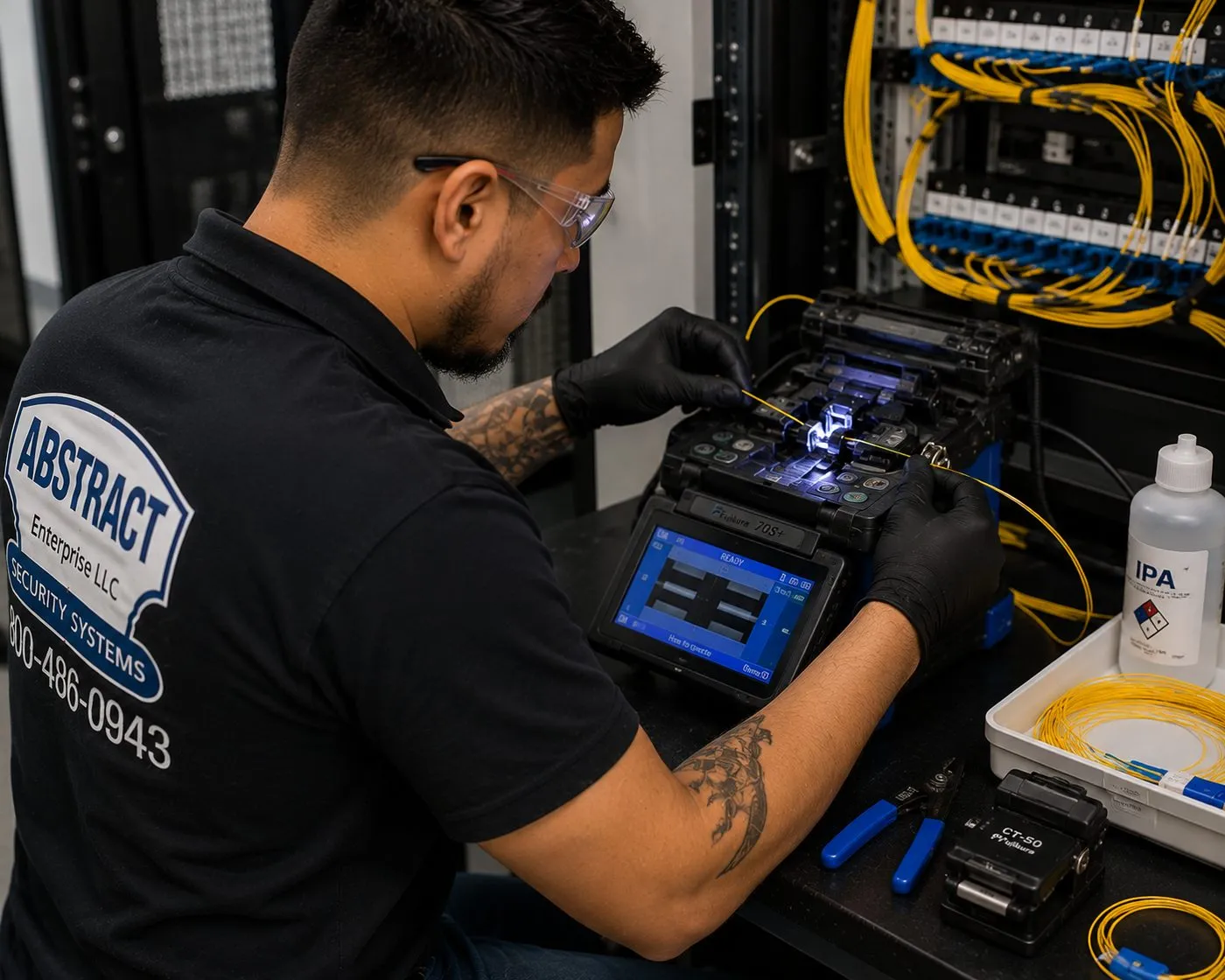
A technician in black nitrile gloves loads a fiber into a fusion splicer; a bottle of isopropyl alcohol, a tray of yellow fiber and a cleaver sit on the bench below a rack of patched panels.
Get a Free Fiber Quote
Tell us the buildings and the distance between them — we call back the same business day
✅
Request Sent!
We'll call you back the same business day.
25+
Years Experience
✓
Same-Day Estimates
100%
Licensed & Insured
4.7★
201 Google Reviews
Two buildings, one network, and a distance nobody has measured yet? Call (800) 486-0943 or send the 60-second form with a rough distance and a photo of where the cable would leave each building. A licensed installer reads it, not a dispatcher.
Outdoor runs designed around lightning, frost and the ground between buildings
Buried routes drawn, tracer-wired and findable; all strands loss-tested
Low-voltage work under New York State licence #12000287431, with certificates of insurance issued for campuses and managed properties
Why Hudson Valley Properties Need Fiber Optic Installation
The Hudson Valley spreads out instead of stacking up, and that single fact decides how its networks have to be built. A city building puts its rooms on top of one another and the wiring problem is a riser. Up here the rooms are scattered across land: an office park with five low buildings on a loop road off I-287, a distribution center in the Town of Montgomery with more than a million square feet under one roof, a horse farm in Dutchess with the house, the barn, the indoor ring and the manager's cottage each a few hundred feet apart, a college whose newest science building went up at the far edge of a thousand-acre campus. Each of those places eventually wants one network, one camera recorder, one internet circuit and one set of door controls. The thing standing in the way is the ground between the buildings.
Copper can be pulled across that ground, and for years it was. The trouble is what happens when the cable gets there. Twisted-pair Ethernet is specified for a 100-metre channel, roughly 328 feet, and a surprising number of outbuildings sit just beyond it. More important, a copper cable between two buildings ties together two separate electrical systems, each with its own ground rod driven into its own patch of soil. On a calm day the difference between those grounds is small. When lightning strikes nearby, or a fault occurs on one building's service, the difference can briefly become very large, and the cable is the easiest path between them. One poster on a networking forum described exactly this: buildings with separate grounds were bonded through network cable and users got shocks through their computer cases. The usual outcome is less dramatic but more expensive — a switch port, a camera, a gate controller or a whole switch dead the morning after a thunderstorm.
The Hudson Valley gets a lot of those storms. In Earth Networks' 2020 lightning report for New York State, Orange County recorded more total lightning pulses than any other county in the state, 275,059 of them, and Ulster, Westchester and Dutchess each logged between about 166,000 and 183,000 with 45 to 49 thunder days apiece. A copper link between two buildings in that climate is not a question of whether it will see a surge, only of when. Fiber removes the question. Glass carries light, not current; an all-dielectric cable has no metal in it to carry a surge from one building to the other, so the two electrical systems stay isolated even while the data passes between them.
The other half of the valley's fiber story is about providers. Large parts of Ulster, Dutchess, Putnam and western Orange were for years served only by cable, fixed wireless or nothing at all, and that is changing. In September 2025 Ulster County announced a $20.8 million award from New York State's ConnectALL deployment programme, matched by Verizon, to bring fiber to nearly 1,300 unserved households, businesses and community facilities in the county's more remote areas. In Orange County, Greenlight Networks now sells fiber service in Goshen, Middletown, Wallkill and Port Jervis. Those projects bring glass to the road and to one point on a building. Getting it from there to the barn office, the second building or the far side of the property is private work that the provider does not do, and it is the work we are hired for.
Hudson Valley facts that shape fiber work
275,059 lightning pulses: Orange County's 2020 total in Earth Networks' New York lightning report, the highest of any county in the state; Ulster logged 49 thunder days, Dutchess 48 and Westchester 45.
$20.8 million: New York State ConnectALL award to Ulster County announced September 25, 2025, with a $40.9 million Verizon match, for fiber to nearly 1,300 unserved locations (Ulster County).
Four Orange County towns: Goshen, Middletown, Wallkill and Port Jervis are listed by Greenlight Networks as served by its fiber, with expansion elsewhere in the county announced but not yet named.
About 15 million square feet: the sum of warehouse projects in a November 2024 list of 37 Orange County projects compiled for the advocacy group Orange Environment, from Wawayanda and Montgomery to Cornwall and Deerpark.
161 acres: average farm size in Dutchess County across 620 farms in the 2022 Census of Agriculture; Ulster's 486 farms average 150 acres. That is the scale at which outbuildings sit apart.
Four cities, one plan: in 2016 Mount Vernon, New Rochelle, White Plains and Yonkers announced a joint push for citywide gigabit fiber, estimated at about $750 million — a reminder that Westchester's density problem is different from the rest of the valley's distance problem.
Put those together and the work divides into three kinds of job. Corporate, medical and institutional campuses in southern Westchester and around Poughkeepsie need owner fiber between buildings because their sites were built out one building at a time. Warehouses and logistics buildings along Route 17K, Route 300 and the I-84 corridor need fiber because the building itself is longer than copper can reach. And homes, estates, farms, wineries and event venues across Putnam, Dutchess, Ulster and Orange need fiber because their outbuildings are far away, exposed to the weather and sitting on separate electrical grounds. Each of those has its own section below.
Most Hudson Valley owners who join two buildings with fiber put cameras on the far end within the year. If that is the plan, our commercial camera installers in the Hudson Valley and our access control team work from the same site plan, so the fiber is sized for them from day one.
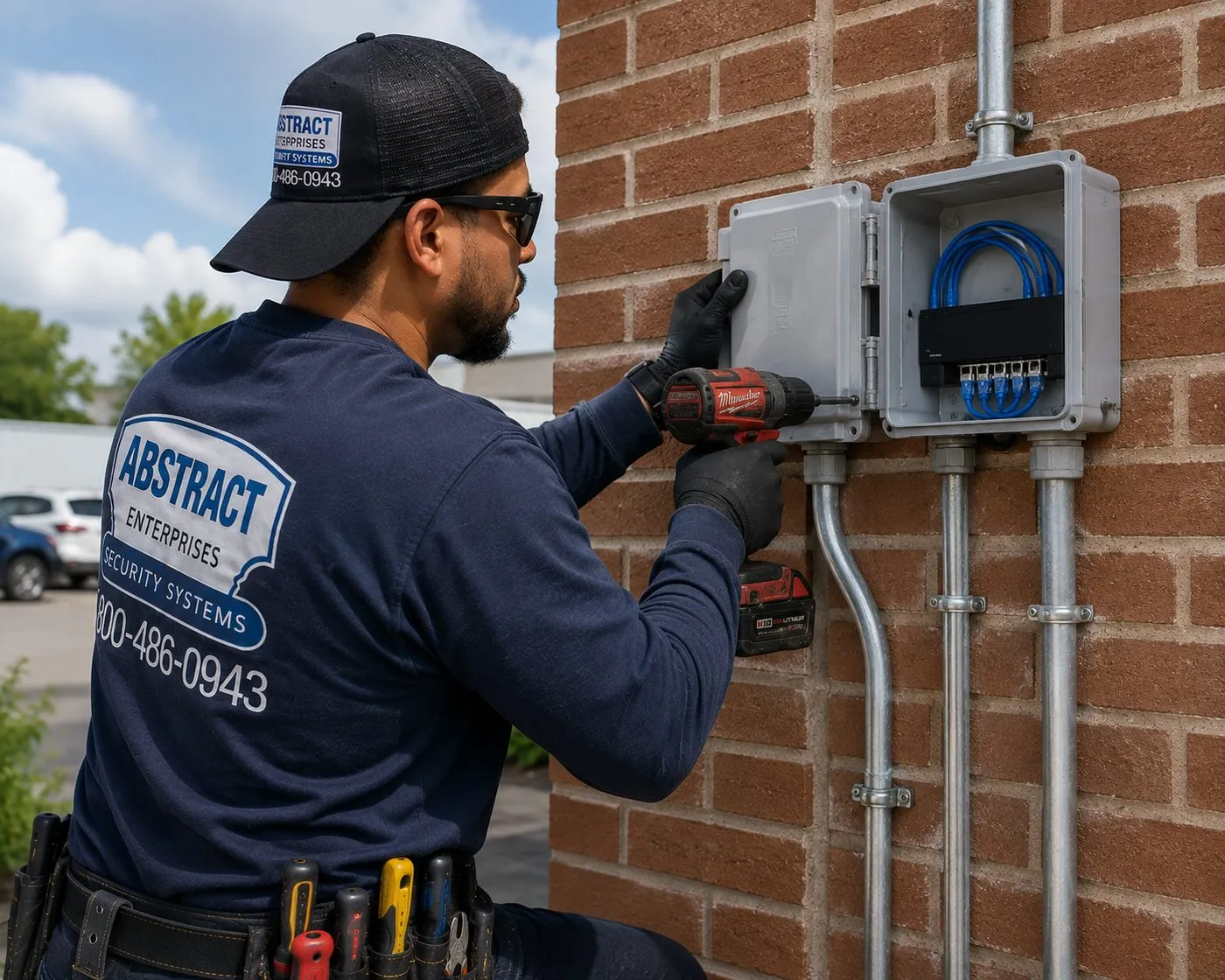
A technician drives a fastener into a grey weatherproof enclosure on a brick wall; two rigid conduits rise from below into the boxes — the kind of entry point where an outdoor run becomes an indoor one.
Repair Capture
Link Down Between Two Hudson Valley Buildings?
A barn that went dark after a storm, a campus link cut by a landscaper's auger, a splice enclosure that filled with water over the winter — these are repairs, not new installs, and we treat them that way. We dispatch the same day where we can, and most single-point faults on fiber we can reach — a damaged pigtail, a broken connector, a wet or crushed enclosure — are located and fixed in one to two hours on site. Call (800) 486-0943 and say it is a fiber repair, or see our network cable repair service in the Hudson Valley for copper and mixed faults. If the link that failed was copper, ask us to quote the fiber replacement while we are there.
What We Install
Fiber Optic Installation Services in the Hudson Valley
Most of what we install north of the city crosses open ground at some point, so every service below starts with the route outside, not the rack inside. Each can be quoted alone or as one project, and each finishes with tested strands, labelled ports and a record of where the cable actually went.
House-to-Outbuilding Links
Fiber from the main house or office to a barn, detached garage, studio, pool house, guest cottage or workshop. We trench or bore conduit, pull outdoor-rated cable, land it in a small wall enclosure at each end and leave media converters or switch optics ready to plug in.
Campus Building-to-Building Single-Mode
Owner fiber between the buildings of an office park, private school, medical campus, house of worship with a parish hall, or municipal complex — through existing duct where it exists, through new conduit where it doesn't, spliced into enclosures in each building's main room.
Long Warehouse Runs
Distribution buildings along Route 17K, Route 300 and the I-84 corridor are often longer than copper's reach from one network room. Fiber from the office pod to remote closets at the far wall, the dock line, the guard house and the yard camera poles keeps one network across the whole site.
Storm-Damaged Copper Replacement
A copper link between buildings that keeps killing ports after storms is a ground-potential problem, not bad luck. We remove it, pull dielectric fiber in its place and put the equipment at each end on local power and surge protection.
Provider Fiber Extensions
The new fiber provider lands its terminal on the house, the farm office or the front building. We carry the service from that point to wherever the network actually lives, on owner fiber you control.
Fusion Splicing and Enclosures
Pigtail splicing into rack-mount panels in main rooms and into sealed wall-mount enclosures in barns, sheds and unheated buildings where dust, insects and condensation are part of the design brief.
Locatable Buried Routes
All-dielectric cable can't be found with an ordinary locator, so every buried run we install gets a tracer wire or a locatable conduit, warning tape above it and a measured route drawing, so nobody hits it in ten years.
Testing, Certification and Documentation
Light-source and power-meter loss tests on every strand, OTDR traces on long outdoor runs and on any run with mid-span splices, and a closeout file a school district, hospital facilities team or future owner can actually use.
Fiber for Cameras, Gates and Access Control
The far end of most Hudson Valley fiber links carries security traffic: cameras at a barn or gate, a keypad at an equipment building, a video intercom at a driveway entrance. We size strands and power for those devices before the trench closes.
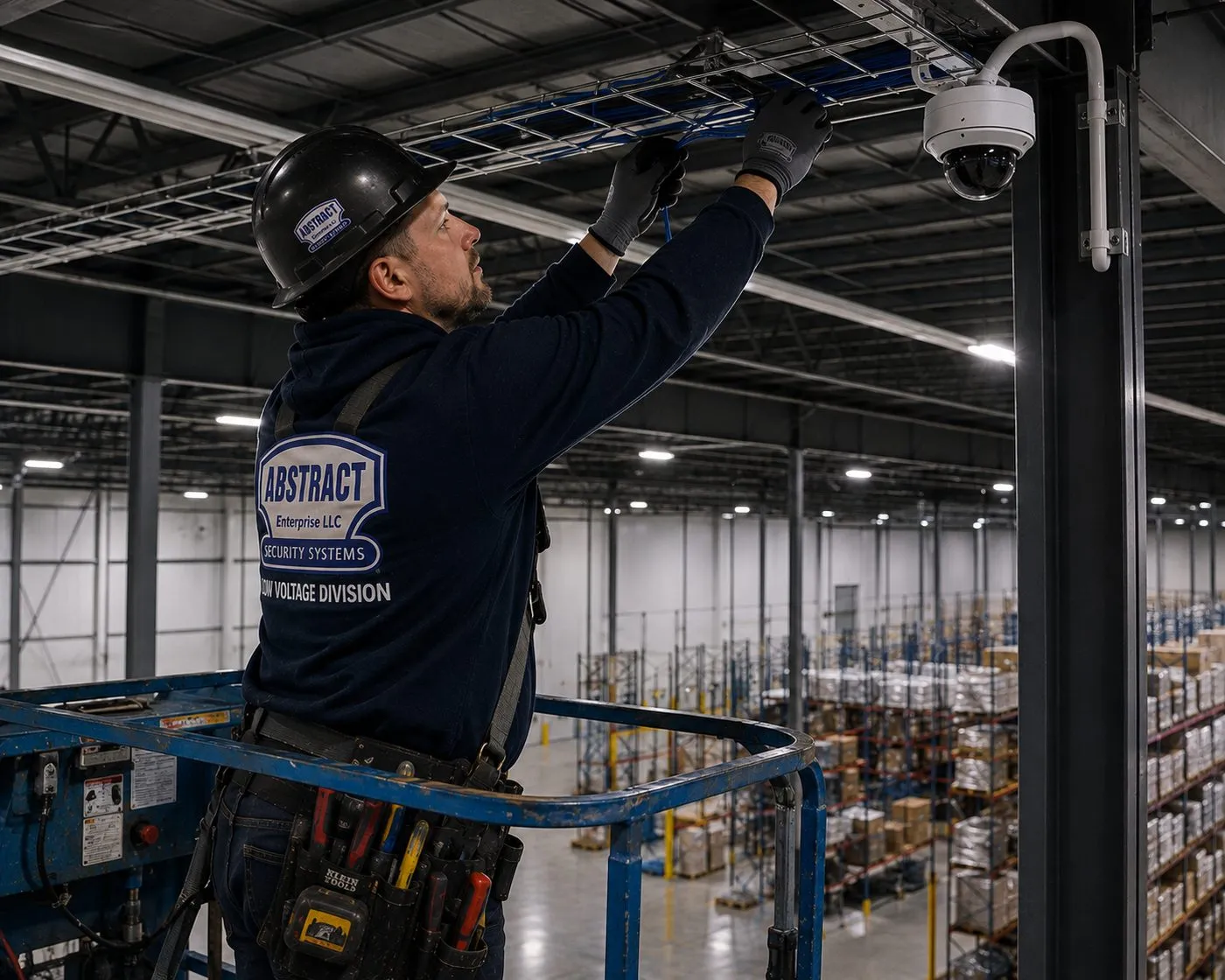
An installer in a hard hat reaches up to an overhead cable tray from a scissor lift in a high-bay warehouse, with pallet racking down the aisle and a dome camera on the column beside him.
Building Specialists
Fiber Optic Installation for Hudson Valley Architecture
The valley's building stock spans three and a half centuries, and the oldest and newest of it often share a single property. A seventeenth-century stone house with a 1990s addition and a steel pole barn behind it is an ordinary Ulster County job. These are the building types we plan around most.
Low-Rise Office Parks
The two- and three-storey office buildings of the 1970s–1990s along I-287, Westchester Avenue, the Saw Mill River Parkway and Route 9. Each building usually has its own telephone room and its own electrical service, and the buildings were connected, if at all, with copper that predates the current tenants.
Medical, Research and College Campuses
Hospitals in Valhalla, research campuses in Tarrytown, colleges in Poughkeepsie and New Paltz. Central IT already runs a backbone; our work is usually a department, a new building or a contractor's scope that has to join that backbone to the campus standard.
Big-Box Warehouses and Distribution Buildings
Tilt-up concrete and steel buildings of half a million square feet and more in Orange County's warehouse belt. The distances are inside the building as much as between buildings, and the network rooms are built late in construction if nobody asks for them early.
Stone, Brick and Timber-Frame Houses
Colonial Dutch stone houses in Kingston's Stockade District, brick in the river towns, nineteenth-century farmhouses almost everywhere. Thick masonry, sills set on stone foundations and no convenient chase make the building entry the hardest few feet of the whole route.
Farms, Estates and Equestrian Properties
Main house, barns, indoor arenas, cottages, sheds and gates spread across tens or hundreds of acres. Distances run from a couple of hundred feet to a quarter-mile, and many of the outbuildings are unheated, dusty and visited by animals.
Wineries, Breweries and Event Venues
A farmhouse office, a production building, a tasting room and a wedding barn, often on different electrical services and sometimes added years apart. Point-of-sale, Wi-Fi for guests and cameras for the parking field all want the same network.
Methods and materials by building type
Office parks: we look first for the existing inter-building duct. Many parks have it, often half-full of dead telephone cable. Where the duct is usable, innerduct and a single-mode cable of twelve or more strands go in; where it is collapsed or full, a new conduit is bored rather than trenched across finished parking.
Medical and campus buildings: cable listings follow the space (plenum above return-air ceilings, riser in shafts), splices go into enclosures that match the campus standard, and labelling follows the institution's scheme, not ours. Infection-control and occupied-building rules govern when ceilings can be opened.
Warehouses: armored or innerduct-protected fiber on the cable tray or J-hooks along the roof steel, with service loops at each remote closet so a closet can move when racking is reconfigured. Yard and pole runs go underground in conduit to the pole base.
Stone and brick houses: the entry is planned from inside the cellar out, through an existing penetration such as an old oil-fill or service sleeve where one exists, otherwise a single small core sealed with a sleeve and a non-hardening sealant suited to the masonry. Inside, fiber is small enough to follow existing wiring routes where copper would not fit.
Farms and estates: conduit trenched or bored between buildings with pull boxes where the route turns sharply or runs long, outdoor-rated cable, tracer wire, and sealed enclosures at each end mounted high enough to stay away from moisture, rodents and equipment.
Wineries and venues: the event barn is treated as an outdoor-adjacent space — enclosures and switches inside a lockable cabinet, power on a UPS, and nothing left where guests can reach it.
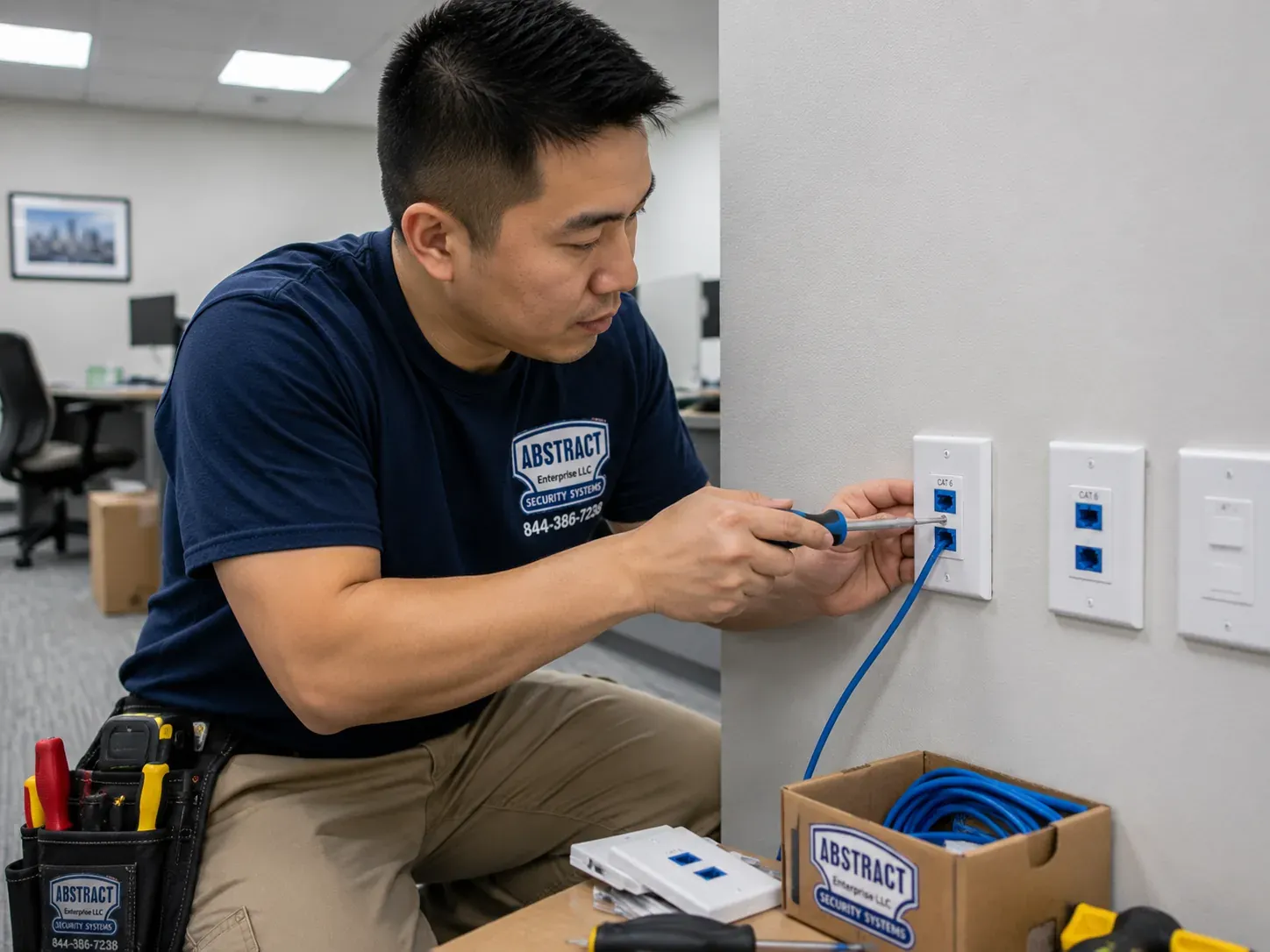
A technician kneels at a wall plate with a punch-down tool, a blue cable feeding the outlet and a box of faceplates and cable on the floor beside him in an open-plan office.
Owners of older valley houses who bring fiber to a barn office usually add cameras at the barn door and the driveway at the same time. Our residential camera installers in the Hudson Valley plan those cameras around the same strands, so the second trip is a hand-off rather than a second trench.
Commercial Fiber
Business Fiber Optic Installation in the Hudson Valley
The valley's commercial fiber work clusters along a handful of corridors, and each corridor has a characteristic building and a characteristic problem.
Westchester Avenue and the Platinum Mile
The office corridor along I-287 through White Plains, Harrison and Purchase. Westchester Avenue's two-building complex at 1111 and 1129 alone covers about 335,000 square feet, and PepsiCo once subleased some 234,000 square feet there while its Purchase headquarters was renovated. Multi-building tenancies like that are where building-to-building fiber earns its keep.
Tarrytown, Valhalla and the Saw Mill Corridor
Research and medical campuses on the Saw Mill River Parkway and the Taconic. Regeneron's Tarrytown expansion was announced in 2021 as about 900,000 square feet of new research space in up to eight buildings, and Westchester Medical Center's $220 million Critical Care Tower in Valhalla was targeted for 2026. New buildings on established campuses all have to join an existing backbone.
Route 17K, Montgomery and the Stewart Area
Orange County's logistics belt around Stewart International Airport. The Amazon building at Route 17K and Route 747 is about 1,015,740 square feet and Medline's nearby facility about 1.2 million. Buildings that size need fiber just to reach their own far walls, before anyone thinks about the guard house or the trailer yard.
Route 59, Nanuet and West Nyack
Rockland's retail and office strip, anchored by the 2.36-million-square-foot Palisades Center, which changed hands at a foreclosure auction in February 2026. Retail pads, outparcels and back-of-house buildings around big centres are classic short building-to-building links.
Poughkeepsie, South Road and Route 9
Dutchess's technology and education corridor. IBM's Poughkeepsie campus on South Road is the site of a planned roughly 300,000-square-foot quantum computing facility, with construction slated to start in September 2026; around it are colleges, medical offices and the suppliers that serve them.
Kingston, New Paltz and the River Towns
Main streets of brick and stone in Kingston, Beacon and Newburgh, where a business often owns the building next door or the carriage house behind. Short fiber links between neighbouring historic buildings are common, and the entry through old masonry decides the method.
Compliance callouts for commercial fiber in the Hudson Valley
Cable listings still apply outside the city. Riser (OFNR) cable in vertical shafts, plenum (OFNP) above return-air ceilings, and outdoor or indoor/outdoor cable for anything buried or between buildings. Outdoor-only cable is not listed for long indoor runs, so the transition point is designed in.
Metallic members at the building entrance. The National Electrical Code's Article 770 treats fiber with metal in it — armor, a metallic strength member, a tone wire — differently from all-dielectric cable: where a cable entering a building could contact power conductors, its metal must be grounded or interrupted with an insulating joint as close as practicable to the point of entrance. We design the entry to suit the cable chosen.
Copper between buildings needs primary protection. Communications circuits on copper that leave a building require a listed primary protector near the entrance under NEC Article 800, bonded to the building's grounding. Replacing the link with dielectric fiber removes that requirement for the data path.
Digging means calling first. New York law requires a call to the one-call centre through 811 before any excavation; Central Hudson tells customers to call at least two and no more than ten days before digging. Utilities mark their own facilities; privately owned lines on your land are yours to locate.
County licensing. Westchester requires home-improvement contractors to hold a county licence, and Rockland issues its own home-improvement contractor licence and master electrician licences. Which licence a scope needs depends on the work and the county; ask any contractor which ones they hold for yours.
Watershed rules. Parts of Westchester, Putnam, Orange and Ulster drain to New York City's reservoirs, and the city's watershed regulations cover stormwater and wastewater in those areas. A long trench near a stream or reservoir can raise questions a short one doesn't; we check before we dig, not after.
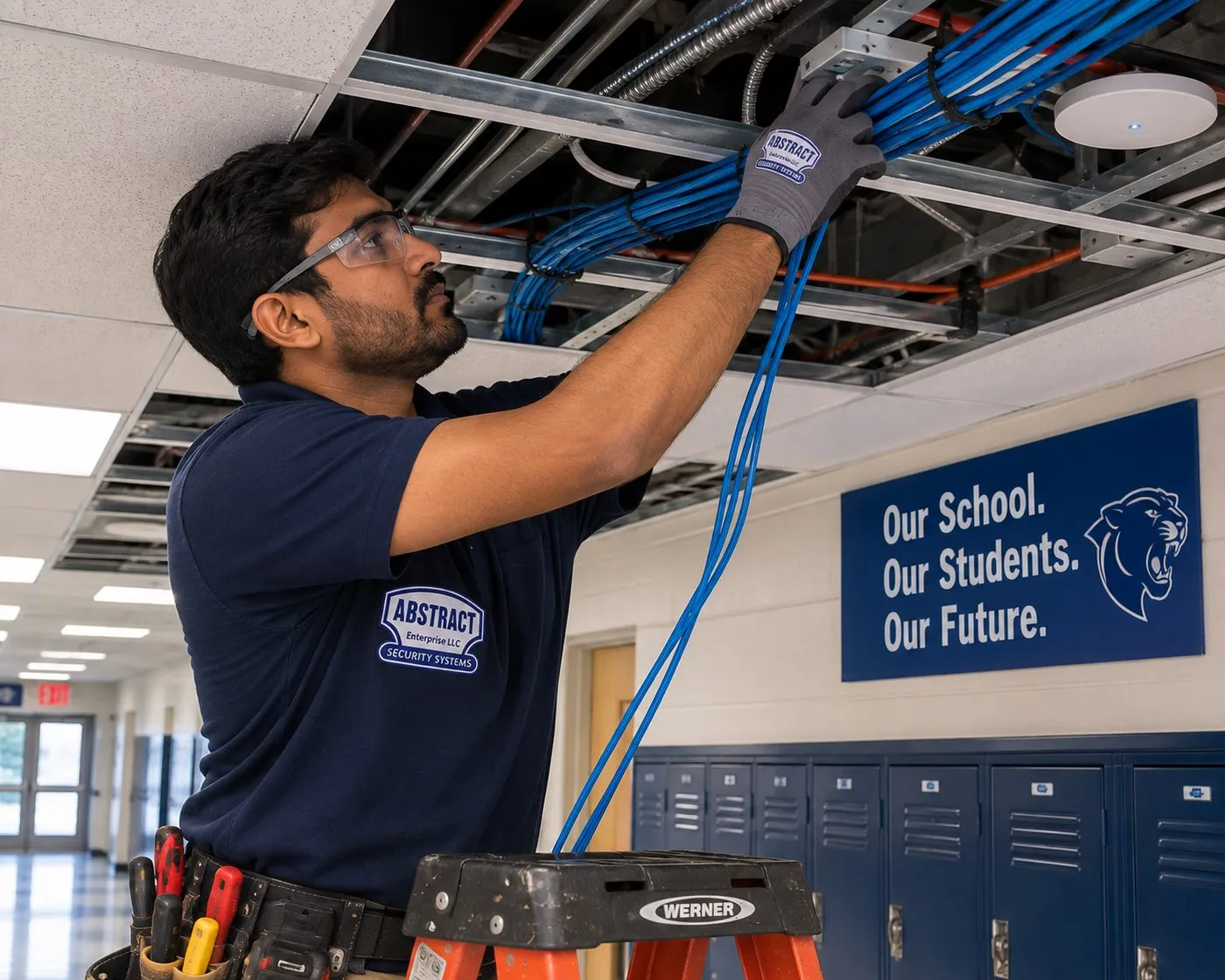
An installer on a stepladder feeds a bundle of blue cable into an open ceiling grid above a school corridor lined with lockers, next to a ceiling-mounted wireless access point.
Ground, Lightning & Distance
Why Copper Fails Between Valley Buildings and Fiber Doesn't
Every building with its own electrical service has its own connection to the earth, and no two of those connections sit at exactly the same voltage. That is the physics behind most of the "it just died after the storm" calls we get from outbuildings, and it is the main reason we recommend fiber for nearly every link that leaves one building and enters another.
Picture a farmhouse and a barn 350 feet apart, each with its own service and its own ground rod. Run a copper Ethernet cable between them and you have connected the two grounding systems through the shields, the drain wires and, more subtly, through the electronics at each end. Ethernet ports are transformer-coupled, which gives them isolation for normal signalling, but as one engineer on the MikroTik forum put it, that isolation is functional, not safety isolation. A nearby strike raises the earth around one building relative to the other for a fraction of a second. The voltage difference finds the cable, crosses the port and leaves through the equipment's power supply. Sometimes it takes out one port. Sometimes it takes out every device on both ends. Utility faults and poorly bonded services can do the same thing on a sunny day, more slowly.
There are copper-side mitigations, and they have their place: surge protectors at both ends, bonded to each building's grounding electrode, shielded cable with its drain properly terminated, and buried rather than overhead routes. Done well, they reduce the damage. They don't change the underlying situation, which is that a conductive path now connects two independent earth references. A poster on Reddit's r/HomeNetworking put the common view bluntly while answering a question about networking a new barn: "you want to run fiber for anything between buildings," adding that they had personally dealt with equipment fried by the alternative. That is opinion, not engineering, but it matches what we see in the field.
Fiber solves it at the root. An all-dielectric cable — glass fibers, aramid yarn, plastic tubes and a polyethylene jacket — has nothing in it to carry current from one building to the other. Each end's electronics take power only from their own building, so a ground-potential difference between the two simply has nowhere to go. That is also why many fiber specifications for buried runs between buildings call for all-dielectric construction rather than armored cable: armor brings strength against crushing and rodents, but it reintroduces metal that, under NEC Article 770, may need grounding at each building entrance where it could contact power conductors. We choose between the two route by route.
Distance is the second reason. The 100-metre copper channel includes the patch cords at each end, so the usable permanent link is a little shorter, and an outbuilding at 300 feet as the crow flies is often 380 feet by the route a cable actually has to take around a driveway, a septic field and a row of trees. Multimode fiber carries 10-gigabit Ethernet hundreds of metres; single-mode carries it kilometres. On valley properties, where the barn is rarely the last building anyone will add, we usually install single-mode for anything that leaves a building, because the optics are cheap and the reach is effectively unlimited for the distances on a farm, an estate or a campus.
The third reason is everything else that shares the ground: electric fences, well pumps, irrigation controllers, generator transfer switches, barn lighting on long circuits and the motors that run fans, waterers and gates. All of them put noise on nearby copper. None of them affect light in glass.
When copper between buildings is still reasonable
We are not dogmatic about it. A detached garage forty feet from the house, fed from the house's own panel rather than a separate service, shares the house's grounding system; a properly protected copper run there is a sensible, cheaper choice. A second building on the same service at a short distance is similar. What changes the answer is a separate service, a long run, an overhead route, or a history of storm damage. Where we do recommend copper, we fit primary protection at the entrance, bonded correctly, and we tell you what we would do instead if it fails.
One more practical point from the same forum discussions: when a trench is open, put in more than you need today. A spare conduit, or a second cable alongside the fiber, costs little while the ground is open and a great deal once it is closed. One r/HomeNetworking commenter running 200 feet of fiber to a barn suggested exactly that — a terminated, tested but unused Cat6 in the conduit as a backup — and on a short, same-service run we sometimes do the same. On a separate-service run we prefer a second fiber, for the reasons above.
Six Counties
How Fiber Work Changes From County to County
The Hudson Valley is six counties with six different mixes of building, distance and soil. Dedicated county pages are on the way; until each is live, its link below goes to our quote form, and the same crews cover it today.
Westchester
Westchester is the densest of the six and the closest to the city in how its commercial buildings behave. The fiber work is mostly campus and multi-building: office parks on the Platinum Mile and around Tarrytown and Elmsford, research and hospital campuses in Valhalla and along the Saw Mill, private schools and country clubs with buildings spread around grounds, and large houses in the northern towns with pool houses, garages and guest cottages. Existing duct banks are common on commercial sites and are often reusable. The county licenses home-improvement contractors through its Department of Consumer Protection, so residential scopes start with that paperwork. Westchester fiber optic installation pricing uses the 1.25× rate shown in the pricing table below.
Rockland
Rockland packs a lot into a small county: the Route 59 retail spine through Nanuet and West Nyack, office and light-industrial parks around Orangeburg and Pearl River, and older villages along the river. Typical fiber work is short building-to-building links between pads and back-of-house buildings, warehouse and flex buildings that outgrew one network room, and houses on wooded lots where a detached studio or garage sits uphill on ledge. The county issues home-improvement and electrical licences under its own code. Rockland fiber optic installation uses the 1.30× rate.
Orange
Orange is the valley's logistics county and, by the 2020 count, its lightning capital. Warehouses and distribution buildings in Montgomery, New Windsor, Wawayanda, Wallkill and Chester need fiber inside the building and out to guard houses and camera poles. Around them are farms in the black-dirt region, horse properties and new subdivisions. Greenlight's fiber in Goshen, Middletown, Wallkill and Port Jervis means more owners now have a provider terminal on the house and a reason to extend it. Orange County fiber optic installation uses the 1.40× rate.
Putnam
Putnam is mostly residential and mostly wooded, with lakes, steep lots and long private driveways, and a commercial core around Brewster, Carmel and Mahopac. Fiber work here is dominated by house-to-outbuilding links, gatehouses and driveway gates far from the house, and small commercial buildings that share a lot with a second building. Much of the county drains to the city's reservoirs, which makes route planning near water more careful. Putnam fiber optic installation uses the 1.45× rate.
Dutchess
Dutchess runs from the Poughkeepsie technology corridor and its colleges to farm country around Millbrook, Pine Plains and Rhinebeck. Its 620 farms average 161 acres, and historic estates along the river — the Vanderbilt property at Hyde Park covers 211 acres and once ran its own hydroelectric plant — show how long the valley has been solving the problem of getting power and signals between scattered buildings. Our work splits between institutional campus links and long rural runs. Dutchess fiber optic installation uses the 1.53× rate.
Ulster
Ulster has the valley's oldest buildings and some of its most remote properties: the Stockade District in Kingston, eight blocks and 32 acres with Colonial Dutch stone houses on all four corners of Crown and John Streets; the college town of New Paltz; and hamlets in the Catskills where the county's ConnectALL-funded fiber build is aimed. Stone walls, long gravel driveways, ledge rock and second homes that sit empty for weeks shape the design. Ulster fiber optic installation uses the 1.53× rate.
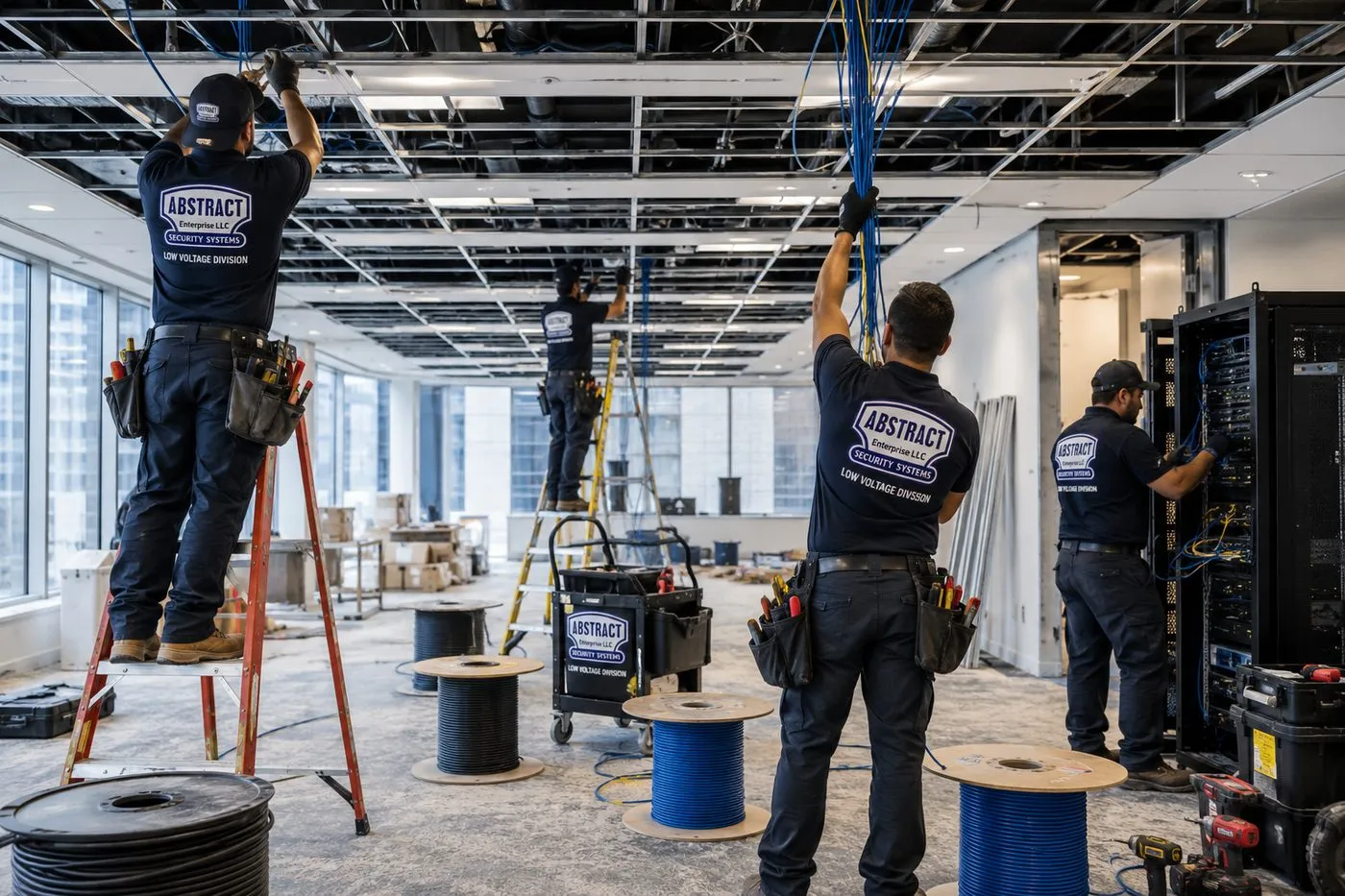
Three installers work from stepladders in an open-ceiling office floor, pulling cable off reels standing on the concrete while a fourth works at an equipment rack near the windows.
Your Questions Answered
Fiber Optic Installation in the Hudson Valley: Questions Answered
These are the questions valley owners, facilities managers and builders ask us before a fiber job. Each is answered once here; shorter follow-ups are in the FAQ further down.
Barns, cottages and other outbuildings
Does it matter whether our barn or cottage has its own electric meter when we choose the network cable?
It matters more than anything else about the link. A building fed from the house's own panel shares the house's grounding system, so a copper cable between them connects two points that sit at nearly the same electrical potential; at a modest distance, properly protected copper is a reasonable, cheaper choice. A building with its own meter and service has its own ground rod in its own soil, and copper between the two joins two independent earth references. That is the arrangement that turns a nearby lightning strike into dead equipment at both ends. For a separately metered building we recommend all-dielectric fiber almost without exception, with the switch or media converter at each end powered from its own building. If you don't know how the outbuilding is fed, a look at the meters and panels during the walkthrough settles it in a minute.
Why did the copper cable to our detached garage die after a summer thunderstorm, and will it happen again?
Almost certainly because of a ground-potential difference between the two buildings, and yes, it will happen again unless the link changes. If the garage has its own service and ground rod, a nearby strike lifts one ground relative to the other for an instant and the copper cable between them carries the surge into the equipment at both ends. Replacing the damaged switch and re-using the same cable puts you back where you started. The durable fix is fiber, which isolates the two buildings electrically, with each end's equipment powered locally through a surge-protected outlet or a small UPS. If you want to keep copper, the minimum is listed primary protection at each entrance bonded to each building's grounding electrode — and a buried route if the existing cable runs overhead.
A stream or a wet meadow lies between the house and the barn — how does fiber get across, and does anyone have to approve it?
There are three usual answers. A directional bore can pass beneath a small stream or wet area without disturbing it, entering and leaving on dry ground. Where a culvert or a farm bridge already crosses, conduit can sometimes be fixed to it, protected and sealed. Or the route can go around, along higher ground, if the extra distance is modest — fiber doesn't care about a few hundred more feet. Approval is the part to settle first. Work in or near regulated wetlands and streams can involve the town and state, and in the parts of Westchester, Putnam, Orange and Ulster that drain to New York City's reservoirs the city's watershed regulations also apply to stormwater and related work. We identify which, if any, apply to your route before quoting, and design the crossing to avoid needing a permit where a reasonable alternative exists.
Campuses, parks and institutions
A college department or research tenant wants its own fiber between two buildings on a campus that already has a central IT backbone — how does that get coordinated?
Through the campus IT and facilities offices, before anything is priced in detail. Established campuses usually have standards for cable type, strand counts, enclosure brands, labelling and where a department's or tenant's fiber may terminate. Some allow dedicated strands in the campus duct; others want the department to use spare strands on the existing backbone rather than pull new glass. Our job is to read the standard, propose a design that fits it, and produce test results and as-built drawings in the format the campus asks for. Colleges add academic calendars to the plan, because the best time to trench across a quad is when students are away, and research buildings add their own access rules for labs and plant rooms. We schedule around both.
Who owns the old duct bank between our office-park buildings, and can our new fiber use it?
Ownership comes first. On a single-owner park the duct normally belongs to the landlord; on a condominium or subdivided park it may belong to an association, and occasionally to a carrier that built it. We ask for the site's utility plans and get written confirmation that a duct may be used before we open it. Physically, the answer depends on what we find when we rod it. If one conduit is clear, innerduct carrying single-mode fiber is the cheapest route between buildings there is. If the conduits are full of abandoned telephone copper, removing it is often possible and always worth asking about; if a conduit has collapsed or silted up, a new bore beside it beats a trench across a finished parking lot.
Our new warehouse near Stewart needs cameras on yard poles and a network at the guard house — what has to go in the ground before the lot is paved?
Conduit, and more of it than seems necessary. Every camera pole, the guard house, any gate or barrier arm, the trailer-yard lighting controls and any future EV chargers need a pathway back to a network room, and the cheapest moment to provide one is before the base course and asphalt go down. We give the site contractor a conduit schedule: sizes, routes, sweeps, pull-box locations and which runs carry fiber and which carry power, with spare conduits to each cluster of poles. Fiber then goes in after paving, through conduit that is already there. If the lot is already paved, the same design is built by boring between landscaped islands and pole bases instead — slower and costlier, but without cutting finished pavement.
Providers arriving and properties waiting
A grant-funded provider is finally bringing fiber up our road — what should we have ready on our land before they connect?
Decide where you want the service to land and where the network should live, because they are often not the same place. The provider will bring its drop to one building, usually the house or the front office, and install its terminal there. If your router, recorder and work space are in a barn office or a second building, plan the owner fiber between the two now: a conduit from the provider's entry point to that building, and an enclosure with room for the extension. Clear access for the provider's crew helps too — a marked route for their drop, the location of any private buried power or water lines, and a dry, powered spot for their equipment. When the provider's crew leaves, we extend the service on fiber you own, so changing provider later never means rewiring the property.
Old masonry, hillsides and hard ground
How does fiber get into an eighteenth-century stone house with walls two feet thick?
Carefully, and preferably without making a new hole. We look first for an existing penetration: an old fuel-oil fill, a disused service sleeve, a cellar window frame that can be replaced with a panel, or the route the electric or telephone service already uses. Fiber cable is thin enough to share many of these. If a new penetration is unavoidable, it is a single small core through a mortar joint rather than a stone where the wall allows it, sleeved, sloped to drain outward and sealed with a sealant compatible with old lime mortar. In a historic district, visible exterior changes may need local review, so we confirm that first. Inside, fiber follows existing chases and floor framing where copper often wouldn't fit.
Our outbuilding sits uphill on ledge rock — can a buried route still be built, and what does rock do to the price?
Usually, but rock changes the method more than the design. Where the soil is shallow over ledge we look at routes that follow existing disturbed ground — the driveway shoulder, an old water line, a stone wall's footing — and at surface methods such as conduit fixed to rock in a protected run, or a shallow trench with concrete cover where traffic crosses. Directional boring through soil full of cobbles is possible but slower. We price rock as an allowance after looking at the site rather than guessing, because the same 300-foot route can be a morning's work or a week's depending on what is under the lawn.
Will frost heave and spring thaw damage fiber buried on a sloping Hudson Valley lot?
Not if it is in conduit, buried properly and given slack. Frost moves soil, and on a slope the thaw can shift it downhill. Cable laid loose in a shallow trench can be stretched or pinched where it enters a building or a pull box. Conduit spreads that load, sweeps at each end avoid tight bends where movement concentrates, and a service loop in each enclosure gives the cable room to move. Where a route crosses a drainage swale or a wet area, we raise the pull boxes and seal the conduit ends so the run doesn't become a drain into the building.
Power, animals and working sites
If the link between buildings is fiber, do we still need surge protection?
Yes, but for a different reason. Fiber stops surges travelling between buildings along the network cable. It does nothing about surges arriving in each building through its own power, its own antenna leads or its own copper cables to cameras on poles. The switch or media converter at each end should be on a surge-protected supply, ideally a small UPS; outdoor copper runs from that switch to cameras or gate controllers still need their own protection; and armored fiber, if we used it, needs its armor handled at the entrance. The difference is that one well-protected building can no longer take the other down with it.
What does fiber in a horse or livestock barn need that a link to a garage doesn't?
Protection from dust, moisture, animals and the people who clean around them. Barn dust and hay chaff clog fans and connector end-faces, ammonia from stalls corrodes ordinary electronics, rodents chew anything soft, and pressure washers find every unsealed box. So the enclosure and the switch go in a sealed, gasketed cabinet mounted high in a feed room or tack room rather than an aisle, cable enters through glands from below, exposed runs are in conduit, and unused fiber ports are capped. Equipment rated for wide temperature ranges handles the unheated months. Cameras in the aisles then connect over short copper runs from that cabinet, each protected, while the fiber back to the house stays out of reach.
Our farm winery runs events in a separate barn — can one fiber link carry the point-of-sale, guest Wi-Fi and cameras out there?
Comfortably. A single pair of strands carries all of it at gigabit or ten-gigabit speed; we normally install twelve strands so spares exist for the future. At the event barn, a managed switch separates the traffic into its own networks — payments isolated from guest Wi-Fi, cameras on their own segment — so a guest can't see the till and the cameras keep recording when a hundred phones join the Wi-Fi. The switch, the fiber enclosure and the UPS go in a lockable cabinet out of guests' reach, and the access points mount high on the barn structure. Our network installation team in the Hudson Valley handles the switching and Wi-Fi as part of the same job.
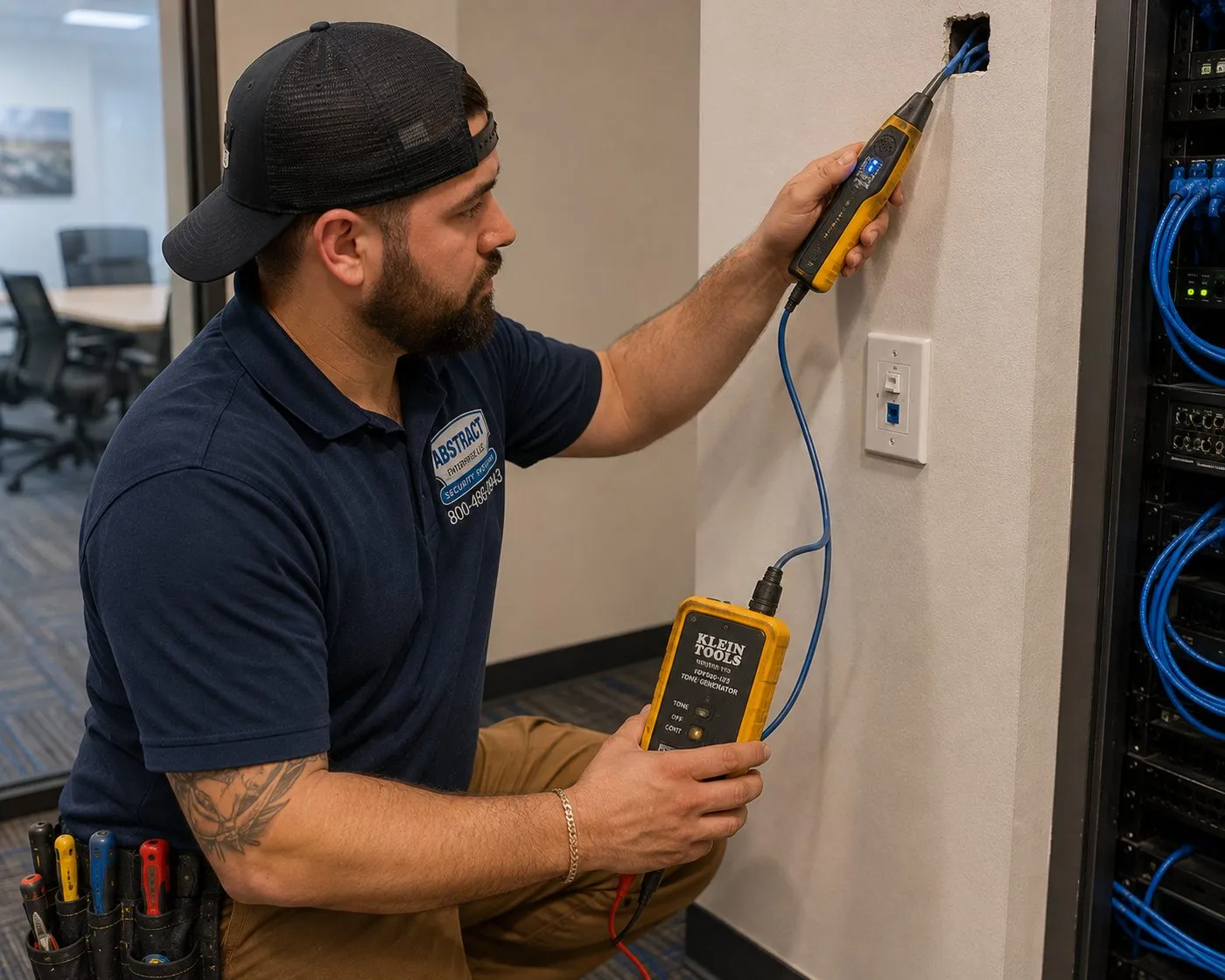
A technician in a cap holds a tone probe to a wall jack while a yellow tester hangs from the connected cable, beside an open rack of blue patch cords — how an unknown existing cable is identified before anything is reused.
Equipment
Types of Fiber Optic Cabling We Install
On valley jobs the cable's jacket matters as much as the glass inside it. These are the products we specify most often outside the city, and where each one belongs.
All-Dielectric Outdoor Loose-Tube
Gel-free or water-blocked loose-tube cable with no metal at all. Our default for buried conduit between buildings with separate electrical services, because it carries nothing that could bridge their grounds.
Indoor/Outdoor Tight-Buffered
Cable listed for both environments, so a run can leave one building, cross underground and enter the next without a splice at each wall. Ideal for shorter outbuilding links where the cable must enter living or work space.
Armored Outdoor Cable
Corrugated steel or aluminium armor under the jacket for crush and rodent resistance in direct-buried or exposed runs. Stronger, but metallic, so its armor is grounded or isolated at each building entrance.
Aerial and Self-Supporting Cable
Cable lashed to a messenger or built with its own support, for routes along existing poles on large rural properties where trenching is impractical.
Single-Mode OS2
The glass we install for nearly every building-to-building link. Optics are inexpensive and the reach far exceeds any distance on a valley property, so a barn link installed today can carry whatever speed the next switch supports.
Multimode OM4
Used inside large buildings — warehouse closets, campus buildings — where links are short and the existing equipment is multimode.
Sealed Wall-Mount Enclosures
Small gasketed splice and patch enclosures for barns, garages and sheds, mounted high and away from moisture, with cable glands that keep out insects and rodents.
Conduit, Pull Boxes and Tracer Wire
HDPE or PVC conduit with long sweeps, in-ground pull boxes on long or turning routes, warning tape above the conduit and a tracer wire so dielectric cable can be found again.
Media Converters and SFP Optics
Industrial media converters for unheated buildings, or switches with fiber ports, matched to the fiber type and wavelength so the link lights on the first try.
Fiber or copper between two valley buildings: a quick comparison
Question
Copper (Cat6/Cat6A)
All-dielectric fiber
Maximum channel length
100 m (328 ft) including patch cords
Hundreds of metres (multimode) to kilometres (single-mode)
Bridges two buildings' grounds
Yes — conductive path between them
No — no metal in the cable
Primary protection at each entrance
Required for circuits leaving the building
Not needed for the data path
Affected by electric fences, pumps, motors
Can pick up interference
Immune
Carries power to a camera at the far end
Yes, by PoE
No — far-end equipment needs local power
Can be found by a standard locator once buried
Yes
Only with tracer wire or locatable conduit
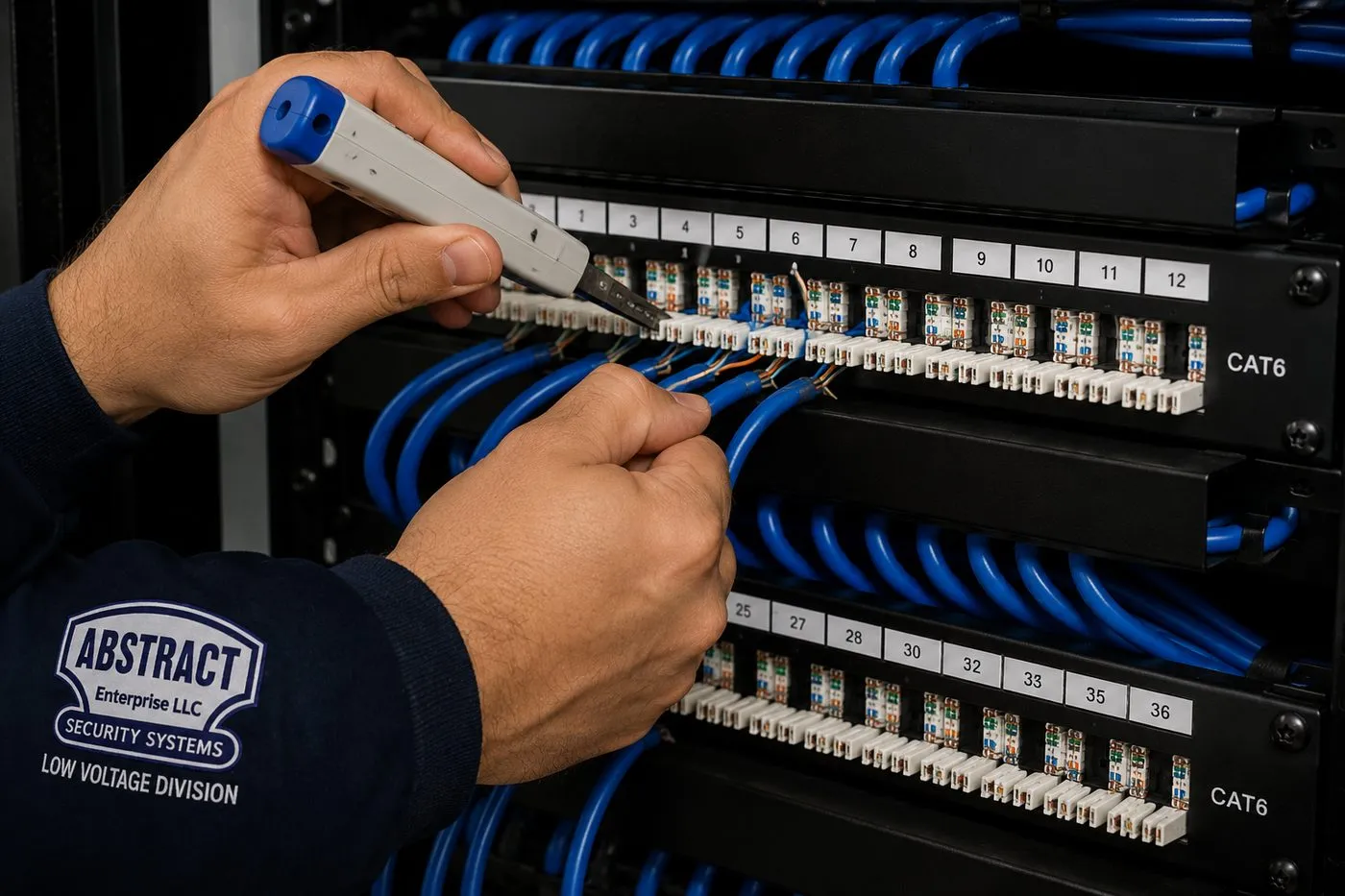
Close-up of a technician's hands seating blue cables into a numbered Cat6 patch panel with a punch-down tool — the copper side of a rack that a fiber link feeds.
AI Overview Reality Check
What AI Gets Wrong About Fiber Optic Installation in the Hudson Valley
AI summaries and cost guides are written for an average job, and the average job is an office floor in a city. Here is how seven common claims hold up on valley properties. The claims are quoted from published cost guides and forum answers, not from any one company's advice to you.
"Under 100 metres, ordinary Cat6 is the cheapest link between buildings"
This one comes from a forum answer that called the lightning concern a myth, and on the narrow question of price it is right: a box of Cat6 costs less than outdoor fiber and two optics. The claim leaves out what happens after installation. Between two buildings on separate services, Cat6 is a conductor joining two grounding systems, and the valley's storm season will test it every summer.
The cheapest link is the one you install once. A copper run that loses a switch, a recorder port and a camera every couple of years has cost more than fiber by the second storm, before counting the time the barn spent offline. Where copper is legitimately fine — a short run to an outbuilding on the house's own service — we say so.
Distance also bites sooner than people expect. A building "about 250 feet away" is often 330 feet by the route a cable must actually take, which is beyond the copper channel before a single patch cord is added.
"Fiber doesn't need grounding"
True for all-dielectric cable, and a good reason to choose it. Not true for every fiber cable. Armored cable, cable with a metallic strength member and cable with a copper tone wire all contain metal, and the electrical code treats that metal like any other conductor entering a building where it could meet power conductors: grounded, or interrupted by an insulating joint, near the entrance.
This matters on rural jobs because armored cable is tempting for direct burial — it resists rodents and shovels — and then quietly reintroduces the ground-bridging problem fiber was chosen to avoid. If the armor is bonded at both buildings, it is a conductor between them.
Our approach is to use dielectric cable in conduit between buildings on separate services, and to reserve armor for places where crush protection matters more, handling the armor deliberately at each end when we do.
"A short aerial building-to-building run is only a few thousand dollars"
One published guide puts aerial runs on poles at roughly $8 to $12 per foot and says a short aerial link "can range from a few thousand dollars." The same guide notes that aerial runs need attachment rights, and that is where valley projects stall.
On a farm or estate, the poles between buildings may belong to the property owner or to the utility, and they may not be where the cable needs to go. Where they belong to the utility, permission to attach is a formal process with its own clearances, and it is rarely quick. Where they are private and old, a pole may need replacing before anything else can hang on it.
Aerial cable also lives in the valley's weather: ice loading, wind, falling limbs. We price aerial honestly where it makes sense, but on most properties a bored or trenched conduit costs less over its life and never needs a ladder after a storm.
"Fiber costs two to three times as much as a copper drop"
That comparison, from a published installation cost guide, is per drop: one terminated run from a closet to a device in an office. It is a fair rule of thumb inside a building where both media would work.
It doesn't describe a link between buildings, where the comparison isn't fiber against one copper drop but fiber against copper plus primary protectors at both entrances, bonding at both ends, surge protection for the equipment and the replacement cost of whatever the next storm takes. For a run beyond 100 metres, copper isn't an option at all without a switch in the middle of the lawn.
On valley jobs the trench, bore or conduit often costs more than either cable. Once that cost is committed, the difference between pulling fiber and pulling copper through it is small.
"Whole-building projects with 100 to 200 drops land between $15,000 and $30,000"
Another orientation range from the same guide, and the guide itself says these are not quotes. It describes a cabling fit-out measured by drop count, which is how a city office is priced.
A valley campus or farm job is priced by route, not by drops. Two buildings with ten drops each and 600 feet of rock-strewn ground between them cost far more than one building with forty drops, because the money is in the ground. A distribution warehouse may have few drops per square foot but long trunks to remote closets and a yard full of conduit.
That is why our pricing section publishes the building blocks — terminations, testing, backbones and drops — at each county's rate, and why we walk the route before giving a firm number.
"Call 811 two days before you dig and the lines will be marked"
Calling is the law, and Central Hudson's guidance is to call at least two and no more than ten days before digging. What the call achieves is notification of the utilities and municipal operators that are members of the one-call system, each of which marks its own facilities.
On a valley property, many of the things a trench can hit are not theirs. The feed from the house to the barn, the well line, the irrigation, the septic lines, the low-voltage cable to the gate, the old telephone wire to the cottage — those are private, and no one-call ticket will mark them.
So our route survey asks the owner what is buried, looks for the evidence (meters, junction boxes, well caps, cleanouts), and uses a locator on anything conductive before we dig. It is one more reason every fiber route we bury gets a tracer wire: so the next person can find it.
"With the new rural fiber build, the provider will wire the whole property"
Grant-funded builds such as Ulster County's ConnectALL award are aimed at unserved locations — households, businesses and community facilities — and providers connect a location, typically to one building. That is a big step for a property that had no wired service, and it ends at the provider's terminal.
From that terminal on, the wiring is the owner's. A provider installer may run a cable to a second room in the house; they are not going to trench to the barn, build a link to the cottage or design a network for a multi-building property.
The best time to plan that owner wiring is before the provider arrives, so the terminal lands where the extension is easiest. The second-best time is the week after.
Get the Route Measured Before the Ground Freezes
Send the buildings and a rough distance. We will tell you what the link needs, how it should cross your ground and what it costs at your county's rate.
A few lines about the property are enough to start: which buildings, roughly how far apart, and whether lawn, pavement, woods or water lies between. Expect a reply within the business day — or skip the form and dial (800) 486-0943.
✅
We Got Your Request!
We'll call you back the same business day. If it's urgent, call us now at (800) 486-0943.
How It Works
Our Installation Process
Seven steps, the same on a two-building farm and a twelve-building campus. Most of the difference between a smooth valley fiber job and a difficult one is decided in the first two.
1. Site walk and route survey
We walk the ground between buildings with you, measure the real route, note slopes, rock, wet areas, trees and pavement, find each building's electrical service and grounding, and ask what private lines are already buried.
2. Design and written proposal
Cable construction, strand count, conduit and pull-box layout, building entries, enclosures and optics, with a loss budget for each link and every line priced at your county's rate.
3. Notices, approvals and locates
The 811 one-call ticket, any town, campus or historic-district approval the route needs, and a private-line locate on anything conductive near the route.
4. Trench, bore and conduit
Conduit installed with long sweeps and pull boxes, tracer wire and warning tape laid above it, building entries cored, sleeved and sealed, and the ground restored.
5. Pull and mount
The cable goes through the new conduit on a grip attached to its aramid yarn, with slack coiled at both buildings, enclosures fixed high on dry walls and any armor dealt with where it enters.
6. Splice, terminate and test
Factory pigtails joined to the cable on the splicer, each connector checked under a scope, then a power-meter reading on all strands and an OTDR shot wherever the run is long or has a mid-span splice.
7. Light, label and hand over
Optics or media converters installed and the link brought up, both ends labelled, and the results, route drawing with measurements and photos handed to you.
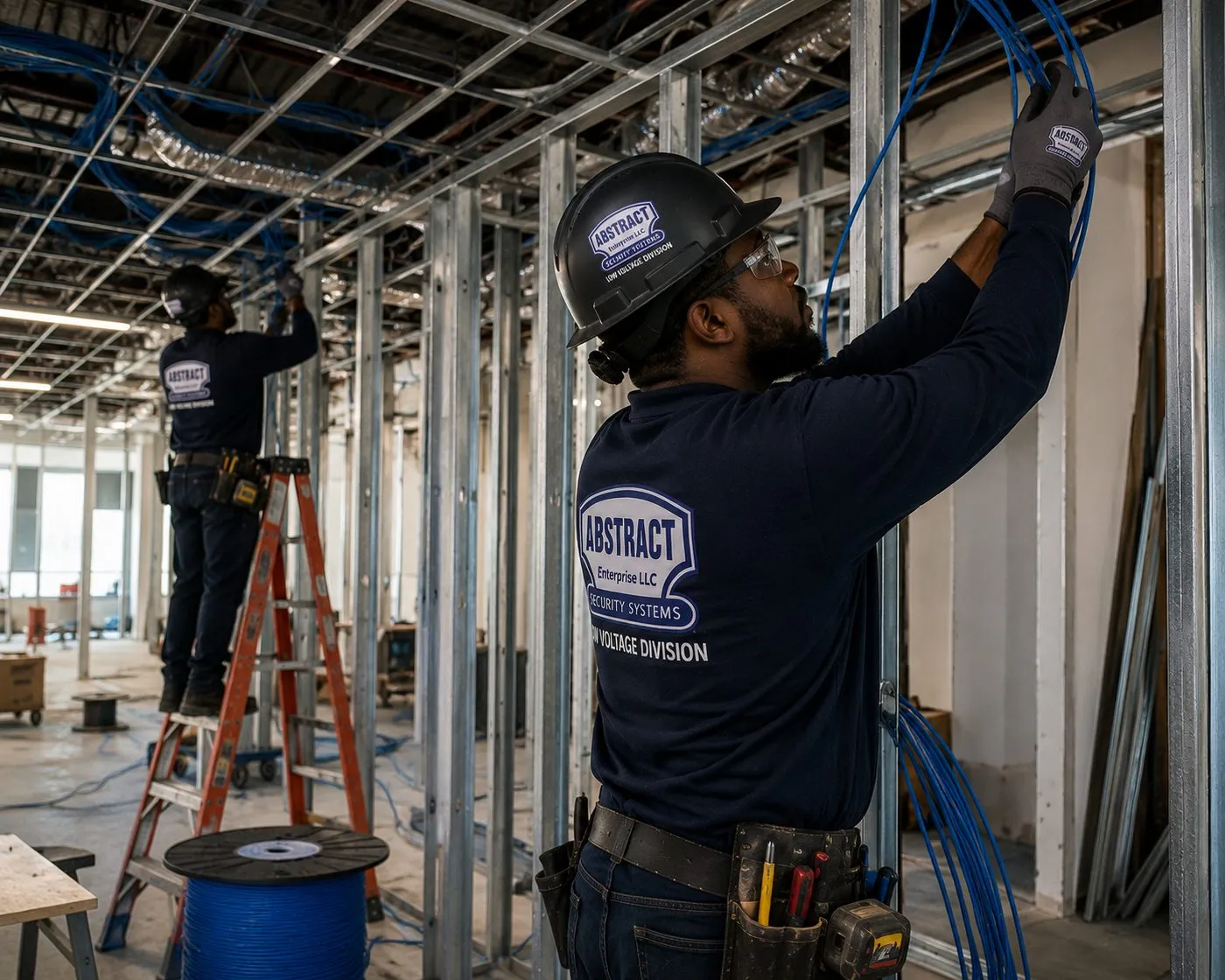
An installer in a hard hat routes blue cable along a run of metal studs during a fit-out, with a second worker on a ladder and a reel of cable on the floor behind him.
Coverage Area
Fiber Optic Installation Near Hudson Valley Landmarks
We work across all six counties. These are reference points that tell you which part of the valley a job is in and what kind of fiber work surrounds them — not claims that we worked inside them.
Stewart International Airport, New Windsor
A 1,552-acre airport in the towns of Newburgh and New Windsor, run by the Port Authority since 2007 and home to the 105th Airlift Wing. Around it sit the large logistics buildings of Route 17K and Route 747, where fiber inside and between buildings is routine.
The Platinum Mile, White Plains
Westchester Avenue along I-287, lined with office campuses such as the two-building, 335,000-square-foot complex at 1111 and 1129 Westchester Avenue. Multi-building tenancies and duct banks between buildings define the work.
Westchester Medical Center, Valhalla
A hospital campus about 30 miles north of Manhattan where a five-storey, 162,000-square-foot Critical Care Tower broke ground in July 2024. Medical campuses set strict standards that outside fiber contractors work to.
Regeneron, Tarrytown
A research campus whose $1.8 billion expansion, announced in 2021, planned about 900,000 square feet across up to eight research buildings, three garages and a central utility plant — the scale at which campus fiber is planned building by building.
Vassar College, Poughkeepsie
About 1,000 acres and more than 100 buildings, with James Renwick Jr.'s Main Building completed in 1865. Historic buildings spread across a large campus are the definition of a long-run, old-masonry fiber problem.
The Stockade District, Kingston
Eight blocks and 32 acres listed on the National Register, including the 1676 Senate House and Colonial Dutch stone houses on all four corners of Crown and John Streets. Thick stone walls and historic review shape every entry.
We also cover the Route 59 corridor around the Palisades Center in West Nyack, the IBM campus on South Road in Poughkeepsie, Brewster, Carmel and Mahopac in Putnam, the Montgomery and Wallkill warehouse district, Goshen and Middletown, Beacon, New Paltz and the river estates around Hyde Park. From the Bronx line northward, see our NYC fiber optic installation hub for work in the five boroughs.
A technician reaches up to fix a round white wireless access point to a ceiling tile in a bright office with glass walls and a stepladder behind him.
Pricing
Fiber Optic Installation Cost in the Hudson Valley
Every price below is one of our standard published prices multiplied by the county's area rate, then rounded to the dollar. None is a new figure. The base prices are $35 per termination, $40 per strand for an OTDR test, $350 for a multimode drop, $400 for a single-mode drop, $4,500–$7,000 for a 12-strand OM4 floor-to-floor backbone, $8,000–$15,000+ for a 24-strand OS2 building-to-building backbone and from $2,400 for a second telecom room with its fiber link.
County (rate)
Termination
OTDR / strand
MM drop
SM drop
12-strand OM4 backbone
24-strand OS2 building-to-building
Second telecom room with fiber
Westchester (1.25×)
$44
$50
$438
$500
$5,625 – $8,750
$10,000 – $18,750+
from $3,000
Rockland (1.30×)
$46
$52
$455
$520
$5,850 – $9,100
$10,400 – $19,500+
from $3,120
Orange (1.40×)
$49
$56
$490
$560
$6,300 – $9,800
$11,200 – $21,000+
from $3,360
Putnam (1.45×)
$51
$58
$508
$580
$6,525 – $10,150
$11,600 – $21,750+
from $3,480
Dutchess (1.53×)
$54
$61
$536
$612
$6,885 – $10,710
$12,240 – $22,950+
from $3,672
Ulster (1.53×)
$54
$61
$536
$612
$6,885 – $10,710
$12,240 – $22,950+
from $3,672
Service calls, troubleshooting and return visits are billed at $195/hr, 3-hr minimum ($585), in every county; that rate is never applied to a new installation.
What the building-to-building price includes
The 24-strand OS2 line covers the cable, its pull through a pathway that exists or that is part of the scope, fusion splicing into an enclosure in each building, and OTDR testing of every strand. The spread in the range is mostly distance and building entries. On valley properties the larger variable is often the pathway itself: an existing duct bank or a clear route across soft ground sits at the bottom of the range; ledge rock, pavement, long bores and multiple pull boxes push it up. Where a route needs significant excavation, boring or restoration, we quote it as a separate line so the fiber price stays readable.
Where the money goes on a valley fiber job
The ground. Lawn and soft soil are the cheap case. Pavement, ledge, cobbles, tree roots, wet ground and slopes add time and sometimes equipment.
Existing pathway. Usable conduit or a clear duct between buildings saves more than any other single factor.
Building entries. A frame wall with a crawlspace is quick; two feet of stone or a finished basement wall takes longer and needs care.
Distance and strand count. More cable, more splices and more strands to test, though strand count adds less than people expect.
What the far end needs. Enclosures, a switch with fiber ports or media converters, a UPS and the network behind them.
National brand versus local contractor. ADT, Ring and SimpliSafe sell monitored alarms and cameras; none of them trenches fiber between a house and a barn or splices a campus link. The real choices in the valley are a provider's construction crew, which builds only to its own terminal; an electrician, who can dig a trench but usually doesn't splice or test glass; a national integrator, which suits large campuses but may subcontract the field work; or a licensed local low-voltage contractor with its own splicer and test gear who walks the route with you and answers for the result.
Shop Our Systems
Fiber Optic Installation Packages & Pricing
Three common starting points, built only from the county prices above. Each shows the Westchester price and the Dutchess and Ulster price; Rockland, Orange and Putnam fall between them at their own rates. Your proposal itemises the real scope.
Starter — Light the Fiber You Already Have
$1,656 – $2,028
Someone pulled a 12-strand cable between your buildings and never finished it. We put connectors on all 24 ends and trace each of the 12 strands with an OTDR, at the county rate ($1,656 in Westchester, $1,728 Rockland, $1,848 Orange, $1,920 Putnam, $2,028 Dutchess or Ulster). Missing enclosures are added at cost.
Standard — Backbone Inside a Large Building
$5,625 – $10,710
A 12-strand OM4 backbone from a main room to a remote closet — across a warehouse, between floors of a campus building, or from an office pod to a far wall — fusion-spliced into panels and loss-tested. Westchester $5,625–$8,750; Dutchess or Ulster $6,885–$10,710.
Premium — Building to Building
$10,000 – $22,950+
Twenty-four single-mode strands joining two of your buildings, each end fusion-spliced into its own enclosure and every strand traced with an OTDR. Westchester $10,000–$18,750+; Dutchess or Ulster $12,240–$22,950+. Significant excavation or boring is quoted separately.
Bring Your Own Equipment — Labour Only
If you have sourced your own outdoor reel, enclosures or converters, labour for placing, splicing and testing them is charged at $195 per hour, three-hour minimum ($585). Before your reel goes into conduit we shoot it with a light source or OTDR on the spool, because a fault discovered after the trench is backfilled is the most expensive kind. Materials you supply are covered by their maker's warranty rather than ours.
Price the Link Between Your Buildings
No charge to walk the route. Every line of the proposal comes from the county table above.
On a city job the pathway is a riser that already exists. On a valley job we usually build the pathway, and it is where most of the cost and most of the risk live. This is how we think a route through.
Start from the buildings, not the map
The straight line between two buildings is rarely the route. We start inside each building at the spot where the equipment should live, work out the cleanest way out of that building — through a crawlspace, a cellar wall, a frame wall above grade — and only then look at the ground between the two exit points. A route that saves forty feet outdoors but needs a core through a finished basement wall and a run across a finished ceiling is usually the worse choice.
Avoid what is already buried
Wells and their supply lines, septic tanks and leach fields, propane lines, buried electric to outbuildings, irrigation and invisible pet fences are everywhere on valley properties, and most are private. We map what the owner knows, look for the surface evidence of what they don't, run a locator over the route and keep a clear distance from leach fields in particular. Where the fiber shares a trench with a new power feed, the electrician's conduit and ours keep the separation the code and good practice call for.
Choose trench, bore or surface run
Open trenching with a small machine is fastest across lawn and field. Directional boring passes under driveways, patios, stone walls and gardens without disturbing them and is worth its cost wherever restoration would be expensive. Over ledge, or along a building, a protected surface run in rigid conduit can be the right answer. Many routes use all three.
Build in pull boxes, slack and spares
Long runs and routes with several bends get in-ground pull boxes so the cable is never pulled past its tension limit or bent too tightly. Each enclosure keeps a service loop for future re-termination. We generally put in a spare conduit, or a larger conduit with innerduct, so a second cable can follow later without digging; and we install more strands than today's need because the glass costs little and the trench costs a lot.
Make it findable
A tracer wire alongside dielectric cable, brought up into an accessible test point at each end, lets any locator find the route. Warning tape above the conduit gives anyone digging a second chance. And the route drawing, with measured offsets from fixed points like building corners, goes into the closeout file and to you.
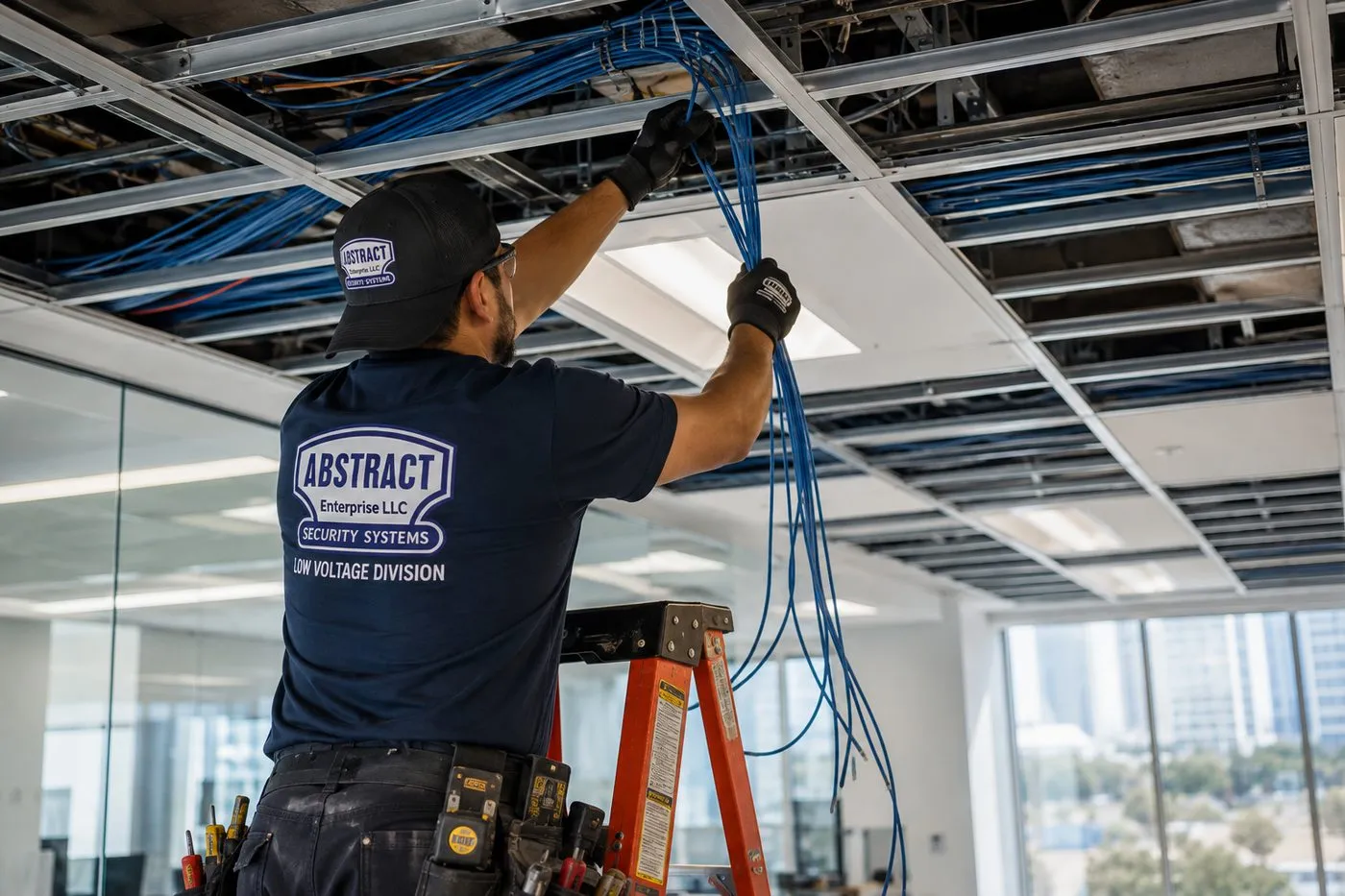
Seen from behind, an installer on a red stepladder feeds a bundle of blue cable up through an open suspended-ceiling grid in a bright commercial interior.
Existing Links
Common Problems With Links Between Buildings Someone Else Installed
A good share of our valley work starts with a link that already exists and doesn't behave. These are the faults we find most often, and what we do about each.
Indoor cable buried outdoors. Ordinary indoor Ethernet or indoor fiber pushed through a garden hose or laid in a shallow trench. Water gets in, the jacket breaks down and the link degrades season by season. The fix is the correct outdoor cable in proper conduit.
Copper between separate services with no protection. The usual cause of repeat storm damage. We replace it with dielectric fiber or, on a short same-service run, add correctly bonded primary protection.
Armor bonded at both ends. Armored fiber whose armor is grounded in both buildings, quietly recreating the ground loop fiber was meant to remove. We isolate or bond it per the design.
Enclosures that hold water. Unsealed boxes in barns and sheds, conduit ends left open and running downhill into the building. We reseal, add drainage and move enclosures off the floor.
Media converters on bare power strips. Consumer converters with wall-wart supplies in unheated buildings, no surge protection and no UPS. We replace them with industrial units or a switch with fiber ports, on protected power.
No record of the route. Nobody knows where the cable runs, so nobody can dig safely near it. We trace what can be traced, add a tracer path where we re-pull, and draw it.
Mismatched optics. Multimode modules on single-mode cable or the wrong wavelength pair, which may work at short distances and then fail. We identify the glass and match the optics to it.
If a link is copper and keeps failing, our Hudson Valley network cable repair technicians can get you running the same week while the fiber replacement is planned.
Complete Services
Every Fiber Optic Installation Service in the Hudson Valley
Fiber joins the buildings; what happens inside each of them usually comes from one of these Hudson Valley services.
Video intercoms at driveway gates and building entries, networked back to the main building.
Before the Walkthrough
What to Gather Before We Walk Your Property
A route survey on open ground goes faster, and the proposal comes back more accurate, when a few things are ready before we arrive. None of this is required; all of it helps.
A sketch or survey of the property. A copy of the property survey, a site plan from the builder, or even a phone photo of a hand drawing showing the buildings, the driveway, the well, the septic area and any known buried lines.
Where each building gets its power. Whether the outbuilding has its own meter or is fed from the house panel. If you don't know, a photo of each building's electrical panel and the meter base answers it.
What the far building will run. Cameras, a gate, Wi-Fi, a phone, a point-of-sale terminal, a workstation, a recorder. The list decides the strand count, the switch and the power backup at the far end.
Where the provider lands today. The location of the modem or optical terminal, and whether a new fiber provider has said it is coming to your road.
Existing conduit, poles or cable. Any pipe you know runs between the buildings, poles that carry wires across the property, or old cable left from a previous owner.
Constraints on the calendar. Events booked in a venue barn, a harvest window on a farm, term dates on a campus, or a closing date on a house sale. We plan the trench around them.
Anyone else who must approve. A landlord, an association, a campus IT office, a historic-district commission or an insurer with requirements for the work.
On commercial sites, add the site utility plan if one exists, the name of the facilities contact who controls access to telecom rooms and duct banks, and any specification your organisation uses for cabling. For new construction, the architect's or developer's drawings let us propose network-room locations and a yard conduit schedule before anything is built.
With that in hand, the walkthrough on a two- or three-building property is short, and the written proposal follows with each line priced at your county's rate. If the site is far up the valley and you would rather start remotely, photos of each building's exterior wall where the cable would enter, the electrical panels and the ground between the buildings let us talk through a likely budget range before anyone drives out.
Field Notes
Field Notes From Links That Cross Open Ground
The routine our crews follow on any run that leaves one building for another — a description of practice, not an account of one job
Before anyone talks about cable, our crews find each building's electrical service. Where is the meter, where is the panel, where does the ground wire go? If the second building is fed from the first building's panel, it shares its ground, and the conversation is about distance. If it has its own meter or its own ground rod, the conversation is about isolation, and the answer is nearly always glass.
The second thing they do is ask the owner to walk the route with them and point at everything they know is buried, then look for what the owner doesn't know: a cleanout cap in the grass, a junction box on the back of the garage, a line of sunken turf from an old trench. Most of the surprises on outdoor jobs are private lines nobody remembered.
The third is to look up. A barn with its equipment mounted on the floor next to the door will have a wet enclosure within a year, so the enclosure goes high, on the inside of a wall that stays dry, with the conduit entering from below and sealed. None of this is complicated. Skipping it is what makes links between buildings fail.
FAQ
Hudson Valley Fiber Optic Installation FAQ
Which parts of the Hudson Valley do you cover for fiber work?
+
All six counties: Westchester, Rockland, Orange, Putnam, Dutchess and Ulster, from Yonkers and Nyack north to Kingston, New Paltz and the Catskill hamlets. Each county is priced at its own published area rate, and the same crews, splicing and test equipment work in all of them.
Can one fiber link carry both the security cameras and the office network to a far building?
+
Yes. One pair of strands carries both with room to spare. A managed switch at the far building keeps cameras and office traffic on separate networks, and spare strands in the same cable allow a physically separate link later if your insurer or IT policy asks for one.
Can fiber follow an old stone wall across a field?
+
Often, and it is one of the better routes on older valley land. Ground beside a stone wall is usually undisturbed by ploughing and easy to find again. We keep the trench a little off the wall so its stones aren't undermined, and we avoid digging under walls that may have historic or boundary value.
What happens to the old copper link once the fiber is working?
+
Your choice. Where the old cable bridged two separately grounded buildings, we recommend disconnecting it at both ends so it can't carry a surge, and removing it if it's accessible. On a short, same-service run it can stay terminated and tested as a spare, clearly labelled as such.
How will anyone find the buried fiber again before digging near it in a few years?
+
Every buried run we install gets a tracer wire brought up to a test point at each end, so a standard locator can follow it, plus warning tape above the conduit. You also receive a route drawing with measured offsets from building corners and other fixed points.
Can fiber reach a boathouse or dock on a lake or the river?
+
Often, yes. Fiber is a good fit near water because it carries no current. The route to the shoreline is usually the hard part: slopes, rock and wet ground. Any work at or below the waterline, or in a regulated wetland or watershed buffer, may need approvals, which we check before quoting.
What equipment sits at each end of a fiber link to an outbuilding?
+
A small splice or patch enclosure where the cable terminates, a short fiber patch cord, and either a switch with a fiber port or a media converter that turns the light back into Ethernet. Each end needs local power, ideally on a UPS. We match the optics to the fiber type and wavelength.
Can you meet the testing and paperwork requirements on a town, library or school district job?
+
Yes. Public jobs typically specify test methods, loss limits, labelling and closeout documents. We provide per-strand loss results, OTDR traces where specified, as-built drawings and photos in the format the specification asks for, along with our licence and insurance documentation.
Should fiber be planned into a new house in a Hudson Valley subdivision before the walls close?
+
If a detached garage, studio or pool house is planned, yes: a conduit from the house's network location to each future outbuilding costs little during site work. Inside the house, a conduit from the provider's entry point to the network location is the cheap insurance; fiber to every room is rarely needed.
Can fiber be installed in winter when the ground is frozen?
+
Indoor work, splicing and testing go ahead year-round. Trenching frozen ground is slower and restoration has to wait for spring, so outdoor runs are usually best done from spring to late autumn. Directional boring is less affected by surface frost, and conduit can go in one season with the fiber pulled later.
Can installation at a venue, farm stand or seasonal business be scheduled around the busy season?
+
Yes. Tell us the dates that matter — weddings, harvest, opening weekend — and we plan trenching, cutovers and noisy work outside them. Conduit can go in during the off-season and the fiber be lit just before you open, so nothing is dug up while guests are on site.
Do you need us on site the whole time at a second home we visit only occasionally?
+
No. We need you or a caretaker for the route walk, so we can learn what is buried and agree where equipment goes, and access to both buildings on the work days. After that we can work with a key or code and send photos and test results as each stage finishes.
All Areas Served
Fiber Optic Installation Across New York
Six county pages will sit under this hub. While each is still in preparation, the county name below opens our quote form instead — the work itself is available in every one of them now. For the five boroughs and for Nassau and Suffolk, use the city and Long Island fiber pages.
Barn offline since last night's storm, or a campus building cut off after someone dug near the conduit? Ring (800) 486-0943. We send a tech the same day when the schedule allows, a typical connector, pigtail or wet-enclosure fault takes one to two hours on site, and the repaired strands are measured again before anyone leaves.
Fiber Optic Installation Hudson Valley — Licensed, Tested, Mapped
Abstract Enterprises Security Systems · 460 E Fordham Rd, Bronx, NY 10458 · (800) 486-0943 · WhatsApp (718) 679-0359 via wa.me
NYS Low-Voltage Licence #12000287431 · 100% Licensed & Insured · Same-Day Estimates · Rated 4.7★ from 201 Google Reviews
Full terms — including 50% deposit, one-year parts-only warranty on AESS-supplied products, and the late-fee schedule — are set out in the service agreement. See our warranty page.
Page reviewed and updated October 17, 2026. Changelog: first publication of the Hudson Valley fiber optic installation hub.