Long Island networks are wide, not tall. We install the private fiber that ties a suburban property together: links across the parking lot between office buildings, from the front office of a flex building to the far end of its warehouse, out to the gatehouse and the maintenance garage, and from the carrier's demarc at the loading dock to the room where the network actually lives. Every strand is spliced, tested from both ends and handed over with a map of where the cable runs underground.
Reviewed and updated October 17, 2026 · Written by Anwar Timothy, NYS licence #12000287431
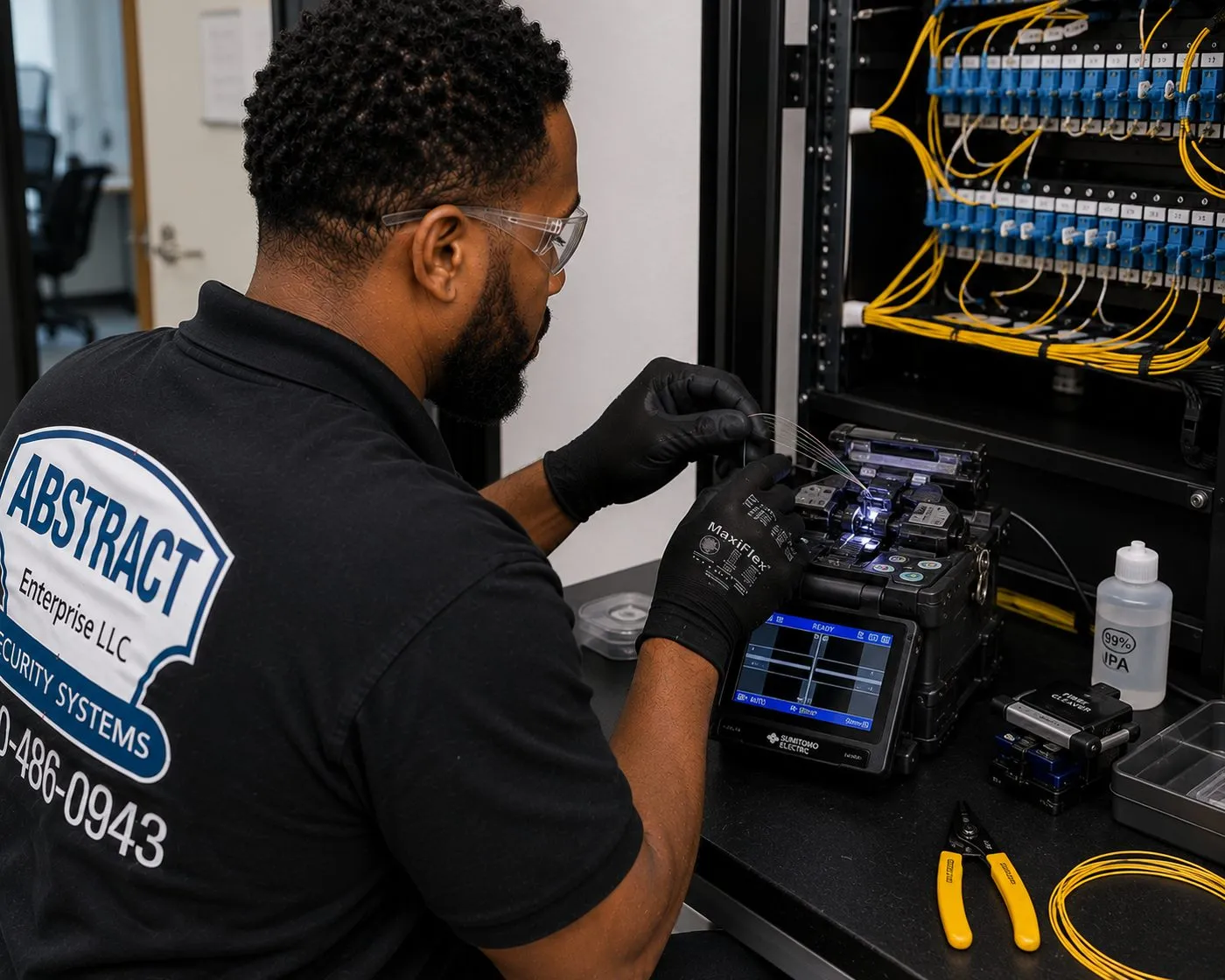
Seen from behind, a technician in safety glasses feeds bare fiber into a fusion splicer on a bench; a fiber cleaver, a bottle of isopropyl alcohol and a coil of yellow cord sit beside it, with a rack of yellow patch cords above.
Get a Free Fiber Quote
Tell us the buildings and the distance between them — same-business-day callback
✅
Request Sent!
We'll call you back the same business day.
25+
Years Experience
✓
Same-Day Estimates
100%
Licensed & Insured
4.7★
201 Google Reviews
Two buildings, one network, and a parking lot in between? Call (800) 486-0943 or send the 60-second form with the site address. A licensed technician reads every Nassau and Suffolk request and calls back the same business day.
Underground routes located, marked and drawn on the as-built
Every strand tested in both directions before we leave the site
NYS licence #12000287431 · insured to meet park-landlord COI requirements
Why Long Island Properties Need Fiber Optic Installation
On Long Island the problem fiber solves is distance on the ground, not height in the air. Nassau and Suffolk were built out in low, spread-out buildings: two- and three-storey office blocks set in their own parking fields along Route 110 and the Long Island Expressway, single-storey flex buildings in Hauppauge, Bohemia and Ronkonkoma with an office at the front and a warehouse behind, medical and college campuses with dozens of structures linked by footpaths and service roads. A business that grows on the Island usually grows sideways — into the building next door, the unit at the other end of the strip, the outbuilding across the lot — and copper cabling was never meant to follow it there.
That sideways growth creates a very particular set of requests. An accounting firm in a Melville office park takes a second building across the parking lot and wants one phone system and one server room. A distributor in the Long Island Innovation Park at Hauppauge — still called the Hauppauge Industrial Park by almost everyone who works there — finds that the cameras and scanners at the back of a 300-foot warehouse keep dropping off the network. A school, a house of worship or a senior community has a gatehouse, a maintenance garage and a main building, each on its own internet connection because nobody ever linked them. In every case the answer is a fiber link the owner controls, and in almost every case it has to cross open ground to get there.
Crossing open ground is what makes Long Island fiber work different from fiber work in a city high-rise. The cable leaves the building. It goes under asphalt or over a parking field on a messenger wire, it lives outdoors in heat, frost and salt air, and it has to survive the day the lot is repaved or a landscaper sinks a fence post. The paperwork is different too: instead of one building manager, there is a town or village building department, an underground-utility markout before any digging, sometimes a park landlord who owns the conduit and a property manager who owns the schedule. Nassau County alone contains two cities, three towns and 64 incorporated villages, and Suffolk is divided into ten towns with dozens of villages inside them, so “who do we ask?” has a different answer from one side of a county road to the other.
Carriers have been busy at street level. Optimum says its fiber network now reaches nearly 900,000 passings on Long Island, and in April 2026 the Brookhaven Town Board unanimously approved a Verizon franchise to build a townwide fiber network, subject to state approval. More carrier fiber at the curb is good news, but it ends at a demarc — usually a box on the back wall by the electrical service. Everything past that point, between the buildings and through them, belongs to the owner. That private stretch is the work we do.
Long Island facts that shape fiber work
38.45 million square feet: net rentable office space tracked by CBRE across Long Island in the second quarter of 2026, with total vacancy at 11.5 percent and availability at a post-pandemic low of 12.1 percent — office buildings that are filling up again and being re-fitted.
About 1,350 businesses and 55,000 workers: the scale of the Hauppauge Industrial Park described in a 2017 economic-impact summary, packed into roughly eleven square miles — the Island's densest cluster of multi-building industrial sites.
7.0 percent: Long Island industrial vacancy at the end of Q2 2026 after more than 800,000 square feet of net absorption, according to CBRE — warehouses are occupied, and occupied warehouses need cameras, scanners and wireless at the far wall.
Nearly 900,000 fiber passings: Optimum's own figure for its Long Island fiber network in October 2024, when it announced a further $40 million local investment.
Two cities, three towns, 64 villages: the municipal map of Nassau County as New York State lists it; Suffolk adds ten towns. Permits, road openings and inspections follow those lines, not the county line.
Almost half of 1.1 million customers: the share of PSEG Long Island customers left in the dark at the peak of Tropical Storm Isaias in August 2020 — the reason we design campus links that keep working when one building's power does not.
Put together, those numbers explain the calls we get from Elmont to Riverhead. Offices are being re-fitted for tenants who expect fast connections between every room they lease. Warehouses are full and wired for more devices than ever. Carrier fiber is arriving at more doors, which makes the inside-the-property gap more obvious. And the weather keeps reminding owners that a network spread across several buildings is only as good as its weakest link.
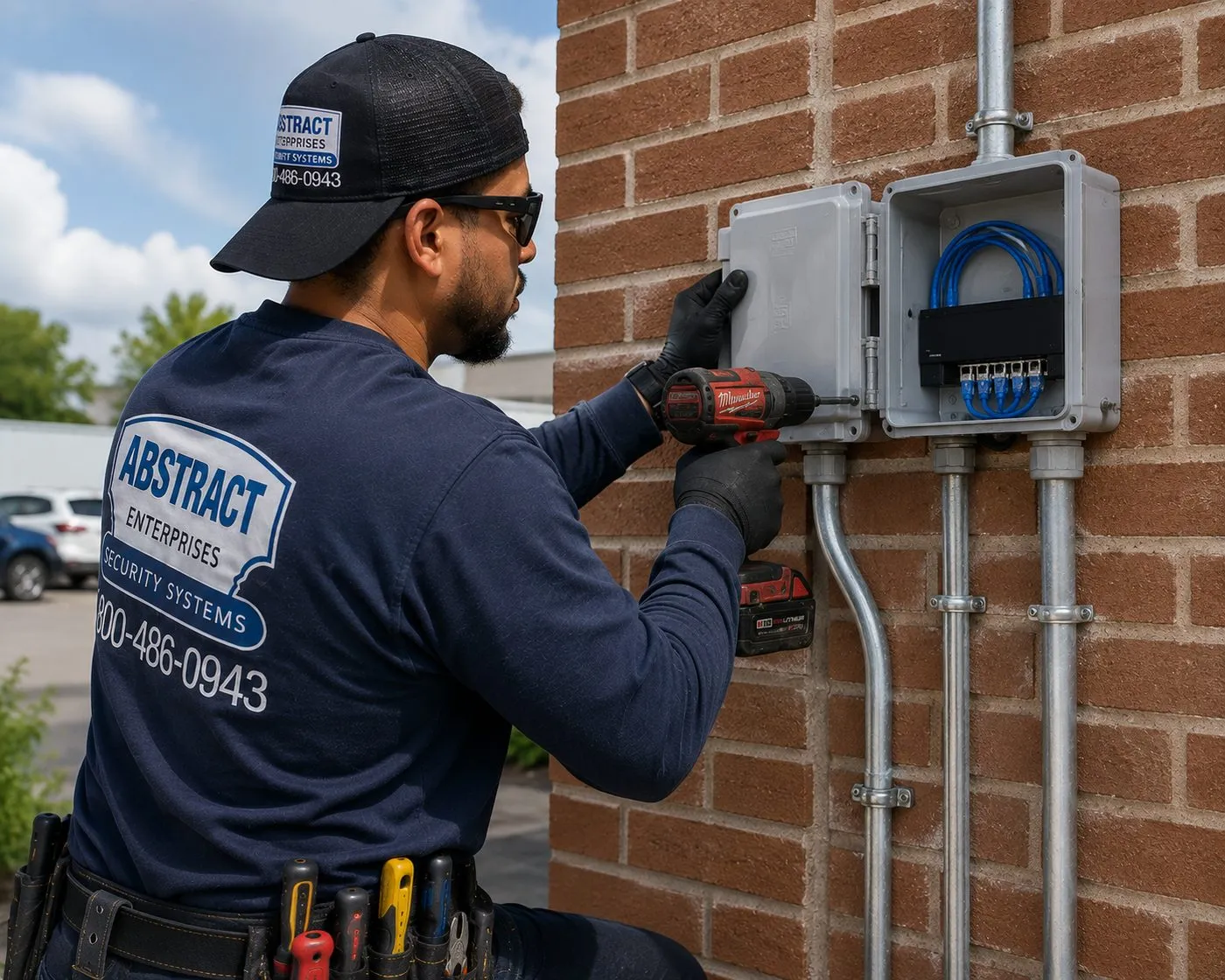
A technician drives a screw into a grey weatherproof enclosure on a brick wall; a second enclosure beside it holds a small switch and blue patch cords, and three runs of metal conduit drop from the boxes toward the ground. Parked cars sit in the lot behind him.
Repair Capture
Fiber Link Down Somewhere on Long Island
A link between buildings that went dark after a lot was regraded, a pigtail snapped in an enclosure a cleaning crew bumped, a strand that has been throwing errors since the last thunderstorm — those are repair calls, not new installations, and we treat them that way. Most single-point faults are located with a light source and a fault locator or OTDR and fixed in one to two hours once a technician reaches the site; buried breaks take longer because the cable has to be exposed. Call (800) 486-0943 and say it is a fiber repair, or see our network cable repair service on Long Island when the fault may be in the copper instead.
What We Install
Fiber Optic Installation Services in Long Island
Suburban fiber is mostly about links: from one building to another, from one end of a long building to the other, and from where the carrier stops to where the equipment sits. These are the services Long Island owners and tenants ask for most, each quoted on its own lines so the trenching never hides inside the cable price.
Building-to-Building Across a Lot
Outdoor-rated single-mode between two or more structures on one property, run in conduit under the parking field, in an existing duct bank, or overhead on a messenger strand. Each end lands in a wall-mount or rack enclosure, spliced and tested.
Office-to-Warehouse Links
The classic flex-building job: the network room is in the front office, the warehouse runs back hundreds of feet, and the devices at the dock end are beyond reach of copper. A fiber link to a small closet near the dock puts them back within range.
Campus Backbones
Star or ring layouts for properties with many buildings — office parks, schools, health campuses, garden-apartment complexes — designed so that one central room serves every building and a cut cable doesn't isolate half the site.
Gatehouses and Outbuildings
A guard booth at the entrance, a maintenance garage, a pump house, a pool building or a detached storage shed that needs a camera, a phone, an access reader or wireless. Fiber removes distance and lightning from the equation.
Demarc Extensions
The carrier's fiber ends in a box by the electrical service at the back of the building. We extend it on owner fiber to the network room, so the provider's technician plugs into a labelled panel instead of a patch cord strung across a warehouse ceiling.
Aerial Runs on Private Poles
Where trenching isn't practical — across a wooded strip, over a drainage swale, along the edge of a large lot — fiber lashed to a messenger wire between the owner's own poles or building attachments, with drip loops and storage coils at each end.
Fusion Splicing and Enclosures
Pigtail splicing in rack and wall enclosures, outdoor splice closures in handholes, and mid-span repairs where an excavator or a fence crew found the cable first.
Testing, Certification and Locating Records
Loss testing on every strand, bidirectional OTDR traces on outdoor links, and an as-built that shows where the conduit actually runs, how deep, and where the handholes are — the drawing the next contractor will need.
Takeover of Inherited Fiber
Office parks change hands and tenants come and go; many have fiber in the ground that nobody can vouch for. We identify it, test it end to end, and either bring it back into service or tell you plainly that it should be replaced.
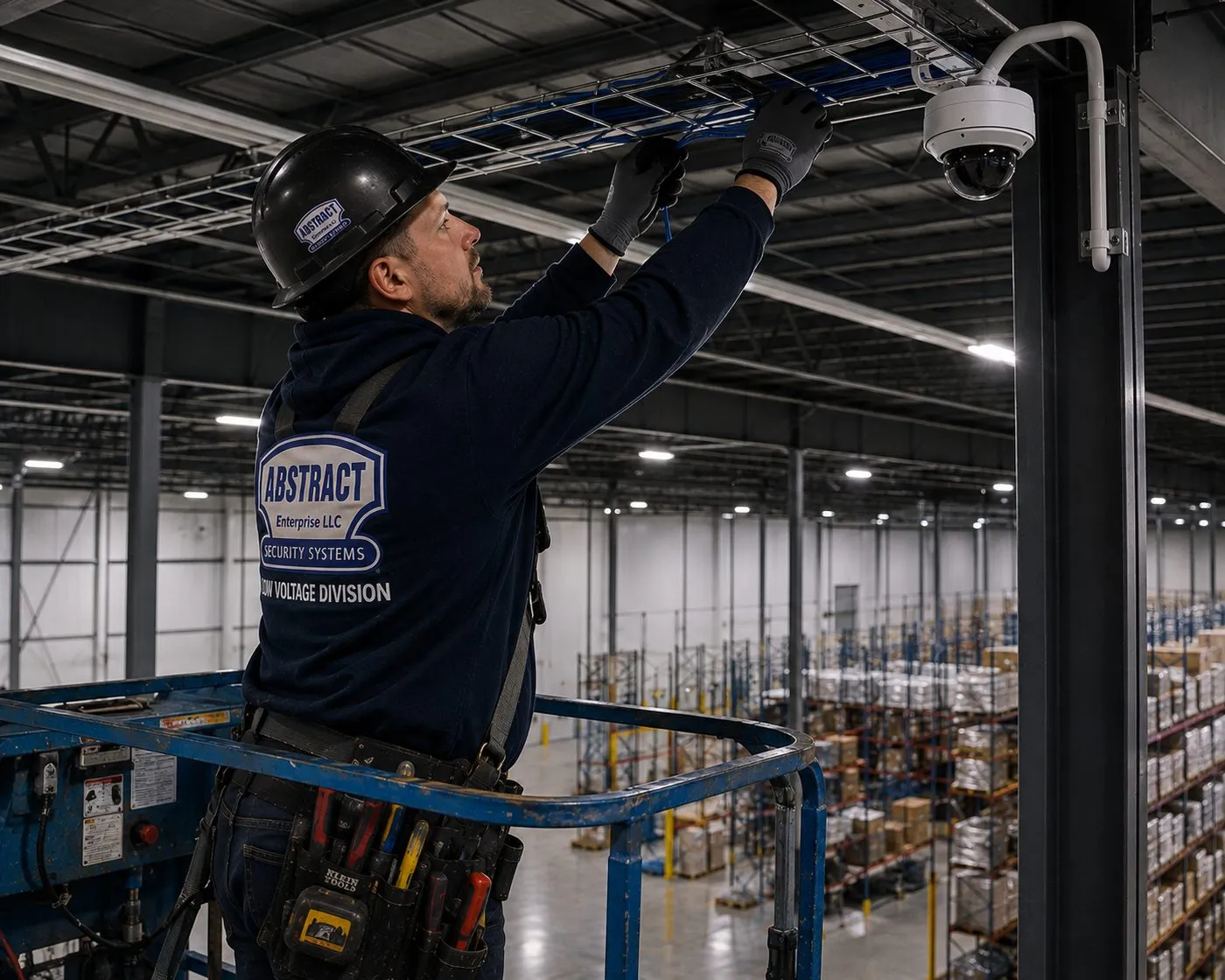
Working from the basket of a lift, a technician in a hard hat dresses blue cable into wire-basket tray along the roof steel of a high-bay warehouse, beside a dome camera; racking stacked with pallets fills the floor below.
Building Specialists
Fiber Optic Installation for Long Island's Architecture
Long Island's commercial stock was mostly built after the Second World War, by car, for cars. That makes the buildings easy to work in and the spaces between them the real challenge. These are the property types we meet most often in Nassau and Suffolk, and what each asks of a fiber design.
Suburban Office Parks
Two to four storeys of steel and curtain wall, a telecom closet on each floor if the original builder was generous, and surface parking all around. Several buildings often share one owner and one demarc. The fiber questions are almost all about the ground between them and whether the park's original conduit still exists.
Flex and Light-Industrial Buildings
Single-storey tilt-up or block buildings with an office front and a warehouse or production floor behind, common through Hauppauge, Islandia, Bohemia, Ronkonkoma, Farmingdale and Hicksville. Ceilings are high, distances long, and the electrical noise from compressors, conveyors and dock doors is constant.
Big-Box and Strip Retail
One long building divided into units, or a pad site in the middle of a parking field. Tenants want the stock room, the registers and the cameras on one network, and landlords want everyone's cable to stay out of the common roof and the common lot unless it's documented.
Health and Medical Campuses
Hospitals, ambulatory centres and medical office buildings that grew one wing or one building at a time. Northwell Health alone describes itself as New York's largest private employer, and its network of hospitals and outpatient sites is a reminder of how much Long Island healthcare is spread across campuses rather than towers.
Colleges, Schools and Districts
Large sites with many buildings: Stony Brook University counts 213 buildings over 1,454 acres, and Hofstra about 117 buildings on 244 acres on both sides of Hempstead Turnpike. Smaller private schools and district buildings face the same problem at a smaller scale — separate structures that must behave as one network.
Garden Apartments and Senior Communities
Low-rise residential complexes with a clubhouse, a management office and many separate buildings. Owners link them with fiber so cameras, access control and resident Wi-Fi run from one room, and so a provider can serve the whole complex from a single head-end.
Methods and materials by property type
Across a parking field. Outdoor loose-tube single-mode, gel-free and water-blocked, pulled through conduit between handholes set at each building and at any change of direction. We leave a service coil in the handhole nearest each building so a future repair has slack to work with, and we add a tracer wire or a locatable cable so the route can be found from the surface.
Inside a flex building. Indoor/outdoor or armoured cable in wire-basket tray or J-hooks along the roof steel, kept well above the reach of forklift masts and pallet racking, with a short run of conduit or a protective guard wherever it drops down a column near the dock doors.
Through an office building's riser. Riser-rated cable between floors through existing sleeves, plenum-rated cable where it crosses an air-return ceiling, and firestop restored at every penetration we open. In a three-storey building this is a modest job; the outdoor link to the building next door is usually the bigger line on the quote.
Where cable enters and leaves. Outdoor cable is spliced or transitioned to an indoor-rated cable shortly after it enters a building, inside a wall-mount enclosure that also holds the splice trays. Entry conduits are sealed against water and rodents, and the penetration through the wall is sealed to match the wall it passes through.
On a campus. A main room with a rack-mount fiber panel, a star of links out to each building, and where the site justifies it a second path so that a single cut doesn't isolate a building. Every strand and every handhole is labelled to match the as-built drawing.
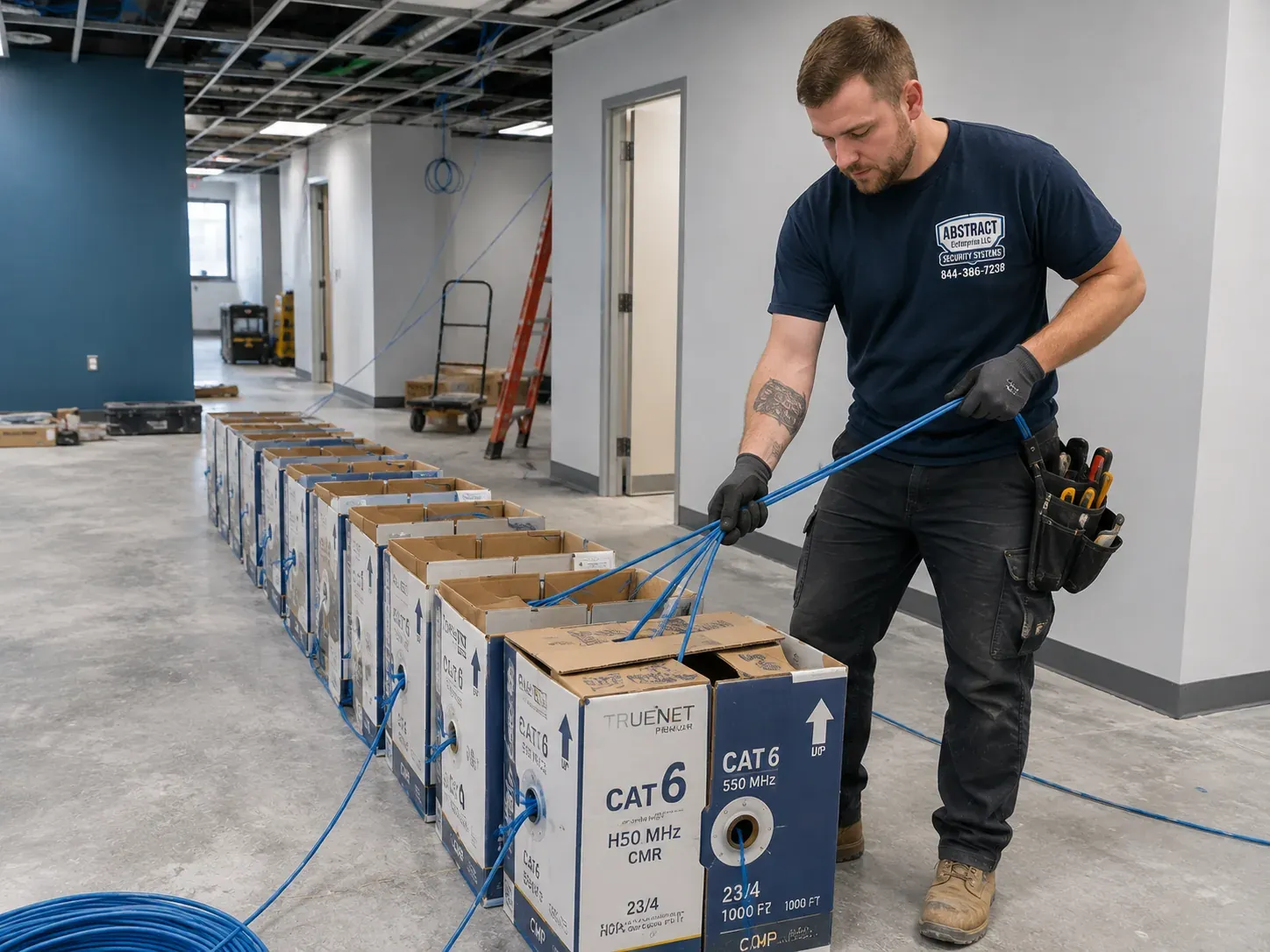
In an office under fit-out with an open ceiling grid and bare concrete floor, a technician gathers several blue cables from a long row of cable boxes lined up for a multi-cable pull; a ladder and a hand truck stand in the corridor behind.
Owners linking buildings with fiber often add access control at the same time, so every door on the property reports to one system. Our access control installation on Long Island is regularly scoped on the same site visit.
Commercial Fiber Optic
Business Fiber Optic Installation in Long Island
Commercial fiber work on the Island follows the expressways and the parkways. These are the corridors where we spend most of our time, and the kind of link each one tends to need.
Route 110: Melville and Farmingdale
The Island's best-known office corridor, running north–south across the Long Island Expressway. Buildings such as Melville Corporate Center I at 105 Maxess Road — about 149,000 square feet near Route 110 and the LIE — are typical: multi-tenant, multi-floor, and often one of several buildings on a shared campus.
Hauppauge, Islandia and the Motor Parkway
The Long Island Innovation Park at Hauppauge took that name in 2019; the Town of Smithtown's planning overlay covers about two-thirds of it. Its streets are lined with flex buildings, manufacturing plants and distribution space, and most of our work there is front-office-to-warehouse and building-to-building fiber.
Uniondale and the Meadowbrook Corridor
RXR Plaza sits beside the Meadowbrook Parkway, with Nassau Coliseum and Roosevelt Field close by and the Northern and Southern State Parkways a short drive away. This is the closest the Island comes to a high-rise office cluster, and the riser work inside is paired with links out to garages and neighbouring buildings.
Old Country Road and the Central Nassau Retail Belt
From Garden City through Westbury and Hicksville, large retail sites, auto dealerships and service businesses with showrooms, service bays and detached buildings on one lot — ideal territory for a short single-mode link and a camera system that finally reaches the back fence.
Ronkonkoma, Bohemia and the MacArthur Area
Industrial and logistics buildings around Long Island MacArthur Airport and the Ronkonkoma station, many with truck courts, yard offices and outbuildings that need connecting to the main building.
Stony Brook and the North Shore Research Belt
Stony Brook University's campus, its 246-acre research and development park to the south, and Brookhaven National Laboratory's 5,265-acre site at Upton. Their own networks are run by their own teams; we work for the contractors, suppliers and tenants around them who need the same standard on a smaller scale.
Compliance callouts for commercial fiber in Nassau and Suffolk
Dig safely first. No trench, bore or post hole goes in until a one-call markout has been requested through 811 and the utilities have marked their lines. Private lines — parking-lot lighting, irrigation, a previous tenant's conduit — are not marked by the utilities, so we also ask the owner for site plans and, where they're missing, recommend a private locator.
The town or village decides. Building and road-opening permits on Long Island are issued by the town, the village or the city the property sits in, not by the county. A link that stays on private property is usually a different conversation from one that crosses a public road, which may need the municipality's or the state's permission and is often better handled by a carrier.
Poles belong to someone. Utility poles along a road are owned and managed by the utility and the companies already attached to them; a private owner can't simply lash a cable to them. On private property we use the owner's own poles or building attachments.
Cable listings still apply indoors. Outdoor cable is transitioned to an indoor listing shortly after entry, riser-rated cable goes between floors, plenum-rated cable through air-handling ceilings, and every rated penetration is firestopped.
Accessible routes stay clear. Handholes are set flush and out of accessible parking aisles and curb ramps where the site allows, and nothing we mount on a building narrows a walkway or egress door.
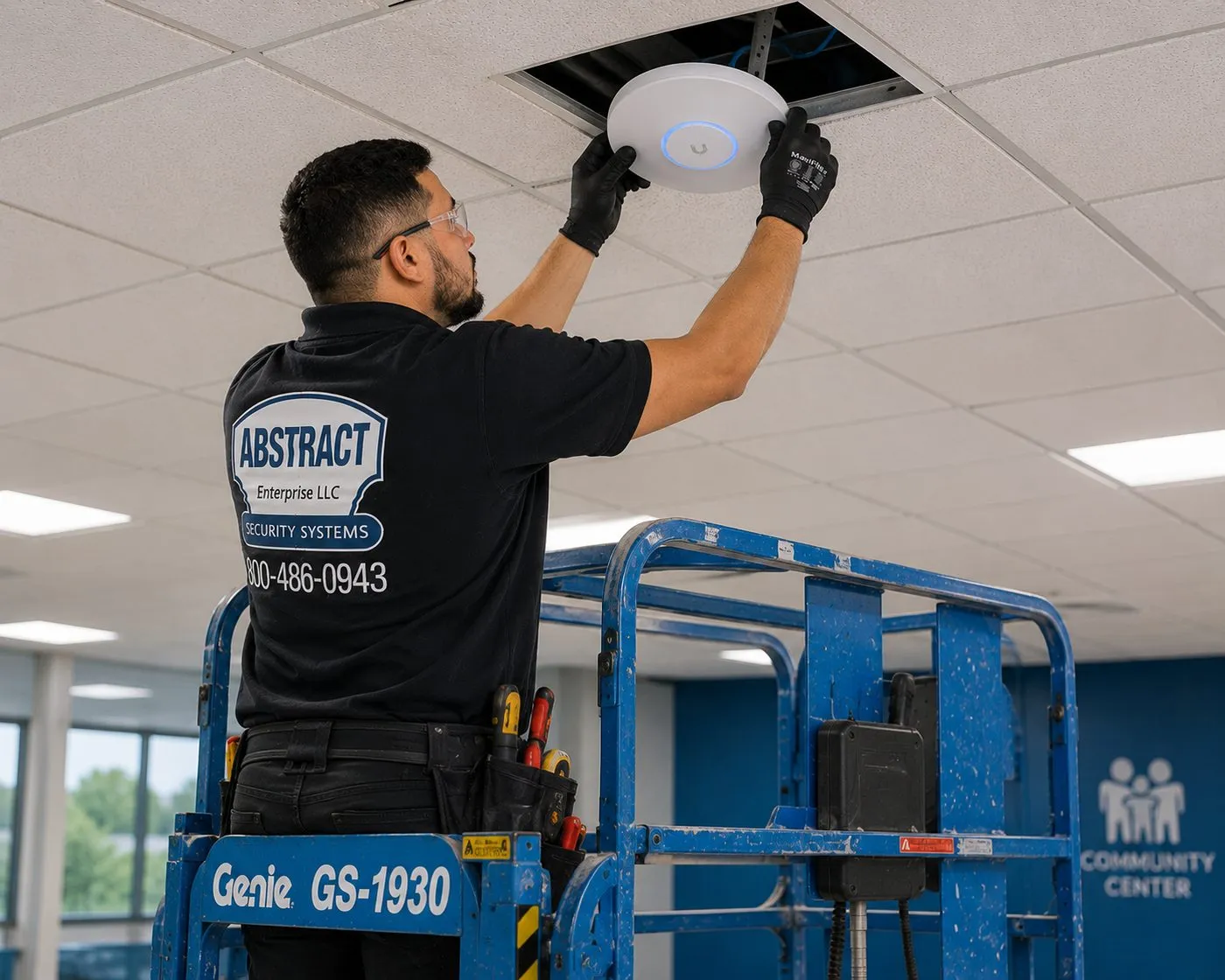
Standing in a blue scissor lift, a technician in safety glasses lifts a white access point into an open ceiling tile with cable visible in the plenum above; a large open-plan room with tall windows stretches out behind him.
Between Buildings
Crossing the Lot: How Long Island Buildings Get Linked
The defining Long Island fiber job is the link from one building to another across ground the owner controls. There are only a handful of ways to do it, and the right one is usually obvious once someone has walked the site with a measuring wheel and the original site plan.
Reusing what is already in the ground
Many office parks and industrial subdivisions were built with empty conduit between buildings, or with telephone duct that once carried copper pairs from a central building to the others. If that conduit still exists, isn't crushed and isn't full of roots or silt, it is by far the cheapest route. We find it from the building end, rod or blow a line through it, prove it with a mandrel where the run is long, and pull fiber in innerduct so the remaining space stays usable. Conduit that has collapsed in the middle of a run is located with a sonde and repaired with a single excavation instead of a full new trench.
A new underground route
Where nothing usable exists, new conduit goes in either by open trench along a landscaped strip or curb line, or by directional boring under the asphalt when the owner can't have the lot torn up. A narrow saw-cut trench across a parking aisle, patched the same week, is often the least disruptive option for a short crossing. Handholes are set at each building and at bends, and a warning tape and tracer go in with the conduit. Excavation, boring and paving restoration are always priced as their own lines, because they depend on the ground and not on the fiber.
An aerial route on the owner's poles
On larger properties, especially where a wooded buffer, a drainage swale or a long fence line separates buildings, an aerial run can beat a trench on cost and speed. A steel messenger strand is tensioned between the owner's poles or building attachments, and a lightweight all-dielectric cable is lashed to it, or a self-supporting figure-eight cable is used on shorter spans. Aerial cable is more exposed to falling limbs and storms, so we keep spans short, leave storage coils at the poles and design around the trees rather than through them.
Getting into each building
The crossing gets the attention, but the two ends decide how tidy the result is. Slab-on-grade flex buildings are usually entered by bringing the conduit up beside the foundation and through the wall a foot or two above grade into an enclosure on the inside face, with the outside sweep protected by a bollard or a short length of rigid conduit where vehicles turn. Office buildings with a basement or a crawlspace can often be entered below grade through an existing sleeve, sealed against water on both sides. On block and brick walls we core rather than hammer, and on tilt-up concrete we check with the owner's engineer before cutting anything near a panel joint or embedded steel. Whatever the method, the entry is sealed against water, insects and rodents, and the conduit end inside is plugged so that a wet handhole outside doesn't drain into the building.
Inside, the outdoor cable rises into a wall-mount enclosure where it is spliced to indoor-rated pigtails or an indoor cable, so that the outdoor jacket never runs further into the building than it should. From there, a short patch or indoor run reaches the switch. Keeping the transition in one box means a future repair at that building happens in one place, not along a ceiling.
When wireless is the honest answer
If two buildings are separated by a public road, a railroad or someone else's land, a private trench usually isn't possible and a point-to-point radio, or a carrier circuit between the two addresses, may be the right call. We will tell you so. Where a cable route on your own property exists, though, fiber takes weather, interference and line-of-sight off the list of things that can go wrong.
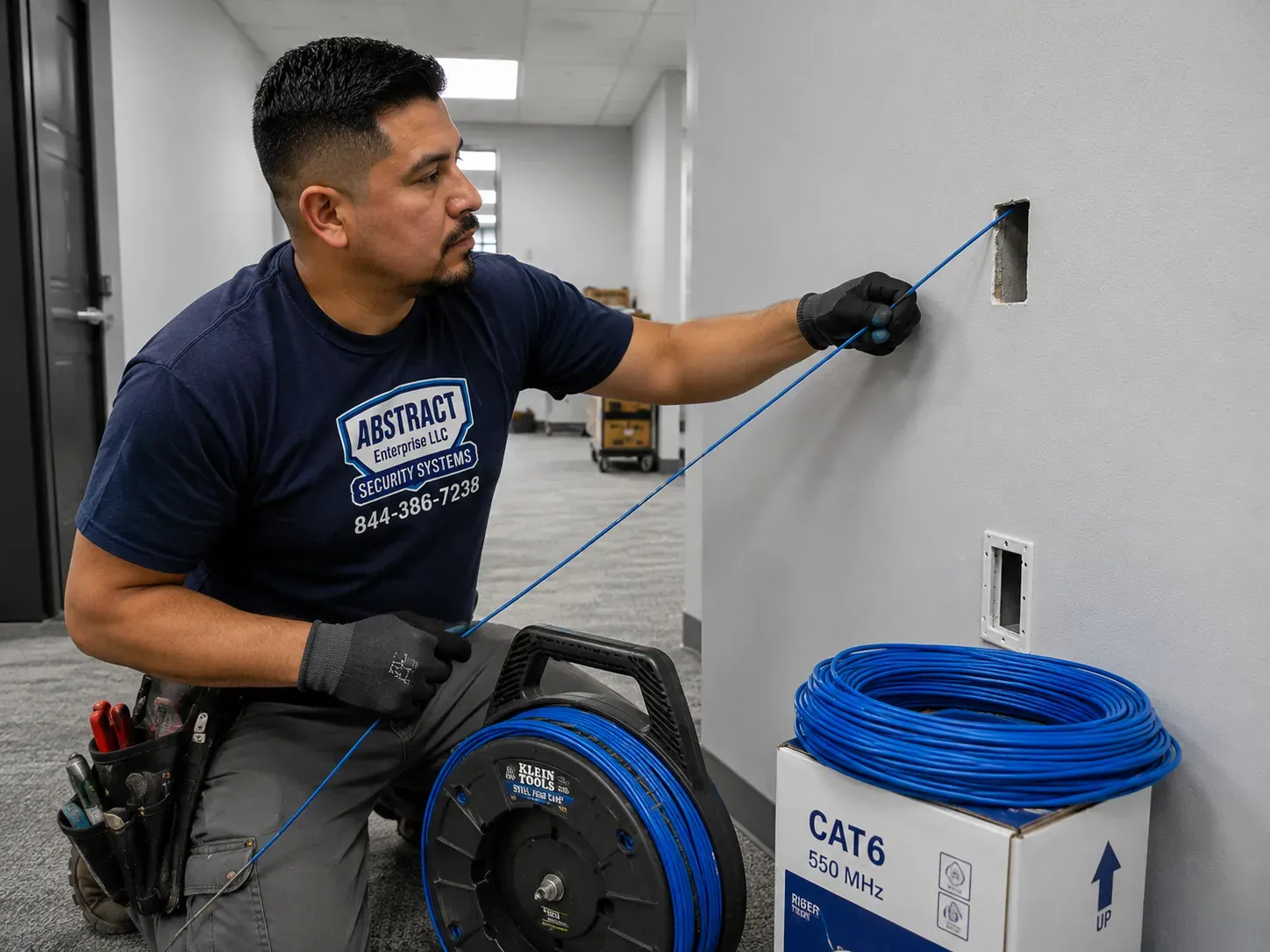
Kneeling in a carpeted corridor, a technician feeds a fish line from a reel into a cut opening high on a finished wall, with a boxed coil of blue cable and a low-voltage mounting bracket below.
Your Questions Answered
Fiber Optic Installation in Long Island: Questions Answered
These are the questions Long Island owners, property managers and IT providers actually put to us on site visits, grouped by the decision they're trying to make. The shorter questions about bids, conduit depth and scheduling are in the FAQ further down the page.
Linking buildings on one property
Should the fiber between our buildings go under the parking lot or overhead?
Underground is the default and the right answer on most Long Island commercial lots. Conduit under asphalt is protected from storms, falling branches, delivery trucks and vandals, it looks like nothing at all once the lot is patched, and a properly installed duct with handholes lets you pull more cable later without digging again. Its drawbacks are cost and disruption: trenching or boring, paving restoration and a markout before anyone digs.
Overhead makes sense when the ground is the problem — a long run through trees, across a drainage swale or along the back of a large property where excavation would be expensive and nobody parks. It is faster and cheaper to build, but it is the part of the network most exposed to the kind of wind that took down lines across the Island during Isaias. We price both where both are possible, and we tell you which one we would choose on our own property.
Can our fiber be attached to the utility poles that already run along our property?
Usually not by you or by us directly. The poles along a road belong to the utility, and the space on them is shared under agreements between the pole owner and the communications companies already attached. Getting a new private attachment means applying to the pole owner, paying for engineering and any make-ready work, and waiting on its schedule; New York's Public Service Commission revised its pole-attachment rules in July 2024 to speed the process for providers, but it remains a provider's process rather than a property owner's shortcut.
The practical routes are simpler. If the two buildings are on your land, we set your own poles or use building attachments, or we go underground. If they are on opposite sides of a public road, a carrier circuit or dark-fiber lease between the two addresses is normally faster and cheaper than trying to become a pole attacher yourself.
Is it worth running fiber to a gatehouse, pump house or detached garage that needs only a few devices?
More often than people expect. A gatehouse with one camera, a phone and an access reader doesn't need much bandwidth, but it does need a connection that won't be killed by distance or by the next lightning strike on the property. Copper between separate buildings carries both risks: it runs out of channel length quickly once it climbs up and down walls, and it gives a surge a conductive path into the main building's equipment. A two- or four-strand fiber with a small media converter or switch at the far end costs a little more on day one and removes both problems for good.
Where the outbuilding is very close to the main building and on the same electrical service, a protected copper run may be enough, and we will say so. The deciding facts are measured on the walkthrough: real cable path length, whether the structures share a ground, and what the owner plans to add there later.
Our sites are a few miles apart in different hamlets — can we own the fiber between them?
Owning fiber between separate properties means crossing public roads and other people's land, which brings in town or village road-opening permits, state permits on state roads, pole attachments or new conduit in the public right of way. That is construction on a carrier's scale, and for a business, a school district or a group practice it is rarely economic. What most multi-site organisations on the Island actually do is lease a circuit or dark fiber from a carrier between sites, and own everything inside each property.
We design that inside-the-property part so it is ready for whatever the carrier delivers: a clean entrance, a demarc extension to the network room, and a campus backbone at each site. When the organisation later changes providers, nothing inside the fence has to change.
Carriers, demarcs and private fiber
Optimum or Verizon fiber already reaches our street — doesn't that make a private backbone unnecessary?
Carrier fiber and private fiber do different jobs. Optimum reports nearly 900,000 fiber passings on the Island, and Verizon is pursuing new fiber franchises such as the Brookhaven agreement approved in April 2026; both bring a fast internet circuit to a demarc on your building. Neither builds the links between your buildings, carries your camera traffic from the warehouse to the recorder, or extends their circuit from the back wall to the network room in the front office — that inside-the-property plant is yours.
The two work best together. A good private backbone means the carrier's installation is quick and clean, the internet circuit reaches every building at full speed, and you can change carriers later without rewiring anything.
The carrier landed its fiber at the loading-dock end — how does it reach the front office?
This is the most common demarc problem in Long Island flex buildings. Carriers enter where their cable and the building's electrical service meet, which is often the rear or side wall near the dock, while the network room is in the office at the front. The provider's technician will hand over service at the demarc and, in many cases, run nothing further. What usually fills the gap is a long patch cord or a Cat6 run draped across the warehouse ceiling, often longer than copper allows.
We replace that with an owner fiber extension: a small enclosure next to the demarc, single-mode or multimode run in tray or J-hooks along the roof steel, and a panel in the network rack. The carrier's equipment stays where the carrier wants it, and the circuit reaches the office without a single extra hop.
Offices, fit-outs and campuses
We're moving into a vacant office building near Route 110 — what fiber should be in place before move-in?
Before move-in, three things are worth checking. First, where the carrier's service enters and whether there is a usable path from there to the room you plan as your main network room. Second, how the floors connect: in a two- or three-storey building that usually means fiber between a closet on each floor, which is far easier to install while ceilings are open and the space is empty. Third, whether any other building on the campus needs to share your network, because that link may need conduit work that takes longer than the interior fit-out.
Office buildings on the Island are leasing again — CBRE reported Long Island office availability at its post-pandemic low of 12.1 percent in mid-2026 — and that means more fit-outs with tight schedules. Fiber left to the last week of a fit-out tends to get compromised; fiber in the first set of drawings costs less and goes in cleaner.
How is fiber work handled inside an occupied hospital or medical campus?
Healthcare sites set the rules and we follow them. Work above ceilings in patient areas is normally governed by the facility's infection-control process, which can mean containment around the work area, dust control, scheduled windows and sign-off from the facility before tiles are lifted. Building-to-building links on a medical campus are planned around ambulance routes, patient parking and entrances that can never be closed.
Our part is to bring a method that fits: short work windows, enclosures and splice work done in the telecom rooms rather than in corridors, and documentation the facility's own engineering team can file. Many of our healthcare calls are for medical office buildings and ambulatory sites rather than hospitals themselves, where the same discipline applies on a smaller scale.
Storms, salt air and lightning
Will a storm that knocks out power to one building take the whole campus network down?
Not if it's designed with that in mind. The fiber itself carries no power and doesn't care about an outage; what fails is the equipment at each end. A campus designed for Long Island weather puts a UPS on the core switch and on the switch in each building, sized for the outage the owner is willing to ride through, and keeps the core in the building most likely to have generator power. With that in place, losing power in the gatehouse or the annex takes only that building offline, and everything else keeps talking.
Isaias left almost half of PSEG Long Island's 1.1 million customers without power at its peak in August 2020, and outages on that scale are exactly when owners want cameras, door access and phones to keep working. Where it matters, we also design a second fiber path so that a tree through one aerial span or a cut in one trench doesn't isolate a building.
Does salt air near the South Shore or the Sound shorten the life of outdoor fiber hardware?
The glass doesn't mind salt; the hardware around it does. Steel enclosures, unprotected fasteners, messenger strand and pole hardware corrode faster within reach of salt spray, and a corroded hinge on an outdoor box eventually lets water in. Near the water we specify non-metallic or properly coated enclosures, stainless hardware, sealed cable glands and all-dielectric cable where an aerial run is unavoidable.
Flooding is the bigger coastal risk. The city of Long Beach alone sustained $150 million in damage in Sandy, and before the storm Nassau ordered voluntary evacuations of the South Shore surge area south of Sunrise Highway. On those sites we keep splice enclosures and network equipment above the ground floor where possible, and we use outdoor-rated, water-blocked cable for anything that runs through a space that could flood.
Does metal inside an outdoor fiber cable create a lightning risk between buildings?
It can, which is why we choose the cable deliberately. All-dielectric cable has no metal at all and gives lightning or a ground fault nothing to follow between buildings; it is our default for links between separate structures. Armoured cable, chosen where rodents or crushing are a risk, contains a metal sheath, and that sheath must be bonded to the building's grounding system where the cable enters, as the electrical code requires for conductive optical cable.
The same thinking applies to tracer wire buried alongside a cable so it can be located later: it is terminated in a test station or handhole and handled so it doesn't become an unintended path into either building.
Before the first shovel
What has to happen before anyone digs a fiber trench across our property?
Four things, in order. A design that shows the route, the conduit size, handhole locations and how each building will be entered. A one-call markout through 811 so the electric, gas, water and communications utilities mark their lines. A search for the private lines the utilities don't mark — parking-lot lighting circuits, irrigation, sprinkler mains, signage feeds and old conduit — from the owner's site plans or a private locating service. And a check with the municipality the property is in about whether the work needs a permit there; on Long Island that may be a town, a village or a city.
Owners of multi-tenant parks also need their own approvals: a landlord's sign-off on the route, the tenants' agreement on the work window and a certificate of insurance naming the right parties. We gather all of that before scheduling the excavation, because a trench that has to stop halfway is the most expensive kind.
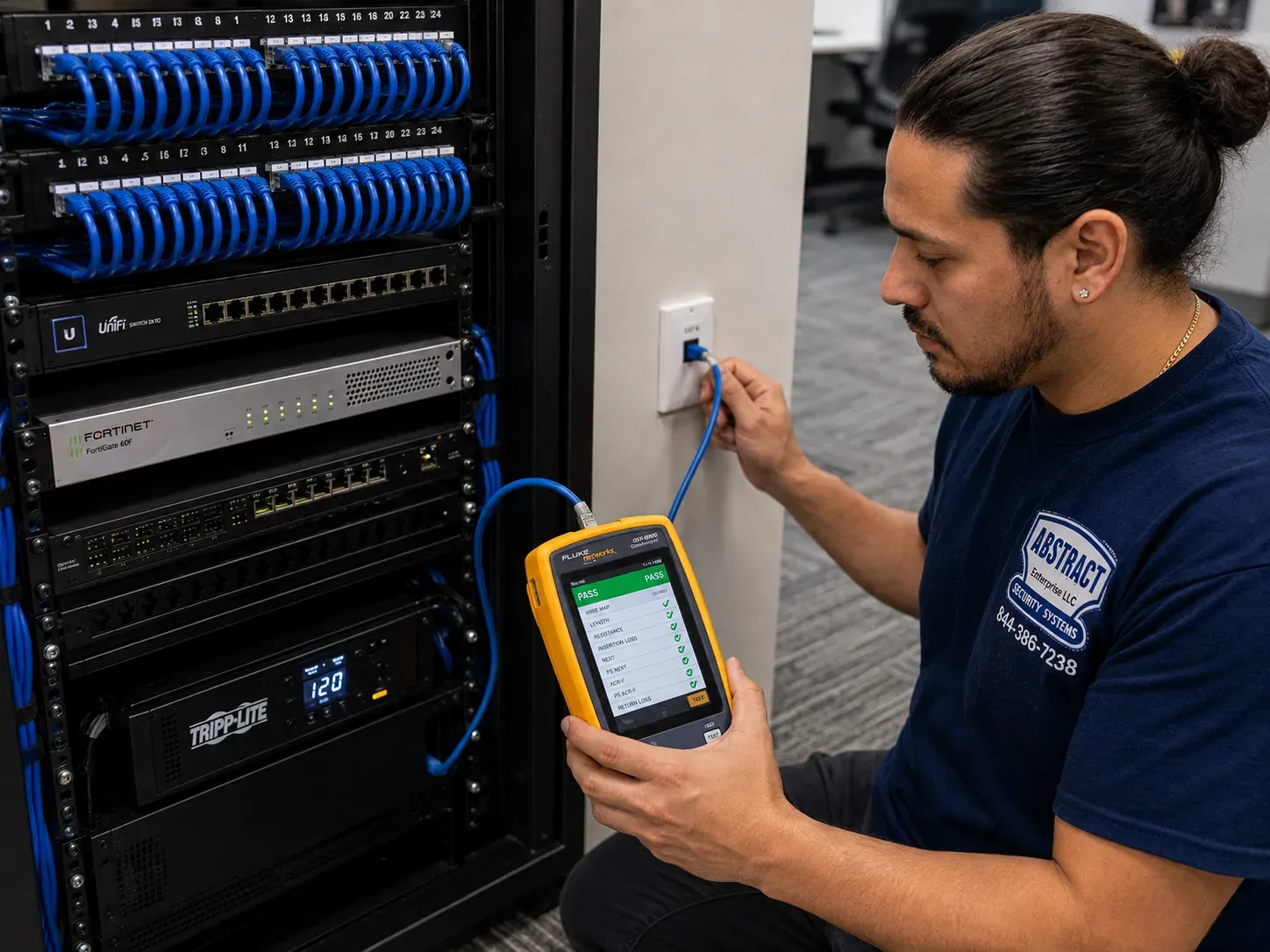
A technician kneels beside an open rack of patch panels, a switch, a firewall and a UPS, holding a yellow handheld certification tester whose screen shows a green pass result; its cord runs to a wall outlet.
Equipment
Types of Fiber Optic Cabling We Install
Suburban fiber spends much of its life outdoors, so the cable and hardware list looks different from an in-building job. These are the components we specify most on Long Island properties, and where each one belongs.
Outdoor Loose-Tube Single-Mode
The workhorse between buildings: fibers in gel-free, water-blocked buffer tubes inside a UV-resistant jacket. Single-mode OS2 because the distances on a campus can reach well beyond what multimode optics handle comfortably, and because it will carry whatever speed the owner buys next.
All-Dielectric Aerial Cable
Lashed to a messenger strand or built as a self-supporting figure-eight design for shorter spans. No metal in the cable, so nothing to bond and nothing for lightning to follow between buildings.
Armoured Indoor/Outdoor Cable
A metal or interlocking armour layer for runs through warehouses, mechanical rooms and crawlspaces where forklifts, rodents or crushing are a risk. Bonded to ground where it enters the building.
Multimode OM4 for Short Inside Links
Front-office-to-dock links inside one building and floor-to-floor links in a low-rise office, where distances are a few hundred feet and inexpensive short-reach optics make sense.
Conduit, Innerduct and Handholes
HDPE or PVC conduit underground, innerduct to divide it for future pulls, and traffic-rated handholes where the route passes under drive aisles. Warning tape and tracer wire go in the same trench.
Splice Closures and Wall Enclosures
Sealed outdoor splice closures for handholes and poles, wall-mount enclosures at each building entrance, and rack-mount panels in the main room, all with splice trays sized for the strand count plus spares.
Pigtails and Connectors
Factory-polished LC pigtails fusion-spliced onto each strand, with SC or other connectors where existing equipment calls for them, so the field joint is a splice rather than a hand-polished connector.
Media Converters and Small Switches
For gatehouses and outbuildings, an industrial or temperature-rated switch or converter that takes the fiber in and delivers copper and PoE to the cameras, readers and access points in that building.
Test and Locating Equipment
Fusion splicer, precision cleaver, inspection scope, light source and power meter, OTDR with launch and receive fibers, a visual fault locator for quick checks, and a cable locator to confirm the buried route before the trench is closed.
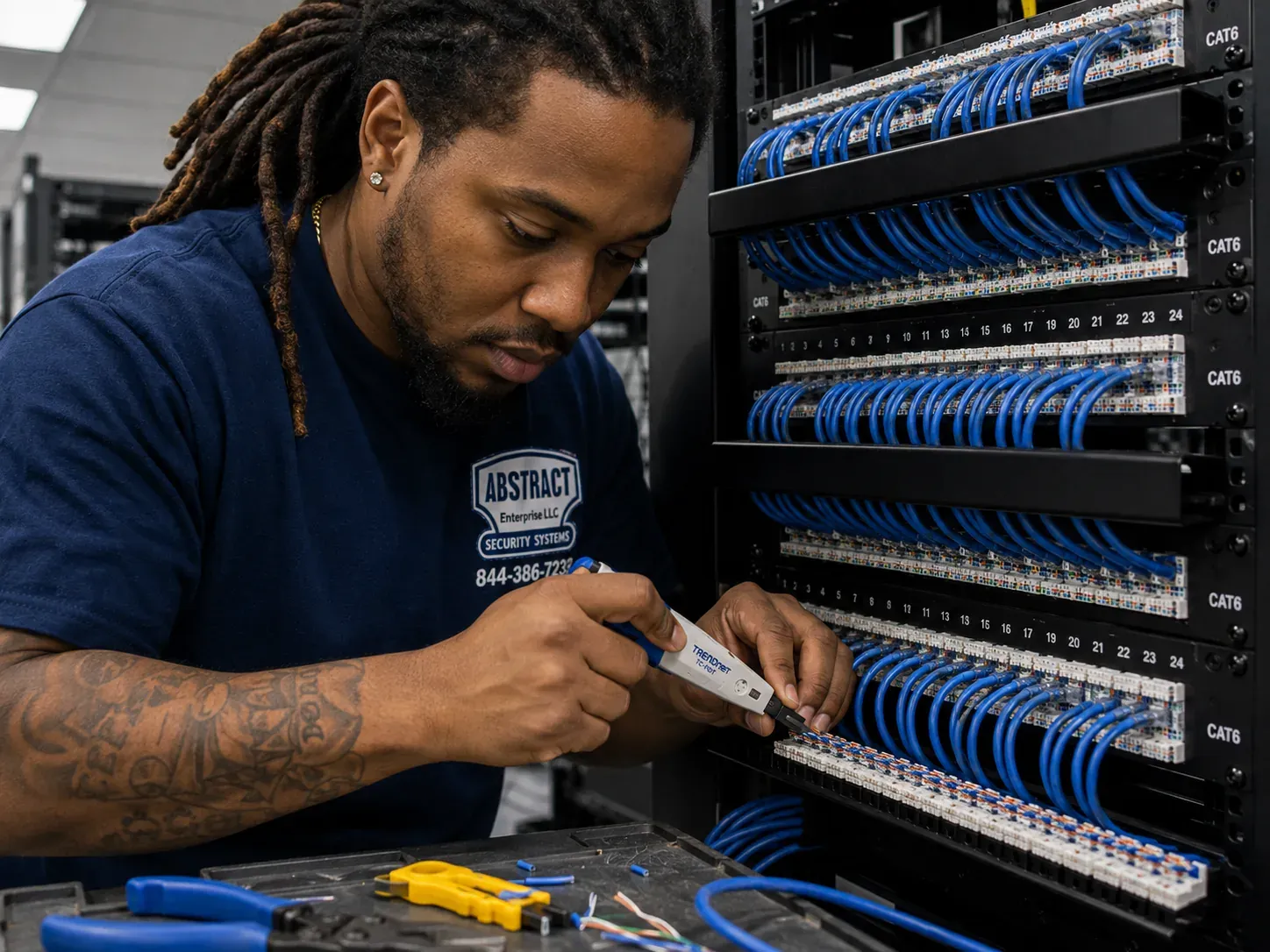
A technician uses a punch-down tool on the rear termination strip of a tall stack of patch panels full of blue cable, with cutters, a stripper and cable offcuts on the tray in front of him.
AI Overview Reality Check
What AI Gets Wrong About Fiber Optic Installation in Long Island
Google's AI Overview could not be read from our research environment, so we have not invented what it says. Below are claims that cost guides, provider pages and online discussions actually publish — the material summaries and chatbots draw on — checked against how fiber work goes on Nassau and Suffolk properties.
“If Fios or Optimum fiber is available, your business is on fiber”
Availability maps answer a narrow question: can a provider deliver service to an address. Optimum publishes a fiber footprint of nearly 900,000 passings on the Island, and Verizon's own coverage pages direct addresses without Fios to its 5G home service instead. Residents find the maps confusing too: in an r/longisland thread titled “Fios in Melville”, one reply cites figures putting most of Melville inside Fios coverage, while the thread also describes Fios not being offered at an address that already had a Fios terminal on the house.
For a business on a multi-building lot, a yes on the map means a circuit at one demarc on one building. It says nothing about the second building, the warehouse at the back or the gatehouse at the entrance.
So the right question to ask is not “is fiber available here?” but “where will the carrier hand off, and what carries it from there to everything we own?” That second half is a private installation.
“Underground fiber costs about $18 a foot”
Outside-plant numbers travel fast online. The one most often repeated comes from the Fiber Broadband Association’s 2025 cost research as relayed by a cabling firm’s guide — roughly eighteen dollars a foot buried and eight strung on poles, as medians. They are real, but they describe carrier builds along public roads.
On a private Long Island lot, the cost of a link is dominated by things a national median can't see: whether usable conduit already exists, whether the crossing is lawn or a heavy-duty drive aisle, whether the lot can be closed for a day, how much asphalt has to be restored and how many private lines need locating first. A 300-foot link through existing conduit and a 300-foot link through new conduit under a busy lot are completely different jobs.
We price the fiber, the splicing and the testing from our published list and price the civil work separately after walking the route. That way the owner sees exactly which part of the money is going into the ground.
“A wireless bridge is just as good as fiber between buildings”
Point-to-point radios are a real tool and sometimes the only one, when a public road or a neighbour's property sits between buildings. Online advice often presents them as equivalent to fiber because the headline speeds look similar.
Over a Long Island winter and summer, the differences show. A radio link needs clear line of sight, which a growing tree or a new rooftop unit can block. It is exposed to wind, ice and the storms that regularly cross the Island, and its throughput depends on interference from everyone else's radios nearby. A buried fiber link has none of those variables.
Our rule is simple: where a cable route across your own property exists at a sensible cost, use fiber and keep the radio as a backup if you like. Where it doesn't, a well-designed wireless link is better than nothing, and we'll say so.
“Fiber installation takes a few hours”
Ask a search engine how long fiber installation takes and the answer comes from residential providers: an in-home install of up to four hours from one major carrier, four to six from another. Those times describe connecting one home to a network that already reaches it.
A private link across a Long Island property involves a markout request and its waiting period, possible municipal paperwork, excavation or boring, conduit, handholes, the cable pull, splicing at both ends, testing and paving restoration. Some of those steps are measured in hours and some in days, and several depend on the weather and the owner's ability to close part of the lot.
We give owners a schedule broken into those stages. The splicing and testing really can be done in a day; it's everything around them that sets the calendar.
“Multimode is the cheaper choice for any building network”
Summaries tend to say multimode is for short runs inside buildings and single-mode for long distances, with multimode the cheaper option. Industry comparisons note that the cable prices are now close; the difference is mostly in the optics.
On a Long Island campus the distances regularly exceed what an in-building rule of thumb assumes. Between buildings, or from one end of a large property to the other, single-mode avoids any doubt about reach and will carry future speeds without replacement. Multimode still has a place for short links inside one building where the equipment is already chosen.
We often run single-mode outdoors and multimode or hybrid indoors, and we document which is which so the IT provider buys the right optics the first time.
“Fiber is fragile and won't survive outdoors”
This one appears in forum threads whenever someone suggests running fiber to a garage or a second building. It is half true: bare fiber and indoor patch cords are fragile, and a link built from the wrong cable will fail.
Outdoor-rated cable is designed for exactly this life: UV-resistant jackets, water-blocking, strength members that take pulling tension and, in armoured versions, protection from rodents and crushing. The weak points outdoors are the transitions — where cable enters a building, drops off a pole or comes up out of a handhole — and those are where installation quality shows.
Done correctly, an outdoor link is the most durable part of a campus network. The things that usually end its life are excavators and fence crews, which is why we leave accurate locating records behind.
“The carrier will run fiber to every building on your lot”
Provider sales pages and resident forums sometimes give the impression that the internet company wires the whole property. On a single house that's broadly true. One r/longisland commenter in Suffolk described the carrier “just now hanging the fiber in my backyard” — a drop to one home.
On a commercial property the carrier builds to its demarc and serves the account at that point. Extending it to other buildings is either a separately priced carrier job or, more often, the owner's own responsibility, and the provider will reasonably expect a clean, documented place to hand off.
Owners who plan the private fiber before the carrier arrives get the best of both: a short, tidy carrier installation and a network that reaches every building from day one.
Campus Design
Designing a Multi-Building Backbone: Star, Ring and the Core Room
Once a property has three or more buildings, the layout of the fiber matters as much as the fiber itself. Long Island campuses tend to grow one building at a time, and the links between them often grow the same way — each new building tied to whichever one was nearest. Ten years later the network depends on a chain, and a fault in the middle of it cuts off everything beyond. A short design exercise at the start avoids that.
Choosing the core building
The core room should sit in the building with the best power, the best physical security and the carrier entrance — ideally all three. If the carrier enters one building and the generator serves another, we usually extend the carrier circuit on owner fiber to the generator-backed building rather than move the network to follow the carrier. On sites near the South Shore, the core belongs above any level that has flooded before.
Star layouts
In a star, every building has its own fiber back to the core. It is the simplest layout to understand, to troubleshoot and to expand: a new building gets a new link, and a fault on one link affects only that building. For most office parks and small campuses a star is the right answer, and where buildings sit in a line the separate cables can share one trench and one conduit bank to keep civil costs down.
Rings and second paths
Where losing a building would be serious — a healthcare site, a distribution centre whose dock office runs the trucks, a property whose gatehouse controls entry — we add a second path. That can be a ring through every building, so traffic reroutes the other way if one span is cut, or a second link from the most important buildings by a physically different route. The fiber is only half of it: the switches at each end must be configured to use the second path, which is why we plan these links with the IT provider rather than around them.
Strand counts and spare conduit
Each active link uses two strands, but a building link that carries the network, a separate camera network and perhaps a provider's service for a tenant uses six quickly. We size each building cable with spare strands and, where a trench is open anyway, lay a spare conduit beside the one in use. An empty conduit costs very little in an open trench and avoids a second excavation when the next tenant or the next system arrives.
Documentation that matches the ground
A campus backbone is only useful if the next person can understand it. Every building enclosure carries a label showing where each strand goes, every handhole number appears on the drawing, and the drawing shows the route measured from fixed points. That is the difference between a property where a future fault takes an hour to find and one where it takes a week.
Working On Site
Working Around Docks, Forklifts and Open Businesses
Most Long Island fiber work happens while the business keeps running. In an office park that means tenants who still need to park; in a warehouse it means trucks at the dock, forklifts in the aisles and lift work above people's heads. A few habits make that safe and keep the client's operation moving.
Aisles closed in sections. In warehouses, overhead tray and J-hook work is planned aisle by aisle with the operations manager, so only one section is closed at a time and the lift is never working above active picking. Where the building runs around the clock, we schedule the aisles with the quietest shift.
Parking fields worked in halves. A trench or a bore across a parking lot is phased so that one side of the lot stays open, with cones, barriers and plates over any open cut at the end of each day. Saw-cut trenches are filled and temporarily patched the same day where possible, with the final patch following once the material has settled.
Dock schedules respected. Building entries near loading docks are timed around deliveries, and nothing is left in a truck court overnight.
Cutovers out of hours. The new fiber is built, spliced and tested alongside the old connection while the business runs on it. The switch to the new link happens at a time the client picks, usually early morning or at a weekend, with both ends staffed.
Clean sites. Cores and cuts are dust-controlled inside occupied spaces, ceiling tiles go back the same day, and the site is left as it was found — apart from the new enclosure on the wall.
Larger Private Properties
Estates, Marinas and Seasonal Properties on the Forks
Not every multi-building Long Island property is commercial. Large residences on the North Shore and the East End, marinas, farms and seasonal properties often have a main house, a guest cottage, a pool house, a garage with staff quarters and a gate at the end of a long drive. Owners want cameras, gate control, wireless and sometimes a home office in every one of them, and a set of separate internet connections or a chain of wireless repeaters rarely delivers it.
The approach is the same as on a commercial campus, scaled to the site: a core location in the main house or a utility room, fiber out to each outbuilding underground in conduit, and a small switch at each end. Long driveways to a gate are a natural fiber run, because the cable can share a trench with the gate's power and control wiring if it is planned together. Where the property is near the water, enclosure and hardware choices follow the salt-air rules described above, and equipment stays out of spaces that flood.
Seasonal properties add one more consideration: timing. Trenching across lawns and gardens is best done in the off-season, when the work can be restored before the property is in use, and a network that has to be monitored remotely through the winter benefits most from links that don't depend on line of sight through trees that leaf out every spring.
Large-Lot Retail
Dealerships, Garden Centres and Other Large-Lot Businesses
Some of the most practical fiber jobs on the Island are at businesses whose real estate is mostly open ground. A car dealership along a busy Nassau or Suffolk road typically has a showroom, a service building, a detail bay, a parts warehouse and a lot full of inventory that needs cameras on poles. A garden centre has a sales building, greenhouses, a yard office and a delivery gate. A self-storage site has an office at the front and rows of buildings behind. Each one needs the same thing: every building and every camera pole on one network, managed from one office.
These properties are where the economics of fiber are clearest. Copper between buildings on a lot that size simply doesn't reach, wireless struggles across rows of parked vehicles and metal buildings, and separate internet connections per building make the cameras impossible to manage as one system. A single trench along a curb line or a landscaped edge, carrying conduit for fiber and for camera-pole power, connects the whole site.
We plan these jobs around the business's busiest days, coordinate the camera positions with the fiber route so poles are fed from the nearest handhole, and leave a drawing the dealer principal or site manager can hand to the next contractor who wants to dig a sign footing or move a light pole.
Walk the Route Before Anyone Digs
Send the address and a rough sketch of the buildings. We measure the real route, look for conduit that is already there and price the fiber and the civil work on separate lines.
Tell us the town or hamlet, the buildings and what has to connect. We reply the same business day, or call (800) 486-0943.
✅
We Got Your Request!
We'll call you back the same business day. If it's urgent, call us now at (800) 486-0943.
How It Works
Our Installation Process
Eight stages on every Long Island job. On a link inside one building, the middle stages shrink to an afternoon; on a campus with a new trench, they set the calendar.
1. Site walk with a measuring wheel
We walk every building and the ground between them, find the carrier demarc, open handholes and pull boxes, and measure the real route rather than the straight line on a site plan.
2. Route options and proposal
Existing conduit, new underground or aerial on owner poles, each priced where it is possible, with fiber, splicing and testing on our published lines and civil work quoted separately.
3. Markouts, permits and approvals
811 markout request, private-line search, a check with the town, village or city, and the landlord, tenant and insurance paperwork a multi-tenant property needs.
4. Civil work and building entries
Trenching, boring or pole setting, conduit with tracer and warning tape, handholes at buildings and bends, and sealed wall entries with enclosures mounted inside.
5. Cable pull
Outdoor cable pulled by its strength members with lubricant and tension control, service coils left in handholes and enclosures, and every interior penetration firestopped.
6. Splicing and termination
Outdoor cable transitioned at each entrance, pigtails fusion-spliced into trays, and every connector inspected and cleaned before it is mated.
7. Testing in both directions
Loss testing on every strand at the right wavelengths and bidirectional OTDR traces on outdoor links, compared against a loss budget written before the pull.
8. Restoration, as-built and cutover
Lot and landscaping restored, buried route drawn on the as-built with handhole locations, both ends labelled, live services moved in a planned window and the results file handed over.
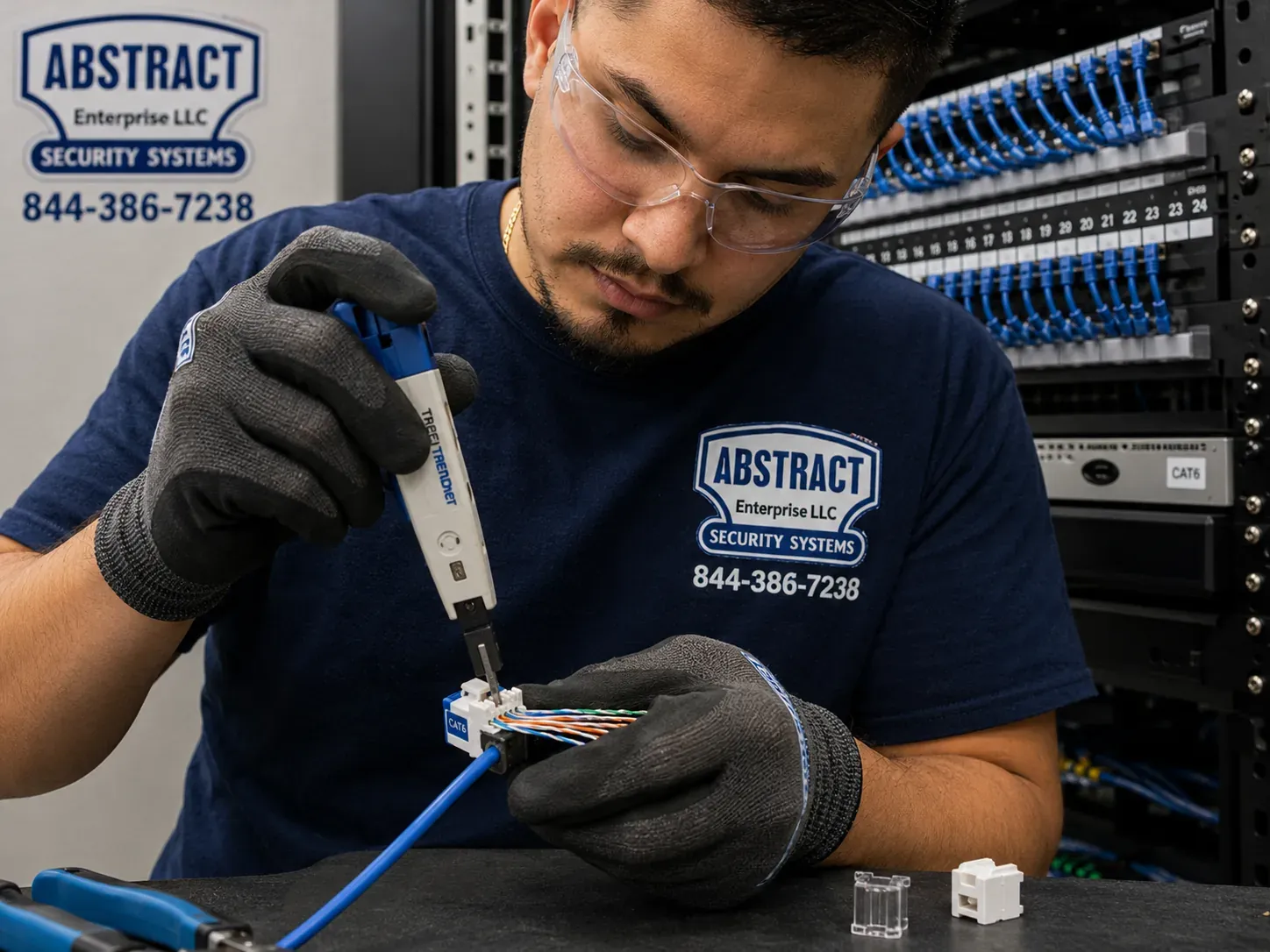
Wearing safety glasses and work gloves, a technician seats conductors into a keystone jack with a punch-down tool at a bench, a rack of patched panels behind him — the copper hand-off that a fiber link feeds in each building.
Coverage Area
Fiber Optic Installation Near Long Island's Landmarks
Long Island's landmarks for fiber work are its campuses and business parks — the places where many buildings share one owner, one network and a lot of open ground. We work around all of these.
Long Island Innovation Park at Hauppauge
Described in a 2017 economic summary as the largest industrial park in the Northeast by number of companies and employees, with about 1,350 businesses in roughly eleven square miles, and renamed by its business association in 2019.
Route 110 Corridor, Melville
Office campuses on both sides of the Long Island Expressway, including Melville Corporate Center I at 105 Maxess Road, a building of about 149,000 square feet close to Route 110 and the LIE.
RXR Plaza, Uniondale
The office complex beside the Meadowbrook Parkway, near Nassau Coliseum and Roosevelt Field, with tenants on upper floors of its towers and the Northern and Southern State Parkways close by.
Hofstra University, Hempstead
About 117 buildings on 244 acres in the Uniondale section of Hempstead, with part of the campus south of Hempstead Turnpike — a textbook example of one institution spread across a major road.
Stony Brook University
213 buildings over 1,454 acres in the Town of Brookhaven, plus a 246-acre research and development park south of the main campus and a 695-bed university hospital.
Brookhaven National Laboratory, Upton
A Department of Energy laboratory on a 5,265-acre site at the former Camp Upton, staffed by about 2,750 people — the largest single campus on the Island and a major presence for contractors and suppliers in central Suffolk.
We also work across Mineola, Garden City, Westbury, Hicksville, Syosset, Plainview, Great Neck, Lake Success, Elmont, Valley Stream, Freeport, Massapequa, Farmingdale, Huntington, Commack, Smithtown, Islandia, Ronkonkoma, Bohemia, Holbrook, Bay Shore, Patchogue, Medford, Riverhead and the North and South Forks.
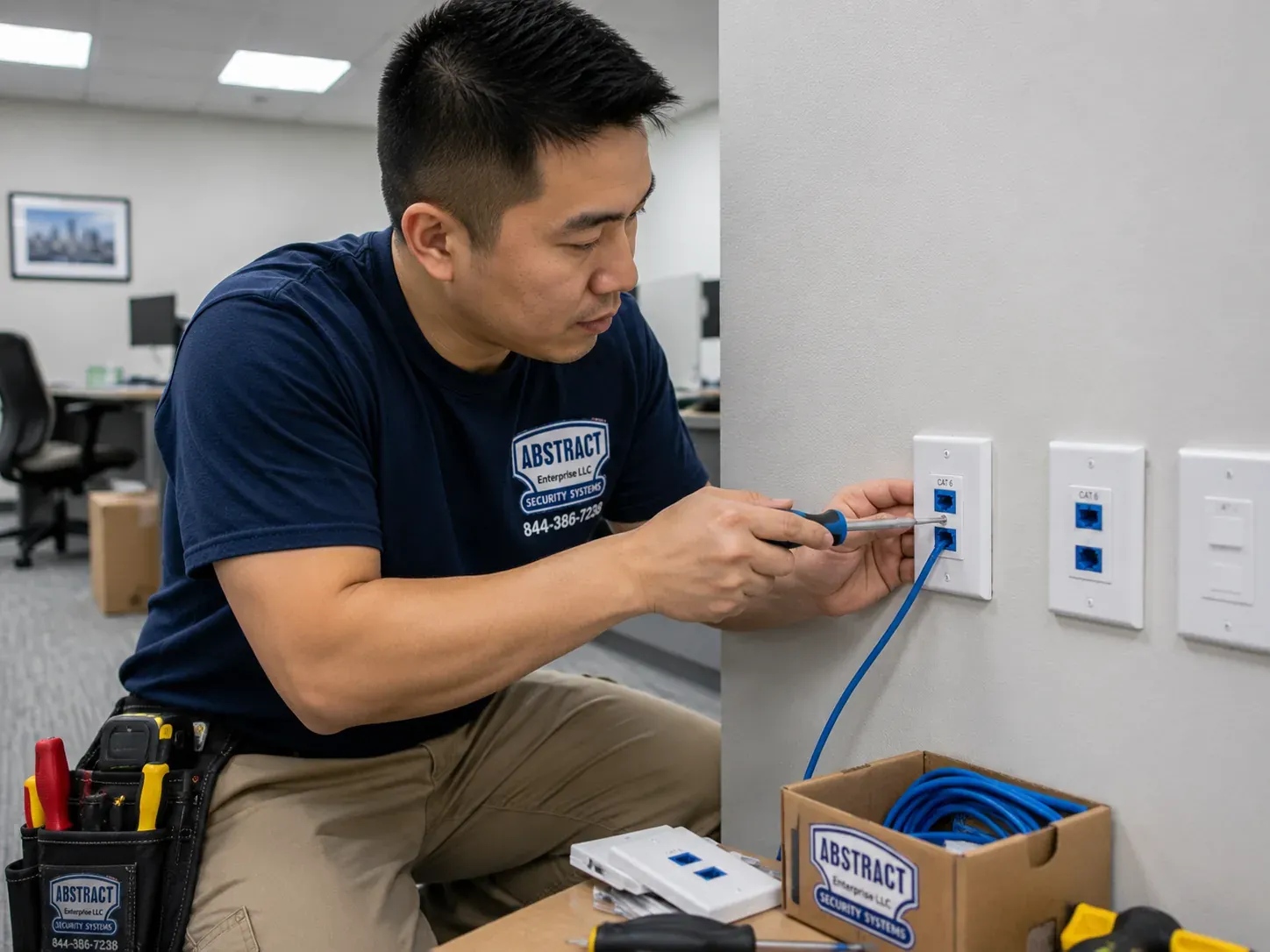
Kneeling beside an office wall, a technician screws a dual-port data outlet plate into place, with two finished plates beside it and a box of cable and spare plates at his feet; desks and a framed picture are visible in the office behind.
Pricing
Fiber Optic Installation Cost in Long Island
Every Long Island fiber job is quoted after a site walk, but the building blocks are published. These are our standard fiber prices with the Nassau (1.15×) and Suffolk (1.20×) area rates applied to the Brooklyn base used across our New York City pages. Excavation, boring, poles and paving are not in these lines; they are priced separately once the route is known.
Item
Nassau
Suffolk
What it covers
Fiber termination on an existing cable
$40 each
$42 each
One connector, fusion-spliced pigtail or mechanical
OTDR test
$46 per strand
$48 per strand
Trace and event table for each strand
Multimode fiber drop
$403
$420
Short inside run, terminated and tested
Single-mode fiber drop
$460
$480
Short inside run, terminated and tested
12-strand OM4 backbone between floors or rooms
$5,175 – $8,050
$5,400 – $8,400
Fusion-spliced, panels both ends, tested
24-strand OS2 building-to-building backbone
$9,200 – $17,250+
$9,600 – $18,000+
Single-mode, spliced at both buildings, OTDR-tested; civil work extra
Second telecom room with fiber link
from $2,760
from $2,880
Room build-out at the far end and the fiber tie back
Service and callback rate
$195/hr, 3-hr minimum ($585)
Repairs, troubleshooting and return visits — not the initial install
What moves a Long Island fiber quote
Whether a route already exists. Usable conduit between buildings turns a construction job into a cable pull. Its absence is the single biggest variable.
What the route crosses. Lawn, landscaped strips, light-duty parking, heavy truck courts and public roads each cost very differently to cross, and so does restoring them.
Access to the lot. A lot that can be closed on a weekend is cheaper to work than one that must stay open to customers and deliveries throughout.
Strand count and cable type. More strands mean more splices and more testing; armoured and aerial cable cost more than standard outdoor loose-tube.
Number of buildings. Each building adds an entry, an enclosure and a set of splices, so a five-building campus costs more than five times a single link's splicing.
National brand versus local contractor. The big consumer security names — ADT, Ring, SimpliSafe — sell monitored alarms and cameras, not private fiber between buildings, so they aren't really in this comparison. The realistic alternatives are a carrier's construction team, which builds to its own demarc; a national integrator, strong on very large campuses but often subcontracting the field work; or a local licensed contractor that owns its splicing and test equipment, can walk your lot this week and answers to you directly.
Shop Our Systems
Fiber Optic Installation Packages & Pricing
Most Long Island requests fall into one of these three shapes. Each figure is simple arithmetic on the Nassau and Suffolk lines in the table; the written proposal replaces it with your actual counts and adds the civil work.
Starter — Bring Old Fiber Back
$1,512 – $1,584
Terminate and certify a 12-strand cable already in the ground or the ceiling: 24 terminations and 12 OTDR traces, at $40 and $46 in Nassau ($1,512) or $42 and $48 in Suffolk ($1,584). Missing enclosures are added at cost.
Standard — Inside One Building
$5,175 – $8,400
A 12-strand OM4 backbone from the front-office network room to a closet at the warehouse end, or between floors of a low-rise office: $5,175–$8,050 in Nassau, $5,400–$8,400 in Suffolk, spliced and tested.
Premium — Across the Lot
$9,200 – $18,000+
A 24-strand OS2 single-mode link between two buildings on one property: $9,200–$17,250+ in Nassau, $9,600–$18,000+ in Suffolk, spliced into enclosures and OTDR-tested on every strand. Trenching, boring and paving are quoted separately.
Bring Your Own Equipment — Labour Only
Already bought the cable, the closures or the optics? We install, splice and test customer-supplied materials at the $195 per hour service rate with a three-hour minimum ($585). We test a customer-supplied reel before it goes into a trench, because a damaged reel discovered after the lot is repaved is the most expensive kind. Customer-supplied equipment carries its maker's warranty rather than ours.
Two Buildings, One Network
The site walk is free. You get the route options, the fiber lines from this page and the civil work priced separately, so you can see where every dollar goes.
Both counties share the same basic pattern of low buildings and open ground, but the scale changes as you drive east. Dedicated county pages are on the way; until they are live, this is the overview.
Nassau County
Nassau is the denser of the two: about 453 square miles, more than 1.38 million residents and a patchwork of two cities, three towns and 64 villages. Commercial lots are tighter, buildings closer together, and links between them are often short — a few hundred feet across a shared parking field in Garden City, Mineola, Westbury, Hicksville or Lake Success. The challenge is usually access rather than distance: lots that can't close, neighbouring tenants who share the pavement, and a village or town building department whose rules have to be checked address by address. Office stock around Uniondale and the Meadowbrook corridor adds riser work inside taller buildings, and the South Shore adds flood exposure that shapes where equipment rooms belong.
Suffolk County
Suffolk is more than five times Nassau's land area at about 2,373 square miles, with roughly 1.52 million residents across ten towns. Properties are bigger and buildings further apart, so the typical job is longer: a warehouse and yard in Bohemia or Ronkonkoma, a multi-building campus around Stony Brook, a flex building in the Hauppauge park whose dock end sits several hundred feet from the office. Aerial runs on owner poles appear more often here because the ground between buildings is more likely to be wooded or unpaved. Further east, on the North and South Forks, sites are seasonal, salt exposure is higher and the distances from a main building to barns, pool houses and outbuildings can be considerable.
Pricing follows the same split: Nassau carries a 1.15× area rate and Suffolk 1.20× on our published fiber lines, both applied to the same Brooklyn base used on our city pages.
Testing Explained
Testing Outdoor Links: Why We Shoot Both Directions
Indoor fiber tests are short and simple. A link that leaves one building, runs under a parking field and enters another deserves more. Here is what our Long Island test reports contain and why.
A loss budget written before the pull. We add up the allowance for the length of fiber at each wavelength, every splice and every mated connector pair, and write the expected maximum on the proposal. That turns the test from “did it light up” into “did it come in under the number we agreed”.
Insertion loss at two wavelengths. Single-mode links are measured with a light source and power meter at 1310 and 1550 nanometres. The longer wavelength is more sensitive to bends, so a link that passes at 1310 but looks high at 1550 often points to a tight bend at a handhole, a building entry or a pole — exactly the places outdoor cable gets mistreated.
OTDR from both ends. An OTDR trace taken from one end can make a splice look like it gains or loses light depending on small differences between the two fibers joined there. Averaging traces from both ends gives the true loss of each splice. On outdoor links with transitions at both buildings and sometimes a mid-span closure, that matters, and it gives a baseline the owner can compare against if the link is ever damaged.
Launch and receive fibers. The OTDR can't measure the first connector it's plugged into without a length of fiber in front of it, so we test with launch and receive cords at both ends. That way the connectors at each building are measured, not hidden.
Distance to every event. The trace shows where each splice, connector and end sits along the cable. Paired with the as-built drawing, it lets a future technician estimate where a break is before digging — a few feet of accuracy that can save a whole parking aisle.
Acceptance across a whole campus. On a property with several buildings, each link is tested and accepted on its own, then the backbone is checked as a system: every building reachable from the core, any second path tested by deliberately disconnecting the first, and the results compiled into one file with a page per link. That file, not the day the lights came on, is what we treat as completion.
End-face inspection and labels. Every connector is inspected under a scope before it is mated, and every strand carries the same label at both ends and on the report. A perfect link with mismatched labels still fails on cutover day.
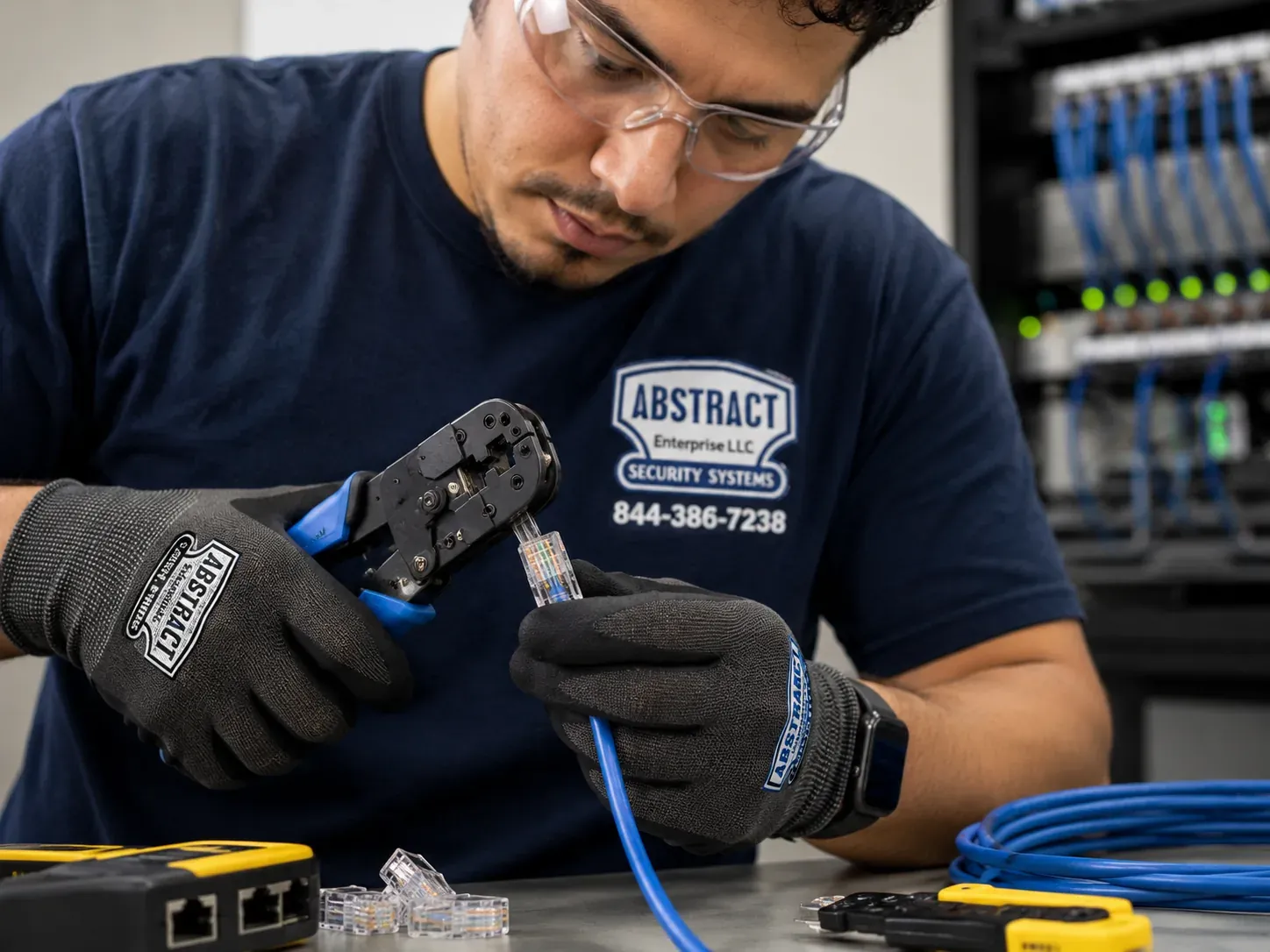
In safety glasses and gloves, a technician crimps a clear connector onto a blue patch cord at a metal bench, with spare connectors, a cable tester and a coil of cord laid out and a lit rack behind him.
Before You Call
What to Gather Before a Long Island Site Walk
None of this is required, but each item shortens the proposal and makes the price more exact.
The site plan or survey. Even an old one shows building footprints, curb lines, lighting poles and sometimes the original telephone conduit.
Where the carrier enters. Which building, which wall, and which providers serve the property today.
Which buildings need linking, and why. Cameras, phones, access control, wireless, a shared server — the devices decide the strand count and the equipment at each end.
Who controls the ground. The owner, a park association, a landlord who leases the building but not the lot — and whose permission the route needs.
Known private lines. Irrigation, lot lighting, signage, sprinkler and septic or drainage lines that won't appear on a utility markout.
Work windows. When parking aisles can be closed, delivery schedules at the dock, and any seasonal blackout dates.
Power at each building. Whether outbuildings have their own service, and which building has generator backup, so equipment goes where it will stay up.
Plans for the next five years. A building you might add, a lot you might repave, a tenant who might expand — all cheaper to accommodate with an extra conduit now.
If you lease rather than own, ask the landlord early who will own fiber laid under the lot and whether the lease lets you leave it in place. Those answers are easy to get before the trench and awkward to negotiate after it.
Inherited Plant
Fiber Left Behind in Long Island Office Parks and Plants
Office parks and industrial buildings on the Island change hands, and tenants come and go. A lot of the fiber we're called about already exists — it just isn't trusted. These are the conditions we find most often, and how each is dealt with.
Cable that ends in a coil. A link was pulled between buildings, then the project stalled or the tenant left, and the fiber was never terminated. We test it bare before spending anything on connectors; if it is whole, splicing and certifying it costs a fraction of a new route.
Indoor cable buried outdoors. Riser or plenum cable run through underground conduit because it was what was on the truck. Indoor jackets aren't built to sit in water, and these links tend to degrade after a few seasons. The fix is to pull outdoor-rated cable through the same conduit, which is usually still good.
Handholes nobody can find. Boxes paved over during a resurfacing, or buried under landscaping. We locate them with a tracer or a sonde, raise them to grade and record their position on a drawing.
Unbonded armour. Armoured cable entering a building with its metal sheath left floating. It is corrected at the entrance enclosure as part of any takeover.
Aerial spans that sag or rub. Cable lashed to a strand that has stretched, or chafing on a branch or a building edge. We re-tension, re-lash or re-route, and trim back to a safe clearance with the owner's approval.
No idea which strand is which. Panels without labels, splice trays without records. Every strand is traced, tested and labelled the same at both ends, and the documentation that should have existed is produced.
An inherited link that tests well is the best news a Long Island owner can get: the expensive part, the route, has already been paid for.
Complete Services
Every Fiber Optic Installation Service in Long Island
A fiber link between buildings is usually the start of a larger plan. These are the Long Island services that most often share the proposal.
Our per-drop cabling price builders for each county, for the copper work that accompanies a fiber project.
Field Notes
Field Notes From Long Island Parking Lots
How our crews approach a building-to-building job — working practice, not a single project
The first thing our crews do on a Long Island campus job is look down, not up. Before anyone talks about cable, they walk the curb lines and the landscaped islands looking for the square lids of old handholes, the stub of a conduit coming out of a building wall, a patch in the asphalt that runs straight from one building to another. A surprising number of parks built in the seventies and eighties had telephone duct laid between buildings, and the owner has no idea it is there.
If we find it, the next step is to prove it, end to end, before anyone promises a price that depends on it. A duct that is half full of silt or crushed under a light pole base is worse than no duct at all, because it encourages a plan that falls apart mid-pull. If it is clean, the job just got shorter and cheaper.
The second habit is about the end of the job. Whatever we put in the ground gets drawn on the as-built from measurements, not from memory, with handholes tied to fixed points such as building corners. The next person to dig on that lot — a paving contractor, a landscaper, an electrician setting a new light pole — is the biggest threat to the fiber, and the drawing is the best protection the owner has.
FAQ
Long Island Fiber Optic Installation FAQ
Why are Nassau and Suffolk fiber prices higher than the city base rate?
+
Our fiber price list is set at a Brooklyn base, and each area applies a published multiplier for travel, time on site and local costs: 1.15 times in Nassau and 1.20 times in Suffolk. A termination that is $35 at the base is $40 in Nassau and $42 in Suffolk; civil work is priced separately after the site walk.
Do you take fiber work on the North Fork and the South Fork?
+
Yes. We work across all ten Suffolk towns, including Riverhead, Southold, Southampton, East Hampton and Shelter Island, at the Suffolk rate. East End jobs are scheduled in blocks so the crew is on site for full days, and seasonal properties are usually best done outside the summer weeks.
How deep does fiber conduit sit under a parking lot?
+
Deep enough to sit below the pavement's base course and clear of future milling, and in line with the site engineer's specification where one exists. We set the depth after looking at the pavement section and the other lines in the ground, record it on the as-built, and lay warning tape above the conduit.
Can the conduit be bored under the lot instead of cutting the asphalt?
+
Often, yes. Directional boring passes under drive aisles, curbs and landscaping with only small pits at each end, which keeps a busy lot open. It costs more per foot than an open trench on soft ground and needs accurate utility marks, so we price both where both are practical and show the difference.
What happens to buried fiber when the parking lot is milled and repaved?
+
Nothing, if the paving contractor knows where it is. Conduit below the base course is out of reach of milling, and handholes are raised to the new grade rather than paved over. Give the paving contractor our as-built, ask for a markout of private lines, and call us if a handhole needs adjusting.
Do you need a site plan or survey before quoting a campus link?
+
It helps but it isn't required. We measure the route on the site walk regardless. A site plan or survey lets us spot old conduit, lighting circuits and drainage before we arrive, which makes the first proposal closer to the final price.
Do you work for property managers who run several office parks?
+
Yes. Managers with several Long Island properties often want one contractor, one documentation standard and one price list across them. We keep consistent labelling and as-builts from site to site so any building's fiber can be understood from its file.
Can fiber share a trench with electrical, gas or irrigation lines?
+
We keep communications conduit separate from gas and keep the separation from power that the codes and the site engineer require. Sharing a trench with new low-voltage lines, such as camera or lighting control conduit, is common and saves money, and we plan it at the design stage.
Will you work alongside our IT provider or managed-service company on cutover day?
+
Yes, and we prefer it. We agree which optics and connectors their equipment needs before we terminate, hand over the strand map in advance, and stay on site through the cutover window so any link issue is resolved on the spot rather than by phone.
Can fiber be run through the attic or crawlspace of a house converted into offices?
+
Usually. Many professional offices on the Island occupy former houses, where attics and crawlspaces are the natural routes between rooms. We use armoured or conduit-protected cable where rodents or stored items are a risk, avoid hot attic spaces for equipment, and keep penetrations sealed.
Can fiber go into an old underground conduit that has filled with water?
+
Yes, provided the conduit is otherwise sound. Outdoor-rated, water-blocked cable is designed to sit in wet duct. We clear silt and debris, prove the duct with a mandrel, and pull in innerduct. Indoor-rated cable must never be used in a wet conduit.
What should a written fiber bid for a Long Island campus include?
+
The route and how each building is entered, cable type and strand count, splice and enclosure details, a loss budget and test method, separate lines for trenching, boring and paving restoration, who handles markouts and permits, and what documentation you receive. If two bids differ widely, the civil-work lines usually explain why.
All Areas Served
Fiber Optic Installation Across New York
Long Island has its own fiber hub — this page — with Nassau and Suffolk county pages in preparation. Until a county page goes live, its link below opens our quote form; the crews and the price list are the same either way. Our New York City and Hudson Valley fiber pages are linked here too.
If the gatehouse, the warehouse or the second building dropped off the network, call (800) 486-0943. Same-day dispatch where available across Nassau and Suffolk; connector, pigtail and patch-cord faults are usually fixed in one to two hours on site, buried breaks are located with an OTDR before anything is dug, and every repaired strand is re-tested before we leave.
Fiber Optic Installation Long Island — Licensed, Tested, Mapped
Long Island fiber line: (800) 486-0943 · message us on WhatsApp (718) 679-0359 · crews cover every town in Nassau and Suffolk from Abstract Enterprises Security Systems, 1282 Troy Ave, Brooklyn, NY 11203.
NYS Low-Voltage Licence #12000287431 · 100% Licensed & Insured · Same-Day Estimates · Rated 4.7★ from 201 Google Reviews
Full terms — including 50% deposit, one-year parts-only warranty on AESS-supplied products, and the late-fee schedule — are set out in the service agreement. See our warranty page.
Page reviewed and updated October 17, 2026. Changelog: first publication of the Long Island fiber optic installation hub.