What are you looking for?
About Us Contact Us Careers Get a Free Quote (347) 934-8335
Pick a service
✅ Got Your Own System?
🎬 Home TheatreQuote 🎶 AV SoundQuote 🔑 Access ControlQuote
Now pick your area
Pick your area
Long Island
Hudson Valley
Services available
Pricing & Tools
Pick a service for pricing
🚪 Intercom Pricing 🔔 Buzzer Repair Pricing
Calculators
📹 Camera System Calculator 🚨 Alarm Calculator ⚡ Cabling Quote Builder ✅ Got Your Own System?
Select your area
Nassau & Suffolk Parking Lot Security

Parking Lot Camera
Installation in
Long Island

Camera systems designed for Long Island parking: shopping center and strip plaza lots, LIRR commuter parking, village and municipal lots, hospital and campus decks, industrial park yards, dealership inventory rows, marina and beach lots, and the school, house-of-worship and catering-hall properties in between — LPR entrance coverage, pole-mounted 4K cameras, trenched conduit and remote viewing, engineered from a free on-site survey.

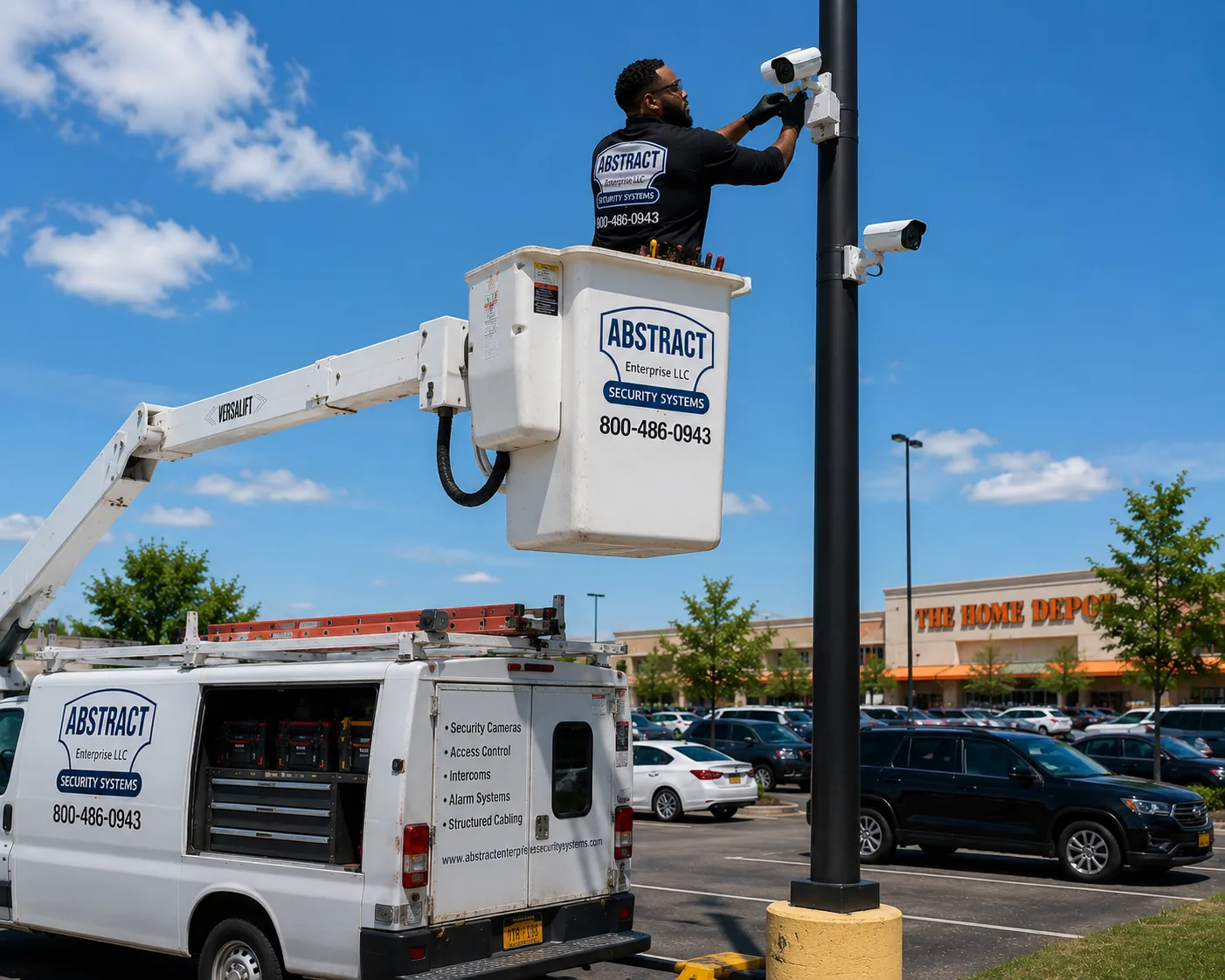
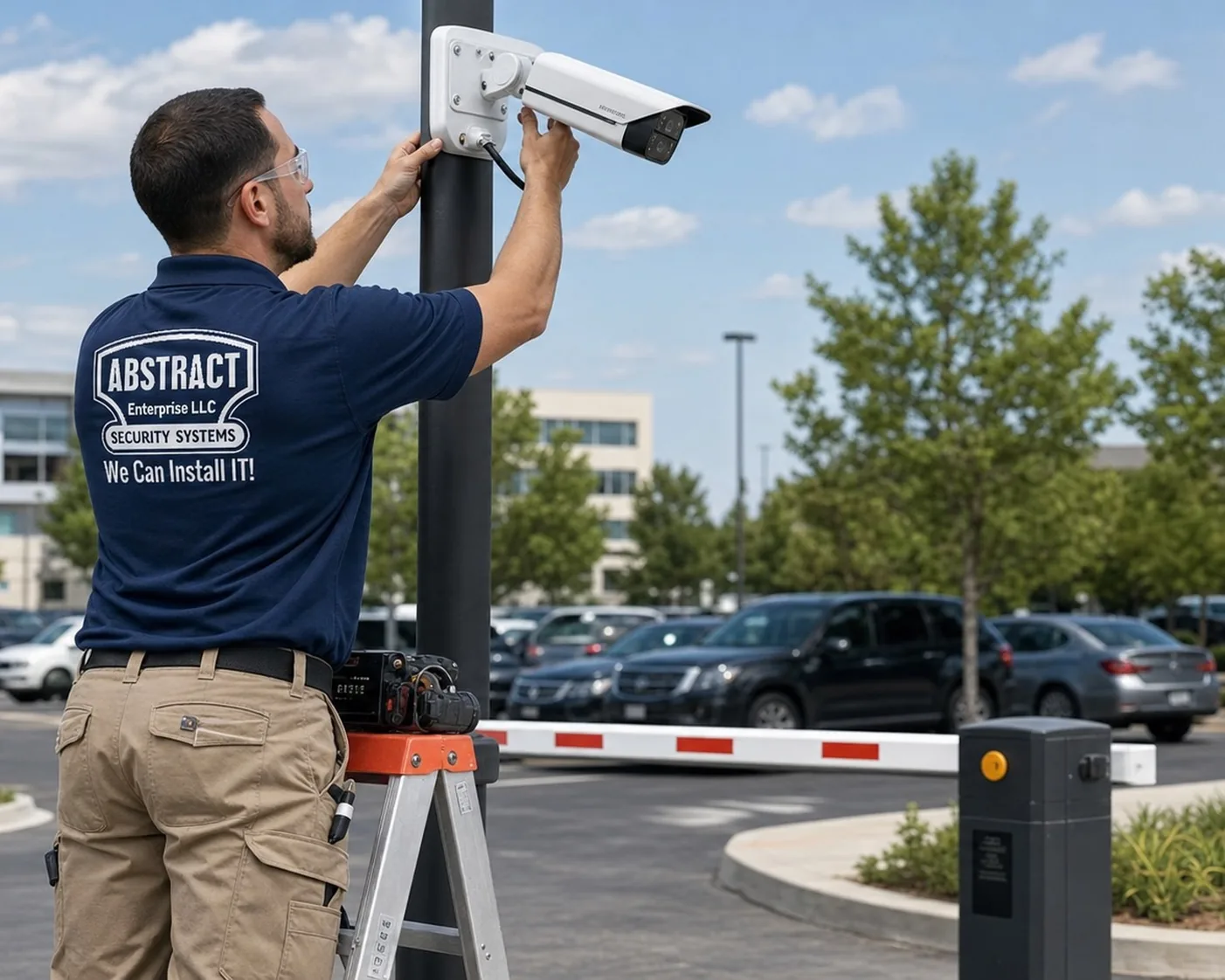
Abstract Enterprises technician working from a bucket lift to mount two bullet cameras on a parking lot light pole above a large retail lot
Parking lot camera installation on Long Island: bucket-lift access puts fixed cameras high on an existing lot pole, above the roofline of parked vehicles.
4.7 · 201 reviewsLicensed & insuredNYS Lic. #120002874313-year warranty$0 monthly feesFree on-site survey

★ 4.7 · 201 Google Reviews  |  NYS Low-Voltage License #12000287431  |  Free on-site survey

We serve parking properties across Nassau County and Suffolk County.

Reviewed and updated July 24, 2026.

Request a Free Parking Lot Survey

THE NEIGHBORHOOD

Why Long Island Parking Lots Are Their Own Design Problem

Long Island parking is not city parking. The lots are larger, flatter and further from the buildings that serve them. Where a Brooklyn property might cover its parking from a rear wall, a Hicksville shopping center or a Hauppauge industrial yard has acres of open asphalt with no building anywhere near the middle of it. That single geographic fact drives most of what makes Island lot projects different: more pole positions, longer cable runs, more trenching, more power coordination, and more of the project cost sitting in infrastructure rather than cameras.

The archetype is the large Long Island retail lot: Roosevelt Field in Garden City alone runs four parking garages and a lighted surface field of more than eleven thousand spaces off Old Country Road and the Meadowbrook Parkway. Even at that scale, Nassau County police have stepped up patrols after vehicles were driven out of the mall’s own parking lot — the case, on any Long Island property, for pairing entrance LPR with pole-mounted overview instead of relying on either alone.

The second fact is the utility landscape. Overhead distribution and street lighting across Nassau and Suffolk run through PSEG Long Island, and lot lighting is frequently a mix of privately owned fixtures and utility-owned poles at the property edge. Establishing who owns which pole before a design commits to it is a bigger deal here than in a dense borough where nearly everything mounts to a building face.

The third is weather and geography. The south shore runs from Valley Stream out to Montauk with salt air the whole way, and barrier-beach and bayfront properties in Long Beach, Freeport, Lindenhurst, Babylon and the Fire Island ferry towns face corrosion conditions that eat hardware not chosen for them. Flood-zone considerations affect where equipment is mounted on those properties. Meanwhile north shore and central Island properties from Great Neck through Smithtown to Riverhead deal with heavy snow loading, plow operations across enormous open lots, and the seasonal snow piles that redraw sightlines for weeks at a time.

The fourth is soil and buried infrastructure. Long Island lots frequently sit over sandy soil, irrigation systems, drywells, septic fields on older commercial parcels, and utility runs that predate current drawings. Trenching across a lot here is usually easier than saw-cutting a NYC street, but it demands markouts and a real conversation about what is under the landscape islands before a trencher touches the ground.

Abstract Enterprises Security Systems is a licensed NYS low-voltage contractor serving Nassau and Suffolk. Every proposal follows a free on-site survey, and every camera position is specified for the property it sits on rather than pulled from a template.

Start here: talk to an installer about this property. Call (347) 934-8335  ·  Request a survey

WHAT WE INSTALL

Long Island Lot Types and What Each One Needs

Shopping centers and strip plazas

The dominant Island format — a long building line facing a wide parking field, with service drives and dumpster enclosures behind. Building-mounted cameras cover the first rows well and lose useful detail beyond them, so the far rows and outparcels need pole positions. Rear service areas need their own coverage because they carry deliveries, contractor traffic and after-hours activity that never passes the storefronts.

Commuter and station parking

Vehicles sit unattended for ten to fourteen hours on weekdays, which is the defining risk profile. Coverage priorities are entrances, the aisles where vehicles sit longest, and the pedestrian paths between the lot and the platform. Multi-lot arrangements across a station area typically need a small backbone rather than one recorder trying to reach every corner.

Village and municipal lots

Downtown lots in villages across both counties mix metered or permit parking, evening restaurant traffic and municipal oversight. These properties carry additional review layers — village boards, architectural review in some incorporated villages, and public right-of-way considerations at the curb cuts.

Apartment, condo and HOA parking

Resident lots with assigned spaces, visitor parking and pedestrian routes to unit doors. Board approval processes, resident privacy expectations and a clear footage-access procedure matter as much as the camera layout here.

Hospital and campus lots and decks

Continuous around-the-clock use, staff arriving and leaving in the dark on both ends of a shift, and a mix of surface lots and structured decks on one campus. These properties usually need both design approaches on one system, plus scoped viewing access for security staff.

Industrial parks and warehouse yards

Large-format properties with trailer parking, employee lots, gates and yards. Coverage extends past passenger vehicles to trailers, equipment and gate traffic, and plate capture at the entrance carries more weight than it does on a retail lot.

Dealership and inventory lots

Rows of high-value vehicles with quiet overnight periods and demo traffic all day. Perimeter and after-hours coverage, entrance capture, and views tight enough to distinguish activity between rows are the priorities.

Marinas, beach and seasonal lots

Peak-season crowds, off-season emptiness, and salt exposure year round. Hardware selection is driven by corrosion resistance, and seasonal analytics schedules matter more here than anywhere else on the Island.

Schools, houses of worship and catering halls

Sharp usage peaks with long quiet stretches between them, volunteer or part-time oversight, and stakeholders who need simple viewing access. Straightforward layouts, clear signage and coverage of entrances and gathering paths during peak flow.

Technician on a step ladder fitting a fixed bullet camera to a pole beside a marked entrance lane, with directional lane signage and parking rows behind
Parking lot security camera design on Long Island: positions follow lot geometry, with this camera covering a marked entry lane rather than sweeping open rows.

COVERAGE AREA

Nassau County Coverage

Nassau lots tend toward density: shorter runs between buildings and parking, more shared property lines, and more incorporated villages with their own review processes. Work spans the Hempstead, North Hempstead and Oyster Bay towns and the villages within them — Garden City, Mineola, Rockville Centre, Freeport, Long Beach, Great Neck, Manhasset, Westbury, Valley Stream, Hicksville, Levittown, Massapequa, Glen Cove and the rest.

The properties that generate the most parking work here are recognizable: retail concentrations around Roosevelt Field and the Old Country Road corridor, the medical and office density around Mineola and Garden City, the Nassau Hub area near the Coliseum and UBS Arena at Belmont Park, LIRR station lots along the Hempstead, Babylon, Port Washington and Oyster Bay branches, the south shore village downtowns, and the residential complexes along Sunrise Highway and Hempstead Turnpike.

Nassau's incorporated villages are the practical wrinkle. A lot in an unincorporated area answers to the town; the same lot inside a village answers to the village, and several villages maintain their own review requirements and their own police departments. Where a project involves poles, trenching, electrical work or anything touching a right-of-way, confirming which jurisdiction reviews the work is part of the survey rather than an assumption.

Pole mounting, electrical and structural work, trenching, protected parcels, and right-of-way work across Nassau and Suffolk may need approval from the property owner, the utility, or the local authority having jurisdiction, and AESS confirms what each site demands ahead of installation.

Suffolk County Coverage

Suffolk changes the geometry again. Properties are larger, distances between buildings and parking grow, and the industrial and campus formats that barely exist in Nassau become common. Work spans Huntington, Babylon, Islip, Smithtown, Brookhaven, Riverhead, Southampton, East Hampton, Southold and Shelter Island.

The parking properties that dominate here: the Route 110 corridor through Melville and Huntington Station with its office parks and dealership rows, the Hauppauge industrial area with some of the largest yard and employee lots on the Island, the retail concentrations at Smith Haven, Walt Whitman and Tanger in Riverhead, the Stony Brook and Farmingdale campus lots, MacArthur Airport area parking in Ronkonkoma, the LIRR Main Line and Montauk branch commuter lots, downtown village lots in Patchogue, Bay Shore, Huntington village, Babylon village and Riverhead, the Fire Island ferry terminal lots in Bay Shore, Sayville and Patchogue, and North Fork agritourism parking that swings from empty to overflowing by season.

Distance is the design driver in Suffolk. A single property may need a backbone run measured in hundreds of feet, which pushes designs toward fiber or engineered wireless links between pole clusters rather than trying to home-run every camera to one building. Larger lots also mean more pole positions, and more pole positions mean more foundations, more conduit and more coordination — which is precisely why quoting a Suffolk lot without walking it produces numbers that mean nothing.

When a job can start and wrap depends on conditions on site, equipment availability, property access, any required permits, and the size of the scope.

Fire Island Ferry Terminals and Seasonal Overflow

The ferry terminal lots at Bay Shore, Sayville and Patchogue run a parking pattern almost nothing else on the Island shares. Vehicles arrive on a Friday, sit unattended through an entire weekend or an entire week, and leave in a compressed departure window. Nobody from the household is anywhere near the vehicle in between, and there is no natural observer on the property for most of that time.

That stretches the discovery window further than a commuter lot does, and retention has to be sized for it. A vehicle damaged on Saturday morning may not be seen again until the following Sunday evening, and vehicles left across a two-week stay are routine in July. Sizing drives to an overnight assumption on a property like this guarantees the footage is gone by the time anyone looks.

Seasonal load is the second characteristic. These lots go from near-empty in March to completely full on a summer weekend, then back to empty by October. Coverage designed around the summer layout — including overflow areas that only open at peak — leaves cameras aimed at empty ground for two-thirds of the year, while coverage designed for the quiet season misses the rows that only exist in season. Analytics schedules change with the calendar for the same reason, and a rule set tuned in August is wrong by November.

Similar patterns apply at beach and marina parking along both shores, at the North Fork agritourism properties that fill on autumn weekends, and at any Island lot serving a seasonal business. The design question is the same each time: which coverage is permanent, which is seasonal, and whether the seasonal portion justifies permanent infrastructure or is better served by portable positions during the months it is needed.

Entrances, Curb Cuts and LPR on Island Lots

Long Island entrances differ from city curb cuts in a way that matters for plate capture: they are frequently wider, faster and shared with a state or county highway. A driveway off Sunrise Highway, Jericho Turnpike, Hempstead Turnpike, Route 110 or Middle Country Road carries vehicles entering at speed and turning across multiple lanes, which is the least favorable condition for a plate camera.

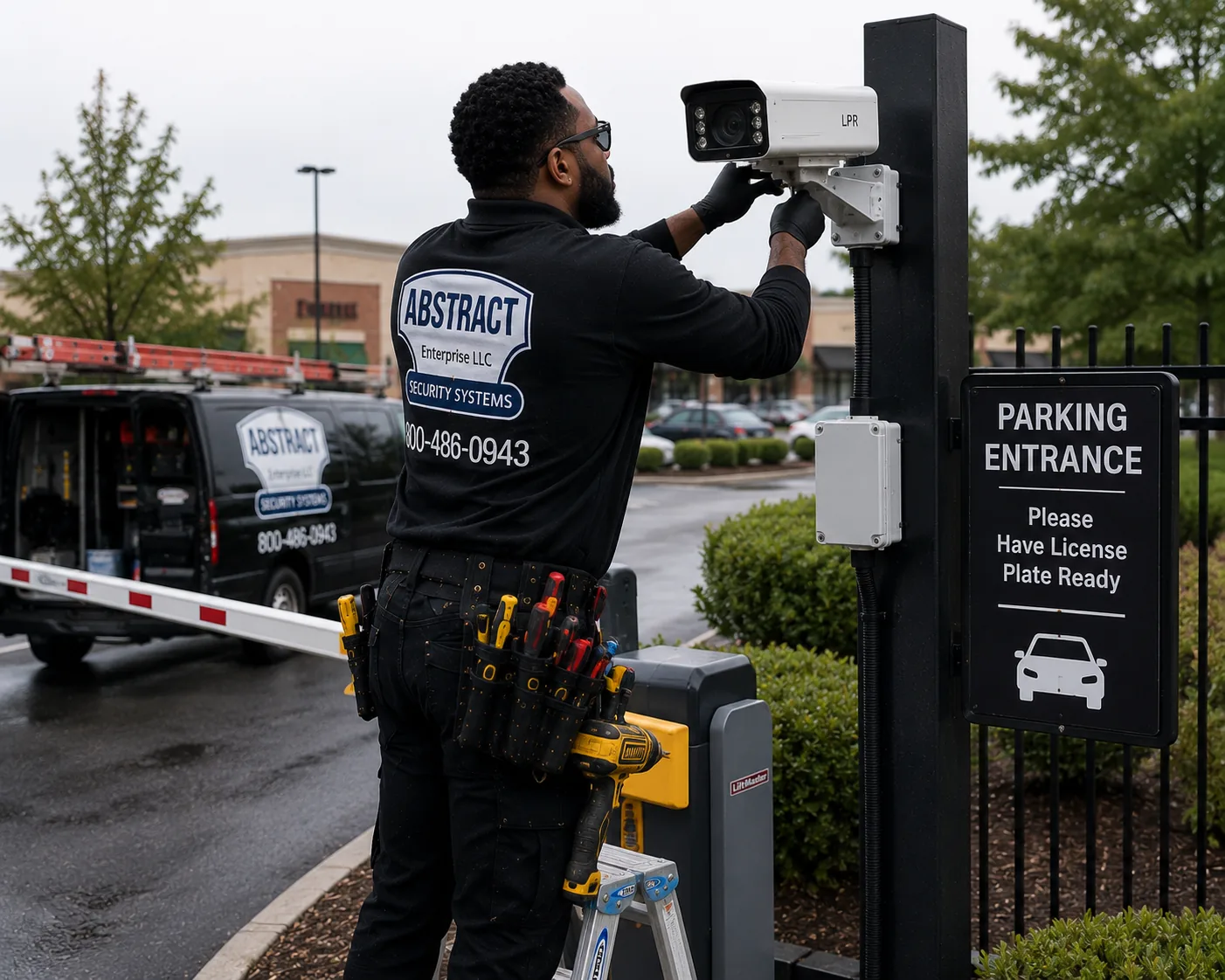
Technician adjusting a license plate recognition camera on a black post at a gated parking entrance with a barrier arm and plate-ready signage
Parking lot LPR plate camera on Long Island: the plate camera sits low and shallow to the lane where vehicles slow at the barrier arm.

The design response is to move the capture zone off the apron and into the property. Vehicles slow again where the driveway meets the parking field, at a stop bar, at a speed table, at a gate arm on gated properties, or at the turn into the first aisle. Placing the plate camera at that second slowing point rather than at the street produces more usable frames than fighting highway-speed traffic at the curb.

Multiple entrances are the second Island characteristic. Large lots commonly have two, three or four curb cuts, sometimes onto different roads, and vehicles can enter one and leave another. Covering only the main entrance means an incident vehicle may have arrived and departed without ever passing a camera configured to read it. Where budget forces prioritization, the honest approach is to identify which entrance carries the most traffic and treat the others with overview coverage, documenting the trade-off rather than leaving it implied.

Pairing applies here exactly as it does anywhere: a plate-focused camera at the capture zone and an overview camera nearby recording the vehicle in context. Performance depends on placement, lighting, weather, lens selection, how quickly vehicles pass, plate condition, ongoing maintenance, recording setup, and the conditions of the property.
Shared entrances on multi-tenant plazas add an ownership question on top of the geometry. When one curb cut serves several businesses under different leases, whose system covers it and who may access that footage is worth settling before installation rather than during an incident.

Poles, PSEG Long Island and Power Coordination

Almost every Island lot project touches the pole question. The lots are too wide to cover from buildings alone, so cameras go on poles — and which pole determines how the project runs.

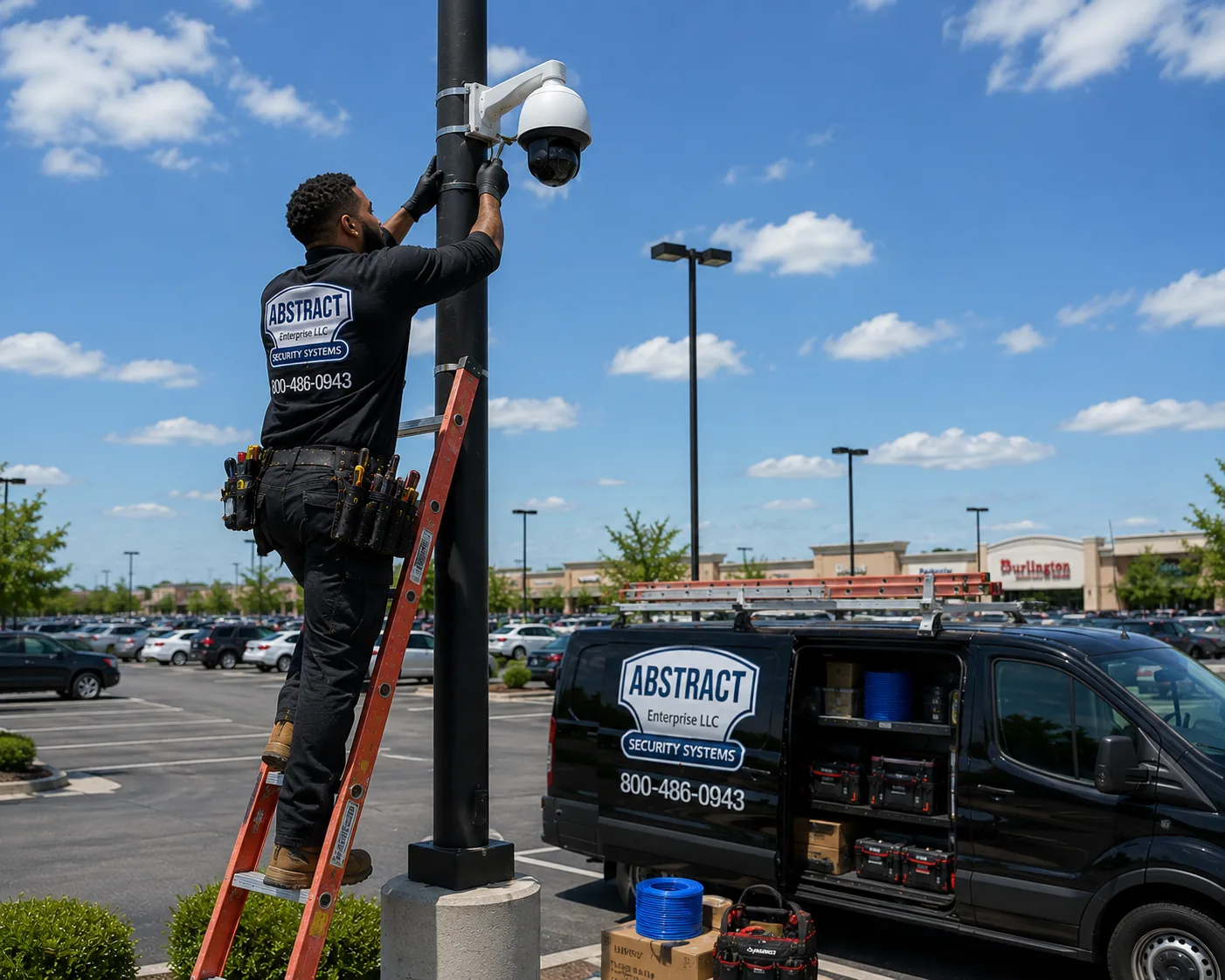
Technician on an extension ladder securing a white PTZ dome camera bracket to a parking lot light pole, service van parked nearby
Pole-mounted parking lot camera work on Long Island: the bracket is squared and the cable dressed down the pole shaft before final aiming.

Privately owned lot lighting. Most shopping center and commercial lot fixtures belong to the property. These are usually the best candidates: the owner can authorize attachment directly, and the pole already has a power path. What still gets verified is whether the circuit is switched by photocell or timer — a camera fed from a dusk-to-dawn lighting circuit goes dark every morning, so an unswitched source or a separate circuit is needed, coordinated with a licensed electrician.

Utility-owned poles. Poles carrying distribution or street lighting along the property edge generally belong to PSEG Long Island or, in some communities, to a municipal lighting arrangement. Attachment to those poles is not something a contractor authorizes unilaterally, and designs that depend on them need the ownership question answered before the proposal is finalized. In practice, most lot designs treat utility poles as unavailable and plan around them.

Leased or serviced lighting. Some properties do not own their own lot lighting outright but receive it under a service arrangement. Attachment rights in that situation depend on the agreement, and confirming it is a property-side question we raise at the survey.

Dedicated camera poles. When no existing pole sits where the coverage needs to be, the design adds one: a pole sized for height and wind loading, a concrete footing appropriate to the soil, conduit stubbed through the base with spare capacity, and grounding and surge protection on everything that runs out into weather. On sandy Island soil, footing design deserves genuine attention rather than a default.

Pole mounting, electrical and structural work, trenching, protected parcels, and right-of-way work across Nassau and Suffolk may need approval from the property owner, the utility, or the local authority having jurisdiction, and AESS confirms what each site demands ahead of installation.

School District and Municipal Fleet Parking

Long Island runs an unusual concentration of school district and municipal properties, and their parking is a distinct design problem. A district bus depot holds forty or more vehicles overnight on a fenced parcel that is completely unattended between the evening return and the pre-dawn departure. Town highway yards store plows, sanders, dump trucks and fuel. Village halls, libraries and fire houses each carry small lots with sharp, predictable use patterns.

What these share is a long, reliable empty window and a high replacement value sitting in it. That combination suits perimeter analytics better than almost any other property type on the Island: rules scoped to the fence line and active only outside operating hours fire rarely, and when they fire they mean something. Gate plate capture carries the same weight it does on an industrial yard, since one controlled entrance accounts for every movement.

The complication is governance rather than engineering. District and municipal projects run through boards, purchasing rules and public meeting schedules, and the approval timeline is frequently longer than the installation. Footage-access policy also needs settling early, because requests on these properties can come from staff, unions, parents or the public, and a written procedure decided in advance is far easier than one improvised under pressure.

Fuel points, salt storage and equipment bays usually justify their own positions. They are where value concentrates, they sit away from the main lot, and on most of these properties they are the areas least visible from any building window.

Trenching, Conduit and Restoration Across Island Lots

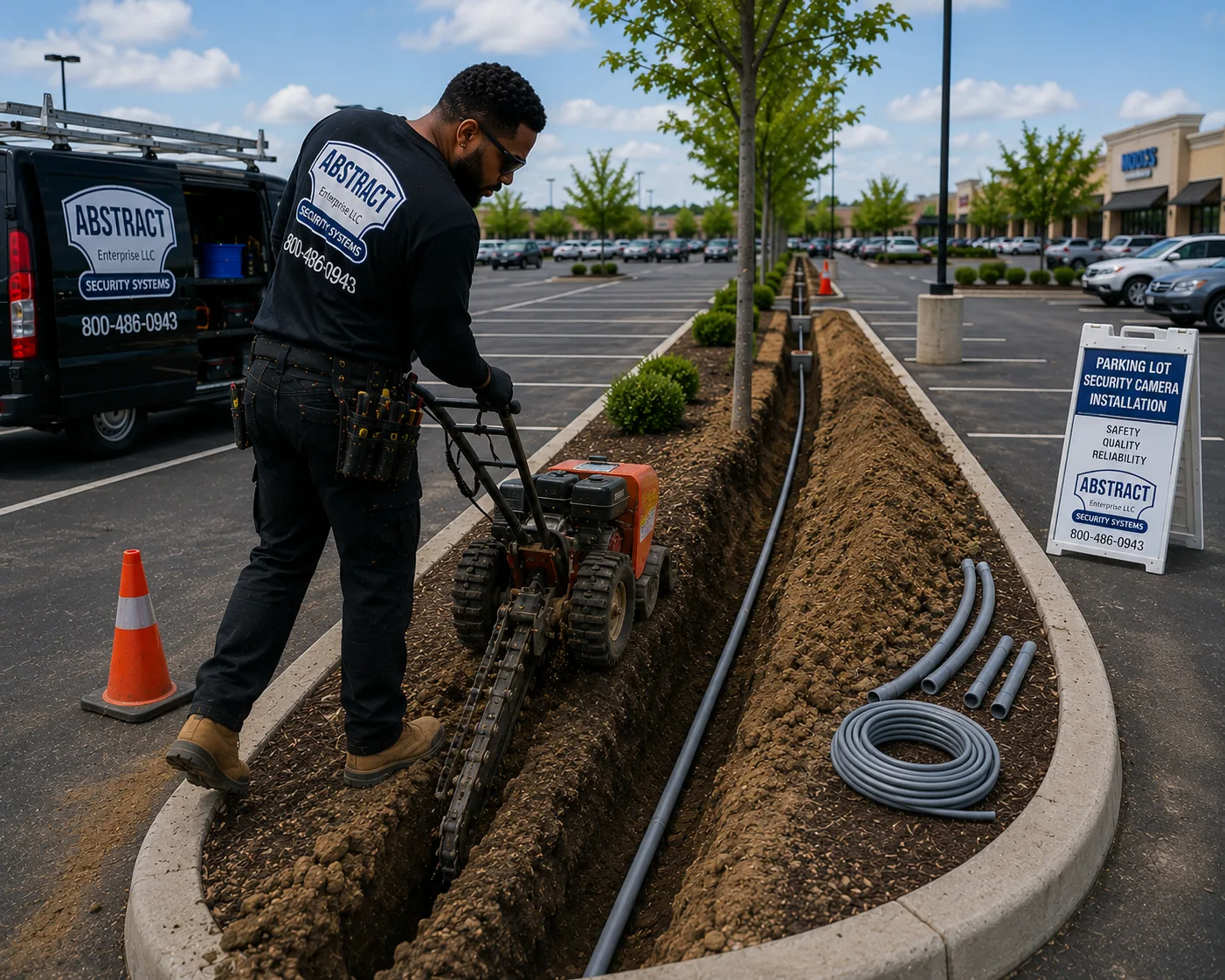
Long Island lots are usually kinder to trenching than a city street, and that is one of the few cost advantages the geography offers. Most commercial lots here are laid out with landscape islands running the length of the parking field, and a pathway that follows those islands can reach interior pole positions with far less pavement work than an equivalent urban project.

Technician operating a walk-behind trencher along a parking lot landscape island with conduit sections staged and a trench line running toward the lot
Parking lot camera trenching on Long Island: pathways to interior pole positions follow landscape islands where the layout allows, sleeved in conduit with spare capacity.

What complicates it is what is already buried. Island commercial parcels commonly carry irrigation lines feeding the islands themselves, drywells and stormwater structures, older site lighting circuits, and on some properties septic or cesspool infrastructure that predates any current drawing. Markouts come before excavation, and on properties with irrigation the landscape contractor's knowledge is frequently more accurate than the site plan.

Where a pathway must cross pavement, the options are the same three: saw-cut and patch, which is fast and leaves a permanent visible seam; directional boring, which passes underneath and preserves the surface at the cost of setup space and pit locations; and routing around, which trades cable length for surface disruption. On lots that have been recently resurfaced — a common situation on Island retail properties, where repaving runs on a cycle — landlords frequently prohibit cutting outright, and boring becomes the only acceptable method.

Conduit rather than direct burial is the standard we build to. Cable inside conduit can be replaced or added to without opening the ground twice, and on properties likely to expand coverage later, generous conduit sizing with a pull string left in place is the least expensive future-proofing available. Pull boxes at direction changes and at intervals keep pull tension reasonable, with covers rated for whatever drives over them.

Restoration finishes the work: compacted backfill that will not settle into a depression, surfaces reinstated to match, striping repainted where cuts crossed marked stalls, and landscape areas made good. Trench length, crossing count, surface type and restoration standard are among the largest variables separating one Island lot proposal from another.

Long Runs: Fiber, Cat6 and Point-to-Point Wireless

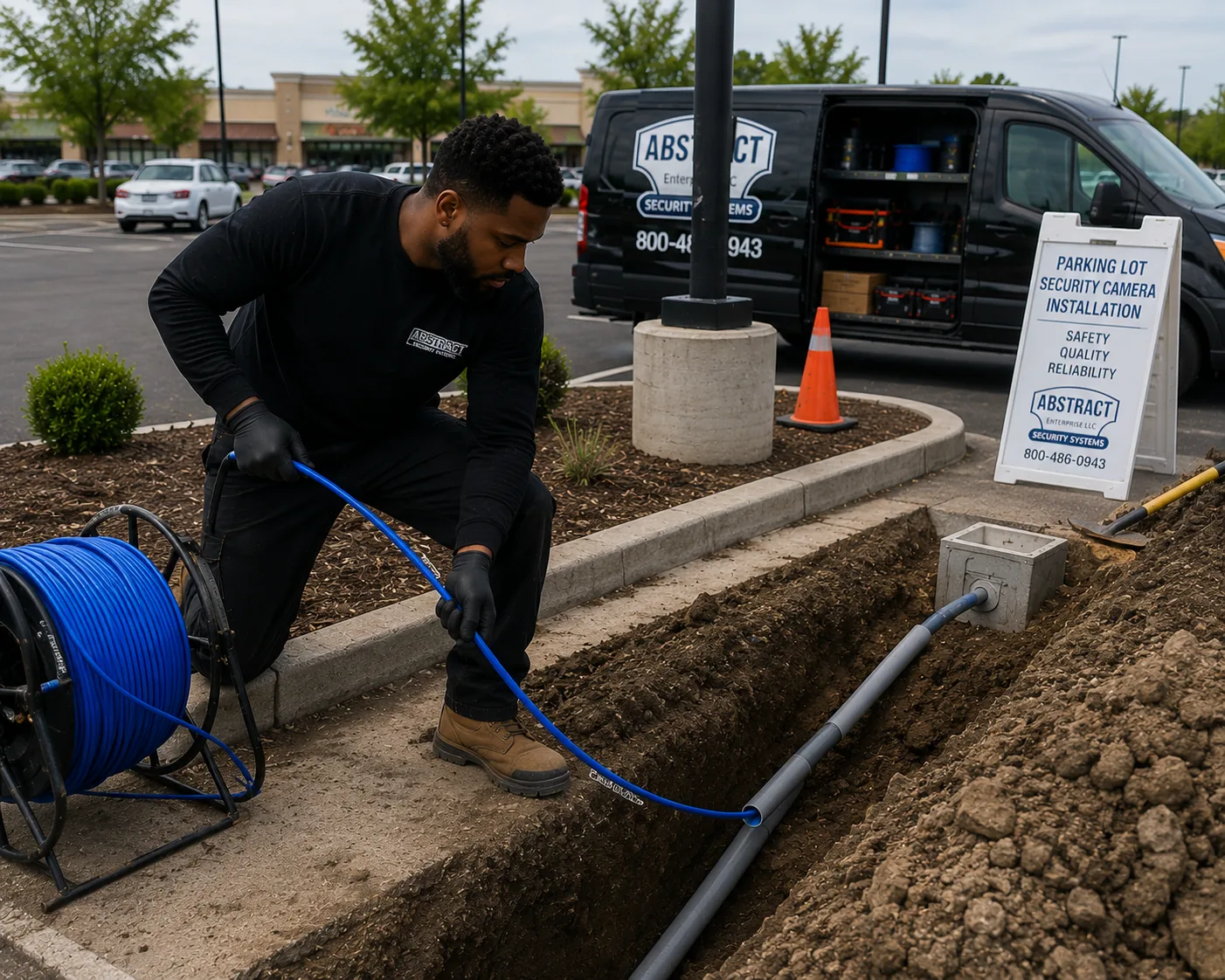
Distance is the defining technical constraint on Island lot projects. A Suffolk industrial property or a large Nassau retail center can easily place a camera cluster several hundred feet from the nearest building, which is past the point where a single copper run works.

Technician pulling blue network cable from a spool into gray conduit laid in an open trench beside a parking lot island
Parking lot camera conduit cabling on Long Island: trench length, conduit runs and pull labor are among the largest variables separating one lot proposal from another.

Cat6 with PoE handles runs inside Ethernet distance limits, carrying data and power on one cable. Outdoor and in-conduit runs use cable rated for the environment, and the distance limit is a hard physical boundary rather than something better cable overcomes.

Fiber is the standard answer for Island backbones. It carries any practical distance, it is immune to the surge coupling and ground-potential differences that make long outdoor copper risky on properties with separate electrical services, and it leaves headroom for future bandwidth. A fiber-fed pole cluster still needs local power, so fiber typically pairs with a power run in the same trench and terminates into a switch inside a field enclosure at the pole.

Point-to-point wireless bridges what should not be trenched: across a public roadway between two parcels of the same property, over recently resurfaced pavement, between separated buildings on a campus, or out to a remote yard where a trench would cost more than the cameras. Engineered directional links are specified for distance, throughput and weather fade margin, and they need genuine line of sight — which on Long Island means accounting for mature trees that will keep growing and for trailers or equipment that may eventually park in the path.

Where a position has no feasible power route at all, solar-plus-battery designs sized for consecutive low-sun days become the option, and for temporary or seasonal coverage — construction phases, event parking, summer overflow lots — solar surveillance trailers on Long Island provide self-contained positions with no permanent infrastructure at all. Where a lot project runs alongside broader network work on the property, it overlaps directly with Long Island structured cabling and fiber installation, and planning both together avoids trenching the same route twice.

Salt Air, Coastal Exposure and Corrosion

Long Island is a coastal environment on both shores, and salt is patient. Properties in Long Beach, Freeport, Island Park, Lindenhurst, Babylon, Bay Shore, Patchogue, the Hamptons and the North Fork face conditions that quietly destroy hardware never selected for them.

Salt attacks the fasteners and mounts before it attacks the cameras. Standard hardware corrodes at brackets, pole bands, enclosure hinges and cable gland entries, and a camera that is electrically perfect becomes a camera hanging at the wrong angle because its mount failed. Stainless or otherwise corrosion-resistant hardware costs marginally more at installation and is the difference between a five-year and a fifteen-year mount on a bayfront lot.

Enclosures on coastal properties need their ratings preserved in practice: gaskets intact, cable entries through proper rated glands rather than drilled holes, penetrations on the bottom rather than the top, and doors that close squarely. A salt-laden atmosphere finds every compromised seal and corrodes from the inside out.

Lenses and domes accumulate a salt film that scatters light. Day footage still looks acceptable while night footage degrades first, which is the mechanism by which a system that was excellent in year one becomes disappointing by year three without any specific failure being noticed. Seasonal cleaning matters more on the coast than anywhere else.

Flood-zone considerations apply on low-lying south shore and bayfront properties. Where a property sits in a mapped flood zone or has a history of tidal flooding, mounting head-end equipment, field enclosures and power supplies above expected water levels is a design decision made at survey time. Elevation requirements on such properties may involve owner or AHJ review, and AESS confirms applicable project requirements before installation.

Snow, Plows and Seasonal Sightlines

Island lots are plowed aggressively because they are enormous and they need to open by morning. That operation reshapes the property for weeks at a time.

Snow piles are the largest seasonal change to a lot's geometry. Plows consolidate snow at the ends of rows, against islands, and into the corners of the property, and after a significant storm those piles can stand taller than a vehicle and remain for weeks. A camera positioned in July with a clean view down an aisle may spend February looking at a wall of compacted snow. Designs made in warm months ask the property manager where snow gets pushed — they always know — and choose positions and heights accordingly.

Plow equipment is also a physical hazard. Blades and equipment throw slush, salt and gravel at height, and reversing trucks contact anything close to the pavement. Low-mounted cameras, enclosures and ground-level cable runs near plow paths need protection, whether that is a bollard, a curb position, or simply not putting the equipment where a plow works.

Temperature affects the equipment itself. Cameras with heaters and defoggers keep domes and windows clear through freezing conditions; cameras without them can ice over and stay effectively blind for a cold snap. Heaters draw substantially more power, which loops directly back to how the PoE budget at each field switch was sized — a switch specified for camera count rather than combined winter draw will drop cameras on the first cold night when every heater energizes at once.

Practical seasonal upkeep on an Island lot: clean lenses and domes before winter and again in spring, verify aiming after major storms, walk for snow-pile obstructions that appeared since the last review, inspect surge protection after electrical storms, and confirm heated cameras are cycling. A short seasonal pass keeps a system honest.

Night Performance on Wide-Open Lots

Island lots are dark in a way city lots are not. A Brooklyn lot borrows ambient light from streetlights, storefronts and surrounding buildings. A Suffolk industrial yard at 2 AM has whatever its own fixtures provide and nothing else, and when those fixtures are on a timer that cuts back after hours, the difference between a designed system and a hopeful one becomes obvious.

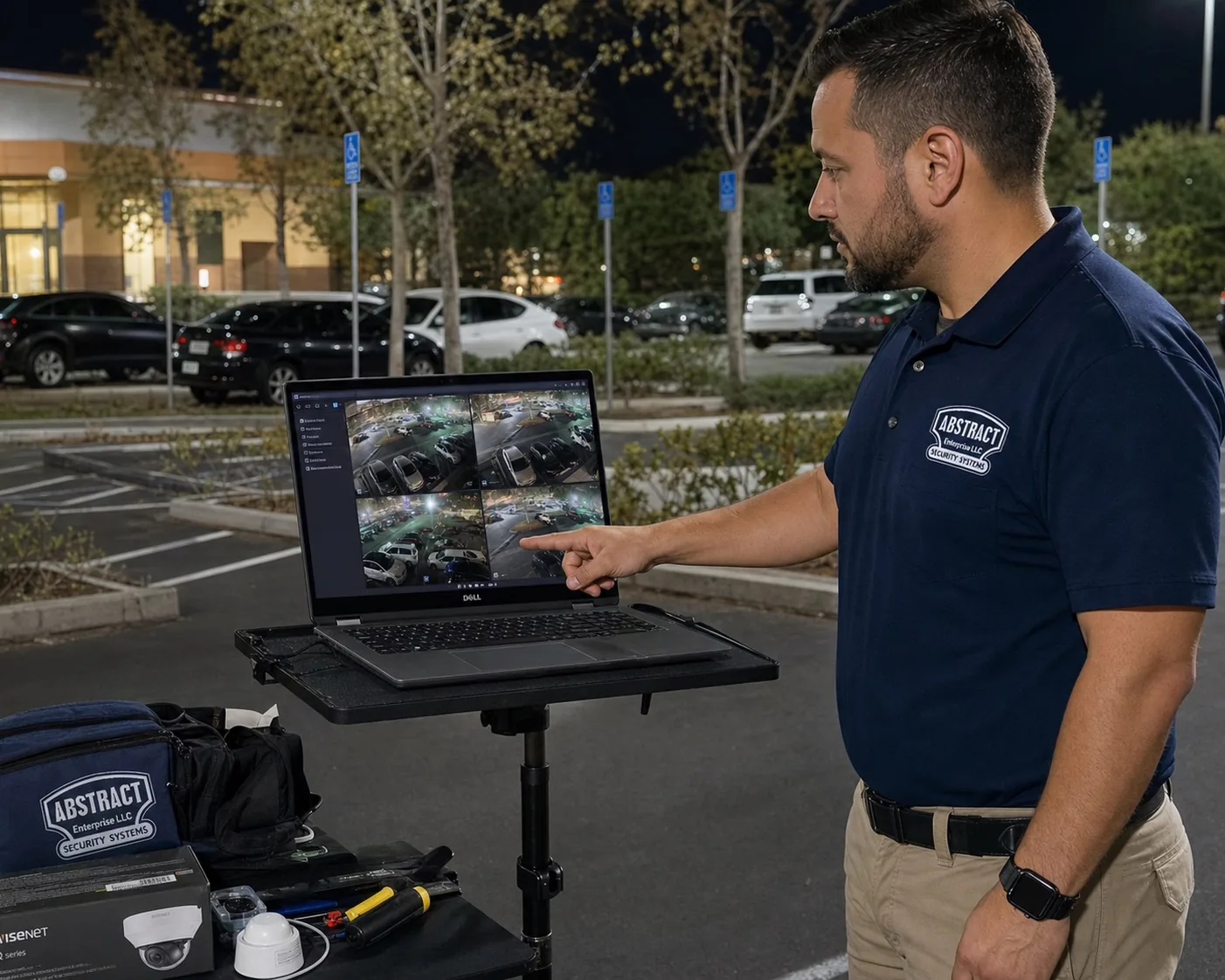
Technician reviewing a six-camera live view on a laptop mounted to a tripod stand in a parking lot after dark Abstract Enterprises technician setting up a mobile solar-powered surveillance camera trailer in a Long Island parking lot for temporary and overflow coverage
Parking lot night camera coverage on Long Island: night verification is its own commissioning step, checking every view for glare, dark gaps and usable detail.

The design levers are sensor performance, illumination and aiming. Larger-sensor cameras gather more light; full-color low-light models work where ambient lighting supports them and fall back to infrared where it does not; supplemental IR illumination positioned away from the camera avoids the bounce-back that washes out a frame from within; and wide dynamic range processing handles scenes that mix a bright entrance with dark rows.

Aiming carries as much weight as hardware. A camera positioned so headlights strike the lens directly washes out exactly when a vehicle should be identified. Offsetting horizontally from the lane, or mounting slightly above the headlight axis and looking down, removes most of that problem without spending anything.

Night verification is a separate commissioning step, not an assumption. Every camera gets checked after dark for usable detail at its intended distance, for dark gaps between fixtures, for IR bouncing off nearby signage, poles or mounting hardware, and for how the image holds when pavement is wet. Fixes are usually small: a few degrees of re-aim, an illumination change, an exposure adjustment, or moving a camera a few feet relative to a light fixture.

Sometimes the right recommendation is lighting rather than cameras. A lot with genuinely inadequate illumination produces marginal footage from any equipment, and improving the lighting frequently costs less than the camera upgrades needed to compensate for darkness — while also changing how the property feels to the people using it after dark.

BUILDING SPECIALISTS

Camera Classes for Island Lot Work

Fixed bullet

The workhorse for long directional views — aisles, fence lines, entrance approaches, yard perimeters. Varifocal optics let each position be set to its exact field of view during aiming rather than guessed at purchase, which matters on lots where positions vary from forty feet to two hundred.

Turret

Compact and quick to re-aim, avoiding the infrared bounce-back that domes suffer in weather. Common on building faces, deck ceilings and lower pole positions where profile matters.

PTZ

Motorized coverage for large open lots — patrol patterns, operator-directed zoom, and event-driven positioning. A PTZ looking elsewhere records elsewhere, so it supplements fixed coverage rather than replacing it.

Panoramic and multisensor

Wide-area coverage from one mounting point, valuable on Island lots where usable poles are scarce and each one has to earn its cost. Breadth trades against pixel density at distance, so these pair with tighter fixed views where identification matters. Uniview dual-lens panoramics such as the IPC2K28SE-ADF40KMC-WL-I0 (8MP, 180° stitched) hold a wide field from a single drop.

LPR

Purpose-built plate cameras for entrance lanes, configured for tight single-lane framing, fast shutter and plate-tuned infrared. Always paired with an overview camera, because an LPR camera is poor at everything except plates.

Corrosion-resistant variants

Coastal properties benefit from housings and hardware selected for salt exposure. On a bayfront or barrier-beach lot this is a specification decision, not an upgrade.

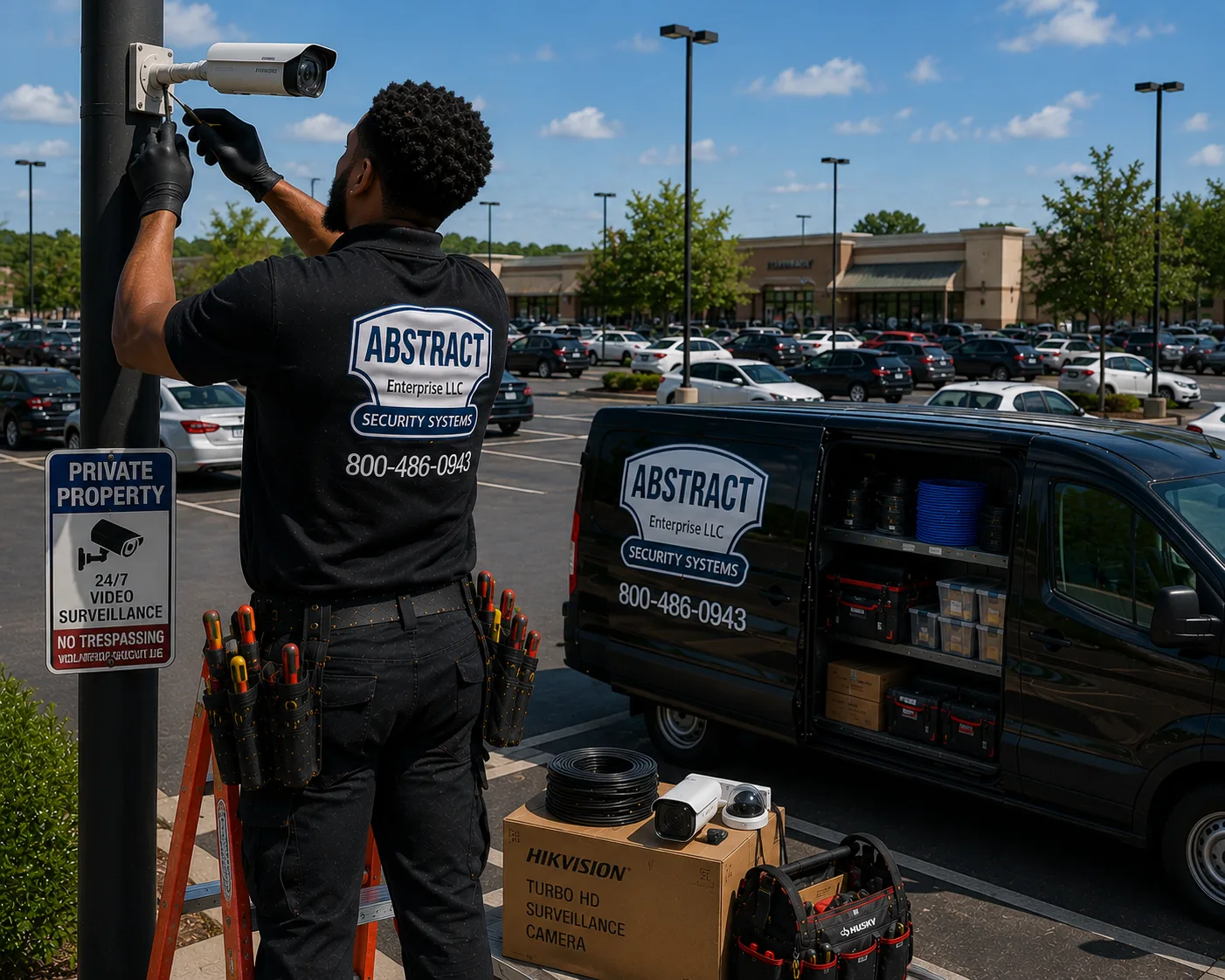
Technician tightening a 4K bullet camera on a lot pole beside a private property video surveillance sign, with bullet and dome cameras on the equipment box below
Parking lot 4K camera system on Long Island: bullet and dome housings serve different roles on the same property, and signage goes up with the cameras.

Field Enclosures, PoE Budget and Surge Protection

Beyond a handful of cameras, Island lot designs stop home-running every cable and start aggregating at the pole. A weatherproof enclosure holds a switch, power supply, surge protection and terminations, and one backbone run carries everything home. Because trenching is the expensive part of an Island project, this single decision frequently determines whether a large lot is affordable.

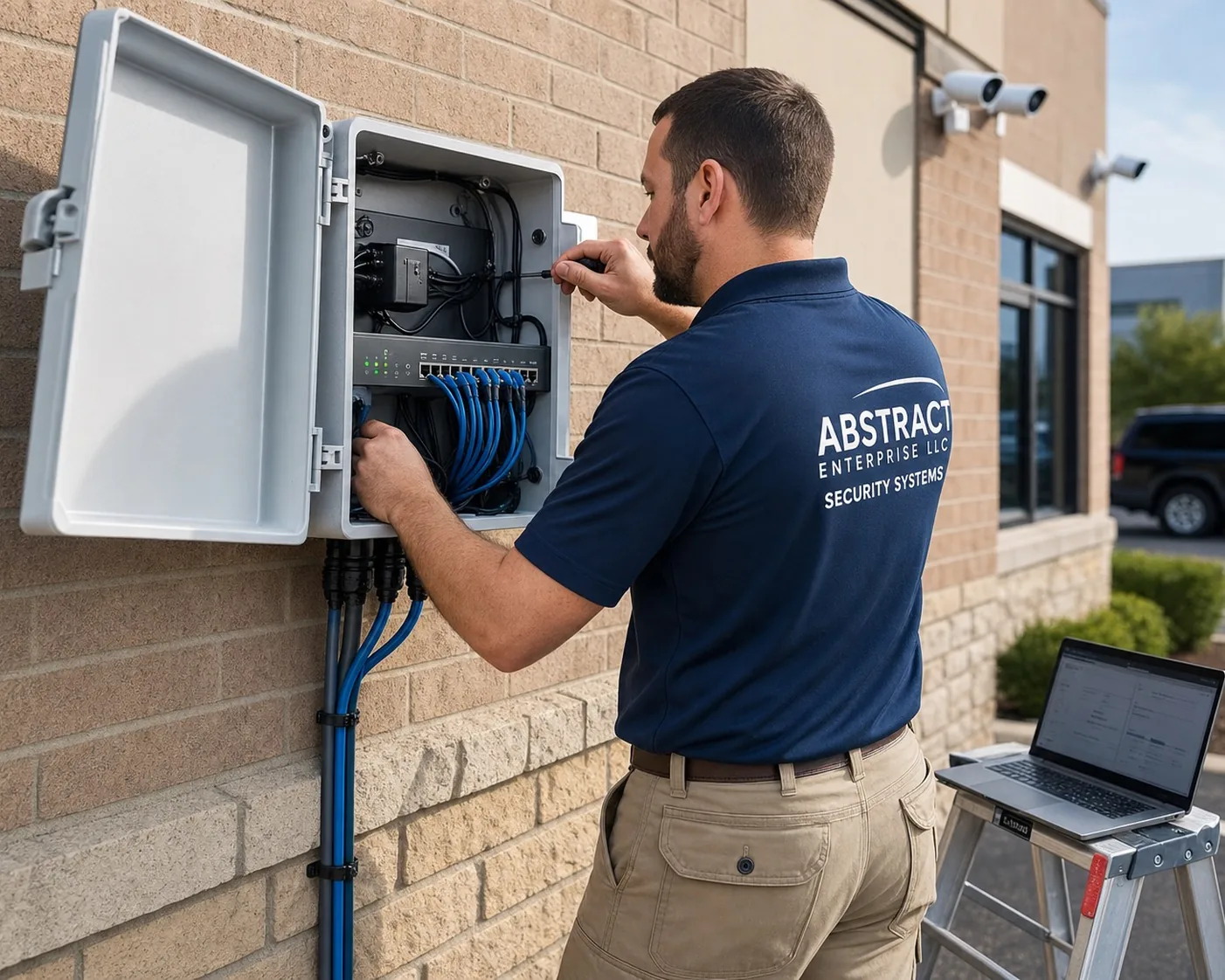
Technician wiring a PoE switch inside a weatherproof enclosure mounted on an exterior wall, with cameras above and a laptop staged alongside
Parking lot camera PoE enclosure on Long Island: field switches live in sealed enclosures with rated cable entries, feeding one backbone run to the recorder indoors.

Enclosure selection follows exposure. Ratings only mean something if the installation preserves them: rated glands or hubs for cable entry, intact gaskets, bottom penetrations rather than top, and latching doors. Thermal management is the detail most often skipped — a sealed metal box in full summer sun over open asphalt runs hot, and shaded mounting, sun shields, or vented designs with filters keep the electronics inside within their limits. In winter the reverse applies, and equipment rated for low temperature keeps a switch from failing to start on a January morning.

PoE budget sizing is where Island designs most often get underspecified. Cameras with heaters, illuminators, PTZ motors or integrated strobes draw far more than a basic fixed camera, and a switch sized only to port count works fine in October and drops cameras in January. Sizing accounts for the actual combined draw at worst-case conditions, with headroom for future additions.

Surge protection and grounding are not optional on open lots. An elevated device on a pole connected to long conductors is close to a textbook description of something that will collect induced surge, and Island properties see plenty of summer electrical activity. Bonding and grounding come first because every protective device references ground; surge protection devices then go at both ends of every outdoor run, on power and data alike. Fiber removes the problem entirely on the runs it serves, which is an argument for fiber beyond distance alone. Surge devices are sacrificial and get inspected after significant electrical events rather than assumed intact.

Parking Decks and Structured Garages on the Island

Structured parking on Long Island concentrates around hospital and university campuses, transit-oriented development near LIRR stations, larger office properties and a handful of downtown village decks. It is a different engineering problem from the surface lots that surround it.

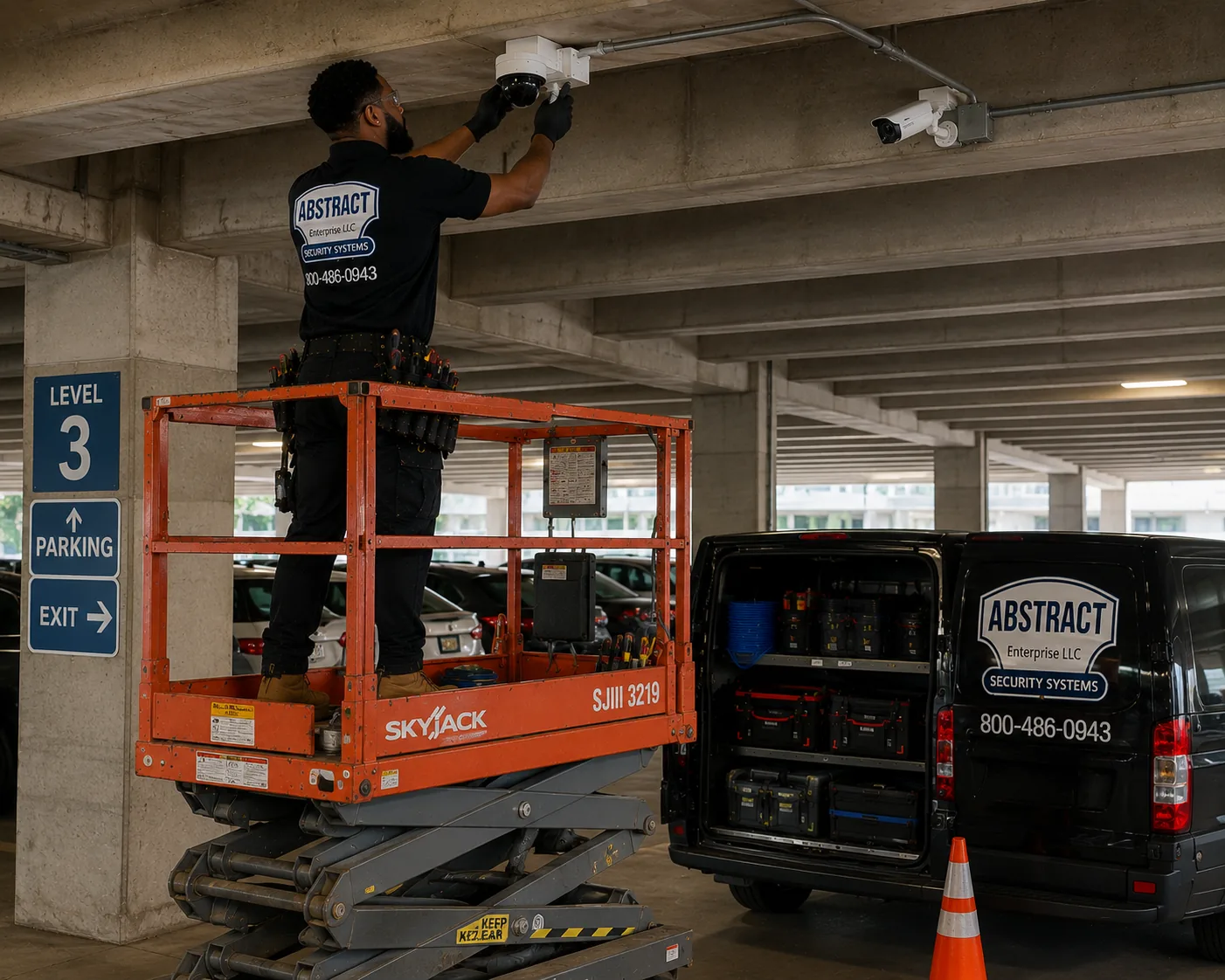
Technician on a scissor lift installing a dome camera on the concrete ceiling of a parking deck level, with a bullet camera and surface conduit alongside
Parking garage security camera work on Long Island: decks need short-range domes per bay section, surface conduit on concrete, and lift access for every position.

Concrete blocks radio effectively, so deck designs are cabled designs, surface-mounted in conduit because concrete does not accept fished cable. Pathway layout becomes an aesthetic decision as well as a technical one — runs following beam lines look intentional, diagonal runs do not. Anchoring is its own discipline, with fasteners chosen for the substrate and reinforcement located before drilling; post-tensioned decks require particular care, and structural mounting on a parking structure may require owner or AHJ review.

Ramps and helixes are the geometric challenge. Vehicles change elevation and direction at once, so a camera covering a straight run loses them at the transition. Coverage places cameras at the top and bottom of each ramp facing the transition rather than trying to follow a curve.

The hardest scenes are the transition zones — deck openings, entrances, and the top level where a garage becomes an open-air lot. Those positions mix full daylight with interior shade in a single frame, and the top deck is a surface lot in every respect: weather-rated housings, wind loading, glare management and salt exposure if the property sits near the water.

Ceiling height sets lens choice. Low ceilings force wide fields of view, and wide at close range means detail concentrates near the camera. Practical deck designs accept shorter coverage zones and more positions rather than stretching one camera across a level.

Commuter Lots: A Long Island Category of Its Own

Station parking deserves separate treatment because the risk profile is unlike any other lot type on the Island. Vehicles arrive in a compressed morning window, sit unattended for ten to fourteen hours, and leave in a compressed evening window. Nobody is watching the lot during the middle of the day, and the owner of each vehicle is thirty miles away.

Coverage priorities follow that pattern. Entrances matter because they bracket every arrival and departure. Aisle coverage matters because the middle of the day is when the lot is full and unobserved. Pedestrian paths between the lot and the platform matter because that is where people walk alone in the dark on winter evenings. And the corners — the far row nobody parks in until the lot fills, the section behind the station building, the overflow lot across the street — matter because they are the least observed parts of the property.

Multi-lot station areas are common across both counties, with parking split across several parcels under village, town or transit authority control. A single recorder trying to reach every parcel usually means impractical cable runs; a small backbone with field enclosures at each lot, linked by fiber or engineered wireless, is the workable approach. Jurisdiction matters too — who owns each lot determines who authorizes the work, and on station-adjacent property that answer is not always obvious from the curb.

Retention deserves extra thought on commuter lots specifically. The discovery window is long: a vehicle damaged on Monday may not be noticed until the owner returns in daylight on Saturday, and a vehicle left through a vacation may sit for two weeks. Retention sized to a next-morning discovery assumption fails exactly the properties where discovery is slowest.

Recording, Retention and Remote Access

Every camera decision lands on the recorder. Island lot systems record to an NVR sized for the camera count with room to grow, installed indoors in a secured, ventilated location — a locked office, IT room or utility closet. On properties where the building serving the lot is unstaffed at night, physical security of that room matters as much as the cameras themselves; a recorder that can be carried off takes the evidence with it.

Retention is arithmetic, not a slogan. It is calculated from camera resolution, frame rate, recording mode, camera count and installed storage capacity, then checked against two human factors: how quickly incidents are actually discovered on that specific property, and what the owner requires. The discovery window varies enormously by lot type on Long Island — a strip plaza notices damage the same day, a commuter lot may not notice for a week, a marina lot in the off-season may not notice for a month. Storage is sized to the realistic window for that property, the calculated figure appears in the proposal, and recording modes are configured so the number holds in practice.

Remote viewing gives owners and managers live views, playback and export from phones and desktops, with individual user accounts rather than one shared administrator login so access can be granted and revoked person by person. Recording continues locally whether or not the internet connection is up — internet enables viewing and notification, not recording.

Time synchronization is a commissioning step rather than an afterthought. When the recorder synchronizes to a reliable time source and cameras take time from the recorder, a timestamp on one camera indexes correctly into every other camera on the system. Without it, correlating an entrance camera with an aisle camera becomes guesswork.

Recorder health monitoring closes the loop: drive status notifications, camera-offline alerts, and a quarterly habit of pulling footage from a random camera at a random past time to confirm it exists and is usable. That single test catches misconfigured schedules, storage filling faster than designed, and cameras recording black at night — failures that are otherwise invisible until footage is needed.

Analytics, Alerts and Escalation

Cameras on Island lots can classify what they see, separating people and vehicles from headlight sweep, blowing leaves, rain and the deer that genuinely do wander across Suffolk properties at night. Rules can trigger on a person crossing a perimeter after hours, a vehicle lingering in a closed lot, or activity at a service area at 3 AM.

Rule design is part of commissioning rather than a checkbox. Zones, active hours, object types and recipients all get configured, then tuned after a week of live traffic. Untuned analytics on a large open lot either flood phones until everyone mutes them or sit so conservative they never fire. Seasonal properties need seasonal schedules — a marina or beach lot with summer crowds and winter emptiness wants different rules in July than in January.

Escalation is the question analytics cannot answer alone: an alert at 3 AM matters only if someone acts on it. Options ladder up from push notifications to owners and managers, to on-camera deterrents such as white-light strobes and audio talk-down triggered by events, to professional video monitoring where trained operators review events live and follow an agreed script. Which rung fits depends on the property, its history and its budget, and starting with recording and adding monitoring later is a legitimate path rather than a compromise.

Video may aid incident documentation, while coverage requirements, claim determinations, and any possible policy impact are confirmed directly with the property owner’s insurer. No camera system sends police to the scene or produces any guaranteed investigative outcome.

Repair, Takeover and Modernization on Island Properties

A large share of Island lot work is not a blank slate. It is a system installed years ago that has stopped earning its keep: pole cameras dark, a recorder nobody has the password to, analog resolution that cannot read a plate across a drive aisle, or a layout built for a property that has since been restriped, expanded or re-tenanted.

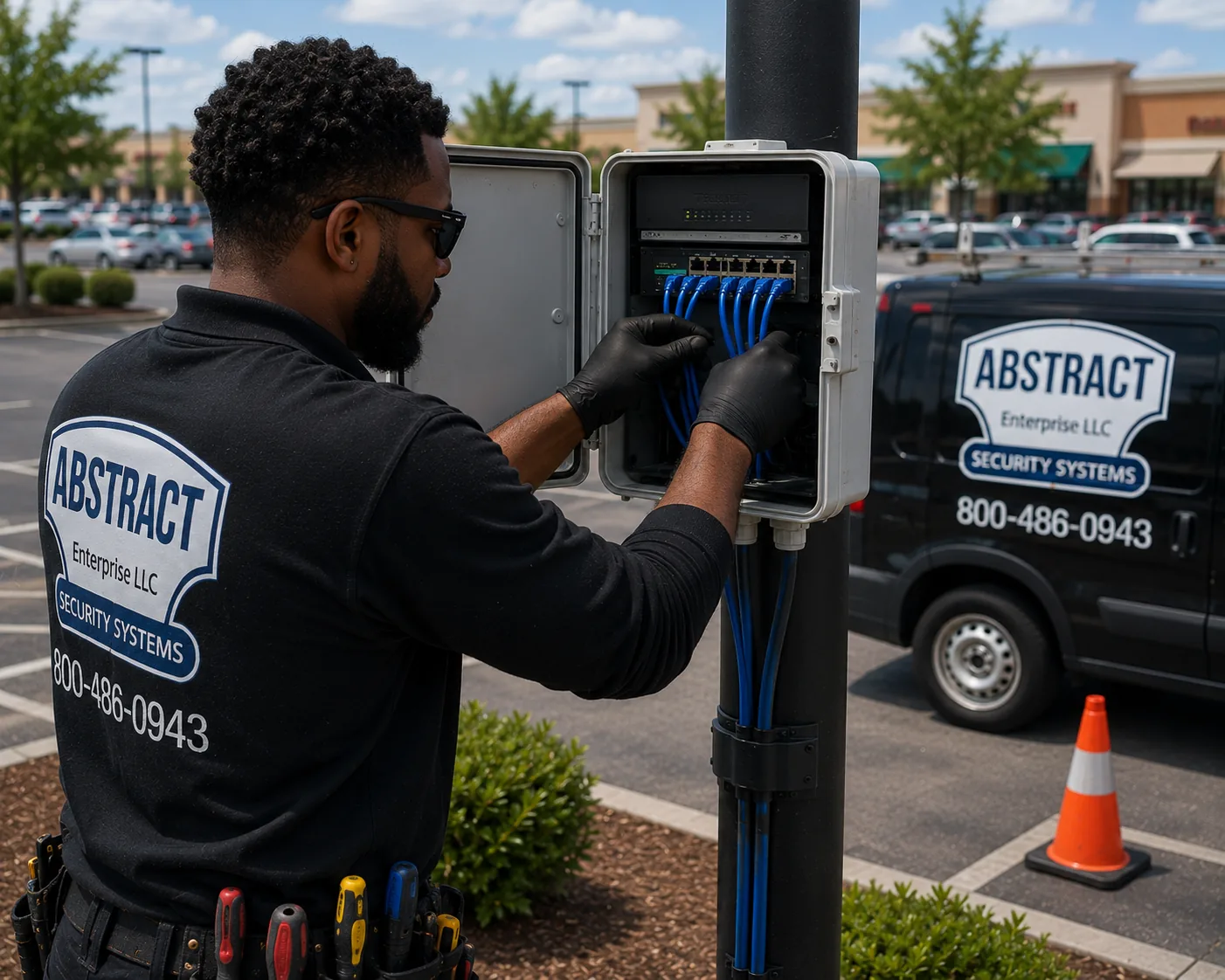
Technician servicing patch cables in an open pole-mounted equipment enclosure containing a network switch in a parking lot
Parking lot camera repair on Long Island: existing systems are diagnosed at the enclosure first — switch, terminations and cable condition before any camera is replaced.

Work starts with assessment rather than a quote: which cameras and runs are healthy, what the recorder can still do, whether existing cabling is reusable, and where the actual coverage gaps are. On Island properties the buried cabling is frequently the valuable survivor — coax or Cat5e already trenched to pole positions represents the expensive part of the infrastructure, and testing it rather than trusting it determines which upgrade path makes sense.

Paths available: HD-over-coax replaces cameras and recorder while keeping existing coax, which suits properties where positions are still correct and only image quality disappoints. Hybrid recorders accept both analog and IP so a migration can proceed in phases, keeping serviceable cameras online while new IP cameras go in at the entrance and other priority positions. Ethernet-over-coax adapters carry IP traffic on installed coaxial cable where new trenching is impractical. Full IP replacement pulls new cable and starts fresh, which makes the most sense when the positions themselves are wrong.

Common Island repair calls: dark pole cameras after storms, water intrusion at outdoor terminations, corrosion failures on coastal properties, surge damage after summer electrical activity, plow contact with low equipment, cut or degraded runs, recorder faults, deck channels gone dark, and lost remote access after a router or internet provider change. Each is diagnosed on site rather than guessed over the phone.

When a job can start and wrap depends on conditions on site, equipment availability, property access, any required permits, and the size of the scope.

Privacy, Signage and Property Boundaries

Camera systems on private Island lots operate inside expectations that deserve straight treatment. Aiming discipline comes first: lot cameras belong on the lot — entrances, aisles, rows, walkways, perimeter — not angled into residential windows, neighboring parcels or areas where people reasonably expect privacy. On Long Island this comes up constantly because commercial lots frequently abut residential property directly, sometimes separated by nothing more than a fence and a row of arborvitae.

Posted surveillance signage at entrances is standard practice on recorded properties and plainly informs drivers and pedestrians that the lot is monitored. For properties with tenants, employees, residents or association members, footage access is worth deciding in advance: who may view, who may export, how requests are handled, and who decides. Individual user accounts on the recorder make those decisions enforceable rather than theoretical.

Multi-tenant plazas add a layer. When one lot serves several businesses under different leases, equipment ownership, maintenance responsibility, coverage scope and footage access should be settled in writing before installation rather than negotiated during an incident.

Pole mounting, electrical and structural work, trenching, protected parcels, and right-of-way work across Nassau and Suffolk may need approval from the property owner, the utility, or the local authority having jurisdiction, and AESS confirms what each site demands ahead of installation.

This content is general information and is not legal advice.

Service Standards

Rather than reviews, here are the commitments built into every Long Island parking lot project:

Licensed NYS contractor

Abstract Enterprises Security Systems works across Nassau and Suffolk under NYS Low-Voltage License #12000287431. License details, insurance certificates and references are provided in writing before any work is scheduled.

Survey before pricing

Every proposal follows a free on-site survey. Camera positions, pathways and equipment are specified from the actual property — we do not quote Island lots from a phone call, because pole availability, trench routes and power sources are only visible on site.

Itemized proposals

Each camera position with its purpose, the pathway plan, recorder and storage sizing with calculated retention, and scope boundaries in writing — so competing bids can be compared honestly.

Workmanship standards

Weatherproof terminations, drip loops, surge protection and grounding on outdoor runs; corrosion-appropriate hardware on coastal properties; secured recorder placement; labeled cabling; individual user accounts instead of shared logins.

Walkthrough and documentation

Commissioning ends with a walkthrough of live views, playback, export and mobile access, plus documentation of logins, camera maps, pathway as-builts and settings handed to the owner. It is your system.

Three-year warranty

Products supplied by AESS carry a three-year warranty for normal wear and tear — full terms below and at our warranty page.

★ 4.7 · 201 Google Reviews across our service work.

Questions to Ask Any Long Island Parking Lot Installer

Whoever you hire — us included — these separate lot-ready installers from generalists:

HOW IT WORKS

How a Long Island Parking Lot Project Runs

Every project follows the same sequence. When a job can start and wrap depends on conditions on site, equipment availability, property access, any required permits, and the size of the scope.

  1. Property walk and zone map — A technician walks the lot, maps entrances, aisles, rows and perimeter, and checks sightlines with the property full. On large parcels the walk also establishes where a backbone will have to run.
  2. Pole and power verification — Every candidate pole is checked for ownership, structural capacity and whether its circuit is switched by photocell or timer, since a camera on a dusk-to-dawn circuit goes dark each morning.
  3. Written proposal — Positions, lens choices and mounting heights, the pathway plan, equipment schedule, storage sizing with calculated retention, and clear scope limits.
  4. Markouts and approvals — Utility markouts before excavation, plus town or village confirmation where poles, foundations, electrical work or right-of-way are involved.
  5. Trenching and backbone — Island routes, pavement crossings by cut or bore, conduit sized with spare capacity and a pull string, and fiber or engineered wireless where distance requires it.
  6. Poles, mounting and enclosures — Footings, pole setting, camera mounting, field enclosures with rated cable entries, and corrosion-appropriate hardware on coastal properties.
  7. Recorder, retention and accounts — NVR placement above flood levels where applicable, storage configured to the calculated figure, individual accounts, and time synchronisation.
  8. Night check and handover — After-dark verification of every position, then a walkthrough of live view, playback, export and mobile access with full documentation handed over.

PRICING

What Drives Long Island Parking Lot Camera Pricing

Island lot projects vary too widely for honest flat pricing — two properties with the same square footage can be completely different jobs depending on whether usable poles and power already exist. Pricing is determined after a free on-site survey, and the proposal itemizes exactly where the money goes. The variables that move the number:

Coverage and equipment

  • Camera count and camera classes (fixed, LPR, PTZ, panoramic, corrosion-resistant)
  • Number of LPR lanes and entrance configurations
  • Recording retention target and storage sizing
  • Monitoring, deterrence and alerting scope

Site conditions and labor

  • Pole quantity, height and footing requirements in local soil
  • Existing power, and whether lighting circuits are switched
  • Existing conduit that can be reused
  • Trenching distance, pavement crossings and restoration standard
  • Fiber or engineered wireless requirements between zones
  • Lift requirements for high positions and deck ceilings
  • Coastal hardware specification where exposure warrants it
  • Property access and working-hours constraints
  • Permit or AHJ review where applicable, including village-level review

A survey answers all of these for your specific property, and the itemized proposal that follows prices each driver on its own line. When a job can start and wrap depends on conditions on site, equipment availability, property access, any required permits, and the size of the scope.

The Site Survey on a Long Island Property

  1. Purpose conversation — what prompted the project, what has actually happened on this property, and who will use the footage.
  2. Zone mapping — every curb cut, drive aisle, parking row block, pedestrian path, service area, dumpster enclosure and perimeter line.
  3. Sightline check at vehicle height — what a box truck or a full row of SUVs blocks from each candidate position when the lot is full.
  4. Pole inventory and ownership — which lot poles are private, which belong to the utility, which are under a lighting service arrangement, and where new poles would need footings.
  5. Power audit — panel locations, available capacity, and whether candidate circuits are switched by photocell or timer.
  6. Pathway assessment — island routes for trenching, pavement crossings requiring cut or bore, existing conduit, and wireless line-of-sight where trenching is impractical.
  7. Buried infrastructure discussion — irrigation, drywells, septic on older parcels, prior tenant runs, and arranging markouts.
  8. Head-end location — a secured, ventilated indoor space with network access, and above expected water levels on flood-prone properties.
  9. Exposure review — salt exposure on coastal properties, snow-pile locations, plow paths and equipment access.
  10. Night visit where warranted — actual lighting conditions, dark gaps, glare paths and after-hours fixture schedules.
  11. Retention math — realistic discovery window for this property type, then storage sizing against camera count, resolution, frame rate and recording mode.
  12. Constraints review — access hours, tenant and customer traffic, landlord, board or association approvals, village versus town jurisdiction, and any owner, utility or AHJ review the scope requires.
  13. Written proposal — each position with its purpose and optics, the pathway and backbone plan, equipment schedule, retention calculation and itemised pricing.

Fourteen Things to Settle Before an Island Lot Project Starts

  1. Rank what the system is for. On Island properties the usual candidates are damage documentation, plate records at the entrance, enforcement against non-tenant parking, and reassurance for staff walking out after dark. Put them in order, because the top item decides where the money goes.
  2. Write down the actual incident history — what happened, where on the property, at what hours. Real history beats general concern for aiming decisions.
  3. Establish jurisdiction. Town or incorporated village, and which board or department reviews work involving poles, trenching or electrical.
  4. Confirm pole ownership for every existing pole the design might use, rather than assuming lot lighting is yours.
  5. Verify photocell and timer control on every candidate circuit before the design assumes daytime power.
  6. Identify every curb cut, including secondary and service entrances and pedestrian openings in fence lines.
  7. Ask what is buried along candidate trench routes — irrigation, drywells, septic, old conduit — and arrange markouts.
  8. Note recent or planned resurfacing, which may prohibit saw-cutting and push pathways toward boring.
  9. Set a realistic discovery window. Same day, several days, or weeks — this drives storage sizing more than any other input.
  10. Pick the head-end room and decide who holds keys and passwords; on flood-prone properties, confirm its elevation.
  11. Plan the network. Internet source, whether cameras get a dedicated segment, and who administers it.
  12. Choose how visible the system should be. Signage at each curb cut is the baseline; beyond that, better lot lighting, event-triggered strobes, audio talk-down and monitored response are separate decisions with separate costs. Settle which ones belong in this phase before the design is priced.
  13. Think about gating. If access control, a gate arm or credentialed entry is anywhere on the horizon, say so at the survey so conduit and camera positions accommodate it without re-trenching.
  14. Budget for maintenance. Seasonal lens cleaning, post-storm re-aiming, corrosion inspection on coastal properties, firmware updates and periodic playback testing keep a system honest years after install day.

COMMERCIAL PARKING CAMERAS

Business Parking Camera Systems in Long Island

Island commercial parking concentrates along a small number of arterial corridors, each with its own lot format:

Route 110, Melville and Huntington Station

Office parks, dealership rows and corporate campuses with large open lots.

Sunrise Highway

Retail plazas and dealerships from Valley Stream out through Suffolk, most with multiple curb cuts.

Jericho Turnpike

Continuous commercial frontage with small-to-mid plazas and shared parking fields.

Hauppauge Industrial Park

One of the largest industrial concentrations on the Island — employee lots, trailer yards and gates.

Old Country Road, Nassau

Big-box retail and mall-adjacent parking with the widest open fields in the county.

Middle Country Road, Suffolk

Strip plazas and service businesses running east through the centre of the Island.

Commercial sites carry approval requirements a residential lot does not. Pole mounting, electrical and structural work, trenching, protected parcels, and right-of-way work across Nassau and Suffolk may need approval from the property owner, the utility, or the local authority having jurisdiction, and AESS confirms what each site demands ahead of installation.

This content is general information and is not legal advice.

YOUR QUESTIONS ANSWERED

People Also Ask: Parking Lot Cameras on Long Island

Can I put cameras on the light poles already in my parking lot?

Often, but ownership decides it. Lot fixtures on most commercial Island properties belong to the property owner, who can authorize attachment directly. Poles along the property edge frequently belong to the utility, and some properties receive lighting under a service arrangement where attachment rights depend on the agreement. Beyond ownership, the practical checks are whether the pole has usable interior space and a hand-hole, whether its structure can carry the added equipment and wind load, how much it sways, and whether the circuit feeding it is switched off during daylight hours.

Why does a Long Island lot need more cameras than a city lot the same size?

It usually needs fewer cameras and more infrastructure. Open Island lots have long sightlines, so one well-placed camera covers more ground than it could in a dense borough. What increases is everything supporting those cameras: poles where no building overlooks the middle of the lot, trenching to reach them, power coordination, and backbone runs long enough to require fiber or wireless. Comparing quotes by camera count alone misses where Island project cost actually sits.

Do I need to trench, or can the system be wireless?

Engineered point-to-point wireless is genuinely useful for crossing what should not be dug — a roadway between parcels, recently resurfaced pavement, a long gap to a remote yard. It solves data, not power. Unless a position is designed as solar-plus-battery, something still has to feed the camera, and on most lots that means a pathway anyway. The usual outcome is a mix: trenched runs where the route is straightforward, wireless where trenching is impractical or prohibited.

Will salt air destroy cameras on a south shore property?

It attacks the hardware before the cameras. Mounts, pole bands, fasteners, enclosure hinges and cable gland entries corrode first, and a perfectly functional camera hanging at the wrong angle is still a failed position. Corrosion-resistant hardware, properly rated enclosures with intact seals and correct cable entries, and seasonal cleaning of lenses and domes are what make the difference on bayfront and barrier-beach lots. Specify for the environment at design time rather than replacing hardware in year three.

How do snow piles affect a camera system?

They redraw the lot for weeks. Plows consolidate snow at row ends, against islands and in property corners, and those piles can stand taller than a vehicle. A camera with a clear summer sightline can spend February looking at compacted snow. The fix is design-side: ask the property manager where snow gets pushed, then choose positions and heights that survive it. Plow equipment also throws slush and salt at height and contacts low equipment, so anything near a plow path needs protection or repositioning.

My lot has three entrances. Do I need plate cameras at all of them?

Ideally yes, because a vehicle can enter one and leave another, and covering only the main entrance means an incident vehicle may never pass a camera configured to read it. Where budget forces prioritization, the approach is to treat the highest-traffic entrance with a full LPR-plus-overview pair and give the others high-resolution overview coverage, with the trade-off documented rather than left implied. Adding the remaining lanes later is straightforward if conduit was run with spare capacity the first time.

How long should a commuter lot keep footage?

Longer than most other lot types, because discovery is slow. A vehicle damaged Monday morning may not be inspected until the owner returns in daylight days later, and vehicles left through a vacation may sit for two weeks. Retention is calculated from resolution, frame rate, recording mode, camera count and installed storage, then set against that realistic discovery window. Sizing a commuter lot to a next-morning assumption is the most common retention mistake on Long Island.

Who approves camera work on a lot in an incorporated village?

The village, in most cases, rather than the town — and several Nassau and Suffolk villages maintain their own review requirements and their own police departments. Work involving poles, foundations, electrical, trenching or anything affecting a right-of-way may require owner, utility or AHJ review, and which body reviews it depends on where the property sits and what the scope includes. AESS confirms applicable project requirements before installation. This content is general information and is not legal advice.

Can an Island lot be covered without opening the ground?

Sometimes. Where a building overlooks the coverage zones or existing conduit can be reused, cable routes on the structure instead. Where a gap must be crossed and trenching is impractical, an engineered link carries the data — though the far position still needs power unless it is designed as solar-plus-battery.

Who owns the poles at the edge of my property?

Often the serving utility rather than the property. Lot fixtures inside the property line usually belong to the owner and are the better candidates; poles along the road frequently are not available for attachment. Ownership is confirmed at the survey rather than assumed from a satellite view.

What does salt exposure actually damage first?

Mounting hardware. Brackets, pole bands, fasteners and enclosure hinges corrode well before a camera fails, and a working camera hanging at the wrong angle is still a failed position. Corrosion-resistant hardware on bayfront and barrier-beach properties is a specification decision at design time, not an upgrade.

How much footage should a station lot keep?

Longer than a retail property. A vehicle damaged on a Monday may not be inspected until the owner returns days later, and vehicles left through a holiday can sit a fortnight. Retention is calculated from resolution, frame rate, recording mode, camera count and drive capacity, then set against that slower discovery window.

Do seasonal properties need year-round coverage?

The permanent core does — entrance, buildings, main parking. Overflow fields used a handful of weekends a year rarely justify trenching and poles that sit idle the rest of the time, and portable positions during the season are usually the better economics.

Can the system tell the difference between a person and a car?

Modern cameras classify objects, which is what makes rules usable on a large open lot. Rules can trigger on a person crossing a perimeter after hours while ignoring vehicles on the adjacent road, and they need tuning after a week of live traffic rather than being set once.

EQUIPMENT

Types of Parking Camera Equipment We Install in Long Island

On an Island lot the distances and the coastal exposure drive selection, so each position is specified individually. All cameras are Uniview (UNV) — NDAA-compliant and specified by model per position, not sold as a kit.

Fixed bullet cameras

The backbone of Island lot coverage, with throws from forty to two hundred feet across a single property and lenses set position by position. Specified with Uniview (UNV) 4K ColorHunter bullets such as the IPC2128SE-ADF28KM-WL-I0 (8MP, full-color at night).

Turret cameras

Compact housings for building faces, deck ceilings and lower pole heights where profile matters. Uniview OwlView turrets such as the IPC3628SR-ADF28KM-WP (8MP, Wise-ISP low-light), with IPC3638SE-ADF28K-WL-I0 eyeballs where a flush ceiling fit is needed.

PTZ cameras

Steerable coverage on the large open parcels the Island is full of, layered over fixed positions. Uniview LightHunter PTZs such as the IPC6658SR-X25-VF (4K, 25× optical) or IPC6622SR-X33-VF (33×) for long throws across open lots.

Panoramic and multisensor

Wide coverage from one mounting point where a pole footing is the expensive part and each pole must justify itself.

LPR cameras

Plate readers positioned inside the property where vehicles slow, rather than at a curb cut opening onto a highway. Uniview ANPR plate cameras such as the PKC2640@Z80-P (4MP, 8–32mm) or HC121@TS8CR-Z (2MP @60fps), with whitelist and blacklist barrier control.

NVRs and storage

Recorders sized for a slow discovery window on commuter and seasonal properties, and mounted above flood level near the shore. Uniview recorders such as the NVR304-16E2-P16, NVR308-64X or NVR516-128, sized to camera count and calculated retention.

Field switches and enclosures

Sealed enclosures at pole clusters, aggregating cameras to one fiber or copper uplink instead of many trenches. Uniview PoE switches such as the NSW2010-16T2GC-POE-IN (16-port) or cloud-managed NSW3000-8T2GT-POE-IN carry PoE up to 250m over copper to remote clusters.

Surge protection and grounding

Bonding at every pole, with corrosion-appropriate hardware and surge devices at both ends of coastal runs.

AI OVERVIEW REALITY CHECK

AI Overview: What the Search Results Get Right and Wrong About Island Lots

Search for parking lot camera information and an AI-generated summary assembles an answer from national blogs, marketplace listings and directory content. Some of it holds up. A good deal of it does not survive contact with a Nassau or Suffolk property.

“Parking lot cameras cost $X to $Y”

Published cost ranges are built largely from consumer and small-business installs, and they rarely account for what actually drives an Island lot project: poles and footings, trenching across landscape islands, pavement crossings, fiber backbones, lift equipment, LPR lanes and storage sized for a slow discovery window.

They also flatten the single biggest local variable, which is whether usable private poles and a nearby unswitched circuit already exist. A Hicksville plaza with lot lighting the owner controls and a Hauppauge yard with nothing but utility poles at the road are the same square footage and completely different projects.

The third distortion is that published figures blur equipment against installed cost. On a large open lot the hardware is frequently the smaller half. Excavation and restoration, electrical coordination, lift time, enclosure work and commissioning make up the rest, which is why an Island lot is priced after a survey rather than from a table.

“Wireless is easier for big open lots”

Two different things get called wireless. Engineered point-to-point links between a pole cluster and a building are legitimate infrastructure used constantly in Island work. Consumer Wi-Fi cameras several hundred feet from a router are a different product and generally disappoint outdoors at distance.

Long Island geography does favor engineered links more than a dense borough does, because parcels are large, flat and frequently split by a roadway or a recently paved apron that nobody wants opened. A properly specified directional link across that gap is often the right answer rather than a compromise.

What wireless never solves is power. Unless a position is explicitly designed as solar-plus-battery, something still has to feed the camera, and on most Island lots that means a pathway anyway. Seasonal foliage also closes line-of-sight paths that looked clear in March, which is why links are specified with real fade margin.

“Just use the existing light poles”

Frequently right, sometimes impossible. Most commercial lot fixtures belong to the property owner, who can authorize attachment directly, and those are the best candidates because a power path already exists at the pole.

Poles at the property edge are a different matter. Distribution and street lighting across Nassau and Suffolk generally belongs to PSEG Long Island, and attachment there is not something a contractor authorizes unilaterally. Some properties also receive lighting under a service arrangement where attachment rights depend on the agreement rather than the deed.

Even on an owned pole the checks continue: usable interior space and a hand-hole, structural capacity for the added equipment and its wind load, how much the pole sways, and whether the circuit is switched by photocell or timer. A camera fed from a dusk-to-dawn circuit goes dark every morning, and none of this is visible from a satellite image.

“Analytics mean the system watches itself”

Analytics genuinely help filter headlight sweep, weather and wildlife from real activity, but they are rules that require designing and tuning after a week of live traffic. Untuned rules on a large open lot either flood phones until everyone mutes them or sit so conservative they never fire.

Island properties add a seasonal dimension that generic advice ignores. A marina or beach lot with summer crowds and winter emptiness wants different rules in July than in January, and a retail centre's quiet hours shift with the season. Rules set once in spring are wrong by autumn.

Escalation is the part analytics cannot supply. An alert at 3 AM matters only if someone acts on it, and the options ladder from a push notification to on-camera deterrence to professional monitoring with an agreed script. Resolution choices feed the same budget conversation, since higher-resolution cameras consume storage proportionally and pull retention down unless drives were sized for it at design time — exactly the wrong trade on a commuter lot where discovery may take a week.

“A DIY kit will cover the lot”

Consumer kits are engineered for houses: short runs, indoor power, mild environments, forgiving distances. Island lot work involves outdoor-rated pathways, surge and grounding on exposed runs, mounting heights that need lifts, distances past copper limits and secure recorder placement.

Coastal exposure raises the bar further. Salt attacks mounts, pole bands, fasteners and enclosure hardware before it touches a camera, and a functioning camera hanging at the wrong angle is still a failed position. Corrosion-appropriate hardware is a specification decision on a bayfront lot, not an upgrade.

Some small lots genuinely can be served with modest equipment competently installed, and that deserves saying plainly. The failure mode is scale: applying the same approach where the far rows sit two hundred feet from any building, then discovering the gap while reviewing an incident that already happened.

“A matching service will find me a parking lot specialist”

Lead-matching platforms and national cost pages such as Angi, HomeAdvisor and Fixr distribute contact details to participating contractors and publish national averages rather than data from your property. As a way to build a shortlist, that is reasonable enough.

The structural issue is that those platforms reward response speed over fit. A contractor who answers in minutes appears qualified; one who asks to walk the lot before quoting appears slower. On lot work that ordering is backwards, because whoever prices without seeing the site is the one most likely to issue change orders later.

A better filter costs nothing. Ask each bidder for a per-camera plan before pricing, and ask specifically which poles on the property are usable and how they confirmed ownership. Anyone who has run conduit under a drive aisle can answer both from a walk-through; anyone who cannot is quoting a camera count.

“Cameras will stop the problem”

This is the claim that does the most damage. Nothing about a camera guarantees prevention, detection, a readable plate, a police response or any specific result, and every question about coverage, claims and policy impact belongs with the property owner’s insurer rather than an installer.

What cameras reliably do is narrower and still valuable: they create a record where none existed. On an Island commuter lot that record may be the only account of a weekday nobody witnessed, and it settles damage disputes, establishes sequence and documents who entered and when.

The honest framing is layered. Lighting changes how a lot is used after dark, signage tells drivers the property is recorded, gating changes who enters at all, monitoring puts a person behind an alert, and cameras document all of it. Performance depends on placement, lighting, weather, lens selection, how quickly vehicles pass, plate condition, ongoing maintenance, recording setup, and the conditions of the property.
Talk Through Your Long Island Lot

Give us the details of the property and we will schedule an on-site survey. When a job can start and wrap depends on conditions on site, equipment availability, property access, any required permits, and the size of the scope.

Call (347) 934-8335   Request a Survey

FAQ

Long Island Parking Lot Camera FAQ

Do you install parking lot cameras throughout Nassau and Suffolk?

Yes. Service is available throughout Nassau County and Suffolk County — shopping center and plaza lots, commuter and station parking, village and municipal lots, apartment and HOA parking, hospital and campus lots and decks, industrial parks, dealership lots, marina and seasonal lots, and school and house-of-worship properties. Abstract Enterprises Security Systems is a licensed NYS low-voltage contractor, NYS License #12000287431.

How is a Long Island parking lot estimate put together?

From a free on-site survey. A technician walks the property, maps zones and sightlines, inventories poles and confirms their ownership, checks power and whether lighting circuits are switched, identifies pathway routes, and reviews exposure conditions. The written proposal itemizes each camera position and purpose, the pathway plan, equipment, storage sizing with calculated retention, and pricing by line item. Island lots are not quoted from a phone call because the cost drivers are only visible on site.

What does a parking lot camera system cost on Long Island?

Cost is determined after the survey. The variables include camera count and classes, pole quantity and height, existing power and whether circuits are switched, existing conduit, trenching distance and pavement crossings, fiber or wireless requirements, number of LPR lanes, lift requirements, coastal hardware specification, recording retention, monitoring scope, property access, and permit or AHJ review where applicable. Two identically sized properties can be very different projects, and the proposal prices each driver on its own line.

Can you install cameras on poles in the middle of a large lot?

Yes — dedicated camera poles are standard on Island properties where no building overlooks the interior rows. Pole work includes a footing sized for pole height, wind loading and local soil, conduit stubbed through the base with spare capacity, grounding and surge protection on outdoor conductors, and service loops for future re-aiming. Camera poles, electrical work, structural mounting, trenching, landmarked properties and work affecting a right-of-way may require owner, utility or AHJ review; AESS confirms applicable project requirements before installation.

How do cameras get power and network across a big lot?

Per run, chosen at the survey: Cat6 with PoE inside Ethernet distance limits, fiber for long backbones and building-to-pole-cluster runs, trenching and conduit through landscape islands or across pavement where required, and engineered point-to-point wireless where trenching is impractical or prohibited. Solar-plus-battery designs serve positions with no feasible power path. Outdoor runs get weatherproof terminations, drip loops, surge protection and grounding.

Will the system read plates at my entrance?

Where the geometry supports it. LPR needs a tight single-lane view, a shallow angle to the plate, and a capture zone where vehicles are slow. Many Island entrances open onto fast highway traffic, so the capture zone usually moves off the apron to the point where vehicles slow inside the property — a stop bar, a gate arm, or the turn into the first aisle. Performance depends on placement, lighting, weather, lens selection, how quickly vehicles pass, plate condition, ongoing maintenance, recording setup, and the conditions of the property.
How long is footage kept on a commuter lot versus a retail lot?

Both are calculated the same way — resolution, frame rate, recording mode, camera count and installed drive capacity — but they land in very different places. A retail centre discovers most damage the same day, so a shorter window is defensible. A station lot may not surface an incident until the owner returns from a week away, and a vehicle left through a vacation can sit a fortnight. We size drives to the slower of the two realities on your property and state the calculated figure in the proposal.

Can I view the lot from my phone?

Yes. Systems are configured for remote viewing on phones, tablets and desktops for live views, playback and export, with individual user accounts for owners, managers or board members rather than one shared administrator login, so access can be granted and revoked per person. Recording continues locally on the NVR whether or not the internet connection is up.

Do you service or adopt an existing Long Island lot system?

Yes, regardless of who installed it. Common calls include dark pole cameras after storms, corrosion failures on coastal properties, surge damage, water intrusion at outdoor terminations, plow contact with low equipment, cut or degraded runs, recorder faults and lost remote access. Work begins with an on-site assessment of what is healthy and reusable, then a repair or phased modernization path. When a job can start and wrap depends on conditions on site, equipment availability, property access, any required permits, and the size of the scope.

How long does an Island lot installation take?

It depends on the project. Scheduling and completion time depend on site conditions, equipment availability, access, permitting requirements and project scope — trenching, pole footings, lift scheduling, electrical coordination, markouts and required reviews all affect the timeline. The proposal states the scope, and scheduling is confirmed with you rather than estimated generically.

Should gate hardware go in during the camera project or afterward?

During, if it is anywhere in the plan — the trench is the expensive part and digging it twice is the most avoidable cost on an Island property. Running conduit to the entrance island with spare capacity, establishing a power route sized for a gate operator, and setting a pedestal stub at the same time costs very little while the ground is already open. Camera positions also get chosen with a future gate arm and pedestal in the frame, so nothing ends up looking at the back of new hardware.

What is covered after the install, and what happens when the warranty ends?

Abstract Enterprises Security Systems provides a three-year warranty on products supplied by AESS for normal wear and tear. It does not cover existing or customer wiring, customer-supplied equipment, lightning or other acts of God, power outages or surges, physical damage or unplugging, internet, router or phone changes, or camera readjustments requested after completion. After the warranty period, service is $195 per hour with a three-hour minimum ($585). Full terms are on our warranty page.

Warranty and Service Terms

Abstract Enterprises Security Systems provides a three-year warranty on products supplied by AESS for normal wear and tear. It does not cover existing or customer wiring, customer-supplied equipment, lightning or other acts of God, power outages or surges, physical damage or unplugging, internet, router or phone changes, or camera readjustments requested after completion. After the warranty period, service is $195 per hour with a three-hour minimum ($585).

Read the full warranty terms.

Areas We Serve

We serve parking properties across Nassau County and Suffolk County. Request a survey for a lot anywhere on the Island:

Nassau County

Hempstead, North Hempstead and Oyster Bay towns and the villages within them — retail plazas, medical and office parking, station lots, village downtown lots and residential complexes.
Request a Nassau lot survey

Suffolk County

Huntington through the Twin Forks — office and industrial park lots, campus and hospital parking, commuter lots, village lots, ferry terminal parking and seasonal properties.
Request a Suffolk lot survey

New York City

Parking lot systems across the five boroughs, including structured garages and operator-run facilities.
Parking Lot Camera Installation NYC

Hudson Valley

Parking properties across the Hudson Valley counties.
Parking Lot Camera Installation Hudson Valley

All Long Island services

Cameras, access control, cabling and the rest of the low-voltage catalog across Nassau and Suffolk.
Security Camera Installation Long Island

Home

The full service catalog from Abstract Enterprises Security Systems.
Abstract Enterprises home

SHOP OUR SYSTEMS

Parking Camera Packages & Pricing in Long Island

Starter

$1,003–$1,935 installed

A small strip-mall or office lot — four fixed cameras on the entrance, a drive aisle and one perimeter edge.

Standard

$1,770–$3,225 installed

A mid-size retail or commuter lot — about eight cameras with row-by-row coverage and a plate camera at the curb cut.

Premium

$3,304–$5,805 installed

A big-box or park-and-ride lot — sixteen-plus cameras with LPR lanes, pole-mounted PTZ and full perimeter coverage across the property.

Ranges are installed pricing for the scope shown at the Nassau-to-Suffolk rate; LPR lanes, pole PTZ, trenching distance and restoration move the figure within the range, finalized on your free survey.

Bringing your own equipment? BYOE is labor-only — we handle mounting, cabling and configuration of the cameras you supply.

Zero monthly fees and full ownership of the system. Post-install service and callbacks are billed at $195/hour with a three-hour minimum ($585).

Request a Survey   Call (347) 934-8335

COMPLETE SERVICES

Every Security Service We Offer in Long Island

Security Camera Installation

Full camera system design and installation for commercial and residential properties across the Island.

Security Camera Repair

Diagnostics and repair for existing systems, any brand, any prior installer.

Commercial Camera Installation

Camera systems for offices, retail units, industrial buildings and multi-tenant properties across Nassau and Suffolk.

Access Control Installation

Gate arms, credentialed entry and pedestal hardware for Island properties moving from open parking to controlled access.

Warehouse & Yard Cameras

Industrial park interiors, docks and trailer yards — the natural companion to an employee lot system.

Construction Site Cameras

Jobsite systems for active construction and staging areas.

ALL AREAS SERVED

Parking Lot Camera Installation by Area

Each parking page in the silo is linked above; where an area has no page yet, we serve it directly — the request-coverage link starts a survey.

Parking Lot Cameras NYC

Citywide hub across the five boroughs.

Parking Lot Cameras Brooklyn

Retail, industrial, residential and institutional lots.

Parking Lot Cameras Manhattan

Below-grade and multi-level garages, attended facilities.

Parking Lot Cameras Long Island

Nassau and Suffolk lots, commuter and coastal properties.

Parking Lot Cameras Hudson Valley

All six Hudson Valley counties.

Areas without a page yet

Queens · Bronx · Staten Island · Nassau · Suffolk · Westchester · Rockland · Orange · Putnam · Dutchess · Ulster

GET IN TOUCH

Request Your Free Long Island Parking Lot Survey

Tell us about the property and we will schedule an on-site survey, map the lot, confirm pole and power options, and produce an itemized proposal with a per-camera plan and calculated retention. When a job can start and wrap depends on conditions on site, equipment availability, property access, any required permits, and the size of the scope.

Call (347) 934-8335
WhatsApp: wa.me/17186790359
NYS Low-Voltage License #12000287431
★ 4.7 · 201 Google Reviews

Long Island Parking Lot Project Details