
Warehouse Security Camera Installation
on Long Island
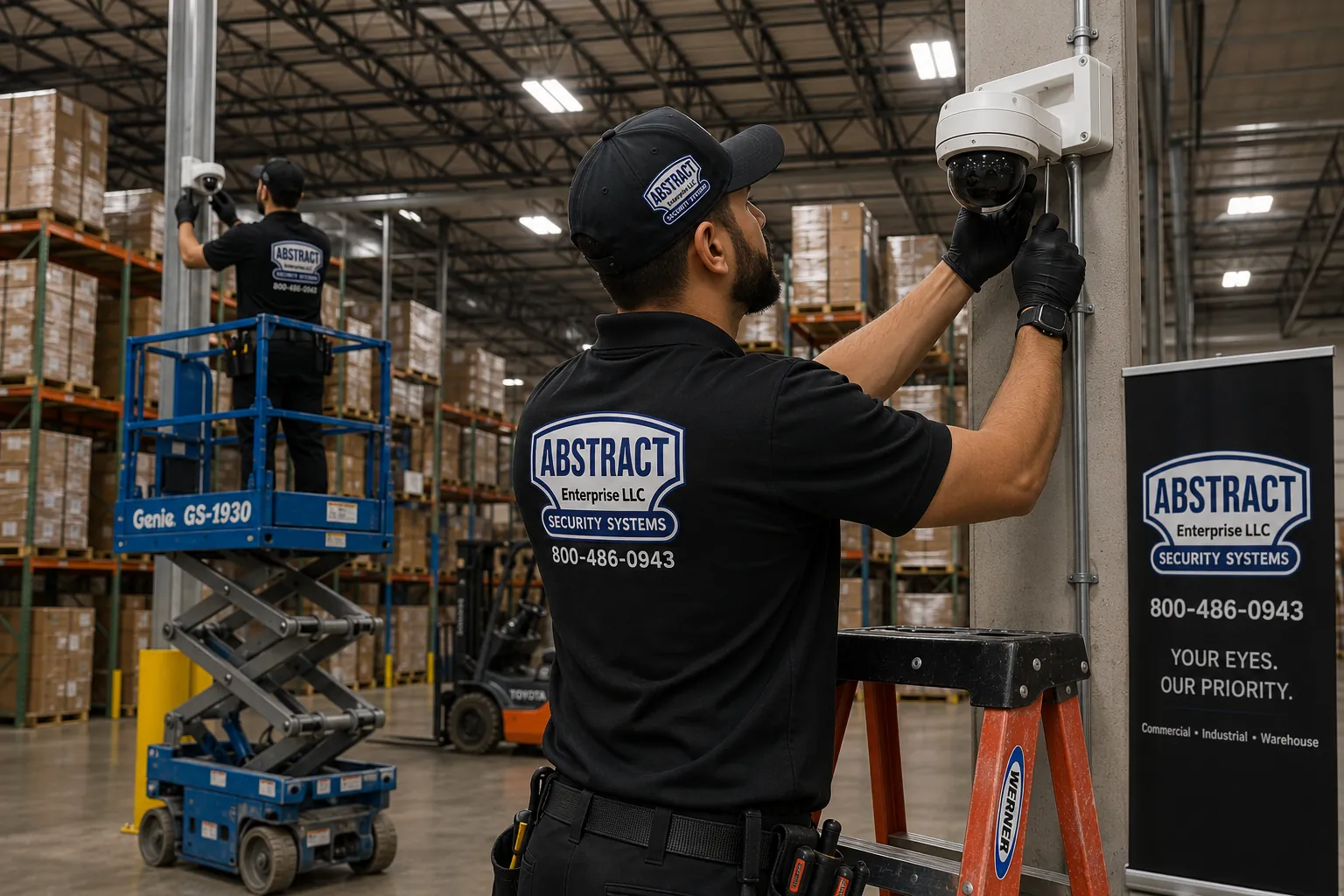
4K PoE camera systems built for the way Long Island warehouses actually work: sprawling single-story steel, sun-blasted dock doors, trailer yards off the LIE, contractor equipment that sleeps outside, and inventory that disappears between Friday close and Monday count. You own the recorder, the footage and the passwords, with zero monthly fees.
Get a Free Warehouse Security Quote
Fixed pricing, model numbers included — a tech replies fast.
This is our Long Island warehouse camera hub for Nassau and Suffolk. Start from the Abstract Enterprises Security Systems homepage for everything we install, or see the NYC warehouse camera hub for the five boroughs.
Get a Long Island Warehouse Camera Quote
- Free site walks across Nassau and Suffolk — request a warehouse security assessment by phone or the 60-second form
- A fixed written warehouse surveillance installation estimate, camera by camera, never a phone-script guess
- Three-year warranty on AESS-supplied products, installed by a licensed warehouse camera installer carrying NYS #12000287431
Warehouse Security Camera Installation Built for Long Island Buildings
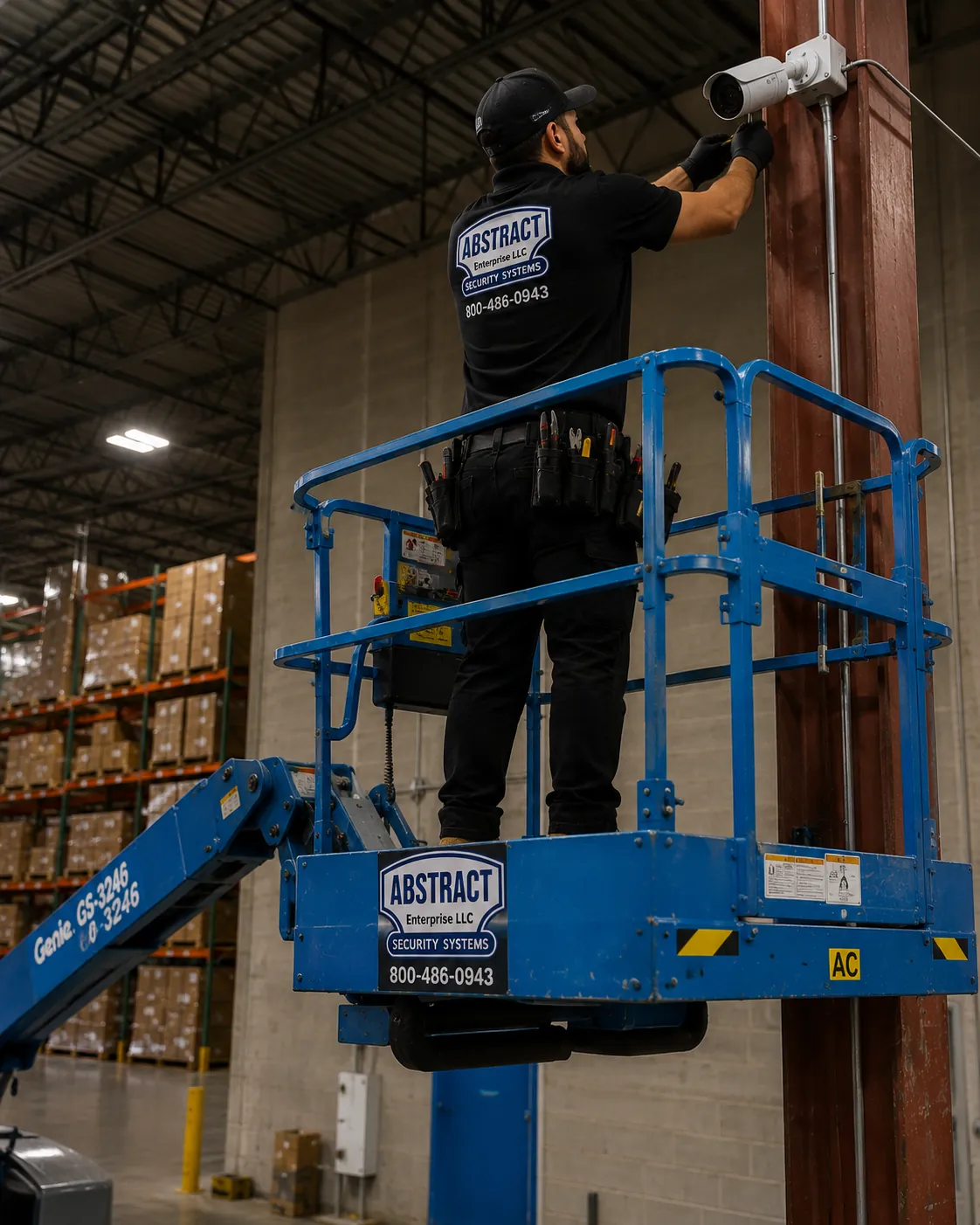
Long Island warehouses fail differently than city ones. Out here the problem is rarely a cramped vertical building; it is sprawl. A single-story steel box in Hauppauge or Deer Park can put four hundred feet between its front office and its rear dock, with a fenced yard, staged trailers and parked contractor equipment adding another acre the cameras are somehow supposed to cover. The eight-camera kit from a warehouse club was never going to do it, and the WiFi cameras a well-meaning employee mounted five years ago stopped reporting for duty around the second winter. Abstract Enterprises Security Systems handles warehouse security camera installation the opposite way: we start at your dock doors, gates, aisles and yard, then engineer the warehouse video surveillance installation the building actually needs, at the scale it actually is.
We are a New York State licensed low-voltage security contractor, license #12000287431, headquartered at 1282 Troy Ave in Brooklyn and on Long Island jobs every week of the year, from Inwood on the Queens line to Calverton at the edge of the East End. Professional warehouse security camera installation is the same discipline at every scale we build: commercial 4K IP cameras on hardwired Cat6, PoE switching with spare ports, a local NVR sized to your retention target, and remote viewing proven on your phone before the truck leaves the lot. Abstract Enterprises warehouse security cameras carry no subscription and no per-camera monthly bill, the same promise behind every security camera installation we do across Long Island.
Half-dead system? That is routine work too: recorder swaps, camera replacement, cable repair and adoptions of systems whose installers stopped answering the phone, handled by the same crew that runs our Long Island camera repair calls, usually same day. Below: how we design security camera installation for warehouses out here, what it honestly costs in Nassau versus Suffolk, the questions Long Island owners actually ask, and the blind spots we find on almost every first walk. Read what you need, then call (800) 486-0943 or take the 60-second form.
Price My Long Island Warehouse Cameras
Four quick answers and a real installer, not a call center, gets back to you with numbers. Use it to get a warehouse camera installation quote back fast, or call and we will schedule the installation directly. No obligation, no spam.
Why Long Island Warehouses Need Purpose-Built Camera Coverage
The Island's industrial economy is bigger than most of its own residents realize. The Long Island Innovation Park at Hauppauge alone spans roughly 1,400 acres across Hauppauge, Ronkonkoma and Islandia, houses about 1,300 companies with some 55,000 workers, and is commonly ranked the second-largest industrial park in the country. Add the Route 110 corridor through Melville and Farmingdale, the Heartland complex around Edgewood and Brentwood, the freight cluster near MacArthur Airport, and the west-Nassau pockets from New Cassel to Inwood on the JFK line, and you have thousands of buildings full of product, tools and rolling stock, most of them dark and empty from six at night to six in the morning. Industrial vacancy in Suffolk has run famously tight, which means buildings are full, and full buildings are worth robbing.
The theft economics are national but they park on Long Island streets. Cargo theft causes up to $35 billion in estimated annual U.S. losses, according to the National Insurance Crime Bureau, and the modern version reached Suffolk County directly: federal prosecutors have charged an organized crew whose alleged scheme included a plan to steal roughly $433,000 worth of cologne from Ronkonkoma using the fictitious-pickup playbook, a hacked carrier email, a fake driver and a real truck. When the thief arrives looking exactly like your scheduled carrier, gate cameras with plate capture and dock footage at identification density are what separates a police report with leads from a shrug. Purpose-built industrial security camera installation is that separation.
Then there is the paperwork layer. Commercial property and cargo insurers increasingly ask what surveillance runs before writing or renewing coverage, and many discount premiums for commercial warehouse camera installation that is professionally documented and recorded. 3PL contracts specify retention. New York's cannabis regulator holds licensed facilities to statewide surveillance rules wherever the building sits, Riverhead or Red Hook alike. And when a forklift injury claim or a slip-and-fall lands in a Nassau courtroom, the time-stamped video on your own recorder ends arguments that would otherwise take a year of depositions. Warehouse security system installation on Long Island is theft prevention second; first, it is the documentation layer the whole operation stands on.
Warehouse Camera Systems We Install Across Nassau and Suffolk
4K PoE IP Camera Systems
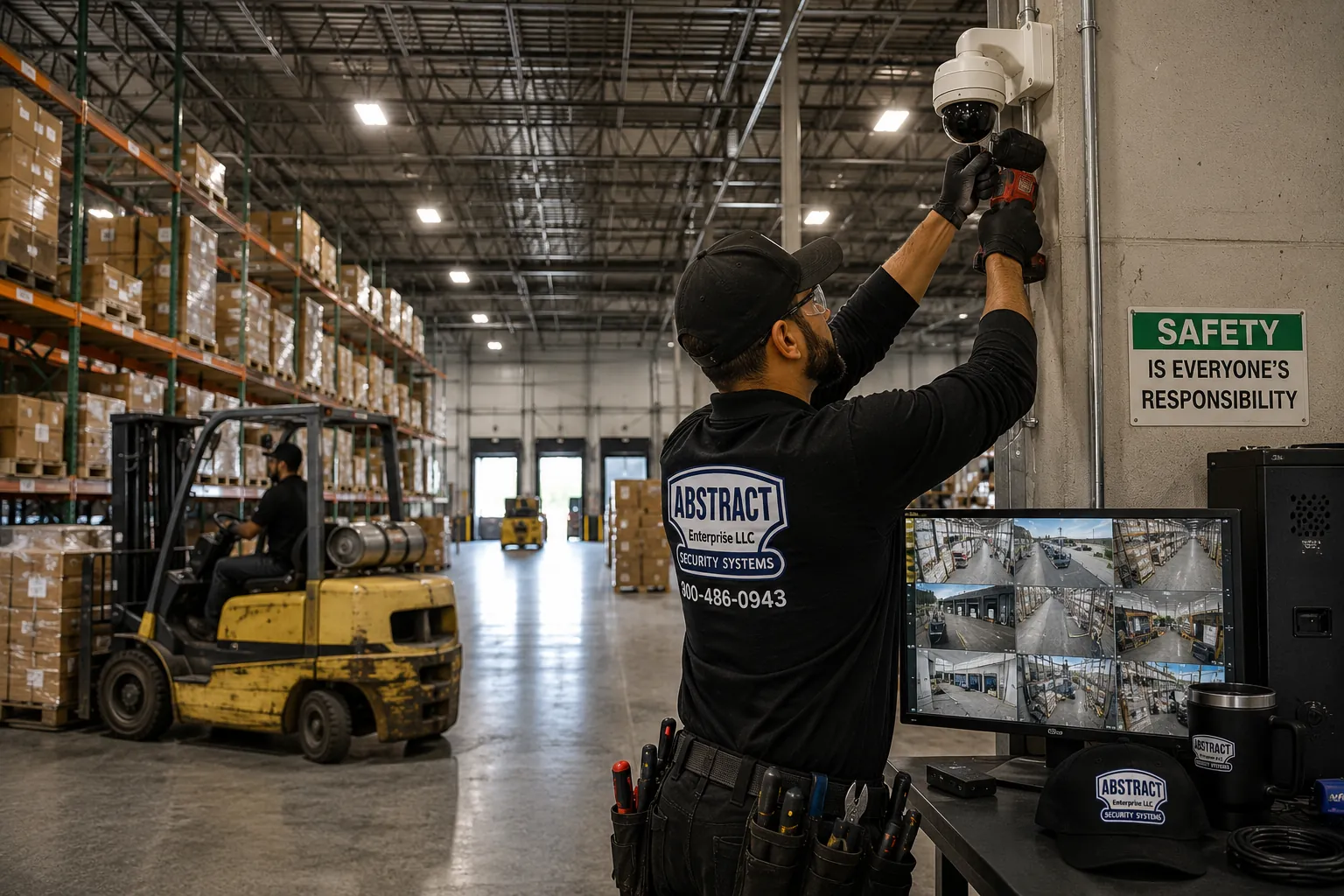
4K warehouse cameras over hardwired Cat6 are the default answer for Long Island's single-story steel: one cable per camera carries power and video, no plug-in transformers baking in a ceiling, and enough resolution to pull a readable face or carton label out of recorded footage at a dock door. PoE warehouse cameras also scale cleanly, so the 12-camera build you start with grows to 24 on spare switch ports instead of a rewire. We mix vandal-resistant dome cameras for warehouses that want low-profile interior heads with rugged bullet cameras for warehouses whose docks and yards face the weather off the Sound and the South Shore.
NVR Recording Sized to Your Retention
The recorder is where Long Island installs most often go wrong: a builder-grade box with one small drive that overwrites the week you needed. We calculate storage from real inputs, camera count, resolution, codec, and the retention your insurer or contracts demand, then build in headroom. Sixteen 4K cameras recording around the clock consume roughly ten terabytes a month even with a smart codec, and knowing that before purchase is the difference between evidence and apology.
PTZ and Yard Coverage
Long Island warehouses come with land, and land is where losses start: trailer staging, equipment rows, material piles. PTZ warehouse cameras with strong optical zoom patrol those acres from one pole, auto-tracking movement after hours while fixed heads hold the wide view. For contractor and landscaping yards, we pair the PTZ with fixed coverage on every gate so nothing enters or leaves unrecorded.
Panoramic and Fisheye Interiors
Panoramic warehouse cameras solve the racked-interior problem without a forest of heads: a single ceiling-mounted 12MP unit covers a staging floor or an aisle intersection, dewarped in software into flat, reviewable views. Fisheye warehouse cameras at the crossings, with directional cameras at aisle ends, kill the between-rows blind spots that fixed-only designs always leave.
License Plate Recognition at Gates
Every truck that rolls a Long Island gate should leave a plate in your log, and general cameras cannot do it through headlights and motion. Dedicated license plate recognition cameras at driveways, gate lanes and dock aprons are tuned for exactly that shot, which matters double out here now that fictitious-pickup cargo theft, a fake carrier with real paperwork, has reached Suffolk County. The plate log is the receipt.
Thermal and Low-Light Perimeter
For unlit yards and fence lines, thermal warehouse cameras find a human heat signature in total darkness or fog, while full-color low-light warehouse cameras hold usable color where a little ambient light exists, parking lots, building faces, gate aprons. Night-vision warehouse cameras with long IR throw handle the dark interior corners. All of it records to the same NVR and the same app.
AI Analytics and Real Alerts
AI warehouse cameras tell a person from a deer, a headlight sweep or blowing snow, which on Long Island is the whole ballgame for alert quality, and a generational leap past the dumb motion detection cameras that cried wolf every windy night. We configure line-crossing detection on fences, after-hours intrusion zones on docks, people-counting cameras where entrance counts matter, vehicle-tracking cameras on yard lanes, and real-time security alerts filtered hard enough that the ones reaching your phone deserve the interruption.
DVR Takeovers and Upgrades
Plenty of Island warehouses run coax systems installed two owners ago. Where the cable is sound we keep it, step the cameras up to HD over the same runs or convert to IP, and replace the recorder with a modern unit that adds phone viewing and honest retention. We also adopt orphaned systems outright, including the Dahua camera systems we service across Long Island weekly.
Where the Cameras Actually Go: A Long Island Placement Map
Inside, the pattern holds across nearly every Nassau and Suffolk build. Warehouse entrance cameras and warehouse exit cameras catch every face at the threshold at identification density, with employee entrance cameras at head height by the time clock. Shipping area cameras and receiving area cameras own the two places inventory changes hands; warehouse aisle cameras at the row ends cover the canyons while storage rack surveillance from crossing-mounted fisheyes fills the gaps. Forklift traffic cameras on the main travel lanes double as safety documentation, inventory room cameras and cage coverage guard the highest-value shelf, and warehouse office cameras watch the cash drawer and the server closet. Buildings with mezzanines add stairwell security cameras and emergency exit cameras, because a quiet walkout always uses the quiet door, and the rare two-story flex building gets freight elevator cameras too.
Outside is where Long Island differs from the city: there is simply more of it. Warehouse perimeter cameras sweep the fence line, parking lot security cameras cover employee vehicles and staged trailers, delivery gate cameras with plate capture log every truck, and loading dock security cameras hold the doors themselves, all of them weatherproof security cameras rated for nor'easters and salt air. The design goal never changes: map the warehouse camera blind spots a thief would walk through, then make sure the install leaves none. That map is what our free site walk produces.
One planning note from years of Island installs: warehouse camera projects pair naturally with access control on personnel doors and cages, because video shows what happened while the badge log shows who unlocked it. Wiring both on one visit costs meaningfully less than two mobilizations, and we hold the license for the full low-voltage scope.
The Vocabulary on Your Long Island Camera Quotes, Translated
Three bids will arrive speaking three dialects. Here is the plain-English key so you can line them up fairly.
- PoE (Power over Ethernet)
- Power and video on one Cat6 cable per camera. Fewer parts to fail and no electrician needed at every mounting point.
- NVR (Network Video Recorder)
- The on-site appliance recording your IP cameras to hard drives you own; the reason there is no monthly bill. Proper sizing starts with NVR storage calculation against camera count and honest video retention planning.
- DVR
- The older coax-era recorder. Serviceable, resolution-capped; the usual Long Island upgrade path is DVR to NVR without abandoning good cable.
- IP Camera
- A network camera, individually addressable and configurable, versus the take-it-or-leave-it analog heads of the old systems.
- WDR (Wide Dynamic Range)
- One frame exposing bright and dark zones together. True 120dB-class WDR is what keeps a south-facing dock door from washing out at noon.
- IR Range / Lux
- How far infrared reaches and how little light a sensor needs. Unlit steel interiors and yards want long throw and low lux numbers.
- Varifocal Lens
- Motorized zoom and focus adjustable from a laptop, so the camera 26 feet up over the racking never needs another lift rental to reframe.
- H.265 / Smart Codec
- Compression that roughly halves storage against H.264 with no visible loss, which directly shrinks the drive budget on big retention targets.
- PPF (Pixels Per Foot)
- The density behind identification: about 80 PPF to hold up a face, far less for an overview shot. Placement decides it more than the spec sheet.
- ONVIF
- The compatibility standard letting mixed-brand cameras and recorders cooperate, your insurance against vendor lock-in.
- VMS
- Video management software for viewing and searching many cameras, the tool of choice once you run two or three buildings across the Island.
- Surveillance Drives / RAID
- Purpose-built surveillance footage storage rated for constant writes, arranged so one failed disk does not erase the month.
- LPR / ANPR
- Plate-reading cameras and software logging every vehicle through a gate or lane, searchable by number when the question comes.
- Point-to-Point Wireless Bridge
- An engineered radio link for a detached guard booth or far gate where trenching is impractical; not consumer WiFi, and used sparingly.
- WDR vs. IR Bounce
- Two different night problems: glare from mixed light, and infrared reflecting off shrink wrap. Both are placement problems before they are camera problems.
- Edge Analytics
- Detection running inside the camera itself, people, vehicles, line-crossing, so alerts stay fast and the recorder is not doing all the thinking.
Camera Brands We Install in Long Island Warehouses
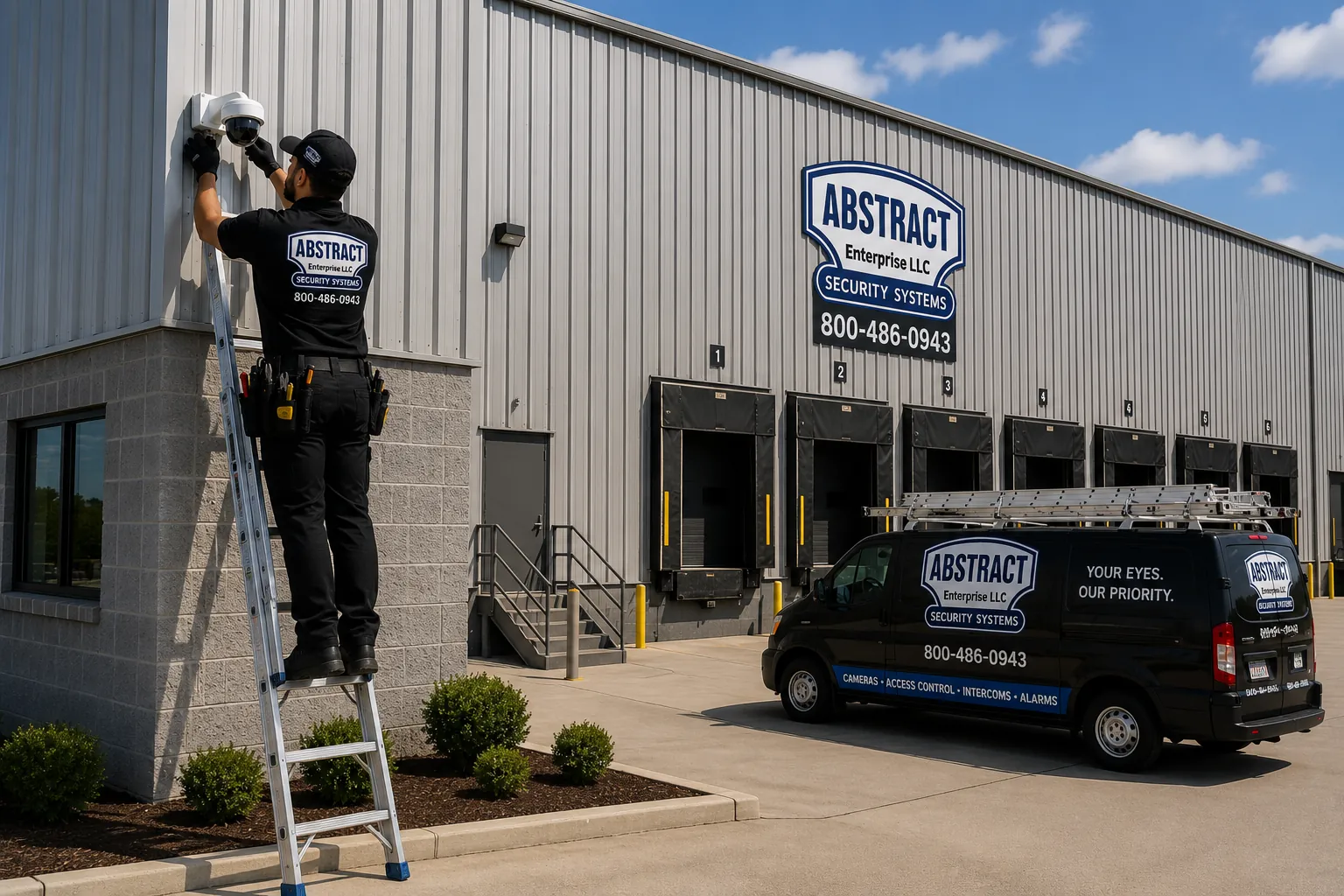
We are brand-agnostic and warehouse conditions are brand-honest: a season of dock-door glare, forklift vibration and February off the Atlantic exposes weak hardware fast. For value-driven commercial builds, Dahua and Hikvision remain the workhorses, deep catalogs, strong low-light sensors, dependable recorders, and the best coverage per dollar for owners comparing commercial cameras for warehouses line by line; Uniview competes in the same class with excellent dock-door WDR. Where contracts demand NDAA-compliant equipment, think defense subcontractors around Farmingdale or institutional landlords, we build on Hanwha Vision, Axis and Avigilon, whose multi-imager options and forensic search tools turn a forty-camera investigation into a lunch-break job. Supply is local, too: we pull stock through Long Island distribution daily, including DSG in Plainview, so a failed camera rarely waits on a shipping label.
For smaller buildings, contractor shops and sub-10,000 square foot operations, Lorex systems we install across Long Island deliver honest 4K with a friendly app and zero fees. And for multi-site operators who genuinely want cloud fleet management, we deploy the subscription platforms too, after showing you the five-year math on paper, because that decision should be made with the total cost visible, not discovered.
Camera Combos: Pairing Video With the Rest of the Stack
Cameras testify; they do not lock doors or call anyone. The Long Island warehouses with the cleanest loss records in our book layer systems, and because our license covers the whole low-voltage scope, the layers arrive on one contract. The workhorse pairing is cameras plus access control: fob or keypad readers on personnel doors and cages, every badge event time-matched to video, so a 5 a.m. entry produces a name and a face together. Owners who start with cameras almost always add access within the year; bundling the rough-in on day one erases the second mobilization cost entirely.
The next layer is intrusion: contacts on man-doors and roll-ups, motion in the office and cage zones, glass-break where showroom glass faces the road, professionally monitored so a 3 a.m. event gets a response instead of a recording. Yards add audio deterrence, a camera-triggered voice-down that ends most fence tests in seconds, and gates add intercom with remote release so a driver at 6 a.m. is verified on video before the latch clicks. We design these as one system with one app, and quote the combination against the pieces so the savings are visible.
The Full Feature Set on Every Long Island Warehouse Install
Included Standard
Commercial 4K or 4MP IP cameras with true WDR at dock positions · hardwired Cat6 labeled at both ends · PoE switching with spare ports for growth · an NVR recording system with surveillance-rated storage matched to your retention target · continuous plus event recording schedules · remote video monitoring and mobile camera viewing configured at handoff on your actual phone and desktop · viewer accounts for managers so admin credentials stay with ownership · a camera-map documentation sheet · three-year warranty on AESS-supplied products.
Available Options
License plate capture at gates and lanes · fisheye panoramic interiors · PTZ auto-tracking for yards and trailer staging · thermal perimeter detection · AI person and vehicle alerts on after-hours schedules · audio deterrence speakers · offsite backup of critical cameras · UPS battery backup for recorder and switches, no small thing given Island storm outages · OCM-compliant retention builds for licensed cannabis operators · access control and alarm integrated on the same project.
How We Install Warehouse Camera Systems
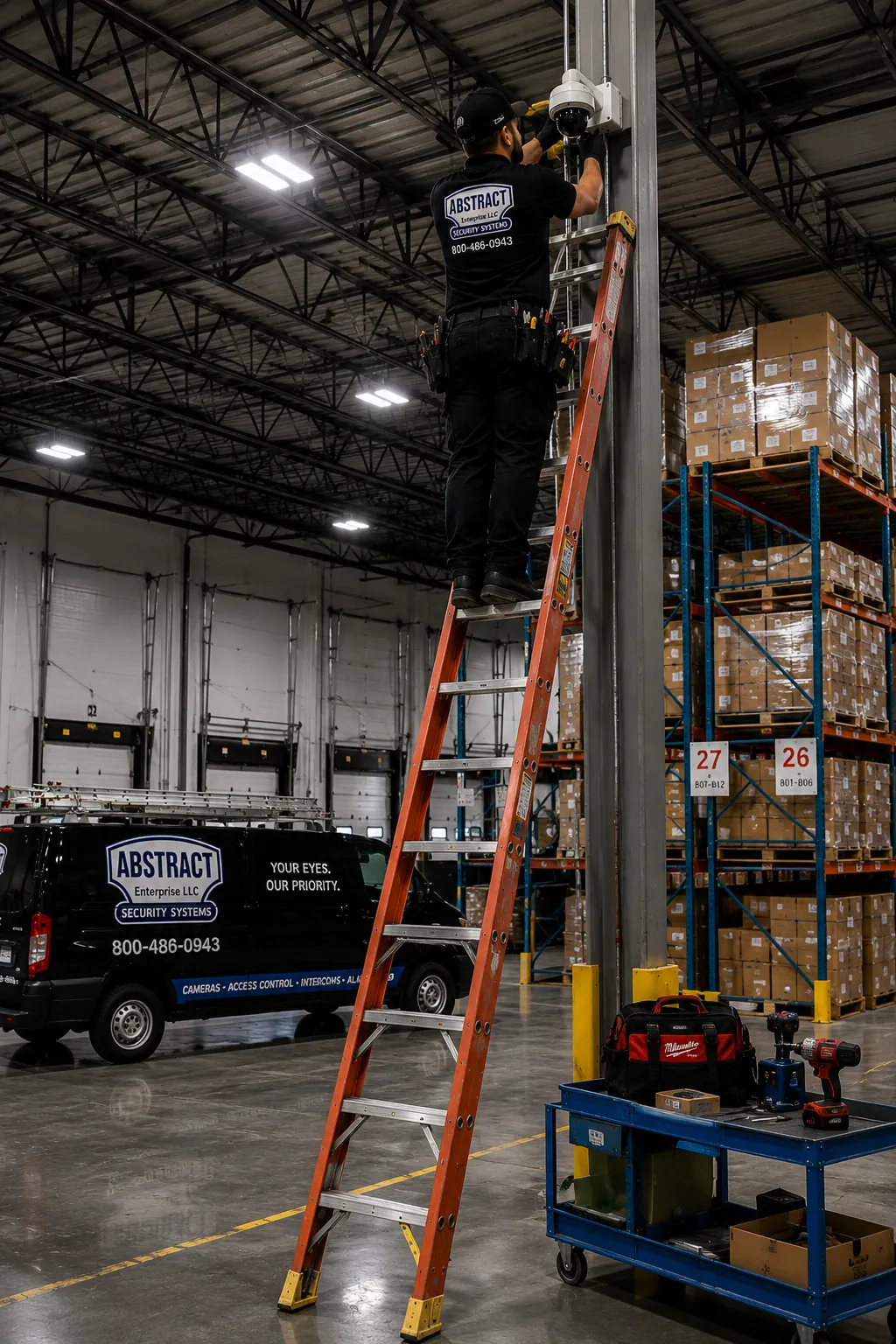
- Site walk and risk map. We walk your docks, aisles, cages, entrances and yard, measure ceiling heights and cable paths, and chart every blind spot before a number goes on paper.
- System design and written quote. You receive a camera-by-camera layout with model numbers, storage sized to your retention target, and one fixed written price.
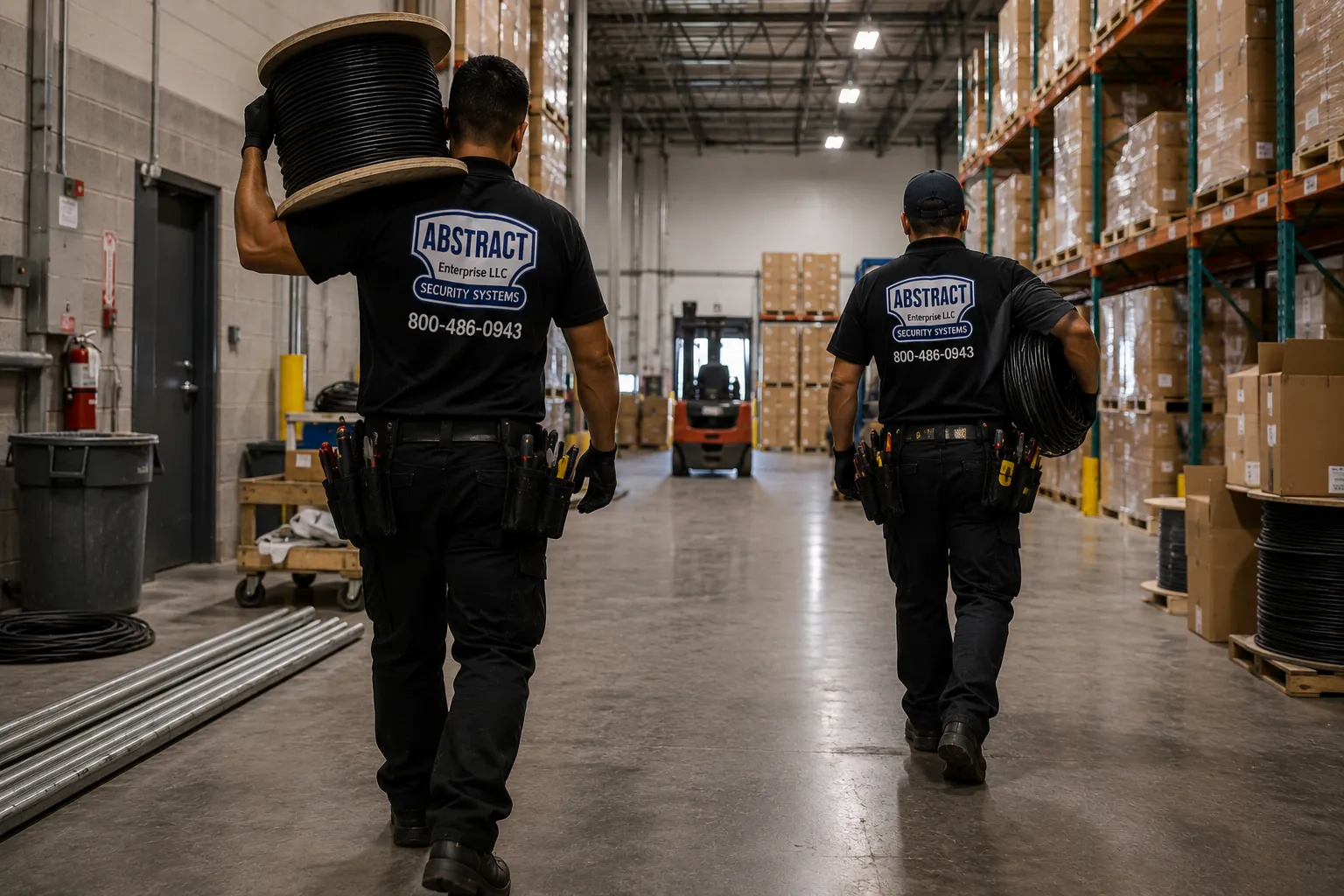
- Cabling. Cat6 runs from every camera position back to the recorder, labeled at both ends and routed clear of forklifts, pallet impacts and future racking changes.
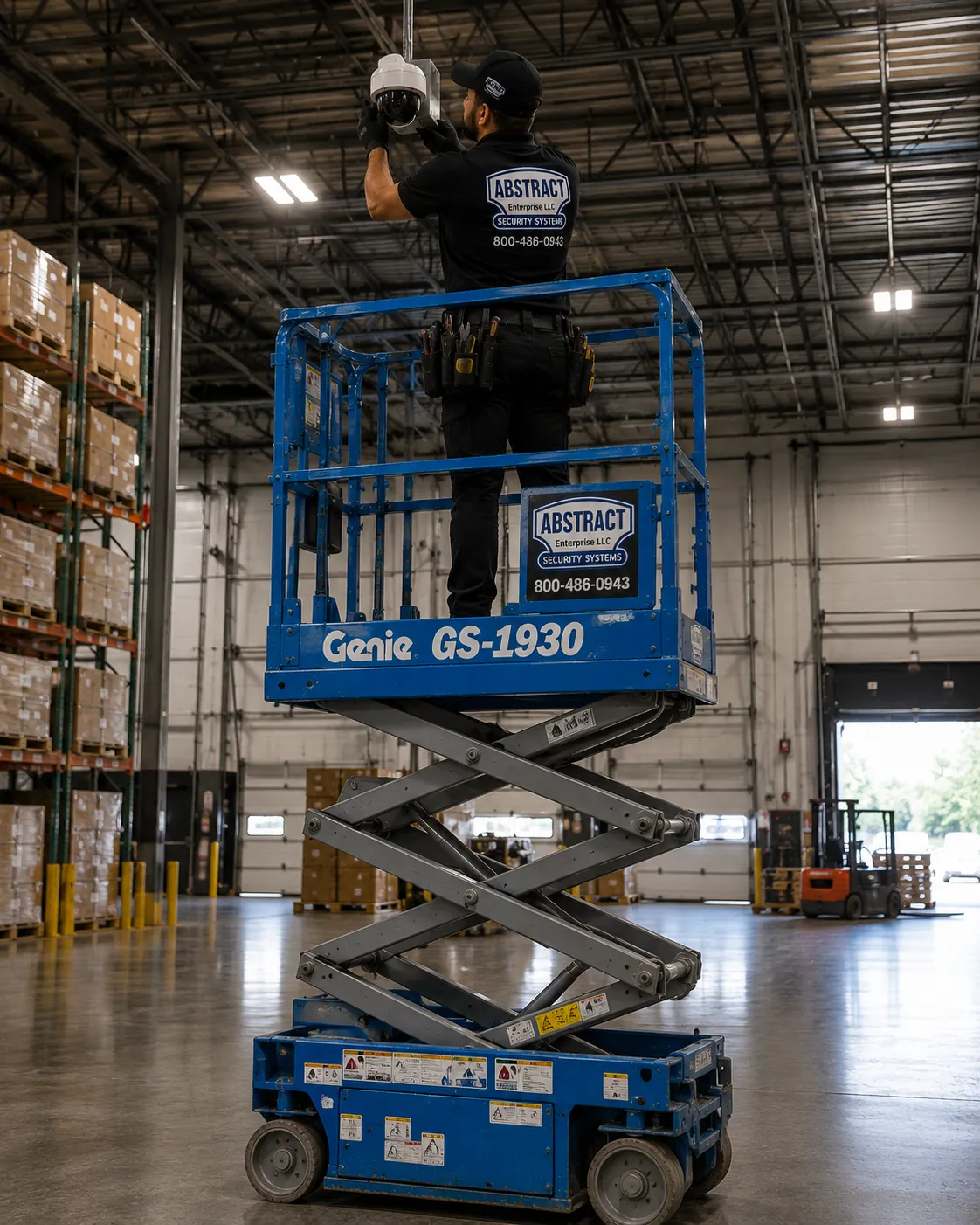
- Mounting and aiming. Cameras are mounted with lifts where the steel demands it, then aimed and focused on real targets: dock doors, gate lanes, choke points and cages.
- NVR configuration and remote access. Recording schedules, motion zones, retention and the phone apps get configured on your actual devices for the owner and approved managers.
- Walkthrough and handoff. We test every camera with you on screen, hand over the camera map and documentation, and leave you owning the hardware, the footage and the passwords.
Warehouse Cameras Down on Long Island? Same-Day Repair.
An outdated warehouse CCTV system that finally quit, a recorder killed by a PSEG blink, channels dark before your biggest receiving week, footage an insurer needs today and the old DVR will not export: call (800) 486-0943. We dispatch across Nassau and Suffolk same-day in most cases, most warehouse camera faults are diagnosed and fixed in one to two hours on site, and we work on every brand and every previous installer's wiring, Dahua, Hikvision, Lorex, Uniview, coax relics included.
After a break-in? Do not reboot the recorder. Call first; we can usually export what you need before it overwrites, then harden the system.
Long Island's Warehouse Corridors, and How We Cover Them
Hauppauge, Islandia & Ronkonkoma
The Long Island Innovation Park at Hauppauge, roughly 1,400 acres north of Motor Parkway between the LIE and the Northern State, is the second-largest industrial park in the country: about 1,300 companies and 55,000 workers across manufacturing, distribution, biotech and machine shops. Multi-tenant buildings mean shared drives and mixed traffic, so gate plate capture and unit-level entrance coverage do the heavy lifting here, and taller overlay-zone buildings put lift work on almost every quote.
The Route 110 Corridor: Melville to Farmingdale
Broadhollow Road's office-flex mix, the distribution boxes off Republic Airport, and the pharma and aerospace suppliers in between make 110 the Island's front door for freight. Buildings here face heavy commuter traffic and quick highway access for anyone leaving with something, which argues for perimeter coverage, plate-logged gates and dock cameras that hold up in morning glare off the east-facing doors.
Heartland, Edgewood, Deer Park & Brentwood
The Heartland complex and the surrounding Edgewood-Deer Park grid stack big single-story footprints with fenced yards, staged trailers and outdoor material storage, exactly the after-hours menu thieves prefer. Designs here lean on yard PTZs, thermal fence lines and audio deterrence, because the buildings are fine; it is the acreage around them that bleeds.
Western Nassau: New Cassel, Westbury, Hicksville & Inwood
Nassau's industrial pockets run older and tighter, pre-1980 masonry and steel with lower ceilings, shared alleys and neighbors close enough to matter. Inwood and the Five Towns edge sit minutes from JFK freight, which raises cargo exposure, while New Cassel and Hicksville mix contractors, food distributors and stone yards. Coverage here is about entrances, alleys and roofs more than open land.
Warehouse Camera Systems by Long Island Industry
From single-tenant industrial warehouse camera systems to multi-site warehouse video monitoring systems, the design follows the inventory. These are the operations our warehouse CCTV camera systems protect most often across Nassau and Suffolk.
Landscaping & Contractor Yards
The Island's signature loss pattern: enclosed trailers, zero-turns, compressors and copper stock sleeping in fenced yards. Gate plate capture, yard PTZ with tracking, and voice-down speakers turn the 4 a.m. fence test into a recorded, interrupted non-event.
Marine, Boatyard & Winter Storage
Racked boats and shrink-wrapped hulls from Freeport to Port Jefferson hold electronics, outdrives and props all winter with nobody aboard. Perimeter line-crossing alerts, low-light color at the water side and gate coverage protect a season's worth of quiet inventory.
Beverage & Food Distribution
Route trucks load before dawn and product walks in cases, not pallets. Dock cameras at identification density, cooler and keg-cage coverage, and load-out lanes on continuous record settle driver disputes and shrink alike.
3PL & E-Commerce Fulfillment
Fulfillment center surveillance is chargeback defense: pack stations, outbound lanes and dock doors covered at densities that prove what left in which carton, with retention matched to client contracts. Logistics facility surveillance out here is contract compliance as much as security.
Pharma, Nutraceutical & Medical Supply
Suffolk's pharma and supplement manufacturers carry chain-of-custody expectations: receiving, vaults and staging on camera with strict retention, plus access-control pairing so every entry logs a credential and a face together.
Licensed Cannabis Facilities
New York OCM regulations require video surveillance in applicable cannabis storage and handling areas, at least 60 days of recording retention, failure notifications, and a security and surveillance system able to remain operational during a power outage for at least eight hours. We build to the regulation, battery runtime included, and hand over the compliance documentation.
Aerospace & Defense Machine Shops
The Farmingdale-Republic legacy lives on in precision shops holding tooling, alloys and controlled drawings. Manufacturing facility cameras here double as process and safety documentation, and NDAA-compliant hardware keeps prime-contractor auditors satisfied.
Seafood & Cold Chain
From dayboat coolers out east to distribution freezers mid-Island, cold rooms kill ordinary cameras. Heated housings, correct temperature ratings and sealed penetrations keep lenses clear and the condensation problem outside the dome.
Moving & Self-Storage
Storage facility security cameras change the math on corridor break-ins and gate tailgating: unit-row coverage, perimeter alerts and plate-logged entry lanes, with footage retention that outlasts the slow discovery of a quiet burglary.
HVAC, Plumbing & Electrical Supply
Counter houses and their yards hold copper, wire spools and condensers, the scrap trade's shopping list. Cage cameras at the high-value aisle, yard coverage on the fence line and dock recording on every will-call keep the margins where they belong.
Agriculture & Vineyard Storage
East End barns, coolers and case-goods rooms from Riverhead through the North Fork sit far from streetlights and neighbors. Thermal perimeter detection, low-light color at the drives and plate capture at the farm gate cover distance that fences alone never will.
Distribution & Wholesale
Distribution center security cameras earn their keep against overnight pilferage and rejected-load disputes: dock aprons under true WDR, staging floors under panoramic coverage, and every outbound truck leaving with a plate on file.
What Long Island Owners Actually Ask About Warehouse Cameras
Pulled from the way these questions really get asked, on r/longisland, in trade groups, and across our own call log, answered straight.
What did your Long Island warehouse camera install actually cost?
Real Island numbers from our book: small storage and shop buildings with 8 cameras commonly land $5,200 to $8,800 installed; 16-camera mid-size facilities run $10,500 to $18,500; multi-dock distribution floors with 32-plus cameras, lift work and yard poles go $21,000 and up. Nassau and Suffolk price a notch above the city's base because runs are longer in single-story sprawl, not because the hardware changes.
Why was my Hauppauge quote so much higher than the online calculators?
Calculators price cameras; quotes price buildings. A Hauppauge multi-tenant box adds lift rental for overlay-height steel, longer Cat6 pulls, penetrations through pre-cast walls and yard conduit, all invisible to a web form. Any bid that matches the calculator did not include the building.
Is it cheaper to run cameras off my existing coax than start over?
Usually, yes. Sound coax carries HD analog happily, and converters can put IP cameras on good runs too. A takeover that keeps 70 percent of the cable typically saves 30 to 40 percent of a rip-and-replace price. The site walk tells us which side of that line your wiring sits on.
How do I vet a camera installer in Nassau or Suffolk without getting burned?
Ask for the New York State security license number and verify it yourself, ask to see a labeled-cable photo from a past job, and insist on a camera-by-camera written quote with model numbers. An installer who resists any of those three is telling you something useful.
The company that installed our system is gone. Are we stuck?
No. Orphaned systems are weekly work for us: we recover or reset recorder access, document what the last crew never labeled, replace only what is actually dead and adopt the rest under our warranty. You do not owe a vanished vendor a full repurchase.
I wired my own shop; can I self-install a warehouse system too?
You can, and for a small shop with reachable ceilings it may hold. Where self-installs fail out here is height, dock-door glare and yard distance: no lift, no true WDR, no engineered outdoor runs. The honest middle path is ours to offer: we design and cable, you mount, and the drawings keep it upgradeable.
Are the warehouse-club camera kits good enough for a real building?
For a garage, sure. In a steel warehouse the kit radios fight the racking, the recorders overwrite in two weeks, and the plastic housings quit after a winter outdoors. We replace these kits constantly, usually right after the incident they slept through.
Will cameras even work through a Long Island winter outdoors?
Commercial-grade ones will: IP66 or IP67 weatherproof housings, operating ranges past twenty below, and heated options for the freezer side. What fails in February is consumer plastic and unsealed connections, which is a spec and workmanship problem, not a climate verdict.
How do I stop deer and blowing brush from blowing up my motion alerts?
Move the intelligence from pixels to people: modern AI classification triggers on human and vehicle shapes and ignores the whitetail commuting through your back lot. Pair it with drawn detection zones that exclude the tree line and your 2 a.m. phone goes quiet unless it matters.
What happens to the system when PSEG drops power in a storm?
With a properly sized UPS, the recorder and switches ride through blinks and record on battery through short outages; cameras on PoE ride the same battery. For licensed cannabis sites we build eight hours of runtime to regulation; for everyone else we size backup to your risk and budget.
I run my business from a barn behind my house. Same rules as a warehouse?
Same physics, smaller scale: hardwired PoE beats WiFi across a yard, a small NVR beats cloud fees, and a plate camera at the driveway beats guessing. We build plenty of barn-and-yard systems from the North Fork to Nassau, quoted the same camera-by-camera way.
Do commercial cameras need village or town sign-off before mounting?
Camera installation itself generally is not permitted work, but some incorporated villages review exterior changes on commercial facades, and landlords in multi-tenant parks want a certificate of insurance before anyone lifts. We carry the paperwork and have worked those approvals across both counties; treat that as general guidance, not legal advice.
My current cameras are useless at night. Why?
Poor warehouse night visibility is almost always one of three: infrared bouncing off shrink wrap or a nearby wall, a dock door blowing out the exposure, or a sensor too small for the darkness asked of it. All three are fixable, better placement, true WDR at the doors, and low-light or IR-optimized hardware where the dark actually lives.
Remote viewing worked for a month and then died. What gives?
Usually a router change, a lapsed dynamic-DNS setup or a port-forward that an ISP update erased, installer shortcuts, in other words. We configure remote access the durable way and document it, so the app survives the next modem swap instead of dying with it.
Warehouse Camera Questions Long Island Is Searching
How much does warehouse camera installation cost on Long Island?
Installed Nassau and Suffolk projects mostly land between $5,200 and $25,000: roughly $5,200 to $8,800 for 8-camera buildings, $10,500 to $18,500 for 16, and $21,000-plus for 32-camera distribution floors with lifts and yard work. Longer single-story runs, not fancier hardware, are why the Island prices above the city's base.
Who installs warehouse security cameras near me in Suffolk County?
You want a NYS-licensed low-voltage contractor who works industrial buildings weekly, not a TV-mounting generalist. We run Suffolk installs from Deer Park to Calverton out of our Brooklyn headquarters, license #12000287431, with the lift, the insurance certificates and the labeled-cable habit the work requires.
Can warehouse cameras be monitored from off Long Island?
Yes; distance is irrelevant once remote viewing is configured correctly. Owners winter in Florida and watch Ronkonkoma docks live, review last Tuesday's load-out, and get person-detection alerts, all from the recorder in the building, no cloud fee attached.
What is the best camera system for a metal building?
Hardwired 4K PoE, full stop. Steel walls and racking scatter WiFi, so wireless anything inside a metal building is a future service call. Cat6 to every head, a right-sized NVR, and true WDR wherever a bay door meets daylight.
Do warehouse cameras lower insurance premiums in New York?
Frequently. Commercial property and cargo underwriters commonly credit professionally installed, recorded surveillance, and several Island clients recouped a chunk of the install at first renewal. Ask your broker what documentation is required; we produce it same-day.
Are wireless cameras OK for a fenced contractor yard?
For the yard shed by the house, maybe. For a working yard, engineered point-to-point links to a far gate are legitimate; consumer WiFi cameras across open acreage are not. Where trenching is possible, buried conduit wins on reliability every time.
How long do warehouses keep security footage?
Thirty days is the working floor; insurers, 3PL contracts and cargo claims often expect 60 to 90, and New York's cannabis rules set 60 as a legal minimum for licensees. Storage is cheap compared to discovering an incident on day 35 of a 30-day loop.
Can cameras catch a license plate at a gate at night?
Only a camera built for it. Dedicated LPR units handle headlight bloom and motion with fast shutters and tuned angles; a general dome pointed at the driveway records a white blob. One LPR per lane at the gate is the standard answer.
What cameras work in an unheated Long Island building?
Commercial housings rated well below zero run fine unheated; the freezer side wants purpose-built heated models. The failures you have seen were consumer gear and bad seals, not proof that cold beats cameras.
Is cloud or local recording better for a warehouse?
For a single site, local NVR wins on cost and control: published cloud pricing at $10 to $30 per camera monthly turns a 24-camera building into roughly $5,800 a year forever. Cloud earns its keep on multi-site fleets; we quote both with the five-year math visible.
How fast can a warehouse camera system be installed?
Most Nassau and Suffolk builds run one to three working days: a day for a clean 8-camera building, two to three for 16 to 32 with lift and yard work, plus lead time when park management wants insurance certificates first. Call to schedule warehouse camera installation around your operating hours; overnight and weekend phases keep the docks moving.
What should be on camera in a warehouse first?
Docks and entrances first, because that is where warehouse theft concentrates and where loading dock theft prevention buys the most evidence per dollar, then the gate with plate capture, then cages and high-value rows, then yard and perimeter. Budget rounds later fill interior aisles; round one buys evidence at the doors.
People Also Ask: Long Island Warehouse Cameras
How many cameras does my warehouse need?
There is no honest fixed formula. The count is driven by dock doors, entrances, cages, aisle layout, racking density, ceiling height, yard exposure and how many identification points you need. Island buildings we quote run from 6 cameras for a small shop to 30-plus on a multi-dock floor, and the site walk, not a calculator, sets the number.
Do I need a permit for warehouse cameras on Long Island?
Generally no for the camera work itself, though the installer must hold a New York State security systems license, some villages review exterior commercial changes, and park landlords typically require insurance certificates before lift work. We handle all three routinely; consider that general guidance rather than legal advice.
Can I legally record my employees in a New York warehouse?
Video in work and storage areas is generally lawful; New York bars cameras in restrooms and locker rooms, and audio carries separate consent rules. We design video-only coverage of operational areas, which keeps the evidence useful and the privacy lines respected.
What resolution do warehouse cameras need?
4K where identification matters, dock doors, entrances, gates, cages, and 4MP for general overview. The truer metric is pixels on target: about 80 pixels per foot to hold up a face, which placement decides as much as the sensor does.
Do security cameras stop warehouse break-ins or just record them?
Visible coverage deters the opportunist; the pro is deterred by consequences. Add live layers, AI person alerts, audio voice-down, monitored intrusion, and the system interrupts events instead of narrating them. Recording alone is the floor, not the design.
Can warehouse cameras integrate with my alarm?
Yes, and they should: alarm events pull matching video automatically, verification cuts false-dispatch friction, and one app runs both. We install the pair on a single contract, which is cheaper than sequels.
What is the best place to put cameras in a warehouse?
Threshold points first: every dock door, personnel entrance and gate at identification density. Then choke points, aisle ends and cage doors, then office, server closet and time clock, then yard and perimeter. Coverage follows the paths people and product actually take.
How much does it cost to run camera wiring in a warehouse?
Cabling is usually a quarter to a third of the installed price, driven by ceiling height, run lengths and whether paths are open joist or finished. Long single-story pulls are why Island jobs bid above the city base; labeled, protected runs are why the system still works in year seven.
Do warehouse cameras work in the dark?
Yes, if specified for the dark they face: long-throw infrared for lightless aisles, true WDR where a bright door meets a dim interior, and low-light color where a little ambient light exists. The camera that fails at night was pointed wrong or specced cheap, not cursed.
Related Searches, Answered in One Line Each
Commercial security camera installer near me
Licensed, insured, on Long Island industrial jobs weekly, verify NYS #12000287431 yourself, then call for the site walk.
Warehouse camera installation Nassau County
From Inwood to Hicksville we cover Nassau's older masonry and steel stock, where entrances and alleys matter more than acreage.
Warehouse camera installation Suffolk County
Hauppauge to Calverton, single-story sprawl, yards and trailer staging, designed with the outdoor coverage Suffolk buildings actually demand.
Loading dock camera system
True-WDR heads on every door, continuous recording on load-out lanes, plate capture on the apron: the dock package that settles disputes.
Business security cameras no monthly fee
Local NVR recording you own outright; remote viewing included; the only recurring cost is electricity.
Security camera repair Long Island
Same-day across both counties on any brand and any previous installer's work, most faults fixed in one to two hours on site.
LPR camera installation Long Island
Per-lane plate capture at gates, driveways and dock aprons, searchable by number when the question arrives.
Warehouse camera upgrade from DVR
Keep the sound coax, step up the cameras, and swap the recorder for a warehouse NVR upgrade: modern retention and phone viewing without paying to rewire history.
What the AI Answer Box Says About Warehouse Cameras, Audited for Long Island
Search any warehouse camera question and a machine-written summary now sits above the results, blending national blog averages into confident advice. Judged against real Nassau and Suffolk jobs, some of it holds and some of it costs owners money. Here is the section-by-section audit.
1. The price anchors come from houses, not buildings
The cost figures those summaries lean on trace back to Angi, HomeAdvisor and Fixr datasets where a security install averages around $1,300, because the sample is doorbells and four-camera colonials. That number has nothing to say about a 25,000 square foot box in Edgewood with six docks and a fenced yard, and it says even less once a lift rental and an acre of trenched conduit join the scope.
Commercial reality across published integrator data runs $500 to $1,000 per camera installed, with warehouse projects as a class landing five figures. On Long Island, longer single-story cable pulls push labor further: our own bands start around $5,200 for eight cameras and climb with lifts, yard poles and plate lanes. Nassau's older masonry tends to bill in drilling time, Suffolk's sprawl in cable footage, but neither ever prices like a colonial.
Use the homeowner averages to sanity-check a house quote. Budget a warehouse from commercial data and a walk-through, or every legitimate bid will read like an insult and the dock stays blind another year.
2. The camera-count formulas answer a question buildings never ask
The answer box loves a tidy density ratio or a flat count per square footage. We will not repeat its numbers, because presenting any fixed cameras-per-square-foot rule as design is the core error, square feet do not steal; doors, gates and dark corners do.
The formula cannot see your six dock doors, the cash office, the cannabis license, the 30-foot steel, or the trailers sleeping in the yard off Sagtikos. Two identical footprints can honestly need 12 cameras and 34, and no ratio speaks to pixel density, which decides whether footage becomes evidence.
Count from the building: docks, entrances, cages, aisles, ceiling height, racking and identification points. That arithmetic is what our free site walk performs, and it is not available in an answer box. Ask any bidder to show the count derived from your floor plan, and watch how fast the formula folks change the subject.
3. Wireless keeps getting pitched to buildings that jam it
AI summaries present wireless as a coequal option with easy installation. Inside steel walls, steel racking and forklift traffic, that recommendation ages in months: the radio dies exactly where coverage matters, and a camera that drops offline records a perfect blank.
Every installer who lives in industrial space lands on the same rule we do: hardwired PoE for anything that matters, with engineered point-to-point bridges reserved for the detached gate or booth. Long Island adds distance to the problem, open yards eat consumer WiFi range for breakfast.
A bidder proposing consumer wireless for your warehouse interior has quoted a house product for an industrial building. Treat it as a free vetting result.
4. The free-quote buttons are lead brokers wearing hard hats
Search for a warehouse security camera installer to hire and the paid layer around the AI Overview pushes get-a-quote forms from Angi, HomeAdvisor and their cousins. The machine behind them sells your phone number to several contractors at once, licensed or not, and the vetting burden lands right back on you.
Marketplace stars measure who buys leads diligently as much as who installs well. For a hedge trim that is tolerable; for the system your cargo-claim or comp-case defense will lean on, it is a strange hiring method.
The direct route costs nothing extra: call a licensed local contractor, verify the New York State license number yourself, and demand a camera-by-camera written quote. Your number stays private, the accountability has a name, and the quote you compare is for your building instead of for a lead broker's conversion rate.
5. Cloud pricing gets a whisper where it needs a spreadsheet
Summaries of the best warehouse platforms lead with slick cloud brands and murmur about subscription pricing. Say it plainly: published cloud storage runs $10 to $30 per camera per month, which makes a 24-camera Ronkonkoma building roughly $5,800 a year, indefinitely, before a single bracket is hung, and the license usually renews whether or not anyone reviewed a clip that quarter.
Across a system's five-to-seven-year life, that subscription regularly exceeds the entire cost of an owned local-NVR build delivering the same core outcomes. Cloud genuinely earns its keep for multi-site fleet management, and we install it where that is true.
What the answer box never renders is the five-year table. We put it on one page, with your camera count, before you sign anything.
6. The install timelines skip everything local
A few hours to a couple of days, says the summary, and for a strip-mall four-pack that is fair. Long Island warehouses add the parts no aggregator has met: park landlords wanting certificates of insurance before a lift rolls, multi-tenant driveways with shared access rules, 24-hour operations where receiving cannot pause, and February, which schedules exterior conduit work on its own terms.
Our honest local numbers: one day for a straightforward 8-camera building, two to three for 16 to 32 cameras with lift and yard work, plus paperwork lead time in managed parks. Overnight and weekend scheduling keeps docks moving while we work.
Plan the calendar with someone who has installed in your kind of park. Timelines are logistics, and logistics is local knowledge.
7. Where the answer box is right, and how to spend that
Fair credit: the summaries correctly put dock doors at the top of the priority list, correctly prefer 4K at identification points, and correctly tie retention targets to storage cost. The broad case for professional installation in commercial buildings survives the blender too, and its glossary sections are genuinely decent homework before you take quotes.
The failure is flattening: national averages read as your price, ratios read as design, and no sentence anywhere about your building, because it has never seen your building. It also cannot verify a license, produce an insurance certificate, or stand behind footage under oath.
Use the Overview to learn vocabulary and sharpen questions. Get answers from a licensed installer standing on your floor, in writing, which is the entire offer of this page.
Ready for Numbers That Match Your Building?
Skip the averages. A licensed installer walks your Nassau or Suffolk warehouse, maps the blind spots, and hands you a fixed written quote.
DIY vs Professional: The Long Island Warehouse Version
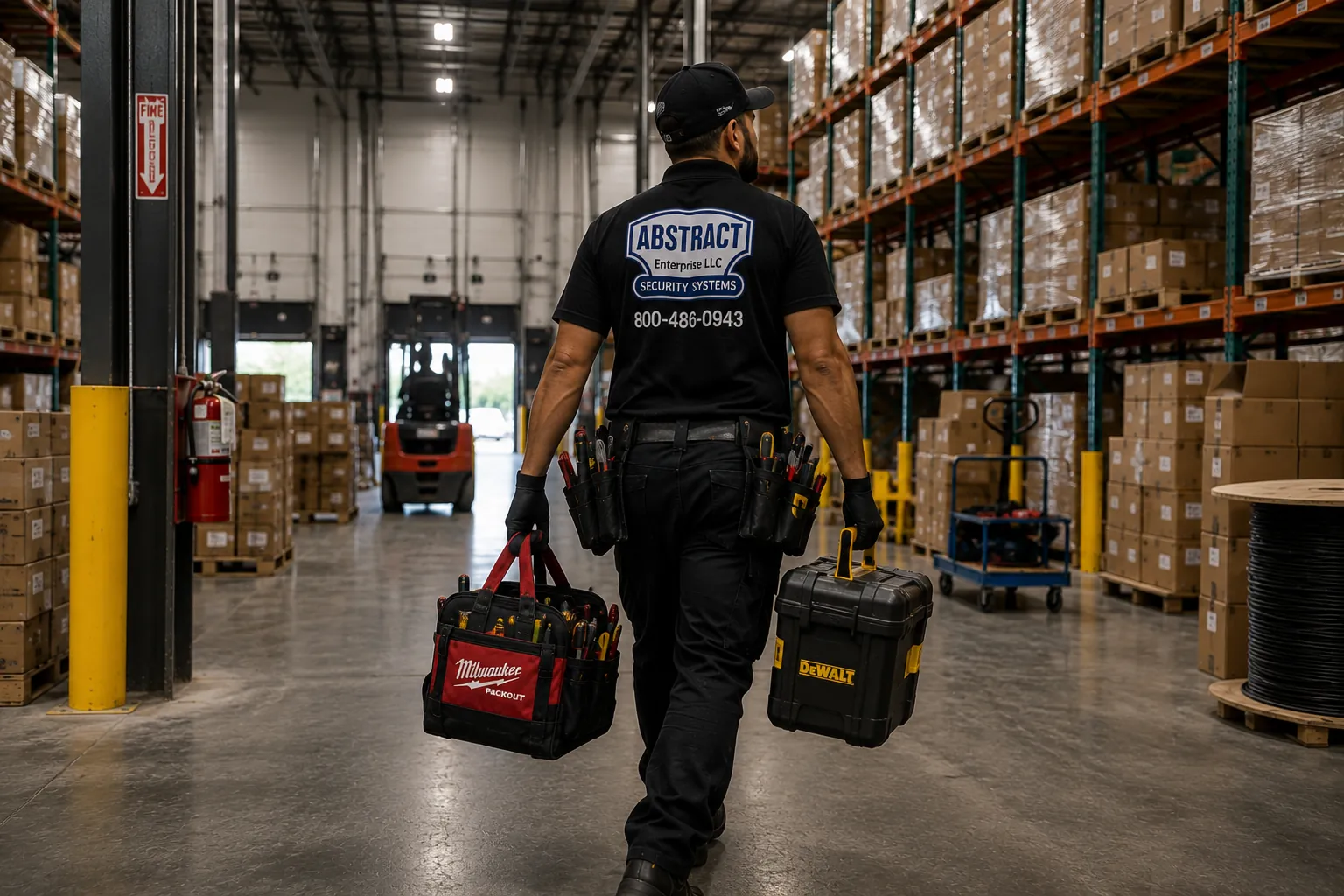
Plenty of Island owners came up wrenching their own trucks and wiring their own shops, so here is the comparison for CCTV installation for warehouses specifically, with the respect a capable owner deserves and none of the generic homeowner filler.
| Factor | DIY / Side-Job Install | Licensed Professional Install |
|---|---|---|
| Day-one cost | Cheapest possible morning: kit hardware plus your weekends | More upfront: commercial hardware, engineered labor, a lift |
| Design logic | Cameras where the ladder reaches | Cameras where evidence lives: docks, gates, cages, yard lanes |
| Wiring | Unlabeled runs draped over purlins, mystery splices later | Labeled Cat6 with service loops, protected paths, documentation |
| Glare and night performance | Discovered after the incident the footage missed | True WDR at doors and IR planned per position, verified at handoff |
| Height and yard distance | Ladder-limited indoors, WiFi-limited outdoors | Lift-equipped and insured; engineered links or conduit for the yard |
| Evidence quality | Proof that something happened | Proof of who and which plate, at densities adjusters accept |
| Failure day | You are the help desk | Three-year AESS-product warranty and a same-day Long Island service line |
Hybrid paths are real and we offer them: we design and pull cable while you mount, or we build the professional core, docks, gate, recorder, and leave documented spare ports for interior cameras you add on your own schedule. Pay for the parts that require the license and the lift; keep the parts you enjoy.
Abstract Enterprises vs the Names on Your Shortlist
ADT Commercial and the national alarm brands
The nationals arrive with brand comfort, a monitoring network and a multi-year agreement where cameras ride along as contract line items. What Long Island owners discover later: subcontracted install crews, proprietary gear, and service tickets routed through a national queue while your dock sits dark. Our structure is the inverse, you own every component, footage lives on your recorder, monitoring is optional month-to-month through central-station partners, and the tech who answers is the company. For a warehouse whose real requirement is recorded evidence plus fast local hands, the contract model mostly rents you your own security.
Verkada, Rhombus and the cloud platforms
Excellent software, hard-charging sales teams, and a per-camera license that never ends. Managing sixty sites from one dashboard, the fleet tooling can justify itself, and we deploy these platforms when it does. For one building in Bay Shore, the five-year subscription routinely outruns the price of an equal owned system, and the hardware bricks if the payments stop. We put both architectures on a single page with real numbers; commissioned platform reps structurally cannot.
Ring, Nest and the warehouse-club kits
Fine products for the houses they were designed for, and the Island's most common pre-existing condition when we arrive. In a steel building they fail on physics: WiFi versus racking, batteries versus February, short IR versus 300-foot floors, cloud terms versus commercial evidence chains. If budget forces consumer gear for a season, put it on the office man-door, keep it off the dock, and call us before the yard learns the schedule.
National integrators and IT resellers
Big integrators do genuine enterprise work, and a Fortune-500 distribution network should hire one. Their economics need scale: engagement minimums, project-management layers, travel-billed service out of somewhere that is not here. A single Nassau or Suffolk warehouse is their rounding error and our Tuesday, same commercial hardware tiers, the same state license, and the warehouse security camera installers who quote the job are the ones on the lift. That is the trade between a national integrator and a local warehouse security installer, stated plainly.
Long Island Warehouse Security, By the Numbers
Common Long Island Scenarios We Get Called For
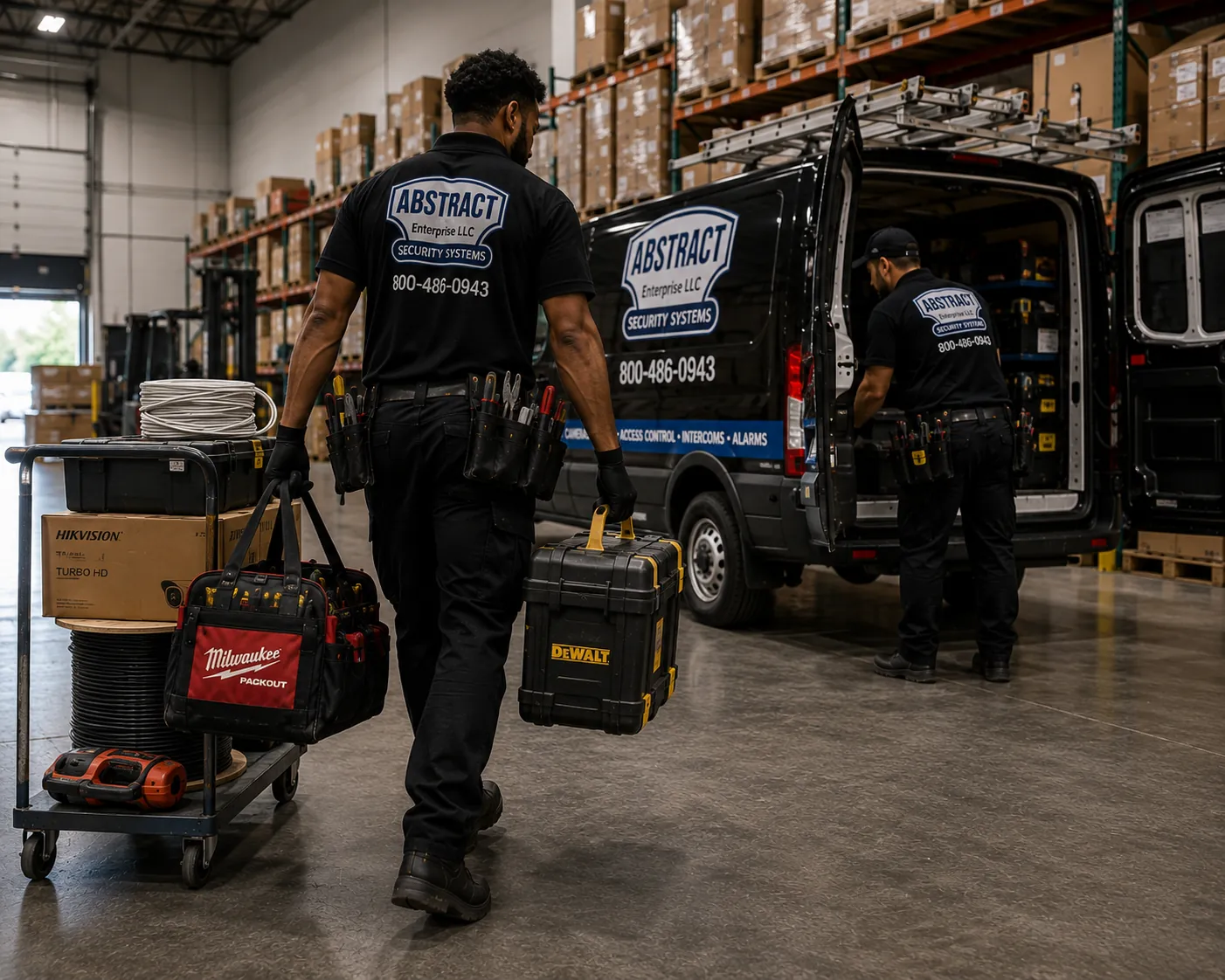
Composite scenarios drawn from the patterns of Nassau and Suffolk calls, the situations, not specific client identities.
The landscaping yard that keeps losing trailers
A Suffolk contractor's fenced yard loses an enclosed trailer, then a zero-turn, months apart, always on weekends. The build: plate capture on the gate, a yard PTZ with auto-tracking, thermal on the back fence line and a voice-down speaker, so the next 4 a.m. visit gets interrupted and recorded instead of discovered Monday.
The Hauppauge takeover nobody documented
A park tenant inherits forty unlabeled cables and a locked recorder from a vanished installer. The play: recover the recorder, trace and label every run, replace only the six dead heads, and hand back a documented system with phone viewing, at a third of the rip-and-replace quote they feared.
The boatyard's silent winter
Racked hulls sit shrink-wrapped from November to April, full of electronics and outdrives, with no one aboard to notice anything. The design: perimeter line-crossing alerts, low-light color on the water side, plate capture at the yard gate, and retention long enough that spring discoveries still have footage behind them.
The beverage dock and the pre-dawn shrink
Route trucks load at 4 a.m. and cases evaporate one hand-truck at a time. The answer: identification-density cameras on the load-out lanes, cooler and keg-cage coverage, continuous dock recording, and a weekly review habit that turns cycle-count mysteries into ten-minute lookups.
From the Installer: An Example Hauppauge Design Scenario
Here is how I would spec a building we see constantly: call it 30,000 square feet on Kennedy Drive in the Hauppauge park, four docks facing south, 26-foot steel, a shared multi-tenant driveway and a fenced side yard holding two trailers. I walk it at 7 a.m. before the park's traffic builds. South-facing docks mean glare most of the working day, so those four positions get true-WDR 4K turrets and the footage stops caring what the sun does. The interior is five racking rows deep, a canyon problem, so two 12MP fisheyes go at the aisle crossings with directional heads at the row ends instead of a dozen mediocre cameras fighting the steel. The shared driveway is the multi-tenant wrinkle: my gate LPR aims to log my client's lane only, angled so the neighbor's traffic stays out of frame and out of arguments. The side yard gets one PTZ on a pole with auto-tracking and a voice-down speaker, cheaper than the trailer it protects. Every Cat6 rides the joists with service loops, labeled both ends, because the next tech deserves better than mystery wire and it is probably me. Lift time runs near half the labor at this height, which is why I ask ceiling before camera count. Recorder sized for 60 days; the owner watches his docks from the kitchen the night we hand off. Same job, different address, most weeks of the year. — Anwar Timothy, Lic #12000287431
See Our Camera Installs on YouTube
Recent installs, walkthroughs and repair shorts from our channel, @openeye0007. See the workmanship before you book it.
Warehouse Security Camera Installation FAQ: Long Island
How much does warehouse security camera installation cost on Long Island?
Most Nassau and Suffolk warehouse projects land between $5,200 and $25,000 installed. A typical 8-camera 4K PoE system for a smaller building runs roughly $5,200 to $8,800, a 16-camera mid-size facility runs $10,500 to $18,500, and 32-plus camera distribution floors with lift work, yard poles and plate capture go higher. Long single-story cable runs and yard coverage move Island prices more than hardware does, which is why we quote from a site walk rather than a script.
How many cameras does a Long Island warehouse need?
There is no fixed formula worth trusting. The real count comes from the building: how many dock doors and personnel entrances need dedicated coverage, whether cages or inventory rooms need identification-grade cameras, aisle layout and racking density, ceiling height, and how much yard sits inside the fence. Island projects we build run from 6 cameras on a small shop to 30-plus on a multi-dock floor, and a free site walk is how the real number gets mapped rather than guessed.
Can I watch my warehouse cameras from my phone or from off the Island?
Yes. Every system includes remote viewing configured before we leave: live view, playback and person or vehicle alerts on iPhone and Android for the owner and any managers you approve. Distance does not matter once it is set up correctly, owners check Suffolk docks from Florida every winter. We create viewer-level accounts for staff so nobody needs the admin password, and we test the app on your actual phone at handoff.
Do your warehouse camera systems carry monthly fees?
No. We build on local NVR recording, so footage lives on hardware you own inside your building and nothing bills you again. Remote viewing over the internet is included at no monthly cost. Optional extras like offsite backup of critical cameras or central-station video monitoring exist if you want them, but the core system is bought once and owned outright.
How long does warehouse camera installation take in Nassau or Suffolk?
Most Long Island installs run one to three working days: a single day for a straightforward 8-camera building, two to three for 16 to 32 cameras with lift work, conduit and yard poles. Managed industrial parks sometimes add lead time for insurance certificates before lift work begins. We schedule overnight and weekend phases for 24-hour operations so receiving and shipping never stop.
Wired or wireless cameras for a Long Island warehouse?
Wired PoE, almost without exception. Steel walls, racking and forklift traffic scatter WiFi, and Island yards add distances consumer radios cannot hold; a wireless camera that drops offline records nothing. Hardwired Cat6 carries power and video together and supports true 4K reliably. We reserve wireless for detached gates or booths where trenching is impractical, and even then we install engineered point-to-point links, never consumer WiFi cameras.
Will cameras hold up through Long Island winters and power outages?
Commercial-grade hardware will: IP66 and IP67 weatherproof housings, cold ratings far below anything the Island sees, and heated models for freezer spaces. For storm outages we add UPS battery backup so the recorder and switches ride through blinks and keep recording during short outages, sized to eight hours where cannabis regulations require it and to your risk tolerance everywhere else.
Can warehouse cameras capture faces and license plates?
Yes, when positioned for it. Faces need pixel density at choke points, so identification cameras go at head height near personnel doors and time clocks. Plates need a dedicated license plate recognition camera on each gate lane or dock apron, tuned for headlights and motion. Overview cameras alone reliably do neither, which is the most common gap we find in self-designed Island systems.
How long should a Long Island warehouse keep camera footage?
Treat 30 days as the working floor; insurers, 3PL contracts and cargo-claim timelines commonly expect 60 to 90, and licensed cannabis facilities in New York must retain at least 60 days under OCM rules. We size NVR storage from your actual camera count, resolution and target, so an incident discovered late still has footage behind it instead of an apology.
Can you upgrade or take over my existing warehouse camera system?
Usually, yes; an outdated warehouse CCTV system rarely needs a full rip-out. Sound coax or Cat5e gets reused, failing cameras get swapped for modern HD or IP units, and an aging recorder gets replaced with an NVR that adds phone viewing and honest retention. We also adopt systems whose installers disappeared, recovering access and documenting what was never labeled. A short visit tells us what is salvageable before you spend anything.
Do I need a license or permit for warehouse cameras on Long Island?
Camera installation itself is generally not permitted work, but the installer should hold a New York State security systems license, verifiable through the NYS Department of State, and ours is #12000287431. Some incorporated villages review exterior changes on commercial buildings, and park landlords often require insurance certificates before lift work. On privacy, New York Labor Law Section 203-c bars cameras in restrooms and locker rooms, and audio has separate consent rules, so we design video-only coverage of work and storage areas. Treat all of this as general guidance rather than legal advice.
Do warehouse security cameras lower insurance costs in New York?
Often. Commercial property and cargo insurers commonly discount premiums for professionally installed, recorded surveillance, and several Island clients recovered a noticeable share of their install cost at the first renewal. Beyond discounts, footage shortens claims: a documented dock incident or slip-and-fall settles far faster with time-stamped video than with dueling statements. Ask your broker what documentation qualifies; we produce the camera map and retention specs same-day.
Questions Answered. Next Step: Your Building.
Every Nassau and Suffolk warehouse is its own design problem. Get yours solved on paper before you spend a dollar.
Warehouse Camera Installation Coverage Across Long Island
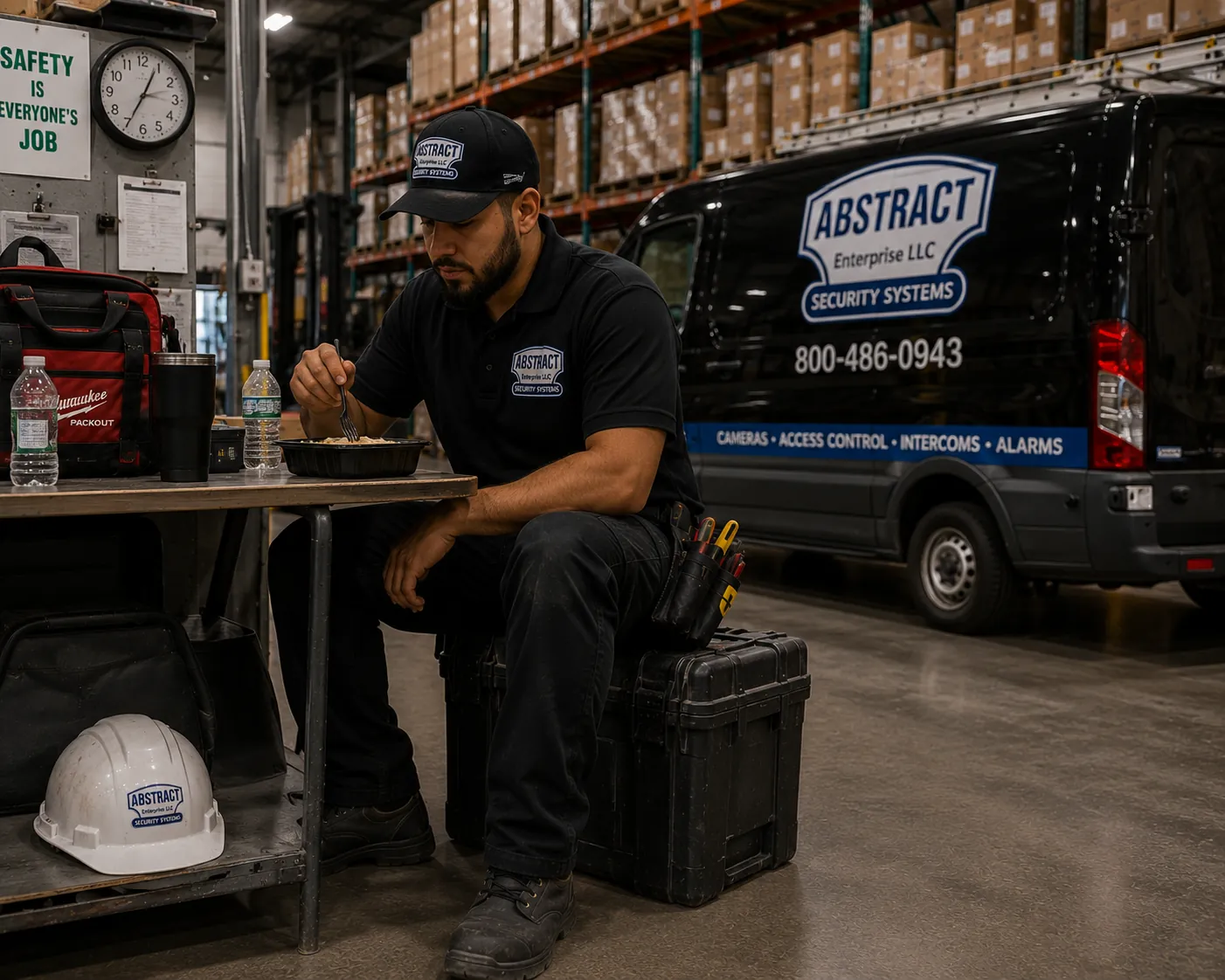
This warehouse surveillance installation hub covers Nassau and Suffolk from our headquarters at 1282 Troy Ave in Brooklyn, with crews on the Island weekly. County pages with local pricing and case notes join the silo footer below as they publish; the footprint today at a glance:
Searches like “warehouse camera installation near me” and “warehouse CCTV installer near me” from any of these hamlets land on this hub; the Nassau and Suffolk county pages below will narrow it further as they go live. We also run warehouse surveillance camera installation projects across the five boroughs through our NYC warehouse hub, same crews, same standards.
How Your Long Island Options Stack Up
Every commercial warehouse CCTV installation company, cloud platform and side-hustle handyman pitches this market. Here is how the warehouse surveillance system installers actually compare after the deposit clears.
| Abstract Enterprises | National Alarm Company | Cloud Camera Platform | Handyman / GC Side Job | |
|---|---|---|---|---|
| NYS security license | Yes, #12000287431 | Corporate license, subbed installs | Varies by install partner | Usually none |
| Monthly fees required | None | Contract monitoring | Per-camera licensing forever | None |
| You own footage locally | Yes, on your NVR | Depends on package | No, cloud-hosted | If it records |
| Warehouse-specific design | Docks, yards, lifts, WDR: weekly work | Template packages | Strong hardware, remote design | Cameras where the ladder reaches |
| Service response on Long Island | Same-day, local crew | National ticket queue | Mail-in / partner dispatch | When he answers |
| Contract length | None, job-based | Multi-year typical | Annual license terms | None |
| Warranty | 3-year (AESS products), written | Contract-dependent | Hardware while subscribed | Handshake |
Warehouse Security Camera Installation Pricing on Long Island
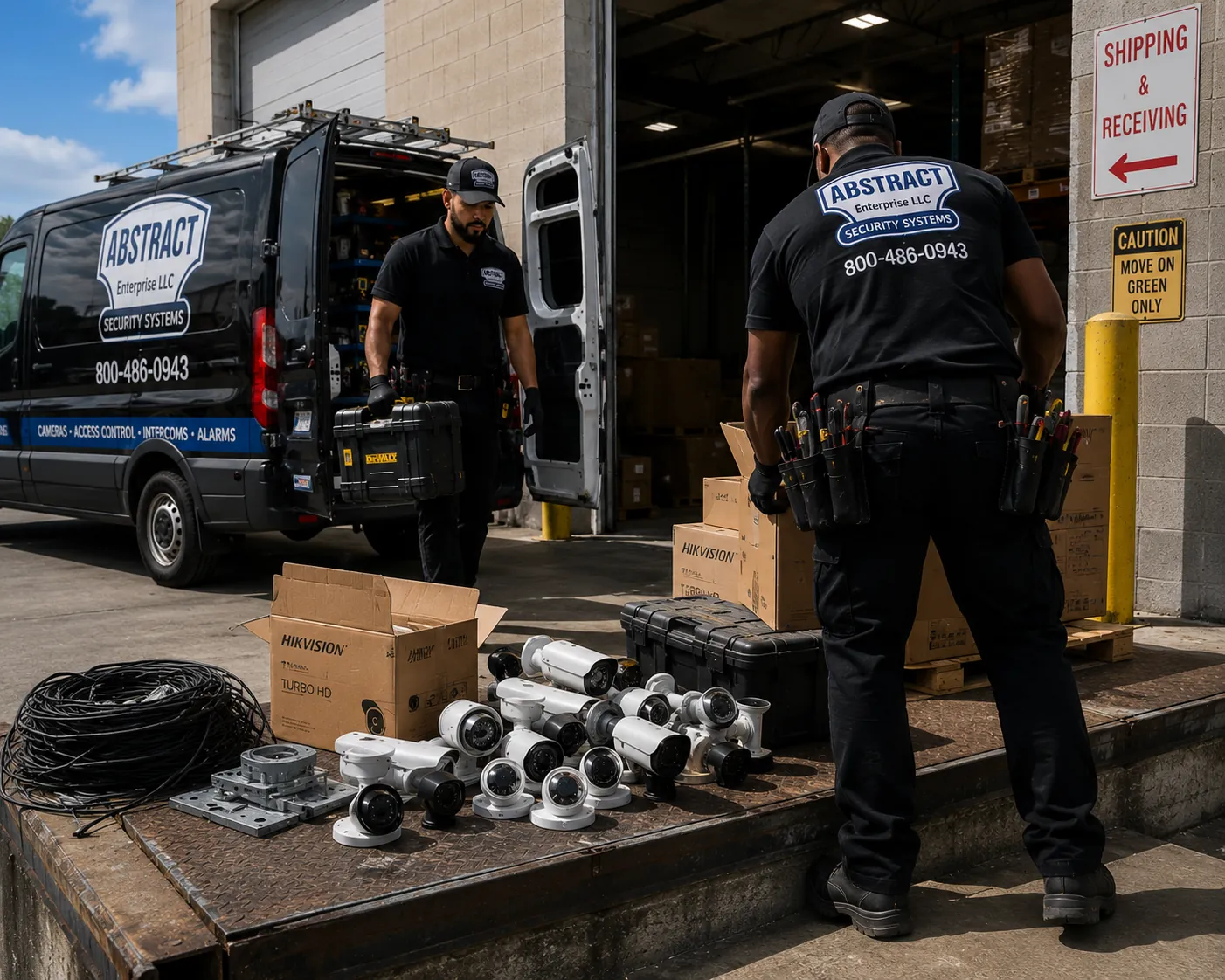
Warehouse camera installation cost is the first question on every call, so here are honest Island ranges before anyone visits. These are installed warehouse security camera system prices, hardware and labor, for Nassau and Suffolk; longer single-story runs and yard work put them a step above our city base, and complex multi-building sites top each band.
| Package | Typical Building | Installed Range | What Drives It Up |
|---|---|---|---|
| 8-camera 4K PoE + NVR | Under 10,000 sq ft, shops and small storage | $5,200 – $8,800 | High steel, exterior conduit, masonry penetrations |
| 16-camera 4K PoE + NVR | 10,000 – 30,000 sq ft, multi-dock buildings | $10,500 – $18,500 | Lift work above 20 ft, 60–90 day retention, yard runs |
| 32-camera distribution build | 30,000+ sq ft, 3PL and fulfillment floors | $21,000 – $38,000+ | Fisheye arrays, redundant storage, multi-switch networks |
| LPR gate / dock lane add-on | Any site with truck or trailer traffic | $1,600 – $3,200 per lane | Pole setting, trenching, lighting conditions |
| PTZ yard coverage add-on | Trailer staging, equipment rows, fence lines | $1,400 – $3,000 per unit | Mounting height, auto-tracking configuration |
| DVR-to-NVR upgrade | Existing wired systems, any vintage | $2,000 – $7,500 | Cameras reused vs replaced, retention target |
| Repair / service call | Any brand, any installer's system | $195/hr specialty rate | Most warehouse faults fixed in 1–2 hours on site |
Context worth keeping: published commercial data puts professional installs at $500 to $1,000 per camera nationally, so these warehouse security camera packages are affordable warehouse camera installation by any licensed standard. Phasing is a design feature, docks and gate first, and every quote itemizes hardware by model number so you can check the math line by line.
Need Warehouse Camera Repair on Long Island? Fixed in 1–2 Hours, Most Cases.
A warehouse camera system not recording before an inventory count, unreliable warehouse cameras dropping channels every storm, warehouse remote viewing problems locking you out of your own docks, footage an insurer or the police need exported today: warehouse security system repair is same-day work for us across Nassau and Suffolk. One call covers diagnosis and warehouse camera replacement where hardware has died, and most systems are recording again within one to two hours of arrival.
The Security Problems Long Island Warehouses Face Right Now
None of this is theoretical; it is why warehouse theft security cameras top our Island call sheet. These are the loss patterns behind recent Nassau and Suffolk installs, a fair share of them warehouse cameras after a break-in rather than before one, and the design answer for each.
Fictitious pickups and strategic cargo theft
The modern cargo thief arrives with paperwork: federal prosecutors have charged an organized crew whose alleged scheme included a plan to take roughly $433,000 in cologne from Ronkonkoma using a hacked carrier email and a fake driver. Gate LPR logging every tractor, identification-density dock coverage and a verify-before-release habit tied to your camera timestamps are the counters that give investigators something to pull.
Commercial burglary crews working the corridors
Suffolk's District Attorney announced a 38-count indictment against a crew tied to a 17-day spree that hit eight auto-body businesses across the region, smash, grab cash and keys, move on. Shops and warehouses share the exposure: rear man-doors, glass fronts and 3 a.m. Coverage on the forgotten sides, monitored intrusion and interior identification cameras convert that visit from a loss into an arrest exhibit.
Landscaping and contractor equipment walking off
Enclosed trailers, zero-turns, compressors and hand tools vanish from fenced Island yards in a pattern every contractor here can recite. Plate capture at the gate, a yard PTZ with auto-tracking and a camera-triggered voice-down speaker end most fence tests in under a minute, and warehouse vandalism cameras pay for themselves the first time a cut fence comes with a face attached.
Catalytic converters, copper and the scrap run
Fleet vans, rooftop units and stocked copper feed the scrap trade across both counties. Thermal or low-light perimeter cameras with person-detection alerts, aimed along fence lines and parked rows, catch the scouting visits that precede the big night, and hand your precinct better evidence than a shrug and a sawzall mark.
Internal shrink and the pre-dawn load-out
The quietest loss line: a case here, a pallet short there, surfacing at cycle count with no story attached. Employee theft surveillance done right means identification-grade cameras at man-doors, time clocks and load-out lanes with continuous dock recording, so a missing inventory investigation starts from a timestamp instead of a hunch and damaged shipment video evidence closes carrier disputes in days.
Storage yards and off-season targets
Boatyards, self-storage rows and seasonal-equipment lots hold months of value with no daily eyes on it, and the Island's larceny numbers stay stubbornly at the top of its property-crime ledger. Perimeter line-crossing alerts, corridor and rack-row coverage and plate-logged gates mean an off-season breach gets answered in minutes, not discovered in spring.
Related Security Services Across Long Island
Security Camera Installation
Homes, storefronts and buildings across Nassau and Suffolk: the Island-wide hub for our camera work.
Security Camera Repair
Same-day fixes on any brand and any installer's system, both counties.
Commercial Camera Systems
Offices, retail, restaurants and mixed-use beyond the warehouse walls.
Apartment Building Cameras
Multifamily lobbies, hallways, package rooms and parking across the Island.
Wireless Camera Installation
Engineered wireless for the gates and outbuildings wire truly cannot reach.
Dahua Camera Installation
The value workhorse line we install and service across Long Island.
Lorex Camera Installation
No-fee 4K systems for smaller commercial buildings and shops.
Intercom Installation
Video intercoms and building entry systems for commercial and multi-unit properties.
Put Cameras on Your Warehouse Before the Next Loss Names the Price
One call books a free site walk anywhere in Nassau or Suffolk, a camera-by-camera written quote, and a system you own outright from a licensed and insured commercial security company: no contracts, no monthly fees, a three-year warranty on AESS-supplied products, and NYS license #12000287431 on every page of the paperwork. Warehouse security camera installation is what this crew does across Long Island week in and week out, and Abstract Enterprises warehouse surveillance systems are recording on Island docks tonight; let us prove it on your building.
Warehouse Security Camera Installation: Every Area We Serve
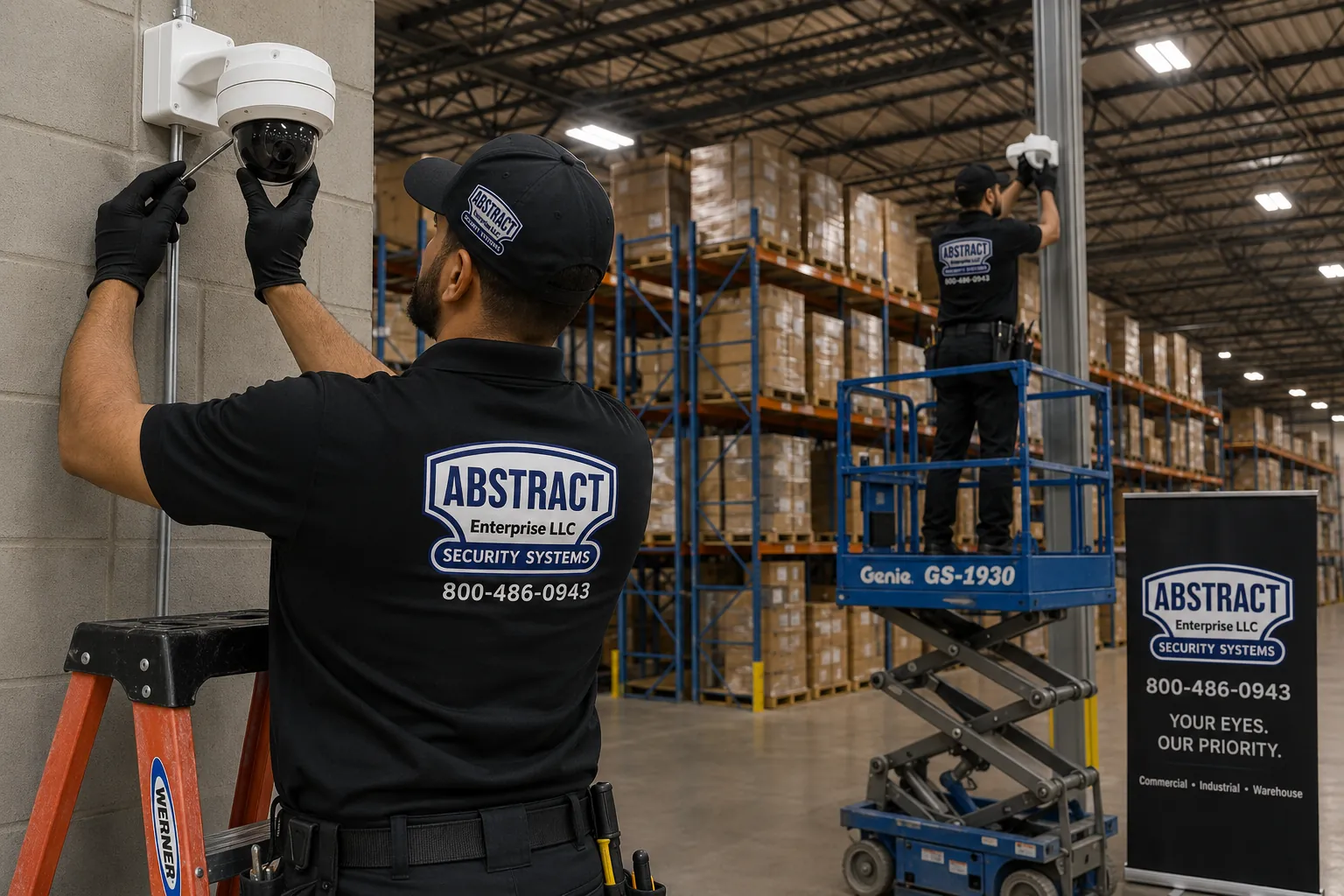
Borough and county pages are rolling out; area names below become links as each page goes live.
- NYC (Hub)
- Brooklyn
- Manhattan
- Queens
- Bronx
- Staten Island
- Long Island (This Hub)
- Nassau County
- Suffolk County
- Hudson Valley (Hub)
- Westchester County
- Rockland County
- Orange County
- Putnam County
- Dutchess County
- Ulster County
Hub navigation: Home · Security Camera Installation Long Island · Camera Repair Long Island