
Warehouse Security Camera Installation
in New York City
4K PoE camera systems designed for real NYC warehouses: blinding dock-door light, 30-foot ceilings, steel racking, forklift traffic, and inventory that walks off after hours. Local NVR recording you own, remote viewing on your phone, and zero monthly fees.
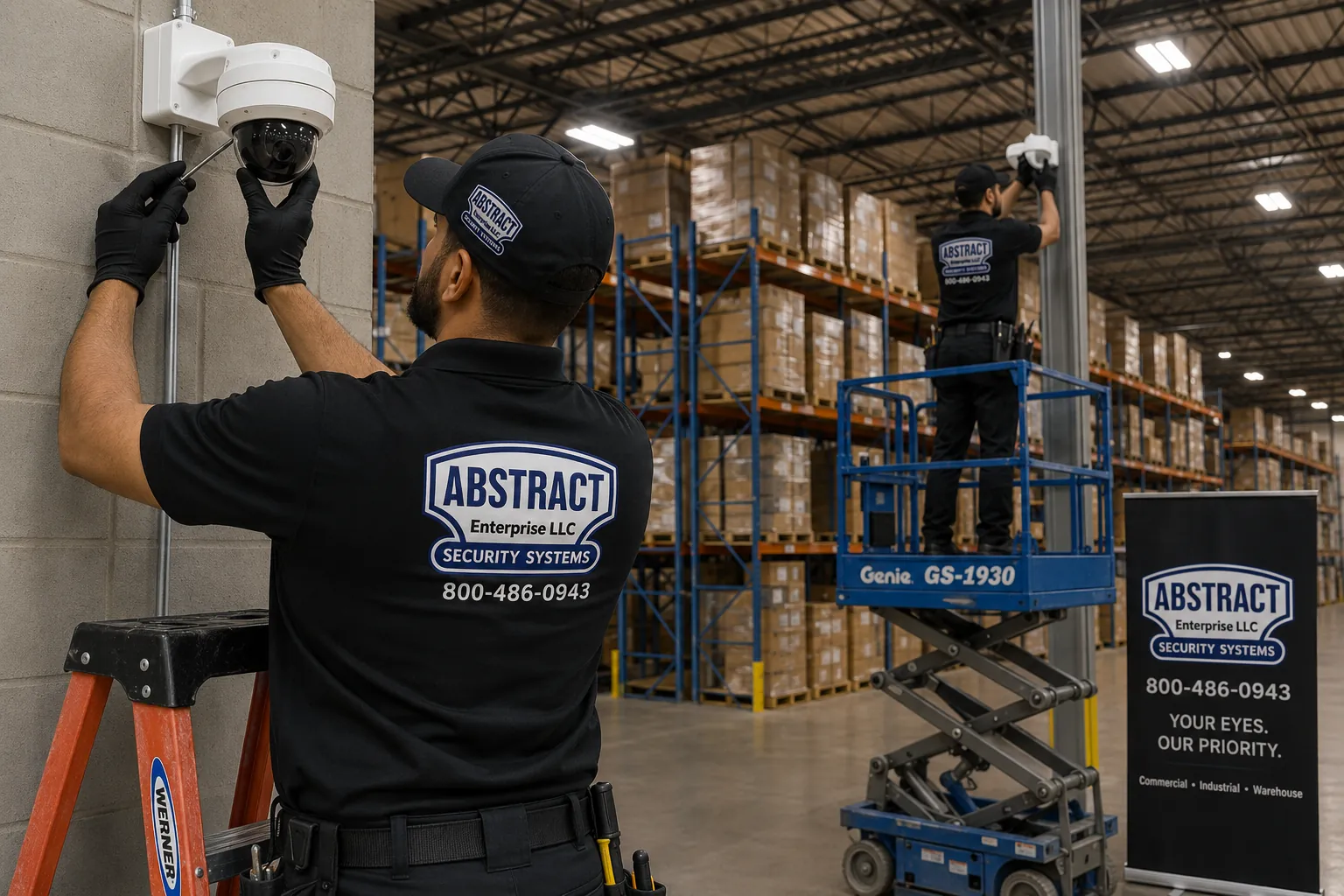
Get a Free Warehouse Security Quote
Fixed pricing, model numbers included — a tech replies fast.
This is our NYC warehouse camera hub. Browse everything we install from the Abstract Enterprises Security Systems homepage, or jump to your borough in the silo footer below.
Get a Warehouse Camera Quote Today
- Free site walks in all five boroughs — request a warehouse security assessment by phone or form, evenings and weekends included
- A fixed written warehouse surveillance installation estimate with camera-by-camera layouts, never phone-script guesses
- Three-year warranty on AESS-supplied products, installed by a licensed warehouse camera installer carrying NYS #12000287431
Warehouse Camera Systems That Actually Hold Up in NYC Buildings
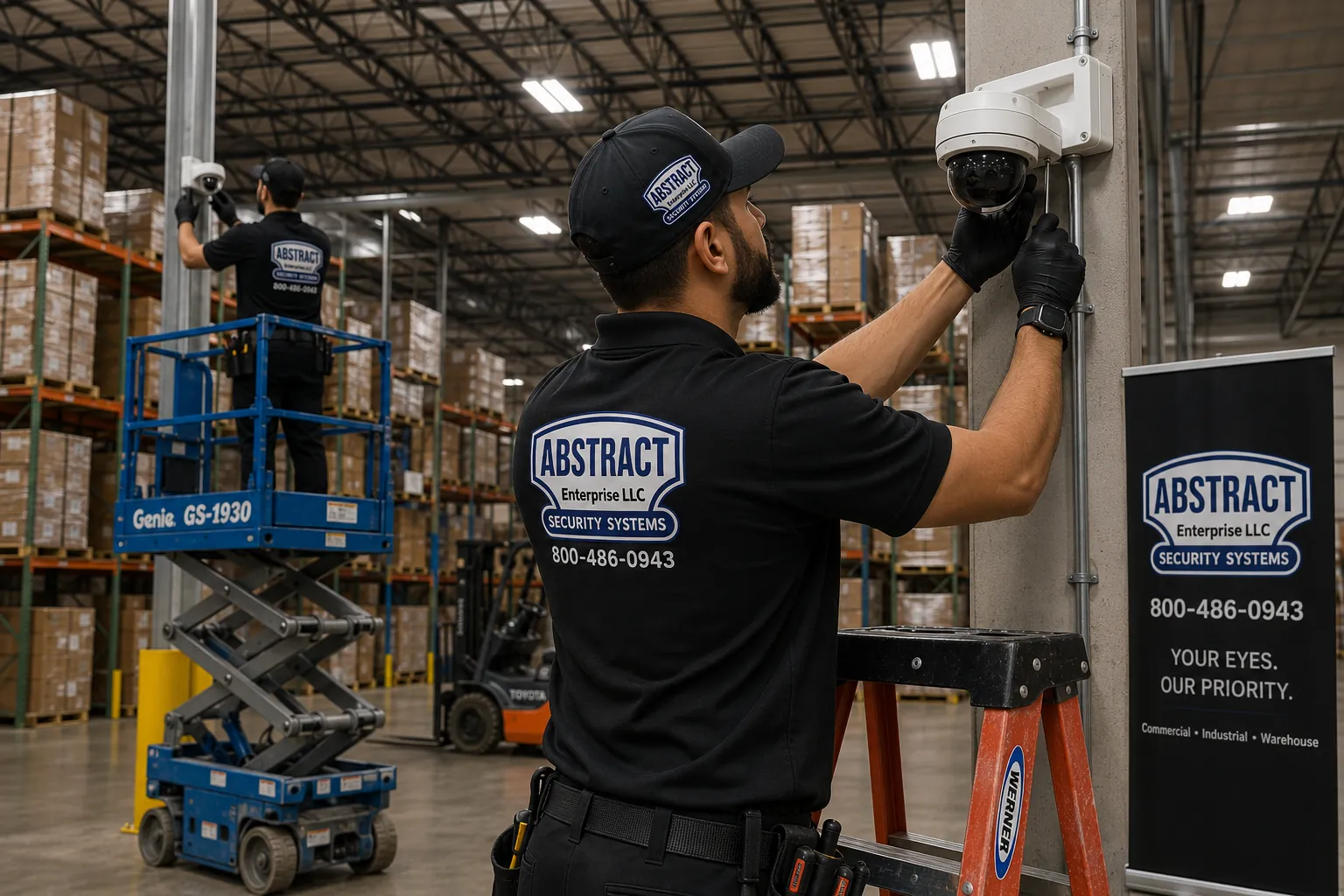
A warehouse is the hardest environment in New York City to put cameras in, and most systems we get called to fix were never designed for it. Consumer kits from a big-box store wash out the moment a dock door opens into sunlight. WiFi cameras drop offline behind three rows of steel racking. A four-channel recorder that was fine for a bodega overwrites the exact week a pallet count came up short. Abstract Enterprises Security Systems handles warehouse security camera installation the other way around: we start with your docks, aisles, cages, yard and entrances, then engineer the warehouse video surveillance installation that NYC industrial space actually demands.
We are a New York State licensed low-voltage security contractor, license #12000287431, operating out of 1282 Troy Ave in Brooklyn and installing across all five boroughs. Our warehouse work runs from 6-camera storage buildings in East New York to 40-plus camera distribution floors near JFK — professional warehouse security camera installation at every scale — and every job gets the same architecture: commercial 4K IP cameras on hardwired Cat6, PoE switching, a local NVR sized for your retention target, and remote viewing configured on your phone before we leave. You own the hardware and the footage; Abstract Enterprises warehouse security cameras never bill you monthly. There is no subscription, no cloud ransom, and no per-camera monthly bill, which is also true of every security camera installation we do across NYC.
If your current system is half-dead, we handle that too: recorder swaps, camera replacements, cable repairs and takeovers of orphaned installs are everyday calls, and our NYC camera repair crew often has a down warehouse system recording again the same day. This page covers how we design security camera installation for warehouses, what it costs in New York, the questions owners and facility managers actually ask, and the mistakes that leave loading docks blind. Read it, then call (800) 486-0943 or grab the 60-second quote form below.
Price My Warehouse Cameras
Four quick answers and a real installer, not a call center, gets back to you with numbers. Use it to get a warehouse camera installation quote back fast, or call and we will schedule the installation directly. No obligation, no spam.
Why NYC Warehouses Need Purpose-Built Camera Coverage
New York City industrial real estate is dense, expensive and busy around the clock, and that combination makes warehouses here a different security problem than a distribution box off a highway in New Jersey. Your loading dock probably opens onto a public street in Maspeth or Sunset Park, not a fenced 40-acre campus. Trucks stage on the curb. Delivery drivers, sanitation crews, scrappers and foot traffic pass your roll-up gates all day, and the person casing your dock looks exactly like the fifty legitimate people who walked by before him. Purpose-built industrial security camera installation is how you tell them apart after the fact, and increasingly how you get alerted in the moment.
The loss numbers back this up. Cargo theft causes up to $35 billion in estimated annual U.S. losses, according to the National Insurance Crime Bureau, and warehouses sit squarely in that pipeline: goods at rest, staged trailers, and dock doors opening onto public streets. New York adds its own flavors: organized fencing crews that move stolen goods through storage units and industrial lots in the Bronx and Brooklyn, trailer break-ins on commercial blocks, and the quiet internal shrink that shows up as a cycle-count mystery until a camera finally catches a pallet leaving on the wrong truck.
There is also the paperwork side of New York. Commercial insurers and cargo underwriters here increasingly ask what surveillance you run before they write or renew a policy, and many discount premiums for commercial warehouse camera installation that is professionally documented and recorded. 3PL and fulfillment contracts routinely specify camera coverage and footage retention. Licensed cannabis operators answer to the Office of Cannabis Management, which treats any unmonitored product area as a violation. And when a slip-and-fall claim or a comp case lands, time-stamped video from your own NVR is the difference between a quick resolution and a year of depositions. Warehouse security system installation in NYC is not just theft prevention; it is the documentation layer your whole operation leans on.
Warehouse Camera System Types We Install
4K PoE IP Camera Systems
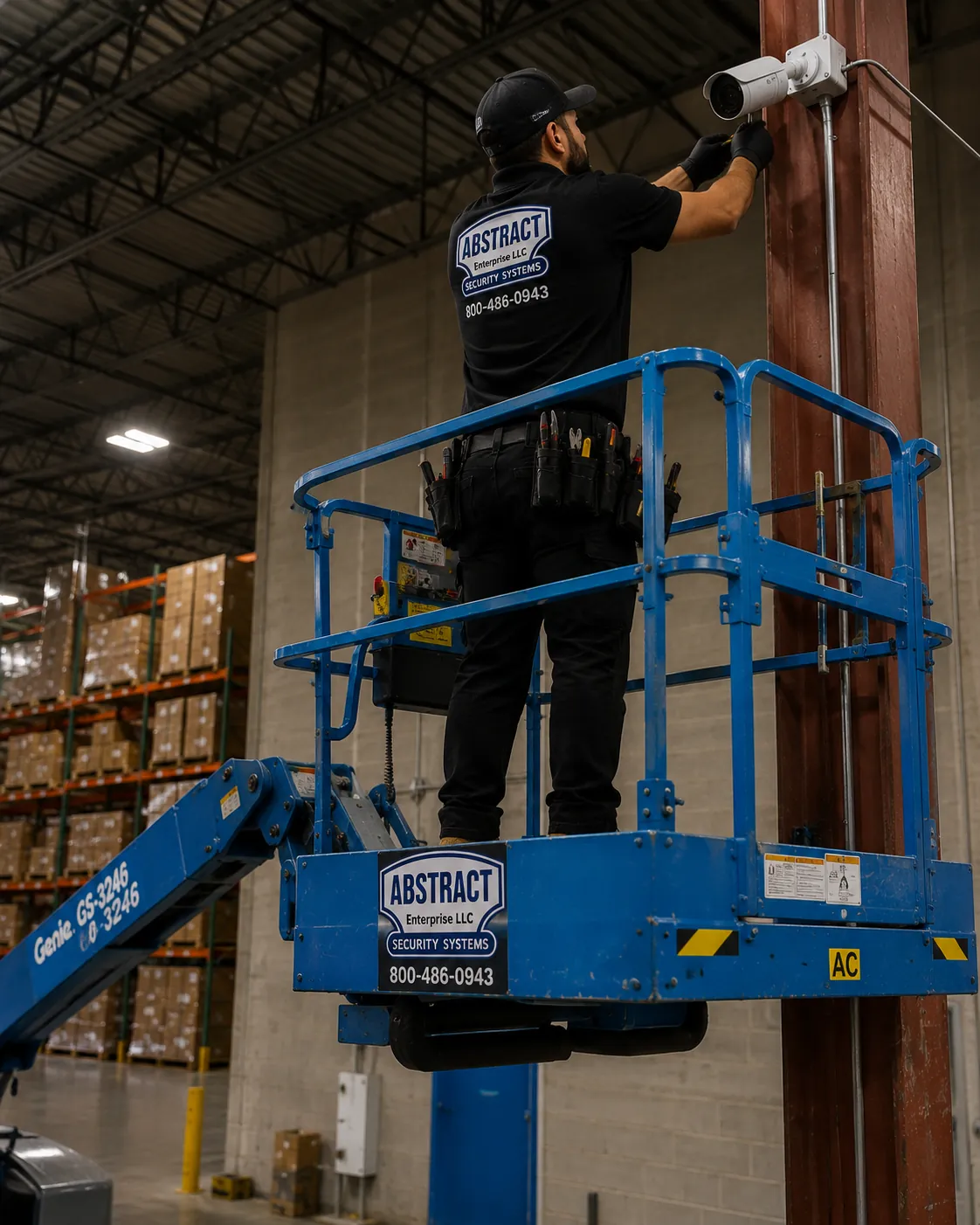
4K warehouse cameras on hardwired Ethernet are the backbone of nearly every build. Each of these PoE warehouse cameras rides a single Cat6 run carrying power and video back to a PoE switch and NVR, so there are no wall-wart power supplies dying above the racking. 4K resolution gives you the pixel density to zoom into recorded footage and still read a box label or a face at a dock door 60 feet away. We install vandal-resistant dome cameras for warehouses that want low-profile interior coverage, and rugged bullet cameras for warehouses whose docks and yards take the abuse.
NVR Recording, Sized for Retention
We spec network video recorders with enterprise surveillance-rated drives and calculate storage from your real camera count, resolution and retention target. A 16-camera 4K system recording continuously with a smart codec eats roughly 10 terabytes a month; we build in headroom so day 31 never silently erases day 1.
PTZ and Auto-Tracking Cameras
PTZ warehouse cameras earn their cost outdoors: truck yards, trailer staging, and long fence lines where one camera with 25x optical zoom replaces four fixed heads. We pair them with fixed overview cameras so the PTZ can chase detail without leaving the wide shot blind, and add auto-tracking for after-hours motion.
Panoramic and Fisheye Coverage
Panoramic warehouse cameras shine on high bay ceilings: a single 12MP fisheye can watch an entire staging floor or intersection of aisles, with software dewarping that turns the circle into flat, reviewable views. In racked warehouses, fisheye warehouse cameras at aisle crossings kill the blind spots that fixed cameras leave between rows.
License Plate Recognition (LPR)
Dedicated LPR cameras at gates, dock aprons and yard entrances capture plates through headlight glare and motion that would blur a normal camera. Every truck in and out of your Brooklyn or Bronx facility gets logged with a readable plate, which is exactly the evidence NYPD and cargo insurers ask for first.
Thermal and Low-Light Perimeter Cameras
For unlit yards and perimeters, thermal warehouse cameras detect a human heat signature in total darkness, fog or backlight, while full-color low-light warehouse cameras keep usable color video where a little ambient light exists. Both feed the same NVR and the same phone app as the rest of your system.
AI Analytics and Smart Alerts
AI warehouse cameras distinguish people and vehicles from headlight sweep, rain and pigeons, so a 2 a.m. push alert actually means something — a generational leap past the dumb motion detection cameras that cried wolf all night. We configure line-crossing detection on fence lines, intrusion zones on dock doors after close, people-counting cameras at shift entrances where turnstile counts matter, vehicle-tracking cameras on yard lanes, and real-time security alerts tuned so the ones that reach your phone deserve to.
DVR-to-IP Upgrades and Takeovers
Have an old coax DVR limping along? We reuse sound cable where it exists, convert runs with adapters or pull new Cat6 where it does not, and move you to a modern recorder with remote viewing. We also adopt systems installed by companies that vanished, including Dahua camera systems across NYC we service daily.
Where the Cameras Actually Go: The Placement Map
Inside the building, the pattern repeats across almost every NYC facility we design. Warehouse entrance cameras and warehouse exit cameras at identification density catch every face crossing the threshold, with employee entrance cameras placed at head height near the time clock. Shipping area cameras and receiving area cameras watch the two spots where inventory changes hands, warehouse aisle cameras at the row ends cover the canyons, and storage rack surveillance from crossing-mounted fisheyes fills the gaps between them. Forklift traffic cameras double as safety documentation on the main travel lanes, inventory room cameras and cage coverage guard the high-value shelf, and warehouse office cameras protect the cash drawer and the server closet. Multi-story buildings add freight elevator cameras, stairwell security cameras and emergency exit cameras, because those are exactly the paths a walkout uses.
Outside, warehouse perimeter cameras sweep the fence line, parking lot security cameras cover staff vehicles and trailer staging, and delivery gate cameras with plate capture log every truck, all of them weatherproof security cameras rated for the exposure. The design goal is blunt: map the warehouse camera blind spots a thief would walk through, then make sure none survive the install. That map is exactly what our free site walk produces.
One planning note from hundreds of NYC installs: most warehouse camera projects pair naturally with access control on personnel doors and cages, because the camera tells you what happened and the credential log tells you who badged in. We wire both on the same visit when you want them, and the combined system costs less than two separate projects.
Warehouse Surveillance Terminology, Decoded
Quotes from three installers will use three vocabularies. Here is what the terms actually mean so you can compare apples to apples.
- PoE (Power over Ethernet)
- One Cat6 cable delivers both power and data to a camera. Fewer failure points, no electricians needed at each camera position.
- NVR (Network Video Recorder)
- The appliance that records IP camera streams to hard drives on site; the brain of a no-monthly-fee system. Sizing one starts with NVR storage calculation against camera count and honest video retention planning.
- DVR (Digital Video Recorder)
- The older coax-based equivalent. Still serviceable, but resolution-limited; most warehouses upgrade DVR to NVR.
- IP Camera
- A network camera producing digital video, addressable and configurable individually, versus legacy analog heads.
- WDR (Wide Dynamic Range)
- The ability to expose bright and dark areas in one frame. True 120dB WDR is what keeps an open dock door from whiting out.
- IR Range / Lux
- Infrared illumination distance and the minimum light a camera needs. Warehouse aisles need long IR throw and low lux ratings.
- Varifocal Lens
- A motorized lens that zooms and refocuses remotely, so a camera 28 feet up never needs a lift visit to reframe.
- H.265 / Smart Codec
- Compression that roughly halves storage versus H.264 without visible quality loss. Directly cuts your NVR drive cost.
- PPF (Pixels Per Foot)
- The density metric behind identification. Reading a face needs about 80 PPF; a general overview needs far less.
- ONVIF
- The interoperability standard letting cameras and recorders from different brands work together, protecting you from vendor lock-in.
- VMS (Video Management Software)
- Software for viewing and searching many cameras across one or more sites, used on multi-building operations.
- RAID / Surveillance Drives
- Drive configurations and purpose-built surveillance footage storage rated for 24/7 video writes, so a single disk failure does not erase your evidence.
- LPR / ANPR
- License plate recognition cameras and software that log every plate passing a gate or dock lane, searchable by number.
- Line Crossing / Intrusion Zone
- AI rules that trigger alerts when a person or vehicle crosses a virtual boundary, such as a fence line after hours.
- Dewarping
- Software that flattens a fisheye camera image into normal rectangular views for live watching and playback.
- Edge Storage
- An SD card in the camera that keeps recording if the network drops, then backfills the NVR. Cheap insurance on critical views.
Camera Brands We Install in NYC Warehouses
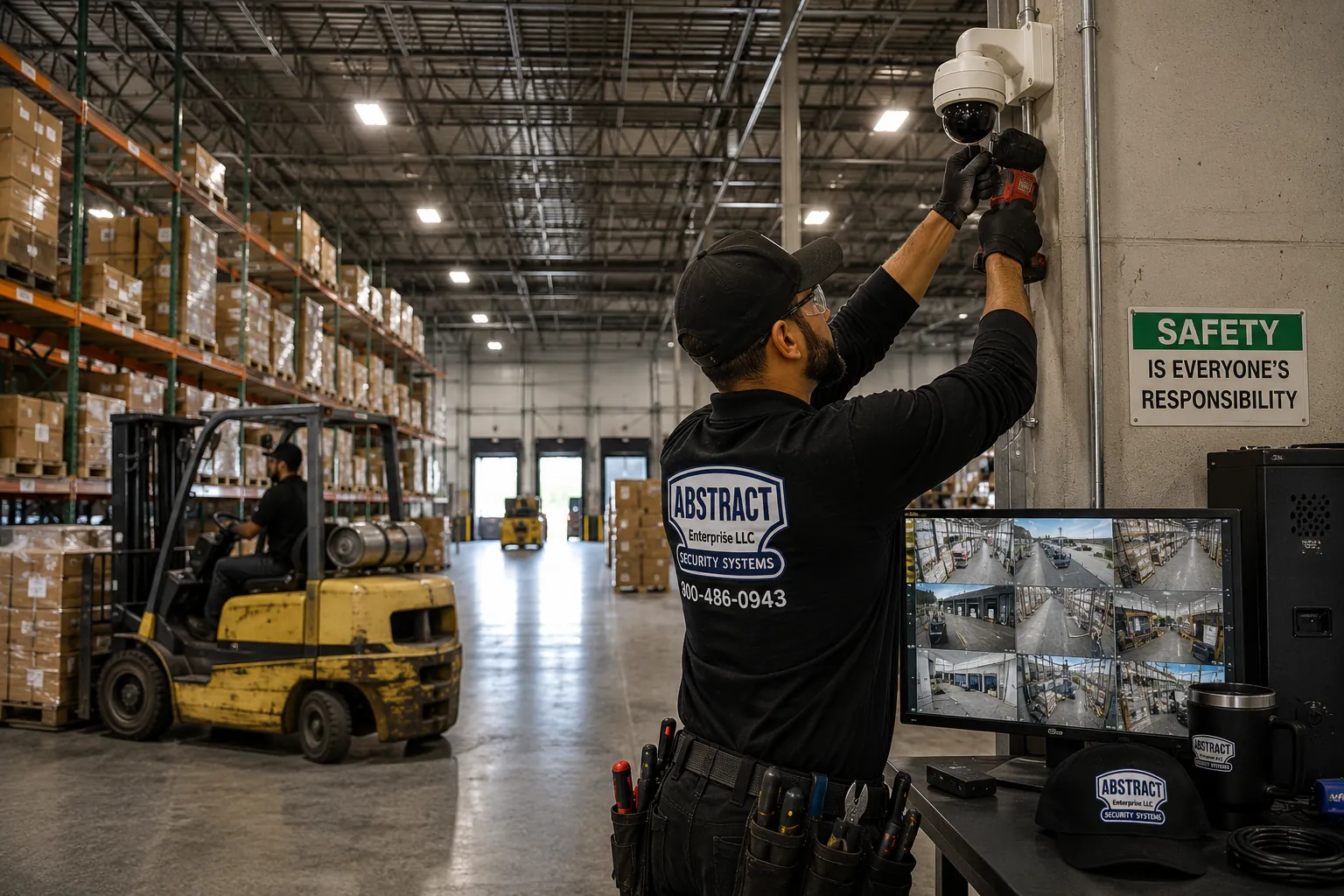
We are not a single-brand dealer, and warehouse conditions punish weak hardware fast, so we spec from lines we have watched survive New York loading docks for years. Dahua and Hikvision remain the workhorses of value-driven commercial installs: deep camera catalogs, strong low-light sensors, reliable NVRs, and the best price-to-performance in the industry for owners comparing commercial cameras for warehouses on coverage per dollar. Uniview sits in the same class with excellent WDR performance at dock doors. For clients whose contracts require NDAA-compliant equipment, federal work, or certain institutional landlords, we build on Hanwha Vision, Axis and Avigilon: premium sensors, specialty multi-imager and fisheye options, and forensic search analytics that make investigating an incident across 40 cameras a minutes-long job.
On the lighter end, Lorex gives smaller warehouses and contractor shops a solid 4K system with consumer-friendly apps and no fees, and we install plenty of it in sub-10,000 square foot buildings. For multi-site operators who genuinely want cloud management, we will deploy and support cloud platforms like Rhombus, but we will also show you the five-year subscription math first, because it surprises people. Whatever the brand, everything we install is configured ONVIF-compatible where possible, passworded properly, firmware-updated, and documented so you are never hostage to us or anyone else. Already own equipment? We do BYOE installs of owner-purchased cameras too, as long as the hardware is commercial-grade enough to be worth mounting.
Camera Combo Packages: Video Plus the Rest of Your Security Stack
Cameras record; they do not stop a door from opening. The warehouses with the fewest losses in our client base layer systems, and because we are licensed for the full low-voltage scope, we install the layers together on one contract instead of three vendors pointing at each other. The most common combination we build is cameras plus access control: keypad or fob readers on personnel doors, cages and server rooms, with each badge event tied to camera timestamps so a 3 a.m. entry produces both a log line and a face. Most warehouse owners who start with cameras add access control within a year; bundling them on the initial install saves the second mobilization entirely.
The next layer is intrusion: door contacts on man-doors and roll-up gates, motion detection inside, glass-break where offices face the street, and central-station monitoring that calls you and can dispatch on a verified alarm. Video verification, where the monitoring station sees your camera feed during an alarm, dramatically improves police response priority in NYC compared with a blind audible alarm. We also run structured cabling for the whole building while the lifts are already on site, tie camera feeds into guard-desk video walls for larger facilities, and add video intercoms at pedestrian gates so your team can screen visitors before buzzing anyone in. One design, one installer, one warranty, one number to call.
Full Feature Set on Every Warehouse Install
Included Standard
4K or 4MP commercial IP cameras with true WDR at dock positions · hardwired Cat6 runs labeled at both ends · PoE switching sized with spare ports · an NVR recording system with surveillance-rated storage matched to your retention target · continuous plus motion-event recording schedules · remote video monitoring and mobile camera viewing configured at handoff on phone and desktop · viewer-level accounts for managers so admin credentials stay yours · camera-map documentation sheet · three-year warranty on AESS-supplied products.
Available Options
License plate capture at gates and dock lanes · fisheye panoramic coverage for staging floors · PTZ with auto-tracking for yards · thermal perimeter detection · AI people and vehicle alerts with after-hours arming schedules · audio deterrence speakers with recorded warnings · offsite backup of critical cameras · UPS battery backup for recorder and switches · OCM-compliant retention builds for licensed cannabis facilities · integration with access control and alarm on the same project.
How We Install Warehouse Camera Systems
- Site walk and risk map. We walk your docks, aisles, cages, entrances and yard, note ceiling heights and cable paths, and map every blind spot before quoting.
- System design and written quote. You get a camera-by-camera layout with model numbers, storage sizing for your retention target, and a fixed written price.
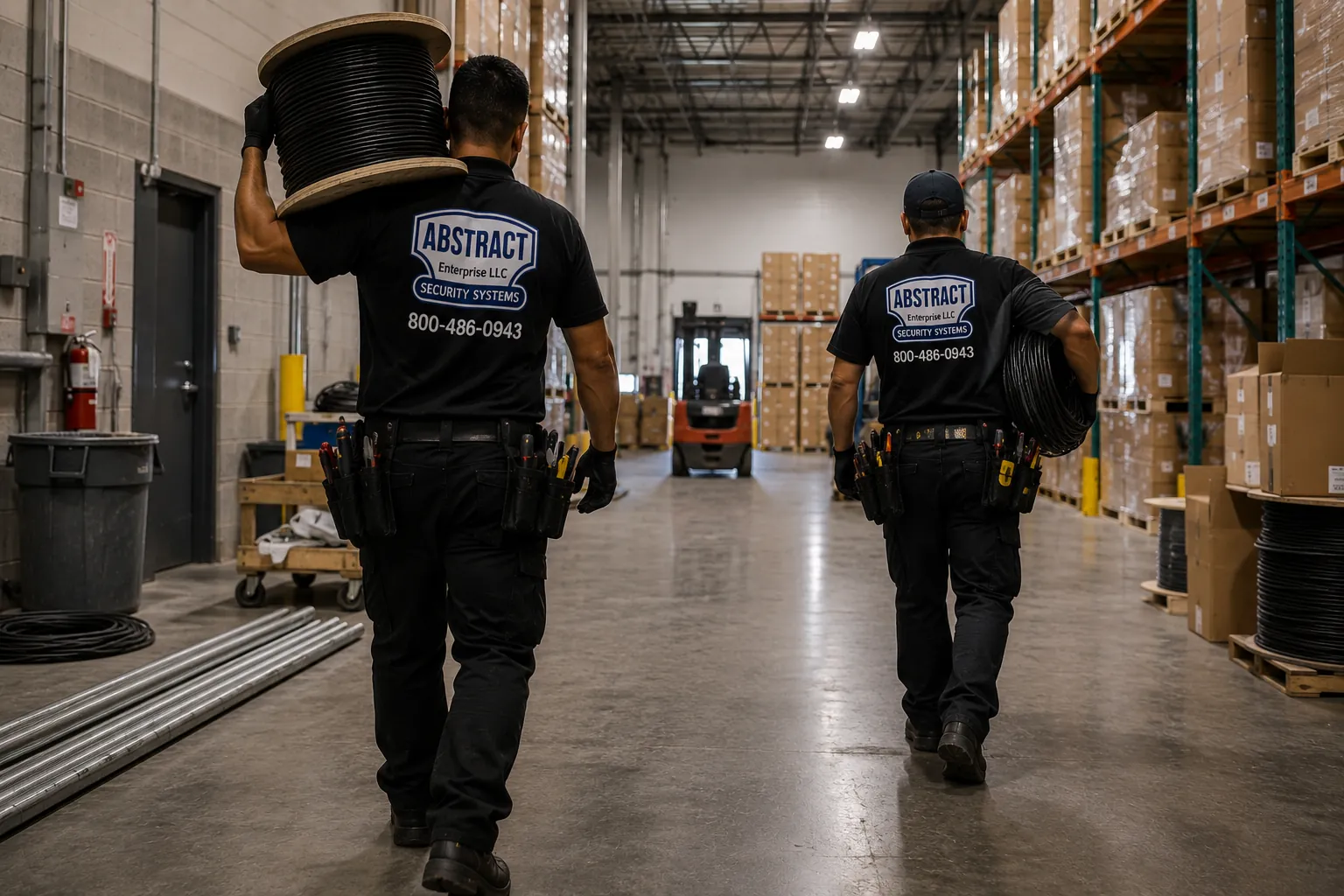
- Cabling. We run Cat6 from each camera position back to the NVR, labeled at both ends, routed to survive forklifts, pallets and racking changes.
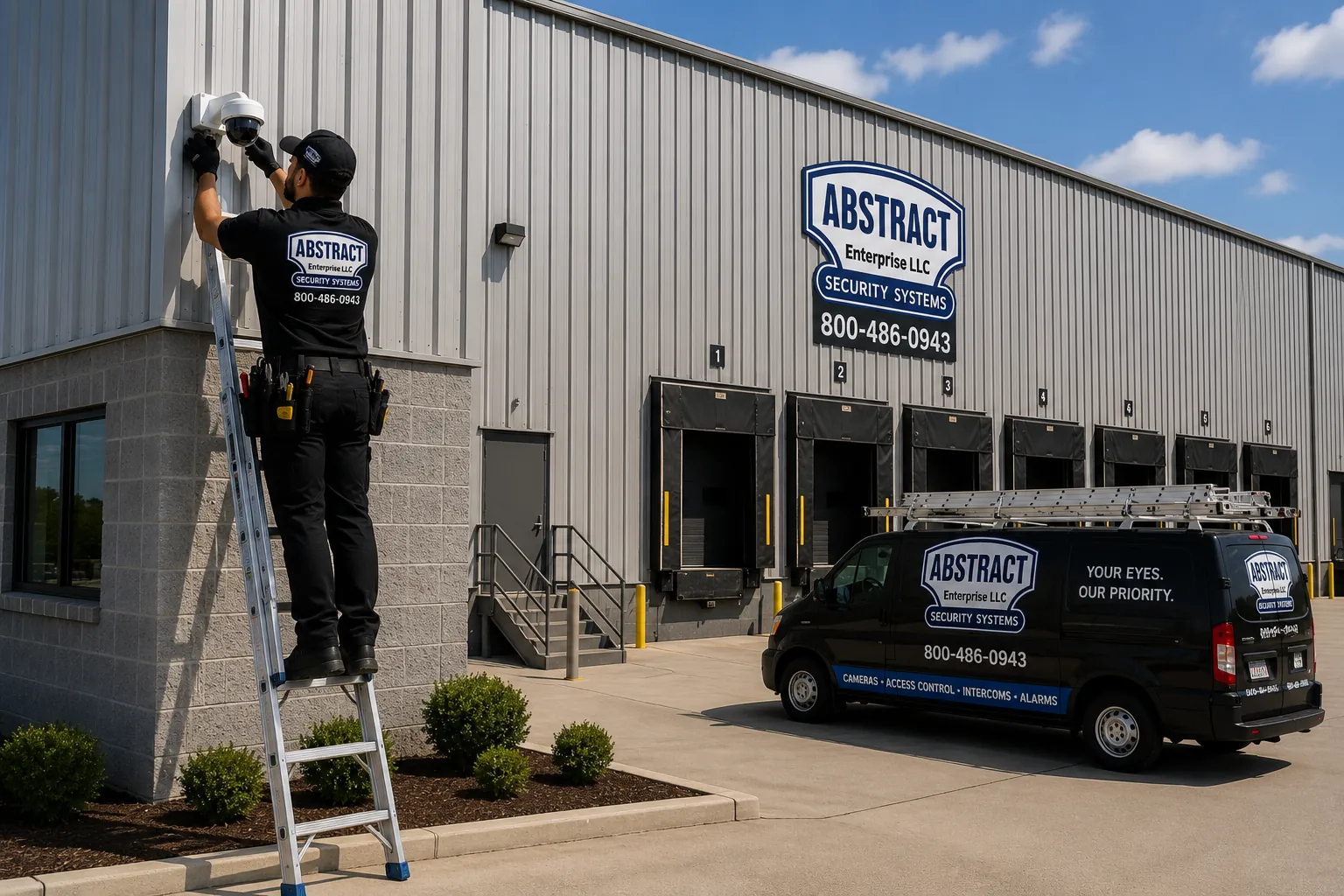
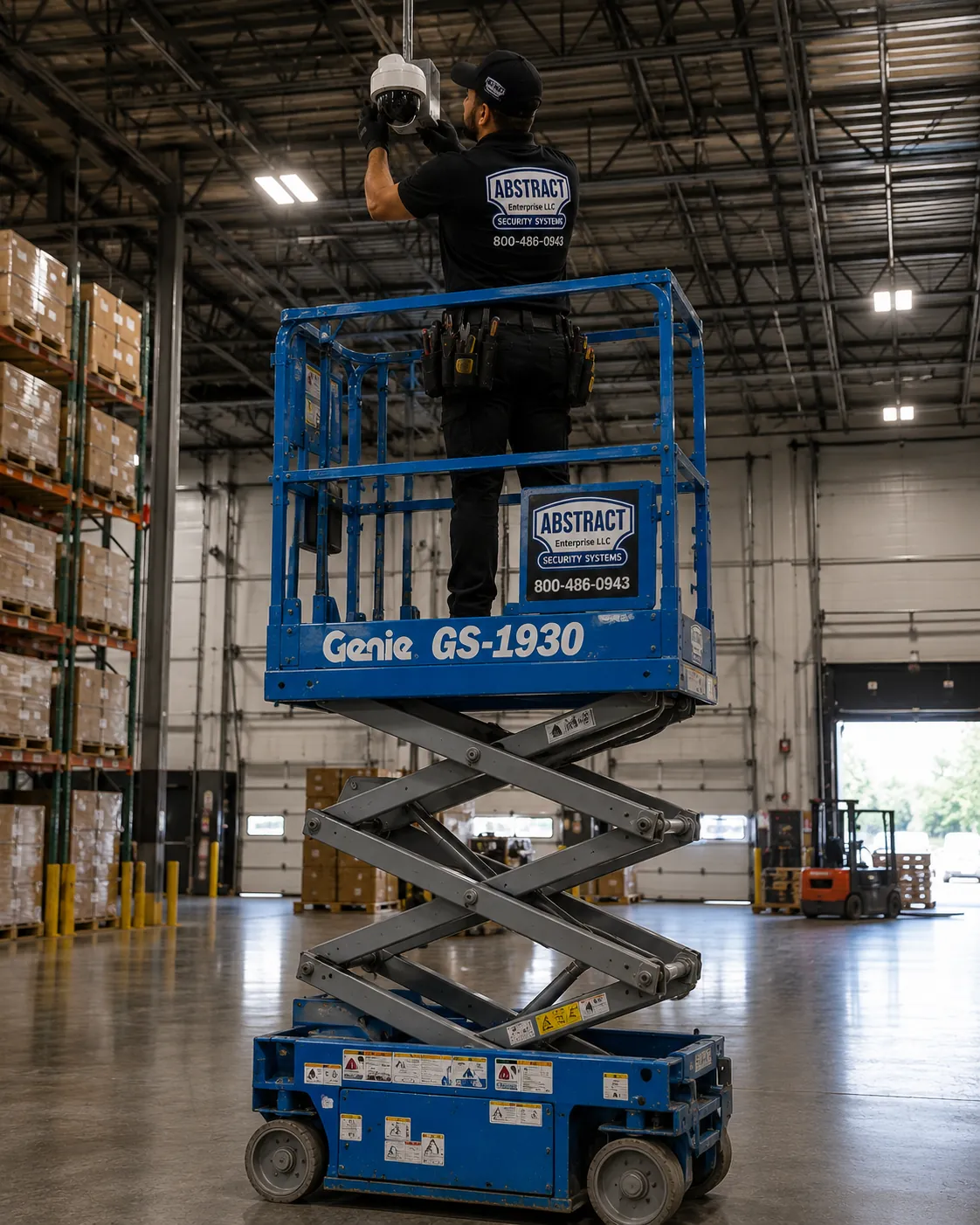
- Mounting and aiming. Cameras go up with lifts where needed, aimed and focused on real targets: dock doors, plate lanes, choke points and cage doors.
- NVR configuration and remote access. We configure recording schedules, motion zones, retention, and phone apps for the owner and authorized managers, on your actual devices.
- Walkthrough and handoff. We review every view with you, confirm playback and export, hand over labeled documentation, and register your three-year AESS-product warranty.
Warehouse Cameras Down in NYC? Same-Day Repair.
An outdated warehouse CCTV system finally quitting, a recorder dead after a power hit, cameras dark before a big receiving week, footage you need for a claim and the DVR will not export it? Call (800) 486-0943 now. We dispatch across all five boroughs same-day in most cases, most warehouse camera repairs are diagnosed and fixed in one to two hours on site, and we work on systems we did not install: Dahua, Hikvision, Lorex, Uniview, old coax DVRs, all of it.
After a break-in? Preserve your recorder, do not reboot it, and call us before footage overwrites. We can often recover and export what you need while we harden the system.
NYC Industrial Corridors Where We Install Warehouse Cameras
Warehouse camera design starts with knowing the block, because the block decides your risks: curbside docks, shared driveways, elevated train shadows, scrapper routes, overnight truck staging. These are the corridors our vans work every week.
Brooklyn
Sunset Park is the borough anchor: Industry City along 2nd and 3rd Avenues from 32nd to 41st Streets, Bush Terminal, and the Brooklyn Army Terminal off 58th Street, all mixing food producers, e-commerce and studios behind roll-up doors. Red Hook warehouses on Van Brunt, Beard and Imlay Streets sit near the container terminal with heavy curbside truck activity. The East Williamsburg industrial zone around Morgan, Stewart and Vandervoort Avenues, Greenpoint blocks off Norman Avenue and Apollo Street, the Flatlands and Canarsie sheds along Foster Avenue and Ditmas, and East New York industrial lots near Atlantic and Pitkin round out our densest Brooklyn coverage.
Queens
Maspeth is NYC trucking country: Grand Avenue, Rust Street, 58th Street and the Long Island Expressway service roads carry more freight than anywhere else in the borough. Long Island City warehouses along Borden and Review Avenues and the Dutch Kills blocks mix logistics with film production storage. College Point around Ulmer Street and 20th Avenue, the Ridgewood sheds bordering Bushwick, Willets Point auto and parts yards, and the JFK air-cargo belt through Springfield Gardens along Rockaway Boulevard and North Conduit are all regular install territory, including bonded and customs-adjacent facilities.
The Bronx
Hunts Point is the food security capital of the city: the Produce Market, Meat Market and the distributor sheds along Food Center Drive and Halleck Street run 24 hours and lose product 24 hours. Port Morris warehouses under the Bruckner along Walnut and Locust Avenues, the Bathgate Industrial Park, the Zerega Avenue and Castle Hill industrial pockets, and Eastchester distribution blocks near Boston Road all combine overnight truck staging with exactly the trailer-theft pressure that has made Bronx cargo cases a State Police staple.
Staten Island & Manhattan
Staten Island's West Shore is the newest big-box logistics frontier: the Matrix Global Logistics Park on Gulf Avenue in Bloomfield, fulfillment giants off the West Shore Expressway, Travis industrial blocks, and the Howland Hook marine terminal edge in Mariners Harbor. Manhattan still warehouses more than people think: Manhattanville and West Harlem buildings off 12th Avenue between 125th and 135th, Inwood's Sherman Creek shops, East Harlem commissaries, the Gansevoort market remnant, and the self-storage and prop-house corridor along 11th Avenue in Hell's Kitchen.
Warehouse Camera Systems by Industry
From single-tenant industrial warehouse camera systems to multi-site warehouse video monitoring systems, the design changes with what sits on the shelves. These are the operations our warehouse CCTV camera systems protect most often across the five boroughs.
3PL & E-Commerce Fulfillment
Fulfillment center surveillance is chargeback defense: client SLAs and disputes live or die on video. We cover pack stations, outbound lanes and dock doors at pixel densities that prove what left in which box, and set retention to match your contracts — logistics facility surveillance is contract compliance as much as security.
Food & Beverage Distribution
Hunts Point to Maspeth, distribution center security cameras earn their keep against overnight pilferage and rejected-load disputes. Cold-rated camera housings, dock aprons with WDR, and coolers covered without condensation fogging the dome.
Cold Storage
Freezers kill ordinary cameras. We spec heated housings and appropriate temperature ratings, seal penetrations correctly so you do not create ice problems, and keep lens defrost from becoming a maintenance job.
Licensed Cannabis Facilities
New York OCM regulations require video surveillance in applicable cannabis storage and handling areas, at least 60 days of recording retention, failure notifications, and a security and surveillance system able to remain operational during a power outage for at least eight hours. We build to the regulation and hand you the compliance documentation.
Garment & Apparel
High-value, high-portability inventory in Sunset Park and Midtown-adjacent lofts. Aisle-end coverage, cage cameras at identification density, and searchable AI filters that find the person in the red hoodie fast.
Pharma & Medical Supply
Chain-of-custody expectations mean camera coverage on receiving, vaults and staging with strict retention, plus access-control integration so every entry pairs a credential with a face on video.
Moving & Self-Storage
Storage facility security cameras changed the math for operators in College Point and East New York, who learned the hard way that fence-jumpers ransack outdoor units. Perimeter line-crossing alerts, corridor cameras and gate LPR change the math.
Manufacturing & Machine Shops
Manufacturing facility cameras double as safety documentation: forklift lanes, press areas and shipping get coverage that resolves OSHA questions and comp claims as often as it catches theft.
Construction Supply & Auto Parts
Copper, catalytic converters, power tools: the most fenced goods in the city. Yard PTZs, gate plate capture and after-hours intrusion zones aimed at exactly what scrappers come for.
Film, Props & Art Storage
NYC-specific inventory: production houses in LIC and Greenpoint and fine-art storage need discreet, high-resolution interior coverage and climate-area monitoring with clean aesthetics for client walkthroughs.
Beverage & Wine Distribution
Case goods vanish a hand truck at a time. We put identification-grade cameras on man-doors and load-out lanes and tie counts to timestamps so route-level shrink finally has an address.
Multi-Tenant Industrial Buildings
Landlords of divided warehouse buildings get common-area and loading-bay coverage with per-tenant viewing permissions, which also pairs well with the building-wide camera work we do for NYC multifamily properties.
Across every vertical, the highest-leverage add-on stays the same: pair the cameras with electronic access control on cages and product rooms, because insurers, auditors and OCM inspectors all ask for the who as well as the what.
What Warehouse Owners Ask on Reddit, Answered by an NYC Installer
These fourteen questions mirror what actually gets asked in r/homedefense, r/AskNYC, r/smallbusiness and the logistics subreddits when warehouse cameras come up. Our answers come from doing this work in New York buildings, not from a brochure.
Why did I get quotes of $6,000 and $19,000 for the same 16 cameras?
Because camera count is the worst way to price this work. The $6,000 bid is probably consumer hardware, exposed cable stapled along the racking, and a recorder that holds twelve days. The $19,000 bid may include lift work for 28-foot steel, conduit at the docks, 90-day retention and plate capture at the gate. Make both bidders give you a camera-by-camera layout with model numbers and a storage calculation. The vague quote is the expensive one, eventually.
Is there any way to phase the cost instead of doing 30 cameras at once?
Yes, and we recommend it for tight budgets: docks and entrances first, because that is where warehouse theft concentrates, then perimeter and yard, then interior aisles. The key is paying once for infrastructure sized for the final system: a switch with spare PoE ports, an NVR with empty channels and drive bays, and cable pathways run while the lift is on site. Phase the cameras, never the backbone.
Do the AI cloud camera companies really cost more long-term?
Run the math on your own numbers. Cloud platforms commonly run $10 to $30 per camera per month for storage and licensing. At 24 cameras and a mid-range $20, that is $5,760 a year, roughly $29,000 over five years, on top of hardware that often costs more per unit than equivalent ONVIF cameras. A locally recorded system with remote viewing does the core job with zero recurring cost. Cloud earns its keep mainly for multi-state operators managing dozens of sites from one dashboard.
How do I vet a camera installer in NYC without getting burned?
Ask for the New York State security license number and verify it with the Department of State; ours is #12000287431. Ask for a certificate of insurance made out to your building, three commercial references you can actually call, and whether the techs on site are employees or day-labor subs. Then ask one technical question: how they handle a dock door that opens into direct sun. If the answer is not some version of true wide dynamic range, keep interviewing.
The sales rep from a big national company quoted a subscription and a 5-year contract. Normal?
Normal for their business model, not required for yours. National integrators and cloud vendors monetize the contract, not the install, which is why the pitch leans on financing and auto-renewal. A locally installed NVR system has no contract because there is nothing to subscribe to. If you like a managed service, fine, but sign it because you chose it, not because the rep implied recorded video is impossible without one.
Can my maintenance guy just run the cables and I buy a kit online?
He can physically pull wire, but warehouse cable is where kits die: runs over 300 feet that exceed Ethernet limits, cable draped across sprinkler pipes, no service loops, nothing labeled, and terminations that fail when the building vibrates. Then the first firmware bug hits and nobody owns the problem. If budget is the driver, have us design and cable it and mount your own cameras after; that split keeps the hard part professional.
Is a $700 8-camera kit from a warehouse club good enough for 12,000 square feet?
For a garage, maybe. At 12,000 square feet those kit cameras give you wide, soft images that prove something happened without proving who did it. The lenses are fixed and short, the IR reaches 60 feet on the box and 35 in reality, and the recorder overwrites in under two weeks at full resolution. You will spend the money twice. A right-sized 10 to 12 camera commercial build is the version you only buy once.
My ceilings are 30 feet. Do cameras just go at the top?
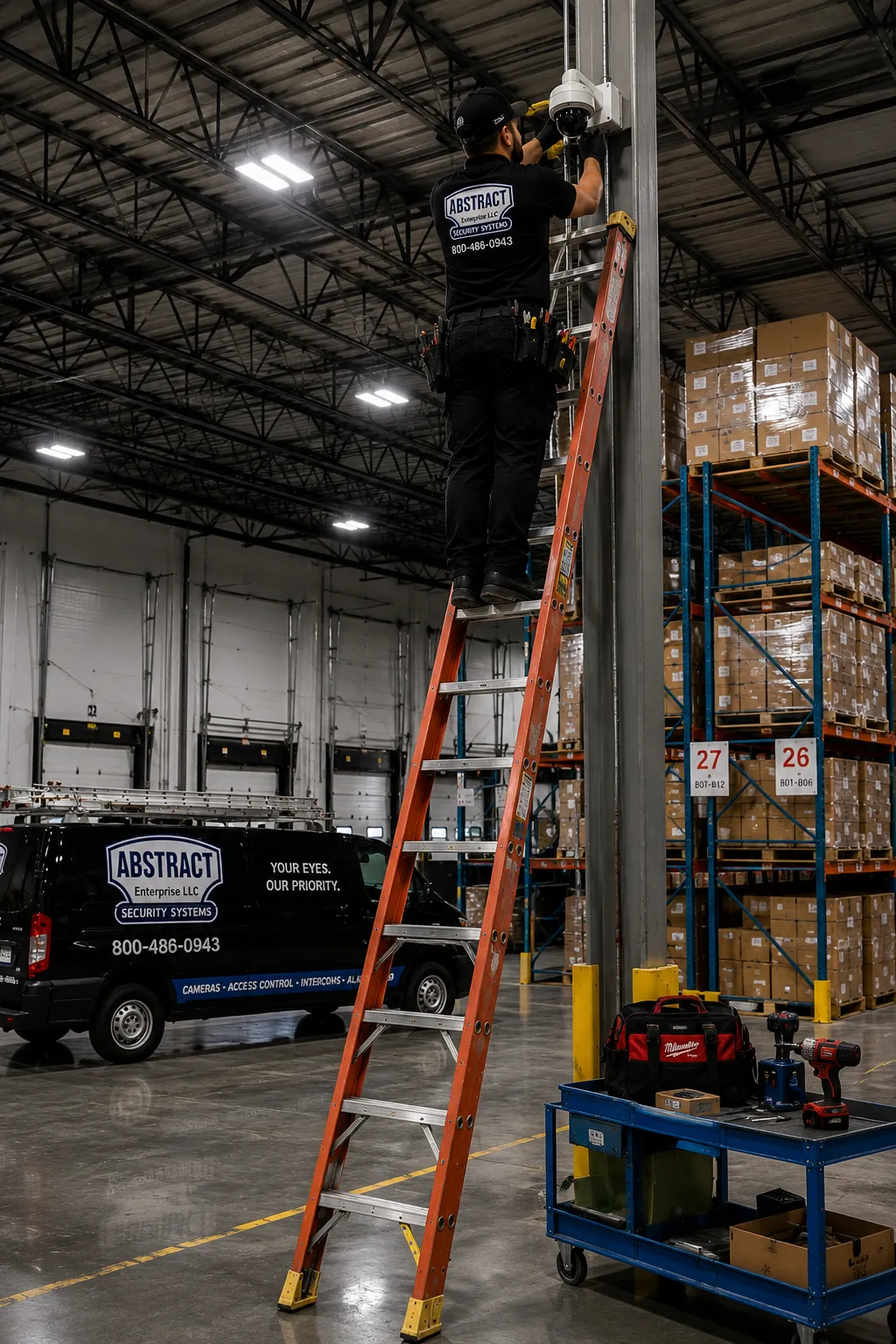
No, and this is the most common self-install mistake we correct. At 30 feet a camera sees the tops of heads and pallet wrap. We mount most identification cameras at 12 to 16 feet on columns and walls, angled to catch faces at choke points, and reserve true high mounts for wide overview and fisheye units. Mounting height is a design decision per camera, not a default to the steel.
Why do my WiFi cameras keep dropping behind the racking?
Because your warehouse is a Faraday cage with forklifts. Steel racking, dense palletized inventory, metal walls and motor noise shred 2.4GHz and 5GHz signal, and every dropped connection is footage that does not exist. Hardwired PoE is not an upgrade in a warehouse, it is the baseline. Where a wire truly cannot go, a gate booth across the yard for example, we use dedicated point-to-point wireless bridges with directional antennas, not consumer WiFi.
How much storage do I actually need for 30 days of footage?
Rough rule: a 4K camera with a modern smart codec recording continuously averages 1.5 to 2.5 megabits per second. Sixteen of them run roughly 10 terabytes per 30 days; motion-based recording in quiet areas cuts that hard. We calculate per-camera from resolution, frame rate and scene activity, then add 25 percent headroom, because the incident you need always surfaces on day 29.
I lease my warehouse. Can I install cameras, and who owns them when I leave?
Almost every NYC industrial lease allows tenant security systems with landlord notice, and low-voltage cameras rarely trigger structural alteration clauses. Get consent in writing for roof or exterior penetrations. Ownership follows your lease's trade-fixture language: cameras and recorders are typically removable tenant equipment if you patch holes, while abandoned cable often stays. We install with removal in mind for tenants and can relocate the whole system when you move.
My landlord has cameras in the shared loading bay. Can he see into my unit? Can I add my own?
His cameras belong on common areas, and yours belong inside your demised space; that boundary protects both of you. You have every right to your own system inside your unit, recording to your own NVR that the landlord cannot access. In multi-tenant buildings we regularly install parallel systems and, where owners want it, permission-limited shared views of the common docks so each tenant sees their lane and nothing else.
Installer finished a year ago, one camera died, and he will not call back. Options?
This is a third of our service calls. Bring us the recorder and we can usually identify the dead camera, the switch port or the cable fault in one visit; orphaned systems from vanished installers are routine takeovers for us. Going forward, hire on serviceability: labeled cable, documented passwords you hold, standard ONVIF hardware anyone can replace, and a written warranty with a phone number that answers, which is (800) 486-0943 here.
My night footage is a whiteout of glare and bugs. What went wrong?
Classic IR bounce. The camera's infrared is reflecting off shrink-wrapped pallets, a nearby wall or the dome itself, and moths love the glow. Fixes we apply weekly: reposition off reflective sightlines, switch domes to turrets which resist internal IR reflection, use external IR illuminators mounted away from the lens, or move to full-color low-light models where ambient light allows. Ninety percent of terrible night video is placement, not the camera.
Warehouse Camera Questions People Type Into Search
How do warehouse security cameras work?
Commercial IP cameras capture video and send it over Cat6 cable to a network video recorder in your office or IT closet, which stores weeks of footage on surveillance drives. The same recorder streams live and recorded video to phone and desktop apps over your internet connection, with motion and AI alerts pushed to whoever you authorize.
How high should warehouse cameras be mounted?
Twelve to sixteen feet for identification views at doors, docks and choke points, which keeps faces in frame and hands out of reach. Overview, fisheye and PTZ units go higher, up on the steel, to map movement across the floor. Every height above 20 feet means lift work, which is a labor line worth planning around.
What resolution is best for warehouse cameras?
4K at docks, gates, entrances and anywhere you need to identify a face, a plate or a label. 4MP is a sensible economy for general aisle and overview positions. Below 1080p there is no reason to install anything new in 2026; the storage savings no longer justify unusable evidence.
Can warehouse cameras work without internet?
Yes. Recording is fully local to the NVR, so cameras capture and store everything even if your internet is down for a week. Internet is only required for remote phone viewing and push alerts, and service restores those automatically when the connection returns. This is a core advantage over cloud-only cameras, which record nothing during an outage unless they have onboard storage.
What is the difference between CCTV and IP camera systems?
CCTV traditionally means analog cameras on coax feeding a DVR: closed, low-resolution, but simple. IP systems put a network camera on Ethernet feeding an NVR: far higher resolution, per-camera intelligence, and easy expansion. People now use CCTV loosely for both; what matters on your quote is whether the hardware is analog or IP.
Where should cameras go in a warehouse first?
Priority order from loss data: dock doors and loading bays, then personnel entrances and exits, then the yard and gate, then high-value cages, then interior aisles and staging. If the budget covers eight cameras today, that is the order we spend them in, with cable pathways left ready for the rest.
Can employees legally be recorded in a New York warehouse?
Video in work and storage areas is legal in New York; restrooms, locker rooms and similar private spaces are strictly off-limits under state labor law. Audio recording has separate consent rules, so we install video-only in employee areas by default. Posting notice of surveillance is good practice and helps the deterrence do its job.
Why are warehouse cameras better than a security guard alone?
They are not either-or, but cameras never sleep, cover forty places at once, and produce evidence a guard's memory cannot. The strongest setups we build pair recorded coverage with a guard or manager who receives verified alerts, so a human responds to what the system already documented. A guard service also costs more per month than most camera systems cost once.
Will cameras stop internal theft or just record it?
Both, in that order. Visible, professionally mounted cameras with posted notice measurably suppress internal shrink because opportunity thieves stop treating the floor as unobserved. When someone persists, timestamped video plus your inventory system turns a suspicion into a resolvable case instead of an accusation. The camera you can see prevents; the recording proves.
Which is better for a warehouse, dome or bullet cameras?
Turrets and bullets outdoors and at docks, because dome bubbles collect dust and bounce infrared at night. Vandal-rated domes still make sense in reachable interior spots where tampering is the threat. The honest answer is per-position: we routinely mix all three form factors on one warehouse, chosen by mounting point and lighting, not by a brand's bundle.
How often do warehouse camera systems need maintenance?
Twice a year is the sweet spot: lens cleaning after months of dust and forklift exhaust, aim checks because vibration walks cameras off target, drive health review, firmware updates, and a full playback test. We offer this as a scheduled service, and it is why our systems still produce court-usable footage in year six.
What happens to my footage if the NVR is stolen?
Plan for it: we mount recorders in locked cabinets or rooms, out of casual sight, and can add offsite backup of critical cameras so a thief taking the box does not take the evidence of him taking the box. Edge SD storage in key cameras and cloud copies of dock views are cheap redundancy for exactly this scenario.
People Also Ask About Warehouse Camera Installation
Who installs security cameras in warehouses near me?
In New York City, look for a state-licensed low-voltage security contractor with documented commercial work, not a general handyman or a national call center reselling leads. Abstract Enterprises Security Systems installs warehouse cameras across all five boroughs from our Brooklyn base at 1282 Troy Ave, license #12000287431, with free site walks.
What is the best security camera system for a warehouse?
The one designed around your building: 4K PoE cameras with true WDR at the docks, correct lens choices per aisle, an NVR sized for your retention, and plate capture at the gate if trucks matter. Brand-wise, Dahua, Hikvision and Uniview dominate value builds; Hanwha, Axis and Avigilon lead NDAA and analytics-heavy projects.
How much does it cost to install cameras in a warehouse?
In NYC, most warehouse projects land between $4,500 and $22,000 installed. Smaller 8-camera systems start around $4,500 to $7,500; 16-camera mid-size builds run $9,000 to $16,000; large distribution floors with lifts, conduit, yard poles and LPR climb from there. Ceiling height and cable paths move price more than camera count.
How many cameras do I need for my warehouse?
There is no honest fixed formula. The count is driven by dock doors, entrances, cages, aisle layout, racking density, ceiling height and how many identification points you need; then add dedicated units at every dock door, personnel entrance and high-value cage. Racking layout adjusts the number: long aisles need end coverage, open staging floors need fewer, taller units. A site walk turns the rule of thumb into a real count.
Can I watch my warehouse cameras from my phone?
Yes, on every system we install. Live view, playback, clip export and motion alerts run through manufacturer apps on iPhone and Android, and we configure them on your actual devices before we leave. Owners get admin access; managers get viewer accounts with only the cameras and hours you allow.
Do warehouse cameras work in the dark?
Properly specified ones do. Infrared cameras see 100-plus feet in total darkness in black and white; full-color low-light models keep color where any ambient light exists; thermal units detect people in absolute black across a yard. The failures you have seen come from consumer IR bouncing off pallets, which placement fixes.
Should warehouse cameras record continuously or on motion?
Hybrid. Docks, gates and entrances record continuously because motion triggers can clip the start of an event and disputes hinge on complete timelines. Quiet interior zones record on motion with pre-record buffers, which saves enormous storage. We schedule both per camera, then arm stricter AI rules after closing time.
What internet speed do I need for remote viewing?
Less than people fear, because recording is local. Remote viewing streams only what you watch: a smooth substream view uses about 1 to 2 megabits of upload per live camera. A basic business connection handles an owner checking docks from home; only multi-viewer, multi-site monitoring pushes bandwidth planning.
Do I need to tell employees about the cameras?
New York does not require consent for video in work areas, but written notice and posted signage are strongly recommended and standard in our installs. Notice strengthens the deterrent effect, heads off morale issues, and keeps you clearly outside the private-space and audio-consent rules that do carry legal teeth.
Related Searches, Translated Into Plain English
Warehouse CCTV installation companies
The vetting shortlist: NYS license, commercial COI, in-house techs, model-numbered quotes and a warranty someone answers the phone for. That filter removes most of the search results.
Commercial security camera installer near me
Near-me matters in NYC because service response does. A Brooklyn-based crew reaches a dead recorder in Maspeth today; a franchise dispatcher books you for Thursday week.
PoE cameras for warehouses
Power over Ethernet is the warehouse standard: one cable per camera, centralized battery backup at the switch, and none of the plug-in power bricks that fail above the racking.
Loading dock security cameras
The highest-priority position in the building. True WDR for door glare, mounted to see faces and trailer numbers, recording continuously, with a second angle covering the dock office.
Warehouse camera packages
Our 8, 16 and 32-camera packages below are honest starting points, but the package is the beginning of a design, not the end. The site walk decides what your building actually needs.
Warehouse NVR upgrade
Keep good cameras, replace the aging recorder: bigger retention, remote viewing, AI search. One of the cheapest ways to modernize, and often done in a single visit.
Warehouse alarm systems
The partner layer to video: door contacts, motion, glass-break and monitored response. We install intrusion alongside cameras so a verified alarm comes with footage attached.
Best 4K cameras for warehouses
Look past megapixels to sensor size, true WDR numbers and IR range. A quality 4MP with a 1/1.8-inch sensor out-performs a cheap 4K after dark, every time.
What Google's AI Overview Tells You About Warehouse Cameras, and Where It Misleads NYC Buyers
Search anything about warehouse camera installation and an AI-generated answer box now appears above the real results, stitched together from national averages and affiliate blogs. Some of it is fine. Some of it will cost a New York warehouse owner real money. Here is the honest audit, section by section.
1. The national cost figures are homeowner math wearing a hard hat
AI Overviews lean heavily on aggregator data from Angi, HomeAdvisor and Fixr, which put average security camera installation somewhere around $1,300 with per-camera figures as low as $125. Those datasets are dominated by residential jobs: doorbell cameras, four-camera houses, plug-in WiFi units. A ranch house in Ohio and a 25,000 square foot warehouse in Maspeth are not the same project.
Commercial reality, confirmed by every serious integrator publishing numbers, runs $500 to $1,000 per camera installed for commercial-grade hardware, with warehouse systems as a category landing roughly $8,000 to $35,000 depending on scale. Labor alone is commonly $150 to $300 per camera before lifts and conduit. When an AI answer primes you with residential figures, every legitimate commercial quote looks like a rip-off, and owners stall for a year while the dock stays blind.
Use the aggregator numbers for what they are: a floor for small residential work. Budget a New York warehouse from commercial data and a site walk.
2. The camera-count formulas skip the part that matters
Ask how many cameras a warehouse needs and the AI recites a density formula or a flat count for your square footage, delivered with total confidence. We will not repeat the numbers, because presenting any fixed cameras-per-square-foot ratio as a rule is exactly the mistake.
The formula does not know you have six dock doors on a public street, a cash office, a cannabis license, 30-foot steel with canyon aisles, or trailers staging overnight. Two warehouses with identical square footage can legitimately need 12 cameras and 34, and density rules say nothing about pixel density, the difference between footage and evidence.
The count on your quote should be built from your docks, doors, cages, aisles, ceiling height, racking and identification requirements by someone who stood in the building, which is exactly what our free site walk produces.
3. Wireless keeps getting recommended for buildings that eat wireless alive
AI answer boxes routinely list wireless cameras as a pro-and-con equal option for warehouses, praising easy installation. In a steel-framed, steel-racked, forklift-filled building, that advice is close to malpractice. RF signal dies in exactly the aisles you most need covered, and a dropped connection is footage that never existed.
Every integrator who works industrial space converges on the same answer: hardwired PoE for anything business-critical, with engineered point-to-point bridges for the rare detached structure. The easy install the AI is praising becomes the system you replace in eighteen months, and we know because replacing them is a steady share of our work.
If a bidder proposes consumer wireless for your warehouse interior, they are quoting a house product for an industrial building. That is a vetting result, not a discount.
4. Free quote buttons are lead-resale funnels, not installers
Search for a warehouse security camera installer to hire and the AI Overview, plus the ads around it, push get free quotes forms from Angi, HomeAdvisor and similar marketplaces. Understand the machine: your details are sold as a lead, often to several contractors simultaneously, some of whom pay per phone number rather than per qualification, and few of whom hold a New York State security license.
The calls start in minutes and the quality control is yours to perform. Marketplace review scores measure lead-buying behavior as much as workmanship. For a commodity task that might be tolerable; for the system your insurance claim will one day depend on, it is a strange way to hire.
The alternative costs nothing extra: contact a licensed local contractor directly, verify the license number yourself, and get a written camera-by-camera quote. You keep your phone number private and your vetting real.
5. Cloud subscription costs get one soft sentence, then vanish
AI summaries of the best warehouse camera platforms lead with slick cloud brands and mention pricing available on request or a vague monthly fee. The arithmetic deserves daylight: published cloud storage runs $10 to $30 per camera per month. A 24-camera warehouse at the midpoint is roughly $5,800 a year, forever, before hardware.
Over the five to seven year life of a camera system, the subscription frequently exceeds the entire cost of an owned, locally recorded system delivering the same core outcomes: recorded evidence, phone viewing, smart alerts. Cloud has genuine wins, mainly fleet management across many sites and zero on-prem IT, and we install it when that is truly the fit.
But the AI never shows you the five-year table, and the vendors it cites certainly do not. We will, on your numbers, before you sign anything.
6. Install timelines ignore how New York buildings actually work
The answer box says installation takes a few hours to a couple of days, which is true in a suburban strip mall. NYC warehouses add friction the AI has never met: certificates of insurance with specific endorsements before your landlord lets a lift through the gate, freight elevator windows, union buildings with work-hour rules, and 24-hour operations where the dock cannot stop for you.
Our honest local numbers: one day for a straightforward 8-camera building, two to three days for 16 to 32 cameras with lift work, plus lead time for COI paperwork in managed industrial parks. We regularly schedule overnight and weekend installs so shipping never pauses.
Plan the calendar with someone who has installed in your kind of building. The timeline is a logistics question, and logistics is local.
7. What the AI Overview gets right, and how to use it
Credit where due: the answer boxes correctly rank loading docks as the top coverage priority, correctly favor 4K at identification points, and correctly note that retention requirements drive storage cost. The broad strokes of placement and the case for professional installation in commercial buildings generally survive the summarization.
The failure mode is flattening: national averages presented as your price, density rules presented as design, and a hedge-everything tone that never tells you wireless is wrong for your building because it does not know your building. AI summaries also cannot verify a license, pull a COI or stand behind footage in a deposition.
Use the Overview to learn vocabulary and shape questions. Then get your actual answers from a walk-through with a licensed installer whose name goes on the work. That is the entire pitch of this page, and unlike the answer box, we will put it in writing.
Ready for Real Numbers on Your Building?
Skip the averages. A licensed installer walks your warehouse, maps the blind spots, and hands you a fixed written quote.
DIY vs Professional Warehouse Camera Installation
We respect a hands-on owner; half our clients rack their own servers and fix their own forklifts. So here is the unvarnished comparison for CCTV installation for warehouses specifically, rather than the generic version written for houses.
| Factor | DIY / Handyman Install | Licensed Professional Install |
|---|---|---|
| Upfront cost | Lower on day one: kit hardware plus your weekends | Higher on day one: commercial hardware plus engineered labor |
| Coverage design | Cameras where mounting is easy; blind spots where thieves work | Cameras where evidence is needed: docks, choke points, cages, gate |
| Cabling | Exposed runs, no labels, failures when the building vibrates | Labeled, protected Cat6 with service loops, tested and documented |
| Night and dock-door performance | Whiteouts and IR bounce discovered after the incident | True WDR and IR planned per position, verified before handoff |
| Height and lift work | Ladder-limited; steel stays out of reach | Lift-equipped, insured for it, mounts torqued to structure |
| Evidence quality | Proof that something happened | Proof of who, in footage that survives an insurance adjuster |
| When it breaks | You are the support department | Three-year AESS-product warranty, same-day NYC service line |
The honest middle path exists too: we design and cable, you mount and save labor; or we install a core professional system and leave documented spare ports for cameras you add yourself later. The runs, the recorder and the design are the parts worth paying for; ask us to structure the job that way and we will.
Abstract Enterprises vs the Names You Already Know
ADT Commercial and the national alarm giants
The nationals sell warehouses a monitored ecosystem on a multi-year contract, with cameras as an add-on line and equipment that stays proprietary. You get brand comfort and a real monitoring network; you also get subscription pricing, subcontracted installs in many markets, and service tickets routed through a national queue. We sell the opposite structure: you own everything, footage lives in your building, monitoring is optional and month-to-month through our central-station partners, and the tech who answers your service call is the company. For a warehouse whose core need is recorded evidence and fast local service, the contract model mostly adds cost.
Verkada, Rhombus and the cloud subscription platforms
Genuinely excellent software, honestly aggressive sales, and per-camera license fees forever. For a 12-state operator managing 60 sites from one dashboard, the fleet tooling can be worth it, and we will deploy it for you. For a single Brooklyn warehouse, the five-year subscription usually exceeds the cost of an equal owned system, and the cameras brick into paperweights if you ever stop paying. We put both architectures on one page with real numbers and let you choose with eyes open, which the platform reps, on commission, structurally cannot.
Ring, consumer kits and prosumer gear
Ring and its cousins are fine products for the buildings they were designed for, which are houses. In a warehouse they fail on physics: WiFi through steel, batteries in freezing mezzanines, short IR, no true WDR at dock doors, cloud dependency during outages, and terms of service never meant for commercial evidence chains. We replace these systems constantly, usually right after the incident where the footage mattered and was not there. If budget forces consumer gear temporarily, at least put it on the man-door and not the dock, and call us when it earns you a real system.
National integrators and IT VARs
Big integrators do strong enterprise work, and if you are a Fortune-500 distribution network, use one. Their economics need scale: minimum engagements, project-management layers, and travel-billed service. A single NYC warehouse is their rounding error and our core account. Same commercial hardware tiers, a state license just like theirs, and the owner of the company has personally been on your roof, and the warehouse security camera installers who quote your job are the ones who hang the cameras. That is the trade between a national integrator and a local warehouse security installer, plainly stated.
Warehouse Security, By the Numbers
Common NYC Warehouse Scenarios We Get Called For
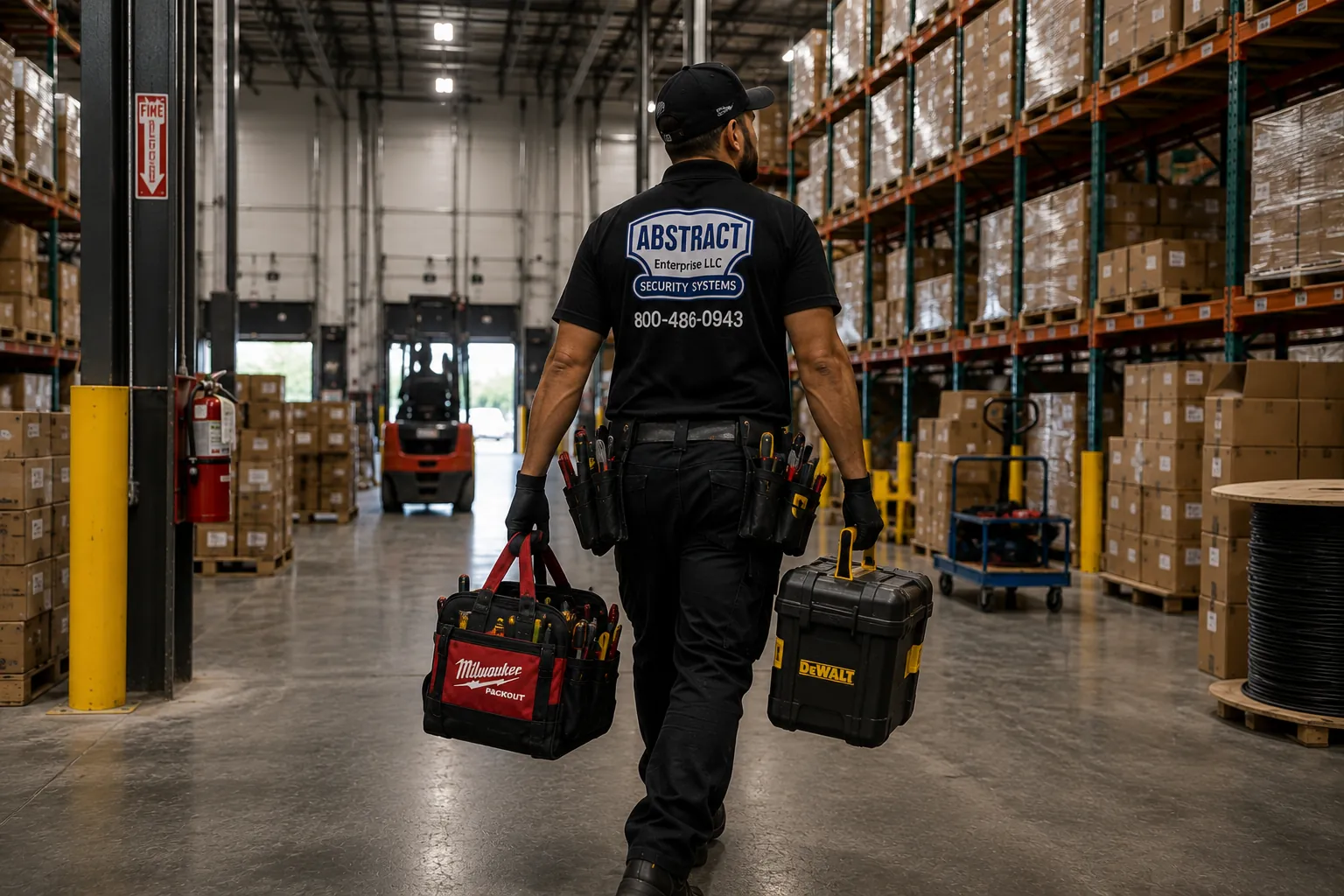
Composite scenarios drawn from the patterns of calls we take across the five boroughs — the situations, not specific client identities.
The overnight produce-dock install
A Hunts Point food distributor needs sixteen cameras across dock and coolers without stopping receiving. The build: overnight installation, cold-rated housings, true WDR at the dock doors, and retention sized so a rejected-load dispute weeks later still has footage behind it.
The orphaned-system takeover
A Maspeth 3PL inherits a half-dead system from an installer who vanished. The play: audit and salvage the sound cable, swap the recorder, relabel every run, and stand remote viewing up across both buildings so the owner is not paying for a rip-and-replace the wiring never required.
The fence-jumper response
A storage operator gets hit through the perimeter. The layered answer: line-crossing detection along the fence, corridor coverage on the units, and audio deterrence speakers so a 2 a.m. alert becomes a live intervention instead of a morning discovery.
The insurance-renewal package
A Staten Island logistics yard gets asked for surveillance documentation at renewal. What we hand over: the camera map, retention specs, and installation records from a licensed contractor, the paperwork underwriters actually credit when pricing a commercial policy.
From the Installer: An Example Maspeth Design Scenario
Here is how I would spec a typical job we see all the time: call it 22,000 square feet off Rust Street in Maspeth, six dock doors, 28-foot steel, an owner tired of finding shrink he cannot explain, and an old system of eight WiFi cameras with three offline so long the apps got deleted. I walk it at 7 a.m. before the trucks stack up. Dock doors facing east means morning glare straight into any camera without real WDR, so those four positions get 4K turrets rated 140dB and the 8 a.m. footage looks like noon. The aisles are the canyon problem, five rows of racking, so instead of ten mediocre heads I hang two 12MP fisheyes at the crossings and directional cameras at the aisle ends. The gate gets an LPR unit angled down the apron to log every carrier and carting truck that rolls through. Every Cat6 runs high along the joists with service loops, labeled at both ends, because the next tech, probably me, deserves better than mystery wire. Lift time is half the labor, which is normal above 20 feet and why I ask the ceiling height before the camera count. The recorder holds 60 days, and the owner checks his first load-out from his kitchen the night we hand it off. That is the whole design, honestly: turn a bad feeling into a timestamp. — Anwar Timothy, Lic #12000287431
See Our NYC Camera Installs on YouTube
Latest installs, walkthroughs and repair shorts from our channel, @openeye0007. Subscribe to see the work before you buy it.
Warehouse Security Camera Installation FAQ
How much does warehouse security camera installation cost in NYC?
Most NYC warehouse camera projects land between $4,500 and $22,000 installed. A typical 8-camera 4K PoE system for a smaller Brooklyn or Queens facility runs roughly $4,500 to $7,500, a 16-camera build for a mid-size warehouse runs $9,000 to $16,000, and 32-plus camera distribution centers with lift work, yard poles, and license plate capture go higher. Cable paths, ceiling height, and retention requirements move the number more than camera count does, which is why we quote from a site walk, not a phone script.
How many cameras does a 20,000 square foot warehouse need?
There is no fixed formula worth trusting. The real count comes from the building itself: how many dock doors and personnel entrances need dedicated coverage, whether cages or inventory rooms need identification-grade cameras, aisle layout and racking density, ceiling height, and yard exposure. Typical 20,000 square foot NYC warehouses land anywhere from 10 to 20-plus cameras depending on those factors, and a free site walk is how the real number gets mapped rather than guessed.
Can I watch my warehouse cameras from my phone?
Yes. Every system we install includes remote viewing configured before we leave: live view, playback, and motion alerts on iPhone and Android for the owner and any managers you authorize. We set up viewer-level accounts for staff so nobody needs the admin password, and we test the app on your actual phone at handoff.
Do your warehouse camera systems have monthly fees?
No. We build around local NVR recording, so footage stays on hardware you own inside your building and there is no required subscription. Remote viewing over the internet is included at no monthly cost. Optional extras like offsite cloud backup or central-station video monitoring are available if you want them, but the core system never bills you again.
How long does warehouse camera installation take?
Most NYC warehouse installs run one to three working days. An 8-camera system in a facility with accessible ceilings is usually a single day; a 16 to 32 camera project with lift work, conduit, and exterior yard cameras typically takes two to three. We can schedule overnight or weekend work so receiving and shipping never stop, which matters for 24-hour operations in places like Hunts Point and JFK-area logistics.
Should I use wired or wireless cameras for a warehouse?
Wired PoE, almost always. Steel racking, forklifts, concrete, and dense metal inventory chew up WiFi signal, and a wireless camera that drops offline records nothing. Hardwired Cat6 delivers power and video on one cable, survives interference, and supports 4K without compression tricks. We reserve wireless links for detached guard booths or gates where trenching is impractical, and even then we use dedicated point-to-point antennas rather than consumer WiFi.
Will cameras work in dark warehouse aisles?
Yes; poor warehouse night visibility is a hardware problem, not a fate. We spec night-vision warehouse cameras with strong infrared range and true wide dynamic range of 120dB or better, so a dock door flooded with daylight next to a dark interior still produces usable footage. For fully unlit areas we use IR-optimized turrets positioned to avoid bounce-back off shrink wrap and racking, and for color detail at night we add low-light full-color models where ambient light allows.
Can warehouse cameras capture faces and license plates?
Yes, when they are planned for it. Faces need enough pixel density at choke points, so we place identification cameras at head height near personnel doors and time clocks. Plates need a dedicated license plate recognition camera aimed down a gate lane or dock apron with the right shutter settings for headlights and motion. General overview cameras alone will not reliably do either job, which is a common failure in self-designed systems.
How long should a warehouse keep camera footage?
Thirty days is the practical minimum for most NYC warehouses, and many insurers, 3PL contracts, and cargo claims processes expect 60 to 90. Licensed cannabis facilities in New York must retain at least 60 days under OCM rules. We size NVR storage to your retention target using the actual camera count and resolution, so footage from a slow-to-surface incident is still there when you need it.
Can you upgrade my existing warehouse camera system instead of replacing it?
Often, yes; an outdated warehouse CCTV system rarely needs a full rip-out. If your coax or Cat5e cable runs are sound we can reuse them, swap failing analog cameras for modern HD or IP units, and replace an aging recorder with a new NVR that adds remote viewing and longer retention. We also take over systems other companies installed and no longer support. A short site visit tells us what is salvageable before you spend anything.
Do I need a license or permit for warehouse cameras in NYC?
Camera installation itself does not require a city permit in most NYC warehouses, but the installer should hold a New York State security systems license, verifiable through the NYS Department of State, and ours is #12000287431. On the legal side, New York Labor Law Section 203-c bars cameras in restrooms and locker rooms, and recorded audio has separate consent rules, so we design video-only coverage of work and storage areas. Treat this as general guidance rather than legal advice.
Do warehouse security cameras lower insurance costs?
Frequently. Commercial property and cargo insurers commonly discount premiums for monitored, professionally installed surveillance, and several of our clients recovered part of the install cost in the first renewal. Beyond discounts, footage shortens claims: a documented dock incident or slip-and-fall dispute settles far faster with time-stamped video than with conflicting statements. Ask your broker what documentation they need and we will provide it after install.
Questions Answered. Next Step: Your Building.
Every warehouse is its own design problem. Get yours solved on paper before you spend a dollar.
Warehouse Camera Installation Coverage Across NYC
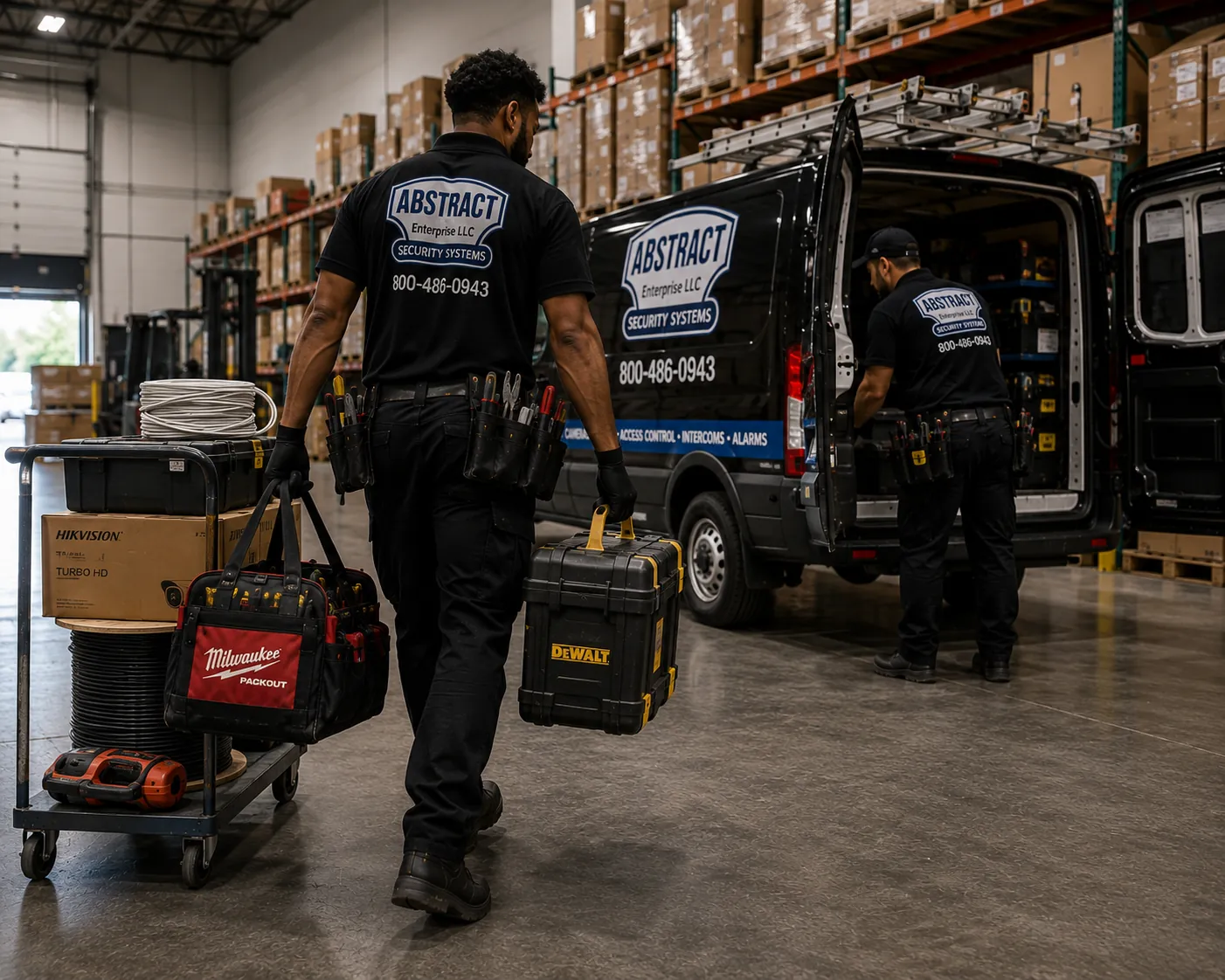
This warehouse surveillance installation hub covers all five boroughs from our Brooklyn headquarters at 1282 Troy Ave. Borough-specific pages with local pricing, neighborhoods and case notes are linked in the silo footer below; here is the footprint at a glance.
Searches like “warehouse camera installation near me” and “warehouse CCTV installer near me” from any of these corridors land on this hub; your borough page below narrows it to the block level. Beyond the five boroughs, we run warehouse surveillance camera installation projects on Long Island and across the Hudson Valley through our regional hubs, with the same crews and the same standards. Nassau, Suffolk, Westchester, Rockland, Orange, Putnam, Dutchess and Ulster owners: your county pages are in the silo footer.
How Your Options Stack Up
Every commercial warehouse CCTV installation company, cloud platform and side-hustle handyman pitches this market. Here is how the warehouse surveillance system installers actually compare on the things that matter after the deposit clears.
| Abstract Enterprises | National Alarm Company | Cloud Camera Platform | Handyman / GC Side Job | |
|---|---|---|---|---|
| NYS security license | Yes, #12000287431 | Corporate license, subbed installs | Varies by install partner | Usually none |
| Monthly fees required | None | Contract monitoring | Per-camera licensing forever | None |
| You own footage locally | Yes, on your NVR | Depends on package | No, cloud-hosted | Yes, if it records |
| Warehouse-specific design | Docks, aisles, lifts, WDR: daily work | Template packages | Strong hardware, remote design | Cameras where the ladder reaches |
| Service response in NYC | Same-day, local crew | National ticket queue | Mail-in / partner dispatch | When he answers |
| Contract length | None, job-based | Multi-year typical | Annual license terms | None |
| Warranty | 3-year (AESS products), written | Contract-dependent | Hardware while subscribed | Handshake |
Warehouse Security Camera Installation Pricing in NYC
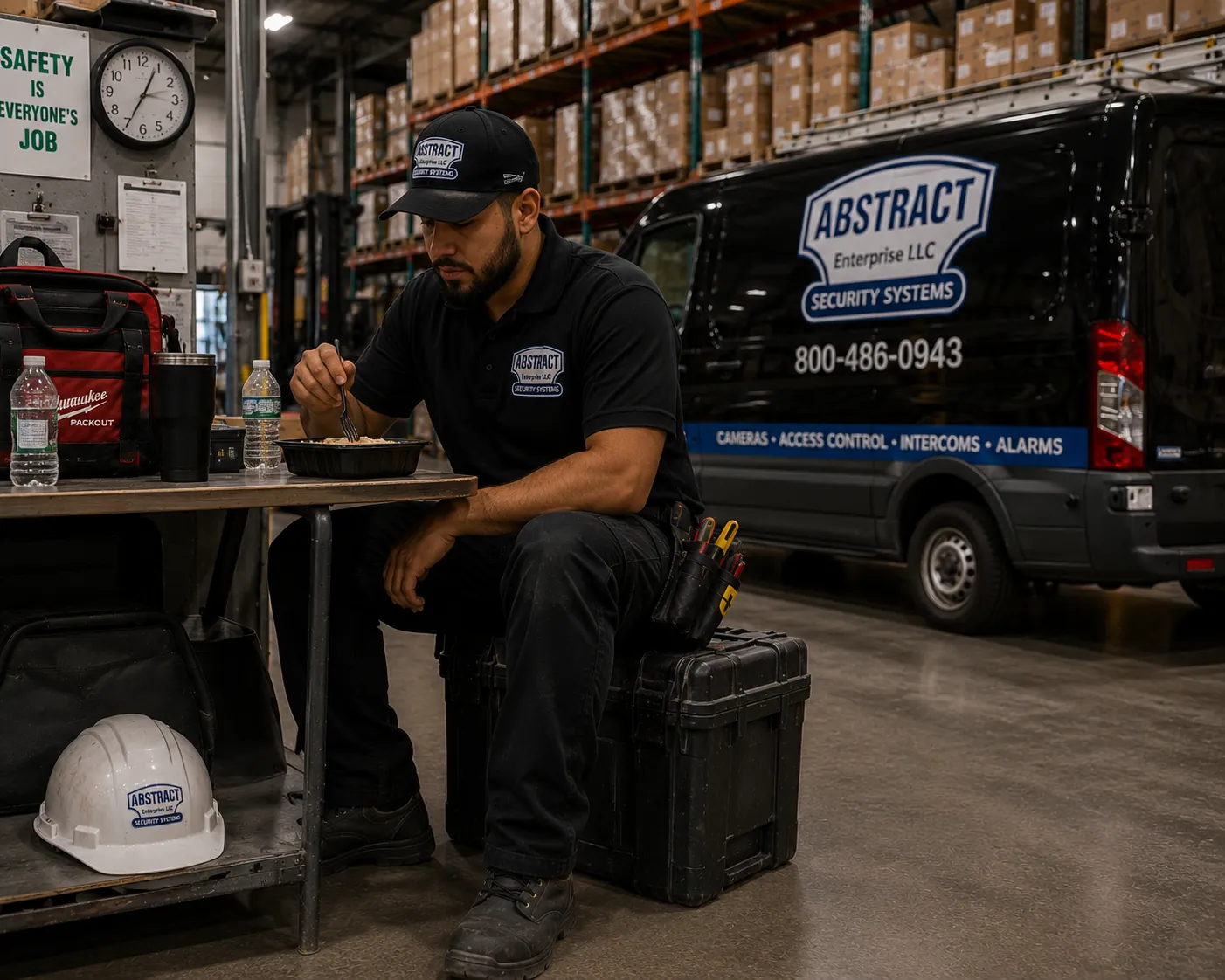
Warehouse camera installation cost is the first question on every call, so here are honest ranges before anyone visits. These are installed warehouse security camera system prices, hardware and labor, for the five boroughs; NYC is our base pricing area, with Brooklyn and Queens typically at the low end of each band and complex Manhattan buildings at the top.
| Package | Typical Building | Installed Range | What Drives It Up |
|---|---|---|---|
| 8-camera 4K PoE + NVR | Under 10,000 sq ft, storage and shop buildings | $4,500 – $7,500 | High ceilings, exterior conduit, masonry drilling |
| 16-camera 4K PoE + NVR | 10,000 – 30,000 sq ft, multi-dock facilities | $9,000 – $16,000 | Lift work above 20 ft, 60–90 day retention, yard runs |
| 32-camera distribution build | 30,000+ sq ft, 3PL and fulfillment floors | $18,000 – $32,000+ | Fisheye arrays, redundant storage, multi-switch networks |
| LPR gate / dock lane add-on | Any facility with truck traffic | $1,400 – $2,800 per lane | Pole setting, trenching, lighting conditions |
| PTZ yard coverage add-on | Trailer staging, parking, fence lines | $1,200 – $2,600 per unit | Mounting height, auto-tracking configuration |
| DVR-to-NVR upgrade | Existing wired systems of any age | $1,800 – $6,500 | Camera count reused vs replaced, retention target |
| Repair / service call | Any brand, any installer's system | $195/hr specialty rate | Most warehouse faults fixed in 1–2 hours on site |
Budget context worth repeating: national commercial data puts warehouse systems at $8,000 to $35,000 as a category and commercial installs at $500 to $1,000 per camera, so these warehouse security camera packages are affordable warehouse camera installation by any licensed standard. Financing-style phasing is available by design, docks first, and every quote itemizes hardware by model number so you can check our math line by line.
Need Warehouse Camera Repair in NYC? Fixed in 1–2 Hours, Most Cases.
A warehouse camera system not recording before an inventory audit, unreliable warehouse cameras dropping channels every week, warehouse remote viewing problems locking you out of your own feeds, footage you must export for NYPD or an insurer today: warehouse security system repair is same-day work for us across Brooklyn, Queens, the Bronx, Manhattan and Staten Island. One call covers diagnosis and warehouse camera replacement where hardware has died, and most systems are recording again within one to two hours of arrival.
The Security Problems NYC Warehouses Deal With Right Now
None of this is theoretical; it is why warehouse theft security cameras top our commercial call sheet. These are the loss patterns behind recent five-borough installs — a fair share of them warehouse cameras after a break-in rather than before one — and the camera answers we build for each.
Trailer and cargo theft on industrial blocks
Loaded trailers staged overnight are the city's softest target; New York State Police publicized a Bronx case this spring where an entire commercial-trailer shipment vanished. Yard PTZs with auto-tracking, gate LPR logging every tractor, and after-hours intrusion zones on the apron turn a staging yard from anonymous to documented.
Storage and outdoor-unit ransacking
The fence-jumper pattern hit College Point and East New York storage properties for roughly $80,000 in one recent stretch, with the 109th Precinct logging a double-digit burglary increase that year. Perimeter line-crossing alerts plus corridor cameras catch the climb, not just the aftermath, and audio deterrence speakers end many attempts on the spot.
Organized fencing rings and boosted goods
Queens prosecutors dismantled a crew that moved millions in stolen merchandise through Bronx and Brooklyn storage units and industrial lots, with license plate readers central to the case. If stolen goods can flow through industrial space, your dock can be a target or an unwitting waypoint; plate capture and load-out coverage protect you either way.
Commercial burglary sprees and roof entries
Recent NYPD patterns include six-figure business burglary strings across Cypress Hills and nearby industrial edges, often entering through roofs, gates and rear man-doors at 3 a.m. Coverage on the forgotten sides of the building, rear doors, roof hatches, alley gates, is exactly what a professional design adds that self-installs miss.
Internal shrink and dock pilferage
The quietest loss line: a case here, a pallet short there, discovered at cycle count with no story attached. Employee theft surveillance done right means identification-grade cameras at man-doors, time clocks and load-out lanes, paired with continuous dock recording, so a missing inventory investigation starts with a timestamp instead of a hunch and damaged shipment video evidence settles carrier disputes in days. Posted coverage suppresses most of it before it starts.
Scrappers, copper and catalytic converters
Yard vehicles and rooftop units feed the scrap trade across the outer boroughs, and warehouse vandalism cameras pay for themselves the first time a cut fence or tagged wall comes with a face attached. Thermal or low-light perimeter cameras with people-detection alerts, aimed along fence lines and at parked box trucks, catch the pattern visits that precede the big hit, and give the precinct something better than a shrug to work with. Many owners pair this coverage with monitored alarm contacts on gates for a response, not just a recording.
Related Security Services Across NYC
Security Camera Installation
Every property type, all five boroughs: the citywide hub for our camera work.
Security Camera Repair
Same-day fixes on any brand, any installer's system, across NYC.
Commercial Camera Systems
Offices, retail, restaurants and mixed-use buildings beyond the warehouse.
Apartment Building Cameras
Multifamily lobbies, hallways, packages and compliance coverage.
Wireless Camera Installation
Engineered wireless for the locations where wire truly cannot go.
Dahua Camera Installation
The value workhorse line we install and service citywide.
Lorex Camera Installation
No-fee 4K systems for smaller commercial and residential buildings.
Intercom Installation
Video intercoms and building entry systems for commercial and multi-unit properties.
Put Cameras on Your Warehouse Before the Next Incident Writes the Check
One call gets you a free site walk anywhere in the five boroughs, a camera-by-camera written quote, and a system you own outright from a licensed and insured commercial security company: no contracts, no monthly fees, three-year warranty on AESS-supplied products, NYS license #12000287431 on every page of the paperwork. Warehouse security camera installation in NYC is what this crew does all day, and Abstract Enterprises warehouse surveillance systems are recording on five-borough docks tonight; let us prove it on your building.
Warehouse Security Camera Installation: Every Area We Serve
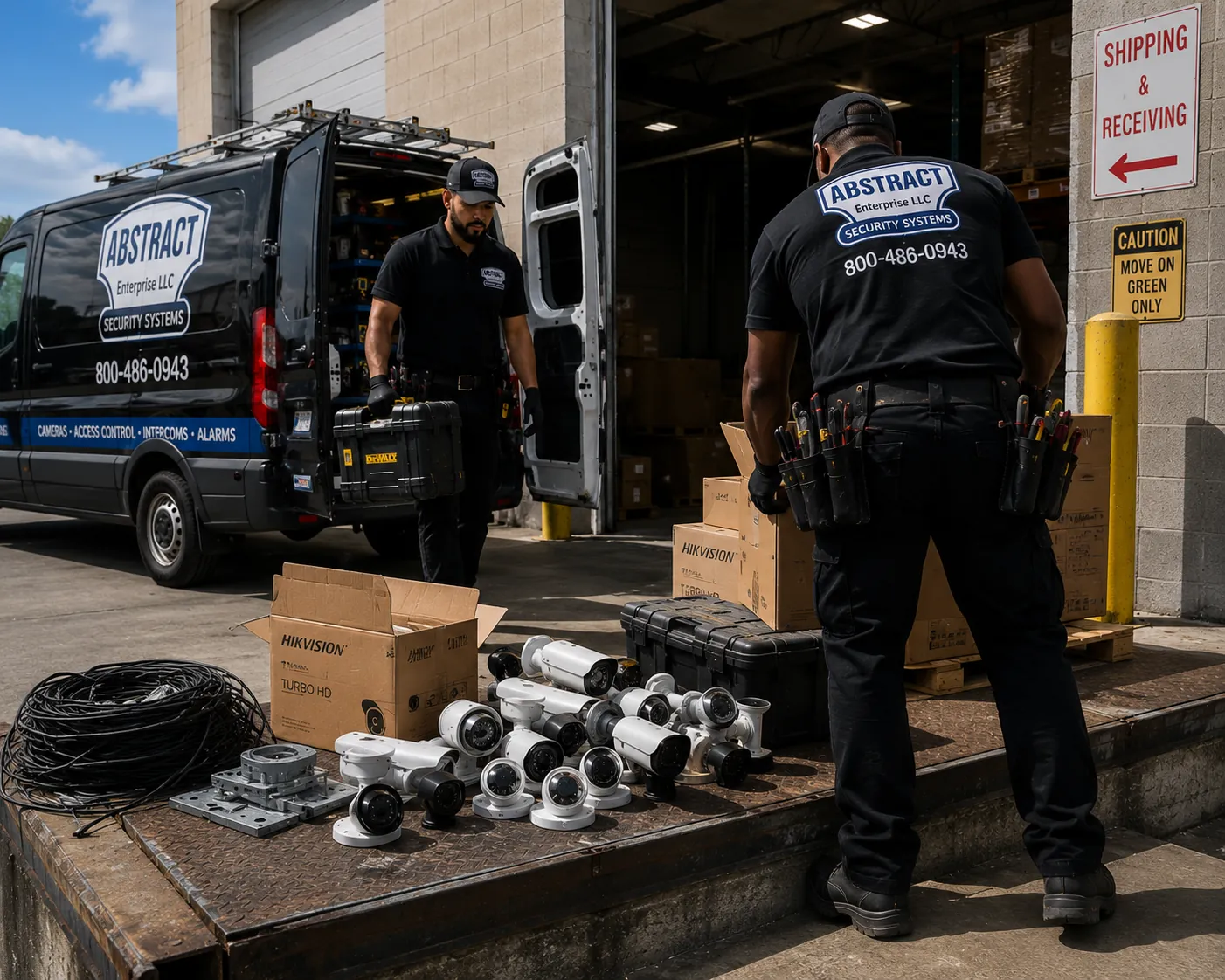
Borough and county pages are rolling out; area names below become links as each page goes live.
- NYC (This Hub)
- Brooklyn
- Manhattan
- Queens
- Bronx
- Staten Island
- Long Island (Hub)
- Nassau County
- Suffolk County
- Hudson Valley (Hub)
- Westchester County
- Rockland County
- Orange County
- Putnam County
- Dutchess County
- Ulster County
Hub navigation: Home · Security Camera Installation NYC · Camera Repair NYC