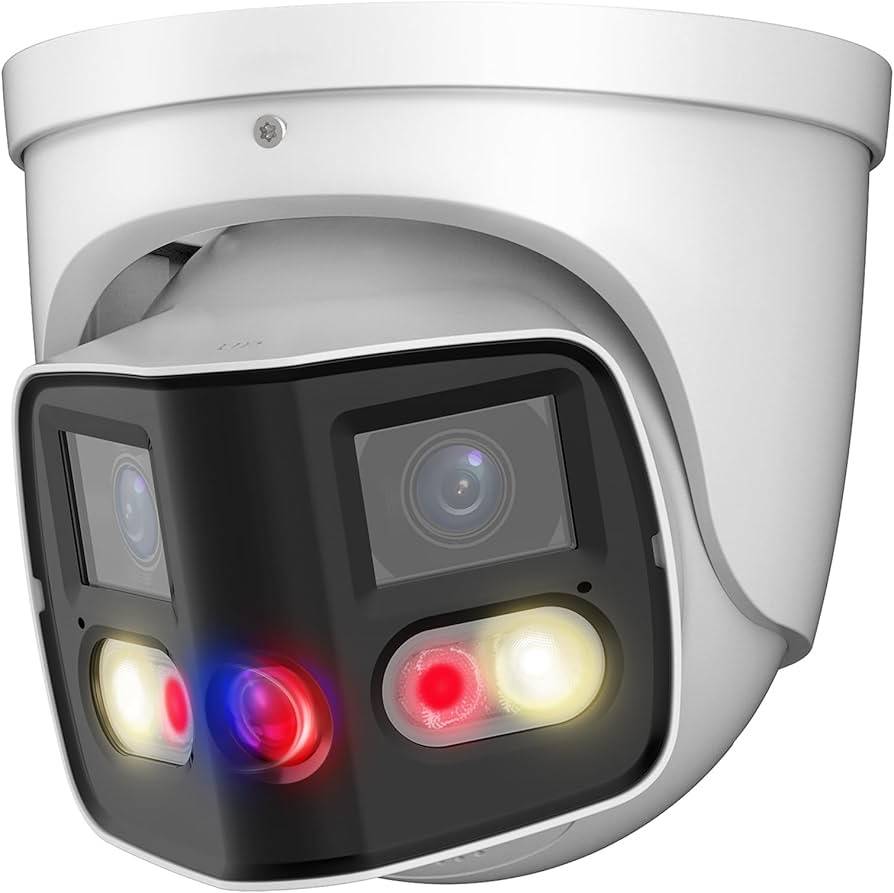
Business CCTV designed and installed for offices, retail, restaurants, warehouses, and multi-tenant buildings across all five boroughs — watch every entrance, register, aisle, and loading dock from your phone, anywhere. IP/PoE cameras, NVR or cloud recording, structured cabling, and analytics, installed by a licensed low-voltage contractor. NDAA-compliant options. No monthly fees on local-NVR systems.
Commercial security camera installation in New York City is a different job than a home install — bigger systems, stricter compliance, and far more at stake when footage is needed. Abstract Enterprises Security Systems is a licensed NYS low-voltage contractor (#12000287431) that designs, installs, and services business CCTV across all five boroughs: offices and coworking floors in Manhattan, retail and restaurants in Brooklyn and Queens, warehouses and industrial spaces along the waterfronts, multi-tenant apartment buildings, and ground-floor storefronts everywhere in between.
Every system starts with a free on-site survey. We walk your space, map entrances, registers, stockrooms, loading docks, hallways, and blind spots, then design coverage around how your business actually operates — not a one-size flyer package. You get a written, fixed-price proposal: camera count, camera types, where each one goes, NVR or cloud recording, retention in days, cabling scope, and a single number. IP cameras over PoE, clean structured cabling through walls, ceilings, risers and conduit, and remote viewing set up on your phone before we leave. On local-NVR systems there are no monthly fees — you own the hardware and the footage.
Because we’re a licensed contractor and not a national box-shifter, we handle the parts other installers skip: NYC biometric-notice signage where AI face features are used, employee electronic-monitoring notice, audio disabled to avoid eavesdropping exposure, Landmarks Preservation Commission documentation on landmarked buildings, and right-sized retention so the footage is actually there when an insurer, the NYPD, or a lawyer asks for it.
The core driver is loss and liability. Retail shrinkage at the register and on the sales floor, employee and vendor theft in stockrooms, break-ins and vandalism to storefronts, package and inventory loss at loading docks, slip-and-fall and worker-comp claims, and disputes that come down to “whose word against whose” — commercial CCTV turns all of those into reviewable footage. Insurers frequently discount premiums for a professionally installed system, and footage routinely becomes the deciding evidence in a claim or a police report.
Operationally, owners and managers use cameras for accountability and visibility, not just crime: watching open and close, verifying deliveries, checking that safety procedures are followed on a warehouse floor, and keeping eyes on multiple locations from one phone. In a multi-tenant building, cameras in the lobby, elevators, mailroom, parking, and service entrances reduce liability for the owner and reassure tenants.
New York adds its own pressure. High foot traffic means more exposure; high property values mean a single incident is expensive; and dense, mixed-use blocks mean your storefront, your neighbor’s, and the sidewalk all interact. A camera placed and configured correctly — covering your property without aiming into spaces where people expect privacy — protects the business and keeps you on the right side of the law.
There is no single “best” commercial camera — the right system mixes types by what each area needs. Here’s what we deploy and where it fits:
Sleek and vandal-resistant, hard to tell which way they’re pointing. Ideal for lobbies, retail floors, offices, restaurants, and elevators where you want discreet, tamper-resistant coverage.
Visible and directional — an obvious deterrent. Best for perimeters, building exteriors, hallways, and long-range outdoor views along a storefront or lot line.
Remotely rotate, tilt, and zoom, or auto-track motion. One PTZ covers a large area — warehouses, parking structures, big open floors, and loading zones — where fixed cameras would need several units.
Flexible aiming, less glare than domes at night, clean look for offices and retail. A common workhorse for indoor and sheltered-outdoor coverage.
One unit captures 180° or 360°, replacing multiple cameras over a single cable and NVR channel. Great for open-plan offices, retail floors, stockrooms, and storefronts.
Reads plates at gated lots, loading docks, and secured entrances. We pair LPR with a 4K overview camera so you capture both the plate and the vehicle.
Detect heat in darkness, fog, or dust. Used at warehouse perimeters, outdoor storage yards, and critical-infrastructure sites that need true 24/7 detection.
On the recording side, the choice is local NVR vs. cloud. A Network Video Recorder (Hanwha, Axis, Hikvision and others, recording locally) means you own the hardware outright with no per-camera monthly fee — best for single-site offices, retail, and warehouses. Cloud-managed platforms (Verkada, Avigilon Alta, Eagle Eye, Rhombus) carry a monthly per-camera fee but remove on-site hardware and simplify multi-site management. We recommend based on your sites and budget, not our margin, and most NYC single-location clients come out ahead on a local NVR.
A network camera that sends video over your data cabling. The standard for professional commercial systems — higher resolution and remote access than old analog.
One Cat6 cable carries both power and video to each camera, so there’s no separate power run. The backbone of a clean commercial install.
Network (IP) or Digital (analog) Video Recorder — the box that stores footage on local hard drives. NVR is what modern IP systems use.
Detail. 4MP is the baseline for general areas; 8MP/4K is worth it at entrances, registers, and anywhere you need to identify a face or a plate.
How many days of footage you keep before it overwrites. Most NYC businesses run 30–90 days; some industries need more.
On-camera intelligence — person/vehicle detection, line-crossing, loitering, LPR — that cuts false alerts and makes footage searchable.
Video Management Software — the platform that ties many cameras (and often access control) into one searchable interface, used on larger sites.
Hardware allowed for federally funded projects under NDAA Section 889 (Axis, Hanwha, Avigilon, Verkada). Matters for schools, government, and grant-funded organizations.
We install and service the major commercial lines and recommend by site, compliance needs, and budget — not by what carries the best markup:
Axis — premium IP cameras and analytics, the integrator standard. Hanwha Vision (Wisenet) — excellent image quality and value on local NVR. Avigilon — enterprise VMS with strong AI search, common on large multi-floor sites. Verkada — cloud-managed, hybrid local+cloud storage, ideal for multi-site and tenants without IT staff.
Hikvision and Dahua — outstanding price-to-performance for private retail, restaurants, and warehouses that take no federal funding. Lorex — reliable local-NVR systems for small business. Under NDAA Section 889 these brands are barred from federally funded projects, so if you receive Title I, Medicare/Medicaid, infrastructure, or government-contract dollars, we’ll steer you to a compliant line from the start.
Already have cameras? We also do bring-your-own-equipment installs, system expansions, and analog-to-IP upgrades — reusing what still earns its place and replacing what doesn’t.
The single most common reason a commercial camera system underperforms is not the cameras — it’s the network and the cabling. Cameras that drop offline, lag, or record choppy footage are almost always a cabling or bandwidth problem, and it’s the line item inexperienced buyers underestimate most.
Each IP camera needs a dedicated Cat6 run back to a PoE switch. In a finished retail space with accessible drops that’s straightforward. In a six-story mixed-use building on the Upper West Side — cameras at every entry, stairwell, and service door — you’re looking at twenty-plus runs through fire-rated assemblies, concrete block, plaster, and drop ceiling. Fire-stopping every penetration through a rated wall or floor is both a code requirement and a real cost, and it’s exactly the kind of thing a cheap quote leaves out so the number changes mid-job.
Before we quote a fixed price we audit the network: switch capacity, PoE power budget, uplinks, and whether existing cabling is adequate or new Cat6 is needed. Older NYC buildings — 1920s lofts with lead-painted trim and ornate molding, landmarked facades, pre-war commercial blocks — turn a “simple 12-camera job” into careful, discreet work. That’s why a real site survey, not a phone estimate, is the only honest way to price commercial CCTV in this city.
We install business CCTV in every borough and commercial corridor — storefronts on Fifth Avenue and Steinway Street, restaurants in Williamsburg and Astoria, offices in Midtown and Downtown Brooklyn, warehouses in Sunset Park, Maspeth, Hunts Point, and the South Bronx, and multi-tenant buildings citywide. Pick your borough:
Offices, retail, restaurants & high-rises across Manhattan.
Brooklyn →Storefronts, warehouses & mixed-use across Brooklyn.
Queens →Retail corridors, industrial & offices across Queens.
The Bronx →Commercial strips, warehouses & multi-tenant in the Bronx.
Staten Island →Retail, offices & commercial properties on Staten Island.
Residential / All CCTV →Home & apartment security camera installation across NYC.
POS and register coverage to cut shrinkage, sales-floor and entrance cameras at 8MP for face/plate ID, stockroom and back-door coverage against internal theft. Visible domes deter; analytics flag line-crossing after hours.
Loading docks, aisles, perimeter, and yard. PTZ for wide coverage, LPR at gates, thermal where it’s dark or harsh. Supports OSHA-style accountability on forklift zones and production lines.
Lobby, reception, hallways, conference rooms, and server-room doors. Discreet domes and access-point coverage that integrate with door access control.
Kitchen, dining, bar, register, and back-alley delivery. Discreet placement, health-code-aware mounting, and remote oversight of open and close.
Lobbies, elevators, mailrooms, parking, and service entrances — reducing owner liability and reassuring tenants across a portfolio from one platform.
Entrances, corridors, parking, and perimeter with longer retention and NDAA-compliant hardware where federal funding applies. Privacy zones at exam rooms and restricted areas.
LPR at entries/exits, PTZ for wide coverage, and full-color night cameras for low-light decks.
Solar/4G LTE and rugged cameras to cover material yards and equipment without trenched power.
Most commercial camera systems pair naturally with access control (card/fob entry, door schedules) and video intercom for multi-tenant buildings — we integrate all three on one visit.
Real questions business owners raise — on Reddit, in our inbox, and on every site survey — with straight answers for a New York commercial install.
All-in, NYC businesses typically run $500–$2,500 per camera installed (hardware, cabling, labor, configuration). A small retail or restaurant system of 4–8 cameras commonly lands around $4,000–$15,000; a 16-camera warehouse can reach $30,000 with PTZ, LPR, and long retention. The spread is mostly cabling and camera mix, which is why we quote a fixed price only after a site survey.
In NYC the cabling is the work. Labor runs roughly $75–$150/hour or $150–$300 per camera, and a multi-floor building with fire-rated penetrations, conduit, and riser runs is far more labor than a finished open office. The camera on the box is the cheap part.
On a local-NVR system, no — you own the recorder and the footage outright. Cloud-managed platforms charge roughly $20–$80 per camera per month. We’ll show you both and most single-site NYC businesses choose local NVR.
Be wary of anyone who quotes without a site survey, uses unnamed off-brand cameras, or can’t explain how they’ll handle your network. The cheapest quote almost always changes mid-job. Ask for a license number, a written fixed-price scope, and references from NYC jobs of similar size.
In New York, installing and maintaining security systems requires a NYS Department of State license. A licensed low-voltage contractor also knows the code-compliant cabling, fire-stopping, and NYC privacy rules a handyman doesn’t. We’re NYS #12000287431, insured, and provide COIs for building management.
For a tiny shop with a couple of cameras, maybe. For anything multi-camera, multi-floor, or compliance-sensitive, DIY usually costs more once you hit network integration, cabling through rated walls, and the legal placement and signage rules. Most business owners who try it end up calling us to fix offline cameras and re-run cable.
Wireless cameras marketed as “easy” drop and lag in warehouses, metal buildings, and large floors where Wi-Fi weakens. Commercial systems are wired PoE for a reason — reliability and long-term recording. Consumer “crowd” or “emotion” AI rarely performs as advertised.
It depends on entries, blind spots, and what you’re protecting. Rough starting points: small retail 4–6, mid-size office 8–12, large warehouse 16–30, multi-floor commercial 50+. The right mix of camera types (one fisheye or PTZ can replace several fixed units) often lowers the count. We map it on the survey.
4MP is the baseline for general areas; use 8MP/4K at entrances, registers, and anywhere you must identify a face or plate. Most NYC businesses retain 30–90 days; some industries (financial, healthcare) keep longer. We size storage to your camera count, resolution, and retention before quoting.
Local NVR for a single site where you want no monthly fee and full ownership. Cloud for multi-site operations, tenants without IT staff, or smaller deployments wanting zero on-site hardware. Hybrid (local + cloud) gives resilience for sites that can’t afford downtime.
Almost never a good idea. New York is one-party-consent, and a camera capturing conversations you’re not part of can be illegal eavesdropping under Penal Law §250.05 — a felony exposure. We disable audio by default unless you have a specific, policy-backed reason.
Yes. New York’s Electronic Monitoring law requires written notice to employees about monitoring, with acknowledgment at hire. You also can’t place cameras in bathrooms, locker rooms, changing areas, or (as of recent updates) break rooms and nursing stations — that’s a felony under Penal Law §250.45. We plan placement to keep you compliant.
The most common complaint we hear is exactly that: wires left hanging, no warranty callbacks, no one answering the phone. We’re a local licensed contractor, our crews are the people who pick up when you call, and we provide a parts warranty and documented scope so there’s no mystery later.
We cover all five boroughs from our Brooklyn base, with same-week surveys in most areas and a fixed-price proposal after the walk-through.
$500–$2,500 per camera installed in NYC; 4–8 camera systems commonly $4K–$15K. Final number depends on cabling and camera mix.
Axis, Hanwha, Avigilon, and Verkada are the NDAA-compliant leaders; Hikvision and Dahua win on price for private commercial use.
No audio without consent, employee monitoring notice required, no cameras in private spaces, biometric-notice signage if you use face recognition.
NVR = own it, no monthly fee, best single-site. Cloud = monthly fee, best multi-site or no-IT.
Small retail typically 4–6: entrance, register, sales floor, stockroom, and exterior.
Search “commercial security camera installation cost” and AI Overviews, Angi, HomeAdvisor, and Fixr hand you a national average — usually around $1,000–$1,300 per install — that has almost nothing to do with wiring a real building in New York City. Here’s what those numbers leave out, and what actually drives a commercial quote in the five boroughs.
Aggregators like Angi and HomeAdvisor blend mostly home and small-business jobs nationwide. A commercial NYC system is priced per camera all-in — $500–$2,500 each — because the cost lives in cabling, fire-stopping, switch and storage infrastructure, and labor through difficult building stock, not in the camera itself. A 16-camera warehouse reaching $30,000 isn’t an outlier here; it’s a normal mid-size commercial job.
Fixr and similar sites quote a tidy per-camera number. The site survey is where the truth shows up: how many dedicated Cat6 runs, through what kind of walls, how many rated penetrations need fire-stopping, what PoE switch and NVR your camera count and retention require, and whether the building is landmarked. Any quote without a walk-through is a guess that will change.
The national results skip the part that gets New York businesses sued or fined: no-audio eavesdropping rules, employee electronic-monitoring notice, the NYC biometric-notice law if you turn on face recognition, felony placement restrictions, and Landmarks review on protected facades. A licensed local contractor builds those in; a national flyer install doesn’t know they exist.
Generic “best business camera” roundups push whatever brand pays for placement. For a school, a government office, or any federally funded organization, NDAA Section 889 bars Hikvision and Dahua outright — pick wrong and you can lose funding or face a full rip-and-replace. We filter for compliance before brand preference.
Cloud platforms market simplicity, and for multi-site businesses they’re genuinely great. But the per-camera monthly fee adds up fast across many cameras, and for a single NYC location a local NVR is usually cheaper over any multi-year horizon — with no recurring bill and full ownership of the footage.
Coverage is about placement, not count. One well-aimed fisheye or PTZ can replace three poorly placed fixed cameras, and a thoughtfully designed 10-camera system beats a sloppy 20-camera one. We design to your actual entries, blind spots, and risk — not to a camera quota.
Commercial CCTV in NYC is worth it — for loss prevention, liability, insurance, and operational visibility — but only when it’s designed for your building and configured for the law. The right move isn’t the cheapest per-camera quote online; it’s a licensed contractor, a real site survey, and a fixed price you can hold them to.
| DIY Kit | National Brand | Abstract (Local Licensed) | |
|---|---|---|---|
| Site survey & design | None — you guess | Often a sales call | Free on-site walk & coverage map |
| NYC code & cabling | Your problem | Subcontracted | Licensed, fire-stopped, code-compliant |
| Compliance (audio, monitoring, biometric) | Not addressed | Generic | Built into the design |
| Monthly fees | Varies | Usually required (contract) | None on local NVR |
| Contract lock-in | No | Often 3–5 yr monitoring | No contract |
| Warranty & callbacks | DOA returns only | Call-center queue | Local crew, parts warranty |
| Who answers the phone | No one | Tier-1 support | The people who did your install |
This is where most installers leave businesses exposed. Commercial surveillance in New York sits under overlapping rules — we design around all of them:
NY is one-party-consent; a camera recording conversations you’re not part of can be a felony under Penal Law §250.05. We disable audio unless there’s a clear, lawful reason.
Cameras in bathrooms, locker/changing rooms, and (per recent updates) break rooms and nursing stations are a felony under §250.45. We map placement to legitimate areas only.
New York’s Electronic Monitoring law requires written notice and acknowledgment at hire, updated after system changes. We flag what you need to post and provide.
If you enable facial recognition or biometric features, NYC requires conspicuous DCWP signage at every entrance — $500 per violation with a 30-day cure. Basic motion/person detection generally isn’t “biometric,” and we’ll tell you which side you’re on.
On landmarked NYC buildings, exterior camera work may require LPC review. We use discreet, color-matched mounting and provide the documentation.
We right-size retention (commonly 30–90 days, longer for finance/healthcare) so footage is retrievable when an insurer, the NYPD, or a court asks — and so you can meet a preservation obligation.
This is general information, not legal advice — we design to keep you compliant and recommend counsel for your specific situation.
All-in, NYC businesses typically pay $500 to $2,500 per camera installed, covering hardware, cabling, labor, and configuration. A 4 to 8 camera retail or restaurant system commonly runs $4,000 to $15,000, and a 16-camera warehouse can reach $30,000 with PTZ, LPR, and longer retention. We give a fixed price after a free on-site survey.
Not on a local-NVR system — you own the recorder and footage with no recurring fee. Cloud-managed platforms charge roughly $20 to $80 per camera per month. We show you both options and most single-site NYC businesses choose local NVR.
It depends on entries, blind spots, and what you’re protecting. Typical starting points are 4 to 6 for small retail, 8 to 12 for a mid-size office, 16 to 30 for a large warehouse, and 50+ for multi-floor commercial. We map exact placement during the survey.
Axis, Hanwha, Avigilon, and Verkada for NDAA-compliant projects (schools, government, grant-funded), and Hikvision, Dahua, and Lorex for private commercial use where price matters most. We also do bring-your-own-equipment installs and analog-to-IP upgrades.
4MP is the baseline for general areas; 8MP or 4K is worth it at entrances, registers, and anywhere you need to identify a face or license plate. Most NYC businesses keep 30 to 90 days of footage; financial and healthcare sites often keep longer.
Local NVR for a single site where you want no monthly fee and full ownership. Cloud for multi-site operations or tenants without IT staff. A hybrid setup gives resilience for sites that can’t afford downtime.
We disable audio by default. New York is a one-party-consent state, and a camera capturing conversations you aren’t part of can be illegal eavesdropping under Penal Law Section 250.05. We only enable audio where there’s a clear, lawful basis.
Yes. New York’s Electronic Monitoring law requires written notice and acknowledgment at hire. You also cannot place cameras in bathrooms, locker rooms, changing areas, or break rooms. We plan placement so your system stays compliant.
In New York, installing and maintaining security systems requires a NYS Department of State license. A licensed low-voltage contractor also handles code-compliant cabling, fire-stopping, and NYC privacy rules. We are NYS licensed #12000287431 and fully insured.
Yes. We integrate CCTV with card and fob access control and with video intercom for multi-tenant buildings, all on one visit, so entries, door schedules, and footage work together on a single platform.
A small retail or office system is often a one-day install. Larger multi-floor or warehouse systems with extensive cabling can take several days. We give a timeline with the fixed-price proposal after the survey.
Yes — we do system expansions, analog-to-IP upgrades, repairs, and takeovers of existing systems. We reuse hardware that still performs and replace what doesn’t, so you’re not paying to rip out a working camera.
“Our SoHo retail store had constant register discrepancies. They put 8MP cameras at every POS and a fisheye over the floor — shrinkage dropped and the footage settled a chargeback dispute in a week.”
— Rachel B., Retail Owner, Manhattan
“16 cameras across our Sunset Park warehouse, LPR at the gate, PTZ on the dock. Clean cable runs, fixed price, done in two days. No monthly fee because it’s on our own NVR.”
— Mike D., Warehouse Manager, Brooklyn
“We manage six buildings and needed one platform for all of them. They set up cloud cameras in every lobby and elevator with tenant-friendly placement. I check all six from my phone.”
— Anthony R., Property Manager, Queens
“Restaurant kitchen, dining, bar, and back-alley delivery — discreet domes, audio off so we stay legal, and they walked our staff through the app. Exactly what we asked for.”
— Sofia L., Restaurant Owner, the Bronx
From the truck — the job that best explains why the survey matters: a 12-camera system in a 1920s loft building off Broadway. On paper it’s a one-day install. In reality the “simple” runs went through plaster-and-lath walls, a landmarked facade we couldn’t touch from outside, and a riser closet that hadn’t been opened in years. We pulled every camera drop back through the interior, fire-stopped four rated penetrations, color-matched the one unavoidable exterior conduit, and set the NVR for 60-day retention because their insurer asked for it. Audio off — a tenant on the floor records podcasts and we weren’t going to hand anyone an eavesdropping problem. The owner wanted “cheap and fast” cameras off a website; what actually protected the business was the part that doesn’t show up in an online quote: the cabling, the compliance, and a placement plan that covers the door, the register, and the stockroom without aiming anywhere it shouldn’t. That’s the difference between a camera on a wall and a system that holds up when footage is the only thing standing between you and a claim.
| ADT / Verkada reseller | SimpliSafe / Ring Business | Abstract Enterprises | |
|---|---|---|---|
| Model | Monitoring contract | Consumer DIY-plus | Licensed install, you own it |
| Monthly fee | Required, multi-year | Required for features | None on local NVR |
| Camera grade | Proprietary | Consumer | Commercial IP/PoE (Axis, Hanwha, Avigilon…) |
| NYC cabling & code | Subcontracted | DIY | In-house, licensed, fire-stopped |
| Compliance built in | Generic | No | Audio, monitoring notice, biometric, LPC |
| Local support | Call center | App/email | The crew that installed it |
Every commercial quote is fixed-price after a free survey — but here are honest NYC ranges so you can budget before we walk the space:
4–6 cameras
$4,000–$9,000
Entrance, register/reception, floor, stockroom, exterior. Local NVR, 30-day retention, app setup.
8–12 cameras
$9,000–$18,000
Lobby, hallways, conference/dining, kitchen/back-of-house, exterior. NVR or cloud, analytics.
16–30 cameras
$18,000–$35,000+
Docks, aisles, perimeter, yard. PTZ + LPR at gates, longer retention, thermal where needed.
30–50+ cameras
Custom
Unified VMS or cloud across floors/locations, access-control integration, centralized management.
Pricing reflects hardware + cabling + labor + configuration. No monthly fees on local-NVR systems. 50% deposit to schedule, balance on completion. Service/callbacks billed at the specialty rate (3-hr min) — not on the initial install.
Black screen, cameras offline, NVR not recording, footage you can’t pull for an insurer or the NYPD — we diagnose and repair commercial systems of every brand, often same-day across the five boroughs. Analog-to-IP upgrades and system takeovers too.
📞 Call (347) 934-8335 — Same-Day CCTV RepairAlmost always a network or cabling issue — undersized switch, no PoE budget, or CCA cable. We audit and re-cable so the system stays up.
Wrong resolution or placement. We put 8MP/4K at entrances and registers and aim for face/plate capture, not just “something happened.”
We install owned local-NVR systems with no monthly fee and no contract — you keep the hardware and the footage.
We take over orphaned systems, fix the cabling, and become the local crew that actually answers the phone.
We right-size retention, document the system, and design placement and notices to meet NYC and industry requirements.
Multi-site cloud or unified VMS so a manager sees every store, floor, or building from one phone.
Free on-site survey, fixed-price proposal, licensed and insured, no monthly fees on local NVR. Offices, retail, restaurants, warehouses, and multi-tenant buildings across all five boroughs.
Abstract Enterprises Security Systems · Licensed NYS #12000287431 · Commercial CCTV for offices, retail, warehouses & multi-tenant buildings across all five boroughs. No monthly fees on local NVR.