Home › Apartment Building Security Cameras, Long Island
Nassau & Suffolk · Village Co-ops · Garden Complexes · LIRR Station Rentals · Oceanfront Buildings · NYS Licensed
Apartment Building Security Cameras on Long Island
Two Counties · Dozens of Villages · One Survey Method · One Toll-Free Line
Long Island is not one apartment market but two counties stitched together by the railroad. Nassau's rental and co-op buildings cluster in old village centres around LIRR stations, many of them rent-stabilized and built before 1974, with a new wave of station-area rentals going up beside them and a strip of oceanfront high-rises in Long Beach. Suffolk spreads out into garden complexes, HOA communities and Main Street buildings. We plan camera systems for owners, co-op and condo boards, managing agents and portfolio companies on both sides of the county line, from one Brooklyn office, with one way of surveying a building and a price that follows the county the building stands in.
Reviewed and updated October 18, 2026 · Written by Abstract Enterprises Security Systems, NYS licence #12000287431 · Long Island bookings handled through our Brooklyn office at 1282 Troy Ave
Example photo from another Abstract Enterprises Security Systems job, not a Long Island apartment building: a white suspended ceiling with a square air diffuser, a red exit sign with a small dark camera fixed on top of it, round recessed lights and a black mini dome camera hanging from the grid.
Long Island Building Camera Quote
Name the county, the village and how many properties are involved — a written reply comes back the same business day
✅
Request Sent!
A Long Island estimator will call you back the same business day.
25+
Years Experience
✓
Same-Day Estimates
100%
Licensed & Insured
4.7★
390+ Google Reviews
One number for the whole Island. Call (800) 486-0943 and say which county the property is in, which village or hamlet, how many buildings and units there are and who signs off — owner, co-op board, condo board or management company. If you run several properties, list them all on the same call; we price each one on its own and plan the survey days so neighbouring buildings are seen together.
The same survey checklist, camera list and proposal format whether the building is in Great Neck Plaza or Riverhead
Prices follow the county: Nassau at the Nassau rate, Suffolk at the Suffolk rate, shown side by side below
Installed under NYS licence #12000287431, with county, city or village paperwork sorted before the first bracket goes up
Why Long Island Properties Need Apartment Building Security Cameras
Owners who know Long Island only from the expressway tend to picture houses. The apartments are there, but they hide in plain sight: above the shops a block from a railroad station, in brick courts built for returning veterans, in elevator buildings that line the boardwalk at Long Beach, and increasingly in four- and five-storey rentals going up on former commuter parking lots. Each of those building types fails in its own way when there is no camera, or only the wrong one. A lobby door left on the latch, a car opened in the lot overnight, a package room that anyone with a delivery code can walk into, a back passage nobody can see from the street — the owner usually hears about it from a resident before anyone has a picture of what happened.
The first thing to understand is that Nassau and Suffolk are different markets for building cameras. Nassau is older and denser, and much of its rental stock is regulated. New York's Division of Housing and Community Renewal lists sixteen Nassau localities that have opted into rent stabilization under the Emergency Tenant Protection Act — among them the Villages of Great Neck Plaza, Mineola, Rockville Centre, Lynbrook, Freeport and Hempstead, the Cities of Glen Cove and Long Beach, and the Town of North Hempstead. In those places, apartment buildings of six or more units built before January 1, 1974 are covered, and the tenants are entitled to the services the building provides. The same list names no Suffolk locality at all. A camera upgrade in a stabilized Freeport walk-up and one in a market-rate Suffolk complex may use the same cameras, but the conversation with residents, the paperwork and the way costs are recovered are not the same.
The village centres are where the density is. The Village of Great Neck Plaza, incorporated in 1930, covers a third of a square mile and holds ninety multiple-family apartment buildings alongside 148 single-family houses and more than 260 shops and service businesses around its LIRR station. One r/longisland commenter weighing a move put it simply: Great Neck Plaza "has a bunch of rent stabilized apartment buildings." Buildings that close together share side passages, rear yards, garbage areas and walls, so the question is rarely how to see a whole lot and usually how to see your own door without filming your neighbour's.
Around the stations, the stock is changing fast. Mineola already has One Third Avenue, an eleven-storey rental a block from the station, and Modera Metro Mineola, 192 homes with a controlled-access garage and a self-service package room. In Hicksville, the Governor's office broke ground in December 2023 on 189 apartments at 99 Newbridge Road, right beside the station, with underground parking, more than 7,000 square feet of retail and a public plaza. In September 2026 the Village of Westbury approved 184 apartments on a former MTA lot on Railroad Avenue. A 2025 Newsday survey of station-area housing counted more than 500 apartments in Farmingdale, 215 at The Grand in Baldwin and 187 at Scally Place in Westbury. These buildings come with garages, amenity floors, retail tenants and plazas — spaces that are partly public and need a camera plan that respects that.
At the shore, the issue is the ocean itself. A 2021 report circulated by the State Senate noted that Long Beach is the only place on Long Island with oceanfront high-rises, and residents described buildings that are "sandblasted every day" by sand and sea air. During Sandy, a Long Beach managing agent told Habitat magazine that one condominium lost its first floor, pool, gym, heating plant and lobbies, and that a Neptune Boulevard building's boiler room sat under fifteen feet of water. Cameras on those buildings need different hardware and a different place for the recorder than the same cameras on a village co-op ten miles inland.
And then there are the houses. In 2017 the Long Island Index counted 112 towns, cities and villages on the Island with their own rules for apartments inside single-family homes. In Nassau most of them either forbid accessory apartments or restrict them to family members or seniors; several Suffolk towns permit them with a licence. Owners of those homes ask us for cameras just as building owners do, and the right answer depends on which of those 112 rulebooks applies. The rest of this page walks through all of it, county by county and building type by building type, and links down to the detailed Nassau County apartment building camera page and Suffolk County apartment complex camera page.
Long Island facts that shape a building camera plan
16 Nassau localities listed by NYS Homes and Community Renewal as having adopted rent stabilization under ETPA, covering buildings of six or more units built before 1974; no Suffolk locality appears on the same list (HCR Fact Sheet #8).
90 apartment buildings in a third of a square mile in the Village of Great Neck Plaza, according to the village itself — one of the densest residential blocks anywhere on the Island.
112 municipalities with their own accessory-apartment rules, as compiled by the Long Island Index and published by Newsday in 2017.
189 apartments in Hicksville, 184 approved in Westbury, 215 in Baldwin and more than 500 in Farmingdale, all within walking distance of LIRR stations (Governor's office; LIBN; Newsday, 2025).
An 18 percent rise in car thefts and break-ins reported by Nassau police in October 2019, who said 97 percent could have been avoided if key fobs had not been left in the cars (ABC7).
Only oceanfront high-rises on the Island are in Long Beach, where Shore Road and boardwalk buildings take daily sand and salt (State Senate news item, 2021).
Most Long Island boards that start with cameras end up looking at the door hardware next, because the camera shows who walked in and the door decides who could. Our Long Island access control installers and the crew behind building intercoms on Long Island work from the same survey, so the cameras, fobs and video intercom end up on one plan.
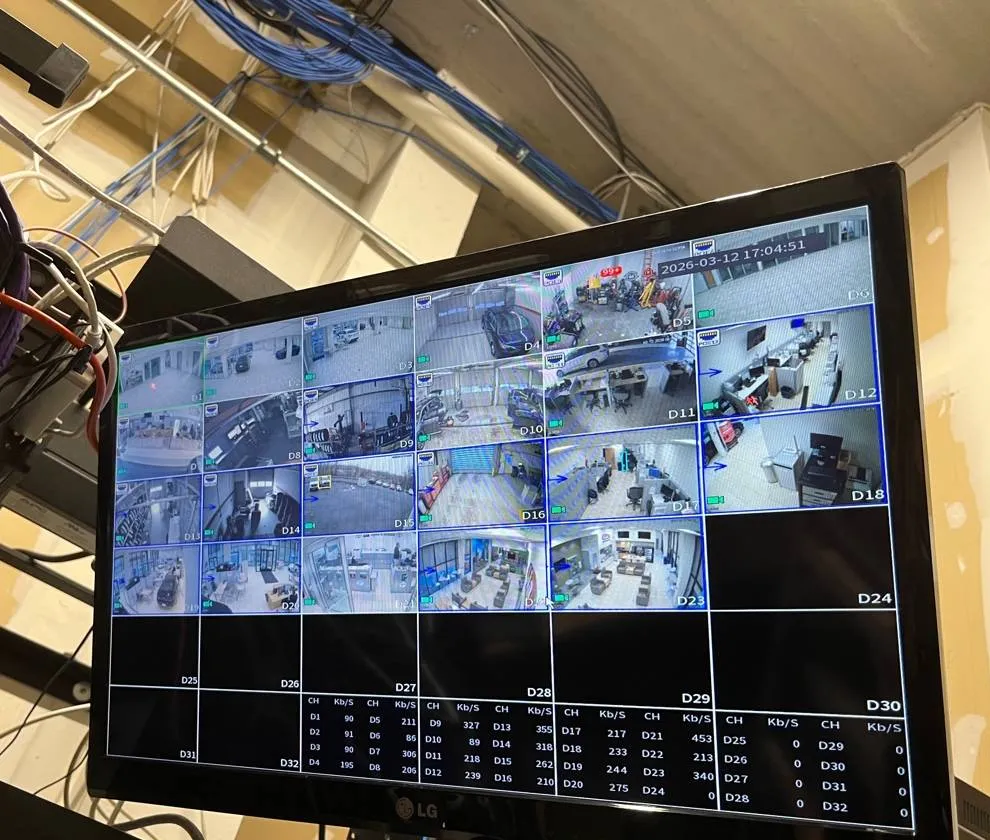
Example photo from another Abstract Enterprises Security Systems job, not a Long Island apartment building: a wall-hung monitor shows a recorder's live view with more than twenty camera tiles and a table of per-channel bitrates, below overhead runs of blue and white network cable and a rack on the left.
Lobby Camera Dead on Long Island? Same-Day Repair Visits
Most building camera failures we see on the Island come down to a recorder drive that stopped writing weeks ago, a switch that lost power in a basement, or an outdoor connection that let water in. Call (800) 486-0943 with the address and the symptom; we book the next open window in that county, and most single-camera or recorder faults are fixed within one to two hours of arrival. Service visits are $195 an hour with a three-hour minimum ($585).
Apartment Building Security Camera Services on Long Island
These are the jobs that come in through the Long Island line most often. Each one can be done on a single building or rolled out across every property an owner has on the Island.
🏛️
Village Co-op Lobbies
Entrance, vestibule, mail area and elevator lobby cameras for the brick and limestone co-ops around Nassau's station villages, mounted to suit a board that cares how the lobby looks.
📜
Rent-Stabilized Buildings
Upgrades in pre-1974 ETPA buildings, with a written record of what existed before, so a new system is plainly an improvement and nothing residents relied on quietly disappears.
🚆
Station-Area Rentals
Garage, package room, amenity and retail-edge cameras for new rentals beside LIRR stations, specified early enough to land in the construction drawings.
🌳
Garden-Apartment Courts
Walkway, court and parking cameras for two- and three-storey courtyard complexes, with cable routed through basements and existing paths rather than across lawns.
🌊
Oceanfront Buildings
Sealed housings, stainless fixings, sand-resistant domes and a recorder kept well above the floors that flooded, for the high-rises along Long Beach's shore.
🏡
Homes With Accessory Apartments
Cameras for owner-occupied houses with a permitted mother-daughter or accessory unit, aimed so each household's door is covered and neither household's privacy is crossed.
🗂️
Portfolio Standards
One camera family, one naming scheme, one set of user roles and one spare-parts kit across every Long Island building a company manages, in both counties.
📋
Board and Lender Proposals
Written proposals with photographs of every camera position, a camera list, retention days and a price per building, laid out for a board vote or a capital plan.
🔧
Takeovers and Repairs
Getting old recorders back under the owner's control, replacing dead cameras, and rebuilding systems installed by a developer or a vendor who is no longer around.
Two Counties
Nassau or Suffolk? How the Two Counties Differ for a Building Camera Project
This is the part of the job most out-of-area installers skip. The cameras are the same on both sides of the county line; almost everything around them is not. The table below sets out the differences we plan for before we quote. Each row is explained in more detail further down this page, and in depth on the two county pages.
What changes
Nassau County
Suffolk County
Typical apartment building
Pre-war and post-war elevator and walk-up buildings in village centres; co-ops; post-war garden courts; new station-area rentals; Long Beach oceanfront high-rises
Spread-out garden complexes, condo and HOA communities, 55-plus developments, apartments over Main Street shops, newer station-area projects
Rent stabilization (ETPA)
Adopted in 16 localities, including Great Neck Plaza, Mineola, Rockville Centre, Freeport, Glen Cove, Long Beach and the Town of North Hempstead
No Suffolk locality on the HCR list
County contractor licensing
Office of Consumer Affairs licenses home improvement contractors under Administrative Code §21-11, with a fingerprinting requirement; the City of Long Beach keeps its own home improvement licence list
Consumer Affairs licenses under Chapter 563, with a carve-out for towns and villages that license trades themselves (see the Suffolk page)
State licence for CCTV
The same everywhere: NYS Department of State security and fire alarm installer licensing applies to CCTV used to detect intrusion, theft or movement
Accessory apartments
Mostly not permitted, or limited to family members or seniors (Town of Hempstead, North Hempstead, Oyster Bay; many villages forbid them)
Several towns permit them by licence, with owner occupancy (Babylon, Brookhaven, Huntington, Islip and others)
Main distance problem
Short runs, tight lots, shared walls and passages
Long runs between buildings, carports and light poles
Main weather problem
Daily sand and salt on the Long Beach barrier island, where Sandy flooded lobbies, garages and boiler rooms
Bay and Sound wind, Fire Island surge, summer storms on large open sites
Price multiplier (Brooklyn = 1.00)
1.15×
1.20×
If your buildings are all on one side of the line, the county page will serve you better than this one. If you own or manage in both, or you are deciding where to buy, the sections below are written for you.
Example photo from another Abstract Enterprises Security Systems job, not a Long Island apartment building: a single fisheye camera tile on a recorder monitor, looking down a red brick wall to a concrete walk and an asphalt lot, with a March 2026 date stamp at the top right.
Building Specialists
Apartment Building Security Cameras for Long Island's Architecture
Seven kinds of property make up nearly all the apartment work on the Island. They differ in where the cable can go, where the recorder can live and who has to approve the work, so we treat them as seven different jobs.
Village-Centre Co-ops and Rentals
Four- to six-storey brick buildings within walking distance of a station in places like Great Neck Plaza, Rockville Centre, Mineola and Lynbrook. Plaster walls, a basement boiler room, a small lobby and often an elevator. Cable rides the old risers and the boiler room becomes the head-end.
Post-War Garden Courts
Two- and three-storey walk-ups arranged around lawns, each building with its own basement and stair halls. Many became co-ops. Cameras cover the court paths, the stair doors and the parking at the edge, with cable carried basement to basement.
Station-Area Rentals
New four- to eleven-storey buildings by the LIRR with structured or underground parking, package rooms, clubhouses, roof decks and shops on the ground floor. Concrete and steel throughout, so the best time to plan cameras is before the slabs are poured.
Oceanfront High-Rises
Long Beach's boardwalk and Shore Road buildings, some fifty years old and repaired more than once. Exposed concrete, balconies, garages at grade and mechanical rooms that have flooded before. Hardware and recorder placement are chosen for sand, salt and surge.
Waterfront Master Plans
Large mixed developments like Glen Cove's Garvies Point, where rental buildings, condominiums, public promenades and parking structures sit side by side under different owners. The camera plan starts by drawing who owns which ground.
Condo and HOA Communities
Townhouse and low-rise communities with their own roads, gates, mailbox kiosks and clubhouses, common across Suffolk and found in Nassau too. Outdoor runs and a board vote set the pace. The Suffolk page covers these in depth.
Houses With an Accessory Unit
Owner-occupied homes with a permitted mother-daughter apartment or a licensed accessory unit. Two front doors, one driveway, one owner. Small systems, but the privacy line between the two households matters more than the camera count.
What changes from one building type to the next
Walls and ceilings. Village buildings from the 1920s to the 1960s have plaster on block or terra-cotta, with few hung ceilings in the halls, so we fish cable inside closets and chases, use the existing risers where the board allows, and use slim painted raceway only where there is no other way up. Garden courts usually have plaster stair halls over full basements, which makes the basement the highway: cable runs across the basement ceiling to a short vertical drop at each stair. Station-area rentals have hung ceilings and cable trays in the corridors and garages, which is easy, but they also have fire-rated shafts and a general contractor with a schedule, so the cable has to go in at the right stage. Oceanfront concrete is the hardest: drilling a deteriorating balcony slab or column is out of the question, so we mount to sound surfaces that the building's engineer has cleared and run cable inside the building wherever we can.
Where the recorder goes. In a village co-op it usually sits in a locked cabinet in the super's office or the boiler room, on a battery backup. In a garden court it sits in the management office or in one basement, with the other buildings linked to it by cable or fibre. In a new rental it belongs in the building's telecom room with the rest of the network. On the oceanfront it goes above the floors that flooded, never in a ground-floor mechanical room, even if that means a longer cable run. In a house with an accessory unit it sits in the owner's part of the house.
Who approves. A co-op or condo board, usually through the managing agent; a single owner or a portfolio company for rentals; a developer and general contractor for buildings under construction; an HOA board and sometimes an architectural committee in communities; and the homeowner for houses. Where a village, a city or the county has a say — a pole in a public plaza, work in a building under facade repair, a licence check — we find out before the proposal goes to the board, not after.
Example photo from another Abstract Enterprises Security Systems job, not a Long Island apartment building: a compact black bullet camera on a short bracket high on a plain pale wall, casting a long shadow downward, with a small white sensor mounted a little way to its left.
Rent-Stabilized Buildings
Cameras in Nassau's Rent-Stabilized Buildings
Rent stabilization outside New York City runs under the Emergency Tenant Protection Act of 1974. A village or city may adopt it after a survey shows a rental vacancy rate under five percent, and once it does, apartments in buildings of six or more units built before 1974 come under it. Some localities set a higher threshold. In Nassau, the localities on the state list run from Baxter Estates to Thomaston, and they include most of the village centres where older apartment buildings stand. Each has a county rent guidelines board that sets the yearly increases.
Nothing in the state's fact sheet on ETPA mentions cameras. What it does say is that stabilized tenants are entitled to the services the building is required to provide, that owners who fail to maintain them can face rent reductions, and that owners can pass on the cost of certain building improvements only with the agency's permission. For a camera project, that leads to three practical habits. First, before anything is removed — an old intercom, a lobby monitor residents could watch, a door buzzer — we photograph and list what was there and what replaces it, so the owner can show nothing was taken away. Second, if the owner hopes to recover any of the cost through rents, that is a question for the owner's counsel and the agency before the contract, not after. Third, residents get a plain notice of where the new cameras are and what they cover, which costs nothing and heads off most complaints.
The buildings themselves are typical of their era: brick walk-ups and elevator buildings from the 1920s to the early 1970s, many with a basement laundry, a rear yard used for garbage, and a lobby that was designed for a doorbell panel rather than a camera. The cameras that matter most are the same in all of them — one at each entrance that shows a face, one on the mail area, one in the laundry, and one on the rear yard or the garbage area where outsiders cut through. The Nassau County building camera page goes through those buildings village by village.
The Shore
Long Beach and the Oceanfront: Cameras That Have to Survive the Beach
The barrier island at Long Beach is unlike anywhere else on the Island for apartment work. The high-rises along the boardwalk and Shore Road face open ocean, and the people who live in them describe sand and salt hitting the buildings every day. Those buildings have had more than their share of structural trouble over the years: five balconies came down onto units at the Sunlit Terrace Apartments on Shore Road in 2016, a six-storey boardwalk building was evacuated in 2010 over a deteriorated column, and Lido Beach Towers was evacuated after Sandy. After the 2021 condominium collapse in Surfside, Florida, Long Beach residents and officials asked the state for tighter inspections of exactly these buildings.
For cameras that history means four rules. We do not drill into balconies, slab edges or columns that are part of a repair programme, and we ask for the engineer's latest report before marking positions on the facade. We use housings sealed against fine sand as well as water, stainless fixings, sealed cable entries and domes made of material that can be cleaned without scratching, because a scoured dome turns every night image into fog. We avoid outdoor pan-tilt-zoom cameras on the ocean side where we can, because moving parts and blown sand do not mix, and use fixed cameras with good lenses instead. And the recorder, switches and battery backup go above the floors that took water in 2012 — the managing agent Habitat interviewed after Sandy described lobbies, pools, heating plants and a boiler room fifteen feet under water.
The same thinking applies, on a smaller scale, to other low-lying buildings near the water on Nassau's South Shore and to the Suffolk bay shore, which the Suffolk building camera page covers. Where the bay rather than the ocean is the neighbour, the sand problem fades and the flood and wind problems remain.
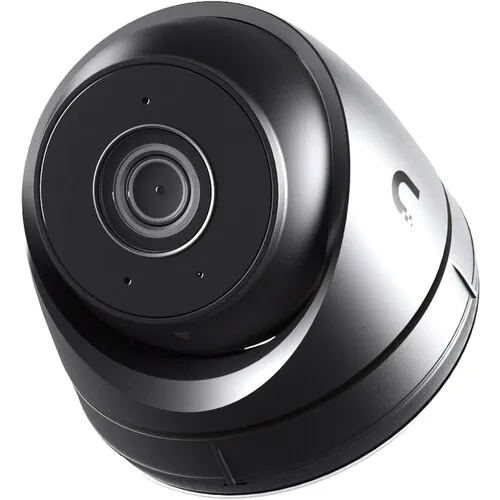
Manufacturer product photo: a black turret camera with a silver rim, a large round lens and a small logo on its side, seated at an angle in its base, on a white background.
By the Railroad
Station-Area Rentals: Planning Cameras Before the Building Opens
The newest apartment buildings on Long Island are going up beside the railroad. In Mineola, One Third Avenue rises eleven storeys a block from the station and Modera Metro Mineola offers 192 homes with a controlled-access garage, two clubhouses, a package room, courtyards and roof decks. In Hicksville, 189 apartments at 99 Newbridge Road sit right next to the station over underground parking, with shops and a public plaza. Westbury's newly approved building on Railroad Avenue will put 184 apartments over ground-floor retail with 254 parking spaces, on land the MTA used for commuter parking, with opening targeted for 2029. In Suffolk the same pattern runs from Farmingdale to Ronkonkoma.
Those buildings share four features that shape their camera plans. Their garages carry residents, guests, retail customers and sometimes the public, so the cameras must show each entry lane and the doors from the garage into the building. Their package rooms see more deliveries than any other room, so the camera has to show the courier coming in and every resident going out. Their amenity spaces — pool, gym, roof deck, lounge — are shared and partly private, so we cover the doors and the edges rather than the people using them. And their ground floors face plazas and sidewalks that someone else may own or that a village approval governs, so we check the site-plan conditions before a camera looks outward.
The cheapest moment to get this right is during design. A camera drop costs very little when the electrician is already running conduit through open walls and costs a great deal once the drywall and the fire-stopping are finished. We work with developers and their general contractors to put the camera layout, the cable pathways and the telecom room space into the drawings, then come back for the cameras near the end of construction so they are not damaged by other trades. For a building that has already opened, the plan starts with what the developer left behind.
Garden Courts
Post-War Garden Courts and Co-ops Across Nassau
Garden apartments — low brick buildings set around lawns, each stair serving a handful of flats — are found from the western Nassau villages out to eastern Suffolk; one large Long Island management company describes its garden-apartment holdings as running from Woodmere and Cedarhurst in western Nassau to Riverhead and Middle Island in eastern Suffolk. In Nassau many of these courts were built in the decade after the Second World War and converted to co-ops later; in Suffolk more of them are newer and still rental.
The Nassau courts tend to be compact. The buildings sit close together, the parking is a strip along the street or a small lot at the back, and there is often a full basement under every building. That makes them easier to wire than the sprawling Suffolk complexes: cable runs along the basement ceilings, comes up beside each stair door, and crosses between buildings either through an old tunnel or pipe chase or, where the buildings are separate, through a short underground conduit or a point-to-point wireless link. The cameras that pay for themselves are on the stair doors, the court paths at night, the laundry rooms and the parking.
Two things slow these jobs down. The first is the age of the basements: pipe insulation and floor tiles from that era can contain asbestos, and we do not disturb anything suspect until the co-op has had it checked. The second is the board calendar, since many garden co-ops meet monthly and approve capital work only once the budget allows. We build both into the schedule from the first visit.
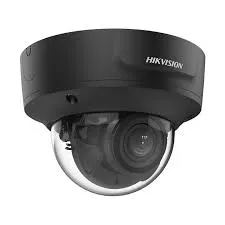
Manufacturer product photo: a black dome camera with a curved black housing, a maker's name on the upper edge and a clear lower dome over a zoom lens, on a white background.
Accessory Apartments
Houses With Accessory Apartments: 112 Rulebooks, One Privacy Line
The Long Island Index's survey, published by Newsday, found 112 towns, cities and villages on the Island with rules about apartments inside single-family houses. The variety is striking. The Town of Hempstead limits them to mother-daughter arrangements and to homes where the owner or spouse is 62 or older; the Town of North Hempstead allows a mother-daughter residence of up to 700 square feet that shares the entrance and utilities; the Town of Oyster Bay limits them to family members or domestic staff; and the Cities of Glen Cove and Long Beach and villages such as Garden City, Mineola, Rockville Centre and Great Neck Plaza do not allow them at all. On the Suffolk side, towns such as Babylon, Brookhaven, Huntington and Islip permit them under a licence with owner occupancy.
None of those rules says anything about cameras, and we have not found a Long Island ordinance that does. What the rules do tell you is who lives in the house and how it is laid out, which decides the camera plan. In a mother-daughter home with a shared entrance, a single doorbell camera and a driveway camera usually do the job, and the family decides together who sees what. In a licensed accessory unit with its own entrance, the owner's cameras cover the driveway, the yard and the owner's door; the tenant's door is covered only if the tenant agrees, and no camera looks through a window into either home. Audio stays off outdoors and in shared halls, because recording a conversation without a participant's consent is a crime in New York.
We will not design a system around an apartment that is not legal where it stands. If the town or village does not allow the unit, the right first call is to the building department, not to a camera installer.
Portfolios
Running Cameras Across a Long Island Portfolio
A good share of Long Island apartments are owned or managed in groups: a family company with a dozen walk-ups across three villages, a management firm with co-op clients in both counties, an owner who has bought several garden complexes over twenty years. Those owners usually inherit a different camera system at every property, installed by a different vendor at a different time, with different passwords and apps. The result is a manager who cannot find footage quickly at any of them.
For portfolio owners we agree a standard before we touch the first building. It covers the camera and recorder family, so a spare from one property fits another; a naming scheme, so "B2 rear stair door" means the same thing everywhere; user roles, so a super sees his own building, a regional manager sees her region and the owner sees everything; a retention target for each type of camera; and a short written handover for each property that lists what is installed and where. Each property keeps its own recorder, so a fault at one never takes down the others.
Then the rollout is planned by risk, not by address. The properties with the most incidents, the oldest systems and the most residents go first; the ones with working systems are brought onto the standard when their equipment is due. Each property gets its own line in the proposal at its own county's rate, so a Nassau co-op and a Suffolk complex on the same contract are each priced correctly.
Manufacturer product photo: a slim silver rack-mount recorder seen from the front at a slight angle, with four drive bays side by side across its face, on a white background.
Commercial Apartment Building Security Cameras
Business Apartment Building Security Cameras on Long Island
Most Long Island apartment buildings with a business side sit on a handful of corridors where the railroad, the shops and the housing meet. These are the ones we are asked about most, and what changes on each.
Third Avenue and the Station Blocks, Mineola
Tall new rentals, the county seat's offices and a busy station. Buildings here have garages, package rooms and lobbies that see commuters pass the door. Cameras focus on garage lanes, the package room and the lobby door, with the street view kept narrow.
Newbridge Road, Hicksville
The 189-unit building beside the station brings underground parking, retail and a public plaza to a downtown that was mostly parking lots. Plaza-facing cameras follow what the approvals allow; the garage and the doors from it get the most attention.
Railroad Avenue, Westbury
The village's approved station building will put 184 apartments over shops with 254 parking spaces on a former MTA lot. A building at this stage is the right time to put camera pathways into the drawings rather than retrofit them.
The Station Village, Great Neck Plaza
Ninety apartment buildings and more than 260 shops and services in a third of a square mile. Many residential entrances sit beside storefronts, so a building's camera must see its own door, mail area and side passage without recording the shop next door.
Shore Road and Neptune Boulevard, Long Beach
Oceanfront co-ops, condos and rentals with ground-floor garages and lobbies that flooded in 2012. Hardware chosen for sand and salt, and head-end equipment kept high.
Garvies Point, Glen Cove
A waterfront master plan of more than 1,000 homes with promenades, parks and parking structures — 2,381 spaces in the 2018 plan, 450 of them public. Ownership lines between buildings, garages and public paths decide what each owner's cameras may cover.
Compliance callouts for Long Island apartment camera systems
State licence. For cameras, the licence that counts is the Department of State's alarm installer licence: its regulations at 19 NYCRR §195.2 name closed-circuit television and video surveillance used to watch for intrusion, theft or movement. Abstract Enterprises Security Systems holds NYS licence #12000287431.
Nassau County. The Office of Consumer Affairs licenses home improvement contractors under Administrative Code §21-11 and lists a fingerprinting requirement for licensees; its licensing pages also cover home services and locksmiths. Whether a given camera job is "home improvement" depends on the building and the work, so a board should simply ask any installer for their county licence status.
City of Long Beach. The City Clerk issues its own home improvement licence and publishes a list of licensed contractors, separate from the county.
Suffolk County. Consumer Affairs licenses home improvement contractors and electricians under Chapter 563, and the electrician article does not apply in towns and villages that license trades themselves — the Suffolk page explains it.
Rent stabilization. In ETPA localities, removing a service residents had, or passing a building improvement on in rents, involves the state housing agency; ask counsel before either.
Audio. Recording a conversation without the consent of at least one participant is eavesdropping under New York Penal Law article 250. Building cameras record video only unless counsel advises otherwise.
Privacy. Common areas such as lobbies, halls, laundry rooms and lots may be recorded; apartments, bathrooms and staff changing areas may not, and cameras are aimed so they do not see into a unit through an open door or a window.
Your Questions Answered
Apartment Building Security Cameras on Long Island: Questions Answered
These are the questions Long Island owners, boards and managers bring to us that are about the Island as a whole — owning in both counties, the village and oceanfront buildings, the new station-area stock and the rules that differ from place to place. County-specific questions are answered on the Nassau and Suffolk pages.
Owning and managing in both counties
Our company manages co-ops in Nassau and garden complexes in Suffolk — why would the same camera job be priced differently in each county?
Because our price list is set per area, not per job. Brooklyn is the base; Nassau work is priced at 1.15 times that base and Suffolk work at 1.20 times, which reflects travel time, the longer outdoor runs typical of Suffolk properties and the time a crew spends on the road rather than on a ladder. A twelve-camera system that would be quoted from $13,800 at a Nassau building is quoted from $14,400 in Suffolk. Equipment is the same price in both; the difference is in the labour. On a combined contract each property carries its own county's rate on its own line, so the board or owner of each building sees exactly what its share is.
If we standardise on one camera model across a dozen Long Island properties, what do we gain and what do we give up?
You gain a lot. One recorder family and one app mean your staff learn one system; one spare camera kept at the office can replace a failure at any building; firmware updates are done the same way everywhere; and the naming and user-role scheme carries from property to property. What you give up is a little flexibility. An oceanfront building needs housings and fixings that a village walk-up does not, a parking field needs longer lenses than a lobby, and one or two positions at any property may need a specialist camera. So we standardise the family and the software, not every single camera, and we keep the exceptions short and written down.
With twenty Long Island buildings and a limited capital budget, how do we decide which property gets cameras first?
Rank them on four things: incidents in the last year, the number of residents, the state of the existing system and how exposed the property is. A building with repeated car break-ins in its lot — Nassau police have long said that parking lots are where break-ins concentrate — or a lobby that keeps being entered, comes first. So does a building whose recorder has failed outright. A building with a working system that is simply old can wait for its turn. We usually suggest doing the head-end and entrances at the riskiest properties first, then filling in the rest of their cameras and moving on, rather than finishing one property to perfection while the others go uncovered.
When a superintendent or regional manager leaves our Long Island portfolio, how do we cut off their camera access at every building the same day?
By never giving anyone a shared login in the first place. Every person gets their own account with a role — building staff, regional, owner, board — and the roles are set up the same way at every property. When someone leaves, one person at the office disables that account on each recorder or, where the recorders are managed together, once for all of them. Changing a shared password at twenty buildings is the job nobody gets round to; disabling one named account takes minutes. We set this up at handover and leave written steps for the office.
Village buildings and rent-stabilized stock
Our Rockville Centre rental is covered by rent stabilization — what should we record before replacing the old lobby camera and intercom?
Write down and photograph everything residents could use before the work: the intercom panel and handsets, any lobby monitor tenants could watch, door buzzers, mailbox locks, lighting. Then write down what replaces each item. Stabilized tenants are entitled to the building's required services, so the record shows the upgrade added protection and removed nothing residents relied on. If the owner wants to recover the cost in rents, that needs the state agency's permission, so counsel should look at it before the contract. We provide the before-and-after list as part of the handover.
Great Neck Plaza fits 90 apartment buildings into a third of a square mile — how do cameras work when our side passage is a few feet from the next building?
Narrowly and deliberately. In a passage that tight, a wide-angle camera will see your neighbour's windows, door and garbage area as clearly as your own. We use a camera with a narrower lens mounted at your end of the passage, looking along your wall toward your door, and use privacy masking in the recorder to black out any part of the picture that falls on the neighbouring property. If the passage is shared, the two boards can agree a single camera with both buildings able to view it; we can draw that up, but we will not install it without both sides agreeing in writing.
Our building is in the City of Long Beach, not just Nassau County — whose contractor licence list should the installer be on?
Ask about both, plus the state. The City of Long Beach's City Clerk issues its own home improvement licence and publishes a list of licensed contractors, separately from the county's Office of Consumer Affairs, and the state Department of State licenses alarm and CCTV installers. Which local licence a particular camera job needs depends on the work and the building, and the city clerk is the authority on the city's licence. What a board should not do is take any contractor's word that "no licence is needed" without checking with the office that issues it.
Oceanfront and South Shore buildings
Sand blows against our Shore Road building every day — how do we stop it scouring camera domes and jamming the zoom cameras?
Choose and place hardware so sand has less to attack. On the ocean side we use fixed cameras rather than motorised pan-tilt-zoom units, with turret designs whose lens window is recessed instead of a full dome that faces the wind. Where a dome is needed, it goes under an overhang on the lee side. Every housing is sealed against fine particles, not just rain, and cable entries are sealed too. And we leave the board a simple cleaning instruction: rinse with fresh water and wipe with a soft cloth, never a dry wipe, because dry sand on a dome is sandpaper.
Which surfaces on an ageing oceanfront concrete building should never take a camera bracket?
Balcony slabs and their edges, columns and beams under repair or monitoring, any concrete showing cracks, rust staining or spalling, and anything the building's engineer has flagged. Anchors driven into deteriorating concrete let water in and can make the damage worse. We ask for the engineer's latest report, mark camera positions on sound masonry, metal frames or interior surfaces looking out, and run cable inside the building wherever possible. If the only good position is on a surface due for repair, the camera waits for the repair or goes on a temporary mount that does not penetrate the concrete.
Station-area rentals and waterfront developments
A rental going up beside the Westbury or Hicksville LIRR station is still in design — what should the camera section of the construction documents say?
It should show every camera position on the plans, with a cable pathway from each one to the telecom room; the size and power of that room, including battery backup; conduit for any camera outside the building's envelope, such as at the garage entry or the plaza; the recording period the owner wants, so the storage is sized; and the handover requirements — drawings, a camera list, admin passwords in the owner's name, not the installer's. Written that way, the general contractor's electrician can rough in the pathways while the walls are open and the cameras can be installed late, after the dusty trades have gone.
The village approval for our station-area building includes a public plaza out front — can plaza light poles carry cameras, and who gets to watch them?
Read the approval and any agreement with the village first, because the plaza's ownership and maintenance terms decide it. If the building owns and maintains the plaza, its poles can usually carry the building's cameras, aimed at the plaza and the building's doors, with the footage held by the building like any other. If the plaza is public or dedicated to the village, cameras on its poles may need the village's consent, and the village may want access. Either way, a camera on a plaza pole records the public, so it should be signed and aimed at the places that matter rather than sweeping the whole square.
During lease-up our new Mineola building gets dozens of tours a week — how should the cameras and the leasing office work together?
Give the leasing office a live view of the entrance, the amenity doors and the model units' corridor, so an agent can see who is waiting and who is wandering; set the recorder to keep a clear record of each tour route; and make sure the amenity floors and roof deck are covered at their doors from day one, because a building in lease-up has many strangers and few residents to notice them. When lease-up ends, the leasing views are handed to the management office and the temporary cameras, if any, are taken down.
Our Glen Cove building faces a public waterfront promenade — how far out can our cameras look?
As far as you need to see your own property and its approaches, and no further. A camera on your building can record the edge of the promenade where people come and go from your entrance or garage. It should not be aimed to follow people along a public walk, and anything beyond your boundary should be masked out in the recorder. In a master plan like Garvies Point, where rental buildings, condominiums, garages and public paths belong to different owners, we start from the ownership plan and agree with your neighbours who covers which shared edge.
Garden co-ops, houses and the rules
Our 1940s Nassau garden co-op has old pipe insulation in the basements — does that stop new camera cable from going through?
It stops us from disturbing it, not from wiring the building. Insulation, ceiling tiles and floor tiles of that era can contain asbestos, so before we drill or pull cable near anything suspect, the co-op should have it tested. Most of the time we can route cable along walls and joists that do not touch the pipe lagging at all; where we cannot, the material is dealt with by a licensed abatement contractor first. We mark the route on the basement plan at the survey so the board knows before it votes whether testing is needed.
Long Island has 112 municipalities with their own accessory-apartment rules — do any of them say where cameras can go on those homes?
Not that we have found. The rules collected by the Long Island Index deal with who may live in the unit, its size, entrances, parking and permits, not cameras. Camera placement on those homes follows the same principles as anywhere else in New York: cover the outside and the shared areas, never look into the other household's rooms, and do not record sound. If you have a permit, keep the camera plan consistent with it — for example, a mother-daughter permit that requires a shared entrance should not end up with cameras implying a separate rental door.
Can a Long Island landlord rely on building camera footage in a housing-court case?
Footage is often used as evidence, but whether a court accepts a particular clip is for the lawyers and the judge. What we can do is make sure the system produces footage that holds up: accurate time on every camera, exports that include the recorder's own verification file, a log of who exported what and when, and original recordings kept until the case is over. A clip saved by filming the monitor with a phone is easy to challenge. Talk to your attorney before relying on it.
Does either Nassau or Suffolk actually require an apartment building to have cameras?
We have not found a county law in either that requires them. The pressure usually comes from elsewhere: residents and boards after an incident, insurers asking about security at renewal, lenders and buyers looking at a building's condition, and the plain cost of losses that cameras could have explained. In rent-stabilized buildings, once cameras are part of what the building provides, keeping them working matters, which is one more reason to install a system someone will maintain.
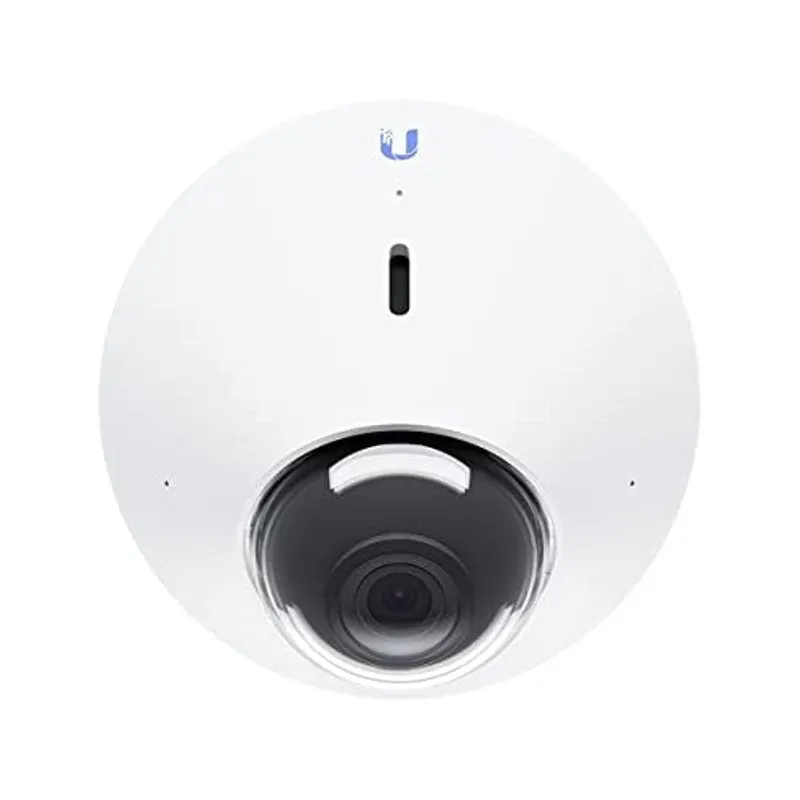
Manufacturer product photo: a round, flat white ceiling dome camera seen from below, with a small logo near the top, a slot-shaped light in the middle and a dark lens bubble near the lower edge, on a white background.
Equipment
Types of Apartment Building Security Cameras We Install
Every Long Island system is built from the same short list of parts. What changes from a Great Neck Plaza lobby to a Long Beach garage is which of them go where.
Varifocal Dome Cameras
Vandal-resistant domes with a zoom lens set on site, for stair doors, lobby entrances and mail areas where a face must fill enough of the picture to recognise.
Turret Cameras
Ball-in-socket cameras without a full dome, which avoid the glare and dirt problems of domes outdoors and suit sandy or dusty spots and covered entrances.
Flat Ceiling Domes
Low-profile domes that sit almost flush with a lobby or corridor ceiling, for co-op boards that do not want the lobby to look like a garage.
Indoor Cube and Compact Cameras
Small cameras on a stand or wall bracket for leasing offices, package rooms and management offices, where a full-size camera would be out of place.
Dual-Module PTZ Cameras
A fixed wide view and a zooming camera in one housing, for large plazas, garage entries and lots where an operator or an automatic rule needs to zoom without losing the overview.
Network Video Recorders
One recorder per property, sized for the camera count and retention target, on battery backup, with named user accounts and remote access set up for the office.
Links Between Buildings
Fibre or point-to-point wireless links for garden courts and campuses where buildings stand apart, with surge protection at both ends.
Video Intercoms and Door Hardware
Entry panels and door readers that work with the cameras, so a missed delivery or a tailgater can be traced from the door to the hall.
Manufacturer product photo: a tall camera with a grey upper housing holding several wide lenses above a black pan-tilt-zoom module with a large lens and a ring of small lights, on a white background.
Choosing cameras for Long Island buildings
Two rules decide most choices. First, a camera exists to answer a question — who came through this door, which car entered the garage, what happened at the mailboxes — and the lens is chosen so the answer fills the picture. A single wide camera in a lobby shows that something happened; a narrower one at the door shows who did it. Second, the camera has to cope with its location: night light, backlight from a glass door, salt and sand on the shore, cold in an unheated garage. Inside a village co-op that usually means compact domes and flat ceiling cameras; outside a station-area rental it means turrets and bullets with good low-light performance; on the oceanfront it means fewer moving parts and better seals.
ADT, Ring and SimpliSafe compared with a building system
Consumer brands such as Ring and SimpliSafe make good products for houses, and ADT sells monitored alarm service with cameras on top. For a whole apartment building they fall short in the same places: each camera usually runs on Wi-Fi and a per-camera or per-home subscription, recordings sit in an account tied to one person, and there is no single recorder that keeps everything on site when the internet goes down. One r/longisland homeowner thread describes neighbours whose Wi-Fi cameras recorded nothing during break-ins because thieves used jammers. A building system uses wired cameras on a recorder the owner controls, with accounts that belong to the building rather than an employee. For a house with an accessory apartment, a consumer doorbell can be the right tool; for a building, it rarely is.
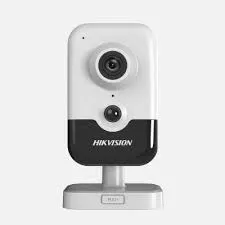
Manufacturer product photo: a small cube-shaped indoor camera, white on top and black below with a maker's name, a lens and a small sensor on its front, standing on a short white base against a light background.
AI Overview Reality Check
What AI Gets Wrong About Apartment Building Security Cameras on Long Island
We could not display Google's AI Overview for Long Island building camera searches from our research environment, so we did not quote one. Instead, here are seven claims that appear again and again in quick search answers, cost guides and sales pitches about Long Island buildings, checked against the published sources and what we see on site.
1. “Long Island is one market, so one price works everywhere.”
Online cost guides average across huge areas. Angi quotes a New York average of about $1,509 for a camera installation, with a typical range of $797 to $2,222, and HomeAdvisor's national figures are similar. Those numbers describe a few cameras on a house, not a building, and they say nothing about which county the building is in.
On Long Island the same system costs a different amount in Nassau and in Suffolk, because travel time and the length of outdoor runs differ. Our own list prices a twelve-to-twenty-camera system from $13,800 in Nassau and from $14,400 in Suffolk, and a single building can move up or down that range by a wide margin depending on how the cable has to travel.
The useful takeaway is to compare quotes per camera and per property, inside the county, and to read what each quote includes — cable, recorder storage, battery backup and removal of the old system are where quotes differ most.
2. “Rent-stabilized buildings can't add cameras without state approval.”
This one comes up from Nassau landlords who have heard that "everything" in a stabilized building needs the state's say-so. The state's own fact sheet on the Emergency Tenant Protection Act does not mention cameras at all. What it governs is rents, lease renewals, evictions and the services tenants are entitled to.
Two real limits sit close to the myth. An owner who removes or stops maintaining a required service can face rent reductions, and an owner who wants to pass the cost of a building improvement on in rents needs the agency's permission first. Neither stops a landlord from adding cameras.
So add them, keep a record that nothing residents relied on was removed, and take advice before trying to recover the cost through the rent roll.
3. “A home improvement licence is all a camera installer needs.”
County home improvement licences are real and matter: Nassau's Office of Consumer Affairs issues them under its Administrative Code, Suffolk under its county code, and the City of Long Beach issues its own. But they are not the licence that covers security cameras.
New York's Department of State licenses security and fire alarm installers, and its rules include CCTV and video surveillance used to detect intrusion, theft or movement. A camera system on an apartment building almost always falls inside that description.
The question for a board is therefore not "are you licensed?" but "which licences do you hold?" — the state alarm installer licence first, and the county or city licence where the work requires it. Abstract Enterprises Security Systems works under NYS licence #12000287431.
4. “Accessory apartments are legal everywhere on Long Island now.”
There has been plenty of news about loosening the rules, and some towns, especially in Suffolk, do permit accessory apartments with a licence. But the Long Island Index's count of 112 separate municipal rulebooks shows how uneven it is.
In Nassau, the Town of Hempstead limits them to family and senior arrangements, North Hempstead to mother-daughter homes, Oyster Bay to family or domestic staff, and the Cities of Glen Cove and Long Beach and many villages do not allow them at all.
This matters for cameras because the layout of the house and who lives there decide where cameras can point. If the unit is not legal where it stands, sort that out with the building department before buying cameras for it.
5. “Wireless cameras on every door are the modern way to cover a building.”
Wireless is attractive because it avoids cable, and for one house door it can be fine. Across a building, every camera then depends on Wi-Fi signal through brick and concrete, on a router somebody may unplug, and on an internet connection that may fail.
Long Islanders have described the other weakness themselves: in an r/longisland thread about home cameras, a poster said neighbours were burgled by people using jammers and the Wi-Fi cameras recorded nothing. A wired camera on a recorder in the building keeps recording through all of that.
We use wireless only for links between buildings, where a dedicated point-to-point radio is the right tool, and wire the cameras themselves.
6. “Any outdoor-rated camera will do on the oceanfront.”
An outdoor rating tells you a camera keeps out rain and dust in a test. It does not tell you how long its bracket will last in salt air, how its dome will look after a year of blown sand, or whether its motor will still turn.
The Long Beach buildings that line the ocean have been described as sandblasted every day, and they have a history of corroded balconies and columns. Cameras on them need stainless fixings, sealed cable entries, lens windows that can be cleaned without scratching and, ideally, no moving parts on the ocean side.
The recorder needs a dry, high home too. After Sandy, buildings on Shore Road and Neptune Boulevard lost lobbies, garages and a boiler room to the water; equipment left on those floors would have gone with them.
7. “Cloud cameras are cheaper than a recorder in the long run.”
Cloud camera platforms avoid buying a recorder, and for a few cameras that can make sense. For a building, the monthly fee is charged per camera, and the platforms we see typically run $20 to $80 per camera per month.
At thirty cameras, even the low end of that range is $600 a month, every month, for as long as the building wants its footage — and the footage stops if the subscription lapses. A recorder sized for the same cameras is a one-time cost plus occasional drive replacement.
There is a place for cloud backup of the most important cameras, such as the entrances, and we can set that up alongside a recorder. As the only copy of a building's footage, it is usually the more expensive and the more fragile choice.
A Proposal That Works on Both Sides of the County Line
Send us the list of properties. We walk each one, then send a proposal with photographs of every camera position, a camera list and a price per building at its own county's rate — in time for the next board meeting or budget review.
Tell us the county and village or hamlet of each property, how many buildings and units it has, whether it is a co-op, condo, rental or house, who manages it and what is installed now. If you have several properties, list them in the message. We answer in writing the same business day; to talk it through, call (800) 486-0943.
✅
We Got Your Request!
Received. Whoever covers your county will go through the property list and phone you today; for anything urgent the toll-free line is (800) 486-0943.
How It Works
Our Installation Process
Seven steps, the same for one village walk-up or a portfolio of buildings in both counties. The first two decide most of the price; the last one decides whether the system is still useful in five years.
1. One call, every property
You call the toll-free line or send the form with each property's county, village, size, type and decision-maker. We give a budget range per property from the county tables.
2. Survey with the super or manager
We walk each building with whoever holds the keys: entrances, mail area, basement, roof, garage and lot, plus the boiler or telecom room for the recorder, and check rules that apply there.
3. Photo proposal per building
Every camera position is marked on a photograph with what it will see, followed by a camera list, retention days, cable routes and a fixed price at that county's rate.
4. Board, owner and paperwork
The board or owner approves; we confirm licences, any village or city consent, insurance certificates and work hours, and note anything that needs testing or an engineer first.
5. Recorder and entrances first
The recorder, battery backup and network go in first, with the entrance and mail-area cameras recording from day one, so the building is never without a picture of its front door.
6. The rest of the building
Halls, stairs, laundry, garage, lot and rear yard follow, floor by floor or building by building, with every outdoor connection sealed and the work area cleaned each day.
7. Handover in the owner's name
We adjust each camera by day and after dark, set named accounts and roles, train staff to find and export footage, and hand over the drawings, camera list and admin access in the owner's name.
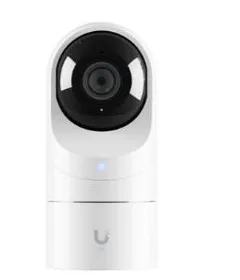
Manufacturer product photo: a small white camera with a rounded black face and lens, a tiny status light below the lens, sitting on a white cylindrical stand marked with a small logo, on a white background.
Coverage Area
Apartment Building Security Cameras Near Long Island's Landmarks
These are places, not clients: landmarks that mark the kinds of apartment buildings around them. We name them so you can see where the different building types cluster, not to suggest we have worked in any building listed.
Great Neck Station and the Plaza
The station at the heart of a village incorporated in 1930, ringed by ninety apartment buildings, co-ops and shops in a third of a square mile.
Mineola Station Area
The county seat's station, with One Third Avenue's eleven storeys a block away and the 192 homes of Modera Metro Mineola a short walk off — the template for Nassau's new station rentals.
Hicksville Station and Newbridge Road
Where a $112 million, 189-unit building with underground parking and a public plaza broke ground beside the station in December 2023 under the state's Downtown Revitalization Initiative.
Westbury Station and Railroad Avenue
Site of the 184-apartment building the village approved on September 3, 2026, on a former MTA parking lot, with a plaza and 254 parking spaces, and of Scally Place nearby.
The Long Beach Boardwalk and Shore Road
The only oceanfront high-rises on Long Island, from co-ops and condominiums to rentals, rebuilt after Sandy and still facing sand and salt every day.
Garvies Point, Glen Cove
A waterfront redevelopment of more than 1,000 homes with 28 acres of promenades and parks, mixing rentals, condominiums and public space.
We also serve the rest of both counties, from Valley Stream, Lynbrook, Rockville Centre, Freeport, Baldwin, Hempstead, Garden City and Floral Park in Nassau to Farmingdale, Huntington, Ronkonkoma, Patchogue, Bay Shore and Riverhead in Suffolk. The Nassau apartment building camera installation page and the Suffolk apartment complex camera installation page cover the places in each county in detail.
Pricing
Apartment Building Security Camera Cost on Long Island
Our apartment building prices start from a Brooklyn base list and are multiplied by a fixed factor for each area: 1.15 for Nassau and 1.20 for Suffolk. Equipment is priced the same everywhere; the multiplier reflects the labour and travel. Here are both counties side by side, installed, with cameras, recorder, cable and set-up included.
System size
Typical Long Island property
Nassau (1.15×)
Suffolk (1.20×)
Per camera, installed
Any building
$575–$1,725
$600–$1,800
4–8 cameras
Village walk-up, small co-op, Main Street building, house with an accessory unit at the top of the range
$5,750–$13,800
$6,000–$14,400
12–20 cameras
Elevator co-op, garden court, smaller station-area rental
$13,800–$28,750
$14,400–$30,000
24–40 cameras
Large rental with a garage, oceanfront high-rise, multi-building complex
$28,750–$51,750+
$30,000–$54,000+
Portfolio
Several properties under one owner or manager
Each property priced at its own county's rate, on one proposal
Labour only
Owner-supplied cameras
$86.25–$172.50 per hour
$90–$180 per hour
Service visit
Repair or diagnosis after installation
$195 per hour, three-hour minimum ($585)
What moves a Long Island building up or down the table
How the cable travels. A village building with open basement ceilings and a spare riser is at the low end; a plaster building with no ceilings and no chases, a concrete oceanfront tower or a garden court whose buildings must be linked is at the high end. How much footage you keep. Thirty days of continuous recording on twenty cameras needs more storage than fourteen days on motion, and storage is a real part of the price. What happens to the old system. Removing dead cameras, patching holes and taking away an old recorder is listed separately so the board can choose. Night and weather. Cameras that must see faces in a dark lot or survive the beach cost more than lobby cameras. Conditions in the building. Testing suspect basement materials, waiting for facade repairs or working only in a co-op's permitted hours all affect the schedule, and the schedule affects the price. Third-party cloud plans, if you want them, run about $20 to $80 per camera per month and are billed by the provider, not by us.
Shop Our Systems
Apartment Building Security Camera Packages & Pricing
Three starting points for Long Island properties. Every proposal is fixed per building after the survey; the "from" prices are the bottom of each range in the table above.
Village Building — from $5,750 (Nassau) / $6,000 (Suffolk)
Four to eight cameras for a walk-up, small co-op or apartments over shops: each entrance, the mail area, the stair or hall, the laundry and the rear yard or lot, on a recorder in the super's office or boiler room with battery backup, named accounts for the owner or board and phone viewing for the manager.
Elevator Building or Garden Court — from $13,800 / $14,400
Twelve to twenty cameras: entrances and vestibules, elevator lobby or stair doors on every floor or building, laundry, package room, garage entry or lot, and the paths that outsiders use. For garden courts, the links between buildings are included. A photo proposal for the board comes first.
Large Building, Complex or Portfolio — from $28,750 / $30,000
Twenty-four to forty cameras at a large rental, an oceanfront high-rise or a multi-building complex, or a set of properties on one standard: shared naming, roles and spares, one proposal with each property at its own county's rate, and staged installation by risk.
Already Bought the Cameras? Labour-Only Installation
If the owner or board has already bought cameras and a recorder, we install them at the labour rate for the county — $86.25 to $172.50 an hour in Nassau, $90 to $180 in Suffolk — after checking that the equipment suits the building. We will tell you plainly if something you bought will not do the job, such as Wi-Fi cameras for a concrete garage or a recorder with too few channels. Owner-supplied equipment keeps its manufacturer's warranty; our workmanship is covered under the service agreement.
Footage
Who Holds the Footage When One Company Runs Buildings in Both Counties
A single building can manage footage informally. A company with properties from Great Neck to Riverhead cannot, because the people who need footage — supers, regional managers, the office, the boards, the police and the insurer — are spread across two counties and several organisations. So we set three rules at the start of a portfolio project and write them into the handover.
Retention by camera type, not by building. Entrances, mail areas and garages keep the longest — often thirty days or more — because that is where most incidents are investigated, and because residents often report a missing package or a damaged car days later. Corridor and stair cameras can keep less. Co-op and condo industry guidance commonly cites thirty to ninety days for building footage; the right number for each property is the board's or owner's call, and we size storage to match.
Who may export, and a log of every export. Viewing can be widely shared; exporting should not. We give export rights to a named person at each property and at the office, and the recorder keeps a record of every clip taken. When a resident, a police officer or an insurer asks for footage, the request goes to that named person, who decides under the building's policy and the owner's lawyer's advice.
The owner owns the admin account. The top-level login to every recorder is in the owner's or management company's name and held at the office, never by the installer or a single employee. That way, a change of super, managing agent or installer does not lock the building out of its own cameras.
Choosing a Page
Should You Read This Page, the Nassau Page or the Suffolk Page?
This overview is for owners and managers who think about Long Island as a whole — companies with buildings in both counties, buyers comparing properties across the county line, developers planning station-area projects in more than one village, and boards that simply want to understand how their building fits the wider picture. It explains how the counties differ, how pricing works across them and how a portfolio is run.
If your building is in Nassau, the Nassau County page goes deeper into the village co-ops, the post-war courts, the rent-stabilized walk-ups and the South Shore buildings, with Nassau prices only. If it is in Suffolk, the Suffolk County page covers the spread-out garden complexes, HOA communities, 55-plus developments, Main Street buildings and the long outdoor runs that dominate Suffolk work, with Suffolk prices only.
Whichever page you start from, the number to call is the same for a Long Island hub enquiry: (800) 486-0943. Tell us the county first and the call goes to the estimator who covers it.
Complete Services
Every Apartment Building Security Camera Service on Long Island
A survey for building cameras usually turns up other needs: tired buzzers, a recorder elsewhere on the property, doors with no readers. The Long Island services below cover them.
Scheduled checks of drives, outdoor connections and battery backup.
Field Notes
Field Notes: Ask for the Basement Keys Before the Lobby Tour
What follows describes our standing survey habit in older Long Island buildings; it is a method, not an account of one job.
Boards always want to start a walkthrough in the lobby, because that is where the problem is. We ask to start in the basement, because that is where the answer is. In a village co-op or a post-war garden court, the basement decides almost everything: whether there is an old riser or pipe chase that can carry cable upstairs, whether the ceiling is open enough to run cable along it, whether there is a dry, ventilated corner for the recorder away from the boiler, whether the electrical panel has a spare circuit, and whether the pipe insulation needs testing before anyone drills near it. We note where the water meter is, where the floor has flooded before, and which doors the super locks at night. Only then do we go up to the lobby, and the conversation there is different: instead of "can we put a camera here," it becomes "this is how the cable gets here, and this is what the camera will see." It also means we find out at the first visit, not on installation day, that the only route upstairs runs through a tenant's closet.
FAQ
Long Island Apartment Building Security Camera FAQ
Does an owner with buildings in both counties get one crew, or separate Nassau and Suffolk teams?
+
One company, one project manager and one standard for the whole portfolio. The crews are scheduled by geography so a Nassau building and a Suffolk complex are not on the same day unless they are close together, but the surveys, proposals, camera models and handover documents are the same everywhere, and you have one person to call about all of it.
Is the price table on this page the same one used on the Nassau and Suffolk pages?
+
Yes. The Nassau column here matches the Nassau page and the Suffolk column matches the Suffolk page; both come from the same base list multiplied by 1.15 and 1.20. This page shows them side by side so an owner with properties in both counties can see the difference at a glance.
Can one proposal cover several Long Island properties with a separate price for each?
+
Yes, and that is how we prefer to do it. Each property gets its own section with its photographs, camera list, schedule and price at its county's rate, and a summary page totals them. Boards or owners can approve properties one at a time, and the installation order can follow the approvals.
How early should a Long Island co-op book if it wants cameras running before the holiday delivery season?
+
Count back from the board meeting, not from the holidays. A survey and photo proposal take about two weeks; the board then needs a meeting to vote, and many co-ops meet monthly. For a typical building, starting the conversation in late summer or early autumn leaves time for the vote, any paperwork and installation before the busiest delivery weeks.
Will the cameras keep recording if the building's internet service goes down?
+
Yes. The cameras record to a recorder inside the building, so an internet outage only stops remote viewing from phones and the office until service returns. Recording carries on, and once the connection is back, staff can look at what was recorded during the outage. That is one of the main reasons we use an on-site recorder rather than cloud-only cameras.
Can the board see each camera's view on a photo of our building before it votes?
+
Yes. At the survey we photograph each proposed camera position and the area it will cover, and the proposal shows the camera marked on the photo with a short note of what it is for. Where it helps, we hold up a test camera on site and capture its view. Boards find it much easier to approve a camera they can see than one described in words.
Where do your vans and ladders go during a job at a Long Island garden complex with assigned parking?
+
Wherever the manager tells us. Before work starts we agree a spot for the van and materials — usually a visitor space, a corner of the lot or the street — and we never park in a resident's assigned space. Ladders and lifts are set up only where they do not block parking aisles, and anything left overnight is locked away.
How many years should a Long Island building expect from its cameras before planning replacements?
+
Plan on roughly five to eight years for the cameras and recorder as a working rule, less for outdoor cameras on the oceanfront and more for indoor cameras in a clean lobby. Recorder drives wear out sooner and are replaced on their own. The cable, if it was installed properly, outlasts several generations of cameras, which is why it is worth doing right the first time.
Can cameras be installed on a Long Island building in the middle of winter?
+
Yes, with some limits. Indoor work goes ahead any time. Outdoor mounting and sealing need dry weather and temperatures the sealants are rated for, so on cold or wet days we work inside and come back for the outdoor positions. Any digging for conduit between buildings is best left until the ground thaws, and we plan the order of work around that.
Do you keep spare cameras on hand so a failed one can be swapped on the first visit?
+
For systems we installed, we carry the common models on the van, and for portfolio clients we recommend keeping one or two spares of the standard camera at the office so a swap does not wait for delivery. If the failed camera is covered under the service agreement it is replaced on those terms; if it is outside them, the board or owner is told the cost first.
Apartment Building Security Cameras Across New York
This Long Island overview sits under the Abstract Enterprises Security Systems home page and leads to the two county pages below. Every other area page for apartment building camera systems is listed here too.
Each number, rule and incident quoted above can be checked against the list that follows. The Nassau and Suffolk prices come from our own apartment-building list with each county's factor applied; nothing on the page is estimated from these sources.
Footage Missing at a Long Island Building? Call Before It Overwrites
Recorders overwrite their oldest footage automatically, so if an incident happened and the recorder or a camera is not working, call (800) 486-0943 straight away. We book the next open window in your county, check drives, power and connections first, recover what can be recovered, and most faults are fixed within one to two hours of arrival.
Long Island Building Cameras From a Licensed, Insured Crew
For every Long Island property, call (800) 486-0943. Abstract Enterprises Security Systems runs Long Island work from its Brooklyn office at 1282 Troy Ave, NY 11203; written messages are welcome on WhatsApp (718) 679-0359 through wa.me.
NYS Low-Voltage Licence #12000287431 · 100% Licensed & Insured · Same-Day Estimates · Rated 4.7★ from 390+ Google Reviews
Cameras and recorders carry their manufacturers' warranties. Full terms — including 50% deposit, the 30-day warranty and optional paid extended warranty, and the late-fee schedule — are set out in the service agreement. See our warranty page.
Page reviewed and updated October 18, 2026. Changelog: Long Island overview rebuilt from scratch as a two-county guide — Nassau's rent-stabilized village buildings, post-war garden courts, LIRR station-area rentals and Long Beach oceanfront high-rises alongside Suffolk's complexes; county-by-county licensing, accessory-apartment and pricing differences; portfolio standards; new sourced local research, side-by-side Nassau and Suffolk prices and a new FAQ.