From the brick rowhouses of Newburgh's East End to the garden complexes off Route 59 and the new rentals rising beside Metro-North platforms, Hudson Valley apartment buildings span two centuries and six counties — and each county writes its own contractor rules. We plan building camera systems for owners and managing agents who need one consistent standard across buildings that sit under different licensing boards, different building departments and, in some river cities, different rent laws.
Reviewed and updated October 18, 2026 · Written by Abstract Enterprises Security Systems, NYS licence #12000287431 · Hudson Valley bookings handled through our Bronx office at 460 E Fordham Rd
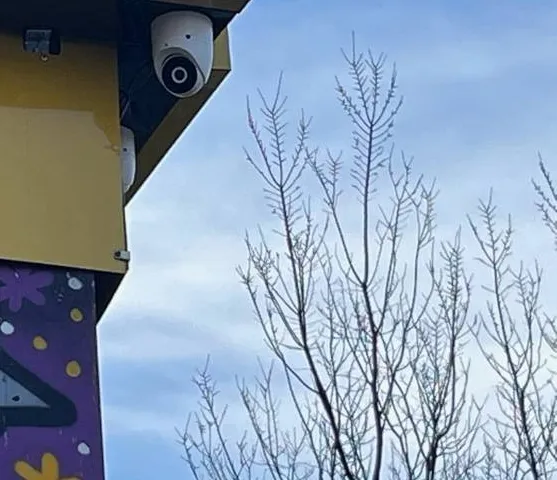
Example photo from an Abstract Enterprises Security Systems installation, not a Hudson Valley apartment building: a white dome camera and a smaller dark camera sit under the corner of a yellow-painted fascia, above a purple mural panel, with leafless tree branches against a pale blue sky to the right.
Hudson Valley Building Camera Quote
Tell us the county, the town or city and how many buildings you manage — we reply the same business day
✅
Request Sent!
We will call you back about the property the same business day.
25+
Years Experience
✓
Same-Day Estimates
100%
Licensed & Insured
4.7★
390+ Google Reviews
For a Hudson Valley property, the county decides more than the scenery. It decides whether a county board licenses the people pulling camera cable, whether a county electrical licence applies to the recorder circuit, and what each mile of travel adds to the price. The town, village or city then decides who inspects the work. Call (800) 486-0943 with the county, the municipality and the number of buildings, and we can tell you during the call which rules apply and where the property sits on the county price table below.
One written camera standard that works across every county in your portfolio, with local paperwork noted building by building
County-by-county pricing from a published multiplier, so a Kingston quote and a Yonkers quote can be compared line for line
Installed and supervised under NYS licence #12000287431, with county licence questions settled before a crew is booked
Why Hudson Valley Properties Need Apartment Building Security Cameras
The Hudson Valley is the only part of our service area where a single owner's buildings can fall under four different licensing regimes inside one afternoon's drive. A management company with a twelve-unit walk-up in Newburgh, a garden complex in Spring Valley, a condo community near Fishkill and a mixed-use building in Kingston is working in Orange, Rockland, Dutchess and Ulster counties at once. Each county has its own consumer-affairs office, its own view of which trades it licenses, and its own mix of cities, towns and villages that inspect work locally. The camera hardware can be the same in all four buildings. The paperwork, the travel and sometimes the tenant rules are not.
The building stock is just as varied. The river cities — Yonkers, Peekskill, Newburgh, Beacon, Poughkeepsie and Kingston — grew around docks, railroads and mills, and their older neighbourhoods are full of nineteenth-century brick rowhouses, storefront buildings and walk-ups that were divided into apartments long after they were built. Newburgh's East End is described by the city's own promotional site as the second largest designated historic district in New York State, with Italianate row houses and Greek Revival buildings along Grand, Montgomery and Liberty streets. Kingston has five historic districts, and its Historic Landmarks Preservation Commission reviews exterior work on those buildings that can be seen from the street. A camera on the front of one of these buildings is a design question as much as a security one.
Away from the river, the dominant apartment type changes. Rockland, Orange and Dutchess have large numbers of two- and three-storey garden complexes built in the post-war decades, spread over several buildings with parking courts between them. In Spring Valley, a 2021 report on the redevelopment of two village complexes — the 144-unit Lakeview Village senior building and Highview's 76 family units — listed security cameras “throughout the properties” alongside apartment renovations and exterior repairs in a $44 million plan. That is the scale at which many Hudson Valley owners now think about cameras: as part of a capital project, not a gadget.
The third type is new. New York State and Metro-North have been turning commuter lots into housing: in Beacon, the MTA Board approved Jonathan Rose Companies to build 265 mixed-income apartments on a parking lot beside the Beacon station, with a structured garage replacing the commuter spaces. New rentals near the Poughkeepsie station, and the towers in downtown Yonkers, New Rochelle and White Plains, follow the same pattern. These buildings arrive with access control, garages and amenity floors, and their camera systems are best designed while the drawings are still on the table.
And the problems arrive everywhere. In April 2026, Daily Voice reported that the Haverstraw Police Department had opened an investigation into packages taken from several buildings within a residential complex, then executed a search warrant at a nearby home and recovered numerous packages reported stolen by residents. Package theft is not only a city problem; in a complex of separate buildings, each with its own door and mail area, the thief simply has more places to try. Cameras that show the hand-off point at each building, on one recorder the management office can search, turn a string of separate complaints into one investigation.
Hudson Valley facts that change a building camera plan
Kingston opted into the state's Emergency Tenant Protection Act effective August 1, 2022, for buildings built before 1974 with six or more units, and New York State Homes and Community Renewal reports that a June 2025 decision upheld the city's vacancy study and its adoption of the law.
Newburgh and Poughkeepsie both voted to adopt the same law — Newburgh in December 2023 and Poughkeepsie in June 2024 — and in both cities a state court declared the adoption null and void because of problems with the vacancy study, according to HCR's ETPA update page.
Putnam County licenses low-voltage and limited-data communication technicians, and its electricians' law expressly lists video surveillance systems operating at 90 volts or less among the cabling those technicians install.
Rockland and Ulster both license electrical contractors at county level, and both definitions reach signaling systems; Rockland also adopted a new home-improvement contractor law in April 2026 that applies to dwellings of not more than three units.
Newburgh's East End Historic District covers 445 acres and 2,217 buildings, including Washington's Headquarters State Historic Site, according to its Wikipedia entry (search excerpt).
265 apartments are planned on the commuter lot beside Beacon's Metro-North station, with a garage for residents and retail customers and no loss of commuter parking, according to the Governor's office.
Most Hudson Valley owners who start with cameras end up rethinking the front door too, because footage of a door that does not latch only records the problem. Our Hudson Valley intercom installation crews and the team behind access control across the Hudson Valley work from the same building survey.
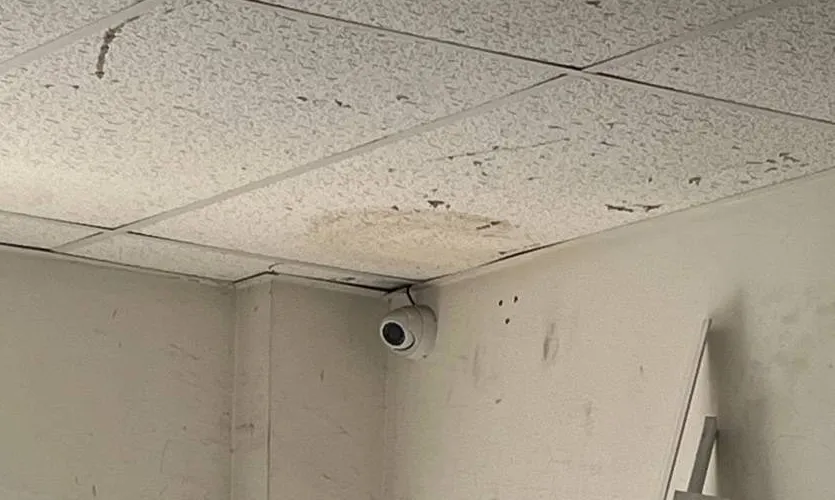
Example photo from an Abstract Enterprises Security Systems installation, not a Hudson Valley apartment building: a white turret camera is mounted high in the corner of a plain room, where two scuffed off-white walls meet a suspended ceiling of speckled tiles with a brown water stain; the top of a few leaning boards shows at the lower right.
Hudson Valley Recorder Down? Same-Day Repair Across Six Counties
When a recorder in a Poughkeepsie basement stops writing, or a parking-court camera at a Rockland complex shows a grey tile, call (800) 486-0943. We book the next open slot, and most camera, power-supply or drive faults are fixed within one to two hours of arrival. Service visits are billed at $195 an hour with a three-hour minimum ($585), the same in every county.
Six Counties, Six Sets of Rules: Choosing Where to Start
This is the regional overview. Three counties have their own detailed apartment-building pages, linked below; for Putnam, Dutchess and Ulster, the essentials are on this page. Every summary below comes from the county's own published code or office, and where we could not find a county rule, we say so rather than guess. It is a practical guide, not legal advice.
The densest market: station-area towers, prewar village co-ops, garden co-ops and rent-stabilized buildings in the eighteen municipalities that adopted ETPA. A county home-improvement licence covers only dwellings of three units or fewer. Price factor 1.25. The full county page covers co-op boards, ETPA tenants and village building departments.
Garden complexes along Route 59, village walk-ups in Nyack and Haverstraw, and large affordable and senior complexes in Spring Valley. County licences for electrical contractors (Chapter 250) and, since 2026, a rewritten home-improvement law (Chapter 286). Price factor 1.30.
Newburgh's historic rowhouse district, Middletown and Port Jervis walk-ups, and suburban complexes along the I-84 and Route 17 corridors. We found no county contractor licence in the county's published consumer guidance; licensing, where it exists, is local. Price factor 1.40.
🌲
Putnam County
Smaller apartment buildings and condo communities in Brewster, Carmel, Mahopac and Cold Spring. The strictest county for our trade: a county low-voltage/limited-data technician licence that names video surveillance cabling, plus mandatory home-improvement contractor registration. Price factor 1.45.
🚂
Dutchess County
Poughkeepsie's older neighbourhoods and new waterfront rentals, Beacon's station-area development, college-town rentals and condo communities in Fishkill and Wappingers. We found no county-level contractor licence; building permits run through each city, town or village. Price factor 1.53.
⛰️
Ulster County
Kingston's historic districts and its ETPA buildings, New Paltz student rentals and village apartments in Saugerties. A county Electrical Licensing Board licenses master electricians under Chapter 185; we found no county home-improvement licence. Price factor 1.53.
The county differences at a glance
County
County licence that can touch a camera job
ETPA status we found
Apartment stock we see most
Price factor
Westchester
Home-improvement licence (3 units or fewer only); alarm business licence for alarm devices
In force in 18 municipalities
Towers, prewar co-ops, garden co-ops
1.25
Rockland
Electrical contractor licence (Ch. 250); home-improvement licence (Ch. 286, 3 units or fewer)
Nyack adopted it (Nov 2023), then opted out (Jan 2024)
Poughkeepsie adopted it; a court voided it (Nov 2024)
City walk-ups, waterfront and station rentals, condos
1.53
Ulster
Master electrician licence (Ch. 185)
In force in Kingston; upheld in 2025
Historic-district buildings, student rentals
1.53
How to read the table. State licensing sits over all six counties: New York's Department of State licenses security and fire alarm installers under Article 6-D of the General Business Law, and its regulation, 19 NYCRR §195.2(b)(1), brings closed-circuit television and video surveillance systems used to detect intrusion or theft within that licence. Abstract Enterprises Security Systems installs and supervises under NYS licence #12000287431. The county column shows what may apply on top of that. “None found” means we searched the county's published code and consumer pages and did not find one; it does not mean a town or village has no rule of its own.
Where portfolio owners usually start. Owners with buildings in several counties tend to begin where the losses are, not where the rules are easiest: the building with the most package complaints, the open parking court, or the walk-up whose front door is forced every winter. Our advice is to write the standard once — camera types, retention, naming, accounts — on the first building, then roll it out county by county, adding each county's paperwork as you go.
Example photo from an Abstract Enterprises Security Systems installation, not a Hudson Valley apartment building: a small black camera on a short mount projects from the middle of a plain white wall, its shadow falling below it; nothing else is in the frame.
What We Install
Apartment Building Security Camera Services in the Hudson Valley
A Hudson Valley camera system is built from the same parts wherever the building is; what changes is which parts a property needs. A six-unit Kingston walk-up may use three of these services, a forty-building garden complex in Rockland all nine.
📐
Portfolio Camera Standards
One written specification — camera models by location type, recorder sizing, retention, naming and account roles — that a management company applies to every building it runs, from Yonkers to Saugerties.
🧱
Rowhouse and Walk-Up Systems
Compact systems for converted brick rowhouses and nineteenth-century walk-ups in Newburgh, Poughkeepsie, Kingston and Peekskill: street door, inner door, stair, mailboxes, rear yard and cellar door on one small recorder.
🌳
Garden Complex Backbones
Fiber, outdoor-rated cable or point-to-point wireless linking separate garden buildings to one recorder, for the post-war complexes of Rockland, Orange and Dutchess where buildings stand apart across lawns and parking courts.
🅿️
Parking Courts and Pole Cameras
Pole-mounted and building-mounted cameras for open lots, with lighting checked at night, surge protection on every outdoor run and plate positions at the entrance where the owner wants them.
📦
Mail and Package Points
A camera on the courier's drop point and one on the shelves, lockers or mailbox bank at each building, so a theft at any building in a complex shows up on the same searchable recorder.
🚆
New-Build and Station-Area Design
Camera layouts drawn into the plans of new rentals near Metro-North stations, coordinated with the electrical engineer and access-control designer before walls close.
🏡
Condo and HOA Communities
Entrance, clubhouse, mailbox-kiosk and common-road cameras for townhouse and condo associations, designed to cover association property and stop at the edge of each owner's unit.
🗄️
Recorders and Central Viewing
A recorder in each building on battery backup, with a central management view so a property manager can check every site in every county from one office without depending on any one building's internet line.
🔧
Takeovers and Repairs
Inherited set-ups with no paperwork and no one to call get traced, labelled and either fixed, enlarged or migrated to hardware whose passwords the owner actually holds.
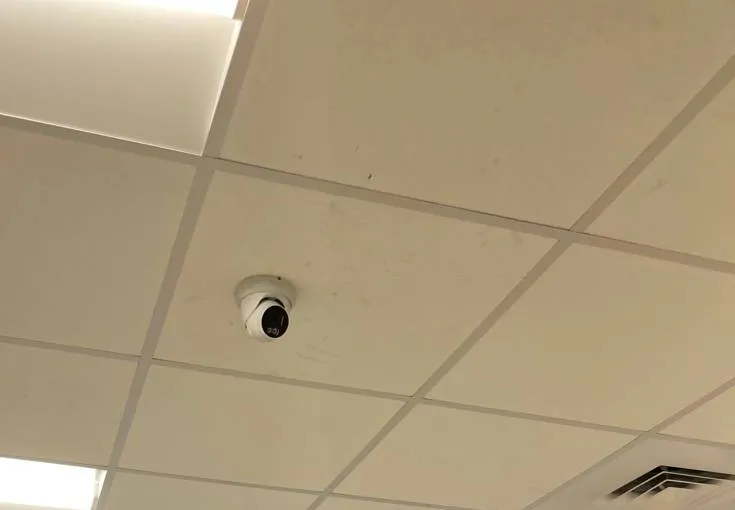
Example photo from an Abstract Enterprises Security Systems installation, not a Hudson Valley apartment building: a small white turret camera is fixed to one tile of a beige suspended ceiling, with a lit rectangular light panel nearby and an air vent at the edge of the frame.
Building Specialists
Apartment Building Security Cameras for the Hudson Valley's Architecture
Six building types account for almost every Hudson Valley apartment property we are asked to look at. The camera positions are similar; the cable routes, recorder locations and approval paths are not.
🧱
River-City Rowhouses
Two- to four-storey brick rowhouses from the nineteenth century, many now divided into apartments, in Newburgh's East End, Poughkeepsie, Kingston and Hudson-side Yonkers. Shared party walls, narrow stairs, a single front door and a rear yard reached through the cellar.
🏪
Main Street Mixed-Use Buildings
Storefronts with two or three floors of apartments above on Broadway in Newburgh, Main Street in Poughkeepsie and Beacon, Wall Street and Broadway in Kingston. A separate residential door, a long stair, and a shop owner with a system of their own.
🌳
Post-War Garden Complexes
Two- and three-storey brick or frame buildings around parking courts and lawns, typical of Spring Valley, Haverstraw, Middletown, Wappingers Falls and Poughkeepsie's suburbs. Each building has its own entrance and basement; the backbone between them is the design.
🚆
Station-Area Rentals
New mid-rise rentals beside Metro-North and the river-city waterfronts: concrete or steel frame, a garage or deck, fob access already specified, and amenity rooms. The opportunity is to design cameras into the drawings.
🏡
Condo and Townhouse Communities
Attached townhouse rows and condo buildings with private roads, a clubhouse, a pool and a mailbox kiosk, run by an association with a managing agent. Association property ends where each unit begins.
🎓
College-Town Rentals
Converted houses and small apartment buildings near SUNY New Paltz, Vassar, Marist and SUNY Orange, with a yearly turnover of tenants, bikes in every hallway and owners who manage from a distance.
How cable and recorders work in each type
Rowhouses. The brick party walls that make these buildings quiet also make them hard to cable sideways, so we work vertically: one route from cellar to top floor, usually beside the old gas or plumbing riser or inside a closet stack, with each floor's camera fed from that route. The recorder lives in the cellar in a locked enclosure, above any line where water has stood before. Where two or three adjoining rowhouses share one owner, we link them through the cellar wall at a single drilled point, sealed afterward, rather than across the facades.
Main Street mixed-use. The residential stair and the shop are different tenancies with different hours, so they get different systems or at least different recorders. A camera at the residential street door looks at faces coming in, not at the sidewalk or the shop's display window; a second covers the stair from the first landing; a third watches the rear exit where trash goes out. If the owner wants the shop on the same equipment, it is separated by account so the shopkeeper sees only the shop.
Garden complexes. We start by finding anything the buildings already share — a conduit between basements for an old intercom or cable trunk, a laundry building, the lighting circuit for the parking court. Each building's cameras then run to a small switch in its own basement on battery backup, and only one link per building travels across the site. Where trenching is impractical, outdoor-rated cable along an existing route or a short wireless bridge between rooflines does the job.
Station-area rentals. In a new building the cheapest camera is the one whose cable was pulled before the drywall went up. We mark camera positions on the electrical and low-voltage drawings, size the telecom-room space for recorders and switches, and agree with the access-control designer which doors get a camera and a reader together, so that every door event can be matched to video.
Condo and townhouse communities. The association's cameras watch what the association owns: the entrance road, the clubhouse, the pool gate, the mailbox kiosk and the visitor parking. They are aimed so that no camera looks into a unit's windows or private patio, and the declaration and rules are checked for anything they say about cameras before the board votes.
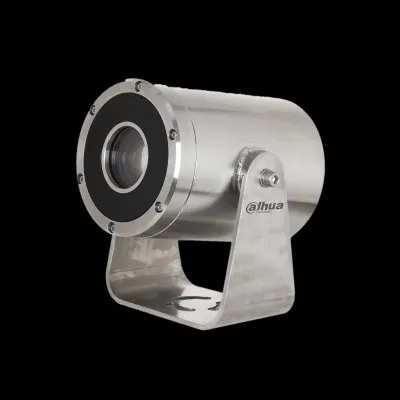
Product photo: a brushed stainless-steel box-style camera housing with a round front window, held on a stainless U-shaped bracket, against a black background.
Commercial Apartment Building Security Cameras
Business Apartment Building Security Cameras Across the Hudson Valley
Hudson Valley apartments are owned as businesses by local families with a handful of buildings, regional management companies with dozens, and developers building near the train. These are the corridors where that business is concentrated and the camera questions their owners ask most.
Broadway and the East End, Newburgh
Broadway, which the city's promotional site calls the widest Broadway in the United States, runs through a district of rowhouses and storefronts where owners are restoring buildings one at a time. Asks: entrances, rear yards and cellar doors on small recorders.
Main Street and the Waterfront, Poughkeepsie
Older walk-ups along the Main Street corridor and new rentals near the Metro-North and Amtrak station, including the 75-apartment Crannell Square development described by the New York Housing Conference. Asks: lobby, package and garage coverage.
Uptown and Rondout, Kingston
Mixed-use buildings in the Stockade and Rondout-West Strand historic districts and the city's pre-1974 apartment buildings now under ETPA. Asks: discreet exterior cameras and dependable common-area coverage.
Route 59 and Spring Valley, Rockland
A corridor of garden complexes, senior buildings and shopping centres, where complexes are being bought and renovated. Asks: complex-wide systems with parking courts, mailrooms and community rooms.
Beacon's Main Street and Station
A Main Street of storefront buildings with apartments above, and the 265-unit station project on the commuter lot. Asks: residential entrances beside busy retail, and new-build design coordination.
Route 9 Through Fishkill and Wappingers
Condo communities and rental complexes along the Route 9 corridor in southern Dutchess. Asks: entrance, clubhouse and mailbox-kiosk cameras for associations, and parking coverage for rentals.
Compliance points that come up on Hudson Valley jobs
Local code enforcement: outside New York City, each city, town or village (and in some cases the county) administers the state's Uniform Fire Prevention and Building Code, as 19 NYCRR Part 1203 sets out, so the permit question goes to the local building department.
Rated assemblies: cable that crosses a fire-rated floor or wall is sealed with a tested firestop product, and a photo of every seal goes into the handover file.
Exits: no mount or cable run may block an exit sign, a sprinkler, a closer or panic bar, and fire-door leaves stay untouched.
Historic review: in Kingston, exterior work on historic properties visible from the public right-of-way is reviewed by the Historic Landmarks Preservation Commission before a building permit is issued; other river cities have their own commissions.
Privacy limits: Labor Law §203-c keeps cameras out of employee washrooms and changing rooms, and sound recording stays disabled, because the Penal Law treats capturing a conversation with no participant's consent as eavesdropping.
Electrical work: a new circuit for a recorder or a pole camera is electrical work; in Rockland, Putnam and Ulster it is done by a county-licensed electrician and inspected as the local building department requires.
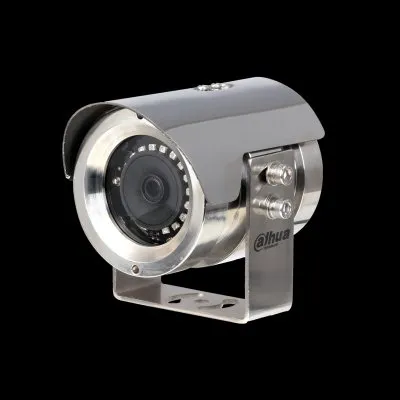
Product photo: a stainless-steel bullet camera with a sunshade, a ring of small illuminators around the lens and a sealed cable gland, on a short stainless bracket against a black background.
Portfolio Owners
One Owner, Several Counties: Running Cameras as a Portfolio
Many of the calls this page exists for come from owners and managing agents rather than single boards: a family company with buildings on both sides of the river, a regional manager with a mix of co-ops, condos and rentals, or an investor who has bought complexes in three counties in five years. Their problem is not one building; it is twenty buildings with twenty different systems installed by twenty different people. This is how we approach that.
Write the standard before buying anything. One page that says which camera goes where by location type (street door, vestibule, stair, corridor, mailbox, package room, parking, rear yard), what resolution and lens each uses, how many days each keeps, how cameras are named, and who gets which kind of account. That page becomes the scope for every building and the yardstick for every future quote, whoever installs.
Keep recording local, viewing central. Each building records to its own recorder on battery backup, so an internet outage in Saugerties never stops recording in Saugerties, and a failure at one building never takes another down. A central management account then lets the regional office see every recorder's health and search any building. Supers see their own building only.
Standardise the parts you will have to replace. Cameras, power supplies, mounts and drives from a short list mean a covering super, or our crew, carries the right spare to any building. Over a portfolio, that matters more than the last few dollars of unit price.
Name everything the same way. A camera called “B2-STAIR-3F” in every building, with the same pattern for doors, parking and mail, means a regional manager reading an alert in the evening knows exactly what failed and where, without opening a drawing.
Map the paperwork per county. The standard stays the same; the local column changes. For each building we list the municipality's building department, any county licence that applies (for example Putnam's low-voltage technician licence or Rockland's electrical licence for a new circuit), any historic review, and whether the building is under ETPA. The owner sees the whole picture in one table.
Price from one formula. Our Hudson Valley prices are the same apartment-building list multiplied by a published factor for each county, so an owner can compare a Westchester building and an Ulster building on the same basis, and can see why one costs more than the other.
Roll out in waves. Most portfolios start with the buildings that generate the most complaints, then follow the order that keeps crews in one county for a run of days. A building that is about to be renovated waits so its cameras go in with the work, not before it.
Your Questions Answered
Apartment Building Security Cameras in the Hudson Valley: Questions Answered
These are the questions owners, managing agents and association boards ask when their buildings are spread across the region, grouped by the part of the decision they belong to. Questions about one county in depth — Westchester co-op boards, Rockland complexes, Orange County buildings — are answered on those county pages; the ones here are about choosing between counties and running several buildings at once.
Choosing between counties and comparing their rules
We own buildings in Yonkers, Newburgh and Kingston — can one camera specification work for all three?
Yes, and it should. The camera types, recording settings, naming and account roles can be identical, because the jobs the cameras do — identify people at the door, show the mail hand-off, watch the parking — are identical. What differs is the cable route and the paperwork. A Yonkers elevator building cables up a riser; a Newburgh rowhouse cables up a closet stack beside the old plumbing; a Kingston building in a historic district keeps its exterior cameras where the street cannot see them. We write the specification once, then add a one-page local sheet for each building that lists its building department, any county licence involved, any historic review and its ETPA status. Owners who do this find quotes easier to compare and spare parts easier to manage, because every building uses the same short list of equipment.
Why does the same twelve-camera system price higher in Dutchess or Ulster than in Westchester?
Because our area prices apply a published multiplier to one base list, and the multiplier grows with distance from our Bronx office and the time crews spend on the road. Westchester is 1.25, Rockland 1.30, Orange 1.40, Putnam 1.45, and Dutchess and Ulster 1.53. The equipment on a twelve-camera job is the same everywhere; the labour day is longer when the first hour and the last hour are spent on the Thruway or the Taconic. Applying the factor openly is fairer than padding a quote by feel, and it lets a portfolio owner see exactly why the Kingston building costs more than the Yonkers one. The free walkthrough and written proposal do not change by county.
Putnam County licenses low-voltage technicians for video surveillance cabling — what does that mean for a camera job in a Brewster or Carmel building?
It means the licence question in Putnam is not theoretical. Putnam's electricians' law (Chapter 145 of the county code) defines a low-voltage/limited-data communications technician as someone who installs or alters cabling for networking, intercom, audio/video, fiber optics, video surveillance systems and any other system operating at 90 volts or less and five amperes, starting from an outlet installed by a properly licensed electrician. The county's Consumer Affairs office runs the electrical board that issues those licences and publishes a list of licence holders. Before any Putnam job is booked we confirm, with Consumer Affairs, how the licence applies to that specific design and who on the job will hold it, and we put the answer in the proposal. Owners should ask every bidder the same question and check the county's published list.
Rockland and Ulster license electrical contractors at county level — which parts of a building camera job count as electrical work there?
The clear part is the power. A new 120-volt circuit or receptacle for a recorder, a rack or a camera pole is electrical work under both counties' laws and is done by a county-licensed master electrician. The camera cabling itself is less clear-cut. Rockland's Chapter 250 describes an electrical contractor as one who installs wiring for light, heat or power or for signaling systems operating on 50 volts or more; Ulster's Chapter 185 uses the same 50-volt wording for contractors but defines electrical work broadly enough to name signaling, communication, alarm and data transmission. Power-over-Ethernet sits close to that 50-volt line, so we do not assume an answer: we ask the county board about the design in writing and plan the job around its reply. In practice most Rockland and Ulster projects pair our crew with a licensed electrician for the circuits.
We could not find a county contractor licence in Orange or Dutchess — does that leave camera work in Newburgh or Poughkeepsie unregulated?
No. We also found no county-level contractor licence in either county's published materials; Orange County's own consumer guide tells residents to complain to a local licensing agency where one exists, and otherwise to the state. But the state installer licence for security systems applies in both counties, because the Department of State's regulation covers video surveillance systems used to detect intrusion or theft. Each city, town and village also enforces the state building code, so drilling through a fire-rated floor or adding a circuit in a Newburgh or Poughkeepsie building can still involve the local building department, and some cities run their own electrical or historic-district reviews. “No county licence” only means the county is not the office that answers; it does not mean nobody does.
Rockland's new home-improvement law took effect in May 2026 — does it reach a camera job in a Spring Valley apartment complex?
For a large complex, probably not, but for small buildings it can. Rockland adopted a rewritten Chapter 286 in April 2026 (effective May 14, 2026), and it defines home improvement as work on a private residence, apartment or dwelling place of not more than three units, including accessory units. A two-family house in Haverstraw with cameras over the driveway may be inside that definition; a 200-unit complex is not. The chapter also excludes electrical work and alarm work by a county-licensed alarm business. If your Rockland portfolio includes small houses as well as complexes, we tell you building by building which side of the line each one sits on, and we recommend confirming with the county's Consumer Protection office before work on the small ones.
Rent rules that changed in the river cities
Kingston's rent stabilization survived in court while Newburgh's and Poughkeepsie's were voided — what changes for cameras in a pre-1974 building with six or more units?
In Kingston, a building of that age and size is under ETPA, administered by New York State Homes and Community Renewal, and its tenants have a state complaint route for decreased services, harassment and lease issues. In Newburgh and Poughkeepsie, courts declared the cities' adoptions null and void in 2024, so those protections are not in force there unless a city adopts again after a new vacancy study. For cameras, the practical difference is documentation. In a Kingston ETPA building we recommend a written camera notice, a short description of how footage is released, and a clear record of what security equipment the building has, because those facts may be referred to in an HCR proceeding. The design itself — common areas only, nothing looking into homes, audio off — is the same in all three cities.
If we take out the old lobby cameras in a Kingston ETPA building, could tenants call it a decrease in building-wide services?
It is a risk worth taking seriously. Kingston's ETPA information hub explains that owners must keep providing the services listed in their initial building services registration and those required by law as of August 1, 2022, and that tenants can file form RA-84 for decreased building-wide services in areas such as the entrance, lobby, halls, stairs and elevator; the harassment form also lists “security” among services that cannot be withdrawn to pressure tenants. Whether a particular camera system counts as a registered service depends on the building's registration, which is a question for the owner's counsel. Our practical advice: never remove a working system without a replacement scheduled, stage upgrades so the lobby is never left unrecorded, and keep the before-and-after camera lists on file.
Building types from the river cities to the suburbs
How do you run camera cable through a Newburgh East End rowhouse that shares brick party walls with its neighbours?
Vertically, and as little through brick as possible. In a converted rowhouse the usable route is nearly always a closet stack, the space beside the plumbing riser or an old dumbwaiter or chimney chase that is no longer in use; we inspect each before drilling. From the cellar, one route reaches every floor, and each floor's camera is fed from it with a short run behind trim or in a painted surface raceway. We do not drill into a party wall shared with another owner. Where two adjoining houses belong to the same owner, a single sleeved core through the cellar wall links them, sealed afterward. Inside the district, front-facade work is kept to a minimum; the street door is usually covered from inside the vestibule, looking out.
Which cameras on a Kingston Stockade or Rondout building can stay out of the historic commission's review?
Kingston's Historic Landmarks Preservation Commission reviews exterior projects on historic properties that are visible from the public right-of-way, before the building permit is issued. Cameras inside the building — in the vestibule, on the stair, in the cellar — are not exterior work at all, and an exterior camera in a rear yard or side passage that cannot be seen from the street may not trigger review either; the city's Planning Department confirms that for each address. So we design from the inside out: a vestibule camera looking through the glass at the stoop, rear and side cameras where the street cannot see them, and only the street-facing positions that are genuinely needed go into a submission with photographs, a product sheet and the mounting detail.
A renovation of our Spring Valley complex promised security cameras throughout — how do we check what was actually delivered?
Ask for three documents and then test against them. First, the camera schedule: every camera, its location, what it is supposed to see and how long it keeps footage. Second, the recorder report: the list of channels the recorder is actually recording, with the days of footage currently stored. Third, the as-built drawing showing where each camera and switch is. Then walk the property with the schedule at night, when infrared and lighting matter, and check that every listed camera appears on the recorder, shows a usable picture and keeps the promised number of days. We do this as a paid audit for owners and residents' associations and hand back a short report listing what matches, what is missing and what each gap would cost to close.
We are planning a building near a Hudson Valley train station — when should the camera design be done?
Before the electrical and low-voltage drawings are final. At that stage the camera layout costs only drawing time: positions are marked, back boxes and conduit are added to the contractors' scope, the telecom room is sized for recorders and switches, and the access-control designer knows which doors need a reader and a camera together. After the walls close, the same camera means fishing cable through finished drywall and fire-rated assemblies. For projects like the station-lot developments in Beacon, where a garage serves both residents and others, the garage camera plan also has to be agreed between the owner and whoever runs the parking, which is far easier on paper than after opening day.
Student renters in New Paltz or Poughkeepsie turn over every May — how should camera notices and access be handled?
Treat turnover as a scheduled event. Each lease cycle, update the camera notice in the lease packet and on the inside of the entry door, so every new tenant learns where the common-area cameras are on day one. Remove any temporary viewing access given to a tenant representative the year before; in most small buildings, tenants do not need their own accounts at all. Check the cameras at the bike storage, the side door and the parking area the week after move-in, because furniture deliveries knock cameras out of alignment more often than vandals do. And keep the move-in and move-out footage for the full retention period; it is the most useful record of who damaged the hallway.
Weather, wildlife and open sites
Parking-lot camera poles on an exposed ridge in Dutchess — what protects the system from lightning?
Grounding and isolation. Each pole is bonded to a ground rod, and every outdoor cable that enters a building passes through a surge protector at the entry point, itself bonded to the building's grounding system. Long runs between buildings or out to distant poles are best carried on fiber, which conducts no surge at all, with a small powered enclosure at the pole. The recorder and core switch sit on a battery backup that also filters the incoming power. None of this makes a direct strike harmless, but it limits damage to the camera on the pole instead of the whole system, and it keeps the replacement to one part.
Motion alerts at our Putnam complex fire all night because of deer and branches — what fixes that?
Moving from simple pixel-change motion to cameras and recorders that classify people and vehicles, then drawing detection zones that exclude the treeline, the lawn edges and the road beyond the fence. Night-time infrared also attracts insects and lights up branches, so we keep infrared illuminators away from foliage and add a white light on a motion sensor where the entrance needs it. After a week of live alerts we review what still triggers and tighten the zones. The goal is a handful of alerts a night that someone will actually look at, not hundreds that everybody learns to ignore.
How do cameras on the north end of the region cope with ice storms and deep cold?
By being specified for it. Outdoor cameras in Ulster and northern Dutchess are rated for the low temperatures they will actually see, mounted under an eave or hood where possible so ice does not form on the lens, and fitted with heaters where the manufacturer offers them. Cable entries are sealed so meltwater cannot run into the housing, and power-over-Ethernet budgets are calculated with the heaters on. Domes are avoided in exposed spots because ice and condensation blur the bubble; turrets and bullets with recessed lenses stay clearer. After the first winter we recheck focus and seals.
Running a portfolio across several counties
Our management company runs buildings in four Hudson Valley counties — should every building use the same recorder and camera line?
For new work, yes, within reason. A single recorder platform means one software for the regional office, one way to search and export, and one password policy. A short list of camera models — a turret for doors and corridors, a compact camera for mail and package rooms, a bullet for parking, a plate-reading camera where needed — means spares fit every building. Existing systems that work do not need to be ripped out to achieve this; they can be brought under the same naming and reporting and replaced on the standard when they fail. The exception is a building whose association or board has chosen its own equipment, in which case we document it and leave it alone.
When we sell one building out of the portfolio, how do we separate its cameras from our central account?
Plan it as part of the closing. Before the sale we export any footage the seller needs to keep for open incidents, remove the building's recorder from the central management account, reset the administrator credentials, and hand the buyer a fresh administrator account with the camera list, drawings and passwords. Because each building records locally, the cameras keep recording through the change. If the buyer wants to keep us, we open a new account in their name; if not, the documents let anyone continue. Telling us a few weeks before closing avoids a rushed visit on the last day.
How should we compare a Westchester installer's quote with an upstate installer's quote for the same Kingston building?
Line by line against your own specification. Check the state installer licence number for each bidder, and whether each has an answer for Ulster's electrical licence on the recorder circuit. Compare the camera count and models by location, the recorder's channel count and days of storage, the cable route described, the fire-stopping included, and who handles the historic review if a street-facing camera is needed. Then compare service: who answers when the recorder fails in February, and what a visit costs. A local installer may have shorter travel; a regional one may bring a standard your other buildings already use. Either can be the right choice if the specification is met.
Can a single footage-request procedure serve our co-ops, condos and rentals across the region?
The structure can be shared; the decision-makers differ. One written procedure can define how requests arrive (in writing, with date, time and location), who searches (the managing agent), how exports are logged, how long footage is kept, and how police requests and court orders are handled. What changes by building is who approves release: a co-op or condo board under its own rules, an association under its declaration, a rental owner under its own policy and its lawyer's advice. We build the recorder accounts to enforce whatever each building decides and keep the export log in the same format everywhere, so the regional office can see every request in one place.
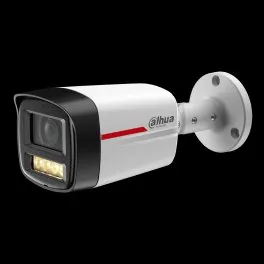
Product photo: a white bullet camera with a thin red stripe along its body, a dark front with the lens and two small lights glowing warm white, on an angled white wall-mount arm against a black background.
Equipment
Types of Apartment Building Security Cameras We Install
Hardware comes from mainstream makers — Uniview, Dahua, Hikvision, Ubiquiti — and is cabled with PoE. We pick by the job a spot does, not by brand loyalty, which keeps a multi-county parts list to a handful of models. Eight families do nearly all the work.
Turret Cameras
Our usual pick inside rowhouses and walk-ups. A ball-and-socket body aims easily under low ceilings, built-in infrared reaches dark cellar steps, and with no plastic bubble there is nothing to mist up in a cold entry.
Bullet Cameras
For parking courts, rear yards and the long paths between garden buildings. A visible shape that tells a passer-by the lot is watched, and longer lenses for the far end of a Rockland or Dutchess parking field.
Stainless and Sealed Housings
For pool enclosures, laundry rooms with steam and chemicals, and spots near road salt spray at complex entrances, where an ordinary housing corrodes within a few winters.
PTZ Cameras
Motorised zoom cameras on a pole for big lots and community entrance roads. They supplement fixed views; they never replace them, since a PTZ aimed one way is blind the other.
Multi-Lens Domes
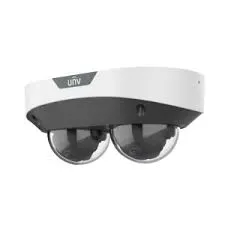
Two or more lenses in one housing for a clubhouse corner, a mailbox kiosk or a courtyard junction where one mount has to cover two directions without two cable runs.
Plate-Reading Cameras
Tight-field cameras tuned for one lane — an association gate or a deck entrance — with shutter and angle chosen so characters on a moving plate stay readable.
Network Video Recorders
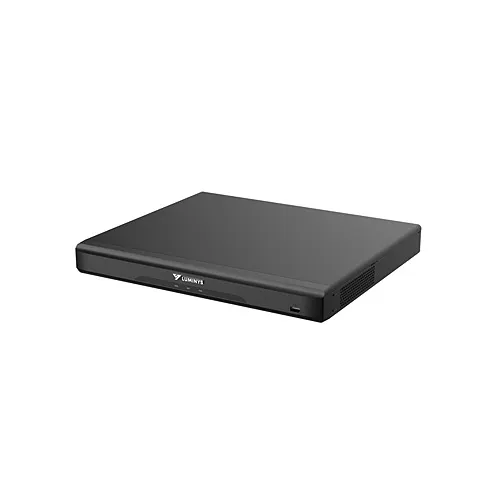
Each building keeps its own box, with enough channels and disk for the agreed days, a UPS beneath it, a lock on the door, and e-mail health reports to whoever manages the property.
Fiber and Wireless Links
Glass fiber where a trench or conduit exists, radio bridges where it does not, so a far building, pole or detached garage joins the head-end without copper running hundreds of feet outdoors.
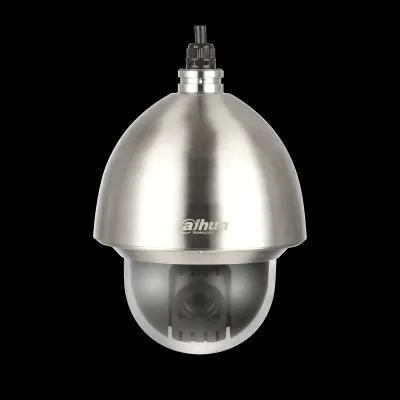
Product photo: a brushed stainless-steel pan-tilt-zoom dome hanging from a short pendant tube, its lower clear bubble showing the lens, against a black background.Product photo: a wide white dome housing with a maker’s logo on a dark band and two clear lens bubbles side by side on its underside, on a white background.
AI Overview Reality Check
What AI Gets Wrong About Apartment Building Security Cameras in the Hudson Valley
We could not capture Google's AI Overview for this topic, because the environment we research in cannot display live search-result features. This section instead tests the claims those summaries are typically assembled from — published cost guides from Angi and HomeAdvisor, vendor blogs and general legal explainers — against what a Hudson Valley apartment property actually involves.
1. “Professional installation runs about $100 to $350 per camera.”
Angi's New York cost page gives installation at $100 to $350 per camera on top of the camera itself, and an overall New York average of $1,509. For a camera on a house, with an outlet nearby and a short cable to a recorder on a shelf, that is a fair guide.
An apartment building is priced differently because the cable, not the camera, is the job. In a Newburgh rowhouse each floor's camera has to reach a cellar recorder through a closet stack; in a Spring Valley complex each building's cameras have to reach a switch, then a link across the parking court, then the recorder in the office.
That is why our county table starts at $6,250 in Westchester and $7,650 in Dutchess and Ulster for a small building. The difference from the cost-guide figure is the route through the building, the fire-stopping and the occupied-building working conditions, not markup on the hardware.
2. “Wireless cameras save money on spread-out properties.”
Vendor blogs make the point that wireless cameras for apartment buildings can lower initial installation costs by avoiding extensive cabling. On a single small building that is sometimes true, for one or two cameras.
On a Hudson Valley garden complex, the distances, the brick between buildings and the winter work against it. Wi-Fi cameras need power anyway, battery cameras need charging in January, and a single jammed or congested Wi-Fi channel takes cameras offline; one r/longisland poster wrote that police told them thieves had used a signal jammer to block their Wi-Fi cameras.
Where cable truly cannot go, we use a wireless link between buildings — a dedicated point-to-point bridge, not consumer Wi-Fi — and wire the cameras on each side. That keeps the saving where it is real and avoids it where it is not.
3. “Outside New York City, there are no special rules for installing cameras.”
Summaries often treat the suburbs as unregulated compared with the city. The Hudson Valley has fewer city-wide rules, but more layers: the state installer licence, county licences that vary, and municipal building departments that each enforce the state code under 19 NYCRR Part 1203.
Putnam's law names video surveillance cabling in its low-voltage technician licence. Rockland and Ulster license electrical contractors whose definitions reach signaling systems. Kingston's historic commission reviews exterior work visible from the street.
None of this is hard to comply with, but it is different from county to county, and an installer used to one county can miss the rule next door. That is why every proposal we write for the region lists the local paperwork for that address.
4. “Rent stabilization only matters in New York City.”
General explainers about camera rules in rental buildings usually describe New York City's regime. Outside the city, the Emergency Tenant Protection Act applies in municipalities that adopt it after a vacancy study, and the Hudson Valley has seen more activity on that than anywhere else upstate.
Kingston adopted ETPA in 2022 and HCR reports the adoption was upheld in a June 2025 decision; Newburgh and Poughkeepsie adopted and then saw courts void their adoptions in 2024; Nyack adopted and then opted out. Westchester has eighteen ETPA municipalities.
For a camera project, being in an ETPA building changes the paperwork more than the hardware: written notices, a clear record of building services and a careful approach to removing anything tenants already rely on.
5. “Any electrician can install a building's cameras.”
Because cameras use power, summaries sometimes treat them as general electrical work. New York's Department of State regulation, 19 NYCRR §195.2(b)(1), brings closed-circuit television and video surveillance systems used to detect intrusion or theft within the security installer licence.
The two licences answer different questions. The electrician's licence covers the new circuit for the recorder or a pole; the security installer licence covers the surveillance system. In Putnam, a county low-voltage technician licence may also apply to the cabling.
Our projects in Rockland, Putnam and Ulster usually combine the two: our licensed crew designs, cables and configures the system, and a county-licensed electrician provides the circuits.
6. “Cloud cameras with a subscription are cheaper than a recorder.”
HomeAdvisor's cost guide describes consumer setups of five to eight cameras for $500 to $1,000 or more, and cloud platforms advertise low starting prices. For a household, a subscription can be the simplest option.
Building-grade cloud platforms are typically priced per camera per month; at $20 to $80 per camera, a sixteen-camera Hudson Valley complex would pay $320 to $1,280 every month, indefinitely, and every camera's video has to leave the building over its internet line — a real constraint on a rural connection.
A locally recorded system has no monthly fee, records through internet outages, and can still be viewed remotely. Where an owner wants cloud features, we add them to a local recorder rather than replacing it.
7. “Visible cameras stop package theft on their own.”
Prevention guides often present cameras as a deterrent first. The Haverstraw case reported by Daily Voice in April 2026 involved packages taken from several buildings in one complex, and it ended with a police investigation and a search warrant, not with a thief scared off.
Cameras are best understood as evidence and early warning. A camera on the hand-off point at each building, on a recorder the office can search by time, turns a run of separate complaints into a pattern and gives police something concrete quickly.
Deterrence comes from the combination: a door that latches, a package room or locker that controls access, lighting at the drop point, and cameras that show faces. We design the camera part to fit that whole.
Get a Hudson Valley Camera Plan in Writing
Give us the addresses and who owns each one. After a site visit you get one document: what goes where, which local offices are involved, and a price per building that will not move.
The most useful Hudson Valley requests name the county and municipality of each building, the number of units and buildings, whether each is a rental, co-op, condo or HOA community, roughly when it was built, and what is there now. We reply in writing the same business day; to talk it through, call (800) 486-0943.
✅
We Got Your Request!
Your list of buildings is in our queue. Expect a call before the end of the business day; if a recorder is down right now, dial (800) 486-0943 instead.
How It Works
Our Installation Process
Seven steps for a single building or a whole portfolio. Steps two and four are where the Hudson Valley differs from the city: the county and municipal paperwork for each address, and a proposal that prices each building on its own county's factor.
1. Call and map the properties
Owner or agent lists each property with its town, size and form of ownership; we match it to a county row and name the people whose sign-off is needed.
2. Check each address’s rules
For every address we note the state and county licensing position, which local code office inspects, any landmark district and the rent-law status.
3. Walk every building
A tech tours each site with whoever holds the keys, from front door to back fence, noting every closet, chase and possible recorder spot on camera.
4. Send one proposal
Decision-makers get a single package: camera-by-camera list, marked-up plans, how long video is kept and who sees it, the permits per address, and a locked price per building.
5. Install the entrances first
Day one covers the ways in and the places parcels land, so each property is recording its doors that same night.
6. Complete and link the buildings
Halls, stairwells, basements, lots and the cross-site links come next; sealed firestops are photographed as they are made.
7. Hand over and connect centrally
Logins are issued per person, storage days are proven, private views are blanked, staff learn to export, every recorder joins the portfolio dashboard, and the owner receives drawings and credentials.
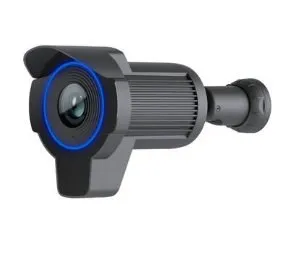
Product photo: a dark grey bullet camera with a deep hood over the front, a blue-lit ring around the lens, a ribbed body and a round mounting arm, on a white background.
Coverage Area
Apartment Building Security Cameras Near the Hudson Valley's Landmarks
These six reference points, spread across the region, are how we place buildings when booking walkthroughs. They are named as landmarks and building types only — not as Abstract Enterprises Security Systems projects.
Newburgh's East End Historic District
Described by the city's promotional site as the second largest designated historic district in New York State, with Italianate row houses, Greek Revival buildings and Washington's Headquarters, the oldest property in the city, south of Broadway.
Kingston Stockade and Rondout
Two of Kingston's five historic districts, the Stockade (local designation 1974) and Rondout-West Strand (1979), where exterior work visible from the street goes to the Historic Landmarks Preservation Commission.
Beacon Metro-North Station
The commuter lot where the MTA Board approved Jonathan Rose Companies to build 265 mixed-income apartments with a structured garage, a short walk from Beacon's Main Street.
Poughkeepsie Station and Waterfront
New rentals near the Metro-North and Amtrak station, including the 75-apartment Crannell Square development, and waterfront apartments that a Poughkeepsie Journal report placed within walking distance of the Walkway Over the Hudson.
Spring Valley Village
A Rockland village of rental complexes where a 2021 plan to redevelop Lakeview Village (144 senior units) and Highview (76 family units) included security cameras throughout the properties.
Brewster and the Harlem Line
A compact Putnam village — 881 housing units in the count used by the village's own Brewster Plan — whose Metro-North Harlem Line platform is at the Brewster train station, with Putnam Area Rapid Transit buses meeting trains.
We also serve Yonkers, White Plains, New Rochelle, Peekskill, Nyack, Haverstraw, Nanuet, Pearl River, Suffern, Middletown, Port Jervis, Monroe, Cornwall, Goshen, Carmel, Mahopac, Cold Spring, Fishkill, Wappingers Falls, Hyde Park, Rhinebeck, Red Hook, New Paltz, Saugerties, Highland and Ellenville.
Pricing
Apartment Building Security Camera Cost in the Hudson Valley
Every Hudson Valley price on this page is the same Abstract Enterprises Security Systems apartment-building list multiplied by the factor for the county the building is in. The factors are the ones we apply across all our services: Westchester 1.25, Rockland 1.30, Orange 1.40, Putnam 1.45, Dutchess 1.53 and Ulster 1.53. Each figure is installed and all-in: cameras, recorder and drives, switches, cable, labour, fire-stopping, configuration and handover. A locally recorded system has no monthly fee.
County (factor)
Walk-up or small building, 4–8 cameras
Mid-size building or small complex, 12–20 cameras
Large building or multi-building complex, 24–40 cameras
Per camera, installed
Westchester (1.25)
$6,250–$15,000
$15,000–$31,250
$31,250–$56,250+
$625–$1,875
Rockland (1.30)
$6,500–$15,600
$15,600–$32,500
$32,500–$58,500+
$650–$1,950
Orange (1.40)
$7,000–$16,800
$16,800–$35,000
$35,000–$63,000+
$700–$2,100
Putnam (1.45)
$7,250–$17,400
$17,400–$36,250
$36,250–$65,250+
$725–$2,175
Dutchess (1.53)
$7,650–$18,360
$18,360–$38,250
$38,250–$68,850+
$765–$2,295
Ulster (1.53)
$7,650–$18,360
$18,360–$38,250
$38,250–$68,850+
$765–$2,295
Portfolios of 50 or more cameras across several buildings are priced building by building on each county's row and then combined in one proposal, so the owner sees what each property costs and what the whole programme costs.
What moves a Hudson Valley building up or down its row
Construction. A new station-area building with conduit already in place is quick; a nineteenth-century rowhouse with brick party walls and plaster is slow and careful.
Spread. A garden complex's cost depends on how many separate buildings must be linked and how far apart they are, priced per link.
Approvals. A commission submission in Kingston, a permit filing in a village, or a county electrician for a new outlet each appear as their own line.
Winter specification. Heaters, hoods and cold-rated cameras for exposed northern sites add a modest amount per camera.
What is already there. Healthy cabling or young cameras left by a previous vendor come off the total.
National brands versus a building system
ADT sells monitored security built around an alarm panel and a monthly contract; for an apartment building the monitoring rarely fits, and the camera side is limited in count and retention. Ring and SimpliSafe sell cameras tied to one household account and an optional subscription. All three do well what they are designed for. A Hudson Valley apartment property needs something else: dozens of wired cameras on recorders the owner controls, named accounts for supers, managers and boards, retention set by policy, and someone who handles the cable through rowhouse brick or across a parking court — in every county the owner has buildings.
Looking at the property and writing the proposal costs nothing in any of the six counties. Once a system is in, any later service call is $195 per hour, three hours minimum ($585), with no county surcharge.
Product photo: a slim, flat black desktop network video recorder seen from above at an angle, with a small logo on the top surface and a port on its front edge, on a white background.
Shop Our Systems
Apartment Building Security Camera Packages & Pricing
The cards give each tier's entry price at the cheapest and dearest county. Your own figure comes from your county's row once we have walked the site, and it is fixed on paper before you commit.
🧱
Rowhouse & Walk-Up — from $6,250 (Westchester) to $7,650 (Dutchess, Ulster)
Four to eight cameras covering the way in, the mail, the stair, the yard and the cellar. A locked recorder holding about a month of video on a UPS, logins for owner and super, and a printed list tenants can be shown.
🌳
Complex & Mid-Size — from $15,000 (Westchester) to $18,360 (Dutchess, Ulster)
Twelve to twenty cameras: halls, laundry, parcels and the lot on top of the basics — or a cluster of two to four garden buildings joined by fiber or radio. One to two months kept, viewable from the office.
🏘️
Campus & Community — from $31,250 (Westchester) to $38,250 (Dutchess, Ulster)
Two dozen to forty cameras spread over a campus: every shared space, pole-mounted lot coverage, gate and plate lanes, the clubhouse and the mail kiosk, with up to three months stored for the main doors.
Bought Your Own Cameras? Labour-Only Installation
Already own the hardware, perhaps cartons a developer left in a storage room? We will mount, wire and set it up for labour only, once we have confirmed the parts suit the spots and talk to one another. See supplied-equipment installs; owner-bought gear stays under its maker's warranty, not ours.
Associations
Condo and HOA Communities: Cameras on Common Property Only
Townhouse associations and condo communities are spread across the region, from the Route 9 corridor in Dutchess to the hills of Putnam and the suburbs of Orange. Their camera projects differ from rental buildings in one important way: the association owns some things and the unit owners own others, and the cameras have to respect that line.
Start with the declaration. The declaration, bylaws and rules say what the association owns, who can alter common elements and how capital spending is approved. We read the relevant sections with the managing agent before drawing anything, so the proposal matches the governing documents rather than fighting them.
Cover what the association owns. Typical positions are the entrance road, the clubhouse doors, the pool gate, the mailbox kiosk, the visitor parking and the maintenance building. These are the places where outsiders come in and where association property is most often damaged.
Stop at the unit. No association camera looks into a unit's windows, a private patio or a fenced yard. Where a field of view would cross one, we re-aim or mask it before handover, and the camera list records the mask so a later board can see it was deliberate.
Deal with owner-installed cameras separately. Unit owners often add their own doorbells or cameras. Whether they may, and where they may point, is for the association's rules; we can suggest wording that limits owner cameras to their own entrances and keeps them off neighbours' doors, which the board and its counsel can adopt or adapt.
River Cities
Older Walk-Ups in Yonkers, Newburgh, Poughkeepsie, Kingston and Peekskill
The river cities hold most of the region's oldest apartment stock, and those buildings share a set of weak points that cameras can help with, provided the basics are right first.
The front door. In a converted rowhouse or a walk-up over a shop, the street door is often the original, rehung several times, with a lock that no longer latches cleanly. A camera on a door that swings open records strangers walking in; it does not keep them out. We check the closer, strike and lock on the walkthrough and tell the owner plainly when the door needs work before the camera will be worth much.
The vestibule. The best view in these buildings is usually from inside the vestibule, at head height, looking at the street door, so faces are lit by daylight from the street and the camera is out of reach. In historic districts that also keeps the facade untouched.
The recorder. In buildings without a super's office, the recorder goes in a locked enclosure in the cellar on a shelf above any past water line, on a battery backup, with a remote connection the owner can use from home. The owner, not a tenant, holds the administrator password.
Complete Services
Every Apartment Building Security Camera Service in the Hudson Valley
A camera project rarely stands alone. The pages below cover the neighbouring trades a Hudson Valley owner tends to need next, all quoted from one site visit.
Our wider Hudson Valley camera price list for homes and businesses.
Field Notes
Field Notes: Drive the Portfolio Before You Price It
The routine below is how a crew lead plans a day that crosses county lines. Treat it as a habit we keep, not a case study.
When an owner asks us to price several buildings in different counties, we plan the walkthroughs as a route, not a list, and we keep notes in the same order at every stop. At each building we stand on the street and look at the front the way a stranger would: which door is the real entrance, whether it latches, where packages pile up, where the light is at dusk. Then we walk the edges — the rear yard of a rowhouse, the parking court of a garden complex, the path between a station-area building and the platform — because that is where people come and go unseen. Inside, we find the one route that reaches every floor and the one place a recorder can live safely. Finally we write down the local column: the municipality, the county licence that may apply, any historic district, whether the building is under ETPA. By the end of the day the owner has the same set of facts for every building, which is what makes it possible to compare them, prioritise them and give each one the same standard.
FAQ
Hudson Valley Apartment Building Security Camera FAQ
Can you walk several of our buildings in different Hudson Valley counties on the same day?
+
Usually, yes, when they sit along one route. A Rockland complex, a Newburgh walk-up and a Beacon building can often be walked in one day; a portfolio that runs from Yonkers to Kingston may take two. We plan the order with you so the super or manager at each building knows when to expect us, and each building gets the same set of notes.
Before anyone drives up to a Saugerties or New Paltz building, can the first look happen by video call?
+
Yes. A short video call with the owner or super, walking the entrances, the cellar and the parking area with a phone camera, lets us confirm the scope and the likely price range before the site visit. The fixed price still comes after an in-person walkthrough, because cable routes and recorder locations are hard to judge on a screen.
Do you cover Sullivan, Columbia or Greene County buildings that sit in the same portfolio?
+
This page and its price table cover Westchester, Rockland, Orange, Putnam, Dutchess and Ulster. If a portfolio includes a building in a neighbouring county, call and tell us where it is; we will say plainly whether we can take it on and how it would be priced before any visit is booked.
In what order should a management company roll out cameras across a dozen Hudson Valley buildings?
+
Start with the buildings where losses and complaints are highest, then group the rest by county so crews stay in one area for a run of days. Buildings due for renovation wait so the cameras go in with the work. The first building is used to settle the standard, and every later building follows it.
Is the walkthrough still free when the building is in Ulster or Dutchess, far from your Bronx office?
+
Yes. The walkthrough and the written proposal are free in all six counties. Distance is reflected in the county price factor on the installation itself, which is published on this page, rather than in a charge for coming to look.
Our older Hudson Valley building already has a few cameras from another brand — can new ones be added to the same recorder?
+
Often, if the existing cameras and recorder support a common standard such as ONVIF and are in good condition. We test each existing camera on the walkthrough. Where they work with the new recorder, they stay; where they do not, or where their picture is too poor to identify faces, we tell you which to replace and what that adds.
Will you sign the building’s confidentiality agreement covering the camera drawings?
+
Yes. Camera drawings show where a building is and is not watched, so owners are right to protect them. We sign the owner’s or managing agent’s agreement before the walkthrough if asked, mark the drawings confidential and share them only with the people the owner names.
What documents do we get that an insurer or lender can review after installation?
+
Each building receives a camera schedule with locations and retention days, as-built drawings showing camera and cable positions, the recorder configuration report, photographs of fire-stopped penetrations and the service agreement. Owners usually pass the camera schedule and recorder report to their insurer when asked what security the property has.
How are the cameras labelled so a covering super from another building can find them?
+
Every camera, switch and recorder gets a label that matches its name on the recorder, using the same pattern across the portfolio — building, location type and floor. A super covering for a colleague can match a camera on screen to the one on the wall without a drawing, and the regional office reads alerts the same way for every building.
What happens to the warranty on the system if one of our buildings is sold?
+
Warranty terms are set out in the service agreement for that building. Tell us before closing and we will document the system’s condition, hand the buyer the drawings and passwords, and confirm in writing what the agreement provides for the new owner.
Apartment Building Security Cameras Across the Hudson Valley and New York
This is the regional hub for building camera systems north of New York City. Each Hudson Valley county with its own detailed page is linked below, along with every other area page for apartment building cameras.
This hub sits directly under our main site; licensing, insurance and company background are on the about page.
Sources
Where the Hudson Valley Facts Come From
County codes, state agencies and local reporting behind the statements above are grouped here by topic. Items we could only read as a search snippet carry the word excerpt. The county price rows come from our own list and published multipliers.
If the management office finds a gap in last night's recording at any building in the six counties, or a parking-court or package-room camera has gone dark, phone (800) 486-0943. We check power, switch ports and drives first, and most buildings are recording again within one to two hours of arrival.
Hudson Valley Building Cameras From a Licensed, Insured Crew
Abstract Enterprises Security Systems · 460 E Fordham Rd, Bronx, NY 10458 · (800) 486-0943 · WhatsApp (718) 679-0359 via wa.me
NYS Low-Voltage Licence #12000287431 · 100% Licensed & Insured · Same-Day Estimates · Rated 4.7★ from 390+ Google Reviews
Cameras and recorders carry their manufacturers' warranties. Full terms — including 50% deposit, the 30-day warranty and optional paid extended warranty, and the late-fee schedule — are set out in the service agreement. See our warranty page.
Page reviewed and updated October 18, 2026. Changelog: Hudson Valley hub rebuilt from scratch as a six-county regional overview — county licensing and ETPA differences, river-city walk-ups, garden complexes, station-area rentals, condo and HOA communities and multi-county portfolios — with county-by-county pricing from the published multipliers and new sourced questions and FAQ.