A Queens apartment building is rarely one front door and a lobby. It is a Jackson Heights garden co-op with a block-long inner garden and a dozen stairway entrances, a six-story elevator house on Queens Boulevard with a cellar laundry and a rear lane, a campus of separate buildings and parking courts, a glass rental tower in Long Island City, or a two-family house in Woodside with a tenant upstairs. We design camera systems around how people actually get into each of those buildings — the vestibule door, the mailroom, the courtyard gate, the lot — and around who signs off: a co-op board, a landlord, or an owner who lives on the ground floor.
Reviewed and updated October 18, 2026 · Abstract Enterprises Security Systems, NYS licence #12000287431 · Queens jobs scheduled from 460 E Fordham Rd, Bronx
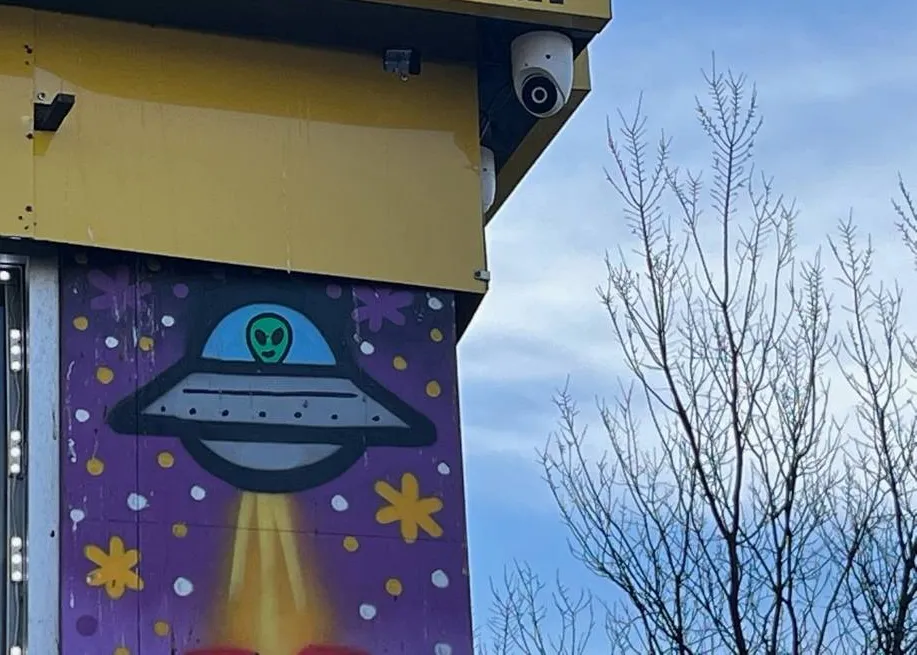
Example photo from an Abstract Enterprises Security Systems installation (not a Queens job): a white turret camera sits tucked under the corner of a yellow fascia, a small bracket and a second fitting beside it, above a purple panel painted with a cartoon flying saucer; bare branches and blue sky fill the right side.
Queens Building Camera Quote
Tell us the neighborhood, the building type and how many entrances it has — a written price follows the same business day
✅
Request Sent!
An installer will come back to you about the Queens building the same business day.
25+
Years Experience
✓
Same-Day Estimates
100%
Licensed & Insured
4.7★
390+ Google Reviews
Count the doors before you count the cameras. The fastest way to price a Queens building is to tell us how many ways in it has — street doors, courtyard gates, cellar doors, the lot entrance — and where the mail and packages land. Ring the Queens line on (347) 434-6392 or use the form, and we can sketch a layout before anyone visits.
Queens package prices run from $5,250 for a small building to $47,250 and up for large campuses, on the published list with the borough's 1.05 adjustment
Local recorder, no monthly fee, footage owned by the building — not by us
Two-hour arrival windows, seven days a week up to 8 PM, under NYS low-voltage licence #12000287431
Why Queens Properties Need Apartment Building Security Cameras
Queens is where the garden apartment began. The Jackson Heights Beautification Group's history records that the Queensboro Corporation completed Laurel Court, the first apartment building in Jackson Heights, in 1914, and in 1917 — the year the elevated line reached Roosevelt Avenue — built a complex it called the Garden Apartments, coining the term. Its designs centred on large interior gardens, often running the full length of a block, and between 1920 and 1925 it built eight block-long garden complexes. The Historic Districts Council calls Jackson Heights the first and still the largest garden-apartment community in the United States. Those buildings were laid out for light and air, not for watching doors: each one has many separate stairway entrances, a long shared cellar and a garden that anyone who gets through one gate can cross.
The borough kept building that way for decades. Kew Hall in Kew Gardens, from 1922, took up half a block around an interior garden court with multiple entrances so that only two apartments shared each landing, a plan the Six to Celebrate survey says became a favourite of Kew Gardens developers. Sunnyside Gardens added about 600 buildings around landscaped courts in the 1920s. After the war came campuses: Glen Oaks Village describes its 134 buildings and 2,904 garden-style apartments on 110 acres, built in 1947. Along Queens Boulevard, Forest Hills and Rego Park filled up with six-story elevator buildings and taller towers — the Queens Chronicle describes Rego Park's Howard complex of three 12-story buildings from 1952, with 70 percent of its site given to lawns, gardens and playgrounds.
Then the glass arrived. In 2016, 6sqft counted 28 developments under way or proposed in Long Island City, with the Long Island City Partnership projecting 24,500 housing units, and rental towers now line Court Square and Queens Plaza with keyless entry, amenity floors and garages. Between those extremes sit tens of thousands of two- and three-family houses and apartments over shops in Woodside, Astoria, Elmhurst and Flushing, many owned by people who live in them.
What these buildings have in common is that their weak points are spread out. The local news is consistent about where things go wrong. CBS New York reported a man using a screwdriver on the door lock of an Astoria building near 36th Avenue and 31st Street and leaving with more than $400 in deliveries from the lobby. FOX 5 reported a lobby door on 73rd Street in Elmhurst forced with a screwdriver before the mailroom was emptied. QNS reported in 2025 that one burglar hit the mail room of a Jackson Heights building on 35th Avenue three times in March, then buildings in Elmhurst, Flushing, Woodside and Long Island City, and that the NYPD released a surveillance image from the Jackson Heights building. In Forest Hills, QNS reported a man who picked an outer-door lock near 67th Road and Booth Street and then picked a large mailbox. And in September 2026 PIX11 reported residents on 62nd Drive in Rego Park dealing with repeated car break-ins caught on surveillance video.
Residents say the same things online. On r/AskNYC, a tenant in a mid-size Queens building wrote that the only significant package theft they had seen came during the holiday season; on r/NYCapartments, another was told by a landlord that the building's cameras were simply down. Habitat magazine interviewed a property manager whose portfolio of about 125 buildings is mostly in Queens: package theft was a major problem in buildings without a full-time doorman, and the fix was a combination of cameras in vestibules and hallways, lock plates on doors that could be forced with a screwdriver, and packages kept out of sight of the street door. That is the brief for a Queens building camera system: cover every way in, cover where the mail lands, keep the recorder working, and make sure somebody can pull a clip the morning after.
Queens facts that shape a building camera plan
October 19, 1993: the date the Landmarks Preservation Commission designated the Jackson Heights Historic District, built mostly between 1914 and 1939 (Historic Districts Council) — so street-facing cameras there need an LPC permit.
About 36 blocks between 76th and 88th Streets, Roosevelt Avenue and Northern Boulevard, and at least 60 Jackson Heights buildings converted to co-ops or condos in the 1980s, adding more than 5,000 owner-occupied units (Jackson Heights Beautification Group).
134 buildings, 2,904 apartments, 110 acres: the scale of Glen Oaks Village, a 1947 garden complex that became a co-op in 1981 (Glen Oaks Village) — the kind of campus where video has to travel between buildings.
Two or three cameras per 25 feet of street frontage: the LPC permit guidebook's limit for small and large residential buildings in historic districts.
56.3 percent of Queens residents five and older speak a language other than English at home (Census figures cited by Babbel), which is why camera notices here should not be in English alone.
Half of all New York City housing is in Brooklyn and Queens combined (Citizens Housing & Planning Council), much of it in small buildings with no staff on site.
Screwdrivers beat weak latches before cameras ever matter. Several of the Queens break-ins above started with a door forced or picked, so a latch guard, a working closer and a proper intercom belong in the same conversation. Our Queens intercom installation crews and our access control installers in Queens work from the same office, so a board can price the door, the intercom and the cameras in one proposal.
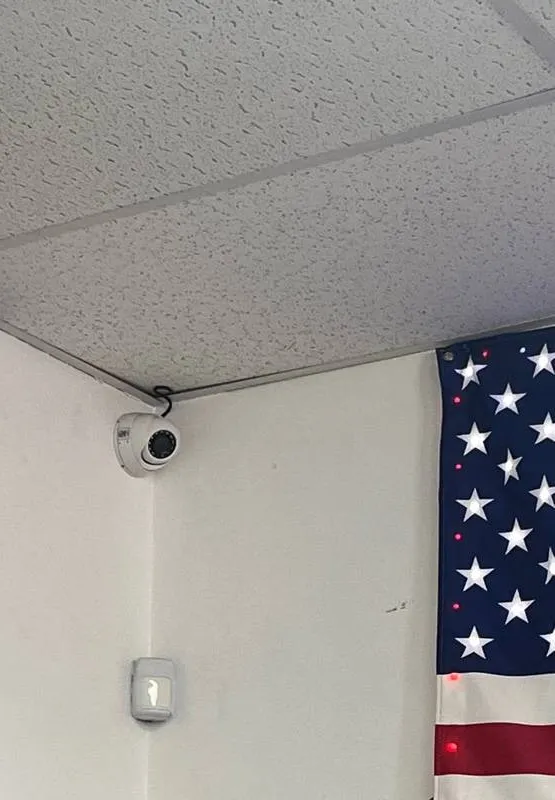
Example photo from an Abstract Enterprises Security Systems installation (not a Queens job): a small white turret camera is fixed in the top corner of a room where two white walls meet a textured drop ceiling, its short cable looping into the ceiling; a white motion sensor sits lower on the wall and a stars-and-stripes flag hangs at the right.
Recorder Down After a Break-In in Queens?
If the morning after a mailroom break-in you discover the recorder stopped writing weeks ago, or half the cameras show black, call (347) 434-6392 for the next open two-hour window. Most dead recorders, failed drives and dropped cameras are recording again within one to two hours of arrival, and we try to recover whatever footage the drive still holds before anything is replaced.
Apartment Building Security Camera Services in Queens
Nine kinds of job make up almost every Queens building we are asked to quote. They are defined by where people get in and where things go missing, more than by which brand of camera ends up on the wall.
🌿
Courtyard and Garden Coverage
Gate and passage cameras where people enter a Jackson Heights or Kew Gardens garden, plus wide views of the court, cabled through the cellar instead of across the lawn.
🚪
Vestibule and Entrance Cameras
A face-height camera outside each street door and one inside the vestibule looking back, so a person working at the lock is filmed face-first.
📬
Mailroom and Package Areas
Door and mailbox-bank cameras set to the side of the boxes, with late-night motion alerts sent to the super for buildings that have been hit before.
🧺
Laundry Rooms and Cellars
Video-only cameras at laundry, bike-room and storage-cage doors, with audio switched off and a notice on the door.
🏢
Multi-Building Campuses
A switch in each building's cellar, fiber or point-to-point radio back to the management office, and one screen for every building.
🚗
Lots, Garages and Alleys
Lot-entrance and parked-row cameras, plate cameras at garage ramps, and low-light colour cameras along rear service lanes.
🏗️
Taking Over Developer Systems
Admin-access recovery, account transfer and a full audit of systems left behind in new Long Island City and Astoria rentals.
🏠
Two- and Three-Family Homes
Front door, side gate, driveway and mailbox coverage for owner-occupied houses with tenants, with privacy masking over the tenant's space.
🔄
Upgrades on Old Coax
HD cameras that reuse tested coax in older Forest Hills and Kew Gardens buildings, mixed with new network cameras where runs fail.
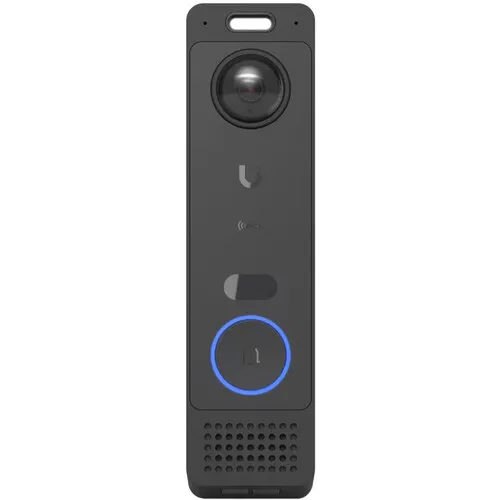
Manufacturer product photo: a tall, narrow black door station with a camera lens near the top, a small reader area in the middle, a round call button ringed in blue light and a speaker grille at the bottom, on a white background.
Building Specialists
Apartment Building Security Cameras for Queens' Architecture
Queens buildings fall into a handful of families, and each family fails in its own way. The same twelve cameras would be wrong for a Jackson Heights garden co-op and a Court Square tower.
Garden Co-op Complexes
Jackson Heights, Sunnyside Gardens and Kew Gardens buildings of the 1910s–1930s: low-rise, many stairway entrances, a shared inner garden and a long cellar. Cameras go at each entrance and gate; cable runs underground through the cellar.
Six-Story Elevator Houses
The pre- and post-war apartment houses along Queens Boulevard, Austin Street and the side streets of Forest Hills, Rego Park and Elmhurst: one lobby, an elevator, a cellar laundry and a rear lane.
Post-War Campuses
Glen Oaks Village-type complexes of dozens of separate buildings with parking courts and lawns, run from one management office. Video has to travel between buildings.
Towers in the Park
Taller post-war buildings set back on landscaped sites, like Rego Park's 12-story Howard complex of 1952, where the grounds and play areas are as much a concern as the lobby.
New Rental Towers
Long Island City and Astoria glass-and-concrete rentals with keyless entry, video intercoms, amenity floors and garages already installed — and gaps the developer left.
Small Owner-Occupied Buildings
Two- and three-family houses in Woodside, Astoria and Maspeth, and mixed-use buildings with stores below, where the owner lives on site and makes every decision.
How each building type is wired and mounted
Garden co-ops. These buildings are brick on masonry walls, with plaster inside and a continuous or near-continuous cellar under each building. We treat the cellar as the cable highway: one small equipment location, often near the boiler room or the super's workshop, and runs fanning out under each stairway entrance and up through the floor or a wall behind each door. Where the building is inside the Jackson Heights Historic District or Sunnyside Gardens, street-facing cameras are small domes or turrets fastened at mortar joints or plain masonry, finished to match, with cable coming straight back through the wall rather than along it, so the installation can meet the LPC guidebook's limit of about ten inches of visible conduit.
Six-story elevator houses. Here the cable route is the stair hall and the cellar. Cameras for the lobby, vestibule, mailroom and elevator landing are fed from a rack in the cellar or a utility closet off the lobby, with vertical runs in an existing chase or a painted raceway in the stair hall where nothing else is possible. Rear lanes and side alleys get their cameras on the building's own back wall, with cable dropping straight into the cellar. Elevator cab cameras are coordinated with the elevator contractor, ideally during a modernization.
Campuses. Each building gets its own small switch and, depending on the links, its own recorder. Building-to-building links are fiber wherever there is a usable conduit, steam tunnel or old cable path; where there is not, a pair of point-to-point radios on the roofs or eaves carries the video. Every outdoor mount is grounded, and copper never runs between buildings.
Towers in the park. Lobbies are usually concrete and terrazzo, so we work through existing ceilings and the building's riser closets. Grounds cameras along paths, play areas and parking go on the building walls and on light poles where the co-op owns them, fed through existing underground conduit where it exists.
New rental towers. Fire-rated walls, sprinklered ceilings and a building management system are already there. Cable rides in existing trays and sleeves, every rated penetration is fire-stopped afterwards, and cameras are integrated with the access-control and intercom platforms the building already runs rather than layered on as a separate island.
Small owner-occupied buildings. Frame or brick houses with aluminium or vinyl siding are the simplest to wire: cable through the basement or attic, cameras under eaves or on the siding with proper mounting blocks, and a compact recorder in the owner's part of the house. The work is fast; the care goes into where each camera points.
Manufacturer product photo: a white bullet camera with a black sunshield hood over the lens and a logo on its side, on a short arm with a round white mounting base, against a white background.
Commercial Apartment Building Security Cameras
Business Apartment Building Security Cameras in Queens
Many Queens apartment buildings are also businesses: the ground floor holds stores, the owner is a management company running a portfolio, or the property is a co-op corporation with an operating budget and a board. These corridors produce most of our mixed-use and portfolio work.
Main Street and Roosevelt Avenue, Flushing. Wikipedia describes the Main Street–Roosevelt Avenue intersection as the third-busiest in the city. Buildings here and on the side streets often combine shops below with apartments above, and the residential door is a few feet from a busy storefront. We separate store and residential cameras by user account even when they share one recorder. The Queens Chronicle has also reported a string of mail thefts from street relay boxes in the 11358 ZIP code; that is a postal matter, but it is one more reason residents want their own building's mail area covered.
Roosevelt Avenue and 37th Avenue, Jackson Heights and Elmhurst. Under the elevated line and along the shopping streets, apartment entrances sit between storefronts. Doors take heavy traffic and get propped; the QNS-reported mail-room burglaries began in a Jackson Heights building on 35th Avenue. Entrance and mailroom cameras come first here.
Queens Boulevard, Forest Hills and Rego Park. Six-story and taller apartment houses line the boulevard and its side streets, many of them co-ops with professional managing agents. The work is usually a building-wide upgrade approved by the board, covering lobby, mailroom, laundry, rear lane and, more and more, the curb and parking after reports like the 62nd Drive break-ins.
Austin Street and Lefferts Boulevard, Forest Hills and Kew Gardens. Austin Street co-ops and the mixed-use buildings around Lefferts Boulevard — which the Six to Celebrate survey describes becoming Kew Gardens' main commercial corridor after the LIRR station opened in 1909 — combine older wiring with newer storefronts.
Court Square, Queens Plaza and Hunters Point, Long Island City. Large rental and condo towers run by professional operators, with garages, amenity floors and integrated access systems. Here the job is often taking over or extending a developer system, adding plate reading at the garage, and bringing cameras into the same platform as the doors.
Steinway Street and 30th Avenue, Astoria. Shopping streets lined with mixed-use buildings and, a block away, rows of two- and three-family houses and newer mid-rise rentals. CBS New York's Astoria package-theft report came from a building near 36th Avenue and 31st Street.
Rules a Queens building owner should know
Entrance doors and intercoms: under Multiple Dwelling Law §50-a, class A multiple dwellings built or converted after January 1, 1968 need automatic self-closing, self-locking entrance doors, and those with eight or more apartments need an intercom that lets each apartment talk to the door and release it. Older buildings must add them if tenants of a majority of apartments request it in writing. The law does not require cameras.
Audio: New York Penal Law article 250 treats recording a conversation without the consent of at least one party as eavesdropping, a class E felony. We switch microphones off on every common-area camera.
Historic districts: cameras on buildings in the Jackson Heights and Sunnyside Gardens historic districts, and other designated areas, need a Landmarks Preservation Commission permit; staff-level approval is available when cameras meet the guidebook's spacing, attachment and conduit rules.
Private spaces: cameras belong in common areas — lobbies, halls, laundry rooms, garages — and never where residents have a reasonable expectation of privacy, such as inside apartments or bathrooms.
Footage access: attorneys quoted by Brick Underground say a landlord is not generally obliged to show tenants footage outside a police request or court order; the building should still decide in writing who may view and export it.
Licensing: the New York Department of State licenses security and fire alarm installers after fingerprinting, at least 81 hours of approved education and an examination. Abstract Enterprises Security Systems works under NYS licence #12000287431 and carries insurance certificates that managing agents can request in their own wording.
This section summarises published rules for planning purposes; it is not legal advice. Boards and owners with a specific question about tenants' rights or a lease should ask their own attorney.
Your Questions Answered
Apartment Building Security Cameras in Queens: Questions Answered
Grouped from the courtyard inward to the cellar and out to the curb. Where an answer cites a Queens break-in, a building figure or a rule, the publication is named in the sources list near the end.
Garden Co-ops and Interior Courtyards
Queens invented the garden apartment, and those buildings still set most of the camera questions we hear.
How do you cover a Jackson Heights garden co-op whose interior garden runs the full length of the block?
Treat the garden as its own space with its own few cameras, and treat each building entrance separately. The Jackson Heights Beautification Group's history describes Queensboro Corporation designs centred on large interior gardens, often running the full length of a block, with several separate entrances around them. A single long-range camera at one end of that garden sees silhouettes at the far end and nothing useful. What works is a short-range camera at each gate or passage where people actually enter the garden, plus one or two wide views of the garden itself for context.
The entrances matter more than the lawn. In these complexes each stairway entrance typically serves its own stack of apartments, so we put a camera inside or directly over each entrance door at head height, where it sees faces rather than the tops of heads. Cable is carried along the cellar, which in most of these buildings is continuous or nearly so under each building, and comes up behind each entrance through the floor or a wall, so nothing is strung across the garden.
Can a building inside the Jackson Heights Historic District put cameras on its street facade at all?
Yes, with a permit and within limits. The Landmarks Preservation Commission designated the Jackson Heights Historic District on October 19, 1993 — roughly 36 blocks between 76th and 88th Streets, Roosevelt Avenue and Northern Boulevard, according to the Jackson Heights Beautification Group. The LPC's permit guidebook lets staff approve security cameras that meet its criteria: no more than two cameras per 25 feet of street frontage on small residential buildings and three on large ones, fastened at mortar joints, plain masonry, wood or metal rather than through decorative surfaces, and kept off the primary facade unless there is no other option.
In practice that pushes cameras to the courtyard side, to plain masonry in recesses beside entrances, and to small dome or turret housings painted to match the wall. The guidebook allows roughly ten inches of visible conduit at most, painted to match, so cable comes through the wall behind the camera wherever the masonry allows. We prepare the photos, elevation drawings and camera cut sheets the application asks for, and nothing is drilled until the permit is in hand.
Our Sunnyside Gardens court is shared by several owners — who has to agree before cameras go up?
Everyone whose property the camera sits on or looks across, plus the Landmarks Preservation Commission. CityLand reports that the LPC designated Sunnyside Gardens, about 600 buildings built in the 1920s to Clarence Stein and Henry Wright's plans and known for their large landscaped courtyards, as a historic district on June 26, 2007. The Commission's own Sunnyside Gardens manual says it must approve in advance any alteration, including work on all facades of the buildings.
So a camera covering a shared court needs two kinds of agreement: the neighbours who share the court, ideally in writing, and the LPC permit for anything fixed to a facade. We recommend each owner cover only their own gate and path, with privacy masking over anything that belongs to the house next door; a single camera owned by one person and watching everyone's back doors is the arrangement most likely to start an argument.
Multi-Building Campuses
Some Queens complexes are small towns: dozens of separate buildings, lawns and parking courts managed from one office.
What carries camera video between the separate buildings of a Glen Oaks Village–type campus?
Fiber or point-to-point wireless, not long copper runs. Glen Oaks Village describes itself as 134 buildings with 2,904 garden-style apartments on 110 acres, built in 1947 and converted to a co-op in 1981. Network cable for cameras is limited to about 100 metres per run, which is less than the distance between many buildings on a campus that size, and copper strung between buildings also carries lightning and ground problems from one building into another.
The usual design is a small switch in each building's cellar collecting that building's cameras, linked back to the management office by fiber where a conduit or utility path already exists between buildings, and by a pair of point-to-point radio links where it does not. Fiber does not conduct electricity, so a strike near one building stays in that building. We walk the campus with the superintendent first, because the existing conduits, steam tunnels or old intercom cable paths decide which buildings can be joined cheaply.
Does each building in a Queens garden complex need its own recorder, or can the management office hold them all?
Either works; the choice depends on the links between buildings. With fiber between buildings, one recorder or a pair of recorders in the management office is simplest: one place to check, one place to export from, one battery backup. Where the links are wireless or the complex is very spread out, a small recorder in each building keeps recording even if a link drops, and the office views them all through one software screen.
We usually recommend central recording for complexes up to a few dozen cameras with solid links, and local recorders per building for larger campuses. Either way, every recorder is set to the same clock and named by building and entrance, so footage from building 12 can never be confused with building 21.
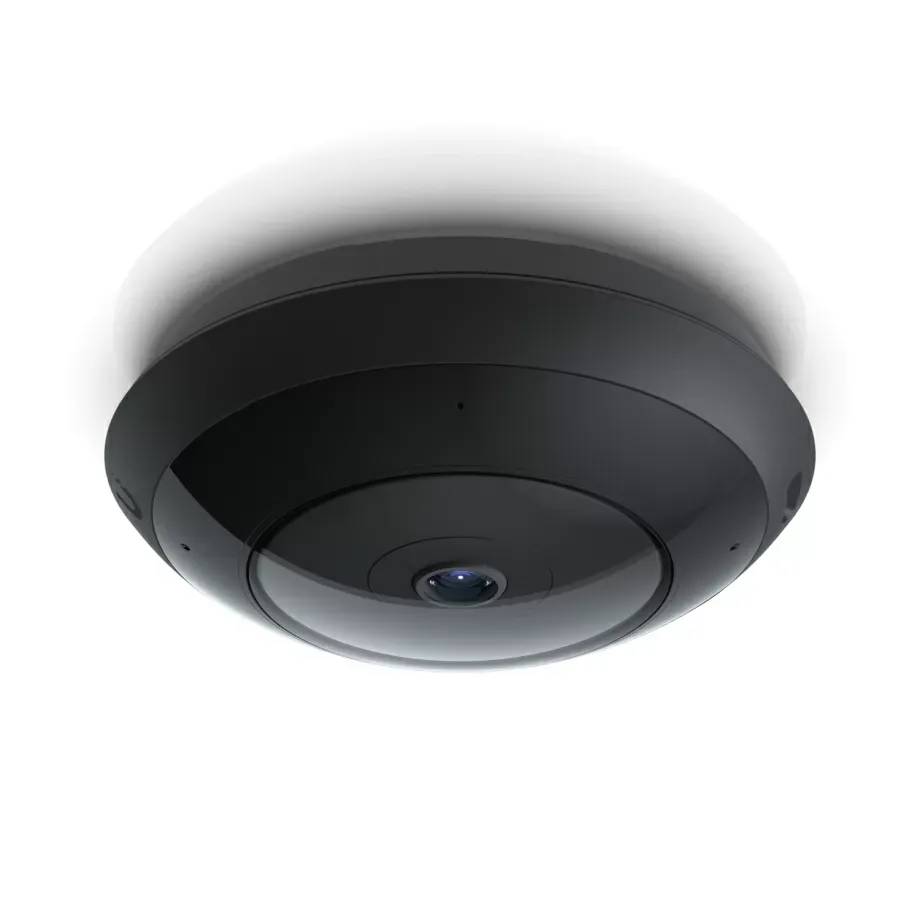
Manufacturer product photo: a flat, round black ceiling camera seen from slightly below, with one wide fisheye lens set in the middle of its dark dome, on a white background.
Vestibules, Mailrooms and Package Theft
Most Queens camera calls start the morning after something went missing from a lobby.
What camera angle actually identifies someone forcing a vestibule door with a screwdriver, as in the Astoria and Elmhurst cases?
A camera outside the door, at about head height and close in, looking at the lock side of the door. CBS New York reported that a man in an Astoria building near 36th Avenue and 31st Street used a screwdriver to disable a door lock and took more than $400 in deliveries from the lobby; FOX 5 reported video of a man forcing a lobby door on 73rd Street in Elmhurst with a screwdriver before emptying the mailroom. In both cases the person spent time standing at the door, which is exactly when a close, face-height camera gets its best image.
A high corner camera inside the lobby sees the top of a hood. We place one camera outside the entrance, often in the vestibule ceiling recess or beside the door frame, framed so a person at the lock fills a good part of the picture, and a second inside the vestibule looking back at the outer door. Habitat magazine describes one Queens-heavy management company surveying its doors for ones that could be forced with a screwdriver and adding lock plates; we point that out at the walkthrough wherever we see it.
A Jackson Heights mailroom was hit three times in March — how do cameras change things for a repeat target?
They turn a repeat target into an identification. QNS reported in April 2025 that a burglar entered the mail room of an apartment building at 83-10 35th Avenue in Jackson Heights three times in March before moving on to buildings in Elmhurst, Flushing, Woodside and Long Island City, and that the NYPD released a surveillance image taken in the Jackson Heights building. One good face image is what lets four precincts connect five break-ins.
For a mailroom that means a camera at the mailroom door seeing faces on the way in, a second covering the boxes and package shelf, and a recorder that keeps at least 30 days, because a pattern is often only noticed weeks later. We also set motion alerts on the mailroom camera for the small hours, sent to the super's phone, so the second visit is noticed the same night instead of the next morning.
Where should a camera sit to catch someone picking an outer-door lock and then a mailbox, like the Forest Hills case near 67th Road?
One at the outer door and one facing the mailbox bank from slightly to the side. QNS reported in November 2022 that a man broke into a Forest Hills building near 67th Road and Booth Street by picking the lock of the outer door, then picked the lock of a large mailbox and took a package; police released video and images of him. Lock-picking keeps a person in one spot for a while, facing the lock — which means a camera behind him sees only his back.
We mount the mailbox camera on the wall opposite or at an angle to the boxes, at about head height, so someone working at the boxes faces it. A camera directly above the boxes sees hands and hair. Where mail is delivered to wall boxes in the vestibule, a small camera on the vestibule's inner wall usually covers both the outer door and the boxes in one frame.
Our Queens Boulevard building has no doorman — where should couriers leave packages so the camera sees them but passers-by don't?
Out of sight of the street door and inside a camera's view. Habitat magazine describes a Queens-heavy management company asking delivery workers to leave packages at the back of the lobby, out of view from the doorway, and installing package cages where buildings had no package room — under a stairway, for example. A package visible through the glass from the sidewalk is an invitation; one around a corner is not.
Pick that spot first and then aim a camera at it, so anyone picking a box up is filmed face-on. A small notice saying the area is recorded, in the languages the building speaks, adds some deterrence. Where a building has room, a locker system with its own camera does better still, and it pairs naturally with the video intercom couriers already use to get in.
Laundry Rooms, Basements and Courtyard Perimeters
The places nobody watches are where small thefts and arguments happen.
Is a camera allowed in the basement laundry room of a Rego Park six-story building, and can it record sound?
Video yes, sound no. Laundry rooms are shared common areas, and tenant-rights guides list them alongside lobbies and hallways as places owners generally may put cameras, while ruling out anywhere residents have a reasonable expectation of privacy, such as inside apartments or bathrooms. Audio is a different matter: under New York Penal Law article 250, recording a conversation without the consent of at least one party to it is 'mechanical overhearing of a conversation', and eavesdropping is a class E felony.
Many cameras ship with a microphone switched on. We switch audio off on every common-area camera during setup and leave it off, and we put a visible notice on the laundry room door. The camera itself goes by the door, so it sees who comes and goes, rather than over the machines.
Kew Gardens courtyard buildings have several separate entrances — does every entrance need its own camera?
Every entrance that a stranger can walk in through does. The Six to Celebrate guide to Kew Gardens describes Kew Hall, from 1922, as a half-block building with an interior garden court and multiple entrances so that there were only two apartments per landing — and says this courtyard plan became a favourite of Kew Gardens developers through the 1920s. That layout means a single building may have several stairway entrances off one court.
If all of them open from a single locked courtyard gate, the gate camera plus one wide view of the court can be enough. If each entrance opens from the street or an unlocked court, each needs its own door camera, because any one of them is a way in. Cable usually runs through the cellar, which in these buildings tends to connect the stairway bases.
How do you cover the rear alley or service lane behind a Queens Boulevard apartment house at night?
With cameras that see colour in low light, mounted where the existing lighting helps rather than blinds them. Rear lanes are where garbage, deliveries and fire escapes meet, and they are often lit by a single bulb over the service door, which leaves a camera looking straight into glare. We mount the camera beside or below the light, aimed along the lane, and choose models that keep a colour image in low light — clothing colour matters to a police report.
Where the lane belongs to several buildings, each owner covers their own service door and the stretch directly behind their own wall; a camera aimed down a neighbour's lane belongs on the neighbour's building. Cable comes through the rear wall at the camera and drops straight into the cellar or service room, so no conduit runs along the lane.
Parking Lots and the Street Outside
Queens buildings are far more likely than Manhattan ones to have a lot, a garage or a row of residents' cars outside.
After the 62nd Drive car break-ins in Rego Park, what can a building's own cameras realistically capture on the street?
The building's own frontage, clearly, and not much more. PIX11 reported in September 2026 that residents along 62nd Drive in Rego Park were dealing with a string of car break-ins, with surveillance video showing people breaking into vehicles; one resident said, 'They come multiple times, it's unbelievable.' With a typical wide-angle lens, a wall camera identifies faces and plates only at fairly short range; farther along the block it records shapes and movement.
So a building camera aimed along its own curb, from a height of around three metres, will record who walks along that stretch and roughly when; it will not read plates at the far end of the block. For residents' cars parked in the building's own lot or driveway, we put a camera at the entrance to the lot, where every vehicle passes slowly, and a second covering the parked rows.
Can cameras read plates at the entrance to a Long Island City tower's garage?
Yes, with a dedicated plate-reading camera set close to the ramp. Several new Long Island City rentals include their own garage — CityRealty lists one Queens Plaza North tower of 132 apartments with a garage among its amenities — and the ramp is the one place every vehicle slows down. A plate camera works best within a few metres of the plate, at a shallow angle, with its own infrared lighting so headlights do not wash out the characters.
A general overview camera does not read plates reliably, so we install both: the plate camera at the gate or barrier, aimed at the lane, and an overview camera that shows the whole vehicle and driver. Garage gate controllers often already have a spare input, so the plate camera can also be used to flag vehicles that are not on the residents' list.
New-Construction Rentals in Long Island City and Astoria
Glass towers come with technology already in the walls; the question is usually what is missing.
A new Long Island City rental already has keyless entry and a video intercom — what do cameras add?
A record of what happens after the door opens. Keyless entry tells you which credential opened a door, and a video intercom shows who was buzzed in, but neither records the lobby, the package room, the amenity floors or the stairwells. The 6sqft rundown of Long Island City development in 2016 counted 28 projects under way or proposed and a projected 24,500 housing units; many of those buildings now have large shared spaces — gyms, lounges, roof decks — that are not staffed around the clock.
We add cameras to the spaces the access system cannot see and, where the access platform allows, link door events to the nearest camera so that each 'door opened' entry has a clip next to it. We also check that the stair doors' alarms and the camera coverage match, because in new buildings the fire stairs are the usual way someone without a credential moves between floors.
The developer left a camera system in our Court Square building — can the new managing agent take it over?
Usually yes, but only if the administrator passwords and the recorder itself are handed over. We see developer-installed systems where the cameras are fine but nobody at the building knows the recorder's password, the remote app is registered to the original contractor's account, and footage has been overwriting itself unseen for months. The first job is to recover admin access through the manufacturer's reset process, with proof of ownership, and move the remote viewing to an account the building owns.
After that we audit every camera: is it recording, what resolution, how many days are being kept, is the firmware current, and does each camera still point where it should. Most of these systems can be kept and extended rather than replaced.
Small Buildings, Mixed-Use Blocks and Who Decides
Much of Queens is two- and three-family houses and apartments over shops, owned by people who live there.
I own a two-family house in Woodside with a rental upstairs — where can my cameras point without crossing into my tenant's space?
At the shared approaches, never into the tenant's own space. A camera covering the front door, the side gate, the driveway and the mailbox protects both households. A camera inside the shared hallway or stair is a common area in principle, but in a two-family house that hall is often effectively the tenant's front door, so we suggest telling the tenant in writing before it goes in and keeping it pointed at the entry door rather than up the stairs.
Nothing should look into a window, and no camera should record sound. Where a camera's view takes in the tenant's private yard or windows, we mask that part of the image so it is never recorded. The recorder stays in the owner's part of the house, and the tenant gets the video doorbell or intercom view of their own door.
A Flushing building has stores on Main Street below and apartments above — can the shops and the residential entrance share one recorder?
They can share hardware, but they should not share access. Downtown Flushing is one of the borough's busiest shopping districts — Wikipedia calls the Main Street and Roosevelt Avenue intersection the third-busiest in New York City — and many buildings there and on the side streets are mixed-use, with retail at street level and apartments above. A single recorder with separate user accounts, one seeing only the store cameras and one only the residential entrance and halls, keeps costs down while keeping each party out of the other's footage.
We usually give the residential entrance its own camera at the street door, because it often sits a few feet from a busy shop entrance and is easy to tailgate. If the store owner and the building owner are different people, a written note of who owns which camera and who may export what saves trouble later.
Who approves cameras in a Forest Hills co-op, and how is that different in an Elmhurst rental building?
In a co-op the board decides and the managing agent carries it out; in a rental the owner decides. Forest Hills has co-op apartment houses from that era — Habitat magazine describes one six-story, 98-unit Austin Street co-op built in 1931 — and in a building like that a camera project is a board resolution, usually after a proposal reviewed at a board meeting, with the managing agent handling insurance certificates and access. Shareholders who want a camera at their own apartment door generally need the board's permission under the building's rules.
In a rental building the owner or management company signs the contract, and tenants have no vote, though notice and placement still matter. We prepare a proposal written for whoever decides: for boards, a short plain-language summary of where each camera goes and why, with a floor plan; for owners, a priced scope with options.
Should camera notices in a Jackson Heights or Flushing building be posted in more than one language?
Yes — a notice nobody can read deters nobody. Queens is often described as having at least 138 languages spoken in the borough, and Census figures cited by Babbel put 56.3 percent of Queens residents aged five and older speaking a language other than English at home. In Jackson Heights and Flushing, a lobby notice in English alone misses many of the people who live there.
We supply plain notices with a camera symbol and short text, and the building chooses the languages; the managing agent or board usually knows which ones matter most in its own lobby. Symbols carry most of the message, so the text can stay short: 'This area is recorded on video.' Notices go at each recorded entrance, the mailroom and the laundry room.
Can a camera be added inside the elevator cab of a six-story 1930s co-op on Austin Street?
Yes, but it has to be coordinated with the elevator company, because the camera's signal travels down the elevator's traveling cable or a wireless bridge, and work on the car is regulated elevator work. The cleanest time is during a modernization: Habitat magazine describes a 98-unit, six-story Austin Street co-op from 1931 replacing machines, motors, controllers and cabs for about $330,000 in nine weeks. If a cab is being replaced anyway, a spare pair in the new traveling cable costs almost nothing.
Outside a modernization, a small wireless bridge from the top of the car to the machine room or hoistway can carry the signal, installed with the elevator contractor present. The camera itself is a small vandal-resistant dome in a corner of the cab ceiling, with no audio.
Equipment
Types of Apartment Building Security Cameras We Install
We install commercial-grade cameras and recorders from manufacturers including Lorex, Dahua, Hikvision, Uniview, Hanwha and Axis, and intercoms from ButterflyMX, Aiphone, 2N, Akuvox and Comelit. The choice follows the building, not the other way round.
Turret and Dome Cameras
The workhorses for lobbies, vestibules, halls and laundry rooms. Turrets avoid the reflections domes can pick up from bright entrance lights; vandal-resistant domes suit places within reach.
Low-Light Colour Cameras
For rear lanes, courtyards and lots lit by one or two fixtures, where a colour image of clothing and vehicles matters to a police report.
Plate-Reading Cameras
Narrow-view cameras with their own infrared lighting, set close to garage ramps and lot gates in Long Island City towers and Queens Boulevard co-ops.
Pan-Tilt-Zoom Cameras
Used sparingly on large campuses and parking courts, always paired with fixed cameras so the scene is still recorded when the PTZ is pointed elsewhere.
Network Video Recorders
Local recorders sized for at least 30 days of retention, mirrored or RAID drives on larger systems, on a battery backup, owned by the building.
PoE Switches and Fiber
A switch per building or cellar zone powering the cameras, fiber or point-to-point radio between buildings, and grounded outdoor mounts.
Video Intercoms
Door stations that show the caller to the apartment being buzzed and can log each call — often the most visible deterrent at a Queens street door.
HD-over-Coax Kits
Cameras and hybrid recorders that reuse tested coax in older buildings, so plaster walls and finished halls are not opened unnecessarily.
ADT, Ring and SimpliSafe compared with a building system
Owners of two- and three-family houses often ask whether a consumer kit would do. For a single-family front door, it might. Ring and SimpliSafe sell battery and plug-in cameras that record to the cloud on a monthly plan; they are designed to be installed by the homeowner and viewed by one household. ADT and similar monitored-alarm companies sell cameras as part of a monitoring contract. All three are built around one household's account.
A building is different. Several households share the doors, the footage has to belong to the building rather than to whichever tenant installed the camera, and a mailroom or lobby needs cameras that record continuously rather than waking up on motion after the person is already inside. Wi-Fi cameras also depend on a router somewhere in the building staying on, and in a brick cellar or a concrete stair hall the signal often does not reach.
A local recorder with wired cameras costs more on day one and nothing per month afterwards, keeps recording through an internet outage, and holds weeks of footage that the managing agent or owner controls. One r/AskNYC thread discusses a resident putting a Ring camera on an apartment door because of stolen packages; a building system makes that unnecessary and avoids residents filming each other across the hall.
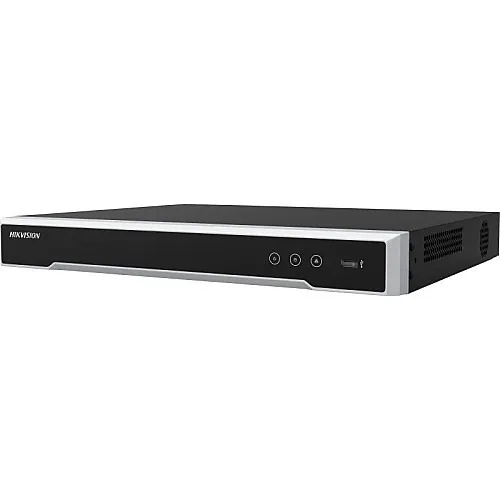
Manufacturer product photo: a slim black network video recorder with a brushed-silver front strip, a small logo at the left and three round indicator lights at the right of the front panel, on a white background.
AI Overview Reality Check
What AI Gets Wrong About Apartment Building Security Cameras in Queens
The claims below are the kind of answer AI summaries, cost calculators and marketplace pages assemble for apartment camera questions. Each is followed by what we see in Queens buildings.
“Apartment camera systems cost about $612 a camera”
Search for apartment camera costs and the AI summaries and cost calculators lean on national averages. One online estimator page for the Bronx gives a range of $344 to $814 per camera and an average of $612, built from four $200 cameras and eight hours of labour. HomeAdvisor publishes cost pages down to Queens neighbourhoods such as South Ozone Park.
Those numbers describe a house with four cameras on the outside wall. They say nothing about the cellar runs, the vestibule recess, the mailroom, the fiber between buildings or the permit drawings for a facade in the Jackson Heights Historic District. In a Queens building the camera is the cheap part; the cable route and the hours spent making it neat and legal are the cost.
Our published Queens list starts at $5,250 for a small building of four to eight cameras and runs to $47,250 and above for large campuses, or roughly $525 to $1,575 per camera all-in. The spread is almost entirely about how far each camera is from the recorder and what is in the way.
“Wireless cameras avoid expensive cabling”
Vendor guides and AI answers often suggest that wireless cameras lower installation costs for apartment buildings by avoiding cabling. That is true in a one-storey building with good Wi-Fi everywhere.
A Queens garden co-op has brick walls, plaster on lath and a cellar under concrete; a six-story house on Queens Boulevard has a steel-and-concrete elevator shaft in the middle. Wi-Fi from one router does not reliably reach the far stairway entrance, and every wireless camera still needs power at the camera — which means an outlet or a cable anyway.
We use wireless only where it genuinely wins: a point-to-point radio link between two buildings on a campus, or a camera on a detached garage. Everything else is wired, because a camera that drops off the network every time a tenant's microwave runs is not a security camera.
“Any building can install cameras wherever it likes”
AI summaries tend to say owners may put cameras in common areas, which is broadly right, and stop there.
In Queens there are three common catches. Buildings in the Jackson Heights and Sunnyside Gardens historic districts need an LPC permit for facade cameras, with limits of two or three cameras per 25 feet of street frontage and rules on how they are fastened and how much conduit shows. Audio recording in common areas runs into New York's eavesdropping law. And a camera that looks into a tenant's window or a neighbour's yard is the fastest way to turn a security project into a dispute.
Our layouts mark every camera's field of view on the plan before installation, and we mask out anything private that falls inside it.
“Cloud cameras are easier for property managers”
Cloud-managed systems are often presented as the modern choice, with remote access and no recorder to look after.
For a management company running many buildings, a cloud platform can make sense, and we install them. But each camera carries a monthly fee for as long as the building owns it, footage leaves the building over its internet connection, and an internet outage in a cellar comm room stops the recording. For a single Queens co-op or a two-family owner, the per-camera fees add up quickly over the life of the system.
A local recorder with secure remote viewing gives the board or owner the same phone access with no subscription, and keeps recording when the internet is down. We explain both options in the proposal and let the decision-maker choose.
“More cameras means more security”
Answers to 'how many cameras does an apartment building need' usually give a number per floor or per entrance.
The reporting from Queens points the other way: the break-ins at Astoria, Elmhurst, Forest Hills and Jackson Heights were solved, or could have been, with one good face-height image at the right door. Sixteen high corner cameras that see only the tops of hoods are worth less than four that see faces at the vestibule, mailroom, laundry door and lot entrance.
We start from the doors and the places things go missing, place cameras where people face them, and only then fill in the general views. The count follows the plan.
“A video doorbell on each apartment solves package theft”
Consumer advice often suggests that residents simply add their own doorbell cameras.
Packages in Queens buildings are stolen from vestibules, lobbies and mailrooms, not from apartment doors, because that is where couriers leave them. Doorbell cameras on hallway doors also film neighbours walking past, and the recordings belong to individual tenants, not to the building.
The fix that property managers describe in Habitat magazine is structural: packages placed out of sight of the street door, a camera aimed at that spot, lock plates on doors that can be forced, and lockers or cages where space allows. Cameras are one piece of that, placed to support it.
“Installation takes a day”
Marketplace listings and AI answers often describe camera installation as a one-day job.
For a two-family house with four outdoor cameras, it often is. For a Jackson Heights co-op there is a board meeting, perhaps an LPC permit, the managing agent's insurance requirements and access arrangements for each stairway; for a campus there are links to plan between buildings; for an elevator cab there is the elevator contractor's schedule.
We give every Queens building a written timeline in the proposal, separating the paperwork from the days the crew is on site, so a board knows exactly which steps are waiting on whom.
A Camera Plan Drawn Around Your Doors
Send the address, the number of buildings and entrances, and a photo of the vestibule and the mail area. We'll mark where each camera goes, what the building will need from the board or the LPC, and price it on the Queens list.
Most Queens quotes need five things: the address or cross streets, whether it is a co-op, condo, rental or owner-occupied house, how many buildings and entrances, where mail and packages are left, and whether the building is in a historic district. A written total comes back the same business day; to talk it through, call (347) 434-6392.
✅
We Got Your Request!
Received. We will read through the doors, buildings and incidents you described and phone you back today. For anything urgent, ring (347) 434-6392.
How It Works
Our Installation Process
Seven steps, whether the job is four cameras on a two-family house in Woodside or a campus of garden buildings. In Queens the first four often take longer than the installation itself, because boards meet monthly and historic districts need permits.
1. Count the ways in
From your address, photos and a short call, we list every street door, courtyard gate, cellar door, lot entrance and the place mail and packages land, and mark the incidents you already know about.
2. Walk the building with the super
On site we trace cable routes through the cellar, stair halls and risers, find the equipment location, check power, and look at doors that could be forced, before a camera position is fixed.
3. Write the plan for whoever decides
A floor plan with each camera's view, a priced scope on the Queens list, and the paperwork the board, managing agent or owner needs, including insurance certificates in the agent's wording.
4. File permits where they apply
For buildings in the Jackson Heights or Sunnyside Gardens historic districts, we prepare the photos, elevations and cut sheets for the LPC application; work on those facades waits for the permit.
5. Install cable first, cameras second
Cable is pulled and terminated through cellars and chases with fire-rated penetrations sealed, then cameras go up entrance by entrance, keeping one door of each building clear at all times.
6. Aim, mask and set retention
Each camera is aimed with the super watching, private areas masked out, audio switched off, the clock synced, and the recorder set for the agreed number of days on a battery backup.
7. Hand over and test an export
We set up named logins, show playback and export, have the super export a test clip, and leave a printed camera list and export steps inside the rack door.
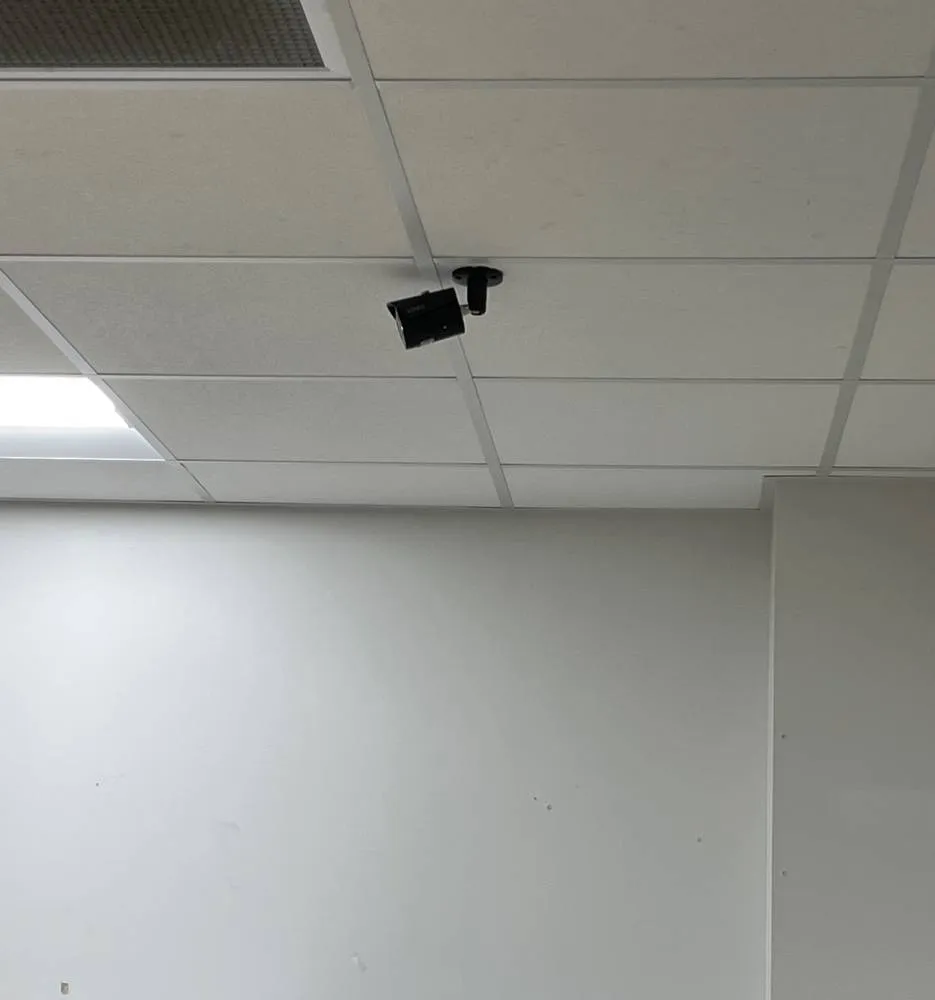
Example photo from an Abstract Enterprises Security Systems installation (not a Queens job): a small black bullet camera hangs from a short black pole fixed to the metal grid of a white drop ceiling, angled down toward a plain white wall; the tops of two dark monitors and some paper trays show at the bottom.
Coverage Area
Apartment Building Security Cameras Near Queens' Landmarks
These are the places that define the borough's apartment stock — and the building types we plan for most often. They are reference points for the kinds of buildings we work in, not a list of past customers.
Jackson Heights Historic District
About 36 blocks between 76th and 88th Streets, Roosevelt Avenue and Northern Boulevard, designated in 1993: the original garden co-ops, with block-long inner gardens and many entrances.
Sunnyside Gardens
Clarence Stein and Henry Wright's 1920s courtyard community of about 600 buildings, designated a historic district in 2007; shared courts and LPC review of facade work.
Queens Boulevard, Forest Hills and Rego Park
Six-story and taller apartment houses and post-war towers such as Rego Park's 1952 Howard complex, with lobbies, cellar laundries, rear lanes and parking.
Kew Gardens and Lefferts Boulevard
Courtyard apartment buildings of the 1920s and 1930s, from Kew Hall to the six-story H-plan buildings of Hampton Court, around a mixed-use commercial corridor.
Court Square and Queens Plaza, Long Island City
Glass rental and condo towers with keyless entry, amenity floors and garages, built in the wave of development 6sqft counted in 2016.
Glen Oaks Village
A 1947 garden complex of 134 buildings and 2,904 apartments on 110 acres in eastern Queens, a co-op since 1981 — the model of a multi-building campus.
We also serve Astoria, Sunnyside, Woodside, Elmhurst, Corona, Flushing, Bayside, Fresh Meadows, Briarwood, Jamaica, Ridgewood, Maspeth, Middle Village, Howard Beach and the Rockaways — every Queens neighborhood, from the Queensboro Bridge to the Nassau line.
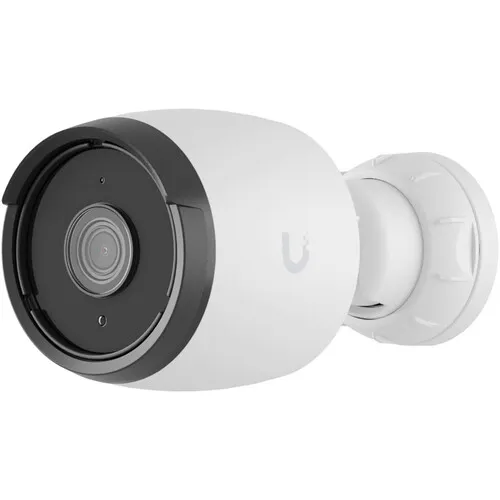
Manufacturer product photo: a white 4K bullet camera with a dark grey front ring and a small logo on its side, on a white swivel arm and round wall base, shown on a plain white background.
Pricing
Apartment Building Security Camera Cost in Queens
Our Queens prices are the published Abstract Enterprises Security Systems building-camera list with the borough's 1.05 adjustment applied. They are all-in: cameras, recorder and drives, PoE switching, cable, mounting, configuration, remote viewing and handover. There is no monthly fee on a local recorder. A fixed price is given only after a walkthrough, because the same number of cameras can cost very different amounts in a garden co-op and a new tower.
The figures below are ranges, not quotes. Where a building falls within a range depends almost entirely on four things.
What drives the price
Lower in the range
Higher in the range
Cable route
Open cellar, short runs, one building
Finished halls, long runs, several buildings joined by fiber or radio
Longer retention, mirrored drives, recorders in several buildings
Building
Typical cameras
Queens price range
Small building — two- or three-family house, small walk-up, mixed-use building
4–8
$5,250–$12,600
Mid-size elevator building — six-story house, single garden co-op building
12–20
$12,600–$26,250
Large building or campus — towers, multi-building complexes, garages
24–40
$26,250–$47,250+
Per camera, all-in
—
about $525–$1,575
Service after installation
—
$195/hr, 3-hr minimum ($585)
Service visits after completion — adding a camera later, re-aiming one a resident moved, recovering a forgotten password — are billed at the service rate rather than the installation list.
If a board needs a phased plan, we price the phases separately: entrances and mailroom first, then laundry and cellar, then grounds and parking. Each phase stands on its own, and the cable for later phases can be pulled during the first so walls are opened only once.
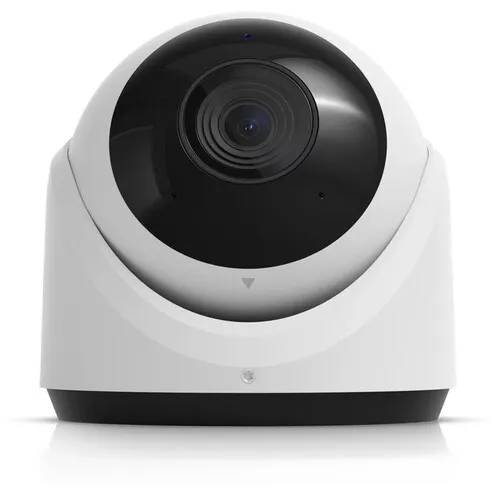
Manufacturer product photo: a white ball-shaped turret camera with a large black front face and a centred lens, sitting in a round white base with a dark lower band, on a white background.
Shop Our Systems
Apartment Building Security Camera Packages & Pricing
Three starting points on the Queens list. Every building ends up with its own layout, but most land close to one of these.
Starter — Small Building
$5,250–$12,600
4–8 cameras
Street door and vestibule, face height
Mailbox bank or package area
Rear door, side gate or driveway
Local recorder, 30-day retention, battery backup
Phone viewing for the owner or super
Standard — Elevator Building or Garden Co-op
$12,600–$26,250
12–20 cameras
Every entrance and the lobby
Mailroom, laundry room and bike or storage room
Elevator landing; cab camera coordinated with the elevator contractor
Rear lane, courtyard or garden views
Named logins for board, agent and super
Premium — Tower or Campus
$26,250–$47,250+
24–40 cameras
All of Standard across several buildings or floors
Fiber or point-to-point links between buildings
Plate reading at the garage or lot gate
Mirrored drives and longer retention
Integration with the intercom and access system
Already bought the cameras? Labor-only installation
Some Queens owners, especially of two- and three-family houses, have already bought a camera kit or recorder, and some boards have a supplier relationship. We install customer-supplied equipment on a labor-only basis: mounting, cabling, recorder setup and handover, priced on the same Queens list without the equipment. Our bring-your-own-equipment page explains how that works.
Customer-supplied equipment carries its own manufacturer's warranty rather than ours, and we check compatibility before the visit — a consumer Wi-Fi kit meant for one house may not suit a building's mailroom, and it is better to find out on the phone.
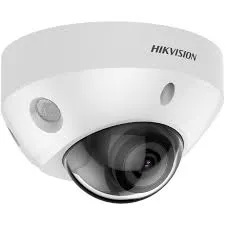
Manufacturer product photo: a compact white dome camera with a clear lower bubble over the lens, a small sensor window on the housing and a logo on its top, on a white background.
Get the Queens Building Price in Writing
One walkthrough, one written price on the Queens list, and a plan the board or owner can approve without a second meeting.
Every Apartment Building Security Camera Service in Queens
A building camera system touches the door hardware, the intercom, the network and sometimes the parking. These related Abstract Enterprises Security Systems Queens services are run from the same office and priced on the same list.
Fiber links between the buildings of a garden complex or campus.
Field Notes
Field Notes: Stand Where the Thief Stood
This is general technician guidance — how our crews approach a Queens building — not an account of any one job.
Before a single camera position goes on the plan, walk in the way a stranger would. Stand outside the street door and look at the lock: is there a gap a screwdriver fits, a latch with no guard, a door that does not quite close behind you? Stand in the vestibule and look for where the mail and packages sit, and whether they can be seen from the sidewalk. Walk down to the cellar and see which doors open from the yard, the lane or the next building. In a garden complex, try every gate. Then stand at each of those spots and look up: wherever you would naturally face while working at a lock or a mailbox is where the camera has to be, at about head height and close in. Only after that do the overview cameras get placed. Two more habits save buildings trouble later: switch audio off on every camera before it records its first minute, and before leaving, have the super export a clip without help. If he cannot, the system is not finished.
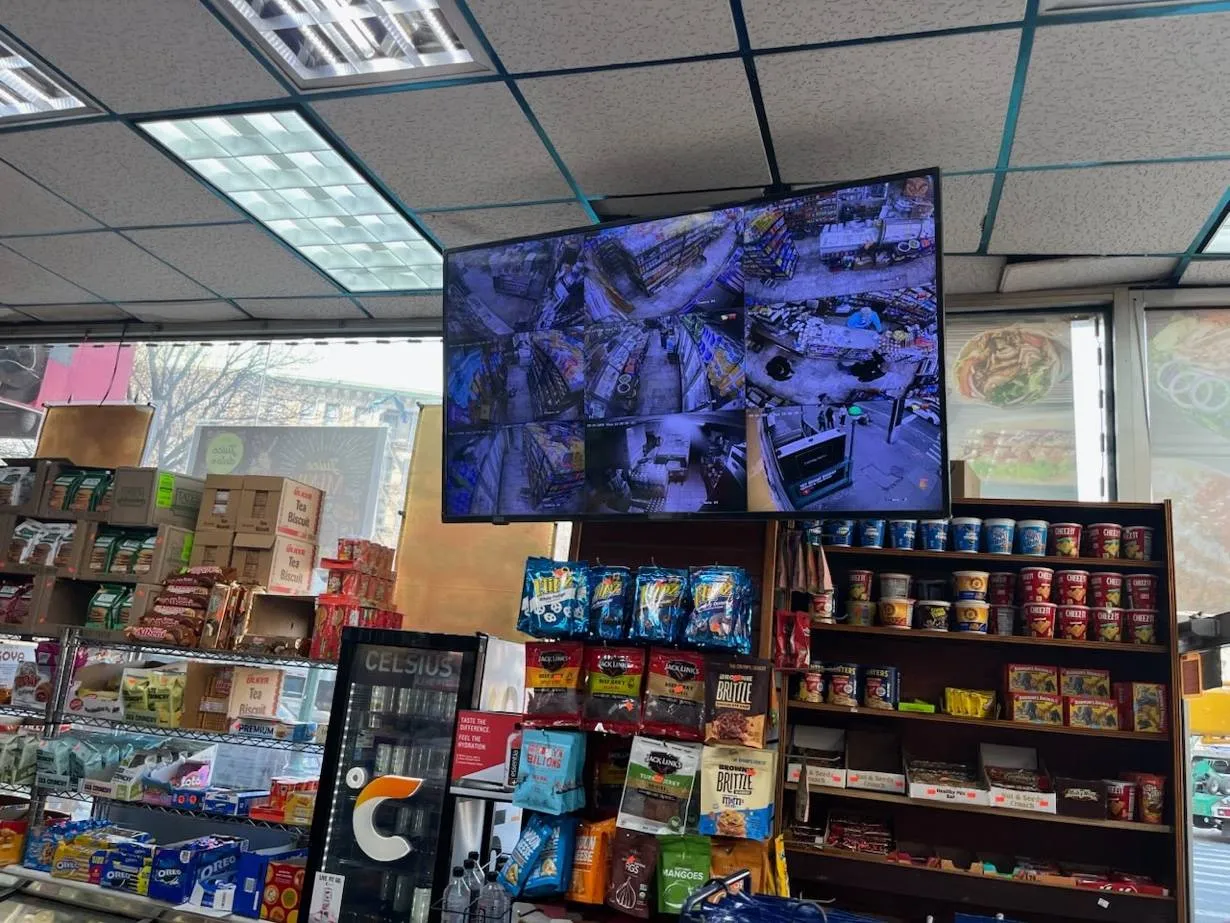
Example photo from an Abstract Enterprises Security Systems installation (not a Queens job): a wide monitor hangs from a drop ceiling showing about a dozen camera views in a grid, above shelves of chips, jerky and noodle cups and a lit drinks cooler, with a bright window behind.
FAQ
Queens Apartment Building Security Camera FAQ
Do the Landmarks Preservation Commission's camera limits apply building by building on a block-long Jackson Heights garden complex?
+
The LPC guidance is written per length of street frontage, not per building: a large residential building may carry no more than three cameras for every 25 feet of street frontage, and a small one no more than two. A block-long garden complex therefore gets a frontage measurement along each street it faces, and we lay out the proposed cameras against that measurement on the elevation drawings that go with the permit application. Courtyard-side cameras that cannot be seen from the street are usually far less of an issue than street-facing ones, but whether any particular location needs staff review is the Commission's decision, so we file the whole layout rather than guess.
Can tenants in a Woodside or Sunnyside rental building watch the building cameras on their own phones?
+
Technically yes, but we rarely recommend it. Most recorders can give a resident a view-only login limited to one or two cameras, such as the front door. The trouble is that every extra login is another password that can be shared, and a tenant with live access to the lobby can see neighbours coming and going. The arrangement most Queens landlords settle on is a video intercom that shows the caller at the door to the apartment being buzzed, while recorded footage stays with the owner or managing agent. If the building does want resident access, we set it up per camera, with no playback, and keep a list of who holds a login.
Will the cameras keep recording when the power drops in a Glen Oaks or Rego Park basement?
+
Only if the recorder and the network switch that powers the cameras sit on a battery backup. A small UPS in the rack keeps the recorder writing and the cameras powered through a short outage and lets the recorder shut down cleanly in a long one, which protects the hard drives. We size the battery for the recorder and the PoE switch together and set the recorder to restart and resume recording on its own when power returns. A basement that floods is a different problem: the rack goes on the wall or a shelf above the highest water line anyone remembers, not on the floor.
What happens when the local precinct asks for video of a mailroom break-in in our Jackson Heights building?
+
The managing agent or super exports the clip from the recorder to a USB stick or a download link, using the export steps we leave taped inside the rack door and show at handover. We set every recorder's clock to sync automatically so the time stamp on the clip matches the time on the police report, and we name the cameras after real places — '35th Ave vestibule', 'mailroom wall' — so a detective knows what he is looking at. It is better to export a generous window around the event than a ten-second clip, so the minutes before and after are not lost when the drive overwrites itself.
Can a camera cover the bike room or storage cages in the cellar of a Long Island City rental?
+
Yes, and it is one of the most useful cellar cameras in a new building, because bike rooms are a common target and nobody is down there to notice. We place the camera at the bike-room door so every person entering is filmed face-first, plus one view down the row of racks or cages. These are shared amenity spaces, not private ones, so a camera is appropriate; a notice on the door helps. Cellars in new LIC towers are often fully sprinklered concrete, so cable rides in the same tray or conduit routes the building already uses, with any fire-rated wall penetrations sealed after.
Can a Kew Gardens co-op reuse the coaxial cable from its old analog cameras?
+
Often, yes. HD-over-coax cameras and recorders can use existing coax, which saves pulling new cable through plaster walls and finished hallways in a 1920s or 1930s building. The catch is that old coax has to be tested first: runs that were spliced, crushed behind a radiator or left outdoors for decades will not carry a clean HD signal. Where a run tests well we keep it; where it fails we replace that run with network cable. Many older Queens buildings end up as a hybrid, and the recorder can handle both kinds of camera at once.
How can a Sunnyside Gardens homeowner watch the shared court without filming a neighbour's windows?
+
Aim low and use privacy masking. A camera on your own rear wall, angled down at your gate and the path to your door, covers the approach that matters without looking across the court. Most current cameras also let us black out parts of the image permanently, so a neighbour's window that falls inside the frame is never recorded at all. Because Sunnyside Gardens is a historic district where the Commission approves work on facades, the camera's position and any visible cable should be part of an LPC application before anything is fixed to the house.
Can installation work be scheduled so the lobby of an occupied Rego Park building is never blocked?
+
Yes. Lobby and vestibule work is usually split into short stages: cable is pulled in the cellar and risers first, which residents never see, and the lobby itself is done in a single visit with one ladder and a clear walkway kept open. Our arrival windows run seven days a week up to 8 PM, so a building can choose a quieter weekday morning. Tell us about move-in days, elevator reservations and the super's hours when you book, and we will work around them.
What does a yearly check-up of an existing Queens Boulevard building system involve, and how is it billed?
+
We clean every lens and dome, check that each camera still points where it was aimed, read the recorder's drive health and confirm how many days are really being kept, update firmware, test the battery backup, and export a test clip to make sure the super still knows how. You get a short written list of anything failing. Service visits after the original installation are billed at our published service rate of $195 an hour with a 3-hour minimum ($585); camera adjustments made after completion count as service work.
If our co-op board and the managing agent disagree about who should hold the recorder password, what do you suggest?
+
Give each of them a separate login rather than one shared password. The recorder can hold several user accounts with different rights: the managing agent and super usually get playback and export, a board officer may get view and playback, and only one administrator account can change settings or delete footage. Each login is logged when it exports a clip, which answers most arguments about who looked at what. We write the account list into the handover document and hand the administrator password to the person the board names in writing.
All Areas Served
Apartment Building Security Cameras Across New York City and Beyond
Every Queens incident, date, building figure and rule quoted on this page is listed below with the publication it came from; where we saw only a search snippet, the entry is marked as an excerpt. Prices are the Abstract Enterprises Security Systems building-camera list multiplied by 1.05 for Queens.
Queens Cameras Not Recording? Call the Queens Line
A recorder that has quietly stopped, a drive that filled and failed, a camera knocked out of line by a delivery cart — phone (347) 434-6392. We book the next open two-hour window, and most are recording again within one to two hours of arrival.
Queens Building Cameras From a Licensed, Insured Crew
Abstract Enterprises Security Systems · 460 E Fordham Rd, Bronx, NY 10458 · (347) 434-6392 · WhatsApp (718) 679-0359 via wa.me
NYS Low-Voltage Licence #12000287431 · 100% Licensed & Insured · Same-Day Estimates · Rated 4.7★ from 390+ Google Reviews
Cameras and recorders carry their manufacturer's warranty. Full terms — including 50% deposit, the 30-day warranty and optional paid extended warranty, and the late-fee schedule — are set out in the service agreement. See our warranty page.
Page reviewed and updated October 18, 2026. Changelog: Queens page rebuilt from new research around the borough's garden co-ops and courtyards, multi-building campuses, six-story elevator buildings on Queens Boulevard, Long Island City and Astoria rentals, two- and three-family homes, recent mailroom and package thefts, historic-district permits, and Queens list pricing.