Licensed Garages · Airport Lots · Auto Rows · Building Garages · NYS Licensed
Parking Lot Cameras Installed in Queens
A Record of Every Car in Your Care · Recording That Outlasts a Cut Wire · Gear Kept Above the Water
Most Queens lots are not empty asphalt. They are businesses that hold somebody else's car: a licensed public garage in Jamaica, a long-stay lot off Rockaway Boulevard, a dealer's inventory on Northern Boulevard, a body shop in the shadow of Citi Field, the garage under a Forest Hills co-op. When one of those cars comes back dented, missing miles or not at all, the owner of the lot is the one who has to show what happened. We design Queens parking lot camera systems around that question first — arrival, keys, movement, departure — and then make sure the recording survives the two things that have erased Queens footage before: a thief who cuts the power, and water in a below-grade garage.
Reviewed and updated October 18, 2026 · Anwar Timothy, owner, NYS license #12000287431 · Queens jobs run from our office at 460 E Fordham Rd, Bronx, NY 10458
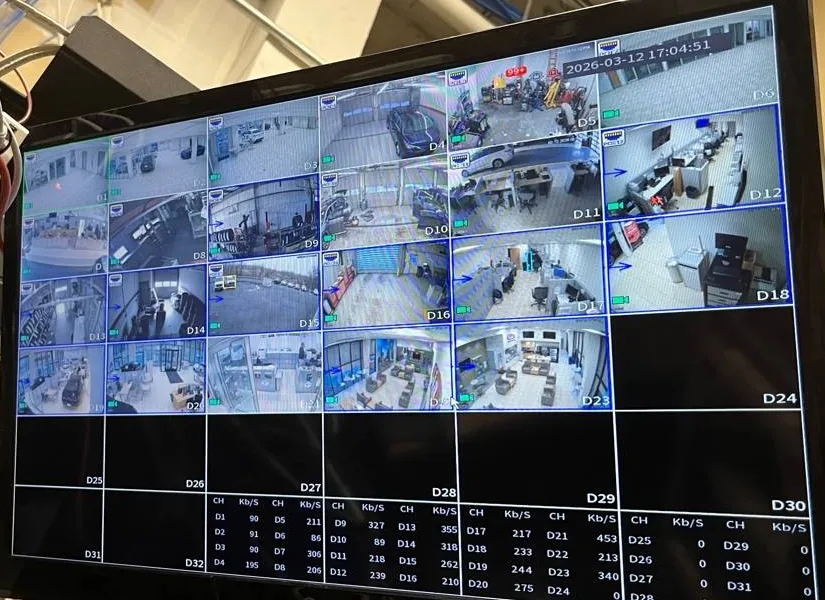
Example photo from another AESS job (a car dealership outside Queens): the recorder’s live grid, with tiles showing service bays, offices and parked cars. The row of empty black tiles is spare channels with room for more cameras.
Queens Lot Camera Quote
Tell us what kind of lot, how many entrances and who holds the keys — a written price follows the same business day
✅
Request Sent!
An installer will call you back about the Queens lot the same business day.
25+
Years Experience
✓
Same-Day Estimates
100%
Licensed & Insured
$0
Monthly Fees
Four facts get a Queens lot quote moving. How many ways a car can enter and leave, whether your staff ever hold a customer's keys, where the nearest locked room with power sits, and whether that room has ever taken water. Text them with a photo of each entrance to (347) 434-6392 and we can usually tell you the shape of the system before anyone visits.
Queens lot packages start at $893 installed for a four-camera single-entrance lot
The recorder is yours: no monthly fee to keep local recordings
Same-day written estimates · 4.7★ from 201 Google reviews · NYS license #12000287431
Why Queens Properties Need Parking Lot Camera Installation
Queens is the borough where New York keeps its cars. It holds both of the city's airports, the Long Island Rail Road's main junction at Jamaica, the stadium lots around Citi Field, the auto-repair district of Willets Point, Queens Boulevard's shopping centers and a long belt of dealerships, body shops and tire stores along Northern Boulevard. Around all of that sits a ring of businesses whose whole product is parking: licensed garages, open lots that charge by the hour, shuttle lots that hold travelers' cars for a week or two, and building garages where residents rent a space by the month. In most other parts of the city a lot camera watches the owner's own property. In Queens it is very often watching property that belongs to a customer.
That changes what a camera system is for. A store owner wants to know who broke a window. A parking operator, a dealer or a repair shop needs to be able to show that a particular car arrived in a particular condition, sat where it was supposed to sit, was not driven while its owner was away, and left with the right person. New York City's Department of Consumer and Worker Protection, which licenses garages and lots that park five or more cars for a fee, tells drivers that a garage must "take care to prevent damage to customers' vehicles" and cannot post a sign or make anyone sign a form that waives that responsibility. When the claim arrives, video is usually the only neutral witness the operator has. Residents feel the same pressure from the other side: neighborhood forums such as r/astoria regularly carry camera stills of someone going through a parked car at 4:45 in the morning.
Two Queens events shape how we build these systems. In November 2022, Fox 5 reported that thieves took 26 cars in one night from a dealership at Queens Boulevard and Kneeland Street in Elmhurst — and that there was no surveillance video, because the crew cut the power before they forced the gate, broke into the office and took the keys. And on September 1, 2021, the remnants of Hurricane Ida dropped 3.15 inches of rain on Central Park in a single hour; the Queens Eagle reported eleven deaths in Queens, a maintenance worker at an Elmhurst complex counting about half of its 31 garage doors damaged, and flooded cars abandoned under the LIRR tracks. A recorder that sits on the floor of a cellar garage, plugged into the same circuit as the lot lights, fails on exactly the night it is needed.
So a Queens lot system is designed in a fixed order: first the custody points (where cars and keys change hands), then the paths a car can take in and out, then power that keeps running when somebody pulls a breaker, then a recorder location that a thief cannot easily find and water cannot reach. Only after that do we choose camera models. Many Queens operators pair the lot cameras with access control on the key room and booth door, because the same cable path and the same battery backup can serve both.
Queens facts that shape a lot camera design
A large, car-owning borough. The 2020 Census counted 2,405,464 people in Queens across 108.72 square miles of land, and the Census Bureau's 2020–2024 figures put the owner-occupied housing rate at 44.9%, against 19.7% homeownership in the Bronx reported by NYU's Furman Center for 2024 — more owners, driveways and building garages per block.
Licensing sets the paperwork, not the cameras. A DCWP garage or lot licence requires a Buildings document stating the legal capacity, garagekeepers liability of at least $300,000 per accident, signs at each public entrance with the licence number and capacity, and — under the rules updated after an August 2024 proposal — premises that are "adequately attended at all times during operation." None of it requires cameras; all of it is easier to prove with them.
Long Island's largest transit hub is here. Jamaica station on Sutphin Boulevard carries more than 200,000 weekday riders and connects to AirTrain JFK, which is why commuter and airport parking crowd the streets around it.
Airport garages are enormous. The Terminal B garage at LaGuardia, recognised by ENR in 2018, is a seven-floor structure with 3,100 spaces. Private lots nearby compete on price, not on size.
The auto district is being replaced. A 2006 Hunter College study counted about 225 businesses employing 1,400 to 1,800 people in the Willets Point "Iron Triangle"; the site is now being rebuilt around a 25,000-seat soccer stadium that was expected to open in 2027, pushing repair shops and their lots elsewhere in the borough.
Water finds below-grade garages. Beyond Ida, CBS New York reported in September 2022 that a single overnight storm flooded basements in Rego Park and stranded cars in the Cooper Avenue underpass.
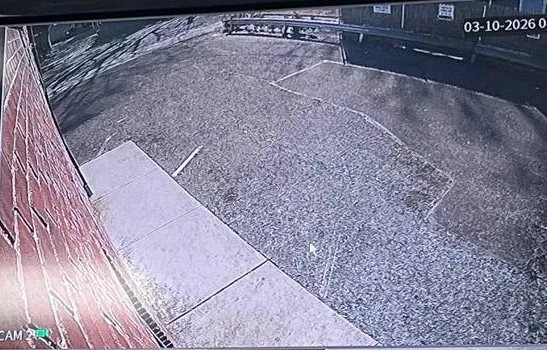
Example photo from another AESS job (not a Queens property): one camera’s view of a paved side lot along a brick wall, as it appears on the recorder. The wide lens shows the whole strip but no plate detail — a dedicated lane camera does that job.
Lot Cameras Dark, Recorder Silent or a Car Gone in Queens?
If a car is missing, damaged or was driven while its owner was away, call (347) 434-6392 before anyone touches the recorder. We book the earliest open slot the same day where we can, and most lot camera faults are fixed within one to two hours of arrival. The first job is always to protect the footage you already have.
Do these four things before we arrive
Write down the time window. When was the car last seen, and when was the problem noticed? That decides how far back we search before the recorder overwrites anything.
Do not unplug or restart the recorder. If its clock is wrong or a drive is failing, a restart can make both worse. Leave it running.
Check whether power was lost. Look for a tripped breaker, a pulled plug or a dead UPS. A power cut that lines up with the incident is itself evidence.
Note which cameras are dark. If every camera on one side of the lot went out at once, the cause is usually a switch, a power supply or a cut cable rather than the cameras.
Nine pieces of work make up most Queens lot jobs. A small shop lot might need three of them; a licensed garage with a key room and a cellar level needs nearly all nine. The survey decides which.
Custody-Point Coverage
The places where responsibility for a car changes hands — the drop-off lane, the key box or booth, the attendant's walkway, the release point — covered tightly enough to show faces, hands and the car's condition.
Entrance and Exit Lanes
A camera aimed down each lane at the angle a plate reads best, plus an overview of the same lane, so every arrival and departure is tied to a time and a vehicle.
Aisle and Row Coverage
Overlapping views along each row so a car can be followed from its space to the exit. On long, narrow Queens lots that usually means cameras at both ends of an aisle rather than one in the middle.
Below-Grade Garage Cameras
Ceiling-mounted cameras for garages under apartment and co-op buildings, with cable in conduit along the beams and the recorder and switches planned above the level water has reached before.
Tamper-Resistant Power
Battery backup sized for the recorder, the switches and the cameras, fed from a circuit separate from the lot lights, so cutting the lights or a breaker does not stop the recording.
Concealed Recorder Placement
The recorder in a locked, ventilated location away from the booth or office a thief would search first, with a camera of its own watching the door to that room.
Off-Site Copy of Key Footage
Selected cameras — usually the lanes and the key box — copied to cloud storage or a second recorder at another address, so taking the recorder does not take the evidence.
Pole, Wall and Fence Mounting
Cameras on existing light poles, building walls, steel canopies or new poles where needed, with mounts chosen for the height trucks clear and the reach a ladder thief would need.
Handover, Accounts and Export
Separate logins for owner, manager and attendant, the admin password sealed for the owner, and a tested routine for exporting a clip to an insurer, a customer's lawyer or the police.
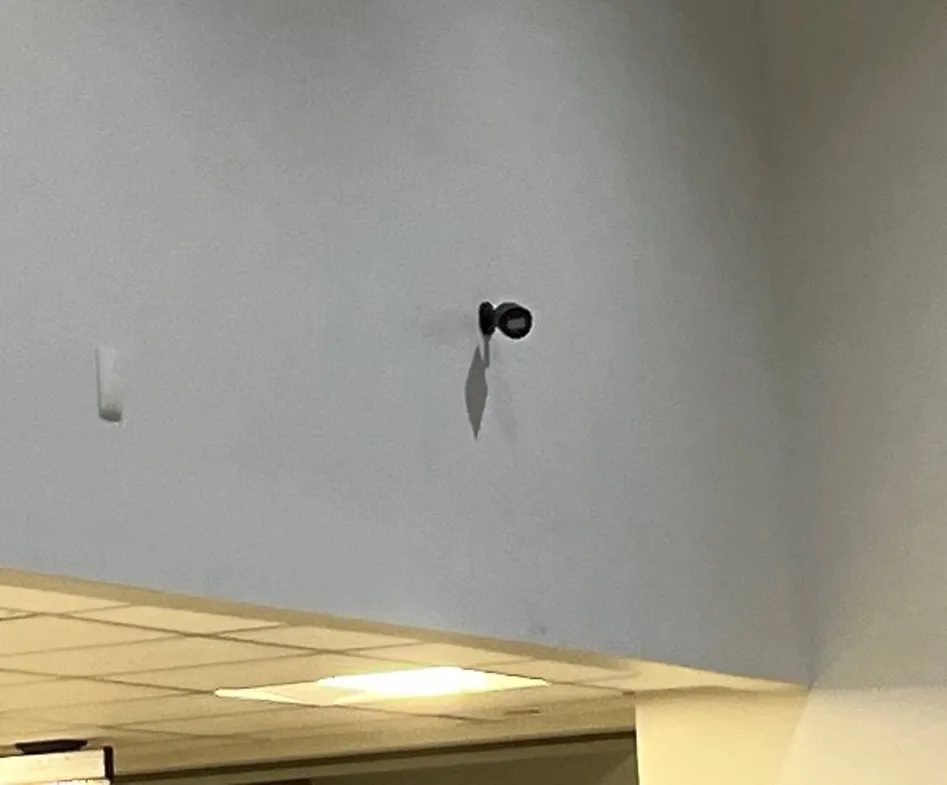
Example photo from another AESS job (not a Queens property): a bullet camera set high on a wall above a dropped ceiling. Height like this keeps a camera out of easy reach, which matters at a booth or key room.
Building Specialists
Parking Lot Cameras for Queens's Architecture
Queens parking comes in more shapes than any other borough. These are the property types we see most, and what each one asks of a camera system.
Licensed Public Garages and Lots
DCWP-licensed operations that charge by the hour, day or month. The licence number, capacity and rates are posted at the entrance; the cameras need to show the entrance, the booth, the key handling and every row.
Airport Long-Stay and Shuttle Lots
Lots around JFK and LaGuardia that hold cars for days or weeks. The design question is whether a car moved while its owner was away — continuous recording on the lanes, long retention and accurate time stamps.
Dealerships and Inventory Rows
Showroom lots on Northern Boulevard and Queens Boulevard with keys in an office and cars that are worth stealing in bulk. The Elmhurst theft showed that the key room and the power matter as much as the lot.
Repair Shops and Body Shops
Customer cars parked overnight in tight yards, often stacked and moved by staff. Cameras record condition on arrival, where each car was placed and who moved it.
Garages Under Apartment Buildings
Below-grade garages in Forest Hills, Rego Park, Kew Gardens, Jackson Heights and Flushing towers and co-ops. Low ceilings, ramps, sprinkler pipes and a history of water.
Garden-Apartment Garage Courts
Rows of single-storey garages reached by narrow driveways — Jackson Heights has had them since Linden Court in 1919. Long, shallow sight lines that one camera at the mouth cannot cover.
Shopping Center and Supermarket Lots
Open surface lots shared by an anchor store and smaller tenants along Queens Boulevard, Northern Boulevard, Jamaica Avenue and Cross Bay Boulevard. Daytime break-ins and fender-benders dominate.
Fleet, Truck and Contractor Yards
Yards in Long Island City, Maspeth, College Point and near the airports with fences, gates and high-value vehicles. Perimeter and gate coverage matter more than aisles.
Houses of Worship and Schools
Lots that are full on a few days a week and empty the rest of the time. Recording rules, alerts and retention are set around that rhythm.
How the method changes from one Queens lot to the next
Licensed garage. We start at the booth and the key cabinet, because that is where a damage or theft claim turns. One camera shows the attendant's counter from the customer's side; another looks down into the key box or key board. Entrance and exit lanes get a tight plate view and a wider overview each. Rows are covered end to end. The recorder goes somewhere other than the booth, since the booth is the first place anybody looking for it will go.
Airport long-stay lot. The lanes record continuously rather than on motion, because the question afterwards is often "did this car leave and come back?" and motion recording can miss the moment. Retention is set to cover the longest normal trip plus the time it takes a customer to notice and complain — in practice several weeks on the lanes. The recorder's clock syncs automatically, because a toll record or a ticket from another borough will be compared against it.
Dealership. The office that holds keys gets its own camera on the door and on the key storage. Power to the recorder and the switches comes through a battery unit on a separate circuit, and the recorder sits behind a locked door that is not marked. A copy of the gate and lane cameras goes off site. That combination is the direct answer to a crew that cuts power first.
Repair or body shop. Cars are moved by staff all day, so the cameras follow the moves rather than the customers: the bay doors, the spot where cars wait for the lift, and the corner of the yard where finished cars are parked for pick-up. A camera on the counter where keys are tagged ties each key to a ticket. Shops pushed out of Willets Point onto tighter lots often stack cars three deep, which means more cameras at lower heights, each covering a short stretch.
Below-grade garage. Cable runs in conduit along beam lines, clear of sprinkler heads and posted clearance bars. The switches, power supplies and recorder go above the highest water the building has seen, which in a Queens cellar garage usually means an upper-floor room rather than the garage itself. City planning guidance for buildings in the 1% annual-chance floodplain already treats raised electrical equipment as the standard; we apply the same idea to the camera system even where the building sits outside the mapped zone, because Ida's water came from rain, not from the coast.
Garage court. A camera at the mouth of the driveway shows who came in; one or two more along the row show which door they went to. Where the court belongs to a co-op, the board decides who can view the footage before we install anything.
Shopping lot and fleet yard. Plazas get coverage of the drive aisles nearest the doors, the cart corrals and the exits; yards get the fence line and gate. In both, poles may already exist for lighting, and we check how they are powered before relying on them.
Custody points on a Queens lot, and what each camera has to show
Every lot that holds other people's cars has the same handful of moments where responsibility changes hands. The table is the checklist we walk through on the survey; a small lot may have only two of these points, a licensed garage all seven.
Custody point
What the camera has to show
Why it matters afterwards
Drop-off lane
The whole car, all four corners if possible, and the driver getting out
Condition on arrival is the first thing a damage claim argues about
Key handover
Hands, the key and its tag, the attendant's face, the time
Shows which key went to which car and who took it
Key storage
The board, box or drawer, and anyone opening it
The point the Elmhurst crew went for once the power was off
Parking rows
Each car in its space, end to end, without gaps between cameras
Proves a car stayed where it was put, or shows who moved it
Internal ramps and stacking areas
Cars moving between levels or being shuffled by staff
Most scrapes in attended lots happen during repositioning
Exit lane
The plate, the driver and the time of departure
Answers "did this car leave?" and "who drove it out?"
Booth and pay point
The counter from the customer side, and the cash or card area
Settles rate and payment disputes, and protects the attendant
Garage courts and building garages in Queens's historic districts
Some of the borough's oldest resident parking sits inside landmark districts. The city's Jackson Heights Historic District, designated on October 19, 1993, covers almost 600 buildings between roughly 76th and 88th Streets, from Roosevelt Avenue almost to Northern Boulevard, and unlike the larger National Register district it carries aesthetic protections. Linden Court, completed in 1919, was the first Jackson Heights development with resident parking — single-storey garages reached by narrow driveways.
A camera on the exterior of a landmarked building needs a Landmarks Preservation Commission permit. The Commission's permit guidebook lets staff approve cameras that meet set criteria: a limited number per 25 feet of street frontage, fixings into mortar joints or plain surfaces rather than decorative ones, the primary facade avoided where another location works, and conduit concealed or kept short and painted to match. For a garage court that usually means cameras on the garage structures or rear walls rather than the street front, which suits the sight lines anyway. We prepare the photos, positions and product sheets the application needs, and the co-op or owner files it.
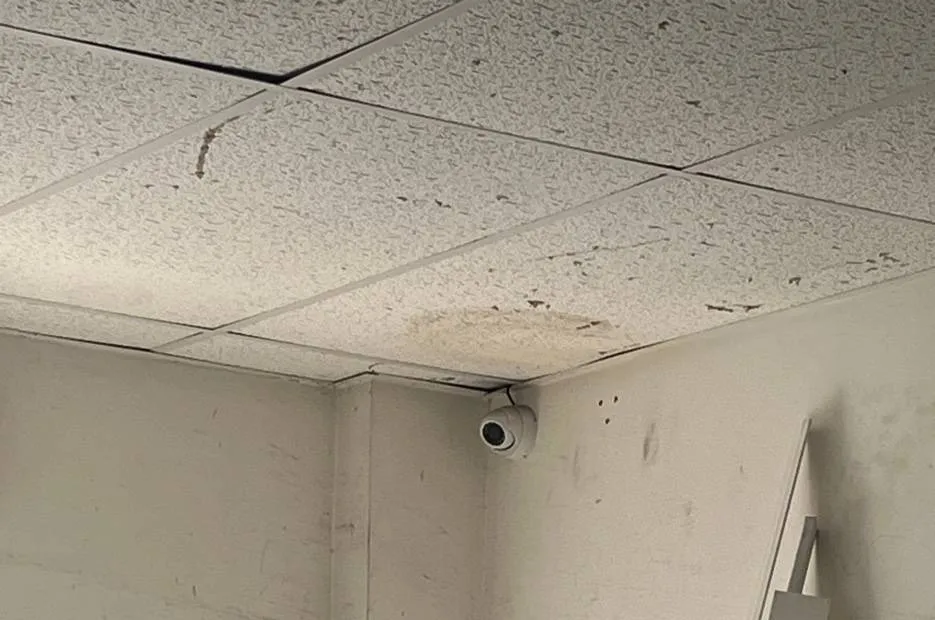
Example photo from another AESS job (not a Queens property): a turret camera in a storage-room corner below stained ceiling tiles. Stains like these are what we look for before deciding a room is dry enough for a recorder.
Commercial Parking Lot Cameras
Business Parking Lot Cameras in Queens
Queens commercial parking follows its corridors. Each one brings a different kind of lot, a different set of risks and a different answer to the question of who is responsible for the car.
Queens Boulevard, from Queens Plaza to Jamaica
Queens Boulevard runs 7.5 miles from Queens Plaza to Jamaica Avenue and is about 200 feet wide for much of that length, with up to twelve lanes and sixteen at Yellowstone Boulevard. Between Roosevelt Avenue and Union Turnpike drivers reach the lots along it from three-lane service roads. That geometry matters to a camera: the entrance lane of a lot faces a wall of moving headlights at night, and a car leaving a lot can disappear into traffic within a few seconds. Lot owners along the boulevard include Queens Center in Elmhurst — 967,000 square feet between 57th Avenue and Woodhaven Boulevard, which has had its parking areas upgraded in a recent renovation — plus supermarkets, banks and dealerships. The Elmhurst dealership theft in 2022 happened at Queens Boulevard and Kneeland Street.
Northern Boulevard, from the old "Carridor" to Jackson Heights
Northern Boulevard has been Queens's auto street for more than a century. Brownstoner's history of what its author calls the "Carridor" traces the stretch running out from under the elevated tracks at Queens Plaza back to Ford, Packard and Pierce-Arrow service buildings in Long Island City; the former Ford service station is now the Center Building at 33-00 Northern Boulevard. Further east, Streetsblog has reported dealerships in Jackson Heights using sidewalks and curb lanes as showroom space. Dealers, tire shops and repair garages along the boulevard need coverage that reaches the curb as well as the lot, because the inventory often sits right at the property line.
Jamaica Avenue, Sutphin Boulevard and the station
Jamaica station at 93-02 Sutphin Boulevard is the junction of the LIRR's three main trunk lines, carries more than 200,000 riders on weekdays and connects to AirTrain JFK, which opened its Jamaica station in December 2003. The parking around it is commuter and airport parking: daily and monthly lots, garages, and street-front operators with small booths. These lots change hands frequently between owners and operators, which is one reason we hand the admin login to the property owner rather than to whichever operator happens to hold the lease. When the lease turns over, the owner changes the operator’s password and the new operator gets a fresh account, with no reinstall and no lost recordings. Small booths on these lots rarely have room for a recorder, so it usually lives in the adjoining building or a locked cabinet at the back of the lot.
Rockaway Boulevard and the JFK long-stay lots
The streets between Jamaica and the airport are lined with off-airport lots that undercut the Port Authority's own parking. Their reputation is mixed, and the record is public. In 2019 ABC7's "7 On Your Side" reported customers of a long-term lot at 133-98 142nd Street returning to damaged cars and parking tickets dated while they were abroad; the city's consumer agency said the lot lacked a proper licence and a judge imposed a $500 fine. In November 2024 CBS New York reported a traveler who parked at a lot on 147th Avenue and later received a George Washington Bridge toll notice timed while her flight was over the Atlantic; DCWP's commissioner said her office had issued three violation notices to that lot, and the city had sued a parking app in August 2024 over listings for 46 unlicensed lots. On r/AskNYC, people researching JFK long-term parking mention reviews describing "hundreds of extra miles on the odometer." For an honest operator, a camera system that can prove a car never left is a selling point, and one an operator can show a worried customer on the spot from the manager’s phone.
Downtown Flushing
Flushing's parking history is a lesson in how fast lots change. The 5.5-acre municipal lot bounded by 37th and 39th Avenues and Union and 138th Streets held 1,101 public spaces until the City Council approved its conversion in July 2010 into Flushing Commons, a mixed-use project with a 1,600-space underground garage. Downtown Flushing's lots today are a mix of garages under new mixed-use buildings, small surface lots behind Main Street and Roosevelt Avenue businesses, and the Downtown Flushing business improvement district's shopping streets — dense, busy and short on room for poles. Cameras here go on building walls and canopies instead, and the recorder shares a room with the store’s own system where the owner agrees.
Willets Point, Citi Field and Flushing Meadows
The Iron Triangle east of Citi Field was for decades the borough's auto-repair district. Gothamist reported in November 2022 that the city counted about a dozen businesses left, while mechanics said more than 90 small business owners were still working there; earlier relocation efforts had moved some shops as far as Hunts Point. The redevelopment around the new stadium means repair, tire and body businesses are settling in other parts of Queens, often on smaller lots with less room. Around the stadium itself, the Queens Chronicle reported that the FAA's plans for a LaGuardia AirTrain called for construction staging in the Citi Field lots, mainly the Southfield lot south of Roosevelt Avenue — a reminder that event and stadium lots can be reorganised for years at a time.
Long Island City, Maspeth and the industrial edge
Fleet yards, contractor lots, distribution buildings and new residential towers sit side by side here. In November 2023 PIX11 reported that seven men left a residential parking garage at 22-44 Jackson Avenue in Long Island City with four vehicles at about 3:45 a.m. And in April 2026 ABC7 reported nearly 100 cars at a takeover near a gas station at 69th Street and Elliott Avenue in Maspeth, where drivers did donuts around a fire in the roadway. Industrial-edge lots need gate and fence coverage, good night performance, and a plan for what the cameras should do when a crowd arrives after closing.
The garages under the newer residential towers in this part of Queens have their own pattern. Residents arrive by fob through a roll-up door, the garage is often unattended overnight, and the weak point is usually the moment the door is open and a second car slips in behind the first. A camera inside the door aimed back at it, set to record continuously, shows every vehicle that follows another one in; a second camera at the pedestrian door shows anyone who walks down the ramp. Tied to the building’s access control, the door’s own log tells management whose fob opened it at the time the camera shows the extra car.
Congregations, schools and community lots across the borough
Not every Queens lot is a business. Churches, mosques, temples, gurdwaras, schools and community centers from Bayside to the Rockaways run lots that are packed for a few hours a week and empty the rest of the time, often looked after by volunteers. These lots need simple systems: cameras on the entrance and the rows nearest the building, alerts after hours, a recorder that someone on the board can operate, and a written note on who may view footage and when. Because many of them share a lot with neighbors or rent spaces out on weekdays, we set up separate viewing accounts so each party sees only what it is entitled to.
Rules that touch a Queens lot camera project
DCWP garage and lot licence. Applies to businesses parking five or more vehicles for a fee; lots used only by the business's own customers or staff, and lots run by a building's owner for its residents, are exempt. The licence itself does not require cameras, but signs, capacity and an attended operation are all things a recording can document.
NYC biometric identifier law. Retail stores, food and drink establishments and places of entertainment that collect customers' biometric data, such as face templates, must post a sign near every customer entrance; selling or trading the data is prohibited, and there is a private right of action. Ordinary recording is not biometric collection; face recognition can be.
New York's eavesdropping law. Recording a conversation without the consent of at least one party is a crime in New York. Lot cameras ship with microphones that we leave switched off unless you have taken advice.
FAA notice near the airports. Federal rules require notice for structures that would rise above an imaginary 100:1 slope extending 20,000 feet from the nearest runway at airports like JFK and LaGuardia, and for anything taller than 200 feet anywhere. A new pole close to either airport is checked before it goes up.
Flood-resistant construction. In the mapped 1% annual-chance floodplain, the city's guidance limits space below the design flood elevation to parking, storage and access, and expects electrical equipment to sit above it.
State tax credit. New York's Commercial Security Tax Credit, run by the Division of Criminal Justice Services, lists surveillance cameras and exterior licence plate readers among eligible expenses for small retail locations; check with DCJS for the current year before counting on it.
Electrical work. Low-voltage camera cabling is our work; a new circuit, a new pole base or a feed through a building's electrical panel is coordinated with a licensed electrician where the job needs one.
This page is general information about installing cameras, not legal advice. For a specific question about a licence, a lease, privacy or a claim, speak to a lawyer.
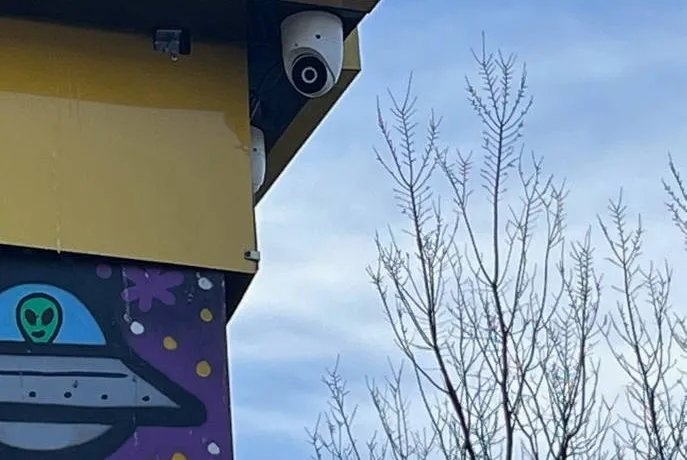
Example photo from another AESS job (a storefront, not a Queens lot): a dome camera tucked under the edge of a fascia. Under a canopy or fascia a camera is shielded from rain and harder to knock out of aim.
Your Questions Answered
Parking Lot Cameras in Queens: Questions Answered
These are the questions Queens lot owners, operators and building managers bring to us, grouped by what they are really about. Each answer comes first; the reasoning follows.
Licences, Rules and Airspace
Does a DCWP garage or parking lot licence say anything about cameras?
No. The city's licence checklist and the rules DCWP updated after its August 2024 proposal deal with capacity, insurance, posted signs, posted rates and an attended operation; neither mentions surveillance. What the licence does is define the claims you will face. A licensed garage must take care to prevent damage to customers' vehicles and cannot use a sign or a form to waive that responsibility, so the operator carries the burden of showing what happened.
That is why we treat the licence paperwork as part of the design brief. The legal capacity on your Buildings document tells us how many spaces the rows must cover. The rule that the premises be attended tells us the booth matters. The posted-rate rules mean a customer who disputes a charge may ask when the car came in and went out, which the lane cameras answer with a time stamp.
If your lot is exempt — because it serves only your own customers or staff, or only a building's residents — none of this changes the camera design much. The questions customers and residents ask after an incident are the same.
Does a camera pole close to JFK or LaGuardia need FAA notice?
It can. Under 14 CFR 77.9, anyone planning construction near an airport with a runway longer than 3,200 feet must notify the FAA if the structure would rise above an imaginary surface that slopes upward at 100 to 1 for 20,000 feet from the nearest point of the nearest runway. At a distance of 2,000 feet that surface is only 20 feet above the runway's elevation, so a tall new pole on a lot right beside either airport can cross it.
In practice most Queens lot cameras go on buildings, canopies and existing light poles and never come close. When a new pole is proposed within a few thousand feet of a runway at JFK or LaGuardia, we check the distance and height before ordering it, and if notice is needed the owner files it before the pole goes up. Cranes or lifts used during installation can need the same check.
This is one of the few camera questions that is genuinely specific to Queens. It does not apply to the lot behind a store in Bayside; it can apply to a shuttle lot in Springfield Gardens or a yard in East Elmhurst.
Can we switch on face recognition for the lot cameras?
Technically, many current cameras and recorders offer it. Legally, it changes your obligations in New York City. Under the city's biometric identifier law, a retail store, a food and drink establishment or a place of entertainment that collects, retains, converts, stores or shares customers' biometric data must post a clear sign near every customer entrance, and no business may sell or trade that data. People can sue: $500 for each signage violation, and up to $5,000 for an intentional or reckless sale.
A standalone parking operator may or may not fall inside those categories; a supermarket or shopping center lot almost certainly does. Either way, we install systems with face recognition switched off by default and leave the decision to the owner after they have taken advice.
What most lots actually need is not recognition but a clear, well-lit face image at the custody points — the booth, the key box, the pedestrian gate — that a person can look at later. That is a camera placement question, and it does not require any biometric processing at all.
Is it legal for the lot cameras to record sound?
Recording a conversation you are not part of, without the consent of at least one person in it, is eavesdropping under New York's Penal Law, a felony. A microphone on a parking lot camera picks up exactly that kind of conversation: customers talking to each other, attendants on the phone, people passing on the sidewalk.
So our default is microphones off on every lot camera. Some operators want audio at the booth window, where the attendant is a party to the conversation; that is a decision for your lawyer, not for us, and we will set it up the way your lawyer approves.
Two-way talk-down speakers that let a monitoring person announce "you are being recorded" are a different matter from recording audio, and we can add them where an owner wants that deterrent.
Custody: Proving What Happened to a Car
How can footage show that a customer's car never left the lot while they were away?
By recording every lane continuously, keeping that recording longer than the longest normal stay, and making sure the recorder's clock is right. If the exit lane shows no departure for that vehicle between drop-off and pick-up, and the row camera shows it in its space throughout, that is the strongest answer an operator can give to a toll notice or a mileage complaint.
The weak points are predictable. Motion-only recording can skip the moment a car rolls out. Thirty days of retention is not enough for a traveler who notices a toll bill six weeks later. A recorder whose clock has drifted ten minutes makes the timeline argue with itself. And a single wide camera on a busy lane may show a car leaving without showing which car. We fix each of those in the design: continuous lanes, longer retention on those channels, automatic time sync, and a tight lane view alongside the overview.
The Queens news record shows why operators near the airports should care: complaints about odometer readings and out-of-state toll notices have been reported on more than one JFK-area lot.
Can the recordings settle a dispute when a car is towed off our private lot?
They can show what happened, which is usually what a dispute turns on: where and how the car was parked, how long it had been there, whether your signs were visible from where the driver stopped, and when the tow truck arrived and left. Without that, a lot owner is left with the tow company's word against the driver's.
Owners searching forums after a car disappears often do not know at first whether it was stolen or towed. A camera on the entrance that captures the tow truck, plus a camera on the sign itself, answers both questions in minutes.
Footage does not decide whether a tow was lawful — that depends on the rules and on any agreement with the tow company — but it gives the person who has to decide a factual record rather than two stories.
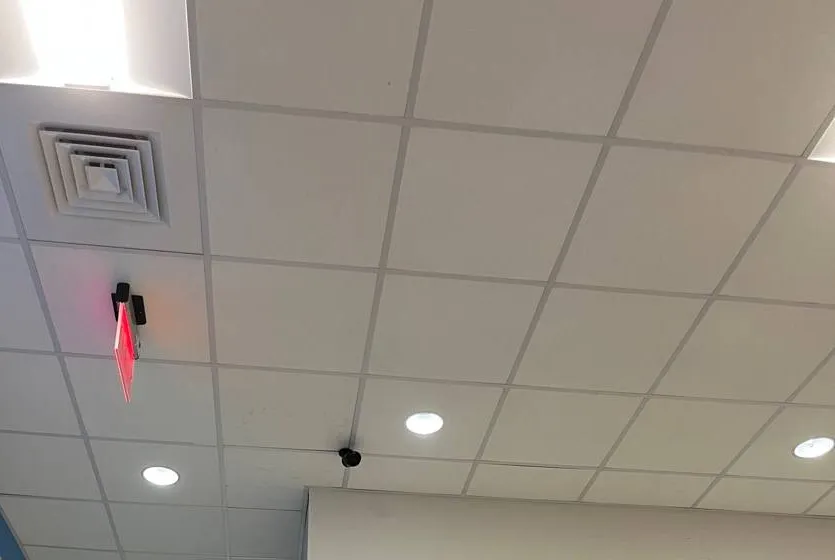
Example photo from another AESS job (not a Queens garage): a small camera on a tiled ceiling near an exit sign. Exits, stairs and pedestrian doors from a garage need their own coverage, separate from the vehicle lanes.
Power, Water and the Night Someone Cuts the Lights
If someone cuts the power to the lot, how does the footage of them doing it survive?
By making sure the camera that watches the electrical panel, the recorder, and the switch that feeds that camera are all on battery power that the lot's breakers do not control. Then the act of cutting the power is itself recorded, and the recorder keeps writing for as long as the battery lasts.
The Elmhurst dealership that lost 26 cars in 2022 had no video because power was cut first. The lesson is not "buy better cameras." It is to separate the camera system's power from the building's lighting and door circuits, to put the recorder where a crew working quickly will not find it, and to copy the most important cameras off site as they record.
We also set the recorder to alert the owner's phone when cameras drop off. A crew that cuts power at 2 a.m. then has to work while the owner already knows something is wrong.
Our lot lights run on a photocell — can the cameras borrow that power?
Not directly. A photocell or timer switches the pole's power off at dawn, so a camera wired to it goes dark every morning and its recording stops for the whole day. We see this on older Queens lots where someone tapped the light circuit to save a cable run.
The fix is a constant feed to the pole that the lighting control does not switch — either a separate circuit run by an electrician, or a Power over Ethernet cable from the camera switch, which carries power and video on one line from a battery-backed location. On most Queens lots the PoE route is simpler, because it puts every camera's power on the same protected supply as the recorder.
Existing light poles are still valuable as mounting points. We check what they are made of, whether there is a spare conduit inside, and who owns them before we use one.
Sight Lines on Queens Corridors
Will headlights coming off Queens Boulevard blind the entrance camera at night?
A badly placed camera, yes. A lot entrance off a service road on Queens Boulevard, Northern Boulevard or Woodhaven Boulevard faces headlights head-on all night, and a camera looking straight into them sees two white circles and nothing else.
The answer is angle and timing. We mount the lane camera to look at the car from the side and slightly above, after it has turned in and its headlights are no longer pointed at the lens, and we set exposure for the plate rather than for the scene. A second, wider camera catches the turn itself. Cameras with strong wide-dynamic-range processing help, but placement does most of the work.
We test this on the survey night if the lot operates after dark, because a daytime survey cannot show what oncoming traffic does to the image.
Can the cameras see through the chain-link and privacy slats around our lot?
Through plain chain-link, yes, if the camera is mounted close to the fence so the mesh is out of focus; a camera set back from the fence often focuses on the wire instead of the street beyond. Through privacy slats, no — a slatted fence is a wall as far as a camera is concerned.
Many Queens yards and lots are fenced with slatted chain-link for good reasons. On those we mount cameras above the fence line on posts or the building, looking down over it, or on the inside of the gate looking out through the opening. Infrared light also reflects off mesh close to a camera and can wash out the night image, so we keep infrared cameras off the fence itself.
A fence-mounted camera is also easy to reach. Anything within arm's length of the top rail gets a vandal-resistant housing and a mount that needs a tool to move.
Money, Timing and Other Systems
Can a Queens retailer claim the state's commercial security tax credit for lot cameras?
Possibly. New York's Commercial Security Tax Credit, run by the Division of Criminal Justice Services, offers a credit of up to $3,000 per retail location to businesses with 50 or fewer employees statewide that spend more than $4,000 at a location (25 or fewer employees) or more than $6,000 (26 to 50). DCJS lists surveillance cameras and exterior licence plate readers among the eligible expenses, and applications are due by October 31 each year.
It was enacted for the 2024 and 2025 tax years, and the program is capped at $5 million a year statewide, so check the current year's status with DCJS before you count on it. A supermarket or a store with its own lot is the typical fit; a standalone parking operator may not qualify as a retail location.
We provide an itemised invoice that separates cameras, plate readers and labor, which is what an accountant needs to prepare the application.
Our lot may be redeveloped in a few years — is a camera system still worth buying?
Usually, yes, if it is designed to move. Queens lots get redeveloped all the time — the Flushing municipal lot became Flushing Commons, and Willets Point's repair yards are giving way to a stadium and housing. A system built for a short stay puts cameras on surface mounts, runs cable in surface conduit rather than trenches, and keeps the recorder and switches in one cabinet that can be unbolted and taken to the next site.
The parts that cannot move are the cable runs and any new pole bases, so we keep those to a minimum on a short-horizon lot, using existing structures and wireless links where they are reliable.
The recorder and cameras belong to you. When the lot closes, they go with you.
Can the cameras work with the pay station or parking app that runs our lot?
Sometimes, in a limited way. Camera systems and parking payment systems are usually separate products from separate companies, and most do not talk to each other out of the box. Where a payment system can export entry and exit times, those can be compared with the lane cameras' recordings when a dispute comes up.
Licence plate recognition cameras can produce their own log of plates and times, which some operators use alongside a pay-by-plate app to check for cars that never paid. Whether the two systems can be linked directly depends on the specific products; we look at what you have before promising anything.
What we always do is make sure the camera system's clock matches the pay station's, so the two records can be read side by side.
After Hours
Car meets keep taking over our lot after closing — what can cameras realistically do?
Record clearly, alert early and help the police afterwards; they will not stop a crowd of a hundred cars on their own. The April 2026 takeover in Maspeth drew nearly 100 cars, and a council member said the plates police checked were fake — which is why an overview camera that shows the crowd, the cars' makes and colours and the direction they arrived from is worth as much as a plate camera.
On lots that attract meets, we set after-hours alerts so the owner or a manager knows within a minute when vehicles enter after closing, add lighting where the cameras need it, and consider a talk-down speaker. Physical measures — a gate, a chain, barriers across the entrance — do more to prevent a meet than any camera.
After the event, the recording helps with the damage claim and gives detectives the vehicles' arrival times and routes. The NYPD said publicly in 2026 that it was making arrests and seizing cars after car meets, and footage from private lots is part of how those cases are built.
Equipment
Types of Parking Lot Cameras We Install
Every Queens lot uses a mix. The list below is what each type is for, and where in a Queens lot we tend to put it.
Licence Plate (LPR) Cameras
Narrow-view cameras tuned to read plates on one lane at a fixed distance and angle, day and night. One per entrance and exit lane on licensed garages, long-stay lots and dealerships.
Overview Bullets and Turrets
4K or 4–8 megapixel fixed cameras covering a row, a lane or a corner. The workhorse of every Queens lot, mounted on walls, canopies and poles.
PTZ Cameras
Pan-tilt-zoom cameras for large open lots and stadium-style parking where someone is actually watching and can follow a car or a person. Not a substitute for fixed coverage.
Low-Ceiling Domes
Compact vandal-resistant domes for garages under buildings, where clearance bars, sprinkler pipes and beams leave little room.
Multi-Sensor Panoramics
Several lenses in one housing, covering an entire small lot or a junction of aisles from one pole, with one cable run.
Recorders and Storage
NVRs with surveillance-rated drives sized to the retention each channel needs — weeks on the lanes of an airport lot, less on aisles that only matter for a few days.
PoE Switches and Battery Backup
Switches that power the cameras over their data cables, on a UPS sized for the whole system so a power cut does not end the recording.
Wireless Bridges and Fiber
Point-to-point links to a booth, a far pole or a second building where trenching through asphalt is not worth it; fiber where distance or lightning risk makes copper a poor choice.
Talk-Down Speakers and Lighting
Speakers that let a manager or monitoring service warn someone in the lot, and lighting where existing poles do not give the cameras enough to work with.
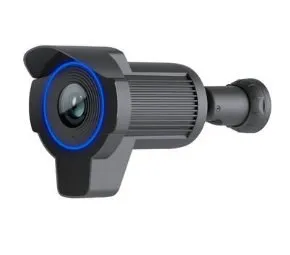
Manufacturer product photo (Ubiquiti UniFi AI LPR camera), not an installed unit: a bullet camera built to read plates on one lane. Shown as an example of the category; the model for a Queens lot is chosen on survey.
Queens lot cameras compared with ADT, Ring and SimpliSafe
Owners often ask whether a national brand would do. The honest comparison depends on the lot.
Question
AESS lot system
ADT, Ring or SimpliSafe
Designed around custody points and lanes?
Yes — booth, key box, lanes and rows planned on a survey
Typically a set of cameras placed by the owner or a technician on a standard visit
Wired PoE cameras with a local recorder?
Yes, recording on a recorder you own
Ring and SimpliSafe are built mainly around Wi-Fi cameras and cloud storage; ADT offers several product lines
Licence plate cameras on each lane?
Yes, where the lot needs them
Not part of the consumer-focused packages
Battery-backed power separate from the lights?
Designed in
Depends on the installation
Monthly fee to keep recordings?
No fee for local recording
Cloud plans and monitoring are usually subscription-based
For a single driveway, a consumer camera can be enough. For a lot that holds other people's cars, the wiring, lane geometry and power design are the parts that matter, and they are what we are paid for.
Recording mode and retention by Queens lot type
How long a lot should keep video, and whether each camera records all the time or only on motion, depends on how long it takes a problem to surface. These are the starting points we propose on a Queens survey; every owner can change them, and storage is sized from the final numbers.
Lot type
Lanes and key area
Rows and perimeter
Reasoning
Airport long-stay or shuttle lot
Continuous, longest retention on the system
Continuous at lower resolution, or motion with pre-record
Travelers can be away for weeks and query a toll or ticket weeks after that
Licensed hourly or monthly garage
Continuous
Motion with pre-record
Damage claims usually surface within days, rate disputes within a billing cycle
Dealership
Continuous, with an off-site copy
Continuous at night, motion by day
A missing car may not show up until inventory is counted
Repair or body shop yard
Continuous
Motion with pre-record
Customers notice damage at pick-up, typically within a week or two
Building garage
Continuous at the ramp and doors
Motion with pre-record
Residents report break-ins quickly; boards often set a policy
Store, supermarket or plaza
Continuous at entrances
Motion with pre-record
Fender-bender and slip claims arrive within days to weeks
"Pre-record" means the camera keeps a few seconds of buffer so a motion clip starts before the movement that triggered it — the difference between seeing a car's whole departure and catching only its tail lights. Continuous lanes cost more storage, and on a large airport lot that is the biggest single factor in the recorder's drive size, which is why we size it per channel rather than per system.
Plain-English terms you will see on a Queens lot estimate
NVR (network video recorder). The box that receives every camera's video and writes it to hard drives. On a lot it is the single most important piece of hardware, because if it is stolen, drowned or unplugged, every camera stops mattering.
PoE (Power over Ethernet). Power and video on one network cable, supplied by a switch. It lets every camera run from the same battery-backed source instead of a scatter of local outlets.
UPS. The battery unit that keeps the recorder, switches and cameras running when mains power drops or is cut. Sized in minutes or hours of runtime for the actual load.
LPR (licence plate recognition). A camera, and often software, built to capture and read plates on one lane. Different from an overview camera that happens to see plates.
PTZ. Pan, tilt and zoom: a camera that can be steered and zoomed, by a person or on a programmed tour. Useful for watching; not a replacement for fixed recording.
WDR (wide dynamic range). Processing that helps a camera see detail in bright and dark parts of the same image — a garage mouth at noon, or a lane with headlights at night.
IR (infrared). The invisible light many cameras use to see in the dark. It reflects strongly off plates, fences and nearby walls, which is why placement matters at night.
Retention. How many days of video the recorder keeps before the oldest is overwritten. Set per camera, and checked at handover against what the drives actually hold.
Pre-record. A short buffer that lets a motion-triggered recording start a few seconds before the motion.
Off-site copy. A second copy of selected cameras kept away from the lot, in cloud storage or on another recorder.
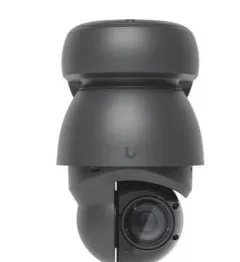
Manufacturer product photo (Ubiquiti UniFi AI PTZ Industrial camera), not an installed unit: a pan-tilt-zoom camera of the kind used for a watched overview of a large lot, on top of fixed coverage.
AI Overview Reality Check
What AI Gets Wrong About Parking Lot Cameras in Queens
Google's AI Overview for these searches could not be viewed from our research environment, so we do not quote one here. These are seven claims that come up repeatedly in national cost guides from sites like HomeAdvisor and Angi, vendor blogs and forum answers — and what we see on Queens lots instead.
1. "Installing security cameras costs about $600 to $2,000"
HomeAdvisor's cost guide puts the national average at $1,298, with a typical range of $593 to $2,040, and one camera with labor at $125 to $450. Those figures describe homes. The guide gives no commercial or parking numbers at all.
A Queens parking lot is not a house with a few cameras on the eaves. It has lanes that need plate cameras at specific angles, rows that run longer than a cable can go without a switch, a booth or key room, and power that must survive a deliberate cut. The cost is in the cabling, mounting heights and power design, not in the cameras.
Our Queens packages run from $893 for a four-camera single-entrance lot to $4,725 for a sixteen-camera lot with plate cameras and a PTZ, and a survey decides where in those ranges a lot falls.
2. "Just put a PTZ camera in the middle of the lot"
Commercial cost guides list PTZ cameras "for parking lots and large open areas," and they are often recommended as a single-camera answer. A PTZ can only look one way at a time. When it is zoomed in on the north row, the south exit is not being recorded in detail.
On a Queens lot where the questions afterwards are "which car left, when, and who was driving," fixed cameras on the lanes and rows answer them every time. A PTZ is useful on top of that, for someone actively watching a large lot or a stadium event.
We use PTZs on the largest Queens lots, mounted where they can see the fixed cameras' blind spots, and never as the only coverage.
3. "Wireless cameras are easier for a parking lot"
Wireless cameras still need power, and on a lot that usually means a cable to the pole anyway. The radio link then has to cross a lot full of metal car bodies, compete with every Wi-Fi network in the surrounding buildings, and survive a delivery truck parked in the line of sight.
In a below-grade garage under a Queens apartment building, concrete stops radio almost completely. Battery-powered wireless cameras that record on motion have the further problem described above: they can miss the moment a car leaves.
We use wireless where it is the right tool — a point-to-point bridge to a far pole or a booth — and wired PoE everywhere else.
4. "Cameras deter theft"
Visible cameras do discourage some opportunists. They did not stop the crew that took 26 cars from the Elmhurst dealership in one night, or the seven men who took four vehicles from a Long Island City residential garage in 2023. Organised thieves plan around cameras.
What cameras reliably do is record, if they are designed to keep recording. That means power that survives a cut breaker, a recorder that is not in the obvious place, an off-site copy of the most important channels and alerts that wake somebody up.
Deterrence is a bonus. Evidence is the job.
5. "Any 4K camera can read licence plates"
A 4K overview camera covering a whole lot has plenty of pixels, but they are spread across the entire scene. A plate thirty feet away and moving at 10 miles an hour occupies a tiny part of the frame and is blurred by the default shutter speed. At night, the plate's reflective coating bounces the camera's own infrared light straight back as a white rectangle.
Reliable plate capture comes from a camera dedicated to one lane, aimed so the plate fills enough of the frame, with a fast shutter and exposure set for the plate. On Queens lots with headlights coming in off a boulevard, the angle matters even more.
So every lane on a lot that needs plates gets its own plate camera, and the overview cameras do what they are good at.
6. "Keep thirty days of footage"
Thirty days is a common default and a sensible one for many stores. On a Queens airport lot, a traveler can be away for two weeks and then take another four to receive and query a toll bill or a ticket. On a dealership lot, a missing car may not be noticed until inventory is counted.
Retention should be set by channel, from the longest realistic gap between an incident and a complaint. Lanes and the key box usually get the longest; general aisle views can be shorter.
We size drives from those numbers rather than from a default, and show the owner how many days each channel actually holds at handover.
7. "Cloud cameras mean you never lose footage"
Cloud storage protects footage from a stolen or flooded recorder, which matters in Queens. But cloud storage depends on the lot's internet upload, and a lot with twenty cameras recording continuously cannot push all of that video off site on an ordinary business connection.
The practical design is a local recorder for everything, and a cloud or off-site copy of the channels that matter most — usually the lanes and the key area. That keeps monthly costs down and keeps the most important evidence safe even if the recorder is taken or drowned.
We also make sure the recorder itself survives: raised above any water the building has taken, on battery power, and alerting when it goes offline.
Not Sure Your Lot Would Prove Anything?
Send a photo of each entrance and the room where your recorder sits to (347) 434-6392. We will tell you what a claim, a toll notice or a missing car would look like on your current system.
Tell us the kind of lot, the number of entrances and whether you ever hold customers' keys. A licensed installer calls back the same business day, and you get a written Queens price — or a time to walk the lot — before anything is booked.
We Got Your Request!
An installer will call you about the Queens lot the same business day. Need us sooner? Call (347) 434-6392.
How It Works
Our Installation Process
Seven steps, the same on a twelve-space shop lot as on a four-hundred-space shuttle lot. What changes is how long the survey and the cabling take.
1. Photos and a phone call
You send a photo of each entrance, the booth or key area, and the room where a recorder could go. We ask how long cars stay, whether staff hold keys and what has gone wrong before, and sketch a first plan.
2. Walk the lot, by day and after dark
On site we walk every lane and row, find the custody points, check how the poles and the recorder room are powered, look for water marks, and — if the lot runs at night — check headlight glare at the entrances after dark.
3. Map lanes, rows and custody points
We decide which cameras record continuously, which lanes need plate cameras, where the recorder and battery backup go, and which channels are copied off site.
4. Written plan and price
You get a written Queens price at the published package ranges, with camera positions, cable routes, retention per channel, power design and the terms in the service agreement.
5. Cable, mount and power
Cable goes in along the planned routes in conduit or raceway, cameras are mounted at the agreed heights, and the recorder, switches and UPS are installed on their own protected circuit.
6. Set time, retention, accounts and alerts
Automatic time sync, retention by channel, separate logins for owner, manager and attendant, a sealed admin password, camera-offline and drive alerts, and microphones off.
7. Test playback and export, then hand over
You export a clip yourself while we watch, we confirm each lane shows arrivals and departures clearly, and you receive the camera map, account list and recorder details.
What installation day looks like on a working Queens lot
Lots rarely close for us, so the work is staged around the cars. We agree with the operator which rows can be cleared at which hours, cone off the area around a lift or ladder, and leave the entrance and exit lanes open except for the short time it takes to mount the cameras over them. Cable inside a garage or booth goes in first, while the lot is busy; work above the lanes is scheduled for the quietest window, which on a commuter lot is mid-morning and on a shopping lot is early evening on a weekday. The old system keeps recording until the new recorder is running, and the changeover is done in one step so there is no gap in coverage.
Coverage Area
Parking Lot Cameras Near Queens's Landmarks
We install lot cameras across the whole borough. These six places are reference points for the kinds of parking around them; they are not client sites.
Jamaica Station and AirTrain
93-02 Sutphin Boulevard: the LIRR's three-trunk junction, more than 200,000 weekday riders and the AirTrain JFK link, ringed by commuter and airport parking.
JFK and the Rockaway Boulevard Lots
The airport's surrounding streets hold long-stay and shuttle lots whose disputes over damage, tickets and mileage have reached ABC7 and CBS New York.
LaGuardia Airport
Its Terminal B garage alone is a seven-floor, 3,100-space structure; East Elmhurst lots nearby serve travelers, airport staff and car services.
Citi Field and Willets Point
Stadium parking beside the former Iron Triangle repair district, where a 25,000-seat soccer stadium is under construction with a hotel and housing planned around it.
Queens Center, Elmhurst
A 967,000-square-foot mall on Queens Boulevard between 57th Avenue and Woodhaven Boulevard, opened in 1973 — the anchor of the borough's busiest shopping strip.
Resorts World New York City
The casino at 110-00 Rockaway Boulevard, on 72.6 acres beside the former Aqueduct Racetrack, licensed for full casino gaming in December 2025 and now expanding.
We also serve Astoria, Long Island City, Sunnyside, Woodside, Maspeth, Ridgewood, Middle Village, Glendale, Elmhurst, Jackson Heights, East Elmhurst, Corona, Rego Park, Forest Hills, Kew Gardens, Richmond Hill, Woodhaven, Ozone Park, Howard Beach, South Ozone Park, Springfield Gardens, St. Albans, Hollis, Queens Village, Bellerose, Fresh Meadows, Bayside, Douglaston, Little Neck, Whitestone, College Point, Flushing, Murray Hill, Auburndale and the Rockaways — and the rest of the city from our NYC parking lot camera hub.
Pricing
Parking Lot Camera Cost in Queens
Queens prices are our Brooklyn base rates multiplied by the Queens area factor of 1.05, rounded to the nearest dollar. The figures below are installed prices for the scope described; the survey settles where in each range a lot falls.
Queens lot work
Price
What it covers
Starter lot system
$893–$1,575 installed
Lot with a single way in: a view of the entrance, the main aisle and one side or back line, plus the recorder and the owner’s handover
Standard lot system
$1,575–$2,625 installed
Custody lot: every aisle on camera, a plate reader at the gate, and the booth or key cabinet watched
Premium lot system
$2,940–$4,725 installed
Large or multi-lane lot: a plate reader per lane, a PTZ for a watched overview, the fence line and any garage level
Site survey and written estimate
Free
Walkthrough of entrances, custody points, power and recorder location; same-day written estimate
Service visit after installation
$195/hr, 3-hr minimum ($585)
Callbacks and changes after the job is complete; not charged on the initial install
What moves a Queens lot price within or beyond those ranges is rarely the cameras. It is the distance from each camera back to the recorder, whether a new pole or a trench through asphalt is needed, how many lanes need their own plate camera, the battery backup the system needs to ride out a deliberate power cut, and how much storage the longest-retention channels require. Poles, trenching, fiber or wireless links, extra battery capacity and off-site storage are itemised on the written estimate after the survey; we do not publish flat prices for them because they depend entirely on the ground and the building.
Why Queens prices sit 5% above Brooklyn
Our parking lot prices start from one set of base rates, and each area carries a published factor for travel, access and the time a typical job takes there. Queens carries 1.05. On the Starter package that is the difference between $850 and $893 at the low end; on Premium, between $4,500 and $4,725 at the top. The factor is applied once, to the whole package, and nothing else on the estimate is marked up for the borough.
What the written Queens estimate itemises
Cameras by position. Each camera listed against the lane, row or custody point it covers, so you can see what you are paying for and drop a position if you choose.
Cable routes and mounting. Which runs go along walls, through ceilings, up poles or under asphalt, and which existing poles or canopies are used.
Power. The battery backup, the circuit it is fed from, and any electrician's work needed for a new feed.
Recorder and storage. The recorder, the drive capacity and the number of days each group of cameras will hold.
Off-site copy. Which channels are copied, where to, and any ongoing storage cost from the provider — the one item that can carry a monthly charge, and only if you choose it.
Third-party items. Poles, trenching, permits or FAA filings where the lot needs them, shown separately so they are not hidden in the camera price.
The estimate also lists what is not included — usually lighting upgrades, gates and barriers, and any repairs to the existing electrical service — so there are no surprises on the day.
A worked example on the published ranges
A family-run repair shop near Northern Boulevard parks about twenty customer cars overnight in a fenced yard with one gate, holds keys in the office, and wants to know who moved which car. The shop starts in the Standard range, $1,575–$2,625: about eight cameras, one of them a plate camera on the gate, one on the key cabinet, and the rest along the rows and fence line. If the yard also has a separate exit lane that needs its own plate camera and the owner wants the gate and key cameras copied off site, the extras are itemised on the estimate. If the same owner only needed four cameras on a single entrance and a short row, the Starter range of $893–$1,575 applies.
Every estimate also states the payment terms. Full terms — including 50% deposit, one-year parts-only warranty on AESS-supplied products, and the late-fee schedule — are set out in the service agreement.
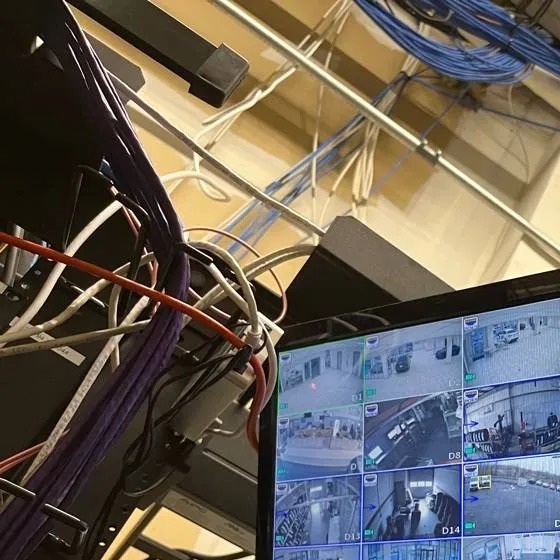
Example photo from another AESS job (not a Queens lot): camera cable home runs dropping into the rack that holds the recorder. Every camera on a lot ends at a point like this, which is why where the rack sits matters.
Shop Our Systems
Parking Lot Camera Packages & Pricing
Three starting points, each adjusted to the lot on the written estimate. None needs a monthly fee to keep local recordings.
Starter — Single-Entrance Lot
$893–$1,575 installed
A shop, office or small building lot with one way in: about four cameras covering the entrance, the main aisle and a rear or side line, a recorder sized for your retention, phone viewing and a sealed admin login for the owner.
Standard — Custody Lot
$1,575–$2,625 installed
A repair yard, small licensed lot or building garage: about eight cameras with full aisle coverage, a plate camera at the entrance, the booth or key cabinet on camera, and alerts when a camera goes offline.
Premium — Large or Multi-Lane Lot
$2,940–$4,725 installed
Long-stay, dealership, plaza or multi-level parking: sixteen or more cameras, plate cameras on each lane, a PTZ overview, perimeter and garage-level coverage, and power and storage planned for long retention.
Already own cameras? We install them at labor-only rates
If you have bought cameras and a recorder, or inherited a system from a previous operator, we can mount, cable and configure your equipment as a bring-your-own-equipment job, priced on labor only. We check the hardware first and tell you plainly if a camera is wrong for the position — a wide-angle dome on a lane that needs plates, for example. Our bring-your-own-equipment calculator shows how labor-only pricing is built up, and equipment you supply keeps its own manufacturer warranty.
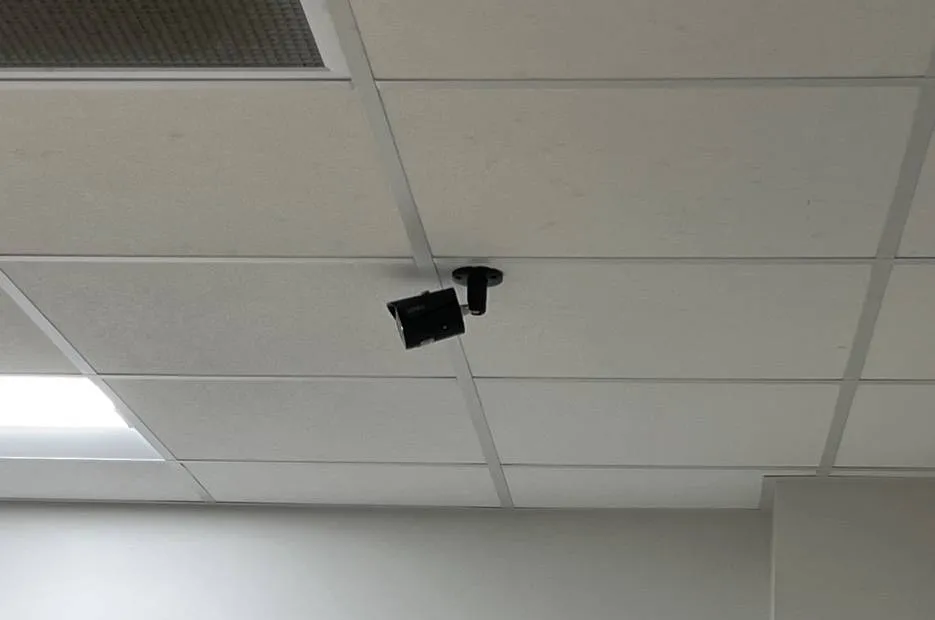
Example photo from another AESS job (not a Queens property): a bullet camera on a short mount fixed to a dropped ceiling — the kind of mount we use inside an attendant’s booth or a dealership office.
Speak to a Queens Lot Camera Tech
Ask about plate cameras on a boulevard entrance, battery backup for a dealership, or moving a recorder out of a garage that flooded — the person who will plan the job answers.
Lot cameras rarely stand alone. These are the related services Abstract Enterprises Security Systems provides in the borough, each with its own Queens page.
Coverage while a lot or garage is being built or rebuilt.
Field Notes
Field Notes: Follow the Keys, Then the Power
On a Queens lot survey I do not start at the entrance. I start wherever the keys live. A key board in a booth, a lockbox on the wall of a repair office, a drawer under a dealer's desk — that is where a theft or a claim usually begins, and it is the camera owners most often forget. I stand where a customer hands over a key and look at what a camera on the wall behind me would see: the hand, the face, the tag.
Then I follow the power. Where does the recorder plug in? Is it on the same breaker as the lot lights? Is there a battery unit, and when was it last tested? Could someone standing outside the office reach the panel? If the answers are "the same breaker, no battery, and yes," the system will record everything except the one night that matters.
Last, I look down. Water stains on the bottom of a cellar wall, rust at the base of a rack, a recorder sitting on a milk crate — all of it tells me where the next flood will reach. The recorder goes above that line, and so do the switches. Only then do we talk about cameras.
— Anwar Timothy, owner, NYS license #12000287431
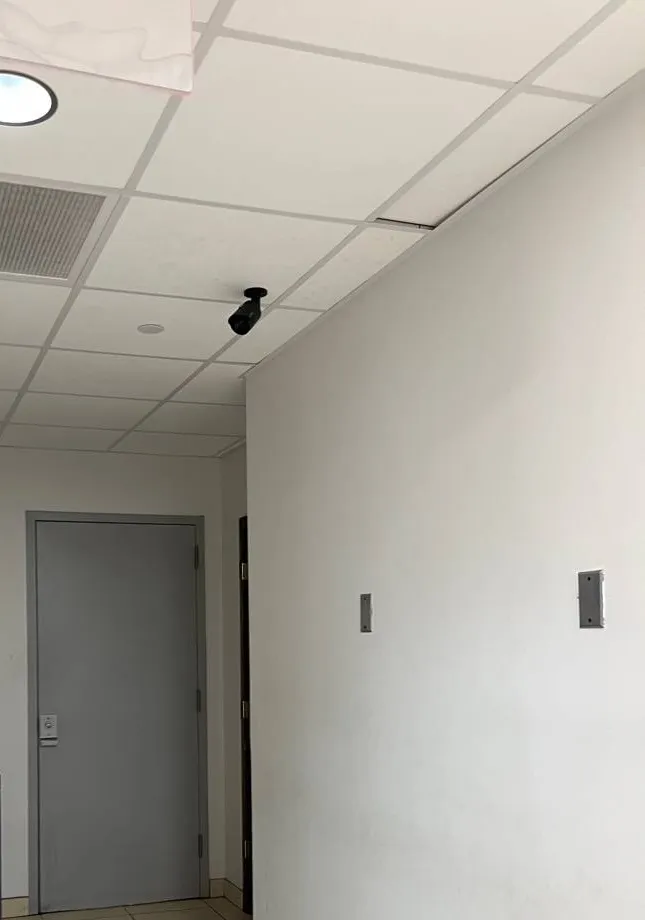
Example photo from another AESS job (not a Queens property): a camera covering the length of a corridor to a steel door. The door to the room holding a lot’s recorder or keys deserves a camera like this.
FAQ
Queens Parking Lot Camera FAQ
Practical questions about the job itself and living with the system afterwards — the ones not already covered above.
Do you send a certificate of insurance naming the lot owner and the parking operator?
+
Yes. Many Queens lots have a landlord and a separate operator, and building garages have a managing agent or board as well, so the certificate often needs more than one name. Send us the exact certificate-holder names and any additional-insured wording each party needs, and we issue the certificate before the start date so nobody is held up at the gate on the first morning.
Should the cameras be on their own network, apart from customer Wi-Fi and the payment terminals?
+
Yes, and we set them up that way by default. The cameras, switches and recorder sit on their own network segment, with only the recorder allowed out to the internet for phone viewing and alerts. Keeping cameras off the customer Wi-Fi and away from the card terminals protects both: a problem on one does not spill into the other, and nobody parked in the lot can reach the cameras from a phone.
How is payment handled on a Queens lot camera job?
+
The written estimate sets out the price, what is included and the payment schedule. Full terms — including 50% deposit, one-year parts-only warranty on AESS-supplied products, and the late-fee schedule — are set out in the service agreement. Equipment you supply yourself keeps its own manufacturer warranty.
Will you take down the dead cameras a previous operator left on the poles and walls?
+
Yes, as part of the job if you want it. Old cameras left by an earlier operator confuse customers and police alike, because they look like coverage that does not exist. Before anything comes down we check whether an old recorder still holds footage someone may need; if it does, we export it or leave the drive with the owner. Old cable inside walls is labelled and left in place unless removing it is agreed.
Can the attendant’s booth show live cameras without giving the attendant playback or export?
+
Yes. The booth monitor can run a live view that needs no login for playback, while searching recordings, exporting clips and changing settings stay behind the owner’s or manager’s account. The attendant sees the lanes and rows in real time; only the people responsible for claims can pull footage.
Can a copy of the recordings be kept somewhere other than the lot itself?
+
Yes. We usually copy the most important channels — the lanes and the key area — to cloud storage or to a second recorder at another address, while everything else records locally. That way a stolen, smashed or flooded recorder does not take the evidence with it, and the monthly cost stays modest because only a few cameras are sent off site.
What should we have ready when you come to survey the lot?
+
Someone with keys to every room and gate we may need, including the electrical room; a rough idea of how long cars normally stay and the longest stay you have had; the names of anyone who needs to view footage; and, if you have them, the lot’s DCWP licence details and the Buildings document showing capacity. If the property has flooded before, tell us how high the water reached.
How soon after we approve the estimate can work begin?
+
That depends on the size of the lot and whether an electrician, a pole or permits are involved. Smaller systems on existing buildings and poles can often be scheduled quickly; anything needing a new circuit, a new pole base or a trench takes longer to coordinate. The written estimate gives a start window, and we confirm the date once the deposit is in.
All Areas Served
Parking Lot Cameras Across New York City, Long Island and the Hudson Valley
This borough page sits under our New York City parking lot camera hub. Every other borough, county and region where we install lot cameras has a page of its own.
Rules, places, figures and news items on this page come from the publications below. Forum material was read as search excerpts. AESS prices are our parking-lot base rates at the Queens area factor of 1.05, as published on this site.
A car that left without its owner, a recorder that stopped after a storm, or a claim that needs footage by Friday — phone (347) 434-6392. We secure the recordings you already have first, then fix the fault; most lot systems are recording again within one to two hours of arrival.
Queens Lots Covered by a Licensed, Insured Crew
Queens line (347) 434-6392 · Abstract Enterprises Security Systems, 460 E Fordham Rd, Bronx, NY 10458 · messages by WhatsApp (718) 679-0359
Working under NYS license #12000287431, insured on every Queens job, with same-day estimates · 4.7★ average across 201 Google reviews
Cameras, recorders and drives carry their manufacturers' warranties. Full terms — including 50% deposit, one-year parts-only warranty on AESS-supplied products, and the late-fee schedule — are set out in the service agreement. See our warranty page.
Page reviewed and updated October 18, 2026. Changelog: Queens parking lot page rebuilt from new research on DCWP garage and lot licensing, JFK-area long-stay lot complaints, the 2022 Elmhurst dealership theft, Ida's 2021 garage flooding, FAA notice rules near JFK and LaGuardia, NYC's biometric-sign law, New York's eavesdropping law and the state's commercial security tax credit, on the parking-silo base prices at the Queens area factor of 1.05.