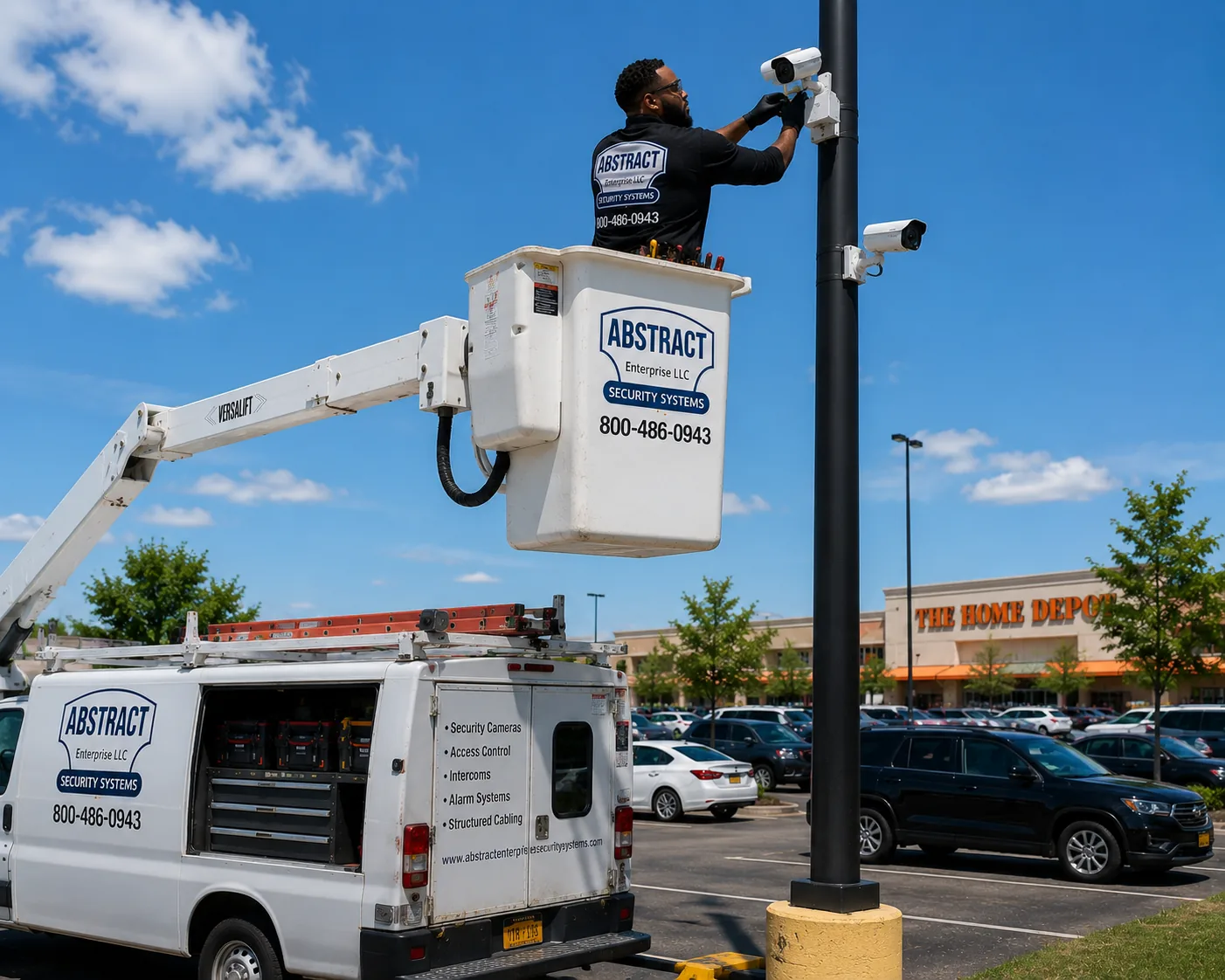
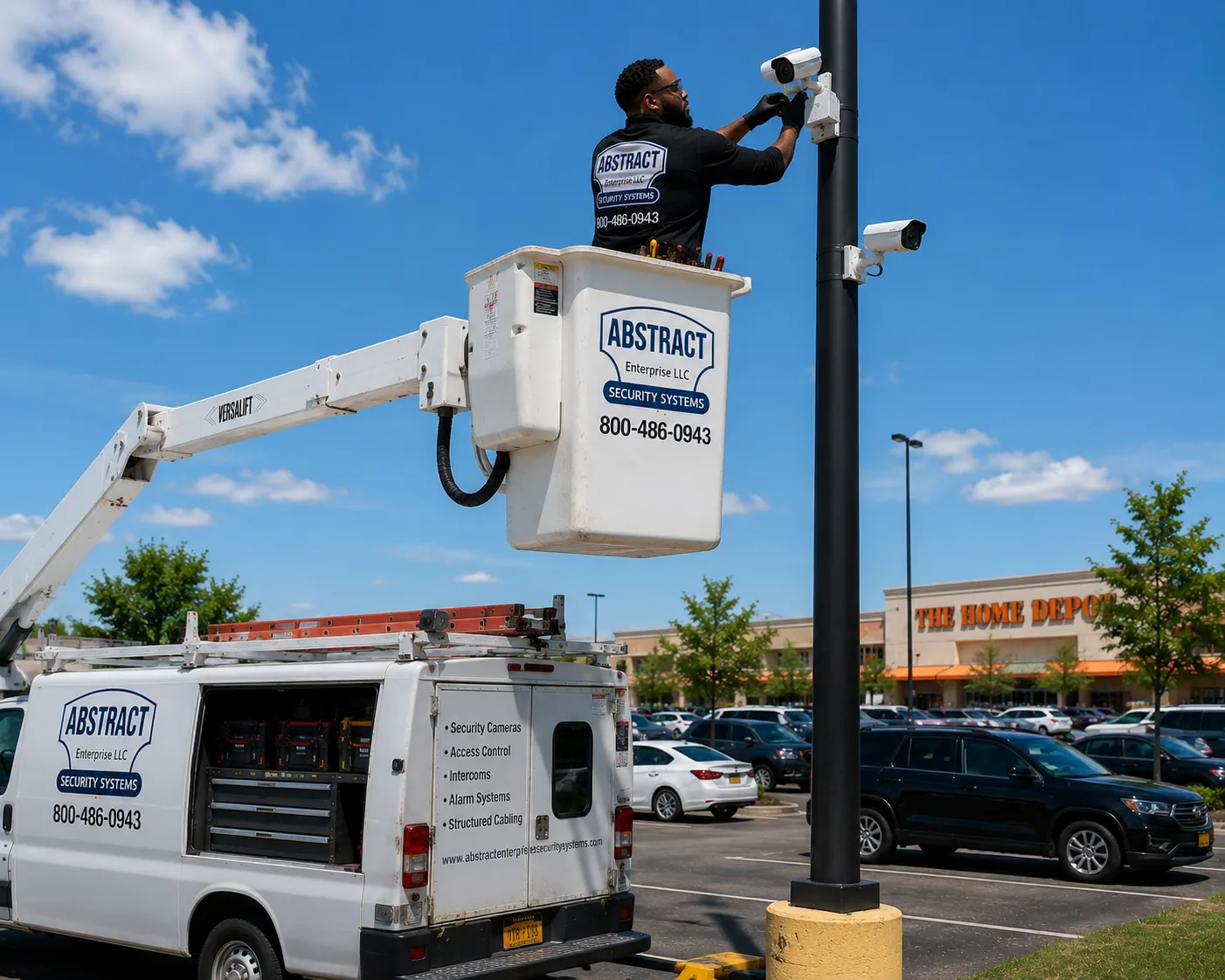
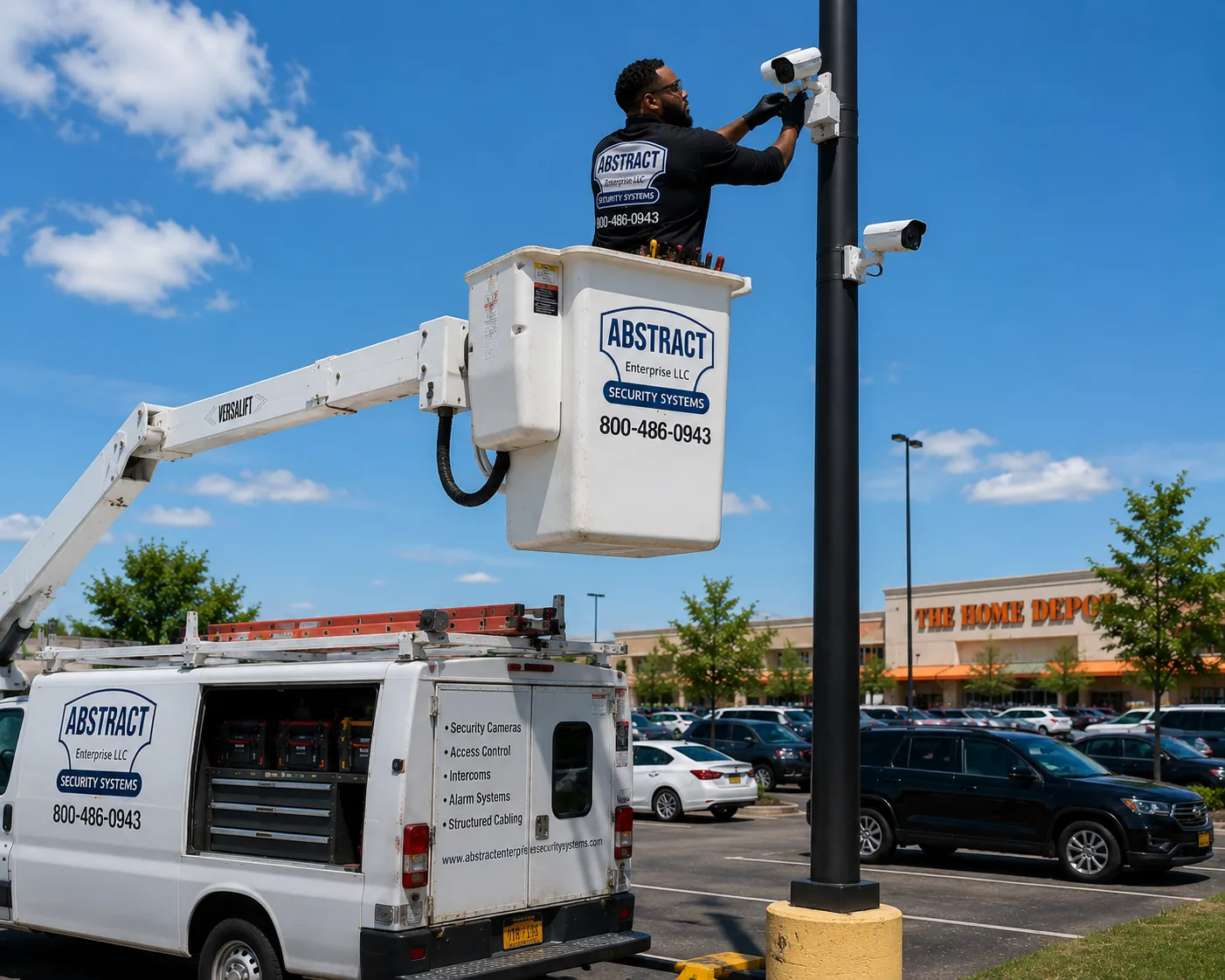
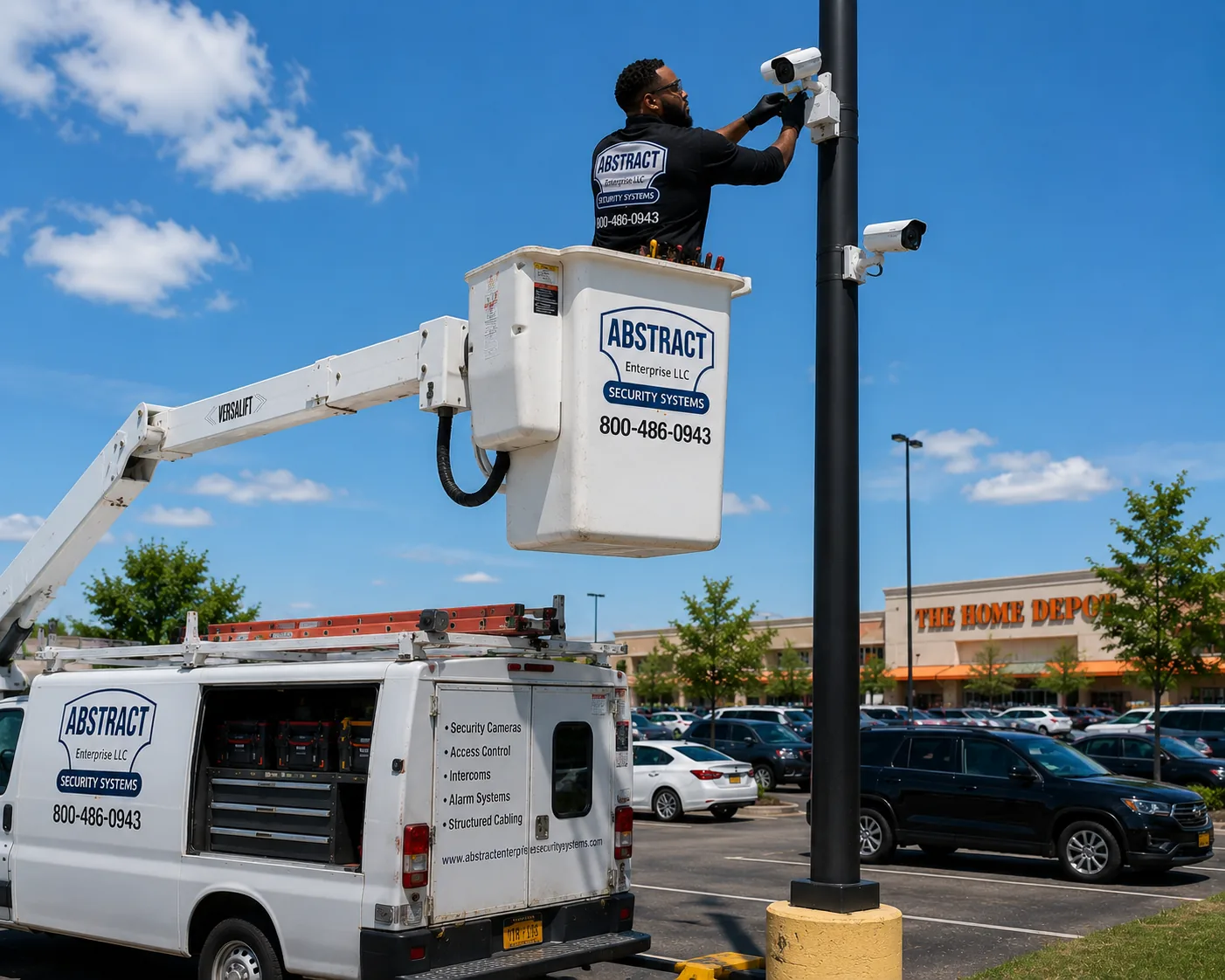
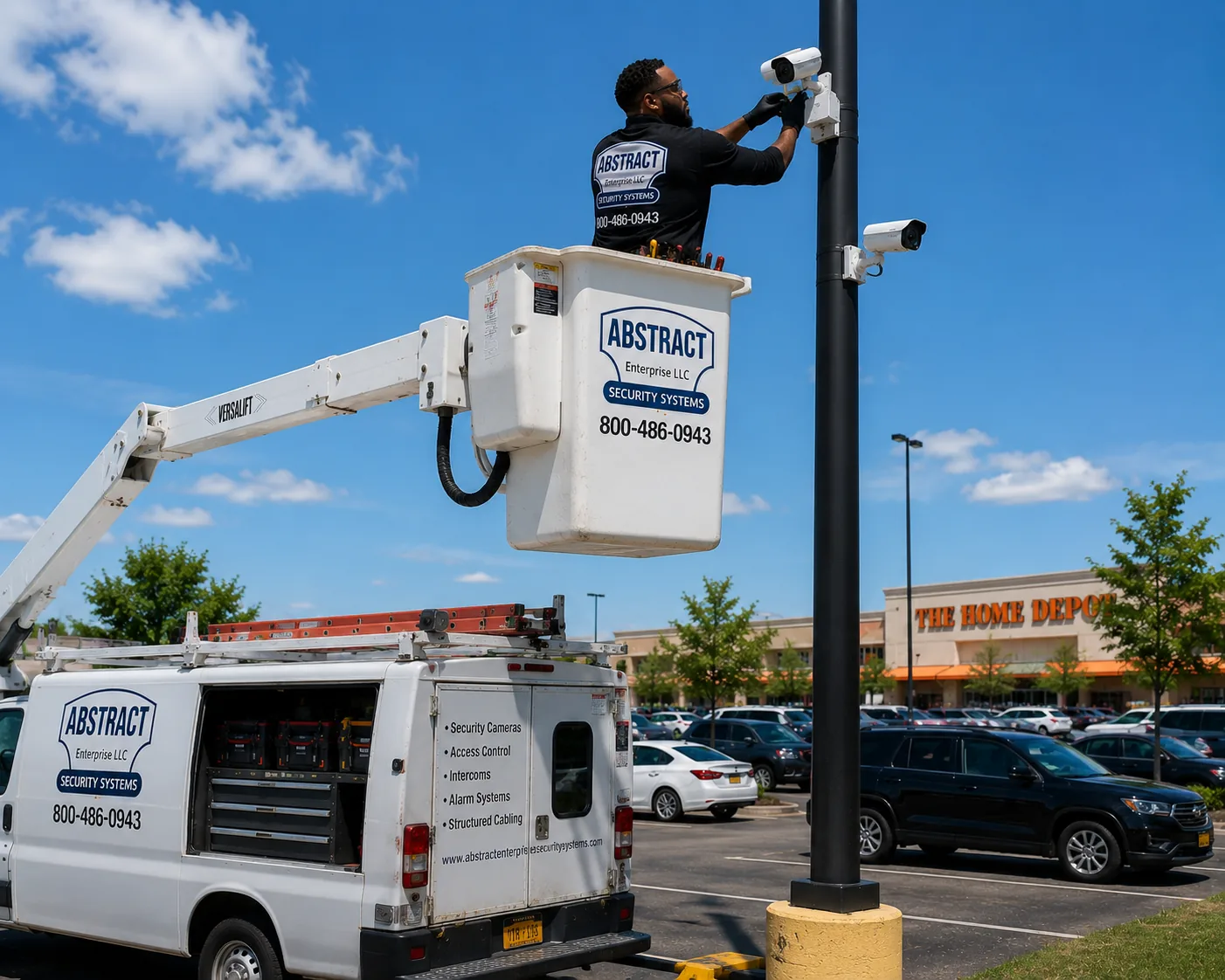
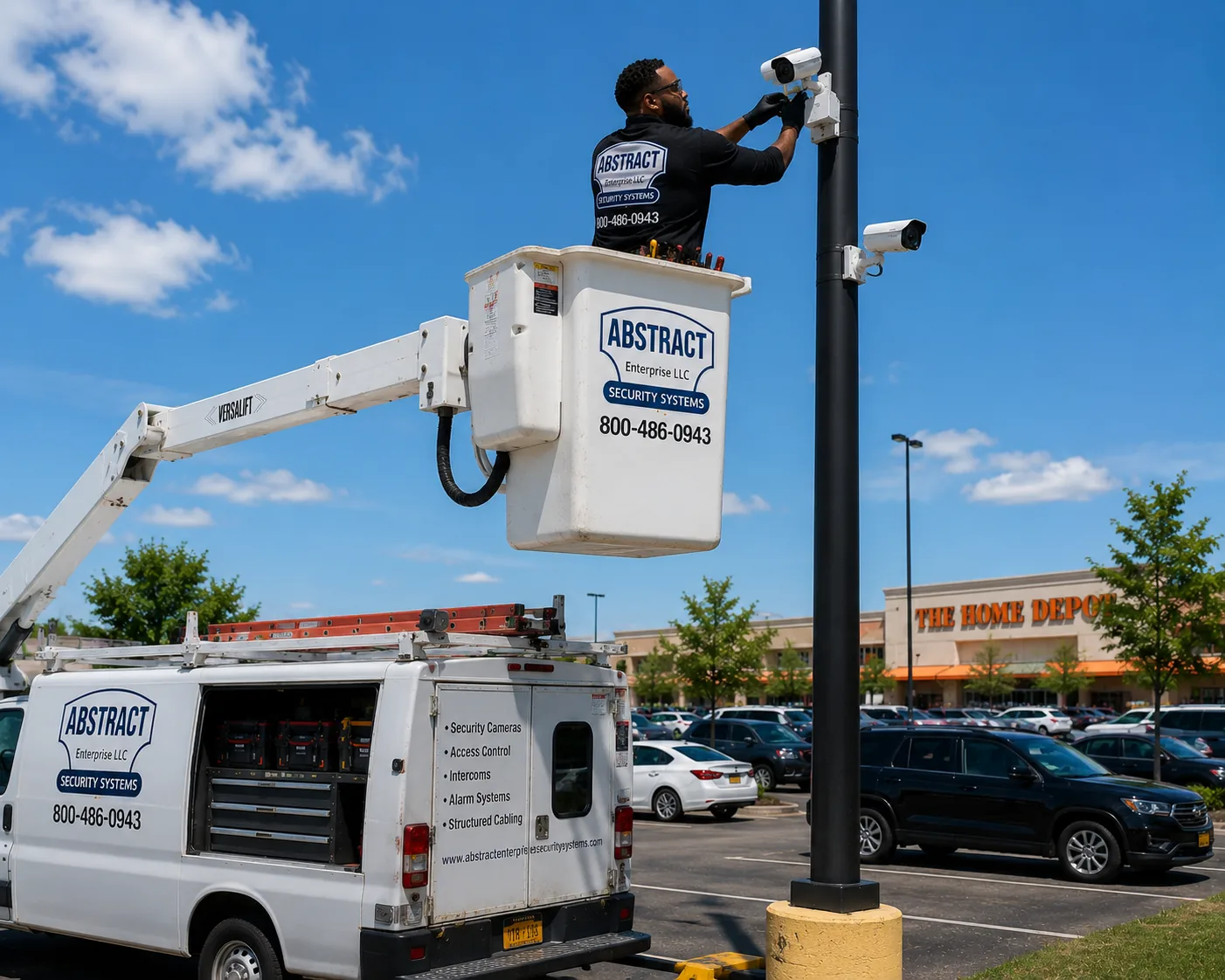
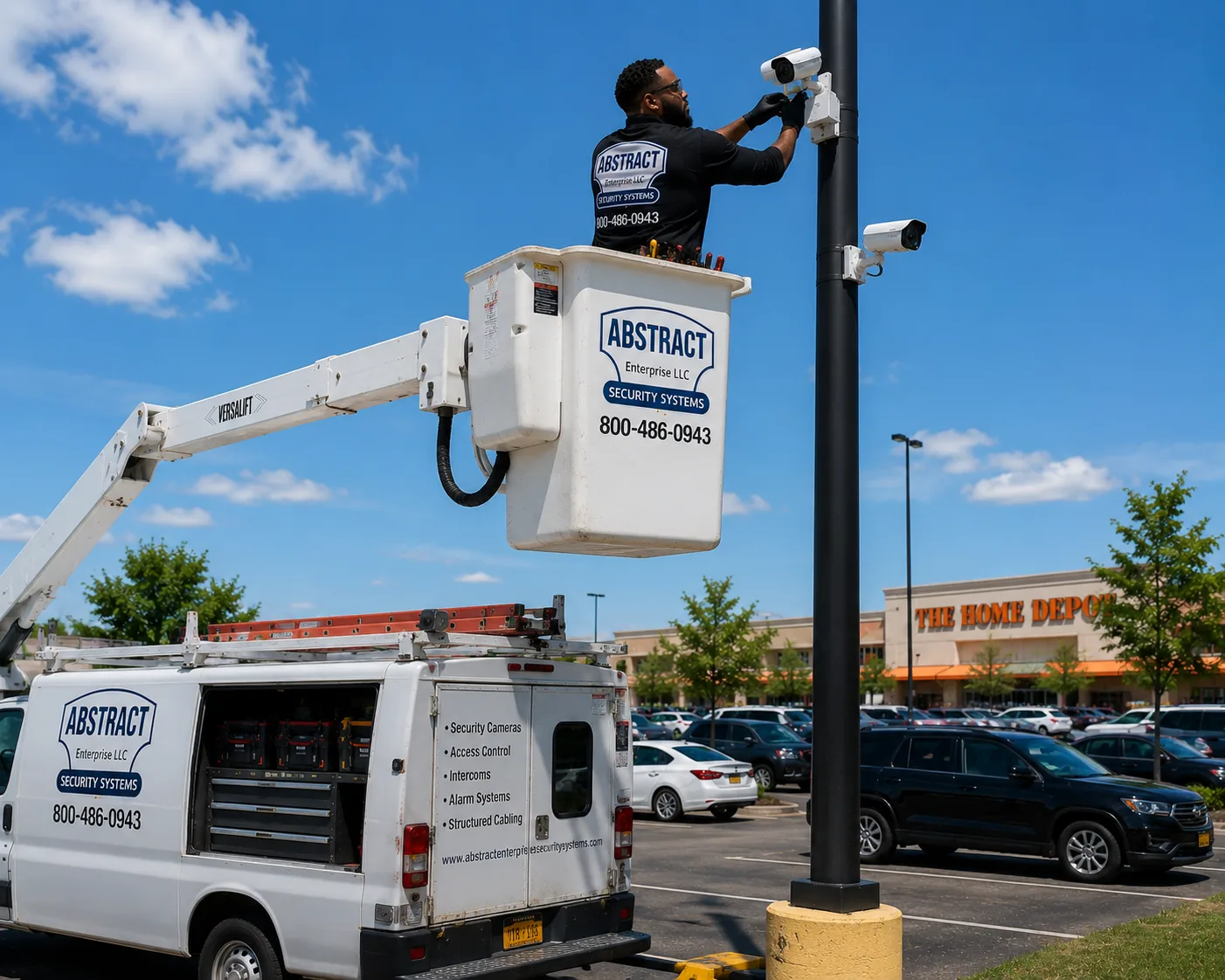
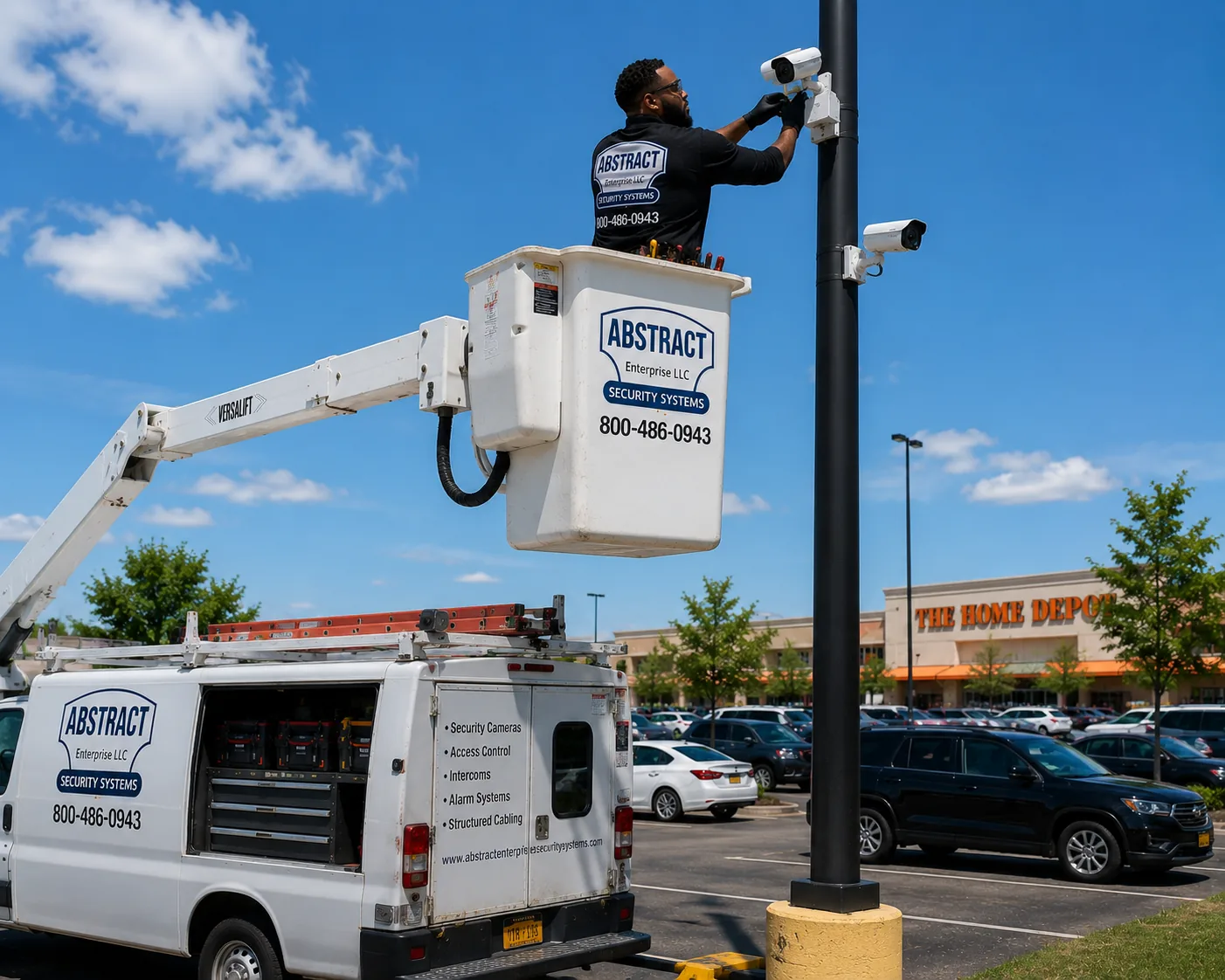
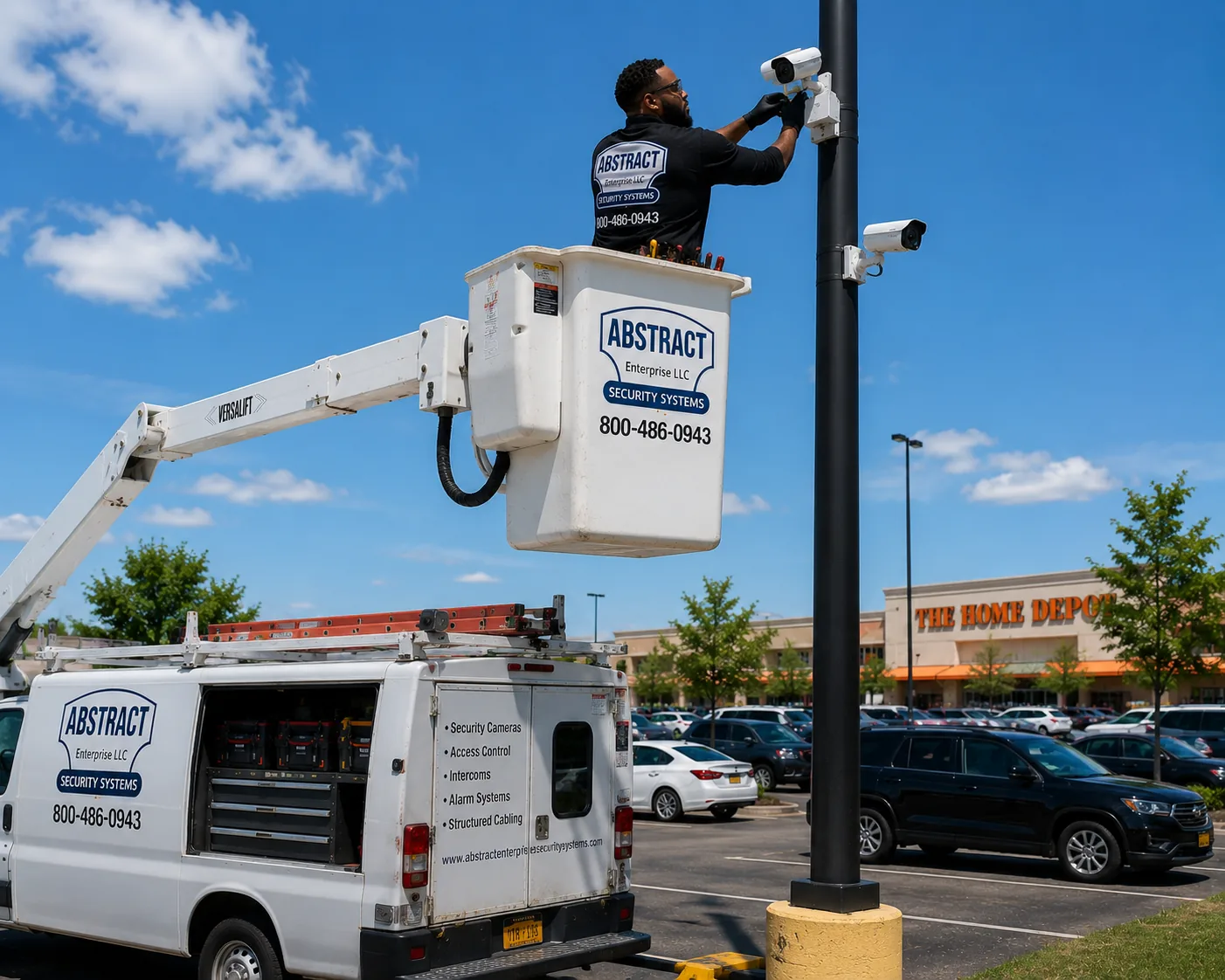
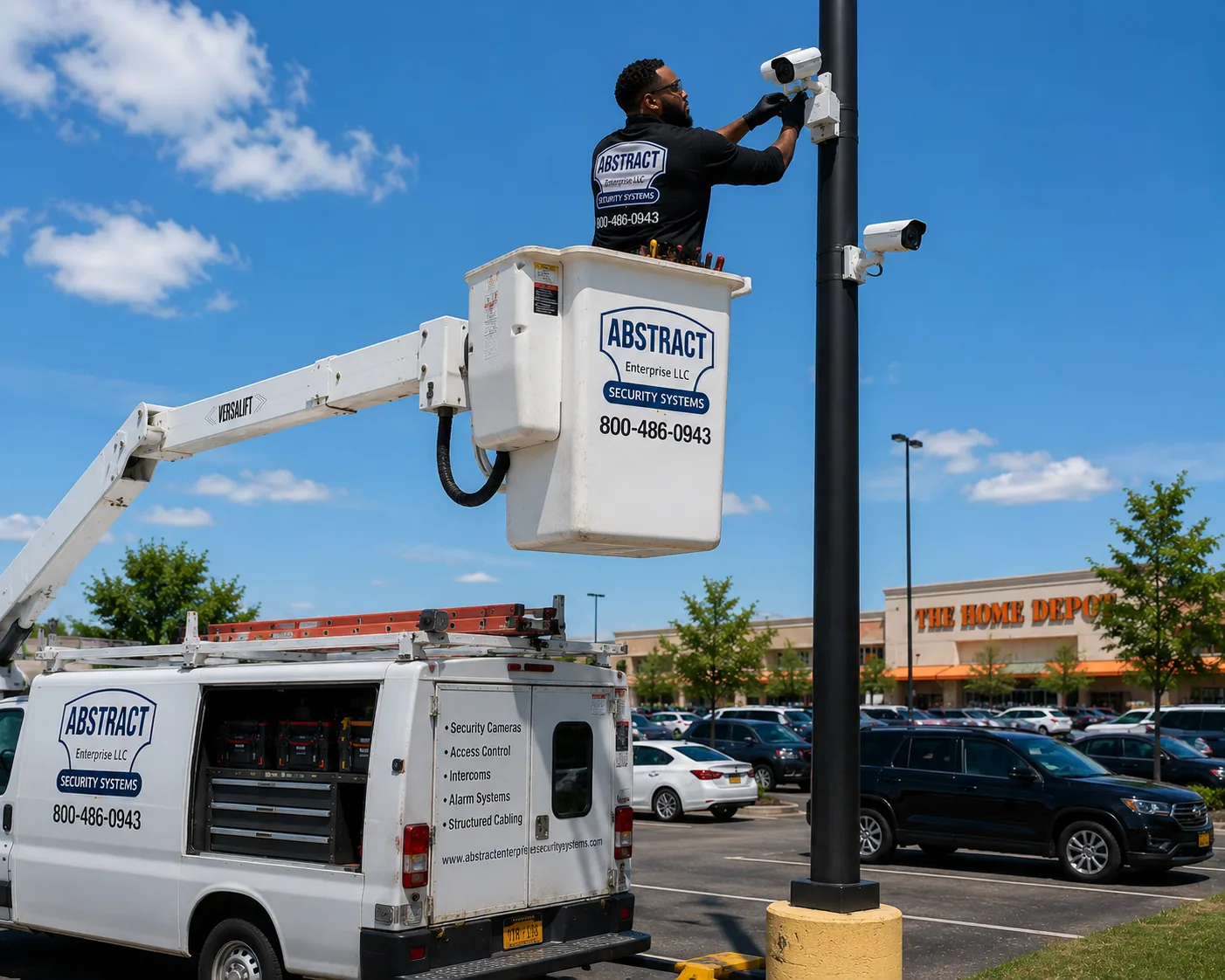
Camera systems for Ulster County parking cover the whole spread: the uptown Kingston garages and Rondout waterfront lots, the Thruway park-and-ride at Exit 19 and Exit 18, SUNY New Paltz and its village, and the remote trailhead lots at Minnewaska, Mohonk and the Catskill high peaks where a car can sit unwatched for the length of a hike.
· 201 Google Reviews | NYS Low-Voltage License #12000287431 | Free on-site survey
We work lots throughout Ulster County — Kingston and New Paltz, the river towns of Saugerties and Port Ewen, the Rondout Valley through Stone Ridge, High Falls and Rosendale, the southwest around Ellenville and Kerhonkson, and the Catskill hamlets of Phoenicia, Pine Hill and Shandaken up toward Belleayre.
Reviewed and updated August 1, 2026.
THE NEIGHBORHOOD
Ulster is a large, split-personality county — roughly eleven hundred square miles running from the Hudson’s west bank clear into the high Catskills. A camera plan that fits a tight Kingston garage is the wrong plan for a mile-long trailhead pullout on Route 44/55, and the reverse holds just as true.
Ulster is also Central Hudson’s home county. The utility is headquartered in Kingston and is the electric provider across nearly all of the county, so unlike places with a split territory, a pole a camera might attach to almost always belongs to one company — which keeps the make-ready conversation simple and the pole-ownership question short. One familiar utility, not two, owns the poles and runs the lines here.
The theft picture here has its own signature. Alongside the everyday smash-and-grab in Kingston and the SUNY New Paltz lots, the Ulster County Sheriff’s Office has flagged a pattern the flatter counties do not share: break-ins at remote trail and preserve lots — Minnewaska, the Mohonk Preserve gateways, Kaaterskill and Sam’s Point — where thieves work unattended cars while owners are hours out on the ridge, plus a steady run of catalytic-converter cuts off SUVs left in the open.
The ground here is less forgiving than the counties across the river, and for two reasons at once. Western Ulster is Catskill rock and thin mountain soil, the Shawangunk Ridge is quartz conglomerate that shrugs off a shovel, and a good share of the county drains toward the Ashokan and Rondout — New York City’s own water supply — so parcels near those basins carry watershed and stormwater review on top of the digging.
The parking generators are an unusual mix. There is no commuter-rail terminus to anchor the demand — Ulster sits west of the Metro-North lines — so the volume comes instead from Thruway park-and-ride lots, a seven-thousand-student SUNY campus at New Paltz, resort and trailhead lots that fill on weekends, and the Kingston government, court and hospital core.
A short list of roads ties the county together. The New York State Thruway, I-87, is the north-south spine, dropping traffic at Exit 18 in New Paltz, Exit 19 in Kingston and Exit 20 at Saugerties; US Route 9W runs the Hudson’s west bank, Route 28 climbs west into the Catskills, Route 299 and Route 44/55 feed New Paltz and the Gunks, and Route 209 carries the southwest toward Ellenville.
WHAT WE INSTALL
Ulster parking runs the full gap — from a cramped uptown Kingston lot to a preserve pullout a half-mile from the nearest building. The first sits on workable valley soil; the second is ridge rock, sometimes inside a watershed buffer, and each one changes what it takes to stand a pole and pull a trench.
Kingston is the county seat and the first capital of New York State, its Stockade District and Rondout waterfront drawing steady foot traffic. It is not a rail hub — the county’s commuter volume lands instead on Thruway park-and-ride lots and the Adirondack Trailways and UCAT bus network, with drivers crossing the Kingston-Rhinecliff Bridge to reach Metro-North on the east bank.
Historic Huguenot Street in New Paltz, the Kingston Stockade, the Saugerties Lighthouse and the Woodstock arts village all pull visitors into lots that were never sized for the crowd, and every one of them sits under some form of preservation or municipal review that shapes where a pole can go.
Concrete decks carry their own list — headlights flaring off low ceilings, tight ramp turns, blind corners at the stair cores. Ulster’s structured parking clusters in Kingston, at the HealthAlliance hospital campuses and in the redeveloped TechCity blocks, and each deck gets cameras chosen for wide-dynamic control rather than a rural pole’s reach.
The colleges are their own parking economy. SUNY New Paltz sits at the foot of the Gunks with roughly seven thousand students, its lots slammed on August move-in and May commencement, while SUNY Ulster in Stone Ridge runs a quieter commuter campus — both wanting footage that holds a plate at a gate and a face at a walkway.
The redeveloped IBM Kingston site — now TechCity and iPark 87 — and the office and industrial parks along Route 9W and Route 28 run large employee lots that empty and fill on shift lines, the kind of predictable rhythm a camera can be tuned around.
Round-the-clock coverage is the rule at the medical campuses. HealthAlliance Hospital’s Broadway and Mary’s Avenue sites in Kingston and Ellenville Regional to the southwest keep lots and decks lit and moving at every hour, which sets the retention and low-light bar for the whole build.
The Ulster County Fairgrounds in New Paltz and the HITS-on-the-Hudson show grounds in Saugerties swell to enormous overflow lots on event days — the county fair, the horse shows, the garlic festival — then sit near-empty between them, a load pattern that argues for coverage that scales without a guard at every row.
Retail churns through the day. The Hudson Valley Mall footprint in Kingston, the Route 9W big-box strip through Lake Katrine and Ulster, and the Route 299 plazas in New Paltz all cycle cars in bursts, so the cameras are placed for turnover and cart-corral disputes rather than a single fixed view.
Ulster’s dealership rows run mostly along Route 9W and Route 28 outside Kingston, and an inventory lot lit for browsing is an easy overnight mark. The fix points straight at that: low-light coverage down the fence line, a plate lane at the only way in, and lights-out analytics that flag movement after close.
Residential work covers Kingston and New Paltz apartments, the Route 9W and Route 32 corridors, and the barn, clubhouse and gated-drive properties of the Rondout and Wallkill valleys — each one balancing a resident’s privacy against a clear read of who comes through the entrance.
COVERAGE AREA
Ulster is one city, twenty towns and a scatter of villages spread over more than eleven hundred square miles, and the parking spread is just as wide — uptown Kingston decks at one end, a preserve pullout in the western Catskills at the other.
Our footprint takes in the cities of Kingston and New Paltz; the river towns of Saugerties, Port Ewen and Marlborough; the Rondout Valley through Stone Ridge, High Falls, Rosendale and Accord; the southwest around Ellenville, Kerhonkson and Wawarsing; and the Catskill hamlets of Phoenicia, Shandaken and Pine Hill up to Belleayre.
Ulster does not have one parking problem; it has a dozen scattered across eleven hundred square miles. A SUNY New Paltz commuter deck, a Hudson Valley Mall apron, a Minnewaska trailhead pullout and a Woodstock village lot are four different jobs, and pretending otherwise is how a generic bid goes wrong.
A plate camera earns its place at exactly one spot — the lane where a car slows to a crawl — and nowhere else. On a Route 9W entrance or a Thruway park-and-ride approach that means one head framed tight to the lane, angled to the grade, and left to do only that.
Those reads earn their keep at commuter, dealership and retail entrances. After one of the overnight thefts the county keeps logging, the list of which vehicles entered and left is frequently the only lead worth chasing. That's why the overview head and the plate head stay two separate cameras at a busy entrance — widen one for context without ever giving up the tag detail on the other — and a whitelist can pass permit-holders or staff through a gate while everyone else gets flagged.
Ulster simplifies the pole question, because a single utility runs nearly the whole county. Central Hudson owns most of the poles from the river towns to the Catskill foothills, which spares an Ulster job the split-utility make-ready that slows the counties with two or three owners on one road.
When a utility pole really is the correct mount, the attachment and make-ready go through Central Hudson before the position is locked. Power is then matched to the distance involved — a home run from the panel where the geometry allows it, a dedicated feed into a pole-side enclosure where it doesn't, and a self-powered head where trenching out to a far corner of a commuter, campus or horse-country lot simply isn't worth it. A battery backup carries the recorder and the key cameras, so a storm knocking out the grid never opens a hole in the record.
Trenching in Ulster is about the ground and the rulebook both. The Catskill and Shawangunk rock is the physical wall; the reservoirs are the paperwork one — a parcel draining toward the Ashokan or Rondout can pull DEP watershed and DEC stormwater review, which is a constraint the counties east of the Hudson simply do not carry.
Rock or a long haul takes a straight trench off the table, and the substitutes are chosen on purpose: surface conduit hugging a curb or wall, a saw-cut where the base course cooperates, an engineered point-to-point wireless hop between buildings, or a self-powered position that never breaks ground at all. Out on the big eastern parcels that wireless hop is usually the honest call — nobody trenches several hundred feet across a horse farm to light one lot and comes out ahead. We pick the route the property allows, and restore it so the lot looks finished the day the crew pulls off.
On the county's larger properties — and there are many — distance quietly runs the design. Copper is good to roughly a hundred meters; past that a run wants fiber with media conversion, or a switch parked out in the field, and across a Kingston garage, a college quad, the chip campus or a horse-country lot those hundred-meter marks stack up in a hurry. Which segments go copper, which go fiber, and where a field switch lands all get settled before a single figure is quoted.
Where no paved path links two points — or where rock in the south makes trenching one a bad bet — a licensed point-to-point radio carries the video home on a clear line of sight, though in the wooded, hilly stretches that sightline has to survive summer leaf-out. It's engineered, aimed, tested and watched, not a consumer bridge stuck to a wall, and it's what keeps a stranded commuter row, a distant campus lot or a far barn writing to the same recorder as everything else.
Ulster holds more structured parking than its mountain reputation suggests. The Kingston decks, the HealthAlliance hospital garages and the TechCity blocks all want indoor-rated cameras tuned for glare and ramp blind spots, not the long reach a rural pole is set up to deliver.
A structured deck — a Hudson Valley Mall level, a HealthAlliance hospital garage — gets built up floor by floor: plate reads on every entrance ramp, wide-dynamic heads at the stair cores, and cameras chosen for glare rather than reach.
Snow does not fall evenly here. Kingston’s river floor stays comparatively mild, but the western towns toward Belleayre and Slide Mountain take real Catskill accumulation, so housings, heaters and mounting on the high-country lots are specified for a heavier winter than the waterfront ever sees.
Salt is the quiet tax winter charges the hardware. Brine thrown off the Thruway, Route 28, Route 9W and Route 299 works into every seam, so connectors, gaskets and housings on lot poles are chosen to take the corrosion rather than surrender to it after one season.
It's the quiet, dark lots that get hit — station lots after the last train, New Paltz and Woodstock village lots once the shops lock up, dealership rows overnight, and campus and horse-country lots with almost no ambient light. Those are precisely the conditions that expose a camera picked from a sunny catalog photo, so low-light capability is built in at the start, sensors and lenses matched to whatever light a given lot actually holds once it's dark.
Checking a lot after dark is a discrete step, not a courtesy. Every view is walked once the sun is down — for glare and hot spots kicked off by pole and street lighting, for the black gaps that open between fixtures, and for whether the entrance plate still reads. Wherever the ambient light falls short — and on a rural eastern lot or a wooded campus edge it reliably does — IR or white-light fill goes in on purpose, so the clip from an overnight theft is something you can act on instead of a gray smear.
BUILDING SPECIALISTS
No single camera class carries a whole lot, so a Ulster layout blends them by the task each performs — distance, angle and available light choose every unit, not a bundled price. Six turn up again and again on Ulster properties:
This is the pick for one long axis — a Kingston commuter row, a Route 9W dealership fence, a mall apron drive. One steerable head at the right height covers a run that would otherwise eat three or four fixed cameras, then holds a preset on the entrance the rest of the time.
Small enough to disappear on a New Paltz or Woodstock facade, fast to re-aim, and free of the internal IR bounce that fogs a cheap dome after dark — that's the turret. It's the dependable choice for entrances, walkways and deck soffits.
One mast-mounted head that pans, zooms and follows on command is the camera that pays for itself on a sprawling property — a mall apron, a campus commuter deck — where a wall of fixed cameras would be the more expensive way to cover the same ground.
A single wide sensor that takes in a whole fairground overflow lot or a garage level at once, earning its place where the alternative is cutting a run of pole footings, or where one clean view beats four narrow ones.
A single-purpose plate reader — framed to one lane, quick on the shutter, shielded for headlight glare — is the right tool where a dealership or a park-and-ride needs the tag of every car that enters. It reads plates and does nothing else, which is exactly why it reads them well.
Heated, defogging bodies are specified for how an Ulster winter actually behaves, weighted toward the western high country where Catskill cold and freeze-thaw are the norm rather than the exception, so a lens stays clear on the mornings that matter most.
Everything downstream of the lens decides whether a lot system holds up. On a Ulster commuter, campus or horse-country property the cameras usually sit well away from any building, so a switch has to move out into the field to collect them — and it lives inside a sealed, weather-rated enclosure, not a hardware-store junction box, because the summer storms tracking up the Hudson and over the eastern hills will find any weak seam. Surge protection and a genuine ground on every outdoor conductor aren't extras out here; they're what keeps a lightning-season strike from taking out a whole row.
Power gets tallied, never assumed. A Ulster cold snap wakes the heaters, illuminators and PTZ motors all at once, and a switch pushed to its rated ceiling browns out the cameras feeding off it — so each field switch is specified with room to spare, enough that the last camera on a long farmland run still draws clean power the instant the heaters kick in.
Institutional lots are a large slice of the county’s work. The HealthAlliance hospital campuses in Kingston, SUNY New Paltz and SUNY Ulster, and the county government and court blocks all run continuous parking that has to be watched at every hour and held on video long enough to matter.
Access is the thing that really shapes these jobs. Facility and campus security want their own slice and nothing more — their lots, their cameras, a login each, and a logged trail behind every export — often tied into an existing access-control or dispatch system. Plate capture at the entrance, coverage of the walk from deck to door, and a clean footage handoff to public safety after an incident are all drawn in at the survey rather than bolted on afterward.
What sets Ulster apart is the absence of a rail terminus, not the presence of one. With no Metro-North station to concentrate the load, the demand spreads across Thruway park-and-ride lots, a big state campus, and resort and trailhead lots that spike on weekends — a pattern driven by season and time of day as much as by raw headcount.
Two design calls flow from that. Retention is sized to survive a full slow week — not the day or two a busy retail lot gets by on — and the cameras cluster where the exposure actually sits: entrances, long-stay rows, garage ramps and the walk to the platform. The out-of-state theft crews the Sheriff keeps flagging operate in exactly these overnight hours, and this profile exists to still have them on record when it counts.
Ulster carries real historic fabric — Historic Huguenot Street in New Paltz, the Kingston Stockade and Old Dutch Church, the stone-house hamlets of Hurley and Stone Ridge — and cameras near any of it are placed with sightlines and mounting that a preservation review will actually sign off on.
In practice that means shorter poles, finishes chosen to melt into the building, cameras tucked beneath existing architecture wherever a sightline allows, and conduit kept off the street face. Coverage never suffers for it — it just takes a layout a Woodstock or New Paltz board, or an estate-district office, will approve, and the survey names the sign-offs a given property needs so the schedule stays honest from the first day.
Ulster draws crowds most counties never see. Mohonk Mountain House and the Mohonk Preserve, Minnewaska State Park, the Woodstock arts village, Belleayre Mountain and the Ashokan Rail Trail pull visitor traffic into lots — many of them remote — that were never scaled for the volume they now absorb.
The design follows from that rhythm. Plate capture at the entrances and overflow lots comes first, the pedestrian routes between lots and venues are covered, and layouts are drawn to keep working when an overflow field fills on a fair weekend or a peak museum Saturday. Analytics get tuned to a spiky, event-driven pattern nothing like a steady commuter lot, and the coverage allows for the long walks these venues put between a car and the gate.
The TechCity and iPark 87 blocks, the Route 9W and Route 28 office parks, and the Route 9W dealership rows outside Kingston all run large lots on predictable cycles — shift changes, showroom hours — which is the rhythm a well-tuned camera plan is built to follow.
At an Ulster dealership the plan aims at the overnight break-in: plate capture on the only entrance, low-light coverage down the inventory rows, and after-hours analytics that trip on any movement once the lot is closed and dark.
Evidence you can't retrieve isn't evidence, so every Ulster system is engineered backward from the pull. The recorder and drives are sized to the days a property truly needs — longer on slow-discovery commuter and dealership lots, shorter where trouble surfaces the same shift — and that figure lands in plain days on the proposal instead of buried in a spec table. Cameras are placed and exposed so the exported clip is crisp enough to be worth something.
Remote access is set up around how the property actually runs — live and recorded views on a phone or laptop, one login per person instead of a shared password, and an optional off-site copy of the cameras that matter so a stolen or smashed recorder doesn't carry the record off with it. Before the crew leaves, you run a search, an export and a mobile sign-in with your own hands, so you know it works.
A modern lot camera does more than bank video. A line-cross rule flags a figure stepping into a closed commuter lot at 2 a.m.; loitering logic catches a car circling a dealership row long after it shuts; a plate list watches for one specific vehicle. Tuned to the property, that turns a passive archive into something that raises its hand while there's still time to do something about it.
Tuning is the whole game. Left at factory defaults, analytics fire on a windblown bag, headlights raking a wall, or the deer and wildlife crossing a rural eastern lot, and the one genuine event drowns under a hundred false ones until somebody kills the alerts for good. So the rules are cut to the lot's real traffic and to sensible hours, and exactly who receives an alert — and what they're expected to do next — is nailed down before handover rather than left to luck.
Plenty of Ulster lots already carry cameras — half-dead, aimed at nothing, or abandoned by whoever installed them. A takeover starts with a diagnosis at the recorder and the field enclosure; whatever hardware still pulls its weight stays, and only what's genuinely failed gets swapped, so we're not condemning the lot to justify a fresh sale. A property that went dark after a break-in jumps to the head of the queue.
Modernization is usually a mix — a newer recorder, a few sharper cameras where they matter most, plate capture added at the entrance, remote access finally set up correctly — sequenced so the lot is never fully blind while the work runs. When it's finished the system is documented and yours outright, with logins and a camera map handed over instead of pocketed by the contractor.
New York law puts a parking-lot camera on firm ground when it watches your own property and the people using it, so coverage is drawn to stay on the lot, its entrances and its walkways. Anywhere a view would spill onto a neighbor's land, a public sidewalk or an adjoining building's windows, digital masking blacks that wedge out of frame, and entrance signage both meets expectations and layers on deterrence. Signage and boundary rules vary by municipality, so this is general guidance for Ulster properties and not legal advice.
On apartment, condo, HOA and campus properties the footage-access rules — who may view, who may export, how a resident or student request gets answered — are put in writing as part of the design, so the system holds up in front of a board, a manager or a court if it ever comes to that. Settling the boundaries before install day costs a fraction of reshooting coverage after a complaint lands.
No testimonials — just the commitments every Ulster parking lot project is held to:
Abstract Enterprises Security Systems works across Ulster County and the surrounding region under NYS Low-Voltage License #12000287431. License details, insurance certificates and references are provided in writing before work is scheduled.
Every proposal follows a free on-site survey. Camera positions, pathways and equipment are specified from the actual property — Ulster lots are never quoted from a phone call, because pole ownership, ground conditions and power sources are only visible on site.
Every position listed with the job it does, the route its cable takes, the recorder and drive capacity behind it with the retention that produces, and clear limits on what is and is not included — the detail that makes two bids genuinely comparable.
Weatherproof terminations, drip loops, surge protection and grounding on outdoor runs; footings designed for local frost depth and soil; secured recorder placement above flood levels where applicable; labeled cabling; individual user accounts instead of shared logins.
We close out by working through live viewing, searching playback, exporting a clip and setting up mobile access with you directly, then hand over account details, a marked camera map, as-built pathway records and configuration notes. You own it outright.
Products supplied by AESS carry a three-year warranty for normal wear and tear — full terms below and at our warranty page.
· 201 Google Reviews across our service work.
A bid worth your time answers these without dodging. Are you a licensed NYS low-voltage contractor, and do the number, insurance and references come in writing? Did somebody actually walk the lot, or is the price pulled off a satellite tile? Which runs are copper, which are fiber, and where does a field switch go? For any pole on the plan, is the Central Hudson attachment genuinely confirmed?
Then the follow-through: which recorder, and how many days of retention on this exact property? Is plate capture a dedicated camera or a re-tasked overview? How does the far corner of a big campus or horse-country lot get covered — trench, fiber or wireless? Do I get individual logins and full ownership, or am I tied to your account and a monitoring contract? On a Ulster lot, those answers separate a system that lasts from one that hands you blur.
HOW IT WORKS
Every job follows the sequence below, fitted to the property in front of us. The one variable is the finish date — moved up or back by ground conditions, equipment lead times, site access, municipal or historic review, and the sheer amount there is to build.
PRICING
There is no honest flat rate for a Ulster lot, because two properties of the same size can price worlds apart — one a Kingston garage with conduit already in place, the other a horse-country lot where power is a long trench away and half the coverage rides a wireless hop. The number comes after a free on-site survey, and the proposal itemizes exactly where it goes. The variables that move it:
The walkthrough resolves each of these for your specific lot, and each one shows up as its own line on the proposal. Ulster labor sits above the Brooklyn baseline for access, distance, ground conditions and the county's spread-out properties, and we put that on the table rather than folding it into a round number.
COMMERCIAL PARKING CAMERAS
The county's business parking clusters along one long spine and a handful of crossroads, and what can go in shifts from place to place with the terrain, the density and the layer of review:
The retail-and-highway spine — the Hudson Valley Mall footprint, the Route 9W big-box and plaza lots, and the dealership rows from Lake Katrine up through Kingston — where turnover is constant and the cameras earn their keep on disputes and after-hours cover.
The commuter core without a train — the Kingston and New Paltz Thruway park-and-ride lots and the UCAT and Trailways hubs — where cars sit all day and retention has to stretch to match.
The southern gateway at Thruway Exit 18 — New Paltz, the Gunks trailheads and the Route 299 and Route 44/55 corridors — highway-adjacent retail and college lots plus the preserve pullouts that fill on weekends.
The chip campus and surrounding office parks — large employee lots with shift changes in the dark and controlled, gated entrances.
Mohonk, Minnewaska, Historic Huguenot Street and the Woodstock village and fairgrounds — historic and event parking where preservation review and weekend surges both shape the layout.
The Rondout Valley and western Catskills — Stone Ridge, High Falls, Rosendale, Ellenville and Kerhonkson, out to Phoenicia, Shandaken and Belleayre — farm, hamlet and resort lots with long runs between buildings and rock never far below the surface.
A commercial lot clears review hurdles a house never meets. Pole attachments, electrical and structural mounting, trenching, historic and estate parcels, and right-of-way work across the county's towns and villages can each pull owner, utility, municipal or preservation review, and AESS works out which requirements apply before the install begins.
This content is general information and is not legal advice.
YOUR QUESTIONS ANSWERED
Rock is a real possibility on the ridge and in the western towns, and — unlike the counties east of the Hudson — the watershed rulebook is a live factor here whenever a parcel drains toward the Ashokan or Rondout, so both get settled on the walkthrough rather than at the trench.
A camera will not physically stop a thief, but against Ulster’s pattern it changes the math. A break-in at a Minnewaska pullout or a Kingston lot leaves a usable plate and face, the deterrent of a visible dome thins the easy attempts, and the footage turns a shrug into an actual report.
Below frost, and past that the soil under the pole decides it. On the southern ridge behind New Paltz a footing frequently sets into rock; through the Kingston corridor and the eastern farmland it usually passes through workable soil to something solid. The foundation is engineered to the specific pole height, its wind load with every camera and enclosure hung on it, and the actual ground — a footing spec lifted from another county isn't what a Ulster pole needs, and getting it wrong shows up as a leaning mast a couple of winters on.
Because the gap before anyone looks is long. A car left at a Mohonk or Minnewaska trailhead — or at a Thruway park-and-ride — can sit unwatched for the whole of a hike or a workday, which is exactly the window retention has to cover.
Yes — that scale is the whole point of the approach. A Hudson Valley Mall apron, a SUNY New Paltz commuter deck or a HITS overflow field spans far more than one camera can hold, so the design distributes heads and gathers them back to a single field enclosure per lot.
It can, though it tends to show in how the gear looks more than in the cameras — pole height and finish, whether new poles appear at all, how exposed conduit and enclosures end up, and how the install reads from a protected streetscape in Woodstock, New Paltz or the Ellenville district. Layouts that lean on existing structures, choose lower-profile housings and keep conduit off the street face move through review far more smoothly. Work involving poles, structural mounting, trenching or a right-of-way may trigger town, village or preservation review, and AESS confirms what applies first. This content is general information and is not legal advice.
The recording does not lean on the internet at all. Cameras reach the recorder over cable or a dedicated wireless link on the property, so an outage or a dropped ISP connection costs you remote viewing, never the footage itself.
Yes — but only with a camera assigned to nothing else. A reader on a busy Route 9W, Route 28 or Route 299 entrance has to be framed to one lane and shielded for glare, or the plate you actually need is the one it misses.
Yes, and Ulster properties ask for it constantly — a Hudson Valley Mall deck sits right beside its surface lots, a SUNY New Paltz garage beside open commuter rows — so a mixed build of deck and surface cameras on one recorder is the normal request, not the exception.
Ulster’s dealership rows along Route 9W and Route 28 are an obvious overnight mark, so the design leans into it — plate capture at the entrance, low-light down the rows, and movement alerts once the showroom goes dark.
In Ulster that is an unusually simple question, because one utility runs nearly the whole county. Central Hudson owns most of the poles countywide, so an attachment is a single conversation rather than the three-owner puzzle a split-utility county hands you.
Yes, and the access rules are baked into the design. Coverage stays on the lot, its entrances and its walkways, with digital masking wherever a view would slide onto a neighbor or into unit or dorm windows, plus a written footage-access procedure — who views, who exports, how a resident or student request is handled — so it holds up to a board, a property manager or a campus security office. Posted signage at the entrances sets expectations and adds deterrence.
Yes. The Ulster County Fairgrounds, the Saugerties horse shows, Mohonk and Minnewaska, Belleayre and the Woodstock events all throw enormous overflow lots on peak days, and the plan scales to cover them without a body posted at every entrance.
Yes, and out in the western Catskills and the Rondout Valley it is frequently the cleanest answer. Where dragging power and cable hundreds of feet across rock or a farm field is the hard part, a solar-and-wireless node skips the trench entirely.
By pulling everything back to the field. Each lot or parcel gets an enclosure with a switch and, where the run demands it, its own recorder, so a sprawling property is wired as a set of tidy local nodes instead of one impossible cable home-run.
EQUIPMENT
What rides each pole is a per-position decision, driven by Ulster conditions — rock in the south, long runs in the east, hard winters out in the hills, big commuter and campus distances, low deck ceilings — not by a boxed bundle. It's all Uniview (UNV), NDAA-compliant, and picked model by model:
For the long single-axis views — a commuter row, a dealership fence, a retail boundary — with the lens matched against the grade to the target. The go-to is a Uniview (UNV) 4K ColorHunter bullet such as the IPC2128SE-ADF28KM-WL-I0 (8MP, full color after dark).
Low-profile bodies for building faces and deck ceilings, and the easiest thing to clear a Woodstock or New Paltz historic board. Uniview OwlView turrets such as the IPC3628SR-ADF28KM-WP (8MP, Wise-ISP low-light), or IPC3638SE-ADF28K-WL-I0 eyeballs where a flush ceiling fit is wanted.
Steerable reach earns its place on properties big enough to justify it — a mall apron, a hospital deck, a SUNY New Paltz campus lot — where one tracking head covers a run that would otherwise take a fistful of fixed cameras.
Wide single-point coverage for a fairground overflow lot or a garage level, or where one clean view is worth more than several narrow poles cut into southern rock.
Readers pulled in off busy state roads like Route 9W, Route 28 or the Thruway approaches and squared to the grade of the entrance, so the plate lands in frame at the one moment the car is moving slowly enough to read.
Recorders sized to a discovery window that stretches out on the commuter and dealership lots, and set above flood level where the ground demands it. Uniview recorders such as the NVR304-16E2-P16, NVR308-64X or NVR516-128, matched to camera count and calculated retention.
Sealed field boxes at every parcel or pole cluster, brought home over fiber or an engineered hop across the distance and grade. Uniview PoE switches such as the NSW2010-16T2GC-POE-IN (16-port) or cloud-managed NSW3000-8T2GT-POE-IN drive PoE to 250m over copper out to remote clusters.
A ground bond on every pole set into Ulster soil or rock, surge devices at both ends of each outdoor run, and a walk of the whole system after the summer storms roll up the Hudson and over the eastern hills.
AI OVERVIEW REALITY CHECK
Type a parking-lot camera question into a search box and the AI answer that comes back is stitched together from national how-to blogs and directory pages. Some of it holds up. A lot of it doesn't survive a real Ulster County lot, where the size of the county, the two end-of-line rail termini, the single-utility pole system, the estate-and-museum crowds and the long eastern distances quietly snap the national assumptions.
Those opening figures — Fixr’s roughly six-hundred-dollar-per-camera average, Angi’s per-camera bands, HomeAdvisor’s ranges — describe a driveway on flat ground, not a ridge-top trailhead lot or a Kingston deck, which is why the national averages read low against a real Ulster quote.
Two lots of identical footprint can land at wildly different numbers — one a Kingston garage with conduit already down, the other a rocky New Paltz-ridge site or a far eastern lot with power a long trench away. No national average bridges that gap, which is why a real Ulster price waits on a walk of the property. And since access, distance and the county's spread-out properties all run higher out here, Ulster labor sits above the Brooklyn baseline — stated plainly, not tucked into a round figure.
Those same ranges also quietly fold hardware in with installed cost. On a large Ulster property the cameras are often the cheaper half; the trench, the poles, the fiber and the crew hours are where the budget actually goes, so a quote that adds up only boxes has told you next to nothing about the finished system.
Wireless does belong here — a link across southern rock you'd rather leave uncut, or between two buildings on a spread-out campus or horse-country property — but calling it the easy button is where the summaries go wrong. An engineered link still needs clear line of sight, power at the far end, and genuine aiming and monitoring; it has nothing in common with a consumer bridge screwed to a wall.
What the write-ups miss is that wireless doesn't erase the hard work, it moves it. Trade a trench for a radio shot and you take on interference, a power source at the far end, and a sightline a leafing tree or a parked trailer can sever — and across the wooded, hilly reaches of the county a clear path is never guaranteed, least of all in summer. Built right it's invisible and steady; hung as a DIY bridge it starts dropping frames the first warm week.
The truthful version: most Ulster lots end up hybrid — copper where a paved route already runs, fiber for the long hauls, and a wireless jump only where cutting the trench genuinely isn't worth it. Which segment is which gets decided at design time, not defaulted to wireless because a blog implied it was cheaper.
It sounds thrifty, and now and then it works, but a light pole is built to carry a luminaire, not a camera. It sways in the wind — motion a fixed camera reads as constant activity — and it stands at whatever height and spot the lighting plan wanted, seldom where you actually need eyes on the entrance or the rows.
Ownership is at least cleaner in Ulster than in split-utility counties: a lot light pole is either the property's or Central Hudson's, not a coin-flip between two territories, and hanging gear on a utility pole still means an attachment process, not a freebie. On a Ulster lot that gets checked pole by pole at the survey, and the usual answer is a dedicated camera pole set where both the view and the footing work.
Where an existing light pole does earn its place is the power and conduit already run to it, which can shave a nearby camera position. We use that where it truly helps, as one input into the layout — never as an excuse to accept a bad angle.
A modern camera can raise a flag when someone steps into a closed commuter lot at 2 a.m., or when a car keeps circling a dealership row long past closing — genuinely useful. Straight out of the box, though, those same rules trip on windblown trash, headlights washing a wall, and the deer and wildlife crossing a rural eastern lot, and one real event vanishes under a stack of false ones until the alerts get muted.
The entire return lives in the tuning: which zones, which hours, which object types, and who the alert reaches — dialed to the lot's real traffic and refined over a few days of live footage. A Woodstock fairground lot and a weekday Kingston commuter lot want opposite rule sets, and pasting one onto the other is precisely how analytics collapse into noise.
And analytics never replace the recording. They point a person to the moment worth watching; the footage still proves what happened. Sold as a system that watches itself they'll disappoint you; framed as an early-warning layer over solid recording, they pull their weight.
A box-store kit is built for a driveway, and the national summaries quietly assume that scale. Point it at a Ulster parking lot and it hits a wall: cable-length limits, a PoE budget that sags with distance, consumer housings that fog and ice through a real eastern-Ulster winter, a day or two of retention, and no dedicated plate camera — exactly the pieces a commuter, dealership or estate lot can't do without.
It also skips the parts that make a lot a lot: pole footings, surge protection and grounding on long outdoor runs, real low-light performance across a dark field, and coverage engineered so the exported clip is usable. None of those are upgrades — they're the line between footage that helps after a break-in and a blur that doesn't.
As a way to keep an eye on a doorway, DIY is fine. As a way to protect a mall apron, a campus deck or a fairground overflow field, it falls apart the first time you need a plate at night from two hundred feet.
Angi, HomeAdvisor and Thumbtack sell themselves as the path to the right pro, but underneath they run on lead sales: your details go to whoever is buying leads in your zip, which is a very different thing from a licensed contractor who does commercial parking work. The match is an auction, not a screening.
On a Ulster parking lot that gap is everything, because the work wants a licensed NYS low-voltage contractor who will walk the property and carry the utility, municipal and historic review — and confirm the Central Hudson attachment — not a general handyman who bought the lead. A directory star rating tells you nothing about whether a bidder has ever pulled fiber across a campus or set a footing through southern rock.
The safer route is to reach a contractor directly, get the license number, insurance and references on paper, and put them on the lot beside you. It's slower than filling in a form, and it's the step that separates a system that holds up from one you rip out in two years.
Cameras deter and document; they don't physically stop a break-in or a keyed ignition, and pretending otherwise sets up a letdown. The county's own record makes the case: the Sheriff keeps telling residents to lock up because the crews taking cars are organized and fast, and it's footage and a plate that close those cases.
What genuinely drives incidents down is stacking layers — visible cameras and signage that send casual crews toward a softer target, lighting, gate access control, entrance plate capture, and after-hours alerts that bring a response while something is still moving. A camera plan is one strong layer in that stack, not a force field over the lot.
The honest promise is deterrence plus evidence: fewer attempts because the lot obviously looks like effort, and when something does slip through, footage sharp enough for the Sheriff, an insurer and a DA to work with. That's what a Ulster lot system is built to deliver — and it beats the fantasy of stopping everything cold.
Every property is different, and the fastest way to a real answer is a walkthrough. Call (845) 640-3835 or request a free on-site survey, and we will scope coverage, retention and pricing for your specific Ulster County lot — no phone-quote guesswork.
FAQ
Most Ulster jobs run a couple of days to about a week on site once materials are in hand. A small building-mounted layout can wrap in a day or two; add pole footings, a trench through southern rock, a long farmland run, a fiber pull or a garage and it stretches out. A large commuter, campus or chip-campus property runs longer still. You get a realistic date at the survey, and the work is staged so the lot keeps operating instead of shutting down.
Sometimes. The cameras themselves rarely need one, but pole footings, electrical work and any trenching can — and in Ulster a parcel near the Ashokan or Rondout may add watershed and DEC stormwater review on top of the local permit, which is exactly the sort of thing the walkthrough runs down in advance.
Yes. Plenty of Ulster properties are already running a system that half-works or points at nothing, so we diagnose it at the recorder and the field enclosure, keep whatever hardware still earns its place, and replace only what's failed. A lot that went dark after a break-in is a same-day priority, and whatever we finish is documented and handed over so it's no longer chained to the last installer.
It's yours outright. Recorder, cameras, footage and the accounts all belong to you, with one login per person rather than one we keep, and nothing forcing a monthly monitoring contract to run the system. Optional extras like an off-site cloud copy or an active monitoring service are there if you want them, but they're a choice, not a leash.
The count comes out of the lot, not off a menu. Entrances and exits, the rows where cars sit longest, pedestrian routes and any deck levels each drive positions, and a plate-capture entrance is always its own dedicated camera. A small village or apartment lot might want a handful; the Kingston garage, a hospital or college campus, the chip campus or a large dealership wants considerably more. The survey maps coverage to the real property instead of quoting a round number.
Yes, and in Ulster it's frequently the tidiest answer. Where dragging power and cable to a far pole isn't worth the trench — through southern rock, or hundreds of feet across an eastern horse farm — a solar-and-cellular position, or a battery-backed camera on an engineered wireless link, keeps that corner covered without touching the ground. It has to be sized to the spot for sun, distance and camera load, which the survey confirms, but it's a real solution, not a fallback.
For a stretch, if it's built that way. The recorder and key cameras can ride a battery backup so a brief cut leaves no gap, and critical positions can carry their own power. Central Hudson runs the lines across nearly all of Ulster, and like any Hudson Valley utility it takes storm and tree-contact outages, so the system is designed so the short outages those tend to cause don't knock the lot offline when coverage matters most. A long outage is a different story, but the short ones are planned around.
Yes. The western Catskills and the Rondout Valley — Phoenicia, Shandaken and Pine Hill out toward Belleayre, and Stone Ridge, High Falls, Rosendale and Ellenville — bring resort, farm and hamlet lots with long distances between buildings and rock rarely far below the shovel, and we cover all of it.
Yes. The system exports the exact clip to a file with timestamp and camera intact — something you hand straight to the Ulster County Sheriff, a local department, an insurer or a lawyer, rather than filming a monitor with a phone. During closeout we show you how to search by time and camera and export it yourself, so when something happens you're not waiting on us.
Heated, defogging housings keep the domes clear through Catskill freeze-thaw, and positions are set so a plow pass and a snowbank do not blind the very camera you counted on through the worst of the winter.
Usually yes. Reopening a trench — especially through southern rock, or across a long eastern run — is slow and expensive, so pulling conduit with spare capacity to the entrance, planning a power route and picking camera positions with a future gate arm or extra cameras in mind turns the next phase into a pull-and-mount instead of a second excavation. It's cheap insurance while the ground is already open.
Abstract Enterprises Security Systems provides a three-year warranty on products supplied by AESS for normal wear and tear. It does not cover existing or customer wiring, customer-supplied equipment, lightning or other acts of God, power outages or surges, physical damage or unplugging, internet, router or phone changes, or camera readjustments requested after completion. After the warranty period, service is $195 per hour with a three-hour minimum ($585). Full terms are on our warranty page.
Abstract Enterprises Security Systems provides a three-year warranty on products supplied by AESS for normal wear and tear. It does not cover existing or customer wiring, customer-supplied equipment, lightning or other acts of God, power outages or surges, physical damage or unplugging, internet, router or phone changes, or camera readjustments requested after completion. After the warranty period, service is $195 per hour with a three-hour minimum ($585).
Parking lot camera installation runs across Ulster County, and through our regional hubs the wider Hudson Valley, New York City and Long Island. Request a survey for your lot:
Our Hudson Valley parking hub covering Ulster, Westchester, Rockland, Orange, Putnam and Ulster.
Parking Lot Camera Installation Hudson Valley
Yonkers, White Plains, New Rochelle, the Sound Shore and Rivertowns commuter lots.
Parking Lot Camera Installation Westchester County
The Southeast/Brewster commuter lots, Cold Spring, Carmel, Mahopac and the Route 6 and Taconic corridors.
Parking Lot Camera Installation Putnam County
Woodbury Common, the Galleria, Middletown, Newburgh and the Route 17 and Thruway corridors.
Parking Lot Camera Installation Orange County
Palisades Center, Route 59, Nanuet, Nyack and the Metro-North Pascack Valley commuter lots.
Parking Lot Camera Installation Rockland County
Poughkeepsie, Fishkill, Beacon, Wappingers Falls, Hyde Park, Rhinebeck and the Route 9 corridor.
Request a Dutchess lot survey
Kingston, New Paltz, Saugerties, Highland, Ellenville and the Route 9W and Thruway corridors.
Request an Ulster lot survey
Borough lot and garage systems, from open surface parking to multi-level structures and operator-managed facilities.
Parking Lot Camera Installation NYC
Nassau and Suffolk parking lots, commuter parking, industrial and coastal properties.
Parking Lot Camera Installation Long Island
Our complete low-voltage service list for the region.
Abstract Enterprises home
SHOP OUR SYSTEMS
$1,301–$2,295 installed
The entry package suits a compact property — a small village lot in Saugerties or Rosendale, a single Route 9W storefront apron — with a handful of cameras, a plate lane at the entrance and a recorder sized to a modest retention window.
$2,295–$3,825 installed
The middle tier, for a Kingston or Saugerties lot of moderate size. Around eight cameras deliver coverage down every aisle and a plate-ready entrance, with the cabling and footings scaled up for Ulster’s distances and its mix of southern rock and open ground.
$4,284–$6,885 installed
The full build is for the county’s largest properties — the Hudson Valley Mall footprint, a TechCity block, a HealthAlliance hospital deck, a SUNY New Paltz campus lot — where a distributed camera count, field enclosures and extended retention are the entire point.
Figures shown are installed, at Ulster County rates, for the scope in each card. Where a job lands inside its range depends on plate lanes, pole PTZ, run distance across a large property, the length of any rock trenching and winter exposure — all pinned down at your free survey.
No monthly monitoring contract is required — you own the system, the footage and the accounts outright. After the warranty period, service is $195 per hour with a three-hour minimum ($585).
COMPLETE SERVICES
Whole-property camera design and install work for Ulster businesses and homes — entrances, interiors and grounds, not just the lot.
When an existing Ulster system goes down or blind, we troubleshoot it in place and get the picture back — recorder, cabling or cameras.
Retail, office, industrial and multi-tenant buildings — coverage scoped to the whole site, with the lot as one piece of it.
Barrier gates, readers and credentialed entry for any Ulster property tightening up who gets into the lot and the building.
Dock doors, aisles and trailer parking for the distribution and tech buildings along Route 9W, Route 28 and the Thruway corridor — the TechCity blocks and the Kingston industrial parks — where coverage has to hold a trailer number as cleanly as it holds a face.
Temporary and permanent coverage for Ulster job sites — equipment laydown, material storage and site entrances through the build.
ALL AREAS SERVED
The full parking silo is linked here; any area still without its own page is served directly via the request-coverage survey link.
Citywide hub across the five boroughs.
Retail, industrial, residential and institutional lots.
Below-grade and multi-level garages, attended facilities.
Mall and casino decks, storefront lots, and truck and fleet yards.
Garages, Hunts Point yards, resident and event lots.
Marina, mall, waterfront and ferry-district lots.
Nassau and Suffolk lots, commuter and coastal properties.
Roosevelt Field, LIRR commuter, South Shore marina and office-park lots.
Fire Island ferry, LIRR and airport lots, the Hamptons and Hauppauge fleet yards.
Regional hub across all six Hudson Valley counties.
Yonkers, White Plains, New Rochelle, the Sound Shore, Rivertowns and Metro-North commuter lots.
Palisades Center, Route 59, Nanuet, Nyack, the Metro-North Pascack Valley lots and the Hudson-shore villages.
Woodbury Common, the Galleria, Middletown, Newburgh and the Route 17 and Thruway corridors.
The Southeast/Brewster commuter lots, Cold Spring, Carmel, Mahopac and the Route 6 and Taconic corridors.
You are here — Kingston, New Paltz, Saugerties and Woodstock, the Gunks and Minnewaska trailheads, the Hudson Valley Mall and TechCity, and the I-87 Thruway, Route 28 and Route 299 corridors that tie the county together.
GET IN TOUCH
Tell us about the property and we will schedule an on-site survey, map the lot, confirm pole, power and ground conditions, and produce an itemized proposal with a per-camera plan and calculated retention. Scheduling and the finish date depend on site conditions, equipment lead time, access, permitting needs, and the extent of the work.
Call (845) 640-3835
WhatsApp: wa.me/17186790359
NYS Low-Voltage License #12000287431
· 201 Google Reviews