What are you looking for?
About Us Contact Us Careers Get a Free Quote (347) 934-8335
Pick a service
✅ Got Your Own System?
🎬 Home TheatreQuote 🎶 AV SoundQuote 🔑 Access ControlQuote
Now pick your area
Pick your area
Long Island
Hudson Valley
Services available
Pricing & Tools
Pick a service for pricing
🚪 Intercom Pricing 🔔 Buzzer Repair Pricing
Calculators
📹 Camera System Calculator 🚨 Alarm Calculator ⚡ Cabling Quote Builder ✅ Got Your Own System?
Select your area
Bronx Parking Lot Security

Parking Lot Camera
Installation in
the Bronx

Camera systems for the full range of Bronx parking: resident lots and garages at large housing developments, retail plaza parking, Hunts Point and Port Morris fleet and truck yards, Webster Avenue auto row, hospital and university campuses, house-of-worship lots and Yankee Stadium-area event parking — LPR entrance coverage, pole-mounted 4K cameras, trenched conduit and remote viewing, engineered from a free on-site survey.

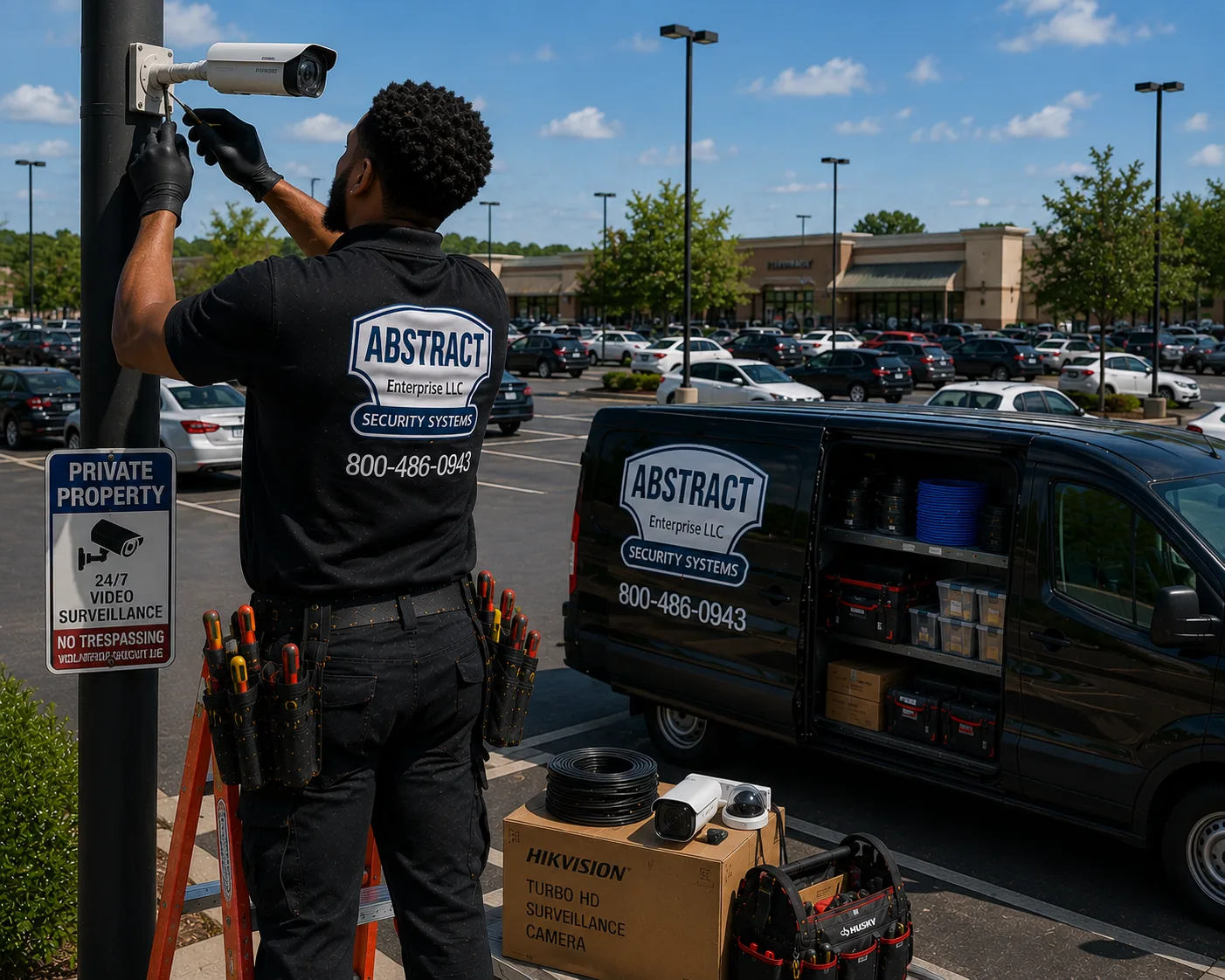
Bronx parking lot camera installation — pole-mounted 4K bullet camera for commercial lot coverage
Parking lot camera installation in the Bronx: a lift places a fixed 4K camera high on an existing lot pole, above the roofline of parked vehicles.
25+ Years Experience Same-Day Estimates100% Licensed & Insured$0 Monthly Fees

★ 4.7 · 201 Google Reviews  |  NYS Low-Voltage License #12000287431  |  Free on-site survey

We work throughout the Bronx, with our office at 460 E Fordham Rd.

Reviewed and updated July 29, 2026.

Request a Free Parking Lot Survey

THE NEIGHBORHOOD

The Bronx Parks Its Cars in Garages as Much as Lots

The Bronx is the parking-garage borough. Between Co-op City, Parkchester, the Mitchell-Lama towers and the NYCHA developments, an enormous share of the borough's parking is structured — multi-level decks and below-grade garages tied to resident housing rather than open commercial fields. That single fact shapes most of the camera work here: the problems are ramps and stairwells and assigned bays, not just an open lot with a fence around it.

Alongside that sits everything else. Retail plaza parking at Bay Plaza, along Fordham Road and out toward Throggs Neck; the industrial and food-distribution yards of Hunts Point and Port Morris, where trucks and trailers move around the clock; the auto row on Webster Avenue and Boston Road, with dealer inventory and body shops holding customer cars; hospital campuses at Montefiore, Jacobi and Lincoln; Fordham University; and the event-parking surge around Yankee Stadium on game nights. Each of these parks vehicles differently, and each fails differently when it is not watched.

The incidents that bring Bronx owners to a camera project are specific and local. Attended garages have had staff threatened for keys during vehicle thefts. Resident garages off Pelham Parkway have had rows of windows smashed in a single night. Crews have worked public garages between roughly midnight and dawn taking tires, rims and catalytic converters, and higher-end vehicles have turned up staged in Bronx garages used as makeshift storage. In several of those cases investigators leaned on plate reads at entrances, which is exactly where a designed system earns its place.

Whether footage helps in any given incident depends on the camera's position, the light, the weather, the lens, vehicle and plate condition, how recording was configured and the specifics of the property. Recorded footage may assist an investigation or an insurance claim; it does not guarantee an outcome, and no camera stops every event on its own. What a properly engineered Bronx system does is put usable coverage where the borough's parking actually gets hit.

WHAT WE INSTALL

Bronx Parking Property Types

Parking cameras are not one product. What goes on a resident garage deck at a housing development is not what goes on a Hunts Point fleet yard or a Fordham Road plaza. These are the property types we build for across the Bronx.

Housing-development garages and lots

Co-op City, Parkchester, Mitchell-Lama and NYCHA parking — multi-level decks, below-grade garages and surface lots with assigned bays, resident decals and management that answers to a board or authority.

Retail plaza and shopping-center lots

Bay Plaza, Fordham Road and Bruckner Boulevard centers — open fields with a long storefront line, heavy pedestrian crossings and high daytime turnover.

Industrial and fleet yards

Hunts Point and Port Morris trailer parking, box trucks and contractor vehicles behind fencing, with perimeter and gate coverage that has to work overnight.

Apartment and co-op parking

Smaller resident lots and tuck-under garages with assigned spaces, visitor parking and the recurring problem of vehicles that do not belong there.

Dealership and inventory lots

Webster Avenue and Boston Road auto row — rows of high-value vehicles that need perimeter coverage and plate capture at the gate.

Auto body and repair yards

Customer vehicles stored on site awaiting parts or payment, where responsibility for a car in your custody is the whole reason for the cameras.

Hospital and university campuses

Montefiore, Jacobi, Lincoln and Fordham University parking — around-the-clock use with staff, patients and students arriving and leaving in every shift.

House of worship lots

Parking that follows a fixed weekly and holiday rhythm, quiet most of the week and full at predictable times.

Event and stadium-area parking

Yankee Stadium-area lots and garages that swing from near-empty to full on a schedule, with crowds moving through on foot.

Bronx parking lot camera layout survey mapping entrance and aisle coverage
Parking lot camera layout survey in the Bronx: every position is assigned a zone — ramp, aisle, bay line, gate — before anything is mounted.

Unauthorized Parking and Enforcement Coverage

On a resident lot at a Bronx development, the most common day-to-day complaint is not theft — it is vehicles parked where they should not be. Non-residents using a resident garage, cars in assigned or reserved bays, contractors and visitors overstaying, and abandoned vehicles that sit for weeks.

Cameras support enforcement rather than perform it. A plate camera at the entrance produces a record of what came in and when; fixed cameras over the bay lines show which spaces are occupied and by whom. That record is what management, a board or a towing contractor acts on. The system documents the pattern so a decision has evidence behind it; it does not tow the car itself, and whether a given clip supports action depends on coverage and conditions.

For an assigned-bay problem, the useful design pairs an entrance plate read with overhead coverage of the bay rows, so a vehicle can be followed from the gate to the spot it took. For a general trespass problem, the entrance and the exits carry the weight, because the question is who is coming and going rather than where each car sits.

Garage Ramps, Gates and LPR Placement

Because so much Bronx parking is structured, the license-plate camera in this borough is more often a ramp-and-gate camera than a street-curb camera. It reads vehicles entering and leaving a garage at the point where they slow and line up, which is exactly the condition a plate reader needs.

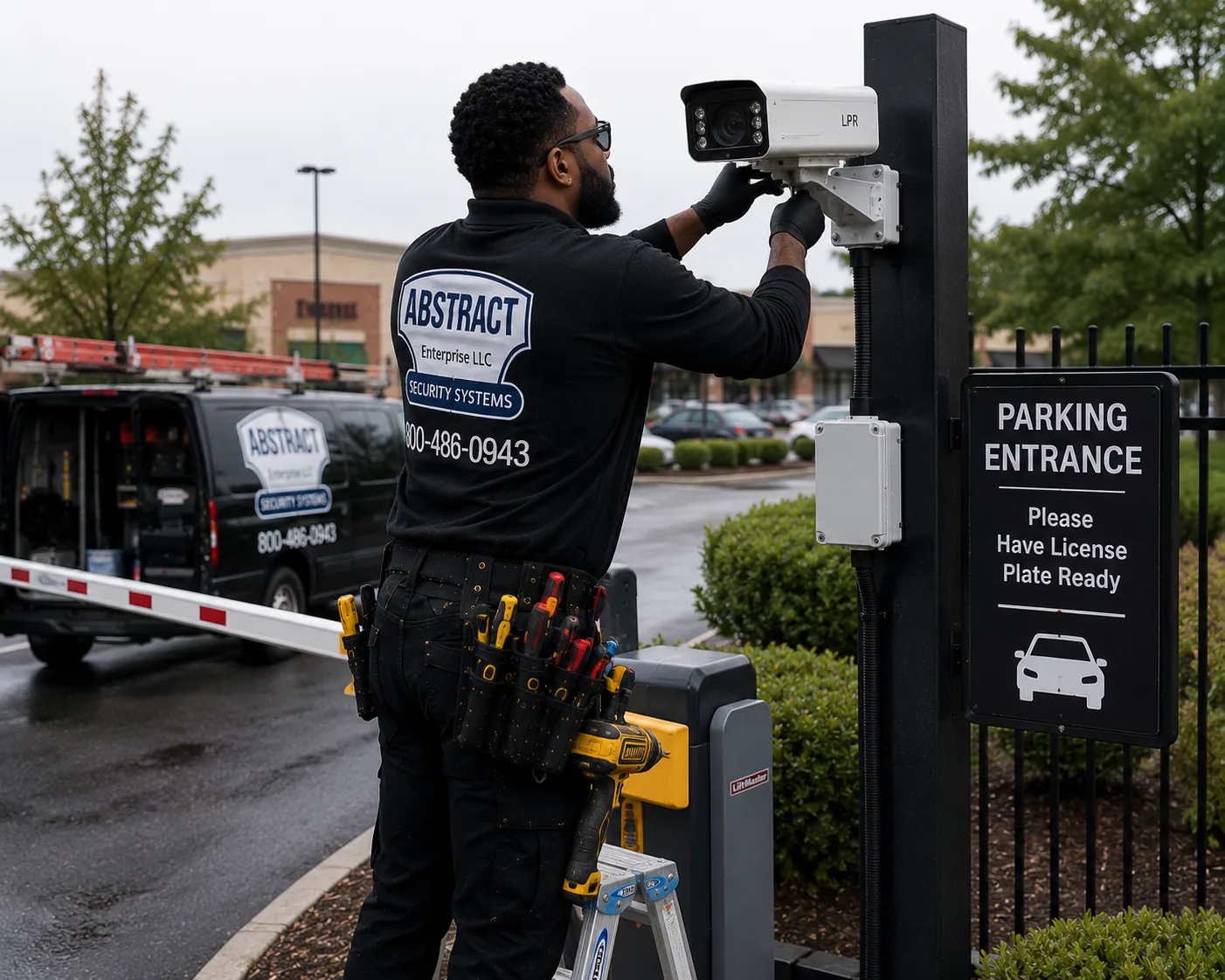
Bronx parking garage LPR license plate camera at gated entrance lane
Parking garage LPR camera in the Bronx: the plate camera sits low and square to the ramp lane, framed tight so a plate fills enough of the frame to read.

An LPR camera is a dedicated instrument, not a general-coverage camera pointed at a gate. It runs a narrow field, a fast shutter to freeze a moving plate, and framing tight enough that the plate occupies a usable share of the image. One reader covers one controlled lane; a two-lane ramp or a separate entrance and exit needs its own reader on each.

What a plate read is worth still depends on real conditions — a plate caked in road salt over the winter, a temporary tag, a vehicle taking the lane at speed, or a camera knocked out of aim all degrade the result. Placement, framing and maintenance decide whether the entrance record is dependable. The plate camera handles identification at the gate; separate fixed cameras handle the wide view of the ramp and the deck.

Mounting: Building Faces, Poles and Garage Structure

The Bronx offers more to mount to than most boroughs and in more forms. Housing developments and hospital campuses have tall buildings overlooking their lots; garages have concrete decks and ceilings; open lots and yards have room for poles. Each surface is a different job.

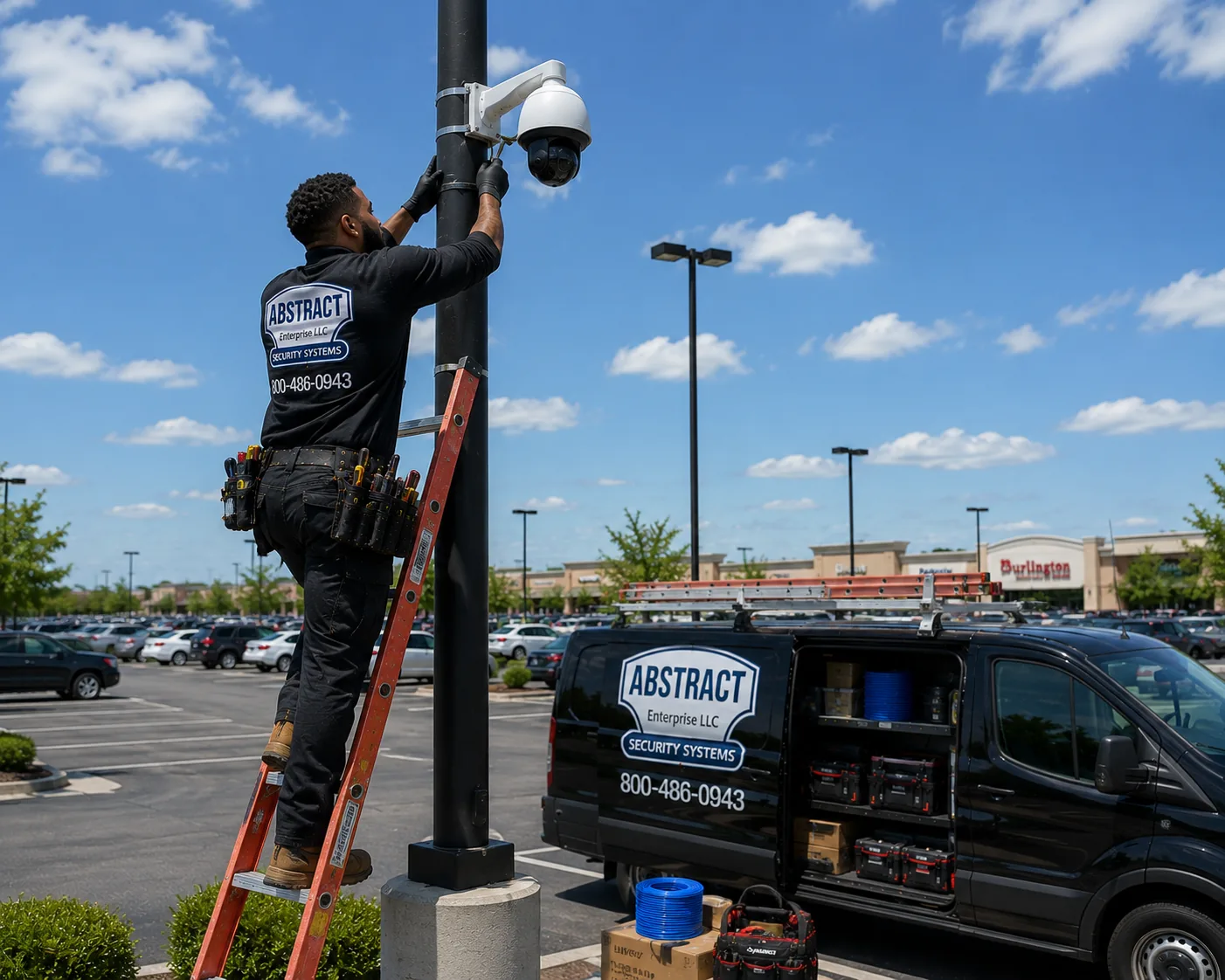
Bronx parking lot PTZ camera mounting on pole for wide open-lot coverage
Pole-mounted PTZ parking lot camera in the Bronx: the bracket is squared and cable is dressed down the shaft before the steerable camera is aimed and presets are set.

Building faces are the first choice wherever they serve the coverage. They are inexpensive, power is close, and they avoid foundation work. The limit is reach: a camera on a residential tower covers the near rows well and loses plate-level detail across a large field, and the wrong wall sees the backs of vehicles rather than their fronts.

Garage structure is its own discipline. Concrete decks and ceilings mean short-range domes per bay, cameras at ramp turns and stairwell doors, and cabling run along the structure rather than trenched. Low ceilings, columns that block sightlines and headlight glare on painted walls all shape where a camera actually goes.

Existing lot light poles are usable on many Bronx properties, subject to the usual checks: who owns the pole, whether the circuit is switched by photocell or timer, whether the shaft has usable interior space, and whether the structure can carry more equipment. Poles at the property edge may belong to the utility.

Dedicated camera poles come in when open ground has no other vantage — a Hunts Point yard, a large plaza field. Footing sized for height and wind loading, conduit stubbed through the base with spare capacity, grounding and surge protection on outdoor conductors. On former industrial parcels the excavation question is what is buried, and markouts precede the dig.

Mounting to poles, electrical and structural work, trenching, and work in a historic district such as parts of Riverdale may each call for sign-off from the property owner, the utility, or the authority having jurisdiction, and AESS confirms which apply before work starts.

Trenching, Buried Surprises and Bronx Ground

Getting cable across a Bronx lot or yard is usually possible and rarely predictable. South Bronx parcels in Port Morris, Mott Haven and Hunts Point have been factories, rail yards and fuel depots, while the north sits on rock — and what is under the surface reflects that history more than any current drawing does.

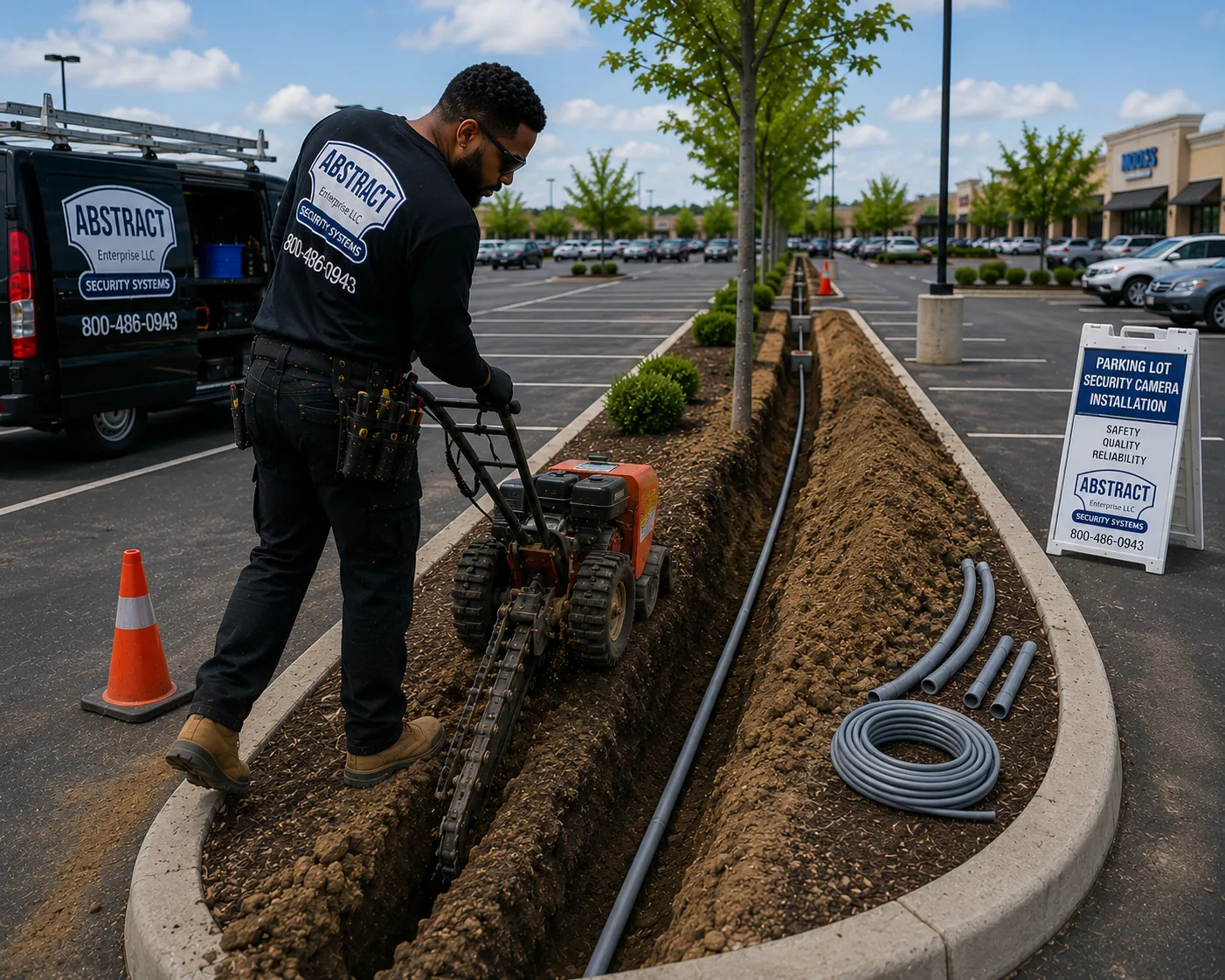
Bronx parking lot camera conduit pathway trenched across a lot island
Parking lot camera conduit pathway in the Bronx: markouts precede every dig, and the run follows islands and margins where the layout allows.

Markouts come before any excavation, without exception. Beyond the marked utilities, what turns up on Bronx parcels is old conduit from prior tenants, abandoned fuel lines and tank infrastructure on former industrial ground near the Harlem and Bronx rivers, irrigation on landscaped campus properties, and stormwater structures that are not where the plan says. The design assumes the trench will find something, and the pathway is routed with an alternative already chosen.

Rock changes the calculation in the north Bronx. In Riverdale, Fieldston and Kingsbridge Heights, shallow bedrock can make open trenching slow or impractical, and the answer shifts toward surface conduit on walls and existing structure, shorter runs to building-mounted positions, or a wireless link across a span that cannot be cut.

Route selection favors landscape islands and unpaved margins where they exist. Where a pathway must cross pavement, saw-cut and patch is direct, and directional boring is the alternative on recently resurfaced lots or where an owner prohibits cutting. Conduit rather than direct burial is standard, sized generously with a pull string left in, because reopening a working Bronx lot disrupts a property that depends on that parking daily. Restoration closes the work: compacted backfill, surfaces reinstated, striping repainted where cuts crossed stalls.

Long Runs, Field Switches and Surge Protection

Many Bronx garages and small lots are compact enough that copper reaches, but the large developments, hospital campuses and Hunts Point yards push past Ethernet distance limits, and multi-building sites raise the ground-potential question that fiber solves.

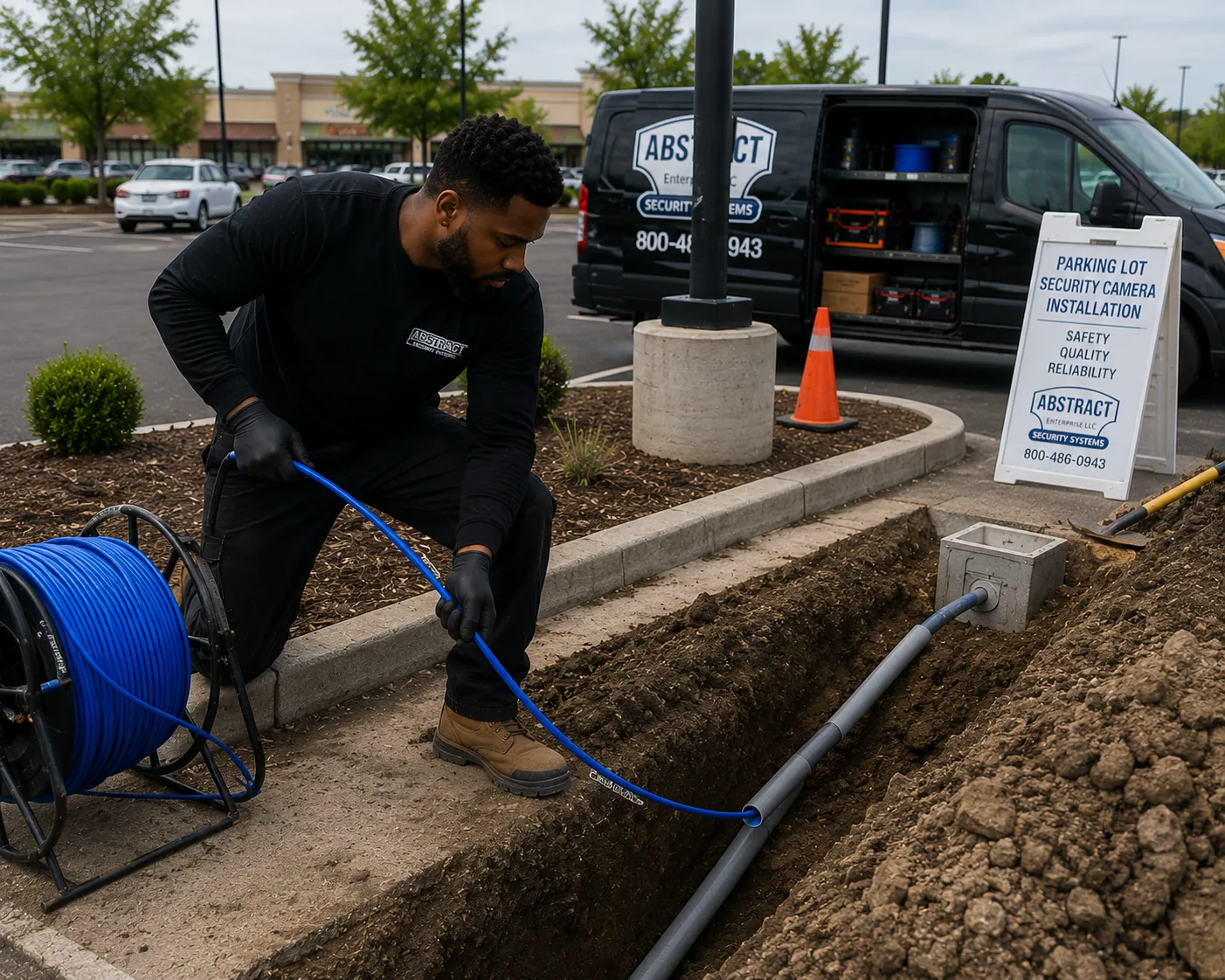
Bronx parking lot camera cable installation pulled into trenched conduit
Parking lot camera cable installation in the Bronx: conduit is sized generously with a pull string left in, because reopening a working lot disrupts the property.

Cat6 with PoE carries the majority of runs, one cable delivering data and power, with environment-rated cable on outdoor and in-conduit segments.

Fiber takes over on long backbones and between separate buildings on a campus or development. Beyond distance, fiber carries no metal, which removes the surge coupling and ground-potential problems that affect long copper runs between structures on different electrical services — a real consideration at a multi-building complex.

Point-to-point wireless handles gaps that should not be trenched: across a shared driveway, over recently resurfaced pavement, up a rock ledge in the north Bronx, or out to a detached yard area. Engineered directional links need genuine line of sight, which on a Bronx yard means accounting for a trailer that may eventually park in the path.

Bronx parking garage PoE switch terminated in a sealed enclosure
Parking garage PoE switch in the Bronx: aggregating a camera cluster to one switch and one uplink cuts the amount of ground or structure that has to be opened.

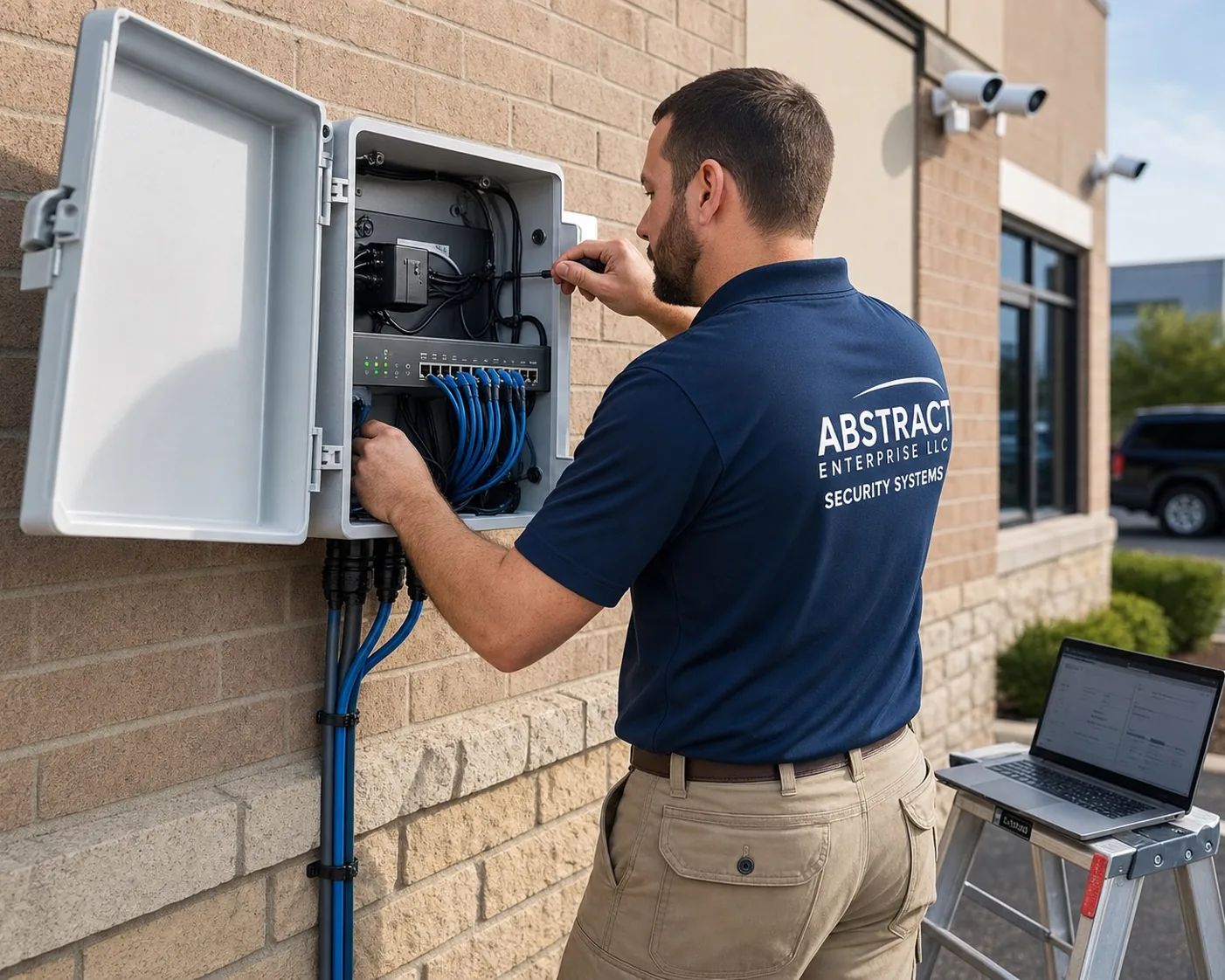
Field enclosures aggregate a cluster of cameras to one switch and one uplink, which reduces trenching and structural fishing on larger properties. Enclosures need rated cable entries, intact gaskets, bottom penetrations and thermal treatment — a sealed box in full sun over open asphalt runs hot, and winter cold can keep equipment below start-up temperature.

PoE budget is sized for actual combined draw rather than port count. Cameras with heaters, illuminators or motorized functions draw far more than a basic fixed camera, and a switch specified by camera count drops cameras on the first cold night when every heater energizes. Surge protection and grounding are not optional outdoors: bonding first because every protective device references ground, then sacrificial surge devices at both ends of every outdoor run, on power and data, inspected after significant electrical events rather than assumed intact.

Sound-Side Exposure, Flood Zones and Salt

The Bronx has real coastline. Throggs Neck, Pelham Bay, City Island, Country Club and Soundview sit on the Long Island Sound and Eastchester Bay, and the Port Morris, Mott Haven and Hunts Point edges front the Harlem and East rivers. Parking on those properties faces conditions inland lots do not.

Salt in the air attacks hardware before it attacks cameras. Mounts, pole bands, fasteners, enclosure hinges and cable-gland entries corrode first, and a working camera hanging at the wrong angle because its bracket failed is still a failed position. Corrosion-resistant hardware and properly sealed enclosures cost marginally more at installation and decide whether a mount lasts five years or fifteen on a waterfront Bronx property.

Flood exposure changes equipment placement. On properties with a history of tidal or storm flooding — low ground near the Sound or the rivers — recorders, field enclosures, power supplies and battery backup are mounted above expected water levels rather than at convenient height. A recorder on the floor of a ground-level office in a flood-exposed area is a recorder that gets replaced along with the footage inside it. Where elevation requirements affect the work they may involve owner or AHJ review, and post-flood inspection of terminations, junction boxes and pole bases belongs in the maintenance plan, because water intrusion often shows up as intermittent faults weeks later rather than immediate failure.

Night Coverage on Bronx Lots and Garages

Most of what a Bronx parking system is bought to capture happens after dark, and darkness is where cheap cameras fail. A camera that produces a clean daytime image and a smeared, useless one at 2am is common, and it is the night image that matters on a resident garage or a fleet yard.

Bronx parking lot night camera testing verifying low-light coverage after dark
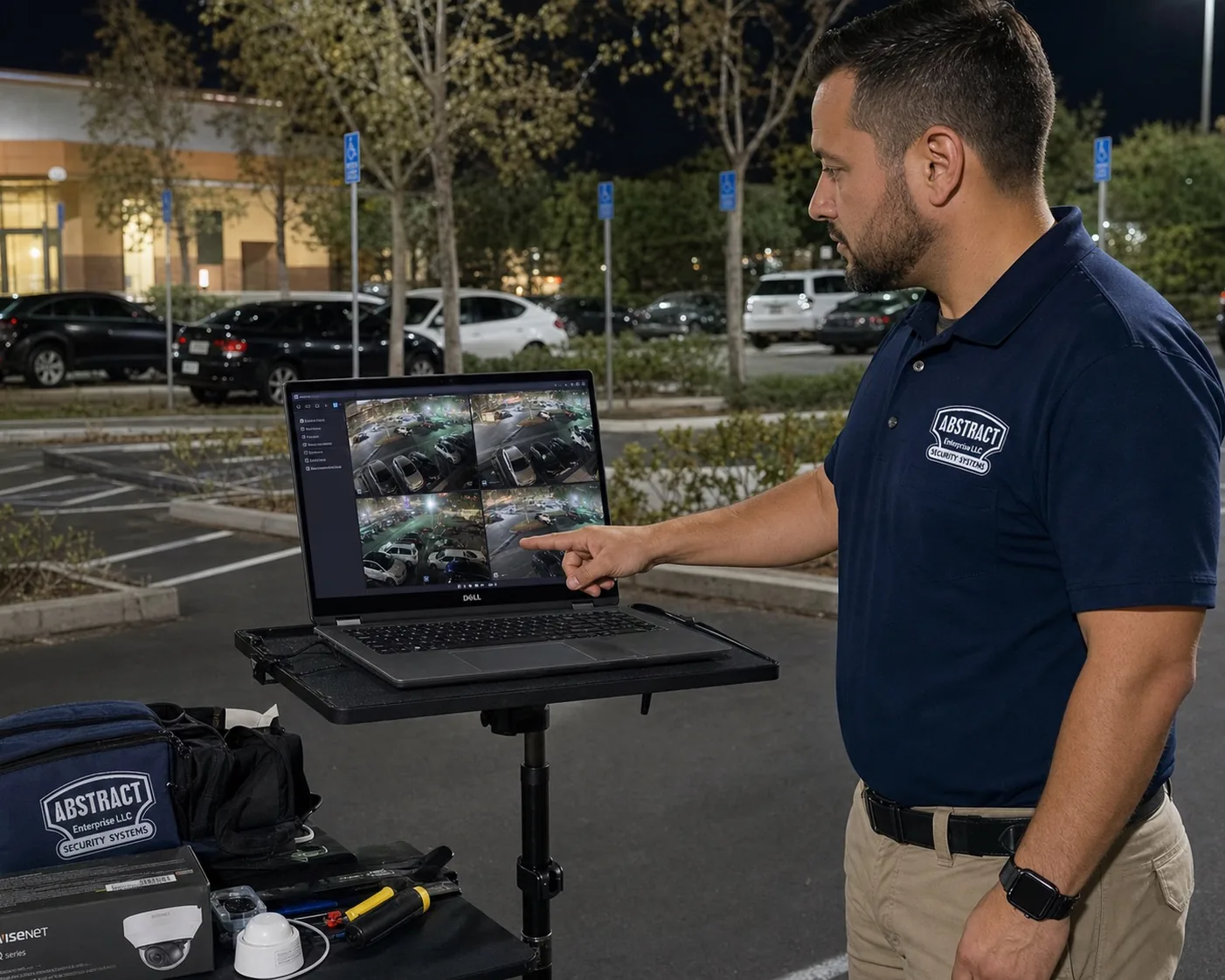
Parking lot night camera testing in the Bronx: dark rear rows, ramp mouths and glare from adjacent signage are checked against each position after dark, not at noon.

Garages and lots present opposite night problems. An open Bronx lot may have dark rear rows and bright glare where a streetlight or an illuminated sign sits in frame; a garage has pooled light under fixtures and deep shadow between them, plus headlight glare bouncing off painted concrete. Both are solved by matching the camera and its light handling to the actual position rather than trusting a spec sheet.

The tools are real low-light sensors, supplementary infrared or white light where the scene needs it, and wide-dynamic-range handling for the bright-and-dark mix. Every position is verified after dark during the survey and again at handover, because the only night performance that counts is the one on your property, not the one in a brochure.

Camera Classes for Bronx Lot and Garage Work

Different positions call for different cameras. A single class across a whole property means some positions are overbuilt and others fall short.

Fixed bullet

The default for long, one-direction views — down aisles, along a fence line, across a ramp. A visible housing that also reads as a deterrent.

Turret

Low-profile housings that re-aim quickly and avoid the internal infrared reflection domes get in rain; strong on building faces and garage ceilings.

PTZ

Steerable coverage for large properties — preset tours, zoom on request — backed by fixed cameras, since a PTZ pointed one way is blind the other.

Panoramic and multisensor

One mounting point covering a very wide field, useful over a plaza field or a full garage level from a single position.

LPR

Dedicated plate readers for garage ramps and gated lanes — narrow framing, fast shutter, tuned for plates rather than scenes.

Corrosion-resistant and vandal-rated

Hardware selected for salt exposure on Sound-side properties and for reach on garages and low positions where a camera can be tampered with.

Bronx parking lot 4K bullet camera mounted beside posted surveillance signage
Parking lot 4K bullet camera in the Bronx: bullet and dome housings cover different roles on the same property, aimed for aisles, gates and bay lines.

Bronx Structured Garages and Decks

Structured parking is the Bronx signature, and it is a different build from an open lot. Co-op City, Parkchester, hospital decks and the garages under newer residential buildings all need coverage designed around concrete rather than sky.

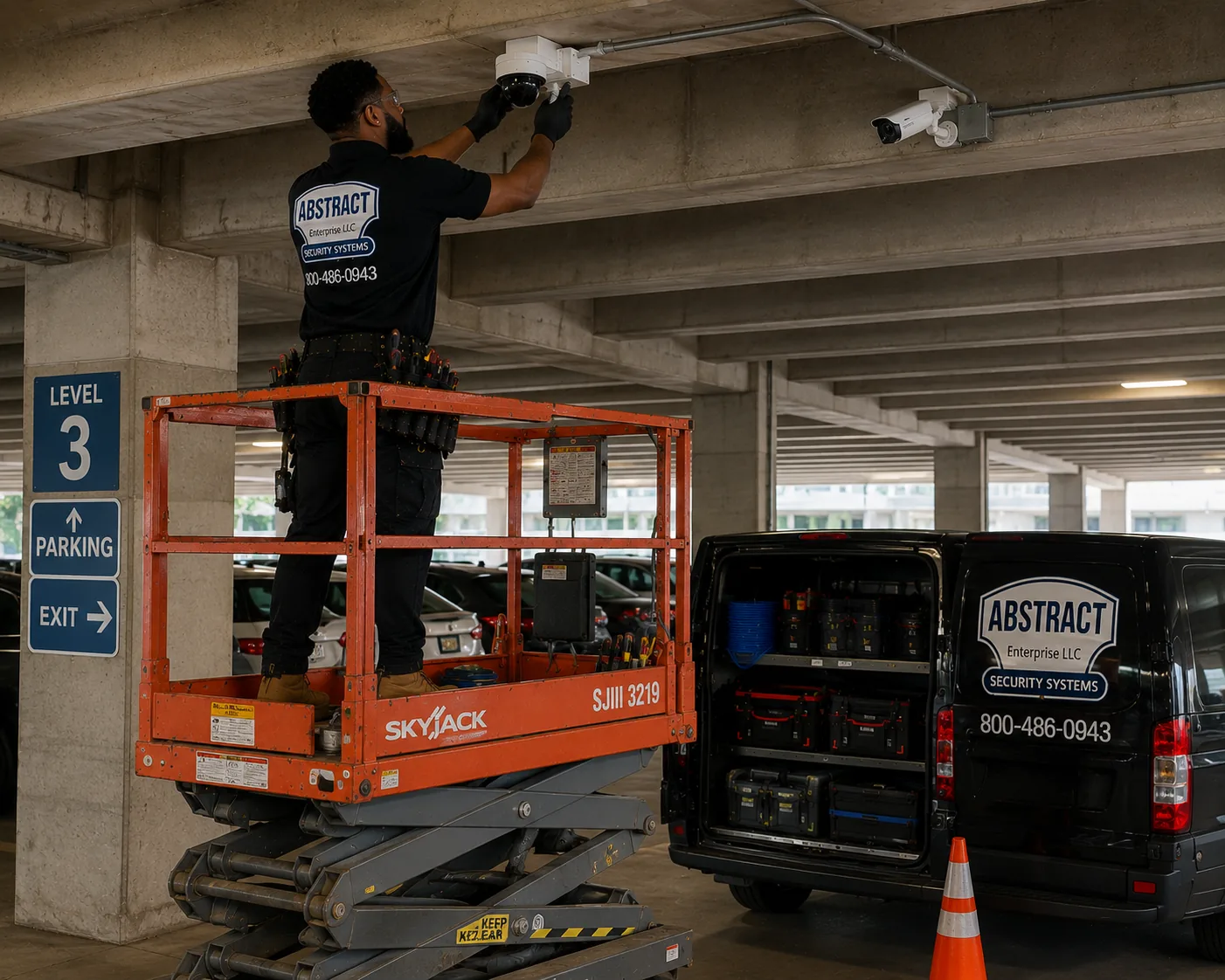
Bronx parking garage camera installation — dome coverage across multi-level deck
Parking garage camera installation in the Bronx: structured parking needs short-range domes per bay area, cameras at ramp turns, and coverage at every stairwell and elevator door.

A garage design covers the entry and exit ramps, each level's drive lane, the bay rows, and the pedestrian pinch points — stairwell doors, elevator lobbies and the cashier or attendant booth where there is one. Ramps and stair doors matter as much as the bays, because that is where people and vehicles cross and where an incident is most likely to be caught in transit.

Concrete works against wireless and long copper alike, so cabling follows the structure, cameras sit clear of columns that would blind them, and positions account for headlight glare on painted walls. Where a garage sits below grade in a flood-exposed part of the Bronx, the head-end equipment goes up, not down, for the same reason it does on an open waterfront lot.

Recording, Retention and Remote Access

The cameras are half the system; the recorder and how long it keeps footage are the other half. On a Bronx property the retention target is set by how fast damage or a dispute is actually noticed — a resident may not report a scraped bumper for days, and a management office may only review footage when a claim comes in.

Storage is sized against camera count, resolution, frame rate and recording mode to hit that target, not guessed. A system that overwrites before anyone looks is worse than useless because it creates the impression of coverage without the substance. Recorders live in a secured, ventilated indoor space with reliable power and network, and on flood-exposed ground they live above the water line.

Remote access lets a superintendent, a managing agent or an owner view live and recorded footage from a phone or desktop, with accounts scoped so the right people see the right cameras and nothing more. Who holds those accounts, and how they are revoked when staff or agents change, is decided at the survey rather than after the first problem.

Analytics, Alerts and Escalation

Modern cameras can flag a person in an area after hours, a vehicle stopped where it should not be, or a line crossed at a perimeter. On a Bronx yard or a resident garage those alerts turn a passive recording into something that can prompt a look in near-real-time.

Analytics assist attention; they do not replace it. Tuned well, they cut the noise so a real event stands out; tuned badly, they cry wolf until nobody checks. Setup accounts for how the property is actually used — a fleet yard has legitimate overnight movement, a resident garage does not — and the rules are written to that reality.

Escalation is a decision, not a default. Some Bronx properties want alerts to a phone, some to an on-site guard, some only recorded for later review. Whatever the path, it is agreed in advance and tied to who is actually available to act, because an alert nobody receives is the same as no alert at all.

Repair, Takeover and Modernization

A large share of Bronx work is not a fresh install — it is a system somebody else put in that no longer does the job. Cameras dead for months, a recorder nobody can log into, analog cameras that were never sharp enough to read a plate, coverage that made sense before the lot was restriped.

Bronx parking garage camera repair and system takeover service
Parking garage camera repair in the Bronx: takeovers start at the enclosure — checking the switch, power and terminations before condemning cameras or recorder.

A takeover starts at the enclosure and the recorder: what is actually installed, what still works, and what the cabling and power will support. Frequently the cameras are fine and the recorder, switch or a run of cable is the fault; sometimes the cabling is sound and only the cameras need replacing. Either way the goal is to keep what is good and replace what is not, rather than rip out a working backbone.

Modernization is usually the analog-to-IP step: keeping usable coaxial runs where an encoder makes sense, replacing what cannot carry a modern image, and adding the plate and night capability an old system never had. On a Bronx garage that often means the difference between footage that identifies a vehicle and footage that only proves something happened.

Industrial Yards and Fleet Parking

Hunts Point and Port Morris are their own world. Trailer parking, box trucks, contractor fleets and the food-market yards run overnight, and the parking is really a secured yard rather than a customer lot. The camera problem is perimeter, gate and asset coverage, not tidy rows of cars.

Perimeter and fence-line cameras watch the boundary where a yard is most exposed; a plate reader at the gate records every truck and trailer in and out; fixed cameras cover the areas where vehicles and equipment sit. On a yard with legitimate all-night activity, analytics are tuned to that reality so a genuine intrusion still stands out against normal movement.

These properties push the infrastructure hardest — long runs to fiber, field enclosures to cut trenching, hardened outdoor hardware, and grounding and surge protection across multiple structures on different electrical services. The design assumes weather, dirt and constant use, because a Hunts Point yard gives equipment no easy life.

Auto Body Yards and Vehicles Held for Customers

Webster Avenue, Boston Road and the side streets of the south Bronx hold a dense auto trade — dealers, body shops, tire and parts businesses. When a customer's car sits in your yard awaiting parts or payment, it is in your custody, and that responsibility is the whole reason for the cameras.

Coverage on these yards frames the stored vehicles, the gate and the perimeter, with enough resolution to document condition on arrival and departure and to catch tampering overnight. A plate camera at the gate ties a vehicle to a time in and a time out, which settles most disputes about what happened while a car was on the lot.

Because auto-row yards are frequently fenced open ground rather than buildings, they lean on poles, hardened enclosures and perimeter design — the same toolkit as a fleet yard, aimed at customer vehicles rather than a trucking operation.

COVERAGE AREA

Parking Lot Cameras Near the Bronx's Landmarks

We cover parking across the borough, from the southern industrial edge to the northern hills. A sample of the areas and landmarks that anchor the work:

Co-op City & Bay Plaza

One of the largest concentrations of resident garage and lot parking in the city, plus the Bay Plaza retail center alongside it.

Hunts Point & the Food Distribution Center

Wholesale market yards, fleet and trailer parking on the peninsula, operating overnight behind fencing.

Yankee Stadium & the Grand Concourse

Event-driven lots and garages around 161st Street, with scheduled surges on game nights.

Fordham Road & Fordham University

Major retail corridor and campus parking, high daytime pedestrian volume and mixed commercial lots.

Parkchester & Westchester Avenue

A planned community's resident parking under the elevated 6 line, with assigned-bay and visitor coverage needs.

Pelham Parkway, Morris Park & Montefiore/Jacobi

Resident garages and hospital-campus parking in an area with a documented garage break-in pattern.

We also serve parking properties in Riverdale, Throggs Neck, Mott Haven and Port Morris, and coordinate coverage across adjacent areas as a property's footprint extends beyond one neighborhood.

BUILDING SPECIALISTS

Coverage Zones on a Bronx Lot or Garage

A parking property is a set of zones, each with its own job. Coverage is designed zone by zone rather than by scattering cameras and hoping.

Entry and exit ramps

The highest-value positions in a Bronx garage. Every vehicle passes slowly, which is where identification and plate capture belong.

Gate and curb cut

On open lots and yards, the controlled entrance — the point where a plate read and an overview camera earn their place.

Drive aisles and levels

The circulation spine. Coverage follows the lane rather than each car, catching vehicles in transit across the property.

Bay rows and assigned spaces

Where vehicles sit and where damage and misuse happen. On resident lots, the assigned-bay problem lives here.

Stairwells and elevator lobbies

Garage pedestrian pinch points where people cross vehicles — framed lower and tighter for faces.

Perimeter and fence line

The property boundary, particularly on Hunts Point and Port Morris yards, where the exposure is greatest.

Rear and service areas

Loading docks, dumpster and compactor corrals, service doors and the corners a lot's routine traffic never reaches.

Secondary access points

Gaps in fencing, rear gates and shared driveways with a neighboring property — the ways in that get overlooked.

Pedestrian paths

Routes between vehicles and building doors, framed to catch people at a usable height rather than from a distant pole.

Reviewing an Incident on a Bronx Property

The test of a system is the day something happens and someone has to find it. A design that looks complete on a drawing can still fail this test if nobody thought about how footage gets retrieved.

A usable review starts with knowing roughly when and where — a resident reports a scraped car, a manager notices a missing plate, a yard finds a trailer gone. From there the entrance and exit cameras establish who came and went, the aisle cameras follow the vehicle across the property, and the position over the spot or the gate provides the identifying detail. That chain only exists if the cameras were placed to hand off to one another, which is a design decision made long before the incident.

Whether the footage ultimately identifies anyone depends on the same real conditions that govern every position — light, angle, distance, weather and configuration. Recorded footage may assist an investigation or a claim; it is not a guarantee, and part of a good handover is being honest at the survey about what each camera can and cannot deliver.

Privacy, Signage and Shared Properties

Parking cameras on a Bronx property should see the property. Aiming cameras so their useful coverage stays on the lot, the garage and its approaches — rather than into a neighbor's windows or a private yard — is both good practice and good design, since a camera pointed off-property is usually a camera wasted.

Posted signage that a lot or garage is under video surveillance is a normal part of the deterrent and sets expectations for residents, staff and visitors. On developments and shared plazas, who may view footage and how requests are handled is worth writing down before the first request arrives, so a board, a managing agent and residents all understand the policy.

On multi-tenant and shared properties, one system can serve several parties with accounts scoped so each sees only what concerns them. The governance — who owns the recorder, who administers accounts, who authorizes an export — is settled at the survey, because a shared system with no clear owner becomes nobody's responsibility.

Service Standards

Licensed NYS contractor

Abstract Enterprises Security Systems operates from 460 E Fordham Rd in the Bronx under NYS Low-Voltage License #12000287431. License details, insurance certificates and references are provided in writing before work is scheduled.

Survey before pricing

Every proposal follows a free on-site survey. Mounting, power, pathway and retention are settled against your actual property, not estimated from a phone call.

Itemized proposals

Every position listed with the job it does, the route its cable takes, the recorder and drive capacity, and what is excluded. No lump sums.

Workmanship standards

Weatherproof terminations, drip loops, surge protection and grounding on outdoor runs, and corrosion-appropriate hardware on Sound-side properties.

Walkthrough and documentation

We close out by working through live viewing, playback, export and mobile access with you, and leave a documentation package for current staff.

Three-year warranty

Products supplied by AESS carry a three-year warranty for normal wear and tear, with the exclusions set out in the warranty terms below.

Questions to Ask Any Bronx Parking Lot Installer

A short list that separates a designed system from a box of cameras on a wall:

HOW IT WORKS

How a Bronx Parking Lot Project Runs

Each project moves through the same steps, adapted to the property. Start and completion timing turns on lot and garage conditions, equipment availability, access to the property, permitting where it applies, and how large the project is.

  1. Walk the property in use — We schedule the first visit for a busy hour, because a Bronx lot's real sightlines only appear when the rows are occupied and a garage's traffic only shows at shift change. Vans and SUVs are the wall the design has to see over.
  2. Settle mounting rights and structure — Whether a building face, a garage deck, an existing pole or a new footing carries each camera, and whose permission a neighboring wall needs, is fixed before the position enters the proposal.
  3. Establish what is under and around the property — Prior industrial use near the rivers, shallow rock in the north, and existing conduit all show up here. Markouts are ordered and the pathway is planned with a second route already chosen.
  4. Confirm circuits and panel capacity — Lot lighting is frequently photocell-switched and a garage's power is its own question. We trace the candidate circuit back to the panel with the electrician before anything depends on it.
  5. Written proposal by position — Each camera listed with its zone, lens choice and mounting point; the pathway plan; recorder and drive capacity with the retention that produces; and what is excluded.
  6. Install in phases that keep the property open — Sequencing is planned around resident and business use so ramps, levels or bays come out of service in blocks rather than all at once, coordinated with management or the managing agent first.
  7. Terminate, protect and ground — Outdoor runs get drip loops and weatherproof terminations, surge devices at both ends, and corrosion-appropriate hardware on Sound-side parcels.
  8. Night check, then handover — Every position is verified after dark against street spill, illuminated signage, ramp lighting and headlight glare, then we work through live view, playback, export and mobile access with you.

The Site Survey on a Bronx Property

  1. Purpose conversation — what prompted the project, what has actually happened here, and who will use the footage.
  2. Zone mapping — ramps, gates, drive lanes, bay rows, stairwells and elevator lobbies, rear and service areas, secondary access points and the perimeter.
  3. Sightline check in use — what a delivery truck or a row of SUVs hides from each candidate position during real traffic, not at 7am.
  4. Mounting inventory — usable building faces and garage structure, neighboring walls and whose permission they need, existing poles and their ownership, and where new poles would need footings.
  5. Power audit — panel locations, available circuits, and whether candidate circuits are switched by photocell or timer.
  6. Buried and structural review — prior site uses near the rivers, shallow rock in the north, known excavations, and arranging markouts before any trenching.
  7. Pathway assessment — island and margin routes, structure runs in garages, pavement crossings requiring cut or bore, existing conduit, and wireless line-of-sight where trenching or rock makes digging impractical.
  8. Exposure review — salt and flood considerations on Sound-side and riverfront properties, and where equipment must sit above expected water levels.
  9. Head-end location — a secured, ventilated indoor space with network access and reliable power, above the water line where flooding is a risk.
  10. Night visit where warranted — actual lighting, dark gaps, ramp glare, adjacent illuminated signage and after-hours fixture schedules.
  11. Retention arithmetic — how fast damage is noticed on this kind of Bronx property, then drives sized against camera count, resolution, frame rate and recording mode.
  12. Constraints review — resident and business use, board, association or authority approvals, historic-district review in parts of Riverdale, and any owner, utility or AHJ review the scope requires.
  13. Written proposal — positions with zones and lenses, the pathway plan, equipment schedule, the retention calculation and line-item pricing.

Fourteen Things to Settle Before a Bronx Lot Project Starts

  1. Define the primary job. Enforcement, incident documentation, plate records, dispute resolution or deterrence — the priority order changes the design.
  2. Write down the actual incident history — what happened, where on the property, at what hours and how often.
  3. Identify every approver — owner, board, managing agent, housing authority or congregation committee — and what each needs to sign off.
  4. Confirm mounting rights and structure for any neighboring wall or shared garage deck the design might use, in writing.
  5. Trace the lighting or garage circuit back to its panel before assuming a pole or a deck position can carry a camera through the day.
  6. Identify every way in — main ramp, gate, service entrance, rear gate, gaps in fencing, shared driveways.
  7. Say what you know about the ground — prior site uses near the rivers, shallow rock in the north, known tanks or old conduit — and arrange markouts.
  8. Ask about resurfacing — a recently paved lot usually rules out saw-cutting and pushes the pathway to boring or a wall route.
  9. Set a realistic discovery window. Same day, several days, or longer — this drives storage sizing more than any other input.
  10. Pick the head-end room and decide who holds keys and passwords; on flood-exposed ground, confirm its elevation.
  11. Settle the network — which service reaches the property, whether cameras get their own segment, and who administers it.
  12. Decide the footage-access policy for residents, tenants, staff or an agent before the first request arrives.
  13. Think about gating and entry. If a gate arm, credentials, decals or a garage callbox is anywhere on the horizon, say so at the survey so conduit and camera positions serve both.
  14. Budget for maintenance. Seasonal lens cleaning, post-storm re-aiming, corrosion inspection near the water, firmware updates and periodic playback testing keep a system honest.

Maintenance Plan for a Bronx Lot or Garage System

Outdoor and garage systems degrade quietly, and the Bronx mix of weather, salt near the Sound, and constant activity works against them. This schedule is written to be handed to a property manager or superintendent.

Monthly

Quarterly

Seasonally

Annually

PRICING

What Drives Bronx Parking Camera Pricing

Bronx projects vary too widely for honest flat pricing — a resident garage deck at a development and a fenced Hunts Point yard are not the same job at any size. Pricing is determined after a free on-site survey, and the proposal itemizes exactly where the money goes.

Coverage and equipment

  • Camera count and camera classes, including vandal-rated and corrosion-resistant options
  • Number of LPR lanes and ramp or gate configurations
  • Recording retention target and storage sizing
  • Monitoring, deterrence and alerting scope

Site conditions and labor

  • Usable building faces and garage structure versus poles required
  • Pole quantity, height and footing requirements
  • Existing power, and whether circuits are switched
  • Existing conduit that can be reused
  • Trenching distance, pavement crossings, rock, and restoration
  • Fiber or wireless requirements between levels, zones or buildings
  • Lift requirements for high positions or garage ceilings
  • Sound-side hardware specification and flood-level equipment placement
  • Property access, resident and business use, and keeping the lot usable during work
  • Permit or AHJ review where applicable, including historic-district review

A survey answers all of these for your specific property, and the itemized proposal prices each driver on its own line.

COMMERCIAL PARKING CAMERAS

Business Parking Camera Systems in the Bronx

Commercial parking in the Bronx concentrates along a handful of real corridors, each with its own parking character and its own coverage priorities.

Fordham Road

One of the busiest retail corridors in the city — dense storefronts, high daytime pedestrian volume, and lots that sit behind or beside the shopping strip.

The Hub — 149th Street & Third Avenue

The south Bronx's central retail district, with tight lots, constant foot traffic and high turnover.

Bruckner Boulevard

Mixed commercial and industrial frontage with larger parcels, big-box centers and truck movement along the expressway corridor.

Webster Avenue & Boston Road

Bronx auto row — dealerships, body shops, tire and parts businesses with inventory rows and customer vehicles held overnight.

Hunts Point

The food-distribution peninsula and its surrounding industrial yards, where the parking is really a secured overnight yard.

Bay Plaza & Co-op City

A large northeast Bronx retail center beside one of the city's biggest resident-parking complexes, mixing shopper and resident lots.

Commercial work carries its own review where it applies — NYC construction and electrical codes on structural and power work, FDNY access and fire-lane clearance at large complexes, and ADA considerations at public-facing lots — and AESS confirms what applies to a given property before work starts.

YOUR QUESTIONS ANSWERED

People Also Ask: Parking Lot Cameras in the Bronx

Theft, break-ins and parking enforcement

Can cameras cut down on overnight break-ins in a resident garage?

They help in two ways: a visible camera at the ramp and over the bay rows deters, and if a break-in still happens, the footage supports the report and any insurance claim. In areas with a documented garage break-in pattern, coverage at the entrance and along the rows is where usable identification comes from — though whether a given clip identifies anyone depends on light, angle and how the cameras were placed.

Our garage attendants have been threatened for keys during a theft — can cameras help?

Coverage of the attendant booth, the key board and the ramp records who approached, what happened and which vehicles left, which is exactly the evidence such an incident turns on. Recorded footage may assist an investigation; it does not prevent a confrontation on its own, so the design focuses on capturing the entrance, the booth and the exit clearly rather than promising deterrence it cannot deliver.

We keep losing catalytic converters and rims — what actually gets a usable identification?

Converter and rim thefts tend to happen fast and low, often between midnight and dawn, so the useful cameras are positioned and lit for that: coverage down the bay rows and at the ramp, with night performance verified after dark rather than assumed. A plate read at the entrance ties vehicles to times in and out, which is frequently what connects a pattern of thefts across a garage.

Assigned resident spots at our complex get taken — can cameras support enforcement?

An entrance plate read paired with overhead coverage of the bay lines lets management follow a vehicle from the gate to the spot it took, which is the record a board or towing contractor acts on. The cameras document the misuse; they do not tow the car, and whether a clip supports action depends on the coverage of that particular row.

Reading license plates at ramps and gates

Can a plate camera read cars going up a gated garage ramp?

Yes — a ramp or gated lane is close to ideal for a plate reader, because vehicles slow and line up there. It needs a dedicated LPR camera with tight framing and a fast shutter, one per controlled lane, aimed square to the lane rather than a general camera pointed at the gate.

Can one reader cover a Hunts Point yard gate with trucks moving all night?

One plate reader covers one controlled lane, so a single-lane gate can be read with one camera and a two-lane or separate in/out gate needs its own on each. On a yard with legitimate all-night truck movement, the reader logs every entry and exit and the analytics are tuned so normal activity does not bury a genuine intrusion.

Garages, mounting and Bronx site conditions

Do ceiling domes in a garage under a building work as well as poles on an open lot?

They work well for what a garage needs — short-range coverage of bays, ramps and stair doors from the deck above — but the design is different from an open lot's poles. Low ceilings, columns and headlight glare on painted concrete shape where each dome goes, and cabling follows the structure rather than a trench.

Part of our lot backs onto the water on the Sound side — does that change the hardware?

Yes. Salt air corrodes mounts, fasteners and enclosure hardware before it affects cameras, so Sound-side and riverfront properties get corrosion-resistant hardware and properly sealed enclosures. Where the ground floods, head-end equipment is mounted above expected water levels rather than at convenient height.

There's an elevated 4 or 2/5 line directly over the lot — does that affect mounting?

The elevated structure itself is not usually a mounting surface for a private lot, but it shapes the scene — it casts shadow, the columns block sightlines, and the strip below is busy. The design works around it by positioning cameras to see under and around the structure rather than fighting it, using building faces and poles clear of the shadow line.

Our north-Bronx lot is on rock — can poles still be set?

Shallow bedrock in Riverdale, Fieldston and Kingsbridge Heights can make open trenching and deep footings slow or impractical, so the design leans toward building-mounted positions, surface conduit on existing structure, and wireless links across spans that cannot be dug. Where a pole is genuinely required, the footing is engineered for the actual ground conditions.

Events, upgrades and who controls the system

The lot fills up on Yankee Stadium game nights — does that change the plan?

A scheduled surge changes the emphasis toward the entrances, the pedestrian flow and the pay points, since the risk on an event night is volume and crowd rather than a quiet overnight break-in. The design covers the gates and the walking routes at capacity, and retention is sized so an event night's footage is still there when a claim comes in days later.

Can we keep the recorder we have and add cameras to it?

Sometimes — it depends on the recorder's channel count, its resolution support and whether it can accept the cameras you want to add. A takeover starts by checking exactly that, keeping a recorder and cabling that will carry a modern image and replacing only what genuinely limits the system.

A managing agent runs several of our buildings — who holds the login?

That is decided at the survey and written into the account structure: the owner or board typically holds the top-level account, and the agent and on-site staff get scoped accounts that see only their cameras. When an agent changes, those accounts are revoked, which is why the governance is agreed before the system goes in rather than after.

EQUIPMENT

Types of Parking Camera Equipment We Install in the Bronx

Fixed bullet cameras

The workhorse on Bronx lots and yards, aimed down aisles, along a fence line and across a ramp, with a visible housing that reads as a deterrent.

Turret cameras

Low-profile housings for building faces and garage ceilings, resistant to the internal reflection that domes suffer in rain and glare.

PTZ cameras

Steerable positions on the borough's larger plaza, campus and yard properties, backed by fixed cameras so no view is left blind.

Panoramic and multisensor

Wide coverage from one mounting point over a plaza field or a full garage level, cutting the number of separate positions.

LPR cameras

Plate readers set at garage ramps and gated lanes, catching vehicles where they slow, with framing and shutter tuned for plates.

NVRs and storage

Recorders sized to the retention calculation and installed in a secured, ventilated space, above the water line where flooding is a risk.

Field switches and enclosures

Sealed enclosures on poles, walls and garage structure so a camera cluster reaches the recorder on one uplink.

Surge protection and grounding

Bonding at every pole and metallic enclosure, with sacrificial surge devices on outdoor power and data runs.

AI OVERVIEW REALITY CHECK

AI Overview: What the Search Results Miss About Bronx Lots

Google's AI Overview returned nothing for this specific query at the time of writing, so this section does not quote or attribute an AI Overview. Instead it answers the common claims that circulate across search results, AI summaries and DIY articles about parking-lot cameras — the generalizations that do not survive contact with an actual Bronx property.

“Parking lot cameras cost a fixed price per camera”

The single most repeated claim online is a tidy per-camera figure, and it is the least useful thing you can carry into a Bronx project. The number that matters is installed cost for your property, and on a Bronx lot the install is most of the cost: whether the camera lands on a building face or a new pole footing, whether cable runs along a garage deck or crosses a resurfaced lot, whether the ground is diggable soil or north-Bronx rock.

Two Bronx properties with the same camera count routinely price differently because their conditions differ. A resident garage where domes mount to the deck and cable follows the structure is a lighter install than an open Hunts Point yard needing poles, footings, trenching, fiber between buildings and hardened enclosures. The equipment line can be nearly identical while the labor and infrastructure lines are not close.

That is why an honest number comes from a free on-site survey and an itemized proposal, not from a search result. The proposal prices each driver — cameras, LPR lanes, poles, trenching, retention — on its own line, so the figure reflects the property in front of you rather than a borough-wide average that fits nobody.

“Wireless cameras are easier and cheaper”

Wireless sounds like it removes the hard part — the cabling — and on a Bronx property it usually just moves the hard part somewhere less visible. Cameras still need power, so a “wireless” camera on a pole or a fence still requires a conductor run to it; the only thing wireless removes is the data cable, and only if the link is engineered.

A dependable point-to-point wireless link needs genuine, maintained line of sight. On a Bronx yard that means accounting for a trailer that may eventually park in the path; across a lot it means a clear span that a future truck or a new structure will not block. Consumer wireless cameras on shared Wi-Fi, by contrast, drop frames, miss the moment and fail exactly when the property is busiest.

Wireless earns its place in specific spots — across a driveway that should not be cut, over recently resurfaced pavement, up a rock ledge in the north Bronx — as an engineered directional link, not a default. For most positions on a Bronx lot or garage, cable on PoE remains more reliable, and reliability is the whole point of a camera you are counting on after dark.

“Just use the existing light poles”

Existing lot poles are often usable, and the advice to use them skips every question that decides whether they actually can be. Who owns the pole — edge poles frequently belong to the utility, not the property. Whether the shaft has usable interior space for cable. Whether the structure can carry added equipment and wind load.

The circuit is the quieter problem. Lot lighting on a Bronx commercial parcel is frequently switched by a photocell or timer, which means a camera powered from that circuit goes dark when the lights do — the opposite of what a parking camera is for. Confirming that the candidate circuit is unswitched, or providing switched-independent power, is part of a real design.

Where an existing pole checks out, using it saves a footing and a trench, and we do. Where it does not, forcing it produces a camera that is intermittently dead or improperly loaded, which is why the pole question gets traced back to the panel and the ownership record before anything depends on it.

“Analytics mean the system watches itself”

Analytics are genuinely useful — a camera can flag a person in an area after hours, a vehicle stopped where it should not be, or a line crossed at a perimeter — and the claim that they let a system run itself is where the usefulness gets oversold. Analytics assist attention; they do not replace a person deciding what to do with an alert.

Tuning is everything, and it is property-specific. A Hunts Point yard has legitimate overnight movement; a resident garage does not; a plaza lot is busy by day and quiet at night. Rules written without regard to how the property is actually used either miss real events or fire so often that staff stop looking — and a system that cried wolf last month is ignored this month.

Escalation has to connect to someone who can act. An alert to a phone nobody carries, or to an inbox nobody opens, is the same as no alert. On a Bronx property the path — phone, on-site guard, or recorded-for-review — is agreed in advance and matched to who is genuinely available, so the analytics produce action rather than a log nobody reads.

“A DIY kit will cover the lot”

A boxed kit covers a driveway or a small yard, and the leap from that to a Bronx parking property is larger than the marketing suggests. Open lots and multi-level garages are a matter of scale — distances past what kit cabling reaches, camera counts past what a small recorder holds, and night conditions a consumer sensor cannot handle.

The parts a kit leaves out are the parts that make parking footage usable: real low-light performance across dark rear rows and ramp mouths, weatherproofing and corrosion resistance for a Sound-side property, surge protection and grounding on outdoor runs, and retention sized so footage is still there when damage is finally noticed days later. A kit that overwrites in three days on a property where disputes surface in a week is coverage in appearance only.

There is also the matter of holding aim and staying online through a Bronx winter of plows, salt and cold that keeps un-heated equipment below start-up temperature. A designed system accounts for all of it; a kit accounts for none of it, which is why a lot or garage that matters is not a DIY job.

“A matching service will find me a lot specialist”

Lead-generation sites — the Angi, HomeAdvisor and Thumbtack model — present themselves as finding you the right installer, and what they actually do is sell your contact details to whoever paid for the category. The “match” is a billing relationship, not an assessment of who is competent to design parking coverage for a Bronx garage or a Hunts Point yard.

For a low-voltage install in New York, the thing that matters is not on those profiles: whether the contractor is licensed, insured and willing to put the license number and insurance in writing before scheduling. A parking-lot system that involves poles, trenching, electrical work and structural mounting is not a handyman task, and the licensing exists precisely because the work carries real consequences.

Working directly with a licensed local contractor means the survey, the design, the install and the warranty sit with one accountable party rather than a rotating cast of leads. AESS is a licensed NYS low-voltage contractor operating from 460 E Fordham Rd in the Bronx, and the license and insurance are provided in writing before any work is scheduled.

“Cameras will stop the problem”

The most consequential claim is the one that overpromises the outcome. Cameras deter and they document, and those are real, valuable things — but a camera does not physically stop a theft in progress, and treating one as a guarantee sets an expectation the technology cannot meet on any property.

What a well-designed Bronx system reliably does is raise the odds. A visible camera at the ramp discourages the opportunist; clear coverage of entrances, aisles and bays produces a record that supports a police report or an insurance claim; a plate read at the gate connects a vehicle to a time. Whether that record identifies anyone in a specific case still depends on light, angle, distance, weather and how the footage was configured — recorded footage may assist, but it does not guarantee.

Honest expectations are part of the design. At the survey we say plainly what each camera can and cannot deliver on your property, so the system is judged by what it was built to do — deter, document and support a case — rather than by a promise no camera anywhere can keep.
Talk Through Your Bronx Lot or Garage

Tell us the property, the entrances and what has been happening, and we will map coverage and put a per-position plan and calculated retention in front of you.

Get a Free Quote   Call (347) 934-8335   Speak to a Tech

FAQ

Bronx Parking Lot Camera FAQ

At a NYCHA or Mitchell-Lama development, who approves a lot camera plan first?

It depends on the development's structure — a NYCHA property, a Mitchell-Lama co-op and a private management company each have their own approval chain, typically running through management and a board or authority. We identify every approver at the survey and provide the license, insurance and an itemized plan in writing so the decision has what it needs.

Can a garage callbox or door intercom tie into the camera system later?

Often yes — if a callbox, intercom or gate control is on the horizon, saying so at the survey lets us run conduit and place camera positions so both are served without reopening the work. Integrating entry and cameras is a common Bronx pairing on resident garages, and planning for it early is far cheaper than retrofitting.

Can cameras also cover the dumpster corral and compactor area?

Yes, and it is worth doing — dumpster and compactor corrals are common sites for dumping, tampering and after-hours activity on a Bronx property. A fixed camera framed on that corner, with night performance verified, brings a frequently ignored blind spot into coverage.

Do we have to post signs that the lot and garage are recorded?

Posted video-surveillance signage is a normal part of the deterrent and sets expectations for residents, staff and visitors, and we can point out where signs do the most good. It is sensible practice on a shared property; specific legal requirements are for the owner or their counsel to confirm.

Will winter road salt and plowing damage low cameras at a garage entrance?

They can — ramp mouths and low positions take salt spray, plow contact and slush, which is exactly why hardware there is selected and placed for it. Corrosion-resistant fittings, sealed enclosures and positions clear of plow paths keep an entrance camera working through a Bronx winter.

Can we share a single clip with the local precinct without exposing the whole system?

Yes — footage is exported as a specific clip for the time and camera requested, so you hand over the incident rather than access to the system. How exports are handled and who may authorize them is set up at install, so the process is ready before the precinct asks.

Can a temporary camera cover the lot while a ramp or building is under construction?

Yes — a temporary position or a relocatable camera can hold coverage while a ramp, a deck or a building alongside the lot is worked on, then fold into the permanent design afterward. It is planned at the survey so the temporary run and the final run do not duplicate work.

If the property changes managing agents, how do we keep control of the recorder?

The owner or board holds the top-level recorder account, and the agent and staff get scoped accounts that are revoked when they leave. Setting that structure up at install — rather than letting an outgoing agent hold the only credentials — is what keeps control with the property through a change.

Does the plan need to keep FDNY fire lanes and hydrant access clear at a big complex?

Yes — at a large Bronx complex, camera poles, enclosures and cabling are placed so they do not obstruct marked fire lanes, hydrants or FDNY access, and we confirm what applies before work starts. Coverage of those lanes is useful anyway, since they double as the property's main circulation.

How fast can a failed camera on a busy ramp be swapped out?

A single failed camera on an accessible position is usually a quick swap once the fault is confirmed; a takeover or a fault buried in cabling takes longer to diagnose. During warranty, products supplied by AESS are covered for normal wear and tear; after it, service runs $195 per hour with a three-hour minimum ($585).

Warranty and Service Terms

Abstract Enterprises Security Systems provides a three-year warranty on products supplied by AESS for normal wear and tear. It does not cover existing or customer wiring, customer-supplied equipment, lightning or other acts of God, power outages or surges, physical damage or unplugging, internet, router or phone changes, or camera readjustments requested after completion. After the warranty period, service is $195 per hour with a three-hour minimum ($585).

Read the full warranty terms.

Areas We Serve

Parking Lot Cameras NYC

Borough-wide coverage from one hub — open lots, decks, garages and operator-run parking across the five boroughs.
Parking Lot Camera Installation NYC

Manhattan

Below-grade and multi-level garages, attended and valet operations, and remaining surface lots.
Parking Lot Camera Installation Manhattan

Queens

Auto row inventory parking, mall and plaza lots, and mixed commercial parking across the borough.
Parking Lot Camera Installation Queens

Brooklyn

Retail, industrial, residential and institutional lots across the borough.
Parking Lot Camera Installation Brooklyn

Staten Island

Open lots, congregation and school parking, commercial plazas and waterfront marina parking.
Request a Staten Island lot survey

Long Island

Island-wide lot coverage — station parking, industrial yards, retail centers and coastal properties.
Parking Lot Camera Installation Long Island

Hudson Valley

Six-county coverage from Westchester and Rockland north through Orange, Putnam, Dutchess and Ulster.
Parking Lot Camera Installation Hudson Valley

All Bronx services

Cameras, access control, intercoms and the rest of the low-voltage catalog.
Security Camera Installation Bronx

SHOP OUR SYSTEMS

Parking Camera Packages & Pricing in the Bronx

Starter

$850–$1,500 installed

A compact resident lot or a small yard — four fixed cameras covering the entrance, an aisle and a rear line.

Standard

$1,500–$2,500 installed

A mixed resident-and-retail Bronx property — about eight cameras with full-aisle or per-level coverage and a plate camera at the ramp or gate.

Premium

$2,800–$4,500 installed

A large Bronx garage, plaza or Hunts Point yard — sixteen-plus cameras with LPR at each entrance, a PTZ position and rear-perimeter coverage.

Ranges are installed pricing for the scope shown; plate cameras, PTZ, pole footings, garage cabling and trenching move the figure within the range, finalized on your free survey.

Own your equipment already? A BYOE install is labor-only — we mount, cable and configure the cameras you provide.

No monthly fees — the system is yours. Service calls and post-install work run $195/hour with a three-hour minimum ($585).

Request a Survey   Call (347) 934-8335

COMPLETE SERVICES

Every Security Service We Offer in the Bronx

Security Camera Installation

Full camera system design and installation for Bronx commercial and residential properties.

Security Camera Repair

Fault-finding and repair on systems already in place — whoever installed them.

Commercial Camera Installation

Retail, office, industrial and multi-tenant property camera systems.

Apartment Building Cameras

Lobby, corridor, entry and back-of-house coverage — the natural companion to a resident lot or garage system.

Access Control Installation

Gate arms, credentials and readers for lots and garages moving from open to controlled entry.

Structured Cabling

Conduit, fiber and network infrastructure across the property, planned alongside camera pathways.

ALL AREAS SERVED

Parking Lot Camera Installation by Area

All parking pages in the silo appear here; an area without its own page yet is served directly, and the request-coverage link books a survey.

Parking Lot Cameras NYC

Citywide hub across the five boroughs.

Parking Lot Cameras Brooklyn

Retail, industrial, residential and institutional lots.

Parking Lot Cameras Manhattan

Below-grade and multi-level garages, attended facilities.

Parking Lot Cameras Queens

Mall and plaza lots, storefront lots, and truck and fleet yards.

Parking Lot Cameras Bronx

Development garages, Hunts Point yards, resident and event lots.

Parking Lot Cameras Long Island

Nassau and Suffolk lots, commuter and coastal properties.

Parking Lot Cameras Hudson Valley

All six Hudson Valley counties.

Areas without a page yet

Staten Island · Nassau · Suffolk · Westchester · Rockland · Orange · Putnam · Dutchess · Ulster

GET IN TOUCH

Request Your Free Bronx Parking Lot Survey

Tell us about the property and we will schedule an on-site survey, map the lot or garage, confirm mounting, power and pathway options, and produce an itemized proposal with a per-camera plan and calculated retention. Start and completion timing turns on lot and garage conditions, equipment availability, access to the property, permitting where it applies, and how large the project is.

Call (347) 934-8335
WhatsApp: wa.me/17186790359
460 E Fordham Rd, Bronx, NY 10458
NYS Low-Voltage License #12000287431
★ 4.7 · 201 Google Reviews

Bronx Parking Project Details