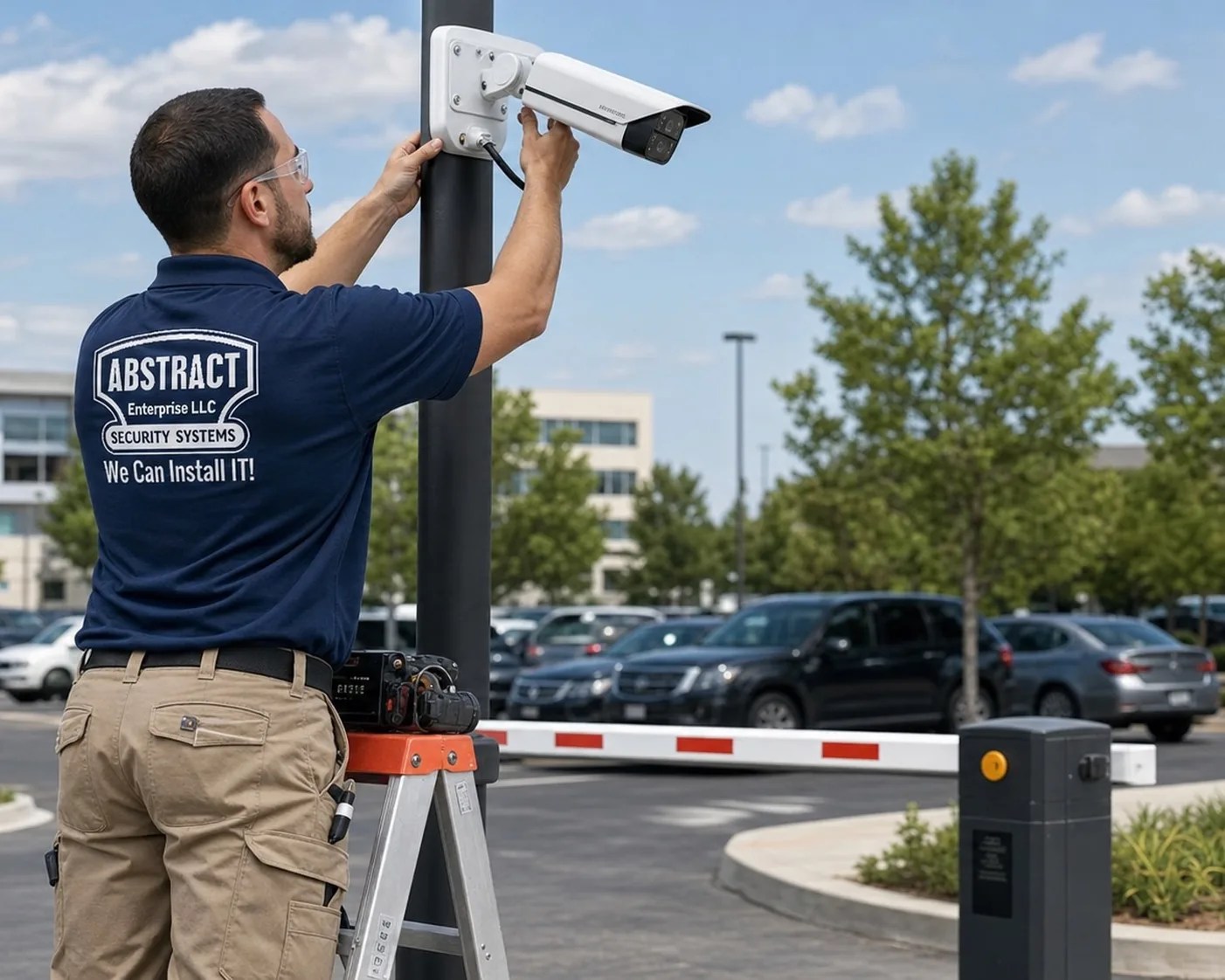
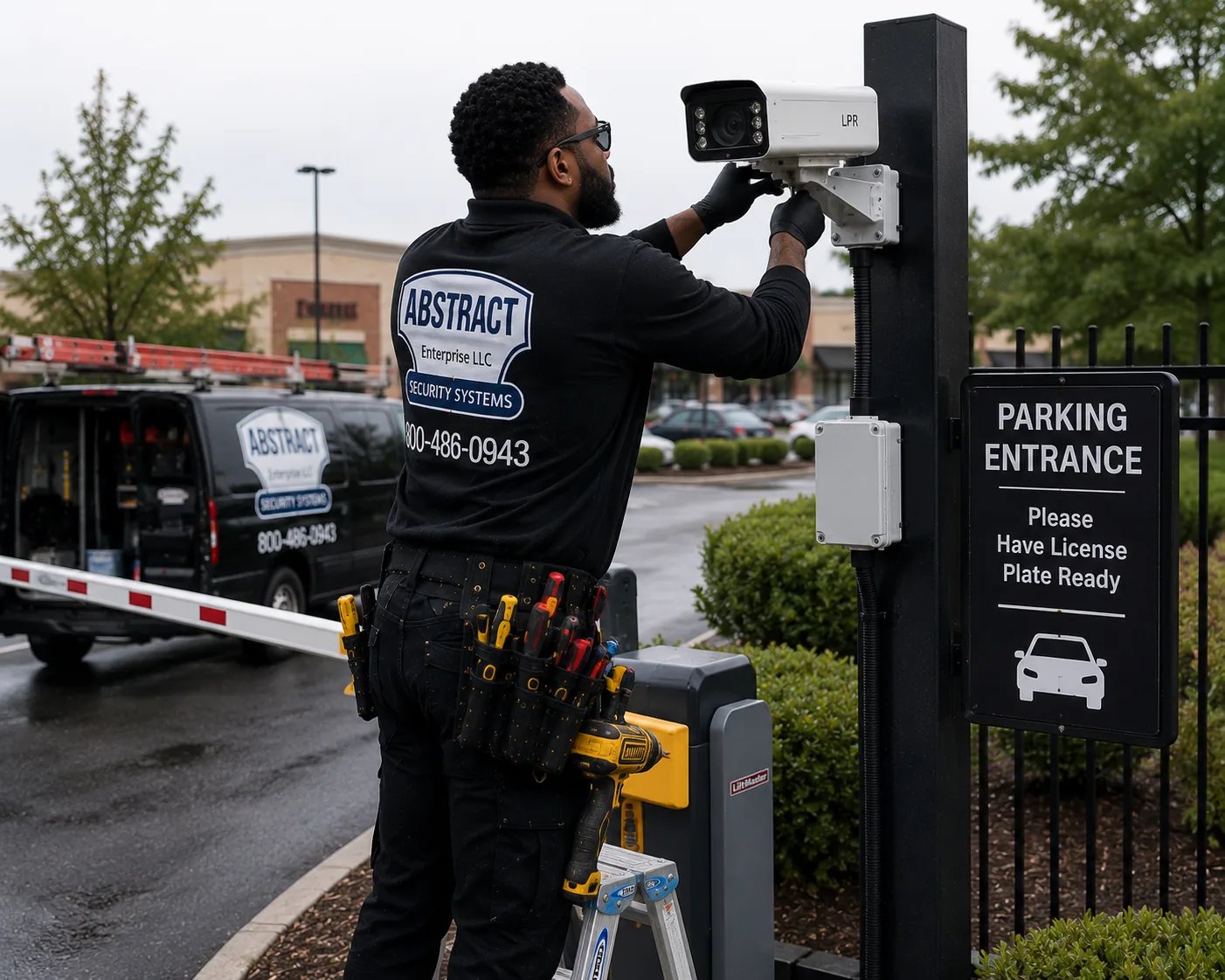
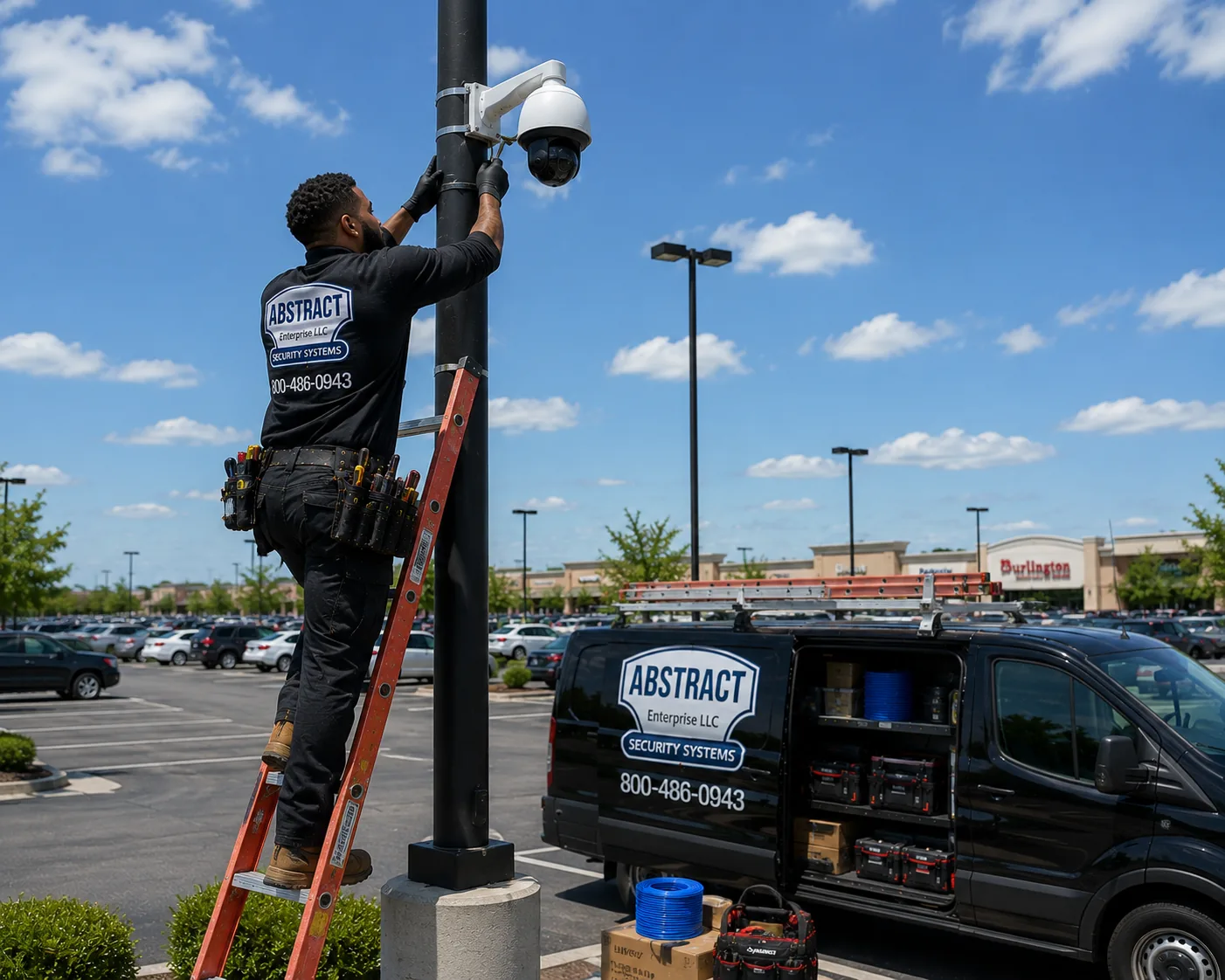
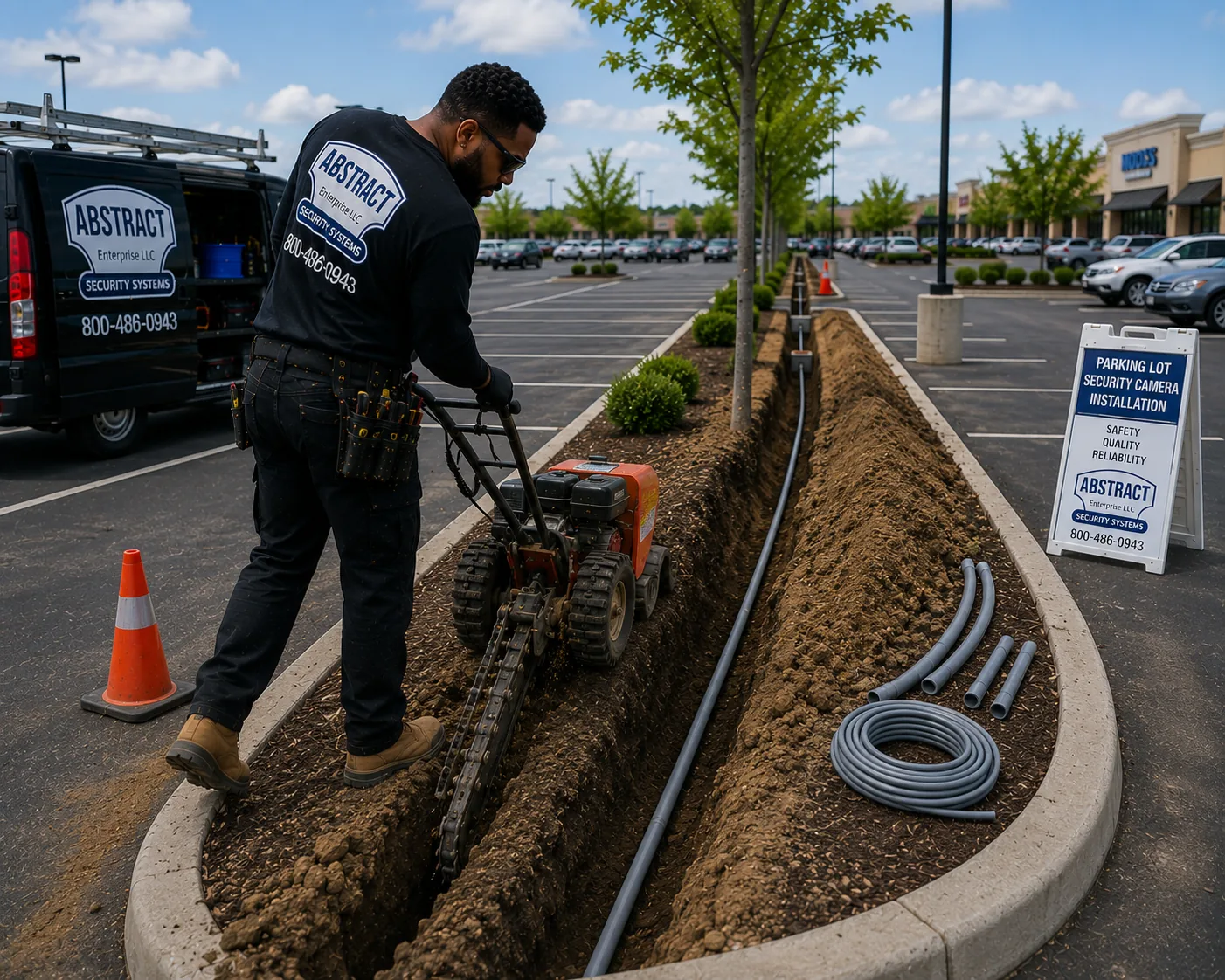
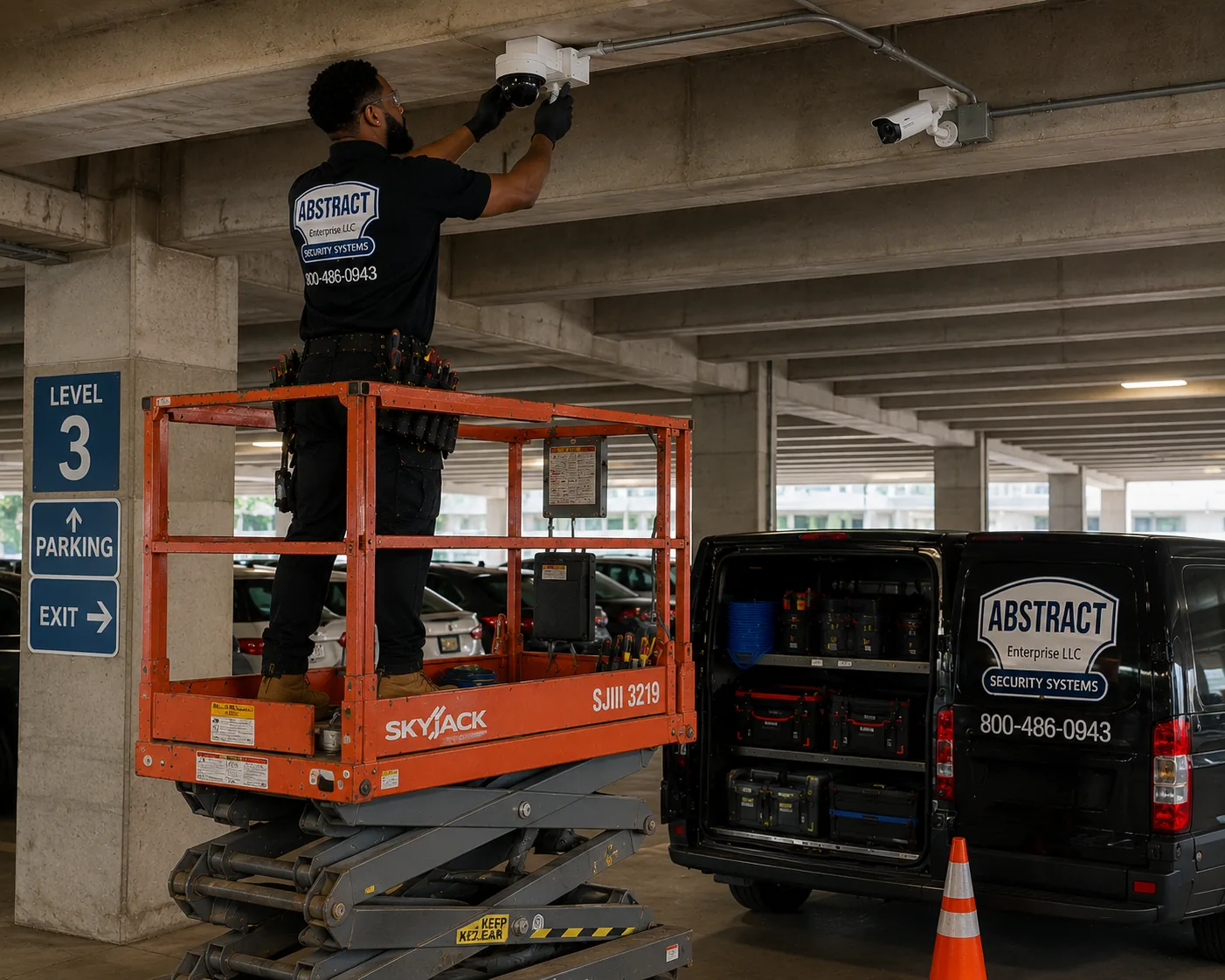
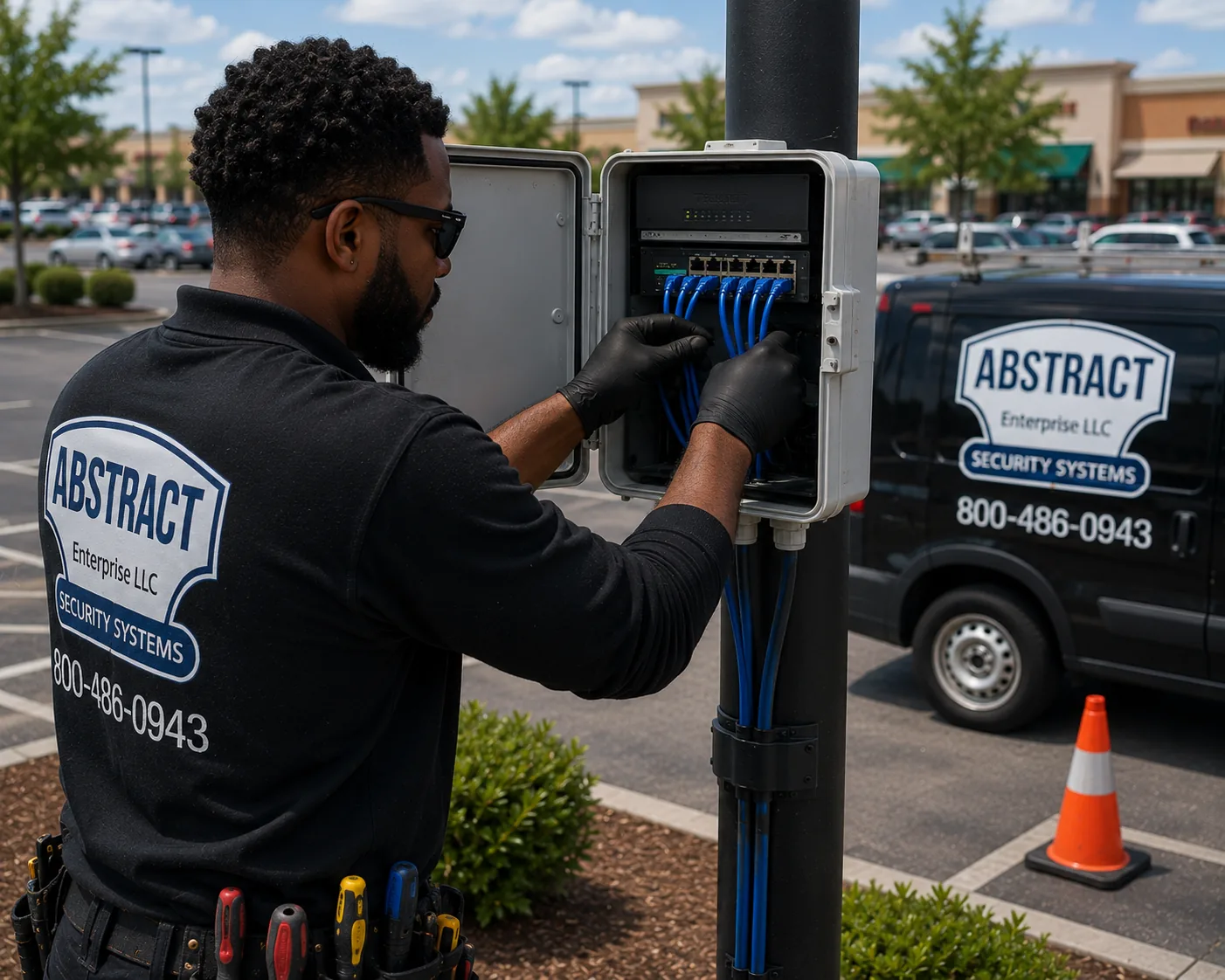
Camera systems for the full range of Suffolk County parking: shopping-center and big-box lots from Smith Haven Mall to the Tanger Outlets, Fire Island ferry and LIRR park-and-ride lots at Bay Shore, Sayville, Patchogue and Ronkonkoma, Islip MacArthur Airport and Hauppauge Industrial Park parking, South Shore marina and boatyard lots, Hamptons and East End seasonal parking, auto-dealership inventory rows, and house-of-worship and school lots — LPR entrance coverage, pole-mounted 4K cameras, trenched conduit and remote viewing, engineered from a free on-site survey.
· 201 Google Reviews | NYS Low-Voltage License #12000287431 | Free on-site survey
We serve all of Suffolk County, dispatched from our Brooklyn office at 1282 Troy Ave.
Reviewed and updated July 30, 2026.
THE NEIGHBORHOOD
Suffolk County is built around the car — the largest county on Long Island, its parking running from dense western downtowns to the open East End. The range takes in Smith Haven Mall in Lake Grove (the easternmost enclosed mall on Long Island, drawing shoppers from the Hamptons and the North Fork), the two Tanger Outlets at Deer Park and Riverhead, the Walt Whitman Shops in Huntington Station, Islip MacArthur Airport and the Ronkonkoma LIRR terminus, the Fire Island ferry lots at Bay Shore, Sayville and Patchogue, the Hauppauge Industrial Park, South Shore marina and boatyard parking, Hamptons and North Fork seasonal lots, dealership inventory rows, and house-of-worship and school lots that fill on a fixed weekly schedule. Almost nothing transfers cleanly from one to the next.
The theft pressure is specific and documented. The Suffolk County Police Department reported a catalytic-converter theft wave that peaked in 2021–22 and has stayed a persistent problem, and DA Raymond Tierney’s office has prosecuted organized crews — one Lindenhurst ring cut converters across the county before leading police on a 90-mph chase down the Southern State Parkway. Crews jack a truck or SUV and cut a converter in seconds; in one March 2026 Lindenhurst case, security footage captured a converter theft the owner never even heard until morning. Isolated lots and specific makes and models get targeted, which is why entrance capture, aisle coverage and a low-mounted plate view all earn a place on a Suffolk lot rather than one wide camera on the building.
That spread is why Suffolk parking resists a template. A design that fits the Smith Haven Mall ring road is wrong for a Fire Island ferry lot where cars sit all week, wrong again for a fenced boatyard on the Great South Bay or a Hamptons village lot that is packed in August and empty by November. The survey is doing real work here — it decides which of several unrelated approaches a property actually needs.
The second Suffolk characteristic is all-day and all-season parking. The LIRR terminus at Ronkonkoma, the Islip MacArthur lots, and the Fire Island ferry terminals at Bay Shore, Sayville and Patchogue draw cars that sit for days or a whole season, so any accessible private lot nearby absorbs overflow and unauthorized parking. Enforcement is one of the most common reasons a Suffolk property calls about cameras at all, and that shifts the design toward entrance coverage and plate records.
The third is the ground. Most of central Suffolk is pine-barrens outwash — sandy and usually easy to trench, but sitting over the sole-source aquifer, so environmental care and markouts come first. The South Shore around Lindenhurst, Babylon, Bay Shore and Mastic sits low with a high water table and a hard Sandy flood history, while the North Shore bluffs and the twin forks bring their own sand, salt and shoreline. Trenching is normally possible but never assumed, and markouts precede excavation on every job.
Abstract Enterprises Security Systems is a licensed NYS low-voltage contractor serving Suffolk County from our Brooklyn office at 1282 Troy Ave. Every proposal follows a free on-site survey.
WHAT WE INSTALL
Most Suffolk County parking is tied to shopping, commuting and the water. Shopping-center and big-box lots want the entrance, the rows and the outparcels covered; ferry and LIRR park-and-ride lots want entrance capture and plate records; marina and boatyard parking wants perimeter and gate coverage; and the strip-mall lots along Sunrise Highway and Montauk Highway want the aisles and doors watched without turning the place into a fortress.
Smith Haven Mall, the Tanger Outlets and the Route 58 and Sunrise Highway big-box plazas put thousands of spaces under one long storefront. A camera on the building reads the first two rows and gives up detail past that, so outparcels, far bays and rear delivery drives need their own pole positions to be seen at all.
The smaller lots tucked behind Sunrise Highway and Montauk Highway tenants usually sit under a shared lease, so the paperwork — who owns the recorder, who can pull a clip — is the first thing to settle. The coverage itself is compact: an entrance, an aisle and the doors.
Through the Hauppauge Industrial Park and the Ronkonkoma and Yaphank yards, the parcels hold trailers, box trucks, plant and stacked material behind a fence. The gate plate record carries the weight here, the perimeter counts as much as anything inside, and the surface is gravel or cracked asphalt rather than finished pavement.
Resident parking turns on assigned bays, a visitor row, and the footpaths people take from the car to their door. Where the cameras go is only half the job — board approval, the windows and yards residents can reasonably expect to keep out of frame, and a written policy for handing over footage all matter just as much.
These lots go from empty for days to packed within the hour on a service or a holiday. The layout leans on the entrance, the walkways linking the lot to the doors, and analytics windows tied to the long stretches when the property is genuinely shut.
Drop-off and pickup pack a short burst of cars and children into the same few minutes, then leave hours — and entire summers — of stillness. Cameras focus on the entrance, the drop-off lane and the paths children genuinely use rather than the vacant bays.
The Suffolk auto rows along Sunrise Highway and Route 112 park rows of high-value stock that sit still overnight and turn over with demo traffic by day. That wants perimeter and after-hours coverage, a clean entrance capture, and framing tight enough to tell movement in one row from the next.
Body shops and detailers along the county’s service corridors leave customers’ vehicles parked outside for days on end. Since the lot is holding someone else’s car, recording its condition at drop-off and collection counts for more than deterrence.
The hospital and larger institutional campuses run twenty-four hours, with staff coming and going in the dark at both ends of a shift and a mix of surface lots and decks across one site. The coverage has to read as well at 3am as it does at noon.
Smith Haven, the Stony Brook and South Shore University Hospital decks, the Ronkonkoma transit garages and the newer downtown-Patchogue and Huntington buildings brought below-grade and stacked parking to a county that is mostly open lots. It is a separate engineering problem, and it gets its own section further down.
Far more of these projects start with a parking headache than with a break-in. A private lot anyone can roll into — near a Fire Island ferry terminal, the LIRR or the airport, or a busy stretch of Sunrise Highway or Montauk Highway — quietly fills with all-day commuter and beach cars, and the owner foots the bill for parking the neighbourhood treats as free.
What a camera actually delivers for enforcement is limited, and it pays to spell out each piece rather than promise the problem away.
A record at the entrance. A plate camera on the curb cut puts a date and time on every car that enters. For an owner who tows or issues notices, that log turns a shouting match into a timeline nobody can dispute. How cleanly it reads depends on the shape of the entrance, which gets its own section further down.
Time in the space. Aisle and row footage shows exactly how long a car sat there. When the complaint is a commuter parked all day, or the same reserved bay taken over and over, that record establishes a pattern rather than a single bad afternoon.
Where they get in. Plenty of Suffolk lots bleed through a fence gap, a rear gate nobody chains, or a driveway shared with the shop next door on the same strip. Watching those side doors shows the real source of the traffic — and now and then the answer turns out to be a padlock, not a camera.
When enforcement is the whole point, the property generally ends up gated, and cameras installed with that future in mind — spare conduit and power carried to the entrance, positions framed to accept a gate arm later — make that step inexpensive when it comes. Footage may help document an incident, but what a policy covers, how a claim is decided, and any impact on premiums are questions only the property owner’s insurer can answer.
No two Suffolk entrances behave the same. A curb cut off Sunrise Highway, Montauk Highway, Route 110, Jericho Turnpike or Middle Country Road drops straight onto a busy road with barely any sidewalk to work with; a mall or office-park approach off Route 58 or Veterans Memorial Highway can run long and wide. That shape decides what a plate camera can pull off, and it shifts property to property.
The tight entrances help as much as they hinder. A car all but has to stop to swing across a sidewalk into a narrow gap — ideal for reading a plate — but the only places to hang a camera are the wall beside the opening or a post on the boundary, and there is little lane left to look down.
So the plate camera faces back along the entry from just inside the property, catching the car as it straightens out of the turn, with an overview unit alongside holding the vehicle in context. Where a single driveway carries both directions, either a second camera covers the other way or the design states plainly which direction reads cleanly and records that.
The sidewalk earns its own camera on the corridor lots. Foot traffic on Sunrise Highway, Montauk Highway and the downtown village strips never really lets up, and every car in or out crosses it — footage that counts both for an incident and for the argument that follows when a person and a vehicle want the same few feet.
One feature peculiar to Suffolk shapes where the entrance cameras land: the low sun angles across the flat East End, along with raised LIRR embankments and the Sunrise Highway and Long Island Expressway overpasses, throw shadows that slide across a lot as the day moves, so those shifting shadow lines get checked on site before a camera position is fixed in place.
What the system captures varies with camera position, available light, weather, lens selection, vehicle speed, plate condition, maintenance, how recording is configured, and the specifics of the lot.
Out here a designer usually has options the dense boroughs never offer. A typical Suffolk lot has real open ground where a pole can stand, the mall and highway-front fields already carry tall light standards, and a building wall is rarely far away. So the work is not hunting for one workable vantage — it is choosing the best of several across a lot that may stretch hundreds of feet end to end.
A building wall gets tried first any time it can carry the shot. It costs little, power is usually a few feet away, and it takes foundation work out of the job completely. Its limit is distance: mount a camera two floors up and it owns the nearest bays but surrenders any face across a wide field, and a wall set on the far side of the lot ends up reading tailgates instead of plates.
A neighbour’s wall occasionally offers the cleanest angle over the parking, at which point the obstacle is permission, not engineering. Fixing hardware to a structure you do not own requires that owner’s consent, and where a party wall or a shared boundary is involved, the arrangement needs to be on paper before the whole layout depends on it.
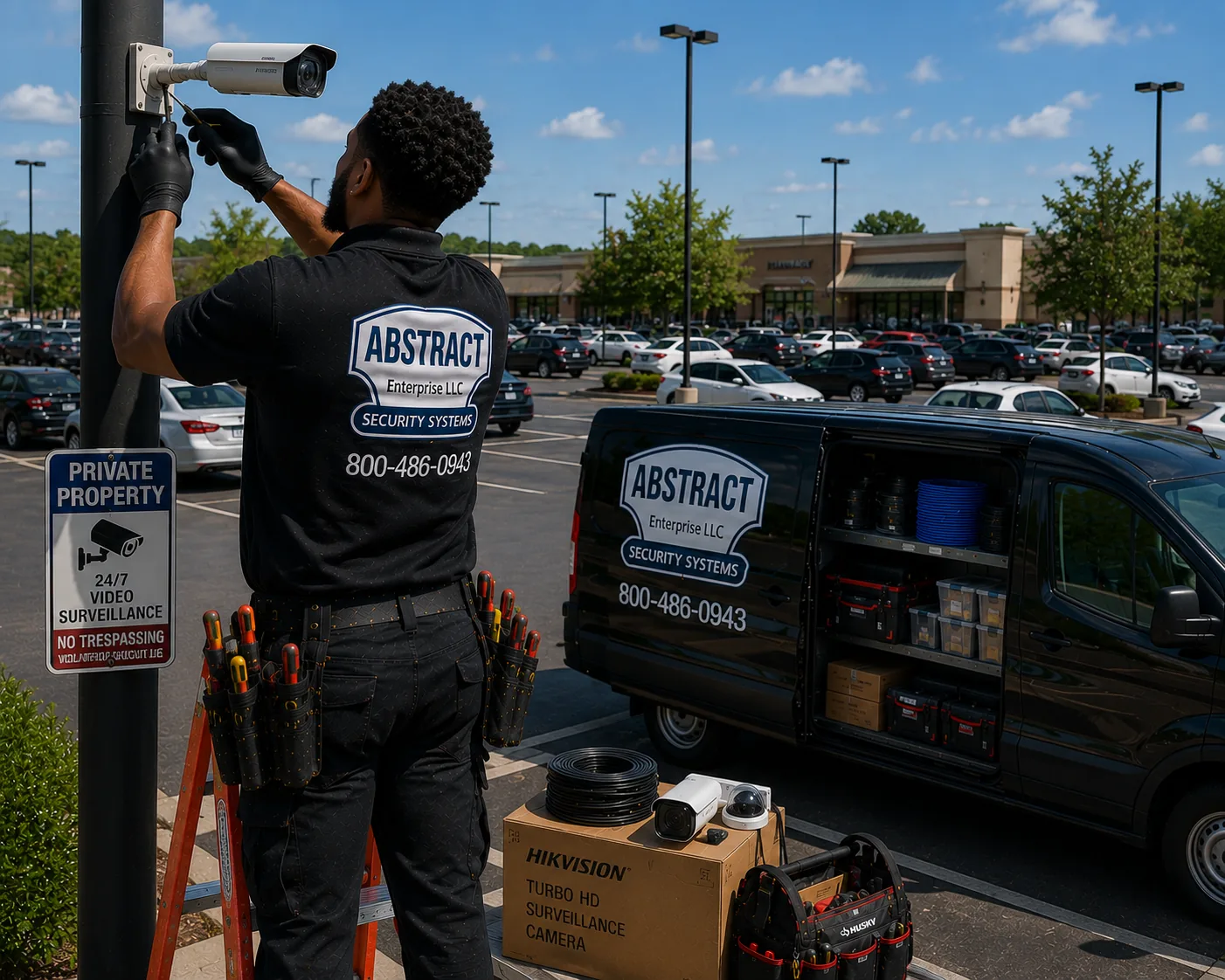
The property’s existing light poles are usable on a good number of Suffolk sites — the malls, the shopping centres and the Route 110 office parks all run tall fixtures — provided a short checklist clears: who actually owns the pole, whether a photocell or timer cuts its power during daylight, whether there is room inside the shaft, and whether it can take the added load. A pole standing out at the curb line often belongs to the utility rather than the lot.
A dedicated camera pole is the answer when an open field gives nothing else worth mounting to — a routine situation on Suffolk’s larger lots. It calls for a footing engineered to the pole’s height and wind exposure, conduit stubbed generously through the base, and grounding plus surge protection on every conductor that runs outdoors. On low South Shore ground the governing question is what that footing hits — fill, a high water table, or shallow rock up on the North Shore — so markouts lead.
Fence and gate posts serve a yard well for perimeter and gateline coverage, as long as the post is rigid enough to keep a camera on aim and the cable feeding it is guarded.
Running cable across a Suffolk lot is doable but almost never predictable. The dirt shifts from clean pine-barrens sand across the central county, to fill and a high water table down on the South Shore, to shallow rock and glacial till along the North Shore bluffs, to plain but unrecorded fill under the older commercial parcels. Whatever sits beneath the asphalt owes more to that history than to any drawing on file.
Markouts happen before a shovel moves, every time. Past the marked utilities, what a trench actually hits in Suffolk County is leftover conduit from an earlier tenant, irrigation on the landscaped malls and office parks, drainage and recharge-basin structures across the outwash plain, and rock no plan bothered to note. The working assumption is that the dig will find something, so the route is planned with a fallback already in hand.
Near the shore the water table and the flood record both count. Around Lindenhurst, Babylon, Bay Shore, Mastic and the low South Shore — much of which Sandy came through — a trench can meet water not far down. It does not stop the job, but it changes the handling: conduit is treated as though it will hold water, with terminations, drip loops and boxes placed so water at a junction never runs on into the gear.
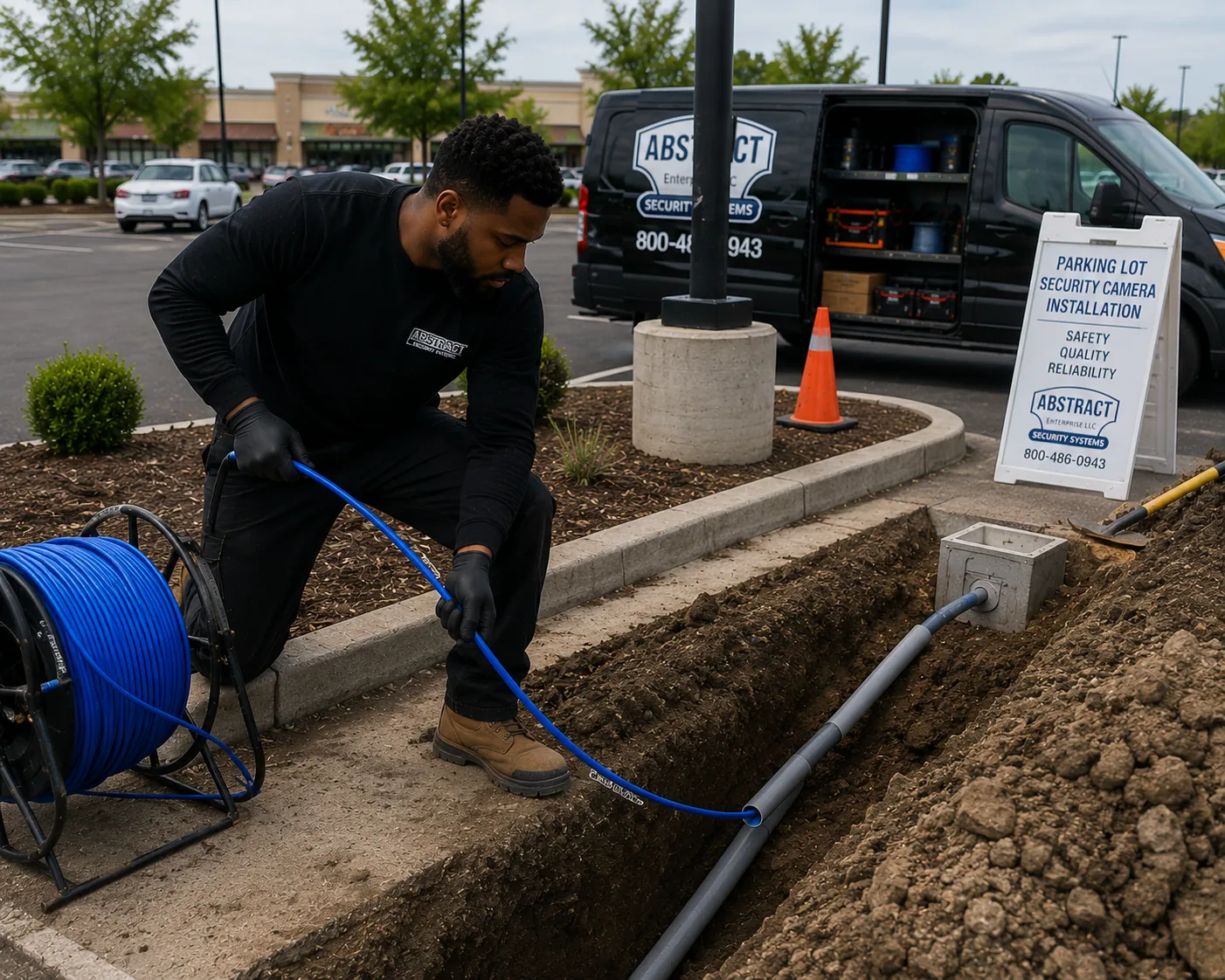
Where the layout allows, the run hugs landscape islands and unpaved edges — and Suffolk County’s larger lots usually leave room. When the path must cross pavement, saw-cut and patch is the straight line, with directional boring held back for a freshly paved lot or a landlord who bars cutting. Conduit beats direct burial as a rule, sized generously with a pull string left behind, because opening a working Suffolk lot twice is a real disruption to the business that lives on it.
Then the trench is closed out properly: backfill tamped so it will not settle, surfaces restored, striping repainted anywhere a cut crossed a marked bay, and any disturbed planting put right.
Copper covers the distances on most Suffolk lots, but the big-box fields, the Hauppauge yards and the bayfront marina parcels routinely outrun what Ethernet will carry, and any site with more than one building brings the ground-potential problem that only fibre resolves cleanly.
Cat6 on PoE carries the majority of runs, one cable delivering both data and power, jacketed for the environment on anything sitting outdoors or inside conduit.
Fibre handles the long backbones and the jumps between separate buildings on a single property. Beyond the reach it adds, fibre carries no metal, so it avoids the surge coupling and ground-potential faults that plague long copper strung between structures on different electrical services — a genuine risk on a multi-building Hauppauge yard.
A point-to-point link spans the gaps you would sooner not trench — across a shared driveway, over newly laid pavement, or out to a detached yard or a marina slip. An engineered directional shot needs an unobstructed path, which in Suffolk means accounting for a trailered boat or a box truck that might one day park in the line of sight.
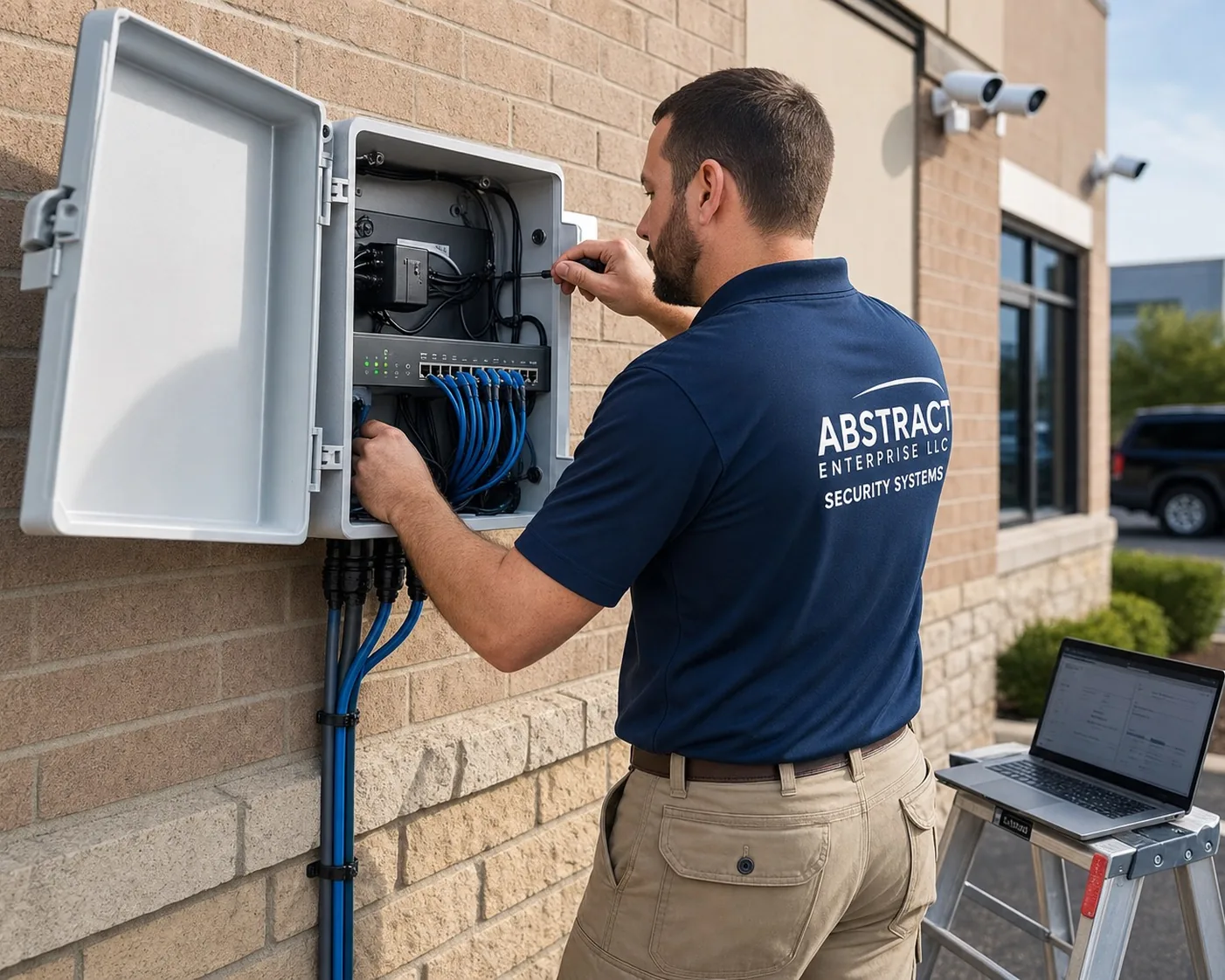
Field enclosures pull a group of cameras back to a single switch and one uplink, sparing a good deal of trenching on the larger sites. The box needs rated cable entries, proper gaskets, bottom-side penetrations and a plan for heat — a sealed enclosure cooking over open asphalt runs hot in July, and a hard Suffolk winter can leave the electronics below their rated start temperature.
The PoE budget is figured against the real combined draw rather than the number of ports. Cameras with heaters, illuminators or pan-tilt motors pull well beyond a plain fixed unit, and a switch chosen on camera count alone will start dropping cameras the first cold night every heater fires at once.
Surge protection and grounding are not optional on an outdoor run. Bonding and grounding are installed first, since every protective device references ground; surge suppressors then sit at both ends of every outdoor run, on power and data alike, and because they are sacrificial they are inspected after any real electrical event rather than presumed intact.
A big share of Suffolk parking sits near the water — the Great South Bay marinas at Bay Shore, Sayville and Patchogue, the Montauk fishing port and the East End harbors, the North Shore harbors at Northport and Port Jefferson — and those lots meet conditions an inland property never sees.
Salt reaches the mounting long before it reaches the camera. Brackets, pole bands, fasteners, enclosure hinges and gland entries corrode first, and a working camera left staring at the sky because its bracket gave way is a dead position all the same. Corrosion-resistant hardware and a properly sealed box cost little at install and decide whether a mount lasts five years or fifteen on the shore.
Flood risk relocates the equipment. On a property with a record of tidal or storm water, the head-end, the field enclosures, the power supplies and the battery backup go above the water line people anticipate, not at whatever height is convenient to work at. A recorder sitting on the floor of a ground-level office in a flood zone is a recorder that will eventually be carried out with the footage still inside. Raising it, or moving it to an upper floor, solves that — and where elevation requirements bear on the work they may involve owner or AHJ review.
Buried runs in low ground are built on the assumption that the conduit will carry water, with terminations and junctions positioned to suit. Pull boxes set low get rated covers and a location where someone can genuinely service them.
On these lots, a post-storm check belongs in the maintenance plan. Once serious water has been through, the outdoor terminations, junction boxes, pole bases and anything that sat in the flood get inspected rather than presumed sound, because water damage usually surfaces as an intermittent fault weeks later rather than an outright failure.
Lens and dome cleaning matters more near the water as well, since a film of salt scatters light and drags the night image down first while the daytime picture still looks acceptable.
Suffolk lots run a wider range of ambient light than a dense-city property. The mall and highway-side lots borrow it from tall fixtures and roadway lighting; a South Shore, East End or residential-edge lot can be truly dark at the back. Light drops off hard toward the rear of a lot, which is exactly where the least-watched part of the property tends to be.
The controls are the sensor, the illumination and the aim. A larger sensor collects more light; a full-colour low-light camera performs where there is ambient light to work with and falls back to infrared where there is not; infrared mounted off to the side of the camera keeps the bounce-back from blowing out its own frame; and wide dynamic range handles a scene that sets a bright street-facing entrance against a dark rear row.
The aim counts as much as the hardware. Point a camera straight into oncoming headlights and it washes out at the exact moment a car ought to be readable. Angling it off to the side of the lane, or setting it slightly above the headlight line looking down, removes most of that at no cost.
Signage is a genuine nuisance on the commercial strips. Lit storefront signs, LED boards and glowing awnings along Sunrise Highway, Montauk Highway and the Route 110 corridor push bright sources into a frame and can throw flicker. Positions get checked against those sources after dark rather than trusted from a daytime walk.
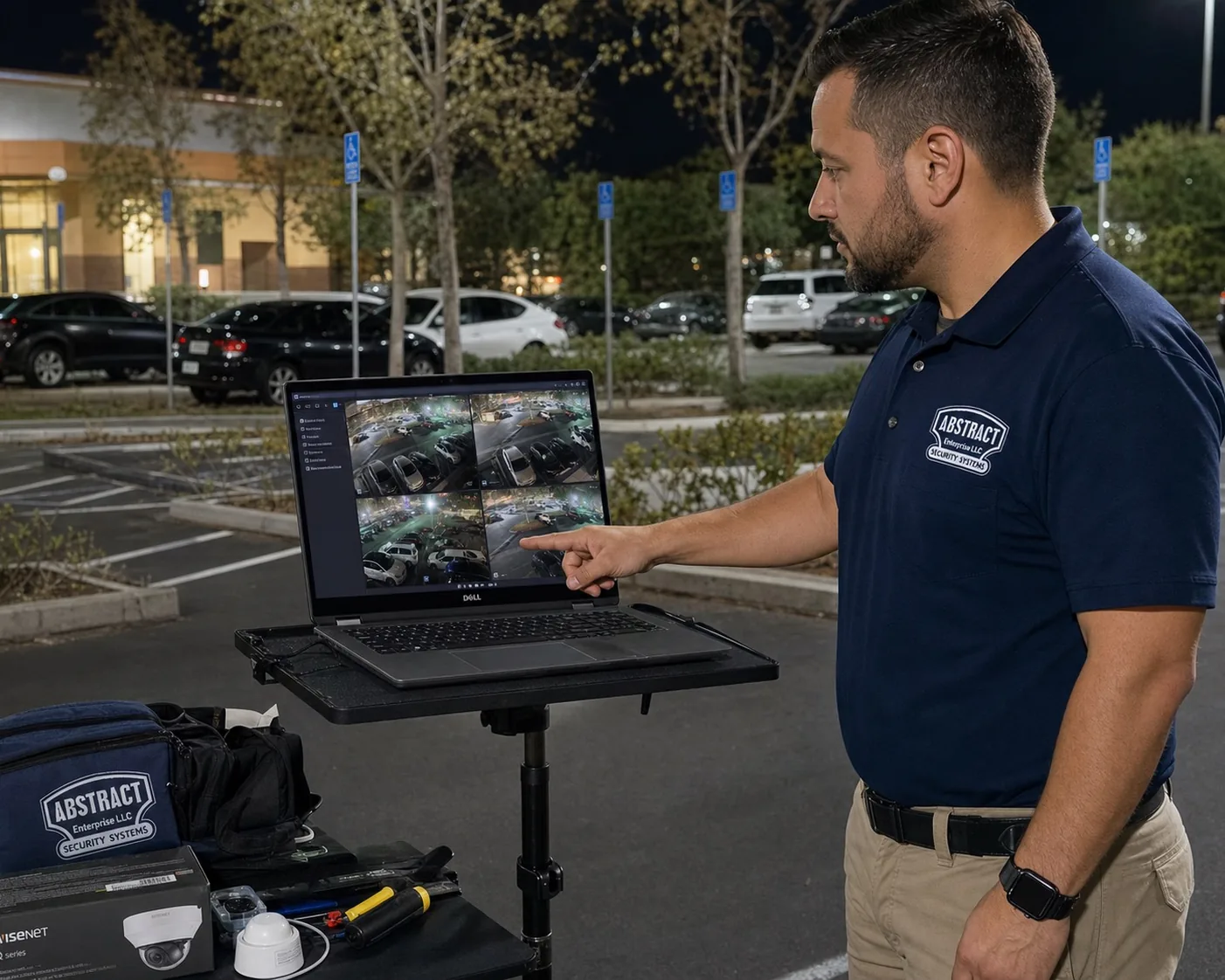
Night verification is a commissioning step in its own right: every camera reviewed after dark for usable detail at its intended range, for dark gaps, for infrared bouncing off a wall, pole or sign, and for how the image holds on wet asphalt. The corrections are usually small — a few degrees of re-aim, a change of illumination, an exposure adjustment.
Where a lot is genuinely underlit, adding lighting frequently costs less than the camera upgrades required to work around the dark — and it changes how the place feels to anyone using it at night.
The go-to wherever a view runs long and stays in one direction — down an aisle, along a fence line, up the entrance drive. A varifocal lens means each unit gets dialled to its own throw at commissioning, which counts on a broad Suffolk field where the distance to target swings from a few metres to the far tree line.
A compact housing that re-aims fast and avoids the internal glare a domed cover tends to collect in wet weather. It works on building faces, deck ceilings and lower pole positions, and keeps a low profile where a property is particular about how the hardware reads.
A single steerable eye for a large field — scheduled preset tours, zoom on command, motion triggered by an event. Because it can only face one way at any moment, it rides on top of the fixed cameras rather than replacing them.
One drop covering a very wide field, which pays off where a property offers few solid mounting points. Resolution thins out at distance, so it is paired with a tight fixed view anywhere detail has to be recoverable. Uniview dual-lens units such as the IPC2K28SE-ADF40KMC-WL-I0 (8MP, 180° stitched) hold that span from a single position.
A purpose-built plate reader for the entry lane — narrow frame, quick shutter, infrared matched to plate reflectivity. It always works in tandem with an overview camera, since the exposure that renders a plate readable leaves the surrounding scene too dark to be of use.
Hardware specified for salt wherever a lot sits close to the water, and impact-rated housings anywhere a camera hangs within arm’s reach or next to a moving traffic lane.
The build-out at Smith Haven, the Stony Brook and South Shore University Hospital decks, the Ronkonkoma transit garages and the newer downtown buildings in Patchogue and Huntington has brought below-grade and stacked parking to a county made mostly of open lots. These structures pose a different engineering problem from the fields around them.
Concrete kills radio, so a garage system is cabled, surface-run in conduit because concrete will not accept a fished cable. Runs that trace the beam lines and the existing conduit read as deliberate; a diagonal run across a ceiling seldom clears a building engineer. Between levels the cable uses an existing riser or sleeve where the building permits, or a fresh core drill with the reinforcement located first and firestopping afterward.
Ceiling height dictates the lens. A low clear height forces a wide field, and wide at short throw concentrates the detail close to the camera. A sound garage layout adds positions and shortens each one’s zone rather than stretching a single camera down a whole level. Nothing hangs below the posted clearance, and nothing obstructs a sprinkler head or the route to a valve or panel.
Ramps are the geometry problem. A car changes elevation and heading at once and drifts out of frame mid-turn, so cameras sit at the top and bottom of each ramp facing the transition, capturing entry and exit rather than trying to follow the curve.
The hardest scenes are the transitions — the mouth of the entrance and, on an above-grade deck, the top level where the garage opens back out into a lot with full weather, wind load and glare.
Structural mounting in a parking deck may want owner or AHJ review, and anchoring into a post-tensioned slab means scanning first and working carefully. Mounting to poles, electrical and structural work, trenching, and right-of-way encroachments may each call for sign-off from the property owner, the utility, or the authority having jurisdiction in Suffolk County, and AESS confirms which apply to a lot before work starts.
Every camera on the property terminates at the recorder. A Suffolk lot system writes to an NVR sized to the camera count with room to expand, installed indoors in a secured, ventilated spot — a locked office, back room or utility closet, and above the anticipated water line on the flood-exposed shore lots. Where a building empties out overnight, the physical security of that room weighs as heavily as the cameras themselves; a recorder that can be carried off carries the evidence with it.
Retention comes down to arithmetic. Resolution, frame rate, continuous versus event-driven capture, camera count and installed drive capacity all feed the calculation, which is then weighed against how quickly incidents genuinely surface on that site. Suffolk properties cover the whole range: a busy mall or a Route 58 retail lot notices damage the same afternoon; a marina the owner visits on weekends may take a week; a house-of-worship lot in use once a week can turn a full cycle before anyone reviews it. Storage is matched to the realistic window, that number appears in the proposal, and the recording modes are configured so the figure holds up in the field.
Remote access gives owners, managers, boards and building staff live views, playback and export from phone and desktop, each on their own account rather than a single shared admin login, so viewing rights are handed out and withdrawn one person at a time. On a shared plaza where several tenants have a stake, those scoped accounts are exactly what make one system practical.
Local recording continues regardless of whether the internet is up. The connection buys remote viewing and alerts — not the recording itself.
Clock synchronisation is a commissioning task in its own right. With the recorder locked to a dependable time source and every camera drawing its clock from it, a timestamp on the entrance camera aligns with the same instant on every other camera across the lot. Leave it out and reconciling the gate against an aisle camera becomes guesswork.
Health monitoring is what keeps a quiet failure from turning into a discovered one: drive warnings and camera-offline alerts routed to someone who will actually read them, backed by the quarterly discipline of pulling one camera and one past moment at random to confirm the footage is present and usable.
Suffolk lots stay busy in ways that shape how analytics get designed. A mall, shopping-centre or corridor lot sees constant legitimate activity — shoppers, deliveries, staff, people on foot — while a marina or a corporate lot falls quiet for long stretches, and a wide camera picks up plenty of movement next door as well. Rules built on raw motion throw off noise; rules built on object type and defined zones throw off signal.
The takeaway is that the rules worth running are the narrow ones. A perimeter line on a fenced marina after hours, a person on foot in a closed mall lot at 2am, or a car stopped in a fire lane each mean something; raw motion across a lot pedestrians cross all day does not. Rules built on object type and defined zones produce signal where bare motion produces noise.
What actually holds up: a perimeter line along a fence or boundary that arms only outside business hours, loitering in a rear service area, a vehicle stopped in a fire lane or across a dumpster corral, movement in a closed lot after dark, and a person entering on foot through a vehicle gate. Each of those flags a specific event worth a ping rather than anything that moves.
Schedules pay off on a property with a strong rhythm. A house-of-worship lot, a school lot and a working yard all sit quiet for long, predictable stretches, and rules tuned to those windows trigger rarely and carry weight when they do. They are dialled in after a week of real traffic rather than set once and left alone.
Escalation is the piece analytics cannot resolve on its own. The ladder climbs from push alerts to owners, managers or building staff, to on-camera deterrents such as white-light strobes and audio talk-down triggered by an event, up to professional monitoring where trained operators watch events live and follow an agreed script. Beginning with recording and layering monitoring on later is a legitimate route, not a compromise.
No camera system calls 911 by itself, and none can guarantee how an investigation turns out.
A lot of Suffolk lot work is not a fresh start. It is a system put in years ago that has quit pulling its weight: cameras dark on the wall, a recorder nobody holds the password to, analog resolution that cannot read a plate across a drive aisle, or coverage laid out for a lot that has since been restriped, re-fenced or partly rebuilt.
It begins with an assessment, not a quote: which cameras and runs are still sound, what the recorder can still handle, whether the existing cable can be reused, and where the coverage genuinely falls short. Coax or Cat5e already pulled to pole and wall positions is the expensive part of the plant, and testing it rather than trusting it decides which upgrade path is worth taking.
The available routes: HD-over-coax moves the cameras and recorder onto the existing coax for a large resolution gain with no new pathways; a hybrid recorder runs analog and IP together so the migration can proceed in phases, placing new IP cameras at the entrance and other priority spots while the serviceable old ones keep running; Ethernet-over-coax adapters carry IP traffic on installed coax where new cable cannot be pulled; and a full IP replacement runs new cable and starts fresh, which is the call when the positions themselves no longer fit how the lot is used.
The repair calls that come in most in Suffolk County: cameras dark after a nor’easter, water in an outdoor termination, corrosion on the shoreline lots, surge damage after a summer storm, plow or delivery-truck contact with low gear, a run cut or chewed up where another trade worked, a recorder fault, and remote access lost after an ISP or router swap. Each gets diagnosed on site rather than guessed down the phone.
Start and completion timing turns on lot conditions, equipment availability, access to the property, permitting where it applies, and how large the project is.
Suffolk’s industrial parking gathers in the central spine and the airport belt, and it acts nothing like a retail lot. Fenced yards through the Hauppauge Industrial Park and the Ronkonkoma, Yaphank and Bohemia districts hold trailers, box trucks, plant, containers and material as much as cars. The value packed in is higher, the surface is often gravel or broken asphalt rather than finished pavement, and the perimeter fence is the real security line.
The priorities shift accordingly. The gate outweighs any retail curb cut, since a yard usually has one controlled entrance and a plate record there accounts for every movement. The perimeter matters as much as the interior, because the exposure is someone coming over a fence rather than a shopper walking between rows. And the interior cameras point at what is stored — trailer rows, laydown, container stacks, the fuel or charging point if there is one — rather than at parking bays.
Mounting is easier in one respect and harder in another. A yard usually has its own poles, gate posts, container stacks and building corners to work with, and permission is straightforward because the operator owns the ground. The complication is that a yard never stays still: a trailer parked where a camera used to see, a stack that becomes a wall overnight, plant dragged into a lane. Positions are set for the layout at its most crowded rather than as it appears on survey day, and the design states plainly which views depend on a lane staying clear.
Pathways in a yard are a challenge of their own. Surfaces are often unbound, heavy plant drives over them daily, and a shallow trench under a truck route will not survive a season. Runs go deeper, in conduit rated for the load overhead, or overhead between structures where the geometry allows, or across the gap on an engineered link where a trench is not worth digging. Cable near equipment at ground level is given physical protection as standard.
Yards also tend to rely on analytics more heavily than retail does. A working yard sits genuinely empty for long, predictable stretches, which makes after-hours perimeter rules unusually effective — they trigger rarely and carry weight when they do. Add lighting and a talk-down speaker at the gate and that is the layered arrangement these properties usually settle on. Footage may help document what happened on the property.
Suffolk carries a heavy run of body shops, mechanics and detailers along the Sunrise Highway, Route 112 and Middle Country Road corridors, and most keep customers’ vehicles outdoors while parts come in or payment clears. That is its own liability: the property is holding someone else’s car, sometimes for weeks, on ground that is fenced rather than closed in.
Coverage here leans toward recording condition rather than deterring anyone. A camera framed on the intake captures a vehicle as it arrives and again as it leaves — the footage that settles an argument over damage the owner insists was not there before. Aisle coverage between stored cars beats perimeter coverage, because the vehicles are parked tight and a wide view catches roofs instead of panels.
Access-control questions come right behind. Keys are on site, the cars can be driven, and staff move them around all day. Covering the key store and the gate together records who took what and when, and on a property that eventually gates the entrance the camera plan should already have conduit and power run to that spot.
The storage window stretches the retention arithmetic as well. A car sitting three weeks on a back-ordered part means an incident may not come to light until long after it happened, and retention sized for a busy retail lot will already have overwritten the day that matters. Footage may help document what happened on the property.
BUILDING SPECIALISTS
Every lot breaks down into a handful of zones, and each one puts a different question to the camera that covers it. Naming them is how a coverage plan on a Suffolk property gets designed rather than guessed at.
The single most valuable position on the lot. Every vehicle slows through it, so the plate-and-overview pair lives here, framed to catch a car as it straightens out of the turn.
Where vehicles cut across a steady flow of people on foot. It is the first thing skipped when a survey stops at the property line, and it is repeatedly the footage that ends a dispute.
The lanes traffic is channelled into. Coverage tracks the aisle rather than individual bays, which puts every vehicle and every person moving through the lot on record.
Where cars sit and where dents show up. A full row of tall vehicles blocks a low sightline, so heights and angles are set for a packed lot, not an empty one.
Deliveries, dumpster corrals, back doors — the least-observed corner of any property. It does not call for dense coverage, but it does have to be covered at all.
The fence gap, the back gate no one chains, the driveway shared with the tenant next door. This is how unwanted traffic really gets in, and covering it reveals where the leak sits.
The routes running between vehicles and building doors, framed lower and tighter than an aisle, because here the aim is recognising a face rather than following a car.
The property boundary — and on a fenced yard the true security line, where after-hours rules run against anything that crosses it.
The specific bays that spark arguments on a resident or multi-tenant lot. A camera fixed on a contested space converts a recurring complaint into a record.
That list gets walked on the actual lot, because a property is rarely used the way its drawing suggests. Bays converted to storage, a lane squeezed by a dumpster, a gate welded shut years ago and another cut open last season all pull the plan around.
A camera system earns its keep at the moment of review, and review is as much a learned skill as a built-in feature. Rehearsing the steps before anyone actually needs them is part of a proper handover.
Pin the window. Whoever raised it knows when they parked and when they returned. That bracket — an actual time, not a guess — drives the search, and it is worth insisting on prompt, precise reporting, because a tight bracket turns an afternoon of scrubbing into a ten-minute job.
Start at the car, not the gate. Locate the affected vehicle in the row or aisle coverage and scrub around the event. Working outward from what actually happened beats working forward from the entrance, because the entrance holds every car that came in while the aisle holds only the one that matters.
Fix the timestamp, then fan out. Once the moment is pinned on a single camera, that time indexes directly into every other camera on the property — provided the clocks agree. This is where synchronisation stops being a nicety and starts doing real work.
Follow arrival and departure. With the moment fixed, run the earlier footage to see how the subject arrived — which entrance, which vehicle, which direction — and the later footage to watch them leave. On a lot with a secondary access point, check that one too, since not everything comes in through the main curb cut.
Export quickly and completely. Retention is finite and the countdown began at the incident. Pull footage from every camera that caught anything, not just the single best angle, and label each clip with the camera it came from, where that camera sits, the window it covers and the date of export.
What the system captures varies with camera position, available light, weather, lens selection, vehicle speed, plate condition, maintenance, how recording is configured, and the specifics of the lot. A well-designed system improves the chance that useful footage exists; it does not guarantee identification.
Cameras on a private Suffolk lot work inside expectations that deserve plain treatment. Aim comes first: lot cameras belong on the lot — entrances, aisles, rows, walkways, perimeter — not tilted into someone’s windows, a neighbour’s yard, or anywhere people reasonably expect privacy. It comes up a lot here, where strip-mall and storefront lots along Sunrise Highway, Montauk Highway and Middle Country Road back straight onto residential streets.
Posted surveillance signs at the entrances are standard on any recorded property and make it plain to drivers and pedestrians that the lot is monitored.
Shared tenancies complicate it. Where one lot serves several leaseholds, who owns the equipment, who maintains it, which zones each party’s coverage reaches, and how a footage request is handled all belong in writing up front rather than under pressure after the event.
A residential property needs its access procedure settled ahead of time: who may watch live, who may review recordings, how a resident requests footage of an incident involving their own car, and who makes the decision. Separate accounts on the recorder are what make those rules enforceable rather than theoretical.
This content is general information and is not legal advice.
We would rather be judged on what we commit to than on reviews we cannot verify, so every Suffolk County parking-lot project carries this fixed set of standards:
Abstract Enterprises Security Systems operates from 1282 Troy Ave in Brooklyn under NYS Low-Voltage License #12000287431. License details, insurance certificates and references are provided in writing before work is scheduled.
A proposal only goes out after the free survey, because mounting points, cable routes, where the power originates and what is buried beneath the lot are things you can only read while standing on the property.
Each camera is documented with the job it covers, the route its cable takes, the recorder and drive size and the days of retention that yields, and a clear line on what the price does and does not cover.
Sealed terminations with drip loops, surge suppression and grounding on every outdoor run; coastal-grade stainless hardware on the salt-exposed shore lots; the recorder set above the flood line where the parcel calls for it; cable labelled at both ends; and separate per-person logins instead of a single shared password.
At handover we sit down with you and walk through live view, playback search, a clip export and phone access, then hand over the account logins, a marked-up camera map, the pathway records and the configuration notes.
Products supplied by AESS carry a three-year warranty for normal wear and tear — full terms below and at our warranty page.
· 201 Google Reviews across our service work.
Ask these of every bidder, ourselves included. The answers separate the contractors who have genuinely built lot systems from the ones who simply hang cameras on buildings:
COMMERCIAL PARKING CAMERAS
Business enquiries in Suffolk County gather along a handful of commercial corridors, and each one hands you a different lot geometry:
The South Shore spine from Babylon out toward the Hamptons — retail, dealerships, strip centers and big-box — where the lot shape shifts from one block to the next.
The old shore road through the South Shore hamlets and out to the East End: walkable downtowns where the lot hides behind the building and one narrow opening carries everything.
The Huntington-to-Melville office and retail corridor — the Walt Whitman Shops, corporate campuses and large open fields with long approaches to the entrance.
Central industrial and government frontage — the Hauppauge Industrial Park, fenced fleet yards and county offices strung along the highway.
East End big-box frontage around Tanger Outlets and the aquarium, all large open fields and regional-draw traffic.
Bay Shore, Sayville and Patchogue park-and-ride where cars sit for days, summer turnover is heavy, and all-week parkers press on every accessible lot.
A commercial parcel answers to oversight a residential lot never sees. Mounting to poles, electrical and structural work, trenching, and right-of-way encroachments may each call for sign-off from the property owner, the utility, or the authority having jurisdiction in Suffolk County, and AESS confirms which apply to a lot before work starts.
This content is general information and is not legal advice.
YOUR QUESTIONS ANSWERED
Cameras document rather than prevent, and near a Fire Island ferry terminal at Bay Shore, Sayville or Patchogue that documentation is what makes enforcement stick. A plate camera at the curb cut records which vehicles entered and when, aisle coverage shows how long a space was held, and covering the rear gate or the gap in the fence shows where the all-day parkers actually come in — often not the main entrance. Properties that get serious about it usually gate the entrance eventually, and cameras installed with conduit and power already run to that point make the gate far cheaper later.
Break-ins along the South Shore commercial strips are usually fast and opportunistic, so the coverage that helps is entrance capture paired with tight aisle views between the rows where the cars actually sit. A single wide camera on the building reads rooftops, not door handles or a person reaching into a vehicle. Framing for a full lot — SUVs and vans block sightlines — along with a low overview at the entrance yields footage that shows both the vehicle a suspect arrived in and the activity between the rows.
Converter cuts happen fast and low, frequently under a truck or SUV, and Suffolk County has logged them by the hundreds — the SCPD tracked a wave that peaked in 2021–22, and one Lindenhurst crew hit lots across the county before a 90-mph chase down the Southern State. A usable identification needs a camera positioned to catch the approach and the vehicle the crew arrives in — a plate at the entrance and an overview of the aisle — rather than a distant wide shot of a parked truck. Lighting and camera height are set so a person crouched at bumper level is still in frame, and an after-hours analytics rule on a lot that empties overnight turns that coverage into an alert rather than a next-morning discovery.
Only with that owner’s written permission, and it is worth settling before the design depends on it. On the tighter downtown lots in Huntington, Patchogue or Riverhead a neighbouring wall sometimes gives the only clean vantage over the parking, and party walls and shared lot lines add a layer because attachment and cable routing touch both properties. Where permission is not available — which in Suffolk County is often — the design moves to the property’s own poles, its lot-light fixtures, or fence and gate posts.
A wide mall or big-box entrance is actually a strong candidate, because vehicles slow at the curb cut and the lane is well defined. The plate camera is framed narrow and low to that single lane with a fast shutter and infrared tuned to plate reflectivity, and it always works alongside an overview camera, since the exposure that reads a plate leaves the rest of the scene dark. Where the approach carries both directions, the design either fits two readers or records which direction reads reliably. What any plate camera returns still depends on light, weather, plate condition and vehicle speed.
Yes — that is exactly what poles and fence-line positions are for, and Suffolk County’s big open fields are more pole-friendly than the dense city boroughs. Cameras go on new poles with footings sized for height and wind, on existing lot-light poles where ownership and the circuit allow, or on substantial gate and fence posts. Because the field is large, the design adds positions and shortens each camera’s zone rather than stretching one camera across the whole lot, which is where detail is lost.
An entrance plate read paired with dated overview coverage builds the record a managing agent or towing contractor needs: which vehicle, its plate, and how long it has held the spot. Vehicles left for weeks near the LIRR terminus, the airport and the Fire Island ferries — often on out-of-state plates — are a recurring Suffolk County headache. The cameras do not tow the car, but a timestamped sequence showing the same plate parked day after day is what turns a stalled 311 complaint into one a contractor can act on, and that entrance read doubles as the security coverage the lot needs anyway.
It changes how the trench is treated rather than whether it happens. On the low South Shore ground around Lindenhurst, Babylon and Mastic, excavation can meet water and soft fill at shallow depth. Markouts come first, then conduit is designed on the assumption it will hold water — terminations, drip loops and pull-box placement arranged so water reaching a junction does not travel into equipment — and pull boxes get rated covers in serviceable positions. Where the ground argues against a trench, a wireless link or a wall route carries the gap instead.
No, but the footing is engineered for it. Along the North Shore bluffs from Huntington to Port Jefferson, shallow rock and dense glacial till mean a standard dug footing is not always possible, and the answer is a rock-anchored or surface-mounted base sized for the pole height and wind loading rather than a deeper hole. It is identified at the survey so the proposal prices the right base rather than discovering the rock mid-dig, and where a pole is impractical a building-face or fence position covers the same zone.
Above expected water levels, decided at design time rather than after the next storm. On the South Shore blocks that flooded — Lindenhurst, Babylon, Mastic Beach —, the recorder, field enclosures, power supplies and any battery backup are mounted high or on an upper floor rather than at convenient working height. Underground conduit is designed to hold water, and post-storm inspection of terminations, junction boxes and pole bases belongs in the maintenance plan, because water intrusion usually shows up as intermittent faults weeks later rather than an immediate failure.
It matters, and it attacks the hardware before the cameras. Mounts, pole bands, fasteners, enclosure hinges and cable-gland entries corrode first, and a working camera hanging at the wrong angle because its bracket failed is still a failed position. On the Great South Bay marina lots and the Montauk and East End harbor lots the design specifies corrosion-resistant hardware and properly sealed enclosures, and lens and dome cleaning is scheduled more often, because salt film scatters light and degrades night footage first while day footage still looks fine.
Usually you can, and the cable is the piece worth keeping. Coax or Cat5e already run to your pole and wall positions is the costly half of the plant. HD-over-coax moves the cameras and recorder onto that existing cable for a large resolution gain; a hybrid recorder lets new IP cameras go in at the entrance and other priority spots while the sound older ones keep running; and Ethernet-over-coax carries IP traffic on installed coax. Which route fits comes down to testing the cable rather than trusting it.
Yes, provided ownership and access are settled in writing first — which matters on the Sunrise Highway, Montauk Highway and Route 110 strips where one lot serves several leaseholds. A single recorder with scoped user accounts lets the landlord, a managing agent and individual tenants each see what is appropriate to them. What causes trouble is an unrecorded arrangement where nobody agreed who maintains the system or who may export footage after an incident.
EQUIPMENT
Every position gets its own equipment, chosen against Suffolk conditions — the throw across a big field, the mounting surface, coastal exposure, and who can reach it. All cameras are Uniview (UNV), NDAA-compliant, specified by model per position rather than sold as a kit.
The workhorse on a Suffolk lot, aimed down aisles, along fence lines and up the entry drive, with the lens set to the real throw at commissioning. Specified with Uniview (UNV) 4K ColorHunter bullets such as the IPC2128SE-ADF28KM-WL-I0 (8MP, full-colour at night).
Low-profile housings for a building face or a garage ceiling, and a neat fit where appearance matters, such as a North Shore village center. Uniview OwlView turrets like the IPC3628SR-ADF28KM-WP (8MP, Wise-ISP low-light), with IPC3638SE-ADF28K-WL-I0 eyeballs where a flush ceiling fit is called for.
Steerable positions in Suffolk County’s bigger mall, big-box and industrial parcels, layered over the fixed coverage rather than replacing it. Uniview LightHunter PTZs such as the IPC6658SR-X25-VF (4K, 25× optical) or IPC6622SR-X33-VF (33×) for long throws across an open field.
Wide coverage from a single mounting point where a property offers few vantages and each pole or wall has to justify its place.
Plate readers positioned inside the property line, catching a vehicle as it slows at a mall, strip or commuter-lot entrance. Uniview ANPR plate cameras like the PKC2640@Z80-P (4MP, 8–32mm) or HC121@TS8CR-Z (2MP @60fps), with whitelist and blacklist barrier control.
Recorders sized to the retention figure and installed in a locked back room, above flood level on a waterfront lot. Uniview recorders like the NVR304-16E2-P16, NVR308-64X or NVR516-128, matched to camera count and the calculated retention.
Sealed enclosures on a pole or wall let a group of cameras share a single run home instead of several trenches. Uniview PoE switches like the NSW2010-16T2GC-POE-IN (16-port) or cloud-managed NSW3000-8T2GT-POE-IN push PoE as far as 250m over copper to a remote cluster.
Every pole and metal enclosure bonded, with sacrificial surge units on both the power and data sides at each end of an outdoor run.
AI OVERVIEW REALITY CHECK
Ask an AI overview or a Google snippet about parking-lot cameras in Suffolk County and you get a competent national summary: resolution advice, a nod to license-plate cameras, a spread of ballpark prices, and a short list of lead-generation sites such as Angi, HomeAdvisor and Fixr. None of it is wrong in the abstract.
Where it stops is the moment your actual lot enters the picture. A generated answer is built from national averages, so it cannot know that a Smith Haven ring road, a Fire Island ferry lot at Bay Shore and a fenced Hauppauge yard are three unrelated design problems, or that the ground beneath them ranges from pine-barrens sand to a high South Shore water table.
That gap is the point of this page: the sections below answer, for Suffolk specifically, the questions an AI overview handles thinly — the crime pattern, the seasonal parking, the ground and the specs.
The prices an aggregator surfaces are national labor-and-equipment averages, usually a per-camera band that lumps a Manhattan garage in with a rural strip mall. They are a starting frame, not a Suffolk quote, and rarely separate labor from equipment the way an itemised proposal does.
On a Suffolk lot the labor sits in the 1.20× Suffolk County tier, reflecting travel across a large county and the pole, trenching and surge work an open field demands. A four-camera storefront and a multi-pole big-box field are not the same job at any price.
That is why the number that matters comes off a free on-site survey. It reads the mounting points, cable routes, power source and what is buried under the lot, and the proposal prices each on its own line instead of a per-camera average.
Angi, HomeAdvisor and Fixr are lead brokers: fill in a form and your details are sold to whichever contractors paid for that ZIP code, several at once. The model works for a water heater. It works poorly for a parking lot, where the right answer depends on someone standing on the property reading the ground and the sightlines.
The contractors a broker routes you to may never have built a lot system at all — the same form feeds camera installers, alarm companies and general low-voltage shops alike. What a Suffolk lot needs is a surveyor who already knows that a Lindenhurst lot floods, that a North Shore lot hits rock, and that a ferry lot fills with cars left all week.
Working with a licensed contractor directly skips the auction: one accountable NYS-licensed company (License #12000287431), a single survey, and a proposal you can hold to — not a scramble of call-backs from firms bidding blind off a web form.
An AI overview will mention catalytic-converter theft as a national trend; it will not tell you that the Suffolk County Police Department tracked a wave that peaked in 2021–22 and has stayed a persistent problem, or that DA Raymond Tierney’s office prosecuted organized crews — one Lindenhurst ring that cut converters across the county before a 90-mph chase down the Southern State Parkway.
It will not say what that means for placement. A converter is cut low and fast under a truck or SUV; in a 2026 Lindenhurst case, security footage caught a theft the owner slept through — because a camera held the approach and the crew’s vehicle, not a distant wide shot.
The practical answer is entrance plate capture, an aisle overview, and camera height set so a person crouched at bumper level stays in frame, with an after-hours analytics rule on a lot that empties overnight. That is a design decision a survey makes, not a spec a snippet can hand you.
National guidance assumes a lot that is roughly as busy every day. Much of Suffolk is not. The Fire Island ferry terminals at Bay Shore, Sayville and Patchogue fill with cars left for days or a whole season, the Ronkonkoma LIRR terminus and Islip MacArthur Airport draw all-week parkers, and Hamptons and North Fork lots swing from packed in August to empty by November.
That rhythm changes both the enforcement problem and the analytics. An accessible private lot near any of those magnets quietly absorbs overflow parking, and enforcement — not burglary — is the most common reason a Suffolk property calls about cameras at all, which pushes the design toward entrance capture and plate records.
It also changes retention. A marina the owner visits on weekends or a seasonal lot checked once a month needs storage sized to a real discovery window that may run a week or more — a figure a survey calculates for your property, and one an AI overview has no way of knowing.
Trenching is where generated answers go quietest, because ground is intensely local. Most of central Suffolk is pine-barrens outwash — sandy and usually easy to trench, but sitting over a sole-source aquifer, so environmental care and utility markouts come before any dig.
The shores each add their own constraint. The South Shore around Lindenhurst, Babylon, Bay Shore and Mastic sits low with a high water table and a hard Sandy flood history, so conduit is treated as though it will hold water and the recorder goes above the expected flood line; the North Shore bluffs and the twin forks bring shallow rock, salt and shoreline instead.
None of that appears in a national cost range, yet it decides the footing, the pathway and where the head-end lives — read on site, priced on its own line, and closed out with compacted backfill and restored striping.
Plate reading is the feature AI overviews most often oversell. A license-plate camera is not a wide overview turned up; it is a dedicated reader framed narrow and low to one lane, with a fast shutter and infrared tuned to plate reflectivity, always paired with an overview because the exposure that reads a plate leaves the rest of the scene dark.
Whether it will actually read a plate depends on the entrance — a wide, defined mall or Route 58 curb cut is a good candidate, a tight two-way driveway less so — and on light, weather, plate condition and vehicle speed. Those are properties of your lot, not settings a snippet can promise.
The recorder and retention work the same way. Camera count, resolution, frame rate and how fast incidents get noticed feed a storage figure sized with real Uniview recorders and PoE switches, not a generic box. A survey turns the AI’s general answer into numbers that fit the property you have.
Tell us what the lot is dealing with and we will send a surveyor out to it. Start and completion timing turns on lot conditions, equipment availability, access to the property, permitting where it applies, and how large the project is.
GET IN TOUCH
Give us the basics on the lot — where it sits in Suffolk County, roughly how many spaces and entrances, and whether anything is already installed — and we set up the survey, walk it, settle mounting, power and pathway, and return a line-item proposal listing every camera, its coverage and the retention it holds. Start and completion timing turns on lot conditions, equipment availability, access to the property, permitting where it applies, and how large the project is.
Call (347) 934-8335
WhatsApp: wa.me/17186790359
1282 Troy Ave, Brooklyn, NY 11203
NYS Low-Voltage License #12000287431
· 201 Google Reviews
HOW IT WORKS
Every project moves through the same sequence, adapted to the lot. Start and completion timing turns on lot conditions, equipment availability, access to the property, permitting where it applies, and how large the project is.
An outdoor system rots quietly, and Suffolk County’s mix of coastal weather, salt near the shore and hard winters goes to work on the hardware whether or not anyone is watching. A short recurring routine keeps a small fault from turning into missing footage on the day it matters.
Monthly
Quarterly
Seasonally
Annually
COVERAGE AREA
Parking changes noticeably from the western downtowns to the East End, and so does the design that suits it.
Huntington and Smithtown anchor the western North Shore. The Walt Whitman Shops in Huntington Station and Smith Haven Mall in Lake Grove are the big retail draws, the Route 110 corridor through Melville runs office-park after office-park, and the harbor villages at Northport and Cold Spring Harbor add small, tight municipal and marina lots on the water.
Babylon and Islip hold the busy South Shore center. Tanger Outlets Deer Park anchors the big-box shopping, Islip MacArthur Airport and its long-term lots sit in Ronkonkoma, and the Fire Island ferry terminals at Bay Shore and Sayville fill with cars left for days — alongside Lindenhurst and West Islip, both low, flood-prone and repeatedly hit for catalytic converters.
Ronkonkoma and Hauppauge are the central transit and employment core. The Ronkonkoma LIRR terminus is the Main Line’s eastern end and one of the largest park-and-ride lots on Long Island, MacArthur Airport parking sits a mile south, and the Hauppauge Industrial Park off Veterans Memorial Highway packs hundreds of fenced commercial and fleet yards into one district.
Brentwood, Central Islip and Bay Shore carry dense transit-oriented parking. Suffolk County Community College, the county courts in Central Islip, South Shore University Hospital and high-turnover downtown lots all draw the kind of all-day traffic where entrance capture and plate records matter most.
Patchogue, Medford, Selden and Stony Brook make up central Brookhaven. Patchogue’s revived downtown and its Fire Island ferry lot sit off Sunrise Highway, the Portion Road and Waverly Avenue plazas run strip retail end to end, and Stony Brook University and its hospital add a round-the-clock campus of surface lots and decks.
The Mastics, Shirley and Moriches run the eastern South Shore. William Floyd Parkway spine, Smith Point beach lots and the low blocks around Mastic Beach — hit hard by Sandy — put flood elevation and salt into every layout here.
Riverhead and the North Fork sit at the county seat and the farm belt. Tanger Outlets Riverhead and the Route 58 big-box corridor draw regional traffic, the Long Island Aquarium anchors downtown, and the North Fork wine country from Mattituck to Greenport brings winery, farm-stand and harbor parking that fills seasonally.
The Hamptons and South Fork close the East End — Southampton, Bridgehampton, East Hampton, Sag Harbor and Montauk. Village lots and the Bridgehampton Commons are packed on an August weekend and near-empty by November, second homes sit dark for months, and marina and yacht parking on the bays and at Montauk carry high value with a strong seasonal swing.
Service is available throughout Suffolk County.
SUFFOLK SPECIFICS
Suffolk parking swings with the season and the shoreline far more than any city borough does, and a lot that is right for a Route 58 big-box field is wrong for a Montauk marina or a Fire Island ferry lot. The county holds a handful of parking patterns that barely exist west of the Nassau line, and each one bends the coverage, the analytics and the retention in a direction a national estimate never anticipates.
The Fire Island ferry lots at Bay Shore, Sayville and Patchogue are the clearest example. Cars park Friday and are not touched again until Sunday or, for a summer share, not for a week, so the useful record is the entrance plate capture and the row a vehicle sits in rather than a live view nobody is watching. Retention is sized to a discovery window measured in days, and the analytics that earn their keep are the overnight perimeter rules on a lot that empties once the last boat leaves.
The East End runs on the opposite rhythm. A Hamptons village lot or the Bridgehampton Commons is jammed on an August Saturday and close to empty by mid-November, and the North Fork wineries from Mattituck to Greenport fill on a fall weekend and quiet through the winter. Analytics windows are tied to the real calendar of the property rather than a fixed clock, and the cameras that cover a packed August lot are aimed for vehicles blocking sightlines, not the bare asphalt those same lots show off-season.
Water sets its own terms. The Great South Bay marinas, the Montauk fishing port and the North Shore harbors at Northport and Port Jefferson all hold high-value boats and trailers on lots that take salt off the water year-round, so corrosion-rated hardware and sealed enclosures stop being an upgrade and become the baseline. On the low South Shore the same lots carry a flood history, which pushes the recorder and the power supply above the expected water line as a matter of course.
The commuter mega-lots are the fourth pattern. The Ronkonkoma LIRR terminus is among the largest park-and-ride fields on Long Island and Islip MacArthur Airport parking sits a mile south, both filling at dawn with cars left all day and, at the airport, for a week or more. Those are enforcement and plate-record properties first: an entrance reader that logs every vehicle, an overview that holds the row, and retention long enough that an incident noticed days later is still on the drive.
None of these patterns is guessed at from a drawing. The survey reads which rhythm a Suffolk lot actually runs on — ferry, seasonal, waterfront or commuter — and the proposal sizes the cameras, the analytics windows and the retention to that pattern rather than to a generic parking-lot average.
FIELD NOTES
The ferry lot that empties at once. On the Bay Shore and Sayville ferry lots, the cars worth recording are the ones no one touches for days, so we frame the entrance for a clean plate and let the row coverage carry the rest. The mistake we get called to fix is a single wide camera on a pole that reads a sea of roofs; it looks like coverage until someone needs the plate of a car that sat all weekend, and it is not there.
The Hauppauge yard never looks like its survey. Off Veterans Memorial Highway the industrial park is trailers, container stacks and plant that move overnight, so a camera set to a clear lane on survey day is watching the side of a box truck by the next week. We set positions for the yard at its most crowded and write down, in plain words, which views depend on a lane staying open — because on a working Suffolk yard, one always closes.
The South Shore recorder goes high. In Lindenhurst, Babylon and the Mastics we mount the head-end, the power and the battery backup well above the floor as a habit, not an exception. A recorder on the ground in a flood zone is a recorder someone eventually carries out with the footage still inside, and after a storm we come back to inspect the outdoor terminations rather than assume the water spared them.
The mall plate read lives on the curb cut. At Smith Haven and the Tanger lots the entrance is wide and defined, which is exactly what a plate reader wants — a fast shutter, a low narrow frame and an overview beside it. The same reader on a tight two-way village driveway is a coin flip, and we say so at the survey rather than after the install.
The Ronkonkoma lot fills before we get there. The LIRR park-and-ride is one of the biggest fields on the Island, and by the time a survey crew arrives at eight the rows are already full, so we read it packed rather than empty and set pole heights for the SUVs and vans that block a low line. An entrance reader that logs every car in and an overview that holds each row is what a commuter property actually uses when an incident surfaces days later.
The North Fork lots turn over with the season. A Mattituck farm stand or a Southold winery lot is a field of cars on an October Saturday and a quiet gravel apron by January, so the analytics get tied to the property’s real calendar instead of a fixed weekly clock. Gravel and unbound surfaces out here also mean a shallow trench under a lane will not last, so the runs go deeper or overhead where the geometry allows.
Lindenhurst taught us where the converter camera goes. After a crew worked lots across the village, the lesson was height and angle: a converter is cut low under a truck in seconds, so a camera set for a standing person misses it. We frame lower, hold the aisle a vehicle arrives through, and add an overnight rule on any lot that empties out, because the theft that gets solved is the one where the arriving car and the plate are both on the drive.
The harbor lots eat hardware. At Northport, Port Jefferson and the Great South Bay marinas the salt is on everything within a season, so the bracket, the pole band and the enclosure gland matter as much as the camera. We spec stainless and sealed boxes from the start on the water, because a corroded mount drops a working camera to a dead one and the boat or trailer it was watching is worth more than the whole system.
The pine barrens slow the shovel down. Across central Suffolk the ground is easy sandy digging, but it sits over the sole-source aquifer, so the utility markout and the environmental care come before the trench rather than after. We stub conduit generously and leave a pull string in every run, because reopening a working lot over that aquifer is a bigger deal here than the digging itself, and a spare pathway saves a second dig the next time a camera moves.
PRICING
Suffolk projects range too widely for honest flat pricing — a Sunrise Highway storefront lot and a fenced Hauppauge industrial yard are not the same job at any size. The price is set after a free on-site survey, and the proposal spells out exactly where the money goes.
A survey resolves all of these for your specific lot, and the itemised proposal prices each factor on its own line. Start and completion timing turns on lot conditions, equipment availability, access to the property, permitting where it applies, and how large the project is.
SHOP OUR SYSTEMS
$1,020–$1,800 installed
A small lot behind a storefront — four fixed cameras covering the entrance, the aisle and a rear boundary.
$1,800–$3,000 installed
A mid-size Suffolk County lot mixing retail and residents — roughly eight cameras covering every aisle plus a plate reader at the way in.
$3,360–$5,400 installed
A big Suffolk County commercial field — sixteen or more cameras, a plate reader on each entrance, a PTZ, and coverage right out to the rear fence.
These are installed prices for the scope described, at the Suffolk County rate; plate readers, PTZ units, pole footings and trenching slide the number inside the range, settled on your free survey.
No monthly fees — the system is yours. Service calls and post-install work run $195/hour with a three-hour minimum ($585).
COMPLETE SERVICES
Full camera-system design and install for commercial and residential properties across Suffolk County.
Diagnosis and repair on systems already running — whoever originally installed them.
Camera systems for retail, office, industrial and multi-tenant properties.
Lobby, hallway, entry and back-of-house coverage — the natural companion to a residential lot system.
Gate arms, credentials and readers for a lot moving from open to controlled entry.
Conduit, fibre and network cabling across the property, planned alongside the camera runs.
FAQ
On a residential property, usually yes. For a co-op or condo lot behind a building on the North Shore or in western Suffolk, the board and its managing agent generally want to see the camera positions, any wall or pole mounts and where the footage lives before work starts. The proposal is written to hand straight to a board or agent, and mounts are set to keep residents’ windows out of frame.
Yes — where a property has both, one recorder normally covers the whole lot. The garage portion is its own design: cable rather than wireless since concrete kills radio, surface conduit following the beam lines, positions kept clear of sprinkler heads and the posted clearance, and cameras at the ramp transitions so a car moving between levels stays on record. Structural mounting in a parking structure may require owner or AHJ review.
Yes, mostly in the analytics and retention rather than the camera positions. A Great South Bay or Montauk marina lot runs full on summer weekends and nearly empty through winter, so after-hours and off-season rules can be scoped tightly to fire rarely and mean something, and retention is sized to the real discovery window — which off-season may be a week or more before anyone visits a boat.
Yes. Plenty of Suffolk lots sit next to a building with a rear or service door onto the parking, and a camera there picks up deliveries, after-hours entries and anyone using the door as a shortcut, framed at door height to get a face.
It is planned for. Suffolk County lots sit alongside multi-year DOT reconstruction, utility cuts and water-main projects that can park against a curb for months. The perimeter conduit is sleeved and routed through pull boxes, so if the sidewalk or curb is torn out and rebuilt the cable is drawn back through instead of the lot being trenched a second time. Street-facing camera positions are aimed to hold the entrance and drive aisles even when a work zone sits directly outside.
Building it into the camera job costs far less than reopening the ground later. Spare-capacity conduit to the entrance, a power route to the gate location, and positions framed to hold a future gate arm mean readers, operators and intercom hardware can be added down the line without redoing the pathway.
Yes, and it is a common Suffolk County job along the Sunrise Highway and Route 112 auto corridors. Inventory rows want perimeter and after-hours coverage, entrance capture, and views tight enough to tell activity between rows apart, because the vehicles are high-value and the lot is quiet overnight. Positions are set for the rows full, since a packed inventory line blocks sightlines a survey-day walk would not show.
Plows pile snow at the ends of rows and in the corners, and those banks can block a view for weeks. Heights and positions are chosen after asking the property manager where the snow ends up, and any camera that loses its line every January gets a re-aim or a second position rather than a shrug.
Yes, and those properties gain the most from it. A school or house-of-worship lot has long, predictable quiet spells, so analytics rules can be scoped to those windows to trigger rarely and carry weight when they do, while coverage stays trained on the entrance, the drop-off zone and the walking routes people actually use.
Abstract Enterprises Security Systems provides a three-year warranty on products supplied by AESS for normal wear and tear. It does not cover existing or customer wiring, customer-supplied equipment, lightning or other acts of God, power outages or surges, physical damage or unplugging, internet, router or phone changes, or camera readjustments requested after completion. After the warranty period, service is $195 per hour with a three-hour minimum ($585).
ALL AREAS SERVED
Every parking page in the silo is listed here; an area without its own page yet is still served directly, and the coverage link books a survey.
Citywide hub across the five boroughs.
Retail, industrial, residential and institutional lots.
Below-grade and stacked decks, attended houses.
Nassau and Suffolk lots, commuter and coastal properties.
All six Hudson Valley counties.
Dealer rows, plaza and mall parking, and yards for trucks and fleets.
Garages, Hunts Point yards, resident and event lots.
Ferry-district parking, mall fields, marina slips and strip plazas.
Roosevelt Field, LIRR commuter, South Shore marina and office-park lots.