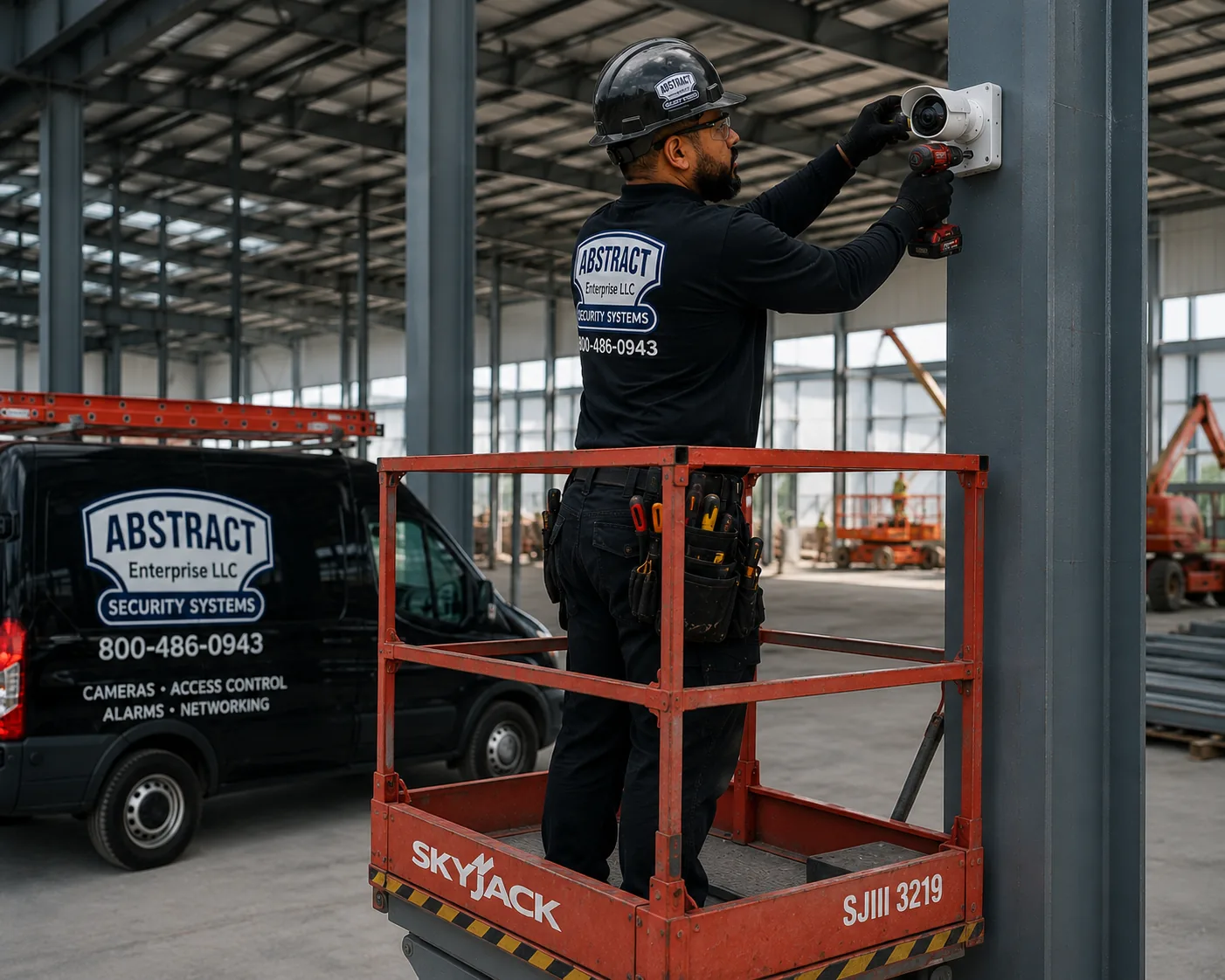
Jobsite cameras for a county where the biggest construction site is a 200-acre former IBM campus with a million square feet of buildings that sat empty for decades, and the next one is a 20-acre former jail site turned into 164 apartments. Coverage built for phased campus redevelopment, vacant structures still full of copper, Kingston and village infill under historic review, watershed-restricted parcels, and Catskill builds at the end of long roads.

Ulster's development story is dominated by big properties waiting on their second life. The former IBM Kingston plant in the Town of Ulster — roughly 200 acres and more than a million square feet of buildings along Enterprise Drive, just off Thruway Exit 19 — has been the subject of a long redevelopment effort whose master plan has included warehouse and commercial space plus workforce housing, and which has moved in fits and starts, with the county advancing foreclosure on two West Campus parcels in early 2026. Meanwhile a $87 million, 164-unit affordable and supportive development was built on the 20-acre site of the former county jail in Kingston, and over 200 affordable apartments across two dozen buildings in Kingston, Saugerties and the Town of Ulster have gone through rehabilitation.
What that mix produces is a security problem most jobsite camera advice never addresses: the dormant period. A building empty for a decade still holds copper, switchgear, mechanical and piping, and nobody is on site to notice a truck at 2 a.m. By the time construction starts, the loss may already have happened. Power tools remain the most commonly reported theft from active American jobsites and recovery on any single tool is poor, but on a stalled campus the metal in the walls is the exposure — and federal estimates put national copper theft in the range of a billion dollars a year.
Phased and stalled redevelopment means buildings sit empty between approvals. Coverage during that window is different work than covering an active crew — fewer people, more entries, and nobody to call anything in.
A 200-acre property with multiple buildings and several access roads cannot be covered like a fenced lot. Entrances and the buildings actually holding value come first; everything else follows the phases.
The Ulster County Sheriff's Office, Kingston city police, town and village departments across the county, State Police out of Troop F, and New York City DEP Police on watershed land around the Ashokan and Rondout reservoirs.

The configuration follows the site — what it has, what phase it is in, and how long coverage has to last.
Self-contained camera with its own battery and LTE radio, mounted to fencing, a container, a pole or a building parapet. This is what covers a vacant structure or a pre-construction parcel, because it needs no service and no crew on site.
Same head with a panel sized to the site. Open parcels along the Route 9W and Route 209 corridors carry solar well. Shaded Catskill sites and north-facing slopes in Woodstock, Olive and Shandaken get larger battery banks instead.
Cameras on Cat6 back to a recorder in a locked field office once temporary power is set. On campus redevelopment this often goes in building by building, becoming the permanent system as each structure is brought back online.
For acreage, laydown yards and access roads with nothing to mount on — the practical answer on a large campus before any building is secured. See solar surveillance trailers for Ulster County.

Power over Ethernet — one Cat6 run carries video and power, so a hardwired system needs a cable path rather than an outlet at every camera.
The unit has its own SIM and data plan, independent of any site network. Data budget is why clip length and alert sensitivity get tuned during commissioning.
On-camera classification separating people and vehicles from branches, weather and wildlife — essential on a large rural campus where movement is constant.
A speaker that lets an operator or the account owner address someone on site live rather than reviewing a clip the next morning.
Camera coverage of vacant buildings and parcels between approvals and construction, when there is no crew and no service but the metal is still in the walls.
Fence, container, ballasted-pole or trailer mounting that requires no excavation — the standard approach on watershed-regulated parcels.
A vacant property needs coverage aimed at entries and the buildings holding metal. An active site needs coverage aimed at the work front, storage and staging. Most Ulster campus projects need both, in sequence.
No service means battery or solar. Once a service is energized and lockable, hardwired becomes available and gets cheaper per camera across a long build.
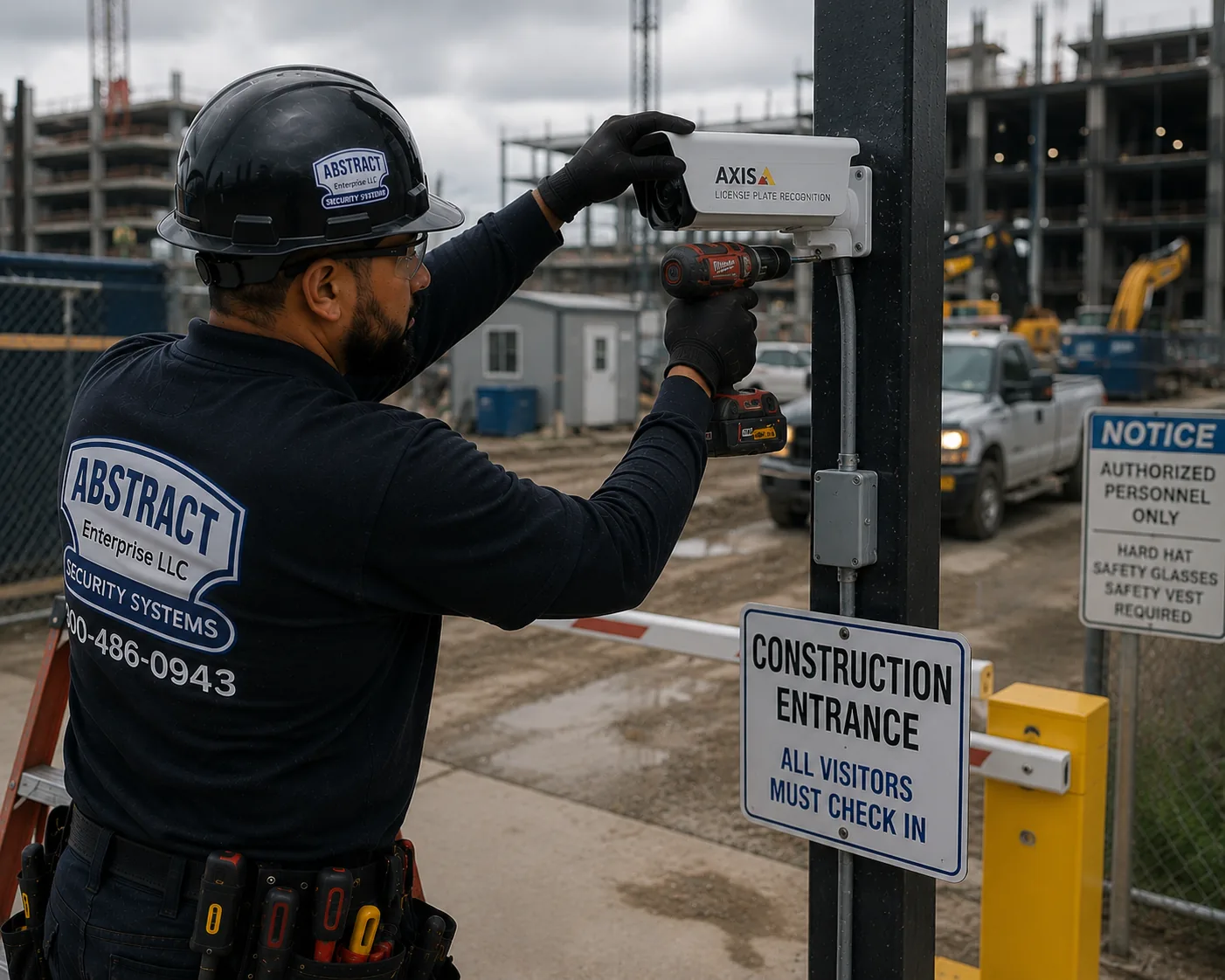
On a campus, entrance count drives the plan far more than acreage. Every road in is a separate point that has to be covered at plate height.
An owner watching one house is a different account than a developer, a GC, a public funder's inspector and a property manager all needing separate logins.
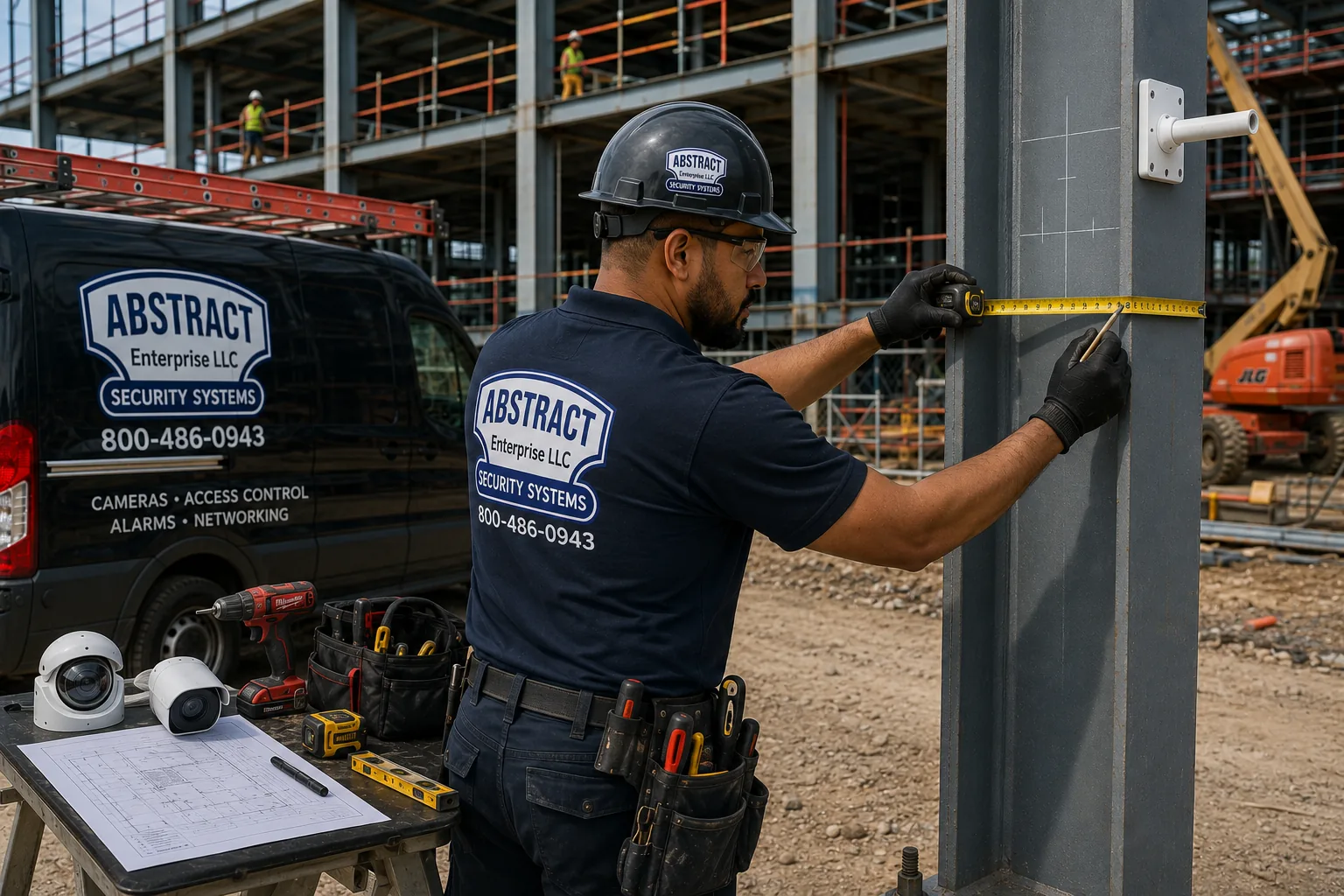
Placement comes off the drawings and the walk. On an Ulster site the priority order usually runs like this.

Jobsite units are chosen for cold-weather battery behavior, cellular reliability from the Thruway corridor into the Catskills, and mounting hardware that holds through mountain and river wind. Fixed systems use commercial IP cameras and recorders sized to the retention the project actually needs.
Any project touching public money in this county — a school district capital program, a city or county facility, a publicly financed housing development — gets NDAA-compliant equipment with compliance documentation supplied in the submittal. Given how much of the current Ulster pipeline carries state, county or federal housing funding, compliant lines are specified by default so a funding change does not turn into a replacement job.
Entrances covered first, then the structures holding value, then the active work fronts as phases come online. Live operators overnight on the larger properties.
Entrance and laydown coverage during structure, interior heads once material moves indoors, and documentation set up for the funder's closeout package.
Two units covering the approach and the material staging, with AI alerts to the builder and the owner. The pattern across Woodstock, Gardiner, Marbletown and the Catskill towns.
Most jobsite camera clients pair coverage with access control at turnover, so credentials for the finished building are planned while the walls are still open.

AI person and vehicle classification · scheduled after-hours zones · tamper alerts · push notifications with clip attached · email escalation lists
Strobe and siren on verified detection · two-way talk-down audio · visible signage at access roads and frontage · floodlight-integrated heads on unlit parcels
On-board storage · cloud clip retention · per-user logins · role-based permissions · clip export for claims and police reports · optional progress time-lapse
Internal battery banks · solar panels sized to site · LTE with carrier selection · low-battery and offline alerts to the account owner
Fence, container, pole, parapet, mast and interior mounts · wind-rated hardware · non-penetrating options for watershed and historic sites
Video verification of alerts · talk-down by trained operators · escalation according to your approved response plan · owner notification
The former IBM Kingston campus, roughly 200 acres with more than a million square feet of buildings on both sides of Enterprise Drive off Thruway Exit 19. A master plan that has included warehouse, commercial and workforce housing, moving in phases, with parts of the West Campus in county foreclosure proceedings as of early 2026. Long dormancy, multiple access roads and buildings full of legacy mechanical.
Golden Hill, a 164-unit affordable and supportive development on the 20-acre former county jail site, plus proposed housing on surplus county property and continued downtown revitalization work. Uptown Stockade District renovation runs alongside it under historic review.
Rehabilitation of more than 200 affordable apartments across two dozen buildings in Kingston, Saugerties and the Town of Ulster — occupied-adjacent work where the exposure is inside the buildings rather than behind a fence.
Student-adjacent housing, village mixed-use and commercial work around SUNY New Paltz, plus Gardiner and Rosendale residential. Tight village lots, sidewalk staging and design review.
Riverfront and rail-trail-adjacent development on the eastern edge, orchard-land conversions and Route 9W commercial. Quick Thruway and bridge access in both directions.
Woodstock, Olive, Shandaken, Wawarsing and Ellenville — custom homes, short-term-rental conversions, resort and institutional work. Long roads, no streetlights and watershed rules across much of the western county.

Large redevelopment properties in the Town of Ulster and along the Thruway corridor. Multi-unit monitored coverage with a migration plan across phases and dormancy periods.
Kingston, Saugerties and the Town of Ulster. Public funding usually means documented equipment, documented retention and a closeout package alongside the coverage.
Woodstock, Gardiner, Marbletown, High Falls and the Catskill towns. Two heads, usually rented, usually triggered by a delivery or by something that already walked.
Fleet accounts across several active jobs, one app, units relocated between sites as work completes rather than returned.
Resort, inn and campus work around New Paltz, Woodstock and the Shawangunk Ridge, where occupied buildings sit next to active construction.
City, town and village facilities, county buildings and district capital programs. NDAA compliance and public-records awareness are part of the spec.

The phase most plans skip. Vacant buildings still hold copper, switchgear and mechanical, and there is no crew to notice anything. Access roads and the buildings holding value get covered before the first permit is pulled.
Doors open all day, dumpsters cycling, and the existing metal being removed by people who are supposed to be removing it. Entry coverage and clear documentation of what left and when.
New wire, plumbing and mechanical arrive. Peak copper exposure, and the phase where a loss costs weeks rather than dollars.
Appliances, fixtures and a dozen subs moving through propped doors. Access-driven losses overtake perimeter losses, and the camera record becomes how disputes get settled.
Usually the opposite. A vacant building with copper and switchgear still in it, no crew and no service is the most exposed the property will ever be. Coverage during dormancy is cheaper than replacing what disappears before the job starts.
Battery and cellular covers it. Units need a mount and a signal, not a service, which is why they can go up on a property that has been dark for years.
One head per road at plate height and angle, because those are the only points every vehicle must use. Everything after that follows the buildings that actually hold value.
Not equally. The ones with mechanical, switchgear and piping still in place are the targets. Empty shells can usually be covered by the access-road heads rather than individually.
Rentals are month-to-month, which matters on a phased project where a stall can last a season. You pay for coverage while you need it rather than for a term.
On a rural Ulster parcel, wildlife is the leading cause of nuisance alerts. AI classification and zone drawing handle it, and the tuning happens at commissioning rather than as a later service call.
The account owner. Access is granted per user, retention is configurable, and clip export is available to the owner on request.
Temporary units go on fencing, containers and poles rather than on the protected facade, which generally keeps design review focused on the building. The permanent system is a separate conversation at turnover with the architect involved.
Recorded footage may assist with incident and insurance documentation. Coverage requirements and any possible policy impacts must be confirmed directly with your insurer — we make no claims about your policy.
Yes, using non-penetrating methods. Fence, container, ballasted-pole and trailer mounts avoid ground disturbance entirely, which keeps the camera outside the permitting conversation.
Units alert on tamper and removal, and footage lives in the cloud as well as on board, so pulling a unit does not erase what it already captured.
It usually does. Publicly financed work generally expects NDAA-compliant equipment with documentation in the submittal and documented retention at closeout, so compliant lines are specified by default.
It varies sharply with terrain in the western towns. Carrier selection and a signal check at the actual mounting height are part of the walk, and on-board recording carries the site through dropouts until the link returns.
Nothing additional on a rental. Closeout removal is included, which matters when the last two weeks of a job are already a scramble.
Monitored rental units run $349 for one, $649 for a pair and $999 for multi-unit coverage with live operators. Purchased hardwired cameras run $500 to $2,500 per camera installed.
No. Cellular units carry their own LTE link and battery, which is why they can cover a property that has been without service for years.
Yes, and that is one of the most common requests here. Coverage of access roads and the structures holding metal is the standard approach during dormancy.
There is no blanket statewide mandate. Requirements come from an owner's contract, a lender, a public funding agreement, an insurer or a site-plan condition.
Yes, and on phased campuses they have to be. Relocations are included on rental accounts.
Configurable per project. A multi-year phased redevelopment usually wants a longer window than a short renovation for dispute and claim purposes.
Search construction site cameras and you get a national average assembled from directory pages and vendor blogs. Here is how those claims hold up against conditions in this county.
On most Ulster builds the highest-value window is when wire, mechanical, appliances or fixtures land and sit before installation — and on a campus that staging area may be a long way from anyone. The protocol is mostly scheduling rather than hardware.

Cameras cover your property, your access roads and your frontage. On village lots in Kingston, New Paltz and Saugerties, and on rehabilitation work at occupied buildings, that discipline is what keeps a security system from becoming a tenant or neighbor complaint.
Owner, developer, GC, PM and a public funder's inspector each get their own login and permissions. Nobody shares a password, and access is removed when someone leaves the project.
Retention windows are set per project. Clip export for an insurance claim or police report is available to the account owner on request, and publicly funded projects get retention documented in closeout.
Honestly: on a small residential project where somebody is on site most days, there is a garage outlet and the house WiFi reaches, a consumer camera on a pole is a reasonable thing to try. It is inexpensive and better than nothing.
It stops being reasonable when any of the following is true — and on an Ulster campus or vacant-building project every one of them is:
No service on the property at all · multiple access roads · buildings holding metal with nobody on site · batteries that fade in a January freeze · alerts nobody triages at 2 a.m. · footage on a card that leaves with the camera · no documentation trail for a public funder.
Licensed installation on record · dormancy and active-phase coverage planned together · equipment matched to canopy, signal and power · non-penetrating mounts for watershed parcels · cloud retention independent of the device · optional live operators · a three-year warranty on AESS-supplied products.
NYS licensed low-voltage contractor #12000287431, covering Ulster from the Bronx office at 460 E Fordham Rd — with systems specified so a property does not need a technician on site to keep working.
Systems specified for the real constraints: no service, vacant structures, multiple access roads, phased and stalled schedules, mountain winters, and terrain that eats cell signal.
A site walk, a written scope and a quote that matches the invoice. Rentals month-to-month, relocations included, closeout removal part of the rental rather than a final surprise.

Two paths, and the account owner chooses which one applies.
AI classifies the detection, the clip attaches to a push notification, and it reaches whoever is on the notification list. You decide what happens next. Most residential accounts run this way.
Optional monitoring may include video verification, talk-down audio and escalation according to the customer's approved response plan. When appropriate, monitoring personnel may contact the responsible local authority. Dispatch routing, response times and outcomes are controlled by the monitoring provider and the responding agency and are not guaranteed.
The response plan gets written before the account goes live: who is called first, who is called at 3 a.m., whether talk-down is authorized, and what counts as an event worth escalating. On a vacant property with no crew, that plan is the difference between a clip nobody watches and a documented response.

Practical observations from working in this county, offered as installer guidance rather than as customer accounts:
On large properties the useful question is not how many cameras but which buildings still hold metal. A dozen structures on a campus are rarely equal targets — the ones with intact switchgear, mechanical rooms and copper risers are, and covering those plus the access roads gets more protection per dollar than spreading heads evenly across the site.
Dormancy coverage has different power math than active-site coverage. There is no crew to swap a battery or notice an offline unit, so banks get sized longer, low-battery alerts get routed to someone who will actually act, and solar is favored wherever the sky allows it. A unit that quietly dies in February on an empty property is worse than no unit, because everyone assumed it was working.
Cellular coverage in the western towns changes with terrain rather than distance. A site in Shandaken or Denning can have usable signal at the top of a rise and nothing three hundred feet down the road. Checking at the actual mounting position during the walk — and confirming carrier — prevents the return trip.
Abstract Enterprises Security Systems holds a 4.7★ Google rating across 201 reviews. Rather than reprinting selected quotes, we would rather you read them at the source and judge for yourself — including the ones that are not five stars.
NYS low-voltage contractor license #12000287431. Ask every bidder for theirs and check that the name on the license matches the name on the contract.
4.7★ across 201 Google reviews. Look at how problems were handled, not only how smooth installs went.
Camera count, which buildings and roads are covered, mounting method, retention window, monitoring tier, relocation terms and closeout removal — all in the quote before anyone signs.
Yes, and on large redevelopment campuses that dormant period is often the most exposed one. A building that has been empty for years still contains copper, mechanical and switchgear, and there is no crew on site to notice anything. Battery-cellular units cover entrances and the buildings themselves during dormancy, then migrate onto the active work fronts once construction begins.
Yes. Battery-and-cellular units carry their own power and their own LTE link, so a unit can be mounted the week demolition or clearing finishes and long before a temporary service is energized. On open parcels solar keeps the batteries topped off; on shaded Catskill and Shawangunk sites a larger battery bank does the same job.
Rental units are typically a same-week install once the site walk is complete, and same-day emergency deployment is often possible for a site that has just taken a loss. Hardwired systems follow the electrical rough-in schedule and get planned around the construction calendar.
Rentals run $349 per month for one monitored unit, $649 for a two-unit builder pair, and $999 for multi-unit coverage with live operators and talk-down audio. Hardwired PoE installs run $500 to $2,500 per camera depending on the head and cable path, with most complete systems landing between $6,500 and $18,000. Every figure is firmed to the dollar in a written quote after the walk.
In layers, and by phase. Entrances and access roads first, because they are the points every vehicle must use. Then the buildings actually holding value — the ones with mechanical, switchgear and copper still in them. Then the active work fronts as each building comes online. A campus that size is a migration plan rather than a fixed camera count, and units relocate as phases change.
They affect mounting more than they affect coverage. Western Ulster includes New York City watershed land around the Ashokan and Rondout reservoirs, where ground disturbance and buffer requirements are governed by the approved plan. Temporary units mount to fencing, containers, ballasted poles or a trailer rather than to anything requiring excavation.
Only the users the account owner authorizes. Access is granted per person, so a general contractor, a developer and a project manager each hold their own login rather than sharing one password. Retention is configurable, and clip export for an insurance claim or a police report is available to the account owner on request.
Recorded footage may assist with incident and insurance documentation, and it gives an adjuster something more concrete than an inventory rebuilt from memory. Coverage requirements and any possible policy impacts must be confirmed directly with your insurer.
On self-monitored accounts the alert reaches your phone with a clip attached. On monitored accounts, optional monitoring may include video verification, talk-down audio and escalation according to the customer approved response plan. When appropriate, monitoring personnel may contact the responsible local authority. Dispatch routing, response times and outcomes are controlled by the monitoring provider and responding agency and are not guaranteed.
Yes. Kingston's historic district, New Paltz and Saugerties all have review processes that care about what gets attached to a protected building and what the street sees. Temporary units mount to site fencing, containers and poles rather than to a historic facade, which keeps the coverage off the structure until the permanent system is designed with the architect.
Yes. School district, city, town, village, county and other publicly funded work gets NDAA-compliant equipment specified with compliance documentation supplied in the submittal package. Publicly financed housing developments frequently carry the same expectation, so compliant lines are specified by default.
Abstract Enterprises Security Systems provides a three-year warranty on products supplied by AESS for normal wear and tear. It does not cover existing or customer wiring, customer-supplied equipment, lightning or other acts of God, power outages or surges, physical damage or unplugging, internet, router or phone changes, or camera readjustments requested after completion. After the warranty period, service is $195 per hour with a three-hour minimum.
City of Kingston · Town of Ulster · Hurley · East Kingston · Lake Katrine · Port Ewen
Saugerties · Glasco · Woodstock · Bearsville · Shady · Malden-on-Hudson
New Paltz village & town · Gardiner · Rosendale · Tillson · High Falls · Stone Ridge
Highland · Lloyd · Marlboro · Milton · Plattekill · Esopus
Ellenville · Wawarsing · Napanoch · Kerhonkson · Accord · Rochester
Olive · Shandaken · Phoenicia · Boiceville · Denning · Hardenburgh
Regional depot, freight-scheduled delivery, phone support routed out of state, term contracts common, relocations and site visits often billable, and a catalog built around fenced active sites rather than dormant campuses.
NYS-licensed low-voltage contractor covering the county directly, dormancy and active-phase coverage planned together, site walk before the quote, month-to-month rentals, relocations included, closeout removal included, and a three-year warranty on AESS-supplied products.
Three weather realities drive equipment choices here, and they hit harder in Ulster than downstate. Cold reduces usable battery capacity, and the western towns run colder and longer than the river corridor, so banks get sized for a real Catskill February. Short days cut solar harvest exactly when the site is dark for sixteen hours, which is why panel angle is set for the low winter sun rather than for June. And wind across a ridge or an open campus loads a mast-mounted camera hard enough that mounting hardware gets specified for the exposure.
Winter storms add the other problem — multi-day power and network outages, and access roads that may not be plowed on a dormant property. A cellular unit with on-board recording keeps working through an outage that takes a wired system down, and uploads what it captured once the link returns.
Budget-ready numbers, firmed to the dollar after the walk. Unit rates match every county we serve; the mix here runs more dormancy coverage, multi-road campus accounts and trailer deployments.
One monitored battery-cellular head — the custom home, the single access road, or the vacant building — with AI alerts, cloud clips and signage.
Two units — access road plus the structure holding value, or two active jobs. One app, relocations included.
Multi-unit coverage with 24/7 live operators, talk-down audio and video-verified escalation under your approved response plan — the standard on campus properties.
Hardwired PoE for multifamily, campus and institutional projects — most complete systems land $6,500–$18,000 depending on heads and runs, engineered to convert into the permanent system at turnover.
Plate-capture access-road heads · interior building packages · delivery-week priority windows · progress time-lapse from $149/mo · surveillance trailers from $2,500/mo for acreage and dormant campuses · closeout removal included on every rental.

A campus with three roads and four buildings holding metal is a different plan than a fenced lot with one gate.
Coverage with no crew on site needs longer battery autonomy and alert routing to someone who will act, which changes the specification.
Open river-corridor parcel versus shaded Catskill site changes battery sizing and the service schedule.
Self-monitored alerts versus live operators with talk-down is the largest single line-item difference on a rental.
Watershed parcels need non-penetrating or trailer solutions, which is a different line item than a driven post.
NDAA documentation, retention requirements and closeout packages on publicly funded work add scope private jobs do not carry.
Same-day emergency deployment is often available for a site that has just taken a loss. Battery-cellular units need a mount and a signal rather than a service and a network, so the constraint is scheduling, not infrastructure. Call (845) 640-3835 and describe the property — what was taken, which road they used, what is still in the buildings — and we will spec coverage around the exposure that is still open tonight.
📞 Emergency Deploy — (845) 640-3835On campus, multifamily and institutional projects the jobsite system should be phase one of the permanent one. During rough-in we plan conduit and pathways so permanent cameras land where the finished building needs them — lobby and vestibule, package room, parking and loading, yard and access roads, roof access, and the service corridor everyone forgets until occupancy. On a phased campus that planning happens building by building, so each structure comes online with its own documented coverage instead of a retrofit at the end.
Related Ulster services frequently planned at the same time: building security cameras, access control, alarm systems and structured cabling.
Dormancy coverage with longer battery autonomy, alert routing to someone who will act, and heads on the buildings that still hold metal.
Plate-height heads on each access road, because those are the points every vehicle must use regardless of where they end up.
Fence, container, ballasted-pole and trailer mounts avoid excavation entirely on watershed-regulated parcels.
Signal checked at the actual mounting height, with carrier selection and on-board recording covering the gaps.
NDAA-compliant equipment, documented retention and access records assembled at commissioning rather than reconstructed at closeout.
Catskill and western-town sites get on-site deterrence — visible equipment, lighting and optional talk-down — because passive visibility from the road is not doing the work there.
Site walk, written scope, fixed quote. Month-to-month rentals with relocations and closeout removal included, or a hardwired system engineered to become the building's permanent coverage.
Permanent building camera systems for homes, multifamily and commercial property across the county.
Credentials, readers and door hardware planned at turnover so the finished building opens with managed access.
Intrusion detection with optional monitoring for finished buildings and occupied sites.
Entry panels and in-unit answering for multifamily projects reaching occupancy.
Cat6 infrastructure, racks and pathways — the layer everything else depends on.
Mobile mast-mounted coverage for acreage, dormant campuses and phased sites.