Construction Site Security Camera Installation in NYC
Solar and cellular jobsite cameras that run without power or Wi-Fi, wired construction CCTV systems, and 24/7 remote video monitoring — installed, moved with every phase, and pulled at closeout by a licensed NYS low-voltage contractor. Same-week deployment across Brooklyn, Manhattan, Queens, the Bronx, and Staten Island. Rentals month-to-month, no long-term contracts.
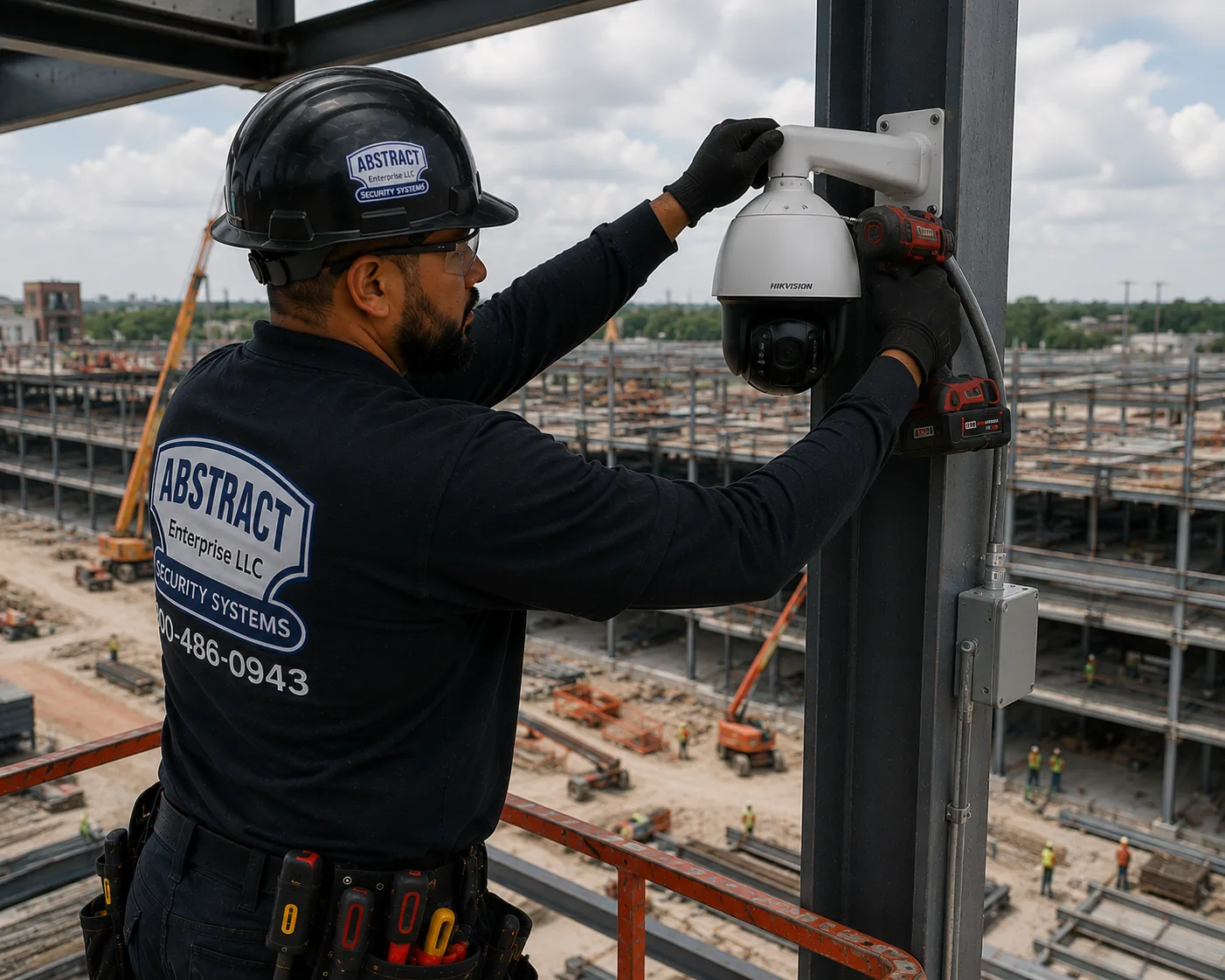
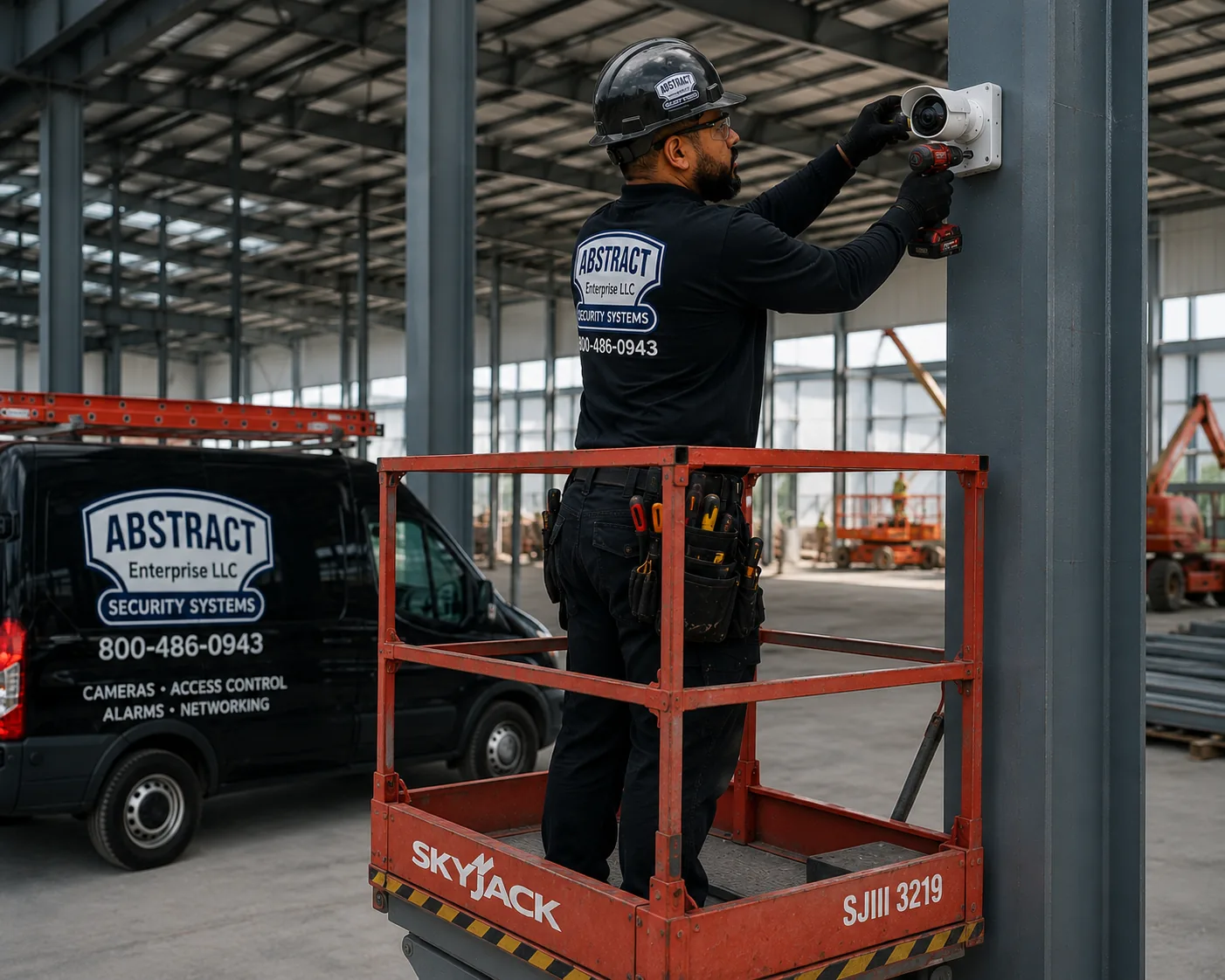
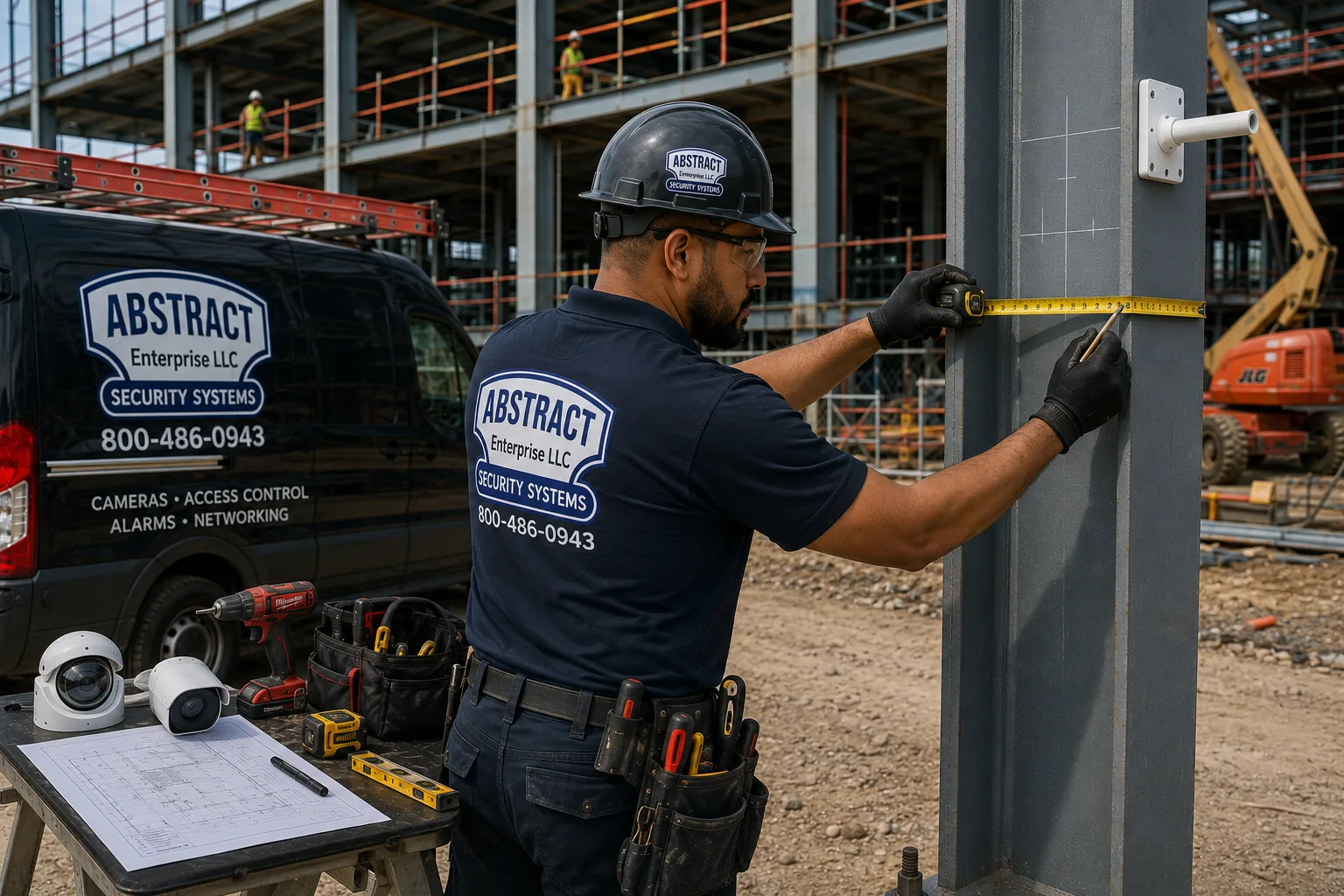
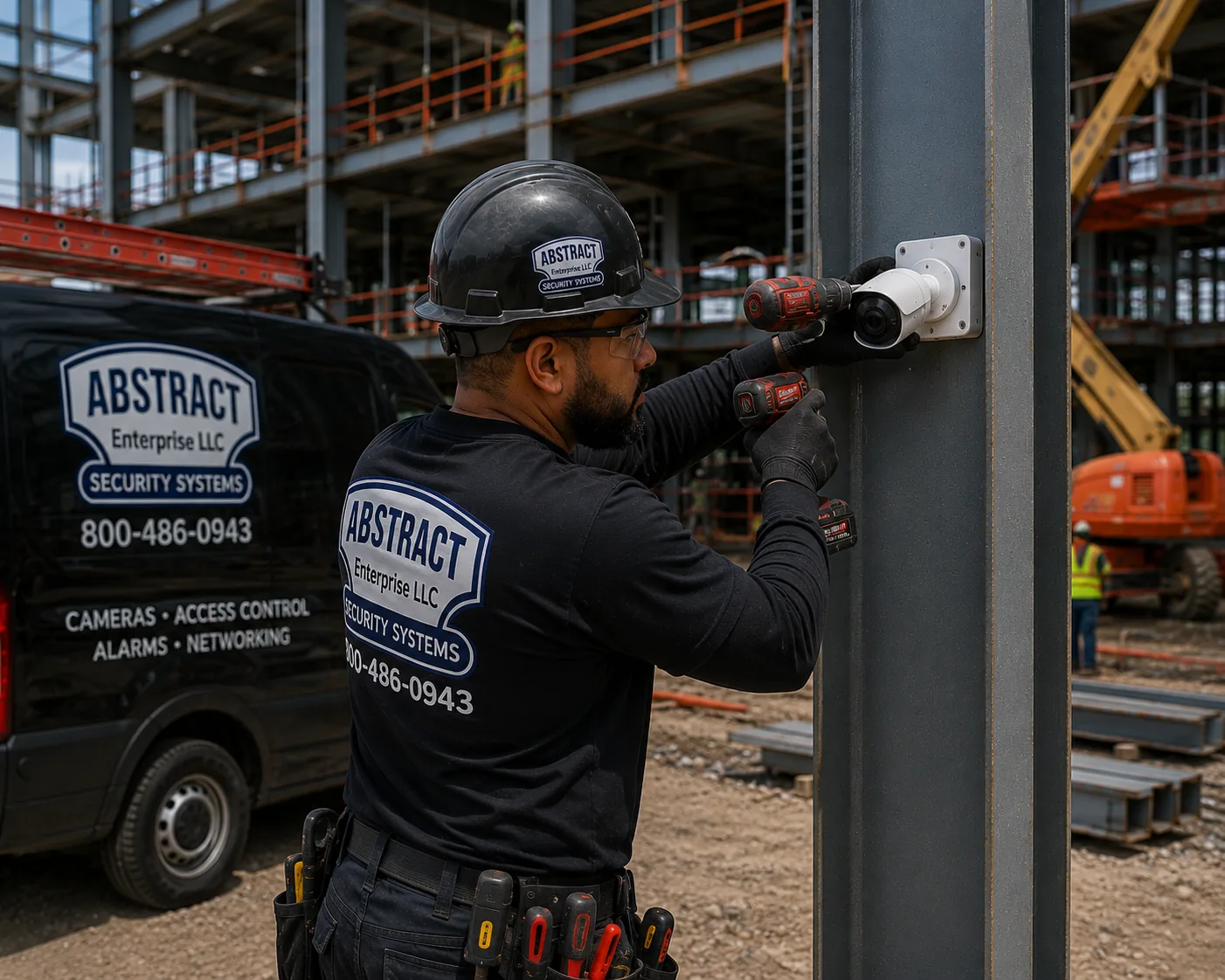
Construction site security camera installation in NYC: our lead tech sets a PTZ dome on the steel, with the whole deck framed out below.
⏱ Same-day rapid deployment inside the 5 boroughs🔓 Site going unprotected this weekend?☀️ Solar units — no ConEd wait, no trenchingCall (800) 486-0943
Element 4 · Why NYC Jobsites Need Cameras
Why NYC Construction Sites Are Getting Cameras Before the Fence Goes Up
New York City runs one of the largest construction pipelines in the country — supertall towers rising at the World Trade Center, the Hudson Yards build-out pushing west, the Port Authority Bus Terminal replacement, Second Avenue Subway Phase 2 boring under East Harlem, and thousands of nine- and twelve-story multifamily jobs filed every month from Mott Haven to Kew Gardens. Every one of those sites is a dense concentration of copper, tools, lumber, and heavy equipment sitting behind a plywood fence at night. Thieves know it, insurers know it, and the Department of Buildings absolutely knows it.
Nationally, construction equipment theft runs an estimated $300 million to $1 billion a year (National Equipment Register / NICB heavy-equipment theft reporting), with roughly another $1 billion a year lost to copper theft nationwide — a widely cited U.S. Department of Energy estimate. Recovery is brutal: only about 1 in 5 stolen machines ever comes back, and for tools and single items the recovery rate drops below 7%. The average heavy-equipment theft costs around $30,000 before you count the rented replacement, the idle crew, and the schedule slip — and copper's record pricing since the 2025 tariff wave has made stripped wire and HVAC coil the fastest cash on any block.
Then there's the New York layer. Chapter 33 of the NYC Construction Codes governs safeguards on every construction and demolition site, and DOB runs dedicated construction-safety inspection and enforcement programs that sweep sites daily — with civil penalties that can reach $25,000 for the most serious violations. Under Local Law 78 of 2017, site incidents have to be reported to DOB within three business days. When an inspector, an insurance adjuster, or a plaintiff's attorney asks what actually happened on your site at 2:47 AM on a Sunday, time-stamped video is the difference between a documented answer and an expensive argument.
None of this means cameras are legally mandated on a jobsite — they're not, and anyone telling you otherwise is selling fear. What cameras are is the cheapest layer of construction perimeter protection a defensible site can run: they deter the crew-of-opportunity walking the fence line, they document access control and site conditions for DOB scrutiny and Local Law 78 incident reports, they satisfy the insurance carriers that increasingly ask what surveillance was in place before they pay a theft claim, and they protect you from the neighbor claiming your excavator cracked their foundation on a day nobody was digging.
Timing matters more in New York than almost anywhere else. Theft on jobsites spikes around long weekends and holiday shutdowns — exactly when a Brooklyn brownstone gut or a Queens mid-rise sits dark from Friday afternoon to Monday morning. A solar-powered, cellular-connected camera unit goes up in an afternoon, needs no ConEd temporary service and no internet drop, and starts watching that same night. That's why the smart GCs now order cameras before mobilization — the fence, the signage, and the surveillance go up together, before the first generator or lumber drop ever hits the ground.
$300M–$1Bannual U.S. equipment theft (NER/NICB)
<7%recovery rate on stolen tools & single items
~$30Kaverage heavy-equipment theft loss
$25Ktop civil penalty for the most serious DOB site-safety violations
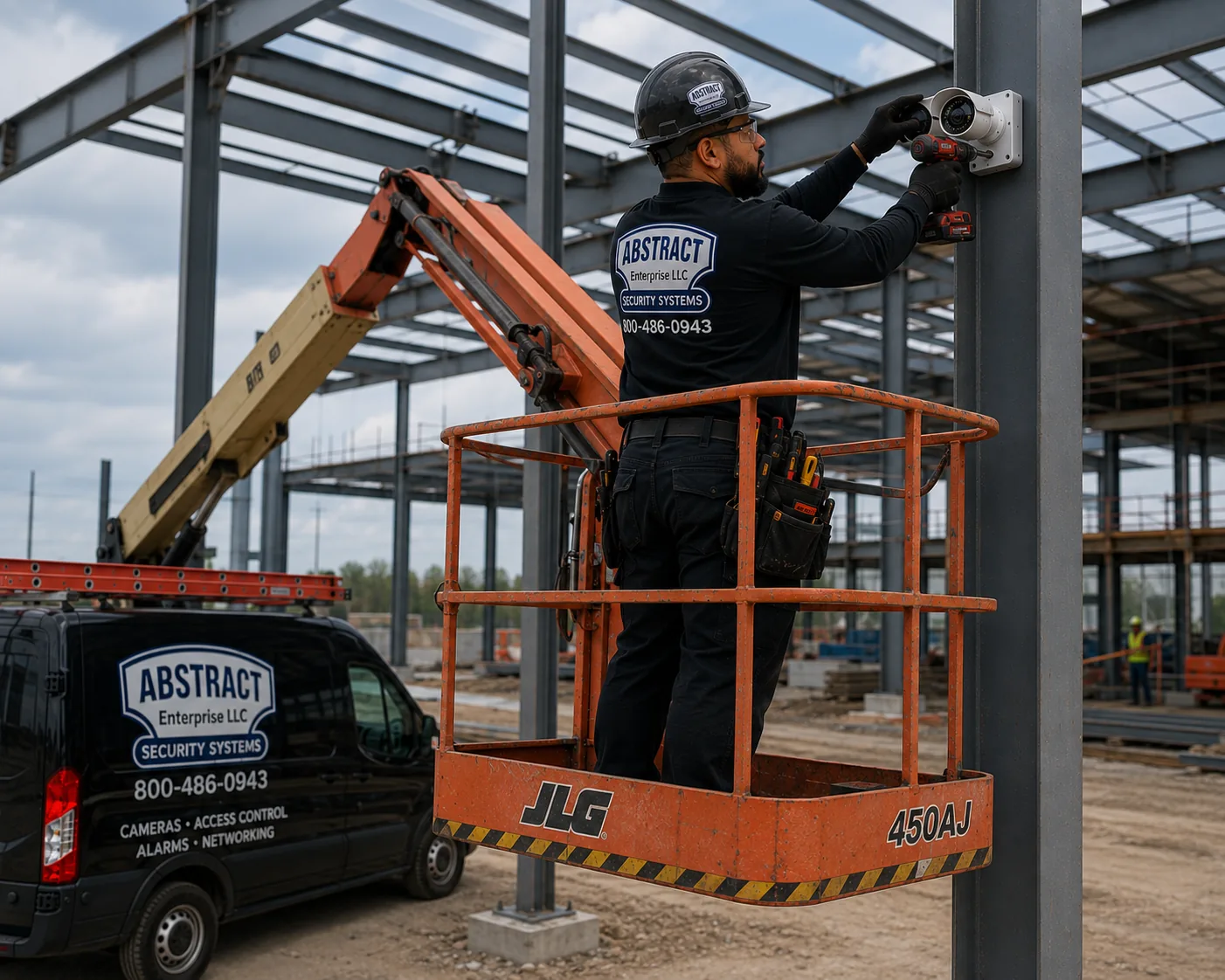
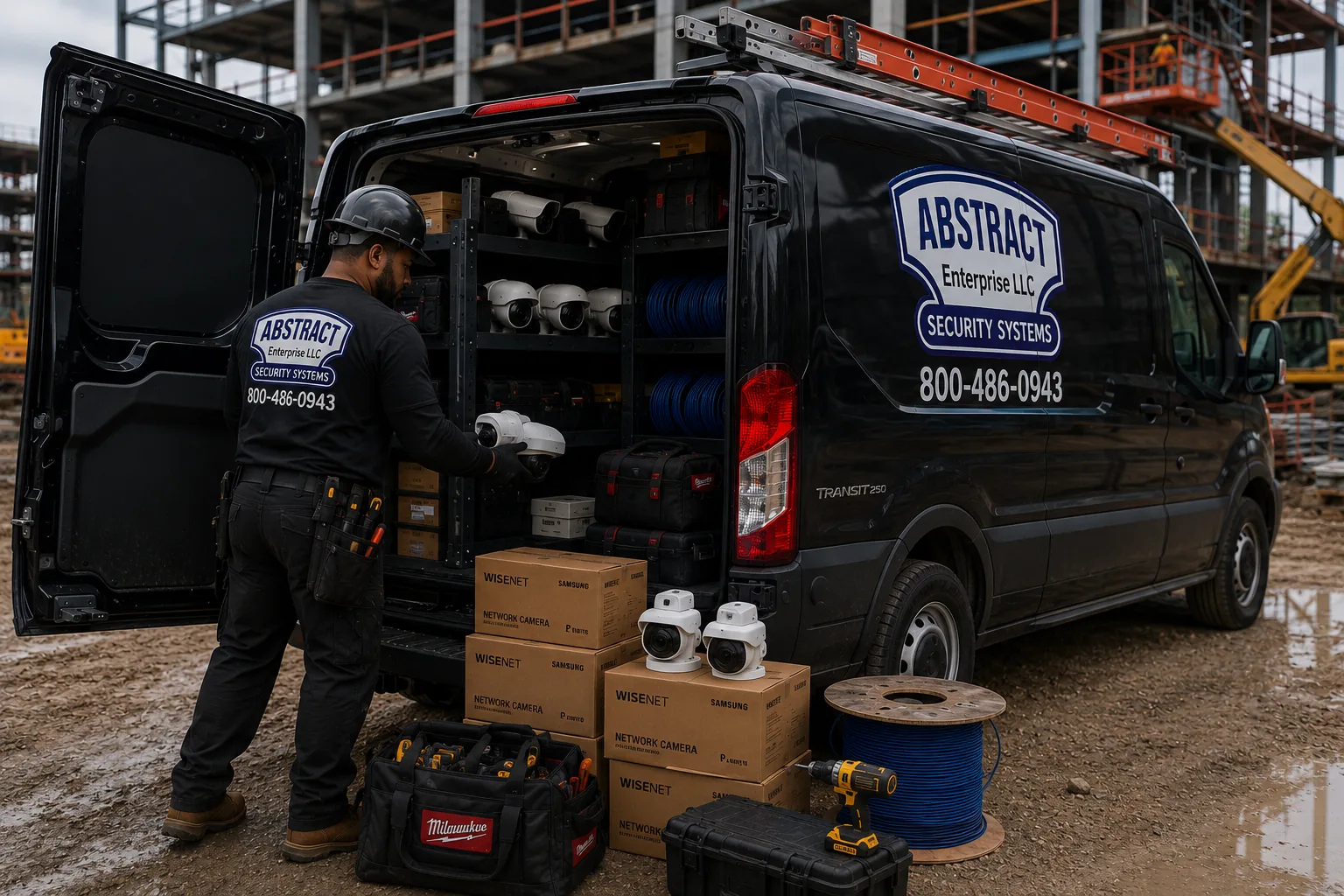
Jobsite surveillance camera installation, NYC style — boom lift, bare steel, and the company van parked where the laydown will be.
⚠️ Straight talk: no NYC law forces you to put cameras on a construction site. DOB Chapter 33 governs fences, sheds, and safeguards — not surveillance. Cameras are about theft, liability documentation, and insurance leverage. We'd rather tell you that plainly than win a job on a made-up code requirement.
Element 5 · Jobsite Camera Systems
Every Way We Put Eyes on an Active Jobsite
There is no single "construction camera." A tight Brooklyn infill lot, a Queens tower crane site, and a Staten Island equipment yard need three different systems — and most projects end up running a mix. Here's the full menu we install, rent, and monitor across NYC — from temporary construction site camera installation to permanent wired construction CCTV installation once the building stands.
☀️
Off-Grid Workhorse
Solar & Cellular Camera Units
Pole- or fence-mounted units with solar panels, multi-day battery, and 4G LTE / 5G uplink. No power, no Wi-Fi, no trenching — true off-grid construction cameras, the go-to for bare sites waiting on ConEd temporary service. Motion-activated, night-vision, app-viewable from day one.
🎥
Wired Backbone
Fixed IP / PoE Site CCTV
Once temp power lands, wired construction site CCTV systems — 4K IP cameras on PoE runs — give you the cleanest 24/7 recording — NVR on site or cloud, no cellular data caps. The right call for long-duration jobs, interior fit-out floors, and hoist and loading areas.
🔄
Wide-Area Sweep
PTZ Cameras
Pan-tilt-zoom heads that patrol a laydown yard or track along a fence line, with auto-tracking on motion. One well-placed PTZ on a mast can replace three fixed heads on an open site.
🌡️
Zero-Light Detection
Thermal Cameras
Heat-signature detection that picks up a person in total darkness, fog, or behind light scaffold netting — no floodlights to vandalize, almost no false alarms from headlights and shadows. The premium answer for perimeter intrusion.
🚚
Gate Intelligence
License Plate (LPR) Cameras
Purpose-built plate capture at the site gate and truck entrance — every delivery, every haul-off, every after-hours vehicle logged and searchable. Ends the "which truck took the extra pallet" argument permanently.
📢
Active Deterrence
Strobe + Talk-Down Audio Cameras
AI person-detection triggers a flashing strobe and a live or recorded voice challenge — "You on the scaffold, you're being recorded, police are being notified." That's construction site audio deterrence — most intrusions turn around right there, before anything is touched.
🧠
Fewer False Alerts
AI Video Analytics
Person/vehicle classification, line-crossing and loitering rules, after-hours zones around conex containers and fuel. Your phone buzzes for a human on the fence at 1 AM — not for every rat, pigeon, and plastic bag in the five boroughs.
⏩
Progress Record
Time-Lapse & Progress Cameras
High-resolution construction time-lapse cameras that document every milestone — for owners, lenders, marketing reels, and construction delay documentation. Live jobsite view plus a finished construction project time-lapse video of the whole build.
🖥️
Storage & Access
NVR + Cloud Recording
On-site NVR for continuous 24/7 record, cloud clips for off-site protection (a stolen recorder shouldn't mean stolen evidence), and one mobile app across every jobsite you run.
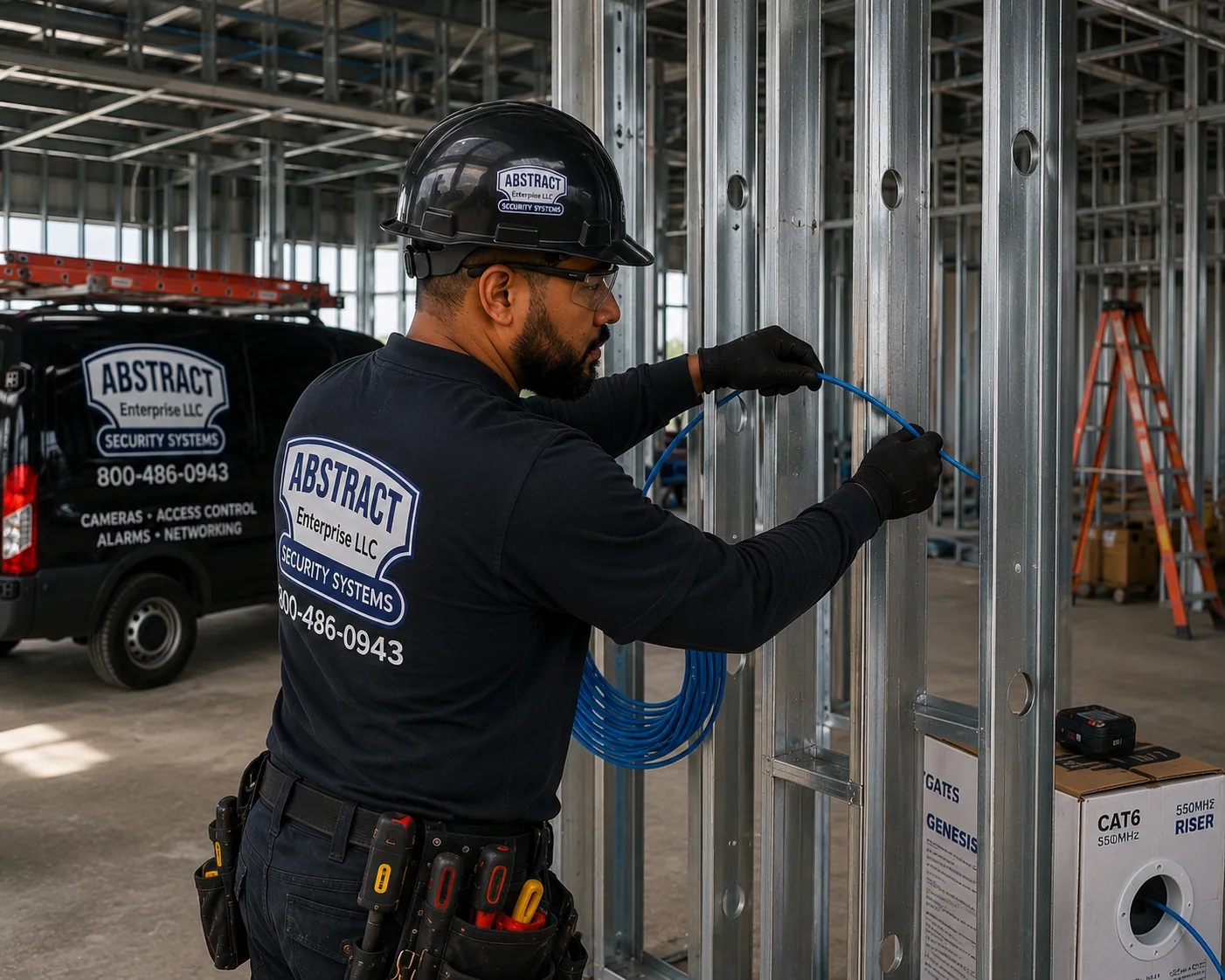
Structured cabling and PoE camera runs going in behind the walls — the wired backbone NYC construction sites switch to once temp power lands.
Monitored Option
24/7 Remote Video Monitoring — a Virtual Guard for Your Site
Cameras that record a theft are useful. Cameras that interrupt one are better. This is 24/7 remote video monitoring for construction sites — a virtual security guard for construction sites that never blinks. On a monitored plan, AI-verified alerts route to live operators after hours: they eyeball the feed, hit the talk-down speaker and strobes, notify your site contact, and call NYPD with a video-verified intrusion report — the kind of call that gets a response, not a report number. It's after-hours jobsite monitoring at a fraction of what an overnight guard costs — and unlike the guy in the pickup at the gate, the operator never falls asleep.
When a Trailer Beats Fixed Cameras
Big Open Site? Roll in a Surveillance Trailer
For large laydown yards, road and infrastructure work, and multi-acre phases, a remotely monitored construction site surveillance trailer — 22-ft mast, 4K PTZ heads, strobes, talk-down audio — covers from one position what would take six pole units. Trailers deploy in under an hour and reposition as the work moves — see the full NYC solar surveillance trailer lineup and construction surveillance trailer rental pricing. Many of our construction clients run both: pole units on the gate and material stacks, a trailer sweeping the open yard.
📐 Temporary vs. permanent: everything above deploys as a temporary construction site camera system — relocatable through every phase, removed clean at closeout. If ownership wants eyes on the finished building, we convert the temporary system into a permanent commercial CCTV installation before turnover, so the property never goes dark between C of O and move-in.
Element 5.5 · Terminology & Name Variants
Jobsite, Job Site, Construction Site, Building Site — Same Cameras, Different Words
Contractors, PMs, and insurance adjusters all use different words for the same thing. So the phone call makes sense on both ends, here's the working vocabulary of construction surveillance:
Construction site vs. jobsite vs. job site vs. building site — interchangeable. GCs say "jobsite," owners say "construction site," older specs say "building site." Every system on this page fits all of them, from an active jobsite mid-pour to a temporarily closed site waiting on financing.
CCTV vs. video surveillance vs. video monitoring — "construction CCTV" is the legacy term for a closed, recorded camera circuit; "video surveillance" is the modern IP version; "video monitoring" or "remote monitoring" means humans or AI actually watching and responding, not just recording. If someone quotes you "monitoring" but delivers recording, that's the bait-and-switch to watch for.
Camera tower vs. surveillance trailer vs. pole unit — a pole unit is a compact solar/cellular camera mounted to a pole, fence post, or building; a surveillance trailer is a towable platform with a telescoping mast; a camera tower usually means the larger skid- or trailer-based mast systems. Trailers and towers live on our solar surveillance trailer pages — this silo covers everything mounted to the site itself.
Temporary / relocatable / rapid-deployment cameras — three flavors of the same idea: systems designed to go up fast, move as phases change, and come down at closeout. "Rapid deployment" specifically means same-day or next-day installs — usually after a theft or before a holiday shutdown.
LPR / ANPR — license plate recognition at the gate. VMS — the video management software your PM opens on a phone or desktop. NVR — the network video recorder storing continuous footage on site. Talk-down audio — a speaker on the camera that lets an operator (or an automated message) challenge an intruder in real time. Video verification — an operator confirming a live intrusion on camera before police are called, which is what separates a priority NYPD response from a routine alarm report.
NDAA-compliant — camera hardware permitted on federally funded and most government-adjacent projects under Section 889 of the 2019 National Defense Authorization Act. If your project touches SCA, federal, or hospital-system money, this word decides your camera brand list — more in the brands section below.
jobsite CCTV installationwireless construction site camerassolar-powered jobsite camerascellular construction camerasconstruction site video monitoringremote jobsite monitoringrapid-deployment camera systemrelocatable construction camerasconstruction perimeter surveillancebattery-powered jobsite cameratemporary CCTVmobile surveillance
Element 6 · Camera Brands We Spec
Construction Camera Brands — and the NDAA Question Nobody Warns You About
We're brand-agnostic installers, not a single-manufacturer dealership — the site conditions and the funding source pick the hardware, not a sales quota. These are the lines we install and stand behind on NYC jobsites:
NDAA-Compliant
Axis Communications
The engineering benchmark for harsh-environment IP cameras — thermal, PTZ, and fixed heads that shrug off vibration, dust, and NYC winters. The default spec when a project's paperwork says "no exceptions."
NDAA-Compliant
Hanwha Vision
Outstanding 4K and multi-sensor heads with strong on-camera AI analytics — person/vehicle classification that cuts false alerts on a windy fence line to almost nothing.
NDAA-Compliant
Avigilon / Avigilon Alta
Enterprise video with best-in-class appearance search — find "person in a red hoodie, 1–4 AM" across a week of footage in seconds. Cloud-native Alta suits multi-site GCs who want zero on-site servers.
NDAA-Compliant · Cloud
Verkada
Camera, cloud, and app in one subscription — the fastest path to "every jobsite in one dashboard" for construction managers running work in three boroughs at once.
Value Workhorse
LTS / Platinum Series
The price-performance line for private jobs — solid 4K IP hardware and NVRs that keep an eight-camera site build inside a tight GC budget without going consumer-grade.
Budget Solar/Cellular
Reolink & Value Cellular Units
Entry solar-cellular units for small renovation sites and short-duration jobs where a full managed unit is overkill — professionally mounted, sighted, and configured so they actually catch what matters.
🇺🇸 The NDAA §889 reality check: Hikvision and Dahua hardware is barred on federally funded projects — and SCA, government, and most hospital-system work follows the same rule in practice. We install Dahua and similar value lines every week on private residential and commercial jobs where they're a legitimate budget play; we will never quietly spec them onto a public project where they'd fail a compliance audit. Tell us who's funding the job, and the brand list writes itself.
Element 7 · Site Packages Contractors Actually Order
The Four Packages NYC Sites Actually Order
🚧
Perimeter Package
2–4 solar/cellular units covering fence lines and corners + reflective "24HR VIDEO SURVEILLANCE" signage + strobe deterrence. The baseline that makes the crew-of-opportunity pick a different block.
🚪
Gate Package
LPR camera on the truck gate + man-gate camera + optional access control keypad or fob reader and gate intercom. Every entry logged, every delivery time-stamped, every haul-off searchable.
🌙
Full-Watch Package
Perimeter + gate cameras with live jobsite camera monitoring 24/7, talk-down audio, and video-verified NYPD dispatch. The closest thing to a guard booth that never blinks — typically a fraction of overnight-guard cost.
🎬
Progress Package
Time-lapse + live-view progress cameras for owners, lenders, and marketing — added to any package above. One build, one film, and a defensible day-by-day record if a delay claim ever lands.
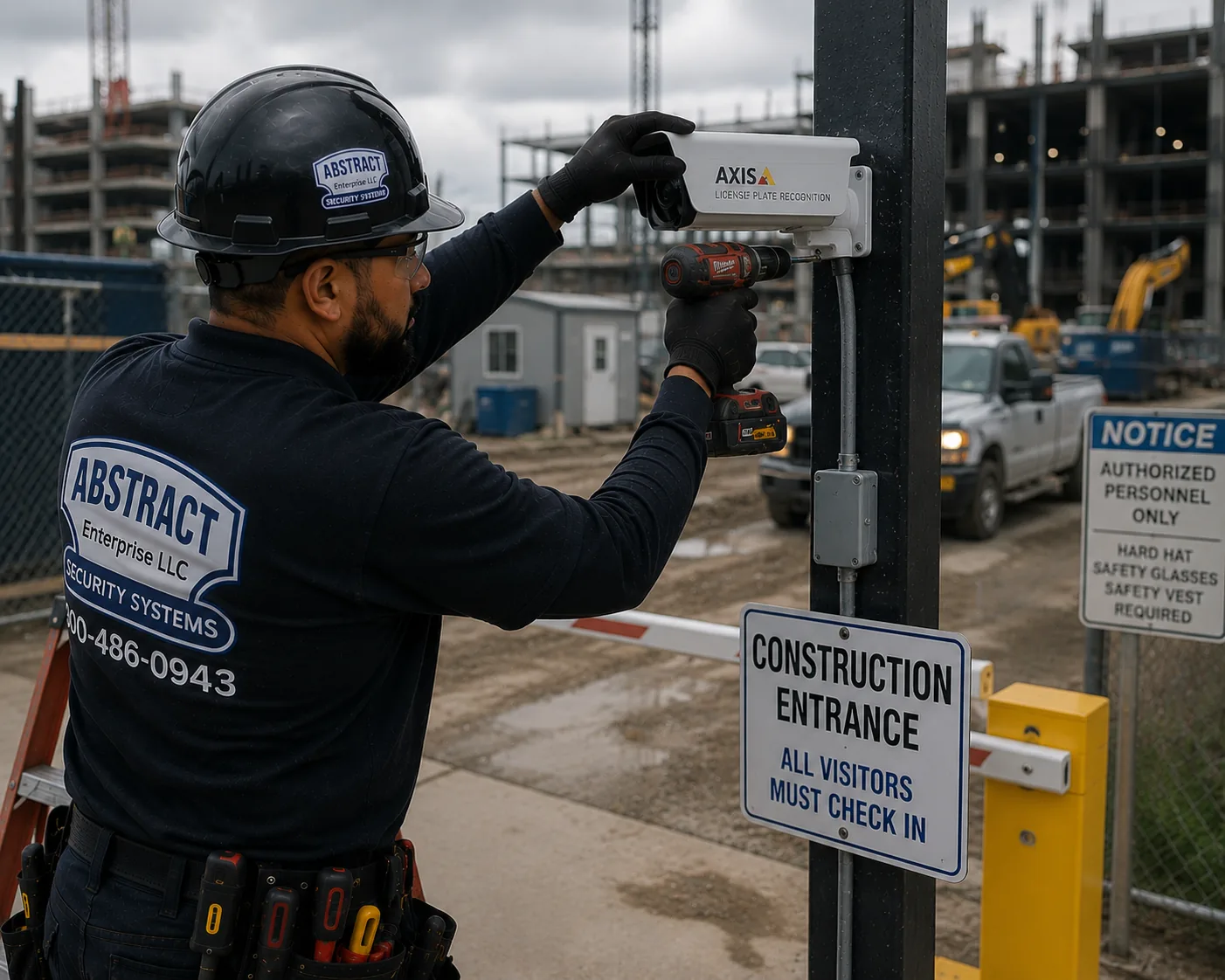
Construction gate LPR camera installation at a NYC site entrance — every plate through this gate gets logged, time-stamped, and searchable.
Every package can bolt onto the rest of the site's low-voltage scope — temporary intrusion alarms on trailers and conex rows, structured cabling for the field office, and the permanent building systems that follow the C of O.
Element 7.5 · Full Feature Set
Everything on the Spec Sheet, Listed Out
Hardware
On the Pole
▸ 4K & 2K weatherproof IP cameras (IP66/IP67)
▸ Solar panels + multi-day battery backup
▸ 4G LTE / 5G cellular uplink — no Wi-Fi needed
▸ PTZ, fixed, multi-sensor & thermal heads
▸ Infrared + low-light night vision
▸ License plate capture at gates
▸ Strobe lights + talk-down loudspeakers
▸ Pole, fence, scaffold & sidewalk-shed mounts
▸ Vandal-resistant housings, tamper alerts
Software
On Your Phone
▸ One app across every jobsite you run
▸ AI person/vehicle detection & loitering rules
▸ After-hours arming schedules per zone
▸ Instant motion alerts with clip preview
▸ Cloud + on-site NVR recording, 30–90 day retention
▸ Time-stamped incident clip export for insurers
▸ Time-lapse generation & live share links
▸ Per-user permissions for supers, PMs & owners
Operations
On Us
▸ Site walk & camera placement plan before install
▸ Same-week standard installs, same-day emergency
▸ Phase relocations as the building rises — included on rentals
▸ 24/7 live operator monitoring (optional plan)
▸ Video-verified NYPD dispatch on confirmed intrusions
▸ Clean closeout removal — or conversion to permanent CCTV
▸ Owner-direct support line, 7 days
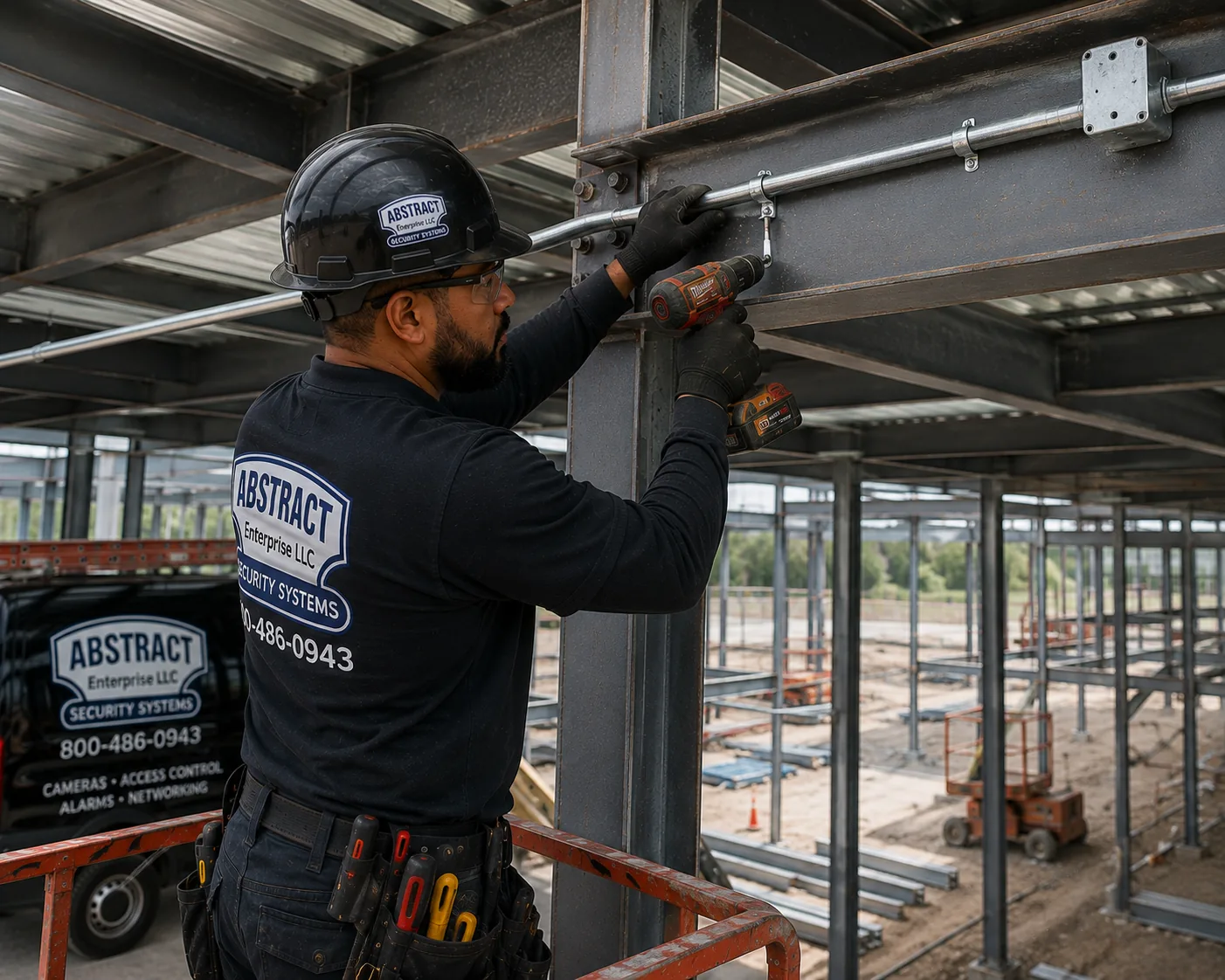
The unglamorous half of a construction site camera system installation — clean NYC conduit runs mounted where the trades can work around them.
Element 8 · Where NYC Is Building Right Now
The Corridors Where NYC Construction — and Construction Theft — Is Concentrated
Site security follows the cranes. These are the zones where New York's 2026 construction wave is concentrated — the same zones where scrappers and tool crews hunt, because density of jobsites means density of targets. If your fence is on one of these corridors, assume your site has already been scoped.
Manhattan
West Side, WTC & Midtown
The Hudson Yards expansion keeps pushing the far West Side, Two World Trade Center (200 Greenwich St) and Five World Trade Center (130 Liberty St) anchor Lower Manhattan's next skyline phase, and the $10-billion Port Authority Bus Terminal replacement is reshaping Midtown West around Eighth and Ninth Avenues. Add the demolition-to-supertall cycle in Midtown — like the Wellington Hotel site clearing for a 1,000-foot tower — and Manhattan's fences hold more copper per block than anywhere in America.
Brooklyn
Gowanus, Downtown & the Avenues
The Gowanus rezoning corridor along the canal is one of the busiest multifamily construction zones in the city, Downtown Brooklyn and the Flatbush Avenue spine keep stacking towers, and gut renovations run block-to-block through Bed-Stuy, Bushwick, and Crown Heights. Our Brooklyn office at 1282 Troy Ave sits in the middle of it — most Brooklyn deployments happen same-day or next-day.
Queens
LIC, Willets Point & the Boulevard
The Long Island City tower cluster around Court Square and Queens Plaza is still climbing, the Willets Point redevelopment is turning parking fields into a new neighborhood beside the stadium build, and mid-rise infill runs from Astoria down Queens Boulevard to Kew Gardens — where multi-building residential filings keep landing month after month.
The Bronx
Mott Haven, the Concourse & Metro-North Corridors
Mott Haven's waterfront and Willis Avenue pipeline, the multifamily wave along Boston Road and Crotona Park East, and the development ringing the new Metro-North station areas make the South and East Bronx one of the fastest-filing construction markets in the city. Our Bronx office at 460 E Fordham Rd covers these corridors daily.
Staten Island
North Shore & the Commercial Corridors
North Shore residential tracts, townhouse developments off Hylan Boulevard, and large commercial alterations like the office expansion filings around South Avenue in Graniteville — lower-density sites with longer sight lines, which is exactly where a single PTZ unit or trailer earns its keep.
Infrastructure
Below the Street & Behind the Barriers
Second Avenue Subway Phase 2 staging in East Harlem along the 125th Street corridor, airport terminal programs at JFK and LaGuardia, bridge and roadway packages across all five boroughs — utility and infrastructure sites carry the densest copper and cable loads of all, and they're a documented favorite of organized scrap crews.
Streets our crews work week in, week out: Atlantic Ave, Flatbush Ave, Fourth Ave & the Gowanus canal blocks (Brooklyn) · Eighth Ave, Tenth Ave, Greenwich St & 125th St (Manhattan) · Jackson Ave, Northern Blvd & Queens Blvd (Queens) · Willis Ave, Boston Rd, Grand Concourse & E Fordham Rd (Bronx) · Hylan Blvd, Richmond Ave & South Ave (Staten Island).
Element 8.5 · Who Orders Construction Site Cameras
Built for Every Trade That Owns the Risk
🏗️
General Contractors
Site-wide coverage under one app, phase moves handled, footage ready when the owner or the insurer calls.
📋
Construction Managers
Multi-site dashboards, subcontractor accountability, and delivery-gate records across every active project.
🏢
Developers & Owners
Progress documentation for lenders, liability protection for neighbors' claims, and an asset record from excavation to C of O.
🧨
Demolition Contractors
Pre-demo condition records, debris-and-access documentation, and cameras that relocate as the structure comes down.
🛣️
Road, Bridge & Infrastructure
Linear-site coverage, staging-area protection, and the copper-heavy corridors scrap crews target first.
⚡
Utility & Electrical Contractors
Wire reels, transformers, and trench work protected overnight — the highest-value theft targets on any site.
🏫
SCA, Schools & Government
NDAA-compliant camera specs, documented chain-of-custody footage, and installers comfortable with public-work paperwork.
🏥
Hospitals & Institutional
Occupied-campus construction with strict access control, compliance-grade hardware, and zero-disruption installs.
🏠
Residential Builders & Renovators
Brownstone guts, townhouse tracts, and new development builds — small-site packages priced for small-site budgets.
🏭
Warehouse & Industrial Builds
Big-envelope sites with long fence lines — PTZ and thermal coverage where six fixed heads would still leave gaps.
🚜
Equipment & Laydown Yards
Excavators, skid steers, generators, and fuel — the yard inventory that walks off on long weekends without a deterrence stack.
📦
Suppliers & Staging Operations
Material staging areas and delivery corridors covered with LPR, so every pallet in and out has a plate attached to it.
Element 9 · 14 Real Questions From NYC Contractors, Supers & PMs
What Contractors Actually Ask After the Second Break-In
These are the questions we hear on site walks and the ones contractors hash out in trade forums after a hit — answered straight, the way we'd answer them at your gate.
Mapping remote video monitoring for a NYC construction site — which gates, corners, and container rows the live operators watch after hours.
Someone keeps stealing materials from our jobsite. We put up a fence and better locks — they keep getting in. What actually works?
Site-walk question #1, every time
Fences and locks slow amateurs; they don't stop anyone who's watched your site for a week. What changes behavior is the deterrence stack: visible cameras at the corners, reflective surveillance signage on every fence face, a strobe that fires on person-detection after hours, and a live voice telling the guy on your material stack that he's on camera and police are being called. Repeat-hit sites are being scoped — usually the thief knows your delivery schedule and your dark hours. Cameras with after-hours AI zones flip that: now you know their schedule, and NYPD gets a video-verified call instead of a morning-after report.
How do contractors stop tools from getting stolen out of gang boxes and the conex?
The most common loss on any site
Power tools are the #1 stolen item on U.S. jobsites, and single-item recovery runs under 7% — once a Sawzall leaves your gate, it's gone. The camera answer is coverage on the container row itself, not just the perimeter: a dedicated head watching conex doors and gang-box staging, an after-hours motion zone drawn tight around them, and tamper alerts on the camera. Pair that with the boring stuff that works — engraved tools, a sign-out sheet, boxes bolted down — and the container row stops being the free ATM it is on most sites.
They stripped the copper out of two floors over a weekend. How do you even defend against that?
The 2025–2026 copper wave
Copper theft is the ugliest loss on a site because thieves destroy weeks of finished rough-in to get pounds of metal — and with copper prices at record levels since the 2025 tariff run-up, copper theft nationwide runs into the hundreds of millions of dollars a year by widely cited federal estimates. Defense is layered: interior cameras on wire-heavy floors once rough-in starts, after-hours detection at every access point (including the scaffold and the sidewalk shed — that's how they come in), talk-down audio that challenges immediately, and monitored response so the intrusion is interrupted in minute two, not discovered Monday at 6 AM.
A generator walked off the site at 4 AM and nobody saw anything. What camera setup catches that?
Equipment-theft pattern
A generator leaves on a truck, which means it left through your gate or over a dropped fence section — both cameraable. The setup: an LPR camera on the vehicle gate logging every plate 24/7, a fixed head with night vision covering the equipment staging area, and a line-crossing rule on the fence sections a truck could back against. Average heavy-equipment theft runs around $30,000 before downtime; one plate capture usually turns "nobody saw anything" into an NYPD case with a suspect vehicle.
The guys who robbed us wore hi-vis and hard hats and walked right in during work hours. Cameras can't stop that, right?
The costume problem
Daytime walk-in theft is real — crews dressed as workers load pallets in front of everyone precisely because nobody questions hi-vis. Cameras beat it in two ways: the LPR gate record ties every vehicle to a time window, and searchable video (appearance search on lines like Avigilon) finds "person in orange vest carrying material to a white van" across the whole day in seconds. Add a simple site rule — deliveries and pickups only through the logged gate — and the costume stops working, because now the question isn't "did anyone see him" but "which clip is he in."
We had Wi-Fi cameras and the thieves jammed them. Footage just cuts out. What's the fix?
A depressingly common story
Consumer Wi-Fi cameras die two ways on a jobsite: cheap jammers kill the wireless link, and grabbing the camera kills the evidence. Professional site systems fix both — cellular LTE uplink (a different radio band than the consumer jammers hit) with on-device and cloud recording, so even a lost link means the footage still exists, plus tamper alerts the moment a camera goes dark or gets moved. If your footage lives only inside the camera on your office Wi-Fi, you don't have surveillance; you have a deterrent sticker with a lens.
Do cameras work better than overnight security guards?
The budget-meeting question
A single overnight guard in NYC typically runs $3,000–$6,000+ a month — and a 24/7 rotation can run north of $16,000 — for one set of eyes that covers one place at a time and, candidly, sometimes sleeps. A monitored multi-camera stack covers every corner simultaneously, never blinks, costs a fraction of that, and produces evidence a guard's memory can't. Where guards still win: sites needing physical intervention or occupied-building interface. Plenty of large projects run both — cameras everywhere, one guard at the gate — but for the typical NYC site, monitored cameras replace the overnight guard line item outright.
Is a surveillance trailer worth the money, or am I better off with pole cameras?
Rent-vs-rig question
Depends entirely on geometry. A tight 25-ft-wide Brooklyn infill lot doesn't have room for a trailer and doesn't need one — two pole units cover it. A half-block laydown yard or a road job is the opposite: one trailer with a 22-ft mast and PTZ sweep replaces five or six pole units and moves with the work. Rule of thumb we use on site walks: long sight lines and open ground favor the trailer; vertical sites and tight urban lots favor pole units; big projects run both.
What's the best camera for a jobsite with no power at all? ConEd temp service is weeks out.
Every NYC ground-up, week one
Solar-cellular units — that's the entire category's reason to exist. Panel plus multi-day battery handles power, 4G/5G LTE handles connectivity, and the unit mounts to your fence post or a pole in an afternoon. Your site is covered from mobilization day, and when temp power finally lands you either keep the solar units (they're already paid for in the rental) or transition high-traffic positions to wired PoE heads for continuous recording. Nobody should wait on ConEd to have eyes on a site.
Our night footage is useless — headlight glare and black shadows. What are we doing wrong?
The 2 AM blur problem
Usually three things: cameras aimed into oncoming light, consumer sensors that can't handle NYC's mixed streetlight/dark-lot contrast, and mounting too high "to see everything" — which sees everything and identifies nothing. The fix is placement and sensor choice: heads mounted 10–12 ft for face-height capture at choke points, true low-light or IR-balanced sensors, and thermal on the dark perimeter where identification matters less than detection. Night performance is a design problem before it's a hardware problem — it's most of what a site walk is for.
I run three sites in two boroughs. How do I watch all of them without three different apps?
Multi-site PM reality
One platform, one login, every site as a folder — that's how we build it. Your dashboard shows every gate and yard across all three jobs; your supers get permissions for their site only; the owner gets a view-only link to theirs. Alerts route by site and by zone, so a 1 AM fence-line hit in Mott Haven pings the right person, not everybody. This is exactly the case where cloud-native lines like Verkada or Avigilon Alta earn their subscription.
Deliveries keep getting "shorted" — pallets signed for that never made it to the floor. Can cameras solve a dispute like that?
The quiet leak
Yes — this is what the gate stack is for. LPR logs the truck in and out with time stamps, a fixed head covers the unloading zone, and suddenly every delivery has a video record: what came off, where it staged, who moved it. Shrinkage disputes with suppliers and subs stop being word-against-word. Several of our construction clients tell us the delivery-documentation angle pays for the system before the theft-deterrence angle ever gets tested.
Our insurance carrier is asking what security measures the site has before they'll write the builder's risk policy. Do cameras actually move that needle?
The underwriting question
Increasingly, yes. Carriers writing builder's risk and contractor's equipment coverage ask about fencing, lighting, and surveillance — and monitored video is the strongest answer on that list short of full-time guards. More important: when a claim happens, documented surveillance and time-stamped footage is the difference between a smooth payout and an adjuster's fight. Ask your broker directly whether a monitored camera plan affects your premium or deductible; on NYC projects it's a conversation worth having before mobilization, not after a loss.
The neighbor is claiming our excavation cracked their wall — on a day we weren't digging. How do cameras protect us on liability, not just theft?
The claim that eats projects
This is the underrated half of jobsite video. Continuous, time-stamped footage of your site conditions, equipment operation, and access is a defensive record: it shows what was and wasn't happening when a crack, a fall, or a property-damage claim allegedly occurred, and it feeds the incident documentation DOB expects under Local Law 78's three-business-day reporting clock. Attorneys and adjusters settle differently when the other side has dated video. On adjacent-property-sensitive jobs — which in NYC is most jobs — the liability record alone justifies the cameras.
Element 10 · People Also Ask
Quick Answers to the Questions Everyone Googles First
How many cameras does a construction site need?
A typical NYC infill site runs 3–6: gate, fence corners, and the material/container area. A quarter-block-plus site runs 6–12 with a PTZ or trailer covering open ground. The honest answer comes off a site walk — coverage is about choke points and sight lines, not a per-square-foot formula.
Where should cameras be placed on a construction site?
Priority order: the vehicle gate (with LPR), the man gate, the conex/gang-box row, material laydown, fuel and generator staging, and the fence sections hidden from street view — because that's where pros come over. Interior wire-heavy floors get added once rough-in starts.
Can construction cameras work without Wi-Fi?
Yes — cellular construction cameras run on 4G LTE/5G with their own data plans, no site internet required. It's the standard for temporary jobsite systems, and it's more jam-resistant than consumer Wi-Fi cameras.
How are temporary construction cameras powered?
Three ways: solar panel + battery (no power needed at all), battery-with-backup units for shaded positions, or 120V once temp service lands. Solar units on NYC sites are sized for winter sun-hours so they run through the dark months, not just July.
How long is construction camera footage stored?
Standard cloud retention is 30 days; 60- and 90-day tiers exist for projects that want a longer record, and on-site NVRs can hold continuous footage for the project's life. Flagged incident clips get archived separately so evidence never ages out.
Do construction cameras reduce theft?
Visible surveillance plus posted signage measurably reduces how often a site gets targeted, and active deterrence (strobe + talk-down + monitoring) turns most of the remaining attempts around mid-intrusion. Recording alone deters less; the stack is what works.
Should I rent or buy construction cameras?
Rent for anything under ~18 months or any site without power — you get hardware, data, phase moves, and removal in one monthly number. Buy wired systems on multi-year projects, or when the temporary system will convert to the finished building's permanent CCTV. Many NYC jobs do both: rented solar units early, owned wired system after top-out.
How can I watch my construction site from my phone?
Every system we install ships with a mobile app: live view of every camera, motion alerts with clip previews, and playback/search. Multi-site contractors see all their jobsites in one dashboard with per-site permissions for supers and owners.
Element 10.5 · AI Overview Reality Check
What the AI Overviews Get Wrong About NYC Jobsite Cameras
Ask a search engine's AI about construction site cameras and you'll get tidy national-average answers written for a fenced lot in the suburbs. Here's where those answers break on a New York City jobsite — seven claims, checked against how it actually goes.
1. "Wireless cameras work anywhere — just mount and go."
The AI treats "wireless" as magic. Reality: in NYC, "wireless" means cellular, and cellular means signal engineering. Steel-frame buildings, below-grade phases, and the canyon effect between towers create dead spots where a bargain unit uploads nothing for hours. On dense blocks the network itself gets congested at exactly the hours you care about.
Professional deployments check carrier signal at each mounting position during the site walk, use external high-gain antennas where the frame eats signal, and put dual-SIM units on projects where one carrier's coverage dips as the structure rises.
And every serious unit records on-device as well as to the cloud — so a weak-signal hour degrades your live view, not your evidence. "Mount and go" is how sites end up with a camera that watched the theft and saved none of it.
2. "Solar cameras run year-round on free energy."
True in Phoenix. In New York, December delivers a fraction of June's usable sun, panels sit shaded by scaffold and adjacent towers, and snow does what snow does. Undersized solar units — the ones in most online listings — start browning out right as the holiday-shutdown theft season peaks.
The fix is boring math: panels sized for NYC winter sun-hours, batteries spec'd for a week-plus of low-light autonomy, and mounting positions chosen for southern exposure the building won't block by the next phase.
Done right, solar runs all winter on a New York site. Done off a spec sheet written for the Sun Belt, it dies the week between Christmas and New Year's — the exact week your site is dark and the scrap crews are working overtime.
3. "You need one camera per X square feet."
The AI loves a formula. Construction sites break formulas: a jobsite is vertical, it changes shape monthly, and its risk isn't distributed evenly across square footage — it's concentrated at the gate, the container row, the laydown, and the hidden fence line.
A 12-story Brooklyn build might need four cameras during excavation, seven during superstructure (add the hoist, the shed, the scaffold access), and five during fit-out (shift to interior wire floors). Same site, three different systems — which is why phase relocation is built into how we rent.
Camera count comes from a walk-through and a phase plan, not from your lot area. Anyone quoting you a number before seeing the site is quoting you their inventory, not your coverage.
4. "Cameras are cheaper than guards."
Directionally true, but the AI never does the actual math, so here it is. One overnight-only guard in NYC typically runs $3,000–$6,000+ per month; a full 24/7 guard rotation runs roughly $16,000–$20,000. A monitored multi-camera deterrence stack typically lands under $1,000–$1,500 a month all-in — covering every corner at once, with video evidence attached.
What the AI skips is where guards still earn it: sites requiring physical intervention, occupied-building interfaces, and union or contract requirements that specify personnel. Cameras don't unlock a gate for the fire department or walk a late delivery in.
The honest framing: monitored cameras replace the overnight watching function at a tenth of the cost and do it better; they don't replace every function a human on site performs. Most NYC projects that "have security" should have cameras first and decide about the guard second — most do it in the opposite order and overpay for years.
5. "Wireless means no installation."
No trenching, yes. No installation, no. A jobsite unit still needs a mount that survives wind load on an exposed pole, a position thieves can't reach with a ladder in fifteen seconds, aiming that produces identification-grade footage instead of a wide shot of nothing, and configuration — detection zones, schedules, alert routing — that matches how your site actually operates.
It also needs to move: fence line to sidewalk shed to slab edge as the building rises. That relocation work is half the value of a professional rental and the part every DIY listing forgets to mention.
Illustrative example — for work like this, a typical security camera job involves reviewing the property, matching equipment to the space, running clean cabling, and walking through the finished system. Hypothetical planning example — not a customer account, completed AESS project, verified review, or promised result.
6. "Any visible camera deters theft."
Partly. Visible surveillance and posted signage measurably reduce targeting — but NYC's professional crews can tell a $60 decoy from a monitored system, and repeat-hit sites prove that passive cameras get factored into the plan, not deterred by it.
What actually turns intrusions around is the escalation stack: person-detection that fires a strobe, a live talk-down voice naming what the intruder is wearing, and — the part they can't call a bluff on — a monitored response that has NYPD getting a video-verified call while they're still on the fence.
Deterrence is a spectrum. A camera says "you might be recorded." A monitored stack says "someone is watching you right now." Thieves price those very differently.
7. "Footage is stored in the cloud automatically."
On a cellular jobsite camera, every minute of cloud video rides a mobile data plan — so real systems upload events and thumbnails continuously and keep full-resolution 24/7 recording on the device or an NVR. "Automatic cloud storage" without a data-plan conversation means either a surprise bill or silently reduced recording.
Retention is the second gap: default plans keep 30 days, but NYC liability timelines — a neighbor's damage claim, an incident report, an insurance dispute — surface later than that. Projects with exposure should run 60–90 day retention and archive flagged incidents permanently.
And for footage to hold up with insurers, attorneys, or DOB, it needs accurate time-stamps and a clean export trail. That's configuration, not luck — one more thing "automatic" doesn't cover.
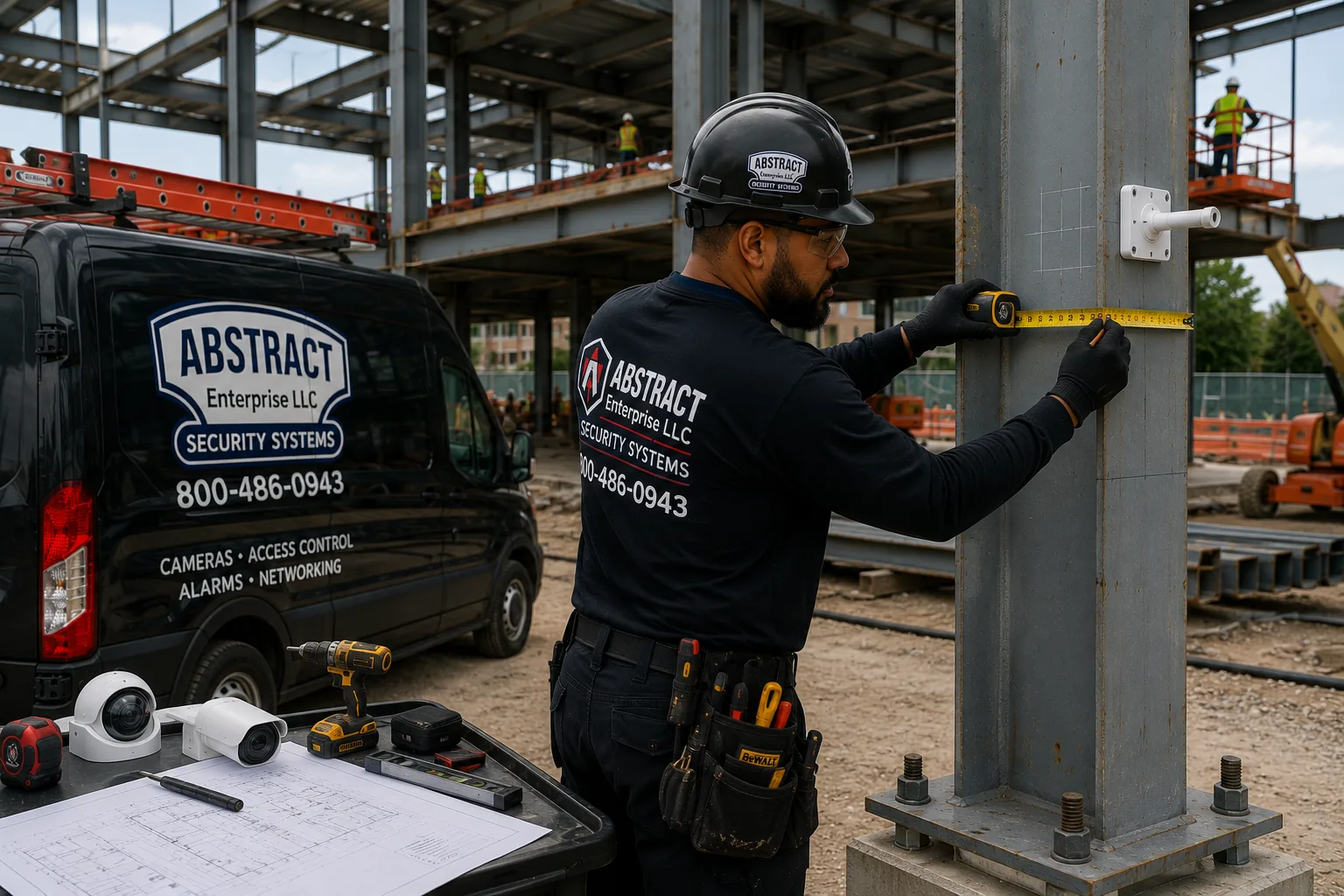
Prepping a column mount for a solar construction site camera installation — in NYC, panel angle and southern exposure get picked before anything is drilled.
Element 11 · DIY vs Licensed Contractor
Buying Cameras Off Amazon vs. a Licensed Jobsite Deployment
Decision Point
Abstract — Licensed Deployment
DIY / Consumer Cameras
Power & connectivity
Solar sized for NYC winters, cellular checked per position, dual-SIM where the frame eats signal
Wi-Fi cameras on a site with no Wi-Fi; batteries dead by week two; dead zones discovered after the theft
You, a ladder, and a return window that closed in March
A fixed head positioned for progress and construction time-lapse coverage inside a NYC shell — mounted where trades can't clip it and the frame sees the floor.
Where DIY genuinely makes sense: a one-week punch-list phase, a small renovation with power and Wi-Fi already live, or a site where you only want a delivery-doorbell view. We'll tell you that on the phone rather than sell you a system you don't need — and if you've already bought your own cameras, our install-your-own-system service mounts and configures them properly.
Element 12 · Why Abstract for Jobsite Cameras
Why NYC GCs Put Our Number in the Site Trailer
🪪
Licensed & Insured
NYS low-voltage contractor license #12000287431 — the paperwork your GC contract, your insurer, and public-work compliance actually require.
📍
Already in the City
Brooklyn HQ on Troy Ave, Bronx office on Fordham Rd. Same-day emergency deploys and next-day standard installs — no freight from a warehouse in Texas.
👷
Owner on the Job
The person who answers (800) 486-0943 is the person who walks your site and runs the install. No call center, no ticket queue, no Tier 1 script.
📅
Month-to-Month
30-day minimum, then month-to-month for the life of the project. No 12-month lock-ins, no early-termination penalty when you hit closeout.
🏙️
NYC-Fluent
DOB Chapter 33 site logic, Local Law 78 incident documentation, sidewalk sheds, scaffold mounting, ConEd temp-power timelines — the local playbook national vendors don't have. Local construction camera specialists, not a dispatch queue.
NDAA-compliant brand options for SCA, government, and institutional work — and honest value lines for private jobs that don't need the premium.
🧾
Evidence That Holds Up
Time-stamped, export-clean footage and incident archiving built for insurance adjusters, attorneys, and DOB paperwork — because recording is only half the job.
Element 21 · Field Notes
What I Check on Every Site Walk Before We Mount Anything
Notes from the installer's side of the fence — the checklist we run before a single camera goes up:
1. Where would I come in? Not the gate — the fence section behind the dumpster, the scaffold ladder off the neighbor's yard, the sidewalk-shed cross-bracing you can climb like stairs. Every site has two or three "employee entrances" for thieves, and they're never on the street side. Those get cameras first.
2. What's the most stealable thing here, and can a camera read a face near it? Wire reels, the conex row, the fuel cage. If the nearest camera is forty feet up "covering everything," it identifies nothing. We mount for ID height at the choke points and let the wide shots be wide shots.
3. What kills the signal and the sun? Carrier bars at each mounting position, because steel eats LTE. Southern exposure that survives the next two phases, because a panel the new floors will shade in October is a dead camera in December.
4. What changes next month? The phase plan decides half the layout. If superstructure starts in six weeks, the fence-line units are getting relocated to the shed and the hoist — so they get mounted in ways that move fast, not in ways that look permanent.
5. Who gets woken up? Alert routing is the difference between a system and a gadget. After-hours person on the container row goes to monitoring and the super; a truck at the gate at 5 AM might just be the concrete guy early. We tune the zones until the 1 AM buzz means something.
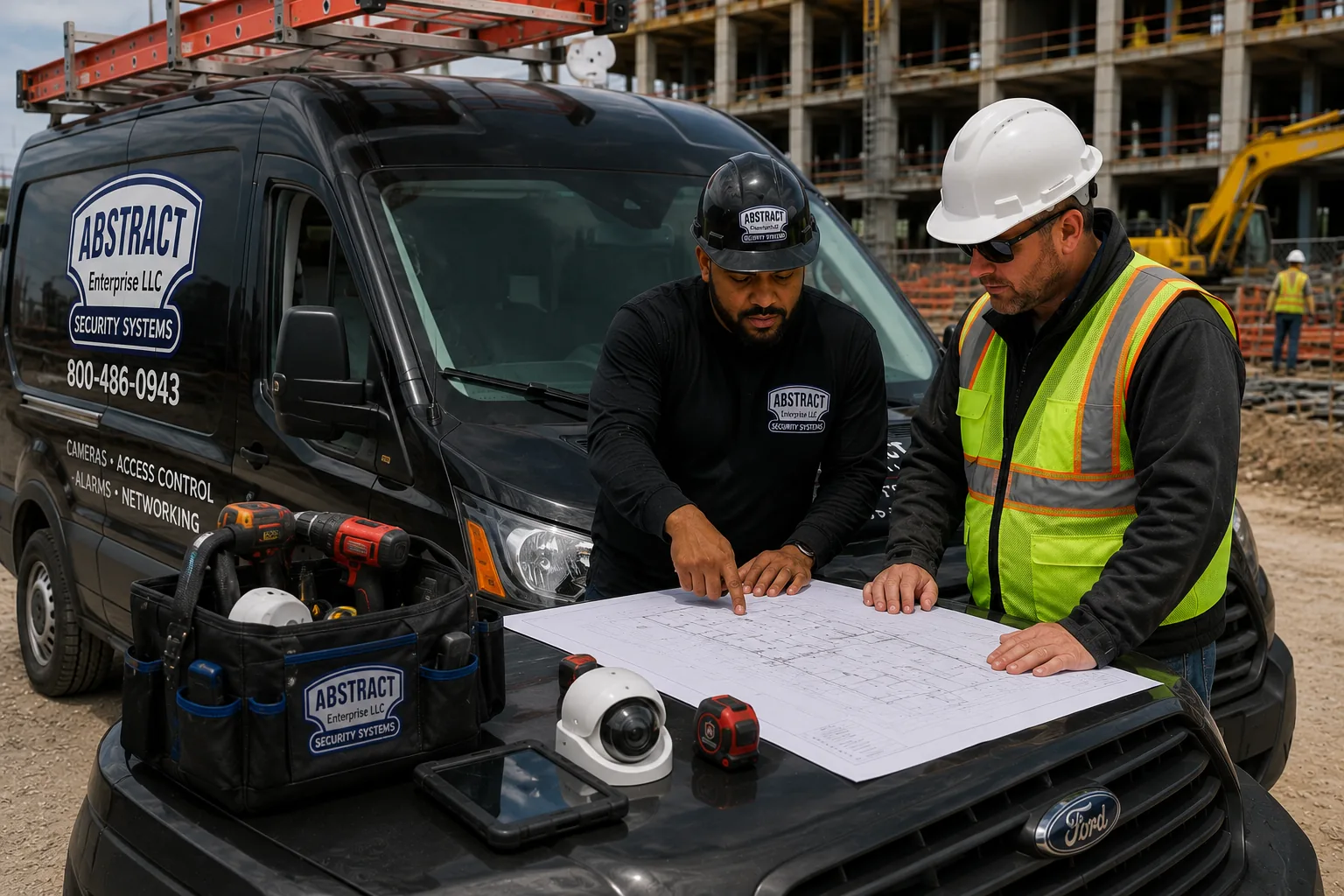
A NYC construction site CCTV installer doing the part that decides everything — mount height, sight line, and the drawing checked before the drill comes out.
Get a Camera Plan Before the Next Long Weekend
Request a site-specific camera plan — site walk, placement, and a firm monthly number, usually within one business day.
Abstract Enterprises Security Systems — Brooklyn (1282 Troy Ave) & Bronx (460 E Fordham Rd) offices
Recurring Theme
Speed
The word that shows up most in our reviews. Sites call after a hit or before a shutdown, and the units are up before the next overnight — that turnaround is the reason contractors keep the number.
Recurring Theme
Straight Answers
Reviewers consistently mention getting talked out of hardware they didn't need. We'd rather spec four cameras that matter than sell eight that don't — it's why the ratings hold across hundreds of jobs.
Recurring Theme
Owner Access
No dispatcher, no "your call is important to us." The owner picks up, knows your site, and shows up when something needs adjusting — clients notice, and they write it down.
More construction camera installation reviews live on our Google Business Profiles — search "Abstract Enterprises Security Systems" in Brooklyn or the Bronx.
Element 14 · Frequently Asked Questions
Construction Site Camera FAQ
How much does construction site security camera installation cost in NYC?
Rentals for a monitored solar or cellular jobsite camera unit start around $349 per month with a 30-day minimum. Wired construction site CCTV installation typically runs $500 to $2,500 per camera installed depending on mounting height, cabling, and camera type, with most active-site systems landing between $6,500 and $18,000. Surveillance trailers start at $2,500 per month.
Should I rent a jobsite camera unit or a surveillance trailer?
Pole-mounted solar or cellular camera units suit fenced urban lots, building shells, and sites where a trailer footprint is impractical. A surveillance trailer with a 22-foot mast covers large open sites, laydown yards, and equipment storage areas from one position. Many NYC projects run both — units at gates and material stacks, a trailer covering the open yard.
Do I have to sign a long-term contract for construction camera rental?
No. Rentals run on a 30-day minimum and continue month-to-month for the life of the project. There are no 6- or 12-month lock-ins and no early-termination penalty when the job closes out.
Who watches the cameras overnight on a construction site?
With a monitored plan, live operators watch AI-verified alerts after hours. On a confirmed intrusion they trigger talk-down audio and strobes, notify your site contact, and can call NYPD with a video-verified report. Unmonitored plans send motion alerts straight to your phone instead.
What happens to the cameras as the building goes up?
Phase relocation is part of the service. As excavation becomes superstructure and superstructure becomes fit-out, we move cameras from fence lines to scaffold, sidewalk shed, and floor slabs so coverage follows the work. Rental relocations inside the five boroughs are included.
How fast can you deploy cameras after a jobsite break-in?
Same-day and next-business-day rapid deployment is available inside the five boroughs. Solar and cellular units need no power or internet, so a hit site can be covered before the next overnight.
Are your construction cameras NDAA-compliant for SCA and government work?
Yes. For federally funded, SCA, hospital, and government-adjacent projects we spec NDAA-compliant camera lines such as Axis, Hanwha Vision, Avigilon, and Verkada. For private jobs without that requirement, value lines remain available.
How long is construction camera footage stored, and can I pull clips for an insurance claim?
Standard cloud retention is 30 days, with 60- and 90-day tiers for projects that need a longer record. Incident clips export time-stamped in formats insurers and attorneys accept, and we can archive flagged events for the life of the project.
Do construction site cameras actually reduce theft or just record it?
A deterrence stack — visible cameras, posted surveillance signage, strobes, and live talk-down audio — turns most intrusions around before anything is taken. Industry research has found sites with visible surveillance signage are targeted significantly less often, and recorded footage covers the cases deterrence does not.
Can I watch multiple jobsites in one app?
Yes. Every site's cameras load into a single app account, so a GC or project manager running work in three boroughs sees every gate, yard, and floor from one dashboard, with per-site user permissions for supers and PMs.
Do you remove everything at project closeout?
Yes. Rental closeout removal is included — units, mounts, and signage come off the site clean. If ownership is taking over the finished building, we can convert the temporary system into a permanent building CCTV installation instead.
Which areas do you cover for construction site camera installation?
All five boroughs — Brooklyn, Manhattan, Queens, the Bronx, and Staten Island — plus Long Island (Nassau and Suffolk) and the Hudson Valley (Westchester, Rockland, Orange, Putnam, Dutchess, Ulster).
Element 15 · Service Coverage
Construction Site Cameras Across the Five Boroughs & Beyond
Jobsite security camera installation NYC-wide — the hub covers all five boroughs from our Brooklyn and Bronx offices. Searching "construction site security camera installation near me" from a site trailer? You just found the local crew. Dedicated borough and county pages are rolling out — until yours is live, hit the quote link with your area and we'll route it same-day.
Element 15.5 · Why Abstract vs National Jobsite Camera Companies
How We Compare to the National Jobsite Camera Companies
The national jobsite-camera and managed-surveillance companies run remote fleets out of warehouses in Texas, Florida, and the Midwest. They freight units to New York on multi-day lead times, quote national rack rates, and lock projects into long contracts serviced by a call center. Here's how a locally-owned, NYS-licensed NYC operator stacks up on the factors that decide whether your site is actually covered:
Factor
Abstract Enterprises
National Jobsite Camera Companies
Deploy lead time
Next business day standard inside the 5 boroughs · same-day for emergencies
5–10 business days typical · cross-country freight, scheduling queues
Monitored unit pricing
Monitored solar/cellular units from $349/mo · site plans under $1,500/mo for most projects
Managed-unit quotes commonly $500–$900+/mo per unit · plus freight, setup & fuel surcharges
Contract terms
30-day minimum, month-to-month after · no early-termination penalty
6–12 month contracts common · buyout fees at closeout
Phase relocations
Included on rentals — we're already in the city
Service-call pricing and scheduling windows for every move
For context: one overnight guard runs $3,000–$6,000+/mo; a 24/7 rotation roughly $16,000–$20,000/mo. Any monitored camera stack — ours or theirs — beats that math. The question is who answers when a camera goes dark at 11 PM.
Element 16 · Pricing
Construction Site Camera Pricing — NYC
Construction camera rental prices and installation costs, stated up front. Every project gets a firm written quote after a site walk, but these are the lanes NYC jobs actually land in — monthly jobsite camera rental, installed systems, and monitored plans:
Temporary construction camera rental stock, NYC-ready — units, mounts, and cable staged so a site can be covered the day the call comes in.
Buy · Wired Site Systems
Installed IP / PoE Construction CCTV
Typical construction site camera installation cost: $500–$2,500 per camera depending on mounting height, cable runs, and camera class — most active-site builds land $6,500–$18,000 complete with NVR, and convert to the finished building's permanent system at turnover. Ballpark your build with the camera calculator.
Add-Ons & Adjacent
Trailers, Time-Lapse & Extras
Construction surveillance trailer rental from $2,500/mo for large open sites · time-lapse/progress camera add-on from $149/mo · LPR gate camera add-on quoted per gate · closeout removal included on all rentals. Every number confirmed in writing before we mount anything.
Jobsite security camera warranty. “Abstract Enterprises Security Systems provides a three-year warranty on products supplied by AESS for normal wear and tear. It does not cover existing or customer wiring, customer-supplied equipment, lightning or other acts of God, power outages or surges, physical damage or unplugging, internet, router or phone changes, or camera readjustments requested after completion. After the warranty period, service is $195 per hour with a three-hour minimum ($585).” Full terms: warranty page.
Just Got Hit?
Same-Day Emergency Deployment
Break-in last night? Emergency construction site camera installation is what the truck is stocked for — solar/cellular units watching the site before the next overnight — thieves who scored once come back within the week. Call (800) 486-0943 and say "emergency deploy."
Shutdown Coming?
Holiday & Long-Weekend Coverage
Holiday-weekend jobsite security is when theft spikes — sites go dark and crews scatter. Protect the site before the holiday shutdown: reserve units before the shutdown week — Thanksgiving through New Year's is our busiest deploy season, and the calendar fills.
Breaking Ground?
Pre-Mobilization Installs
The smartest money: secure the jobsite before equipment arrives — cameras up with the fence, before the first material drop. Day-one coverage, day-one delivery documentation, zero unwatched nights on record.
A cellular jobsite camera installation going up in NYC — its own LTE uplink, so coverage starts today instead of whenever the internet drop lands.
Element 18 · Real NYC Problems This Actually Fixes
Real NYC Jobsite Problems a Camera System Actually Fixes
The Weekend Copper Strip
Friday 3 PM → Monday 6 AM is 63 unwatched hours
With copper at record prices, a dark site over a long weekend is a payday with a fence around it. After-hours AI zones, strobe-and-voice deterrence, and monitored response turn those 63 hours from your biggest exposure into your best-documented window.
The Scoped Site
They know your schedule better than your subs do
Repeat-hit sites are being watched — delivery days, dark hours, which gate the super uses. Your cameras flip the surveillance: after-hours footage shows the scout walks, the slow drive-bys, the guy "waiting for the bus" at your fence for forty minutes. NYPD takes video-verified patterns seriously.
The Neighbor Claim
"Your excavation cracked my wall" — on a day nobody dug
Adjacent-property claims eat NYC projects alive. Continuous time-stamped video of site conditions and equipment operation is the defensive record that ends the argument — and feeds the Local Law 78 incident paperwork DOB expects within three business days.
The ConEd Wait
Temp power is weeks out and the site is already loaded
Materials arrive before electricity does on almost every NYC ground-up. Solar/cellular units cover the gap from mobilization day — no ConEd, no trenching, no internet drop, watching that same night.
The Delivery Dispute
Signed for 14 pallets, found 11 on the job site floor
LPR at the gate plus a head on the unloading zone gives every delivery a plate, a time stamp, and a clip. Shrinkage disputes with suppliers and subs stop being word-against-word — several clients say this pays for the system by itself.
The Insurance Squeeze
Carrier wants to know your security posture before writing the policy
Builder's-risk underwriters increasingly ask what surveillance the site runs. A monitored camera plan is a strong answer on the application — and when a claim lands, exportable time-stamped footage is the difference between a payout and a fight.
Element 19 · Book Your Site Coverage
Ready to Put Cameras on Your NYC Jobsite?
Tell us the site, the phase, and the timeline — the fastest way to get a construction site security quote in the five boroughs. You'll get a placement plan and a firm monthly number — usually within one business day, same day for emergencies. Licensed, insured, month-to-month, and already in the city.
Abstract Enterprises Security Systems · NYS Low-Voltage License #12000287431 · Fully insured · Brooklyn & Bronx offices · Serving all five boroughs, Long Island & the Hudson Valley · Se habla español
Request a Site Camera Plan
Send the Site Details — Get a Placement Plan & Firm Number
The more we know about the site, the tighter the first quote. A minute here usually saves a phone call — and emergency requests jump the queue.