🏗️ Licensed jobsite security specialists  |  NYS Lic. #12000287431  |  Call (347) 934-8335  |  Se habla español
What are you looking for?
About Us Contact Us Careers Get a Free Quote (347) 934-8335
Pick a service
✅ Got Your Own System?
🎬 Home TheatreQuote 🎶 AV SoundQuote 🔑 Access ControlQuote
Now pick your area
Pick your area
Long Island
Hudson Valley
Services available
Pricing & Tools
Pick a service for pricing
🚪 Intercom Pricing 🔔 Buzzer Repair Pricing
Calculators
📹 Camera System Calculator 🚨 Alarm Calculator ⚡ Cabling Quote Builder ✅ Got Your Own System?
Select your area
FiDi · Midtown · Hudson Yards · UES · UWS · Harlem

Construction Site Security Camera Installation, Manhattan

Jobsite cameras built for vertical Manhattan — towers, office-to-residential conversions, fit-outs, and façade work — with shed-line and hoist coverage, per-floor expansion as decks pour, curb cameras that close the delivery window, and 24/7 monitored response. Installed by a licensed NYS low-voltage contractor with offices on both sides of the borough, rented month-to-month, converted or removed clean at TCO.

NYS Lic #12000287431 Shed & scaffold mounting Hoist & per-floor coverage Same-day emergency deploys Month-to-month rentals

60-Second Site Camera Match

Tell us the site. We spec the system before we call you back.
Or call the owner direct: (347) 934-8335
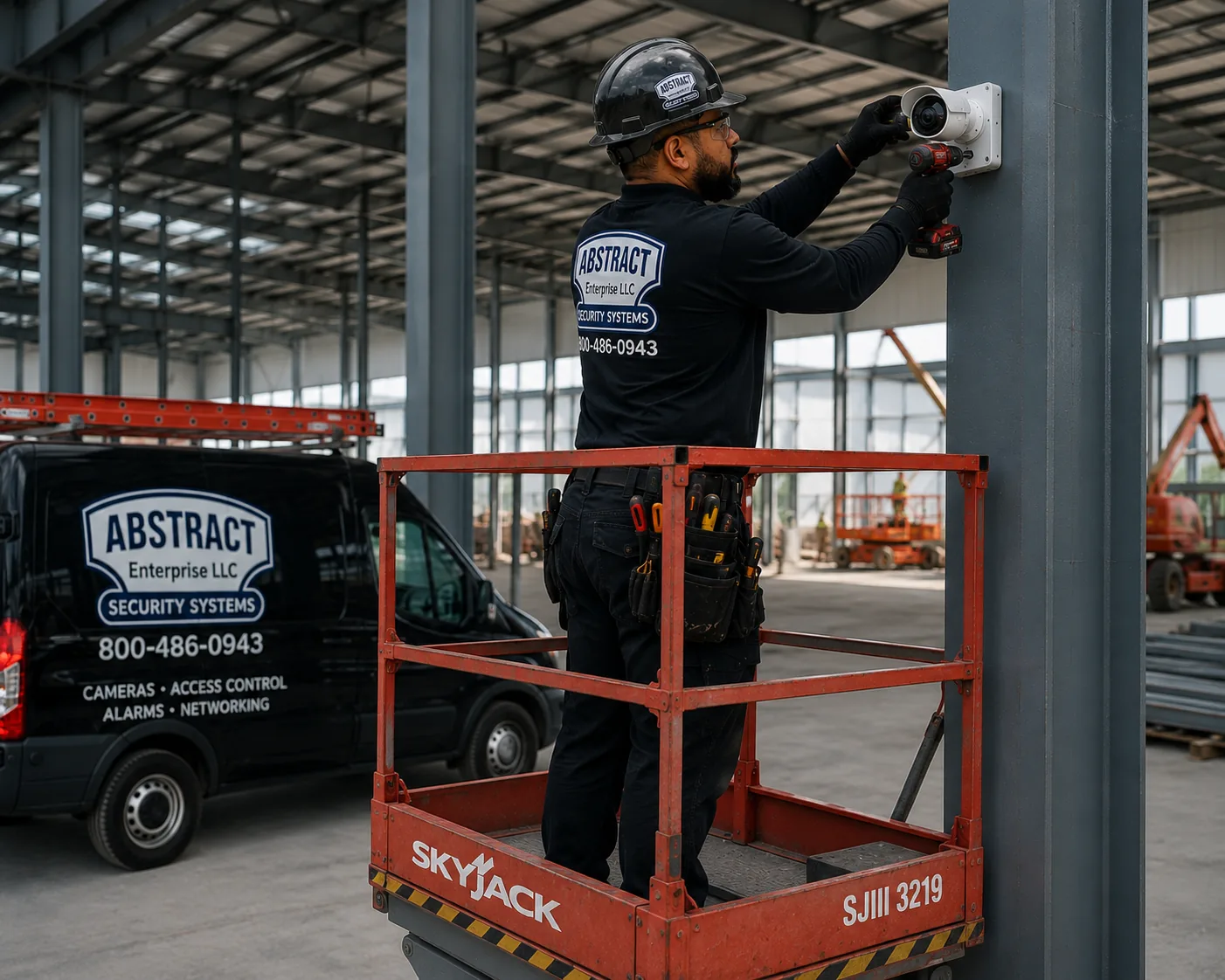
Technician on a scissor lift fastening a compact camera to a steel column inside a bright open floor plate during a Manhattan construction site security camera installation
Construction site security camera installation in Manhattan — a scissor lift, a bare floor plate, and coverage climbing the building one deck at a time.
Same-day emergency deploys borough-wide 🏢 Shed, scaffold & hoist mounting coordinated 🎥 Per-floor coverage that climbs with the build Call (347) 934-8335

The Most-Watched Borough Still Loses Tools, Copper & Pallets Every Single Week

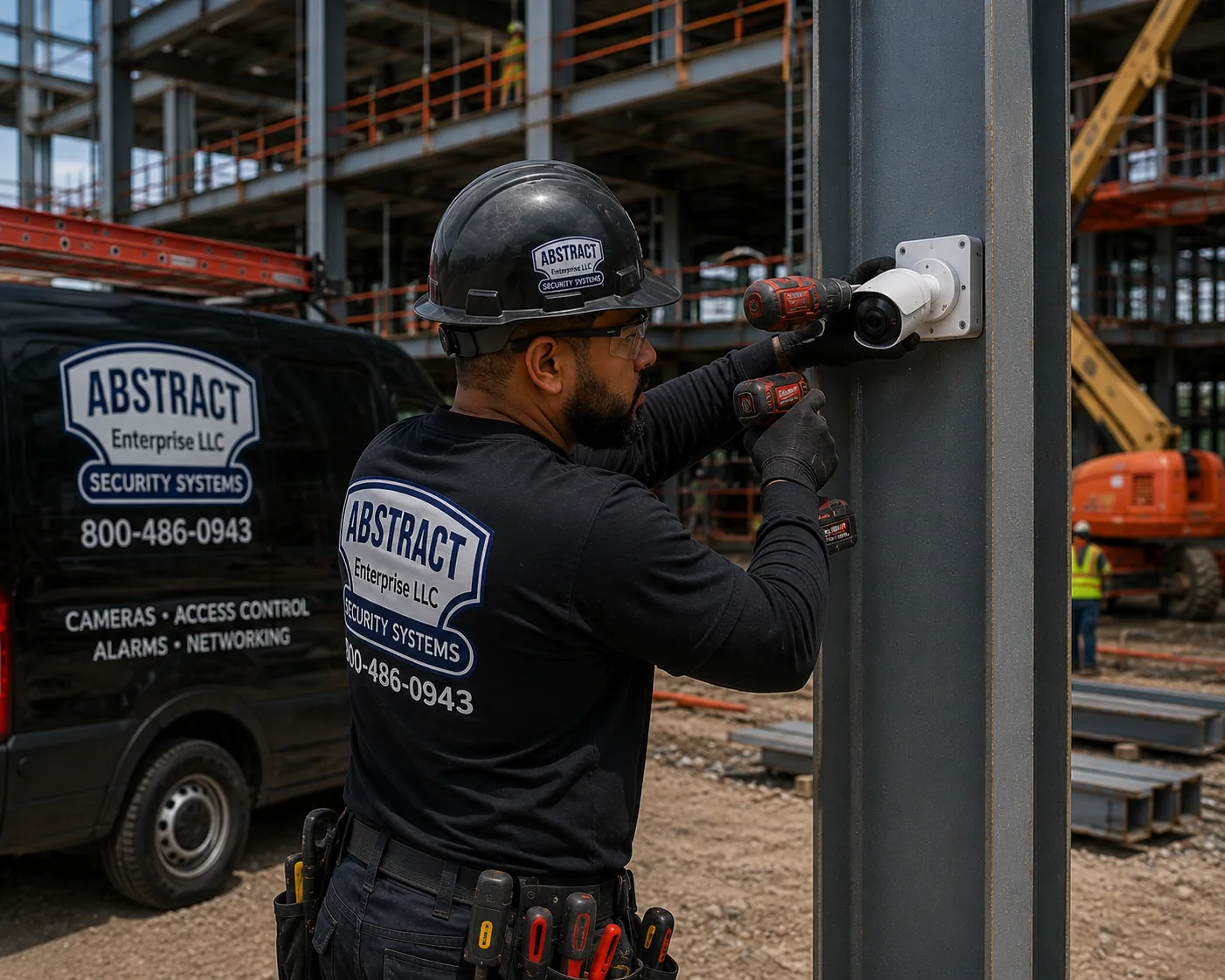
Installer drilling a compact wireless camera onto a steel column at an active Manhattan jobsite with lifts staged along the open deck
Wireless jobsite camera installation on a Manhattan floor plate — up, aimed, and reporting before the lift moves to the next bay.

Manhattan theft doesn't look like a pickup rolling through a fence at 3 AM. It looks like a hard hat and a hi-vis vest walking out the hoist with a $4,000 rotary hammer in a bucket. It looks like a pallet of copper fittings evaporating from the curb in the twenty minutes between the delivery truck and the material lift. It looks like riser floors stripped of wire the weekend after rough-in, an "electrician" nobody hired riding the shed stair, and a fit-out floor where six subs all swear their tools were locked up Friday.

Density is the disguise. On a block with ten thousand daily passers-by, one more person carrying material out of a construction entrance is invisible — unless the entrance, the hoist, the curb, and the floors are on camera. The dollars are the same national epidemic — $300 million to $1 billion stolen annually per NER/NICB reporting, with recovery rates on tools under 7% — but the Manhattan version concentrates in materials, tools, and interior packages, walked out in gym bags and buckets rather than driven off on trailers.

And here, the camera earns its keep twice. This borough's projects carry the city's heaviest paper exposure: DOB permits and site-safety plans, sidewalk sheds over live pedestrian traffic, party walls against occupied buildings, after-hours variances with neighbors counting decibels, and a claims bar that knows exactly what a stop-work order costs you per day. Nothing in the code makes you install jobsite cameras — and we won't pretend otherwise — but when the crack claim, the shed-line slip-and-fall, or the "your crew worked past the variance" complaint arrives, the time-stamped record is the difference between a five-figure settlement and a two-line email with a clip attached.

$300M–$1Bannual U.S. equipment & material theft (NER/NICB)
<7%recovery rate on stolen tools & small equipment
13/13largest U.S. office-to-resi conversions — all in Manhattan (TRD)
20 minthe curb window where borough material theft lives
⚠️ Straight talk: no DOB rule requires security cameras on your project — site-safety plans, flaggers, and shed lighting have code sections; surveillance doesn't. What cameras buy in Manhattan is accountability per square foot: every entrance, hoist ride, curb drop, and riser floor accounted for, and a defense file that builds itself. That's the honest pitch.

Coverage That Works the Way Manhattan Builds — Up, Not Out

A suburban site spreads across acres; a Manhattan site stacks thirty stories over a forty-foot curb cut. The camera plan has to think vertically — entrances, hoist, floors, roofline — and it has to survive an environment where the site itself changes shape every month:

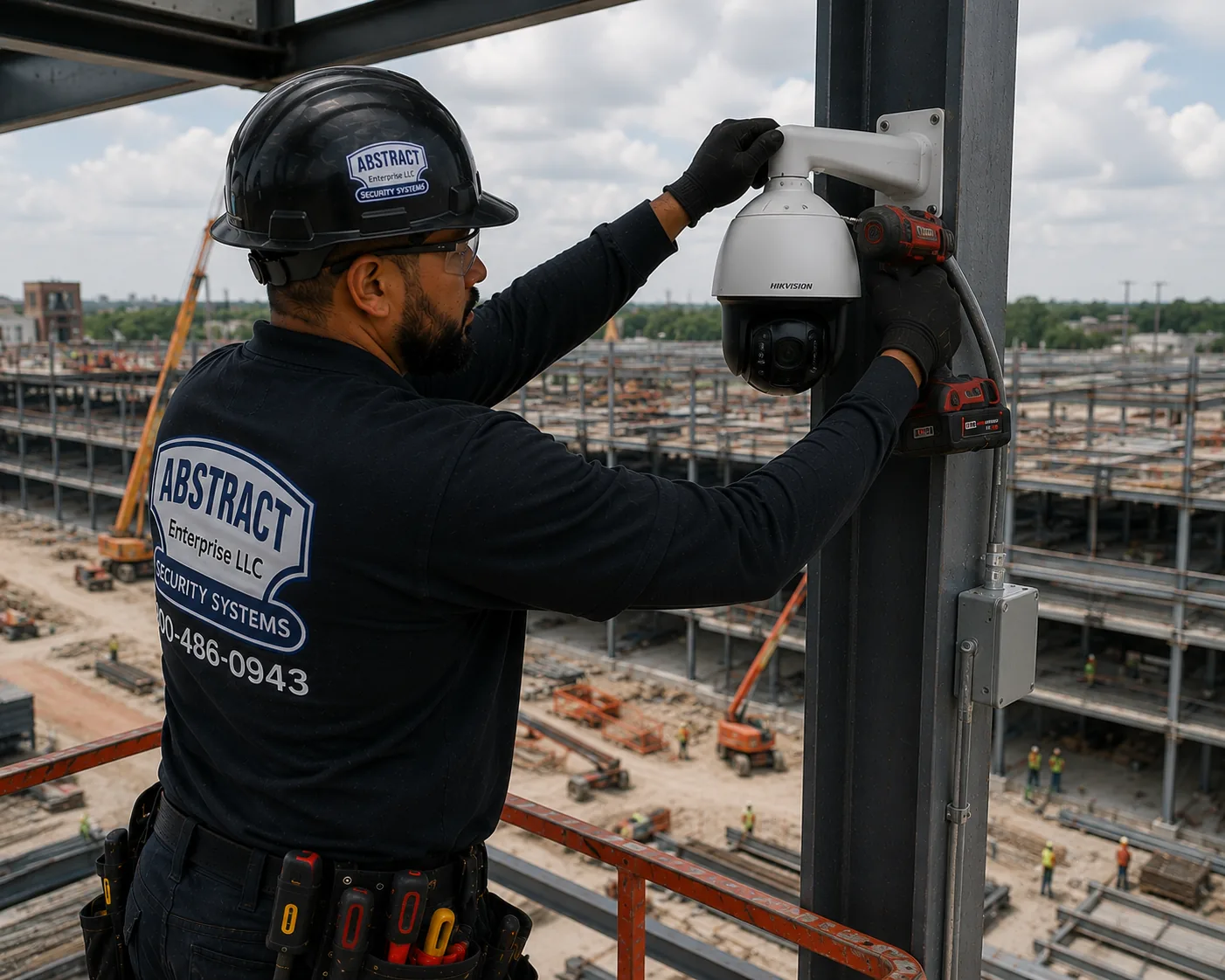
Abstract Enterprises technician securing a PTZ camera to structural steel high above a Manhattan construction deck with the frame stretching behind him
High-rise construction camera installation in Manhattan — one well-set PTZ watching a full floor plate and the hoist landing that feeds it.
🚪
The Front Line

Entrance & Shed-Line Cameras

ID-height heads on every worker and visitor entrance, the shed stair, and the standpipe alley — the choke points where everything and everyone enters the record.

🛗
The Vertical Artery

Hoist & Material-Lift Coverage

Cameras on the hoist landings and car log every ride and every load — the single richest evidence stream on a tower project, and the fastest way to settle who took what to which floor.

🏢
Climbing Coverage

Per-Floor Interior Units

Compact heads that leapfrog upward with the work — riser floors after rough-in, material staging floors, finished floors holding appliance and fixture packages before turnover.

🚚
The Curb Window

Dock & Curb-Line Cameras

Plate-capture and overview heads on the loading zone, where material sits exposed between truck and hoist — the twenty minutes where most borough theft actually happens.

🔄
The Wide View

Roofline & Setback PTZ

Pan-tilt-zoom units on parapets and setbacks documenting the deck, crane picks over the street, and the site perimeter from above — one head, the whole footprint.

🧠
Signal vs. Noise

AI Person & Vehicle Analytics

After-hours zones tuned for a block that never empties — alerts for someone inside the fence line, silence for the sidewalk crowd two feet away.

📢
Active Response

Strobe + Talk-Down Audio

A voice naming the intruder's location lands differently inside a dark shell than on an open lot — and on a Manhattan block, it also summons every doorman's attention within earshot.

The Record

Time-Lapse & Progress

Deck-by-deck progress documentation for lenders, owners, and marketing — plus the schedule evidence when a delay claim needs a day-by-day answer.

🖥️
Storage & Access

NVR + Cloud Hybrid

On-site recording with cloud clips that survive a stolen recorder — one app across the tower in FiDi, the conversion in Midtown, and the fit-out uptown.

Monitored Option

24/7 Live Monitoring — Tuned to Your Variance, Not a Clock

Manhattan sites don't keep office hours: AHV night pours, weekend hoisting, occupied-building work windows. Monitored plans run on your actual schedule — operators verify events, fire strobes and talk-down, work the call list, and give responding officers a video-verified report with a floor and a description. The 2 AM alert gets an answer while the person is still in the stairwell, not a review on Monday.

When the Lot Is Open Ground

Excavations, Yards & Lay-Down Lots

For the foundation stage, demolition lots, and the rare Manhattan laydown yard, a solar surveillance trailer in Manhattan parks mast-mounted PTZ coverage with no power and no structure to mount to — then leaves when the steel rises. Rates on the trailer pricing page.

📐 Temporary vs. permanent: everything above installs as relocatable jobsite equipment — and on conversions and towers, the smart money plans the handoff early. The same positions convert into the building's permanent commercial camera system in Manhattan, tied to access control and video intercoms, so the lobby is covered the day the first tenant gets keys.

Shed, Hoist, AHV, Party Wall — the Manhattan Vocabulary

Sidewalk shed / pipe scaffold — the protective structure over the sidewalk and the frame on the façade. Both are prime camera real estate: shed-line heads watch the pedestrian interface where slip-and-fall claims are born, and scaffold positions cover approaches no ground mount can see. We coordinate every position with the scaffold contractor so nothing interferes with jumps or inspections.

Hoist / material lift — the vertical artery of a tower project. Hoist-landing cameras produce the cleanest chain of custody on the site: what went up, what came down, who carried it, and when.

AHV — after-hours variance — DOB permission to work outside standard hours. For cameras it means two things: monitoring schedules built around your actual work windows, and a time-stamped record that answers noise complaints with facts instead of apologies.

Party wall / adjacent property — the lot-line interface with the occupied building next door, and the source of Manhattan's most expensive slow-burn disputes. Continuous camera coverage of the interface, paired with your pre-construction survey, is the cheapest claims defense on the project.

TCO — temporary certificate of occupancy — the finish line where jobsite systems either come off clean or convert into the permanent building package. Planning the conversion at mobilization, not at punch list, is how owners avoid buying the same coverage twice.

NDAA-compliant — hardware permitted on federally funded and most public work under Section 889. SCA schools, CUNY buildings, and agency work in the borough carry the requirement; the brand list starts there, not at price.

jobsite security camerasconstruction camera rentaltower crane area camerassidewalk shed camerashoist landing camerasmonitored construction site camerasinterior fit-out cameras4G LTE jobsite camerasloading dock camerasconstruction progress camerasafter-hours jobsite monitoringconversion project security

The Hardware List — and What Gets Past a Compliance File

Brand strategy in this borough is written by the funding source and the floor plan. Public and institutional work — SCA schools, CUNY, city agencies, anything touching federal money — requires NDAA §889 compliance, which strikes Hikvision and Dahua and puts Axis, Hanwha Vision, Avigilon / Alta, and Verkada on the table with paperwork attached. Private towers, conversions, and fit-outs can run LTS/Platinum where budget leads, or Uniview and entry lines on short-cycle interior work — and yes, we install Dahua where it's a legitimate private-project play, never where an auditor will find it.

How the borough sorts them: Avigilon's appearance search is the answer to "find the guy in the red hoodie across nine floors and three weeks"; Verkada's cloud-first model suits developers running a portfolio of sites from one dashboard with no server closets; Axis owns the roofline PTZ and low-light shed positions; Hanwha multi-sensors cover a corner entrance and two sidewalks with one penetration. Tell us the funding, the floors, and what's been disappearing — the spec writes itself from there.

Four Setups That Cover Most Borough Jobs

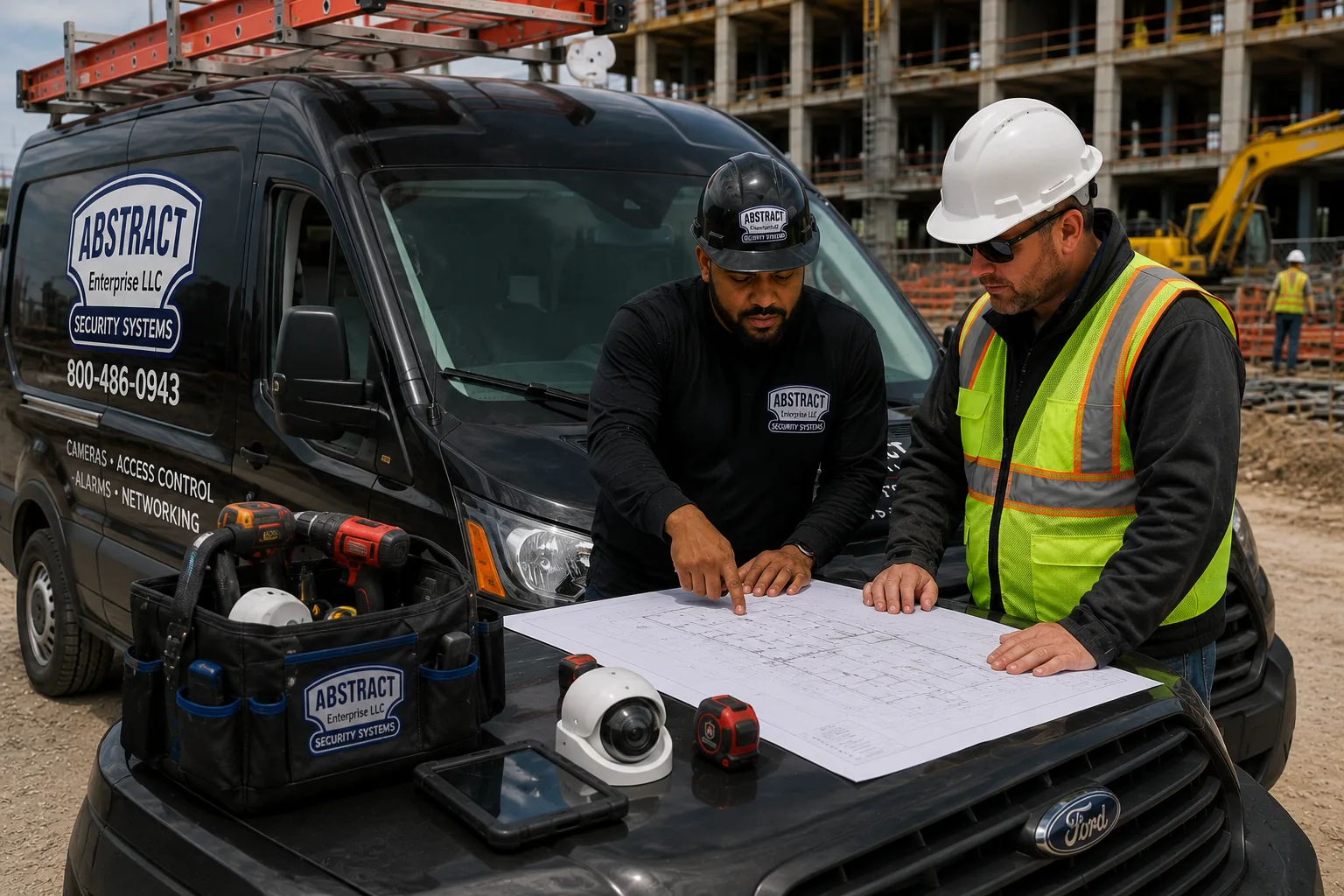
Abstract Enterprises technician reviewing site drawings with a contractor in a hi-vis vest on the hood of a company van outside a Manhattan project
A jobsite camera consultation outside a Manhattan project — package, positions, and schedule settled before anyone touches a ladder.
🏙️

Tower Package

Entrances, hoist landings, curb line, and roofline PTZ, with interior units climbing as decks pour — the full vertical chain of custody from excavation to topping out.

🏢

Conversion Package

Built for occupied-adjacent adaptive reuse: shed-line and entrance coverage, riser and demolition floors, party-wall documentation, and retention tuned for the claims these projects attract.

🛠️

Fit-Out Package

Compact interior coverage for office, retail, and hotel build-outs — tool cribs, material rooms, and floor entrances watched without touching the base building's systems.

🌙

Full-Watch Package

Any layout above plus 24/7 live operators, talk-down response, and video-verified dispatch scheduled around your AHVs — the site answered around the clock.

Each package hands off cleanly to the rest of the low-voltage scope — site and building alarms, tel-data backbone, and the permanent systems the finished property keeps.

The Spec Sheet, Line by Line

Hardware

On the Site

  • ▸ 4K & 2K weatherproof IP cameras (IP66/IP67)
  • ▸ Shed, scaffold & parapet mounting hardware
  • ▸ Hoist-landing & car-mounted units
  • ▸ Compact interior heads for working floors
  • ▸ Battery + LTE units for pre-power phases
  • ▸ Rooftop antennas & repeaters for canyon signal
  • ▸ PTZ, multi-sensor, plate-capture & low-light heads
  • ▸ Strobes, talk-down speakers, tamper detection
  • ▸ Lockable NVR enclosures off the working floors
Software

On Your Phone

  • ▸ One app across every project & borough
  • ▸ AI person/vehicle detection tuned for dense blocks
  • ▸ Arming schedules that follow AHVs & work windows
  • ▸ Instant alerts with clip previews by zone & floor
  • ▸ Cloud + on-site recording, 30–90 day retention
  • ▸ Time-stamped exports carriers & counsel accept
  • ▸ Progress time-lapse with owner & lender links
  • ▸ Per-user permissions for CMs, supers & ownership
Operations

On Us

  • ▸ Site walk with signal check & mounting plan
  • ▸ COIs for building & adjacent owners handled
  • ▸ Coordination with scaffold & site-safety teams
  • ▸ Next-day standard installs, same-day emergencies
  • ▸ Re-aims at shed jumps & phase turnovers included
  • ▸ 24/7 live operator monitoring (optional)
  • ▸ Video-verified dispatch on confirmed intrusions
  • ▸ Clean TCO removal — or permanent conversion
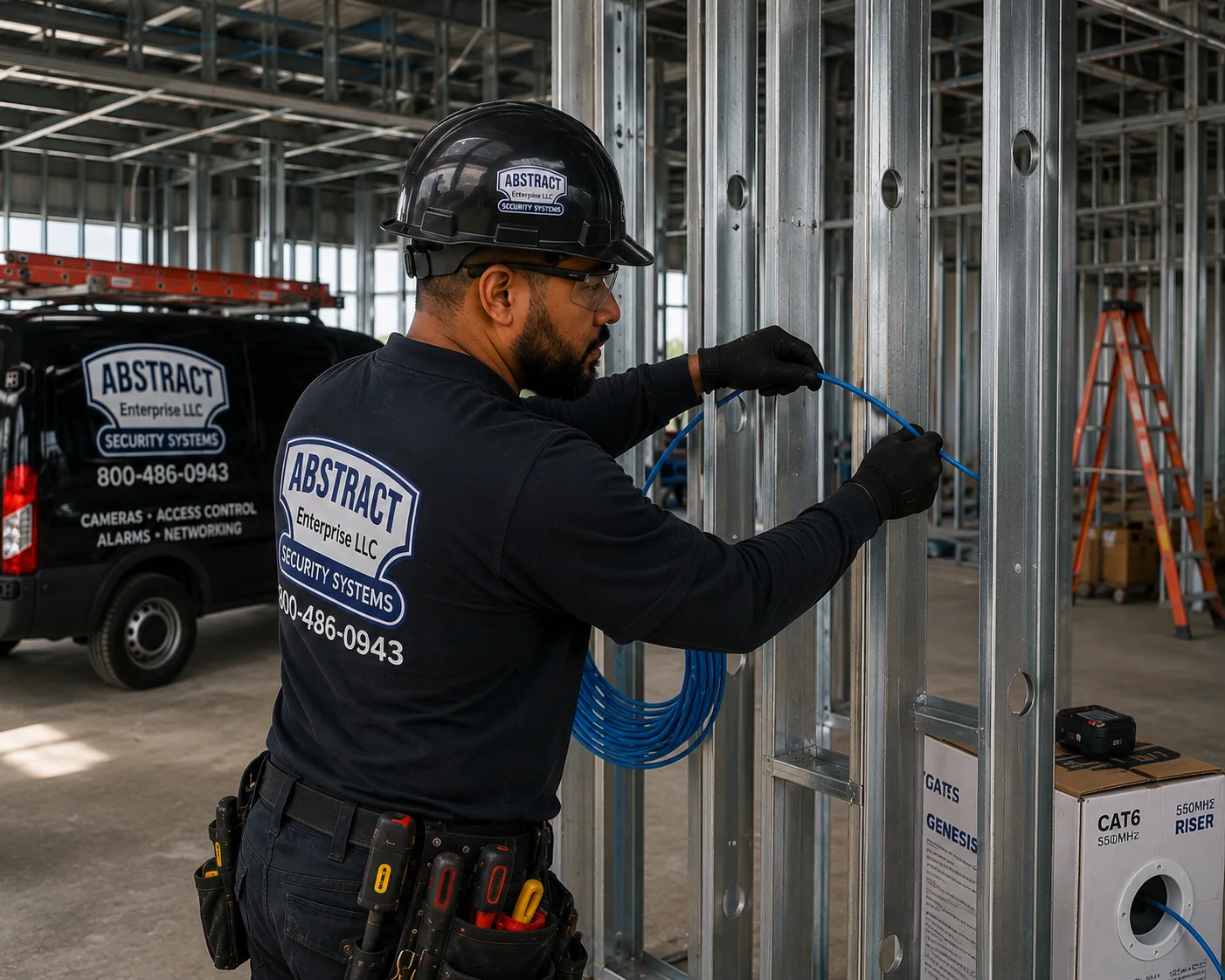
Installer pulling blue Cat6 cable through steel stud framing beside a boxed spool for construction camera network cabling on a Manhattan project
Construction camera network cabling on a Manhattan fit-out — runs routed where the trades won't fight them and the finishes won't hide problems.

The Work Driving the Borough's 2026 Camera Demand

Manhattan's construction story this cycle is adaptive reuse at a scale no other city touches — plus the perennial vertical churn around it:

The Headline

The Conversion Wave

Developers are putting roughly 9.5 million square feet of office-to-residential conversions into construction in 2026, with the nation's thirteen largest conversion projects all inside this borough — a Downtown-heavy pipeline running from the Financial District through Tribeca and NoHo into Midtown and Hell's Kitchen.

Midtown East

The 51st–57th Street Cluster

The corridor between East 51st and 57th is thick with active conversions and modernizations — Tower 57 at 135 East 57th repurposing a 430-foot office tower into 350 rentals under the 467-m program, and 355 Lexington adding four floors on its way to roughly 297 units, shed already up.

The Scrutiny

Every Conversion Under a Microscope

A July structural scare that halted one of the country's biggest Midtown conversions made national news — and put every adaptive-reuse site's documentation, monitoring, and neighbor relations under sharper watch. Continuous site records went from nice-to-have to board-meeting material overnight.

Downtown

FiDi's Second Act

Nine of the top thirteen mega-conversions cluster below Chambers Street — Water Street and Wall Street towers becoming thousands of apartments, with more filings landing steadily as owners of half-empty office stock follow the tax incentives into residential.

Vertical Churn

Fit-Outs, Hotels & Retail

Under the headlines, the borough's steady economy of interior work rolls on — office repositionings, hotel refreshes, restaurant and retail build-outs — short-cycle projects where a tool crib and a material room still hold six figures of exposure.

Uptown & Institutional

Campuses, Healthcare & Housing

The perennial institutional pipeline — hospital systems, universities, SCA school work, and affordable-housing starts uptown — carries NDAA requirements, occupied-campus logistics, and documentation standards that make camera planning part of the bid, not an afterthought.

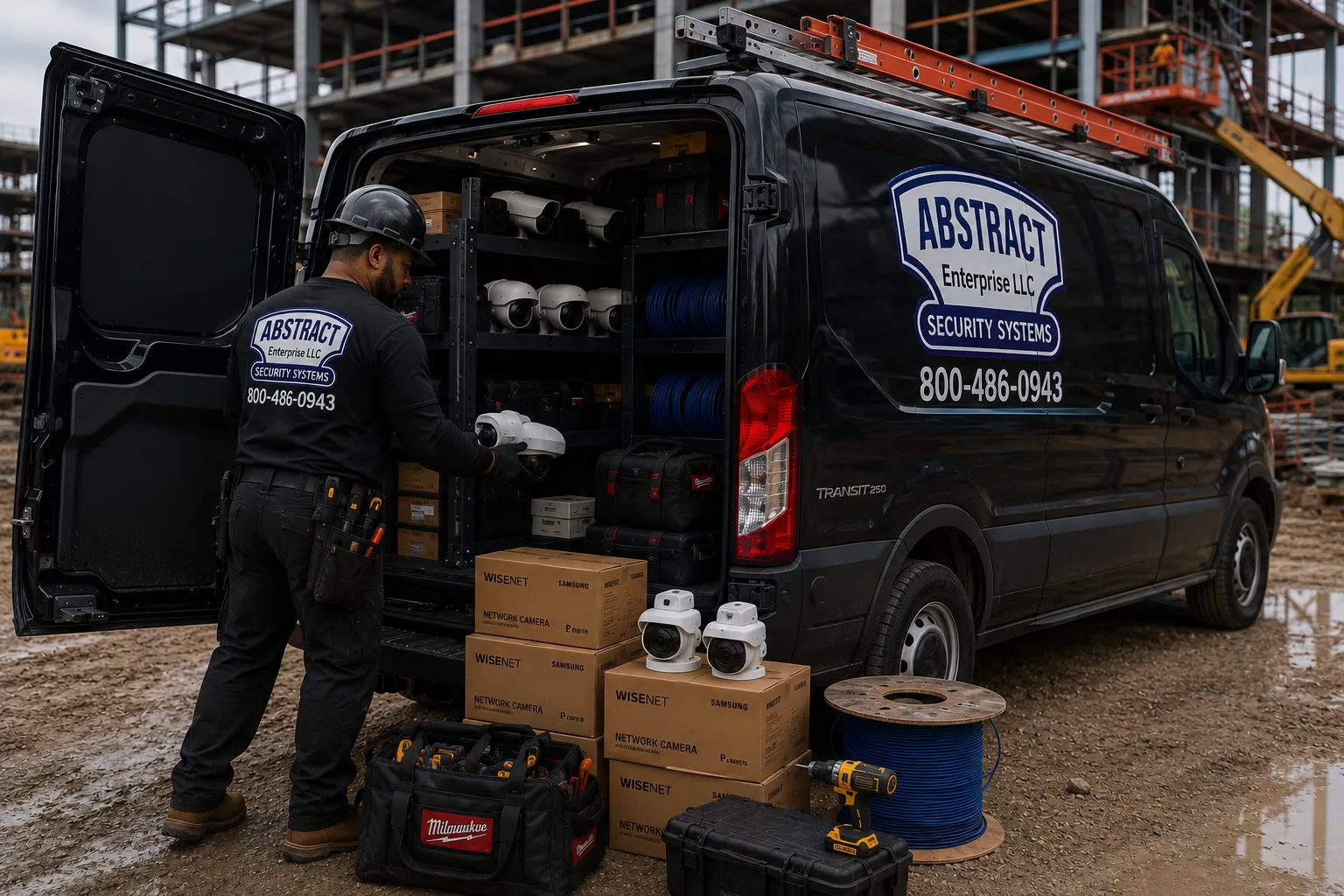
Abstract Enterprises van staged at a jobsite with racked camera units, boxed network heads, and a cable spool ready for a Manhattan deployment
Construction camera equipment rental stock staged for a Manhattan project — the load-out that turns a walk-through into a live site in one visit.

How we work the borough: Brooklyn HQ over the bridges for Downtown and the East Side · Bronx office down the Deegan or Harlem River Drive for Upper Manhattan and the West Side — two launch points, no crosstown excuse.

Built for the People Who Sign the Claims Checks

🏙️

Developers & Owners' Reps

Portfolio visibility, lender-ready progress records, and a claims file that builds itself across every active address.

👷

GCs & Construction Managers

Entrance, hoist, and floor accountability across stacked trades — the record that ends "wasn't my guys" in one clip.

🏢

Conversion Specialists

Adaptive-reuse teams working over occupied neighbors, with party-wall exposure and a press corps watching the category.

🛠️

Interior & Fit-Out GCs

Short-cycle build-outs where the tool crib, the material room, and the freight corridor carry the whole risk.

🧱

Façade & Restoration Contractors

LL11 cycles and scaffold work over live sidewalks — pedestrian-interface documentation from day one.

🏫

Institutional & Public Builders

SCA, CUNY, healthcare, and agency projects with NDAA specs and formal footage-handling requirements.

🏨

Hospitality & Retail Teams

Hotel refreshes and flagship build-outs where FF&E packages arrive early and disappear easily.

MEP & Specialty Subs

Electricians and mechanical crews protecting staged wire, fittings, and equipment between rough-in and inspection.

What Borough Builders Ask After the First Stripped Riser

Collected on walk-throughs from Water Street to 125th — answered the way we answer them in the site trailer.

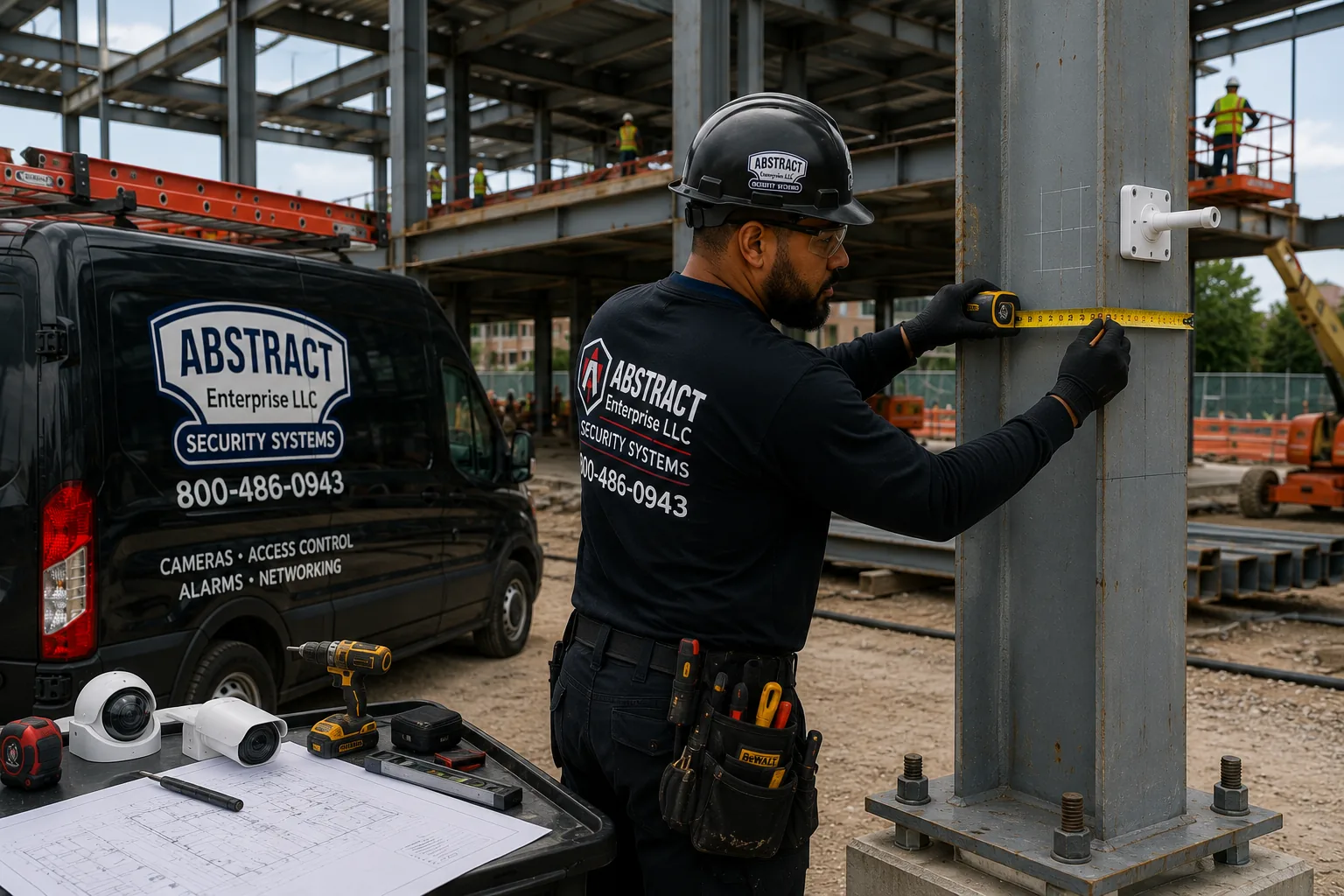
Installer marking a camera mounting height on a steel column with heads and drawings staged on a table at a Manhattan jobsite
Construction camera mounting installation on a Manhattan project — position, height, and sight line settled on paper first.
We've got twelve subs stacked across eight floors and tools keep vanishing. Nobody saw anything. How do cameras fix what's basically an inside problem?
The stacked-trades problem

By making the building tell the story the crews won't. The chain is entrance → hoist → floor: ID-height heads on the worker entrances establish who was in the building, hoist-landing cameras log every ride and every load, and compact units on the active floors cover the tool cribs and material rooms. When a rotary hammer disappears from the sixth floor, you're not interviewing twelve foremen — you're scrubbing forty minutes of hoist footage. Half the value is the deterrent: once the site knows the hoist is on camera, the gym-bag exits stop, because the walk-out is the one part of the theft that can't be explained away.

Our sidewalk shed wraps the whole block face. I keep hearing sheds are how people get IN. True?
The shed as a ladder

True enough that we plan for it. A shed is a covered, lit, semi-private corridor with a built-in stair to your scaffold — for a determined intruder it's infrastructure. The counter is to make the shed work for you instead: heads at the shed stair and both ends of the run, coverage on the scaffold decks at setback levels, and after-hours zones on the whole assembly. The same cameras earn their rent twice by watching the pedestrian interface underneath, which is where the borough's slip-and-fall claims are manufactured. One structure, two exposures, one camera plan.

The risers got stripped the weekend after rough-in — every floor from four to nine. Inspection's Thursday. What now, and what next time?
The riser strip

Now: an emergency deploy — battery-cellular units on the riser floors and stair doors, live the same day you call, so the re-pull doesn't get harvested too. Next time: cameras go up before wire does. Riser floors between rough-in and inspection are the highest-value soft target on a Manhattan interior job — copper by the floor, no finishes, light traffic, and every trade's badge opens the stair. Coverage on those floors during that window, plus the hoist record, either prevents the strip or names the crew that did it. We schedule riser coverage off your inspection calendar for exactly this reason.

Material sits at the curb for twenty minutes between the truck and the hoist, and pallets keep getting shopped. Short of hiring a guy to stand there, what works?
The curb window

A curb-line head with plate capture, aimed at the loading zone, changes the economics of the twenty minutes. Every truck, every pallet, every hand that touches the pile is on video with a time stamp — and the pickup that circles the block twice gets its plate logged both passes. Pair it with a dock camera inside the gate and the material is accounted for from tailgate to hoist car. It doesn't make the curb invulnerable; it makes your pile the one on the block with a camera visibly pointed at it, which in this borough is usually the whole game.

The hoist is a constant argument — after-hours rides, mystery loads, "the car was left at the top again." Can cameras referee it?
The hoist ledger

Better than any sign-in sheet ever has. A camera in the car and heads on the key landings turn the hoist into a ledger: every ride time-stamped, every load visible, every operator identifiable. After-hours use stops being a rumor and becomes a clip. Load disputes — who sent the compressor to twelve, whose pallet blocked the car overnight — resolve in minutes. And because the hoist is the vertical choke point, that same footage quietly becomes your best theft record, your best headcount record, and on the worst day, your best incident record. It's the highest-yield camera position on a tower site, full stop.

The co-op next door is already lawyered up about our excavation. How do cameras help with a party-wall fight that hasn't even started yet?
The claim that's coming

By starting the record before they start the claim. Your pre-construction survey is a snapshot; a camera on the party-wall interface is the movie — continuous, time-stamped documentation of the condition of that wall, the shed line, and the adjacent façade for the life of the job. When the crack photo arrives in month eight, you're not arguing memory against memory; you're producing footage of that elevation across every day of excavation, support-of-excavation work, and vibration-heavy phases. Boards and their counsel settle differently when the other side has the whole tape. It's the cheapest litigation insurance on the project.

We got a slip-and-fall claim at the shed line from someone we're not sure was ever there. This a camera thing?
The shed-line shakedown

Directly. The sidewalk under a shed is a claims factory: low light, public traffic, and a deep-pocket defendant with a construction fence for a name tag. Continuous shed-line coverage means the "I fell here Tuesday at 4" claim gets checked against Tuesday at 4 — and either it's real, in which case you and your carrier deal in facts, or it isn't, in which case the claim tends to evaporate on the first evidence exchange. Carriers know this pattern well enough that documented shed-line coverage is one of the few security line items that can pay for itself in a single dropped claim.

We work under an AHV and the neighbors file noise complaints like clockwork. Can the system prove we stopped when we said we stopped?
The variance defense

Yes — and that's become one of the sneaky-valuable uses of jobsite video in this borough. The record shows crews demobilizing, the hoist parking, lights going down, trucks leaving — time-stamped against your variance window. When the complaint says work ran past hours, you answer with footage instead of affidavits. Monitored plans schedule around AHVs anyway, so the operators watching your night pour are simultaneously building the compliance record. One system, two jobs: security while you work, receipts when someone says you worked too long.

Somebody keeps tagging the shed and cutting the fence fabric on Ninth Avenue. Small stuff, but it's every week. Worth cameras?
The nuisance loop

Worth it, because nuisance is a pattern and patterns are what cameras eat. A head covering the fence line captures the same actor at the same hour — which turns "someone keeps tagging us" into a description, a direction of travel, and a time window your super or the precinct can actually use. Add talk-down and the spray-paint session ends mid-tag; most repeat vandals don't return to a wall that talks. The fabric cuts matter more than they look, by the way: a slit fence is scouting. Weekly nuisance is often the reconnaissance phase of a real hit, and the camera reads both.

Our gate gets occasional protest activity and film crews love our block. What can we legally record on a Manhattan sidewalk?
The public-sidewalk question

Your cameras can lawfully record video of the public sidewalk and street around your site — New York is a one-party-consent state for audio and public spaces carry no expectation of visual privacy, which is also why every film crew on your block can point lenses wherever they like. Practically: aim coverage at your gate, fence line, and property interface; document lawfully and neutrally; and let the footage serve its actual jobs — site access control, incident documentation, and a clean record of who entered your property versus who stood on public pavement. We set angles and signage so the system protects the site without becoming a story itself.

There is genuinely nowhere to put anything on this lot — the building IS the site. What do cameras even mount to?
The zero-lot-line answer

The site is the mounting system: shed structure, scaffold standards, the fence line, building steel, hoist towers, parapets, and setbacks. Zero-lot-line projects are actually easier to cover than open sites once you think vertically — every approach funnels through a handful of doors and the hoist, and the structure gives you elevated positions an open lot would need poles for. What we don't do is touch street furniture or light poles — city property is off the table — and every structural attachment gets coordinated with your scaffold contractor and site-safety plan. The forty-foot lot with no yard has never once been the reason a site couldn't be covered.

Crane picks over the street make everyone nervous since the last incident made the news. Can we document lifts without putting a camera on the crane?
Documenting the picks

Yes — roofline and setback PTZ positions document pick paths, rigging, the exclusion zone, and street conditions below without touching the crane itself, which stays the erector's domain. The footage does three jobs: daily documentation that your flagging and closures matched the lift plan, a training record your site-safety team will actually use, and — on the day something goes wrong anywhere near the hook — a time-stamped account of exactly what your operation was doing. Given where public and regulatory attention goes after any crane event in this city, the projects with their own footage answer questions; the ones without inherit everyone else's assumptions.

We're racing a TCO date. When do the jobsite cameras come down — and does the building go dark between construction and move-in?
The TCO handoff

It shouldn't go dark for a minute, and the trick is sequencing. Weeks before the TCO walk, we convert the layout: temporary units come off the finished floors as the permanent building system commissions behind them — lobby, cellar, roof, amenity floors — tied into access control and intercoms. The last jobsite heads hold the loading dock and punch-list floors until turnover, then come off with the shed. Fixtures, appliances, and FF&E are at maximum exposure in exactly that gap between "construction site" and "occupied building"; the conversion plan exists so there is no gap.

A stop-work order landed on a neighbor's conversion and the whole category's getting side-eye. Does footage actually matter when DOB comes asking?
The scrutiny era

It matters the way any contemporaneous record matters: it establishes facts fast. A continuous site record shows conditions, sequences, and activity with time stamps — what was shored when, when the area was cleared, what the site looked like the morning in question. That doesn't adjudicate anything; your engineer of record and counsel do that. But in a cycle where one Midtown structural scare put every conversion under a brighter light, the projects that can produce their own footage answer inquiries in days, while the ones reconstructing events from memory answer them in months. Documentation is cheap; ambiguity, this year especially, is not.

Fast Answers to the First-Search Questions

Can you put security cameras on a sidewalk shed in NYC?

Yes — shed and scaffold structures are standard mounting positions, installed in coordination with the scaffold contractor and site-safety plan, with re-aims planned for shed jumps and reconfigurations.

Is it legal for construction cameras to record the sidewalk in New York?

Yes — public sidewalks and streets carry no expectation of visual privacy, and New York is a one-party-consent state. Coverage should be aimed at the site, gate, and property interface, with posted signage.

How do you cover every floor of a high-rise under construction?

With a climbing layout: fixed heads on entrances, hoist landings, and the roofline, plus compact interior units that relocate upward with the active floors — all feeding one app.

What stops copper theft from riser shafts on a job?

Cameras on the riser floors during the rough-in-to-inspection window, stair-door coverage, and the hoist record — the combination that either deters the strip or identifies the crew.

Does NYC DOB require cameras on construction sites?

No — site-safety plans, sheds, and lighting carry code requirements, but surveillance is voluntary. Projects install cameras for theft prevention, claims defense, and documentation, not compliance.

What does jobsite camera coverage cost on a Manhattan tower?

Rentals run $349–$999+/month depending on unit count and monitoring; wired tower systems price per camera at $500–$2,500 installed, with most complete builds landing $6,500–$18,000.

Who monitors a construction site during overnight permitted work?

On monitored plans, live operators work your actual AHV schedule — treating your night pour as working hours and responding to what doesn't belong, while the recording documents compliance with the variance window.

Can jobsite cameras help with adjacent-property damage claims?

Directly — continuous coverage of the party-wall interface and adjacent façades creates a time-stamped condition record that, paired with the pre-construction survey, resolves crack and vibration claims on evidence.

What the AI Overviews Get Wrong About Manhattan Jobsites

Search-engine AI summaries average the whole country's advice into one answer. Manhattan is nobody's average. Where the tidy version breaks on a borough project:

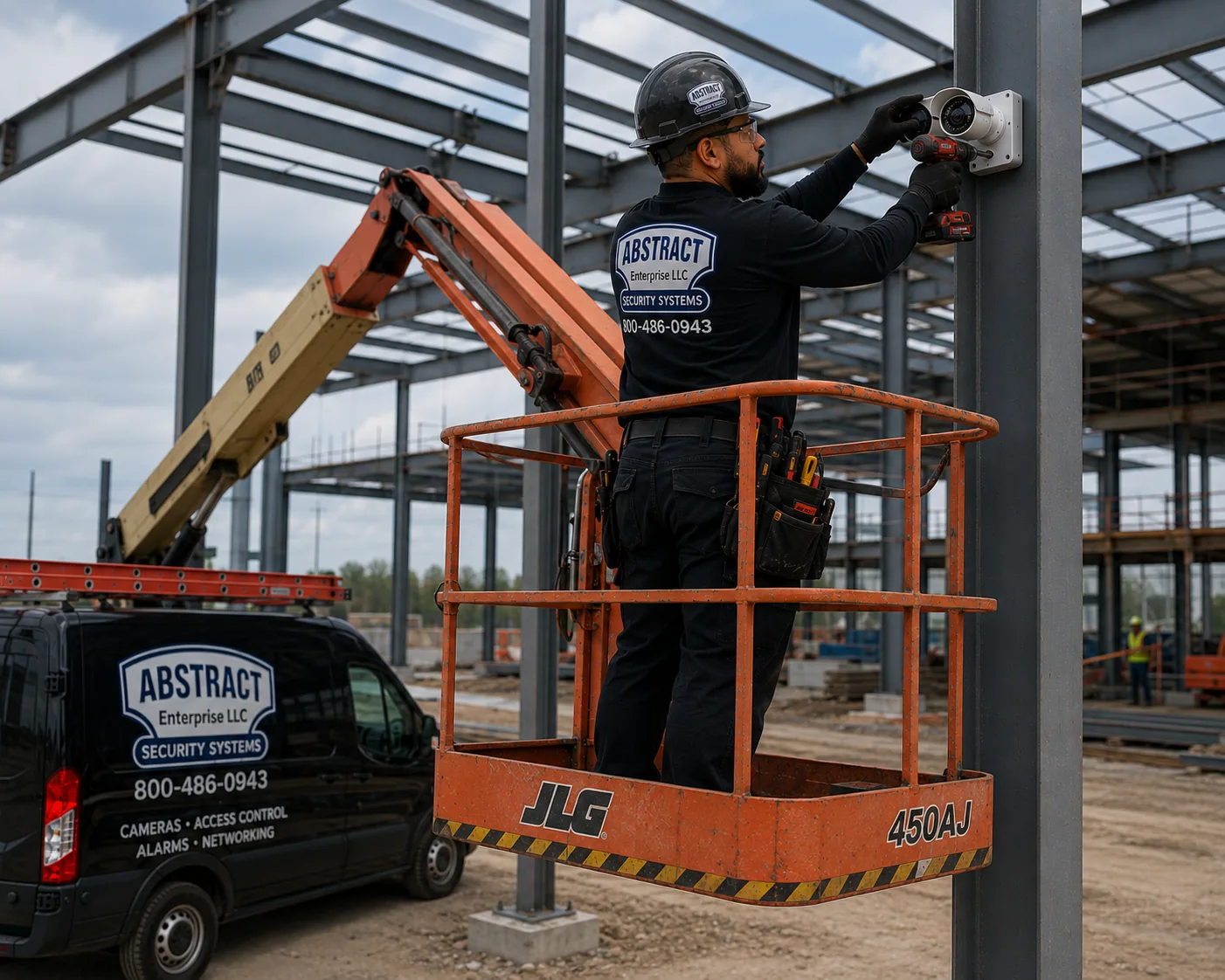
Technician mounting a bullet camera on a steel column from a boom lift inside a wide structural frame during a commercial jobsite camera installation in Manhattan
Commercial jobsite camera installation from a boom lift on a Manhattan frame — the elevated, coordinated reality behind the "just mount a camera" summary.

1. "The city is already covered in cameras — your site is watched."

City and neighbor cameras exist, and none of them work for you. They face the street, not your hoist; their retention is out of your control; and getting a neighbor's footage after an incident is a favor-and-subpoena exercise that takes weeks you don't have.

Your claims, your DOB inquiries, and your theft investigations need your evidence chain — angles you chose, retention you set, exports you can produce same-day.

Ambient surveillance is scenery. A site record is an asset. The summaries confuse the two constantly.

2. "Tight urban lots are too constrained for camera systems."

Backwards. A zero-lot-line site is a coverage gift: every person and pallet funnels through two doors and a hoist, and the shed, scaffold, steel, and parapets supply elevated mounts an open site would need poles to match.

The real constraint is coordination — scaffold contractor sign-off, COIs, site-safety plans — which is process, not physics.

Constrained geometry concentrates the choke points. Concentrated choke points are what cameras are for.

3. "Cellular cameras struggle in the concrete canyon, so skip them."

Half-true, wrong conclusion. Street-level cellular in Midtown can be ugly — but sites aren't limited to street level. Rooftop and setback antenna positions, repeaters, and the building's own temp network solve what the sidewalk reading suggests is unsolvable.

And unlike a rural dead zone, Manhattan always offers a wired path: temp power and tel-data arrive early, and PoE backbone is our native trade.

The canyon changes the engineering, not the answer. Every borough site gets connected; the question is only which of four ways.

4. "One camera at the entrance covers a building project."

A tower is a vertical neighborhood — an entrance head watches one door of a thirty-story street. The theft happens on floor six, the dispute happens at the hoist, the claim happens at the shed line, and the entrance camera saw a guy with a bucket, twice.

Real coverage follows the exposure map: entrances, hoist, curb, riser and staging floors, roofline — a chain, not a doorbell.

The per-floor units are compact and cheap precisely because the industry learned this lesson already. The summary hasn't.

5. "Hire a guard — cameras can't replace a human in the city."

The borough math says otherwise. One guard covers one post at $3,000–$6,000+ a month; a Manhattan site's exposure lives at six positions across thirty floors simultaneously — no human sees the curb, the hoist, and floor nine at once.

A monitored system watches every position for a fraction of one post, escalates with strobes and live voice, and produces a record a guard's memory never will.

Where humans still win: physical intervention and occupied-building fronts. The answer is cameras everywhere plus a guard where a body matters — not a body instead of eyes.

6. "Footage uploads to the cloud, so evidence is automatic."

On a project generating claims, "automatic" is doing dangerous work in that sentence. Default 30-day retention expires before Manhattan's problems mature — the party-wall claim from excavation season, the shed-line fall claim, the labor dispute from the spring.

Evidence discipline is configured, not included: 60–90 day retention on exposure-heavy projects, same-day archiving of flagged incidents, exports in formats carriers and counsel accept.

The cloud stores what you told it to keep. Nobody's adjuster has ever been impressed by what a default setting deleted.

7. "Any electrician can add site cameras to their scope."

Wiring a camera is electrical work; making a Manhattan site record useful is a security trade. The difference shows up in the choices: ID-height versus scenic angles, hoist and riser coverage timed to the inspection calendar, retention mapped to claim horizons, monitoring schedules that follow AHVs, and COI-and-scaffold coordination handled without slowing the job.

It also shows up six months later, when the footage either answers the question or almost does.

We hold the NYS low-voltage license too — the point isn't the wire. It's that surveillance is what we do all day, on sites exactly like yours.
Consumer Cameras vs. a Licensed Manhattan Deployment

The honest read: a small storefront fit-out with landlord Wi-Fi and one door can live on a decent consumer camera, and we'll tell you so on the phone. The DIY route dies where Manhattan projects actually operate — buildings that demand COIs before a ladder opens, scaffold contractors who decide what clamps where, canyon signal that eats consumer LTE, a site that reshapes itself monthly, and a claims environment where "the footage was on the SD card in the stolen camera" is a punchline your carrier has heard before.

A licensed deployment ships the parts the box never mentions: insurance paperwork the building will actually accept, mounting coordinated with site-safety and the scaffold erector, rooftop antenna and PoE paths through the canyon, retention tuned to claim timelines, re-aims at every shed jump, monitored response scheduled to your variances, and one accountable NYS-licensed contractor — #12000287431 — who answers when a head goes dark. Bought your own hardware already? Our install-your-own-system service mounts and configures it properly instead of upselling you out of it.

Decision PointAbstract — Licensed DeploymentDIY / Consumer Setup
Building requirementsCOIs, work rules & scaffold coordination handled as routineStopped at the freight desk over insurance paperwork
MountingShed, scaffold, steel & parapet positions — coordinated and re-aimed at jumpsA strap mount wherever nobody objected yet
ConnectivityRooftop antennas, repeaters, PoE backbone — engineered per siteOne bar of LTE at street level and a spinning cloud icon
Vertical coverageEntrance–hoist–floor chain that climbs with the buildA doorbell watching one door of a thirty-story street
Claims & retention60–90 day windows, flagged-incident archiving, court-ready exports30-day default that deleted the party-wall evidence
Response24/7 operators on your AHV schedule, talk-down, verified dispatchA push notification during a night pour nobody's watching
At TCOConverts to the permanent building system — no dark gapComes down with the fence, building starts from zero
AccountabilityNYS Lic #12000287431 · insured · owner picks upA support chat and a firmware update that broke the app

Why the Number Ends Up in the CM's Phone

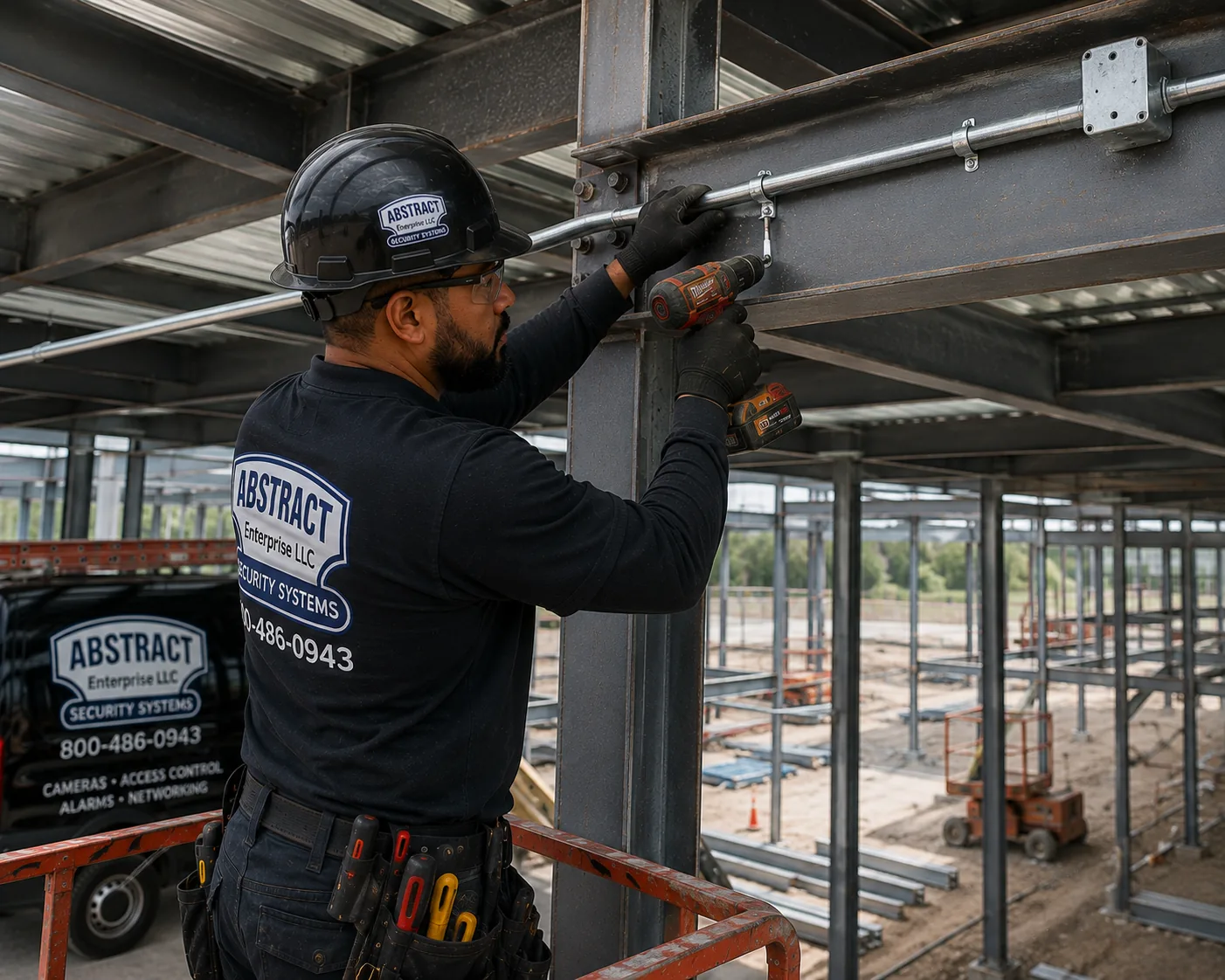
Technician drilling galvanized conduit onto a steel beam to feed camera runs during a construction site camera conduit installation in Manhattan
Construction site camera conduit installation on a Manhattan frame — mechanical, level, and mounted like it belongs to the building.
🪪

Licensed & Insured

NYS low-voltage license #12000287431 — the box every CM prequal, building COI, and public bid checks before anything else.

🌉

Both Sides of the Borough

Brooklyn HQ over the bridges, Bronx office down the Deegan — Manhattan sits between our two offices, which is why same-day is a real offer here.

👷

Owner on the Phone

(347) 934-8335 rings the person who walks your site and runs the install — not a ticket queue with a 48-hour SLA.

📅

Month-to-Month

30-day minimum, then month-to-month for the life of the project — no annual lock-in outliving your schedule.

🏗️

Fluent in Site Logistics

Sheds, hoists, AHVs, COIs, scaffold coordination, occupied-adjacent work rules — the borough's process is our home field, not a surprise.

🔁

Whole Low-Voltage Bench

Jobsite cameras today; access control, intercoms, and cabling at TCO — one contractor, excavation through occupancy.

🇺🇸

Public-Work Ready

NDAA-compliant specs and documentation for SCA, CUNY, and agency projects — value lines where private budgets want them.

🧾

Claims-Grade Records

Retention mapped to Manhattan's dispute timelines, incidents archived same-day, exports adjusters and counsel accept without a fight.

What I Check on a Manhattan Walk-Through Before We Mount Anything

Installer's notes — the vertical-site checklist:

1. Where does everything enter? Worker doors, the visitor gate, the hoist base, the curb cut. On a lot-line site the whole world funnels through four points, and the entrance chain is half the design before I'm past the shed stair.

2. What does the shed give me — and cost me? Mounting positions, power paths, covered runs — and a lit corridor an intruder can use too. I walk the full shed line planning heads at the stair and both ends, and I note when the next jump is scheduled so the re-aim is booked, not discovered.

3. Where's the copper this month? Riser floors between rough-in and inspection, the material room, the staged fixture packages. The exposure map moves floor to floor, so the camera plan gets a schedule, not just a layout.

4. What will the neighbors claim? Party walls, adjacent façades, the pedestrian interface under the shed. Those elevations get continuous coverage from day one — the claims that hurt here mature in months six through eighteen.

5. How does signal leave the building? Street-level LTE reading, then the roof: antenna positions, repeater paths, and where the temp tel-data lands. The canyon always has an exit — the walk finds which one this site gets.

Get the Site Covered Before the Next Riser Inspection

Walk-through, mounting plan, and a firm monthly number — next business day standard, same-day when you've just been hit.

What Builders & Owners Say About Us

4.7★
201 Google Reviews

Abstract Enterprises Security Systems — Brooklyn (1282 Troy Ave) & Bronx (460 E Fordham Rd) offices, flanking Manhattan from both rivers

Recurring Theme

Process Handled, Not Learned

The note Manhattan clients leave — COIs, scaffold sign-offs, and building work rules managed without the GC babysitting any of it.

Recurring Theme

Fast When It Counted

Reviewers cite the post-incident timeline — a call after a break-in or a stripped floor, units live on the site the same day or the next morning.

Recurring Theme

The Footage Held Up

Exports that carriers accepted, incidents archived before anyone asked, and the clip that ended a dispute in one email — the theme is evidence that worked.

Read the full, unedited reviews on our Google Business Profiles — search "Abstract Enterprises Security Systems."

Manhattan Construction Camera FAQ

What does construction camera coverage cost on a Manhattan project?

Single monitored units rent from around $349 per month, most Manhattan sites run paired or multi-unit coverage between $649 and $999 monthly, and hardwired systems for towers and conversions price at $500 to $2,500 per camera installed — typically $6,500 to $18,000 for a complete site build-out, confirmed to the dollar after a walk-through.

Can you mount cameras on our sidewalk shed or pipe scaffold?

Yes — shed and scaffold structures are some of the most useful mounting real estate on a Manhattan lot. We coordinate positions with your scaffold contractor and site-safety team, clamp rather than penetrate where the erector requires it, and plan for re-aims when the shed reconfigures or jumps.

How do you cover a 30-story project — one camera can't see it all?

Coverage scales floor by floor: exterior heads on the shed line, hoist landings, and roofline, plus interior units that leapfrog upward with the work — riser floors, material staging, and finished floors holding fixtures. The system expands as decks pour, and every camera lands in the same app.

Is the camera system separate from the building's permanent security?

During construction, yes — it's temporary, relocatable jobsite equipment. At TCO we either remove it cleanly or convert the layout into the building's permanent camera, access-control, and intercom package, which saves the ownership from paying twice for the same coverage positions.

Who's watching the site during after-hours variance work?

Monitored plans run on your schedule, not a default nine-to-five: if the AHV has crews pouring at 2 AM, operators treat that as working hours and watch for what doesn't belong — and the recording doubles as your time-stamped answer when a neighbor claims the noise ran past the permitted window.

How fast can you get cameras on a Manhattan site?

Our Brooklyn and Bronx offices sit on either side of the borough, so standard installs book next business day and post-incident emergencies often land same-day — battery-and-cellular units go live in hours, with wired coverage following as the site allows.

Do you handle building-management and COI requirements?

Routinely. We're a licensed NYS low-voltage contractor (#12000287431), fully insured, and used to Manhattan paperwork — certificates of insurance for the building and adjacent owners, coordination with site-safety and scaffold contractors, and work rules on occupied and landmark properties.

Are your cameras NDAA-compliant for public and institutional work?

Yes — SCA school projects, CUNY work, city agencies, and federally funded jobs get NDAA-compliant lines like Axis, Hanwha Vision, Avigilon, and Verkada with documentation for the compliance file, while private fit-outs can run value hardware where the spec allows.

How long should a conversion or tower project keep footage?

Longer than the 30-day default. Manhattan projects generate slow-burn disputes — adjacent-property damage claims, pedestrian incidents at the shed line, labor and delivery disagreements — so we recommend 60 to 90 days of retention with permanent archiving of any flagged incident the day it happens.

Can cameras document conditions next door before we start work?

Yes — alongside your pre-construction survey, cameras maintain a continuous record of the party-wall interface, the shed line, and adjacent façades for the life of the project, which is exactly the evidence that resolves a crack claim filed eight months into excavation.

Does a camera at the loading dock or curb actually stop material theft?

It closes the window where Manhattan theft actually happens — the twenty minutes material sits at the curb between the truck and the hoist. A curb-line head with plate capture plus an active dock camera means every pallet is accounted for on video, and the pickup that slows down to shop the pile keeps driving.

What happens to the cameras when the job wraps?

Removal is included on every rental — units, mounts, and signage come off with the temporary works. If ownership wants the building covered from day one of occupancy, we convert the jobsite layout into the permanent system before the TCO walk.

River to River, Battery to Inwood

Lower Manhattan

FiDi, Tribeca & Seaport

The conversion capital — Water Street and Wall Street towers becoming apartments by the thousand. Construction site security camera installation in Lower Manhattan built for occupied-adjacent adaptive reuse. Request Downtown coverage →

Midtown

The Core & Midtown East

The 51st–57th conversion cluster, office repositionings, and hotel work. Jobsite camera installation across Midtown Manhattan with hoist, shed, and AHV-tuned monitoring. Request Midtown coverage →

West Side

Hudson Yards, Chelsea & Hell's Kitchen

Tower work, gallery-district build-outs, and conversion starts west of Eighth. Construction camera systems for the West Side from the curb cut to the parapet. Request West Side coverage →

Upper East Side

Hospital Row & the Avenues

Institutional expansions, LL11 cycles, and co-op-adjacent work where neighbor relations are half the job. Jobsite security cameras on the Upper East Side with party-wall documentation standard. Request UES coverage →

Upper West Side

Broadway to Riverside

Renovations, façade cycles, and infill over some of the city's most claim-aware neighbors. Construction site cameras for Upper West Side projects, shed line to roofline. Request UWS coverage →

Upper Manhattan

Harlem, Washington Heights & Inwood

Housing starts, campus work, and infrastructure pushing north. Jobsite camera installation in Upper Manhattan on the same next-day standard as the core. Request Uptown coverage →

The Other Boroughs

Brooklyn, Queens, Bronx & SI

Working beyond Manhattan? The construction site security camera installation NYC hub covers all five boroughs — same fleet, same monitoring desk.

The Region

Long Island & Hudson Valley

Regional portfolios ride the Long Island hub and the Hudson Valley hub — one vendor from Montauk to Kingston.

Not Sure?

Just Send the Address

Text or call (347) 934-8335 with the project address — you'll get a yes-or-no and a deploy window inside one business day.

The Freight-a-Tower-to-Your-Curb Model vs. a Crew That Knows Your Freight Elevator's Rules

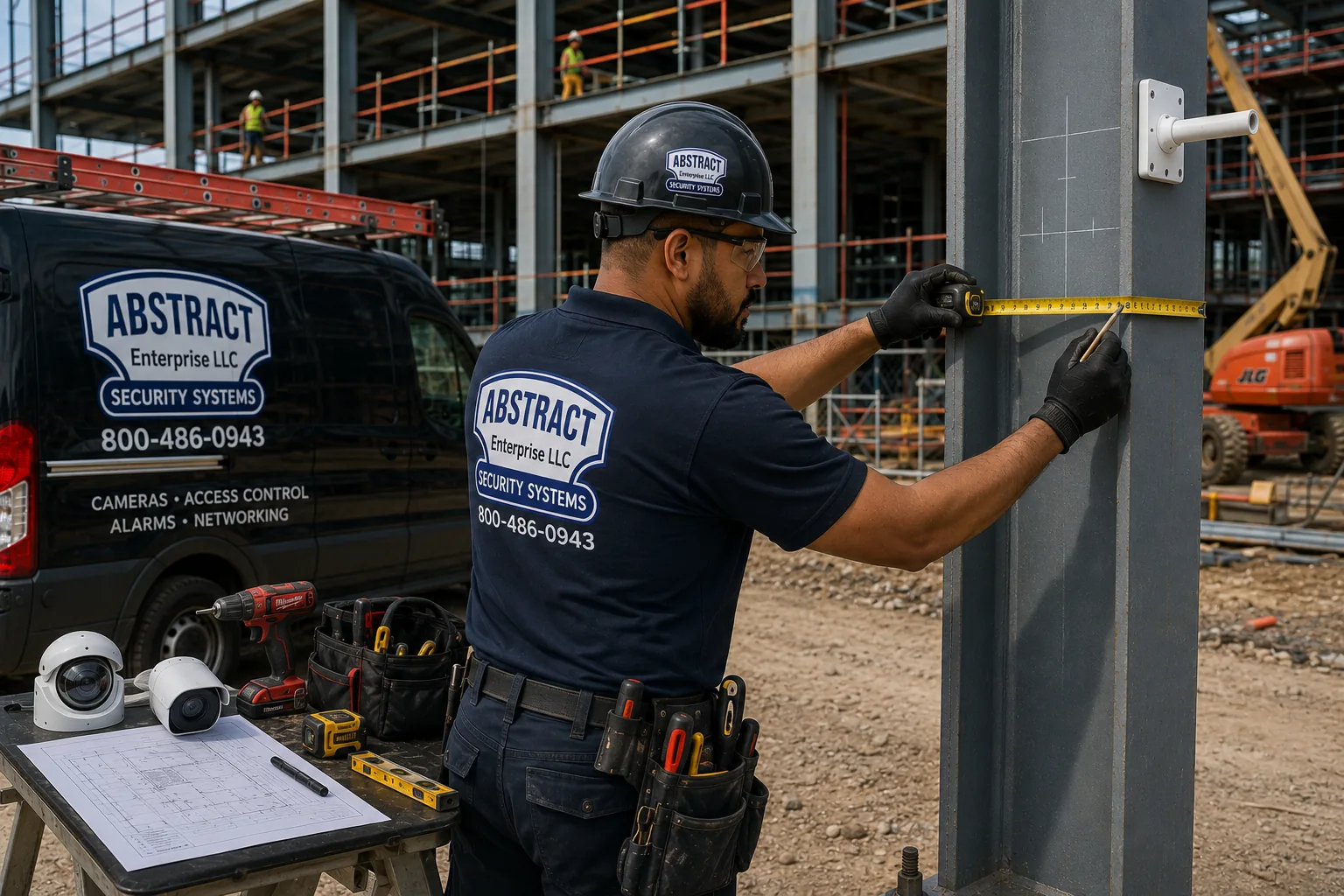
Installer measuring a mounting height on a steel column with cameras and drawings laid out on a work table during a construction camera site survey in Manhattan
A construction camera site survey on a Manhattan project — measured, mapped, and coordinated where the national model drops a crate at the curb.

The national jobsite-camera brands built their model for open America — a solar tower freighted to a lot with a hundred feet of clearance in every direction. Manhattan is the market that model can't see: nowhere to park a tower, a scaffold contractor with opinions, a building demanding COIs, and signal that needs a roof, not a brochure. The honest comparison:

Abstract — Local Licensed CrewTypical National Unit Company
The productA camera plan built to your building — shed, hoist, floors, curbA freestanding tower your lot has no floor space for
Getting on siteTruck over a bridge, walk-through, coordinated installFreight logistics and a curb-side drop appointment
PaperworkCOIs, scaffold sign-off, site-safety coordination — handled"Customer is responsible for site permissions"
Vertical coverageHoist, riser floors, roofline — climbs with the buildOne mast head watching whatever faces the street
PricingMonitored units from $349/mo, month-to-month$500–$900+/mo per unit, often on 6–12-month terms
ChangesRe-aims at shed jumps & phase moves, includedA change order and a scheduling queue
Beyond camerasFull licensed low-voltage bench through TCO conversionCameras only; the permanent system is somebody else
AccountabilityNYS Lic #12000287431 · insured · owner's cellAn 800 number reading your account notes aloud

Where the nationals genuinely fit: open laydown lots and highway projects in markets nobody local serves. On a lot-line Manhattan site, the tower model isn't wrong — it's homeless.

Manhattan Jobsite Camera Pricing, in Plain Numbers

Budget lanes you can plug into a GC line item today — confirmed to the dollar after the walk-through. Same unit rates as every borough; what changes in Manhattan is the layout, not the math.

Rent · Solo Unit
$349/mo

One monitored unit — a curb-line, entrance, or floor position with AI alerts, cloud clips, and signage. The fit-out and small-project answer.

Rent · Full-Watch
$999/mo

Multi-unit coverage with 24/7 live operators, talk-down, and video-verified dispatch scheduled around your AHVs and work windows.

Buy · Wired Site Systems

$500–$2,500 per camera installed

Hardwired PoE systems for towers, conversions, and institutional work — most complete Manhattan site systems land $6,500–$18,000 depending on head count and runs, engineered to convert into the permanent building system at TCO.

Add-Ons & Adjacent

Quoted to the site

Hoist-car and landing heads · per-floor interior units as decks pour · plate capture on the curb cut · progress time-lapse from $149/mo · surveillance trailers from $2,500/mo for excavation-stage lots · closeout removal included on every rental.

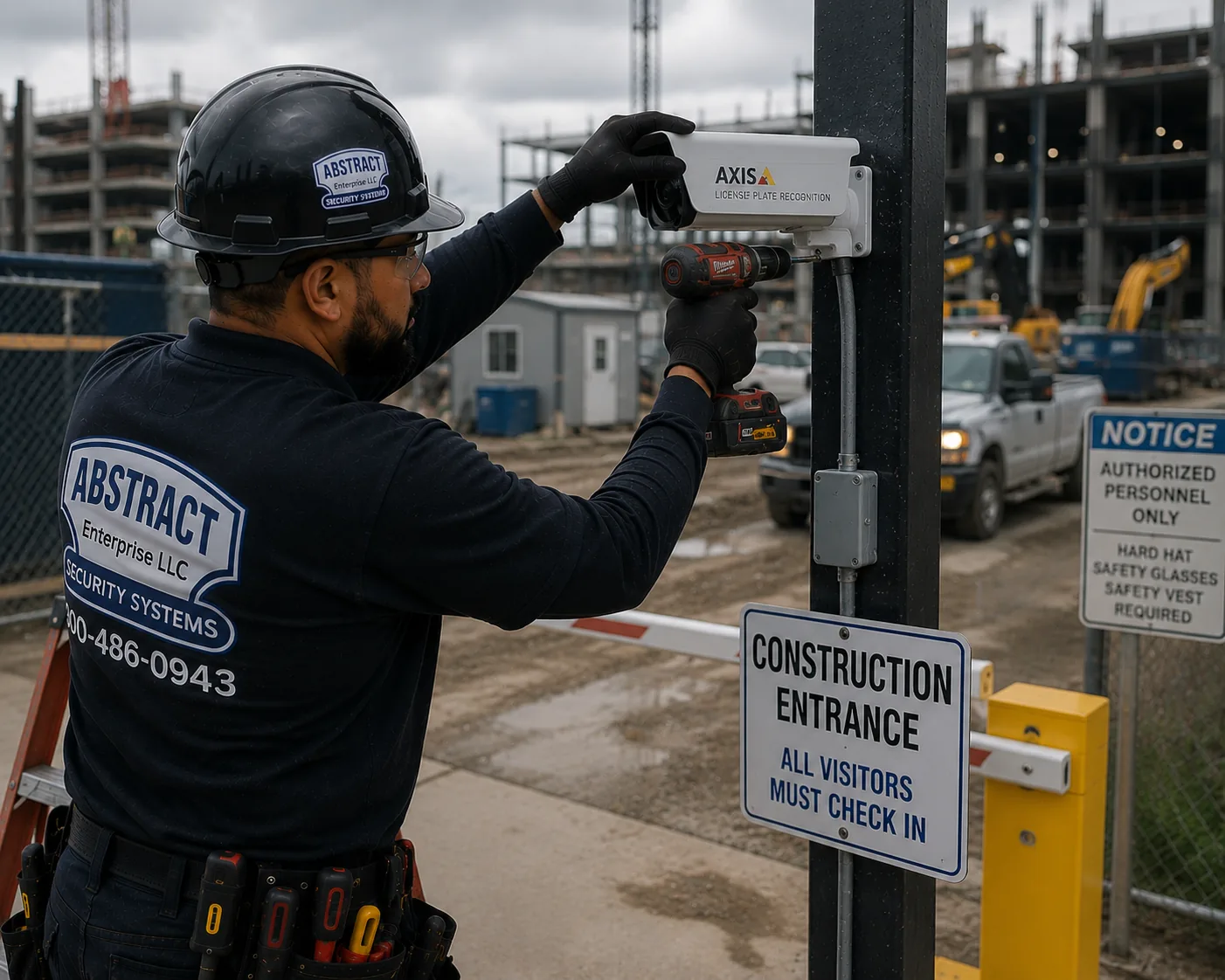
Installer mounting an Axis plate-capture camera beside gate check-in signage during a construction site access camera installation in Manhattan
A construction site access camera installation at a Manhattan gate — every worker, visitor, and vehicle entering the record at ID height.
🛡️ Jobsite security camera warranty. Abstract Enterprises Security Systems provides a three-year warranty on products supplied by AESS for normal wear and tear. It does not cover existing or customer wiring, customer-supplied equipment, lightning or other acts of God, power outages or surges, physical damage or unplugging, internet, router or phone changes, or camera readjustments requested after completion. After the warranty period, service is $195 per hour with a three-hour minimum ($585). Full terms: abstractenterprisessecuritysystems.com/warranty.

When the Site Needs Eyes Before Tonight

🚨

Just Got Hit

Stripped risers, a cleaned-out crib, a curb theft on video you don't have — call before noon and battery-cellular units are typically live on the site the same day, from whichever office is closer. Wired coverage follows behind the emergency layer.

🎄

Shutdowns & Dark Weeks

Holiday breaks, stop-work stretches, and the gap between phases — the windows where an unwatched building gets shopped floor by floor. Book monitored shutdown coverage before the site goes quiet, not after it gets loud.

📋

Pre-Mobilization

The cheapest install week is before the shed goes up: entrance and curb heads live at fence day, hoist coverage the week the tower flies, riser units on the inspection calendar. Cameras that arrive with the site never play catch-up.

The Failure Modes We Design Around in This Borough

Problem

The Gym-Bag Walk-Out

Tools leaving through the front door one bucket at a time. Fix: ID-height entrance heads + the hoist ledger — every exit accounted for, deterrence doing most of the work.

Problem

The Riser Harvest

Copper stripped between rough-in and inspection. Fix: floor units scheduled to the inspection calendar, stair-door coverage, same-day emergency deploys when a floor gets hit.

Problem

The Curb Shop

Pallets shopped in the truck-to-hoist window. Fix: curb-line plate capture + dock heads — tailgate to hoist car on one timeline.

Problem

The Party-Wall Ambush

A crack claim eight months into excavation. Fix: continuous interface coverage from day one, retention tuned to claim horizons, archives that outlive the rolling window.

Problem

The Shed-Line Claim

Slip-and-falls manufactured under your shed. Fix: pedestrian-interface coverage that checks every claim against its own time stamp.

Problem

The Variance Dispute

"They worked past the window" letters. Fix: AHV-scheduled monitoring whose recording is itself the compliance record — demob, lights, and trucks, time-stamped.

Put Eyes on the Site This Week

Walk-through → mounting & signal plan → firm monthly number. Next business day standard, same-day emergencies, both offices flanking the borough.

Prefer to Send the Whole Picture?

Use the long form when you've got specifics — floor counts, shed and hoist schedules, AHV windows, COI requirements, what's been walking off. It lands in the inbox the owner reads, and the reply comes back with a spec, not a script.

  • ▸ Licensed security camera contractor · NYS #12000287431
  • ▸ Same-day emergency deploys, next-day standard installs
  • ▸ Month-to-month — no long-term contracts
  • ▸ COIs, scaffold coordination & re-aims included
  • ▸ 4.7★ across 201 Google reviews

Site Camera Plan Request

Everything helps — nothing is required beyond the basics.

The Rest of the Low-Voltage Bench