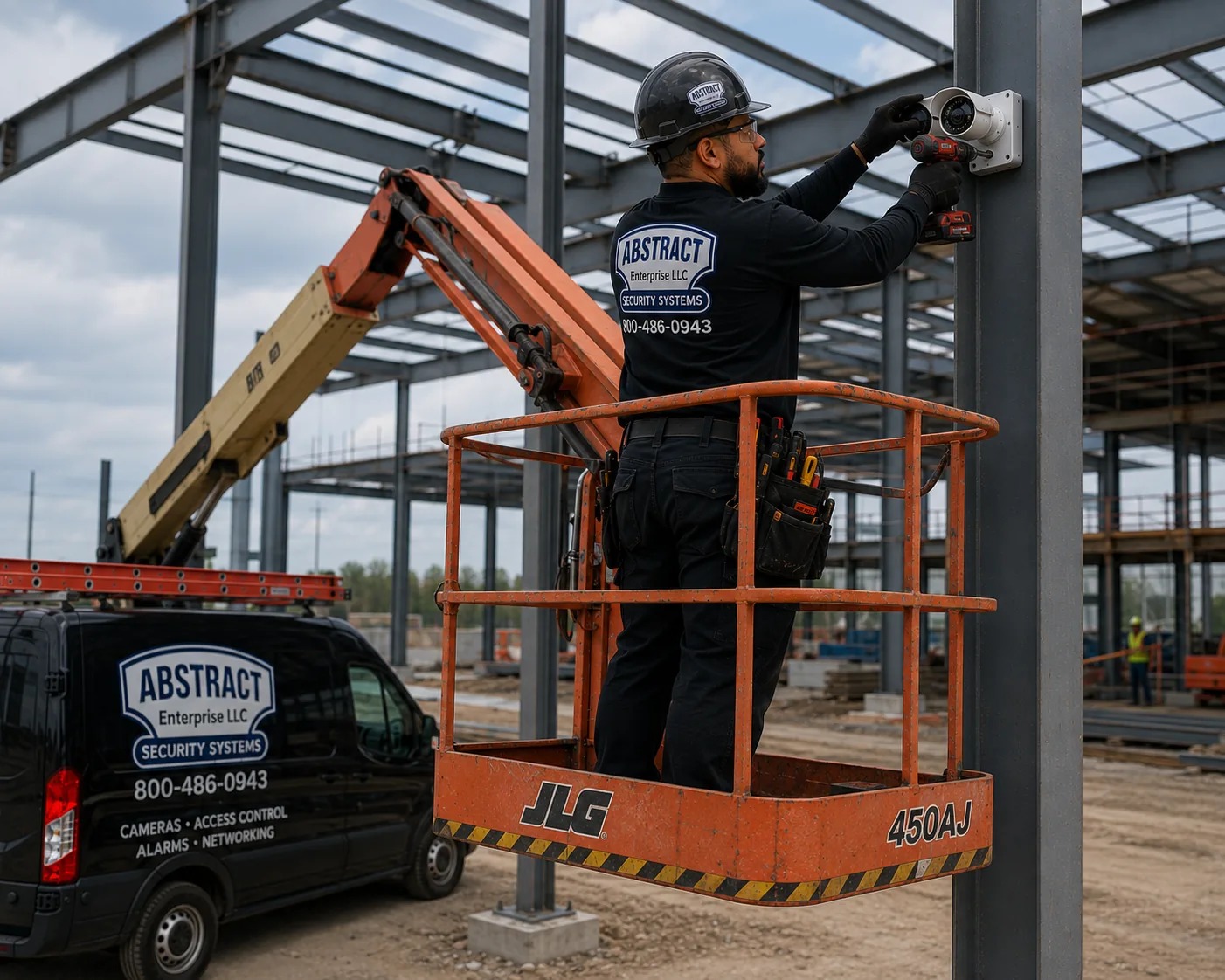
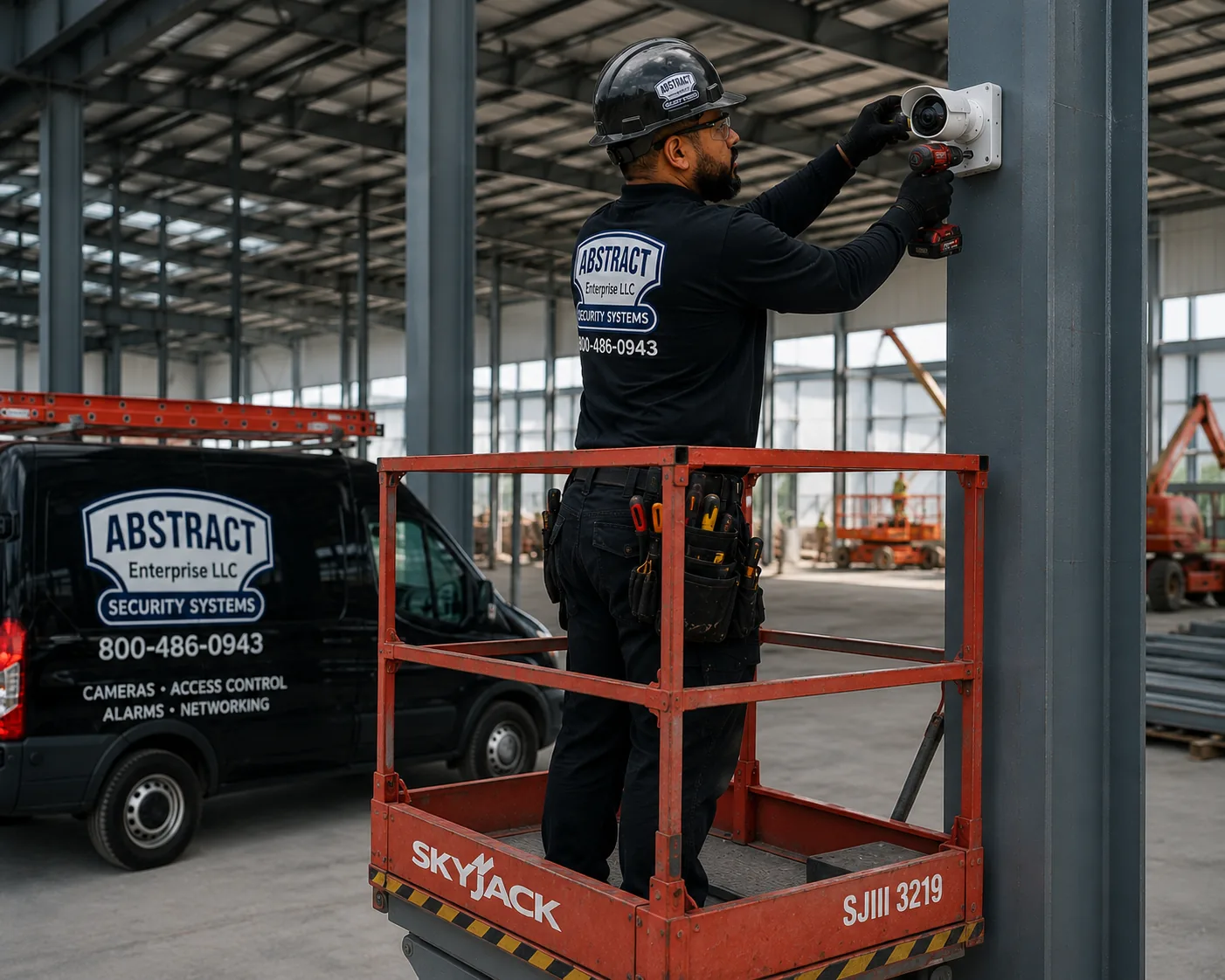
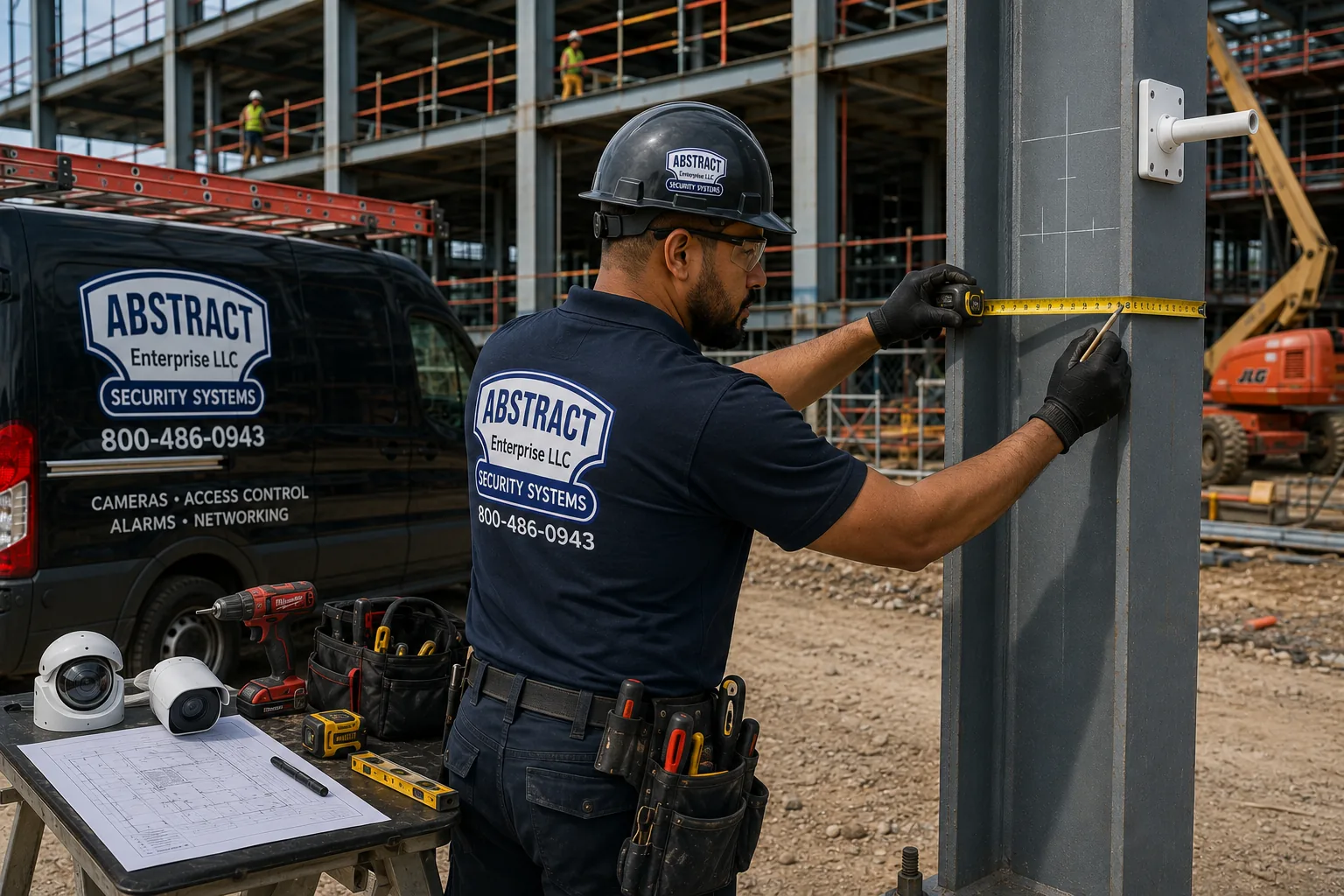
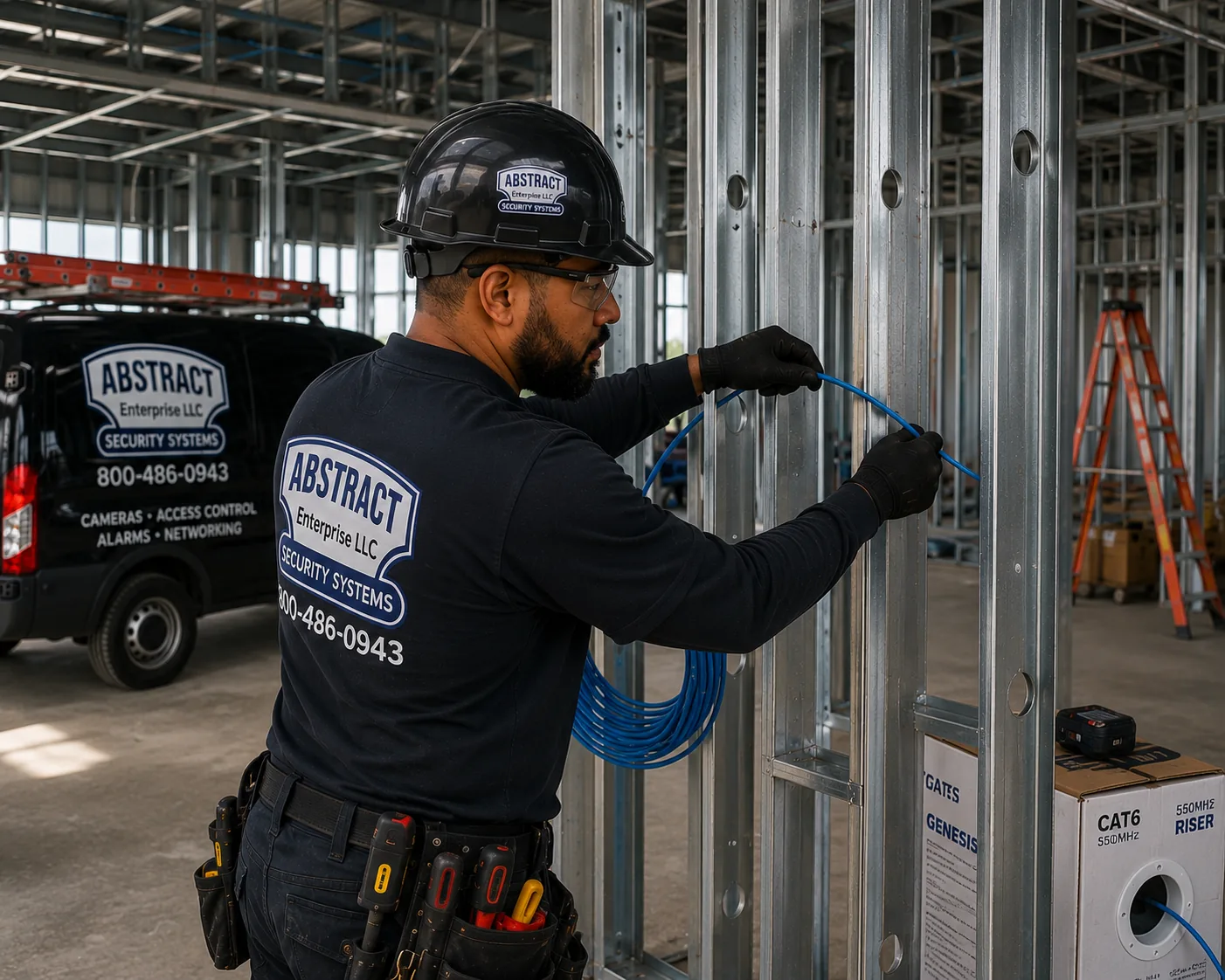
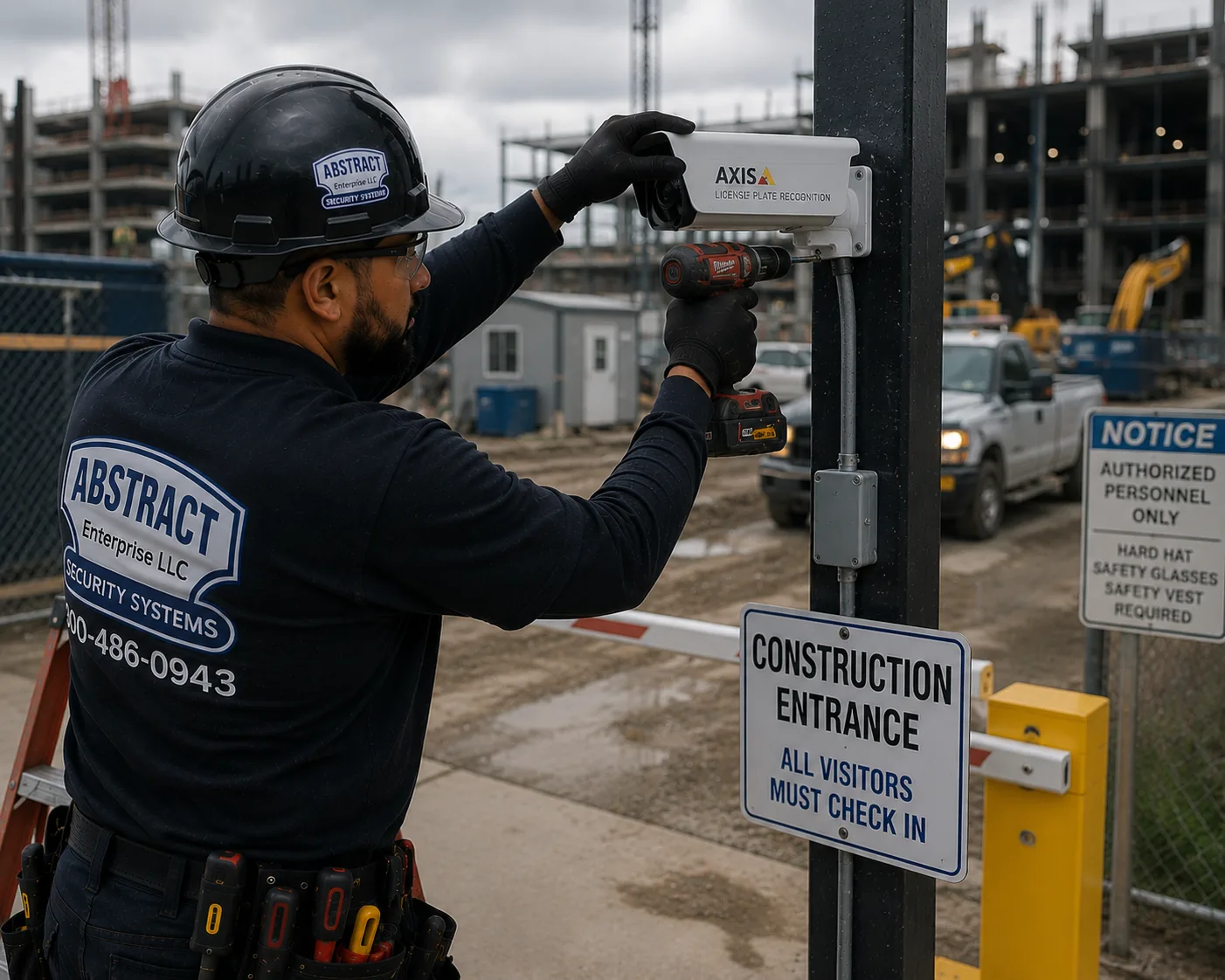
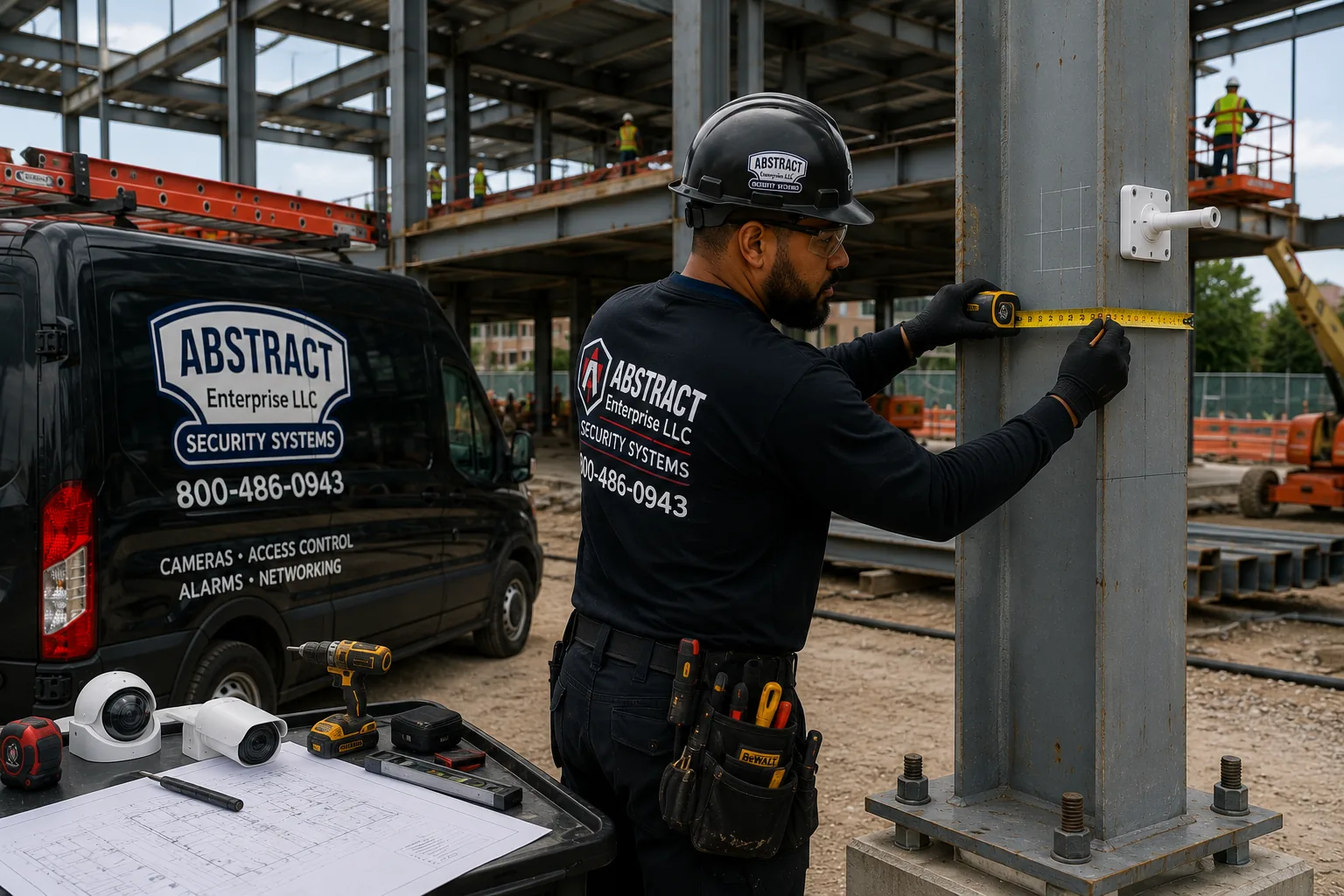
Solar and cellular jobsite cameras for lots with no power and no internet, wired CCTV for commercial builds, and 24/7 remote monitoring across Nassau and Suffolk — installed, relocated lot to lot as your project moves, and removed clean at closeout by a licensed NYS low-voltage contractor. Month-to-month rentals, no long-term contracts, East End included.
Long Island construction doesn't look like city construction, and neither does its theft. Instead of one dense tower behind one fence, a Nassau or Suffolk project is spread out — a subdivision with a dozen open lots, a custom home on a wooded acre, a warehouse pad off the LIE, an equipment yard behind a chain-link line on Route 110. Long sight lines, low light, quiet roads after dark, and quick highway access in every direction: from a thief's seat, that's not a jobsite, that's a drive-through.
The national numbers say what every LI contractor already knows. Equipment theft runs an estimated $300 million to $1 billion a year (NER/NICB heavy-equipment theft reporting), single-item recovery lands under 7%, and the average heavy-equipment loss runs around $30,000 before the rental replacement and the schedule slip. It's local, too — Suffolk County Crime Stoppers regularly circulates equipment-theft cases, like the mud buggy lifted from a Southampton equipment yard over a single summer weekend. Appliance packages staged in nearly-finished homes, copper in roughed-in walls, lumber drops on open lots, generators and compressors in the yard — on Long Island the highest-value targets sit on the least-watched sites.
And unlike the five boroughs, there's no DOB inspector sweeping the block. Outside the city, sites answer to the State Uniform Code and their town's building department — which means the documentation burden is on you. When the insurance adjuster, the neighbor with a drainage complaint, or a Labor Law 240 claim wants to know what actually happened on your site at 3 AM on a Sunday, time-stamped video is the difference between an answer and an argument. No law makes you put cameras on a Long Island jobsite — and anyone claiming otherwise is selling fear — but the builders who've been hit once don't need a statute to explain the math.
A half-acre custom build in Massapequa, a forty-lot subdivision in Yaphank, and a distribution warehouse in Hauppauge need three different systems — and the big projects run a mix. Here's the menu we install, rent, and monitor across Nassau and Suffolk:
Pole- and fence-mounted cameras with solar panels, multi-day batteries, and 4G/5G uplink — coverage from the day the clearing crew shows up, with no PSEG service and no internet drop. The default for subdivisions and any lot that's still dirt.
Hardwired 4K cameras on PoE for warehouse pads, medical buildings, and any structure with temp power — continuous 24/7 recording with no cellular data ceiling, ready to become the building's permanent system at turnover.
Pan-tilt-zoom heads with auto-tracking that patrol a laydown yard, a lumber drop, or a long fence run — one well-placed PTZ covers open LI acreage that would take five fixed heads.
Heat-signature cameras that separate a person from the deer, the raccoons, and the wind-blown brush that plague motion alerts on wooded Suffolk lots — reliable detection in total darkness with almost no false alarms.
Plate-capture heads on the site entrance and haul road — every delivery, dumpster pull, and after-hours pickup logged with a time stamp. On a spread-out site, the gate record is half the security plan.
Person-detection fires a strobe and a live or recorded voice challenge across the lot. On a quiet residential street at 1 AM, a loudspeaker naming what the intruder is wearing ends most visits on the spot.
Person and vehicle classification with after-hours zones drawn around the conex row, the fuel cage, and staged appliances — so the 2 AM buzz means a human on your lot, not a fox crossing it.
High-resolution progress cameras that turn a build into a documented timeline — draw-request support for lenders, marketing footage for the sales office, and a day-by-day record if a delay dispute lands.
On-site recording for continuous coverage, cloud clips so evidence survives a stolen recorder, and one app across every project you're running — Nassau, Suffolk, or over the city line.
Recording a theft is evidence; interrupting one is security. On a monitored plan, live operators review verified after-hours alerts, hit the strobes and talk-down speaker, work your call list, and give police a video-verified intrusion report — the call that gets a car sent, not a case number. On spread-out Long Island sites where a guard can only stand in one spot, monitored cameras watch every corner of every lot at once, for a fraction of a guard line item.
For multi-acre clears, road packages, and equipment yards, a solar surveillance trailer on Long Island puts a 22-ft mast with PTZ heads, strobes, and talk-down audio anywhere a truck can back in — then repositions as the work moves. See trailer rental pricing. Plenty of LI projects pair one trailer sweeping the open ground with pole units on the gate and container row.
Subdivision / tract build vs. spec house vs. custom home — three flavors of Long Island residential construction with three different camera problems. A tract build needs coverage that migrates across dozens of lots; a spec house needs its appliance package protected between punch list and closing; a custom home on the East End needs seasonal, storm-tolerant coverage that reports to an owner who's rarely there.
Pad site / commercial pad — the cleared, utility-ready parcel a retail, medical, or warehouse building goes on. Pad-site security starts as solar/cellular during sitework and converts to a wired system as the shell closes in.
Site cameras vs. site surveillance vs. site monitoring — cameras record, surveillance means the system is designed and watched with intent, and monitoring means live operators or AI actually respond. If a quote says "monitoring" but delivers a recorder and an app, you bought cameras, not monitoring.
Pole unit vs. trailer vs. tower — a pole unit mounts to your fence, post, or building; a trailer is a towable mast platform for open ground; "camera tower" usually means the bigger skid-mounted mast rigs. Trailers and towers live in our Long Island solar trailer lineup — this page covers everything mounted to the site itself.
Video verification — an operator confirming a live human on camera before police are called. On Long Island's spread-out sites this matters twice: it gets a faster response than an unverified alarm, and some towns and villages require alarm registrations for monitored systems — a paperwork step we flag on the site walk.
NDAA-compliant — hardware allowed on federally funded and most public work under Section 889. If your project touches a school district, BOCES, town, county, or federal facility, this word picks your brand list before price does.
We're installers, not a single-brand dealership — the lot conditions and the funding source pick the hardware. On school district, BOCES, municipal, and federally funded Long Island work (think Brookhaven National Laboratory's orbit, county facilities, district bond projects), NDAA §889 bars Hikvision and Dahua gear — so those jobs get Axis, Hanwha Vision, Avigilon / Alta, or Verkada, with the paperwork to prove it. Private builds without that requirement can run LTS/Platinum for price-performance or entry solar-cellular lines like Reolink for short renovations — we install Dahua on Long Island every week where it's a legitimate budget play, and we'll never quietly spec it onto a project where it would fail a compliance audit.
The pairing logic in one breath: Axis thermal and PTZ for perimeter and open acreage, Hanwha multi-sensor for gates and yards, Avigilon's appearance search for "find the guy in the gray hoodie across four nights" moments, Verkada when a builder wants every project in one cloud dashboard with zero on-site servers, and value lines where the risk is modest and the timeline is short. Tell us who's paying for the project and what keeps disappearing — the brand list writes itself from there.
Solar/cellular units clustered on active lots + the material yard + the access road, with lot-to-lot relocations included and reflective surveillance signage at every entrance.
Gate plate-capture + perimeter heads during sitework, converting to a wired PoE system as the shell closes — one contractor from clearing through C of O, tied into access control at turnover.
Any layout above plus 24/7 live operators, talk-down audio, and video-verified police dispatch — the overnight-guard replacement for yards and high-loss sites.
Compact coverage for high-value residential builds — appliance and millwork staging watched before closing, storm-rated mounts near the shore, and owner app access from anywhere.
Every package bolts into the rest of the low-voltage scope — site-trailer alarms, structured cabling for the field office, and the permanent systems the finished building keeps.
Cameras follow the work. These are the zones carrying Long Island's 2026 construction load — and because thieves scout where the equipment density is, they're the zones where an unwatched lot gets found fast.
The $3-billion Midway Crossing plan around the Ronkonkoma LIRR–MacArthur Airport connection and Tritec's Station Yards build-out anchor the biggest transit-oriented construction zone on the Island — life sciences, convention space, hotel, and block after block of mixed-use going vertical.
The Belmont Park racetrack expansion is underway beside the arena-and-retail district that's already transformed Elmont, while the downtown apartment wave keeps stacking around Nassau's LIRR villages — Mineola, Westbury, Farmingdale, Hicksville — where state housing-fund awards are pushing hundreds of new transit-oriented units into construction.
The Hauppauge industrial area, the Route 110/Melville corridor, and the warehouse belt from Deer Park through Brentwood to Yaphank hold the Island's densest concentrations of copper, cable, and staged equipment — with the LIE Exit 53/Crooked Hill connectivity work feeding it all.
NYSDOT's 2026 season put $146 million of paving and bridge rehabilitation in motion across the LIE, Sunrise Highway, and Heckscher State Parkway, with the Oakdale Merge and the Southern State/Meadowbrook interchange advancing behind it — linear sites, overnight work windows, and staging areas full of exactly what scrap crews hunt.
A hospital building boom — NYU Langone's Long Island expansion alongside Northwell and Mount Sinai projects — plus perpetual school-district bond construction and the federal campus at Brookhaven National Laboratory keep institutional sites (and NDAA-compliant camera specs) in steady demand across both counties.
High-value custom homes and estate renovations from Westhampton to Montauk and out the North Fork — plus state intersection reconstructions on the East End — mean seven-figure builds sitting empty on quiet roads all winter. Nowhere on the Island is the gap between what's on the site and who's watching it wider.
Roads our crews run week in, week out: Hempstead Tpke, Old Country Rd, Jericho Tpke & Glen Cove Rd (Nassau) · Route 110, Motor Pkwy, Veterans Memorial Hwy & Crooked Hill Rd (western Suffolk) · Sunrise Hwy, Montauk Hwy, Route 112 & Route 25 out to Orient (central & East End).
Coverage that migrates lot to lot, appliance-staged homes watched before closing, one app across the whole community.
High-value materials on quiet streets — millwork, stone, and appliance packages protected between delivery and CO.
Commercial pads, medical buildings, and school work with gate records, sub accountability, and compliance-grade footage.
Big envelopes along the LIE belt — PTZ and thermal on long fence lines where fixed heads leave dead zones.
Linear sites and overnight work zones on state routes — staging areas covered where the cones end.
Wire reels, transformers, and array components — the highest-value scrap targets on the Island, watched around the clock.
NDAA-compliant specs and documented footage chains for bond-funded school and public projects in both counties.
Yards and trailers full of machines that vanish on long weekends — deterrence where the fleet sleeps.
Collected from site walks across Nassau and Suffolk — the questions that come up at the tailgate, answered the way we answer them there.
The appliance package is the most predictable theft on Long Island residential work — the fridge, range, and washer set goes in at punch list, the house sits empty and unlocked-ish for days, and crews who watch new developments know the delivery vans on sight. The fix is a compact interior/entry unit per staged house with an after-hours zone and, ideally, monitored response — plus the boring move that works: stage appliances as late as the closing calendar allows. One camera per staged home costs a fraction of one stolen package, and the visible unit at the front door changes which house gets picked.
Repeat yard hits mean your yard is on somebody's route. The change is escalation, not more padlocks: person-detection zones around the trailer row and fuel, a strobe-and-voice challenge the moment someone crosses the line at 2 AM, and monitored response so police get a live, video-verified call. Add plate capture on the yard gate — most yard crews drive in — and the second visit produces a suspect vehicle instead of a shrug. Equipment-yard packages are one of the most common things we deploy in both counties.
They can, because lumber theft is a vehicle crime — nobody carries a unit of studs out on their shoulder. A solar unit sighted on the drop plus a head on the lot approach means every pickup and box truck that stops gets a plate and a time stamp. Pair that with delivery timing (drop as close to install as the schedule allows) and posted surveillance signage, and the pile stops being free. The same setup covers the dumpster — because on LI, dumpster scrappers and lumber crews scout the same lots.
You cover the work, not the map. At any moment a subdivision has three to six hot zones — the active foundation cluster, the framing lots, the material yard, the model home, the access road. Six to eight units, positioned on those zones and relocated as phases advance, out-covers thirty statically-placed cameras and costs a quarter as much. Relocations are included on our rentals precisely because tract work moves — the coverage plan is a living document we update with your construction schedule.
On basic motion cameras, yes — deer, foxes, raccoons, and wind-thrown branches will train you to ignore your own alerts inside a week, which is worse than no alerts. The answer is AI person/vehicle classification, which filters four-legged traffic out entirely, and thermal heads on the deep perimeter where brush movement fools optical sensors. Configured right, a wooded lot goes quiet until something on two legs or four wheels shows up — and then the alert actually means it.
With the right spec, yes. Shoreline sites get IP66/IP67 sealed housings, corrosion-resistant stainless mounting hardware, and wind-rated pole attachments — the difference between a camera and a casualty is almost always the mount, not the head. After named storms we run check visits to re-aim and inspect. What doesn't survive the shore is consumer hardware on zip ties, which is most of what we get called to replace.
Solar plus battery plus cellular — the whole category exists for this parcel. Panels sized for Long Island's winter sun keep a multi-day battery topped, LTE carries the video with no internet drop, and the unit mounts to a post we drive if there's nothing to mount to. Clearing day to coverage is one visit. When PSEG service finally lands, you either keep the solar units running or transition the permanent positions to wired heads.
Patchy — and any vendor who won't say so is planning to disappoint you. Parts of the East End, the pine barrens, and pockets of the North Fork run thin on one carrier and fine on another, so we test signal per carrier at the actual mounting positions during the walk, spec high-gain external antennas where the reading is marginal, and run dual-SIM units where a single carrier can't be trusted. Every unit also records on-device, so a weak-signal hour costs you live view, never evidence.
Run the numbers for a spread-out LI site: an overnight guard is one set of eyes, in one spot, at $3,000–$6,000+ a month — and a subdivision has a dozen spots. A monitored camera stack watches every zone simultaneously, challenges intruders by loudspeaker, produces court-ready video, and typically costs a fraction of the guard line. Where a human still wins: sites that need physical intervention or an occupied-building interface. For the typical Nassau or Suffolk jobsite, monitored cameras are the overnight coverage and the guard budget goes back into the build.
That dark stretch is when winterized East End and North Shore builds get harvested — copper, fixtures, tools left in the conex, sometimes the temporary heat equipment itself. A two-unit seasonal package (entry approach plus interior or yard) with monitored after-hours response keeps the site on somebody's screen all winter for less than the deductible on one claim. Owners get the app, we get the alerts, and the site is exactly as you left it at spring mobilization.
One account, every project. Each site is a folder — the Massapequa build, the Smithtown build, the Southold build — with its own cameras, zones, and alert routing. Your supers see their site, you see everything, the owner of any one house gets a view-only link to theirs. When a project closes out, its folder archives; when the next one breaks ground, it appears. The platform doesn't care about town lines even though your permits do.
Daylight equipment grabs work because a work truck plus confidence reads as legitimate — neighbors wave, subs assume it's another trade. Cameras dismantle the act after the fact and during: plate capture at the access point ties the truck to a timestamp, searchable video finds "white pickup, ladder rack, 10:40 AM" in seconds, and a talk-down challenge — "driver at the generator, you're on camera, this is being reported" — tests the nerve in real time. Confidence evaporates fast when the site answers back.
Increasingly, yes — underwriters writing builder's risk and contractor's equipment ask about site security, and monitored surveillance is one of the strongest answers short of full-time guards. The bigger effect shows up at claim time: dated, exportable video of the site's condition and the incident itself is the difference between a documented claim and a negotiation. Ask your broker specifically how a monitored plan reads on your application — on high-value LI residential work it's a conversation that can pay for the cameras.
Cameras on your site, aimed at your site, recording areas with no reasonable expectation of privacy — driveways, lot lines, the street — are standard practice. The trouble starts with careless aiming into a neighbor's windows or enclosed yard, which is why placement discipline matters: we aim and mask views to your property, document the coverage map, and use privacy zones to black out anything past the line. Done that way, the camera protects you twice — against theft, and against the neighbor's future claim about what your site did or didn't do.
For most LI sites: a solar-cellular AI unit on the gate and material zones, thermal on wooded perimeters, and a PTZ where the lot is open. "Best" is a placement answer more than a brand answer — the right head in the right spot beats a better head in the wrong one.
Professional units are IP66/IP67 sealed and rated well below Long Island winter temperatures — rain, snow, and coastal spray are design conditions, not exceptions. The weak point on cheap setups is the mount and the wiring, which is exactly what a proper install fixes.
Late staging, locked delivery documentation, and a compact camera on the entry with an after-hours zone — visible enough to deter, connected enough that a 1 AM entry pings a phone or a monitoring desk while the truck is still in the driveway.
Yes — AI person-detection with scheduled after-hours arming sends a clip to your phone within seconds of a human crossing the zone, and on monitored plans a live operator sees it at the same time you do.
Public areas and your own property, yes; a neighbor's private spaces, no. Professional installs aim at the site, mask anything past the property line with privacy zones, and keep a documented coverage map — protection without a dispute.
They still use cellular — but with carrier testing per position, high-gain external antennas, and dual-SIM units in fringe areas like parts of the East End. On-device recording backstops everything, so thin signal degrades the live view, not the footage.
Monitored site plans on Long Island typically land under $1,000–$1,500 a month all-in depending on camera count — measured against $3,000–$6,000+ for a single overnight guard, it's the cheapest set of eyes a site can hire.
Sometimes on premium, reliably on outcomes: carriers ask about site security when writing the policy, and time-stamped footage materially strengthens theft and liability claims. Ask your broker how a monitored plan reads on your specific policy.
Ask a search engine's AI about construction cameras and you get answers averaged for everywhere — which means they're wrong somewhere specific. Here's where the tidy answers break on a Nassau or Suffolk site.
Your phone works at the gas station on Route 25; that says nothing about the tree line at the back of the parcel. Fringe zones on the East End, in the pine barrens, and along stretches of the North Fork run one carrier strong and another useless — and the AI answer never mentions carriers at all.
Real deployments meter signal per carrier at each mounting position during the walk, hang high-gain antennas where the reading is thin, and run dual-SIM hardware where no single network earns trust.
And every serious unit records on-device regardless — so a weak hour costs you the live view, never the evidence. "Works anywhere" is true only after somebody did the signal work.
Long Island has more sun than a Manhattan canyon and more shade than the spec sheet assumes — mature oaks over half the lot, a house shell that shadows the panel by October, and December delivering a fraction of June's usable light.
The engineering answer is unglamorous: panels sized for LI winter sun-hours, batteries with a week-plus of gray-sky autonomy, and mounting positions picked for southern exposure the build won't block two phases from now.
Sized that way, solar runs through a Long Island winter without drama. Sized off a Sun Belt spec sheet, it browns out between Christmas and New Year's — the exact stretch your winterized site sits dark and unvisited.
Square-footage formulas die instantly on Long Island geometry. A 30-lot subdivision isn't a big rectangle — it's five hot zones that move every month. A wooded custom-home acre isn't coverage area — it's one approach, one staging spot, and a lot of trees that don't need watching.
Camera count comes from choke points: the access road, the material yard, the active cluster, the staged houses, the fuel and generator spot. That's usually six to eight units on a tract, two or three on a custom build — numbers no acreage formula produces.
Anyone quoting a camera count from your parcel size hasn't seen your parcel. The walk is the spec.
The direction is right; the AI just skips the geometry that makes it lopsided on Long Island. A guard is one position — and an LI site is many. One overnight guard at $3,000–$6,000+ a month watches the gate while the back lots, the yard, and the staged houses sit unwatched.
A monitored camera stack typically runs a fraction of that and covers every zone at once, with talk-down deterrence and exportable evidence attached. That's not "cheaper" — that's a different capability class at a lower price.
Where the human still earns it: physical intervention, occupied-building interfaces, contract requirements. For the standard spread-out LI jobsite, the honest sequence is cameras first, then decide whether a guard adds anything the cameras don't.
Half true. Visible cameras and posted signage push the casual opportunist to the next lot — and Long Island has a next lot in every direction. What they don't deter is the crew that scouts developments, knows a passive camera just records, and budgets thirty seconds more per visit for it.
Deterrence that holds is escalation: detection that fires a strobe, a live voice naming the intruder's jacket color, and a monitored desk putting a video-verified call in while the person is still on the lot.
A camera says "this might be reviewed Tuesday." A monitored stack says "someone is watching you right now." Professionals price those very differently, and it shows in which sites get hit twice.
On a cellular jobsite unit, every cloud minute rides a mobile data plan — so real systems push events and thumbnails continuously and keep full-resolution 24/7 recording local. "Automatic" without a data-plan conversation means a surprise bill or silently thinned recording, usually discovered the morning after the theft.
Retention is the second trap: default 30-day windows expire before Long Island's slow-burn problems surface — the drainage complaint from the neighbor, the Labor Law claim, the carrier's follow-up request months later.
Projects with real exposure run 60–90 day retention and archive flagged incidents permanently, with clean time-stamped exports. That's configuration and discipline — two more things "automatic" doesn't include.
Mounting, maybe. Everything that makes the camera worth mounting — no. It needs a position that survives a South Shore gust, aiming that produces identification instead of a wide shot of weather, detection zones tuned so deer don't own your nights, and alert routing that wakes the right person.
It also needs to move: subdivision coverage that doesn't relocate with the phases is a camera watching last month's work. The relocation discipline is half the value of a professional rental and the half the DIY listings never mention.
Fifteen minutes gets you a camera on a post. The judgment about which post, aimed where, alerting whom — that's the installation, and it's the part that decides whether the footage exists when you need it.
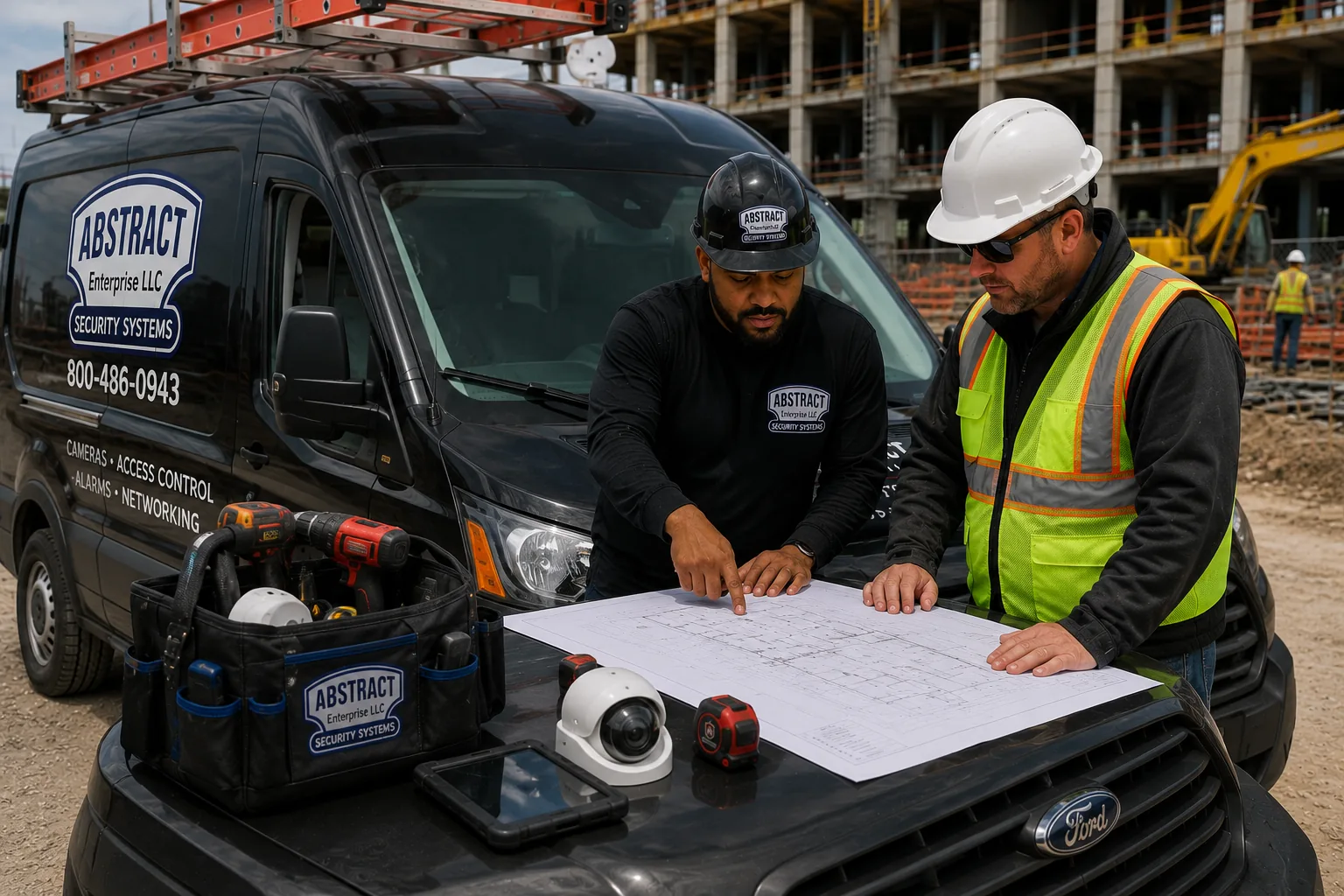
The honest version first: for a two-week punch-list phase or a small reno with live power and Wi-Fi, a decent consumer camera can be enough, and we'll say so on the phone. Where the big-box route falls apart is everywhere Long Island jobsites actually live — raw lots where Wi-Fi cameras have no Wi-Fi, wooded parcels where untuned motion detection cries wolf until you mute it, shore-adjacent mounts that corrode by spring, and subdivisions where the camera bought for lot 4 is still staring at lot 4 while lot 19 gets stripped.
A licensed deployment buys the parts you can't order online: carrier-tested positions, LI-winter solar sizing, wildlife-filtered analytics, corrosion-rated mounts, relocations that track your schedule, tamper alerts, evidence-grade time-stamps, and one accountable NYS-licensed contractor — #12000287431, insured — who answers when a head goes dark on a Friday. If you've already bought your own cameras, our install-your-own-system service will mount, aim, and configure them properly rather than talk you into replacing them.
| Decision Point | Abstract — Licensed Deployment | DIY / Consumer Setup |
|---|---|---|
| Connectivity | Per-carrier signal survey, high-gain antennas, dual-SIM in fringe zones | Wi-Fi camera on a lot with no Wi-Fi; "no signal" discovered after the loss |
| Power | Solar sized for LI winters, week-plus battery autonomy | Batteries dead by the second gray week of January |
| False alarms | AI person/vehicle filtering; thermal on wooded lines | Deer at 3 AM until the alerts get muted — then nothing at all |
| Weather | IP66/IP67 housings, stainless coastal hardware, post-storm re-aim visits | Zip ties and hope, replaced every spring |
| Phase moves | Lot-to-lot relocations included, coverage tracks the schedule | Camera watches the finished lot while the active one gets hit |
| Response | Optional 24/7 monitoring: talk-down, strobes, video-verified police call | A notification you sleep through, reviewed over coffee and an empty conex |
| Evidence | ID-grade capture, accurate time-stamps, exports carriers accept | 720p silhouette, clock off by a day, footage inside the stolen camera |
| Accountability | NYS-licensed low-voltage contractor · insured · owner picks up the phone | A support chatbot and a return window that closed in March |
NYS low-voltage license #12000287431 — the paperwork your GC agreement, your carrier, and every public bid on the Island actually asks for.
Queens line to Montauk and Orient Point — next-day standard across Nassau and western Suffolk, scheduled East End routes, emergencies jumped to the front.
(347) 934-8335 rings the person who walks your site and runs the install — not a call center reading a script about your subdivision.
30-day minimum, then month-to-month for the life of the project — no 12-month lock-ins, no penalty when the last CO closes the job out.
Winter solar math, wildlife-filtered analytics, coastal hardware, fringe-signal engineering — the suburban-site playbook, not a city template stretched east.
Cameras today, access control, alarms, and cabling tomorrow — one contractor from clearing through turnover.
NDAA-compliant specs and documentation for districts, BOCES, and municipal projects — and honest value lines where private budgets call for them.
Time-stamped, export-clean footage and archived incidents built for adjusters and attorneys — because recording only counts if it holds up.
Installer's notes — the suburban-site checklist, which is a different list than the city one:
1. Where does a truck stop without looking wrong? On LI the thief arrives on four wheels. I walk the pull-offs, the unfinished driveway aprons, the spot behind the dumpster where a pickup sits invisible from the road — those approaches get the plate cameras before the pretty gate does.
2. What does the schedule say about next month? On a tract, the coverage plan is the construction schedule wearing a different hat. If foundations move to the east cluster in five weeks, today's mounts get installed to relocate fast, and the material yard camera gets a position that survives the move.
3. What will the trees and the season do? Panel exposure in December, oak canopy in July, deer paths on the perimeter — I'd rather spec thermal on a wooded line now than explain a hundred false alerts later.
4. What's the single most walk-away-able thing here? Staged appliances, the wire reels, the compressor by the fuel cage. Whatever it is gets an ID-height head and a tight after-hours zone, not a wide shot from forty feet up.
5. Who gets woken, and for what? The super for a truck at 5 AM might be normal on pour day and an emergency on a Sunday. Alert routing gets tuned to the site's actual rhythm — the goal is a 2 AM buzz that's never ignored because it's never wrong.
Site walk, lot-by-lot placement plan, and a firm monthly number — next business day across Nassau and western Suffolk.
Abstract Enterprises Security Systems — Brooklyn (1282 Troy Ave) & Bronx (460 E Fordham Rd) offices, serving all of Long Island
The review pattern that matters most out here — quoted timelines that hold, trucks that arrive when promised, and East End jobs treated like jobs instead of favors.
Clients repeatedly mention being steered to fewer cameras, better placed — a two-unit answer where a competitor pitched eight. The ratings hold because the specs are honest.
When a head needs re-aiming after a storm or a relocation comes up mid-phase, the owner takes the call and the truck gets routed — no ticket queue between you and your site.
Read the full, unedited reviews on our Google Business Profiles — search "Abstract Enterprises Security Systems."
Monitored solar or cellular jobsite camera rentals start around $349 per month per unit. Wired construction CCTV installs run $500 to $2,500 per camera depending on mounting and cabling, with most Long Island site systems landing between $6,500 and $18,000. Rates are the same across Nassau and western Suffolk; East End work runs on scheduled deployment routes.
Both counties, border to border — from the Queens line out to Montauk and Orient Point. Western and central Long Island gets standard next-business-day scheduling; East End installs run on planned route days, with emergencies prioritized ahead of the route.
Rent while lots are open and power is spotty — the monthly covers hardware, cellular data, and relocations as construction moves lot to lot. Buy a wired system for the clubhouse, model home, or any building the cameras will stay with after closing; we convert rentals to owned systems at turnover.
On a monitored plan, live operators review the AI-verified clip, trigger talk-down audio and strobes on the site, notify your contact list, and call police with a video-verified intrusion report. Without monitoring, the alert goes straight to your phone with a clip attached.
Yes. We spec IP66/IP67 weatherproof housings, corrosion-resistant mounts for shoreline and South Shore sites, and wind-rated pole hardware. After a major storm we run check visits to re-aim anything the weather moved.
Temporary low-voltage jobsite cameras generally don't require a separate town permit — they ride under the project's existing site controls. Some Long Island towns and villages require alarm registrations for monitored systems, which we flag during the site walk. Permanent building systems get handled within the building permit scope.
Next business day is standard across Nassau and western Suffolk, dispatched from our Brooklyn and Bronx crews. Same-day emergency deployment is available when a truck can be routed. Solar and cellular units need no power or internet, so a hit site is covered before the next overnight.
Solar-cellular units are built for exactly that. We cluster units around the active lots, the material yard, and the access road, then relocate them as construction advances — no trenching, no waiting on PSEG service, coverage from the first day of clearing.
Relocations are included on rentals. As foundations become framing and framing becomes finished homes, coverage shifts with the work — active lots, the model home, appliance-staged houses before closing, and whatever the current material yard is.
Yes. For districts, BOCES, and town or county projects we spec NDAA-compliant lines such as Axis, Hanwha Vision, Avigilon, and Verkada, with documentation for the compliance file. Private jobs can use value lines where the budget calls for it.
Standard cloud retention is 30 days, with 60- and 90-day plans for projects that carry more exposure. Flagged incidents get archived outside the rolling window, and clips export time-stamped in formats carriers and attorneys accept.
Closeout removal is included on every rental — units, mounts, and signage come off clean. If the finished home, building, or facility should keep its eyes, we convert the temporary system into a permanent installation before turnover.
Hempstead, Oyster Bay, North Hempstead and every village between — construction site security camera installation in Nassau County with next-business-day deploys on the Hempstead Tpke, Old Country Rd and Jericho corridors. Request Nassau coverage →
The Route 110 corridor, Hauppauge, the LIE warehouse belt and the Ronkonkoma build-out — jobsite security camera installation across Suffolk County where the Island's equipment density is heaviest. Request Suffolk coverage →
Custom builds and estate renovations from Westhampton to Montauk and out Route 25 to Orient — scheduled route days, storm-rated hardware, and winterized-site watch plans. Request East End coverage →
Building over the city line too? Our construction site security camera installation NYC hub covers DOB territory — tower work, dense-lot sites, and borough logistics — from the same bench.
Westchester, Rockland, Orange, Putnam, Dutchess and Ulster jobsites ride the same rental fleet and monitoring desk. Request Hudson Valley coverage →
Text or call (347) 934-8335 with the site address — you'll get a yes-or-no on coverage and a deploy window inside one business day, usually faster.
The national jobsite-camera brands ship a unit on a freight truck and watch it from three time zones away. Fine for a parking lot in a market they'll never visit — thinner value on a spread-out Suffolk subdivision that needs its coverage moved next month. The honest comparison:
| Abstract — Local Licensed Crew | Typical National Unit Company | |
|---|---|---|
| Getting on site | Truck from Brooklyn/Bronx — next day across Nassau & west Suffolk | Freight shipment + a subcontracted installer's calendar |
| Placement | Walked in person — approaches, tree lines, phase plan | Wherever the delivery driver can safely drop it |
| Phase moves | Lot-to-lot relocations included, tracked to your schedule | Change-order, remote coordination, weeks of lag |
| Pricing | Monitored units from $349/mo, month-to-month | $500–$900+/mo per unit, often 6–12-month terms |
| Storm response | Post-nor'easter check & re-aim visits | A ticket in a queue after every coastal blow |
| Beyond cameras | Full licensed low-voltage bench — access, alarms, cabling, permanent systems | Cameras only; everything else is somebody else |
| Accountability | NYS Lic #12000287431 · insured · owner's cell | An 800 number and an SLA paragraph |
Where a national outfit genuinely fits: a fifty-state builder standardizing one vendor everywhere. If that's not you, local wins on every line that touches your actual lot.
Numbers you can budget against before anyone visits — confirmed to the dollar after the site walk. Same rates across Nassau and western/central Suffolk; East End work rides scheduled routes at the same unit pricing.
One monitored solar/cellular unit — gate or material-drop coverage with AI alerts, cloud clips, and signage. The custom-home and small-reno answer.
Two units covering approach + yard or two active lots, one app, relocations included — the working setup for most LI builds.
Multi-unit coverage with 24/7 live operators, talk-down deterrence, and video-verified dispatch — the overnight-guard replacement.
Hardwired PoE systems for pads, shells, and buildings with temp power — most complete Long Island site systems land $6,500–$18,000 depending on camera count and cabling runs, and convert to the permanent system at turnover.
Gate/LPR heads per entrance · thermal perimeter heads · progress time-lapse packages from $149/mo · surveillance trailers from $2,500/mo for open acreage · closeout removal included on every rental.
The morning-after call. We route the nearest truck, mount solar/cellular units on the compromised approaches, and have the lot reporting before the next overnight — Nassau and western Suffolk same-day when a truck can be turned, next business day guaranteed.
Thanksgiving weekend, the Christmas–New Year's dark stretch, and winterized seasonal builds are when LI sites get harvested. Book the shutdown package before the last crew day and the site stays on a monitored screen until remobilization.
The cheapest week to install is the week before anything worth stealing arrives. Site walk during clearing, units up before the first material drop, gate camera live before the first delivery signs in.
Spec houses stripped between staging and closing. Fix: per-house entry units, tight after-hours zones, late staging coordination, monitored response on the final-week houses.
Equipment yards and trailers cleaned out over 63 dark weekend hours. Fix: plate capture on the yard gate, strobe-and-voice escalation, live operators who call it in while the truck's still loading.
Deer-triggered notifications until the super mutes the app. Fix: AI person/vehicle classification, thermal on the tree lines, zones tuned on the walk — silence until it matters.
Static cameras aimed at finished work while the active cluster sits blind. Fix: relocations included, coverage plan tied to the construction schedule, moves booked with your phase meetings.
Cameras that upload nothing from the back of an East End parcel. Fix: per-carrier signal survey, high-gain antennas, dual-SIM units, on-device recording as the always-on backstop.
Shells sitting dark December through March on quiet roads. Fix: seasonal watch packages — two units, monitored after-hours, storm checks — so spring finds the site the way fall left it.
Site walk → placement plan → firm monthly number. Next business day across Nassau & western Suffolk, scheduled routes to the East End, emergencies first.
Use the long form when you've got specifics — lot counts, phase schedules, what walked off last time, bid documents that mention NDAA. It lands in the same inbox the owner reads, and the reply comes back with a spec, not a sales script.
Permanent systems for LI homes & businesses
Warehouses, retail, medical & office
Towable masts for open acreage & yards
Card, fob & mobile entry at turnover
Site trailers today, finished buildings tomorrow
Field offices & permanent building backbones
Existing systems fixed, upgraded, re-aimed
Video entry for the buildings you hand over