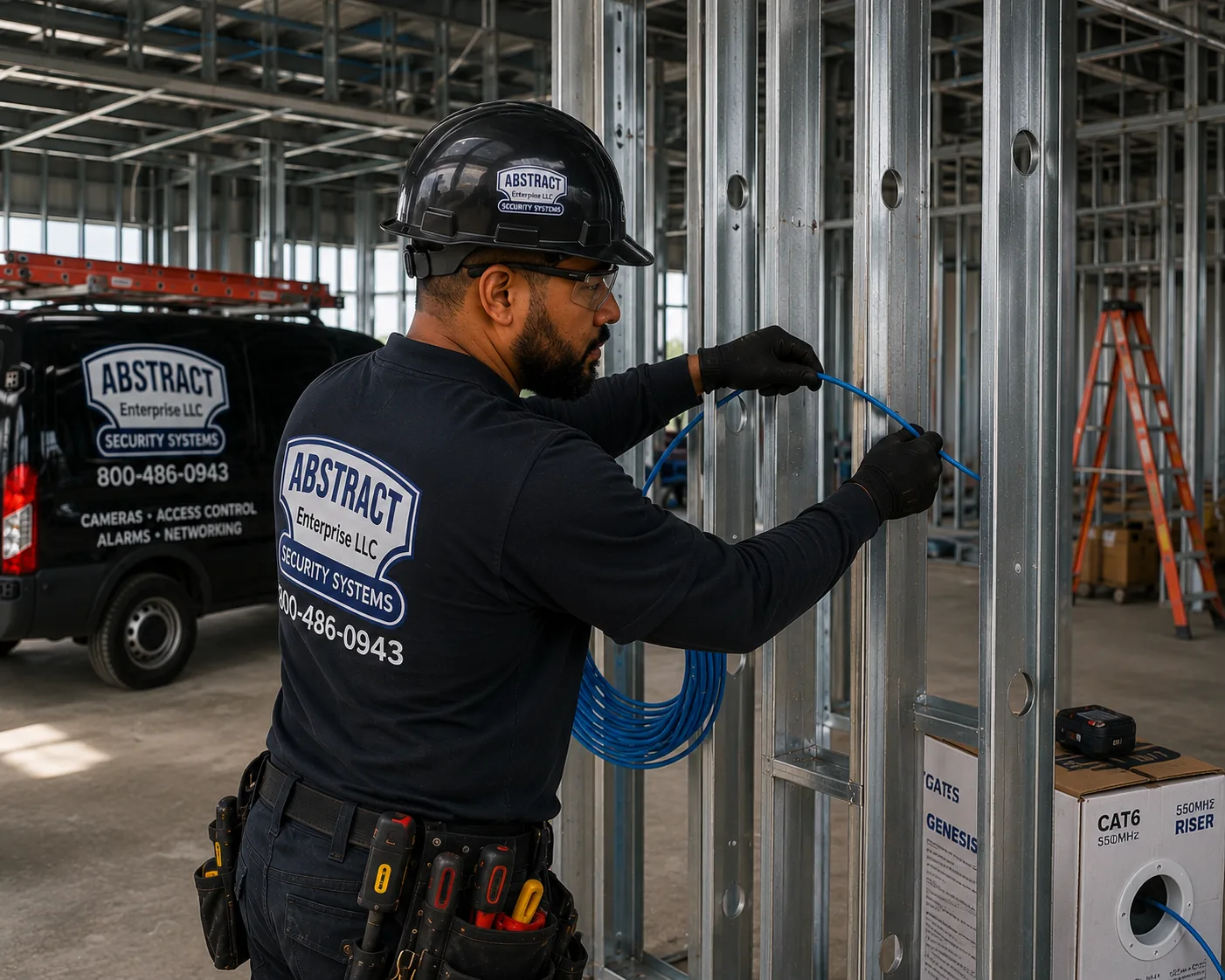
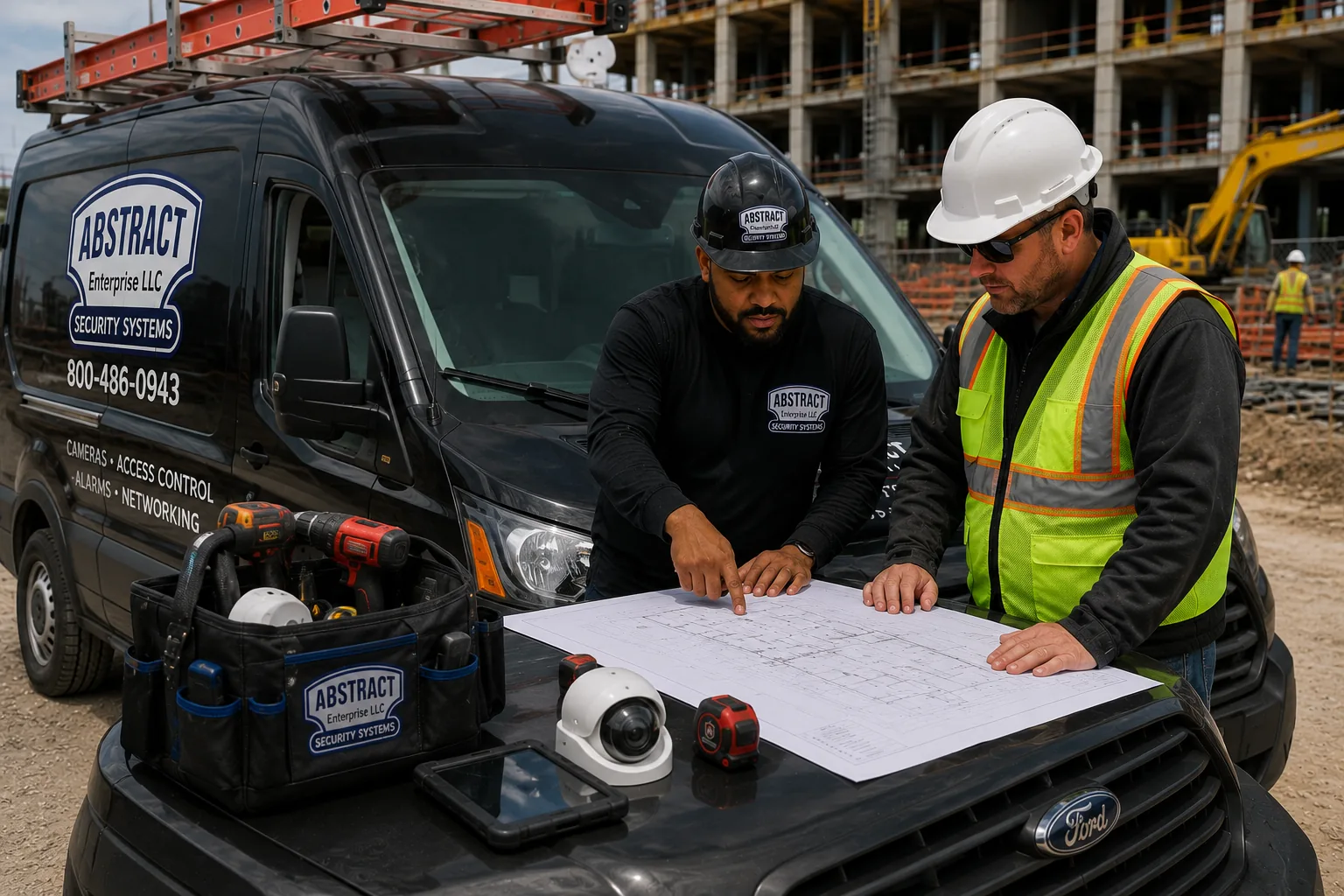
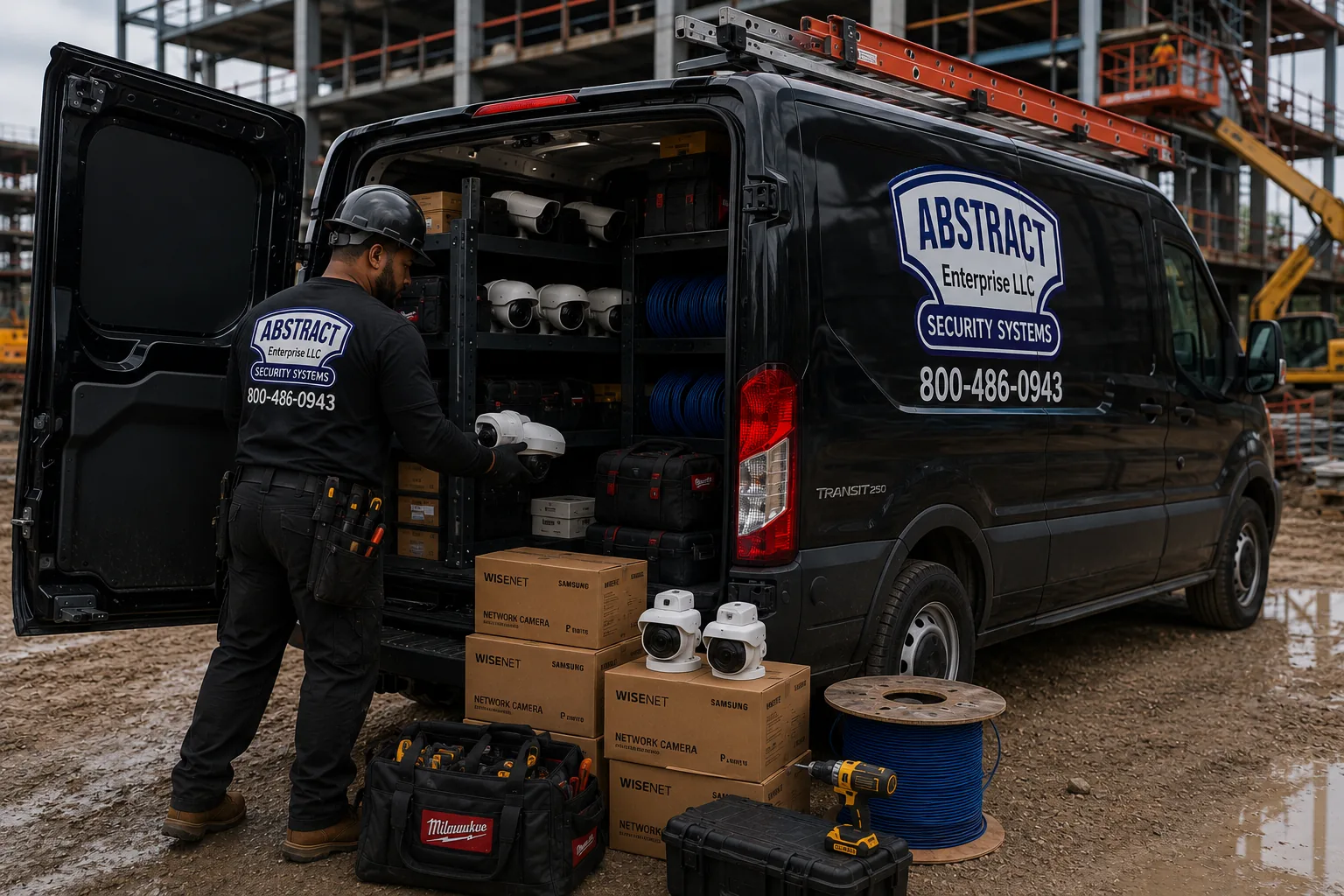
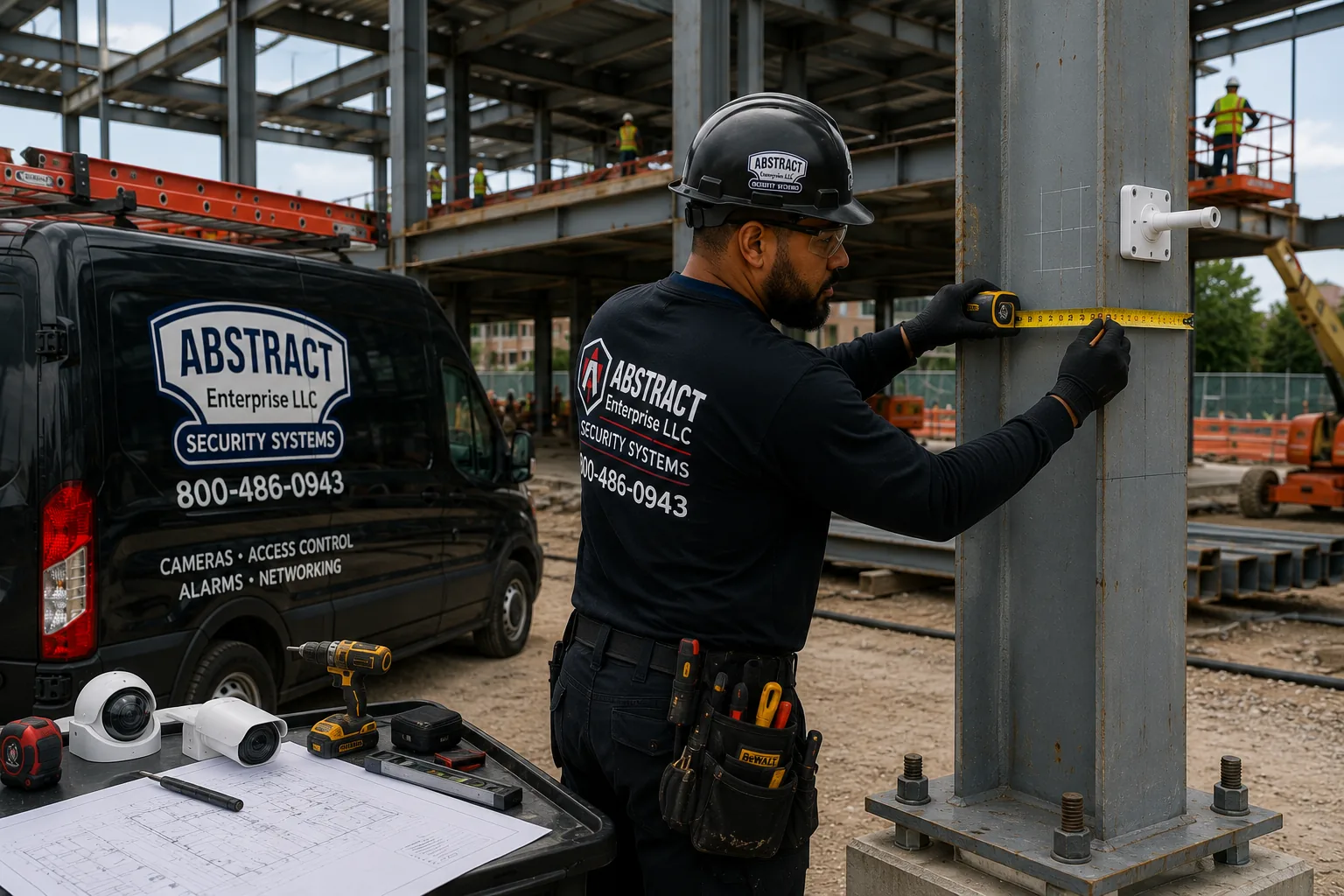
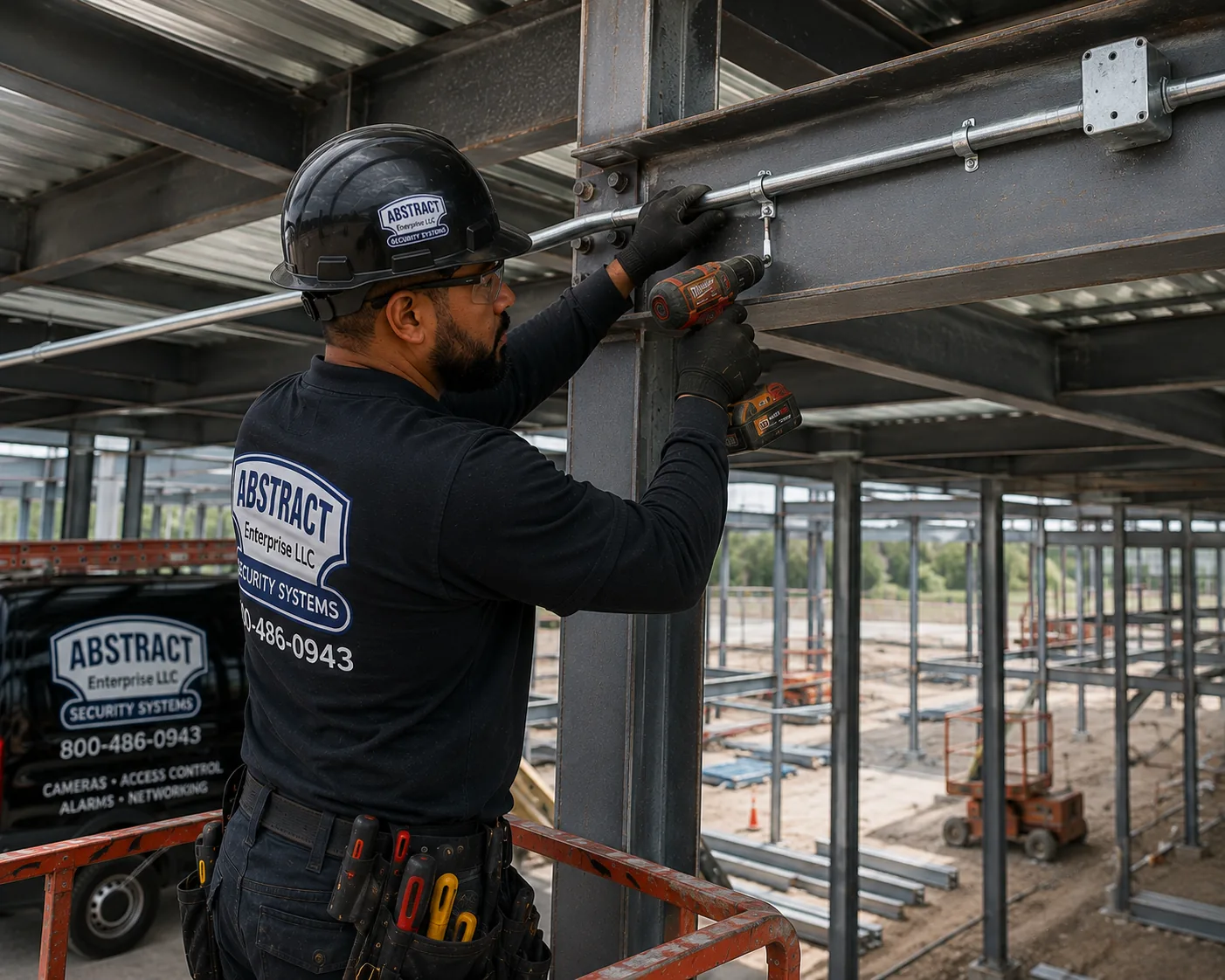
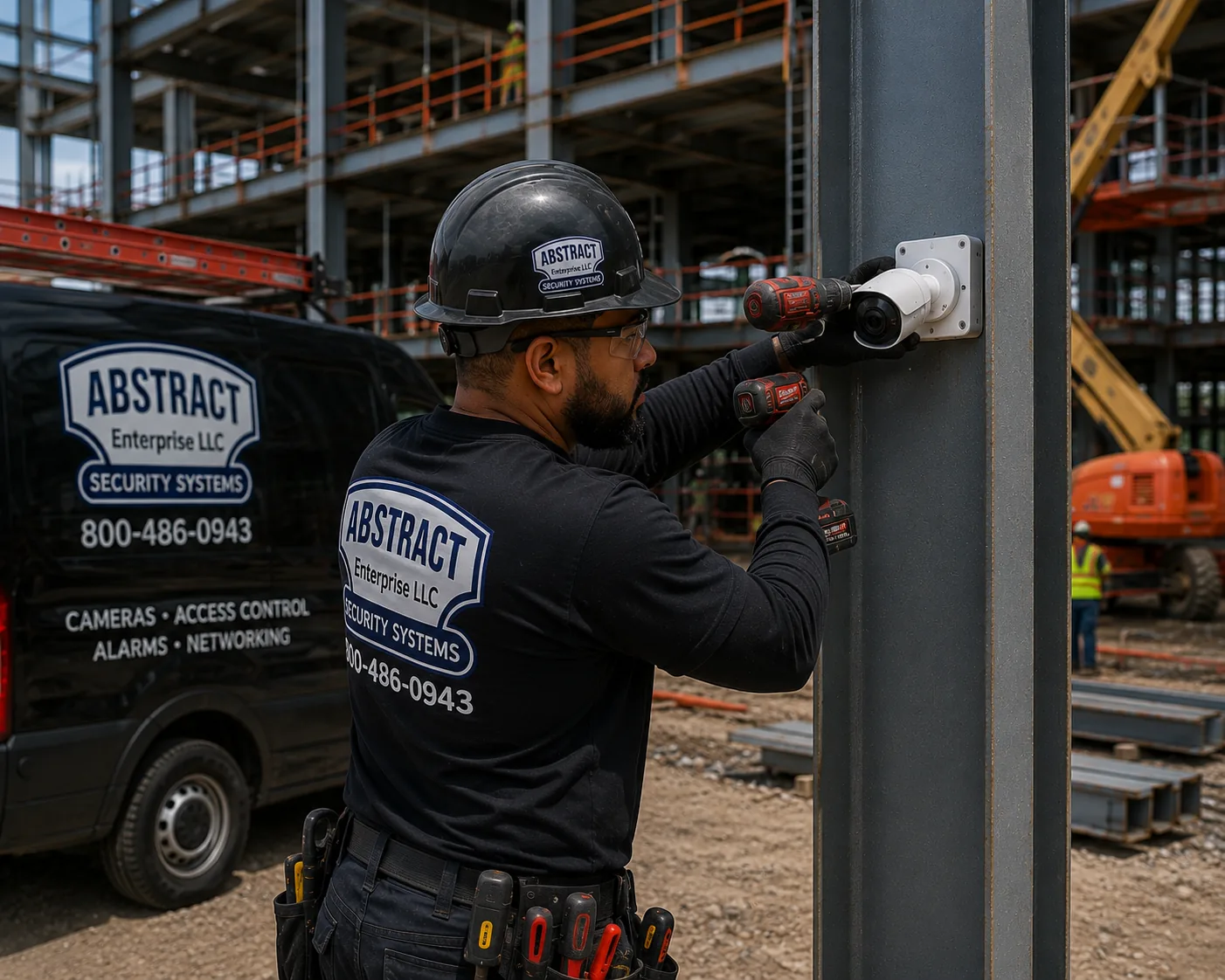
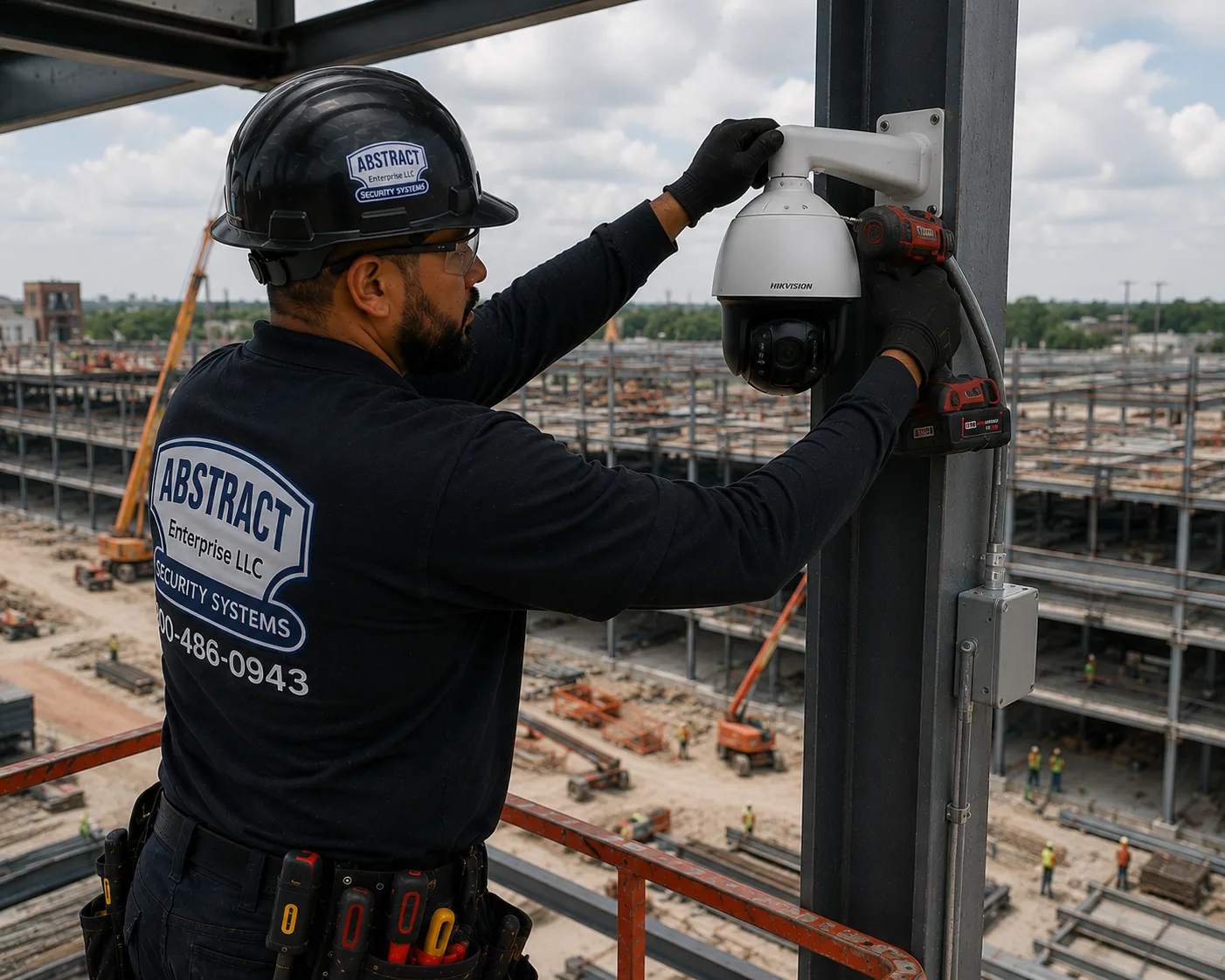
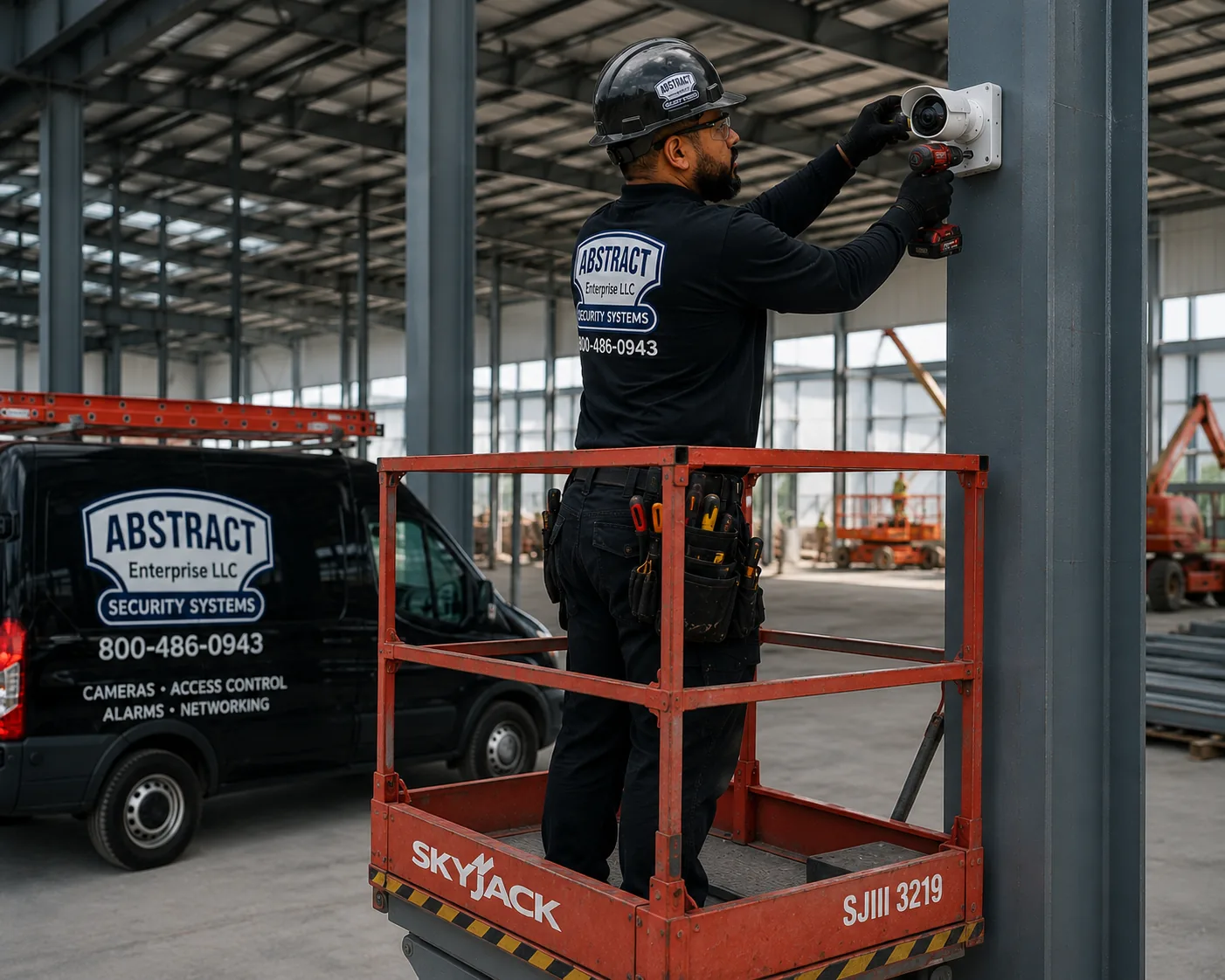
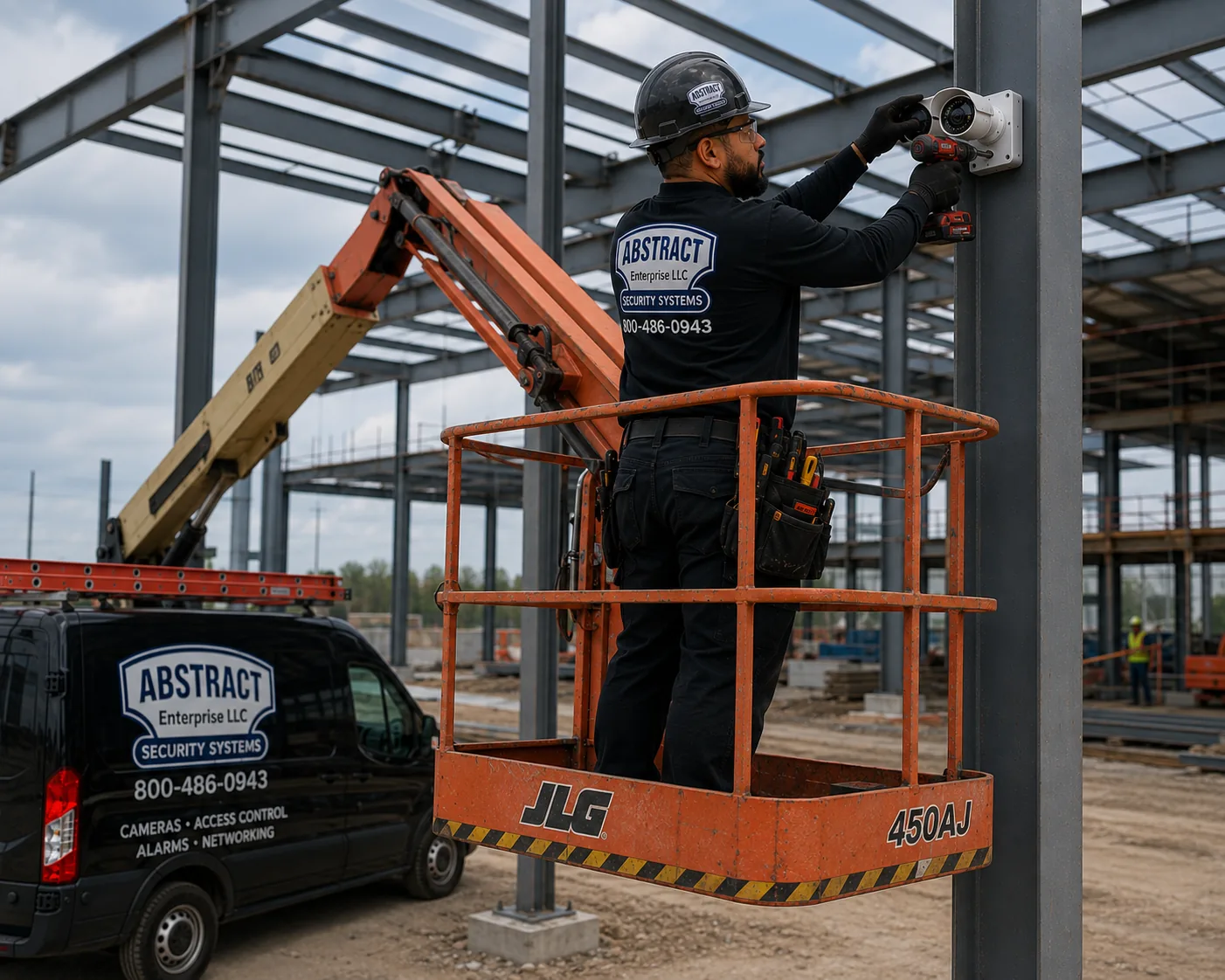
Jobsite cameras for the county where the build is usually somebody's dream house — teardowns becoming custom colonials, six-figure finish packages staged in garages, gunite pools carved into backyards, gut renovations running while the owners summer elsewhere, and mid-rise apartments climbing next to the LIRR downtowns. Installed and monitored 24/7 by a licensed NYS low-voltage contractor headquartered in Brooklyn — one parkway from the county line, with systems built to run without a truck on the street.
Nassau construction concentrates value like nowhere else in the region: a teardown becomes a custom build carrying imported slab, bespoke millwork, and an appliance package that costs more than the truck that delivers it — all staged in a garage on a street where nothing moves after ten. Pools put machines, heaters, and hundreds of feet of copper line in open backyards for weeks. Gut renovations run while owners are away for the season, alarms off because trades come daily. And the county's downtowns are adding mid-rise apartment projects with hoists, scaffold, and laydown right off the LIRR platforms.
The loss math starts at the national baseline — the 2013 NER/NICB Heavy Equipment Theft Report estimated $300 million to $1 billion a year in stolen equipment and materials nationally. Those figures are historical, and we present them as exactly that — but no rigorous national study since has suggested the problem shrank, and Nassau's per-item numbers run bigger than most. One slab of stone, one range, one pallet of Belgian block is a four-figure loss; a staged finish package is five to six. The quiet street isn't protection. It's privacy — for whoever backs up to the garage.
And the regulatory picture, straight: Nassau permitting runs through dozens of village, town, and city building departments, and requirements depend on the municipality and the installation method. Temporary freestanding equipment may not require a building permit, but fixed poles, electrical work, permanent mounts, trailers, public-right-of-way placement, and permanent systems can trigger local review — Nassau County directs applicants to the applicable city, town, or village building department, and Abstract Enterprises confirms requirements with the project's authority having jurisdiction before installation. What no municipality does is require site cameras in the first place: that layer of security is purely the builder's call, and the builder's exposure. A monitored system is the difference between a quiet street that hides a theft and a quiet street where the theft gets interrupted, recorded, and answered.
A knockdown-rebuild, a backyard pool dig, an occupied-street renovation, and a five-story TOD project don't share a spec. The catalog, matched to how Nassau actually builds:
Self-powered LTE heads live from demo day — no utilities, no Wi-Fi, no waiting on the electrician. Demo-to-CO on their own power.
One or two units riding the whole cycle — demolition, foundation, framing, finish — repositioned as the build changes shape, included.
Named zones over staged slab, millwork, and appliance packages, with arming that tightens the week the big deliveries land.
Pole or house-mounted heads covering the dig, the machine, the equipment pad, and the staged copper — relocating between digs as the season moves.
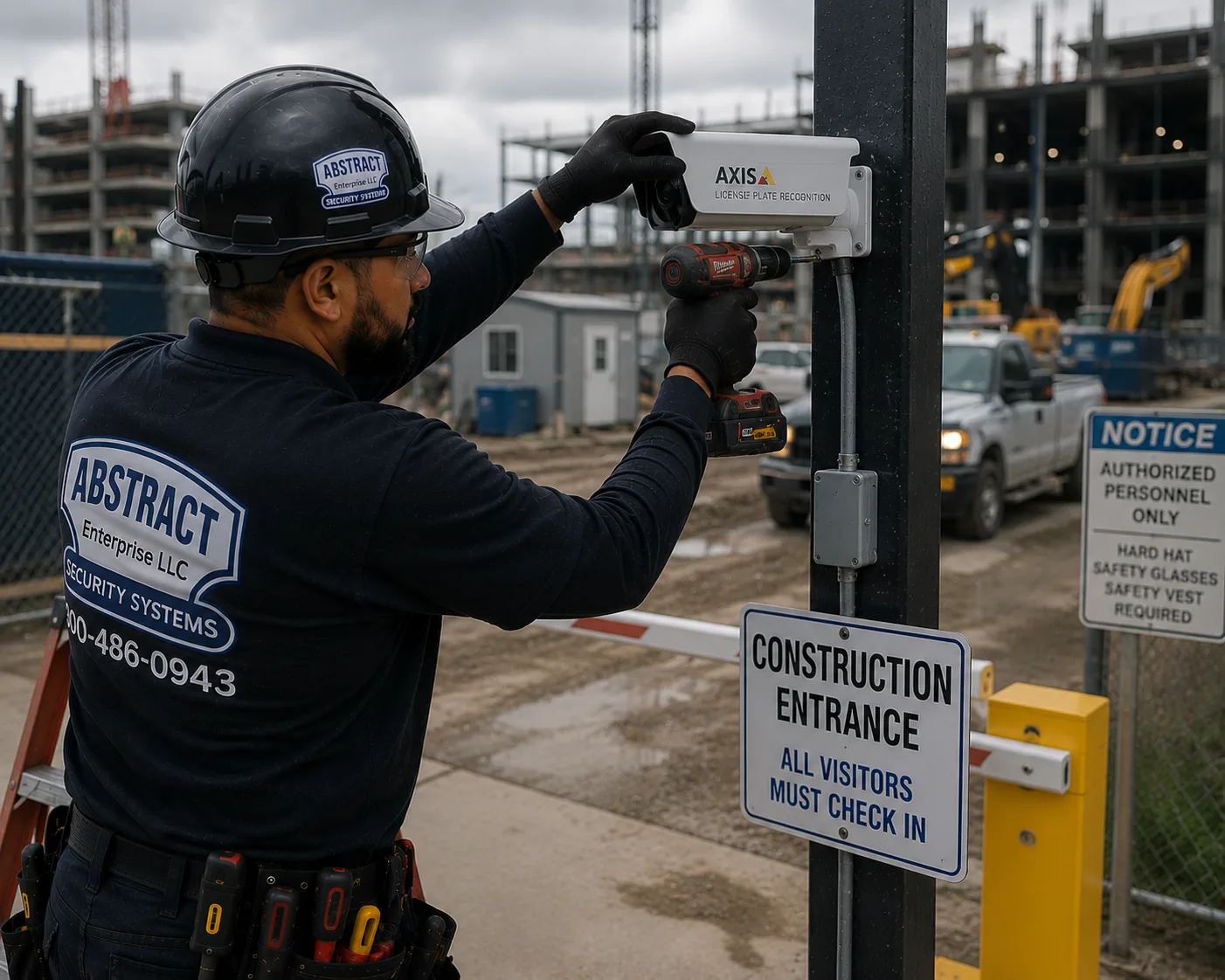
Plate-reading heads on the frontage — every vehicle that slows, turns in, or loads, logged with a searchable timestamp.
Hardwired 4K for TOD projects, commercial fit-outs, and estates — engineered to convert into the finished property's permanent system.
Low-profile mounting, restricted named-user access, and footage that never leaves your control — security that respects a private client.
Person-detection fires a floodlight strobe and a live voice — the quiet backyard gets loud exactly once, at the right moment.
Every active job in one app with per-site arming — plus cloud clips that survive whatever happens to the hardware.
Nassau's residential blocks empty out early, and a box truck at a dark teardown draws no attention at all. Monitored coverage fills that gap with live operators who verify every after-hours event on video, fire the strobe and talk-down, work your call list, and hand the police a verified intrusion with a description instead of a cold report. On a street where nobody's watching, the monitoring desk is the neighbor who never sleeps.
Cleared teardown lots, TOD laydowns, and staging yards with nothing to mount to get a solar surveillance trailer in Nassau County — mast-mounted PTZ, strobes, and audio anywhere a truck can park. Rates live on the trailer pricing page.
Knockdown / teardown-rebuild — the county's signature project: an existing house demolished so a larger custom build can replace it. The cycle runs a year or more, and the lot holds serious value at nearly every phase.
Delivery week — the stretch when a high-value package lands: appliances, slab, custom windows, millwork. The most predictable theft window on a custom build, and the easiest one to schedule coverage against.
The season — the months owners spend away while renovations run at full speed. Houses full of material, alarms off for the trades, and nobody home to notice anything.
Staging zone — wherever finish material waits for install: usually the garage, sometimes a room, sometimes a container. On a Nassau custom build the staging zone can hold six figures, and it gets a named detection zone of its own.
Village patchwork — Nassau's dozens of independent building departments, each with its own filings and boards. What a camera installation needs varies with the municipality and the method — temporary freestanding units often need nothing, while poles, electrical work, and permanent mounts can trigger review — so the authority having jurisdiction gets a confirmation call before anything is installed.
Winter idle — the December-to-March slowdown when jobs pause but material stays. Coverage through the idle is cheap; a stripped site discovered in March is not.
Every platform on the truck solves a different combination of three questions: how long does the site go without utility power, what is there to mount to, and does the coverage end at closeout or convert into the property’s permanent system? Nassau projects sort themselves fast once those three are answered honestly.
The county default for teardowns, pool digs, and renovations. High-capacity battery packs run weeks per charge, LTE moves the video with no site network, and the unit straps to a fence post, an existing structure, or a temporary pole in a single visit. The trade-off is duty-cycle discipline: batteries record on events, not continuously, so detection zones and schedules are tuned to spend power where the risk is. Swaps and charge checks ride on our scheduled runs.
Same cellular backbone with a panel keeping the battery topped — the right call when a site will sit unpowered past a season, when winter idle stretches the calendar, or when access for battery swaps is awkward. The honest caveat: panel output in late December is a fraction of June’s, so solar systems are sized for the worst month, not the best one, and a shaded north-facing mount gets a bigger panel or a battery-first plan instead.
Once temporary power or the permanent service is live, hardwired PoE delivers what battery platforms can’t: continuous recording, higher sustained resolution, multi-sensor heads, and zero battery logistics. On TOD projects, commercial fit-outs, and estates, the wired build is usually designed as the future permanent system from day one — conduit and runs placed where the finished property needs them, so turnover is a handoff instead of a re-install.
Cleared lots, laydown yards, and big open staging get a towable mast unit — solar array, batteries, PTZ head, strobe, and speaker on one chassis that parks anywhere a truck fits. Trailers cost more per month than strap-on units, so they earn their keep on acreage and sight-line height, not on a single-house lot where a pole unit does the same job for less. We say so when that’s the case.
Placement is the difference between footage that identifies and footage that merely proves something happened. The planning pass on a Nassau build works through the same checklist every time:
High enough to beat casual tampering, low enough to keep faces at a usable angle. Plate-capture heads break the rule on purpose — they mount lower and aim flatter, because a plate read is a geometry problem before it’s a resolution problem.
A head staring into the southern sky spends half the day blinded, and shore-side light bouncing off water compounds it. Mounts are oriented off-axis from the worst glare, and infrared throw is matched to the zone depth so night footage holds detail instead of blooming.
Three zone families cover most residential sites: every opening a person fits through, the staging areas holding value, and the approaches — driveway, side yards, the rear line — that a visitor must cross first. Coverage overlaps so no single failed head opens a corridor.
Framing rises, scaffold wraps, siding lands — and a mount that made sense in April is staring at plywood by July. Placements are chosen for the longest useful life per phase, and the re-aims that a changing structure forces are included, not billed as surprises.
Nassau lots sit close. Any head whose field clips a neighboring yard or window gets a software privacy mask baked into the zone at commissioning — the coverage watches your project, not the block, and that discipline is part of why the neighbors stay friendly.
On wired sites, cable is the most vulnerable component: runs go in conduit or above reach, penetrations are sealed, and home runs route away from the areas trades work hardest. A cut cable defeats a camera; a protected one doesn’t give anyone the option.
The output of the planning pass is a one-page coverage map — every head, its zone, its mounting surface, and its phase lifespan — that rides with the quote. You approve a drawing, not a description, and the install matches the drawing.
Nassau work runs from private custom homes to district bond projects and municipal buildings, and the brand call follows the funding. Section 889 applies to covered federal procurement and contracting — state, municipal, school, and bond-funded projects do not automatically fall under it solely because they are public, but their bid documents or funding conditions may independently require compliant equipment. When federal rules or a project specification call for it, Axis, Hanwha Vision, Avigilon / Alta, and Verkada carry the job with the compliance paperwork riding in the submittal, and Hikvision and Dahua come off the list. Private builds get honest value engineering: LTS/Platinum where price-performance rules, and Dahua in Nassau County where the budget says so and no auditor ever will.
How the county sorts the bench: long-battery cellular lines for teardowns and pool digs; low-profile Axis and Hanwha domes where a private client wants coverage nobody notices; multi-sensor heads where one mount must hold a driveway and two property lines; Verkada when a builder wants every active job on one cloud dashboard; marine-rated housings for barrier-island and shore work. Tell us the project and the client — the list writes itself.
One or two monitored units riding the knockdown from demo through CO — repositioned at every phase, delivery weeks prioritized.
Discreet coverage for occupied-street and away-for-the-season projects — construction zones only, armed on the crew schedule.
A relocating unit fleet covering digs, equipment pads, and staged line sets across the season's active backyards.
Any layout above with 24/7 live operators, talk-down deterrence, and video-verified dispatch — the neighbor who never sleeps.
Every package connects to the rest of the licensed scope when the project delivers — alarms, tel-data backbone, and the permanent systems the finished property will actually live on.
Coverage follows the work — and so do the pickups that slow down at dark teardowns. Where Nassau's building is stacked this cycle:
Mineola, Westbury, Hicksville, and Farmingdale keep rebuilding around their stations — mid-rise apartments and mixed-use projects with hoists, scaffold, and laydown steps from the platforms. Multi-year fences in the middle of walkable downtowns.
The county's steadiest construction economy: existing houses coming down and custom builds going up, lot by lot, from the Gold Coast to the South Shore — each one a year-plus cycle of staged value on a quiet street.
Gunite digs, cabanas, outdoor kitchens, and full backyard buildouts run spring through fall — machines, heaters, and copper line sets sitting exposed behind houses for weeks at a stretch.
The county's health systems keep expanding — medical office buildings, imaging suites, and ambulatory space concentrated through the central corridor, with commercial fit-outs alongside.
The long-running redevelopment planning around the Coliseum area, plus the retail and hospitality follow-on the arena era brought — big-parcel work with big-parcel staging.
Elevations, resilient rebuilds, and coastal hospitality work from the Five Towns through Long Beach — houses on cribbing, marine conditions, and material staged at the water's edge.
Two practical notes ride under all six corridors. First, the authority having jurisdiction changes corridor to corridor — a downtown mid-rise, a barrier-island elevation, and an estate-side knockdown answer to different building departments with different appetites for review, which is why permit confirmation happens per project, never by county-wide assumption. Second, the phase load shifts with the calendar: pool and outdoor-living work stacks spring through fall, interior fit-outs and rough-in phases carry the winter, and the delivery-week peaks cluster wherever the custom-build cycle happens to sit. The coverage fleet moves with all of it.
How we work the county: from Brooklyn headquarters, out the Belt or the Southern State — the Queens line is minutes away and the Suffolk border is an hour on a bad day. Battery-cellular systems and central monitoring mean the service model is scheduled runs and same-day emergencies, not a truck that has to live in the driveway.
Knockdown-rebuild specialists with six-figure finish packages, delivery weeks, and closing dates on the line.
Gut renos, additions, and away-for-the-season projects on occupied streets full of watching neighbors and staged material.
Gunite crews and hardscape outfits with machines, heaters, copper, and pallet stone spread across backyard jobs.
Downtown mid-rise teams running hoists, scaffold, and street-adjacent laydown by the LIRR.
Fit-out crews with equipment-heavy interiors, delivery cycles, and tenant timelines.
Plumbers, electricians, and HVAC crews whose rough-in material, trailers, and van inventory are the county's favorite targets.
Bond-funded school and public projects whose bid documents or funding conditions may call for compliant equipment and formal documentation — supplied whenever the spec requires it.
Owners of custom builds and major renos who want their own eyes on the project — and their privacy kept intact.
A Nassau custom build runs a year or more, and the thing worth stealing changes every few months. The coverage plan should change with it. The cycle, mapped:
The exposure is the lot itself: trespass, dumping, and the excavator or skid steer that sleeps on site between demo and dig. This is the phase most builders skip coverage on, and the phase where habits form — the cut-through path, the after-dark hangout, the contractor down the block who “borrows” the machine. One pole- or fence-mounted battery unit covers the entire parcel, the talk-down ends the foot traffic in a week, and the plate log starts building its record of who slows down out front. Coverage that starts at the fence costs the same as coverage that starts after the first loss; it just prevents more.
Value arrives in machine form: the excavator, the pump truck’s scheduled visits, form panels, rebar, and anchor hardware. Machine theft here is a drive-on, drive-off event that takes minutes and a trailer, so the unit’s vehicle-detection zone earns its keep — a truck entering the site at 1 AM is the single highest-confidence alarm in construction. Side-yard approaches get their own zones now, because the open excavation makes the whole perimeter walkable.
The structure rises and the site becomes climbable: ladders, scaffold, and open floors turn the build into the neighborhood’s most interesting structure after dark. Lumber and sheathing packages stage in the open, and late framing brings the first copper and rough mechanical material. The camera plan usually gains a second angle here — the original frontage unit keeps the approach, and a repositioned or added head watches the structure itself, because the thing being climbed is now the thing worth watching.
The quiet-looking phase with the loudest losses: wire pulled through the studs, copper and PEX run, HVAC line sets hung, panels set. A rough-in strip — walls opened, wire yanked, fittings cut out — is days of loss and weeks of schedule, and it happens from inside the structure where an exterior head can’t see. This is when an interior unit goes in: one compact head per floor covering the mechanical core, armed the moment the last trade leaves. Exterior detection tells you someone entered; the interior head is what turns that into an identification and a verified dispatch.
Peak value, peak portability. Slab, millwork, fixtures, and the appliance package cycle through the staging zone, and the site’s dollar density is now higher than the finished house will ever be — because everything is still in boxes with handles. Coverage tightens to match: the staging zone becomes the primary armed area, delivery weeks get priority handling, and after-hours arming runs on the tightest schedule of the project. Most of the county’s worst single losses happen in this phase, and most of them were preventable with exactly this posture.
The house is essentially complete, the appliances are installed, and — the detail everyone forgets — the homeowner’s own alarm and cameras usually aren’t live yet. The site system carries this gap: coverage runs through the certificate-of-occupancy inspections, the walk-through, and the closing, then either comes off on your schedule or converts into the permanent system so the protection never actually blinks. The worst time to be dark is the week the house is finally worth the most.
The questions this county's work raises — answered the way we'd answer them standing in the driveway.
Yes — the gap itself. A cleared lot with no coverage invites dumping, trespass, and equipment "borrowing" the moment the excavator arrives, and everything that happens on it before foundation is your liability. A single battery unit on a pole covers the whole window: detection ends the cut-through habit before it forms, the talk-down handles the dumpers, and the plate log identifies the truck that left the debris pile. Then the same unit rides the build — foundation, framing, finish — so the day-one deploy isn't an extra cost, it's just starting the coverage where the exposure starts.
A locked garage on a construction site is a vault with a display window — every delivery truck that unloaded into it announced what's inside, and builder's locksets aren't a serious barrier. Give the staging zone its own coverage: an interior head over the material with after-hours arming, entry detection on the garage openings, and monitored response so entry at 2 AM gets a live answer instead of a morning discovery. Slab and millwork are the worst possible losses — long-lead, imported, schedule-killing — so the zone watching them should be the tightest one on the job. It's the cheapest insurance a six-figure package will ever get.
Schedule the coverage against the delivery, not the calendar. Delivery week is the most predictable theft window on a custom build — the truck's arrival is visible to the whole street, the boxes telegraph the brands, and the install gap is when the package is most portable. The move: arming tightened the day the delivery lands, an interior head on the staging room, entry detection live every night of the gap, and monitored response prioritized. If you run multiple builds, tell us the delivery dates each month and the coverage flexes to meet them — the watching gets tightest exactly when the value peaks.
Honestly: whoever you authorize, and no one else. Access is account-based and named — you, the client if they want it, and on monitored plans the licensed central-station operators who review motion events, who see clips, not tours. Footage isn't published, isn't marketing material, and isn't shared with anyone without written permission; feeds can be locked to named users with individual logins, and recordings live in your account, not a public cloud. On builds where the client's privacy is worth more than the finish package, the system gets specced accordingly — low-profile heads, aimed at the work, controlled like a document.
It depends on your village and on how the cameras go in — Nassau has no single countywide answer, which is why the county itself directs applicants to the applicable city, town, or village building department. The general shape: temporary freestanding equipment that arrives with the project and leaves with it may not require a building permit, while fixed poles, electrical work, permanent mounts, surveillance trailers, anything placed in the public right-of-way, and permanent end-state systems can trigger local review — and a village with an active architectural review board may want eyes on anything visible from the street. Our practice is boring on purpose: we confirm requirements with your project's authority having jurisdiction before installation, so the camera plan and the paperwork always match. You can check your municipality through the Nassau County building and zoning permits directory — or hand us the address and we make that call for you.
A unit that treats the backyard as the site, because mid-dig it is one. A battery-cellular head on a pole or the house covers the excavation, the equipment pad, the machine, and the staged line sets with person-and-vehicle detection — and since pool theft is almost always a night visit through the side yard, the side-yard approach gets its own zone. The unit relocates between your active digs as jobs finish, so a small fleet covers the whole season's book. Copper line sets and heaters are grab-and-go losses that stall the job for weeks; the coverage that prevents them costs less than one re-order.
Completely — you've described the most exposed configuration in residential work. A mid-renovation house with absent owners has the contents of a build and the oversight of a vacancy: the alarm is down because trades cycle daily, the neighbors assume every vehicle is a contractor, and nobody performs the nightly walk-through an occupied house gets for free. Site units close the gap — armed on the crew schedule, covering the entries and the material, with alerts to you and the owners wherever they winter. It runs independent of the house systems, so the trades keep their workflow and the house keeps a watchman. When the owners return, the units leave. Clean.
People with the same trucks and forks you have — landscape material moves through a gray resale market where a pallet of bluestone is cash and completely untraceable. The overnight, one-pallet pattern means someone's treating your jobs as inventory: taking little enough to go unreported, often enough to matter. Counter it with detection on the staging area and a frontage head logging plates — the pattern that identifies a repeat visitor is exactly what a plate log builds — plus the habit of staging pallets deep on the property instead of curbside, where loading takes thirty seconds. One interrupted visit usually ends the route; your jobs come off the list.
Layered like the site is: gate and hoist coverage with plate capture on the approaches, elevated heads over the laydown — including the municipal-lot staging, which is off-site and otherwise unwatched — and interior floor coverage added as the building closes in. Downtown adds two wrinkles worth designing for: pedestrian adjacency, so detection zones are drawn to the fence line rather than the sidewalk, and neighbors, whose storefronts appreciate that your cameras incidentally cover their block after hours. The system converts to the finished building's permanent package at turnover — on a multifamily project, that's not an add-on, it's the plan.
Quietly, which is the whole spec. Club work inverts the usual problem: the threat isn't a dark street, it's an open campus with constant legitimate foot traffic and a client who'd rather the security be invisible. The answer is low-profile heads aimed tightly at the construction envelope — the material staging, the equipment, the building openings — with detection zones that ignore the cart path and the members, armed hard after hours when the campus empties. Coverage confined to the work, aesthetics the committee never notices, and footage custody the club controls. The security should be as discreet as the contractor who got the job.
Layers, because a hitch lock alone is a two-minute problem for someone with a grinder. Physical: wheel boot plus hitch lock, tongue pointed away from the street, trailer blocked in by equipment where the site allows. Detection: a unit covering the trailer with vehicle-approach alerts — a tow-away requires a truck to back up to it, which is exactly the slow, distinctive event analytics catch — and a talk-down that announces the recording mid-hookup. Evidence: the plate log, because trailer thieves scout first. The combination turns a two-minute silent job into a lit, recorded, announced one, and that's usually the whole fight.
It's a real one: an elevation project is a house with its underside open to the world — mechanicals, plumbing, and structure reachable by anyone who walks under, for months. Units on the structure or a pole cover the crawl access and the staging with person detection and talk-down, marine-rated housings handle the shore air, and arming runs continuous because a raised house has no "occupied hours." The same coverage documents the project for the lender and the flood-program paperwork, which elevation jobs carry more of than any other residential work. Weird problem, straightforward spec.
Flip the question: the winter idle is when the cameras do their most important work, precisely because nobody else is there. An idle site holds staged material, copper, fixtures, and sometimes equipment through months of fourteen-hour nights, zero deliveries, and zero witnesses — the exact conditions under which sites get stripped and the loss isn't discovered until mobilization. Idle coverage keeps detection and monitored response live with cold-rated batteries and periodic health checks, at the same monthly you paid all season. The alternative is discovering in March what happened in January. It's a discovery worth never making.
It's exactly your problem — an unfinished structure is the textbook attractive nuisance, and a kid hurt inside one is a liability event that makes any theft look cheap. The fix works fast on this crowd: detection on the entries with a strobe and live talk-down, because being loudly announced by name-of-address at 9 PM ends the clubhouse era immediately — teenagers require an audience of zero. The footage also gives you the documentation trail that you secured the site, which matters enormously if anything ever does happen. And a quiet word to the parents, clip attached, tends to end it for good. Protect the kids and the company in one move.
Ride one or two monitored battery units through the whole cycle — demo, framing, finish — with named zones on the staging areas and arming that tightens during delivery weeks. Relocations as the build changes shape should be included.
The cleared-lot gap, the framing months, and the finish staging each carry real exposure — one unit from demo day covers all three and ends the trespass and dumping problems cleared lots attract.
Monitored rentals begin at $349 monthly for a single unit and $649 for two, with full multi-unit monitored coverage around $999; wired systems price out at $500–$2,500 per camera installed.
Stage pallets deep on the property, put detection on the staging area, and log plates at the frontage — pallet theft is a repeat-visitor pattern, and one interrupted visit usually takes your jobs off the route.
A pole- or house-mounted battery unit covering the dig, the machine, the pad, and the staged copper — with a zone on the side-yard approach, since pool theft is almost always a night visit through the gate.
Yes — battery units with solar assist and LTE cellular run from demolition to CO with no utilities at all, then hand off to a wired system if the finished property wants one.
On monitored plans, licensed central-station operators review motion events live, fire the strobe and talk-down, work your call list, and dispatch police on video-verified intrusions — 24/7, every night the site sits empty.
Run the math against one loss: a stolen appliance package, stripped copper, or a liability claim each outweigh a year of monitored coverage. On a single custom build, one unit is usually the entire answer.
Machine-written answers average every jobsite in America into one paragraph. Nassau's sites don't average. Where the summaries break here:
Property crime follows value, and no jobsites in the region concentrate more value per address than Nassau's custom builds — which is why the county's quietest streets produce its biggest single-item losses.
The neighborhood's safety statistics describe its occupied houses. Its construction sites are a different category with a different visitor list.
Nice street, expensive site, no witnesses after ten. That's an invitation, not a defense.
The home alarm has been off since demo — it has to be, because trades cycle through daily and nobody resets zones around missing walls.
Even armed, it protects doors and windows that may no longer exist, and it says nothing about the material staged in the garage or the yard.
Renovation security is its own system, armed on the crew schedule, gone when the job is.
The policy pays some of the money back, eventually, minus the deductible. It does not return the twelve-week slab, un-blow the closing date, or keep the premium from climbing at renewal.
Insurance is the floor under a loss. Prevention is not having the loss.
Every builder who's filed the claim understands the difference; the cameras exist so you don't have to learn it that way.
The garage is where every delivery truck visibly unloaded for a month — it's the most clearly advertised room on the block, secured by a builder's lockset.
Locks measure delay in seconds. Detection measures response in seconds. Only one of those interrupts anything.
Lock the garage, absolutely. Then watch it.
The neighbors are watching a construction project run next door for a year — what puts them off is dust, parking, and 7 AM demo, not a discreet dome aimed at your staging.
In practice the after-hours coverage incidentally watches their block too — a point worth making at the fence line.
Mounted low-profile and aimed at the work, the cameras read as professionalism. Which is what they are.
An idle site holds everything the schedule froze in place — copper, fixtures, staged material, sometimes equipment — through months of long nights and zero visits.
Stripped-in-January, discovered-in-March is a genre of loss, and the discovery timing makes the claim harder and the restart slower.
The idle months are the cheapest coverage you'll buy and the most likely to matter.
A doorbell cam needs a doorbell, Wi-Fi, and an occupant — the build has none of the three. It watches one approach at porch height and alerts a phone that's asleep.
The site has four approaches, a backyard, a staging zone, and no network until the year's end.
Site coverage is self-powered zones with someone awake behind them. Save the doorbell cam for the housewarming.
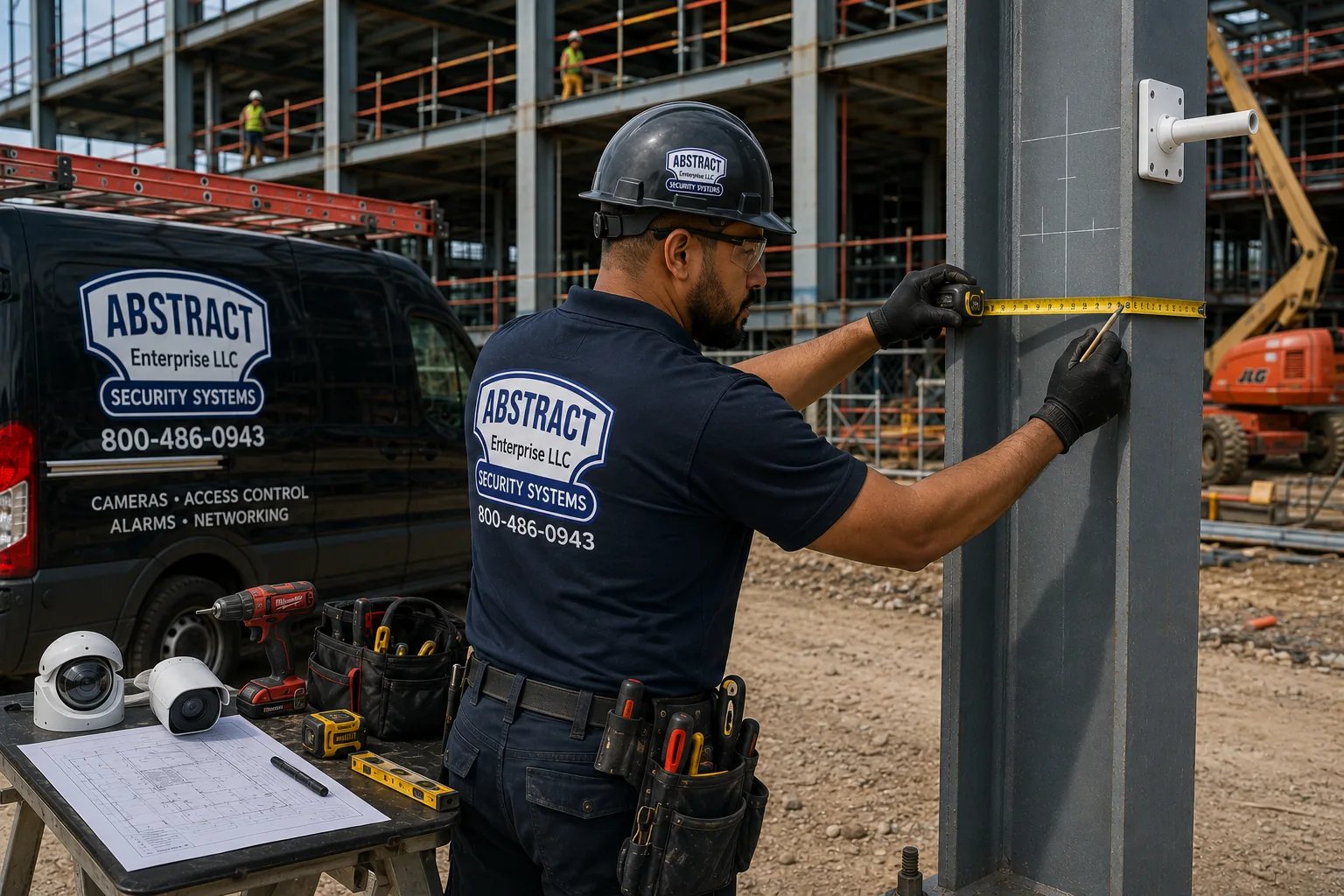
Appliance packages, slab, custom windows, millwork: on a Nassau custom build these arrive on known dates, sit through a known install gap, and represent the most concentrated theft exposure of the whole project. Known dates mean the defense can be scheduled. The protocol:
At kickoff — and again whenever the schedule moves — the high-value delivery dates go into the coverage plan. Slab date, window package, appliance drop, millwork arrival. The plan flexes to the calendar, not the other way around.
In the days before a landing, the staging zone’s detection sensitivity and arming window step up, and the monitored plan flags the site for priority handling. The system is at its most alert before the truck arrives, because scouting precedes stealing.
The delivery itself gets recorded end to end — which doubles as your condition documentation. A cracked slab or a dented range discovered at install becomes a timestamped question with a video answer instead of a three-way argument between builder, vendor, and freight carrier.
Between drop and install, the staging zone runs as the primary armed area: interior head on the material, entry detection on the openings, monitored response every night of the gap. If the gap is long, deliveries can sometimes be re-sequenced later — we’ll say so when the calendar allows it, because the cheapest protection is a shorter gap.
One honest boundary: cameras compress risk, they don’t abolish it. A staged six-figure package still belongs behind a locked opening, staged deep rather than curbside, delivered as late as the schedule tolerates — and then watched. The protocol is all four together; any single layer alone is a story about what almost worked.
On estate-grade work, footage governance matters as much as coverage. The rules we install alongside the cameras:
Every login is a person, not a shared password: the builder, the PM if you add one, the client if you choose to. View-only roles exist for exactly the client-visibility question — they can watch progress without touching zones, schedules, or exports.
Views, clip exports, and setting changes log against the named account that made them. If a clip ever leaves the system, there’s a record of who exported it and when — which is precisely the answer a private client wants to hear.
On monitored plans, central-station operators see motion-event clips for verification — not open browsing of your feeds. Their access is functional and bounded, and it exists only while the plan does.
Standard retention runs 30 to 90 days depending on storage and plan, long enough to cover the discovery lag on most incidents. When something happens, the relevant footage gets exported and placed on hold immediately so routine overwrite never eats the evidence.
Fields of view are planned to the property, and anything that clips a neighboring yard or window is privacy-masked at commissioning. Signage goes up where posting is appropriate. Good fences make good neighbors; well-aimed cameras keep them.
At removal, site accounts close and the recordings follow the retention terms — or transfer with the system when the coverage converts to the homeowner. Nothing lingers in a vendor cloud after the job that isn’t supposed to.
And the standing commitment, in one line: your footage is not our marketing, not our portfolio, and not anyone’s to share without your written permission. On builds where the client’s name is the most valuable thing on site, that line is the spec.
Honest version first: a small, occupied-house project with working Wi-Fi and an owner on site can run a consumer camera, and when that's the situation we'll say so and save you the call. The DIY route collapses where Nassau building actually lives: teardowns with no network for a year, staging zones whose alerts land on a sleeping phone, delivery weeks that need a monitoring desk rather than a notification, private clients who need access control over footage a consumer cloud can't provide, and winters where a consumer battery dies in the first cold snap.
A licensed deployment is a different product: self-powered units built for demo-to-CO timelines, named staging zones, delivery-week arming, restricted named-user access, live monitored response, and one accountable NYS-licensed contractor — #12000287431 — a parkway away. Already own hardware? The install-your-own-system service will mount and dial in whatever you bought — no judgment attached.
| Decision Point | Abstract — Licensed Deployment | DIY / Consumer Setup |
|---|---|---|
| Teardown timeline | Battery + LTE + solar, demo day to CO | No Wi-Fi until the year's end, dead batteries by November |
| Staging zones | Named detection over slab, millwork & appliances | A porch camera pointed at a driveway |
| Delivery weeks | Tightened arming + monitored priority | The same passive recording as any other Tuesday |
| Client privacy | Named-user access, footage under your control | A consumer cloud account and hope |
| Winter idle | Cold-rated batteries + health checks | Three dark months and a March discovery |
| Evidence | ID-grade capture, true timestamps, 30–90 day retention | A looped-over card and a shrugged claim |
| Response | Live operators, talk-down, verified dispatch | A notification under Do Not Disturb |
| Accountability | NYS Lic #12000287431 · insured · Brooklyn HQ + Bronx office | A return window and a chatbot |
Brooklyn HQ to the county line in minutes — with systems engineered to not need a truck in the driveway.
NYS low-voltage license #12000287431 — the credential every lender, client, and district file wants attached.
Delivery weeks, staging zones, closing calendars, private clients — the actual rhythms of high-end residential work.
(347) 934-8335 reaches the person who walks your jobs and specs your layouts — not a national queue.
Named-user access, low-profile mounting, footage under your control — privacy engineered in, not promised.
A 30-day minimum, then rolling — timed to your build calendar, with removals at the walk-through.
NDAA-compliant hardware with Section 889 documentation whenever federal rules or a project's bid specification require it.
Site cameras today — access control, intercoms, and cabling when the finished properties need them.
“24/7 monitoring” is a phrase every camera company uses and almost none unpack. Here is the pipeline on a monitored Nassau site, in order, with the honest boundaries attached:
1. The analytics filter. Motion alone triggers nothing — headlights, rain, and raccoons would bury any human operator. Detection fires on a person or vehicle inside a drawn zone during an armed window. Schedule-aware arming means the 6 AM concrete crew doesn’t generate a false alarm and the 2 AM visitor does.
2. Live verification. The event clip lands in front of a licensed central-station operator within seconds. A human looks at it — is that a person in the staging zone, or a tarp in the wind? Verification is the step that keeps the response credible, because everything downstream depends on it being real.
3. Active deterrence. On a verified intrusion the operator fires the site’s strobe and speaks through the talk-down — addressed, specific, and recorded. Most intrusions end here: the calculus of a dark, quiet site collapses the moment it becomes a lit, loud one with a voice that says it’s watching.
4. The call list. Simultaneously, the operator works your escalation order — super, PM, owner, in whatever sequence you set. You hear about the event while it’s happening, with a clip attached, not at 6 AM from a trade who found the door open.
5. Verified dispatch. If the intrusion continues, the call to police goes out as a video-verified crime in progress with a live description — a categorically different call from an unverified alarm, and one that gets a categorically different response priority. The clip package follows for the report.
6. The morning record. Every event, verification, deterrence action, call, and outcome is logged. After an incident you get the timeline; after a quiet month you get the confirmation that quiet is what actually happened.
Installer's notes — the custom-build checklist:
1. Find the staging zone and treat it as the vault. Garage, spare room, container — wherever the finishes will wait is where the tightest zone goes.
2. Get the delivery calendar. Slab, windows, appliances, millwork — the arming plan is built around the weeks the value lands, not around a generic schedule.
3. Walk the side yards and rear approaches. Nassau theft comes through the gate and the neighbor's hedge line, not the front door. Those paths get their own zones.
4. Ask who's allowed to see the footage. Builder only? Client too? Private client with a name? The access list is part of the spec, decided before the first mount.
5. Read the seasons. Winter idle, owner's travel, pool-season overlap across jobs — half of Nassau coverage is calendar design, and the calendar gets read before the layout.
Site walk, coverage map, firm monthly number — one parkway, one call.
Abstract Enterprises Security Systems — Brooklyn headquarters at 1282 Troy Ave, Bronx office at 460 E Fordham Rd
The delivery calendar gets asked for before the quote goes out — appliance weeks, slab dates, and staging plans are specced up front, not discovered mid-job.
Footage is handled like a contract document — named access, nothing shared, discretion written into the scope on every job.
One or two well-placed units get specced where a tower isn't earned — with the reasoning explained in the driveway before anything is billed.
Read the full, unedited reviews on our Google Business Profiles — search "Abstract Enterprises Security Systems."
Monitored rentals price at $349 monthly for one unit, $649 for a pair, and right around $999 for full multi-unit monitored coverage. Hardwired systems price at $500 to $2,500 per camera installed, with complete systems typically landing between $6,500 and $18,000 — firmed to the dollar after a site walk.
Fast — Nassau is the next county over from our Brooklyn headquarters, a straight run out the Belt or the Southern State. Same-day emergency deploys are routine anywhere from the Queens line to the Suffolk border, and because the units are battery-cellular and centrally monitored, ongoing service is scheduled runs rather than repeat truck rolls.
Requirements depend on the municipality and installation method. Temporary freestanding equipment may not require a building permit, but fixed poles, electrical work, permanent mounts, trailers, public-right-of-way placement, and permanent systems can trigger local review. Nassau County directs applicants to the applicable city, town, or village building department, and Abstract Enterprises confirms requirements with the project's authority having jurisdiction before installation.
You decide, and the circle stays small. Access is account-based: the builder, whoever the builder authorizes, and — only on monitored plans — licensed central-station operators reviewing motion events. Footage isn't published, shared, or used in our marketing without written permission, and feeds can be restricted to named users only. Discretion is a spec we take as seriously as coverage.
That's exactly the job. Staged finishes get named zones: an interior head over the garage or room where material stages, entry coverage on the openings, and after-hours arming with monitored response. High-value deliveries can be scheduled against coverage so the week the appliance package lands is the week the watching is tightest.
It raises the priority. A gutted or mid-renovation house with the owners gone is full of material and empty of witnesses, and the home alarm is usually off because trades come daily. Site units armed on the crew schedule cover the gap — continuous protection that doesn't depend on anyone being home, with alerts to you and the owners wherever they are.
Yes — backyard scale is a specialty. A battery-cellular unit on a pole or the house covers the excavation, the equipment pad, the machine, and the staged copper and PVC that pool work leaves exposed for weeks. It relocates between your active digs as jobs finish, so one small fleet covers the season.
No — the units carry their own power and signal. High-capacity batteries with solar assist handle demolition-to-CO timelines, and LTE cellular moves the video, so coverage starts the day the fence goes up around the teardown. When the house is powered and networked, a wired system can take over if the project calls for one.
That's when it earns the most. An idle site holds staged material, copper, fixtures, and equipment through months of short days and no visits — the exact conditions losses love. Winter coverage keeps detection and monitored response live through the shutdown, with cold-rated batteries and health checks, and steps back up when the crews return.
Yes — the mid-rise stack scales up: gate and hoist coverage, plate capture on the approaches, elevated heads over staging, and interior floors added as the building closes in. Same monitored response, engineered from day one to convert into the finished building's permanent system at turnover.
It can and should be. A raised house is open underneath for months — mechanicals exposed, access unrestricted, the block watching a house on stilts. Units on the structure or a pole cover the crawl access and staging with detection and talk-down, and marine-rated housings handle the shore environment where most elevation work happens.
Your call at the walk-through: we remove the rental units — included, scheduled around your closing — or convert the coverage into the homeowner's permanent camera system, which can be wrapped into the sale as a delivered amenity. Either way the handoff is clean and on your calendar.
Custom builds, estate renovations, and the county's biggest finish packages. Construction site security camera installation in Great Neck, Manhasset, and the Gold Coast villages. Request North Shore coverage →
TOD mid-rises, medical fit-outs, and downtown mixed-use. Jobsite camera installation in Mineola and the central corridor. Request Central Nassau coverage →
Renovations, elevations, and waterfront rebuilds. Construction cameras in Rockville Centre, the Five Towns, and the bay communities. Request South Shore coverage →
Knockdowns, additions, and big-box conversions. Jobsite camera systems in Hicksville and the eastern hamlets. Request East Nassau coverage →
Elevations, coastal hospitality, and resilient rebuilds. Construction site cameras in Long Beach with marine housings specced in. Request Long Beach coverage →
Estate work, waterfront renovations, and village-center projects. Jobsite camera installation in Glen Cove and the north-country villages. Request Glen Cove coverage →
City work runs through the Queens page, the Brooklyn page, and the NYC hub covering all five boroughs.
The Long Island hub carries the island; Suffolk — Request Coverage →. North of the city, the Hudson Valley hub runs six counties.
Call or text (347) 934-8335 with the lot or project address and you'll have a yes-or-no plus a deploy window within one business day.
The national jobsite-camera brands freight a solar tower to a curb and monitor it from another time zone — built for highway medians and hundred-acre laydowns, and visibly wrong the moment it lands in a Manhasset driveway or behind a pool dig. Side by side:
| Abstract — Local Licensed Crew | Typical National Unit Company | |
|---|---|---|
| Site knowledge | Walked in person — staging, deliveries, seasons, clients | A map pin and a drop confirmation |
| Scale honesty | Compact units for house lots; towers only where acreage earns them | The tower is the product, whatever the lot |
| Getting on site | One parkway from Brooklyn HQ — often same-day | Freight scheduling measured in weeks |
| Private clients | Named-user access, footage under your control | A shared portal and a privacy policy |
| Pricing | Monitored units from $349/mo, month-to-month | $500–$900+/mo per unit, often on 6–12-month terms |
| Job changes | Relocations & re-aims included as the build moves | A change order per move, if offered at all |
| Beyond cameras | Full licensed low-voltage bench for delivered properties | Cameras only, then a handoff |
| Accountability | NYS Lic #12000287431 · insured · Brooklyn HQ + Bronx office | An 800 number and an SLA paragraph |
Where the nationals genuinely fit: linear highway programs and fifty-state standardization. On a Nassau custom build with a delivery calendar and a private client, the right-sized local model isn't a preference — it's the only one that matches the work.
Nassau’s geography hands its jobsite hardware two distinct punishments: a marine environment along the barrier and bay communities, and a real winter everywhere. Both are engineering inputs, not surprises.
Salt air corrodes standard housings and hardware in a season, so waterfront and barrier work gets marine-rated enclosures, stainless mounting hardware, and sealed penetrations from day one — plus gasket and corrosion checks folded into service runs. Wind loading gets respected too: masts and poles near open water are torqued, guyed, and specced for gusts that inland mounts never see. An elevation project’s camera has to outlast the same weather the house is being raised against.
When a coastal storm is inbound, exposed heads get a quick pre-storm check — mounts, seals, aim — and after it passes, a remote health sweep confirms every unit is up, aimed, and recording before anyone has to drive out. A camera knocked ten degrees off its zone by a gust is a silent failure unless someone is checking; someone is checking.
Lithium capacity drops as temperature does, and December solar harvest is a fraction of June’s — so winter systems are sized for the worst week, not the average one: cold-rated packs, bigger reserve margins, panels angled and placed for low-sun months, and swap schedules that tighten as the days shorten. Snow occlusion gets designed around as well — heads mounted where drifts and roof-shed won’t bury the view.
A site that pauses from the holidays to March holds its material through the year’s longest nights with zero daily eyes on it. Idle-mode coverage keeps detection and monitored response fully live while the duty cycle relaxes to stretch power, remote health checks run on cadence, and the system steps back to full posture the week crews return. The site sleeps; the coverage doesn’t.
Budget-ready numbers, firmed to the dollar after the walk. Unit rates match every county we serve; the mix here runs more single-build rentals, delivery-week priorities, and pool-season fleets.
One monitored battery-cellular head — the knockdown, the pool dig, or the winter idle — with AI alerts, cloud clips, and signage.
Two units — frontage plus staging zone, or two active jobs — one app, relocations included. The county's standard setup.
Multi-unit coverage with 24/7 live operators, talk-down deterrence, and video-verified dispatch — the neighbor who never sleeps.
Hardwired PoE for TOD projects, commercial fit-outs, and estates — most complete systems land $6,500–$18,000 depending on heads and runs, engineered to convert into the permanent system at turnover.
Plate-capture driveway heads · staging-zone interior packages · delivery-week priority windows · progress time-lapse from $149/mo · surveillance trailers from $2,500/mo for cleared lots and laydowns · closeout removal included on every rental.
The lanes above are real, and the walk exists to firm them to the dollar. What actually moves a Nassau quote up or down:
The biggest lever. One unit covers most single-house builds; a second adds the staging zone or a second job. Month-to-month means the duration bills as the build actually runs, not as a term you guessed at.
Live operators, talk-down, and verified dispatch carry the premium tier. Self-watched plans cost less and alert your phone — an honest option for low-exposure phases, and an upgrade away when the finish materials land.
A rough-in or staging-zone interior head, a plate-capture unit on the frontage, or a marine package each add hardware to the layout — quoted per head, visible on the coverage map, never bundled into mystery.
On hardwired systems the $500–$2,500 spread is mostly labor geometry: run lengths, mounting surfaces, conduit requirements, lift time, and head class. A masonry wall and a forty-foot steel mount price differently than a soffit — the walk is where that gets measured instead of guessed.
Trailers earn their higher monthly on acreage, laydowns, and cleared lots with nothing to mount to. Where a pole unit covers the same ground, we quote the pole unit — the cheaper right answer beats the pricier impressive one.
Builds heading toward a permanent system can have runs and mounting placed with the end state in mind — build-phase money that the finished property inherits instead of throwing away at closeout.
The walk itself, so you know what you’re scheduling: twenty to thirty minutes on site. We map the staging zones and approaches, take the delivery calendar, survey the mounting surfaces and power timeline, note anything the authority having jurisdiction will care about, and flag the phase changes that will move heads later. What comes back is a one-page coverage map with a firm monthly number and any per-head pricing itemized — no obligation attached, and no tower quoted where a pole unit does the job.
An opened garage, a stripped staging room, a towed trailer — call before noon and battery-cellular units typically go live the same day, one parkway out.
Slab, windows, appliances landing this week — coverage tightened before the truck arrives, not after the gap gets noticed.
The cheapest deploy is fence day: the cleared lot covered from the first hour, the frontage logging plates before the first scout drives by.
Every project reaches the same fork at the walk-through: the rental units come off, or the coverage converts into something the finished property keeps. Both paths are clean; the second one is worth understanding before finish, not after.
Conduit, protected runs, mounting positions, and any wired heads placed with the end state in mind become the permanent system’s skeleton — infrastructure the build already paid for. Rental battery units go back on the truck; purchased wired hardware stays and gets re-commissioned to the property’s own recorder and network.
Ownership transfers formally: the homeowner’s named accounts replace the site’s, retention resets under their plan, site-era access closes out, and the three-year AESS product warranty runs on the delivered equipment. The builder exits the loop completely — which, on a private client’s house, is exactly how everyone wants it.
On high-end residential, conversion usually lands inside a larger delivered package — cameras joined to the alarm, video intercom, and access control as one system the owner runs from one app. Builders who offer that as a line item hand over a house that’s protected on day one instead of “scheduling a security consult” after closing.
On TOD and multifamily work the site system is engineered from day one as the base building’s permanent package — lobby, garage, roof, corridors — commissioned floor by floor as spaces close in and handed to management with documentation, credentials, and as-builts at TCO. The security never has a gap between construction and occupancy, because it’s the same system the whole way through.
The economics favor deciding early: runs placed during rough-in cost a fraction of runs fished through finished walls, and a conversion specced at the start turns months of rental into a down payment on the permanent answer. It’s the rare closeout conversation that saves money by happening sooner.
Staged finishes gone before install. Fix: named staging zones, entry detection, monitored after-hours response.
Appliance packages hit between drop and install. Fix: delivery-week arming scheduled against the calendar.
Owner-away renovations exposed for months. Fix: crew-schedule arming independent of the home systems.
Pool machines, heaters & copper gone overnight. Fix: side-yard zones plus a relocating dig-to-dig fleet.
Winter-idle strips found at mobilization. Fix: cold-rated idle coverage with health checks.
Private clients, public footage. Fix: named-user access and footage that never leaves your control.
Site walk → coverage map → firm monthly number. Same-day emergencies, one parkway away.
Use the long form when there's real detail — the build phase, what's staged where, the delivery calendar, the client situation, how many active jobs you're running, what's been taken. Every submission gets read top to bottom, and the callback opens from a layout rather than a script.
Permanent systems for county properties
Retail, medical, office & multifamily
Mast coverage for lots & laydowns
Card, fob & mobile entry at turnover
Sites, estates & finished homes
Tel-data backbone, slab to roof
Existing systems fixed, upgraded, re-aimed
Video entry for the properties you deliver