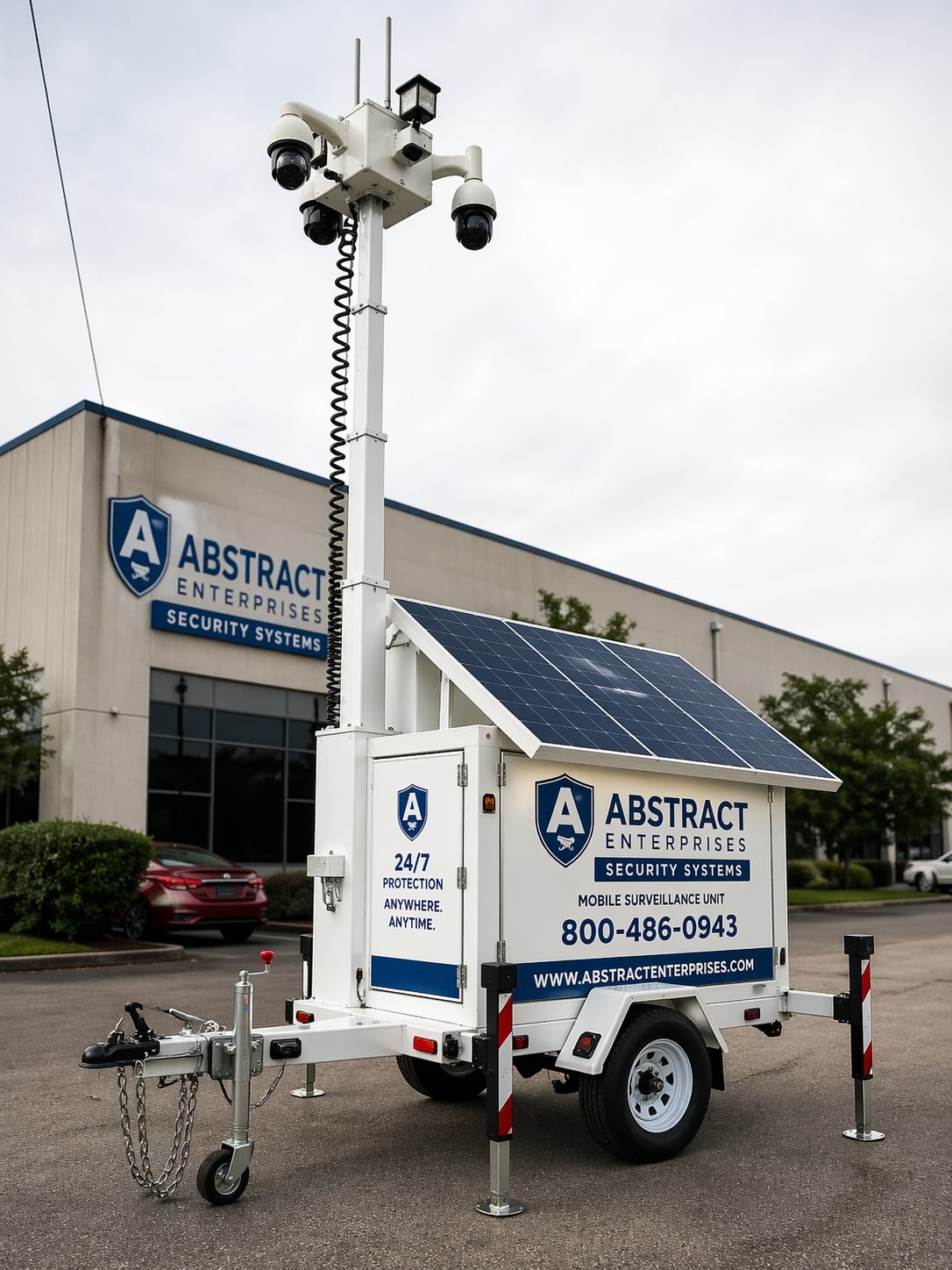
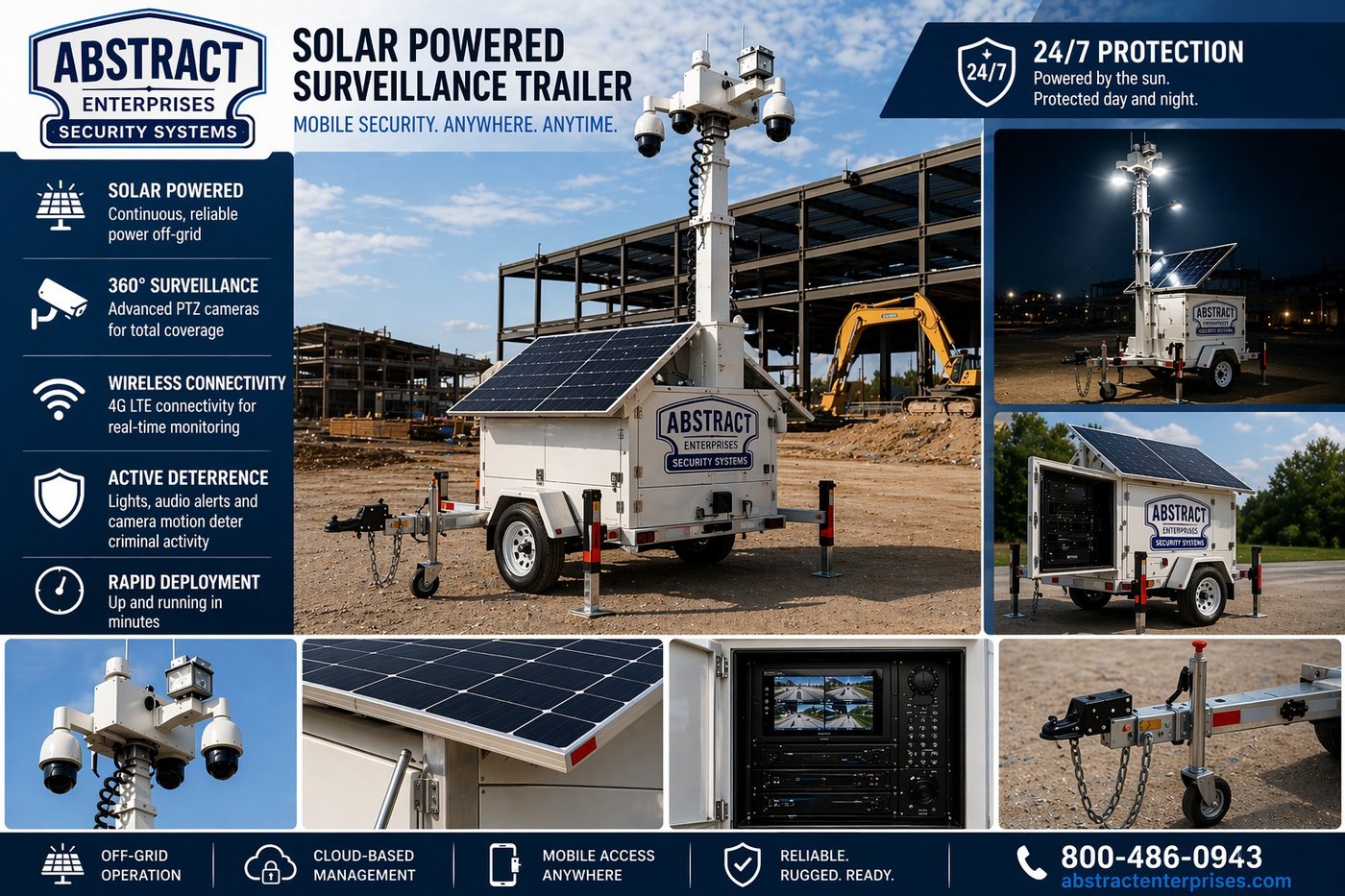
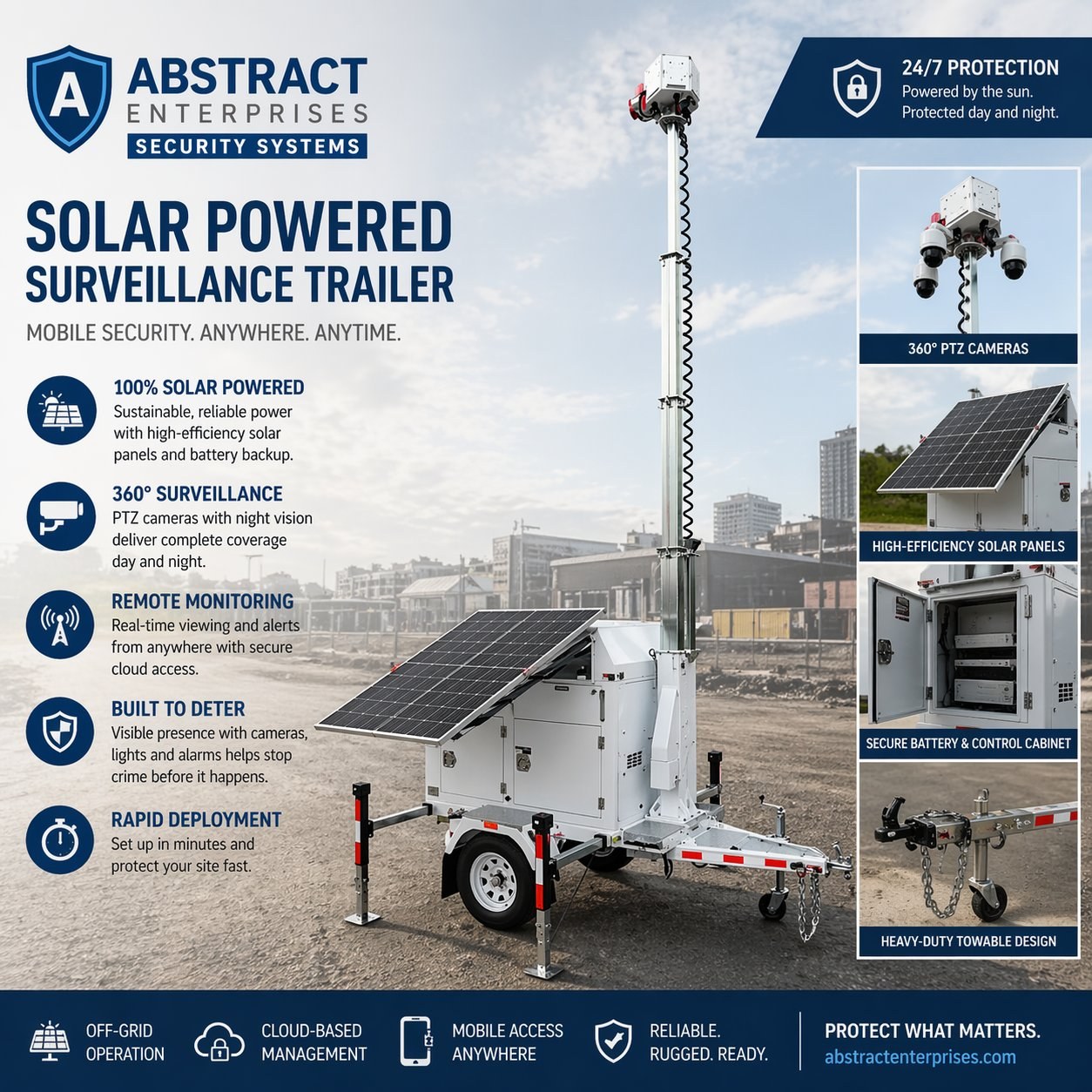
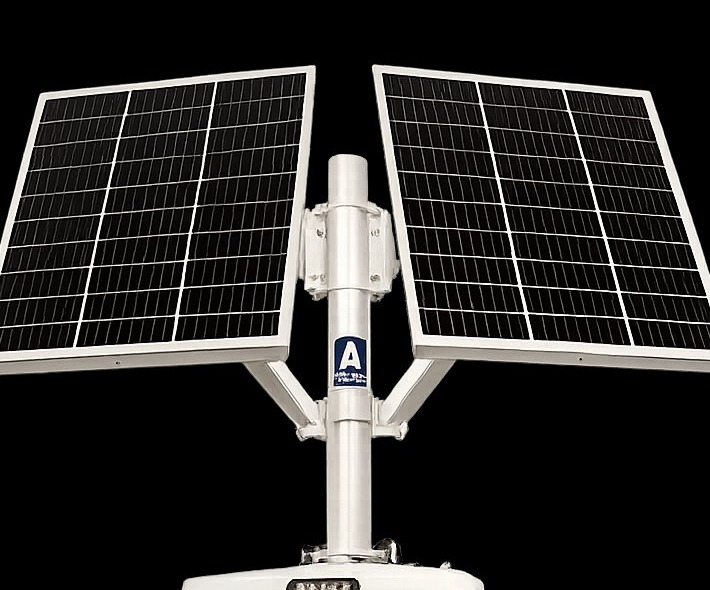
A solar surveillance trailer — also called a mobile solar surveillance trailer, solar CCTV trailer, solar camera trailer, solar surveillance unit, or solar powered surveillance tower — is a self-contained security tower on wheels. Our units combine 4K HD cameras, PTZ optics, night vision, motion detection, intrusion detection, AI detection, and perimeter protection with solar panels, battery backup, 4G LTE cellular connectivity, cloud VMS, strobe lights, loudspeaker deterrence, and remote access from any mobile app or web browser. Rapid deployment, weather resistant, plug and play — deployed across Long Island for Amazon and Prologis warehouse staging (Bethpage, Melville, Holbrook, Syosset, Westhampton Beach), Hamptons estates and beachfront compounds, North Fork vineyards and tasting rooms, Montauk marinas and hospitality properties, Fire Island ferry staging, LIRR trackside projects, solar farm deployments (Brookhaven National Lab 32MW site), Jones Beach and Robert Moses events, and waterfront commercial properties from Great Neck to Montauk Point.
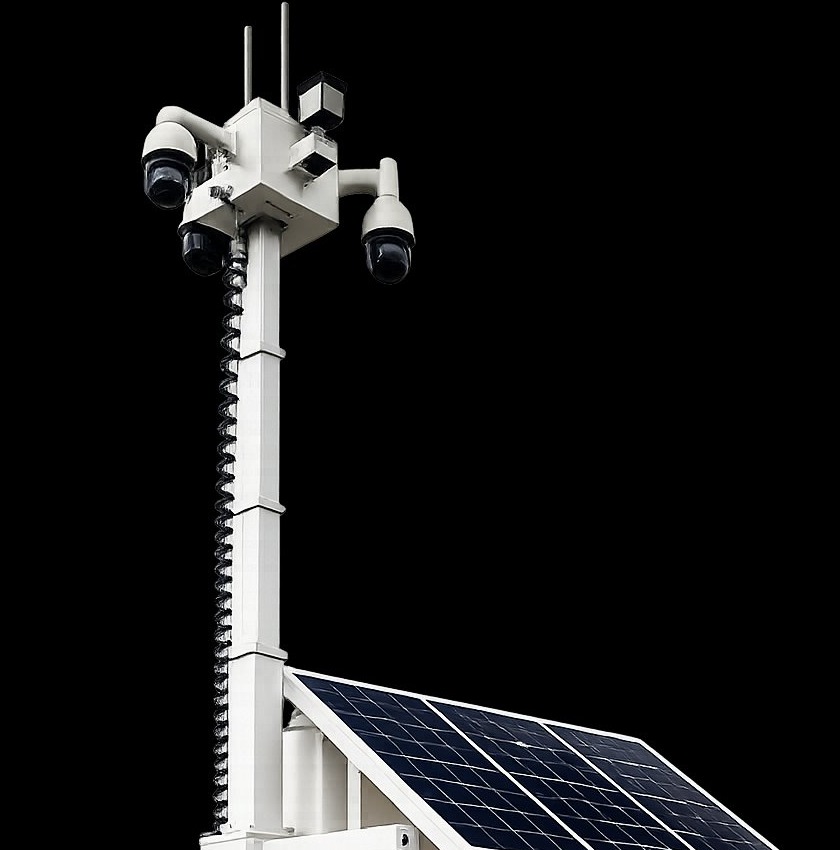
Long Island is not NYC. It's 118 miles of warehouse corridors, beachfront estates, working farms, marinas, and vineyards — spread across 2.8 million residents in two counties. A solar surveillance trailer solves a different problem here: massive last-mile Amazon and Prologis warehouse staging yards with zero overnight security, the Hamptons summer-home gap when owners leave for 9 months, North Fork tasting rooms closed dawn to dusk, and marina properties where the nearest police response is 15+ minutes out. Here's why this region specifically needs mobile solar surveillance.
Amazon operates 9 Long Island warehouses — Bethpage, Carle Place, Holbrook, Shirley, Syosset, Westhampton Beach, Woodmere, Melville (×2). Prologis just added a 240,000 sq ft spec build at 600 Grumman Road (the former Northrop site). Another 11 million sq ft of new warehouse space is in the LI pipeline. Every one of these sites needs 24/7 perimeter coverage during phased construction — and most skip trenching temp power. A solar trailer bridges the gap between permit approval and first utility tap.
Southampton, East Hampton, Bridgehampton, Sag Harbor, Montauk — thousands of multi-million-dollar estates sit empty from Labor Day to Memorial Day. Southampton Coopers Beach area alone has 500+ homes valued at $5M+. Alarm systems fail during nor'easters. A visible 22-ft mast with blue strobes and talk-down handles what a seasonal alarm company can't: documented 24/7 video plus active deterrence while you're back in Manhattan.
The North Fork has 50+ working wineries (Paumanok, Pellegrini, Channing Daughters, Macari, Kontokosta, RGNY) plus hundreds of farm stands along Route 25. Tasting rooms close at 6–7 PM and don't reopen until 11 AM the next day — a 16-hour theft window for barrel rooms, equipment sheds, and packaging yards. A trailer at the service road with talk-down audio handles that window without hiring overnight staff during off-season.
The Long Island Rail Road has a documented $1M/year loss to copper wire theft — the most famous being the 15-employee inside job that netted $253,000 from scrap yards in Farmingdale. LIRR staging yards, signal huts, and trackside electrical enclosures are constant targets. Solar trailers deploy to rotating staging zones without needing permanent conduit to every switch.
From Port Jefferson to Greenport to Sag Harbor to Montauk Harbor, LI marinas hold tens of millions in boats, outboards, and fuel. Boat-yard winterization season (October–April) leaves hulls shrink-wrapped on dry land — prime targets for outboard-motor theft rings that move down the entire Atlantic seaboard. A trailer with LPR on the entry gate makes the unit useless for the driver getting caught.
Brookhaven National Lab operates the 32MW Long Island Solar Farm (164,312 panels). New utility-scale solar projects are breaking ground across Suffolk as LIPA grid-modernization funds deploy. Construction staging for panels, inverters, and copper is high-value and remote. Fire Island ferry staging, Jones Beach infrastructure projects, and PSEG Long Island upgrade sites all need temporary perimeter coverage without grid power.
Every solar surveillance trailer we deploy is a layered system: imaging, power, connectivity, deterrence, and AI analytics. Here's the breakdown of what each sub-system does and why Long Island sites need every one of them.
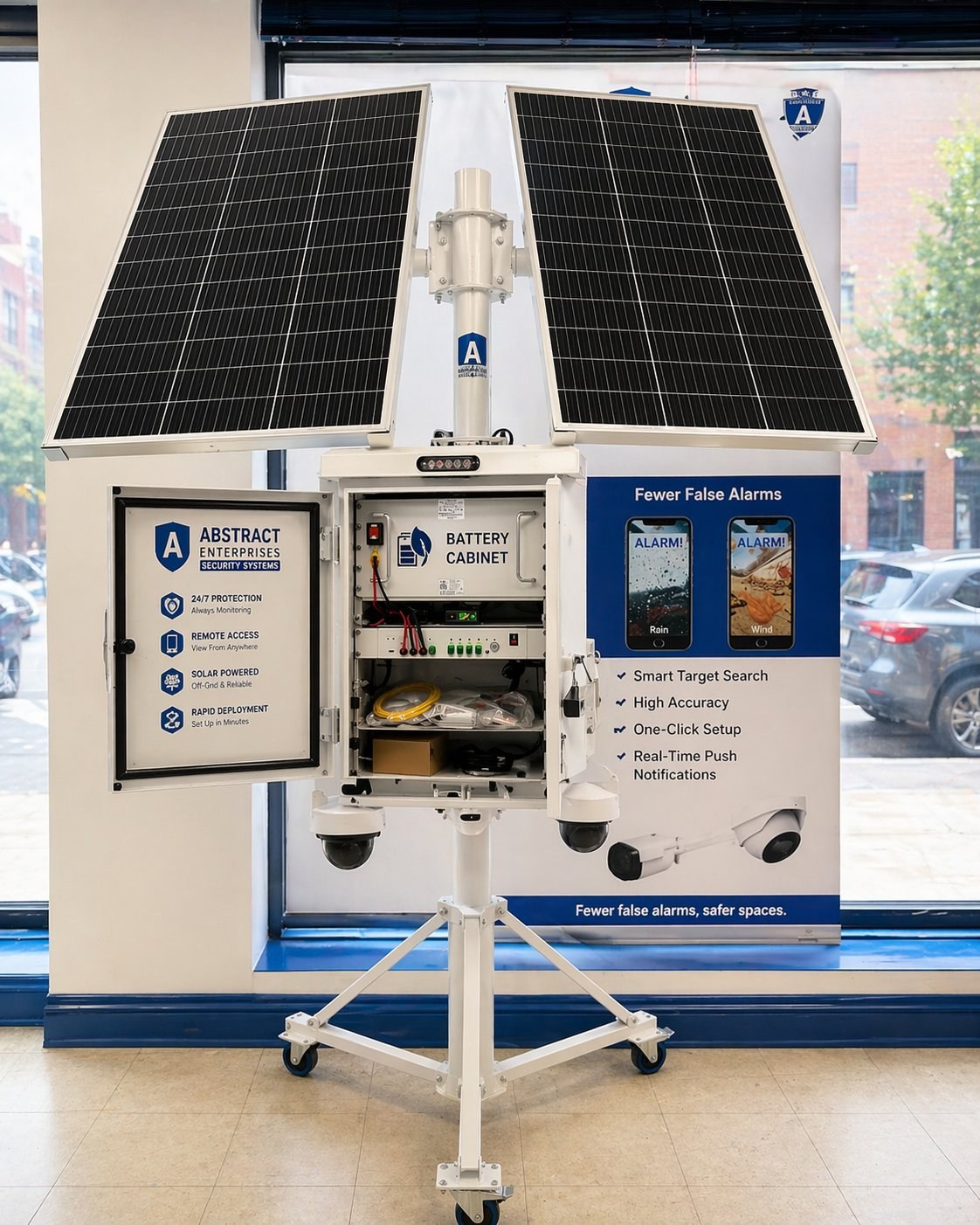
Typical configuration: two to three 4K high resolution HD cameras on a high mast (22-foot telescoping) for 360 coverage with elevated view over fences, scaffolds, and containers. PTZ heads pivot on command, zoom 25–30× optical, and deliver true night vision down to near-zero lux. Panoramic cameras provide wide-angle coverage. Commercial grade cameras built for industrial durability.
Two 400–450 watt monocrystalline solar panels feed a battery backup bank of 6–8 deep-cycle AGM or LiFePO4 batteries (~460 Ah). True energy independence with eco friendly power and long runtime: 10–20 days of autonomy through overcast Long Island winters and spring coastal fog. Zero wiring required, no external power needed — weather resistant, all weather rugged construction. Continuous monitoring with reliable uptime.
Multi-carrier 4G LTE modem auto-switches between Verizon, AT&T, and T-Mobile to pick the strongest Long Island signal for reliable remote viewing from any device. Optional Starlink "Roam" antenna handles Fire Island, Montauk oceanfront, Shelter Island, and any coastal spot where summer crowd density collapses cell service. No fixed internet required.
Blue-red police-style strobe lights mimic a police vehicle on scene — visual deterrents visible from a block away. 110–120 dB loudspeakers and security lighting support pre-recorded automated warnings and live agent talk-down. High-intensity LED floodlights wash the area in daylight-equivalent lumens on motion trigger. Active deterrence with audio deterrents + visual deterrents is the difference between recording crime and preventing crime.
Onboard AI powered edge analytics distinguish people from vehicles, bicycles, and animals — smart detection that eliminates false alarms from blowing tarps. Motion detection zones, intrusion detection, and perimeter protection rules trigger intelligent alerts and active deterrence only during defined "alarm hours." Real time alerts push instant notifications to your phone. The onboard recording system stores 28 days of footage locally.
Optional 24/7 UL-listed central station with trained agents: video recording verification, talk-down, police/guard dispatch, and incident reporting. Centralized control via cloud VMS with mobile access, web access, and secure login. Multi unit management for fleets. Real time response on flagged events — search functionality and playback across 28 days of footage for evidence capture.
There are easily a dozen names in circulation for what is, at the end of the day, the same category of product: a self-contained, solar-powered, trailer-mounted surveillance platform. Here's how the industry names overlap, and how we use them on quotes and site plans.
The industry-default term. Used interchangeably with "solar powered surveillance trailer," "mobile solar surveillance trailer," "portable solar surveillance trailer," and "solar security trailer." Describes any trailer-mounted platform powered primarily by solar panels with cameras on a telescoping mast.
Same product, CCTV-forward framing. "Solar CCTV trailer," "solar powered mobile CCTV trailer," and "solar security camera trailer" are used in commercial procurement docs. On our abstractcameranewyork.net CCTV-branded site we use this terminology. The technology underneath is identical.
Refers to units with no hardwired power or data — pure cellular/wireless. Every legitimate solar surveillance trailer is functionally a wireless solar surveillance trailer, since solar + LTE means no cables leave the chassis. Also called an "off grid surveillance trailer" when deployed somewhere with no grid service available.
Casual names used by GCs and property managers who care more about the cameras than the trailer platform. "Solar powered security camera unit," "solar monitoring trailer," and "solar surveillance unit" all land in this bucket. Same product, different vocabulary.
Emphasizes zero grid dependency. "Solar powered mobile surveillance unit," "solar powered trailer security system," and "solar powered security camera unit" all describe the same autonomous box. Relevant when the site has literally no electrical service.
Used when the emphasis is on the mast height rather than the chassis. "Solar surveillance tower trailer" and "solar powered surveillance tower" both describe units with telescoping masts (typically 20–25 ft) that elevate cameras above fence lines, containers, and scaffolding for a 360-degree elevated view.
We're agnostic on hardware — we match the platform to the site. For fleet-scale developers we favor NDAA-compliant US-built trailers; for shorter deployments and sub-$2k monthly budgets we deploy camera-agnostic platforms paired with commercial-grade imaging.
After hundreds of Long Island deployments across Amazon and Prologis warehouse sites, Hamptons seasonal estates, North Fork vineyards, marinas, and LIRR trackside construction, three configurations cover roughly 80% of LI requests. Here's what's inside each.
Single 22-ft mast trailer · 2 PTZ cameras + 1 multi-sensor fixed · 800W solar · 10-day battery · LTE · strobes + talk-down · self-monitoring portal. Best for: small-to-mid construction sites, dealer lots under 2 acres, single-building demolition.
30× optical zoom each
180° panoramic overwatch
10+ day battery autonomy
iOS / Android / browser
Core perimeter package + license plate recognition camera on entry lane + watchlist alerts. Best for: dealer lots, TLC/rideshare lots, U-Haul yards, self-storage perimeters, any site where plate evidence matters more than just video.
+ dedicated LPR camera
Flag known plates instantly
Every clip indexed by plate
Ready for NY State Police or local PD report
Core package + FLIR/thermal perimeter camera + 24/7 virtual guard monitoring + guaranteed response SLA. Best for: high-value material stockpiles (copper, fuel, catalytics), gov't/infrastructure sites, large event security, and repeat-theft locations.
Detect heat in zero light
Trained UL-listed operators
Agent-initiated voice challenge
Verified alarms prioritized
For the GCs and procurement leads who want a straight spec sheet, here's what a fully-loaded unit from Abstract includes. Matches every RFP line item we've seen.
Plug and play platform with high mast cameras (22-ft telescoping), high resolution 4K imaging, and solar efficiency >22% on mono panels. Industrial durability rated for five-year continuous deployment. Speakers and lights integrated. Heavy duty chassis with galvanized frame. Rugged construction, high performance across all seasons.
Advanced VMS software with surveillance analytics, enterprise security features, and a user friendly dashboard. Live feed access from any browser, mobile app, or cloud. Event based recording + continuous recording with flexible storage options. Playback, search functionality, and evidence capture built in. Enterprise software integrations via open API.
Advanced monitoring dashboard with remote administration, centralized control, and multi unit management. Scalable deployment across multiple sites — flexible configurations per unit, customizable packages. Proactive security with advanced threat detection + real time response. Innovative surveillance technology built for Long Island warehouse, estate, marina, and vineyard deployments.
Compliance-ready footage with timestamping and chain-of-custody documentation. Security documentation for insurance, police reports, and DOB filings. Incident reporting, event logs, and evidence capture built into the VMS. Required for contractors on Site Safety Plan projects.
A trailer for job sites and industrial sites handles the same coverage profile: perimeter, entry lanes, material stockpiles, fuel tanks. Our solar powered security trailer configurations are tuned for each environment — construction phasing, industrial 24/7 operations, or remote yard coverage.
Three commercial paths: (1) short-term rental for events or phased projects, (2) solar surveillance trailer installation with full ownership and on-site commissioning — our portable surveillance trailer for sale inventory includes high resolution solar surveillance trailer configurations, (3) solar surveillance trailer leasing on 12–36 month terms with purchase credit. Rent solar surveillance trailer near me searches hit this page specifically — we deliver to Nassau next business day, Suffolk 1–2 days, and Hamptons/Montauk 2–4 business days.
We cover all of Nassau and Suffolk — from the Queens line to Montauk Point (118 miles). A partial list of landmarks, project zones, and industries where mobile solar surveillance pays for itself on Long Island:
A solar surveillance trailer fits any site where you need rapid deployment, temporary surveillance, mobile security, or perimeter security but power and fixed infrastructure aren't available. Our solar surveillance trailer system supports warehouse operators, estate owners, vineyards, marinas, construction companies, property managers, and developers across Long Island (Nassau and Suffolk — from Great Neck to Montauk), NYC metro, and Hudson Valley.
The biggest category. GCs, contractors, and construction companies rent a solar surveillance trailer the moment the fence goes up. Job site security and theft prevention across active demo, excavation, framing, and MEP rough-in phases — protects equipment protection, material protection, and asset protection from day one.
Outer-borough warehouse perimeters, last-mile distribution, cold storage yards, container overflow lots, trucking depots, and industrial sites. A solar surveillance trailer for warehouses protects freight, chassis, fuel, and perimeter — site monitoring and outdoor security without trenching for fixed cameras.
Car dealerships, U-Haul yards, TLC/rideshare lots, airport overflow parking, retail center lots. A solar surveillance trailer for parking lots cuts catalytic converter theft, vehicle break-ins, and fuel siphoning with active deterrence and crime prevention coverage.
Randall's Island festivals, Coney Island boardwalk events, Prospect Park concerts, Flushing Meadows events. A solar surveillance trailer for events handles crowd-overflow perimeter, vendor-booth coverage, and equipment storage areas overnight — rapid deployment, easy setup, plug and play.
North Fork vineyards (Paumanok, Pellegrini, Macari, Kontokosta), South Fork estate vineyards, farm stands along Route 25, and agricultural equipment yards across East End Suffolk. Covers barrel rooms, tasting-room outbuildings, tractor sheds, and harvested-crop staging areas where the nearest grid tap is across a 40-acre parcel.
Oil and gas pads, pipeline ROW, utility substation yards, construction staging far from grid power. A solar surveillance trailer for remote locations uses long-autonomy battery backup (15+ days) since site visits are weekly or monthly, not daily — ideal for infrastructure projects and municipalities.
Vacant commercial buildings, rezoned lots pending development, post-demolition footprints, property under litigation. A solar surveillance trailer for commercial properties gives property managers temporary surveillance where leaving an asset unguarded creates liability exposure.
Nassau DOT + Suffolk DOT laydown yards, town sanitation depots, school district construction perimeters, and PSEG Long Island staging yards. Solar surveillance trailer deployments align with Nassau and Suffolk municipal procurement requirements and construction project SST card documentation.
Pulled from what LI contractors, warehouse operators, Hamptons homeowners, marina managers, vineyard owners, and property managers post on r/longisland, r/thehamptons, r/homeowners, r/Hamptons, r/homesecurity, and r/homeowners. Real questions, real answers.
Long Island monthly rentals run $2,950 to $5,430/month depending on camera count, monitoring tier, and how far east you are. Nassau and western Suffolk (Amazon/Prologis warehouse corridor) sit at the baseline $2,950–$4,100/mo. Hamptons and Montauk hit the top of the range because the drive from our Brooklyn location can be 3+ hours round trip in summer Jitney traffic. Permanent installed solar towers for LI counties start at $35,400. Call (347) 934-8335 for a flat quote tied to your actual site footprint.
Hamptons seasonal security guard rates run $35–$55/hour with peak-season (Memorial Day through Labor Day) multipliers. A single 12-hour overnight post is $420–$660/shift or roughly $13,000–$20,000/month. A trailer covers 24/7 for $2,950–$5,430/month — typically 15–25% of the guard cost, doesn't call out sick on Memorial Day weekend, and delivers recorded video. For warehouses, overnight guards average $28–$42/hr; a trailer cuts that 70%+.
Delivery is included to all of Nassau and Suffolk as part of the rental rate. There's no separate LIE fuel surcharge or mileage bill. What does scale with distance is the monthly rate itself: Nassau and Western Suffolk is $2,950; Hamptons and Montauk sit at the top of the range because that's a 3-hour each-way drive in summer. We don't line-item the fuel — the rate you see is the rate you pay. Same rule for service calls: a Montauk callback is covered in the rental term with no trip-charge surprises.
Published industry data shows 60–70% drops in theft at sites where a visible solar trailer is deployed. In the LI warehouse context, the three things that work: the 22-ft mast is visible from Motor Parkway or the LIE, the blue/red strobes mimic Nassau or Suffolk PD lights, and the talk-down audio ("You are being recorded — police have been notified") resolves most intrusion events before copper leaves. For warehouse sites specifically, the real advantage is the LPR camera on the access road — theft rings scout warehouse perimeters in the week before hitting, and an LPR capture during scouting is usually enough to deter the attempt entirely.
Two variables decide this: resolution and placement. A 4K PTZ with 30× optical zoom will resolve a plate at 150–200 feet if the camera is aimed at the choke point (the single driveway entry, the dock gate, the service road). The trap is buying high-res and panning across a 300-ft Hamptons privet hedge — pixel density per target collapses. We do a site walk before deployment specifically to identify the 2–3 actual choke points on your estate. On Hamptons properties those are usually the main driveway gate, the beach/pool access path, and any carriage-house/guest-house service door.
You can, and on a small property it might cover the basics. For a commercial LI site, three problems kill the DIY approach: cheap solar cams run on 2G/4G modems that get throttled on summer weekends when every Manhattan weekender is on the LIE streaming, their batteries don't last through a 5-day nor'easter, and they have no talk-down speaker, no blue strobe, no live agent monitoring. The 22-ft visible tower is the actual deterrent. A $200 pole-cam stapled to a tree isn't security — it's evidence collection after your inventory is gone.
Yes. Most trailers are designed for one-person setup in 20–30 minutes: hydraulic jacks down, mast crank-up, panel tilt, cellular handshake. The trap is panel orientation — in LI summer/winter light angles change significantly, and panels aligned by eye will lose 15–20% of capacity. We do the first deploy to dial in true-south orientation and the geofence, then your manager can reposition seasonally. We also train the designated person on-site during the first install so the relocation protocol is documented.
A standard LiFePO4 battery bank carries 10–15 days of full surveillance at full camera load, and a 20-day rated Sentry-Pro with extended cells can go 20+ days. LI gets coastal fog in spring/summer and heavy cloud cover during winter nor'easters, but we size every deployment to cover a 3-week worst-case without solar input. For waterfront sites that see a lot of salt spray and ocean fog (Montauk, Fire Island, Greenport), we run marine-rated enclosures and bump the battery spec by 30%.
Our trailers use multi-carrier SIM rotation — Verizon, AT&T, and T-Mobile — and auto-pick the strongest signal. That covers 95% of Nassau + Suffolk. For the 5% where no carrier works (deep Montauk oceanfront, Fire Island interior, parts of Shelter Island), we add Starlink "Roam" as failover. Cost adds about $200–$350/mo but guarantees satellite uplink even when the summer crowd collapses cell density. We do a signal test on site before committing to a pure-cellular unit — no surprises.
Marine environment is the LI-specific stress test. Standard platforms are rated -20°F to 120°F ambient with IP66 enclosures, but for direct salt-spray exposure (Montauk harbor, Fire Island, oceanfront Hamptons) we deploy marine-rated configurations with stainless-steel hardware, sealed battery enclosures, and anodized aluminum mast components. Wind-rated 60–80 mph staked. On barrier island deployments (Fire Island) we run additional tie-down straps because hurricane-force gusts do hit.
Yes. We deploy on estates from Westhampton to Montauk regularly. Use cases include: seasonal absence (owner spends winter in Palm Beach), construction/renovation projects with contractor equipment on-site for months, weekend-only occupancy coverage, and event security for Hamptons summer parties. For residential estates we usually run the quieter "Self-Monitor Core" tier — you get the cameras and the app, with no live agent announcing "police dispatched" at 3 AM for a deer walking across the lawn. For larger estates (3+ acres) we recommend 2 trailers — one at the street gate, one at the ocean/beach side.
On your own property, no permit is typically required — it's a trailer you're parking. If you're staging on a Hamptons village street (East Hampton, Southampton, Sag Harbor), the village code may require a permit for commercial equipment left overnight. If you're on an active commercial construction project, the GC usually handles any site-specific permits. For warehouse staging yards, it's a non-issue — it's your land. We provide the COI and NYS license documentation any village code office asks for.
Most national solar-trailer rental fleets operate out of Texas, Florida, or the Midwest — they freight to LI on 5–10 day lead times with call-center support based across the country. We're a locally-owned, NYS-licensed contractor (NYS #12000287431) with our Brooklyn location 25 minutes from the Nassau line. Typical Nassau/Western Suffolk lead time is next business day (not 10), Hamptons deployment is 2–4 days, and support goes direct to the owner, not a ticket queue. If something breaks at 2 AM on a Saturday, the phone number you dial is owned by the person who can fix it.
Three things. First, multi-carrier SIM rotation — if Verizon drops during a storm surge, AT&T picks up automatically. Second, we remotely monitor battery state-of-charge and cellular signal on every active trailer; if we see degradation, we contact you before you notice. Third, every trailer has 28-day onboard SD storage, so even during a total cellular outage the cameras keep recording locally and sync back when signal returns. The cheap national rental brands skip remote health monitoring entirely — you find out the trailer is offline when you log in to check footage after an incident.
A solar surveillance trailer is a portable outdoor security platform mounted on a towable trailer, powered entirely by onboard solar panels and battery backup. It carries HD cameras on a high mast (22-ft telescoping), 4G LTE cellular connectivity for remote viewing, AI powered analytics for intrusion detection and motion detection, strobe lights, loudspeaker deterrence, and onboard recording. Deploys in 30 minutes with no grid power or trenching.
Solar panels charge a battery backup bank during daylight, powering cameras, cellular radio, strobe lights, and speakers 24/7. Cameras detect motion or classified targets (people, vehicles) via smart detection AI, trigger active deterrence (strobes, talk-down audio), and stream footage over 4G LTE to your phone app or a live monitoring center. Everything is self-contained — no external wiring leaves the trailer.
On a single battery charge with no sun at all, industry-leading trailers last 10–20 days. On normal operation with solar recharge, they run indefinitely with continuous monitoring. Physical hardware lifetime: solar panels 20–25 years, LiFePO4 batteries 8–10 years, AGM batteries 4–6 years, cameras and electronics 5–8 years.
Yes — that's the primary purpose. Properly specced trailers run 24/7 year-round with reliable uptime. Long Island winters include frequent nor'easters, coastal fog, and short daylight — our 800W dual-panel + 460 Ah battery backup handles it without a backup generator in 95%+ of LI deployments.
Yes — cameras run on battery power through the night, with night vision (IR or color-at-night low-lux imaging) for clear footage. The solar array recharges during daylight. Battery backup provides long runtime even through multiple overcast days or winter weather.
For temporary security, rapid deployment, or sites without grid power — absolutely. A single trailer replaces an overnight guard at roughly 20% of cost, provides documented evidence for insurance, and deters theft 60–70%. For permanent installations in buildings with existing electrical, traditional wired cameras may cost less long-term. The decision hinges on deployment duration and grid availability.
Contractors, construction companies, property managers, municipalities, developers, infrastructure project leads, event producers, warehouse operators, farm owners, and anyone managing temporary surveillance needs on commercial properties, industrial sites, or remote locations. If the asset is outdoors, valuable, and the site has no permanent power — this is the tool.
Construction, logistics/warehousing, parking/automotive, events/festivals, agriculture/farms, oil and gas, utilities, municipalities, commercial real estate, and infrastructure projects. Especially Amazon and Prologis warehouse staging, Hamptons seasonal estates, North Fork vineyards, marinas, and LIRR trackside construction across Long Island.
We handle it. A trained tech tows the unit to site, lowers the hydraulic jacks, raises the mast, orients solar panels for optimal sun exposure, aims cameras, activates the cellular link, configures geofence and alarm rules, and verifies live stream before leaving. Total install time on-site: 30–90 minutes depending on complexity. Plug and play — you don't need an electrician.
Commercial grade cameras from Hanwha, Axis, or Avigilon — PTZ at 4K / 30× optical zoom, plus fixed multi-sensor or panoramic cameras for wide coverage. Add-ons: thermal cameras (FLIR), LPR (license plate recognition), and color-at-night low-lux sensors for night vision without visible IR.
Solar wins for temporary surveillance, rapid deployment, and remote locations: no trenching, no permit delays, mobile between sites. Traditional wired security systems win for permanent installations in buildings with existing electrical service. The crossover point is about 18 months of continuous deployment — below that, solar is cheaper; above that, permanent wiring often pays off.
Wired cameras need conduit runs, a power panel, and usually an NVR in a climate-controlled space — all fine for permanent buildings, impossible on active construction sites. A solar surveillance trailer skips all that with self-contained solar panels, battery backup, and 4G LTE connectivity. For temporary, phased, or off-grid deployments, solar is the only option.
Most units stand 20–25 feet at the mast tip with cameras around 22 feet — a high mast elevated view that clears fences, containers, and most scaffolds while staying short enough for Long Island overhead utility lines during transport on the LIE.
Typical deployed weight is 2,500–3,200 lbs. Standard ball hitch, tows behind any half-ton pickup. Max width stays inside 8 feet for Taconic Parkway and NYS Thruway street-legal transport without an oversize permit.
Google's AI Overview, Angi, HomeAdvisor, Fixr, and the first-page blog aggregators all quote price ranges and spec claims that don't match what Long Island sites actually experience. Here's what the AI tools say vs. what a Long Island-deployed trailer actually looks like.
Rapid deployment solar surveillance trailer on site within 24 hours, typically operational in 30–90 minutes after arrival. Plug and play setup — no electrician, no configuration wizard. We handle easy setup on first install and train your team on relocation.
Commercial grade cameras, heavy duty trailer chassis, industrial durability built for Long Island warehouse staging, coastal estate deployment, marina exposure, and year-round operation through nor'easters and coastal storms. Weather resistant, all weather performance, rugged construction — these are not consumer-grade pole cams.
Scalable solar surveillance trailer system for fleets — run 1 unit or 20 across a multi-acre site, all feeding a centralized control dashboard. Customizable camera packages, solar panel capacity, and monitoring tier. Multi unit management from a single login.
Affordable solar surveillance trailer rental starting at $2,500/month (entry tier). Best solar surveillance trailer pricing for long-term contracts. Commercial solar surveillance trailer fleets get aggressive fleet discounts past 3 units.
We know which LIE exits avoid summer Jitney backup, which Hamptons villages have overnight-equipment permit quirks (East Hampton, Southampton, Sag Harbor), which Nassau and Suffolk warehouse sites align with Amazon's timeline, and which dock-gate access code unlocks the Montauk harbor yards. Solar surveillance trailer companies outside LI don't know any of this.
No ticket queues, no T1 support. You get Anwar's direct line. Whether it's a malfunction at 11 PM or a relocation request at 6 AM, a human answers. That's the difference between us and a national rental desk.
A sample from our combined Brooklyn + Bronx GBP profiles (4.6★ / 190 reviews Brooklyn · 4.7★ / 170 reviews Bronx), including LI deployments from our Brooklyn-location dispatch.
"We were losing copper and tools overnight at our Holbrook warehouse buildout — at least $8K/week. Abstract had two trailers on site in 48 hours. Talk-down caught three intruders the first week and they didn't come back. Pulled the feeds for our insurance claim, paid for itself by the second month."
"I close up my Southampton house Labor Day weekend and don't return until Memorial Day. Insurance was pushing back on my umbrella premium because the alarm is old. Abstract set up a trailer at the front gate with 4K cameras + the talk-down feature. Insurance granted a discount and I sleep better. Worth every dollar."
"Our Paumanok-adjacent tasting room gets hit once a year during off-season. Anwar walked the property, placed the trailer at the service road behind the barrel building, and the blue strobes alone changed how the whole corner of the parcel feels at night. Second winter with zero incidents."
"We keep 200+ boats shrink-wrapped on dry land from November through April at our Port Jefferson yard. Last year we lost 6 outboards in one night. Abstract installed the trailer with LPR on the entry gate — they caught the plate of the truck that was casing us, Suffolk PD had them in a week. Haven't lost a thing since."
"Bethpage industrial build — 240,000 sq ft warehouse, 9-month construction timeline. The GC wanted no trenching and no generator noise (residential neighbors). Abstract's three-trailer deployment covered the entire perimeter plus the material storage area. Zero incidents across the full build. Insurance accepted the video archive as primary evidence."
"Replaced a $14,000/month guard rotation at our Hicksville distribution center with two Abstract trailers at $8,200 combined. The live-agent talk-down stopped three attempted break-ins in the first two months. Savings paid for the trailers outright inside 12 months."
Next business day for Nassau and western Suffolk (warehouse corridor). 2–4 business days for the Hamptons and Montauk — summer Jitney traffic adds drive time. Same-day emergency slots available for post-incident response. Our Brooklyn location is 25 minutes from the Nassau line.
30-day minimum on most units. Long-term contracts (3, 6, and 12-month) earn better per-day rates. Hamptons seasonal contracts often run Memorial Day through Labor Day (4 months) or October through May (8 months, off-season estate coverage). Construction staging rentals typically run 6–18 months.
All of Nassau and Suffolk. Nassau: Great Neck, Port Washington, Glen Cove, Hempstead, Westbury, Hicksville, Levittown, Massapequa. Suffolk: Huntington, Smithtown, Islip, Babylon, Brookhaven, Riverhead, Southold, Southampton, East Hampton, Montauk. Our Brooklyn (1282 Troy Ave) location handles all LI dispatch via the LIE or Sunrise Highway.
Yes. iOS + Android + web browser apps with live streaming, PTZ control, strobe and talk-down activation, and recorded clip pull. Multiple users per account — estate manager, owner, property manager, and insurance adjuster can all have their own logins.
Yes — standard Certificate of Insurance with the trailer listed as additionally insured, similar to any rented heavy equipment. We help structure COI language if your broker needs it. For commercial construction sites the COI is issued within 24 hours at no additional fee.
Yes — we deploy marine-rated configurations for direct salt-spray exposure. Stainless-steel hardware, sealed IP66 battery enclosures, and anodized aluminum mast components. Wind-rated 60–80 mph when staked. For barrier island deployments (Fire Island) we add reinforced tie-downs for hurricane-force gusts.
Yes, and fleet pricing kicks in at 3+ units on the same site (10–15% off per unit). Most 240,000+ sq ft warehouses need 3–5 trailers to cover the full perimeter plus loading-dock access roads. Feeds aggregate to a single dashboard and alarms on one trailer can trigger deterrents across all.
All platforms rated -20°F to 120°F ambient. Batteries in insulated enclosures. Wind-rated 60–80 mph when staked. Panel tilt set to ~45° so snow sheds. For Hamptons/Montauk/Fire Island deployments we add marine-grade enclosures and reinforced tie-downs. Tested through multiple Atlantic hurricane seasons.
Yes. Permanent installed solar surveillance towers on Long Island start at $35,400 for Nassau/Western Suffolk, up to $38,700 for Hamptons/Montauk. Custom financing on the purchase — deposit + milestone installments + final at commissioning. Ideal for permanent warehouse, marina, vineyard, or estate installations.
Month-to-month auto-renewal at the same rate unless you've locked a long-term discount. No re-delivery fee for in-place extensions. Construction projects commonly extend through winter close-out; Hamptons estate rentals often extend when owners decide not to return until late spring.
Yes. Optional UL-listed central station with trained operators, video verification, talk-down, and Nassau PD / Suffolk PD / NY State Police dispatch. Priced per active camera feed. Recommended for remote marinas, Hamptons estates, and any unoccupied commercial property overnight.
Call (347) 934-8335 or submit the free quote form. We respond within 1 business hour during business days. Site walks scheduled 24–48 hours after initial call for most projects — we come to you for the walk, whether you're in Great Neck or Montauk.
Our Brooklyn location (1282 Troy Ave) is 25 minutes from the Nassau line. All of Nassau, all of Suffolk, from the Queens border to Montauk Point. Same NYS-licensed contractor on both NYC metro and Long Island deployments.
Nassau County: Next business day standard, same-day emergency slots available
Western & Central Suffolk: Next business day to 48 hours
Eastern Suffolk / Brookhaven / East End: 2–3 business days
Hamptons, Montauk, North Fork: 2–4 business days · Summer Jitney traffic factored into area pricing (no separate fuel surcharge)
Fire Island / Shelter Island: Ferry schedule dependent · Case-by-case quote
All LI deployments include full on-site commissioning, training for your designated site contact, and two free repositions per rental term.
Most national surveillance trailer rental companies are remote-run fleets with warehouses in Texas, Florida, or the Midwest. They ship to Long Island on a 5–10 day lead time, price at national rack rates that ignore regional conditions, and lock you into 12-month contracts. Here's how Abstract Enterprises — a locally-owned, NYS-licensed contractor with a Brooklyn location 25 minutes from the Nassau line — stacks up on the metrics that actually decide a project's outcome.
National rental companies price in their dispatch overhead, cross-country freight, and 24/7 call-center costs. Abstract is a single-owner NYS-licensed operator with a Brooklyn location that dispatches across Long Island via the LIE or Sunrise Highway. The trailer is already in the region when you call — not freighting from Texas or Florida. No cross-country markup, no dispatch layer, no waiting queue, and the owner runs the install himself, so there's no Tier 1 call-center runaround if something breaks at 2 AM on a Hamptons estate or warehouse site.
| Factor | Abstract Enterprises | National Rental Brands |
|---|---|---|
| Starting Rental Price (LI baseline) | $2,950/mo — Entry tier · full month upfront · delivery included to all Nassau & Suffolk | $3,500–$4,500/mo typical · + Hamptons delivery surcharge · + setup · + fuel |
| Long Island Deploy Lead Time | Next day Nassau · 1–2 days Suffolk · 2–4 days East End · Same-day emergency available | 5–10 business days typical · Cross-country freight from TX/FL/MW |
| Contract Minimum | 30-day minimum · Month-to-month after · No auto-penalty to cancel | 6–12 month contracts common · Early termination fees |
| NY Licensing | NYS Licensed Low-Voltage Contractor #12000287431 · Fully insured | Out-of-state licensure common · NY permit coordination often your problem |
| Support Contact | Direct line to owner · (347) 934-8335 · No ticket queue · Answers 7 days | Tier 1 call center · SLA-based response · 24–72hr escalation chain |
| Long Island Knowledge | Amazon/Prologis warehouse timelines, Hamptons village overnight-permit quirks, Nassau and Suffolk PD coordination, LIRR trackside access — we know the LI playbook | Generic "construction site" framing · LI warehouse, coastal, and Hamptons seasonal logic not in playbook |
| Ownership Path | Rent, rent-to-own, or buy outright · Permanent LI install tower starts $35,400 | Rental-only models common · Buyout typically not offered |
| Hardware Flexibility | Agnostic — LVT, WCCTV, GoView, STARCOMM, custom builds · Matched to your site | Locked to one fleet platform · Take what's in inventory |
| Insurance COI | Standard COI issued within 24hr · Project listed as additional insured · No fee | COI often $50–$150 fee · Multi-day turnaround · Standardized wording only |
| Relocation Mid-Rental | Included 2× per term inside Nassau & Suffolk · No re-deploy fee | Re-deploy fees $350–$800 typical · Scheduled days in advance |
| Talk-Down Escalation | Owner-reviewed before flagging to NY State Police · Real verified events only | Call center operator · Higher false-dispatch rate reported |
| Fleet Discount | 3+ units: 10–15% off per unit · 6+ month pre-pay: additional 8–12% off | Volume discount available but often contract-locked for 12+ months |
| Owner Accountability | Owner-operator · Same person quotes, installs, and services the account | Sales rep → Ops team → Field tech handoff · Account changes over time |
Pricing and lead-time comparisons reflect Abstract Enterprises' market observations during 2025–2026 RFP responses vs. common national rental fleet quotes. Actual figures vary by vendor, site complexity, and negotiation. "National Rental Brands" refers collectively to the largest surveillance-trailer rental fleets operating nationwide — we don't single out or disparage any specific competitor.
Whether you want to rent a solar camera trailer month-to-month, lease a solar surveillance trailer on a 12-month term, or buy a solar surveillance trailer for sale outright with full installation, Abstract handles all three paths. We're one of the few solar surveillance trailer companies serving Long Island that also services what we deploy. Custom solar surveillance trailer builds (specific camera brands, LPR, thermal, custom wraps) are also available — portable surveillance trailers for sale, 4K solar surveillance trailer configurations, heavy duty commercial solar surveillance trailer fleets, and affordable solar surveillance trailer rental tiers. Solar surveillance trailer providers charge widely different rates; we publish ours below.
Surveillance trailers are one layer. Once your project transitions from temporary to permanent, we install the fixed infrastructure. Full service menu:
Call for a same-day quote. Site walks scheduled within 48 hours. Typical deployment: next business day.
Next-day Nassau, same-week Suffolk/Hamptons deployment on rentals. Same-day emergency slots for post-incident response. Custom financing on permanent installed towers. One phone call, one licensed contractor, one direct line for the life of the account.