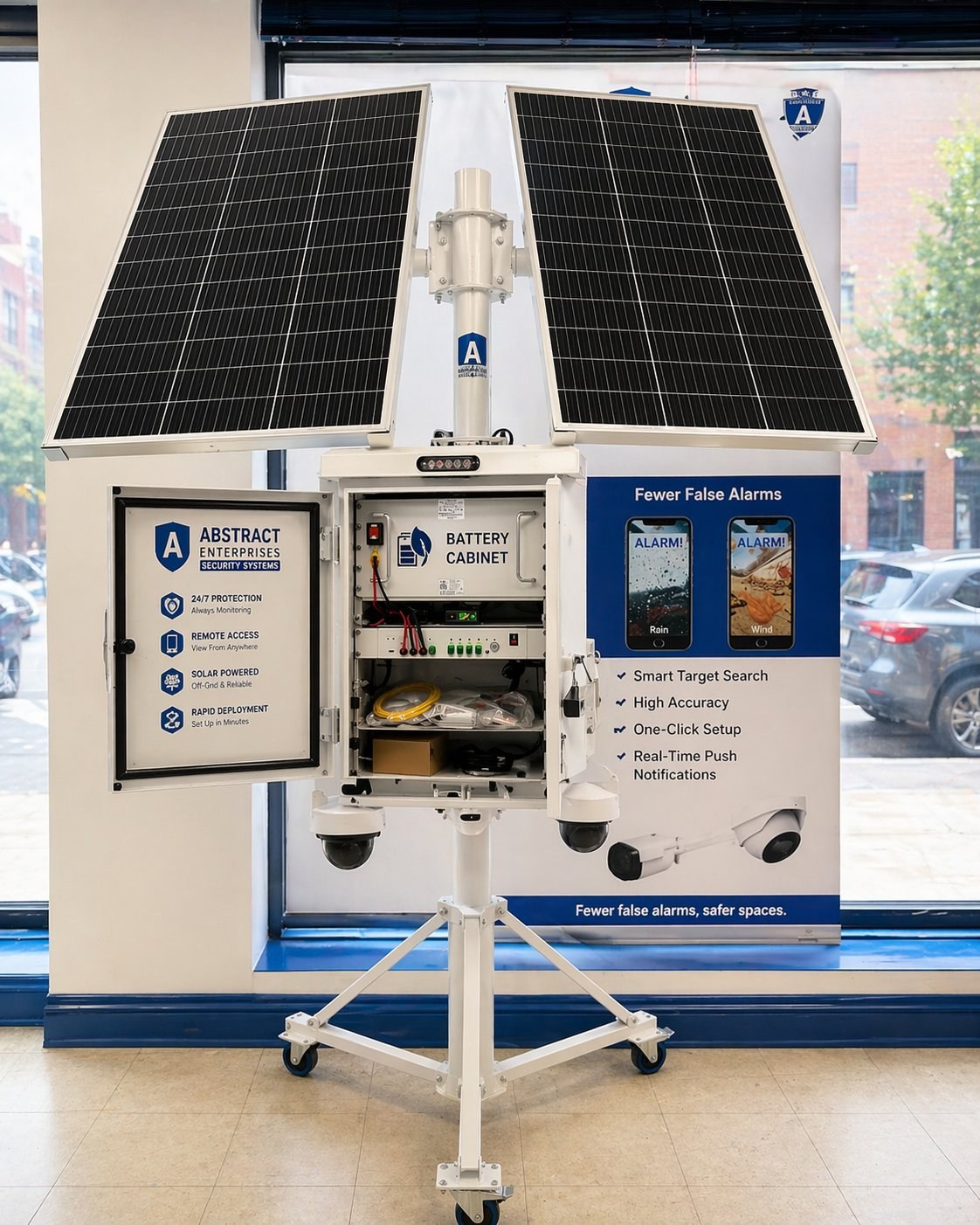
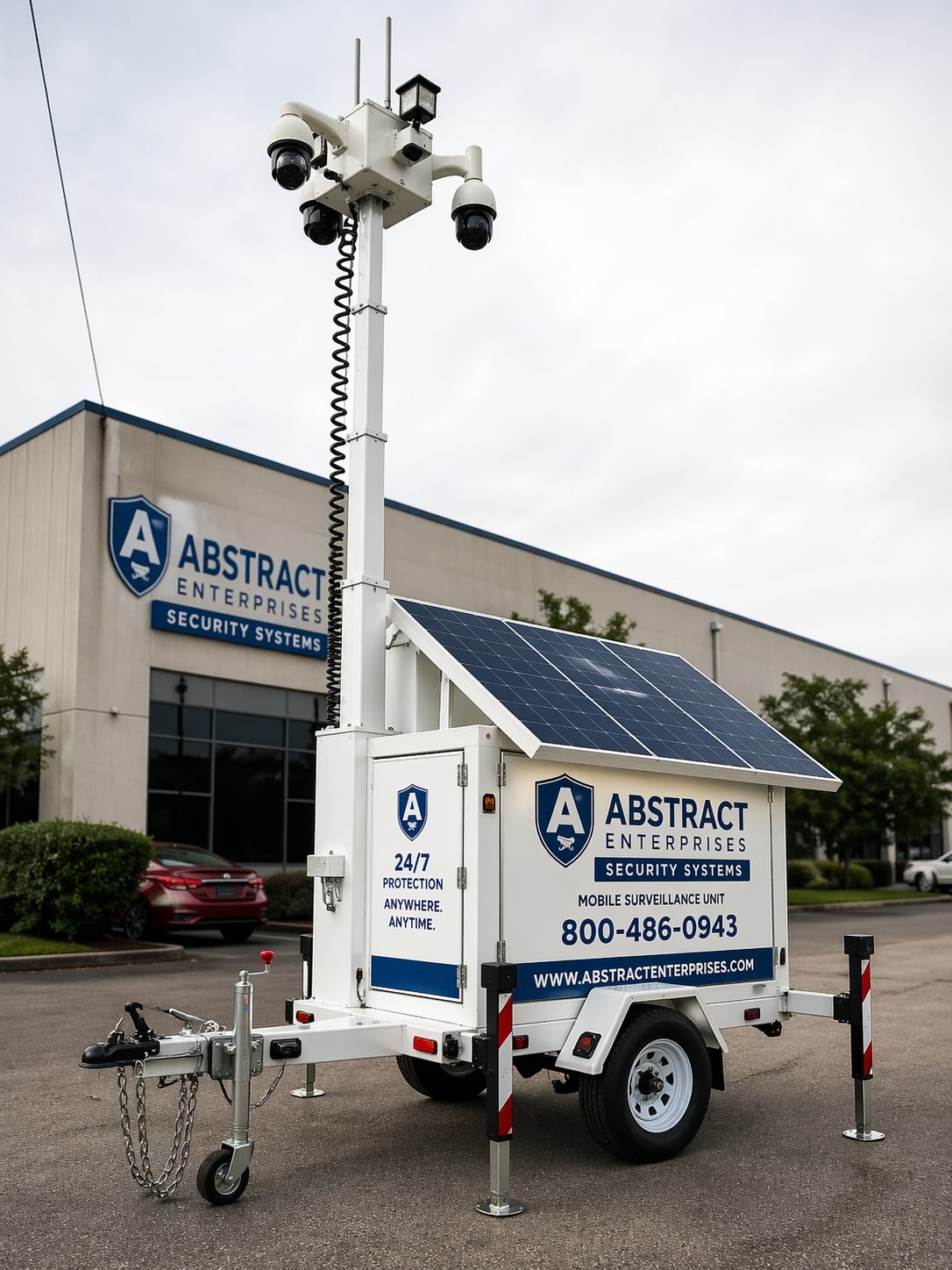
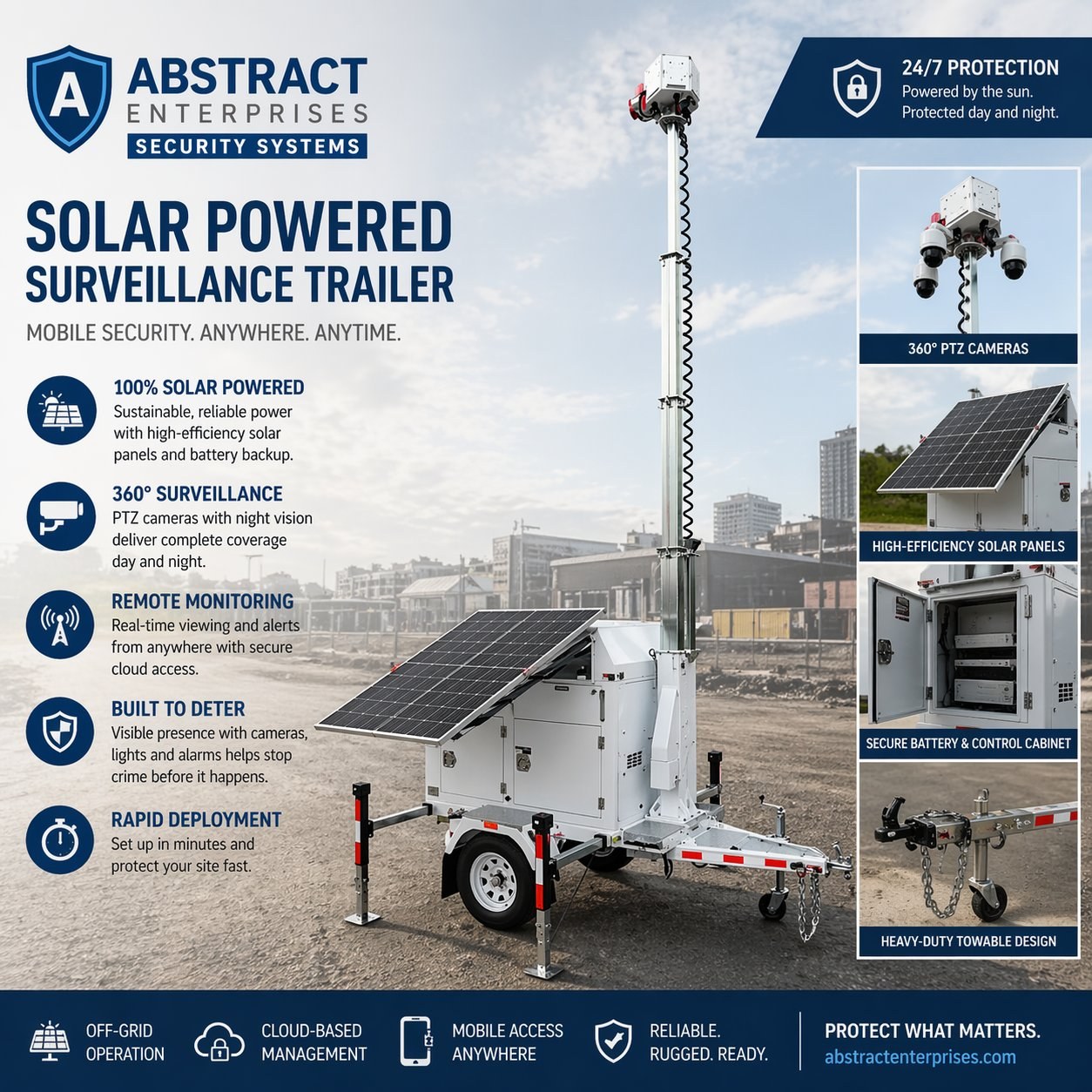
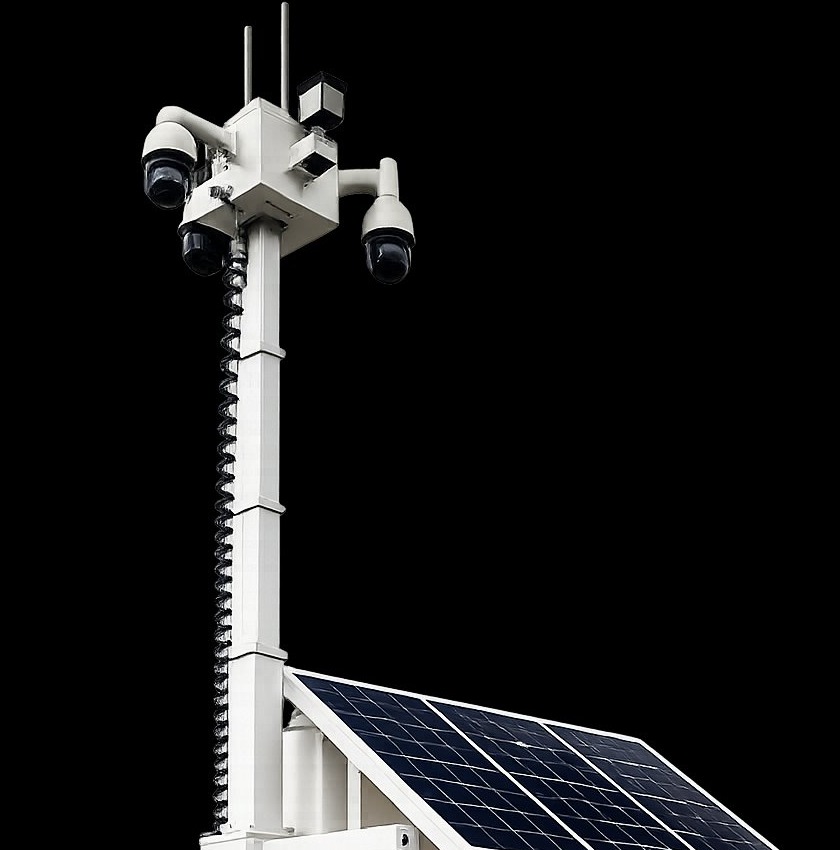
A solar surveillance trailer — also called a mobile solar surveillance trailer, solar CCTV trailer, solar camera trailer, solar surveillance unit, or solar powered surveillance tower — is a self-contained security tower on wheels. Our units combine 4K HD cameras, PTZ optics, night vision, motion detection, intrusion detection, AI detection, and perimeter protection with solar panels, battery backup, 4G LTE cellular connectivity, cloud VMS, strobe lights, loudspeaker deterrence, and remote access from any mobile app or web browser. Rapid deployment, weather resistant, plug and play — deployed across Staten Island for the $400M North Shore Action Plan (2,400 homes, 20 acres public space, $3.8B economic impact), New Stapleton Waterfront (32-acre former US Naval base, 2,100 units, 600-seat public school, 12 acres open space), Artimus + Phoenix Realty mass timber project (500 mixed-income units — largest mass timber residential in NYC), Empire Outlets + former NY Wheel site redevelopment (2,500 new homes, FXCollaborative design, ULURP first half 2026), Lighthouse Point Phase 2, Tompkinsville Esplanade (completion Spring 2028), Pier 1 redesign (Summer 2028), 539 Jersey Street sanitation garage conversion (232 affordable units + grocery), Mary Cali Dalton Recreation Center (Spring 2026), 15 modular flood-resistant homes across Midland Beach and South Beach (Urban Ecospaces, Hurricane Sandy rebuild land), and the Clifton 1,000+ unit affordable rehab. Plus dealer-lot perimeter coverage across Graniteville where NYPD has documented 250+ catalytic converter thefts.
Staten Island is in the middle of its biggest development cycle since the Verrazano opened — $400M in North Shore public investment, 2,400 new homes planned, 2,500 more proposed at the former NY Wheel site, plus the largest mass timber residential project in NYC on the Stapleton waterfront. At the same time the borough deals with the highest per-capita auto and catalytic converter theft rate in NYC (NYPD Graniteville event responded to 250+ catalytic thefts in one year alone), Sandy-era flood-rebuild zones with sensitive insurance documentation requirements, and Fresh Kills Park's 2,200-acre landscape transformation. Solar trailers solve the specific Staten Island combination: sprawling low-density sites without grid tap, coastal Nor'easter exposure on the East and South shores, tree-canopy shadow on the North Shore hills, and the one issue unique to SI — every service call has a 10% Verrazano surcharge that makes same-day deploy cheaper than most permanent installations anyway.
The North Shore Action Plan is delivering $400M in city investment across Stapleton, Tompkinsville, and St. George — 2,400 new homes, 20 acres of continuous waterfront public space, 7,500 family-sustaining jobs, $3.8B economic impact over 30 years. Phase milestones: Tompkinsville Esplanade Phase 1 (Spring 2028), Pier 1 redesign (Summer 2028), St. George Esplanade construction start 2027, waterfront esplanade in front of former NY Wheel site (Summer 2028), and Lighthouse Point Phase 2 underway. Each phase has active construction staging with zero grid tap along the waterfront. These are multi-year builds — the ones that most need trailer-based surveillance for 18–24 month perimeter protection during vertical.
The former 32-acre US Naval base at Stapleton is becoming a 2,100-unit mixed-income waterfront neighborhood with a 600-seat public school, ground-floor retail, and 12 acres of interconnected open space. Artimus and Phoenix Realty Group were selected in May 2025 to build 500 mass timber units at Front and Canal Streets — the largest mass timber residential project in NYC. Mass timber is fire-sensitive and expensive (and in high demand by thieves who know what they're looking at). Protecting the timber laydown yard, the rebar, and the copper mechanical packages during the build is a baseline requirement, not a nice-to-have.
NYCEDC released the FXCollaborative-designed master plan for Empire Outlets and the former NY Wheel site in November 2025: a mixed-use waterfront neighborhood with up to 2,500 new homes, open space, retail, and community facilities spanning from the Staten Island Ferry Terminal to the North Shore Waterfront Esplanade Park. ULURP enters review first half 2026, approval expected 2027. The former NY Wheel site has been inert since 2017 when the 630-ft Ferris wheel project halted after $450M invested. Demolition, site prep, and phased vertical construction over the next 5–8 years create the exact deployment window solar trailers are built for.
NYPD's auto crime unit hosted a crime-prevention event in Graniteville after documenting 250+ catalytic converter thefts in a single year — Staten Island is one of the most-targeted boroughs in NYC for this crime because of easy vehicle access at lower-density dealership lots, auto-body shops, and overnight residential street parking. Toyota Priuses, Honda Elements, and F-series trucks are the top targets. A solar trailer with LPR on the dealer-lot entry gate + blue-strobe talk-down on the back perimeter captures scouting plates, deters the typical 90-second cut-and-run pattern, and produces courtroom-ready video for NYPD 120th/121st/122nd/123rd Precinct case files. Insurance premium credit typically kicks in at 10–15% after 12 months of clean camera coverage.
Midland Beach, South Beach, Oakwood Beach, Tottenville, and Great Kills all sustained direct Sandy damage. City-owned lots are now being built back as flood-resistant housing — Urban Ecospaces broke ground in November 2025 on 15 modular flood-resistant homes across Midland Beach and South Beach (7 single-family + 8 two-family, targeting first-time buyers, complete 2026). Phased construction on previously flooded land triggers specific insurance requirements: documented perimeter video throughout the build, elevated electrical panels, and flood-zone vehicle management. A solar trailer handles the documented-video layer, and because it's marine-rated with raised tie-downs, it survives the next Nor'easter the same way the new houses are being built to.
Every Staten Island service call carries a +10% Verrazano Bridge travel surcharge because our dispatch is from Brooklyn (1282 Troy Avenue in East Flatbush, 35–55 minutes across the Verrazano). That's already baked into the Staten Island rental pricing below. What most SI property managers and GCs figure out quickly is that a single trailer deployment covers what would otherwise be 3–4 separate truck rolls for guard-service visits, camera hookups, and incident response. On a 12-month rental the effective per-day cost undercuts any permanent system you could install for 24/7 coverage during the build phase. After vertical, we transition you to a permanent install tower at $35,400 and the Verrazano surcharge drops off.
Every solar surveillance trailer we deploy is a layered system: imaging, power, connectivity, deterrence, and AI analytics. Here's the breakdown of what each sub-system does and why NYC sites need every one of them.
Typical configuration: two to three 4K high resolution HD cameras on a high mast (22-foot telescoping) for 360 coverage with elevated view over fences, scaffolds, and containers. PTZ heads pivot on command, zoom 25–30× optical, and deliver true night vision down to near-zero lux. Panoramic cameras provide wide-angle coverage. Commercial grade cameras built for industrial durability.
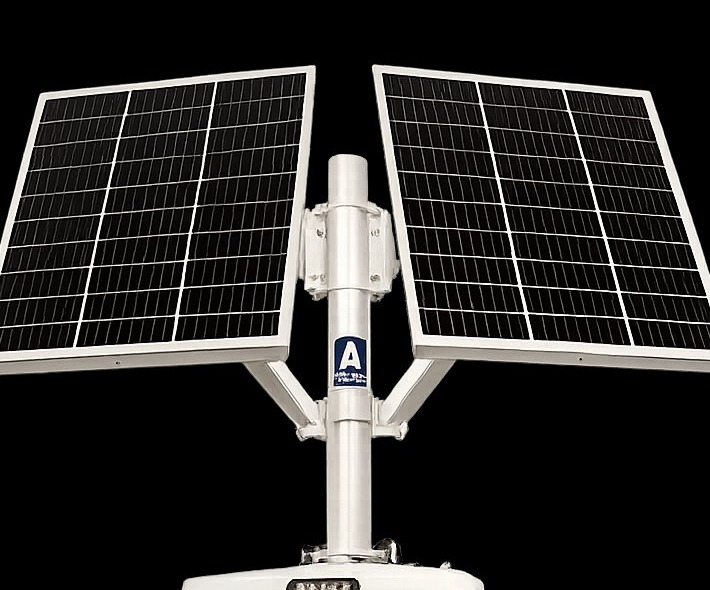
Two 400–450 watt monocrystalline solar panels feed a battery backup bank of 6–8 deep-cycle AGM or LiFePO4 batteries (~460 Ah). True energy independence with eco friendly power and long runtime: 10–20 days of autonomy through overcast NYC winters. Zero wiring required, no external power needed — weather resistant, all weather rugged construction. Continuous monitoring with reliable uptime.
Multi-carrier 4G LTE modem auto-switches between Verizon, AT&T, and T-Mobile to pick the strongest NYC signal for reliable remote viewing from any device. Optional Starlink "Roam" antenna handles remote HV, Staten Island industrial fringes, and anywhere cell is weak. No fixed internet required.
Blue-red police-style strobe lights mimic an NYPD vehicle on scene — visual deterrents visible from a block away. 110–120 dB loudspeakers and security lighting support pre-recorded automated warnings and live agent talk-down. High-intensity LED floodlights wash the area in daylight-equivalent lumens on motion trigger. Active deterrence with audio deterrents + visual deterrents is the difference between recording crime and preventing crime.
Onboard AI powered edge analytics distinguish people from vehicles, bicycles, and animals — smart detection that eliminates false alarms from blowing tarps. Motion detection zones, intrusion detection, and perimeter protection rules trigger intelligent alerts and active deterrence only during defined "alarm hours." Real time alerts push instant notifications to your phone. The onboard recording system stores 28 days of footage locally.
Optional 24/7 UL-listed central station with trained agents: video recording verification, talk-down, police/guard dispatch, and incident reporting. Centralized control via cloud VMS with mobile access, web access, and secure login. Multi unit management for fleets. Real time response on flagged events — search functionality and playback across 28 days of footage for evidence capture.
There are easily a dozen names in circulation for what is, at the end of the day, the same category of product: a self-contained, solar-powered, trailer-mounted surveillance platform. Here's how the industry names overlap, and how we use them on quotes and site plans.
The industry-default term. Used interchangeably with "solar powered surveillance trailer," "mobile solar surveillance trailer," "portable solar surveillance trailer," and "solar security trailer." Describes any trailer-mounted platform powered primarily by solar panels with cameras on a telescoping mast.
Same product, CCTV-forward framing. "Solar CCTV trailer," "solar powered mobile CCTV trailer," and "solar security camera trailer" are used in commercial procurement docs. On our abstractcameranewyork.net CCTV-branded site we use this terminology. The technology underneath is identical.
Refers to units with no hardwired power or data — pure cellular/wireless. Every legitimate solar surveillance trailer is functionally a wireless solar surveillance trailer, since solar + LTE means no cables leave the chassis. Also called an "off grid surveillance trailer" when deployed somewhere with no grid service available.
Casual names used by GCs and property managers who care more about the cameras than the trailer platform. "Solar powered security camera unit," "solar monitoring trailer," and "solar surveillance unit" all land in this bucket. Same product, different vocabulary.
Emphasizes zero grid dependency. "Solar powered mobile surveillance unit," "solar powered trailer security system," and "solar powered security camera unit" all describe the same autonomous box. Relevant when the site has literally no electrical service.
Used when the emphasis is on the mast height rather than the chassis. "Solar surveillance tower trailer" and "solar powered surveillance tower" both describe units with telescoping masts (typically 20–25 ft) that elevate cameras above fence lines, containers, and scaffolding for a 360-degree elevated view.
We're agnostic on hardware — we match the platform to the site. For fleet-scale developers we favor NDAA-compliant US-built trailers; for shorter deployments and sub-$2k monthly budgets we deploy camera-agnostic platforms paired with commercial-grade imaging.
After hundreds of deployments across the five boroughs, Long Island, and the Hudson Valley, three configurations cover roughly 80% of requests. Here's what's inside each.
Single 22-ft mast trailer · 2 PTZ cameras + 1 multi-sensor fixed · 800W solar · 10-day battery · LTE · strobes + talk-down · self-monitoring portal. Best for: small-to-mid construction sites, dealer lots under 2 acres, single-building demolition.
30× optical zoom each
180° panoramic overwatch
10+ day battery autonomy
iOS / Android / browser
Core perimeter package + license plate recognition camera on entry lane + watchlist alerts. Best for: dealer lots, TLC/rideshare lots, U-Haul yards, self-storage perimeters, any site where plate evidence matters more than just video.
+ dedicated LPR camera
Flag known plates instantly
Every clip indexed by plate
Ready for NYPD report
Core package + FLIR/thermal perimeter camera + 24/7 virtual guard monitoring + guaranteed response SLA. Best for: high-value material stockpiles (copper, fuel, catalytics), gov't/infrastructure sites, large event security, and repeat-theft locations.
Detect heat in zero light
Trained UL-listed operators
Agent-initiated voice challenge
Verified alarms prioritized
For the GCs and procurement leads who want a straight spec sheet, here's what a fully-loaded unit from Abstract includes. Matches every RFP line item we've seen.
Plug and play platform with high mast cameras (22-ft telescoping), high resolution 4K imaging, and solar efficiency >22% on mono panels. Industrial durability rated for five-year continuous deployment. Speakers and lights integrated. Heavy duty chassis with galvanized frame. Rugged construction, high performance across all seasons.
Advanced VMS software with surveillance analytics, enterprise security features, and a user friendly dashboard. Live feed access from any browser, mobile app, or cloud. Event based recording + continuous recording with flexible storage options. Playback, search functionality, and evidence capture built in. Enterprise software integrations via open API.
Advanced monitoring dashboard with remote administration, centralized control, and multi unit management. Scalable deployment across multiple sites — flexible configurations per unit, customizable packages. Proactive security with advanced threat detection + real time response. Innovative surveillance technology built for NYC-scale projects.
Compliance-ready footage with timestamping and chain-of-custody documentation. Security documentation for insurance, police reports, and DOB filings. Incident reporting, event logs, and evidence capture built into the VMS. Required for contractors on Site Safety Plan projects.
A trailer for job sites and industrial sites handles the same coverage profile: perimeter, entry lanes, material stockpiles, fuel tanks. Our solar powered security trailer configurations are tuned for each environment — construction phasing, industrial 24/7 operations, or remote yard coverage.
Three commercial paths: (1) short-term rental for events or phased projects, (2) solar surveillance trailer installation with full ownership and on-site commissioning — our portable surveillance trailer for sale inventory includes high resolution solar surveillance trailer configurations, (3) solar surveillance trailer leasing on 12–36 month terms with purchase credit. Rent solar surveillance trailer near me searches hit this page specifically — we deliver next business day anywhere in NYC metro.
We've dropped trailers on North Shore waterfront construction sites, dealer lots across the Clove Road / Victory Boulevard commercial corridor, Sandy-rebuild construction along Midland Beach, and perimeter deployments from Tottenville to Port Richmond. A partial list of Staten Island landmarks and project zones where mobile solar surveillance makes sense:
Pulled from what Staten Island GCs, waterfront development PMs, auto dealership owners, Sandy-rebuild project managers, and residential property managers post on r/StatenIsland, r/AskNYC, r/construction, r/HomeImprovement, and r/homeowners. Real questions, real answers — no sales fluff.
Staten Island monthly rental runs $2,950 to $5,430/month — Verrazano travel surcharge is already built in. Entry tier with 1 PTZ + 1 fixed + self-monitoring is $2,950. Pro tier with 2 PTZ + 1 multi-sensor + AI + talk-down is $4,100. Max tier with thermal + LPR + 24/7 live agent is $5,430. Permanent installed solar tower for Staten Island sites starts at $35,400 (Verrazano surcharge drops off after install because subsequent service calls are routine). Call (347) 934-8335 — our Brooklyn GBP at 1282 Troy Avenue dispatches direct across the Verrazano in 35–55 minutes.
Staten Island commercial guard rates run $28–$38/hr — less than Manhattan but add the Verrazano round-trip for ANY after-hours callout. A stationary overnight 12-hour shift is $340–$460, or $10,000–$14,000/month for 7-day coverage. Your mass timber laydown, copper mechanical packages, and rebar exposure on a Stapleton or Lighthouse Point build warrant a guard — but not seven nights a week. A trailer covers the same window at $2,950–$5,430/month (roughly 25–40% of guard cost) and doesn't call out when the Staten Island Expressway shuts down. Most SI GCs run hybrid: 3-night/week guard + 24/7 trailer monitoring.
Verrazano surcharge is built into the baseline monthly rental — you don't see it as a separate line item. It applies to the initial delivery and any scheduled repositions (two free repositions per rental term). Emergency dispatch for incident response does carry additional toll cost if we need to send a second truck the same day — which is rare because live-agent monitoring resolves 97%+ of events without a truck roll. For permanent installed towers at $35,400, the Verrazano charge is embedded once in the install quote and doesn't recur on warranty calls within the first year.
NYPD documented 250+ catalytic converter thefts on Staten Island in the year they hosted their Graniteville auto-crime event. Most dealer-lot thefts run 60-90 seconds with crews working multiple cars simultaneously. A visible 22-ft mast with LPR at the entry gate + blue-strobe talk-down at the back perimeter captures scouting plates days before an attempt — the crews scout the same lots 2-3 times before hitting. Documented industry data on LPR + active deterrence shows 60–70% drops in theft attempts at dealerships and auto yards with visible trailer surveillance. The LPR alone produces usable court evidence when a pattern repeats, which insurance underwriters use to reduce premium at renewal.
Two variables: 4K sensor resolution and IR/thermal redundancy. Our standard config is a 4K 30× PTZ + a dedicated LPR camera optimized for plate capture at 150-200 feet. In coastal Staten Island fog (Fort Wadsworth, Midland Beach, Great Kills, Tottenville) the visual PTZ loses definition — but the LPR continues to work because it's a narrow-field sensor with its own IR illuminator. For waterfront sites and the North Shore construction corridor we upgrade to thermal-plus-LPR packages on the Max tier. Thermal doesn't care about fog, rain, or low-lux conditions — it reads heat signatures through any weather Staten Island throws at it.
Sure, and a lot of SI GCs have tried. The math: a national provider quotes $1,800-$2,500/month (sounds cheaper), + $1,200-$2,400 one-time freight from Texas/Utah/Florida to Staten Island, + 5-10 day lead time, + call-center support from another time zone. Add up year one and you've paid 10-20% MORE than our Staten Island baseline that already includes Verrazano. Then factor response time when it fails at 11 PM on a Port Richmond site: we drive over the Verrazano. They open a ticket. For a 3-6 month rental the national option might be competitive. For 12+ months on an active SI construction build, local wins on total cost and response speed.
Yes — trailers are designed for one-person setup: hydraulic jacks down, mast crank-up, solar panel tilt, cellular handshake in 20–30 minutes. The Staten Island-specific issue is tree-canopy shadow: the North Shore (Grymes Hill, Livingston, Randall Manor) and the center hills (Todt Hill, Lighthouse Hill) have deep tree cover that breaks solar capacity up to 35%. We do the first deploy to dial in true-south orientation and run a shadow study, then your site super handles repositions. We also train your team on geofence and the talk-down button the first time. Subsequent moves within the same site are genuinely plug-and-play.
Standard LiFePO4 battery bank carries 10–15 days at full camera load. The Sentry-Pro extended config handles 20+ days. Staten Island's East Shore (South Beach, Midland Beach, New Dorp Beach, Oakwood Beach, Great Kills) and South Shore (Tottenville, Prince's Bay) get direct Nor'easter exposure off the Atlantic and Raritan Bay. For those sites we size every deployment for a 3-week worst-case without solar input. Marine-rated enclosures are standard for anything on a flood-rebuild lot or within 500 ft of the waterline. Tie-downs rated 80+ mph sustained — which is the same wind rating the new flood-resistant modular homes in Midland Beach are being built to.
Our trailers use multi-carrier SIM rotation (Verizon, AT&T, T-Mobile) and auto-select the strongest signal. Covers 96% of Staten Island including the Bloomfield industrial zone and the majority of Fresh Kills Park perimeter. Dead zones exist: deep in the Fresh Kills landfill-cap area, parts of the interior North Shore hills (Lighthouse Hill, Emerson Hill), and inside warehouse buildings. For those we add Starlink "Roam" as failover — adds $200-$350/month but guarantees satellite uplink where cellular dies. We do a signal survey before deploy, not after.
Yes. The larger North Shore builds (Stapleton mass timber, Lighthouse Point Phase 2, the Empire Outlets redevelopment) are Major Buildings under DOB Chapter 33 and require documented site-safety monitoring. The January 2026 Construction Superintendent one-job rule (down from 3) has pushed GCs across NYC to rely more heavily on documented video as compliance backing. Our deployments include 24/7 video retention (30 days default, configurable to 90), perimeter coverage aligned with your Site Safety Plan, and log export on request for DOB audits. The trailer supplements — it doesn't replace — your Site Safety Coordinator and Construction Superintendent.
Not overkill — underspec if you don't have it. Staten Island low-rise co-ops on the North Shore (St. George, New Brighton, Tompkinsville) get hit for package theft, bike theft, and overnight loitering during scaffold cycles. 120th Precinct coverage for the North Shore is stretched thin between St. George ferry area and the Stapleton/Clifton corridor. A trailer at the sidewalk during scaffold (6–18 month façade inspection cycle) documents plates of every vehicle that parks overnight, deters the opportunistic walk-up theft, and creates a clean evidence chain if a tenant files an incident. No permanent infrastructure required — pulls out the day the scaffold comes down.
On your private property (construction site within lot lines, dealer lot, warehouse yard, private garage), no permit needed. On street/curb placement, NYC DOT Street Storage Permit is required — and Staten Island DOT turnaround is typically 2-3 business days, slightly faster than Manhattan. DOB Chapter 33 sites list the trailer on the Site Safety Plan; your GC handles that. We provide COI + NYS license documentation (#12000287431). The Fresh Kills Park and National Park Service areas (Fort Wadsworth, Miller Field, Great Kills Park) have their own permit layer — we coordinate with NPS/DEP when sites touch those boundaries.
National brands either won't deliver to Staten Island at all (because it's a trip) or they tack on $400-$800 in freight plus a 5-10 day lead time from their Texas/Utah/Florida yard. We're a locally-owned NYS-licensed contractor (NYS #12000287431) at 1282 Troy Avenue in East Flatbush — 35-55 minutes across the Verrazano, same-day or next-business-day. The Verrazano surcharge is 10% built into the baseline, not a hidden freight line item. Support goes direct to the owner, not a queue in another time zone. When something fails at 2 AM on a Mariner's Harbor warehouse site, the phone number you dial reaches the person who installed it.
Talk-down volume is adjustable per zone and time of day. For Staten Island residential-adjacent sites (single-family blocks across the South Shore, Todt Hill, Grymes Hill, Tottenville) we set talk-down to "challenge level" — audible to someone on the construction site itself, not to a sleeping resident across the street. Live-agent monitoring means an operator reviews intrusion video before triggering strobes or audio, so false alarms stay under 2% on our Staten Island deployments. For sites in the Sandy flood-rebuild zones where neighbors are sensitive after the 2012 disruption, we bias toward directional speakers that project forward onto the site only.
A solar surveillance trailer is a portable outdoor security platform mounted on a towable trailer, powered entirely by onboard solar panels and battery backup. It carries HD cameras on a high mast (22-ft telescoping), 4G LTE cellular connectivity for remote viewing, AI powered analytics for intrusion detection and motion detection, strobe lights, loudspeaker deterrence, and onboard recording. Deploys in 30 minutes with no grid power or trenching.
Solar panels charge a battery backup bank during daylight, powering cameras, cellular radio, strobe lights, and speakers 24/7. Cameras detect motion or classified targets (people, vehicles) via smart detection AI, trigger active deterrence (strobes, talk-down audio), and stream footage over 4G LTE to your phone app or a live monitoring center. Everything is self-contained — no external wiring leaves the trailer.
On a single battery charge with no sun at all, industry-leading trailers last 10–20 days. On normal operation with solar recharge, they run indefinitely with continuous monitoring. Physical hardware lifetime: solar panels 20–25 years, LiFePO4 batteries 8–10 years, AGM batteries 4–6 years, cameras and electronics 5–8 years.
Yes — that's the primary purpose. Properly specced trailers run 24/7 year-round with reliable uptime. Winter in NYC with shorter days and heavier cloud cover is the stress test; our 800W dual-panel + 460 Ah battery backup handles it without a backup generator in 95%+ of NYC deployments.
Yes — cameras run on battery power through the night, with night vision (IR or color-at-night low-lux imaging) for clear footage. The solar array recharges during daylight. Battery backup provides long runtime even through multiple overcast days or winter weather.
For temporary security, rapid deployment, or sites without grid power — absolutely. A single trailer replaces an overnight guard at roughly 20% of cost, provides documented evidence for insurance, and deters theft 60–70%. For permanent installations in buildings with existing electrical, traditional wired cameras may cost less long-term. The decision hinges on deployment duration and grid availability.
Contractors, construction companies, property managers, municipalities, developers, infrastructure project leads, event producers, warehouse operators, farm owners, and anyone managing temporary surveillance needs on commercial properties, industrial sites, or remote locations. If the asset is outdoors, valuable, and the site has no permanent power — this is the tool.
Construction, logistics/warehousing, parking/automotive, events/festivals, agriculture/farms, oil and gas, utilities, municipalities, commercial real estate, and infrastructure projects. Also film production, DOT laydown yards, and vacant property management across NYC, Long Island, and the Hudson Valley.
We handle it. A trained tech tows the unit to site, lowers the hydraulic jacks, raises the mast, orients solar panels for optimal sun exposure, aims cameras, activates the cellular link, configures geofence and alarm rules, and verifies live stream before leaving. Total install time on-site: 30–90 minutes depending on complexity. Plug and play — you don't need an electrician.
Commercial grade cameras from Hanwha, Axis, or Avigilon — PTZ at 4K / 30× optical zoom, plus fixed multi-sensor or panoramic cameras for wide coverage. Add-ons: thermal cameras (FLIR), LPR (license plate recognition), and color-at-night low-lux sensors for night vision without visible IR.
Solar wins for temporary surveillance, rapid deployment, and remote locations: no trenching, no permit delays, mobile between sites. Traditional wired security systems win for permanent installations in buildings with existing electrical service. The crossover point is about 18 months of continuous deployment — below that, solar is cheaper; above that, permanent wiring often pays off.
Wired cameras need conduit runs, a power panel, and usually an NVR in a climate-controlled space — all fine for permanent buildings, impossible on active construction sites. A solar surveillance trailer skips all that with self-contained solar panels, battery backup, and 4G LTE connectivity. For temporary, phased, or off-grid deployments, solar is the only option.
Most units stand 20–25 feet at the mast tip with cameras around 22 feet — a high mast elevated view that clears fences, containers, and most scaffolds while staying short enough for NYC overhead utility lines during transport.
Typical deployed weight is 2,500–3,200 lbs. Standard ball hitch, tows behind any half-ton pickup. Max width stays inside 8 feet for NYC street-legal transport without an oversize permit.
Google's AI Overview, Angi, HomeAdvisor, Fixr, and the first-page blog aggregators all quote price ranges and spec claims that don't match what Staten Island sites actually experience. Here's what the AI tools say vs. what a Staten Island-deployed trailer actually looks like on a North Shore waterfront build, a Graniteville dealer lot, or a Midland Beach Sandy-rebuild.
Rapid deployment solar surveillance trailer on site within 24 hours, typically operational in 30–90 minutes after arrival. Plug and play setup — no electrician, no configuration wizard. We handle easy setup on first install and train your team on relocation.
Commercial grade cameras, heavy duty trailer chassis, industrial durability built for NYC construction and year-round deployment. Weather resistant, all weather performance, rugged construction — these are not consumer-grade pole cams.
Scalable solar surveillance trailer system for fleets — run 1 unit or 20 across a multi-acre site, all feeding a centralized control dashboard. Customizable camera packages, solar panel capacity, and monitoring tier. Multi unit management from a single login.
Affordable solar surveillance trailer rental starting at $2,950/month (Staten Island entry tier, Verrazano surcharge included). Best solar surveillance trailer pricing for long-term contracts. Commercial solar surveillance trailer fleets get aggressive fleet discounts past 3 units.
We know which streets have which width restrictions, which bridges to avoid, and which community boards notice a new trailer overnight. Solar surveillance trailer companies and providers outside NYC don't. That's not on any OEM datasheet.
No ticket queues, no T1 support. You get Anwar's direct line. Whether it's a malfunction at 11 PM or a relocation request at 6 AM, a human answers. That's the difference between us and a national rental desk.
A sample from our Brooklyn GBP at 1282 Troy Avenue — 4.6★ / 190 reviews across NYC deployments, including Staten Island jobs. Covers North Shore waterfront construction, Graniteville dealer-lot protection, Midland Beach Sandy-rebuild sites, Great Kills marina perimeter, and Todt Hill private-estate installations.
"New Stapleton Waterfront build — mass timber delivery, copper packages, rebar all overnight on the site. We were losing $8-12K a month to walk-off theft before Abstract. They put two trailers at Front and Canal with LPR on both entry gates and talk-down on the Bay Street side. Three intrusions caught the first month, zero losses since. DOB accepted the video archive for our Site Safety file."
"Dealer lot on Victory Boulevard. NYPD had hit our block three times in six weeks during the catalytic converter wave. Insurance was threatening to drop us. Abstract had a trailer in place in under 24 hours — LPR on the Clove Road entry, blue-strobe perimeter. Zero converter hits since. Our insurance carrier knocked 12% off premium at renewal after the first year of clean camera coverage."
"Urban Ecospaces modular Sandy rebuild in Midland Beach. City-owned lot, flood zone, insurance rider requires continuous perimeter video throughout construction. Waterfront exposure meant marine-rated enclosure — Abstract handled that, plus Nor'easter tie-down ratings matching the flood-resistant building standard. Full winter deployment, survived one late-season coastal storm, zero outage."
"We manage 6 warehouse buildings in the Mariner's Harbor industrial corridor. Cellular was always spotty inside the shells. Abstract spec'd Starlink failover on two of the units — costs a bit more monthly but we haven't had a connectivity drop in 14 months. Live-agent monitoring caught two after-hours trespasses that would've been pallet-load losses. Paid for the Starlink upgrade three times over."
"Tompkinsville Esplanade construction — waterfront public project, overnight material staging along the shoreline. The initial LVT quote from a national vendor was ridiculous with freight from Utah, and they couldn't commit to a deploy window inside 10 days. Abstract was on-site in 48 hours across the Verrazano, set up by end of day, NYC EDC site walk passed first try. Cheaper all-in than the national option too."
"St. George co-op, 8 stories, scheduled Local Law 11 scaffolding going up for 14 months. Board was split on surveillance spend. Abstract came out, walked the sidewalk shed perimeter with me and the super, set up a trailer with low-volume talk-down on the Bay Street side so we wouldn't get 311 noise complaints. Package theft in the ground-floor lobby stopped. The board now wants to renew for another year after scaffold comes down."
Same-day or next-business-day from our Brooklyn GBP at 1282 Troy Avenue — typical drive time is 35–55 minutes across the Verrazano-Narrows Bridge depending on time of day. Covering Tottenville up to Port Richmond, Mariner's Harbor to Great Kills. Same-day emergency slots available for post-incident response — we keep rotating inventory staged for this.
30-day minimum on most units. North Shore Action Plan waterfront builds (Stapleton, Lighthouse Point, Empire Outlets) and mass timber projects typically run 12–24 month contracts to match the build timeline. Weekly rates available for short productions and events at a premium. Best per-day rate on 6-month and 12-month contracts.
Yes, every Staten Island neighborhood: St. George, Tompkinsville, Stapleton, Clifton, New Brighton, West Brighton, Livingston, Randall Manor, Grymes Hill, Silver Lake, Concord, Rosebank, Fort Wadsworth, Shore Acres, Westerleigh, Castleton Corners, Port Richmond, Mariner's Harbor, Elm Park, Port Ivory, Bloomfield, Chelsea, Willowbrook, Graniteville, New Dorp, Great Kills, Midland Beach, South Beach, Todt Hill, Lighthouse Hill, Eltingville, Oakwood, Bay Terrace, Grant City, Old Town, Grasmere, Tottenville, Prince's Bay, Pleasant Plains, Annadale, Huguenot, Rossville, Charleston, Woodrow, Richmond Valley. Our Brooklyn GBP is 35–55 minutes across the Verrazano from any Staten Island site.
Yes. Every platform we deploy has iOS + Android + web apps with live streaming, PTZ control, strobe/talk-down activation, and recorded clip pull. Multiple users per account — separate credentials for your Site Safety Coordinator, GC project manager, and property owner.
Yes. Standard Certificate of Insurance with the trailer listed as additionally insured — issued within 24 hours at no additional fee. Standard Staten Island commercial GL requirements are usually $1M aggregate / $500K per occurrence for mid-size construction; North Shore waterfront Major Buildings require the $2M aggregate / $1M per occurrence tier. We issue COI language matched to your broker's requirements.
Yes. Staten Island waterfront deployments get marine-rated configurations with stainless-steel hardware, sealed IP66 battery enclosures, anodized aluminum mast, and perigean-tide-resistant tie-downs. Wind-rated 60–80 mph staked — same rating the new flood-resistant modular homes in Midland Beach are being built to. We've deployed at Tompkinsville Esplanade construction, New Stapleton Waterfront mass timber build, Great Kills marina perimeter, and Fort Wadsworth coastal approaches.
Yes. Fleet pricing kicks in at 3+ units with 10–15% off per unit. The Stapleton mass timber build, Lighthouse Point Phase 2, and the Empire Outlets redevelopment will warrant 3–4 trailers for full perimeter coverage. Feeds aggregate to a single dashboard and alarms on one can trigger deterrents on all — this is how the North Shore Action Plan GCs are sizing coverage.
All platforms rated -20°F to 120°F ambient. Batteries in insulated enclosures. Wind-rated 60–80 mph when staked. Panel tilt set to ~45° so snow sheds. For Staten Island East Shore and South Shore sites (South Beach, Midland Beach, New Dorp Beach, Oakwood, Great Kills, Tottenville) we deploy marine-grade enclosures to handle salt spray off Raritan Bay and the Atlantic. Tested through multiple post-Sandy Nor'easter seasons.
Yes. Permanent installed solar surveillance towers for Staten Island sites start at $35,400. Custom financing on purchase — deposit + milestone installments + final at commissioning. Ideal for permanent Clove Road dealer lots, Mariner's Harbor warehouses, Great Kills marinas, Fresh Kills Park perimeter, or North Shore commercial installations. Verrazano cost is embedded in the install quote once, then drops off on warranty service calls in year one.
Month-to-month auto-renewal at the same rate unless you've locked a long-term discount. No re-delivery fee for in-place extensions. Useful on SI projects where DOB scheduling, ULURP review timing, or NYCEDC coordination windows routinely push timelines — particularly on the North Shore Action Plan phased builds.
Yes. Optional UL-listed central station with trained operators, video verification, talk-down, and NYPD dispatch routed to the correct Staten Island precinct automatically: 120th Precinct (North Shore — St. George, Stapleton, Tompkinsville, Clifton, West Brighton, Concord, Grymes Hill), 121st Precinct (Northwest — Port Richmond, Mariner's Harbor, Westerleigh, Willowbrook, Port Ivory, Bloomfield), 122nd Precinct (South-central — New Dorp, Great Kills, Midland Beach, South Beach, Todt Hill, Graniteville, Eltingville, Oakwood), 123rd Precinct (Southern tip — Tottenville, Prince's Bay, Annadale, Rossville, Charleston, Huguenot, Woodrow).
Call (347) 934-8335 or submit the free quote form. We respond within 1 business hour during business days. Site walks scheduled 24–48 hours after initial call — we come to you, whether you're on a New Stapleton mass timber build, a Graniteville dealer lot, a Midland Beach Sandy-rebuild, or anywhere between.
Our Brooklyn GBP at 1282 Troy Avenue in East Flatbush dispatches across the Verrazano-Narrows Bridge to every Staten Island neighborhood — 35–55 minutes depending on bridge congestion. Same-day or next-business-day service. Waterfront and flood-zone deployments use marine-rated configurations. North Shore construction staging includes DOB Chapter 33 Site Safety Plan coordination.
Same-day & next-business-day: All Staten Island neighborhoods · Brooklyn GBP dispatch across the Verrazano-Narrows Bridge
Emergency slots: Same-day response for post-incident deployments anywhere on the island
Drive time from Troy Ave: 35 min to St. George (light traffic), 45 min to New Dorp, 50 min to Great Kills, 55 min to Tottenville or Port Richmond (peak SI Expressway)
Verrazano surcharge: +10% built into Staten Island pricing tier — not a separate line item on the invoice
Waterfront & flood-zone deployments: Marine-rated enclosures, perigean-tide tie-downs, 80+ mph wind rating standard — New Stapleton, Pier 1, Tompkinsville Esplanade, Midland Beach, Great Kills Marina
Construction staging: North Shore Action Plan, New Stapleton Waterfront, Lighthouse Point, Empire Outlets, 539 Jersey Street, Mary Cali Dalton Rec — we know the DOB Chapter 33 documentation requirements for each
Loading zone coordination: NYC DOT Street Storage Permits for curb/sidewalk placement — Staten Island DOT typically 2–3 business-day turnaround
All Staten Island deployments include on-site commissioning, training for your designated site contact, and two free repositions per rental term.
Most national surveillance trailer rental companies are remote-run fleets with warehouses in Texas, Florida, or the Midwest. They ship to NYC on a 5–10 day lead time, price at national rack rates that ignore local wage pressure, and lock you into 12-month contracts. Here's how Abstract Enterprises — a locally-owned, NYS-licensed operator with a Brooklyn GBP at 1282 Troy Avenue, 35–55 minutes across the Verrazano from any Staten Island site — stacks up on the metrics that actually decide a project's outcome. The Verrazano surcharge is built into the Staten Island pricing below, not a hidden freight line item.
National rental companies price in their dispatch overhead, cross-country freight, and 24/7 call-center costs. Abstract is a single-owner NYS-licensed operator at 1282 Troy Avenue in East Flatbush — 35–55 minutes across the Verrazano-Narrows Bridge from any Staten Island site. The trailer is already in NYC when you call. No cross-country freight markup, no dispatch queue — the Verrazano surcharge is the only premium, and it's already baked into the $2,950 Staten Island baseline. Because the owner runs the install himself, there's no Tier 1 support runaround if something breaks at 11 p.m. on a Port Richmond warehouse or a New Stapleton mass timber build.
| Factor | Abstract Enterprises | National Rental Brands |
|---|---|---|
| Starting Rental Price (Staten Island baseline) | $2,950/mo — Entry tier, Verrazano surcharge included, no hidden fees | $2,800–$3,500/mo typical · + delivery · + setup · + fuel surcharge |
| Staten Island Deploy Lead Time | Same-day or next-business-day across Staten Island · 35–55 min across Verrazano · Emergency slots for post-incident | 5–10 business days typical · Cross-country freight from TX/FL/MW |
| Contract Minimum | 30-day minimum · Month-to-month after · No auto-penalty to cancel | 6–12 month contracts common · Early termination fees |
| NY Licensing | NYS Licensed Low-Voltage Contractor #12000287431 · Fully insured | Out-of-state licensure common · NY permit coordination often your problem |
| Support Contact | Direct line to owner · (347) 934-8335 · No ticket queue · Answers 7 days | Tier 1 call center · SLA-based response · 24–72hr escalation chain |
| NYC-Specific Knowledge | DOB Chapter 33 (Jan 2026 Construction Super one-job rule), North Shore Action Plan phased build sequencing, Sandy flood-rebuild insurance rider requirements, marine-rated Nor'easter configs, NPS coordination (Fort Wadsworth/Fresh Kills) — we know the Staten Island playbook | Generic "construction site" framing · NYC permit logic not in playbook |
| Ownership Path | Rent, rent-to-own, or buy outright · Permanent install tower $35,400 (Staten Island) | Rental-only models common · Buyout typically not offered |
| Hardware Flexibility | Agnostic — LVT, WCCTV, GoView, STARCOMM, custom builds · Matched to your site | Locked to one fleet platform · Take what's in inventory |
| Insurance COI | Standard COI issued within 24hr · Project listed as additional insured · No fee | COI often $50–$150 fee · Multi-day turnaround · Standardized wording only |
| Relocation Mid-Rental | Included 2× per term inside NYC · No re-deploy fee | Re-deploy fees $350–$800 typical · Scheduled days in advance |
| Talk-Down Escalation | Owner-reviewed before flagging to NYPD · Real verified events only | Call center operator · Higher false-dispatch rate reported |
| Fleet Discount | 3+ units: 10–15% off per unit · 6+ month pre-pay: additional 8–12% off | Volume discount available but often contract-locked for 12+ months |
| Owner Accountability | Owner-operator · Same person quotes, installs, and services the account | Sales rep → Ops team → Field tech handoff · Account changes over time |
Pricing and lead-time comparisons reflect Abstract Enterprises' market observations during 2025–2026 RFP responses vs. common national rental fleet quotes. Actual figures vary by vendor, site complexity, and negotiation. "National Rental Brands" refers collectively to the largest surveillance-trailer rental fleets operating nationwide — we don't single out or disparage any specific competitor.
Whether you want to rent a solar camera trailer month-to-month, lease a solar surveillance trailer on a 12-month term, or buy a solar surveillance trailer for sale outright with full installation, Abstract handles all three paths. We're one of the few solar surveillance trailer companies in NYC that also services what we deploy. Custom solar surveillance trailer builds (specific camera brands, LPR, thermal, custom wraps) are also available — portable surveillance trailers for sale, 4K solar surveillance trailer configurations, heavy duty commercial solar surveillance trailer fleets, and affordable solar surveillance trailer rental tiers. Solar surveillance trailer providers charge widely different rates; we publish ours below.
Surveillance trailers are one layer. Once your project transitions from temporary to permanent, we install the fixed infrastructure. Full service menu:
Call for a same-day quote from our Brooklyn GBP at 1282 Troy Avenue — 35–55 minutes across the Verrazano-Narrows Bridge to any Staten Island neighborhood. Verrazano surcharge built into the Staten Island baseline pricing. Site walks scheduled within 48 hours anywhere in the borough. Typical deployment: same-day or next-business-day.
Same-day or next-business-day Staten Island deployment from our Brooklyn GBP at 1282 Troy Avenue — covering St. George, Stapleton, Tompkinsville, Clifton, New Brighton, West Brighton, Livingston, Port Richmond, Mariner's Harbor, Westerleigh, Graniteville, Castleton Corners, New Dorp, Great Kills, Midland Beach, South Beach, Todt Hill, Eltingville, Tottenville, Annadale, Rossville, Charleston, Huguenot, and every neighborhood between. North Shore Action Plan waterfront build support, mass timber project perimeter, Graniteville dealer-lot protection, Midland Beach flood-rebuild documentation, Mariner's Harbor warehouse cellular failover. Verrazano surcharge built into baseline pricing. Custom financing on permanent installed towers ($35,400 Staten Island baseline). NYPD precinct routing built in across all 4 Staten Island precincts (120/121/122/123). One phone call, one licensed contractor, one direct line for the life of the account.