⚡ NYC's licensed low-voltage specialists  |  NYS Lic. #12000287431  |  Call (347) 934-8335  |  Se habla español
What are you looking for?
About Us Contact Us Careers Get a Free Quote (347) 934-8335
Pick a service
✅ Got Your Own System?
🎬 Home TheatreQuote 🎶 AV SoundQuote 🔑 Access ControlQuote
Now pick your area
Pick your area
Long Island
Hudson Valley
Services available
Pricing & Tools
Pick a service for pricing
🚪 Intercom Pricing 🔔 Buzzer Repair Pricing
Calculators
📹 Camera System Calculator 🚨 Alarm Calculator ⚡ Cabling Quote Builder ✅ Got Your Own System?
Select your area
Mobile Off-Grid Security · Queens

Solar Surveillance Trailer Rental & Sales in Queens, NY

A solar surveillance trailer — also called a mobile solar surveillance trailer, solar CCTV trailer, solar camera trailer, solar surveillance unit, or solar powered surveillance tower — is a self-contained security tower on wheels. Our units combine 4K HD cameras, PTZ optics, night vision, motion detection, intrusion detection, AI detection, and perimeter protection with solar panels, battery backup, 4G LTE cellular connectivity, cloud VMS, strobe lights, loudspeaker deterrence, and remote access from any mobile app or web browser. Rapid deployment, weather resistant, plug and play — deployed across Queens for the OneLIC 14,700-unit rezone at Court Square (former Amazon HQ2 site), Jamaica Neighborhood Plan 11,800-unit buildout, JFK Airport cargo staging and construction, LaGuardia Terminal B completion work, Astoria/Long Island City tower pipeline (Queens Plaza, 56-story Court Square skyscraper, Packard Motor Building), Flushing mixed-use construction, Citi Field and Arthur Ashe event perimeters, Rockaway Beach boardwalk seasonal concessions, and vacant-lot holding across rezoned parcels from Ozone Park to Elmhurst.
Licensed & insured NYS #12000287431
Same-day deploy across Queens
Zero power required 100% solar
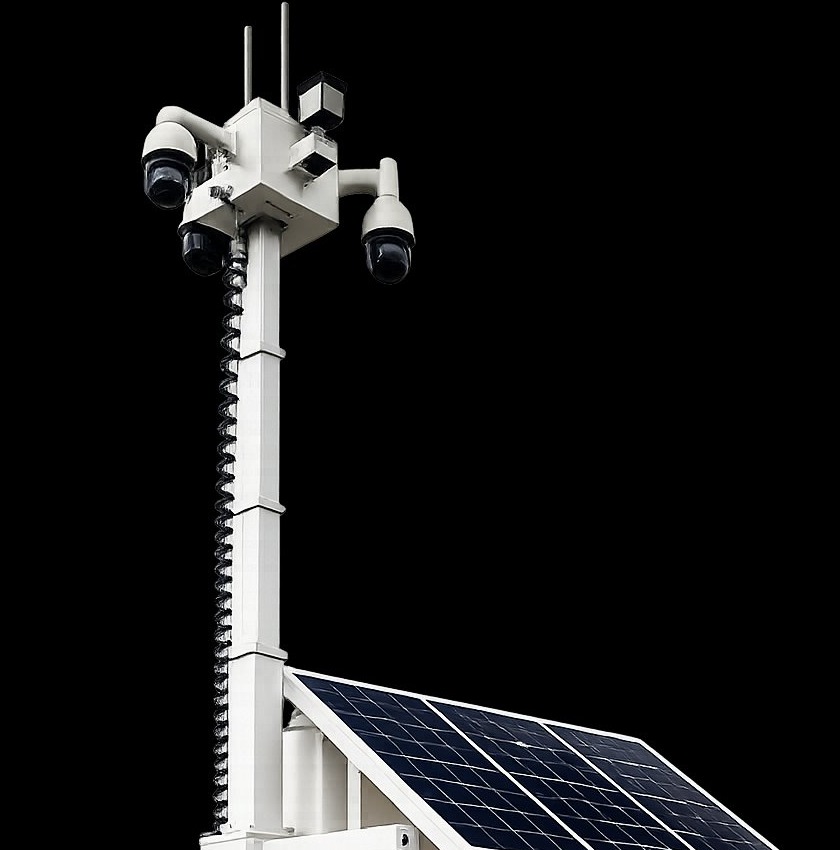
Abstract Enterprises solar surveillance trailer — mast extended with 4K PTZ cameras, dual solar panels, ready for NYC off-grid deployment

Why Surveillance Trailers Make Sense in Queens

Queens is the largest NYC borough by area — 109 square miles covering 2.3 million residents. Between the OneLIC rezone (14,700 units), Jamaica Neighborhood Plan (11,800 units), LaGuardia Terminal B completion, JFK's $19B Redevelopment Program, and the Queens Plaza / Court Square tower pipeline, the borough has more active construction staging than Brooklyn and Manhattan combined. A solar surveillance trailer solves the specific Queens combination: sprawling construction footprints, airport cargo perimeters, vacant-lot liability during phased rezone buildouts, Operation Hellcat-style organized car-theft rings, and street-takeover events that target residential corridors from Malba to Middle Village.

🏗️

OneLIC Rezone + Court Square Tower Pipeline

The OneLIC plan rezones 54 blocks of Long Island City for 14,700 new units — including the former Amazon HQ2 site. Phased construction runs through the 2030s. Active LIC builds include the 56-story 600-condo skyscraper (spring 2026 vertical start), Queens Plaza 561-unit tower, Radiant (117 units), Link (413 units), Packard Motor Building (325,000 sq ft renovation, Feb 2026 completion), and 43-05 Crescent Street (39 units). Every one of these sites has a 12–18 month excavation-and-foundation phase with zero utility power. A solar trailer bridges that gap without trenching.

🏘️

Jamaica Neighborhood Plan 11,800 Units

The Jamaica Neighborhood Plan rezones 230 blocks of central and southern Jamaica for 11,800 new homes (3,800 affordable under MIH) plus 2 million sq ft of commercial space. $700 million city investment. 15-year buildout. Expect phased demolition, staging yards, and laydown areas rotating through Downtown Jamaica, South Jamaica, and Rochdale Village for the next decade. 103rd Precinct (Jamaica) and 113th Precinct (South Jamaica) crime patterns — including 18% rise in index crime in 113th 2025 — make active surveillance non-optional for GCs.

✈️

JFK + LaGuardia Airport Perimeter

JFK's $19 billion Redevelopment Program includes Terminal 1 rebuild (JFK Millennium Partners), Terminal 4 expansion, Terminal 6, and constant cargo-yard and fuel-farm staging. LaGuardia's Terminal B finished, Terminal C + central heating plant work continuing. Both airports have miles of perimeter fence, cargo staging, ground-transport overflow lots, and construction trailers — none of which can run on airport power without FAA coordination. Self-contained solar trailers deploy without that permit layer.

🚗

Operation Hellcat + Organized Car Theft

Queens DA's three-year Operation Hellcat investigation indicted 20 defendants for 126 stolen vehicles worth $4.6 million — 52 stolen from Queens. Dealer lots in College Point, Flushing, Corona, and Jackson Heights are primary targets. Car-theft rings scout lots for days before hitting. A solar trailer with LPR on the entry gate captures plates of every scouting vehicle a week before the theft — usually enough deterrent to send the crew to a softer target.

💨

Street Takeovers + Donut Intersections

Queens has become the East Coast epicenter for organized street takeovers — Malba (Nov 2025: 100+ cars, South Drive / 141st Street, security guard injured, vehicle set on fire), Middle Village (recent: 100 cars doing donuts at a major intersection, plates covered). Commercial property owners at intersections with wide clear approaches are the targets. A surveillance trailer with LPR, blue strobes, and live-agent talk-down closes these events in 3–5 minutes before police arrive — and captures identifying footage when they don't.

🅿️

Citi Field + Arthur Ashe Event Perimeter

Citi Field (81 Mets home games + concerts), Arthur Ashe Stadium (US Open 2 weeks + off-season events), Forest Hills Stadium (concert season), and Flushing Meadows Corona Park events draw millions of vehicles into Queens parking zones. Event-parking theft, catalytic converter cuts, and tailgate incidents spike on game days. A portable solar trailer covers Lot A or K on Mets home stands, repositions for tennis, covers summer concerts at Forest Hills — one contract, rotating deployment, no permanent infrastructure.

What's Actually on the Trailer

Every solar surveillance trailer we deploy is a layered system: imaging, power, connectivity, deterrence, and AI analytics. Here's the breakdown of what each sub-system does and why NYC sites need every one of them.

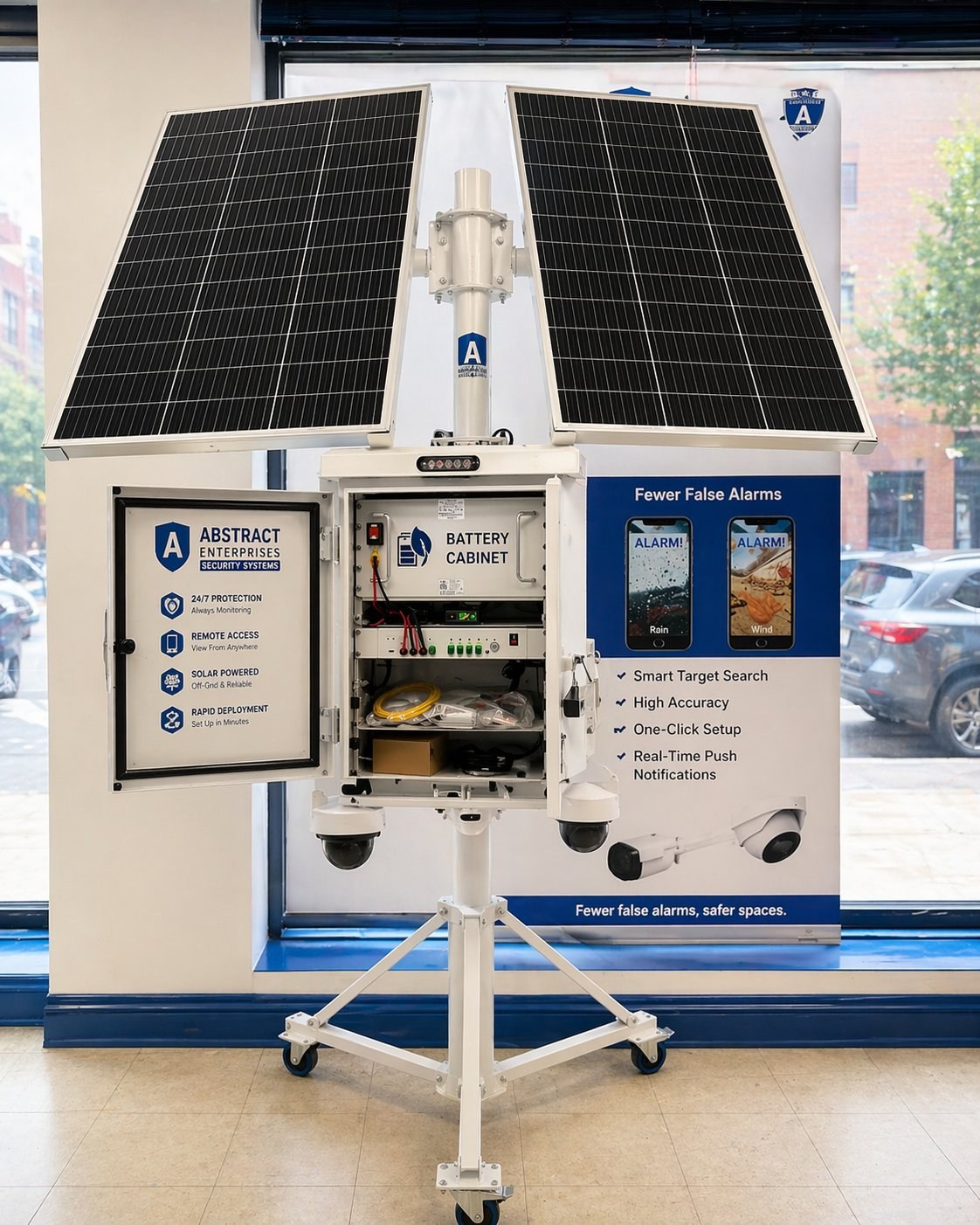
Open battery cabinet on Abstract solar surveillance trailer — exposed lithium battery bank, charge controller, cellular router, PTZ cameras mounted below, solar panels above
Inside the cabinet: deep-cycle battery bank, solar charge controller, 4G LTE router, and the equipment rack that runs a solar surveillance trailer 24/7 off-grid.
Imaging

4K HD Cameras, PTZ & Panoramic

Typical configuration: two to three 4K high resolution HD cameras on a high mast (22-foot telescoping) for 360 coverage with elevated view over fences, scaffolds, and containers. PTZ heads pivot on command, zoom 25–30× optical, and deliver true night vision down to near-zero lux. Panoramic cameras provide wide-angle coverage. Commercial grade cameras built for industrial durability.

  • 4K PTZ with 30× optical zoom
  • Panoramic multi-sensor (180°–360°)
  • Thermal imaging + night vision (add-on)
  • License plate recognition (add-on)
Power

Solar Panels, Battery Backup & Energy Independence

Two 400–450 watt monocrystalline solar panels feed a battery backup bank of 6–8 deep-cycle AGM or LiFePO4 batteries (~460 Ah). True energy independence with eco friendly power and long runtime: 10–20 days of autonomy through overcast NYC winters. Zero wiring required, no external power needed — weather resistant, all weather rugged construction. Continuous monitoring with reliable uptime.

  • 800–900W solar panels (dual array)
  • 10–20 day battery backup
  • Weather resistant IP66+ enclosures
  • Rugged construction, all weather rated
Connectivity

4G LTE + Optional Starlink (Remote Viewing)

Multi-carrier 4G LTE modem auto-switches between Verizon, AT&T, and T-Mobile to pick the strongest NYC signal for reliable remote viewing from any device. Optional Starlink "Roam" antenna handles remote HV, Staten Island industrial fringes, and anywhere cell is weak. No fixed internet required.

  • Auto-carrier-select 4G LTE modem
  • Cloud VMS (iOS + Android + web)
  • Encrypted remote viewing pipeline
  • Optional Starlink satellite failover
Deterrence

Strobe Lights, Speakers & Active Deterrence

Blue-red police-style strobe lights mimic an NYPD vehicle on scene — visual deterrents visible from a block away. 110–120 dB loudspeakers and security lighting support pre-recorded automated warnings and live agent talk-down. High-intensity LED floodlights wash the area in daylight-equivalent lumens on motion trigger. Active deterrence with audio deterrents + visual deterrents is the difference between recording crime and preventing crime.

  • Blue/red strobe lights
  • 110–120 dB loudspeaker (audio deterrents)
  • Motion-triggered floodlights (security lighting)
  • Automated warnings + pre-recorded challenges
AI Analytics

AI Detection, Motion Detection & Intrusion Detection

Onboard AI powered edge analytics distinguish people from vehicles, bicycles, and animals — smart detection that eliminates false alarms from blowing tarps. Motion detection zones, intrusion detection, and perimeter protection rules trigger intelligent alerts and active deterrence only during defined "alarm hours." Real time alerts push instant notifications to your phone. The onboard recording system stores 28 days of footage locally.

  • AI powered person / vehicle / bike detection
  • Zone-based motion detection + intrusion detection
  • Real time alerts + motion alerts + instant notifications
  • 28-day local recording (event based + continuous)
Monitoring

Live Monitoring, Remote Access & Cloud VMS

Optional 24/7 UL-listed central station with trained agents: video recording verification, talk-down, police/guard dispatch, and incident reporting. Centralized control via cloud VMS with mobile access, web access, and secure login. Multi unit management for fleets. Real time response on flagged events — search functionality and playback across 28 days of footage for evidence capture.

  • UL-listed live monitoring central station
  • Cloud VMS with mobile app + web access
  • Multi unit management + centralized control
  • Search functionality + playback + evidence capture

Solar Surveillance Trailer, Mobile CCTV, Portable Security Trailer — What's The Difference?

There are easily a dozen names in circulation for what is, at the end of the day, the same category of product: a self-contained, solar-powered, trailer-mounted surveillance platform. Here's how the industry names overlap, and how we use them on quotes and site plans.

Most Common

Solar Surveillance Trailer

The industry-default term. Used interchangeably with "solar powered surveillance trailer," "mobile solar surveillance trailer," "portable solar surveillance trailer," and "solar security trailer." Describes any trailer-mounted platform powered primarily by solar panels with cameras on a telescoping mast.

Functional

Solar CCTV Trailer / Solar Camera Trailer

Same product, CCTV-forward framing. "Solar CCTV trailer," "solar powered mobile CCTV trailer," and "solar security camera trailer" are used in commercial procurement docs. On our abstractcameranewyork.net CCTV-branded site we use this terminology. The technology underneath is identical.

Feature-forward

Wireless Solar Surveillance Trailer

Refers to units with no hardwired power or data — pure cellular/wireless. Every legitimate solar surveillance trailer is functionally a wireless solar surveillance trailer, since solar + LTE means no cables leave the chassis. Also called an "off grid surveillance trailer" when deployed somewhere with no grid service available.

Camera-forward

Solar Powered Security Camera Unit

Casual names used by GCs and property managers who care more about the cameras than the trailer platform. "Solar powered security camera unit," "solar monitoring trailer," and "solar surveillance unit" all land in this bucket. Same product, different vocabulary.

Self-Contained

Solar Powered Mobile Surveillance Unit

Emphasizes zero grid dependency. "Solar powered mobile surveillance unit," "solar powered trailer security system," and "solar powered security camera unit" all describe the same autonomous box. Relevant when the site has literally no electrical service.

Tower-style

Solar Surveillance Tower Trailer

Used when the emphasis is on the mast height rather than the chassis. "Solar surveillance tower trailer" and "solar powered surveillance tower" both describe units with telescoping masts (typically 20–25 ft) that elevate cameras above fence lines, containers, and scaffolding for a 360-degree elevated view.

Trailer Platforms & Camera Brands We Spec

We're agnostic on hardware — we match the platform to the site. For fleet-scale developers we favor NDAA-compliant US-built trailers; for shorter deployments and sub-$2k monthly budgets we deploy camera-agnostic platforms paired with commercial-grade imaging.

LiveView Technologies (LVT)
Industry-leading cellular trailer
WCCTV
800W solar, 10+ day battery
GoView
NDAA/TAA compliant, US-built
Backstreet Surveillance
23-ft electric mast, Hanwha PTZ
STARCOMM
2,800 lb fast-deploy platform
VORP Energy
800W–1600W, 5–15 kWh banks
Hanwha Vision
PTZ / PNM multi-sensor cameras
Axis Communications
Q-Series PTZ, thermal perimeter
Avigilon / Motorola
Self-learning analytics
Hikvision (non-federal)
Budget-friendly imaging (private sites only)
Dahua / Uniview
Commercial-grade PTZ options
Starlink Roam
Satellite failover connectivity

The Packages Most NYC Sites Actually Order

After hundreds of deployments across the five boroughs, Long Island, and the Hudson Valley, three configurations cover roughly 80% of requests. Here's what's inside each.

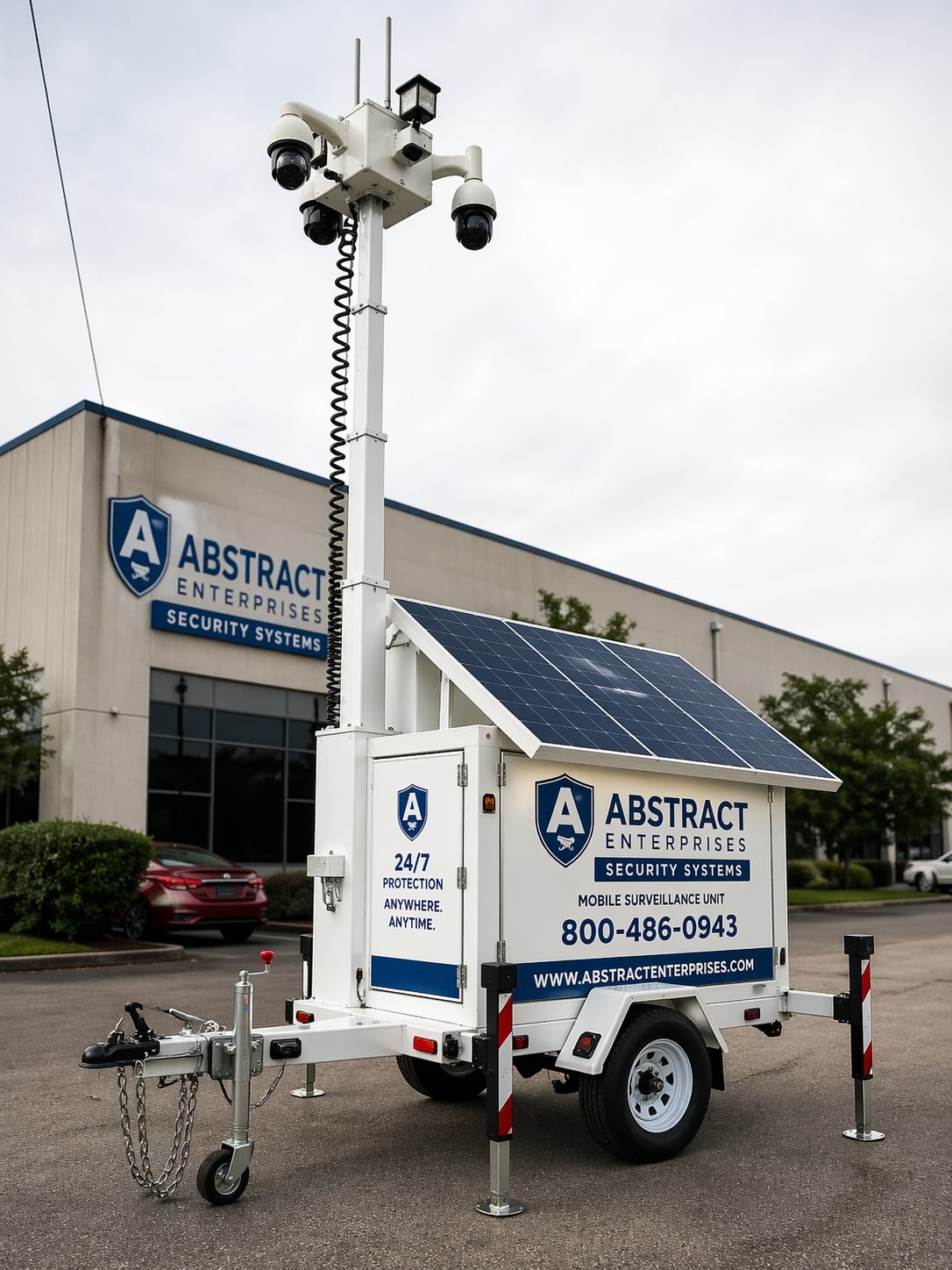
Abstract Enterprises solar surveillance trailer deployed outside commercial warehouse — mast raised with 4K PTZ cameras, solar panels, and branded 24/7 protection messaging
Actual Abstract Enterprises solar surveillance trailer, fully deployed with mast raised — ready for 24/7 protection anywhere in NYC.

🏗️ CORE PERIMETER PACKAGE — Most common

Single 22-ft mast trailer · 2 PTZ cameras + 1 multi-sensor fixed · 800W solar · 10-day battery · LTE · strobes + talk-down · self-monitoring portal. Best for: small-to-mid construction sites, dealer lots under 2 acres, single-building demolition.

2× 4K PTZ cameras

30× optical zoom each

1× fixed multi-sensor

180° panoramic overwatch

800W solar array

10+ day battery autonomy

Cloud VMS + app

iOS / Android / browser

🚗 PARKING + LPR PACKAGE

Core perimeter package + license plate recognition camera on entry lane + watchlist alerts. Best for: dealer lots, TLC/rideshare lots, U-Haul yards, self-storage perimeters, any site where plate evidence matters more than just video.

All Core features

+ dedicated LPR camera

Watchlist alerts

Flag known plates instantly

Plate-stamped footage

Every clip indexed by plate

Insurance-grade evidence

Ready for NYPD report

🔥 THERMAL + LIVE-AGENT PACKAGE — Highest deterrence

Core package + FLIR/thermal perimeter camera + 24/7 virtual guard monitoring + guaranteed response SLA. Best for: high-value material stockpiles (copper, fuel, catalytics), gov't/infrastructure sites, large event security, and repeat-theft locations.

Thermal imaging

Detect heat in zero light

Live agent monitoring

Trained UL-listed operators

Talk-down on command

Agent-initiated voice challenge

Police dispatch SLA

Verified alarms prioritized

Every Feature, Listed Out

For the GCs and procurement leads who want a straight spec sheet, here's what a fully-loaded unit from Abstract includes. Matches every RFP line item we've seen.

Hardware

Plug and Play Hardware

Plug and play platform with high mast cameras (22-ft telescoping), high resolution 4K imaging, and solar efficiency >22% on mono panels. Industrial durability rated for five-year continuous deployment. Speakers and lights integrated. Heavy duty chassis with galvanized frame. Rugged construction, high performance across all seasons.

Software

Enterprise VMS Software

Advanced VMS software with surveillance analytics, enterprise security features, and a user friendly dashboard. Live feed access from any browser, mobile app, or cloud. Event based recording + continuous recording with flexible storage options. Playback, search functionality, and evidence capture built in. Enterprise software integrations via open API.

Operations

Advanced Monitoring & Deployment

Advanced monitoring dashboard with remote administration, centralized control, and multi unit management. Scalable deployment across multiple sites — flexible configurations per unit, customizable packages. Proactive security with advanced threat detection + real time response. Innovative surveillance technology built for NYC-scale projects.

Compliance

Compliance & Documentation

Compliance-ready footage with timestamping and chain-of-custody documentation. Security documentation for insurance, police reports, and DOB filings. Incident reporting, event logs, and evidence capture built into the VMS. Required for contractors on Site Safety Plan projects.

Use Cases

Job Sites & Industrial Sites

A trailer for job sites and industrial sites handles the same coverage profile: perimeter, entry lanes, material stockpiles, fuel tanks. Our solar powered security trailer configurations are tuned for each environment — construction phasing, industrial 24/7 operations, or remote yard coverage.

Commercial Paths

Rental, Installation & Leasing

Three commercial paths: (1) short-term rental for events or phased projects, (2) solar surveillance trailer installation with full ownership and on-site commissioning — our portable surveillance trailer for sale inventory includes high resolution solar surveillance trailer configurations, (3) solar surveillance trailer leasing on 12–36 month terms with purchase credit. Rent solar surveillance trailer near me searches hit this page specifically — we deliver next business day anywhere in NYC metro.

Where We Deploy Across Queens

We've dropped trailers on active construction sites, airport perimeters, dealer lots, and event venues across every Queens zip code. A partial list of landmarks and project zones where mobile solar surveillance makes sense in Queens:

OneLIC Rezone (Court Square) — 54 blocks, 14,700 units, former Amazon HQ2 site
Jamaica Neighborhood Plan — 230 blocks, 11,800 units, $700M city investment
JFK Airport $19B Redevelopment — Terminal 1 rebuild, Terminal 4/6 work, cargo yards
LaGuardia Airport — Terminal B complete, Terminal C work, ground-transport lots
Queens Plaza 56-Story Tower — 29-10 Northern Blvd, 561 units, 2026 completion
Packard Motor Building — 32-02 Queens Blvd, 325K sq ft Related renovation
Long Island City Waterfront — Gantry Plaza to Queensbridge Park corridor
Hunters Point South — tower pipeline, Vernon Blvd construction
Astoria — 30th Avenue corridor, Astoria Cove, Steinway industrial
Sunnyside + Woodside — Queens Blvd construction, 7-train corridor
Flushing Main Street — 136-15 38th Ave mixed-use, 9-story builds
Corona + Elmhurst — Roosevelt Ave corridor, dealer lots, 110th Precinct
Jackson Heights + Woodside — residential corridors, 34th Ave Open Street
Citi Field + Mets-Willets Point — 81 Mets home games, event parking lots
Arthur Ashe Stadium (USTA) — US Open 2-week perimeter, year-round events
Forest Hills Stadium — concert season, 13,000-seat venue perimeter
Flushing Meadows Corona Park — 897-acre park, Unisphere area, events
Forest Hills Gardens — private community, residential burglary targets
Rego Park + Kew Gardens — Queens Blvd commercial corridor
Jamaica AirTrain + LIRR hub — Sutphin Blvd, transit-adjacent theft
Rochdale Village (South Jamaica) — 5,860-unit co-op, 113th Precinct
Howard Beach + Ozone Park — industrial perimeter, rezoned parcels
Rockaway Beach + Boardwalk — seasonal concessions, 100th/101st Precincts
Far Rockaway + Breezy Point — waterfront residential, post-Sandy rebuilds
Bayside + Little Neck — suburban residential, 111th Precinct
Malba + Whitestone + College Point — street-takeover targets, dealer lots

Industries Using a Solar Surveillance Trailer

A solar surveillance trailer fits any site where you need rapid deployment, temporary surveillance, mobile security, or perimeter security but power and fixed infrastructure aren't available. Our solar surveillance trailer system supports contractors, construction companies, property managers, municipalities, and developers across the NYC metro, LI, and HV regions.

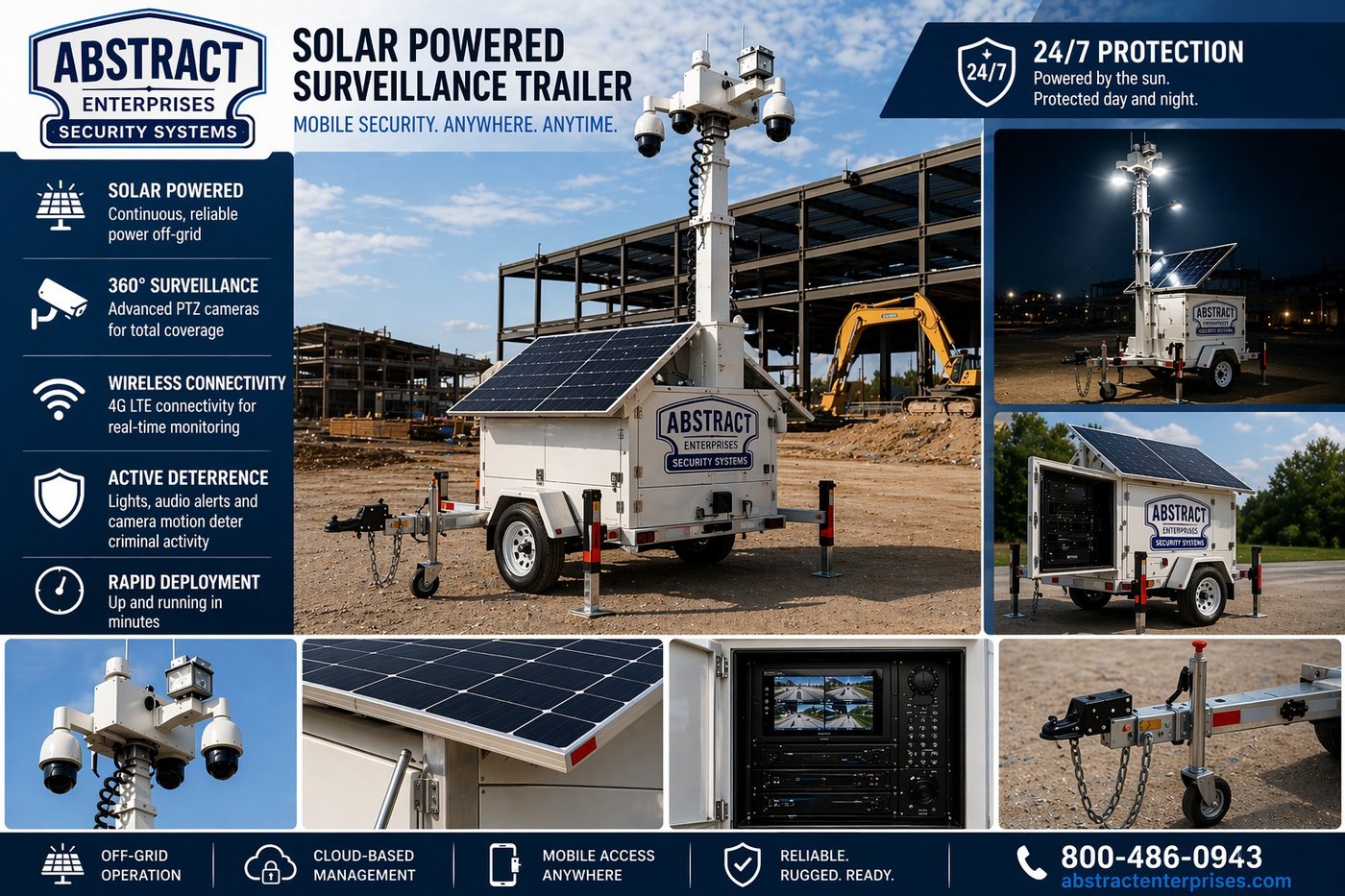
Solar surveillance trailer deployed at active NYC construction site — excavator in background, 4K PTZ cameras on 22-foot mast, solar panels, rapid deployment for job site security
Active construction site deployment — solar surveillance trailer protecting equipment, materials, and perimeter from the first day the fence goes up.
🏗️

Solar Surveillance Trailer for Construction Sites & Job Sites

The biggest category. GCs, contractors, and construction companies rent a solar surveillance trailer the moment the fence goes up. Job site security and theft prevention across active demo, excavation, framing, and MEP rough-in phases — protects equipment protection, material protection, and asset protection from day one.

📦

Solar Surveillance Trailer for Warehouses & Industrial Sites

Outer-borough warehouse perimeters, last-mile distribution, cold storage yards, container overflow lots, trucking depots, and industrial sites. A solar surveillance trailer for warehouses protects freight, chassis, fuel, and perimeter — site monitoring and outdoor security without trenching for fixed cameras.

🅿️

Solar Surveillance Trailer for Parking Lots

Car dealerships, U-Haul yards, TLC/rideshare lots, airport overflow parking, retail center lots. A solar surveillance trailer for parking lots cuts catalytic converter theft, vehicle break-ins, and fuel siphoning with active deterrence and crime prevention coverage.

🎪

Solar Surveillance Trailer for Events & Festivals

Randall's Island festivals, Coney Island boardwalk events, Prospect Park concerts, Flushing Meadows events. A solar surveillance trailer for events handles crowd-overflow perimeter, vendor-booth coverage, and equipment storage areas overnight — rapid deployment, easy setup, plug and play.

🚜

Solar Surveillance Trailer for Farms

Upstate NY farms, orchards, Hudson Valley vineyards, and agricultural equipment yards. A solar surveillance trailer for farms covers barns, fuel tanks, livestock perimeters, and harvested-crop staging areas where grid power is hundreds of feet from the asset.

🛢️

Solar Surveillance Trailer for Remote Locations

Oil and gas pads, pipeline ROW, utility substation yards, construction staging far from grid power. A solar surveillance trailer for remote locations uses long-autonomy battery backup (15+ days) since site visits are weekly or monthly, not daily — ideal for infrastructure projects and municipalities.

🏢

Solar Surveillance Trailer for Commercial Properties

Vacant commercial buildings, rezoned lots pending development, post-demolition footprints, property under litigation. A solar surveillance trailer for commercial properties gives property managers temporary surveillance where leaving an asset unguarded creates liability exposure.

🌆

Municipalities & Infrastructure Projects

DOT laydown yards, sanitation garages, DOE school construction perimeters, NYCHA renovation sites, public works staging. Solar surveillance trailer system deployments align with NYC procurement and SST card documentation requirements.

What People Actually Ask Before Renting in Queens

Pulled from what Queens GCs, dealer-lot owners, airport cargo operators, event coordinators, and property managers post on r/Queens, r/AskNYC, r/construction, r/nyc, r/homedefense, and r/longislandcity. Real questions, real answers — no sales fluff.

Cost
How much does a solar surveillance trailer cost per month in Queens?

Queens monthly rental runs $2,800 to $5,150/month depending on camera count, monitoring tier, and term length. Entry tier with 1 PTZ + 1 fixed camera + self-monitoring is $2,800. The most-popular Pro tier with 2 PTZ + 1 multi-sensor + AI + talk-down is $3,890. Max tier with thermal + LPR + 24/7 live agent monitoring is $5,150. Permanent installed solar surveillance tower for Queens starts at $33,600. Call (347) 934-8335 for a flat quote tied to your specific Queens site.

Cost
Is a trailer cheaper than hiring overnight security for a LIC tower or Jamaica construction site?

Queens union guard rates for commercial construction run $32–$48/hr; a single 12-hour overnight shift is $380–$575 or $11,500–$17,500/month for 7-day coverage. A trailer with 24/7 live-agent monitoring covers the same 12-hour window for $2,800–$5,150/month — 25–35% of the guard cost — and doesn't call out sick on a holiday weekend. For a 12-to-18-month LIC tower or Jamaica rezone build, you're saving $100K+ across the project with full documented video.

Cost
Delivery fee to Queens from your Brooklyn location — anything hidden?

Delivery is included anywhere in Queens from our 1282 Troy Avenue location in East Flatbush — we're 20–35 minutes from anywhere in the borough depending on bridge/tunnel traffic. No fuel surcharge, no mileage fee. Two free repositions per rental term. If your OneLIC site footprint shifts when the foundation pours happen, we move the trailer without a re-deploy fee. Same rule for service calls: 24/7 response covered in the rental rate, no trip charge. For JFK/LaGuardia airport-side deployments requiring airside access, we coordinate TSA badging separately.

Quality / Trust
Does a visible trailer actually deter Operation-Hellcat-style theft rings targeting Queens dealer lots?

Published industry data shows 60–70% drops in theft at sites where a visible solar trailer is deployed. Three things work specifically in Queens: the 22-ft mast is visible from a block away (matters because Queens dealer lots and LIC staging sites are often on wide commercial streets with distant sight-lines), the blue/red strobes mimic NYPD cruiser lights (deterrent even before an operator engages), and the LPR camera at the gate captures plates of every scouting vehicle for 5–7 days before an attempt. For the exact pattern Operation Hellcat used — crews scouting dealer lots in College Point, Flushing, and Jackson Heights days before hitting — LPR alone is often enough to redirect them to a softer target.

Quality / Trust
Will the cameras resolve plates on Queens Blvd or Northern Blvd at the speeds cars travel?

Two variables decide this: resolution and placement. A 4K PTZ with 30× optical zoom plus dedicated LPR camera resolves plates at 150–200 feet if aimed at the choke point — your driveway gate, your dock, your loading bay, or a specific intersection turn. The trap is buying high-res and panning a 6-lane thoroughfare like Queens Blvd or Woodhaven Blvd — pixel density per target collapses. We do a site walk before deployment to identify the 2–3 actual choke points. For Queens dealer lots the critical points are usually: main vehicle gate, pedestrian access door, and material-storage approach.

DIY vs Pro
Can I just buy a few solar cameras from Amazon for my Astoria or Flushing construction site?

For a 2-month backyard extension, maybe. For any commercial Queens job site, three things kill the DIY approach: cheap solar cams run on 2G/4G modems that get throttled during Queens peak-traffic hours, batteries don't carry through a 5-day overcast stretch, and they have no talk-down speaker, no blue strobe, no live agent monitoring. The 22-ft visible tower is the actual deterrent on a construction site. A $200 pole-cam zip-tied to scaffolding isn't security — it's evidence collection after your copper spools and compressors are gone.

DIY vs Pro
Can my event staff self-deploy trailers when we move between Citi Field, Arthur Ashe, and Forest Hills?

Yes. Most trailers are designed for one-person setup in 20–30 minutes: hydraulic jacks down, mast crank-up, panel tilt, cellular handshake. The trap for Queens event venues specifically — sunlight angles shift wildly from March (US Open tune-ups) through November (Mets playoffs + Forest Hills concerts). We do the first deploy at each venue to dial in true-south panel orientation for the season, then your event-ops team can reposition for future events. We also train your designated staff during that first install so the setup is documented for permit files.

Technical
How long will it run through a Queens nor'easter or 5-day cloudy stretch?

Standard LiFePO4 battery bank carries 10–15 days of full surveillance at full camera load. The Sentry-Pro extended config handles 20+ days. Queens winters see nor'easters with coastal wind-driven snow (especially Rockaway, Far Rockaway, Breezy Point) and 5-day cloud cover stretches. We size every Queens deployment to cover a 3-week worst-case without solar input. For waterfront sites in the Rockaways, College Point, Whitestone, and Malba, we run marine-rated configurations to handle salt spray.

Technical
Will cellular actually work between LIC high-rises or inside Hunters Point construction sites?

Our trailers use multi-carrier SIM rotation — Verizon, AT&T, and T-Mobile — and auto-pick the strongest signal. That covers 98% of Queens. For sites in building canyons where multipath interferes (deep in Court Square, inside active Queens Plaza towers, interior Packard Motor Building rebuild), we add Starlink "Roam" as failover. Cost adds $200–$350/month but guarantees satellite uplink. We do signal test on site before committing to pure-cellular — especially around Citi Field during game-day congestion when 70,000 phones crush the cell towers.

Technical
Can the trailer integrate with Port Authority / FAA requirements for JFK and LaGuardia airside deployments?

Yes, but airside deployment adds a layer. Airside JFK or LaGuardia means TSA-approved badging for any operator entering, FAA compliance on mast height (we have sub-25-ft masts specifically for airport operating envelopes), and Port Authority coordination for placement relative to taxiways. Landside — cargo lots, parking facilities, construction trailers on the perimeter — runs like any commercial Queens site. We've deployed both and know which forms you need before site walk. Call (347) 934-8335 for an airport-specific quote.

Landlord / Commercial
I own a mixed-use building in Jackson Heights with a dealer on the ground floor — do I need COI coverage from the trailer vendor?

Yes, and we provide it. Standard COI names you (the property owner), the dealer (tenant), and any first mortgage holder as additionally insured. Issued within 24 hours at no additional fee. Standard coverage limits: $1M per occurrence, $2M aggregate, $1M excess. If your lender needs non-standard wording (e.g. waiver of subrogation, primary + non-contributory), we route through our broker for rider issuance — typically 48–72 hours.

Landlord / Commercial
Do I need any permits to park a surveillance trailer on my Queens lot or private driveway?

On private property (your own lot, your construction site, your own driveway behind the setback), no permit is required. If you're staging on a curb or sidewalk, that's a different matter — you'll need an NYC DOT Storage Permit, and DOB may require you to list the trailer on your Site Safety Plan. For most active construction sites in Queens, the GC handles this as part of the existing permit package; we provide the COI and NYS license documentation (#12000287431) for filing. Specific to Queens: if your site is within 500 ft of a Port Authority facility (JFK, LaGuardia, any bridge/tunnel approach), PA coordination may also be required.

Complaints / Pitfalls
I've heard horror stories about national rental brands — long lead times, no support. How are you different?

Most national solar-trailer rental fleets operate out of Texas, Florida, or the Midwest — they freight to NYC on 5–10 day lead times with call-center support based across the country. We're a locally-owned, NYS-licensed contractor (NYS #12000287431) with our Brooklyn GBP at 1282 Troy Avenue — 25 minutes from LIC and 35 from JFK at worst. Typical Queens lead time is same day or next business day, not 10. Support goes direct to the owner, not a ticket queue. If something breaks at 2 AM on a Jamaica rezone site, the phone number you dial reaches the person who installed it.

Complaints / Pitfalls
A neighbor rented a trailer and the talk-down caused a noise complaint — how do we avoid that for residential-adjacent Queens sites?

Talk-down volume is adjustable per zone and time. For Queens sites adjacent to residential — LIC tower footprints right up against existing Hunter's Point low-rise, Jamaica sites across the street from Rochdale Village, Astoria jobs next to Steinway residential — we set talk-down volume to "challenge level" (audible to someone on the site, not to a sleeping neighbor) and escalate to "deter level" only when motion persists past warning. Live-agent monitoring also means an actual operator reviews intrusion before triggering strobes/audio. False-dispatch rate on our Queens deployments runs under 2%.

Other Common Questions

What is a solar surveillance trailer?

A solar surveillance trailer is a portable outdoor security platform mounted on a towable trailer, powered entirely by onboard solar panels and battery backup. It carries HD cameras on a high mast (22-ft telescoping), 4G LTE cellular connectivity for remote viewing, AI powered analytics for intrusion detection and motion detection, strobe lights, loudspeaker deterrence, and onboard recording. Deploys in 30 minutes with no grid power or trenching.

How does a solar surveillance trailer work?

Solar panels charge a battery backup bank during daylight, powering cameras, cellular radio, strobe lights, and speakers 24/7. Cameras detect motion or classified targets (people, vehicles) via smart detection AI, trigger active deterrence (strobes, talk-down audio), and stream footage over 4G LTE to your phone app or a live monitoring center. Everything is self-contained — no external wiring leaves the trailer.

How long do solar surveillance trailers last?

On a single battery charge with no sun at all, industry-leading trailers last 10–20 days. On normal operation with solar recharge, they run indefinitely with continuous monitoring. Physical hardware lifetime: solar panels 20–25 years, LiFePO4 batteries 8–10 years, AGM batteries 4–6 years, cameras and electronics 5–8 years.

Can solar surveillance trailers run 24/7?

Yes — that's the primary purpose. Properly specced trailers run 24/7 year-round with reliable uptime. Winter in NYC with shorter days and heavier cloud cover is the stress test; our 800W dual-panel + 460 Ah battery backup handles it without a backup generator in 95%+ of NYC deployments.

Do solar surveillance trailers work at night?

Yes — cameras run on battery power through the night, with night vision (IR or color-at-night low-lux imaging) for clear footage. The solar array recharges during daylight. Battery backup provides long runtime even through multiple overcast days or winter weather.

Are solar surveillance trailers worth it?

For temporary security, rapid deployment, or sites without grid power — absolutely. A single trailer replaces an overnight guard at roughly 20% of cost, provides documented evidence for insurance, and deters theft 60–70%. For permanent installations in buildings with existing electrical, traditional wired cameras may cost less long-term. The decision hinges on deployment duration and grid availability.

Who needs a solar surveillance trailer?

Contractors, construction companies, property managers, municipalities, developers, infrastructure project leads, event producers, warehouse operators, farm owners, and anyone managing temporary surveillance needs on commercial properties, industrial sites, or remote locations. If the asset is outdoors, valuable, and the site has no permanent power — this is the tool.

What industries use solar surveillance trailers?

Construction, logistics/warehousing, parking/automotive, events/festivals, agriculture/farms, oil and gas, utilities, municipalities, commercial real estate, and infrastructure projects. Also film production, DOT laydown yards, and vacant property management across NYC, Long Island, and the Hudson Valley.

How to install a solar surveillance trailer?

We handle it. A trained tech tows the unit to site, lowers the hydraulic jacks, raises the mast, orients solar panels for optimal sun exposure, aims cameras, activates the cellular link, configures geofence and alarm rules, and verifies live stream before leaving. Total install time on-site: 30–90 minutes depending on complexity. Plug and play — you don't need an electrician.

What cameras are used in solar surveillance trailers?

Commercial grade cameras from Hanwha, Axis, or Avigilon — PTZ at 4K / 30× optical zoom, plus fixed multi-sensor or panoramic cameras for wide coverage. Add-ons: thermal cameras (FLIR), LPR (license plate recognition), and color-at-night low-lux sensors for night vision without visible IR.

Solar surveillance trailer vs traditional security systems — which wins?

Solar wins for temporary surveillance, rapid deployment, and remote locations: no trenching, no permit delays, mobile between sites. Traditional wired security systems win for permanent installations in buildings with existing electrical service. The crossover point is about 18 months of continuous deployment — below that, solar is cheaper; above that, permanent wiring often pays off.

Solar surveillance trailer vs wired cameras?

Wired cameras need conduit runs, a power panel, and usually an NVR in a climate-controlled space — all fine for permanent buildings, impossible on active construction sites. A solar surveillance trailer skips all that with self-contained solar panels, battery backup, and 4G LTE connectivity. For temporary, phased, or off-grid deployments, solar is the only option.

How tall is a solar surveillance trailer?

Most units stand 20–25 feet at the mast tip with cameras around 22 feet — a high mast elevated view that clears fences, containers, and most scaffolds while staying short enough for NYC overhead utility lines during transport.

How much does the trailer weigh?

Typical deployed weight is 2,500–3,200 lbs. Standard ball hitch, tows behind any half-ton pickup. Max width stays inside 8 feet for NYC street-legal transport without an oversize permit.

What the AI Overviews Get Wrong

Google's AI Overview, Angi, HomeAdvisor, Fixr, and the first-page blog aggregators all quote price ranges and spec claims that don't match what Queens sites actually experience. Here's what the AI tools say vs. what a Queens-deployed trailer actually looks like.

Why this matters: If you're sizing a budget from a Fixr cost calculator or an Angi "average price" article, you'll land on numbers that were scraped from nationwide averages and blended with suburban deployments. Queens is not the national average. Below, we tear into the most common AI-generated claims one at a time.

1. "Solar surveillance trailers cost $800/month"

AI Overview saysQuoting a bargain-site aggregator, several AI tools surface a "typical" rental rate starting around $800–$1,200 per month for a basic mobile surveillance unit.
Queens realityThe $800 number is a no-monitoring, single-camera, 12-month-minimum rate from a Texas/Florida provider with no NYC presence. Real Queens rentals including delivery, one PTZ + one fixed, and self-monitoring land at $2,800/month baseline for a short-term rental — Pro tier with AI analytics runs $3,890, thermal + live-agent runs $5,150.
Bottom lineAny AI or aggregator quoting sub-$2,200/month for a Queens deployment is either (a) not including delivery, (b) not including monitoring, (c) quoting a 12+ month lock-in rate as a monthly price, or (d) lifting a number from a suburban-market quote. Verify with a real local vendor what's actually included — published prices without scope are meaningless.

2. "Deployment takes 10 minutes"

AI Overview saysMarketing copy on several OEM sites (reproduced in AI answers) claims a "10-minute deployment."
NYC realityMechanical setup is 10–15 minutes. Getting the thing through the Holland Tunnel, negotiating with a parking attendant, finding a stakeable spot on an active NYC jobsite, and aligning the geofence to a rectangular footprint around active scaffold is another 60–90 minutes. Plan a half-day window for first deployment, not a coffee break.
Bottom lineRelocations after the first deploy are faster — 20–30 minutes if you've already validated cellular signal and panel orientation at the new spot. But never budget "10 minutes" into a GC's schedule for a first-time placement on a Queens job site. DOB walk-downs, FAA/PA coordination if you're near JFK or LaGuardia, and LIC tower crane-shadow assessment alone burn an hour.

3. "It runs forever on solar"

AI Overview saysSustainability-angle marketing copy emphasizes "unlimited runtime" and "zero ongoing power costs."
NYC realityPanels under a crane shadow, a scaffolded adjacent building, or an inner courtyard produce 20–40% of spec. Battery is the buffer, but a 3-week shade event plus cloud cover will drain any battery bank. A pre-deploy shadow study is the actual fix — which most aggregator-tier vendors skip.
Bottom lineFor sites with chronic shade or inner-courtyard placement, you have three real options: (1) oversized solar array + 2× battery bank, (2) shore-power tie-in if a nearby outlet exists, or (3) accept a ~72-hour battery buffer and swap-and-charge a second battery bank weekly. Any vendor claiming "set it and forget it" on a shaded NYC site is glossing over a planned maintenance cycle.

4. "Any guard can be replaced by a trailer"

AI Overview saysA common Fixr/Angi claim: "one trailer replaces one guard, save 80% of cost."
NYC realityA trailer replaces a stationary overnight guard at ~20% of cost, absolutely. It cannot replace a roaming patrol guard who locks gates, logs deliveries, escorts subs, or handles tenant interactions. For most NYC GCs the smart move is a hybrid: one day-shift guard for active hours + one or more trailers for 6 PM–6 AM coverage. The savings are real but the math isn't "1 trailer = 1 guard."
Bottom lineThe right framing is: a trailer replaces coverage hours, not the human. If your guard costs $12K/month and you can cover 80% of the risk hours with a trailer at $2,800/month + a 3-hour day-guard presence, you've cut the budget by 60% while keeping the human-judgment piece for active hours. Model the shifts, not the headcount.

5. "Cellular just works, everywhere"

AI Overview saysAggregators describe "seamless cellular connectivity" as a baseline feature.
NYC realityCellular fails in three predictable NYC locations: deep excavation pits (below grade kills LTE), interior courtyard sites surrounded by tower cranes, and waterfront industrial zones where the nearest macro cell is blocked by container stacks. Multi-carrier SIM + Starlink failover is the only real answer. Single-carrier cellular is a recipe for a bricked trailer when you need it most.
Bottom lineBefore signing, ask the vendor two things: (1) which carriers are in the SIM rotation and (2) what happens if all cellular fails — is there onboard storage plus an automatic sync when signal returns, or does the trailer just go dark? The answer tells you whether the unit was engineered for real urban conditions or for suburban demo days.

6. "All trailers are basically the same"

AI Overview saysAggregator articles frequently describe trailers as an undifferentiated commodity.
NYC realityThe spread between a premium platform (LVT, WCCTV) and a budget white-label trailer is enormous on the metrics that matter: battery autonomy (10+ days vs. 3–4), camera optics (Hanwha/Axis 4K vs. generic 2MP), edge AI quality (false alarms per week), and — most importantly — monitoring infrastructure. A cheap trailer with a $40/month offshore monitoring desk is not the same product as an LVT unit on a UL-listed US operator floor.
Bottom lineWhen comparing quotes, ask for the spec sheet on four things: battery chemistry (LiFePO4 vs. AGM), camera sensor model number, edge-AI platform (onboard vs. cloud-only), and monitoring operator location + certifications. If a vendor can't produce those in writing, treat the quote like a lead magnet, not a real proposal.

7. "You don't need a security company — just rent the trailer"

AI Overview saysDirect-to-consumer OEM marketing pitches self-deploy/self-monitor.
NYC realitySelf-deploy works on a lumber yard in Peekskill. On a Manhattan site with DOB Site Safety requirements, a Construction Superintendent, a Site Safety Coordinator, possibly a TPP (Tenant Protection Plan), and a GC who needs documented chain-of-custody for insurance, you want a licensed low-voltage contractor (like us, NYS #12000287431) who speaks DOB, insurance, and police-report language fluently. That's not a sales pitch — it's risk management.
Bottom lineIf something goes wrong on a NYC construction site at 2 AM — an intrusion, a fire alarm, a false trigger that pulls NYPD — you need a licensed, insured, locally-accountable entity on the other end of that phone, not a DIY support forum. The license number on the paperwork is what makes your COI and your legal position defensible. That's the actual service, not the hardware.

DIY Rental vs Licensed Contractor Deployment

❌ Straight DIY Rental

  • No site walk, no shadow study — panels in the wrong orientation
  • Generic camera angles missing active material zones
  • Geofence rectangle doesn't match actual site footprint
  • No liaison with Site Safety Coordinator or DOB docs
  • No coordination with existing alarm or access control
  • You're on the phone with offshore support when it fails at 2 AM
  • Footage chain-of-custody is murky for NYPD reports
  • Re-deploys between sites are on your crew's clock

✓ Abstract Enterprises Deployment

  • Pre-deploy site walk with shadow & signal modeling
  • Custom camera angles per material zone and entry
  • Polygon geofence shaped to actual site (not rectangle)
  • Site Safety Plan coordination with your SSC/CSM
  • Integration with existing alarms, access, and fixed cameras
  • NYC-based support — we drive to you if needed
  • Documented chain-of-custody for insurance + NYPD
  • Re-deploys included in longer-term rentals

Why Queens GCs & Property Owners Call Us

⚡ Rapid Deployment & Plug and Play

Rapid deployment solar surveillance trailer on site within 24 hours, typically operational in 30–90 minutes after arrival. Plug and play setup — no electrician, no configuration wizard. We handle easy setup on first install and train your team on relocation.

🏗️ Commercial Grade, Heavy Duty

Commercial grade cameras, heavy duty trailer chassis, industrial durability built for NYC construction and year-round deployment. Weather resistant, all weather performance, rugged construction — these are not consumer-grade pole cams.

📊 Scalable & Customizable

Scalable solar surveillance trailer system for fleets — run 1 unit or 20 across a multi-acre site, all feeding a centralized control dashboard. Customizable camera packages, solar panel capacity, and monitoring tier. Multi unit management from a single login.

💰 Affordable for Every Project Size

Affordable solar surveillance trailer rental starting at $2,800/month (Queens entry tier). Best solar surveillance trailer pricing for long-term contracts. Commercial solar surveillance trailer fleets get aggressive fleet discounts past 3 units.

🗺️ NYC-Native Logistics

We know which streets have which width restrictions, which bridges to avoid, and which community boards notice a new trailer overnight. Solar surveillance trailer companies and providers outside NYC don't. That's not on any OEM datasheet.

📞 Direct Line to an Owner

No ticket queues, no T1 support. You get Anwar's direct line. Whether it's a malfunction at 11 PM or a relocation request at 6 AM, a human answers. That's the difference between us and a national rental desk.

What Queens Contractors & Property Owners Say

A sample from our Brooklyn GBP at 1282 Troy Avenue — 4.6★ / 190 reviews across NYC deployments, including Queens jobs. Covers LIC tower construction, Jamaica rezone sites, JFK cargo, and Queens dealer-lot clients.

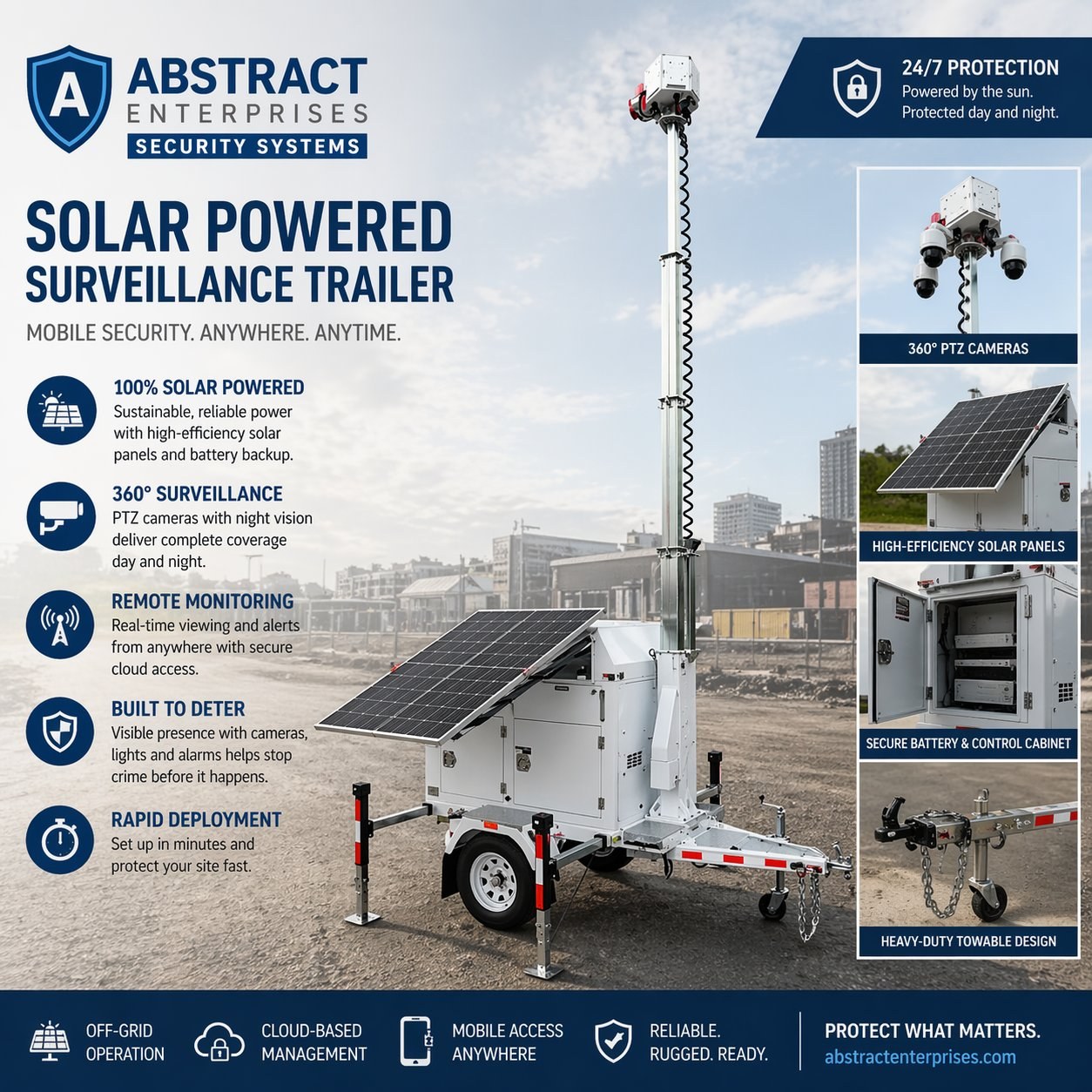
Solar surveillance trailer deployed in urban environment with high-efficiency solar panels, 360° PTZ cameras, secure battery cabinet, and heavy-duty towable design
Full system breakdown — 360° PTZ cameras, high-efficiency solar panels, secure battery & control cabinet, and heavy-duty towable design. Every unit we deploy.
★★★★★

"We were losing copper and compressors at the Packard Motor Building renovation — $28K in the first 6 weeks. Abstract had a trailer on site in under 24 hours. Talk-down caught two intrusions the first week. DOB accepted the archive for our Site Safety File. Haven't lost a lug nut since."

Marcus R.GC — Packard Motor Building renovation, Long Island City
★★★★★

"Our College Point dealer lot was getting hit by the same crew that got caught in Operation Hellcat. Installed a trailer with LPR on the entry and back gate. Three attempts in the first month — all scoured, none followed through. Insurance cut our premium 11% at renewal."

Lena P.Operations Manager — Auto dealer, College Point
★★★★★

"JFK cargo facility needed perimeter coverage during a fuel-farm reroute project. Port Authority approved the sub-25-ft mast configuration. Abstract handled the TSA badging coordination and kept the trailer running through a full winter. Zero incidents, zero outages."

David H.Facilities Manager — JFK cargo tenant, Jamaica
★★★★★

"We manage event parking for Citi Field and Arthur Ashe. Catalytic theft during Mets games was running $6-8K a weekend. Dropped a trailer in Lot K during home stands, moved it to USTA for the Open. One contract, rotating deployment. Season savings paid for the trailer three times over."

James C.Event Parking Operator — Flushing Meadows
★★★★★

"Our Jamaica rezone build runs 18 months on a 230-block footprint. We started with a stationary guard at $14K/month and kept having 2 AM call-outs. Switched to two Abstract trailers with live-agent monitoring — $7,200 combined, no call-outs, video for every DOB inspection."

Patricia M.Project Director — Jamaica Neighborhood Plan site
★★★★★

"After the Malba street takeover in November, our dealership board asked for perimeter coverage. Abstract deployed a trailer with LPR and live-agent talk-down within 36 hours of first call. We've had two attempted gatherings at the property edge since — both dispersed before any damage. The speed of deployment was the selling point."

Sophia K.General Manager — Auto dealer, Whitestone

Solar Surveillance Trailer FAQ

How fast can you get a trailer on my Queens site?

Same-day or next-business-day across all of Queens from our Troy Avenue location in East Flatbush — 25–35 minutes to any Queens neighborhood. Covering Astoria down to Rockaway Beach, Long Island City to Douglaston. Same-day emergency slots available for post-incident response — we keep rotating inventory staged for this.

What's the minimum rental term?

One month minimum on most units. Weekly rentals available for events and short productions at a premium. The best per-day rate is on 3-month and 12-month contracts.

Do you deliver across all Queens neighborhoods?

Yes, every Queens neighborhood: Long Island City, Astoria, Sunnyside, Woodside, Jackson Heights, Elmhurst, Corona, Flushing, College Point, Whitestone, Bayside, Little Neck, Douglaston, Fresh Meadows, Forest Hills, Rego Park, Kew Gardens, Richmond Hill, Ozone Park, Howard Beach, Woodhaven, Middle Village, Ridgewood, Maspeth, Jamaica, South Jamaica, St. Albans, Cambria Heights, Laurelton, Rosedale, Far Rockaway, Rockaway Beach, Breezy Point, and the rest. Our Troy Ave location is 25–35 minutes from any Queens site.

Can I view live video on my phone?

Yes. Every platform we deploy has iOS + Android + web apps with live streaming, PTZ control, strobe/talk-down activation, and recorded clip pull. Multiple users per account.

Do I need insurance to rent a trailer?

Yes — standard COI with the trailer listed as additionally insured, similar to any rented heavy equipment. We help structure the COI language if your broker needs it.

What happens if the trailer is damaged on site?

Covered under the rental's damage waiver (optional add-on) or your site's general liability. We document condition on delivery and pickup with photos — standard practice, keeps everyone honest.

Can I run two or three trailers at once on one site?

Yes, and fleet pricing kicks in at 3+ units. Feeds aggregate to a single dashboard, and alarms on one can trigger deterrents on all. This is how large infrastructure and highway projects run.

Is the trailer rated for Queens nor'easters and coastal weather (Rockaway, Breezy Point)?

All platforms rated -20°F to 120°F ambient. Batteries in insulated enclosures. Wind-rated 60–80 mph when staked. Panel tilt set to ~45° so snow sheds. For Queens waterfront sites (Rockaway Beach, Breezy Point, Far Rockaway, College Point, Whitestone, Malba), we deploy marine-grade enclosures to handle salt spray. Tested through multiple Atlantic nor'easter seasons — the Rockaways took Hurricane Sandy and Ida directly.

Can I buy outright instead of renting?

Yes. Permanent installed solar surveillance towers for Queens start at $33,600. Custom financing on purchase — deposit + milestone installments + final at commissioning. Ideal for permanent dealer-lot, JFK/LaGuardia cargo facility, self-storage yard, warehouse, or event-venue installations across Queens.

What if my project extends and I need the trailer longer?

Month-to-month extension rolls automatically at the same rate unless you've locked a long-term discount. No re-delivery fee for in-place extensions.

Do you offer 24/7 monitoring?

Yes. Optional UL-listed central station with trained operators, video verification, talk-down, and NYPD dispatch (routed to the correct Queens precinct automatically — 100th Rockaway, 103rd Jamaica, 108th LIC/Sunnyside, 109th Flushing, 110th Elmhurst, 111th Bayside, 112th Forest Hills, 113th South Jamaica, 114th Astoria, etc.). Priced per active camera feed.

How do I get a quote for my specific Queens property?

Call (347) 934-8335 or submit the free quote form. We respond within 1 business hour during business days. Site walks scheduled 24–48 hours after initial call — we come to you, whether you're in Long Island City, Rockaway Beach, or anywhere between.

Where We Deploy Across Queens

Our Brooklyn GBP at 1282 Troy Avenue in East Flatbush dispatches to every Queens neighborhood — 25–35 minutes from anywhere in the borough. Same-day or next-business-day service. JFK and LaGuardia airside deployments include TSA/Port Authority coordination.

  • West Queens — Long Island City, Astoria, Sunnyside, Woodside, Ridgewood, Maspeth
  • Central Queens — Jackson Heights, Elmhurst, Corona, Rego Park, Forest Hills, Kew Gardens
  • North Queens — Flushing, College Point, Whitestone, Bayside, Little Neck, Douglaston, Malba
  • Northeast Queens — Bay Terrace, Fresh Meadows, Hollis Hills, Oakland Gardens, Auburndale
  • Central South — Jamaica, South Jamaica, Hillcrest, Briarwood, Kew Gardens Hills
  • Southeast Queens — St. Albans, Cambria Heights, Laurelton, Rosedale, Springfield Gardens
  • South Queens — Richmond Hill, Ozone Park, Howard Beach, Woodhaven, Glendale, Middle Village
  • Rockaway Peninsula — Far Rockaway, Arverne, Rockaway Beach, Belle Harbor, Breezy Point
  • Airports + Transit Hubs — JFK, LaGuardia, Jamaica Station AirTrain, Sutphin Blvd LIRR
  • NYC Metro (5 Boroughs)
  • Long Island (Nassau + Suffolk)
  • Hudson Valley (6 Counties)

📍 Queens Response Windows

Same-day & next-business-day: All Queens neighborhoods · Troy Avenue dispatch

Emergency slots: Same-day response for post-incident deployments anywhere in Queens

Drive time from Troy Ave: 25 min to LIC, 30 min to Jamaica, 35 min to Flushing, 45 min to Rockaway Beach (traffic dependent)

Airport deployments: JFK airside needs 3–5 day lead for TSA badging + PA coordination. Landside cargo/construction runs like any commercial site. LaGuardia Terminal B/C perimeter coverage available.

Event venues: Citi Field, Arthur Ashe / USTA, Forest Hills Stadium, Flushing Meadows Corona Park — advance booking required for Mets home stands, US Open, and concert seasons.

All Queens deployments include on-site commissioning, training for your designated site contact, and two free repositions per rental term.

How We Compare to National Rental Brands

Most national surveillance trailer rental companies are remote-run fleets with warehouses in Texas, Florida, or the Midwest. They ship to NYC on a 5–10 day lead time, price at national rack rates that ignore local wage pressure, and lock you into 12-month contracts. Here's how Abstract Enterprises — a locally-owned, NYS-licensed operator with a Brooklyn GBP at 1282 Troy Avenue, 25–35 minutes from anywhere in Queens — stacks up on the metrics that actually decide a project's outcome.

Why a local operator costs less and moves faster

National rental companies price in their dispatch overhead, cross-country freight, and 24/7 call-center costs. Abstract is a single-owner NYS-licensed operator at 1282 Troy Avenue in East Flatbush — 25–35 minutes from anywhere in Queens via the BQE, Williamsburg Bridge, or Kosciuszko. The trailer is already in the city when you call. No freight markup, no dispatch fee, no waiting queue — and because the owner runs the install himself, there's no Tier 1 support runaround if something breaks at 11 p.m. on a LIC tower site or a Jamaica rezone build.

Typical Queens Savings
$500–$1,200/month
vs. national rental brand quotes on the same tier · Queens baseline
Factor Abstract Enterprises National Rental Brands
Starting Rental Price (Queens baseline) $2,800/mo — Entry tier, full month upfront, no hidden fees $2,800–$3,500/mo typical · + delivery · + setup · + fuel surcharge
Queens Deploy Lead Time Same-day or next-business-day across all Queens · Emergency slots for post-incident 5–10 business days typical · Cross-country freight from TX/FL/MW
Contract Minimum 30-day minimum · Month-to-month after · No auto-penalty to cancel 6–12 month contracts common · Early termination fees
NY Licensing NYS Licensed Low-Voltage Contractor #12000287431 · Fully insured Out-of-state licensure common · NY permit coordination often your problem
Support Contact Direct line to owner · (347) 934-8335 · No ticket queue · Answers 7 days Tier 1 call center · SLA-based response · 24–72hr escalation chain
NYC-Specific Knowledge DOB Chapter 33, FDNY temp-install rules, PA/FAA airport coordination, OneLIC + Jamaica rezone timelines — we know the Queens playbook Generic "construction site" framing · NYC permit logic not in playbook
Ownership Path Rent, rent-to-own, or buy outright · Permanent install tower $33,600 Rental-only models common · Buyout typically not offered
Hardware Flexibility Agnostic — LVT, WCCTV, GoView, STARCOMM, custom builds · Matched to your site Locked to one fleet platform · Take what's in inventory
Insurance COI Standard COI issued within 24hr · Project listed as additional insured · No fee COI often $50–$150 fee · Multi-day turnaround · Standardized wording only
Relocation Mid-Rental Included 2× per term inside NYC · No re-deploy fee Re-deploy fees $350–$800 typical · Scheduled days in advance
Talk-Down Escalation Owner-reviewed before flagging to NYPD · Real verified events only Call center operator · Higher false-dispatch rate reported
Fleet Discount 3+ units: 10–15% off per unit · 6+ month pre-pay: additional 8–12% off Volume discount available but often contract-locked for 12+ months
Owner Accountability Owner-operator · Same person quotes, installs, and services the account Sales rep → Ops team → Field tech handoff · Account changes over time

Pricing and lead-time comparisons reflect Abstract Enterprises' market observations during 2025–2026 RFP responses vs. common national rental fleet quotes. Actual figures vary by vendor, site complexity, and negotiation. "National Rental Brands" refers collectively to the largest surveillance-trailer rental fleets operating nationwide — we don't single out or disparage any specific competitor.

Solar Surveillance Trailer Price & Rental Options

Whether you want to rent a solar camera trailer month-to-month, lease a solar surveillance trailer on a 12-month term, or buy a solar surveillance trailer for sale outright with full installation, Abstract handles all three paths. We're one of the few solar surveillance trailer companies in NYC that also services what we deploy. Custom solar surveillance trailer builds (specific camera brands, LPR, thermal, custom wraps) are also available — portable surveillance trailers for sale, 4K solar surveillance trailer configurations, heavy duty commercial solar surveillance trailer fleets, and affordable solar surveillance trailer rental tiers. Solar surveillance trailer providers charge widely different rates; we publish ours below.

Rental · Entry
Self-Monitor Core
$3,500$2,500/mo
  • 1× PTZ 4K camera + 1× fixed
  • 22-ft solar mast, 800W array
  • 10+ day battery autonomy
  • Blue strobes + pre-rec audio
  • Cloud VMS app (iOS/Android)
  • Self-monitoring dashboard
  • Delivery + setup included (NYC)
  • Minimum 30-day term
Rental · Max
Thermal + Live Agent
$6,440$4,600/mo
  • All Core Perimeter features
  • + Thermal/FLIR camera
  • + LPR camera (entry lane)
  • + 24/7 live agent monitoring
  • + Police dispatch SLA
  • + Starlink backup option
  • + 90-day cloud storage
  • + Insurance credit letter
🏗️ Purchase · Permanent Install
Installed Solar Tower
$47,000$33,600
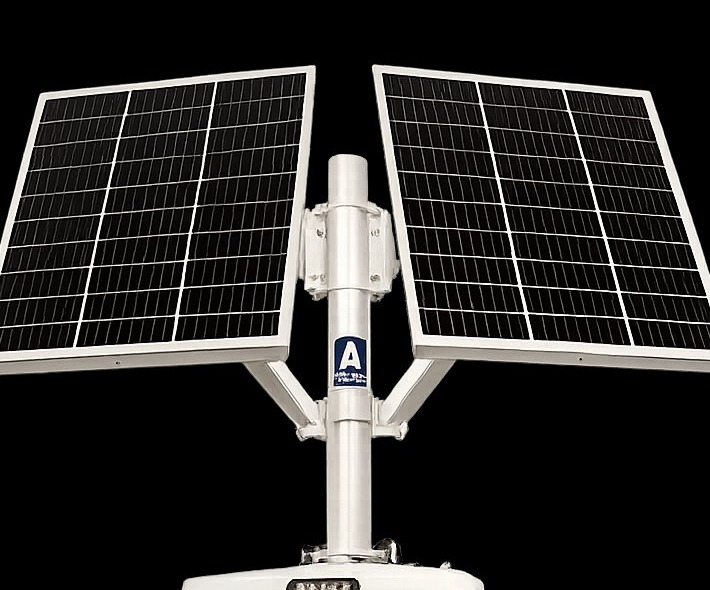
Abstract Enterprises permanent solar surveillance tower — dual-panel solar array, integrated cabinet, heavy-duty fixed installation
  • Full tower + dual solar array
  • Integrated battery cabinet
  • Permanently installed on your site
  • Concrete footing + mast install
  • 1-yr parts warranty
  • On-site commissioning included
  • Cloud VMS first year included
  • Monitoring service optional
  • Financing + trade-in credit available
Rent, buy, or lease. Whether you're looking at a solar camera trailer rental, a portable surveillance trailer for sale, or want to buy solar surveillance trailer hardware outright — we handle all three paths. Solar surveillance trailer price depends on camera count, monitoring tier, and term length. Multi-unit discounts: 3+ units on one site get fleet pricing (typically 10–15% off per-unit). Long-term rentals (6 mo+) and annual pre-pay get an additional 8–12% off. HV counties (Dutchess, Ulster, Putnam) incur a small travel surcharge per trip. All prices exclude NYS sales tax where applicable. Call (347) 934-8335 for a firm quote tied to your actual site footprint.

Full-Service Security Across NYC

Surveillance trailers are one layer. Once your project transitions from temporary to permanent, we install the fixed infrastructure. Full service menu:

Real Queens Problems a Solar Trailer Actually Fixes

  1. OneLIC + Court Square excavation theft. 14,700 units rezoned across 54 LIC blocks means active foundation, excavation, and laydown phases running for years. Copper spools, compressors, and power tools staged overnight are the predictable target. A visible 22-ft mast with LPR at the site gate cuts losses through the entire 12–18 month early-phase of every tower.
  2. Jamaica rezone phased-demolition security. 230 blocks, 15-year buildout, 11,800 units. Southeast Queens theft patterns (103rd Precinct Jamaica, 113th Precinct South Jamaica +18% in 2025) make active perimeter surveillance non-negotiable for GCs staging across Rochdale Village, Sutphin Blvd, and AirTrain-adjacent parcels. Solar trailers rotate with the project footprint over the decade-plus buildout.
  3. JFK + LaGuardia cargo and construction staging. JFK's $19B Redevelopment Program includes ongoing Terminal 1 rebuild, Terminal 4 expansion, Terminal 6 ground-up. LaGuardia Terminal C and central heating plant work continues. Perimeter cargo yards, ground-transport overflow, and construction trailer areas all need temporary surveillance that runs without FAA/Con Ed grid coordination. Solar trailers deploy landside without that permit layer.
  4. Operation-Hellcat-style dealer-lot theft. Queens DA's 3-year investigation indicted 20 defendants for 126 stolen vehicles worth $4.6M. College Point, Flushing, Corona, and Jackson Heights dealer lots are primary targets. LPR at the entry gate captures plates of every scouting vehicle days before a theft attempt — usually enough deterrent to redirect the crew elsewhere.
  5. Street-takeover gatherings in Malba, Middle Village, Whitestone. Organized 100-car gatherings doing donuts at intersections (Malba Nov 2025, Middle Village recent). Commercial property owners with wide-clear-approach intersections are the draw. A surveillance trailer with LPR + blue strobes + live-agent talk-down closes these events before police arrive — and captures identifying footage when they don't.
  6. Citi Field + Arthur Ashe + Forest Hills event-parking theft. Game-day catalytic cuts and tailgate incidents spike during 81 Mets home games, US Open, and Forest Hills concert season. A rotating trailer (Lot K during Mets home stands, USTA during Open, Forest Hills Stadium during concerts) handles the seasonal coverage on one contract.
  7. Flushing + Main Street commercial corridor. Dense mixed-use Asian business corridor from Main Street north through downtown Flushing — electronics shops, jewelry stores, restaurants staging delivery inventory overnight. 109th Precinct area. Language-barrier issues with national call centers slow incident response; local live-agent monitoring with Mandarin/Cantonese operator option resolves faster.
  8. Rockaway boardwalk + seasonal concession. Rockaway Beach boardwalk (5.5 miles), Riis Park, and Jacob Riis Park concessions store equipment October–April when the beach is empty. 100th/101st Precinct covers Rockaways — low winter patrol density means theft attempts on closed concessions go undocumented. One trailer covers the entire boardwalk concession strip through the off-season.
  9. Southeast Queens vacant-lot liability. Rezoned parcels across South Jamaica, St. Albans, Cambria Heights, Rosedale, and Laurelton sit in holding for 12–36 months before construction starts. Trespasser injuries, illegal dumping, and arson exposure land on the property owner. A deployed trailer documents due diligence and enables rapid 113th Precinct or 105th Precinct response.
  10. DOB Chapter 33 documentation for LIC tower sites. Every active Queens construction site needs ongoing site-safety monitoring under NYC Building Code Chapter 33. DOB auditors increasingly request video archive after any incident (see LIC Academy Square 2022 DOB action). A trailer with 30–90 day retention produces the export on demand — no scrambling through a guard's phone footage after an incident.

Get a Surveillance Trailer On Your Queens Site — This Week

Call for a same-day quote from our Troy Avenue dispatch — 25–35 minutes to any Queens neighborhood. Site walks scheduled within 48 hours anywhere in the borough. Typical deployment: same-day or next-business-day.

Ready to Deploy a Solar Surveillance Trailer in Queens?

Same-day or next-business-day Queens deployment from our Troy Avenue location in East Flatbush — covering Long Island City, Astoria, Flushing, Jamaica, Jackson Heights, Elmhurst, Corona, Forest Hills, Bayside, Rockaway Beach, and every neighborhood between. JFK/LaGuardia airport perimeter support. Same-day emergency slots for post-incident response. Custom financing on permanent installed towers. NYPD precinct routing built in. One phone call, one licensed contractor, one direct line for the life of the account.

💳 View Pricing & Book 📞 (347) 934-8335 ✉️ Request Quote
🏢
Licensed Contractor
NYS Lic. #12000287431
Reviews
4.6★ / 4.7★ · 360+ reviews
🗺️
Coverage
NYC · LI · HV · 13 areas
Deploy Speed
Next-day NYC · Same-day emergency
Abstract Enterprises Security Systems · Low-Voltage Licensed Contractor · NYS #12000287431
Brooklyn: 1282 Troy Ave, Brooklyn NY 11203 · Bronx: 460 E Fordham Rd, Bronx NY 10458
Canonical: www.abstractenterprisessecuritysystems.com/solar-surveillance-trailer-nyc
Sitemap · Privacy Policy · Terms · Warranty

Related Surveillance & Security Pages

Solar Trailer Pricing