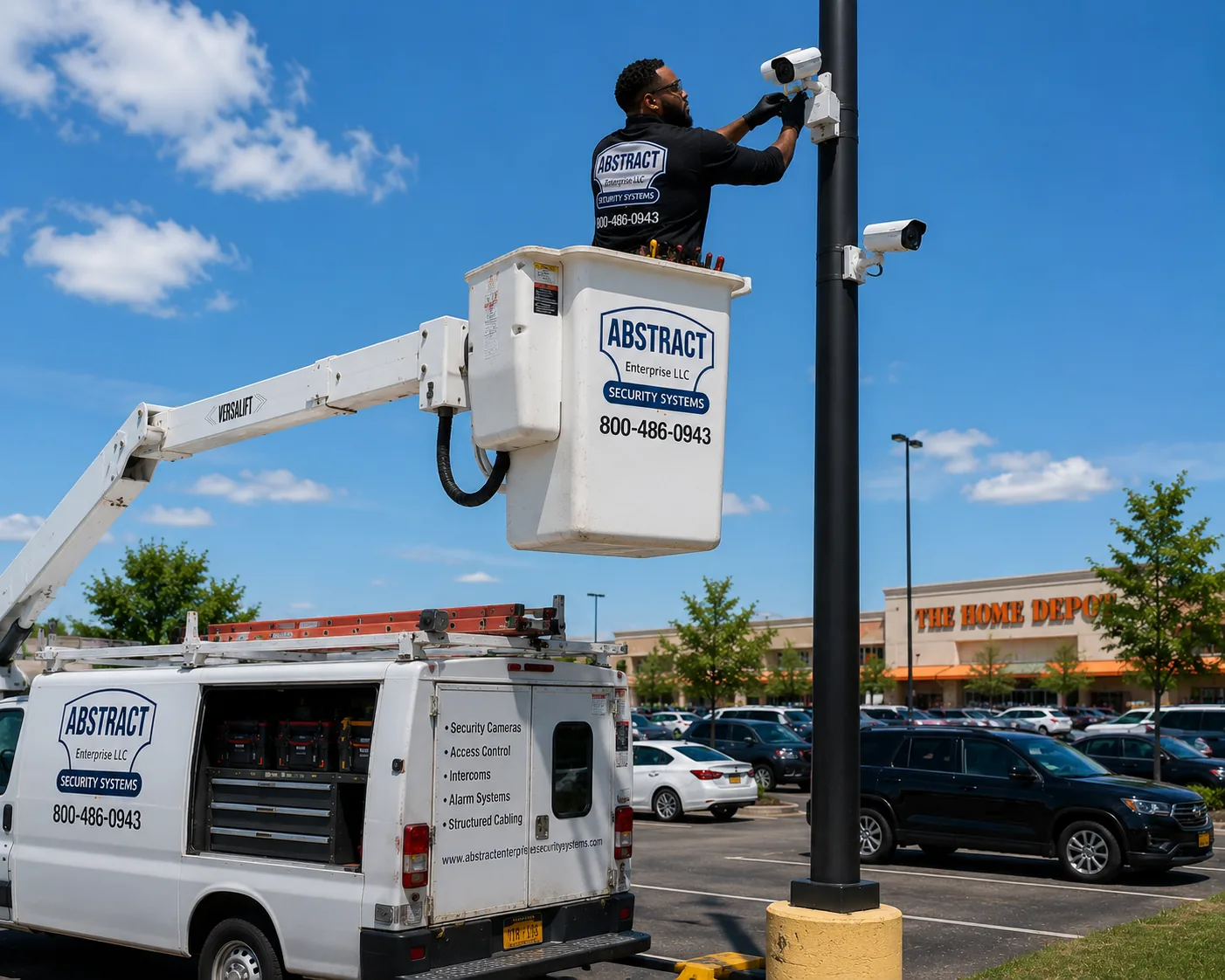
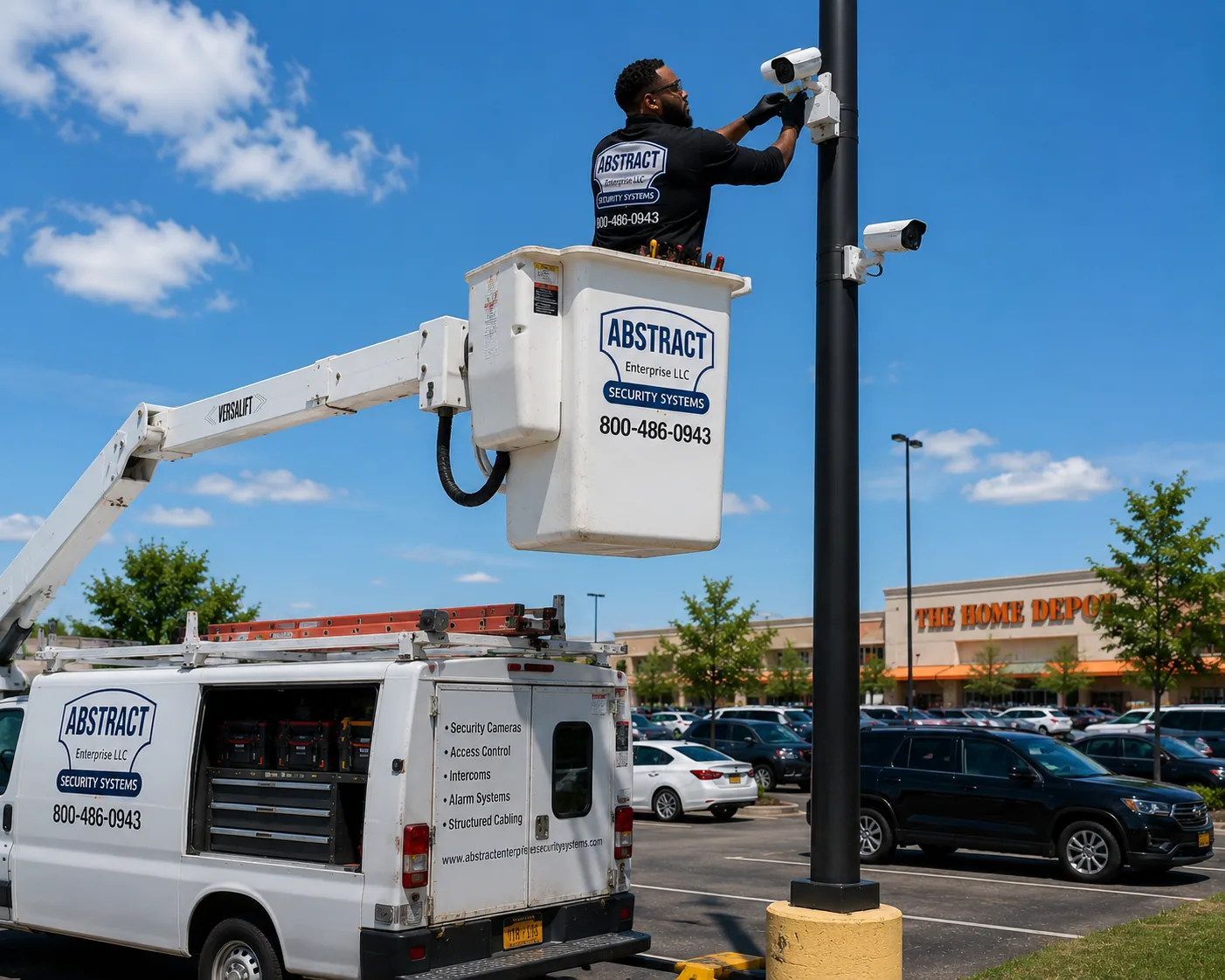
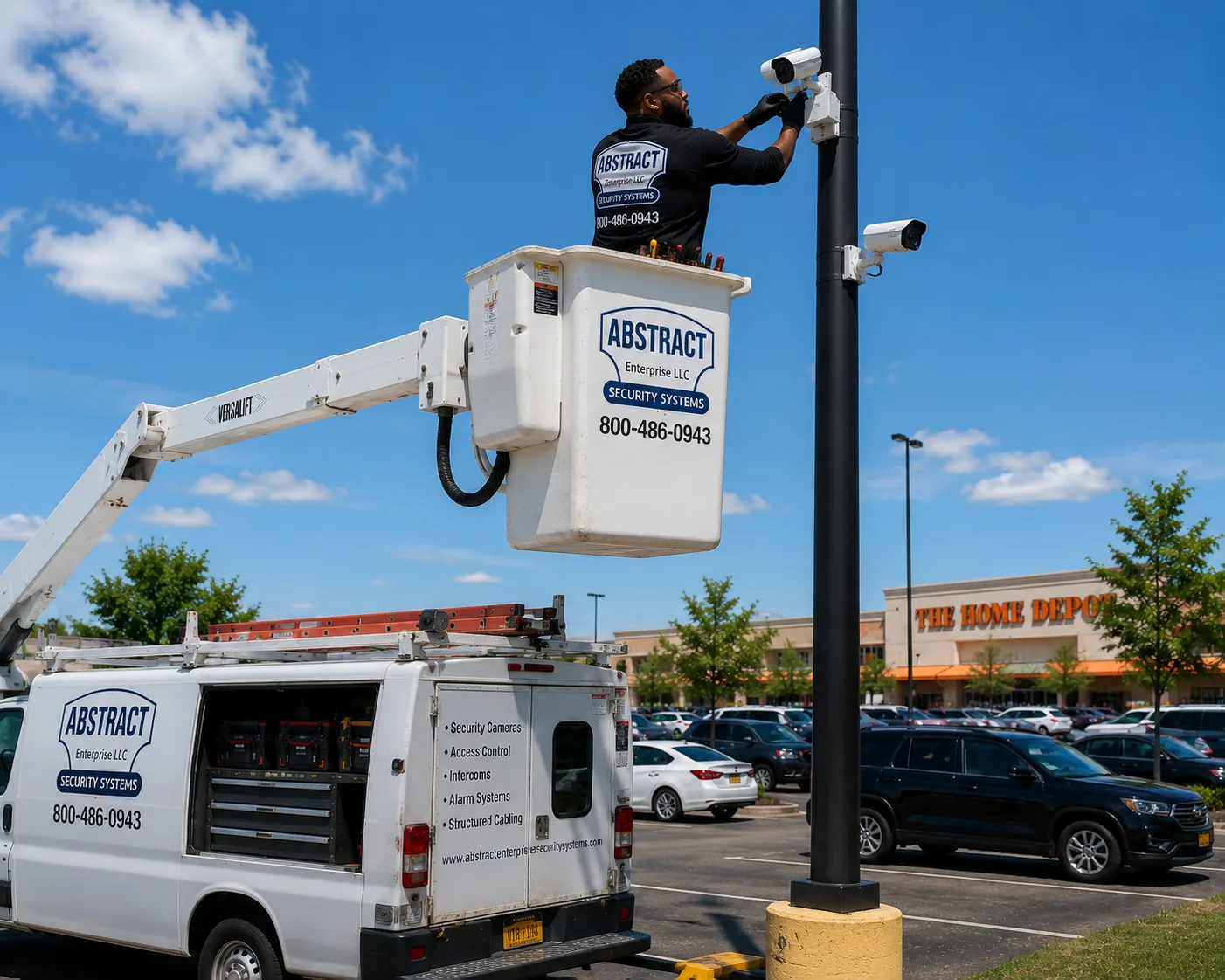
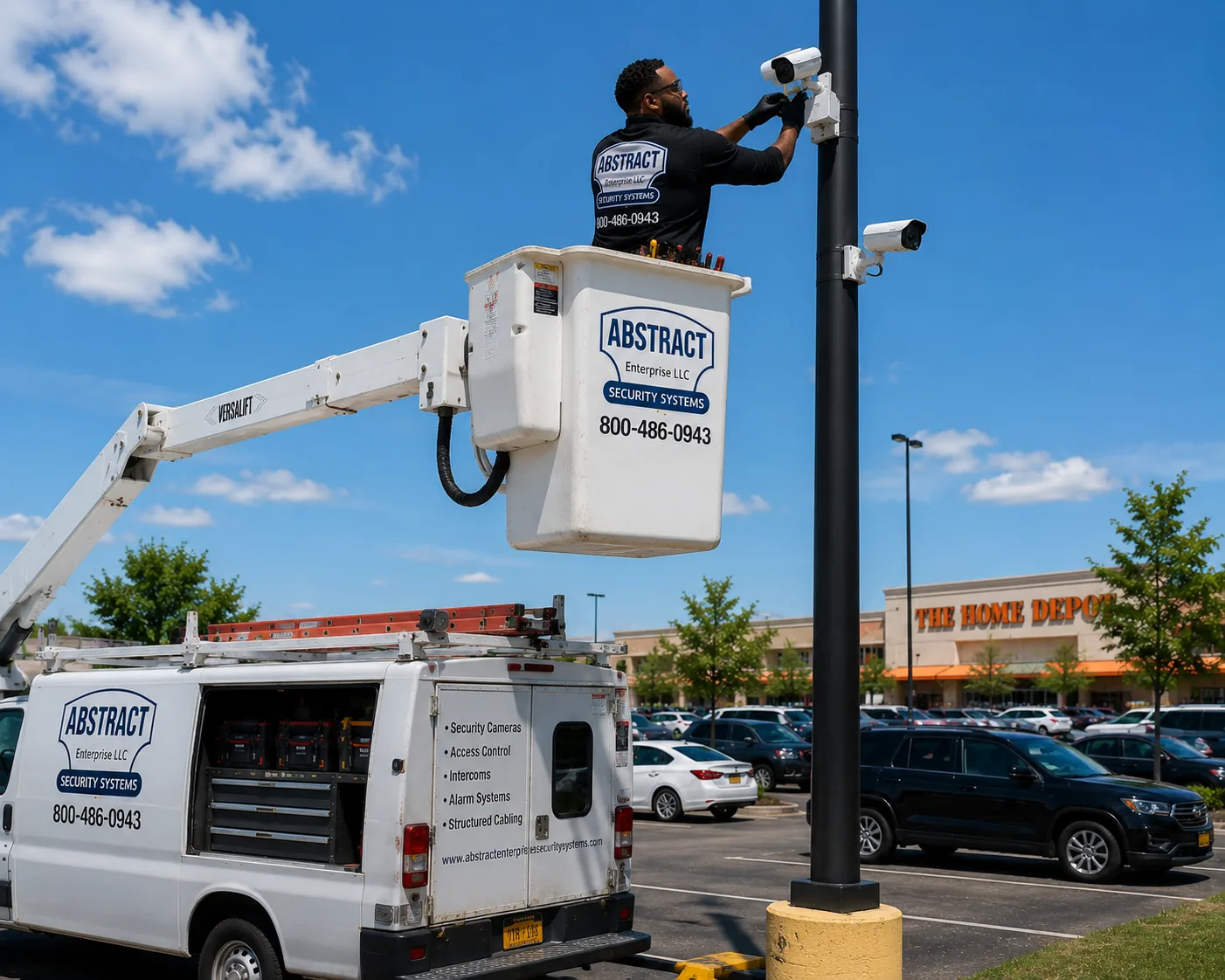
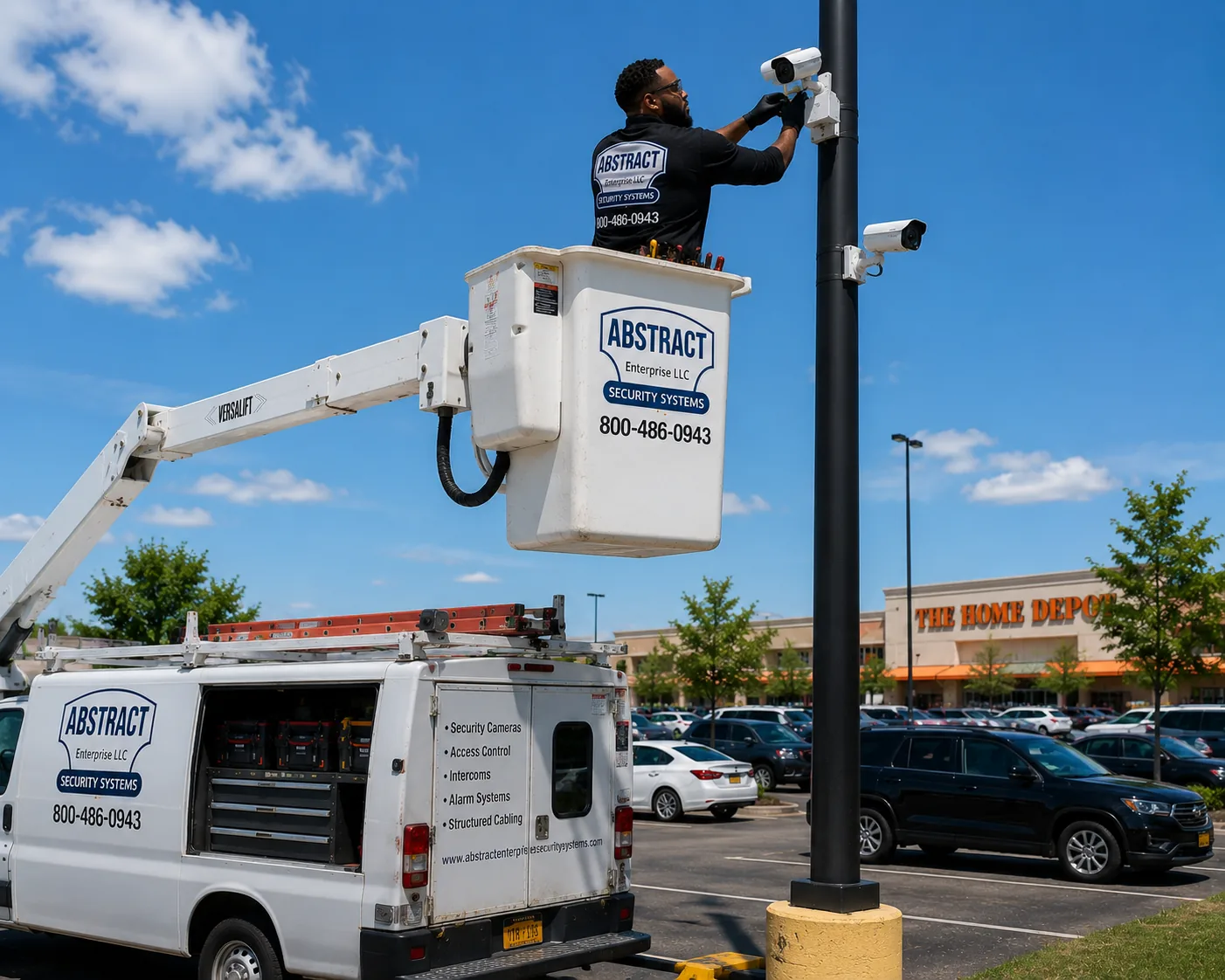
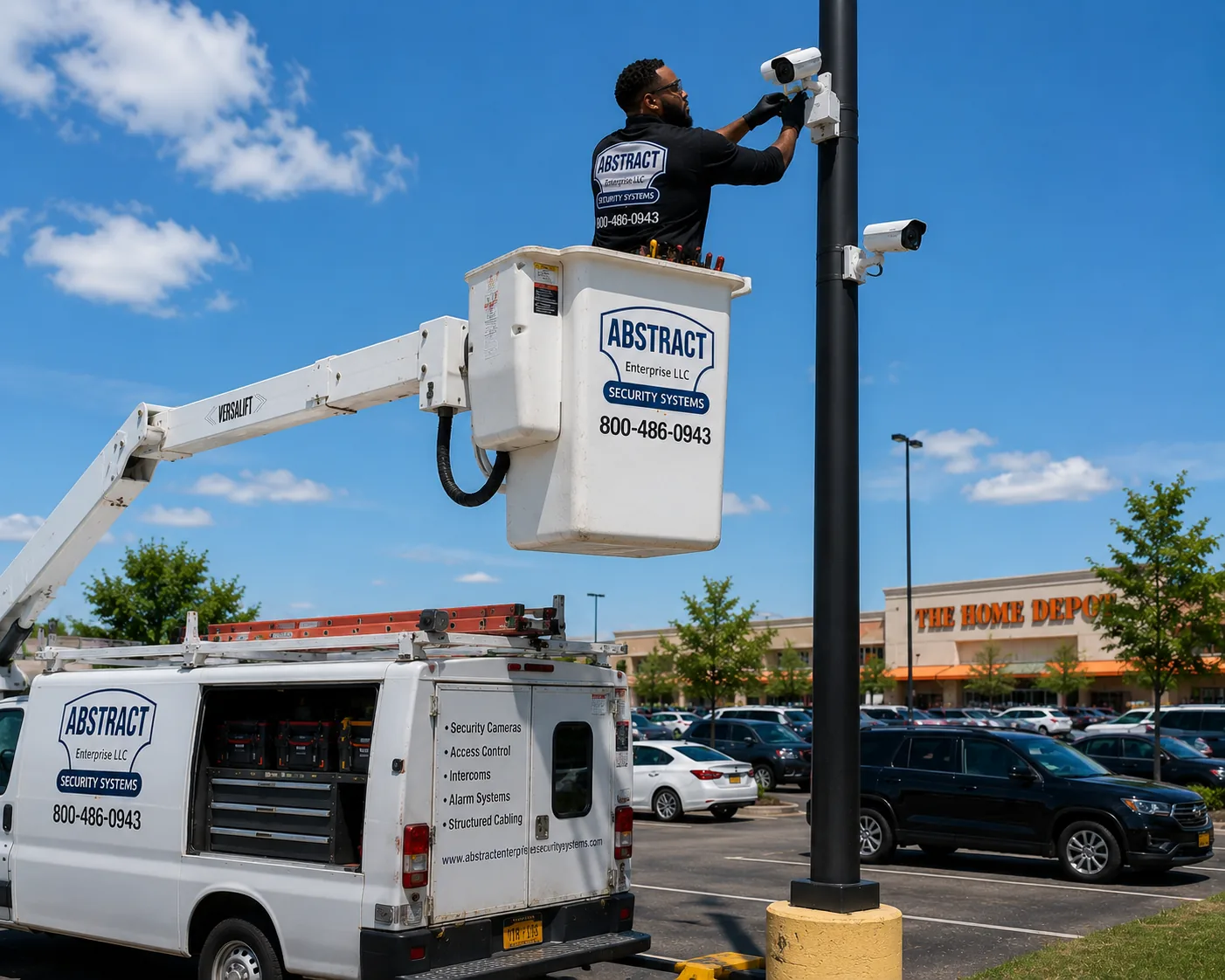
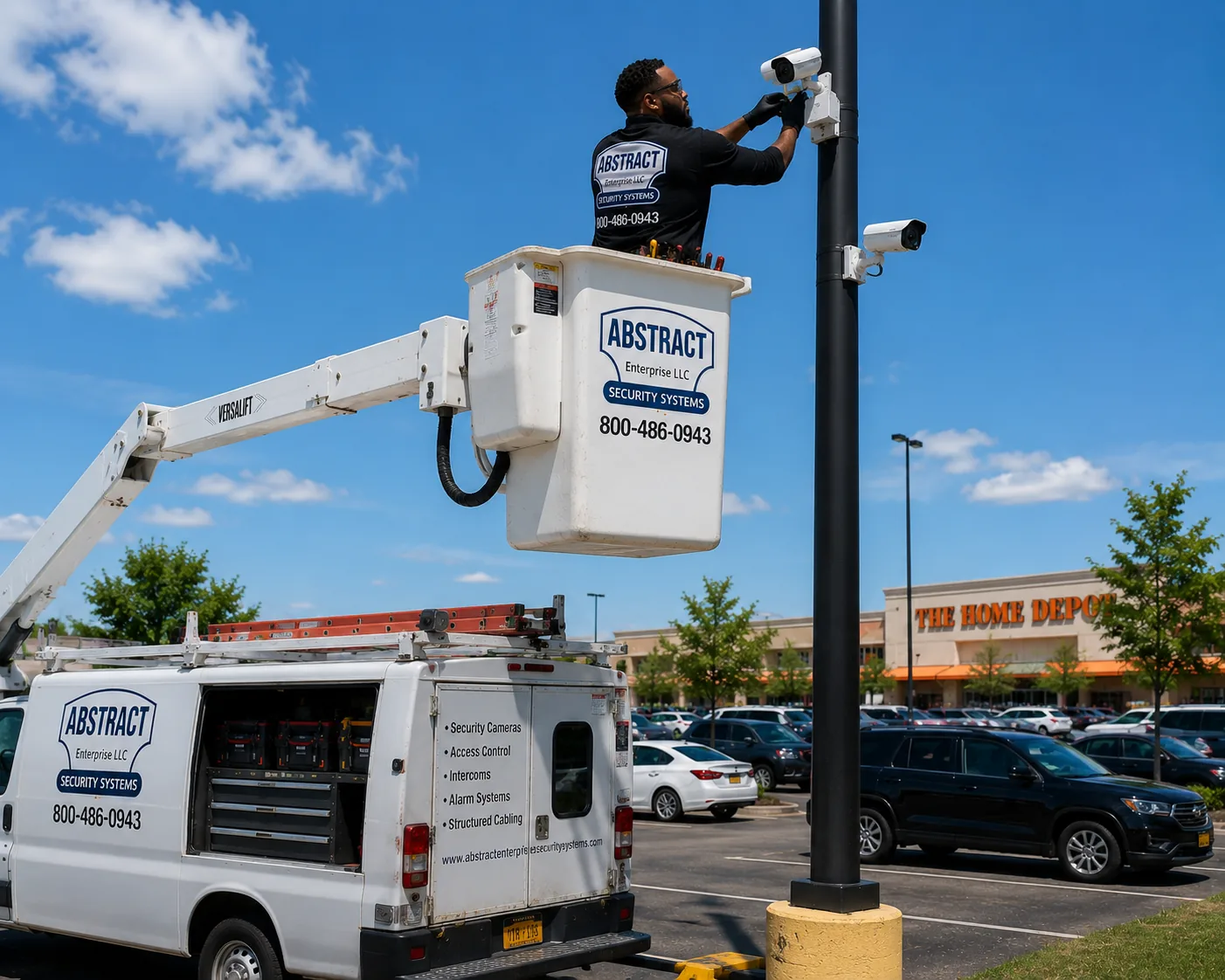
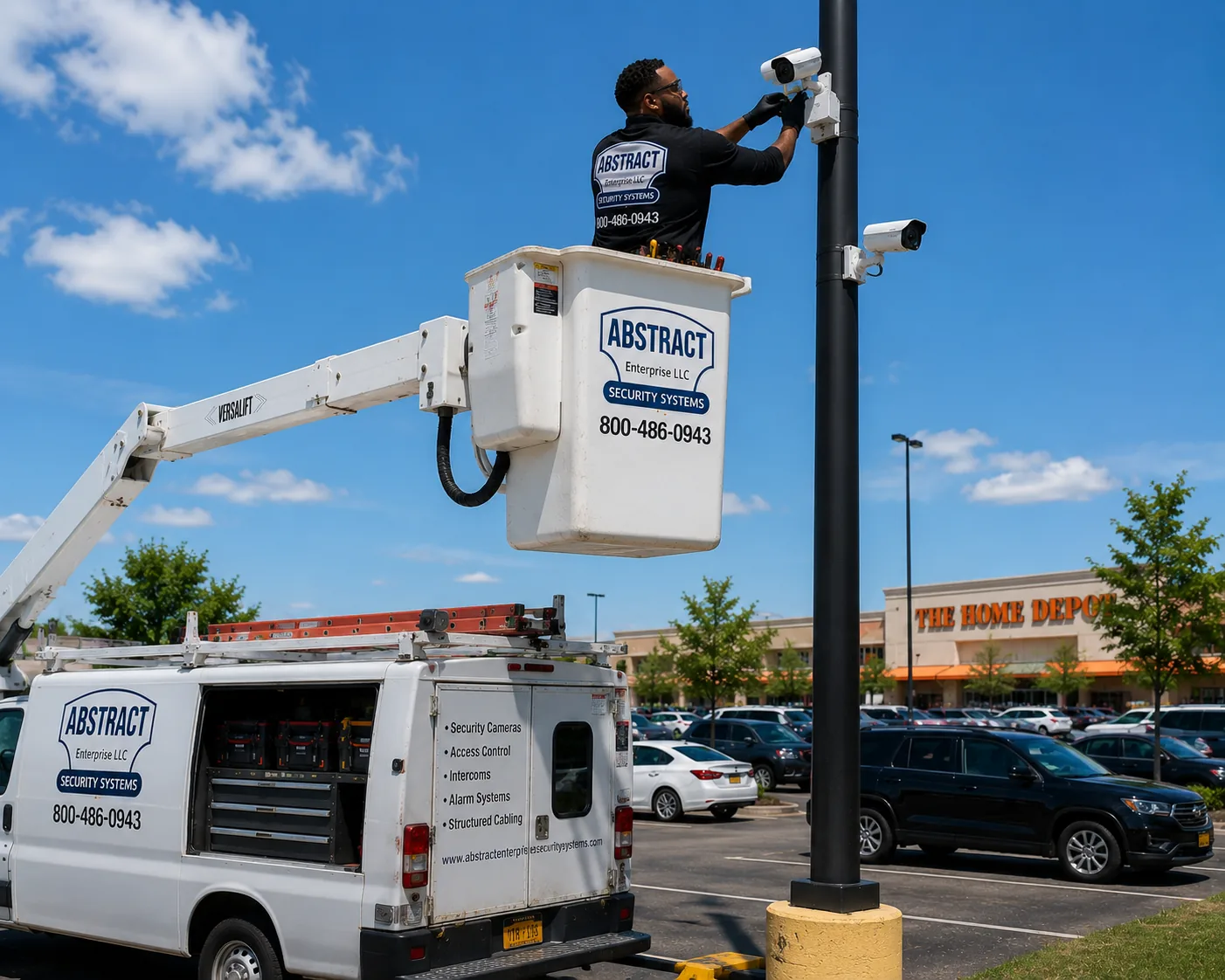
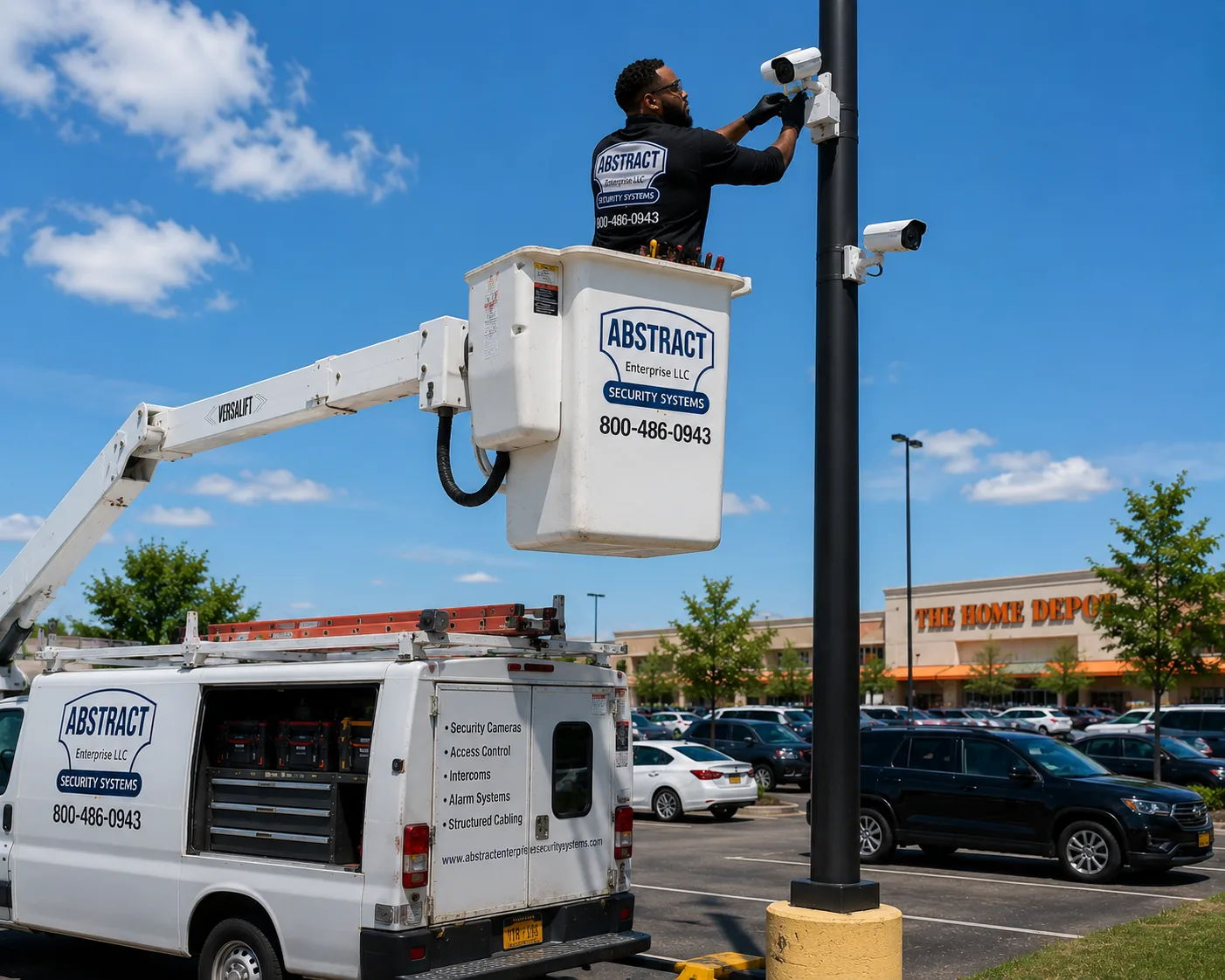
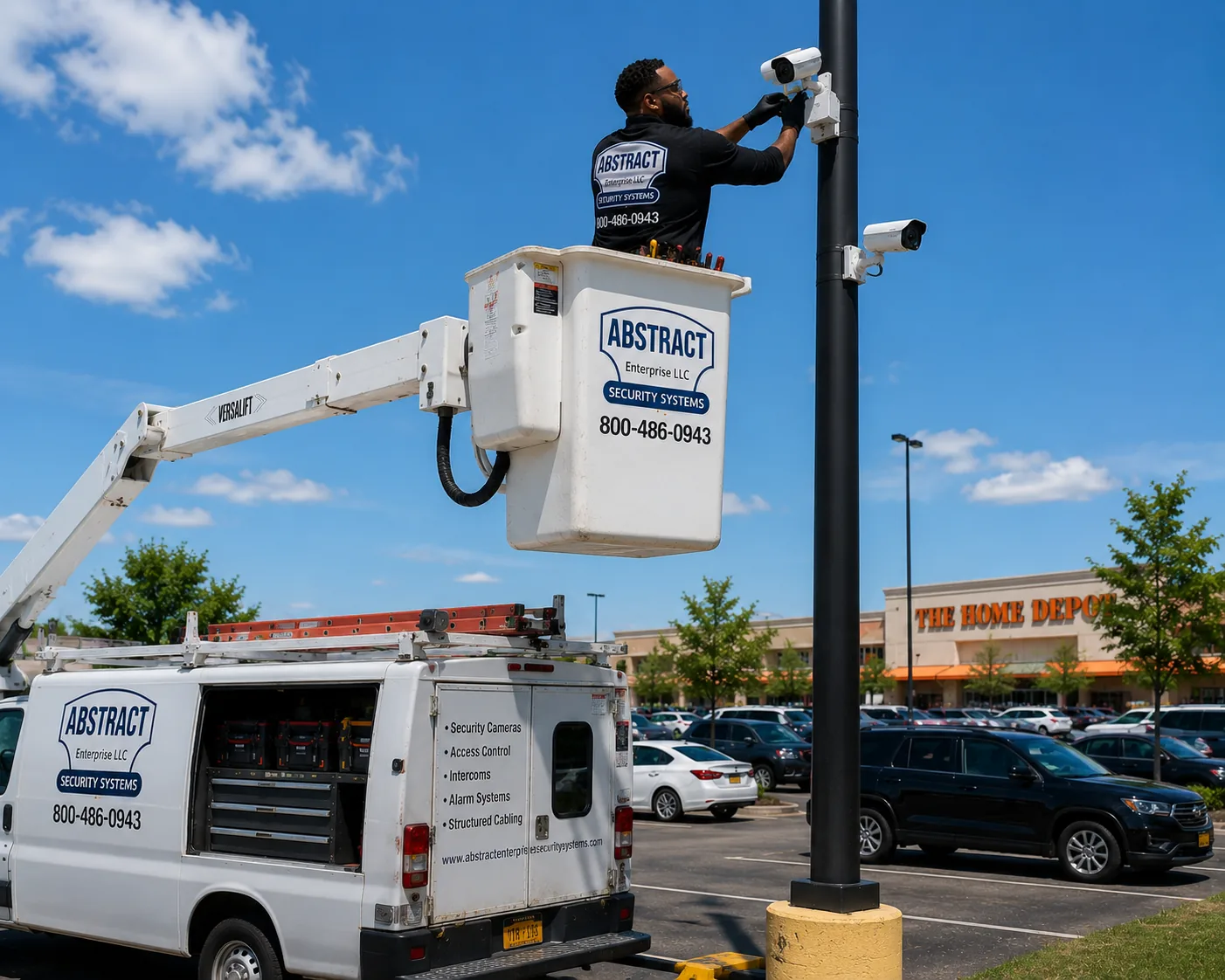
Camera systems for Rockland County parking: the Palisades Center and Shops at Nanuet retail decks, Route 59 plaza lots, the Metro-North Pascack Valley commuter lots at Nanuet, Spring Valley and Pearl River, Hudson-shore village lots in Nyack and Haverstraw, hospital and college campuses, and the apartment, school and house-of-worship lots in between — LPR entrance coverage, pole-mounted 4K cameras, trenched conduit and remote viewing, engineered from a free on-site survey.
· 201 Google Reviews | NYS Low-Voltage License #12000287431 | Free on-site survey
Serving lots county-wide — New City, Nyack, Nanuet, Spring Valley, Suffern, Haverstraw, West Nyack and Pearl River, and every property along the Route 59 spine and the Hudson-shore villages.
Reviewed and updated August 1, 2026.
THE NEIGHBORHOOD
Rockland is small, dense in the south and rugged in the west, and its parking is dominated by a handful of very large generators. The Palisades Center in West Nyack alone carries more than eighteen thousand parking spaces — it has ranked among the dozen largest malls in the country — and the Shops at Nanuet, the Route 59 plaza strip and the Metro-North commuter lots add tens of thousands more. A camera plan that works on a two-tenant strip is not the plan a lot that size needs, so coverage here is scoped to the specific property rather than to a template.
The theft pattern is well documented in the local record. Clarkstown police have described a rash of evening smash-and-grab break-ins moving through different Nanuet parking lots, with cars hit at a fitness-center lot on West Route 59 and valuables taken from the seats. Spring Valley has logged larcenies from vehicles in Route 59 lots, and Ramapo detectives recently recovered a car stolen from a Monsey driveway in Spring Valley after identifying the suspect on surveillance video — a reminder that on a Rockland lot the footage is often what actually closes the case.
Two things shape the physical work more than anything. The electric utility here is Orange & Rockland Utilities, a Con Edison company headquartered in Pearl River, not Con Ed directly — so pole ownership and any utility attachment run through O&R rather than the utility a downstate installer is used to. And the ground fights back: the Palisades diabase and traprock along the Hudson shore, the gneiss under the central county, and the Ramapo Mountain rock out west mean a trench that would take an afternoon on Long Island can hit ledge a foot down here.
Geography splits the county into distinct parking worlds. The Route 59 retail corridor runs west to east through Spring Valley, Monsey, Nanuet and West Nyack; the Hudson-shore villages — Nyack, Piermont, Haverstraw, Stony Point — carry downtown, waterfront and event parking; and the Ramapo west — Suffern, Sloatsburg, Airmont — runs larger, rockier lots against the mountains. Rockland also borders New Jersey to the south and connects to Westchester across the Mario M. Cuomo Bridge, which puts a steady stream of commuter and cross-river traffic through its lots.
Commuting here does not look like the rest of the region. Rockland’s rail is the Metro-North Pascack Valley and Port Jervis lines, operated under contract by NJ Transit toward Hoboken, with station lots at Nanuet, Spring Valley, Pearl River and Suffern; and the Palisades Center runs a park-and-ride where Hudson Link and TZx buses cross the bridge to the Tarrytown Metro-North station. Cars sit in those lots all day, which sets a retention profile a busy retail lot never needs.
The through-line across all of it is prolonged, unattended parking against difficult ground — a mall the size of a small city, commuter lots emptied by 8am, Hudson-shore village lots, fleet and distribution yards — which is exactly what a camera plan built for plate capture, after-hours alerting and slow discovery is meant to cover.
WHAT WE INSTALL
A lot of Rockland parking is public or very large. The Palisades Center and the Metro-North park-and-rides sit far from any single panel, the Hudson-shore village lots are old and tight, and the Ramapo-west lots run long distances over rock — so coverage leans on point-to-point wireless hops between buildings and, where trenching power to a far pole through diabase isn’t worth it, solar-and-cellular positions.
From the Palisades Center’s eighteen-thousand-space decks and the Shops at Nanuet down to a two-tenant strip on Route 59. Storefront cameras cover the first rows and lose plate detail past them, so the far field, the parking decks and the outparcels need pole and deck positions. Rear service drives, cart corrals and dumpster enclosures carry the activity the entrance cameras never see.
Cars sit unattended ten to fourteen hours on a weekday, which sets the risk profile. Pascack Valley and Port Jervis station lots at Nanuet, Spring Valley, Pearl River and Suffern — plus the Palisades Center park-and-ride — need coverage on entrances, long-stay rows and the walk to the platform or bus. Retention is sized for slow discovery, because a car hit Monday may not be seen until Friday night.
Nyack, Suffern, Haverstraw, Spring Valley and Piermont run metered and permit lots that flip from weekday parking to evening dining and waterfront crowds, all under a village’s eye. Expect more sign-offs than a private site — a village board, historic review in the old river towns, and right-of-way rules governing the curb cuts.
Around-the-clock use, staff arriving and leaving in the dark, and campuses that mix surface lots with decks — Montefiore Nyack Hospital, Good Samaritan in Suffern, and college lots at Dominican University in Orangeburg, Rockland Community College in Suffern and St. Thomas Aquinas in Sparkill. Most need both design approaches on one system plus scoped viewing for campus security.
Rockland’s office corridor — Blue Hill Plaza in Pearl River and the office parks along Route 59, Route 303 and the Thruway — runs employee decks, gated visitor lots and long entrance drives. Plate capture at the gate matters as much as row coverage, and access is scoped so corporate security sees only its own property.
The warehouse and distribution build-out along the Route 303 and Thruway corridors brought trailer parking, employee lots, gates and yards. Coverage reaches past passenger vehicles to trailers and equipment, and after the county’s overnight vehicle and tool thefts, entrance plate capture and low-light row coverage carry real weight.
Guest parking with no timetable, plus banquet and waterfront event nights that can triple a lot’s load in an evening. The layout leads with entrance coverage and clean pedestrian routes, and it holds up when an overflow field is thrown open for a Saturday wedding.
Assigned-space resident lots in Spring Valley, Nanuet, Suffern and Monsey, with visitor bays and walking routes to the unit doors. Getting the board’s sign-off, honoring what residents expect for privacy, and putting the footage-access rules in writing count for as much here as camera placement does.
Sharp arrival-and-dismissal peaks with long quiet stretches, part-time or volunteer oversight, and stakeholders who need simple viewing access — across Rockland’s many districts and its unusually large concentration of congregations in the Ramapo and Monsey area. Straightforward layouts, posted signage and coverage of entrances and gathering paths during peak flow.
COVERAGE AREA
Rockland packs five towns, nineteen villages and the state’s densest suburban core into 174 square miles, and the parking changes character across it. The Route 59 corridor is retail and commuter; the Hudson shore is old village and waterfront; the Ramapo west is larger and rockier. One camera plan does not fit all three, so coverage is scoped to the specific property, not a county-wide template.
We work Clarkstown — New City, Nanuet, West Nyack, Congers, Valley Cottage, Bardonia — and Ramapo — Suffern, Spring Valley, Monsey, Airmont, Sloatsburg, Hillburn, Wesley Hills, Pomona, Chestnut Ridge, Montebello. Along the Hudson we cover Orangetown — Nyack, Pearl River, Tappan, Blauvelt, Orangeburg, Sparkill, Piermont, Grand View — and Haverstraw and Stony Point up north: Haverstraw and West Haverstraw villages, Garnerville, Thiells, Stony Point and Tomkins Cove. Each has its own building department, and several run historic review on top of it.
The high-volume parking generators — the Palisades Center in West Nyack, the Shops at Nanuet, the Route 59 plazas, the county garages, the hospital and college campuses, and the Metro-North Pascack Valley and Port Jervis station lots — sit across every part of the county, and each gets a plan built around how long cars actually sit and where people walk.
A plate read comes from a camera built only for that — its own aim, its own exposure — never an overview lens hoping to catch a tag across a driveway. The spot that works on a Rockland lot is wherever traffic already slows: a deck ramp, a ticket machine, a pinched curb cut off Route 59 or Route 303. There the camera sits low and tight to the lane, its shutter quick enough to stop a plate moving through in the dark.
It is the commuter-lot and mall-gate entrances where those reads pay off, because after an overnight hit the log of who came and went is frequently the only evidence worth anything — the very thing that cracked the Monsey vehicle theft on camera. At a busy retail entrance we split the job across two cameras, an overview and a dedicated reader, so pulling back for wider context never sacrifices the plate detail that makes the clip usable.
Rockland’s electric utility is Orange & Rockland Utilities — a Con Edison company headquartered at Pearl River, serving Clarkstown, Ramapo, Orangetown, Haverstraw and Stony Point — so whether a camera can lean on an existing pole is an O&R question settled during the survey, not assumed from an aerial view. Most far-field coverage ends up on dedicated camera poles the design specifies, positioned for the view and the foundation rather than for whatever utility pole happens to be nearby.
On the rare occasion a utility attachment really is the best call, the make-ready and the O&R attachment paperwork are nailed down before that position is locked in. Power follows the same logic: a straight home run from the panel when the distance is sane, a dedicated feed and enclosure at the pole when it is not, and a self-powered solar-and-cellular position when trenching juice to the far edge of a mall lot simply is not worth it.
Rockland sits on hard ground almost everywhere. The Palisades diabase — the traprock that forms the cliffs along the Hudson from Piermont north — runs shallow near the shore, gneiss underlies the central county, and the Ramapo Mountains bring rock and boulder to the west. That changes the trenching conversation from the start: where a sandy coastal lot might be crossed in an afternoon, a Rockland property can hit ledge a foot or two down, so pathway routing is planned around what is actually under the pavement, and a test dig is sometimes worth doing before a proposal is finalized.
When ledge or an obstruction rules out a clean trench, the fallbacks are deliberate design decisions rather than compromises: conduit run on the surface along a curb or wall, a saw-cut through existing asphalt, an engineered building-to-building wireless hop, or a self-powered position that needs no trench at all. The pathway is picked to suit the property, and the patch-back is scoped so the lot reads as finished once the crew leaves.
Distance is the quiet cost driver on a property the size of the Palisades Center or a spread-out Rockland campus. Copper is dependable to roughly one hundred meters; past that a run needs fiber with media conversion or a switch positioned out in the field, and across an eighteen-thousand-space deck complex or a hospital campus those distances add up fast. The design settles which runs are copper, which are fiber and where a field switch belongs before anyone quotes a number.
Where no paved route connects two points, or where traprock makes cutting one a money pit, a licensed point-to-point radio carries the feed back over an open line of sight. This is engineered gear — aimed, tested, watched — not a big-box bridge tacked to a wall, and it is what folds a detached lot, an outparcel or a park-and-ride into the same recorder and system as everything else on the site.
Rockland’s biggest parking is structured — the multi-level decks at the Palisades Center, hospital decks in Nyack and Suffern, and municipal and mixed-use garages in the villages. A deck is a different camera problem than an open lot: low concrete ceilings, headlight glare bouncing off painted walls, tight ramp turns and dead spots behind columns all work against a single sweeping view.
A deck is worked floor by floor: plate capture on the in and out lanes, a camera on every ramp and each stair-and-elevator landing, and fixed units on the parked rows angled to look between the columns instead of straight at them. The models are picked for wide dynamic range, so a sunlit ramp mouth beside a shadowed bay does not wash out the image, and the cabling runs in surface conduit wherever core-drilling the slab is unwanted or off-limits.
Winter is no joke here, and a plow can redraw a lot by morning. Pushed snow stacks into piles tall enough to swallow a low camera’s view or wall off a plate lane, and a pole planted in the wrong spot is just a target for the blade. So positions are set around the plowing pattern — where the piles will land, which lanes stay open — and coverage lives through the first storm instead of vanishing behind a snowbank until April.
Road salt is the tax winter charges the hardware. The brine thrown up along Route 59, the Thruway ramps and the riverfront lots eats cheap brackets and fasteners well before it touches the camera itself, so anything near the water or a heavily salted entrance gets stainless or a coastal-rated finish. Heated, cold-rated housings then keep the domes clear through every freeze and thaw, so a camera that looked fine in October is still working in January.
The Rockland lots that get hit are the ones that empty out and go black — station lots after the last train, mall decks past closing, fleet yards overnight, the village lots along the river. Those conditions are exactly where a camera chosen for a sunny catalog photo falls apart, so low-light capability is engineered in from the start, with sensors and lenses matched to the light the lot actually has after dark.
Checking each view after dark is a separate step in its own right. We look at every position for glare and hot spots off the pole lights, for the black gaps between fixtures, and for whether the entrance plate still reads once the sun drops. When there is not enough ambient light, we add IR or white-light fill on purpose, so the clip from a 2am break-in — a Nanuet smash-and-grab, a Spring Valley larceny — is something worth pulling rather than a gray blur.
BUILDING SPECIALISTS
No single camera type covers a whole lot well, so a Rockland design mixes them by role — distance, angle and light decide each pick, never a package price. Six show up on most properties here:
Best where one long line needs watching — a deck aisle, a fence run, a row of all-day commuter spaces. It reads as a camera from across the lot, which is half the deterrent, and once aimed it stays put.
Re-aims fast and, unlike a budget dome, keeps its own infrared from washing the night image out. That makes it the default at entrances, on walkways and under deck ceilings.
One high mast that pans, zooms and follows on command — worth its cost only on something Palisades-sized or a sprawling campus, and always over a fixed layer rather than instead of one.
A single head that swallows a very wide field. It pays for itself over an open row or a garage level where the alternative is cutting several pole footings into diabase.
A plate reader, not a scene camera — tight lane framing, a shutter fast enough to stop a moving plate, exposure set for headlights so the read survives after dark.
Heated and defogging, sized for Rockland freeze-thaw. It is the difference between a camera that quits under January ice and one that keeps its picture through the storm.
The electronics feeding a lot system decide whether it survives its first summer. Because cameras on a Rockland mall or commuter lot usually sit a long way from the building, a switch has to go out into the field to collect them — and that switch belongs in a sealed, weather-rated enclosure, never a hardware-store junction box. Skip that and the thunderstorms rolling off the Ramapos will find the weak point. Every outdoor conductor gets surge suppression and a real ground, which is not an add-on line item here so much as the reason a lightning-season hit takes out nothing instead of a whole row.
Power gets counted, not guessed. Between heaters, illuminators and PTZ motors, a switch run to its rated ceiling will sag and drop the cameras it feeds, so the design leaves headroom — enough that the far camera on a long cable still gets clean power when the heaters wake up in a cold snap.
Rockland carries a genuine base of campuses — Blue Hill Plaza and the Pearl River and Route 59 office parks, Montefiore Nyack and Good Samaritan on the medical side, and college lots at Dominican, Rockland Community College and St. Thomas Aquinas. Their parking is rarely one thing: an employee deck, a gated visitor lot and a long entrance drive often live on the same property, so the system usually has to solve a garage problem and an open-lot problem at once and tie both to one recorder.
What sets campus work apart is who needs to see the video. Corporate and hospital security want their own cameras and nobody else’s, individual logins, an audit trail of every export, and often a tie-in to existing access control or dispatch. So the build starts from that: plate reads at the gate, unbroken coverage of the walk between deck and door, and a clean way to hand footage to public safety after an incident — all specified at the survey, not bolted on later.
The park-and-rides are the county’s defining parking problem, and the reason is time, not volume. A commuter leaves a car at the Pascack Valley or Port Jervis lots — Nanuet, Spring Valley, Pearl River, Suffern — or at the Palisades Center bus lot at dawn and returns after dark, and a vehicle hit Monday morning may go unseen until Friday night, or two weeks if the owner is traveling. Footage that has already rolled off is worth nothing.
Two things follow from that. Retention is sized to cover a full slow week rather than the day or two a busy retail lot survives on, and cameras concentrate where the exposure actually is: the entrances, the long-stay rows, and the walk to the platform or the bus. The overnight vehicle and converter thefts documented across Rockland — commuter and fleet lots first in line — are precisely the events this profile is built to still have on record.
Few counties have as many protected river villages as Rockland — Nyack, Piermont, Haverstraw, Tappan, the old core of Suffern. Inside those districts a tall galvanized mast or a boxy street-side enclosure often will not clear review, so the constraint gets designed for before anything is ordered rather than discovered at a board meeting.
In practice that means lower poles, finishes chosen to vanish against the building, cameras worked in under existing architecture where a sightline allows, and conduit kept off the street face. Coverage does not give anything up for it — it just takes a plan the district will sign off on, and the survey names which approvals a given village expects so the schedule is honest from day one.
Downtown Nyack, Suffern, Piermont and Haverstraw run on the evening: restaurants, bars, waterfront dining, mixed-use lots that sit half-empty at three in the afternoon and overflow at eleven at night. The trouble here lives after dark and at the edges — the far corner, the alley behind the row, the path from the lot to the sidewalk.
So these lots are designed for night first, not day. Entrances and the busiest pedestrian routes come first, camera choice is matched to the low, patchy light of a village block, and where valet or shared parking is in play the coverage records the handoffs cleanly. For mixed-use buildings, who may view and export between the commercial tenants and any residential parking is written into the design instead of argued about after something happens.
The river is never far from a Rockland lot on the east side — waterfront and downtown parking in Nyack, Piermont, Haverstraw and Stony Point, and low ground along the Sparkill Creek and the Piermont marsh with a real flood history behind it. Near the water, brine eats ordinary brackets, pole bands and fasteners well before it touches the camera, so shore hardware is specified in stainless or a coastal-rated finish from the start.
On the flood-exposed parcels, the recorder and the field electronics go above known high-water marks — not in the low mechanical room that has flooded before — and enclosures are sealed against wind-driven rain. The whole point is a system still recording the morning after the storm that justified installing it, rather than one that drowned the first time the creek came up.
Video nobody can retrieve is not evidence, so every Rockland system is built backward from that. The recorder and its drives are sized to the retention the property truly needs — longer for the slow-discovery commuter and fleet lots, shorter where problems surface the same shift — and that figure is written in plain days in the proposal, not hidden in a spec table. Cameras are placed and exposed so an exported clip is sharp enough to act on.
Remote access is set up for how an owner actually uses it: live and recorded views on a phone or laptop, a login per person instead of one shared password, and an optional off-site copy of the cameras that matter so a smashed or stolen recorder does not erase the record with it. Before we leave, you run a search, an export and a mobile login yourself.
Today’s lot cameras can do more than store video. A line-crossing rule flags someone stepping into a closed commuter lot at 2am; loitering logic notices a car circling a mall deck long after the stores shut; a plate list watches for one specific vehicle. Tuned to the property, that turns a passive archive into something that pushes a warning while there is still time to do something about it.
The whole value sits in the tuning, though. Set wrong, analytics fire on a windblown bag, headlights raking a wall, or a raccoon down off the Ramapos, and the real event drowns in a hundred false ones until everyone stops looking. So rules are cut to the lot’s actual traffic and to sensible hours, and who receives an alert and what they do next is settled up front, not assumed.
A lot of Rockland lots already run cameras — frequently half-dead, badly aimed, or abandoned by whoever put them in. Taking one of those over starts with a diagnosis at the recorder and the field enclosure; the hardware that still earns its place stays, and only what has actually failed gets replaced, instead of condemning the whole system to justify a new sale. A lot that went dark after an incident jumps to the front of the line.
Modernizing is usually a blend — a newer recorder, a handful of better cameras at the positions that carry the most weight, plate capture added at the entrance, remote access finally set up right — sequenced so the lot is never fully blind while the work runs. At the end it is documented and owned outright, with logins and a camera map handed over rather than kept by the contractor.
In New York, a parking-lot camera stands on firm ground when it watches your own property and the people using it. So coverage is drawn to stay on the lot, its entrances and its walkways, and anywhere a view would drift onto a neighbor’s yard, a public sidewalk or an adjoining building’s windows, digital masking blacks that slice of the frame out. Signage at the entrances both meets expectations and adds a layer of deterrence.
For apartment, condo, HOA and mixed-use properties, the footage-access rules — who views, who exports, how a resident or tenant request is answered — are put in writing as part of the design, so the system holds up to a board, a manager, and a court if it ever comes to that. Settling the boundaries before install day is far cheaper than reshooting coverage after a complaint.
No testimonials — just the commitments every Rockland parking lot project is held to:
Abstract Enterprises Security Systems works across Rockland County and the surrounding region under NYS Low-Voltage License #12000287431. License details, insurance certificates and references are provided in writing before work is scheduled.
Every proposal follows a free on-site survey. Camera positions, pathways and equipment are specified from the actual property — Rockland lots are never quoted from a phone call, because pole ownership, ground conditions and power sources are only visible on site.
Every position listed with the job it does, the route its cable takes, the recorder and drive capacity behind it with the retention that produces, and clear limits on what is and is not included — the detail that makes two bids genuinely comparable.
Weatherproof terminations, drip loops, surge protection and grounding on outdoor runs; footings designed for local frost depth and soil; secured recorder placement above flood levels where applicable; labeled cabling; individual user accounts instead of shared logins.
We close out by working through live viewing, searching playback, exporting a clip and setting up mobile access with you directly, then hand over account details, a marked camera map, as-built pathway records and configuration notes. You own it outright.
Products supplied by AESS carry a three-year warranty for normal wear and tear — full terms below and at our warranty page.
· 201 Google Reviews across our service work.
A bid worth taking will field these without hedging. Are you a licensed NYS low-voltage contractor, and will the license number, insurance and references come in writing? Did someone actually walk the lot, or is the price off a satellite photo? Which runs are copper, which are fiber, and where does a field switch land? For any pole in the plan, who owns it — and is an Orange & Rockland attachment actually confirmed?
And then: what recorder, and how many days of retention on this specific property? Is plate capture a dedicated camera or a re-tasked overview? How are surge protection and grounding handled on the outdoor runs? Do I get individual logins and outright ownership, or am I tied to your account and a monitoring contract? On a Rockland lot, those answers are what separate a system that holds up from one that hands you blur.
HOW IT WORKS
The work always moves in the same sequence, adjusted to the property. When it finishes depends on site conditions, equipment lead time, access, municipal review and how much there is to build.
PRICING
No honest flat rate survives a Rockland lot, because two properties of the same footprint can be entirely different jobs once you factor in ledge, who owns the poles and how far the power has to run. So the price follows a free on-site survey, and the proposal breaks out exactly where every dollar lands. Here is what pushes the figure up or down:
The survey resolves every one of those for your particular lot, and the itemized proposal that comes after puts each driver on its own line. For access, the thicket of permits and the ground itself, Rockland labor runs above the Brooklyn baseline — and we say so outright instead of tucking it inside a rounded total.
COMMERCIAL PARKING CAMERAS
Commercial parking in Rockland gathers along the county’s main roads, and what can actually be built moves from one corridor to the next with the terrain, how tightly it is developed, and which review board holds sway:
The county’s retail spine from Spring Valley through Monsey and Nanuet to West Nyack — continuous plaza lots, dealers and big-box parking with constant turnover and documented evening break-ins.
The eighteen-thousand-space mall decks plus the commuter park-and-ride — multi-level garages, plate capture at the ramps and coverage of the pedestrian routes between deck and stores.
The Orangetown distribution and retail corridor through Blauvelt, Orangeburg and Tappan — warehouse trailer parking, employee lots and office-park entrances.
The Hudson-edge stretch through Nyack, Piermont, Haverstraw and Stony Point — downtown, waterfront and event lots that bring salt corrosion and historic-district review with them.
Suffern and the I-87/287 approaches — cross-river commuter, hotel and Thruway-adjacent lots feeding the bridge to Westchester.
The dense Spring Valley, Monsey, Kaser and New Square core — tight residential, retail and house-of-worship parking on constrained lots.
A commercial lot answers to sign-offs a home never sees. Pole attachments, electrical and structural mounting, trenching, work on historic parcels, and anything in the right-of-way across Rockland’s towns and villages can each trigger owner, utility or authority-having-jurisdiction review — and AESS pins down which of those apply before a single position is installed.
This content is general information and is not legal advice.
YOUR QUESTIONS ANSWERED
Across most of the county it is a live possibility — the Palisades traprock, the gneiss under the middle of Rockland and the Ramapo bedrock out west all ride close to the surface — so the sane move is to plan for rock, not stumble onto it. From there the choices open up: swing the pathway toward softer ground even at the cost of a longer run, pull more of the lot in from perimeter poles on tighter lenses, jump a gap with an engineered radio link, or drop in a solar-and-cellular position that needs no trench whatsoever. Where ledge looks likely, a quick test dig before the proposal is locked is usually the cheapest fact you can buy.
Cameras do not physically block a saw, but on the profile Rockland has been hit with — overnight vehicle and converter thefts in commuter, mall and fleet lots — they change the math. Visible cameras and posted signage push casual crews to an easier target, plate capture at the entrance records who came and went, and after-hours analytics can alert on someone moving under vehicles in a lot that should be empty. When a theft still happens, clear night footage and a legible plate are what let police act, exactly as surveillance video did in the recent Monsey vehicle-theft arrest.
Deeper than a coastal lot downstate, because up here it is frost, not the pole, that dictates the footing. The base is engineered to the exact pole height, to the wind load once every camera and enclosure is hung on it, and to whatever soil and rock sit at that spot. Borrow a footing spec from a Long Island job and it is wrong for Rockland — and the error does not show on install day, it shows as a leaning mast two freeze-thaw winters later.
Because discovery is slow. On the Pascack Valley and Port Jervis lots at Nanuet, Spring Valley, Pearl River and Suffern, a car damaged Monday morning may not be looked at until the owner comes back Friday night, and one left through a vacation can sit two weeks. Retention is calculated from resolution, frame rate, recording mode, camera count and installed storage, then set against that realistic window — not the next-morning assumption that is the most common retention mistake on a commuter lot.
It can, usually in visual terms rather than the cameras themselves — pole height and finish, whether new poles are introduced at all, how visible conduit and enclosures are, and how the equipment reads from a protected riverfront streetscape. Designs that use existing structures, choose lower-profile housings, route conduit along existing lines and keep enclosures off freestanding sightlines move through village review more easily. Work involving poles, structural mounting, trenching or a right-of-way may require owner, utility or AHJ review, and AESS confirms what applies before installation. This content is general information and is not legal advice.
The internet has nothing to do with whether it records. Cameras reach the recorder over cable or a dedicated radio link and write locally whether or not the line is up; the connection only powers remote viewing, off-site alerts and remote support. On a property with thin upload, the real-world effect is that streaming a wall of live cameras to your phone at once may stutter, while recording and on-site playback carry on untouched — and the design is built around the bandwidth you genuinely have.
Yes — as long as a camera is dedicated to it. On a busy Route 59 or Route 303 entrance, the reader frames one lane tight, runs a fast shutter and sets its exposure for headlights, mounted low and shallow right where cars slow for the curb cut. The lots that end up with footage showing a vehicle but never a legible tag are the ones that tried to pull plates off a wide overview camera at a high-traffic gate.
Yes, and it is a common Rockland setup — a structured deck alongside an open surface lot on one recorder, the way the Palisades Center or a hospital campus runs. The deck takes short-range domes by bay section, plate capture at the ramp mouths and eyes on every stair and elevator landing; the surface lot takes pole or building positions for its rows and entrances. A single timestamped system indexes the pair, so an incident that begins on the deck and ends in the lot is one search instead of two.
Yes. The downtown lots in Nyack, Suffern, Haverstraw, Spring Valley and Piermont blend metered or permit parking with evening dining, waterfront foot traffic and a municipality watching over it, so coverage concentrates on the entrances, the pay stations and the walks toward Main Street — all worked out with the village or town and any review board before a pole or a foot of conduit goes down.
Yes. Sites like Montefiore Nyack Hospital, Good Samaritan in Suffern, and the college lots at Dominican, Rockland Community College and St. Thomas Aquinas carry several entrances, busy visitor decks and staff zones alive around the clock, so the cameras are grouped by entrance and by lot, funneled to one recorder, tilted toward the walk from parking to the doors, and scoped so campus security only ever sees its own ground.
Both, and they drive how shore hardware is specified. On riverfront lots in Nyack, Piermont, Haverstraw and Stony Point, brine corrodes ordinary brackets, pole bands and fasteners long before the camera itself fails, so mounts near the water are specified in stainless or a coastal-rated finish. On low ground near the Sparkill Creek or the Piermont marsh, the recorder and field electronics are placed above known flood levels and enclosures sealed against wind-driven rain, so the system is still recording after the storm.
The distribution poles here belong to Orange & Rockland Utilities, the Con Edison company based in Pearl River, and whether a camera may hang on an existing one is an O&R matter resolved at the survey rather than guessed from a satellite image. More often the plan calls for dedicated camera poles set for the view and the footing; and on the occasions a utility attachment truly is the answer, the make-ready and attachment steps are confirmed before that position is committed.
Yes, with the access rules baked into the design. Coverage is kept to the lot, its entrances and its walkways, with digital masking anywhere a view would drift onto a neighbor’s property or into a unit’s windows, and a written footage-access process — who views, who exports, how a resident’s request is answered — so it stands up to a board and a property manager. Signage at the entrances sets expectations and deters at the same time.
Overnight vehicle and tool thefts are a known problem along the Route 303 and Thruway distribution belt, so the system is aimed squarely at them. A gate plate camera logs every vehicle in and out, low-light coverage on the rows and undercarriage angles catches anyone working beneath a truck, and after-hours intrusion and loitering rules fire an alert while a crew is still on the lot instead of the next morning. Retention is stretched to cover the days a hit might go unnoticed across a big yard.
By aggregating out in the field. Every parcel carries an enclosure with a switch inside, and each of those ties back to one head end over fiber or an engineered radio hop. It keeps trench runs short across a spread-out Pearl River or Route 59 campus, and it puts a single timestamp on every camera, so security works the entire property from one console.
EQUIPMENT
What goes on each pole is a per-position call, driven by Rockland’s realities — rock underfoot, hard winters, low deck ceilings, dark commuter lots — not by a boxed bundle. Everything is Uniview (UNV), NDAA-compliant, and chosen model by model:
For the long, one-direction views — a commuter row, a fence line — with the lens picked against the grade between camera and target. We reach for Uniview (UNV) 4K ColorHunter bullets like the IPC2128SE-ADF28KM-WL-I0 (8MP, full-color after dark).
Slim housings for building faces and deck ceilings, and the easiest thing to get past a village historic board. Uniview OwlView turrets like the IPC3628SR-ADF28KM-WP (8MP, Wise-ISP low-light), or IPC3638SE-ADF28K-WL-I0 eyeballs when a flush ceiling fit is called for.
Steerable reach for the properties big enough to justify it — Palisades-scale retail, campuses, distribution yards — sitting over a fixed base. Uniview LightHunter PTZs like the IPC6658SR-X25-VF (4K, 25× optical) or IPC6622SR-X33-VF (33×) for the long throws.
Wide single-point coverage where every new pole means excavation into traprock and each position carries a real cost.
Plate readers pulled in off busy state-route curb cuts like Route 59 and squared to the pitch of the entrance drive. Uniview ANPR cameras like the PKC2640@Z80-P (4MP, 8–32mm) or HC121@TS8CR-Z (2MP @60fps), with whitelist and blacklist barrier control.
Because a Metro-North lot may not notice a hit for days, storage is scaled to that longer window, and the recorder itself is mounted above flood level near the Hudson and the Sparkill Creek. Uniview units — the NVR304-16E2-P16, NVR308-64X or NVR516-128 — chosen to fit the camera count and the retention target.
Sealed field boxes at each parcel or pole cluster, brought home over fiber or an engineered hop across the rock and grade. Uniview PoE switches like the NSW2010-16T2GC-POE-IN (16-port) or the cloud-managed NSW3000-8T2GT-POE-IN push PoE as far as 250m over copper to those remote clusters.
Every pole driven into Rockland rock and soil is bonded, each outdoor run carries surge protection at both ends, and the whole system gets a post-storm walk once the Ramapo thunderstorms pass through.
AI OVERVIEW REALITY CHECK
Type a parking-lot camera question into a search bar and the AI answer that comes back is assembled from national how-to blogs and lead-gen directories. Parts of it are sound. Much of it falls apart the moment you stand on an actual Rockland lot, where the rock underfoot, the winters, the Orange & Rockland poles and the all-day commuter cars quietly break the national assumptions.
The figures the summaries lead with — Fixr’s roughly six-hundred-dollar-per-camera average, Angi’s per-camera labor in the low hundreds — come off residential and light-commercial jobs and should be read as a starting sketch, nothing firmer. They almost never fold in the things that actually set a Rockland lot’s price: a footing dug for frost, a trench that meets diabase a foot down, dedicated plate lanes, a fiber spine across a mall or campus, and storage sized for a car nobody looks at for a week.
Two lots of identical square footage can carry wildly different numbers — one with conduit already in the ground and private poles to lean on, the other with neither. That single gap is invisible to any national average, which is why a real Rockland price waits on a walk of the property rather than a search result. And because access, permitting and ground conditions all run higher here, Rockland labor sits above the Brooklyn baseline, stated plainly instead of smuggled into a round figure.
There is also the equipment-versus-installed sleight of hand. On a large Rockland property the cameras are frequently the cheaper half; the trench, the poles, the fiber and the crew hours are where the budget actually lives, so a “quote” that prices only hardware has told you next to nothing about what the finished system costs.
Wireless earns a spot on plenty of Rockland properties — a link thrown across a diabase trench you would rather not cut, or between two buildings on a Palisades-scale site — but calling it the easy option is where the summaries go wrong. An engineered link still demands clear line of sight, power waiting at the far end, and real aiming and monitoring; it has nothing in common with a consumer bridge screwed to a wall.
What the national write-ups gloss over is that wireless does not delete the hard part, it relocates it. Trade a trench for a radio path and you have taken on interference, a power source and a sightline that a leafing tree or a parked box truck can interrupt — and on a wooded or built-up Rockland lot, clear sight is never a given. Installed properly it is invisible and steady; hung as a DIY bridge it drops frames the first warm week.
The truthful picture is that most Rockland lots land on a hybrid — copper where a paved route exists, fiber for the long hauls, and a wireless jump only where cutting the trench genuinely is not worth it. Which is which gets decided at the design stage, not defaulted to wireless because a blog implied it was cheaper.
The idea reads as thrifty, and now and then it works, but a light pole is built to carry a luminaire, not a camera. It flexes in the wind — motion a fixed camera reports as constant activity — and it stands at whatever height and spot the lighting plan wanted, rarely where you actually need eyes on the entrance or the rows.
Then there is the matter of who owns it. A good share of lot light poles belong to Orange & Rockland or to the municipality rather than to the property, so mounting gear on one means an attachment process, not a freebie. On a Rockland lot that gets checked pole by pole at the survey, and the usual verdict is a purpose-set camera pole placed where both the view and the footing work.
Where an existing light pole does help is the power and conduit already run to it, which can trim a nearby camera position’s cost. We put that to use when it genuinely helps — as one input to the layout, never as an excuse to accept a poor angle.
A current camera can raise a flag when someone crosses into a shuttered commuter lot at two in the morning, or when a car keeps circling a mall deck long after closing — and that is real value. Straight out of the box, though, the same rules trip on windblown trash, headlights washing a wall, and the occasional animal, and one real event vanishes under a pile of false ones until the alerts get muted.
The entire payoff lives in the tuning: which zones, which hours, which object types, and who the alert actually reaches — dialed to the lot’s real traffic and refined over a few days of live data. A Nyack restaurant-row lot and a Nanuet commuter lot want opposite rule sets, and copying one onto the other is how analytics turn into noise.
And analytics never stand in for the recording. They aim a person at the moment worth watching; the footage is still what proves what happened. Pitched as a system that “watches itself” they let you down — framed as an early-warning layer over solid recording, they pull their weight.
A big-box kit is built for a driveway, and the summaries quietly assume that scale. Point it at a Rockland parking lot and it hits a wall: cable-length limits, a PoE budget that sags across distance, consumer housings that fog and ice through a real winter, a day or two of retention, and no dedicated plate camera — precisely the pieces a commuter lot or a mall deck cannot do without.
It also skips the parts that make a lot a lot: pole footings, surge protection and grounding on long outdoor runs, genuine low-light performance across a dark expanse, and coverage engineered so the exported clip is actually usable. None of those are upgrades — they are the line between footage that helps after a break-in and a smear that does not.
As a way to keep an eye on a doorway, DIY is fine. As a way to protect a hundred cars sitting all day at a Rockland station or across an eighteen-thousand-space mall deck, it is not — and stretching a consumer kit that far usually costs more once someone redoes it correctly.
Angi, HomeAdvisor and Thumbtack sell themselves as the way to reach the right pro, but underneath they run on lead generation: your contact details go to whoever is buying leads in your zip code, which is not the same thing as a licensed contractor who does commercial parking work. The “match” is an auction, not a vetting.
On a Rockland parking lot that distinction is the whole ballgame, because the work wants a licensed NYS low-voltage contractor who will walk the property, carry the Orange & Rockland and village review, and stand behind the workmanship — not a general handyman who happened to buy the lead. A star rating in a directory says nothing about whether a bidder has ever pulled fiber across a campus or poured a pole footing for frost.
The surer route is to reach a contractor directly, get the license number, insurance and references on paper, and have them stand on the lot with you. It is slower than filling in a form, and it is the step that divides a system that lasts from one you tear out in two years.
Cameras deter and they document, but they do not physically stop a saw or a shattered window, and implying otherwise only sets up a letdown. Rockland’s own blotter makes the case: Clarkstown police tracked a run of evening lot break-ins through Nanuet, and it was surveillance video that put a name to the Monsey vehicle theft — the footage is what makes a case at all.
What genuinely drives incidents down is layering — visible cameras and signage that send casual crews to a softer target, lighting, access control at the gates, plate capture at the entrances, and after-hours alerts that summon a response while something is still unfolding. A camera plan is one strong layer in that stack, not a force field.
The honest promise is deterrence plus evidence: fewer attempts because the lot plainly looks like work, and when something does slip through, footage sharp enough for an insurer, the police and a DA to move on. That is what a Rockland lot system is built to deliver — and it beats the fantasy of stopping everything.
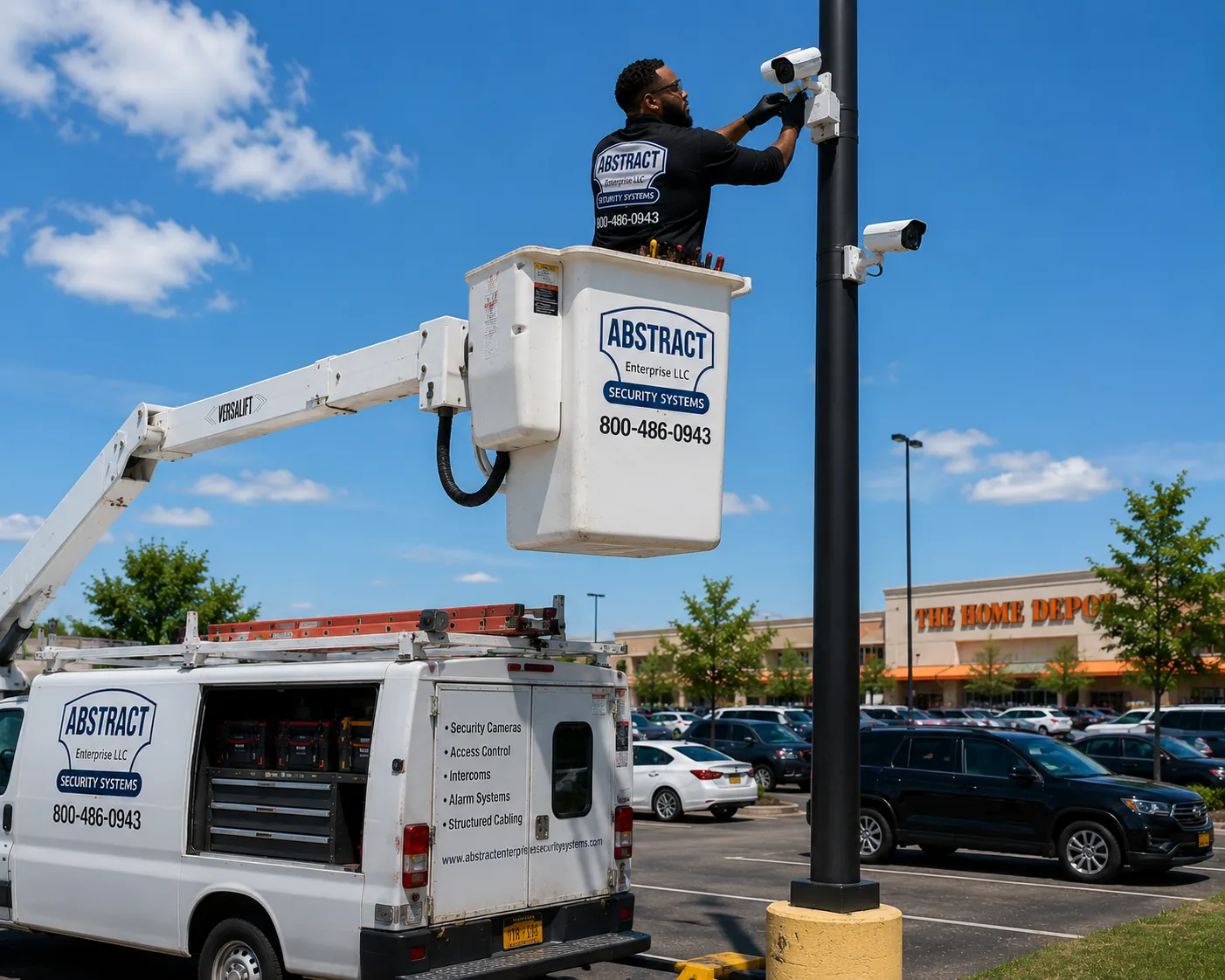
No two lots are alike, and the quickest path to a real number is to walk yours. Call (845) 640-3835 or ask for a free on-site survey, and we will scope the coverage, the retention and the price to your specific Rockland property — none of the phone-quote guesswork.
FAQ
Most Rockland jobs land somewhere between a couple of days and about a week on site once the equipment is in hand. A small building-mounted layout can wrap in a day or two; add pole footings, a trench through traprock, a fiber pull or a mall deck and it stretches. You get a realistic date at the survey, and the work is staged so the lot keeps operating rather than shutting down.
Occasionally. The cameras themselves usually do not, but pole footings, electrical work, trenching in a right-of-way and anything on a historic parcel in the river villages can each trigger a permit or a village-board sign-off — and Rockland is a tight patchwork of towns and villages, each with its own rulebook. We pin down what a given lot needs before starting so the timeline reflects it. This content is general information and is not legal advice.
Yes — it is a common ask here. Plenty of Rockland lots carry a system that half-works or points the wrong way, so we diagnose it at the recorder and the field enclosure, keep whatever hardware still earns its place, and swap only what has failed. A lot that went dark after an incident is a same-day priority, and whatever we finish is documented and handed over so it is no longer chained to the last installer.
It is yours outright. Recorder, cameras, footage and the accounts all belong to you, with a login per person rather than one we hold onto, and nothing forces a monthly monitoring contract to keep the system running. Extras like an off-site cloud copy or an active monitoring service exist if you want them, but they are optional, never a lock-in.
The count comes out of the lot itself, not a menu. Entrances and exits, the rows where cars linger longest, the pedestrian routes and any deck levels each ask for positions, and a plate-capture entrance is always its own dedicated camera on top of that. A small commuter lot may want a handful; a Palisades-scale deck, a hospital or a Route 59 plaza wants a good many more. The survey draws coverage from the real property instead of quoting a round number.
Yes. Where hauling power and cable to a far pole is not worth the trench — and through Rockland traprock it frequently is not — a solar-and-cellular position, or a battery-backed camera on an engineered radio link, keeps that corner covered without breaking ground. It does have to be sized to the spot for sun, distance and camera load, which the survey confirms, but it is a real solution rather than a consolation prize.
For a stretch, if it is built that way. The recorder and the key cameras can ride on a battery backup so a brief cut leaves no gap, and critical positions can carry their own power. A long outage is another matter, but the system is designed so the short utility drops that a storm off the Ramapos tends to cause do not knock the lot offline exactly when coverage counts.
Yes. The western towns — Suffern, Sloatsburg, Hillburn, Airmont, Montebello — tend toward larger, more spread-out lots pressed against the Ramapo Mountains, often on rock and with real distance between buildings and parking. Those distances lean the design toward fiber runs and wireless hops, but the coverage gets planned with the same care as anything down in the Route 59 core.
Yes. It exports the exact clip as a file with the timestamp and camera label intact — something you can hand straight to police, an insurer or an attorney, instead of filming a monitor with a phone. At closeout we walk you through searching by time and camera and exporting yourself, so when something happens you are not stuck waiting on us to retrieve it.
Heated, defogging housings keep domes clear through freeze-thaw, and positions are set so plowed snow piles do not bury a low camera or block a plate lane. Past that, an occasional lens wipe and a look after a hard storm keep the image honest; we can handle those on a service visit, or walk your staff through what to watch for so a salt- and spray-covered lens does not quietly dull the footage.
Usually, and more so in Rockland than most places, because reopening a trench through traprock is expensive. Pulling conduit with spare capacity to the entrance, planning a power route and choosing camera positions with a future gate arm or extra cameras in mind turns the next phase into a pull-and-mount instead of a second dig. It is cheap insurance while the ground is already open.
Abstract Enterprises Security Systems provides a three-year warranty on products supplied by AESS for normal wear and tear. It does not cover existing or customer wiring, customer-supplied equipment, lightning or other acts of God, power outages or surges, physical damage or unplugging, internet, router or phone changes, or camera readjustments requested after completion. After the warranty period, service is $195 per hour with a three-hour minimum ($585). Full terms are on our warranty page.
SHOP OUR SYSTEMS
$1,105–$1,950 installed
The entry package, for a compact property — a one-tenant shop lot, a small municipal or house-of-worship lot off Route 59. It places four fixed cameras where they count: the way in, one aisle and a single pass down the boundary.
$1,950–$3,250 installed
The middle tier, for a Nanuet or Nyack lot of moderate size. Around eight cameras deliver coverage down every aisle and a plate-ready entrance, with the cabling and footings scaled up for Rockland’s distances and harder ground.
$3,640–$5,850 installed
The full build for the county’s largest properties — a Palisades Center deck, a hospital campus, a Metro-North park-and-ride. Sixteen cameras and up, dedicated plate lanes, pole PTZ and a complete perimeter, all specified to hold through hard winters and traprock trenching.
Figures shown are installed, at Rockland County rates, for the scope in each card. Where a job lands inside its range depends on plate lanes, pole PTZ, the length of any traprock trenching and winter exposure — all pinned down at your free survey.
No monthly monitoring contract is required — you own the system, the footage and the accounts outright. After the warranty period, service is $195 per hour with a three-hour minimum ($585).
COMPLETE SERVICES
Whole-property camera design and install work for Rockland businesses and homes — entrances, interiors and grounds, not just the lot.
When an existing Rockland system goes down or blind, we troubleshoot it in place and get the picture back — recorder, cabling or cameras.
Retail, office, industrial and multi-tenant buildings — coverage scoped to the whole site, with the lot as one piece of it.
Barrier gates, readers and credentialed entry for any Rockland property tightening up who gets into the lot and the building.
Dock doors, aisles and trailer parking for the distribution buildings along Route 303 and the Thruway — the pairing to an employee-lot system.
Temporary and permanent coverage for Rockland job sites — equipment laydown, material storage and site entrances through the build.
ALL AREAS SERVED
The full parking silo is linked here; any area still without its own page is served directly via the request-coverage survey link.
Citywide hub across the five boroughs.
Retail, industrial, residential and institutional lots.
Below-grade and multi-level garages, attended facilities.
Mall and casino decks, storefront lots, and truck and fleet yards.
Garages, Hunts Point yards, resident and event lots.
Marina, mall, waterfront and ferry-district lots.
Nassau and Suffolk lots, commuter and coastal properties.
Roosevelt Field, LIRR commuter, South Shore marina and office-park lots.
Fire Island ferry, LIRR and airport lots, the Hamptons and Hauppauge fleet yards.
Regional hub across all six Hudson Valley counties.
Yonkers, White Plains, New Rochelle, the Sound Shore, Rivertowns and Metro-North commuter lots.
You are here — Palisades Center, Route 59, Nanuet, Nyack, the Metro-North Pascack Valley lots and the Hudson-shore villages.
GET IN TOUCH
Tell us about the property and we will schedule an on-site survey, map the lot, confirm pole, power and ground conditions, and produce an itemized proposal with a per-camera plan and calculated retention. Scheduling and the finish date depend on site conditions, equipment lead time, access, permitting needs, and the extent of the work.
Call (845) 640-3835
WhatsApp: wa.me/17186790359
NYS Low-Voltage License #12000287431
· 201 Google Reviews