
Warehouse Security Camera Installation
in Queens
4K PoE camera systems built for the way Queens warehouses actually work: single-story steel with real yards, cargo floors on the airport belt, multi-tenant parks, gate lanes, and inventory that leaves on wheels nobody logged. You keep the recorder, the footage and the passwords; the monthly fee stays a flat zero.
Get a Free Warehouse Security Quote
Fixed pricing, model numbers included — a tech replies fast.
This is our Queens warehouse camera page. Start from the NYC warehouse camera hub for the five boroughs, or the Abstract Enterprises Security Systems homepage for everything we install.
Get a Queens Warehouse Camera Quote
- Free site walks borough-wide — request a warehouse security assessment by phone or the 60-second form
- A fixed written estimate, camera by camera with model numbers — never a phone-script guess
- Three-year warranty on AESS-supplied products, installed under NYS low-voltage license #12000287431
Warehouse Security Camera Installation Built for Queens Buildings
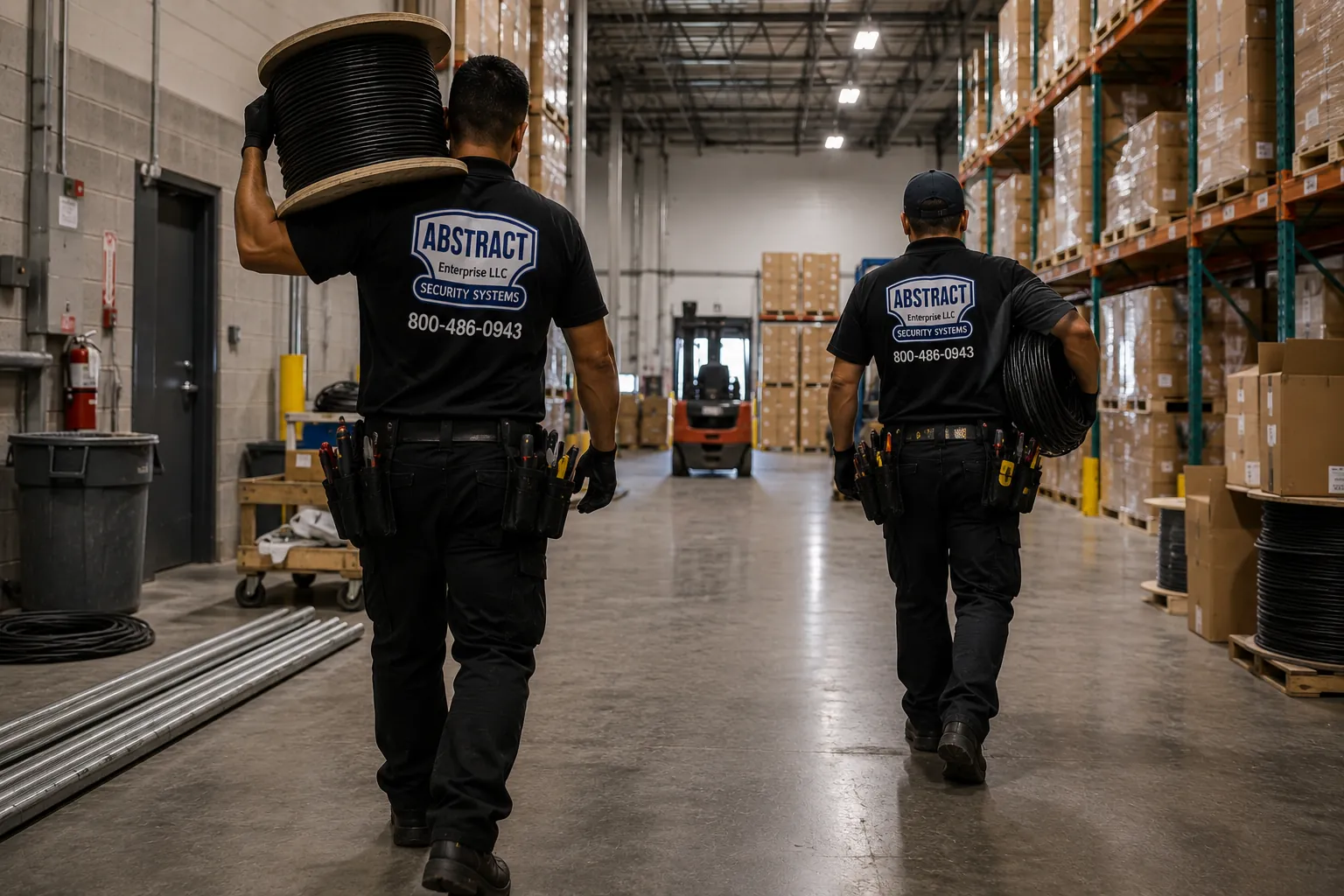
A Queens warehouse fails at its edges. The yard where the trailers and the converter rows sleep. The gate lane where a tractor with perfect paperwork turns in. The shared drive of a multi-tenant park where nobody's camera quite reaches. The dock face where morning glare erases the one handoff that mattered. Club kits and driveway cameras were never designed for those edges — and the borough's scale, from a Ridgewood shop to a bonded cargo floor on the airport belt, punishes generic design harder than anywhere else in the city. We work the problem from the building's side: count the decision points at your docks, gates, cages, and fence lines, read the contracts your customers actually hold you to, and engineer the surveillance to both.
Abstract Enterprises Security Systems is a New York State licensed low-voltage security contractor, license #12000287431, on Queens docks and yards weekly from Maspeth to Springfield Gardens — close enough that a service call is a bridge crossing, not a dispatch ticket. Every build carries the same backbone regardless of corridor: commercial 4K IP cameras on hardwired Cat6, PoE switching with growth ports held in reserve, a local NVR sized against a written retention target, and remote viewing proven on your own phone before the truck leaves your block. No subscription exists anywhere in it, no per-camera monthly line — the identical promise behind every security camera installation we do across Queens.
We inherit half-dead systems weekly as well: recorder swaps, camera replacement, cable repair, and outright adoption of orphaned installs whose original company stopped picking up — handled by the crew behind our Queens camera repair calls, usually same day. What follows: how we design for buildings here, what it honestly costs corridor to corridor, the questions borough owners actually ask, and the blind spots we find on nearly every first walk. Read what you need, then call (347) 434-6392 or take the 60-second form.
Price My Queens Warehouse Cameras
Four quick answers and the person who replies is an installer, not a call center. Use it for fast numbers, or skip it and call to put the job on the calendar directly. No obligation, no spam.
Why Queens Warehouses Need Purpose-Built Camera Coverage
Queens is where New York's freight actually touches ground. The Maspeth triangle feeds the LIE and BQE, Long Island City's industrial blocks run last-mile and studio support around the clock, College Point holds printing and distribution off the Whitestone Expressway, the Cooper Avenue corridor threads supply houses through Ridgewood and Glendale, and the JFK belt — Springfield Gardens, South Ozone Park, Rosedale — runs the forwarder and bonded-warehouse economy of the East Coast's busiest air-cargo gateway. Single-story steel with real yards, multi-tenant parks, and cargo floors where the inventory is worth multiples of the building — most of it working before dawn and unwatched after dark.
The theft economics follow the freight. Cargo theft causes up to $35 billion in estimated annual U.S. losses, according to the National Insurance Crime Bureau — and the modern playbook of fictitious pickups and correct-looking paperwork was practically written for an airport-adjacent borough. When the thief arrives dressed as your scheduled carrier — or the loss is a converter row in College Point, a lumber rack in Glendale, a cage in a Maspeth park that reconciles short — gate cameras with plate capture and dock footage at identification density are what separate a police report with leads from a shrug. Purpose-built installation is that separation.
And then the paperwork layer — which in Queens tends to show up before any thief does. Cargo customers send security questionnaires; CTPAT and bonded-facility expectations put camera coverage, retention, and documented access in writing; property and cargo underwriters ask what surveillance runs before quoting; wholesale and 3PL contracts specify retention. The state's cannabis regulator applies its surveillance rules to a licensed Queens floor exactly as anywhere else. And when a forklift claim or a slip-and-fall reaches a Queens County courtroom, one time-stamped clip on a recorder you own ends in an afternoon what depositions would drag through a year. In this borough the camera system prevents theft second; first, it's the documentation the entire operation rests on.
Warehouse Camera Systems We Install Across Queens
4K PoE IP Camera Systems
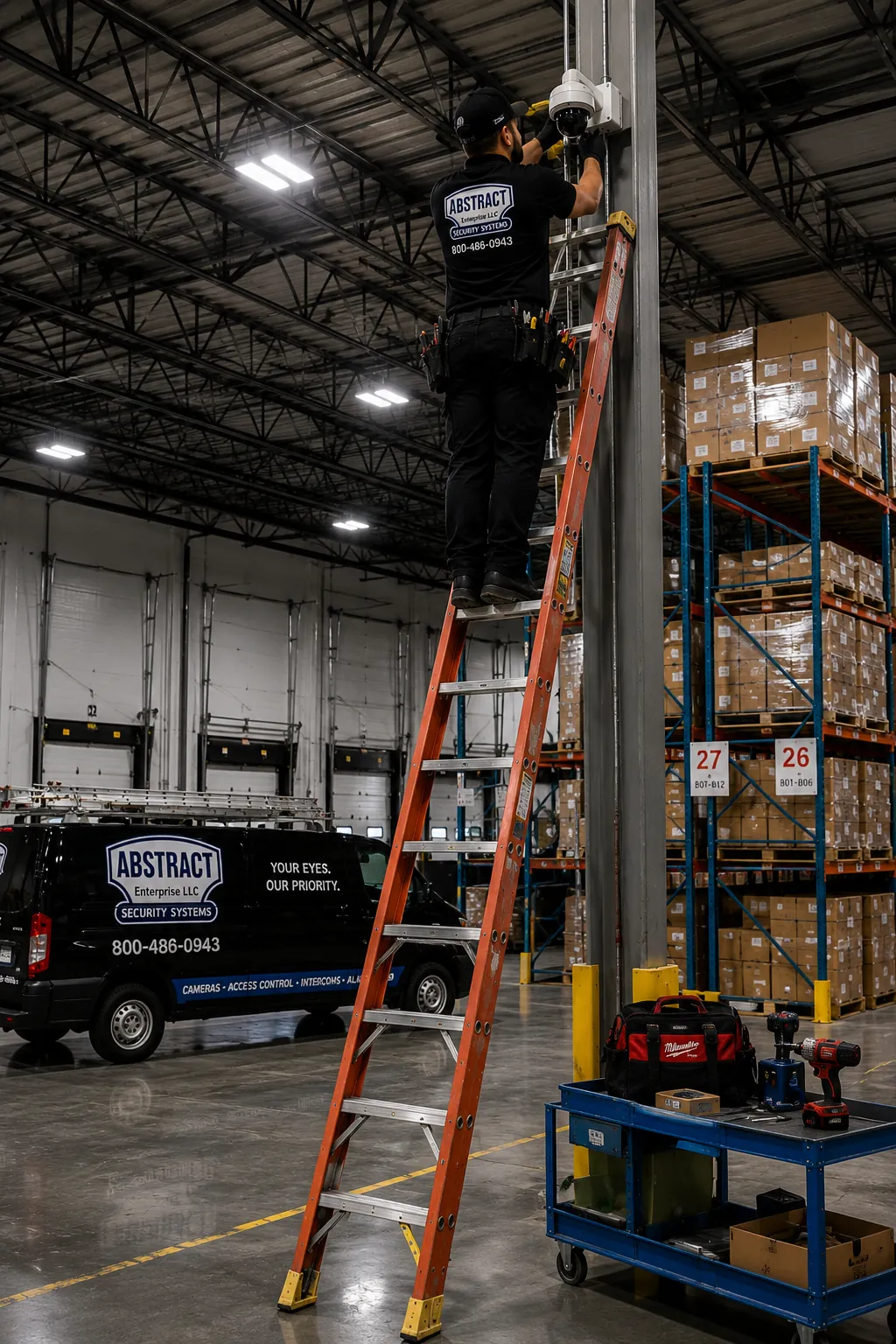
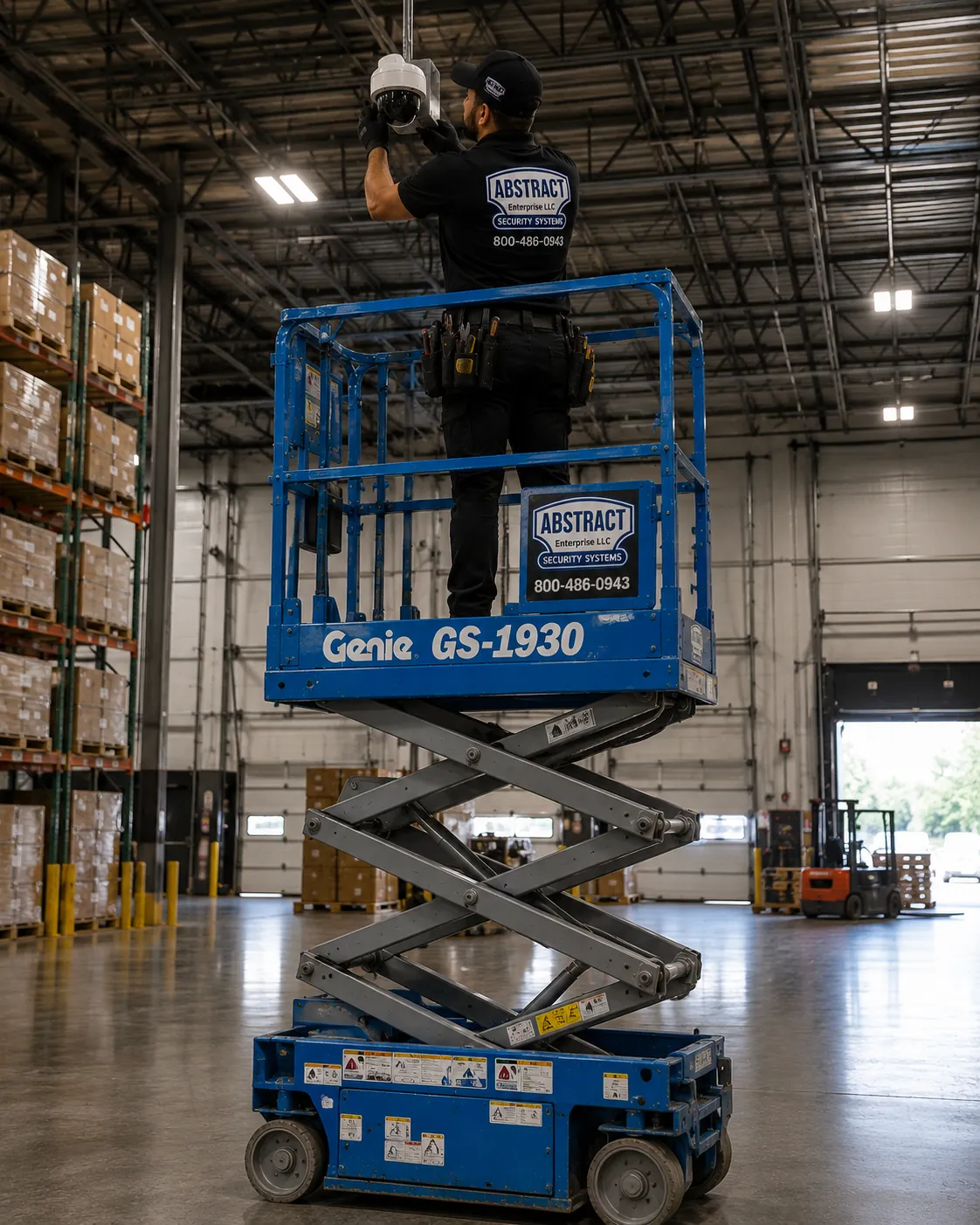
Power and video ride one Cat6 run per camera — wiring that scales cleanly from a Ridgewood shop to a forty-head cargo floor with no transformer closet anywhere. The resolution pulls a carton label off dock footage and a face at the man-door; growth costs a spare switch port; both ends of every run carry a label. Interiors get domes, and anywhere docks, gates, or yards face the weather gets sealed turrets and bullets.
NVR Recording Sized to Your Retention
The recorder is where audits are won. Ours get sized from arithmetic — channels, resolution, codec, and the retention your customer questionnaire, cargo contract, or the OCM actually specifies — with the math printed on the quote. When the validator or the claims adjuster asks how long you hold footage, the answer is a line you point to, not a guess.
PTZ and Yard Coverage
The borough's losses concentrate where it keeps its land: trailer yards, equipment rows, fence lines from College Point to Jamaica. One pole-mounted PTZ with real optical zoom patrols the rows and auto-tracks after-hours movement while fixed heads hold the fence and the gate — because a yard camera that misses the exit is a highlight reel, not evidence.
Panoramic and Fisheye Interiors
A single ceiling-mounted 12MP fisheye at an aisle crossing replaces a fistful of smaller heads, with software flattening its circular image into clean directional views. Crossings carry the panoramics, row ends carry fixed heads, and the between-rack blind spots that all-fixed layouts leave behind stop appearing on the map at all.
License Plate Recognition at Gates and Aprons
On the cargo belt the plate log is the case file. An overview camera goes blind in headlights; an LPR camera is shuttered precisely for them. Set one tuned unit per gate lane, apron, or curb cut where tractors genuinely turn in, and the vehicle log becomes searchable by plate — which is what turns a police report from "white box truck, unknown" into a registered owner.
Thermal and Low-Light Perimeter
Unlit fence lines get thermal that reads heat instead of light; frontages and courts with ambient glow get full-color low-light sensors that hold usable color all night; dark interior corners get long-throw IR. Everything lands on the same recorder and reads from the same app.
AI Analytics and Real Alerts
A borough of truck routes and foot traffic generates false alerts by the hundred. Person-vehicle analytics with schedules and zones fix it — line-crossing on the fence, after-hours rules on the dock, loitering at the gate — filtered down to the point where a 2 a.m. notification means an actual human in a place no human belongs.
DVR Takeovers and Upgrades
Plenty of Queens floors run coax somebody installed two owners ago. Runs that pass the meter keep working — cameras step to HD over the existing coax or convert to IP — and the recorder swaps for a modern unit with phone viewing and honest retention behind it. Orphaned systems get adopted wholesale too, including the Dahua camera systems we service across Queens weekly.
Where the Cameras Actually Go: A Queens Placement Map
Inside, the borough map is consistent: identification-density cameras at every man-door and freight entrance — head height, facing the traffic — because faces are caught entering, not wandering. Shipping and receiving get dedicated heads on the exact spots where inventory changes hands; aisle-end cameras run the rows while crossing-mounted fisheyes fill between racks; the cage and inventory room take the tightest shots in the building; the office camera watches the drawer and the server closet. On audited cargo floors, the map extends to wherever the questionnaire says it must — and we build to the strictest line item.
Outside is where Queens earns its camera count: dock faces get weather-sealed WDR units aimed at the trailer and the handoff, the apron gets a wide view logging every tractor, gate lanes get tuned plate capture, fence legs get fixed heads with analytics, and yards get the PTZ over the rows. College Point's flood geography moves recorders high and housings sealed; the airport belt adds escorted-access realities to the mounting plan. The objective never changes: walk your property with a thief's eyes, list every path a person or truck can travel unrecorded, then engineer that list down to nothing. Generating it is the entire purpose of the free site walk.
One planning note from years on these blocks: run cameras and access control as a single project. Video establishes what happened; the badge log establishes who opened the door — together they close the question. Wiring both in one mobilization costs real money less than two, and our license spans the full low-voltage scope.
The Vocabulary on Your Queens Camera Quotes, Translated
Three bids will arrive speaking three dialects; this key lines them up on one page and shows which one has actually worked a borough dock.
- PoE (Power over Ethernet)
- Camera power and video sharing a single Cat6 run — no outlet hunts, no transformer farms, one labeled cable per head from a Glendale shop to a cargo floor.
- NVR (Network Video Recorder)
- Your recorder, your drives, every channel written locally — which is exactly why no monthly line exists. It gets sized by printed arithmetic: channel count, resolution, days required.
- DVR
- The coax-era recorder still running many older Queens floors. Serviceable but resolution-capped — the usual move is DVR-to-NVR while every legacy run that meters clean keeps its job.
- IP Camera
- A camera that's a network citizen: individually addressable, focusable, updatable — not a fixed analog head frozen wherever someone aimed it in 2012.
- WDR (Wide Dynamic Range)
- One exposure that holds a sunlit apron and the dark dock behind it. True 120dB-class WDR is why the loading-face camera catches a face at 7 a.m. instead of a silhouette.
- IR Range / Lux
- The two specs that decide the night together: how far infrared throws, and the minimum light the sensor can use. Yards and unlit floors need both numbers strong — one alone still fails.
- Varifocal Lens
- Zoom and focus you adjust from a laptop on the floor — so the camera above the racking never bills another lift day just to reframe.
- H.265 / Smart Codec
- Encoding that roughly halves storage against the old standard with nothing visible lost — on an audited 90-day retention spec, that's drive budget handed back.
- PPF (Pixels Per Foot)
- What makes a face identifiable in court: roughly 80 PPF at the doorway, versus the small fraction a wide shot delivers. Position purchases PPF at a fraction of what megapixels cost.
- ONVIF
- The interoperability standard keeping mixed-brand cameras and recorders on speaking terms — and the exit door from any vendor who behaves like your landlord.
- VMS
- The software layer for searching many cameras fast — the right tool once one screen watches a Maspeth floor, a College Point yard, and a forwarder near the airport.
- Surveillance Drives / RAID
- Drives rated for round-the-clock writing, structured so losing a disk means replacing a disk — instead of losing the ninety days of footage a cargo claim needed.
- LPR / ANPR
- Plate-reading hardware that turns every gate and apron lane into a searchable vehicle log — the first thing a detective or a cargo insurer asks whether you have.
- Point-to-Point Wireless Bridge
- A purpose-built directional radio link to the far yard corner or detached building where a trench would never pencil — engineered wireless feeding commercial recording, nothing like a battery camera on a fence post.
- WDR vs. IR Bounce
- Two separate ways night footage dies: glare where sun meets a dock door, and infrared flaring off shrink wrap in the cage. Each is a placement-and-settings problem long before it's hardware.
- Edge Analytics
- Detection running inside the camera head itself — alerts stay instant on a truck-route block, and the recorder isn't doing the thinking for forty channels at once.
Camera Brands We Install in Queens Warehouses
Queens grades hardware on its own schedule: apron glare off the runways' worth of open sky, salt winters, forklift vibration, and yards that stay wet from November through March expose weak spec sheets inside a season. On value-driven commercial builds, Dahua and Hikvision remain the workhorses — deep catalogs, honest low-light sensors, recorders that simply run — with Uniview competing in the same class and earning trust at glare-heavy dock faces. Where a contract requires NDAA-compliant equipment — routine on the cargo belt, with institutional owners, and in government-adjacent work — the build moves to Hanwha Vision, Axis, and Avigilon, whose multi-imager heads and forensic search collapse a fifty-camera investigation into a lunch break. Stock is a bridge crossing away through metro distribution, so a dead camera waits on traffic, not a shipping label.
For shops, small buildings, and sub-5,000-square-foot operations, the Lorex systems we install across Queens deliver legitimate 4K with a friendly app and zero fees. And when a multi-site operator genuinely wants cloud fleet management, we'll deploy the subscription platforms too — after the five-year math sits on paper in front of you, because that decision belongs with the total cost visible rather than discovered at renewal.
Camera Combos: Pairing Video With the Rest of the Stack
A representative warehouse camera scope includes an on-site assessment, a written fixed quote, and installation to code, with credentials managed per unit. Hypothetical planning example — not a customer account, completed AESS project, verified review, or promised result.
The third layer is intrusion — contacts on man-doors and roll gates, motion in the cage and office zones, glass-break where frontage glazing meets the street — professionally monitored, which turns a 3 a.m. event into a dispatched response instead of a clip somebody reviews at 8. Yards carry audio deterrence — a camera-triggered voice-down that shuts down most fence probing inside half a minute — while gates carry video intercom with remote release, so the pre-dawn driver is verified on a screen before anything unlocks. The whole stack designs as one system inside one app, and the bundle gets priced next to the piecemeal total on paper — making the savings something you read, not something you take on faith.
The Full Feature Set on Every Queens Warehouse Install
Included Standard
Commercial 4K or 4MP IP cameras, true WDR on every dock face · hardwired Cat6 labeled both ends · PoE switching with growth ports in reserve · NVR on surveillance-rated drives matched to a written retention target · continuous and event recording together · remote and mobile viewing stood up on your own devices before we leave the lot · scoped viewer accounts with admin held by ownership · camera-map documentation · audit-ready export procedure · three-year warranty on AESS-supplied products.
Available Options
Gate, apron and curb-lane plate capture · panoramic fisheye interiors · yard PTZ with auto-tracking · thermal detection on fence lines · after-hours AI person/vehicle alerting · audio deterrence speakers · critical-channel offsite backup · UPS runtime behind recorder and switches · CTPAT/customer-audit documentation packages · OCM-compliant retention builds · access control and alarm folded into the same visit.
How We Install Warehouse Camera Systems
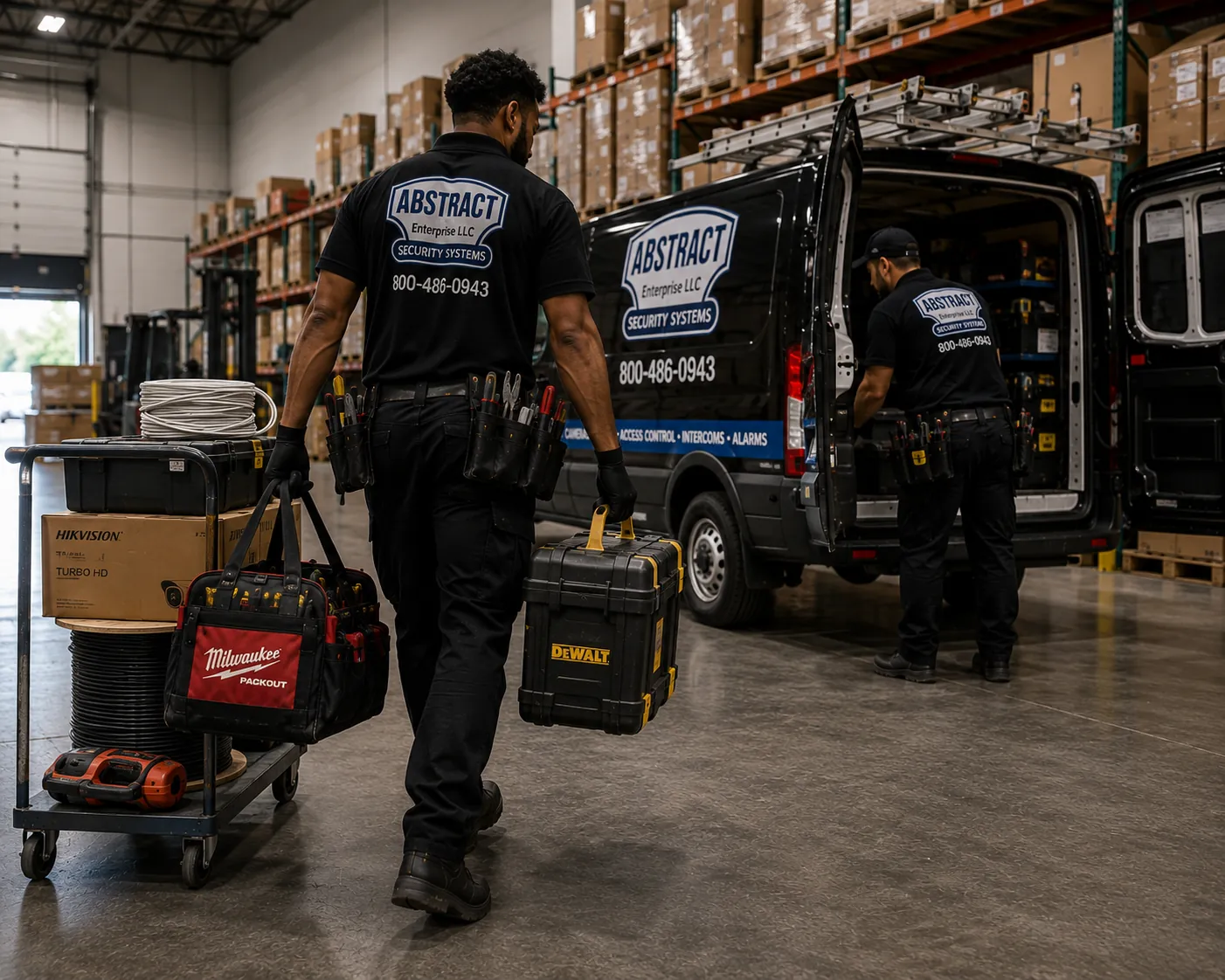
- Site walk and risk map. We walk your docks, floor, cages, gate and yard with you — and read the security language in your customer contracts if you hold any — then list every unrecorded route through the property before any number exists.
- System design and written quote. The design arrives as a camera-by-camera layout with model numbers, the drive math behind your retention target, and a single fixed price in writing — no decoder ring required, no change order lying in wait.
- Scheduling around your operation. Dock windows, gate hours, park rules, escorted access on the cargo belt, after-hours work where floors run around the clock — the sequence gets set with you before anyone rolls a cart off the truck.
- Cabling, mounting and aiming. Labeled Cat6 runs home to the recorder on protected paths above forklift reach, conduit where docks and yards demand it; heads get mounted and aimed at real targets — a dock face, a gate lane, a cage door — not at a building in general.
- NVR configuration and remote access. Recording schedules, detection zones, and retention get configured, then the mobile apps go live on your actual phones and desktops — ownership and each approved manager on their own scoped account.
- Walkthrough and handoff. We test every camera with you watching the monitor, then hand it all over: camera map, documentation, hardware, footage, passwords — nothing stays with us.
Warehouse Cameras Down in Queens? Same-Day Repair.
A tired warehouse CCTV system that finally quit, a recorder that never came back after an outage, channels dark the week of your biggest receiving push, footage a cargo customer or the NYPD needs today that the old DVR refuses to export: call (347) 434-6392. Same-day dispatch across the borough in most cases — one bridge from the shop — most faults diagnosed and fixed in one to two hours on site — every brand, every previous installer's wiring, Dahua, Hikvision, Lorex, Uniview, coax relics included.
After a break-in? Do not reboot the recorder. Call first; we can usually export what you need before it overwrites, then harden the system.
Queens' Warehouse Corridors, and How We Cover Them
Maspeth & West Maspeth
The borough's trucking heart works the triangle of Grand Avenue, Rust Street, and Maspeth Avenue — distribution floors, food wholesalers, and fleet depots feeding the LIE and BQE interchanges. Docks face the street, trailers stage overnight, and gate cameras with plate capture do the heavy lifting on every design out here.
Long Island City: Borden Ave to Dutch Kills
Borden and Review Avenues, Blissville, and the Dutch Kills blocks hold last-mile megasites, commissaries, studio support shops, and multi-tenant industrial buildings converting floor by floor. Shared docks, freight elevators, and 24-hour van traffic set a spec that's half logistics coverage, half tenant diplomacy.
The JFK Air-Cargo Belt
Springfield Gardens, South Ozone Park, and Rosedale run the freight-forwarder and bonded-warehouse economy along Rockaway Boulevard and the Conduit — buildings where cargo worth more than the real estate sleeps overnight. Fictitious pickups, CTPAT audits, and customer security questionnaires make identification-grade dock and gate coverage the price of doing business.
College Point & Whitestone Expressway
The 20th Avenue industrial park and the blocks off the Whitestone Expressway hold printing, distribution, and big-box back-of-house operations with real yards and real truck counts. Low-lying ground adds a design wrinkle: recorders mounted high, sealed housings, and UPS runtime for the outages that follow the water.
Ridgewood, Glendale & Middle Village
The Cooper Avenue corridor and the blocks around the Fresh Pond rail yard mix building-supply houses, food production, and contractor shops into tight residential seams. Roll gates off the avenue, sidewalk staging, and overnight van parking are the loss points the camera map has to own.
Jamaica, Hollis & the Liberty Corridor
Food distribution, building supply, and fleet garages work Liberty Avenue, Merrick Boulevard, and the blocks south of the LIRR cut. Single-story stock with yards and gates — converter theft, fuel theft, and weekend equipment hits keep this end of the borough on our dispatch board.
Warehouse Camera Systems by Queens Industry
From single-tenant industrial warehouse camera systems to multi-site warehouse video monitoring systems, the design follows the inventory. These are the operations our warehouse CCTV camera systems protect most often across the borough.
Air Cargo & Freight Forwarding
The JFK belt runs on chain-of-custody: dock cameras at identification density, gate LPR logging every tractor, retention long enough for a claim filed from another continent, and exports that satisfy a CTPAT validator or a customer's security questionnaire without a scramble.
Bonded & High-Value Storage
Buildings holding in-bond freight, electronics, and pharma staging carry camera expectations written into contracts and federal program requirements. We build coverage, retention, and documented access to the strictest line item and hand over the paperwork.
Last-Mile & Fulfillment Megasites
The LIC and Maspeth delivery footprints live on dock discipline: every door, apron, and van line recorded, with analytics separating a rider from a passerby and retention that outlasts a chargeback filed in week three.
Food Distribution & Produce Wholesale
Wholesalers from Maspeth to Jamaica move product through docks before dawn. Cameras on the doors, the walk-ins, and the staging lanes turn route shrink and invoice disputes into two-minute lookups instead of standing arguments.
Licensed Cannabis Facilities
New York OCM regulations require video surveillance in applicable cannabis storage and handling areas, at least 60 days of recording retention, failure notifications, and a security and surveillance system able to remain operational during a power outage for at least eight hours. We build to the regulation, battery runtime included, and hand over the compliance documentation.
Film, TV & Studio Support
Stage complexes and equipment houses around LIC turn gear over daily and empty by the truckload. Checkout-counter cameras, aisle overviews, and dock coverage tied to the rental log make a missing case a search query, not a write-off.
Beverage Distributors
Keg, case, and pallet counts reconcile against camera timelines at the dock. Distributors across the borough pair aisle overviews with door cameras so route shrink shows up as a clip with a name on it.
Auto Parts, Salvage & Fleet
Parts rows, lifts, and fleet vehicles across the borough's yards feed a steady converter-and-core theft economy. Fence-line analytics, yard PTZs, and gate plate capture end the pattern — and document it for the detective.
Building Materials & Lumber
Racked lumber, roofing, and masonry stored outside from Glendale to Jamaica walks away by the truckload. Yard coverage, rack rows, and gate LPR convert the loss pattern into plates and faces.
Contractor & Landscaping Yards
Across the borough's equipment yards, weekends eat trailers, attachments, and diesel. Fence-line person-vehicle detection, a gate lane on camera, and real-time alerts to an actual phone retire the Monday-morning inventory surprise.
Self-Storage & Flex Multi-Tenant
Storage buildings cover drive aisles, elevators, and offices after hours with scoped viewer accounts — and multi-tenant industrial parks settle who-was-where without a confrontation.
E-Commerce 3PL & Returns Floors
Returns floors manufacture condition disputes by the hour — what arrived back, in what shape, through which hands. Camera coverage at station level with a searchable timeline reverses the economics: chargebacks go back out the door with evidence stapled to them.
What Queens Owners Actually Ask About Warehouse Cameras
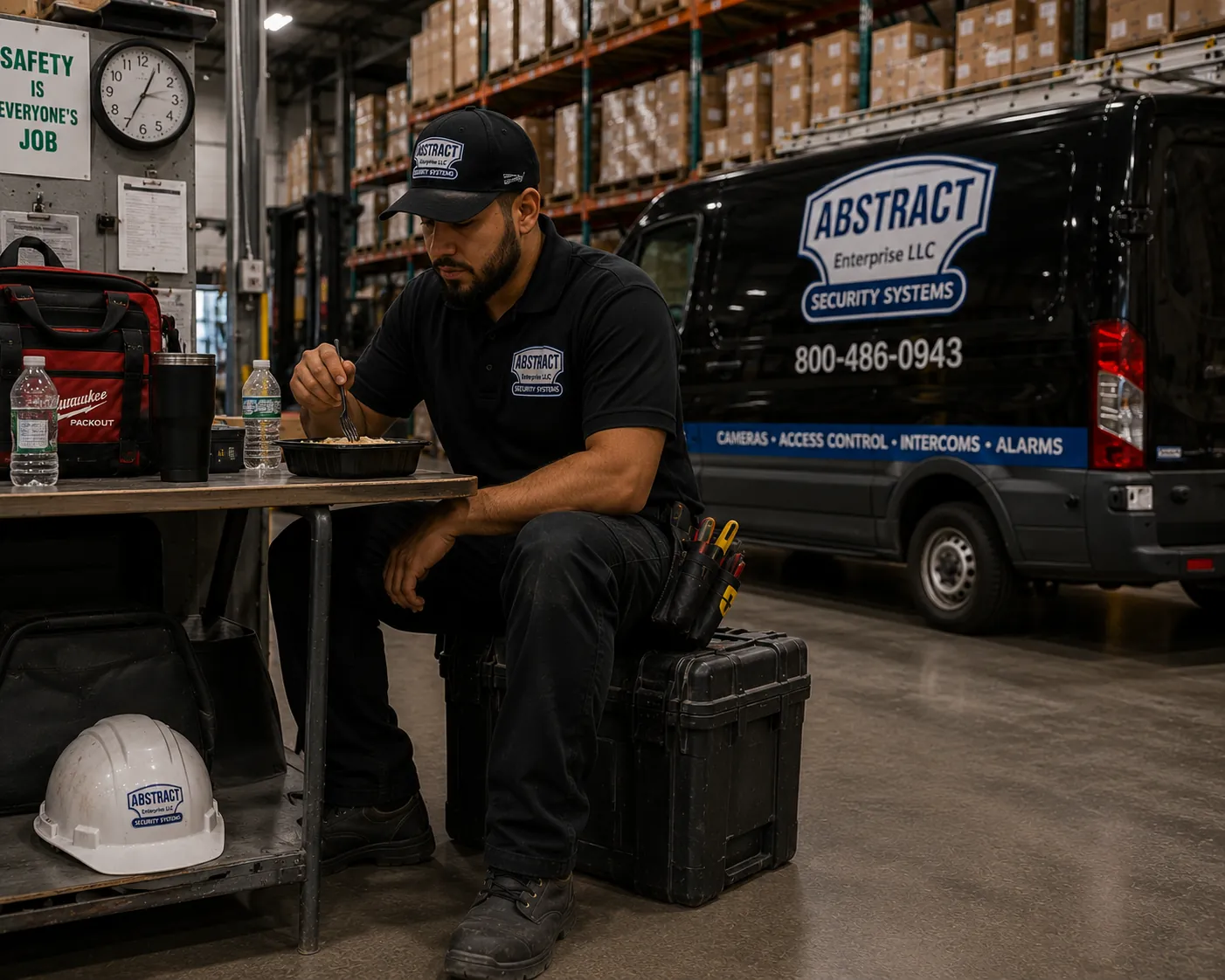
What did your Queens warehouse camera install actually cost?
Real borough numbers from our book: 8-camera 4K PoE systems on shops and small distribution buildings commonly land $4,900 to $8,200 installed; 16-camera multi-dock builds run $9,900 to $17,500; 32-plus-camera cargo and fulfillment floors go $19,800 and up. Queens prices a step above our Brooklyn base — borough scale, bridge time, and bigger single-story stock — and the quote is fixed in writing either way.
A freight forwarder near JFK quoted me triple what my cousin paid for his house cameras. Why?
Because a bonded cargo floor and a colonial in Bayside are different jobs wearing the same word. Your building carries CTPAT expectations, customer security questionnaires, identification-grade dock coverage, gate LPR, and retention measured in months. The house got four cameras and a ladder. The gap isn't markup — it's the job description.
Is it worth cameras on a Glendale yard I only use for staging?
Run the two-loss math: a converter row hit plus one stolen trailer of material usually exceeds the yard package that ends both. Gate LPR runs $1,500 to $3,000 per lane, yard PTZ $1,300 to $2,800 — one recovered load or one denied fraudulent claim pays the whole corner.
How do I vet a warehouse camera installer in Queens?
Four documents: a NYS Department of State low-voltage license you can verify by number (ours is #12000287431), an insurance certificate naming your building, commercial references in operations like yours, and a quote itemized by model. Around the airport, add a fifth: ask whether their exports have ever satisfied a CTPAT validator or a customer audit. Silence answers the question.
The company that wired our Maspeth building got bought and nobody answers. Now what?
Adoption is weekly work for us. Whatever the brand, we walk every channel, separate the cameras that record from the ones that decorate, then restore or replace the head end while keeping each run that tests clean. You end up with a documented system map you own — so the next corporate shuffle costs you nothing.
I've got one roll gate and a small shop off Liberty Ave. Kit and a Saturday?
Honestly — maybe. One gate, low ceilings, under 5,000 square feet: a decent kit can hold the line if you mount it right and check it monthly. The failure line is scale: PoE budgets that brown out, 20-foot steel with no lift, retention that overwrites in nine days, nothing at plate height. Cross any of those and the weekend project becomes the thing we replace.
What actually breaks when warehouses self-install?
The same four things, borough-wide: unsupported cable laid on ceiling grid, terminations that fail with the seasons, cameras focused at nothing from 22 feet, and a recorder on a power strip that dies with the first outage. We rebuild this exact install every month — the do-over costs more than doing it once.
What do I need to read plates at my gate off the Conduit at night?
A dedicated LPR camera per lane — shutter, angle, and IR tuned for headlights — not a higher-resolution overview. A 4K dome watching the whole entrance reads nothing moving at 2 a.m. One tuned lane camera produces the searchable plate log a detective actually asks for.
How much retention do I need if my customers audit my building?
Match the strictest contract you hold. Cargo and 3PL customers commonly expect 60 to 90 days; some security questionnaires specify it in writing. Retention is drive arithmetic — channels, resolution, frame rate against terabytes — and we print the calculation on the quote so the audit answer is a line you point to.
Do cameras survive College Point flooding and the outages after?
Design for it and yes: recorders mounted high, sealed IP66-plus housings on anything low, and UPS runtime so the head end rides through the outage that follows the water. The systems that die in a flood year were installed for a dry one.
Who covers cameras in a multi-tenant industrial park — me or the landlord?
The lease decides, but the working pattern across the borough's parks: landlord takes the common areas — shared drives, courts, perimeter — and each tenant takes their demised docks, floors, and cages. We build both sides constantly, with scoped viewer accounts so every party sees exactly their own space and nothing else.
My tenant runs overnight and wants the parking field covered. Whose job?
Negotiable, but get it in writing either way. Common practice: the landlord cameras the field as shared infrastructure and recovers it in CAM charges; the tenant gets a scoped view of their rows. We've papered it both directions — what matters is that somebody owns it before the first break-in, not after.
Our cameras record but the footage never seems to show the thing that happened.
That's a design gap, not bad luck: overviews where identification shots should be, dead zones between racks, a gate camera blinded by headlights. We audit the layout against how your losses actually occur, re-aim and re-spec the weak positions, and close the map. Cameras that record everything except the answer aren't a system — they're a ceiling decoration.
Every vendor pitch ends with a monthly platform fee. Can I just own my system?
Yes, and most of the borough does. A locally recorded PoE system carries no required monthly fee: hardware yours, footage on your NVR, remote viewing free. Cloud platforms and monitoring are legitimate options for specific needs — they are not the price of admission for working cameras.
Warehouse Camera Questions Queens Is Searching
How much does warehouse camera installation cost in Queens?
Most borough installs land between $4,900 and $24,000. Eight-camera buildings run about $4,900 to $8,200, sixteen-camera builds $9,900 to $17,500, and 32-camera cargo and fulfillment floors start at $19,800. The band sits one step above our Brooklyn base — borough scale and bridge time — and every quote lists hardware to the model number.
Can warehouse cameras work without internet?
Yes — recording lives entirely on the local NVR. Docks, floors, and gates capture around the clock whether the building's connection is up, down, or gone for a week. What internet adds is the remote view and the alerts: the part you'll check daily and the part footage never depends on.
Do I need a camera on every aisle?
No. Cover the decision points instead: every dock door, man-door, cage, aisle end, gate lane, and yard exposure. Whether each aisle earns its own camera or shares a high overview comes down to racking density and steel height — and a design priced by intersections beats one priced by aisle count every time.
What's the best camera for a cargo dock near JFK?
A 4K fixed head with true WDR per dock face — positioned for the trailer, the seal, and the handoff against ramp glare — plus an apron view logging every tractor and plate. If the freight is bonded or audited, add identification-density coverage at the man-door and retention that matches the contract.
Who installs warehouse cameras near me in Queens?
We do — NYS licensed low-voltage contractor #12000287431, on Queens docks and yards weekly from Maspeth to Springfield Gardens, with the shop one borough over. The site walk is free and the quote arrives fixed, in writing.
How long should a Queens warehouse keep footage?
Thirty days is the floor. Freight forwarders, bonded storage, 3PL, multi-tenant parks, and cannabis licensees run 60 to 90 — their disputes and audits arrive weeks late. It's drive arithmetic, and the arithmetic prints on our quote.
Are wireless cameras good enough for a warehouse yard?
Depends which "wireless" you mean, because two very different products wear the name. A designed point-to-point radio link to a distant gate or outbuilding is real commercial infrastructure; a consumer WiFi camera across a working yard is an outage on a delay. When trenching makes no sense, we engineer the link — and it records to the exact standard wire does.
Can I add cameras to my existing system?
Nearly always. Spare recorder channels plus PoE headroom turns expansion into one camera and one cable; a maxed-out head end means stepping up to a larger or hybrid recorder that adopts every working camera. A single audit visit determines the route — and tends to expose whatever the previous installer never wrote down.
Do warehouse cameras lower insurance costs?
Often enough to plan on it. Documented professional surveillance may assist with insurance documentationts have recovered a real slice of the install at renewal. Find out from your broker exactly which paperwork qualifies; we turn that packet around the same day.
What happens to the cameras in a power outage?
Battery backup carries the head end: recorder and switches on a UPS sized to the site, a full eight hours where cannabis regulation demands it and to your own risk appetite everywhere else. Blackout, flood-season outage, tripped breaker — the timeline survives all three.
Do I need a permit for warehouse cameras in Queens?
No line-voltage permit attaches to camera work, but two requirements stand: the installer must hold the NYS low-voltage license, and your building or park may add its own layer — COIs, gate rules, roof rights. Whatever your block actually demands is ours to handle.
Should warehouse cameras record audio?
Default no. New York consent rules — and Labor Law Section 203-c’s workplace-privacy limits — make audio a legal question before a technical one, and video answers almost every warehouse dispute on its own. If counsel signs off on a specific use, we configure to it.
People Also Ask: Queens Warehouse Cameras
How many cameras does my Queens warehouse need?
A formula answer is a polite guess. The genuine count is read off your building — dock doors, entrances, cages, aisle layout, steel height, yard exposure — plus, near the airport, whatever your customers' audit language requires. Our borough quotes span 8 cameras at a Ridgewood shop to 60-plus on a cargo floor, and the site walk is what fixes the number.
What is the best security camera system for a warehouse?
The one engineered for your building rather than lifted from a brochure: 4K PoE heads on commercial cable, a local NVR, genuine WDR at every dock face, person-vehicle analytics, and retention scaled to your exposure. Uniview, Dahua, and Hikvision all manufacture excellent hardware — what separates systems is the design, never the logo.
How much does it cost to install cameras in a warehouse?
Queens installed bands: $4,900–$8,200 at 8 cameras, $9,900–$17,500 at 16, $19,800-plus at 32. Held against the published national commercial range of $500 to $1,000 per camera installed, the packages sit inside the math with borough logistics already priced.
Can my warehouse cameras be monitored remotely?
Yes, and it's half the point. Live view, playback, and alerts land on every authorized phone and desktop, tested on cellular before we leave the lot. Owners watch Maspeth docks from Long Island, Florida, and everywhere between — the dock doesn't know the difference.
Do warehouse cameras work in the dark?
The ones rated for it. Unlit floors and yards get long-throw IR, ambient-light spaces get sensors that hold color all night, and a pitch-black fence line gets thermal that reads heat instead of light. Night failures belong to consumer gear pointed at darkness it was never built to see.
What is the difference between DVR and NVR for a warehouse?
DVRs record analog cameras over coax; NVRs record IP cameras over network cable, sharper and with modern analytics. A building full of sound coax can bridge through a hybrid recorder and skip the rewire; fresh builds go straight NVR. When your wiring supports both paths, both show up on the quote.
Can cameras stop theft in a warehouse?
What they remove is the ambiguity every theft depends on. Visible heads discourage the opportunist, analytics pull the repeat pattern out of the noise, and when a load walks anyway, the export converts suspicion into an HR file or an NYPD report with the clip stapled on — and at a cargo building, into the exact packet your customer's claims team requests first.
Are warehouse security cameras tax deductible?
Generally, yes: commercial security equipment is a legitimate business expense that frequently qualifies for accelerated treatment. The final ruling is your accountant's, not your installer's — our contribution is the itemized, model-numbered invoice that makes their answer take five minutes.
Who is responsible for security cameras in a leased warehouse?
Start with the lease; where it goes quiet, the borough convention fills in — landlord owns the common areas and perimeter, tenant owns the demised docks, floors, and cages. Put it in writing at signing, because papering that argument after a loss costs more than wiring the answer ever did.
Related Searches, Answered in One Line Each
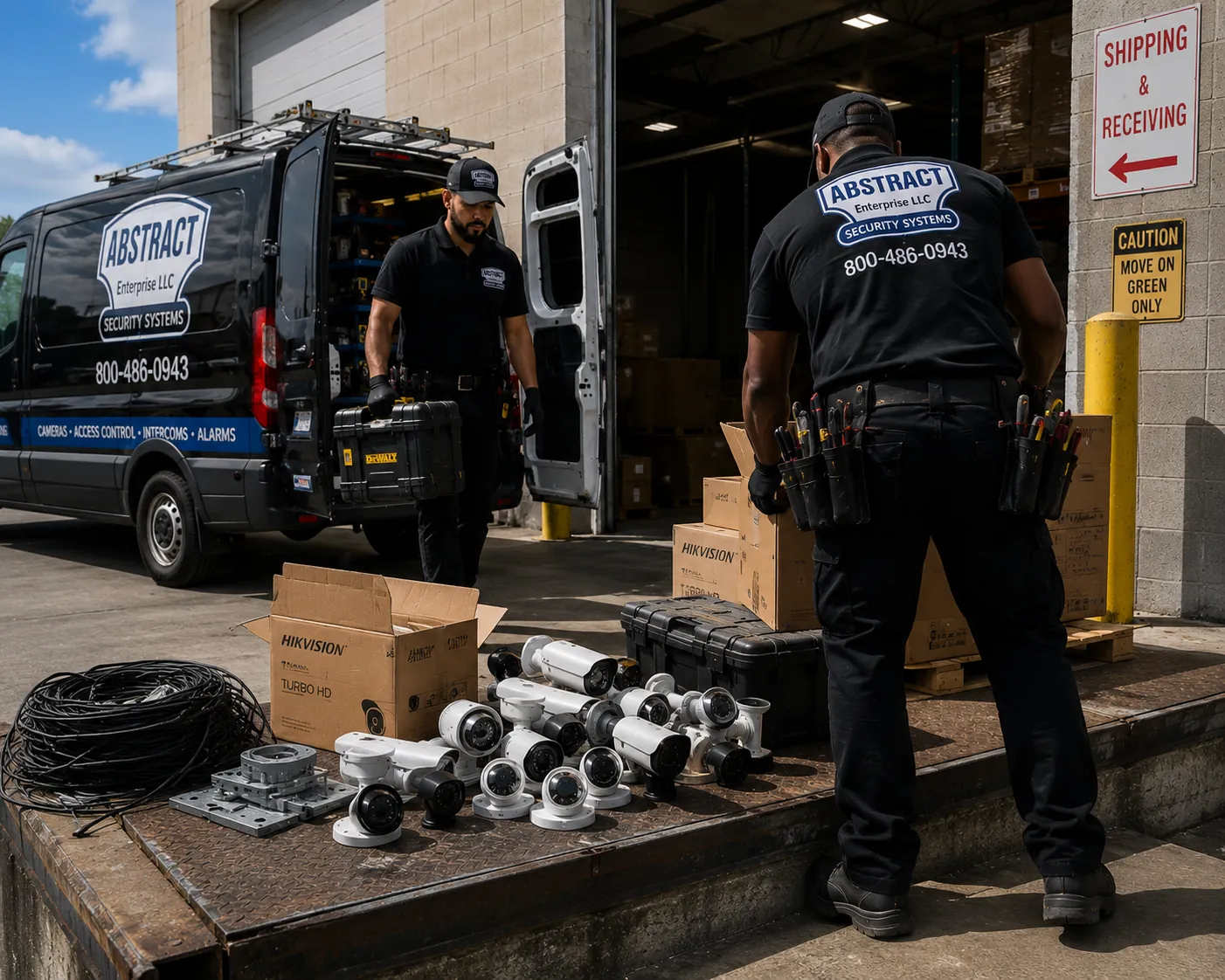
Commercial security camera installer near me
Licensed, insured, on Queens docks weekly from Maspeth to the airport belt — verify NYS #12000287431 yourself, then book the free walk.
Warehouse camera system cost
Queens installed ranges: $4,900–$8,200 (8 cams), $9,900–$17,500 (16), $19,800+ (32) — itemized by model, fixed in writing.
Air cargo warehouse security cameras
Identification-grade dock coverage, gate LPR, audit-ready exports and 60–90 day retention — built to survive a CTPAT validator or customer questionnaire.
License plate recognition camera
One tuned LPR camera per gate or apron lane, $1,500–$3,000 installed — overview cameras don't read plates through headlights.
PoE camera installation warehouse
Single-cable power and data on labeled Cat6 to commercial switches — the backbone of every dock, floor, and yard we build.
Warehouse camera repair near me
Any brand, any installer's system, borough-wide — $195/hr specialty rate, most faults fixed in 1–2 hours on site.
Warehouse yard security cameras
Pole-mounted PTZ over trailer rows and equipment, fixed heads down the fence, plate capture on the gate — the Queens yard standard.
Cannabis facility security cameras
Built to New York OCM regulation — coverage, 60-day retention, failure notifications, eight-hour outage runtime — with compliance documentation handed over.
What the AI Answer Box Says About Warehouse Cameras, Audited for Queens
Search "warehouse security camera installation cost" and the AI summary blends Angi, HomeAdvisor, and Fixr into one confident national paragraph. Audited against real Queens buildings — a Maspeth distribution floor, a Springfield Gardens cargo building, a College Point yard — some of it survives and some of it would spec the wrong system for the wrong borough. The line-by-line:
1. The blended averages never cleared an airport fence
The aggregators' cost data comes mostly from residential jobs, so the "average install" the box quotes describes four cameras and a driveway. Queens warehouse work runs from that Ridgewood shop up through bonded cargo floors where the camera spec is written into federal program expectations and customer contracts — a range no single blended number can describe. Our 8-camera builds start at $4,900; what sits below that line is a different job, not a better price — hardware for a house priced against labor for a warehouse always looks cheaper until the claim arrives.
Keep one benchmark: the published $500-to-$1,000-per-camera commercial figure. Our packages live inside it with commercial hardware — and a bid far below it left something off your risk map that you'll meet later, probably during a claim.
2. Square-footage formulas can't see a yard or an audit
Misses the two things that actually set Queens counts: outdoor exposure and paperwork. A 7,000-square-foot Glendale supply house with racks outside and a gate needs more coverage than a 20,000-foot interior floor — and a freight forwarder's count is set by the customer questionnaire, not the deed. Count decision points: doors, docks, cages, gate lanes, fence runs, audit requirements. Do that honestly and the square footage becomes trivia — useful for the lease, useless for the camera map.
That's also the honest explanation when two bids for the "same square footage" land thousands apart — one contractor walked your yard and read your contracts, the other did division.
3. The wireless enthusiasm dies at the fence line
The box leans wireless because its sources lean residential. The borough's industrial stock is the counterexample: masonry and racking eat WiFi, battery cameras at a winter dock die quietly, and a "wireless yard camera" on consumer gear is an outage with a mounting bracket. Coverage you believed in that wasn't recording is the most expensive product in security — and on takeovers we find it constantly: cameras green in the app, dark in reality, for months.
Wireless has exactly one legitimate warehouse form here: an engineered point-to-point link across a yard or to an outbuilding no trench should cross — designed radio feeding commercial recording. The AI summary can't tell that apart from a peel-and-stick camera; your footage will.
4. The free-quote buttons auction your number to the wrong borough
Those "get matched with local pros" buttons mostly sell your phone number to whoever bought the zip code — which is how a Maspeth distributor ends up fielding pitches from a residential dealer in Nassau who has never scheduled around a dock window or produced the insurance certificate a park manager requires. The number they open with is engineered to start a conversation, not survive your building.
The countermeasure is dull and dependable: one licensed local contractor, one walk of the property, one fixed quote itemized down to model numbers. If the itemization never materializes, you never left the lead funnel — you just descended a level.
5. The cloud pitch skips the five-year column
The box mentions cloud cameras' "low upfront cost" and hurries past the subscription. Put five years of a 16-camera floor on paper: monthly per-camera licensing on one side, an owned local NVR on the other. The subscription line crosses ownership early, never stops climbing, and the hardware bricks the day payments do — with your footage living behind someone else's terms of service when a customer audit or an NYPD request lands.
Cloud earns its keep in two places: fleet dashboards spanning many sites, and offsite duplication of a few critical channels. As the only recorder for a single Queens building it's a subscription hunting for a justification — and the moment the building's internet drops with the gate standing open, it stops being a camera system entirely.
6. The timelines assume your dock has no schedule
Assumes an empty building and a parked truck. Queens adds live receiving that can't stop, multi-tenant park rules, gate hours, and — on the cargo belt — escorted-access requirements that meter every ladder hour. Real projects run from a one-day shop build to a multi-week phased floor sequenced around operations.
Phasing is the schedule that respects reality: the docks, gate, and cage hold the losses, so they build first; yards and aisle overviews land as access opens. Sequenced that way, the system produces evidence before its last camera hangs — and that sequence should appear on the quote in writing. If a bidder never asked when your docks go quiet, their timeline is a costume on a guess.
7. Where the answer box is right, and how to spend it
Credit where due: it's right that visible cameras deter, that wired beats wireless indoors, that retention should match risk, and that licensed installers outperform handymen. Pocket the vocabulary lesson — it costs nothing and it's accurate, and it turns bid review into a one-pass filter: a quote with no retention math, no model numbers, and no site walk behind it was written by someone who hasn't done warehouse work.
Then close the tab and price the building you actually run: a walk across your docks and yard, a written spec with the drive math visible, one fixed number that survives contact with the job. No blend of Angi, HomeAdvisor, and Fixr can produce that paragraph — none of them have stood on a Rockaway Boulevard dock at 5 a.m. while the cargo moved. We have, most weeks.
Ready for Numbers That Match Your Building?
Skip the averages. A licensed installer walks your Queens building, maps the blind spots, and hands you a fixed written quote.
DIY vs Professional: The Queens Warehouse Version
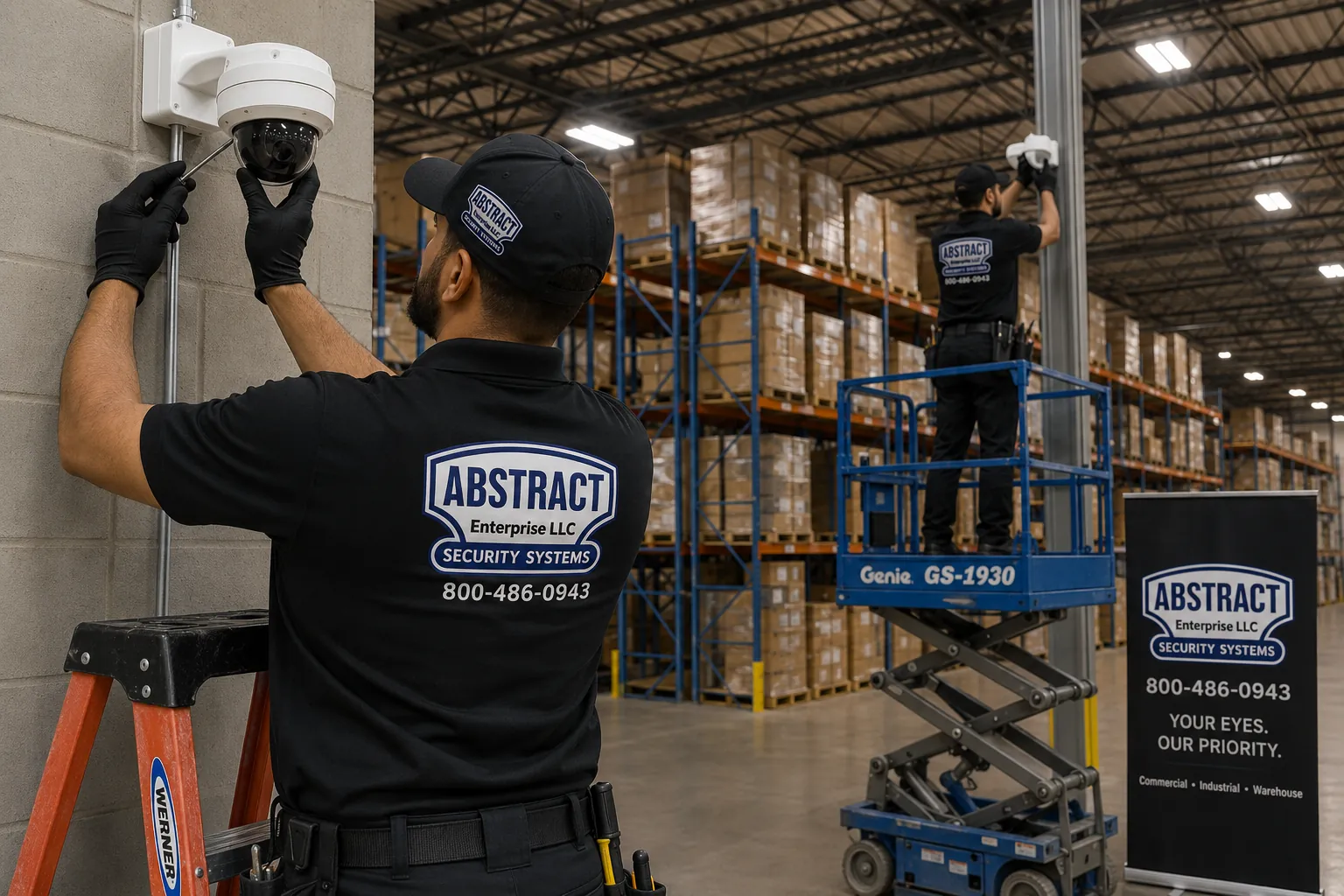
Queens runs on owners who built their operations with their own hands, so this comparison is written for borough warehouse CCTV specifically — with the respect a capable owner has earned and none of the homeowner-blog filler.
| Factor | DIY / Side-Job Install | Licensed Professional Install |
|---|---|---|
| Day-one cost | Cheapest on day one: club-kit hardware plus three weekends of your labor | More upfront: commercial hardware, engineered labor, a lift |
| Design logic | Cameras where the ladder reaches | Cameras where evidence lives: docks, gate lanes, cages, fence runs |
| Wiring | Runs draped unlabeled over the purlins; splice archaeology two winters out | Labeled Cat6 with service loops, protected paths, documentation |
| Glare and night performance | Discovered the morning apron glare ate the face | True WDR at doors and IR planned per position, verified at handoff |
| Height and yard distance | Ladder-limited indoors, WiFi-limited across the yard | Insured, lift-equipped, and set up for high steel and yard trenching |
| Evidence quality | Approximate proof that something occurred | Proof of who and which plate, at densities adjusters accept |
| Failure day | You are the help desk | Three-year AESS-product warranty and a same-day service line one bridge away |
Hybrid is a legitimate route, not a consolation: we engineer and pull the cable while you hang hardware, or we build the licensed core — docks, gate, recorder — and leave documented spare ports for interior heads you add on your own schedule. Pay for the parts that require us; keep the parts you enjoy.
Abstract Enterprises vs the Names on Your Shortlist
ADT Commercial and the national alarm brands
The national pitch is a logo, a monitoring network, and a multi-year agreement with cameras tucked into the line items. What tends to show up is a subcontracted crew meeting your block for the first time, hardware locked to their platform, and a service queue in another state while your gate camera sits dark through a weekend of receiving. We're structured the opposite way: every component yours, footage on your floor, monitoring an optional month-to-month add through central-station partners, and the person who priced the job standing on your dock. If what you actually need is recorded evidence plus hands that arrive fast, a five-year agreement is a lease on security you could have bought outright.
Verkada, Rhombus and the cloud platforms
Legitimately good software chained to per-camera licensing that never ends — and the reps work the borough's industrial parks hard. Across a sixty-building portfolio the fleet dashboard pays for itself, and where that's the honest case we'll deploy it. For a single Queens floor, put five years on a spreadsheet: the subscription overtakes an equivalent owned system early, never stops climbing, and the hardware turns to brick when payments do. We present both builds side by side with real five-year numbers — a comparison the commissioned rep's pay structure won't let him make.
Ring, Nest and the warehouse-club kits
Perfectly honest products for the houses they were built for — and the single most common pre-existing condition on the floors we inherit. Masonry and racking eat the WiFi, winter dock faces eat the batteries, a 250-foot floor outruns the IR, and consumer cloud terms were never written for a cargo customer's evidence request. When this season's budget only covers consumer gear, assign it to the office door, keep it off the dock and out of the yard, and bring us in before the block learns your schedule.
National integrators and IT resellers
The national integrators do genuine enterprise work; if you run a Fortune-500 logistics portfolio, hire one. The economics simply weren't built for a single building: engagement minimums, PM layers, and service billed with travel time from somewhere that is not Queens. One Maspeth distributor or one forwarder off Rockaway Boulevard is their rounding error; it's our weekly route, on the same commercial hardware tiers and the same state license, with the estimator and the installer being the same person. That's the whole trade, stated plainly.
Queens Warehouse Security, By the Numbers
Common Queens Scenarios We Get Called For
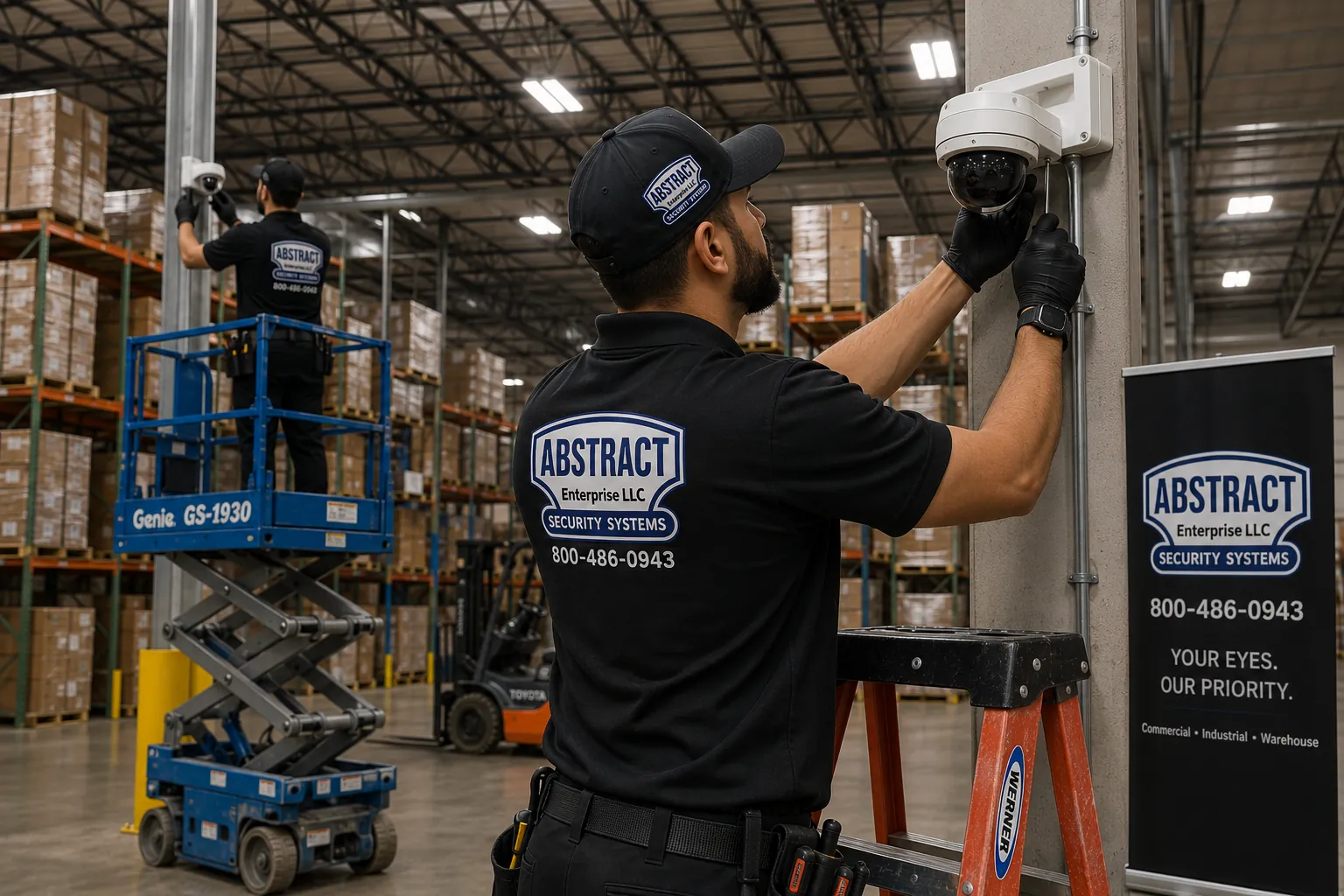
Composite scenarios assembled from the recurring shapes of borough calls — patterns, not client identities.
The forwarder and the pickup with perfect paperwork
A Springfield Gardens freight forwarder releases a high-value pallet load to a tractor with correct-looking documents; the real carrier calls an hour later. Gate LPR, identification-density dock cameras, and 90-day retention went in the next week. The following attempt got turned away at the gate — and the export packet from the first one gave the detective and the cargo insurer an actual case file.
The Maspeth distributor bleeding by the route
A beverage house off Grand Avenue reconciles short against specific delivery routes and can't prove which. Dock cameras timed to the load-out, aisle overviews, and a searchable event timeline settle it in one morning's review: same door, same fifteen minutes, same helper. The conversation that followed was HR's, with the clip attached.
The LIC equipment house and the case that walked
A studio-support shop near Borden Avenue rents gear by the day and eats a missing lens case a month. Checkout-counter cameras at register height, aisle overviews, and dock coverage synced to the rental log turn the next shortage into a two-minute search — checked out clean, returned short, one name in between.
The College Point yard and the converter row
A contractor yard off the Whitestone Expressway loses catalytic converters off the fleet twice in one winter. Person-vehicle analytics on the fence line, a pole PTZ over the truck rows, alerts tested on the owner's phone, and a voice-down speaker on the lot. The third attempt lasted under a minute and left a plate at the gate camera on the way out.
From the Installer: An Example Maspeth Design Scenario
Here is how I would spec a building we see constantly: call it 30,000 square feet of single-story steel off Grand Avenue in Maspeth, four dock doors on the truck court, a man-door by the office, a fenced yard holding two trailers and a forklift, and the LIE ramp three blocks away — which matters, because easy highway access is a feature for your freight and for whoever's casing it. I walk it at 6 a.m. when the court is filling. Each dock face gets a 4K fixed head with true WDR mounted to read the trailer, the seal, and the handoff against morning glare, and one wide apron camera logs every tractor that turns in. The man-door gets a head-height identification shot just inside. The floor gets aisle-end heads down the rack rows and one fisheye over the central crossing; the cage and office corridor take the tightest shots in the building. The yard runs a fixed camera down each fence leg, a pole-mounted PTZ over the trailer positions, and a tuned LPR camera on the gate lane — out here the losses leave by vehicle, so the plate log is the case file. Head end is a 32-channel NVR in the office on a UPS sized to ride an outage, drives calculated for 60 days because the tenant holds wholesale contracts with claims exposure. Cable is labeled Cat6 on J-hooks above forklift reach, conduit on the dock wall below eight feet. Phasing if budget asks: docks, gate, and cage first, yard and aisles second. The whole design comes from standing in that truck court at dawn — the one step no answer box and no out-of-borough bidder will ever take. For us it's a Tuesday with coffee.
See Our Camera Installs on YouTube
Recent installs, walkthroughs and repair shorts from our channel, @openeye0007. See the workmanship before you book it.
Warehouse Security Camera Installation FAQ: Queens
How much does warehouse security camera installation cost in Queens?
Most borough projects land between $4,900 and $24,000 installed. A typical 8-camera 4K PoE system for a shop or small distribution building runs roughly $4,900 to $8,200, a 16-camera multi-dock build $9,900 to $17,500, and 32-camera cargo and fulfillment floors $19,800 and up. The band sits one step above our Brooklyn base — borough scale and bridge time — and every quote itemizes hardware by model number so nothing hides.
How long does a Queens warehouse camera installation take?
A straightforward 8-camera building is usually one working day; 16-camera builds take two to three; cargo floors and multi-tenant parks phase over weeks around dock schedules, gate hours, and house rules. We sequence around live receiving and forklift traffic so your operation never stops for us.
Can you meet cargo-security and audit requirements near JFK?
Yes — that corridor is regular work for us. Identification-grade dock coverage, gate LPR with a searchable vehicle log, retention matched to your contracts, documented access, and clean timestamped exports that satisfy a CTPAT validator, a customer security questionnaire, or a cargo insurer's claims team. The documentation hands over with the system.
Do you work with our existing cameras and wiring?
We keep whatever the meter approves. Legacy coax in good health drives a hybrid recorder, functioning IP cameras carry over to the new NVR, and clean runs stay right where they are. You get billed for genuine failures only — not for a salesman's wish list — and on older Queens stock that difference shows up in four figures.
What brands do you install, and can we mix them?
The everyday spec is Uniview, Dahua, or Hikvision commercial gear. Cargo-belt contracts and institutional owners often require NDAA compliance, which shifts the build to Hanwha, Axis, or Avigilon. Mixing brands on a takeover is normal work — the recorder has to understand every camera it inherits, and we prove that channel by channel before handing anything over.
Will the cameras hold up outdoors, in freezers, and through outages?
Yes, when the housings match the space: IP66-plus enclosures on yards and docks, heated units in freezers and unconditioned floors, mounts placed above the flood line where College Point geography demands it. The recorder and switches ride UPS battery backup sized to a full eight hours where cannabis rules require it and to your appetite everywhere else.
Can warehouse cameras capture faces and license plates?
Both, but only on purpose. A face is a pixel-density problem solved at choke points — head-height heads at man-doors and the time clock, never a rafter shot. A plate is a dedicated LPR camera on the gate lane, shuttered and angled for headlights. Ask a wide overview to do either and it does neither — the most common gap on the self-built systems we take over.
Who can view the footage, and can we limit what a tenant or manager sees?
Fully — visibility is an account structure you own. Admin credentials never leave ownership; managers, tenants, and landlords each carry a scoped login restricted to their own cameras. Every multi-tenant park we serve runs this way: your space on your screen, nobody else's, and no shared passwords anywhere in the building.
How many days of footage will we have?
Precisely what the drives were purchased to hold. We floor at thirty days; freight, bonded, 3PL, multi-tenant, and cannabis operations run 60 to 90 because their claims and audits show up weeks behind the event. The storage calculation appears on the quote itself — retention becomes a figure you approved, never a surprise you discover.
Do we need monthly fees or a cloud subscription?
Zero, permanently. You own the NVR, the footage sits on it, and remote viewing plus alerts cost nothing. The only cloud on offer is optional backup of a few critical channels for offsite redundancy — some operators want it, no operator needs it.
Are you licensed and insured for commercial work in Queens?
Yes — NYS licensed low-voltage security contractor #12000287431, insured to the certificate limits park managers and cargo customers actually require, with commercial references in operations like yours. Verify the license yourself through the NYS Department of State; we put the number on everything because you should check.
What happens after the install — service, repairs, changes?
Abstract Enterprises Security Systems provides a three-year warranty on products supplied by AESS for normal wear and tear. It does not cover existing or customer wiring, customer-supplied equipment, lightning or other acts of God, power outages or surges, physical damage or unplugging, internet, router or phone changes, or camera readjustments requested after completion. After the warranty period, service is $195 per hour with a three-hour minimum ($585).
Questions Answered. Next Step: Your Building.
Every Queens warehouse is its own design problem. Get yours solved on paper before you spend a dollar.
Warehouse Camera Installation Coverage Across Queens
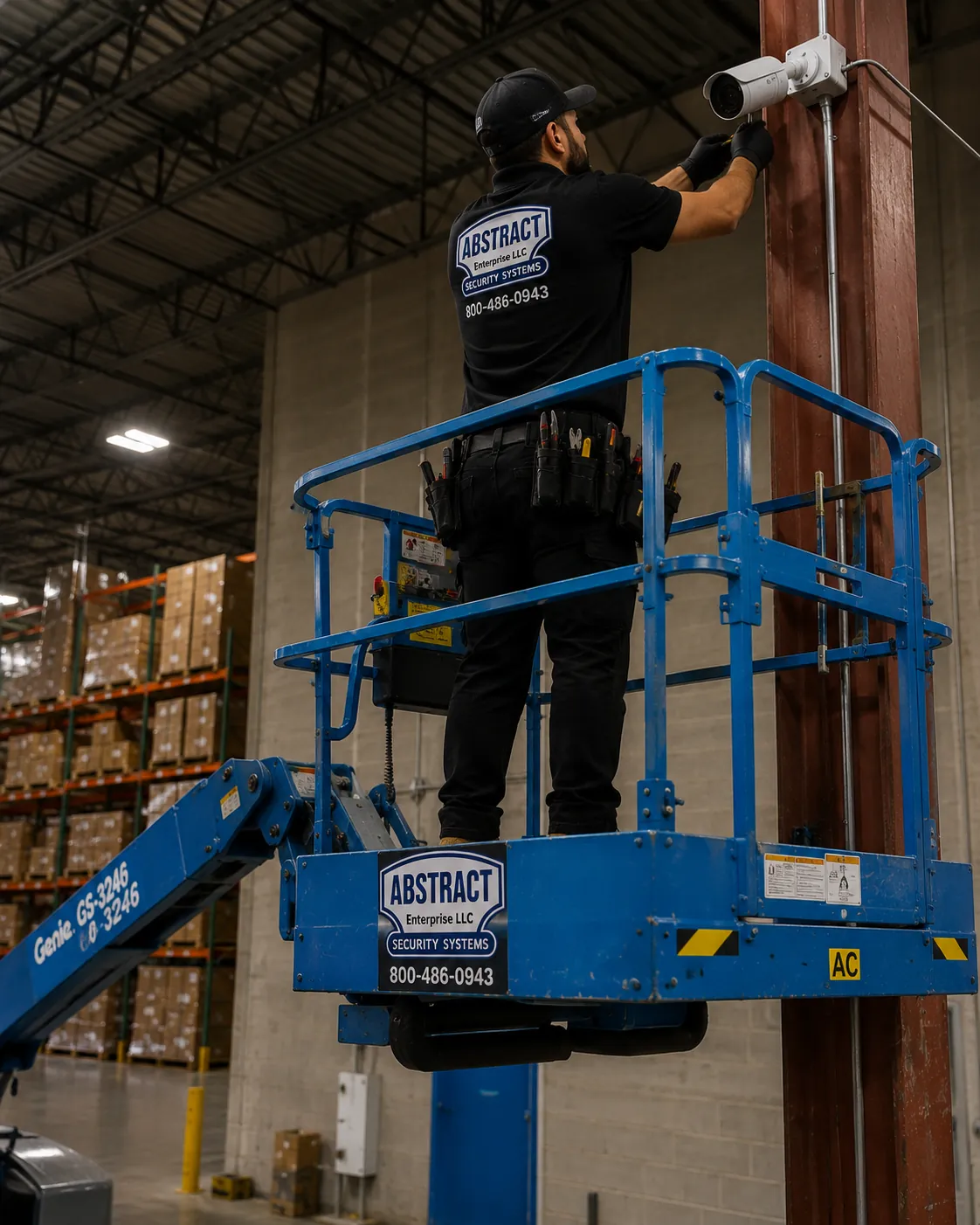
This is the borough-wide warehouse surveillance installation page — docks, cargo floors, and yards from Long Island City to the airport belt, with crews on Queens jobs weekly. The footprint at a glance:
How Your Queens Options Stack Up
Every national brand, cloud platform, and side-hustle handyman is pitching this market. Here is how the options actually behave once a deposit clears.
| Abstract Enterprises | National Alarm Company | Cloud Camera Platform | Handyman / GC Side Job | |
|---|---|---|---|---|
| NYS security license | Yes, #12000287431 | Corporate license, subbed installs | Varies by install partner | Usually none |
| Monthly fees required | None | Contract monitoring | Per-camera licensing forever | None |
| You own footage locally | Yes, on your NVR | Depends on package | No, cloud-hosted | If it records |
| Warehouse-specific design | Docks, yards, gate lanes, audits — our weekly route | Template packages | Strong hardware, remote design | Cameras where the ladder reaches |
| Service response in Queens | Same-day, local crew | National ticket queue | Mail-in / partner dispatch | When he answers |
| Contract length | None, job-based | Multi-year typical | Annual license terms | None |
| Warranty | 3-year (AESS products), written | Contract-dependent | Hardware while subscribed | Handshake |
Warehouse Security Camera Installation Pricing in Queens
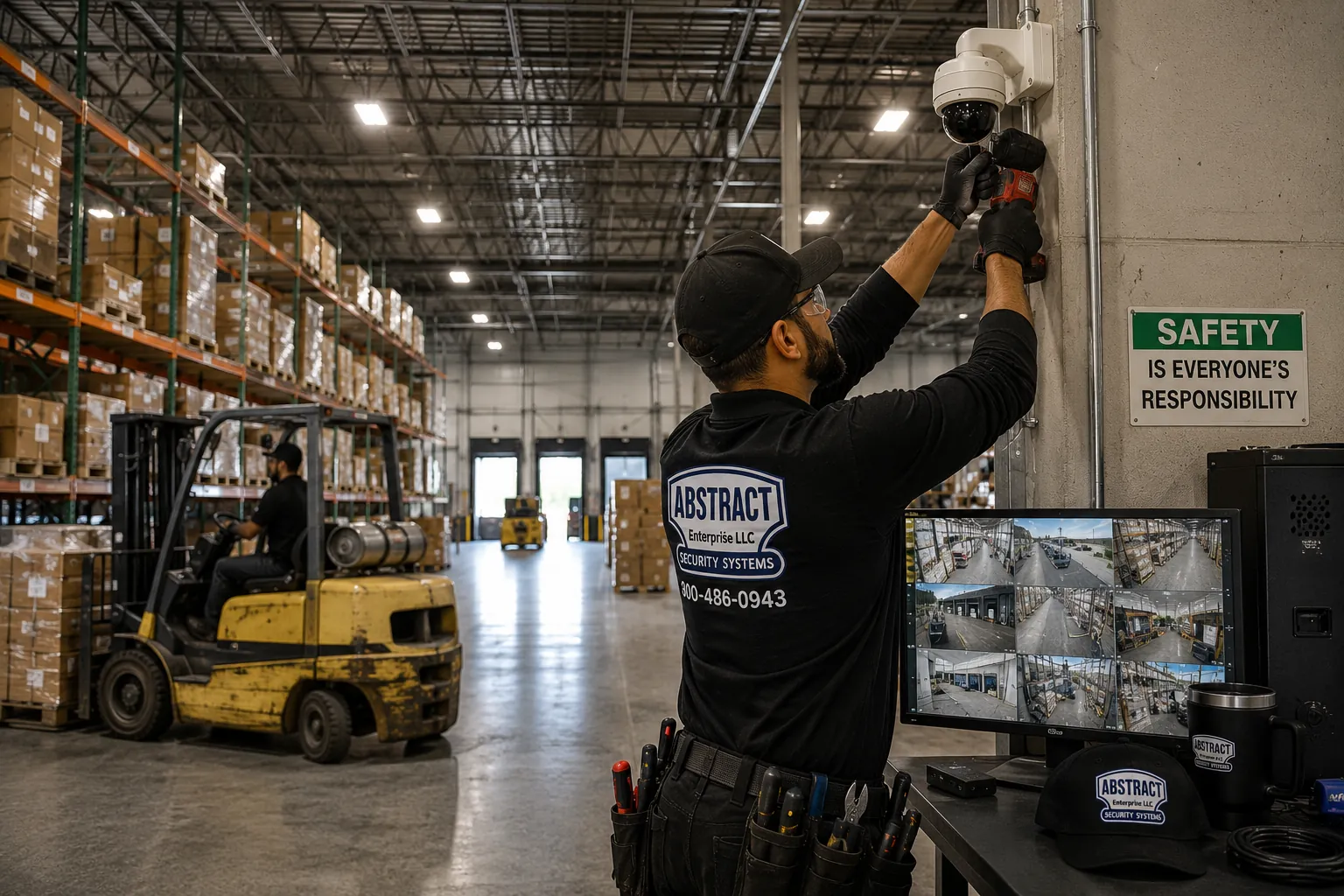
Warehouse camera installation cost is the first question on every call, so here are honest borough ranges before anyone visits. These are installed warehouse security camera system prices, hardware and labor, for Queens — one step above our Brooklyn base to carry bridge time and borough scale. Simple single-story shops trend toward the bottom of each band; audited cargo floors, multi-tenant parks, and yard-heavy sites toward the top.
| Package | Typical Building | Installed Range | What Drives It Up |
|---|---|---|---|
| 8-camera 4K PoE + NVR | Shops, small distribution, commissaries | $4,900 – $8,200 | High steel, exterior conduit, yard runs |
| 16-camera 4K PoE + NVR | Multi-dock buildings, park units | $9,900 – $17,500 | Lift work, 60–90 day retention, audit specs |
| 32-camera distribution build | Cargo, 3PL and fulfillment floors | $19,800 – $35,000+ | Fisheye arrays, redundant storage, multi-switch networks |
| LPR gate / apron lane add-on | Any gate, apron or curb cut with truck traffic | $1,500 – $3,000 per lane | Pole or wall mounting, lighting conditions |
| PTZ coverage add-on | Trailer rows, equipment yards, fence lines | $1,300 – $2,800 per unit | Mounting height, auto-tracking configuration |
| DVR-to-NVR upgrade | Existing wired systems, any vintage | $2,000 – $7,000 | Cameras reused vs replaced, retention target |
| Repair / service call | Any brand, any installer's system | $195/hr specialty rate | Most warehouse faults fixed in 1–2 hours on site |
Context worth keeping: published commercial data puts professional installs at $500 to $1,000 per camera nationally, so these warehouse security camera packages are affordable warehouse camera installation by any licensed standard. Phasing is a design feature, docks and gate first, and every quote itemizes hardware by model number so you can check the math line by line.
Need Warehouse Camera Repair in Queens? Fixed in 1–2 Hours, Most Cases.
A system that stopped recording the week of inventory, cameras that drop channels at random, remote viewing that's locked you out of your own dock, a clip the police or a cargo insurer need exported today: this is same-day work for us across Queens. One call covers diagnosis and replacement wherever hardware genuinely died — and the typical system is recording again inside two hours of our truck reaching the curb.
The Security Problems Queens Warehouses Face Right Now
None of it is hypothetical — these patterns are why warehouse theft security cameras lead our borough call sheet. Each drove a recent Queens install (more than a few of them after the incident instead of before it), and each carries its design answer.
Cargo theft and fictitious pickups on the airport belt
The freight economy around JFK makes Queens docks a national cargo-theft venue: correct-looking paperwork, a tractor that isn't the carrier, a load gone by the time the phone rings. Gate LPR on every lane, identification-grade dock coverage, and retention that outlasts a slow claim keep the trick from working twice.
Catalytic converters and fuel walking out of yards
Fleet rows from College Point to Jamaica get hit in the quiet hours. Person-vehicle analytics on the fence and truck rows, alerts that reach a phone in real time, and a camera-triggered voice-down turn a morning discovery into a 2 a.m. interruption that usually ends itself.
Roll-gate break-ins and overnight forced entry
Between closing and dawn, corridor shops and commissaries get their gates pried, cut, and kicked. A camera on every gate and man-door — local recording, zero internet dependency — puts the crew on file, and an audio voice-down usually sends them looking for a quieter block.
Shrink in multi-tenant industrial parks
Shared drives, shared docks, and a dozen tenants breed accusation economies. Landlord cameras on common areas, tenant cameras on demised space and cages, synchronized timestamps, and scoped accounts settle who-was-where without a confrontation.
Van and box-truck break-ins on the block
Vans and box trucks sleeping on industrial side streets wake up short tools and cargo. Facade and yard views across your frontage, plus a recorded gate lane, pull the curb inside your system's boundary — and put the plate log inside the police report.
Cannabis compliance that fails an inspection
For licensed operators the costliest theft is regulatory: a coverage gap, retention that falls short of 60 days, no runtime through an outage. We construct to the OCM rule — the battery hours included — and deliver documentation built to survive an inspector's checklist line by line.
Related Security Services Across Queens
Security Camera Installation
Homes, storefronts and buildings across the borough: the Queens-wide hub for our camera work.
Security Camera Repair
Dead channels, failed recorders and lost remote view fixed across Queens, most in one visit.
Commercial CCTV
Offices, retail and mixed commercial buildings borough-wide, engineered to the same standard as our warehouse work.
Apartment Building Cameras
Entrances, lobbies, and package rooms for multifamily owners and boards across the borough.
Wireless Camera Systems
Engineered point-to-point wireless for yards, gates and outbuildings where trenching doesn't pencil.
Dahua Systems
Full-line Dahua design and install with local recording and the DMSS ecosystem configured right.
Lorex Systems
Lorex 4K kits installed and hardened for shops and smaller buildings — no monthly fees.
Intercom Installation
Video intercoms and building entry for multifamily and commercial doors across Queens.
Put Cameras on Your Warehouse Before the Next Loss Names the Price
One call books a free site walk anywhere in the six counties, a camera-by-camera written quote, and a system you own outright from a licensed and insured commercial security company: no contracts, no monthly fees, a three-year warranty on AESS-supplied products, and NYS license #12000287431 on every page of the paperwork. Warehouse security camera installation is what this crew does across Queens week in and week out, and Abstract Enterprises warehouse surveillance systems are recording on borough docks tonight; let us prove it on your building.
Warehouse Security Camera Installation: Every Area We Serve
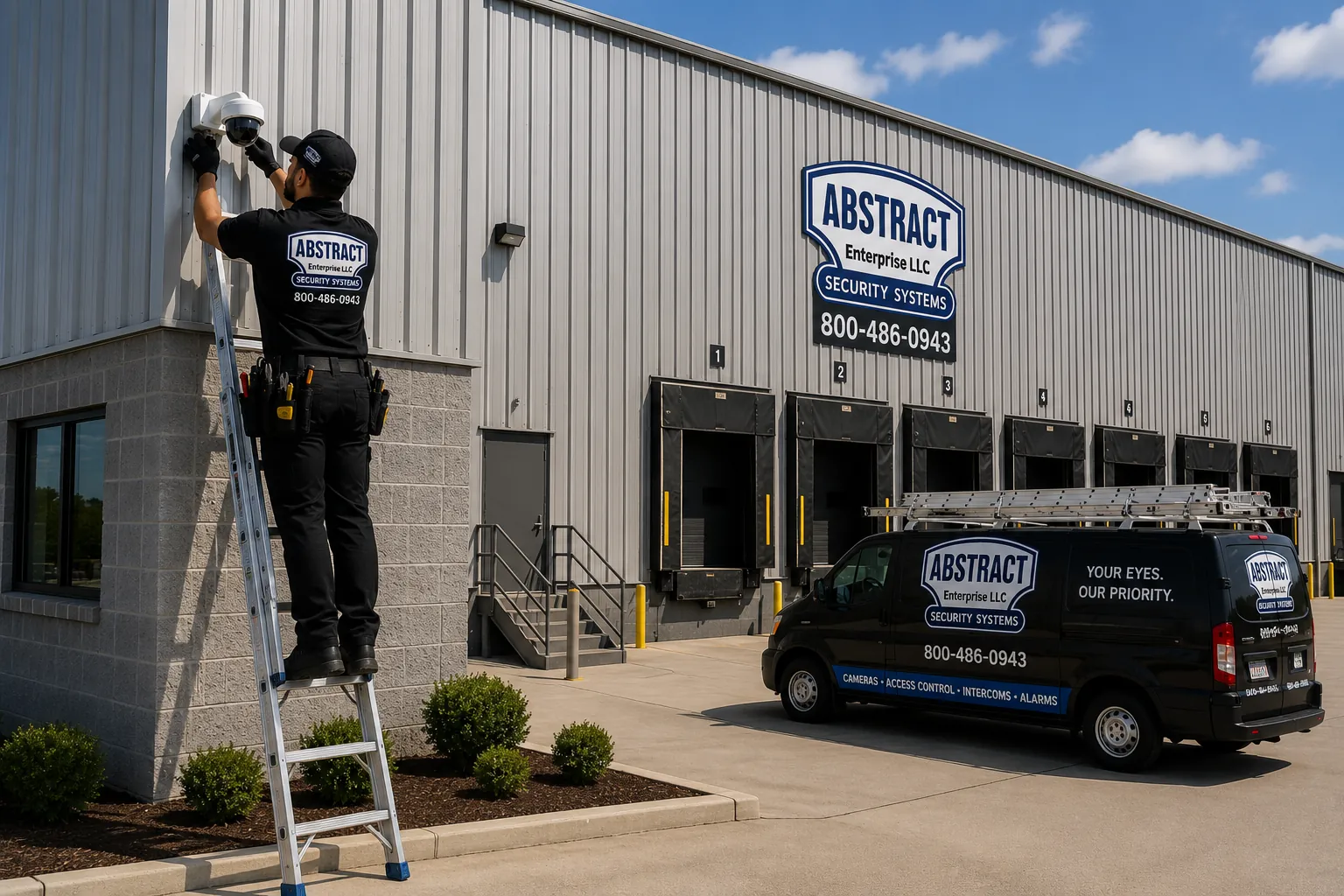
Borough and county pages are rolling out; area names below become links as each page goes live.
- NYC (Hub)
- Brooklyn
- Manhattan
- Queens (This Page)
- Bronx
- Staten Island
- Long Island (Hub)
- Nassau County
- Suffolk County
- Hudson Valley (Hub)
- Westchester County
- Rockland County
- Orange County
- Putnam County
- Dutchess County
- Ulster County
Hub navigation: Home · Security Camera Installation Queens · Camera Repair Queens