Licensed Low-Voltage Contractor · Astoria to the Rockaways · Towers, Co-ops, Shops & Cargo Buildings
Fiber Optic Installation in Queens
Multi-Tenant Backbones · Courtyard & Co-op Links · Fusion Splicing · OTDR Results on Every Strand
Queens buildings are rarely one thing. A Long Island City factory now holds offices and sound stages, a Flushing building holds forty small businesses, a Jackson Heights co-op is six walk-ups around one garden, and a freight building near JFK is offices at the front and a cold warehouse behind. We install owner fiber that ties those pieces together — one backbone, separate strands for whoever needs them, every link tested and written down.
Reviewed and updated October 17, 2026 · Written by Anwar Timothy, NYS licence #12000287431
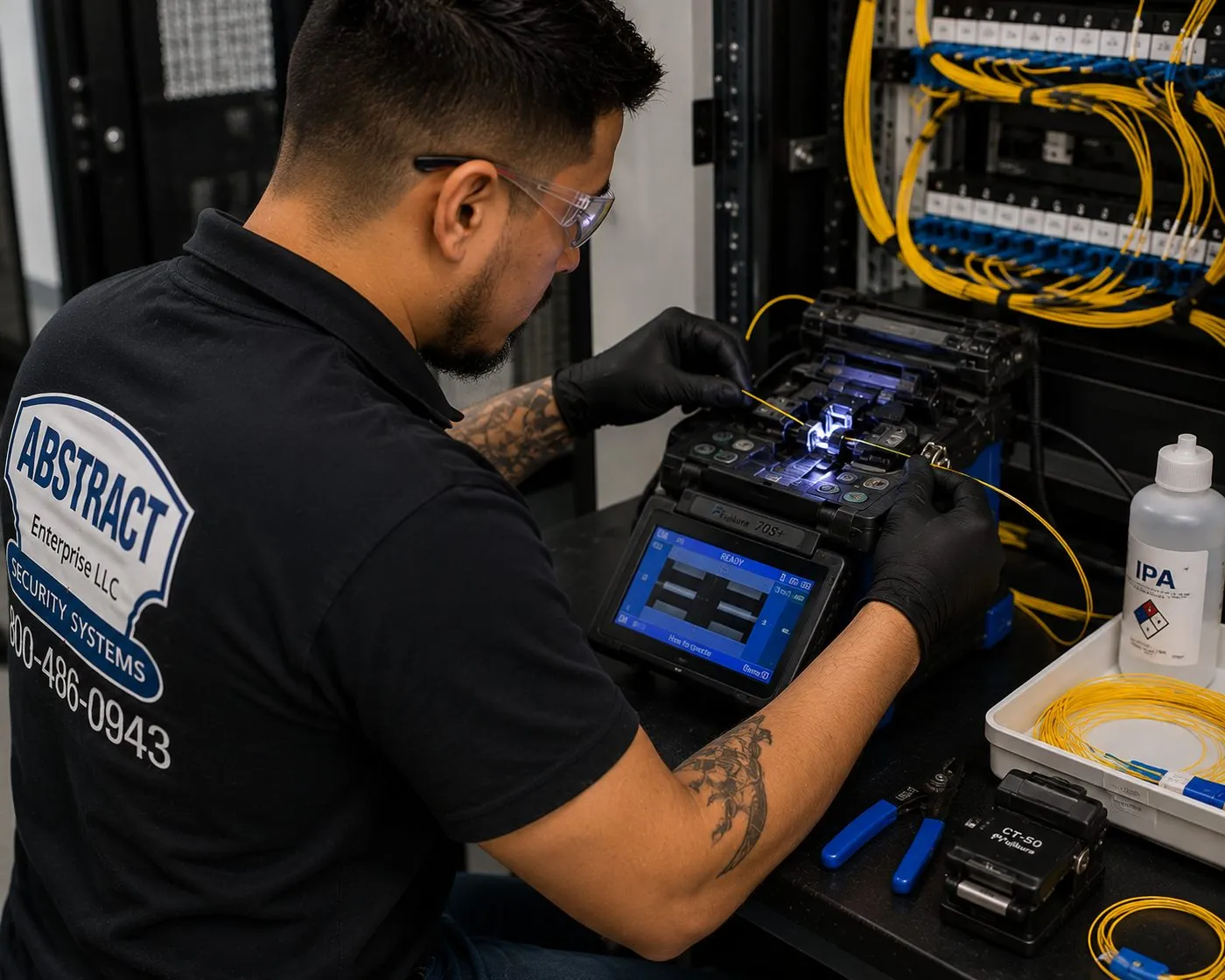
Gloved hands feed a yellow fiber into a fusion splicer whose screen shows two fiber ends lined up, with a cleaver, a tray of pigtails and a bottle of isopropyl alcohol on the bench and a patched fiber rack behind.
Queens Fiber Quote
Neighbourhood, building type and where the provider lands — a licensed installer calls back the same business day
✅
Request Sent!
A Queens installer will call you back the same business day.
25+
Years Experience
✓
Same-Day Estimates
100%
Licensed & Insured
4.7★
201 Google Reviews
Know roughly how many buildings, floors or tenants the fiber has to reach? That is enough to start. Call the Queens line at (347) 434-6392 or use the 60-second form, and a licensed installer — not a call centre — will ask the next three questions.
Separate strands and locked enclosures for each tenant, owner or business that shares the backbone
A light-loss number for each strand, written into a file the owner keeps
Licensed by New York State (#12000287431); Queens crews dispatched from our East Fordham Road base in the Bronx
Why Queens Properties Need Fiber Optic Installation
Queens is the borough of shared buildings. More businesses here share a roof with people they did not choose than almost anywhere else in the city: shops below apartments on Steinway Street and Roosevelt Avenue, dozens of small offices and stalls inside a single building off Main Street in Flushing, studios, makers and tech tenants inside one converted factory in Long Island City, and cargo agents, customs brokers and trucking firms splitting one long building on the roads around JFK. Each of those occupants needs a reliable network, and most of them depend on whatever cabling the owner happened to leave in the walls.
That is the problem private fiber solves in Queens. An owner backbone — fiber that belongs to the building rather than to a carrier — runs from the room where the providers' cables enter to a small, locked enclosure on each floor, in each wing or in each building on the lot. From there every tenant can be given their own strands, every provider can be connected without drilling a fresh hole through a fire-rated floor, and the owner keeps a labelled record of what goes where. It is the same idea whether the property is a 1920s garden-apartment co-op in Jackson Heights or a glass tower at Court Square, and it is far cheaper to do once, properly, than to let each tenant's provider improvise.
Residents describe the symptom without the diagnosis. On Reddit's r/astoria one commenter wrote that they could get three providers in their building and that "the key is your landlord or co-op board has to let them wire the place up"; another put the other side bluntly: "If the building doesn't have FiOS then you can't have FiOS. Simple as that." A Verizon community moderator, answering an Astoria tenant who wanted fiber in their building, explained that "you will need the owner to sign an easement form" before the carrier can pull its cable. Service in Queens is decided building by building, by whoever controls the walls — which is exactly why an owner who wires the building properly has an advantage when it comes to filling it.
The borough is also changing fast, and fiber is part of the plumbing of that change. The 2001 rezoning of Long Island City opened 37 blocks around Court Square and Queens Plaza to large office and mixed-use buildings; the towers at Hunters Point South added more than a thousand apartments in a single complex; JFK and LaGuardia are being rebuilt terminal by terminal; and a 25,000-seat soccer stadium with thousands of affordable apartments is planned at Willets Point. Meanwhile, Hurricane Ida taught Queens a hard lesson in September 2021 about what lives in basements. All of it argues for the same thing: a documented backbone, equipment kept out of harm's way, and strands to spare for whoever moves in next.
Queens facts that shape fiber work
10 Queens residents died when Ida's stormwater flooded basement apartments in Flushing, Woodside, Jamaica, Forest Hills and Elmhurst (QNS, September 3, 2021) — the clearest local reason to keep active network equipment out of cellars where you can.
41 percent of households in Jamaica–St. Albans–Hollis (Queens Community District 12) had no broadband subscription, according to the NYC Council's internet-access data — a reminder that "fiber in the street" does not mean fiber in the building.
37 blocks of Long Island City were rezoned in July 2001 for higher-density commercial and mixed use; the city's environmental review projected roughly 5 million square feet of new office space there (NYC Department of City Planning).
1.67 million tonnes of cargo moved through JFK in 2024, making it the eighth-busiest cargo airport in the country and the entry point for about a quarter of the nation's inbound low-value e-commerce parcels (STAT Times, April 2025).
Seven of the city's Industrial Business Zones are in Queens — Jamaica, JFK, Long Island City, Maspeth, Ridgewood/SoMA, Steinway and Woodside (NYC Clean Trucks Program) — each a cluster of warehouses and workshops with long internal cable runs.
90 percent of Queens premises were passed by Verizon's fiber network at the end of 2013, by the carrier's own count — passed on the street, not wired into every building.
Most Queens owners who put in a backbone are also rethinking the building's cameras and front doors. If that is the plan, our commercial camera installers in Queens and the Queens access control team can design from the same riser drawing, so the cameras, door readers and tenant networks all ride strands on one documented cable.
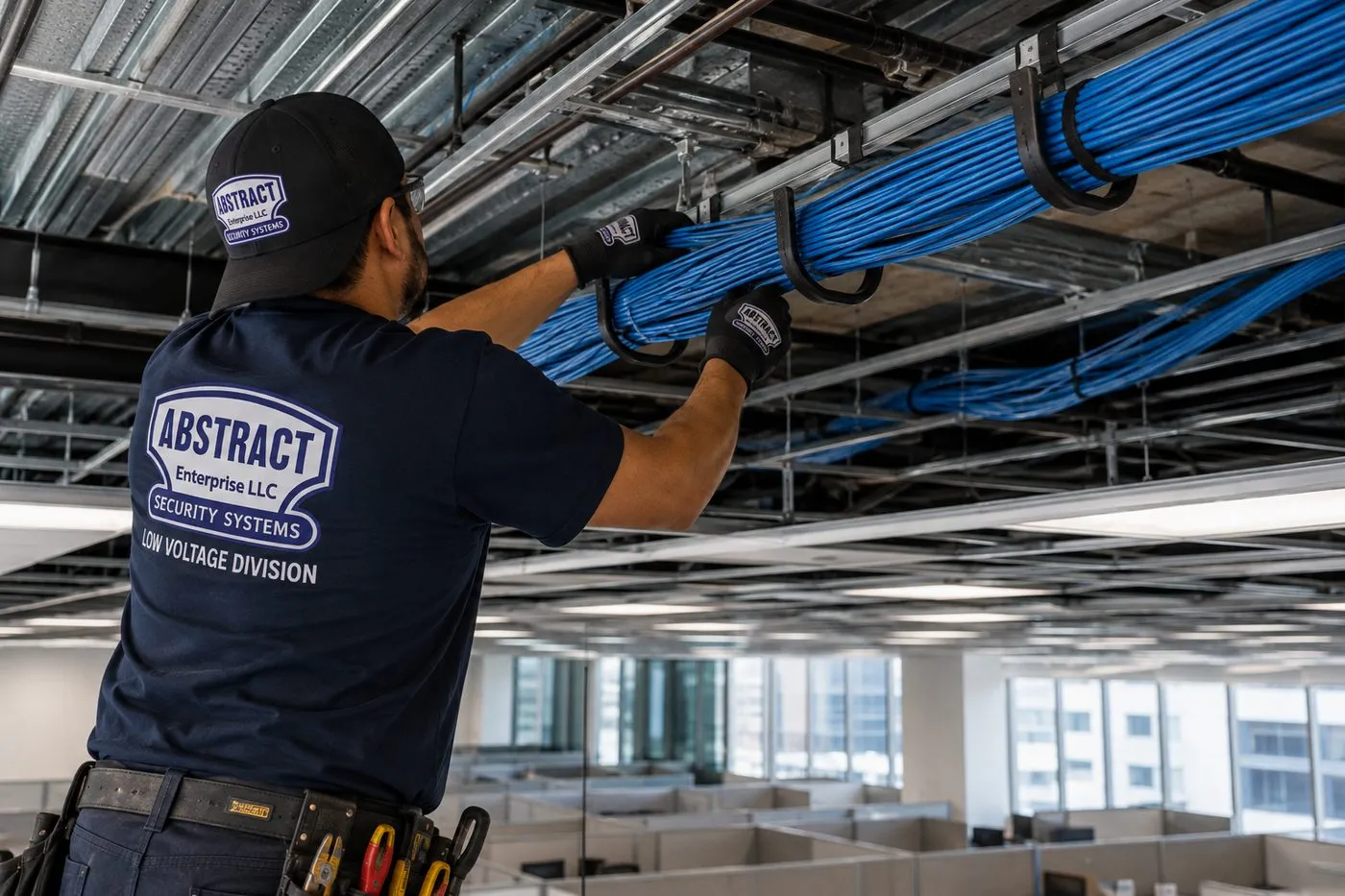
Standing below an open ceiling, a technician in gloves and safety glasses lifts a thick bundle of blue cable into a row of black J-hooks, with an open-plan floor of cubicles and tall windows behind him.
Repair Capture
Has a Queens Fiber Link Gone Dark?
A tenant fit-out, a plumber in the ceiling or a storm-soaked basement can take a working fiber link down in seconds. That is a repair, and we treat it as one: same-day dispatch where we can, and most single-point faults — a crushed jumper, a pigtail torn out of a tray, a connector that was plugged in dirty — are found and fixed in one to two hours once a technician is in the room. Call (347) 434-6392 and say "fiber repair," or use our Queens network cable repair service when copper is part of the problem too.
What We Install
Fiber Optic Installation Services in Queens
Everything we do sits on the owner's side of the carrier's handoff. The provider brings service to the building; we decide, with you, how it reaches every tenant, floor and building on the property — and we prove each link with a meter before we call it finished.
Multi-Tenant Building Backbones
For the Flushing office building with thirty suites or the Jamaica Avenue building with stores below and offices above: one backbone from the entry room to a locked enclosure on each floor, with strands assigned per tenant so nobody shares a cable they do not control.
Courtyard and Garden-Apartment Links
Co-ops and rental complexes made of several walk-ups around a shared garden or courtyard: fiber from the building where the providers land to a small enclosure in each of the others, through existing basement passages or conduit wherever it can be found.
Converted Industrial Buildings
Long Island City, Maspeth and Ridgewood factories now leased as offices, studios and workshops. We find a vertical route through the old structure, then give each floor or each tenant its own uplink back to the main room.
Warehouse and Cargo Buildings
Long, single-storey buildings in the JFK, Springfield Gardens and Jamaica industrial areas, where the office, the dock and the far end of the warehouse are more than a copper run apart. Fiber feeds secondary network cabinets so scanners, cameras and wireless reach the back wall.
Office Tower Tenant Links
Court Square and Queens Plaza offices where a tenant holds two floors, or a back-office operation needs a clean path from the building's carrier room to its suite. Built to the landlord's rules and handed over with a drawing the building engineer can file.
Coax and Legacy Cable Replacement
Hallway coax left by a cable company, telephone pairs from the 1960s and early multimode fiber nobody can identify: we trace what is live, retire what is dead with the owner's agreement, and pull a modern backbone in the same pathway.
Fusion Splicing and Termination
Factory pigtails fused onto every strand inside the enclosure, joins made in the middle of a run when a renovation has severed one, and loose ends a previous installer abandoned above a ceiling brought back into service.
Testing, Labels and As-Builts
Insertion-loss results for every strand, OTDR traces on backbone and between-building links, connector inspection, and a strand map that tells the next tenant or technician exactly what each port is.
Temporary and Seasonal Fiber
Tactical fiber for a production, an event or a temporary office: laid, protected, tested and removed without leaving marks on the building, with the routes agreed with the facility manager in advance.
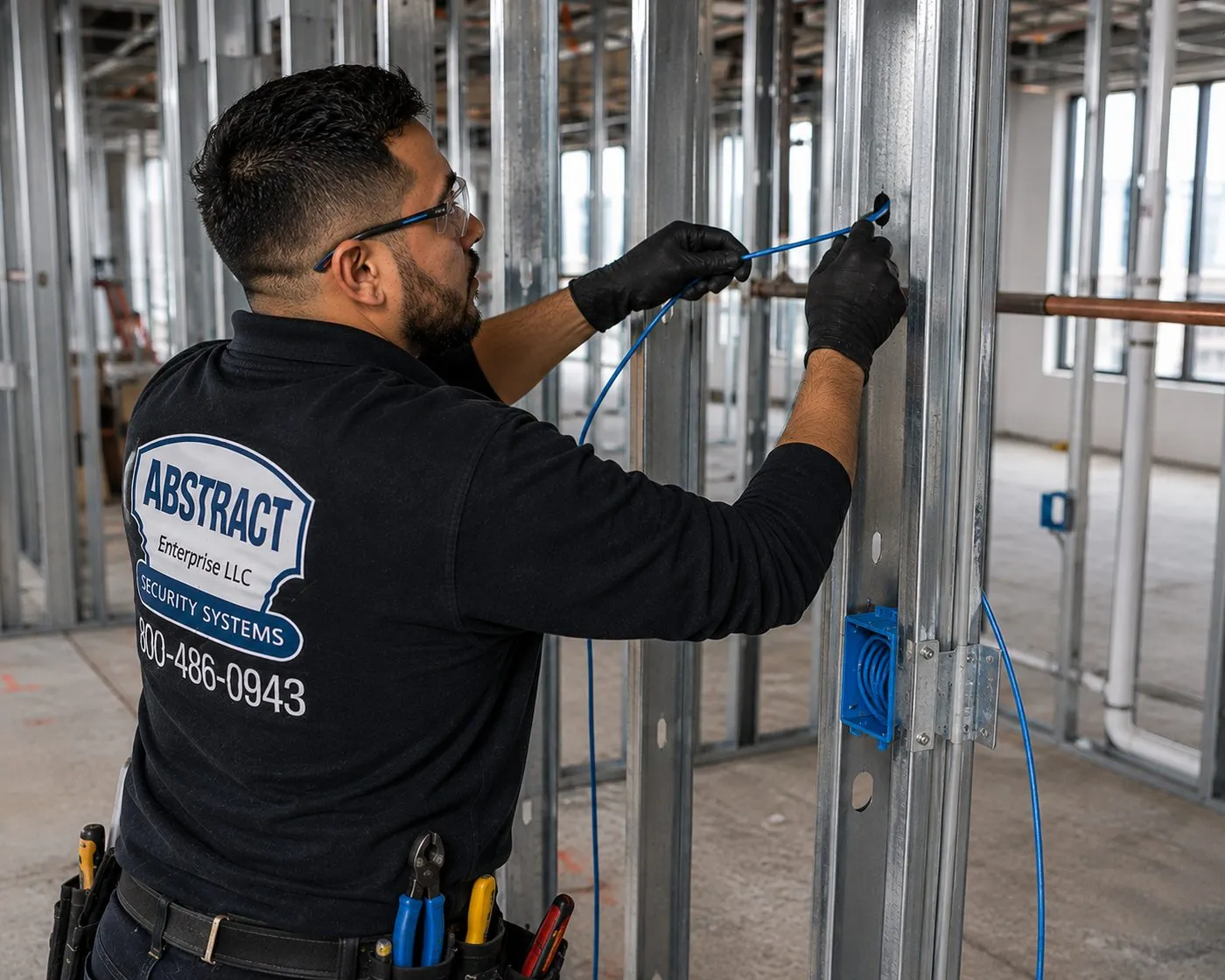
In an open fit-out with exposed metal framing and concrete floors, a technician in black gloves threads a blue cable through the holes in a steel stud, with a blue outlet box fixed to the stud below.
Building Specialists
Fiber Optic Installation for Queens's Architecture
Queens was built in waves — the factories of the early twentieth century, the garden-apartment and elevator-building boom that followed the subway, post-war houses and low commercial strips, and since 2001 a new skyline at the western edge. Each wave left a different kind of building, and fiber gets through each one differently.
Garden-Apartment Complexes
Jackson Heights, Sunnyside and parts of Elmhurst and Forest Hills: four- to six-storey walk-ups arranged around private gardens, often run as one co-op. Where basements connect, they can carry a backbone between buildings without touching the garden at all.
Pre-War Elevator Buildings
Six-storey brick buildings along Queens Boulevard, in Kew Gardens and on Astoria's side streets, with one stair, one elevator and tight utility closets. The vertical route is usually a stair-adjacent chase, a dumbwaiter shaft or a corner of the compactor room.
Converted Factories and Bakeries
Thick concrete or masonry, columns on a regular grid, freight elevators and loading docks — Long Island City has many, including the 1929–30 bakery that is now Silvercup Studios. Floors are deep and open, so distance on each floor matters as much as the climb between them.
Mixed-Use Commercial Strips
One- and two-storey "taxpayers" and three-storey buildings with stores below and offices or apartments above, lining Northern Boulevard, Steinway Street, Jamaica Avenue and Main Street. One shared basement, many separate businesses.
New Residential and Office Towers
Glass towers at Court Square, Queens Plaza and Hunters Point with purpose-built telecom rooms on every floor. Pathways are generous; the work is meeting the developer's specification and keeping the owner in control of the backbone.
Single-Storey Warehouses
Long, low buildings in Maspeth, Springfield Gardens and around JFK's cargo areas, often with a two-storey office at one end, high-bay racking, dock doors and refrigerated rooms. The challenge is length, height and forklifts.
Methods and materials, building by building
Garden apartments: indoor/outdoor-rated cable through connecting basements or existing conduit, small wall enclosures in each building's boiler or meter room, and armoured cable wherever it crosses a storage room or a laundry where carts and tenants move around it.
Pre-war elevator buildings: small-diameter riser-rated cable in innerduct, enclosures on landings or in compactor rooms where the board agrees, and firestop restored at every slab we pass through.
Converted factories: cable in conduit or on strut along columns and beams, cores through concrete only after scanning, and plenum-rated cable wherever new ceilings have created return-air spaces.
Mixed-use strips: a single locked entry enclosure in the shared basement, mounted high and away from floor drains, with separate strands and separate trays for commercial and residential tenants.
New towers: the developer's specified jacket and labelling scheme, MPO trunks where the main room is dense, and a test report in the format the closeout binder calls for.
Warehouses: armoured or conduit-protected runs up a column and across the roof structure, secondary cabinets placed out of forklift paths, and sealed fittings where cable passes into cold or wet rooms.
Co-op and condominium boards in Queens often pair a fiber backbone with a new lobby entry system. If your board is weighing both, our Queens intercom installers can plan the entry panel's network connection off the same basement enclosure.
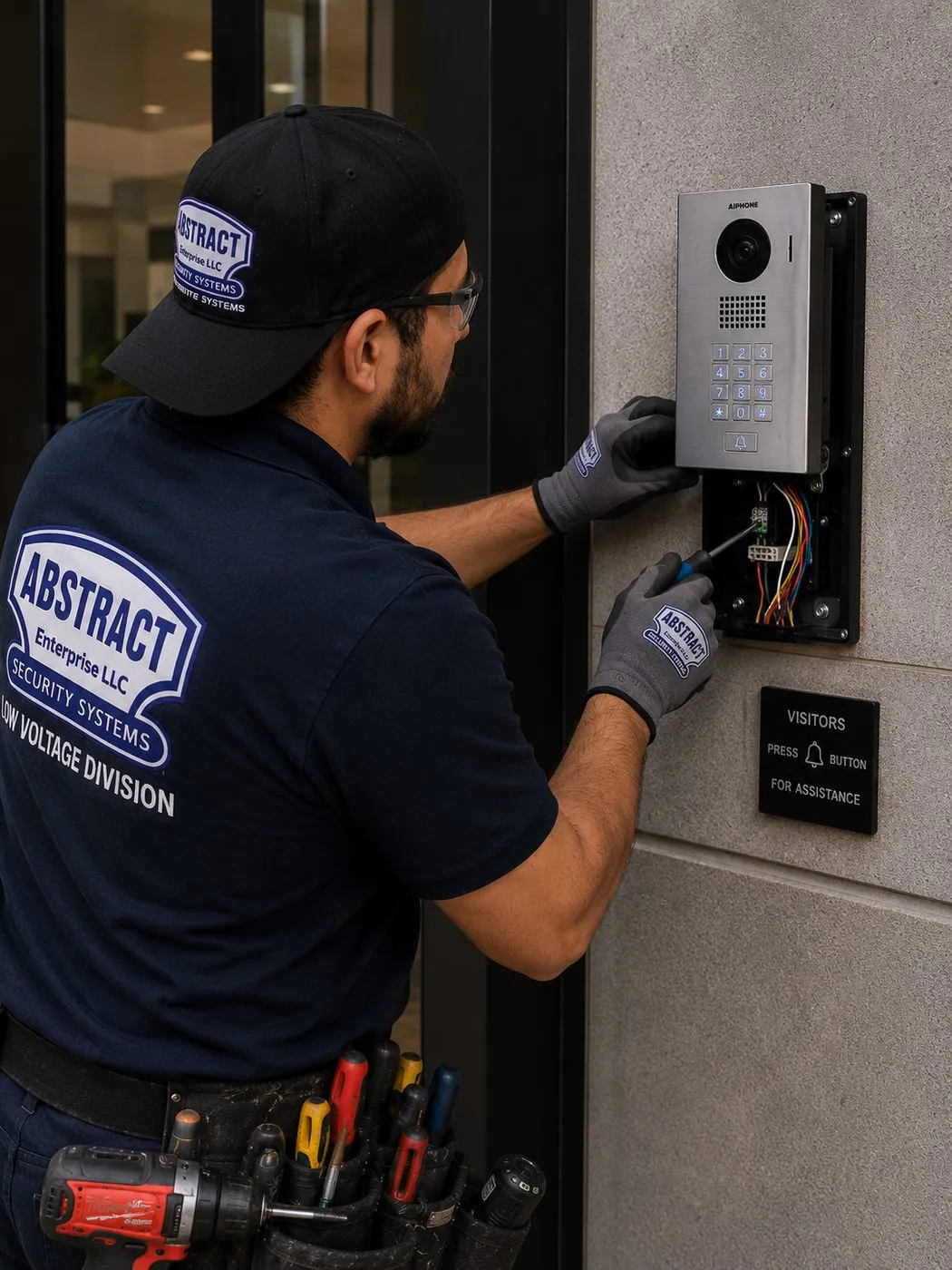
At a stone-clad building entrance, a technician with a screwdriver works on the exposed terminal block of a stainless-steel video intercom panel with a camera and keypad, beside a small "press button for assistance" sign.
Commercial Fiber Optic Installation
Business Fiber Optic Installation in Queens
Queens's business districts have almost nothing in common with each other, and that is the useful thing to know before planning fiber in any of them. These are the corridors where we see the most demand, and what the work looks like in each.
Court Square and Queens Plaza
The office core of Long Island City, centred on One Court Square — the 50-storey, 673-foot tower completed for Citigroup in 1989 directly above the Court Square–23rd Street station. Tenant backbones between floors, links from the carrier room to a suite, and fit-out work under the landlord's rules.
Hunters Point and the LIC Waterfront
Residential towers along Center Boulevard and the streets behind them, including a 1,194-apartment, two-tower complex completed in 2021. Owners need backbones that several providers can share; ground-floor shops and offices need short, protected links from the building's entry room.
Dutch Kills, Astoria and the Studio District
Industrial blocks where film and television have taken over factory space — Silvercup Studios occupies the former Silvercup bakery on 21st Street, and Kaufman Astoria Studios, opened in 1920 as Paramount's first home, runs eleven sound stages. Around them sit equipment rental houses, post-production suites and creative offices that move very large files.
Downtown Flushing
One of the busiest pedestrian downtowns in the city — the Greater Flushing Chamber of Commerce says only Times Square counts more people — with about 200,000 daily bus passengers on Main Street by city DOT figures. Multi-storey commercial buildings here are subdivided into many small offices, clinics and shops, each wanting its own service.
Downtown Jamaica and Sutphin Boulevard
A government, transit and retail centre around the LIRR station and the AirTrain to JFK, upzoned by the city's Jamaica Plan in 2007 to draw new commercial development. Older office buildings on Jamaica Avenue and Sutphin Boulevard sit beside new mixed-use construction.
The JFK and LaGuardia Corridors
Freight forwarders, customs brokers, trucking yards and airline suppliers along the roads around JFK's cargo areas, where a new 350,000-square-foot consolidated cargo centre opened in April 2025; and offices and hotels on the Grand Central Parkway side of LaGuardia. Long buildings, cold rooms and 24-hour operations.
Compliance callouts for Queens fiber work
Cable listings follow the space, not the budget. The National Electrical Code's optical-fiber article lists riser cable (OFNR) for vertical shafts and plenum cable (OFNP) for air-handling spaces; a higher listing may stand in for a lower one, never the reverse. Converted factories with new dropped ceilings often turn into plenum spaces without anyone mentioning it.
Firestop every penetration. Low-voltage cabling under 50 volts generally does not need a Department of Buildings permit, but "no permit" is not "no rules": every hole through a rated floor or wall is sealed with a listed firestop system, and unsealed penetrations are one of the most common findings when inspectors or landlords walk a building.
Landmark districts. The Jackson Heights Historic District, designated on October 19, 1993, is one of several in Queens. Interior low-voltage routes are usually invisible to the Landmarks Preservation Commission; anything on a facade, roof line or garden wall in a district is not, and stays the owner's architect's decision.
Fair access in multifamily buildings. City housing guidance notes that FCC rulings ban exclusive and graduated revenue-sharing agreements between building owners and providers, and sale-leaseback of inside wiring. A building-owned backbone keeps the owner on the right side of that.
Insurance before access. Property managers across Queens increasingly ask for a certificate of insurance naming the owner and agent before any contractor walks a basement. We issue it before the survey, not after.
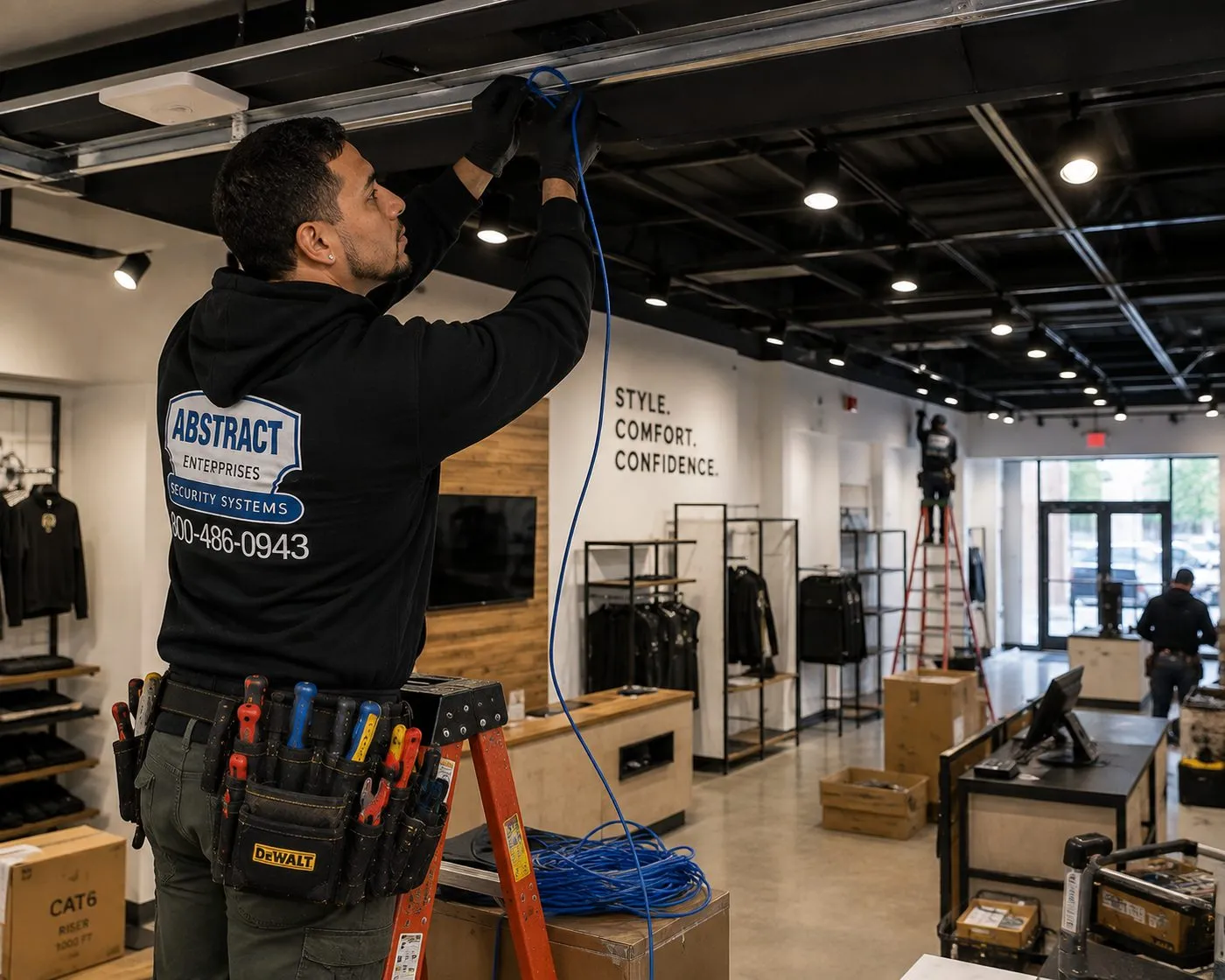
From an orange stepladder in a clothing store being fitted out, a technician pulls blue cable along a black open ceiling, with a coil on a box below him and a second worker on a ladder near the front windows.
Long Island City
From Factory Floors to Office Towers: Fiber in Long Island City
Long Island City is two neighbourhoods stacked on top of each other. Underneath is the industrial district that grew up around the rail yards and the East River piers; on top is the high-rise district that the 2001 rezoning allowed. The Department of City Planning's summary of that rezoning describes 37 blocks bounded roughly by 23rd Street, 41st Avenue and the Sunnyside Yards, where low-density manufacturing zones were replaced with higher-density commercial and mixed-use districts and office buildings with large floor plates became permitted as of right.
For fiber, that history means two very different kinds of job, sometimes on the same block. In the towers, the building was designed with telecom rooms, sleeves and a carrier entry, and our work is to install a tenant or owner backbone that matches the landlord's specification and labelling. In the older buildings — the former bakeries, printing plants, garment and parts factories that now hold offices, studios, galleries and schools — nothing was designed for data. The route has to be found: a freight elevator machine room, an abandoned chute, a column line where conduit can climb, or a core through a slab that has been scanned first.
There is also a carrier presence close by. Industry directories list a data-centre building at 23-10 43rd Avenue with Zayo and Lumen shown as in-building providers. We do not build street fiber between buildings — that is carrier and franchise territory — but when a tenant leases a circuit from a provider with nearby infrastructure, the part that usually goes wrong is the last few hundred feet inside the tenant's own building. That part is ours.
Your Questions Answered
Fiber Optic Installation in Queens: Questions Answered
Below is what Queens co-op boards, shop landlords, warehouse operators and office tenants most often want settled before they sign. Each answer comes first, then the reasoning; the quick practical points — insurance certificates, lead times, enclosure size — sit in the FAQ near the end.
Shared buildings and many tenants
Our Flushing building has dozens of small shops and offices — how does each tenant get its own internet service without a new hole for every one?
By giving the building one backbone and every tenant a short, clean connection to it. Today, in many subdivided commercial buildings, each provider that wins a tenant runs its own cable from the basement to that suite, wherever it can find a path. After a few years the corridors are full of loose coax and drop cable, the fire-rated floors are full of unsealed holes, and nobody knows which cable belongs to whom. A building backbone replaces that habit with a plan: fiber from the room where the providers enter to a locked enclosure on each floor, and from that enclosure a short run to each suite.
The providers then hand off in the entry room, and a tenant's service travels on strands assigned to that tenant alone. When a tenant leaves, the strands are re-assigned rather than abandoned; when a new provider arrives, it connects at a panel instead of a drill. We label every strand with the suite number, give the owner a strand map, and size the backbone with spare strands for the subdivisions that Flushing buildings seem to go through every few years.
In a mixed-use building with stores below and apartments above, can one backbone serve both while keeping them apart?
Yes, and it is one of the most useful things an owner on a Queens commercial strip can do. The commercial and residential sides can share the physical cable and the entry room while staying completely separate: different strands, different splice trays, and ideally different enclosures, locked separately, on each floor. A shop's card terminals and a resident's home internet never share a strand, a switch or a patch panel, so a problem on one side cannot spill into the other.
The separation matters for more than tidiness. Shops that take cards are expected to keep their payment network apart from everything else, and residents expect their service not to depend on the hardware store downstairs. We document which side owns which strands and enclosures, so a future managing agent or a store's IT provider can see the boundary at a glance. Where the building is small, a single enclosure with separately locked trays can do the job; we say which approach fits once we have seen the basement.
Can the coaxial cable a cable company left running through our hallways be replaced with fiber the building owns?
Often, yes — but in stages, and with the provider in the conversation. Hallway coax in older Queens buildings is sometimes the provider's property and sometimes, after years of service changes, the building's; the first step is finding out which, because you should not cut cable that a provider still uses to serve residents. We trace what is live, identify the owner of each run as far as the paperwork and the provider allow, and agree with the managing agent what can be retired.
Then the new backbone goes in, ideally in the same pathway so no new holes are needed, and providers are invited to connect to it at the entry room. Old coax comes out only once nobody depends on it. The finished result is a building whose corridors carry one documented cable instead of a decade of drops, which also makes the next fire inspection and the next renovation simpler.
A provider has offered to wire our building at no charge — what should an owner check before signing?
Read the agreement for three things: who will own the wiring, whether the deal locks other providers out, and what happens when it ends. The city's housing agency, summarising federal rules for affordable-housing owners, notes that FCC rulings ban exclusive agreements and graduated revenue-sharing arrangements between owners and providers, and also ban sale-leaseback arrangements for inside wiring. A "free" installation can still leave the provider owning every cable in your risers, which makes it harder for residents or tenants to choose anyone else later.
We are not lawyers and this is not legal advice; your attorney should read the contract. What we can do is tell you, in plain terms, what a building-owned backbone of the same size would cost, so you can weigh the offer against owning the infrastructure outright. Some owners take the provider's offer for apartment wiring and install their own backbone for commercial tenants and building systems; others prefer to own everything and let every provider connect. Either way, decide it knowingly.
Our Long Island City landlord has a preferred telecom contractor — can we still bring in our own fiber installer?
That depends on your lease and the building's alteration rules, so start there. Many office landlords keep a list of approved contractors for work in base-building risers and telecom rooms, and some require that only their designated vendor touches shared spaces. Others approve any licensed and insured contractor who submits a scope, drawings and a certificate of insurance. Inside your own suite, tenants usually have more freedom than in the riser.
If the building does allow outside contractors, we prepare the submission the landlord asks for and work to their labelling and documentation scheme, so the result looks the same as the preferred vendor's work. If it does not, we can still help: reviewing the preferred vendor's proposal, doing the in-suite work they leave out, or testing and documenting what they install. We will tell you plainly which of those situations you are in after reading the rules.
Co-ops, garden apartments and older buildings
Our co-op is several walk-up buildings around a shared garden — can one fiber plant serve every building from a single basement room?
Usually, and the garden can normally stay untouched. Some garden-apartment complexes have basements that connect from building to building, or conduit already running between buildings for older utilities; we look for both on the first visit. Where those exist, fiber can travel from the building where the providers enter to a small enclosure in each of the others without digging. Where they do not, a short conduit run under a path or along a foundation is the fallback, planned with the board and its gardener so nothing planted is disturbed.
The design is a hub-and-spoke plant: a main enclosure where the providers land, and a cable to each building carrying enough strands for every service the board might want there — residents' internet, the entry intercom, cameras, laundry payment systems and the superintendent's office. We draw the plant on the complex's own site plan and leave each building's enclosure labelled with the strand map, which outlasts any board's institutional memory.
Do you need to get into individual apartments or offices to run a building backbone, and how is that arranged with shareholders?
For the backbone itself, usually not. A backbone runs through common spaces — basements, stair chases, compactor rooms, utility shafts and hallway ceilings — and stops at an enclosure on each floor. Entry to a unit is only needed where the only practical vertical route passes through a closet or a kitchen chase inside an apartment, which happens in some pre-war buildings, or when the job includes extending service into each unit.
When access is needed, we work through the managing agent or the superintendent: a written notice to the affected shareholders or tenants with the date, the time window and what will be done, a technician who arrives in that window, floor protection, and the space left as found. We keep in-unit time to the minimum the work needs, and we schedule the common-area work so that no resident loses service for longer than a planned cutover.
Our building has old multimode fiber from the 1990s — can it carry today's speeds or does it need replacing?
It may carry more than you expect, but probably less than you want. Early multimode fiber — 62.5-micron cable, typically with an orange jacket — was designed for the speeds of its day. It will often run gigabit links over the short distances inside a building, but its reach at 10 gigabits and above is very limited compared with modern OM4 multimode, which supports 10-gigabit links over several hundred metres, or single-mode, which goes much further. The only way to know what your cable can do is to inspect the connectors and test every strand.
So we test first. If the old cable is intact and your needs are modest, it can be re-terminated, labelled and kept as a secondary path. If it fails, or if you need 10 gigabits between floors, we usually pull new single-mode alongside it and retire the old cable once the new links are proven. Either way you get a report that shows the numbers, not an opinion.
We have fiber between floors but nobody knows which strands are in use — can you sort it out without taking the network down?
Yes. Undocumented fiber is common in Queens buildings that have changed hands or managing agents a few times. We start at the panels: every connector is inspected, every patch cord is traced to the equipment it feeds, and live strands are identified from the equipment side without unplugging anything that carries traffic. Dark strands — the ones with nothing connected — can then be tested end to end safely.
The result is a strand map that shows what each strand does today, which are spare and which are damaged, plus new labels at both ends. Any re-patching needed to tidy things up is scheduled into a short, agreed window. It is one of the cheapest pieces of fiber work an owner can buy, and it usually reveals spare capacity the building did not know it had.
Studios, cold rooms and the elevated trains
We rent a stage or production space for a season — can temporary fiber go in and come out cleanly when the show wraps?
Yes, and it is a different kind of job from permanent installation. Temporary fiber uses rugged tactical cable designed to be laid on floors, run along trusses and coiled again, with pre-terminated, protected connectors at each end so nothing needs splicing on site. We agree the routes with the facility manager before the first cable comes off the reel: which doors stay closed, where cable crosses walkways, and where it may and may not be fixed to the building.
At wrap, everything comes out and the routes are checked against the photos taken on day one. Between those two dates, the cable is tested at installation and re-tested on request, so a damaged run can be swapped quickly. Studios and stage landlords care a great deal about marks on their walls and floors; our job is to leave none.
Can fiber run into a refrigerated or freezer room in a warehouse near JFK?
Yes, with care at the wall. The glass itself is unaffected by cold; what needs attention is the penetration through the insulated panel and the moisture that forms where warm air meets a cold surface. We cross the cold-room wall in a sealed sleeve or fitting rather than a loose hole, keep enclosures and connectors on the warm side wherever possible, and choose cable jackets rated for the temperature inside. Where a device such as a camera or scanner station must sit in the cold room, the short run to it is protected and its connections are kept outside.
The cold room's owner or refrigeration contractor should approve any penetration, because a poorly sealed hole wastes energy and can ice up. We mark the proposed location on site with them before drilling, and we photograph the sealed result for their records. Cold-chain operators near the airport — including the new consolidated cargo centre, which has temperature-controlled space for pharmaceuticals and perishables — tend to have strict rules here, and we follow them.
The elevated 7 train runs right past our building — will vibration or electrical noise from the trains affect fiber?
Electrical noise, no. Fiber carries light, not current, so the motors, power rails and signal equipment of an elevated line — the 7 runs on a steel viaduct over Roosevelt Avenue and a concrete viaduct over Queens Boulevard — cannot induce errors in it the way they can in long copper runs. That immunity is one of the strongest reasons to use fiber for the longer links in buildings along those avenues.
Vibration is a smaller, practical concern. Constant shaking can loosen badly secured enclosures, rub cable against sharp edges and work poorly seated connectors out of their adapters over time. We fix enclosures to structure rather than to thin partitions, support cable at short intervals with soft straps, leave no cable touching sharp metal, and use latching connectors. Installed that way, fiber in a building beside the el behaves exactly like fiber anywhere else.
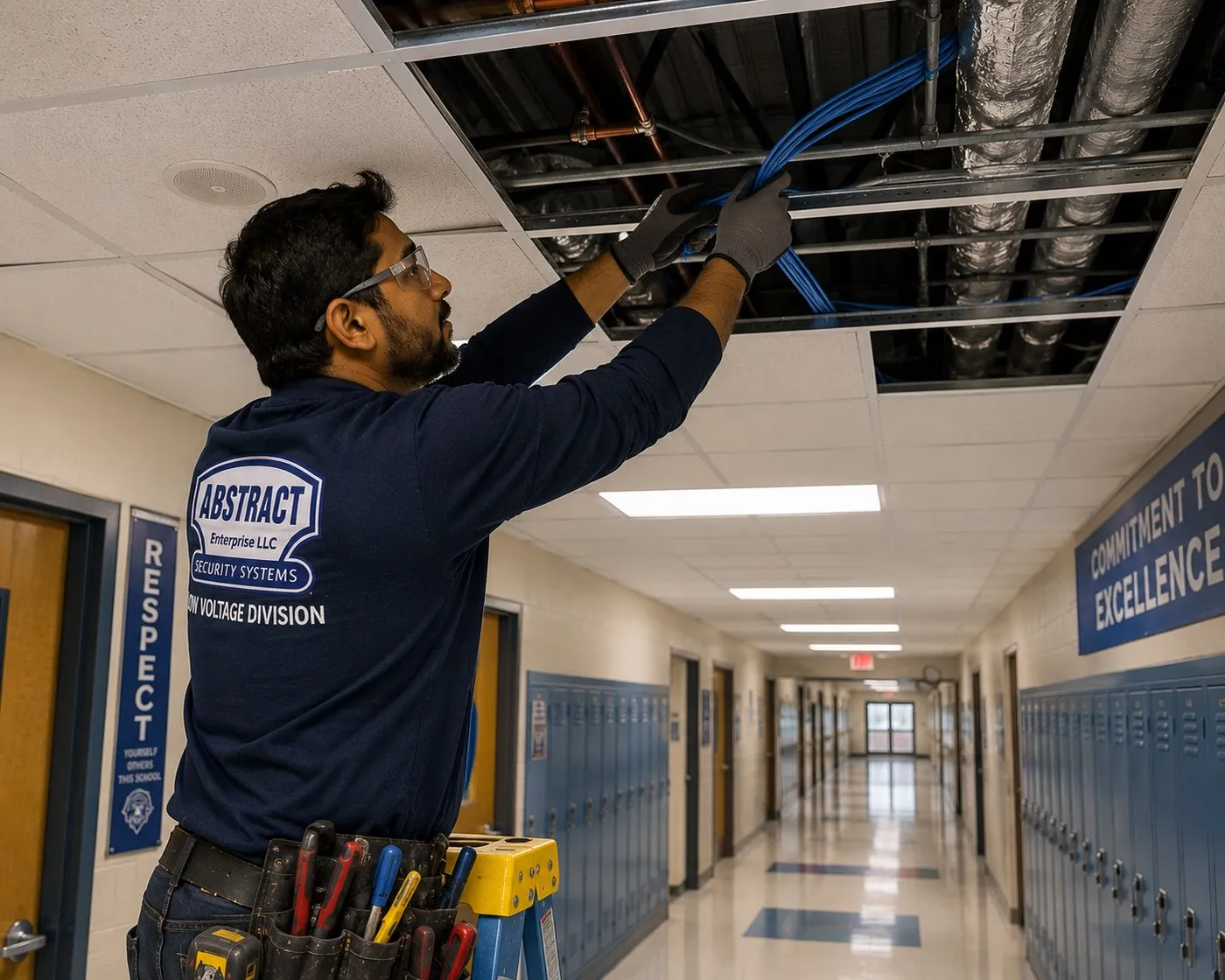
On a stepladder in a long school corridor lined with blue lockers, a technician in safety glasses guides a bundle of blue cable through an open ceiling grid past ductwork and copper pipe.
Equipment
Types of Fiber Optic Cabling We Install
The parts list for a Queens fiber job is short. What changes from a Flushing office building to a Maspeth warehouse is which jacket each space demands, how much physical protection the route needs, and how many strands the owner should buy now so the next tenant does not need a new cable.
OS2 Single-Mode Backbone
Our default for building backbones, links between buildings on one property and anything a provider may later use. The glass costs little more than multimode and the reach is effectively unlimited inside a Queens property.
OM4 Multimode
Short links inside one building where the switches at both ends already use short-reach multimode optics — typical between a studio's machine room and its edit suites on the same floor.
Indoor/Outdoor Cable
One cable that is rated to run inside and also tolerates damp basements, connecting passages and short outdoor conduit runs between garden-apartment buildings, avoiding a splice at every doorway.
Armoured Fiber
Interlocking metal armour for basements, laundry rooms, storage cages, loading docks and warehouse columns — anywhere a cart, a forklift, a tenant's boxes or a careless trade could crush the cable.
Plenum and Riser Ratings
Plenum-rated (OFNP) cable above air-handling ceilings, common in converted factories and new office fit-outs; riser-rated (OFNR) cable in vertical shafts and chases where no plenum space is involved.
Tactical and Pre-Terminated Cable
Rugged, factory-terminated cable for temporary studio and event networks, and pre-terminated trunks where a fast, splice-free installation suits the site better than splicing on the spot.
Lockable Wall Enclosures
Small, keyed enclosures for each floor, wing or building, with separate trays where commercial and residential tenants, or several businesses, share one backbone.
Rack Panels: LC, SC and MPO
LC duplex on most backbones, SC where a provider's handoff uses it, and MPO in dense main rooms in new towers. Every port labelled to the strand map.
Media Converters and Optics
Small converters for devices that only have copper ports — a camera at the far end of a cargo building, an intercom in a rear building — and transceivers matched to the switch you already own.
Owner fiber, the provider's wiring, or more Wi-Fi: which fixes a Queens building?
Approach
Who owns it
What it solves
Where it falls short
Provider-installed wiring
Usually the provider
Gets that provider's service into units quickly, often at little upfront cost to the owner
Other providers may need their own cable; the owner may not control the risers afterwards
Owner fiber backbone
The building owner, board or main tenant
One documented path every provider and tenant can use; separate strands per tenant; building systems on the same cable
Upfront cost; needs a walkthrough and a plan
More wireless access points
Whoever buys them
Coverage inside one floor or one space
Every access point still needs a cable back to the network; thick masonry and long buildings defeat range
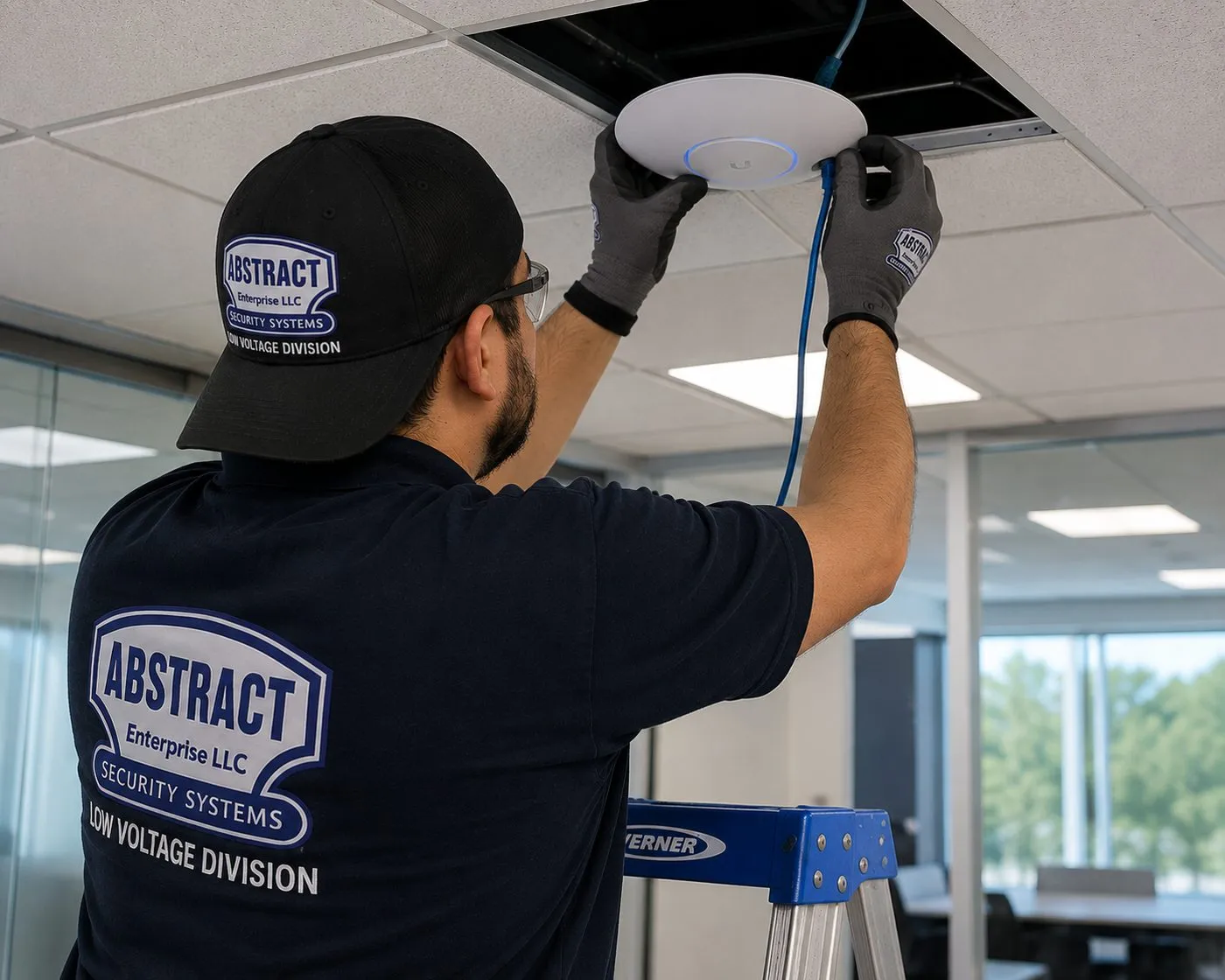
Standing on a blue stepladder in a glass-walled office, a technician in grey gloves presses a round white wireless access point against a ceiling tile as a blue cable drops through the open grid above it.
AI Overview Reality Check
What AI Gets Wrong About Fiber Optic Installation in Queens
Ask an AI assistant about fiber in Queens and you will get a tidy answer assembled from provider marketing, national cost guides and forum threads. Google's AI Overview itself could not be opened from our build environment, so below we quote the published claims those summaries draw on — from Ring and Ping, Low Voltage New York, Streamline Telecom, Unio, T-Mobile, AT&T and Reddit threads — and set each one against what we find inside Queens buildings. Directory sites such as Angi, HomeAdvisor and Fixr did not return a fiber-installation cost page in our searches, so we have not quoted them.
"Fiber is available at your address"
Provider pages now advertise fiber-powered service across Astoria and the rest of the borough, and address-lookup tools answer the availability question one street number at a time. An AI summary will repeat that answer with confidence.
Residents know better. "If the building doesn't have FiOS then you can't have FiOS," one r/astoria commenter wrote; in r/Flushing another simply advised a frustrated tenant to "move to a different building." Availability in Queens is decided at the building, by whether the owner has let a provider in and whether there is a path from the basement to your door. Verizon's own community moderator told an Astoria tenant that the owner would need to sign an easement before the carrier could pull its cable.
An address check tells you what is in the street. Whether it reaches your suite, your apartment or your second building is a question about the building's wiring — which is the question an owner backbone answers once, for every provider.
"Residential projects typically range from $1,500 to $6,000"
A 2026 cost guide from Ring and Ping gives this range for residential fiber projects and says commercial work "can scale into six figures for complex builds." It is a fair summary of the national market.
It describes almost nothing we do in Queens. Most of our residential fiber work is not a single house; it is a co-op of several walk-ups, a pre-war elevator building whose board wants provider choice, or a mixed-use building where the apartments share a basement with three shops. Those jobs are priced by the number of buildings and floors and the number of strands, not by whether the client lives there. Meanwhile the "six figures" commercial end is rare for a single Queens tenant; a two-floor office backbone in Long Island City is priced from a few thousand dollars on our published rates.
A better question than "what does a residential project cost" is "how many enclosures, how many strands, and how many walls does the route cross?" Those three numbers decide the price on any Queens property.
"Figure a few dollars a foot, installed"
Streamline Telecom, a New York fiber firm, says fiber-optic cable "costs anywhere from $1-6 per linear foot to install," and Low Voltage New York's 2026 guide gives the same $1–$6 per foot for indoor work in normal conditions, rising toward $12 through finished walls and packed risers.
Per-foot pricing makes sense for long, open pulls. Queens fiber jobs are rarely long and open. A garden-apartment link may be only a few hundred feet in total but pass through six basement walls, a laundry room and two boiler rooms, each needing a sleeve and a seal. A Flushing commercial building may need a hundred feet of cable per floor and an enclosure, splicing and labelling on every one. The footage is the cheap part; the penetrations, enclosures and terminations are where the hours go.
That is why our quotes separate cable, pathway, enclosures, splicing and testing. If you want to compare a per-foot quote against ours, add up those lines for the other bidder too.
"Singlemode glass is now cheaper than OM4"
Low Voltage New York makes this point in its 2026 cost guide, and adds the important caveat that single-mode transceivers cost "roughly 1.5–5×" their multimode equivalents. AI summaries tend to keep the first half of that sentence and drop the second.
In Queens buildings the trade-off usually comes out in favour of single-mode for the backbone and whatever the existing switches use at the edges. A backbone through a co-op or a mixed-use building will outlive several generations of switches and may end up carrying a provider's service; single-mode keeps every option open. A short link between two racks in a studio's machine room, where the switches already use multimode optics, may be cheaper overall in OM4.
We price both where it matters and tell you what the optics at each end will cost, so the decision is made on the total rather than on the cable alone.
"Leave the building and you need a street-opening permit"
Low Voltage New York's guide puts it as "any fiber that leaves the building in NYC needs a street-opening permit," and it is right as far as it goes: putting your own cable under a city street is street work, with all that entails. The same guide adds that in Manhattan and the Bronx networks typically rent underground space from an old franchised conduit company.
The useful distinction for Queens owners is between leaving the building and leaving the property. Many Queens fiber links never touch a street: they cross a private courtyard in a garden-apartment complex, a shared basement between attached buildings, or the yard of a warehouse lot. Those are private routes, governed by the owner, the board and the building's own rules, not by street permits. A link to a building across the street, on the other hand, is usually a job for a provider's circuit rather than your own cable.
So the first thing we establish on a multi-building Queens job is whether the route stays on your land. Most of the time it does.
"Budget $300 to $800 for each fiber drop"
Unio's cost guide estimates $300–$800 for an installed fiber drop, roughly two to three times a Cat6 drop. Our own Queens structured cabling page puts a typical copper connection point at $150–$300, so the ratio holds up as a rule of thumb.
The mistake is to read it as "fiber everywhere costs three times as much." Almost nobody in Queens needs fiber to the desk. The right design is a small number of fiber links — entry room to each floor, main building to each building, office to the far end of a warehouse — and ordinary copper for the last stretch to desks, cameras and access points. Our Queens fiber drop prices, $391 multimode and $447 single-mode, apply to those few links, not to every outlet.
Count fiber links, not outlets, and the numbers look very different from the headline ratio.
"Installation takes about four hours"
T-Mobile tells home customers a fiber installation "can take up to 4 hours," and AT&T's support pages say "four to six hours." AI answers to "how long does fiber installation take" usually lead with figures like these.
Those numbers describe a provider connecting one home that is already served. Wiring a building is a different project. A provider's own guide for multifamily owners lays out roughly 30 days of off-site construction, 30 days on site and 40 to 60 days of implementation and activation. An owner backbone through a Queens building is faster than that, because no street work is involved, but it still involves a survey, approvals from the board or landlord, a pull and a test day.
For planning, think in weeks from the walkthrough to the test report on a typical building, and tell us early about any move-in or lease date that the schedule must meet.
Tell Us How Many Buildings, Floors or Tenants. We'll Draw the Plant.
A free walkthrough, a strand map of the plant we would build and a line-by-line price. Nothing to sign until you have seen all three.
Tell us the address and what has to be joined to what — buildings, floors, tenants or a far end of a warehouse. You will hear back from a Queens installer that business day, or call (347) 434-6392.
✅
Request Received
A Queens installer will call you back the same business day. If it can't wait, call (347) 434-6392.
How It Works
Our Installation Process
Seven steps. On a Queens job the slowest part is usually agreement — between owner and tenants, board and shareholders, or landlord and tenant — so we start with a plan everyone can read.
1. Walk every building and basement
With the super, manager or owner, from the room where providers land to each floor, wing and building, photographing closets and measuring the real route.
2. Draw the plant and the strand map
Enclosure locations, cable routes and strand counts on your own floor or site plan, with each tenant's or each building's strands assigned in advance.
3. Price, approvals and notices
An itemised proposal, the certificate of insurance, any landlord or board submission, and written notices for tenants or shareholders whose space we must enter.
4. Pathway and enclosures
Sleeves through basement walls, conduit or innerduct where needed, scanned cores in concrete, and locked enclosures mounted high and away from drains.
5. Pull, protect and seal
Pulling tension and bend radius kept inside the maker's limits, armour or conduit wherever tenants, carts or forklifts pass, straps at short intervals, and each hole sealed with a listed firestop and photographed.
6. Splice, terminate and test
Strands fused into trays at both ends, every connector inspected under a scope, loss measured on each strand, and OTDR traces taken on backbones and between-building links.
7. Label, cut over and hand over
Labels at both ends, cutovers booked tenant by tenant, and the strand map, test results and photos delivered to the owner and, where agreed, the managing agent.
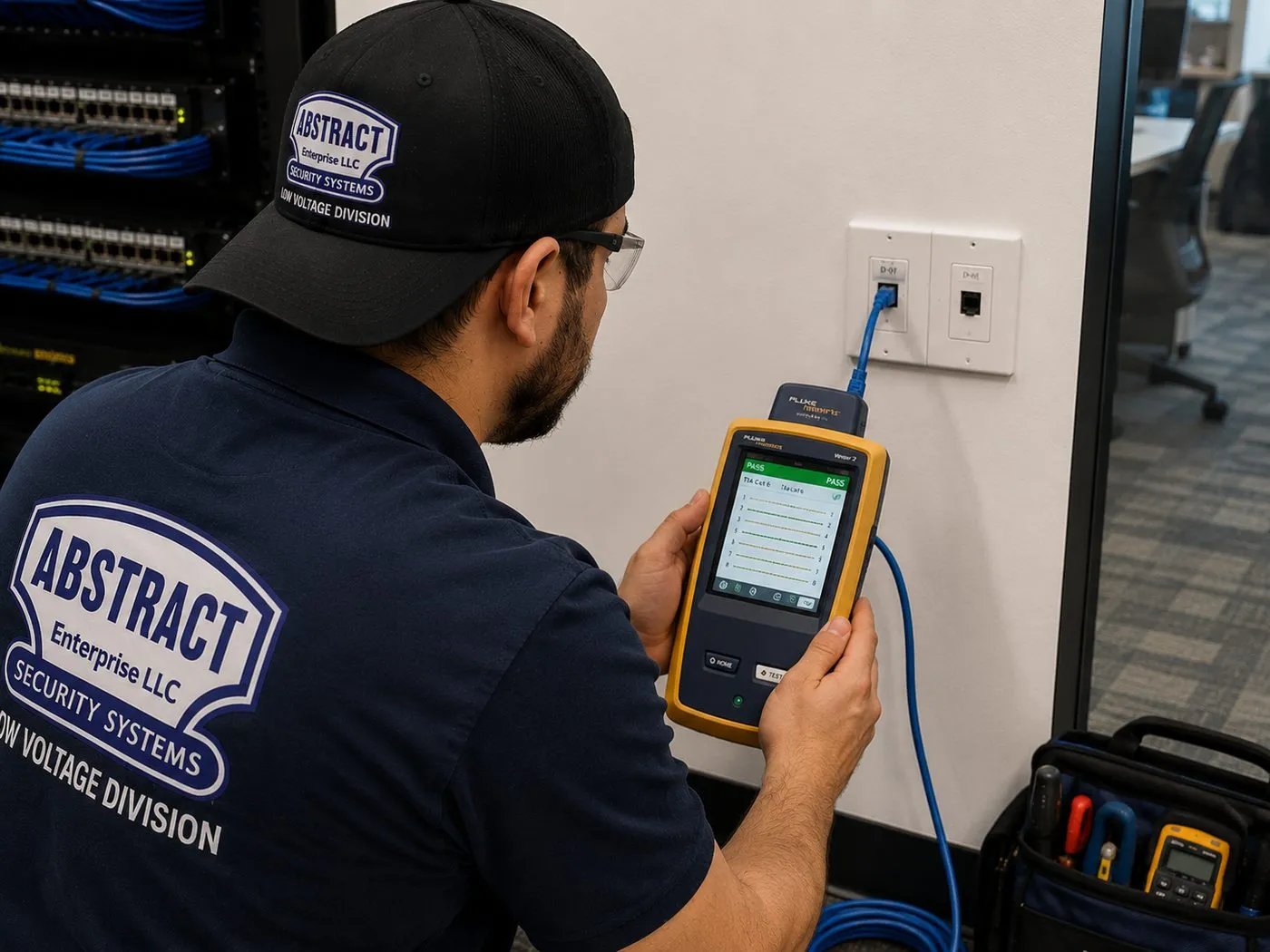
Kneeling beside a rack of blue patch cords, a technician holds a yellow handheld certification tester connected to a wall outlet; the green bar across the top of its screen reads PASS.
Coverage Area
Fiber Optic Installation Near Queens's Landmarks
Queens's landmarks are not mostly monuments; they are working places — a tower, two film studios, two airports and a college campus — and each of them anchors a district full of buildings that need the kind of fiber work on this page.
One Court Square, Long Island City
The 50-storey, 673-foot office tower completed in 1989 for Citigroup at 25-01 Jackson Avenue, directly above the Court Square–23rd Street station; Queens's tallest building until Skyline Tower topped out in 2019.
Silvercup Studios, 42-25 21st Street
A bakery built by the Gordon Baking Company in 1929–30 and turned into a film and television studio in 1983, home over the years to productions from The Sopranos to 30 Rock.
Kaufman Astoria Studios, Astoria
Opened in 1920 as the original home of Paramount Pictures, with eleven sound stages and about 325,000 square feet of production offices; sold to Hackman Capital Partners and Square Mile Capital in 2021.
JFK International Airport
In the middle of a rebuild reported at about $18 billion, including the $9.5 billion New Terminal One and the $4.2 billion Terminal 6, plus a new $270 million consolidated cargo centre opened in April 2025.
LaGuardia Airport
Rebuilt in an $8 billion programme that the Port Authority describes as the first complete rebuild of a US airport in over 25 years, with a 1.3-million-square-foot Terminal B completed in 2022 and 78 gates in all.
Queens College, Flushing
The CUNY campus off Kissena Boulevard, founded in 1937: 83 acres and more than 40 buildings, from six early-twentieth-century Spanish-style buildings to modern science and arts halls.
We also serve the Jackson Heights Historic District and its garden apartments, Hunters Point South, Sunnyside, Woodside, Maspeth, Ridgewood, Forest Hills, Rego Park, Kew Gardens, Corona and the Willets Point area, Bayside, Whitestone, Fresh Meadows, Jamaica, Hollis, St. Albans, Ozone Park, Howard Beach, the Rockaways, and the neighbouring business districts of Greenpoint, Williamsburg and the South Bronx.
In a glass-walled meeting room, a technician in black gloves fits a video-conference camera onto a bracket above a large wall-mounted display, with a soundbar below, a touch control panel on the credenza and tools laid out beside it.
Pricing
Fiber Optic Installation Cost in Queens
No Queens building gets a final number until we have walked it — but you can see the unit prices now. The termination, testing, backbone and room figures below apply our 1.05× Queens rate to the Brooklyn and Bronx base; the two drop prices match the fiber options in our Queens structured cabling configurator.
Item
Queens price
What it covers
Fiber termination on an existing cable
$37 per termination
One connector on one strand — LC, SC, ST or MPO, fused or mechanical
OTDR test
$42 per strand
An OTDR trace showing distance, splices and any fault point, on top of the loss reading
Multimode fiber drop
$391 per drop
Shorter run, terminated and tested
Single-mode fiber drop
$447 per drop
Shorter run, terminated and tested
12-strand OM4 floor-to-floor backbone
$4,725 – $7,350
Spliced into an enclosure at each end, sealed at every slab, a loss figure per strand
24-strand OS2 between buildings on one property, or along a long cargo building
$8,400 – $15,750+
Single-mode with OTDR on every strand
Second telecom room with fiber link
from $2,520
A second network room fitted out and joined to the first by fiber
Service and callback rate
$195/hr, 3-hr minimum ($585)
Call-outs, fault finding and later changes; the original installation is priced separately
What moves a Queens fiber quote
The number of enclosures. Each floor, wing or building that gets its own enclosure adds hardware, splicing and testing; in Queens's subdivided and multi-building properties this matters more than footage.
Walls between buildings. Every basement wall, foundation or cold-room panel the cable crosses needs a sleeve and a seal.
Tenant separation. Separate trays, enclosures or locks for commercial and residential sides, or for each business, add a little hardware and a lot of clarity.
Old cable. Tracing, identifying and retiring hallway coax or legacy fiber before the new backbone goes in is labour that a clean building does not need.
Access. Work inside occupied units, after-hours windows at shops and restaurants, or a warehouse that cannot stop add time.
Why not ADT, Ring or SimpliSafe? Those national names are alarm and camera brands; none of them installs a building's fiber plant. In practice a Queens owner chooses between letting each internet provider wire its own customers, hiring a large integrator that may send a subcontracted crew, or hiring a licensed local installer who owns the splicer and OTDR, has met co-op boards and managing agents across the borough, and comes back if a strand ever misbehaves.
Shop Our Systems
Fiber Optic Installation Packages & Pricing
Three sample bills for the Queens requests we hear most, added up line by line from the unit prices above and nothing else. Your proposal will show your building's actual route, enclosure count and any extras the walkthrough finds.
Starter — Map and Re-terminate What You Have
$1,392
For buildings that already have a 12-strand cable nobody can vouch for: both ends of every strand finished (24 terminations at $37), each strand traced with the OTDR (12 at $42), ports labelled and a strand map handed over. If an end has no enclosure, one is supplied at cost.
Standard — One Building, Every Floor Separate
$4,725 – $7,350
Twelve OM4 strands from the entry room to the upper floors of a mixed-use or office building, spliced into enclosures, sealed at every slab, with loss results for each strand. Where you land in the range depends mainly on the vertical route.
Premium — Several Buildings, One Plant
$8,400 – $15,750+
A 24-strand OS2 single-mode link for a garden-apartment complex, a warehouse with a rear building or a long cargo building, with OTDR on every strand — the base for providers, cameras and doors in every building.
Bring Your Own Equipment — Labour Only
Sometimes a board or an IT firm buys the materials itself. Then our crew brings only hands and tools — pulling, fusing and testing — billed at the $195 hourly service rate, three hours minimum ($585). Anything you purchased is covered by its own manufacturer rather than by us, and a reel you supply gets a quick continuity check on the floor before we commit it to a wall.
Want the Strand Map Before You Commit?
The walkthrough is free. You receive the plant drawing, the strand assignments for each tenant or building, and a price you can take to the board.
How Fiber Jobs Change From Astoria to the Rockaways
Queens covers more ground than any other borough, and the building stock changes completely between its western edge on the East River and its eastern edge on the Nassau line. The neighbourhood tells us a good deal about a fiber job before we open a single basement door.
Long Island City, Hunters Point and Dutch Kills
New towers and old factories side by side. Office and residential towers around Court Square, Queens Plaza and the waterfront have proper telecom rooms and specifications to match; the industrial buildings a few blocks inland hold studios, workshops, galleries and schools that need a route invented for them. Expect tenant backbones in the towers, owner backbones that several providers can share in the new rental buildings, and a lot of creative pathfinding in the conversions.
Astoria and Steinway
Two- and three-family houses, six-storey walk-ups and elevator buildings on the side streets, busy commercial strips on Steinway Street, 30th Avenue, Broadway and Ditmars Boulevard, and the Steinway industrial zone and the studio district to the north and west. Mixed-use buildings with shops below and apartments above are the most common Astoria fiber job: one shared basement, a handful of tenants and a landlord who wants every provider able to serve them.
Sunnyside, Woodside and Maspeth
Sunnyside Gardens and the courtyard buildings of Sunnyside and Woodside are classic garden-apartment country, where co-op boards want a building-owned plant linking several buildings. Under the 7 train on Roosevelt Avenue and Queens Boulevard, mixed-use buildings line the avenue. Further east, Maspeth's industrial zone is warehouses, distribution and trade businesses with long buildings and yard cameras.
Jackson Heights, Elmhurst and Corona
The Jackson Heights Historic District, built mainly between 1914 and 1939 and designated in 1993, is described by the Historic Districts Council as the first and largest garden-apartment community in the country. Its co-ops share the same fiber questions as Sunnyside's, with the added rule that nothing touches a facade or garden wall without the board's architect. Along Roosevelt Avenue and 37th Avenue, dense commercial buildings hold many small businesses, often with a basement that has flooded before.
Flushing, College Point and Whitestone
Downtown Flushing has some of the most subdivided commercial buildings in the city: offices, clinics, travel agents, restaurants and shops sharing one entry room. Every tenant wants its own service, and the corridors show what happens when each provider improvises. College Point's industrial area and the commercial strips along Northern Boulevard add warehouses, showrooms and offices; Queens College and the hospitals nearby add institutional work.
Forest Hills, Rego Park and Kew Gardens
Pre-war and post-war elevator buildings along Queens Boulevard, many of them co-ops, plus the Tudor houses and apartment buildings of Forest Hills Gardens and Kew Gardens. Boards want provider choice and tidy common areas; the vertical route is usually a chase beside the stair or the compactor shaft, and the superintendent's knowledge of the building is worth more than any drawing.
Jamaica, Hollis, St. Albans and South Jamaica
Downtown Jamaica is a transit and government centre with older office buildings on Jamaica Avenue and Sutphin Boulevard and new mixed-use construction encouraged by the 2007 rezoning. The residential neighbourhoods around it are largely one- and two-family houses and small apartment buildings — and Community District 12, which covers them, is one of the city's districts where more than four households in ten had no broadband subscription in the Council's data. Fiber here is often about getting service into older buildings that no provider has bothered to wire.
Springfield Gardens, Ozone Park, Howard Beach and the JFK area
The airport economy: freight forwarders, customs brokers, cold storage, trucking and airline suppliers in long single-storey buildings, plus hotels and parking operators. Jobs are about length, protection from forklifts and trucks, cold rooms and round-the-clock operations.
Eastern Queens and the Rockaways
Bayside, Fresh Meadows and the neighbourhoods out to the Nassau line bring garden-apartment complexes, co-op towers and medical offices along Bell Boulevard and Union Turnpike. On the Rockaway peninsula, salt air and storm surge make equipment placement and sealed, corrosion-resistant enclosures matter more than anywhere else in the borough.
At a glass door with long black pull handles, a technician in grey gloves holds a black card reader against the frame while tightening it with a screwdriver; a lobby with a potted plant is visible through the glass.
Basements
After Ida: Where Network Equipment Belongs in a Queens Building
In early September 2021, the remnants of Hurricane Ida dropped rain on Queens faster than its sewers could carry it away. QNS reported two days later that eleven Queens residents had died, ten of them when stormwater flooded basement apartments — in East Flushing near Kissena Park, in Woodside, in Jamaica, in Forest Hills and in Elmhurst. Most of those neighbourhoods are nowhere near the waterfront. The water came from the street and the drains, not the sea.
That matters for building networks because Queens buildings keep almost everything in the basement: the providers' entry, the boiler, the meters, and very often the building's only network rack. A basement that took water once can take it again. Fiber cable itself tolerates water far better than copper; the switches, power supplies, batteries, patch cords and unsealed enclosures around it do not.
We cannot move where a provider enters the building — that is set by where its street cable arrives. What an owner can decide is how much else sits next to it. Our usual recommendation for a Queens building with a flood-prone basement has three parts:
Keep the basement passive. A sealed, wall-mounted enclosure where the providers hand off, mounted as high as their cables allow and well away from floor drains and sump pits, with no switches or power supplies inside it.
Move the active equipment upstairs. A small network room or cabinet on the ground floor or above, joined to the basement enclosure by owner fiber, holds the switches, the building systems and the battery backup.
Write down what is where. A strand map and photos stored outside the building, so that after a flood the owner and the providers know exactly what to replace and in what order.
None of this replaces flood mitigation for the building itself, and nothing about network design is a substitute for safe housing. But after a storm, the difference between replacing a passive box and replacing a whole equipment room is weeks of downtime for every tenant.
Airport Corridor
Fiber for the Buildings That Serve JFK and LaGuardia
Both of Queens's airports are being rebuilt, and the businesses around them are growing with them. At JFK, a rebuild reported at about $18 billion includes the $9.5 billion New Terminal One, at 2.4 million square feet the airport's largest international terminal, and the $4.2 billion Terminal 6, whose first gates are scheduled to open in 2026. In April 2025 the Port Authority and its partners opened a $270 million, 350,000-square-foot consolidated cargo centre in JFK's north cargo area — described as the first new cargo facility at the airport in 25 years. At LaGuardia, the Port Authority says its $8 billion rebuild was completed in 2024.
We do not work inside the terminals; airport operators and their contractors handle that. Our work is in the buildings around them: forwarders, brokers, trucking firms, caterers, parking operators and suppliers in Springfield Gardens, Jamaica, South Ozone Park and along the roads that feed the cargo areas, and offices and hotels near LaGuardia. Those buildings share a profile that makes fiber the natural backbone.
Length. A cargo building can run several hundred feet from the office at the front to the far dock door. Copper runs out of reach well before the back wall; fiber to a cabinet halfway down and another at the far end brings scanners, cameras and wireless within copper range again.
Cold rooms. Pharmaceuticals and perishables need temperature-controlled space, and the network has to cross into it through sealed penetrations without bringing moisture in.
Trucks and forklifts. Cable on columns and along dock walls is armoured or in conduit, and cabinets sit where a forklift cannot reach them.
Cameras everywhere. Docks, yards and gates are covered by cameras that need power and data at the far edges of the property; fiber to a cabinet near each group, then short copper runs, is the tidy way to feed them.
Kneeling at a white wall beside a glass meeting room, a technician uses a small screwdriver to seat blue cable pairs into a keystone jack in an open wall plate, with a tool bag and a spare faceplate on the floor.
Comparing Bids
Four Things a Good Queens Fiber Proposal Spells Out
Fiber proposals for a Queens building can look alike on the first page and hide very different assumptions. These four points bring them into the open, whoever you hire.
1. A strand map, not just a strand count. "24-strand single-mode" says nothing about who gets which strands. A good proposal shows how many strands each tenant, building or system will have and how many are left spare. In a subdivided building, this is the document that stops arguments later.
2. How the route crosses walls. Ask how many penetrations the route needs, how each will be sleeved and sealed, and whether the bidder walked the basement passages or priced from a floor plan.
3. What happens to the old cable. If hallway coax or legacy fiber will be retired, the proposal should say who confirms it is dead, who removes it, and what happens to cable a provider still uses.
4. The test report you will get. Insist on loss results for every strand against a stated budget and OTDR traces for backbones and between-building links, delivered as a file you keep. "Tested" without numbers is not a test.
Complete Services
Every Fiber Optic Installation Service in Queens
Owners rarely call us for fiber alone. When the backbone goes in, these are the jobs that tend to ride along on the same basement enclosure and the same strand map.
IP video entry panels for co-ops and mixed-use buildings, networked from the basement enclosure.
Field Notes
Field Notes From Queens Basements and Boiler Rooms
Habits our crews bring to every courtyard complex, mixed-use strip building and subdivided office in the borough — general practice rather than the story of one job
In Queens the first walkthrough usually starts with the superintendent and a ring of keys. The super knows which basement passage connects to the next building, which storage room floods when the drains back up, which tenant's cage is never unlocked and which old cable still feeds someone's internet. None of that appears on a drawing. Our installers walk the whole route with that person before measuring anything, and they write down what they are told.
The second habit is to look up. In basements the cable is safest high on the wall, above the line where water and stored boxes reach, so our installers note the high routes — existing pipe racks, beam lines, old conduit — before planning anything at floor level.
The third is to label for the next person, not for ourselves. Every enclosure gets the building, floor and tenant on the door, and every strand gets a name that someone who has never met us can understand. In a building that changes tenants and managing agents as often as many Queens properties do, that label is the most valuable thing we leave behind.
FAQ
Queens Fiber Optic Installation FAQ
Do you cover the Rockaways, Broad Channel and the neighbourhoods along the Nassau border?
+
Yes. We work across all of Queens, from Long Island City and Astoria in the west to Bayside, Glen Oaks and Rosedale on the Nassau line, and down to Broad Channel and the Rockaway peninsula. Queens jobs are run from our Bronx office on East Fordham Road.
How far ahead of a move-in or lease date should we book fiber work?
+
Call as soon as the date is set. A free walkthrough can usually happen within a few business days; approvals from a board or landlord often take longer than the installation itself, so a month or more of notice before a move-in is comfortable for a single building and more is better for several.
Can you issue a certificate of insurance that our property manager or co-op will accept?
+
Yes. Send us the certificate holder, any additional insureds and the limits your managing agent requires, and we issue the certificate before the walkthrough. Many Queens managers will not hand over basement keys without one, so it is the first document we prepare.
Is pre-terminated fiber faster to install than splicing on site?
+
Sometimes. Factory-terminated cable arrives with connectors already fitted and tested, so it suits short, predictable routes and temporary networks. It must be ordered to an exact length and its connectors must fit through every sleeve on the route, so on long or awkward Queens routes splicing on site is usually the safer choice.
Can our phone system run over the same fiber as our data?
+
Yes. Modern business phone systems run over the network, so once the fiber carries data between floors or buildings it carries the phones too. Where old analogue lines or alarm circuits still need copper pairs, we can leave those in place or pull a small copper cable alongside the fiber.
Can the fiber enclosures be locked so other tenants cannot get into them?
+
Yes. We install keyed enclosures and, where several businesses or a commercial and a residential side share one location, separate lockable trays or separate enclosures. The owner or managing agent decides who holds which key, and the strand map records it.
How much wall space does a fiber enclosure need?
+
Less than most people expect. A floor or building enclosure for a small backbone is roughly the size of a large book and mounts on a wall or a backboard. Main rooms with many strands use rack-mount panels a few inches tall. We agree each location with the super before mounting anything.
Is it safe for staff to handle fiber patch cords?
+
Yes, with two simple rules. Never look into the end of a connector or an open port, because some equipment uses invisible infrared light, and keep the dust caps on any connector that is not plugged in. Dirty connectors cause more fiber faults than broken glass.
Can existing fiber be rerouted when we renovate a floor or a basement?
+
Yes. We can open the cable at a convenient point, reroute it in new pathway and splice it back together, or replace a short section, then re-test every strand so you know the link is as good as before. Telling us before demolition starts costs far less than repairing a cut afterwards.
Do you offer an annual check of a building's fiber plant?
+
Yes, on request. A yearly visit inspects and cleans connectors in each enclosure, checks labels against the strand map after a year of tenant changes, and re-tests a sample of strands. Return visits are billed at our service rate of $195 per hour with a three-hour minimum.
What does the installation warranty cover?
+
Full terms — including 50% deposit, one-year parts-only warranty on AESS-supplied products, and the late-fee schedule — are set out in the service agreement. Materials you supply yourself remain under their manufacturer's warranty, and every link we install is handed over with test results that show it passed on the day.
What should we have ready when we call for a Queens quote?
+
The address, the number of buildings, floors or tenants the fiber has to reach, which providers already serve the building and where their equipment sits, and any date the work must meet. Photos of the basement and any existing enclosures help, but we can gather everything else on the walkthrough.
All Areas Served
Fiber Optic Installation Across New York City
Our fiber crews cover sixteen areas from the Rockaways to Ulster County, and Queens is one of them. The New York City fiber optic installation hub explains how the five boroughs differ. Where an area page has not been published yet, its link opens the quote form instead — we already take fiber work there.
Tenants offline, cameras black, a co-op building cut off from the boiler-room switch? Ring (347) 434-6392. A technician is sent the same day whenever the schedule allows, the usual culprits — a pulled patch cord, a cracked pigtail, a contaminated connector — are typically put right within an hour or two on site, and the repaired strand is measured again before anyone packs up.
Fiber Optic Installation Queens — One Backbone, Every Tenant Accounted For
Abstract Enterprises Security Systems · 460 E Fordham Rd, Bronx, NY 10458 · Queens line (347) 434-6392 · WhatsApp (718) 679-0359 via wa.me
NYS Low-Voltage Licence #12000287431 · 100% Licensed & Insured · Same-Day Estimates · Rated 4.7★ from 201 Google Reviews
Full terms — including 50% deposit, one-year parts-only warranty on AESS-supplied products, and the late-fee schedule — are set out in the service agreement. See our warranty page.
Page reviewed and updated October 17, 2026. Changelog: first publication of the Queens fiber optic installation page.