Levittown to Montauk · Wired PoE Recorders · Doorbells · Floodlights · Kits You Already Bought
Most Lorex systems on Long Island arrive in a warehouse-club box and meet a house that was never built for them: a slab ranch with no basement, a cape whose upstairs hides behind knee walls, a split-level with four half-floors, a bay-front house that took water in the last big storm. On this Island the real work is choosing the one dry, heated, flood-safe spot where the recorder can live, then finding a cable path from there to every eave without opening finished walls. This hub explains how we do that across Nassau and Suffolk, what it costs at each county’s factor, and where to find each county’s own page.
Reviewed and updated October 18, 2026 against Lorex support pages, Nassau and Suffolk licensing rules and PSEG Long Island storm reports · Written by Anwar Timothy, NYS license #12000287431 · Long Island Lorex visits are booked from 1282 Troy Ave, Brooklyn
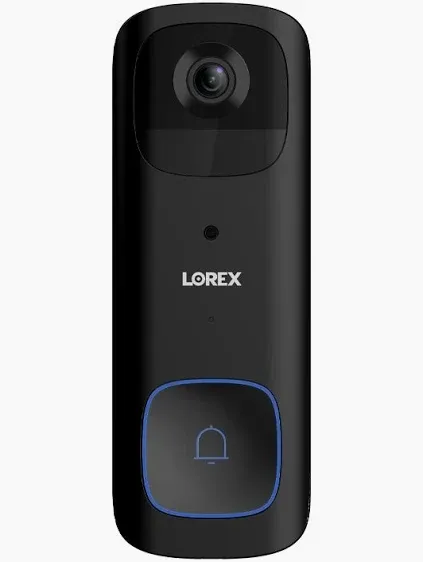
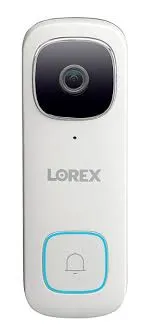
Lorex catalogue image of a black video doorbell with a blue-lit button; it is a product shot, not a door we fitted. At a Long Island front door this unit sees the caller's face, while the parcels at their feet are left to a wired camera above the porch.
Long Island Lorex Quote
Tell us the town, the house style and where the kit is now — a written figure follows the same business day
✅
Request Sent!
A Long Island installer will call back about your Lorex system the same business day.
25+
Years Experience
✓
Same-Day Estimates
100%
Licensed & Insured
4.7★
201 Google Reviews
Three facts let us price a Long Island Lorex job while you are still on the phone: which county the house is in, what style it is — ranch, cape, split-level, high ranch, colonial or raised waterfront — and whether there is an attic or crawl space a person can move around in. Call (800) 486-0943 with those and we can usually tell you where the recorder should go, how the cables will reach the outside, and the written total at the Nassau or Suffolk factor.
Four wired Lorex cameras plus the recorder, cabled and running: $1,938 for a Nassau house, $1,985 for a Suffolk one
Recorder placed above flood height and inside the temperature range Lorex prints for its recorders, never in an unheated attic
Weekend and evening visits are normal for us, up to an 8 PM arrival; the camera, cable and network work all falls under NYS license #12000287431
Why Long Island Properties Need Lorex Camera Installation
Long Island is a place of single-family houses, and they are not old in the way Brooklyn is old or spread out in the way the upstate counties are. Census figures for 2023 count 364,529 detached one-family houses among Nassau’s 477,860 homes and 463,095 among Suffolk’s 579,790. The median Nassau house was built in 1955; the median Suffolk house in 1970. Those two dates describe the Lorex job better than any brochure does. Nassau is the land of the post-war ranch, the cape and the early split-level, many of them built fast and close together on small lots. Suffolk adds the 1960s and 1970s high ranch, the colonial and the newer subdivision, then thins out into farmland, vineyards and the summer houses of the forks.
What those houses share is a construction pattern that makes camera cabling either easy or awkward, with little in between. A colonial with a full basement and an open attic is a gift: cable drops from the attic to every soffit, and the recorder sits in a dry corner of the basement. A Levittown ranch poured on a concrete slab has no basement at all, so everything travels overhead. A cape’s second floor is tucked under the roof, with knee walls hiding the only crawl space. A split-level spreads its rooms across four short floors that never quite line up. And thousands of South Shore and North Shore houses sit low enough to the water that the basement, the obvious home for a recorder, is the first room to flood.
The reasons people call are just as local. Nassau and Suffolk police formed a joint task force in January 2024 after a spike in break-ins and car thefts, describing crews that spot expensive cars in driveways and then enter houses looking for the key fobs. In November 2025 the Suffolk District Attorney charged fourteen men over the theft of more than 200 phones and tablets from porches in 31 communities, Brentwood, Central Islip, Shirley and Deer Park among them. In 2026 Nassau detectives announced an arrest in New Hyde Park over a run of jewellery burglaries across the county stretching from July 2025 to May 2026. Each of those stories ends with the same request from police: does anyone have video? A Lorex system that sees the driveway, the porch and the side door clearly at night, and keeps recording while the power is out, is what people are really asking us for.
The power does go out. The Long Island Power Authority’s 30-day report on Tropical Storm Isaias counted about 645,000 customer outages in August 2020 and eight days before PSEG Long Island finished restoring them. During a coastal storm on September 26, 2026, PSEG reported 13,337 of its 1.2 million customers still dark at one point and more than 34,600 already restored, with Huntington Station, Setauket, Bay Shore, Northport and Southampton hardest hit. A wired Lorex system gets its camera power from the recorder, so when the recorder goes dark every camera goes with it. That is why recorder placement and a battery backup come up on every Long Island visit, alongside the cable route.
Finally, Lorex itself is a brand to buy with your eyes open. It was owned by Dahua from 2018 until late 2022, when it was sold to Skywatch; since 2025 the attorneys general of Nebraska, Texas and Iowa have sued Lorex, alleging continued reliance on Dahua components — claims Lorex disputes. Lorex’s own help pages say its products are not for federal agencies, federally funded projects or contractors bound by the NDAA, and that some Lorex products are subject to FCC import and marketing restrictions that took effect in July 2026. For a family home that is a decision for the owner, and we set out the trade-offs plainly. For a fire district, a village hall or a school, we point to the Long Island commercial camera team and other brands instead.
Long Island numbers that shape a Lorex install
Detached houses dominate. 364,529 of Nassau’s 477,860 housing units and 463,095 of Suffolk’s 579,790 are detached one-family homes (Census ACS 2023, five-year estimates).
Two building eras. Median year built: 1955 in Nassau, 1970 in Suffolk. Levittown alone added 17,447 houses between 1947 and 1951, many of them ranches on concrete slabs.
Two very different counties. Nassau packs two cities, three towns, 64 villages and more than 60 hamlets into about 453 square miles; Suffolk’s ten towns cover about 2,373.
Outages are measured in days. Isaias: about 645,000 PSEG customer outages and eight days to full restoration (LIPA’s 30-day report).
Water reaches low houses. Suffolk had its first-ever flash flood emergency on August 18–19, 2024, when the Stony Brook Mill Pond dam failed; more than 2,000 residents and business owners reported flood damage.
Seasonal houses cluster east. A Town of Southampton planning study put seasonal housing at 35.2 per cent of the town’s stock against 7.3 per cent for Suffolk as a whole.
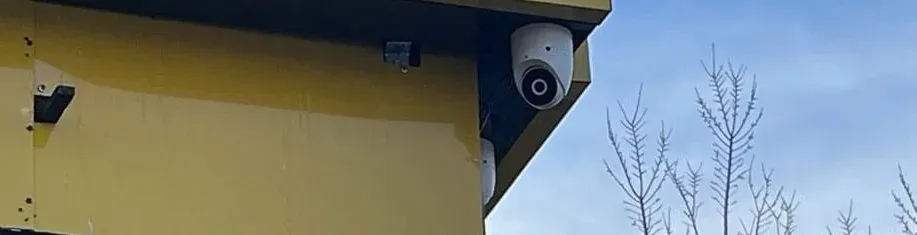
From an AESS job off Long Island, cropped to the fascia and shown only as an example: a dome camera tucked under a corner and a smaller camera along the wall. On a Long Island ranch the same two spots — the corner and the run of eave beside it — are where the attic cables come down.
Lorex Cameras Offline on Long Island — Same-Day Help
Most of the urgent Lorex calls we take from Nassau and Suffolk follow a PSEG outage or a flooded basement. The power is back, but the app says the recorder is unreachable, half the cameras show a black tile, or the recorder sat in water and will not start. Phone (800) 486-0943 and we book the next two-hour window in your county. In most cases the system is recording again within one to two hours of our arrival; if a hard drive or the recorder itself has failed, the replacement follows on the same visit or the next. Other brands go to our Long Island camera repair crew.
Before anyone drives out, check these
Is the recorder dry? If it sat on a basement floor that took water, unplug it at the outlet and leave it off. Powering a wet recorder can finish off a drive that might otherwise be recoverable.
Bring the internet back before the recorder. Restart the modem and router first, wait until the Wi-Fi is working on your phone, then restart the recorder. A recorder that wakes before the router often gives up looking for it.
Plug a television into the recorder. If the cameras appear on that screen, they are recording, and the trouble lies between the house and your phone. If they are black there too, the fault is power or cable.
Look at the breaker panel. A recorder that shares a circuit with a sump pump, freezer or garage door opener can lose power when that circuit trips during a storm; the rest of the house carries on as if nothing happened.
Two Counties
Nassau and Suffolk Are Different Lorex Jobs
People talk about “Long Island” as one place, but a Lorex crew driving from Valley Stream to Riverhead crosses two very different counties. The tools are the same; the houses, the distances, the licensing offices and the price factor are not. Each county has its own full Lorex page with local detail.
Older and denser. The median house dates from 1955, lots are small, and many neighbourhoods are rows of ranches, capes and early split-levels within a few feet of each other. Runs from the recorder are short, but the routes are tight and the neighbours are close, so aim matters as much as wiring. Electricians are licensed by the towns and villages. Price factor 1.15.
Newer and wider. The median house dates from 1970, high ranches and colonials are common west of the pine barrens, and lots grow larger heading east. Long runs to detached garages, pool houses and gates appear more often, and the forks add seasonal houses and salt air. Suffolk licenses communications cabling of 90 volts or less through its consumer affairs office, with towns and villages that license their own trades carved out. Price factor 1.20.
Nassau
Suffolk
Typical house
1950s ranch, cape or split-level on a small lot
1960s–70s high ranch or colonial; seasonal houses on the forks
Where the cable usually travels
Attic over a slab, knee-wall crawl spaces, short basement runs
Unfinished basements, open attics, longer outdoor runs to outbuildings
Flood exposure we plan around
South Shore canal streets, Long Beach barrier island
Great South Bay shoreline, Stony Brook harbour area, the forks
Licensing we follow
Line-voltage work by a town- or village-licensed electrician
County restricted licence for communications cabling; master electricians for line voltage
AESS price factor on labour
1.15
1.20
What We Install
Lorex Camera Installation Services on Long Island
Every service below begins in the same place: the spot where the recorder will live. On Long Island that spot has to be heated, dry, above the level water has reached before, and close enough to the router for a short cable between them. Once it is settled, everything else is routing.
Wired PoE Lorex systems
Lorex IP cameras on single network cables that carry power and video back to a Lorex NVR, recording around the clock. This is our standard for any house where an attic, basement or crawl space gives the cable somewhere to go, which on the Island is most of them.
Installing the kit you already bought
Many Lorex kits are bought at a warehouse club — Lorex says Costco has carried its systems for more than a decade — and stay in the hall closet because the box assumes an easy house. We install the kit you own, swap in longer or outdoor-rated cable where the house needs it, and set up the app.
Recorder relocation
Moving a recorder off a basement floor that floods, out of an attached garage that freezes, or out of an attic that bakes, into a closet or utility room inside the heated part of the house, with the cables re-routed and labelled.
Doorbells and porch cameras
A Lorex video doorbell at the front door, checked against its 16–24 volt AC power requirement first, and where packages wait on a porch or stoop, a wired camera looking down at the step so the doorbell is not the only witness.
Driveway and side-door coverage
Cameras placed to show a face at the car door and the side entrance at night, not just the roofline — the views police actually ask Long Island owners for after a driveway theft.
Floodlight cameras
A Lorex floodlight camera over the garage or the back patio where a light is wanted anyway. Any new outlet or box is made by a licensed electrician; we mount, aim and join it to the same app as the wired cameras.
Battery backup
A UPS sized for the recorder, the router and any PoE switch, so recording carries on through the short PSEG outages and the minutes before a standby generator takes over, with the modem on the same battery so the app keeps working.
Shops, offices and yards
Lorex systems for strip-centre stores, small offices in industrial parks and contractors’ yards from Hicksville to Riverhead, with the recorder in a locked back room and the remote view on the owner’s phone.
A camera tells you what happened; a contact on the slider or the side door tells you the moment it opens. Pair the two through our Long Island alarm installation crew and the opening alert lands on your phone next to the clip.
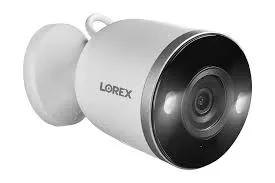
Product shot supplied by Lorex, not one of our installs: a white bullet camera with a small light either side of the lens. Lights like these keep night footage in colour on a Long Island street with no streetlight outside the house.
Building Specialists
Lorex Cameras for Long Island’s Architecture
Long Island houses fall into a handful of shapes, and each shape has one good way to get a Lorex cable from the inside to the outside. Knowing which shape we are standing in tells us, before the ladder comes off the van, where the recorder will go and roughly how long the job will take.
Slab ranches
The Levittown, Wantagh and Bethpage pattern: one storey, no basement, a concrete floor and a low attic. Every cable runs overhead, dropping through the top plate of an interior wall to the recorder and out through the soffit to each camera. Attic access and insulation depth decide the day.
Cape Cods
Steep roofs, dormers and a finished upstairs whose only crawl spaces sit behind short knee walls. Cameras on the gable ends are reached from those crawl spaces; cameras on the first-floor eaves often come from the basement instead, up inside an outside wall.
Split-levels
Four half-floors stacked around a short stair: a garage and den at grade, the living room a few steps up, bedrooms above and often a low basement. The recorder belongs on the level that is both heated and dry, and cable moves between levels through the one wall where they stack.
High ranches
The raised ranch common across Suffolk and eastern Nassau: a ground floor half in the earth with the garage, a den and the utilities, and the main living space up a split stair. The utility room is often the ideal recorder home — unless the ground floor has ever taken water.
Colonials and newer subdivisions
Two full storeys over a full basement, an open attic and often an existing network closet. The easiest Long Island houses to wire; the work is mainly aim and distance, with the occasional detached garage or pool house at the back of a larger lot.
Waterfront and raised houses
Canal-front houses on the South Shore, harbour houses on the North Shore and summer houses on the forks, some lifted onto piers or a new foundation after Sandy. Salt air, wind and flood height shape both the camera mounts and the recorder’s shelf.
Methods that change from house to house
Blown-in attic insulation. Ranch and cape attics are often filled deep with loose insulation. We run cable on top of the joists rather than buried in it, keep it clear of recessed light housings and bathroom fans, and put the insulation back level when we leave.
Cedar shakes and shingles. Common from the North Shore to the Hamptons. Cameras go on a flat mounting block so the base sits true, with the screws through the block into the sheathing, and the cable entry sealed and flashed rather than caulked over a gap in the shingles.
Vinyl and aluminium siding. Siding moves with temperature. A camera screwed tight through vinyl can crack it in the first cold snap; a mounting block fixed to the wall behind lets the siding float around it.
Stucco and brick fronts. Found on many post-war Nassau houses and on Mediterranean-style houses farther out. We drill with masonry bits, use sleeved anchors and seal the hole before the camera base covers it.
Where a house needs cameras that Lorex does not make — a long-range plate camera at the end of a driveway, for instance — our Long Island home camera installation page explains how we mix brands on one plan.
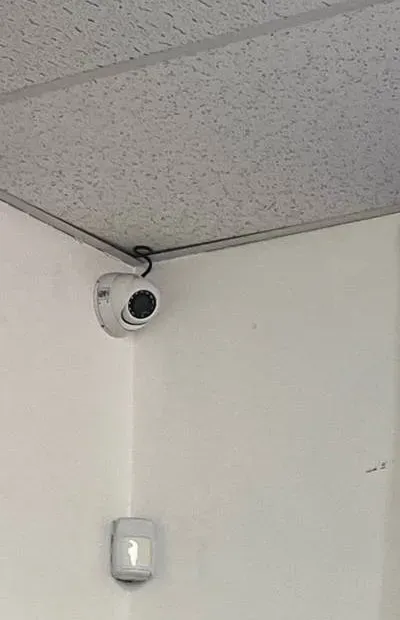
From an AESS job off Long Island, cropped and shown only as an example: a dome camera in a ceiling corner with a motion sensor below it. In a split-level den or on a high ranch's ground floor, a corner like this watches the door from the garage and the stairs at once.
Commercial Lorex
Business Lorex Systems on Long Island
The Long Island businesses that pick Lorex tend to be owner-run: a pizzeria, a nail salon, a dry cleaner, a landscaper’s yard, a two-room office in an industrial park. They want the footage on a box in the back room, nothing to pay each month, and the cameras on the owner’s phone at night. Here is where most of those jobs are.
Old Country Road and Roosevelt Field
The retail spine of central Nassau around Long Island’s largest mall in East Garden City and Uniondale. Our work here is the independent shops and services in the surrounding strips, not the mall itself: counter, door and the parking spaces out front.
Route 110 corridor
Farmingdale through Melville to Huntington Station: offices, flex buildings and warehouses. Typical Lorex jobs are a small office or a showroom that wants the entrance, the reception desk and the loading door on one recorder.
Long Island Innovation Park at Hauppauge
About 1,350 businesses across roughly 11 square miles, many of them small manufacturers and distributors. Wide lots and long building faces mean cameras on corners with longer runs back to an office.
Ronkonkoma and the MacArthur area
The Ronkonkoma Hub development beside the LIRR station and the airport, with older industrial and service businesses around it. Contractors’ yards here want vehicles and equipment covered overnight.
Main streets and downtowns
Village downtowns from Rockville Centre and Mineola to Huntington, Patchogue and Sayville: narrow storefronts with apartments above, glass fronts and a back door onto a municipal lot.
Route 58, Riverhead
The big-box and strip-centre stretch at the gateway to the forks. Shops here see summer crowds and quiet winters, and owners watch from home far more in the off-season.
Rules every Long Island business owner should know
Albany’s rule comes first. Under the Department of State’s security and fire alarm regulations (19 NYCRR §195.2), anyone working on a video system whose job is spotting break-ins or theft is doing licensed security work, wherever on the Island the store sits. Our state licence number is #12000287431; ask any other bidder for theirs.
Suffolk’s cabling licence. Suffolk County’s consumer affairs rules include a restricted licence for communications cabling systems of 90 volts or less, naming audio and video systems; line-voltage wiring stays with licensed electricians, and towns or villages that license their own trades are carved out of the county law.
Nassau’s split. Nassau’s home improvement licence law excludes burglar and fire alarm systems, and its consumer checklist says electricians must be licensed by the towns and villages. Contractors who work only on commercial buildings do not need the county home improvement licence at all. Ask any installer which licence covers your particular job.
Federal money and public buyers. Lorex states its products are not for federal agencies, federally funded projects or contractors subject to the NDAA. A business on Route 110 that supplies a federal agency, or a house of worship spending a security grant, should use another brand.
Money back on store cameras. A shop on Jericho Turnpike or Main Street with no more than 50 staff may be able to recover part of the cost: the state’s Commercial Security Tax Credit is worth as much as $3,000 a store. Eligibility is a question for whoever prepares your taxes.
Dig safely. A cable buried across a parking area or lawn needs a call to 811 at least 48 hours before any digging so buried gas, electric and water lines are marked.
From an AESS job off Long Island, shown only as an example: small cameras fixed high on the wall of a large open room. Showrooms and offices along the Route 110 corridor often have walls this tall, which lets one camera see the whole floor.
Your Questions Answered
Lorex Camera Installation on Long Island: Questions Answered
These are the questions Long Island owners put to us most, grouped by what is really behind them: the shape of the house, the water around it, the kit already bought, and what happens at the porch and in the driveway. The short answer comes first in each case.
The house decides the cable route
Our ranch sits on a concrete slab with no basement. How does Lorex cable get from the recorder to the eaves?
Through the attic. On a slab house the attic is the only open space that touches every outside wall, so it becomes the cable highway. The recorder goes in an interior closet or a utility room; one bundle of cable rises from it through the top of the closet wall into the attic, then each cable travels across the joists to a soffit above the camera spot and drops straight through to the camera.
The limits are attic access and headroom. A pull-down stair or a hatch big enough for a person, and enough height at the eaves to reach the soffit, make it a one-day job for four to six cameras. A hatch in a closet ceiling with eighteen inches of blown-in insulation and a shallow pitch takes longer, because the last few feet to each eave are worked from below with fish rods.
The one thing we never do on a slab house is run cables along the outside of the wall and under the eaves on clips. It works for a season, then sun, squirrels and gutter cleaning take their toll, and every cable is visible from the street.
Our cape has a finished upstairs with knee walls. Can cable run behind them to reach the cameras at each end of the house?
Usually, yes. The triangular space behind a cape’s knee walls runs the length of the house on both sides and is often reachable through a small access panel or a closet. Cable laid along the floor of that space reaches both gable ends and can drop into the first-floor walls below.
The catch is that in many capes the knee-wall space is closed off where a dormer interrupts it, and the small attic above the upstairs ceiling may have no access at all. We look for the panels first; where none exist we either fit a neat access hatch in a closet or route those cameras from the basement instead, up inside an outside wall to the first-floor eave.
Gable-end cameras on a cape sit high and see a long way down each side yard. They are often the best two cameras on the house, which is why it is worth the effort to reach them properly.
In a split-level, which of the half-floors makes the best home for the Lorex recorder?
The lowest level that is both heated and has never taken water — most often the den or family room level at grade, close to where the cable modem already comes into the house. The bedroom level is a poor choice, because a recorder there is the first thing a burglar finds; the garage is worse, for reasons of temperature.
Split-levels are built around one wall where the floors overlap. Cable travelling between levels goes through that wall or through the garage ceiling below the bedrooms, then fans out through the attic over the upper wing and the basement or crawl space under the lower one.
If the split-level has a sub-basement below the den, we check it for water marks before considering it. A dry sub-basement is a fine home for a recorder on a shelf; one with a sump pump is not.
Can the recorder sit in the attached garage or up in the attic, where the cables are easiest to reach?
We advise against both. Lorex’s own specification sheets for its recent NVRs give an operating range of 14°F to 131°F and 10 to 90 per cent relative humidity. An attached garage in a January cold snap and an unvented attic in a July heat wave are the two places in a Long Island house most likely to push a recorder outside that range, and hard drives age fastest at the extremes.
The attic and the garage make excellent cable routes. They are just poor rooms to live in. We run the cables through them and bring them down into a closet, a laundry room or a utility room inside the heated envelope, where the recorder, a small UPS and the router can sit together.
A PoE switch is a little more tolerant than a recorder, and in a large house we sometimes put one in a heated garage to shorten the runs to the backyard cameras. It still goes on a shelf, never on the floor, and never in an unheated space.
How are cameras fixed to cedar shakes, vinyl or stucco without causing a leak?
With a mounting block or junction box under every camera, and the cable entry sealed behind it. The block gives the camera a flat, solid base on a surface that is anything but flat, hides the connection from the weather and keeps the hole in the wall covered.
On shakes and shingles the block’s screws go through into the sheathing and the top edge is flashed or sealed so water running down the wall passes over it. On vinyl, the block is fixed to the wall behind the siding so the siding can expand and contract around it without cracking. On stucco we drill with a masonry bit and seal the hole before the block covers it.
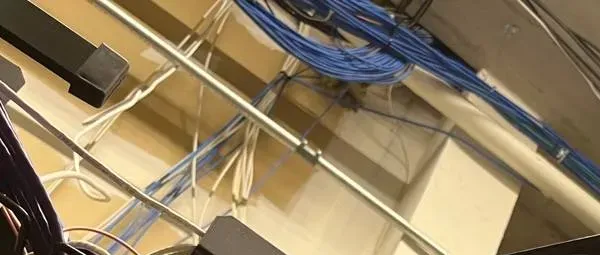
From an AESS job off Long Island, cropped and shown only as an example: blue and white network cables running across a ceiling. In a Long Island ranch attic the same kind of cable lies across the joists above the insulation, one run for each camera.
Water, salt and the coast
Our South Shore house is in a FEMA flood zone. Where should the recorder and the network gear go?
Up. The rule we follow is that nothing that records goes below the highest water the house has seen, and on a property in a mapped flood zone that usually means off the basement and off the ground floor of a high ranch altogether. The Town of Babylon’s own flooding page explains that FEMA’s AE6 designation marks land less than six feet above sea level as prone to flooding; whatever the number on your flood map, the recorder belongs above it.
In practice the recorder moves to an upstairs closet or a high shelf in a first-floor utility room, the router comes with it, and the cable modem is moved or extended so the three can share one battery backup. The outside cameras do not care where the recorder lives, so long as each cable is within Lorex’s 328-foot limit, which on a Long Island lot it almost always is.
If the house floods anyway, a recorder on a high shelf is the one thing in the basement that still has the footage of the night the water came in, and still works the morning after.
How often should cameras on a bay-front or ocean-facing wall be rinsed and checked?
Every spring and every autumn is a sensible minimum, and after any storm that drives spray against the house. Salt dries on the lens as a haze that softens the picture and catches headlights at night, and on the mounting screws and bracket joints as the start of corrosion.
An IP67 rating, which many Lorex outdoor cameras carry, means the housing keeps water and dust out. It says nothing about salt crystals building up on the outside. A rinse with fresh water and a soft cloth on the lens, a look at the screws and bracket, and a check that the cable boot is still sealed take a few minutes per camera.
We use stainless fixings on waterfront walls from the start, and where a house faces open water we mount cameras under an overhang wherever the view allows, so rain does some of the rinsing and the spray does less of the damage.
Our house was raised after Sandy. Does the new crawl space or pier foundation change how the cameras are wired?
Yes, and mostly for the better. A raised house usually has an open, ventilated space under the living floor where the old basement used to be. Cable can run through it to every side of the house, but it has to be treated as outdoors: outdoor-rated cable, fixed up under the floor framing rather than lying on the ground, and protected where it rises past the flood vents.
The recorder stays upstairs in the living space, well above the design flood level the house was raised to. The cameras under the house — covering the parking area, the stairs and the storage space — are often the most useful ones, because that space is where bikes, kayaks and tools end up.
Many raised houses also have a long exterior staircase to the front door. A Lorex doorbell at the top of it sees faces; a wired camera at the foot of it sees who is coming up.
Can the Lorex recorder stay on all winter in a house where the heat is turned down to the minimum?
Yes, provided the thermostat stays above freezing and the recorder is in the heated part of the house. The 14°F lower limit Lorex prints for its recent recorders is far below any sensible winter setting, so a closed-up house kept at 50°F or so is comfortable for the equipment.
The risks at a winterised house are elsewhere. If the electricity is switched off at the panel to save money, the system stops; if the internet service is suspended for the season, remote viewing stops even though recording continues. We set up the recorder to send an alert when it loses contact with the app, and ask owners to keep the internet on through the off-season.
East End owners who close a house for the winter often want the cameras most in exactly those months. A recorder that is warm, powered, connected and on a battery backup is the whole answer.
The kit you already bought
We bought a Lorex kit at a warehouse club. What usually has to change before it fits a Long Island house?
Usually the cables, sometimes the camera mix, rarely the recorder. Kit cables come in fixed lengths with moulded ends; a run up through a split-level, across a ranch attic and down to a garage corner often needs a different length, and a cable with a moulded end will not fit through the small hole that a neat installation needs. We use bulk cable cut to length and terminate it in place, keeping the kit’s cables for short indoor runs.
The camera mix is the second thing. A kit holds four or eight of the same camera, but a Long Island house has spots that want different views: a wide angle over the back patio, a narrower one down the driveway, a camera that can cope with the glare of headlights from the street. We can install the kit as it is and suggest an extra or two, without pressing you to buy anything.
We also check that the recorder and cameras in the box are from the same Lorex family. Lorex warns that its cameras, recorders and apps are not always interchangeable, and a kit that has been added to over the years sometimes holds a camera that will not talk to the recorder.
Can two Lorex kits bought a year apart run on one recorder?
Often, but not always. Lorex has changed recorder lines and apps several times, and its compatibility pages say plainly that not every Lorex camera works with every Lorex recorder. Two IP kits from the same family usually combine well, with the cameras from the second kit plugged into free ports on the first recorder or a PoE switch beside it.
Mixing an older analogue (coaxial) kit with a newer IP kit is a different matter: the recorders work in different ways. In that case we choose one recorder to keep, usually the newer one, and either replace the older cameras or keep the old recorder running separately for a while.
Before you buy a second kit, send us the model number on the bottom of the recorder you have. We will tell you which Lorex cameras it accepts and how many channels are left.
Porches, driveways and the police
Packages keep disappearing from our front step. Is a Lorex doorbell enough, or does the porch need its own camera?
A doorbell alone is rarely enough. A doorbell camera looks straight out at face height, so it sees the visitor well and the package at their feet badly; a thief who comes from the side and stoops to pick up a box often appears as a shoulder and the top of a head. A wired camera mounted above and to one side of the door, looking down at the step, shows the box, the hands and the face as the person straightens up.
The scale of the problem on the Island is real. The Suffolk ring charged in November 2025 was accused of taking more than 200 phones and tablets from porches across 31 communities. Those were deliveries tracked by the thieves; ordinary parcels go just as easily.
Thieves on Long Island go after cars parked in driveways. Where does the camera need to be to see someone trying the door handles at night?
Low and close, not high on the roofline. A camera under a second-storey eave covering the whole driveway shows that someone was there; a camera at first-floor height on the garage corner or a porch post, aimed along the cars, shows who it was. We usually pair the two: one wide view for context, one tighter view at the driver’s door.
The January 2024 task force announcement described crews who spot expensive cars in driveways, then break into houses for the key fobs. That makes the side door and the door from the garage into the house as important as the cars themselves, and both should be in view.
Light matters too. A camera with a built-in spotlight or a nearby motion light records colour, which tells police the colour of a jacket or a car; pure infrared gives black-and-white. On a dark cul-de-sac we prefer colour.
Our police department runs a camera registry. Should we sign up, and what does it give them?
Signing up is voluntary and gives police a list, not a live feed. The Suffolk County Police Department’s Camera Registry Program records where residents and businesses have cameras so detectives know whom to ask for video after a crime; the department says footage is retrieved at the owner’s convenience. Garden City’s village police run a similar private camera registration and state plainly that it does not give them access to private systems.
For most homeowners the benefit is speed: if something happens on your street, a detective calls you rather than knocking on every door. The cost is that your address is on a list of camera owners, which some people would rather avoid.
Either way, we show you how to export a clip from the Lorex recorder to a USB stick before we leave, so that if anyone asks, you can hand it over in minutes without letting anyone into the house.
Shops, lots and loading doors
Can a Lorex camera at our strip-centre shop look out over the shared parking lot?
It can usually look at the spaces in front of your store and the walk to your door; whether it can be mounted outside at all depends on your lease. In most Long Island strip centres the landlord owns the façade, the canopy and the lot, and exterior cameras need written permission. Inside the glass, aimed out, is your own space.
A camera inside the front window has to fight reflections at night and glare in the afternoon. We mount it close to the glass with a hood, or high above the door where the canopy shades the view.
Will a camera watching our loading door be blinded by truck headlights backing in?
It can be, if it faces straight into them. The fix is aim first and settings second: mount the camera to the side of the door looking across the dock, not out from above it, so headlights cross the picture instead of shining into the lens.
Lorex cameras have settings to handle bright and dark parts of the same scene, and we tune them on site after dark with a vehicle in place. A second camera inside the door, looking out, catches what the outside camera misses.
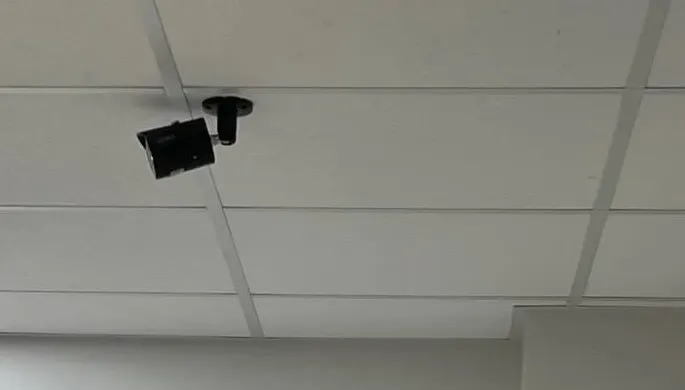
From an AESS job off Long Island, cropped and shown only as an example: a bullet camera on a short pole below a drop ceiling. A pole mount like this lets a camera inside a strip-centre shop or an industrial-park office sit low enough to see faces at the counter or the loading door.
Equipment
Types of Lorex Equipment We Install
We do not name models until we have stood in the house. What follows are the kinds of Lorex hardware that end up on Nassau and Suffolk jobs, with the spot each one tends to earn.
Lorex NVR recorders
Each wired camera plugs into a port on the back of this box and draws its power from it. Ours come with a few channels left over for later and a hard drive matched to how many weeks of video you want on hand. It lives in a heated closet on the Island, not up under the roof.
Turret and dome cameras
Most of the cameras we hang under a Long Island soffit are one of these two. A turret’s round face shrugs off the cobwebs that blur a bullet at night; a dome’s hard cover is the better pick on a porch ceiling a person could reach.
Bullet and spotlight cameras
The narrow, reaching view for a long driveway or the strip between two houses. Models with their own light flick it on when something moves, which turns a grey night clip into one where you can tell a red jacket from a blue one.
Video doorbells
Wired Lorex doorbells need a steady 16 to 24 volts AC; Lorex notes that many older houses have 10-volt transformers that cannot supply it. We test the existing transformer and replace it or add a plug-in supply before mounting.
Floodlight cameras
Light and camera in one fixture over a garage or patio. They connect over Wi-Fi to the same app as the wired system, so the Wi-Fi signal at the mounting spot is tested first.
PoE switches
Extra ports when the recorder is full, or a second point of power in a detached garage or pool house so one cable back to the house feeds several cameras.
Pan-tilt-zoom cameras
For a large lot, a commercial yard or a view across water. Some Lorex PTZ models carry an IP67 rating, an IK10 vandal rating and an operating range Lorex lists as −40°F to 158°F.
Battery backup
Lorex does not make it, yet we fit one on each Island system: a battery box under the recorder that also feeds the modem and router, so a flicker from PSEG or a generator switching over does not wipe out an hour of recording.
Lorex compared with Ring, SimpliSafe and ADT on Long Island
Ring and SimpliSafe mostly sell Wi-Fi and battery cameras that keep clips in the cloud on a paid plan; one r/longisland commenter recommending Ring put the yearly subscription at around $90. ADT sells installed systems with monitoring contracts. In a house with strong Wi-Fi everywhere and fast upload, those products work well, and we install them when they suit.
The difference shows up on a Long Island ranch or high ranch with the router in the den and a camera wanted on the detached garage, or during a PSEG outage when the router goes down. A cloud camera needs both Wi-Fi and internet to save anything; a wired Lorex recorder records locally around the clock whatever the internet is doing, with no subscription required. Its weak points are the ones this page is honest about: the questions over Lorex’s supply chain, three different apps, and the need for someone to plan the cable route through a finished house properly.
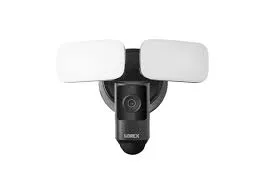
From Lorex's own catalogue rather than a job site: a black floodlight camera with two light panels. Over a Long Island garage door or back patio it gives light and a camera in one fixture, joined to the same app as the wired cameras.
AI Overview Reality Check
What AI Gets Wrong About Lorex Installation on Long Island
Google’s AI Overview was out of reach for the tools we research with, so nothing below is presented as a quote from it. Instead we took seven things that chatbot answers, store listings and cost articles keep repeating about Lorex, and held each one up against what a crew actually meets in a Nassau or Suffolk house.
“A store-bought Lorex kit includes everything you need”
The box includes a recorder, cameras and a cable for each one, and in a house with a full basement and an open attic it may genuinely be enough. Lorex sells a great many of these kits through Costco, as it says itself, and many end up on Long Island houses.
What the box cannot include is the route. A slab ranch needs every cable lifted into the attic; a cape needs access behind knee walls; a split-level needs a path between levels that do not stack neatly. Pre-made cables with moulded ends do not fit through small, neat holes, and the lengths rarely match the house.
So the kit is a good start, not a finished plan. Most of what we add is cable, mounting blocks and sealant, not more cameras.
“Wireless cameras mean no drilling in a finished house”
A Wi-Fi camera still needs power, from a plug, a battery or a solar panel, and a Wi-Fi signal strong enough at the mounting spot. On a brick-faced Nassau ranch or a high ranch with the router at the far end of the ground floor, that signal is often weak exactly where the camera is wanted.
Battery cameras record on motion rather than continuously and have to be taken down and charged. On a second-storey eave that means a ladder every few months, or a camera that quietly stops.
One cable through the attic and one small hole in the soffit is usually less disruption than it sounds, and it removes both problems for the life of the camera.
“Put the recorder anywhere out of sight — the attic is perfect”
Out of sight, yes; the attic, no. Lorex’s spec sheets for its recent recorders list an operating range of 14°F to 131°F and 10 to 90 per cent humidity. An unvented Long Island attic in July and an attached garage in January are the two places most likely to break those limits.
Basements bring a different risk on this Island. Suffolk’s first-ever flash flood emergency in August 2024 and the memory of Sandy along the South Shore mean a recorder on the basement floor can drown in a single night.
The right place is boring: a closet, a laundry room or a utility room in the heated part of the house, on a shelf, near the router.
“Outdoor cameras are weatherproof, so the coast is no problem”
Weatherproof ratings such as IP67 describe how well a housing keeps water and dust out. They do not cover salt crystals drying on the lens or creeping into screws and bracket joints over several seasons.
On canal-front houses in Massapequa or Freeport, harbour houses on the North Shore and summer places on the forks, the cameras that face open water need stainless fixings, a sealed cable entry and a rinse every spring and autumn.
Placement does more than any rating. A camera under an overhang facing along the house collects a fraction of the spray of one on an open wall facing the bay.
“You don’t need battery backup — outages are short”
Some are. LIPA’s report on Isaias counted about 645,000 customer outages in August 2020 and eight days before service was fully restored. A September 2026 coastal storm left thousands of customers dark across Huntington Station, Setauket, Bay Shore, Northport and Southampton.
A wired Lorex system draws its camera power from the recorder. When the recorder goes off, every wired camera goes off with it, at the moment an empty or dark house is most exposed.
No reasonable UPS covers eight days, but one sized for the recorder, router and modem carries the system through the short cuts that happen several times a year and the minutes before a standby generator starts.
“Installation costs $100 to $200 per camera”
Angi’s 2026 guide to camera installation gives that per-camera range for labour, charged in addition to buying the cameras. As a nationwide middle-of-the-road number for a straightforward house, it holds up.
It does not price a cable route through blown-in insulation over a slab, a recorder moved out of a flood-prone basement, or a doorbell transformer that has to be replaced. Those are normal Long Island tasks, and a national average smooths them away.
So we publish a fixed figure for the ordinary part of the job and list every Island-specific extra by name on the written quote, which you see before anyone picks up a drill.
“Home camera footage is shared with the police automatically”
Not with a Lorex system. Footage stays on the recorder in your house and in your app unless you choose to share it. Suffolk police run a voluntary camera registry that records where cameras are, and say footage is retrieved at the owner’s convenience; Garden City’s registration programme says outright that it gives police no access to private systems.
The confusion is understandable. Licence-plate reader networks have been in the Long Island news in 2026, with the New York Post reporting in August that Flock Safety cameras had been vandalised on the Island. Those are separate systems run for police and municipalities, not home cameras.
If you want to help investigators, the practical step is learning to export a clip to a USB stick. We show every owner how before we leave.
Tell Us the House Style, We’ll Tell You the Route
Ranch, cape, split-level, high ranch, colonial or raised waterfront: give us the style, the town and whether there is an attic you can stand in, and we will say where the recorder should live, how the cables reach the eaves and what the county factor makes the total.
For a Long Island Lorex price we need the town, the style of house, whether the basement or ground floor has ever taken water, where the router sits, and whether you already own a Lorex kit. A few phone photos of the attic hatch and the outside walls often save a visit. The written figure comes back the same business day, or call (800) 486-0943 to talk it through.
✅
We Got Your Request!
Received. Someone who books Nassau and Suffolk jobs will phone you today to ask about the attic, the router and any water in the basement, then send the price. Cameras already down? Don’t wait for us — dial (800) 486-0943.
How It Works
Our Installation Process
Six steps on every Long Island house. The first two are the ones most kits skip: knowing the shape of the house, and choosing a room for the recorder that stays warm, cool and dry.
1. Read the house
We note the style — ranch, cape, split-level, high ranch, colonial or raised — find the attic hatch, the basement stairs and the breaker panel, and look for any water line on the basement or ground-floor walls.
2. Choose the recorder's room
A heated, dry closet or utility room near the router, on a shelf above any past flood level and inside the 14°F to 131°F range Lorex lists for its recent recorders.
3. Map every cable route
Attic, knee-wall space, basement ceiling or crawl space: we trace the path from the recorder to each camera spot and note any run that needs a new hatch, a longer cable or an outdoor-rated jacket.
4. Write the quote at your county's factor
A camera list with mounting spots, the route for each cable, any electrician or doorbell-transformer work, and one total at the Nassau 1.15 or Suffolk 1.20 factor, all in writing before any drilling.
5. Install, seal and set up
Cable through the house, cameras on mounting blocks with sealed entries, the recorder and a battery backup in place, detection zones on the driveway and doors, and the right Lorex app on every phone.
6. Unplug, restart and check after dark
We unplug the recorder, confirm every camera returns by itself in the app on mobile data, show you how to export a clip to a USB stick, and look at each view after dark before we leave.
Coverage Area
Lorex Camera Installation Near Long Island’s Landmarks
Six places that show the range of Lorex work across the Island, from post-war tract houses to flood-prone harbours and summer towns.
Levittown
17,447 houses built between 1947 and 1951, many of them ranches on concrete slabs. The pattern for overhead cable routes across much of central Nassau: recorder in a closet, every run through the attic.
Roosevelt Field, Garden City
Long Island’s largest mall anchors the Old Country Road retail corridor. The independent stores and services in the surrounding strips are where our Nassau business Lorex systems cluster.
Long Island Innovation Park, Hauppauge
Roughly 1,350 businesses across about 11 square miles. Long building fronts, loading doors and night-time truck traffic make camera aim and long runs the design questions.
Stony Brook Mill Pond
The dam failed in the August 2024 storm that brought Suffolk its first-ever flash flood emergency. A reminder that on the North Shore, too, a recorder belongs above the floor.
Long Beach
The barrier-island city took about $150 million in damage from Sandy. Raised houses, flood vents and salt air shape every camera and recorder we fit along this stretch of the South Shore.
Southampton
A town where a planning study put about 35 per cent of houses in seasonal use. Owners away for months at a time want alerts that work through the winter and a system that comes back on its own after an outage.
Beyond these six, Lorex calls come from every corner of both counties. In Nassau: Valley Stream, Elmont, Franklin Square, Hempstead, Freeport, Merrick, Wantagh, Massapequa, Hicksville, Syosset, Great Neck, Port Washington, Glen Cove and Oyster Bay. In Suffolk: Amityville, Lindenhurst, Babylon, Bay Shore, Brentwood, Commack, Huntington, Northport, Smithtown, Ronkonkoma, Patchogue, Shirley, Riverhead, Southold, the Hamptons and Montauk.
From an AESS job off Long Island, cropped and shown only as an example: small dome cameras set among the lights of a shop ceiling. Independent stores in the strips around Old Country Road often need several of these to cover every aisle and the register.
Pricing
Lorex Camera Installation Cost on Long Island
How the numbers are built: a Lorex camera or recorder is priced identically in Brooklyn, Mineola and Montauk. What changes is our time, which we take from the Brooklyn labour rate and multiply by 1.15 in Nassau or 1.20 in Suffolk. The table assumes the normal case on the Island — a camera reached through an attic, basement or crawl space a person can get into, and a recorder going into a heated room.
County
Factor
Labour per wired camera
Recorder setup
4-camera Lorex system, installed
Camera added, from
Recorder with setup, from
Nassau
1.15
$230
$173
$1,938
$308
$493
Suffolk
1.20
$240
$180
$1,985
$318
$500
In the four-camera column you are paying for everything: the NVR, four cameras, the cable runs and the app on your phones. Coming back later for a change or a fault is a separate service call, charged at $195/hr, 3-hr minimum ($585) on either side of the county line.
What moves a Long Island Lorex price
Attic access. A pull-down stair and a walkable attic keep a slab-ranch job to the standard figure; a closet hatch and a shallow, insulation-filled roof add time, quoted after we look.
Moving the recorder. Relocating a recorder out of a flood-prone basement or a garage, with the existing cables extended or re-run, is listed as its own line.
Doorbell power. A new transformer or plug-in supply for a Lorex wired doorbell is listed separately when the old one cannot deliver 16 to 24 volts AC.
A missing outlet. If the recorder closet or the floodlight spot has no power, a town-, village- or county-licensed electrician adds it and bills for it, permit included.
Waterfront hardware. Stainless fixings and extra sealing on walls that face open water.
A kit from the club store. Cameras and recorder you bought yourself drop out of the price entirely; only our time and any extra cable remain.
Want a figure for one particular Lorex model? Our Long Island Lorex price calculator lists them camera by camera. It sorts the Island into its own price zones, so if its number and the table here disagree, the Nassau or Suffolk line above is the one your quote follows.
Lorex product photograph, not an installed doorbell: the white version of its video doorbell. Many older Long Island houses have doorbell transformers too weak for a wired doorbell like this, so we test the existing one before it goes up.
Shop Our Systems
Lorex Packages & Pricing for Long Island
Three starting points, each shown at the Nassau and Suffolk figures. Anything beyond the standard work is quoted after a look at the house.
Four-camera house system
$1,938 Nassau · $1,985 Suffolk, installed. A wired Lorex NVR with four cameras — typically the driveway, the front door, the back door and one side yard — cable run through the attic, basement or crawl space, the recorder set up in a heated closet, and the app on your phones.
One more camera
From $308 Nassau · $318 Suffolk, installed. Your recorder still has an empty port and the attic or basement gives us a way to the new spot: we hang the camera, run its cable home, add it to your phones and set its aim once it is dark.
New or replacement recorder
From $493 Nassau · $500 Suffolk, with setup. The box that drowned in the basement, the one that ran out of ports, or the first one for a house with no system yet: a new Lorex NVR on a shelf upstairs, with any cameras it can talk to plugged back in.
Already own a Lorex kit? Labour-only pricing
If the Lorex box is already in your hall closet, the bill is our time and nothing else: per camera, $230 in Nassau or $240 in Suffolk; for setting up the recorder, $173 or $180. Where a kit cable comes up short on the way through your attic, we cut a longer one from our own reel and mention it on the quote. Where you bought it does not matter. What does is that the recorder and cameras are one Lorex generation, so photograph the label under the recorder and send it to us before the visit.
Moving a recorder, replacing a doorbell transformer, trenching to a detached building or adding an outlet is priced after a walk-through and listed line by line in the written quote.
Nassau or Suffolk — Get Your Figure in One Call
Five minutes on the phone about your house style, your attic and your basement usually settles the package, whether the recorder needs a new home and the price on your side of the county line.
Lens cleaning, salt rinsing, drive checks and firmware updates.
Field Notes
Field Notes: Read the House Before the Cameras
On a Long Island Lorex job I start indoors, at the attic hatch, the basement stairs and the breaker panel. A pull-down stair means easy overhead runs; a hatch in a closet ceiling means a slower day; a water line on the basement wall means the recorder goes upstairs, whatever was planned.
Next comes the recorder’s room: heated, on a shelf, near the router, never the floor or the garage. Only then do I go outside and stand where each camera will hang, looking at the driveway, the porch step and the side door from that height.
Before I leave, I unplug the recorder at the wall, wait, and plug it back in. Every camera has to come back by itself, in the app on my phone, on mobile data. After dark I check each view once more, because a camera that looks right at noon can be blinded by a neighbour’s porch light at night. — Anwar Timothy, NYS low-voltage license #12000287431
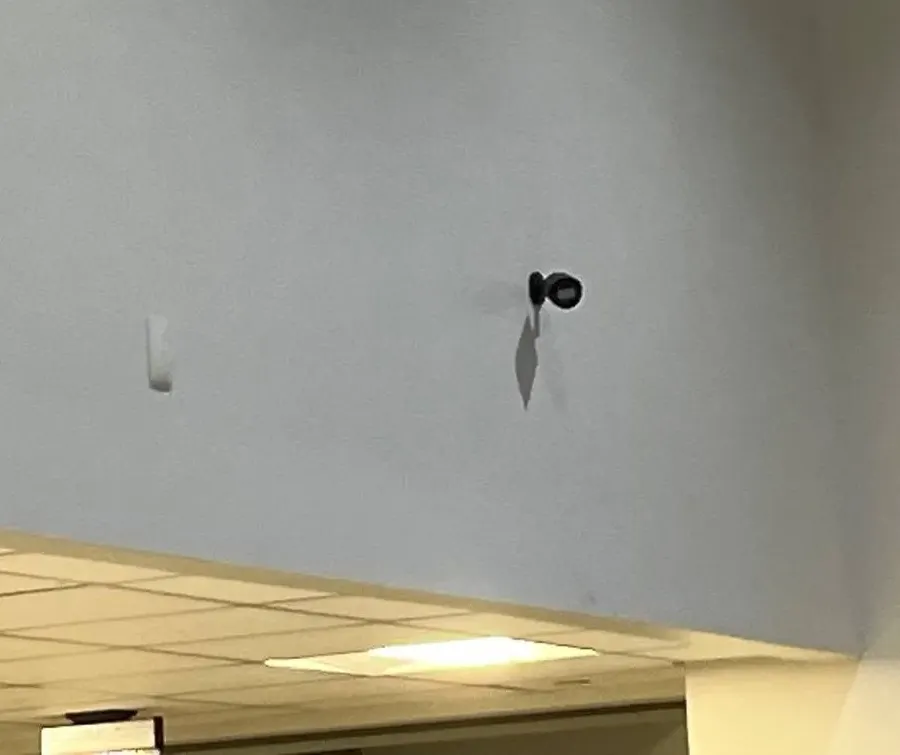
From an AESS job off Long Island, cropped and shown only as an example: a small camera high on a wall, its shadow thrown by the lights below. Checking every view after dark is how we catch a camera that a nearby light washes out.
FAQ
Long Island Lorex Camera Installation FAQ
Will the crew need to get into our attic or crawl space, and what should we clear beforehand?
+
Almost certainly, because on most Long Island houses the attic, the knee-wall space or the basement ceiling is where the cables travel. Clear a path to the hatch or pull-down stair, move anything stored directly under it, and if the hatch is inside a closet, take the clothes out on that side. In a finished basement we may need to lift a few ceiling tiles, so clear the shelves below them. We bring drop cloths, wear shoe covers inside, and put attic insulation back level wherever we moved it. If the attic has no safe access at all, tell us when you book so we can plan the routes another way.
Is winter a bad time to have outdoor cameras installed on Long Island?
+
No. Most of the work happens indoors, in the attic, the basement and the recorder closet, and cameras, cable and mounting blocks go up in cold weather without trouble. Two things change in winter. Exterior sealant needs a dry surface, so we avoid sealing in freezing rain and come back to finish a cable entry if we have to. And attics are far easier to work in during January than in a July heat wave, so slab-ranch and cape jobs often go faster in the cold months. If ice on a roof edge makes one ladder position unsafe, we reschedule that single spot rather than take the risk.
Can the cameras on the front of the house record the street and the sidewalk?
+
A camera aimed at your own driveway and front walk will show some of the street beyond it, and most owners accept that. What we avoid is pointing cameras into a neighbour's windows or back garden: New York's Civil Rights Law section 52-a lets a neighbour sue over a camera installed to record their backyard without written consent. On tight Nassau lots we use Lorex privacy masks to black out a neighbour's windows, and draw motion zones on your own property so passing cars and dog-walkers do not set off alerts all day. Audio recording stays off outdoors unless you ask for it.
The closet we picked for the recorder has no outlet. Who adds one?
+
A licensed electrician, not a camera installer. In Nassau, the county's consumer checklist notes that electricians are licensed by the towns and villages, so the electrician needs the licence for your town or village. In Suffolk, line-voltage wiring belongs to licensed electricians under the county code, and some towns and villages license their own. We can arrange the electrician and coordinate the timing, or work alongside yours. Often a new outlet is not needed at all, because another closet or utility room close by already has power and suits the recorder just as well.
Can the new camera cables come into the house through the hole the old cable-TV line used?
+
Sometimes, and we look for exactly that. Many Long Island houses have an old entry where cable-TV or satellite coax came through the rim joist or the siding, often left unsealed since the dish came down. If that entry is in the right place and large enough, we pass the new camera cables through it and seal it properly, removing the old coax if it is no longer used. Where it is on the wrong side of the house from the recorder, we make a new sealed entry instead, because a long detour around the foundation to reuse a hole costs more than it saves.
Can a cable cross our driveway to a camera on the far side, and who checks for buried lines first?
+
It can, either buried in conduit beside the driveway or carried overhead through the garage and along the house if that reaches. Anything dug into the ground needs a call to 811 at least 48 hours before digging so the utilities mark their buried lines, and we place that request ourselves when the job includes trenching. Cutting across an existing asphalt or paver driveway is rarely worth it; we look first for a route around the end of the drive, under a walkway joint or through the garage ceiling. A single cable to a small switch can then feed several cameras on the far side.
Will wired Lorex cameras slow down our home Wi-Fi or streaming?
+
Not in normal use. Wired cameras send their video over their own cables to the recorder, not over your Wi-Fi, and the recording happens inside the recorder. The only traffic that crosses your internet connection is what you watch remotely on a phone, plus app alerts. Watching several cameras live from work does use upload bandwidth while you watch; Lorex recommends at least 6 Mbps of upload for remote access on some of its recorders. Wi-Fi floodlights and doorbells do use your Wi-Fi, so we test the signal at their spots and suggest an access point if it is weak.
Do Lorex cameras keep working on a south-facing wall in a Long Island heat wave?
+
Yes, within the limits Lorex prints for each model, which for outdoor cameras sit well above any Long Island summer air temperature: some of its outdoor battery cameras are listed to 122°F and some wired pan-tilt-zoom cameras to 158°F. A housing in direct afternoon sun runs hotter than the air, so on a south or west wall we prefer a spot under the soffit where the camera is shaded most of the day. Battery cameras are the ones to watch, because heat shortens battery life just as cold does. The recorder indoors is a different matter, which is why it never goes in the attic.
Can the crew come on a weekend so we can be home for the walk-through?
+
Yes. We book Long Island visits seven days a week in two-hour arrival windows, with the last window ending at 8 PM. The walk-through and quote can also be done by video call: you carry your phone through the house, showing us the attic hatch, the basement, the router and each outside wall, and we send the written figure afterwards. The installation itself is usually booked as a single day for four to six cameras on a house with good attic or basement access, so a weekday works too if someone can be home at the start and the end.
Can a camera on the house keep watch over our boat at the end of the dock?
+
Often, if the dock is in clear view and not too far away. A wired camera with a narrower lens on the corner of the house facing the water can show the boat and the end of the dock; at night, lights on the dock help far more than infrared, which bounces off water and spray. If the dock has its own power, a camera on a post near it can be fed by a cable from the house in conduit, within Lorex's 328-foot limit, with stainless hardware and a sealed box. We avoid aiming across the water at a neighbour's dock or house, and plan a fresh-water rinse each spring and autumn.
All Areas Served
Lorex Cameras Across Long Island, New York City and the Hudson Valley
You are reading the Island-wide page. For the towns, house styles and prices in one county, go to Nassau or Suffolk below; Lorex customers in the city and north of it will find their own pages here too.
Nothing factual above rests on our say-so alone. The census counts, the PSEG and LIPA storm numbers, the county licence rules, the police announcements and the Lorex specifications each trace to one of these pages. The prices are the exception: they are ours, worked out from the Brooklyn labour line in our Lorex calculator times 1.15 or 1.20, with the hourly rate for later visits.
Recorder in the Basement? Call Before the Next Storm
A recorder on a basement floor is one heavy rain from a dead hard drive. Ring (800) 486-0943 and we will move it upstairs, or come out the same way for a kit still in its box or cameras that vanished from the app when PSEG last went down. Most Long Island systems we visit are back to recording within an hour or two of the van pulling up.
Long Island Lorex Systems From a Licensed, Insured Crew
Call (800) 486-0943 from anywhere between Elmont and Orient Point. Snap the attic hatch or the label under your recorder and send it by WhatsApp. Abstract Enterprises Security Systems, 1282 Troy Ave, Brooklyn, NY 11203
Google reviewers give us 4.7★ over 201 reviews. Every Long Island crew is insured, the low-voltage work is done under NYS license #12000287431, and a written price reaches you on the day you ask for it.
Paperwork: each Lorex recorder and camera we supply also carries Lorex’s own manufacturer warranty, and any outlet or circuit added by a licensed electrician is covered by that electrician’s terms and inspection. Full terms — including 50% deposit, one-year parts-only warranty on AESS-supplied products, and the late-fee schedule — are set out in the service agreement. Ask for a copy with your quote, and see our warranty page for how claims are handled.
Page reviewed and updated October 18, 2026. Changelog: Long Island Lorex hub rebuilt from new research on Long Island house types and cable routes, Lorex recorder temperature limits, flood zones and the 2024 Suffolk flash flood, PSEG Long Island outages, Nassau and Suffolk licensing, police camera registries and porch and driveway thefts; prices now follow the published Nassau and Suffolk multipliers on the Brooklyn base labour figures.