Every Arrival on Camera · Thirty Days on the Drive · Clips You Can Hand Over
In much of Orange County a camera system is no longer only the owner's business. A Monroe or Woodbury short-term rental needs outdoor cameras that can show every arrival and departure, with a month of recordings ready for the building inspector. A Newburgh restaurant needs video that names the person who forced the door, not a silhouette. A commuter who leaves on the first train out of Middletown needs alerts that mean something by the time the house is empty. We design Lorex systems for that kind of scrutiny: cameras placed where people actually come and go, a drive sized for the retention you are asked to keep, a recorder clock you can trust, and a way to pull a clip off the box in minutes.
Page last reviewed on October 18, 2026 by Anwar Timothy, holder of NYS low-voltage license #12000287431 · Orange County appointments are run from the Bronx office on East Fordham Road
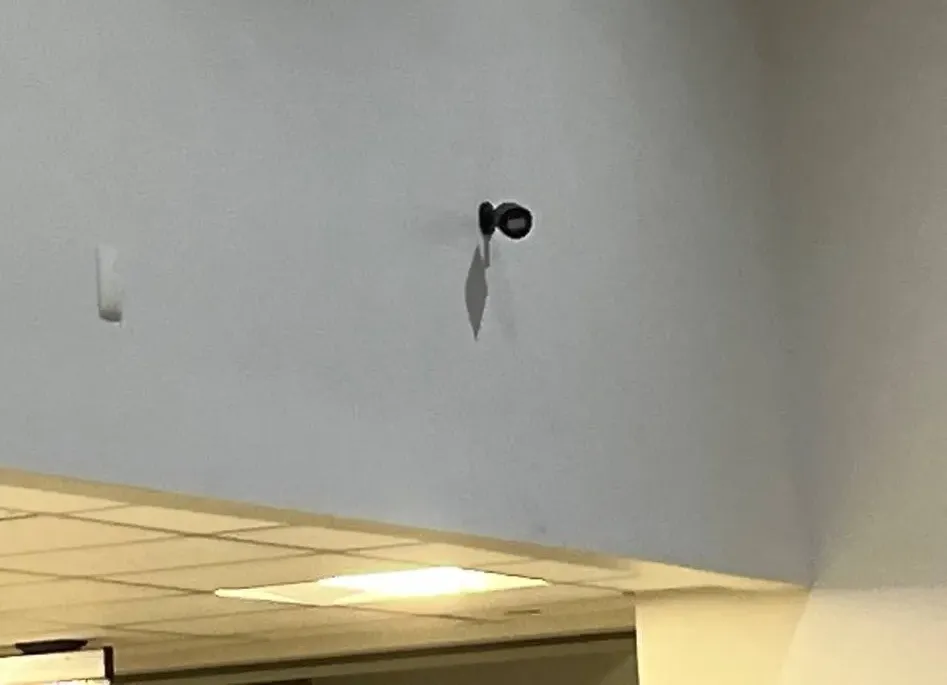
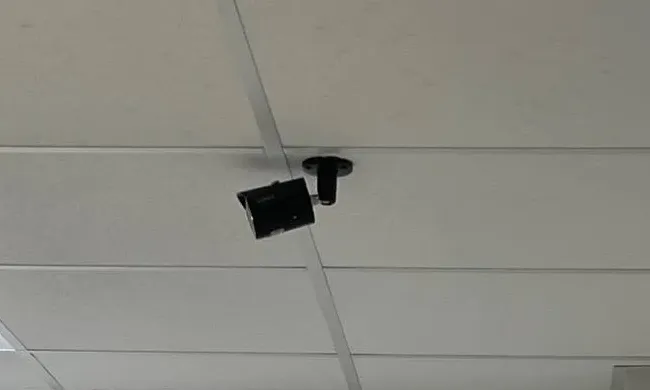
Example photo from another AESS job (not an Orange County property), cropped to the wall: a small black bullet camera set high on a plain painted wall above a lowered ceiling. In a showroom or warehouse unit off Route 17K or Route 211, the high camera gives the overview; the cameras that identify people go lower and closer to the doors.
Orange County Lorex Camera Quote
Tell us the town, the property and who the cameras have to satisfy — a written Lorex price follows the same business day
✅
Request Sent!
A Lorex installer will call you back about the Orange County property the same business day.
25+
Years Experience
✓
Same-Day Estimates
100%
Licensed & Insured
4.7★
201 Google Reviews
Start with who will look at the footage. If it is a town building inspector, an insurance adjuster, a rental platform or the police, tell us when you call — it decides where the cameras go, how big the drive must be and how the recorder is set. Text the town, a photo of the driveway and front door, and any permit paperwork to (845) 640-3835 and we will sketch the arrival points before we visit.
A four-camera Lorex system in Orange County is $2,175 installed: recorder, cameras, cable within reach of the recorder, setup on your phones and a restart test
Footage is kept on the recorder at your own property, and Lorex's wired systems need no paid plan to record or play it back
Book any day, mornings through 8 PM, and the technician turns up within the two hours you were given; camera cabling falls under New York low-voltage license #12000287431
Why Orange County Properties Need Lorex Camera Installation
Orange County is the part of the Hudson Valley that is still filling in. The Census Bureau's 2024 survey counts 411,767 residents and 152,422 homes, roughly seven in ten of them single-unit houses and two-thirds owner-occupied, and USAFacts, working from the same bureau's estimates, puts the county's growth between 2015 and 2025 at 11.1 percent. Thirteen percent of residents moved into their current home in 2021 or later. That turnover shows up in the calls we get: new owners of builder colonials in Chester, Monroe and Wallkill who want cameras before the first winter, buyers of older houses in Newburgh, Middletown and Port Jervis who inherited a system nobody can log into, and investors who bought a lake or village house to rent by the night.
It is also a county that leaves home early. The same survey puts the average trip to work at 35.3 minutes, with two-thirds of workers driving alone and six percent on public transit. On the Port Jervis Line, the first weekday train toward Hoboken and Penn Station leaves Port Jervis at 3:44 in the morning and Middletown/Town of Wallkill at 4:15, according to the MTA timetable. A house whose owners catch those trains, or merge onto Route 17 or I-84 before sunrise, is empty from dark to dark for much of the year. A Lorex system there is not watching a busy household; it is the only thing paying attention, and it has to decide on its own what is worth a phone alert at 11 in the morning.
The newest reason is rental law. The Town of Monroe's Local Law No. 1 of 2022 requires a short-term rental, whenever the manager is not living on site, to be digitally monitored with “outdoor cameras adequate in number, location and view angle to monitor arrivals and departures at the property,” with recordings kept for at least 30 days and copies handed to the Building Inspector on request. The Village of Woodbury's 2024 permit application uses the same words. Airbnb, for its part, has banned every camera that monitors any part of a home's interior since April 30, 2024, even one that is switched off. Back in 2019 Alfred Acquavivia, an attorney for Greenwood Lake residents who object to short-term rentals, told Advertiser News North that “the first step is always to try to prevent the problem from occurring.” In those towns a Lorex system is built to a written standard and will be judged by an inspector after a neighbour complains.
Businesses have the same problem from the other side. When a burglar crowbarred the front door of An Artistic Taste in Newburgh in December 2025, ABC7 reported, the surveillance video showed him behind the bar taking the card terminal, a printer, an iPad and the cash drawer — and the owner said the drawer held only $100; the hardware and the door were the real cost. In January 2025 the Town of New Windsor police warned residents about organized theft groups and advised them to consider cameras or an alarm. A Lorex system pays for itself in those moments only if the camera saw a face, the recorder survived, and the clip can be copied out before it is overwritten. Owners who are adding cameras to a rental or a shop often want the doors controlled too, and we can price smart locks for Orange County rentals at the same visit, so the lock log and the camera clip tell the same story.
Orange County facts that shape a Lorex install
Two local rental laws already specify cameras. Monroe (Local Law No. 1 of 2022) and the Village of Woodbury require outdoor cameras covering arrivals and departures whenever an absentee host rents, recordings kept at least 30 days, copies to the Building Inspector and notice to renters of camera locations and any audio.
The county itself moved toward a rental registry. Local Law Introductory No. 7 of 2025 would make Orange County a “covered jurisdiction” under Article 12-D of the state Real Property Law, with registration run by the Commissioner of Finance; it went to a public hearing in Goshen on October 27, 2025.
No cameras indoors at platform rentals. Airbnb's rules, in force since April 30, 2024, forbid devices that monitor any part of a listing's interior even when turned off, and outdoor cameras must be disclosed in the listing.
A long commute empties houses early. Mean travel time to work is 35.3 minutes (Census ACS 2024), and the first Port Jervis Line train leaves at 3:44 a.m.
Many owners are new. 13 percent of residents moved in since 2021 and another 25 percent between 2018 and 2020 (Census ACS 2024); the county grew 11.1 percent from 2015 to 2025 (USAFacts, from Census estimates).
Lorex's own limit for one cable run is 328 feet between recorder and camera — enough for most subdivision lots, short for a farm lane or the far side of a warehouse yard.
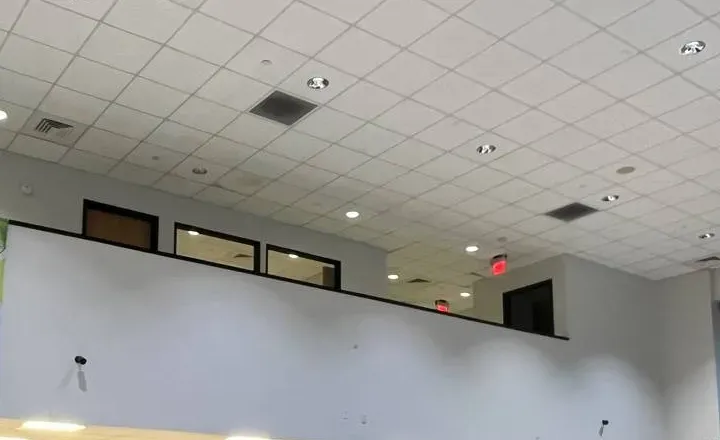
Example photo from another AESS job (not an Orange County building): two small cameras on a tall white wall beneath mezzanine windows in an open hall. Cameras at this height see faces across a big room; in an Orange County showroom or event space they pair with one camera on each entrance.
Orange County Lorex Stopped Recording?
When the screen says “no disk,” the tiles have been black since the storm, or the town wants rental footage and nobody remembers the password, ring (845) 640-3835. The first free two-hour slot is yours, and on most Orange County Lorex calls the recorder is saving video again within one to two hours of our arrival — a new drive or cable, if one is needed, follows on a second trip. Other brands go to camera repair in Orange County.
If footage is needed for an inspector or the police, do these first
Do not unplug or reset the recorder. A factory reset can wipe users and settings, and a recorder that is switched off records nothing while it sits there.
Note the date and time you need, and check whether the clock on the recorder's screen matches your phone. If it is off, write down by how much.
Find a USB flash drive. Lorex recorders copy clips to a USB stick plugged into the front or back of the box; the stick is not included with the recorder.
Tell us how long the drive keeps footage. If you do not know, assume the oldest days are being overwritten now and call before anything else.
With that information we can usually save the clip by phone before a visit is even booked.
What We Install
Lorex Camera Installation Services in Orange County
These are the pieces of work that make up most Lorex jobs in the county. The first two are the ones people skip when they buy a kit, and the ones an inspector or adjuster notices first.
🛬
Arrival-Point Mapping
Walking every way a car or person reaches the property — driveway mouth, parking pad, front and side doors, lake path, garage — and placing cameras so each one is seen arriving and leaving.
💾
Retention-Sized Recorders
Choosing the Lorex recorder and drive for the number of days you must keep, at the recording mode you will actually use, rather than the drive that came in the box.
🏡
Rental-Permit Systems
Outdoor-only Lorex layouts for Monroe, Woodbury and other permitted rentals, with written camera locations you can attach to the application and paste into a listing.
🏗
Pre-Wire for New Houses
Network cable run to the eaves, porch, garage and a recorder closet while the studs are open, so cameras go up later without opening a finished wall.
🔔
Doorbells and Front Doors
Wired Lorex doorbells on a checked 16–24 volt AC supply, paired with a camera that sees the walk and the porch where parcels wait all day.
🍽
Shops and Restaurants
Door, counter and register coverage in Newburgh, Middletown, Goshen and Warwick storefronts, with the recorder somewhere a burglar will not find it.
🚚
Warehouse and Flex Units
Lorex inside a tenant's own unit along Route 17K, Route 300 or I-84 — office door, dock door, stock cage — separate from the landlord's building cameras.
🌾
Barns, Stands and Yards
Cameras on outbuildings, farm stands and equipment yards from the Black Dirt to Montgomery, on cable where it reaches and a bridge or extender where it does not.
📤
Clip Export and Handover
Recorder clock set and checked, a test clip copied to USB at handover, and a written page showing anyone in the household how to do it again.
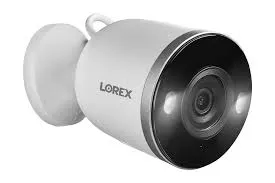
Manufacturer product photo (not an installed camera): a white Lorex 4K bullet with a small light on each side of the lens. On an Orange County rental or commuter house, a bullet like this usually watches the driveway mouth, where every arrival starts.
Building Specialists
Lorex Systems for Orange County's Architecture
Orange County has almost every kind of building the region builds, often within one town. These are the types we wire most, and what each changes about a Lorex plan.
Subdivision Colonials and Ranches
Chester, Monroe, Blooming Grove, Montgomery, Wallkill, Warwick. Vinyl siding, an attic over the second floor, a two-car garage and the network panel often in the basement or garage. Attic and basement routes make cabling straightforward; the recorder location is the real decision.
Houses Under Construction
The county's growth means many owners can still talk to the builder. Cable pulled before insulation and drywall costs a fraction of a retrofit, and it lets cameras land exactly where the porch, garage and side door need them.
Townhouse and Condo Communities
Shared walls, association-owned exteriors and common driveways. A Lorex plan here usually centres on the unit's own door, garage and patio, and on what the association allows on its siding.
River-City and Village Buildings
Newburgh's East End, Middletown, Port Jervis, Goshen, Warwick and Walden: brick and frame buildings from the nineteenth and early twentieth centuries, many split into two families or with a store below. Old plaster, stairwells as cable routes and two sets of users.
Lake and Rental Houses
Greenwood Lake, Warwick, Monroe, Tuxedo and the Woodbury area. Houses rented by the night or week, where town law or the platform sets the rules: outdoor cameras only, disclosed, covering every arrival, and a month of recordings.
Farms, Barns and Black Dirt Fields
Pine Island, Florida, Goshen, Montgomery and Crawford. Farmhouses, barns on their own meters, equipment parked outside overnight and long lanes. The 328-foot cable limit matters here more than anywhere else in the county.
How the method changes from building to building
Builder houses after move-in. Most subdivision houses can be wired without opening a finished wall. The attic gives a route to every eave; the basement or garage ceiling reaches the front porch and the side door. We drop cable from the attic into the soffit behind each camera position and seal the entry, and where the siding is vinyl the camera sits on a mounting block that matches the siding profile, so it seals flat and the screws reach solid sheathing. The thing to settle before drilling is where the recorder lives, because the garage the builder chose for the network panel is the worst room in the house for a hard drive in a Hudson Valley August or January.
Houses still being framed. If the drywall is not up yet, call before it is. A home-run network cable from a recorder closet to each likely camera spot — each eave corner, the porch ceiling, over the garage doors, the back door — costs little while the walls are open, and the ends can be coiled and labelled behind a blank plate until the cameras arrive. We coordinate with the builder's electrician so the low-voltage cable keeps clear of power wiring and the recorder closet gets an outlet.
Older city and village buildings. In a Newburgh rowhouse or a Middletown two-family, plaster walls and solid masonry stop Wi-Fi and resist new cable. Stairwells, closets stacked floor over floor, the basement ceiling and the line where the old phone or cable TV wire already enters the building are the usual routes. Where the building is split between an owner and a tenant, the recorder belongs to the owner and goes in the owner's space, and we list which cameras each household may see before any setup.
Rental houses. A rental is designed from the outside in. We stand where a guest's car stops, where people walk from it, where the lake path or the side gate meets the yard, and where a second car would park if someone brought friends. Every one of those spots gets covered, and no camera looks through a window, into a hot tub enclosure or onto a neighbour's yard. The written camera list becomes part of the permit file and the listing disclosure.
Farms and outbuildings. Barns and equipment sheds that sit beyond one cable length use a PoE switch or long-range PoE extender in a weatherproof box, or a point-to-point wireless link to a small switch in the barn. Lorex lists 328 feet as the maximum Ethernet run between recorder and camera; we measure the lane before promising anything. The Hudson Valley Lorex page goes deeper on extenders and long links; on an Orange County farm the usual problem is simpler: the barn is on a separate meter, so the camera's power and the recorder's power fail at different times.
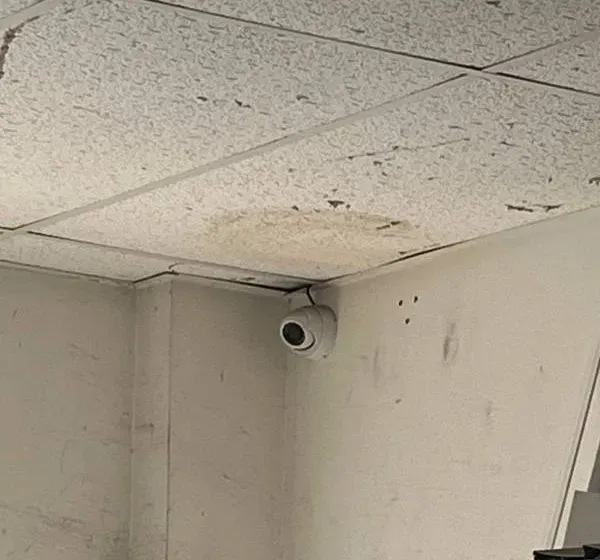
Example photo from another AESS job (not an Orange County building): a white dome camera tucked into a corner under ceiling tiles marked by an old leak. In older Newburgh, Middletown and Port Jervis buildings we look up before we mount anything — a stained tile can mean water running along the same route as the cable.
Commercial Lorex
Business Lorex Camera Installation in Orange County
For a restaurant, shop, office or leased warehouse bay in Orange County, a Lorex system means the footage lives on a box you own and there is no subscription to keep paying. For wired business systems Lorex also publishes a separate app, Lorex Pro, built for multi-camera viewing on phones and computers. These are the commercial areas where the work concentrates, and what each tends to need.
Downtown Newburgh
Restaurants, salons, barbers and small offices in older buildings near the riverfront. The December 2025 burglary at An Artistic Taste, where the thief took the payment hardware and the drawer, is the pattern to plan against: a camera at face height on the forced door and a recorder out of the burglar's path.
Route 17K, Route 300 and I-84 near Stewart
Distribution buildings along these roads, including the Amazon and Medline buildings near Route 17K in the Town of Montgomery and the Matrix project at Route 300 and I-84. Building-wide systems belong to the owner; tenants and their contractors call us for their own office, dock and cage.
Route 211 and Route 17M, Middletown and Wallkill
Strip centres, auto shops, contractors' yards and medical offices around the Galleria at Crystal Run. Wide lots, lights on poles and cars arriving all day; the camera that matters looks at the door, not the whole parking field.
Woodbury Common and Route 32
The outlet centre opened in 1985 and now has about 220 stores; the businesses that serve its visitors line the roads nearby. Small food and retail tenants want their own register and back-door cameras.
Village Main Streets
Goshen, Warwick, Chester, Florida, Walden and Cornwall: storefronts with apartments above, where the shop's Lorex system and the building's system should be separate even when both are Lorex.
Farm Markets and Agricultural Businesses
Black Dirt growers, orchards and farm stores. Equipment and fuel outside, staff coming and going early, a stand facing the road. Cameras watch the yard gate, the fuel tank and the cash area.
Rules an Orange County owner should know before the cameras go up
Rental hosts in Monroe and the Village of Woodbury already have a camera rule. Outdoor cameras must be adequate in number, location and view angle to monitor arrivals and departures; recordings are taken while the property is rented, kept at least 30 days and copied to the Building Inspector on request; renters must be told where the cameras are and whether any record audio. The Town of Warwick also requires short-term rentals to hold a permit under its Chapter 129.
Airbnb forbids interior cameras outright. Since April 30, 2024 its rules ban devices that monitor any part of a listing's interior, even if turned off, and require outdoor cameras to be disclosed before booking; cameras may not cover places such as an enclosed outdoor shower or a sauna.
New outlets and circuits need a county-licensed electrician. Orange County has required a county-issued electrician licence since Local Law No. 8 of 2007, revised by Local Law No. 1 of 2024, with applications handled by the Department of Consumer Affairs and Weights & Measures in Goshen. The City of Middletown has its own electrical licensing board. Our camera cabling is low-voltage work under NYS license #12000287431; any new 120-volt outlet is done by a licensed electrician.
Get the contract in writing. The county's consumer guide to home improvements says contracts over $500 should be written in plain English, signed, and list the work and the materials, including makes and models. Our quotes name every Lorex model and drive size.
Audio is a separate legal question. New York's Penal Law section 250.05 makes eavesdropping, including mechanical overhearing of a conversation, a class E felony. Lorex's own FAQ warns that audio monitoring is not legal everywhere. We leave camera microphones off at rentals and businesses unless you have taken advice.
Federal money and certain end uses rule Lorex out. Lorex's FAQ excludes federal governments, federally funded projects and NDAA-bound contractors, and its notice on the FCC's Public Notice DA 26-635 says some products cannot be marketed for public safety, government or critical-infrastructure surveillance. A company doing federal work near Stewart or West Point should choose another platform for that work.
A state credit can offset part of a shop's bill. Retailers with no more than 50 employees can claim New York's Commercial Security Tax Credit on security equipment, cameras included, capped at $3,000 for each retail location — an accountant can tell you whether a given store qualifies.
Example photo from another AESS job (not an Orange County business): a black bullet on a short pendant mount fixed through a ceiling grid. In an Orange County office or flex unit with a drop ceiling, a pendant lets the camera clear the tiles and aim straight at a door or counter.
Your Questions Answered
Lorex Camera Installation in Orange County: Questions Answered
These are the Lorex questions Orange County owners bring us, grouped by the problem underneath them: rental houses that must satisfy a town law, guests' privacy, proving what happened after a complaint, houses that are empty all day, houses still being built, and businesses that need video able to identify someone.
Short-Term Rentals Under Town Rules
Our Monroe rental needs a town permit — what does the camera part of the application actually ask for?
Four things, all written into the Town of Monroe's Local Law No. 1 of 2022. When the house is rented and the manager is not living there, the site has to be “digitally monitored” so the manager can check the number of guests and visitors against the permit and give the Building Inspector evidence if there is a complaint. The monitoring has to include outdoor cameras “adequate in number, location and view angle to monitor arrivals and departures.” Recordings have to be made whenever the property is rented and kept for at least 30 days, with copies to the inspector on request. And renters have to be told where the cameras are, what they are for, and whether any of them record sound.
The Village of Woodbury's 2024 short-term rental permit application repeats the same requirements almost word for word. Other places in the county regulate rentals without, as far as we have found, writing cameras into the text: the Town of Warwick has required a short-term rental permit under Chapter 129 since 2018, rewritten in 2023, and Cornwall-on-Hudson has posted proposed rules. Check the current law for your own town or village before you apply; the building department will have the latest version.
For a Lorex installation this translates into a short list we can document for the application: a camera plan showing each outdoor camera and what it sees, a recorder and drive that keep 30 days or more at the chosen settings, a written note that no camera has a microphone switched on (or which one does), and a description of how a clip is copied for the inspector. We give you that as a one-page attachment with photos of each camera's view.
Which doors, drives and paths count as “arrivals and departures” when a town requires them on camera?
Every way a person can reach the house and leave it without climbing a fence. On a typical Monroe or Woodbury rental that is the driveway entrance, the parking area, the front door, any side or basement door that guests can use, the deck stairs if they lead to a yard with its own gate, and on a lake house the path down to the water. The law's purpose is to count people, so a camera that sees cars but not the walk from the car to the door only does half the job.
This is different from how most hosts use cameras. One host on a hosting forum wrote that they have two cameras outside and “occasionally take a look” but do not monitor the number of guests. The Monroe wording asks for exactly that headcount, so we place cameras where faces and bodies pass at a predictable distance — a doorway, a gate, the narrowest point of a path — rather than one wide view of the whole yard where people become dots after dark.
In practice that usually means four to six cameras on a modest rental: one at the driveway mouth for vehicles, one covering the parking area and the walk, one at each door guests use, and one on any separate path. We mark each on a site sketch with its field of view so the inspector, and you, can see there is no unwatched way in.
The town wants thirty days of video kept — what does that mean for the recorder's hard drive?
It means the drive has to be sized for the way the cameras will actually record while guests are there, not for the default. Lorex's own help pages explain that recorders constantly overwrite the oldest footage when the drive fills, and its hard drive calculator works from resolution, frame rate, hours recorded per day and camera count — with a default of only two hours a day and motion recording estimated at around 120 thirty-second events per hour. A rental with cars and people moving all weekend does not fit those assumptions.
Because the Monroe and Woodbury rules ask for recordings “during times when the property is rented,” we normally set the arrival cameras to record continuously while a booking is active and size the drive so that 30 days of continuous recording on those cameras still leaves margin. On a five- or six-camera 4K system that often means a larger drive than the one in the box, or recording the main stream at a lower resolution on the wide views while the door cameras keep full detail.
At handover we check the oldest recording the recorder actually holds, rather than trusting a calculation, and write that date on the permit sheet. If the drive cannot reach 30 days at the settings you want, you will know before the inspector does.
Does Orange County's new short-term-rental registry say anything about cameras?
Not in the notice the county published. Local Law Introductory No. 7 of 2025 proposed making Orange County a “covered jurisdiction” under Article 12-D of the state Real Property Law and setting up a registration system for short-term rental units, with the Commissioner of Finance writing the details. A public hearing was set for October 27, 2025, at the County Executive's office in Goshen. The state law it ties into, section 447-c, is about registering hosts and units, not about equipment.
Camera rules, where they exist, come from the town or village, as in Monroe and Woodbury. A county registration does not replace a local permit, so a Monroe host would need both. If you are unsure which rules apply to your address, the town clerk or building department is the right first call; we can work from whatever they give you.
What a registry does change is visibility. Once rentals are listed with the county, a complaint is easier to trace to an owner, and an owner with recordings that show who came and went is in a stronger position than one without.
Guests, Privacy and What Must Never Be Recorded
Airbnb bans indoor cameras — does that rule out a doorbell camera or an outdoor camera that sees through a window?
The doorbell is allowed; the window view is not. Airbnb's help pages count doorbell cameras as recording devices that hosts may use outdoors if they are disclosed in the listing. But its rules, in force since April 30, 2024, forbid any device that monitors any part of a home's interior, and its announcement said outdoor cameras are “prohibited from monitoring indoor spaces.” A camera on the porch that looks through a glass storm door into the hall, or a yard camera that sees into a lit kitchen at night, crosses that line.
We check every view after dark, with the house lights on, because that is when windows become screens. Where a window falls in the frame we move the camera, change its angle, or use Lorex's privacy masking to black out that part of the picture permanently in the recording.
The same applies to a rental in a two-family house. A camera covering the shared entrance must not see into the guest apartment's door when it is open, and any camera inside the owner's own half has to be out of sight of the rented space entirely, or switched off and removed while the listing is active.
Do renters have to be told where the cameras are, and what changes if a camera has a microphone?
Yes, under both the town rules and the platforms. Monroe and Woodbury require notice of the location and purpose of the cameras, “as well as disclosure of audio recording if any.” Airbnb requires outdoor cameras to be disclosed in the listing before booking. We give you wording for both that matches the actual installed positions, such as “cameras cover the driveway, parking area, front door and lake path; no cameras record sound.”
Audio is the harder part. Many Lorex cameras and every Lorex doorbell have a microphone. New York's eavesdropping law, Penal Law section 250.05, makes mechanically overhearing a conversation without a participant's consent a felony, and Lorex's own FAQ says audio monitoring is not legal everywhere. Guests talking on a deck are not consenting by staying.
Our default on rental cameras is microphones off in the recorder and in the app, noted in the handover sheet, so the disclosure can honestly say no sound is recorded. If you want two-way talk on the doorbell for check-in, we set it up so it works only when you press to speak, and you disclose it.
A hot tub, outdoor shower or fire pit is part of the rental — can any camera cover it?
Not the private parts of it. Airbnb's rules name the inside of an enclosed outdoor shower and a sauna as places hosts may not point cameras, and a hot tub screened by a fence or enclosure falls in the same category of greater privacy. New York's unlawful-surveillance law also defines places where people can reasonably expect to undress in privacy. No camera goes there under any circumstances.
What you can usually cover is the approach. A camera that watches the path or gate leading to the deck shows who went there and when, which is what matters for a noise or occupancy complaint, without seeing anyone in the water. An open fire pit area in the middle of the yard is generally visible from a camera covering the yard, but we keep it out of close-up framing.
If you are unsure about a particular spot, leave it uncovered. A missing camera angle is a small gap; a camera in the wrong place can end a listing and expose the owner to a claim.
Proving What Happened
A neighbour complained about a party at our rental — how do we show the building inspector who arrived and when?
By pulling a short, time-stamped sequence from each arrival camera for the night in question and copying it to a USB stick at the recorder. Lorex recorders back up selected clips from the playback screen to a USB flash drive plugged into the recorder, and that is usually the fastest route; the app can also save clips to a phone, but a copy taken straight from the recorder, with its own time stamp, is the one to hand an official. Start with the driveway camera to count vehicles, then the door camera to count people, and note the times.
The Monroe and Woodbury rules exist for exactly this: the recordings are there to give the inspector evidence when he or she investigates a complaint. Hosts on forums say the same in plainer words — outdoor cameras help them catch guests who bring extra people. A clear sequence showing eight people arriving for a six-person booking resolves the question either way.
If the night in question is close to the end of your retention window, copy it first and review it later. We can do the export on a service visit or walk you through it by phone; the handover sheet we leave at installation has the steps for your recorder model.
Our recorder's clock is a few minutes off — does that matter if footage ends up with the town or a court?
It matters more than most owners expect. A complaint says the music was loud at 11:40 p.m.; if the recorder's clock runs eight minutes slow, the clip you hand over appears to show a quiet yard at that time, and the other side will say the footage is unreliable. A recorder that lost power and came back with the wrong date can make a whole weekend look as if it never happened.
At installation we set the time zone, switch on automatic network time so the recorder corrects itself from the internet, and confirm daylight-saving changes are handled. At handover we compare the on-screen time with a phone and note it on the sheet. After a long power cut, check the clock on the recorder before you rely on any clip from that period.
When you export a clip for anyone official, write down the time shown on the recorder and the actual time at the moment you export it. If there is a difference, saying so up front keeps the footage credible.
Should the rental's cameras record all the time or only on motion when guests are in?
For the arrival cameras at a permitted rental, all the time while a booking is active. Lorex's recorder guides show how to choose continuous or motion recording per camera and set a weekly schedule by dragging across the days in the recording settings. Motion recording saves space, but it can miss the first second of an arrival, skip a person who stands still at the door, and leave gaps that look odd to someone checking a complaint. The town wording asks for recordings while the property is rented, which continuous recording satisfies without argument.
Between bookings, when you or a cleaner are at the house, you can switch to motion recording or a schedule that suits you. Some owners keep continuous recording year-round and buy the drive to match; others prefer the schedule. Either works if the drive still reaches the required 30 days in the busiest period.
Commuter Houses Empty From Dawn to Dark
We leave for an early train and get home after dark — which Lorex alerts are worth receiving at work?
Very few, and only for people. With a 35-minute average commute, many Orange County households are away for ten or eleven hours. If every passing car or blowing branch reaches your phone, you will mute the app by the second week. On Lorex wired cameras that support it, person and vehicle detection lets you limit alerts to people at the doors and vehicles entering the driveway, and motion zones keep the road and the neighbour's lot out of the picture.
We usually set two levels. During working hours, a person at any door or a vehicle stopping in the driveway sends an alert. Overnight, when everyone is home, only the back door and the garage side send alerts, so a late delivery does not wake anyone. Everything still records; the alerts are just a filter.
The test is whether you would act on it. If an alert would not make you open the app and look, it should not be an alert. We review the first week's alerts with you and trim them.
Can the system let us know the kids got in the door after school?
Yes, in a simple way. A camera or doorbell at the door the children use, with person detection and an alert schedule covering the after-school window, sends a notification with a snapshot when someone arrives. You see who came in and when, without anyone having to text you.
What the system will not do is recognise which child it was or confirm the door was locked behind them. If that matters, a smart lock with its own entry log or individual codes does the second part, and we can install one at the same visit.
Some mornings the garage door gets left open in the rush to the train — can the cameras catch that?
They can show it, if one camera is aimed for it. A camera on the driveway side, or inside the garage looking at the overhead door, shows at a glance whether the door is up. Check the live view from the platform or the office and you know in seconds, without waiting for anything to happen.
What a Lorex camera does not do on its own is announce that a door has been open for twenty minutes; its alerts are about people and vehicles moving, not about a door that is standing still. If you want a reminder, a person or vehicle alert on a garage camera during working hours will tell you when someone walks in, and a separate smart garage-door controller can report the door's position directly. We can wire the camera and leave room on the circuit for the controller.
New Construction and Builder Houses
Our house is still being framed — what should go into the walls now so Lorex cameras can be added later?
One network cable from a single equipment closet to every likely camera position, each run unbroken, labelled at both ends and left coiled behind a blank plate or in the eave. Typical positions on a two-storey house are each front and rear corner under the eave, the porch ceiling, above the garage doors, the back door and the side or mudroom door, plus one for a doorbell. Lorex's PoE cameras take power and video over that single cable, so nothing else needs to be run to the camera.
The closet matters as much as the cables. It should be inside the conditioned part of the house, have an outlet, and be close to where the internet arrives, or have its own cable to the internet provider's equipment. A recorder in a heated and cooled closet lasts longer than one in a garage or attic.
We coordinate with the builder and electrician, keep the low-voltage runs away from power cables, and leave a drawing of where every cable ends. Cameras can then be added in stages without opening a wall.
Should the builder's electrician run the camera cable, or someone who installs cameras?
Either can pull cable; the difference is who knows where the cameras will end up and who stands behind the result. An electrician's crew wiring a whole house will run whatever the plan shows, but camera positions on a builder's plan are often guesses, and a cable that lands six inches from where a camera needs to sit can mean a new hole in finished siding later. A camera installer places each end for the view it has to give — the porch from the corner, the driveway mouth, the side door at head height.
Whoever runs it, ask for three things. Each cable should be one continuous run from the equipment closet to the camera spot, with no splices in the walls. Each end should be labelled and recorded on a drawing. And each run should be tested end to end before the drywall goes up, because a nicked cable behind a finished wall is the most expensive kind to fix.
We are happy to work beside the builder's electrician: they handle the outlets and the recorder closet's power under the county electrician licence, and we pull and test the low-voltage camera runs.
Our street is still a construction site — is a camera worth installing before the neighbouring houses are finished?
Often yes, and for your house rather than the builder's lots. While a subdivision is being built, trucks and crews you do not know are on the street every day, materials are delivered to open sites, and finished houses sit next to empty ones at night. A driveway camera and a door camera on your own house give you a record of who stopped at your property without trying to watch the whole street.
Aim at your driveway and doors, not at the lots next door. New York's Civil Rights Law section 52-a gives a homeowner a right to sue someone who installs a device on adjoining property to record their backyard without consent, and the house going up beside you will soon be someone's home. Motion zones that cut out the neighbouring lots also keep construction traffic from filling your alerts.
Shops, Restaurants and Warehouse Units
What should a restaurant's cameras see so that a break-in video actually identifies someone?
A face, at close range, at the door that gets forced. In the Newburgh restaurant burglary ABC7 covered in December 2025, the video showed the burglar behind the bar and showed the crowbar on the front door — useful, but a camera aimed across a room usually records a figure, not a face. The cameras that identify people are the ones mounted at about head height or just above, a few metres from an entrance, looking at the spot where a person has to stop or turn.
For a typical Orange County restaurant or shop we put one camera inside each entrance looking at it, one over the register or bar looking at the person standing there, one on the back or delivery door, and a wide view for context. The wide view tells the story; the door cameras give the police something to work with.
Then protect the recording. The same burglar took the payment terminal and an iPad from behind the bar; a recorder left on a shelf behind the counter can go the same way. Put it in a locked office, a ceiling space or a lockbox, and let the monitor stay out front if you want customers to see it.
Our landlord's cameras already cover the outside of the building — is a Lorex system inside our unit still worth it?
Usually, because the landlord's cameras answer the landlord's questions. In a flex or warehouse building along Route 17K or I-84, the owner's system typically watches the lot, the truck court and the building entrances. It rarely sees inside your office, your stock cage or your dock door from the inside, and getting footage from it means asking the property manager, on their schedule.
A Lorex system of your own covers your doors from inside, your counter or desk area, your high-value stock and the dock or roll-up door, recorded on a recorder you control. Check your lease first: some require landlord approval for any drilling or cabling, and some limit cameras that face common areas. We supply an insurance certificate for the landlord if they ask.
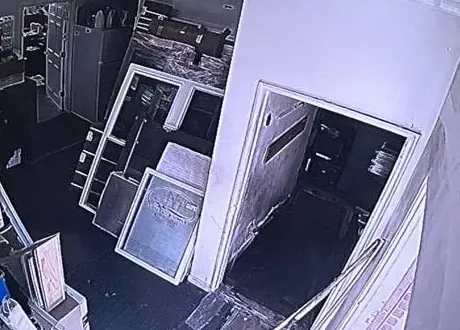
Example photo from another AESS job (not an Orange County business), cropped to remove the channel label: a recorder's view of a dim back storeroom from a ceiling camera, with frames leaning on the wall and a doorway beyond. A back-room camera like this shows who went into stock after hours; the doorway itself needs a closer camera to show a face.
Equipment
Types of Lorex Cameras We Install
Lorex renames its product lines often, so we choose by shape, power and recording behaviour rather than by series name. These are the categories we install in Orange County, and the job each one does on a rental, a commuter house, a farm or a shop.
💾
PoE Network Recorders
The box that powers and records every wired camera over one cable each. Chosen by channel count and, in Orange County, by the number of days a town or insurer expects you to keep; the drive is often upgraded for a rental.
🔫
Bullet Cameras
Longer view for the driveway mouth, the parking pad and the yard gate. Many Lorex bullets carry lights and a siren; at a rental we usually leave the siren off so it does not wake the neighbours.
🟢
Turret Cameras
Compact and easy to aim at head height under a porch ceiling or beside a side door, with no glass dome to collect glare from a porch light.
🔵
Dome Cameras
The low-profile choice for a dining room, a stockroom ceiling or a hallway in a two-family, where a hand could reach the camera and a hard shell and hidden lens angle discourage anyone from trying.
🔔
Wired Video Doorbells
The close-up of whoever rings, with two-way talk for check-ins. Lorex specifies a 16–24 volt AC supply; we meter the builder's doorbell transformer before connecting.
💡
Floodlight Cameras
Light and camera in one unit for a dark barn door, a side yard or a parking pad, wired to the recorder where possible and aimed so the light stays on your own ground.
🔋
Battery and Wi-Fi Cameras
For a boat dock, a far shed or a spot no cable can reach, after a signal check at the exact mounting point. Not our choice for a camera a permit depends on.
🌐
Switches, Extenders and Links
PoE switches, long-range extenders and wireless bridges that carry a camera past the 328-foot single-run limit to a barn, a stand or the far end of a lot.
A wired Lorex system against the national alternatives
Question for an Orange County owner
Lorex wired system, installed by AESS
ADT
Ring
SimpliSafe
Where recordings are kept
On a drive in the recorder at the property
Depends on the package
Mostly in the cloud with a plan
Mostly in the cloud with a plan
Holding a fixed number of days, such as 30
Set by the drive size you choose
Set by the plan
Set by the plan
Set by the plan
Continuous recording on arrival cameras
Available on wired cameras, per camera
Varies
Mostly event clips
Mostly event clips
Copying a clip for an inspector
USB stick at the recorder, or the app
Through the provider's app or portal
Through the app
Through the app
Who decides camera positions
A licensed installer who walks the property
Company technician
Usually you
Usually you
This compares system types, not product quality, and the national companies change plans and features often, so check their current terms before deciding. Cloud cameras suit a renter who cannot drill or an owner who wants nothing in the house; a wired local recorder suits a host or business owner who must show a month of recordings on demand.
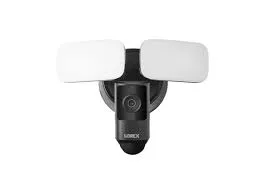
Manufacturer product photo (not an installed unit): a Lorex floodlight camera with two white light panels over the camera. On an Orange County barn or parking pad a unit like this lights the arrival and records it; we aim the panels down so the light stays on your property.
AI Overview Reality Check
What AI Gets Wrong About Lorex Camera Installation in Orange County
Google's AI Overview could not be read from the system we built this page on. Instead, here are seven statements that turn up again and again in price guides, marketplace pages, platform help and host forums, which is where AI summaries get their material. Each one is partly true. Here is what changes when the property is in Orange County.
1. “Camera installation around Newburgh costs about $100”
Thumbtack's Newburgh page says installation can run “anywhere from $100 for a single-camera line installation to $1,000-$2,200 for an entire system.” That is a fair description of a marketplace where prices vary with the installer and the job, and the low end is a single short line with the camera already in hand.
Our Orange County prices are built differently: a four-camera Lorex system at $2,175 includes the recorder, the cameras, cable within reach of the recorder and setup, and labour alone on your own equipment is $280 per wired camera. That labour figure is our base labour rate with the county's 1.40 factor applied.
The bigger difference for a rental or a business is what the price has to cover: a drive that holds a required number of days, cameras placed for a town inspector, and a documented export. Ask any quote, ours included, to say which of those it includes.
2. “The drive that comes in the kit holds about a month”
Sometimes, under the assumptions printed on the box. Lorex's own hard drive calculator starts from two recorded hours a day and estimates motion recording at around 120 thirty-second events per hour, and Lorex's help pages note that recorders overwrite the oldest footage once the drive is full.
A Monroe or Woodbury rental must keep recordings from every rented period for at least 30 days. Arrival cameras running continuously through a busy summer fill a drive far faster than two hours a day of motion clips.
The only reliable answer is to size the drive for your actual settings and then check the oldest recording on the recorder a few weeks after installation. We do the first check at handover and show you where to look.
3. “Indoor cameras are allowed at a rental if guests are told”
That used to be Airbnb's rule. Its own announcement explains that it historically allowed indoor cameras in common areas such as hallways and living rooms if they were disclosed and visible.
Since April 30, 2024 the rule is the opposite: no security cameras or recording devices may monitor any part of a home's interior, even if they are turned off or disconnected. Outdoor cameras remain allowed with disclosure, and noise decibel monitors that do not record sound are allowed indoors outside bedrooms and bathrooms.
For an Orange County host that means taking down any indoor camera the house came with, not just switching it off, and relying on outdoor arrival cameras for the evidence the town wants.
4. “A video doorbell is enough to monitor a rental”
It is a good start and the easiest camera to install, which is why it is usually the first one a host buys. It shows whoever comes to the front door and lets you talk to a guest at check-in.
But the Monroe and Woodbury wording asks for outdoor cameras adequate in number, location and view angle to monitor arrivals and departures. A doorbell sees one door from one angle; it does not see the driveway, the side door, the deck stairs or the path to the lake, which is where extra guests usually come and go.
5. “Cameras are low voltage, so no electrician is ever involved”
The camera cable is low-voltage work, and we do it under NYS low-voltage license #12000287431. Lorex's PoE cameras take their power from the recorder, so most cameras need no outlet at all.
The recorder, a PoE switch in a barn or a floodlight camera on its own circuit do need power, and in Orange County new outlets and circuits are electrical work under the county licence administered from Goshen, or under the City of Middletown's own board inside the city. A version of the county law we reviewed also requires electrical work that needs a building permit to be inspected by a certified electrical inspector.
So the honest answer is: usually no electrician for the cameras, sometimes one for the outlet. Our quote says which, and a licensed electrician does that part.
6. “Battery cameras are the easy answer for a rental or a far shed”
Easy to mount, yes. Lorex's own battery-camera guides say battery life runs about four to six months depending on temperature and motion settings, and that cold temperatures reduce the battery's capacity.
A camera that has to show every arrival for 30 days should not be the one that goes quiet in February when a guest arrives for a winter weekend. Battery cameras also tend to wake on motion rather than record all the time, which leaves gaps a complaint can fall into.
We use them for a dock, a shed or a spot no cable can reach, and keep the arrival cameras the permit depends on wired to the recorder.
7. “Remote viewing just works once the app is installed”
Not always, and commuters notice first. Lorex's Fusion system listing says remote access requires the recorder to be connected to the router by cable and recommends at least 6 Mbps of upload speed; a recorder on a weak Wi-Fi link to the router may record perfectly and still fail to stream to a phone in Manhattan.
Lorex also publishes three apps — Lorex Connect, Lorex Classic and Lorex Pro — and which one works depends on the recorder. An owner who downloads the wrong one sees a sign-in screen that never connects.
We wire the recorder to the router, check the upload speed the internet plan actually delivers, install the right app on each phone and test it on cellular data before we leave, so the first time you check from the train is not the first time it has been tried.
Tell Us Who Will Watch the Footage
A building inspector, a rental platform, an insurer or just you on the train — each needs a different Lorex setup. Tell us which, and we will plan the cameras, the drive and the settings around it before you buy anything.
Give us the town or village, what kind of property it is, how guests, family or customers get to the door, and any rules a permit, booking site or insurer has handed you. A Lorex recorder model number saves a step if you already own one. We send a written figure the same business day, or you can talk it over by phone at (845) 640-3835.
✅
We Got Your Request!
Thanks — we will read through the town, the ways in and any permit rules you mentioned, and phone you today with a camera plan and a number. If it cannot wait, ring (845) 640-3835.
How It Works
Our Installation Process
Seven steps for every Orange County Lorex job. The first three are where a rental passes or fails its inspection and where a business system earns its keep.
1. Find out who will judge the footage
Before anything else we ask who will look at the recordings: a town building inspector, a rental platform, an insurer, the police or only you. We read any permit papers so the plan is built to them.
2. Walk the arrival points by day and after dark
We walk every way a car or person reaches the property, then return after dark to check windows, porch lights and headlights from each camera position.
3. Choose the recorder room and the drive
We pick an indoor, conditioned spot for the recorder, wired to the router, and size the drive for the days you must keep at the recording mode you will use.
4. Write the plan and the price
You get a written camera list with the view each camera covers, the recorder and drive, the settings, every Lorex make and model, and the price on the Orange County figures.
5. Pull cable and mount cameras
Cable runs through the attic, basement or stairwells, enters each camera position sealed, and barns or stands beyond one cable length get an extender or a wireless link.
6. Set recording, clock, privacy and alerts
We set continuous or scheduled recording per camera, network time on the recorder, privacy masks over windows, microphones off and person and vehicle alerts.
7. Test, export and hand over
We check every view at night, copy a test clip to a USB stick, confirm the oldest recording held and leave a handover sheet plus a camera list for any permit file.
Coverage Area
Lorex Cameras Near Orange County's Landmarks
From the busiest station on the commuter line to the corner where three states touch, these six spots mark out the county we drive to for Lorex work.
Harriman Station, Port Jervis Line
The busiest station on the line, beside Route 17 and the Thruway. The commuter houses around Monroe, Harriman and Woodbury that empty out each morning are where alert schedules matter most.
Woodbury Common Premium Outlets
Opened in 1985 with about 220 stores, and the reason the roads around Central Valley are lined with shops and food businesses that want their own register and back-door cameras.
Goshen Historic Track
A half-mile harness track dating to 1838 and a National Historic Landmark, in the county seat where the electrician licence is administered at 255 Main Street.
The Black Dirt Region, Pine Island
Flat farm fields cut by ditches and farm roads in western Warwick, where barns, equipment and farm stands sit well beyond one cable length from the house.
Washington's Headquarters, Newburgh
Opened in 1850 as the nation's first publicly owned historic site, according to State Parks, and set inside Newburgh's East End Historic District of brick rowhouses, where cable follows stairwells and old service entries.
Tri-States Monument, Port Jervis
The granite marker, first set in 1882, where New York, New Jersey and Pennsylvania meet at the confluence of the Delaware and Neversink rivers. Up Route 97 in Deerpark, police cracked down on late-night street racing in May 2026, citing about 30 cars — the kind of road noise a driveway camera has to be tuned to ignore.
We also install Lorex in Newburgh, New Windsor, Cornwall, Highland Falls, Monroe, Kiryas Joel, Harriman, Woodbury, Central Valley, Tuxedo, Chester, Blooming Grove, Washingtonville, Goshen, Florida, Warwick, Greenwood Lake, Pine Island, Middletown, the Town of Wallkill, Montgomery, Maybrook, Walden, Crawford, Pine Bush, Hamptonburgh, Mount Hope, Otisville, Deerpark and Port Jervis — and near LEGOLAND New York in Goshen.
Pricing
Lorex Camera Installation Cost in Orange County
Orange County prices are our Lorex base prices with the county's labour factor of 1.40 applied to the labour only; the Lorex equipment itself is priced the same everywhere we work. These are the same Orange County figures published on our Hudson Valley Lorex page. Sales tax is extra. Our Orange County Lorex price list shows individual models.
Item
Orange County price
What moves it
Four-camera Lorex system, installed
$2,175
Recorder, four wired cameras, cable within reach of the recorder, app setup and restart test; camera series and how hard the routes are
Lorex camera added (each)
from $358
An extra wired camera on a recorder with a free channel, cable within reach, added to the app
Lorex recorder with setup
from $530
Channel count, built-in PoE ports and drive size
Your own Lorex camera installed
$280 per wired camera
Labour only: cable, mounting, termination and connection to your recorder
Your own Lorex recorder set up
$210
Placement, network connection, recording settings, clock and app setup
Larger drive for a required retention period
quoted with the model
Number of cameras, resolution, continuous or motion recording, days required
Long runs, links and trenching
quoted after the walk-through
Extenders, wireless bridges, conduit to a barn or stand
Service visit after installation
$195 an hour, 3-hour minimum ($585)
Footage export, re-aiming, adding users, faults not covered by warranty
Four things move an Orange County Lorex price more than the camera model. The first is the number of arrival points: a rental with a single driveway and one door needs fewer cameras than a lake house with a path, a dock and a side gate. The second is retention, because a town's 30-day rule can mean a bigger drive. The third is distance: everything inside one cable length of the recorder is in the base price, while a barn or a far stand needs an extender or a link. The fourth is the building: an attic and an open basement make a subdivision house quick to wire, while plaster walls in an older city building take longer.
A worked example on the published Orange County prices
Take a lake rental in the Town of Monroe with a driveway off the road, a parking pad, a front door, a side door the guests use and a path down to the water. That is six arrival views: the four-camera system at $2,175 plus two added cameras at $358 each, or $2,891 before any larger drive. If the recorder in the four-camera kit has too few channels for six, the recorder line from $530 replaces it. To keep 30 days of continuous recording on all six cameras, the drive may need to be larger than the one supplied; that is priced with the model we specify and shown as its own line.
Now change one thing: the owner already bought a six-camera Lorex kit at a warehouse club. The same six positions cost $280 per camera and $210 for the recorder setup — $1,890 in labour — plus any drive upgrade. Either way, the quote lists each camera with the view it covers, so the same page can go into the permit file.
For a business the arithmetic is the same. An eight-camera layout for a restaurant or a warehouse unit — four cameras on the system plus four added — comes to $3,607 on these prices, with a larger recorder line if the channel count requires it.
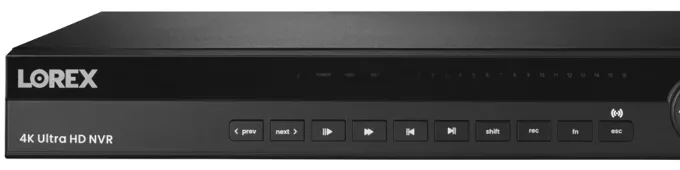
Manufacturer product photo, cropped to the front panel (not an installed recorder): a black Lorex 4K Ultra HD NVR with its playback buttons. For an Orange County rental, the drive inside a recorder like this is sized for the 30 days a town can ask for, and the USB port on the front is where clips leave for the inspector.
Shop Our Systems
Lorex Camera Packages & Pricing
Pick the closest of these and we adjust it once we have seen the site and, for a rental, read what the town expects.
Commuter House
$2,175
Four wired Lorex cameras and recorder. Driveway, front porch, the door the family actually uses and the back yard, with person and vehicle alerts scheduled around the working day, the recorder indoors and wired to the router, and remote viewing tested on cellular data. Suits subdivision houses from Chester to Wallkill.
Rental Permit Layout
from $2,891
Six outdoor Lorex cameras covering every arrival and departure. Driveway mouth, parking, each guest door and any path or gate, microphones off, continuous recording during bookings, drive checked for 30 days, and a one-page camera list for the town file and the listing. Larger drive priced separately if needed.
Shop or Warehouse Unit
from $3,607
Eight wired Lorex cameras. Each entrance at face height, the register or counter, the back or dock door, stock areas and a wide view, recorder locked away from the sales floor, and a Lorex Pro or Connect setup for the owner and managers.
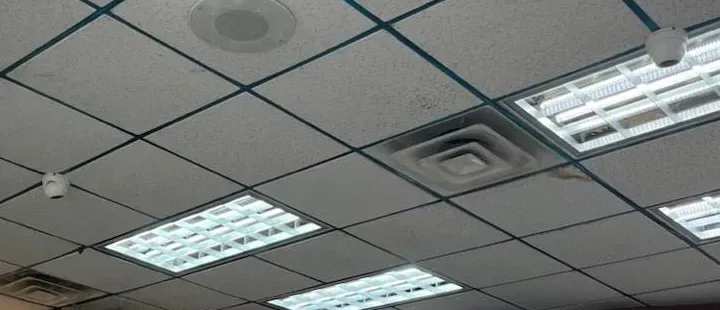
Example photo from another AESS job (not an Orange County store): small white domes spread across a drop ceiling among light panels, a vent and a speaker. An eight-camera Orange County shop layout looks like this from below — most of the cameras are small and spread out, and the ones that matter most hang over the doors and the counter.
Own the Lorex Kit Already? Labour-Only Installation in Orange County
If the kit came from a warehouse club, an online order or Lorex directly, we install it for $280 per wired camera and $210 for the recorder setup in Orange County, covering cable within reach of the recorder, mounting, termination, connection and app setup. If the kit's cables are too short for the property, we supply outdoor-rated cable for the longer runs and tell you before we start. Bring the box unopened if you can, so we can check the recorder's channel count and drive against what your town or platform requires before anything is fixed to a wall. Equipment you supply carries its manufacturer's warranty, which Lorex's FAQ gives as one year.
Get the Orange County Lorex Plan in Writing
We walk the property once, list each camera beside the thing it watches, and put a single figure on paper that already counts the drive and the setup. Phone, text us a picture of the driveway, or use the form.
Intrusion alarms on the same doors the cameras watch.
Field Notes
Field Notes: Count the Ways In After Dark
On an Orange County rental walk-through I do the first lap in daylight and the second after dark. In daylight I count the ways in: where a car stops, where the guests walk from it, which doors open from outside, whether the deck stairs lead to a gate, whether there is a path to the water or a neighbour's drive people cut across. Each of those becomes a line on the sketch. A host usually names two or three; there are almost always more.
After dark I stand where each camera will go and look back at the house. That is when windows light up and show what a camera would see inside, when the porch light flares into a lens, and when the driveway turns into headlights and nothing else. I move positions until each view shows a person's shape at the door without seeing through a window. Then I look at the recorder room and work out the drive for the number of days the town asks for. Only then do I write the quote, so the camera list I hand over is the same list the inspector will read.
None of this describes one particular house; it is the routine on every rental, commuter house and shop we wire in Orange County.
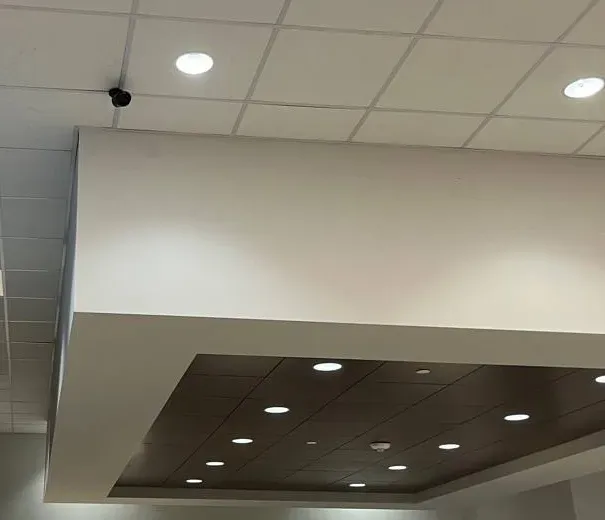
Example photo from another AESS job (not an Orange County property): a small black camera on the corner of a ceiling bulkhead above a dark panel of downlights. Bright downlights in the frame are the indoor version of a porch light after dark; we place cameras so the lights sit behind them, not in front.
FAQ
Orange County Lorex Camera Installation FAQ
Practical questions from hosts, homeowners and business owners that are not already answered above.
We are going to stop renting the house and move in ourselves — what should change on the Lorex system?
+
Mostly settings. Switch the arrival cameras from continuous recording to motion or a schedule that suits a lived-in house, turn on the alerts you want as a resident, and remove access for any co-host, cleaner or manager who no longer needs it. Recordings from the rental period will be overwritten on their own as the drive fills; if the town or a guest dispute is still open, copy the relevant clips to a USB stick first. Tell the building department you have stopped renting so the permit is closed properly, and take the camera disclosure out of any listing that stays online.
Can the rental's driveway camera also show how many cars guests parked?
+
Yes, if it is placed for it. A camera at the driveway mouth shows each car arriving and leaving, and a second view over the parking area shows how many are there at any moment. Many Lorex wired cameras can tell vehicles from people, so you can search or get alerts for vehicle events. Rental permits often set parking limits as well as guest limits, so we aim one camera to show the whole parking area in a single frame, which makes a count at a given time easy to check later.
Headlights sweep across our driveway all night from the county road — will they set off alerts?
+
They can, if the camera is set to plain motion detection and the road is in the frame. We aim driveway cameras so the road is at the edge of the view or out of it, draw motion zones that cover only your driveway and walks, and use person and vehicle detection where the camera supports it so a sweep of light alone does not count. After the first week we review which alerts came in and adjust. Cameras with bright built-in lights are set so they do not switch on for passing traffic either.
A guest wants to see our camera footage after a dispute over damage — do we have to share it?
+
That depends on the dispute, the platform's process and any legal advice you take, so we cannot give a general rule. What we can do is make sure the footage exists and is easy to share if you decide to: the relevant clip copied from the recorder with its time stamp, limited to the arrival points that matter, without unrelated guests or neighbours in it. If the platform's resolution process or an insurer asks for it, a short, clearly dated clip is far more useful than a long recording.
Can we see the front-door camera on a kitchen smart display or speaker screen?
+
Often, depending on the recorder and app. Lorex lists its Lorex Classic app, used with the Fusion line, as compatible with Google Home and Amazon Alexa, which lets a supported display show a camera on request. Lorex Connect and Lorex Pro recorders work differently, so we check the model before promising it. Whatever the display shows, the recording still happens on the recorder, so the display is a convenience rather than part of the evidence.
Can new Lorex cameras use network cable a previous owner ran for another brand's cameras?
+
Often, yes. If the old system used network cable to each camera, which many newer systems did, the same runs can usually power and carry Lorex PoE cameras once each one is tested end to end and re-terminated. Lorex lists 328 feet as the maximum run between recorder and camera, so we also check the lengths. Cables that test badly or run through a damaged wall are replaced rather than trusted. Old coaxial cable from an analog system is a different case and needs adapters or new cable.
Can the installation be fitted into the gap between two bookings?
+
Usually. A four- to six-camera rental system in a house with an accessible attic or basement is normally a single day, and we can start early on a check-out day so the system is tested and recording before the next guests arrive. If the house needs longer, for example because cable has to reach a lake path or a separate garage, we split the work so nothing is left half-finished while guests are in. Tell us the booking calendar when you ask for the quote.
Can the cameras confirm the cleaners came and how long they stayed?
+
Yes, as a side effect of covering the arrivals. The driveway and door cameras record the cleaning crew arriving and leaving like anyone else, and the recorder's search lets you jump to the vehicle or person events on the turnover day. Let your cleaning company know the outdoor cameras are there; most expect it. Indoor cameras to watch the cleaning itself are not an option at a listing where interior cameras are banned.
What happens if a guest covers or unplugs an outdoor camera?
+
The recorder shows that camera as lost or black from that moment, and the gap itself is evidence of when it happened. Where the recorder and app support it, we set an alert for a camera going offline so you hear about it during the stay rather than after. Cameras mounted high enough to need a ladder, with cables entering from behind, are much harder to disconnect casually. If it happens, note the time from the recording and raise it through the platform and your house rules.
Can the old camera system keep recording until the new Lorex system is running?
+
Yes, and at a rental or a business it should. We install the new Lorex recorder and cameras alongside the old system, switch each position over once its new camera is working, and leave the old recorder running until the last camera is moved. If you need footage from the old recorder for a past incident, copy it before we disconnect, because an old recorder that is unplugged and stored often will not be powered on again. We remove the old equipment at the end if you want it gone.
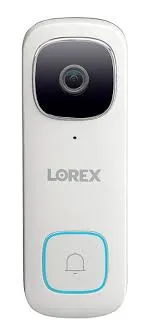
Manufacturer product photo (not an installed doorbell): a white Lorex video doorbell with a blue-lit button. At an Orange County rental it is one of the outdoor cameras, disclosed in the listing, with its microphone used only for check-in calls you start yourself.
All Areas Served
Lorex Camera Installation Across the Hudson Valley, New York City and Long Island
Long cable runs, storm outages and country internet are covered for all six valley counties on the Hudson Valley Lorex camera installation hub, the parent of this page. The rest of our Lorex coverage, county by county and borough by borough, is linked below.
Hosts often add a keyless lock at the same time, shops an alarm, and builders a full low-voltage rough-in; the Abstract Enterprises Security Systems home page lists all of it, and about us explains who we are and how we are licensed and insured.
Sources
Where the Orange County Lorex Facts Come From
Every town law, platform rule, census number, Lorex specification and news report cited above is linked here so you can read it yourself. Host and forum comments were read as search excerpts, not full threads. Prices are our own Orange County Lorex figures, the same ones listed on the Hudson Valley Lorex page, plus the standard hourly rate for service visits.
Nothing here is legal advice. Rental permits are interpreted by your own town or village building department, and questions about recording people belong with a lawyer who knows your situation.
Need a Clip Off the Recorder Today? Call the Orange County Line
If the building department wants a clip by Friday, or the cameras went dark in last night's storm, ring (845) 640-3835. You get the first free two-hour slot, and in most cases the recorder is saving video and visible on your phone again inside one to two hours of the technician walking in.
Orange County Lorex Systems From a Licensed, Insured Crew
Orange County line (845) 640-3835 · Abstract Enterprises Security Systems, 460 E Fordham Rd, Bronx, NY 10458 · messages by WhatsApp (718) 679-0359
Licensed for low-voltage work in New York State (#12000287431) · fully insured for Orange County houses, rentals and businesses · written estimates the day we look · rated 4.7★ from 201 Google reviews
Lorex cameras and recorders carry Lorex's own manufacturer warranty, and any 120-volt work is done by a licensed electrician. Full terms — including 50% deposit, one-year parts-only warranty on AESS-supplied products, and the late-fee schedule — are set out in the service agreement. See our warranty page.
Page reviewed and updated October 18, 2026. Changelog: Orange County Lorex page rebuilt from new research on the Town of Monroe and Village of Woodbury short-term-rental camera requirements, the county's proposed rental registry, Airbnb's 2024 camera rules, commuting and growth figures from the Census Bureau, the county electrician licence, Lorex recording, retention and export settings, and Orange County business burglary reports, on the Orange County Lorex prices already published on our Hudson Valley page.