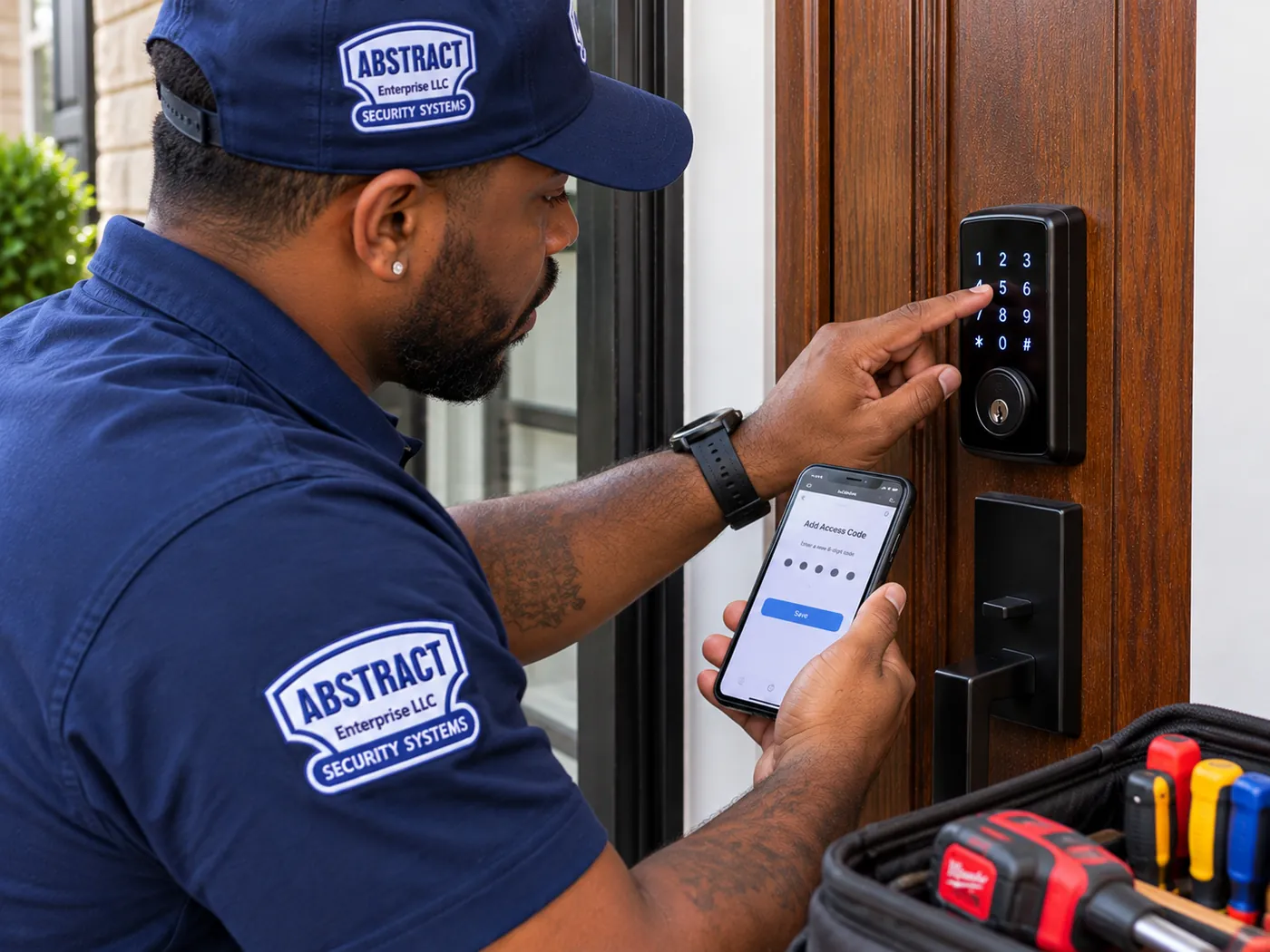
Closing-Day Lock Handovers · Builder Keys Retired · West Point & Stewart Households · Landlord Turnovers · Warehouse & Office Doors
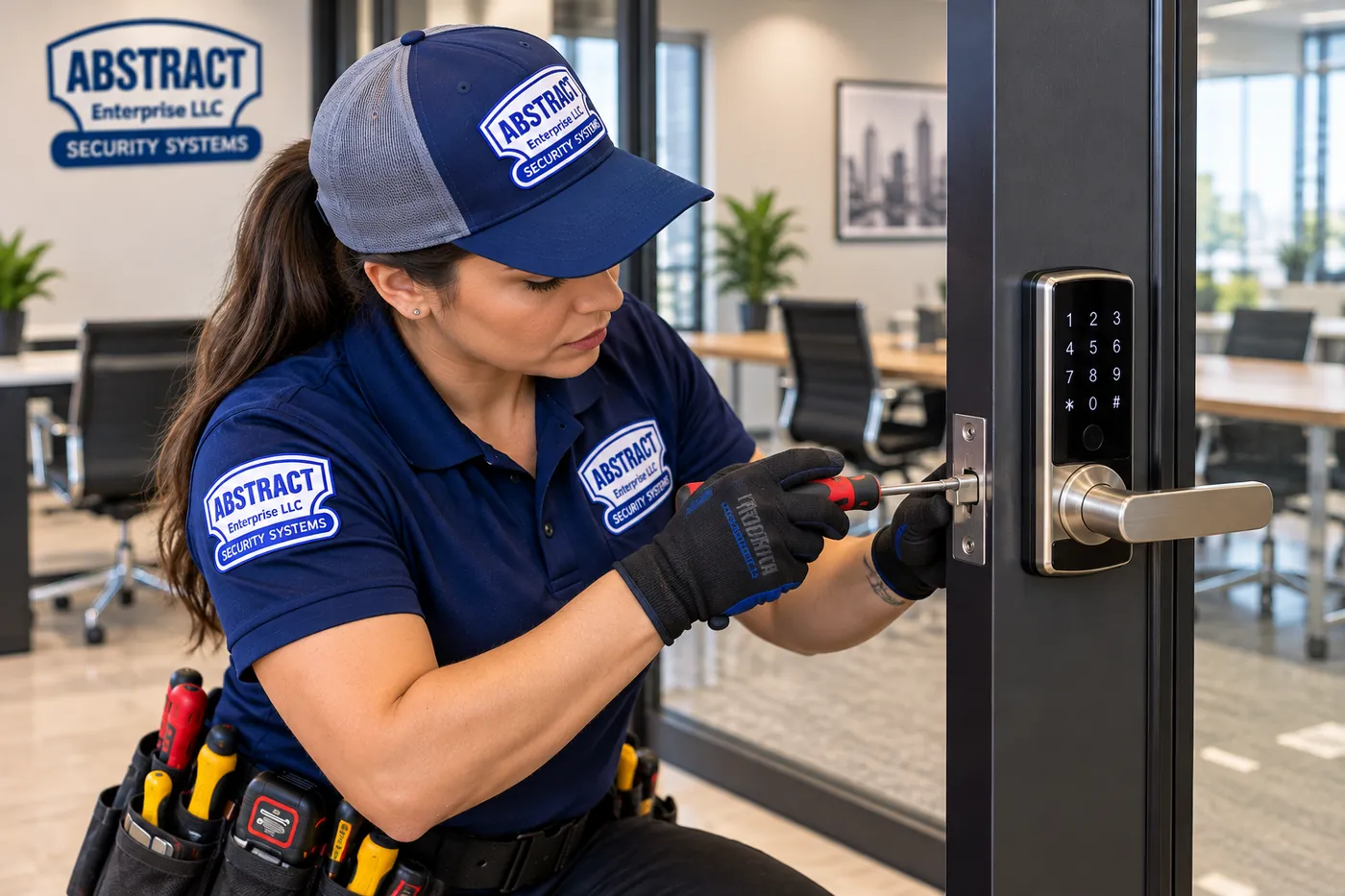
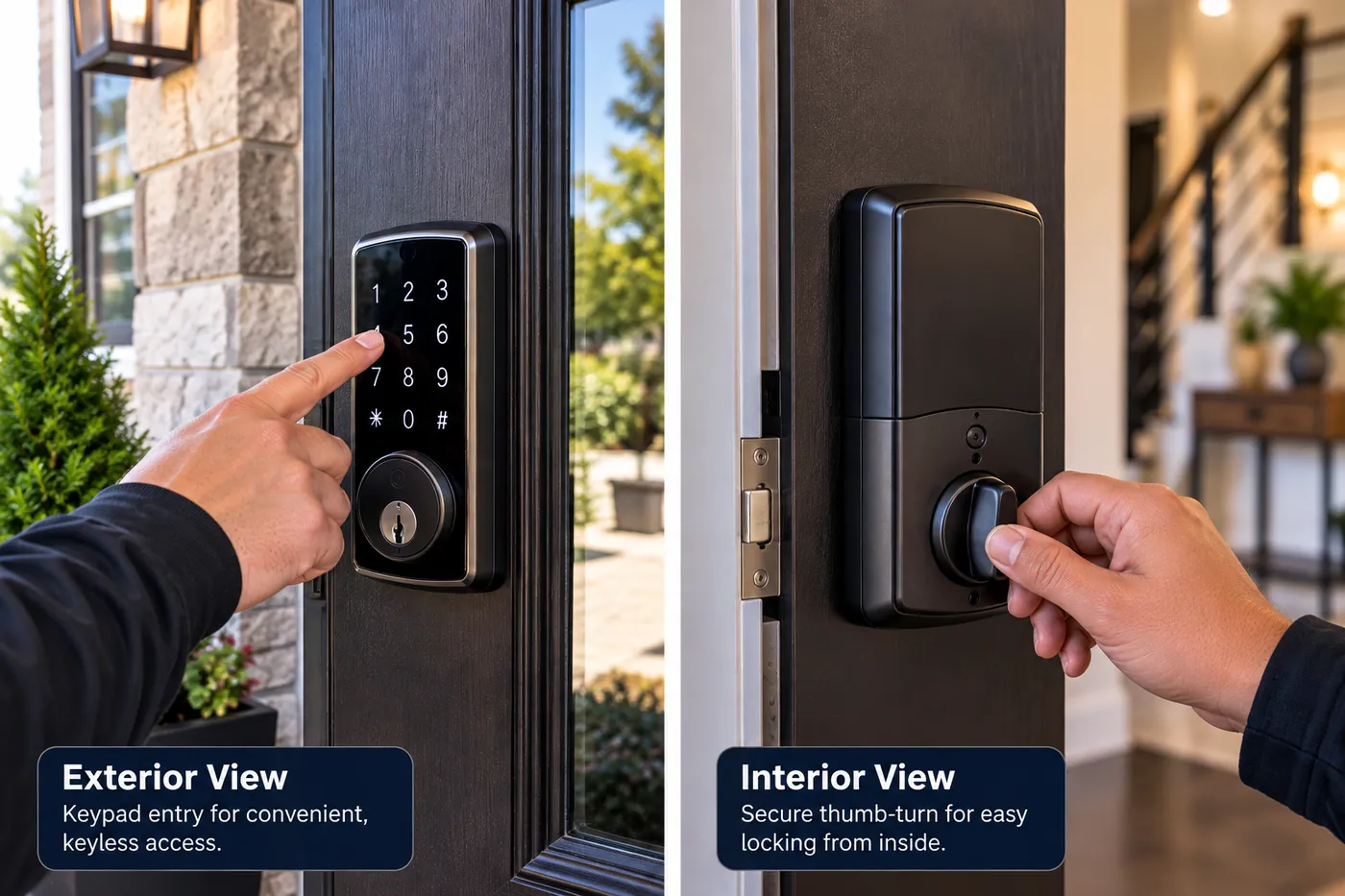
Orange County doors change hands constantly. A townhouse in Tuxedo gets its owners' keys the week the trim carpenter leaves, an Army family at West Point inherits quarters that dozens of households lived in before them, a Newburgh three-family gets new tenants every few years, and a house in Chester goes on the market with a realtor's lockbox hanging off the knob. Each of those moments is when the wrong person can still get in. We fit smart locks that close that gap on the day it opens — old keys and codes retired, new ones issued person by person, and a door that still opens from inside with a single plain turn.
Reviewed and updated October 17, 2026 · Written by Anwar Timothy, NYS licence #12000287431

Closing on a house, starting a lease, or packing for a PCS move somewhere in Orange County? Call our Hudson Valley line, (845) 640-3835, or send the 60-second form. A licensed installer reads every request and will tell you, before anyone drives out, which keys and codes on your doors are still unaccounted for and what it takes to retire them.
In Orange County the dangerous moment for a lock is not the burglary you read about. It is the handover nobody tracks. This is a county that keeps adding people and houses. USAFacts' reading of Census estimates shows Orange County growing by about 2,600 people between 2024 and 2025 and by 11.1 percent over the decade from 2015, with the population rising in 23 of the last 25 years. Census Reporter's profile of the latest American Community Survey puts the county at 411,767 residents. Every one of those new households moved into a door that somebody else held keys to the week before — a builder, a seller, a landlord, a property manager, an Army housing office. A smart lock job here starts with a list of everyone who could still open the door, and ends with that list reduced to the people who should.
New construction is the clearest case. The largest project in the county, Tuxedo Reserve, is described by the Orange County Partnership as a community of more than 1,600 units on roughly 1,200 acres between Harriman State Park and Sterling Forest, with Lennar and Related breaking ground, home sales from 2025 and rental leasing in 2026. Smaller builder communities are scattered across the county: Ridgebury Estates at Slate Hill, Grandview Estates at New Hampton, Palisades Ridge at Woodbury Junction in Central Valley, Blackburne Homes in Campbell Hall. During construction, a new house is opened by framers, electricians, painters, flooring crews, inspectors, the sales office and the punch-list team. Builders handle that with construction keys and, increasingly, keypad deadbolts. What matters to the buyer is whether those keys and codes were actually shut off at closing — and most buyers never find out.
The second group is military. The United States Military Academy at West Point sits on the county's eastern edge, and Stewart International Airport, in the Towns of Newburgh and New Windsor, is home to the New York Air National Guard's 105th Airlift Wing. Army families on post live in West Point Family Homes, which is managed by Balfour Beatty Communities and has written rules about locks: the housing office's community guidelines say residents may ask to alter or add locks only through a Request for Alterations, that an approved replacement lock "must be from the same manufacturer as the existing lock," and that Community Management must receive a copy of the new key. Off post, in Highland Falls, Cornwall, New Windsor and Washingtonville, those same families rent houses for a tour of a few years and then move on, which means the lock on the door is changing hands on an Army schedule.
The third group is rental property in the county's cities. Census Reporter's American Community Survey figures show that 65 percent of occupied homes in the City of Newburgh are renter-occupied and 64 percent of its housing is in multi-unit buildings — the brick two- and three-family houses and rowhouses that fill the East End Historic District, a district of 445 acres and 2,217 buildings listed on the National Register in 1985. Middletown is roughly half and half: 52 percent owner-occupied, 56 percent single-unit. Every lease that ends is a handover, and in New York a landlord who changes a tenant's entrance lock without supplying the occupant a key is breaking a statewide law, not just a city one. Keyless entry can make turnovers cleaner for owners and safer for the next tenant, but only if it is set up with the law in mind.
Finally, Orange County is a commuter county. Census Reporter shows a mean travel time to work of 35.3 minutes, above the state figure, and that average hides the households that drive Route 17 and the Thruway before dawn or catch the Port Jervis Line at Harriman, which Wikipedia's history of the line calls its busiest station. The Town of Newburgh Police Department's own burglary-prevention advice points out that a house that looks vacant is a target "during the work day when everyone may be at work or school." In a commuter household the door is often left to children coming off the school bus, a parent who lives alone during the week, or a contractor who needs to get in while nobody is home. Those are access decisions, and a smart lock lets you make them one person at a time.
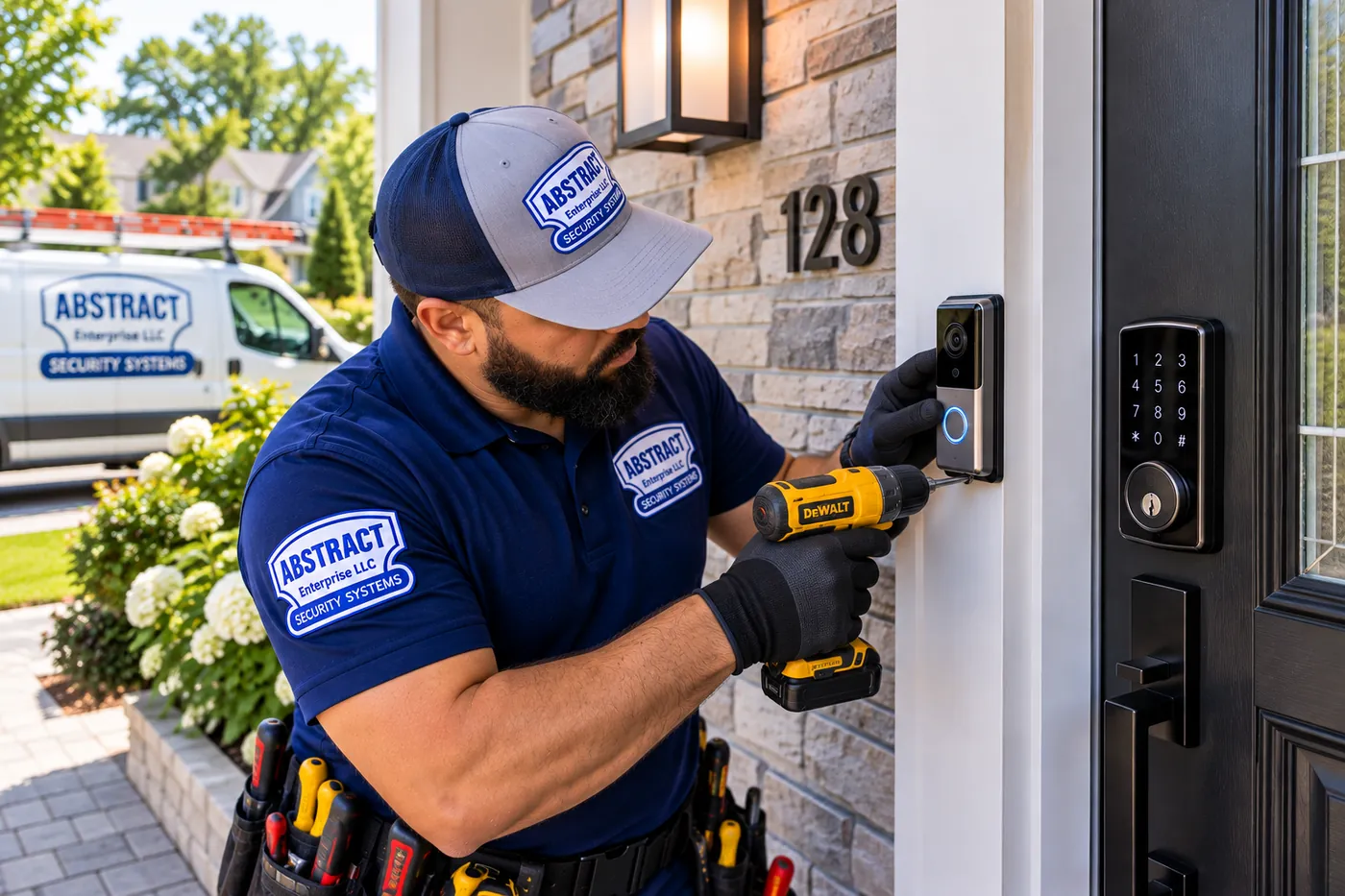
A handover rarely stops at the deadbolt. New owners usually want to see the front step from their phone before they trust a remote unlock, so our doorbell camera installation team in Orange County is often booked for the same morning, and the AESS alarm installers in Orange County put contacts on the slider, the garage entry and any other door that keeps its ordinary lock.

A builder-installed keypad that stopped taking codes a few months after closing, a deadbolt that grinds because a new house has settled through its first winter, an app that lost the lock when the router was swapped during a move, or an office keypad that a departing manager was the only one able to program — none of that waits for a new project. A fault goes into the first free 2-hour slot on the schedule, and batteries, lost pairings and a bolt fouling its strike are normally sorted within an hour or two of our arrival. If the trouble is a commercial entrance strike that hums but won't release, a failed electric strike repair runs $413–$679 at our Orange County rate. Call (845) 640-3835 and say it's a smart lock problem, or see our door buzzer repair service in Orange County for apartment-house buzzers and lobby strikes.

Most Orange County smart lock jobs are triggered by a date — a closing, a move-in, a lease end, a PCS order, a new hire. Each service below finishes the same way: every credential that should no longer work has been removed and tested, every person who should get in has tried their own code or fob in front of us, and the door opens from inside with one plain motion, power or no power.
For new-construction and resale buyers: we identify every lock, keypad and app account on the house, retire construction keys and the seller's codes, set up your own, and leave you a list of what was changed on which door.
When a builder fitted keypad deadbolts as standard, we reset them to factory defaults where the maker allows, rebuild the user list from nothing, and confirm the sales office, trades and old test codes no longer open anything.
While a house is still open framing, we run low-voltage cable and door-position wiring to the entry doors, so a video doorbell, a wired keypad or a door contact can be added later without opening finished walls.
Off-post rentals near West Point and Stewart get locks that suit a tour of a few years and a landlord's approval. On post, we work only within what the housing office has approved in writing.
For landlords from Newburgh to Port Jervis: keypad deadbolts that let you issue each tenant a fresh code and a fresh key at move-in, with the outgoing tenant's credentials closed only when the law and the lease allow it.
For sellers: a temporary code for showings and inspections that ends on a set date, alongside or instead of the realtor's lockbox, so you can see when the house was opened and shut it down at closing.
Personal codes for children coming off the bus, grandparents who help out, and the neighbour who walks the dog, with arrival alerts to parents' phones on the commute home.
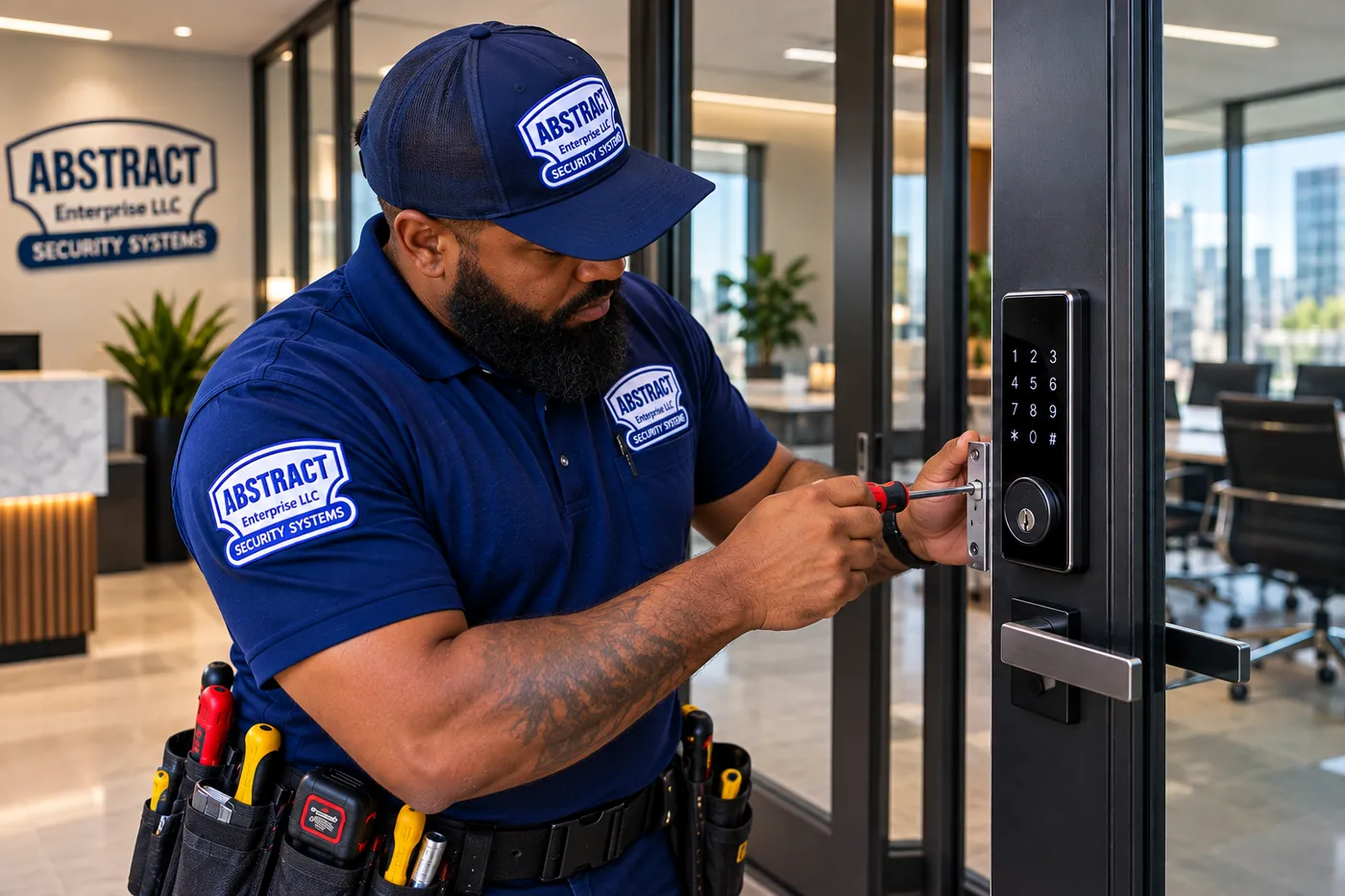
Keypads and readers with electric strikes on driver rooms, staff entrances, records rooms and appointment-only offices, wired so exit never depends on a code or on power.
Dead keypads, locks that dropped off a replaced router, bolts that stopped throwing after a new house settled, and lost admin accounts after a phone change or a staff departure.

Orange County's housing has been built in layers: river-city brick in Newburgh and Port Jervis, village centres in Goshen, Warwick and Montgomery, post-war suburbs along Route 17 and Route 32, and a current wave of builder communities and townhomes. Each layer hands us a different kind of door and a different set of people who may still have a key to it.
Slate Hill, New Hampton, Central Valley, Campbell Hall and the newer streets of Chester, Monroe and Montgomery: insulated steel or fibreglass entry doors in factory frames, pre-bored for a standard deadbolt. The door is easy; the question is who else holds keys and codes to it.
Three-storey townhomes such as Lennar's Pershing plan at Tuxedo Reserve put the front door, the garage and the living floors on different levels, often under a homeowners' association that sets rules for what appears on the exterior. Approval first, then hardware.
Two- and three-storey brick rowhouses and multi-family houses in a 445-acre historic district, many divided into apartments, many with original or heavy replacement doors. The City's Architectural Review Commission issues certificates of appropriateness for exterior alterations, doors included, in its historic and architectural design districts.
Older two- and three-family frame houses converted over decades, each with a shared front door, a hall and separate apartment doors. Landlords here want turnover-friendly credentials; tenants want their own key to work, always.
Single-family houses and apartments in Highland Falls, Fort Montgomery, Cornwall and New Windsor rented by Army households for a tour. A lock that can be removed cleanly and the original reinstalled is usually the right choice.
Monroe, Washingtonville, Vails Gate, Walden and the Town of Wallkill: wood doors in wood frames, sliding patio doors to back decks, and side doors through attached garages. Frames have moved over the decades and strikes need attention.
Goshen, Warwick, Montgomery and Florida: a shop or office at street level with apartments above, reached by a separate street door. Business credentials and residents' credentials are kept completely separate.
Large new buildings along I-84 and Route 17K in Montgomery, the Town of Newburgh and the Town of Wallkill: hollow-metal doors in steel frames, driver entrances, staff doors and offices inside the warehouse shell.
Builder hardware. New houses usually arrive with a matched set of entry hardware chosen for price. The deadbolt bore and strike are almost always standard, which makes a smart deadbolt a straightforward swap, but builder strikes are frequently fixed with short screws into the jamb alone. A motorised bolt that hits a strike held by short screws will loosen it within a season. We replace those screws with long ones that reach the framing, and we check the strike again after the house has been through its first heating season, when new framing dries and doors move most.
Settling and the first winter. A newly built house moves. Lumber dries, the foundation takes up load, and exterior doors that latched perfectly at the final walkthrough can start to bind or rub by February. A hand-turned deadbolt hides that; a smart deadbolt reports it as a jam and drains its batteries trying. On new construction we set the strike so the bolt clears it with room to spare, and we show owners what a misalignment looks like in the app so it gets fixed before it becomes a lockout.
Sliding patio doors. Ranches and new builds alike open onto a deck through a sliding door, and that door is where most smart lock plans have a gap. Most sliding-door locks are built into the handle and are not motorised. The Town of Newburgh police's vacation checklist still recommends making sure a "Charley bar" is secure on sliding doors before you leave. We fit a door contact or an extra sliding-door lock where the owner wants one, but we tell you plainly that the smart deadbolt on the front door does not protect the deck.
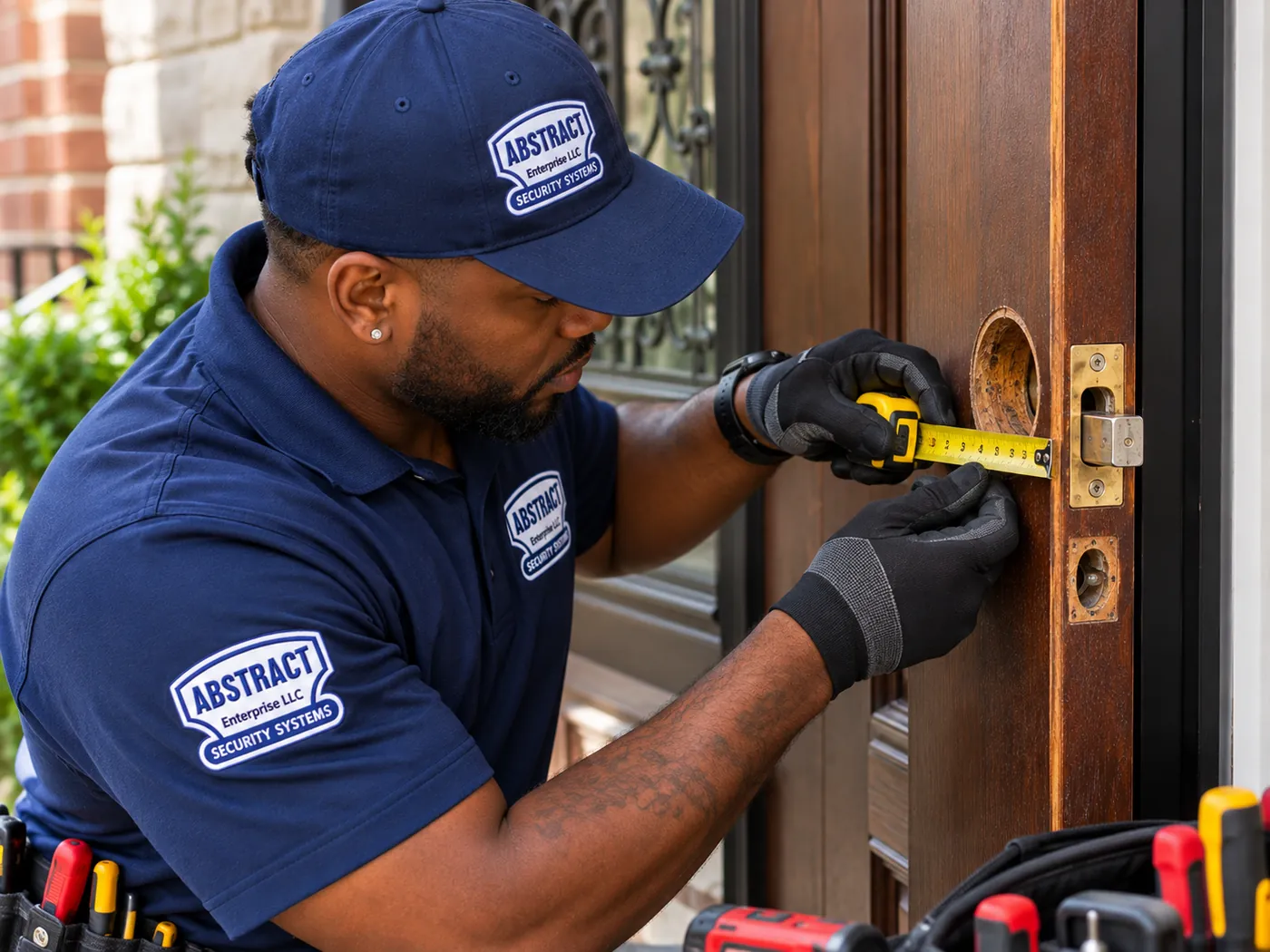
Rentals and borrowed doors. On an off-post rental, a landlord's house or anything on post, the door belongs to somebody else. We remove the existing cylinder or deadbolt intact, label it, and leave it with the tenant so it can go back in on move-out. Where the landlord or housing office hasn't agreed in writing, we don't drill, and on post we don't touch the door unless the alteration has been approved.
Landlords with a shared front hall usually ask about the street door next. On a Newburgh or Middletown two- or three-family house that door is a job for our Orange County intercom installation service, and where the old buzzer has finally died, the AESS door buzzer installers in Orange County replace the station and the strike together.

Orange County's business doors are changing as fast as its houses. The I-84 and Route 17K corridor has become a logistics address, the county seat in Goshen keeps a steady flow of lawyers, title companies and professional offices, and Middletown has grown into the county's retail and medical centre. The keyless question differs by door: a driver entrance that a stranger uses every hour, a records room that only three people should open, a Main Street office that sees clients by appointment. These are the corridors where our commercial calls cluster.
Distribution buildings in Montgomery, the Town of Newburgh and the Town of Wallkill. Ridgecut Road broke ground on the 146,075-square-foot I-84 Orange County Logistics Center in Montgomery, the Matrix I-84 Distribution Center on Route 17K is listed at about 595,900 square feet, and HGAR reported a Walmart proposal for a 1.5-million-square-foot distribution centre on about 200 acres near Route 17K and I-84 in Wallkill.
The county seat, where the county's Consumer Affairs office sits at 255 Main Street among courts, law offices, title and insurance offices in older village buildings. Appointment-only offices that want to see who is at the door before they open it.
Shopping centres, the Galleria at Crystal Run, which opened on April 1, 1992, and the medical and service businesses around Route 211. Staff doors, stock rooms and records rooms.
Waterfront restaurants on Front Street and the storefronts and upstairs offices of downtown Newburgh: early prep shifts, late closes, and back doors that matter as much as the front.
Central Valley's outlet centre, which Wikipedia records as opened in late 1985 with about 220 stores, and the offices and service businesses along Route 32 and Route 17. Shift staff, store managers and back-of-house doors.
Small shops, cafés and studios in a walkable village centre, many with an owner who opens alone and an apartment upstairs. One or two keypad doors and a clean separation from the residents' entrance.
Route 300 in New Windsor and the Town of Newburgh and North Street in Middletown bring the same mix of offices, shop doors and back entrances to their own stretches of the county.
Past three or four doors, or once shifts, a second building or a camera record come into it, a set of standalone keypads turns into a system that needs a controller. That is the point where our access control installation in Orange County takes over, and where warehouse security cameras for Orange County logistics buildings let a manager match each badge swipe to a picture of who used it.

Each answer below started as a phone call: a buyer the week of closing, an Army spouse reading the housing rules, a landlord between leases, a seller with an agent coming round, a manager with a door that keeps getting broken. They are grouped by what set the call off. Costs, timing and the towns we cover are in the FAQ near the bottom. We are installers, not lawyers; where a statute, a housing-office rule or a federal regulation comes up, we cite it by name so you or your own adviser can check the source.
Possibly, and you can't tell by looking. On many new homes the locks are set up so that one construction key opens every house on the street while it is being built. The intended practice is that the homeowner's key permanently disables the construction key the first time it is used, or that the builder swaps a temporary construction core for a permanent one at closing. A homeowner on Reddit's r/homeowners put the expectation simply: "New builds should be using construction cores and swapping out to an owners core that only you get the copies for." Whether that happened on your house depends on the builder, the lock brand and whoever handled the punch list.
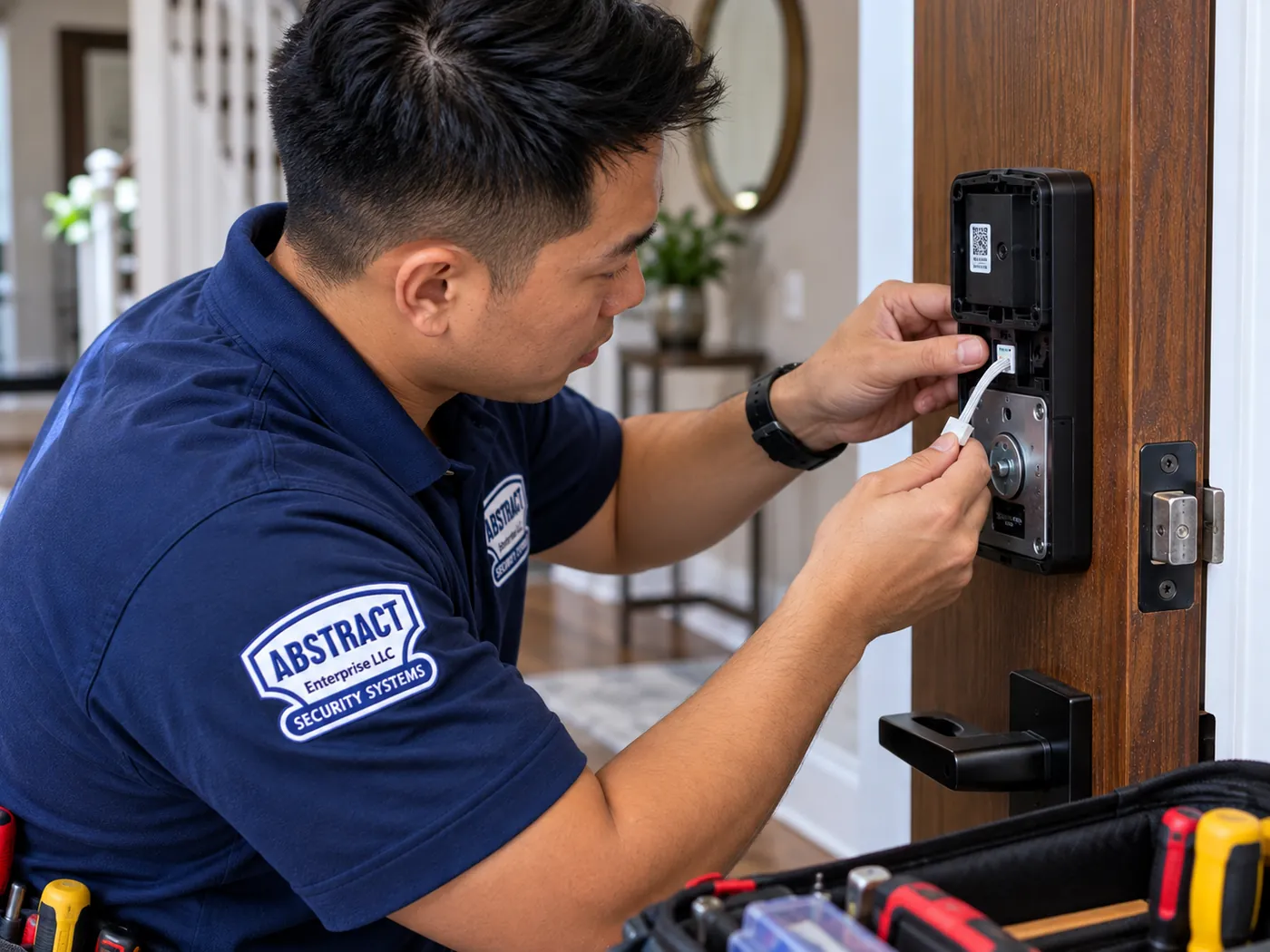
Keypad deadbolts add a second layer of the same problem. A builder that fits keypads as standard has usually programmed them during construction — a code for the trades, a code for the sales office, sometimes a code for the realtor. Some of those may have been deleted at closing; some may not. Schlage's own support article on factory-resetting its Encode lock warns that a factory default reset "will remove all codes and virtual keys that have been programmed to your lock," which is exactly why a reset is the cleanest starting point for a new owner when the maker allows one.
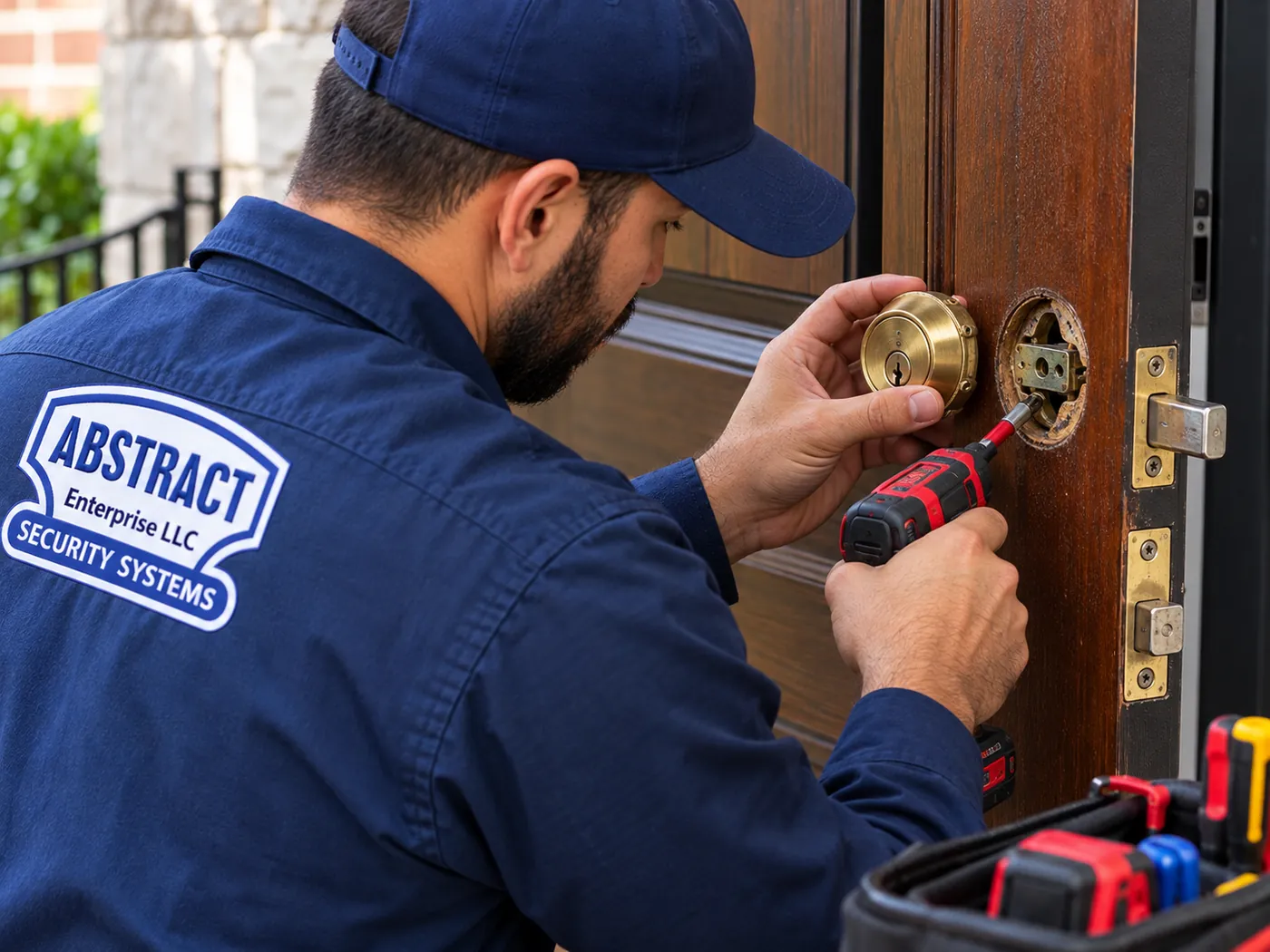
On a closing-day handover we test every exterior door with any keys the builder gave you, reset or replace the keypads, rebuild the user list from your household only, and either rekey the mechanical cylinders or replace them with new ones. You get a written list of every door, what was on it when we arrived and what is on it when we leave. Garage doors from the house and sliding doors to the deck are on that list too, because they are the doors that get forgotten.
Yes, and it costs a fraction of what it costs later. A battery smart deadbolt doesn't need any wiring, so the lock itself can wait. What can't easily wait is the cable for the things that tend to follow it: a low-voltage pair or a network cable to the door for a wired video doorbell or a video intercom, a door-position contact in the hinge-side or head jamb so an alarm or hub knows whether the door is open or shut, and a cable path from the front door to wherever the router and network panel will live.
The decisions are simple to make on a framing walkthrough. Where will the doorbell camera mount, given the door, the sidelight and the porch light? Is there a chance a wired keypad and electric strike will ever go on a side or garage entry, for instance for a home business or a caregiver? Will the router be in a basement utility room two floors away from a townhome's front door? Each answer is a cable, pulled and labelled now, with a blank cover plate at the door.
Talk to your builder's site superintendent first: most builders allow owner-contracted low-voltage work during a defined window, and some insist their own contractor does it. Our structured cabling installation in Orange County handles the pre-wire, and the door hardware goes on after closing.
Read your builder's limited warranty, because that document is what sets the details. Underneath it, New York's General Business Law section 777-a gives buyers of new homes a housing merchant implied warranty that survives the closing: one year against defects from poor workmanship or defective materials, two years for the plumbing, electrical, heating, cooling and ventilation systems, and six years against material defects.
A deadbolt is door hardware. Replacing it doesn't alter the structure, the electrical system or the door slab, and on a pre-bored door a smart deadbolt goes into the same holes. Where a builder could reasonably push back is damage caused by the swap — an enlarged bore, a chiselled-out jamb, a cracked door skin — or a claim about the door itself that the builder blames on the new hardware. That's why we use the existing bore and strike pocket wherever the lock allows and photograph the door before and after.
Keep the original builder lockset, its keys and its packaging in the house. If a door warranty issue comes up during the first year, the builder's hardware can go back on for their technician, and if you ever sell, the buyer can choose.
Only through the housing office, and only on its terms. West Point Family Homes' community guidelines say residents "can request permission to alter existing locks or install additional locks by submitting a Request for Alterations form to Community Management." If the request is approved, "the replacement lock must be from the same manufacturer as the existing lock and the Community Management Office must receive a copy of the new key." In practice that rules out simply ordering any smart lock you like and fitting it; it means asking first, finding out which manufacturer's hardware is on the door, and choosing a smart model from that maker if one fits.
The same guidelines explain why the office wants a key: lost keys are reported to maintenance, the lock is changed and a $50 replacement fee is charged, and residents who get locked out can ask for help — the first business-hours lockout free, a second $25, and after-hours or weekend lockouts $50, with a resident on the lease present to show identification. A smart lock that maintenance can't open with a key breaks that whole system, which is why approval comes with conditions. The guidelines add that exterior cameras, including doorbell cameras, may only be aimed at the resident's own entry and yard, not at common areas or neighbours' homes.
We don't install on post without the approved alteration in hand. If you have it, send us the approval and a photo of the existing lock and its brand stamp, and we'll tell you whether a matching smart model exists and fits your door. If it doesn't, a doorbell camera aimed at your own entry and a keypad on a door the approval covers are often the better route.
Usually, yes. The no-drill route is a retrofit unit: it replaces only the inside thumb-turn of the existing single-cylinder deadbolt, using the deadbolt's own mounting screws, and leaves the outside cylinder and the landlord's key exactly as they are. From the outside nothing changes; from the inside the bolt can be thrown by the motor when you use the app, an auto-lock timer or, with an add-on keypad, a code. When the tour ends, the original thumb-turn goes back on and the door is as you found it.
Two checks come first. The deadbolt has to be a single-cylinder type, with a thumb-turn inside rather than a key on both sides, and it has to throw smoothly by hand, because a motor can't turn a bolt that a person struggles with. And you still need the landlord's agreement that you may swap the thumb-turn, because the lease decides what tenants may change; a written yes by email is enough for most.
If even that is refused, the alternatives are things that don't touch the door at all: a doorbell camera on a no-drill mount where the landlord allows it, a key safe the landlord approves for a family member, and a plain conversation about whether the landlord would rather fit a keypad deadbolt themselves and keep it when you leave.
It depends less on the length of the stay than on how often the door changes hands while you're there. A household that has a sitter, a dog walker, family visiting for weeks at a time and a spouse away for training gets value from individual codes in the first month. A household of two people who both carry keys and are rarely away may not.
If you do buy one, buy it to move with you. A retrofit unit or a standard-bore smart deadbolt can be removed at move-out, the landlord's hardware put back, and the lock fitted again at the next duty station, provided that door takes the same type of deadbolt. Keep the box, the manual and the mounting parts together, and reset the lock before you pack it, so the next house starts with a clean user list.
On post the calculation is different, because the housing office decides what is allowed and wants a key. There, a doorbell camera aimed at your own entry, which the guidelines permit, may give you more of what you want than a lock you would have to get approved and then remove.
Ask your listing agent first, because many agents and the multiple listing service have their own rules for how agents get access and how showings are recorded. Within those rules, a temporary code on a smart lock has real advantages for a seller. You can give the listing agent a code that only works between set hours, give each inspector or appraiser their own code for the day of their visit, and see in the app exactly when the door was opened and locked. When the house goes under contract, or the day after closing, the codes expire on their own.
A lockbox holds a physical key, and once a copy of that key exists you can't easily know where it goes. The weakness of a code is different: codes get shared. The answer is to keep them individual, time-limited and logged, and to look at the activity log after each showing. If the agent prefers the lockbox, the two can coexist — the lockbox for the agent, timed codes for everyone else.
Don't forget the handover at the end. Before closing, factory-reset the lock or delete every code and your own app account, leave the buyer the mechanical keys and the manual, and tell them the lock is reset. A buyer who inherits a smart lock with the seller's account still attached is the next owner who has to call us.
Yes, if you choose the hardware for it. Many consumer smart lock apps support several homes on one account, so a landlord can see every lock in one list, issue and cancel codes remotely and check battery levels from anywhere. Standardise on one brand and one model where the doors allow, connect each lock through Wi-Fi or a bridge so it can be managed remotely, and keep a spreadsheet of which code belongs to which tenant, contractor and cleaner at which address. That's what turns a turnover from a locksmith visit into a few minutes on a phone.
The law matters more than the app. New York's Real Property Actions and Proceedings Law section 768, added statewide by the Housing Stability and Tenant Protection Act of 2019, makes it unlawful to evict or try to evict an occupant who has lived in a unit for 30 consecutive days or longer, or who has a lease, by means that include "changing the lock on such entrance door without supplying the occupant with a key." The Attorney General's guidance to police treats unlawful eviction as a class A misdemeanor, and the section adds civil penalties of $1,000 to $10,000 per violation. Deleting a sitting tenant's code to force them out is the digital version of changing the lock. Codes come off when a tenant has actually moved out, or when a court says so.
Give each tenant both a code and a physical key, write into the lease how codes are issued, changed and removed, and tell tenants in writing what the lock records. We set the locks up that way across a portfolio, one visit per house, and leave you the register of what is on every door.
Treat the drivers' room as its own small building with its own door. Many distribution buildings along I-84 and Route 17K give drivers a separate entrance to a room with a check-in window, a restroom and a waiting area, with a second door from that room into the warehouse. The outside door can be open during receiving hours or released by a keypad code that changes daily or weekly; the inner door into the warehouse takes a staff credential only, so a code that drivers know never opens the floor.
Use a reader or keypad with an electric strike on the inner door, not a standalone battery lock, so the door can be tied to the building's schedule and its alarm, and so a lost staff fob can be cancelled from a computer. Put a camera on both doors and keep the inner door's events in a log someone actually looks at. The exit side of both doors stays free — a lever or panic bar — because a drivers' room is still part of the building's way out.
If you're in a new speculative building, raise this with the landlord's fit-out team before the walls go up. A cable to each door and a power supply location agreed in advance is far cheaper than adding them to finished block walls.
Out of the path of the equipment, first of all. A keypad mounted on the wall right beside a loading-dock personnel door sits exactly where pallet jacks, forklifts and swinging pallets pass, and it gets knocked, cracked and pulled off its box. In the large new buildings along I-84 and Route 17K, we look at the traffic pattern before choosing the spot: which side of the door the trucks and lifts approach from, where pallets are staged, and where a person on foot naturally stands to use the door.
The fixes are simple once you see the path. Move the keypad or reader to the frame on the protected side of the door, or recess it into the wall so nothing projects; put it behind the line of an existing bollard or guard rail, or ask the building owner to add one; and choose a metal-housed, impact-resistant reader instead of a plastic keypad. A fob or card reader is easier than a keypad for staff wearing gloves, and it can't be read off a worn button.
Run the cable inside conduit from the reader to the controller or power supply, with the conduit clear of the dock area, and put the door's exit hardware where it can't be fouled either. A door event log is only useful if the reader that writes it is still on the wall.
Yes. The usual set-up for a small professional office is a video intercom or video doorbell at the street or building door and an electric strike in that door, so the person at the front desk sees the visitor, speaks to them and releases the door with a button or an app without leaving the desk. Staff and partners use their own codes or fobs at the same door, so nobody has to be buzzed in to get to work.
In an older village building the main design question is where the cables go. Strikes need a low-voltage run from the door frame to a power supply, and the intercom needs a run to the desk or a network connection. In a building with plaster walls or a shared hallway, we plan the route at the walkthrough, use surface raceway where we have to, and tell the landlord exactly what will be visible before we start.
Keep the door's exit side simple, set the strike to the right fail mode for that door, and decide in advance what happens after hours — whether the intercom rings through to a phone or simply goes unanswered. Those three decisions make the difference between a front door that works for clients and one that frustrates them.
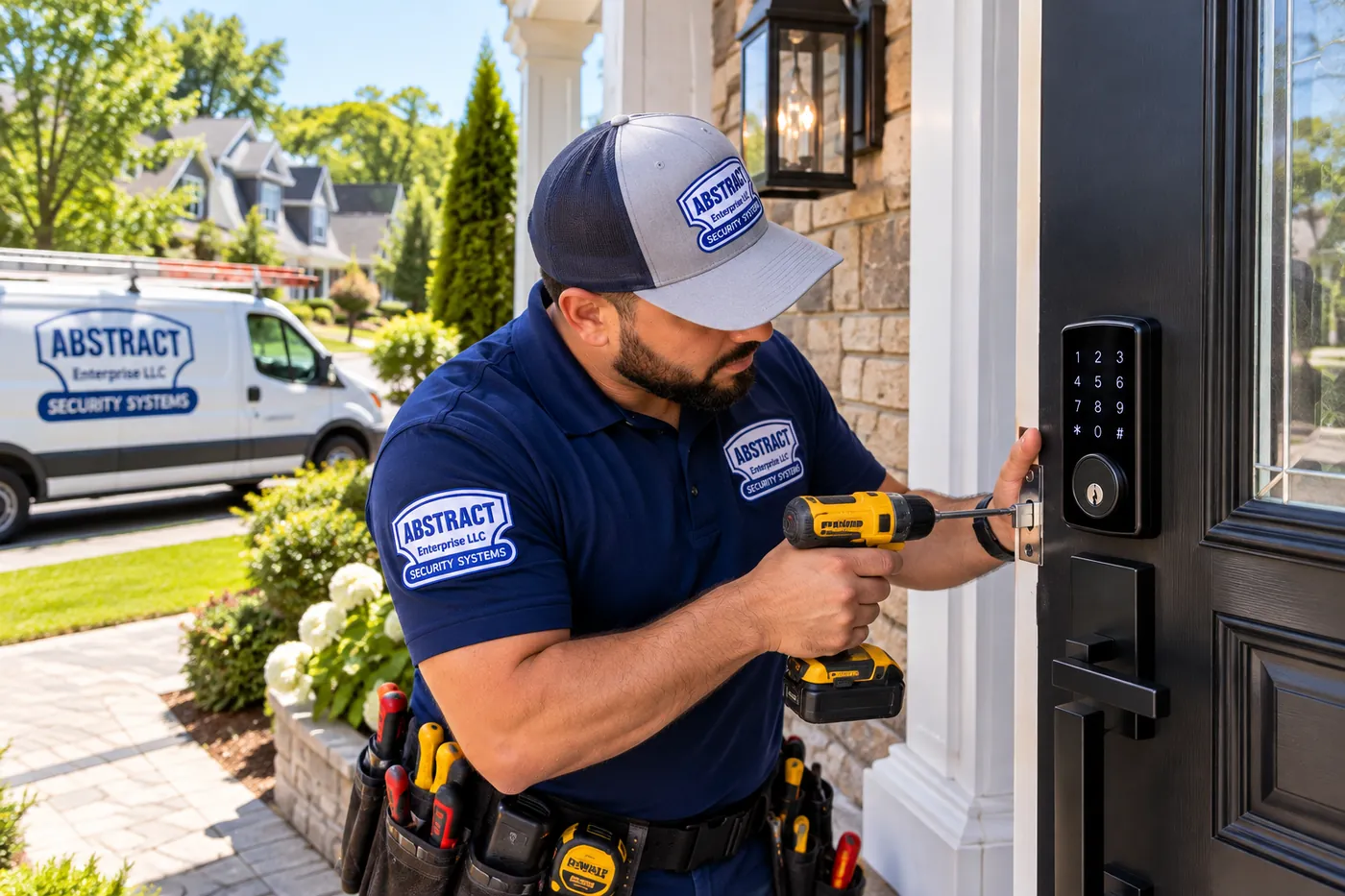
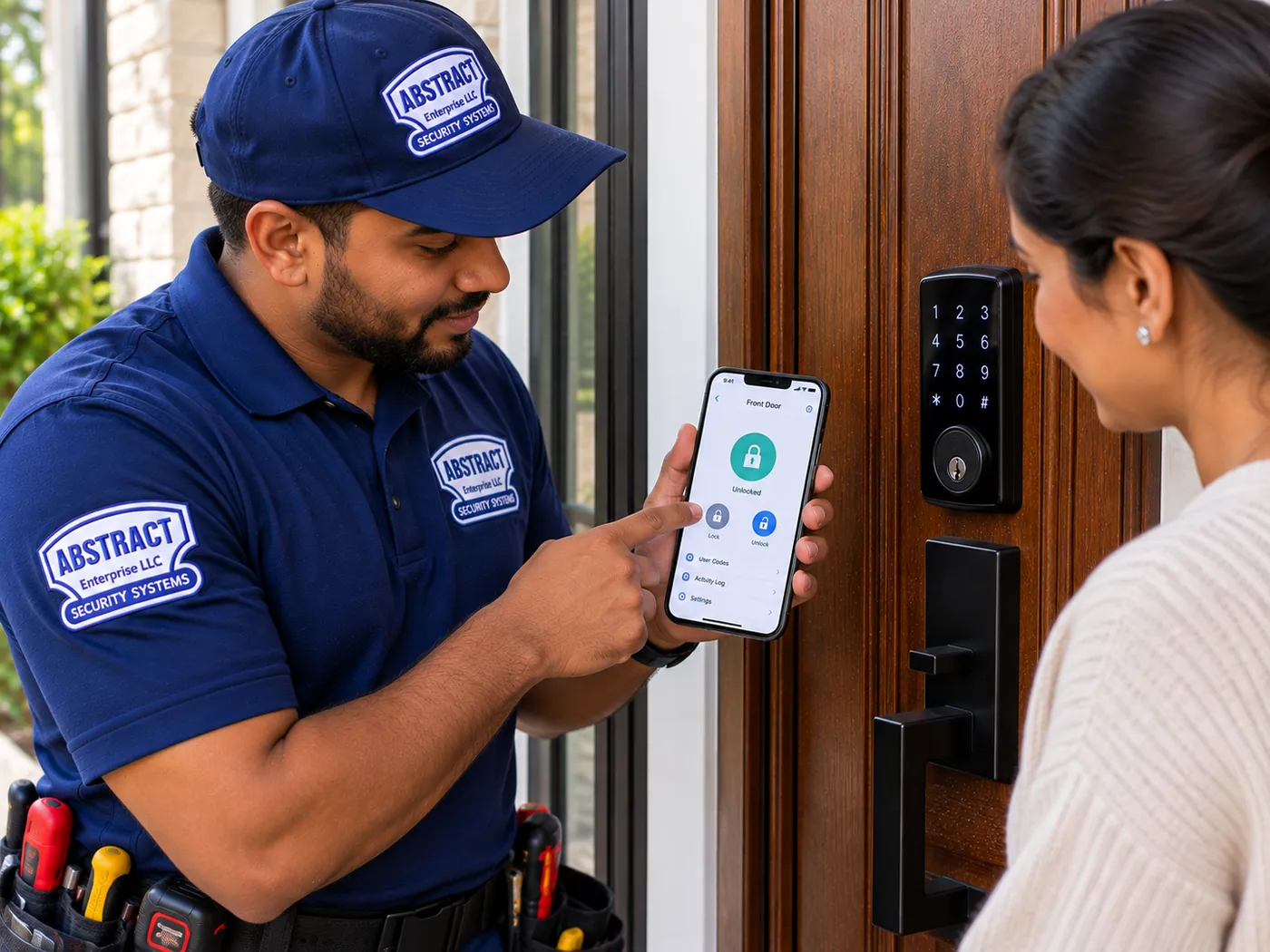
In Orange County the right lock is usually decided by who has to be removed from the door as much as by who has to be added. These are the categories we fit on new builds, rentals, military households and business doors across the county. You can buy your own and have us fit it, or let us recommend one after the walkthrough.
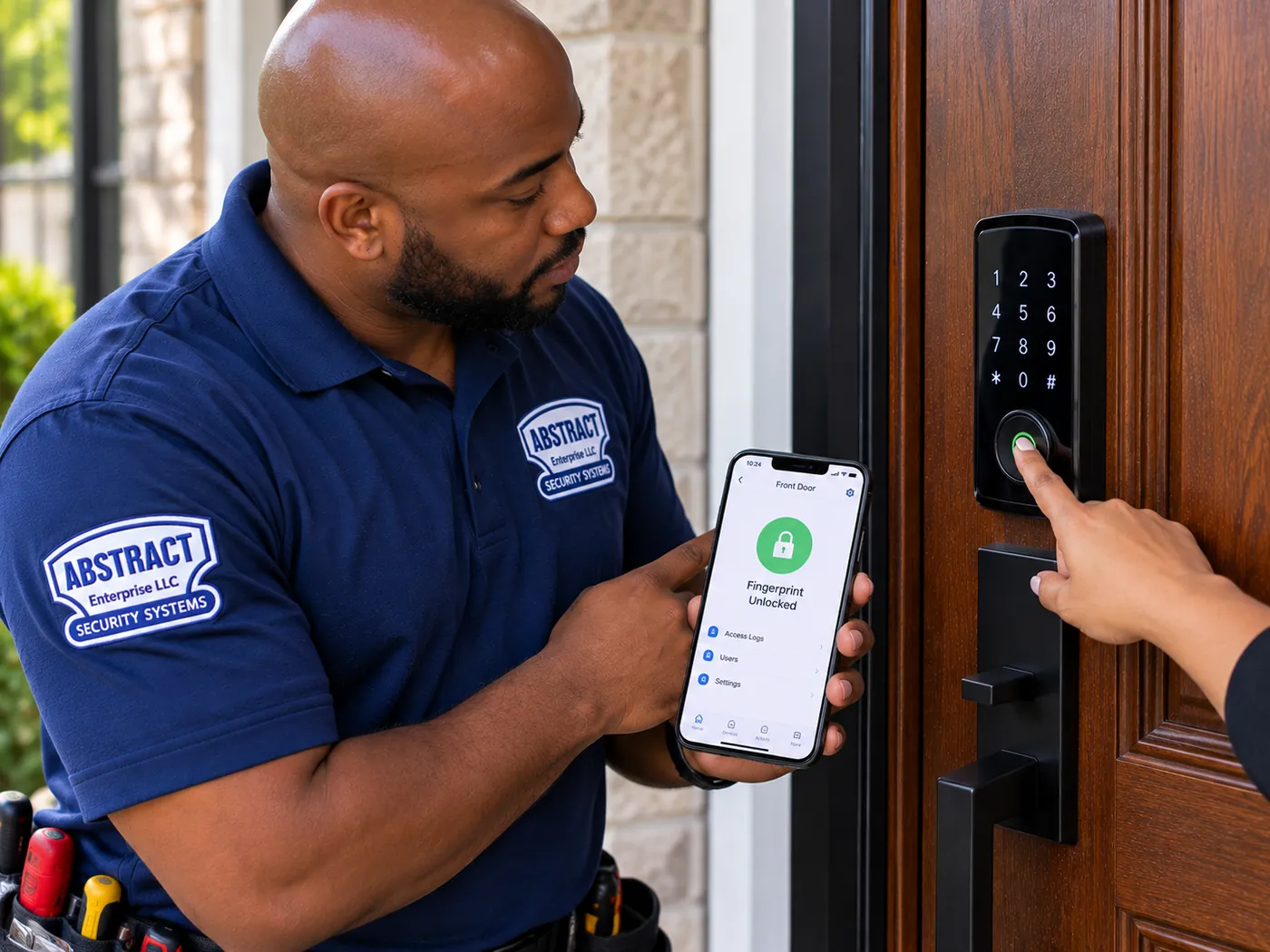
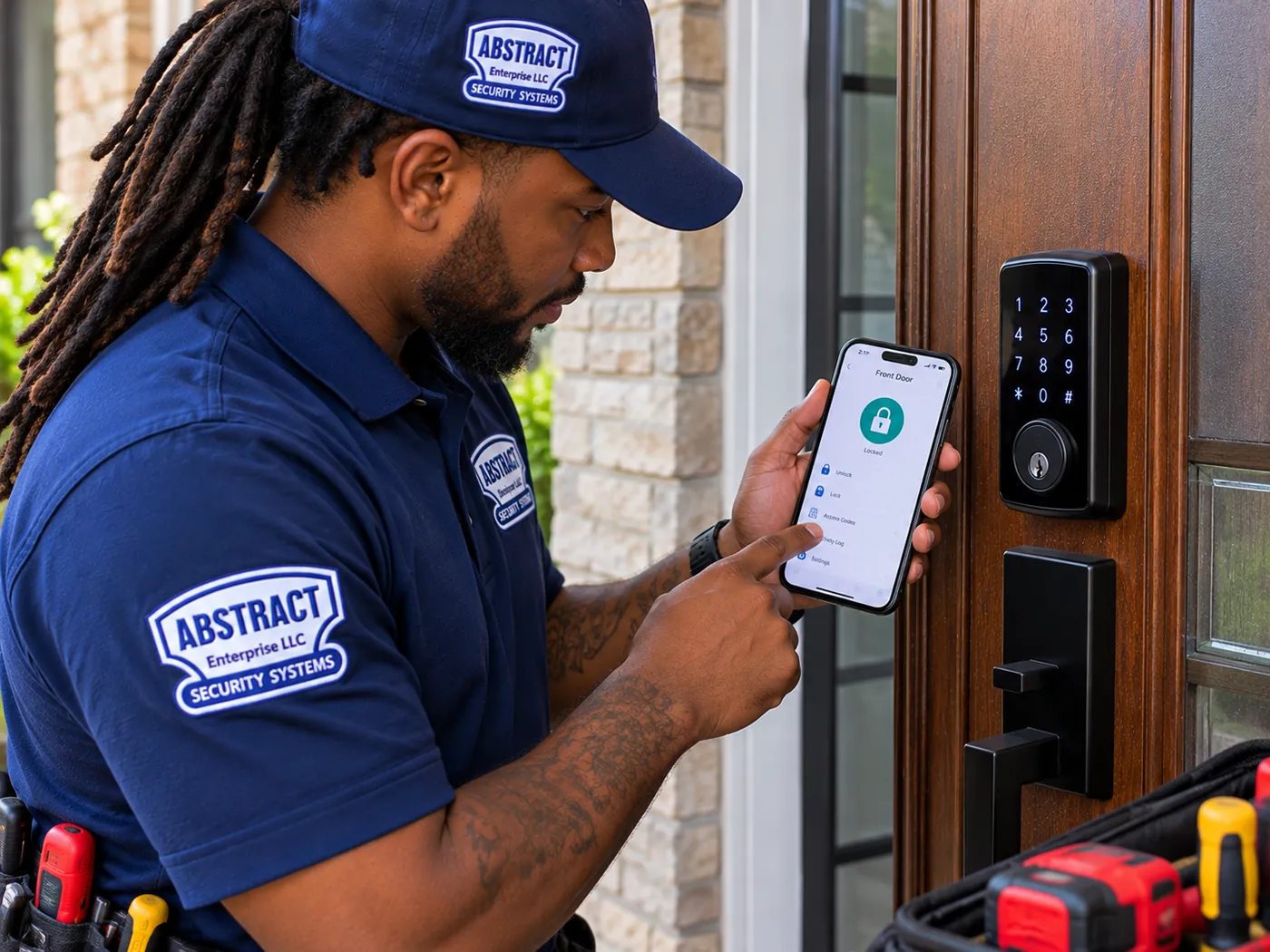
The workhorse for houses and townhomes: individual codes for each person, auto-lock, an activity log and a keyed cylinder for backup. Most fit the standard bore that builder doors arrive with.
For buyers inheriting a builder's or seller's lock: models that the maker allows to be reset completely, so every old code and virtual key is gone before your own go in.
A motorised unit that takes the place of the inside thumb-turn of a single-cylinder deadbolt; the landlord's outside cylinder and key stay put. The natural choice for an off-post rental, and simple to undo at move-out.
Connected locks a landlord can manage remotely across several addresses: codes issued and cancelled from one app, batteries monitored, activity logged by tenant.
A camera at the most-used entrance so a remote unlock is never blind, or a video intercom at an office door so staff can see and release visitors from their desks.
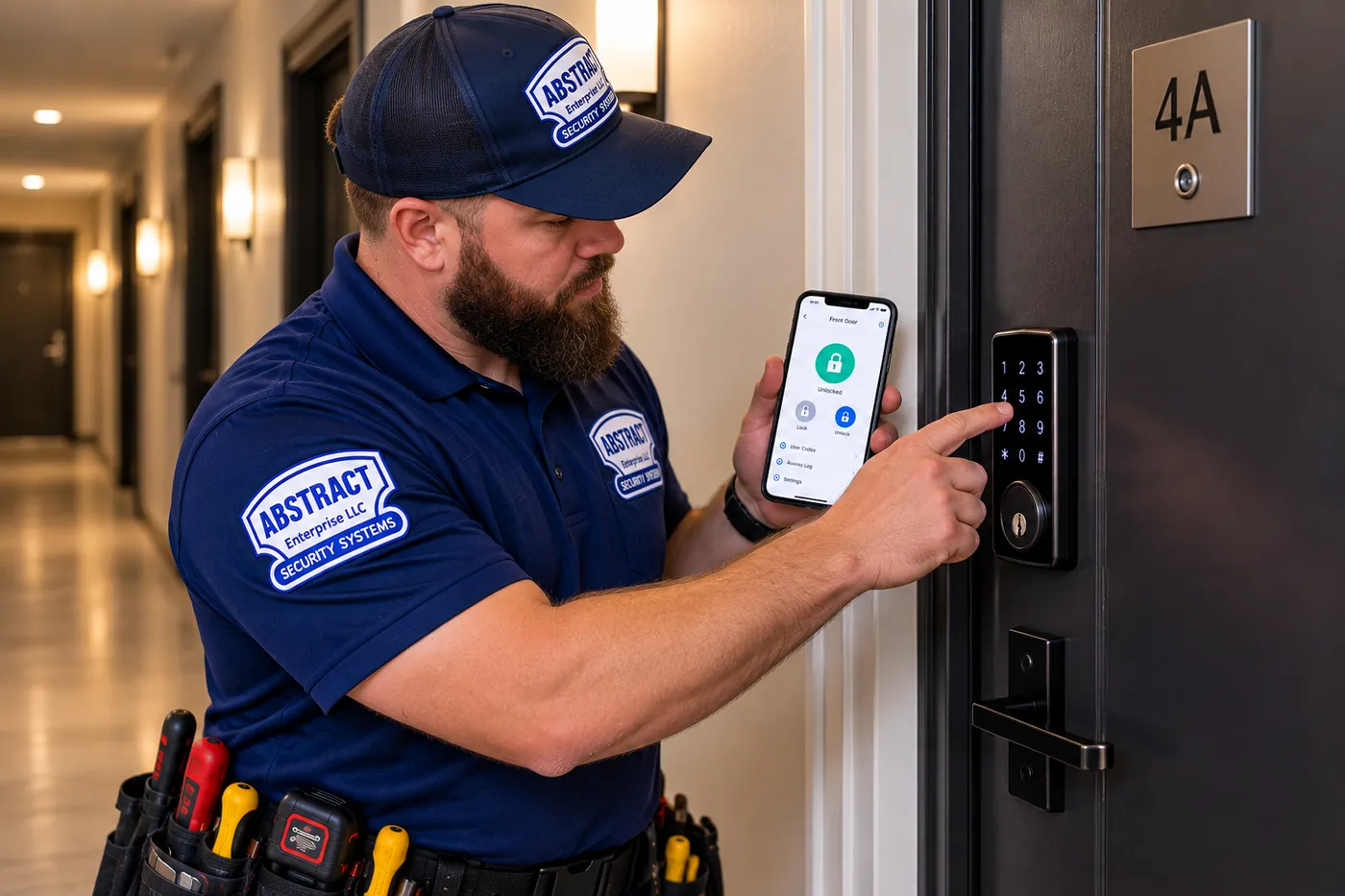
For driver rooms, staff entrances, records rooms and appointment-only offices: a keypad or fob reader outside, a strike in the frame, and a free exit inside.
For aluminium-and-glass storefront and office doors where a strike won't fit, with a request-to-exit device and power-loss release set up as the code requires for that door.
Small sensors that tell you when a sliding patio door, a garage entry or a basement walkout is open — the doors a front-door smart lock doesn't cover.
National brands versus an Orange County installer. National alarm companies sell a smart lock as part of a monitored plan, builders fit whatever comes in the hardware package, and big-box install services put a lock on a door and leave. None of them asks who else still has a key, or checks whether the old codes are really gone, or knows that the housing office at West Point wants the same manufacturer and a copy of the key. That checking is the part of the job a local, licensed installer is for, and it is where we spend most of our time.

How these were chosen: we had no way to view Google's AI Overview while preparing this page, so none of the quoted lines below is copied from it. Each is a statement we kept finding in national cost guides, product pages and DIY articles — the material answer engines summarise — set against what turns up on doors in Newburgh, Tuxedo, Middletown and the rest of the county.
The logic sounds right: nobody has lived there, so nobody has a key. But a new house has usually been opened by more people than a resale — framers, electricians, plumbers, painters, flooring and cabinet crews, inspectors, the sales office and the punch-list team — over months of construction.
Construction keying and temporary cores are designed to shut those keys out at closing, and builder keypads can be reset. Both depend on someone actually doing it. One locksmith's public post describes rekeying a home in a new-construction neighbourhood that still had master pins in its locks.
On every new build in Tuxedo, Chester or Slate Hill we test the doors, reset or replace the keypads and rekey or replace the cylinders on closing day, then give the owner the list.
That is Fixr's national range for a single smart lock installed, updated in January 2025, with a $300 average. It is a fair figure for one lock on one pre-bored door with no complications, and it isn't an AESS price.
The Orange County jobs that cost more are usually the handovers: three or four exterior doors to clear at once, keypads to reset, cylinders to rekey, a strike to reset after the first winter, a portfolio of rentals, or a commercial door with a strike and a power supply.
We publish the commercial figures we have priced and quote the residential door work flat after a walkthrough or a set of photos, so the number you get covers the whole handover rather than one lock.
Retrofit units that fit over the inside of an existing deadbolt are often marketed as renter-friendly, and on many off-post rentals they are. But a rental is still somebody else's door, and the lease decides what can change.
On post at West Point the rule is explicit: changes only through a Request for Alterations, a replacement from the same manufacturer as the existing lock, and a copy of the key to Community Management.
Off post, get the landlord's agreement in writing, keep the original hardware, and put it back when you leave. We work on that basis on every rental door.
Keyless entry can make turnovers easier, and articles aimed at landlords tend to stop there. In New York, the 2019 statewide unlawful-eviction law, RPAPL section 768, names changing the lock on an occupant's entrance door without supplying a key as one of the acts it prohibits.
That makes a lock change for a sitting tenant something to plan with care: supply a working credential, explain it in writing, and keep a physical key available. Using a lock to push someone out is a crime, not a technology choice.
We set up landlords' locks so every tenant gets a code and a key at move-in, and so codes are only removed after someone has actually left.
It secures the front door. Orange County houses typically have three or four other ways in: a door from the attached garage, a side or mudroom door, a sliding patio door to the deck and sometimes a basement walkout.
Sliding doors are the common gap. Their locks are built into the handle and rarely motorised, which is why the Town of Newburgh police still tell residents to set a Charley bar on sliding doors before a trip.
We include every exterior door in the walkthrough and recommend a contact or a bar where a smart lock isn't the right answer.
On a well-hung pre-bored door, many people can. The thirty-minute version leaves out what makes a smart lock last: a strike fixed with long screws into the framing, a bolt that clears the strike after the house has moved through a winter, and a door that latches without a shove.
It also leaves out the parts of an Orange County handover that aren't about the lock at all: finding out what old keys and codes still work, resetting a builder's keypad, getting a landlord's or a housing office's approval.
Many of our calls are DIY installs that work at the counter and fail at the door. We fix the door, then the lock.
A battery keypad deadbolt on an office door is a simple job. A keypad or reader with an electric strike, a power supply and a request-to-exit device is a small access-control system that has to suit the building's exits.
It also has a licensing edge in Orange County. The county licenses electricians, and any new 120-volt circuit or receptacle to feed a power supply is an electrician's work, separate from the low-voltage installation.
We hold NYS low-voltage licence #12000287431, design the door's fail mode and exit hardware, and coordinate with a county-licensed electrician when line-voltage work is needed.

Give us the date and the doors. We'll tell you which old keys and codes need retiring, which lock suits each door, and the price, before the day arrives.
List the doors, the town and the date that matters — a closing, a move-in, a lease change, a PCS report date — and you'll hear back in writing the same business day. Prefer the phone? Our Hudson Valley line is (845) 640-3835.
Thank you. One of our licensed installers will call you back today, during business hours. If a door is failing right now, call (845) 640-3835.
The order never changes: old access is found and closed before new access is handed out. That holds for a single townhome door in Tuxedo and for a landlord's houses from Port Jervis to the river.
On the phone we note the closing, move-in, lease or PCS date, every exterior door including sliders and garage entries, and any approval needed from a builder, HOA, landlord or housing office.
At the walkthrough, or from photos, we identify each lock and keypad, the brand and model, which keys you were handed, and which codes or app accounts may still be active.
A written sheet lists each door with its verdict — reset, rekey, replace or leave alone — and one flat total. Business doors are costed from the county rates we already publish.
Keypads are factory-reset or replaced, cylinders rekeyed or swapped, strikes refixed with long screws into the framing, and each door adjusted to latch with a light push.
New locks are fitted and paired, then every old key and code is tried and must fail, every new one must work, and each door is opened from inside by hand with the power off.
Household members, tenants or staff set their own codes and try them while we watch; two people get admin rights; the owner keeps the signed register of what came off each door and what went on.
Six places that show how Orange County holds old and new side by side — the oldest public historic site in the country a few miles from new distribution buildings, a nineteenth-century racetrack in a village that now has a theme park.
New York State Parks calls it the nation's first publicly owned historic site, opened on July 4, 1850, preserving the house Washington used as headquarters for more than 16 months. It stands in the East End, among the brick rowhouses and multi-family houses where many of our Newburgh rental jobs are.
The academy and its family housing, managed by Balfour Beatty Communities as West Point Family Homes, with written rules on lock changes. Off-post rentals in Highland Falls, Fort Montgomery and Cornwall house many of the families who rotate through.
In the Towns of Newburgh and New Windsor, built in the 1930s for West Point cadet aviation and home to the New York Air National Guard's 105th Airlift Wing. The airport and the I-84 and Route 17K corridor around it anchor the county's logistics growth.
A half-mile harness track in the Village of Goshen, established in 1838 and a National Historic Landmark. Around it, the county seat's village blocks of offices, law firms and apartments over shops.
A 150-acre resort that opened on May 20, 2021, about 60 miles northwest of New York City by its own description. Visitor traffic has reshaped Goshen, which has taken its own position on short-term rentals.
A 500-acre outdoor museum of large-scale sculpture near Cornwall and New Windsor, open since 1960. Its neighbours include some of the off-post rental streets used by West Point and Stewart households.
We also serve Newburgh, the Town of Newburgh, New Windsor, Vails Gate, Cornwall, Cornwall-on-Hudson, Salisbury Mills, Highland Falls, Fort Montgomery, Monroe, Harriman, Highland Mills, Central Valley, Woodbury, Tuxedo, Tuxedo Park, Greenwood Lake, Warwick, Pine Island, Florida, Chester, Sugar Loaf, Goshen, Campbell Hall, Washingtonville, Blooming Grove, Montgomery, Walden, Maybrook, Middletown, the Town of Wallkill, Slate Hill, New Hampton, Otisville, Port Jervis and Deerpark.

Two kinds of number appear below: prices we already publish, and work we will only price once we have looked at it. Business-door hardware — readers, keypads and strikes — has set base ranges across the site, and the Hudson Valley smart lock page lists them for each county; here they are at Orange County's 1.40. House doors are different. A single deadbolt swapped into a builder's pre-bored door can be done before lunch, whereas a resale colonial with a seller's keypad, a garage code, three mismatched cylinders and a strike that shifted over the winter fills the day. So residential handovers get a written, fixed quote once we have walked the doors or seen your photos, and that quote does not move on the day.
| Item | Orange County price | Scope and source |
|---|---|---|
| Smart lock on a house, townhome or rental door, including closing-day handovers (reset, rekey or replace) | Quoted flat at free walkthrough | Depends on how many doors, which keypads can be reset and how many cylinders need rekeying — seen first, then priced |
| Single-door keypad or card reader with electric strike, installed | $2,100–$3,500 | Office, driver-room, clinic or shop door; published $1,500–$2,500 base × 1.40, as on our Hudson Valley page |
| New electric strike on an existing door | $350–$630 | Fitted during entrance work; $250–$450 base × 1.40 |
| Failed electric strike repair | $413–$679 | Strike replaced and realigned when the release has failed; $295–$485 base × 1.40, to the nearest dollar |
| Setup-only visit (app, codes, schedules, bridge, reset; no hardware change) | $250 first hour, then 30-minute blocks | Our published Orange County setup-only rate |
| Service and callback rate | $195/hr, 3-hour minimum ($585) | After-install service calls; never charged on the initial installation |
What the national guides say. Fixr, updated in January 2025, gives $250–$400 nationally for one smart lock fitted to an ordinary door, with $300 as the typical figure. Treat that as a benchmark for a single lock, not as our price and not as the cost of clearing construction keys, a seller's keypad and a garage code across a whole house.
Most Orange County work falls into one of three bundles. The two business bundles have fixed county ranges; the house handover can't, because no two closings leave the same keys and codes behind.
Quoted flat at walkthrough
Every exterior door checked, builder or seller keypads reset or replaced, cylinders rekeyed or swapped, smart deadbolts fitted where you want them, old keys and codes tested to fail, your household enrolled, and a written register of every door.
$350–$630
The frame-side half of a keyless business door, for a reader or intercom that is already in place: strike supplied, cut in and wired at the county rate. If the existing strike has only worn out, the repair line applies instead, $413–$679.
$2,100–$3,500
Everything for one door from scratch: reader or keypad, strike, power supply and an exit device on the inside. Staff are enrolled one by one, and whoever runs the office learns to issue and revoke credentials before we pack up.
Bought a smart lock already, or inherited one with the house? We fit it, or reset and take it over, quoted flat as labour only after the walkthrough; if it is already on the door and only needs resetting, pairing and new codes, it is a setup-only visit at $250 for the first hour. Before anything is drilled we check the door thickness, backset and bore, and on a rental or on-post house, the approval. We won't fit a model that needs a key or code to get out. A lock you supply carries its manufacturer's warranty rather than ours.

Text or email two pictures per door — outside face and inside face — plus the date the keys changed hands. That is usually enough for us to say what needs resetting before anyone visits.
The hardware is the same from one end of the county to the other. The history of the door is not, and that is what changes our plan from town to town.
The City of Newburgh's East End is mostly rental housing in older brick buildings, so our work there is landlords' turnover locks, shared front doors on two- and three-family houses, and careful planning around the Architectural Review Commission when a door itself is changing. Outside the city, the Town of Newburgh and New Windsor mix post-war houses with the commercial and logistics growth around Stewart, I-84 and Route 17K, and with off-post rentals for Air National Guard and Army households.
The towns closest to West Point and Storm King. Many households here are on a military timetable, renting for a tour and leaving with a few weeks' notice, so we lean toward retrofit units and locks that can come off cleanly, with the original hardware kept for move-out.
The southern Route 17 and Route 32 corridor: commuter houses close to the Thruway and the Harriman station, the outlet centre at Woodbury Common, and the builder townhomes and houses at Tuxedo Reserve and Palisades Ridge. New-construction handovers, HOA approvals and after-school codes for commuter families dominate the calls.
The middle of the county: village centres with offices over shops, the county seat's professional offices on Main Street in Goshen, LEGOLAND's visitors on the edge of town, and newer houses around Chester and Campbell Hall. A mix of appointment-door intercoms, village mixed-use separation, and closing-day handovers on new builds.
The southwest: the Village of Warwick's Railroad Avenue shops, lake houses at Greenwood Lake, farm country around Pine Island and the craft village of Sugar Loaf. Older houses with several entrances, small businesses that open early, and owners who want to see who is at the door from wherever they are.
The county's retail and medical centre around Route 211 and Crystal Run, older two- and three-family houses in the city, builder communities at Ridgebury Estates and Grandview Estates, and the large logistics proposals near Route 17K and I-84. Medical-office records rooms, rental turnovers and new-build handovers all land here.
Village centres and post-war neighbourhoods in the northern part of the county, with new distribution buildings off I-84 in Montgomery. Driver-room doors and staff entrances on the commercial side, side and patio doors on ranches on the residential side.
The western end of the county and of the Port Jervis Line: a small city of older multi-family houses, river and mountain properties outside it, and long drives for anyone coming back to fix a lock. Landlords here value locks they can manage remotely, and we plan visits so a whole portfolio is done in one trip.

Fitting a lock is quick; proving that nobody else can open the door is the real work. These are the people we look for on an Orange County handover, and how each one is shut out.
| Who may still have access | Where it comes from | What we do |
|---|---|---|
| Builder's crews and trades | Construction keys or temporary cores used during the build | Test every door with the keys you were given, rekey or replace cylinders where construction keying may still work |
| Builder's sales office or realtor | Keypad codes set during construction and showings | Factory-reset the keypad where the maker allows, or replace it, then rebuild the user list from your household only |
| Previous owner of a resale house | Mechanical keys, garage remotes, an app account still attached to the lock | Remove the old account, reset the lock, rekey cylinders, and flag garage openers for reprogramming |
| Former tenants | Codes, fobs and copied keys from an earlier lease | Remove only after the tenant has left, issue the new tenant a fresh code and a fresh key, and log the change |
| Housing office on post | Required copy of the key under West Point Family Homes rules | Work only within the approved alteration, keep the same manufacturer, and make sure the office's copy key works |
| Anyone with an old garage remote or keypad code | Remotes left in previous owners' cars, a builder's test code on the outdoor garage keypad | Clear the opener's memory, re-pair only your own remotes, and change or reset the outdoor keypad code |
| Neighbours and relatives holding a spare | Keys handed out by a previous owner or landlord for emergencies or plant-watering | Rekeyed cylinders make every old spare useless; issue new spares only to people you choose |
| Contractors, cleaners, dog walkers, showing agents | Temporary codes that nobody remembered to delete | Give each one a dated code that expires on its own and check the activity log afterwards |
A register goes stale unless someone looks at it. Twice a year, open the app's user list and remove anyone who has moved on — the dog walker from last summer, the contractor who finished in spring. Count the mechanical keys at the same time and leave one with somebody nearby you trust, since a key is the only way in that survives flat batteries. For help after the install, an Orange County setup-only visit is $250 for the first hour.

A family assigned to West Point or Stewart lives on a different clock from everyone else in the county. The house is rented for a set number of years, the move-out date arrives with the orders, and the next family is often already on its way. These are the rules we follow on those doors.
If you need the work done around a report date or a housing inspection, tell us the date when you call; a lock that has to come off before an inspection is a short visit, and we book it accordingly.
The same lock is not right for a new-build owner, a renting Army family and a warehouse manager. This is the short version of how we match hardware to the situation on Orange County doors. It is a starting point for the walkthrough, not a substitute for it.
| Situation | Usual choice | Why it fits |
|---|---|---|
| New-build house or townhome, owner-occupied | Keypad smart deadbolt in the existing bore, cylinders rekeyed to match | Builder doors are pre-bored for it; a reset or new lock retires construction codes; one key for every exterior door |
| Resale house with a seller's smart lock | Factory reset and owner takeover, or replacement if the maker won't allow a full reset | Removes the seller's codes and app account; costs less than new hardware when the lock is sound |
| Off-post rental for a military tour | Retrofit interior unit, or a smart deadbolt using the same holes with the landlord's lock stored | Leaves the door as found; a short swap back at move-out; needs the landlord's written agreement |
| On-post quarters at West Point | Only what the approved Request for Alterations allows, from the same manufacturer as the existing lock | The housing office's written rule, with a copy of the key going to Community Management |
| Landlord with several rental houses | One connected model across the portfolio, managed from one account | Codes issued and removed remotely at turnover; one set of spare parts; a single register per address |
| Commuter family with school-age children | Keypad deadbolt with auto-lock and arrival notifications | Children use a code, not a phone or a hidden key; parents see arrivals on the way home |
| Parent living alone | Connected keypad deadbolt with two remote administrators and a video doorbell | Family can let a rescuer in remotely and see who is at the door; inside opens with one motion |
| Office, clinic or driver room | Keypad or card reader with an electric strike and request-to-exit | Credentials by role, a door log, central cancellation of lost fobs, and a free exit side |
If you are in the middle of a build, ask your site superintendent when owner-contracted low-voltage work is allowed, and see the pre-wire question above. Our Orange County network installation team can place an access point where a far door needs one.

A handover often turns into a short list of other jobs. These are the Orange County services that most often get added once we are on site.
Multi-door systems with a controller for logistics buildings, clinics and offices.
Video of the porch on your phone, paired with the lock for closing-week deliveries and visitors.
Audio and video intercoms for multi-family entrances and appointment-only offices.
Fault-finding on intercoms already installed in Orange County buildings.
Lobby releases and apartment-house buzzers that have stopped answering.
Contacts on sliders, garage entries and side doors, with monitoring for houses and businesses.
Cameras on driveways, decks and side yards of Orange County houses.
Hubs, scenes and automations that bring locks, lights and sensors together.
Door wiring, data, cameras and sound, handled by one licensed crew.
One form for any mix of the services above.
A standing routine, written down so customers know what to expect on handover day — not an account of any particular house
We start with the keys on the kitchen counter. Whatever the builder, seller, landlord or housing office handed over goes in a row, and we ask how many copies exist and who else might have one. Nobody ever knows the full answer, which is the point of the visit.
Then every exterior door, in order: front, garage entry, side or mudroom, slider, basement walkout. Each one gets tried with every key in the row. A key that opens a door it shouldn't goes on the list. Each keypad gets checked for a model number and whether it can be reset completely.
Then the strikes. On a new house we pull the strike screws and replace short ones with long ones into the framing, because that is the thing that fails in February. On an older house we look for wood that is soft or split behind the plate.
Last, the people. Each person tries their own code or fob while we watch, the old keys are tried again and must fail, and the owner gets the written register. Then we open every door from inside, by hand, before we leave.


Our county multiplier is 1.40, so a keyless business door — reader or keypad plus electric strike, installed — moves from the $1,500 to $2,500 base to $2,100 to $3,500 here. On the same basis a new strike is $350 to $630 and replacing a failed one is $413 to $679. House-door smart locks and closing-day handovers have no list price; we quote them flat after a free walkthrough.
Yes — the whole county is in our area, west to the Delaware at Port Jervis and Deerpark, east to the river towns of Highland Falls, Cornwall and Newburgh, north to Montgomery and Walden and south to Warwick, Greenwood Lake and Tuxedo. Every booking gets a 2-hour arrival window, any day of the week, between 8 AM and 8 PM.
Yes, and it is the best time. Book the visit for the afternoon of closing or the next morning, before furniture and boxes block the doors. Bring every key and remote you were handed. We reset or replace keypads, rekey or swap cylinders, fit any smart locks, and enrol your household, so the movers arrive at a house only you can open.
Yes. Tell us the report date or inspection date when you call. Taking a smart lock off a rental and reinstalling the landlord's original deadbolt is a short visit, and we book it before the inspection so the door is back to how you found it. On post, we only work within an alteration the housing office has approved.
Sometimes. Some builders allow owner-contracted work, such as low-voltage pre-wire, during a set window before closing, with their site superintendent's written permission and proof of insurance; others don't allow anything until the keys are handed over. Ask your builder first. Locks themselves are best fitted after closing, so construction access isn't blocked.
Yes. A smart lock's keypad codes, fingerprints and auto-lock work without the internet, so we can fit the locks and enrol your household on closing day. Remote unlocking, notifications and the activity log on your phone start once the Wi-Fi or bridge is online; we can come back for a short setup-only visit, or talk you through connecting it.
Yes. After a handover we leave a door register: each exterior door, the lock and model on it, what we reset, rekeyed or replaced, how many keys were cut, and which users were enrolled. Keep it with the house documents. It is what you will want if keys go missing, a tenant changes, or you sell the house.
Usually. Most wireless keypads for garage door openers can have their code changed or be cleared and re-paired to the opener, using the opener's learn button and the maker's instructions. We do that alongside the door locks on a handover, and point out any remotes that should be cleared from the opener too.
Yes, if someone can let us in. Many Orange County buyers close remotely or arrive days later. With the builder's, seller's or your agent's agreement to meet us, we can do the handover before you arrive, then send you the register and enrol your own phone remotely once you are in the app.

Handovers, military housing and rental turnovers are the Orange County story. Weekend houses, winter battery life and the six-county price table live one level up, on the Hudson Valley smart lock installation hub. Westchester, Rockland, Putnam and Dutchess have their own smart lock pages; Ulster links to our quote form for now, and the same crews already work there. New York City and Long Island each have a regional page, and every borough plus Nassau and Suffolk has a page of its own.
Smart lock installation in the Hudson Valley · Orange County (this page) · Putnam County smart locks · Dutchess County smart lock installation · Westchester · Rockland · Ulster
AESS smart lock installation in NYC · Manhattan smart lock installation · Brooklyn smart locks · Queens smart lock installers · the Bronx · Staten Island
Long Island smart lock installation — Nassau and Suffolk counties.
Cameras, alarms, network cabling and intercoms each have their own sections, all reachable from the Abstract Enterprises Security Systems home page; who we are and how long we have done this is on our about page.
Blank keypad at 5:30 in the morning, an app showing the lock offline, a bolt that stops halfway on the warehouse staff door — ring (845) 640-3835 from anywhere in Orange County. You get the first free arrival window, and the usual culprits, batteries, a dropped pairing or a strike out of line, rarely take a technician more than an hour or two. Until we get there, use the mechanical key: it does not care whether the electronics are awake.

Orange County line: (845) 640-3835. Door photos and closing dates can go by WhatsApp (718) 679-0359 via wa.me. Abstract Enterprises Security Systems, 460 E Fordham Rd, Bronx, NY 10458.
NYS Low-Voltage Licence #12000287431 · 100% Licensed & Insured · Same-Day Estimates · Rated 4.7★ from 201 Google Reviews
Locks you supply carry their manufacturer's warranty. Full terms — including 50% deposit, one-year parts-only warranty on AESS-supplied products, and the late-fee schedule — are set out in the service agreement. See our warranty page.
Statutes, housing-office rules and federal regulations are cited on this page for orientation only and are not legal advice. Last reviewed October 17, 2026. Changelog: Orange County smart lock installation page first published.