Long Island houses have more doors than people think: the front door nobody uses, the side door by the driveway everybody uses, the door from the attached garage into the kitchen, the back slider and the cellar hatch. We fit smart locks on the doors that matter, square up old door prep so the bolt throws cleanly, pair every lock to the alarm panel or hub already in the house, and leave each household member with a code that works on every door they need.
Reviewed and updated October 17, 2026 · Written by Anwar Timothy, NYS licence #12000287431
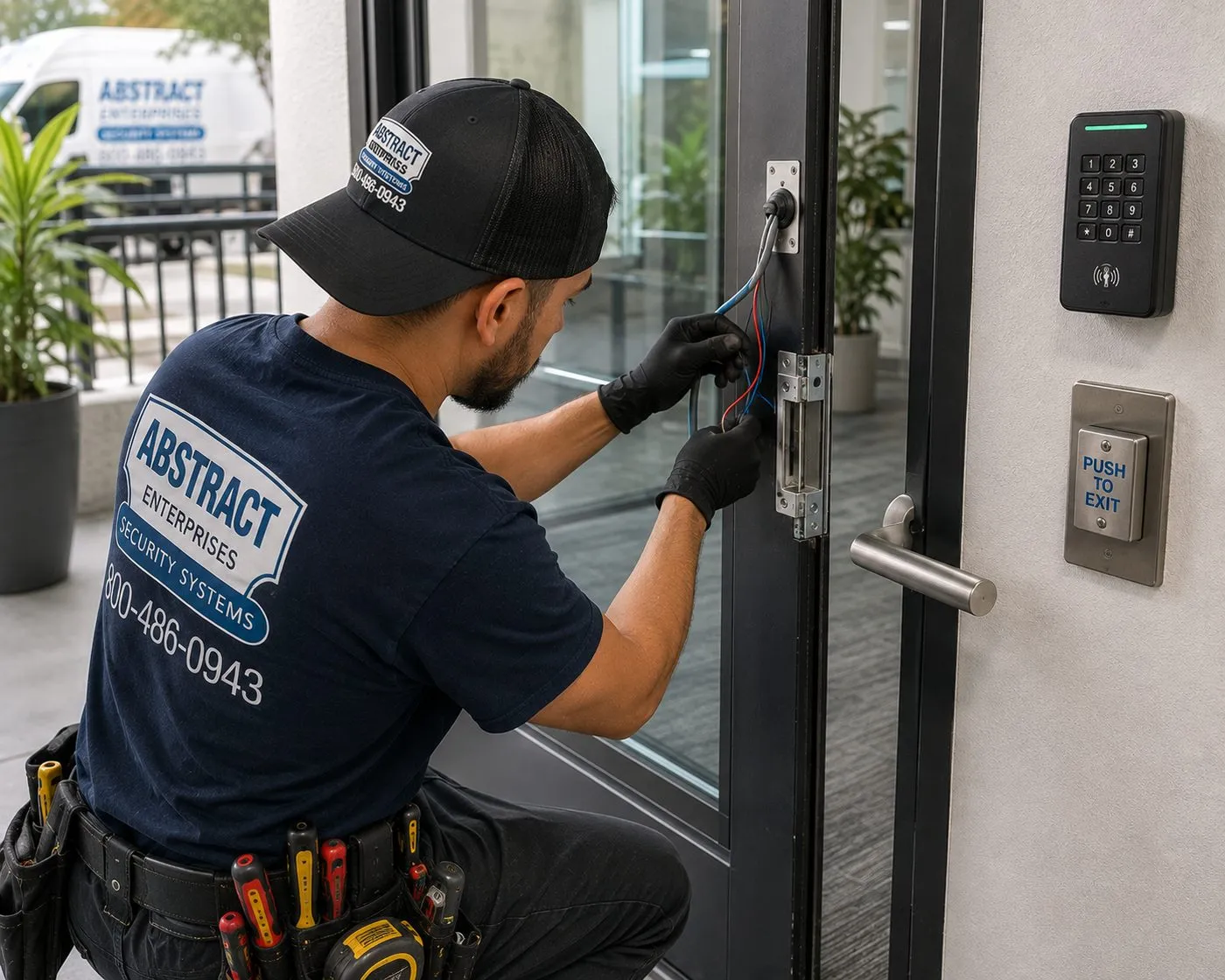
A technician in gloves feeds red and blue conductors into an electric strike set in an aluminium door frame. To the right, a keypad reader with a green status light and a "Push to Exit" plate are already on the wall, and a company van is parked outside. This is the commercial end of keyless entry; most houses get a battery deadbolt instead.
Get a Free Smart Lock Quote
Which doors, the lock you like and the hub you have — we call back the same business day
✅
Request Sent!
We'll call you back the same business day.
25+
Years Experience
✓
Same-Day Estimates
100%
Licensed & Insured
4.7★
201 Google Reviews
Closing on a house, handing keys to a contractor, or tired of the spare under the planter? Call (800) 486-0943 or send the 60-second form with the number of doors and the alarm or hub you already own. A technician reads every request, not a call centre.
One fixed figure for every door on the house, agreed at a free walkthrough before any drilling
Every lock paired to the panel, hub or app you already run
NYS licence #12000287431 · certificates of insurance issued free
Why Long Island Homes Need Smart Lock Installation
On Long Island the lock question is a whole-house question. More than four in five homes in Nassau and Suffolk are lived in by their owners, according to the Census Bureau, and most of those are detached houses on their own lots. A house like that is not secured by one good front-door lock. It has a front entry that guests use, a side or kitchen door by the driveway that the family actually uses, an interior door from the attached garage, a slider onto the deck, and often a cellar hatch or a basement walk-out. Each one is a way in, and each one needs its own decision.
That is why smart locks catch on so quickly here. A keypad on the side door ends the hunt for keys with groceries in both hands. A code for the dog walker, the cleaner or the contractor can be switched on for a week and switched off again without anyone cutting a key. Children walking home from school get their own code, and the app shows when they used it. And for the many households that already have an alarm panel on the wall, a lock that talks to the panel can arm the system when the last person leaves and disarm it when the first person comes home.
The garage door deserves its own paragraph, because Long Island police keep bringing it up. In 2016 Suffolk police described a series of Hauppauge break-ins in which a thief took garage remotes out of unlocked cars in driveways, opened the garage, and walked into the house through an interior door that was also unlocked; the advice afterwards was to keep cars locked, keep remotes out of sight and always lock the door between the garage and the house. In June 2026 Nassau police investigated a 3:45 a.m. break-in on Melby Lane in East Hills, where the homeowner was woken by a garage alarm and confronted intruders in her kitchen; officers urged residents to install deadbolts and take garage openers out of cars left in the driveway. A smart deadbolt on that interior door, set to relock itself after a minute, closes the gap that a remote in the cup-holder opens.
The houses themselves add the complications. The post-war Capes, ranches and high ranches that fill much of Nassau and western Suffolk were built with doors and bores that have been re-drilled, shimmed and painted for seventy years. Older North Shore homes still carry mortise locks that no retail smart deadbolt fits without work. Shore houses on the South Shore bays and the East End see salt air that pits ordinary finishes. And a large share of East End houses are second homes that sit closed for months, then need guest codes, cleaner codes and remote checks once the season starts.
None of this needs a locksmith's van parked for a day or a security company's three-year contract. It needs an installer who measures every door before recommending a lock, knows which protocols the household's alarm and hub actually speak, and quotes the whole house up front. That is the job we do across Nassau and Suffolk.
Long Island facts that shape a smart lock install
81.9% and 82.2%: owner-occupied housing rates in Nassau and Suffolk for 2020–2024 (U.S. Census Bureau QuickFacts) — owners who can choose and drill their own doors, without a landlord's sign-off.
1,064,368 homes: 480,591 housing units in Nassau and 583,777 in Suffolk as of July 1, 2025 (Census QuickFacts) — a great many front, side and garage doors, most of them chosen and maintained by the people who live behind them.
17,447 houses: built by Levitt & Sons in Levittown between 1947 and 1951 (Levittown history, Wikipedia) — a generation of doors and frames that have been re-hung, re-bored and re-painted many times since.
Almost half of 1.1 million: the share of PSEG Long Island customers in the dark at the peak of Tropical Storm Isaias in August 2020 (ABC7 New York) — the reason every lock we fit runs on batteries and keeps a mechanical key or override.
63 percent: houses in the Town of East Hampton owned by second-home owners, per a 2017 study for the town reported by The East Hampton Star — homes that need codes issued and revoked from a distance.
14 days: the minimum rental period under Southampton Town's rental rules, per the town's rental FAQ — summer tenants who change every two weeks or more, each needing their own entry code.
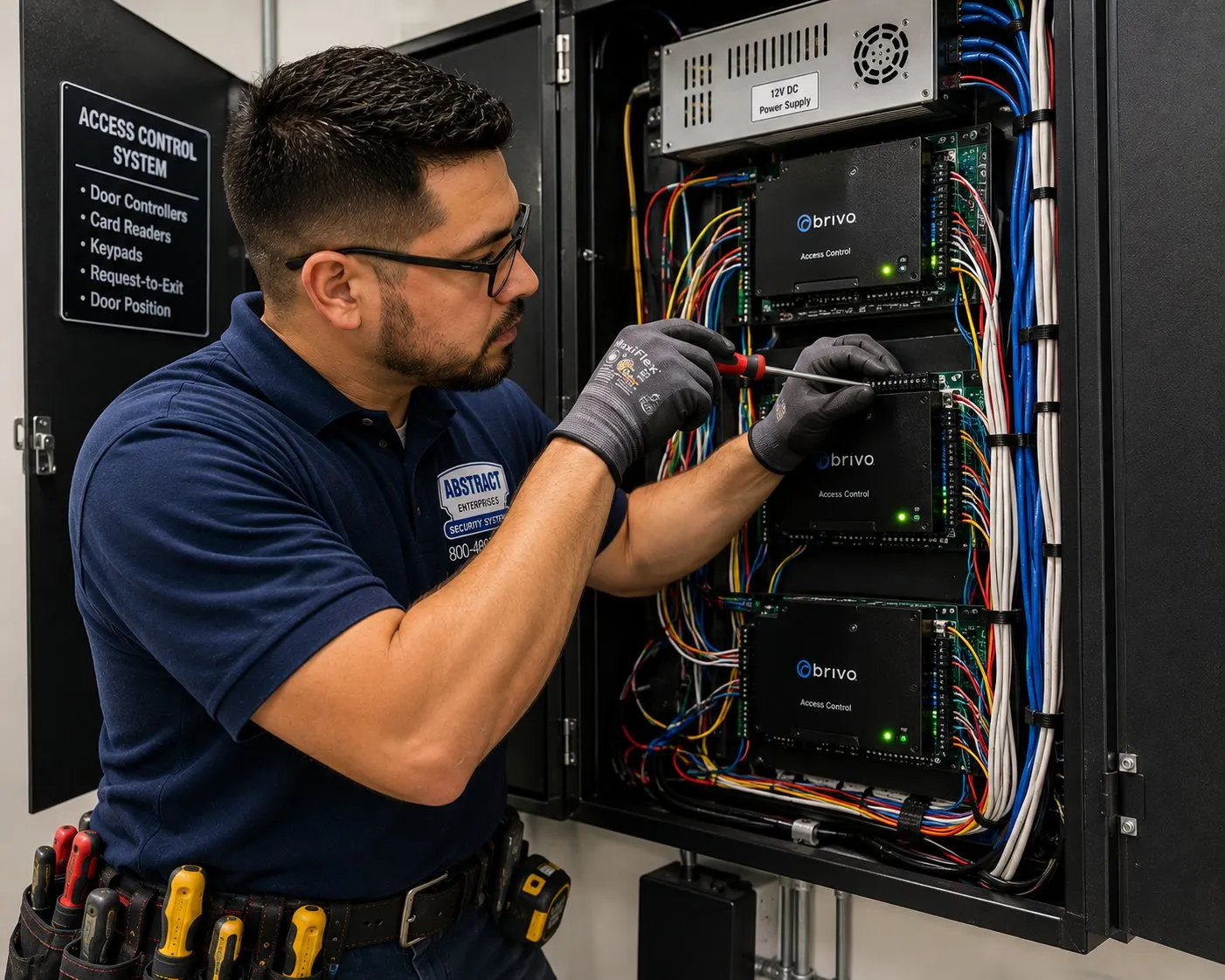
A technician in glasses and work gloves tightens a terminal on one of three Brivo access control boards in an open wall cabinet, under a 12V DC power supply, with a sign on the cabinet door listing door controllers, card readers, keypads, request-to-exit and door position. Wired systems like this run business doors; a house usually needs only battery locks and the hub it already has.
Repair Capture
Locked Out by Your Own Smart Lock on Long Island?
A keypad that went dark, a bolt that grinds and stops halfway, a lock that dropped off the app after the router was replaced, or an alarm that no longer arms when the door locks — those are not new installations. Most come down to batteries, a door that has shifted so the bolt binds in the strike, or a lost pairing with the hub, and once a technician is at the door most are fixed in one to two hours. App, hub and pairing work with no new hardware is booked as a setup-only visit: first hour flat at $225 in Nassau or $250 in Suffolk, then 30-minute blocks. Same-day when a two-hour window is open. Call (800) 486-0943 and say it's a smart lock problem.
What We Install
Smart Lock Installation Services on Long Island
A typical Long Island job combines several of these, because a typical Long Island house has several doors. We supply the lock or fit yours, prepare the door, pair the lock to the household's system and set up every user before we leave.
Front Entry Smart Deadbolts
Keypad or touchscreen deadbolts on the main entry, matched to the existing handleset finish, with the bolt throwing fully into a reinforced strike. Quoted flat after the walkthrough.
Side and Kitchen Doors
The door by the driveway that the family really uses. Usually the first lock we recommend, and the one that gets the auto-lock timer and the children's codes.
Garage-to-House Doors
A deadbolt on the interior door from the attached garage, set to relock on a timer, so an opened overhead door no longer means an open house. Fitted without compromising the door's closer or its rating.
Whole-House Code Plans
One code per person that works on every lock they need, with schedules for cleaners and dog walkers and a separate code for contractors that expires when the job does.
Alarm Panel Pairing
Locks enrolled on the Z-Wave radio of a compatible alarm panel, so locking with a code can arm the system and unlocking can disarm it, where the panel and plan support it.
Hub and Matter Setup
Pairing with an existing SmartThings, Home Assistant, Apple Home, Google Home or Alexa set-up, including a Thread border router check for Matter locks before anything is bought.
Garage Door Controllers
Smart controllers on the overhead door so it can be closed from the app and checked from the road, coordinated with the interior-door lock rather than running in a separate app.
Door Prep and Repair
Re-boring, filling old holes, adjusting backset, deepening the strike pocket and re-hanging sagging doors so the bolt throws without strain — the work most failed DIY installs skipped.
Mortise and Older-Door Solutions
For North Shore and village homes with original mortise locksets: smart mortise options, conversion kits where appropriate, or a separate smart deadbolt above the old lock.
Second-Home and Rental Codes
East End and shore houses set up so owners can issue and revoke tenant, cleaner and caretaker codes from anywhere, with low-battery alerts sent before the house reopens.
Video Doorbell Pairing
A doorbell camera on the same door as the keypad, so you can see who is there before you unlock remotely for a delivery or a neighbour.
Small-Business Keypads and Readers
Keypads, card readers and electric strikes for offices, shops and practices in Long Island plazas and office parks, with user lists the owner can change.
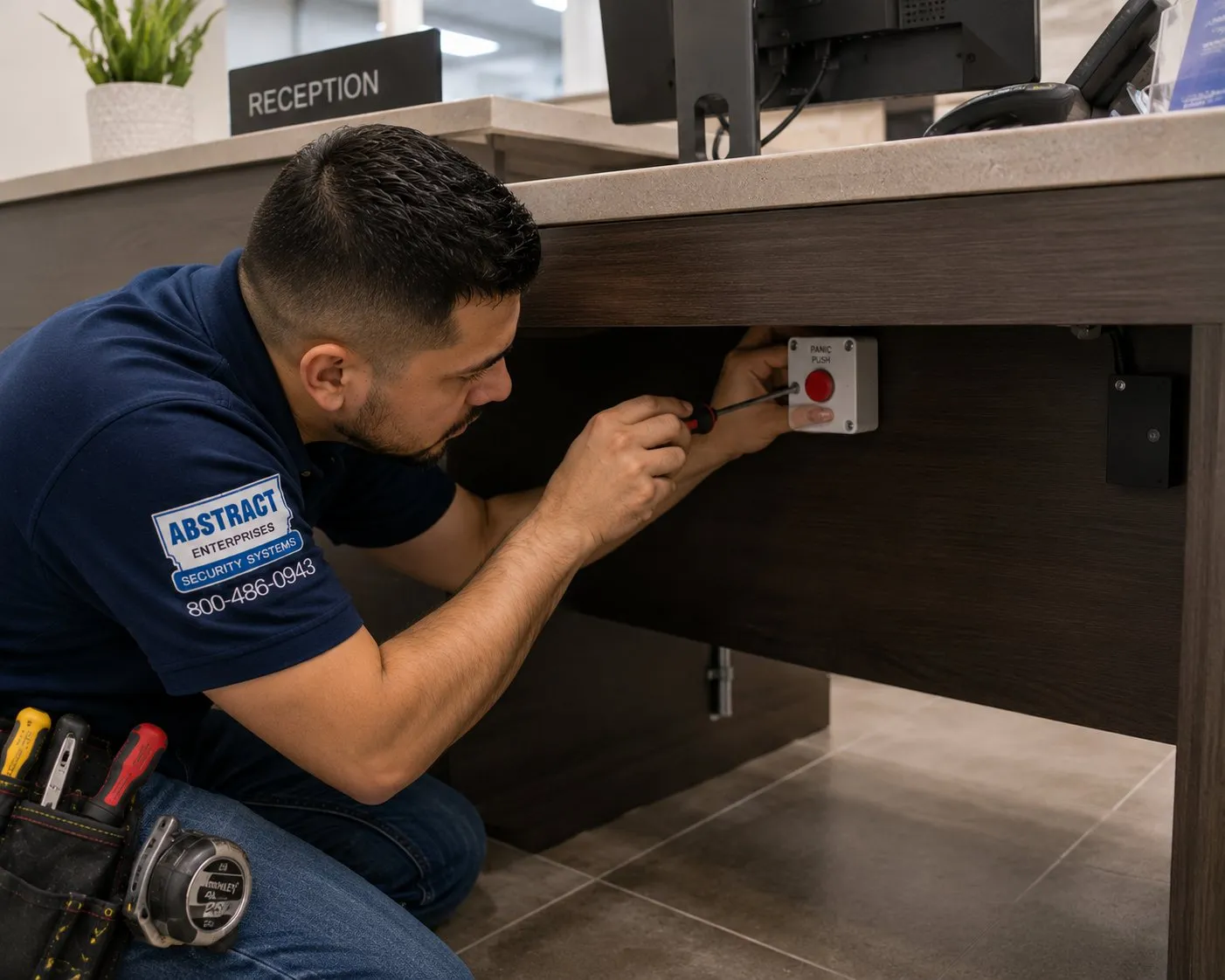
A technician with a cordless drill fixes a small white sensor high on the wall beside a shop window, next to a sign showing store hours; inset frames show a sensor labelled as a glass-break detector and a second device being pressed onto a wall. Locks paired to an alarm panel join sensors like these on the same system.
Smart Lock Installation for Long Island's Architecture
Doors age with the houses they hang in. These are the house types we work on most across Nassau and Suffolk, and what each one tends to mean for the doors, the frames and the lock that will fit them.
Levittown-Era Capes and Ranches
Small post-war houses, many since expanded with dormers, rear family rooms and new side entries. Doors have often been replaced at least once, sometimes with mismatched bores and backsets. We measure before recommending, because a lock that needs a 2-3/4 inch backset will not centre on a door drilled at 2-3/8.
High Ranches and Split-Levels
A split entry at the front, a lower-level door beside the garage, and frequently an interior door from the garage into the lower den. The lower door is the one most families use daily, and the one that most needs a keypad and an auto-lock.
Centre-Hall Colonials
A formal front door, a mudroom or kitchen door off the driveway, a two-car attached garage with an interior entry, and a slider to the deck. The classic four-door house: one code plan, three or four locks, all on the same app.
North Shore Older Homes
Heavy wood doors, original mortise locksets, sidelights and storm doors. Retail smart deadbolts are designed for bored doors, so these need either a smart mortise lock, a carefully placed new deadbolt, or a retrofit model that works with the existing cylinder.
South Shore Raised and Bay-Front Houses
Houses raised after storms, with stairs up to an entry door exposed to wind-driven rain and salt air off the bays. Finish, weather exposure and the walk up from the driveway all shape which keypad goes on which door.
East End Second Homes
Farmhouses, shingle-style houses and newer custom builds that sit closed for months. Locks here are chosen for remote management, battery alerts and code scheduling as much as for the hardware itself.
Methods and materials door by door
Front entry doors. Most residential smart deadbolts are built around a 2-1/8 inch cross bore and a 1 inch edge bore — the preparation Schlage specifies for its Arrive lock, for example — and Schlage's published door prep for its Encode Plus calls for a door 1-3/8 to 1-3/4 inches thick and an adjustable 2-3/8 or 2-3/4 inch backset. We check all three numbers, then check the strike: the bolt has to throw its full inch into a pocket deep enough to take it, with a reinforced strike plate screwed into the framing rather than just the jamb. A smart lock motor that fights a shallow strike drains its batteries and eventually stops halfway.
Side and kitchen doors. Often a half-light door with a storm door in front of it. The storm door handle can sit exactly where the keypad wants to be, so we check clearance with the storm door closed. If they clash, the answer is a slimmer keypad, a different handle on the storm door, or a keypad lock on the inside door with the storm door left on a simple latch.
Garage-to-house doors. Under the model residential code, the door between an attached garage and the house must be solid wood or steel at least 1-3/8 inches thick, or a 20-minute fire-rated door, and must have a self-closing or automatic-closing device. That shapes the work: we fit the lock without cutting into the door beyond the standard bore, keep the closer working, and on a labelled fire-rated door use hardware and preparation consistent with the label rather than drilling new holes. A keypad on this door is usually the one that relocks on a short timer.
Back sliders. Sliding patio doors have narrow stiles that will not take a standard deadbolt. Options are a slider-specific lock, an auxiliary bar or foot lock, and a contact sensor on the alarm so the system knows if the slider is open. We tell you honestly when a smart lock is the wrong tool for a door.
Cellar hatches and basement walk-outs. Outside bulkhead doors are rarely candidates for a smart lock; they are better secured from inside and monitored with a contact on the alarm. A basement walk-out door with a normal frame can take a smart deadbolt like any other exterior door, and is a good place for one if the household uses it for the yard.
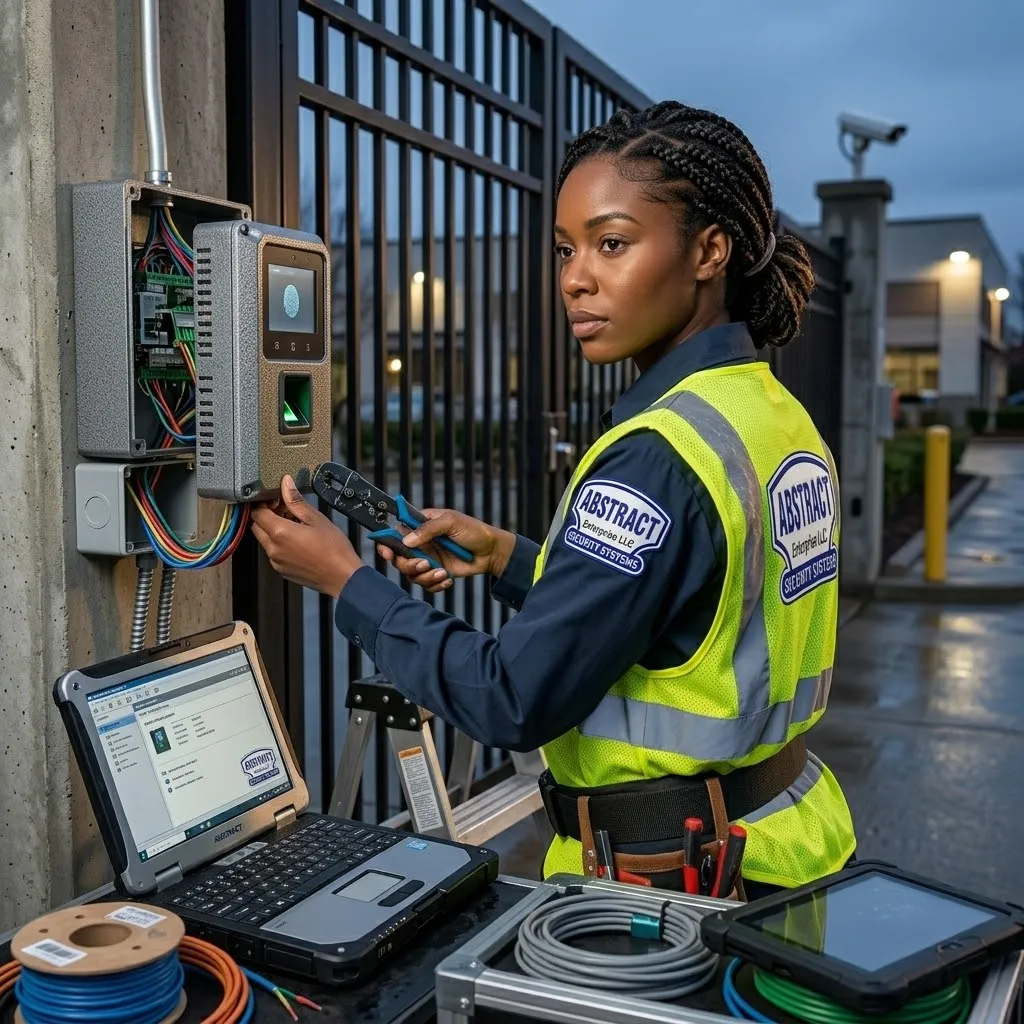
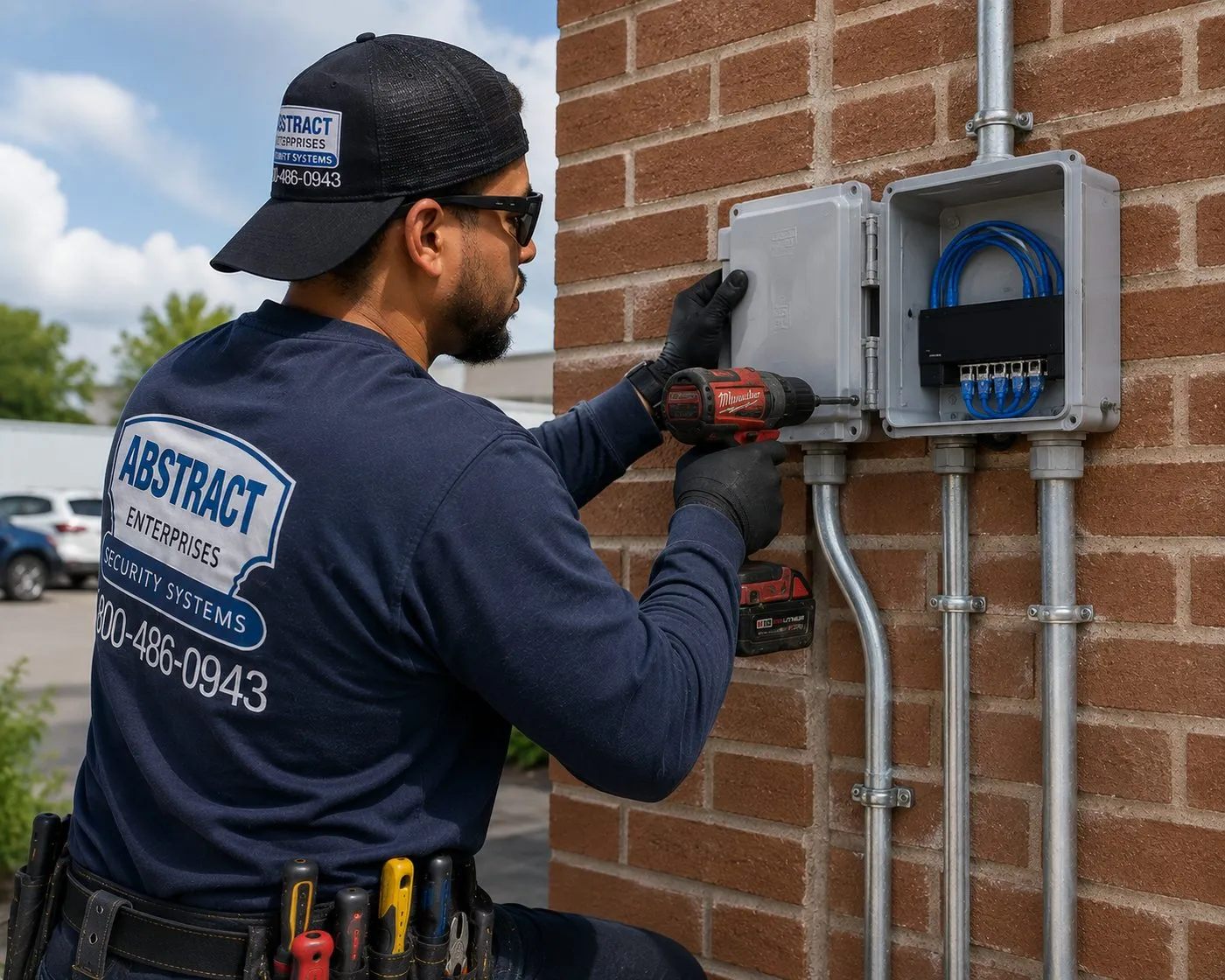
At dusk, a technician in a high-visibility vest works with crimping pliers on a reader unit with a screen and fingerprint pad, mounted beside an open junction box next to a tall metal gate. A rugged laptop, a tablet and reels of cable sit on the cart in front. Driveway and pool gates can join the same code plan as the house doors.A technician drives screws into a grey weatherproof enclosure on a red-brick wall, with blue cable coiled inside a second open box and metal conduit running down the brick. Outdoors, every fitting is chosen for weather first.
Most Long Island families who put smart locks on the side and garage doors also want to know who rang the bell while they were out. Our low-voltage installation services across Long Island cover doorbells, cameras and network drops on the same visit.
Commercial Smart Lock Installation
Business Smart Lock Installation on Long Island
On Long Island, commercial keyless entry mostly means small businesses in plazas, village downtowns and office parks. A dental practice with a staff entrance, a shop with a back door onto the parking lot, an office suite whose cleaners come at night. The goal is the same as at home — codes or cards instead of keys — but the hardware is usually a keypad or reader on an electric strike rather than a battery deadbolt. These are the corridors where we do that work.
Route 110 Office Corridor
The Broadhollow Road office parks through Melville and Farmingdale, where suites change tenants and every move-out means re-keying. A keypad or card reader on the suite door lets the tenant delete a departing employee instead of calling a locksmith.
Hempstead Turnpike
The long commercial road from Elmont, home of UBS Arena at 2400 Hempstead Turnpike, east through Franklin Square, Uniondale and East Meadow. Shops and restaurants with rear service doors onto the lot are the classic case for a keypad with a delivery code.
Old Country Road and Roosevelt Field
The retail and office strip around Roosevelt Field in East Garden City, Long Island's largest mall with 243 stores. Showrooms and salons in the surrounding buildings use staff codes so opening shifts don't depend on one keyholder.
Huntington Village
Restaurants, shops and offices along New York Avenue, Main Street and Wall Street around the Paramount. Upstairs offices and back-of-house doors are where code locks replace a ring of keys.
Patchogue Main Street
A walkable downtown of restaurants and bars near the ferries to Davis Park and Watch Hill. Late closing times and rotating staff make code schedules more useful than keys.
North Fork: Riverhead to Greenport
Restaurants and ale houses in Riverhead, Mattituck and Greenport. Where staffing changes with the season, codes that start and stop on set dates are simpler than collecting keys.
Compliance callouts for commercial keyless entry on Long Island
Free egress. The model residential code requires egress doors to be readily openable from the inside without a key or special knowledge or effort, and we apply the same principle to every business door. A keypad or reader controls who comes in; the inside lever or exit device must always let people out.
Operable hardware. On public-accommodation doors, accessibility standards require hardware that works without tight grasping, pinching or twisting of the wrist, mounted between 34 and 48 inches above the floor. That rules out knob-style smart locks on customer doors and favours lever trim.
Fire-rated doors. A door in a rated assembly keeps its rating only with hardware and preparation consistent with its label. We do not field-cut rated doors to fit hardware they were not made for.
Commercial work and county licensing. Nassau County's home improvement licence covers remodelling of residential homes, and the county says contractors who work only on commercial buildings don't need it; landlords' own contractor rules and insurance requirements still apply.
Certificates of insurance. Plaza and office-park landlords usually want one before any contractor drills a door; ours are issued free.
Power and wiring. Electric strikes and maglocks run on low-voltage power supplies. New line-voltage outlets or circuits are electrician's work, inspected under the town's electrical inspection arrangements.
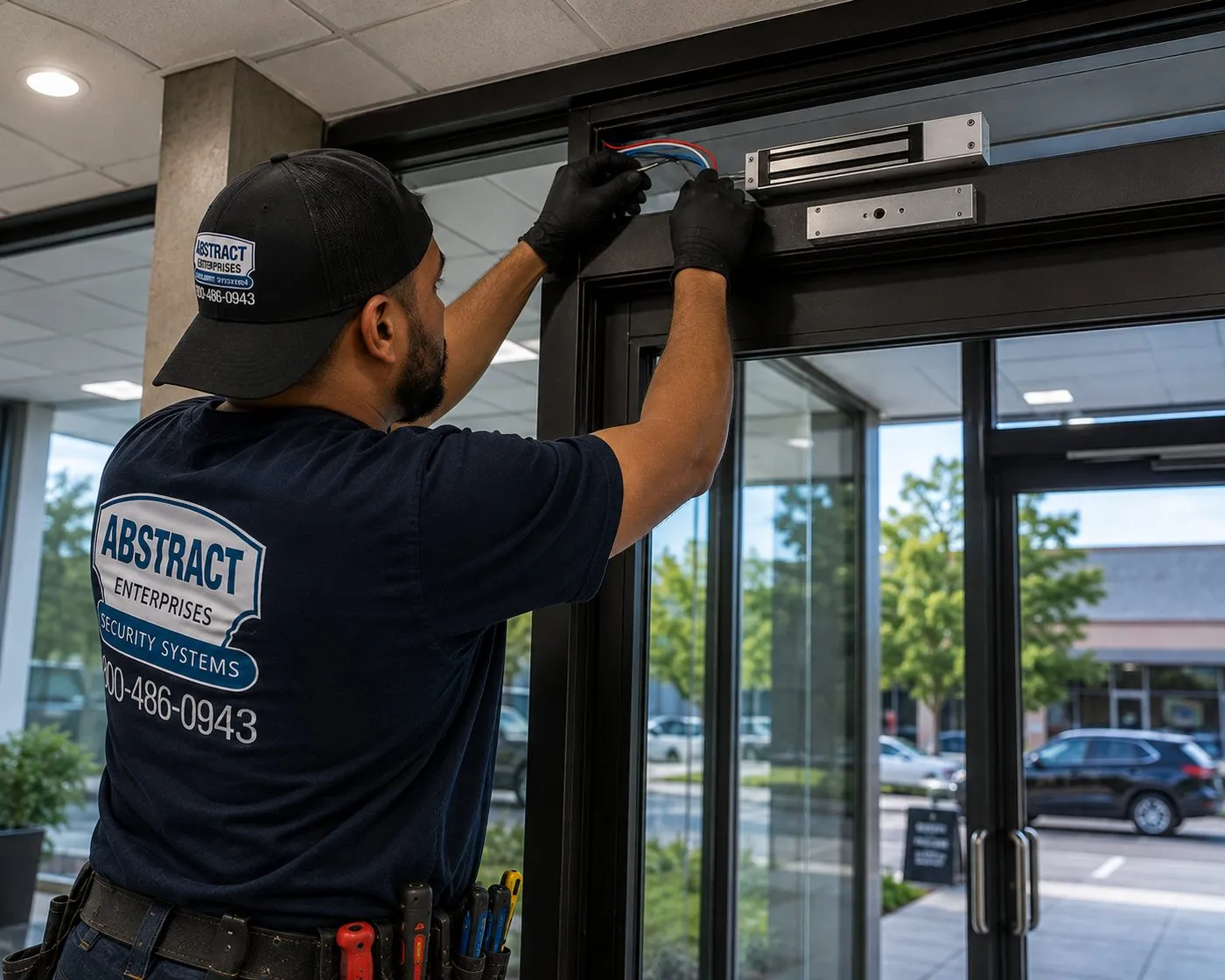
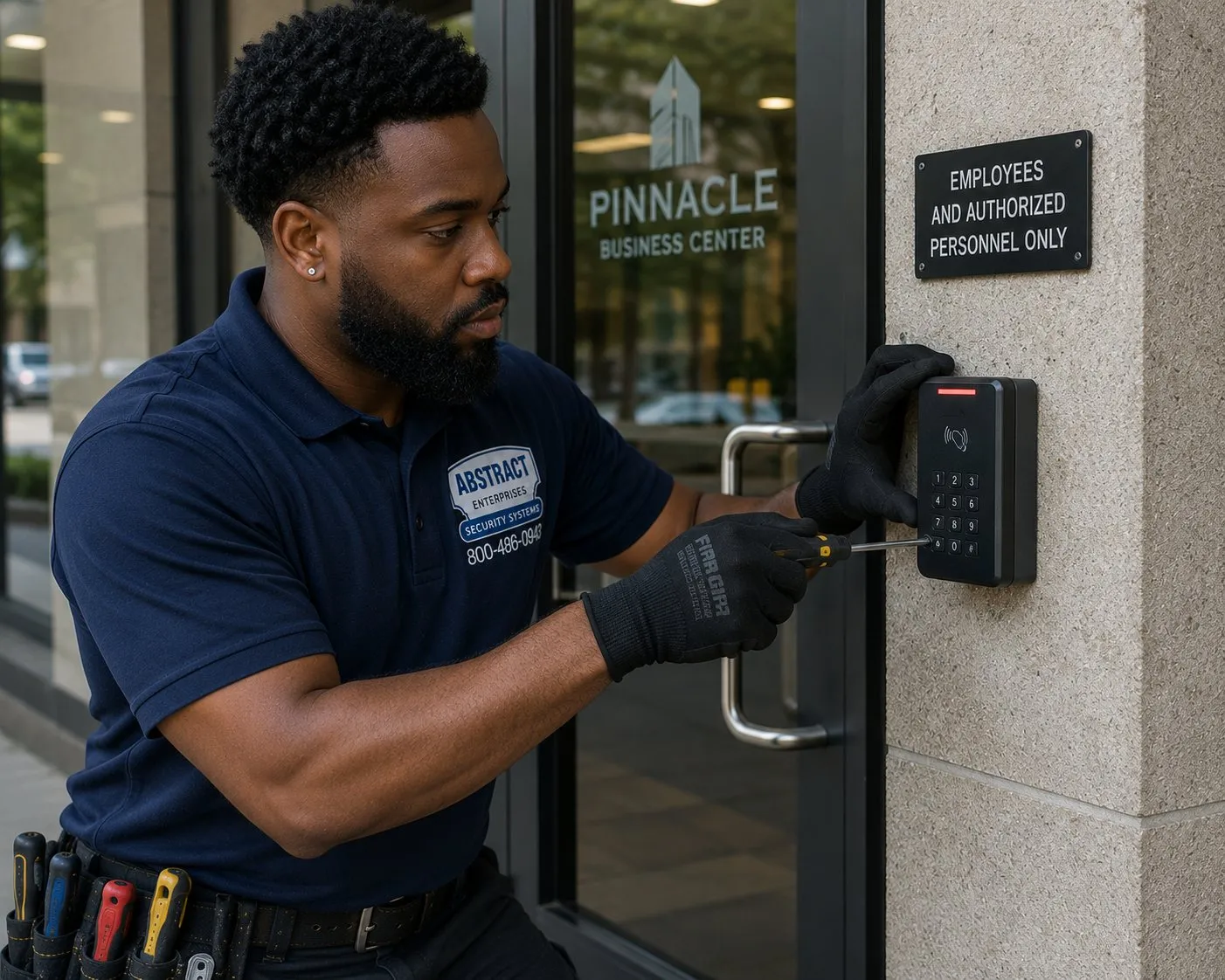
A technician reaches up to wire a magnetic lock and its armature plate on the header of a double glass storefront door; through the glass are a parking lot, cars and a low commercial building. Storefront doors like these take strikes or maglocks, not battery deadbolts.A technician in a company polo and work gloves fastens a black keypad with a proximity symbol to a stone pillar, next to an "Employees and Authorized Personnel Only" sign beside a glass office door. A keypad reader suits a staff door where some people carry cards and others prefer a code.
Nobody calls us because they want an app. They call because the keys stopped working for the way the family lives. These are the situations that most often bring a Nassau or Suffolk household to a smart lock, and what changes once one is fitted properly.
A key under the mat, the planter or the fake rock. Everyone who has ever visited knows where it is. A personal code per person replaces the hidden key and can be deleted the day it's no longer needed.
The garage door left open all afternoon. With the interior door unlocked, an open overhead door is an open house. A deadbolt that relocks itself on a timer, and a garage controller that closes the door from the app, close that gap.
Too many people with keys. Former contractors, a previous cleaner, the neighbour from three summers ago. Re-keying every lock is the old fix; deleting a code is the new one.
Children with house keys on a lanyard. A code they can't lose, and an app notification when they get home, replaces the call to ask whether they made it in.
An alarm nobody remembers to set. When locking the door with a code also arms the system, the alarm is set as often as the door is locked.
Every door on a different key. Front, side, garage and basement doors bought in different decades, each with its own key. One code that opens the doors a person is allowed to use makes the ring of keys redundant.
A summer house reached by car from the city. Codes for the caretaker, the pool service and the weekly cleaner, changed from a phone two hours away, beat a lockbox on the porch.
If one of these sounds familiar, a list of the doors and a photo of each lock is enough to start. If the honest answer for a door is a better mechanical deadbolt rather than a smart one, we'll say so.
Your Questions Answered
Smart Lock Installation on Long Island: Questions Answered
These are the questions Long Island homeowners ask once they start walking round the house counting doors. They are grouped by the decision behind them; quick questions about price, timing and policy are in the FAQ further down.
Several doors, one house
Of the five or six ways into a Long Island house, which ones actually deserve a smart lock?
Start with the doors people use, not the door the house faces. In most Long Island houses that means the side or kitchen door by the driveway and the interior door from the attached garage, then the front entry. Those are the doors that get opened with full hands, that children come home through, and that are left unlocked out of habit. A smart deadbolt on each pays its way every day.
The slider and the cellar hatch are different. A sliding door's narrow frame will not take a standard deadbolt, and an outside bulkhead is better secured from inside. Those two are usually covered with mechanical security bars or foot locks and a contact sensor on the alarm, so the system knows if they are opened. A typical colonial ends up with three smart locks and two monitored doors, and the walkthrough is where we settle which is which.
Can the door from the attached garage into the kitchen take a keypad deadbolt without breaking any rule?
Yes, with care. The model residential code requires that door to be solid wood or steel at least 1-3/8 inches thick, or a 20-minute fire-rated door, and to have a self-closing or automatic-closing device. A smart deadbolt in the standard bore does not change any of that, provided the door is not cut beyond the manufacturer's preparation and the closer still pulls it shut and latched.
Two practical points matter more than the code. First, the closer and the auto-lock have to agree: if the door is slow to latch, the lock may try to throw its bolt into a door that hasn't closed, so we adjust the closer and set the relock delay to suit. Second, garages on Long Island get hot in summer and damp in winter, so we pick a lock whose rated operating range covers the garage side of the door and fit the keypad side facing the garage, where the family arrives.
Should the side door by the driveway use the same code as the front door?
Usually yes, per person rather than per door. Most smart lock systems let one user code be valid on every lock on the account, so each family member learns one number. What changes from door to door is who else gets access: the dog walker may need the side door between 11 and 2 on weekdays, the contractor may need the garage door for two weeks, and nobody but the family needs the front.
That is easiest when every lock is the same brand and on the same app, which is one reason we plan the whole house at once even if you only buy one lock this year. Mixing brands works, but each brand keeps its own user list, and a code deleted on one lock stays live on the other unless someone remembers to delete it there too.
Alarm panels, hubs and garage doors
Will a new smart lock talk to the alarm panel already on our wall?
It depends on the panel's radio and the alarm company's plan, so the first job is to read the panel model off the keypad or the box in the basement. Many current panels include a Z-Wave radio that can enrol Z-Wave locks; Ring Alarm, for example, lets a compatible Z-Wave lock arm the system when the door is locked with a code and disarm it when the door is unlocked. Ring's own support page notes the limits: a compatible subscription is needed, and only codes created in the Ring app trigger arming and disarming.
Older panels without a home-automation radio, and some monitored systems where the dealer controls the programming, will not accept a lock at all, or only through the dealer. In those cases we either pair the lock to a separate hub and leave the alarm alone, or coordinate with the alarm company. We do not buy a lock for a panel until we have confirmed the panel will take it.
Z-Wave, Wi-Fi or Matter — which suits a house that already has a hub?
Match the lock to the hub, not the other way round. A house with an alarm panel or SmartThings or Home Assistant hub that speaks Z-Wave is best served by a Z-Wave lock; Kwikset's Z-Wave 700 locks, for example, run on four AA batteries and store 250 user codes. A house with no hub at all can use a Wi-Fi lock directly, at the cost of shorter battery life: Schlage quotes up to six months for its Wi-Fi Encode Plus, which needs a 2.4 GHz network.
Matter locks talk over Thread and need a Thread border router — Yale lists Apple TV and HomePod mini, recent Google Nest hubs, several Echo models and SmartThings hubs among them — and Yale recommends the router sit within 50 feet of the lock. Yale also notes that not every Matter app offers every lock feature, and that the lock can't run in its own app and a Matter app at the same time. For a large colonial with the router in the basement office, those distances decide more than the logo on the box.
Can the overhead garage door and the door locks be run from one app?
Sometimes, and it is worth checking before buying a garage controller. Chamberlain, whose myQ app runs many Long Island garage openers, decided in late 2023 to block unauthorised third-party apps from the myQ system, and Home Assistant removed its myQ integration that December. So a myQ opener may stay in its own app even when every lock is on one hub.
The alternatives are a garage controller that connects to the same hub as the locks, or a dealer-supported integration if the alarm company offers one. What we aim for is simple: one place to see that the overhead door is shut and the interior door is locked before bed. If that takes two apps, we tell you before you spend the money.
Older doors and house types
Our post-war door has been re-drilled for three different locks — is it still sound enough for a smart deadbolt?
Usually, once the old holes are dealt with. Doors in Capes, ranches and high ranches built in the 1950s and 1960s have often carried a knob, then a deadbolt, then a handleset, each drilled slightly differently. We fill abandoned holes in the face and edge, fit an edge plate where the old latch mortise is oversized, and re-bore at the backset the new lock needs. If the door already has a sound standard deadbolt, a retrofit model that replaces only the inside half and keeps the outside key avoids new drilling altogether.
What we look for is wood, not holes: soft or split stiles around the lock, screws that spin in the hinge side, and a door that has warped so it touches the frame. A smart lock motor magnifies every one of those. If the door is too far gone to hold a lock well, we say so; sometimes a new slab in the old frame is the better money. The heavier front doors on older North Shore homes are a different case, covered under house types above.
The storm door sits tight against the entry door — will a keypad deadbolt still fit between them?
It often fits, and it is the first thing we measure on Long Island side doors. The outside keypad of a smart deadbolt sticks out further than a plain key cylinder, and a storm door's handle or latch can land right on it when the storm door is closed. Before ordering, we close the storm door and measure the gap at the height of the deadbolt.
If the gap is too small, there are clean answers: a lower-profile keypad model, moving the storm door's handle set, or a keyless lock whose outside part is only a slim reader. And if the storm door is the one the family locks, a smart lock on it is rarely the right choice; we secure the main door and leave the storm door on a simple latch.
Shore houses, weather and outages
Does a door within sight of the Great South Bay or the ocean need a different lock finish?
It benefits from one. Salt air attacks finishes and small exposed parts first: the keypad bezel, the screws, the strike plate and the latch. Some lock makers sell finishes specifically for that environment; one maker's product page, for instance, recommends its marine-grade finish "for saltwater environments" where the lock will be exposed to the weather, describing it as resisting the corrosive elements of coastal settings.
For a bay-front or ocean-side house, we steer toward a lock and finish rated for exterior exposure, stainless screws in the strike and the trim, and a keypad on a door with an overhang rather than one facing the weather head on. A coastal finish is not a guarantee against corrosion; a yearly look at the strike and a wipe-down of the keypad are part of owning one near the water.
After a storm like Isaias knocks out PSEG Long Island for days, can we still get in?
Yes, if the lock was chosen and set up properly. Residential smart deadbolts run on their own batteries, typically four AAs, so a power cut does not stop the keypad. What a power cut does stop is the Wi-Fi router and any hub without a battery backup, which means no app access and no remote codes until the power returns. During Isaias in August 2020, almost half of PSEG Long Island's 1.1 million customers lost power at the peak, according to ABC7, and some were out for days.
So we set every lock to work locally first: codes stored in the lock, a mechanical key or override kept somewhere outside the house, and fresh batteries when we leave. If you rely on remote access, a small backup battery on the router and hub keeps the app working through a short outage.
East End and shore second homes
How should codes work for a Hamptons or North Fork house rented by the fortnight?
One code per rental, valid from check-in to check-out, created in the lock's app and never reused. In the Town of Southampton, the town's rental FAQ says any home rented for any period needs a rental permit and sets a minimum stay of 14 days; East Hampton requires rental properties to be registered and the registry number to appear in advertisements. Those rules don't say anything about locks, but they do mean a steady turnover of tenants, each of whom should get a code that dies when they leave.
Owners usually add standing codes for the cleaner and the pool or landscape service, scheduled to the days they work, and a caretaker code that is always on. We set the lock to log every entry, so if something goes missing between rentals you can see whose code opened the door and when.
Can we check the locks on a closed-up Long Island beach house from the city all winter?
Yes, as long as something in the house stays online. A Wi-Fi lock needs the router powered and connected; a Z-Wave or Matter lock needs its hub or border router powered too. Many second homes have the internet suspended for the winter, which turns a smart lock back into an ordinary keypad lock until spring.
If you want winter visibility, keep the internet and the hub on, set low-battery alerts to your phone, and give the caretaker a code. And change the batteries before closing up, not when you return: Schlage quotes up to six months for its Wi-Fi model under typical use, and a lock that has been polling the network all winter is not one to trust with dead cells.
Nassau, Suffolk, licences and price
Does whoever fits our smart locks need a Nassau or Suffolk home improvement licence?
Ask, because both counties license contractors who work on homes. Nassau County's Office of Consumer Affairs licenses contractors who perform remodelling on residential homes. In Suffolk, the Department of Labor, Licensing and Consumer Affairs runs a home improvement licence covering repairs, alterations and improvements to residential property, with a written test and insurance requirements, and offers an online search of licensed contractors. Riverhead Local reported in 2019 that unlicensed home improvement work can bring civil penalties of up to $750 for a first violation and $1,500 for each one after.
Low-voltage work is a separate credential. Abstract Enterprises holds NYS Low-Voltage License #12000287431 and carries insurance, with certificates issued free to homeowners' associations and landlords. Whoever you hire, ask for their numbers and check them on the county sites; a legitimate installer expects the question.
Why might the same lock job be priced differently in Nassau and in Suffolk?
Because travel and time on the road differ, and our area pricing reflects it. Where a published figure is scaled by area, Nassau carries a 1.15 multiplier on our Brooklyn base and Suffolk 1.20. That is why our setup-only visit is $225 for the first hour in Nassau and $250 in Suffolk, and why a single-door keypad or card reader with an electric strike, published at $1,500–$2,500 installed on our Brooklyn base, works out to $1,725–$2,875 in Nassau and $1,800–$3,000 in Suffolk.
Residential smart deadbolts are different: there is no published per-lock figure, and we quote them flat after the walkthrough, because the door prep varies more than the lock does. A new door with clean factory bores is a short job; a 1950s door with old holes to fill is not. The walkthrough is free, and the price you get is the price you pay unless something nobody could see turns up, which we explain before doing it.
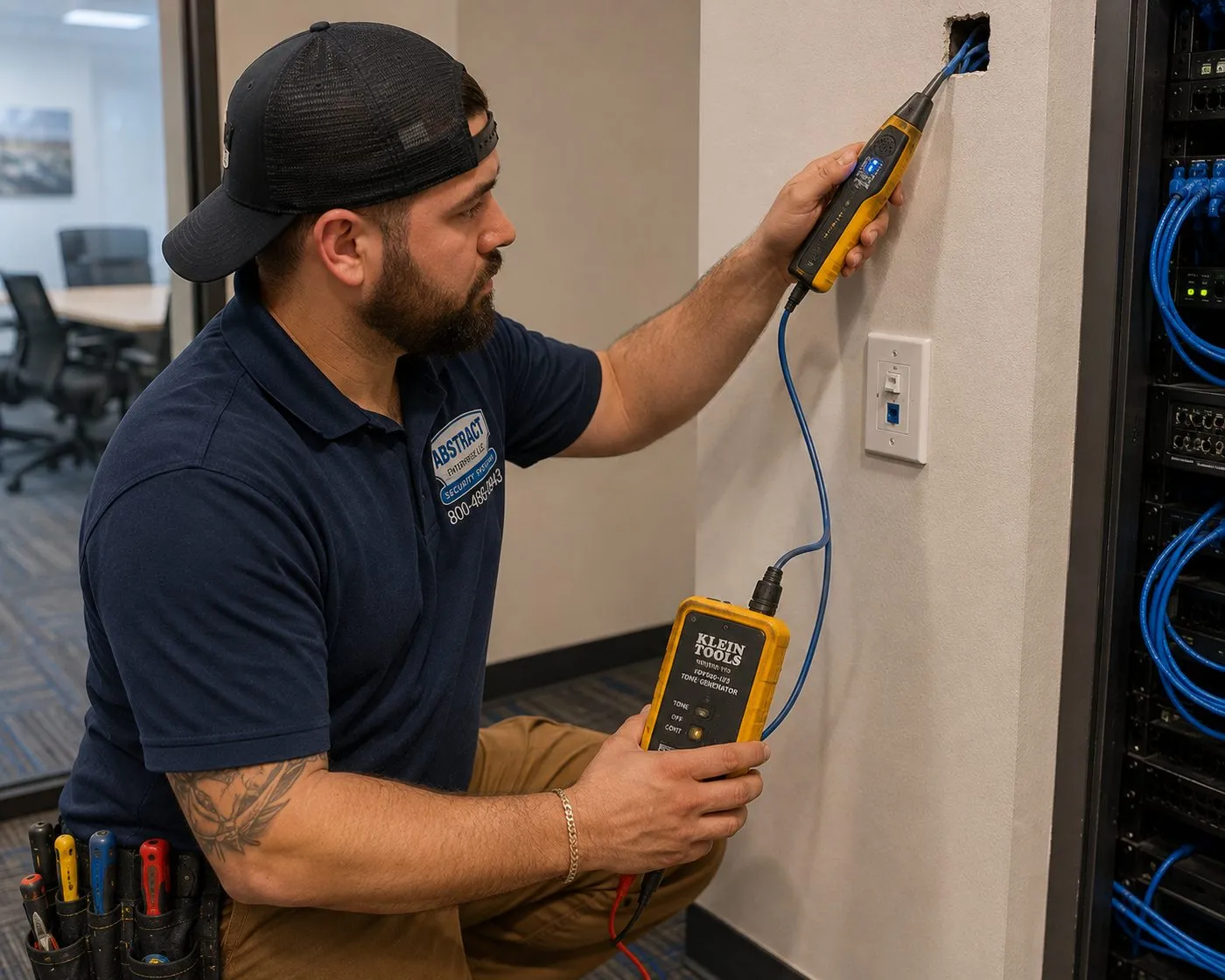
A kneeling technician holds a yellow tone generator connected to blue cable while probing a small opening high in the wall, with a network rack of blue patch cables to the right. Locks that rely on a hub or Wi-Fi are only as reliable as the network they sit on.
Equipment
Types of Smart Locks We Install
We install every major brand, and we'll say so when the lock you've picked doesn't suit the door or the hub. Specifications below are the manufacturers' published figures; ranges change every year, so we check the current model before you buy.
Keypad Deadbolts
Push-button keypads on a standard bored deadbolt, often with a backup key. The simplest upgrade for a side or garage door, and the easiest for older relatives to use.
Touchscreen Wi-Fi Deadbolts
Connect straight to the home router with no hub. Schlage's Encode Plus, for example, needs 2.4 GHz Wi-Fi, holds 100 codes, supports Apple Home Key and quotes up to six months of battery life on four AAs.
Z-Wave Locks
The natural choice where an alarm panel or hub already speaks Z-Wave. Kwikset's Z-Wave 700 models, for instance, store 250 user codes, fit doors 1-3/8 to 2 inches thick and carry BHMA Grade 2 certification.
Matter-over-Thread Locks
Work across Apple, Google, Amazon and SmartThings platforms through a Thread border router. Best where the household already owns one within about 50 feet of the door.
Retrofit Smart Locks
Replace only the inside half of an existing deadbolt and keep the outside key. Useful where the outside hardware matches a handleset the owners want to keep.
Smart Handlesets and Levers
Deadbolt and handle as one matched set for front entries, and lever trim where a knob would be hard to turn with full hands or arthritic wrists.
Smart Mortise Locks
For heavy older doors with an existing mortise pocket, common on North Shore and village homes. Fewer brands, more careful fitting, original look kept.
Garage Door Controllers
Open, close and check the overhead door remotely. Chosen to work with the same hub as the locks where the opener's maker allows it.
Door Contacts and Sensors
Contacts on sliders, cellar doors and the overhead garage door so the alarm or hub knows what's open, even on doors that don't take a smart lock.
Commercial Keypads and Readers
Wall keypads and proximity readers driving an electric strike or maglock, for offices, shops and practices with staff turnover.
How smart locks talk, in plain terms
Wi-Fi locks join the home network directly. No hub is needed, but the radio uses more power, so batteries go faster, and the lock needs a strong 2.4 GHz signal at the door. Bluetooth locks talk to a phone nearby and need a separate bridge for remote access. Z-Wave locks join a mesh run by an alarm panel or hub; they sip power and are the long-standing standard for alarm integration. Matter over Thread is the newer common language; a Thread border router relays the lock to whichever platform the household uses, with features that vary by platform.
Whatever the radio, the lock keeps working at the door if the network goes down: codes and keys are stored in the lock itself. What the network adds is remote control, alerts and logs. We test each of those from your phone, on mobile data and off the home Wi-Fi, before we leave.
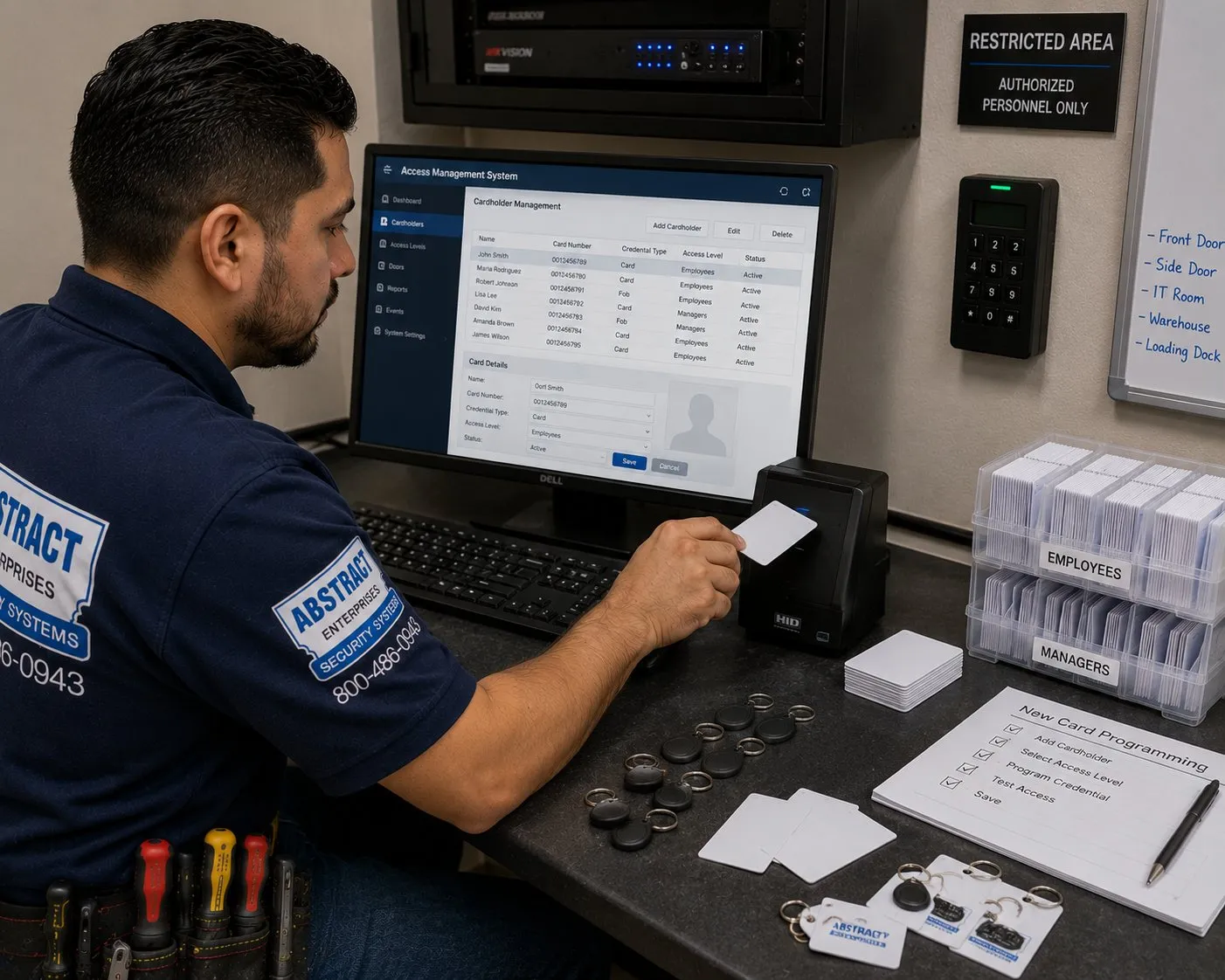
A technician taps a white card on a desktop enrollment reader in front of a monitor showing a cardholder list, with key fobs, blank cards and boxes labelled "Employees" and "Managers" on the desk and a keypad reader on the wall behind. Whether it's a fob or a code, every user gets set up before handover.
Plain-English Glossary
Smart Lock Terms You Will See on a Box or a Quote
Backset. The distance from the door's edge to the centre of the bore hole, usually 2-3/8 or 2-3/4 inches. Most residential smart deadbolts adjust to either.
Cross bore and edge bore. The large hole through the face of the door (typically 2-1/8 inches) and the smaller hole into its edge (typically 1 inch) that a bored lock fits into.
Strike and strike pocket. The metal plate on the frame and the hole behind it that the bolt throws into. A shallow pocket is the most common reason a smart lock stalls.
Bolt throw. How far the bolt extends, typically one inch on a deadbolt. A lock that can't complete its throw will report a jam.
Mortise lock. A lock body set into a rectangular pocket cut into the door's edge, common on older and heavier doors.
Retrofit lock. A smart unit that replaces only the interior part of an existing deadbolt.
Auto-lock. A setting that throws the bolt a set time after the door closes. Useful on garage-to-house and side doors.
Z-Wave. A low-power mesh radio used by many alarm panels and hubs to control locks, lights and sensors.
Matter and Thread. Matter is a shared language for smart-home devices across platforms; Thread is the low-power mesh network a Matter lock usually rides on.
Thread border router. The device, often a smart speaker, streaming box or hub, that connects Thread devices to the home network.
BHMA / ANSI grade. Industry ratings for security and durability. Schlage's Encode Plus, for example, lists ANSI/BHMA A156.40 Grade AAA.
Electric strike. A frame-mounted strike that releases on a signal from a keypad or reader, used mostly on commercial doors.
Self-closing device. A closer or spring hinge that returns a door to the closed position; required on garage-to-house doors under the model residential code.
AI Overview Reality Check
What AI Gets Wrong About Smart Lock Installation on Long Island
We could not read Google's AI Overview from our research environment, so we haven't invented its wording. What follows takes claims that national cost guides and product makers actually publish — the figures AI summaries tend to repeat — and checks them against how smart lock jobs go in Long Island houses.
"A smart lock costs $250 to $400 installed"
That is Fixr's national range, updated January 2025, with a national average of $300. LawnStarter's 2025 guide puts the national average at $330 and the typical range at $200 to $460. Both are national third-party figures, and both describe one lock on one door.
A Long Island house rarely stops at one door. The useful number is the cost of the doors the family actually uses — often the side door, the garage door and the front — plus whatever the old doors need before a lock will throw cleanly. That is why we quote residential smart deadbolts flat after a free walkthrough rather than per lock from a chart.
When comparing quotes, ask how many doors are included, whether door prep is, and whether pairing to the alarm or hub is. A low per-lock price often covers the lock and nothing else.
"Installation labour is only $50 to $100"
Fixr lists installation at $50 to $100, and LawnStarter's labour range is $50 to $110. For a new door with clean factory bores and a lock straight out of the box, that is a fair description of the screwdriver time.
It leaves out the parts that decide whether the lock works in a year: filling and re-boring an old door, deepening the strike pocket, re-hanging a door that has sagged, adjusting a garage-door closer so the bolt doesn't fire early, and enrolling the lock on an alarm panel. On a post-war Long Island door, those can take longer than the lock itself.
Skipping them is how a lock ends up grinding, draining batteries and jamming halfway — the call we get most often about smart locks someone else fitted.
"Any smart lock works with your alarm system"
Summaries often present alarm integration as a feature of the lock. It is a feature of the panel. Ring's support page, for example, describes arming and disarming with a compatible Z-Wave lock, but requires a compatible subscription and works only with codes created in the Ring app.
Plenty of Long Island houses have alarm panels installed years ago by a dealer, some without a Z-Wave radio and some programmed so only the dealer can add devices. A Wi-Fi lock bought for one of those houses will never arm the alarm, however good the lock is.
The fix is to read the panel model first. We do that at the walkthrough and recommend a lock the panel will accept, or a separate hub if it won't.
"Matter means the lock works with everything"
Matter does let one lock work across platforms, and that is real progress. Yale's own Matter FAQ is more careful than the marketing: the lock needs a Thread border router, ideally within 50 feet; not every platform offers every lock feature; and the lock can't be run from Yale's app and a Matter app at the same time.
In a large Suffolk colonial with the router in a basement office at the far end of the house, the 50-foot guidance matters. So does knowing that one platform may support custom entry codes while another supports only remote lock and unlock.
We check the border router's location and the platform the household uses before recommending a Matter lock over a Z-Wave or Wi-Fi one.
"Smart locks are a 15-minute DIY job"
On a modern door with standard bores, many are. Manufacturers design them for that, and their door prep specifications — Schlage's typical 1-3/8 to 1-3/4 inch door thickness and 2-3/8 or 2-3/4 inch backset — match most doors sold today.
Long Island's housing stock is old enough that many doors don't match. Doors replaced in the 1970s, re-hung in the 1990s and painted ever since have bores in odd places, soft wood around old screw holes, and frames that have moved. A smart lock is a motor pushing a bolt; any friction the old door adds shows up as a jam.
If your door is new and square, fit it yourself and call us for the alarm pairing. If it isn't, the door prep is the job.
"A smart lock won't work in a power outage"
This one is backwards. Residential smart deadbolts run on their own batteries — four AAs in both the Schlage and Kwikset models above — so a power cut doesn't touch the keypad. Codes are stored in the lock.
What goes down is everything around the lock: the router, the hub and the app. Long Island knows outages well; during Tropical Storm Isaias almost half of PSEG Long Island's 1.1 million customers lost power at the peak.
The practical rule is to keep a mechanical key or override outside the house, replace batteries on a schedule rather than when the lock complains, and put the router and hub on a small backup battery if remote access matters to you.
"A smart lock replaces your locksmith"
For lost keys and re-keying after staff or contractors leave, it largely does: you delete a code instead. Long Island Redditors make the same point — one r/longisland thread about finding a locksmith in Suffolk includes the reply "Smart locks aren't anything you need a locksmith for".
But a smart lock that is badly fitted or left with dead batteries and no key can turn into exactly the locksmith call it was meant to prevent. A post in the r/Locksmith forum from a Long Island homeowner discusses a locksmith's charge for drilling out a smart lock and replacing the deadbolt.
Fit it properly, keep the override, and set low-battery alerts to a phone someone actually checks. That is how a smart lock really does keep the locksmith away.
Every Door Counted, Every Code Planned
Send a list of the doors, a photo of each lock and the alarm or hub you own. We'll tell you which doors need a smart lock and what the whole house costs.
Tell us the doors, the locks you like and the system in the house. We reply the same business day, or call us at (800) 486-0943.
✅
We Got Your Request!
We'll call you back the same business day. If it's urgent, call us now at (800) 486-0943.
How It Works
Our Installation Process
Six steps, whether it is one keypad on a side door in Wantagh or five doors and an alarm panel in Dix Hills. Most houses are finished in one visit.
1. Count the doors
Call, text or use the form with the doors you want covered, photos of the current locks, and the alarm panel or hub in the house. We tell you what we need to see in person.
2. Free walkthrough
We measure every door — thickness, bore, backset, strike, storm-door clearance — read the panel or hub model, and check Wi-Fi or Thread coverage at each door. You get a flat price for the whole house.
3. Prepare the doors
Old holes filled, bores corrected, strike pockets deepened, reinforced strikes fitted and sagging doors adjusted so each bolt throws freely before any motor is involved.
4. Fit and calibrate
Locks mounted, door handing set, auto-lock delays tuned to each door's closer, and the bolt cycled repeatedly with the door open and closed.
5. Pair and program
Locks enrolled on the alarm panel, hub or app; one code per person; schedules for cleaners and contractors; alerts set; garage controller linked where the opener allows.
6. Handover
Every household member tries their code on every door. We show you how to add and delete users, where the override key lives, and how to change batteries.
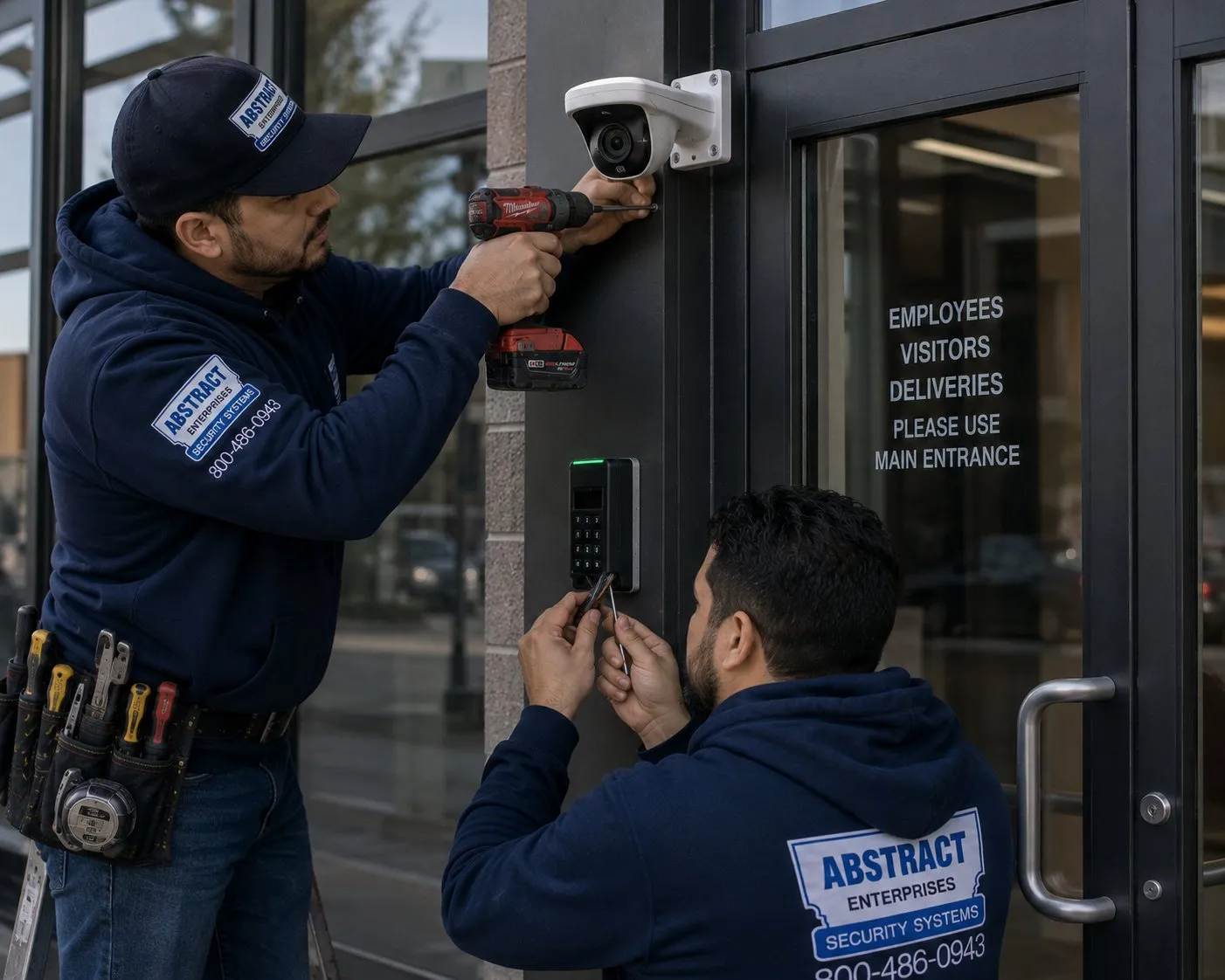
One technician drills a camera bracket above a glass entrance while a second, crouching, wires a keypad reader with a green light on the same wall; a sign on the door directs employees, visitors and deliveries to the main entrance. Lock and camera on one door, planned together.
Coverage Area
Smart Lock Installation Near Long Island's Landmarks
Long Islanders give directions by landmarks, so here are ours. We fit smart locks in the houses and businesses around every one of them, from the Queens line to the lighthouse.
UBS Arena, Elmont
The Islanders' arena at 2400 Hempstead Turnpike, opened in November 2021. The residential streets of Elmont, Franklin Square and Floral Park surround it.
Roosevelt Field, East Garden City
Opened in 1956 on the airfield Charles Lindbergh flew from in 1927, now 243 stores on Old Country Road. Homes in Garden City, Westbury and Carle Place surround it.
Levittown, Town of Hempstead
The 17,447 houses Levitt & Sons built between 1947 and 1951, many expanded or altered since. Doors here have usually been replaced, and the bores rarely match the last lock.
Jones Beach State Park, Wantagh
Opened in 1929 with six and a half miles of ocean beach. The South Shore towns behind it, Seaford to Massapequa, live with salt air on every exterior door.
Stony Brook University, Brookhaven
Founded in 1957, with more than 27,000 students in fall 2025. Homes in Setauket, Stony Brook and Port Jefferson around the campus range from older village houses to newer colonials.
Montauk Point Light, Montauk
Authorised under George Washington in 1792 and finished in 1796, at the island's eastern tip. The East End from here to the Shinnecock Canal is second-home country, where locks are managed from a distance.
We also serve Hempstead, Valley Stream, Rockville Centre, Freeport, Long Beach, Merrick, Massapequa, Hicksville, Syosset, Great Neck, Manhasset, Port Washington, Glen Cove, Huntington, Commack, Babylon, Bay Shore, Islip, Smithtown, Ronkonkoma, Patchogue, Riverhead, the Hamptons and the North Fork, and every community between them. The same crews cover smart lock installation in NYC and the Hudson Valley smart lock installation service.
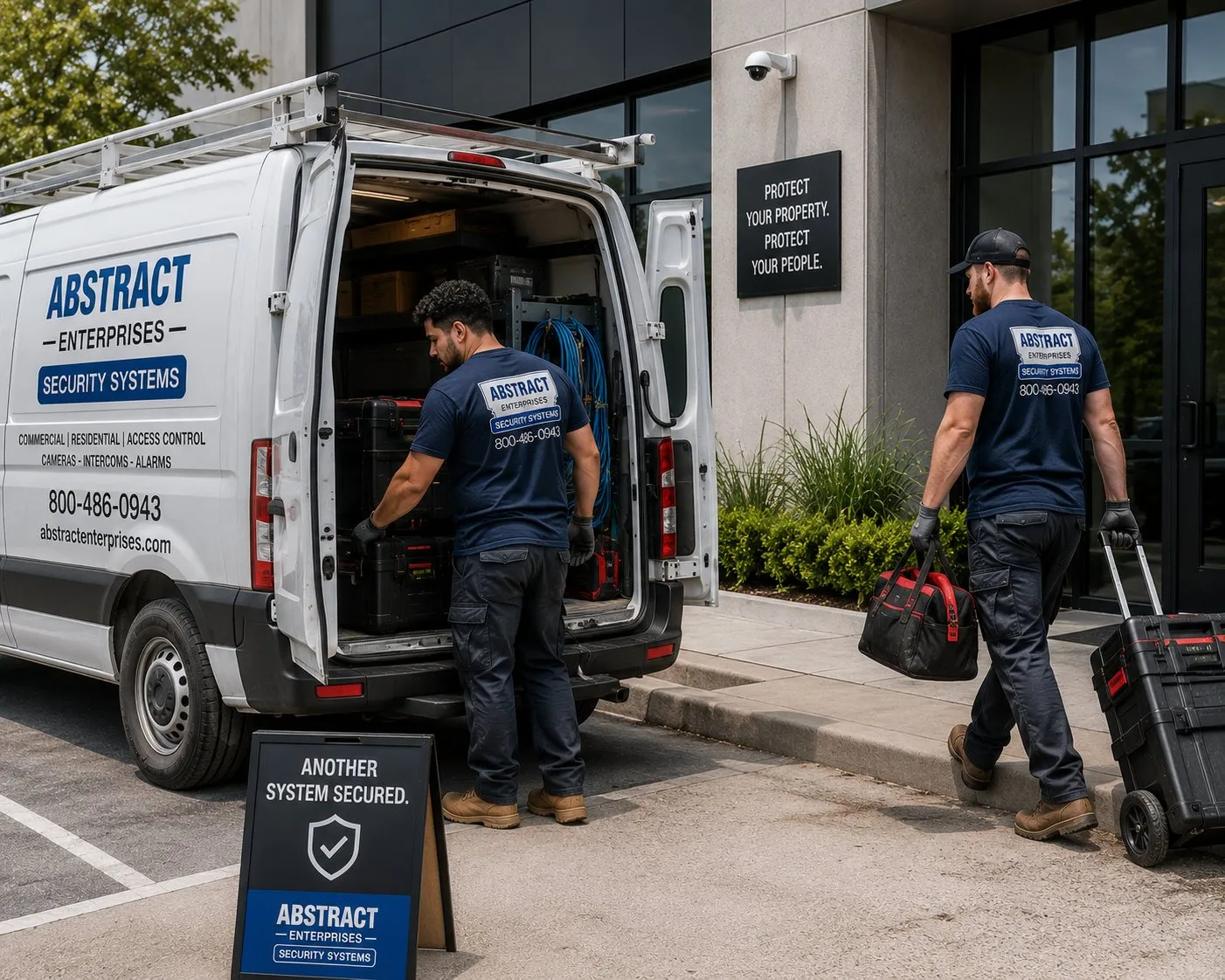
One technician reaches into the back of a white company van stacked with cases and cable reels while another wheels a rolling tool case and a bag toward a building entrance. The van carries fill kits, strikes and spare batteries so most houses are finished in one visit.
Pricing
Smart Lock Installation Cost on Long Island
We publish the figures we have, and we say plainly where we don't. There is no per-lock list price for residential smart deadbolts: the door prep varies too much from house to house. Those are quoted flat after a free walkthrough. Commercial keypads and readers, service calls and setup-only visits do have published figures, shown below with Nassau and Suffolk area pricing applied where the figure is area-scaled.
Item
Nassau
Suffolk
Notes
Residential smart deadbolt, any door
Flat quote at walkthrough
Flat quote at walkthrough
Includes door prep, fitting, pairing and user setup as quoted
Single-door keypad or card reader with electric strike
$1,725–$2,875
$1,800–$3,000
Published $1,500–$2,500 installed on our Brooklyn base, ×1.15 Nassau / ×1.20 Suffolk
New electric strike on an existing door
$288–$518
$300–$540
Published $250–$450 base, area-scaled
Failed electric strike repair
$339–$558
$354–$582
Published $295–$485 base, area-scaled
Setup-only visit (app, hub, pairing, no hardware fitted)
$225 first hour
$250 first hour
Then billed in 30-minute blocks
Service call or callback after the job
$195/hr, 3-hr minimum ($585)
Not charged on the initial install
Certificate of insurance
Free
Free
For HOAs, landlords and property managers
What national guides say a smart lock costs
For a sense of scale, national third-party cost guides put one smart lock, installed, at $250 to $400 with a $300 national average (Fixr, updated January 2025), or $200 to $460 with a $330 national average (LawnStarter, 2025). Fixr lists the lock alone at $100 to $250 for a keypad model and $250 to $400 for a Z-Wave model. These are national averages for a single door and are not AESS prices; they are here so you can sanity-check any quote, including ours.
What moves a residential quote up or down
Number of doors. Three locks on one visit cost less per door than three separate visits.
Door condition. Factory-bored modern doors are quick; old doors with filled holes, wrong backsets or a mortise pocket take longer.
Who supplies the lock. We can supply it, or fit one you have bought, provided it suits the door.
Integration. Pairing to a Z-Wave alarm panel or hub, setting up a Matter border router, or linking a garage controller adds time.
Exposure. Coastal finishes and stainless fittings for shore houses cost a little more than standard hardware.
Distance. Area pricing on our published figures is 1.15× in Nassau and 1.20× in Suffolk over the Brooklyn base.
What the price includes, and what it doesn't
Included: measuring and preparing each quoted door, fitting and calibrating the lock, pairing it to the app, hub or panel quoted, setting up every user, and a walk-round test of every code on every door.
Not included: electrical work of any kind (new outlets and circuits are for an electrician), new doors or frames, painting, and alarm-company fees or subscriptions.
Later service: callbacks after the job are $195/hr with a 3-hr minimum ($585); simple app or pairing visits are billed at the setup-only rate instead.
National brand versus a local installer. ADT, Ring and SimpliSafe sell systems that can include smart locks, and their locks work well inside their own ecosystems. What they don't do is re-bore a 1950s door, adjust a garage-door closer or decide which of five doors needs a lock. A local licensed low-voltage contractor does the door work, pairs the lock to whatever system you already have — including theirs — and answers to you directly.
Building a Whole-House Quote
How a Multi-Door Smart Lock Quote Comes Together
Most Long Island quotes cover two to four doors, and the arithmetic is the walkthrough, not a chart. This is what we look at, in the order we look at it, so you know what the price is built from.
Door
What we check
Typical outcome
Side or kitchen door
Bore, backset, strike depth, storm-door clearance
Keypad deadbolt with auto-lock; most-used door
Garage-to-house door
Door type and rating label, closer action, garage temperature
Keypad deadbolt on a short relock timer
Front entry
Handleset style, sidelights, door weight, existing mortise lock
Matching smart handleset or deadbolt; sometimes a retrofit
Back slider
Frame profile, track condition
Mechanical bar or foot lock plus a contact sensor
Cellar hatch or bulkhead
Inside latch, frame
Secured from inside, contact sensor on the alarm
Overhead garage door
Opener brand and app, hub compatibility
Smart controller where it can share the locks' app
Then we look at the system: the alarm panel model and whether it has a home-automation radio, any hub already in the house, where the router sits, and whether a Matter lock would have a Thread border router close enough. The quote lists every door and every pairing, with one flat total.
For a business, the order is different: we start with the door hardware the landlord allows, the power available for an electric strike, and how many users need access on what schedule. Single-door keypads and readers use the published, area-scaled figures in the table above.
Shop Our Systems
Smart Lock Installation Packages & Pricing
Three common starting points. Residential packages are quoted flat at the free walkthrough because doors differ; the business package uses our published, area-scaled access-control figure.
Starter — One Busy Door
Quoted at walkthrough
One keypad or touchscreen deadbolt on the side, kitchen or garage-to-house door. Door prep, reinforced strike, auto-lock tuned to the door, app setup and a code for everyone in the house.
Standard — Whole-House Code Plan
Quoted at walkthrough
Smart locks on the two to four doors the household uses, one brand and one app, one code per person on every door, scheduled codes for cleaners or walkers, and pairing to the alarm panel or hub where it supports locks.
Business — Keypad or Reader on a Strike
$1,725–$3,000
Single-door keypad or card reader with electric strike, installed: $1,725–$2,875 in Nassau and $1,800–$3,000 in Suffolk, from our published $1,500–$2,500 base. Staff codes or credentials programmed, free egress kept.
Bring Your Own Lock — Labour Only
Already bought a smart lock? We fit customer-supplied locks for a labour-only price quoted at the walkthrough, after checking that the lock suits the door, the backset and the system you want it paired to. Customer-supplied locks carry their manufacturer's warranty rather than ours.
Need the alarm or doorbell done on the same visit? We quote it alongside the locks. A lock that just needs re-pairing after a router change? That is a setup-only visit, $225 for the first hour in Nassau and $250 in Suffolk.
Ready to Walk the House?
The walkthrough is free and the quote is flat. Photos of the doors and the panel get us halfway there before we arrive.
How Smart Lock Work Differs Across the Two Counties
Nassau County. Older, denser and more uniform housing. The western half is post-war: Levittown and the Capes, ranches and high ranches around it, with doors replaced and re-bored over the decades. Lots are smaller, so the side door is often a few steps from the driveway and the garage is frequently detached or tucked under a high ranch. North Shore villages add heavier, older front doors with mortise locks and sidelights. Door prep is the main variable here, and setup-only visits are $225 for the first hour.
Western and central Suffolk. From Huntington and Babylon east through Smithtown, Islip and Brookhaven, houses are newer on average, with two-car attached garages, interior garage entries, mudrooms and back sliders common. These are the four- and five-door houses where a whole-house code plan makes the most sense, and where an alarm panel with a Z-Wave radio is often already on the wall. Doors are more likely to have factory bores, so the time goes into integration rather than carpentry. Setup-only visits are $250 for the first hour.
The East End and the North Fork. Second homes, summer rentals and caretaker arrangements. The lock is chosen for remote management, code scheduling and battery alerts, and the network that supports it matters as much as the door. Under Southampton Town's rental rules, the minimum stay is 14 days; in East Hampton, rental properties must be registered and the registry number shown in advertisements. Each rental is another set of codes to issue and revoke.
The South Shore bays and barrier communities. Long Beach, the bay side of the Five Towns, Freeport, Massapequa and the Great South Bay shoreline: raised houses, stairs to exposed entries, and salt air on every exterior fitting. We steer toward exterior-rated finishes and stainless screws, and toward doors with some shelter for the keypad.
The Garage Entry
Securing the Door Between the Garage and the House
If we could put a smart lock on only one door in a typical Suffolk or Nassau house, it would often be this one. The overhead garage door is opened by a remote that lives in the car, and cars live in the driveway. The interior door is the one families leave unlocked because they think of the garage as inside. Long Island police have described exactly that sequence in burglaries: in Hauppauge in 2016, Suffolk police said a thief took remotes from unlocked cars, opened the garages and walked in through unlocked interior doors, and the advice was to always lock the door between the garage and the house.
Relock automatically. A deadbolt that throws itself 30 seconds to a few minutes after the door closes removes the habit problem. We set the delay to suit the door's closer so the bolt never fires into an open door.
Keypad facing the garage. The family arrives on the garage side, so that is where the keypad goes, with the thumb-turn inside the house.
Keep the closer and the rating. The model residential code requires a solid or rated door with a self-closing or automatic-closing device here. We fit the lock in the standard bore and leave the closer working.
Watch the overhead door too. A tilt or contact sensor on the overhead door, or a smart garage controller, tells you if it was left open. Where the opener's maker blocks third-party apps, as Chamberlain did with myQ in 2023, we say so before you buy.
Remotes out of the car. Nassau police gave the same advice after the 2026 East Hills break-in: take garage door openers out of cars left in the driveway. A keypad on the garage side means fewer people need a remote at all.
Temperature. Attached garages are unheated. We check the lock's published operating range for the garage-facing side; Schlage, for example, lists -31°F to 150.8°F for the outside of its Encode Plus.
The same thinking applies to the lower-level door in a high ranch that opens beside the garage, and to the mudroom door many colonials have off the driveway: frequent use, full hands, and a habit of leaving it unlocked.
Second Homes and Rentals
Running Smart Locks on an East End or Shore Second Home
Setting up for the season
Put fresh batteries in every lock in spring, even if the app shows them above half. Confirm the router and any hub came back online after the winter, and that every lock reports in. Delete last year's tenant and guest codes, and re-issue standing codes for the cleaner, the pool service and the caretaker on this year's schedules. If the internet provider changed or the router was replaced, re-pair before the first guests arrive rather than on their first evening.
During the season
Create each rental's code with start and end dates, so it works from check-in and stops at check-out without anyone remembering to delete it. Keep the entry log on; it is the quickest way to answer a question about who was in the house and when. Leave the override key with the caretaker, not in a lockbox on the porch.
Closing up
Decide whether the house stays online. If the internet is suspended, the locks still work locally with codes, but remote access and alerts stop. If it stays on, set low-battery alerts to a phone someone checks in January. Either way, leave a working code with the caretaker and a key or override somewhere they can reach.
When something stops working
A lock that won't report in after a winter is almost always a network change or flat batteries. A setup-only visit — $250 for the first hour in Suffolk — covers re-pairing locks, the hub and the garage controller; book it for the week before you arrive.
Before You Call
A Short Door-by-Door Checklist for Long Island Homeowners
Ten minutes with this list gets you an accurate quote on the first call.
Which doors. Walk the house and list every exterior door and the garage-to-house door. Mark the ones the family uses daily.
A photo of each lock, inside and out. Deadbolt, knob, handleset or mortise lock, and whether there is a storm door in front.
The door edge. A photo of the edge of the door with it open shows the latch plate and any old filled holes.
The alarm panel. The model name on the keypad or the box in the basement or closet, and the alarm company if it's monitored.
Any hub or smart speaker. SmartThings, Home Assistant, Apple TV or HomePod, Google Nest, Echo — and roughly where it sits.
The garage opener. The brand and whether it already has an app.
Where the router is. Basement, office or living room, and whether Wi-Fi reaches the side and garage doors.
Who needs access. Family members, regular helpers, contractors and, for second homes, tenants.
Living with a smart lock, in plain terms
Change batteries on a schedule rather than waiting for the warning; a lock on a busy side door works harder than one on a front door used twice a week. Keep the mechanical key or override somewhere outside the house, not in a kitchen drawer. Give each person their own code, so you can delete one without changing everyone's. Review the user list twice a year and remove anyone who no longer needs access. And if the bolt starts to sound strained, call before it jams: a door that has moved with the seasons usually needs a strike adjustment, not a new lock.
Fixing Earlier Installs
Common Problems With Smart Locks Someone Else Installed
Plenty of Nassau and Suffolk homeowners call us about a lock that is already hanging on a door, fitted by a relative, a handyman or themselves. The same seven complaints come up again and again, and nearly all of them trace back to the door rather than the electronics.
Bolt stalls halfway. The strike pocket is too shallow or the door has dropped, so the motor hits resistance. We deepen the pocket, adjust the strike or re-hang the door.
Batteries die in weeks. Usually the same friction problem, or a Wi-Fi lock struggling with a weak signal at the door.
Auto-lock fires into an open door. The relock delay is shorter than the time the closer takes. We retune both.
Lock won't arm the alarm. The lock was paired to its own app, not the panel, or the code was created outside the alarm app. We re-enrol it properly where the panel allows.
Two apps, two user lists. Mixed brands with codes deleted on one lock but still live on another. We consolidate or document who has access where.
Keypad blocked by the storm door. The storm door handle presses on the keypad when closed. A different handle or a slimmer lock fixes it.
Garage controller never linked. The opener's maker restricts third-party apps. We set expectations and offer a compatible alternative.
Re-pairing and app problems are handled on a setup-only visit, $225 for the first hour in Nassau and $250 in Suffolk; door and strike work is quoted at the visit.
Complete Services
Every Smart Lock Installation Service on Long Island
A smart lock is usually one part of securing a house or a business. These are the Long Island services most often booked alongside it.
Send the details for any service and get a written price the same business day.
Field Notes
Field Notes From Long Island Side Doors
The three checks our technicians run before a smart lock goes on a Long Island door (general practice, no single customer)
The first check happens with the old lock still in. We close the door, throw the existing deadbolt by hand and feel it. If it drags, scrapes or needs the door pushed to line up, a motor will have the same trouble, only it will drain the batteries trying. So the door gets fixed first: hinge screws tightened or lengthened into the framing, the strike moved or its pocket deepened, until the bolt slides home with a finger.
The second check is the storm door and the swing. On side doors especially, we close the storm door and measure what's left between it and the keypad, and we watch the door close on its own if it has a closer. A keypad that fits on paper but gets nudged by a storm door handle every time will fail in a season.
The third check is the signal. Standing at the door with a phone, we look at what the lock will actually see: Wi-Fi strength for a Wi-Fi lock, distance to the hub or border router for Z-Wave and Matter. In a long colonial with the router in the far corner of the basement, that test decides the lock more than any feature list.
FAQ
Long Island Smart Lock Installation FAQ
Is the walkthrough for a Long Island smart lock quote really free?
+
Yes. We visit, measure every door you want covered, read the alarm panel or hub model and check the signal at each door, then give you one flat price for the whole house. There is no charge for the visit and no obligation to book.
Does someone need to be home for the whole installation?
+
Someone needs to let us in, be there at the start to confirm which doors are being done, and be back for the handover so every household member can try their code. In between, an adult who can answer questions about the alarm and Wi-Fi is enough. For second homes, a caretaker with the app logins can stand in for the owner.
Should the smart locks go in before or after the alarm company replaces our panel?
+
After, if the panel swap is already booked. Locks are enrolled on the panel's radio, so a new panel means enrolling them again. If the swap is months away, we can fit the locks now on their own app or a hub and move them onto the new panel when it arrives, on a setup-only visit.
Do you cover the North Fork, the Hamptons and Montauk as well as Nassau?
+
Yes. We work across both counties, from the Queens line in Nassau to Orient and Montauk. Appointments run in two-hour arrival windows; for the far East End, booking a few days ahead gives you the widest choice of times, especially in spring when second homes are opening.
Will our existing house keys still work after the smart locks go in?
+
Not on the new deadbolts, which come with their own keys or overrides, unless we fit a retrofit model that keeps your existing outside cylinder. Knob or handleset latches that stay in place keep their old keys. We can usually key new locks alike so one key fits every smart lock in the house as a backup.
What do we need to have ready on installation day?
+
Clear access to each door inside and out, the Wi-Fi name and password, the login for the alarm or hub app, and the phones of anyone who will use the locks so we can set them up. If the alarm is monitored, let the alarm company know we are coming so a test doesn't trigger a dispatch.
Can you remove the old locks and patch the holes they leave?
+
We remove the old hardware and fill holes in the door edge and face that the new lock needs to cover or use, with fill kits and edge plates where they are needed. Painting and cosmetic patching of the door or frame beyond what the new hardware covers are not included.
Is there a charge if you come back to adjust a lock later?
+
Service calls after the job are billed at $195/hr with a 3-hr minimum ($585); that rate is not charged on the initial install. Simple app, code or re-pairing help with no hardware work is booked as a setup-only visit instead, $225 for the first hour in Nassau and $250 in Suffolk.
Can the keypad be read at night on an unlit side or garage door?
+
Most keypad and touchscreen smart deadbolts light their numbers when touched, so they can be used in the dark. We check that on the model you choose, and where the household wants more, a porch or garage light can be set to come on when a code is entered through the hub or home automation system.
What happens to the codes and the app account when we sell the house?
+
Before closing, delete every user code, remove the locks from your app account and, where the lock has one, run its factory reset so the buyer starts clean. Leave the mechanical keys or overrides and the manuals. If the locks are enrolled on an alarm panel that stays with the house, the buyer's alarm company re-enrols them. We can do the handover on a setup-only visit.
Can a Long Island office or shop get keypads on several doors at once?
+
Yes. A single door with a keypad or reader and an electric strike is $1,725–$2,875 installed in Nassau and $1,800–$3,000 in Suffolk; several doors are quoted together after a site visit, and larger systems with schedules and audit trails are handled by our access control team.
All Areas Served
Smart Lock Installation Across Long Island and New York
This is the Long Island hub for our smart lock installation service. Dedicated pages for Nassau and Suffolk counties are being added; until each one is live, its link goes to our quote form, and the same crews cover both counties today.
A lock that won't throw, a keypad that stays dark after new batteries, or a lock that dropped off the alarm? Ring (800) 486-0943. Same-day when a two-hour window is open; most battery, strike and pairing faults are fixed in one to two hours once we are at the door.
Smart Lock Installation Long Island — Licensed, Insured, Quoted Flat
Abstract Enterprises Security Systems · 1282 Troy Ave, Brooklyn, NY 11203 · (800) 486-0943 · WhatsApp (718) 679-0359 via wa.me
NYS Low-Voltage Licence #12000287431 · 100% Licensed & Insured · Same-Day Estimates · Rated 4.7★ from 201 Google Reviews
Full terms — including 50% deposit, one-year parts-only warranty on AESS-supplied products, and the late-fee schedule — are set out in the service agreement. See our warranty page.
Reviewed and updated October 17, 2026. Changelog: new page — smart lock installation for Nassau and Suffolk homes, second homes and small businesses.