Licensed Low-Voltage Contractor · Westchester to Ulster · Second Homes, Rentals & Outbuildings
Smart Lock Installation in the Hudson Valley
Keypad Deadbolts · Guest Codes · Wi-Fi Bridges · Z-Wave & Thread · Barn & Garage Doors · Electric Strikes
Smart locks fitted and set up for the way property actually works north of the city: weekend houses you check on from an app two hours away, rentals that turn over guests every few days, barns and detached garages a long walk from the router, and old doors that were never made for a modern deadbolt. We pick the lock and the radio for the distance and the winter, install it so the bolt throws cleanly in January, and leave you able to add and cancel codes without driving up.
Reviewed and updated October 17, 2026 · Written by Anwar Timothy, NYS licence #12000287431
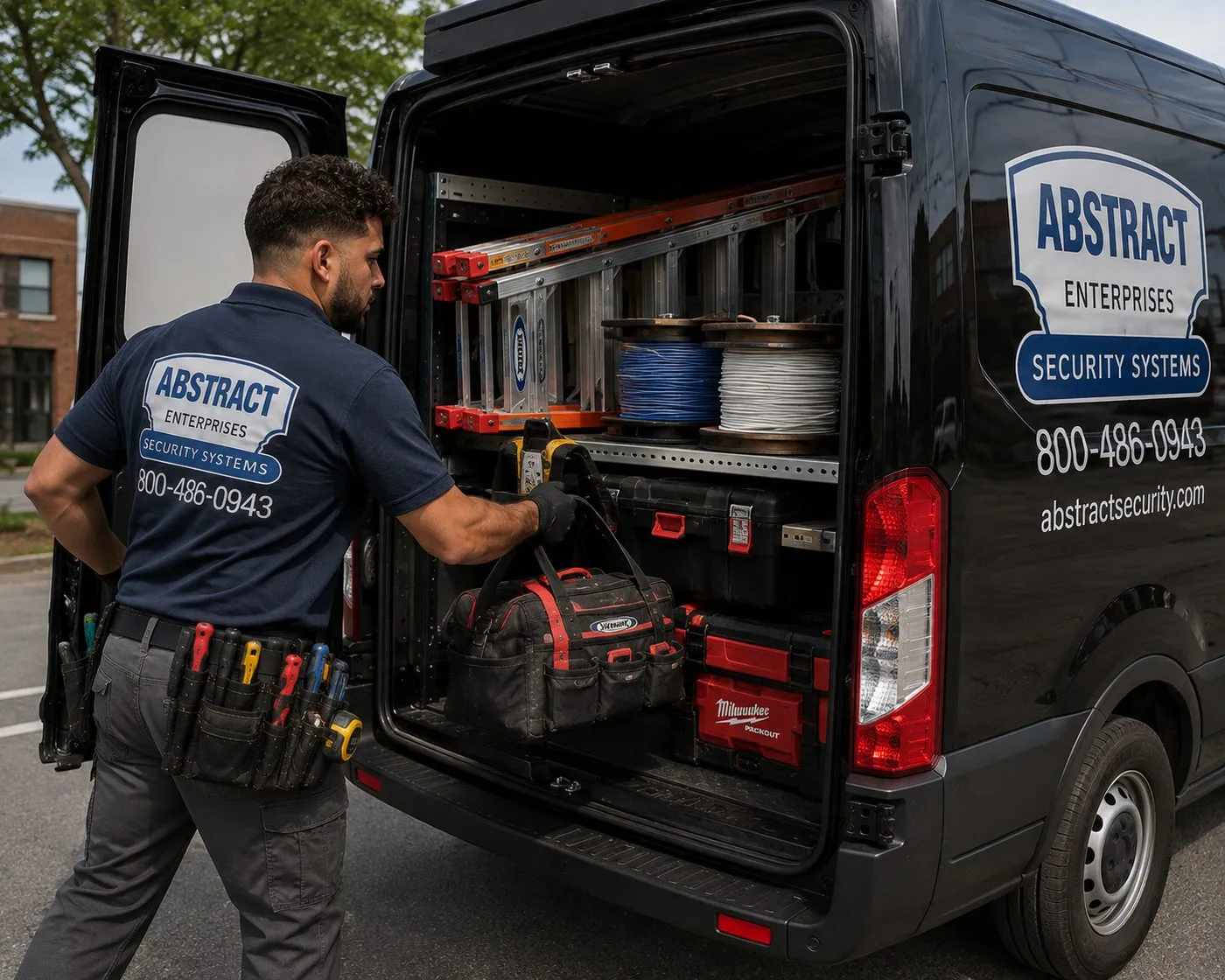
A technician pulls a tool bag from a black service van racked with ladders, cable reels and tool cases — on a long drive up the valley, what is loaded before leaving decides whether the lock goes in on the first visit.
Get a Free Smart Lock Quote
Tell us the town, the door and how you manage the property — we call back the same business day
✅
Request Sent!
We'll call you back the same business day.
25+
Years Experience
✓
Same-Day Estimates
100%
Licensed & Insured
4.7★
201 Google Reviews
Not sure which lock suits a door you can only see on weekends? Call (800) 486-0943 or use the 60-second quote form with a photo of the door edge and the lock. A licensed technician reads it and tells you what the door, the distance and the winter will ask of it.
Locks matched to the radio that actually reaches your door, not just the one on the box
Two-hour arrival windows, 8 AM to 8 PM, seven days a week — far-valley visits grouped by area
NYS licence #12000287431 · insured, certificate of insurance free on request
Why Hudson Valley Properties Need Professional Smart Lock Installation
In the Hudson Valley a smart lock is rarely about convenience at your own front door. It is about controlling a door you are not standing next to. The typical call we get from north of the city line is not "I want to stop carrying keys". It is "the house is ninety minutes from where we live and the cleaner needs to get in on Thursday", or "we rent the cottage out and I am tired of lockboxes", or "the barn has the tractor and the tools in it and I want to know when it is opened". Those are remote-management problems, and the lock is only one part of the answer. The other parts are distance, radio range, power, winter and the door itself — and each of those behaves differently up here than in a city apartment or a suburban colonial.
Start with distance. Properties in Putnam, northern Dutchess and Ulster are spread out: the house sits back from the road, the detached garage is across the driveway, the barn or the guest cottage is further still. A Bluetooth lock that works perfectly when you are standing in front of it is invisible to the app once you are more than a few rooms away. Manufacturers say so plainly. August, for example, recommends placing its Connect Wi-Fi bridge within 10 to 15 feet of the lock, and notes the bridge only joins a 2.4 GHz network. Put that same lock on a barn door two hundred feet from the router and it simply never reports in. Choosing between Wi-Fi, a bridge, Z-Wave, Thread or a lock that does not need a network at all is the first decision on most valley jobs, and the wrong choice is the most common reason a smart lock "doesn't work" here.
Then there is the short-term rental market, which is real and regulated. The Ulster County Comptroller's 2025 report counted 2,827 housing units operating as short-term rentals as of May 2025 — 3.28 percent of all housing in the county — with Shandaken at 9.76 percent and Woodstock, Gardiner and Denning also above 7 percent. The same report says at least 16 Ulster municipalities have adopted some form of short-term rental regulation, and New York's new state law requires counties to keep a short-term rental registry unless they opt out. For hosts that means guest access is now something to document, not just a code taped to the fridge. A properly set-up smart lock gives every guest a unique code that starts and ends with the booking, and leaves a record of when the door was used.
Winter is the third difference. Smart locks are battery-powered machines bolted to the coldest surface in the house. At the National Weather Service's Poughkeepsie station, 2022 recorded 134 days with a minimum temperature at or below freezing and a low of −3°F on January 30. Lock makers publish operating ranges for exactly this reason: Schlage rates the outside of its Encode Wi-Fi deadbolt from −31°F to 150.8°F but the inside body only down to 14°F, and Yale rates the outside of the Assure Lock 2 to −22°F and the inside to 5°F. That inside figure is the one that matters in an unheated mudroom, a three-season porch or a barn. Cold also slows battery chemistry, and a deadbolt that drags because the door has shrunk or frozen makes the motor work harder and drains the cells faster.
The last difference is the doors. The valley is full of houses built long before the 2-3/8-inch backset and the 1-3/4-inch door became standard: Dutch stone houses with thick plank doors, Victorians with mortise locks, farmhouses whose doors have been planed and re-hung for a century. Many modern smart deadbolts list a narrow range of door thicknesses — Schlage's Encode lists 1-3/8 to 1-3/4 inches — and assume a bored hole that an antique door does not have. Fitting a smart lock to a door like that without damaging it is carpentry and judgment first, electronics second. We are a licensed low-voltage contractor; the locks, readers, strikes, bridges and hubs are our trade, and we tell you on the first call when a door needs a carpenter or a locksmith before it needs us.
Hudson Valley facts that shape a smart lock install
2,827 short-term rentals: housing units operating as STRs in Ulster County in May 2025, 3.28 percent of all housing, with a monthly peak of 3,310 in October 2023 (Ulster County Comptroller, Short-Term Rental Report 2025).
At least 16: Ulster County municipalities that have adopted some form of short-term rental regulation, according to the same report.
134 days: days in 2022 with a minimum at or below 32°F at the Poughkeepsie climate station, including 3 days at or below 0°F (National Weather Service Albany annual climate summary).
5°F and 14°F: the published lowest operating temperatures for the inside body of the Yale Assure Lock 2 and the Schlage Encode Wi-Fi deadbolt respectively — the half of the lock that sits in an unheated porch or barn.
10 to 15 feet: how close August recommends its Connect Wi-Fi bridge sit to the lock it serves — a distance that rules out reaching a barn or detached garage from the house router.
Nearly 1,300: unserved homes, businesses and community facilities in remote parts of Ulster County covered by a $20.8 million New York ConnectALL broadband award announced in September 2025 — a reminder that some valley doors still have no reliable internet behind them.
Most owners who put a smart lock on a weekend house or rental end up wanting the gate, the barn and an outside camera on the same plan. Our access control installation in the Hudson Valley covers keypads and readers with electric strikes, driveway gates and multi-door systems, and the Hudson Valley doorbell camera team can put a camera on the same door the lock is on.
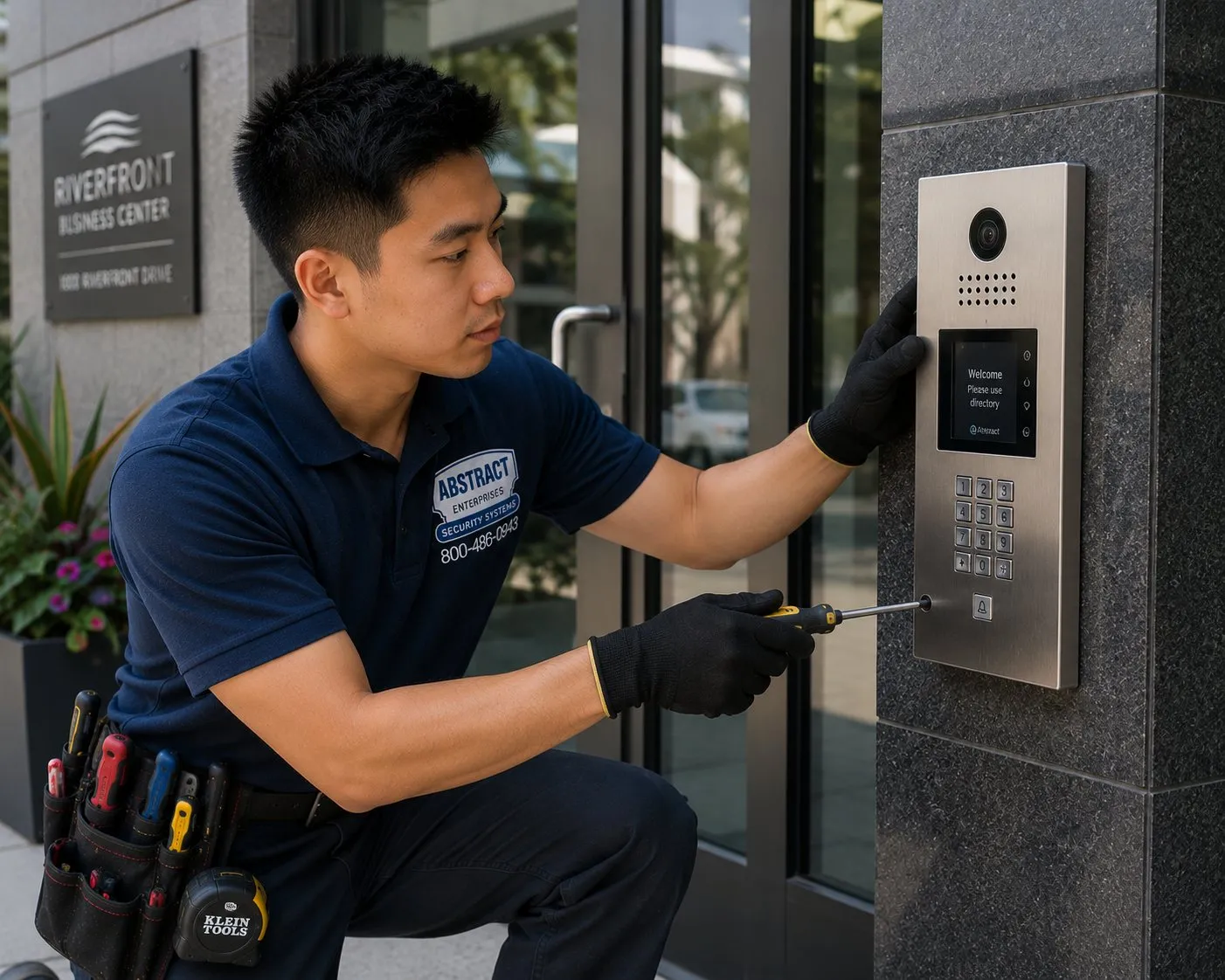
A technician in gloves drives the screws of a stainless keypad entry panel into a polished stone pillar next to a glass door — on masonry, the fixing and the cable path are planned before anything is drilled.
Repair Capture
Smart Lock Offline or Jammed at a Hudson Valley Property?
A lock that has dropped off the app, a keypad that lights up but will not throw the bolt, a guest code that stopped working mid-stay or a motor that grinds after a cold snap is usually a battery, alignment, bridge or settings fault rather than a dead lock. Most of these are found and fixed within one to two hours once a technician is at the door, on a setup-only visit billed at the published county rate. Call (800) 486-0943, tell us the town and the lock model, and say whether anyone is at the property — and keep a physical key or backup entry method with a neighbour or caretaker until it is sorted.
What We Install
Smart Lock Installation Services in the Hudson Valley
Every job below ends the same way: the bolt throws cleanly by hand and by motor, the lock reports to the app from wherever you are, and you have tested adding and deleting a code yourself before we leave.
Smart Deadbolts on the Main Door
Keypad, touchscreen and app-controlled deadbolts fitted to the house's main entry, with the strike and door alignment corrected so the motor isn't fighting the frame. We check thickness and backset before ordering, so the lock suits the door rather than the other way round.
Second-Home and Rental Guest Access
Locks set up for owners who manage from a distance: scheduled codes for guests, cleaners and contractors, automatic expiry, entry history, and low-battery alerts sent to the person who can actually do something about them.
Barn, Garage and Outbuilding Doors
Locks for detached garages, workshops, pole barns, pool houses and guest cottages, where the door may be wood, steel or sliding and the nearest outlet and router are a long way off. Battery, hard-wired and keypad-only options, chosen for the door.
Wi-Fi Bridges, Hubs and Range Extension
Getting the signal to the door: a bridge placed close to the lock, a Z-Wave or Thread hub that reaches further, a wired or point-to-point network link out to an outbuilding, or a lock that works without any network at all.
Old, Thick and Mortise-Lock Doors
Retrofit locks that keep the original exterior hardware, adapters for mortise locks, and honest advice when a historic door is better left with its key and the smart lock goes on a less important door.
Keypads and Readers With Electric Strikes
For offices, studios, tasting-room back doors and storage rooms: a keypad or card reader wired to an electric strike, with a power supply, a request-to-exit and a schedule — the step up when a battery deadbolt isn't enough.
Smart Home and Alarm Integration
Pairing the lock with the hub or alarm panel you already have so that unlocking can disarm, a door left unlocked can be closed from the app, and lights come on when a guest arrives after dark.
Programming and Setup-Only Visits
Already have the lock on the door? We connect it to the app and the bridge, set up user codes and schedules, update the firmware and show you how to manage it, billed by the published county hourly rate.
Fixing a Smart Lock Someone Else Installed
Locks that drain batteries in weeks, drop offline every night, jam in winter or were fitted to a door they don't suit. We find the cause, correct the door or the radio, and explain what was wrong.
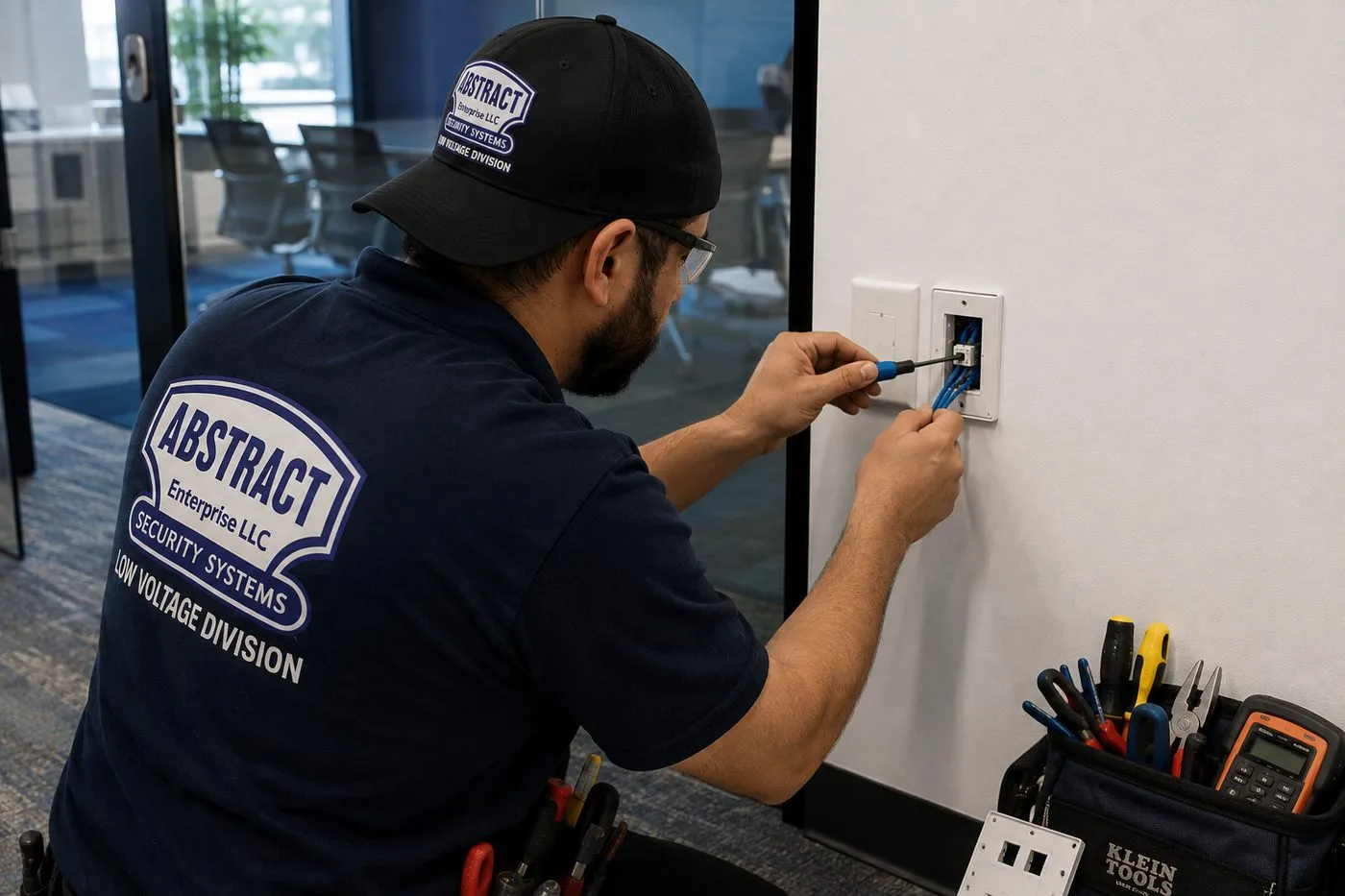
A technician terminates a cable into a wall plate next to a switch, with a meter and hand tools in the bag at his feet — the kind of wired point we add where a hub or bridge needs a dependable network connection near the door.
Building Specialists
Smart Lock Installation for Hudson Valley Architecture
A smart deadbolt that drops straight into a 1990s fibreglass door can take an afternoon of careful fitting on an 1840s plank door. These are the property types we see most between the Westchester line and the Catskill foothills, and what each one asks of a smart lock.
Farmhouses and Victorians
Front doors that are thick, heavy and often hung with a mortise lock or an old rim lock rather than a bored deadbolt. Frames have moved over a century, so a bolt that lines up in August can bind in February. The fit-up is as important as the lock.
Colonial and Dutch Stone Houses
The oldest houses in Ulster and Dutchess, with plank doors set in thick masonry walls. Many owners want the original hardware left alone; an interior retrofit lock or a smart lock on a secondary door usually serves better than drilling a historic door.
Lake Houses, Cabins and Weekend Places
Putnam lake cottages, mountain houses and second homes that sit empty for weeks, often with the heat turned down. Locks here need cold-rated electronics on both sides, reliable remote alerts and a backup way in that doesn't depend on the internet.
Post-War Ranches, Splits and Colonials
Standard pre-bored doors and frames across Rockland, Westchester and Orange — the easiest doors in the valley for a smart deadbolt. The work here is usually the garage entry door and the basement walk-out as much as the front door.
Barns, Detached Garages and Outbuildings
Sliding barn doors, overhead garage doors with a single walk-in door beside them, steel workshop doors and pool-house doors. Distance from the router, no power at the door and big temperature swings drive every decision.
Townhouse Communities and New Construction
Newer developments around Orange and Dutchess commuter towns, often under an HOA with rules on what can appear on the exterior. Doors are standard, but the association's rules and the builder's hardware finish are worth checking first.
Methods and materials by door type
Thick antique doors. We measure the door at the lock position, not at the edge, because old doors are often thicker in the middle stile than at the edge where they have been planed. If the thickness is outside the lock's listed range, we look for a model or extension kit that covers it before we drill anything. Yale, for example, lists the Assure Lock 2 for doors from 1-3/8 to 2-1/4 inches, a wider span than many competitors. Where the door has no bored hole, the new bore is placed so it clears the old mortise pocket and doesn't weaken the stile.
Mortise and rim locks. A standard smart deadbolt replaces a bored cylinder deadbolt; it does not replace a mortise lock. For mortise doors there are retrofit options that sit on the inside and turn the existing thumbturn — August introduced a mortise adapter kit for exactly that purpose in 2017 — and full mortise-format electronic locks. On a rim lock, the honest answer is often to leave it and add a smart deadbolt elsewhere on the door or on a different entrance.
Doors that move with the seasons. Wood doors swell in humid summers and shrink in dry winters. A smart deadbolt's motor can push a bolt that is perfectly aligned; it struggles with one that rubs on the strike. We adjust the strike, deepen the bolt hole where needed and check the bolt by hand with the door pushed and pulled, so the lock throws freely in both seasons. If the door itself needs planing or re-hanging, that is carpentry, and we say so.
Steel and fibreglass outbuilding doors. Pre-bored commercial-style steel doors on workshops and garages take smart deadbolts and keypad levers well. Thin hollow-metal doors may need a reinforcing plate. Sliding barn doors don't take a deadbolt at all; they take a hasp, a keyed padlock or a purpose-made sliding-door lock, and the smart part of the plan often moves to a walk-in door beside the slider.
Masonry surrounds. Where a keypad, bridge or hub has to sit on stone or brick — a gate pillar, a stone porch wall — we use masonry anchors set in sound stone rather than mortar joints, and plan any cable path so we are not chasing channels into historic masonry.
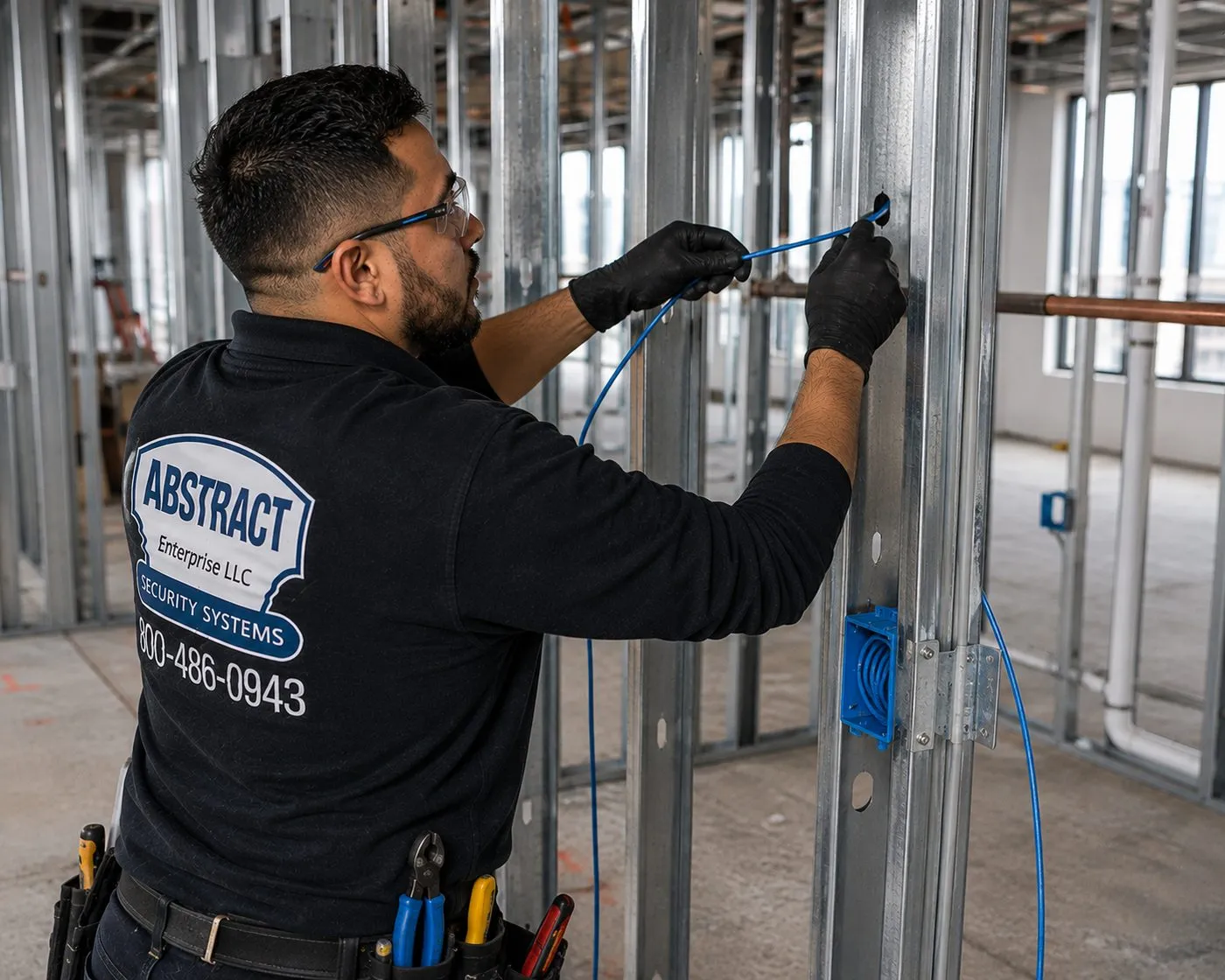
A technician feeds blue cable through the framing of an open wall toward a low-voltage box — when walls are open during a renovation, it is the moment to run cable to a door that may later need a hub, reader or strike.
Owners who fix up an older valley house often add a smart thermostat, leak sensors and lighting scenes after the lock, so the whole place can be checked from one app. Our home automation installation in the Hudson Valley picks up from the lock and builds the rest of the system on the same hub.
Commercial Smart Lock Installation
Business Smart Lock Installation in the Hudson Valley
Small businesses in the valley often sit in the gap between a house key and a full access control system: a suite of offices, a studio, a tasting room with a stock room behind it. These are the settings where we see that work most and what each usually needs.
Westchester Office Parks Along I-287
Suites in the office buildings around White Plains, Harrison, Purchase, Rye Brook, Elmsford and Tarrytown, where a tenant wants code or credential entry on its own suite door without touching the landlord's base-building system. The lease and the building manager decide what can go on the door.
Route 59 and Rockland Retail Strips
Shops and professional offices along Route 59 through Nanuet, Spring Valley and West Nyack, with a front door that the owner opens and a rear service door that staff and deliveries use. The back door is usually where a keypad and a schedule earn their keep.
Newburgh, Route 300 and the Stewart Area
Flex space, contractors' yards and small warehouses around the I-84 and I-87 interchanges, where steel doors, roll-ups and a lot of people with keys make credential-based entry and an entry log worth having.
Poughkeepsie and the Route 9 Corridor
Medical and professional offices, small clinics and service businesses from Poughkeepsie down through Wappingers and Fishkill, where staff come and go on shifts and an audit trail of who opened which door matters.
Kingston, Beacon and the River-Town Main Streets
Galleries, studios, cafés and shops in older brick and stone buildings, often with apartments above. Old commercial doors, glass storefronts and shared hallways make hardware choice and the building owner's permission the first questions.
Farm Wineries, Breweries and Tasting Rooms
Barns and agricultural buildings across Orange, Dutchess and Ulster where the public tasting area and the production or bonded storage space share walls. A keypad or reader with a schedule keeps the back rooms closed during open hours without handing out keys.
Compliance callouts for commercial smart lock work
Free egress. Any door on an exit route must still open from the inside without a key, a code or special knowledge. Smart deadbolts keep a thumbturn on the inside; electric strikes and magnetic locks are wired with a request-to-exit and fail-safe or fail-secure behaviour chosen for that door. We check before we specify.
Fire-rated doors and frames. Drilling or adding hardware to a labelled fire door can affect its rating. Hardware on those doors has to be listed for fire doors, and we flag it rather than improvise.
Accessible hardware. On public-facing doors we specify lever or push-pull hardware a person can operate without tight grasping or twisting, and keypads mounted at a height a seated person can reach.
Landlord and building approval. Tenants in office parks and mixed-use buildings usually need written approval for anything fixed to a door or frame; we can supply product sheets and a certificate of insurance naming the landlord.
No high-voltage electrical work. Power supplies for strikes are plugged into existing receptacles or connected by a licensed electrician; we coordinate with yours.
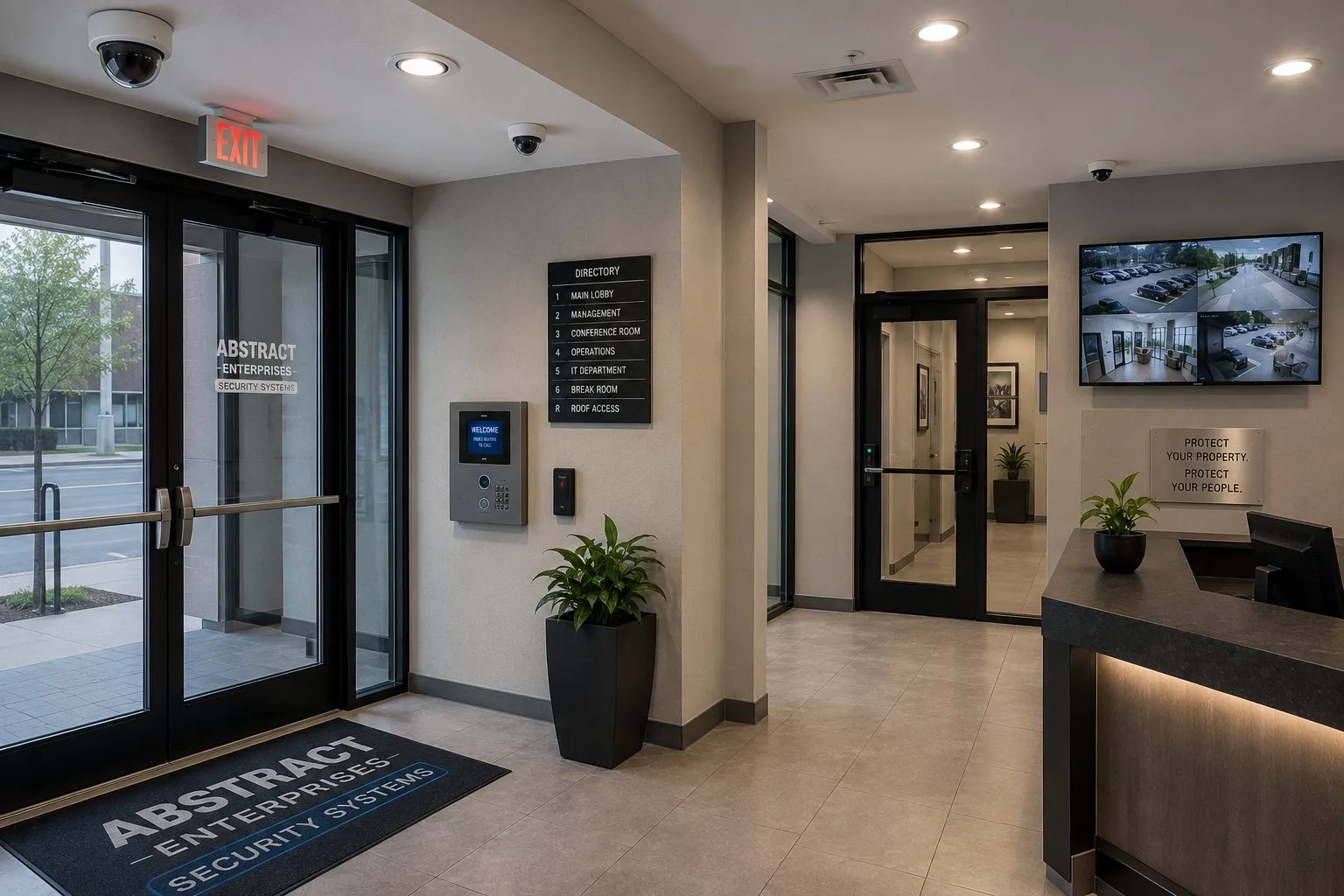
An office lobby with double glass doors, an entry panel on the wall beside an inner door, dome cameras in the ceiling and a reception desk — the point where a small business usually moves from smart deadbolts to readers and strikes.
County by County
Six Counties, Six Different Smart Lock Jobs
The Hudson Valley is six housing markets and six sets of county rules, and a smart lock job changes as you move north. This is what we tend to find in each, how each county handles contractor licensing as far as we have been able to confirm from county sources, and what a setup-only visit costs there.
Westchester. The densest of the six, with everything from pre-war Tudors and river-village Victorians to office suites along I-287. The usual residential job is a smart deadbolt on the main door plus the garage entry, often tied into an existing alarm. Westchester's Department of Consumer Protection says county law requires all home improvement contractors working in Westchester to be licensed, and tells residents to ask to see the licence and look for the green sticker the county issues for contractors' vehicles. Single-door keypad or reader installs with an electric strike run $1,875 to $3,125 here, and a setup-only visit is $235 for the first hour.
Rockland. Raised ranches, split-levels and colonials across Clarkstown, Orangetown and Ramapo, river-front homes in Nyack and Piermont, and small businesses along Route 59. Rockland's Office of Consumer Protection licenses home improvement contractors under Chapter 286 of the Laws of Rockland County, and its licence classifications include a "Locksmiths" category covering locks, security gates, home safes and security screens, as well as a low-voltage category. Single-door keypad or reader work with a strike runs $1,950 to $3,250; setup-only visits are $235 for the first hour.
Orange. Historic Newburgh and Goshen, large newer subdivisions around Monroe, Chester and Middletown, and the commercial ground around Stewart and the I-84/I-87 interchange. New-construction doors are straightforward; the commercial flex space and the farm and estate properties toward the county's rural edges are where range and outbuildings come in. Single-door keypad or reader work with a strike runs $2,100 to $3,500; setup-only visits are $250 for the first hour. We have not confirmed a county-level home improvement licence for Orange from a county source, so we tell customers to check with their town building department.
Putnam. Lake houses around Mahopac, Lake Carmel and the Putnam Valley lakes, older homes in Cold Spring and Garrison along the river, and a good number of weekend and seasonal places. Putnam's county code, Chapter 135, requires anyone running a home improvement business in the county to be registered with the Department of Consumer Affairs. Cold, empty-house winters make battery and alert planning the main event here. Single-door keypad or reader work with a strike runs $2,175 to $3,625; setup-only visits are $250 for the first hour.
Dutchess. Farmhouses, Victorians and estate properties from Rhinebeck and Red Hook to Millbrook and Pawling, Beacon's converted industrial buildings and Poughkeepsie's mix of city and suburban stock. Long driveways, outbuildings and horse barns are common, and so are old doors. Dutchess towns have been writing their own short-term rental rules — the Town of Pleasant Valley's short-term rental law went through state environmental review notice in June 2025. Single-door keypad or reader work with a strike runs $2,295 to $3,825; setup-only visits are $275 for the first hour.
Ulster. Kingston's stone houses and historic districts, New Paltz, Woodstock, Saugerties, Gardiner and the mountain towns toward the Catskills — the county whose comptroller has measured its short-term rental market most closely, and where some doors are still a long way from reliable internet. Guest-code management, offline backup entry and cold-rated hardware are the core of most Ulster jobs. Single-door keypad or reader work with a strike runs $2,295 to $3,825; setup-only visits are $275 for the first hour. As with Orange and Dutchess, we confirm the licensing position with the town for each job.
County licensing notes above are drawn from the counties' own published pages and forms and are general information, not legal advice. Requirements can differ by town, village and scope of work; confirm with the municipality before work is scheduled, and ask every bidder — including us — which licence they hold and who issued it.
Your Questions Answered
Smart Lock Installation in the Hudson Valley: Questions Answered
Remote houses, rentals, winter, distance, old doors, outbuildings and county rules: each cluster below takes one Hudson Valley problem and answers it in the first lines. Short price and booking questions are in the FAQ near the bottom of the page.
Second homes and rentals managed from a distance
We live two hours away from our Ulster or Dutchess rental — what has to be in place before guest codes can be run reliably from the city?
From the lock's app, once the lock can reach the internet — and the "once" is the part that needs planning. A Wi-Fi lock, or a Bluetooth lock paired with a bridge close to the door, lets you create a code on your phone in Manhattan or Brooklyn and have it active at the door in Woodstock or Rhinebeck within moments. The good apps let a code be scheduled: it starts at check-in time on the arrival day, stops at checkout, and expires on its own if you forget. Each guest, cleaner and contractor gets their own code, so cancelling one never affects the others and the entry history shows whose code opened the door.
If you list on a booking platform, many hosts link the lock to the platform or to a property-management tool so codes are created from the reservation automatically. That is worth doing, but we set up the manual method first and make sure you can do it yourself, because integrations break when apps update and you still need to be able to let a guest in on a Saturday night.
Two habits make remote code management reliable. Use a lock that reports its battery level and sends you an alert well before it dies, and keep a non-electronic way in — a key with a trusted neighbour or caretaker, or a keyed cylinder you can reach — for the day the lock, the Wi-Fi and your phone don't agree. On a rental, we also turn off any feature that lets a guest's code change settings, and set the lock to re-lock itself after a set time so a door left on the latch doesn't stay open all week.
Does New York's new short-term rental registry change how I should run guest access?
It changes the paperwork more than the lock, but it is a good reason to tidy up how access works. Under the state's short-term rental law, as amended by Chapter 99 of the Laws of 2025, counties keep a registry unless they opt out, booking platforms must verify registration before they take bookings, and hosts self-attest on registration that they comply with the law, including health and safety standards and insurance. The New York State Association of Counties FAQ on the law uses fire extinguishers as an example of those standards; counties and towns keep their existing inspection powers on top.
Nothing in the state FAQ requires a smart lock. What a smart lock gives a registered host is control and a record: unique codes per stay, codes that expire at checkout, and an entry log you can look at if there is ever a dispute or a complaint from a neighbour. Lockboxes and shared codes that never change give you none of that. Several Ulster and Dutchess towns also have their own short-term rental laws — the Ulster County Comptroller counts at least 16 regulating municipalities in Ulster alone — and some include conditions on occupancy or owner presence, so read your town's law, not just the state one.
One practical point: whatever lock you choose, guests must always be able to leave. A smart deadbolt keeps a normal thumbturn inside, and we never fit anything to a rental's exit door that needs a code to get out. That is an egress and safety question before it is a convenience one.
When the rural internet or the router goes down at an empty weekend house, which lock features keep working and which stop?
A battery-powered smart deadbolt keeps working at the door — keypad codes, phone unlock over Bluetooth if you are standing there, and the key — because it never depended on house power. What stops is remote control and alerts: if the router or the bridge loses power, the app can no longer reach the lock, you can't send new codes, and you won't be told the door was opened until the connection returns. That gap matters in the valley, where storms take out power widely; in July 2026 the Daily Freeman reported nearly 50,000 Central Hudson customers without power after storms crossed the region.
So for a remote house we plan for the outage before it happens. Codes for upcoming guests and cleaners are loaded onto the lock in advance, so they work even if the house goes offline. The router, the bridge or hub, and any modem are put on a small battery backup so short outages don't knock the lock off the network. Where the internet itself is unreliable, a hub with a cellular backup connection, if your carrier has signal at the house, can keep alerts flowing when the wired service drops.
And there is always a way in that doesn't need power, an app or the internet: the physical key or a caretaker with access. Smart locks fail far less often than people fear, but a remote house is exactly where you don't want to discover the one time it does.
Can I see who came and went at my country house without signing up for a monitoring contract?
Yes. Most Wi-Fi and bridged smart locks keep an entry history in their own app — which code or which phone unlocked the door and when — and can send a notification each time it happens, with no monthly charge from us. That alone answers the most common question second-home owners have: did the cleaner come, did the contractor leave, did someone open the door on a Tuesday when nobody should have been there.
Some lock brands put advanced history or longer storage behind a subscription; we tell you which features are free on the lock you choose before you buy it. If you want more than the lock's own log — a picture of who was at the door, or alerts from other doors and windows — a doorbell camera on the same entrance, or door contacts on an alarm system you monitor yourself, add that without a contract.
Cold winters, batteries and lock motors
How cold can it get before a smart lock on an exposed Hudson Valley door stops working?
It depends on the lock, and the published figures are clear enough to plan around. Schlage rates the outside body of its Encode Wi-Fi deadbolt from −31°F to 150.8°F and the inside body from 14°F to 120.2°F. Yale rates the outside of the Assure Lock 2 from −22°F to 140°F and the inside from 5°F to 158°F. The outside keypads are built for weather; the inside unit, where the motor, the electronics and the batteries live, is built for a heated room.
On a heated house, those inside ratings are comfortably met even in a valley cold snap — the Poughkeepsie station recorded a low of −3°F on January 30, 2022, and the inside of a front door in a heated hall stays far above that. The risk is the doors that aren't heated: a barn, a detached garage, a pool house, a three-season porch, or a weekend house with the heat turned down to the minimum. Those spaces can fall below an inside rating of 5°F or 14°F on a hard winter night.
So we ask where the inside of the door is before we choose the lock. For unheated doors we look at the manufacturer's inside rating first, consider a lock with a wider range or a hard-wired keypad and strike with its power supply in a conditioned space, and for second homes we recommend keeping enough heat on that the entry hall stays inside the lock's range.
Why do smart lock batteries die faster in a Catskills or Taconic winter, and which batteries should go in?
Because battery chemistry slows down in the cold and the lock works harder. An alkaline cell delivers less of its capacity at low temperature, so a lock whose batteries sit in a cold door will report "low battery" sooner than the same lock in a warm one. At the same time, a door that has shrunk, swollen or frozen makes the motor push harder to throw the bolt, which draws more current. Put the two together and a lock that lasts most of a year in a suburban hallway can need new batteries after one winter on a lake cabin.
The battery type is the manufacturer's call, not ours, and they differ. Schlage's Encode page specifies four AA alkaline batteries and quotes up to six months of battery life with typical use. Energizer rates its Ultimate Lithium AA to operate from −40°F to 140°F and publishes a cold-temperature comparison against alkaline, which is why some owners of cold-climate locks use lithium cells where the lock maker allows it. Lithium cells hold their voltage until they are nearly empty, so a lock may give less warning before they quit. We follow what the lock's own manual says, and if it permits lithium we explain the trade-off.
What helps more than any battery choice is a door that closes easily and a bolt that throws without rubbing. We set the strike so the motor isn't fighting the frame, and for remote houses we set the low-battery alert to go to whoever can get there, not just to the owner's phone in the city.
Will ice, snow and a door that swells in winter jam a motorized deadbolt?
They can, and the cause is almost always the door and frame rather than the lock. Water that gets into the bolt hole or the strike and freezes, a door that has dropped slightly on its hinges, or weatherstripping so tight that the door must be shoved shut all leave the bolt pressing against the strike. A key and a strong wrist can force it; a small motor often can't, so the lock reports a jam or stops halfway.
The fixes are mechanical. We align the strike so the bolt enters with clearance, deepen or open up the bolt hole where it binds, adjust the hinges or the strike for a door that has sagged, and make sure water drains away from the threshold and the strike area. On exposed doors facing the prevailing weather, a storm door or a small overhang protects the keypad and keeps meltwater out of the hardware.
We also turn on the lock's auto-lock and jam-detection settings carefully. On a door that is not quite right, auto-lock can fire against a door that hasn't fully closed, which drains the battery and leaves the bolt out with the door open. Better to fix the door first, then set the automation.
Range and connectivity on large lots
My router is in the house and the lock is on a barn or garage 200 feet away — how do we connect it?
By bringing the network to the outbuilding, or choosing a radio that is built for distance — not by hoping the house Wi-Fi reaches. A Bluetooth lock with a plug-in bridge needs that bridge close to the door; August recommends 10 to 15 feet. A Wi-Fi lock needs a usable 2.4 GHz signal at the door itself. Across a driveway or a field, through a stone wall or a steel-sided building, neither is likely to happen on its own.
The dependable fixes are, in order of how often we use them: run a network cable or fibre out to the outbuilding, often in the same trench or conduit as its power, and put an access point or the bridge there; or link the outbuilding with a point-to-point wireless bridge mounted on both buildings with clear line of sight; or use a hub-based radio designed for range. Z-Wave's Long Range specification, for example, was announced with a tested line-of-sight range of one mile in its first implementation — real-world range through trees and walls is far shorter, but it reaches much further than Bluetooth.
Which fix is right depends on what else is out there. If the barn also needs a camera, the cable or the wireless link pays for itself immediately. If the only device is the lock, a long-range hub or a lock that works without any network may be the simpler answer. We walk the distance with you and test the signal at the door before choosing.
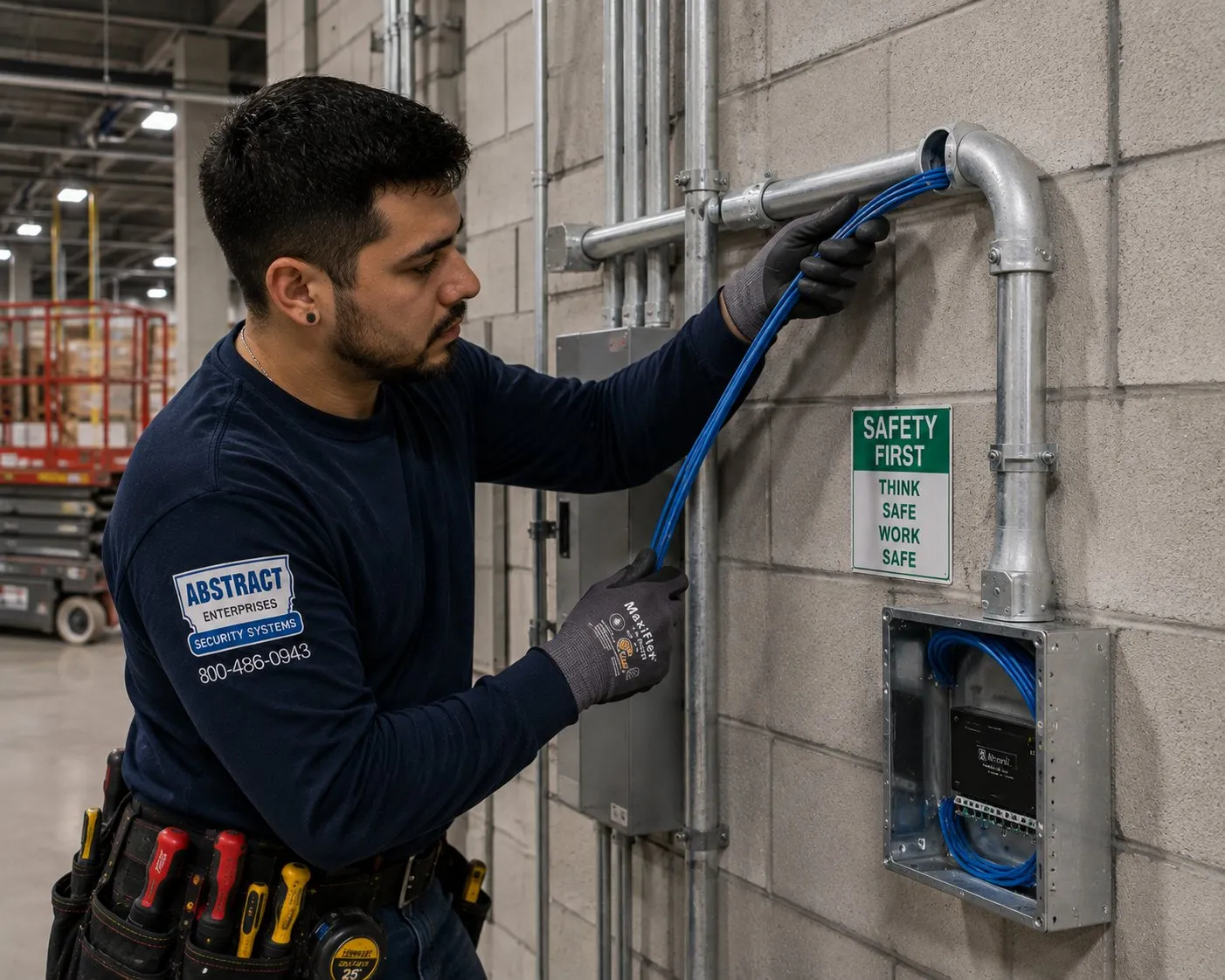
A technician feeds blue cable through a conduit elbow on a concrete-block wall down into a metal junction box — the same kind of protected run that carries a network connection out to a barn or garage door.
Choosing between Wi-Fi, Z-Wave, Thread and Bluetooth when the signal at the door is weak
Each one trades range, battery life and convenience differently, and the right one depends on what you already have in the house. Wi-Fi locks connect straight to the router with no hub, which is simple, but they need a solid 2.4 GHz signal at the door — Schlage's Encode, for one, "requires 2.4GHz WiFi network" — and they use more battery than the alternatives. Bluetooth locks use very little power but only talk to a phone nearby, so remote access needs a bridge close by.
Z-Wave and Thread are mesh radios: each mains-powered device can pass messages along, so a smart plug or a switch halfway between the router and the door extends the reach. Z-Wave needs a hub or a compatible alarm panel; Yale's Assure Lock 2 is listed for Z-Wave systems with a module. Thread locks such as Schlage's Encode Plus connect through a border router — an Apple HomePod mini or Apple TV 4K, for example — and reviewers point to steadier connections and better battery life as the reason to choose it.
For a valley house with a weak signal at the door, our order of preference is usually: fix the signal (a better-placed access point), then a mesh radio with a hub or border router you already own, then a bridge, then Wi-Fi direct. The worst outcome is a Wi-Fi lock at the edge of coverage, which drops off every evening and drains its batteries trying to reconnect.
Can a smart lock work at a property with no internet at all?
Yes, with the right type. Plenty of valley properties — hunting cabins, rural barns, a cottage in a dead spot — have no internet, and in remote parts of Ulster, where the county's 2025 ConnectALL award targets nearly 1,300 unserved locations, that is not unusual. A basic keypad deadbolt works perfectly without any network: you set codes at the door and change them on your next visit.
If you need to issue codes remotely without internet at the door, there are locks built for that. igloohome, for example, describes a system where the lock and its app share a per-lock "formula", the app turns a request such as "grant access to this guest for 2 days" into a PIN, and the lock decodes it with the same formula — no connection at the door required. You send the guest the PIN by text from wherever you are, and it works for the period you set.
What you give up without internet is the live part: no instant alerts, no remote unlock, and no entry history until you're back at the lock with your phone. For many cabins and outbuildings, that is a perfectly good trade, and it removes the bridge, the hub and the router as things that can fail.
Historic doors and old hardware
Our nineteenth-century front door is thicker than most smart locks are listed for — what are the options?
Sometimes directly, sometimes with an adapter, and sometimes not without changing the door — so we measure before anyone orders a lock. Smart deadbolts list the door thicknesses they fit. Schlage's Encode lists 1-3/8 to 1-3/4 inches; Yale's Assure Lock 2 lists 1-3/8 to 2-1/4 inches. Many nineteenth-century front doors are thicker than 1-3/4 inches, and some plank doors are thicker still, so the lock that is easiest to buy is not always one that fits.
Backset — the distance from the door edge to the centre of the lock — is the other measurement. Most smart deadbolts adjust between 2-3/8 and 2-3/4 inches. An old door may have a mortise lock with a different backset, or a pocket cut into the edge where a bored deadbolt would go. Drilling a new bore through or beside that pocket can weaken the stile.
For mortise doors, the gentler route is a retrofit that fits over the inside thumbturn and leaves the exterior hardware and key as they are; August launched a mortise adapter kit for this in 2017. Another option is a mortise-format electronic lock that replaces the old lock body. And on the most important historic doors, the right answer is sometimes to leave the original hardware alone and put the smart lock on the side or kitchen door the household actually uses.
Do I need historic-district approval to put a keypad on a door in Kingston's Stockade or another landmark district?
Possibly, so ask before you install. The City of Kingston's Historic Landmarks Preservation Commission oversees five local landmark districts — the Stockade, Rondout-West Strand, Chestnut Street, Fair Street and Wilbur — and says exterior work on historic properties that is visible from the public right-of-way must be reviewed before a building permit is issued. Its examples are window replacements, siding, new construction and site work; the page does not specifically mention door hardware, which is exactly why a quick call to the commission is worth making for a keypad or reader on a street-facing door.
Other valley villages and cities have their own landmark laws and commissions, and the rules differ. What they generally care about is what the public sees. A smart lock that sits entirely on the inside of the door, turning the existing thumbturn and leaving the historic exterior hardware untouched, changes nothing visible from the street, which is why owners of landmarked houses often choose one.
If you want a keypad on the outside, we can supply the product photos and dimensions a commission usually asks for, and help choose a finish and form that suits the door. We won't install exterior hardware in a landmark district until you have confirmed it doesn't need approval, or have the approval in hand.
Outbuildings, barns and detached garages
What is the best way to lock a detached garage, workshop or barn that has no power at the door?
Usually a battery-powered keypad deadbolt or keypad lever on the walk-in door, with the big doors locked from inside. Battery smart locks don't need power at the door, which makes them the natural choice for outbuildings. The questions are the door, the cold and the signal. A steel or solid wood walk-in door takes a smart deadbolt well. A thin hollow door may need a reinforcing plate. Overhead and sliding doors don't take a deadbolt; they are secured from the inside, and the walk-in door becomes the controlled entry.
Cold is the bigger issue. An unheated barn spends much of the winter below the inside operating rating of many smart deadbolts — 14°F for the inside of Schlage's Encode, 5°F for Yale's Assure Lock 2. In an outbuilding that matters, we look at locks with wider ratings, a keypad and electric strike whose power supply and backup battery sit in a heated space, or simply a quality mechanical lock with a key safe, and we are honest about which suits the building.
Can a cleaner's code open the guest cottage but not the barn or the main house?
Yes, as long as each building's lock is enrolled separately and the codes are issued per door rather than shared. Most lock apps manage several locks under one account, so the main house, the guest cottage and the barn walk-in door each get their own list of users: the cleaner on the cottage only, the farm help on the barn only, the family on all three, each with its own schedule. Hub-based systems go further, letting a single code or a single schedule apply across several doors, which suits a cleaner who needs the cottage but not the garage.
The catch is mixing brands. A Yale on the house, a Schlage on the cottage and a keypad of another brand on the barn means three apps, three sets of codes and three battery alerts. If you are starting fresh across several buildings, choosing one ecosystem saves real time. If you already have different locks, a hub or a property-management tool that supports all of them can bring them together.
The network does the rest. Each outbuilding needs its own path to the internet — a cable, a wireless link or a long-range radio — and we test each lock from your phone off the property's Wi-Fi before we leave, so you know it really works remotely.
County pricing, licensing and small commercial doors
Why does the same smart lock job cost more in Ulster or Dutchess than in Westchester?
Because our published prices are set by area, and the area multiplier rises as you move further from the city. For a single-door keypad or card reader with an electric strike, our published base range is $1,500 to $2,500. In the valley that becomes $1,875 to $3,125 in Westchester, $1,950 to $3,250 in Rockland, $2,100 to $3,500 in Orange, $2,175 to $3,625 in Putnam, and $2,295 to $3,825 in Dutchess and Ulster. Setup-only visits follow the same pattern: $235 for the first hour in Westchester and Rockland, $250 in Orange and Putnam, $275 in Dutchess and Ulster.
The difference is drive time and the day's capacity, not a different standard of work. A crew that drives to Shandaken can do fewer jobs that day than one working in Yonkers, and the multiplier reflects it. To keep it fair, we group far-valley appointments by area and ask for photos first, so the trip is as productive as possible.
A residential smart deadbolt on its own has no fixed published price; we quote it flat at the free walkthrough or from photos, because the door makes the difference between a straightforward swap and an afternoon of fitting. National averages are useful as a reference, and we discuss them in the reality check further down.
Which county licences should a smart lock installer hold in the Hudson Valley?
It depends on the county and the work, and the rules are not the same across the six. Westchester's Department of Consumer Protection says all home improvement contractors working in the county must be licensed under the county's home improvement law. Rockland licenses home improvement contractors under Chapter 286, and its classifications include locksmith work — "Locks, Security gates, Home Safes, Security Screens" — and low-voltage systems. Putnam requires home improvement businesses to register with its Department of Consumer Affairs under Chapter 135.
For Orange, Dutchess and Ulster we have not confirmed a county-level home improvement licence from a county source, and we tell customers to check with the town or village where the property is. Wherever the property is, separate rules apply to electrical work: a home improvement licence is not an electrical licence, as Rockland's own forms point out, and any new circuit for a strike power supply or gate operator is an electrician's work.
Our own credential is NYS Low-Voltage Licence #12000287431, and we provide a certificate of insurance free on request. Ask any installer — us included — which licences they hold for your county and scope, and check them with the issuing office. This is general information, not legal advice.
Can a small office-park suite or studio use smart locks instead of a full access control system?
For one or two doors and a handful of people, often yes. A commercial-grade keypad or Wi-Fi lever on a suite door gives each employee a code, lets you schedule hours, deletes a departing employee's access in seconds and keeps a basic log — for a fraction of a multi-door system. That suits a small practice in a Tarrytown or White Plains office building, a Beacon studio or a Kingston shop's back room.
The limits arrive with scale and with building rules. Battery locks have to be changed one by one; their logs live in each lock's app; and many landlords don't allow tenants to replace suite hardware without approval. Once there are several doors, a shared entrance, staff turnover or an insurance or compliance requirement for audit records, a keypad or reader wired to an electric strike, managed from one dashboard, is the better tool.
We price that step up openly: a single-door keypad or reader with an electric strike is $1,875 to $3,825 installed depending on county. For multi-door systems, see our Hudson Valley access control page.
What does a farm winery or tasting room need on the door between the public space and storage?
A door that stays locked during open hours without anyone carrying a key, and that still lets staff leave freely. In a tasting room, the risk is not the front door at closing time; it is the back-of-house door that customers wander towards during a busy Saturday. A keypad lever or a keypad with an electric strike, set to stay locked at all times and opened by staff codes, solves that. A closer on the door makes sure it actually shuts behind people carrying cases.
Agricultural buildings bring the same challenges as any barn — cold, distance from the network, timber or steel doors — plus a public setting. We choose hardware rated for the temperature of the storage space, mount keypads at a height staff can use with full hands, and make sure the inside of the door opens with a simple push or lever, never a code.
If the operation is subject to rules about who can enter a particular storage room, a reader with a logged credential per person gives a cleaner record than shared codes. That is access control rather than a smart lock, and we will tell you when you have crossed that line.
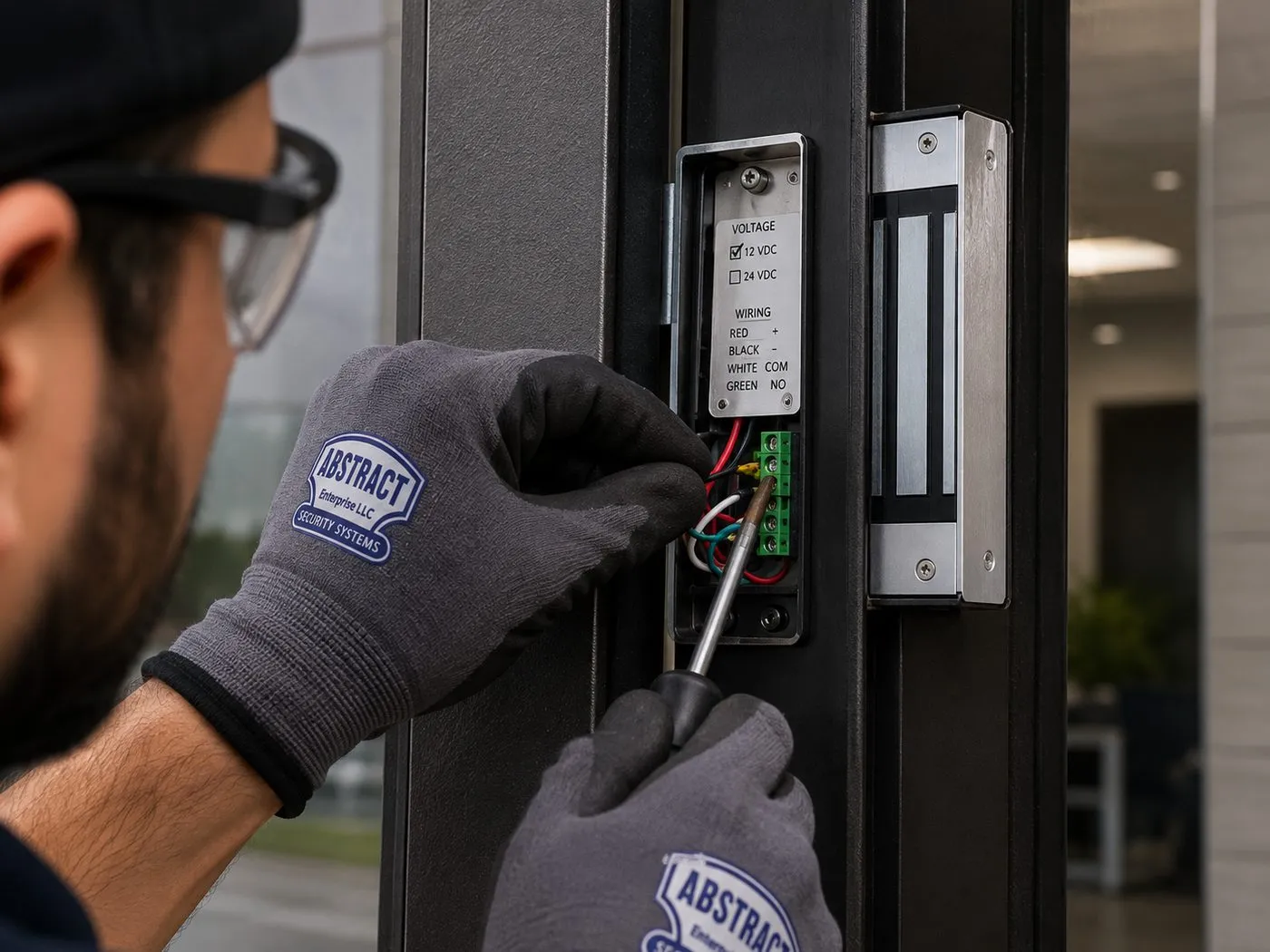
A technician in safety glasses tightens terminal screws on a door-mounted lock's wiring block, its label showing the 12 or 24 VDC setting and wire colours — the detail that separates a wired lock from a battery smart deadbolt.
Equipment
Types of Smart Locks We Install
We install the lock you have bought or the one we choose together, from the major makers. These are the categories we fit most often on Hudson Valley houses, rentals, outbuildings and small businesses, and where each one fits.
Wi-Fi Keypad Deadbolts
Locks with Wi-Fi built in, such as Schlage's Encode with its 100-code capacity, that talk straight to the router with no hub. Simple and well suited to a main door with strong 2.4 GHz coverage; heavier on batteries than other radios.
Bluetooth Locks With a Bridge
Locks that pair with your phone and reach the internet through a small plug-in bridge near the door. Good battery life; remote access only works as well as the bridge's position and power.
Z-Wave Locks on a Hub or Alarm Panel
Locks that join an existing alarm panel or smart-home hub over a mesh radio, so unlocking can disarm and lights can follow. Yale's Assure Lock 2, for example, is offered with a Z-Wave module.
Thread and Matter Locks
Newer mesh locks that connect through a border router, such as Schlage's Encode Plus on Apple Home with Home Key support. Steady connections and good battery life where a compatible hub is already in the house.
Offline-Code Locks
Locks that accept time-limited PINs generated in an app without any internet at the door, built for rentals and cabins in dead zones. No live alerts, but nothing to drop offline.
Interior Retrofit Locks
Units that fit over the existing inside thumbturn and keep the exterior hardware and key, including adapters for some mortise locks. The gentlest option for historic and landmark-district doors.
Keypad Levers and Commercial Locks
Lever-handle keypad locks for offices, studios and back-of-house doors, with schedules and user codes, on standard commercial door preps.
Keypads and Readers With Electric Strikes
Wired keypads or card readers that release an electric strike, with a power supply, backup battery and request-to-exit. The right tool for cold outbuildings and busier commercial doors.
Bridges, Hubs and Network Links
Wi-Fi bridges, Z-Wave and Thread hubs, outdoor access points and point-to-point wireless links that carry the network to a barn, garage or cottage door.
How the radios compare on a large Hudson Valley lot
Connection
Needs at the door
Remote access
Best fit
Wi-Fi built in
A solid 2.4 GHz Wi-Fi signal
Yes, direct to router
Main house door near the router
Bluetooth + bridge
A bridge within about 10–15 ft, plugged in, on 2.4 GHz Wi-Fi
Yes, through the bridge
Doors with an outlet nearby inside
Z-Wave
A hub or alarm panel in mesh range
Yes, through the hub
Houses with an alarm or hub already
Thread / Matter
A border router in mesh range
Yes, through the border router
Homes already on Apple, Google or similar platforms
Offline codes
Nothing — batteries only
Codes sent by text; no live alerts
Cabins, barns and dead zones
Wired keypad / reader + strike
Cable to a power supply and controller
Yes, if the controller is networked
Unheated outbuildings and commercial doors
AI Overview Reality Check
What AI Gets Wrong About Smart Lock Installation in the Hudson Valley
Google's AI Overview text could not be read from the environment this page was researched in, and we will not invent what it says. Instead, the seven points below take statements printed on national cost guides, manufacturer pages and forums — the material chatbots summarise — and test each against long driveways, cold barns and old doors.
"Smart lock installation costs about $50 to $100"
Fixr's cost guide, updated January 31, 2025, says the average cost to install a smart lock is around $50 to $100 in labour, and quotes handyman rates in the same range per hour. Summaries repeat that as the price of a smart lock job.
It describes a lock swapped onto a standard pre-drilled door in a house with good Wi-Fi. It does not describe re-fitting a strike on a door that has moved, drilling a thick antique door, or getting a signal to a barn.
In the valley, the labour is usually in those parts. That is why we quote a residential smart deadbolt flat after seeing the door, and price wired keypad-and-strike work from our published county ranges.
"The national average is $300, and most jobs are $250 to $400"
The same Fixr guide gives a national average of $300 and a range of $250 to $400, lock included. Homewyse, working from home-improvement-store products in "readily serviceable conditions", estimated $94.71 to $227 per lock in January 2026, excluding permits, tax and contractor markup.
Those are reasonable national benchmarks for a lock on a standard door. They are national third-party figures, not AESS prices, and they exclude the things that drive valley jobs: travel to the far counties, outbuildings, bridges and network links.
Use them as a sanity check on the lock itself. Then add what your property needs to make the lock work remotely, which is the part national averages leave out.
"Any smart lock works fine outdoors in winter"
Product listings stress weather resistance, and answers built from them often stop there. The outside keypads are indeed rated well below zero — Schlage gives −31°F for the Encode's outside body.
The inside body is another matter: 14°F for the Encode and 5°F for Yale's Assure Lock 2. In a heated house that is irrelevant. On an unheated barn, porch or closed-up cabin, it is the number that decides whether the lock works in January.
Ask where the inside of your door is. If the answer is "outside, more or less", choose a lock or a wired strike system that suits it.
"Just connect the lock to your Wi-Fi for remote access"
True in a compact house with the router in the hall. On a valley property, the door that most needs remote access is often the one furthest from the router.
August recommends its bridge within 10 to 15 feet of the lock and notes it only uses 2.4 GHz Wi-Fi. A lock at the edge of coverage connects in the afternoon and drops overnight, burning batteries trying to reconnect.
The fix is network design: an access point or bridge near the door, a mesh radio, a cabled or wireless link to the outbuilding, or a lock that doesn't need a network at all.
"Smart locks fit any standard door"
The key word is "standard". Smart deadbolts list the doors they fit: Schlage's Encode 1-3/8 to 1-3/4 inches thick, Yale's Assure Lock 2 up to 2-1/4 inches, both with 2-3/8 or 2-3/4 inch backsets.
Many valley front doors predate those standards, with mortise locks, extra thickness or a pocket where a modern bore would go. The lock that arrives in the box may not fit them.
Measure first. Retrofit and mortise-adapter options exist, and sometimes the right move is to put the smart lock on the door the family actually uses.
"Swap the lockbox for a smart lock and your rental is sorted"
Host forums and blogs treat the smart lock as the finish line. In New York, the state short-term rental law now requires county registries unless a county opts out, and hosts self-attest to health, safety and insurance requirements when they register.
Towns add their own rules; the Ulster County Comptroller counts at least 16 municipalities with some form of short-term rental regulation, and in Dutchess the Town of Pleasant Valley moved a short-term rental licensing law through review in 2025.
A smart lock is good practice for a rental, not a compliance plan. Check your county registry and your town's law, and keep the exit side of every door code-free.
"Any handyman or app-booked pro can install a smart lock"
On a modern pre-bored door with good Wi-Fi, often true — marketplace listings and big-box services install plenty of them well.
The difference shows on the jobs this region is full of: the barn 200 feet from the router, the 1850s door, the cabin with no internet, the office suite where a strike and power supply have to be wired. A booking that assumed a standard door either improvises or reschedules.
We ask for photos and the distance before the visit, check county licensing for the scope, and carry the bridges, hubs and wiring for the jobs that are not standard.
A Smart Lock That Reaches You From the Far End of the Property
Send a photo of the door edge, tell us how far it is from the router, and say whether the space behind it is heated. We will tell you which lock and which connection will work before anyone drives out.
Which county, which door, and how you manage the property — that is all we need to start. Expect a reply the same business day, or ring (800) 486-0943.
✅
We Got Your Request!
We'll call you back the same business day. If it's urgent, call us now at (800) 486-0943.
How It Works
Our Installation Process
The sequence is the same for a single deadbolt in Nyack and a house, cottage and barn in Saugerties — only the time spent on the signal survey and the door fit changes.
1. Photos, distance and quote
You send the town, photos of the door edge and lock, the distance to the router and whether the space behind the door is heated. We confirm the lock, the connection and the price before booking.
2. Two-hour arrival window
We book a two-hour window between 8 AM and 8 PM, seven days a week, grouping far-valley visits by area and arranging access with a caretaker if you won't be there.
3. Door and signal survey
On site we measure thickness and backset, turn the bolt by hand, check the strike, and test Wi-Fi and cellular signal at every door on the job.
4. Fit and align
Lock fitted, strike aligned so the bolt throws freely in summer and winter, and any bridge, hub or network link placed where the signal is solid.
5. Connect and program
Lock joined to the app, bridge or hub, firmware updated, owners, guests, cleaners and caretakers set up with their own codes and schedules, alerts routed to the right phones.
6. Test remotely and hand over
We lock and unlock from a phone off the property's network, test a guest code, show you how to add and delete users, and leave a card with the model, battery type and reset steps.
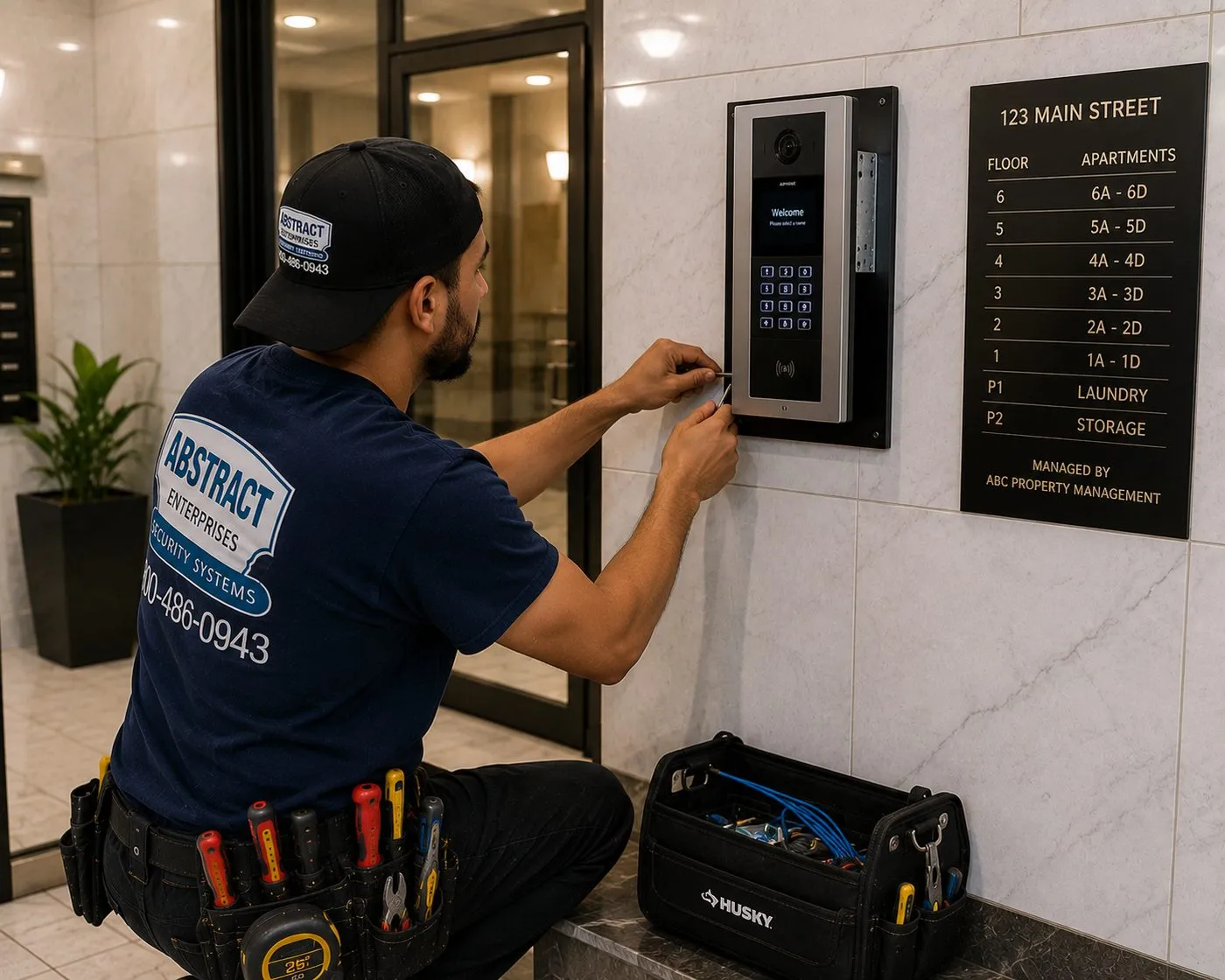
A technician kneels at a stone-faced lobby wall to wire a recessed entry panel with keypad and camera, a tool bag at his side — the same test-before-handover routine applies to a single smart deadbolt.
Coverage Area
Smart Lock Installation Near Hudson Valley Landmarks
Our coverage runs from the New York City line to the edge of the Catskills. These landmarks mark the territory — and several of them are good reminders of how old, how spread out and how varied the doors around them are.
Historic Huguenot Street, New Paltz
A 10-acre National Historic Landmark district settled in 1678, with seven stone houses — the kind of early Ulster stone architecture whose doors call for interior retrofits rather than new bores.
Mohonk Mountain House, New Paltz
The Smiley brothers' Victorian resort on Lake Mohonk, built in stages between 1869 and 1910 where the towns of New Paltz, Marbletown and Rochester meet, and a National Historic Landmark since 1986.
Boscobel House and Gardens, Garrison
A Federal-style house built 1804–1808 for States Dyckman in Montrose, Westchester, saved in 1955 and moved to Garrison in Putnam County in 1956.
Bear Mountain State Park
Opened in June 1913 and covering 5,205 acres across Rockland and Orange counties, with the Bear Mountain Inn completed in 1915.
Lyndhurst, Tarrytown
Alexander Jackson Davis's Gothic Revival mansion, designed in 1838 and later owned by Jay Gould, on a 67-acre estate at 635 South Broadway above the Hudson.
Vanderbilt Mansion, Hyde Park
Built 1896–1899 by McKim, Mead & White for Frederick and Louise Vanderbilt, on 211 acres of a once roughly 600-acre Dutchess estate overlooking the river.
We also serve the Palisades Center area of West Nyack, White Plains and the I-287 office parks, Newburgh, Goshen and Middletown, Carmel, Mahopac and Cold Spring, Poughkeepsie, Rhinebeck and Millbrook, Kingston, Woodstock, Saugerties and Shandaken, and every town between the city line and the mountains.
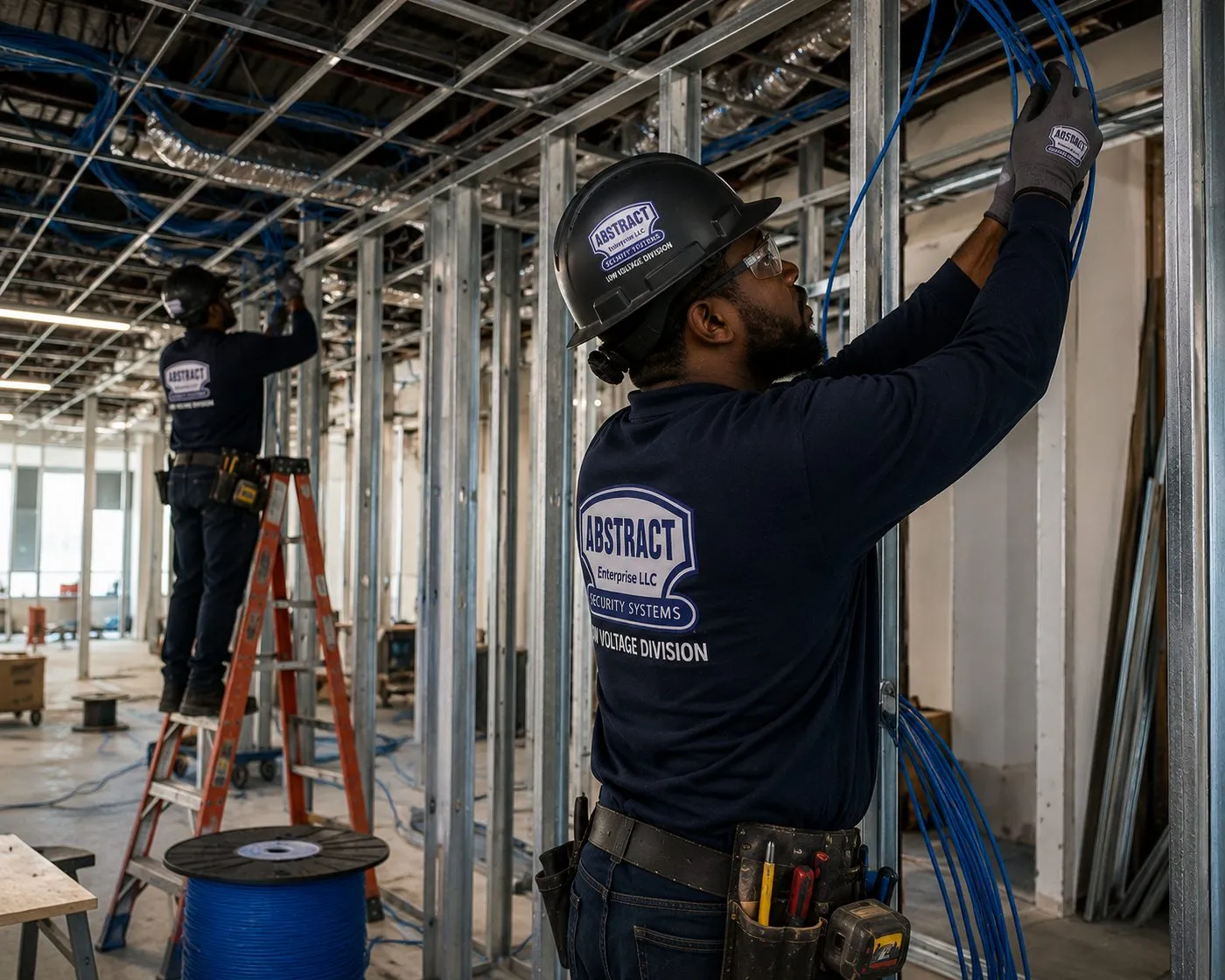
A technician in a hard hat reaches up to dress a bundle of blue cable through open metal-stud framing while a colleague works on a stepladder behind him — renovation is the cheapest time to run cable to a future reader, strike or hub.
Pricing
Smart Lock Installation Cost in the Hudson Valley
Smart lock work in the valley is priced in three ways: wired keypad and strike work from our published ranges, setup-only visits at a published hourly rate, and residential smart deadbolts quoted flat once we have seen the door. Published ranges are scaled by county from our base prices; nothing below is a new or invented figure.
Keypad or reader with electric strike, by county
County
Single-door keypad or card reader with electric strike, installed
New electric strike on an existing door
Failed electric strike repair
Westchester (1.25×)
$1,875 – $3,125
$313 – $563
$369 – $606
Rockland (1.30×)
$1,950 – $3,250
$325 – $585
$384 – $631
Orange (1.40×)
$2,100 – $3,500
$350 – $630
$413 – $679
Putnam (1.45×)
$2,175 – $3,625
$363 – $653
$428 – $703
Dutchess (1.53×)
$2,295 – $3,825
$383 – $689
$451 – $742
Ulster (1.53×)
$2,295 – $3,825
$383 – $689
$451 – $742
The base ranges these are scaled from are the figures we publish elsewhere on the site: $1,500 to $2,500 for a single-door keypad or fob reader with an electric strike, $250 to $450 for a new electric strike on a door, and $295 to $485 to replace a failed strike. The county multiplier is applied to both ends of each range and rounded to the dollar.
Setup-only visits and service calls
County
Setup-only visit, first hour
After the first hour
Westchester
$235
30-minute blocks
Rockland
$235
30-minute blocks
Orange
$250
30-minute blocks
Putnam
$250
30-minute blocks
Dutchess
$275
30-minute blocks
Ulster
$275
30-minute blocks
A setup-only visit covers a lock that is already on the door: connecting it to the app, bridge or hub, creating codes and schedules, updating firmware, sorting out a lock that has dropped offline, or adjusting settings. Service callbacks on existing systems outside the initial installation are billed at $195/hr, 3-hr minimum ($585); that rate is never applied to a new installation.
Residential smart deadbolts
There is no fixed published AESS price for fitting a standalone smart deadbolt to a house door, because the door decides the work. A pre-bored modern door near the router is a short job; a thick antique door, a mortise lock, an unheated barn or a door that needs a bridge or network link is not. We quote these flat at the free walkthrough or from photos, before any work starts. For reference only, national third-party figures put smart lock installation at $250 to $400 with a $300 average (Fixr, updated January 2025) or $94.71 to $227 per lock (Homewyse, January 2026); those are national averages, not our prices.
What the price includes, and what it doesn't
Included: fitting and aligning the lock, connecting it to the app and the bridge or hub, setting up your first users and schedules, testing from off the property's network and showing you how to manage it.
Not included: carpentry such as planing or re-hanging a door, patching or refinishing old holes, and electrical work such as new circuits or receptacles, which is for a licensed electrician.
Not included: the lock itself if you supply it, and any subscription a lock maker charges for its own app features.
National brand versus local installer. National alarm companies and big-box install services sell smart locks bundled with their own platforms, and app-booked pros install plenty of them on standard doors. Where a licensed local installer earns the difference is the work those bundles don't anticipate: the signal to the barn, the 1850s door, the cabin with no internet and the county licensing for the scope. We publish what we can, quote the rest after seeing it, and answer to you directly.
Shop Our Systems
Smart Lock Installation Packages & Pricing
Three starting points for Hudson Valley properties. Where a package has a published price we show it by county; where the door decides the price, we say so rather than print a number we can't stand behind.
Starter — Program the Lock You Have
$235–$275
Setup-only visit, first hour at the county rate: $235 Westchester and Rockland, $250 Orange and Putnam, $275 Dutchess and Ulster, then 30-minute blocks. Lock connected to the app and bridge, codes and schedules created, firmware updated, remote access tested.
Standard — Smart Deadbolt, Fitted
Quoted at walkthrough
A smart deadbolt fitted to your main door, strike aligned for winter, connected and set up for remote management. Priced flat from photos or the free walkthrough because thickness, bore and signal vary so much on valley doors. National third-party average for reference: $300 (Fixr).
Premium — Keypad or Reader With Electric Strike
$1,875–$3,825
Single-door keypad or card reader with an electric strike, power supply and request-to-exit, installed: $1,875–$3,125 Westchester, $1,950–$3,250 Rockland, $2,100–$3,500 Orange, $2,175–$3,625 Putnam, $2,295–$3,825 Dutchess and Ulster. For offices, studios, back-of-house doors and cold outbuildings.
Bring Your Own Equipment — Labour Only
Bought your own smart lock? We fit it and set it up for a labour-only price quoted at the walkthrough, or, if it is already on the door, connect and program it on a setup-only visit at the county rate above. We check the lock's door-thickness, backset and temperature ratings against your door before fitting it. Customer-supplied locks carry their manufacturer's warranty.
Get the Door Priced Before Anyone Drives Up
A photo of the door edge, the existing lock and the route to the router is usually enough for a firm quote on a valley smart lock job.
Planning a Smart Lock for a House You Don't Live In
The hard part of a remote-house lock is not installing it. It is making sure it keeps working, and keeps you informed, through the weeks when nobody is there. This is the plan we work through with second-home owners and rental hosts.
Decide who needs access. Owners, family, guests, cleaners, a caretaker, the plumber. Each gets their own code with the narrowest schedule that works.
Choose who gets the alerts. Low battery, door left unlocked and jam alerts should reach someone within driving distance as well as the owner.
Load codes ahead. Set up the next few weeks of guest and cleaner codes in advance so an internet outage doesn't strand anyone.
Put the network on backup power. A small battery backup on the modem, router and bridge keeps the lock reachable through short power cuts.
Keep a non-electronic way in. A key with a neighbour or caretaker, never under the mat.
Keep the exit free. Inside thumbturns and levers only, on every door a guest might use to leave.
Set auto-lock with care. Only once the door closes and latches reliably, so the lock doesn't fire against an open door.
Check your town and county rules. If you rent short-term, confirm your registration and your town's law before the season.
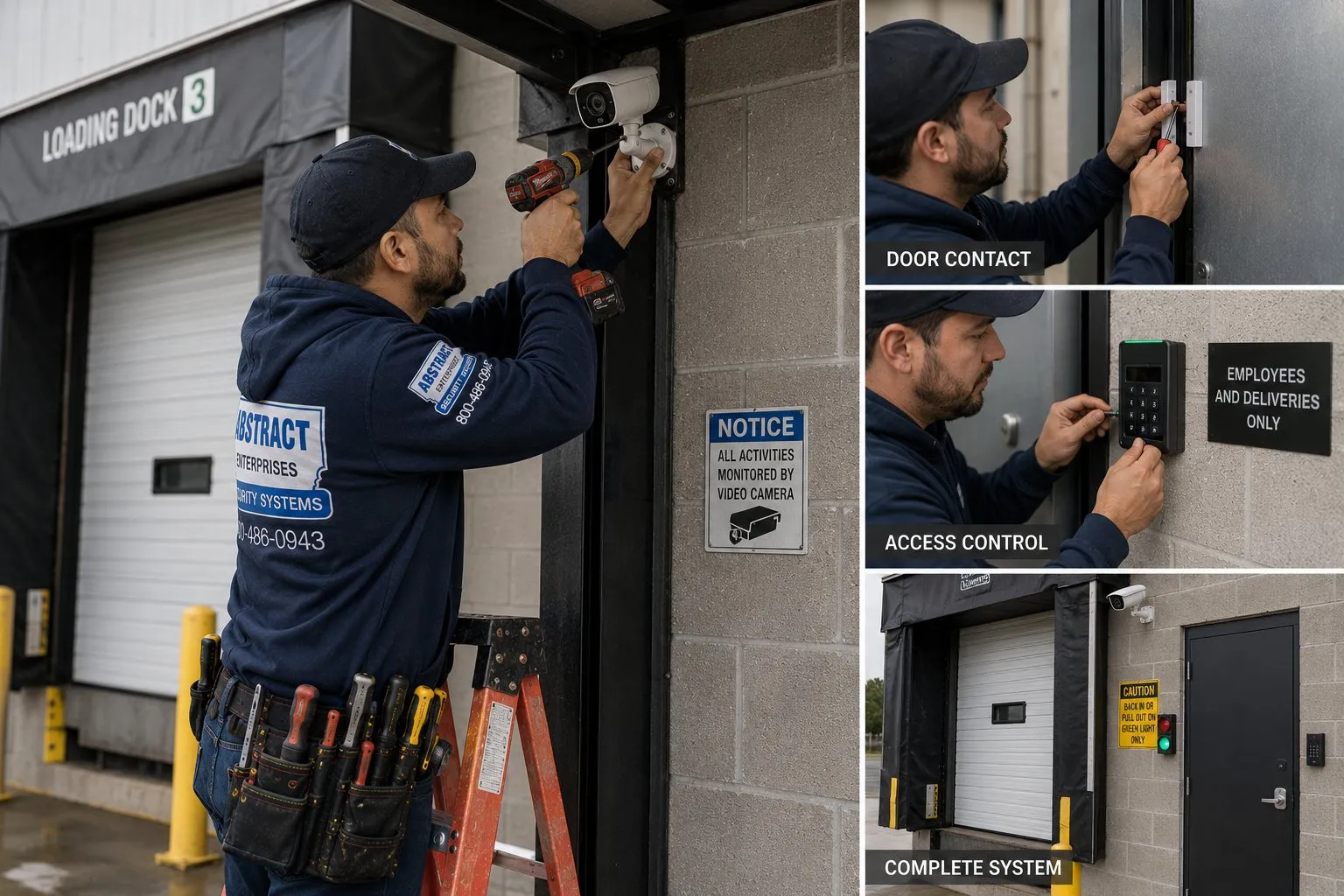
A technician on a ladder fits a device above a dock doorway, with inset panels labelled door contact, access control and complete system — pairing a lock with a door contact is how a remote owner knows the door is not just locked but actually shut.
Second Opinions
Common Problems With Smart Locks Someone Else Installed
A good share of our Hudson Valley smart lock calls are to sort out a lock that was fitted quickly. These are the faults we find most, and what fixing them involves.
Batteries that last weeks instead of months. Almost always a bolt that rubs on the strike, a Wi-Fi lock at the edge of coverage reconnecting all night, or both. We realign the strike and fix the signal, and battery life returns to normal.
A lock that drops offline every evening. A bridge plugged in too far away, a router that changes channel or band, or a 5 GHz-only network the lock can't join. We move the bridge, set a stable 2.4 GHz network for the lock, or move it to a mesh radio.
A lock fitted to a door it doesn't suit. A deadbolt forced onto a door thicker than its range, or a bore drilled through an old mortise pocket. Sometimes an extension kit or a retrofit unit solves it; sometimes the door needs a carpenter first.
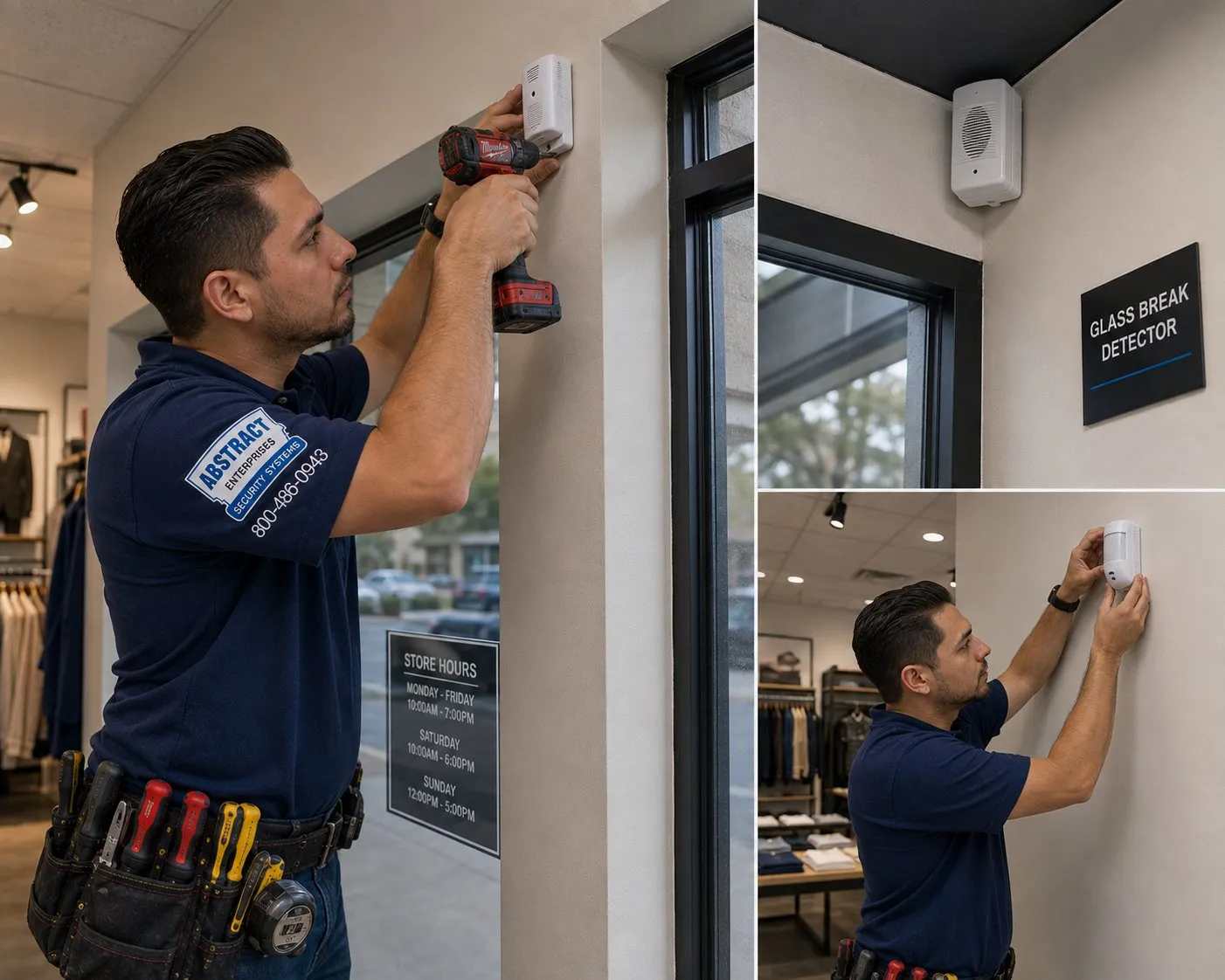
A technician drills at the head of a storefront window frame, with inset views of a detector going onto the wall beside a glass-break sign — a shop's smart lock is usually only one part of its door and window security.
Complete Services
Every Smart Lock Installation Service in the Hudson Valley
Valley customers who book a smart lock tend to ask about one of these next, so they are linked here in one place.
Everything Abstract Enterprises installs across New York.
Field Notes
Field Notes From Doors Far From the Router
Three habits our crews bring to every remote valley door — general practice, not a story about one customer
Before we choose a lock for an outbuilding or a far door, we stand at that door with a phone off the property's Wi-Fi and on it, and check what signal actually reaches. The app's promise and the barn's reality are often different, and that two-minute test decides between Wi-Fi, a bridge, a mesh hub or an offline-code lock better than any spec sheet. We do the same for cellular, because a hub with a cellular backup is only useful where the carrier has signal.
The second habit is to close the door and turn the bolt by hand before a single screw goes in for the new lock. If the old key lock drags, the new motor will too. Fixing the strike first is the difference between a lock that runs a season on its batteries and one that needs a visit in February.
The third is to leave the owner with a printed card inside the door listing the lock model, the battery type, how to reset it and who to call. Somebody other than the owner is usually the one standing at a remote door when something goes wrong.
FAQ
Hudson Valley Smart Lock Installation FAQ
What does a single-door keypad with an electric strike cost in each Hudson Valley county?
+
Installed, it is $1,875 to $3,125 in Westchester, $1,950 to $3,250 in Rockland, $2,100 to $3,500 in Orange, $2,175 to $3,625 in Putnam, and $2,295 to $3,825 in Dutchess and Ulster. Those are our published $1,500 to $2,500 base range scaled by the county multiplier.
How much is a visit just to program a smart lock that is already on the door?
+
A setup-only visit is a flat first hour at the county rate: $235 in Westchester and Rockland, $250 in Orange and Putnam, and $275 in Dutchess and Ulster, then 30-minute blocks. It covers app and bridge connection, codes, schedules and firmware.
Can you quote a far-valley job from photos so nobody makes the drive twice?
+
Usually, yes. Photos of both sides of the door, the door edge with the old lock, and the route to the router let us choose the lock and the connection in advance and bring the right parts. A residential smart deadbolt is then quoted flat before any work starts.
Should the router and lock bridge be on our standby generator?
+
If the house has one, yes. The lock itself runs on batteries, but the router, modem and any bridge or hub need power for remote access and alerts. Putting them on the generator circuit, or on a small battery backup, keeps the lock reachable through valley outages.
Can you install a smart lock at a house that is closed up for the winter?
+
Yes, if someone can let us in and the space behind the door stays within the lock's inside operating range. We recommend leaving enough heat on in the entry, fresh batteries in, and alerts routed to a caretaker nearby.
Can you work on a weekend when we are up at the house?
+
Yes. We book two-hour arrival windows between 8 AM and 8 PM, seven days a week, and group far-valley visits by area. Saturday and Sunday slots fill first in the summer and autumn, so book early.
Is a second smart lock on a garage or cottage door cheaper if done on the same visit?
+
Usually, per door, because the travel and the setup of your account are shared. Each door is still quoted on its own merits, since an outbuilding may need a bridge, a network link or a different lock.
Who programs the guest codes after you leave?
+
You do, from the app, and we make sure you can before we go. We set up the first users and schedules with you, show you how to add and delete codes, and can link the lock to your booking platform or property-management tool if it supports it.
Can you service a rental's lock between one guest's checkout and the next check-in?
+
We try to, by booking the visit into the turnover window. Service callbacks on existing systems are billed at $195 per hour with a 3-hour minimum, never on the initial installation; call (800) 486-0943 with your checkout and check-in times.
All Areas Served
Smart Lock Installation Across New York
Westchester, Rockland, Orange, Putnam, Dutchess and Ulster will each get a dedicated smart lock page of their own. Until a county page is published, its link below opens the quote form — the crews and the price list are already working there.
Guest Locked Out at a Hudson Valley Rental Tonight?
Call (800) 486-0943. Same-day visits are possible when a two-hour window is open in your area; most battery, alignment and connection faults are fixed in one to two hours once we are at the door. In the meantime, send the guest a fresh code from the app if the lock is online, or ask your caretaker to use the backup key.
Smart Lock Installation Hudson Valley — Licensed, Insured, Priced in the Open
Abstract Enterprises Security Systems · 460 E Fordham Rd, Bronx, NY 10458 · (800) 486-0943 · WhatsApp (718) 679-0359 via wa.me
NYS Low-Voltage Licence #12000287431 · 100% Licensed & Insured · Same-Day Estimates · Rated 4.7★ from 201 Google Reviews
Locks, strikes and hubs carry their manufacturer's warranty. Full terms — including 50% deposit, one-year parts-only warranty on AESS-supplied products, and the late-fee schedule — are set out in the service agreement. See our warranty page.
Page reviewed and updated October 17, 2026. Changelog: first publication of the Hudson Valley smart lock installation hub. Photos on this page are from our low-voltage and commercial security work; dedicated smart lock photos will replace them as they are added.