Same-Day Service · All Brands · Intercom Repair · Buzzer Repair · All Orange County Communities
Professional door buzzer repair and intercom repair across all Orange County communities. From Mott Haven walk-ups to Fordham apartment buildings to Riverdale co-ops — if your apartment buzzer is not working or your intercom system stopped working, we fix it same day. Most repairs completed in a single visit.
Component-level diagnosis. We isolate the failed part before quoting a replacement.
Certificates of insurance issued to owners, boards, and managing agents before work starts.
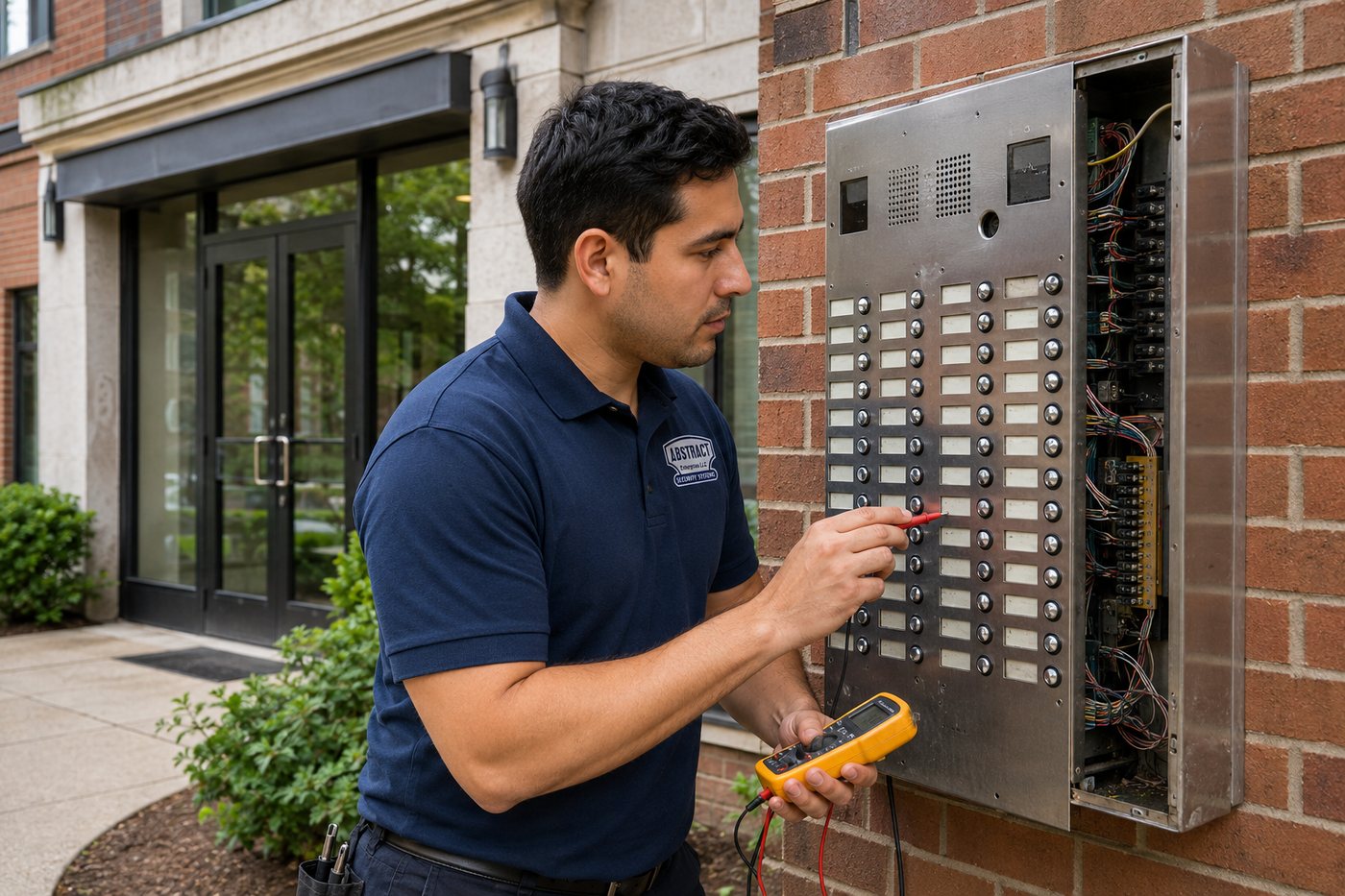
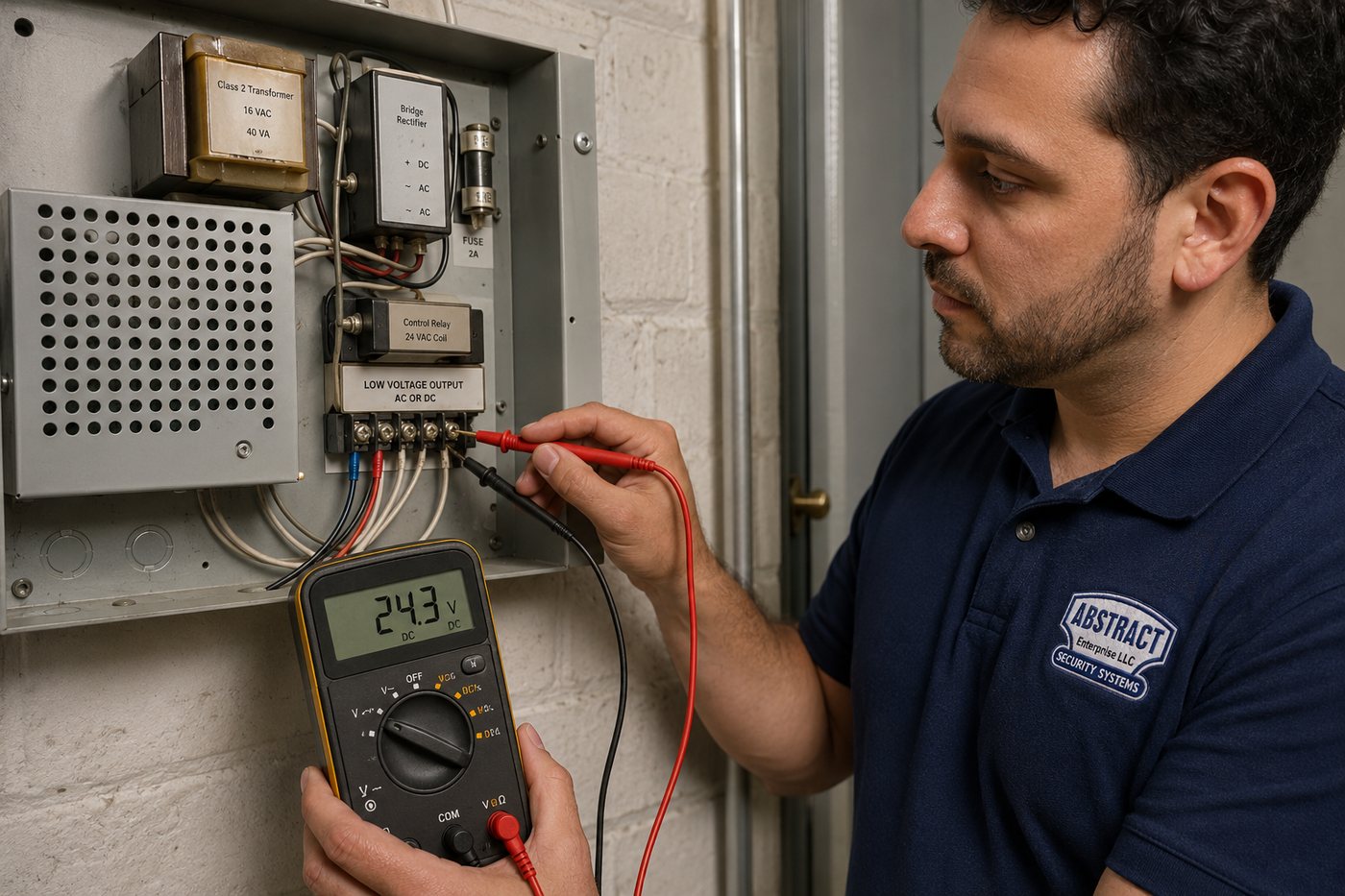
Terminal testing behind a stainless lobby panel.
Need Buzzer Repair in Orange County Today?
Orange County runs from dense pre-war multi-family in Newburgh and Middletown to rural property with a gate at the end of a long drive, and the two need entirely different diagnostics. A dead entry door is an access and life-safety problem, not a maintenance ticket — tenants get locked out, deliveries stop, and the front door ends up propped, which defeats the system entirely.
Three layers, as everywhere: the talk path to wherever you answer, the release path to the door or gate, and the mechanical layer of the hardware itself. Orange is the Hudson Valley county with the widest spread between its urban and rural extremes, and a phone diagnosis is worth less here than almost anywhere.
If the buzzer rings and you can speak, the talk path is intact and the fault is downstream. If nothing rings, the fault is upstream. That single distinction narrows a whole-building mystery to a handful of components, and it is why a proper diagnostic beats a blind replacement quote.
Layer 1 — the talk path
Newburgh and Middletown carry substantial pre-war apartment stock on original risers. Village and rural property runs transformer-and-chime arrangements, and on larger parcels a gate station several hundred feet from the house.
Basement amplifier cabinet feeding the building riser.
Layer 2 — the release path
In city apartment buildings the strike is close and preload leads. On rural property the operator may be two hundred feet from its supply, which makes voltage drop the leading diagnosis and one that only shows under load.
Layer 3 — the mechanical layer
Frost heave moves gate posts and door frames every winter. Ice loading on a gate and a settled hinge both present to the owner as an electrical failure.
The Buzzer Works But the Door Stays Locked
Orange is the county where the diagnosis genuinely depends on which half of it you are in. A Newburgh apartment vestibule preloads its strike; a Warwick property with a gate two hundred feet out has a voltage-drop problem.
On the rural side the tell is cold weather. Gate operators draw hardest on start, and grease thickens in winter, so an undersized supply that coped all summer collapses in January.
On the urban side the tell is force. Heavy entrance doors on pre-war Newburgh and Middletown buildings, with closers tightened over decades, jam the latch against the keeper. Hold the door slack and trigger release to separate the two.
Electric strike service at the frame — the most common failure point.
Not sure whether yours is a part swap or a wiring job? The diagnostic answers that, and the fee applies either way.
Relay bank service. Welded contacts leave the entrance unlocked.
No Sound, No Power, or a Buzzer That Will Not Stop
Rural silence is usually the buried conductor. Direct-burial cable run with the driveway decades ago fails where water sits, and the symptom is intermittency that follows the weather rather than a clean failure.
Urban silence in Newburgh and Middletown is usually the transformer or the amplifier in a basement equipment room — a single component that takes a whole building out and gets mistaken for a dead system.
Continuous buzzing behaves the same in both: a stuck button or a welded relay holding the circuit energised, with the entrance left unlocked in the meantime.
Only One Apartment Is Dead
In a Newburgh or Middletown apartment building one dead line means the shared equipment is fine and the fault is that circuit.
On rural property the equivalent is one station out of several — house, barn, gate, guest cottage. Those tend to be daisy-chained, so a single break kills everything past it while everything before it works normally.
Knowing which topology you have before anyone starts tracing is the difference between a predictable visit and an open-ended one.
In-unit handset service. Cord conductors fatigue where they flex.
What We Actually Replace
Buzzer repair is component work. Below is the hardware behind the terms you will see on an invoice, so you can read a quote and tell a genuine part swap from a padded one.
24V transformer
Low-voltage supply for the whole system. Fails gradually — weak buzz, dropped calls, then silence.
Door release relay
Switches power to the strike when you press release. Contacts weld shut or stop making altogether.
Electric strike
The powered keeper in the frame. Fail-secure locks on power loss; fail-safe unlocks.
Magnetic lock
Holds by electromagnet, always fail-safe. Needs alarm integration and a manual release to be compliant.
Riser wiring
The vertical pairs from the basement to each unit. Corrosion here causes static and dead lines.
Apartment station
The in-unit handset. Cord conductors, hookswitch and speaker all wear out.
Lobby panel
Buttons, directory, speaker and microphone at the entrance. Weather and vandalism take these first.
Request-to-exit
Interior release button or sensor. On a maglock this is life-safety hardware, not a convenience.
We service legacy analog hardware including Lee Dan, TekTone and Alpha Communications and keep common stations and transformers for those platforms on the truck. System-wide video, gate and driveway entry and brand-specific catalogs are covered on our intercom pages.
Landlord Responsibility in Orange County
For covered rental property, yes, and Newburgh and Middletown hold most of it.
New York State Multiple Dwelling Law requires buildings built or converted after 1968 with eight or more units to provide a two-way voice intercom linking the entrance to each apartment. That state requirement reaches Orange County directly, and courts have treated a working intercom as an essential service under the warranty of habitability.
The New York City Housing Maintenance Code and HPD process do not apply. Enforcement runs through your city, town or village building department — Newburgh, Middletown and Port Jervis each operate their own code enforcement, as do the towns and villages — and escalation goes to the local city or justice court.
For owner-occupied single-family, which is most of the county by parcel count, the entry system is the owner's responsibility. General information, not legal advice.
Gates, Commercial Corridors and Distance
Three factors shape most Orange County work.
Distance. Rural parcels put gates and outbuildings hundreds of feet from the supply. Conductors have to be sized for the operator's inrush rather than its holding current, and undersized wire is the defect we find most often. It surfaces in cold weather when draw increases.
Buried cable. Direct-burial conductors run with the driveway decades ago fail where water sits, producing intermittency that tracks the weather. Fine in a dry week, dead after rain, and slower to trace than any indoor fault.
Commercial growth. The I-84 and Route 17 corridors have added substantial warehouse and distribution capacity, and those entries have different requirements from residential — multi-door access control, request-to-exit hardware and, where maglocks are fitted, alarm integration and free egress that are life-safety rather than cosmetic.
Maglock and power supply under test — life-safety hardware tied to egress.
What Buzzer Repair Costs in Orange County
Our service call is $250 and includes on-site diagnosis: we identify the failed component and give you the repair number before parts work begins. Most single-fault repairs finish in that visit.
Service call + on-site diagnostic$250
Apartment station replacement$250 – $525
Door release relay or button$250 – $475
24V transformer replacement$325 – $650
Electric strike replacement + alignment$450 – $950
Lobby panel repair or faceplate$650 – $1,800
Riser pair repair / re-termination$850 – $2,400
Aggregator sites quote a national average with no idea whether your fault is a $250 button or a $2,400 riser. The number only means something after someone has looked at the panel.
Repair or Replace?
Orange splits its economics the same way it splits its geography.
In pre-war Newburgh and Middletown stock, replace when the trunk conductor is corroded and repair when a single pair or component has failed. Toning first is what separates them.
On rural property, replace the buried run when it has water damage, and time it to any driveway work already planned. A standalone trench is several times the cost for the same result.
Cellular conversion is worth pricing on gated rural property, since it removes the buried run entirely. On the commercial corridors along I-84 and Route 17 the question is different again — those entries usually need proper access control rather than a buzzer at all.
Verifying the talk path with the resident before closing the call.
Where We Work Across Orange County
Newburgh and the river
City of Newburgh, Town of Newburgh, New Windsor and Cornwall. The county's largest concentration of pre-war multi-family, much of it on original riser wiring, plus waterfront and historic-district property.
Middletown and the west
Middletown, Goshen, Wallkill and Chester. Village commercial and older apartment stock alongside newer residential development.
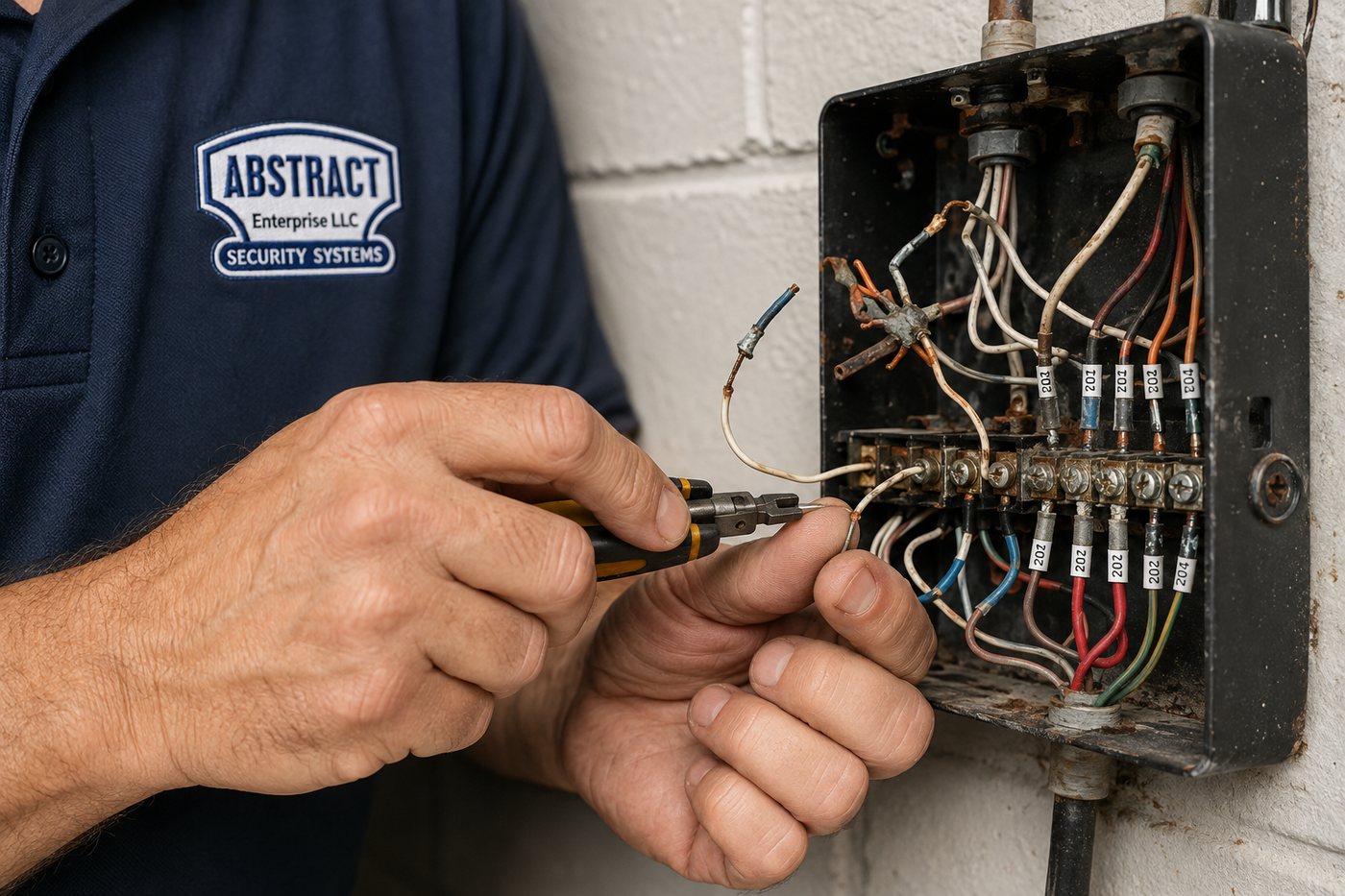
Corroded terminals — the usual cause of static and dead lines.
Monroe and the south
Monroe, Harriman, Woodbury, Highland Mills and Central Valley. Mixed residential with a substantial commercial presence around the Route 17 interchange and Woodbury Common.
Warwick and the rural west
Warwick, Florida, Pine Island and the black-dirt region. Larger parcels, longer runs, agricultural outbuildings on the same circuit as the house, and the highest proportion of gate work in the county.
Port Jervis and the far west
Port Jervis, Deerpark and Greenville. Older village stock with aging wiring, and longer drive times that make scheduled windows more practical than same-day promises.
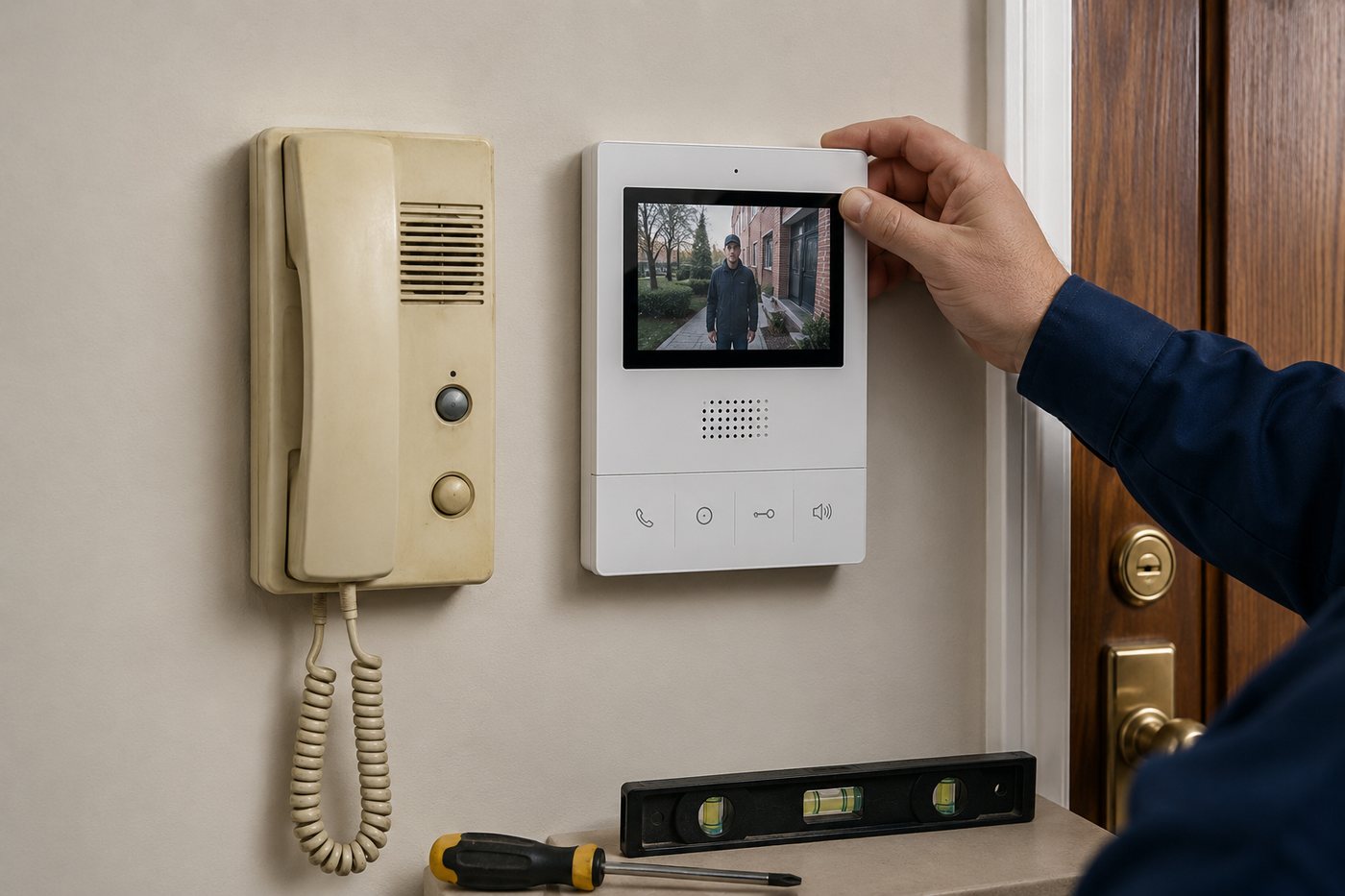
Audio station replaced with a video monitor on the existing pair.
Field Notes
Three findings cover most Orange County callouts.
First: the winter collapse. A gate operator or strike that ran fine all summer fails in January because the coil draws harder and an undersized supply finally gives out. Owners describe it as the system dying over the winter; the wire was marginal the whole time.
Second: the weather-tracking fault. Intermittent operation that correlates with rain is a buried conductor with a water fault, not an intercom problem. That clue saves hours of diagnosis.
Third: pre-war riser corrosion in Newburgh and Middletown. Persistent static across several apartments means the trunk is going, and that is a genuinely different job from a single failed pair. Toning before quoting is what separates the two.
Door Buzzer Repair Orange County — Questions
How much does door buzzer repair cost in Orange County?
Service call $250 with diagnosis. Newburgh and Middletown apartment work prices conventionally — station $250–$525, transformer $325–$650, strike $450–$950. Rural gate work is quoted separately because run length and buried-cable tracing drive the number.
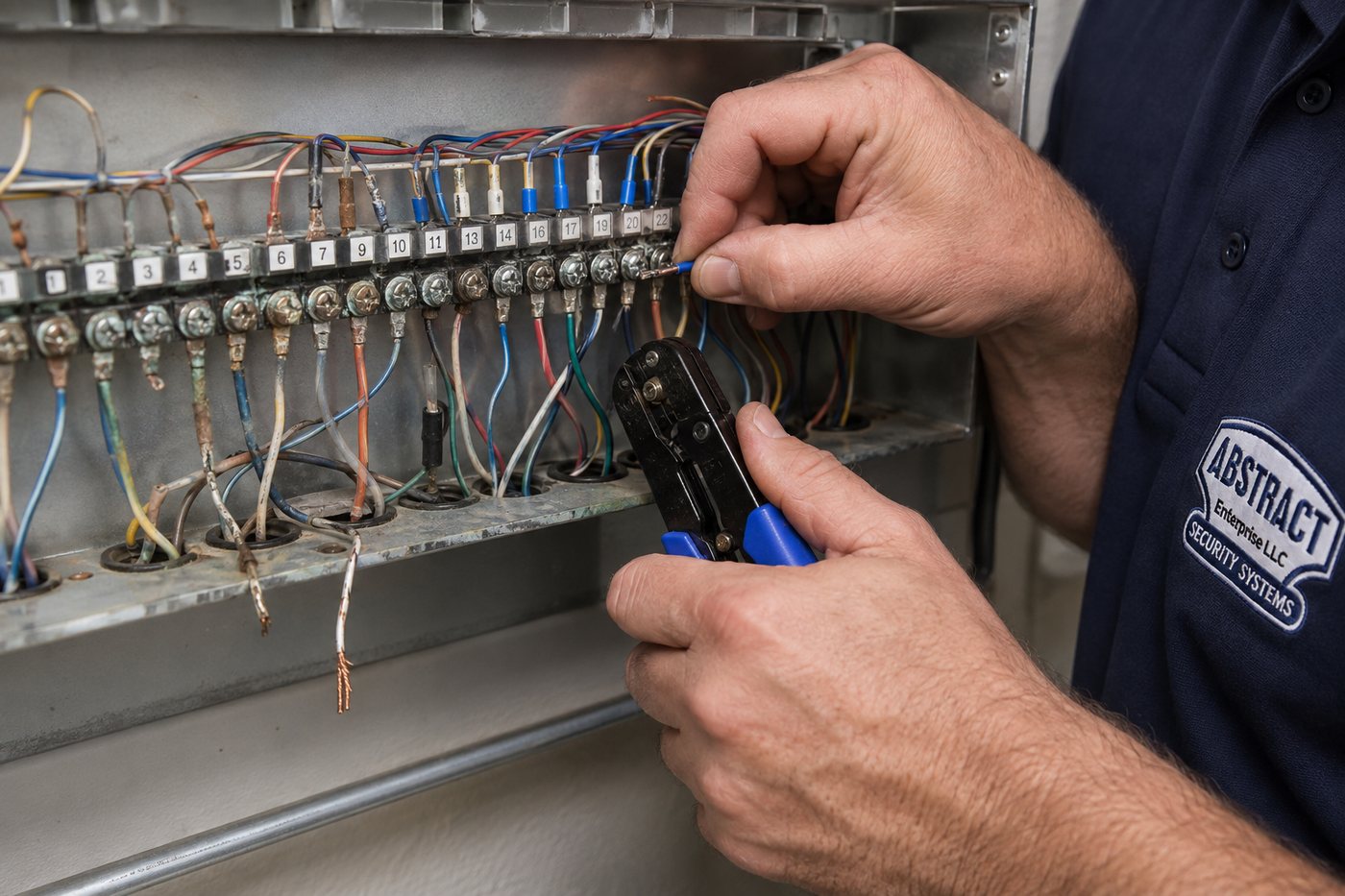
Re-terminating a labelled block rather than rewiring the riser.
Is my Orange County landlord required to fix the buzzer?
For covered buildings, yes. State MDL requires post-1968 buildings with eight or more units to have a two-way voice intercom, and Newburgh and Middletown hold most of that stock. NYC's HPD process does not apply — enforcement is your city, town or village building department, escalation is the local court. General information, not legal advice.
Our gate fails every winter.
Cold makes the operator draw harder on start and thickens gearbox grease, so an undersized supply that coped all summer collapses. Frost heave moving the posts adds mechanical binding on top of it.
The system is intermittent and it tracks the rain.
Buried conductor with a water fault. Direct-burial cable run with the driveway decades ago fails where water sits. That clue narrows the diagnosis considerably.
Directory panel service on a large multi-unit entrance.
Several apartments in our Newburgh building have static.
That is trunk corrosion rather than a single failed pair, and pre-war Newburgh stock is old enough for it to be a real finding. It prices very differently, so we tone the conductor before recommending anything.
We have a barn and a guest house on the same system.
Those are usually daisy-chained rather than home-run, so one break takes out everything past it. Knowing the topology before tracing starts is what keeps the visit predictable.
Do you handle warehouse and distribution entries?
Yes. The I-84 and Route 17 corridors have added substantial capacity and those entries usually need proper access control rather than a buzzer — multi-door credentials, request-to-exit hardware, and maglocks with alarm integration and free egress.
Transformer output measured under load. Below six volts means replace.
Can you avoid trenching the driveway?
Often. Cellular conversion at the gate station removes the buried run to the house entirely. It carries a monthly fee but compares well against excavation on a long drive.
How fast can you reach Warwick or Port Jervis?
Those are scheduled rather than same-day. Newburgh, New Windsor, Cornwall, Monroe and Middletown are usually next day. We would rather book a firm window than leave you waiting on a long drive.
One apartment in our Middletown building is dead.
Shared equipment is working and the fault is that unit's station, terminals or pair. Least expensive repair in the category.
The buzzer will not stop buzzing.
A stuck button or a welded relay holding the circuit energised — and a welded relay holding the strike open leaves the entrance unlocked. Disconnect the panel rather than forcing the button.
Can I replace the transformer myself?
No, the primary side is line voltage and that is licensed work. Safe to check: whether other units are affected, whether the fault follows the weather, and whether a button is physically stuck.
Reviewed and updated September 2026.
Get the Buzzer Fixed
Component-level diagnosis across Orange County. We identify the failed part and quote the repair before touching anything — no system-replacement pitch on a $250 fault.