Nassau is three towns, two cities and sixty-four villages, and its front doors span every decade from Gold Coast estates to post-war Capes, high ranches, raised canal houses and Main Street storefronts. The right smart lock depends on which of those doors you own. We read the door first — its age, its bore, its frame, its exposure — then fit a lock that suits it, pair it to the system you already run, and set up every person who needs to get in.
Reviewed and updated October 17, 2026 · Written by Anwar Timothy, NYS licence #12000287431
Close-up of a technician in safety glasses and grey work gloves tightening a terminal on an electric strike set into a black metal door frame. A small label on the strike body has tick boxes for 12 VDC and 24 VDC and a wiring key for red, black, white and green conductors. A strike like this belongs on a shop or office door; most Nassau houses get a battery deadbolt instead.
Free Nassau Smart Lock Quote
Your village, the doors and the house type — we call back the same business day
✅
Request Sent!
We'll call you back the same business day.
25+
Years Experience
✓
Same-Day Estimates
100%
Licensed & Insured
4.7★
201 Google Reviews
Just bought in Merrick, renovating in Massapequa, or opening a shop on Jericho Turnpike? Call our Nassau line, (516) 346-5778, or send the quick form with your village and a phone photo of each door. The person who reads it is a technician who can tell a 1949 ranch door from a 1990s fiberglass replacement at a glance.
Door read before lock chosen — bore, backset, frame, exposure and swing checked on every door we quote
One written figure per house or per shop, agreed at the free walkthrough before anything is drilled
NYS Low-Voltage licence #12000287431 · certificates of insurance for HOAs, co-op boards and landlords at no charge
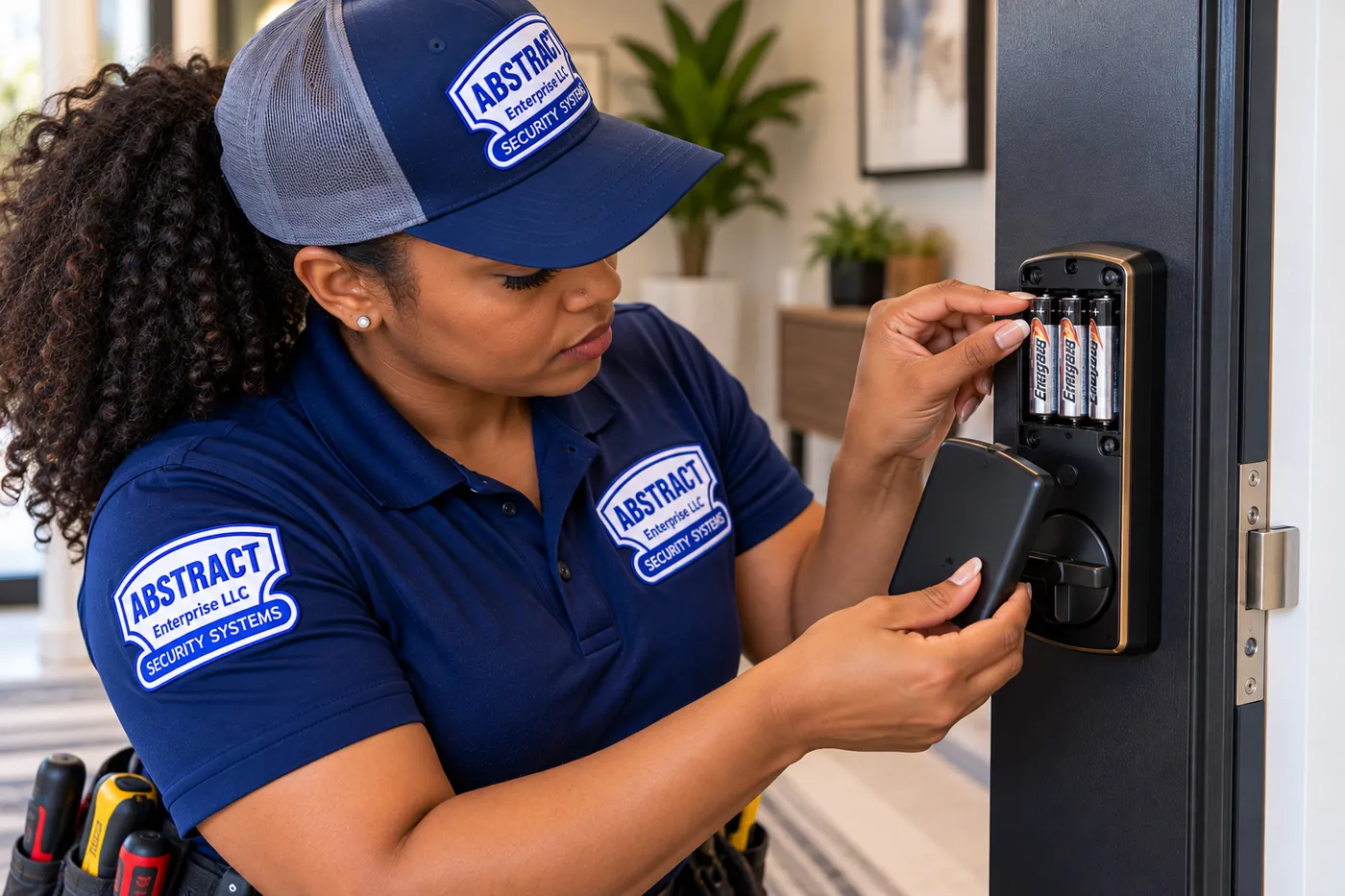
Fresh batteries and a check of the motor — the fix for most locks that start acting up.
The Neighborhood
Why Nassau County Properties Need Smart Lock Installation
In Nassau, the door decides the lock. Drive from Inwood to Bayville and you pass through nearly every era of American house-building, packed tightly together. A Garden City street laid out after Alexander Turney Stewart bought part of the Hempstead Plains in 1869 gives way to post-war split-levels and ranches; a block of Levitt Capes and 1949 ranches sits a few minutes from a Gold Coast estate in Old Westbury; raised houses on the canals of Freeport, Baldwin and Island Park sit across the bay from the barrier-island city of Long Beach. Each era built doors its own way, and a smart lock that drops straight into one of them can fight the next one for an afternoon.
That is the real reason people call us rather than just buying a box at the hardware store. The keypad deadbolt on the shelf assumes a modern door: a 2-1/8-inch cross bore, a 2-3/8 or 2-3/4-inch backset, a door between about 1-3/8 and 1-3/4 inches thick and a frame that lines up with the strike. Plenty of Nassau doors meet that. Plenty don't. Original doors on houses from the 1920s often had a mortise lockset and no deadbolt bore at all. Levitt-era doors have been re-hung and re-bored by several owners. Split-level entries open onto a half-flight of stairs where the inside of the lock can foul a railing. Colonial front doors carry thumb-latch handlesets that a new deadbolt has to sit above and match. Canal houses raised after Superstorm Sandy have front doors at the top of an exterior stair, open to wind-driven rain, and sometimes a ground-level door that the next surge could put under water.
The security case is the same as anywhere on Long Island, and Nassau police keep making it. In June 2023 the Nassau County Police Department described two masked men walking a Syosset driveway before dawn, trying car doors, then testing a rear sliding door and a basement window until the window broke and woke the homeowner; the department's advice was for residents to lock their vehicles and their residence doors, because "locked doors can help to prevent crimes." Years earlier, Nassau police warned about distraction burglars posing as contractors or utility workers while a partner slipped in through an unsecured entry, and told residents to keep doors locked even when they are home. A deadbolt that relocks itself after the door closes does exactly that, without anyone remembering to turn a key.
Then there is daily life. A Nassau household commonly has a working parent who leaves before seven, children who get home before anyone else, a dog walker, a cleaner, a contractor in the middle of a kitchen job, and an older parent who visits on Sundays. Each of those people currently has a key, or knows where one is hidden. A smart lock replaces that with a code for each person, switched on and off when needed, with a record of when each one was used. For Main Street businesses — a boutique in Rockville Centre, a dental office off Mineola Boulevard, a seafood restaurant on the Freeport Nautical Mile — the same idea runs staff codes and early delivery access, and ends the ritual of re-keying every time someone leaves.
So our Nassau work starts at the door, not at the catalogue. We measure, look at the frame and the hinge side, check what the door is exposed to, then choose between a retrofit that keeps your outside cylinder, a full keypad or touchscreen deadbolt, a smart handleset, or — for a commercial door — a keypad or reader on an electric strike. Then we pair it to the panel, hub or app already in the house and teach everyone how to use it.
The numbers behind a Nassau smart lock job
2 cities, 3 towns, 64 villages: Glen Cove and Long Beach; Hempstead, North Hempstead and Oyster Bay; and 22, 27 and 15 incorporated villages within those three towns respectively, plus more than 100 unincorporated areas (Nassau County, Cities, Towns & Villages page) — a lot of separate building departments, codes and design habits within a short drive.
480,591 housing units and 81.9% owner-occupied: Nassau's housing count for July 1, 2025 and its 2020–2024 owner-occupancy rate (U.S. Census Bureau QuickFacts) — most doors here are chosen, drilled and paid for by the people who live behind them.
2.99 people per household: the county average in Census QuickFacts — roughly three codes per house before you add the cleaner, the walker and the in-laws.
1869 and 1919: the year A. T. Stewart bought the Hempstead Plains land that became Garden City, and the year the village incorporated (Garden City history, Wikipedia) — the county's oldest planned streets sit alongside post-war split-levels and ranches.
1949: the year Levitt restyled its Cape Cod into the ranch, moving the kitchen to the front of the house and putting the house on a heated concrete slab with no basement (Hofstra University Levittown exhibit) — one reason the busiest door on many Levittown streets is not the one a visitor would choose.
$250 million and two weeks: the estimated Superstorm Sandy damage in Long Beach and how long the city went without power and running water in October–November 2012 (Long Beach, Wikipedia) — why every lock we fit on the South Shore keeps a mechanical key or override and why we think hard about doors below the flood line.
Keypad lever lock on an interior office door — good for suites, supply rooms and server closets.
Repair Capture
When a Nassau Smart Lock Stops Behaving
A bolt that stalls against the strike every humid August afternoon, a keypad that lights but won't turn, a lock that vanished from the app after Optimum or Verizon swapped the router, an auto-lock that fires while the door is still open — none of those means you need a new lock. Most come down to a door that has moved, a strike that needs deepening, a lost pairing or a setting, and once a technician is standing at the door most are fixed in one to two hours. App, pairing and settings work with no hardware fitted is booked as a setup-only visit: first hour flat at $225 in Nassau, then 30-minute blocks. Hardware repairs after an installation are service calls at $195/hr with a 3-hr minimum ($585). Same-day when a two-hour window is open — call (516) 346-5778 and tell us the brand and what the lock is doing.
What We Install
Smart Lock Installation Services in Nassau County
Every service below starts with the same thing: reading the door. We supply the lock or fit one you already own, prepare the door and frame so the bolt throws cleanly, pair the lock with the system you use, and set up every user before we leave.
Post-War Cape & Ranch Doors
Keypad or touchscreen deadbolts on Levittown, Wantagh, Hicksville and Bethpage doors that have been re-hung and re-bored over seventy years — old holes filled, bores trued, strikes reset into solid wood.
Split-Level & High Ranch Entries
Locks chosen and positioned so the inside unit clears the half-flight railing and the door still swings fully open onto the landing. Common across East Meadow, Plainview, Syosset and Merrick.
Colonial & Tudor Handleset Doors
A smart deadbolt fitted above an existing thumb-latch handleset, or a matched smart handleset that replaces both, in finishes that sit right on Garden City, Rockville Centre and Manhasset front doors.
Mudroom & Garage Entries
The door the family actually uses, set to relock on a short timer and to warn you if it is left ajar. Children get their own codes; the app shows who came in and when.
Raised & Flood-Zone Houses
Exterior-rated locks on the stair-top entries of canal houses in Freeport, Baldwin, Oceanside and Island Park, and an honest conversation about which ground-level doors should keep a mechanical lock.
Gold Coast & Estate Doors
Heavy, older North Shore front doors and service entrances in Glen Cove, Oyster Bay and the Old Westbury area, where a retrofit or a mortise-compatible solution protects original hardware.
Garden Apartments & Co-ops
Unit doors that open straight to the outdoors or onto a shared hall, near LIRR stations from Great Neck Plaza to Mineola, with the house rules and duplicate-key arrangements of the building respected.
Main Street Shop Doors
Keypads and readers on electric strikes for narrow-stile aluminium storefronts and back doors on Jericho Turnpike, Franklin Avenue, Middle Neck Road and Sunrise Highway, with free egress kept on the inside.
Repairs & Re-Pairing
Locks that drift out of the app, bolts that bind, keypads that died after a storm, and smart locks fitted by someone else that never quite worked. Diagnosed, adjusted and re-paired.
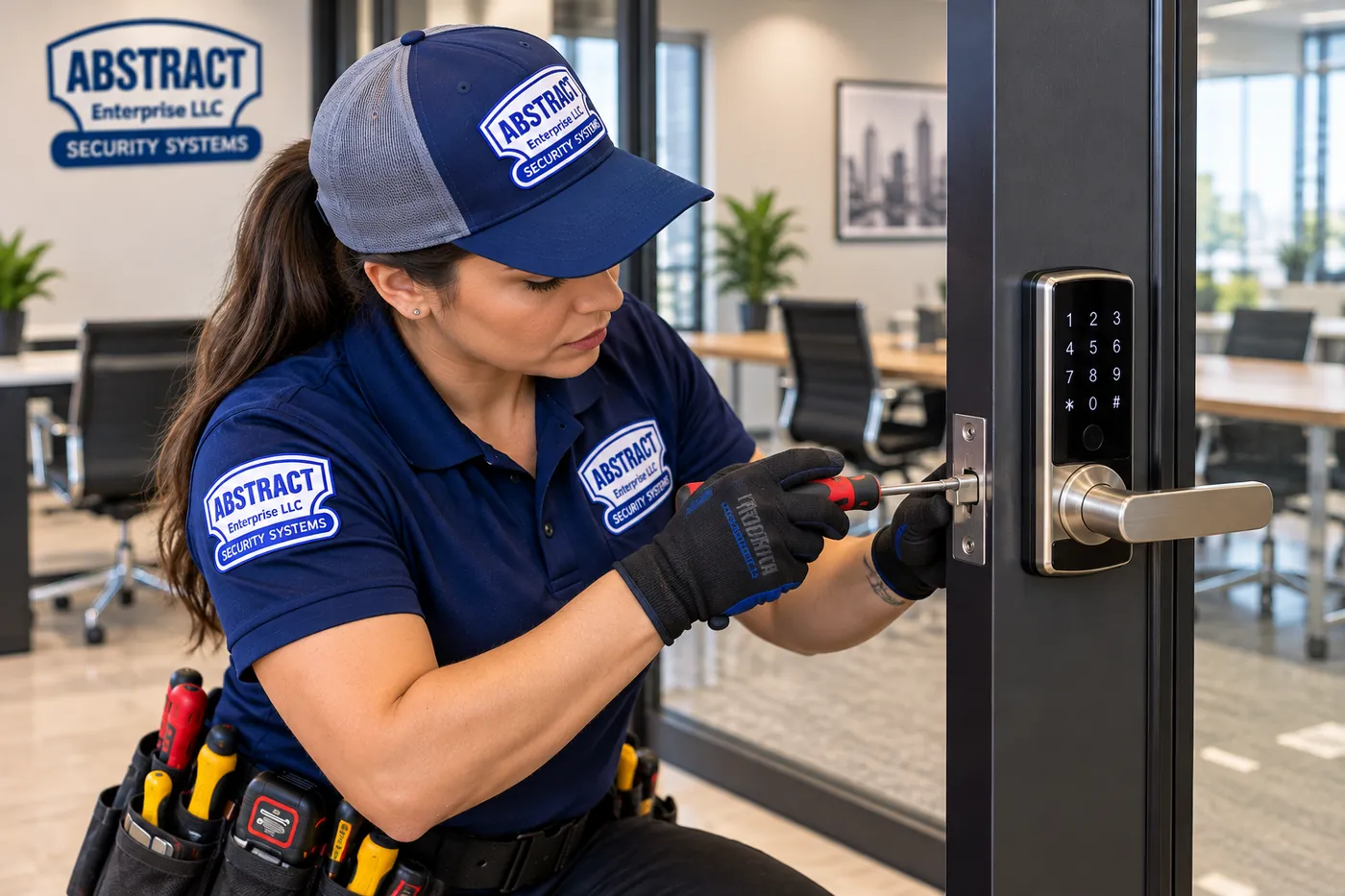
Checking bolt throw and strike alignment — a bolt that binds drains batteries and jams motors.
Building Specialists
Smart Lock Installation for Nassau County's Architecture
Think of Nassau as a museum of doors. Below are the house and building types we meet most often across the three towns and two cities, what their entry doors tend to be like, and what that means for the lock. None of this replaces measuring the actual door — owners have swapped doors, re-bored them and painted over hinges for decades — but it explains why two neighbouring houses can need very different hardware.
Dates from the Garden City, Old Westbury Gardens, Long Beach, Glen Cove and Planting Fields articles on Wikipedia, Hofstra University's Levittown exhibit, and CBS New York and Long Island Weekly coverage of the Hempstead rental law. Spacing is not to scale.
House or building type
Where you see a lot of it
What the entry door is usually like
What we usually fit
Early planned-village homes and 1920s–30s Colonials and Tudors
Garden City, Rockville Centre, Malverne, Manhasset, Great Neck villages
Heavy wood door, often original; may carry a mortise lock or a handleset with no separate deadbolt; sidelights common on Colonials
Retrofit or smart handleset; new deadbolt bore only where the door's construction allows it
Gold Coast estates and their service wings
Glen Cove, Oyster Bay villages, Old Westbury, Sands Point, Lattingtown
Oversized or thick doors, specialist hardware, several service entrances, long distances from the router
Mortise-compatible or retrofit units on main doors; keypad deadbolts on service and staff doors; signal planned door by door
Levitt Capes (1947–48) and ranches (1949–51)
Levittown, parts of Hicksville, Wantagh and Westbury
Doors replaced or re-bored by several owners; slab-built houses with the 1949-on kitchen at the front
Keypad deadbolt after filling old holes and resetting the strike; the street-side kitchen door often becomes the main keyless entry
1950s–60s split-levels and high ranches
East Meadow, Merrick, Bellmore, Plainview, Syosset, Massapequa
Front door opening onto a landing with stairs up and down; garage often under the upper level
Slim-profile interior unit that clears the railing; relock timer that suits a door often left open while carrying shopping upstairs
Later Colonials, expansions and new builds
Throughout the county, especially where older houses were rebuilt
Factory-bored fiberglass or steel door, mudroom off an attached garage, back slider
Keypad or touchscreen deadbolts on front and mudroom doors, paired to the alarm or hub, one code plan for the house
South Shore canal and bay houses, many raised after 2012
Freeport, Baldwin, Oceanside, Island Park, Long Beach, Point Lookout, Massapequa waterfront
Front door up an exterior stair, exposed to wind and salt; some ground-level doors to storage or garage areas below the living floor
Exterior-rated lock and finish on the stair-top door; mechanical locks on doors that can flood; battery and override access planned for outages
Garden apartments and co-op buildings
Near LIRR stations: Great Neck Plaza, Mineola, Hempstead, Freeport, Long Beach
Unit doors that open outdoors or onto a shared corridor; building rules on keys and hardware
Keypad deadbolt or retrofit within the building's rules, duplicate key or code arrangement agreed with management
Main Street storefronts and small offices
Jericho Turnpike in Mineola, Franklin Avenue in Garden City, Middle Neck Road, Sunrise Highway, the Freeport Nautical Mile
Narrow-stile aluminium and glass doors, steel back doors, landlord-controlled frames
Keypad or reader on an electric strike, or a commercial keypad lever on the back door; free egress kept inside
Methods that change with the era of the door
Pre-war wood doors. The question is how much of the door's original construction we can keep. A mortise lock lives in a deep pocket cut into the door edge, and a standard deadbolt bore driven through that pocket can leave very little wood behind. Where the existing lock still works, a retrofit unit that mounts on the inside and turns the existing thumb-turn is often the kindest option. Where a new bore is safe, we drill with a jig so the hole is square to the face and the latch hole meets it cleanly, then mortise the strike into the frame rather than surface-mounting it.
Post-war doors with a history. A Levitt-era or 1950s door may have carried a knob, then a knob plus deadbolt, then a replacement deadbolt at a slightly different height. We fill abandoned holes with hardwood plugs or a fill kit, fit a reinforcing wrap or edge plate where the wood around the bore is thin, and use long screws through the strike into the stud behind the jamb. The goal is a bolt that slides home with a fingertip before any motor is asked to do it.
Factory-bored modern doors. Fiberglass and steel replacement doors installed in the last few decades are usually the quickest: the bore and backset match what smart deadbolts expect. The time goes into alignment — a strike plate that the bolt actually hits on a muggy day and a dry one — and into pairing, scheduling and setting up users.
Exposed and coastal doors. On a stair-top entry facing the bay, we look for a lock rated for exterior temperature range and moisture, use stainless fasteners, and pay attention to how much shelter the keypad has from driving rain. A keypad that faces the weather with no overhang will see more water than its maker imagined. We would rather suggest a small canopy or a different model than fit something that corrodes in two seasons.
Commercial frames. Narrow-stile aluminium storefront doors rarely have room for a residential deadbolt. Instead, a keypad or reader on the frame or wall releases an electric strike in the jamb, or a maglock holds the door at the header, with a request-to-exit device and free egress on the inside. Where the landlord controls the frame, we propose options that need the least cutting and document them for approval.
Cross-sell worth considering: most Nassau Colonials and split-levels that get two or three smart locks also get a video doorbell on the front entry, and Main Street shops that start with one keypad often move on to access control installation for Nassau County businesses once they have more than a couple of doors and want schedules and audit reports.
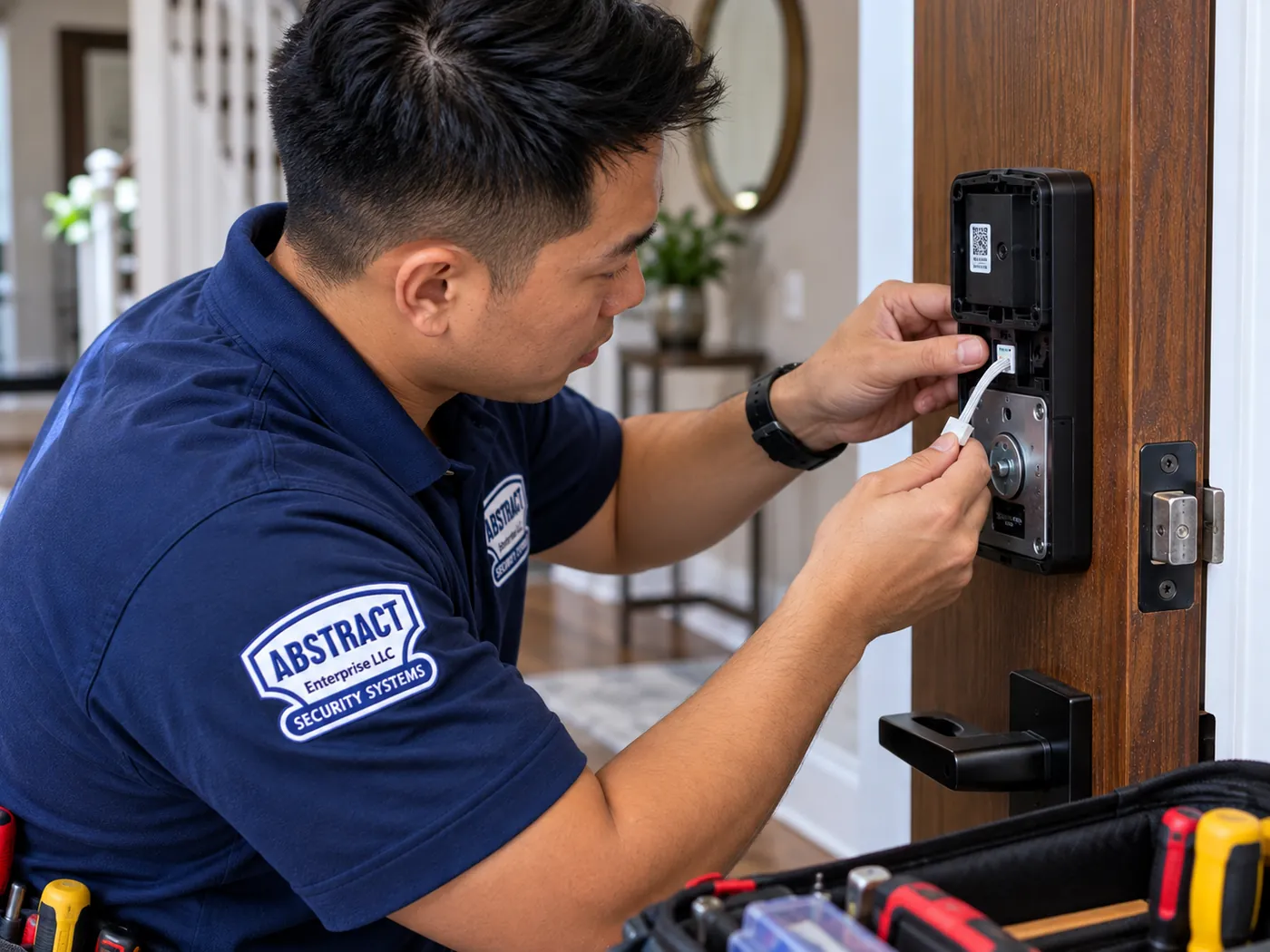
Seating the ribbon cable between the outside keypad and the inside unit — a loose connector is the top cause of dead keypads.
Commercial Smart Lock Installation
Business Smart Lock Installation in Nassau County
Nassau's small businesses mostly sit on Main Streets and turnpikes, not in towers. That shapes the lock. A shop with one front door, a back door to the alley and a stockroom does not need a server room full of controllers; it needs staff codes that can be cancelled the day someone leaves, a delivery code that works only early in the morning, a record of who opened up, and a front door that still lets customers out without fumbling. These are the corridors where we do most of that work.
Jericho Turnpike through Mineola and beyond
Jericho Turnpike is Mineola's commercial main street, running past the village that has been the county seat since 1900. Law offices, medical suites near NYU Langone Hospital–Long Island, and service businesses with a front door on the turnpike and a back door on a side lot.
Franklin Avenue and Seventh Street, Garden City
Franklin Avenue's former department-store buildings now hold offices and medical practices, and the village centre has boutiques and restaurants. Suites with shared lobbies, where the suite door gets a keypad and the building door stays with the landlord.
Middle Neck Road, Great Neck peninsula
Middle Neck Road runs down the centre of the peninsula through some of its nine villages. Shops, salons and professional offices with glass fronts, often with apartments above and a shared rear entrance.
The Freeport Nautical Mile
Dozens of restaurants, bars and shops along Woodcleft Avenue beside the canal, plus charter fishing boats. Early seafood deliveries, late closing, salt air on every fitting and staff who change with the season.
Sunrise Highway and the South Shore downtowns
From Valley Stream and Rockville Centre east through Baldwin, Freeport, Merrick and Massapequa, strip centres and village downtowns line Sunrise Highway. Landlord-owned aluminium storefronts and steel back doors on shared service lanes.
Hempstead Turnpike and Old Country Road
Big-box and strip retail, car dealers, medical offices and restaurants along two of the county's busiest east–west roads. Multi-door businesses where a keypad is the first step and full access control is the next.
What a Nassau business door usually gets
Front glass door: a keypad or proximity reader beside the door releasing an electric strike or a maglock during business hours, with the door's mechanical lock still keyed for the owner.
Back or delivery door: a commercial keypad lever or a keypad on a strike, with time-limited codes for suppliers and an alert when it opens outside hours.
Stockroom, office or cash room: a standalone keypad lever so only managers can get in, logged by code.
Free egress first. Model building and residential codes require exit doors to be readily openable from the inside without a key or special knowledge or effort, and electrified locks on commercial doors must release toward the exit side. New York's statewide 2020 codes, in force from May 12, 2020, are built on the 2018 International Code Council books, and your village or town building department applies the edition in force. Every lock we fit leaves an inside thumb-turn, lever or exit device that works with no code and no power.
County home improvement licensing. Nassau County's Office of Consumer Affairs licenses contractors who do home improvement on residences of up to three families. The county's own list of covered trades includes “doors, windows, awnings” and carpentry; it does not name locks, locksmiths or low-voltage work. Its licensing FAQ says contractors who work only on commercial buildings do not need the licence, and that licensed contractors must display it and put the licence number on contracts. AESS holds NYS Low-Voltage licence #12000287431. If your project includes replacing a door or other carpentry, ask whoever does that part for their Nassau licence number; this note is general information, not legal advice.
Accessible hardware. On business doors open to the public, operable hardware should be usable without tight grasping, pinching or twisting of the wrist and mounted between 34 and 48 inches above the floor under the 2010 ADA Standards. We place keypads and levers with that in mind.
Short-term rental rules are local. In July 2017 the Town of Hempstead board voted to set a 28-day minimum on residential rentals and create a rental permit and registry with inspections, after a June 2017 proposal that cited more than 1,000 Airbnb-style listings in the town. A keypad makes check-ins easy, but it does not change what your town, city or village allows; check the current code with them before you list a house.
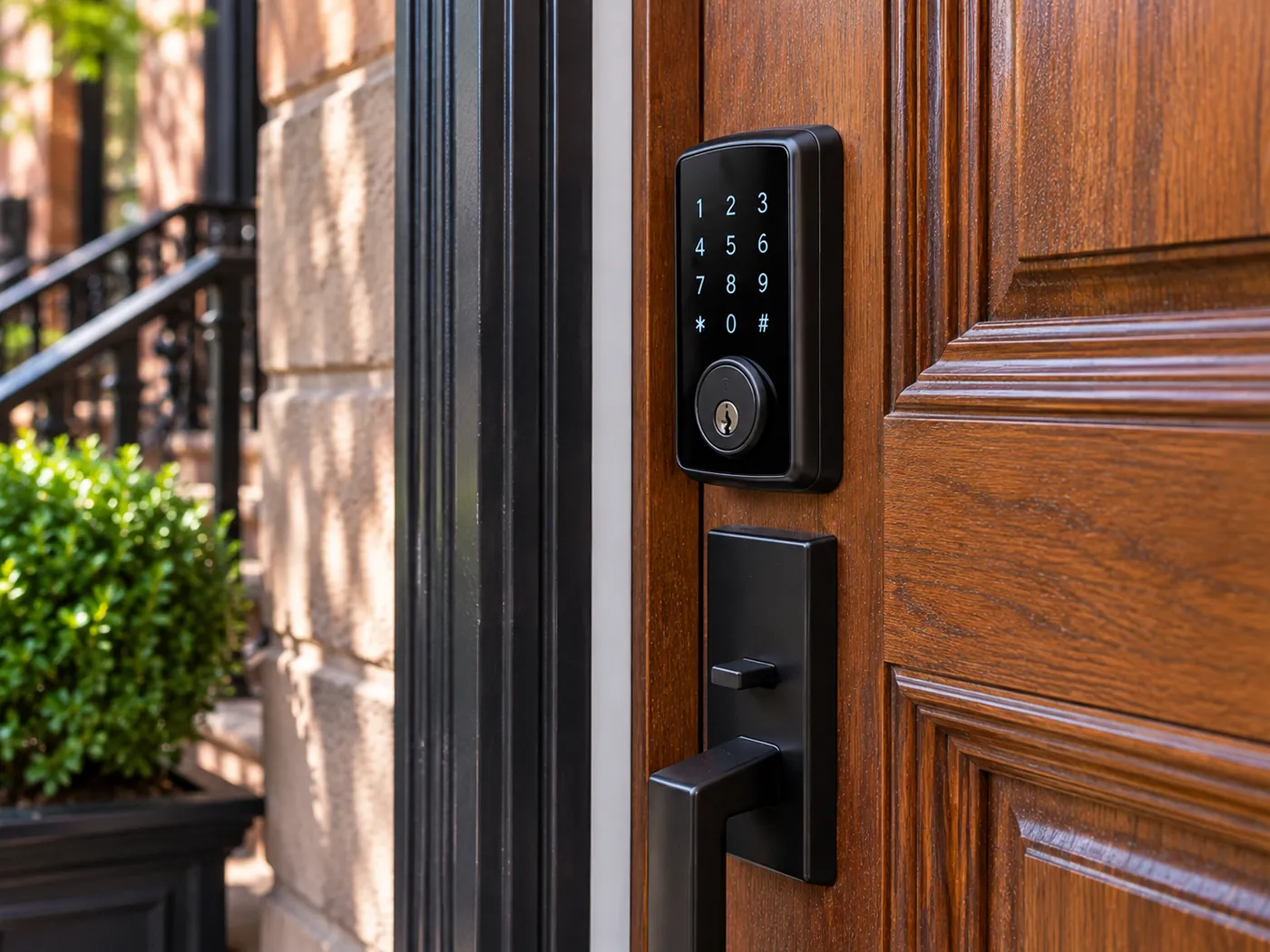
A finished keypad deadbolt on a brownstone front door — keyless entry with a key backup.
Door Reading Guide
How to Tell What Kind of Door You Have Before You Buy
You can learn a lot about your door in five minutes with a tape measure and a phone camera, and it will save you from buying a lock that does not fit. Here is the routine we follow on every Nassau walkthrough, in the order we do it.
Measure the thickness of the door slab at the lock edge. Most smart deadbolts list a range of roughly 1-3/8 to 1-3/4 inches, a few go thicker. A heavy pre-war or estate door may be outside that range.
Measure the backset — from the edge of the door to the centre of the existing deadbolt or knob hole. It should be close to 2-3/8 or 2-3/4 inches. Anything else usually means an older lockset or a non-standard door.
Look at the edge of the door. A small round latch hole with a rectangular faceplate means a bored lock. A tall rectangular faceplate with the latch and bolt in one body means a mortise lock.
Count the holes. Filled or abandoned holes on the face or edge tell you the door has been re-bored. Photograph them; we will plan the fill.
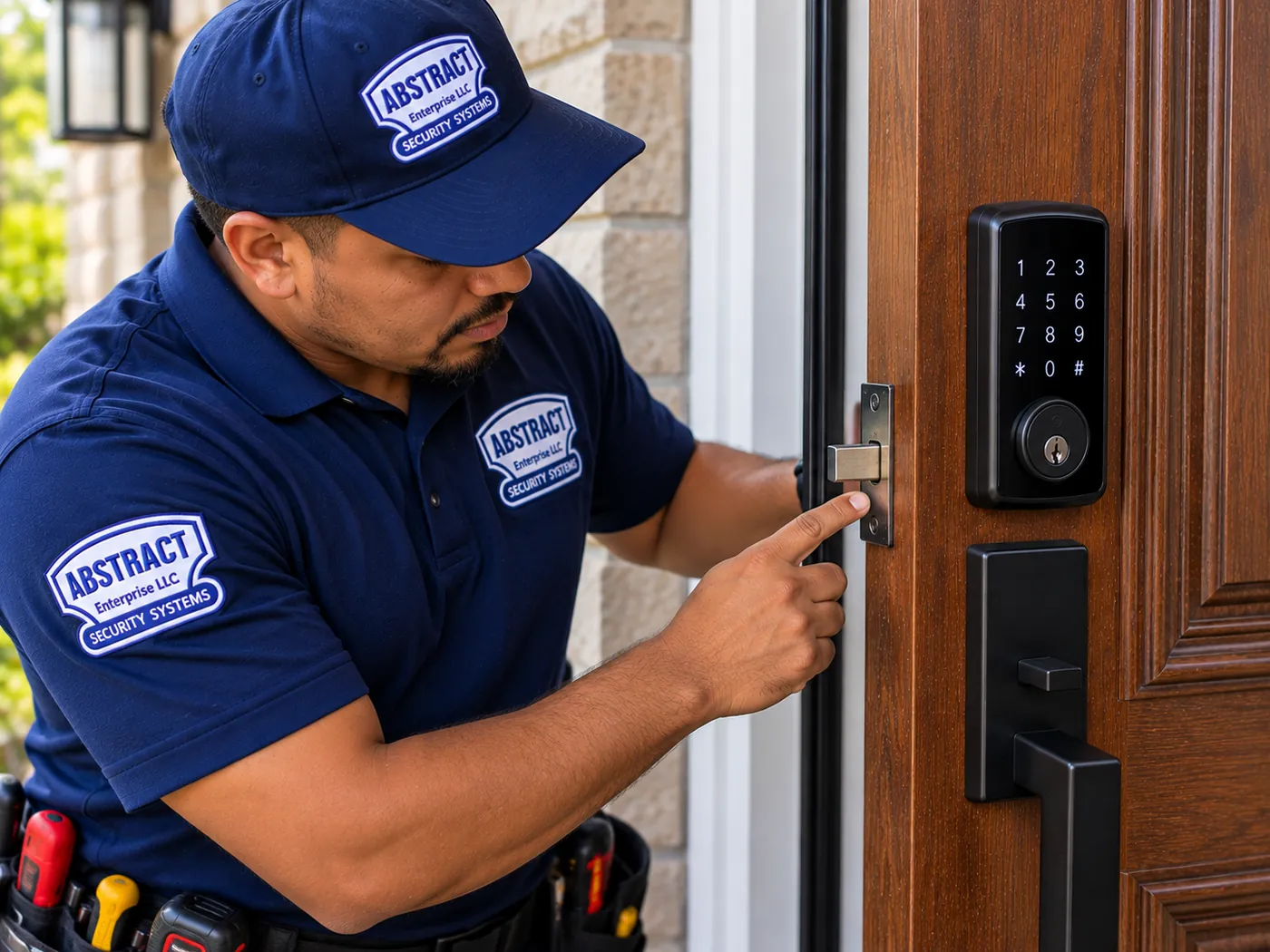
Close the door and turn the existing deadbolt slowly. If you feel it rub or have to push or pull the door to make it throw, the strike is out of line. A smart lock will struggle with the same door until that is fixed.
Check what is in front of and behind the door. A storm door, a railing on a split-level landing, a wall return or a glass sidelight all affect which interior and exterior units fit.
Note the exposure. Is there a canopy? Does the door face the bay, the ocean or the prevailing wind? Is it one step above grade or at the top of a raised-house stair?
Find the router and any hub or alarm panel. Note the alarm keypad brand and the hub model if there is one. That decides whether the lock should speak Wi-Fi, Z-Wave, Thread or Bluetooth.
Typical preparation that most retail smart deadbolts list. Always check the exact figures for the model you are considering; heavier and older Nassau doors often fall outside them.
Send us those photos and measurements with your quote request and we can often tell you on the phone which lock families will work, and which will not, before anyone drives over.
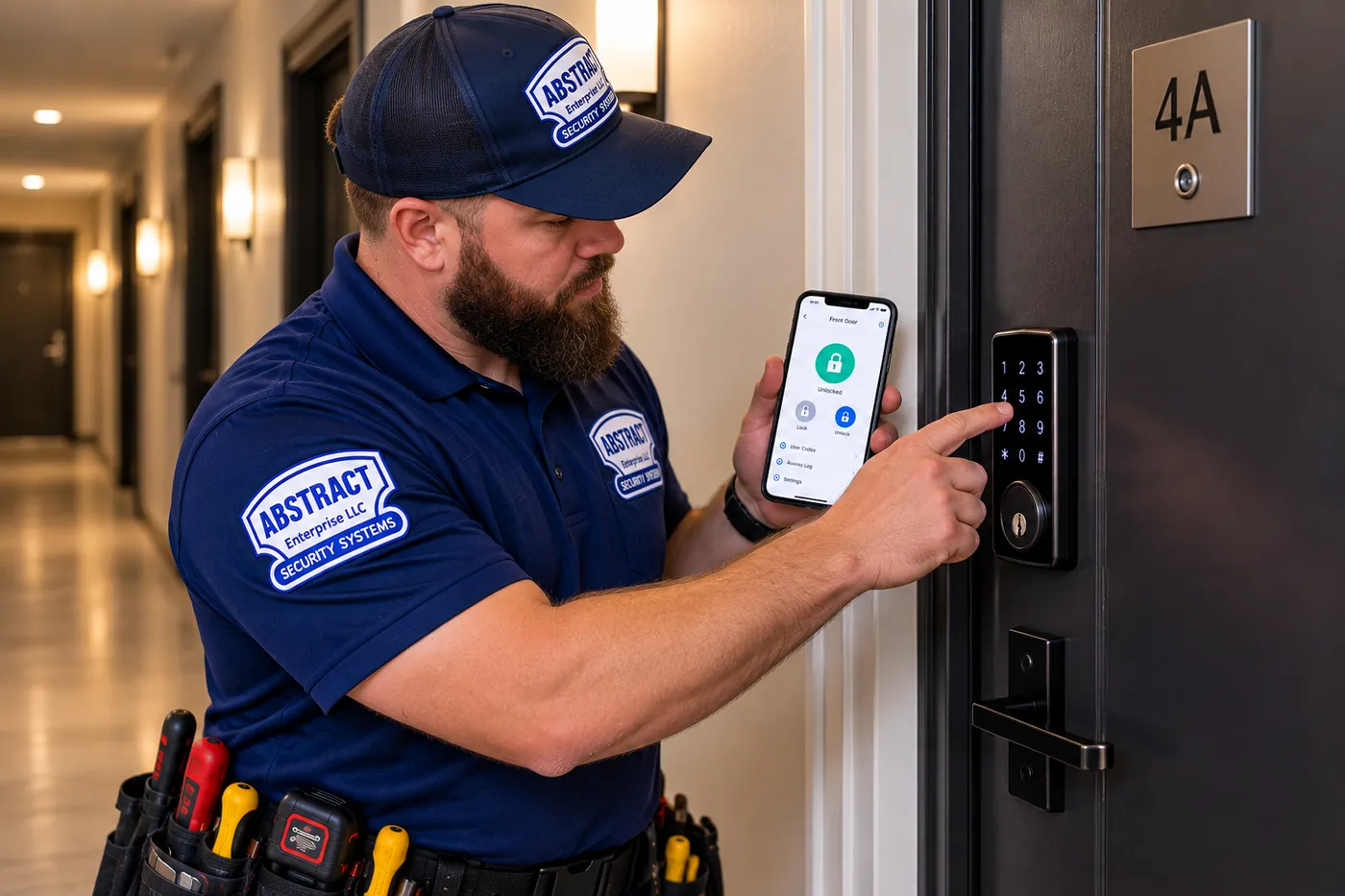
Apartment unit door, tested from the keypad and the app — handy for owners renting out units.
Your Questions Answered
Smart Lock Installation in Nassau County: Questions Answered
These are the questions Nassau homeowners and shop owners actually put to us at the door, grouped by the kind of property they come from. Each answer is the one we would give standing on your front step.
Doors from different housing eras
Can a keypad deadbolt be added above the thumb-latch handleset on our Colonial or Tudor front door without replacing the whole set?
Usually, yes. Many Nassau Colonials and Tudors have an exterior handleset — a grip with a thumb latch — with a separate deadbolt above it, and a smart deadbolt can replace just that upper deadbolt. Three things decide whether it looks and works right. First, the spacing: on many handlesets the deadbolt sits a fixed distance above the latch, and the new deadbolt's exterior unit has to fit between the handleset's upper post and the door's top rail or glass. Second, the finish: a satin-nickel keypad above an oil-rubbed bronze handleset looks like a mistake, so we bring the finish options to the walkthrough. Third, some handlesets are one-piece units where the deadbolt and grip share a backplate; on those, a matched smart handleset that replaces the whole assembly is the clean answer. We tell you which you have before quoting.
What if our front door has never been bored for a deadbolt at all?
That happens on some original 1920s and 1930s doors in older villages, on doors that rely on a mortise lock, and occasionally on interior-grade doors someone hung on an exterior opening. If the door is solid and thick enough, we bore a new deadbolt hole with a jig — square to the face, at the right backset, clear of any rails or panels — and mortise a reinforced strike into the frame. If the door is a mortise-lock door, we look at whether a retrofit unit can drive the existing lock or whether boring a separate deadbolt would weaken the stile. And if the door is hollow or thin, we say so: the honest answer may be a better door first, which is carpentry outside our work.
The front door on our split-level opens onto the landing between two half-flights — will the inside of a smart lock hit the railing?
It can, and it is one of the most common snags we find in East Meadow, Merrick and Plainview. Smart deadbolts carry their batteries and motor in the interior unit, and some interior units are tall and deep. On a split-level or high-ranch landing the door may swing back toward a railing, a newel post or the wall of the upper flight. We measure the clearance with the door fully open, pick a lock with a slimmer interior unit if needed, and check that the thumb-turn is still easy to reach from the landing without leaning over the stairs. Where a door stop is missing, we add one so the lock body never meets the railing.
Why we open a split-level door all the way before choosing a lock: the interior unit travels with the door and must stop short of the railing.
Our center-hall Colonial has glass sidelights beside the front door — how do we stop someone reaching through and turning the lock?
This is a fair worry: a thumb-turn within an arm's reach of a sidelight can be turned by someone who breaks the glass. Fitting a lock that needs a key on the inside creates a different problem, because doors used to leave the house must open from inside without a key. The practical answers are to make the glass harder to get through — laminated glass or a security film — and to make breaking it noisy and reported: a glass-break detector or door contact on the alarm, and a lock that sends an alert whenever it is unlocked. Some smart locks also let you disable the outside keypad remotely while you are away, which doesn't stop a reach-through but does stop a code from being guessed. We go through the options for your door before choosing.
How do we stop the door from being kicked in at the frame once the smart deadbolt is on?
The lock is rarely what fails in a forced entry; the frame is. A strike plate held by two short screws in a thin pine jamb splits away long before the bolt bends. On every exterior door we fit, we replace the stock strike screws with long screws that reach the framing behind the jamb, and on doors that need it we fit a reinforced strike box or a full-length jamb reinforcement. We also look at the hinge side — short hinge screws are just as weak — and at whether the deadbolt throws its full length. A smart lock that reports “locked” but only throws half its bolt is not doing its job.
Mudrooms, families and everyday use
The mudroom door is where everyone kicks off their boots — what happens if it relocks while the door is still ajar?
An auto-lock that fires on an open door throws the bolt into thin air, and the next push leaves the door wedged against the bolt or marks the frame. On busy mudroom and kitchen doors we use one of two approaches: a lock with a door-position sensor that only locks once the door is actually closed, or a relock delay long enough to cover the time it takes to get a stroller or a load of groceries through. We also set an alert for a door that has been left open for more than a few minutes, which is often more useful on a mudroom than the auto-lock itself.
Can the lock tell us which of our children got home and at what time?
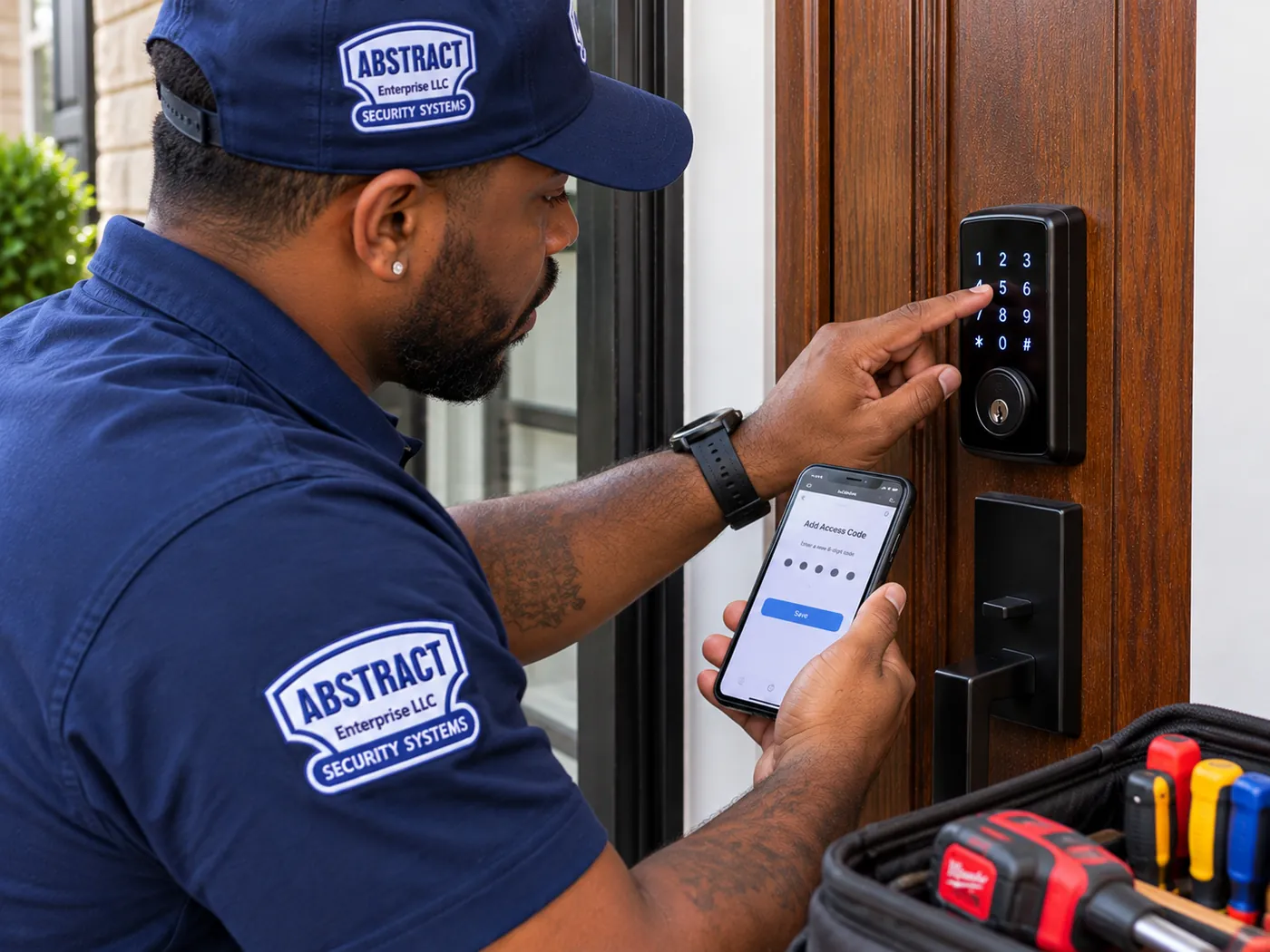
Yes, if each child has their own code or their own phone credential. The app then records which code opened the door and when, and most systems can send a notification for a specific user — “Sam unlocked the side door at 3:12” — rather than for every unlock. We set up named users at the handover, show you how to switch notifications on for particular people, and talk through what happens if a child shares a code with a friend: you change that one code, not everyone's.
Which smart locks are easiest for an older parent with arthritis or weak eyesight to use?
Look for three things: large, backlit buttons with a clear click or a touchscreen with high-contrast digits; a lever-style or large thumb-turn on the inside rather than a small knob; and an auto-lock so nobody has to remember to lock up. Fingerprint models can help some people and frustrate others, so we prefer to let your parent try one before committing. We also set a longer code-entry timeout where the lock allows it, and make sure the person has a key or an override they can actually manage on the day the batteries run down.
We have a kitchen renovation starting — can the lock show when the contractor's crew actually arrives and leaves?
Yes, within limits. Give the contractor a code of their own, valid only on working days and hours, and the lock's history records every time that code opens the door. It shows when the door was unlocked with that code, not who walked through or when they left, so treat it as a check rather than a timesheet. Put the code on the side or mudroom door if you can, so the front door stays family-only, and delete it the day the job is signed off. If the crew needs to come and go without anyone home, a camera at that door fills in what the log cannot.
Will auto-lock shut me out when I step into the yard to let the dog out?
Not if it is set up sensibly. On a back or kitchen door you use constantly, we either lengthen the relock delay, turn auto-lock off for that door during daytime hours where the lock supports schedules, or rely on the keypad so being outside without a phone is never a problem — you simply enter your code to get back in. The one combination we avoid is a keyless lock with auto-lock on and no keypad, where a phone left on the kitchen counter really does lock you out.
Flood zones, canals and the South Shore
Should a smart lock go on a ground-level door that sits below the flood line in a canal-front house?
Generally we advise against putting the only working lock on a door that could be under water. Smart locks are built for rain and humidity, not for being submerged in salt water, and a surge that floods the ground level will usually ruin the electronics. For storage, garage and utility doors below the living floor of a raised house, a good mechanical deadbolt is the dependable choice; put the smart lock on the stair-top entry you use every day. If a lower door must be keyless, choose a model that keeps a mechanical key override and expect to replace the lock after a flood.
We would like to let our Lido Beach or Point Lookout house to weekend visitors with keypad check-in — does the Town of Hempstead allow that?
Not for stays that short, as the law was reported. In July 2017 the Town of Hempstead board voted to set a 28-day minimum on residential rentals and to require a rental permit and registry with inspections. A keypad lock makes it easy to give a monthly tenant or a family member their own code and to cancel it when they leave, but it does not change what the town allows. Rules differ in Long Beach, Glen Cove and each incorporated village, and codes change, so check with your own municipality before advertising.
Apartments, co-ops and shared entrances
Our garden-apartment unit door opens straight to the outdoors rather than onto a hallway — does that change which lock suits it?
It does. Many garden-apartment complexes near Nassau's LIRR stations have unit doors that face a courtyard or a parking area, so the lock sees rain, sun and cold like a house door, not like a corridor door in a city high-rise. That means an exterior-rated lock, a keypad with some shelter, and batteries that cope with winter. It also means the building's rules still apply: many co-op and rental buildings require that management keeps a working key or code for emergencies, so we fit locks that allow that and leave a key or arrange a management code before we go.
When Optimum or Verizon swaps our router, do the smart locks stop working?
The locks keep locking and unlocking with codes and keys, but Wi-Fi locks and Wi-Fi bridges lose their connection if the new router has a different network name or password, so the app and remote access stop until they are rejoined. Z-Wave and Thread locks connect to a hub or border router rather than to the internet router directly, so they are usually unaffected unless the hub itself was moved or reset. The easy fix is to give the new router the same network name and password as the old one; otherwise each Wi-Fi lock or bridge has to be re-added. We can do that on a setup-only visit if you would rather not.
Shops, offices and Main Street doors
What goes on a narrow-stile aluminium shop door, since a residential smart deadbolt won’t fit it?
Yes. Narrow-stile storefront doors have too little metal for a residential smart deadbolt, but a standalone keypad or proximity reader on the frame or wall can release an electric strike in the jamb, with a small power supply and a request-to-exit device on the inside. Codes are programmed at the keypad or in its app, and there is no server or monthly fee unless you want cloud management. Our published figure for a single-door keypad or card reader with electric strike in Nassau is $1,725–$2,875 installed, set at the walkthrough once we have seen the frame and the power available.
Our landlord at a village strip centre won't let us cut into the storefront frame — what are the options?
Ask first what the landlord will accept, in writing. Options that need little or no frame cutting include a surface-mounted maglock at the header with a matching armature on the door, a keypad mounted on the wall beside the door rather than on the frame, and a commercial keypad lever or deadbolt on the steel back door, which is often tenant-controlled. We prepare a short written scope with photos that the landlord's property manager can approve, and we can supply a certificate of insurance naming the landlord.
Can a supplier get in our back door at 5 a.m. without anyone from the restaurant there?
Yes, with a scheduled code. A keypad lever or keypad-and-strike on the back door can hold a code that only works in a window you choose — say 4:30 to 6:30 a.m. on delivery days — and the log shows every time it was used. If the supplier's driver changes, you change one code. Pair that with a camera on the rear door and a door contact on the alarm and you know exactly what came in and when. For walk-in coolers and stockrooms inside, a separate manager code keeps the delivery code to the receiving area only.
Can staff be locked in after closing if the back door uses a keypad?
They should never be. Whatever opens the door from outside, the inside must open with a single, obvious action and no code: a lever, a thumb-turn or a push bar, and on electrified doors a release that works even if the power fails. We fit and test that on every commercial door. If you want to know who left by the back door, add a door contact and camera rather than putting anything in the way of the exit.
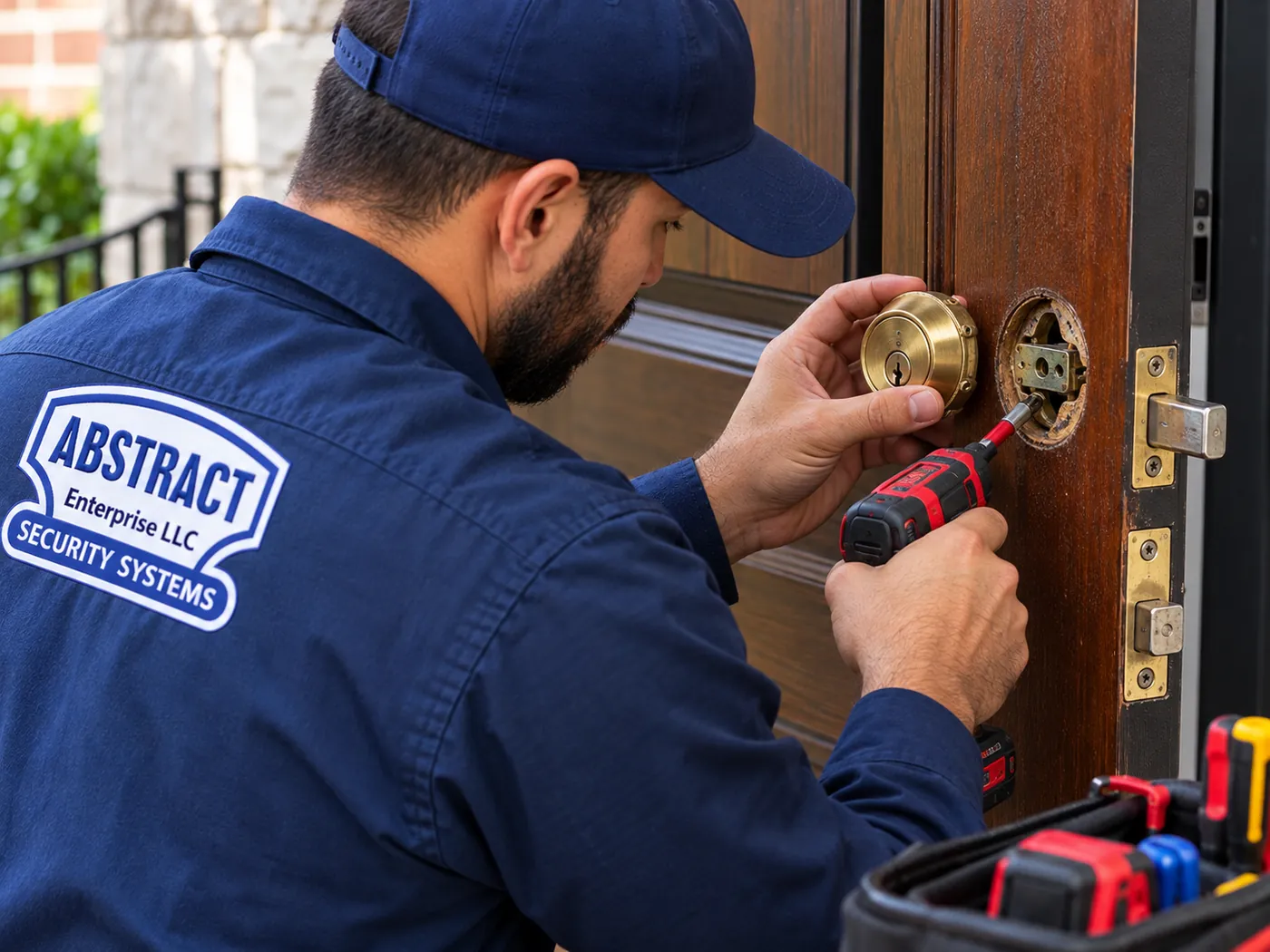
Old brass deadbolt coming out — the first step of a smart lock swap on a wood entry door.
Equipment
Types of Smart Locks We Install
We are not tied to one brand. We choose by door and by system: what fits the bore and the frame, what survives the exposure, and what speaks the same language as the alarm panel, hub or phones in the house. These are the families we fit most often in Nassau.
Retrofit Smart Locks
Mount on the inside over an existing single-cylinder deadbolt and turn its thumb-turn, leaving the outside and your keys unchanged. Good for original or decorative hardware in older villages and for co-op doors with a matching hallway look.
Keypad Smart Deadbolts
Replace the deadbolt entirely, with push buttons or a touchscreen outside and the motor and batteries inside. The workhorse for Capes, ranches, split-levels and mudroom doors.
Smart Handlesets
A grip-and-thumb-latch handleset with an integrated smart deadbolt, matched in finish. The tidy choice when a Colonial or Tudor front door's old handleset is worn out anyway.
Fingerprint & Touch Locks
Fingerprint readers or touch-to-open with a phone credential. Helpful for some older users and children who lose codes; we let the household try one before deciding.
Commercial Keypad Levers
Lever locks with a built-in keypad for back doors, stockrooms and offices, holding many user codes with schedules and an audit trail.
Keypads & Readers on Electric Strikes
For glass and aluminium storefront doors: a wall or frame keypad or reader, a strike or maglock, a power supply and a request-to-exit device, with free egress inside.
Bridges, Hubs & Border Routers
Wi-Fi bridges for Bluetooth locks, Z-Wave enrolment on alarm panels, and Thread border routers for Matter locks, placed where each lock actually gets signal.
Door Sensors & Reinforcement
Door-position sensors so auto-lock only fires on a closed door, reinforced strikes, long screws and edge plates so the frame holds as well as the bolt.
How the lock connects
Works best in a Nassau house that…
Things to know
Wi-Fi built in
has good 2.4 GHz Wi-Fi at the door and no hub
Simple to set up; uses more battery; must be rejoined if the router's network name or password changes
Bluetooth plus a Wi-Fi bridge
has a power outlet within a few feet of the door
Bridges typically need to sit close to the lock; the lock still works by code and phone nearby if the bridge drops
Z-Wave
has an alarm panel or smart home hub with a Z-Wave radio
Locks can arm or disarm the alarm on some panels; enrolment is done on the panel or hub
Matter over Thread
already has an Apple, Google, Amazon or SmartThings Thread border router
The border router must be set up first; feature support differs between apps
ADT, Ring and SimpliSafe versus a local installer
National security brands sell smart locks as part of their systems, and inside their own apps those locks work well. Ring Alarm, for instance, can arm and disarm with compatible Z-Wave locks, with the condition that only codes created in the Ring app trigger that feature, and the feature needs a subscription. What a national brand will not do is plug and re-bore a 1950s door in Bethpage, reinforce a split jamb, work out why a lock binds every August on a canal house, or decide which of a Colonial's four doors needs a keypad at all. We do the door work, then pair the lock to whatever system you have — including ADT, Ring or SimpliSafe — and you deal with one licensed local contractor for the whole job.
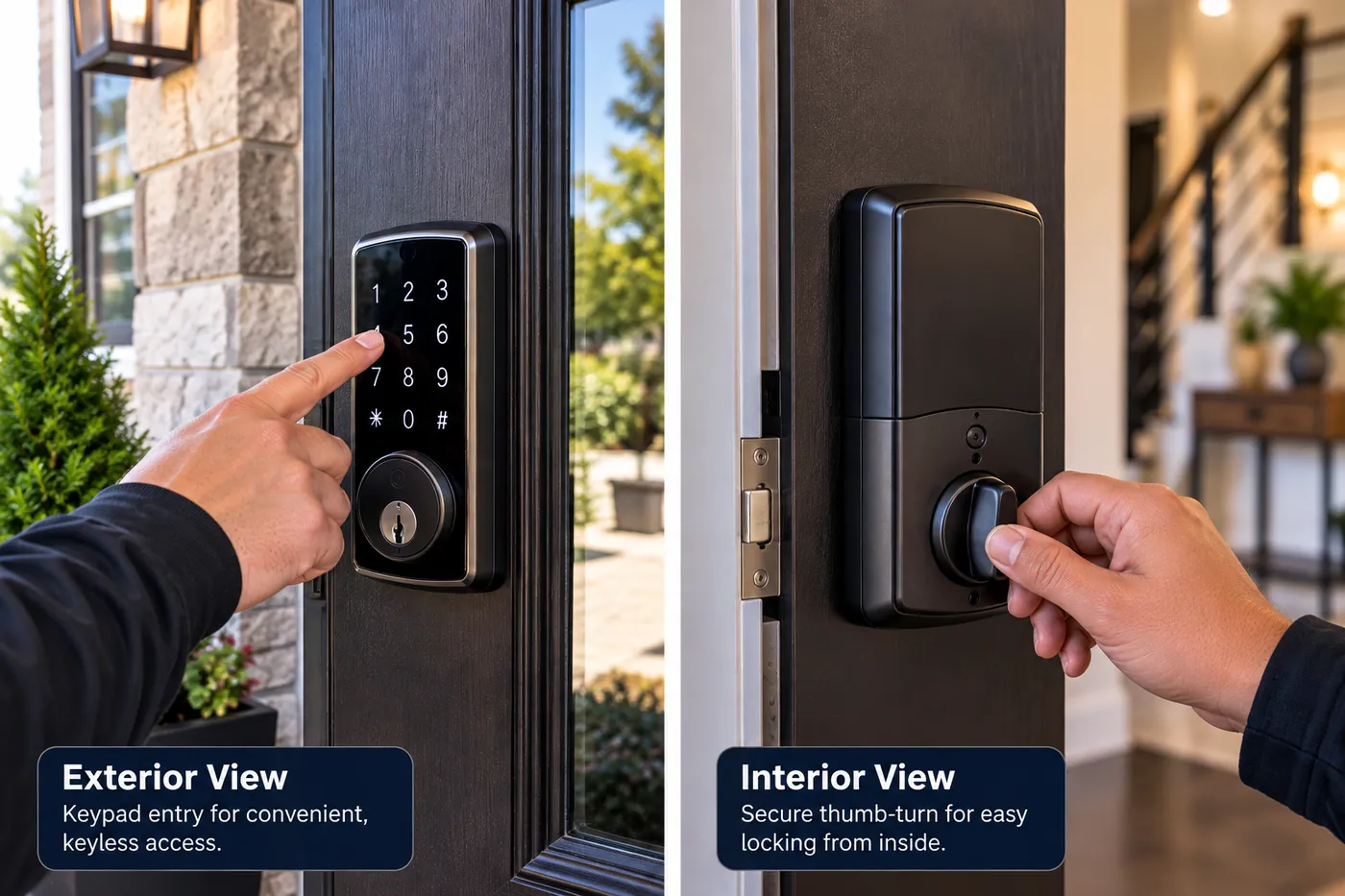
Outside: keypad entry with a key override. Inside: a thumb-turn so nobody gets locked in.
AI Overview Reality Check
What AI Gets Wrong About Smart Lock Installation in Nassau County
We could not open Google's AI Overview or People Also Ask from our research setup, so the claims below are the ones published by national cost guides and manufacturers that AI answers are built from. Each is fair as far as it goes. Here is where it stops matching what we find on Nassau doors.
“Expect to pay a few hundred dollars per lock, fitted.”
That range comes from national cost guides — Fixr's page, updated in January 2025, gives $250 to $400 with an average of $300 for a Wi-Fi lock and one accessory, and LawnStarter's 2025 figure is a $330 national average. Those numbers describe one lock going into one ordinary, factory-bored door, somewhere in the country.
In Nassau the variable is the door, not the lock. A modern fiberglass door in a newer Colonial may be close to that national picture. A Levitt-era door with three abandoned bores, a Garden City door with an original mortise lock or a split-level door that needs a slimmer lock to clear the railing is a different job, and so is any lock that has to be enrolled on an alarm panel.
That is why we quote residential smart locks flat after a free walkthrough instead of publishing a per-lock list price. Use the national figure to sanity-check any quote, ours included — then ask what door preparation and integration are in it.
“It is a thirty-minute screwdriver job for anyone.”
Product reviewers fitting a lock to a test door often report exactly that, and on a door with the standard bore and a well-aligned strike it is true. Many Nassau homeowners do fit their own smart locks, and we are happy to say so.
The half-hour claim falls apart on doors that have moved. A house that has settled for seventy years, a door that swells in South Shore humidity, or a strike that was set a quarter inch high by a previous owner will make a motorised bolt stall, drain batteries and report errors. The screwdriver does not fix alignment; a chisel and a straightedge do.
Our test before any lock goes on: the bolt must throw fully, with the door closed, using one finger on the thumb-turn. If it cannot, we fix the door first.
“If your door already has a deadbolt, any smart deadbolt will drop in.”
Manufacturers publish their door preparation requirements — Schlage's, for example, call for a door between 1-3/8 and 2 inches thick on some models, a 2-1/8-inch cross bore and a 2-3/8 or 2-3/4-inch backset. “Standard” means a door that matches those numbers.
Nassau's housing stock includes plenty of doors that do not: pre-war doors with mortise locks, estate doors thicker than the listed range, sidelight doors where the exterior unit would sit over glass, and narrow-stile shop doors with no room for a residential deadbolt at all.
The fix is to measure before buying. Our door-reading routine above takes five minutes and tells you which lock families can work.
“Buy a Matter lock and the app question goes away.”
Matter is a genuine step forward: a Matter lock can join more than one ecosystem. But the manufacturers' own help pages are careful. Yale's says a Matter-over-Thread lock needs a Thread border router set up first, that feature support varies by app, and that its own app and the Matter app cannot run the lock at the same time.
In practice, a Nassau household with an older alarm panel that speaks Z-Wave, an Amazon speaker in the kitchen and an iPhone in every pocket has to choose which system owns the lock. Matter does not make that choice for you.
We ask what you already run before recommending a protocol, and we tell you plainly which features you will and will not get in each app.
“Hackers make a plain keyed deadbolt the safer bet.”
Any connected device can have vulnerabilities, and keeping firmware up to date matters. But the burglaries Nassau police describe are not sophisticated: masked men testing car doors, sliding doors and basement windows before dawn in Syosset; distraction burglars walking in through an unsecured door while a partner keeps the homeowner talking.
Those break-ins exploit doors that were left unlocked. A lock that relocks itself and tells you when it was opened closes that gap better than a key that depends on someone remembering to turn it.
The real weak points on most Nassau doors are the frame and the glass beside the lock, which is why our installs include long strike screws, reinforcement where needed and an honest look at sidelights.
“Who fits it doesn’t matter, it is just a lock.”
For a single battery deadbolt on a modern door, a careful handyman can. The question is what else the job touches. A keypad and electric strike on a shop door involves low-voltage wiring, a power supply, a request-to-exit device and free-egress rules. A lock enrolled on an alarm panel changes how the alarm behaves.
Nassau County also licenses home improvement contractors working on homes of up to three families, and its covered-trades list includes doors and carpentry. If your project includes replacing a door, that part of the work falls in a licensed trade.
Ask any installer what licence and insurance they carry and for a certificate of insurance. Ours is NYS Low-Voltage licence #12000287431, and certificates are free.
“Outages don’t affect a battery lock at all.”
Mostly true: battery locks keep locking and unlocking by code, key and nearby phone when the house loses power. What stops is remote access and notifications, because the router and any bridge or hub are down.
Nassau knows long outages. After Sandy, Long Beach was without power and running water for two weeks. A lock that is fine on batteries for that long still needs fresh batteries going in, and someone who knows where the mechanical key or override is.
Every lock we fit keeps a key or override, and at the handover we show you exactly where it is and how the lock behaves with the internet down.
Read the Door, Then Choose the Lock
Send a photo of each door, its edge and the alarm keypad on your wall. We will tell you which locks will fit your Nassau house before anyone drills a hole.
Tell us your village, the doors and what the house is like. We reply the same business day, or call our Nassau line at (516) 346-5778.
✅
We Got Your Request!
We'll call you back the same business day. If it's urgent, call us now at (516) 346-5778.
How It Works
Our Installation Process
Six steps, whether it is a single keypad on a Levittown kitchen door or a handleset, a mudroom lock and a shop strike for a family that lives in Rockville Centre and works in Mineola.
1. Door photos first
You send photos of each door face and edge, the alarm keypad or hub, and your village. We tell you which lock families can fit and what we need to see in person.
2. Free door reading
At the walkthrough we measure thickness, bore, backset and clearance, check the strike with the door closed, note exposure and test signal at every door. You get one written figure.
3. Door and frame work
Old holes filled, new bores drilled square, strikes mortised and reinforced with long screws, hinges tightened, door stops added on landings — until the bolt throws with one finger.
4. Lock fitted and tuned
Lock mounted and handed, door-position sensor fitted where used, relock delays matched to how each door is used, and the bolt cycled with the door open and closed.
5. Paired and programmed
Locks joined to the app, hub or alarm panel; a named code for each person; schedules for cleaners, walkers or suppliers; alerts set for the people and doors you care about.
6. Handover at the door
Each person walks to each door and opens it with their own code while we watch. Then the app tour: adding and deleting people, the spare key or override, the battery swap, and what still works with the Wi-Fi off.
Coverage Area
Smart Lock Installation Near Nassau County's Landmarks
Nassau residents give directions by landmarks, and each of these sits in a different corner of the county with its own kind of house nearby. We fit smart locks around every one of them.
Cathedral of the Incarnation, Garden City
Commissioned by Cornelia Stewart and completed in 1885; the village's tallest building, and village law keeps it that way. Around it: planned streets, large older homes and handleset front doors.
Eisenhower Park, East Meadow
930 acres in the middle of the county, larger than Central Park, with three golf courses and the Nassau 9/11 Memorial. The surrounding streets are split-levels, high ranches and Capes.
Old Westbury Gardens
The Phipps family house completed in 1906 to designs by George A. Crawley, listed on the National Register in 1976. Nearby North Shore estates bring thick doors and long walks from router to front door.
Planting Fields, Upper Brookville
More than 400 acres in the Town of Oyster Bay; Coe Hall, a 67-room Tudor Revival house built 1918–1921, with Olmsted Brothers landscapes. Gold Coast service entrances and outbuildings around it.
The Freeport Nautical Mile
Restaurants, bars, shops and charter boats along Woodcleft Avenue beside the canal. Raised canal houses on one side, Main Street back doors and early deliveries on the other.
Long Beach Boardwalk
2.2 miles along the “City by the Sea,” destroyed by Sandy in 2012 and fully reopened in October 2013. Behind it: apartment buildings, attached houses and salt air on every exterior lock.
We also work throughout the rest of the county: Valley Stream, Elmont, Franklin Square and Floral Park on the city line; Hempstead, Uniondale, Roosevelt and Freeport in the middle south; Levittown, Hicksville, Bethpage, Massapequa and Seaford toward Suffolk; Mineola, Westbury, Carle Place, New Hyde Park and the Willistons in the centre; Great Neck, Manhasset, Port Washington and Roslyn on the North Shore; Glen Cove, Locust Valley, Bayville and Oyster Bay on the Gold Coast; and the Five Towns, Oceanside, Island Park and Point Lookout along the bays.
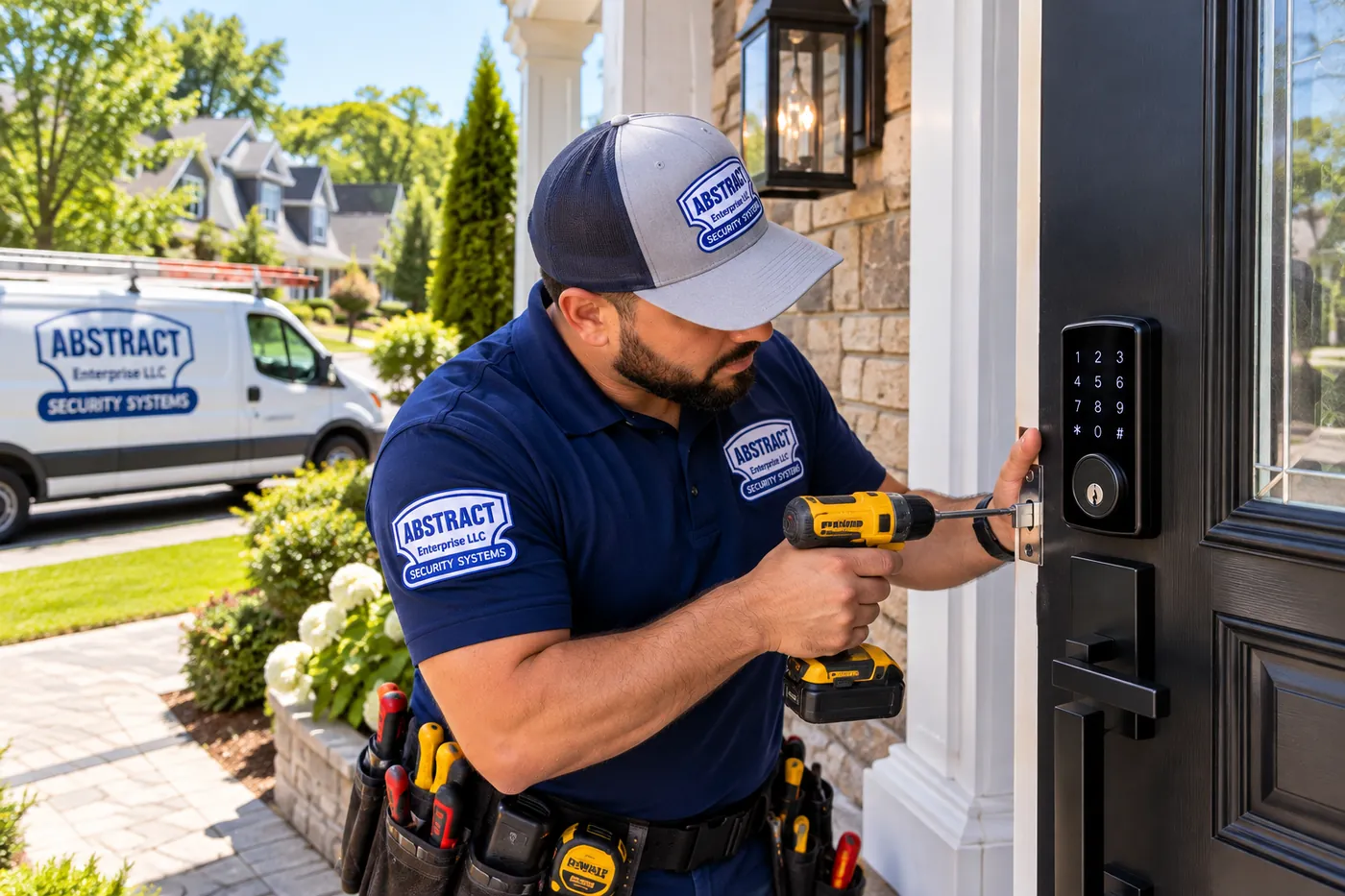
Single-family front door, keypad deadbolt going in — one visit, about an hour on a standard door.
Pricing
Smart Lock Installation Cost in Nassau County
Some of our Nassau prices are fixed and printed below; others depend on a door we haven't seen yet. A house lock can need no preparation or an hour of plugging, re-boring and moving a strike, so residential locks get a single written figure at the free walkthrough rather than a list price. Commercial keypads and strikes, service calls and setup-only visits do have published figures, shown here with Nassau area pricing (1.15× our Brooklyn base) applied where the figure is area-scaled.
Item
Nassau County
How the figure is set
Residential smart deadbolt, handleset or retrofit, any door
Flat quote at walkthrough
Includes the door and frame preparation, fitting, pairing and user setup listed on the quote
Single-door keypad or card reader with electric strike, installed
$1,725–$2,875
Published $1,500–$2,500 Brooklyn base × 1.15
New electric strike on an existing door
$288–$518
Published $250–$450 base × 1.15, rounded half-up
Failed electric strike repair
$339–$558
Published $295–$485 base × 1.15, rounded half-up
Setup-only visit (app, pairing, codes, settings; no hardware fitted)
$225 first hour
Then billed in 30-minute blocks
Service call or callback after the job
$195/hr, 3-hr minimum ($585)
Not charged on the initial installation
Certificate of insurance for an HOA, co-op board or landlord
Free
Issued before the visit on request
What moves a Nassau residential quote
The era of the door. Factory-bored modern doors are quick. Re-bored post-war doors need filling and strike work. Pre-war doors with mortise locks or no deadbolt bore take the most thought.
Clearances. Split-level railings, storm doors, sidelights and wall returns can rule out some locks and add a door stop or a different model.
Frame strength. Reinforced strikes, long screws and jamb reinforcement are added where the frame needs them, and listed on the quote.
Exposure. Exterior-rated models and stainless fasteners for bay- and ocean-facing doors cost a little more than standard hardware.
Integration. Enrolling on an alarm panel, setting up a Thread border router or placing a Wi-Fi bridge adds time.
How many doors go on one trip. Travel, setup and pairing are shared, so the second and third lock on the same visit carry less of that overhead than a lock booked on its own later.
Whose lock it is. Ours comes with our product warranty; a lock you bought yourself is fitted for labour only once we confirm it suits the door and your system.
Inside the price, and outside it
Covered: reading and preparing each quoted door, fitting and adjusting the lock, pairing it to the app, hub or panel listed, setting up every named user, and testing every code on every door with you. Not covered: new doors or frames, painting, electrical work such as new outlets or circuits (those are for a licensed electrician), and fees or subscriptions charged by an alarm company or app. Full terms — including the deposit and the warranty on AESS-supplied products — are in the service agreement summarised at the foot of this page.
National figures for comparison. Third-party guides put one smart lock installed at $250–$400 with a $300 national average (Fixr, January 2025) or a $330 national average in a $200–$460 range (LawnStarter, 2025). Those are national averages for one standard door, not AESS prices; they are here so you can sanity-check any quote.
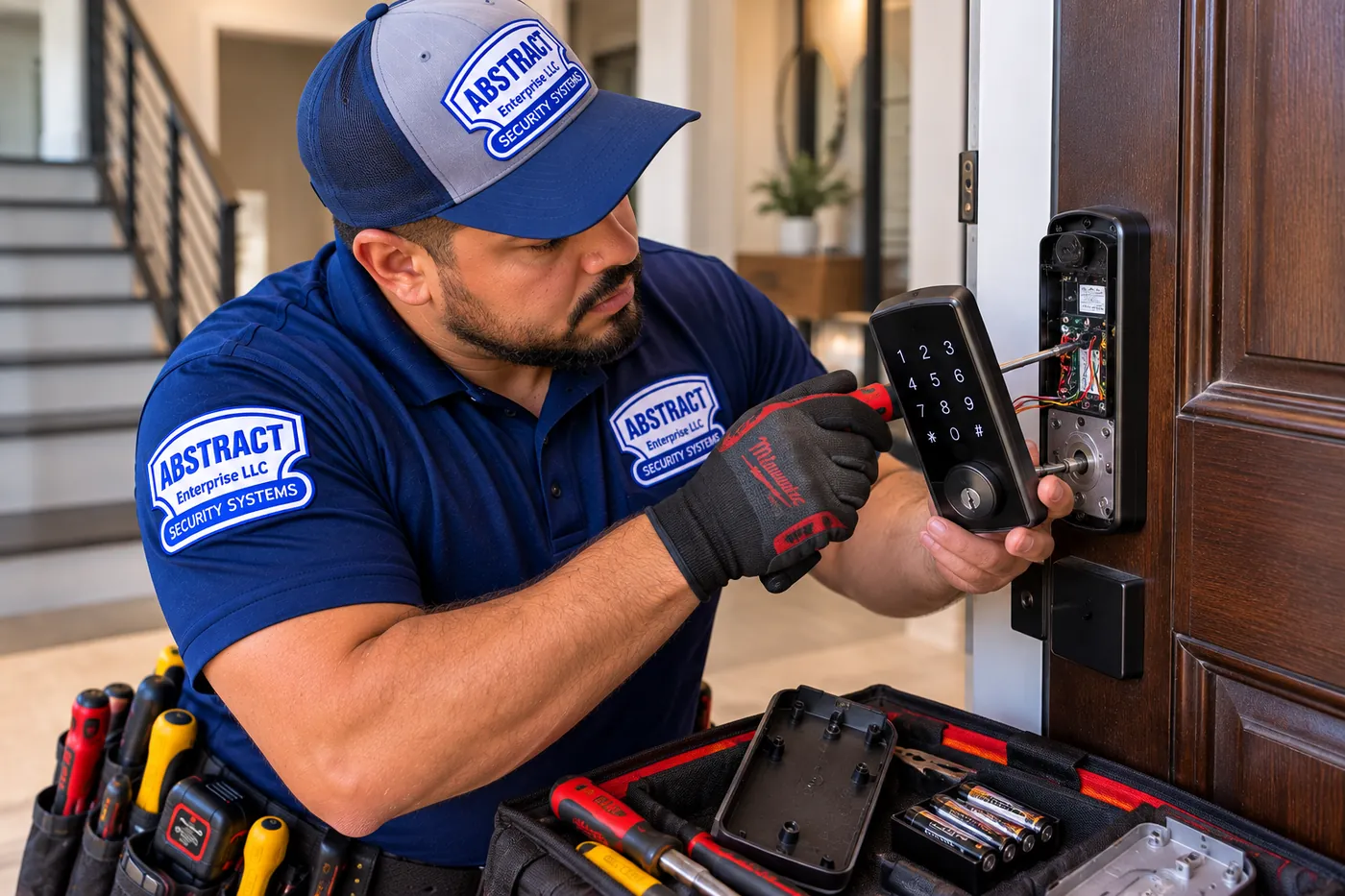
Repair visit — opening the keypad to check the harness and contacts on a lock that stopped responding.
Shop Our Systems
Smart Lock Installation Packages & Pricing
Most Nassau jobs begin as one of these three. The two house packages carry a walkthrough price because the door work differs so much between eras; the Main Street package carries our published Nassau figure.
STARTER — THE DOOR EVERYONE USES
Quoted at walkthrough
One keypad or touchscreen deadbolt on the kitchen, mudroom or garage-side entry. Old holes filled, strike reset with long screws, door-position sensor or relock delay set to suit the door, and a code for every person in the house.
STANDARD — MATCHED TO THE HOUSE
Quoted at walkthrough
The front door handled to suit its era — a smart handleset on a Colonial, a slim lock on a split-level landing, a retrofit on an original door — plus the everyday side or mudroom door, one app, one code plan, and pairing to the alarm or hub.
MAIN STREET — KEYPAD ON A STRIKE
$1,725–$2,875
Single-door keypad or card reader with electric strike, installed in Nassau, from our published $1,500–$2,500 base. Power supply, request-to-exit and free egress included; staff and delivery codes programmed with schedules.
Bring your own lock — labour only. Already bought a smart lock? We fit customer-supplied locks for a labour-only figure quoted at the walkthrough, after checking that the lock suits the door's thickness, bore and backset and the system you want it paired with. Customer-supplied locks carry their manufacturer's warranty rather than ours. A lock that only needs re-pairing or new codes is a setup-only visit: $225 for the first hour in Nassau.
Get a Door-by-Door Nassau Quote
The walkthrough is free and the figure is written down before we drill. Photos of each door get us halfway there.
How Smart Lock Work Changes Across Nassau's Towns and Cities
Nassau's municipal map matters for locks in small, practical ways: who issues a permit if a door is being replaced, whose rental rules apply, and what kind of house is likely to be behind the door. Here is how the work tends to differ.
Town of Hempstead. The largest of the three towns by far, with 22 incorporated villages and a long run of unincorporated hamlets from Elmont and Franklin Square through Levittown to Wantagh and Seaford, plus the barrier beaches of Lido Beach and Point Lookout. Housing ranges from Levitt Capes and 1949 ranches to split-levels and South Shore canal houses. Door preparation on re-bored post-war doors is the main variable, and on the bay side, exposure and flood-level doors. The town's 2017 rental rules set a 28-day minimum and a permit and registry, which affects how owners of beach houses use guest codes.
Town of North Hempstead. Twenty-seven villages, from the Great Neck peninsula's nine through Manhasset, Port Washington and Roslyn to Mineola, the county seat. Older Colonials and Tudors with handleset front doors, co-op and garden-apartment buildings near the Port Washington Branch, and professional offices along Jericho Turnpike and around NYU Langone Hospital–Long Island. Matching hardware finish and respecting building rules matter as much as the lock itself.
Town of Oyster Bay. Fifteen villages and a long north–south spread, from the Gold Coast estates of Upper Brookville, Mill Neck and Lattingtown down through Syosset, Plainview, Hicksville and Bethpage to the Massapequas on the South Shore. North of Jericho Turnpike, larger lots and older, heavier doors with long distances to the router; south of it, split-levels and ranches with mudroom and garage entries.
City of Glen Cove. A city since January 1, 1918, built around Gold Coast estates such as the Pratt family's, many converted from single-family use, with post-war neighbourhoods filling in former farmland. Both estate service doors and modest post-war entries in the same city.
City of Long Beach. A village from 1913 and a city since 1922, on the barrier island, densely built, with fewer than 40% of homes detached houses. Apartment and attached-house doors, salt air everywhere, and the memory of two weeks without power after Sandy. Exterior-rated locks, mechanical overrides and building rules on keys come first here.
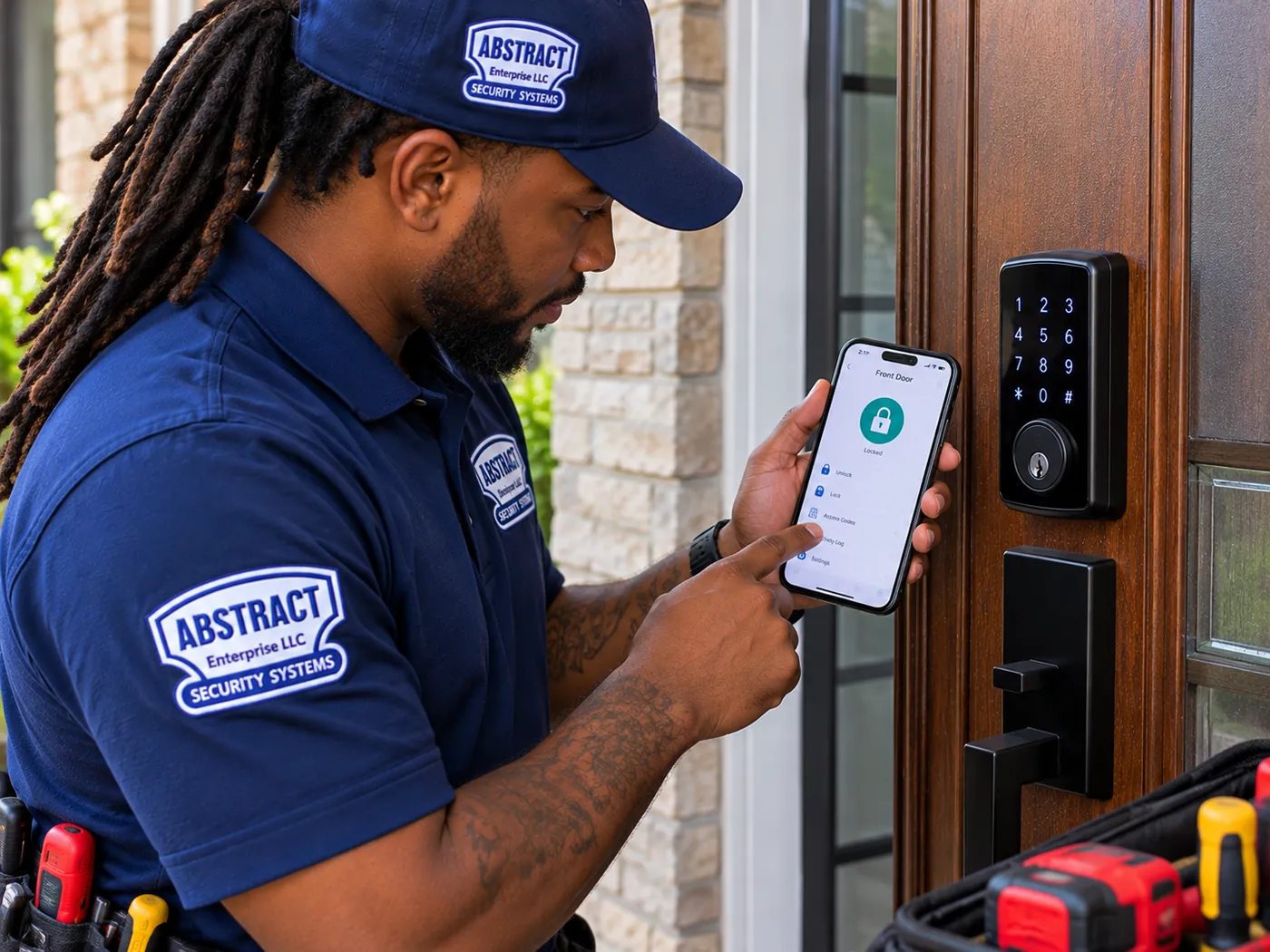
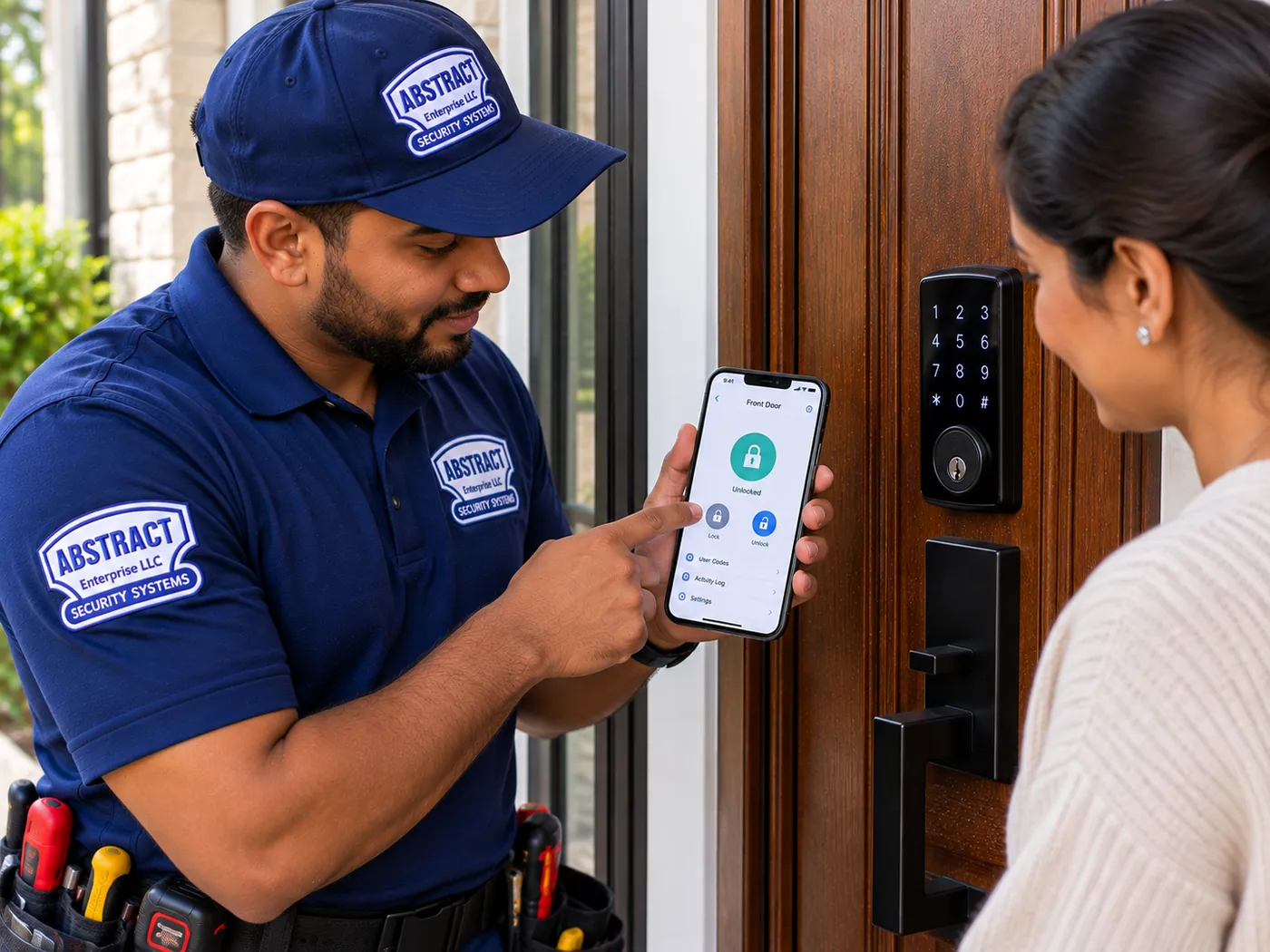
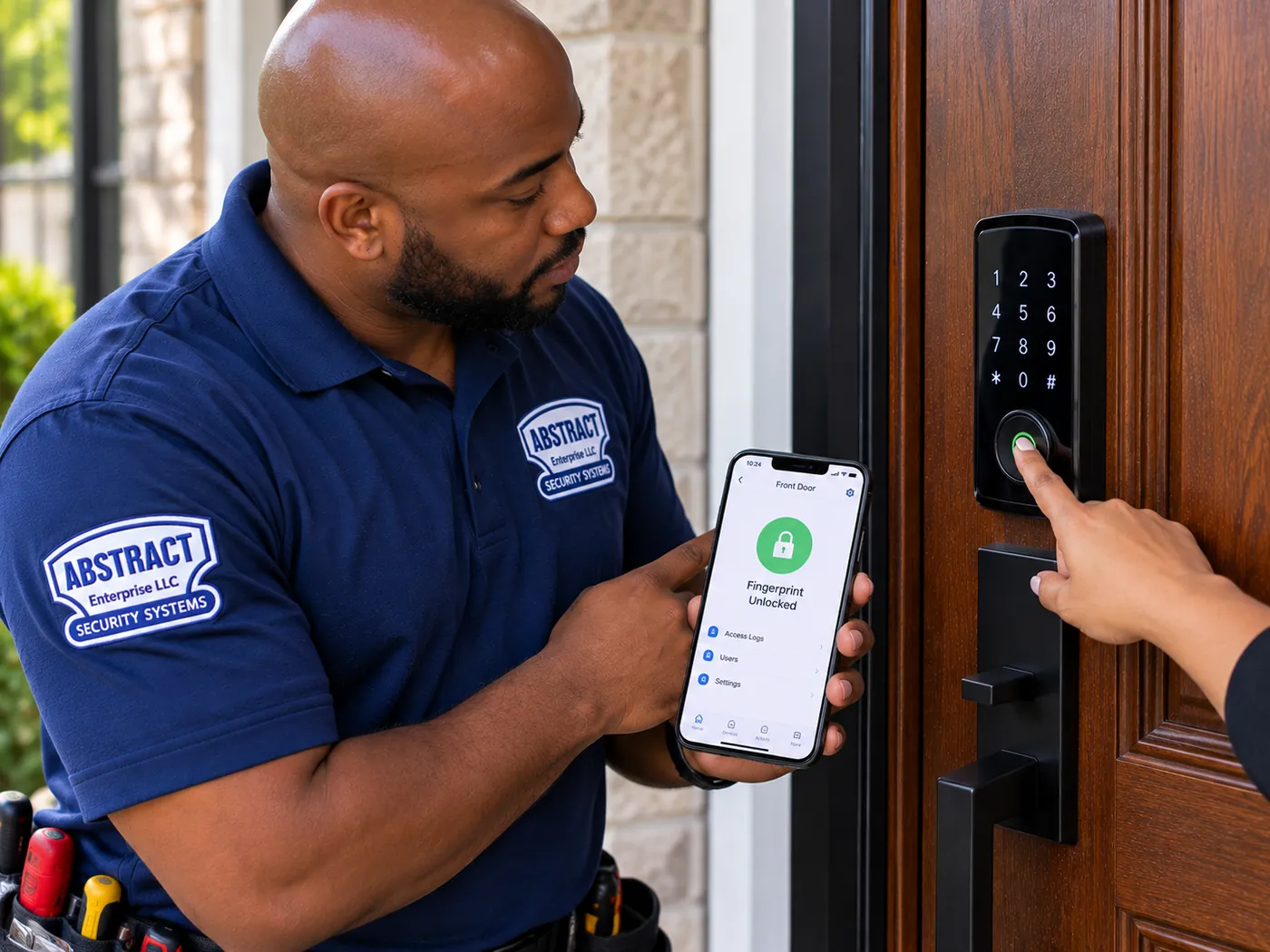
Confirming lock status, access codes and the activity log from the phone.
Code Planning
Planning Codes for a Busy Nassau Household
The hardware is half the job. The other half is deciding who gets in, when, and what you want to be told about. A ten-minute conversation at the handover saves months of shared codes and confusion. This is the plan we suggest to most families, adjusted to the house.
Person
Kind of access
What we usually set
Adults in the house
Permanent code and phone access on every smart lock
Admin rights in the app for at least two people, so one lost phone doesn't lock everyone out of the settings
Children
Their own permanent code
Arrival notifications for that child only; codes long enough not to be guessed by a friend watching
Grandparents and regular family visitors
Permanent or weekend code
A simple code on the door they actually use, and confirmation that they can work the inside lever or thumb-turn easily
Cleaner, dog walker, babysitter
Scheduled code
Valid only on the days and hours they work; a notification each time it is used
Contractors during a renovation
Temporary code
Starts and ends with the job; on the side or mudroom door, not the front, where possible
Deliveries
Usually none
A camera and a parcel box are better than a code for the delivery driver
Two more decisions round it out. First, which doors auto-lock and how fast: front doors can lock quickly, mudroom and back doors usually need a longer delay or a door sensor. Second, what you want to hear about: most families only want alerts for children arriving, scheduled codes being used and doors left open, not for every lock and unlock.
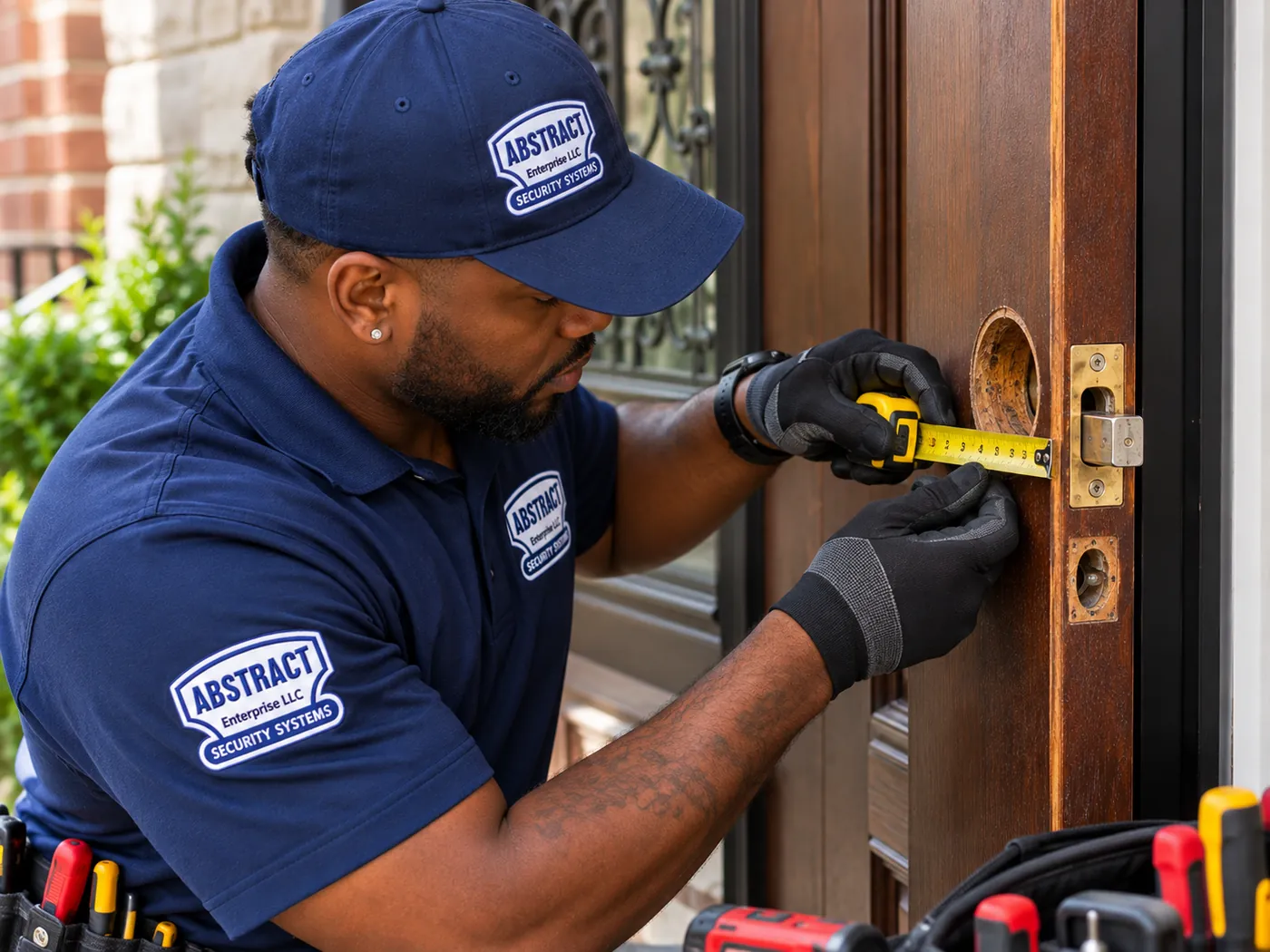
Measuring the bore and backset first, so the new smart deadbolt fits the existing door without re-drilling.
Moving In
Taking Over a House That Already Has Smart Locks
Nassau houses change hands constantly, and more and more of them come with a smart lock already on the door. The previous owner may have deleted their codes and removed the lock from their account — or may not have. Until you know, assume that someone else could still have a code or app access.
Find the brand and model. It is usually printed on the inside unit or under the battery cover. Find the manual or the maker's support page.
Check whether it is still on someone's account. If the app will not let you add the lock, it is probably still registered to the seller. The seller can remove it, or the lock's factory reset will clear it.
Factory-reset and start fresh. A reset removes stored codes and pairings. Then set it up in your own account with your own codes.
Change or re-key the mechanical cylinder. Previous owners, their families and their contractors may still have keys. A new cylinder or a re-key closes that off.
Check what it is paired to. If it was enrolled on an alarm panel that stayed with the house, your alarm company may need to re-enrol it on your account.
If you would rather we did all of that, it is a setup-only visit: $225 for the first hour in Nassau, then 30-minute blocks. If the old lock does not suit you or the door, we quote a replacement at the same visit.
Finish & Style
Choosing a Lock Finish That Suits a Nassau Front Door
A smart lock is the most handled object on the front of a house, and on many Nassau streets the front door is also the most photographed. Getting the finish right matters more than most people expect, and it is easy to get wrong when you are choosing from a phone screen.
Match what stays, not what goes. If the handleset, knocker, house numbers or kick plate are staying, the lock should match them. If everything is being replaced, choose the finish first and the lock family second.
Dark finishes on dark doors, light on light, is not a rule. A black or bronze keypad on a red or navy Colonial door often looks deliberate; satin nickel on a white fiberglass door on a high ranch looks clean. Hold samples against the door in daylight.
Think about exposure. Bay- and ocean-facing doors are hard on plated finishes. Ask about the maker's exterior and coastal ratings and expect to spend a little more for them on the South Shore.
Touchscreen or buttons. Touchscreens look tidy but show fingerprints and can be harder to use with gloves in January. Push buttons wear but are easier by feel. On a side or mudroom door, practicality usually wins.
We bring finish samples to the walkthrough for the lock families that fit your door, so the decision is made at the door, not from a catalogue.
Walking the owner through the app before we pack up — lock, unlock, codes and history.
Complete Services
Every Smart Lock Installation Service in Nassau County
Once the door is sorted, the next questions are usually about what watches it, what alarms it and what keeps it online. These Nassau County pages cover those jobs.
Power supplies, strikes, readers and the wiring between them on commercial doors.
Field Notes
Field Notes: Reading Doors Across Nassau
These notes describe how we work rather than any single job; we have not attached a customer story we cannot document. The pattern repeats across the county. On a re-bored post-war door, the first thing we do is close it and turn the old deadbolt slowly; nine times in ten the hand on the thumb-turn tells you more than the tape measure does. If it drags, the strike comes out, the mortise gets deepened or moved, and long screws go into the stud before the new lock leaves its box.
On a split-level, we open the door all the way before choosing a lock and look at what it swings toward. On a Colonial, we hold the finish samples against the handleset in daylight, because a keypad that looks right under the kitchen lights can look wrong at the front step. On a raised canal house, we stand at the top of the stair and look at where the rain comes from, and we ask which lower doors flooded last time.
On a Main Street door, we ask the landlord question before the lock question. And everywhere, before we leave, every person in the house tries their code on every door while we watch. That last step catches more problems than any other.
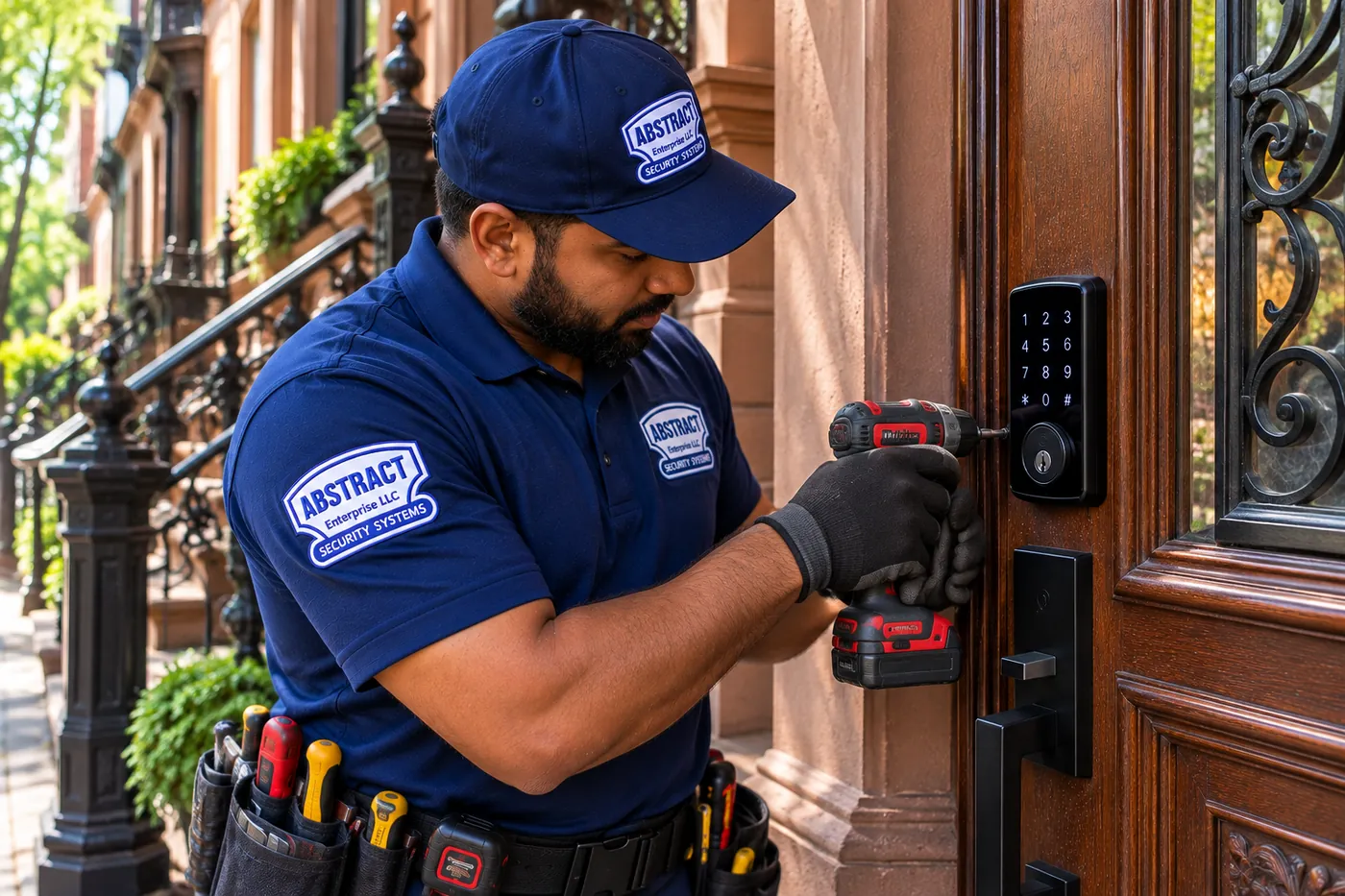
Mounting a keypad deadbolt on a stoop door with ironwork and an original wood frame.
Door Hardware Glossary
Door and Lock Words You Will Hear on a Nassau Walkthrough
Half the confusion around smart locks comes from words that installers use without explaining. These are the ones that come up most on Nassau doors, in plain English.
Term
What it means at your door
Backset
The distance from the edge of the door to the centre of the lock hole. Most smart deadbolts expect 2-3/8 or 2-3/4 inches; older doors sometimes differ.
Cross bore
The big round hole through the face of the door that the lock body passes through, usually 2-1/8 inches on modern doors.
Edge bore
The smaller hole in the edge of the door where the bolt slides out, usually 1 inch.
Strike
The metal plate and pocket in the door frame that the bolt slides into. If it is out of line, a smart lock strains and stalls.
Reinforced strike
A heavier strike or strike box fixed with long screws into the wall framing, so a kick splits nothing.
Mortise lock
A lock whose whole body sits inside a deep rectangular pocket cut into the door edge, common on older and heavier doors. Standard smart deadbolts do not drop into it.
Handleset
The exterior grip with a thumb latch found on many Colonial and Tudor front doors, often with a separate deadbolt above it.
Retrofit lock
A smart unit that mounts on the inside over your existing deadbolt and turns it, leaving the outside and your keys as they are.
Handing
Which way the door swings and which side the hinges are on. Smart locks have to be told, or they turn the bolt the wrong way.
Door-position sensor
A small sensor that tells the lock whether the door is actually shut, so auto-lock never throws the bolt into an open doorway.
Electric strike
A strike for commercial doors that releases electrically when a keypad or reader grants access, while the door's own lock stays latched.
Maglock
An electromagnet at the top of a door that holds it shut while powered. Needs a request-to-exit device and a fail-safe release.
Request-to-exit (REX)
A button, bar or motion sensor on the inside of a commercial door that releases the lock for people leaving.
Z-Wave
A low-power radio used by many alarm panels and smart home hubs. A Z-Wave lock is enrolled on the panel or hub, not on Wi-Fi.
Thread and Matter
Thread is a low-power mesh network; Matter is a standard that lets one device join several apps. A Matter-over-Thread lock needs a Thread border router.
If a word on your quote is not on this list, ask. A good installer can explain every line in one sentence.
FAQ
Nassau County Smart Lock Installation FAQ
Do you work in every Nassau village, including Glen Cove and Long Beach, which are cities rather than towns?
+
Yes. We cover all three towns, both cities and the incorporated villages and unincorporated hamlets within them, from Inwood and Elmont on the city line to Bayville, Massapequa and the Suffolk border. Appointments are booked in two-hour arrival windows.
Can you leave our existing doorknob or lever in place and replace only the deadbolt with a smart one?
+
Usually. A smart deadbolt replaces only the deadbolt, so a knob or lever latch below it can stay. We check that the two finishes sit well together and that the latch still lines up with its strike, and we tell you if a matching lever would make the door easier to use.
Our front door has a mail slot and a knocker near the lock — will they get in the way?
+
They can. A keypad's exterior unit is taller and wider than a plain deadbolt, and on some older Nassau doors the mail slot or knocker sits right where it needs to go. We measure the space at the walkthrough and choose a slimmer model, or suggest moving the knocker. Moving or closing up a mail slot is carpentry, so we flag it before quoting rather than on the day.
Is a deposit required to book the installation?
+
Yes. Our service agreement calls for a 50% deposit to book the work, with the balance due on completion. The agreement also sets out the warranty on AESS-supplied products and the late-fee schedule, and we send it with the written quote so you can read it first.
Do you need to touch our electrical panel or turn off power for a smart lock?
+
Not for battery smart locks, which need no wiring at all. Wi-Fi bridges plug into an ordinary outlet. Electric strikes on shop doors use a low-voltage power supply; if a new outlet or circuit is needed for it, that part is done by a licensed electrician.
We are in the middle of a renovation — when should the smart locks go on?
+
After the doors are hung, painted and adjusted, and after any flooring that changes the door's clearance. Until then, give the contractors a temporary keyed lock or a basic keypad. If you want new doors pre-bored for a particular lock, tell your contractor the model so the bore and backset match.
Is there a smart option for the sliding glass door out to the deck?
+
Far fewer smart locks are made for sliders than for hinged doors, and most sliding doors lock with a latch in the handle rather than a deadbolt. For most Nassau decks and patios we recommend a sturdy secondary lock such as a bar or foot lock, plus a contact sensor on the alarm so you are told whenever the slider opens. If you want a motorised slider lock, we check your door's frame and handle before suggesting one.
Is the electric strike for a shop door priced separately from the keypad?
+
Not when both are new. Our single-door keypad or card reader with electric strike is quoted as one installed figure, $1,725–$2,875 in Nassau, including the power supply and request-to-exit. A new strike on its own for a door that already has a working keypad is $288–$518.
Will you protect our floors and painted trim while you bore and chisel the door?
+
Yes. We lay a drop cloth at the door, tape the face of painted or stained doors where the boring jig sits, and catch shavings as we go. Dust is vacuumed before we leave, and boxes and packaging go with us.
Will the quote list each door separately so we can phase the work?
+
Yes. The written quote lists every door with the lock, the preparation and any pairing it needs, plus one total. Many families do the busiest door first and add the front door or a shop door later at the same per-door figure.
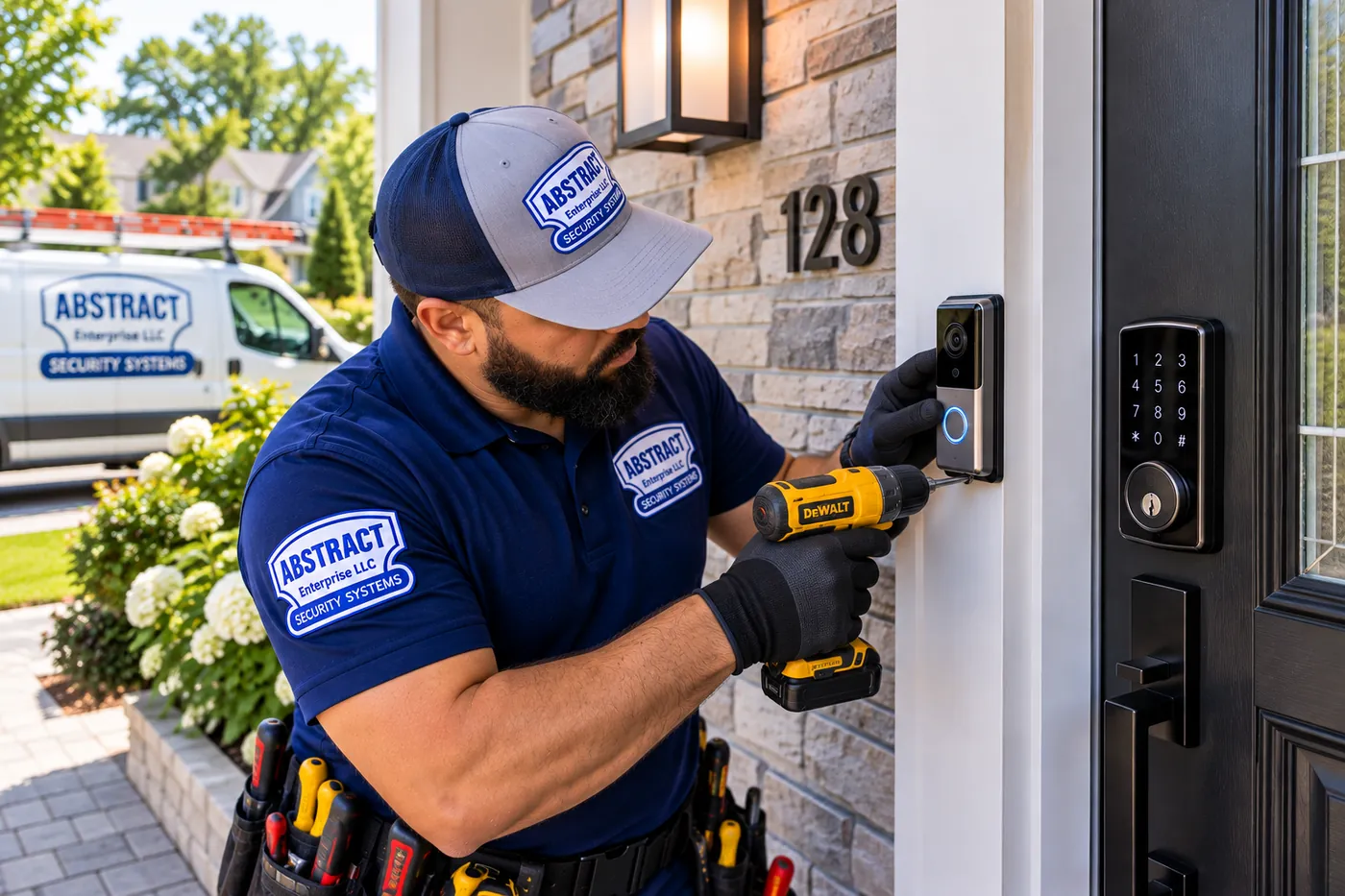
Video doorbell and smart lock at the same visit — see who is there, then let them in.
All Areas Served
Smart Lock Installation Across Long Island and New York
This page covers Nassau County. It sits under our Long Island smart lock installation hub, which explains how we approach multi-door houses across both counties. Pages for other areas are listed below; where a dedicated page is not live yet, its link goes to our quote form and the same crews cover the area today.
Enrolling and testing a fingerprint with the owner — the app logs every unlock.
Same-Day Help for a Failed Nassau Smart Lock
Front door refusing your code, a mudroom bolt stuck halfway, or a Main Street strike humming without letting go? Ring the Nassau line, (516) 346-5778. Same-day when a two-hour window is open; most battery, strike and pairing faults are fixed in one to two hours once we are at the door.
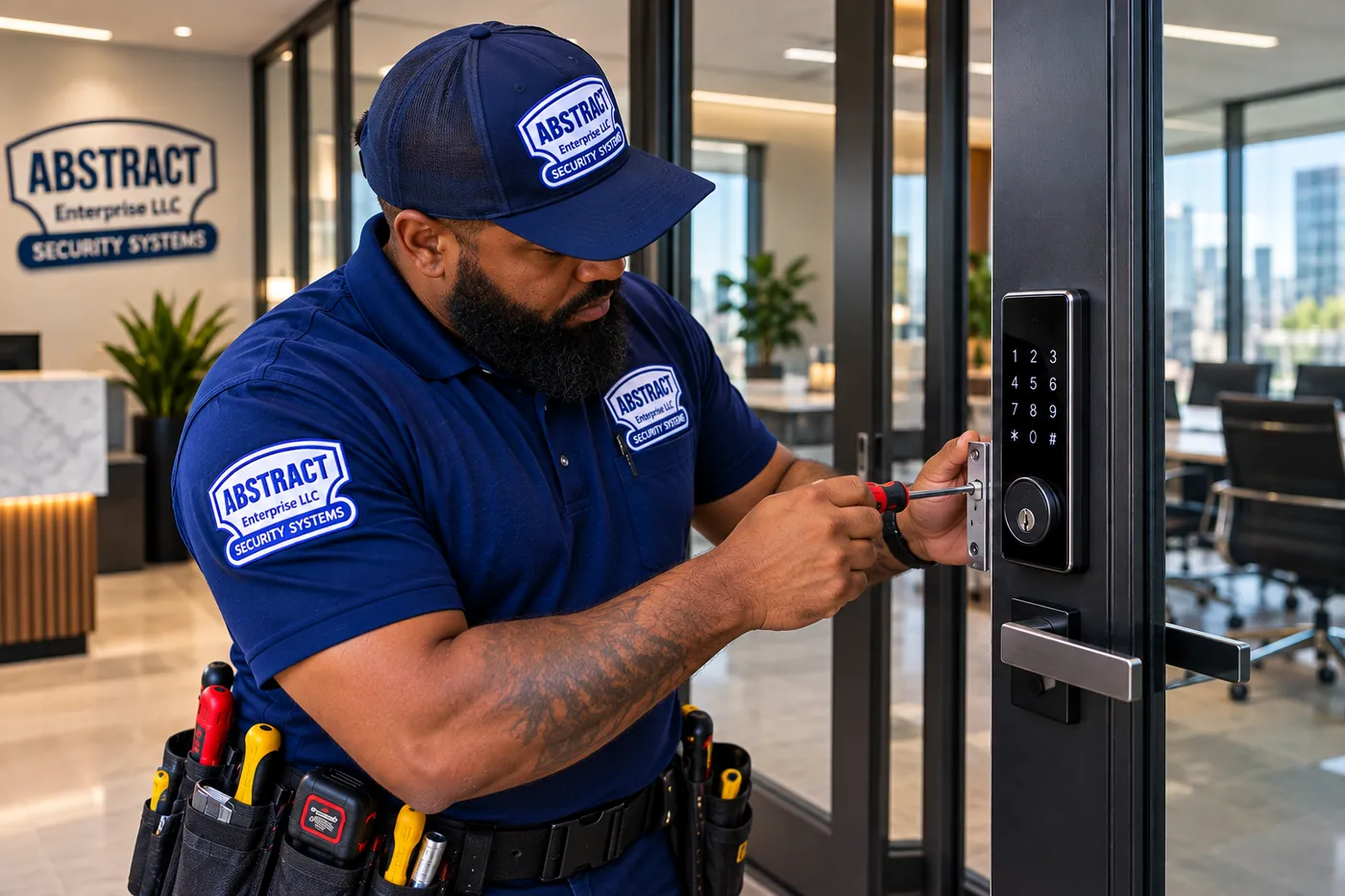
Business smart lock on an aluminum office door — codes per employee, no keys to collect.
Smart Lock Installation Nassau County — Licensed, Insured, Quoted in Writing
Abstract Enterprises Security Systems · 1282 Troy Ave, Brooklyn, NY 11203 · Nassau line (516) 346-5778 · WhatsApp (718) 679-0359 via wa.me
NYS Low-Voltage Licence #12000287431 · 100% Licensed & Insured · Same-Day Estimates · Rated 4.7★ from 201 Google Reviews
Full terms — including 50% deposit, one-year parts-only warranty on AESS-supplied products, and the late-fee schedule — are set out in the service agreement. See our warranty page.
Reviewed and updated October 17, 2026. Changelog: new page — smart lock installation for Nassau County homes of every era, raised and flood-zone houses, garden apartments and Main Street businesses.