What are you looking for?
About Us Contact Us Careers Get a Free Quote (800) 486-0943
Pick a service
✅ Got Your Own System?
🎬 Home TheatreQuote 🎶 AV SoundQuote 🔑 Access ControlQuote
Now pick your area
Pick your area
Long Island
Hudson Valley
Services available
Pricing & Tools
Pick a service for pricing
🚪 Intercom Pricing 🔔 Buzzer Repair Pricing
Calculators
📹 Camera System Calculator 🚨 Alarm Calculator ⚡ Cabling Quote Builder ✅ Got Your Own System?
Select your area
Licensed Low-Voltage Contractor · Doorman Co-ops, Condo Towers, Office Suites & Landmark Storefronts · Manhattan Line (929) 560-0737

Smart Lock
Installation in
Manhattan

Unit Doors in Doorman Buildings · Locks That Live Beside Latch, ButterflyMX & Fob Systems · Pied-à-Terre Remote Access · Suite Doors in Office Towers · Historic-District Shopfronts

In Manhattan the apartment door is rarely the first lock anyone meets. A visitor passes a doorman or a concierge desk, a lobby reader, often an elevator that needs a fob, and only then reaches your unit. Office staff badge through a turnstile run by the landlord before they get to the suite. We install smart locks that fit into that chain instead of fighting it: a unit lock that works alongside the building's own entry app, codes that suit how the desk, the dog walker and the cleaner actually move through the building, remote control for owners who spend months elsewhere, and suite and storefront locks that respect the fire code, the base-building system and, below Houston Street, the Landmarks Preservation Commission.

Reviewed and updated October 17, 2026 · Written by Anwar Timothy, NYS licence #12000287431

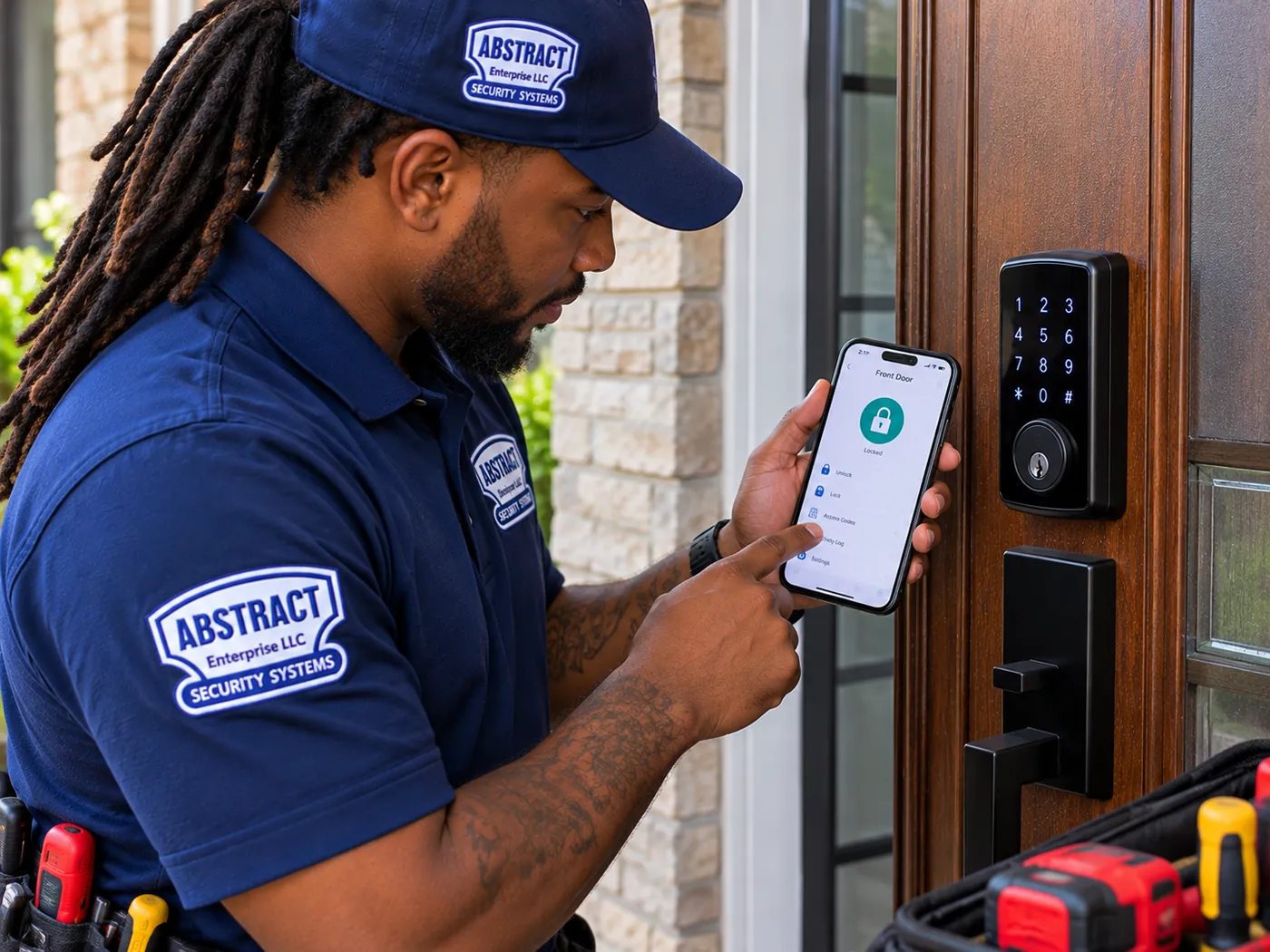
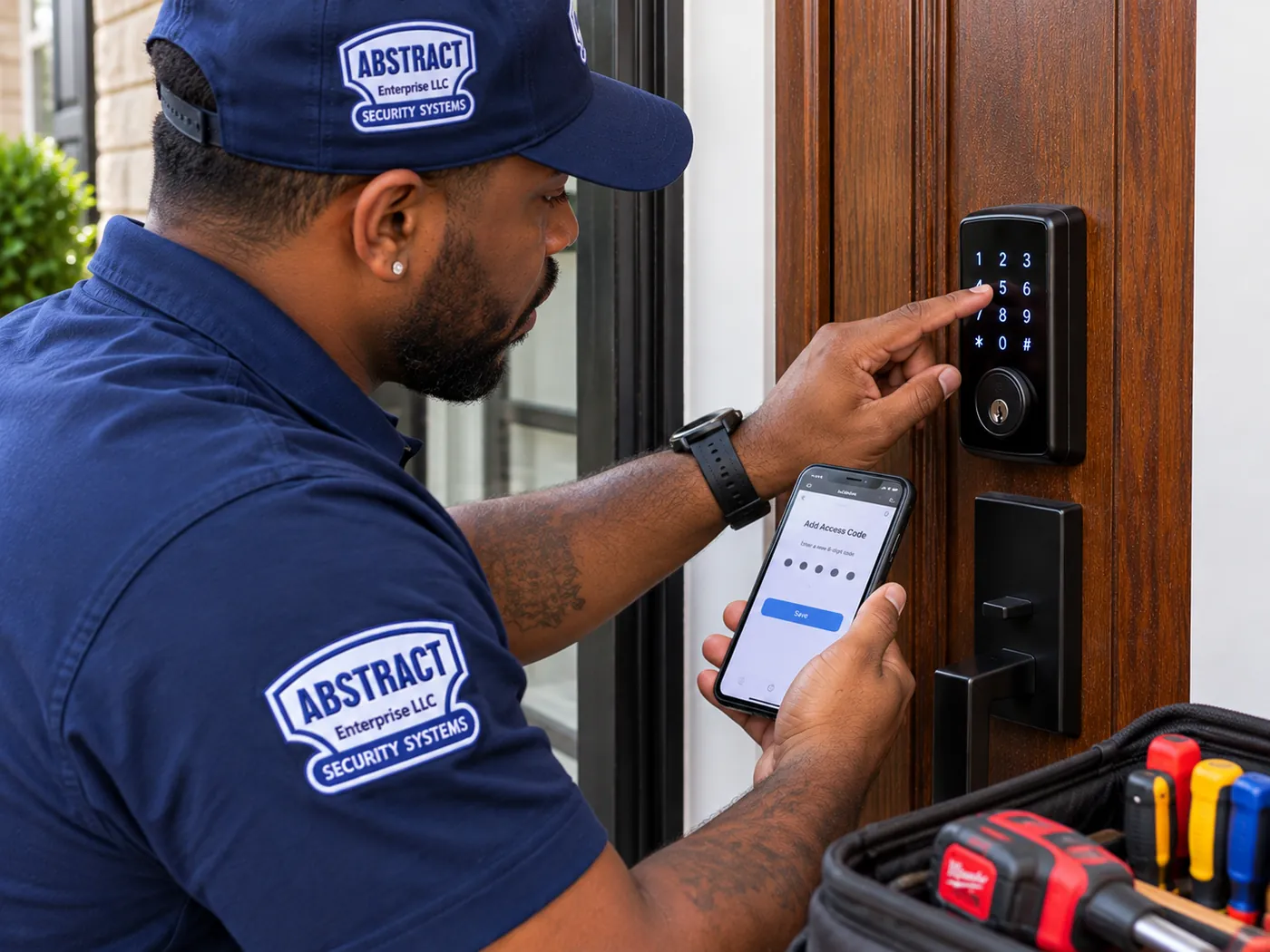
AESS technician programming a new user access code in the smart lock app at the front door in Manhattan
Two doors under one AESS sign: a stainless video intercom with keypad beside the glass visitor doors, and a separate employee entrance with a small wall reader and a “key card access only” notice, with cameras mounted above both.
Get a Free Manhattan Smart Lock Quote
Tell us the building, the door and who needs to get in — a licensed installer replies the same business day

✅
Request Sent!
A Manhattan installer will call you back the same business day.
25+
Years Experience
✓
Same-Day Estimates
100%
Licensed & Insured
4.7★
201 Google Reviews

Planning a keyless door in a building with a front desk, or locked out of one you already have? Ring the Manhattan line, (929) 560-0737, or send the 60-second form. Tell us which entry platform your building runs and who needs to come and go; we tell you before anyone visits whether the lock you have in mind can work there.

  • The door, the frame and the building's own access system checked before a price is set — and the written price is what you pay
  • Suite and lobby doors priced from published AESS figures with the Manhattan rate applied
  • NYS licence #12000287431 · fully insured · scope letter and insurance paperwork prepared for your managing agent
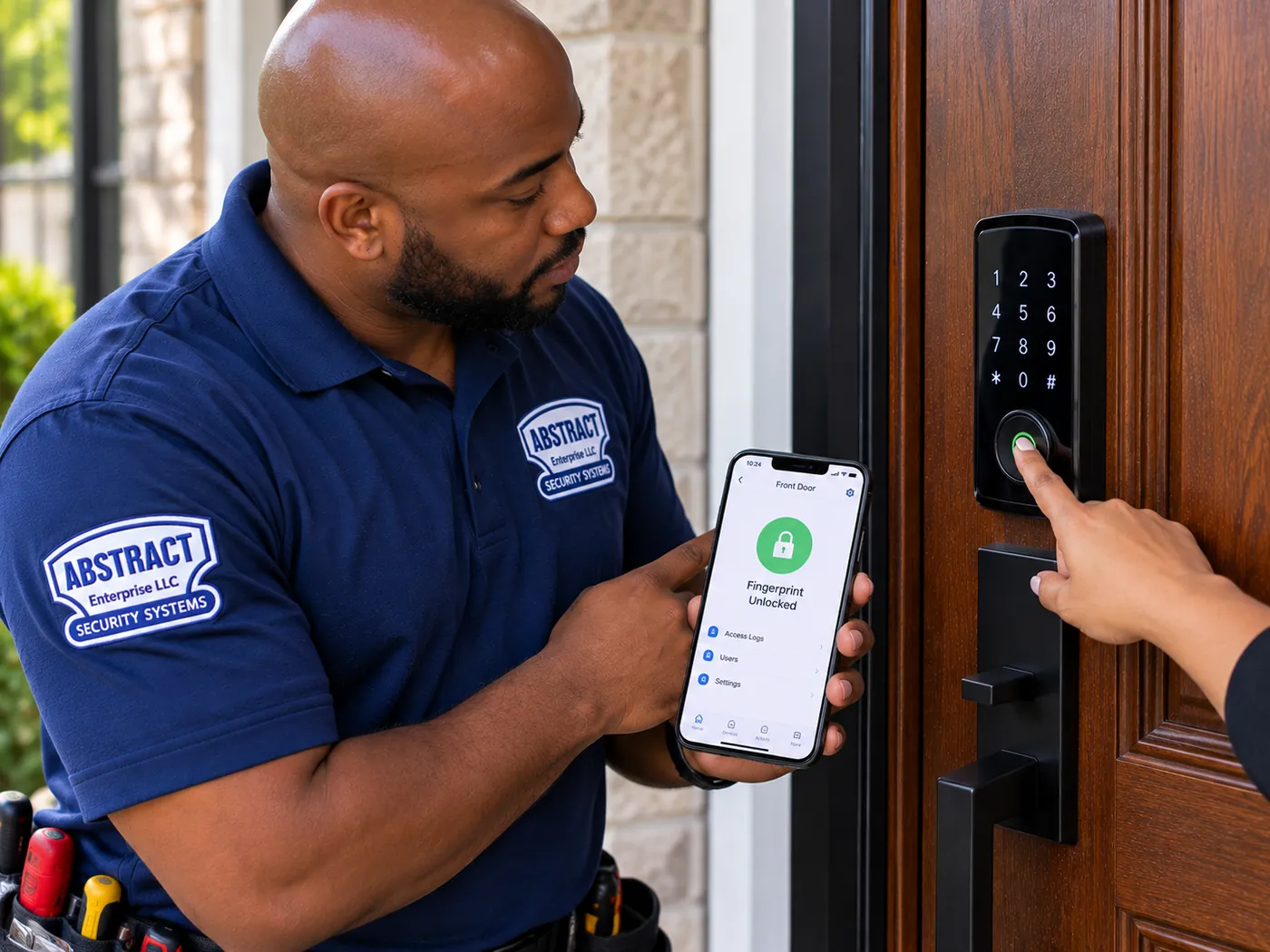
AESS technician showing a homeowner a fingerprint unlock on a new smart lock with the app confirming access in Manhattan
Enrolling and testing a fingerprint with the owner — the app logs every unlock.
The Neighborhood

Why Manhattan Homes and Offices Need Smart Lock Installation Planned Around the Building

Manhattan is the most layered place in the country to put a lock on a door. The Citizens Housing & Planning Council's housing-stock analysis puts it plainly: in Manhattan, nearly all units, about 97 percent, are in buildings of six or more units. Your front door sits at the end of a corridor in a building that already has its own idea of who gets in — a doorman with a key cabinet, a concierge desk with a package room, a lobby keypad or video intercom, a fob reader on the elevator, and in more and more buildings an app-based platform chosen by the developer or the managing agent. A smart lock on the unit door has to live inside that system. Installed as if it were a suburban front door, it ends up duplicating, contradicting or quietly weakening it.

The people who live behind those doors are not a typical homeowner either. The U.S. Census Bureau's QuickFacts for New York County show an owner-occupied rate of about 25 percent for 2020–2024 and roughly 938,000 housing units as of July 2025, so most Manhattan households are renters, and most owners own a co-op share or a condo unit rather than a building. A great many are only in town part of the year. In an April 30, 2026 fiscal note on the proposed pied-à-terre tax, the New York City Comptroller's office counted 17,125 Manhattan properties among the 19,107 citywide in its model of high-value homes that are not the owner's primary residence — the overwhelming majority of them in this one borough. New York's surcharge on those homes took effect on July 1, 2026. Those owners want to see and control the door from another city or another continent, and they want the building staff to keep working the way they always have.

Then there is the paperwork. Very little gets done to a Manhattan apartment without the managing agent hearing about it first. Brick Underground's guide to alteration agreements notes that most buildings limit contractor work to 9 to 5 on weekdays and set service-elevator hours, and co-op and condo boards routinely ask for a certificate of insurance before anyone touches a door. City rules add their own window: NYC311 lists residential construction as allowed from 7 AM to 6 PM on weekdays. A smart lock is a small job by Manhattan standards, but it still runs through the desk, the super, the freight elevator and sometimes the board. Getting that part right decides whether the job happens next week or next month.

Key handling has become a live issue too. In Chelsea in 2016, the neighbourhood paper counted eleven key lockboxes on a single block of West 21st Street between Eighth and Ninth Avenues, clipped to tree guards and fences so short-term visitors could let themselves into residential buildings; residents told amNewYork it meant “you have no idea who is in your building.” In August 2026, FOX 5 reported that a concierge at a Long Island City luxury tower handed a couple's apartment keys to a woman who said she was their dog walker while they were on vacation. The concierge was removed from the property. Both stories point at the same weak link: a physical key that can be copied, left in a box or handed to the wrong person. A well-configured smart lock replaces that with codes and phone credentials that are personal, time-limited and logged.

Commercial Manhattan has its own version of the problem. Office towers run base-building access — turnstiles, lobby desks and card systems from platforms such as Kastle, which advertises a single mobile credential that moves “between base building and tenant spaces” — and the tenant's own suite door has to sit politely inside that. The NYC Building Code allows electromagnetic locks on doors to tenant spaces in business occupancies only with door-mounted release hardware that interrupts power with one hand and unlocks when power fails. Fire-rated corridor doors and frames can only be prepared in the ways their listings allow. And from SoHo's cast-iron blocks to NoHo, landmark designation reaches the storefront and even the sidewalk in front of it.

Manhattan figures that shape a smart lock job

  • About 97 percent: share of Manhattan housing units in buildings of six or more units, per the Citizens Housing & Planning Council's housing-stock visualisation — almost every door sits behind a shared lobby.
  • About 25 percent: owner-occupied rate in New York County for 2020–2024, from U.S. Census QuickFacts, out of roughly 938,000 housing units (July 2025).
  • 17,125 of 19,107: Manhattan's share of the high-value non-primary residences in the Comptroller's April 2026 pied-à-terre tax model — the owners most likely to want remote control of a door.
  • 16,400: apartments in the office-to-residential conversion pipeline in Manhattan, according to the Comptroller's report on conversions — former office floors where entry hardware is being rethought from scratch.
  • 11: key lockboxes counted on one block of West 21st Street in Chelsea in July 2016, the visible face of keys being handed around outside the building's control.
  • Fewer than 30 days: the stay below which renting out an entire apartment is not allowed in New York City, even with registration under Local Law 18 — a smart lock does not change that.

Put together, those facts describe the job. A Manhattan smart lock has to coexist with the building's platform rather than replace it, satisfy a managing agent who will want to see what is going on the door, give the doorman, the walker and the cleaner exactly the access they need and nothing more, keep working for an owner who is away, and — on office and shop doors — release the way the fire code expects. That is the work we do.

Most Manhattan buildings that ask us about unit smart locks are also rethinking the lobby. Our access control installation team in Manhattan handles base-building fob readers and suite controllers, and the AESS intercom installers in Manhattan connect the front-door intercom and release to the same plan.

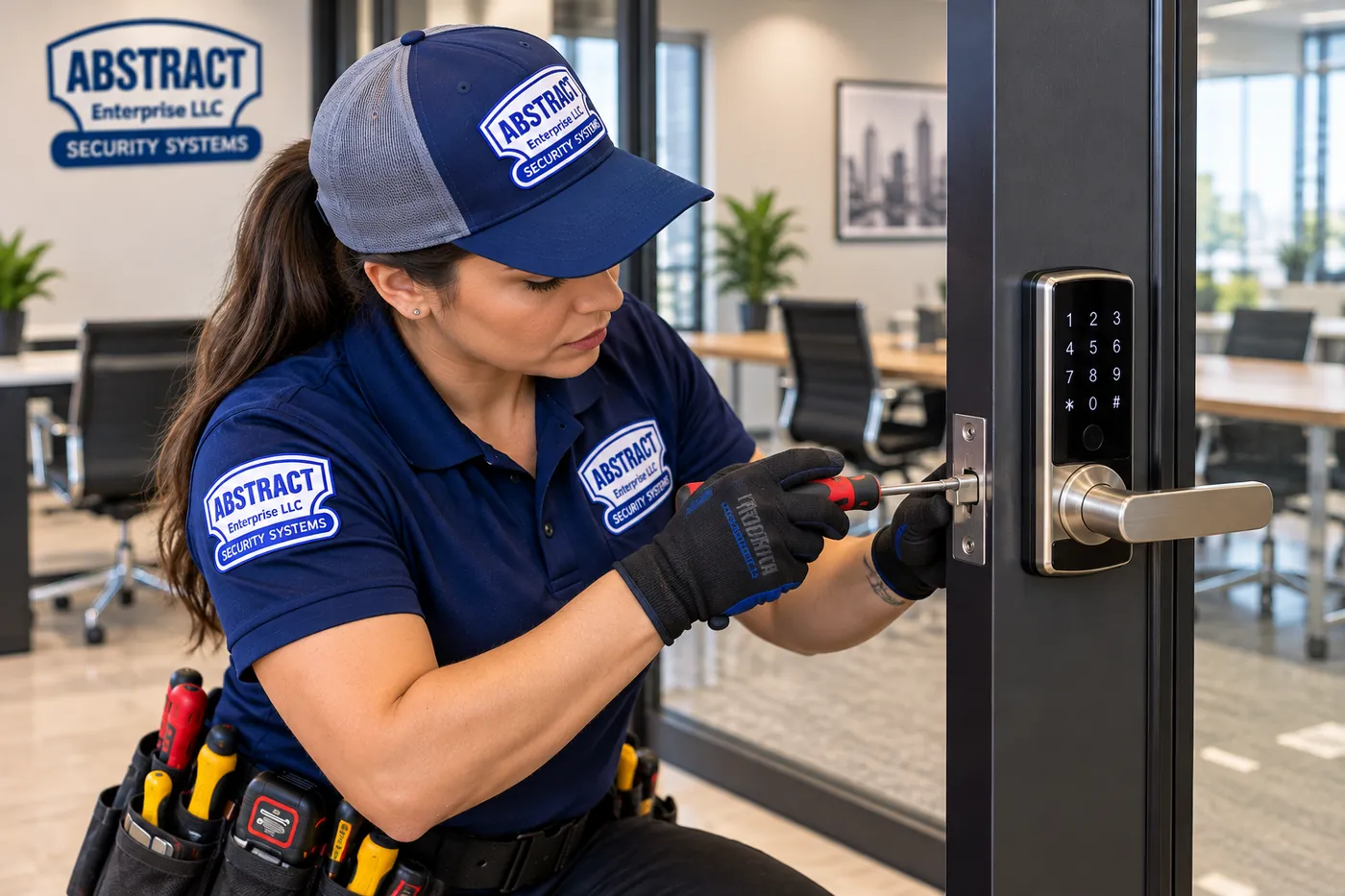
AESS technician installing a keypad lever smart lock on an office suite door in Manhattan
Keypad lever lock on an interior office door — good for suites, supply rooms and server closets.
Repair Capture

Smart Lock Acting Up Somewhere in Manhattan?

A keypad that went blank while you were out of town, a lock that dropped off the app after the building changed its Wi-Fi or its entry platform, a deadbolt that grinds against a strike that moved when the building settled, a suite door whose magnetic lock will not release, or codes that the dog walker swears stopped working — those are service calls, not new installs. We book them into the next open 2-hour window that your building's contractor hours allow, and most power, pairing and alignment faults are fixed in one to two hours once a technician is at the door. If the problem is the building's front door rather than yours, a failed electric strike repair is $369–$606 at the Manhattan rate. Call the Manhattan line, (929) 560-0737, and say it is a lock fault, or see our door buzzer repair service in Manhattan if the lobby is the one that has stopped releasing.

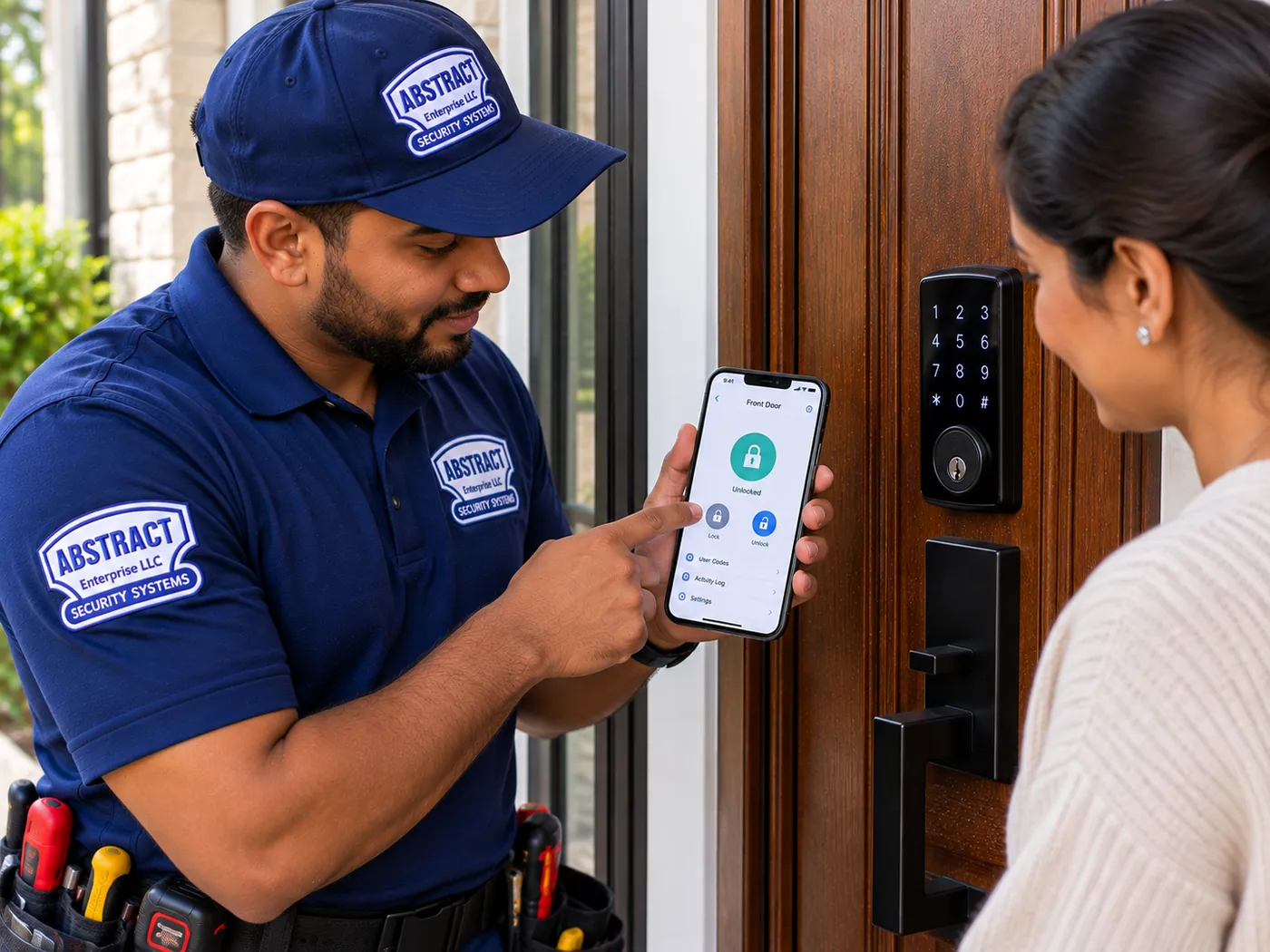
AESS technician walking a customer through locking and unlocking her new smart lock from the app in Manhattan
Walking the owner through the app before we pack up — lock, unlock, codes and history.
What We Install

Smart Lock Installation Services in Manhattan

Every keyless job we take on between Inwood and the Battery is one of these, or a mix. Each finishes the same way: the door closes and latches by itself, it opens from inside without a key, the building staff know what changed, and every code, fob and phone has been tested at the door with you.

Unit Locks in Doorman and Concierge Buildings

A keypad, fingerprint or app lock on your apartment door, set up so the front desk's routine still works: a staff code or a retained key for emergencies, separate codes for the people the desk already lets up, and nothing on the hallway side that breaks the building's hardware standard.

Locks That Coexist With the Building Platform

Where the building runs Latch (now DOOR), ButterflyMX, a fob system or a video intercom app, we either enrol a compatible unit lock into that platform or keep your lock deliberately separate — whichever the managing agent allows and you prefer.

Pied-à-Terre and Frequent-Traveller Setups

Remote unlocking, low-battery and offline alerts, a bridge or Thread border router placed where the signal is real, and a documented fallback — so a dead battery in February does not mean a locksmith drilling the door while you are in London.

Office Suite Doors in Towers

Keypad, card or phone entry on the suite door, wired to the egress rules: release hardware on the door, fire-alarm release where the building requires it, and a credential plan that lines up with the landlord's lobby system instead of competing with it.

Shopfronts in Historic Districts

Keyless entry for staff on storefronts in SoHo, NoHo, Tribeca and other landmark districts, with readers and strikes placed inside the glass or on the frame where they change the least, and the Landmarks question answered before anything goes on the facade.

Short-Stay Apartment Hosts Who Want to Stay Legal

For registered hosts who are home during a stay and owners renting for 30 days or more: guest codes that start and end on the right dates, without locking anyone out of the rooms the city's rules say a guest must be able to reach.

Renovation and Move-In Access

Time-boxed codes for a contractor crew, a mover or a designer, so the apartment can be worked on for a week without a key leaving the desk — and the codes die on the day the job ends.

Network Work Behind Cloud-Managed Locks

The quiet part of most suite jobs: a data drop to the controller, a port on the right network, a Wi-Fi access point within range of the lock bridge, all under the same licence as the lock.

Service, Repair and Hand-Back

Re-pairing after a platform change, battery and motor faults, strikes and closers that have drifted, and the clean removal of a smart lock with the original hardware restored when you sell or the lease ends.

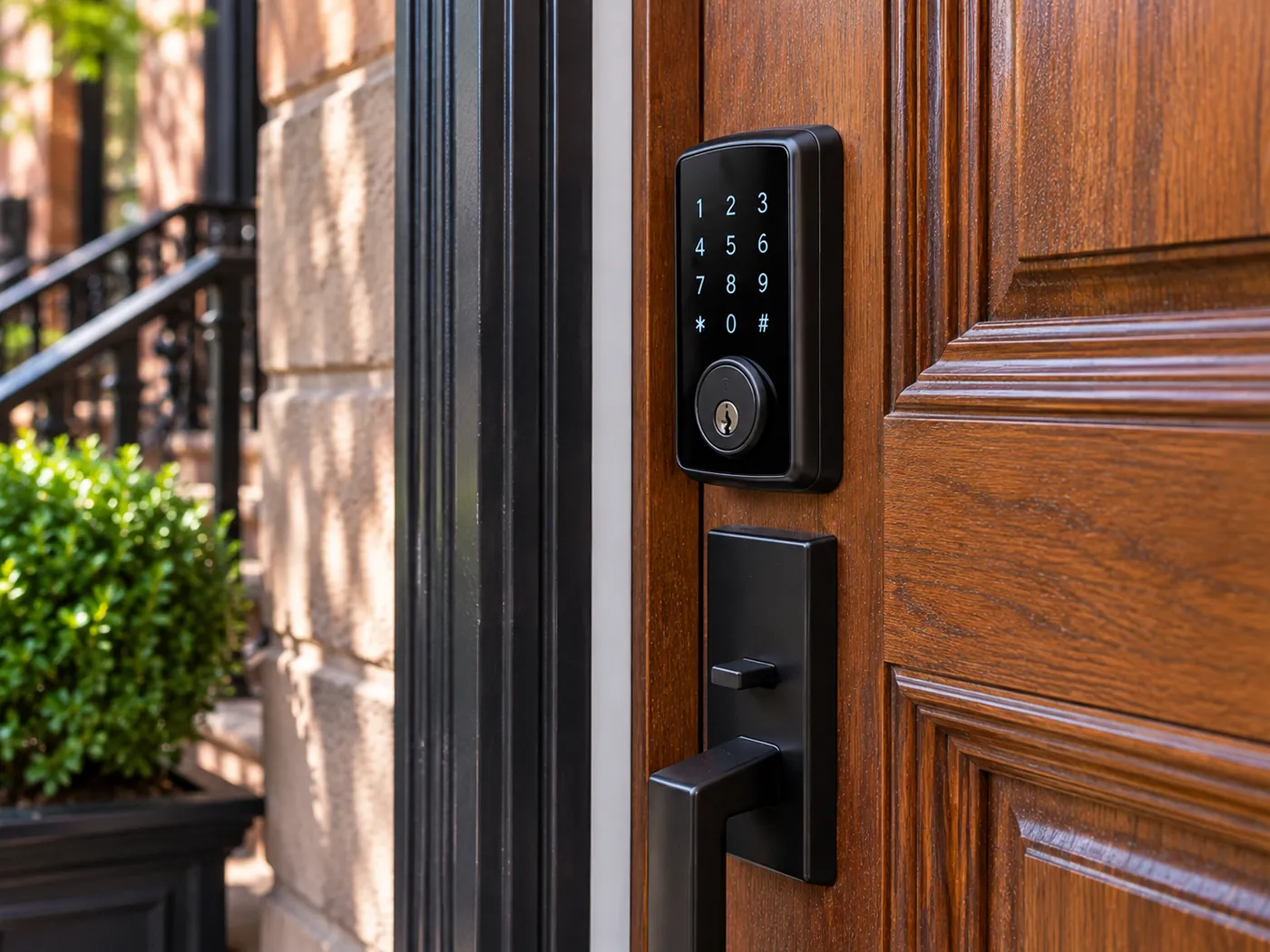
Finished black keypad smart deadbolt and handle on a wood brownstone front door after smart lock installation in Manhattan
A finished keypad deadbolt on a brownstone front door — keyless entry with a key backup.
Building Specialists

Smart Lock Installation for Manhattan's Architecture

Manhattan's buildings sort into a handful of types, and each one decides the lock before the lock catalogue does. These are the ones we work in most, and what each means at the door.

Pre-War Doorman Co-ops

Central Park West, West End Avenue, Park and Fifth: heavy unit doors, original mortise hardware, a hallway look the board protects, and staff who have held a key to every apartment for decades. The lock has to keep a key path the building can use and change nothing that shows in the corridor without approval.

Post-War White-Brick Rentals

The full-service rental towers of the Upper East Side, Murray Hill and Yorkville: hollow-metal doors in steel frames, bored deadbolts, concrete corridors, and a management company that decides what tenants may change. Usually the cleanest smart lock retrofit in the borough, if the management office says yes.

Glass Condo Towers

Billionaires' Row, Hudson Yards, the Far West Side and downtown: a developer-chosen access platform from lobby to elevator to amenity floor, and often a unit lock already specified. The question here is whether to integrate with what is there or replace the unit lock with one you control.

Office-to-Residential Conversions

Water Street, Wall Street, Broad Street and Third Avenue: former office floors carved into apartments, sometimes with corridors and doors that still behave like commercial ones. Expect fire-rated assemblies and building-wide systems designed fresh, which makes it the best moment to get the unit lock right.

Class A Office Towers

Grand Central, the Plaza District, Hudson Yards and the Financial District: base-building turnstiles and card readers, landlord-approved vendors, after-hours rules, and suite doors that are often glass on a steel or aluminium frame. Suite locks here are low-voltage access work, not consumer hardware.

Cast-Iron Lofts and Landmarked Storefronts

SoHo, NoHo and Tribeca: tall glass storefronts in cast-iron frames, residential loft doors up narrow stairs, and Landmarks Preservation Commission oversight of anything that changes the exterior. Readers go inside the glass where possible; strikes go into the frame only where the frame can take them.

How the method changes by building

Doorman co-ops. We start with the building's own key policy. Most boards expect to hold a working means of entry for emergencies, so we fit locks that keep a keyed override or an admin code the desk can use under whatever rules the board sets. Hallway-side trim is matched or left untouched, and the inside of the door is where the electronics live.

Post-war rentals. The door prep is usually standard, so the work is mostly about the management office and the signal. We put the written request in front of management with the lock's specification, and we test Wi-Fi or Thread at the door before choosing between Bluetooth-only, a bridge or a border router — concrete corridors and dozens of neighbouring networks can make the hallway a dead zone.

Glass condo towers. We ask for the building's integration list first. Platforms such as ButterflyMX advertise integrations with dozens of smart lock styles; where your model is supported, enrolling it means one app for lobby, elevator and unit. Where it is not, we keep the unit lock separate and make sure the desk still has the emergency access the condo's rules require.

Conversions and office towers. Every door is treated as a potentially rated assembly until the label says otherwise. We look for the label on the hinge edge of the door and the frame, check what the hardware listings allow, and keep electric strikes, transfer hinges and readers to approved preparations. Wiring rides the existing pathways to the floor's network closet rather than new holes through rated walls.

Lofts and storefronts. Readers and keypads go on the inside face of the glass or the interior jamb wherever the shop's layout allows, so nothing new is fixed to a cast-iron facade. Where a reader really must be outside, the job pauses for the landlord and the LPC question before we drill. Most Manhattan shops that add staff codes pair the door with cameras — our commercial security systems for Manhattan businesses cover both.

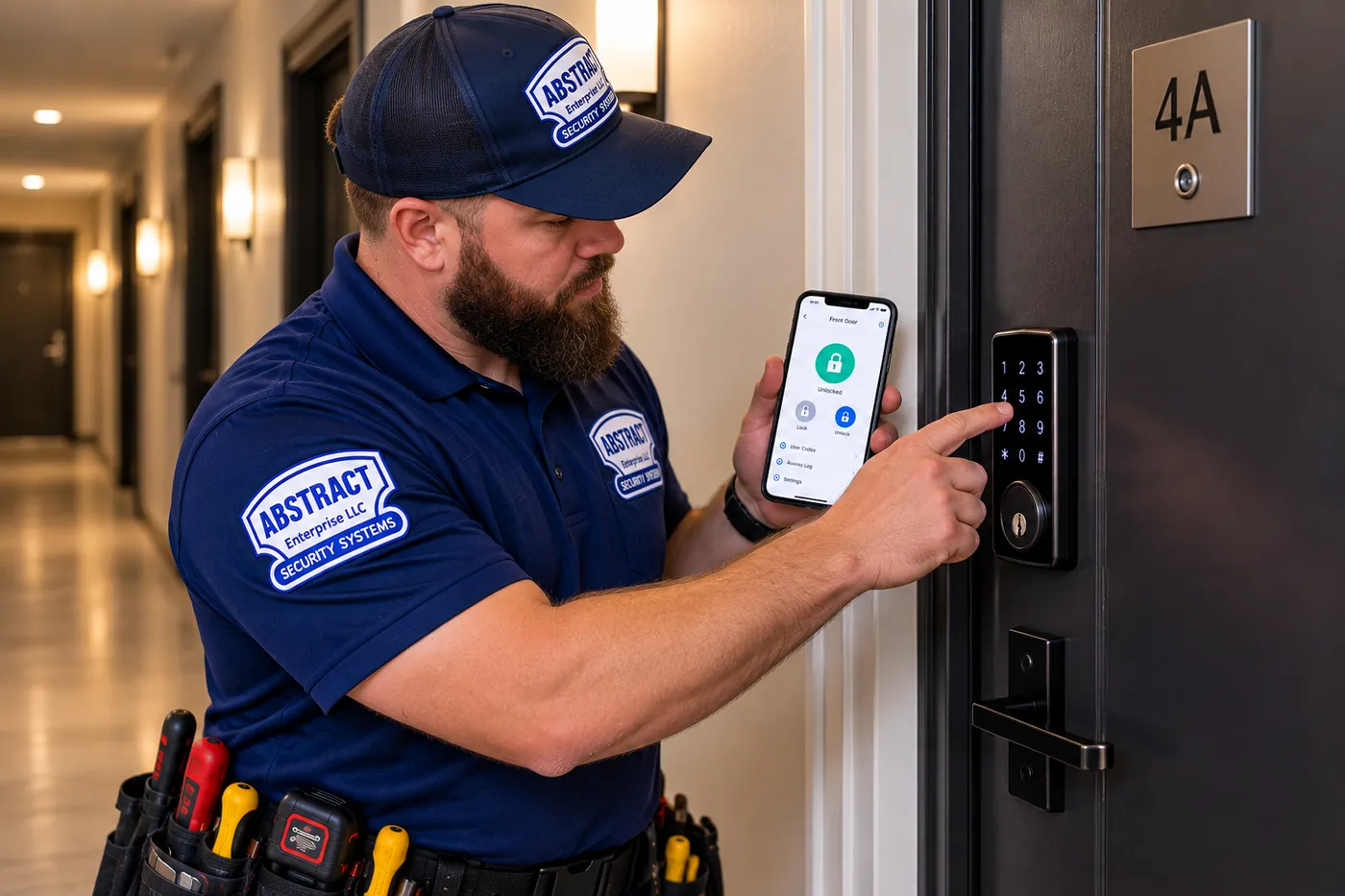
AESS technician testing a keypad smart lock on an apartment unit door with the mobile app in Manhattan
Apartment unit door, tested from the keypad and the app — handy for owners renting out units.
Commercial Smart Locks

Business Smart Lock Installation in Manhattan

Manhattan business doors fall into a few corridors, each with its own landlord habits and door types. We work across all of them; these are the patterns we plan for.

Grand Central, Madison and Park Avenue

The Midtown East office core around One Vanderbilt and the avenues north of 42nd Street. Base-building access is strict and vendors are vetted, so suite locks are scheduled through the property manager, often after hours, and tied to the tenant's own credential list.

The Plaza District and Billionaires' Row

57th Street between Sixth and Park, where office floors, private clubs and residential towers such as Central Park Tower sit block to block. A mix of suite doors, members' entrances and concierge-managed residential locks within a few hundred yards.

Financial District and Water Street

Older towers on Water, Broad and Wall, many now partly or wholly residential after conversion. Commercial-grade corridors with apartment doors on them, and suites still trading as offices a floor below.

SoHo, NoHo and Tribeca Retail

Broadway, Greene, Mercer, Lafayette and the cast-iron side streets: flagship storefronts, galleries and showrooms with staff entrances, stock rooms and upstairs studios, all inside historic districts.

Flatiron, NoMad and Chelsea Creative Floors

Loft-style offices for design, media and tech tenants along Fifth, Broadway and the West 20s: shared floors, coworking suites and small companies that want phone entry and a log without a full access-control build.

Upper East Side Medical and 125th Street

Ground-floor practices along the avenues of the Upper East Side, and the shops and offices of the 125th Street business improvement district in Harlem: street doors, back-of-house doors and records rooms that need staff codes and an audit trail.

Compliance callouts for Manhattan business doors

  • Electromagnetic locks: NYC Building Code section 1010.1.9.9 permits them on egress doors and doors to tenant spaces in assembly, business, educational, mercantile and R-1/R-2 occupancies only where the door hardware has a built-in switch, operates with one hand and an obvious motion under all lighting, cuts power to the lock directly, and unlocks on power loss — and where panic hardware is required, it must release the magnet too.
  • Fire-rated assemblies: NFPA 80 limits job-site preparation of fire doors and frames to round holes for listed hardware; other cutouts are field modifications that need the listing laboratory's approval, as door-hardware specialist Lori Greene has explained on iDigHardware. We work to the label.
  • Low-voltage permits: under NYC Administrative Code § 28-105.4.7, wiring designed to run below 50 volts for signalling, communication, alarm and data circuits does not need an electrical permit when the work is done by a licensed master electrician, special electrician or a qualified person as defined in the city electrical code. Line-voltage power to a power supply is electrician's work and is arranged separately.
  • Landmarks: in Manhattan's historic districts the NoHo business improvement district's guidance reminds owners that an LPC permit is needed for most exterior work even when no DOB permit is, while repairing or replacing hardware such as knobs, hinges and handles does not need LPC approval.
  • Accessibility: keypads and release hardware are placed where they can be reached and operated without tight grasping, pinching or twisting of the wrist.

None of this is legal advice; we name the rules so you or your architect can read them. Offices that add suite locks usually want the lobby and the cameras to agree — see our commercial security camera installation in Manhattan.

AESS technician checking latch and bolt alignment at the door edge during a smart lock installation in Manhattan
Checking bolt throw and strike alignment — a bolt that binds drains batteries and jams motors.
Your Questions Answered

Smart Lock Installation in Manhattan: Questions Answered

These are the questions that come up when the door is in a Manhattan building with staff, a platform and a managing agent, grouped by situation: living alongside the building's own entry system, the paperwork before the visit, doormen and service providers, owners who are often away, short-stay hosting, office suites and landmark shopfronts. General renter and co-op rules are covered on our New York City smart lock page; cost, scheduling and coverage are in the FAQ further down. None of this is legal advice.

Living with the building's entry platform

My building already opens the lobby with an app — will a second app on my own door clash with it?

It will not clash electrically, because the building's system and a stand-alone unit lock do not talk to each other unless someone connects them. The practical issue is daily life: two apps, two sets of guest codes and two places to revoke access. A visitor you let into the lobby from the building's app still needs a separate code or an unlock from your lock's app to get through your door, and when your cleaner leaves you have to remember to remove them twice.

There are three ways to handle that. If the building's platform supports your lock model, the managing agent can enrol it, and the same app then opens the lobby, the elevator and your unit. ButterflyMX, for instance, says its platform connects with more than 80 smart lock styles and finishes, and that its door PINs and Bluetooth credentials keep working through a building-wide internet outage once a Wi-Fi lock has been integrated. If the building will not integrate, or you would rather the managing agent not administer your front door, a separate lock is perfectly reasonable — we simply set it up so the codes you hand out mirror the building's, with the same start and end dates.

The third option is the one most people overlook: a building whose units already have platform locks, such as many Latch buildings, may not allow a second lock on the door at all. Latch rebranded as DOOR in August 2025 and says it continues to support existing Latch hardware, so those locks are not going away. Before buying anything, ask management whether the unit door is yours to change. We are glad to put that question to them in writing.

Can my unit lock be enrolled in the building's system so the front desk can see it?

Sometimes, and it is worth thinking about whether you want that. Enrolment means the building's dashboard holds your lock: the desk can issue a one-time code for a delivery or a repair, see when the door was opened, and in some systems unlock it remotely. That is convenient for owners who are away, and it is the kind of arrangement many condos already expect for emergencies. It also means building staff and the platform company hold data about your comings and goings.

If you rent, the city's Tenant Data Privacy Act already limits what an owner can collect through a smart access system and bars making it the only way into your apartment, so enrolment should be your choice rather than a condition. If you own, the condo or co-op's own rules decide what the desk is entitled to. Either way, we recommend agreeing in writing what the desk can do with your lock — issue codes, view logs, unlock — before we enrol it.

Technically, enrolment depends on the lock's radio and the platform's integration list, not on how well it is installed. We check the model against the building's list, install it, and then hand over to the managing agent's administrator to complete the enrolment on their side, so nobody is guessing who controls what.

The paperwork before the visit

What should the scope letter to the managing agent say about the lock and the door?

Managing agents approve paperwork, not intentions, so the letter should answer their questions before they ask them. We draft it for you and include the lock's make and model with its specification sheet; whether the work is a retrofit on the inside only, a deadbolt swap in existing holes, or a change that needs new preparation; whether anything changes on the corridor side; how the door will still open from inside with one motion; and what emergency key or code the building will hold.

Where the door carries a fire-rating label, we say so and state that no preparation beyond what the label and the hardware listings allow will be made. On powered suite or lobby doors we add the release arrangement and whether the fire alarm is involved. We name the date window we are asking for, the number of technicians and the tools — drill, hole saw if needed, no wet work — and confirm the debris leaves with us.

Attach the insurance certificate the building asks for and the letter usually comes back in days rather than weeks. When it comes back with conditions, such as matching hallway finish or working only on Tuesdays, those go straight onto the work order.

Whose insurance answers if the door or the hallway is damaged during the installation?

Ours, for damage we cause. That is what the certificate of insurance is for: Brick Underground describes a COI as proof that the contractor carries a policy covering liability and loss, and co-op buildings routinely require one before any work starts. Many buildings also ask to be named as additional insured; we arrange that wording to match the managing agent's request.

What the certificate does not cover is a pre-existing problem we uncover — a door already warped, a frame already cracked, a strike already loose. That is why we photograph the door, the frame and the corridor finish when we arrive and show you anything we find before we start. If the door is not fit for the lock, we say so and stop, rather than turning a lock job into a door replacement without your agreement.

Your own homeowner's or renter's policy, and the building's master policy, sit behind ours for everything else. If your proprietary lease or condo by-laws say alterations must be insured in a particular way, send us that clause and we will check our certificate matches it.

Doormen, concierges and service providers

How should the doorman, the dog walker and the cleaner get in once the door has a code instead of a key?

Give each of them their own credential and decide how far each one goes. A dog walker's code might work weekdays from 11 to 3; a cleaner's only on Thursdays; the doorman's emergency access might be a code kept sealed at the desk, or the building's own key held under the board's rules. Everyone gets a different code so the lock's log shows who came in, and so one person can be removed without changing everyone else's.

Most Manhattan buildings will still want the desk involved: staff announce or log service providers on the way up. A smart lock does not replace that; it removes the step where the desk hands over your key. That matters, because the weak point in a doorman building is the key cabinet — in August 2026 FOX 5 reported that a concierge at a Long Island City tower handed a vacationing couple's keys to a woman who claimed to be their dog walker. With personal codes, nobody at the desk is holding a key to your apartment for a stranger to talk their way into.

We set up the schedules with you at handover, label each code by person in the app, show you how to suspend one in seconds, and leave a short written sheet you can share with the desk so they know who is expected.

Should packages still go to the desk if a smart lock could let couriers into the apartment?

For most buildings, yes. Some smart lock makers offer in-home delivery with a one-time unlock while you watch on a camera, but in a building with a package room, the desk is already doing that job with less risk. Letting a courier past the desk and into your unit means the building has to allow it, and many do not. It also means the delivery is now inside your home rather than in a monitored room.

Where there is no package room, or the desk is part-time, a one-time code for a specific delivery window is safer than leaving keys with a neighbour. Pair it with a doorbell camera or an indoor camera facing the door, and keep the code single-use so it expires as soon as the door closes.

If you want in-unit grocery or laundry drop-offs on a schedule, set them up as a named recurring code rather than a shared one, so the log shows exactly which service came and when. Our doorbell camera installation in Manhattan covers the camera side.

What stops someone who talks their way past the lobby from getting through my door?

The lock itself, if it is set up properly. A person who gets past the desk on a story still faces a door that only opens with a personal code, a phone credential or a key held under controlled conditions. That is a big improvement over a building where the desk can simply hand out a key. The details that make the difference are auto-lock, so the door never sits unlatched after someone leaves; tamper lockout, so repeated wrong codes freeze the keypad and alert you; and no default or shared codes.

Keypads have a known habit of showing wear on the numbers that are used most. Locks with a scramble feature let you type extra digits before or after the real code, which hides the pattern. Fingerprint models avoid the issue entirely for the household, with codes kept for visitors.

Finally, the alerts have to reach you. A lock that is offline cannot tell you anything, so we confirm notifications arrive on your phone over mobile data, not just on the home Wi-Fi, before we leave.

Owners who are often away

If the batteries die while we are out of the country, how does anyone get in?

Plan for it on day one, because it is the most common pied-à-terre call we get. Smart locks warn of low batteries well before they fail, but the warning only helps if it reaches you and someone can act on it. Schlage, for example, quotes up to six months of battery life for its Encode locks with typical use; heavy daily use, an exposed cold corridor or a lock that strains against a sticky strike shortens that.

The fallbacks, in order: many keypad locks have external contacts for a temporary nine-volt or USB-C power boost, which lets you key in a code and get inside to change the batteries; a keyed override, if the building holds a key under its emergency rules; and a trusted person — often the super or a resident manager — who has instructions and, if you agree, an admin role in the app. We test whichever of these your lock supports before we leave and write it down for you.

Owners away for months can also ask the desk or a cleaner to change the batteries on a schedule. Lithium AA cells are rated by Energizer to work from minus 40 to 140 degrees Fahrenheit, but alkaline cells are what most locks are specified for — follow the lock maker's instructions, and change all of them at once.

Can a renovation crew work in the apartment for a week without being given a key?

Yes, and in Manhattan this is often the main reason owners add a smart lock. The contractor gets a code that works only on the agreed days and within the building's permitted hours — for example 9 to 5 on weekdays, which is what Brick Underground notes most alteration agreements allow. When the job ends, the code expires on its own; no keys to collect, no locksmith to call because a key went missing.

Give each trade its own code if the job has several. The log then shows who arrived when, which helps if the building questions noise outside the permitted hours or a neighbour reports damage in the corridor. Pair the lock with an indoor camera if you want to see progress, and tell the crew it is there.

One caution: some renovation work involves taking the door off or replacing it. If that is planned, install the smart lock after the new door is hung, or have us remove and refit it so the door supplier does not have to deal with electronics.

Short-stay hosting and the city's rules

Can a keypad let us rent the apartment to visitors while we are away?

Not for stays of under 30 days. NYC311's guidance on Local Law 18 is plain: hosts, whether owners or tenants, cannot rent an entire apartment or home to visitors for fewer than 30 days, even if they own or live in the building, and this applies to all permanent residential buildings regardless of the number of units. Registered hosts must stay in the unit with the guests and may have no more than two guests. A keypad makes the hand-off easier; it does not make the rental legal.

Rentals of 30 days or more fall outside the short-term rules, subject to your lease, your proprietary lease or the condo's by-laws, many of which set their own minimum terms or require board approval for any rental. For those, a smart lock is genuinely useful: a code that starts on move-in day and ends at checkout, with a separate one for the cleaner between tenancies.

We install locks for owners and hosts who are doing it legally. If you are not sure which side of the line your plan falls on, the Office of Special Enforcement's registration pages and your building's managing agent are the people to ask before you buy a lock for the purpose.

We host a registered guest while we are home — can the guest bedroom get its own smart lock?

Not a lock that keeps the guest out of the rest of the apartment, or you out of the guest's room in a way that splits the home in two. NYC311's guidance says a host must ensure every guest has access to all parts of the dwelling unit and to each exit, and NY1's coverage of the rules when enforcement began in September 2023 summed it up as “no locked doors.” Turning a bedroom into a self-contained, separately locked suite is exactly what the rule is written to prevent.

What remains useful is the front door: a guest code that starts and ends with the stay, so you are not cutting keys for someone who will be gone in a week, and that you can cancel instantly if the stay ends early. Privacy for a guest inside the home can come from an ordinary privacy latch that opens from the corridor side with a tool in an emergency, which is not a smart lock at all.

Interior smart locks have legitimate uses — a home office with work files, a storage room, a wine room — and we fit them often. They are just not the tool for a short-term rental arrangement.

Key lockboxes keep appearing on the railings outside our building — what can the building do?

Start with the lobby door. Lockboxes clipped to tree guards and railings are usually there because someone needs to give a visitor a building key without being present. Chelsea residents complained about exactly this in 2016, when the local paper counted eleven of them on one block of West 21st Street; the Parks Department said lockboxes on tree guards are not an authorised use of its property. If the building's front door accepts personal codes or phone credentials, there is no building key for anyone to leave in a box.

For a co-op, condo or rental building, that means a keypad or fob reader on the street door, codes issued per resident and per authorised visitor, and a log the managing agent can check. It also means the building can see when a single unit's credentials are being used by a stream of strangers, which is a far better signal of an illegal hotel than a box on the fence.

Remove the boxes you can lawfully remove, report the rest to the Office of Special Enforcement if you suspect illegal short-term rentals, and fix the door. Our building-door pricing is in the cost section below, and our door buzzer installation in Manhattan covers older entry panels.

Office suites in towers

Our suite is in a Midtown tower with its own card system — can our door have a different lock?

Usually, with the landlord's agreement. Most Class A leases let the tenant secure its own premises but require approval for anything that touches the base-building system, the corridor or the life-safety wiring, and many landlords keep a list of approved access vendors. The cleanest answer is often a suite lock on its own controller or a cloud platform the tenant administers, with the landlord's base-building credential still opening the lobby and the elevator.

The alternative is to put the suite door on the landlord's platform. Some platforms are designed for this — Kastle, for example, advertises a single mobile credential that moves between base building and tenant spaces — and it saves staff carrying two credentials. It also hands control of your door to the landlord's system and its fees, which not every tenant wants.

We will walk the suite, read the relevant lease clause with you, and put a short proposal to the property manager. The aim is a door your team can manage day to day that the building's engineer is comfortable with.

Can an electric strike be cut into the labelled steel frame of a suite entrance?

Only within what the frame's and the strike's listings allow. NFPA 80, the fire-door standard, limits job-site preparation of fire door assemblies to round holes for listed hardware; a rectangular strike cutout in a rated frame is a field modification unless the listing permits it, and otherwise needs the listing laboratory's approval. If an alteration is made without approval, the door or frame may need to be re-labelled after a site visit by the lab, which is slow and expensive.

So we read the label before choosing hardware. Often the answer is a frame that was factory-prepared for a strike, a fire-rated electric strike in an existing prep, an electrified lockset with a power transfer hinge, or a surface-applied solution listed for the assembly. Where none fits, we tell you before anyone picks up a saw.

Non-rated suite doors, such as many glass fronts on interior corridors, give far more freedom — but we still confirm with the building which doors are rated, because a corridor that looks like ordinary office space can be part of a rated exit path.

Does a magnetic lock on our glass suite door have to release when the fire alarm goes off?

The release rules depend on the arrangement. NYC Building Code section 1010.1.9.9 permits electromagnetic locks on doors to tenant spaces in business occupancies where the door has hardware with a built-in switch that is obvious, operable with one hand under all lighting conditions, interrupts power to the magnet directly, and where loss of power unlocks the door. Where panic hardware is required, operating it must also release the magnet. Separate provisions in the code govern sensor-release arrangements, and those tie release to the building's fire alarm and sprinkler systems.

In practice, many Manhattan towers also require tenant locks on egress paths to drop on a fire alarm signal regardless, because that is how their fire safety plan works. That means coordination with the building's fire alarm vendor and the building engineer, and sometimes a filing, before the lock is live.

If your glass door is not on an egress path — the suite has another exit and the door is not required for egress — the options widen. We map the suite's exits with you and the building before recommending maglock, electric strike or electrified lever.

Our team works late — how does after-hours access fit with a suite smart lock?

Most Manhattan towers run the lobby on staffed hours and require a base-building credential, sign-in or advance notice after hours and at weekends. The suite lock should follow the same rhythm: schedules that unlock the suite during business hours and require a personal credential outside them, and an after-hours list that matches the one the building's security desk holds.

Keep the two lists in step. When an employee leaves, remove them from the suite system and ask the building to cancel their lobby credential the same day. Cloud-managed suite locks make that a one-click job; key-and-cylinder suites mean a re-key.

For the cleaning crew, which in many towers is the landlord's contractor, give the suite a code limited to the cleaning window, and check the log the first week to make sure the window is right.

Shopfronts in landmark districts

Can the reader sit behind the glass so nothing new goes on a cast-iron facade?

Often, yes, and that is our first choice on SoHo, NoHo and Tribeca storefronts. Many card and phone readers will read through a single pane of glass at short range; others mount on the interior jamb, visible from the street but fixed inside. Staff present a card or phone to the glass, the strike or electrified lock on the door frame releases, and the facade is unchanged. The NoHo BID's guidance notes that most window and door work needs an LPC permit but that repairing or replacing hardware such as knobs, hinges and handles does not; a reader inside the shop keeps the job as close to the second category as it can be.

Not every reader works through every glass. Coated, laminated or very thick glazing can kill the signal, so we test on site with the actual reader before committing. If an exterior reader turns out to be the only way, the job pauses while the owner or tenant confirms with the landlord and the Landmarks Preservation Commission what is approvable.

Remember that the whole designated property, including the sidewalk, is landmarked in a historic district — not just the facade — so nothing goes into the sidewalk or the stoop either without the same check.
AESS technician installing a keypad smart deadbolt on a suburban home front door with the AESS van outside in Manhattan
Single-family front door, keypad deadbolt going in — one visit, about an hour on a standard door.
Equipment

Types of Smart Locks We Install

In Manhattan we choose the category by the building first and the brand second. Bring your own lock or let us recommend one at the walkthrough; these are the categories we fit in apartments, suites and shops across the borough.

Interior Retrofit Units

Mount over the inside of an existing single-cylinder deadbolt and leave the corridor side and the key exactly as they were — August's own description is “leaving the outside untouched.” The usual choice where the building's hallway hardware must not change and the desk keeps its key.

Keypad and Fingerprint Deadbolts

Replace the bored deadbolt with a keypad or fingerprint reader outside and a thumb-turn inside, normally with a keyed override. Best for post-war doors and condos where the owner controls the unit door.

Mortise-Format Smart Locks

For heavy pre-war and commercial doors with a lock body set into a pocket in the door. Converted with a mortise-specific smart lock or a kit made for the format rather than forced into a bored-deadbolt design.

Platform-Compatible Unit Locks

Models on the integration list of the building's entry platform, so the same app opens lobby, elevator and unit. We check the list with the managing agent before you buy.

Thread and Matter Locks

Low-power mesh radios that need a Thread border router — a smart speaker or hub of the right brand — inside the apartment. Useful in concrete towers where Wi-Fi at the door is weak but the living room has a hub.

Electric Strikes and Electrified Locksets

For suite, lobby and storefront doors: the frame or the lockset releases on a valid credential, while mechanical exit stays one motion. Fire-rated versions for labelled assemblies.

Electromagnetic Locks

For glass and aluminium suite doors where a strike cannot go, installed only with the door-mounted release hardware the NYC code requires and the fire-alarm interface the building needs.

Card, Fob and Phone Readers

Single-door readers on cloud or local controllers, including readers that work through glass for landmark storefronts. Paired with request-to-exit devices so people inside are never trapped.

Which category fits which Manhattan door

DoorUsual first choiceWhy
Pre-war co-op unit door with mortise lockMortise-format smart lock or interior retrofit on a separate deadboltKeeps the hallway trim and a key path the board accepts
Post-war rental or condo, bored deadboltKeypad or fingerprint deadboltStandard door prep; quickest clean install once approved
Glass condo tower with developer platformPlatform-compatible lock, or a separate lock you controlOne app for everything, or independence from the building
Office suite, steel frame, rated corridorFire-rated electric strike or electrified leverStays within the assembly's listing
Glass suite door, aluminium frameElectromagnetic lock with door-mounted releaseNYC 1010.1.9.9 arrangement; fire alarm tie-in as required
Cast-iron storefront in a historic districtReader inside the glass, strike in the frameNothing new on the facade where it can be avoided
AESS technician servicing the keypad wiring of a smart lock during a repair visit in Manhattan
Repair visit — opening the keypad to check the harness and contacts on a lock that stopped responding.
AI Overview Reality Check

What AI Gets Wrong About Smart Lock Installation in Manhattan

How this section was put together: the research tools behind this page could not display Google's AI Overview, so no heading here quotes it. The headings are claims found on national cost guides, manufacturer sites and how-to articles — the kind of statement answer engines echo — and each is followed by what changes once the door sits inside a Manhattan building with a desk, a platform and a managing agent.

“A smart lock is a $300 job anywhere in the country”

Fixr's national cost guide, updated in January 2025, puts smart lock installation at $250 to $400 with an average of about $300, and handyman labour at $50 to $100 an hour. Sites such as Angi and HomeAdvisor publish similar national ranges. Those figures assume an ordinary door in a house, one visit, no paperwork and parking at the curb.

A Manhattan unit door adds a scope letter and an insurance certificate, a booking inside the building's contractor hours, a service-elevator slot, sometimes a mortise or rated door, and a credential plan for the desk and service providers. Suite and storefront doors are access-control work with strikes, power and code requirements. That is why the published AESS figure for a single keyless door with an electric strike is $1,875 to $3,125 at the Manhattan rate, and why apartment-door locks are quoted after we see the door.

The national number is a fair guide for a bored deadbolt on a house. It is not a guide for a door at the end of a Manhattan corridor, and a quote built on it tends to grow on the day.

“Anyone with a screwdriver can fit one in half an hour”

Reviewers who test consumer locks often say a retrofit needs nothing more than a Phillips screwdriver and about thirty minutes, and on a standard deadbolt in a well-hung door that can be true. The hardware is designed for exactly that.

The thirty minutes do not include getting permission. In many Manhattan buildings, a resident who changes the lock without telling management gets a letter; a contractor who arrives without a certificate on file is turned away at the service entrance. They also do not include the door: pre-war doors that have sagged, frames that have moved with the building, strikes that need adjusting so the motor is not straining, and corridors where Bluetooth barely reaches the living room.

DIY is fine where your lease or the building allows it and the door is simple. Where it is not, the cost of a professional is mostly the cost of doing it once.

“Smart locks work with any building's intercom or access app”

Marketing pages make integration sound universal. In reality each building platform publishes its own list of supported lock models, and integration has to be switched on by the building's administrator, not the resident.

ButterflyMX, for example, lists support for more than 80 smart lock styles and finishes — a long list, but a list. A lock bought off the shelf may not be on it. And some buildings, especially those already fitted with platform locks such as Latch, now DOOR, may not let residents add their own lock at all.

Before buying, ask the managing agent which platform runs the building and whether resident locks can be enrolled. We are happy to make that call for you.

“Give guests a code and you can rent the place out”

Smart lock makers rightly advertise guest codes for holiday homes, and short-stay platforms have encouraged lockboxes and keypads for years — CBS New York reported Airbnb pointing hosts to “the almighty lock box.” Generic advice rarely mentions local law.

In New York City, renting an entire apartment for fewer than 30 days is not allowed, even with registration under Local Law 18; registered hosts must be present, may host no more than two guests, and must give guests access to all parts of the home. A keypad does not change any of that.

Where guest codes are useful in Manhattan is for 30-day-plus tenancies the building permits, for family and friends staying while you are away, and for registered hosts who are home.

“If your building has a doorman, you don't need a smart lock”

Plenty of advice treats a doorman as a complete security system: the desk sees everyone, holds a spare key and lets in the walker. That is how many Manhattan buildings have run for generations.

The weak point is the key the desk holds. When a concierge at a Long Island City tower handed a couple's keys to a woman claiming to be their dog walker in July 2026, FOX 5 reported, it was the key cabinet, not the front door, that failed. A smart lock lets the desk keep its role — announcing and logging — without being the place where your key can be handed to the wrong person.

Doormen and smart locks are complements, not alternatives. The best setups use both.

“Smart lock batteries last about a year”

Battery claims vary widely, and roundups often repeat the most optimistic one. Schlage's own product page for the Encode Plus says “up to six months of battery life with typical use.” Wi-Fi models generally use more power than Bluetooth or Thread models, and a lock that fights a misaligned strike uses more still.

For a family that is home, a low-battery warning and a pack of AAs in the drawer is the whole answer. For a Manhattan owner who is away for months, a dead lock is a real problem, because the people who could help — the super, the desk — may have no way in.

We set alerts to your phone, align the door so the motor is not working harder than it should, and agree a battery routine and an emergency fallback before we leave.

“A magnetic lock is the simple choice for any glass office door”

Maglocks are sold as the easy option for glass doors because they need no cutout in the glass. Product pages rarely mention the code requirements that come with them.

The NYC Building Code allows electromagnetic locks on doors to tenant spaces in business occupancies only where the door has release hardware with a built-in switch that interrupts power directly, works with one hand and an obvious motion, and where power loss unlocks the door. Many towers also require release on the fire alarm signal, which means coordinating with the building's fire alarm vendor.

A maglock done right is a good solution. Done as a quick fix with only a push button on the wall, it may not meet the code and may not pass the building engineer.

Exterior keypad and interior thumb-turn views of a smart deadbolt installed in Manhattan
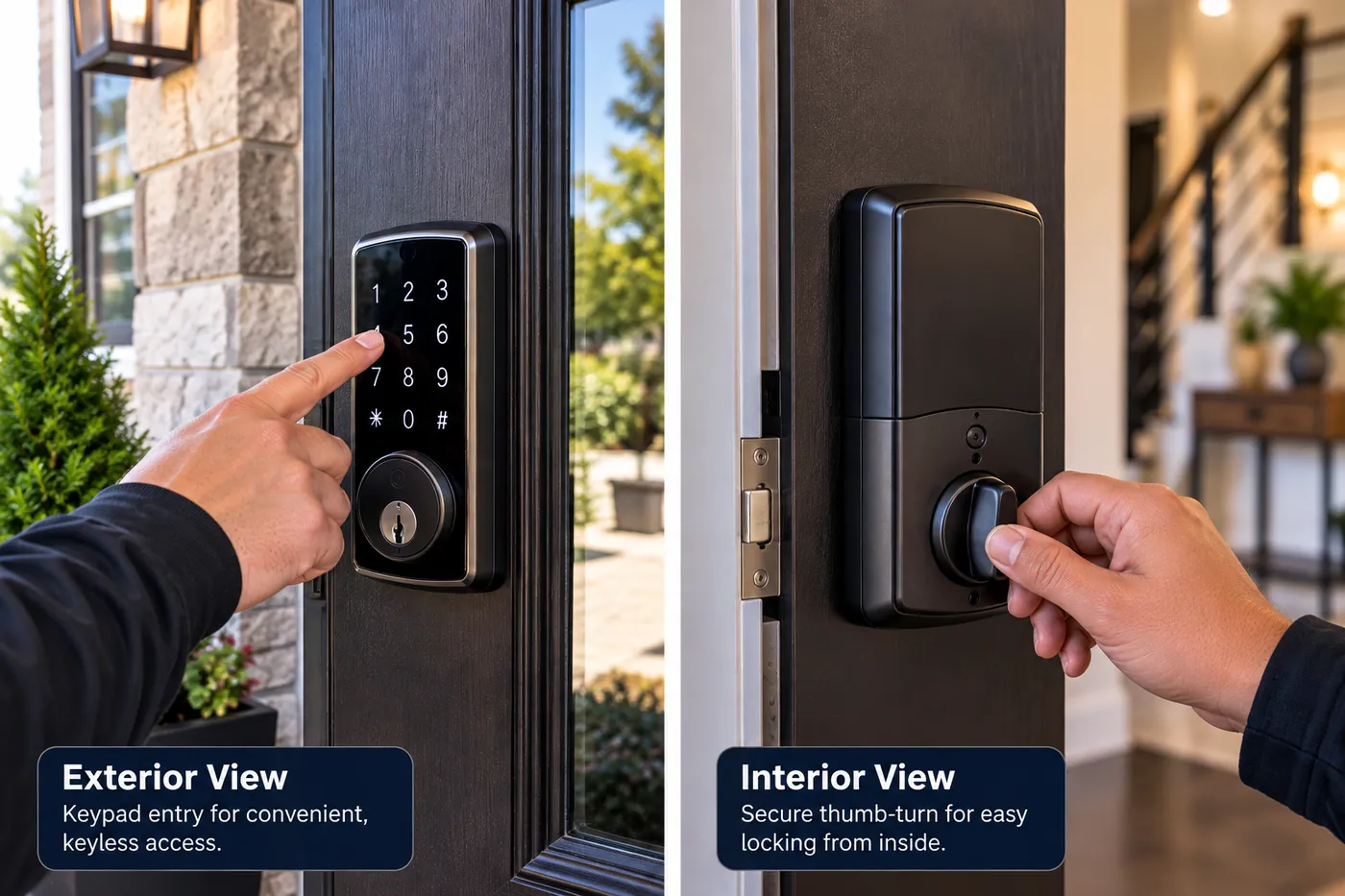
Outside: keypad entry with a key override. Inside: a thumb-turn so nobody gets locked in.

A Smart Lock That Works With Your Building, Not Around It

Tell us the building, the entry system it runs and who needs to come and go. We will tell you which lock fits, what the managing agent will want to see, and the price.

Get In Touch

Request a Free Quote

Doorman co-op, condo tower, office suite or SoHo shopfront — describe the door and the building and a written answer comes back the same business day. Rather talk it through? Call the Manhattan line on (929) 560-0737.

✅

We Got Your Request!

A Manhattan installer will call you back the same business day. If it's urgent, call (929) 560-0737.

How It Works

Our Installation Process

Seven steps, whether it is a retrofit on a co-op door on Riverside Drive or a strike and reader on a suite off Madison Avenue.

1. Building and door triage

You send photos of both faces and the edge of the door, the name of the entry platform the building uses, and who needs access. We tell you which lock categories can work and whether management is likely to need anything.

2. Scope letter and insurance

We draft the scope letter for the managing agent with the lock's specification, the door work and the emergency access plan, and send the certificate of insurance worded as the building requires.

3. Walkthrough and written price

At the door we check the label, the prep, the swing and the signal, confirm platform compatibility, and give you a written flat price. Suite and lobby doors are priced from published AESS figures at the Manhattan rate.

4. Booking inside the building's rules

We book a 2-hour arrival window inside the building's contractor hours, reserve the service elevator if needed, and confirm with the desk or the super so the technician is expected.

5. Door preparation and fit

The door and frame are photographed, swing and strike corrected so the door latches on its own, and the lock fitted using only the preparation the door, its label and the building allow.

6. Connect, enrol and test release

The bridge or border router is placed and tested over mobile data, the lock enrolled in the building's platform where agreed, and one-motion exit from inside — and fire-alarm release on powered suite doors — tested.

7. Credentials and handover sheet

Personal codes and schedules are set for household, desk, walker, cleaner and contractors, admin access is put on two devices, and you get a one-page sheet of who holds what to share with the desk.

Coverage Area

Smart Lock Installation Near Manhattan's Landmarks

Six places that capture the range of doors we work on in Manhattan — from a co-op that predates the elevator age to a 1,550-foot condo tower and a block where the lockbox problem made the news.

The Dakota, Upper West Side

The cooperative at 1 West 72nd Street, completed in October 1884. The archetype of the Manhattan doorman co-op: a board with house rules, heavy period doors and staff who have always managed who goes up.

Central Park Tower, Billionaires' Row

At 1,550 feet, the tallest primarily residential building in the world, one of the towers around 57th Street that the press calls Billionaires' Row — condos where owners are often elsewhere and the building's own platform runs every door from lobby to amenity floor.

SoHo–Cast Iron Historic District

Designated by the Landmarks Preservation Commission on August 14, 1973, covering about 26 blocks and nearly 500 buildings, and extended in 2010 to take in most of West Broadway and reach Lafayette and Centre Streets. Storefront locks here start with the LPC question.

NoHo Historic Districts

Most of NoHo lies within three historic districts, and its business improvement district reminds owners that the whole property, sidewalk included, is designated. Loft doors upstairs, shop doors below, landmark rules over both.

One Vanderbilt, Midtown East

The 1,401-foot office tower beside Grand Central that opened in September 2020, home to finance, law and real estate firms. A reminder that suite doors in Class A towers sit inside a base-building access system they must work with.

West 21st Street, Chelsea

The block between Eighth and Ninth Avenues where, in July 2016, the neighbourhood paper counted eleven key lockboxes on tree guards and fences. The clearest local argument for giving visitors personal codes instead of building keys.

We also serve Inwood, Washington Heights, Hamilton Heights, Harlem, East Harlem, Morningside Heights, the Upper West and Upper East Sides, Yorkville, Lenox Hill, Midtown, Hell's Kitchen, Murray Hill, Kips Bay, Gramercy, Flatiron, NoMad, Chelsea, Hudson Yards, the West and East Villages, the Lower East Side, Tribeca, the Financial District, Battery Park City and Roosevelt Island, plus the rest of New York City, Long Island and the Hudson Valley.

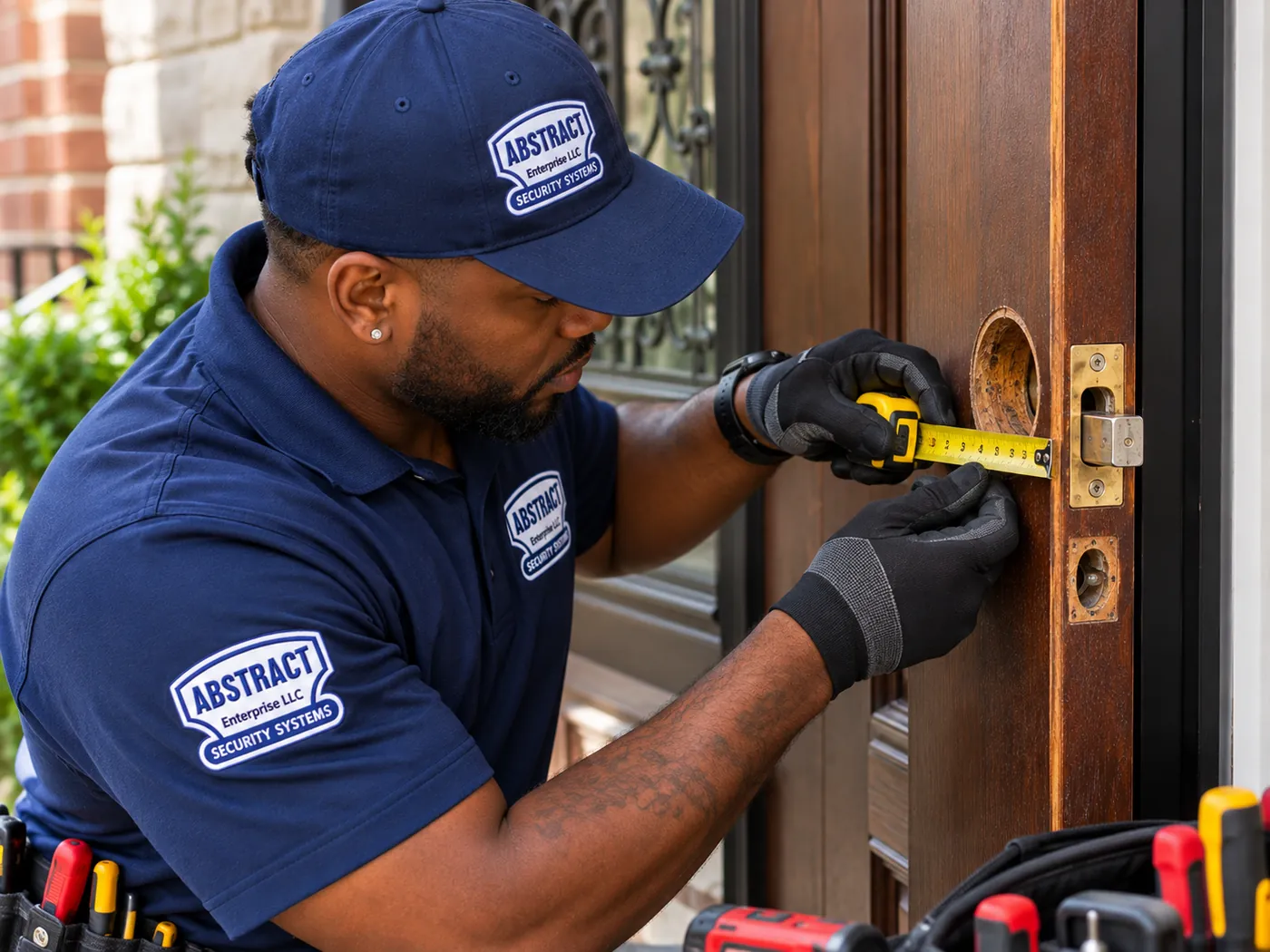
AESS technician measuring the door bore with a tape measure before a smart lock installation in Manhattan
Measuring the bore and backset first, so the new smart deadbolt fits the existing door without re-drilling.
Pricing

Smart Lock Installation Cost in Manhattan

Our Manhattan prices are our published figures with the Manhattan area rate applied, and we say plainly where a job is quoted at the walkthrough instead. Keyless suite, lobby and storefront doors are already priced on our access-control and door-buzzer pages at a Brooklyn base; Manhattan carries a 1.25 multiplier, the same one we use for every service in the borough, because of building logistics, scheduling windows and travel time. A smart lock on an individual apartment door has no published AESS figure yet, because the door and the building decide the work. Those are quoted flat, in writing, after a free walkthrough, and the quote is what you pay.

ItemManhattan priceScope and source
Apartment-door smart lock: interior retrofit, deadbolt replacement, mortise-format conversion or a lock enrolled in the building platformQuoted flat at free walkthroughPriced once we have seen the door, its fire label, the lock you want and what the managing agent allows — there is no published AESS figure for this line
Single-door keypad or fob reader with electric strike$1,875–$3,125 installedSuite, vestibule, lobby or storefront door; published $1,500–$2,500 base × 1.25
New electric strike on a lobby or suite door$313–$563Replacement keeper in the frame during a keyless upgrade — our $250–$450 door-buzzer figure × 1.25
Failed electric strike repair$369–$606Lobby or suite release that hums and stays shut — our $295–$485 repair figure × 1.25
Programming visit for a lock already on the door — app account, bridge, codes or enrolment in the building platformFirst hour $265, then 30-minute blocksOur published Manhattan setup-only rate
Service and callback rate$195/hr, 3-hour minimum ($585)Billed only for return visits once the job is signed off — never on the first installation

What moves a Manhattan apartment-door quote

  • Lock format and door: an inside-only retrofit is the lightest job; a deadbolt swap in existing holes is next; mortise-format conversions and rated doors take the most time.
  • Building platform: a lock that has to be enrolled in the building's system takes coordination with the managing agent's administrator; a stand-alone lock does not.
  • Paperwork and access: scope letter, insurance certificate wording, service-elevator booking and the building's contractor hours.
  • Connectivity: whether the lock reaches the internet through its own Wi-Fi, a bridge in the hall closet or a Thread border router in the living room, and how much testing a concrete corridor needs.
  • Credentials: a household's codes are quick; desk, walker, cleaner, renovation crews and guests with schedules take longer and are worth getting right.

National cost guides and national brands, for comparison

Fixr's national figure, updated January 2025, puts smart lock installation at $250–$400 with a $300 average and handyman labour at $50–$100 an hour. That is national third-party data for an ordinary house door, not an AESS price. Alarm brands are another route: Ring, for example, lets compatible Z-Wave locks arm and disarm Ring Alarm, but its support page says a subscription is required and only codes created in the Ring app work with the feature. If you are weighing a national alarm brand such as Ring, SimpliSafe or ADT against a local installer, check whether lock codes depend on their app and monitoring plan, and whether their installers will deal with your managing agent, your door's label and your building's platform. That last part is where a local, licensed Manhattan crew earns its fee.

Full terms for every job — deposit, warranty and late fees — are in the service agreement you sign before work starts, and summarised at the foot of this page.

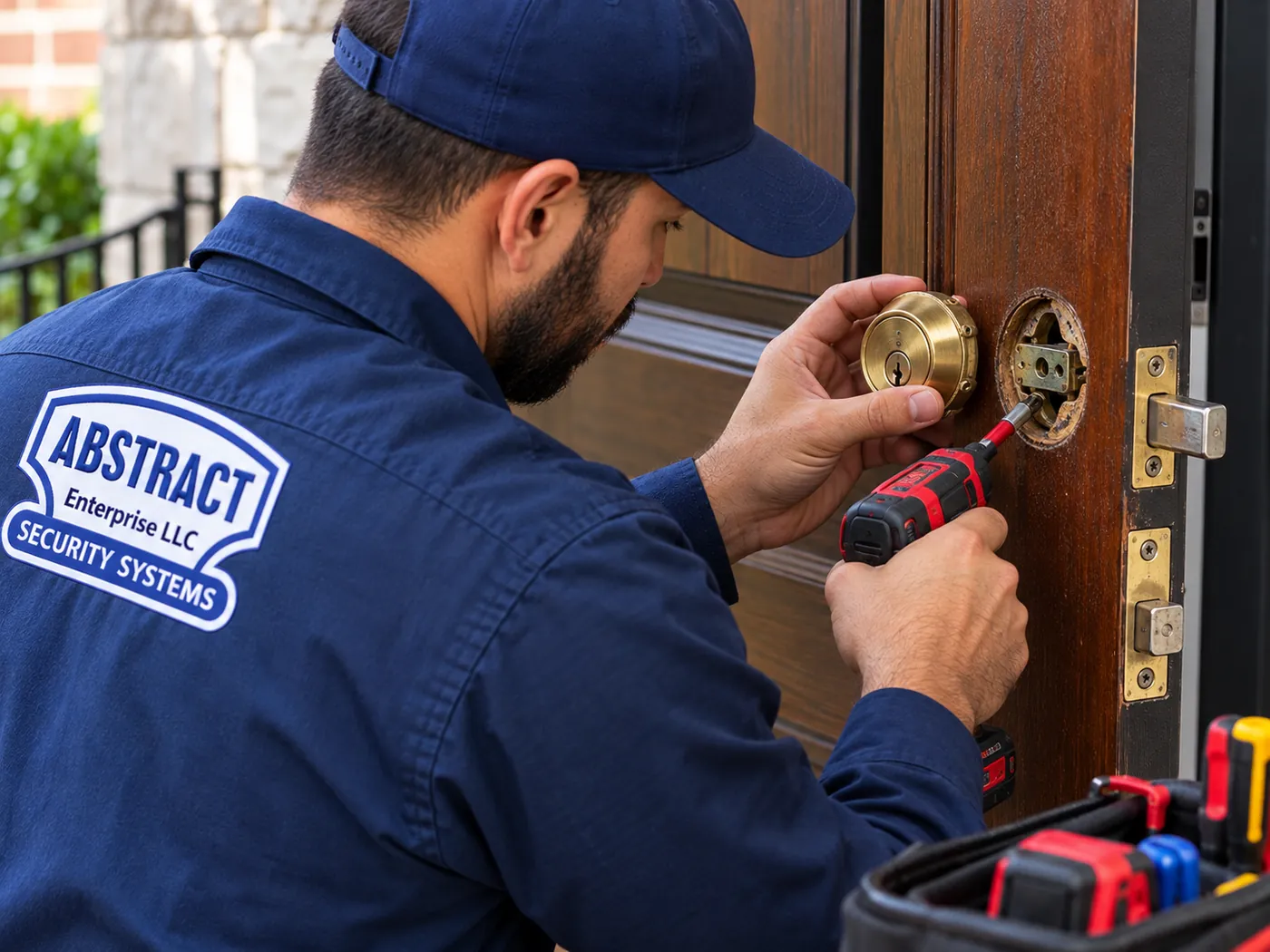
AESS technician removing an old brass deadbolt with a drill to prepare the door for a smart lock in Manhattan
Old brass deadbolt coming out — the first step of a smart lock swap on a wood entry door.
Shop Our Systems

Smart Lock Installation Packages & Pricing

Most Manhattan keyless jobs fit one of these three. The suite and lobby figures are published prices at the Manhattan rate; the apartment package is quoted flat at the walkthrough because a Dakota-era door and a 2020s condo door are different jobs.

Starter — Apartment Door in a Staffed Building

Quoted flat at walkthrough

Retrofit, deadbolt swap or mortise-format lock chosen for the door and the building; scope letter and insurance certificate for the managing agent; swing and strike corrected; one-motion exit checked; personal codes for household, desk, walker and cleaner; remote access tested over mobile data; handover sheet for the desk.

Standard — New Strike on a Suite or Lobby Door

$313–$563

Fitting a new electric strike into a suite, vestibule or lobby frame during an entry upgrade, at the Manhattan rate. If an existing strike has simply failed, the repair line applies instead: $369–$606.

Premium — Keyless Suite or Building Door

$1,875–$3,125

Single-door keypad or fob reader with electric strike, installed at the Manhattan rate: credentials for every user, request-to-exit inside, egress and release arrangement agreed with the building, and the administrator shown how to add and remove people.

Bring Your Own Lock — Labour Only

Already bought a lock? We install it, quoted flat at the walkthrough as labour only. Before we open the box we check it fits the door — bored or mortise, thickness, backset — that it suits the building, including whether it can or must be enrolled in the building's platform, and that it keeps a key path where the board or the condo rules expect one. A customer-supplied lock carries its manufacturer's warranty rather than ours. If it is the wrong lock for the door or the building, we tell you before anything is drilled, and a programming-only visit for a lock that is already fitted is $265 for the first hour, then 30-minute blocks.

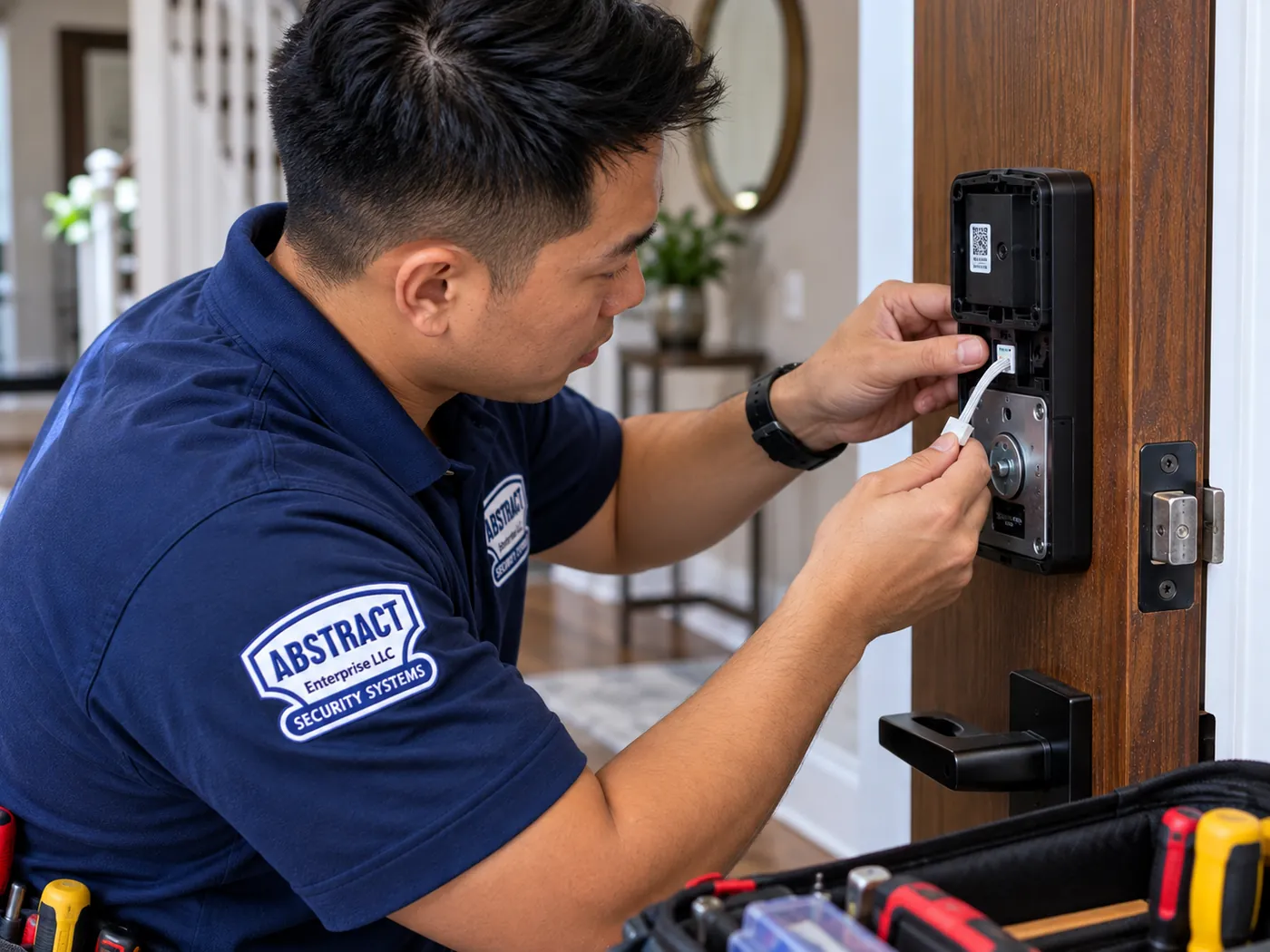
AESS technician connecting the ribbon cable on the interior unit of a keypad smart lock during installation in Manhattan
Seating the ribbon cable between the outside keypad and the inside unit — a loose connector is the top cause of dead keypads.

Ready to Take the Key Out of the Key Cabinet?

Send a photo of the door, both sides, and the name of your building's entry system. We will tell you what fits and what the managing agent will need.

Desk & Service Access

A Credential Plan for a Doorman Building

The most useful thing we leave behind in a staffed building is not the lock; it is the plan for who gets what. This is the starting point we use, adjusted to your household and your building's rules.

PersonCredentialScheduleNotes
Household membersFingerprint or phone, plus a personal codeAlwaysTwo admins, on two different phones
Front desk or resident managerSealed emergency code, or the building's key under board rulesEmergencies onlyUse is logged; change it if the envelope is opened
Dog walkerPersonal codeAgreed weekday windowAuto-lock on; alerts to the owner on each entry
CleanerPersonal codeCleaning day and hoursSeparate from the walker so either can be removed alone
Contractor or renovation crewCode per tradeJob dates, inside the building's work hoursExpires automatically at the end of the job
Family or friends stayingGuest code or phone invitationArrival to departureSingle household only; see the short-stay rules above
One-off delivery or repairSingle-use codeDelivery windowExpires when the door closes

We set this up in the lock's app with you, name every code by person, and print a one-page version for the desk. When someone leaves your employ or a job ends, removing them takes seconds and does not touch anyone else's access.

Away From Home

Setting Up a Pied-à-Terre Door for Months Away

Owners who split the year between Manhattan and somewhere else ask for the same few things: to know the door is locked, to let the right people in from far away, and never to arrive to a dead keypad. This is how we set that up.

  • A connection that does not depend on luck. Bluetooth alone gives you nothing from another city. We use a Wi-Fi lock, a bridge placed close enough to the lock (August, for instance, asks for its Connect bridge within 10 to 15 feet), or a Thread border router in the apartment, and test remote unlock over mobile data before we leave.
  • Power that keeps the bridge alive. A bridge or border router on a smart plug that someone switches off, or on a router that reboots nightly, is the most common cause of a lock going quiet. We put it on a permanent outlet and tell the cleaner not to unplug it.
  • Alerts that reach you abroad. Low battery, lock offline, door left unlocked and repeated wrong codes, all pushed to your phone and, where the app supports it, to a second person in New York.
  • A documented fallback. The emergency-power method your lock supports, the keyed override or the building's key arrangement, and the name of the person authorised to use it, written on the handover sheet.
  • A battery routine. A date-based change of all the batteries before you leave for a long stretch, or a standing instruction to the desk or cleaner.
  • A clean account. The lock's admin account in your name, not the installer's, with two-factor sign-in, and a second admin you trust.

If you also want to see the door, a camera inside facing it is simpler in most buildings than one in the corridor, which the building may not allow. Our home automation installation in Manhattan can tie the lock, lighting and climate into one app for an empty apartment.

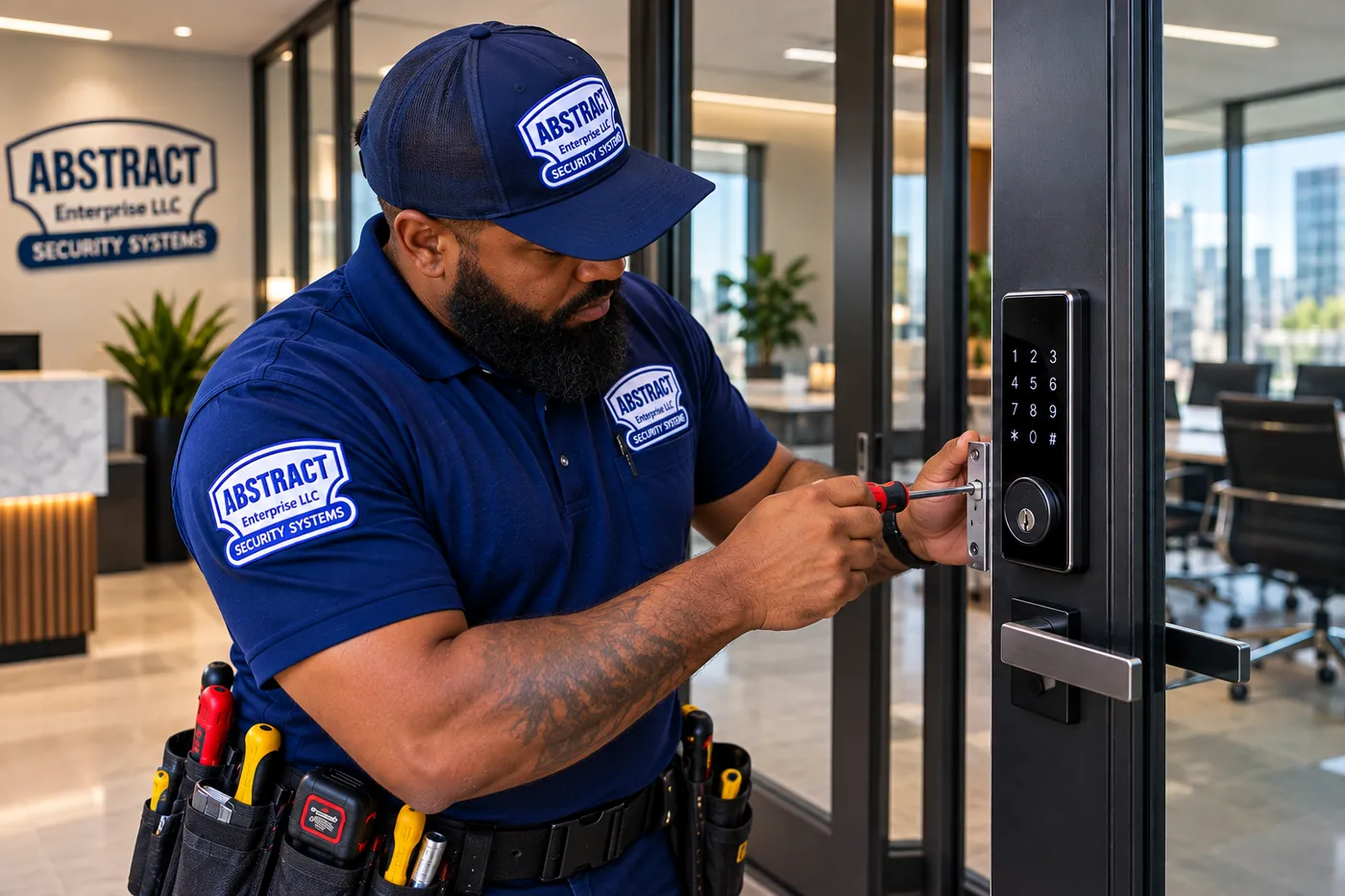
AESS technician fastening the strike for a keypad smart lock on an office glass-frame door in Manhattan
Business smart lock on an aluminum office door — codes per employee, no keys to collect.
Before We Arrive

A Manhattan Building Checklist Before the Visit

Ten minutes with this list saves a wasted trip to the service entrance. We will chase most of it with you, but these are the facts we need.

  • Managing agent's name and email, so the scope letter and insurance certificate go to the right person.
  • Insurance wording the building wants on the certificate: certificate holder, additional insureds, limits.
  • Contractor hours and service-elevator rules, including any days the building does not allow work.
  • The building's entry platform (Latch/DOOR, ButterflyMX, a fob system, a video intercom app or none) and whether unit locks can be enrolled.
  • The board's or management's key policy: does the desk hold a key to every unit, and what do they need from you if you go keyless?
  • Photos of the door: both faces, the edge with the lock, and the hinge edge, where a fire label usually sits.
  • Who needs access: household, desk, walker, cleaner, contractors, guests, and their schedules.
  • Wi-Fi details, or whether there is a smart speaker or hub that can act as a Thread border router.
  • For suites: the property manager's contact, the base-building access vendor, the lease clause on alterations and security, and the fire alarm vendor if a powered lock is planned.
  • For landmark storefronts: whether the building is in a historic district or an individual landmark, and the landlord's position on exterior changes.
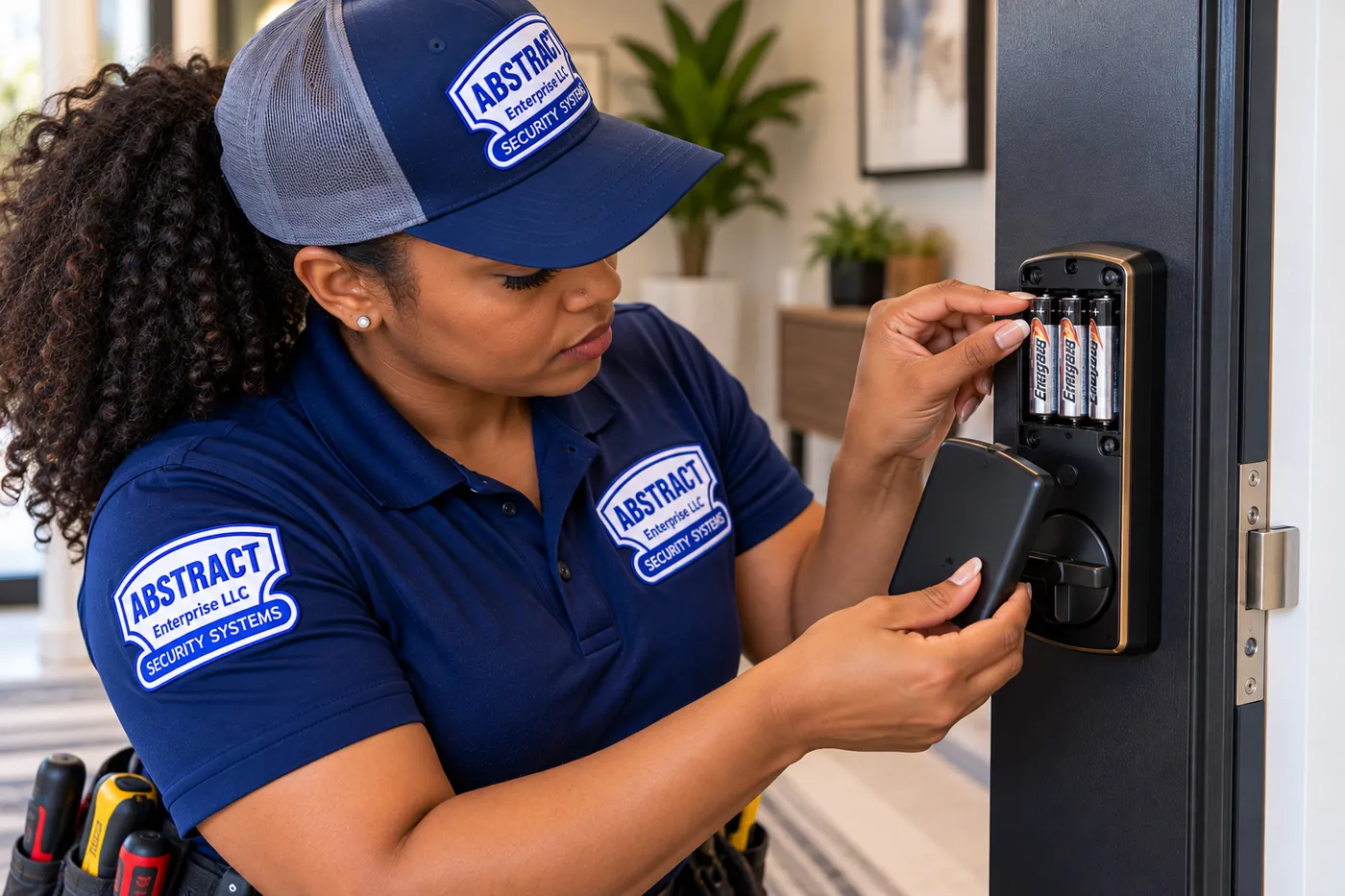
AESS technician replacing the batteries in a smart lock interior unit during a service visit in Manhattan
Fresh batteries and a check of the motor — the fix for most locks that start acting up.
Glossary

Manhattan Building Terms You Will Hear on a Lock Job

  • Managing agent: the company that runs the building day to day for the owner, co-op board or condo board, and the usual gatekeeper for any work on a unit door.
  • Alteration agreement: the building's contract for work inside a unit, setting hours, insurance, approvals and clean-up rules; small jobs are sometimes handled with a simpler work request.
  • Certificate of insurance (COI): proof the contractor carries liability insurance, issued to the building in the wording it asks for before work starts.
  • Additional insured: a party, often the building and its managing agent, added to the contractor's policy for the job.
  • Service entrance and service elevator: the route contractors must use, often with set hours and a booking.
  • Fire label: the metal or embossed tag on the hinge edge of a rated door or frame showing its listing; it decides what preparation the door can take.
  • Mortise lock: a boxed lock mechanism recessed deep into the door's thickness, with a long faceplate on the edge — what most pre-war co-op and office doors carry.
  • Bridge or Thread border router: the small device inside the apartment that links a Bluetooth or Thread lock to the internet so it can be controlled remotely.
  • Base building: in an office tower, the landlord's systems — lobby, turnstiles, elevators, life safety — as distinct from the tenant's suite.
  • Request-to-exit: the button, sensor or switch in the door hardware that tells a powered lock someone is leaving, so they are never trapped.
  • Historic district: an area designated by the Landmarks Preservation Commission, where most exterior work on a property, including its sidewalk, needs an LPC permit.
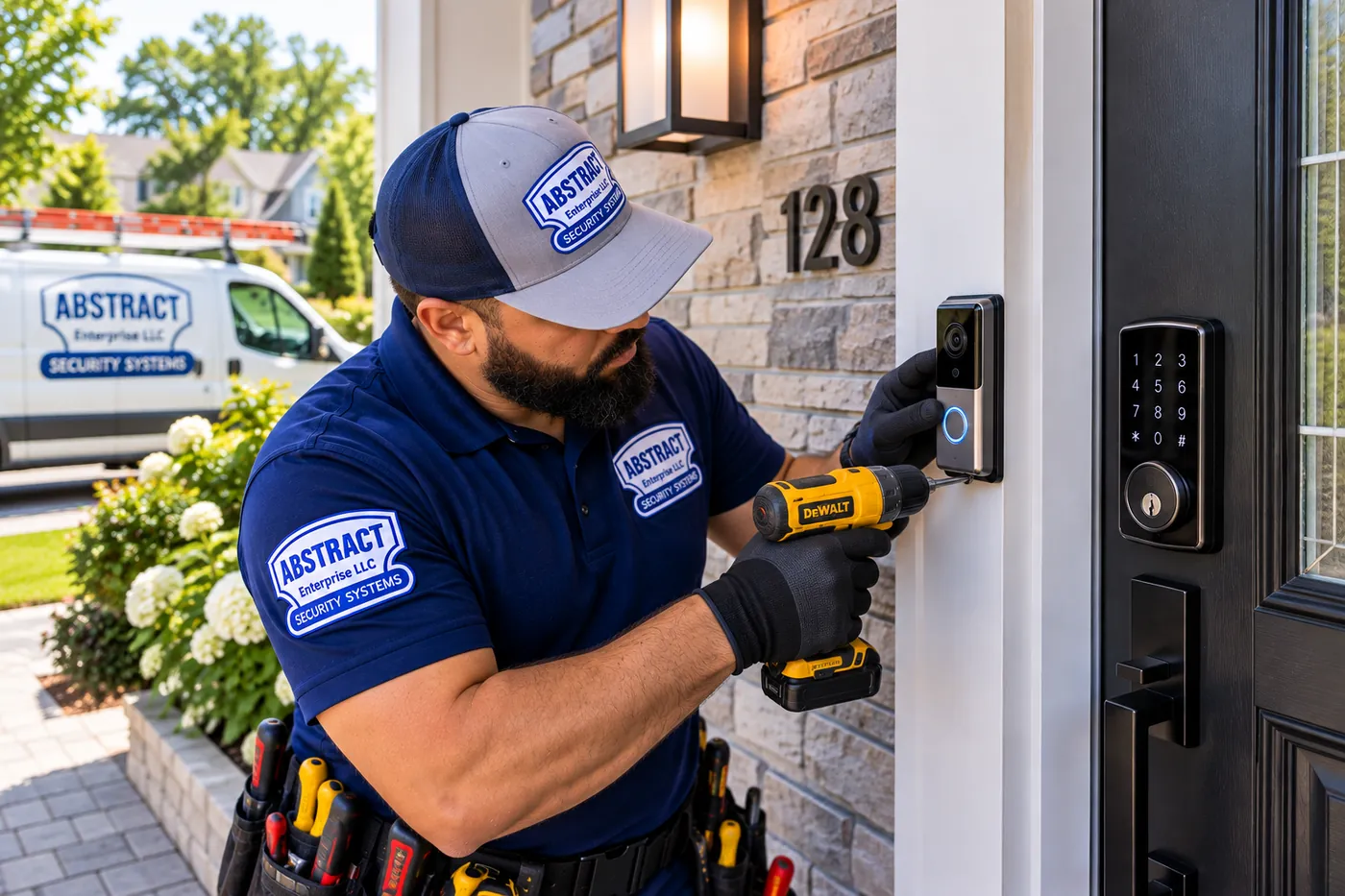
AESS technician mounting a video doorbell beside a newly installed keypad smart lock in Manhattan
Video doorbell and smart lock at the same visit — see who is there, then let them in.
Complete Services

Every Smart Lock Installation Service in Manhattan

A smart lock rarely arrives alone in Manhattan. A move-in, a renovation, a suite fit-out or a lobby upgrade usually brings some of these into the same visit.

Access Control Installation Manhattan

Base-building and suite readers, door controllers and cloud credential platforms for Manhattan floors and lobbies.

Abstract Enterprises Intercom Installation in Manhattan

Video and audio entry panels with remote release for doorman co-ops, condos and walk-ups.

Intercom Repair

Dead apartment stations, failed panels and releases that no longer work.

Door Buzzer Installation Manhattan

New buzzer and strike systems for smaller buildings and brownstone conversions.

AESS Door Buzzer Repair in Manhattan

Lobby releases that buzz without opening, dead push-buttons and faults in the riser wiring.

Doorbell Camera Installation Manhattan

See who is at the door before a remote unlock, where the building allows a camera.

Home Automation

Locks, lighting, shades and climate on one app for apartments that sit empty for weeks.

Commercial Security Systems Manhattan

Combined access, camera and alarm systems for suites, shops and galleries.

Apartment Building Cameras

Lobby, package room and corridor coverage for co-op and condo boards.

Low-Voltage Installation Manhattan

The data, power and pathway work behind every networked lock and reader.

Alarm Installation

Door sensors and alarms that arm when the smart lock locks.

Get a Quote

Send one request that covers the lock and anything else on this list.

Field Notes

Field Notes From Manhattan Service Entrances

How our installers approach a smart lock in a staffed Manhattan building — working practice, not a single job

The job starts at the service entrance, not the apartment. If the certificate of insurance is not on file at the desk, nothing else matters, so we confirm it the day before and carry a copy. We sign in, ask which elevator, and tell the desk which unit and roughly how long. A technician who is expected is let up in minutes; one who is not can lose the morning.

At the door, the first look is at the hinge edge for a fire label and at the corridor face for anything the building is fussy about — a brass knocker, a number plate, a matching lever. Then we close the door and let go. In older buildings the frame has often moved, and a door that has to be pushed to latch will make any motorised lock work too hard and drain its batteries early.

Before choosing the radio, we stand at the door with a phone. A corridor in a concrete tower can show a dozen neighbours' networks and barely any of yours. If the living room has a hub that can act as a border router, Thread often wins; if not, a bridge in the hall closet usually does.

Last, we walk the credential plan with whoever will run it, and we hand the desk a one-page sheet. The lock is the easy part; the plan is what keeps the building happy.

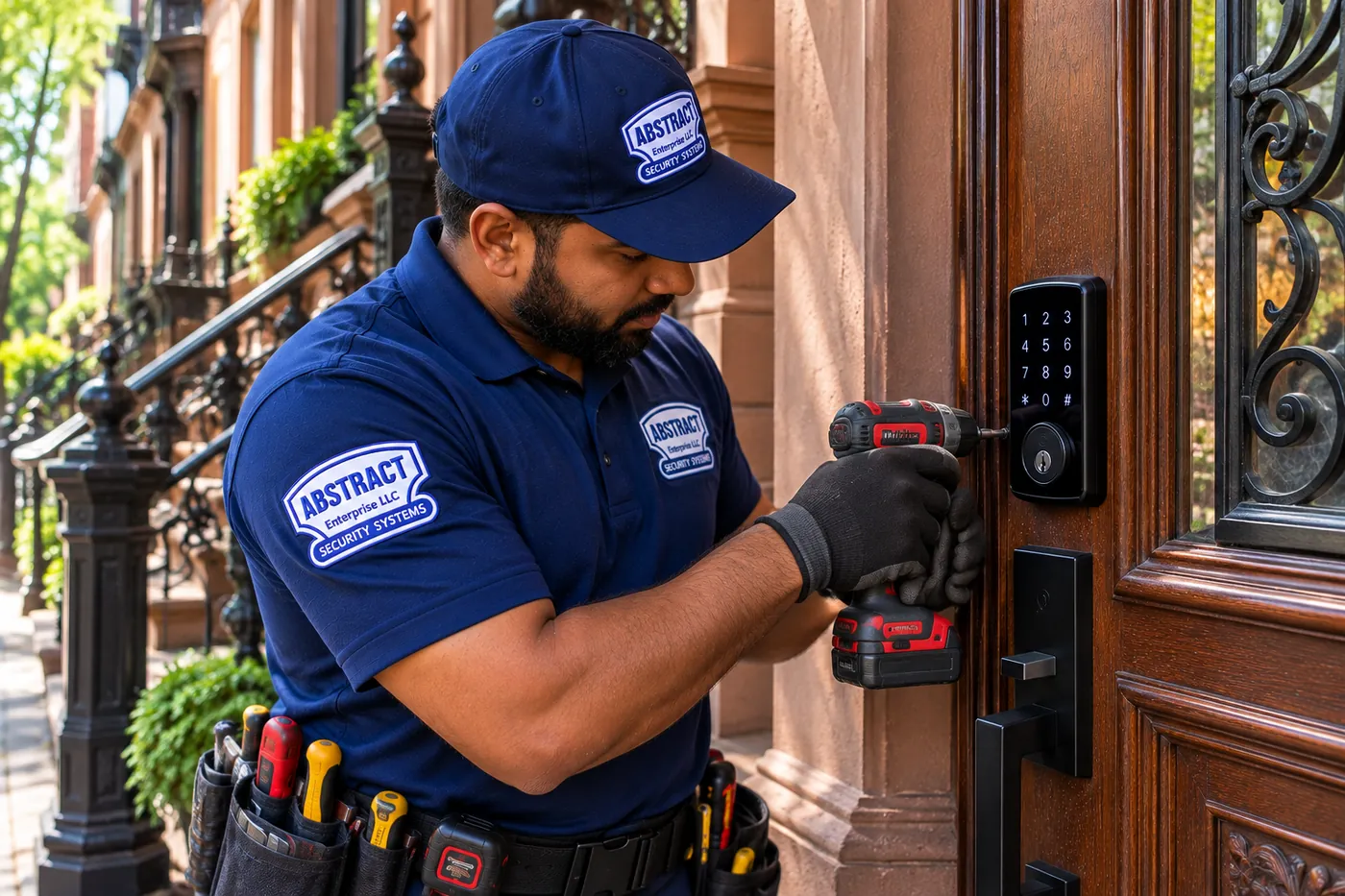
AESS technician drilling to mount a keypad smart lock on a brownstone stoop door in Manhattan
Mounting a keypad deadbolt on a stoop door with ironwork and an original wood frame.
FAQ

Manhattan Smart Lock Installation FAQ

What does a keyless suite or lobby door with an electric strike cost in Manhattan?
+

Our published single-door keypad or fob reader with electric strike is $1,875 to $3,125 installed at the Manhattan rate, which is the $1,500 to $2,500 base with the borough's 1.25 multiplier. A new strike alone is $313 to $563, and repairing a failed strike is $369 to $606. A smart lock on an apartment door is quoted flat after a free walkthrough.

Do you cover Inwood, Washington Heights and Harlem as well as Midtown and downtown?
+

Yes. We work the whole borough, from Inwood and Washington Heights through Harlem, the Upper East and West Sides, Midtown and downtown to Battery Park City, plus Roosevelt Island. Prices are the same across Manhattan.

Can the building's super or in-house locksmith be there while you work?
+

We welcome it. Many buildings like their super or locksmith to see what changes on a unit door, and it is the easiest way to agree the emergency key or code arrangement on the spot. Tell us when you book and we will confirm the time with them directly.

Can the lock relock itself so a dog walker or cleaner can't leave it open?
+

Yes. Most smart locks have an auto-lock setting that throws the bolt a set number of seconds after the door closes, and some add a door sensor so the lock knows the door is actually shut. We set the delay with you and test it, and turn on alerts for any time the door is left unlocked.

Will you start work before the managing agent has signed off?
+

No. Where a building requires approval for work on a unit door, we wait for it in writing. We prepare the scope letter and insurance certificate to speed it up, and we can do the free walkthrough before approval so the quote is ready the day it comes through.

Can you fit a smart lock to an interior door, such as a home office or storage room?
+

Yes. Interior smart locks are useful for a home office with work files, a storage or wine room, or a room for a household employee's belongings. We choose a model that always opens from inside without a key and does not create a separately rented area, which the city's short-stay rules do not allow.

Should the lock go in before or after our movers have the freight elevator?
+

After, ideally on a separate booking, so the movers' elevator slot is not shared and the door is not knocked during the move. If you need keyless entry on move-in day, we can fit it the day before and give the movers a code that expires when the move ends.

Where do your Manhattan technicians come from, and how quickly can they reach the door?
+

Manhattan jobs are run from our Bronx office at 460 E Fordham Rd. We book a 2-hour arrival window inside your building's contractor hours, and for repairs we take the next open window, often the same or next day.

Can roommates in a shared Manhattan apartment each have their own code?
+

Yes. Each roommate gets a personal code or phone credential, so one can be removed when they move out without changing anyone else's access, and the log shows whose code was used. One person, usually the leaseholder, holds the admin account.

When is the deposit due on a Manhattan smart lock job?
+

The walkthrough and written quote are free. Full terms — including 50% deposit, one-year parts-only warranty on AESS-supplied products, and the late-fee schedule — are set out in the service agreement.

All Areas Served

Smart Lock Installation Across New York

This is the Manhattan page. The five-borough guide to renters' rights, co-op key rules and lobby systems is on our smart lock installation NYC hub, and each region and borough has its own page as it is published; boroughs and counties without one yet link to our quote form, and the crews who would serve them already work there.

Every other service we offer starts from the Abstract Enterprises Security Systems home page, and the people and licence behind this work are on our company page.

AESS technician checking the locked status of a keypad smart lock in the mobile app after installation in Manhattan
Confirming lock status, access codes and the activity log from the phone.

Keypad Dead in a Manhattan Hallway or Suite Tonight?

Blank keypad, a lock the app can no longer see, a suite magnet stuck shut or a lobby strike that has given up — ring the Manhattan line on (929) 560-0737. We book the next open 2-hour window your building allows, and most power, pairing and alignment faults are fixed in one to two hours once we are at the door.

Smart Lock Installation Manhattan — Licensed, Insured, Building-Ready

Abstract Enterprises Security Systems · 460 E Fordham Rd, Bronx, NY 10458 · Manhattan line (929) 560-0737 · WhatsApp (718) 679-0359 via wa.me

NYS Low-Voltage Licence #12000287431 · 100% Licensed & Insured · Same-Day Estimates · Rated 4.7★ from 201 Google Reviews

Locks you supply carry their manufacturer's warranty. Full terms — including 50% deposit, one-year parts-only warranty on AESS-supplied products, and the late-fee schedule — are set out in the service agreement. See our warranty page.

Nothing here is legal advice: the page describes how Manhattan building practice and city codes bear on a smart lock job. Last reviewed October 17, 2026. Changelog: Manhattan smart lock page published for the first time.