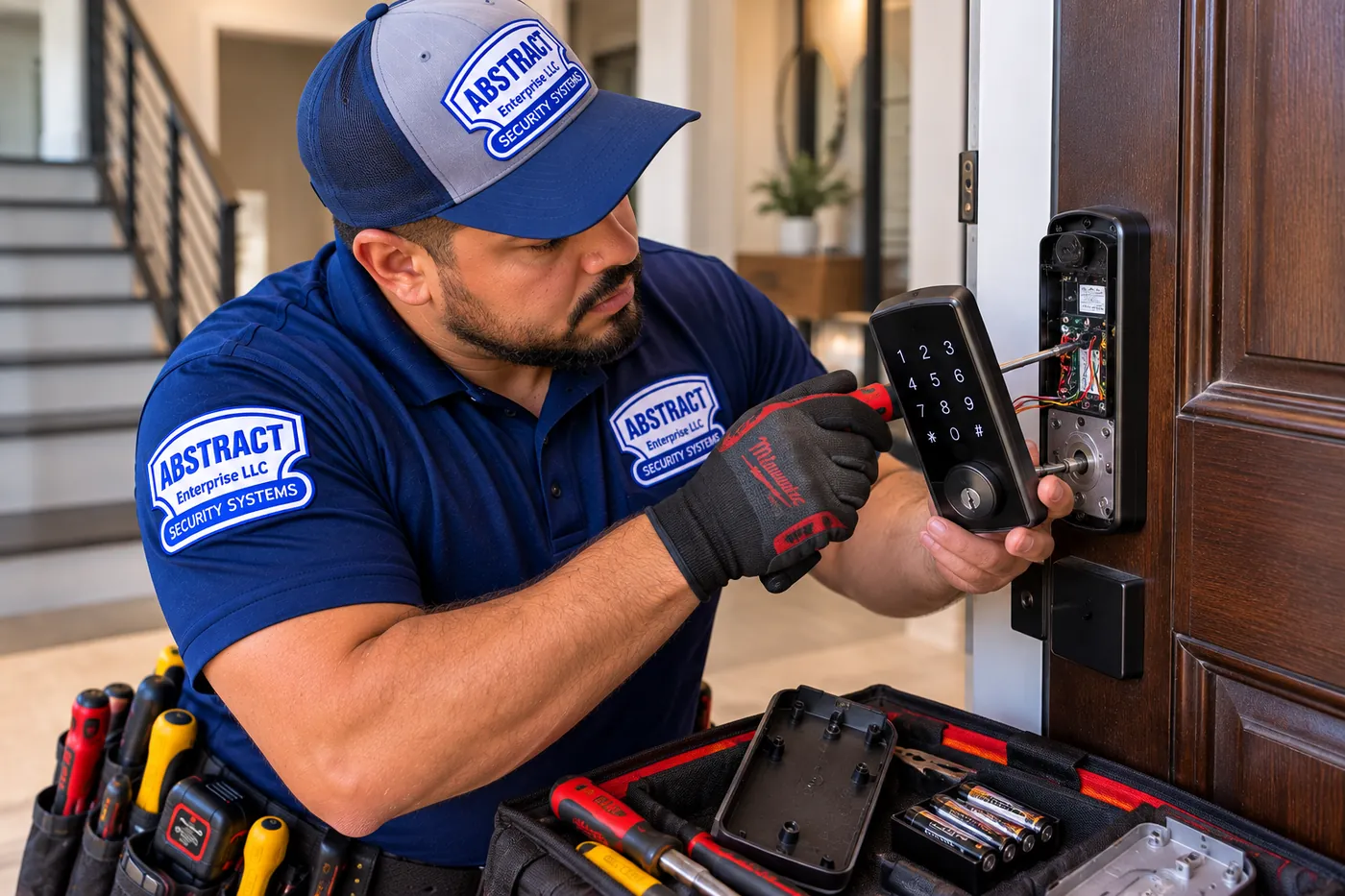
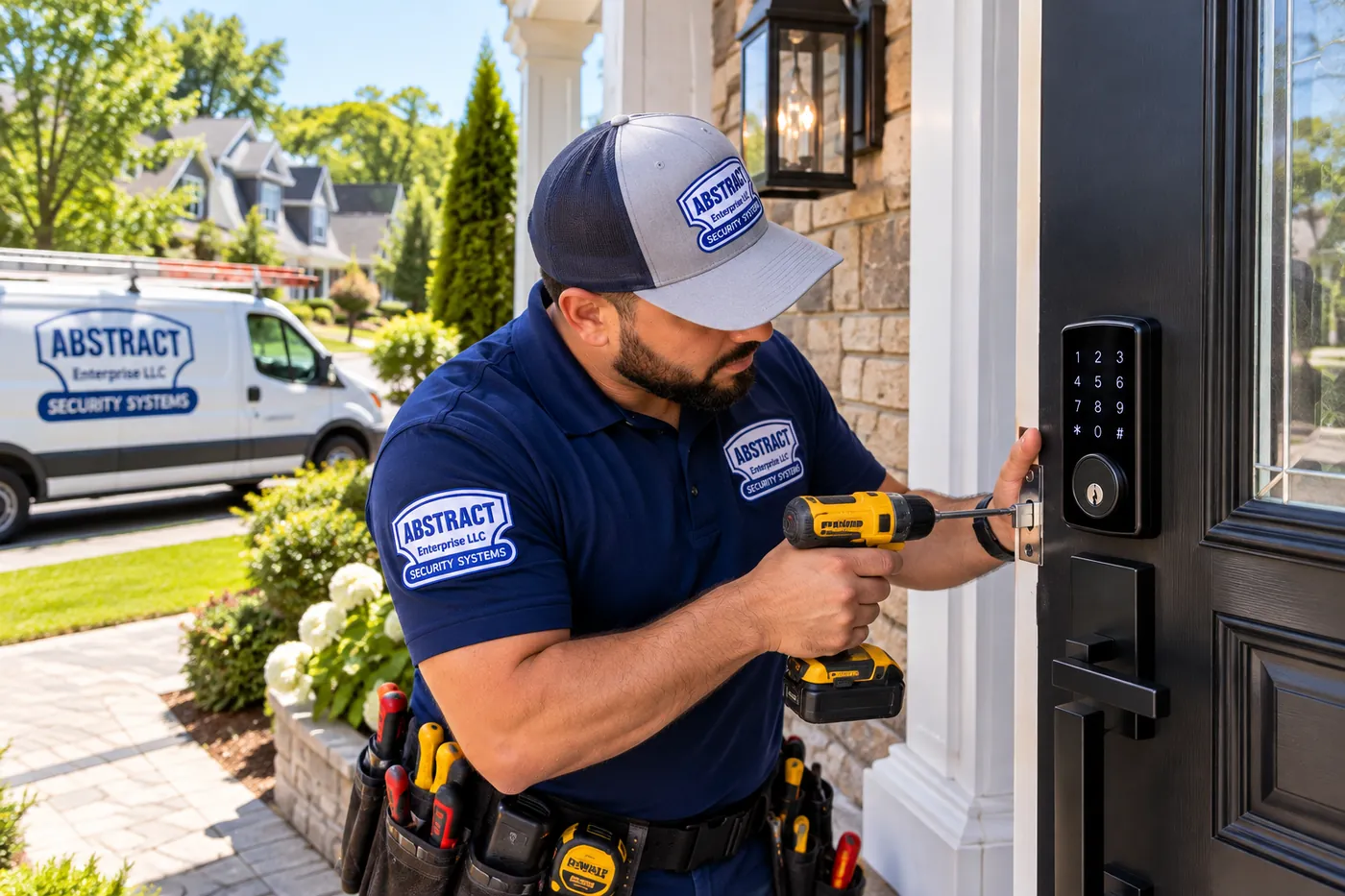
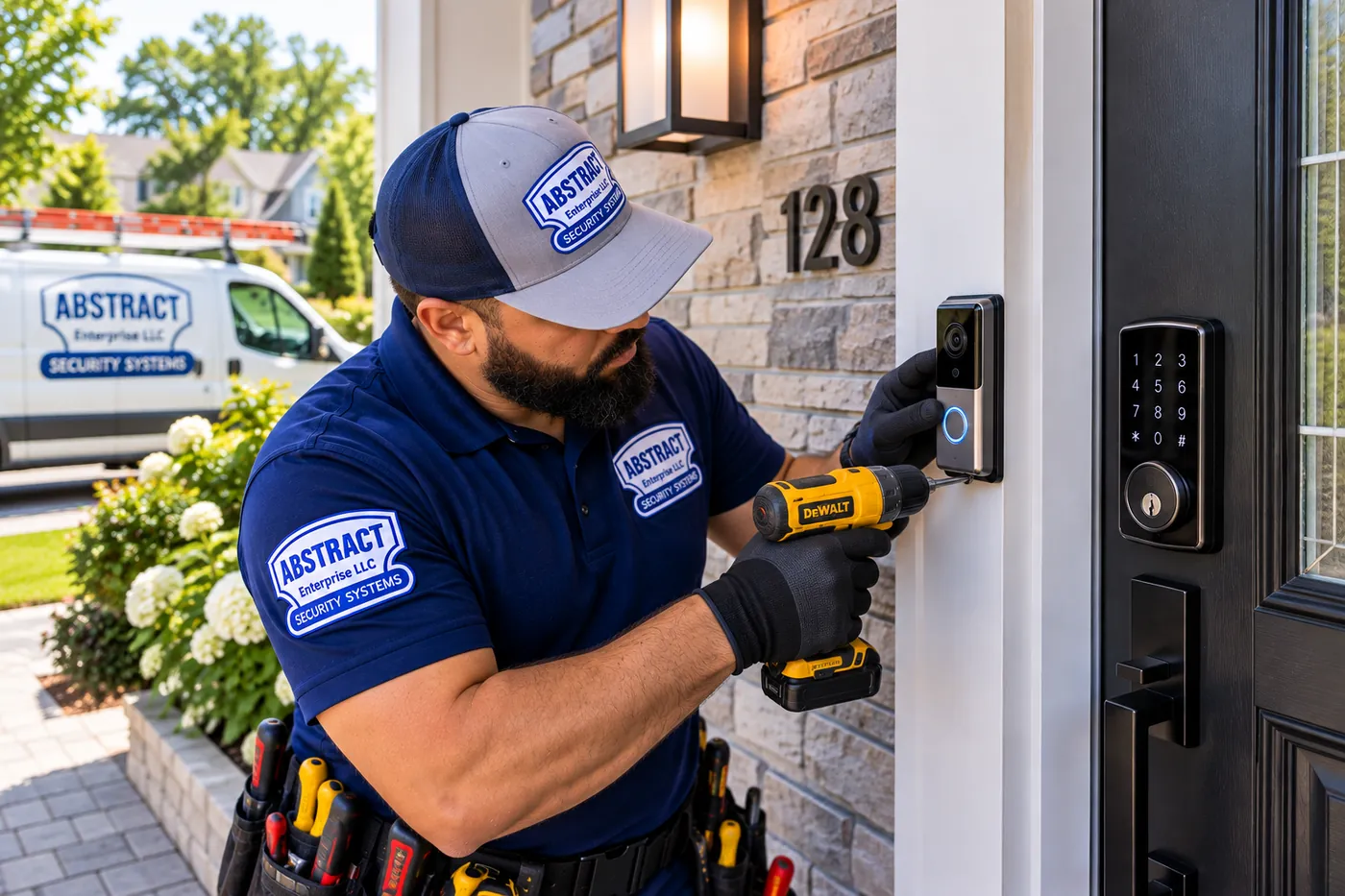
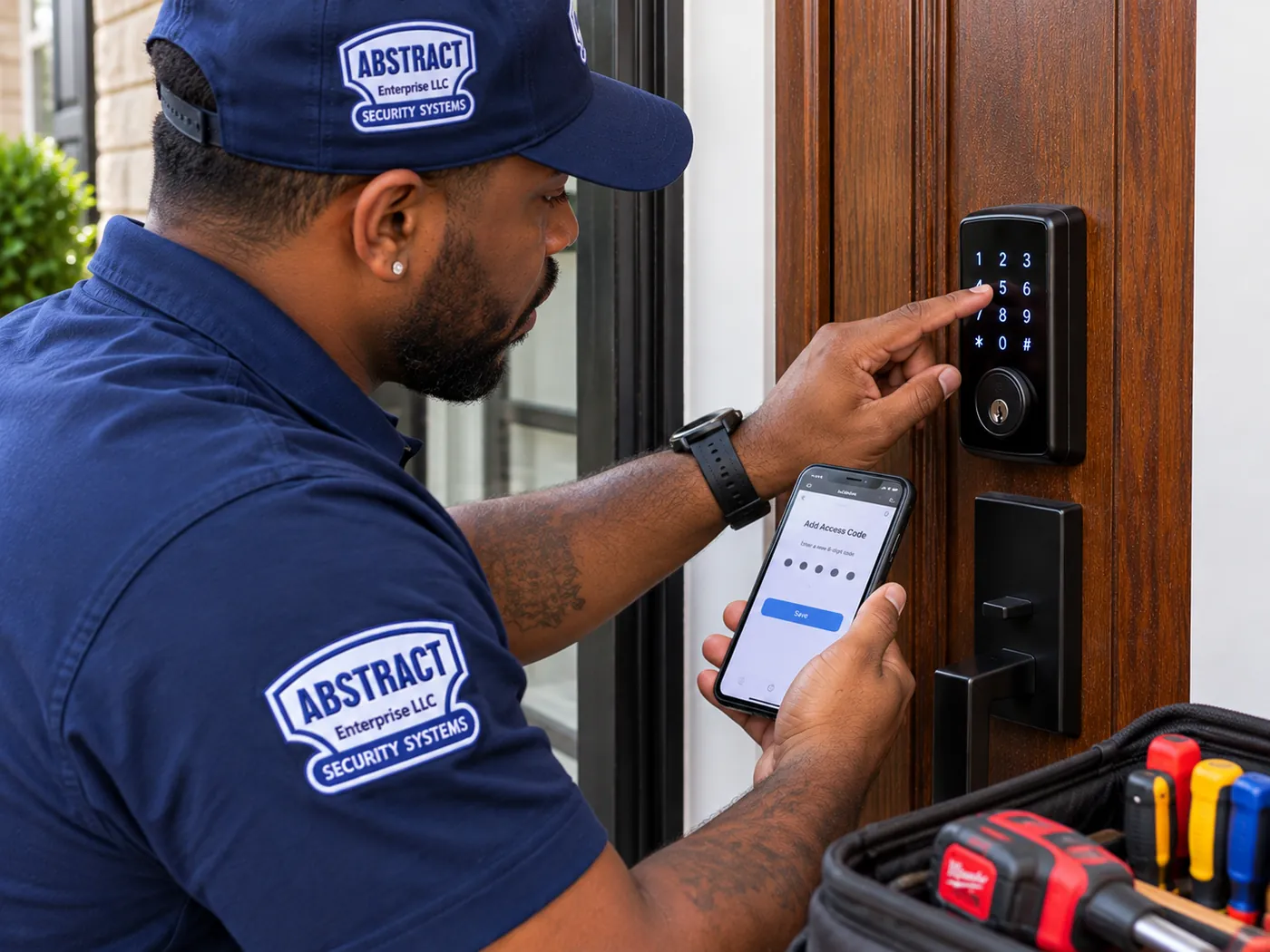
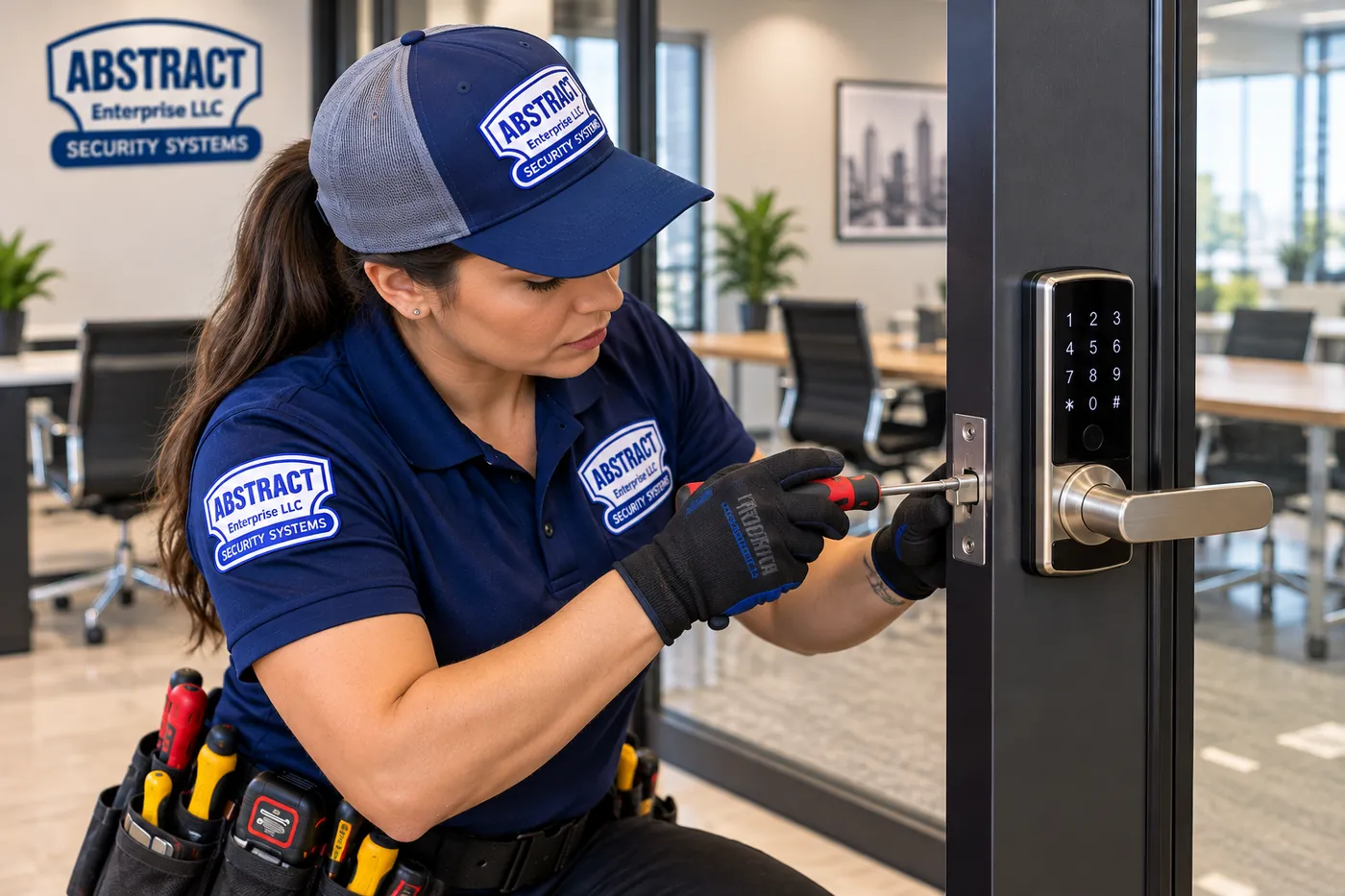
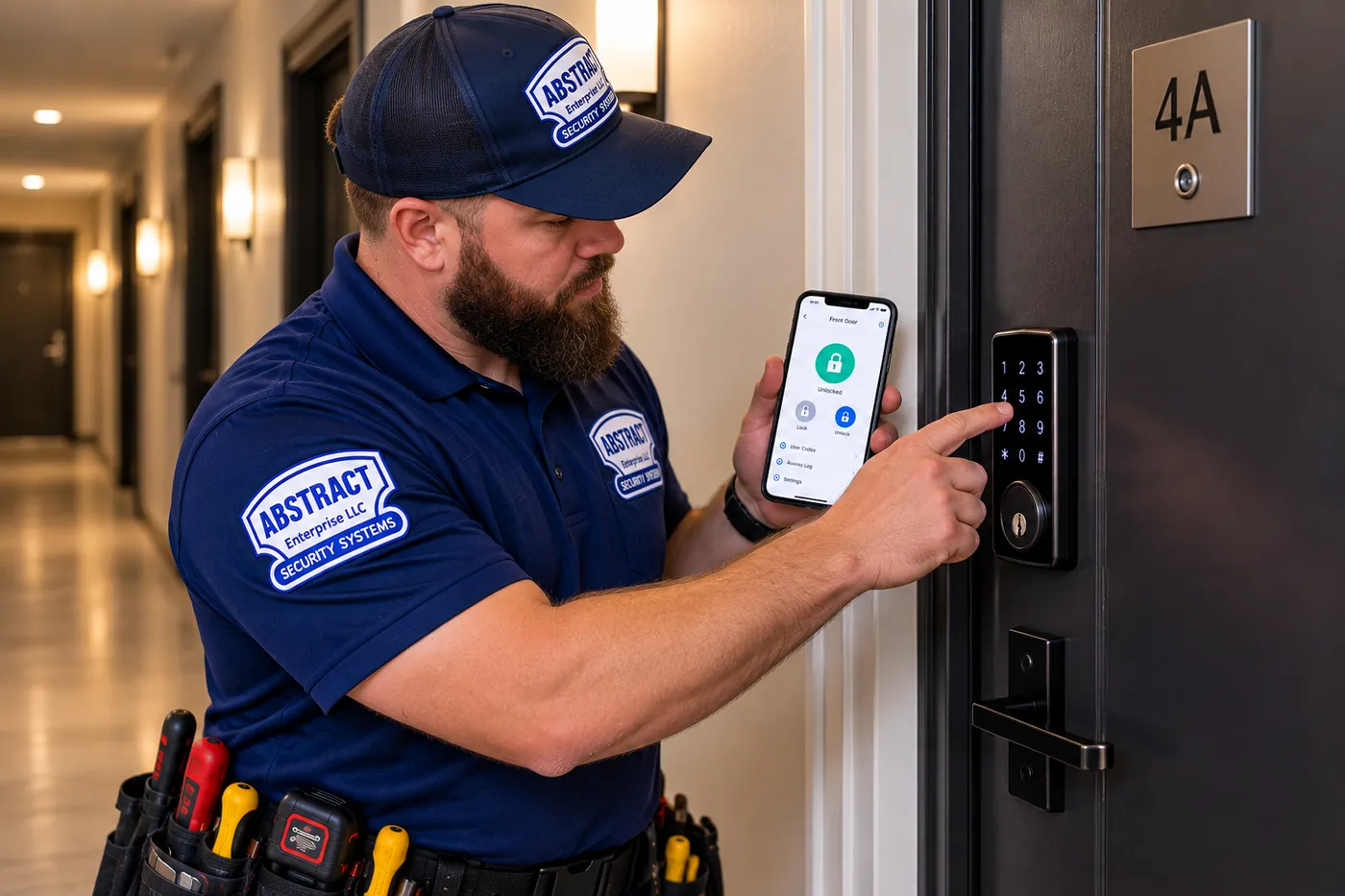
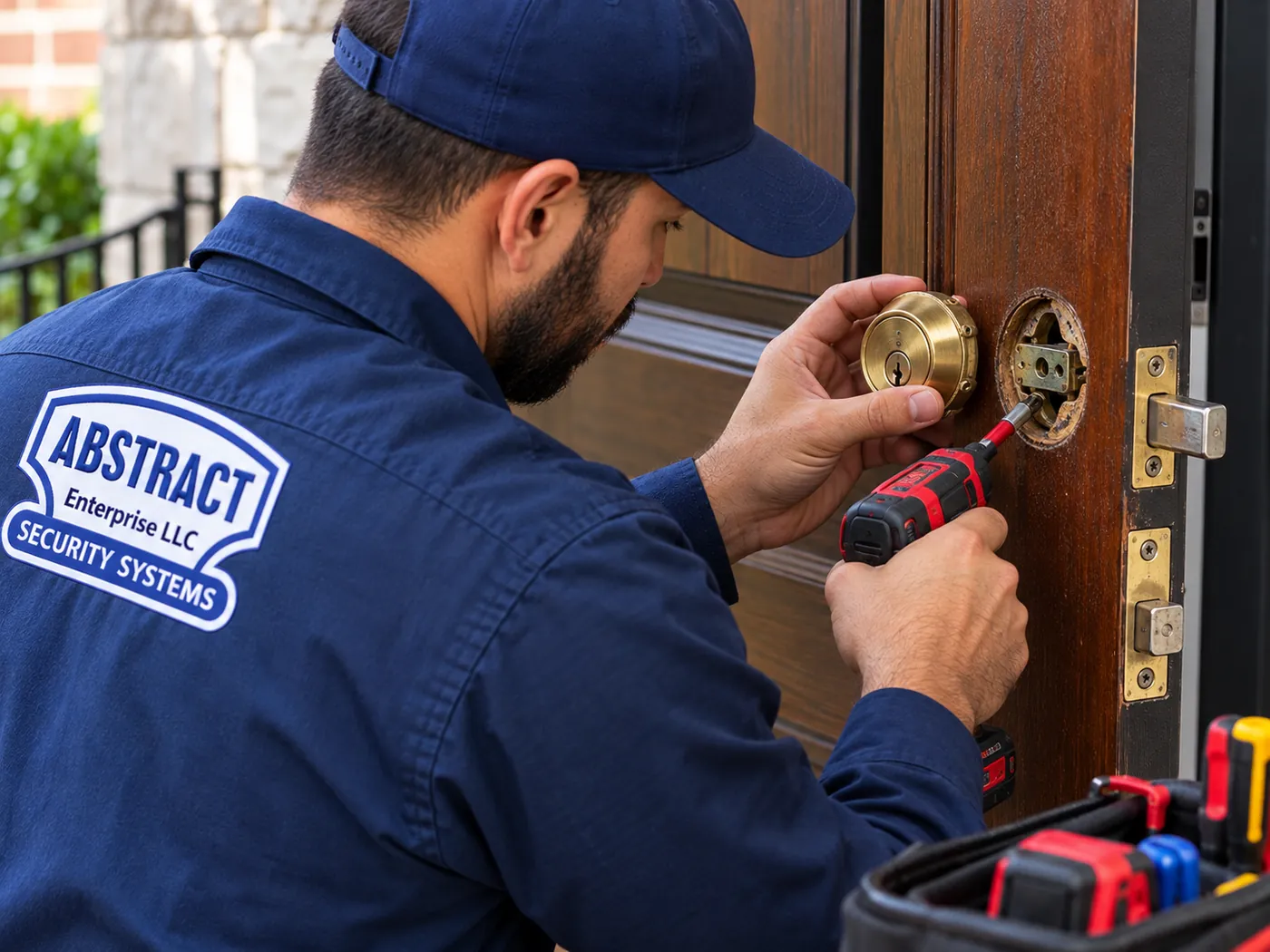
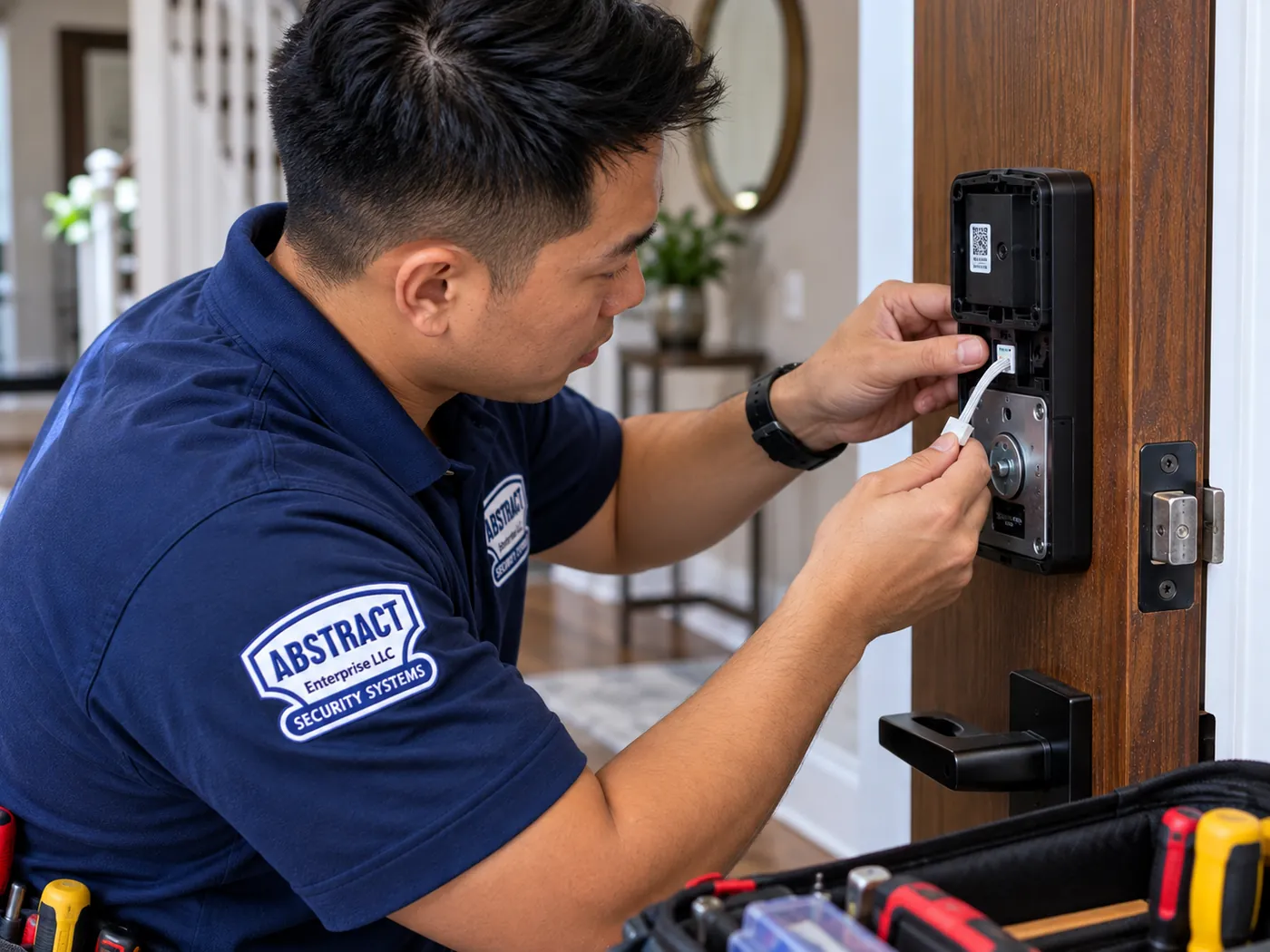
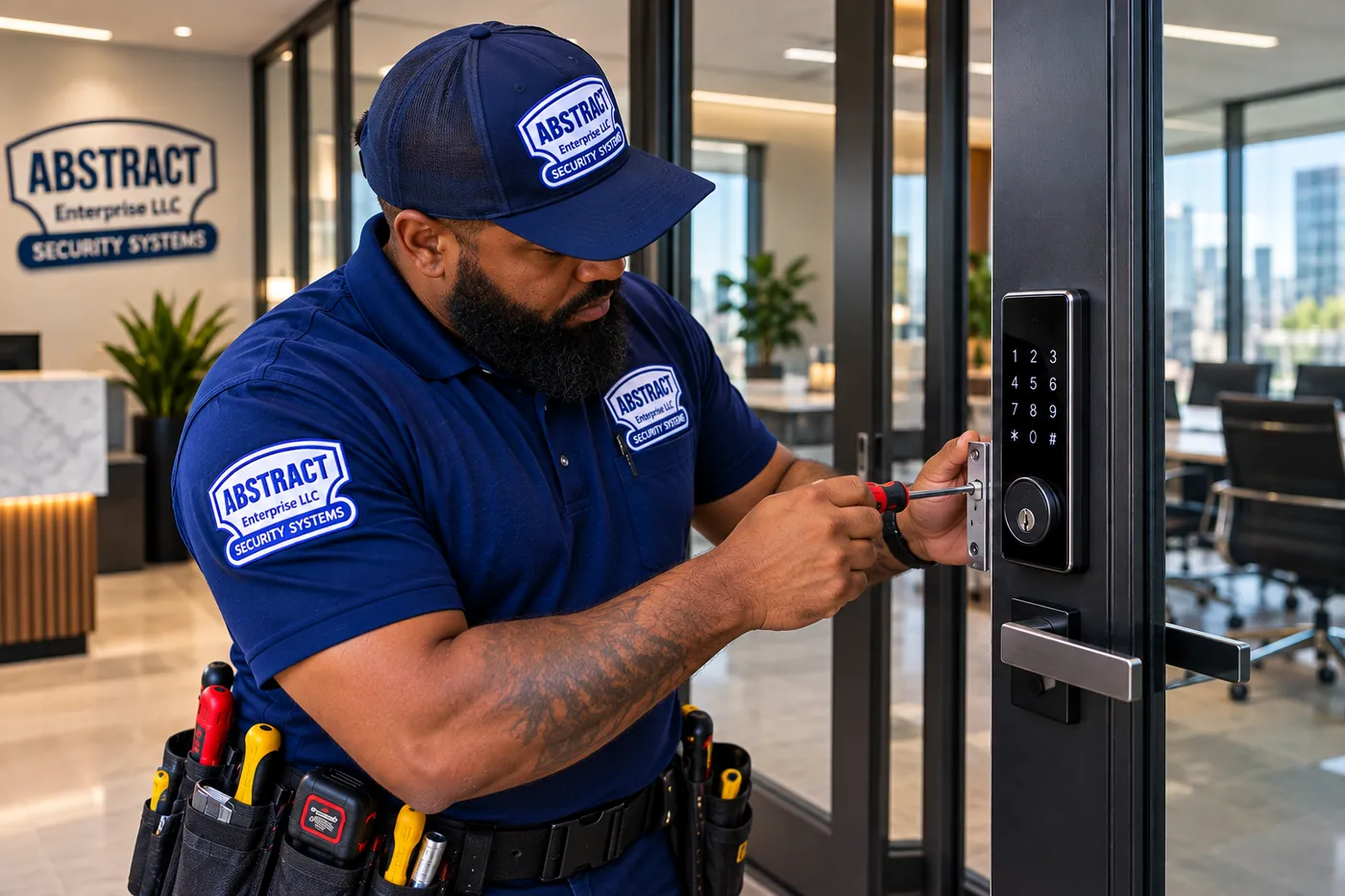
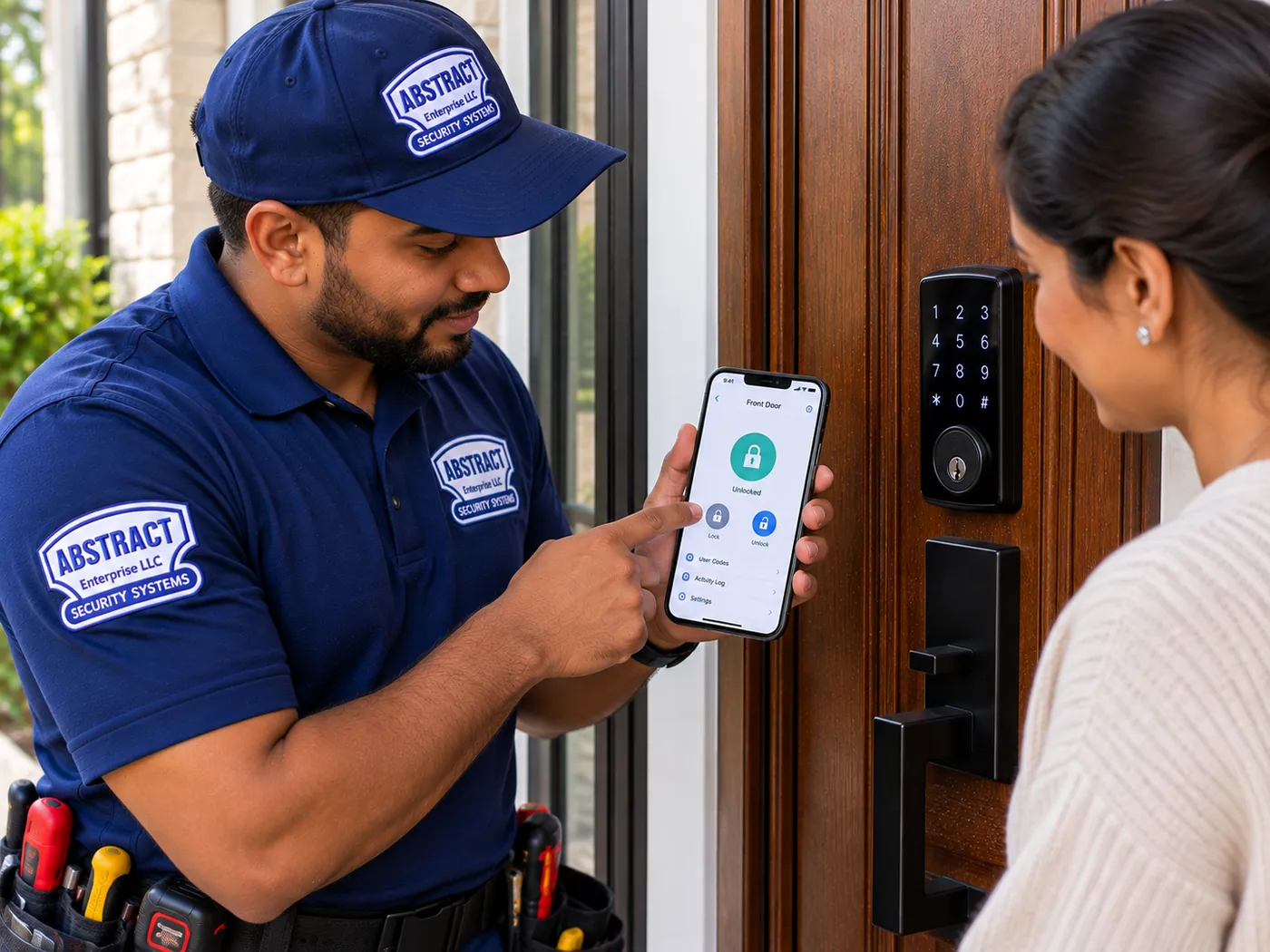
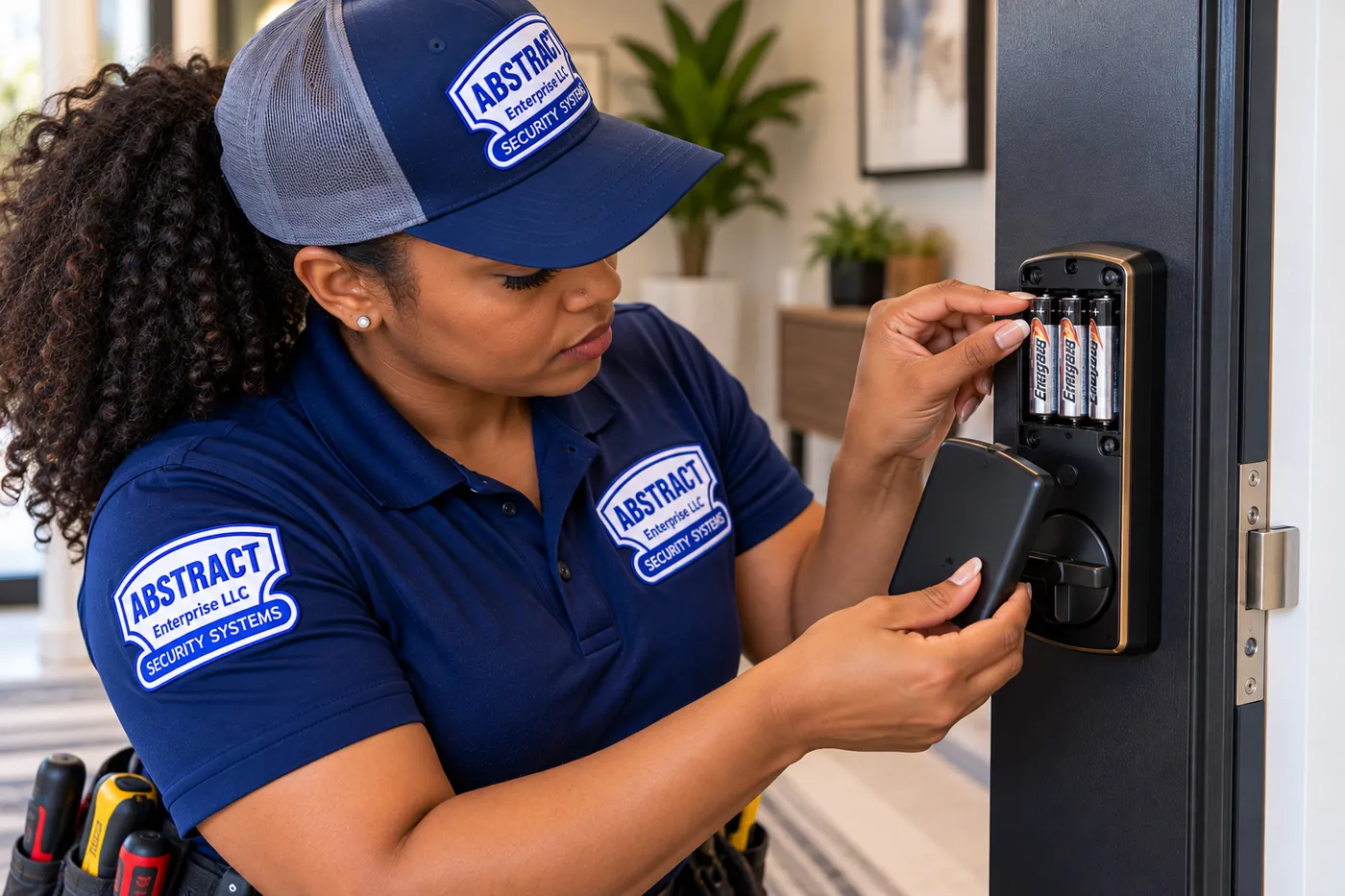
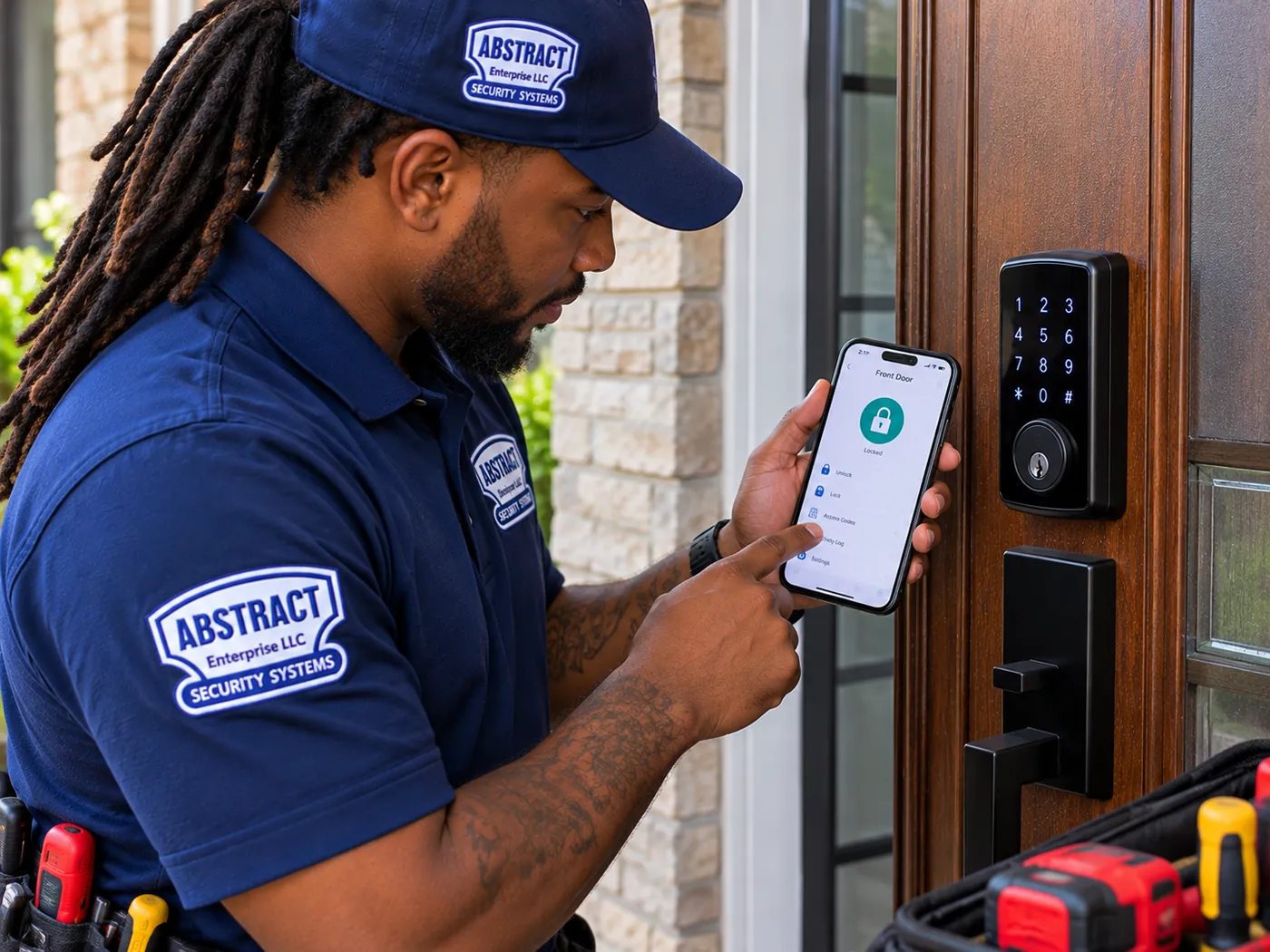
Front, Side & Basement Doors · Codes for Every Generation · Flood-Aware Hardware · Garden Co-op Doors · Storefront & Back-Alley Doors
A Queens house rarely has one door and one key-holder. There is the front door behind an aluminium storm door, a side door off the driveway, steps down to a basement that took water during Ida, and a household where a grandmother without a smartphone, a home attendant on weekday mornings and teenagers on their own schedules all need to get in. We fit smart locks that every one of those people can actually use, that still open from inside with a simple turn when the lights are out, and that are placed where water and weather won't finish them off.
Reviewed and updated October 17, 2026 · Written by Anwar Timothy, NYS licence #12000287431

Planning keyless doors for a Queens house, or stuck outside one that stopped answering? Ring our Queens line, (347) 434-6392, or send the 60-second form. Every request is read by a licensed installer who will tell you, before a visit, which of your doors are worth converting and which lock suits the people who use them.

Queens is the borough of the house with three doors and seven key-holders. Drive down almost any block in Bayside, Middle Village, Hollis, Woodhaven or Whitestone and the pattern repeats: a detached or semi-detached house with a stoop or porch at the front, an aluminium storm door hung over the main door, a side door at the end of the driveway that the family actually uses every day, and a set of concrete steps leading down to a basement door at the back or under the porch. Each of those doors gets a different amount of traffic, faces different weather and is used by different people. A smart lock project here starts by deciding which doors deserve one and which should simply be locked properly and left alone.
The households behind those doors are rarely a couple and a dog. The Census Bureau's QuickFacts for Queens County report 2.72 persons per household, nearly half of all residents born outside the United States, and more than half of residents over five speaking a language other than English at home. In practice that means a parent or grandparent who reads Mandarin, Korean, Bengali or Spanish more comfortably than English, an older relative who has never owned a smartphone, adult children coming and going at all hours, and often a home attendant or a cousin who needs to get in on a schedule. A keyless system that only works through one English-language app on one person's phone fails most of the household. We plan the credentials around the people first: keypad codes for those who prefer numbers, fingerprints for those who forget codes, fobs for those who want something to hold, and a working mechanical key for everyone, always.
The basement is the second Queens-specific question, and it is a serious one. When the remnants of Hurricane Ida hit the city on September 1, 2021, the Queens Daily Eagle reported that 11 of the 12 people then confirmed dead in the city were from Queens, and that 10 of the dead had lived in basement apartments. The city's own health department data story on flooding later put Ida-related deaths at fourteen, most of them by drowning in unregulated basement apartments. Five years on, New York City Emergency Management still tells basement occupants to keep exits clear and know more than one way out, and to install a water sensor or flood alarm below grade. A basement door is therefore the one place in a Queens house where we are most conservative about electronics: the inside must open with a plain turn in total darkness, nothing about the lock can depend on power, and anything electronic on the outside should be chosen and positioned with standing water in mind.
Then there is the legal layer around those basement units. In 2024 the city enacted Local Law 126, a pilot program to bring existing basement and cellar apartments toward legal occupancy in a list of community districts that includes Queens Community District 2 — Long Island City, Sunnyside and Woodside. To qualify for a temporary residence authorization, a unit must have existed before April 20, 2024 and must, among other conditions, have at least one means of egress directly to the outdoors, plus smoke and carbon monoxide alarms and water sensors. A smart lock cannot make an unlawful apartment lawful, and we do not pretend otherwise. What we can do is make sure the hardware we put on that door never stands between the people downstairs and the street.
The rest of Queens adds its own door types. Garden co-ops in Jackson Heights, Glen Oaks and Bay Terrace put apartment doors on courtyards and walk-up stairs rather than on long interior corridors. Long Island City's glass towers, many of them built in the last fifteen years, often arrive with the building's own app-based entry already in place. And the borough's shopping streets — Main Street in Flushing, Steinway Street in Astoria, Jamaica Avenue, 82nd Street and Roosevelt Avenue in Jackson Heights — are full of family-run shops and restaurants where three or four relatives open up on different days and the back door onto the alley is as important as the front.
Most Queens homeowners who call about smart locks are also thinking about who is at the door. Our doorbell camera installation team in Queens often fits a camera on the same visit, so a remote unlock is never a blind one, and the AESS alarm installers in Queens can tie a basement water sensor and door contacts into the same plan.

A keypad that went blank after a wet week, a side-door deadbolt that grinds because the house has settled and the strike no longer lines up, an app that lost the lock when a son changed phones, a basement-door lock that stopped answering after water got near it, or a shop keypad that a closing employee can no longer open — those are service calls, and we treat them that way. We book them into the next open 2-hour window, and most power, pairing and alignment problems are put right in one to two hours once a technician is at the door. If the trouble is on a building's front entrance instead, a failed electric strike repair runs $310–$509 at our Queens rate. Call (347) 434-6392 and say it's a smart lock problem, or see our door buzzer repair service in Queens for entrance buzzers and strikes.

These are the jobs Queens households and businesses actually ask us for. Each one finishes the same way: the door shuts and latches on its own, the inside opens with a single plain motion, a physical key still works, and every person who needs a credential has tried it in front of us.
We walk the front, side, rear and basement doors with you and recommend where a smart lock earns its place, where a good keyed deadbolt is enough, and how the codes should differ from door to door.
Keypad and touchscreen deadbolts fitted so the keypad can be reached and read with the storm door open, and so the storm door's own latch doesn't end up doing the job of the real lock.
The door most Queens families use daily gets the most durable lock and the most thought about who holds a code, because it's usually the one the home attendant, the dog walker and the grandchildren use.
Mechanical-first hardware with a plain inside turn, outside keypads chosen for weather exposure and mounted as high as the door allows, and no electrified lock that could stay shut in a power cut.
Separate codes for each relative, fingerprints enrolled for anyone who forgets numbers, fobs for those who want something in hand, scheduled codes for caregivers, and printed instructions for the family members who will never open the app.
Locks for unit doors that open onto courtyards and walk-up stairs, chosen with the co-op's rules and the door's exposure in mind, and installed without changes the building would object to.
Retrofit units and connectivity work in Long Island City, Rego Park, Forest Hills and Kew Gardens towers, including what can and can't be done alongside an entry platform the building already runs.
Keypad deadbolts, keypads with electric strikes and readers for storefronts, alley delivery doors and upstairs offices on Queens shopping streets, set up so exit never needs a code.
Settled frames that throw a bolt off its strike, dead batteries, lost admin accounts after a phone change, keypads damaged by weather, and bridges that dropped off a replaced router.

Queens was built in waves — early garden communities, inter-war rows, post-war co-ops and towers, and a twenty-first-century skyline on the East River. Each wave left a different kind of door. These are the ones we work on most, and what each means for a keyless install.
Bayside, Douglaston, Whitestone, Hollis and Queens Village: a front door behind a storm door, a side door off the driveway, sometimes a rear door to the yard and a basement entrance. Wood or insulated steel slab doors in wood frames, usually bored for a standard deadbolt. Plenty of options, and plenty of decisions about which doors to convert.
Middle Village, Glendale, Woodhaven, Ridgewood and much of Jackson Heights and Elmhurst: shared party walls, a short front stoop and often a separate door under it. Frames in attached houses have frequently shifted over decades, so strike alignment is the first thing we check before any motorised bolt goes in.
Jackson Heights, Glen Oaks Village and the Bay Terrace sections in Bayside: low-rise buildings around landscaped courts, with unit doors on short walk-up stairs or directly on the courtyard. Co-op rules and a uniform look apply, and some unit doors face the weather in a way hallway doors never do.
Rochdale Village in South Jamaica, LeFrak City in Corona and the Fresh Meadows development: big planned complexes with standard steel doors and frames, management offices with their own procedures, and concrete construction that makes signal at the door the main technical question.
Glass high-rises with metal unit doors and, often, a building-run entry platform covering the lobby, amenities and sometimes the apartment door itself. The work here is usually a retrofit and a connectivity plan rather than new hardware in the door.
A shop at street level with one or two apartments above and a separate residential door beside it — a common pattern along Steinway Street, Roosevelt Avenue, Jamaica Avenue and Myrtle Avenue. The shop's credentials and the residents' credentials should never overlap.
Many Queens houses have a separate entrance to the basement, whether it is a family den, a relative's room or a rental. That door is treated as an escape route first: mechanical inside release, careful choices about anything electronic outside, and a frank conversation about what the city requires of the space.
Small houses close to the water on the Rockaway peninsula and in Broad Channel, where salt air and storm flooding shape what hardware lasts. Finish, exposure and a mechanical fallback matter more here than any app feature.
The storm door and the real door. Most Queens houses have an aluminium storm door hung on the outside of the main frame. It keeps weather off the main door and, in summer, lets air through a screen. Many storm doors carry their own small keyed latch, and families sometimes end up using that latch as their lock while the main deadbolt is left open behind it. That is backwards: a storm-door latch is not built to resist force. We put the smart lock on the main door, check that its keypad can be reached and read with the storm door held open, and confirm the storm door's closer and latch don't drag on the deadbolt's exterior housing.
Frames that have moved. Attached and semi-detached houses settle, and wooden frames swell in humid summers and shrink in dry winters. A motorised deadbolt is less forgiving of a misaligned strike than a hand-turned one: if the bolt touches the edge of the strike plate, the motor strains, the battery drains and the lock reports a jam. We test the bolt with the door pulled shut by hand, by its own weight and by the storm door closing behind it, and we move or enlarge the strike where needed so the bolt throws cleanly in every season.
Below-grade doors. A basement door at the bottom of exterior steps lives in the wettest spot on the property. Leaves block the drain at the foot of the stairwell, rain pools against the threshold and, in a cloudburst, water can rise above the lock. Yale's own support page, for example, describes its Smart Keypad as IP55 — dust protected and effective against water jetting — and says its lock and bridge are installed inside the home and are not intended for outdoor use. Nothing in that rating describes being submerged. So on a basement door we favour mechanical inside hardware, mount any keypad as high on the door or frame as is practical, and plan for the outside electronics to be replaced rather than trusted after a flood.
One turn to get out. Every lock we put on a residential door in Queens opens from inside with a thumb-turn or lever, no key, code or phone required. HPD's fire-safety guidance says double-cylinder locks are illegal on apartment doors, and on a house door — especially a basement door — we apply the same standard, because the danger it guards against is the same.
Most Queens owners who rework their house doors also look at the shared entrance or the intercom. Our Queens intercom installation service handles two-family entrances and small-building door stations, and the AESS door buzzer installers in Queens fit new buzzer and strike systems where an old one has given up.

Queens commerce is mostly small, family-run and open long hours. A bakery that starts before dawn, a restaurant that closes after midnight, a salon where independent stylists rent chairs, a phone-repair counter where the owner's brother opens on weekends. The keyless question in these businesses is less about technology than about trust and turnover: how several people open the door at different times, how a back delivery door is controlled, and how to take away someone's access without changing every lock. The city's Department of Small Business Services lists eleven business improvement districts in Queens; these are the corridors where our commercial calls cluster.
The Downtown Flushing Transit Hub BID covers the dense blocks around Main Street and Roosevelt Avenue, which the city's BID directory describes as 30 block faces and about 1,500 ground-floor businesses. Narrow storefronts, upstairs offices reached by a shared stair, and owners who may want the lock's instructions in a language other than English.
Covered by the Steinway Street BID: cafés, restaurants and shops along a long commercial strip, many with a rear door onto a service alley or yard. The back door is usually where keyless access saves the most trouble, for deliveries and early prep shifts.
The 82nd Street Partnership's district and the Roosevelt Avenue corridor under the elevated 7. The city launched Operation Restore Roosevelt in October 2024 and in June 2025 reported burglaries along the corridor down 48 percent for the year to mid-June; owners still ask us for doors that log who opened them and when.
The Downtown Jamaica Partnership's district around Jamaica Avenue and the transit hub: retail at street level, professional offices on upper floors, and older mixed-use buildings where a reader on a second-floor door is a common request.
The Myrtle Avenue (Queens) BID: a shopping street in a neighbourhood of masonry row buildings, with shops below apartments and residential doors beside shop doors. Separate credentials for the two are the first thing we set up.
The Bayside Village BID: restaurants, bars and service businesses along Bell Boulevard, open late and staffed in shifts. Keypads with per-employee codes and a log the owner can check from home are the usual answer.
The Long Island City Partnership, Sunnyside Shines, 180th Street, Woodhaven and GatewayJFK districts, also on the SBS list, bring the same mix of shop doors, offices and back entrances to their own neighbourhoods.
When a business outgrows one or two keypads — several doors, schedules, an elevator, a camera timeline — the work becomes access control. Our access control installation in Queens takes it from there, and commercial security cameras for Queens businesses put a picture next to every door event.

These are the questions Queens families and business owners put to us before a smart lock goes on a door, grouped by situation: households where several generations share the doors, basements and flood-prone entrances, garden co-ops and towers, house doors with storm doors, and shops. Price, scheduling and coverage questions are in the FAQ further down. Nothing here is legal advice; where a law or a city rule is mentioned we name it so you can read it yourself or ask your own lawyer.
Exactly the way she wants to. A smart lock doesn't have to involve a phone for every user; the phone is only needed by whoever administers the lock. For a relative who has never used an app, the usual choices are a keypad code, a fingerprint, a small fob on her keyring, or simply her existing key, which should keep working on any lock we fit to a Queens house door. We ask her which she prefers, not the grandchildren.
A few details make the difference for older users. A keypad with large, physical, backlit buttons is easier than a smooth touchscreen that needs the whole face woken first. A four- to six-digit code built from something she already knows — never her birth year, which is printed on too many documents — is easier to remember than a random string. A fingerprint enrolled twice, on two different fingers, avoids lockouts when one finger is cut or bandaged. And a lock that announces "locked" or flashes clearly removes the habit of going back down the stairs to check.
Before we leave, we have her open and lock the door herself, from outside and inside, with the method she has chosen, while we watch. If she struggles, we change the method on the spot rather than leaving a lock the household will quietly stop using.
Yes, and it should. Most current smart locks and their apps let the administrator give a user a schedule: certain days, certain hours, or a start and end date. A home attendant who works Monday, Wednesday and Friday from 8 a.m. can have a code that opens the door only in that window, and a second, separate code can be created for the relief aide the agency sends when she is off. Each opening is logged under that person's name, which is useful when an agency asks you to confirm visit times.
Two practical points. First, schedules depend on the lock knowing the correct time; locks that stay connected to a bridge or hub keep accurate time, while a purely Bluetooth lock that nobody opens with the app for weeks can drift. We set up whichever connection keeps the schedule reliable. Second, give each caregiver their own code rather than sharing a family code. When the agency changes staff, you delete one code and nobody else is affected.
If the person being cared for has trouble with doors themselves, think about which door the aide uses. A side door off the driveway with a keypad is often easier for a visiting worker than a front door behind a storm door and a set of steps.
Check the app before you buy the lock, because the answer varies widely by brand and even by country. When we checked while preparing this page in October 2026, Apple's App Store listed the Schlage Home app in English, French and Spanish, and the Yale Access app sold for US and Canadian Yale locks in English only, while Yale's separate Yale Home app, offered outside North America, listed English plus 25 more languages. Phone settings don't translate an app that hasn't been translated by its maker.
For many Queens families the more useful answer is that the parents never need the app at all. The app belongs to whichever family member manages the lock; everyone else uses a keypad code, a fingerprint, a fob or a key, none of which involves reading a screen. Some keypad locks also speak setup prompts aloud — Yale's programming guides for several keypad models describe a voice-prompt language setting of English, Spanish or French.
What we do on the day is simple: the administrator's phone gets the app, each parent gets the method that needs no language at all, and we leave a one-page sheet with the steps written out so a family member can translate it into the language the parents read.
It can tell you, and it must never lock him in. The Alzheimer's Association's wandering checklist suggests warning bells above doors or a monitoring device that signals when a door is opened, and it is explicit that a person living with dementia should never be locked in at home. A connected smart lock fits the first part well: the app can send a notification when the door is unlocked from inside, or when it is opened between hours you choose, and a separate door contact can add an alert for the door simply being opened.
What we won't do is make the inside of the door harder to open. A keypad or key on the inside of a house door would trap him — and everyone else — in a fire, which is exactly why HPD calls double-cylinder locks illegal on apartment doors. The same checklist mentions placing deadbolts out of the line of sight; on a residential door that raises its own fire-egress questions, so talk that through with his doctors and the rest of the family rather than leaving it to a lock installer.
The practical set-up is a smart lock with a normal inside thumb-turn, notifications to two family members' phones, a chime or contact if you want a sound in the house, and a doorbell camera so the person who gets the alert can see the doorstep immediately.
One where nothing has to be gripped and twisted. With a motorised deadbolt, the bolt is thrown by the motor once a code, fingerprint or fob is accepted; the user still has to push or pull the door, but never turn a small key in a stiff cylinder. Locks that relock automatically after a set time also remove the step of turning anything on the way out.
Among input methods, a fingerprint reader asks the least of stiff hands, followed by a fob held near the reader. Keypads vary: large raised buttons are easier than a touchscreen that needs firm, accurate presses. Inside, check the thumb-turn — a long, wide paddle is far easier than a small round knob — and look for a lock with an inside button that locks the door without turning anything.
Just as important is the door itself. If the door needs a shove to latch because the frame has moved, a weak hand can't close it far enough for the bolt to throw. We adjust the strike and hinges so the door latches with a light push, which helps every user, not only the one with arthritis.
Not if it goes under. Smart lock electronics are designed for rain on a door, not for standing water over the lock. Yale's support page, for instance, rates its outdoor Smart Keypad IP55 — protected against dust and water jets — and says its smart lock and bridge belong inside the home. A basement stairwell where water pooled to knee height during Ida is outside what any of those ratings describe.
That doesn't rule out convenience on the basement door; it changes the priorities. Our usual approach is a high-quality mechanical deadbolt with a plain inside thumb-turn as the primary lock, and, if the family wants keyless entry there, a keypad unit mounted as high as the door and frame allow, accepted as a part that may need replacing after a serious flood. Where the main living entrance is upstairs, we often recommend putting the smart lock on that door instead and keeping the basement door simple.
Just as useful is fixing what made the stairwell flood: clearing the drain at the foot of the steps, and adding the water sensor NYC Emergency Management recommends for basements and ground floors. A lock that survives doesn't help if the room behind it doesn't.
They must be able to, and the hardware we fit is chosen so they can. NYC Emergency Management's flash-flood guidance tells basement residents to keep exits clear, know more than one way out and move to a higher floor when heavy rain is coming, rather than waiting for water to come in. Every one of those steps assumes the door opens instantly from inside, in the dark, for someone who may be frightened and wet.
So on any door that serves as a way out of a basement we follow three rules. The inside opens with a single thumb-turn or lever — no code, no key, no phone. The lock is a battery or mechanical deadbolt that stays fully operable by hand when the electricity is off; we do not put an electrified strike or magnetic lock on a residential basement door. And nothing extra — a slide bolt, a chain at head height, a second keyed lock — is added that someone unfamiliar with the door would have to find in the dark.
We also check the door's swing and the stairwell. A door that sticks when the frame is damp, or that opens onto steps cluttered with stored items, is a bigger risk than any lock. If yours sticks, that is the first thing we fix.
It depends on how the door is used. QNS reported in July 2025 that three burglars entered a private house near 268th Street and 79th Avenue in Glen Oaks through an unlocked basement door on a June afternoon and took about $50,000 in jewellery. Three years earlier, ABC7 reported a pattern of daytime break-ins in Queens Village, Glen Oaks and New Hyde Park, each involving a side door or window being broken. The lesson of the first story is that the door people use least is the one left open; the lesson of the second is that a lock is only one layer.
If the basement door is used every day — by a relative who lives downstairs, or as the route to the laundry and the yard — a smart lock earns its place: it can report whether the door is locked, send a reminder at a set hour if it isn't, and give the downstairs occupant their own code. If the door is opened a few times a year, a good mechanical deadbolt plus a door contact tied to an alarm or a smart-home hub is usually the better value: it tells you the moment the door opens, whether or not someone remembered to lock it.
Many Queens families end up with both on the busiest below-grade door, and a contact alone on the others. Neither stops a broken basement window, which is where cameras and window contacts come in.
Several things, and none of them is decided by the lock. The 2024 basement and cellar pilot program, Local Law 126, covers existing basement apartments in a list of community districts that includes Queens Community District 2, which takes in Woodside, Sunnyside and Long Island City. To be eligible for a temporary residence authorization, a unit must have existed before April 20, 2024, and the inspection criteria in the law include at least one means of egress directly to the outdoors and access to a public way. The authorization also comes with requirements for smoke and carbon monoxide alarms, water sensors and alarms, and later a sprinkler system. Owners have until April 20, 2029 to apply, and the Department of Buildings proposed implementing rules in late 2025.
Whether a relative's basement room counts as a separate apartment, and whether your house is covered, are questions for the Department of Buildings, HPD or your own lawyer or architect, not for us. What we can say is that the door to the outside is the means of egress the law is talking about, so the hardware on it has to open instantly from inside without a key or code, stay operable without power, and not be supplemented with bolts or chains that slow someone down.
Yes. Most smart lock advice for apartments assumes a door inside a heated corridor. In Glen Oaks Village, which describes itself as 2,904 garden-style apartments in 134 buildings, in the Bay Terrace sections in Bayside, and in parts of Jackson Heights, many unit doors face a courtyard, a garden path or a short exterior stair. That door gets rain, sun and winter cold on its outside face, and the lock's exterior half has to be rated for it.
In practice we look for three things. An exterior keypad or reader that its maker rates for outdoor use, rather than a model intended for interior corridors. A finish that matches what the co-op expects on its doors — most garden co-ops care a great deal about the uniform look of their courts. And an inside unit that copes with the temperature swing of a door that is cold on one face and warm on the other, which mostly means good batteries and a door that seals, so condensation doesn't form inside the housing.
Board approval and duplicate-key rules for co-ops are covered on our five-borough page; here the point is the weather. Ask your managing agent whether the exterior face of the unit door is the co-op's responsibility before buying anything, and bring us the answer.
Only as far as the building's platform allows. When a developer or landlord installs an entry system on unit doors, the hardware and the software account belong to the building, and integrations with consumer smart home apps are switched on or off by the platform's operator, not by the resident. Some platforms offer phone widgets or their own voice-assistant links; others offer nothing beyond their own app. Ask the building management or the platform's support pages what is enabled for your building.
What we won't do is open or modify a building-owned lock, add a retrofit unit over hardware the lease says belongs to the owner, or wire anything into the building's system. If you want automations at home, the safer route is to build them around devices you own — a doorbell camera or a door sensor inside the apartment — and leave the door hardware alone.
If the app-based entry is the only way into your apartment, the Tenant Data Privacy Act, Local Law 63 of 2021, matters to you: HPD's summary says an owner of a multiple dwelling may not require a tenant to use a smart access system to enter their own unit. That's an issue to raise with management, not something to solve with a drill.
The main door, almost always. A storm door is a lightweight aluminium frame with glass or screen panels, hung outside the real door to protect it from weather. Its latch, even a keyed one, is designed to keep the storm door closed in wind, not to stop someone forcing their way in. The main door, with a deadbolt throwing into a solid frame, is the security barrier, and that is where a smart deadbolt belongs.
The storm door then becomes a usability question. Can a visitor or a relative reach and read the keypad with the storm door held open? Will the storm door's handle or closer hit the smart lock's exterior housing? Does the storm door's own lock get left locked, so that someone with a code for the main door is still stuck outside? We check all three and, where the storm-door latch is causing more trouble than it prevents, we suggest leaving it unlocked or swapping it for a latch with no key.
There are exceptions. Some families use a full-view security storm door as their real barrier, especially on a side door. In that case we talk through whether the main door or a reinforced storm door should carry the electronics, but we still keep the inside release on both doors simple.
Start with where the keypad sits. A keypad mounted at eye level beside the door, in full view of the bus stop, invites shoulder-surfing. Mounting it on the frame at the side where the user's body naturally screens it, under a small hood, or recessed into the storefront return makes the code much harder to read from the sidewalk. We look at the sightlines from the street and the nearest bus shelter before choosing the spot.
Then reduce how much the code matters. A fob or a fingerprint can't be watched and repeated, so the staff who open most often can use those, with codes kept for occasional users. Codes that are individual rather than shared can be changed for one person without retraining everyone, and the app's log shows if a code is suddenly used at an hour nobody was working. Wiping the keypad face now and then also removes the worn-shiny buttons that give away which digits are in the code.
Finally, choose hardware built for a commercial street: a metal keypad housing rather than plastic, screws that need a special bit, and a cable route protected inside the frame. On Jamaica Avenue, as on any busy Queens strip, the keypad will be bumped, leaned on and rained on far more than one on a house.
Give each stylist their own code with a schedule. In a chair-rental salon, each renter is effectively running a small business inside yours and may book clients early in the morning or after you close. A keypad deadbolt or a keypad with an electric strike on the front door lets you issue each renter a personal code, limited to the days and hours your agreement allows, and remove it in seconds when they move on.
Think about which door they use. If the salon has a rear door to a hallway shared with apartments upstairs, keep salon codes off any door the residents use; residents' doors are governed separately and their access shouldn't be mixed with your tenants' business hours. If there is a back room with stock, products or the till, consider a separate lock that only you and your manager can open.
Write the arrangement into your chair-rental agreement: which door, which hours, who is responsible for locking up, and that the code ends when the agreement ends. The lock then enforces what the paperwork already says.
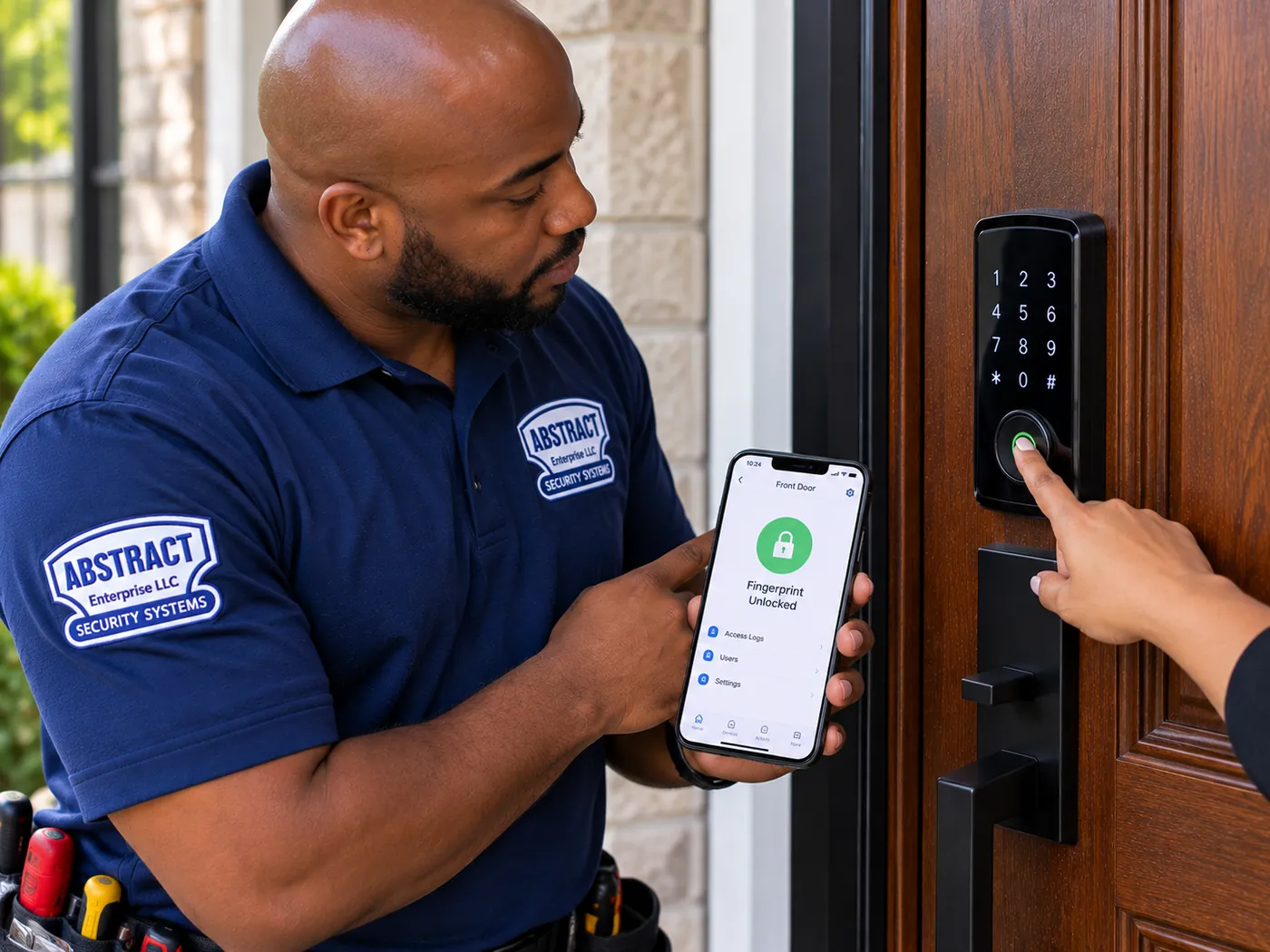
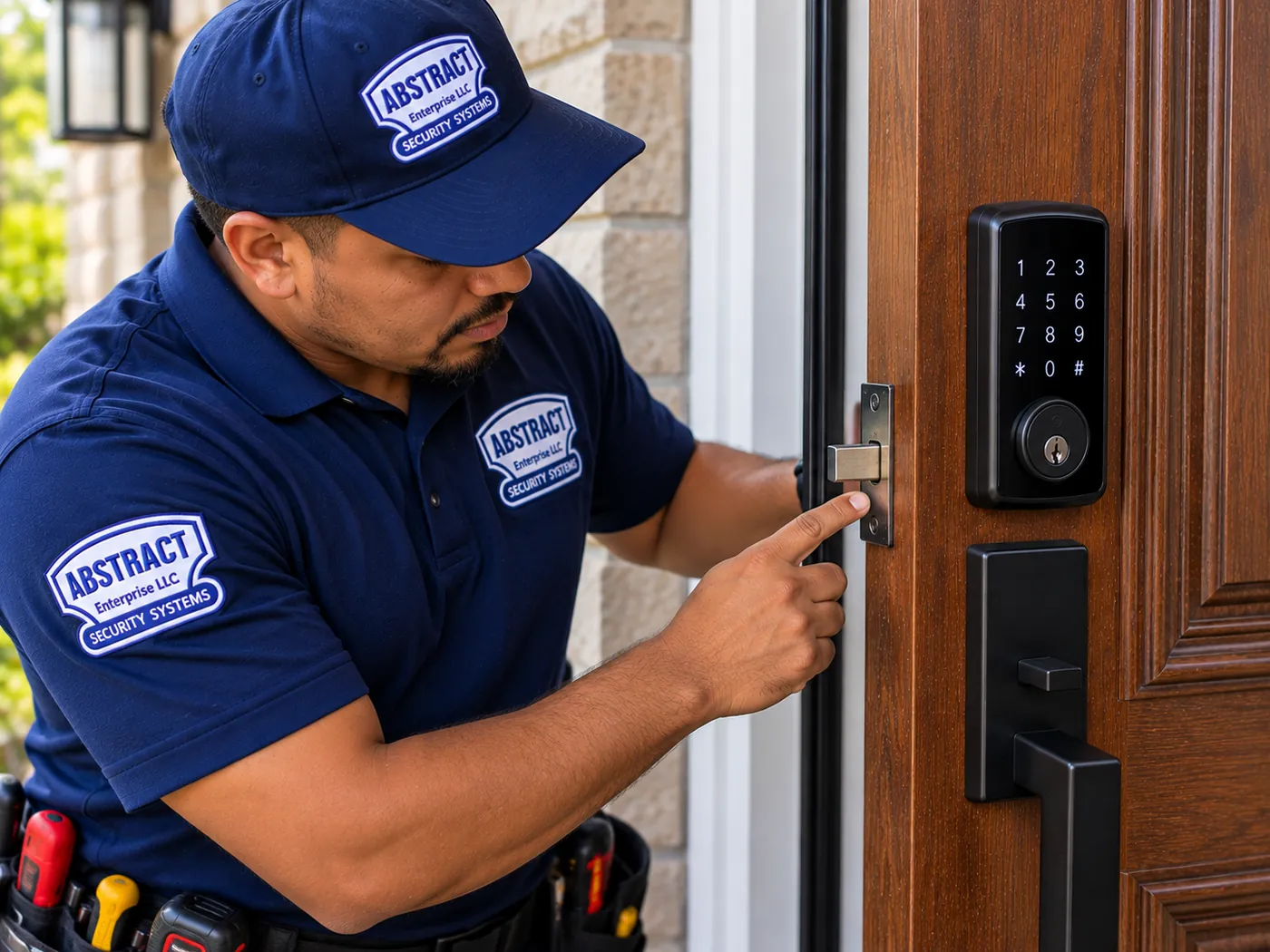
In Queens the right lock is usually decided by who uses the door, not by the door alone. You can buy your own and have us fit it, or let us recommend one after we have met the household. These are the categories we install in Queens houses, co-ops, apartments and shops.
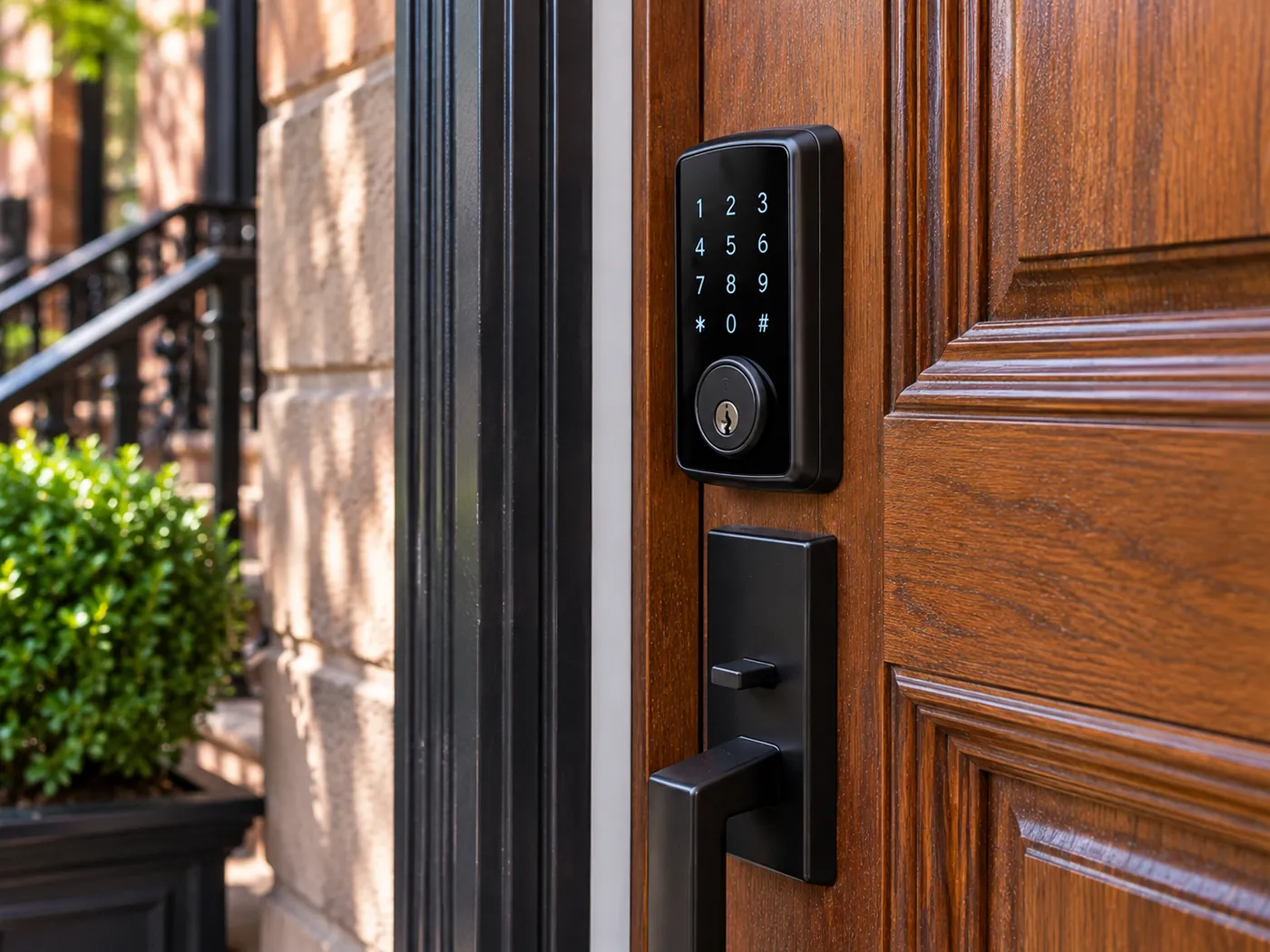
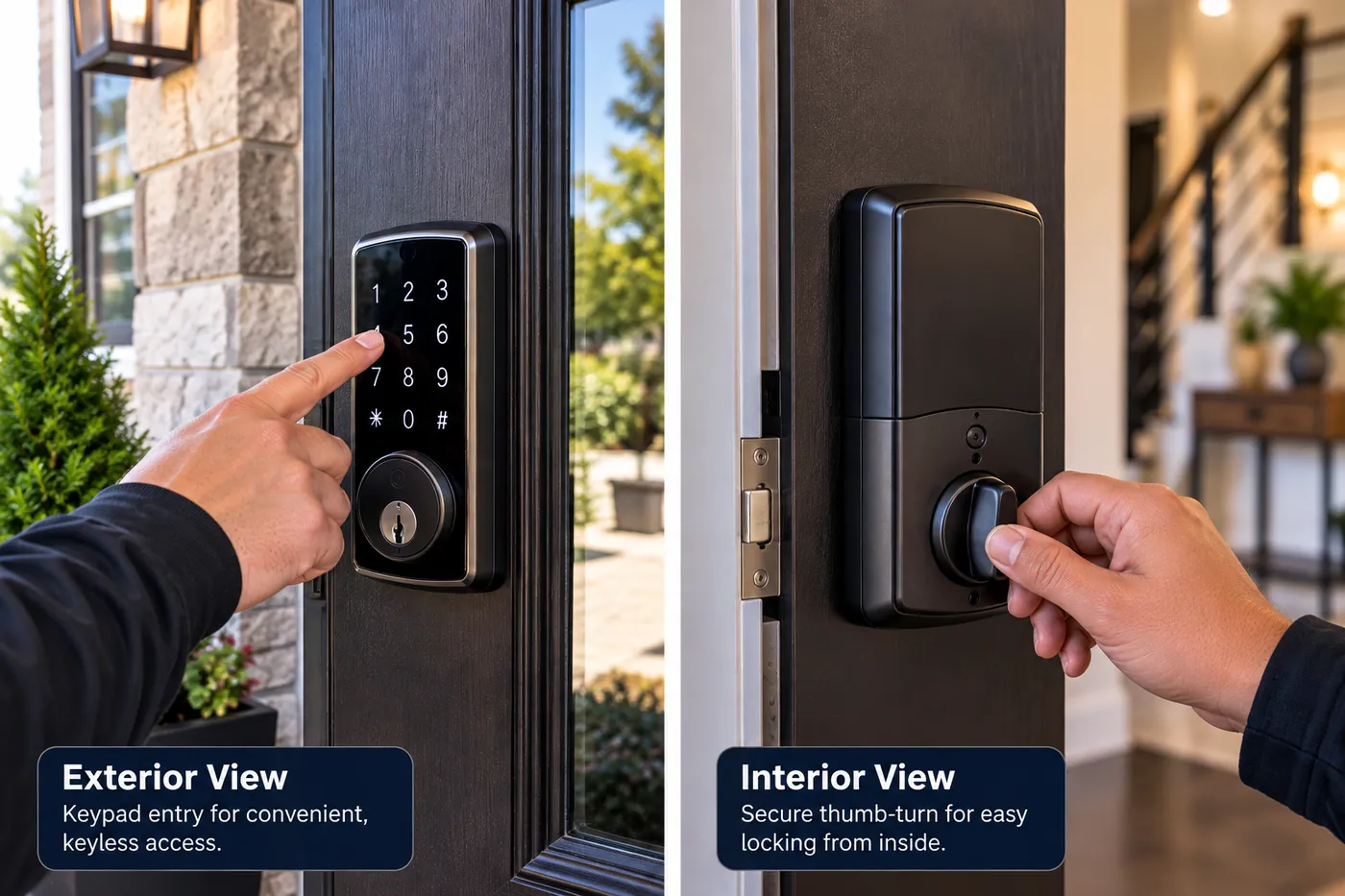
Raised, backlit buttons that older relatives can feel and read in the dark, a keyed cylinder for anyone who prefers a key, and an inside thumb-turn. Our most common choice for a side or driveway door.
For household members who forget codes or share them too freely, and for stiff or arthritic hands. We enrol at least two fingers per person so a cut or bandage never means a lockout.
Something to hold for people who would rather tap than type, and for staff in a shop. Cheap to replace when a fob is lost, and each one is cancelled individually.
Fit over an existing single-cylinder deadbolt on the inside of the door only, leaving the outside and the key unchanged. The usual choice in Long Island City and Forest Hills rentals where the outside of the door isn't ours to change.
Separate keypads paired to an interior lock, rated by their makers for outdoor use — Yale lists its Smart Keypad at IP55, for example. Useful on courtyard-facing co-op doors and basement doors where the lock itself should stay inside.
Push-button deadbolts with no batteries or electronics at all. On a basement door in a flood-prone block they are often the most sensible keyless choice: nothing to short out and nothing to reset after water.
For shop fronts, alley doors and upstairs offices. The keypad or reader sits on the wall or frame, the strike releases the latch, and a push-to-exit button inside keeps exit independent of the system.
Small add-ons that turn a lock into an alert system: a contact that tells you the basement door is open, a water sensor that tells you the stairwell is filling. NYC Emergency Management recommends a water sensor or flood alarm below grade.
National brands versus a Queens installer. National alarm and smart-home companies sell a lock as part of a plan, and big-box stores sell it in a box. Neither will stand in your kitchen and work out that your mother wants a fingerprint, your son wants the app, your home attendant needs a Tuesday-Thursday code and your basement door shouldn't carry electronics at all. That conversation is the part of the job a local, licensed installer is for, and it is the part we spend the most time on.

A word on sources: the tools used to research this page had no access to Google's AI Overview, so the seven headings below are not its words. They are claims that appear again and again in lock marketing, review roundups and how-to articles, which answer engines pick up and repeat. Each is followed by what we see on real Queens doors.
Smart lock marketing almost always shows one person opening the door with a phone. In a Queens household of three generations that picture leaves out the grandparent without a smartphone, the parent who reads Bengali but not English, the teenager whose phone is always at five percent, and the aide who shouldn't be given an app account at all.
The app is an administration tool. It should be on one or two phones belonging to the people who manage the lock. Everyone else is better served by a keypad code, a fingerprint, a fob or a key — and the best locks support several of those at once.
When we set up a Queens house, we write down each person and the method they will use before we choose the lock. That list decides the model far more than any feature chart.
Phones translate their own menus, not third-party apps. An app shows only the languages its maker has translated it into. When we checked in October 2026, the App Store listed the Schlage Home app in English, French and Spanish and the US Yale Access app in English only; Yale's Home app, sold outside North America, listed 26 languages.
For a borough where, according to the Census Bureau, more than half of residents speak a language other than English at home, that matters. A parent who can't read the app can't approve a guest code, check the log or understand a low-battery warning.
Check the App Store or Google Play listing for the language you need before buying, and plan for the parents to use a method that doesn't involve reading at all.
Many locks are rated for rain and temperature swings on an ordinary exterior door. Ratings like IP55 describe dust and water jets, though, not immersion. Yale's own support article rates its Smart Keypad IP55 and says the lock and bridge belong inside the home.
Queens has thousands of doors that sit below grade at the bottom of exterior steps, and Ida showed how fast those stairwells can fill. A lock sitting under a foot of water is outside every rating we have seen.
On those doors we keep the inside mechanical, mount any keypad high, treat outside electronics as replaceable, and often recommend a battery-free mechanical keypad instead.
Auto-lock is genuinely useful: the bolt throws on its own a set time after the door shuts. It is the best single answer to the forgotten side or basement door that QNS described in the Glen Oaks burglary of June 2025.
But auto-lock assumes the door is closed and latched. A door that rests a quarter-inch open because a frame has moved, or that a storm door holds slightly ajar, can report "locked" after the bolt has thrown into thin air, or jam and drain the battery trying.
Before relying on auto-lock we make sure the door latches from its own weight or closer, and we turn on the door-position feature where the lock has one, so the app knows the difference between locked-and-shut and bolt-out-door-open.
A good deadbolt that is actually locked is excellent protection for the door it is on. That is all it protects. The 2022 burglary pattern ABC7 reported in Queens Village and Glen Oaks involved side doors or windows being broken, which no lock prevents.
Smart locks earn their place by making it easy to keep every door locked and by telling you when one isn't. Windows at the back of the house, basement windows at ground level and garage side doors are separate problems.
That's why we often pair a smart lock job with a doorbell camera at the most-used entrance and alarm contacts on the doors and windows that can't be seen from the street.
Online advice about renting out a basement sometimes treats a separate keypad entrance as the finishing touch. In New York City the door is the least of it. Local Law 126 of 2024 sets out a pilot path for existing basement apartments in specific community districts, including Queens Community District 2, with egress to the outdoors, smoke and carbon monoxide alarms, water sensors and later sprinklers among the conditions.
A lock cannot make a unit legal, and an electronic lock that fails shut or needs a code to exit can make a basement more dangerous, not less.
If you have or are planning a basement unit, talk to the Department of Buildings, HPD or an architect first. We will fit door hardware that keeps the way out simple once you know what the space is allowed to be.
Some consumer locks are certified for several smart home ecosystems, and articles about them blur into articles about the entry systems new rental towers install. They are different things.
A building-run platform on unit doors, common in Long Island City's newer towers, is owned and configured by the building. Whether it links to Google Home, Apple Home or Alexa is the operator's decision, and a resident can't add it.
If your building's system is the only way into your apartment, the Tenant Data Privacy Act says your landlord can't require you to use it to get into your own unit. Raise that with management; don't try to modify the lock.

Tell us the doors and the people who use them. We will tell you which doors should go keyless, which lock suits each person, and the price.
Fill in the doors you want converted and the people who use them — parents, aides, tenants downstairs, staff — and you will hear back in writing the same business day. Prefer the phone? Our Queens number is (347) 434-6392.
Thanks — a licensed installer will phone you before the end of the business day. Something urgent? Ring (347) 434-6392.
Six steps, whether it's one keypad on a side door in Maspeth or every door of a two-family house in Richmond Hill.
On the phone we list every entrance and every person who needs to get in, with how each would rather do it: code, fingerprint, fob, phone or key. That list drives everything that follows.
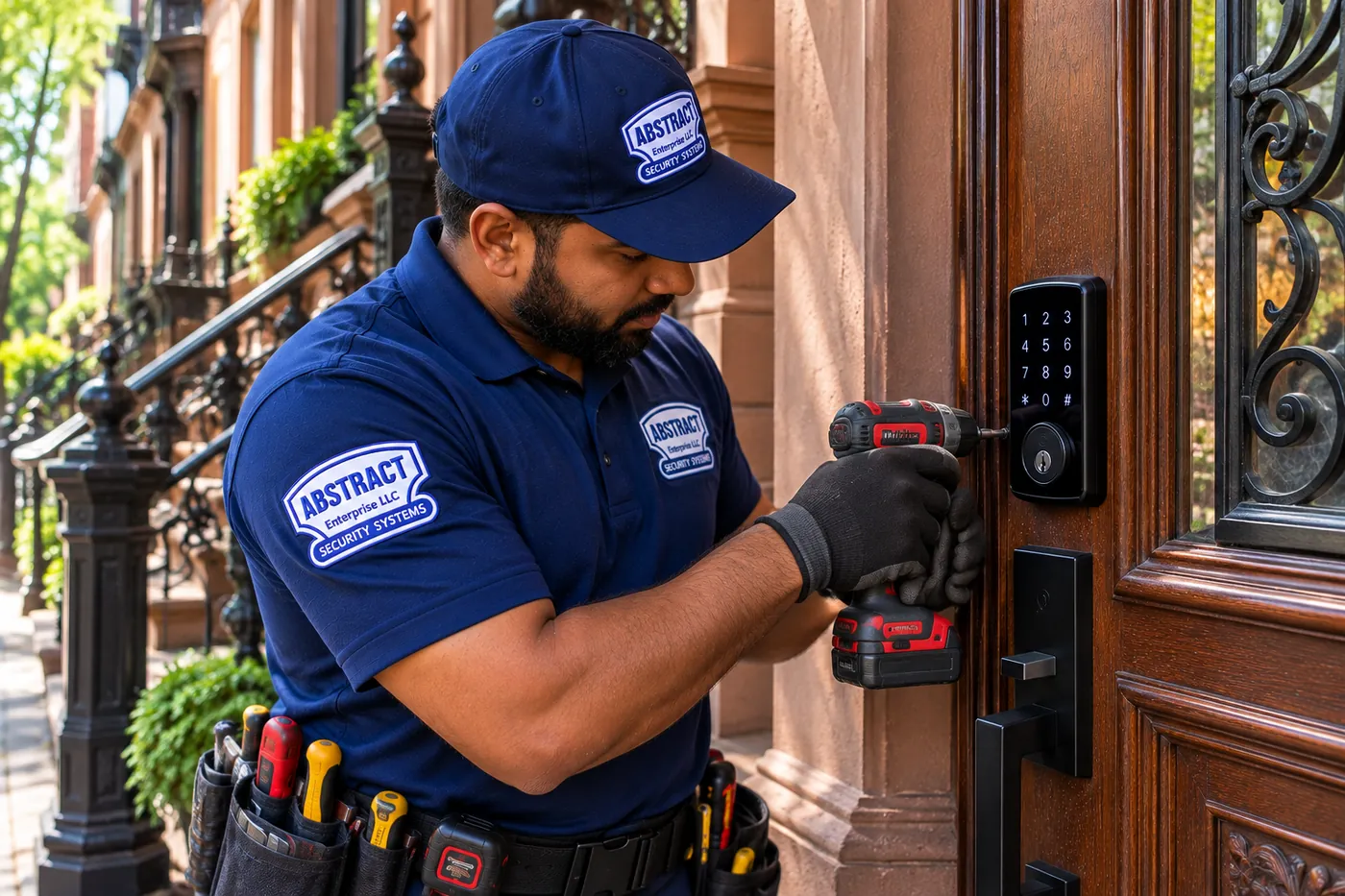
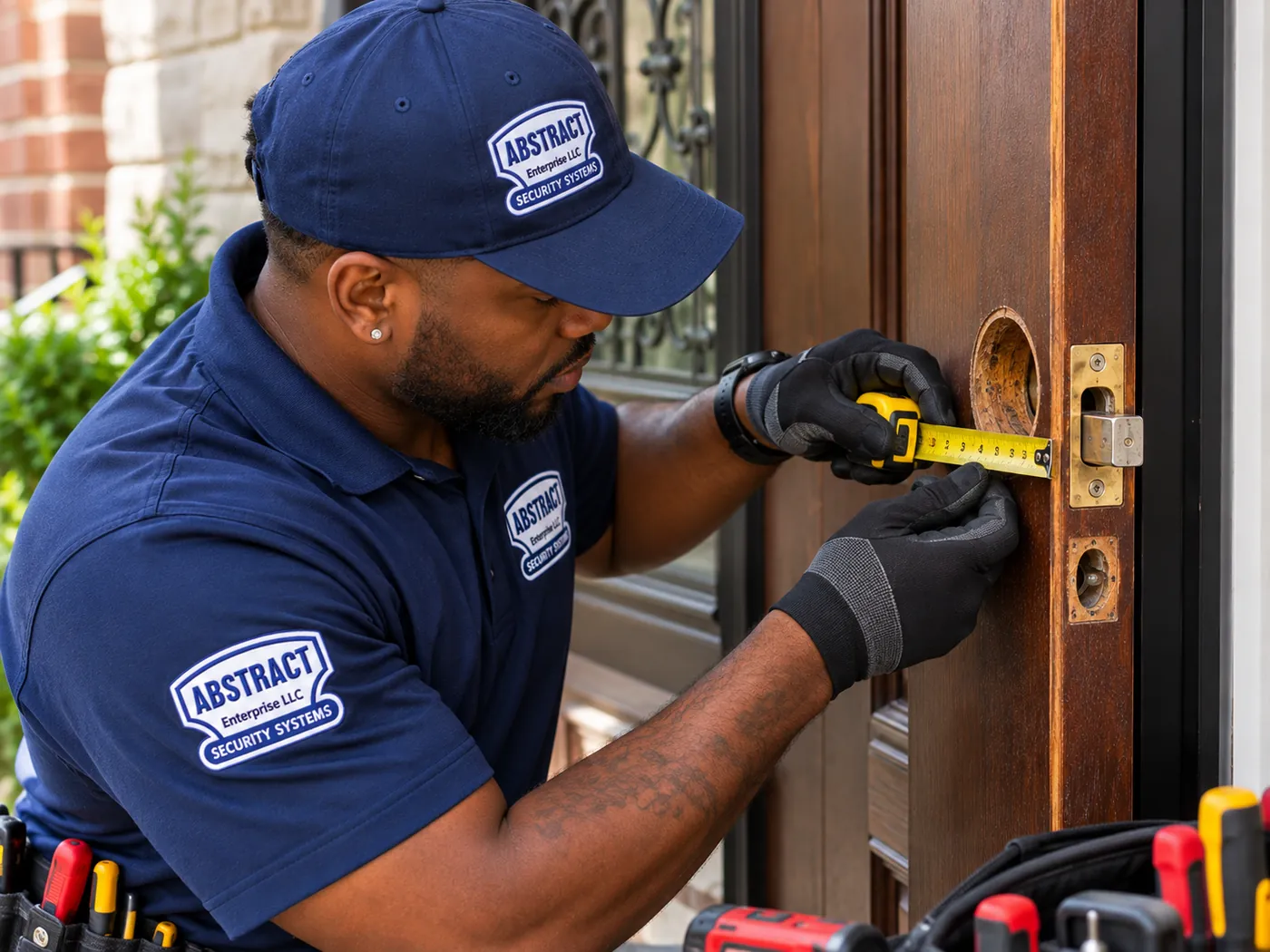
At the free walkthrough we look at the front door and its storm door, the side and rear doors and any basement entrance, check frames and strikes, note flood exposure, and test signal at each door.
You get a written plan saying which doors get which lock and why, and a flat figure. Shop and entrance work is priced from our published Queens access-control rates.
Strikes are moved or reinforced with long screws into the framing, hinges tightened and closers set, so each door latches with a light push before any motorised bolt goes in.
Locks are fitted and paired, a bridge or hub is placed where needed, and we open every door from inside in the dark, by hand, with the power off, to prove the way out never depends on electronics.
Each family member and caregiver enrols and tries their own method while we watch, schedules are set, admin access goes on two phones, and you keep a printed sheet the whole household can follow.
Six places that explain why Queens doors are so varied: early garden communities, the post-war housing experiments, and the towers rising on the waterfront.
Designated by the Landmarks Preservation Commission on October 19, 1993, covering roughly 36 blocks of garden apartment buildings and houses. Courtyard-facing doors, co-op boards that value uniformity, and exterior work in a landmark district.
Built between 1924 and 1928 as twelve courts of row houses and small apartment buildings, and designated a historic district in 2007. Small houses with front doors on shared green courts, where the outside of the door is part of a protected streetscape.
The 1909 planned community designed by Frederick Law Olmsted Jr. and Grosvenor Atterbury for the Russell Sage Foundation, a 142-acre community of houses and apartment buildings. Heavy, distinctive front doors where the hardware has to suit the house.
The New York Life Insurance Company's planned development on a former golf course, where the first twenty families moved in on September 2, 1947, and which numbered 140 buildings when New York Life sold it in 1972. A planned rental community where management sets the rules for unit doors.
Opened in 1963 and described by its management as the largest private housing cooperative in the world: twenty 13-storey buildings in circles of four, with 5,860 apartments. Concrete construction and a cooperative with its own procedures.
Topped out in 2019 at 762 feet, overtaking One Court Square as the tallest building in Queens. The kind of new tower where the building's own entry system usually comes first and a resident's options start with the lease.
We also serve Astoria, Ditmars, Steinway, Sunnyside, Woodside, Maspeth, Ridgewood, Glendale, Middle Village, Elmhurst, Corona, East Elmhurst, Rego Park, Kew Gardens, Richmond Hill, Woodhaven, Ozone Park, Howard Beach, South Ozone Park, Jamaica, Hollis, St. Albans, Cambria Heights, Laurelton, Rosedale, Springfield Gardens, Queens Village, Bellerose, Glen Oaks, Floral Park, Little Neck, Douglaston, Bayside, Auburndale, Whitestone, College Point, Murray Hill, Flushing, Fresh Meadows, Briarwood, Jamaica Estates, Broad Channel and the Rockaways from Far Rockaway to Breezy Point.

We publish the figures we have actually priced, and we say plainly when a job is quoted after we see it. Entrance and shop-door work — keypads, fob readers and electric strikes — is priced on our access-control and door-buzzer pages at a Brooklyn base, and Queens carries our standard 1.05 area multiplier, so those lines appear below at the Queens rate. A smart lock on a house or apartment door has no published AESS price yet, because the door and the household decide the work: one keypad on a sound side door is a short visit, while three doors, a storm door that fouls the keypad, a frame that has moved and six people to enrol is a long one. Those jobs are quoted flat, in writing, after a free walkthrough, and the figure you are given is the figure you pay.
| Item | Queens price | Scope and source |
|---|---|---|
| Smart lock on a house, co-op or apartment door (keypad, fingerprint, retrofit or mechanical keypad) | Quoted flat at free walkthrough | No published AESS figure; set after we see each door and meet the people who will use it |
| Single-door keypad or fob reader with electric strike | $1,575–$2,625 installed | Shop front, alley door, upstairs office or building entrance; published $1,500–$2,500 Brooklyn base × 1.05 |
| New electric strike on an entrance door | $263–$473 | Fitted during entrance work; $250–$450 published figure × 1.05, rounded half-up |
| Failed electric strike repair | $310–$509 | Entrance door that buzzes but won't release; published $295–$485 × 1.05, rounded half-up |
| Setup-only visit (app, codes, schedules, bridge; no hardware change) | $195 first hour, then 30-minute blocks | Our published Queens setup-only rate |
| Service and callback rate | $195/hr, 3-hour minimum ($585) | After-install service calls; not charged on the initial installation |
National cost guides for comparison. Cost-guide sites publish national averages for a single smart lock installed on an ordinary house door; Fixr's January 2025 figure, for example, is $250–$400. That is national third-party data, not an AESS price, and it assumes one door, one user and no storm door, settled frame or basement stairwell.
Three ways Queens customers usually buy keyless entry. Two carry published borough prices; the household plan is priced after we have walked the doors, since the mix of doors and people is different in every house.
Quoted flat at walkthrough
Smart locks on the doors that deserve them, chosen for the people who use them: keypad, fingerprint or retrofit. Strikes reinforced and aligned, inside exit checked by hand in the dark, each family member enrolled, caregiver schedules set, admin on two phones, printed instructions left behind.
$263–$473
For a shop front or the shared entrance of a small Queens building, the strike is supplied and fitted as part of the entry work at the borough rate. A strike that has simply failed is repaired instead, at $310–$509.
$1,575–$2,625
A keypad or fob reader on the frame, an electric strike in it and a push-to-exit button inside, installed for one door at the Queens rate. Each employee or resident gets a scheduled code or fob, and we show the owner how to add and delete them.
Bought a smart lock already? We fit it, quoted flat as labour only after the walkthrough. Before the box is opened we confirm it suits the door — thickness, backset, storm-door clearance and exposure — and the people: an app in a language the administrator reads, a keypad or fingerprint for those without phones. We won't fit a model that needs a key or code to get out. A lock you supply carries its manufacturer's warranty rather than ours. If it won't suit the door, we tell you before anything is drilled.

Send a photo of each door from outside, including the storm door, and tell us who lives in the house. We will tell you what the walkthrough will cover.
A keypad deadbolt in Astoria and one in Laurelton come out of the same box. The houses, buildings and households around them are what make the jobs different.
The northwest corner mixes old two- and three-family houses, attached rows and pre-war walk-ups with the glass towers of Long Island City and Hunters Point, where the State Comptroller's office reported that housing in Long Island City, Sunnyside and Woodside grew by nearly 42 percent between 2010 and 2023, to about 66,700 units. In the towers, our work is mostly retrofits and connectivity around building-run entry systems. In the houses, it is side doors and basement entrances — and this is Community District 2, the Queens district named in the 2024 basement pilot program, so basement-door egress comes up often.
Garden co-ops and pre-war apartment buildings in the Jackson Heights Historic District, attached houses on the side streets, LeFrak City's towers by the Long Island Expressway and the shops of 82nd Street and Roosevelt Avenue. Courtyard-facing co-op doors, multilingual households sharing a single entrance, and back doors behind busy restaurants are the typical calls.
Downtown Flushing's dense commercial blocks give way quickly to detached and semi-detached houses, the Bay Terrace co-op sections that Habitat Magazine describes as built in the 1950s on land owned by Cord Meyer Development, and the restaurants of Bell Boulevard. House jobs here are usually whole-house door plans for extended families; shop jobs are keypads with per-relative codes.
Apartment towers along Queens Boulevard, the houses of Forest Hills Gardens and the planned blocks of Fresh Meadows. Tower and rental apartments call for retrofits that leave the outside of the door alone; Forest Hills Gardens houses call for hardware that suits a heavy, distinctive front door.
Masonry row houses, many in the Central Ridgewood Historic District, and attached and semi-detached frame houses further east. Frames that have shifted over a century are the main technical issue; strikes are realigned and reinforced on almost every job.
Detached one- and two-family houses with driveways and side doors, Rochdale Village in South Jamaica, and the offices and shops around Jamaica Avenue. Side-door keypads, basement entrances and scheduled codes for caregivers are the common requests.
Houses and bungalows near Jamaica Bay and the ocean, where storm flooding and salt air decide what lasts. Mechanical keypads, outdoor-rated finishes and a key that always works are the priorities.
The borough's eastern edge, next to Nassau County: detached houses and the large Glen Oaks Village garden co-op. These are the neighbourhoods named in the 2022 and 2025 burglary reports cited above, so auto-lock and door-left-open alerts are high on owners' lists.
The hardware takes an hour or two. The plan for who gets in, and how, is what makes it work for years. This is the plan we draw up with Queens families before we leave.
| Person | Usual method | What we set up |
|---|---|---|
| Parents who run the house | App plus code or fingerprint | Administrator access on two phones, so a lost or replaced phone never locks the family out of its own lock |
| Grandparents | Keypad, fingerprint, fob or key | A method chosen by them, tried in front of us; two fingers enrolled; a code that isn't a birth year; no app needed |
| Teenagers and adult children | Own code or phone | Individual credentials so the log shows who came in at 2 a.m., and nothing shared with friends |
| Home attendant or relief aide | Scheduled code | A code active only on the agency's days and hours, one per aide, deleted when staff change |
| Tenant or relative in the basement | Own door, own lock | A separate lock on their own entrance where they have one, with an inside release that never needs a code |
| Contractors, dog walkers, cleaners | Temporary code | Codes with an end date, so nobody has to remember to remove them |
Two habits keep it working. First, review the user list a couple of times a year and delete anyone who no longer needs access. Second, keep the physical keys: at least one with a neighbour or relative nearby, because a dead battery or a jammed motor is rare but not impossible, and a key is the one credential that doesn't need power. If something goes wrong after we leave, our setup-only visit in Queens is $195 for the first hour.

After Ida, the basement door deserves its own checklist. This is what we go through before recommending any lock for a below-grade entrance in Queens.
Basement residents can also join the Notify NYC basement alert group, which the city describes as targeted warnings about life-threatening weather for people living below grade. It costs nothing and it is the warning that gives people time to use the door.
In a Queens house, the router usually sits in the living room or upstairs, and the doors that matter most are as far from it as the house allows. A side door at the end of the driveway, a rear door through a kitchen extension and a basement door below a concrete slab can each be a dead spot.
Whatever the method, we finish the same way: phone on mobile data, standing on the sidewalk, lock and unlock each door remotely and confirm the alert arrives. In houses where Wi-Fi doesn't reach, a cable run to a downstairs access point is often the permanent fix; our Queens network installation team and structured cabling in Queens handle that work.

Queens customers rarely stop at the lock. These are the borough services that most often end up on the same work order.
Readers, keypads and controllers for shops, offices and building entrances with several doors.
A camera on the step, so a remote unlock is never guesswork.
Audio and video intercoms for two-family entrances and small buildings.
Dead stations, failed releases and wiring faults on existing intercoms.
Strikes that hum but won't release and buzzers that stopped working.
Door and window contacts, water sensors and monitoring for houses and shops.
Cameras on side yards, driveways, basements and storefronts.
Hubs, scenes and automations that bring the locks, lights and sensors together.
Door wiring, data, cameras and sound, handled by one licensed Queens crew.
One form for any mix of the services above.
The order our installers follow around a Queens house — a routine we use everywhere, not the story of one visit
We start at the door the family actually uses, which in Queens is often not the front door. We ask who came in that way today and how: a key, a hand on the storm door, a code at the side gate. That door gets the most attention, because it will be opened a thousand times a year by the most people.
Then the storm door. We open it, hold it, and see whether a hand can reach the main door's deadbolt and whether the storm door's own latch is being used as the lock.
Then the basement. We walk down the outside steps, look at the drain, the threshold and the bottom of the door for water marks, and open the door from inside with the lights off. If it sticks, has a chain or a slide bolt high up, or needs a key from inside, that is fixed before anything smart goes near it.
Last, the people. We sit with whoever will use each door, including the oldest and least technical member of the household, and choose their method with them. A lock that the grandmother can't open is a lock the family will stop using.

A single-door keypad or fob reader with an electric strike is $1,575 to $2,625 installed at our Queens rate, which is our published Brooklyn base multiplied by 1.05. A new electric strike on an entrance door is $263 to $473, and repairing a failed strike is $310 to $509. Smart locks on house and apartment doors are quoted flat after a free walkthrough.
Go straight to smart locks on the doors you plan to convert, because the new locks come with new keys and nobody else's old copies will fit them. On the doors you are keeping mechanical, have the cylinders re-keyed or replaced, since you can't know how many keys the previous owners, tenants and contractors kept. We can do both in the same visit.
Yes. We leave a one-page sheet for each door covering how to open it with a code, fingerprint, fob or key, how to lock it on the way out, what the lights or sounds mean, and who to call if it stops working. It is written in plain English so a family member can translate it for anyone who reads another language.
Either works. We can supply the lock once the walkthrough has shown which models suit each door and each person, or fit one you have already bought. If you buy first, keep the box and receipt until we have checked the door thickness, backset, storm-door clearance and the app language, so it can go back if it is the wrong fit.
Two people who live in the house and are comfortable with apps, usually a parent and an adult child. One administrator alone is a risk: if that phone is lost or that person moves out, nobody can add users or change codes. Avoid making a relative who lives elsewhere the only administrator.
Most smart locks flash or beep at the keypad and, if connected, send a low-battery notification to the administrators' phones, usually weeks before the lock stops working. We set those notifications to reach two people, show the household what the warning looks like, and recommend keeping a spare set of the correct batteries in the house.
Yes. Our Queens crews work across the borough, from Astoria and College Point to Far Rockaway, Breezy Point and Broad Channel. Appointments are booked in 2-hour arrival windows between 8 AM and 8 PM, seven days a week.
Often, yes. Metal front-yard and driveway gates can take a weatherproof keypad lock or a keypad with a gate-rated electric lock, depending on the gate's construction and whether power can reach it. We look at the gate, the post and the latch at the walkthrough and price it with the house doors.
We reinforce it. That can mean long screws through the strike into the framing behind the trim, a reinforcing strike plate, or filling and re-drilling stripped screw holes. Where the frame itself is rotted or split, we tell you before installing, because a carpenter's repair has to come first.
Usually. Most smart lock lines come in several finishes such as satin nickel, matte black, bronze and brass. Tell us the finish of your handles, hinges and storm door at the walkthrough, or send a photo, and we will suggest models that match or tell you if the lock you want isn't made in that finish.

This is our Queens page. It sits under the NYC smart lock installation hub, which covers renters' rights, co-op boards and building rules across all five boroughs. Manhattan and Brooklyn have pages of their own; the Bronx and Staten Island links open our quote form for now, and the same crews already work there. Long Island and the Hudson Valley each have a regional smart lock page.
Smart lock installation in NYC · Manhattan smart locks · Brooklyn smart lock installation · Queens (this page) · the Bronx · Staten Island
Long Island smart lock installation — Nassau and Suffolk counties, next door to eastern Queens.
Smart lock installation in the Hudson Valley — Westchester, Rockland, Orange, Putnam, Dutchess and Ulster.
Upper East Side, Manhattan · Brooklyn Heights, Brooklyn · Flushing, Queens · Bedford-Stuyvesant, Brooklyn · Jackson Heights, Queens · Kingsbridge, Bronx · Throgs Neck, Bronx · Todt Hill, Staten Island · Chelsea, Manhattan · New Dorp, Staten Island · Washington Heights, Manhattan · Greenpoint, Brooklyn · Bayside, Queens · Morris Park, Bronx · West Brighton, Staten Island · Upper West Side, Manhattan · Park Slope, Brooklyn · Astoria, Queens · Riverdale, Bronx · St. George, Staten Island · Tribeca, Manhattan · Tottenville, Staten Island · Harlem, Manhattan · Bay Ridge, Brooklyn · Williamsburg, Brooklyn · Forest Hills, Queens · Pelham Bay, Bronx · Long Island City, Queens · Mott Haven, Bronx · Great Kills, Staten Island
Everything else we fit, from cameras to cabling, is listed on the Abstract Enterprises Security Systems home page; the people behind it are on our about page.

If a keypad has gone dark, the app can't find the lock, or the bolt won't throw on a side or basement door, call our Queens line at (347) 434-6392. We book the next open 2-hour window, and most battery, pairing and alignment faults are fixed in one to two hours once a technician is at the door. Keep the physical key handy in the meantime — it's the one credential that never needs a battery.

Queens customers call (347) 434-6392 or message WhatsApp (718) 679-0359 through wa.me. Abstract Enterprises Security Systems, 460 E Fordham Rd, Bronx, NY 10458.
NYS Low-Voltage Licence #12000287431 · 100% Licensed & Insured · Same-Day Estimates · Rated 4.7★ from 201 Google Reviews
Locks you supply carry their manufacturer's warranty. Full terms — including 50% deposit, one-year parts-only warranty on AESS-supplied products, and the late-fee schedule — are set out in the service agreement. See our warranty page.
This page explains how Queens houses, basements and city rules affect smart lock installation; it is not legal advice. Page reviewed and updated October 17, 2026. Changelog: first publication of the Queens smart lock installation page.