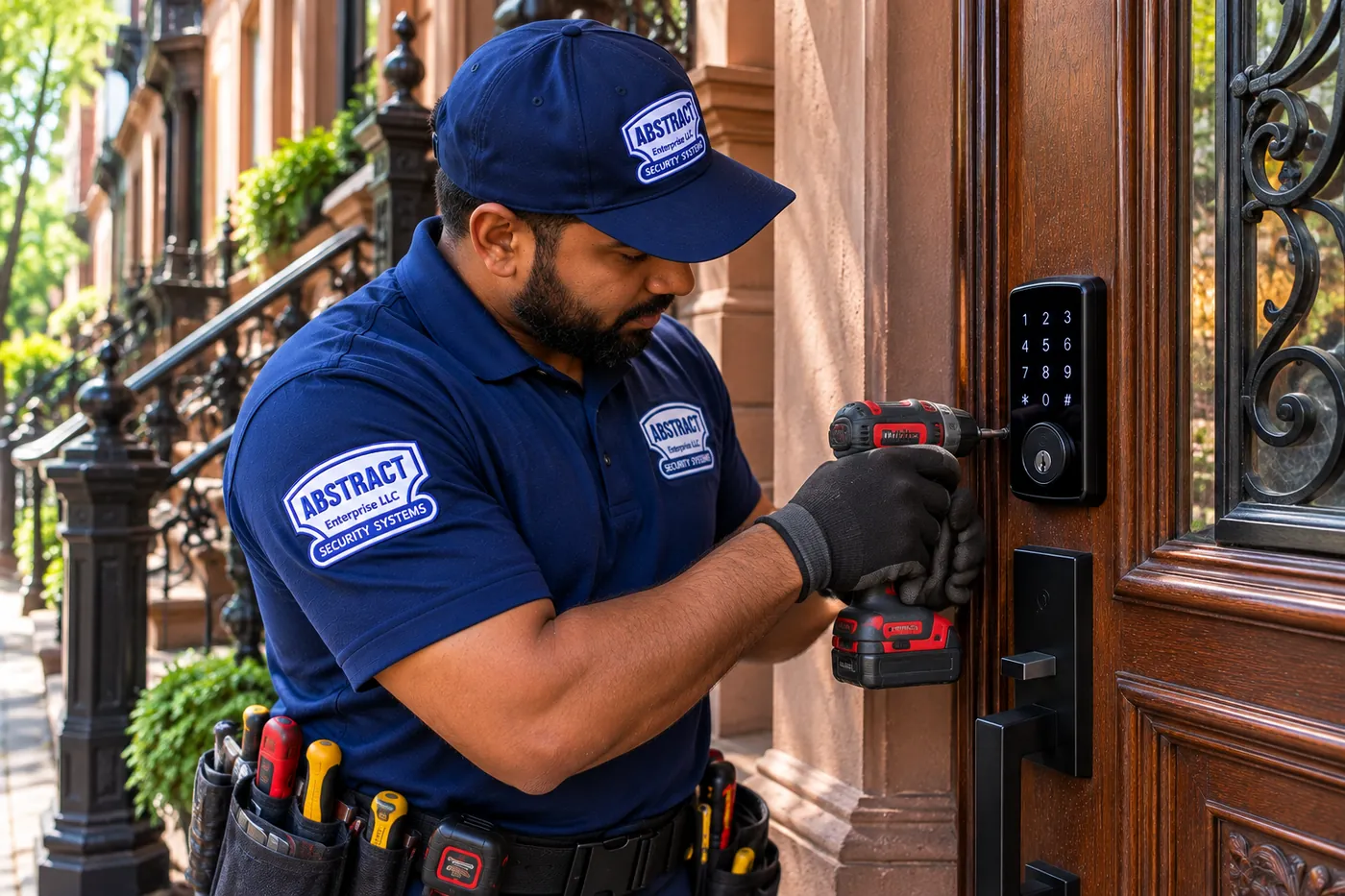
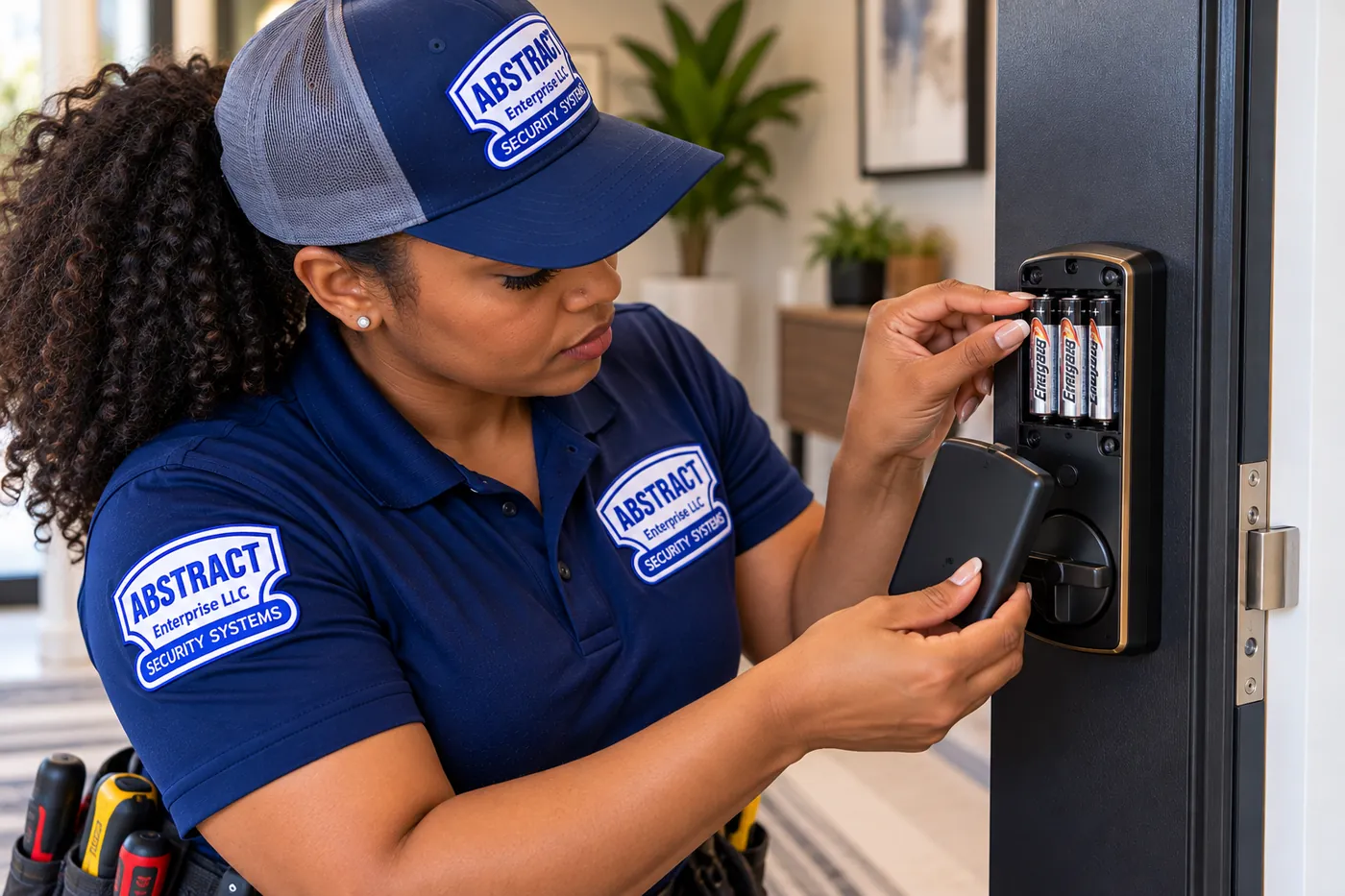
Prewar Lobby Buildings · Limited-Equity Co-ops · Roommate Apartments · Shops Under the 1 Train · Houses on the Hill
In Kingsbridge the door that lets trouble in is usually the one downstairs. In 2024 police said someone twice used a crowbar to pry open the lobby door of a building near Corlear Avenue and West 231st Street. In 2026 Community Board 8 wrote that main doors at Marble Hill Houses lack working locks and buzzers. So we plan every Kingsbridge smart lock as a two-door job: first we check whether the street or lobby door still shuts and relocks, and who is responsible for it, and then we fit a keyed smart lock on your own door that still protects you on the nights the lobby door doesn't.
Written by Anwar Timothy, licensed low-voltage contractor (NYS #12000287431) · Last reviewed and updated October 17, 2026 · Kingsbridge jobs run from our Fordham Road office

Not sure where to start — the lobby or your own door? Call (646) 490-0629 or send the 60-second form with two photos: the inside of your apartment door, and the building's front door from the sidewalk. We tell you which of the two needs work first and who is allowed to do it before anyone climbs the stairs.

Most people who ask us about a smart lock in Kingsbridge are really asking about two doors. One is their own apartment door. The other is the building's street or lobby door, and that is usually the one that worries them. Kingsbridge was built for the people who pass through those doors: six-story brick apartment houses climb the hills off Broadway, Kingsbridge Avenue, Heath Avenue and Sedgwick Avenue, and a neighborhood history ties the rise of the six-story buildings on those avenues to the 1 train's arrival early in the twentieth century. Nearly every one of them has a lobby or courtyard entrance shared by dozens of households. If that door is propped, broken or forced, a stranger reaches every apartment door in the building.
The local record shows why we start downstairs. In April 2024 the Norwood News reported a burglary pattern the NYPD had identified in Kingsbridge: on March 25 and again on April 5, someone used a crowbar to pry open the front door of the lobby of the same residential building near Corlear Avenue and West 231st Street, then fled north along Corlear. Nothing was taken either time. The lobby door still gave way twice. In August 2026 The Riverdale Press described residents of Marble Hill Houses, the public housing towers on Broadway between West 225th and 230th Streets, finding entrance doors propped open or forced and keys that sometimes would not open a freshly repaired entrance lock. Bronx Community Board 8's Fiscal Year 2027 statement of needs put it plainly: “There are security concerns as main doors to buildings do not have proper entry security such as working locks and buzzers.”
That is why a Kingsbridge smart lock plan has two halves. The lobby half depends on who owns the building. A private owner of a rental building is responsible for the entrance door, its lock and its buzzer. In the Amalgamated and Park Reservoir cooperatives that responsibility sits with the housing company. At Marble Hill Houses it belongs to NYCHA. Our job there is to tell you whether the door can be fixed with a strike, a closer or a keypad, what it costs at our published Bronx figures, and who has to approve it. The apartment half is yours to decide, within your lease or proprietary lease: a keyed smart deadbolt that locks itself, keeps a record of who came in, and still has a mechanical key for the day the batteries or the building let you down.
The neighborhood's other features shape the job too. Kingsbridge is hilly enough that several of its streets turn into staircases. A walking guide counts 187 steps on the West 229th Street stairs, 70 on West 231st Street and 72 on West 230th Street. Community Board 8 counts one in five of its residents as 65 or older and has asked the city to rebuild the crumbling West 238th Street step street between Waldo and Irwin Avenues. Older residents at the top of those climbs often need codes for aides and relatives more than they need an app. Manhattan University sits just over the line in Riverdale, so many apartments near it are shared and their tenants change each semester. Under the elevated tracks, the Kingsbridge Business Improvement District's roughly 200 merchants run small shops along Broadway and West 231st Street, and they need staff codes they can switch off in a minute.
Building owners and tenants here are also living with heavy housing-code enforcement. The NYU Furman Center counted 222.4 serious housing code violations per 1,000 privately owned rental units in Riverdale/Fieldston, the community district that includes Kingsbridge, in 2024, and 283.6 in Kingsbridge Heights/Bedford next door. A smart lock that stops a door from latching, or an entrance that cannot be opened from inside, only adds to that count. So before anything else we confirm that the door swings shut, latches and opens from inside with one simple motion.
Most Kingsbridge buildings that need a better lobby door also have entry and buzzer problems. Our Kingsbridge access control installers handle fob readers and keypads on street doors, and the Abstract Enterprises intercom team for Kingsbridge keeps the buzzer and door release working with them.

If the keypad stays dark, the bolt grinds against a strike that has shifted, the app shows the lock offline since the router was swapped, a roommate's old code still works, or the lobby strike hums but won't let go, call us for a service visit. We book the next open two-hour window, and most battery, alignment and pairing faults are fixed in one to two hours once a technician is at the door. When the fault is the building's entrance rather than your lock, our published Bronx figure for a failed electric strike repair is $295–$485, and our door buzzer repair page for Kingsbridge covers the rest of the lobby. Call (646) 490-0629 and tell us which door has failed.

Each Kingsbridge job we take is one or more of the services below, and each ends with the same checks. The door closes and latches without a push, the lock opens from inside with one motion and no key, every keyholder the rules name still has a key, and every code, fingerprint and phone has been tried while you watch.
For the tenant whose building door is often propped or broken: a smart deadbolt with a real key cylinder, auto-lock set to a short delay, and an entry log, so your own door is locked every time you leave even when the lobby door is not.
For cooperators at the Amalgamated, Park Reservoir and other Van Cortlandt Village buildings: a retrofit unit that replaces only the inside thumb-turn of a deadbolt you are allowed to use. The hallway side and the existing key stay exactly as the housing company left them.
For owners of walk-ups and elevator buildings off Kingsbridge Avenue, Tibbett Avenue and Kingsbridge Terrace: a keypad or fob reader with an electric strike on the street or inner lobby door, at our published Bronx figure of $1,500–$2,500 for a single door.
When a building door closes but doesn't lock, the electric strike or the closer is usually to blame. A new strike fitted as part of an entry upgrade is $250–$450 at our Bronx figures, and a failed strike repaired is $295–$485.
For apartments shared by roommates or students near Manhattan University: one code per person, an admin account held by the leaseholder, and a written routine for deleting a code the day someone moves out.
For a district where one in five residents is 65 or older: scheduled codes for home attendants, a code for the relative who checks in, alerts to a son or daughter's phone, and a lock the resident can still work by key or fingerprint without an app.
For Kingsbridge BID storefronts on Broadway and West 231st Street: keypad deadbolts or lever locks on the front door, reader-and-strike sets on back and stair doors, staff codes that can be cancelled in a minute, and exit that never needs a key.
For owners of row houses and detached houses on Kingsbridge Terrace, Bailey Avenue and the streets off the step streets: a smart deadbolt on the main entry, a matching plan for the side or basement door, and a key that still opens both.
The fixes we do most in Kingsbridge: a keypad brought back after its batteries leaked, a bolt that drags because a heavy steel door has dropped, an owner locked out of their own admin account by a lost phone, and a lock that vanished from the app when the internet company replaced the router.
Kingsbridge looks uniform from the 1 train platform, all brick and fire escapes, but the doors inside tell different stories. These are the five kinds of building we meet most often between Van Cortlandt Park and Kingsbridge Road, and what each means for the lock.
Brick buildings from the first decades of the twentieth century on Kingsbridge Avenue, Heath Avenue, Sedgwick Avenue, Kingsbridge Terrace and the blocks around them, many with courtyard entrances and one shared lobby door. Apartment doors are usually steel-clad or hollow metal with a building-supplied lock and the scars of several earlier ones.
The Amalgamated's Tudor-style clusters from 1927 to 1932, its 1949–51 concrete high-rises and its two 20-story towers at 3965 and 3975 Sedgwick Avenue, plus Park Reservoir's three buildings. Shareholders live under a housing company's rules and state oversight, so we favor locks that can come off without a trace.
Tudor Revival row houses, walk-ups and detached houses on the hillside blocks of Kingsbridge Heights and along the edges of the step streets. Owners control every door, but many rent out a floor, and the front door often sits at the top of a high stoop exposed to wind and weather.
Two- to six-story buildings with storefronts at street level under the elevated tracks and apartments above, reached through a separate street door beside the shop. The shop door and the residential door must be planned separately, because their users and their rules differ.
Marble Hill Houses, 11 NYCHA buildings of 14 and 15 stories on Broadway between West 225th and 230th Streets, finished in 1952. NYCHA's handbook rules govern the apartment door: the bottom lock stays, a resident may add a lock and is responsible for it.
Phase two of the Kingsbridge Armory redevelopment plans about 500 permanently affordable rental apartments on the adjacent National Guard site, expected in 2032. New buildings like these usually arrive with the developer's own entry system, and a tenant's lock has to work alongside it.
Most apartment doors in Kingsbridge's older buildings are steel or steel-clad, and many carry the building's heavy-duty lock set low on the door, a viewer, a chain guard, and filled holes from police locks and rim cylinders removed years ago. Before we suggest a lock we map every hole and check where the stiffeners sit inside the door, so the new bore lands in solid metal and the keypad clears the building lock's trim. Sometimes the right position is higher than you expected. Sometimes a retrofit that drills nothing is the better answer.
Buildings with courtyards often have three barriers between the street and your apartment: a courtyard gate, the lobby door and your own door. Owners sometimes ask us to put the keypad on the first barrier because it faces the street. We usually advise against it. The lobby door is the one that should lock itself and take credentials, because a courtyard gate is easy to climb or hold open and leaves the lobby unprotected. The apartment door stays the tenant's last line, with its own key.
When an apartment changes hands in a limited-equity co-op, the housing company restores it before the next household takes the keys; the Amalgamated's own FAQ describes apartments shown “pre-restoration or restored and ready for occupancy.” We have not seen a published Amalgamated rule on door locks. A retrofit or a smart deadbolt that uses the existing bore makes any later question about putting the original hardware back an easy one. Whatever we take off the door is handed back to you, not thrown away, so it can go back on if it is ever needed.
On the hill streets above Broadway the front door of a house or small building often sits above a long flight of steps. Rain and wind reach the keypad, the delivery driver has to climb to reach the bell, and an older resident may not be able to hurry down to open the door for a visitor. We place the keypad where an overhang shelters it, fit a lever rather than a knob where hands are stiff, and set up a remote unlock or a scheduled code so nobody has to rush down the stairs.
Most Kingsbridge households that add a smart lock also want to see who is at the lobby or the stoop before letting them in. Our security camera installation in Kingsbridge puts that view on the same phone.

Before choosing hardware we work out two things for every Kingsbridge address: who is responsible for the entrance downstairs, and who decides what goes on the apartment door upstairs. The answers differ more than people expect, even between buildings on the same block. The table summarizes what we have found in the published rules and laws. It is a guide to what to ask, not legal advice about your own lease.
| Where you live | Lobby or street door | Your own door |
|---|---|---|
| Private rental building (walk-up or elevator) | The owner's job. For class A buildings built or converted after January 1, 1968, Multiple Dwelling Law §50-a requires automatic self-closing and self-locking entrance doors, and an intercom with a release from each apartment in buildings of eight or more units. In older buildings those duties start when tenants occupying a majority of the apartments ask for them in writing. | The owner supplies a key lock and at least one key (Housing Maintenance Code §27-2043). Multiple Dwelling Law §51-c lets a tenant add a lock of their own, no more than three inches in circumference, with a duplicate key to the landlord on request. |
| Amalgamated or Park Reservoir co-op | The housing company maintains it; the Amalgamated's FAQ says the company is supervised by New York State Homes and Community Renewal. | Governed by the housing company's rules and the cooperator's handbook. We found no published lock rule, so we ask you to get management's answer in writing before any drilling. |
| Other co-op or condo in Kingsbridge or Riverdale | The board and its managing agent. | The proprietary lease or condo rules. Proprietary leases commonly require a duplicate of any new key, which is why we fit keyed smart locks there. |
| Marble Hill Houses (NYCHA) | NYCHA. Report a failed entrance to the Customer Contact Center at 718-707-7771 or through the MyNYCHA app, as NYCHA itself advises. | NYCHA keeps the bottom lock. A resident may buy and install an additional lock, is responsible for it, and NYCHA may break it in an emergency. Multiple Dwelling Law §51-c does not cover housing-authority buildings. |
| Owner-occupied house or two-family | Yours. If a tenant shares the front door, plan their access too. | Yours for your own floor. A rented unit's entrance door needs a key lock and at least one key for the tenant. |
| Apartment over a Broadway shop | The building owner, even when the shop tenant uses the same street door. | As for any private rental: owner's key lock plus your right to add your own lock. |
A smart lock on your apartment door makes your own door harder to get through and tells you when it opens. It does nothing about the stairwell, the mailboxes or the packages in the lobby. In the 2024 Corlear Avenue incidents the crowbar went into the lobby door, not an apartment door. In 2008 The Riverdale Press reported four burglaries in one week in the 50th Precinct in which thieves came in through the victims' front doors. One victim in a Riverdale building was believed to have left her door unlocked. At a Claflin Avenue building in Kingsbridge Heights the burglars broke a key off in the lock so no one could get in behind them. Both kinds of problem have practical answers. A lobby door that relocks every time cuts down on strangers in the halls. An apartment lock that locks itself and keeps a log covers the door someone forgot to lock.
If you rent, you can't replace the lobby strike yourself. You can still help get it fixed. Write down when the door fails, photograph it, report it to the owner and, if nothing happens, to the city through 311. Tenants of rent-stabilized apartments can also file with the state housing agency, whose fact sheet lists front and entrance door security, including the lock and buzzer, among required services. If you own the building, a failing lobby door is usually one of three faults: a closer too weak to pull the door shut against the wind, a strike that no longer catches the latch, or a latch bolt worn too short. We find which one it is before we sell anyone a keypad.

Kingsbridge's shopping streets are small-business streets. The Kingsbridge BID describes about 200 merchants. A 2015 Norwood News profile reported that retail space in the district had filled up and that several businesses, a funeral home, a real estate office and an insurance agency, had each been there at least 50 years. Those shops change staff, take early deliveries and close late, and most of them still use keys. These are the corridors where we fit business smart locks, and what each one asks of the door.
The long side of the L-shaped BID, under the elevated 1 train. Food shops, discount stores, pharmacies and offices with glass fronts behind roll-down gates. Front doors need staff codes and a key override, and the stair doors to the apartments above belong to the building, not the shop.
The short side of the L, climbing east past the 231st Street station toward Bailey Avenue and the Major Deegan Expressway. The BID's office is listed on Kingsbridge Avenue. Medical and professional offices upstairs need a keypad suite door and a separate code for cleaners.
Big-box retail at West 225th Street and Broadway sits just south of the BID, and smaller shops and offices line the stretch in between. Back-of-house doors in those buildings are where reader-and-strike sets usually go.
The Armory's first redevelopment phase plans a venue, community space and 125,000 square feet of community-owned manufacturing and community space, with construction expected to start in 2026 and finish in 2030. New tenants nearby will need doors that keep staff, deliveries and the public apart.
The western edge of Kingsbridge where it meets Riverdale. Small offices, studios and shops in older buildings, often with one door shared by several suites.
St. John's on Kingsbridge Avenue, Visitation on West 239th Street and Our Lady of Angels on Sedgwick Avenue all run churches and schools. Their side and office doors suit scheduled codes better than a ring of keys, provided the doors still open from inside without one.
Kingsbridge shops that update their door locks often add an alarm system from our Kingsbridge alarm installers so a forced door triggers more than an app notification.

These are the questions Kingsbridge residents, co-op shareholders, building owners and shopkeepers ask us, grouped by the door they are about. Each answer is written for this neighborhood. Questions that apply across the whole borough are on our Bronx smart lock installation page.
Yes, as long as you know what it can and can't do. A crowbar on a lobby door gets someone into the building, not into your apartment. Your apartment door is the next barrier, and a smart deadbolt with a reinforced strike makes it harder to force. Its log and alerts also tell you right away if it opens when you aren't home. What it can't do is fix the lobby. Report the forced door to the owner the same day, and if it isn't repaired, call 311 so there is a record. After a forced entry we look at the frame and strike on your own door, because a lock is only as strong as the wood or steel its bolt goes into.
The owner's. In a private rental building the entrance door, its lock and its buzzer are the landlord's responsibility. For newer class A buildings, Multiple Dwelling Law §50-a specifically requires self-closing, self-locking entrance doors. Tell the super or managing agent in writing and include the date and a photo. If it stays broken, file a complaint through 311 so HPD can inspect. Rent-stabilized tenants can also file with the state housing agency, which lists entrance-door security among required services. If you are the owner, call us. Most doors that won't relock need a closer adjustment, a strike realigned or a worn latch replaced, and our published Bronx figures cover the strike work.
It should lock itself and tell you what happened. Set auto-lock to a short delay so the bolt goes out even when you are carrying bags and forget. Turn on alerts for unlocks and for failed code attempts. Keep the key cylinder, so a dead battery or a phone left at work doesn't lock you out. Make sure the door viewer still works, and if the building allows it, add a digital viewer so you can see the hall from your phone. A propped lobby means more strangers in the hallway, so the habits that matter most are a door that is always locked and a clear view of who is knocking.
To its key cylinder, yes. Most smart deadbolts keep a mechanical keyway as a backup, and anything pushed into a keyway can jam it. The difference is that you have other ways in. The keypad, a fingerprint or the app still move the bolt, because the motor drives it whether or not the cylinder turns. That doesn't help if the bolt itself has been forced, which is why we check the strike and frame too. If you ever find something stuck in your lock, don't go in alone. Call 911 first, as the 2008 Kingsbridge Heights burglaries are a reminder that someone may still be inside.
Start with the housing company's management office. The Amalgamated's own FAQ says it is supervised by New York State Homes and Community Renewal, which approves admissions and apartments. Day-to-day rules for cooperators, including alterations, come from the company and its handbook, not from the state agency directly. We have not found a published Amalgamated or Park Reservoir rule specific to door locks, so we suggest asking management one plain question: “May I install a keyed smart deadbolt, or a retrofit on my existing deadbolt, and do you need a copy of the key?” Get the answer in writing, and show it to us at the walkthrough.
In most limited-equity co-ops, a retrofit. It mounts on the inside of a single-cylinder deadbolt you already have, swaps only the thumb-turn, and leaves the hallway side and key exactly as they were. That suits housing that restores apartments between households and buildings where hallway hardware is uniform. Its limit is that there's no keypad outside unless you add a separate one, so the person coming in needs a phone, a key or a wireless keypad mounted beside the door. A full keypad deadbolt makes sense where management allows it and an existing bore can be reused. In the Amalgamated's 1949–51 concrete buildings and the Sedgwick Avenue towers, we also check whether the phone can reach a bridge from the hallway before you choose.
If the smart lock is yours, installed as the lock you are allowed to add, yes: whoever holds the admin account deletes that person's code and phone access in the app, and it takes effect at once. Then check the activity log for entries after the move-out date. The landlord's own lock and key are a separate matter, and changing them is the landlord's call. That's why we set up shared apartments with one code per person rather than one shared code. The leaseholder holds admin, and a short note inside the door records who has what. If the lock belonged to the departing roommate and is on their account, transfer ownership or reset the lock before they leave.
Only if the same person controls both doors, which in a Kingsbridge rental they usually don't. The apartment door is easy. Give the aide a code that works only during her scheduled hours, and set alerts so you see when she arrives and leaves. The lobby door belongs to the building. If it has a keypad or fob reader, the owner decides who gets a credential. If it has a key lock, the aide needs a building key, which your mother can get from management. Some families have a video intercom or doorbell let the aide be buzzed in remotely. We set up the apartment side and tell you exactly what to ask the owner for the lobby.
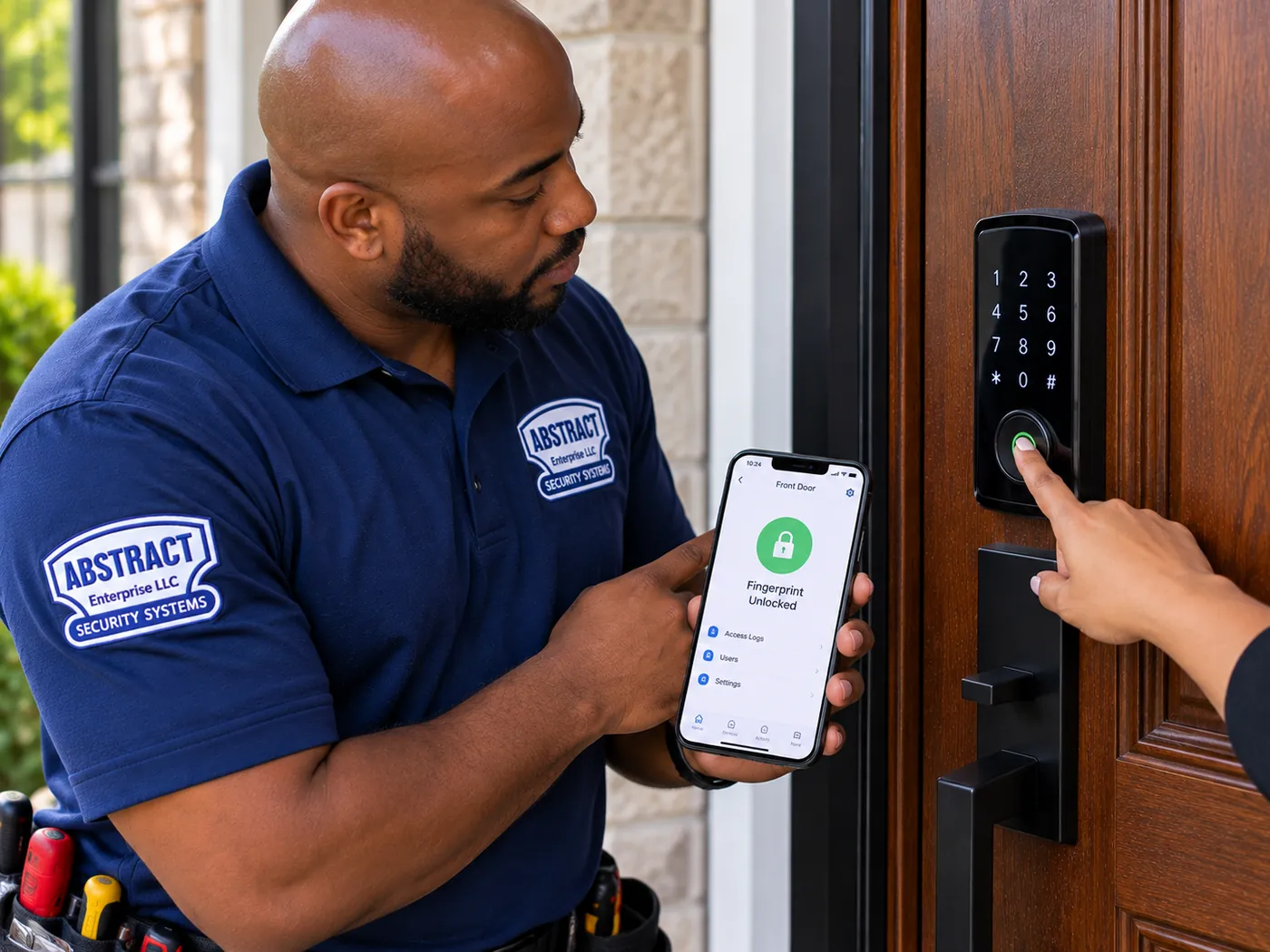
Yes. A fingerprint reader on the outside of the lock opens it with one finger, even with grocery bags on the other arm. Phone-based unlocking works by tapping a button in the app or a watch, or by holding the phone near the lock on models that support it. We enroll two fingers for each person in case one is cut or bandaged, test them with cold and slightly damp hands at the door, and keep a code and a key as backups. Fingerprint readers can struggle with very dry or worn fingertips, which is common among older residents and people who work with their hands, so we try them before you rely on them.
Marble Hill is in the borough of Manhattan, but Community Board 8 notes that the Bronx provides its city services. For your door the borough line matters less than who owns your building. The state Multiple Dwelling Law and the city's Housing Maintenance Code are the same in both boroughs. At Marble Hill Houses, NYCHA's resident handbook applies: the bottom lock stays, you may add a lock, NYCHA may break it in an emergency, and alterations need written consent from the property management office. In Marble Hill's private buildings and houses, the same rules apply as anywhere else in the city. We cover Marble Hill from our Fordham Road office, the same as Kingsbridge.
It depends on how many people use the door and how much you need to know about them. A keypad deadbolt on the front door works for a shop with a handful of staff. Each person gets a code, the app shows who opened up, and nothing needs to be wired. A reader with an electric strike costs more, $1,500–$2,500 for a single door at our Bronx figure, but it suits a door used all day, a back or stair door that has to relock after every delivery, or a business that wants fobs it can cancel from a computer. If the door is narrow-stile aluminum and glass, a residential deadbolt may not fit at all, and the reader and strike becomes the practical choice.
Shopkeepers on Broadway sometimes ask whether the 1 train overhead will knock a smart lock offline. We have not found any published measurement of elevated-train interference with smart locks, so we don't guess; we test at the door. What we check on Broadway is ordinary signal reach. A shop router in a back office behind brick and a steel roll-down gate may not reach a lock on the front door, and Wi-Fi bridges generally need to sit within a short distance of the lock. We measure the signal at the door, place the bridge or a Thread border router inside the shop where it reaches, and lock and unlock from mobile data on the sidewalk. If the signal can't be made reliable, we recommend a keypad lock that works fully offline.

We aren't tied to one brand. We pick the type of lock to suit the door, the building's rules and the people using it, then suggest models in that type that we know install cleanly. These are the types that fit Kingsbridge doors most often.
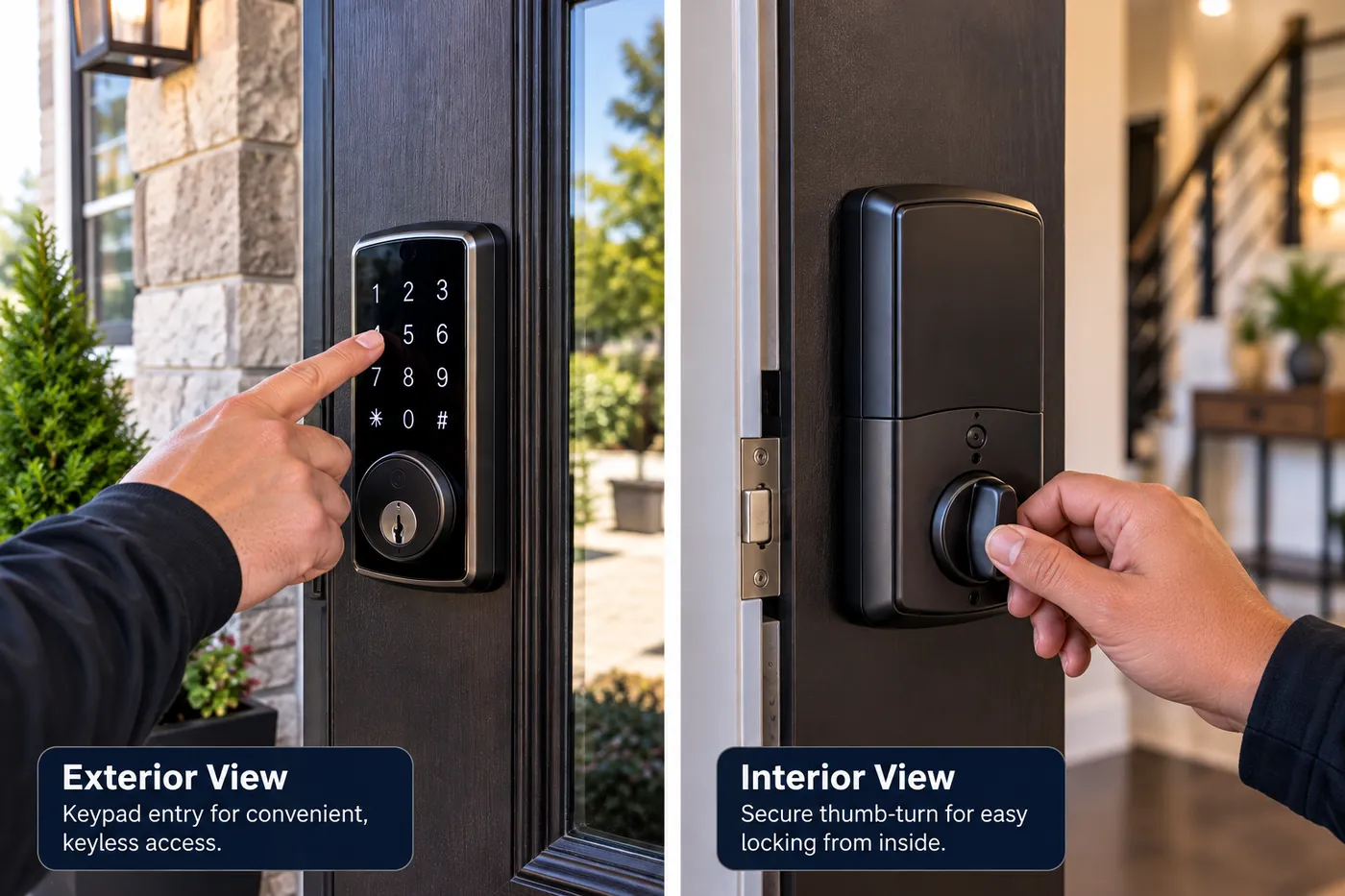
A keypad outside, a motorized bolt, and a standard key cylinder. Our default for prewar rental apartments and co-op units where management or the lease expects a key to exist. Auto-lock and an activity log come with most current models.
Replace only the inside thumb-turn of an existing single-cylinder deadbolt and leave the outside and the key unchanged. They suit limited-equity co-ops and rentals where nothing new should show in the hallway. They don't work on double-cylinder deadbolts, which shouldn't be on an apartment door anyway.
A fingerprint pad beside or below the keypad. Helpful on the hill streets where people arrive with full hands, and for older residents who struggle with small keys, provided the reader recognizes their fingers when we test it at the door.
Keypad and lever in one body for interior office suites, shop back rooms and clinic doors above Broadway. The lever passes the reach-and-grip test that a small knob fails.
A keypad or fob reader on the frame and an electric strike in the jamb, wired to a power supply and controller. Used on lobby doors, shop back doors and stair doors that must relock after every use.
Wi-Fi bridges and Thread border routers that give a lock remote access. In concrete co-op towers and deep prewar apartments, where the bridge goes matters as much as which lock you choose.
A camera viewer that replaces the peephole on an apartment door, or a video doorbell at a house entrance, so you can see who is at the door in the same app or on a nearby display before unlocking.
Wrap-around plates that cover old holes on a twice-drilled door, and long-screw strike kits that anchor the bolt into the frame. These help most against the kind of prying that reaches apartment doors.
Kingsbridge residents usually come to us after looking at one of three options. Here is how they compare on the things that matter in this neighborhood. It isn't a ranking of anyone's hardware.
| Question | Monitored-alarm package (ADT-style) | Retail DIY kit (Ring, SimpliSafe and similar ecosystems) | AESS, licensed local installer |
|---|---|---|---|
| Who checks your building's lock rules first? | Usually no one; the lock is part of a home package | You | We do, before quoting: lease, proprietary lease, NYCHA handbook or house rules |
| Does anyone look at the lobby door? | Not usually | No | Yes, every Kingsbridge walkthrough covers it |
| Steel-clad prewar door with old holes | Depends on the technician sent | Your drill, your template | Mapped, reinforced and bored with the right cutters |
| Keeps a mechanical key | Depends on the model | Depends on the model you buy | Always offered; required where the rules call for a key |
| Monthly fee | Usually part of a monitoring contract | Optional subscriptions vary | No monthly fee from us |

A note on method: Google's AI Overview could not be read from the environment this page was built in. The seven statements below are therefore the ones that turn up again and again on national cost guides, store listings and contractor marketplaces such as Angi, HomeAdvisor and Fixr, set against what Kingsbridge doors actually look like.
Two national price guides set the number most people arrive with. Fixr's, revised in January 2025, gives a range of $250 to $400 and an average close to $300; LawnStarter's average is $330. Both are describing a single lock going onto a single sound door, with the hardware picked out already.
A Kingsbridge job often has two doors in it. The apartment lock may be a simple retrofit or a bore through steel with a reinforcement plate. The lobby door may need nothing, a strike, or a full keypad entry. National averages cover the first case and not the second.
Our approach is to quote the apartment door flat after seeing it and to price lobby work from figures we have already published for the Bronx: $250–$450 for a new strike, $295–$485 for a strike repair and $1,500–$2,500 for a single-door keypad or fob reader with strike.
New York's Multiple Dwelling Law §51-c does give tenants of multiple dwellings the right to add a lock of their own, with a duplicate key to the landlord on request. Online summaries usually stop there.
The same law excludes buildings supervised by a municipal housing authority, which in Kingsbridge's corner of the map means Marble Hill Houses, where NYCHA's handbook sets the rules instead. And co-op shareholders at the Amalgamated or Park Reservoir aren't tenants in the ordinary sense. Their housing company's rules come first.
So the right first question is not “can I?” but “under which rulebook?” We answer that before recommending a lock, and we tell you what to ask management in writing if the answer isn't published.
It can make your apartment door harder to defeat and gives you a record of every entry. But security in a Kingsbridge apartment building starts at the entrance. The crowbar in the 2024 Corlear Avenue incidents went into a lobby door, and CB8's 2027 statement complains about main doors without working locks and buzzers.
A smart lock on a door with a weak frame or a strike held by short screws is no stronger than that frame. The motor drives a bolt, and the bolt is only as good as what it goes into.
So our walkthrough looks at the lobby door, the strike and frame of your door, and the lock, in that order. Sometimes the most useful thing we do on a visit is a long-screw strike kit and a closer adjustment, with the smart lock coming second.
Retail testers often report that a smart lock went in with little more than a screwdriver. That holds for a wood door with a standard bore where a deadbolt has been removed. Many Kingsbridge doors aren't like that.
Prewar apartment doors are commonly steel-clad, already drilled for a building lock low on the door, scarred by the plates of police locks and rim cylinders, and hung in frames painted many times over. Boring through steel without tearing the skin takes the right cutters and a template, and the new lock has to clear the existing trim.
If your door is a modern wood door with a single-cylinder deadbolt you own, a DIY install can be fine, and we will say so. If it isn't, the time goes into mapping old holes, fitting a reinforcement plate and setting the strike.
Many Wi-Fi locks reach the internet through a bridge plugged in nearby, and makers' own guidance is to keep it close; August, for example, says 10 to 15 feet from the lock. Matter-over-Thread locks need a Thread border router set up first.
In a deep prewar apartment, the router is often in a back bedroom or living room far from the entry hall. In the Amalgamated's concrete high-rises, walls and corridors can weaken the signal again. The app shows the lock as online at setup, then drops it a week later.
We measure signal at the door, place the bridge or border router where it is reliable, and lock and unlock from mobile data outside the building before we leave. If remote access can't be made reliable, we say so and choose a lock that is fully useful offline.
Auto-lock moves the bolt after a delay. If the door hasn't closed fully, the bolt either hits the frame and stops or locks a door that is still open. Neither is what you wanted.
The city requires self-closing doors in multiple dwellings, and HPD tells residents that apartment doors should close and latch by themselves. A door that drags, a closer set too weak, or a strike that has shifted defeats both the fire rule and the auto-lock feature at the same time.
So before auto-lock goes on we adjust the strike and check the closer so the door closes and latches from fully open. Where the lock supports a door sensor, we turn it on, so the lock knows whether the door is actually shut before it throws the bolt.
Advertising for keyless entry suggests the key ring can go. In New York City apartments it can't entirely. The Housing Maintenance Code requires owners to provide a key lock and at least one key, Multiple Dwelling Law §51-c expects a tenant-added lock to come with a duplicate key on request, and co-op proprietary leases commonly ask for one too.
Practical sense says the same. Batteries run down, phones break, and lobby doors in this neighborhood sometimes fail at night. A key cylinder on your smart lock is the backup that doesn't depend on any of those.
So we install keyed smart locks unless you have a specific reason not to, and we write down who holds each key before we leave.
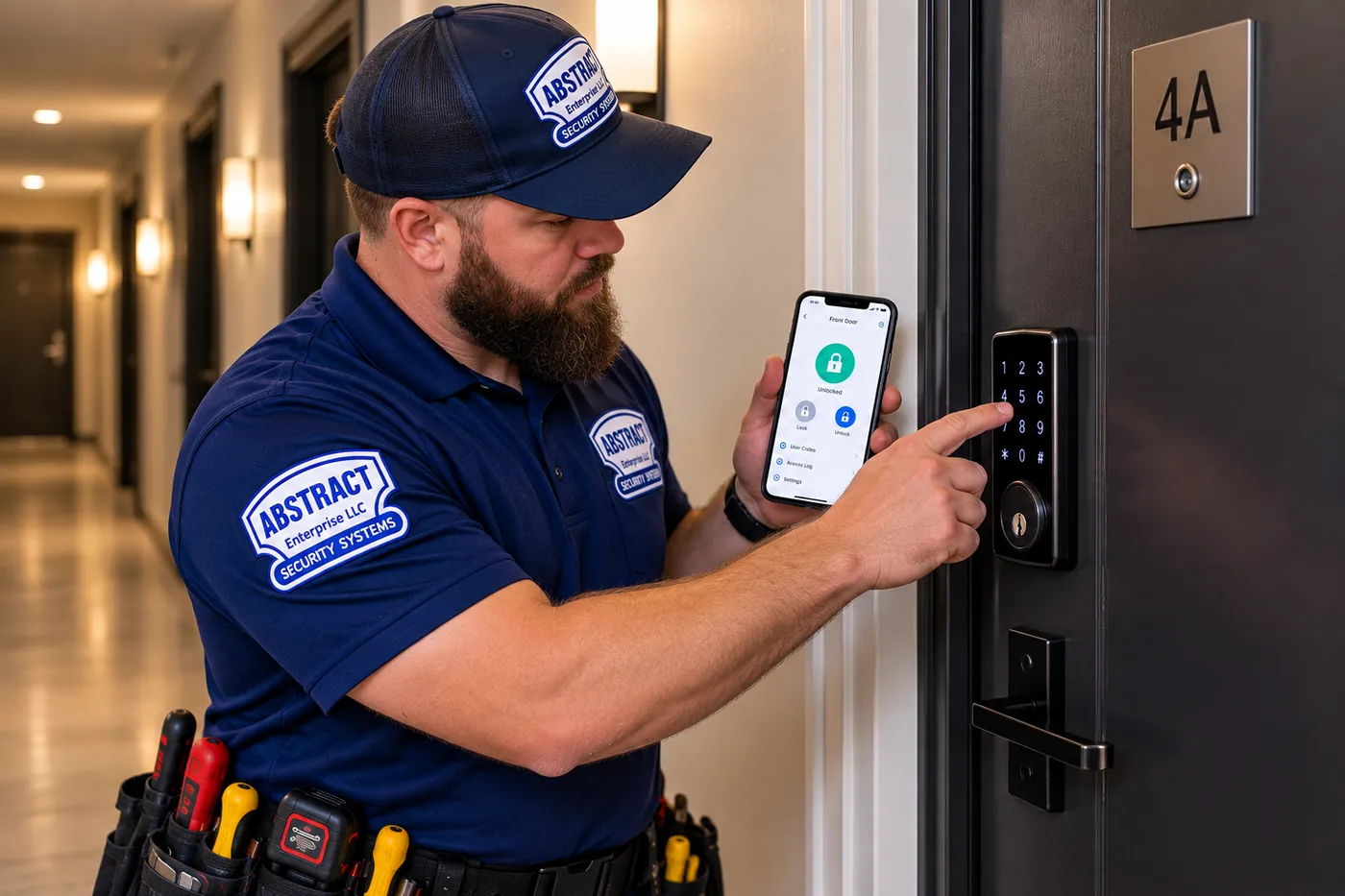
Tell us your street, your floor and whether the lobby door relocks. We will tell you which door to fix first, who has to approve it, and what each part costs.
A prewar rental off Kingsbridge Avenue, an Amalgamated apartment, a Marble Hill unit, a house on the hill or a shop on Broadway — tell us the building and both doors, and a written answer comes back the same business day. Prefer to talk? Call (646) 490-0629.
Thanks — a Bronx installer will phone you today, or on the next business day if it is already evening. If you are standing outside a locked door right now, ring (646) 490-0629 instead.
Six steps, whether the job is one apartment door on Tibbett Avenue, a retrofit in Van Cortlandt Village or a lobby entrance off Kingsbridge Terrace.

Six places that between them explain most of what this page says about doors in Kingsbridge: a fortress, a cooperative, a park, a station corner, a stair street and a piece of Manhattan on the Bronx side.
Opened in 1917, used by the military until 1994, a city landmark since 1974. The redevelopment plan approved by the City Council centers on its 180,000-square-foot column-free Drill Hall, expected to break ground in 2026, with about 500 affordable apartments planned next door by 2032.
Kingsbridge Heights access control →Organized in 1927 at 98 Van Cortlandt Park South by the Amalgamated Clothing Workers and grown from 303 apartments to 1,468 in 11 buildings, from Tudor-style clusters to two 20-story towers. The heart of Van Cortlandt Village, where co-op rules decide the door.
Kingsbridge intercoms →At 1,146 acres, New York City's third-largest park, running along Kingsbridge's northern edge. Apartment houses along Van Cortlandt Park South look over it, and many residents walk to it daily.
Kingsbridge Heights cameras →The elevated 1 train station, fully accessible, where the Kingsbridge BID's two arms meet. Shops at street level, apartments above, and street doors for both side by side.
Kingsbridge buzzer repair →Two blocks of steps, 187 in all, from Heath Avenue up past Kingsbridge Terrace to Sedgwick Avenue, the longest of the five stair streets on a Kingsbridge walking route that also takes in Naples Terrace, Godwin Terrace, West 230th and West 231st Streets. Front doors at the top of climbs like these shape where we put keypads.
Kingsbridge Heights alarms →Once part of Manhattan island and still part of the borough of Manhattan, now joined to the Bronx since Spuyten Duyvil Creek was filled in. Its NYCHA towers, Marble Hill Houses, are home to 3,222 residents according to Community Board 8.
Kingsbridge cameras →We also install smart locks in Kingsbridge Heights, Van Cortlandt Village, Marble Hill, Spuyten Duyvil, Riverdale, Fieldston, North Riverdale, Bedford Park, Norwood, University Heights, Fordham and the rest of the Bronx, plus Manhattan, Queens, Brooklyn, Staten Island, Long Island and the Hudson Valley.

Kingsbridge pays exactly what the rest of the Bronx pays, and the Bronx sits at the same 1.00 multiplier as our Brooklyn base. Each number in the table has already been published on our Bronx pages for the scope shown beside it; nothing here was made up for this page. An individual apartment or house door has no published AESS price, because the door decides the work. A retrofit on a deadbolt you already own and a new lock bored through steel with a reinforcement plate are different jobs. Those are quoted flat, in writing, after a free walkthrough, and the quote is the bill.
| Item | Kingsbridge price | Scope and source |
|---|---|---|
| Lock on the door you live behind (apartment, co-op unit or house), whether retrofit, keyed smart deadbolt or mortise-format | Quoted flat at free walkthrough | We have not published a fixed price for this. Steel thickness, earlier holes and the building's permission all change the work, so we price it standing at your door |
| Single-door keypad or fob reader with electric strike | $1,500–$2,500 installed | Our Bronx access-control single-door figure, for a lobby, street, shop back or office suite door; Bronx equals the Brooklyn base |
| New electric strike on a lobby door | $250–$450 | Published on our Bronx buzzer pages for swapping in a fresh strike when a building entrance is upgraded |
| Failed electric strike repair | $295–$485 | Published on our Bronx buzzer-repair pages for an entrance whose strike has stopped working, whether it won't release or won't catch |
| Setup-only visit (app, bridge, codes, no hardware change) | $225 first hour, then 30-minute blocks | Bronx rate for visits that only touch apps, bridges and codes |
| Service and callback rate | $195/hr, 3-hour minimum ($585) | Applies to later service calls, never to the original installation visit |
A few costs you may hear about belong to the building rather than to us. For Marble Hill Houses residents, NYCHA's resident handbook lists a $47.25 charge to the resident's account for a new NYCHA lock and keys after a daytime lockout drill-out, and a further $50 after hours. Limited-equity co-ops charge restoration and painting fees when apartments change hands, set by the housing company. We mention them so you can plan for the whole picture. None of them are on our invoice.
For a sense of scale only: third-party national averages run from about $300 (Fixr, range $250–$400) to $330 (LawnStarter, most jobs $200–$460). They describe one lock on one ordinary door somewhere in the country and are not our prices.
Full terms — including 50% deposit, one-year parts-only warranty on AESS-supplied products, and the late-fee schedule — are set out in the service agreement. Locks you buy yourself carry their manufacturer's warranty.
Put simply, a Kingsbridge job is your door, the building's door, or both. The building-door options below use figures already on our Bronx pages; your own door is priced once we have seen it, since no two prewar doors have been drilled the same way.
One of the inside of your door, one of the lobby door from the sidewalk. Send them with your street name and we will tell you what the walkthrough will cover and roughly what it involves.
Manhattan University, which took that name in 2024 after more than a century as Manhattan College, has been in Riverdale since the 1920s, on the hill just west of Kingsbridge. Many apartments within walking distance are shared: two friends splitting a one-bedroom, three students in a converted two-bedroom, a couple renting a room to a third person. Locks in these apartments tend to fail through people, not hardware: a spare key that walked off with a former roommate, a door code written on the fridge, an app account in the name of someone who moved to Ohio.
The person on the lease should own the lock and hold its admin account, with a second admin on a trusted phone. If the leaseholder moves out first, ownership transfers before they go. Roommates get their own user profiles, not the admin password. A lock bought and registered by whoever happened to have the credit card is the most common mess we untangle.
Separate codes cost nothing and solve most problems. When someone leaves, only their code goes. When the log shows an entry at 3 a.m., you know whose code it was. When a friend stays for a week, they get a guest code that expires on the day they leave. A single shared code turns every one of those situations into an argument.
The lock you add is yours, but in a private multiple dwelling the landlord may ask for a duplicate key under Multiple Dwelling Law §51-c, and the landlord's own lock stays in place. A keyed smart lock handles that without handing anyone a code. Roommates who aren't on the lease should know the lock doesn't change their status with the landlord. It only changes who can open the door.
Community Board 8 says one in five residents is 65 or older, and its budget requests include wheelchair-accessible buses for senior centers and grab bars for older public-housing residents. In Kingsbridge many of those residents live on upper floors of walk-ups and elevator buildings or in houses up a flight of stoop steps. That changes what a smart lock is for. It is less about convenience and more about letting the right people in without anyone hurrying to the door.
A home attendant gets a code that works only during scheduled hours, and the family gets a notification when it is used. A visiting nurse who comes once a week gets a separate code. A relative who checks in on weekends has a permanent code and, if they want it, the app. Every code has a name in the log, so no one has to wonder who came in.
The person who lives there should be able to work the lock with nothing but their hand. Inside, that means a large thumb-turn or lever that turns easily. Outside, it means a key they already know, a fingerprint if their fingers read reliably, or a short code they choose. We don't set up locks that only work through an app the resident has never opened. Adult children who manage things from elsewhere get admin access too, but not instead of the resident.
If someone falls behind a locked door, the people who need to get in fastest are usually a neighbor with a code or a relative with the app. We help families decide in advance who that is. A keyed cylinder also means a responder or a locksmith has a non-destructive way in. For buildings that have a super, a key in the building's key cabinet is often part of the plan, under the building's rules.
An aide who can open the apartment door still has to get through the lobby. If the building has a keypad or fob reader, the owner issues the credential. If not, a building key from management or a video intercom that lets someone buzz the aide in from a phone are the usual answers. We set up what is yours and give you the exact request to make for what isn't.
Most of the returns and regrets we see come from a lock bought before anyone looked at the door. Ten minutes with this list saves most of them.
Send us photos of the inside of your door and its edge before you buy, and we will tell you which types of lock will fit. That costs nothing and doesn't commit you to booking us.
When the owner of a small Kingsbridge rental building calls us, it is usually for one of two reasons: tenants are complaining about the front door, or the owner wants to stop handing out keys to the building. Both start in the same place. The entrance has to shut and lock by itself every time before any keyless system is worth buying.
We test the closer from fully open and from halfway, check that the latch reaches the strike, and look for wear, a sagging hinge, a strike plate that has moved, or a frame that has been pried. On a hill street the wind and the slope can work against a weak closer. Many entrances are fixed at this stage with an adjustment, a new strike at $250–$450, or a strike repair at $295–$485.
A keypad or fob reader with an electric strike at $1,500–$2,500 for a single door gives each tenant their own credential and lets you cancel one without re-keying the building. It also brings obligations. Under the city's Tenant Data Privacy Act you may not require tenants to use a smart access system to get into their own apartment, and you must limit and protect the data you collect. Fobs and codes avoid most of the privacy issues that come with biometric or facial-recognition entry.
Owners must provide each apartment with a key lock and at least one key. Tenants may add their own lock, with a duplicate key on request. Changing or disabling a tenant's lock without giving them a key is unlawful under the city's eviction rules, so we don't put owner-controlled smart locks on occupied apartment doors without the tenant's agreement. Between tenancies, a smart deadbolt on a vacant apartment door is the owner's choice, as long as the new tenant gets a key.
Buildings with eight or more apartments that fall under §50-a need an intercom with a door release from each apartment. A new keypad should work alongside the buzzer, not replace it. Visitors, deliveries and aides still need to be buzzed in. Our intercom repair team in the Bronx can fix the buzzer on the same visit if it has failed.
Kingsbridge isn't only apartment buildings. On the hillside blocks of Kingsbridge Heights, along Bailey Avenue and on the streets off the stair streets, there are attached and detached houses, Tudor Revival row houses and small multi-family buildings with owners living downstairs. Community Board 8 lists one-family and two-to-four-family houses among the district's main housing types. These owners control their own doors, which makes the job simpler and the planning more personal.
Usually a wood or fiberglass door at the top of the stoop, sometimes with a glass panel or a storm door in front. We fit a keyed smart deadbolt, check that the storm door clears the keypad, and put the keypad on the side an overhang protects. On a door that faces the street from a height, we turn on the keypad's scramble or anti-peep feature where the model has one, so someone watching from the sidewalk can't learn the code.
Many hillside houses have a second entrance a full story lower at the back or side, opening onto a yard, a garage or a basement. That door is usually less visible and less often checked. If it gets a smart lock too, both locks run in one app with the same codes, and the lower door gets auto-lock even if the front doesn't.
If you rent out a floor, the tenant's apartment door needs a key lock and a key. We can put a smart lock on it if the tenant wants one, with the tenant as its admin. The shared front door is where owners and tenants need to agree. Separate codes for each household, a key for each, and no one reading the other's entry log without agreeing to it first.
A new lock often comes with other door work: a lobby that needs a buzzer, a stoop that needs a camera, or a shop on Broadway opening a second location. These Kingsbridge and Bronx services often go on the same visit.
Fob readers, keypads and controllers for lobby doors, shop back doors and office suites.
New audio or video entry panels for the six-story buildings on the Heights side of Broadway.
Lobby releases and call buttons that have stopped working, fixed on a repair visit.
See who is on the stoop before you unlock, from upstairs or from work.
Detection for shops and mixed-use buildings, planned so locked doors still release when they must.
Data and low-voltage runs for shops and offices that want a wired reader or a better router position.
Power supplies, strikes, cameras and cable runs, all done by the same licensed crew.
Everything we install and repair, from cameras to cabling.
One request covering the lock and anything else on this list.
How our installers approach a Kingsbridge address — our standard routine, not an account of any one job
The check starts before the lobby. We stand on the sidewalk and watch the entrance for a minute. Does the door swing shut behind the person who just went in? Does it latch, or rest against the frame? Is there a wedge or a folded cardboard pad at the foot of it? On the hill streets we also note which way the wind hits the door, because a closer that works on a calm day can lose to a gust.
Inside, we look at the lobby side of the entrance: the strike, the screws holding it, any marks on the frame. Pry marks near the strike tell us the building has been tested before, and they change what we recommend upstairs. Then the stairs or the elevator, and the hallway: whose lock is on every door, whether the hardware matches from door to door, whether there is a fire-safety notice on the back of the apartment door.
At the apartment door we count holes, measure the backset, check the steel, and open the door to its widest and let go. If it doesn't close and latch by itself, that is the first fix. Only then do we stand in the doorway with a phone on mobile data and decide between a lock that works on Bluetooth alone, one with a bridge, or one on Thread.
Before we leave, the person who lives there locks and unlocks the door three ways, the key goes to whoever the rules say should have one, and the card inside the door records who holds what.
Often, yes. A digital viewer fits the existing peephole hole and shows the hallway on a small screen inside the door, and some models send a picture to your phone when someone knocks. The city requires a viewer on apartment entrance doors in multiple dwellings, so we only fit a replacement that still lets you see out, and we keep the original viewer if your lease or co-op asks for it back.
We park at the nearest street with curb access, usually at the top or bottom of the stairs, and carry the tools up by hand. A smart lock job needs a tool bag and a small case, not a van at the door. Tell us when you book if your entrance is only reachable by steps so we can allow the time.
Not in the way it covers your landlord. The Tenant Data Privacy Act sets rules for building owners who run smart access systems for tenants. A lock you buy and manage yourself keeps its codes and entry log in your own account with the lock maker, so read the maker's privacy terms before you choose, and give the landlord a key rather than app access unless you want them to see your log.
Usually, once the door is set up properly. A closer that slams the door can leave the bolt rubbing on the strike, and the motor then strains, beeps or stops part way. We adjust the closer's closing and latching speed and set the strike so the bolt slides in freely, then test the lock several times from a full swing before we leave.
We always offer a keyed model and recommend one in almost every case. Apartment rules in New York expect a key to exist, co-op leases commonly require a duplicate, and a key is the backup when batteries, phones or the building's entrance let you down. If you want a keyless model for a specific reason, we explain what you give up before you decide.
Most current keypad smart locks lock out the keypad for a short time after several wrong codes, and many send an alert to the app when that happens or when the lock is forced. We switch those features on, send the alerts to the phones you choose, and show you where the attempts appear in the activity log.
We look at it first. If it fits your door, keeps a key where your rules need one, opens from inside with one motion and has a working app with a way to remove users, we install it as labor only. If its app has poor reviews, can't remove a user, or the hardware won't suit a steel door, we tell you before anything is drilled so it can go back.
Locking by voice is harmless and handy. Unlocking by voice is different, because anyone who can be heard by the speaker, including through a door or an open window, could try it. Most voice assistants ask for a spoken PIN before they will unlock. We set that PIN, or turn voice unlocking off altogether, and leave voice locking on.
You are reading the Kingsbridge chapter of our smart lock service. One level up, the Bronx smart lock installation page deals with borough-wide questions such as NYCHA bottom locks, Co-op City move-outs, Parkchester key filing and two-family houses; above that, the NYC smart lock installation hub sets out the city and state rules every borough shares. Long Island and the Hudson Valley have hubs and county pages of their own, and the Bedford-Stuyvesant and Jackson Heights pages were written in the same batch as this one.
Abstract Enterprises smart lock installation, NYC · the Bronx · Manhattan smart locks · Brooklyn · smart lock installation in Queens · Staten Island
Kingsbridge, Bronx (this page) · Bedford-Stuyvesant, Brooklyn · Jackson Heights, Queens Earlier neighbourhood pages: Upper East Side, Manhattan · Brooklyn Heights, Brooklyn · Flushing, Queens. · Morris Park, Bronx
Smart lock installation in the Hudson Valley · Westchester · Rockland · Orange · Putnam · Dutchess · Ulster
Smart locks are one of several trades we cover in Kingsbridge. Our TV installation in Kingsbridge and the full service directory list the others. Our warranty terms and the story of our company are a click away, and everything else starts at the Abstract Enterprises Security Systems home page.
Dark keypad, a bolt that won't budge, a lock the app can't find, or a lobby door that refuses your key at midnight: call (646) 490-0629. We book the next open two-hour window from our Fordham Road office, and most battery, pairing and alignment faults are fixed in one to two hours once we reach the door. Try the mechanical key first; it is there for exactly this. At Marble Hill Houses, NYCHA will drill out a resident-installed lock on request but won't replace it, so a spare key with a relative saves both the lock and the charge.
Abstract Enterprises Security Systems · 460 E Fordham Rd, Bronx, NY 10458 · (646) 490-0629 · WhatsApp (718) 679-0359 via wa.me
Rated 4.7★ from 201 Google Reviews · Same-Day Estimates · 100% Licensed & Insured under NYS Low-Voltage License #12000287431
Full terms — including 50% deposit, one-year parts-only warranty on AESS-supplied products, and the late-fee schedule — are set out in the service agreement. See our warranty page.
Nothing on this page is legal advice. We quote laws and house rules so you can put the right question to your landlord or board; a lawyer can tell you how they apply to your own lease. Local facts come from the Norwood News, The Riverdale Press, Bronx Community Board 8, the NYU Furman Center, NYCEDC, the Kingsbridge BID and the Amalgamated Housing Corporation. Reviewed and updated October 17, 2026. Changelog: Kingsbridge smart lock page first published.