Driveway Side Doors · Upstairs-Tenant Entrances · Indian Village Tudors · Morris Park Avenue Shopfronts · Codes for Shift Workers & Carers
Morris Park is a neighborhood of houses, not towers. Most blocks between Bronxdale Avenue and Eastchester Road are lined with detached and semi-detached one- and two-family homes, and almost every one of them has two doors that matter: the front door on the street and a side door off the driveway that the family actually uses. Nearly two of every three homes here are rented, often the floor above or below the owner. We plan a smart lock around all of that: which door gets the keypad, who gets a code, which tenant still needs a key, and what the lock should tell you when nobody is home.
Morris Park visits dispatched from our Bronx office on East Fordham Road · Page by Anwar Timothy (NYS license #12000287431), reviewed and updated October 17, 2026

Two doors, three households and one set of keys nobody has counted in years? Call (646) 490-0629 or send the 60-second form with a photo of each door you are thinking about. Before anyone comes out, we tell you which door should carry the keypad, which lock should stay keyed, and who in the house will need what.

The typical Morris Park smart lock call is not about a lobby or an apartment corridor. It is about a house. The Department of City Planning, writing up the 2005 rezoning of the neighborhood, described it plainly: most of Morris Park is developed with single- and two-family detached homes and semi-detached housing, with small and medium-sized apartment buildings along Morris Park Avenue, which is the main commercial corridor, and along Williamsbridge Road. The rezoning itself locked that pattern in. Eleven full blocks and parts of nineteen more north and south of Morris Park Avenue went to R4A, a district that allows only detached one- and two-family houses with walls no higher than 21 feet, in keeping with what the planners called the area’s two-story homes with attics beneath pitched roofs. A smaller pocket between Bronxdale and Radcliff avenues went to R4-1, which also allows semi-detached houses.
Houses mean more doors per household than an apartment ever has. A Morris Park two-family on a 25-foot lot usually has a front door on the stoop, a separate entrance or inner door for the second unit, a side door off a narrow driveway that leads to the kitchen or the basement stairs, sometimes a rear door to the yard, and a garage at the back. Each of those doors has its own history of locks, and in a neighborhood where many houses have been in the same family for decades, its own unknown number of copied keys. When someone asks us for “a smart lock,” the first job is deciding which door it belongs on. In most of the houses we see here, the answer is the side door, because that is the door the family uses every day and the one a stranger can work at without being seen from the street.
That is not a theoretical worry. In March 2025, News 12 reported that two women broke into a single-family home in Morris Park near Loreto Playground on a Tuesday afternoon, about six minutes after the homeowner’s mother left to pick his daughter up from school. Video from the house shows them knocking twice to check that no one was home, pushing the security camera up so it could not see, and prying open the side door. A safe holding passports and other documents was taken, along with family heirlooms. The NYPD offered a reward of up to $3,500. The same report noted that the 49th Precinct, which covers Morris Park from its station house at 2121 Eastchester Road, had recorded 13 burglaries that year to that date, down from 17 a year earlier. Burglary is not common here, and residents still describe the neighborhood as safe. But when it does happen, it tends to happen at the door nobody watches.
The second thing that shapes a lock job in Morris Park is who lives behind the door. At the 2020 census the neighborhood, counted by the city as tabulation area BX1102, had 25,077 residents in 9,173 households, and 65.8 percent of its occupied homes were rented. In a district of houses, that figure describes something specific: owners living on one floor and renting the other, adult children renting from parents, and whole two-families let to two separate households. Each arrangement changes who should hold the administrator account, who must keep a mechanical key, and what the owner is and is not allowed to do with a tenant’s door. New York’s Multiple Dwelling Law treats a building occupied by three or more families as a multiple dwelling and a building for no more than two families as a private dwelling, so several rules written for apartment buildings simply do not reach a Morris Park two-family, while others, including the state’s ban on locking out an occupant, reach every home.
Then there is the hospital district on the neighborhood’s eastern edge. The Albert Einstein College of Medicine’s Jack and Pearl Resnick Campus sits at 1300 Morris Park Avenue, NYC Health + Hospitals/Jacobi at 1400 Pelham Parkway South, Montefiore’s Jack D. Weiler Hospital at 1825 Eastchester Road and Calvary Hospital at 1740 Eastchester Road. Jacobi alone runs the Bronx’s only burn unit and its Level I adult trauma center. A large share of the people who rent rooms and apartments in Morris Park work shifts in those buildings, and a large share of the families who own homes here care for older parents at home. Both groups ask for the same thing in different words: a door that lets the right person in at four in the morning without anyone getting out of bed to find a key.
Most Morris Park owners who put a smart lock on the side door end up wanting to see that door too. Our security camera installation in Morris Park covers driveways and side yards, and the Abstract Enterprises alarm installers in Morris Park can put a contact on the same door so a forced opening is reported even when the lock is not touched.

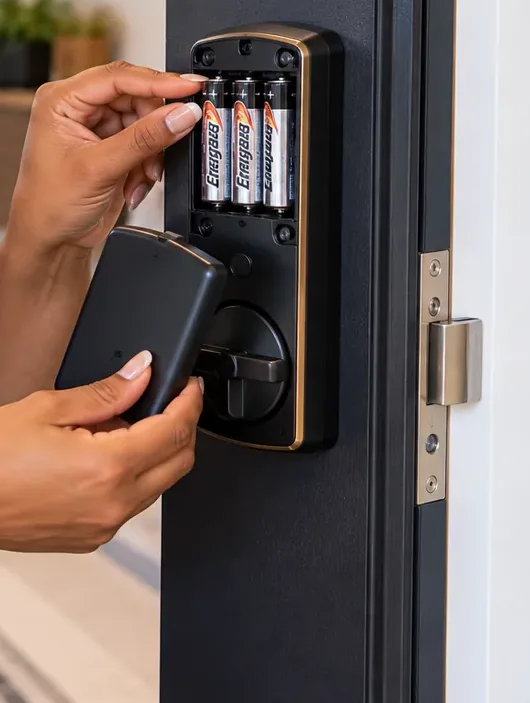
A keypad that went dark over a long weekend, a bolt that grinds because a wood door swelled against its strike, a lock that dropped off the app when the internet provider swapped the router, or a tenant upstairs whose code stopped working the morning of an early shift — those are service calls, and we book them as such. Call (646) 490-0629 and say it is a smart lock repair in Morris Park. We take the next open two-hour window, and most battery, pairing and alignment faults are put right in one to two hours once a technician is standing at the door. If the trouble is the street door of a small building rather than your own lock, our published Bronx figure for a failed electric strike repair is $295–$485, and the door buzzer repair page for Morris Park covers that work.
Nine kinds of work cover almost every Morris Park keyless job we are asked about, and most visits combine two or three of them. Every one ends the same way: the door closes and latches without a shove, the inside opens with one simple turn and no key, every person who is owed a key still has one, and each code, fingerprint and phone has been tried in front of you before we leave.
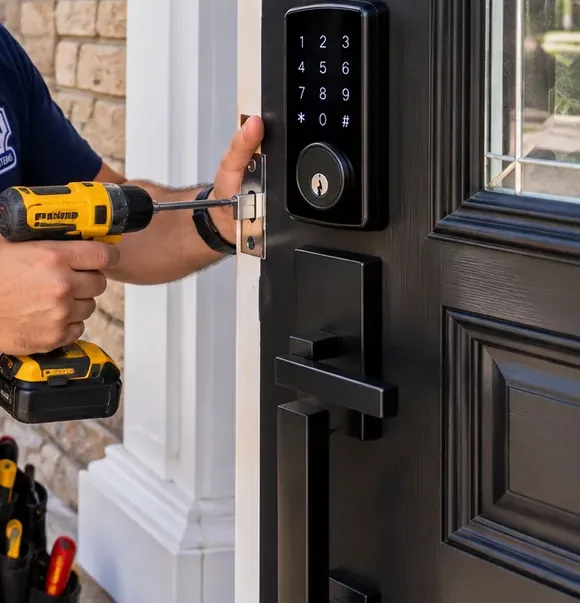
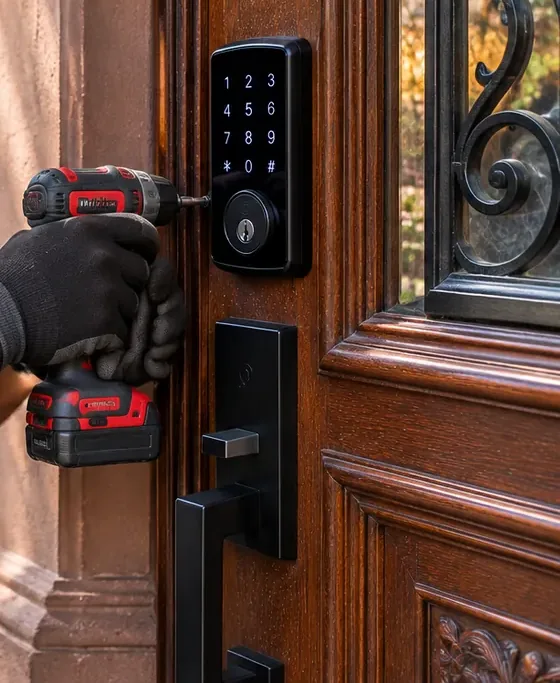
The door most families here actually use. A keypad deadbolt on the side door off the driveway, with door-position sensing where the model supports it, so the app reports an open or forced door as well as a locked one.
A keyed smart deadbolt above the existing handleset on the stoop door, chosen to match the hardware finish and the door’s backset, so the street side of the house still looks like it always has.
The owner’s door, the tenant’s door and the shared hall or side entrance, each on its own credentials. The tenant keeps a key lock and a key; the owner never sees the tenant’s log unless the tenant chooses to share it.
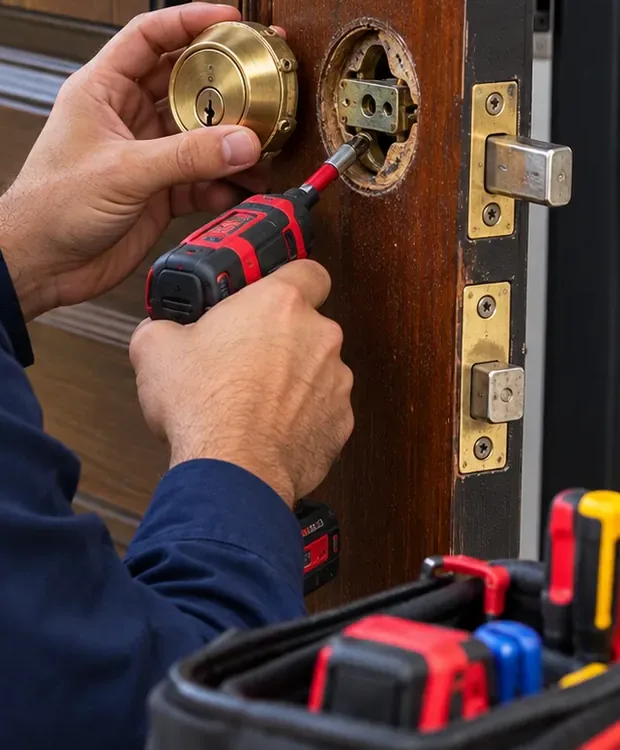
Where a good single-cylinder deadbolt is already on the door, a retrofit unit replaces only the inside thumb-turn. The outside cylinder and every existing key keep working, which suits renters and anyone who wants nothing changed on the street side.
Separate, named codes for home aides, visiting nurses, the cleaner and the dog walker, scheduled by day and hour where the lock supports it, and switched off the day the service ends — not handed around on a key ring.
Brick party walls, plaster and a router in the finished basement can leave a front-door lock out of reach. We test at the door before choosing Bluetooth, a Wi-Fi bridge or a Matter-over-Thread lock, and place any bridge indoors where it holds a signal.
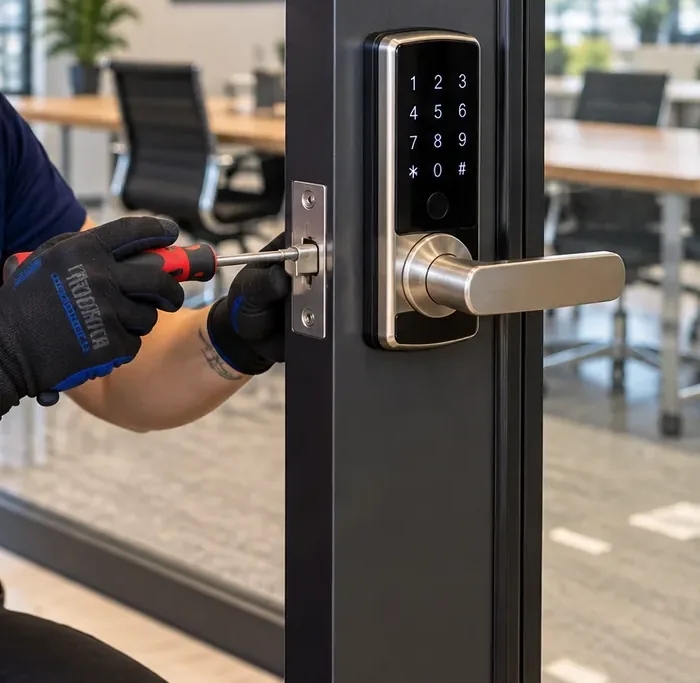
Keypad levers and deadbolts for bakeries, restaurants, salons and offices on the avenue, with a code per employee and an entry log the owner can read from home; keypads with electric strikes where a door needs to buzz open.
Keypad or fob entry for practices along Eastchester Road and Waters Place, with separate codes for staff, cleaners and after-hours vendors, and a release that never traps anyone inside.
Dead keypads, motors that strain against a swollen door, locks that lost the app after a router change, and codes that will not sync to a family member’s phone.

Morris Park was built in layers. City Planning dates the start of house building to the turn of the twentieth century and says it sped up after a streetcar line opened along Morris Park Avenue in 1910, the same year a fire swept the old racetrack whose grounds were then cut into lots. Building went on well after the Second World War. Each layer left a different kind of front door, and each takes a smart lock differently.
The grid itself is a reminder of how old some of these lots are. Several Morris Park streets, including Cruger, Holland, Radcliff, Colden, Paulding and Hone avenues, are named after New York City mayors of the eighteenth and nineteenth centuries, and the neighborhood takes its name from the Morris Park Racecourse, which hosted both the Preakness and the Belmont Stakes in 1890. A house on one of those blocks may have had its front door replaced twice and its side door never; we often find a 1950s lock on the door the family uses most.
The house on most R4A blocks: two stories plus an attic under a pitched roof, one unit per floor, a stoop at the front and a driveway down one side. Usually three entry doors and a basement door, and the most to gain from deciding which door gets the keypad before buying anything.
Two houses sharing one party wall, with front doors often a few feet apart. Keypads face the same walk, so we choose positions and backlight settings with the neighbor’s door in mind, and keep each house’s lock on its own app account and Wi-Fi.
North of Morris Park Avenue near Jacobi, on streets named Choctaw Place, Narragansett Avenue, Seminole Avenue and Pawnee Place, detached brick Tudor-style houses from around 1940 carry heavy wood doors, often with a small glazed opening. Hardware choice here is as much about looks as fit.
Two-story frame houses with two separate units and a full basement, some on 25-by-95-foot lots. Wood frames that have taken several generations of locks need the strike area checked for softness and old screw holes before a motorized bolt goes in.
The small and medium apartment buildings along Morris Park Avenue and Williamsbridge Road. With three or more families they are multiple dwellings, so tenant lock rights, the Tenant Data Privacy Act and the building’s street door all come into play.
Ground-floor stores on Morris Park Avenue with apartments above. The shop door, the stair door to the apartments and the rear door each have a different keyholder, and none of their codes should open another.
The 2024 rezoning around the planned Morris Park Metro-North station on the east side allows larger apartment buildings. New construction usually arrives with its own access system; unit-door locks have to fit what the developer installed.
Owners renovating a two-family often fold the lock into a bigger job. Our access control installation for Morris Park buildings handles shared street doors and vestibules, and the Morris Park intercom team can give an upstairs tenant a way to see and let in a visitor without walking down to the front door.

Walk any residential block between Haight Avenue and Williamsbridge Road and count the side doors. On a detached or semi-detached house the driveway runs along one side of the lot to a garage at the back, and somewhere along it there is a door: into the kitchen, into a back hall, or down a few steps to the basement. In most families that door is used ten times for every time someone climbs the stoop. It is also the door with the least light, the least foot traffic past it and, too often, the oldest lock on the house.
The March 2025 break-in near Loreto Playground showed the pattern clearly. The people who entered did not touch the front door. They knocked to see whether anyone would answer, dealt with the camera, and worked on the side door, all within a few minutes of the house emptying for the school pick-up. Nothing on this page claims that a different lock would have stopped them. What a well-installed smart lock does change is what the owner knows and when. A lock with door-position sensing reports that the door is open while the bolt is still thrown, which is exactly the signature of a door pried away from its frame. A lock that logs every operation records whether anyone used a code, a key or the app, and when. And a keypad lock that auto-locks takes away the most common side-door failure of all, which is the door simply left unlocked after someone ran out to the car.
So on most Morris Park houses we plan the side door first and the front door second. For the side door that means a keypad deadbolt rated for exterior use, set to lock itself a short time after it closes, with sensing that confirms the door is actually shut rather than just bolted in the air. It means reinforcing the strike with longer screws into the framing, because a lock is only as strong as the wood it bolts into. It means placing any bridge or hub indoors, out of reach and on a circuit nobody is likely to switch off. And it means connecting the lock to the camera or alarm that already watches the driveway, so a forced-door alert and a video clip arrive together rather than in two different apps an hour apart.
The front door usually gets something quieter: a keyed smart deadbolt that matches the handleset, or a retrofit that changes nothing on the street side at all. Families who host on Sundays, or whose relatives come and go, often keep the front door on a physical key and the side door on codes. There is no single right answer. The point of the walkthrough is to match each door to how your household really comes and goes.
Morris Park’s businesses sit in two clusters: the shops and restaurants of Morris Park Avenue, and the medical offices that have grown up around the hospitals on its eastern edge. Both want the same things from a door — a code per person instead of a key per person, a record of who opened up, and a way out that never depends on a code — but the doors themselves are very different.
The Morris Park Business Improvement District covers properties on Morris Park Avenue between Unionport Road and Amethyst Street to the west and Williamsbridge Road to the east, with its office at 966 Morris Park Avenue. Storefront doors, rear service doors and stair doors to the apartments above.
The neighborhood’s north-south spine, home to the Morris Park Station post office at 1807 Williamsbridge Road and FDNY Squad 61 at 1518. Small apartment buildings, professional offices and shops, many with a residential entrance beside the commercial one.
Private practices, labs and clinics near Calvary Hospital at 1740 Eastchester Road and Montefiore’s Weiler hospital at 1825. Suite doors that need staff codes, after-hours cleaners and a records room locked separately from the waiting room.
The office campus at Waters Place, where the 280,000-square-foot Tower Two at 1250 Waters Place is leased to Montefiore for medical offices and 1200 Waters Place houses tenants including the Bronx Chamber of Commerce. Suite-level locks inside a building that runs its own lobby access.
Parish halls, schools and meeting rooms whose side doors are used by different groups on different nights. One lock, several schedules, and a log that shows which group last locked up.
The east side of the neighborhood, where the state’s May 2026 Downtown Revitalization Initiative award includes $2.75 million for a public plaza linking the planned Morris Park station entrance to the Hutchinson Metro Center campus and Marconi Street.
Owners who want a whole building on one system, rather than a smart lock door by door, should look at our access control installation in the Bronx; it covers controllers, readers and wiring for several doors at once.

These are the questions Morris Park owners, tenants and shopkeepers actually bring to a walkthrough, grouped by what they are really about. Questions about price, booking and brands are in the FAQ further down.
Potentially quite a lot, depending on the model. A lock with door-position sensing knows the difference between a door that is closed and bolted and a door that is open while the bolt is still extended. When a door is forced away from its frame, the second state appears without any code, key or app unlock being logged first, and many locks can push that as an alert. Some keypad models also sound a built-in alarm when they detect tampering or repeated failed entries.
What it cannot do is stop a determined pry bar on its own. That depends on the strike, the screws behind it and the frame, which is why we fit long screws into the framing on every side door we do. The useful combination is a lock that reports, a camera the burglar has to deal with first, and an alarm contact that does not care whether the lock was touched. Any one of the three can be defeated; all three together tell you, within seconds, that something is wrong.
The Builders Hardware Manufacturers Association grades residential locks in three categories: security, durability and finish. Under its residential scheme a grade of C is good, B better and A best, so AAA means the top grade in all three. The standard for residential deadbolts, A156.40, covers the force needed to turn the bolt, how many open-and-close cycles the hardware survives, a set of seventeen security tests including loading the door against the bolt with 1,350 pounds of force, and a salt-spray test of the finish.
Older packaging still uses the ANSI Grade 1, 2 and 3 language, which was written for commercial hardware. Either way, read the security letter first. For a Morris Park side door off a driveway, a lock with a top security grade fitted to a reinforced strike is worth more than a fashionable finish. For an interior home-office door, a lower-graded keypad lever is perfectly reasonable.
The August 2024 rezoning around the planned Metro-North stations allows larger buildings on some blocks of Morris Park, Van Nest and Parkchester, and the MTA has scheduled station work along Sackett Avenue. A building site next door changes a house’s exposure for months: scaffolding and sidewalk sheds can screen a side door from the street, fences open up rear yards, and a lot of unfamiliar people pass the driveway every day.
For the length of the work, we suggest auto-lock on every exterior door, door-position alerts on the side and rear doors, and a camera covering the driveway. Do not hand a code to anyone working next door, however friendly; if they need to reach your yard or meter, open the door for them yourself or issue a one-time code and watch the log. And if a door that used to close cleanly starts to bind, call us before the motor wears itself out against it.
Put it in writing, briefly. The lease should name which doors the tenant uses and which lock is on each, confirm that the tenant receives a working key to their own entrance as well as any code, and say who holds the administrator account. Ideally the tenant administers their own unit door and the owner administers only shared doors, such as a side entrance or the basement.
It should also cover the log: whether the owner can see entries on doors the tenant uses, and that the owner will not use that record to track the tenant. Add who changes the batteries and who pays for a lockout call, and that all of the tenant’s codes, fingerprints and app access are deleted at move-out. Finally, do not let the lease suggest the owner can shut the tenant out by deleting a code. Under New York’s Real Property Actions and Proceedings Law section 768, changing an occupant’s lock without supplying a key is unlawful once they have lived there thirty days or signed a lease. Your lawyer should review the wording.
Where the lock allows it, one code per regular visitor and a separate code for the agency’s night or on-call staff. Named codes give you a record of who came and when, which is useful for the family and for the agency. A single shared agency code is easier to manage when staff rotate, but you lose the who, and the code tends to spread.
A practical pattern we set up for Morris Park families caring for a parent at home: named, scheduled codes for the regular daytime aide; one agency code limited to the hours the agency covers; a family administrator on two phones who can issue a one-time code from anywhere; and a key kept with a trusted neighbor. When the service ends, every code linked to it is deleted the same day. We write the list on a card kept inside the door, without the codes themselves.
This comes up often in a neighborhood where houses stay in one family for decades. Keys to the house are usually spread among siblings, cousins, neighbors and former tenants, and once a parent has died, appraisers, cleaners, contractors and real estate agents all need access on different days. A keypad lock on the door that is used most lets the executor give each of them a code that works only on the day it is needed, and see from the log when each one came and went.
Practically: re-key or replace the other exterior locks so the old keys stop working, put the administrator account in the executor’s name rather than on a relative’s phone, keep one mechanical key with the executor, and delete every temporary code as soon as its visit is done. When the house sells, reset the lock or take it with you, and hand the buyer the keys and a fresh code. If family members disagree about access, that is a matter for the estate’s lawyer, not the lock.
Usually where the existing deadbolt is, with care. Tudor-style doors on the Indian Village streets near Jacobi are often thicker than modern doors and have a small glazed opening near eye level. First we check the door’s thickness against the lock’s listed range and whether an extension kit is available. Then we check the distance from the glazing to the bolt, because a thumb-turn that can be reached through a broken pane defeats the lock.
If the original hardware is part of the house’s character, a retrofit that changes only the inside thumb-turn keeps the outside exactly as it is. If a keypad would look wrong on the arched door, many owners put the keypad lock on the side door and keep the front door on a key. We bring finish samples and photographs of comparable doors so you can decide on looks before anything is cut.
It has happened in the smart-home world. In April 2022 Insteon shut down its cloud servers without warning when its parent company failed, and owners lost app control overnight until a new owner brought the service back that June. A lock is less exposed than a light switch, because a keypad and a key work locally, but remote unlocking, alerts, guest scheduling and the log depend on the maker’s cloud.
We reduce the risk in three ways. We favor makers with long histories in locks, not only in apps. Where it suits the house, we choose locks that support Matter, an industry standard that lets a lock work with more than one ecosystem and with local control. And every lock we fit keeps a mechanical key or another non-cloud way in, so a dead app never means a locked-out family.
The lock’s app does, and for most homes automatic updates are the right setting. Firmware updates fix security problems and compatibility issues as phones and routers change. A lock that has not been updated in years is more likely to be the one that will not pair with a new phone or a replacement router.
At handover we confirm the lock is on current firmware, show the account owner where update notices appear, and leave automatic updates on unless you have a reason to manage them yourself. Two cautions: let an update finish before you change batteries, and expect a lock to be briefly unresponsive while it installs one. If an update ever leaves a lock misbehaving, that is a service call, not something to fix by resetting it to factory settings, which wipes every code.
Cloud-connected locks store their activity on the maker’s servers. Yale’s privacy notice, for example, says lock activity is stored alongside your account information for as long as the account is active, and that deletion requests may be refused where the law requires the data to be kept. Like any company, a lock maker may be compelled to disclose data by legal process. The Electronic Frontier Foundation has argued since 2023 that police should need a warrant for smart lock data and that tenants should be told.
If that concerns you, there are choices. Read the maker’s privacy notice before buying. Keep the log shorter where the app allows it. Use a lock that works locally over Bluetooth, Z-Wave or Thread through a hub you control rather than through a vendor cloud. And for a tenant’s door, remember that the person whose movements are logged is the tenant; the lease should say who sees that record.
Safer than leaving a key under the mat, but treat the message as if it were the key. Send codes only to the person who needs them, never in a group chat, and make them temporary: most apps can issue a code that works only on certain days or between certain hours, or only once. Delete the message after it is used if you can.
Better still, use the app’s own invitation feature where it exists, which gives the person access tied to their phone and can be withdrawn with one tap, and leaves a named entry in the log. Never send the master or administrator code. And if a code has been passed around more widely than you meant, change it; that takes a minute in the app and costs nothing.
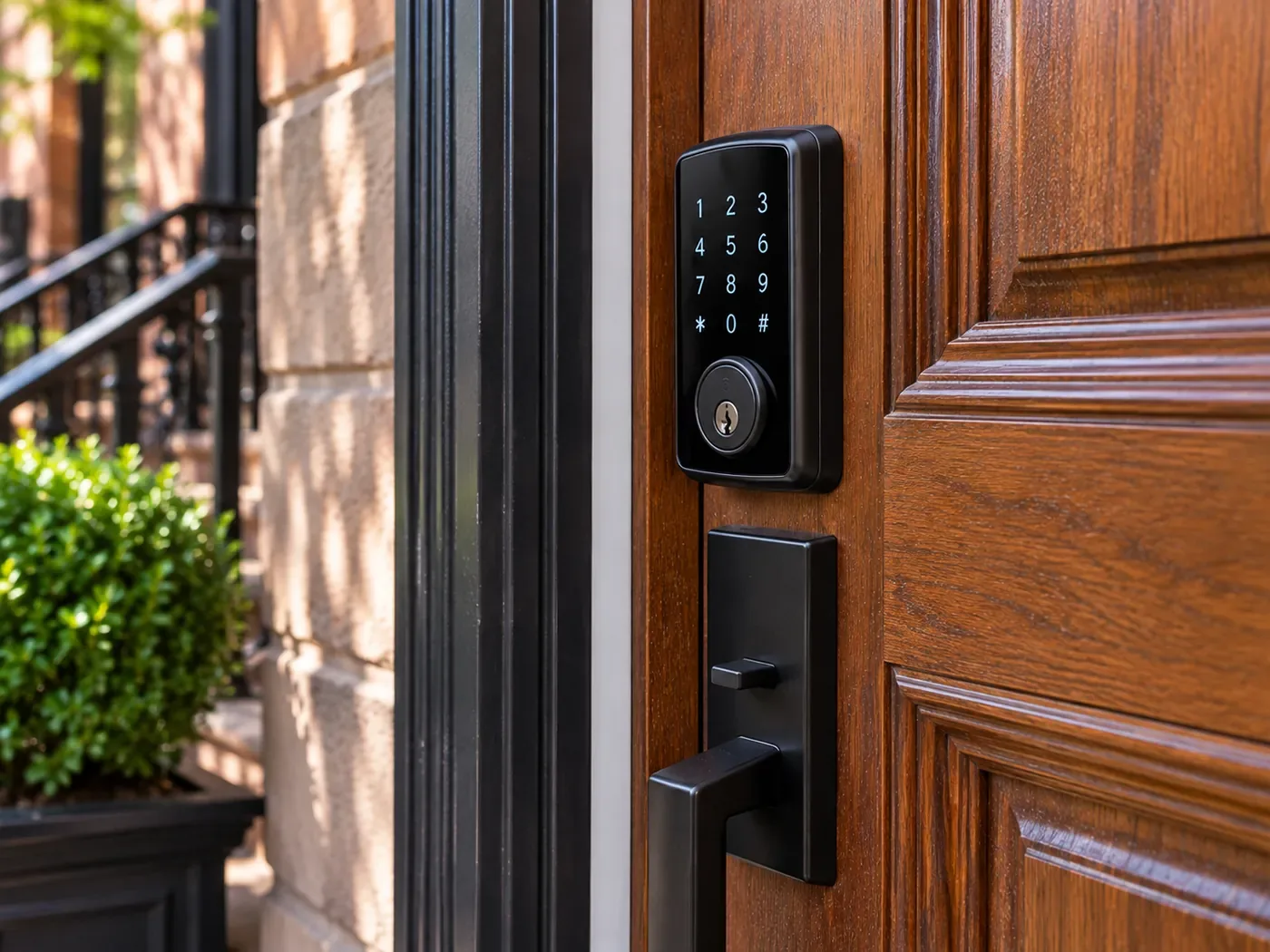
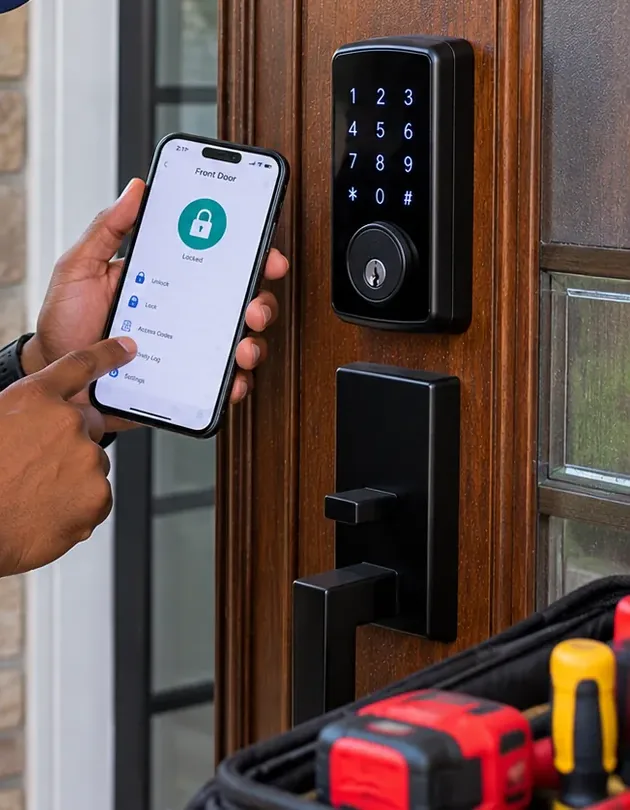
We are not tied to one brand. We fit the lock that suits the door, the household and the network, and we tell you when the lock you already bought is the wrong one before it comes out of the box.
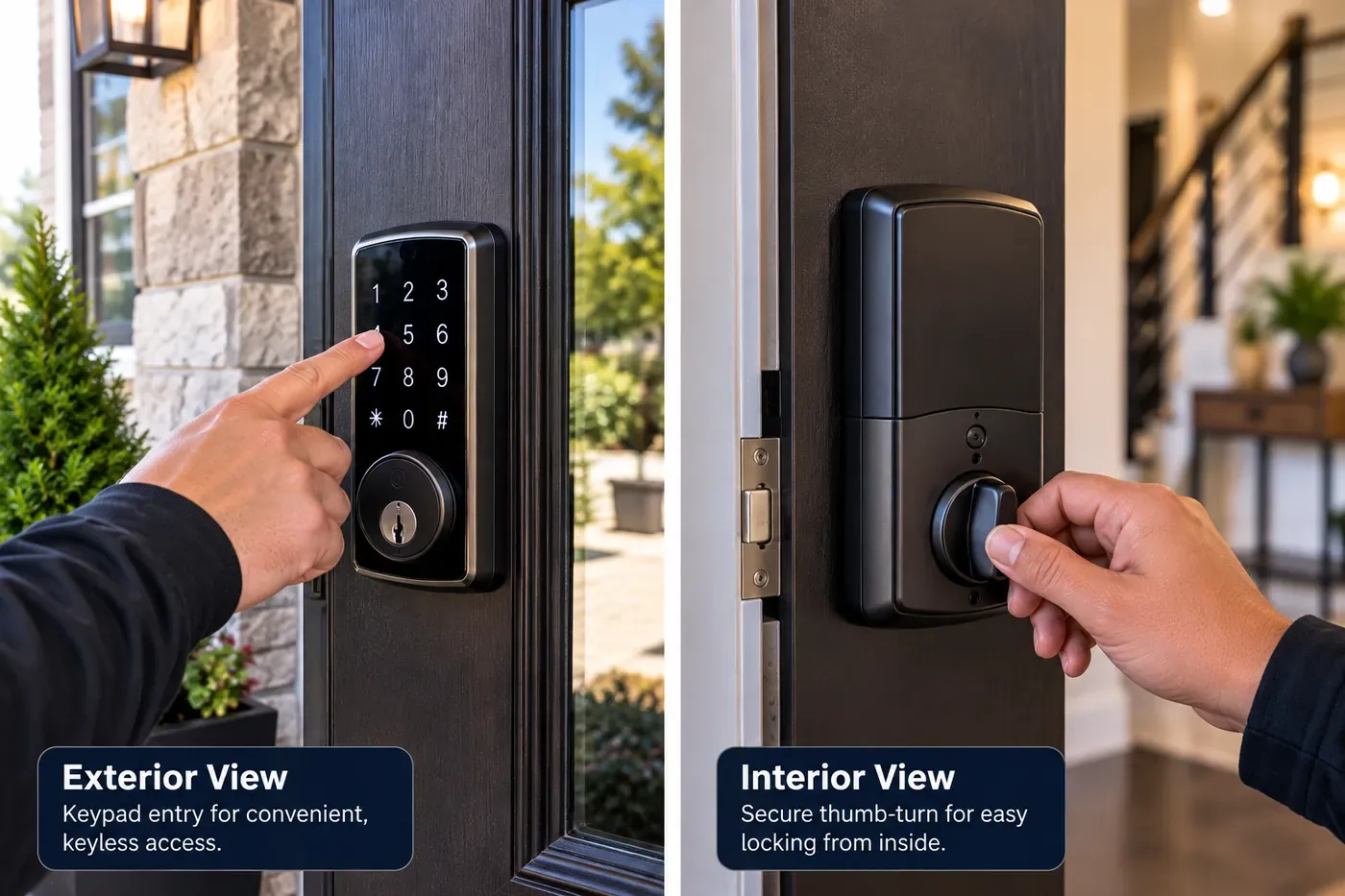
The everyday choice for Morris Park side and front doors: a touch or push-button keypad outside, a thumb-turn inside, a key cylinder for emergencies, and an app for codes and the log. Battery powered, so no wiring through the door.
Locks that talk to the router directly or through a bridge and report whether the door is open or closed, not just whether the bolt is thrown. The best fit for a side door you want to hear about.
Replace only the inside of an existing single-cylinder deadbolt. The outside, and every key, stays the same; useful for renters and for front doors whose look you want to keep.
A fingerprint reader with a keypad backup, for households where someone keeps forgetting codes. We enroll two fingers per person and test them at the door.
A keypad and lever in one unit for interior doors, home offices, basement apartments and shop back rooms. Lower security grades are common; we match the grade to the door.
Locks built to the Matter standard that can work with Apple Home, Google Home or Amazon Alexa through a Thread border router, with local control that does not depend on one maker’s cloud.
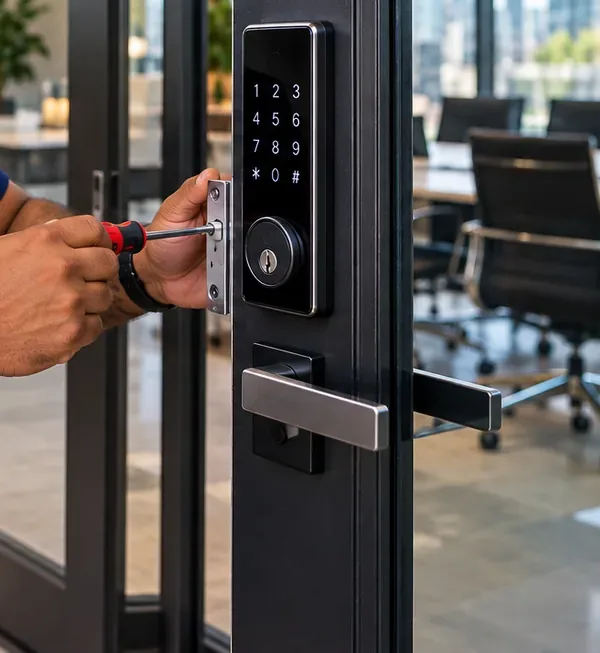
Wired keypads or fob readers with an electric strike for building street doors, shop doors and office suites that need to buzz open, with an exit release inside.
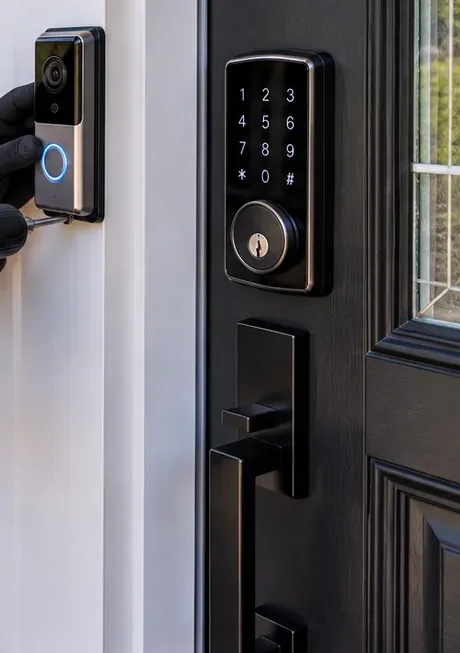
A doorbell camera beside the lock so you can see who is at the door and unlock from the same screen, and so a door event and a clip arrive together.
| Buying inside one brand’s ecosystem | Lock chosen for your door by a local installer | |
|---|---|---|
| Starting point | The app you already use for an alarm or a doorbell | The door: backset, thickness, glass, swing and who uses it |
| Fit check | Usually yours to do from a spec sheet | Measured at the walkthrough before you buy |
| Codes and tenants | Set up by the account holder | Planned per person at handover, tenant keys accounted for |
| Strike and frame | Lock box screws | Strike reinforced into framing on exterior doors |
| Price | Varies by brand and plan | Flat written quote; building doors at published Bronx prices |
If your house already runs on ADT, Ring or SimpliSafe, tell us at the walkthrough. We check whether the lock you want can join that app before you buy it, and if it cannot, we say so.
Search summaries, cost sites such as Angi, HomeAdvisor and Fixr, and product listings repeat a handful of claims about smart locks. We could not open Google’s AI Overview from our build environment, so the claims below are the ones those published sources make, checked against what we find on Morris Park doors.
The claim assumes a standard door. Lock makers do design around a common bore and backset, and on a modern pre-drilled door most models drop in. The trouble is that few Morris Park front doors are modern. A two-family built between the wars has usually had several locks in its life, and the bore that is there now may be oversized, off-center or patched.
Door thickness is the next surprise. Heavy wood entry doors on older houses, including many of the Tudor-style houses in Indian Village, can be thicker than a lock’s listed range, and some side doors are thinner. Storm doors, iron gates and glass near the lock all narrow the choice further.
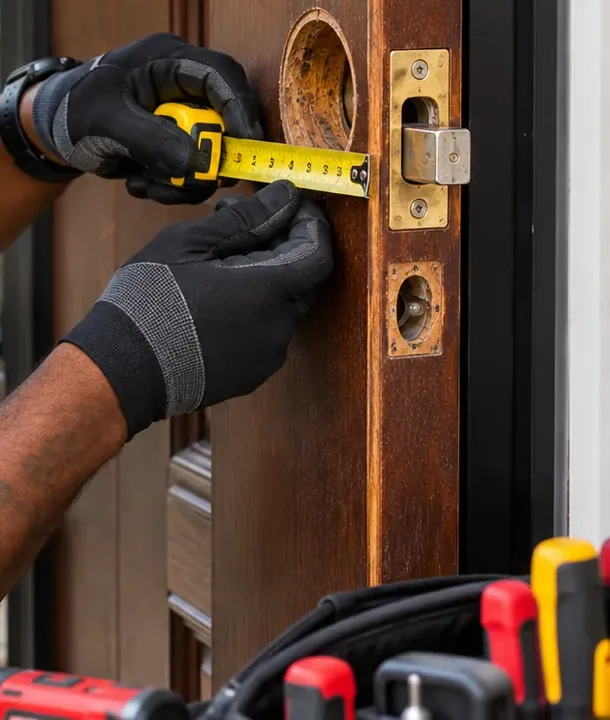
That is why we measure before you buy. Five minutes with a tape measure at the walkthrough saves a return, a second trip and, sometimes, a door that has been drilled for the wrong lock.
Smart locks are graded under the same residential standard as mechanical deadbolts. BHMA’s A156.40 tests security, durability and finish, and several smart deadbolts carry the top grade in all three. A smart lock can be every bit as strong as the brass deadbolt it replaces, and stronger than many.
Where smart locks are weaker is in the things a mechanical lock never had: a cloud account, a phone, a code someone shared. Those are real risks, and they are managed with a strong account password, two-step sign-in, named codes and prompt deletion when someone leaves.
And on any lock, the strike plate and the screws holding it decide how hard the door is to force. A top-graded lock on a strike held by short screws in an old frame is still a weak door.
The number comes from cost guides. Fixr’s January 2025 update gives a $250–$400 range nationally, averaging $300 for a Wi-Fi lock with one accessory, with handymen at $50–$100 an hour. As a sense check for a single pre-drilled door, that is fair enough.
They are not AESS prices, and they leave out the work Morris Park doors often need: reinforcing a side-door strike, re-bushing an oversized bore, fitting around a storm door, or setting up separate codes and keys for an owner and a tenant. Building street doors are a different job entirely.
Our published Bronx figures for building doors are on this page, and house and unit doors are quoted flat after a free walkthrough. The written quote is the bill.
Partly true. A keypad, a fingerprint reader and a key work locally on most locks, so the door still opens. What stops are the cloud features: remote unlock, notifications, schedules and the activity log.
The smart-home industry has already seen it happen. Insteon’s servers went dark in April 2022 when its parent company failed, and users lost app control overnight until a new owner restored the service that June.
So we favor established lock makers, consider Matter-compatible locks that can be run from more than one ecosystem, and never leave a household without a non-cloud way in.
Online summaries tend to describe one set of tenant rights. In New York the answer depends on the building. The Multiple Dwelling Law, including the section that lets a tenant add a lock of their own, applies to buildings with three or more families. A Morris Park two-family is a private dwelling under the same law.
The city’s Tenant Data Privacy Act, which governs fobs, app entry and biometrics, was also written for multiple dwellings. But the state’s unlawful-eviction law, RPAPL section 768, protects any occupant of thirty days or more, in any kind of dwelling, from having a lock changed without being given a key.
So the owner of a two-family has fewer formal data rules and exactly the same duty not to lock a tenant out. We plan both doors with that in mind, and we suggest the owner’s lawyer reviews anything written into a lease.
A smart lock records what the lock did: which code, which phone, which key, when. It does not see who was standing there, and it cannot record a door forced open around it unless it has door-position sensing.
The March 2025 side-door burglary near Loreto Playground is a reminder that a camera can be pushed aside. Each device covers the other’s blind spot: the camera shows a face until it is interfered with, the lock and an alarm contact show what the door did whether or not the camera is watching.
For a driveway side door, the strongest setup is all three working together, with alerts that arrive on the same phone.
Auto-lock throws the bolt a set time after the lock thinks the door has closed. If the door did not actually close — it bounced off a swollen frame, or someone left it resting on the latch — the bolt can extend into thin air and the app may still report locked.
That is why we prefer locks with door-position sensing on side doors, and why the first thing we adjust on any door is the latch and strike, so the door closes fully on its own.
Auto-lock is also the feature most likely to shut someone out who has stepped into the yard. We set the delay with the household, not by default.

Most Morris Park houses have one door the family really uses and one that mostly stays shut. Point your phone at both, send the pictures, and we will come back with a plan for each before anyone visits.
A one-family house, a two-family you live in, a rented unit, an apartment on Williamsbridge Road or a shop on Morris Park Avenue — tell us the doors and the people, and a written answer comes back the same business day. Prefer to talk? Call (646) 490-0629.
Thanks — your door details are with our Bronx office, and an installer will ring you back today or on the next business day. If you cannot get in right now, skip the wait and dial (646) 490-0629.
Six steps, whether the job is one side door in Indian Village, both entrances of a two-family on Hone Avenue or the back door of a shop on Morris Park Avenue.
Six places that between them describe the neighborhood we work in: a park with a history, a library, the medical school, the hospitals, the trains and the parade route.
Bounded by Morris Park, Haight, Van Nest and Tomlinson avenues and named for Officer Alfred Loreto, who lived nearby on Hering Avenue and was killed on July 21, 1950 while foiling an attempted kidnapping of a neighbor. Its playground and bocce courts reopened in April 2022 after a $2 million reconstruction.
The New York Public Library branch at 985 Morris Park Avenue, a two-story, 6,600-square-foot building that opened in 2006 as the first branch library built in the neighborhood.
The Jack and Pearl Resnick Campus at 1300 Morris Park Avenue, on the eastern edge of the neighborhood beside Jacobi, which opened alongside the medical school in 1955 as Bronx Municipal Hospital Center.
Morris Park access control →Calvary Hospital at 1740 Eastchester Road and Montefiore’s Jack D. Weiler Hospital at 1825, with the 49th Precinct station house at 2121 Eastchester Road a short walk north.
The 5 train’s Dyre Avenue Line runs beneath the Esplanade, with stations at Morris Park and Pelham Parkway. A Metro-North station is planned on the east side; THE CITY reported in May 2026 that early service by 2027 now looks unlikely, with early 2029 raised as a possibility.
Held since 1977 and organized by the Morris Park Community Association, the parade marches east on Morris Park Avenue from White Plains Road and turns north on Williamsbridge Road, with the reviewing stand between Lydig and Neill avenues. The 49th parade stepped off from Bronxdale and Morris Park avenues in October 2026 despite stormy weather.
Morris Park intercoms →We also install smart locks across the East Bronx neighborhoods around Morris Park: Indian Village, Van Nest, Pelham Parkway, Allerton, Pelham Gardens, Parkchester, Westchester Square and Bronxdale, and throughout the rest of the Bronx, New York City, Long Island and the Hudson Valley.

Morris Park is priced like the rest of the Bronx, and the Bronx is priced at the Brooklyn base with no area surcharge. Below is every figure we have published that applies to keyless doors, what it covers and where it comes from. A single house or unit door has no published AESS price, because the door decides the work: a retrofit on a sound deadbolt and a new keypad deadbolt in an oversized, patched bore with a reinforced strike are different jobs. Those are quoted flat, in writing, after a free walkthrough, and the quote is what you pay.
| Item | Morris Park price | Scope and source |
|---|---|---|
| House or unit door: keypad deadbolt, retrofit, fingerprint lock or keypad lever | Quoted flat at free walkthrough | No published line yet; the figure depends on the bore, the strike, the door and the codes to be set up |
| Single-door keypad or fob reader with electric strike | $1,500–$2,500 installed | The “single door” figure on our Bronx access-control page, for a building street door, a shop door or an office suite; Bronx equals the Brooklyn base |
| New electric strike on a lobby or street door | $250–$450 | Published on our Bronx door-buzzer pages for a replacement strike during an entry upgrade |
| Failed electric strike repair | $295–$485 | Published on our Bronx door-buzzer repair pages for a door that hums when buzzed but stays shut |
| Setup-only visit (app, bridge, codes; no hardware) | $225 first hour, then 30-minute blocks | Our Bronx rate for visits that only touch apps, bridges and codes |
| Service and callback rate | $195/hr, 3-hour minimum ($585) | For later service calls; never charged on the original installation visit |
Take a building on Morris Park Avenue with a shop on the ground floor and apartments above. The owner wants a keypad with an electric strike on the shop door, and the existing strike on the residential street door has failed. From the published lines that is $1,500–$2,500 for the shop door plus $295–$485 for the strike repair: $1,795–$2,985 in total. If the owner also wants a smart deadbolt on the rear door, that door is added as a flat walkthrough quote.
Some numbers owners ask about are not on our invoice: the lock itself if you buy it, a monthly plan if you choose one from a lock maker, and any mesh Wi-Fi equipment you decide to upgrade to. We tell you at the walkthrough whether the house needs any of them, and if it does not, we say that too.
National cost guides for comparison. Fixr’s national figure is $250–$400 for smart lock installation, average $300, and LawnStarter’s national guide puts it at an average of $330 with most jobs between $200 and $460. Both are national third-party data for ordinary doors, not AESS prices.
Full terms — including 50% deposit, one-year parts-only warranty on AESS-supplied products, and the late-fee schedule — are set out in the service agreement. Locks you buy yourself carry their manufacturer’s warranty.
Morris Park jobs tend to land in one of these three shapes. A house is priced at the door, because each one has its own history of holes and old hardware; the two building-door options are fixed at our published Bronx figures.

A walkthrough costs nothing. We map every door, every key we can find and every person who needs in, and you get a flat written price before any work starts.
Most of what is written online about tenants and smart locks in New York City is about apartment buildings. Morris Park is mostly not apartment buildings. Its owners and renters live in one- and two-family houses, and New York law draws a line at three families that changes which rules apply. Here is how that line falls, in plain terms. It is a guide to the questions to ask, not legal advice for your lease.
| Rule | What it says | Does it reach a two-family? |
|---|---|---|
| Multiple Dwelling Law § 4 | A multiple dwelling is occupied by three or more families living independently; a building for no more than two families is a private dwelling. | Defines the line: a two-family is a private dwelling. |
| Multiple Dwelling Law § 51-c | Lets a tenant in a multiple dwelling add their own lock, up to three inches in circumference, giving the landlord a duplicate key on request. | Written for multiple dwellings, so a two-family tenant should ask the owner rather than rely on it. |
| Tenant Data Privacy Act (Local Law 63 of 2021) | Consent, data and retention rules for owners of multiple dwellings who use smart access systems. | Written for multiple dwellings; a two-family owner still should not collect more than the household agrees to. |
| Housing Maintenance Code § 27-2043 | The owner of a dwelling provides a key lock on each dwelling unit entrance door and at least one key. | Yes: the tenant’s unit door needs a key lock and a key. |
| RPAPL § 768 and Admin. Code § 26-521 | Unlawful to change an occupant’s lock without supplying a key, or otherwise lock them out, once they have lived there thirty days or hold a lease; the state law makes it a class A misdemeanor with civil penalties of $1,000 to $10,000 per violation. | Yes, every dwelling. |
| Basement and cellar pilot (Admin. Code Art. 507) | In Bronx Community District 11 and fourteen other districts, owners can apply by April 20, 2029 to legalize basement or cellar units that existed before April 20, 2024; each needs a smoke and carbon monoxide detector and an exterior door that swings inward with landings inside and out. | Yes, if the house has a basement unit; the exit door has to keep opening from inside without a key. |
Put together, that gives a simple plan for most Morris Park two-families. The owner’s door can be whatever the owner likes. The tenant’s door gets a lock with a key cylinder and the tenant gets the key, even if they mostly use a code. Shared doors, such as a side entrance or a basement stair, get separate codes for each household, and the owner does not use the log on a door the tenant uses to keep tabs on them. Nobody is ever locked out by deleting a code; if a tenancy ends badly, that goes through the courts, not the app.
Where there is a basement unit, its exit door gets particular attention. A lock on that door must open from inside with one simple motion and no key, and if the unit is going through the city’s legalization pilot, the door itself has to meet the program’s inward-swing and landing requirements. We fit locks to suit that door; we do not change how it swings or claim to certify it.
Hospital Row shapes Morris Park’s clock. With Jacobi, Weiler, Calvary and the Bronx Psychiatric Center on the eastern edge, a lot of households here include someone finishing a twelve-hour shift at seven in the morning, someone starting one at seven at night, and someone at home who needs help in between. A smart lock earns its keep in those houses by taking the key out of the handoffs.
Night-shift workers mostly want two things: to come home without waking the house, and to know the door locked behind the family after they left in the morning. Quiet-mode settings on many keypads turn off the beeps; auto-lock with door sensing confirms the door actually shut; and a phone notification when the last person leaves means nobody has to get out of bed to check the bolt.
Home aides and visiting nurses work best with named codes, each set to the days and hours of that person’s visits where the lock allows schedules. When an aide changes, their code is deleted and a new one issued in a minute from the family administrator’s phone, with no key to collect. For agency staff who rotate, one agency code limited to the agency’s hours keeps the list manageable, and the log still shows when the door was opened.
Grandparents and older relatives who live in the house or visit every day often prefer a key, a large-button keypad or a fingerprint over an app. We set them up with whichever they will actually use, practice with them at the door, and make sure someone else in the family holds the administrator account so a forgotten code is fixed by a phone call, not a locksmith.
Hospice and palliative care at home brings its own rhythm, with nurses, aides and chaplains arriving at different hours and sometimes at night. Calvary Hospital on Eastchester Road runs a hospice and home care program alongside its Bronx campus, and families using any home hospice service tell us the same thing: they do not want to be at the door every time. A small set of named codes, one agency code and a family member holding the administrator account lets the household rest without leaving a key under the mat, and every code is removed the day care ends.
Emergency access deserves its own plan. Decide who outside the house can let in an ambulance crew if a parent who lives alone cannot reach the door: a neighbor with a key, a relative who can issue a one-time code, or both. We write that plan on the handover card. The 49th Precinct and FDNY units at Squad 61 on Williamsbridge Road and EMS Station 20 on the Jacobi grounds are close by; what matters is that the people they call can open the door.

A lock is often one piece of a bigger plan for the house or the shop. These Morris Park and Bronx services usually come along on the same visit.
Readers, keypads and controllers for shared street doors, vestibules and offices in Morris Park.
Talk-and-release panels so an upstairs tenant can see and let in a visitor without going downstairs.
Dead buttons and failed releases on the street doors of small buildings along the avenues.
Driveway, side-yard and storefront cameras that sit on the same timeline as door events.
Door contacts and motion sensors that report a forced door even when the lock was never touched.
See who is at the side door on your phone, then decide whether to unlock it.
When a shop or office door needs power, cable or a controller run to it, this team pulls and terminates it.
Everything we fit and fix, from cameras to cabling.
One request covering the locks and anything else on this list.
How our installers work through a Morris Park house before choosing a lock — working practice, not the story of one job
We start at the curb, not at the lock. How many doors face the street, where does the driveway go, which door has the worn step? The door with the worn step is the one the family uses, and it is usually not the one they called about.
Then we count keyholders. Owner, spouse, children, the upstairs tenant, a grandparent around the corner, the aide, the cleaner, a brother-in-law who did the bathroom five years ago. Most families come up with more names than they expected, and every one of those keys is still out there.
At each door we measure, then do the swing test: open it a few inches and let go. A side door that does not latch on its own gets fixed before anything electronic touches it, because a motorized bolt pushing against a sticking door is the fastest way to flat batteries and a jammed lock.
Last, we stand at each door with a phone on the house Wi-Fi. Brick walls and a router in the basement decide more lock choices here than brand preference does. Before we leave, every tenant has a key and every code has a name.
A house or unit door is quoted flat after a free walkthrough, because the bore, the strike and the door decide the work, and the written quote is the bill. Building street doors and shop doors use our published Bronx figures: $1,500 to $2,500 for a single-door keypad or fob reader with electric strike, $250 to $450 for a new electric strike and $295 to $485 for a failed strike repair.
It depends on the lock. Some connect to your Wi-Fi on their own, some use Bluetooth and need a small bridge plugged in near the door for remote access, and Matter-over-Thread locks need a Thread border router such as a compatible smart speaker or hub. Without any of them a keypad and key still work; the bridge or router adds remote control, alerts and the log.
Yes. We fit keypad levers, keypad deadbolts and keypads with electric strikes on medical and dental suites, with separate codes for clinicians, front-desk staff, cleaners and after-hours vendors, and an inside release that never needs a code. The practice decides what its privacy program requires; we document who holds which code.
Sometimes, but check three things first: whether it carries a BHMA or ANSI grade for security, whether the maker publishes firmware updates and a privacy notice, and whether the app has been updated recently. A lock with none of those is a gamble on your front door. We will tell you honestly at the walkthrough if a lock you bought is not worth fitting.
The mechanical parts of a well-graded deadbolt are built for years of daily use; BHMA durability testing runs residential hardware through hundreds of thousands of cycles. The electronics and app support usually set the real lifespan. We suggest choosing a maker with a track record of long software support and replacing the lock when updates stop, not when the bolt wears out.
Yes. The same Bronx crews, prices and booking cover the East Bronx neighborhoods around Morris Park, including Van Nest, Pelham Parkway, Allerton, Pelham Gardens, Parkchester, Westchester Square and Bronxdale, and the rest of the borough. Building-door work is priced at the same published Bronx figures wherever it is.
Many smart lock apps and the Apple Home, Google Home and Alexa ecosystems can show a lock on a paired watch, so you can check it or lock it from your wrist. Unlocking from a watch usually requires the watch to be unlocked and near your phone or connected to the internet. We test it with your watch at handover if that is how you want to use it.
This page covers Morris Park. Its parent is the Bronx smart lock installation page, which covers public housing, co-ops and condominiums across the borough, and the rules every borough shares are on the NYC smart lock installation hub. Every other borough, county and region we serve has a smart lock page of its own.
Abstract Enterprises smart lock installation, NYC · the Bronx · Manhattan smart locks · Brooklyn · Queens · Staten Island
Smart lock installation in the Hudson Valley — Westchester, Rockland, Orange, Putnam, Dutchess and Ulster.
Bayside, Queens · Bedford-Stuyvesant, Brooklyn · Brooklyn Heights, Brooklyn · Chelsea, Manhattan · Flushing, Queens · Greenpoint, Brooklyn · Jackson Heights, Queens · Kingsbridge, Bronx · New Dorp, Staten Island · Throgs Neck, Bronx · Todt Hill, Staten Island · Upper East Side, Manhattan · Washington Heights, Manhattan · West Brighton, Staten Island
Read our warranty terms, learn about our company, or start from the Abstract Enterprises Security Systems home page for every other service.
If the side-door keypad is blank, the bolt will not move, the app cannot find the lock or a tenant’s code has stopped working, call (646) 490-0629. We book the next open two-hour window from our Bronx office, and most battery, pairing and alignment faults are cleared in one to two hours once we are at the door. Before anyone drills, try the mechanical key, the emergency power contact if your lock has one, or a family member’s phone with administrator access.
Morris Park jobs are run from the Bronx office of Abstract Enterprises Security Systems, 460 E Fordham Rd, Bronx, NY 10458. Direct line (646) 490-0629; door photos by WhatsApp (718) 679-0359 through wa.me.
Same-Day Estimates · 100% Licensed & Insured · NYS Low-Voltage License #12000287431 · 4.7★ across 201 Google Reviews
Full terms — including 50% deposit, one-year parts-only warranty on AESS-supplied products, and the late-fee schedule — are set out in the service agreement. See our warranty page.
The laws and city programs on this page appear in summary, to help you frame the right questions for a tenant, a landlord or a board; they are not legal advice about your own lease. Reviewed and updated October 17, 2026. Changelog: Morris Park smart lock page first published.