What are you looking for?
About Us Contact Us Careers Get a Free Quote (800) 486-0943
Pick a service
✅ Got Your Own System?
🎬 Home TheatreQuote 🎶 AV SoundQuote 🔑 Access ControlQuote
Now pick your area
Pick your area
Long Island
Hudson Valley
Services available
Pricing & Tools
Pick a service for pricing
🚪 Intercom Pricing 🔔 Buzzer Repair Pricing
Calculators
📹 Camera System Calculator 🚨 Alarm Calculator ⚡ Cabling Quote Builder ✅ Got Your Own System?
Select your area

Home › Smart Lock Installation NYC › Staten Island › West Brighton

Licensed Low-Voltage Contractor · North Shore · Old Houses, Converted Apartments, Storefronts

Smart Lock
Installation in
West Brighton

Century-Old Doors · Shared Front Halls · Upstairs Units · Forest & Castleton Shops · Plaster-Wall Signal Planning

West Brighton is one of the North Shore's oldest residential neighbourhoods, and its doors show it. Wood doors with glass panels and narrow stiles, front halls shared by two or three apartments carved out of one house, upper units reached by their own stair, offices in converted homes along Forest Avenue and shops on Castleton Avenue. We fit smart locks to those doors as they really are — measuring before we drill, planning who opens which door, keeping the way out to one turn of the hand, and getting a signal through old plaster walls to the lock that needs it.

Reviewed and updated October 17, 2026 · Written by Anwar Timothy, NYS licence #12000287431

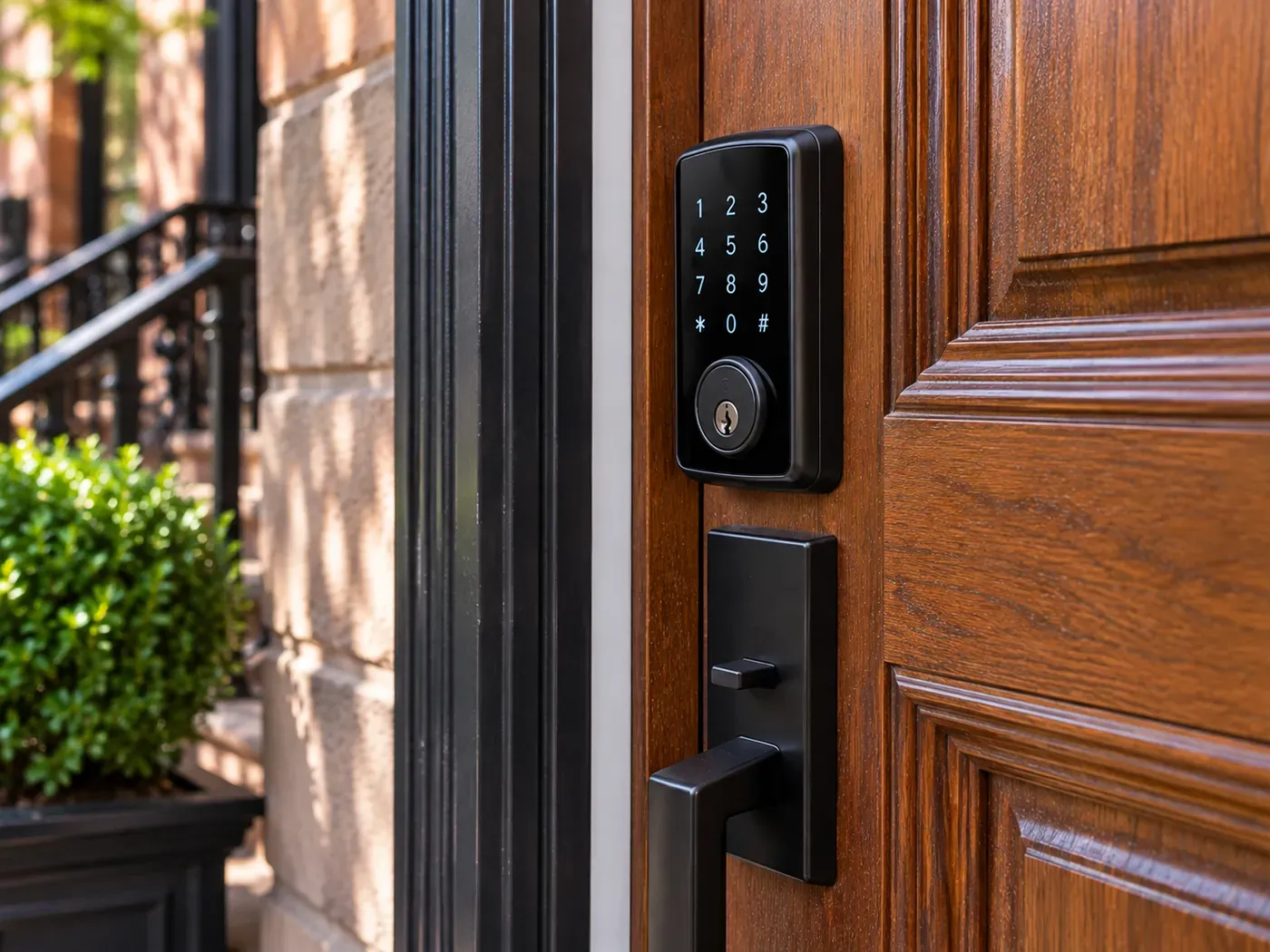
Smart lock installation, West Brighton, Staten Island: black keypad smart deadbolt above a matching lever handle on a raised-panel wood front door
A keypad smart deadbolt with a key cylinder sits above a black lever on a panelled wood door. The finished look most owners of older houses are after: keyless, with a key still there as a backup.
Free West Brighton Smart Lock Quote
Tell us the house, the doors and who needs to get in — a licensed installer calls back the same business day

✅
Request Sent!
We'll call you back the same business day.
25+
Years Experience
✓
Same-Day Estimates
100%
Licensed & Insured
$0
Monthly Fees

Rated 4.7★ from 201 Google Reviews · NYS Low-Voltage Licence #12000287431

Got an old door, a shared hall or a lock that keeps losing its connection? Call (347) 934-8335 or use the 60-second form. Tell us roughly when the house was built and which doors are giving you trouble, and a licensed installer will tell you what is likely to fit before anyone comes out.

  • Every door measured on a free walkthrough before a single hole is drilled
  • Separate codes for each apartment, plus a shared code that opens only the shared door
  • One turn of a thumb-turn or lever to get out, on every door we work on
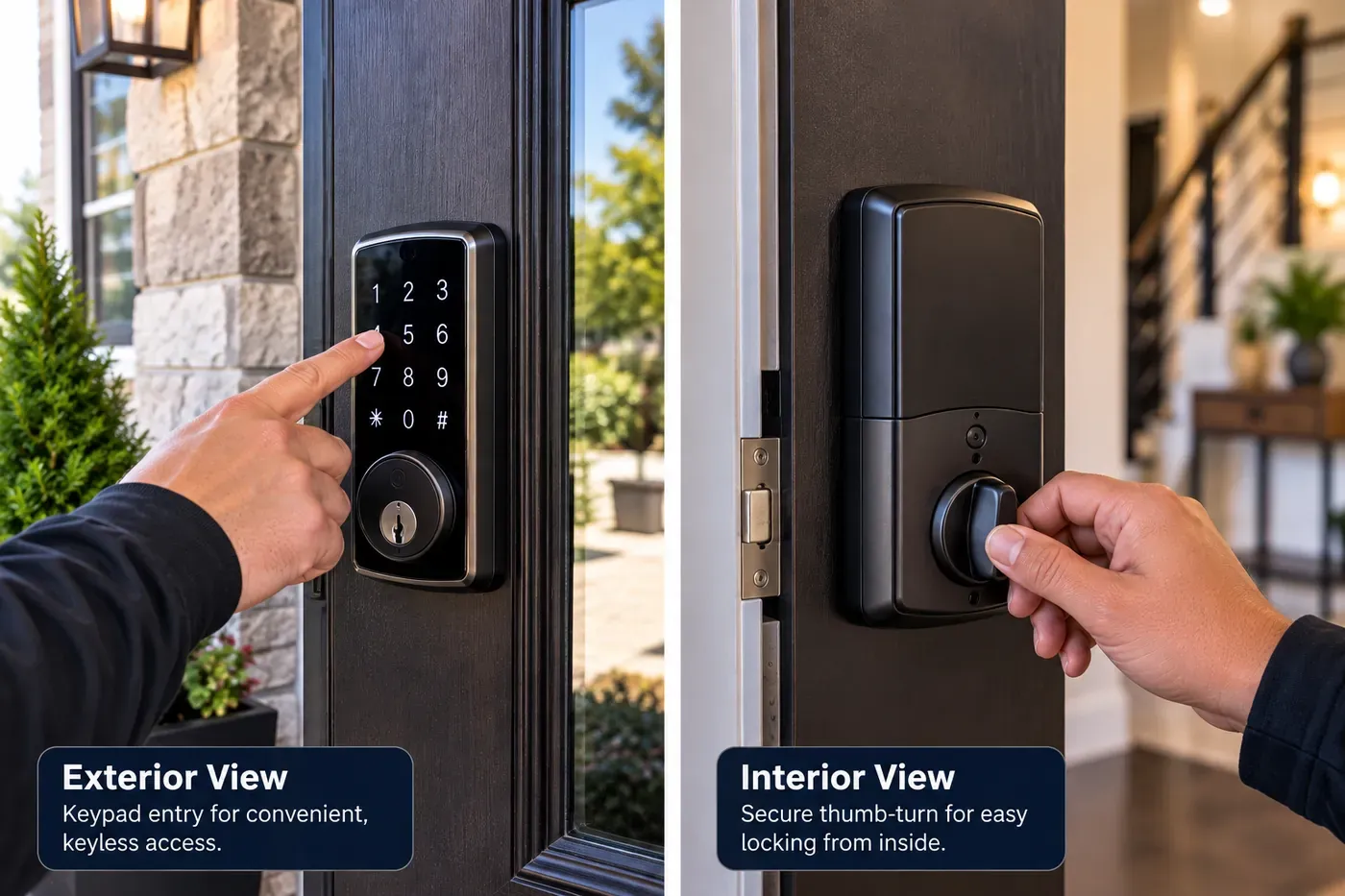
Two views of one smart deadbolt for West Brighton, Staten Island doors: a finger entering a code on the outside keypad, and a hand turning the inside thumb-turn
Outside, a code; inside, a plain thumb-turn. That inside turn is what keeps a shared hall door or an upstairs unit door safe to leave in a hurry.
The Neighborhood

Why West Brighton Properties Need Smart Lock Installation Fitted to Old Doors and Shared Halls

West Brighton was a suburb before most of Staten Island was anything but farmland. The neighbourhood once went by the name Factoryville. Castleton and Bement avenues were laid out in the 1830s and 1840s, the name West New Brighton was on maps by the middle of the nineteenth century, and by the 1910s Forest Avenue had become a real shopping street. The houses that went up along those streets — Queen Anne and Colonial Revival homes, Italianate rows, late-Victorian cottages, with grander houses on the rise people still call Sunset Hill — are still standing in large numbers. So are their front doors, or the doors that replaced them sixty or eighty years ago.

Those doors are the first reason a smart lock job here is different from one in a newer part of the island. A modern smart deadbolt is designed around a modern door: a slab of a standard thickness, drilled with a standard bore at a standard distance from the edge. A West Brighton front door may be thicker or thinner than that, may have a glass panel that leaves only a few inches of wood beside the lock, may carry a mortise lock body buried in its edge from a hundred years ago, and may have been drilled and plugged for three generations of hardware since. None of that rules out going keyless. It does mean the tape measure comes out before the order is placed, and that the first hour of the job is often door work rather than lock work.

The second reason is the way these houses are now lived in. Census figures for the West New Brighton area put the share of renter-occupied homes at 47.4 percent — close to half. Many of those renters live in houses that were built for one family and later divided into two or three apartments, which means a shared front door and hallway, separate doors to each unit, sometimes an outside stair at the back, and an owner who may live downstairs or may live somewhere else entirely. Each of those arrangements changes who should hold which code, what the city expects of the doors, and what the lock must never do to the people who use the hall to get out in an emergency.

The third is what's in the walls. Older houses are often finished in plaster rather than drywall, and some plaster was laid over metal lath, which can weaken a Wi-Fi or Bluetooth signal far more than a modern wall would. Front doors in these houses are also commonly a long way from any electrical outlet. A smart lock that worked perfectly in the shop can drop off the app as soon as it is on a West Brighton door, and planning for that — where a bridge plugs in, whether a Thread border router or a mesh point is needed — is part of the walkthrough, not an afterthought.

And not every West Brighton door belongs to a house. The neighbourhood includes the West Brighton Houses public-housing development, which is in the middle of a major renovation under NYCHA's PACT programme, newer apartment complexes such as the one at Markham Drive, two large apartment complexes on Hart Boulevard, and a commercial district along Forest and Castleton avenues with close to three hundred storefronts, plus professional offices in converted houses. A smart lock plan for a law office in an old Forest Avenue house has more in common with a house than a shop, and a plan for a Castleton Avenue store has to account for the apartments that often sit above it.

West Brighton facts that shape a smart lock job

  • 47.4 percent of occupied homes in West New Brighton are renter-occupied, according to the census figures summarised on the neighbourhood's Wikipedia entry — owners and tenants sharing houses, halls and doors.
  • 37,010 residents in the West New Brighton neighbourhood tabulation area at the 2020 Census, in 13,141 households, 32.9 percent of them with children under 18 — plenty of households where several people need their own codes.
  • 293 storefronts along Forest Avenue (Broadway to Hart Boulevard) and Castleton Avenue (Rector to Hoyt avenues), with an overall vacancy rate of 11.9 percent, in the city's Neighborhood 360° commercial district assessment for West Brighton, carried out from December 2023 to June 2024.
  • 574 apartments at West Brighton I and II being fully rehabilitated after NYCHA closed on $332.3 million in PACT financing on June 26, 2024, with new apartment doors part of the published scope.
  • 124 burglaries were reported in the 120th Precinct, which covers the North Shore including West Brighton, in 2022; the same precinct's overall crime fell 83.3 percent between 1990 and 2022.
  • 1830s–1840s: the decades when Castleton and Bement avenues were laid out, according to the neighbourhood history published by City Neighborhoods NYC — the start of a housing stock that is now well over a century old in places.

Many West Brighton households that call us about a smart lock end up pairing it with a video doorbell at the shared front door, so whoever is upstairs can see who is asking to be let in before they unlock anything. Where a house has three or more units, the conversation often widens to an intercom with a release for each apartment.

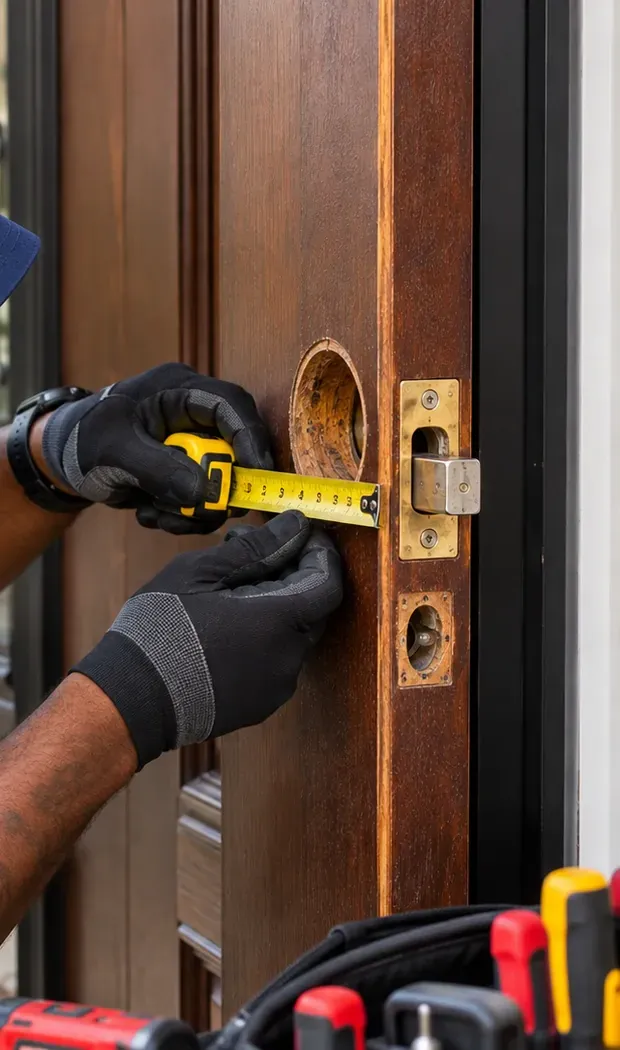
Measuring the backset from the door edge to an empty deadbolt bore before a smart lock installation, West Brighton, Staten Island guide
Gloved hands hold a tape measure from the door edge to the empty bore, with the latch plate still in the edge. On older doors this measurement decides which locks can fit at all.
Repair Capture

Keypad Dark or Lock Offline in West Brighton?

Rain got behind the keypad on the porch and now it shows nothing. The hall lock vanishes from the app each night. A century-old door swelled in August and the motor strains against the strike. Call (347) 934-8335; we book the next open 2-hour window, and most battery, pairing and alignment faults are fixed in one to two hours once we are at the door. If the visit turns out to be only app, bridge or code setup with no hardware change, it is billed at the Staten Island setup-only rate of $225 for the first hour.

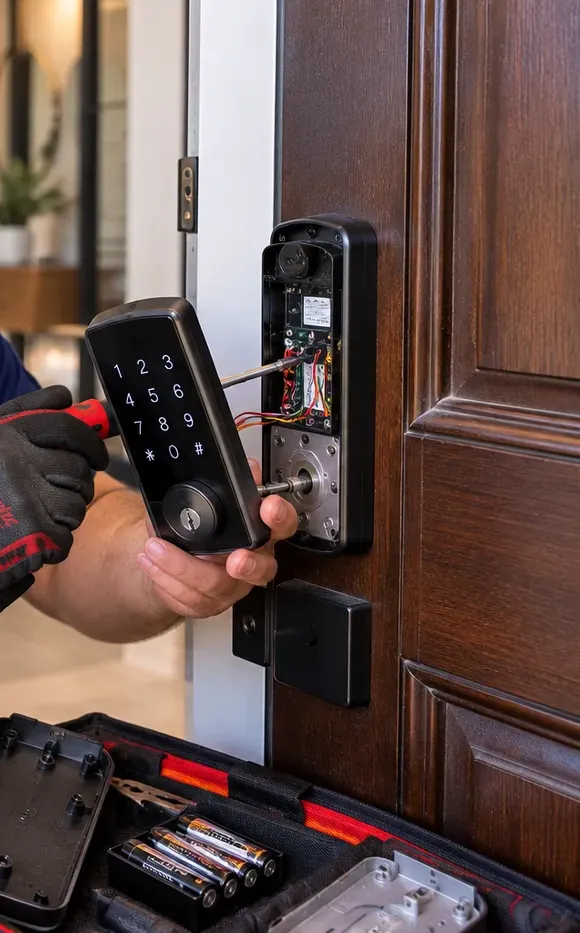
Smart lock repair for West Brighton, Staten Island: gloved hands holding a keypad unit away from a wood door to check the wiring behind it
The outside keypad lifted off its mounting so the cable and connector behind it can be checked, with spare batteries in the open tool case below.
What We Install

Smart Lock Installation Services in West Brighton

What we fit depends on the door in front of us. These are the jobs West Brighton's housing and business mix produces most often.

Smart Locks for Older Wood Doors

Measuring thickness, backset and the wood left beside a glass panel, then choosing a lock that fits the door instead of cutting the door to fit the lock. Old bores are plugged and strikes rebuilt where needed.

Shared Front-Hall Doors

The street door of a house split into apartments: a keypad or smart deadbolt every household can open, a code per apartment so one can be removed without disturbing the others, and a free inside release.

Unit Doors Inside Converted Houses

Each apartment's own door, with its own codes held by the people who live behind it. On buildings of three or more units we fit hardware that still meets the city's deadbolt and chain-guard expectations.

Rear-Stair and Upper-Unit Entrances

Doors at the top of an outside wooden stair or a side passage, often the only way into an upstairs apartment: weather-rated keypads, lighting considered, and a lock placed so it can be reached safely from the landing.

Signal Planning in Plaster-Wall Houses

Testing Wi-Fi and Bluetooth at the actual door, then placing a bridge, a Thread border router or a mesh point where an outlet exists. No lock is left in place that only works when you stand next to the router.

Office and Shop Schedules

Ground-floor offices in converted houses and storefronts on Forest and Castleton avenues: doors that unlock for opening hours and lock at closing, codes per employee, and an access log the owner can read.

Apartment Residents' Locks

For renters and residents in apartment buildings, a second smart lock alongside the building's own lock where the rules allow, with the duplicate key or code the law expects the owner to receive.

Takeovers When a House Changes Hands

New owners of an older house often inherit a drawer of unlabelled keys. We reset or replace every lock, retire codes and app accounts nobody can identify, and give you a written list of what opens what.

Repair, Re-Pairing and Re-Hanging

Locks orphaned by a router swap, keypads that took water from an exposed porch, and old doors that have dropped enough to bind the bolt — fixed at the hinge and strike, not just with fresh batteries.

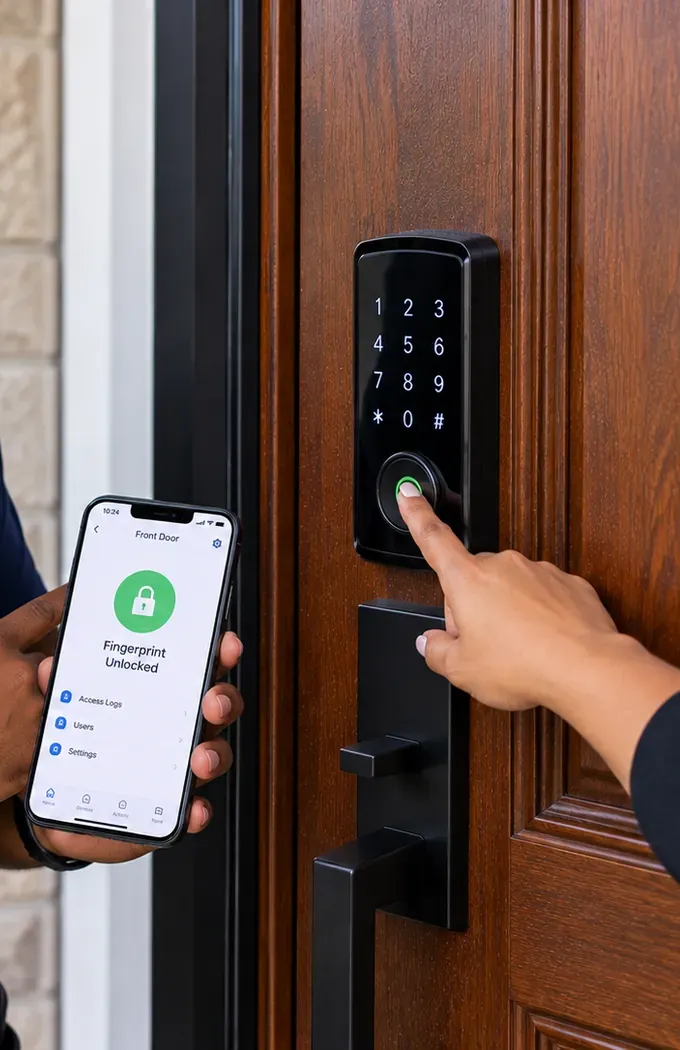
Fingerprint smart lock test for West Brighton, Staten Island homes: a finger on the keypad sensor while a phone shows Fingerprint Unlocked
A finger on the reader and the app confirming the unlock on the phone in the other hand: how each enrolled fingerprint is checked before the installer leaves.
Building Specialists

Smart Lock Installation for West Brighton's Architecture

West Brighton's housing was built over more than a century, and each era left a different door behind. These are the types we meet, and what each one usually asks of a smart lock.

Victorian and Queen Anne Houses

Late-nineteenth-century houses on the older avenues, often with a deep porch, a front door with a large glass panel and sometimes a transom above. The wood beside the glass can be narrower than a standard smart deadbolt expects, and the porch decides how much weather reaches the keypad.

Colonial Revival and Early-Twentieth-Century Houses

Solid panelled doors, usually heavier and more generous in their stiles, that take a smart deadbolt well once old mortise pockets and filled bores are dealt with. Many have a vestibule or a storm door that changes where the lock can go.

Italianate Rows and Attached Houses

Narrower houses, front doors close to the sidewalk and frequently shared between two units inside. The front door here is often the shared door, which makes code planning more important than the hardware.

Houses Divided Into Two or Three Apartments

One-family houses converted long ago: a shared hall, unit doors on each floor, sometimes a back stair added outside. Once there are three apartments the building is a multiple dwelling under state law, and the unit doors carry city requirements a two-family's do not.

Sunset Hill and Larger Single-Family Homes

Bigger houses on the hill south of Forest Avenue, some on a planned street layout with picturesque cottages alongside. More doors per house, longer distances from router to lock, and owners who want every door on one app.

Apartment Complexes and Public Housing

The West Brighton Houses, the Markham Drive apartments and the larger complexes on Hart Boulevard. Here the building owns the door and the lobby; residents' options depend on the lease, the management and the law, and we work within all three.

How the work changes door by door

  • Short backsets beside glass. Standard residential deadbolts are made for a bore set back about 2⅓ or 2¾ inches from the door edge. When the wood beside a glass panel is narrower than that allows, we look first at locks with a shorter backset or a narrow profile, and only then at mounting options. Cutting into the glass rail is not one of them.
  • Old mortise pockets. Many older doors have a rectangular pocket cut into the edge for a mortise lock. Some smart retrofits fit over an existing deadbolt's thumb-turn without touching the outside; others need a fresh bore. Where a new bore would run into an old pocket, we fill and reinforce before drilling so the bolt has solid wood around it.
  • Doors drilled many times. A door with plugged holes from earlier locks needs the plugs glued and set properly, not just filled with putty, or the new lock will loosen within a season. We also check whether a reinforcing plate is needed around the new bore.
  • Thicker and thinner doors. Schlage, for example, lists its residential smart deadbolts for doors between 1⅜ and 2 inches thick. Doors outside the range a lock is listed for need a thickness kit from the maker or a different lock; we confirm before ordering.
  • Frames that have moved. A house that has settled for a century rarely has a perfectly square opening. Strikes are realigned and hinge screws lengthened into the framing so the bolt throws without rubbing — a binding bolt drains batteries and wears out motors.
  • Weather on exposed porches and stairs. Doors under a deep porch are sheltered; doors at the top of an open back stair are not. On exposed doors we use locks whose electronics sit inside the door and fit the gaskets the maker supplies.
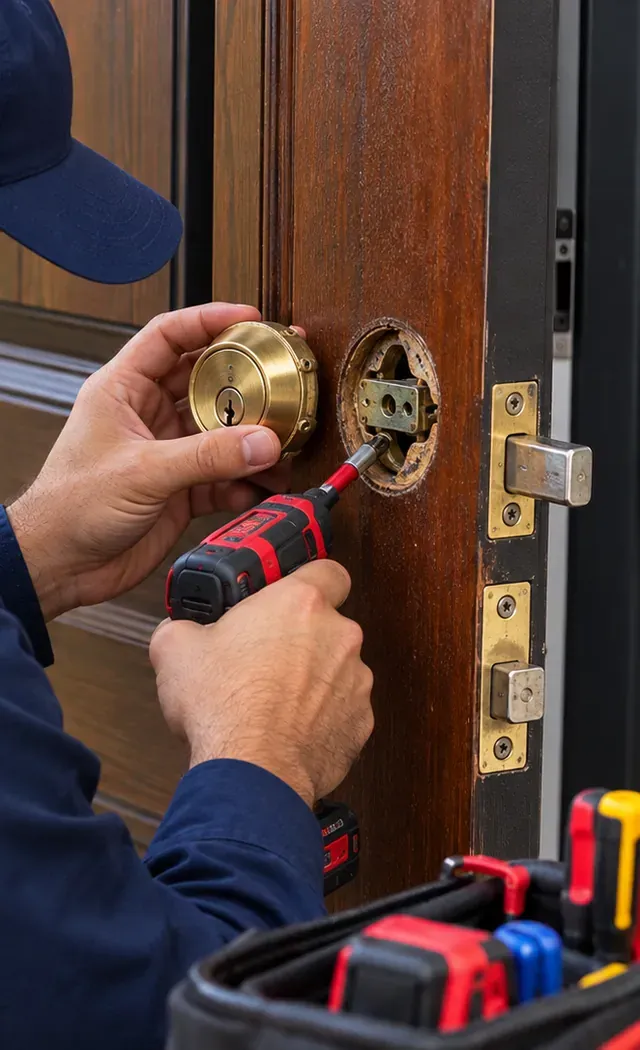
Removing an old brass deadbolt from a wood door before fitting a smart lock, smart lock installation guide for West Brighton, Staten Island
An old brass deadbolt coming out with a cordless driver, brass strike plates still on the frame. What lies under the old hardware decides how much door work the new lock needs.
Converted Houses

One Front Door, Several Households: Planning Codes in a Divided West Brighton House

A house that was built for one family and now holds two or three is the most common West Brighton smart lock job we are asked about, and the one most often done badly. The hardware is rarely the hard part. The hard part is that one door — the front door, and often the hall behind it — belongs to everybody, while the doors off the hall each belong to one household. A good plan keeps those two kinds of door clearly apart.

The shared door belongs to the house; the unit doors belong to the people behind them

On the shared street door, every household needs a way in, and so does anyone they invite. The cleanest arrangement is one code per apartment rather than one code for the whole house, with the owner holding the administrator role on that door only. When a tenant moves out, their code is deleted and nobody else's changes. When a delivery or a repair needs access for a day, a temporary code goes in and comes out again. The owner can see when the shared door was opened and by which apartment's code, which is a reasonable thing for the person responsible for the building to know.

The unit doors are different. The person who lives behind an apartment door should hold the administrator role for it, set their own codes and see their own history. The owner gets whatever the lease and the law give them — typically a key, or a code that is used only for agreed access and emergencies — not a live record of a tenant's comings and goings. We set the accounts up that way from the start, because unpicking it later, after an argument about privacy, is much harder.

The hall is the escape route

In a divided house the upstairs household usually leaves by the same stair and the same front door as everyone else. That makes the shared front door part of the way out in a fire, and it should behave like one: it opens from the inside with a single turn of a thumb-turn or a push on a lever, it never needs a key, code or phone to leave, and it never has a double-cylinder deadbolt that locks people in. The New York City Building Code's egress chapter states the principle plainly: doors people leave by must be readily openable from the egress side without a key or special knowledge or effort. Every door we touch in a shared hall is left that way.

When the house becomes a building

Under the state Multiple Dwelling Law, a building with three or more families is a multiple dwelling, while one with not more than two is a private dwelling. The difference matters for locks. In a multiple dwelling the city's Housing Maintenance Code expects the owner to provide a key lock on each apartment entrance door, with at least one key; for class A apartments it calls for a heavy-duty latch set and a heavy-duty deadbolt operable by key from outside and thumb-turn from inside, plus a chain door guard. City rules also require self-closing doors on apartment entrances in buildings with three or more apartments, and the Tenant Data Privacy Act sets limits on how owners of multiple dwellings can use smart access systems — including that a tenant cannot be required to use one to get into their own apartment. A smart deadbolt can sit comfortably inside all of that; it just has to be chosen and set up with it in mind.

Mail, packages and visitors

Old houses often have the mailboxes inside the front hall or a mail slot in the front door itself. Before the street door goes keyless, decide how mail and packages will reach each household. We don't hand codes to carriers on your behalf, and we usually suggest keeping mail out of the code plan altogether — a slot or mailboxes on the outside wall, and a video doorbell at the street door so whoever is home can see who is there before letting them in.

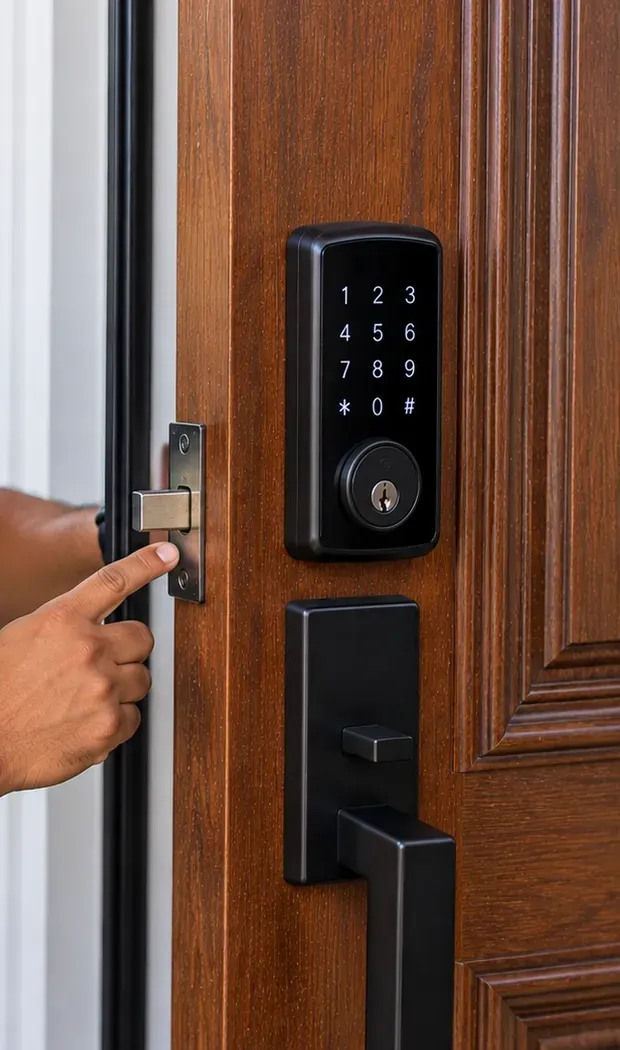
Checking latch alignment at the edge of a wood door fitted with a keypad smart deadbolt, West Brighton, Staten Island smart lock guide
A finger on the latch at the door edge, keypad deadbolt above and lever below. On a settled old frame, the strike often has to move a few millimetres before the bolt throws cleanly.
Commercial Smart Locks

Business Smart Lock Installation in West Brighton

West Brighton's businesses sit along a handful of corridors, and the doors on each tend to be different. The city's Neighborhood 360° study, carried out with the Staten Island Business Outreach Center, the Forest Avenue Business Improvement District and the Castleton Avenue Merchants Organization, counted 293 storefronts on Forest and Castleton avenues alone. Its merchant survey found 72 percent of businesses rent their premises — which matters, because a tenant's door is not always the tenant's to change.

Forest Avenue

The neighbourhood's main shopping street since the 1910s, from Broadway past Hart Boulevard toward Victory Boulevard, with restaurants, diners, cafes and professional offices — several of them in converted houses. Doors range from aluminium storefront to old house front doors, often within a single block.

Castleton Avenue

The other commercial spine, home to the West New Brighton post office and library branch as well as delis, salons, barbershops and clothing stores. Many storefronts have apartments above, so the shop's side or rear door often sits next to a residential entrance that is not the shopkeeper's.

Richmond Terrace

The waterfront road along the Kill Van Kull, with shipyards and tugboat companies among its businesses. Yard gates and steel personnel doors here are access-control jobs rather than residential smart locks, and they face the weather off the water.

Broadway

The north–south street past the Staten Island Zoo and Engine Company 156, with houses, institutions and small businesses mixed together — a street where an office door and a front door can share a porch.

Converted-House Offices

Law practices, insurance agents and other professional offices working out of old houses, including a small A-frame building on Forest Avenue that houses a pair of law practices. These doors take residential smart locks well and benefit most from opening-hours schedules.

Hart Boulevard and Clove Road

The west side of the neighbourhood, where larger apartment complexes and Clove Lakes Park meet the commercial edge of Forest Avenue. Building management, not individual tenants, usually controls the main entrances here.

Compliance points on business doors

  • Free exit, always. Under the 2022 NYC Building Code, egress doors must be readily openable from the inside without a key or special knowledge or effort, with limited exceptions. A keypad on the outside is fine; anything that needs a code, a card or a key to leave is not, and that includes the back door to the yard.
  • One motion to unlatch. The same code generally limits unlatching to one operation on egress doors. A smart deadbolt added above an existing latch on a business door has to be checked against that before it goes on.
  • Electric strikes and magnetic locks. Where a shop or office needs a reader-controlled door rather than a battery smart lock, it becomes an access-control job with a power supply, a free-exit device and attention to what happens in a power cut. We price those from our published single-door figure.
  • Accessible hardware. Levers rather than knobs, and a keypad at a reachable height, matter on any door customers or clients use. Where a business has ADA obligations, we fit hardware that supports them rather than working against them.
  • The landlord's lease. A tenant business should check its lease before changing a lock that the landlord has a right to access. We can fit a lock that keeps a keyed cylinder for the landlord's key alongside staff codes.

Most of the shops and offices we work for here end up pairing a smart lock with access control on Staten Island once they have more than one door or more than a handful of staff.

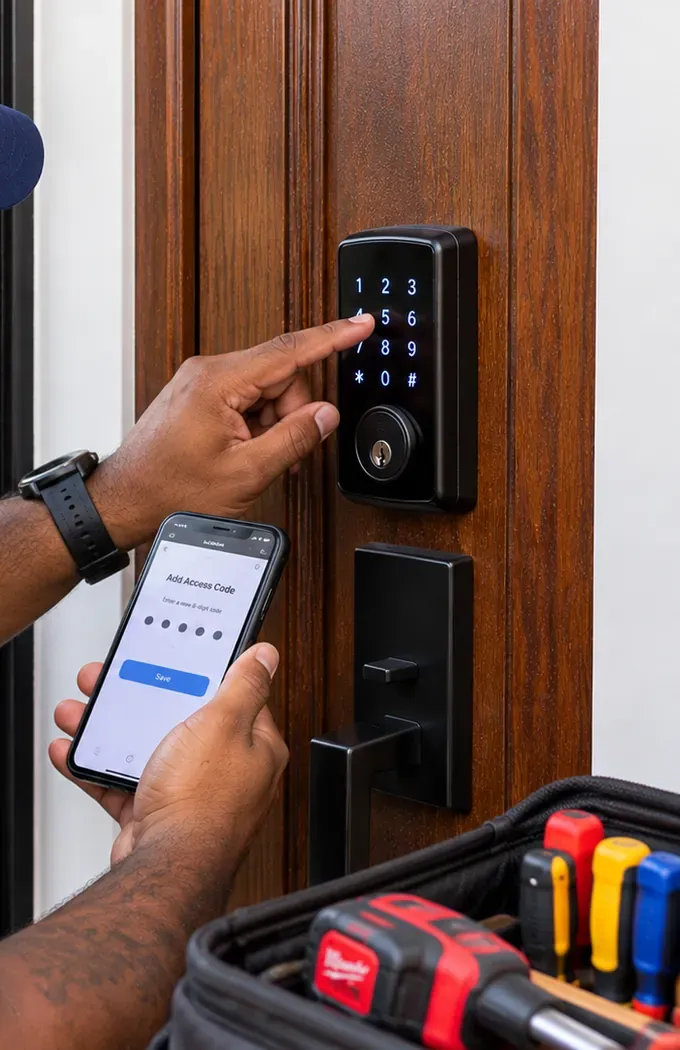
Adding a new access code in a smart lock app while pressing the keypad, for West Brighton, Staten Island apartments and offices
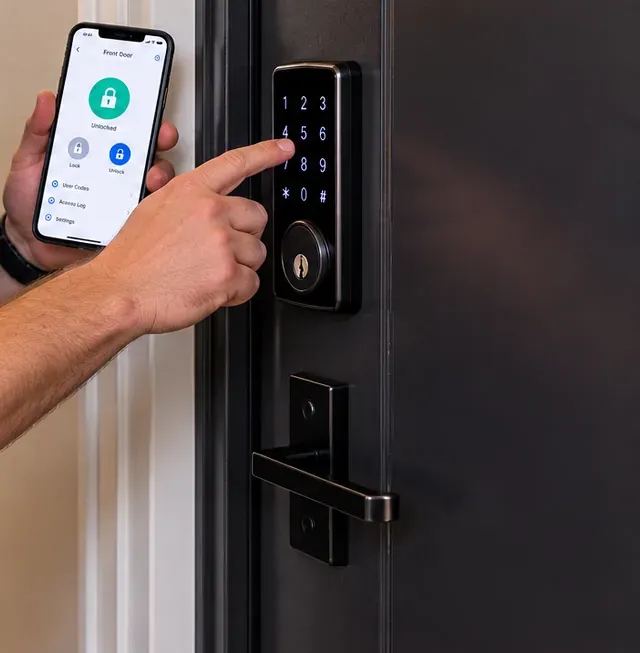
One hand presses the keypad while the other holds a phone on the Add Access Code screen — the step where each household or employee gets a code of their own.
Your Questions Answered

Smart Lock Installation in West Brighton: Questions Answered

These are the questions that come up when the door in question is old, shared or sitting in front of a shop. They're grouped by what they're really about.

Old doors and old walls

The wood beside the glass on our old front door is only a few inches wide — what kind of smart lock fits a door like that?

Measure before you buy anything. Most residential smart deadbolts are built for a bore set back 2⅓ or 2¾ inches from the door edge, and they need enough solid wood around that bore for the outside keypad and the inside unit to sit flat. On many older doors with a large glass panel, the stile beside the glass is narrower than that, and a standard lock either won't fit or will sit partly over the glass rail. Forcing it is how glass gets cracked.

The options, in the order we look at them: a smart lock made with a shorter backset or a narrow profile for exactly this kind of door; a retrofit unit that fits over an existing deadbolt's thumb-turn inside and leaves the outside untouched, if the door already has a deadbolt in the right place; or, on doors where neither works, moving the smart lock to a different door the household actually uses, such as a side or back door, and keeping a good mechanical deadbolt on the front.

There is also a security point. If the glass is within arm's reach of the inside thumb-turn, a smart lock doesn't change the old weakness: break the glass, reach in, turn. We talk through the options at the walkthrough — laminated or security film on the glass, or a lock whose inside turn can be disabled when the house is empty — so the new lock isn't the strongest part of a weak door.

Our walls are old plaster, some of it on metal lath — will that block the lock's Wi-Fi or Bluetooth?

It can. Plaster is denser than drywall, and plaster applied over metal lath puts a mesh of metal in the wall that can weaken a radio signal noticeably. In practice that shows up as a lock that pairs perfectly when you stand next to it with your phone, then goes offline once you walk away, or a Wi-Fi bridge that works in the hall but not from the room where the router lives.

The only reliable way to know is to test at the door. At the walkthrough we check Wi-Fi strength at each lock position, and we test the lock's own connection path — for example, August says its Connect Wi-Fi bridge should sit within 10 to 15 feet of the lock and needs good Wi-Fi where it is plugged in. In a plaster house that usually means the bridge goes in the hall near the door, and the question becomes whether the router's signal reaches the hall.

When it doesn't, the fixes are a mesh Wi-Fi point closer to the door, a Thread border router if the lock uses Matter over Thread, or in some houses a wired access point run to the hall. We'd rather fix the signal than sell a lock that only works when someone is home to stand beside it.

There isn't an electrical outlet anywhere near our front door — where does a Wi-Fi bridge or hub plug in?

This is common in older West Brighton houses, where the front hall was wired long before anyone imagined a lock that talked to the internet. The lock itself runs on batteries, so it doesn't need an outlet. The bridge, hub or border router that connects it to the internet does, and it usually has to be fairly close to the lock.

First we look for the nearest outlet within the bridge's working range, including in the room on the other side of the hall wall, where a bridge can often do its job through a single interior wall. If there's nothing within range, the choices are a lock that connects over Wi-Fi directly, without a separate bridge, which uses more battery; a Thread or Z-Wave lock that reaches a hub further away through other mains-powered devices; or having an electrician add an outlet in the hall. We don't run extension cords along old mouldings or leave a bridge hanging from a hall light fitting.

If the plan involves new wiring, we tell you at the walkthrough so the quote reflects it. Most of the time, though, a careful look at where the outlets actually are solves it without any new power at all.

Converted houses, shared halls and upstairs units

Our house was divided into three apartments years ago — what changes for the locks once a building has three units instead of two?

Quite a lot. Under the Multiple Dwelling Law, a building that houses three or more families is a multiple dwelling; one with not more than two is a private dwelling. Once your house is a multiple dwelling, the city's Housing Maintenance Code applies its apartment-door rules: a key lock on each apartment entrance with at least one key for the tenant, and in class A apartments a heavy-duty latch set, a heavy-duty deadbolt that opens by key from outside and thumb-turn from inside, and a chain door guard. City rules on self-closing apartment doors in buildings with three or more units apply too.

Two other rules change. Tenants in a multiple dwelling have a right under state law to add their own lock to their apartment door, as long as they give the owner a duplicate key on request. And if you, as owner, put in a smart access system — keypads, fobs or app entry — the city's Tenant Data Privacy Act limits what data you collect and how long you keep it, and says a tenant can't be required to use the smart system to get into their own apartment. Multiple dwellings also have to be registered with HPD every year.

In practice, a smart deadbolt can satisfy the deadbolt requirement on a unit door as long as it is a proper deadbolt with a key option and an inside thumb-turn; it doesn't replace the chain guard or the latch. On the shared front door, we set up codes per apartment and make sure every tenant also has a key. This page isn't legal advice; if you're unsure how your building is classified, check its certificate of occupancy or ask HPD.

When the upstairs tenants have to leave through the shared front door, what must that door's lock never do?

It must never stand between someone inside and the street. For the people who live upstairs in a divided house, the shared stair and front door are usually the only way out. So on the inside, that door opens with one turn of a thumb-turn or one push of a lever, with no key, no code, no phone and no fingerprint. A double-cylinder deadbolt that needs a key on both sides is the classic mistake here, and HPD's fire-safety guidance says double-cylinder locks are illegal on apartment doors.

It must also not fail locked in a way that traps anyone. Battery smart deadbolts keep their mechanical thumb-turn when the batteries die, which is why we prefer them on shared doors over anything that relies on power to release from inside. If a shared door ends up on an electric strike or magnetic lock instead, it needs a free-exit device and a release that works in a power cut.

And it must not lock people out in a way that tempts them to prop it open. If tenants can't easily get back in — because the keypad is hard to read at night, or codes keep failing — the door ends up wedged with a shoe, and the whole house is less secure than before. Getting the outside of the door right is part of keeping the inside safe.

The upstairs apartment's only door is at the top of an outside wooden stair at the back — can that door take a keypad lock?

Usually, yes, but it's a harder door than the front one. It's exposed on all sides, it's often a lightweight door added when the house was divided, and the person using it is standing on a narrow landing above a drop, sometimes on ice. So we look at the door's construction first: if it's hollow-core or very thin, it may not hold a smart deadbolt securely, and replacing or reinforcing the door is the honest recommendation.

If the door is sound, we choose a lock with its electronics on the inside and a gasketed outside face, fit it so water running down the door doesn't sit on the keypad, and put the keypad on the side of the door that can be reached without leaning around a railing. A keypad that lights when touched helps on a dark back stair; a light on the landing helps more.

Because that door is also the apartment's way out, the inside stays a simple thumb-turn. And because it is the tenant's own entrance, the tenant holds the codes; the owner keeps whatever access the lease provides.

Can the mail carrier still get to the mailboxes inside our shared front hall once the street door goes keyless?

Not unless you arrange it, and we'd suggest arranging it some other way than giving out a code. Many older divided houses have the mailboxes just inside the front door, or a slot in the door itself. A slot keeps working as it always did. Mailboxes inside a locked hall are the problem: if the door used to be left unlocked during the day, the carrier had access, and a keyless door that locks itself changes that.

The simplest answer is usually to move the mailboxes to the outside wall beside the door, or to keep a mail slot. We don't set up codes for carriers or delivery companies on a customer's behalf, and a code shared that widely stops being a meaningful control over who comes into the hall.

For packages, a video doorbell at the street door lets whoever is home see the courier and decide whether to open the door. If nobody is home, packages wait outside or go to a locker, the same as they would with a key lock.

We've moved out of our two-family and now rent both floors — what should change on the locks?

Your role changes from neighbour to landlord, and the locks should reflect that. While you lived there, you probably held the codes for the shared door and maybe for the other unit. Now both units belong to tenants, and the cleanest setup is: each tenant holds administrator rights to their own apartment door; you hold administrator rights to the shared front door only, with a code for each apartment; and you keep a key or emergency code for each unit, used only as the lease allows.

There's also paperwork that comes with not living there. HPD requires annual registration for one- and two-family houses where neither the owner nor the owner's immediate family lives, as well as for buildings with three or more units. That's separate from the locks, but owners often discover it at the same time.

Finally, change everything that the household used while you lived there: your family's codes, any old app users, any garage or gate codes. Moving out is exactly the moment old access tends to be forgotten. And if a tenant leaves, follow the city's rules on locks and lockouts — it is unlawful to change a lock on someone who has lived there thirty days or more without giving them a key, however simple a smart lock makes it.

Apartments and public housing

Our West Brighton Houses apartment is down for a new front door in the PACT renovation — should we hold off on adding a smart lock?

Yes, hold off. NYCHA closed on $332.3 million in PACT financing for West Brighton I and II on June 26, 2024, and the published scope for the 574 apartments includes new doors along with new windows, kitchens and bathrooms. Construction was expected to take about two years. Anything you add to the current door may be removed when that door is replaced, and drilling it now gains you little.

When the new door is in, ask the property management team — Pinnacle City Living was named as the day-to-day manager for the PACT partnership — what their rules are on residents adding a second lock, and whether they need a duplicate key or code. The state law that lets tenants in multiple dwellings add their own lock specifically excludes buildings run by a municipal housing authority, and how that applies after a PACT conversion is a question for management, not something we'll guess at.

If management agrees, we fit a smart deadbolt that keeps an inside thumb-turn, doesn't interfere with the door's self-closer or its fire rating, and keeps a key option. If they don't, there are still useful steps we can help with that don't touch the door, such as a video doorbell that mounts without drilling, where the building allows it.

Break-ins and everyday security

North Shore burglaries have come in through side and rear windows in the daytime — does a smart lock on the doors help at all?

Honestly, only partly. In one well-reported case, police said a burglar who hit at least 13 homes in West Brighton and Westerleigh early in 2007 got in through side and rear windows, mostly in the afternoon and evening when people were out, and targeted unlit homes without alarms or dogs. A smart lock on the front door would have done nothing about the window itself.

What a smart lock does do is close the gaps people leave at doors: it locks itself when someone forgets, it tells you on your phone if a door was left unlocked, and its history shows whether a door was opened while you were out. Paired with door and window sensors from an alarm system, it becomes part of a picture of the whole house rather than one strong point.

So we look at the house, not only the lock. Which windows are reachable from a side alley or a porch roof? Is the back of the house dark? Is there an alarm, and could the lock arm it when the last person leaves? A smart lock is a good start, but on a house with easy windows it should be one part of the plan, alongside alarm sensors on Staten Island windows and doors.

Our new smart deadbolt still has a key cylinder — is it any harder to pick than the old lock we took off?

It depends entirely on the cylinder. Many smart deadbolts keep a conventional key cylinder as a backup, and that cylinder is attacked the same way any cylinder is. A smart lock with a basic cylinder is no harder to pick than a basic deadbolt; one with a higher-grade cylinder is harder. Some models are sold without a keyway at all, which removes picking as a route in but means you rely on the keypad, the app and the batteries.

The electronics can't be picked in the same way, but they can be guessed at, which is why code length and lockout settings matter. And on old doors, picking is rarely the real risk: a thin door, a weak frame or a short strike screw gives way to force long before a cylinder is picked.

If you want the backup cylinder to be as strong as possible, we can fit a lock that accepts a higher-grade or rekeyable cylinder and match it to the other keys in the house. We'll also make sure the strike is screwed into the framing behind the door jamb, not just the trim.

What happens if someone stands at our keypad and keeps trying wrong codes?

On most smart locks, the keypad locks itself out for a period after a set number of wrong entries, and the lock can send an alert to the administrator's phone. The exact number of attempts and the length of the lockout vary by brand and model, and some let you adjust them in the app. While the keypad is locked out, the app and any physical key still work.

We switch these alerts on during setup and show you where to find them. A burst of wrong-code alerts in the middle of the day is worth knowing about; so is a single wrong code at 3 a.m. Combined with a doorbell camera, you can see who was at the door rather than just that someone was.

There's a practical side too. A child or an older relative who mistypes a code three times can trigger the same lockout. We set codes that are easy for the person to remember but not obvious, and make sure everyone knows the backup if the keypad is temporarily locked.

Offices and shops on Forest and Castleton

Our office is on the ground floor of an old house on Forest Avenue — can the front door unlock itself for office hours and relock at closing?

Yes. Many smart locks have a schedule or passage mode that keeps the door unlocked during set hours and returns it to auto-lock afterwards, and access-control systems do the same more robustly. For a small office that wants clients to walk in during the day without ringing, that's a reasonable setup, with one condition: someone is always at the front of the office while the door is unlocked.

The details matter in a converted house. If the office shares a front door with an apartment upstairs, the door can't be left unlocked during the day without the residents agreeing — and they may well not. In that case the office's own inner door gets the schedule, and the shared street door stays locked with codes and a doorbell. We also set what happens on holidays, so the door doesn't open itself on a day the office is closed.

For staff, each person gets their own code so the office can see who opened up and who locked up, and a departing employee's code goes the day they leave. If the office keeps confidential files, a separate lock on the file room or a locked cabinet still matters; the front door schedule is about convenience, not about who can reach the records.

Our storefront landlord keeps a key to the shop — does a new keypad lock have to let the landlord in too?

That depends on your lease, not on the lock. Many commercial leases give the landlord a right of access for inspections, repairs or emergencies, and some require the tenant to provide a key to any new lock. Before you change a lock on a rented shop, read the lease or ask the landlord, because a lock that shuts out a landlord who is entitled to get in can turn into a lease dispute.

Technically, it's easy to accommodate. We can fit a keypad or smart lock that keeps a keyed cylinder, give the landlord a key to it, and give staff codes. Or the landlord can have a code of their own, which the shop can see being used in the access log. Either way, the landlord's access stops depending on everyone remembering where the spare key went.

If the landlord won't allow any change to the door, there are still options that don't touch it, such as an alarm with door sensors and a camera on the entrance, which give you the record of who came and went without changing the lock.
Equipment

Types of Smart Locks We Install

There's no single best smart lock for West Brighton, because there's no single West Brighton door. These are the categories we choose between, and where each one tends to earn its place here.

Keypad Smart Deadbolts

The workhorse: a replacement deadbolt with a keypad outside, a motorised bolt and a thumb-turn inside. Best on sound wood or steel doors with room for a standard bore — most side doors and many Colonial Revival front doors.

Retrofit Smart Locks

Units that fit over an existing single-cylinder deadbolt on the inside and leave the outside unchanged, keeping your keys. Useful on doors where the outside appearance should stay as it is, or where a renter's options are limited.

Narrow-Profile and Short-Backset Locks

For older doors with glass panels and slim stiles, where a standard smart deadbolt won't sit flat. Fewer models to choose from, so we match the door first and the features second.

Fingerprint and Keypad Combinations

A fingerprint reader alongside the keypad, convenient for households where codes get forgotten. Best on sheltered doors; very wet or very dirty fingers read less reliably.

Matter, Thread and Z-Wave Locks

Locks that join a smart-home system instead of relying on their own bridge. Matter over Thread needs a Thread border router, and in Yale's case the router must match the app's ecosystem. Good for houses that already have a hub.

Keypad Levers for Interior and Office Doors

Keypad locks built into a lever, for office suites, file rooms and interior doors in converted-house offices. Not a deadbolt, so not a substitute for one on an outside door.

Reader and Electric Strike Systems

Hard-wired keypads or fob readers releasing an electric strike, with a power supply and a free-exit device. The right choice for shop doors, gates and busy shared entrances; priced from our published single-door figure.

Mechanical Push-Button Locks

No batteries, no app: a code lock that works by mechanism alone. A sensible choice for a back-stair door, a basement or a shed where an app adds little and weather is hard on electronics.

Video Doorbells With Lock Integration

Not a lock, but the companion most shared front doors need: see the visitor, talk to them, and then decide whether to unlock. We mount them so the camera sees faces, not the top of the porch roof.

National alarm brands set against a local installer

People often ask whether to go through a national brand instead. ADT, Ring and SimpliSafe all sell or support smart locks as part of a wider security system, and each has its strengths. The difference on an old West Brighton door is usually the door work, not the lock.

QuestionADT / Ring / SimpliSafe routeAESS local installation
Who looks at the door first?Varies: often the buyer orders online, or an installer arrives with the lock already chosenWe measure the door, the backset and the wood beside any glass on a free walkthrough before recommending a lock
Old bores, mortise pockets, sagging framesTypically outside the standard install scopePlugged, reinforced and realigned as part of the quoted job
Signal in plaster-wall housesDepends on the brand's own hub or base stationTested at each door; bridge, border router or mesh point placed where needed
Shared halls and multiple householdsUsually set up as one household accountCodes and admin roles set per apartment, with the owner's role limited to the shared door
Monthly feesOften tied to a monitoring plan$0 monthly fees from AESS; any app subscription is the lock maker's and optional
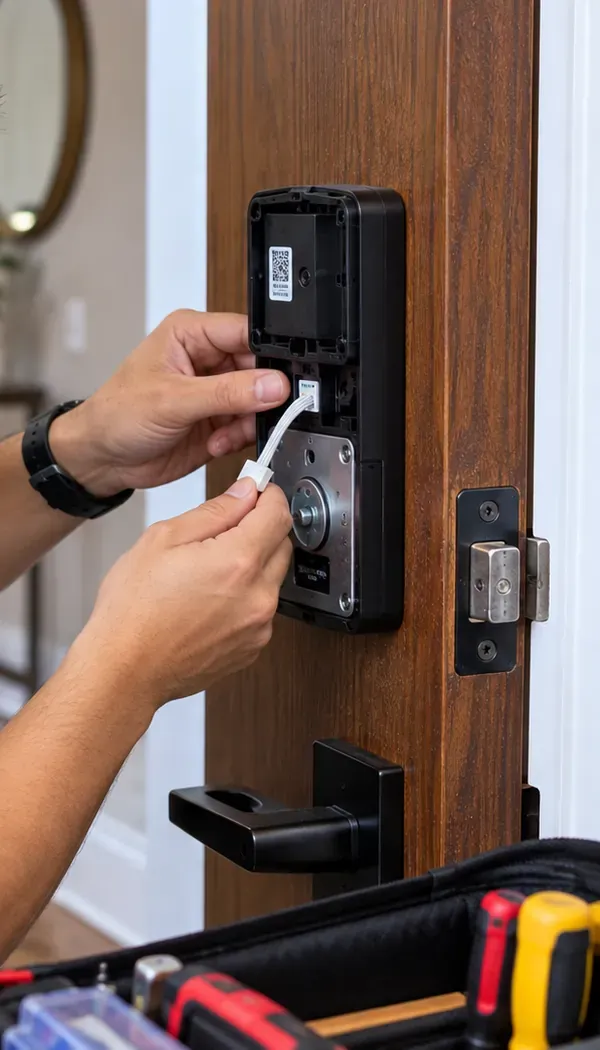
Feeding the ribbon cable through the inside mounting plate of a keypad smart lock, smart lock installation for West Brighton, Staten Island
The flat cable from the outside keypad being fed through the inside mounting plate before the interior unit goes on. A pinched or loose cable here is a common cause of a dead keypad.
AI Overview Reality Check

What AI Gets Wrong About Smart Lock Installation in West Brighton

We couldn't capture Google's AI Overview text from our build environment, so the claims below are the ones that keep turning up in national cost guides from sites like Angi, HomeAdvisor and Fixr, in manufacturers' marketing and in general advice. Each is reasonable somewhere. Here's how each holds up on an old North Shore door.

“Installing a smart lock costs $250 to $400”

Fixr's national figure, updated in January 2025, is $250 to $400 for a smart lock installation, averaging $300. As a national average for one lock on one ordinary door, that's a fair number, and it's useful to know.

It assumes the door is ready. On an older West Brighton door, the job may also include plugging old bores, filling a mortise pocket, rebuilding a strike in a soft frame or realigning a door that has dropped, and in a plaster-wall house it may include a bridge or mesh point so the lock stays online. None of that is in a national average.

That's why we quote residential smart locks flat after a free walkthrough instead of quoting a number over the phone. The national figure is a fair comparison point; it just isn't a price for a door we haven't seen.

“All you need is a screwdriver and half an hour”

Product testers at sites like Bob Vila have installed smart locks with nothing more than a Phillips screwdriver in about thirty minutes. On a modern door already drilled for a standard deadbolt, that's true, and many people do it themselves successfully.

The thirty-minute install depends on a door that is the right thickness, drilled at a standard backset, with a strike that lines up and a frame that is square. A century-old door with a glass panel, a filled bore from an earlier lock and a frame that has shifted fails at least one of those tests.

If your door passes them all, by all means fit the lock yourself, and call us if the connection is the hard part. If it doesn't, the screwdriver is the least of what's needed.

“A smart lock fits any standard door”

Most smart deadbolts are designed around a standard door prep — for example, Schlage lists its residential smart deadbolts for doors 1⅜ to 2 inches thick — and most modern doors meet it. That's where the “any standard door” idea comes from.

The catch is the word standard. Many older doors aren't: stiles narrower than a standard backset beside a glass panel, thicknesses outside the listed range, mortise locks in the edge, or a front door shared by apartments that needs a different kind of control altogether. Retrofit locks, for instance, are only compatible with single-cylinder deadbolts, according to August's own guidance.

The fix is to measure first and buy second. Ten minutes with a tape measure at the walkthrough saves returning a lock that was never going to fit.

“A smart lock connects to your home Wi-Fi anywhere in the house”

Read the installation manual rather than the box and the promise narrows. August, for example, says its Connect Wi-Fi bridge should be within 10 to 15 feet of the lock and needs a good Wi-Fi signal where it's plugged in.

In a house finished in plaster, and especially plaster on metal lath, a signal that is strong in the living room can be weak in the front hall. Add a front door far from any outlet, and the general claim that the lock will simply connect stops being reliable.

We test Wi-Fi and the lock's own connection at each door before choosing the lock, and plan the bridge, hub or border router around what we find. A lock that drops offline every evening isn't a smart lock in any useful sense.

“Renters can just install a retrofit smart lock”

Retrofit locks that fit over an existing deadbolt and leave the outside untouched are often recommended to renters, and with good reason: no new holes, the original keys still work, and the lock comes off when you move.

In New York the question isn't only physical. State law lets tenants in a multiple dwelling add their own lock if they give the owner a duplicate key on request, but that law excludes buildings run by a municipal housing authority, and leases and management rules vary. In a two-family house, the multiple-dwelling rule doesn't apply at all.

So for renters in West Brighton the right sequence is: check the building type and the lease, ask the owner or manager where that's needed, then choose the lock. A retrofit is often the answer, but it's the end of that process, not the start.

“Keyless means you never need a key again”

It's an appealing promise, and day to day it can be true: codes, phones and fingerprints replace keys for most comings and goings.

But the city expects certain doors to be openable by key. In a multiple dwelling, the Housing Maintenance Code's deadbolt requirement is for a lock operable by key from outside, and the owner has to provide a key. Batteries also die, phones get lost, and a keypad can lock itself out after too many wrong codes. A key override is the plain backup that still works.

We almost always leave a key option and tell you where the keys are. Keyless should mean you rarely need a key, not that nobody can open the door when the electronics can't.

“A smart lock makes your home secure”

Smart locks do make a door more secure in specific ways: they lock themselves, they tell you when a door was left open, and they record who came in.

They don't strengthen the door, the frame or the windows. In the West Brighton and Westerleigh burglaries reported in 2007, police said the burglar came through side and rear windows. On older houses, glass beside the lock, short strike screws and soft frames are bigger weaknesses than the lock itself.

So we treat the lock as one layer: a strong strike screwed into framing, attention to glass within reach of the thumb-turn, and alarm sensors on easy windows where the house needs them. A smart lock on a weak door is still a weak door.

Measure First, Then Choose the Lock

Send us a photo of the door from outside, from inside and of its edge. We'll tell you whether a standard smart deadbolt is likely to fit, or whether the door needs a narrower lock or some work first.

Get In Touch

Request a Free Quote

A Victorian with one porch door, a house split three ways, a rented apartment or a storefront: describe what you have and a licensed installer phones you back that business day.

✅

We Got Your Request!

We'll call you back the same business day. If it's urgent, call us now at (347) 934-8335.

How It Works

Our Installation Process

Six steps, whether it's one porch door on a Victorian or every door of a house divided into three apartments.

1. Describe the house and the people

On the phone we note roughly when the house was built, how many households share it, which doors each person uses, and whether any door is at the top of an outside stair or beside glass.

2. Free walkthrough and measurements

At each door we measure thickness, backset and the wood beside any glass, look at the edge for old mortise pockets and plugged bores, and test Wi-Fi and Bluetooth where the lock will sit.

3. Written flat quote

A single figure in writing that lists each door by name, which lock suits it, any carpentry it needs and how it will reach the internet, with Staten Island rates applied to anything we publish.

4. Prepare the doors

Old bores are plugged and glued, mortise pockets filled or reinforced, hinges tightened into the framing and strikes realigned, so each bolt throws without rubbing.

5. Fit, seal and connect

Each lock is mounted with its weather gasket, we turn the inside handle or thumb-turn ourselves to prove one movement lets you out, and the bridge or mesh point is tested with the phone off Wi-Fi.

6. Codes, roles and handover

Each resident tries their own code at their own door while we watch, the owner and each household get the admin rights that belong to them, and a written list records which lock, code and key opens what.

Coverage Area

Smart Lock Installation Near West Brighton's Landmarks

Staten Island Zoo, Broadway

At 614 Broadway, officially Barrett Park, the zoo opened on June 10, 1936 on about eight acres and is home to Staten Island Chuck, the city's official Groundhog Day forecaster. The streets of houses around it are exactly the older, mixed housing this page is about.

Walker Park, Livingston

Opened in 1931 as Livingston Park and renamed in 1934 for Lieutenant Randolph Walker Jr., the park is the home ground of the Staten Island Cricket Club, which moved to the site in 1885; its Tudor-style clubhouse dates from 1934. Big older houses on the surrounding blocks mean many doors per job.

Clove Lakes Park

Some 198 acres of lakes, trails and woods on the western side of the neighbourhood, completed in the 1920s and bordering Forest Avenue. Houses facing the park often have long front walks and doors a long way from the router.

Gardiner-Tyler House, Tyler Avenue

A Greek Revival house of about 1835 at 27 Tyler Avenue, where Julia Gardiner Tyler, widow of President John Tyler, lived from 1868 to 1874. It became a New York City landmark in 1967 — a reminder that work on a landmarked property's doors needs the Landmarks Preservation Commission involved first.

West New Brighton Library, Castleton Avenue

The New York Public Library branch at 976 Castleton Avenue, on its present site since 1933, a few doors from the neighbourhood post office at 1015 Castleton and Ladder Company 79 at 1189 Castleton. Castleton's shops-with-apartments-above are a staple of our commercial work.

St. Peter's Cemetery

Opened in 1848, it is the oldest Roman Catholic cemetery on Staten Island. The blocks around it, like much of the neighbourhood, hold houses old enough that their doors need measuring before any smart lock is bought.

We also serve the neighbourhoods around West Brighton: New Brighton and St. George to the east, Port Richmond to the west, Sunnyside and Castleton Corners to the south, Livingston and Randall Manor toward the Kill Van Kull, and Westerleigh — and the rest of Staten Island smart lock installation from the North Shore to Tottenville.

Pricing

Smart Lock Installation Cost in West Brighton

West Brighton is priced as Staten Island: 1.10 times the Brooklyn base that AESS uses across its services. There is no separate West Brighton surcharge. Residential smart locks have no published AESS figure because older doors vary so much; they are quoted flat after a free walkthrough, and the quote names every door and every piece of door work it includes. Everything that does have a published figure is listed below with the Staten Island adjustment already applied.

ItemWest Brighton (Staten Island) priceWhat it covers
Smart locks on house or apartment doorsQuoted flat at free walkthroughPriced per house after we have seen the doors: any plugging, reinforcing or realigning, the locks themselves, the signal plan and every code
Single-door keypad or fob reader with electric strike$1,650–$2,750 installedWired reader or keypad for a storefront, office, gate or heavily used shared door; the published access-control range is $1,500–$2,500 in Brooklyn, times 1.10 here
New electric strike on an entry door$275–$495New strike in the frame of a shop, office or shared entrance; published at $250–$450 before the 1.10 Staten Island factor
Failed electric strike repair$325–$534For an entrance whose buzzer sounds while the door stays shut; published at $295–$485, multiplied by 1.10 and rounded half-up to whole dollars
Setup-only visit (app, bridge, codes; no hardware change)$225 first hour, then 30-minute blocksStaten Island setup-only rate
Service and callback rate$195/hr, 3-hour minimum ($585)After-install service calls; not charged on the initial installation

Worked examples from the published lines

  • A shop with a front door and a rear door, both on keypad and strike: two single-door systems at $1,650–$2,750 each, so $3,300–$5,500 before anything specific to the doors.
  • A shared entrance that already has a reader but needs a new strike: the new electric strike line, $275–$495.
  • A lock that lost its connection after a router change, no hardware needed: the setup-only rate, $225 for the first hour.

What moves a West Brighton quote up or down

  • The door, more than the lock. Narrow stiles beside glass, old mortise pockets, plugged bores and frames that have moved add door work. A sound, modern door adds none.
  • Signal. A plaster-wall house where the hall needs a bridge, a Thread border router or a mesh point costs more than a house where the router already reaches the door.
  • Households. One family is quick to set up; a house with a shared door and two or three apartments takes longer to set up properly, with codes and admin roles per unit.
  • Weather on the door. A back door at the top of an open stair, or a porch without a roof over it, can push the choice toward a sealed model and add gasket work.
  • Reader or battery lock. A battery smart lock is a residential quote; a wired reader with a strike is priced from the published access-control line.

As a yardstick only, Fixr's national figure for a smart lock installation is $250 to $400, averaging $300, updated January 2025. It is a national average for one lock on a standard door, not an AESS price.

Full terms — including 50% deposit, one-year parts-only warranty on AESS-supplied products, and the late-fee schedule — are set out in the service agreement.

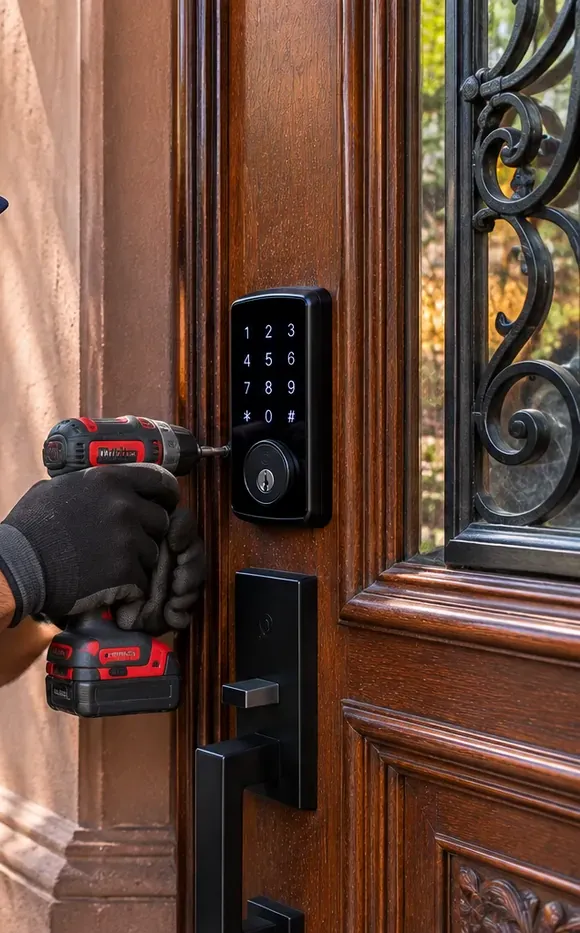
Driving the mounting screws of a keypad smart lock with a cordless drill on a wood door beside a decorative iron grille, West Brighton, Staten Island guide
A gloved hand drives the mounting screws with a cordless drill, the decorative iron grille of the door's glass panel just beside the lock — the kind of tight spacing older doors often have.
Shop Our Systems

Smart Lock Installation Packages & Pricing

Starter — One Old Door Done Right

Quoted flat at walkthrough

One smart lock on the door your household uses most, with the door work it needs: measuring, plugging old holes, a reinforced strike, realignment, the signal test and codes for everyone who lives there.

Standard — The Divided House

Quoted flat at walkthrough

The shared street door plus each apartment's door, with codes per household, admin roles split between owner and tenants, a free inside release on every door, a bridge or mesh point where the walls need it, and a written access list.

Premium — Shop, Office or Busy Entrance

$1,650–$2,750

A hard-wired keypad or fob reader with an electric strike on a storefront, an office entrance or a shared entrance that sees heavy traffic, with power supply, battery backup and free-exit device. Staten Island pricing, per door.

Bring Your Own Lock — Labour Only

Already bought a smart lock? We'll fit it, prepare the door, connect it and set up the codes; labour is quoted flat at the walkthrough. On older doors we check the lock against the door's thickness, backset and stile width before drilling, and tell you plainly if it won't sit properly. If the work is app, bridge or code setup only, it's the $225 first-hour setup-only rate.

Talk to a Tech About a Divided House

Tell us how many apartments share the front door and who lives where. We'll sketch the code plan on the phone before we come out.

Connectivity

Keeping a Smart Lock Online in an Old Plaster-Wall House

Most smart lock complaints we're called about in older houses aren't about the lock. They're about the connection: the app says the lock is offline, remote unlock doesn't work, notifications arrive late or not at all. That usually comes down to three things in a house like this — distance, walls and power.

Distance: where the router lives

In many older houses the internet comes in wherever the provider found it easiest to drill, which is often a back room or the basement, far from the front door. Every wall and floor between the router and the hall costs signal. Moving the router isn't always possible, but knowing where it is tells us early whether the lock's bridge will reach it.

Walls: plaster, lath and old brick

Plaster is heavier than drywall, plaster on metal lath can weaken radio signals noticeably, and some houses have masonry walls between rooms. We test at the door, not at the router. If the hall is a dead spot, a mesh Wi-Fi point placed between the router and the hall usually solves it; in larger houses a wired access point does the job most reliably.

Power: outlets near the door

Bridges and border routers need mains power, and older halls often have few outlets. A bridge plugged into the room behind the hall wall often works; one plugged in two rooms away often doesn't. Where a lock can connect over Wi-Fi by itself, we weigh the convenience against shorter battery life.

Choosing the connection type

  • Wi-Fi built in: no bridge needed, but the lock needs a decent signal at the door and uses its batteries faster.
  • Bluetooth plus a Wi-Fi bridge: the commonest setup; the bridge must be near the lock and have good Wi-Fi itself. August puts the distance at 10 to 15 feet for its Connect bridge.
  • Matter over Thread: a low-power mesh that can hop through other Thread devices, but it needs a Thread border router, such as a Nest Hub (2nd gen) or a HomePod mini, from the same ecosystem as the app you use.
  • Z-Wave: for houses with an existing hub or alarm panel that speaks it; the mesh is built from mains-powered Z-Wave devices between the hub and the lock.

Where the house needs more than a single bridge to cover the doors, network installation on Staten Island is usually the cleaner long-term fix than adding gadgets door by door.

Apartment Residents

For Renters and Residents in West Brighton Apartment Buildings

Not everyone in West Brighton owns their door. If you rent in a divided house, live in one of the larger complexes off Hart Boulevard or Markham Drive, or live in the West Brighton Houses, here's how to think about adding a smart lock before anyone picks up a drill.

Know which kind of building you're in

In a building with three or more apartments, state law lets a tenant install their own lock on the apartment door in addition to the owner's, provided it is no more than three inches in circumference and the owner gets a duplicate key on request; lease clauses that charge for this are void. That right doesn't extend to buildings run by a municipal housing authority, and it doesn't apply in a one- or two-family house, where the lease and the owner decide.

Add, don't replace

Where you're allowed to add a lock, the smart lock goes alongside the owner's lock, not instead of it, unless the owner agrees otherwise. A retrofit unit over an existing deadbolt, or a second smart deadbolt above the original lock, are the usual answers. We make sure the owner can still get in with the key the law or lease entitles them to.

Keep the inside simple

Whatever goes on an apartment door has to open from inside without a key. We fit thumb-turns or levers inside, never double-cylinder deadbolts, and we don't fit anything that interferes with the door's self-closer.

Plan for moving out

When you leave, the smart lock can come with you if it was your addition; we can remove it and patch the holes, or leave it for the next resident by arrangement with the owner. Either way, delete your account and codes from it before you hand back the keys.

Testing a keypad smart lock on a dark apartment door with the phone app showing Unlocked, for West Brighton, Staten Island apartment residents
A finger on the keypad of an apartment door while the phone in the other hand shows the lock as unlocked: the final check that the app and the door agree.
Before You Buy

A West Brighton Checklist Before Ordering a Smart Lock

Five minutes at the door with a tape measure and a phone will tell you more than any product page. Here's what to check before you click buy.

  • Door thickness. Measure the edge of the door. Compare it with the range the lock is listed for, such as Schlage's 1⅜ to 2 inches for its residential smart deadbolts.
  • Backset. Run the tape from the edge of the door in to the middle of the round hole the current deadbolt sits in; the usual figures a smart deadbolt is built for are 2⅓ or 2¾ inches.
  • Wood beside glass. If there's a glass panel, measure the solid wood between the edge and the glass. If it's tight, you need a narrow-profile lock or a different door.
  • Existing deadbolt. Is it single-cylinder, with a thumb-turn inside? Retrofit locks need that. A double-cylinder deadbolt should come off anyway.
  • Mortise lock in the edge. A rectangular plate on the door edge with a large lock body inside means older hardware that may need to be worked around or filled.
  • Wi-Fi at the door. Stand at the door with your phone on Wi-Fi only and load a web page. If it struggles, the lock will too.
  • Nearest outlet. Find the closest outlet to the door, on either side of the wall. That's where a bridge would go.
  • Who needs in. List every person and service that needs to get through this door, and how often. That decides how codes and schedules are set.
  • Whose door is it? If you rent, check the lease and the building type. If you own a building with tenants, decide who holds admin on each door.
  • Landmark status. If the house is an individual landmark or in a historic district, replacing the door needs an LPC permit; for hardware changes, ask LPC through 311 before the work.
Complete Services

Every Smart Lock Installation Service in West Brighton

A smart lock is rarely the only thing an old house or a divided house needs at its doors. Most West Brighton divided houses pair the lock with a doorbell camera at the shared door; most shops pair it with access control. These are the related services we provide here.

Doorbell Camera Installation Staten Island

A camera at the shared street door, so each apartment sees who is there before unlocking.

Intercoms for Divided Houses

A button and a release for each apartment at the front door of a three-unit house.

AESS Access Control on Staten Island

Readers, strikes and controllers for Forest and Castleton avenue shops and offices.

Door Buzzer Repair

For old buzzer systems on shared doors that ring but no longer release.

Alarm Installation

Door and window sensors for the side and rear windows a lock can't protect.

Home Security Cameras

Cameras covering side alleys, back yards and rear stairs.

Home Automation

A hub or Thread border router so the hall lock, the porch light and the alarm can act together.

Network and Wi-Fi Coverage

Access points that get a signal through plaster walls to the front hall.

Low-Voltage Wiring

Transformers, bell wire, strike power and cable pulls through old walls, done under our state licence.

Field Notes

Field Notes on Older North Shore Doors

How our installers approach an older house's doors — general working practice, not an account of any particular job or customer.

On an old door the first thing we look at is the edge, not the face. The edge tells you the door's history: a mortise plate where the original lock was, round plugs where later locks came and went, a strike in the frame that has been moved twice. If the door's edge has been cut up, the new lock needs solid wood to bite into, and that comes from proper plugs and sometimes a reinforcing plate, not from longer screws into putty.

Then we look at the glass. If a pane is within an arm's reach of the thumb-turn, we say so, because a smart lock doesn't change that. Then we close the door gently a few times and watch the bolt line up with the strike; an old house that has settled will often need the strike moved by a few millimetres before a motorised bolt will throw cleanly every time.

Last, we walk from the router to the door with a phone, and ask who lives in the house and who needs to come in. In a divided house the code plan is the real job. On every door we touch, the way out stays one simple movement from the inside, whatever happens to the batteries.

FAQ

West Brighton Smart Lock Installation FAQ

Do you cover the whole of West Brighton, including the blocks near Walker Park, Sunset Hill and Richmond Terrace?
+

Yes. We work across West Brighton from the Kill Van Kull waterfront along Richmond Terrace down to Forest Avenue and Clove Lakes Park, including the blocks around Walker Park and the houses on Sunset Hill, as well as neighbouring New Brighton, Port Richmond, Sunnyside, Castleton Corners, Livingston and Randall Manor. Pricing is the same Staten Island pricing throughout.

Our door is hinged on the left — do we need to order a left-handed smart lock?
+

Usually not. Most residential smart deadbolts work on left- or right-hand doors and set their direction during installation, either automatically or with a switch or app setting. Some keypad lever locks and mortise-style locks are handed, though, so check before ordering, or send us the model and a photo of the door from inside and we'll confirm.

Will the buttons we press most wear shiny and give our code away?
+

On some keypads, over time, they can. Touchscreen keypads avoid physical wear, and many locks let you enter extra random digits before or after the real code so smudges and wear don't reveal it. Changing codes occasionally, and giving each person their own, helps too.

How many digits should our door code be?
+

Longer codes are harder to guess, but they also have to be easy for the person to remember. Most locks accept four to eight digits; we usually suggest six for household members, avoiding birthdays and house numbers, and shorter temporary codes only for one-off visits that are deleted afterwards.

Do the codes get wiped when the batteries are changed?
+

On most current smart locks, no. Codes and settings are stored in the lock's memory and survive a battery change. The clock or schedule may need resyncing, which usually happens automatically when the app next connects. We show you how to change the batteries so you can see the codes still work afterwards.

Can young children use a fingerprint reader, or is a code better for them?
+

Both can work. Fingerprint readers can be less reliable with small or growing fingers and may need re-enrolling as a child grows, so many families give children a simple code as well. A code also works when hands are wet or cold.

What should we do with the physical keys once the house goes keyless?
+

Keep at least one key somewhere secure outside the house, such as with a trusted relative nearby, and one inside. Collect and count the old keys from anyone who had them. If you can't account for all of them, rekey the backup cylinder so old keys no longer work.

Will you show us how to factory-reset the lock ourselves if we ever need to?
+

Yes. At handover we show you where the reset button or procedure is and explain what it erases, which is usually every code and the app connection. It's worth knowing for selling the house, but it shouldn't be done casually, so we also explain how to remove individual codes without a full reset.

How far ahead do we need to book a West Brighton installation?
+

For the free walkthrough, call or send the form and we'll offer the next open 2-hour window. The installation date follows the quote, and depends mainly on whether the locks you choose are in stock and how much door work the house needs.

All Areas Served

Smart Lock Installation Across Staten Island and New York

This West Brighton page sits under our Staten Island smart lock installation page, which covers the whole island, and our NYC smart lock installation hub for the five boroughs. We install smart locks in every area below.

Staten Island

Smart locks on Staten Island — the borough page for houses, two-families and shops from the North Shore to Tottenville.

New York City

Abstract Enterprises smart lock installation in NYC: the citywide hub for apartment doors, building rules and boards in all five boroughs.

Other Boroughs

Brooklyn · Manhattan · Queens · the Bronx

Back to the Abstract Enterprises Security Systems home page, or read about our company.

Locked Out Somewhere Between Forest Avenue and the Kill Van Kull?

Code ignored, motor buzzing but the bolt not moving, or the app insisting the lock is offline? Ring (347) 934-8335 and ask for the first free arrival window; most of these turn out to be a tired battery, a lost pairing or a strike that has crept out of line, and they are usually put right within an hour or two of the technician reaching the door. Meanwhile, if your lock has a keyway, the backup key is the quickest way in — it is there for exactly this night.

Smart Lock Installation West Brighton, Staten Island — Licensed and Insured

Abstract Enterprises Security Systems · 1282 Troy Ave, Brooklyn, NY 11203 · (347) 934-8335 · WhatsApp (718) 679-0359 via wa.me

NYS Low-Voltage Licence #12000287431 · 100% Licensed & Insured · Same-Day Estimates · Rated 4.7★ from 201 Google Reviews

Locks you supply carry their manufacturer's warranty; see our warranty page for how AESS-supplied products are covered.

Nothing here is legal advice: where state or city law is mentioned, it is to show how it bears on fitting locks to West Brighton houses, divided houses and apartments. Page reviewed and updated October 17, 2026. Changelog: first publication of the West Brighton smart lock installation page.