Home › Smart Lock Installation NYC › Queens › Bayside
Tudor & Colonial Front Doors · Storm-Door Heat Checks · Rear & Side Doors · Garden Co-op & Tower Units · Bell Boulevard Shop Doors
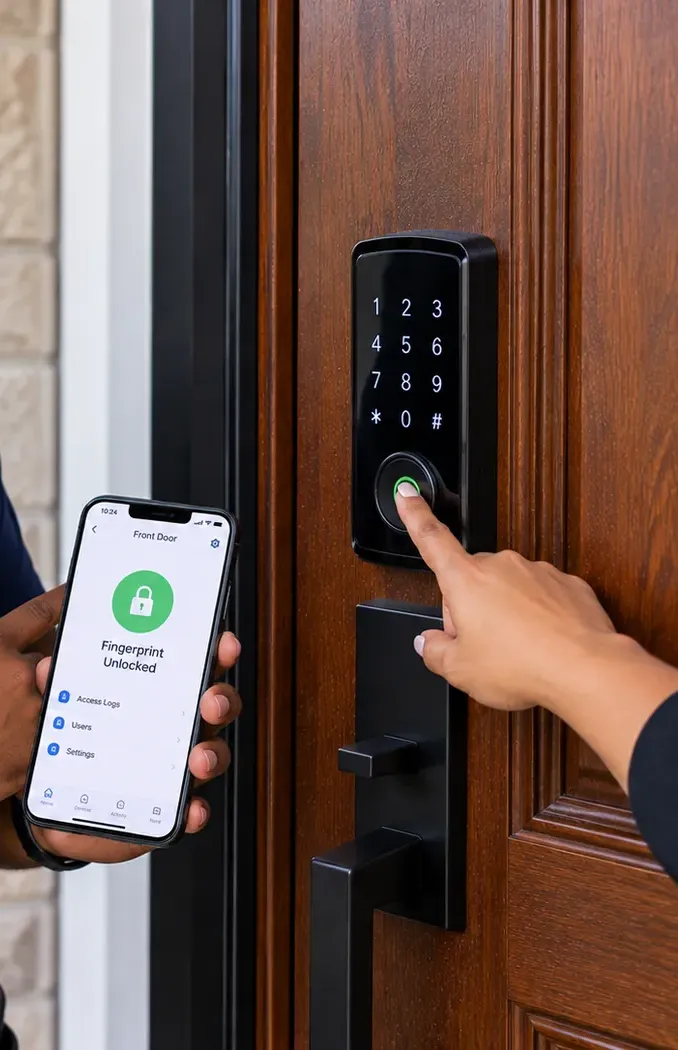
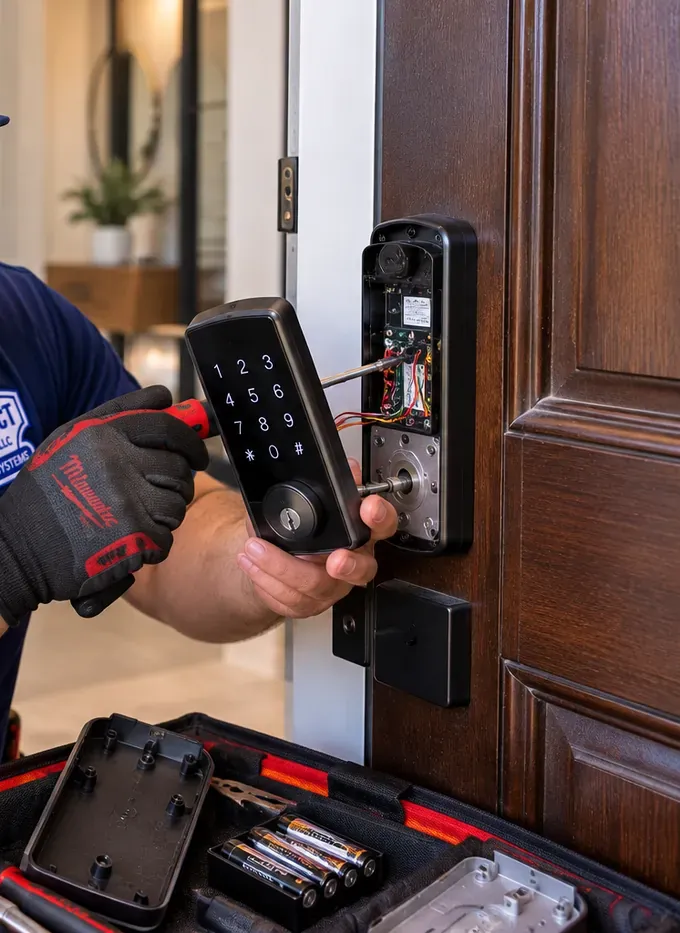
Bayside is a neighborhood of front doors with character: oak doors under brick arches in Bayside Hills, Colonial six-panel doors behind full-glass storm doors, garden co-op entries in Bay Terrace and Oakland Gardens, and late-closing restaurants on Bell Boulevard. We fit keypad, fingerprint and app-controlled locks that suit the door you already have, that open from inside with one plain turn, and that close the gaps a burglar in the 111th Precinct actually tests — the back slider, the side door and the empty house that never answers its doorbell.
Reviewed and updated October 17, 2026 · Written by Anwar Timothy, NYS licence #12000287431 · Part of our Queens smart lock installation service

Weighing a keyless front door for a Bayside house, or standing outside one that has stopped taking your code? Phone our Queens line on (347) 434-6392 or use the one-minute form. A licensed installer reads every request and tells you, before anyone drives over, whether your door, your storm door and your household suit a smart lock — and which model, if any, you should buy.
Bayside was built as a suburb inside the city, and its doors still show it. The neighborhood runs from Little Neck Bay and the Long Island Sound on the north and east to the Long Island Expressway on the south, with Francis Lewis Boulevard and Auburndale on the west and the Cross Island Parkway marking the eastern edge, and most people also count Oakland Gardens and Hollis Hills below the expressway as Bayside. Inside those lines are some of the most varied residential front doors in Queens: inter-war Tudors and Colonials with heavy wood doors set into brick, post-war Capes, ranches and split-levels, garden co-op entries around landscaped courts, condominium towers on the water, and a single main street of restaurants and shops along Bell Boulevard. A smart lock that suits one of those doors can be exactly wrong for the next, which is why our Bayside work always starts with the door rather than with a product page.
Bayside Hills shows the problem best. CityNeighborhoods.NYC describes the subdivision's detached brick and stucco Tudor, Colonial and Mediterranean-style houses as going up in earnest between 1927 and 1935, many of them with slate roofs, leaded-glass windows and decorative stonework. Those houses were built with solid doors, deep masonry reveals and hardware that was meant to last a century. Some still carry their original doors, round-topped or with a small grille at eye level; others have had a modern steel or fiberglass slab fitted into an old frame. Either way, the interesting part of a Bayside Hills job is rarely the electronics. It is how the lock's outside keypad and inside battery housing sit on a door that was never designed for them, and whether the frame, after ninety-odd years of settling, still lets a motorized bolt slide home without a fight.
The second reason Bayside homeowners call is less romantic. Through June 29, 2025, the 111th Precinct, which covers Bayside, had recorded 146 burglaries for the year, 19 more than the 127 at the same point in 2024 — an increase of 15 percent, according to the CompStat figures QNS reported in July 2025. The same article described an attempt on the evening of June 28 near 202nd Street and 36th Avenue, a few blocks west of the Clearview Expressway: two masked people went into the yard of a 65-year-old man, worked on the sliding glass door at the back of the house, failed to get in, and then rang the doorbell repeatedly until neighbors noticed the open slider and shouted them away. The details matter for anyone choosing locks. The front door was not the target; the rear of the house was. And the doorbell was being used as a test of whether anyone was home.
That pattern is not new to the precinct. Back in December 2017, Patch reported that burglaries in the 111th had doubled in a 28-day November period compared with the year before, even as overall crime fell, and officers urged residents to lock windows and doors, keep yards lit and install an alarm where they could. A smart lock is not an alarm and does not replace one. What it can do, fitted properly, is make sure the doors are actually locked when the house is empty, tell you when one is not, and give you a record of every opening — which is the part of that police advice people forget most often, on the side and rear doors they use without thinking.
Then there are the multi-family buildings. Habitat Magazine reported in 2018 that nine Bay Terrace co-op sections, built in the 1950s on land owned by Cord Meyer Development and totalling 1,800 garden apartments, were buying out or otherwise acquiring their land. Farther south, CityNeighborhoods.NYC dates the garden-style co-ops of Bell Apartments, later Oakland Gardens Apartments, to the early 1950s. On the water, the Bay Club's two gated towers hold more than a thousand homes. In each of those, the unit door belongs to a building with rules, a managing agent and, in a co-op, a proprietary lease that expects the corporation to hold a way in. The lock has to work for the shareholder or owner and for the building at the same time.
A lock that knows who came in is only half the picture; most Bayside owners also want to see who is outside. Our Queens doorbell camera installers can fit a camera at the same visit, so the doorbell that burglars use as a test can answer back, and alarm installation across Queens covers the contacts and sirens a lock cannot provide.

A keypad that went black over a hot week behind a glass storm door. A Tudor door that swelled in August and now stops the bolt a quarter-inch short. An app that forgot the lock when the router was swapped. A side-door lock whose last owner left with the admin account. A Bell Boulevard back door that the closing bartender swears is locked but the log says is not. Those are service calls, and we book them as such — into the next open 2-hour window — and most battery, pairing, programming and strike-alignment problems are put right in one to two hours once a technician is at the door. If the fault is on a building entrance rather than a house door, a failed electric strike repair is $310–$509 at our Queens rate. Call (347) 434-6392, or for entrance buzzers see AESS door buzzer repair in Queens.
Nine kinds of work make up almost every Bayside smart lock call. Whatever the mix, the job ends the same way: the bolt throws cleanly with the door pulled shut by hand, the inside opens with one ordinary motion, a mechanical key still works unless you have deliberately chosen otherwise, and each person who will use the lock has tried it in front of us.
Keypad and fingerprint deadbolts on the oak, mahogany and painted panel doors of Bayside Hills and the older streets north of Northern Boulevard, positioned around arches, grilles, mail slots and original knob sets without cutting into anything that can't be put back.
The doors burglars in the 111th actually try. Keyed or smart deadbolts on hinged rear doors, and for sliders an honest conversation about secondary locks, contacts and cameras, because a standard smart deadbolt does not fit a sliding panel.
Before a keypad goes behind a full-glass storm door we look at which way the door faces and how hot the gap gets, and we choose a lock whose published operating range suits it — or change the storm door's glass panel for a screen in summer.
Bought a house with somebody else's smart lock? We factory-reset it from the inside, set it up under your account, change or re-key the cylinder, and tell you plainly if the model is too old to be worth keeping.
Locks for Bay Terrace and Oakland Gardens co-op apartments that respect the corporation's rules on appearance and access, keep the building's way in working, and leave nothing behind that the next shareholder has to undo.
Unit doors in the Bay Club and the other waterfront and Bay Terrace towers: retrofit and replacement smart deadbolts that keep the corridor-side look the condominium expects and still close and latch on the self-closer.
Per-employee codes, door-position sensing and lock-up confirmation for restaurants, bars, salons and offices along the Bayside Village business district, with a push-to-exit or lever inside every exit door.
A video doorbell that answers when you are out, paired with a lock that reports its own state, so the house stops looking empty to anyone who rings and waits.
Swollen and settled doors, strikes that have walked, worn batteries, keypads cooked behind glass, bridges lost after a router change, and admin accounts stranded on an old phone.

Bayside was built in layers: an inter-war garden suburb, a post-war wave of Capes and co-ops, and late-century towers on the bay. Each layer left its own front door. These are the types we see, and what each means for a keyless lock.
Brick and stucco houses from the late 1920s and early 1930s, with the half-timbered fronts and arched entryways CityNeighborhoods.NYC describes; where an original door survives it may be round-topped and set back in a masonry arch. Doors may be thicker than a modern slab and sometimes carry a speakeasy grille or a small window right where a keypad wants to go.
Red-brick and frame Colonials on the older streets, where a panelled front door behind a full-glass aluminum storm door is a combination we meet again and again. The storm door, not the main door, decides which locks will survive a July afternoon.
The arched entryways CityNeighborhoods.NYC notes on Bayside Hills' Mediterranean-style houses, often with stucco around a recessed door. The arch shades the door but also traps heat and blocks signal; hardware finish and a bridge position that can see the router get decided together.
The houses that filled in Bayside and Oakland Gardens after the war: standard-bored doors that take almost any smart deadbolt, plus side doors to the driveway and back doors to the yard that are used far more than the front.
The 1950s sections near the Bay Terrace shopping center: low-rise buildings with lawns and shared paths, unit doors controlled by a proprietary lease and house rules, and a corporation that will expect access in an emergency.
Early-1950s brick co-ops around courtyards between Cunningham and Alley Pond parks. Similar rules to Bay Terrace, with entry doors that range from interior halls to doors close to the outside air.
The Bay Club's two gated towers, the Towers at Waters Edge and the other Bay Terrace condominiums Wikipedia lists: fire-rated corridor doors on self-closers, metal frames, concierge sign-in and a condominium board's view on what the hallway side looks like.
The privately owned, gated enclave near the Bay Terrace shopping center and Little Neck Bay, one of the few clusters of single-family houses in that part of Bayside. Large doors, long sight-lines from the gate, and owners who often want gate, house and garage access thought through as one plan.
Two- and three-storey buildings with a shop or restaurant at street level and offices or apartments above, around the business district and the LIRR station at 213th Street and 41st Avenue. Street doors, stair doors and back doors each need their own credentials.
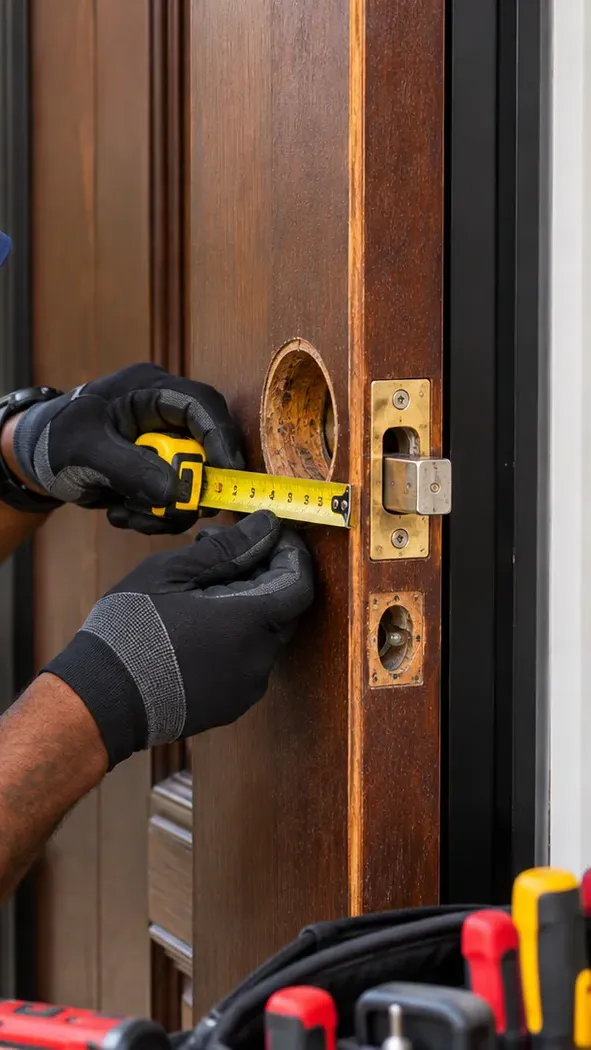
The arch, the grille and the backset. On a period door the question is not whether a smart lock will work but where it physically fits. Many smart deadbolts have an outside escutcheon taller than the old deadbolt rose, and an inside housing taller still because it holds the batteries and motor. On a round-topped door with a speakeasy grille or a glazed panel near the lock rail, we measure from the existing bore to the grille frame, to the edge of the glass and to the stop of the arch, and we check that the inside housing clears any decorative strap or knocker on the back face. Where the old bore is in the wrong place, we would rather fit a different lock than drill a second hole in a door that cannot be replaced like for like.
Doors that move with the seasons. Solid wood doors in masonry openings swell in humid summers and shrink in dry winters. Hand-turned deadbolts tolerate that; motorized bolts do not. When the strike is even slightly off, the motor stalls, the lock reports a jam and the batteries drain. We test the throw with the door pulled shut by hand, by its own weight and by the storm door closing against it, and we deepen, move or replace the strike so the bolt clears in every season. On some doors the honest answer is a trip from a carpenter first; we say so before anything is installed.
Heat behind the glass. A full-glass storm door on a sunny exposure turns the gap in front of the main door into an oven. A storm-door supplier, Storm Door Guy, warns that full-glass panels can trap heat between the storm door and the entry door, damaging paint and warping wood doors. Electronics are less forgiving than paint. Schlage's product page for its Encode Plus Wi-Fi deadbolt, for instance, lists an operating range of minus 31°F to 150.8°F for the outside lock body and 14°F to 120.2°F for the inside body. We check the exposure, and where a door bakes, we recommend swapping the glass panel for the screen in summer, choosing a model with a wide published range, or mounting the keypad side where it is not sitting in direct sun behind glass.
Corridor doors in towers and co-ops. In a multiple dwelling the city's Housing Preservation and Development fire-safety guidance says double-cylinder locks are illegal on apartment doors, and doors to interior corridors in residential buildings are required to be self-closing. So a smart lock on a Bay Club or garden co-op unit door must open from inside without a key, and must not stop the door closing and latching by itself. We check the closer, the latch and the bolt together after installation, because a motorized deadbolt that drags can keep a self-closing door from latching.
One turn out, every time. On every residential door we touch in Bayside the inside opens with a thumb-turn or lever, without a key, a code, a phone or power. We apply that on houses as well as apartments, because a fire or a medical emergency doesn't care which kind of building it is in.
Many Bayside owners rework the front entrance and the intercom or buzzer together. Our intercom installation service for Queens handles two-family and small-building entrances, and the Queens door buzzer installation team fits buzzers and strikes on shared street doors.

Bayside's business doors are mostly small, owner-run and open late. The Bayside Village Business Improvement District, listed in the city's BID directory with an office on 39th Avenue, describes itself on its own social pages as representing more than 200 businesses along Bell Boulevard, from restaurants and bars to salons, nail studios and wine shops. Away from Bell, the work spreads along Northern Boulevard, the Bay Terrace shopping center, Francis Lewis Boulevard's strip of family-run shops and Springfield Boulevard in Oakland Gardens. The questions are the same everywhere: who can open which door, at what hours, and how the owner knows the place was really locked when the last person left.
The Bayside Village BID's main street, north of Northern Boulevard: restaurants, bars, cafés, salons and upstairs offices, many with a rear door onto a lot or service area. Per-employee codes, a door-position contact on the back door and an app check at closing are the usual set-up.
The blocks by the LIRR station at 213th Street and 41st Avenue, 12.6 miles from Penn Station on the Port Washington Branch. Offices and services close to the platform that need a street door that doesn't depend on whoever has the key that morning.
The boulevard that crosses Bayside west to east, with wider frontages than Bell and a mix of shops, services and offices. Wider doors, heavier hardware, and often a back-office door that should be on a different code from the showroom.
The center that gives Bay Terrace and Bayside Gables their landmark. Tenants answer to a landlord's rules on storefront hardware, so the first call is to the property manager, and our plan is written to suit it.
The western edge of Bayside Hills, which CityNeighborhoods.NYC describes as a modest commercial strip of family-owned restaurants and shops. Small doors, few staff, and owners who would rather manage codes than keys.
One of Oakland Gardens' commercial and transit spines, as CityNeighborhoods.NYC describes it: neighborhood services and shops, some below apartments, where a business code must never open the residents' door.
When a business needs more than a couple of keypads — several doors, schedules, a camera beside each door — it is access control territory. Our Queens access control installers pick it up from there, and commercial security camera installation in Queens puts video next to each door event.

These are the questions Bayside homeowners, shareholders and shop owners ask before a smart lock goes on a door, grouped by situation: storm doors and key-free locks, the doorbell test burglars use, new owners and phone keys, and businesses. Measuring period doors, lock grades, code security and data are covered in the hardware notes that follow the equipment list. Pricing, scheduling and coverage are in the FAQ further down. Nothing here is legal advice; where a rule is mentioned we name it so you can read it yourself.
Yes, it can, and it is one of the more common reasons a keypad on a Bayside Colonial starts misbehaving in July. Storm-door suppliers warn that full-glass storm doors trap heat against the entry door; Storm Door Guy, for example, says that heat can damage paint and warp wood doors. A lock in that space is sitting in the same heat. Manufacturers publish operating ranges for this reason: Schlage lists minus 31°F to 150.8°F for the outside body of its Encode Plus and 14°F to 120.2°F for the inside body. A south- or west-facing door behind clear glass on a summer afternoon can approach the top of ranges like those.
There are three practical answers. Swap the storm door's glass panel for its screen panel from late spring to early autumn, which many full-view storm doors are designed to allow — check yours has an interchangeable panel. Choose a lock with a wide published outside range and check it before you buy. Or, on the hottest exposures, put the keyless feature on a side or rear door that sits in shade and leave the front door on a good mechanical deadbolt.
We test the door at the walkthrough by feeling the existing hardware after the storm door has been closed in the sun for a while, and we tell you which of those answers suits your house. Batteries are the other casualty of heat; locks behind hot glass tend to need fresh cells sooner.
Both, depending on what you are worried about. Keyless-only smart deadbolts exist — Yale, for instance, sells “Key-Free” versions of its Assure Lock 2 touchscreen — and removing the cylinder removes the one part of the lock that can be picked or bumped. For a household that has lost track of how many keys are out there, that has real appeal.
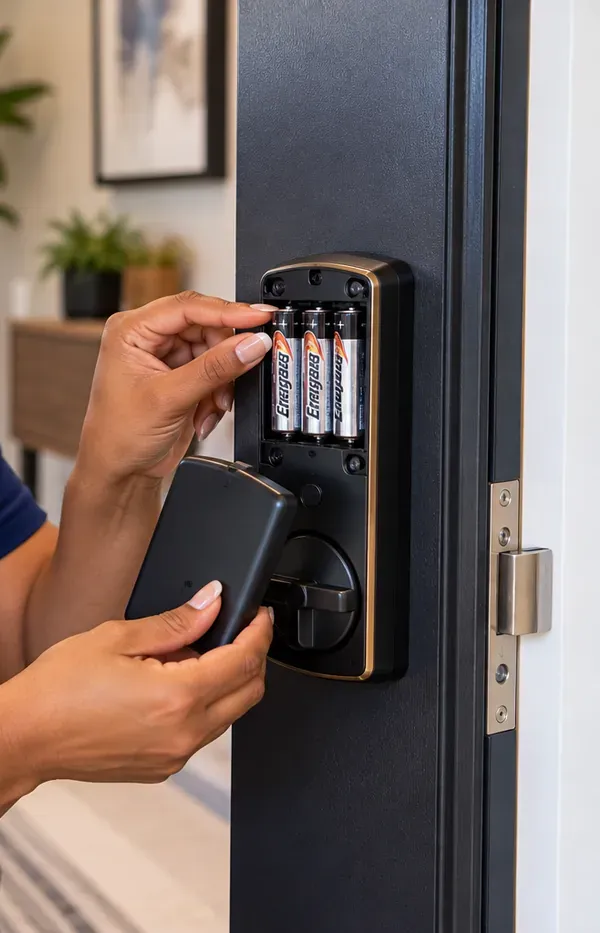
The trade-off is how you get in when the electronics can't help. Key-free models rely on external emergency power, typically a 9-volt battery held to contacts on the outside, when the internal batteries die. That works, but only if somebody has a 9-volt battery when they need one, and only if the fault is the batteries rather than the electronics. There is no physical override for a failed board.
Our usual advice in Bayside is a keyed smart lock on the front door, with the key kept somewhere sensible and not hidden by the door, and a key-free model only on a second door where the first one gives you a way in. If you want a key-free lock on your only entrance, we will fit it, but we will make sure you understand the emergency-power routine first.
They can make the house a great deal less convincing as empty. In the attempt QNS described near 202nd Street and 36th Avenue, the doorbell was rung repeatedly before neighbors raised the alarm. A plain doorbell rung at an empty house tells the person on the step exactly what they want to know. A video doorbell answers that test differently: it alerts your phone, records the person, and lets you speak through it from wherever you are, so a ring that would have been met with silence is met with a voice.
The lock is the second half. When you see who is at the door, you also want to know that the front, side and back doors are actually locked, and to lock any that aren't without going home. A connected smart lock reports its own state to the same phone, and many lock and doorbell makers allow the two to sit in one app or one smart-home platform. We set it up so the alert, the video and the lock status are on one screen.
What neither does is stop someone who decides to break a slider anyway. That is the job of a secondary bar or pin lock on the slider, a contact sensor, and an alarm — which is why we often quote the lock, the doorbell and a slider contact together for houses in the precinct.
Usually yes, because most smart locks are designed so that a factory reset needs access to the inside of the door, which you now have and a stranger outside does not. On many models the reset is done by removing the inside cover or battery pack and holding a reset button, or by a button sequence while the batteries are reconnected; the exact procedure is in the maker's manual and differs from model to model. A reset clears every user code, fingerprint and pairing, including the old owner's.
The app account is the second step. Connected locks are usually registered to a person's account with the manufacturer, and some won't join a new account until the old owner has removed them or the maker's support team has released them. After a factory reset many will simply pair as new; when they won't, we contact the manufacturer with proof of ownership of the house. Then the mechanical side: a keypad lock still has a key cylinder, and the seller's keys still fit it, so we re-key or replace the cylinder at the same visit.
Sometimes the honest answer is that the lock is not worth keeping — an old model the maker no longer supports, an app that no longer updates, or a keypad worn smooth. We tell you that before spending your money on resetting it.
Use both, and don't rely on the phone alone. Several current smart deadbolts let a phone or watch act as a key by tapping it on the lock, much like a transit card; Yale's Assure Lock 2 Plus with Home Keys is one example sold in hardware stores. It is genuinely convenient for adults who always carry a phone, and it means one less code to remember.
The weak points are the ones you'd expect. Phones get lost, replaced and run flat, and a phone-key setup depends on the phone platform and the lock's own batteries both behaving. Owners have posted online about being shut out when a lock's batteries died and the phone tap couldn't help, and having to buy a 9-volt battery to power the lock from outside.
So in a Bayside family house we set phone keys for the people who want them, a personal code for everyone, fingerprints where the lock supports them, and a mechanical key kept with a trusted neighbor or relative. Every person leaves the walkthrough with at least two ways in that don't depend on the same device.
By measuring the door, not just the bolt. Most smart locks report whether their own bolt is extended. That is useful, but on a busy restaurant back door it can be misleading: a bolt can be thrown while the door is still resting against the frame, unlatched, and some locks will report that as “locked”. What you actually want to know is that the door is shut and the bolt is in the strike.
We get there with a door-position sensor — a small contact in the frame, or a lock model that has one built in — so the app shows “closed” and “locked” as two separate facts. Then we set a closing-time check: if either door is open or unlocked after the time you choose, you and one manager get a notification. Each employee gets their own code, so the log shows who locked up.
On the street door of a bar, a keypad deadbolt is often enough. On a back door that takes deliveries, a keypad with an electric strike and a push-to-exit button inside can be better, because the door locks itself the moment it closes. That is the single-door keypad and strike package priced below at our Queens rate.
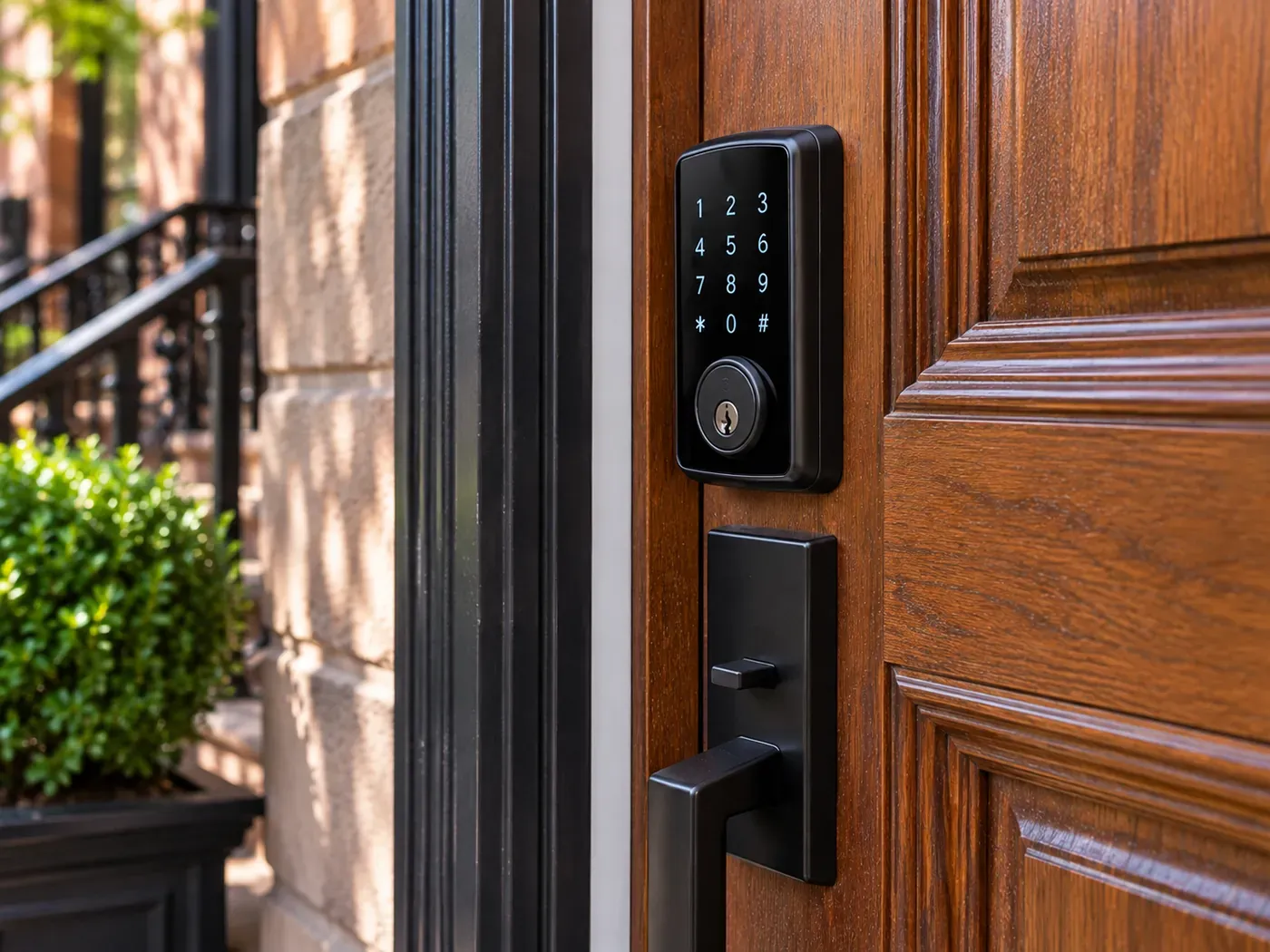
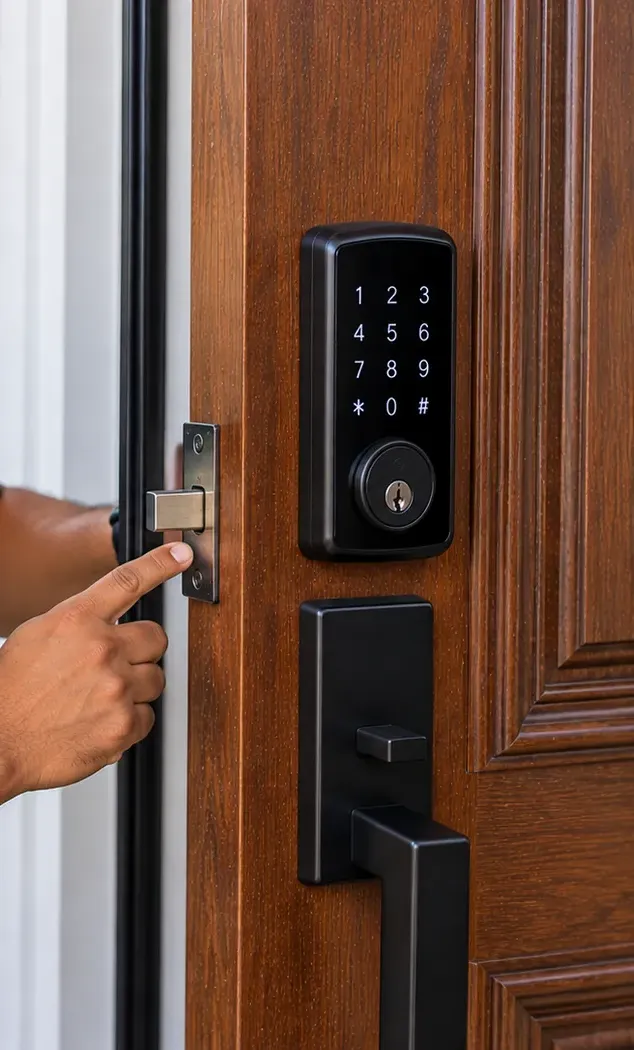
We install mainstream residential and light-commercial brands and pick the type to the door, not the other way round. These are the categories, with the Bayside doors each one suits best.
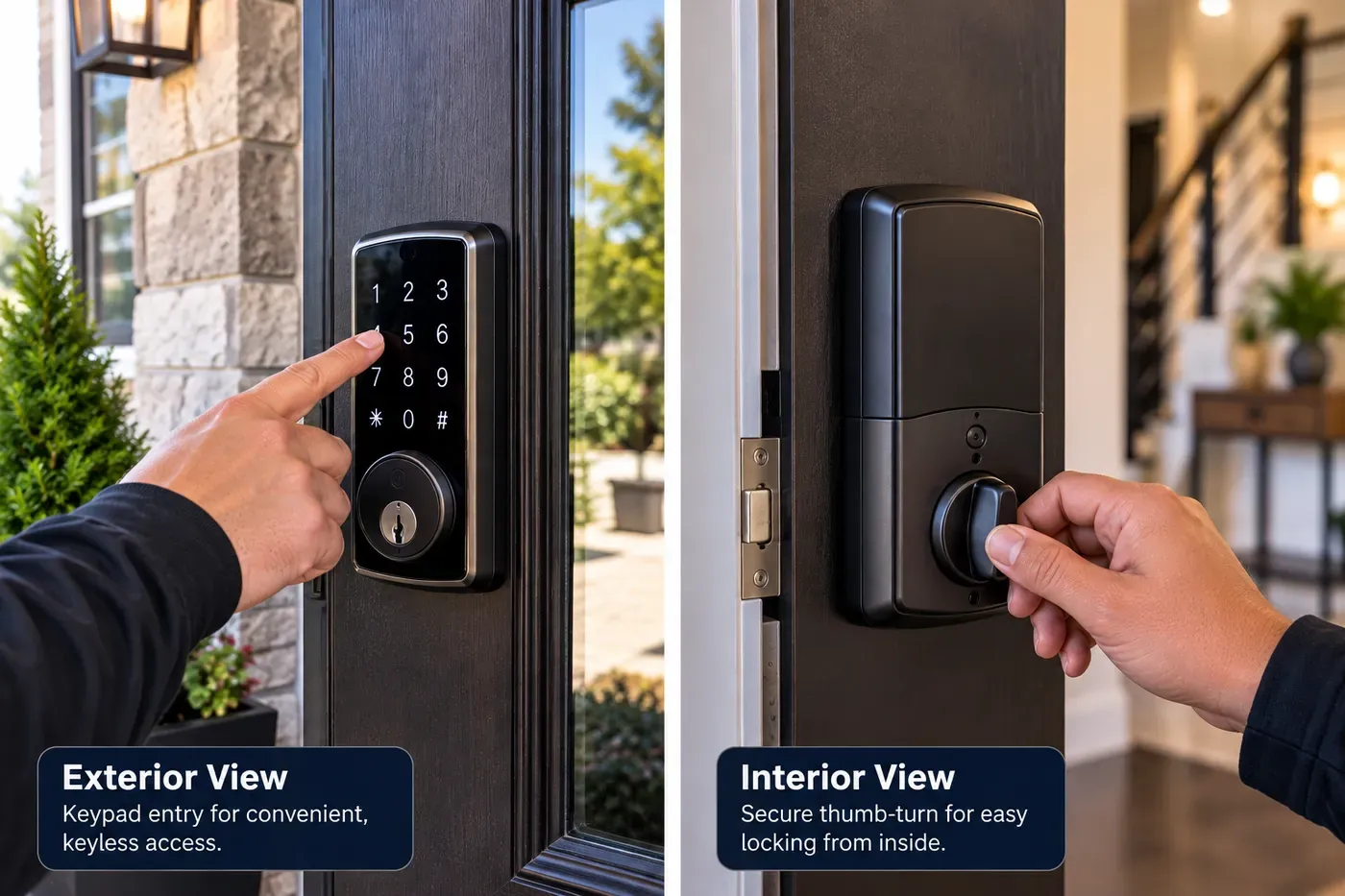
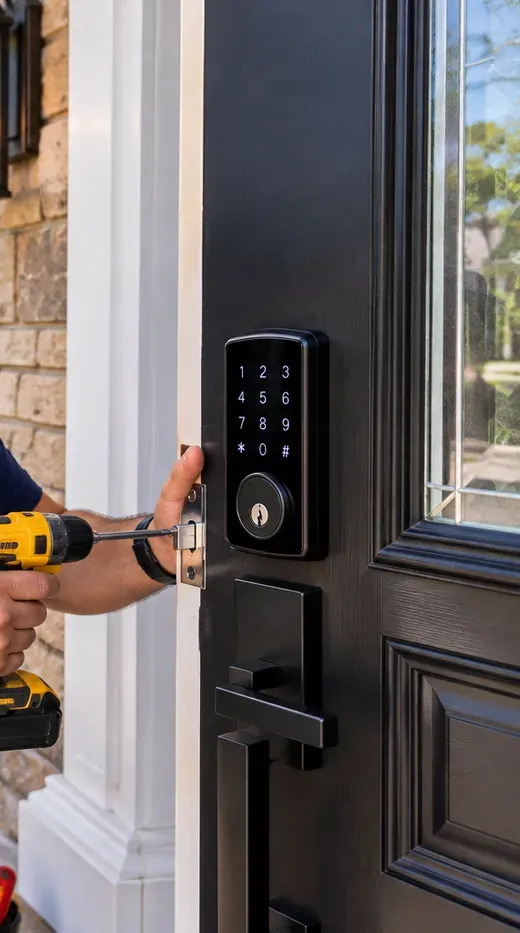
The workhorse: a keypad outside, a motor and thumb-turn inside, a key cylinder for backup. Right for most Colonial, Cape and ranch front and side doors with a standard bore.
Flatter faces that fit narrower rails and sit better near a speakeasy grille or a glazed panel on a period door. Check the published temperature range before putting one behind glass.
A reader on the outside instead of, or as well as, a keypad. Useful for children and older relatives who forget codes, and on doors where there isn't room for a full keypad.
Motorized units that replace only the inside thumb-turn and leave the outside of the door untouched. Best on co-op and condo doors where the corridor side has to match the building.
No cylinder at all, with external emergency power for flat batteries. Best on a second door, so there is always another way in.
Lever handles with a built-in keypad for interior offices, back-of-house rooms and storage, where a deadbolt isn't the right hardware.
A wall or frame keypad driving a strike in the frame, with a push-to-exit button inside. For shop back doors, offices and small-building entrances.
Wi-Fi bridges for Bluetooth locks, Z-Wave and Thread hubs, and door-position contacts that tell the app the door is shut, not only that the bolt is out.
Fitted alongside the lock so you can see and speak to whoever rang before deciding whether to open, and so the house doesn't sound empty.
National names such as ADT, Ring and SimpliSafe sell home security packages, and many Bayside homes already have one of their systems. Their strength is the monitoring and the app; their weak point, for locks, is that the lock still has to be fitted to a ninety-year-old door in a masonry arch, and that's work nobody does through an app. We fit locks that work with whichever platform you already use where the maker supports it, we don't sell monitoring contracts, and nothing we install needs a monthly subscription from us to keep working. If the lock you want won't talk to your existing system, we tell you before you buy it.

The practical detail behind the equipment list: how we fit period doors, what the grade on a box means, how keypads resist guessing, how a lock fits into police burglary advice, and where its records go.
On a round-topped Tudor door the new lock usually goes where the old deadbolt was, but only after measuring three things. First, the outside: most keypad deadbolts have a taller escutcheon than a plain deadbolt rose, so we measure from the existing bore up to the bottom of the grille frame and across to any glazing, and we check that the keypad will not sit over a raised panel moulding that would stop it bedding flat. Second, the inside: the battery and motor housing is the tallest part of any smart deadbolt, and on Tudor doors it has to clear the back of the grille, any decorative strap hinge or clavos, and the inside knob or lever below it. Third, the edge: the backset of a 1930s bore is not always the 2-3/8 or 2-3/4 inches modern locks expect, and the door may be thicker than the lock's listed range.
If all three work, the lock goes into the existing bore and nothing about the door's face changes except the hardware. If the outside keypad would collide with the grille, a slimmer model or a fingerprint-only deadbolt often fits where a full keypad won't. If the door is too thick, many makers sell a longer tailpiece or a thick-door kit. What we avoid is drilling a second bore through a period door; once that hole is there, the door can't go back to how it was.
One more check is specific to arched doors: the arch itself. On a round-topped door the top of the leaf swings through a curve, and on some doors the inside housing of a tall lock would sit close to the curve of the jamb when the door is open. We open the door fully with a cardboard template of the inside unit taped in place before ordering anything.
The grades come from the ANSI/BHMA A156 standards that lock makers test against. They describe durability and resistance to physical attack under set tests, not how clever the electronics are. Summaries of the standard published by hardware suppliers put it this way: a Grade 1 deadbolt must survive 250,000 cycles and 10 hammer strikes, while a Grade 3 deadbolt must survive 100,000 cycles and 2 hammer strikes, with Grade 2 in between. If a smart deadbolt has been graded, the maker usually says so on the box or the spec sheet; if it says nothing, ask before you buy.
For a house front door that sees normal family traffic, Grade 2 is a sound minimum and Grade 1 is a reasonable upgrade, particularly on the side door that gets opened dozens of times a day. But the grade is only as good as what the bolt goes into. A Grade 1 bolt in a strike held by two short screws into an old soft-wood jamb will still give way before the lock does.
So on Bayside houses we put as much attention on the strike as on the lock: long screws through the strike into the framing behind the jamb, a reinforced strike plate where the frame allows it, and a check that the bolt reaches its full throw. That is where most kicked-in doors actually fail.
Guessing a code at the door is slow work on a well-made lock, because manufacturers build in lockouts. Schlage's support pages, for example, say its Encode series disables the keypad for 30 seconds after three consecutive wrong codes, sounds the lock's alarm for 30 seconds after four, and disables the keypad for a minute after each further wrong entry — and, when the lock is paired with the app, the history records that the keypad was disabled. Other makers use similar schemes.
Guessing is not where codes are usually lost. Codes leak because they are short, obvious or shared: a birth year, the house number, 1-2-3-4, or a code given to a contractor two years ago and never deleted. A keypad also shows wear and grease on the buttons that are pressed most, which narrows the guess for anyone who looks closely.
So we set codes of six digits or more where the lock allows, give each person their own code so the log is meaningful, set end dates on codes for workers and visitors, and show you how to wipe the keypad face.
A smart lock turns “lock up” from a habit into something you can check. The advice Patch reported from the precinct in 2017 — lock windows and doors, keep yards lit, install a home burglary alarm if possible — is still the right list. The weak point is the first item. Families lock the front door and forget the side door; the last person out assumes the first person locked the back; the teenager leaves through the kitchen.
A smart lock contributes three specific things. Auto-lock relocks the bolt a set time after the door shuts, so a door that was opened and closed is a locked door. Lock-state alerts tell you when a door has been left unlocked or has been opened when you didn't expect it. And the activity log shows which code or phone opened which door, and when, which matters both for peace of mind and for anyone you have to talk to after an incident.
It doesn't replace the lights or the alarm. Many of the locks we fit can talk to the same smart-home hub as yard lighting and alarm sensors, so “away” can mean locked doors, lights on a schedule and the alarm armed with one tap. We explain what the house's existing alarm can and can't integrate with before suggesting anything.
Where the history lives depends on how the lock is connected. A Wi-Fi lock, or a Bluetooth lock with a Wi-Fi bridge, typically sends its events to the manufacturer's cloud so that the app can show them anywhere, and the maker's privacy policy governs what happens to that data. A lock that is Bluetooth-only keeps its log on the lock and shows it when your phone is nearby. Locks that use Matter over Thread can be controlled locally through a Thread border router on your own network, as Yale's and Bold's support pages on Matter explain, though the companion app may still use the cloud for some features.
For most households the cloud log is the point: it is what lets you see at work that the side door opened at 3:10. If you would rather keep the history at home, we can set a lock up without the cloud bridge, or on a local smart-home hub, and explain which conveniences you lose by doing so.
Whichever route you choose, the basics are the same: two-factor authentication on the account that controls the lock, a different password from your email, and administrators limited to the adults who live in the house.
We could not open Google's AI Overview for these searches from our build environment, so the claims below are the ones that cost guides, retailers and product pages make about smart locks — the material AI summaries are trained on and tend to repeat. Each is followed by what we see on Bayside doors.
Reviewers say this, and on a modern pre-bored door it is roughly true. Bob Vila's testers, for example, describe installing smart locks with little more than a Phillips screwdriver in around half an hour. Retail boxes make the same promise.
On a Bayside Hills Tudor or a Colonial door that has had three deadbolts in eighty years, the screwdriver part is still half an hour. The measuring, the strike work and the decisions about where a keypad can sit near a grille or glass are what take time, and they are where DIY installs go wrong: a bolt that drags on a swollen frame, a second bore drilled through a period door, an inside unit that hits the jamb.
The time estimate isn't wrong; it just describes a different door. Budget for the door you actually have.
This is a national figure. Fixr's guide, updated in January 2025, puts smart lock installation at $250 to $400 with an average of $300, for a Wi-Fi lock and an accessory, and handyman labor at $50 to $100 an hour.
It assumes one standard door, one user and nothing to fix. A Bayside job often includes a period door with an awkward bore, a strike that needs reinforcing, a storm door, a rear door, and several people to enroll. AESS doesn't publish a single figure for a house door for that reason; we quote flat after the walkthrough.
Where we do have published figures — keypads with electric strikes, new strikes and strike repairs — they are in the pricing table below at our Queens rate, and they are not the national number.
Product pages hedge this more carefully than summaries do. August's retrofit lock, for instance, mounts over an existing deadbolt inside the door and is only compatible with single-cylinder deadbolts. Most smart deadbolts list a range of door thicknesses and backsets.
Bayside's older doors fall outside those ranges more often than new-build doors do: thicker solid doors, unusual backsets, mortise hardware, doors with glass or grilles near the lock rail, and round-topped leaves that limit the size of the inside unit.
The correct claim is that most smart locks fit most standard doors. Whether yours is standard is what the walkthrough is for.
True once it is connected. August's own support pages say its Connect Wi-Fi bridge should be within 10 to 15 feet of the lock and needs good Wi-Fi where it is plugged in.
Brick and stucco houses with masonry arches around the front door, routers upstairs at the back of the house, and side doors at the end of a driveway are the textbook case for a bridge that can't hear the router. Tower condos add concrete and steel.
We test signal at the bridge position, not at the router, and finish every connected install by locking and unlocking from a phone on mobile data, standing on the sidewalk.
They are weather-resistant, to a stated rating. Yale's support page, for example, says its Smart Keypad is IP55 — dust protected and effective against water jetting — and that its lock and bridge are installed inside and not intended for outdoor use.
In Bayside the rain is the easy part. The harder conditions are the sun-baked gap behind a glass storm door, salt air on the doors closest to Little Neck Bay, and side doors that face straight into wind-driven rain with no overhang. None of those are the same as a jet of water in a test lab.
We match the model to the exposure and tell you where we think the keypad side will need replacing before the rest of the lock does.
This one is usually overstated. Mainstream locks lock their keypads after a few wrong codes; Schlage, for example, documents a 30-second lockout after three wrong entries on its Encode series, with an alarm after four.
The real weaknesses are human: codes that are never deleted, admin accounts protected by an email password used everywhere else, and keys handed out years ago. And every keyed smart lock still has a mechanical cylinder that is no more or less pickable than the one on any other deadbolt.
So the security work on a Bayside install is mostly in the setup: individual codes, end dates, two-factor authentication, and a cylinder you know the history of.
Marketing copy implies it. Police advice doesn't. The 111th Precinct's advice, as Patch reported it, was to lock windows and doors, keep yards lit and install an alarm — a lock is one item on that list.
The Bayside attempt QNS reported in 2025 was on a rear sliding glass door. A smart deadbolt on the front door would not have been involved at all. Sliders, basement windows and side doors are where the work is.
What a smart lock adds is certainty that the hinged doors are locked and a record of who used them. We plan it as part of a whole-house approach, not instead of one.
Send a photo of each door from outside, with the storm door open and closed, and say which way it faces. We'll tell you which doors should go keyless, what the walkthrough will cover and roughly what the work involves.
List the doors, the type of house or building, and who needs to get in. A licensed installer replies in writing the same business day. Rather talk? Our Queens line is (347) 434-6392.
Thank you — a licensed installer will call before the end of the business day. If it can't wait, ring (347) 434-6392.
Six steps, whether it is one keypad on a Cape's side door in Oakland Gardens or an arched oak door, a storm door and a back slider in Bayside Hills.
You send outside photos of each door, storm door open and closed, and tell us who uses which entrance. We flag anything unusual before the visit.
At the free walkthrough we measure bore, backset and thickness, clearances to grilles, glass and arches, check the strike and frame, read the storm-door exposure and test signal at each door.
You get a door-by-door plan naming the lock type for each and why, and a flat figure. Business entrances are priced from our published Queens access-control lines.
Strikes are reinforced with long screws into the framing, deepened or moved so the bolt throws freely, and hinges and closers adjusted before any motorized lock goes on.
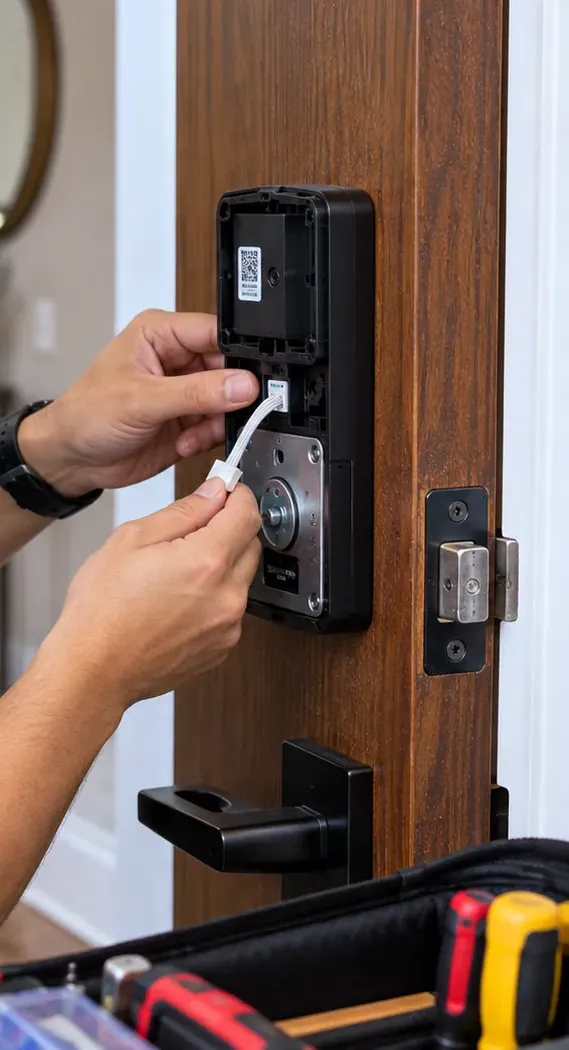
Locks are installed and paired, bridges and door sensors placed, and every door is opened from inside by hand, in the dark, to confirm the way out never depends on electronics.
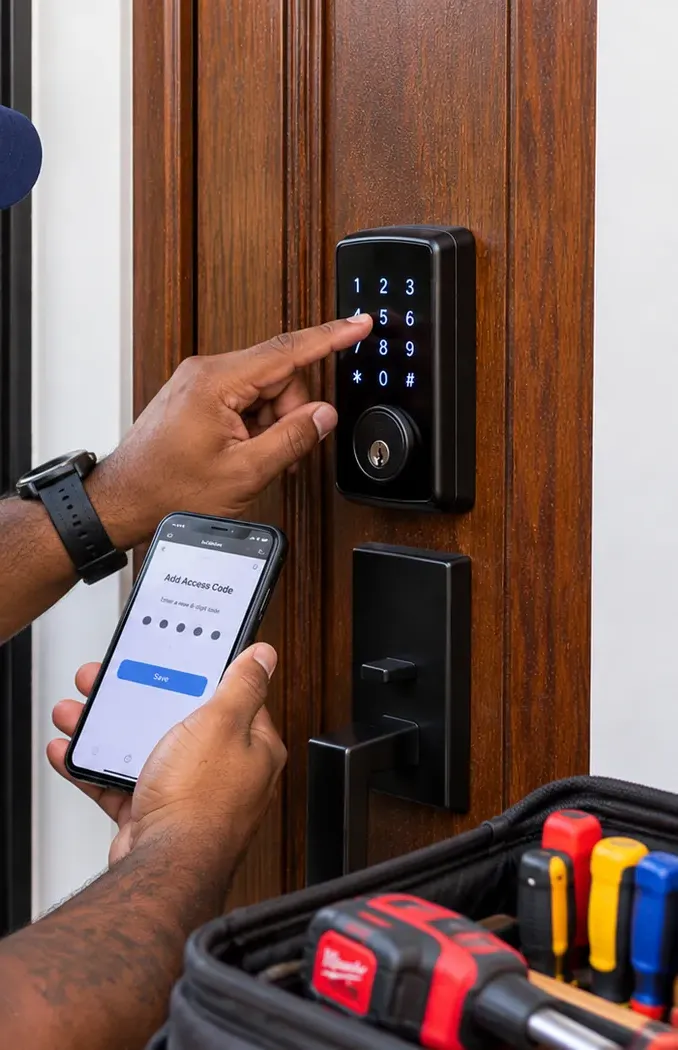
Each person enrolls and tries their own method, two adults get admin rights, auto-lock and alerts are set, old codes and keys are dealt with, and you keep a printed door sheet.
Six places that explain Bayside's mix of doors — an Army post turned park, a planned inter-war enclave, post-war co-ops, a commuter station and a college campus on the edge of two parks.
More than 100 buildings and smaller structures built between the 1830s and the 1960s at the former Fort at Willets Point, designated a city historic district on June 29, 1999, according to the Historic Districts Council. Now run largely by the Fire Department and the Parks Department.
The Gothic Revival officers' club completed in 1887 for the Army Corps of Engineers, a city landmark since September 24, 1974 and home of the Bayside Historical Society since 1984, as the society records. A reminder of how old some of Bayside's building stock is.
The gatehouse at Bell Boulevard and 48th Avenue, the street clock at 50th Avenue and 214th Street and the 33 landscaped street malls that Wikipedia lists for Bayside Hills. Behind them, the late-1920s and early-1930s Tudors and Colonials whose doors set our trickiest measurements.
Nine co-op sections of 1950s garden apartments, 1,800 homes in all, built on land owned by Cord Meyer Development and since bought out section by section, as Habitat Magazine reported in 2018. Unit doors under proprietary leases and house rules.
The Long Island Rail Road's Port Washington Branch stop at 213th Street and 41st Avenue, just off Bell Boulevard and north of Northern Boulevard, 12.6 miles from Penn Station. The hinge between Bayside's commuter streets and its main shopping street.
The City University of New York community college established in 1959, one of the institutions Wikipedia lists as making Bayside home, in the southern part of the neighborhood where garden co-ops and houses spread toward Alley Pond and Cunningham parks.
We also serve the neighborhoods around Bayside: Bay Terrace and Bayside Gables, Fort Totten's edges, Bayside Hills, Oakland Gardens, Hollis Hills, Auburndale, Whitestone, Fresh Meadows, Douglaston and Little Neck, plus every other part of Queens covered by our smart lock installation service for Queens.

Bayside is priced exactly like the rest of Queens: our Brooklyn base multiplied by 1.05, with no neighborhood surcharge. Entrance and business-door work — keypads and readers with electric strikes, new strikes and strike repairs — has published prices, shown below at the Queens rate. A smart lock on a house, co-op or condo door does not yet have a published AESS price, because the door decides the work: a modern Cape side door is short; an arched Tudor door with a grille, a soft frame and a storm door is not. Those are quoted flat, in writing, after a free walkthrough.
| Item | Bayside (Queens rate) | Scope and source |
|---|---|---|
| Keyless lock for a Bayside house, garden co-op or condo unit — any type | Quoted flat at the free walkthrough | No published AESS figure; depends on the door, frame, storm door and number of users |
| Single-door keypad or fob reader with electric strike | $1,575–$2,625 installed | Shop, bar or office door, or a small-building entrance; published $1,500–$2,500 base × 1.05 |
| New electric strike on an entrance door | $263–$473 | Supplied and fitted during entrance work; $250–$450 × 1.05, rounded half-up |
| Failed electric strike repair | $310–$509 | For a strike that has stopped releasing; $295–$485 base × 1.05, rounded half-up |
| Setup-only visit (codes, app, schedules, bridge, reset; no new hardware) | $195 first hour, then 30-minute blocks | Our published Queens setup-only rate |
| Service and callback rate | $195/hr, 3-hour minimum ($585) | Service calls after an installation; not charged on the initial install |
National averages, for comparison only. Fixr's January 2025 guide puts a single smart lock installed at $250–$400 nationally, averaging $300. That is third-party national data, not an AESS price, and it assumes one ordinary door with nothing to fix.
Three ways Bayside customers usually buy keyless entry. Two carry published Queens prices; the house package is priced after the walkthrough because every Bayside door is different.
Quoted flat at walkthrough
Smart locks on the doors that earn them, chosen around the door's shape and the storm door's exposure; strikes reinforced into the framing; inherited locks reset or replaced; codes, fingerprints and phone keys for each person; auto-lock and alerts; a printed door sheet.
$263–$473
For the shared street door of a small Bayside building or a shop entrance already wired for a buzzer or keypad: a new electric strike supplied and fitted at the Queens rate. A strike that has simply failed is repaired instead at $310–$509.
$1,575–$2,625
One business door made keyless end to end at the Queens rate: reader or keypad mounted beside it, strike cut into the frame, exit button by the handle. Staff codes or fobs come with hours attached, and you leave knowing how to revoke one in seconds.
Picked up a lock at the hardware store or online? Keep the receipt and bring us in for labour only, priced flat once we have seen the door. The box stays sealed until the walkthrough confirms the fit: door thickness and backset, room beside any grille, glass or arch, storm-door clearance, and a temperature rating that survives the spot it will live in. Models that lock people in — keyed or coded on the inside — we decline. Your own lock is covered by its maker's warranty, not ours, and a poor fit is flagged before the drill comes out.

Book the free walkthrough and we will measure every door, check the storm door and the frames, and give you a flat, written figure for the house.
Bayside is one name on the map and several different neighborhoods on the ground. The lock out of the box is the same; the door, the building and the rules around it are not.
The north-east corner, bounded by the Clearview Expressway, 26th and 28th Avenues and Little Neck and Little Bay, as Wikipedia draws it. Garden co-op sections and condominium towers dominate — the Bay Club, Baybridge, the Towers at Waters Edge, the Kennedy Street Quad, Bay Country Owners and Bell Owners are among those Wikipedia lists — with Bayside Gables' gated single-family houses near the shopping center. Most jobs here are unit doors under building rules, so the first conversation is with the managing agent. The doors nearest the water also get a question about salt air and finish.
The commercial heart around the LIRR station, with mixed-use buildings, the Bayside Village BID's restaurants and shops, and the older side streets of houses on either side. Business doors with per-employee codes and closing checks; two-family and mixed-use street doors where a shop's credentials must stay separate from residents'; and older houses whose side doors face driveways.
The residential blocks just west of the Clearview Expressway, the area where QNS reported the June 2025 attempt on a rear slider near 36th Avenue. Rear and side doors get as much attention as the front: a smart deadbolt on the hinged back door, a secondary lock and contact on any slider, and a doorbell that answers.
The planned subdivision south of 48th Avenue, with its gatehouse, street malls and clock, and its late-1920s and early-1930s brick and stucco houses. Period doors, arches, grilles and leaded glass; doors that move with the seasons; and owners who care how the hardware looks from the street. The residents' civic association, which CityNeighborhoods.NYC says was founded in 1938, has long worked to keep the area's low-rise character. We measure twice and drill once.
South of the Long Island Expressway, between Cunningham Park and Alley Pond Park. Early-1950s garden co-ops alongside brick Tudors, Capes and ranch houses with private driveways and detached garages, as CityNeighborhoods.NYC describes it. Garden co-op unit doors under house rules, standard-bored house doors that take most smart deadbolts, and side doors to the driveway that see the most use.
The front door is the one everyone photographs; the back of the house is where the reported attempts happen. This is the order we work through on a Bayside house when the owner's main worry is a break-in.
| Door or opening | What usually goes wrong | What we fit or recommend |
|---|---|---|
| Rear sliding glass door | Latch only; can be worked open from outside, as in the 2025 attempt near 36th Avenue | Secondary pin or bar lock, a contact sensor, and a camera covering the yard; a standard smart deadbolt does not fit a slider |
| Hinged back or kitchen door | Left unlocked after the last person comes in from the yard | Smart deadbolt with auto-lock and lock-state alerts, strike reinforced into the framing |
| Side door to the driveway | Most-used door, most codes shared, often the least robust | Grade 2 or better smart deadbolt, individual codes for each person, end dates on workers' codes |
| Front door | The doorbell goes unanswered, telling a caller the house is empty | Video doorbell that alerts and lets you speak, keyed smart deadbolt reporting its state |
| Basement or cellar door | Forgotten; old slide bolts and padlocks that also block a way out | Mechanical deadbolt with an inside thumb-turn, contact sensor; no electric lock that could stay shut in an outage |
| Detached garage side door | Unlocked and full of ladders and tools | Keyed or keypad deadbolt; it doesn't need to be connected to be locked |
Two habits make the hardware count. First, use the “all locked” check before leaving and before bed — most lock apps show every door on one screen. Second, take the police advice that Patch reported years ago at face value: lights in the yard and an alarm still matter, and a smart lock is the part of that list that tells you when someone forgot.

Bayside homes change hands with their locks, and today that often means somebody else's smart lock, app account and codes. This is the checklist we run through in the first visit after closing.
If you only need the reset and re-registration, with no new hardware, it is a setup-only visit at our Queens rate of $195 for the first hour, then 30-minute blocks.

Bayside work orders rarely stop at the lock. These are the Queens services that most often join it.
So the doorbell answers when nobody's home, and a remote unlock is never blind.
Slider and door contacts, motion sensors and sirens for the back of the house.
Cameras on yards, driveways, rear doors and shop fronts.
When a Bell Boulevard business outgrows two keypads: card readers, schedules and a controller covering every door.
One tap for “away”: doors bolted, yard lights on a timer, sensors armed.
Audio and video intercoms for two-family and small-building entrances.
Dead stations, failed releases and wiring faults on existing systems.
Strikes that hum but won't release, and buzzers that went quiet.
Access points and wiring that get signal to a door behind brick and stucco.
One request for any combination of the services above.
How our installers approach an older Bayside door — the routine we follow on period houses, not an account of one particular visit
Before touching a tool, we open and close the door a few times and listen. A door that has to be pushed or lifted to latch will make any motorized deadbolt miserable, so the first job is to make it close sweetly with the old hardware still on.
Then the template. We tape a cardboard outline of the new lock's outside keypad and inside housing to the door, open the door through its full swing, and check the arch, the grille, any glass and the inside trim. If the template hits anything, we change the model, not the door.
Then the storm door. We close it, let the sun do its work if there is any, and touch the old deadbolt. If it is too hot to hold comfortably, the conversation turns to screens, shading or putting the keyless lock on another door.
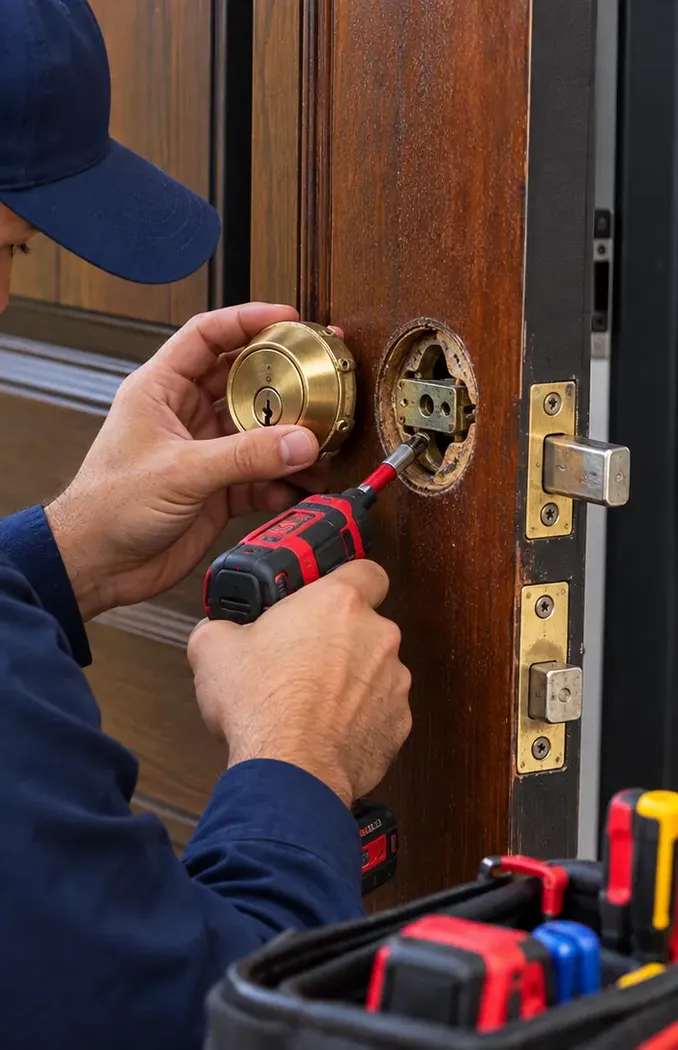
Only after that do we take out the old lock. If the bore is the wrong size or the backset is unusual, we stop and say so before drilling anything, because on a ninety-year-old door the only mistake you can't undo is a hole.
Each door with a keypad or fob reader, an electric strike and a push-to-exit button is $1,575 to $2,625 installed at our Queens rate, so two doors come to $3,150 to $5,250. If the street door already has a working keypad and only its strike has failed, that repair is $310 to $509 instead of a second full install.
Yes. We check the bolt throw and strike alignment, the inside housing and cable, the batteries, the pairing and the auto-lock and alert settings, and correct what we find. If it needs only adjustment and programming, it is billed as a setup-only visit at $195 for the first hour, then 30-minute blocks.
No. The setup-only visit is for programming, resets, app and bridge work with no new hardware, at $195 for the first hour and then 30-minute blocks. The service and callback rate, $195 an hour with a 3-hour minimum of $585, applies to service calls after an installation. Neither is charged on the original install.
All of them, at the same Queens prices with no neighborhood surcharge. We work from Fort Totten and Bay Terrace down through the Bell Boulevard area and Bayside Hills to Oakland Gardens and Hollis Hills, in 2-hour arrival windows between 8 AM and 8 PM, seven days a week.
On many smart locks, yes: the app offers one-time codes that expire after first use, or codes limited to a date and time window. Where a model lacks a true one-time code, we set a short time window instead and show you how to delete the code afterwards, so it never lingers in the lock.
It helps but isn't required. A space near the door saves time carrying tools back and forth, especially on busy blocks near Bell Boulevard. If your driveway is free, we can use it; otherwise we find legal parking nearby and the arrival window still applies.
Most smart locks report a jam if the motor can't complete the throw, and many apps show it as an alert. At installation we check full throw by hand and by motor with the door shut, so a later jam warning means something has changed, usually swelling or a strike that has moved. If you see one, call us before the motor wears.
This is the Bayside page of our smart lock installation service. It sits under Abstract Enterprises' Queens smart lock installation page, which covers the borough's houses, basements, garden co-ops and shopping streets, and that page sits under the New York City smart lock installation hub, which covers renters' rights, co-op boards and building rules across the five boroughs.
Above this page: smart lock installation in NYC. One page per borough — Queens smart locks, Brooklyn, Manhattan, the Bronx and Staten Island.
Just east of Bayside: the Long Island smart lock installation hub, with pages for Nassau County and Suffolk County.
The Hudson Valley smart lock hub and county pages for Westchester, Rockland, Orange, Putnam, Dutchess and Ulster.
Bedford-Stuyvesant, Brooklyn · Brooklyn Heights, Brooklyn · Chelsea, Manhattan · Flushing, Queens · Greenpoint, Brooklyn · Jackson Heights, Queens · Kingsbridge, Bronx · Morris Park, Bronx · New Dorp, Staten Island · Throgs Neck, Bronx · Todt Hill, Staten Island · Upper East Side, Manhattan · Washington Heights, Manhattan · West Brighton, Staten Island
Looking for cameras, cabling or alarms instead? Everything we install is on the AESS home page, the team is introduced on about us, and any request can go through the free quote form.
If the keypad is dark, the app can't see the lock, or the bolt stops short on a front, side or back door, call our Queens line on (347) 434-6392. We book the next open 2-hour window, and most battery, pairing, programming and alignment faults are fixed in one to two hours once a technician is at the door. Until then, the mechanical key — or a 9-volt battery for a key-free model — is your way in.
Bayside customers call (347) 434-6392 or message WhatsApp (718) 679-0359 through wa.me. Abstract Enterprises Security Systems, 460 E Fordham Rd, Bronx, NY 10458.
NYS Low-Voltage Licence #12000287431 · 100% Licensed & Insured · Same-Day Estimates · Rated 4.7★ from 201 Google Reviews
Locks you supply carry their maker's warranty. Full terms — including 50% deposit, one-year parts-only warranty on AESS-supplied products, and the late-fee schedule — are set out in the service agreement. See our warranty page.
Nothing on this page is legal advice; it describes how Bayside doors, buildings and businesses shape the way we fit smart locks. Page reviewed and updated October 17, 2026. Changelog: first publication of the Bayside, Queens smart lock installation page.