Inherited Houses · Empty Houses Between Owners · Heirs’ Code Plans · Stuyvesant Heights & Bedford Historic Districts · Foyer Parcels · Fulton Street Shops
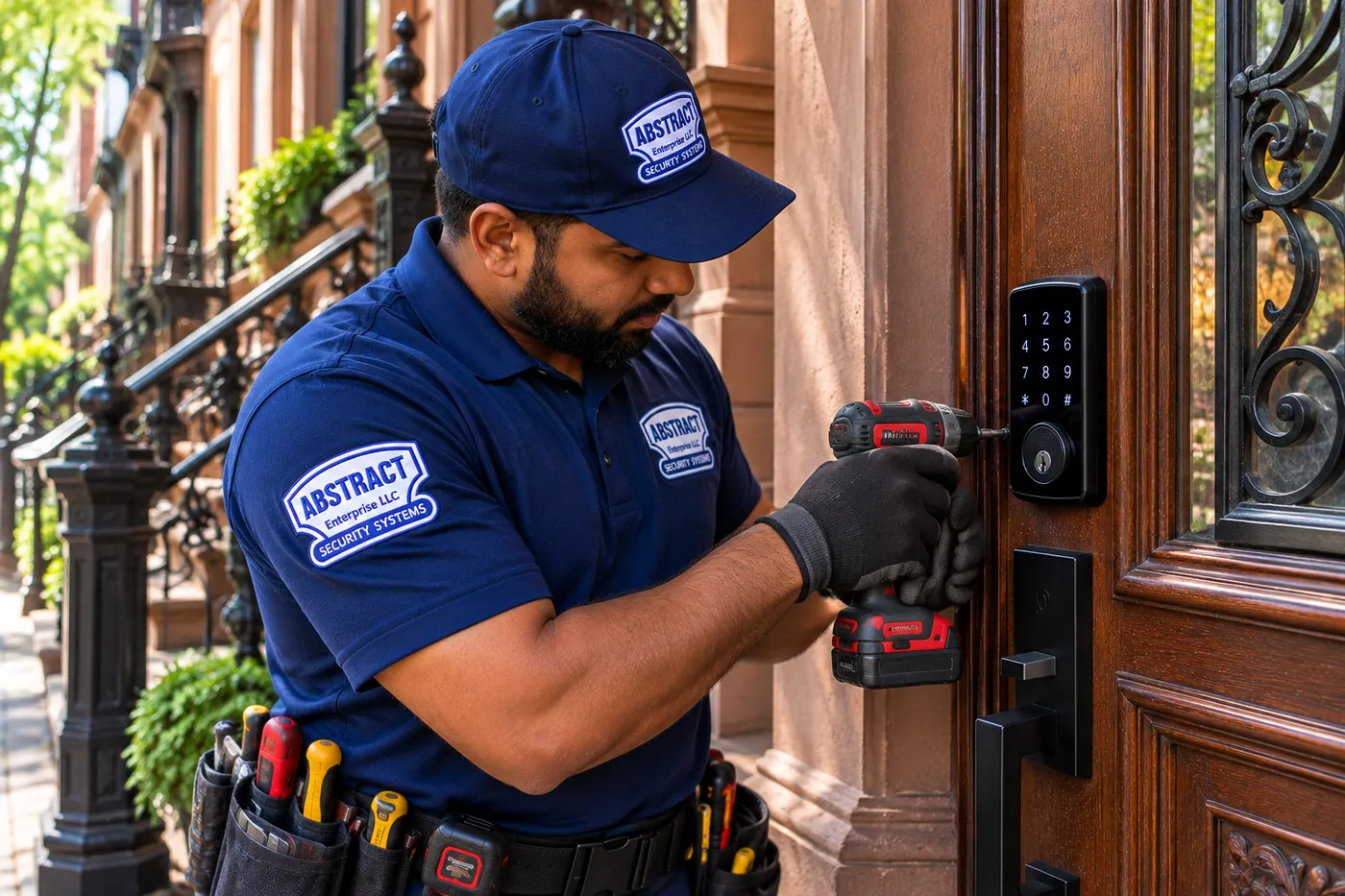
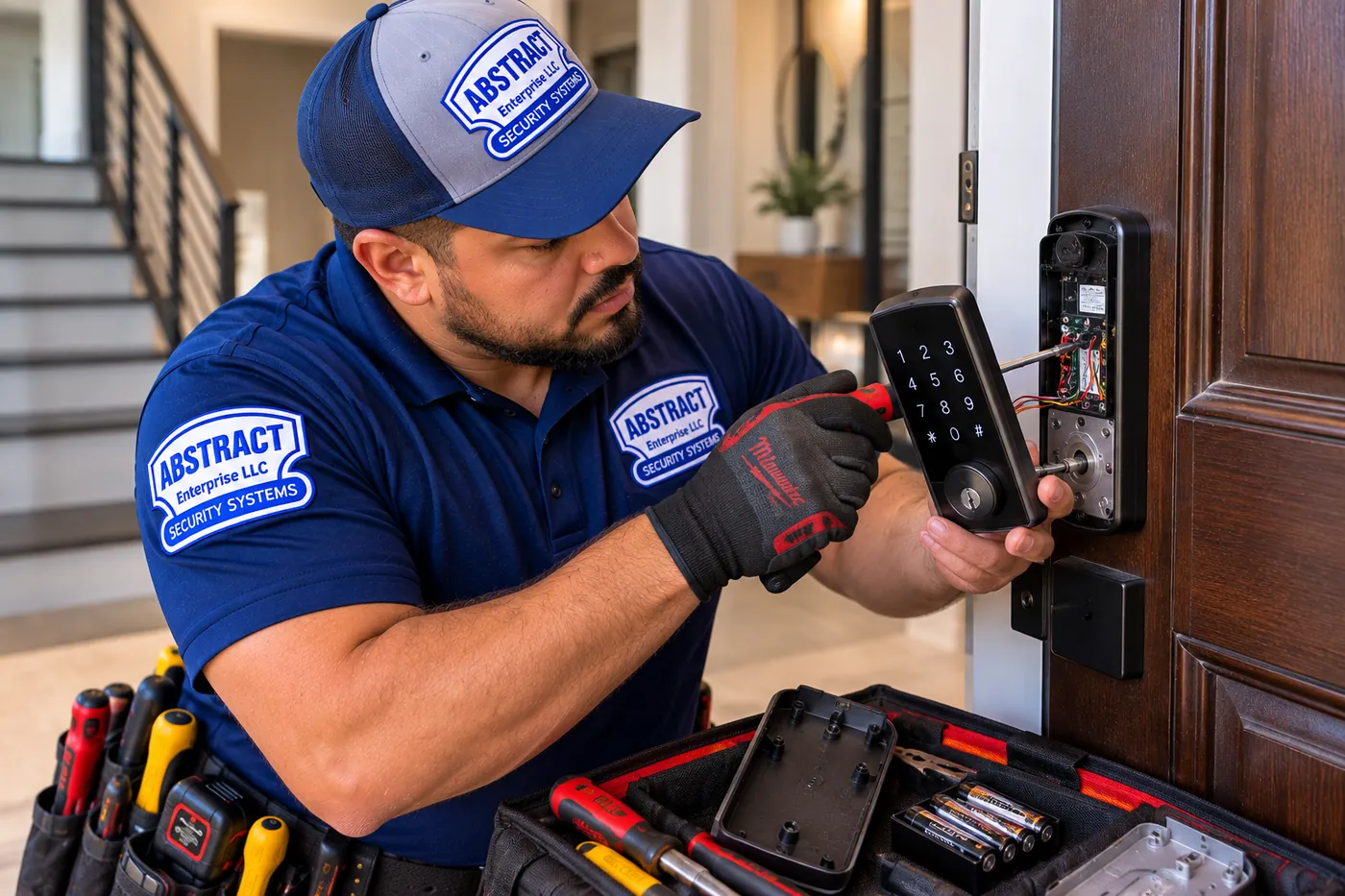
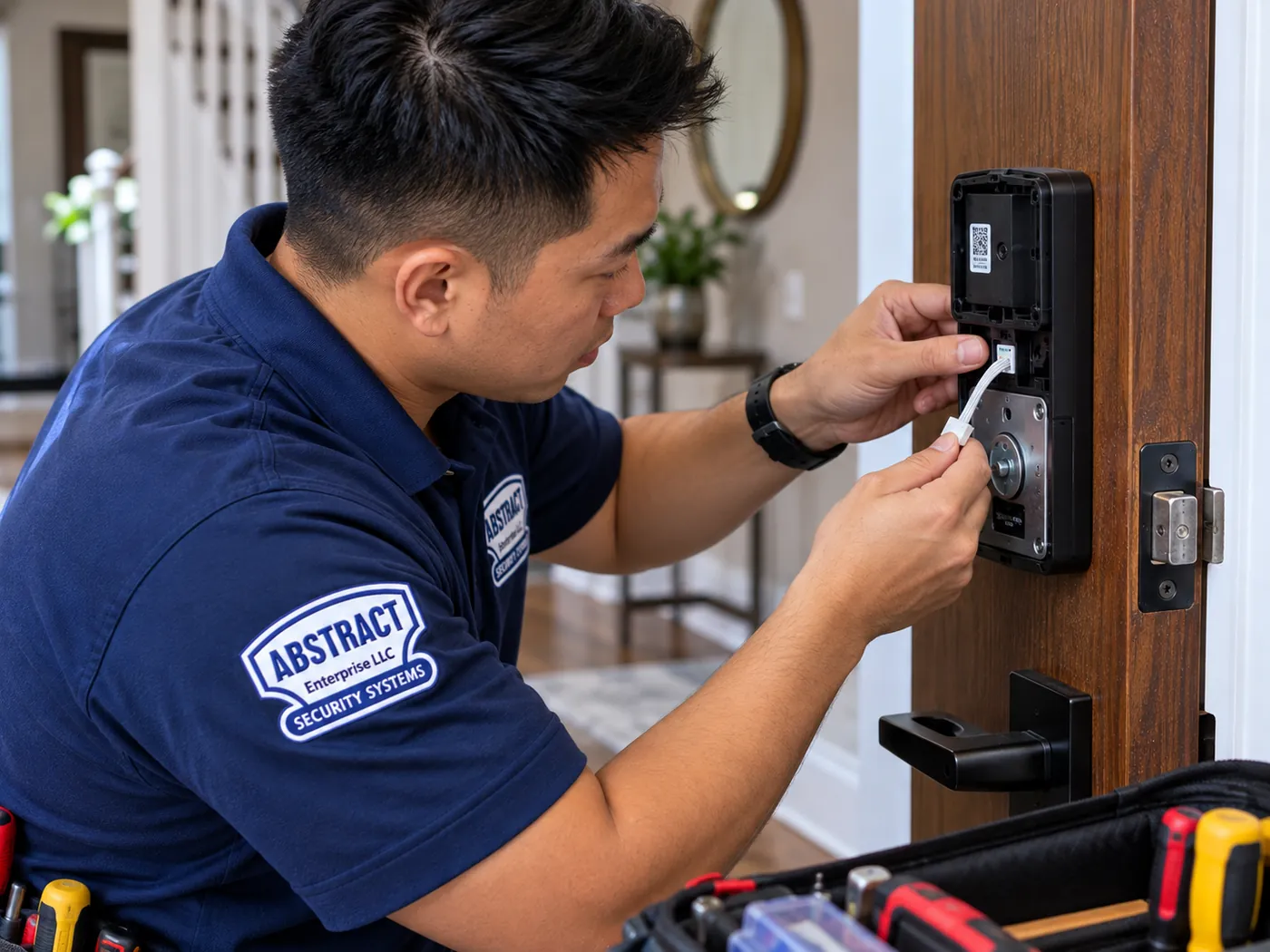
In Bed-Stuy the hardest part of a lock job is rarely the door. It is the question behind it: who is entitled to walk through. Brownstones here pass from parents to children, sit empty while an estate is settled, fill with relatives, contractors and buyers’ agents, and attract people who would like to take them. We fit keyless locks that answer that question in writing — one credential per person, a dated record of every entry, alerts when an empty house is opened — on doors that are often a century and a half old and inside landmark districts that limit what may be fixed beside them.
Reviewed and updated October 17, 2026 · Written by Anwar Timothy, NYS licence #12000287431 · Bed-Stuy neighbourhood page of our Brooklyn smart lock service

Settling a parent’s house, sharing one with brothers and sisters, or simply tired of not knowing who still has a key? Ring the Brooklyn line, (347) 934-8335, or fill in the 60-second form. A licensed installer reads it, asks who should and should not be able to open the house, and tells you what we would do before anyone books a visit.

Most smart-lock pages sell convenience. In Bed-Stuy the stronger reason is custody. A brownstone on Macon, Decatur or MacDonough Street may have been bought by a grandparent, raised two generations, and now belong — on paper or not yet on paper — to several grown children who live in three different places. Over those decades keys were cut for tenants, carers, neighbours, a nephew who stayed for a year, the roofer, the oil man. Nobody can say how many are still out there. That uncertainty used to be a nuisance. Today, in this neighbourhood, it is a risk, because the houses are worth a great deal and a lot of people know it.
The numbers explain why. The NYU Furman Center’s neighbourhood profile, last updated in May 2026, puts Bedford-Stuyvesant’s homeownership rate at 19.7 percent in 2024, against a population of 181,949. Only about one household in five owns, so the owners there are concentrated in exactly the rowhouses that families held on to through the lean decades. Those same houses are what outsiders now chase. NPR’s Code Switch, in a July 2026 episode featuring Councilmember Chi OssΓ© and WNYC/Gothamist reporter David Brand, described deed theft as rampant in gentrifying areas “like Bed Stuy, where brownstones that redlining once made cheap now sell for millions,” and reported that complaints to the state Attorney General rose 240 percent between 2023 and 2025, with more than 500 in 2025 alone.
Deed theft is a paperwork crime, and no lock stops a forged signature. But the way it plays out on the ground often runs through the front door. Scammers, NPR reported, knock, call, leave leaflets and approach through distant relatives; the Attorney General’s office lists empty houses and homes “where the homeowner is deceased and the heirs do not legally transfer title” among the properties thieves target, and tells owners plainly: “Do not abandon your property. Take care of it yourself or ask someone else to look after it.” In December 2025 News 12 reported a Bed-Stuy woman whose family had owned their paid-off brownstone for 60 years answering the doorbell to a man who said he was there to evict her. A house whose doors are visibly controlled, whose every entry is logged and whose owners are alerted when it opens is a harder house to walk into — and a better-documented one if somebody later claims they were let in.
The second thing that sets Bed-Stuy apart is how much of it is landmarked. The Stuyvesant Heights Historic District was designated on September 14, 1971. The Bedford-Stuyvesant/Expanded Stuyvesant Heights Historic District, designated in 2013, added roughly 825 buildings around it. On December 8, 2015 the Landmarks Preservation Commission unanimously designated the Bedford Historic District — about 800 buildings, mostly rowhouses and small apartment houses built between 1870 and 1900, roughly between Bedford, Nostrand, Putnam, Tompkins and Marcy Avenues and Monroe, Fulton and Halsey Streets. On blocks inside those lines, replacing a lock is generally light work in the commission’s eyes, but anything mounted beside the door is governed by specific rules, and we plan keypads and readers around them rather than discover them afterwards.
Third, the neighbourhood is not only brownstones. Bed-Stuy holds some of the largest public-housing campuses in Brooklyn — the Furman Center counts 9,802 public-housing units, 12 percent of the area’s rentals — plus a wave of new construction: 11,644 units added between 2010 and 2025, almost all in buildings of four or more units. And it has busy shopping streets, led by the mile-long Fulton Street corridor that the Bed-Stuy Gateway Business Improvement District says holds around 400 businesses. Each of those has a different answer to “who decides what goes on this door,” and we start every job by working out which answer applies.
So our Bed-Stuy work is built around three promises. We will find out who can open the house today before we change anything. We will leave you with a door where every credential belongs to a named person and can be removed without touching anyone else’s. And on a landmarked row we will keep our work to the hardware and to the places the commission allows, so the house you hand to the next generation looks the way it did when you were given it.
Families who make the house keyless usually want to see the stoop too. Our security camera installation in Bedford-Stuyvesant puts a camera on the steps and the areaway at the same visit, and owners of three-family-and-up buildings often pair the lock plan with Bed-Stuy access control on the street door.

A keypad that will not wake up on a house nobody has visited for a month, a lock that answers the app but will not throw its bolt because the old door has dropped, an admin account on a phone that belonged to a parent who has passed away, a bridge that went offline when the family cancelled the internet at the empty house — these are repairs, and we treat them as urgent because an unreachable lock on an unoccupied Bed-Stuy house is exactly the gap people look for. We book the next open 2-hour window, and most battery, alignment, pairing and account-recovery faults are fixed in one to two hours once a technician is at the door. If the problem is a street door whose electric strike hums but stays shut, our published door-buzzer repair figure is $295–$485; our door buzzer repair team in Bedford-Stuyvesant covers that side. For everything else, call (347) 934-8335 and say it is a lock fault.

These are the jobs Bed-Stuy owners and families actually ask us for. Several are less about a gadget than about getting a house back under clear control. Each ends the same way: every door latches by itself, opens from inside in one motion without a key or code, and every credential that can open it is written down against a name.
For a house whose owner has died or moved into care. We change or retire every mechanical cylinder, set up a smart lock whose admin sits with the person the family has chosen, and hand over a dated list of who can now open each door. The old keys are gone the day we leave.
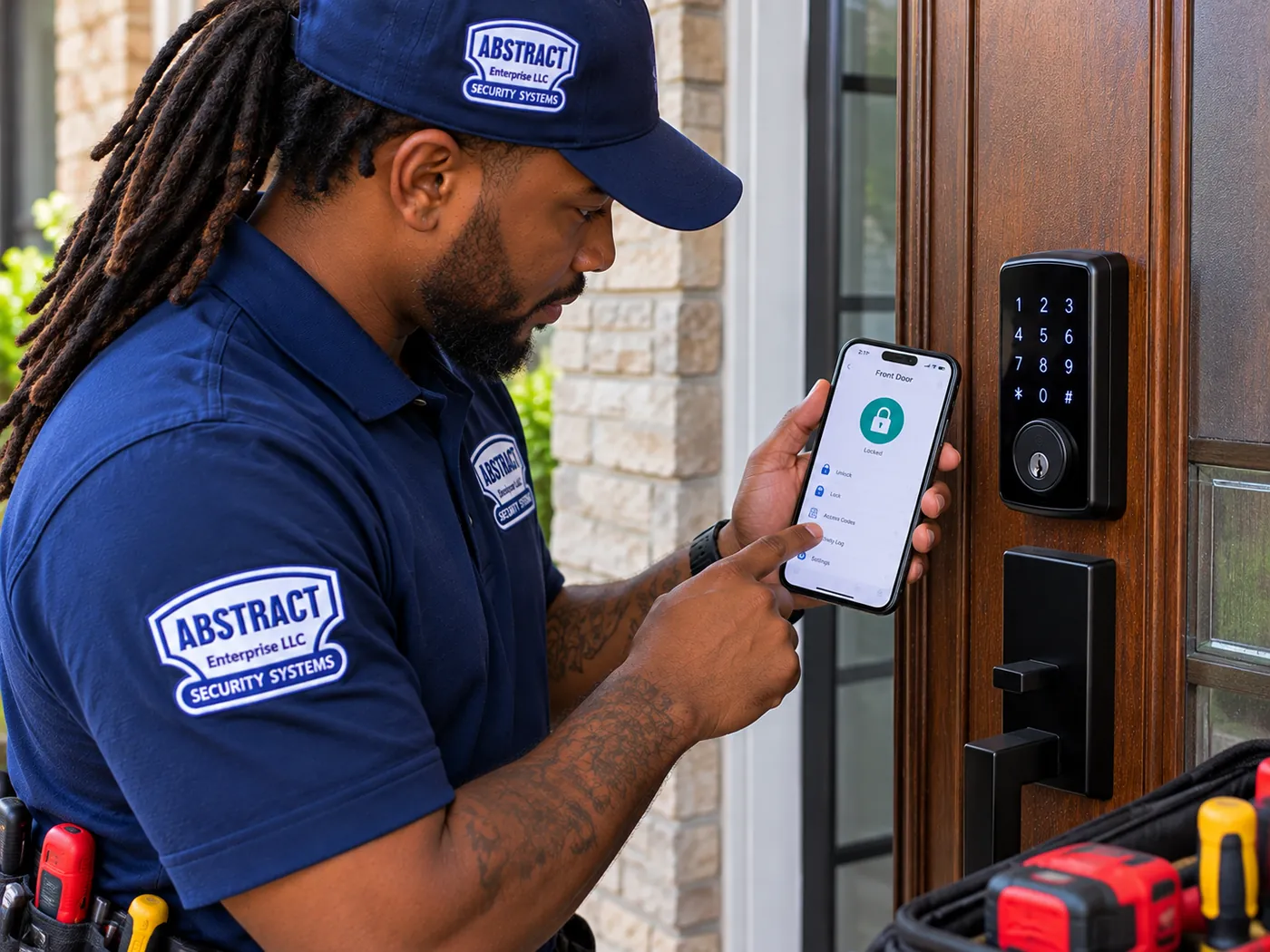
Keyless locks paired with a bridge, Wi-Fi or Thread connection so the family gets a notification every time a door is opened, plus an entry history that shows which credential was used. For houses waiting on probate, a sale, or a renovation that has not started.
When three or four relatives share a house nobody lives in, each gets a personal code or fingerprint, an agreed second admin is named so no one person can shut the others out, and contractor and estate-agent access is issued by date range rather than by spare key.
Smart deadbolts and interior retrofit units on the parlour-floor doors of houses in the Stuyvesant Heights, Expanded Stuyvesant Heights and Bedford historic districts, using the door’s existing preparation wherever it is sound and keeping anything mounted beside the door within the commission’s rules.
For small apartment buildings and converted brownstones where parcels vanish from the hall: a street door that latches every time, personal codes in place of one shared number, and a keyless lock on a parcel cupboard or package room if the building has one.
The back door from the garden floor to the yard is often the oldest, weakest and least-watched door in a rowhouse. We fit a keyless deadbolt that secures it from the yard side and releases with one turn from inside.
Keypad deadbolts or reader-and-strike sets for ground-floor shops, cafΓ©s and offices in buildings with homes upstairs, with staff codes kept entirely apart from the residents’ door.
Unit-door smart locks in the newer mid-rise rentals and condos that have gone up along Fulton Street, Atlantic Avenue, Broadway and elsewhere, chosen to live alongside whatever fob or app the building already runs.
Dead keypads, drained batteries in empty houses, bolts fighting a dropped door, and — very often in Bed-Stuy — a lock whose only admin login belonged to someone who can no longer be asked for it.
If you are not sure which of these describes your house, describe the people instead: who lives there, who used to, who is entitled to come in, and who must not. We work the hardware out from that.

Bed-Stuy was built quickly and then left largely alone, which is why so much of it survives. The Bedford district’s designation report, as summarised by the Historic Districts Council, calls its concentration of row houses “a rare showcase for the rapid changes in row house fashion” across a short span of years. For a lock installer that means variety: neighbouring houses built a decade apart can have completely different doors.
The core of the historic districts: high stoops, parlour-floor entrances, double outer doors or a single heavy leaf, a vestibule and an inner door. Many are still owner-occupied by the same family, with the garden floor let or used by relatives.
Later houses with rock-faced stone, arched entrances and deep reveals. The arch often shelters the doors well, but the stone surround leaves little flat surface for anything mounted beside them.
Three- to six-storey buildings from the same decades, with a street door, a hall and several units. These are multiple dwellings, so the street door, unit-door and tenant rules all apply, and a shared foyer is where parcels tend to go missing.
Landmarks such as Montrose W. Morris’s Alhambra Apartments of 1889–90 on Nostrand Avenue. Unit-door work runs through management and the building’s own entry arrangements.
Marcy Houses (27 buildings, 1,705 apartments, completed 1949), Sumner, Tompkins, Brevoort, Roosevelt, Armstrong and Stuyvesant Gardens. Apartment doors and building entries belong to the housing authority; residents should not have locks drilled without its say-so.
Concrete or steel-stud rental and condo buildings with metal unit doors, developer-chosen lobby systems and house rules. Signal in the corridor and compatibility with the building’s platform matter more than period detail.
Rowhouses split into floor-through apartments decades ago, often with a hall door at the top of the stoop that every household shares. Crossing from two families to three changes which housing rules apply.
Gut renovations where the house is a building site for months. Access needs to be granted by the week to trades, then withdrawn completely on the day the owners move in.
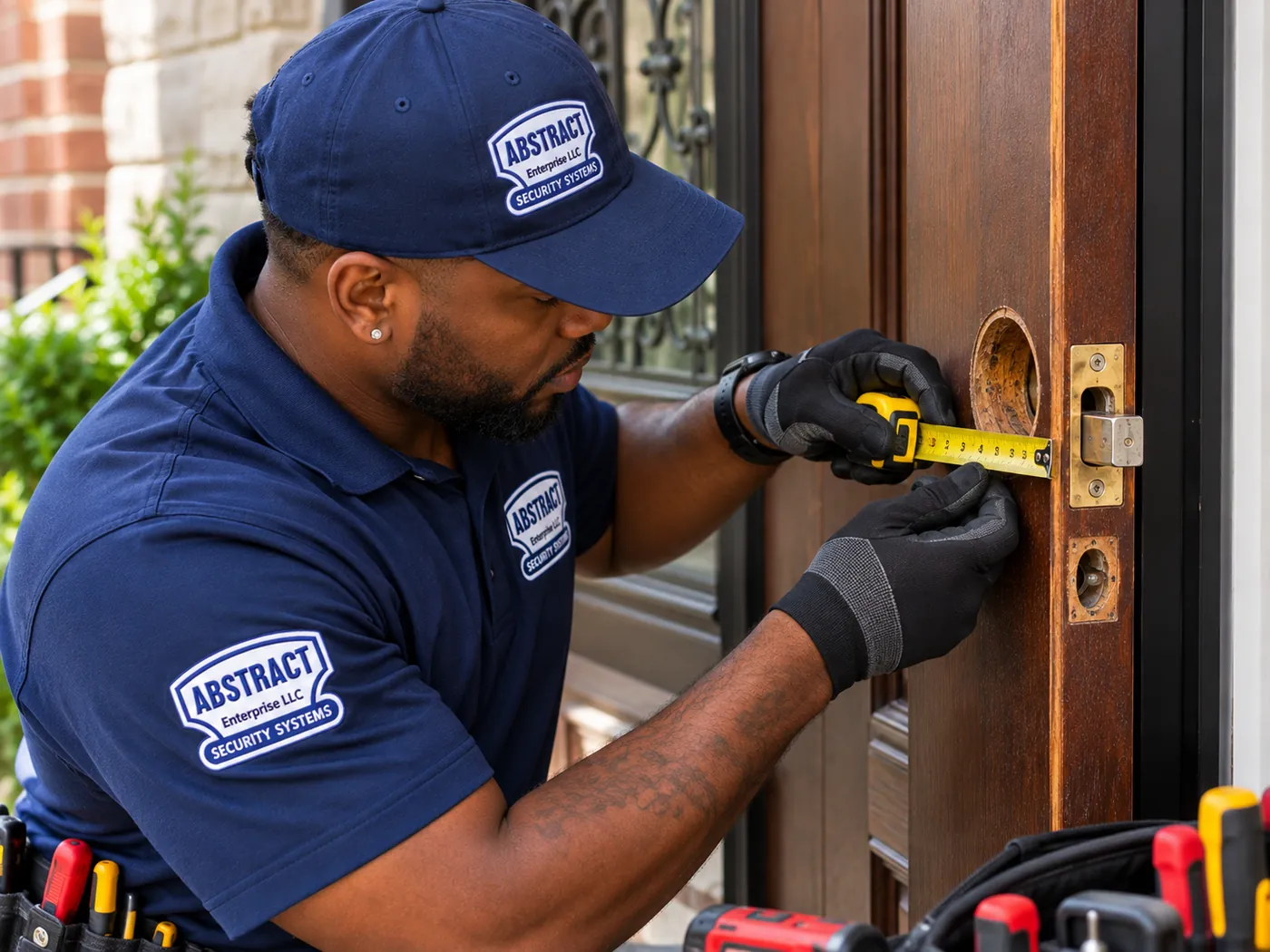
Reading the bore history. A door that has carried a family for a century usually carries the evidence: a filled hole from a rim lock, a mortise pocket from the original lock, a round bore from a 1970s deadbolt, a second one from a 1990s replacement. Before we recommend a lock we take the old hardware off and measure what is left. If the wood around the bore is split or packed with filler, the smart lock goes on a reinforced plate or a different door, not into the damage.
Keeping the face of the door. On landmarked houses we prefer locks whose outside face is small and dark, or interior-only retrofit units that leave the street side exactly as it was. Where the original lock must stay for appearance, the keyless function moves to the vestibule door. Every piece of original hardware we remove is labelled and returned to the family, not thrown away.
Stone, not wood, around the door. Brownstone and limestone surrounds crumble when drilled carelessly. Where a keypad, reader or bell has to sit beside an opening we fix into mortar joints or the door frame rather than the carved face, and we route any cable inside the house, never across the facade.
Empty-house power and signal. A battery smart lock keeps working when the electricity at an empty house is cut, but notifications and remote unlocks need the bridge or router to stay powered and online. On estate houses we confirm with the family who is paying for the electricity and internet while the house is empty, because the monitoring is only as good as that bill.
Exit without a key. Whether it is a parlour door, a garden door or a cellar door, every door we touch opens from inside in one motion without a key, code or phone. On apartment doors in multiple dwellings, New York City’s housing agency, HPD, states that double-cylinder locks are illegal; we apply the same principle to every house door we work on.
Pair the lock with a doorbell camera on houses older owners still live in. Our doorbell camera installers in Brooklyn fit one at the same visit, so an owner can see and speak to whoever is ringing before deciding whether to open the door at all.

Bed-Stuy’s businesses mostly live on the ground floors of buildings that were built as homes. That shapes every commercial lock job here: a shop door, a residential door beside it, a hall or stair shared with tenants, a yard behind. These are the corridors we are called to most.
The Bed-Stuy Gateway BID, based at 1368 Fulton Street, describes a mile-long commercial corridor with around 400 businesses in nearly 500,000 square feet of retail space. Shop doors, offices above shops, and the back doors behind them.
Home of the Bedford Stuyvesant Restoration Corporation, founded in 1967 with Senator Robert F. Kennedy’s backing, and of the offices, arts spaces and tenants around it. Suites here want staff codes and a record of who opened each door.
From the Alhambra Apartments to the subway at Fulton Street, a run of mixed-use buildings where narrow residential doors sit beside storefronts. The classic place where shop staff and tenants must never share a code.
CafΓ©s, restaurants and small shops in converted rowhouses. Kitchens with rear yards, cellar storage and early deliveries make the back door the one that needs the most thought.
Neighbourhood services, churches and community organisations in older buildings, often used by many different groups through the week, each needing its own hours of access.
The northern edges of the neighbourhood, with shops along the elevated J, M and Z line on Broadway and newer buildings with ground-floor retail.
Commercial jobs here are usually smaller than the access-control systems in office towers: a keypad deadbolt on a shop door the owner can manage from a phone, or a single reader and strike on a door used by several staff. Where a business has many doors and schedules, the work moves over to our Brooklyn access control installation team.
Many Fulton Street businesses add cameras after a lock upgrade so that each door event can be checked against video; our commercial security camera installation in Brooklyn handles that work.

These are the questions Bed-Stuy families, owners and shopkeepers raise before a keyless lock goes on, grouped by the situation behind them: houses passing between generations, empty houses, landmarked rows, shared foyers and back doors. Booking and visit details sit in the FAQ further down. Nothing here is legal advice; where a law, a city office or a court process matters, we name it so you can follow it up with your own lawyer.
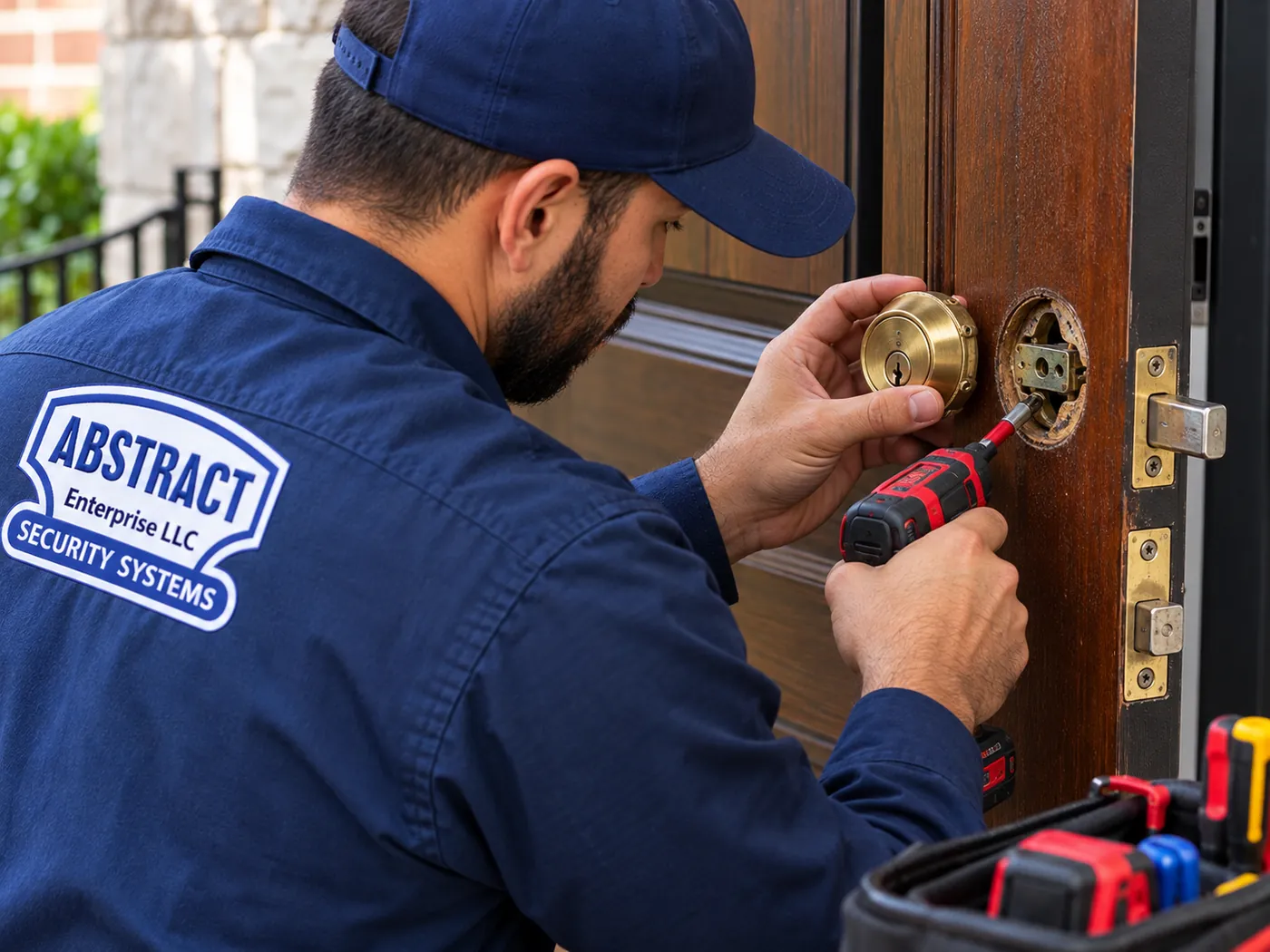
Take stock first, then close every route you cannot account for. Most family houses in Bed-Stuy have keys in more hands than anyone remembers: past tenants, home attendants, neighbours who watered plants, cousins who stayed for a summer, contractors from years ago. The safest assumption on the day the house becomes empty is that some of those keys still work. So we start by asking the family to list everyone they know held a key or code, then we change or retire every mechanical cylinder on every exterior door — parlour door, vestibule door, garden door, rear door, cellar — so that none of those old keys open anything.
Then the house needs one clearly named custodian. That is usually the person the family expects to be appointed executor or administrator, or the relative who lives nearest and has agreed to look after it. That person holds the admin account on the smart lock, a second family member is added as a backup admin, and everyone else who genuinely needs access — a sibling who checks the mail, a cleaner, a surveyor — receives a personal code that can be removed without affecting anyone else. The Attorney General’s deed-theft guidance tells owners not to abandon a property and to “ask someone else to look after it”; a custodian with a working, logged lock is how that looks in practice.
Two things we do not do. We do not decide who in the family is entitled to the house — that is for the court and your lawyer. And we do not change locks on a house where someone is currently living without that person’s agreement or a court order, even if the family believes they have no right to be there. If you are unsure whether anyone is staying in the house, tell us; we will look before we work.
Never just one phone. An admin account is the power to add and delete everyone else, so in a house owned by several heirs it should behave like a joint bank account: two named administrators, ideally from different branches of the family, each able to act if the other is unreachable, and neither able to quietly lock the other out without it showing in the history. Most current smart-lock apps let the owner invite at least one further person with full or near-full rights; we set both up, test both, and write down which email address each account sits on.
Below the administrators, every heir gets an individual credential rather than a shared family code. That matters more than it sounds. When an inherited house becomes contested — and the Center for NYC Neighborhoods counts roughly 350 lawsuits a year across the city over homes in inherited-ownership disputes — the first argument is often about who went in, when, and what they took. A shared code answers none of that. Personal codes, with an entry log that shows which one opened the door, answer most of it.
Finally, agree in writing, before the lock is fitted, what the administrators may and may not do: add a contractor for a fixed week, yes; remove another heir, only with notice to all of them. We leave a one-page access register with the names, credentials and dates so that the agreement and the lock’s settings match.
An entry history is a timeline: this door, this credential, this date and time, locked or unlocked. On an empty house it does two jobs. While nothing happens, it is a quiet record that the house has been secured and visited only by the people the family authorised. When something does happen — a door found unlocked, a stranger claiming they were given permission to stay — it shows which credential opened the door, or that none did and the entry was forced.
To make that history worth something, set the lock up properly from the start. Each person has their own code; no code is ever shared. The lock is connected, so events reach the cloud and the family’s phones rather than sitting only in the lock’s memory. Notifications go to at least two people. And someone exports or screenshots the history regularly, because app histories are not kept forever and a record you can produce months later is better than one that has rolled off the end.
Be realistic about its limits. A lock log does not prove who owns the house, and it will not stop a fraudulent deed being recorded at the City Register. For that, the city’s Mayor’s Office of Deed Theft Prevention offers free property and deed alerts through ACRIS, so the owner of record is told when documents are filed against the property. The lock covers the door; the alert covers the paperwork. In Bed-Stuy we recommend both.
Do not try, and do not ask us to. The law here moved in 2024: the state budget signed that April changed the definition so that a tenant does not include a squatter, and further bills have been introduced since. But how a particular occupant is treated still depends on facts a court or the police will weigh — how they got in, how long they have been there, what paperwork they hold. Fox 5 New York reported a Queens case in which the homeowner herself was arrested when she tried to change the locks on people occupying her house. New York City’s Administrative Code makes it unlawful to change the lock on an occupant of 30 or more days without supplying them a key, and those rules are enforced first and argued about later.
So the order is: call 911 if anyone is in danger or you believe a break-in is in progress; call the local precinct — Bed-Stuy is covered by the 79th and the 81st — to report the occupation; contact a lawyer, the Attorney General’s Homeowner Protection Program or the city’s deed-theft hotline; and gather any record you have of the house being secured and empty, including a lock’s entry history if one was fitted. If the occupant is in housing court claiming the house through a transfer you believe was fraudulent, the Attorney General notes you can ask the judge to pause the case for 90 days while ownership is challenged in the right court.
Our part comes afterwards, once the house is lawfully back in the family’s hands: re-securing every door the same day, fitting a monitored lock so the next attempt is noticed in minutes rather than months, and leaving you with a written register of who can get in. This is the strongest argument we know for fitting a connected lock the week a family house becomes empty, not after something goes wrong.
Start from the habit that protects most: do not open the door to talk business. NPR’s reporting on deed theft in Bed-Stuy described scammers who knock, phone, leave leaflets or approach through distant relatives, offering loans, repairs or a way out of a mortgage, and then slip a transfer of the house into the paperwork. The Attorney General’s advice is just as direct: never transfer a deed without your own attorney, never sign anything you do not understand, and be wary of anyone who says you can “buy back” your home.
Hardware can make that habit easy for an older owner to keep. A video doorbell or small camera by the door lets them see and speak to a caller from the kitchen or their phone without unlocking anything. A smart lock means the people who should come in — family, the home attendant, the doctor’s nurse — have their own codes and never need the owner to come to the door at all, so a knock from a stranger can simply go unanswered. And because every family visitor has a code, the family can see from the history that the attendant came on Tuesday and nobody else did.
We set these up with the owner, at their pace, and leave large-print instructions. We also suggest the family sign the owner up for the city’s free deed alerts and keep the number for the city’s deed-theft hotline, 1-855-HOME-456, by the phone. A lock keeps people out of the hall; only those steps keep them out of the deed.
Within or right next to the door opening, and modestly. The Landmarks Preservation Commission’s permit guidebook does not have a section called “keypads”, but it does set out rules for the closest thing: light fixtures, intercom panels and doorbells “must be installed within or adjacent to a door opening,” and on a given opening there may be no more than two light fixtures and one intercom panel. We apply the same logic to a wall-mounted keypad or reader. Practically, that means inside the door reveal or on the frame, on the vestibule wall behind the outer doors, or on the outer leaf itself as part of the lock — not out on the carved face of the stoop surround.
The simplest answer is usually to avoid a separate wall device altogether. A smart deadbolt carries its own keypad on the door, which counts as hardware rather than an attachment to the facade; the guidebook lists repairing or replacing hardware such as hinges, knobs, locks and handles among work that may not need a permit at all. Where a separate reader is unavoidable — say, for a three-family house whose street door needs fob access — we fix it in the reveal or into mortar joints, keep it small and dark, and run its cable inside the house.
If your project goes beyond hardware — a new door, new ironwork, cutting stone, exposed conduit — talk to LPC staff before work starts. The commission’s staff can tell you whether a proposal fits its rules or needs review. We are glad to send them photographs and the lock’s drawings so the conversation is concrete.
Often the better route is to replace the panel rather than add beside it. Because the guidebook allows one intercom panel per door opening, a second box next to an existing buzzer panel on a landmarked house is the kind of addition that invites questions. Many current entry panels combine call buttons and a keypad or fob reader in one plate, so a three-family house can swap its tired buzzer panel for a single combined unit in the same position and gain keyless entry without adding anything to the facade.
Where the existing panel must stay — it still works and the tenants rely on it — the keypad can go on the door itself as part of a smart deadbolt, or on the inside of the vestibule if only residents need it. Couriers and visitors keep using the bell; residents use the lock. That keeps the outside of the house exactly as it is.
If the buzzer system itself is failing, we would rather fix or replace it properly than build a lock plan around a fault. Our intercom installation in Bedford-Stuyvesant covers panel replacements on rowhouse fronts, and the two jobs can be done at the same visit.
In principle, yes. The same guidebook passage that limits intercoms to the door opening adds that “an intercom can also be installed on a fence or wall in front of the entranceway,” and a gate keypad sits in the same place for the same reason. On many Bed-Stuy rows the low iron fence and gate are original or carefully restored, though, so we fix to a post or a plate rather than drilling decorative ironwork, and we keep the device as small as the job allows.
The harder question is whether a locked gate is what you want. Gates on these rows usually open onto a small front yard and the areaway below the stoop — which is where parcels get left and where one r/BedStuy poster near Lafayette and Throop described a man who “politely opens my gate, steals my package & politely closes gate” at seven in the morning. A locked gate stops that, but it also stops couriers, meter readers and anyone who needs to reach the garden-floor door, so it needs a delivery code, a bell and, if the garden floor is someone’s home, an inside release that works in one motion without a key.
Power and cable are the practical limits. A battery keypad gate lock needs no wiring at all; a powered reader and gate strike needs a cable from the house, which we bring under the yard or along the areaway wall rather than across the stoop. We price both and let you choose.
Almost always by a door that does not finish closing, a code too many people know, or a neighbour buzzing in whoever rings. One r/BedStuy thread from Lexington Avenue described someone getting in repeatedly over months and taking parcels left in the foyer — three times for one resident. In small walk-ups that pattern is common: the street door is heavy, its closer is tired, and it stops a quarter-inch short of latching, so anyone who pushes walks straight in.
The fix comes in layers. First the door: closer adjusted or replaced, strike aligned, latch checked so the door locks every single time it swings shut. Second the credentials: one personal code or fob per resident on the street door instead of one number shared since the last tenant left, so a leaked code can be removed in a minute. Third, if the building has space, a lockable parcel cupboard or room with its own keypad — one r/Brooklyn poster in a non-doorman building said adding a keypad deadbolt to the package room door “stopped most thieves.”
A building with three or more households is a multiple dwelling, so the city’s housing rules on entrance doors and self-closing doors apply, and under the Tenant Data Privacy Act an owner may not make a smart access system the only way into a tenant’s apartment. For buildings whose old buzzer is part of the problem, our Bed-Stuy door buzzer repair and the lock plan usually go together.
A lock that is as strong from the yard as the front door is from the street, and an inside release that a child or an elderly parent can use in the dark. Rear doors on Bed-Stuy rowhouses are often the original garden-floor door or a cheap replacement from decades ago, with glass in the top half, a worn frame and a single spring latch. Because the yard is enclosed by neighbours’ walls, people assume it is private; in practice it is the side of the house nobody watches.
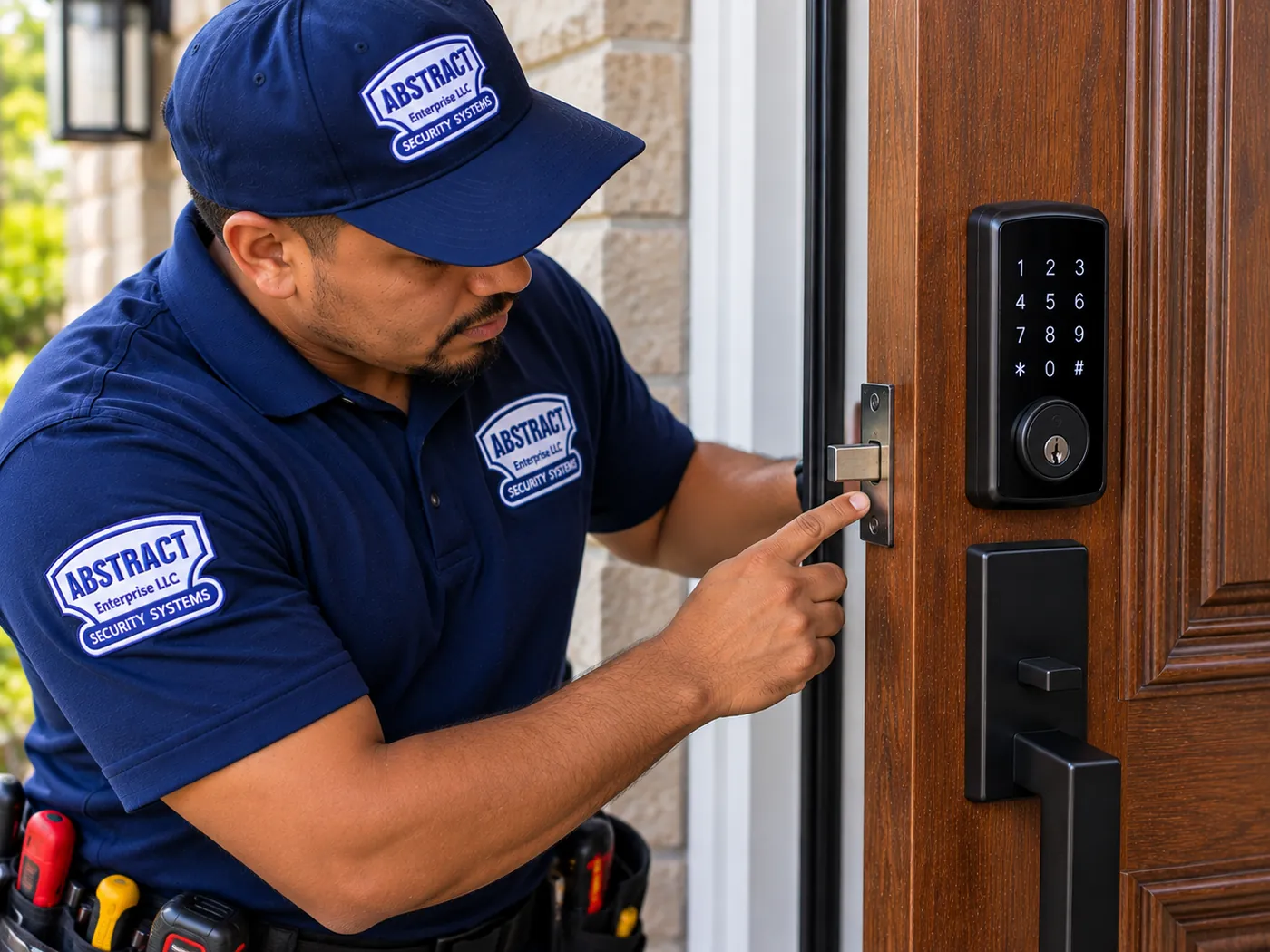
We start with the frame and hinges, because a smart deadbolt in a soft or split frame fails at the first kick. Longer screws into the framing, a reinforced strike and, where needed, a new frame section come first. Then a keyless deadbolt with auto-lock, so the door relocks after someone takes out the rubbish, and a plain thumb-turn inside. If there is glass within reach of the thumb-turn we look at security film or a lock position further from the glass rather than a key-both-sides deadbolt, which would trap people inside in a fire.
The 79th Precinct has itself posted crime-pattern notices asking Bed-Stuy residents to lock doors and windows after rises in residential and commercial burglaries. A connected lock on the rear door lets you check from your phone at night that it really is locked, and alerts you if it opens while the house is empty. Many owners add a camera covering the yard at the same time.
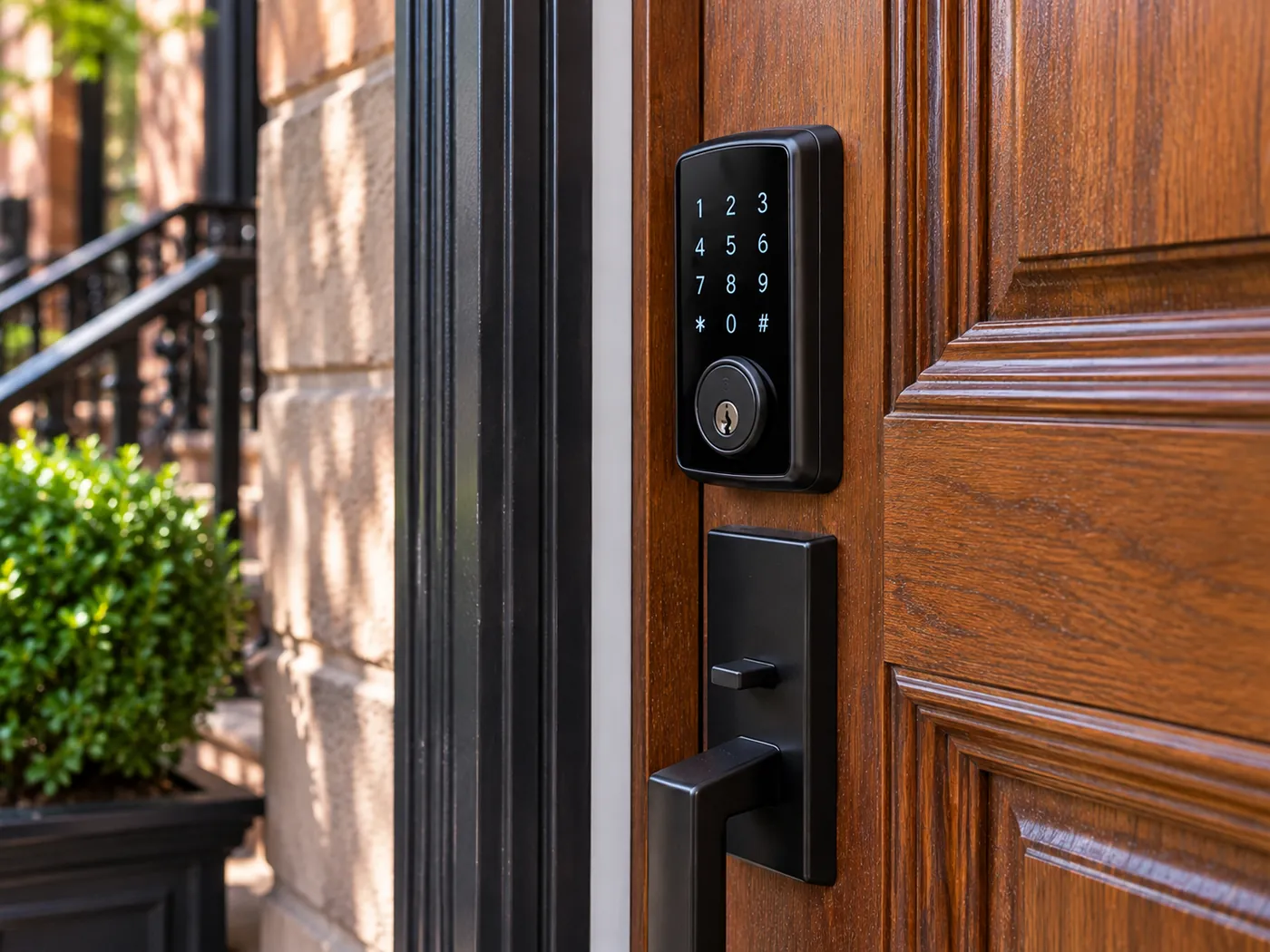
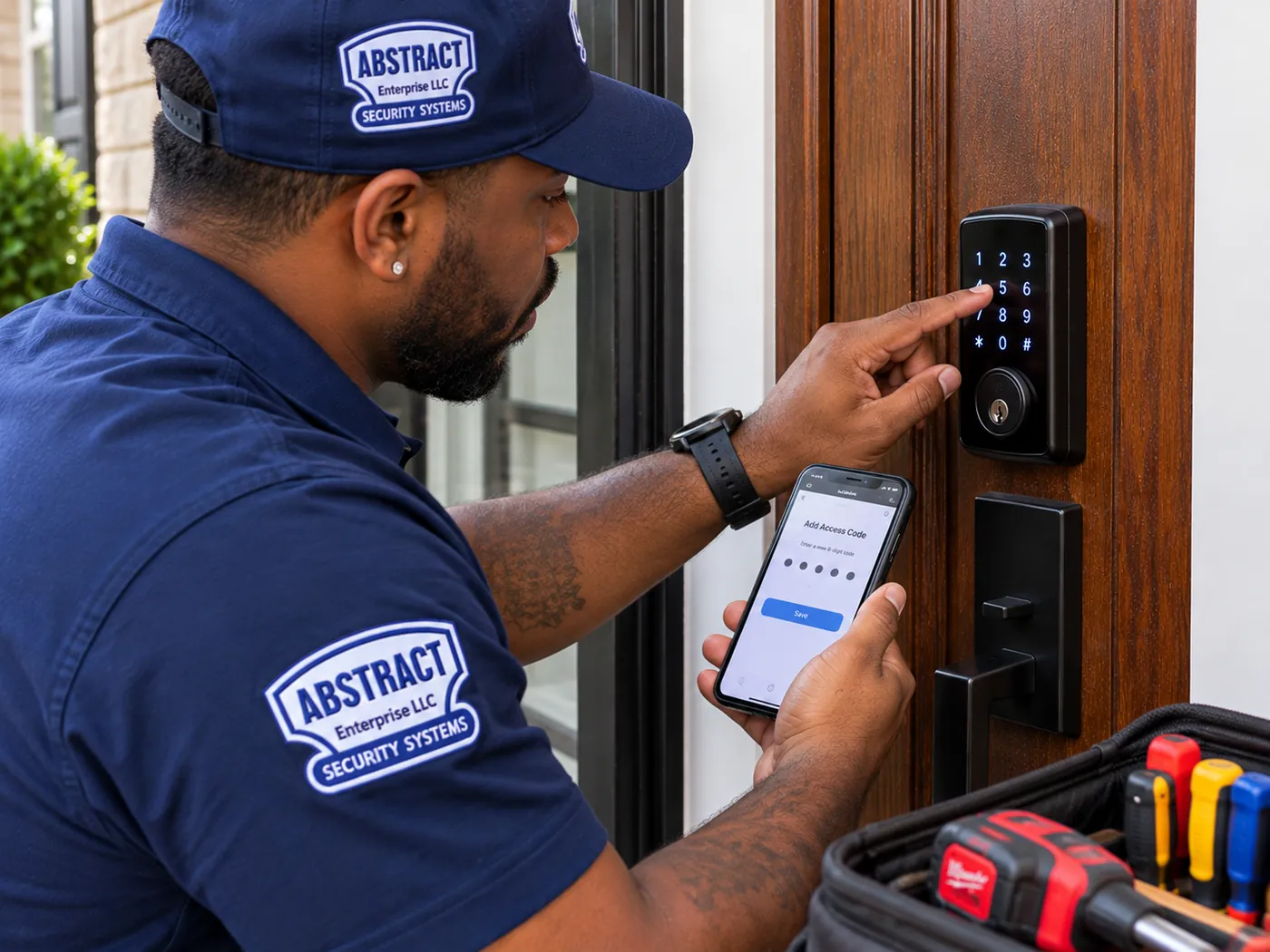
For a Bed-Stuy house the feature that matters most is usually not the one on the box. It is how well the lock keeps a record, how many separate people it can hold, whether two administrators can share it, and whether it will behave on a door that has been bored three times. We fit locks you already own or recommend one after the walkthrough; these are the categories we install here.
The workhorse for estate and family houses: individual codes, an entry log that names the code used, and notifications through a bridge, Wi-Fi or Thread. The one we reach for when a house needs watching from a distance.
Fit over an existing single-cylinder deadbolt on the inside only. The street face of a landmarked door does not change at all, and the original key still works for the family.
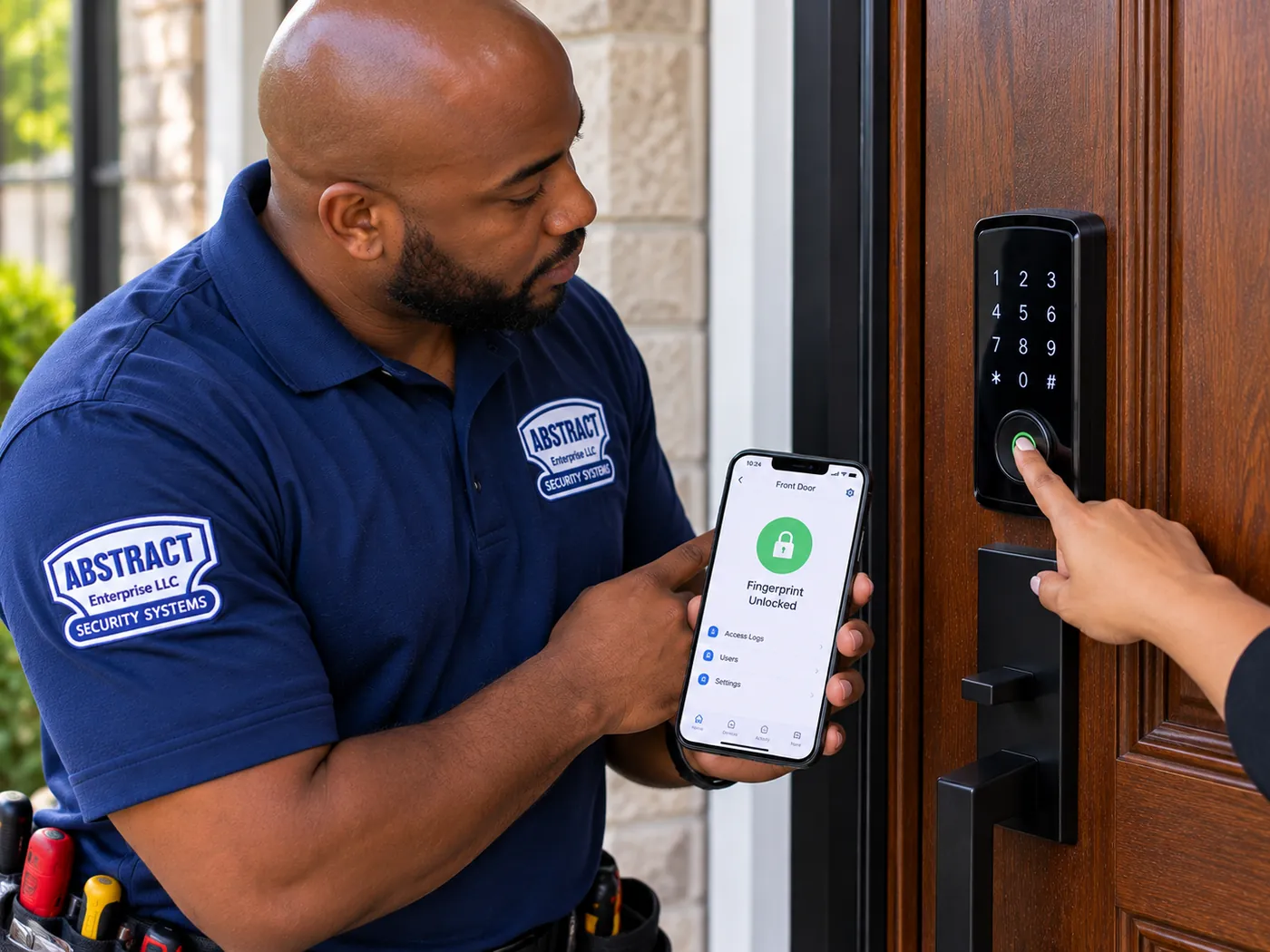
For heirs, carers and older owners: a fingerprint cannot be passed on, written on a sticky note or given to a “helpful” stranger, and the log shows exactly whose finger opened the door.
For thick original doors with an edge-mounted lock pocket. They use the existing mortise rather than adding new bores to a door that already has too many.
For three-family houses and small buildings whose street door already has a buzzer panel: one plate that carries call buttons and a keypad or fob reader, so a landmarked opening still has a single panel.
Fob or keypad readers driving a strike on street doors of apartment houses and shops, with the power supply and controller safely inside.
Battery keypad locks and post-mounted keypads for front-yard and areaway gates, always with a mechanical way out from the inside.
The link that turns a lock into a monitored door. On empty houses where the family does not want to keep broadband running, we discuss hubs with their own mobile connection.
See and speak to a caller without opening the door — the companion to every lock we fit for an older owner.
| Question | National alarm and smart-home brands | AESS in Bed-Stuy |
|---|---|---|
| Who decides which doors are made keyless? | Usually the customer, from a product list | Planned door by door after a walkthrough, with the family |
| Who holds the admin account? | Whoever opened the account | Two named administrators agreed in writing, plus a printed access register |
| Landmark district rules | Not addressed | Hardware kept to the door; anything beside it placed within the LPC guidebook’s limits |
| Old keys still in circulation | Not addressed | Every mechanical cylinder changed or retired the same day |
| Monthly fees | Often tied to monitoring plans | None from us; app features depend on the lock maker |
ADT, Ring and SimpliSafe make perfectly good products, and if you already use one of their platforms we will choose a lock that works with it. What they do not provide is somebody standing at your door working out who in the family should be able to open it.
Our research tools could not display Google’s AI Overview for this neighbourhood, so the headings below are not quotations from it. They are claims that cost guides such as Angi, HomeAdvisor and Fixr, retailers and general smart-home articles commonly make, and that answer engines tend to repeat. Underneath each is what changes on a Bed-Stuy block.
Fixr’s national guide, last updated in January 2025, gives $250 to $400 for having a smart lock put in, averaging $300, and that is a fair figure for one modern door in a suburban house. Angi and HomeAdvisor pages tend to land in a similar band.
An estate house in Bed-Stuy is rarely one door. It is a parlour door, a vestibule door, a garden door, a rear door and a cellar door, every one of which may still open to keys nobody can account for. The smart lock may go on only one of them; the cylinders on the rest still have to change on the same day.
So we quote house doors flat after a free walkthrough, and the quote covers every door that needs closing off — not just the one with the keypad. Building-door items carry our published Brooklyn figures.
True only if each person has their own credential. The log records which code or fingerprint opened the door, not who was standing there. If the whole family uses one code, the history says only that “the family code” was used.
In an inherited house where relatives may later disagree, that difference is the whole point. A shared code produces a log nobody can rely on; individual codes produce a timeline that can be read back months later.
We set one credential per person, two administrators, and notifications to at least two phones, and we tell families to save the history regularly because apps do not keep it indefinitely.
Generic advice for a new homeowner or a bad break-up is to change the locks. In Bed-Stuy that advice can be dangerous when the problem is a person living in the house. Changing a lock on an occupant is a legal act with consequences, and Fox 5 reported a Queens homeowner arrested when she tried it.
And when the problem is deed theft, changing a lock solves nothing: the thief’s weapon is a recorded document, not a key. The Attorney General’s list of protections is about lawyers, wills, records and complaints, not hardware.
Locks are the right tool before anyone moves in and after the house is lawfully back in the family’s hands. In between, the right tools are the precinct, a lawyer and the courts.
Renovation articles often warn that anything in a landmark district needs approval. For a lock, the opposite is closer to the truth: the commission’s permit guidebook lists repairing or replacing hardware such as hinges, knobs, locks and handles among work that may not need a permit.
Where care is needed is beside the door. The guidebook confines intercom panels and doorbells to the door opening and to one panel per opening, and allows an intercom on a fence or wall in front of the entrance. A wall keypad or reader is planned with that in mind.
In Stuyvesant Heights, the Expanded Stuyvesant Heights district and the Bedford district, that means locks on doors, readers in reveals, cables inside the house and original hardware returned to the owner.
Many setup guides imply the lock is useless without internet. In fact a battery smart lock opens with its keypad or fingerprint reader with no connection at all; it is the remote features — notifications, remote unlocks, a live log — that need a bridge, Wi-Fi or Thread.
That matters at an empty estate house where the family has cancelled broadband. The door still works; the monitoring does not. August’s own support pages ask for its Wi-Fi bridge to sit within 10 to 15 feet of the lock with a strong signal where the bridge is placed, which assumes there is a router to talk to.
We ask the family which bills will be kept up while the house is empty, and design the connection around the answer — including mobile-data hubs where broadband is off.
Smart-home marketing often presents a keypad as automatically safer than a key. A code is safer only if fewer people know it. A code written on the inside of a kitchen cupboard, texted to a cousin and given to a contractor is a key that can be copied without a locksmith.
The real advantage of a code is that it can be cancelled in seconds, individually, without touching anyone else’s. That only helps if you actually cancel codes when people stop needing them.
We set expiry dates on every temporary code at the time it is created — contractors by the job, estate agents by the listing, cleaners by the schedule — so the clean-up happens whether or not anyone remembers.
Bob Vila’s testers and many retailers say a smart lock can be fitted with a screwdriver in about half an hour, and on a new door that is fair. On a Bed-Stuy door from the 1880s, with a filled rim-lock hole, a mortise pocket and two later bores, it is not.
A motorised bolt that rubs in a misaligned strike drains its batteries and stalls; a strike screwed into old, dry wood pulls out at the first shove. On an empty house nobody notices until the lock is dead and the door is unlocked.
We check the door, the frame and the bolt throw before fitting, align and reinforce as needed, and test every credential from both sides before we leave.

If the honest answer is “we’re not sure”, that is the place to start. Tell us who has held keys over the years and we will plan the change-over.
Estate house, family brownstone, landmarked row, walk-up or shop — tell us who needs a way in and who must not have one, and a written answer comes back the same business day. Prefer to talk? Call the Brooklyn office on (347) 934-8335.
A Brooklyn installer will call you back the same business day. If the house is open or a lock has failed, call now on (347) 934-8335.
Seven steps, whether the job is a single rear door off Halsey Street or every door of a family house waiting on probate.
Before any visit, the family or owner lists everyone who has held a key, code or app login for the house, and tells us whether anyone is living there now. If someone is, we agree how to proceed before work is booked.
You send photos of every exterior door inside and out. We check whether the house sits in the Stuyvesant Heights, Expanded Stuyvesant Heights or Bedford historic district so the plan respects the commission’s rules from the start.
At the house we try every door from both sides, read each door’s bore history, check frames, glass, signal and power, agree who will be administrator and backup, and give a flat written price.
Every mechanical cylinder the plan calls for is changed or retired the same day, so no key from the past opens any exterior door.
Strikes are reinforced and aligned, the smart lock is fitted using existing preparation where the wood is sound, and every door is opened from inside in one motion with no key, code or phone.
The bridge, Wi-Fi, Thread or mobile-data link is set up and tested from a phone away from the house, and entry alerts go to at least two family members.
Each person’s credential is enrolled and tested, temporary codes are given end dates, and you receive a printed access register naming every person, door and date, plus the original hardware we removed.
Six places that explain the neighbourhood we work in — its houses, its institutions and the people who fought to keep them.
Designated September 14, 1971, and later ringed by the Expanded Stuyvesant Heights district of about 825 buildings. Stoops, paired doors and vestibules where we keep our work to the hardware.
Grown from a seedling in the mid-1880s by William Lemken and planted outside 679 Lafayette Avenue; protected thanks to Hattie Carthan’s campaign from the 1950s and landmarked on May 12, 1970. A reminder of how long Bed-Stuy families have defended what is theirs.
Between Marcy and Tompkins Avenues, originally Tompkins Park, with a design by Frederick Law Olmsted and Calvert Vaux; built in 1870–71. The houses facing it are among the neighbourhood’s grandest rows.
Montrose W. Morris’s apartment building of 1889–90 at 500–518 Nostrand Avenue, between Halsey and Macon Streets — one of Brooklyn’s major early apartment houses and a landmark in its own right.
At 832 Marcy Avenue, built in 1891–92 in the Romanesque Revival style and designated a landmark on September 23, 1975. Its rock-faced stone is typical of the later houses around it.
Headquarters of the Bedford Stuyvesant Restoration Corporation, founded in 1967, at 1368 Fulton Street — also home to the Bed-Stuy Gateway BID that looks after the Fulton Street corridor.
We work on every block from Flushing Avenue to Atlantic Avenue and from Classon Avenue to Broadway and Saratoga Park, including Stuyvesant Heights, the Bedford district, Ocean Hill’s edges and the streets around Marcy and Tompkins Houses. We also serve the neighbouring Clinton Hill, Crown Heights, Bushwick, Williamsburg and Ocean Hill–Brownsville, from the same Troy Avenue base. For building-wide entry systems in the neighbourhood, see our Bed-Stuy structured cabling and alarm installation in Bedford-Stuyvesant pages.

Bed-Stuy is in Brooklyn, and Brooklyn is the base every AESS area price is calculated from — a multiplier of 1.00. So the published figures below are exactly the Brooklyn figures, with nothing added for the neighbourhood. House and apartment doors carry no published price because an estate lock-down of five doors and a single retrofit on a vestibule door are entirely different jobs; those are quoted flat, in writing, after a free walkthrough, and the written figure is what you pay.
| Item | Bed-Stuy price (Brooklyn ×1.00) | What it covers |
|---|---|---|
| Smart lock on a house, vestibule, garden, rear or unit door | Quoted flat at the free walkthrough | Includes changing or retiring the other cylinders on the house where the plan calls for it |
| Single-door keypad or fob reader with electric strike | $1,500–$2,500 installed | Street door of a three-family-or-larger house or small building, shop or office door; from our published access-control figures |
| New electric strike on a building door | $250–$450 | First-time or replacement strike in a street or vestibule door frame; from our door-buzzer pages |
| Failed electric strike repair | $295–$485 | Street door whose buzzer sounds but whose latch stays shut |
| Programming visit on a lock already fitted | $195 first hour, then 30-minute blocks | Account recovery, adding administrators, codes and a bridge; our Brooklyn setup-only rate |
| Service and callback rate | $195/hr, 3-hour minimum ($585) | Return visits after a completed job; never applied to the first installation |
National context. Fixr’s nationwide figure of $250–$400 for smart lock installation, averaging $300, is a third-party average for a single modern door and is not an AESS price.
Locks you buy yourself carry their maker’s warranty. Full terms β including 50% deposit, one-year parts-only warranty on AESS-supplied products, and the late-fee schedule β are set out in the service agreement.
Three shapes cover most Bed-Stuy requests. The house package is quoted after we see the house; the two building-door packages carry published Brooklyn prices.
Quoted flat at walkthrough
Every exterior cylinder changed or retired, one connected smart lock on the door the family uses, two administrators, a personal code for each person who needs one, dated codes for trades, and a printed access register. Built for estate, inherited and newly bought houses.
$250–$450
For the three-family house or walk-up whose street door already has a buzzer: a new strike so the door latches reliably and can be released by the buzzer or a keypad. If the existing strike has simply failed, repair is listed at $295–$485.
$1,500–$2,500
Single-door keypad or fob reader with electric strike, installed: a credential for each resident or staff member, an inside release, and the owner shown how to add and remove people. On landmarked fronts, set within the door opening.
Already bought a lock? We fit it, quoted flat at the walkthrough as labour only, after checking it suits the door — thickness, bore or mortise, glass nearby, outdoor exposure — and that it supports separate user codes, a second administrator and an entry history if the house needs those. If it is wrong for the door you chose but right for another, we say so. A customer-supplied lock carries its manufacturer’s warranty rather than ours.

An empty family house is most exposed in the weeks after it empties. Book a walkthrough and we will list every way in before we price anything.
This is the plan we walk through with families when a house has just become empty. Your house may have fewer doors or more; the principle is the same at each one — close off what nobody can account for, give each authorised person their own way in, and record it.
| Opening | What we usually do | Why it matters in an empty house |
|---|---|---|
| Parlour-floor outer doors | New cylinder or a smart deadbolt, depending on which door the family will use | The door strangers see; it should never be left on a key someone outside the family still holds |
| Vestibule door | Connected smart lock with individual codes and two administrators | Sheltered from weather, so it is the most reliable home for the monitored lock |
| Garden-floor door and gate | New cylinder; keypad only if relatives or carers use this door | Under the stoop and out of sight from the street, so an unnoticed old key is most dangerous here |
| Rear yard door | Reinforced strike, keyless deadbolt with auto-lock | Unwatched, and often the original weakest door in the house |
| Cellar and sidewalk access | Inside bar or keyed lock checked; no codes unless needed | Rarely used, often forgotten when keys are counted |
| Interior doors to rooms holding papers or valuables | Keyed or keypad lock on one room, if the family wants it | Keeps documents and heirlooms apart from contractors and viewers |
Alongside the lock, we suggest three habits. Someone visits in person on a schedule, and the lock history shows they did. Mail is collected or redirected so the house does not look abandoned. And the owner of record — or the estate — is signed up for the city’s free property and deed alerts, because the Attorney General lists empty houses and houses whose heirs have not transferred title among those deed thieves target.
When the house is sold or a family member moves in, the plan reverses cleanly: temporary codes expire, the administrators hand over to the new owner, and the register is closed and given to whoever handled the estate.
Most smart-lock work on landmarked houses is straightforward if it is planned properly. This is the checklist we run on houses in Stuyvesant Heights, the Expanded Stuyvesant Heights district and the Bedford district, and on the individually landmarked buildings around them.
| Item | Our rule of thumb | Source of the limit |
|---|---|---|
| Replacing the lock itself | Treated as hardware work; original hardware labelled and returned to the owner | LPC guidebook lists repairing or replacing hardware such as hinges, knobs, locks and handles among work that may not need a permit |
| Separate keypad or reader | Within or immediately beside the door opening; small, dark, fixed into the reveal, frame or mortar joints | Guidebook rule that intercom panels and doorbells be installed within or adjacent to a door opening |
| Existing buzzer panel | Replace with a combined panel in the same place rather than add a second box | Guidebook limit of one intercom panel per door opening |
| Gate or fence device | On a post or plate, not decorative ironwork | Guidebook allows an intercom on a fence or wall in front of the entranceway |
| Cable | Inside the house, through the cellar or vestibule; never across the stoop or facade | Exposed conduit is the kind of facade change the commission reviews |
| New door or altered door | Not our call; owner speaks to LPC staff first, we supply lock drawings | Door replacement on a primary facade is reviewed against the historic door |
If you are unsure whether your house falls inside a district, the Landmarks Preservation Commission publishes district maps for each one; the Stuyvesant Heights map, for example, is available on the commission’s website. We are glad to look up your block with you at the walkthrough.
Every Bed-Stuy door tells you roughly when it was hung, and that tells us what to expect behind it. This is the short history we carry in our heads when we walk up a stoop here.
| Era | What was built | What it means for a lock today |
|---|---|---|
| 1870–1900 | The rows of the Bedford and Stuyvesant Heights districts; Tompkins Park laid out to an Olmsted and Vaux design in 1870–71; the Alhambra Apartments in 1889–90; Boys’ High School in 1891–92 | Thick wood doors with mortise pockets or rim-lock scars, stone surrounds, vestibules. Hardware work on the door, nothing new on the carving. |
| 1949–1966 | Public housing: Marcy Houses (1949), Brevoort (1955), Sumner (1958), Tompkins and Roosevelt (1964), Roosevelt II (1966) | Authority-controlled doors and entries; residents work through management, not around it. |
| 1967–1971 | The Bedford Stuyvesant Restoration Corporation founded on Fulton Street; the Magnolia Grandiflora landmarked in 1970; Stuyvesant Heights designated in 1971 | The decades when many of today’s owning families bought or held on. Their keys have been copied for fifty years. |
| 2010–2025 | 11,644 new homes, almost all in buildings of four or more units (Furman Center); the Expanded Stuyvesant Heights district in 2013 and the Bedford district in 2015 | Metal unit doors and lobby platforms in the new buildings; stricter attention to what goes beside a door on the old ones. |
| 2023–2026 | Deed-theft complaints up 240 percent from 2023 to 2025; the 2024 state budget’s change on squatters; a city office dedicated to deed-theft prevention | The door becomes part of how a family shows it is looking after a house: who has access, when they came, and what was logged. |
The thread through all of it is continuity. A house built in the 1880s, bought by a family in the 1960s and inherited in the 2020s has seen more hands on its keys than any newer building in the city. Our job on that door is not to make it modern for the sake of it. It is to end that long chain of copied keys cleanly, put a record in its place, and leave the door itself as it was found.
That is also why we are cautious with anything that would change the house for good. A new door, a cut stone surround or exposed wiring outlasts the lock fitted with it. A well-chosen smart deadbolt, or an interior retrofit on the original lock, can come off in an afternoon and leave the door ready for whatever the next owner wants — including the old brass hardware we returned to the family in a labelled bag.
For owners of the newer buildings the timeline matters less, but one point carries over. Whoever fitted the lock first — a developer, a previous tenant, a relative — may still hold a way in. Whatever the age of the building, the first step is the same: find out who can open the door today.
A lock is usually one piece of a bigger change at the front of a Bed-Stuy house. These neighbourhood and Brooklyn services often join it.
Fob and keypad readers for street doors, walk-ups and shops in the neighbourhood.
Combined panels that keep one device per door opening on landmarked fronts.
For street doors that buzz but will not release, or panels that no longer ring upstairs.
Stoop, areaway and yard coverage so each door event can be matched to video.
Door contacts and sirens for houses that stand empty between owners.
See and talk to a caller before deciding whether to open the door.
Cable from cellar to vestibule for readers, cameras and bridges, routed inside the house.
The borough page: stoops, vestibules and owner-landlord code plans across Brooklyn.
Ask for the lock and any of these extras on one form.
How our technicians approach an inherited or empty house — a working method, not the story of any single customer
Before we touch a screwdriver we sit down with whoever is in charge and make a list on paper: every person who might hold a key or a code, and when they last needed it. Families are often surprised by how long the list gets once they start — the tenant from years ago, the aide, the neighbour, the handyman. Then we walk the house from the cellar up, trying every door from both sides and noting which lock and which key belongs to each.
On the doors themselves we look for the history: filled holes, a second deadbolt somebody added, a strike that has been moved, a glass pane replaced with plywood. Those tell us where the house has been forced or patched before, and where a new lock needs reinforcing rather than simply swapping.
Last, we ask the question families find hardest: who will hold the admin, and who will be the second? We do not leave until both are set up, tested from two phones, and written on the register alongside everyone else’s name. A lock without an agreed owner just moves the argument from the keys to the app.
Yes. Before we change cylinders or take over a lock’s admin account we ask for something that shows you have authority over the house, such as a deed or tax bill in your name, letters testamentary or of administration, or a letter from the estate’s lawyer. It protects you as much as us: we will not help anyone take control of a house they cannot show is theirs.
Yes. On houses in the Stuyvesant Heights, Expanded Stuyvesant Heights and Bedford historic districts we photograph each door and its surround before we start and again when we finish, and send you the pictures with the lock’s specification sheet, so you have a clear record of what was changed if the commission or a future buyer ever asks.
Yes. A battery smart lock needs no mains power to lock, unlock or keep codes, so we can fit it in an empty house with the power off. Notifications and remote access are another matter: they need a powered bridge or router, or a hub with its own mobile connection, so we will talk through which utilities the family plans to keep on.
Contact the city’s Mayor’s Office of Deed Theft Prevention on 1-855-HOME-456 and sign up for its free property and deed alerts through ACRIS, contact the New York Attorney General’s office or the Brooklyn District Attorney, and speak to your own lawyer before signing anything. A lock protects the door; those steps protect the title.
Yes. Many inherited Bed-Stuy houses belong to families spread across several states. We can hold the walkthrough with whoever is in Brooklyn while other relatives join by video call, so everyone hears the same plan for administrators and codes before a single cylinder is changed.
Usually. Wherever the door’s existing bore or mortise is sound we fit the smart lock to that preparation, and interior retrofit units leave the outside untouched. When the lock comes off, the original or a matching mechanical lock can go back into the same holes, and we keep any original hardware labelled for exactly that purpose.
This page covers Bedford-Stuyvesant. Its parent is the Brooklyn smart lock installation page, and the citywide renter, co-op and building-rule overview sits on the New York City smart lock hub. Every borough and county we serve has its own page, and two more neighbourhood pages sit alongside this one.
AESS smart lock installation, NYC · Brooklyn · smart locks in Manhattan · Queens · Bronx smart lock installation · Staten Island
Jackson Heights, Queens · Kingsbridge, Bronx · Bedford-Stuyvesant, Brooklyn (this page) Earlier neighbourhood pages: Upper East Side, Manhattan · Brooklyn Heights, Brooklyn · Flushing, Queens.
Long Island smart lock installation · Nassau County · Suffolk County
Hudson Valley smart locks · Westchester · Rockland · Orange · Putnam · Dutchess · Ulster
Locks are one trade among many for us; cameras, intercoms, alarms and cabling are all in the full service directory. The Abstract Enterprises Security Systems home page gives the overview, and our company story explains who we are.
A dead keypad on an empty family house, a rear door that will not latch, a code that stopped working after the last administrator’s phone was lost — ring (347) 934-8335 from anywhere between Flushing Avenue and Atlantic Avenue. We book the next open 2-hour window, and most power, pairing, alignment and account faults are put right in one to two hours once a technician is at the door.
Abstract Enterprises Security Systems · 1282 Troy Ave, Brooklyn, NY 11203 · (347) 934-8335 · WhatsApp (718) 679-0359 via wa.me
NYS Low-Voltage Licence #12000287431 · 100% Licensed & Insured · Same-Day Estimates · Rated 4.7★ from 201 Google Reviews
Full terms β including 50% deposit, one-year parts-only warranty on AESS-supplied products, and the late-fee schedule β are set out in the service agreement. See our warranty page.
This page explains how Bed-Stuy’s houses, landmark districts and city rules affect smart lock installation; it is not legal advice. For deed theft, contact your own lawyer, the New York Attorney General or the Mayor’s Office of Deed Theft Prevention. Page reviewed and updated October 17, 2026. Changelog: Bedford-Stuyvesant page launched as a neighbourhood page of the Brooklyn smart lock service, covering estate and inherited houses, empty-house monitoring, heirs’ code plans, landmark-district placement and shared foyers.