Every Way In Surveyed · Roof, Yard & Terrace Doors Kept Legal · Garden Duplexes and Parlor Floors · Courtyard Arches and Gated Lanes · Shops on Broadway, Amsterdam and Columbus
Between 59th Street and Cathedral Parkway, plenty of homes are reached from more sides than the hallway door suggests. Rooftops run unbroken along a row of brownstones, a garden duplex has a back door onto the yard, a top-floor apartment sits beside the roof bulkhead, and some buildings are entered through a courtyard arch or a gated lane before anyone reaches a lobby. When police tracked seven break-ins in the West 80s in December 2019, the way in was a back door, a fire escape or the roof. We install smart locks on Upper West Side apartment, brownstone and shop doors after looking at every opening in the home — and we keep to the rules that forbid key-locking some of them.
Reviewed and updated October 17, 2026 · Author: Anwar Timothy, owner · NYS license #12000287431 · Manhattan line for the Upper West Side (929) 560-0737

Want to know which doors in your West Side home should go keyless, and which ones the law says must stay on a bolt or a hook? Call the Manhattan line, (929) 560-0737, or send the 60-second form with a photo of the door and a note about any yard, terrace or roof access. We answer before anyone visits: which lock suits the door you use every day, what belongs on the others, and the price.

On the Upper West Side, the front door is rarely the only door that matters. The neighborhood was built in two great waves: rows of brownstones and limestone houses on the side streets from the 1880s and 1890s, then tall apartment houses on Broadway, West End Avenue and Riverside Drive after the IRT subway opened its Broadway stations in 1904. Wikipedia's history of the Ansonia records that the new line “spurred the development of high-rise apartment buildings on the Upper West Side along Broadway.” The result is a district where a family can live in a garden duplex with its own door under the stoop and a second door onto the yard, where a top-floor apartment shares a landing with the stair up to the roof, and where entire buildings such as the Apthorp and the Belnord are entered through arches into a private courtyard before anyone reaches an elevator.
Each of those layouts adds a way in that a smart lock on the hallway door does nothing about. In December 2019 West Side Rag passed on a warning from the 20th Precinct about seven residential burglaries between Central Park West and Broadway, from 82nd to 85th Street, in nine days. Police said the people responsible used “either a back door, fire escape or roof” and had been “crossing rooftops, moving from building to building.” The precinct commander's advice was about locks on fire-escape windows and patio sliding doors, cameras covering every access point, and a free building assessment from the precinct's Crime Prevention Officer. None of it was about the apartment's front door.
The obvious response — lock everything — runs straight into New York's rules. The Multiple Dwelling Law says a roof bulkhead door “shall never be self-locking and shall be fastened on the inside by movable bolts, hooks or a lock which does not require a key to open from the inside of the dwelling.” The city's rule on entrance doors goes further: bulkhead doors and scuttles “shall have no key locks and shall not be locked by a key at any time.” HPD says it is illegal to put double-cylinder locks on apartment doors and that key-locked gates on fire-escape windows are prohibited. In larger buildings converted after 1968, doors from the street, a court, a yard or the cellar must close and lock on their own and still open from the inside without a key. So the answer is never a smart lock on every opening. It is a smart lock on the doors people actually use, and the right latch, sensor or frame repair on the rest.
The people who live here make the planning matter. The NYU Furman Center's 2026 profile of Manhattan Community District 7 counts 230,436 residents and 130,471 homes. The homeownership rate is 35.6 percent, above the 32.7 percent citywide, which means a large share of West Side doors belong to co-op shareholders and condo owners who answer to a board as well as to themselves. Nearly 23 percent of residents are 65 or older and 43.6 percent of households are one person living alone. Census Reporter's 2024 profile of the district puts the share who worked at home at 23 percent, with a wide margin of error. A home that is empty all day is a different problem from a home where someone is in the back bedroom on video calls while a dog walker lets themselves in at the front.
The commercial blocks bring their own version of the same lesson. In August 2026 two men in ski masks used a large rock to break into a taqueria on Amsterdam Avenue between 84th and 85th Streets, smashed a restaurant window ten blocks south, and got into a coffee shop between 74th and 75th Streets by breaking the window above its front door, West Side Rag reported. The front door's lock was not the weak point; the glass above it was. And on Broadway between 59th and 110th Streets the Rag counted 80 vacant storefronts in October 2025 — every one of them a door whose next tenant will want to know who still holds a key or a code.
Put together, those facts describe a different job from the one most smart lock guides imagine. On a West Side visit we walk the whole home — hallway door, kitchen or service door, yard door, terrace, the landing by the roof stair, fire-escape windows — and then decide where a smart lock earns its place. Usually that is one door, sometimes two. The others get a door contact, a better strike, a working closer or simply an honest conversation about the bulkhead rule.
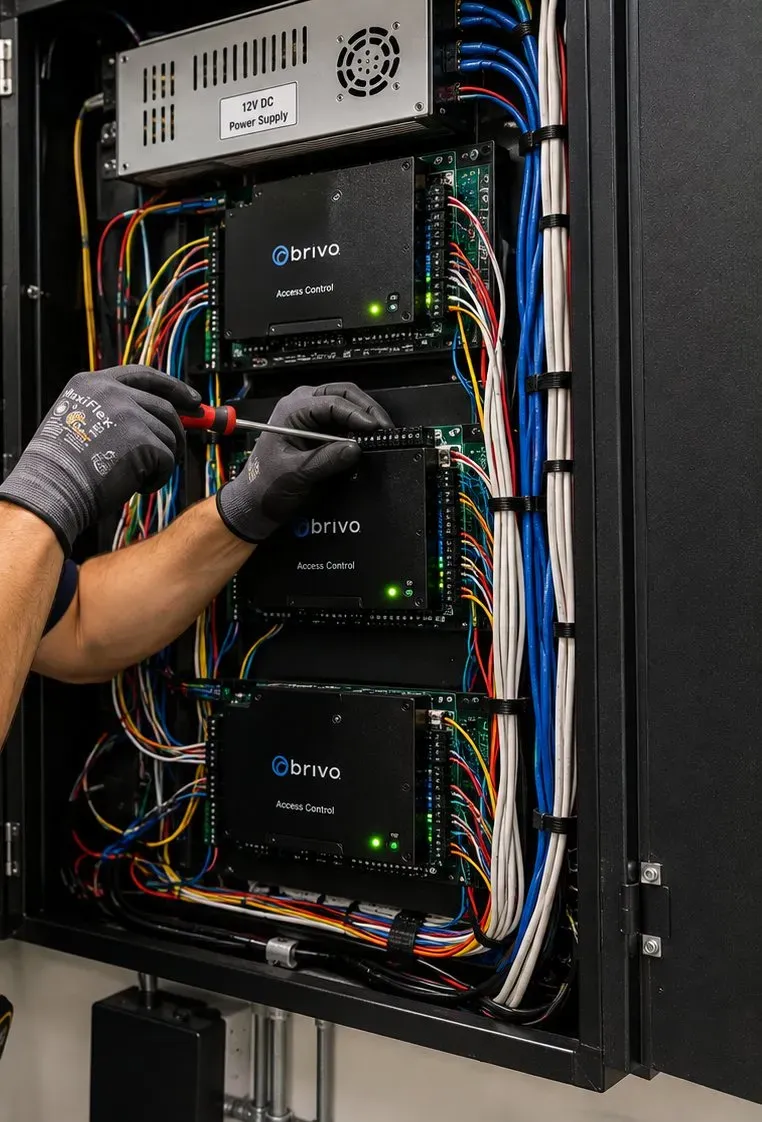
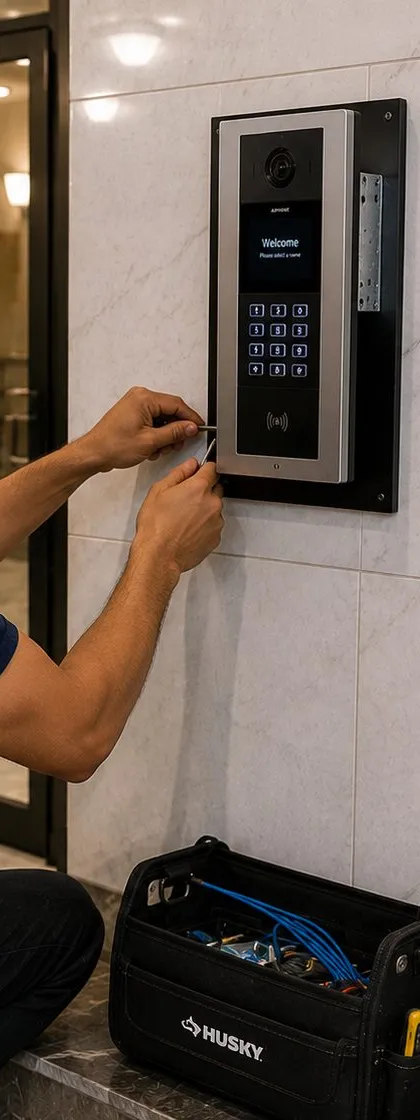
Buildings that ask us about apartment locks often have a lobby or yard door that needs work too. Our Manhattan access control team handles fob readers for street doors and courtyard gates, and the AESS intercom installers in Manhattan look after the buzzer panel in the vestibule. Most West Side brownstone owners pair the lock with door contacts on the yard and roof-stair doors from our Manhattan alarm installation service.

Repairs are a separate booking from new work: the keypad that no longer lights, the motor that drives the bolt partway into a tired strike and gives up, the lock that vanished from the app when the building swapped its Wi-Fi, the dog walker’s code that suddenly fails. We book them into the next open 2-hour window, and most battery, pairing and alignment faults are put right in one to two hours once a technician is at the door. If the trouble is the building's street door or the yard door that won't release, that is the owner's or the board's equipment; a failed electric strike repair on a building door is $369–$606 at the Manhattan rate when they book it. Call (929) 560-0737 and say it is a lock fault, or see the Manhattan door buzzer repair service if the vestibule door has stopped buzzing open.
Most West Side keyless work is one of these jobs, or two or three of them at the same address. Every one finishes the same way: the door closes and latches by itself, opens from inside in one motion with no key, and every code, fingerprint and phone key has been tried from the outside with the door shut.
A walk through every way into the apartment or house — hallway door, service or kitchen door, yard door, terrace, roof-stair landing and fire-escape windows — ending in a written plan of which door gets the smart lock and what the others need.
Keypad, fingerprint or phone-key deadbolts for co-op, condo and rental apartment doors in the avenue buildings, with the owner's lock left in service where the law expects it and the hallway face kept to the building's standard.
Locks for the under-stoop entrance of a garden duplex, the parlor-floor door of a floor-through, and the door between the two halves of a converted brownstone, planned so the household uses one main door and the others are secured rather than forgotten.
Back doors onto a shared yard and terrace doors on setback penthouses, fitted with locks that open from inside without a key, door contacts that tell you when they are left open, and stronger strikes where the frame is soft.
Units that motorise an existing single-cylinder deadbolt from the inside, for shareholders whose house rules keep the corridor face uniform and for renters who want to leave the door exactly as they found it.
Keypad or fob readers for the gate in a courtyard arch or the gates at the ends of a private walkway, wired so they release freely from inside and so every household can manage its own credentials.
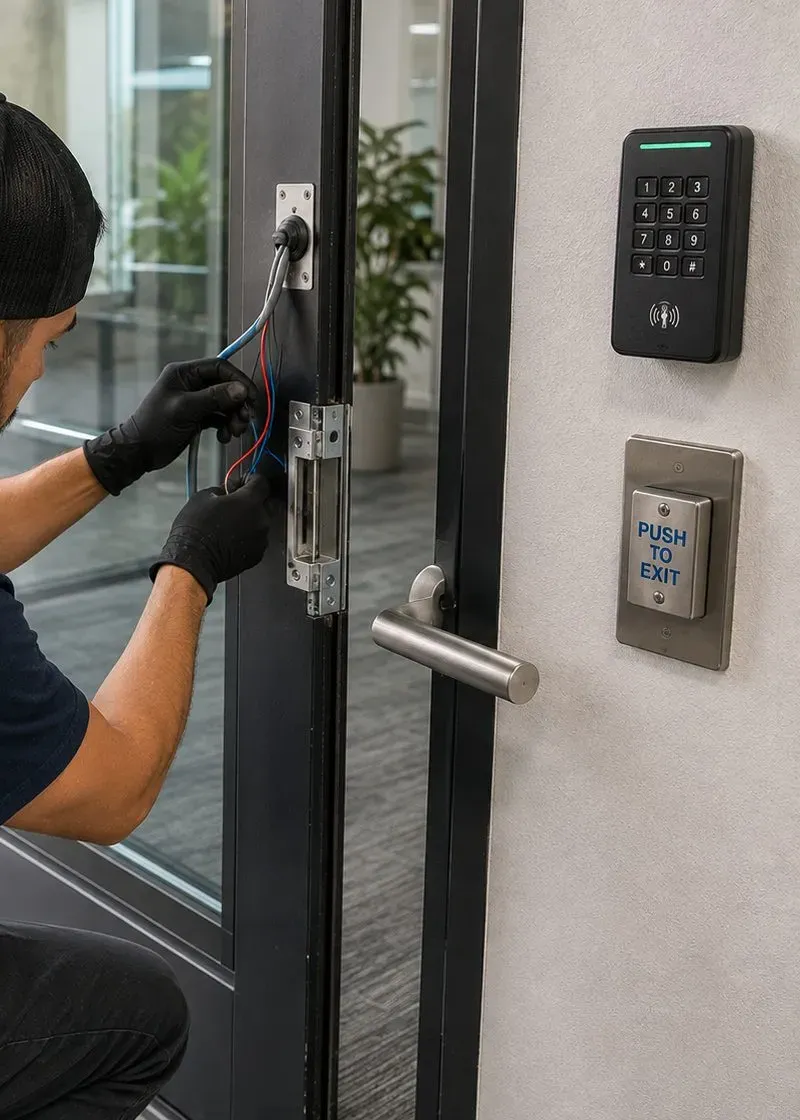
A keypad or fob reader with an electric strike on the vestibule or yard door of a converted brownstone or walk-up, chosen to stay self-closing and self-locking where the building has to be, with an exit that needs no key.
Staff codes and schedules for storefronts on Broadway, Amsterdam and Columbus, and appointment-friendly entry for therapy, medical and dental suites in apartment buildings along Central Park West and the side streets.
Batteries, motors and strikes on locks already fitted, re-pairing after a router or building network change, and a code clean-up for homes that have handed out too many codes over the years.

The same block can hold four different kinds of front door. These are the building types we meet most often west of the park, and how each one changes the job.
Built in rows on the side streets, many now split into a garden duplex, a parlor floor-through and smaller apartments above. A single house can have a street door, a vestibule door, an under-stoop door, apartment doors on each landing and a yard door at the back — and in a converted house with a resident owner, several of those belong to different people. The LPC counts nine historic districts on the Upper West Side, so the street face of many of these houses is under landmark rules even when the apartment doors inside are not.
The Apthorp fills the block between Broadway, West End Avenue, 78th and 79th Streets; its wrought-iron gates lead through arches to an internal courtyard with a garden, driveway and the entrances to the apartments. The Belnord's arches on 86th Street lead to a courtyard too, and its sales pages describe six separate residential lobbies. In buildings like these the gate, the lobby and the elevator all sit between the street and your door, and none of them is yours to change.
The tall apartment houses of West End Avenue, Riverside Drive and Central Park West, the Apthorp's twelve stories among them, many of them co-ops with classic-six layouts, a kitchen door to a service hall and, at the top, a few apartments on setbacks with terraces or a landing shared with the roof stair. House rules usually set the corridor hardware and may limit when work can be done.
Five- and six-story walk-ups on Amsterdam and Columbus, often with a shop on the ground floor. Doors are steel-clad or painted wood, transoms over apartment doors are common, and the city's old-law tenement rules require those transoms to be sealed where fire-rated apartment doors are needed. Fire escapes run across the back or the front, with windows that must open without a key.
Riverside Park South records nineteen buildings eventually erected on the former New York Central 60th Street Yard; the first towers along Riverside Boulevard were finished at the turn of the century. These are doorman buildings with building-wide lock and key policies, rated corridor doors and, often, an in-house locksmith or a management office that controls apartment entry hardware.
HPD's Shared Housing Roadmap names the single-room-occupancy hotels of the Upper West Side as part of the city's history of shared housing. Tenants in rooming units hold their rooms under written or oral agreements, with locks on their own doors and shared bathrooms or kitchens. Locks here raise legal and fire-safety questions that do not apply anywhere else.
Pomander Walk, between Broadway and West End Avenue from 94th to 95th Street, is a cooperative of 27 small buildings from 1921; the Walk itself is a narrow courtyard between two rows of eight buildings, with a locked gate at each end. Lane gates, house doors and the households who share them make a small access system of their own.
The Furman Center counts 12 Mitchell-Lama properties with 2,075 units and 22 public housing properties with 5,927 units in the district. Apartment entry hardware in these buildings is set by the managing agent or the housing authority, so we start with their rules and work only within them.

West Side businesses mostly sit at the bottom of residential buildings, so their doors share walls, stairs and sometimes entrances with the apartments above. A restaurant on Columbus may take deliveries through a door the co-op controls; a dentist on a side street may see patients in a suite off a residential lobby; a shop on Broadway may inherit a door, a gate and a back exit from whoever left before. Keyless entry for these doors is about staff schedules and records, but also about who else shares the door and what has to happen when it is opened from inside.
The neighborhood's main shopping street, with supermarkets, pharmacies, banks, restaurants and a long row of small shops. West Side Rag counted 80 vacant storefronts along it in October 2025, so new leases and re-fitted doors are a steady part of the work: codes for a new staff list, an old keypad wiped, a strike re-cut for a replacement door.
Restaurants, bars and cafΓ©s under walk-ups. The August 2026 break-ins that West Side Rag reported happened here, at three businesses between the 70s and the 80s, and two of them came through glass rather than the lock. For these fronts we look at the glazing above and beside the door as well as the door itself.
Boutiques, restaurants and services served by the Columbus Avenue BID, a short walk from the American Museum of Natural History and Central Park. Many share a residential entrance or a cellar door with the building upstairs, which decides what kind of lock the shared door can carry.
The blocks around Lincoln Center, whose business improvement district was founded in 1996. Offices, studios, schools and institutions with staff doors, rehearsal rooms and stores, often inside larger buildings where the landlord runs the main card system and the tenant runs the suite door.
The Columbus-Amsterdam BID covers both avenues from West 96th to West 110th Street, through Manhattan Valley. Small groceries, restaurants, laundromats and service businesses, many family-run, where one owner opens up and staff need their own codes for the rest of the week.
Broker Metro Manhattan describes professional and medical suites of roughly 500 to 2,500 square feet in apartment buildings on Central Park West and the West End side streets, and says therapy and psychiatry practices fit there best. Their doors open off residential lobbies, which shapes the lock choice more than anything else.

Owners, shareholders, renters and shopkeepers west of the park tend to ask us the same handful of things, so the answers are sorted below by the part of the home or business they concern. When a statute, a city rule or a published source decides the matter, it is named, so you can check it for yourself; this is practical guidance, not legal advice.
Less than most people expect, and more than nothing. The roof bulkhead door itself is off limits for a keyed or code lock: the Multiple Dwelling Law says it is never self-locking and is fastened inside with movable bolts, hooks or a lock that needs no key from inside, and the city's entrance-door rule says bulkhead doors have no key locks at all. That rule exists so that people can get out onto the roof in a fire, and it is why the 2019 team the 20th Precinct described could come down through buildings once they were up top. What you can change is your own side of that landing. Your apartment door is the one that matters most, and a strong smart deadbolt with a good strike and long frame screws belongs there. If you have a terrace or a window onto a roof, its lock can be improved as long as it still opens from inside without a key. And the board can add a door contact or an alarm to the bulkhead so that someone is told when it opens, which deters roof-crossers without trapping anyone.
The one the household uses every day, and in a garden duplex that is usually the under-stoop door, because it lets you in without passing through the building at all. That door also faces the weather and the areaway, so we choose a keypad deadbolt with a solid weather rating, or a fingerprint model if the household prefers not to share codes. The door into the building's hall then becomes the secondary door. It still needs a proper deadbolt, since anyone who gets into the building can reach it, but it can often stay mechanical, or take an inside-only retrofit if you want to see in the app that it is locked. The mistake we see is the reverse: a smart lock on the hall door because it is the “front door” on the lease, while the under-stoop door, which everyone actually uses, keeps a twenty-year-old cylinder that half the neighborhood once had a copy of.
Yes, because a lock only protects the opening it is fitted to. A transom that can still be pushed open or broken is a way around the best deadbolt on the door below. In old-law tenements of four or more stories, the city's Housing Maintenance Code already deals with this for fire reasons: where one-hour apartment doors are required, transoms onto the public hall are to be sealed and fire-retarded, and other hall transoms are glazed with wire glass and permanently sealed shut. If yours is sealed, fire-rated and fixed, it is not a security gap and the smart lock does its job. If it still opens, or still has ordinary glass, that is a condition for the owner to correct, and we would rather tell you before installation than after. We do not seal or alter transoms ourselves on a rental door, because the door assembly is the owner's responsibility; on a co-op door the board's rules decide who does it. What we can do is install the lock, note the transom on the written survey and suggest a door contact if you want to know when the door opens.
Only the last one: your own apartment door, and even that within the house rules. In courtyard buildings like the Apthorp, where wrought-iron gates in the arches lead to a courtyard with a garden, a driveway and the entrances to the apartments, the gate, the courtyard and each lobby are common property run by the board or the condominium. Their access system, whether staffed, keyed or on fobs, is the building's decision and its contract. That is not a reason to skip the unit lock; it is a reason to plan it with the building's layers in mind. With staff at the gate and a lobby beyond it, your door's job is less about strangers off the street and more about people who are already inside: contractors working on other floors, staff of other households, visitors who were let through. So we put weight on personal codes, a log of who opened the door and an auto-lock, and less on gadgets aimed at the street. If the board is reviewing the gate or lobby system, its managing agent can talk to us separately.
Yes, if the gates are treated as exits as well as entrances. A lane with a gate at each end, like the one Pomander Walk is known for, has to let everyone inside leave freely in either direction, at any hour, without a key, a code or a phone. That rules out double-sided keypad locks and anything that needs a credential from inside. The usual answer is a keypad or reader on the street side of each gate, an electric strike or a gate lock that holds the gate shut, and a lever, push bar or exit button on the inside that releases it with one simple motion. Both gates can share one list of codes, so a household adds its dog walker once and both ends work. Power and the controller sit on the property, out of reach from the sidewalk. Because a lane like this is usually owned in common, the co-op or association decides the system and who administers it; individual households then manage their own users within it. On a landmark property the reader's position on the gate or the masonry also becomes a Landmarks Preservation Commission question.
Not on your own say-so, and this is one of the few places where we will not proceed until the building's position is clear. HPD's Shared Housing Roadmap explains that tenants in rooming units live in their own rooms with locks on their doors and share bathrooms or kitchens, so your room should already lock, and if it does not, that is a condition to take up with the owner. Adding a second lock is different from adding one to an ordinary apartment: the Multiple Dwelling Law section that lets tenants add their own lock excludes hotels, and many West Side SROs began as residential hotels. The same HPD report warns that smart locks do not have master keys that management or the Fire Department can override in an emergency, and proposes that future rooming-unit locks have FDNY-approved fail-safe release. So the honest answer is: ask the owner in writing, and if the reply is unclear, the Goddard Riverside Law Project, which represented SRO tenants in a 2024 West Side Rag story, helps tenants with housing questions. If the owner agrees in writing, we fit a lock that keeps a working key and opens from inside in one motion.
It depends on the wording of your house rules, and it is worth asking before you book rather than after. Brick Underground notes that some buildings only allow renovations in the summer and that most limit work to 9 to 5 on weekdays. Those rules are written with kitchens and bathrooms in mind, and many managing agents treat a lock swap on an existing bore as repair or maintenance rather than an alteration. A new bore through the door, a change to the corridor face, or any wiring to a strike in the frame is more likely to count. Our practice is simple: we send you a short description of exactly what will be done, with photos of both faces of the door, and you send it to the managing agent with a one-line question. If the answer is “summer only”, an inside-only retrofit on the existing deadbolt often qualifies as no change at all, and the full smart deadbolt can follow when the window opens. Either way we keep to the building's weekday hours.
No, and a good installer will not offer to make it so. A fire-escape window is a way out of the apartment in a fire, often in smoke and in the dark, and HPD states plainly that key-locked gates on fire-escape windows are prohibited. The Fire Code adds that fire escapes and the access to them are kept free of obstructions at all times. A keypad, a fingerprint reader or a phone-operated latch on that gate would recreate the same problem as a key: someone who is panicking, a child, a guest or a firefighter coming in from outside would need knowledge they may not have. What is allowed is a gate designed to be opened from inside by hand, without a key or a code, and a window lock that works. If the fire escape worries you because of the 2019 rooftop burglaries, the useful additions are a contact on the window that reports when it opens, a camera aimed along the escape where the building permits it, and the habit the 20th Precinct urged at the time: keep the window locked whenever you are out. We fit the contact; we do not put any code on the gate.
It means looking at the glass as well as the lock. In the August 2026 break-ins West Side Rag described, one business was entered after a large rock went through the window above the front door, another had a window smashed but held, and a third was broken into with the same rock. A smart lock with staff codes and a log is still worth having; it tells you who opened up, it stops lost keys from being a problem and it locks itself at closing. But it cannot stop someone climbing through a fanlight. For a storefront we look at the whole opening: the glass above and beside the door, whether a roll-down gate is used, where the alarm's contacts and glass-break detectors are, and how strong the frame is around the strike. Often the right package is a keypad lock on the door plus a glass-break detector and a contact, with the alarm and the lock reporting to the same phone. We quote the lock at the published Manhattan rates and refer the glazing to the right trade.
Yes, by treating the suite as two zones. The suite entrance can run on a schedule, unlocked during reception hours if someone is at the front desk, or on a buzz-in or a keypad if nobody is, and locked automatically at the end of the day. The inner door from the waiting area to the treatment rooms or offices then gets its own lock with staff codes, so a patient who arrived early, or someone who wandered in from the lobby, cannot walk through. Both doors must still open from inside with one motion. Because the suite is in a residential building, the board or managing agent usually controls the lobby hours and may have rules about what hardware can face the lobby, so we confirm those before ordering anything. Staff codes go in the log by name, which helps if records ever have to show who was in the suite and when. For a one-door suite, a keypad lever with a schedule and a privacy mode is often enough.
Usually, but on the building's terms. Doorman towers along Riverside Boulevard often have a management policy that only the in-house locksmith, or a contractor it approves, may change apartment entry hardware, partly because corridor doors are rated and partly because staff need emergency access. We work in one of three ways. We can supply and fully program a lock the building's locksmith then fits, so the door work stays with them and the codes, phone keys and administrator setup stay with us. We can fit it ourselves after the management office approves the model and the method in writing. Or, where neither is allowed, we can install an inside-only retrofit on your existing deadbolt, which in many buildings does not count as changing the door at all. Whatever route, the building's emergency key arrangement keeps working, and the hallway side keeps to the standard the building sets. Ask the office for its policy in writing; it saves a wasted visit.
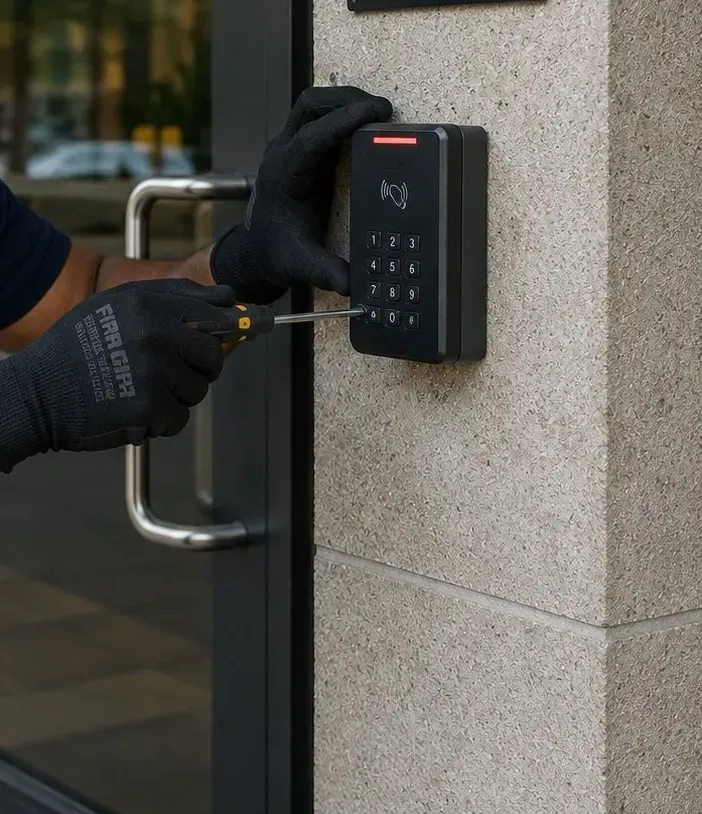
On a West Side job the hardware list usually has two halves: the smart lock for the door people use, and the quieter equipment that looks after the other openings. Both are below.
A replacement deadbolt with a keypad or fingerprint reader outside and a thumb-turn inside. The workhorse for brownstone apartment doors and under-stoop doors, where the household wants codes for family, sitters and walkers and a key that still works.
A motor that clamps over the thumb-turn of an existing single-cylinder deadbolt. August's own literature says its retrofit leaves the outside untouched and keeps your keys, and Consumer Reports points out that the security of a retrofit depends entirely on the deadbolt underneath — so we check that deadbolt first.
For heavy pre-war corridor doors and tower apartment doors that already carry a mortise case. Where the building's standard allows, a smart mortise set keeps one handle and one bolt and adds codes and phone keys; where it does not, we leave the mortise alone and work from inside.
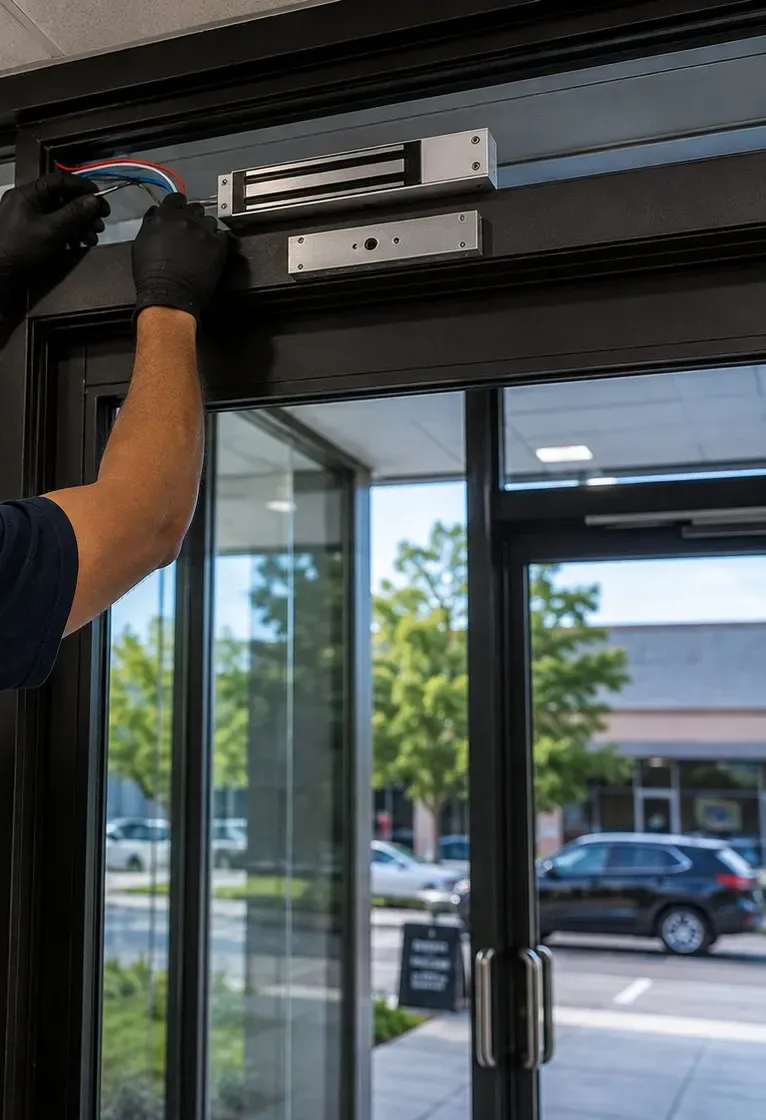
Small magnetic sensors on yard doors, terrace doors and the door to a roof stair, reporting to the same app as the lock or to an alarm panel. They are often the right answer for a door that the law says must not be key-locked.
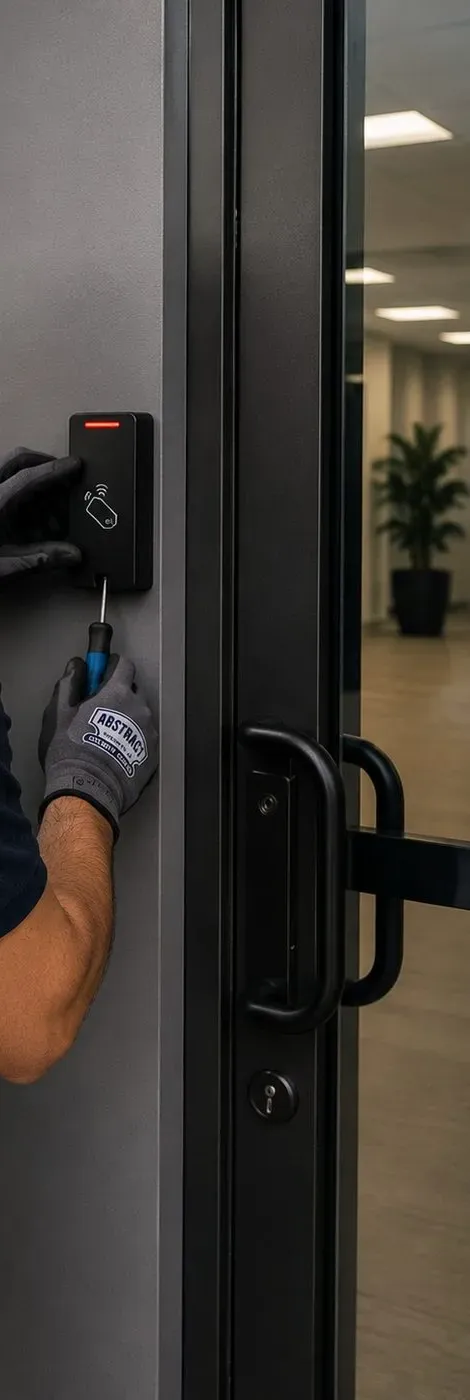
For a brownstone's vestibule or yard door, a courtyard or lane gate, a shop or a practice suite: a reader on the wall, a strike in the frame, an exit device or button inside, and software where an owner or board adds and removes people.
Remote access needs a bridge or a border router, and August says its Wi-Fi bridge should sit within 10 to 15 feet of the lock. In thick-walled pre-war apartments we test the signal at the door before choosing between Wi-Fi, a bridge and a Matter-over-Thread lock.
High-security strikes, long screws into the stud or masonry, edge guards and wrap plates for doors whose wood has been cut by generations of locks. Not glamorous, but on a forced door the frame is usually what gives way first.
| Opening | What usually goes there | Why |
|---|---|---|
| Apartment door on the building hall | Smart deadbolt or inside-only retrofit; reinforced strike | The door everyone uses; must open from inside without a key |
| Garden duplex under-stoop door | Weather-rated keypad or fingerprint deadbolt | Often the real front door; exposed to rain and the areaway |
| Yard door onto a shared garden | Thumb-turn deadbolt, door contact, stronger strike | Has to release from inside; contacts tell you when it is left open |
| Roof bulkhead | No key lock; bolt or hook inside, alarm or contact if the board wants it | The Multiple Dwelling Law and the city rule forbid key locks |
| Courtyard gate or lane gate | Reader outside, strike or gate lock, free exit inside | Shared by many households; must never trap anyone |
| Storefront | Keypad lock or reader and strike, glass-break detector, contact | Glass beside and above the door is part of the opening |

We could not view Google's AI Overview from our build environment, so the claims below are the ones that cost guides, product pages and home-improvement sites publish — the material AI summaries are built from. Each holds for a suburban house; each needs correcting west of the park.
Whole-house guides tell homeowners to make every door keyless so the app can lock the lot at bedtime. In a suburban house with a front door, a side door and a garage door, that makes sense.
On the Upper West Side, several of the “exterior” doors are ones New York forbids you to key-lock. The roof bulkhead may not carry a key lock at all. Yard and court doors in larger post-1968 buildings must close and lock by themselves yet open from inside without a key. HPD prohibits key-locked gates on fire-escape windows.
So the West Side version is a smart lock on the door people actually use, a thumb-turn lock and a contact on the doors that must stay free to exit, and no lock at all on the bulkhead beyond what the law allows. That plan is safer, and it is legal.
Product pages lead with security: tamper alarms, auto-lock, no keys to lose. All true, as far as the door goes.
The West 80s burglary team that the 20th Precinct warned about in 2019 came in by back doors, fire escapes and roofs. The coffee shop on Amsterdam Avenue in 2026 was entered through the window above its door. In November 2024 the New York Post reported that a burglar in a 39-floor doorman building on West End Avenue smashed through an apartment door and broke the jamb. None of those would have been stopped by a better keypad.
A smart lock improves control: who has access, when they used it, and whether the door is locked now. Security comes from the whole opening — the frame, the strike, the glass, the other doors — and we price those honestly alongside the lock.
A Bob Vila review of smart locks found that its testers got by with a single Phillips screwdriver in roughly thirty minutes. On a new door that came pre-bored for a standard deadbolt, that is believable.
A West Side apartment door may have been cut for three or four earlier locks, painted twenty times and hung in a frame that has settled with the building. A brownstone under-stoop door may be swollen with damp. A co-op may need the work described to the managing agent first, and may only allow it on weekdays between nine and five.
The thirty minutes is still in there. It just comes after the survey, the paperwork and the time it takes to make an old door close cleanly against its strike.
The figure that keeps appearing comes from Fixr, whose January 2025 cost guide gives $250 to $400 for having a smart lock put in, roughly $300 typical, and $50 to $100 an hour for a handyman. It is a reasonable national benchmark for one house door.
Manhattan work carries a 1.25 area rate on our published figures, and a West Side apartment door is quoted flat at a free walkthrough because the door, the earlier locks and the building's rules decide the work. Building doors have published numbers: a keypad or fob reader with an electric strike is $1,875–$3,125 here.
The national number is a sensible check on whether anyone is overcharging for a plain door. It is not a price for a garden duplex with three entrances or a courtyard gate shared by forty households.
Renter-focused articles often say an inside-only retrofit needs no permission because it changes nothing outside. In many apartments that is close to true.
New York's Multiple Dwelling Law does let tenants add their own lock and asks them to give the owner a duplicate key on request, but it excludes hotels, and HPD's Shared Housing Roadmap says the city has interpreted its codes so that residents of shared apartments cannot have locks on bedroom doors. It also warns that smart locks lack a master key that management or FDNY can override. Co-op shareholders answer to house rules as well.
So a renter in an ordinary apartment is usually fine with a retrofit, a shareholder should tell the managing agent, a room in a share should not get a lock at all, and a room in an SRO needs the owner's written agreement first.
Setup guides assume the router is a few rooms away and the signal reaches the door. August's own support page says its bridge belongs within 10 to 15 feet of the lock.
Pre-war West Side apartments put the entrance at the end of a long gallery or foyer, often behind masonry and plaster, while the router sits in a back bedroom by the cable outlet. Garden duplexes put the under-stoop door a floor below the living space. Signals that look fine on a phone in the kitchen can drop at the door.
We test at the door before choosing the lock, and if the signal is weak we plan for a bridge in the foyer, a Thread border router or a lock that keeps its codes locally so it works whatever the network does.
Fit checkers ask for a door thickness and a backset and assume the rest is standard. Most new doors are.
Here the doors run from heavy pre-war mortise doors to thin, much-cut brownstone doors and steel-clad doors whose fire labels limit drilling. August itself says its retrofit suits single-cylinder deadbolts only.
We measure, photograph and check labels at the walkthrough, then name a lock that fits. If the honest answer is that a smart lock is the wrong tool for a particular door, we say so before anything is ordered.
Send a photo of the door you use and a note about any yard, terrace or roof access. We will tell you where the smart lock belongs, what the other doors need and the price.
A garden duplex, a classic six on West End Avenue, a walk-up on Amsterdam, a tower apartment on Riverside Boulevard or a shop on Broadway — describe the doors and you will have a written answer the same business day. Prefer to talk? Call the Manhattan line on (929) 560-0737.
Someone who works the West Side will phone you today if it is a business day. Can't get in at this moment? Use (929) 560-0737.
Seven steps, whether the door is under a stoop on West 78th Street, on the eleventh floor of a Riverside Drive co-op or at the front of a shop on Amsterdam Avenue.
You send photos of the door you use, both faces and the edge, and tell us about any second door, yard door, terrace or roof access. We say which door is likely to carry the smart lock and whether a board, landlord or landmark question comes first.
At the home we walk every opening, check each door for bores, labels, strike and frame, test the signal at the door and write up what each opening needs. You get a written flat price for the lock and separate notes for the rest.
For co-ops and doorman buildings we send the description, photos and insurance certificate the managing agent asks for, and agree the date and entrance with the desk. Landmark facades and tower lock policies are settled here.
The visit goes into a 2-hour weekday slot that sits inside whatever hours the co-op or management allows, and the van carries everything the doors on the list could need.
Paint and old hardware are cleared, the strike is reset with long screws, the door is adjusted until it latches on its own, and the smart lock goes into a clean bore or onto the existing deadbolt. Contacts go on the other doors if you chose them.
Each person gets their own code or enrolled finger, a backup administrator is named, regular helpers get time-limited codes, and we try every one from the outside with the door closed before checking the app over cellular data.
You keep a sheet listing every way into the home, what is on each opening, who holds which code or key, the programming code and where the spare batteries are.
Six West Side places that show, in stone and iron, how many layers can stand between the sidewalk and a front door — gates, arches, courtyards, lanes and rooftops.
A cooperative of 27 small Tudor-style buildings put up in 1921 by Thomas J. Healy between Broadway and West End Avenue. The Walk runs through the block from 94th to 95th Street between two rows of eight buildings, with a locked gate at each end; it has been a city landmark since 1979.
Built in 1908 for William Waldorf Astor and filling the block between Broadway, West End Avenue, 78th and 79th Streets. Wrought-iron gates in its arches open onto an internal courtyard with a garden, a driveway and the entrances to the apartments.
Built in 1908–09 on West 86th Street, with arches that lead to an internal courtyard. Its current marketing describes six separate residential lobbies, so even neighbours under one roof may never share an entrance.
Henry Hardenbergh's apartment house at West 72nd Street and Central Park West, finished in 1884 with apartments of four to twenty rooms and bought by its residents, who turned it into a co-op, in 1961. It is a designated city landmark.
A Beaux-Arts residential hotel that opened on Broadway between 73rd and 74th Streets in April 1904, the year the subway arrived at 72nd Street. It became a city landmark in 1972 and a condominium in 1992, with light courts along each side.
Two ends of the West Side story: the West 71st Street Historic District, a cul-de-sac of row houses from 1893–96 designated in 1989, and Riverside South, where nineteen buildings eventually rose on the former New York Central rail yard along the Hudson.
We also serve Lincoln Square, Manhattan Valley, Morningside Heights, Hamilton Heights, Harlem, Midtown West, Hell's Kitchen and the rest of Manhattan through the Manhattan smart lock installation page, plus the other four boroughs, Long Island and the Hudson Valley. The 20th Precinct covers the West Side from 59th to 86th Street, and the 24th Precinct station house is on West 100th Street.

The Upper West Side is priced at the Manhattan area rate, and we separate the jobs that have a published figure from the ones that are quoted at the door. Our building, suite and storefront door work is published at a Brooklyn base and multiplied by 1.25 for every Manhattan neighborhood, so the same strike costs the same on Columbus Avenue as on Wall Street. A smart lock on an individual apartment or brownstone door has no published AESS figure; the age of the door, the earlier locks and the building's rules decide the work. Those are quoted flat, in writing, after the free walkthrough, and the written quote is the price.
| Item | Upper West Side price | Scope and source |
|---|---|---|
| Apartment, garden duplex or brownstone door smart lock, including the whole-home door survey | Quoted flat at free walkthrough | No published AESS figure for this line; priced after we see every door, the earlier locks, the frame and any board or landmark rules |
| Keypad or fob reader plus electric strike, one door | $1,875–$3,125 installed | Vestibule, yard door, courtyard or lane gate, shop or practice suite; published $1,500–$2,500 base × 1.25 |
| Electric strike added to a gate, vestibule or suite frame | $313–$563 | Published $250–$450 base × 1.25, as part of turning an existing door keyless |
| Failed electric strike repair | $369–$606 | Published $295–$485 base × 1.25, for a strike that hums on the buzzer and never lets go |
| Set-up visit only, for a lock someone else fitted: codes, bridge, a code clean-up | First hour $265, then 30-minute blocks | Our published Manhattan setup-only rate |
| Service and callback rate | $195/hr, 3-hour minimum ($585) | Applies to later call-outs once a job is signed off; the original installation never carries it |
The national cost data most often quoted is Fixr's, updated January 2025: $250–$400 for smart lock installation, around $300 on average, with handyman labour at $50–$100 an hour. Treat it as a reference for a plain house door, not an AESS price. When comparing an alarm company's package, ask whether its lock codes depend on the company's own app and monthly plan, whether anyone will look at the yard and roof-stair doors, and whether the strike and frame are included or left as they are.
Nothing is drilled until you have the AESS service agreement in hand and have signed it; the summary of its deposit, warranty and late-fee terms is printed in the licence block at the bottom of the page.

Three packages cover nearly everything we are asked to do west of the park. The two building packages carry published prices at the Manhattan rate; the home package is priced after the walkthrough, because a sound 1990s tower door and a much-cut brownstone door are not the same job.
Quoted flat at walkthrough
The whole-home door survey, a smart deadbolt or inside-only retrofit on the door you use every day, strike and frame corrected, one-motion exit checked, personal codes and a second administrator set up, and a written note of what the yard, terrace and roof-stair doors need, whether or not you have that work done.
$313–$563
A brownstone owner or a board turning an existing vestibule, yard or suite door keyless gets a new electric strike cut into its frame at the Manhattan rate. A strike that is already there but has died is priced on the repair line instead, $369–$606.
$1,875–$3,125
One keypad or fob reader with an electric strike on a courtyard or lane gate, a brownstone's street or yard door, a storefront or a practice suite, at the Manhattan rate. Free exit inside, every user enrolled, and the owner or manager shown how to add and remove people.
If the lock is sitting in its box on your hall table, we install it for a flat labour price agreed at the walkthrough. First we confirm it matches the door — thickness, backset, bored or mortise, and a weather rating if it is going under a stoop — and that its codes keep working with the internet down. Its warranty stays with the maker rather than with us, and if the model is wrong for the door we tell you before a single hole is made. Programming alone, for a lock already on a door, is $265 for the first hour and then 30-minute blocks.

Tell us the floor, the doors and how people come and go. We will tell you what fits, what the law lets you lock and what it costs, before anyone visits.
Fitting the lock is the short part of a West Side visit. The survey that comes first is what decides whether it was worth fitting. This is the order we walk a home in, and what we write down at each opening. You keep the sheet whether or not you go ahead.
We start with the door the household actually comes home through, which is not always the one named on the lease. In a garden duplex it is usually under the stoop; in a parlor floor-through it may be the building's hall door; in a pre-war co-op it is the corridor door off the elevator. We note the door's construction, thickness, any fire label, every existing bore and plate, and whether it closes and latches on its own when released from half open. This is where the smart lock almost always goes.
Classic sixes often have a kitchen door to a service hall, combined apartments can keep two doors on the corridor, and duplexes have one door per floor. For each we ask how often it is used, by whom, and whether it is required as an exit. Some get an inside-only retrofit so the app shows them locked; most just need a sound deadbolt that is actually thrown.
Back doors onto shared yards are where the 2019 West 80s pattern began for some households. We check that the door opens from inside without a key, as the rules require in many buildings, and then look at the strike, the frame and the glass. A contact that reports the door opening, and an alert if it is left open after dark, usually does more here than a keypad.
Setback terraces, roof decks and the landing beside the stair to the bulkhead get the same test: can a person from a neighbouring roof reach this opening, and does it still release freely from inside? We improve terrace door locks within that limit and write a separate note for the board about the bulkhead, since the law keeps key locks off it.
We do not lock fire-escape windows with keys or codes, and HPD prohibits key-locked gates on them. We do note whether the window locks work, whether an approved gate is present, and whether a contact or a camera aimed at the escape would help.
A transom over an apartment door, a sidelight beside a brownstone door or a fanlight over a shop door can make a lock irrelevant. We note whether each is sealed, wired, fixed or openable, and whose responsibility it is to deal with it.
Finally we list every person and every system that can open any of these doors: household members, the owner's duplicate key, the super's emergency key, a dog walker, a cleaner, a home attendant, the building's fob or app. That list becomes the code plan, and anything on it that no longer belongs there is the first thing we remove.

A door survey often turns up work beyond the lock — a vestibule door, a yard door, a camera on the fire escape. These are the related services we provide across Manhattan.
Fob and keypad readers for vestibules, courtyard gates, lane gates and suites.
Audio and video entry panels for brownstones and apartment houses.
When the apartment station is mute or the release button does nothing downstairs.
Buzz-in systems for brownstones split into apartments and for avenue walk-ups.
Street and vestibule doors that buzz but stay shut.
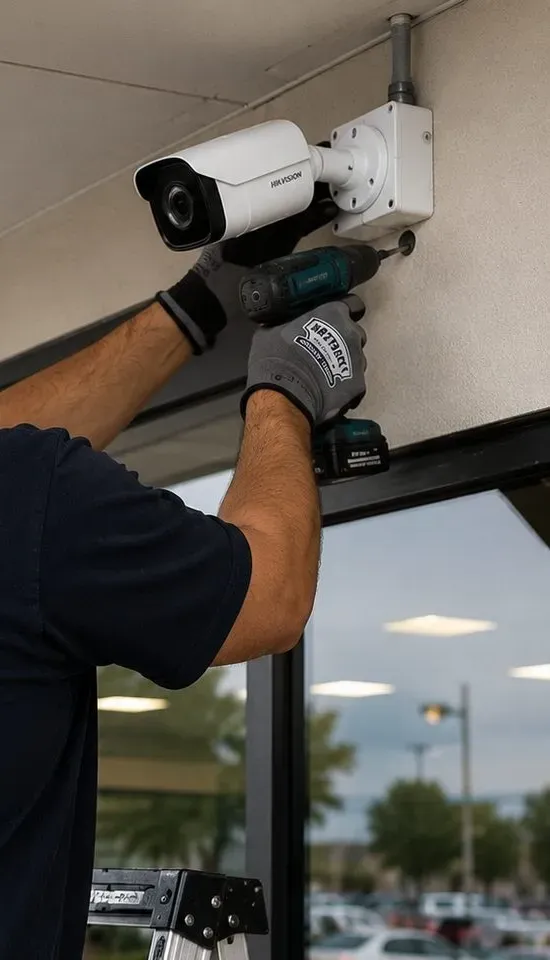
Video at the entrance, so you know who it is before you let them in from afar.
Contacts on yard, terrace and roof-stair doors and glass-break detectors for shops.
The lock, the lights and the thermostat answering to one app.
Locks, cameras and alarms together for shops on Broadway, Amsterdam and Columbus.
Lobby, yard and roof-access coverage for boards and owners.
Power and data pathways behind gate readers and suite controllers.
Ask about several of these at once and get one combined answer.
Our usual routine at a West Side address, described in general terms rather than as the story of any single customer
The first thing we ask on arrival is not where the lock goes but how you got in this morning. The answer is often a surprise to the household itself: the “front door” on the lease is the one nobody uses, and the real front door is under the stoop, or at the end of the kitchen hall, or across the yard from a separate studio.
Then we walk the home with the door list in hand and open everything we are allowed to open. Back doors that have not been opened since the last owner, terrace doors held with a bent hook, a transom propped open for air in August. Most of these are fixed with a screwdriver, a better strike or a conversation with the super, not with a smart lock.
When we do fit the lock, we fit it to the door people use, test it from the outside with the door shut, and hand over a sheet that lists every way into the home, what it has on it now, and who holds a code or key to it.
Because no two West Side doors start in the same state. A sound tower door with one bore is a short job; a brownstone door cut for three earlier locks, or a garden duplex with three entrances, is not. We publish prices for building, gate and shop doors at the Manhattan rate, and quote apartment doors flat, in writing, after the free walkthrough.
Yes. We work across the whole West Side from 59th Street to 110th Street and Cathedral Parkway, between Central Park West and the river, including Lincoln Square, Riverside South and Manhattan Valley, and on into Morningside Heights and the rest of Manhattan.
Most sealed keypads and fingerprint readers tolerate gentle cleaning, but makers differ on which products are safe, so we check the specific modelβs cleaning guidance before ordering. Where staff will wipe the keypad all day, a model that also takes a fob or a phone tap lets people open the door without touching it.
It can, once the door closes fully against its seals without being pushed. Thick perimeter seals and drop-down bottoms make doors spring back slightly, which leaves a motorised bolt binding on the strike. We adjust the strike and closer so the door sits home on its own, and test the bolt repeatedly before handover.
Yes, if you want them. Contacts that report to the same app as the smart lock, or to an alarm panel, are often the right answer for doors that must open freely from inside. We list them as separate lines on the quote, so you can decide door by door.
The Upper West Side is one of several neighborhoods we have written up in detail; the borough view sits on the Manhattan smart lock installation page, and the citywide questions — tenants' added locks, co-op key policies, building-wide entry systems — are handled on the smart lock installation NYC hub. Long Island and the Hudson Valley each have a hub as well.
Manhattan: the Upper East Side · Chelsea · Washington Heights. Brooklyn: Brooklyn Heights · Bedford-Stuyvesant · Greenpoint · Park Slope. Queens: Flushing · Jackson Heights · Bayside · Astoria. The Bronx: Kingsbridge · Throgs Neck · Morris Park. Staten Island: Todt Hill · New Dorp · West Brighton.
Manhattan · Brooklyn · Queens · the Bronx · Staten Island
Long Island (Nassau, Suffolk) and the Hudson Valley (Westchester, Rockland, Orange, Putnam, Dutchess, Ulster).
Cameras, intercoms, alarms and cabling are all listed from the Abstract Enterprises Security Systems home page; the company background and licence details are on the about us page.
If the keypad will not wake, the bolt jams mid-throw or the app has lost the lock, ring (929) 560-0737. Where a key still works, go in with it and take the next free 2-hour slot; dead batteries, dropped pairings and misaligned strikes are usually sorted within an hour or two of our arrival.
Abstract Enterprises Security Systems · 460 E Fordham Rd, Bronx, NY 10458 · Manhattan line (929) 560-0737 · WhatsApp (718) 679-0359 via wa.me
NYS Low-Voltage License #12000287431 · 100% Licensed & Insured · Same-Day Estimates · Rated 4.7★ from 201 Google Reviews
Locks you supply carry their manufacturer's warranty. Full terms β including 50% deposit, one-year parts-only warranty on AESS-supplied products, and the late-fee schedule β are set out in the service agreement. See our warranty page.
Nothing here is legal advice; the page sets out how state law, city rules and building practice bear on smart locks on the Upper West Side. Sources include the NYU Furman Center, West Side Rag, the New York Post, HPD, the Multiple Dwelling Law, the NYC Administrative Code, Wikipedia and manufacturer documentation. Last reviewed October 17, 2026. Changelog: Upper West Side neighborhood page published for the first time.