What are you looking for?
About Us Contact Us Careers Get a Free Quote (800) 486-0943
Pick a service
✅ Got Your Own System?
🎬 Home TheatreQuote 🎶 AV SoundQuote 🔑 Access ControlQuote
Now pick your area
Pick your area
Long Island
Hudson Valley
Services available
Pricing & Tools
Pick a service for pricing
🚪 Intercom Pricing 🔔 Buzzer Repair Pricing
Calculators
📹 Camera System Calculator 🚨 Alarm Calculator ⚡ Cabling Quote Builder ✅ Got Your Own System?
Select your area
Home › Smart Lock Installation NYC › Smart Lock Installation Brooklyn › Park Slope
Licensed Low-Voltage Contractor · Brownstones, Garden-Floor Practices, Home Day Cares & Avenue Shops in 11215 and 11217

Smart Lock
Installation in
Park Slope

Parlour Doors · Under-Stoop Practice Entrances · Family Day Care Doors · Pocket-Door Home Offices · Fifth & Seventh Avenue Shops

A Park Slope brownstone is rarely just a home. The garden floor may be a therapist's consulting room or a licensed family day care, the front parlour may be somebody's office behind a pair of pocket doors, and the top floor may belong to a tenant or a live-in au pair. A smart lock here is not a gadget for the front door; it is how a household draws lines between family, clients, children, caregivers and tenants inside one landmarked house, without trapping anyone and without touching a facade the city protects.

Reviewed and updated October 17, 2026 · Written by Anwar Timothy, NYS licence #12000287431 · Booked from our Brooklyn office at 1282 Troy Ave

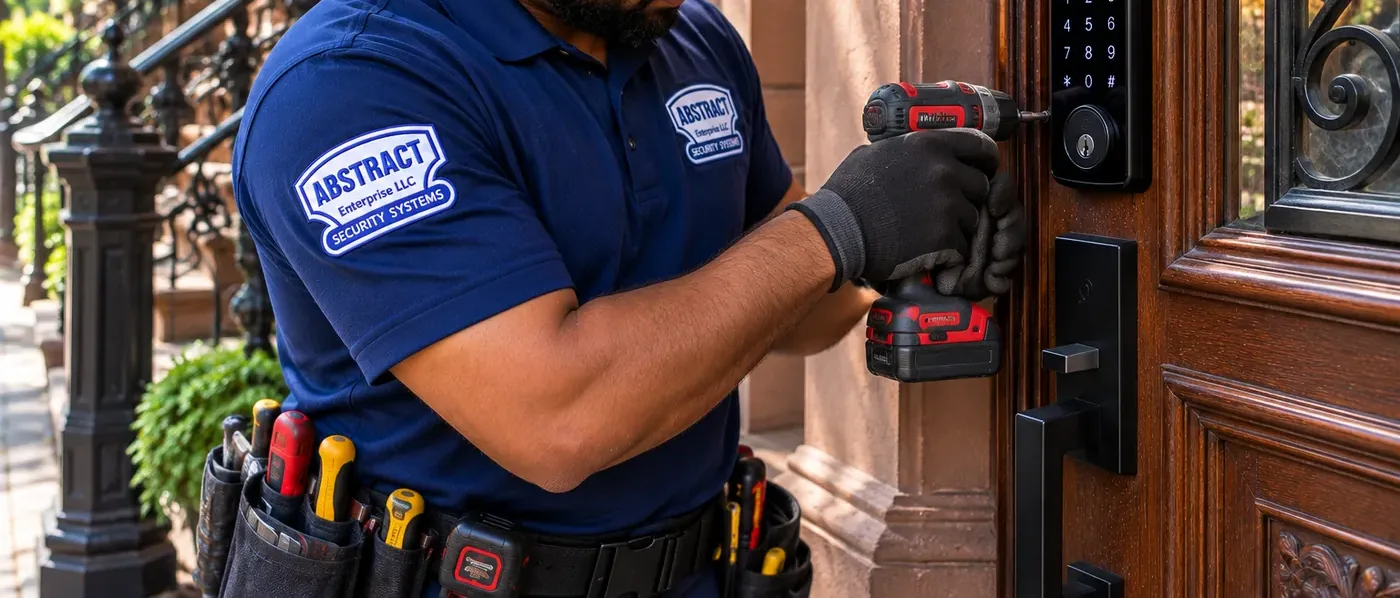
Smart lock installation Park Slope Brooklyn: technician drilling a keypad deadbolt into a wood front door beside an iron stoop railing
A technician in an AESS polo and work gloves drives a screw into the mounting plate of a keypad deadbolt on a panelled wood door, a cast-iron stoop railing and a row of stoops behind him. Illustrative photo of the work, not a specific Park Slope address.
Free Park Slope Smart Lock Quote
Tell us which doors and who uses them — a licensed installer replies the same business day

✅
Request Sent!
We'll call you back the same business day.
25+
Years Experience
✓
Same-Day Estimates
100%
Licensed & Insured
4.7★
201 Google Reviews

Clients arriving at the garden door while the children are upstairs? Parents dropping off at eight and a nanny share starting at nine? Call the Brooklyn line on (347) 934-8335 or send the 60-second form. A licensed installer reads it, asks who uses each door and when, and tells you which doors need a smart lock, which need a plain good deadbolt and which need nothing at all — before a visit is booked.

  • Every door is opened from the inside by hand, with no key, before we leave — the rule that matters most in a house with children or clients in it
  • No neighbourhood surcharge: keypads, readers and strikes for an entrance cost the same here as in Canarsie or Bushwick
  • Rated 4.7 from 201 Google reviews · NYS licence #12000287431 · fully insured
The Neighborhood

Why Park Slope Properties Need Smart Lock Installation That Separates Home From Work

Ring the bell at the garden level of a Park Slope rowhouse on a weekday and the person who answers may not live there. It may be a psychotherapist between sessions, a group family day care provider with eight toddlers behind her, a piano teacher, an architect who rents the room from the owners upstairs, or a nanny caring for two families' children at once. Park Slope's houses were built between the Civil War and the First World War as single-family homes, and many of them still are; but the way people use them has changed. The parlour and garden floors of a Slope brownstone are now as likely to hold a small business as a dining room, and that is the fact that shapes almost every smart lock job we are asked to quote here.

The houses themselves are protected. The Landmarks Preservation Commission designated the Park Slope Historic District in 1973, covering about 1,800 contributing buildings put up between 1862 and around 1920, mostly two- and three-storey rowhouses next to Prospect Park. The district was enlarged in 2012 to about 2,575 buildings and again in 2016, when the second extension added 292 more, mostly between St. Marks Avenue and Sterling Place. By number of buildings it is New York's largest landmarked neighbourhood. For a lock that means two things: hardware changes on an existing door are generally ordinary repair work, but anything that alters the facade, the door surround or the areaway — a new opening, a reader drilled into brownstone, conduit across the front — belongs in a conversation with the Commission first.

Inside those protected walls, work and family share the same front steps. Park Slope Parents, the local network Susan Fox started as a Yahoo group in 2003, describes itself as a community of more than 7,000 member families; licensed group family day cares advertise from Park Slope homes; and listings regularly offer therapy rooms in Slope brownstones by the day or the half-day, such as a large windowed office off Sixth Avenue near President Street. New York City's zoning rules allow this: a "home occupation" may take up to 49 percent of a dwelling unit's floor area, to a maximum of 1,000 square feet, and a professional may employ one person who does not live there. The same rule forbids clients from queuing or waiting outside the dwelling unit — which is, in practice, a rule about the front door.

So the questions we hear in Park Slope are less about which brand is best and more about where the lines fall. Can a client reach the consulting room without being able to wander up the stairs to where the children sleep? Can a day-care parent have the "unlimited and on demand access" to their child that New York's day care regulations promise, while the door still keeps strangers out? Can the front parlour, with its original pocket doors, be closed and locked as an office during the day and opened as a living room at night? Can a nanny who works for two families on the block have a code that stops working when the share ends? A good smart lock plan answers those questions door by door, and it starts with a rule the state writes into its day care regulations and that we apply in every house: every exit opens from the inside without a key.

The avenues are a different world with some of the same tensions. The Park Slope Fifth Avenue BID, set up in June 2008, covers 62 block faces and 521 ground-floor businesses; Seventh Avenue is lined with restaurants, boutiques and specialty food shops, many with apartments above. In the autumn of 2021 Patch reported about 30 burglaries at Park Slope businesses in two months, with the BID noting that many of the Fifth Avenue break-ins hit shops without roll-down gates and the precinct urging commercial-grade door locks and cameras; at one Eighth Avenue restaurant near 11th Street, the burglar simply broke the front door at a quarter past three in the morning. Shopkeepers here need staff codes, schedules and a front door that resists more than a shove — and, like the brownstones behind them, a door that never traps anyone inside.

Park Slope facts that shape a smart lock plan

  • 1973, 2012 and 2016: the Park Slope Historic District's designation and two extensions, which together make it the city's largest landmarked neighbourhood by number of buildings (LPC records via Wikipedia, HDC and New York YIMBY).
  • 49 percent and 1,000 square feet: the most a "home occupation" may occupy of a New York City dwelling unit under Zoning Resolution section 12-10, with clients barred from waiting outside the unit (NYC Department of City Planning).
  • 37.1 percent: homeownership in the Park Slope/Carroll Gardens community district in 2024, above the 32.7 percent citywide rate (NYU Furman Center) — owners who often rent one floor and work from another.
  • 6,563: new housing units the same district added from 2010 to 2025 in buildings of four or more units, much of it on Fourth Avenue after the 2003 rezoning of 110 blocks (Furman Center; NYC Department of City Planning).
  • 521 businesses on 62 block faces: the ground-floor retail counted by the Park Slope Fifth Avenue BID, founded in 2008 (NYC Small Business Services).
  • About 30 in two months: commercial burglaries in Park Slope reported by the Fifth Avenue BID in October 2021, many at shops without roll gates (Patch).

Most Park Slope households that put a smart lock on a practice or day-care door also want to see who is at the door before they open it. Our Park Slope intercom installation team fits video entry panels for garden-level entrances, and where a building or business needs readers on several doors, AESS access control in Park Slope takes it further.

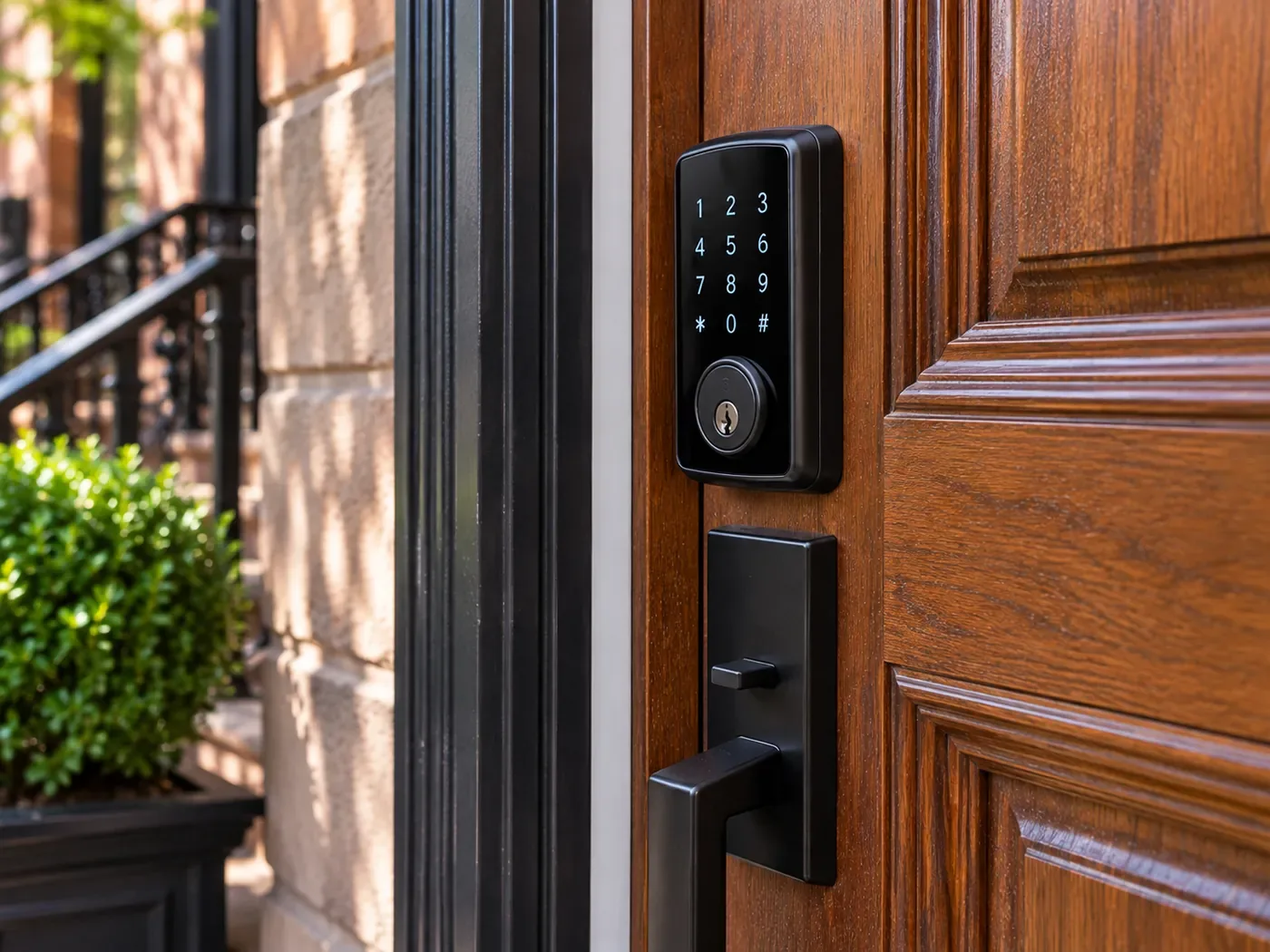
Keypad smart deadbolt above a black lever on a raised-panel wood front door, Park Slope Brooklyn smart lock installation
Close view of the finished job: the keypad deadbolt and the lever under it on a panelled wood door, framed by a pale stone surround, with a boxwood planter and a black iron railing at the left edge.
Repair Capture

Practice Door Jammed or Keypad Blank in Park Slope?

Some calls cannot wait for a walkthrough. An old door swells in August and the motor stalls halfway; the keypad dies an hour before the day's first client; a parent's code starts flashing "invalid" at drop-off; the shop lock vanishes from the app; the garden strike clicks without letting go. We slot these into the next free two-hour arrival window, and a technician at the door usually sorts out batteries, binding, pairing or power in an hour or two. When the fault is a failed electric strike, our published Brooklyn repair figure is $295–$485. Call (347) 934-8335 and tell us whether the door will not lock or will not open; if the trouble is the buzzer system behind it, the Park Slope door buzzer repair page covers that side.

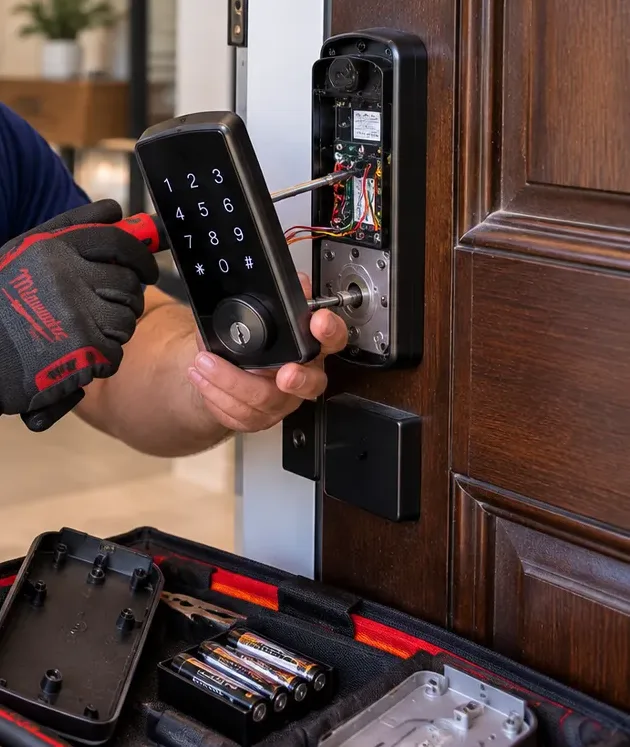
Servicing the wiring of an outside keypad module on a wood door, smart lock repair in Park Slope Brooklyn
Repair in progress: the exterior keypad has been lifted off the door so its connector and circuit board can be inspected, and below it the open tool case holds AA cells and a removed cover plate.
What We Install

Smart Lock Installation Services in Park Slope

Nine kinds of work, and most Slope bookings combine two or three of them. Our sign-off on any of them is identical — the door shuts and catches without help, anyone inside can leave with one hand and no key, and you watch each code and phone credential work before the tools go back in the van.

Parlour-Floor Front Doors

Keypad or retrofit smart deadbolts on the main entrance at the top of the stoop, fitted to the existing bore wherever the door allows, with original brass removed whole and handed to you rather than thrown away.

Garden-Floor Practice Entrances

The under-stoop door that clients use: a smart deadbolt or keypad lever with scheduled client codes, or a reader and electric strike with a video panel, so sessions start without the practitioner leaving the room.

Family Day Care Doors and Gates

Parent codes for drop-off and pick-up, hardware that keeps every exit openable from inside without a key, and a plan for the areaway gate and back-garden gate that the play routine depends on.

Lines Inside the House

The door between a garden-floor practice and the family's stair, a lockable front parlour office, a privacy lock for an au pair's room — interior doors chosen so nobody can be locked in and the right people can always get through.

Rental-Floor Doors

Apartment entrance locks for the top-floor or garden rental in an owner-occupied house, with a thumb-turn inside, the tenant's own codes, and the duplicate-key arrangement New York law allows the owner to ask for.

Caregiver and Nanny-Share Access

Codes for nannies, sitters, dog walkers and the other family in a nanny share, each with its own schedule and end date, set up so that ending one arrangement never means changing everybody's code.

Fifth and Seventh Avenue Shops

Staff codes on front and back doors, a scheduled unlock for opening hours where it suits the business, and front-door hardware and glass protection for shops that close without a roll-down gate.

Co-op and Condo Unit Doors

Smart locks for apartment doors in the pre-war co-ops along Prospect Park West and the newer buildings on Fourth Avenue, inside each building's alteration rules and with the duplicate key or code the board requires.

Repairs and Takeovers

Dead keypads, motors straining against a dropped door, lost administrator access after a house sale or a practitioner moving on, and bridges that dropped off the Wi-Fi when the router changed floors.

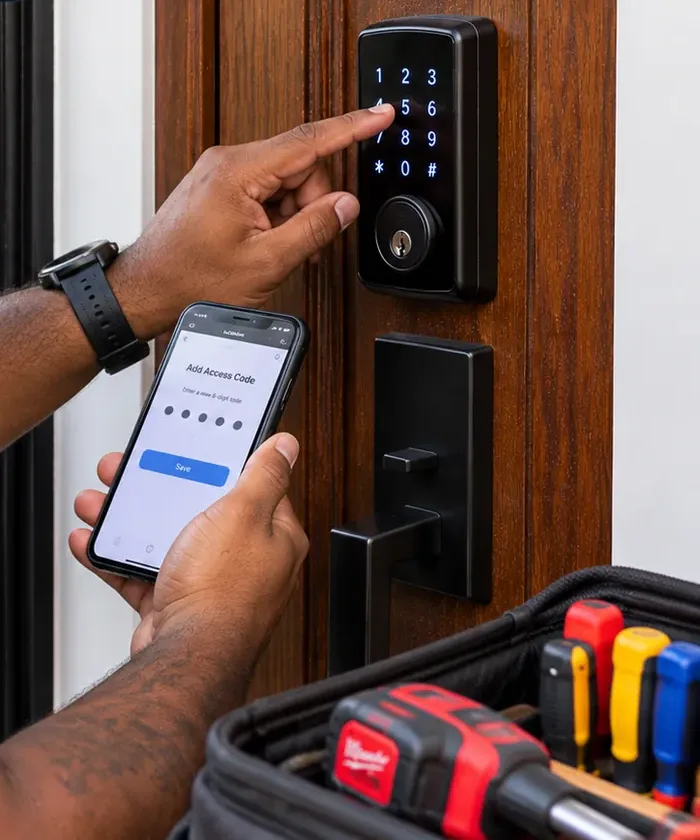
Adding an access code on a phone while testing it on the keypad of a smart deadbolt, Park Slope Brooklyn
Setting up a credential: a phone held low displays the app page for creating a new code while the technician tries digits on the lock above it, his tool bag open on the floor.
Building Specialists

Smart Lock Installation for Park Slope's Architecture

Park Slope was built in one long burst, mostly between the 1860s and about 1920, and then, a century later, rebuilt along Fourth Avenue. Six building types cover nearly every door we are asked about in the neighbourhood, and each one splits between home and work in its own way.

Brownstone and Brick Rowhouses

Two- to four-storey rows with a high stoop to the parlour floor and a garden entrance beneath it. Original front doors are often heavy, panelled and glazed, sometimes in pairs with a vestibule behind. The garden level is where practices, day cares and rentals usually live.

Limestone and Romanesque Rows

The later rows of the 1880s and 1890s — Queen Anne and Romanesque Revival fronts in limestone, terra cotta and tan brick, like the 1891 George P. Chappell rowhouse and the 1892 Montgomery Place houses. Deep reveals, carved surrounds and doors that were made to measure.

Prospect Park West Pre-War Co-ops

Apartment buildings from the 1920s, such as the 16-storey Emery Roth co-op completed in 1929 at 35 Prospect Park West. Doorman lobbies, uniform unit doors, house rules on alterations and boards that want a key or code on file.

Flats Over the Avenues

Three- and four-storey mixed buildings on Fifth and Seventh Avenues with a shop at street level and apartments above, reached through a narrow side door that the shop does not use but every tenant does.

Fourth Avenue New Buildings

Condominiums and rentals built after the City Council adopted the Park Slope rezoning on April 30, 2003, which mapped higher-density R8A zoning along Fourth Avenue. Developer-chosen lobby entry, steel-framed unit doors and often a ground-floor commercial space.

Conversions and Institutions

Former factories such as the Ansonia Clock Company works on Seventh Avenue and 12th Street, built in 1880–81 and residential since 1982; churches, synagogues and schools whose side doors serve many groups through the week.

How each building type changes the lock work

Rowhouse front doors. Original Slope doors are frequently thicker than the range many retail smart deadbolts list, and many were bored decades ago for a mortise lock or a rim lock rather than the tubular deadbolt a box-store smart lock expects. We measure thickness, backset and the existing preparation before anyone buys anything. Where a standard smart deadbolt will not fit honestly, an interior retrofit unit on a compatible single-cylinder deadbolt, a longer through-bolt kit from the manufacturer, or a mortise-format electronic lock is the answer — not a new hole in a 130-year-old door.

Garden entrances. The under-stoop door is usually sheltered from rain but not from damp, and it sits behind an iron gate in the areaway. Battery locks there need a check on condensation and on how far the keypad sits from the gate a client must pass through. If the practice or day care needs a buzz-in from inside, the door gets a strike and a small power supply, and the cable route is planned through the cellar rather than across the front of the house, so nothing new appears on the protected facade.

Interior doors. Pocket doors, parlour doors with original glass, and the stair door between the garden and parlour floors were never meant to carry security hardware. We use privacy-function and edge-mounted hardware that leaves the door's original pulls in place where possible, and we never fit anything that needs a key or a powered release to get out of a room.

Co-op and new-building unit doors. The building's alteration agreement or house rules come first. Many boards accept an interior retrofit unit that leaves the hall side and the building's key untouched; others require their own cylinder or a duplicate code. Steel unit doors in Fourth Avenue buildings usually take a standard smart deadbolt without trouble once the building agrees.

Avenue shops and conversions. Aluminium storefront frames, steel back doors and narrow stiles call for commercial hardware: keypad levers or readers with strikes rated for the traffic, and an exit that works with one push from inside even when the electronics are off.

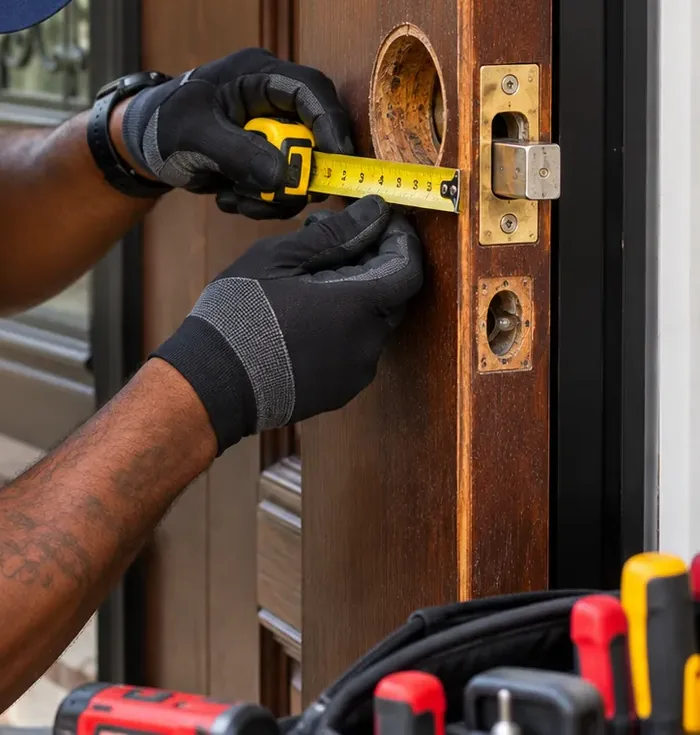
Measuring the backset of an old lock bore on a wood door edge before a Park Slope Brooklyn smart lock installation
Gloved hands hold a tape measure across the edge of a wood door from an old bored hole to the brass latch faceplate, checking the backset before a new lock is chosen.
Commercial Smart Lock Installation

Business Smart Lock Installation in Park Slope

Park Slope's businesses fall into two groups: the ones on the avenues and the ones inside houses. Both need staff and client access that can be granted and withdrawn person by person; both need an exit that never depends on a battery or a power supply. These are the corridors and settings we work in most.

Fifth Avenue

The longest commercial strip in the neighbourhood, with 521 ground-floor businesses on 62 block faces in the BID's count: restaurants, bars, salons, small grocers and service shops. Staff codes, back doors to the yard, and glass fronts that many owners close without a roll-down gate.

Seventh Avenue

Restaurants, boutiques and specialty food stores in mixed buildings with flats above, plus medical offices in the blocks around NewYork-Presbyterian Brooklyn Methodist Hospital at Sixth Street. Keypad levers, scheduled unlocks and separate codes for cleaners and early-morning deliveries.

Garden-Floor Practices

Psychotherapists, speech and occupational therapists, tutors and music teachers who see clients in their own homes or in rooms rented by the day. Client codes that expire, a door that separates the practice from the house, and entry history kept apart from the family's.

Home-Based Day Cares

Family and group family day cares licensed to operate in homes, with parents arriving in two tight windows each day. Parent codes, visitor sign-in kept on paper as the rules require, and keyless exits on every door and gate in the path out.

Eighth Avenue and the Side Streets

Corner restaurants, studios and offices between the brownstone blocks, the scene of the 2021 break-in where a front door was smashed in the early hours. Front-door hardware that resists force, and a log that shows who closed up last.

Fourth Avenue Ground Floors

Fitness studios, clinics and shops in the new buildings, where the landlord's lobby system runs the upper floors and the tenant runs its own storefront and back-of-house doors under the lease.

Rules that apply to Park Slope business doors

  • Exit without a key. Doors on the way out of a business, a day care or a rented practice room must open from the inside without a key or special knowledge. Double-cylinder deadbolts that need a key inside have no place on these doors, and HPD states plainly that they are illegal on apartment doors.
  • Electrified locks release on the egress side. Where a strike or magnetic lock is used, the door must still open from inside by ordinary action or by a release that does not depend on knowledge or a credential; a magnetic lock needs a sensor and a manual release, and in some settings a fire alarm tie-in.
  • Landmarks. Hardware replaced on an existing door is generally a no-permit repair in the Commission's guidance; a new storefront door, a reader or camera drilled into a historic front, or conduit across it is a matter for the Landmarks Preservation Commission first.
  • Day care licensing. New York's group family day care rules require egress doors to open from the inside without using a key, and the state's egress policy prohibits keyed doors and gates on the path out. Providers in the city answer to the NYC Department of Health and Mental Hygiene as well; we describe the hardware, they and their licensor decide what meets their rules.
  • Home occupations. Under the zoning definition, clients may not wait outside the dwelling unit and a home occupation may not make external structural alterations that are not customary for residences — another reason the practice entrance stays a normal-looking door with discreet hardware.
  • Privacy. A practice keeping health information on site has its own federal obligations on physical access, and a residential owner with three or more units who adds smart access falls under the city's Tenant Data Privacy Act. We set the systems up to support those obligations; the obligations themselves stay with the business or owner.
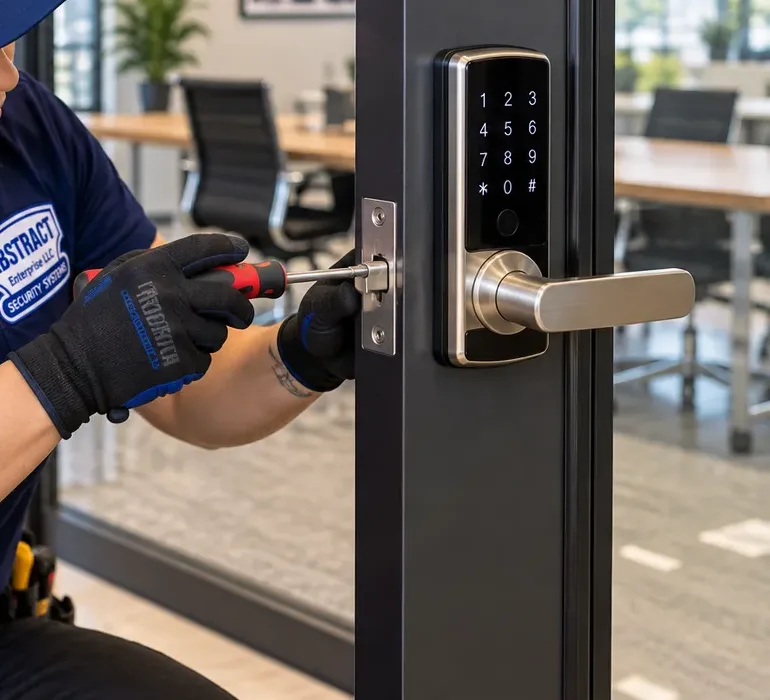
Fitting a keypad lever lock to a glass-framed office door, garden-floor practice keyless entry in Park Slope Brooklyn
A brushed-steel keypad lever going onto a narrow black aluminium door, the screwdriver turning the latch plate; behind the glass, an empty meeting table and chairs.
Your Questions Answered

Smart Lock Installation in Park Slope: Questions Answered

These are the questions Park Slope households, practitioners and providers put to us, grouped by where the line has to fall. Questions every New York renter, co-op shareholder or landlord asks — adding a lock to a rental, board approval, the Tenant Data Privacy Act — are on the New York City smart lock hub, and stoop, vestibule and parcel questions are on the Brooklyn smart lock installation page.

The practice on the garden floor

The only thing between my garden-floor consulting room and the family's stair is an old door with no lock — what should go on it?

Something mechanical, simple and lockable from one side only. There are really two doors in play. The first is the entrance clients use, usually the under-stoop door, which gets whatever credential suits your sessions: a code, a buzz-in from your consulting room, or both. The second is the door between the practice and the family — typically the door at the foot of the inside stair or between the garden-floor hall and the kitchen. That second door is the one that keeps a client in the waiting area from wandering upstairs, and it is the one most people forget. We fit it with a lock that is locked from the practice side and always opens from the family side and from the practice side by hand, so nobody can be shut into either part of the house. During the day it stays locked; in the evening, when the practice closes, the family can leave it open. Where the stair has no door at all, a new door in the existing opening is carpentry first and hardware second, and we will say so plainly at the walkthrough.

Could the lock's entry history give away who is in therapy with me, and how do we stop that?

It could, if it is set up carelessly, because a smart lock's history is a timestamped list of named codes, and a list of names arriving at a therapist's door every Tuesday is sensitive in itself. Three habits prevent it. Label client codes with initials or a reference number that only your own records decode, never full names. Keep the practice entrance in an account the practice controls, so family members, a partner's phone or a nanny with app access never see the practice's history. And set the history to the shortest retention the lock allows that still serves you, deleting old entries rather than keeping years of them. Where you would rather have no client records at all, a buzz-in from the consulting room through a video panel and an electric strike lets you admit people without anyone holding a code. Avoid one shared code for every client: it cannot be withdrawn from one person and tends to end up written on appointment cards.

Does seeing clients at home change what the city expects of our front door?

Indirectly, yes. New York's Zoning Resolution allows a home occupation in a dwelling unit within limits — currently up to 49 percent of the unit's floor area and no more than 1,000 square feet, with one non-resident employee allowed in connection with a profession — and it adds conditions that land right at the door: clients may not queue or wait outside the dwelling unit, there may be no exterior display, and the home occupation may not make external structural alterations that are not customary for a residence. In Park Slope the house will usually be in the historic district as well. Put together, the practice entrance should look and work like a house door: discreet hardware on the existing door, a waiting area inside rather than a queue on the stoop, and no new signage or equipment drilled into the front without checking with the Landmarks Preservation Commission. We are installers, not zoning lawyers; for a specific question about your practice, ask the Department of City Planning or your own adviser.

A licensed day care in the house

We run a licensed group family day care on the garden level — how should parents get in at drop-off and pick-up?

Give each family its own credential, and make the door open for them without anyone leaving the children. New York's group family day care regulations give the parent of a child in care unlimited and on-demand access to their child and to the caregivers during hours of operation, and the right to inspect the parts of the home used for care. A parent code or fob on the garden entrance, active during your operating hours and labelled with the family name, delivers that access without the provider having to stop and answer the door twenty times in the morning rush. Outside operating hours the parent codes switch off, so a parent cannot walk into your home on a Sunday. Grandparents and sitters who collect a child are added as separate, time-limited codes once the family has authorised them in writing, and removed just as easily. The lock records each code's use, but the paper sign-in sheet the rules require for visitors stays exactly as it is.

Does the state's rule against keyed exits affect the gate under our stoop and the back-garden door?

Yes, and those two openings are where providers most often get caught out. The regulations require egress doors from the residence to open from the inside without a key, and the state's egress policy for family and group family day care goes further: doors and gates at the ends of passageways must be readily openable from the side people are leaving from, without a key, and doors and gates with keys are prohibited on that path. In a Park Slope rowhouse the path out from the garden floor often runs through the areaway gate to the sidewalk, and the second way out usually runs through the back-garden door into the yard. A padlock on the areaway gate, a keyed deadbolt on the garden door or a double-cylinder lock on either one breaks that rule. We fit gate latches and door hardware that open by hand from the inside, put any keypad on the outside face only, and position latches where an adult can operate them at once but a toddler will not by accident. Your licensor makes the final call on any specific door.

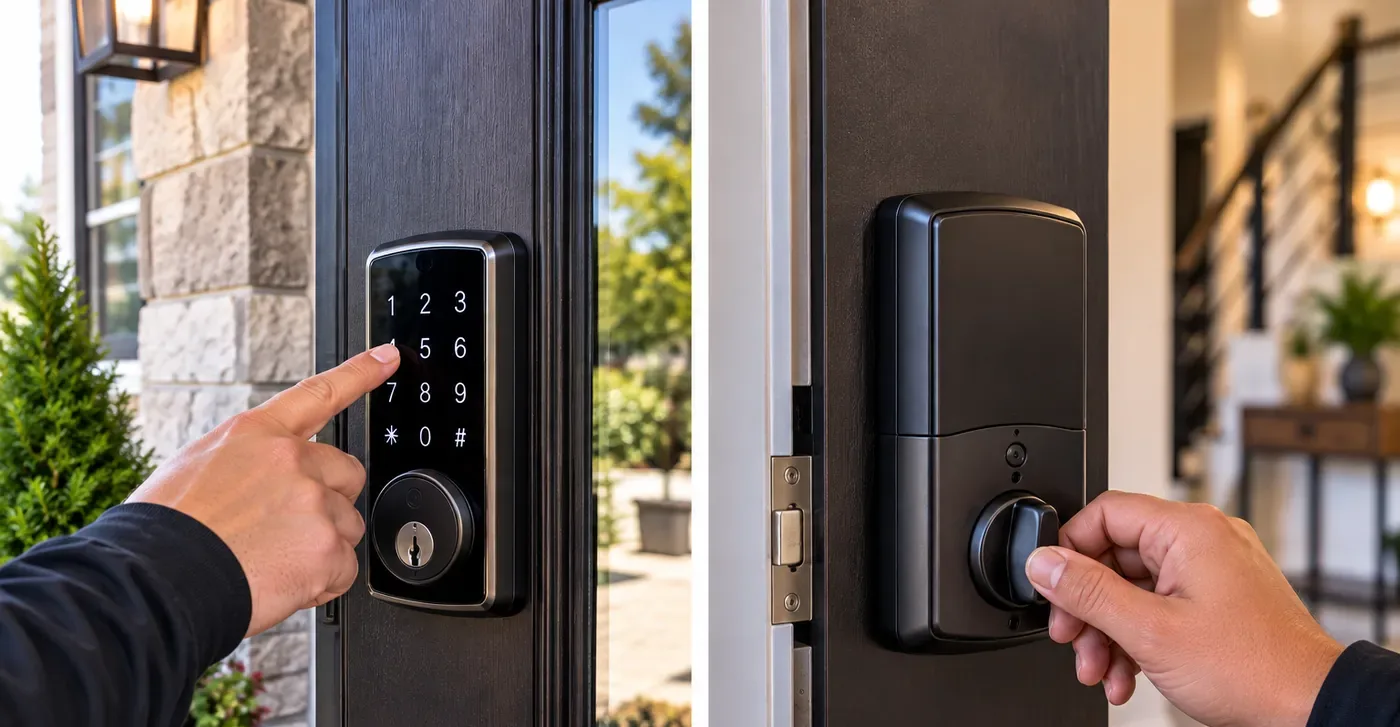
Outside keypad and inside thumb-turn of the same smart deadbolt, keyless exit for a Park Slope Brooklyn day care or home office door
Split image of a single deadbolt. Left half: a fingertip entering numbers on the lit exterior pad. Right half: an indoor hand rotating the plain lever-shaped turn piece, which is all anyone leaving the room has to do.

Lines inside the house

Can the pocket doors between our front and back parlours lock, so the front parlour works as a closed office?

They can, with the right hardware and some care. Pocket doors slide into the wall on rollers hung from a track, and on original parlour doors that track is often still inside the wall behind the casing; the Brownstone Boys, who restore them, note that you may need to remove part of the trim to reach the rollers. A meeting pair of pocket doors can take a flush hook-and-strike lock in the edges, operated by a small flush pull, or a privacy set designed for pocket doors; a single door can lock into the jamb. A full smart lock is rarely the right tool on a pocket door, because there is nowhere for the inside unit to go when the door slides away, so for a home office we usually fit mechanical pocket-door locks on the parlour doors and put the smart lock on the door into the hall instead. Before anything is cut, we check that the doors still run freely; a door that binds in its pocket will defeat any lock.

Our live-in au pair's room needs a lock of its own — should it be a smart lock we can open, or a privacy lock only she controls?

A privacy lock she controls is usually the right answer. The room is her home while she lives with you, and a lock that the family can open from a phone at any moment is not much of a lock to the person behind it. What works well is a quality privacy or keyed-entry lockset on her bedroom door, with the key in her hands and a spare kept somewhere she knows about for emergencies. If you want her to have her own way in and out of the house at hours that suit her, that belongs on the house door: her own code on the front or garden entrance, set up with her, and removed on her last day. We avoid fitting app-controlled locks on bedroom doors in a family home at all, because a lock whose history and controls sit with someone else is the wrong tool for a private room.

A nanny share means another family's caregiver brings their child to our house most mornings — what access should she get?

Her own code, on one door, for the hours of the share, and nothing more. A nanny share creates an unusual situation: the person caring for your child may be employed by another family, and when the share ends, the arrangement ends with it. We set her code to the days and hours the share runs, on the door she actually uses — usually the garden entrance with the stroller, not the parlour door — and give it an end date matching the share agreement. The other family should not be an administrator of your lock, and the caregiver does not need the app; a code is simpler. If the share moves between the two houses week by week, each house runs its own lock and its own codes, and nobody needs to know the other family's.

We're opening our house on the Park Slope House Tour — how should the locks be set for a day of strangers walking through?

Set them so the tour's route is open and everything else is shut. The Park Slope Civic Council traces its house tour back to 1959, and recent tours have run on a Sunday from 11 a.m. to 3 p.m., with ticket holders moving from house to house all afternoon and the 2025 tour selling out. On the morning of the tour we would suggest switching the front door to a mode where it stays unlocked for the hours the tour runs, if your lock supports it, so volunteers are not handing out codes; pausing every caregiver and tenant code that is not needed that day; and locking the doors that are off the route — a home office, a bedroom floor, the garden-floor rental — with locks that still open from inside. Afterwards, check the lock's history to confirm the auto-unlock schedule ended at three, and restore the codes you paused. The same approach works for an open house when a home is listed for sale.

Avenue shops

Our Fifth Avenue shop has no roll-down gate — what does the glass front door need overnight besides a better lock?

It needs the glass, the frame and the record treated as part of the lock. When Patch reported the 2021 spike in Park Slope commercial burglaries, the Fifth Avenue BID pointed out that many of the shops hit had no roll gates, and the NYPD's advice to owners was commercial-grade locks and cameras. On an aluminium-and-glass storefront the weak point is rarely the cylinder; it is a narrow-stile door with a short throw that can be forced past the frame, or glass that can simply be broken. We fit a keypad or reader with a strike or a long-throw lock rated for commercial use, add a door-position contact so the system knows the door is truly shut at closing, and record which staff code locked up and when. Security film on the glass, a camera that covers the door, and good lighting at the entrance are worth discussing at the same visit, and every one of them leaves the inside exit as a single push. A roll-down gate, if you later add one, is a separate decision with its own permit rules.

Equipment

Types of Smart Locks We Install

In a Park Slope house the right hardware changes from floor to floor. These are the categories we fit, with where each one earns its place in the neighbourhood.

Keypad Smart Deadbolts

A full replacement deadbolt with a keypad outside and a motorised thumb-turn inside. The workhorse for garden entrances and rental-floor doors where the door takes standard preparation and codes with schedules are wanted.

Interior Retrofit Units

Mounted on the room side only, this unit turns the thumb-piece of the deadbolt already in the door; the street face, cylinder and keys stay exactly as they were. Useful on an original parlour door where the outside must look the same and on co-op doors where the building's key must keep working.

Keypad Levers

A lever lockset with a keypad, for practice rooms and office doors that are opened many times a day and should latch every time they close, without anyone turning a bolt.

Mortise-Format Electronic Locks

For doors originally prepared for a mortise lock, where cutting for a tubular smart deadbolt would weaken the stile. More expensive, but they respect the door that is already there.

Readers and Electric Strikes

A wired keypad, fob or phone reader releasing an electric strike in the frame, powered from a supply in the cellar. Right for busy practice and day-care entrances and for shop doors, and the only sensible way to add buzz-in from a consulting room.

Video Entry Panels

A camera, speaker and button at the garden entrance, answered on a screen or phone indoors, with the strike released from the practice room. Lets a practitioner see who is there without leaving a session.

Pocket-Door and Privacy Hardware

Flush hook locks, edge pulls and privacy sets for pocket doors, parlour doors and bedroom doors — mechanical hardware that keeps an office or a private room closed and always opens from inside.

Hubs, Bridges and Door Sensors

Wi-Fi bridges, Thread border routers and Z-Wave hubs placed where the signal actually reaches the door, and door-position contacts that tell you a door has been left ajar rather than just unlocked.

National brands and a local installer

Plenty of Park Slope households start with a doorbell or alarm from a national brand. That is no obstacle: most of the smart locks we fit work alongside Ring, ADT and SimpliSafe equipment, and several pair directly with those systems or with the Apple, Google and Amazon home apps. The difference is in who looks at the door.

QuestionNational brand, self-installedAESS in Park Slope
Does the lock fit a 19th-century door?Box lists a door thickness and bore range; the buyer finds out at the doorThickness, backset and existing preparation measured first; retrofit or mortise options offered when a standard deadbolt will not fit honestly
Where do the lines fall inside the house?Not addressed; one lock, one doorDoor-by-door plan separating family, practice, day care, tenants and caregivers
Can everyone get out without a key?Depends on the buyer's choicesEvery door and gate on the way out is tested by hand from inside before we leave
LandmarksNot addressedHardware kept to existing doors; anything touching the facade flagged for the Commission
Who sets up codes and schedules?The buyer, from the appSet up with you, with a written credential register and two administrators
Support after installationManufacturer helplineBrooklyn office on (347) 934-8335; repairs booked into the next two-hour window
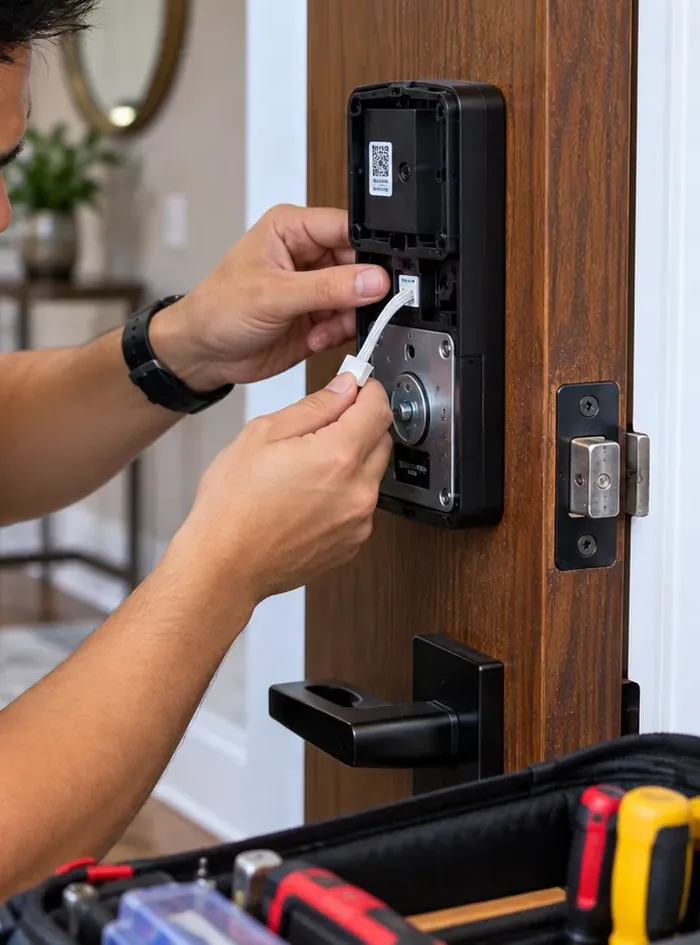
Connecting the ribbon cable between outside keypad and inside unit of a smart lock, Park Slope Brooklyn
Two hands feed the thin cable from the outside keypad through the door and into the open inside unit of a smart deadbolt, a tool bag on the floor below the door.
AI Overview Reality Check

What AI Gets Wrong About Smart Lock Installation in Park Slope

The AI Overview itself was not viewable when this page was written. What follows instead are seven claims that turn up in national cost guides, maker instructions and small-business advice columns — the material AI answers are assembled from. Each is reasonable for a modern suburban house; each needs correcting for a Park Slope brownstone that is also a practice, a day care or an office.

"Installing a smart lock costs about $300"

Ask a chatbot what this costs and you will likely hear Fixr's national band (Angi and HomeAdvisor publish similar ones), from its January 2025 update: $250 at the low end, $400 at the high end, $300 typical. Every one of them pictures a single battery lock on a newish door that is already drilled.

The Park Slope jobs that matter most are not that. A practice entrance with buzz-in from the consulting room is a reader, an electric strike, a power supply, a cable route through the cellar and often a video panel; our published Brooklyn figure for a single-door keypad or fob reader with an electric strike is $1,500 to $2,500 installed. A lock on an original door that needs a retrofit or mortise-format unit costs more in parts than a box-store deadbolt.

Where the chatbot number is roughly right: a tenant's apartment door, or a garden door already drilled the normal way with no buzzer involved. Those get a fixed written price after our free visit, and that figure is the bill.

"Smart locks install in 30 minutes with a screwdriver"

DIY reviews make the job sound like a lunch break: a single Phillips screwdriver, thirty minutes, done. On a recent door drilled to the usual pattern, that is honest.

Old Slope doors are not standard. A parlour door may be thicker than the lock's listed range, bored for a mortise lock, swollen in its frame, or fitted with a strike that has been moved three times. An hour spent measuring, planing and realigning before the lock goes on is normal, and on a door that drags, the motor of a smart deadbolt will strain and drain its batteries until the door itself is fixed.

The screwdriver estimate also ignores the second door — the one between the practice and the house, or between the day care and the stair — which is often the more important door and the harder carpentry.

"A home business can only use 25 percent of the home"

Business-advice sites still repeat that a New York City home occupation may use no more than 25 percent of a home's floor area and no more than 500 square feet. That was the old rule.

The current text of Zoning Resolution section 12-10 allows a home occupation to occupy up to 49 percent of the dwelling unit's floor area and in no event more than 1,000 square feet, and still forbids clients queuing or waiting outside the unit, exterior displays and external structural alterations that are not customary for a residence.

For a lock plan, the conditions matter more than the percentages: a practice entrance that looks like a house door, a waiting area inside the line of the front wall, and no new equipment on the facade. Check your own situation with the Department of City Planning or an adviser before relying on any summary, including this one.

"Lock every door to keep children safe"

General childproofing advice often says to lock doors so small children cannot get out, and in a family home a high latch on a door to the street is sensible.

In a licensed day care, the rules point the other way on the path out. New York's group family day care regulations require egress doors to open from the inside without a key, and the state's egress policy prohibits keyed doors and gates on that path, including gates at the end of a passageway such as an areaway gate.

The way to square that circle is placement and type, not more locks: latches an adult can operate in one motion, set where toddlers do not reach them by accident, keypads on the outside only, and a written description of each door for the provider's own file.

"One code for the whole household is simplest"

Setup guides often start by suggesting a single family code. In a one-person apartment that is fine.

In a Park Slope house with clients, day-care parents, a nanny, a dog walker and a tenant, a shared code means nobody can be removed without changing it for everybody, and the lock's history tells you nothing. Clients end courses of treatment, day-care families graduate to kindergarten, nanny shares end, tenants move.

Every person who needs access gets their own code with its own schedule and end date, and the household's own codes stay separate from the practice's. It takes an hour longer to set up and saves the household from re-keying every time an arrangement ends.

"Any Wi-Fi smart lock works anywhere in the house"

Manufacturers quote short distances for their bridges: August's own support pages ask for the Connect bridge to sit within 10 to 15 feet of the lock. Park Slope residents on r/parkslope ask what Wi-Fi setups actually work in multi-level brownstones, because a router on the parlour floor often reaches the garden floor badly through brick and plaster.

A garden-floor practice door with its bridge two floors away will drop offline, and its schedules and remote unlocks will fail at the worst moment. We place the bridge or hub on the same floor as the door, use a Thread border router or Z-Wave hub where they suit better, and test from a phone on mobile data out on the sidewalk.

If the practice keeps its own network, the practice lock goes on it; the family's front door stays on the household network.

"In a historic district you need permission to change a lock"

Some summaries go further and suggest a Park Slope owner must apply before swapping a deadbolt. Read the Commission's permit guidebook and you find locks and handles in the list of hardware whose repair or replacement may need no permit at all.

What does need the Commission is work that changes the protected fabric: a new door at the front, a reader or intercom drilled into the stone, conduit across the facade, changes to the areaway. In the city's largest historic district, that is a line worth respecting.

We keep new hardware on the existing door and the cable inside the house, and where an owner wants a reader or video panel beside the garden entrance, we say at the walkthrough that the Commission should be asked first and provide cut sheets for the application.
The Right Door Locked for the Right Person, Every Exit Open From Inside

Tell us who comes through each door of your house and when. We will tell you which doors need a smart lock and which need something simpler — before anyone books a visit.

Get In Touch

Request a Free Quote

Name the block, list the doors, and tell us roughly who passes through each and at what hours. A written reply comes back the same working day, usually with one or two follow-up questions. To discuss it by voice instead, the Brooklyn number is (347) 934-8335.

✅

We Got Your Request!

Received. Our Brooklyn office will phone you later today about the doors you listed; if a door will not open for you right now, dial (347) 934-8335.

How It Works

Our Installation Process

Seven steps, whether the job is one keypad on a Fifth Street garden door or a whole house on Carroll Street with a practice downstairs, a rental upstairs and a nanny share in between.

1. Map the house by who uses it

Before any hardware is named, we list who comes through each door: family, tenants, clients, parents, caregivers, staff, deliveries. Photos of each door from both sides help.

2. Walk every door at the free walkthrough

We open and close each door, measure thickness, bore and backset, check the frame and strike, and confirm that each door opens from the inside with one motion and no key.

3. Decide where the lines fall

Together we decide which doors separate the household from the practice, day care, tenant or office, and which credentials belong on each side of those lines.

4. Written plan and flat price

You receive a written scope: hardware for each door, the credential plan, cable and power routes if any, and one flat price, using published Brooklyn figures wherever they apply.

5. Install with the original fabric protected

Floors and trim are covered, original hardware is removed whole and labelled for you to keep, and new locks go on existing preparation wherever the door allows.

6. Program and test from both sides

Every code, schedule and phone credential is tested from outside; every door is opened from inside by hand; wired doors are tested with the power off.

7. Handover and credential register

Two administrators are set up, each account is labelled household or business, and you get a written list of every person and schedule on every door.

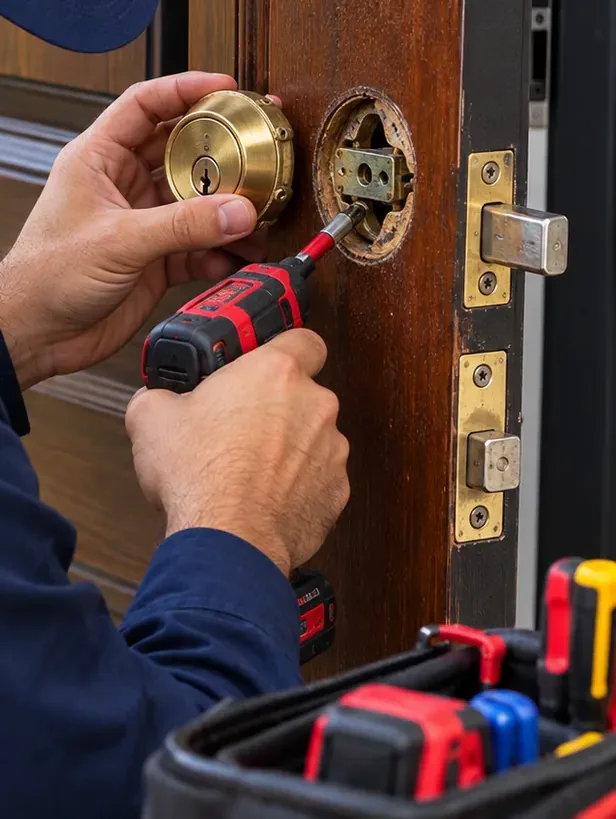
Removing an old brass deadbolt cylinder from a wood door during smart lock installation in Park Slope Brooklyn
Out with the old: the brass cylinder of the previous deadbolt comes away in one hand as a red cordless driver releases the final screw, the door edge showing two old brass faceplates.
Coverage Area

Smart Lock Installation Near Park Slope's Landmarks

Six places that explain the doors we work on between Flatbush Avenue and the Prospect Expressway, from an eighteenth-century farmhouse rebuilt in a park to a Gilded Age clubhouse.

The Montauk Club

Francis Kimball's Venetian Gothic clubhouse at 25 Eighth Avenue, completed in 1891 and modelled on a palace on the Grand Canal, with carved mahogany and stained glass inside — the high-water mark of the doors and woodwork the Slope still protects.

Old Stone House, Washington Park

A 1933 reconstruction, using some original materials, of the Vechte-Cortelyou house of about 1699, standing at Fifth Avenue and Third Street on the ground of the Maryland 400's counterattack in the Battle of Brooklyn.

Litchfield Villa

The Italianate mansion Alexander Jackson Davis designed for Edwin Litchfield, built in 1854–57 and standing just inside Prospect Park at Prospect Park West and Fifth Street, older than almost every house in the district around it.

14th Regiment Armory

The armory on Eighth Avenue between 14th and 15th Streets, built in 1891–95, where a sports complex run by the Prospect Park YMCA opened in 2010 — a single building now serving many different groups through one set of doors.

Ansonia Clock Factory

The clock works at Seventh Avenue and 12th Street, built in 1880–81 and residential since 1982, now a cooperative — one of the South Slope's industrial buildings turned into homes with shared entrances and courtyards.

NewYork-Presbyterian Brooklyn Methodist Hospital

Opened on December 19, 1887 at the corner of Sixth Street and Seventh Avenue, and still the anchor of the medical offices and practices in the surrounding blocks of brownstones and apartment buildings.

We also serve the South Slope down to Prospect Avenue, Windsor Terrace, Prospect Heights, Gowanus, Carroll Gardens and Sunset Park, and every Brooklyn neighbourhood around our Troy Avenue office. For the wiring and cameras that often go in alongside a lock, see our Park Slope structured cabling and Park Slope security camera installation pages.

Pricing

Smart Lock Installation Cost in Park Slope

There is no Park Slope premium: the neighbourhood pays Brooklyn rates, and Brooklyn, at a multiplier of 1.00, is the yardstick for every other AESS area. The entrance prices in the table are copied from figures we already publish on our Brooklyn access-control and door-buzzer pages, alongside what each one means for a Slope house or shop. A smart lock on a single residential door — a parlour door, a rental-floor door, a garden door without buzz-in — has no published AESS figure, because the door decides the work; it is quoted flat, in writing, after a free walkthrough, and that is the price you pay.

ItemPark Slope priceWhat it covers
Smart lock on a residential doorQuoted flat at free walkthroughParlour, garden, rental-floor or unit door; price follows a look at thickness, bore, frame and who uses the door
Single-door keypad or fob reader with electric strike$1,500–$2,500 installedPractice or day-care entrance with buzz-in, shop front or back door; our Brooklyn access-control figure
New electric strike on an entrance door$250–$450A strike cut into the frame of a garden entrance so an existing buzzer, and later a reader, can release it; from our Brooklyn door-buzzer pages
Failed electric strike repair$295–$485An entrance where the release clicks but the door will not open; Brooklyn door-buzzer repair figure
Service and callback rate$195/hr, 3-hour minimum ($585)Applies only when we come back after a finished job, not to the installation itself

What moves a Park Slope quote up or down

  • The age and preparation of the door. A door already bored for a standard deadbolt is quick; an original door bored for a mortise or rim lock needs a retrofit or mortise-format unit, and a door that drags in its frame needs planing first.
  • How many lines inside the house. A practice with its own entrance and a stair door, a day care with a garden gate, or a parlour office with pocket doors each add a door to the plan.
  • Buzz-in or codes only. A keypad deadbolt with scheduled codes is one job; buzz-in from a consulting room adds a strike, a power supply, a cable route through the cellar and often a video panel.
  • Number of people and schedules. Enrolling eight day-care families, three caregivers, a tenant and the household takes longer than one family's codes, and is worth doing carefully.
  • Landmark care. Keeping everything on the existing door and the cable inside the house is our default; anything that needs a Commission application adds time before work starts, not to the work itself.
  • Shop fronts. Aluminium storefronts and steel back doors take commercial hardware, and a door-position contact and staff codes are part of the price.

Online averages, and what they leave out. A widely quoted national guide (Fixr, January 2025) lands between $250 and $400, near $300 in the middle. It is somebody else's survey of single modern doors — useful as a reference point, but it is not our pricing and it says nothing about a buzz-in entrance under a nineteenth-century stoop.

Locks you supply keep their manufacturer's warranty. Full terms — including 50% deposit, one-year parts-only warranty on AESS-supplied products, and the late-fee schedule — are set out in the service agreement.

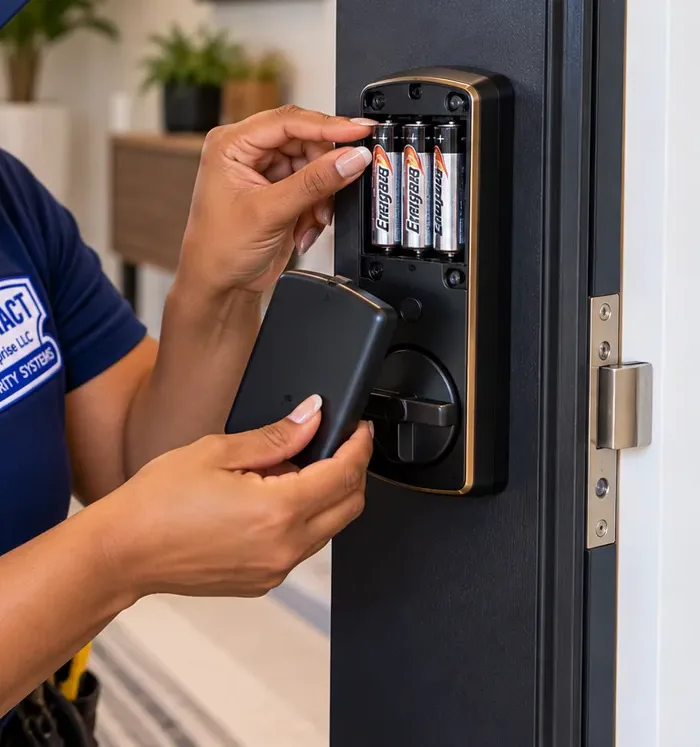
Fitting fresh AA batteries into the inside unit of a smart deadbolt, Park Slope Brooklyn smart lock service
Hands press four AA batteries into the battery bay of a smart deadbolt's inside unit, the cover held ready in the other hand, on a dark door with a white frame.
Shop Our Systems

Smart Lock Installation Packages & Pricing

Most enquiries from the Slope end up in one of these three. Both entrance options use numbers we already publish for Brooklyn. Household doors get a written figure only after a visit — an 1880s parlour door and a steel apartment door on Fourth Avenue simply do not take the same work.

Starter — Household Doors

Quoted flat at walkthrough

A keypad smart deadbolt or interior retrofit unit on the front, garden or rental-floor door, with caregiver and nanny-share codes on their own schedules, the bridge or hub placed on the right floor, original hardware removed whole and returned, and the inside exit tested by hand.

Standard — New Entrance Strike

$250–$450

The garden door already has a working buzzer but nothing in the frame for it to release, or the part there is tired or mismatched. We cut in a new strike so the consulting room or the day-care floor can open the door remotely. Replacing a strike that has died, rather than adding one, is the separate $295–$485 repair.

Premium — Practice or Day-Care Entrance

$1,500–$2,500

Single-door keypad or fob reader with electric strike, installed: scheduled client or parent credentials, buzz-in from inside, a door-position contact, a mechanical exit that needs no power, and a separate administrator account for the business.

Bring Your Own Lock — Labour Only

Ordered a lock online already? Labour-only installation is priced flat once we have seen the door. The first job is confirming that the model matches the door it was bought for — thickness, backset, the existing bore, single or double cylinder — and that it opens from inside with one motion and no key. If it will not fit an original door honestly, we will tell you before anything is cut, and suggest the door where it will work instead. Locks you supply carry their manufacturer's warranty rather than ours.

Ready to Draw the Lines Inside Your House?

Phone us, use the form, or text photographs of the doors in question. By the end of the business day you will know what each one needs and who belongs on it.

Floor-by-Floor Plan

A Park Slope Rowhouse From the Areaway to the Top Floor

Rowhouses on the Slope repeat a pattern: areaway, garden floor, parlour, bedrooms, sometimes a rental on top. Below, each opening in that stack is matched with the people who pass through it and the hardware that tends to suit a house shared by a household and a business.

DoorWho uses itWhat usually works
Areaway gate under the stoopPractice clients, day-care parents, garden tenant, deliveriesLatch that opens from inside by hand; no padlock on a day-care path out; keypad, if any, on the street side only
Garden-floor entranceThe practice, day care or garden rentalKeypad deadbolt with schedules, or reader and strike with buzz-in and video; door-position contact
Door from garden floor to the family stairFamily on one side, clients or children in care on the otherLocked from the business side, openable by hand from both sides; never keyed on the inside
Parlour-floor front doorFamily, caregivers, nanny share, guestsKeypad deadbolt or interior retrofit on the existing bore; individual codes with end dates
Pocket doors between the parloursHome office during the day, family in the eveningMechanical pocket-door lock; smart lock on the hall door instead
Rental-floor apartment doorThe tenantWhatever the tenant fits or the owner provides, always turned by hand from inside; the owner may ask for a duplicate key
Au pair or guest roomThe person living in itPrivacy or keyed-entry lockset she or he controls; no app control from elsewhere in the house
Back-garden doorFamily, day-care children at play timeInside lever or thumb-turn, no double cylinder; latch guard if the yard backs onto other yards

The order of work follows the business, not the stairs. In a house with a practice or a day care, the door between the business floor and the family comes first, because it is the one that keeps clients and children where they belong; the business entrance comes second; the family's own front door third. Where budget allows only one door this year, it is usually that inside door, fitted with plain good mechanical hardware, followed by a smart lock on the business entrance next year.

Checking a smart deadbolt latch bolt on the door edge, keypad above and lever below, Park Slope Brooklyn installation
Fit check after mounting: the technician pushes the spring latch in and lets it return, making sure it slides cleanly before the door is closed on it; the new deadbolt keypad is just above.
For Home Practices

Running a Practice From a Brownstone Without Opening the House

Therapists, tutors, music teachers, speech and occupational therapists, architects and accountants all see people in Park Slope homes. The details differ, but the access plan that works is remarkably consistent.

  • One entrance for clients, never the family's. Clients use the garden door; the family uses the parlour door. Even when both doors are on the same lock app, they are separate locks with separate codes.
  • A waiting area inside. Zoning bars clients from waiting outside the dwelling unit; a code or buzz-in that lets the next client into a waiting area on time, without interrupting a session, meets that rule and keeps the stoop clear.
  • Codes that end on their own. Each client's code carries the session days and an end date; a client who finishes a course of work simply stops having a code, with no awkward conversation.
  • Minimal names in the history. Initials or a reference number only, as explained in the questions above.
  • A business account for the business door. The practice entrance sits in an account the practice owns, so it can move, close or change hands without touching the family's front door.
  • Health information is a separate obligation. A practice that keeps health records on site has federal rules on controlling physical access, including visitor control and documenting repairs to locks and doors. The lock history helps; the practice's own policies are what satisfy the rule.

Practitioners who rent a room by the day in someone else's brownstone have a narrower version of the same need: their own code, for their own days, on the entrance and the room, removed when the arrangement ends. The owner stays the administrator; the practitioner never needs the app.

When the practice leaves. Practices move, retire or outgrow a garden floor, and the house should not carry their access forward. At the end of an arrangement the practice account is removed from the garden lock, every client code still on it is deleted rather than paused, and the stair door goes back to whatever the family wants it to be. If the practice owned the lock outright, it can take the lock with it and we refit the house's own hardware; if the house owns the lock, a factory reset and fresh administrator set-up take less than an hour. Either way, the written register is updated the same day, so the next practitioner starts from a clean list.

For Day Care Providers

Doors for a Family Day Care in a Park Slope Home

Licensed home day cares in Park Slope operate in the same rowhouses and apartments as their neighbours, under rules written for safety first and convenience second. The door plan has to respect that order.

Two ways out, both keyless from inside. The state's egress policy expects a first-floor family or group family day care to have two means of egress, with an approved window as one of them only where the provider has applied for that arrangement. In a garden-floor day care the two ways out are usually the under-stoop entrance and the back-garden door. Both get hardware that opens from inside in one motion; neither gets a double-cylinder deadbolt; and the areaway gate at the end of the path keeps a latch, not a padlock.

Parents in, strangers out. Each enrolled family has its own code or fob for the garden entrance, live only during operating hours. Grandparents and regular sitters are added once the family authorises them in writing, each with their own credential. Because the rules give parents unlimited and on-demand access to their child during operating hours, we never set parent codes so tightly that a parent arriving early for a sick child is shut out.

Paper and electronic records side by side. The written visitor sign-in and sign-out sheet stays at the door. The lock's history adds an automatic record of each opening, which helps if a time on the sheet is ever questioned, and the written description we provide of each door's hardware can go in the provider's own file.

The house above. Where the provider's own family lives upstairs, the stair door between the day care and the house gets the same treatment as a practice's: locked from the day-care side so children cannot climb into the house, openable by hand from both sides so no adult or child is ever shut in.

Before an inspection. Providers tell us the useful preparation is simple: walk the path out from every room used for care, with the doors as they will be during operating hours, and open each door and gate by hand without looking for a key. If anything needs a key, a code or a second person, change it before the visit rather than explain it during. Keep the written description of each door's hardware with your records, keep the paper sign-in sheet at the door, and make sure every parent code on the system belongs to a family currently enrolled. A lock that is tidy, labelled and plainly keyless from inside is the easiest kind to show.

Credential Register

Who Holds a Code in a Busy Park Slope House

The most useful thing we leave behind in a Slope house is not the lock; it is the written list of everyone who can open each door, and on what terms. Here is the shape of a typical register for a rowhouse with a garden-floor practice, a family on the parlour and bedroom floors, and a rented top floor.

PersonDoorWhenEndsWho can remove it
Owners (two administrators)All smart-locked doorsAlwaysNeverEach other
PractitionerGarden entrance; stair door from the practice sideWorking daysWhen the practice movesOwner, or the practice account if separate
Weekly clientGarden entrance onlySession day, fifteen minutes either sideLast booked sessionPractitioner
NannyParlour doorWeekdays, working hoursEnd of employmentOwner
Nanny-share caregiver from another familyGarden door (stroller route)Share days onlyDate in the share agreementOwner
Dog walkerParlour doorMidday windowReviewed every six monthsOwner
CleanerParlour doorCleaning dayReviewed every six monthsOwner
Top-floor tenantTheir own apartment lock and the shared entrance they useAlwaysEnd of tenancy, handled lawfullyTenant manages their own lock
GrandparentsParlour doorAlwaysNever, unless askedOwner
Contractor during a renovationThe door nearest the workWork days, set hoursLast day of the jobOwner

Three habits keep a register like this honest. First, every entry has an end, even if the end is "review in six months"; codes without one are how a house ends up with a former nanny's access three years later. Second, nobody outside the household is made an administrator, however trusted; a dog walker needs a code, not the ability to make codes. Third, the tenant's own apartment door is the tenant's. An owner can ask for a duplicate key to a tenant-installed lock under New York's Multiple Dwelling Law where it applies, but the tenant's codes and history are not the owner's to manage, and the city's rules on smart access and tenant data set limits on what an owner may collect.

We write the first version of the register with you at handover, on paper and as a file, and show both administrators how to add, pause and remove an entry. Most households change it within the first month, which is exactly what it is for.

Keep the paper copy somewhere sensible — not taped inside the front door, where a visitor could photograph it, but with the house documents, beside the warranty card and the lock's factory reset instructions. If the household runs a practice or day care, the business keeps its own register for its own door, and the two lists never need to be merged. Review both whenever someone joins or leaves the household's working life: a new sitter, a finished course of therapy, a family moving on to kindergarten.

Shops After Dark

Closing Up on Fifth and Seventh Avenues

An avenue shop's lock problem is usually a closing-time problem. The last person out has to be sure the door is locked, the owner wants to know who that was, and the next morning the first person in needs to get in without waiting for the manager with the key. A keypad or reader with individual staff codes answers all three: the system logs which code locked the door, a door-position contact confirms it is truly shut rather than resting on the latch, and the opener's code works only from the hour the shift starts.

Two Park Slope events shape where the hardware goes. The first is the burglary spike of autumn 2021, when the Fifth Avenue BID counted about 30 business burglaries in two months and noted that shops without roll-down gates were often the ones hit; a glass front door with a short-throw lock is the place to spend money. The second is water. After storm water flooded Fifth Avenue in autumn 2023, the BID told Brooklyn Paper that more than 30 businesses on the avenue were directly affected and that up to six feet of water filled basements, destroying equipment. A door controller and power supply put in a shop cellar on Fifth Avenue belong high on the wall, or on the ground floor behind the counter, not on the cellar floor.

Back doors deserve the same care as front doors. Many avenue shops open at the rear onto yards that back onto the gardens of the brownstone blocks behind them, and those doors are easy to forget because customers never see them. A reinforced strike, a latch guard and a staff code on the outside, with a plain lever or push bar inside, protects the shop without turning the back door into a trap for the staff working at the far end of a narrow store.

Where a shop shares its building with apartments above, the tenants' entrance and the shop's doors are separate systems with separate codes. The owner of the building, not the shop, decides what goes on the tenants' street door, and the shop's staff never need a code to the flats.

Apartment Buildings

Prospect Park West Co-ops and the New Buildings on Fourth Avenue

Not every Park Slope home is a house. Along Prospect Park West, apartment buildings from the 1920s face the park, among them the 16-storey co-op Emery Roth designed, completed in 1929 at 35 Prospect Park West, and the 15-storey, 43-unit co-op at 9 Prospect Park West, also from 1929. On Fourth Avenue, where the 2003 rezoning allowed taller buildings, condominiums and rentals have replaced garages and low commercial buildings over the past two decades.

In both, the building controls the lobby and the corridor, and the resident controls only what the house rules allow on the unit door. For pre-war co-ops that usually means an alteration request to the managing agent, an interior retrofit unit that leaves the corridor face matching the rest of the floor, and a key or code lodged with the building for emergencies. Many doors in these buildings were prepared for mortise locks; we check the preparation before anyone orders a lock, because a tubular smart deadbolt cut into a mortise door is a poor exchange.

In the newer Fourth Avenue buildings, unit doors are generally steel and prepared for standard hardware, so the question is permission rather than carpentry. Rental leases may restrict changes to the unit lock; condominium rules may require approval for anything that changes the door's corridor face. Residents who work from home in these buildings — and many do — rarely need more than a well-chosen lock with their own codes and a separate code for a regular visitor, but the practice and day-care questions above do not usually arise, because these buildings' rules seldom allow clients in quantity through the lobby.

Connectivity

Getting a Signal to the Garden Floor of a Brick Rowhouse

The router in a Park Slope house usually sits wherever the cable company's line came in, often the parlour floor or a top-floor office. A smart lock on the garden entrance is then a floor or two away through brick party walls, plaster and joists, and residents on r/parkslope ask openly what Wi-Fi setups work at all in multi-level brownstones.

Our rule for family doors is simple: whatever links the lock to the internet lives on the lock's own floor. Makers ask for short distances — August wants its Connect bridge 10 to 15 feet from the lock — and a Slope stair hall eats signal. A Thread lock needs a border router from the same ecosystem as the app — a Google Nest Hub for Google Home, an Apple HomePod mini or Apple TV for Apple Home — set up before the lock is added.

For a practice or day-care entrance with a reader and strike, the door does not depend on Wi-Fi at all: codes and fobs live in the controller indoors, and the door keeps opening for them with the internet down. Remote access, if the business wants it, comes from the practice's own network rather than the family's. Whatever the setup, the test is the same before we leave: a phone on mobile data, standing on the sidewalk, locks and unlocks the door, and the door still opens by code and from inside with the router unplugged. When the weak link turns out to be old cable in the walls rather than the radio, our Park Slope Cat6 repair team traces it first.

Complete Services

Practices, day cares and owners rarely stop at one door. Here is where the rest of a typical Slope project usually goes.

Access Control Installation Park Slope

When a house or shop outgrows single locks: one system, many doors, one list of people.

AESS Intercom Installation in Park Slope

Video entry at the garden door, answered from the consulting room or the day-care floor.

Door Buzzer Repair Park Slope

Releases that click but do not open, dead buttons and old buzzer transformers.

Abstract Enterprises Security Cameras in Park Slope

A camera on the stoop, the areaway gate and the shop front.

Alarm Installation Park Slope

Door contacts and sensors that report a forced or propped door.

Fire Alarm Installation Park Slope

For businesses whose magnetic locks must release with the fire alarm.

Structured Cabling in Park Slope

Cable routes through the cellar that readers, cameras and access points depend on.

Cat6 Repair Park Slope

When the network behind a practice's lock and cameras has failed in the walls.

TV Installation Park Slope

Screens hung on old plaster in the parlour, sometimes the same day as the lock.

Soundbar Installation Park Slope

Sound set up for a house where someone is always asleep or in session.

Doorbell Camera Installation Brooklyn

See the stoop from your phone; often mounted while we are already at the parlour door.

Field Notes

Field Notes on Park Slope Houses That Are Also Workplaces

The order we walk a Slope house in before writing a price. This describes our usual method; it is not an account of any one client's home.

We start downstairs, not at the front door. Who comes in through the garden entrance on a weekday, and who should never get further than the room they came for? We stand at the foot of the inside stair and ask what is on the other side of it.

Then we test every way out. We open the garden door, the back-garden door and the areaway gate from the inside, by hand, as a parent carrying a child or a client in a hurry would. If any of them needs a key, a second hand or a hunt for a hidden latch, that is the first thing on the written plan, before any smart lock.

Only then do we go up to the parlour door, measure it, look at what its bore was made for, and check that it closes without being pushed. We write down every person who needs a code, their days and hours, and when the arrangement ends. The lock choice comes last, because by then it is usually obvious.

FAQ

Park Slope Smart Lock Installation FAQ

What does a keypad and electric strike for a garden-floor practice entrance cost in Park Slope?
+

Our published Brooklyn figure for a single-door keypad or fob reader with an electric strike, installed, is $1,500 to $2,500, and Park Slope is priced at the Brooklyn base. That covers the reader, the strike cut into the frame, a power supply, the cable run and programming. Where the door only needs a new strike for an existing buzzer, the published figure is $250 to $450. A battery smart deadbolt on the practice door, which is often all a one-room practice needs, has no published figure and is quoted flat in writing after the free walkthrough.

Can a client's code be set to stop working by itself when their course of sessions ends?
+

Yes, on most current smart locks and on every access-control reader we fit. A code can be given a start date, an end date and a weekly schedule, so a client who comes on Tuesdays at four for twelve weeks has a code that works only then and expires on its own after the last session. You can still delete it early, extend it, or turn it into a one-time code. We set the first few up with you so the pattern is clear before you do the rest yourself.

Should the lock's app account be in the practice's name or the household's?
+

If the practice is a real business with its own email and records, put the practice entrance in an account the practice owns, and keep the family's front door in a separate household account. That keeps client entry history out of the family's phones, keeps the children's comings and goings out of the practice's records, and means the practice can be handed over, closed or moved without touching the house. One person can be an administrator on both accounts; they simply stay separate.

Do you cover Windsor Terrace, Prospect Heights, Gowanus and the South Slope as well?
+

Yes. The same Brooklyn crews and the same Brooklyn prices cover the South Slope below the Prospect Expressway, Windsor Terrace across the park's southwest corner, Prospect Heights across Flatbush Avenue and Gowanus down the hill toward the canal. Each is a short drive from our Troy Avenue office, and the walkthrough, written quote and installation work the same way in all of them.

Can you give us a written description of the door hardware for our day-care licence file?
+

Yes. After installation we can send a short written description of each door we worked on: the lock or strike fitted, how it opens from the inside, whether it needs power to release, what happens in a power cut, and who holds administrator access. Day-care providers have found it useful to keep that with their own records for inspections. It is a description of the hardware, not an approval; only the licensing agency can say whether a home meets its rules.

Should the practice's smart lock run on a separate Wi-Fi network from the family's?
+

It is a good idea where the practice already keeps its own computers apart from the household's. Most routers can run a separate guest or business network, and the practice lock's bridge or hub can join that one, so a child's tablet and the practice's door never share a network. Where the lock uses Thread or Z-Wave rather than Wi-Fi, the hub is the piece that matters, and it can sit on the practice side of the house.

Can a day care's door log replace the paper visitor sign-in sheet?
+

No, and it should not try to. New York's group family day care rules require visitors to sign in and to sign out in writing with the time they leave, so the written log stays. What the lock's history adds is a second, automatic record of when the door was opened and by which code, which is useful if a time on the sheet is ever questioned. We set the lock's history to name each parent's code clearly so the two records are easy to compare.

All Areas Served

Smart Lock Installation Across Brooklyn Neighbourhoods and New York

Park Slope is one of a growing set of neighbourhood pages. Step up a level to smart lock installation in Brooklyn for the borough-wide picture, or to the AESS New York City smart lock hub for the rules every renter, shareholder and building owner in the city shares.

Beyond locks, the same Brooklyn technicians handle doorbells, garden-entrance video panels and the networks practices run on, in all five boroughs and out to Long Island and the Hudson Valley. The full catalogue starts on the Abstract Enterprises Security Systems home page, and the people behind it are introduced on our about page.

Locked Out Between Sessions or Before the Morning Drop-Off?

Next client due in twenty minutes and the garden keypad blank? A parent at the gate at eight and the release silent? The avenue shop refusing to lock at midnight? Phone (347) 934-8335. You get the first free two-hour slot on the schedule, and the usual culprits (flat cells, a bolt out of line, lost pairing) rarely take a technician more than an hour or two.

Sources

Where the Park Slope Facts Come From

Nothing local on this page is our own estimate: rules, numbers and landmarks are taken from the documents below, and every dollar figure is one AESS already publishes for Brooklyn.

Smart Lock Installation Park Slope — Licensed, Insured, Local

Abstract Enterprises Security Systems · 1282 Troy Ave, Brooklyn, NY 11203 · (347) 934-8335 · WhatsApp (718) 679-0359 via wa.me

NYS Low-Voltage Licence #12000287431 · 100% Licensed & Insured · Same-Day Estimates · Rated 4.7★ from 201 Google Reviews

Full terms — including 50% deposit, one-year parts-only warranty on AESS-supplied products, and the late-fee schedule — are set out in the service agreement. See our warranty page.

This page explains how Park Slope houses, businesses and New York rules affect smart lock installation; it is not legal, zoning or licensing advice. Page reviewed and updated October 17, 2026. Changelog: Park Slope page launched as a neighbourhood child of the Brooklyn smart lock page, covering garden-floor practices, home day cares, interior lines within rowhouses, caregiver access and avenue shops.