One Code Per Person · Fresh Key Cylinder on Move-In · Street & Side Doors · Ditmars, Broadway & Steinway Street Businesses
In Astoria the people behind a door change far more often than the door does. Fewer than one household in five owns its home here, so most locks we fit guard a rented floor of a two-family house, a walk-up apartment shared by roommates, or a shop whose staff turn over every season. We install smart locks that are built for that: every person gets their own credential, departures and arrivals are dated in advance, a fresh key cylinder retires the keys nobody can account for, and the owner’s rights and the lease are respected before anything is drilled.
Reviewed and updated October 17, 2026 · Written by Anwar Timothy, NYS licence #12000287431
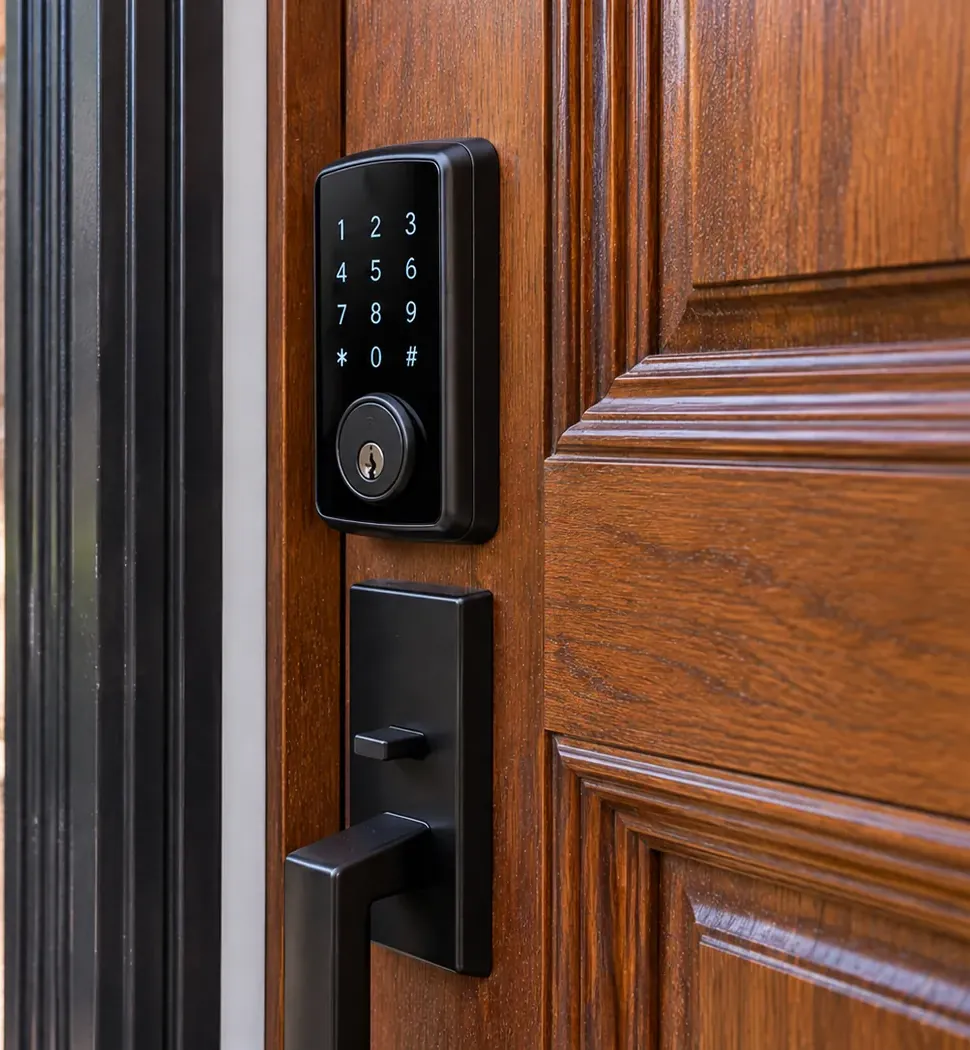
A black keypad deadbolt with a key cylinder sits above a matching lever on a stained wood panel door; nobody is at the door and nothing else is mounted on the frame.
Free Astoria Smart Lock Quote
Tell us the door, how many people use it and who owns the building — we call back the same business day
✅
Request Sent!
We’ll call you back the same business day.
25+
Years Experience
✓
Same-Day Estimates
100%
Licensed & Insured
4.7★
201 Google Reviews
Someone moving out on the 31st, a new roommate arriving on the 1st, or keys from three tenancies ago still floating around? Ring the Queens line, (347) 434-6392, or send the 60-second form. A licensed installer reads every request and tells you, before anyone comes out, whether the door can take the lock you have in mind and whose agreement you need first.
Each person in the household gets their own code, fingerprint or phone access, with start and end dates set ahead of moving day
A new key cylinder on install, so keys handed out by earlier occupants stop working the same afternoon
Licensed under NYS #12000287431 and insured, with arrivals booked in two-hour slots from 8 in the morning to 8 at night, any day of the week
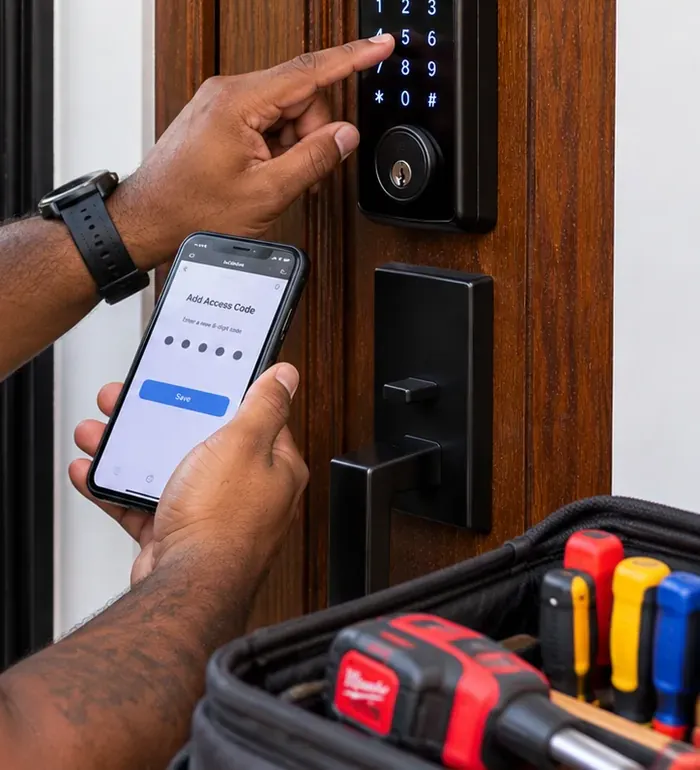
One hand holds a phone open on an add-access-code screen; the other presses the keypad of the deadbolt above, with a tool bag on the floor below.
The Neighborhood
Why Astoria Properties Need Smart Lock Installation Planned Around the People, Not Just the Door
The numbers explain the job before we ever see a door. The NYU Furman Center’s profile of the Astoria community district — Queens Community District 1, which also takes in part of Long Island City — puts homeownership at 18.5 percent in 2024, against 32.7 percent citywide. Roughly four households in five rent. Its 2025 sales figures add the other half of the picture: 204 two-to-four-family buildings changed hands that year against just 47 one-family houses. Put those together and you get the Astoria most of our customers live in: a rented floor of a two- or three-family house, an apartment in a walk-up of a dozen units, or a share in either, with an owner who may live downstairs, around the corner or nowhere nearby.
A lock in that setting has a different job from a lock on a suburban house. It is not guarding one family for twenty years. It is guarding a changing list of people: the leaseholder, the roommate who arrived last spring, the friend who sublet a room for the summer, the partner who moved in and may move out, the owner’s spare key, the super’s. Furman’s profile also counts 38.5 percent of Astoria households as single-person, and the district’s rental vacancy rate at 3.4 percent; small homes, tight rentals and people sharing to afford them mean the cast behind a door changes again and again. Every change used to mean copying keys and hoping they came back. A smart lock turns it into editing a list.
The law has already drawn the outline of that list, and it is not the outline most people expect. New York’s Real Property Law section 235-f says a landlord may not limit an apartment to the people named on the lease: a single tenant may share with immediate family, one additional occupant and that occupant’s dependent children, and must tell the landlord the occupant’s name within thirty days. New York City’s Administrative Code section 26-521 makes it unlawful to change or disable an entrance lock without giving a key to anyone who has lived there thirty consecutive days or more. And the Multiple Dwelling Law’s right for a tenant to add a lock of their own applies to multiple dwellings, which the same law defines as buildings with three or more families — not to the two-family houses that make up so much of Astoria’s side streets. We plan each lock inside those lines.
The doors that get people into the building matter as much as the one on the apartment. Patch reported in March 2021 that a single burglar worked his way through five Astoria apartment buildings in three days: he pried open a lobby door near 33rd Street and 28th Avenue, got into a building near 31st Street and 28th Road through a side door, walked out of another near 29th Street and 31st Avenue with a rent check a tenant had left in front of her apartment door for the landlord, and tried a fourth near 18th Street and 27th Avenue. CBS New York reported in 2019 that a burglar hit two apartments in the same building near 27th Street and Hoyt Avenue South, with a neighbour saying his lock had been picked; when CBS2 returned the following week, the owner was outside helping to change the locks. Neither story is about smart locks. Both are about shared doors that let strangers in, and old keyed cylinders that someone could get past.
Then there is everything that moves around the door: the elevated N and W along 31st Street, which has run above Astoria since 1917; the restaurants and cafés along Ditmars Boulevard, 30th Avenue, Broadway and Steinway Street, where staff come and go by the season; the production offices clustered around Kaufman Astoria Studios; and the new waterfront towers at Halletts Point, where the building may supply its own entry app. A good Astoria lock plan starts by asking who uses the door and who decides, and only then by choosing hardware.
Astoria facts that shape a smart lock job
18.5 percent: homeownership in the Astoria community district in 2024, per the Furman Center, against 32.7 percent across the city. Most doors we fit belong to someone other than the person using them.
204 versus 47: two-to-four-family buildings versus one-family houses sold in the district in 2025 (Furman Center). Shared houses with separate floors are the everyday building type.
38.5 percent: the share of Astoria households made up of one person (Furman Center, 2024) — and many of the rest are friends or partners sharing a lease rather than families.
Three or more families: the Multiple Dwelling Law’s line for a “multiple dwelling.” Below it, in a one- or two-family house, the state rule that lets a tenant add a lock does not apply and the lease does the deciding.
30 days: the point after which New York City’s unlawful-eviction rule, Administrative Code section 26-521, protects an occupant from having the lock changed on them without a key.
119 versus 116: burglaries reported in the 114th Precinct through July 27, 2025, against the same point in 2024, according to the CompStat figures QNS cited — roughly flat, and still more than two a week.
Most Astoria households that sort out their own door end up asking about the one downstairs. The AESS intercom installers in Queens replace buzzer panels that let anyone in, and our access control installation team in Queens handles fob readers for small buildings whose owners want a record of who comes through the street door.
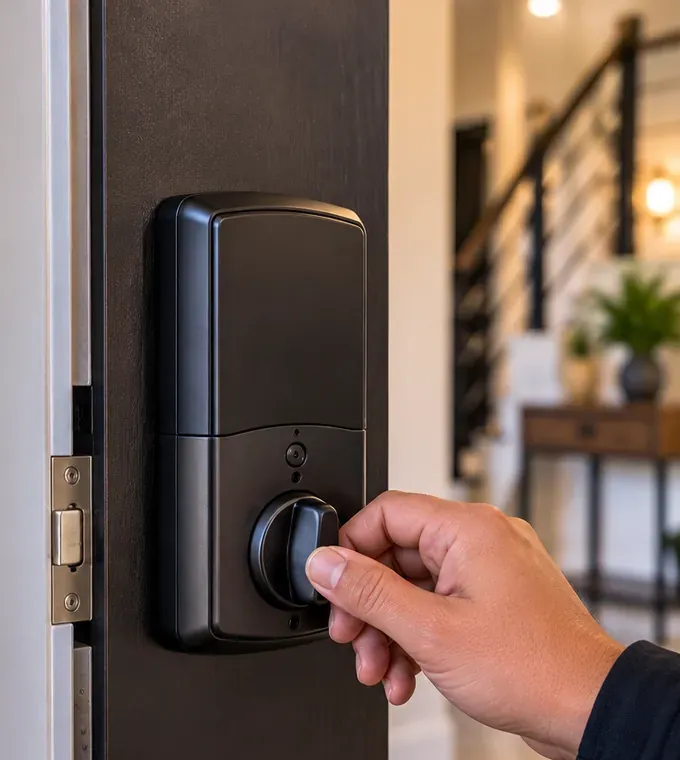
The interior housing of the lock on the inside face of a dark door, with a hand turning its round thumb-turn and a stair rail visible in the room behind.
Repair Capture
Need Smart Lock Repair in Astoria Today
A keypad that went blank the week the person who set it up moved to Brooklyn, a bolt that drags because the door dropped on its hinges over the winter, an app nobody left in the apartment can log into, a side-door strike in a small building that buzzes but won’t release, a restaurant keypad that rejects the manager’s code on a Saturday morning — we treat each one as a service call and book the next open 2-hour window. With a technician at the door, most battery, pairing, administrator and strike-alignment faults are put right in one to two hours. If the fault is in a building’s electric strike, a failed strike repair is $310–$509 at our Queens rate. Call (347) 434-6392 and say it’s a smart lock problem in Astoria; for the buzzer side of a street door, see our door buzzer repair service in Queens. If you rent, let the owner know a technician is coming, as the lease may require.
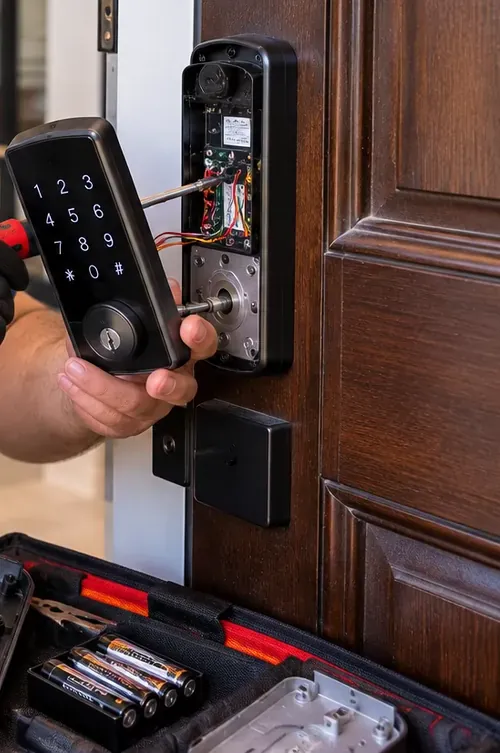
A gloved hand holds the keypad away from the door so the connector and the inside of the housing can be checked; spare batteries sit in the tray below.
What We Install
Smart Lock Installation Services in Astoria
Astoria work falls into three groups: doors one household uses, doors several households share, and doors a business runs. The hardware overlaps; the question of who is allowed to decide does not, so we keep the paperwork for each separate. Whatever the door, we leave it latching cleanly, opening from inside with one motion, holding a working mechanical key, and with every authorised person enrolled in front of us.
Shared Apartment Smart Locks
Keypad, fingerprint or phone-access deadbolts for apartments split between roommates, with one credential per person and two administrators so the account never sits on a single phone.
Two-Family Floor Doors
Locks for the door at the top of the stair or the side entrance to a rented floor, fitted only with the owner’s written agreement and a duplicate key arranged the way the lease says.
Cylinder Changes on Move-In
A new key cylinder in the smart deadbolt the day you move in, so keys cut for earlier tenants, their friends and their dog walkers no longer open anything.
Roster Resets
A setup-only visit that removes everyone who has left, enrols everyone who has arrived, moves the administrator role to people who are staying and writes it all down.
Street and Side Door Keypads
Keypads or fob readers with electric strikes on the street, side and yard doors of small apartment buildings, with a mechanical or push-to-exit release inside.
Interior Retrofit Units
For renters whose owner will not allow the outside of the door to change: a unit that turns the existing deadbolt’s thumb-turn from inside, leaving the hallway face and the owner’s key as they were.
Restaurant and Café Doors
Staff-door keypads and front-door locks for places on Ditmars Boulevard, 30th Avenue, Broadway and Steinway Street, with codes for each opener and closer.
Studio and Production Offices
Keypad levers and readers for offices and workshops that fill up for a production and empty when it wraps, with codes that end on a set date.
Repairs and Account Recovery
Dead keypads, jammed bolts, strikes out of line, and locks whose only administrator has moved away — including factory resets where the manufacturer’s procedure allows.
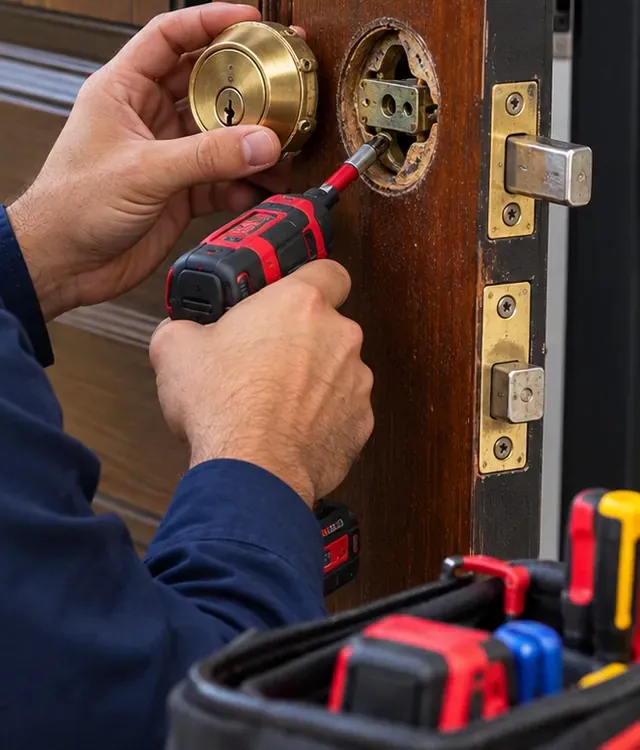
Hands back a brass deadbolt out of its bore with a cordless driver; an empty second bore and two older latch plates show on the same door edge.
Building Specialists
Smart Lock Installation for Astoria’s Architecture
Astoria was built in layers, and each layer left a different door — and a different person in charge of it. When you tell us what kind of building you live in, we already know roughly how thick the door is, whether a multiple-dwelling rule applies, and who will want a key.
Two- and Three-Family Houses
The everyday Astoria house: a floor per household, a shared front hall or a separate side entrance, often a basement. A two-family is a private dwelling in law, so the tenant’s lock is a lease matter; at three families the building becomes a multiple dwelling and the tenant’s right to add a lock applies.
Attached Brick Rows of the 1920s
A 1920s promotional broadsheet, now catalogued by a map dealer, advertised “one hundred 20-foot brick houses” on Ditmars Avenue. Narrow fronts, short stoops and doors that have been re-locked by several owners over a century.
Walk-Up Apartment Buildings
Small apartment buildings with a street door, sometimes a side or yard door, and stairs up to every apartment. Self-closing apartment doors, a super who expects a key, and a street door that decides how safe everyone inside is.
Old Astoria Frame Houses
The Old Astoria Neighborhood Association points to a cluster of historic homes on 12th and 14th Streets between 27th Avenue and Astoria Park South. Older wood doors, glass beside the lock and frames that have moved; we choose hardware for the door rather than forcing the door to the hardware.
Steinway’s Old Company Town
By the mid-1870s Steinway & Sons employed about 400 workers in Queens and gave its name to Steinway Street. The streets around the factory mix older worker housing, later rows and industrial buildings, with doors of every age.
NYCHA Astoria Houses
The 1,103-apartment campus of 22 buildings completed on the Halletts Point peninsula in 1951. The Multiple Dwelling Law’s add-a-lock right expressly excludes housing-authority buildings, so residents ask the Housing Authority before changing anything on a unit door.
New Waterfront Towers
Durst’s Halletts Point towers, with more than 1,000 rentals, and mid-rises such as Astoria Cove. Many come with a building platform for the lobby and sometimes the unit; we work alongside it rather than against it.
Shops With Flats Above
Ground-floor restaurants and stores on 30th Avenue, Broadway, Ditmars Boulevard and Steinway Street with apartments upstairs, where the residential street door and the shop’s back door may sit side by side.
What we look at on an Astoria door before we quote
The cylinder nobody can account for. In a rented floor or a share, the honest answer to “who has a key?” is usually “we’re not sure.” Keys get copied for roommates, partners, cleaners and friends, and they do not all come back when people leave. A smart lock that keeps the old cylinder — including the interior retrofit units that are so popular with renters — still opens for every one of those keys. So on most Astoria installs we fit the smart deadbolt with a new cylinder, give the household its keys, and arrange the owner’s duplicate the way the lease or the law requires. Where the owner insists the original lock stays, we say plainly that a retrofit adds convenience but does nothing about old keys.
Who may decide on which door. In a building of three or more apartments, the Multiple Dwelling Law lets a tenant add a lock of their own, no more than three inches in circumference, alongside the owner’s, provided the owner gets a duplicate key on request. The city’s Housing Maintenance Code separately obliges the owner to supply a working key lock on every apartment entrance door. In a one- or two-family house neither the add-a-lock right nor a multiple-dwelling rule reaches the tenant’s door, so the lease and the owner’s written agreement govern. We ask which kind of building you are in before we quote, because the answer changes the paperwork.
Doors that have moved. Older Astoria houses settle, and doors on the top floor of a house often drop on their hinges or bind in summer. A motorised bolt that rubs on the strike drains its batteries and throws jam warnings, so we check the reveal around the door, tighten or shim the hinges, and move the strike before the lock goes on. If the door needs more than adjustment, we say so before you buy anything.
Leaving needs nothing but a hand. Whatever goes on the outside, the inside of a home door we fit has a plain thumb-turn or lever, so a guest, a child or a half-asleep roommate can get out without knowing a code or finding a phone. HPD’s fire-safety page states that double-cylinder locks are illegal on apartment doors, and we will not fit a model that needs a key or code from the inside.
Households that sort out their own door often want to see who is at the front of the house before buzzing them in. Our doorbell camera installation in Queens suits two-family houses with a shared stoop, and the AESS door buzzer installers in Queens replace tired buzzer-and-strike sets in small walk-ups.
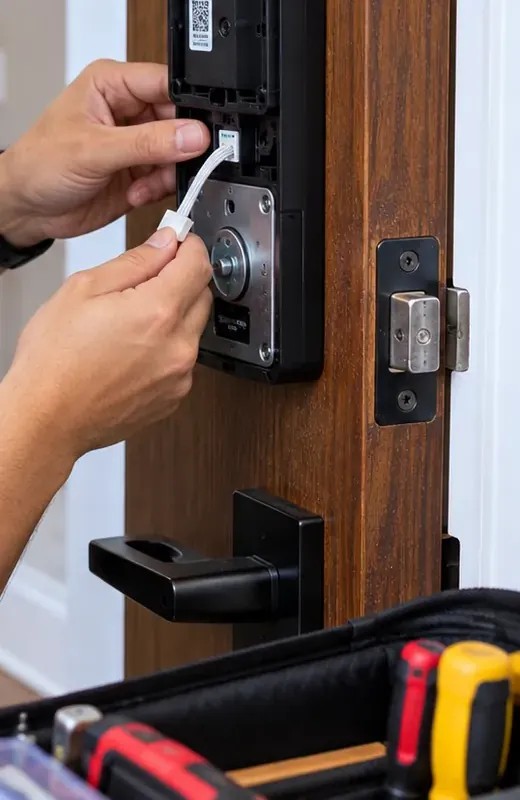
Before the inside cover closes, the flat lead coming through the door from the outside keypad is pushed fully home in the interior unit.
Commercial Smart Locks
Business Smart Lock Installation in Astoria
Astoria’s commercial streets run on small teams that change constantly. A restaurant takes on summer staff for the sidewalk tables, a café hires students, a production office near the studios fills for a shoot and empties at wrap. That turnover is exactly where keys go wrong, and where a lock with one code per person earns its keep. The QNS report on a July 2025 burglary spree is a reminder of the other half of the job: of the four Astoria-area restaurants the burglar entered in just over a week — on 36th Avenue, Crescent Street in Dutch Kills, 31st Avenue and 30th Avenue — three were entered through unlocked windows and one through a smashed window. The door lock is one item on a closing routine, not the whole of it.
Steinway Street
The Steinway Street business improvement district, run as the Steinway Astoria Partnership from 25-69 38th Street, covers the long retail spine named for the piano maker. Part of it has long been called “Little Egypt” for its Arab restaurants and bakeries. Front doors on a busy street and staff doors at the back.
30th Avenue
Restaurants, cafés and shops on both sides of the elevated station, with Athens Square Park at 30th Street. One of the four restaurants in the 2025 burglary spree was here, at 42-20 30th Avenue. Front doors on the sidewalk, kitchen doors at the back.
Ditmars Boulevard
The northern spine near the last stop of the N and W, which one neighbourhood history calls one of Queens’ most vibrant dining corridors. Cafés, bakeries and restaurants with early openers and late closers.
Broadway
A retail, restaurant and service spine that crosses 31st Street at the elevated station and runs on toward the river and Socrates Sculpture Park.
31st Street Under the El
Storefronts and upstairs offices below the elevated line that has run here since 1917. Busy sidewalks, frequent deliveries and narrow doors beside the stairs up to the station.
The Studio Blocks Around 35th Avenue
Kaufman Astoria Studios, opened by Famous Players-Lasky in 1920 at what is now 35th Avenue and 35th Street, has grown to twelve stages, with the Museum of the Moving Image beside it. Production offices, suppliers and workshops nearby rent space for a project and hand it back afterwards.
Compliance callouts for Astoria business doors
Getting out stays simple. Customers and staff leaving a restaurant or shop should never need a credential. Codes and fobs belong on the outside face; the inside gets a lever, a thumb-turn or a push-to-exit plate, and any powered lock keeps a mechanical release that works with no power at all.
The apartments upstairs are a separate matter. In a mixed building, the door residents use is governed by housing rules, and an owner who gives tenants app or fob entry takes on the duties of Local Law 63 of 2021, the Tenant Data Privacy Act. We keep staff codes and residents’ credentials on different doors and, ideally, different systems.
Decide what a powered door does in a blackout. A strike specified fail-safe lets the door open when power drops; a fail-secure strike keeps it shut and leaves entry to the key. Doors on an escape route and stock-room doors usually want opposite answers, and we note the choice for each one on the drawing.
Your landlord’s frame. Cutting a strike into a storefront frame changes the landlord’s property, so we get the landlord’s written agreement first and keep the work reversible where we can.
A kitchen door and a front door can run on smart locks. Once there are four or five doors, staff in several roles and a wish to see video beside each entry, a proper access control system is cheaper to live with; the Queens access control installers on our team handle that, and commercial security cameras for Queens businesses add the picture.
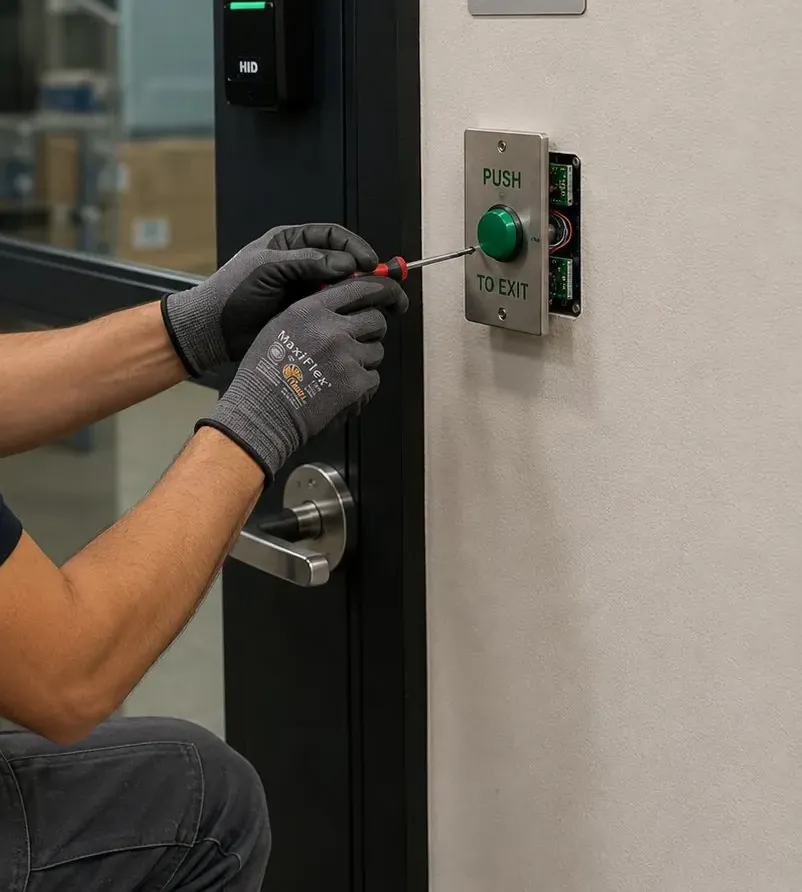
A gloved hand works on the strike in the aluminium frame of a glass door; on the wall beside it are a keypad reader and a push-to-exit plate.
Your Questions Answered
Smart Lock Installation in Astoria: Questions Answered
These are the questions Astoria renters, roommates, house owners and business owners bring us, grouped by the kind of door and the kind of household behind it. Prices, timing and coverage are in the FAQ further down. Nothing here is legal advice: where we mention a law, we name it so you can read it yourself or take it to a lawyer, a tenant organisation or the owner of your building.
Sharing an apartment
We added a roommate who isn’t on the lease — do we have to tell the landlord before giving them a code?
The code is a household decision; the notice is a legal duty that exists whether or not you have a smart lock. New York’s Real Property Law section 235-f says a lease signed by one tenant must be read to allow the tenant, their immediate family, one additional occupant and that occupant’s dependent children, as long as the tenant or the tenant’s spouse lives there as a primary residence. Where two or more people signed the lease, the total of tenants and occupants may not exceed the number of tenants on the lease. Section 235-f also requires the tenant to tell the landlord an occupant’s name within thirty days after that person moves in, or within thirty days of the landlord asking.
Nothing in that section mentions locks, so giving the new roommate their own code does not need the landlord’s sign-off; giving them a code instead of a copied key is simply the tidier way to do what you would have done anyway. What a code does add is a date: the lock’s app records when the person was enrolled, which is a useful note to keep beside the name you send the landlord. In a building of three or more apartments, the Multiple Dwelling Law also lets the owner ask for a duplicate key to any lock a tenant adds, which is a key, not a code, and should be handled exactly as before.
One more line of 235-f matters for the lock’s settings: an occupant does not gain a right to stay on if the tenant leaves, unless the landlord agrees in writing. That is a good reason to make the leaseholder one of the lock’s administrators and the roommate an ordinary user, and to write down who would take over the account if the leaseholder moved out first.
Our roommate’s last day is the 31st — can we switch their code off now, before they’ve actually gone?
Not while they still live there. New York City Administrative Code section 26-521 makes it unlawful for any person to change or disable the lock on an entrance door without giving a key to an occupant who has lawfully lived in the unit for thirty consecutive days or more, and section 26-523 makes a violation a misdemeanour with civil penalties of $1,000 to $10,000 per violation. Deleting the only credential a current resident has is the electronic version of changing the lock on them. We will not do it, and we would rather you didn’t either.
What works is setting the end in advance. Agree the move-out date in writing — a text exchange is better than nothing — and put that date on the departing roommate’s code so it stops working at the end of the agreed day without anyone pressing a button in anger. Ask for their physical key back the same day, remove their phone access once they have carried out the last box, and, if a key does not come back, have the cylinder changed rather than hoping. If a new roommate is arriving, their code can start on the morning of the 1st.
If someone refuses to leave, that is a matter for the courts and, in a share, for a lawyer or a tenant organisation; it is not something a locksmith or an installer can or should settle at the door. A lock with a clear history of who was enrolled and when can help everyone remember what was agreed, which is about as far as hardware should go.
Can each roommate keep their own comings and goings private from the others?
Partly, and it is worth deciding before the lock goes on rather than after the first argument. Smart lock apps sort people into roles. Administrators can add and remove people and usually see the full entry history; ordinary users can open the door and, depending on the app, may see little or nothing of anyone else’s activity. In a share, that means whoever holds the administrator role can, in principle, see when everyone else comes home.
The fairest set-ups we see in Astoria shares give the administrator role to two people openly agreed by the household, switch off per-person unlock notifications that nobody actually needs, and keep the notifications that protect everyone — low battery, jams, the door left unlocked, wrong codes tried. Some apps let administrators choose which events send alerts, so the history exists for when something goes wrong without anyone being pinged every time a roommate walks in.
Write the house rule down in a sentence or two: who the administrators are, what the history is for and what it is not for. A lock that records entries is a security tool; it should not quietly turn into a way for one roommate to watch another.
Rented floors in two-family houses
The owner of our two-family says the last tenants’ keys “probably” all came back and won’t change the cylinder — what can we do?
Start with what kind of building it is. The Multiple Dwelling Law calls a building with no more than two families a private dwelling, and the tenant’s right under section 51-c to add a lock of one’s own applies to multiple dwellings, which start at three families. In a two-family house, then, the lease and the owner’s agreement decide what goes on your door. The city’s Housing Maintenance Code separately requires the owner of a dwelling to provide a key lock on each apartment’s entrance door and at least one key, so the conversation is about which lock and which keys, not whether you get one.
Owners usually say yes when the request is cheap, reversible and leaves them a key. Ask in writing, offer to pay for a new cylinder in the existing lock or for a smart deadbolt with a new cylinder, and offer the owner a duplicate key the same day. Make the point that an interior retrofit unit — the kind that turns your existing thumb-turn — would not help, because every old key would still open the door. One r/astoria thread from a tenant whose apartment between the 36th Avenue and Broadway stations was broken into two weeks after move-in drew a reply asking, in effect, whether the landlord had been there long enough to recognise previous tenants and whether a locksmith had been called yet. That is exactly the question to settle on day one.
If the owner still says no, do not change the lock yourself on a two-family door; keep the written request, which shows you raised it, and talk to a tenant organisation about your options. We will happily send the owner a short scope explaining what we would do, what it costs and what the owner keeps, because that letter often settles it.
The owner downstairs offered to put our apartment lock on the same app as the front door — should we accept?
It is convenient, and it hands the owner more than a key. Whoever holds the administrator role on an app account can usually add and delete codes and read the entry history for every lock on that account. On a shared account, that means the owner could see each time you or your guests came home and could change your codes without asking. The city’s Tenant Data Privacy Act limits what owners of multiple dwellings may collect through smart access systems; in a two-family house, your protection is mostly whatever you and the owner agree.
Our usual recommendation in an Astoria two-family is two accounts. The owner’s front or side door stays on the owner’s account, with a code for each person on your floor. Your apartment door goes on your household’s own account, with the owner holding a mechanical key or a separate code if the lease calls for access. Each side keeps control of its own door, and neither can read the other’s history.
If you do decide to share an account, settle it in writing: who the administrators are, whether the owner may add or delete codes on your door, and that the history is not checked unless something has gone wrong. Clear expectations matter more in a house where you share a stair and a mailbox with the person holding the account.
Street doors, side doors and small buildings
What the 2021 five-building pattern says about street and side doors
The March 2021 pattern Patch reported is a tidy summary of how strangers reach apartment doors in Astoria. On the first day, the man pried open a lobby door near 33rd Street and 28th Avenue and took a parcel, then robbed an apartment near 31st Street and 28th Road after coming in through the building’s side door. Later the same day he walked into a building near 29th Street and 31st Avenue and took a rent check a tenant had left outside her apartment door for the landlord. Two days later cameras caught him inside a building near 18th Street and 27th Avenue, where he failed to get into any apartment, and hours after that he took $150 from an apartment near 31st Drive and 23rd Street.
The lessons are mostly the owner’s, not the tenant’s. A street door that can be pried needs a reinforced strike and frame before it needs electronics. A side door that is supposed to be locked needs to close and latch on its own, and a door-position contact that reports when it is propped. Where an owner wants to know who comes through, a keypad or fob reader with an electric strike gives every resident their own credential and the owner a log, at $1,575–$2,625 per door at the Queens rate.
For residents, the lesson is simpler: the hall outside your door is not a safe place for rent checks, spare keys or parcels, and your own apartment door is the one you control. A smart deadbolt with a fresh cylinder that relocks itself behind you is the part of this you can fix this week.
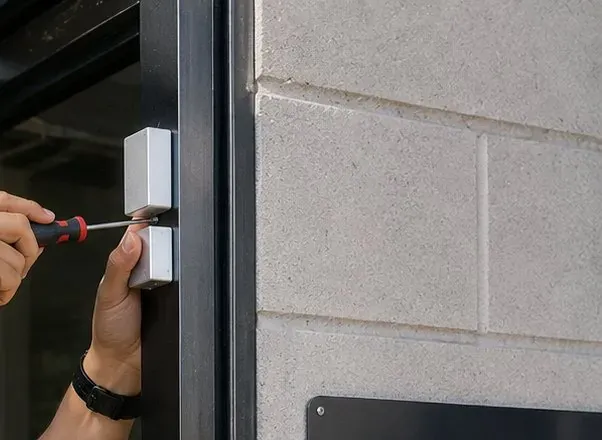
A two-piece magnetic contact goes on at the top of a metal door frame beside a block wall, so the system can tell when the door is actually shut.
Picked locks and changed locks: the 2019 Hoyt Avenue South break-ins
CBS New York reported in September 2019 on two burglaries on August 29 in the same building near 27th Street and Hoyt Avenue South. Police said the burglar took $13,000 in jewellery from one apartment; a neighbour said his own lock had been picked and that passports and a safe were among the things taken. When CBS2 returned the following week, the owner was outside helping to change the locks and arranging for more cameras. The same report said burglaries in the 114th Precinct were up 12 percent year to date, from 117 to 131.
A smart deadbolt does not make a door unpickable: most keep a key cylinder for emergencies, and that cylinder is only as good as its grade. What it changes is how often anyone needs a key at all. When the household uses codes or fingerprints day to day, the mechanical key can live in a drawer rather than on a ring that gets lent and copied, and a lock that auto-locks behind each person removes the commonest weakness of all, the door that someone forgot to lock.
When a building has had a break-in, owners tend to change every cylinder at once. That is the right moment for tenants to ask for the apartment door to take a smart deadbolt with a new cylinder rather than another plain lock with a new batch of keys to copy.
Fobs instead of keys on the street door
In an r/astoria thread about package theft, one resident wrote that their building had replaced the front-door key with a key fob to deter porch pirates and that it seemed to have helped. That matches what we see: a credential that can be cancelled is worth more than one that can be copied. A lost fob or a departing tenant’s code is removed in a minute; a lost street-door key means either re-keying the building or living with a key in a stranger’s pocket.
For a small building, the trade-offs are cost, power and who runs it. A keypad or fob reader with an electric strike needs low-voltage wiring and a power supply, and someone — usually the owner or the managing agent — has to add and remove people promptly. If tenants’ data is involved, the Tenant Data Privacy Act sets rules on consent, retention and what may be collected.
Mail carriers and buzzers still have to work after the change, and residents who prefer a code to a fob should be able to have one. We plan both before the strike is ordered.
Restaurants, studios and small businesses
Our production office near the studios is rented for one season — can everyone’s door code run off the crew list and stop on wrap day?
Yes, and it is one of the tidiest uses of a smart lock we see in Astoria. Productions working out of offices around Kaufman Astoria Studios and the blocks nearby tend to take space for a fixed run, staff it from a list that changes week by week, and hand it back at the end. A keypad lever on the office door, with the production office coordinator and one other person as administrators, lets each crew member have a personal code with an end date set to wrap day. Nobody is handed a key that walks off to the next job.
We enrol from your written list in one sitting, label each code with the person’s name and department, and show the coordinator how to add day-players or remove someone who leaves early. Rooms that hold equipment or petty cash get their own lock with a much shorter list. If the landlord’s lock has to go back on at the end of the lease, we bag and label it on day one and restore it on a short return visit.
Two things to settle with the landlord first: whether you may change the hardware at all, and whether the landlord needs a key or a code during your tenancy. We write both into the scope so the paperwork is done before the first call time.
We rent our rehearsal room by the hour — can each booking get a code that works only for its slot?
Most current smart locks can hold codes limited to a date and a time window, so a renter’s code can begin a few minutes before the booking and end a few minutes after it. Doing that by hand for every booking works for a handful a week. For more than that, some lock platforms can create codes from a booking system automatically, and some cannot; whether yours can depends on both the lock and the booking tool, so we check that pairing before you buy rather than after.
The room itself needs a few house rules built into the hardware: the door opens from inside without a code, the lock relocks when the door shuts, and storage cupboards or the office stay on separate locks with separate codes. A door-position contact will tell you if the last renter left the door propped for the next one.
Keep a fallback for the night the internet drops at 9 p.m.: a staff member with an administrator code that works at the keypad without any connection, and the mechanical key somewhere it can be reached.
Closing up after the July 2025 restaurant break-ins
QNS reported in August 2025 that a man carrying a metal folding stool broke into four restaurants in Astoria and Dutch Kills in just over a week. He climbed through an unlocked window at 33-01 36th Avenue on July 21, another at 35-57 Crescent Street on July 27 and another at 33-21 31st Avenue the next morning, and smashed a window at 42-20 30th Avenue on July 29. In each case the target was the cash register. The same report gave the 114th Precinct’s burglary count through July 27 as 119, against 116 a year earlier.
None of those entries came through a door, which is the point. A smart lock on the staff door makes sure the door is locked when the last person leaves and tells you who that person was. It does nothing for a kitchen window left open for air. The closing routine we help restaurants write puts the door lock at the end of a short list: windows latched, cash out of the register, back door checked, then the lock set and its status confirmed on the manager’s phone.
If windows are the weak point, contacts on them belong on an alarm system rather than a lock. Our alarm installation team in Queens fits window and door contacts that report to the same phone.
When northwest Queens loses power
Astoria has lived through a long outage before. Baruch College’s NYC data archive records that the 2006 Queens blackout began on July 17 and continued for eight days until power was restored on July 25; a Pace law review article notes that on the worst days Con Edison lost twelve of the twenty-two feeders in its Long Island City network. A household that went keyless needs to know what keeps working in a week like that.
Battery-powered smart deadbolts keep working on their own batteries: codes, fingerprints and the inside thumb-turn carry on as normal. What stops is anything that needs the apartment’s power or internet — the Wi-Fi bridge, the router, and therefore remote unlocking and phone alerts. On a building’s street door, a powered electric strike does what it was specified to do: fail-safe strikes release, fail-secure strikes stay locked and rely on the key. Buzzers go silent either way.
The plan is simple and worth writing down: fresh batteries when the lock asks for them, one mechanical key held by someone who does not live in the apartment, a written note of which street doors are fail-safe and which are fail-secure, and an understanding that remote access is a convenience, not the only way in.
A gloved hand tightens a terminal on a green push-to-exit button mounted below a keypad reader, next to the lever of a metal-framed door.
The Roster Method
How We Keep an Astoria Door’s Roster Current
The hardware lasts years; the list of people who can open the door lasts months. This is the table we leave with Astoria households and small businesses, so every change on the roster has a matching change on the lock.
What happens
What changes on the lock
When
You move in
Smart deadbolt fitted with a new key cylinder; each person enrols their own credential; two administrators on two phones
Install day
A roommate arrives
Their own code or fingerprint, starting the day they move in; the leaseholder sends the landlord the occupant’s name as Real Property Law 235-f requires
Within 30 days of move-in
A roommate leaves
End date set on their code in advance; physical key collected; phone access removed once they are out; cylinder changed if a key is missing
On the agreed date, never before
A summer subletter
A dated user code, no administrator rights, and whatever the lease or the owner requires for subletting
For the sublet only
A partner moves in
Their own credential, not a borrowed code, so the history shows who actually used the door
Day one
Cleaner, dog walker, a friend feeding the cat
Scheduled or dated codes that work only when they are expected
As arranged
The owner or super needs access
A duplicate mechanical key handled the way the lease or the Multiple Dwelling Law requires; a code only if both sides agree
On request
A phone is lost or replaced
That phone’s access removed by the second administrator; re-enrolled on the new phone
Same day
The lease ends
Codes and accounts cleared, the lock reset, the original hardware put back if the owner wants it, keys returned
Move-out week
Any of those changes can be done from the app by the household’s administrators. When several happen at once — two roommates out and two in, a new partner and a new dog walker — our setup-only visit does the whole roster in one go at the published Queens rate of $195 for the first hour, then 30-minute blocks, and leaves a fresh roster sheet behind.
Equipment
Types of Smart Locks We Install
Which lock suits an Astoria door has less to do with the door than with how quickly its users turn over. Below are the kinds we install in roommate apartments, rented floors, walk-ups and small businesses. Bring your own if you already have one, or let us suggest a model once we know both the door and the people.
Keypad Deadbolts With a Replaceable Cylinder
The default for an apartment or floor door: a keypad outside, a thumb-turn inside, and a key cylinder we can swap for a new one on move-in so that old keys stop working.
Interior Retrofit Units
Fitted over the existing deadbolt on the inside, leaving the outside and the owner’s key unchanged. Good when an owner will not allow any other change; no help at all against keys from earlier tenancies.
Fingerprint Deadbolts
For shares where codes have a way of being passed on: a fingerprint cannot be lent to a friend, and each person enrols two fingers so a cut or a bandage does not lock them out.
Matter-Capable Locks
For households split between iPhone and Android: Matter lets one lock be shared with more than one smart-home system, and Thread versions need a compatible border router in the apartment.
Keypad Levers
Keypad and lever in one, for production offices, rehearsal rooms, studios and the inside doors of small businesses, where a lever is easier than a knob with your hands full.
Wi-Fi Bridges and Hubs
For locks that talk over Bluetooth, a plug-in bridge near the door gives remote access; August, for example, asks for its bridge within 10 to 15 feet of the lock, which in a long Astoria floor-through can mean a hallway outlet.
Keypads and Readers With Electric Strikes
For the street, side and yard doors of small buildings and for shop doors: credentials per resident or employee, a log for the owner, and an inside release that never needs power.
Door-Position Contacts
Small magnetic switches that tell the lock or controller whether a door is really closed, so a side door wedged for a delivery or a restaurant’s back door left ajar raises an alert.
National brands versus an Astoria installer
ADT sells locks as part of monitored packages, and Ring and SimpliSafe sell locks and keypads that fit their own systems. Any of them can be a sound product. None of them will ask who has keys from the last tenancy, change the cylinder before you move in, write the scope your two-family owner needs, or set an end date on the code of a roommate leaving on the 31st. In Astoria, that is most of the job, and it is what a licensed local installer is for.
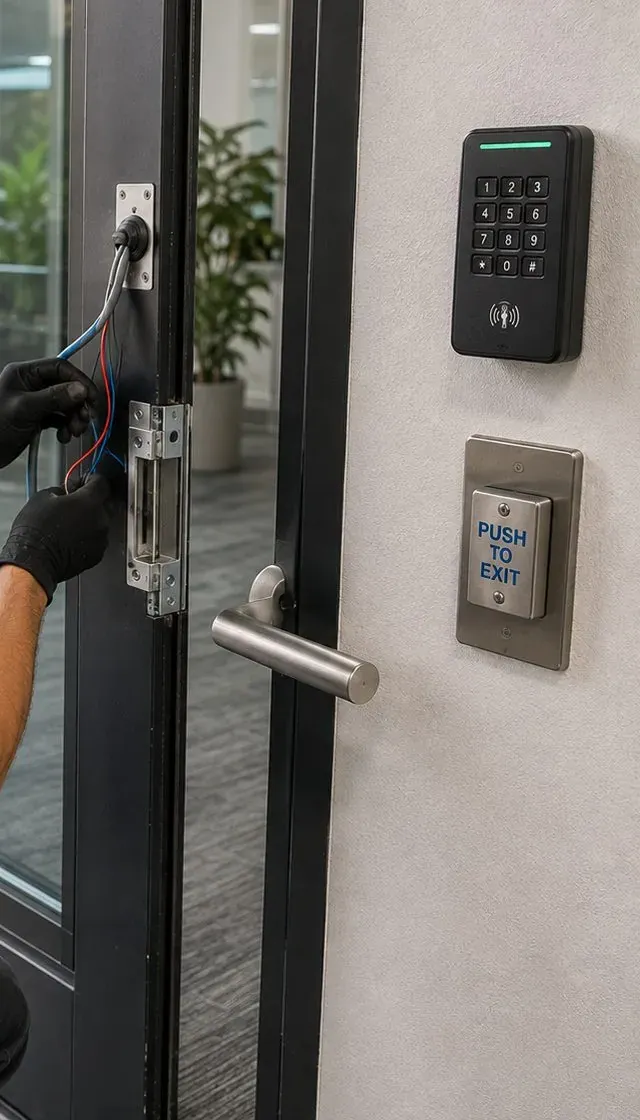
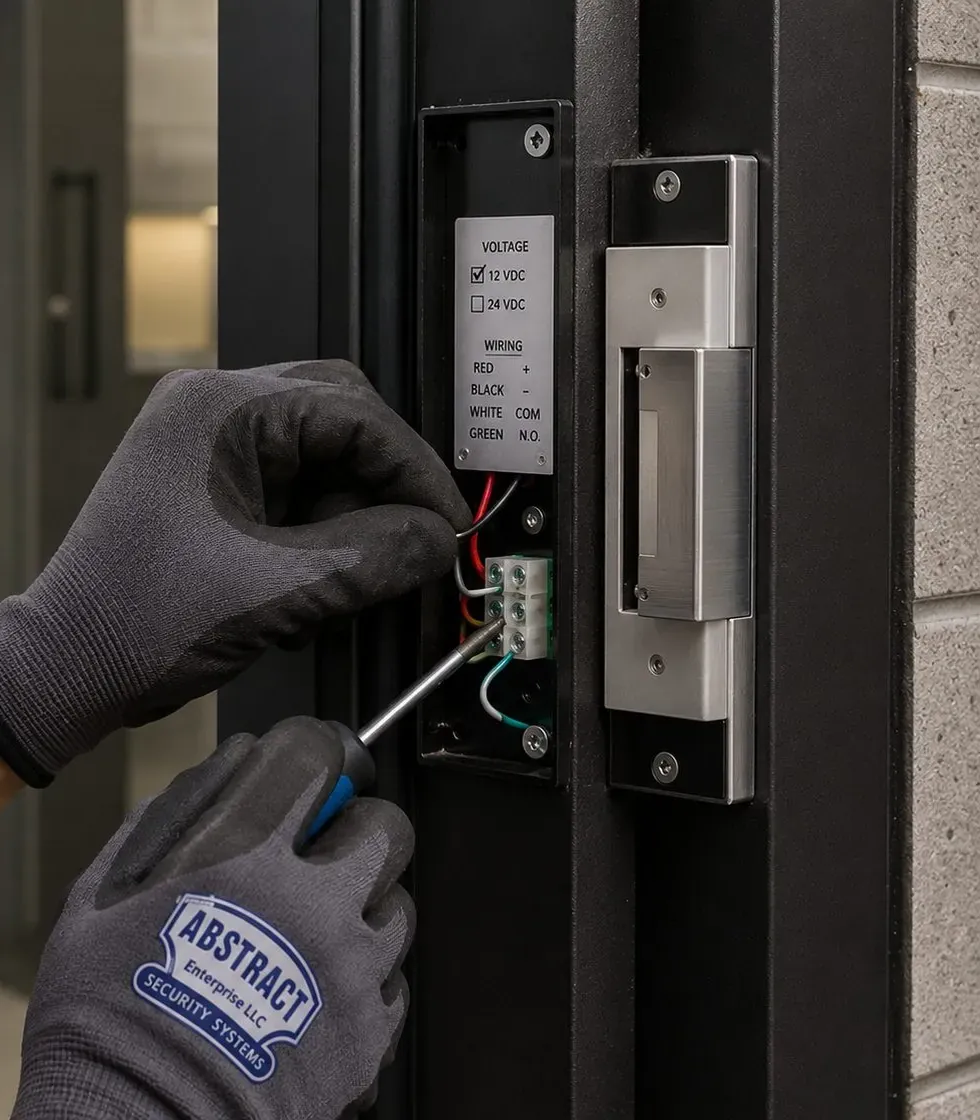
Two gloved hands connect the small wires to an electric strike set into a dark metal door frame; the strike's label and keeper face are visible.
AI Overview Reality Check
What AI Gets Wrong About Smart Lock Installation in Astoria
How this section was written: the tools used to build this page had no access to Google’s AI Overview, so nothing below quotes it directly. Instead, each heading is a claim that keeps appearing in lock makers’ marketing, DIY articles and cost guides such as Angi, HomeAdvisor and Fixr — the sources answer engines draw on — followed by how it holds up on Astoria doors.
“Renters should pick a lock that fits over the deadbolt so the landlord’s key still works”
Retrofit locks are sold to renters on exactly that promise; one maker describes its retrofit as leaving the outside of the door untouched. That is a real advantage where an owner forbids any change to the door.
In Astoria, though, the commonest worry on move-in is not the landlord’s key. It is the keys nobody can account for: copies made by earlier tenants, their roommates and their friends. A retrofit leaves every one of those keys working.
Where the owner agrees, a smart deadbolt with a new cylinder, plus a duplicate key for the owner, solves both problems at once. Where the owner does not agree, a cylinder change in the existing lock is the cheaper fix to ask for first.
“A smart lock lets you decide exactly who lives with you”
A lock controls who can open a door. It does not decide who has a right to be behind it. In New York those rights come from the lease and from statutes such as Real Property Law 235-f, which lets a single tenant share with one additional occupant, and the city’s unlawful-eviction rule, which protects anyone who has lived in a unit for thirty days or more from having the lock changed on them.
In a roommate apartment, that means a code cannot be used to settle a dispute. Deleting a current resident’s only credential can amount to the same thing as changing the lock on them.
Use the lock to carry out what the household has agreed: a dated end on a departing roommate’s code, a dated start for the next one. Use a lawyer or a tenant organisation for anything the household has not agreed.
“Tenants in New York can always add their own lock”
That is true in a lot of New York apartments, and it is the rule most articles quote. Multiple Dwelling Law section 51-c lets a tenant add a lock of their own, no more than three inches in circumference, provided the owner gets a duplicate key on request.
But section 51-c applies to multiple dwellings, which the same law defines as buildings housing three or more families, and it excludes buildings run by a municipal housing authority. Much of Astoria’s housing is two-family houses, where the right does not apply, and the Astoria Houses campus is a NYCHA development.
So the first question we ask a renter is how many apartments the building has. In a two-family, we write a short scope for the owner; in NYCHA, residents go to the Housing Authority first.
“Smart locks stop break-ins”
A smart lock is good at one thing: making sure a door is locked and that only enrolled people open it. Astoria’s own burglary reports show how much else matters. When the 114th Precinct warned residents in 2014 about a string of break-ins between 28th and 31st Avenues, the Queens Gazette reported that entry came through open fire-escape windows, unlocked doors, or air conditioners removed from fire-escape windows.
The four restaurant break-ins QNS reported in July 2025 came through windows too. A locked door is necessary; it is not sufficient.
The precinct’s own advice in 2014 was to fit deadbolts on all doors and locks on all windows. We fit the door side; window gates and window contacts are a separate job, and NYC rules forbid key-locked gates on fire-escape windows.
“The hardware is the whole job”
Testers at one home-improvement site needed little more than a Phillips screwdriver and about half an hour, on a door made for the job. Astoria doors are often older than that, re-drilled for several earlier locks, and hung in houses that have settled.
The hardware is the quick part. Swapping the cylinder, moving a strike, adjusting hinges so the bolt does not drag, testing the latch and the inside release, and then enrolling four roommates and two administrators properly takes longer.
A straightforward Astoria door with three or four people to enrol is usually a visit of an hour or two; a door that needs work or a long list of users takes longer, and the walkthrough tells you which.
“You can open your door from anywhere with the app”
Only while the lock can reach the internet. Bluetooth locks need a bridge close to the door — August asks for 10 to 15 feet — and the bridge needs power and Wi-Fi. In a long floor-through with the router in the back room, that link is the first thing we test.
It is also the first thing to fail in an outage. During the eight-day 2006 Queens blackout, any bridge or router in an affected apartment would have been dark, and remote access and alerts with it.
Codes, fingerprints and the inside thumb-turn keep working on battery power. Treat remote access as a convenience and make sure every person on the roster can open the door at the door.
“Smart lock installation costs $250 to $400”
That range is real: Fixr’s January 2025 national figure is $250 to $400, averaging $300, for one Wi-Fi lock and an accessory on an ordinary house door. It is national third-party data, not an AESS price.
It does not include a building’s street door, where a keypad or fob reader with an electric strike is $1,575 to $2,625 at our Queens rate, or the owner’s paperwork, the cylinder change and the roster enrolment that make up much of an Astoria job.
For an apartment or house door we quote flat after a free walkthrough, and the figure we write down is the figure on the invoice.
Moving Day on the Calendar? Book the Lock Around It
Tell us who is leaving, who is arriving and the dates. We will set the codes to change on the right mornings and fit a fresh cylinder on the day you get the keys.
A few lines about the door, the household and the building’s owner are enough for a written reply on the same business day. If a phone call suits you better, the Queens line is (347) 434-6392.
✅
Request Received
Thank you — a licensed installer will call before the end of the business day. If you are locked out right now, ring (347) 434-6392.
How It Works
Our Installation Process
Seven steps, whether the door belongs to a three-person share off 31st Avenue, a rented top floor near Ditmars Boulevard or a production office by the studios.
1. List the people, not just the door
Before the visit we ask who lives there now, who is about to leave or arrive, who holds keys today and who has to approve changes: the leaseholder, the owner downstairs, a managing agent or a shop landlord.
2. Walk the door and the way in
At the free walkthrough we measure the door, look at the old bores and the strike, check the shared street or side door you pass through first, and test the phone signal at the door itself.
3. Agree the paperwork and the price
You get a written scope and a flat figure. Where an owner must agree, we write the scope so it can be forwarded as is, including what happens to the original lock and who gets a duplicate key.
4. Fit the lock and a fresh cylinder
The old hardware comes off and is bagged and labelled for the end of the lease, the smart deadbolt goes on, and a new key cylinder replaces one that previous occupants may still hold keys for.
5. Prove the way out and the latch
We open the door from inside with one motion, let it close and latch repeatedly, and test the bolt against the strike before anyone enrols.
6. Enrol the roster
Each person enrols their own code, fingerprint or phone, with end dates for anyone leaving and start dates for anyone arriving, and at least two administrators on separate phones.
7. Leave the roster sheet
We leave a one-page sheet listing every credential, who added it and when it ends, plus how to remove a person, so the next change does not need us.
Coverage Area
Smart Lock Installation Near Astoria’s Landmarks
Six places that frame the Astoria we work in, from the river parks to the studios and the oldest houses on the waterfront.
Astoria Park and the Hell Gate Bridge
More than 56 acres acquired by the city in 1913, with the 1936 pool that NYC Parks describes as the largest of its eleven WPA-era pools, beneath the 1,017-foot steel arch of the Hell Gate Bridge, dedicated in 1917.
Kaufman Astoria Studios and the Museum of the Moving Image
The studio Famous Players-Lasky opened in 1920 at today’s 35th Avenue and 35th Street, home to Sesame Street since 1993, with the museum that opened beside it in 1988 and reopened after its expansion in January 2011.
Bohemian Hall and Beer Garden
Built by the Bohemian Citizens’ Benevolent Society, which laid the cornerstone on October 1, 1910 and finished the outdoor garden in 1919; listed on the National Register of Historic Places in 2001.
Socrates Sculpture Park
An abandoned landfill and illegal dumpsite on the waterfront until 1986, when artists and neighbours working with the sculptor Mark di Suvero turned it into an outdoor sculpture park.
Astoria Library, 14-01 Astoria Boulevard
A Queens Public Library branch dating from 1904, closed for renovation since November 2025. When it reopens it will again be one of the few public buildings on this stretch of Astoria Boulevard.
Steinway Mansion
Built in 1857–58 by Benjamin Pike Jr. on a hilltop overlooking Bowery Bay, and designated a New York City landmark in 1967, among the first the city named.
Next door, the same crews work in Long Island City, Sunnyside, Woodside, Jackson Heights and East Elmhurst; for anywhere else in the borough, start from the Queens smart lock installation page.
Pricing
Smart Lock Installation Cost in Astoria
Two kinds of price appear below: fixed lines AESS already publishes for building doors, and flat quotes for home doors that depend on the visit. The fixed lines cover keypads, fob readers and electric strikes on the doors a building or business shares. They start from our published Brooklyn figures and carry the usual Queens uplift of 1.05, and Astoria pays exactly the Queens rate — there is no neighbourhood surcharge. A smart deadbolt on your own apartment, floor or house door has no published AESS figure yet, because a sound door with a two-person household and a century-old door with a five-person share are very different afternoons. For those we walk the door for free and then write down one flat number, which is the number you pay.
Item
Astoria price (Queens rate)
Scope and source
Apartment, floor or house smart deadbolt, new cylinder included
Flat quote after the free walkthrough
Priced per door once we have seen it, heard the lease position and met the household that will use it
Roster visit: people removed and added, schedules, app and bridge sorted, nothing new on the door
$195 first hour, then 30-minute blocks
The published Queens setup-only rate; what most shares book when the line-up changes
One building or business door: reader or keypad plus strike
$1,575–$2,625 installed
A small building’s street, side or yard door, or the entrance of a shop, studio or office; the $1,500–$2,500 Brooklyn base times 1.05
Strike supplied and set into a street or side door frame
$263–$473
Installed while other entrance work is under way; the published $250–$450 multiplied by 1.05
Repair of a strike that has stopped working
$310–$509
For the street door residents can hear buzzing that still won’t open; $295–$485 times 1.05, halves rounded up
Return service calls
$195/hr, 3-hour minimum ($585)
Applies to later visits for service; the first installation never carries it
A worked example from those lines only: an owner who wants a keypad and strike on the street door of a small building and a new strike on its side door would be looking at $1,575–$2,625 plus $263–$473, or $1,838–$3,098 in all, at the Queens rate.
What moves an Astoria quote
The cylinder: fitting a new cylinder, or keying the smart lock to match the owner’s other locks, adds a small amount of time and saves a great deal of worry.
The door’s history: earlier bores, filled mortise pockets and a door that has dropped on its hinges take preparation before a motorised bolt will run cleanly.
The roster: enrolling one person is quick; four roommates, two administrators, a cleaner’s schedule and a departing roommate’s end date take longer and are worth doing properly.
Paperwork: a scope letter for a two-family owner or a commercial landlord is included; waiting for the reply can move the date.
Cable routes on building doors: concealing a strike cable in an old frame takes longer than a surface run, and a side door far from power needs a supply placed sensibly.
Several doors at once: a street door, a side door and an apartment in one visit cost less in travel and set-up than three separate trips.
Against the national averages. Fixr put a single smart lock at $250–$400 nationally in January 2025, $300 on average, and handyman labour at $50–$100 an hour. Those are another company’s national numbers, not ours, and they picture one door, one family and no landlord.
Shop Our Systems
Astoria Smart Lock Packages & Pricing
The three ways Astoria customers usually buy keyless entry, from the cheapest change on a lock you already have to a building door with its own reader.
Starter — Roster Reset
$195 first hour
For a lock already on the door when the household changes: departing people removed on their agreed dates, new people enrolled, administrators moved to people who are staying, schedules for cleaners and walkers, and a fresh roster sheet. Then 30-minute blocks at the published Queens setup-only rate.
Standard — Move-In Smart Deadbolt
Quoted flat at walkthrough
A keypad, fingerprint or Matter-capable deadbolt on your apartment or floor door with a new key cylinder, the original hardware bagged and labelled for the end of the lease, every person enrolled, two administrators set, and a scope letter for the owner where one is needed.
Premium — Keyless Street or Side Door
$1,575–$2,625
Aimed at small-building owners and business tenants. One door gets a reader or keypad on the outside, a strike cut into its frame and a release on the inside that works with the power off, at the Queens rate — plus, if you would like to know when someone wedges it, a contact at the head of the frame.
Bring Your Own Lock — Labour Only
Ordered a lock online before talking to anyone? That is fine: we install customer-supplied locks for a flat labour-only price set at the walkthrough. We check three things before the packaging comes off — that it fits the door’s thickness, bore and backset; that its cylinder can be swapped and its inside release needs no code; and, on a rental, that it is the model the owner said yes to. Your lock keeps its maker’s warranty, not ours, and if it is wrong for the door you hear that before any drilling, while it can still be returned.
Get the Astoria Price in Writing
Apartment, floor, street door or shop — send a photo of each side of the door and tell us who uses it. We reply with a flat figure and, if an owner has to agree, a scope you can forward as is.
Astoria runs from the river parks to the edge of Long Island City and from the studios up to the last stop of the N and W, and the doors change with the blocks. These are the patterns we see.
Ditmars–Steinway and the northern blocks
Around Ditmars Boulevard and the Astoria–Ditmars Boulevard terminal, one neighbourhood history describes developers filling the blocks south of the boulevard after the elevated line arrived with two-storey brick rowhouses, apartment buildings and corner shops. Two-family floors and small walk-ups; r/astoria threads describe tenants who have rented the same floor of a two- or three-family house for decades. Typical requests: a floor door the owner has agreed to, and a cylinder change after a long tenancy ends.
The grid between 28th and 31st Avenues
Walk-ups and two- and three-family houses either side of 31st Street. The 2014 burglary string the 114th Precinct warned about fell in these blocks, and three of the five buildings in the 2021 pattern were in or near them. Street and side doors on small buildings, roommate shares and fire-escape windows all come up here.
31st Street under the elevated line
Apartments and offices over storefronts, with doors beside the station stairs. Residents here ask most about the street door, because deliveries and foot traffic never stop; businesses ask about per-person staff codes.
Broadway, 36th Avenue and the studio blocks
Mixed blocks around Kaufman Astoria Studios and the Museum of the Moving Image, with production offices, suppliers and restaurants among the apartments. Codes with end dates for crews, and closing routines for kitchens; one of the 2025 restaurant break-ins was on 36th Avenue.
Steinway Street
The business improvement district’s long retail and dining spine. Staff doors, stock rooms and, wherever a shop shares a building with apartments, a residential street door that must stay separate from the shop’s credentials.
Old Astoria and Halletts Point
The oldest houses in the neighbourhood on 12th and 14th Streets, the 1951 NYCHA Astoria Houses campus, and the new Halletts Point towers on the peninsula. Old wood doors at one end of the block and building platforms at the other. Under the Hell Gate Bridge, CBS New York reported repeated thefts from postal relay boxes at 23rd Avenue and 21st Street in 2023, with a suspect apparently using a key — a reminder that a key in the wrong hands opens whatever it was cut for.
Toward Dutch Kills and Long Island City
South of Broadway, Astoria runs into Dutch Kills and Long Island City, and the same crews cover both. One of the July 2025 restaurant break-ins was in Dutch Kills, on Crescent Street. Shop and office doors, landlords’ frames and closing routines are the usual requests.
For Renters
A Lease-End Checklist for Astoria Smart Locks
Most Astoria smart locks will see a move-out, and the ones that cause trouble are the ones nobody planned for. This is the list we go through with households in the month before the lease ends.
Decide whether the lock stays or goes. If the owner would like to keep it, put that in writing and agree whether they pay anything toward it. If not, book the short return visit to put the original hardware back.
Find the original hardware. We bag and label it on install day; check it is still in the apartment, with its keys, before the last week.
Remove every person and every phone. Delete codes, fingerprints and app users, then factory-reset the lock following the manufacturer’s procedure so the next household starts from nothing.
Hand the account over or close it. If the lock stays, the owner or the next tenant needs the administrator role transferred properly, not a password written on a sticky note.
Return the mechanical keys. All of them, including the one the owner’s duplicate was cut from and the one the cleaner had.
Photograph both faces of the door. Pictures of the door as you leave it, beside the ones taken on install day, settle most security-deposit questions.
Tell the owner what changed. A two-line note — which lock is on the door, how many keys, whether it has been reset — is a courtesy the next tenant will appreciate too.
Moving into a new place in Queens? The same visit that restores the old door can be booked alongside a cylinder change and new smart deadbolt at the new one.
Complete Services
Every Smart Lock Installation Service in Astoria
A new lock often turns into a conversation about the buzzer, the camera on the stoop or the Wi-Fi behind the door. These are the related AESS services in Queens and in Astoria itself.
Our standing order of work on a door several people share — written as a method, because every share is different
We start at the kitchen table, not the door. Who lives here, who is on the lease, who is leaving and when, who has a key, and who else has ever had one? Writing that list takes ten minutes and usually turns up a key nobody had thought about — a former roommate’s, a partner’s, a dog walker’s from two years ago.
Next we ask about the building. Two families or more? Does the owner live downstairs, around the corner or nowhere near? Has the owner agreed, and in writing? The answers decide whether we proceed, write a scope first, or suggest a cylinder change in the existing lock instead.
Only then do we look at the door: old bores, the strike, the hinges, how the door closes. We fit the lock and a new cylinder, test the inside release by hand and let the door close on its own a few times.
Last, everyone on the list enrols in front of us, the end dates go on, two administrators are set, and the roster sheet goes on the fridge.
FAQ
Astoria Smart Lock Installation FAQ
What does a keypad and electric strike cost on the street door of a small Astoria apartment building?
+
For one street or side door, $1,575 to $2,625 installed, covering the keypad or fob reader, the electric strike and an inside release. If the owner only needs the strike replaced, that is $263 to $473, and getting a dead strike working again is $310 to $509. These are Queens rates, which apply in Astoria: the published Brooklyn base multiplied by 1.05. The apartment doors upstairs are priced separately, flat, after a walkthrough.
Do your crews cover Ditmars–Steinway, Astoria Heights and Old Astoria as well as the blocks near Broadway?
+
Yes to all of them. Our Queens technicians cover every part of Astoria — Ditmars–Steinway in the north, Astoria Heights to the east, the 30th Avenue and Broadway blocks in the middle, and Old Astoria and Halletts Point by the river — and carry on into Long Island City, Sunnyside and Woodside, arriving in two-hour windows from 8 in the morning to 8 at night, every day.
Three of us share the apartment — can each roommate pay a share of the invoice directly?
+
We issue one invoice per job, made out to whoever books it, and the deposit is taken from that person. Roommates usually settle shares among themselves; if you want the scope letter to list who contributed toward the lock, tell us before the visit and we will add a line saying so.
Does the landlord need to be at the apartment while you install?
+
No, unless your lease or the owner asks for it. Someone over 18 from the household must let us in and stay until the lock is tested. If the owner has agreed to the work in writing, bring that email to the visit; if the owner wants to see the finished door or collect a duplicate key, we can time the end of the visit for that.
Could taking the smart lock off at the end of our lease cost us part of the security deposit?
+
It can if the door is left with extra holes or a different cylinder than the owner expects. That is why we bag and label the original deadbolt at installation, reuse the existing bore where we can, and put the original hardware back on a short return visit when you move out. Photographs of both faces of the door on day one help settle any argument later.
Can the low-battery warning go to everyone in the apartment, not just the person who set it up?
+
On most connected locks, yes. Notifications are set per user in the app, so every roommate with app access can switch on battery and jam alerts for themselves. People who only use a code get no app alerts, so we also show everyone what the keypad's own low-battery signal looks like and where the spare batteries are kept.
Half of us use iPhones and half use Android phones — is there a lock that works for both?
+
Yes. Most major lock brands have their own app on both platforms, and locks that support Matter can be shared with more than one smart-home system at a time; one manufacturer's guide says up to five. A Thread-based Matter lock also needs a compatible border router in the apartment. People without a smartphone simply use a code or a fingerprint.
Do we get to try every code and the key before the balance is due?
+
Yes. Before we leave, each enrolled person opens the door with their own code, fingerprint or phone, the mechanical key is tried in the new cylinder, and the door is opened from inside and allowed to close and latch. The balance falls due on completion; the 50% deposit and the rest of the payment terms are set out in the service agreement you receive with the quote.
All Areas Served
Smart Lock Installation Across New York
One level up from Astoria is the Queens smart lock installation page, and above that the New York City smart lock hub, which sets out the citywide rules on tenants’ locks and building doors. The other borough, county and neighbourhood pages in this series are listed here.
Locked Out Between Ditmars Boulevard and Broadway Tonight
Blank keypad, a lock the app can no longer see, an administrator who moved to another borough, a side-door strike that has given up — ring (347) 434-6392 and we take the first free two-hour slot. Once someone is at the door, flat batteries, lost pairings, account problems and a bolt rubbing on its strike are usually sorted in an hour or two. Until then, the mechanical key held by a friend outside the household is what gets you in.
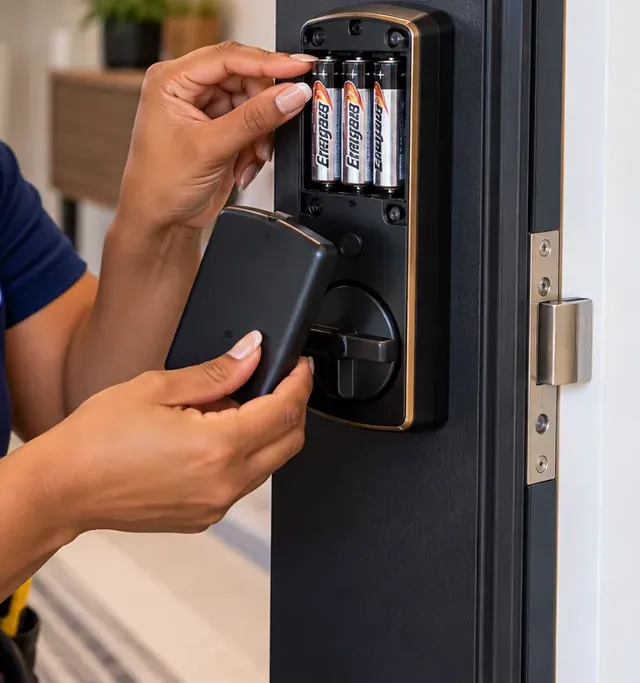
The interior cover is lifted off and a hand slides out the battery pack of a smart deadbolt mounted on a dark door.
Astoria Smart Locks From a Licensed, Insured Installer
Astoria customers call (347) 434-6392 or message WhatsApp (718) 679-0359 through wa.me. Abstract Enterprises Security Systems, 460 E Fordham Rd, Bronx, NY 10458.
NYS Low-Voltage Licence #12000287431 · 100% Licensed & Insured · Same-Day Estimates · Rated 4.7★ from 201 Google Reviews
Locks you supply carry their manufacturer’s warranty. Full terms — including 50% deposit, one-year parts-only warranty on AESS-supplied products, and the late-fee schedule — are set out in the service agreement. See our warranty page.
This page explains how leases, roommate law, building type and Astoria’s housing stock affect smart lock installation; it is not legal advice. Page reviewed and updated October 17, 2026. Changelog: first publication of the Astoria smart lock installation page.