Licensed Low-Voltage Installer · Ditmars to Halletts Point · Two-Families, Walk-Ups & Towers
Soundbar Installation in Astoria, Queens
Renter-Friendly Mounts · Brick & Plaster Anchoring · Tidy Cable Runs · eARC One-Remote Setup · Sound Set for the 31st Street El
Most Astoria living rooms belong to somebody else. Fewer than one household in five owns its home here, so the soundbar usually goes up on a wall in a two-family house whose owner lives downstairs, in a pre-war walk-up, or in one of the new rental towers by the river. We plan the job around that: what the lease and the owner allow, what the wall is made of, who lives above and below, and how loud the street or the N and W trains are outside the window. Then we mount it, hide or tidy every lead, make the TV remote run the volume, and leave it set for the people who actually watch.
Reviewed and updated October 17, 2026 · Written by Anwar Timothy, NYS low-voltage license #12000287431 · Prices follow the Queens list
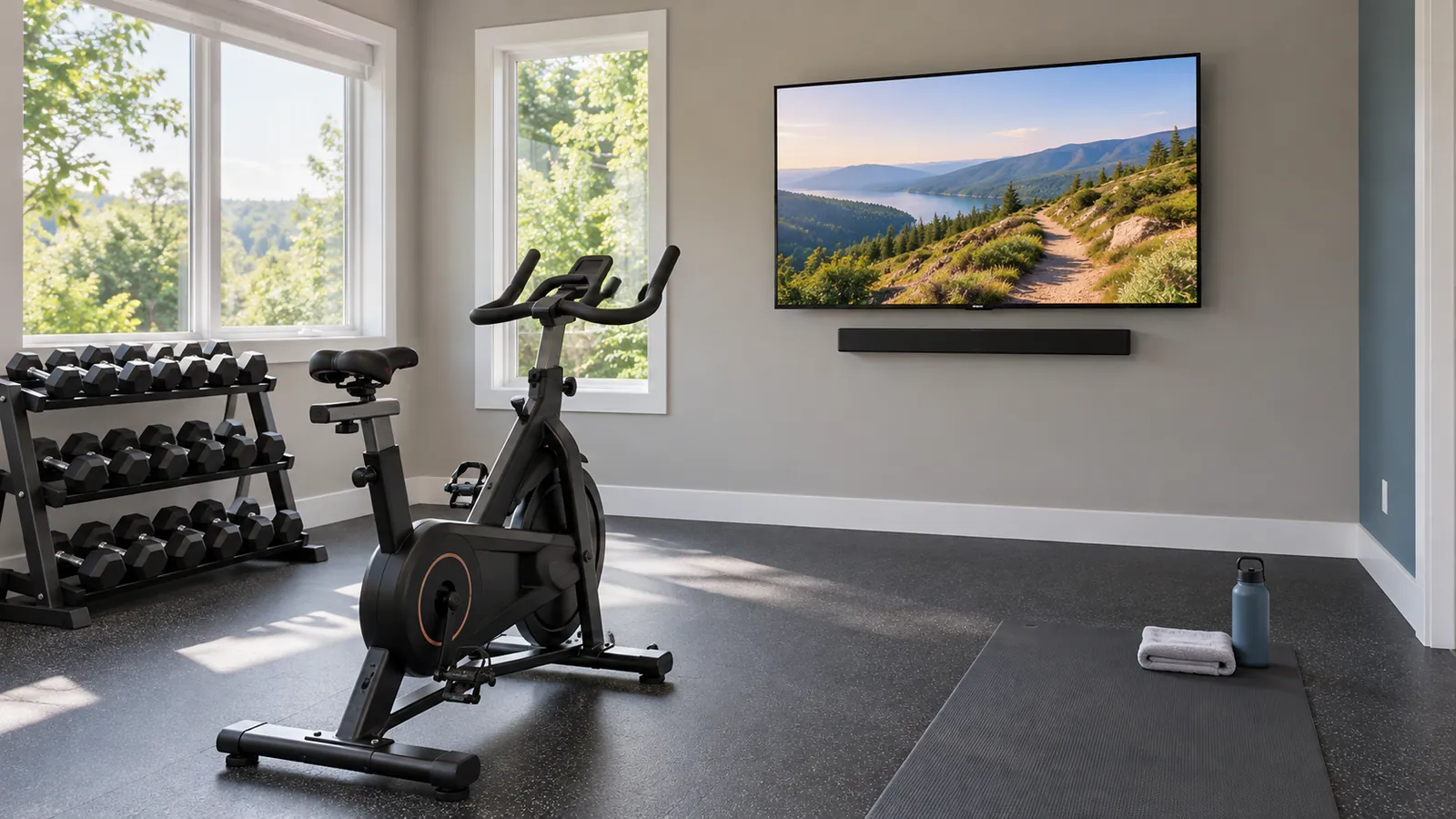
A spare room turned home gym: the soundbar sits on the wall a hand-width under the TV, so the screen and the sound both face the bike.
Astoria Soundbar Quote
Tell us the bar, the wall and the block — a written Queens-rate price the same business day
✅
Got It — Thank You
Someone who installs in Astoria will phone you back before the business day is out.
25+
Years Experience
✓
Same-Day Estimates
100%
Licensed & Insured
4.7★
201 Google Reviews
Moving into a new Astoria apartment, or finally getting the TV corner sorted? Ring (347) 434-6392 or fill in the one-minute form with the bar's model and a phone photo of the wall and the nearest outlet. A licensed installer, not a call script, reads it and sends back a written total built line by line from the Queens price list further down this page.
No-drill console setup $82.95; bracketed wall mount $135.45 on the Queens list
Landlord, co-op or managing-agent insurance paperwork sent free
NYS low-voltage license 12000287431 · 2-hour arrival windows, 8 AM to 8 PM, seven days
In Astoria, the first question about a soundbar is rarely technical. It is whose wall it is. The NYU Furman Center puts the homeownership rate in the Astoria community district at 18.5 percent in 2024, against 32.7 percent for the city as a whole. That leaves four households in five renting: a floor of a two-family house on a side street off Ditmars Boulevard, a one-bedroom in a pre-war walk-up near Broadway, a share with roommates near 30th Avenue, or a new unit in one of the rental buildings that have gone up since 2010. A renter can't treat the living-room wall the way an owner can. A bracket, four anchors and a cable route all need the lease, the landlord or the managing agent on side, and they need to come out cleanly when the lease ends.
The second question is what runs past the window. The Astoria Line opened in 1917 and is elevated for its whole length, carrying the N and W along 31st Street to the last stop at Ditmars Boulevard. People who live beside it are blunt about it. In one r/astoria thread about apartments on 31st Street, a reply warned that “you will not be able to hear your TV when the train goes by”; in another, a tenant on the third floor near Broadway listed double-paned glass and sound panels as the things that made it livable. Away from the el, the same threads point out, the back of a building or a window facing away from the tracks can make a real difference. For a soundbar, that turns into practical decisions: which room the TV lives in, which wall faces the seats, and how the bar is set so voices hold up when a train passes.
The third question is who is on the other side of the floor. Most Astoria houses hold more than one household. In 2025 the Furman Center counted 204 sales of two- to four-family buildings in the district against 47 sales of one-family houses, which tells you what the side streets are made of. In those houses the downstairs owner hears whatever the upstairs subwoofer does, and residents say so. A commenter in an r/astoria thread on noisy apartments said that in the older houses “you can hear a lot. Not conversations, but footsteps, any loud noises”, and the standard advice in a thread about a neighbor's constant bass was to talk to the person first and then go to the landlord. When the landlord lives downstairs, that conversation is a short walk away. A well-installed bar keeps it from ever starting.
The fourth is the sheer range of buildings packed into one neighborhood. Within a mile you can go from the company-town blocks Steinway & Sons helped build in the nineteenth century, through brick two-families and pre-war walk-ups, to the 22 mid-century buildings of the Astoria Houses on the Halletts Point peninsula and the glass towers rising beside them. Each one needs a different anchor, a different cable plan and a different conversation with whoever manages it. A bar that sits perfectly on a plaster wall in a Ditmars walk-up would be on the wrong fasteners entirely in a steel-stud partition at Halletts Point.
And then there is who lives here. More than a third of Astoria households are one person living alone — 38.5 percent in the Furman figures — and a great many of the rest are roommates sharing a living room, young couples, or families who have been in the same two-family for decades. That spread means very different briefs: a solo renter who wants the cleanest possible setup with no damage at move-out, three roommates who each want to cast music from their phones, a family that wants one remote and clear dialogue at a modest volume. A good installation in Astoria starts by finding out which of those you are.
Astoria figures that shape a soundbar visit
18.5 percent homeownership in the Astoria community district in 2024, compared with 32.7 percent citywide (NYU Furman Center neighborhood profile). Most soundbar jobs here start with landlord or management permission.
198,608 residents in about 99,800 housing units, with 38.5 percent of households made up of a single person (Furman Center, 2024). Many TV corners are in small one-bedrooms and shared apartments.
15,142 new homes in buildings of four or more units were added between 2010 and 2025, 82 percent of them market-rate (Furman Center). That is the source of the concrete-and-steel-stud walls we now meet as often as old plaster.
7,584 public-housing apartments in 12 properties make up 9.4 percent of the district's rental units (Furman Center, 2025), including the Astoria Houses — 1,103 apartments in 22 buildings on a 27-acre site, completed in 1951 (NYC Planning, Halletts Point environmental review).
1917 is the year the elevated Astoria Line opened along 31st Street to Ditmars Boulevard; it is still entirely elevated (nycsubway.org). Apartments with front windows on 31st Street live with the trains at window height.
$2,160 median monthly rent across the district in 2024 and a 3.4 percent rental vacancy rate (Furman Center). Tenants tend to stay put once they have a place, which is why a careful, reversible install is worth the trouble.
Taken together, those figures describe a neighborhood of renters in small multi-family buildings, with trains overhead on one avenue, a waterfront of brand-new towers on another, and tight living rooms shared by people who don't always watch the same thing. A soundbar visit in Astoria has to suit all of that before it suits the bar.
Astoria renters who book a soundbar often get the TV hung or moved at the same appointment, so one bracket plan and one cable route cover both. Our TV installation team for Queens handles the screen, and where a household wants more than a bar — separate rear speakers, a receiver, a second room — AV and sound installation across Queens takes the bigger job.
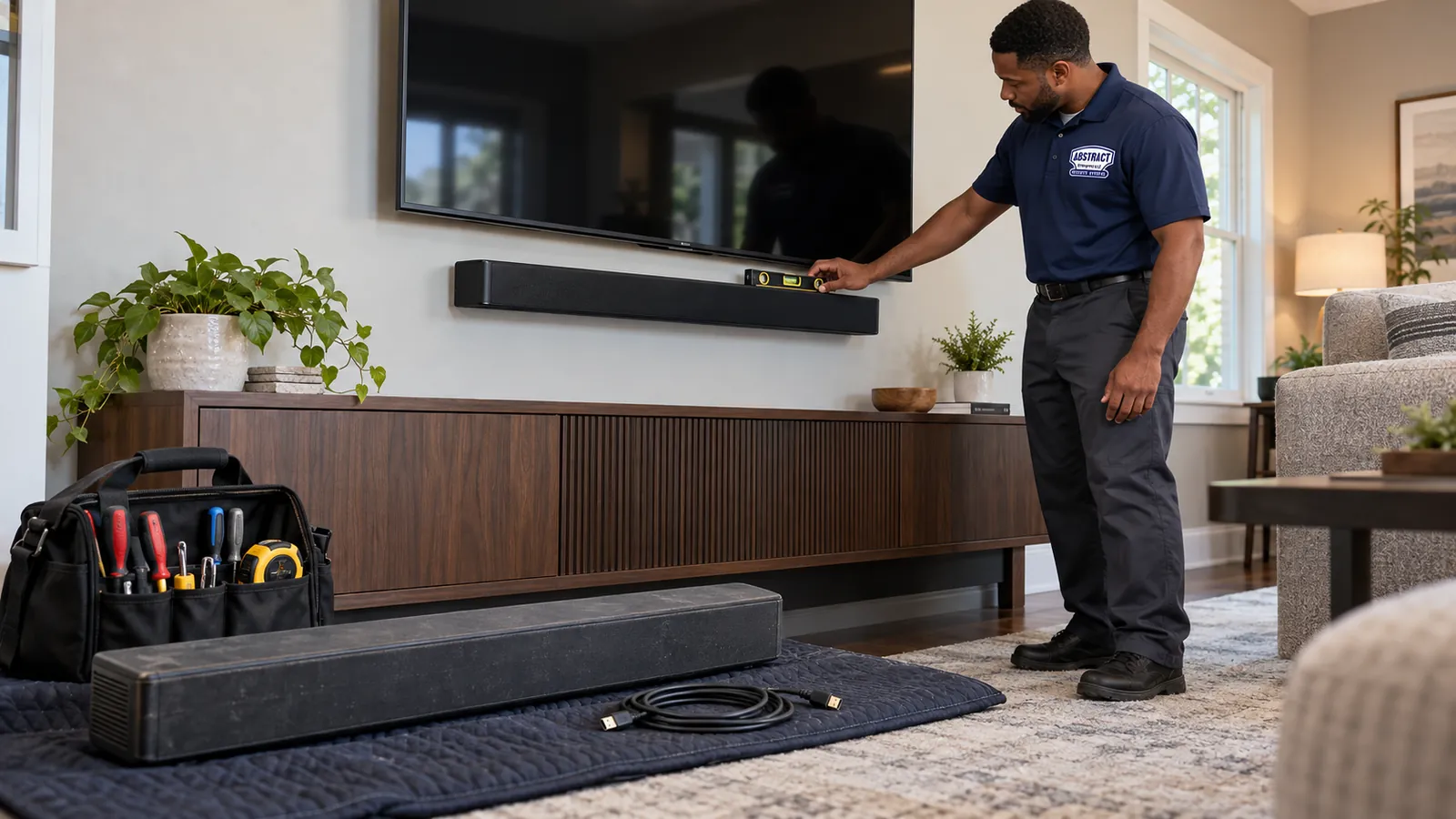
A final level check on the bar after hanging, with the tool bag, an HDMI lead and a spare bar kept on a blanket off the floor.
Repair Capture
Soundbar Repair Visits in Astoria
Some calls are about a bar that already exists. The TV pushed an update overnight and the bar fell silent; the remote has stopped raising the volume; mouths move before the words arrive; the wireless sub is blinking and won't find its partner; the bracket is leaning a little further out of an old plaster wall each month. We book those into the first free 2-hour window, frequently the same day, and once a technician is in the room most of them are sorted inside an hour or two. Dial (347) 434-6392, say the problem is with the soundbar, and give us both model numbers so the van carries the right leads. When nothing gets mounted, the time is billed as described in our TV and soundbar service policies.
What We Install
Soundbar Installation Services in Astoria
Eight kinds of job cover nearly every Astoria call. Most visits combine two or three of them. Each is a line on the Queens price list, and none is finished until the bar is level, centered under the screen, connected so the TV remote works it, and checked from the seat where you actually watch.
No-Drill Console Setup
The bar placed on the media unit in front of the TV, connected on eARC or ARC, clear of the infrared sensor, with cables tied behind the furniture. The first choice for short leases and for owners who would rather not have holes in a freshly painted wall.
Wall Mount Under the Screen
A bracket fixed a few inches below the TV on anchors chosen for the actual wall: masonry sleeves for brick, toggles for plaster on lath, steel-stud fasteners in newer partitions. Four holes, placed where they can be filled and painted later.
Bar Carried on the TV Mount
A bracket that attaches the soundbar to the television or its arm, so the wall gets no extra holes and the pair move together. Handy in rentals where the landlord already approved the TV mount and nothing more.
Screen and Bar in One Visit
TV and soundbar hung as a pair, with one decision about height, one gap between them and one cable route down to the outlet. The usual booking when someone has just moved into an Astoria apartment.
Cable Finish That Comes Off Cleanly
A slim paintable raceway from the bar to the outlet or console, screwed rather than glued where wallpaper or old paint would lift. Where the wall is hollow and the owner agrees, an in-wall power and cable kit instead.
One-Remote Connection
HDMI eARC or ARC with CEC switched on, so the TV remote powers the bar and sets its volume. Cable box, streaming stick and any second box wired into the TV so every source plays through the bar.
Settings for Trains and Neighbors
Speech enhancement, night mode and volume leveling tried with you on a real scene; subwoofer level set for the floor below, not for the showroom. Captions shown on every remote in the house.
Moves, Swaps and Take-Downs
Taking a bar and bracket down at the end of a lease, moving it to the next apartment, swapping an old bar for a new one on the same wall, or adding a wireless sub and rears to a bar that is already up.
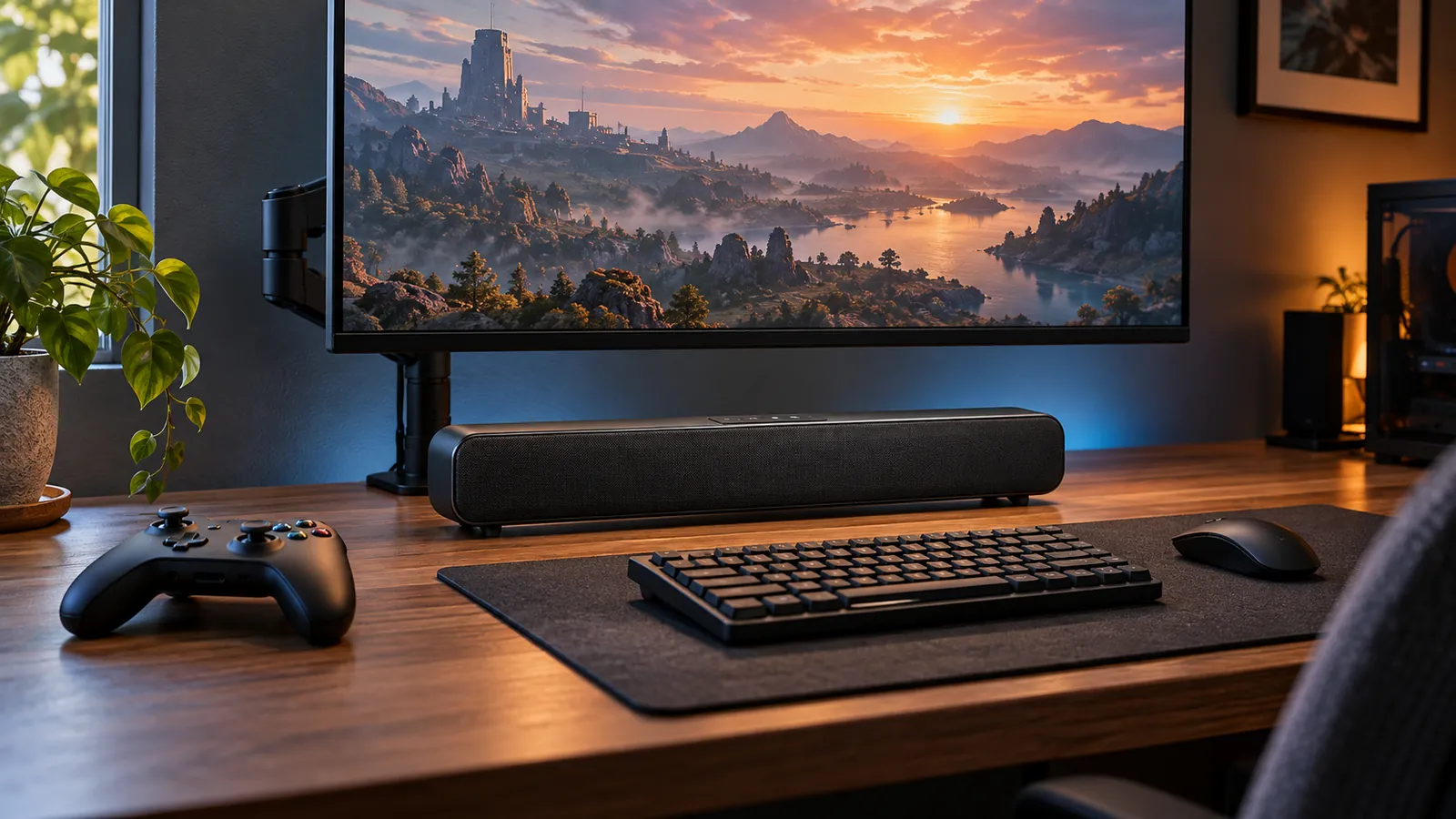
Studio-apartment scale: a short bar on a desk under an arm-mounted monitor, wired in the same tidy way as a living-room job.
Building Specialists
Soundbar Installation for Astoria's Architecture
The bar barely changes from job to job. The building changes everything. These six kinds of Astoria home account for almost every visit we make in the neighborhood, and each one asks for a different fixing, a different cable plan and a different set of permissions.
Brick Two-Family Houses
The side streets between Ditmars Boulevard and Broadway are lined with attached and semi-attached brick houses, many split into an owner's floor and a rented floor. Early marketing for the area advertised whole rows of 20-foot brick houses on Ditmars Avenue. Expect plaster over brick on the party walls and a household right below.
Frame and Sided Houses
Older wood-frame houses, some covered in later siding, scattered among the brick on Astoria's side streets. Interior walls are usually studs with plaster or drywall, which makes them the friendliest walls in the neighborhood for hidden cabling — if the owner agrees.
Pre-War Walk-Ups
Pre-war apartment buildings, some of them now co-ops, on the avenues and the blocks between them. Plaster on lath or block, steam heat, fire-escape windows on the street or rear wall, stairs instead of an elevator, and a superintendent or managing agent to ask first.
The Astoria Houses
NYCHA's campus on the Halletts Point peninsula: 1,103 apartments in 22 buildings, completed in 1951. Masonry walls that need a hammer drill, and the authority's own house rules about alterations, which we ask residents to check before booking.
Halletts Point and the New Rentals
The Durst Organization's three-tower campus by the river, with more than 1,000 rental apartments, plus the mid-rise rentals built across the district since 2010. Concrete floors, steel-stud partitions, big windows, and managing agents who want insurance paperwork first.
Shops With an Apartment Above
Ground-floor stores on Steinway Street, 30th Avenue and Broadway, with one or two floors of apartments over them. A TV in the shop and a family overhead means the bar is set for the counter and kept off the ceiling joists.
How the fixing changes from one Astoria wall to the next
Plaster over brick in a two-family. The finish is a thin layer; the strength is the brick behind it. A small pilot hole tells us how deep the plaster is and what color the dust comes out, then masonry sleeve anchors go into the face of the brick rather than the mortar joint wherever the bracket spacing allows. Old Queens brick varies course to course, so each hole is drilled slowly and each anchor is tested before the bracket takes weight. There is no cavity to fish a wire through, so the cable route is a painted raceway or a path down behind the TV to the console. Because the wall is often shared with the next house, we keep the subwoofer off it.
Studs behind plaster or drywall in a frame house. The easiest mount in the neighborhood and the only common wall where in-wall cabling is straightforward. We scan for studs, confirm a doubtful reading with a test hole hidden behind where the TV will hang, and screw into wood. Before cutting any opening for an in-wall kit we check the bay for the upstairs unit's pipes and wiring, which in a converted two-family can run where you would not expect.
Plaster on lath in a walk-up. Solid when it is still keyed to the lath, fragile when it has let go. We press and tap the area first, drill without hammer action, and either catch the framing or use toggles that spread the load behind the plaster. If the wall sounds hollow and loose over a wide area, we say so and suggest the TV-mounted bracket or the console instead of risking a crack across a landlord's wall.
Masonry block and poured concrete in NYCHA and other mid-century buildings. These walls take a rotary hammer and a carbide masonry bit, and we hold a vacuum nozzle under every hole so the dust never reaches the floor. Wedge or sleeve anchors give the strongest hold of any wall in Astoria. The trade-off is noise, so drilling is scheduled inside the building's permitted hours and done in one short burst rather than spread across the visit. Leads either run in surface raceway or drop straight down behind the screen to the furniture.
Light-gauge steel framing at Halletts Point and in the newer rentals. The wood screws packed with most soundbar brackets are useless in a steel stud. We locate the flanges with a magnet or scanner, then use self-drilling steel-stud screws or a toggle rated for the bar's weight. If management asks contractors to leave the wall shared with the next unit alone, we respect it and pick another wall. Hollow steel partitions are usually good candidates for an in-wall power and cable kit, as long as the building signs off.
Ceramic tile, exposed brick and stone. A kitchen backsplash, a renovated accent wall, a stone-faced fireplace surround. Slow carbide or diamond bits with the hammer off, painter's tape on the surface, and a clear warning beforehand that glazed tile can still crack.
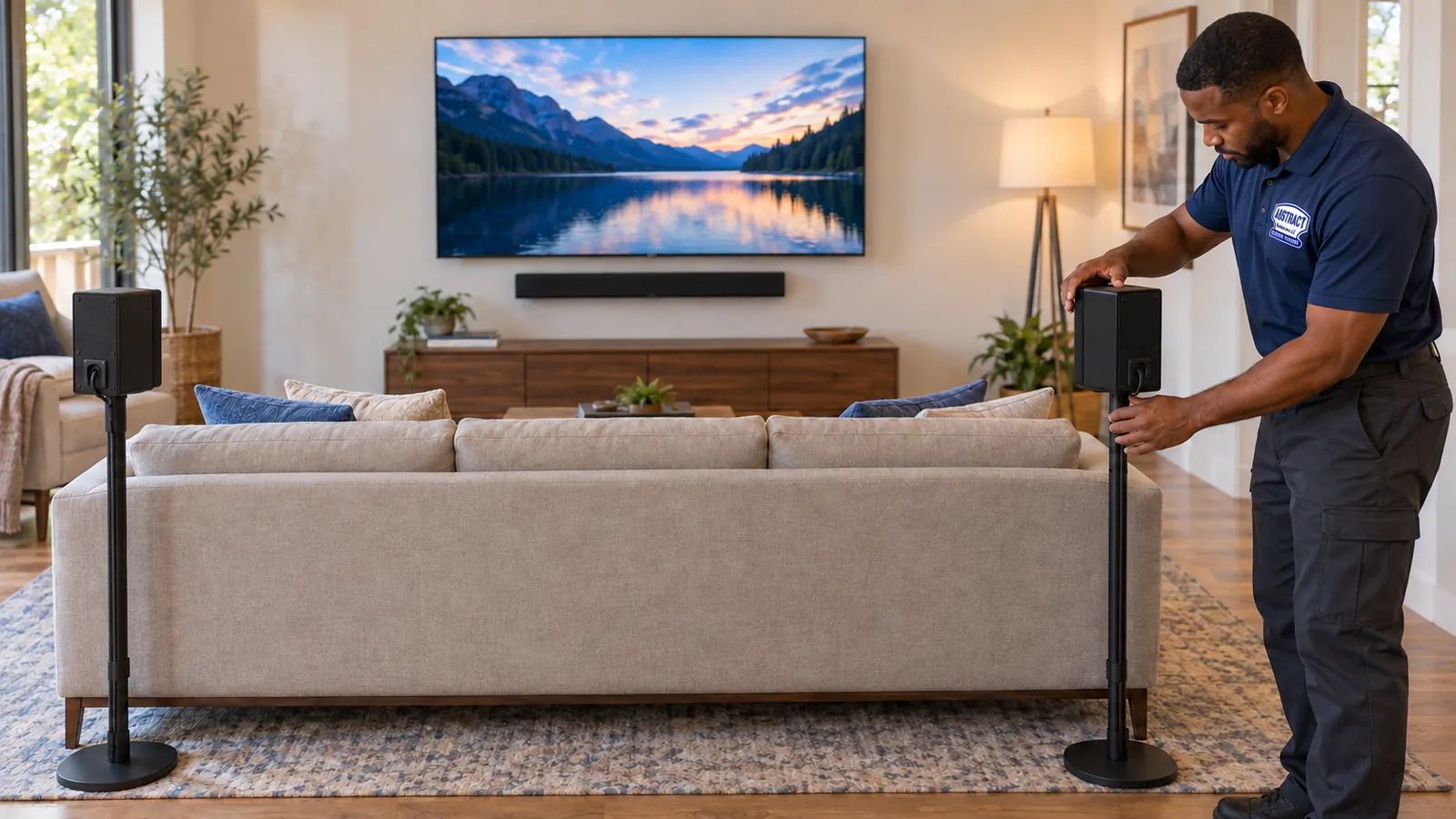
Surround add-ons: a technician sets the height of a speaker stand at the right-hand end of the sofa, its twin already placed on the left, the wall TV and soundbar opposite.
Tenants in older Astoria buildings often ask whether the streaming box and the bar could be wired to the router instead of fighting the neighbors' Wi-Fi. When the router sits in the same room, our Queens structured cabling crew can add a network run to the TV wall during the same appointment.
Commercial Soundbar Installation
Business Soundbar Installation in Astoria
Astoria's shopping streets are full of screens that people can see but not quite hear. A soundbar under a café TV or a waiting-room display is the cheapest way to make it intelligible at the counter without running a whole speaker system through the ceiling. These are the corridors we work along and what each kind of business usually asks for.
Steinway Street
The neighborhood's long retail spine, named after the piano maker and served by its own business improvement district, the Steinway Astoria Partnership. Part of it is known as Little Egypt for its Egyptian and Arab-owned cafés, bakeries and shops, where a screen with a match or the news is often on all day.
30th Avenue
Restaurants, bakeries, barbers and salons from 21st Street toward Steinway. Small rooms with hard floors and big windows; a bar set for clarity at a modest level beats a big one turned up against the room.
Broadway
Shops, bars and service businesses from the waterfront end to the el at 31st Street. Long, narrow storefronts where one bar under one screen usually covers the front half of the room.
Ditmars Boulevard
The northern strip around the last stop of the N and W, with restaurants and cafés serving Astoria Park traffic in summer. Screens over a bar or counter, often with apartments directly overhead.
31st Street Under the El
Storefronts beneath the elevated tracks from Ditmars down to Queens Plaza's direction. Train noise arrives every few minutes, so bars are aimed at the seats and leveled against the trains, not set to a fixed number.
Around the Studios on 35th Avenue
Kaufman Astoria Studios has worked out of the old Paramount plant at 35th Avenue and 35th Street since the 1980s, beside the Museum of the Moving Image. Offices and small businesses on the surrounding blocks use meeting-room displays where clear speech on video calls matters more than bass.
Rules that apply to business soundbars in Astoria
Neighbors overhead. Under the Department of Environmental Protection's summary of the city noise code, music from a business may not exceed 42 decibels inside a nearby residence, and from 10 PM to 7 AM it may not run more than 7 decibels above the street's ambient level measured 15 feet out; pervasive bass has its own limit. With apartments above nearly every Astoria storefront, we set the bar and any sub for the people living over the shop.
Clinic and office corridors. A bar on its bracket can stand out from the wall further than the 4 inches the 2010 ADA Standards allow for anything mounted with its lower edge between 27 and 80 inches off the floor along a route people walk. In a dentist's hallway on Broadway or a narrow shop, we raise it above that band, set it in a recess or put it where nobody passes.
Keep egress clear. In walk-up buildings with a shop below, fire-escape windows and exit routes must stay unobstructed under the city's fire code. Nothing we mount goes in front of them.
Receptacles belong to electricians. Hooking up a soundbar is low-voltage work and needs no separate filing from us, but a new or relocated outlet is electrical work, which a licensed electrician must do. We plan around the receptacles already in the room and tell you up front if one more is needed.
Proof of insurance for the landlord. Commercial landlords and their agents usually want a contractor's certificate of insurance on file before work starts. Ours is free and names whoever your lease requires.
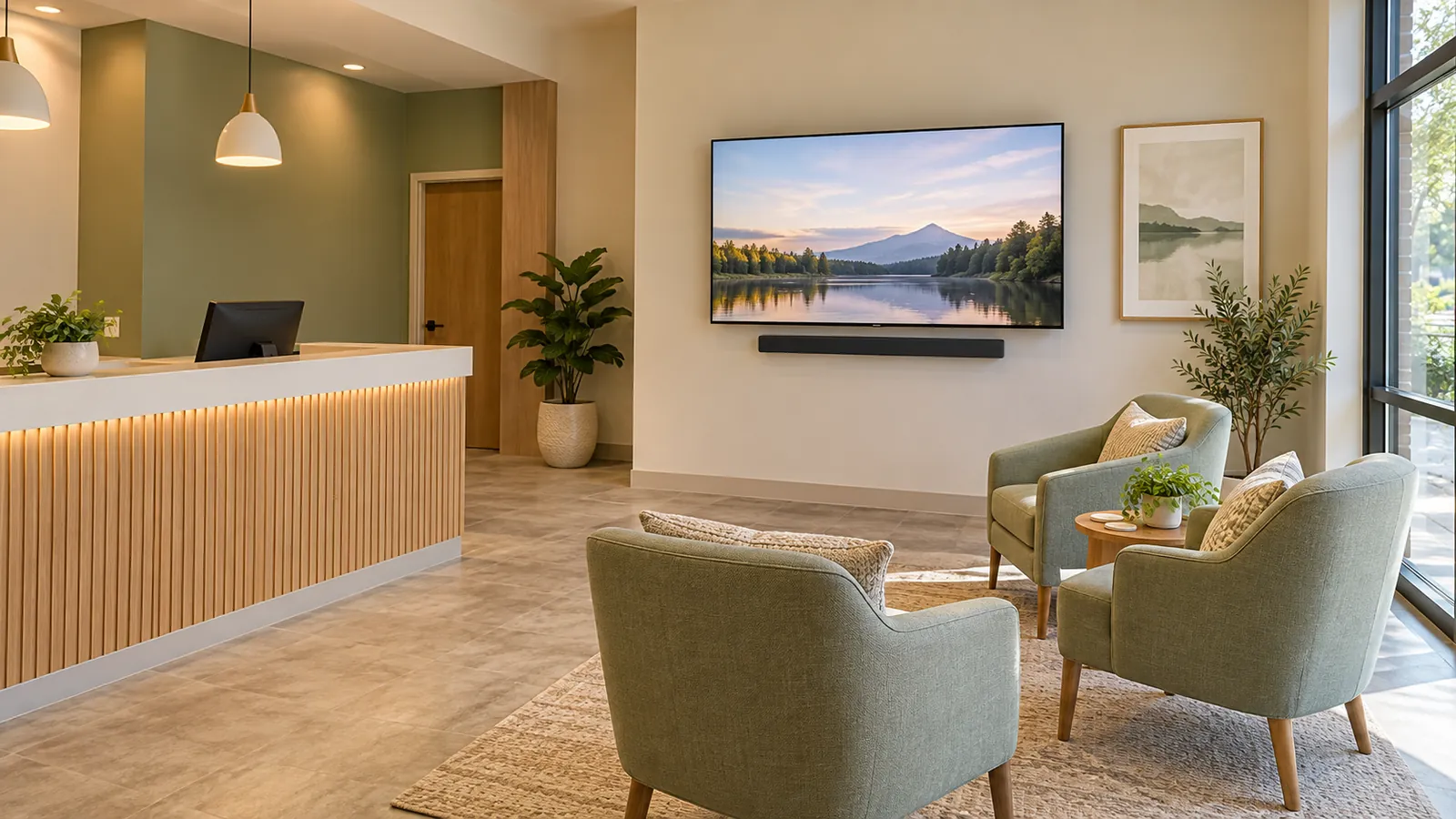
A reception and waiting area: the bar is fixed close under the screen so speech carries to the chairs without being turned up.
A café or salon that books us for TV sound frequently adds the register camera or the back-room Wi-Fi before we leave. Through AESS low-voltage installation in Queens, the audio, data and security wiring are handled by one licensed crew, often on the same trip.
Your Questions Answered
Soundbar Installation in Astoria: Questions Answered
These are the questions Astoria tenants, owners and shopkeepers put to us before a soundbar goes up, grouped by the situation behind them: short leases and shared apartments, the layout of older buildings near the el, the wiring in pre-war houses, newer buildings, households that watch from more than one source, and small businesses. Booking, cost and care questions are in the FAQ near the end.
Leases, roommates and other people's walls
We're on a one-year lease in Astoria — is wall-mounting the soundbar worth it, or should it stay on the console?
It depends on three things: how the TV itself is set up, what the landlord has agreed to, and how much the console arrangement actually costs you in sound. If the TV is on its stand and the furniture in front of it is low and deep enough, the console is a perfectly good home for a soundbar. On our Queens list it is the cheaper line ($82.95 against $135.45 for a wall mount), nothing gets drilled, and when the lease ends the bar goes in a box. The things to check are that the bar doesn't block the TV's infrared sensor or the bottom of the picture, and that the front of the bar isn't recessed behind the edge of a shelf, which muffles the speech drivers.
Wall-mounting starts to pay off when the TV is already on the wall, because a bar left on furniture two feet below a hung screen sends voices from the wrong place, and when there is no furniture under the TV at all. In that case, if the landlord has approved the TV mount, the least invasive option is often a bracket that hangs the bar from the TV or its mount, which adds no holes to the wall. If the bar goes on the wall, four small anchor holes in plaster or drywall fill in minutes at move-out; in brick, we place them in the face of the brick so a patch blends in. Either way, ask the landlord before booking, keep the text or email that says yes, and keep the bracket hardware bag for the day you take it down.
Three of us share the apartment and the soundbar belongs to one roommate — how is it set up for everyone, and what happens when that roommate moves out?
For day-to-day use, the aim is that nobody needs the owner's phone to watch TV. We connect the bar to the TV over HDMI eARC or ARC with CEC switched on, so the TV remote turns it on and sets the volume; that part works for everyone without any app. If the bar supports Wi-Fi casting, we set it up on the apartment's shared network rather than the owner's phone hotspot, and show each roommate how to cast from their own phone. Where the bar is Bluetooth-only, we explain that it pairs with a limited number of devices and that pairing a new phone sometimes drops an old one, so the household knows what to expect.
Moving out is simpler if it is planned on day one. We note on the setup sheet which parts belong to whom — the bar, the bracket, any raceway — and keep the bracket's hardware bag with the bar's box. When the owner leaves, the bar lifts off its bracket in seconds, and the bracket comes down with a screwdriver. The holes then need filling, which is decorating work, not ours. If the roommates staying behind want to keep a bar on that wall, it is usually cheaper to leave the bracket in place and have us fit a new bar to it than to start again, provided the new bar's mounting points match.
Layouts and walls in older Astoria buildings
Our railroad apartment runs front to back with the el outside the front windows — which room should be the TV room, and which wall in it?
If you have the choice, the room furthest from the tracks. Tenants on 31st Street say it plainly on r/astoria: one wrote that their apartment at the back of the building is “so much quieter than the ones that have windows facing the train”, and another found that a unit facing away from the el “made a difference”. In a railroad layout the middle room is often the one people choose for the TV, because it is furthest from both the front windows and the back bedroom, and it usually has the longest uninterrupted wall. The catch is that middle rooms in railroad apartments are often pass-throughs with doorways at each end, so the TV wall is the side wall between them.
Within that room, the TV wall should face the seats with the noisiest window behind or beside the viewer rather than behind the screen, so that dialogue and trains don't arrive from the same direction. Then the soundbar goes close under the screen at roughly seated ear height, with its speech or dialogue setting on and the subwoofer kept modest — turning the bass up to fight a passing train mostly makes speech harder to follow and carries through the floor. Because sound travels freely along a railroad apartment from one open doorway to the next, night mode is worth setting on day one if someone sleeps at the far end. We look at the doorways, the outlets and the radiator positions on site before settling the wall.
The longest wall in our walk-up has the fire-escape window in it — can the TV and soundbar go beside it?
Beside it, yes, as long as nothing we install narrows the way to that window. New York City's fire code requires that windows leading to a fire escape stay clear — it specifically bars air conditioners in those windows from obstructing the path of egress — and FDNY safety guidance tells residents to keep the fire-escape window clear. A TV and soundbar on the wall next to the window are not a problem in themselves. What matters is that the furniture under them, the cable route and the sofa placement still leave an open, direct path to the window, and that no cord or raceway crosses the sill or the floor in front of it.
In practice we keep the TV and bar far enough along the wall that a media console doesn't creep into the approach, run the cables down the side of the TV furthest from the window, and keep the power strip off the floor on that side. If the wall is so short that a TV of the size you want can only go right next to the frame, we suggest a smaller screen, the opposite wall, or a floor stand that can be moved. Leases in walk-ups usually repeat the fire-escape rule, so the landlord will be glad to hear it was planned for.
In summer the window air conditioner and the TV share a circuit and the breaker trips — will adding a soundbar make that worse?
Only slightly, and it is not the real cause. A window air conditioner is by far the largest load in most living rooms, especially at the moment its compressor starts, and older Astoria apartments often have a single circuit feeding several rooms' outlets. A typical soundbar draws a modest amount of power while playing and very little on standby, so it adds a little to the load but is rarely what pushes the breaker over. The trip usually happens when the AC starts while everything else on that circuit is already running.
What we can do is plug the bar, the TV and the boxes into one good surge-protected strip on the outlet that is not shared with the AC wherever the room has one, keep that strip off the floor, and check that nothing is daisy-chained. What we can't do is fix the circuit itself: a dedicated outlet for the air conditioner, or rebalancing what the circuit feeds, is a job for a licensed electrician, arranged through the landlord in a rental. If a breaker trips often or an outlet feels warm, tell the landlord before adding anything to it.
New buildings by the river and across the district
Our new Astoria building put a recessed box and an outlet behind where the TV goes — can the soundbar use them?
Usually, and it is the neatest setup you can get. Many newer apartments are built with a recessed TV box: a shallow enclosure set into the wall at TV height with a power outlet and sometimes a low-voltage plate inside, so the plugs sit behind the screen instead of sticking out of it. The TV plugs in there; the question is the soundbar. If the bar sits a few inches below the TV, its power cord and HDMI lead can often run up into the same box out of sight, since the TV hides most of the opening. We check whether the box has a spare outlet or space for a short, rated power strip, and whether its low-voltage side connects to a matching plate lower down by the console.
If the box has a low-voltage pass-through to a second plate near the floor, the cable box or game console can live in the console and send HDMI up inside the wall, which is the cleanest arrangement of all. If it doesn't, the short cable from the bar to the box is the only one that shows, and a small paintable cover tidies it. We don't open new walls in a managed building without written approval, but using the box the builder already provided normally needs nothing more than the usual insurance certificate.
Households that watch from more than one source
We get overseas channels through a separate internet TV box as well as cable — where do both plug in so either one plays through the soundbar?
Both go into the TV, and the TV sends the sound to the bar. Plenty of Astoria households keep a second box for channels from home — around the stretch of Steinway Street known as Little Egypt, among many other parts of the neighborhood — alongside a cable box or streaming stick. Each box plugs into its own HDMI input on the television; the soundbar connects to the TV's one HDMI port marked eARC or ARC. Whichever input is chosen on the TV, its sound comes out of the bar, and the TV remote keeps control of the volume. We avoid plugging one of the boxes straight into the soundbar's own HDMI input, because then the TV has to switch through the bar and things tend to go wrong when someone changes channels.
Two details matter with international boxes. Some older ones only have a composite or optical audio output, or send a sound format the TV won't pass on; we check the box's outputs before the visit and set the TV's audio output to a format the bar accepts. And if the household uses both boxes every day, we rename the TV inputs to say what they are and set the TV to switch inputs from the box's own remote where the equipment supports it, so the person watching never has to hunt through a menu to get sound back.
I edit video at home — can the soundbar be set to sound accurate instead of “movie” mode?
Within limits, yes. Astoria has been a film and television neighborhood since Paramount opened its studio on 35th Avenue in 1920, and plenty of people who work in the trade watch cuts at home. Most soundbars ship in a processed mode that widens the stereo image, lifts the bass and brightens speech, which is pleasant for a film night and misleading for judging a mix. We look for the bar's pure, direct or standard mode, turn off virtual surround, dialogue lifts and night compression, set the bass and treble trims to zero, and switch off automatic room correction if it was tuned for the sofa rather than your desk chair.
Even then, a soundbar is a compromise for critical listening: its speakers sit close together, the cabinet is small, and the wall behind it colors the low end. For real mix decisions a pair of nearfield monitors or good headphones remains the reference. What we can do is make the bar honest enough that a cut sounds roughly as it will elsewhere, store your normal TV settings in a preset or app profile where the bar offers one, and show you how to switch between the two.
Small businesses on the avenues
Our 30th Avenue barbershop already plays music from a Bluetooth speaker — can the TV's soundbar take over both jobs?
Often it can, and it removes a speaker and a charger from the counter. Most soundbars accept Bluetooth or Wi-Fi streaming as well as TV sound, so the shop phone or a tablet can play the music playlist through the bar while the TV is off or muted, and the bar switches back to TV audio when a match comes on. We set it up so the input changes the way the staff expect — some bars switch automatically when the TV turns on, others need a button — and turn off pairing for unknown devices so a customer's phone can't take over.
Where it doesn't work as well is coverage. One soundbar under a TV at one end of a long, narrow shop sounds fine at the chairs near it and thin at the door. If the music needs to reach the whole room evenly, a pair of small wall or ceiling speakers on an amplifier does that job better, with the soundbar left for the TV. We look at the length of the room and where the apartments above sit before recommending either, and we set levels with the upstairs tenants in mind.
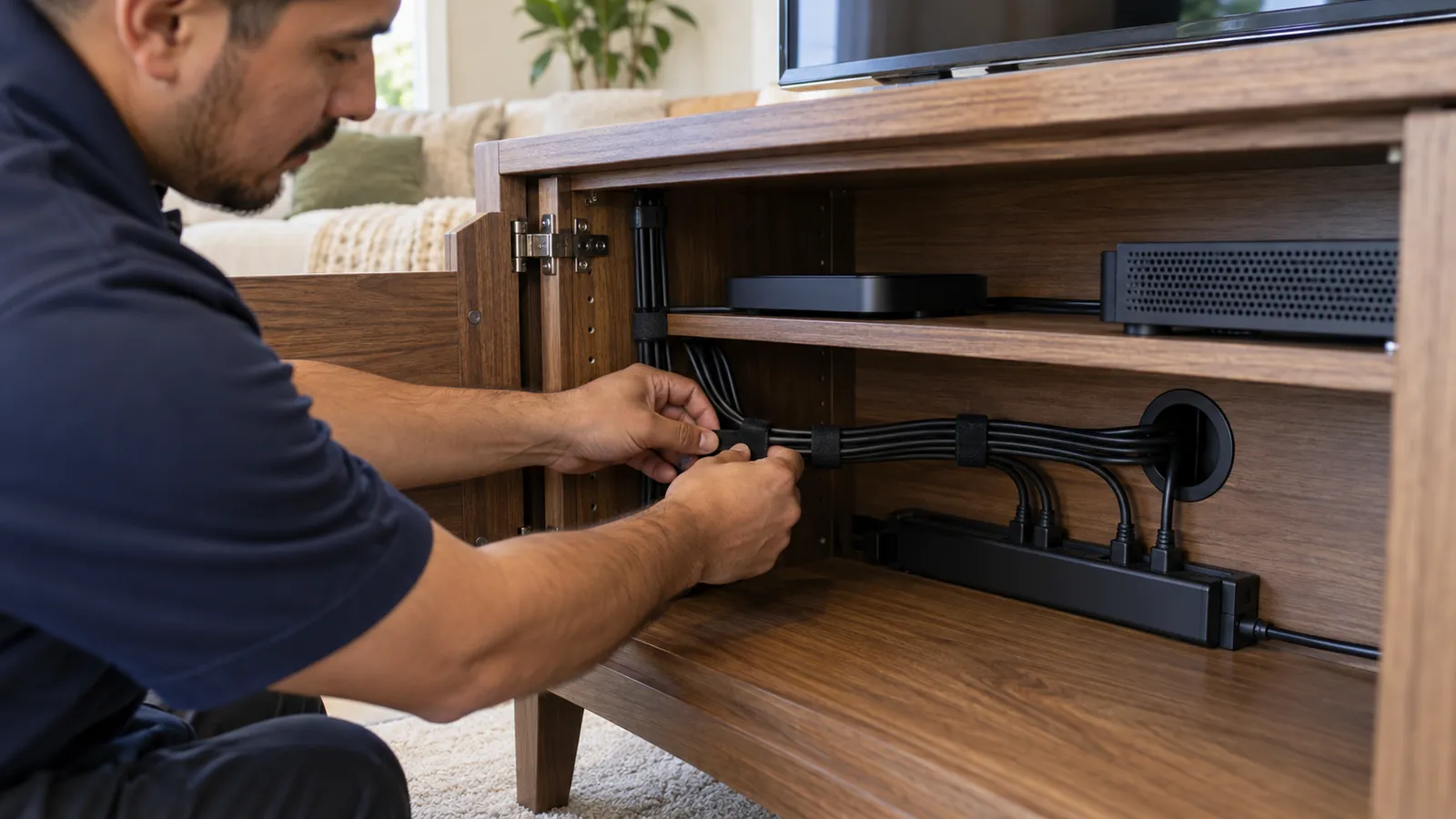
A tidy console is half of a tidy wall: the TV, box and bar leads are strapped together on the cabinet side and dropped through one grommet to the strip.
Astoria Lease Checklist
Matching the Soundbar Setup to Your Astoria Lease and Building
On the phone, we start with four facts: who owns the wall, what it is made of, who lives above and below, and what is outside the window. The table is the shortcut we use to land on a method and a cable finish before anyone visits; the visit then confirms it.
Your situation
Who needs to say yes
Usual mount
Usual cable finish
Sound setting to start with
Renting the top floor of a two-family, owner downstairs
The owner, in writing
Wall bracket into brick or studs, or bar on the TV mount
Screwed paintable raceway
Sub low and on a pad; night mode ready
Owner's floor of your own two-family
You (and your tenant's peace)
Wall bracket
In-wall kit where the bay is clear
Sub away from the tenant's bedroom
Walk-up apartment on or near 31st Street
Landlord or managing agent
Toggles into plaster, or fixings into brick
Raceway or down behind the TV
Speech mode on; TV wall away from the el windows
Short lease or furnished sublet
Landlord, if drilling at all
Console or TV-attached bracket
Tied behind furniture
Factory settings plus speech mode
Shared apartment with roommates
Landlord; agree ownership between you
Whatever the lease allows
Removable raceway
CEC on so any remote works; casting on shared Wi-Fi
NYCHA apartment
Check the development's alteration rules first
Concrete anchors or console
Surface raceway
Modest volume for thin doors and hallways
New rental tower or mid-rise
Managing agent; insurance certificate
Steel-stud fasteners or recessed-box layout
In-wall where allowed, or the builder's TV box
Check reflections from large windows
Shop with apartments above
Commercial landlord; certificate on file
Wall bracket out of customers' reach
Raceway to the counter
Levels set for the tenants overhead
Three habits save time in almost every Astoria booking. Get the yes from the owner or agent in writing before the visit and forward it to us with any insurance requirements. Check the bar's box for its wall bracket and its back panel for an HDMI eARC or ARC socket. And send a phone photo of the TV wall that shows the nearest outlet, the windows and any radiator. With those, we can tell you the method and the total before the van leaves.
Equipment
Types of Soundbars and Mounting Hardware We Install
Usually the bar is already sitting in its box when we arrive; sometimes people want advice before buying. Below are the kinds of bar and hardware that turn up most in Astoria apartments and shops, with the published figures that affect brackets and connections.
Small Bars for One-Bedrooms
Short bars for 32- to 50-inch screens in bedrooms, studios and kitchens. The Sonos Ray is about 56 cm wide and 1.95 kg and connects by optical rather than HDMI, which suits older TVs and light plaster fixings.
Mid-Size Smart Bars
What most people buy for a 55- to 65-inch set. Sonos gives the Beam (Gen 2) a weight of 6.35 lb and an HDMI eARC connection; similar bars from Samsung, LG, Sony, Bose and Vizio go on the same style of bracket and anchors.
Long Atmos Bars
Bars with up-firing drivers for height effects. The Sonos Arc Ultra is about 46 inches wide and roughly 5.9 kg, so it needs a wall long enough between windows and doors — often the deciding factor in a railroad room.
Center-Channel Speech Bars
Three-channel bars with a dedicated center driver for dialogue. In apartments facing the el, they keep voices intelligible at lower volumes better than a two-channel bar of the same price.
Bars With Sub and Rears
Kits with a wireless subwoofer and rear speakers. Each rear and the sub need their own outlet, so in an older Astoria apartment the number of usable outlets decides whether rears make sense.
Universal Wall Brackets
Brackets that grip the back or bottom of most bars. Sanus lists its SASB1 universal soundbar mount for most soundbars up to 20 lb, with adjustable depth. A Sanus bracket supplied by us is $89.24 on the Queens list.
TV-Attached Brackets
Brackets that hang the bar from the TV or its mount, such as Sanus's WSSATM1 extendable mount for the Sonos Arc, made for most 50- to 90-inch TVs. No new holes in a rented wall.
Subwoofer Pads and Risers
Dense pads and platforms that decouple a sub from a wood floor. In a two-family with someone sleeping below, these do more for neighborly relations than any setting.
Raceway, Kits and Leads
Paintable channel that screws on, so it lifts off at move-out without taking paint; approved in-wall kits only where the wall is hollow and the owner agrees; eARC-certified HDMI; and surge strips fixed up off the floor.
Choosing the connection for an Astoria household
What you need
Best connection
Why
Everyone in a shared apartment can use it without an app
HDMI ARC or eARC with CEC on
The TV remote turns the bar on and sets the volume
A cable box plus a second box for overseas channels
Both boxes into the TV, TV to the bar on ARC or eARC
Any input the TV selects plays through the bar
Older TV with no ARC port
Optical
Works for stereo and compressed surround; the remote may need programming
Lossless Atmos from a disc player or console
HDMI eARC
Only eARC carries Dolby TrueHD and DTS-HD Master Audio
Music from roommates' phones
Wi-Fi casting first, Bluetooth second
Casting doesn't steal the bar from another phone; Bluetooth adds delay for TV
Shop music and TV on one bar
HDMI for TV, Wi-Fi or Bluetooth for music
Input switching set to match how staff work
Weights and sizes quoted here were taken from Sonos and Sanus listings and published reviews during the October 2026 update. Manufacturers revise models, so the bracket and anchors are always planned from the model number on your box.
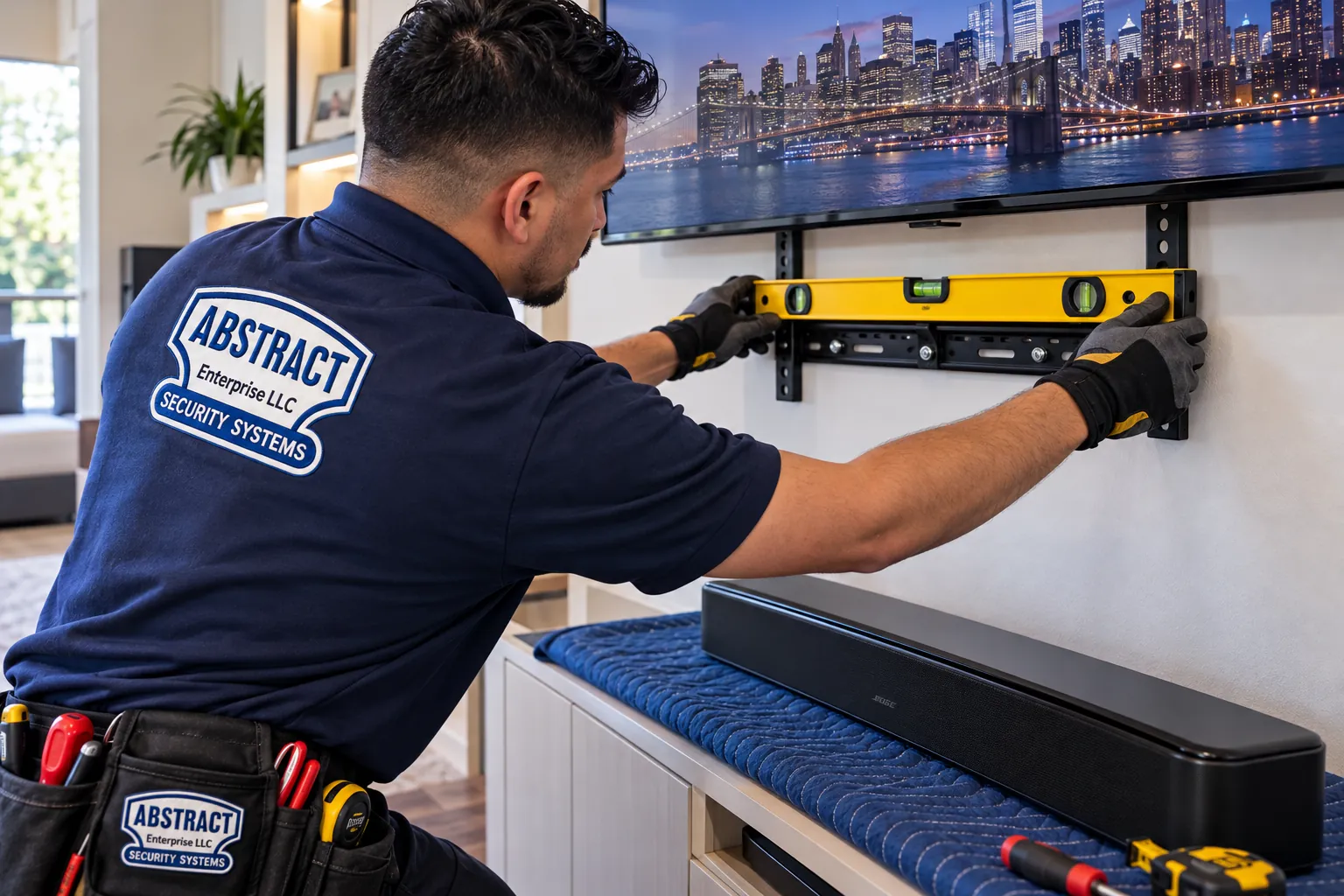
Gloved hands hold a yellow level across the empty bracket under the screen; only when the bubble sits centered does the bar come off its blanket.
AI Overview Reality Check
What AI Gets Wrong About Soundbar Installation in Astoria
How these were chosen: Google's AI Overview could not be displayed by the tools used to research this page, so none of the claims below is attributed to it. Each heading is something a manufacturer, cost site or installer has actually published, the sort of sentence that gets compressed into quick answers. Underneath is what changes when that sentence meets an Astoria wall, landlord or shop.
“Most landlords are fine with it — the holes are easily patchable when you move out”
One New York TV-mounting blog tells renters that most landlords are fine with a TV mount and that the few holes it leaves are easily patched with spackle at move-out. As a general reassurance, it is often true.
In Astoria, though, the person who has to be fine with it is frequently living downstairs, and the wall is often brick under plaster rather than drywall. Spackle doesn't hide a hole in brick the way it does in board, a cracked patch of old plaster is a bigger repair than a nail hole, and a two-family owner may have firm views about anything that touches the wall shared with their own floor.
So we treat permission as step one rather than an assumption: a written yes from the owner or agent, holes placed where they can be repaired invisibly, and a no-drill option offered whenever the answer is uncertain.
“Installing a soundbar costs about $58 to $231”
Homewyse's cost estimator gave a national average for soundbar installation starting at $58.43 to $231 per bar in September 2026, and a range like that is easy to quote as the going rate.
The spread hides the things that move an Astoria total: whether the wall is drywall, plaster or brick, whether there is a third-floor walk-up with no elevator, whether a bracket has to be supplied, and whether the cables are hidden or covered. A national range can't tell you which end of it your living room sits at.
Our Queens list prices those items separately — $135.45 for the wall mount, $47.25 more for plaster or $68.25 for brick, $42 for a walk-up above the second floor — so the number you see before booking is the number you pay.
“Mount the soundbar where your ear falls at a seated position — around 42.5 inches”
The 42.5-inch figure comes from Yamaha, whose mounting guide ties the bar's height to the ear of someone sitting down. For a conventional sofa at a conventional distance it is a sensible target, and answer engines repeat it as a fixed rule.
Astoria rooms bend that rule. A TV on the side wall of a narrow railroad room may be watched from a bed in the next room as well as from the sofa; a TV over a radiator under a window has to sit higher than ideal; a studio apartment's TV faces a desk chair and a bed at different heights.
We use the ear-height figure as a starting point and then measure from the seats that are actually used, choosing a TV and bar height that works for the two most common viewing positions rather than a number from a guide.
“Consider putting the soundbar on a bracket connected to your TV mount”
Dolby's guide to soundbar placement suggests that if you use an adjustable TV mount, the soundbar can go on a bracket connected to that mount so the two move together. It is sound advice, and one we use often for renters.
The part left out is weight and reach. A TV-attached bracket adds the bar's weight to the TV mount's arm, which matters on a full-motion arm already near its rating, and the bar has to clear the bottom of the TV without blocking its sensor. On a fixed or tilting mount in a brick wall, the arrangement works well; on a long articulating arm in a corner, it needs checking.
We confirm the TV mount's rated load against the combined weight of the TV, bar and bracket before fitting one, and adjust the arm's tension so the screen doesn't droop.
“You need eARC for lossless Dolby Atmos”
AWOL Vision's explainer on eARC and ARC states it correctly: eARC is needed for lossless formats such as Dolby TrueHD Atmos and DTS-HD Master Audio. The same piece notes that standard ARC can still carry Atmos inside a compressed Dolby Digital Plus stream — the part that tends to get dropped when the line is shortened to “you need eARC for Atmos”.
That matters for Astoria households with older TVs, or with a TV the landlord supplied. Many of those sets have ARC but not eARC, and people assume they have to replace the TV to use the bar they bought. For streaming services, which send Atmos in Dolby Digital Plus, ARC is usually enough.
We check the TV's ports and settings on the day, enable the right audio output, and tell you honestly whether eARC would make an audible difference for what you actually watch.
“Universal soundbar mounts fit most soundbars”
Sanus describes its universal soundbar mount as fitting most soundbars up to 20 pounds, attaching to the back or bottom with adjustable depth. That is accurate for the bracket.
What a universal bracket can't decide is what holds it to the wall. The screws in the box are for wood studs; they mean nothing in Astoria brick, in plaster over a void, or in the steel studs of a new tower. The bracket fitting the bar is half of the job; the anchor fitting the wall is the other half, and it is the half that fails.
We bring anchors for each wall type, choose them after a pilot hole tells us what is behind the paint, and load-test each one before the bar goes up.
“Turn on dialogue enhancement to hear voices more clearly”
Nearly every soundbar maker describes its voice or dialogue mode as making speech easier to understand, and it does lift the vocal range. Quick answers present it as the fix for a TV you can't hear.
On 31st Street, though, a passing N train can be louder than any setting can overcome for a few seconds, and in a two-family the real limit on volume is the household below. A dialogue mode helps most when the bar is placed well and the room is arranged so that the noise isn't coming from behind the screen.
We switch the mode on as the last step, after placement, and also show you where captions live on each remote, because during the loudest moments a line of text is more reliable than any speaker.
Hear the Show Over the N Train
Send the bar's model and one photo of the wall. You get a mounting plan, a Queens-rate total and a list of anything your landlord or building will want from us.
A rented floor off Ditmars, a walk-up by the el, a tower apartment at Halletts Point or a shop on Steinway Street — this form gets you a written Astoria total, at Queens rates, by the end of the business day. Rather talk it through? Call (347) 434-6392.
✅
Received — We'll Be in Touch
An installer who works in Astoria will call before the business day ends. If it can't wait, phone (347) 434-6392.
How It Works
Our Installation Process
Eight steps, whether it is a compact bar on a console in a Ditmars studio or a bar, sub and rears under a new TV on a Halletts Point steel-stud wall. The extra step compared with a house in the suburbs is the second one: permission.
1. Models and a photo
Text or email the two model numbers and one picture of the TV wall taken from the sofa, wide enough to catch the outlet, windows and radiator. From that we can usually name the wall, the bracket and the hookup.
2. Permission in writing
If you rent, you get the owner's or managing agent's yes in writing; we send any insurance certificate they ask for at no charge, and check building working hours.
3. Written Queens price
A written figure comes back itemized from the Queens list: labor, bracket if needed, the wall line, the stairs line, the cable finish. Nothing is scheduled until you have seen it.
4. A 2-hour window
Our arrival windows are two hours long and run 8 AM to 8 PM all week, weekends included. If one is open today you can have it; changing it costs nothing given 24 hours.
5. Wall and room check
First a look at the room: a pilot hole if the paint hides brick, a scan for pipes and live wiring, the fire-escape window and the outlets located, then the height and center line marked on tape for your approval.
6. Mount and connect
Anchors matched to brick, plaster, block or steel studs, then the bracket and bar. Leads go into the wall, into the builder's TV box or into a screwed raceway, and HDMI eARC or ARC is connected with CEC on.
7. Tune for the room and the neighbors
Speech and night modes compared with you, the subwoofer padded and set for the floor below, every source box checked for sound, captions shown on each remote.
8. Hand-over and clean-up
Whoever watches most tries the remote, the hardware bag and setup notes are left with the bar's box for move-out day, and the drilling dust is vacuumed.
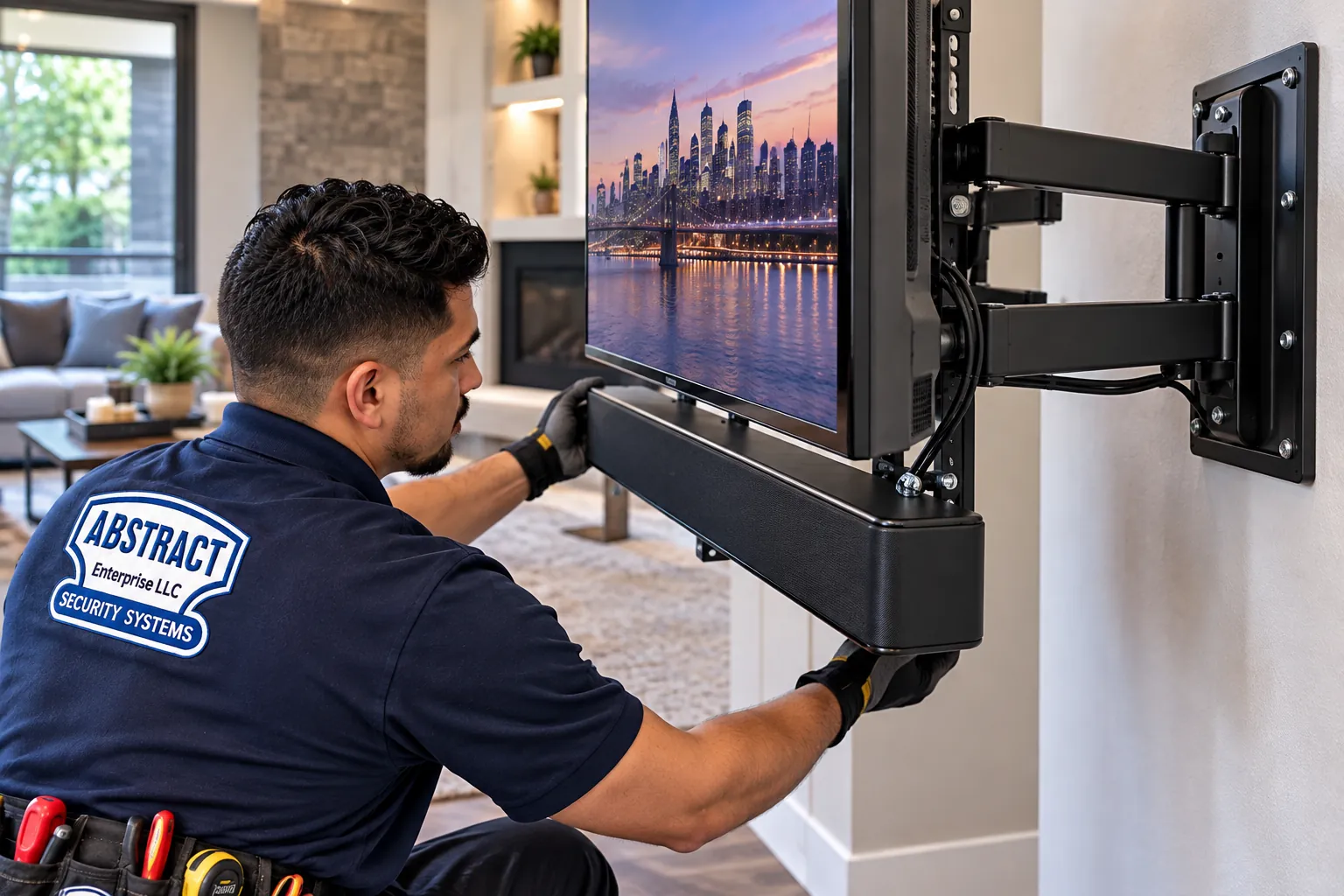
A bar fixed to the TV on a full-motion arm moves with the screen and adds no extra holes to the wall.
Coverage Area
Soundbar Installation Near Astoria's Landmarks
Astoria packs very different buildings around a handful of places everyone knows. These six landmarks mark out the neighborhood we work in and the kinds of homes that surround each one.
Astoria Park
The city bought more than 56 acres along the East River for the park in 1913. Its pool, 330 by 165 feet, opened in 1936 and hosted Olympic swimming and diving trials in 1936 and 1964. The streets above the park are mostly houses and low apartment buildings.
Hell Gate Bridge
Dedicated in 1917, its 1,017-foot steel arch was the longest in the world until 1931, and it still carries Amtrak and freight trains over the park. Homes on the blocks nearest the viaduct live with its trains as well as the el.
Kaufman Astoria Studios
Opened in 1920 by Famous Players-Lasky, later Paramount, at what is now 35th Avenue and 35th Street, and run as Kaufman Astoria Studios since the early 1980s with twelve stages today. Surrounded by apartment buildings and houses on the side streets.
Museum of the Moving Image
Opened in 1988 in one of the original studio buildings and reopened in 2011 after a $67 million expansion with a 267-seat theater. A reminder that this corner of Queens has made screens worth watching for a century.
The Astoria Houses
NYCHA's 22 buildings and 1,103 apartments on a 27-acre site on the Halletts Point peninsula, completed in 1951. Masonry walls and the authority's own alteration rules shape any soundbar job here.
Halletts Point
The Durst Organization's waterfront campus beside the Astoria Houses, with three residential towers and more than 1,000 rental apartments, the first leasing from 2019. Steel-stud partitions, concrete and river-facing glass.
We also install throughout Ditmars-Steinway, Astoria Heights, Old Astoria, the blocks around Steinway Street and 30th Avenue, and next door in the rest of Queens — Long Island City, Sunnyside, Woodside, Jackson Heights and East Elmhurst — as well as across the river in the other boroughs.
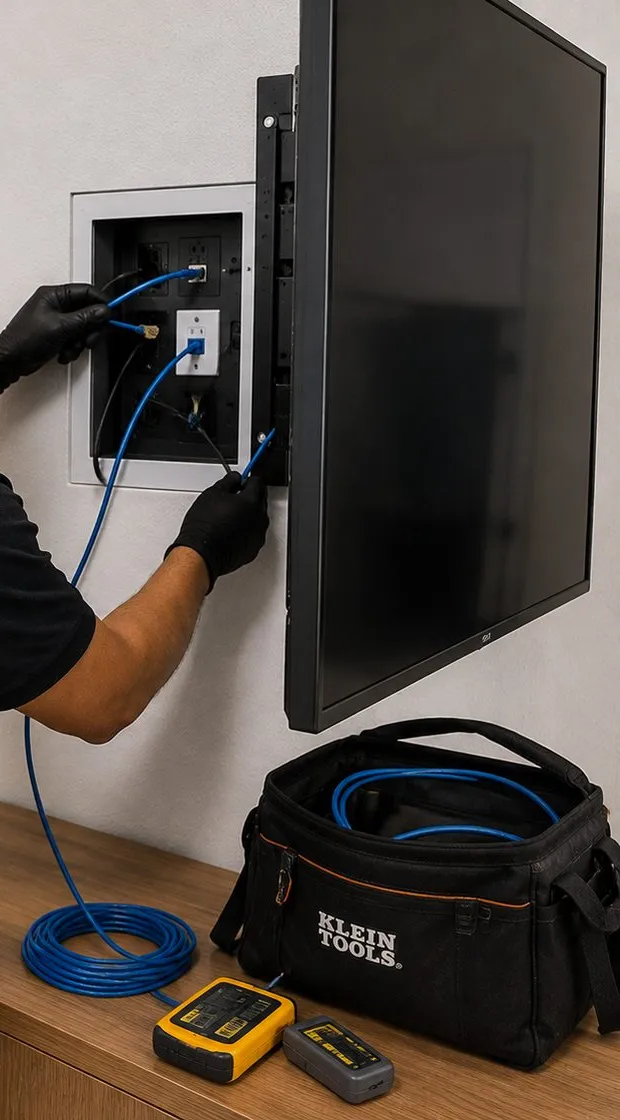
A recessed box with an outlet and a data jack beside the screen keeps plugs flush with the wall; the tester and cable bag sit on the cabinet.
Pricing
Soundbar Installation Cost in Astoria
There is no Astoria surcharge: the neighborhood uses the published Queens list. Add up the rows that fit your job and that sum is both the quote and the bill. Anything we could not have seen in your photo is priced to you before we touch it. Every figure here already carries the 1.05 factor that applies to Queens on our soundbar and accessory menu.
Soundbar service
Astoria (Queens) price
What it covers
Soundbar on a console or stand
$82.95
Placed, connected to the TV, set up and tested; no drilling
Soundbar wall-mounted under the TV
$135.45
Bracket fixed, bar hung and leveled, connected and tested
Sanus soundbar bracket
$89.24
Supplied by us for bars sold without a bracket, or where the boxed one is wrong for brick or steel studs
In-wall concealment
$177.45
Hidden power and HDMI in a hollow partition, owner's say-so required
Paintable cord cover
$61.95
Surface raceway from the bar to the outlet or console
Cable run to a cabinet or other spot
$103.95
Up to 25 ft
Sonos setup
$131.25
Sonos bar, sub, rears, app and grouping
A/V receiver hookup
$135.45
Receiver connected and configured
Universal remote
$103.95
Programmed for TV, bar and sources
Streaming device setup
$51.45
Roku, Apple TV, Fire TV, Chromecast or similar
Full home theater connection
$367.50
Several components set up together
Walls, stairs and extras in Astoria
Condition
Price
Where we meet it in Astoria
Drywall on wood studs
$0
Frame houses and some renovated apartments
Metal studs
+$31.50
Halletts Point and the newer rental buildings
Plaster
+$47.25
Pre-war walk-ups and older houses
Brick or stone
+$68.25
Two-family party walls, exposed-brick accent walls
Concrete or cinder block
+$78.75
NYCHA and mid-century buildings
Tile or marble
+$99.75
Kitchen backsplashes, bathroom TVs
Plywood backer board
$89.25
Where the wall can't take anchors directly
High mount (above about 8 ft)
$78.75
Shops and tall pre-war ceilings
Walk-up, 3rd floor and above, no elevator
$42
Most pre-war apartment buildings and upper floors of houses
Box removal
$26.25
When you'd rather not carry it down the stairs
Certificate of insurance for a landlord, co-op or managing agent
Free
Halletts Point, managed buildings, shop landlords
Time-billed visits and TV mounting in Astoria
Some visits involve no drilling at all: a bar moved onto a replacement TV, an eARC or lip-sync fault, a sub that has to be re-paired, a second source box that needs its sound routed. Those are charged on time, $195 for the first hour at the Queens rate and then in 30-minute blocks. When a television is hung on the same trip, the Queens base for a 32- to 55-inch screen on a flat or tilt mount over wood studs is $179.99, and sizes, mount styles and wall types are itemized on the Queens TV mounting price list.
Included, excluded and worth knowing
Part of every install: working out what is behind the paint, setting the bracket level, hanging and connecting the bar, dressing the leads, turning on HDMI-CEC, setting up speech and night modes, and vacuuming the dust before we go.
Excluded: adding or moving outlets (a licensed electrician's job) and filling or painting holes when a bar comes down (a decorator's job).
Wasted trips: if we arrive and can't work — no bar on site, nobody to let us in, or the owner's or building's permission still missing — the visit is charged as a $150 return trip. Getting the yes in writing before the day avoids it.
Fragile surfaces: if glazed tile, old plaster or soft brick could chip, we tell you before drilling and wait for your go-ahead.
A national chain's install menu or an app-booked handyman versus a licensed local installer. Flat national prices are written for drywall over wood studs in a suburban house, and in that room they are fair. They don't price an Astoria job: brick under plaster, a fourth-floor walk-up, an owner who wants an insurance certificate, a steel-stud tower wall. A Queens list that prices each of those, from a state-licensed installer you can call back afterwards, tells you what your own room will cost.
Shop Our Systems
Astoria Soundbar Packages & Pricing
Most renters land on the first card, most owners on the second or third. The price on each card is the bundle alone; if your wall is plaster, brick or block, or you are up more than two flights with no elevator, those rows from the table above go on top.
Starter — Console, No Drilling
$82.95
One line, $82.95: the bar goes on the furniture in front of the screen, joins the TV over eARC or ARC, and answers the TV remote through HDMI-CEC. Speech mode on, leads hidden behind the unit, not a single hole in the wall — the usual pick for a lease with a year or less to run.
Standard — Wall Bracket Under the TV
$224.69
The wall mount ($135.45) plus our Sanus bracket ($89.24), $224.69 together. Anchors chosen for the wall you have; plaster adds $47.25, brick $68.25, block or concrete $78.75. Usually paired with a $61.95 cord cover in Astoria rentals.
Premium — Wall Bracket, Cables Inside
$402.14
Mount labor $135.45, Sanus bracket $89.24 and an approved in-wall power-and-cable kit $177.45 bring this to $402.14. It only works on a hollow wall, typically in a frame house or a newer steel-stud building, and only with the owner's or management's agreement.
Bring Your Own Equipment — Labor Only
Supplying the bracket yourself, whether from the bar's carton or bought separately, means you pay the $135.45 Queens mounting labor and any wall add. Your bracket's maker warrants it, and it needs a rating that covers your bar. If we think it won't suit the wall you have, you hear that before we drill and can switch to our Sanus bracket.
Get Your Astoria Total in Writing
Which floor, which wall, which bar: three answers and one photo are enough for us to price it from the Queens list before the day is out.
Astoria is one neighborhood on the map and several on the ground. A visit near the last stop on Ditmars Boulevard has little in common with one in a Halletts Point tower, though they are a short walk apart. This is how the work tends to change.
Ditmars-Steinway and the blocks above Astoria Park
The northern end, around the Ditmars Boulevard terminal of the N and W and up toward the park and the Hell Gate viaduct. Rows of brick houses, many of them two-families with an owner on one floor, small apartment buildings, and the older streets that grew up around the Steinway piano works in the nineteenth century. The typical job is a bar on a plaster-over-brick wall in a rented upper floor, with a painted raceway and a subwoofer kept modest for the household below. Homes nearest the Hell Gate approach get the same trains-and-dialogue setup as those on 31st Street.
Along 31st Street under the el
Apartments with windows at track height from Ditmars down toward 36th Avenue, plus the shops beneath them. Here the room and the wall matter more than the bar: if there is a choice, the TV goes in the room away from the street, and in the room it goes on a wall that puts the train windows beside or behind the seats. Speech-focused bars and well-chosen dialogue settings earn their keep, and bracket fixings get checked properly, because the windows and frames see constant traffic outside.
Central Astoria — 30th Avenue, Broadway and Steinway Street
The busiest part of the neighborhood: walk-up apartment buildings on the avenues, two-families on the side streets, and three commercial corridors full of cafés, restaurants, salons and barbers. Residential jobs here are mostly renters on the second floor and up, so the walk-up line and permission paperwork come up often. Commercial jobs are screens over counters with apartments directly above.
Old Astoria, Halletts Point and the waterfront
The oldest part of the village near Hallett's Cove, now a mix of older houses, the Astoria Houses and the new Halletts Point towers. One street can mean a NYCHA apartment with block walls and a hammer drill, a nineteenth-century frame house with studs behind the plaster, and a new rental with steel studs, a recessed TV box and a managing agent's insurance requirements.
Around the studios and Steinway Street south
The blocks around Kaufman Astoria Studios and the Museum of the Moving Image near 35th Avenue, and the southern end of Steinway Street. Apartment buildings, houses and a growing number of newer mid-rises, plus offices and production businesses that use displays for meetings and playback. Accurate-sound settings and meeting-room bars come up here more than anywhere else in the neighborhood.
Astoria Heights and the eastern edge
The residential blocks at the eastern edge of the neighborhood, toward the Grand Central Parkway. When the person booking owns the house rather than renting a floor of it, the job tends to grow: a bar in the living room, another in a finished basement, and cables run through the basement ceiling instead of along the walls, because the owner can say yes to all of it at once.
Neighbor-Friendly Setup
Setting a Soundbar Up for a Shared Astoria House
In a two-family or a walk-up, the soundbar has two audiences: the people on the sofa and the people on the other side of the floor. These are the choices we make on every Astoria install where someone lives above, below or through the wall.
Subwoofer off the shared floor and walls. Low bass travels through joists and brick far more than speech does. The sub goes on a dense pad or riser, away from the party wall and not directly above a bedroom below, and its level is set to fill out the sound, not to shake the room.
Bar close under the screen, aimed at the seats. A bar at seated ear height delivers speech straight to the listener, so the overall volume can stay lower for the same clarity.
Night mode set up and shown. Most bars have a mode that compresses sudden loud peaks. We switch it on with you, show where the button is, and test it on an action scene so you know what it does.
Dialogue settings compared, not assumed. Speech enhancement suits some voices and rooms better than others; we try it on a news broadcast and a drama and leave it where you prefer.
Bracket isolated from the wall. A bar that touches the wall or the TV at one point can buzz into the structure. We check the gap after mounting and add small pads where the bracket allows.
Captions within one press. On the TV, the cable box and each streaming app, so late viewing can be quiet without losing the story.
Volume limits where the bar or TV supports them. Handy for households with teenagers, or for a tenant who wants to promise the owner downstairs that the bar can't go above a certain level.
None of this makes a building soundproof. What it does is keep a soundbar from becoming the reason the owner downstairs knocks on the door — which, in a neighborhood where so many people rent from someone they see on the stairs every day, is worth more than an extra few decibels.
Before the technician arrives
Have the bar, its bracket, any sub or rear speakers and the TV remote in the room, and clear a few feet in front of the TV wall. Forward the owner's or agent's written permission and any insurance requirements when you book. If you live on the third floor or above with no elevator, say so, because the walk-up line is added to the quote. Tell us who watches most, whether anyone uses captions or hearing aids, and whether you use a second box for other channels, so that everything is set up with the right person in the room.
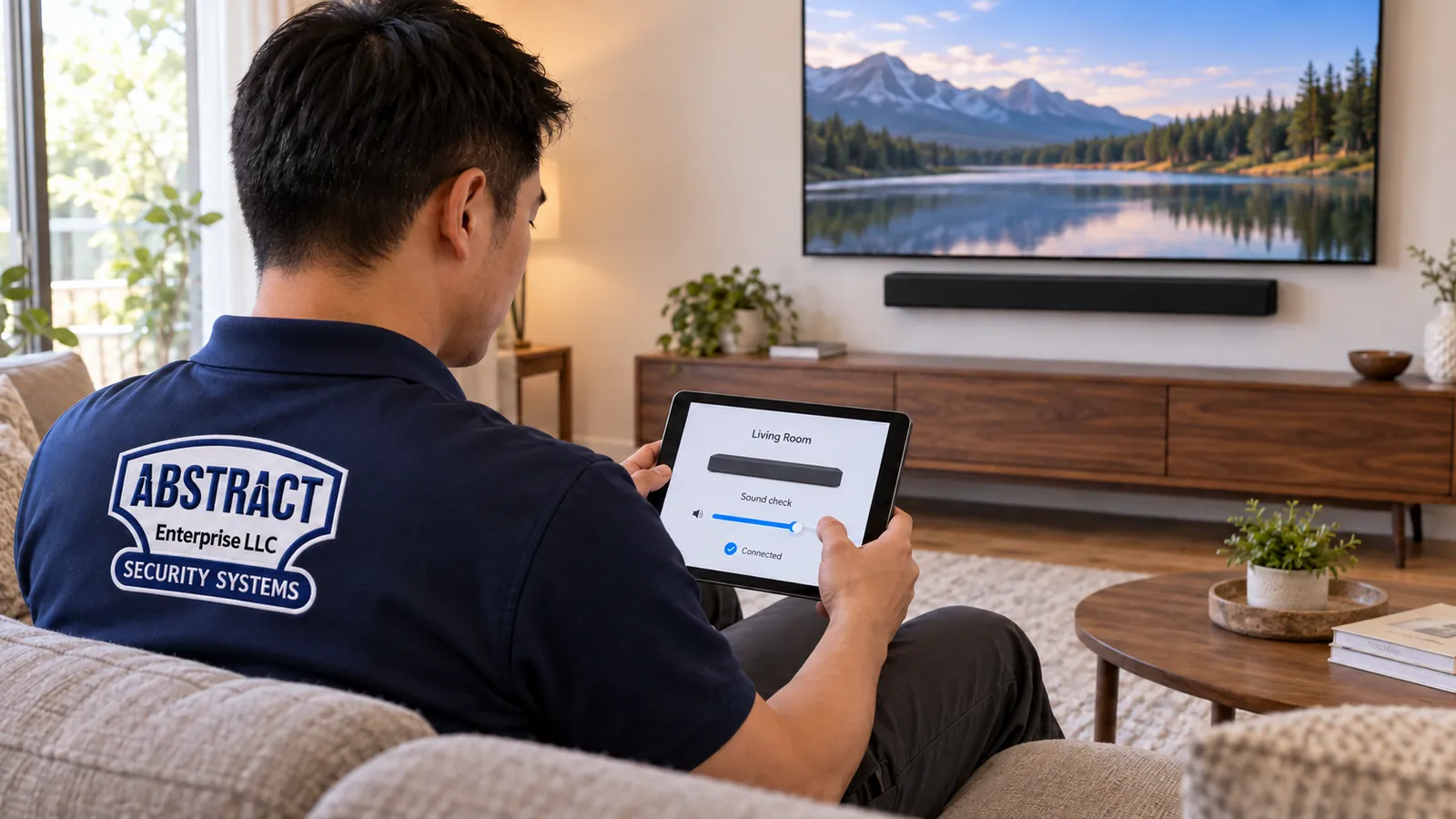
The final adjustment is made from the sofa, tablet in hand, listening where the household actually sits.
Moving Day
Soundbars on Astoria Moving Days, In and Out
Because most of Astoria rents, a large share of our soundbar visits happen within a few weeks of a lease starting or ending. The work at each end is different, and a little planning at the start makes the end of the lease far easier.
Moving in
The best time to put a soundbar up is before the sofa, the rug and the boxes fill the room, but after you know where the sofa will go. A bar is aimed at the seats, so the TV wall is decided by the seating, not the other way round. In a new Astoria apartment, walk the room with the windows open for a few minutes before deciding: on or near 31st Street you will hear the el, on Ditmars and the avenues the buses and traffic, and near the Hell Gate approach the passing trains. Then pick the wall that puts the loudest window beside or behind the viewer.
Next, find the outlets and the cable or fiber point. Older apartments in Astoria often have few outlets per room, and the cable company's line may enter on a wall that does not suit the TV. It is usually cheaper to put the TV where the outlet and the cable line are, or to run one short raceway, than to fight the layout. If the building is new, look for a recessed TV box in the wall before anything else; the builder may have chosen the TV wall for you.
Finally, get permission before booking, not on the morning of the visit. A text from the owner downstairs or an email from the managing agent saying the TV and bar can be mounted, and whether in-wall cabling is allowed, is all we need. Managed buildings will ask for our certificate of insurance; send us the agent's details with the booking and the certificate goes straight to them.
Living with it
Once the bar is up, the things that tend to change in an Astoria apartment are the people and the equipment. A roommate moves in with a games console, a new streaming stick replaces an old one, the cable company swaps the box, or the TV updates its software overnight and forgets its sound settings. Most of these need no visit at all: the setup notes we leave cover how to re-select the TV's audio output and switch CEC back on. When they do need a visit, it is billed by time at the Queens rate rather than as a new installation.
It is also worth looking at the bracket now and then. Walk-up apartments see doors slammed, radiators knocking and windows rattling as trains pass. None of that should move a properly anchored bracket, but plaster in older buildings can soften around an anchor over years, and catching it early is a two-minute job.
Moving out
At the end of a lease the bar comes off its bracket, the bracket comes off the wall, and the anchors either come out or are trimmed flush depending on the type. In plaster and drywall the holes are small and fill quickly. In brick, because we placed the anchors in the face of the brick rather than in the mortar, a patch with a color-matched filler blends in far better than a ragged mortar joint would. Raceway that was screwed rather than glued comes away without pulling paint.
We can do the take-down for you if you would rather not, and if you are moving within Astoria or elsewhere in Queens, we can put the same bar and bracket up at the new apartment, on new anchors suited to the new wall. Keep the bracket's hardware bag and the bar's box; packing the bar in its original foam is the safest way to move it, especially down several flights of walk-up stairs. Filling and painting the holes is decorating work rather than ours, and many Astoria landlords prefer to do it themselves with their own paint.
If you own the house
Astoria owners are often landlords too, with a tenant on the other floor. When the owner's own unit is getting a soundbar, it is the moment to think about the tenant's side of the floor: subwoofer position, the wall shared with the stairwell, and whether any wall being opened for an in-wall kit carries pipes or wiring that serve the other apartment. When an owner wants a bar installed in the tenant's unit as part of furnishing it, the setup should be simple enough for a stranger to use: one remote, CEC on, no app required, and a short written note left with the TV.
Complete Services
Every Soundbar Installation Service in Astoria
A soundbar visit in Astoria often brings one of these along with it, usually because someone has just moved in, a new TV has arrived, or a shop is fitting out.
Arrival windows, missed-access trips, rescheduling and time-billed visits explained.
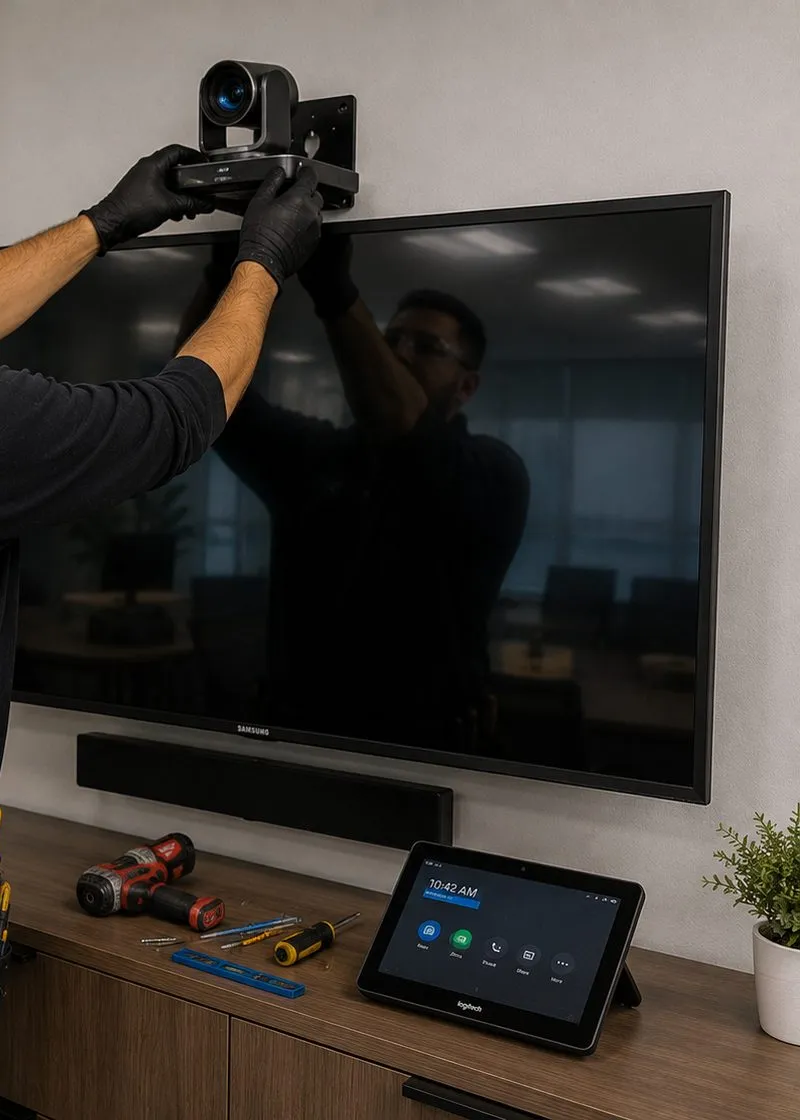
An office meeting display: camera above, soundbar below, control panel on the credenza, the kind of setup used for clear speech on video calls.
Field Notes
Field Notes on Astoria Soundbar Walls
What our installers check first in Astoria buildings — habits, not an account of a specific customer's home
In a two-family, ask which floor the owner sleeps on before choosing where the subwoofer goes, and look at the ceiling below if you can. If the downstairs bedroom is under the TV wall, the sub goes to the opposite side of the room on a pad, and the bar does the work.
On a party wall, a pilot hole is worth more than a scanner. Plaster over brick fools most stud finders. Red or buff dust means brick; white dust that suddenly stops means plaster over a void, and a different anchor.
In a walk-up, find the fire-escape window before planning anything else on that wall, and keep the approach to it clear of furniture and cables. On 31st Street, stand at the front window when a train passes and listen from the sofa; it settles the argument about which wall the TV goes on faster than any measurement.
In a new tower, ask the managing agent which wall is shared with the next apartment and whether contractors may drill it. And in any building with a recessed TV box, open it before deciding the bar's cable route — the builder may already have done half the job.
FAQ
Astoria Soundbar Installation FAQ
Do you cover Ditmars-Steinway, Astoria Heights and the Halletts Point towers, or only central Astoria?
+
All of it. We work across the whole neighborhood, from the blocks around Astoria Park and the Ditmars Boulevard station to Astoria Heights, Old Astoria, the Astoria Houses and the Halletts Point buildings, at the same Queens prices. There is no travel charge for any part of Astoria.
What would a third-floor walk-up with a plaster wall and a painted cord cover come to in Astoria?
+
On the Queens list that is $135.45 for the wall mount, $47.25 for plaster, $42 for the walk-up and $61.95 for the cord cover, which comes to $286.65. If the bar arrived without a bracket, our Sanus bracket adds $89.24, for $375.89 in total.
Do I have to be the leaseholder to book the visit?
+
No. A roommate, subtenant or family member can book and pay. What we do need is the permission of whoever controls the wall, usually the owner or managing agent, and an adult at the apartment to let us in and agree the position before drilling.
Can the soundbar clip onto a floor-standing TV stand so nothing touches the wall?
+
Often, yes. Many floor stands with a pole or frame accept a soundbar bracket or have a shelf for one. We check the stand maker's accessory list and weight rating against your bar, fit it, and route the cables down the pole so the whole setup can roll away from the wall at move-out.
How should a soundbar be cleaned, and does street dust from an open window matter?
+
Unplug it and wipe the case with a dry microfiber cloth; use a soft brush or a vacuum on low through a cloth for fabric grilles, and never spray liquid at it. Dust from open windows facing a busy avenue builds up faster on grilles and vents, so a light clean every month or two keeps the drivers and cooling clear.
Will you test a secondhand soundbar before mounting it?
+
Yes. Before the bracket goes up we power the bar, connect it to your TV, play test material through every input you plan to use and pair any sub or rears. If a used bar has a fault, you find out before holes are drilled, and the visit can switch to a console setup or a different bar.
Can the soundbar sit inside a cabinet with the doors closed?
+
Not if you want it to sound right or respond reliably. Closed doors muffle speech, trap heat and can block the remote's infrared signal. A bar belongs on top of the cabinet, on an open shelf with its front flush to the edge, or on the wall. Many bars can be controlled by the TV remote over HDMI-CEC, which helps but doesn't fix the sound.
How often should a bracket in old brick or plaster be checked?
+
Give it a quick look and a gentle push once or twice a year, and any time the bar starts to tilt, rattle or show a hairline crack around the bracket. In plaster especially, a loose anchor is easy to tighten or move early and much harder once the plaster has crumbled around it.
Can the building owner look at the drilling spot and approve it on the day?
+
Yes, and in a two-family it often helps. We mark the bracket and anchor positions on painter's tape, explain what is behind the wall and how the holes would be repaired later, and only drill once the owner or their agent is happy with the marks.
Can a soundbar go on a rolling TV cart for a rehearsal room or classroom?
+
Yes. Most mobile TV carts take a soundbar bracket under the screen or a shelf for one. We fix the bar to the cart, route the power and HDMI along the cart's column, add a single cord to the wall outlet, and set the bar to follow the TV's power so whoever rolls it in only needs one remote.
Need cameras, intercoms or Wi-Fi instead? Every system we put in is listed on the AESS home page; about us introduces the company, and the free quote page accepts any kind of request.
Astoria Soundbar Gone Quiet — Same-Day Help
TV updated and the bar went mute? Volume buttons ignored, the sub unpaired, the bracket loosening from plaster? Call (347) 434-6392 and take the earliest free 2-hour slot, frequently the same day; a technician typically clears a control or pairing fault in one to two hours.
Abstract Enterprises Security Systems · 460 E Fordham Rd, Bronx, NY 10458 · Queens line for Astoria (347) 434-6392 · WhatsApp (718) 679-0359 via wa.me
NYS Low-Voltage License #12000287431 · 100% Licensed & Insured · Same-Day Estimates · Rated 4.7★ from 201 Google Reviews
Brackets and parts carry their manufacturer's warranty. Full terms — including 50% deposit, one-year parts-only warranty on AESS-supplied products, and the late-fee schedule — are set out in the service agreement. See our warranty page.
Last reviewed October 17, 2026. Revision history: Astoria neighborhood page launched with Queens pricing, landlord-and-lease guidance, notes for apartments on the 31st Street el and setup for new waterfront buildings.